View allAll Photos Tagged Reasoning
Rapid strata formation in soft sand (field evidence).
Photo of strata formation in soft sand on a beach, created by tidal action of the sea.
Formed in a single, high tidal event. Stunning evidence which displays multiple strata/layers.
Why this is so important ....
It has long been assumed, ever since the 17th century, that layers/strata observed in sedimentary rocks were built up gradually, layer upon layer, over many years. It certainly seemed logical at the time, from just looking at rocks, that lower layers would always be older than the layers above them, i.e. that lower layers were always laid down first followed, in time, by successive layers on top.
This was assumed to be true and became known as the superposition principle.
It was also assumed that a layer comprising a different material from a previous layer, represented a change in environmental conditions/factors.
These changes in composition of layers or strata were considered to represent different, geological eras on a global scale, spanning millions of years. This formed the basis for the Geologic Column, which is used to date rocks and also fossils. The evolutionary, 'fossil record' was based on the vast ages and assumed geological eras of the Geologic Column.
There was also circular reasoning applied with the assumed age of 'index' fossils (based on evolutionary beliefs & preconceptions) used to date strata in the Geologic Column. Dating strata from the assumed age of (index) fossils is known as Biostratigraphy.
We now know that, although these assumptions seemed logical, they are not supported by the evidence.
At the time, the mechanics of stratification were not properly known or studied.
An additional factor was that this assumed superposition and uniformitarian model became essential, with the wide acceptance of Darwinism, for the long ages required for progressive microbes-to-human evolution. There was no incentive to question or challenge the superposition, uniformitarian model, because the presumed, fossil 'record' had become dependant on it, and any change in the accepted model would present devastating implications for Darwinism.
This had the unfortunate effect of linking the study of geology so closely to Darwinism, that any study independent of Darwinian considerations was effectively stymied. This link of geology with Darwinian preconceptions is known as biostratigraphy.
Some other field evidence can be observed here: www.flickr.com/photos/101536517@N06/sets/72157635944904973/
and also in the links to stunning, experimental evidence, carried out by sedimentologists, given later.
_______________________________________________
GEOLOGIC PRINCIPLES (established by Nicholas Steno in the 17th Century):
What Nicolas Steno believed about strata formation is the basis of the principle of Superposition and the principle of Original Horizontality.
dictionary.sensagent.com/Law_of_superposition/en-en/
“Assuming that all rocks and minerals had once been fluid, Nicolas Steno reasoned that rock strata were formed when particles in a fluid such as water fell to the bottom. This process would leave horizontal layers. Thus Steno's principle of original horizontality states that rock layers form in the horizontal position, and any deviations from this horizontal position are due to the rocks being disturbed later.”)
BEDDING PLANES.
'Bedding plane' describes the surface in between each stratum which are formed during sediment deposition.
science.jrank.org/pages/6533/Strata.html
“Strata form during sediment deposition, that is, the laying down of sediment. Meanwhile, if a change in current speed or sediment grain size occurs or perhaps the sediment supply is cut off, a bedding plane forms. Bedding planes are surfaces that separate one stratum from another. Bedding planes can also form when the upper part of a sediment layer is eroded away before the next episode of deposition. Strata separated by a bedding plane may have different grain sizes, grain compositions, or colours. Sometimes these other traits are better indicators of stratification as bedding planes may be very subtle.”
______________________________________________
Several catastrophic events, flash floods, volcanic eruptions etc. have forced Darwinian, influenced geologists to admit to rapid stratification in some instances. However they claim it is a rare phenomenon, which they have known about for many years, and which does nothing to invalidate the Geologic Column, the fossil record, evolutionary timescale, or any of the old assumptions regarding strata formation, sedimentation and the superposition principle. They fail to face up to the fact that rapid stratification is not an extraordinary phenonemon, but rather the prevailing and normal mechanism of sedimentary deposition whenever and wherever there is moving, sediment-laden water. The experimental evidence demonstrates the mechanism and a mass of field evidence in normal (non-catastrophic) conditions shows it is a normal everyday occurrence.
It is clear from the experimental evidence that the usual process of stratification is - that strata are not formed by horizontal layers being laid on top of each other in succession, as was assumed. But by sediment being sorted in the flowing water and laid down diagonally in the direction of flow. See diagram:
www.flickr.com/photos/truth-in-science/39821536092/in/dat...
The field evidence (in the image) presented here - of rapid, simultaneous stratification refutes the Superposition Principle and the Principle of Lateral Continuity.
We now know, the Superposition Principle only applies on a rare occasion where sedimentary deposits are laid down in still water.
Superposition is required for the long evolutionary timescale, but the evidence shows it is not the general rule, as was once believed. Most sediment is laid down in moving water, where particle segregation is the general rule, resulting in the simultaneous deposition of strata/layers as shown in the photo.
See many other examples of rapid stratification (with geological features): www.flickr.com/photos/101536517@N06/sets/72157635944904973/
Rapid, simultaneous formation of layers/strata, through particle segregation in moving water, is so easily created it has even been described by sedimentologists (working on flume experiments) as a law ...
"Upon filling the tank with water and pouring in sediments, we immediately saw what was to become the rule: The sediments sorted themselves out in very clear layers. This became so common that by the end of two weeks, we jokingly referred to Andrew's law as "It's difficult not to make layers," and Clark's law as "It's easy to make layers." Later on, I proposed the "law" that liquefaction destroys layers, as much to my surprise as that was." Ian Juby, www.ianjuby.org/sedimentation/
The example in the photo is the result of normal, everyday tidal action in a single incident. Where the water current or movement is more turbulent, violent, or catastrophic, great depths (many metres) of stratified sediment can be laid down in a short time. Certainly not the many millions of years assumed by evolutionists.
The composition of strata formed in any deposition event. is related to whatever materials are in the sediment mix, not to any particular timescale. Whatever is in the mix will be automatically sorted into strata/layers. It could be sand, or other material added from mud slides, erosion of chalk deposits, coastal erosion, volcanic ash etc. Any organic material (potential fossils), alive or dead, engulfed by, or swept into, a turbulent sediment mix, will also be sorted and buried within the rapidly, forming layers.
See many other examples of rapid stratification with geological features: www.flickr.com/photos/101536517@N06/sets/72157635944904973/
Stratified, soft sand deposit. demonstrates the rapid, stratification principle.
Important, field evidence which supports the work of the eminent, sedimentologist Dr Guy Berthault MIAS - Member of the International Association of Sedimentologists.
(Dr Berthault's experiments (www.sedimentology.fr/)
And also the experimental work of Dr M.E. Clark (Professor Emeritus, U of Illinois @ Urbana), Andrew Rodenbeck and Dr. Henry Voss, (www.ianjuby.org/sedimentation/)
Location: Sandown, Isle of Wight. Formed 06/06/2018, This field evidence demonstrates that multiple strata in sedimentary deposits do not need millions of years to form and can be formed rapidly. This natural example confirms the principle demonstrated by the sedimentation experiments carried out by Dr Guy Berthault and other sedimentologists. It calls into question the standard, multi-million year dating of sedimentary rocks, and the dating of fossils by depth of burial or position in the strata.
Mulltiple strata/layers are evident in this example.
Dr Berthault's experiments (www.sedimentology.fr/) and other experiments (www.ianjuby.org/sedimentation/) and field studies of floods and volcanic action show that, rather than being formed by gradual, slow deposition of sucessive layers superimposed upon previous layers, with the strata or layers representing a particular timescale, particle segregation in moving water or airborne particles can form strata or layers very quickly, frequently, in a single event.
And, most importantly, lower strata are not older than upper strata, they are the same age, having been created in the same sedimentary episode.
Such field studies confirm experiments which have shown that there is no longer any reason to conclude that strata/layers in sedimentary rocks relate to different geological eras and/or a multi-million year timescale. www.youtube.com/watch?v=5PVnBaqqQw8&feature=share&.... they also show that the relative position of fossils in rocks is not indicative of an order of evolutionary succession. Obviously, the uniformitarian principle, on which the geologic column is based, can no longer be considered valid. And the multi-million, year dating of sedimentary rocks and fossils needs to be reassessed. Rapid deposition of stratified sediments also explains the enigma of polystrate fossils, i.e. large fossils that intersect several strata. In some cases, tree trunk fossils are found which intersect the strata of sedimentary rock up to forty feet in depth. upload.wikimedia.org/wikipedia/commons/thumb/0/08/Lycopsi... They must have been buried in stratified sediment in a short time (certainly not millions, thousands, or even hundreds of years), or they would have rotted away. youtu.be/vnzHU9VsliQ
In fact, the vast majority of fossils are found in good, intact condition, which is testament to their rapid burial. You don't get good fossils from gradual burial, because they would be damaged or destroyed by decay, predation or erosion. The existence of so many fossils in sedimentary rock on a global scale is stunning evidence for the rapid depostion of sedimentary rock as the general rule. It is obvious that all rock containing good intact fossils was formed from sediment laid down in a very short time, not millions, or even thousands of years.
See set of photos of other examples of rapid stratification: www.flickr.com/photos/101536517@N06/sets/72157635944904973/
Carbon dating of coal should not be possible if it is millions of years old, yet significant amounts of Carbon 14 have been detected in coal and other fossil material, which indicates that it is less than 50,000 years old. www.ldolphin.org/sewell/c14dating.html
www.grisda.org/origins/51006.htm
Evolutionists confidently cite multi-million year ages for rocks and fossils, but what most people don't realise is that no one actually knows the age of sedimentary rocks or the fossils found within them. So how are evolutionists so sure of the ages they so confidently quote? The astonishing thing is they aren't. Sedimentary rocks cannot be dated by radiometric methods*, and fossils can only be dated to less than 50,000 years with Carbon 14 dating. The method evolutionists use is based entirely on assumptions. Unbelievably, fossils are dated by the assumed age of rocks, and rocks are dated by the assumed age of fossils, that's right ... it is known as circular reasoning.
* Regarding the radiometric dating of igneous rocks, which is claimed to be relevant to the dating of sedimentary rocks, in an occasional instance there is an igneous intrusion associated with a sedimentary deposit -
Prof. Aubouin says in his Précis de Géologie: "Each radioactive element disintegrates in a characteristic and constant manner, which depends neither on the physical state (no variation with pressure or temperature or any other external constraint) nor on the chemical state (identical for an oxide or a phosphate)."
"Rocks form when magma crystallizes. Crystallisation depends on pressure and temperature, from which radioactivity is independent. So, there is no relationship between radioactivity and crystallisation.
Consequently, radioactivity doesn't date the formation of rocks. Moreover, daughter elements contained in rocks result mainly from radioactivity in magma where gravity separates the heavier parent element, from the lighter daughter element. Thus radiometric dating has no chronological signification." Dr. Guy Berthault www.sciencevsevolution.org/Berthault.htm
Visit the fossil museum:
www.flickr.com/photos/101536517@N06/sets/72157641367196613/
Just how good are peer reviews of scientific papers?
www.sciencemag.org/content/342/6154/60.full
www.examiner.com/article/want-to-publish-science-paper-ju...
The neo-Darwinian idea that the human genome consists entirely of an accumulation of billions of mutations is, quite obviously, completely bonkers. Nevertheless, it is compulsorily taught in schools and universities as 'science'.
Lancaster Thumper Mk III
The RAF BBMF Lancaster, PA474, is currently painted to represent an aircraft which served with No 617 Squadron after the Dams Raid. This is the story of the original aircraft and its wartime pilot and crew.
Some of the specially-modified Type 464 Lancasters, which survived the Dams Raid, remained in service with No 617 Squadron afterwards. However, these aircraft were not suitable for all operations and the Squadron needed replacement, standard Lancasters, as well as replacement crews to make up losses. One of the brand-new aircraft delivered to the unit to meet this need was Lancaster B1 DV385.
Lancaster DV385
Lancaster DV385 was built by Metropolitan-Vickers Ltd at Trafford Park, Manchester, at a stage of the war when the average build time for a Lancaster was 8 weeks. DV385 rolled off the production line in October 1943. It was delivered to No 617 Squadron at RAF Coningsby (by a quirk of fate now the home to the RAF BBMF Lancaster PA474) in November 1943 and given the squadron codes ‘KC-A’. The aircraft was retro-fitted with bulged bomb-bay doors enabling it to carry one of the huge 12,000-lb HC ‘thin-case’ ‘blockbuster’ blast bombs or a 12,000-lb ‘Tallboy’ bomb internally. DV385’s first bombing mission was flown on 16th December 1943; this was the first of four ‘ops’ it flew from Coningsby, three of them captained by Flight Lieutenant Tom O’Shaughnessy to drop 12,000-lb HC bombs against V-weapon sites in France. On 9th January 1944, 617 Squadron moved the few miles north to Woodhall Spa, taking DV385 with them.
Bob Knights and his Crew
Another Lancaster squadron, No 619, was already based at Woodhall Spa and moved to Coningsby to make way for 617 Squadron. One of the 619 Squadron crews, led by pilot Bob Knights, was coming towards the end of their tour at the close of 1943. Some of the crew were going to reach the ‘magic’ end-of-tour figure of 30 ‘ops’ slightly before the others and they did not want to be split up, reasoning that they were safer together. So they had decided to volunteer for a second operational tour with No 617 Squadron. Knights and his crew were about to become very familiar with Lancaster DV385.
Robert (‘Bob’) Edgar Knights was born in January 1921, in London. He volunteered for service as a pilot with the RAF and was eventually called up in March 1941, aged 20. He completed his flying training in America under the ‘Arnold Scheme’, flying Stearman PT17s, Vultee BT13s and AT6A ‘Texans’. In May 1942, after returning to England to complete his training, he crashed an Airspeed Oxford twin-engine aircraft. Bob badly injured his hand in the accident and this kept him off flying for 6 months. In June 1943, with 474 hours flying under his belt, Pilot Officer Bob Knights and his crew – Sergeants Rhude (navigator), Bell (bomb aimer), Twells (flight engineer), Rowan (wireless operator), Hobbs (mid-upper gunner) and Derham (rear gunner) – joined No 619 Squadron to fly Lancasters on bombing operations.
Before he could fly operationally with his own crew, Bob Knights had to complete the traditional ‘second dickey’ ‘op’ with an experienced crew to ‘learn the ropes’. He flew with Flt Lt ‘Ted’ Dampier-Crossley DFC, a New Zealander in the Royal Australian Air Force, who was flying with the RAF on 619 Squadron. Dampier-Crossley’s aircraft was Lancaster EE112, it wore the code letters ‘PG-T’ (normally ‘T’ for ‘Tommy’) and the crew had named it ’T’ for “Thumper” and painted the Walt Disney rabbit character, from the 1942 Walt Disney film Bambi, on the nose. Dampier-Crossley was an experienced operational bomber pilot and he taught Bob Knights some useful tricks and tactics, such as never flying straight and level but weaving constantly, which Bob’s crew subsequently credited with helping to keep them alive. Sadly, a couple of months later, on the night of 10/11th August 1943, Dampier-Crossley and his entire crew were killed during a raid on Nuremburg. A replacement Lancaster coded ‘PG-T’ arrived on the squadron and was allocated to Knights and his crew, who decided to name it “Thumper Mk II” in honour of Ted Dampier-Crossley and his crew. The so-called ‘Battle of Berlin’ began shortly afterwards and the Bob Knights crew made eight attacks against the "Big City", raids in which Bomber Command's losses were particularly high. On another occasion the crew was en route to bomb Hamburg when one of the engines failed shortly after reaching the Dutch coast. They would have been justified in turning back, but pressed on and bombed the target successfully from only 10,000 feet.
As a Lancaster had only a single pilot, Bob Knights decided that he would train his bomb-aimer, John Bell, to fly the aircraft in case he was killed or incapacitated. He felt that the bomb-aimer could most easily be spared from his other duties in such an eventuality. John Bell, who is the only surviving member of the crew, told the editor, during a visit to the BBMF at Coningsby in September 2012, that he spent several hours in all at the controls of a Lancaster with Bob standing beside him advising him. It is unlikely that such a novice Lancaster pilot, with no other piloting experience, would ever have been able to land the aircraft if his pilot was rendered ‘hors de combat’, but at least he might have been able to fly it back over friendly territory before the crew took to their ‘chutes’. John also said that he always seemed to over-control the aircraft, finding it difficult to keep it steady. When he was flying it, he said, “The rest of the crew were not best pleased!”
617 Squadron
By the end of 1943 the crew was approaching the required 30 ‘ops’ of a full operational tour with 619 squadron; they were due for a well-earned rest tour, but, instead, they volunteered for a second operational tour with No 617 Squadron. After they had been interviewed by 617’s Commanding Officer, Wing Commander Leonard Cheshire, the crew was posted to the elite unit in January 1944.
On the night of 20th January 1944, Flight Lieutenant Tom O’Shaughnessy, who had so far been the regular pilot of DV385, was killed in a training accident at Snettisham, Norfolk, along with his navigator Flying Officer Holding. He was flying one of the original Type 464 ‘Dams Raid’ Lancasters (ED918) and crashed into the sand dunes at the Wash bombing ranges, whilst practising for a proposed raid on an Italian dam that did not, in fact, go ahead. After Tom O’Shaughnessy’s tragic death, DV385 needed a new crew and it was allocated to Bob Knights. He and his crew immediately decided that their new aircraft should be named “Thumper Mk III” and the artwork – the cartoon rabbit holding a foaming pint of beer – was duly painted on the nose.
They also started the ‘bomb log’ under the cockpit with a bomb symbol for each ‘op’ successfully completed by “Thumper Mk III”. The aircraft eventually flew 36 successful operations before it was retired from service in March 1945 (35 bomb symbols are painted on PA474 replicating a wartime photograph). It also flew an additional 13 sorties on which it reached the target, but circumstances prevented the bombs being dropped and they were brought back, as the Squadron’s precision role sometimes demanded.
Bob Knights and his crew first flew “Thumper Mk III” operationally on the night of 8th February 1944, as part of a force of 12 Lancasters which carried out an outstandingly accurate and successful night bombing raid against the Gnome-Rhone aero engine factory at Limoges. Four nights later the crew took part in a long-range attack on the Antheor viaduct, on the railway line between Toulon & Cannes, in an attempt to destroy the strategically important coastal rail link between France and Italy. The target was heavily defended and opposing ground fire was intense as the crew dropped their first 12,000-lb HC bomb. During February, March and April 1944, mostly flown by Bob Knights, “Thumper” was used to attack factories and industrial sites producing vital war materials and equipment for the Germans. In April 1944, having completed more than 30 operations Bob Knights was awarded the DFC.
D-Day – Operation ‘Taxable’
On the eve of D-Day, 5-6th June 1944, Knights and his crew flew “Thumper Mk III” on the highly-secret, deception raid, Operation ‘Taxable’ (the ‘op’ being recorded with a letter ‘D’ on the bomb symbol on the aircraft’s mission tally). The object of this operation was to convince the Germans that the main invasion fleet was heading for the Pas de Calais. Creating this illusion required the precise flying of elongated circuits, whilst bundles of radar-reflective, aluminium-foil strips of pre-determined and varying lengths – ‘window’ – were dropped through the flare chute every 5 seconds. Another, similar, spoof operation, codenamed ‘Glimmer’, was conducted by Short Stirlings of No 218 Squadron in the Boulogne area. Both were successful and, by daybreak on 6th June, the German High Command was trying to react across an unnecessarily broad front. Many of the best German troops were kept on the wrong side of the Seine and the confusion caused by these operations undoubtedly helped the Allies to gain a vital foothold in Normandy on D-Day.
‘Tallboy’
On 15 occasions, 10 of them with Bob Knights at the controls, “Thumper Mk III” was used to drop the 12,000-lb ‘Tallboy’ deep-penetration, ‘earthquake’ bombs against high value targets. Designed by Barnes Wallis, the ‘Tallboy’ was a remarkable weapon, combining the explosive force of a large, high-capacity bomb and the penetrating power of armour-piercing munitions. When it was introduced it was the only weapon in the Royal Air Force’s inventory capable of breaking through the thick concrete structures of the German U-boat shelters, E-boat pens and V-weapon sites. ‘Tallboy’ measured 21 feet (6 metres) long and contained 5,200 lbs of Torpex explosive. With a streamlined (ogival) shape, it was fitted with a long, light-alloy, conical tail with 4 small square fins. These fins were offset by 5 degrees, causing the bomb to spin during its fall, aiding stability and improving its accuracy. To increase its penetrative power, the nose of the bomb contained a specially-hardened and precisely-machined, steel plug. ‘Tallboy’ was ballistically perfect and in consequence had a very high terminal velocity. Released from an altitude of 18,000 feet, a ‘Tallboy’ took only 37 seconds to fall to ground; when it hit, it was supersonic and still accelerating. It could penetrate 16 feet (5 m) of concrete and made a crater 80 feet (24 m) deep and 100 feet (30 m) across, which would have taken 5,000 tons of earth to fill. The bomb was designed to detonate below ground, transferring all of its energy into the target structure. This 'earthquake' effect caused more damage than a direct hit, as it shook the whole target structure, causing major damage to all parts of it and making repair impossible or uneconomic. The fuses in the rear of the bomb could be set to give it sufficient time to penetrate before exploding. The time delay could be set to between 11 seconds and 30 minutes after impact.
Saumur Rail Tunnel
The first time that the Bob Knights crew dropped a ‘Tallboy’ from “Thumper Mk III” was the operational debut for the new bomb on the night of 8/9th June 1944 (D-Day+2). The target for the new weapon was the Saumur railway tunnel in France, some 125 miles to the south of the Normandy battle area. This raid was prepared in great haste, as intelligence indicated that a German Panzer unit was expected to move by train through the tunnel. The aim was to prevent these and any other German reinforcements reaching Normandy from the south. The target area was illuminated with flares by four Lancasters of 83 Squadron and then marked at low level by two Mosquitos of 617 Squadron. Twenty-five Lancasters of 617 Squadron, 19 carrying ‘Tallboys’, dropped their bombs with great accuracy. One ‘Tallboy’ actually pierced the roof of the tunnel and brought down a huge quantity of rock and soil. The tunnel was blocked for a considerable period and the Panzer unit was badly delayed. No aircraft were lost on this raid.
Special Bomb Sight (SABS)
To achieve accuracy with these large single bombs, 617 Squadron used a special bombsight – the Stabilising Automatic Bomb Sight (SABS) Mk IIA – which, for the first time in the RAF’s history, permitted true precision bombing from medium altitude. These special bomb sights were hand-made, precision instruments, produced in small numbers and used only in specialist roles. With a well-trained and practiced bomb-aimer, able to keep the SABS aiming graticule exactly over the aiming point during the approach to the target, the sight automatically calculated the aircraft’s ground speed and wind drift. These were the principal factors which led to inaccuracies with earlier bomb sights, like the Mk XIV in use with the rest of Bomber Command. The SABS fed information to a Bombing Direction Indicator mounted in front of the pilot, which showed him whether any course correction, left or right, was required. It also calculated the bomb release point and released the bomb automatically at the correct moment. Given optimum conditions, a well-trained crew could reliably place a bomb within 80 yards of the target from 18,000 feet. Achieving this level of precision required extremely accurate flying. Unfortunately, it also required a long straight run-up to the target of between 5 and 10 minutes, during which no evasive action was possible, making the Lancaster a sitting target for the defences, especially radar-directed ‘predicted’ flak. The combination of SABS and ‘Tallboy’ was effective only if the aiming point could be clearly identified and tracked visually by the bomb aimer. Some missions were aborted or unsuccessful because this was not possible and, due to the cost and complexity of their manufacture, ‘Tallboy’ bombs which were not dropped were brought back to base.
“Thumper Mk III” bomb aimer, John Bell, said that the first time that they dropped practice bombs using the SABS, he scored direct hits on the aiming triangle on the bombing range in the Wash with the first two bombs. On the third run, John felt that things were not quite going right and he took over manually, missing the target by 75 yards. “I learned from that,” he said, “the automatics were better than me”. He went on to say, “When everything was going right, there was no need for communication between the bomb aimer and the pilot, as the Bomb Direction Indicator mounted in front of the pilot gave him all the steering information needed. It was only if it drifted off that the bomb aimer needed to give the pilot heading corrections to make the pilot’s indication live again.”
“Thumper” Fights On
During a daylight raid against E-boat pens at Le Havre on 14th June 1944 “Thumper Mk III” was hit by flak but only lightly damaged. It was flying again the next day, dropping a ‘Tallboy’ against the E-boat pens at Boulogne.
Most of the aircraft’s ‘ops’ over the next few weeks were ‘Tallboy’ raids against various V-weapon sites, including a V1 bomb store, various V2 rocket sites and the V3 long-range-gun construction site at Mimoyecques. John Bell remembers the direct hit with ‘his’ Tallboy on the north-west edge of the concrete dome at the V2 rocket site at Wizerne on 17th Jul 44. He watched the bomb all the way down to impact. This attack caused severe damage to the site, which was still under construction. Three Tallboys, including the one dropped from “Thumper”, exploded next to the tunnels, one burst just under the dome, and another burst in the mouth of one tunnel. The whole hillside collapsed, undermining the dome support, and burying the entrances to the V2 launch tunnels. Although the concrete dome was unscathed, the buttresses supporting it were dislodged and the dome tilted, jeopardising the bunker from underneath. The site was abandoned a few weeks later. (The site is now the ‘La Coupole’ museum.)
The last ‘op’ that Bob Knights flew in “Thumper” was on 5th August 1944, dropping a ‘Tallboy’ on the U-boat submarine pens at Brest. On 7th August he delivered the aircraft to Coningsby for servicing and modifications to be carried out; subsequently Lancaster LM482 ‘KC-Q’ became his aircraft. This was the point at which bomb aimer John Bell DFC left the crew and the squadron for a ground job. By this time he had flown 50 ‘ops’ and decided enough was enough; his luck had held, but now was the time to stop. He became an Admin (Accounts) Officer for 6 years and then he subsequently served as a Photographic Interpreter for the rest of his career, leaving the RAF on retirement in 1977 as a Wing Commander MBE DFC and with two Korean War medals.
Tirpitz and After
“Thumper Mk III” (now coded ‘KC-V’) returned to operations on 3rd October, piloted by Flying Officer James Castagnola (later Flight Lieutenant Castagnola DSO DFC). On 28th October and 12th November 1944 he captained “Thumper” on the final raids against the powerful German battleship Tirpitz, mooredat Tromso. In common with all the Lancasters used on these missions “Thumper” was modified for long-range flying. The mid-upper turret was removed along with many other internal fittings, and ex-Vickers Wellington overload fuel tanks were fitted, along with a Mosquito long-range tank, increasing the fuel capacity from 2,154 to 2,406 gallons, giving a range of 2,250 miles. On the last of these missions, the Castagnola crew reported a direct hit with their ‘Tallboy’ against the battleship’s superstructure and the mighty ship capsized. For “Thumper Mk III” the war was almost but not quite over, and a swastika on the 32nd bomb symbol on the mission log indicated a German fighter shot down by its gunners – its luck was still holding. The heavy-hitting bomber flew its last successful ‘op’ dropping a ‘Tallboy’ against the Bielefeld viaduct on 22nd February 1945 and then, in March 1945, as the war approached its end, “Thumper” was retired. DV385 ended its life at No 46 Maintenance Unit, where it was eventually struck off charge and scrapped after the war had ended.
Bob Knights DSO DFC
Bob Knights flew 41 ‘ops’ with 617 Squadron, 29 of them in “Thumper Mk III”, and many of them amongst the unit’s most challenging precision bombing operations. He also took part in all three Lancaster raids against the Tirpitz. In December 1944, after flying an official total of 67 bombing operations,Bob was rested. In January 1945, he was awarded the DSO. During his 10 months with 617 Squadron, 8 of the unit’s Lancasters had failed to return from ‘ops’ and another had been lost in an accident. Thirty-two of his fellow squadron aircrew had been killed and more had been injured or become prisoners of war. In April 1945 Bob was seconded to BOAC; he stayed with the airline for 32 years, retiring in 1976 as a Boeing 747 training captain. Bob Knights DSO DFC died in December 2004, aged 83.
Ok so it all started when I was born - literally. My parents were young when they had me, just 19 years old. My grandparents got guardianship of my brother and I when I was about three years old. My family has a history of mental illness on both sides, so I was "doomed" naturally. Schizophrenia, bipolar, manic depression, all disorders someone in my family was diagnosed with. My maternal grandmother is manic depressive, and things were very difficult growing up because it wasn't addressed. She didn't believe in therapy and thought that nothing was wrong. Therapy was only for "messed up" people, and she had an extreme stigma about it. There are so many instances of verbal and emotional abuse towards my grandfather, my brother, my mother, and myself. But if you spoke up, it was even worse, you wouldn't dare speak up against it. It was always better to endure it and hope the next day would be better. She was, and still can be, very unpredictable. You'd think everything was dandy, until it wasn't. Things could switch in a moment into a screaming, "you-don't-care-about-me-how-come-no-one-cares-for-me" mess. I never wanted someone to ever go through that, or to feel like they couldn't speak up. I was often the one to speak up, so my grandmother and I would fight often. Hence, the anxiety, people-pleasing, wanting to always keep the peace mindset that I have as an adult. She's always needed help for her mental health, but you can't make someone do something they don't want. If they won't address what's hurting, things can't progress.
My grandfather, my grandmother, my brother, and I tried going to group therapy once. It didn't go well, and was entirely unproductive in creating any change. The time was spent with my grandmother asking why she was always the bad guy and how no one ever talked about how they hurt her, and essentially made for a bad time for awhile at home. I did go to counseling in school for awhile, but it was in a group setting so it wasn't as exclusive as going to one-on-one therapy. As a teenager, I did got to therapy for a little bit, but I stopped going because my therapists kept leaving for other practices. And I felt like I was "fine". Plus, what good does it do when you live somewhere that's always stressful and you feel like you can't really talk about your feelings anyways? I didn't want that for my life, ever. I knew that I wanted to be different. I was always sad as a kid that I didn't live with my parents. I never had an answer when people asked me why I didn't live with them, honestly I still am not sure completely why I didn't and I'll be 29 this year .
My mother ended up having a drug addiction problem when I was in sixth grade. My mother is also bipolar, although I don't know exactly when this was discovered. My grandmother hated my dad, for whatever reason. So I just had no pull in my desire to want to live with a parent. My mother had always been around, and she lived with us and my grandparents at times. I saw my dad on the weekends and holidays. In the beginning of her addiction, my grandparents got emergency custody of my brother Jacob. So now they were raising three kids. When my mother made the decision to get clean from heroin, I was about 11 (I think, not sure of my exact age). I loved her so much, and I'll always remember driving down the road with her one day as she was crying and saying "I love you, you know I do, right?" I was the one sitting with her in the bathroom while she went through withdrawal. It was hard to see my mother so sick. I stayed by her side and slept in the same room as her at night because I was so happy she was back home. I also went to NA and AA meetings with her. I liked the cookies and snacks they'd have. I really had no business being around so much adult information at my age, but as I see it I was the support in my mother's recovery, because everyone else was just mad at her. Naturally, it makes sense that as an adult my mother uses me as support often. She's better now and has been clean for over 10 years.
Eventually, I did get the chance to live with my father and my step-mom the summer before seventh grade. For whatever reason, my grandmother had a moment and agreed to let me live with them. I was ecstatic! I remember hopping onto the computer and instant messaging my step-mom on AIM. I lived with them from the beginning of seventh grade to halfway through my freshman year of high school. Living there was such a change from what I was used to; more routine and structure, more "normalcy". I moved back in with my grandparents halfway through my freshman year of high school. Around that time is when my father was really starting to struggle with his mental health (that I know of). There was one night I remember he got so angry that my step-mom and I went in the basement with our dog. He'd torn off the keyboard holder from the computer desk, ripped the sliding door off the track, and threw the board into the pool. He wasn't going to hurt us and I think we knew that, but he was just SO aggressively upset. I remember he left and that night I woke up to the sound of him crying in the bathroom pleading to God. He got diagnosed bipolar around that time. I didn't leave because he was struggling, but because I felt like me being there was too stressful and I missed being with my grandparents. Things were still the same when I moved back in, it's like I never left. I think part of me is always going to feel guilty for leaving my brothers there, even though getting out made such a change in me.
I met a junior boy, C is what we will call him, when I moved back. He was my second boyfriend. I'd only dated one person when I lived in Leominster, and it wasn't for long. I didn't really know much about dating, or sex, or how any of it worked really. I feel like I just figured out a lot of it on my own, leading to many poor decisions. Part of the issue is that my grandmother believed that any talk of sex, birth control, or even asking to be on birth control would automatically lead to pregnancy. And most of what I saw growing up was not-so-healthy relationships. C broke up with me shortly after I made the decision to have sex with him, through a note, passing me in the hallway to lunch. One of my first poor decisions, and it got worse because my grandmother found out about it and threatened to bring him to court for statutory rape. For whatever reason I thought that having sex with someone meant love. I don't know where I came up with that, but it was what I thought mattered. And I also couldn't stand to be alone, I somehow put all my worth in being with someone else.
A few boyfriends later, I met P at a little music release basement party for a mutual friend. We were a hit instantly, and I completely ignored all of my friends when they told me the next morning to not get involved with him. Another poor decision. We became boyfriend and girlfriend. I was with him for 3 years almost. We smoked a lot of pot, he skipped a lot of college, he would call out of work to stay with me. My grandmother would call me out sick from school so I could spend a week with him at his dorm in Boston. He practically lived at my grandparent's house with me at one point. It was very toxic. We were very clingy to one another and I had no freedom. I couldn't even really hang out with my friends if he wasn't there too. He didn't like when I colored my hair without asking. One time, I dyed it black without asking and he screamed at me for a good hour through the phone. My friend that was with me had to answer the phone at one point and tell him to stop calling. All my worth and who I was was determined by him. I wanted to stretch my ears but didn't because he got upset and told me that I only wanted to do that so I could fuck his friends. He was extremely emotionally and verbally abusive, narcissistic if you will. And he needed help with mental health, yet another non-believer of therapy in my life, and meds would just make you a zombie so forget that.
When I got to college, P had failed out of New England Institute of Art and ended up at The Mount with me. This was problematic. We had a lot of the same classes and friends. I ended up getting very close to another guy, A, who showed interest in me being who I wanted. I remember being told by A that I was being treated like property. I wasn't happy with P anymore, but I didn't know how to leave. I ended up cheating, which is absolutely against my morals. P found out because A was angry I wouldn't leave P and told him everything. It was a nasty breakup and there was a lot of fighting. We had all the same friends and so there was some division and tension. I failed out of college because I skipped classes so I wouldn't have to see him. But even after the breakup, P found a way to always be involved in my business.
While I was dating P, I stopped talking to my father for about a year. My father was trying to look out for me in a particular circumstance and went to P's house on his lunch one day to talk with him. I was a dumb teenager so I chose my boyfriend over my father. During that year my father tried to commit suicide. I only found out because of someone anonymous on the internet. My father did not succeed and is much better these days.
After P, I had a lot of small relationships. I was trying to find myself and who I wanted to be. I stretched my ears. I went to a lot of shows, and I did get to live with my mother by the way, when I turned 18. Things were hard and she didn't exactly like who I was. A lot of criticism for my boyfriends, who I dated, who my friends were. Because I was already an adult, her trying to parent me didn't exactly mesh. I smoked a pack of cigarettes a day. I was very stressed all the time. I lost my best friend after P, but I also was so caught up in myself I didn't see how awful of a friend I was. She even ended up dating P for a few years, and that was very hard for me. I never took accountability. I was an anxious mess, that couldn't just be by herself. A lot of my relationships felt like I was a "light" for the other person who was looking to fill a void or get over someone else. And even knowing that so many times, I'd just stay sometimes because I was "needed".
Eventually, I would meet my now husband Joe a year (roughly) after P. Joe and I were best friends first. We knew each other first, and hung out as friends first. He would drive from Dracut to Athol almost every day, that's like 2 hours just to get to me, then 2 hours home. We would sit in my room and watch Friend Zone on MTV (how fitting, right?) One day we found ourselves just casually holding hands. This was new for me. I didn't see it coming. Our relationship crept up and blossomed instead of my usual just jumping into a relationship. Joe was the only one to ever stand up to P and tell him he didn't have a place in my life anymore. The only person where I never doubted if I was just filling a void from someone else. Joe cared about my interests and what I enjoyed, and has continued to throughout our 9 year relationship. He showed me what being valued as myself was like. This is love. And I am grateful, because he gives me space to figure out who I am and change if I feel like it.
The lesson from this is that I finally learned that I was enough as me. I didn't have to try to be anyone's ex, I didn't have to try to be anyone but myself. I learned that I had value as a person, and that I could be who I wanted, because I WANTED to be that person. I could be a light in someone's life, without putting out my own light. I learned that my body was not the only thing someone should want in a relationship, and that sex does not mean love. And most importantly, I learned that I didn't need to fill a void in someone, or try to have someone to fill a void in myself. Things don't work that way. You cannot fix a person, you can only be there for them. As far as mental health goes, my intention was always to break the cycle and take care of myself. I knew it from very early in my life. I mentioned that I stopped going to therapy for awhile. Two years ago I did start going to counseling again. After having our second child, I realized that I was really struggling and things were getting hard, I felt like I was falling apart inside. I couldn't cope strictly by myself. Last year I was diagnosed as bipolar 2. My counselor knew a bit sooner than when he told me, but I respect his reasoning. When he diagnosed me, he said that he did not tell me right away when he knew, because he knew that I would have been devastated, since he knew I did not want to be like my family. But I am not like my family. I love my family, and they are not bad people, they just needed help. I am the change in the cycle. I wanted better and I am creating better. I want my children to know stability and that mental health is as important as physical health. I am still working at being better every day, I will always have to, that's okay. I am open, I am accepting of myself, I know healing isn't linear. In healing, I have learned forgiveness.
Rapid strata formation in soft sand (field evidence).
Photo of strata formation in soft sand on a beach, created by tidal action of the sea.
Formed in a single, high tidal event. Stunning evidence which displays multiple strata/layers.
Why this is so important ....
It has long been assumed, ever since the 17th century, that layers/strata observed in sedimentary rocks were built up gradually, layer upon layer, over many years. It certainly seemed logical at the time, from just looking at rocks, that lower layers would always be older than the layers above them, i.e. that lower layers were always laid down first followed, in time, by successive layers on top.
This was assumed to be true and became known as the superposition principle.
It was also assumed that a layer comprising a different material from a previous layer, represented a change in environmental conditions/factors.
These changes in composition of layers or strata were considered to represent different, geological eras on a global scale, spanning millions of years. This formed the basis for the Geologic Column, which is used to date rocks and also fossils. The evolutionary, 'fossil record' was based on the vast ages and assumed geological eras of the Geologic Column.
There was also circular reasoning applied with the assumed age of 'index' fossils (based on evolutionary beliefs & preconceptions) used to date strata in the Geologic Column. Dating strata from the assumed age of (index) fossils is known as Biostratigraphy.
We now know that, although these assumptions seemed logical, they are not supported by the evidence.
At the time, the mechanics of stratification were not properly known or studied.
An additional factor was that this assumed superposition and uniformitarian model became essential, with the wide acceptance of Darwinism, for the long ages required for progressive microbes-to-human evolution. There was no incentive to question or challenge the superposition, uniformitarian model, because the presumed, fossil 'record' had become dependant on it, and any change in the accepted model would present devastating implications for Darwinism.
This had the unfortunate effect of linking the study of geology so closely to Darwinism, that any study independent of Darwinian considerations was effectively stymied. This link of geology with Darwinian preconceptions is known as biostratigraphy.
Some other field evidence, in various situations, can be observed here: www.flickr.com/photos/101536517@N06/sets/72157635944904973/
and also in the links to stunning, experimental evidence, carried out by sedimentologists, given later.
_______________________________________________
GEOLOGIC PRINCIPLES (established by Nicholas Steno in the 17th Century):
What Nicolas Steno believed about strata formation is the basis of the principle of Superposition and the principle of Original Horizontality.
dictionary.sensagent.com/Law_of_superposition/en-en/
“Assuming that all rocks and minerals had once been fluid, Nicolas Steno reasoned that rock strata were formed when particles in a fluid such as water fell to the bottom. This process would leave horizontal layers. Thus Steno's principle of original horizontality states that rock layers form in the horizontal position, and any deviations from this horizontal position are due to the rocks being disturbed later.”)
BEDDING PLANES.
'Bedding plane' describes the surface in between each stratum which are formed during sediment deposition.
science.jrank.org/pages/6533/Strata.html
“Strata form during sediment deposition, that is, the laying down of sediment. Meanwhile, if a change in current speed or sediment grain size occurs or perhaps the sediment supply is cut off, a bedding plane forms. Bedding planes are surfaces that separate one stratum from another. Bedding planes can also form when the upper part of a sediment layer is eroded away before the next episode of deposition. Strata separated by a bedding plane may have different grain sizes, grain compositions, or colours. Sometimes these other traits are better indicators of stratification as bedding planes may be very subtle.”
______________________________________________
Several catastrophic events, flash floods, volcanic eruptions etc. have forced Darwinian, influenced geologists to admit to rapid stratification in some instances. However they claim it is a rare phenomenon, which they have known about for many years, and which does nothing to invalidate the Geologic Column, the fossil record, evolutionary timescale, or any of the old assumptions regarding strata formation, sedimentation and the superposition principle. They fail to face up to the fact that rapid stratification is not an extraordinary phenonemon, but rather the prevailing and normal mechanism of sedimentary deposition whenever and wherever there is moving, sediment-laden water. The experimental evidence demonstrates the mechanism and a mass of field evidence in normal (non-catastrophic) conditions shows it is a normal everyday occurrence.
It is clear from the experimental evidence that the usual process of stratification is - that strata are not formed by horizontal layers being laid on top of each other in succession, as was assumed. But by sediment being sorted in the flowing water and laid down diagonally in the direction of flow. See diagram:
www.flickr.com/photos/truth-in-science/39821536092/in/dat...
The field evidence (in the image) presented here - of rapid, simultaneous stratification refutes the Superposition Principle and the Principle of Lateral Continuity.
We now know, the Superposition Principle only applies on a rare occasion where sedimentary deposits are laid down in still water.
Superposition is required for the long evolutionary timescale, but the evidence shows it is not the general rule, as was once believed. Most sediment is laid down in moving water, where particle segregation is the general rule, resulting in the simultaneous deposition of strata/layers as shown in the photo.
See many other examples of rapid stratification (with geological features): www.flickr.com/photos/101536517@N06/sets/72157635944904973/
Rapid, simultaneous formation of layers/strata, through particle segregation in moving water, is so easily created it has even been described by sedimentologists (working on flume experiments) as a law ...
"Upon filling the tank with water and pouring in sediments, we immediately saw what was to become the rule: The sediments sorted themselves out in very clear layers. This became so common that by the end of two weeks, we jokingly referred to Andrew's law as "It's difficult not to make layers," and Clark's law as "It's easy to make layers." Later on, I proposed the "law" that liquefaction destroys layers, as much to my surprise as that was." Ian Juby, www.ianjuby.org/sedimentation/
The example in the photo is the result of normal, everyday tidal action formed in a single incident, and subsequently eroded by water flow revealing the strata/layers.
Where the water current or movement is more turbulent, violent, or catastrophic, great depths (many metres) of stratified sediment can be laid down in a short time. Certainly not the many millions of years assumed by evolutionists.
The composition of strata formed in any deposition event. is related to whatever materials are in the sediment mix, not to any particular timescale. Whatever is in the mix will be automatically sorted into strata/layers. It could be sand, or other material added from mud slides, erosion of chalk deposits, coastal erosion, volcanic ash etc. Any organic material (potential fossils), alive or dead, engulfed by, or swept into, a turbulent sediment mix, will also be sorted and buried within the rapidly, forming layers.
See many other examples of rapid stratification with geological features: www.flickr.com/photos/101536517@N06/sets/72157635944904973/
Stratified, soft sand deposit. demonstrates the rapid, stratification principle.
Important, field evidence which supports the work of the eminent, sedimentologist Dr Guy Berthault MIAS - Member of the International Association of Sedimentologists.
(Dr Berthault's experiments (www.sedimentology.fr/)
And also the experimental work of Dr M.E. Clark (Professor Emeritus, U of Illinois @ Urbana), Andrew Rodenbeck and Dr. Henry Voss, (www.ianjuby.org/sedimentation/)
Location: Yaverland, Isle of Wight. Photographed 12/10/2018 This field evidence demonstrates that multiple strata in sedimentary deposits do not need millions of years to form and can be formed rapidly. This natural example confirms the principle demonstrated by the sedimentation experiments carried out by Dr Guy Berthault and other sedimentologists. It calls into question the standard, multi-million year dating of sedimentary rocks, and the dating of fossils by depth of burial or position in the strata.
Mulltiple strata/layers are evident in this example.
Dr Berthault's experiments (www.sedimentology.fr/) and other experiments (www.ianjuby.org/sedimentation/) and field studies of floods and volcanic action show that, rather than being formed by gradual, slow deposition of sucessive layers superimposed upon previous layers, with the strata or layers representing a particular timescale, particle segregation in moving water or airborne particles can form strata or layers very quickly, frequently, in a single event.
And, most importantly, lower strata are not older than upper strata, they are the same age, having been created in the same sedimentary episode.
Such field studies confirm experiments which have shown that there is no longer any reason to conclude that strata/layers in sedimentary rocks relate to different geological eras and/or a multi-million year timescale. www.youtube.com/watch?v=5PVnBaqqQw8&feature=share&.... they also show that the relative position of fossils in rocks is not indicative of an order of evolutionary succession. Obviously, the uniformitarian principle, on which the geologic column is based, can no longer be considered valid. And the multi-million, year dating of sedimentary rocks and fossils needs to be reassessed. Rapid deposition of stratified sediments also explains the enigma of polystrate fossils, i.e. large fossils that intersect several strata. In some cases, tree trunk fossils are found which intersect the strata of sedimentary rock up to forty feet in depth. upload.wikimedia.org/wikipedia/commons/thumb/0/08/Lycopsi... They must have been buried in stratified sediment in a short time (certainly not millions, thousands, or even hundreds of years), or they would have rotted away. youtu.be/vnzHU9VsliQ
In fact, the vast majority of fossils are found in good, intact condition, which is testament to their rapid burial. You don't get good fossils from gradual burial, because they would be damaged or destroyed by decay, predation or erosion. The existence of so many fossils in sedimentary rock on a global scale is stunning evidence for the rapid depostion of sedimentary rock as the general rule. It is obvious that all rock containing good intact fossils was formed from sediment laid down in a very short time, not millions, or even thousands of years.
See set of photos of other examples of rapid stratification: www.flickr.com/photos/101536517@N06/sets/72157635944904973/
Carbon dating of coal should not be possible if it is millions of years old, yet significant amounts of Carbon 14 have been detected in coal and other fossil material, which indicates that it is less than 50,000 years old. www.ldolphin.org/sewell/c14dating.html
www.grisda.org/origins/51006.htm
Evolutionists confidently cite multi-million year ages for rocks and fossils, but what most people don't realise is that no one actually knows the age of sedimentary rocks or the fossils found within them. So how are evolutionists so sure of the ages they so confidently quote? The astonishing thing is they aren't. Sedimentary rocks cannot be dated by radiometric methods*, and fossils can only be dated to less than 50,000 years with Carbon 14 dating. The method evolutionists use is based entirely on assumptions. Unbelievably, fossils are dated by the assumed age of rocks, and rocks are dated by the assumed age of fossils, that's right ... it is known as circular reasoning.
* Regarding the radiometric dating of igneous rocks, which is claimed to be relevant to the dating of sedimentary rocks, in an occasional instance there is an igneous intrusion associated with a sedimentary deposit -
Prof. Aubouin says in his Précis de Géologie: "Each radioactive element disintegrates in a characteristic and constant manner, which depends neither on the physical state (no variation with pressure or temperature or any other external constraint) nor on the chemical state (identical for an oxide or a phosphate)."
"Rocks form when magma crystallizes. Crystallisation depends on pressure and temperature, from which radioactivity is independent. So, there is no relationship between radioactivity and crystallisation.
Consequently, radioactivity doesn't date the formation of rocks. Moreover, daughter elements contained in rocks result mainly from radioactivity in magma where gravity separates the heavier parent element, from the lighter daughter element. Thus radiometric dating has no chronological signification." Dr. Guy Berthault www.sciencevsevolution.org/Berthault.htm
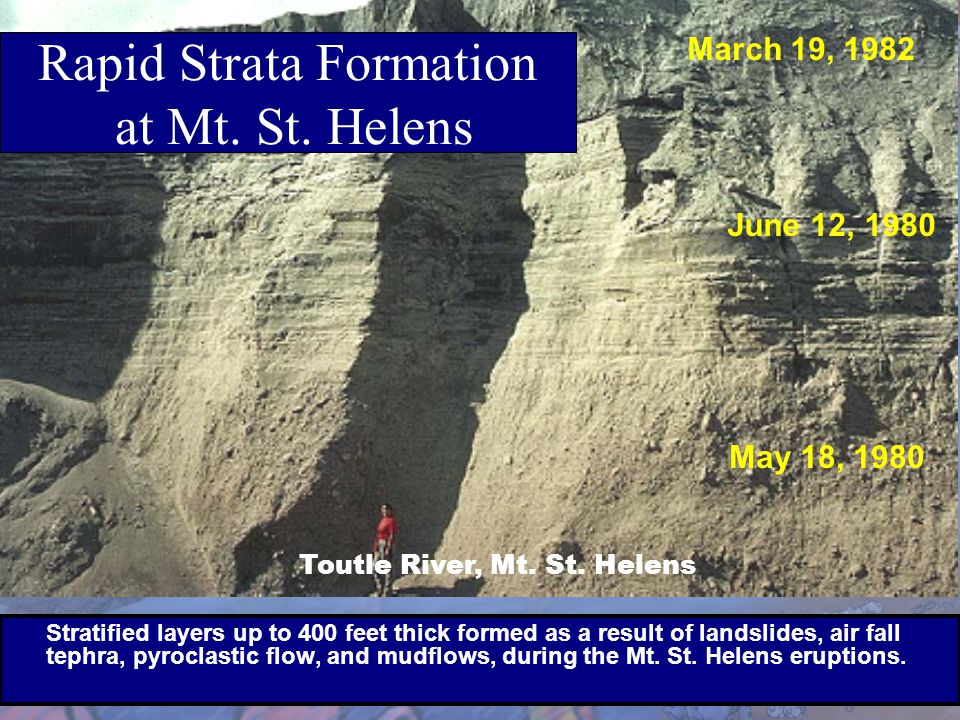
Rapid strata formation and rapid erosion at Mount St Helens.
slideplayer.com/slide/5703217/18/images/28/Rapid+Strata+F...
Visit the fossil museum:
www.flickr.com/photos/101536517@N06/sets/72157641367196613/
Just how good are peer reviews of scientific papers?
www.sciencemag.org/content/342/6154/60.full
www.examiner.com/article/want-to-publish-science-paper-ju...
The neo-Darwinian idea that the human genome consists entirely of an accumulation of billions of mutations is, quite obviously, completely bonkers. Nevertheless, it is compulsorily taught in schools and universities as 'science'.
I daren’t say anything about your filters really, in case anything slips out. You know my tendency to make everything I write universal property, and I don’t want to transgress. I won’t mention your characters or their conundrums. I like your reasoning, the synopsis you have given. I recognize some of those megalomaniacal male tendencies you are describing, and why wouldn’t I? I know that ‘lost boy’ behaviour. It’s even attractive until one reaches a certain age, then it slopes off through unfortunate, and heads downhill rather swiftly towards downright tragedy. Applying the brakes at that stage is no party, let me tell you. Sometimes I feel as if I had been worn down up to the knees, a would-be demi-legged Falstaff, but then this isn’t about me. All these men searching for mammys, what can I say other than sorry about my gender, and thank Yahweh that I am a cis-gender homo (can I call myself that anymore?)? I think you can tell that I have arrived at the point that I am, now, not at all sure what I am, or am not, permitted to call myself. I fear that I, at last, know what and who I am, but I am not at all sure if being that is acceptable to the evolving world. Luckily, we will all be dead soon enough. Now that’s something to really look forward to for the terminally bewildered. I like the idea of ‘A Death’ as the inflexion point of this ‘Comedy’ you are constructing. I have that funny death story to tell yet properly. That one where Jeffrey suddenly shot upright, screaming at his parents who were quibbling over what to watch on the TV. He screamed fiercely at them “I’m dying, I get to choose the video!”. It was gloriously well said. I do love the tyranny of the dying. I do love the abject tyranny of the victim (my speciality). Feck it, I will go the whole hog. I do love tyranny. I also love saying ‘Feck’, when everyone understands that you are insinuating another vowel in the place of that ‘e’. I love that feck is proper and Irish, a softening of that blow, liked a dropped ‘h’, that sort of softening and lilting.
He chose 'Singing in the Rain' and collapsed back into bed raving madly about having three different types of pies to make. I pressed the button and released more morphine, awash in the 'poor meeees'.
Photographed in Cyberjaya, Malaysia
Colour : Creamy White
Assembly : Kulim, Kedah, Malaysia
I drive an Inokom Elantra ! ... said no Malaysian ever. Well, believe it or not, the Hyundai Elantra MD goes by the official name of Inokom Elantra in Malaysia. The reasoning behind the name change is very straightforward; Inokom is the Malaysian company which assembles the Hyundai Elantra (alongside its siblings) in the small city of Kulim in the state of Kedah, which is 200 miles to the north of Kuala Lumpur, and right beside Penang. Aside from the badge and name, the Inokom Elantra is for the most part identical to any other Elantra MD. The car originally came with Inokom badges as standard, but most buyers swapped out said badges with Hyundai ones. The practice became so common, that Inokom now offers buyers the optional choice between the two badges.
Another 'unwanted' feature that plagues the Inokom Elantra is its below average build quality, which lags considerably behind the American and Korean-made Elantras. Nonetheless, Inokom has upped their game significantly from their experience assembling the previous generation Elantra, which had even worse build quality. Inokom has improved so much, that the management in Seoul has recently contracted the company with exporting the facelifted 2014 Hyundai Elantra to neighbouring Thailand, where previously Inokom had mostly catered to the domestic consumption.
The Hyundai Elantra MD itself is a brilliant car, considering how much of an improvement it is over its predecessor. Hyundai has really outdone themselves here, with the Fluidic Sculpture design language being one the Elantra MD's most prominent features. Despite the many improvements, the Elantra MD has not sold particularly well in Malaysia.
I LIKE : Looks awesome. Powered driver's seat. Huge improvement over the previous gen. Elantra. Reasonably priced for what you get.
I DISLIKE : Interior looks and feels a bit cheap. Not nearly as refined as its main competitors. Not nearly as competent as its European-made i30 sibling.
Rapid strata formation in soft sand (field evidence).
Photo of strata formation in soft sand on a beach, created by tidal action of the sea.
Formed in a single, high tidal event. Stunning evidence which displays multiple strata/layers.
Why this is so important ....
It has long been assumed, ever since the 17th century, that layers/strata observed in sedimentary rocks were built up gradually, layer upon layer, over many years. It certainly seemed logical at the time, from just looking at rocks, that lower layers would always be older than the layers above them, i.e. that lower layers were always laid down first followed, in time, by successive layers on top.
This was assumed to be true and became known as the superposition principle.
It was also assumed that a layer comprising a different material from a previous layer, represented a change in environmental conditions/factors.
These changes in composition of layers or strata were considered to represent different, geological eras on a global scale, spanning millions of years. This formed the basis for the Geologic Column, which is used to date rocks and also fossils. The evolutionary, 'fossil record' was based on the vast ages and assumed geological eras of the Geologic Column.
There was also circular reasoning applied with the assumed age of 'index' fossils (based on evolutionary beliefs & preconceptions) used to date strata in the Geologic Column. Dating strata from the assumed age of (index) fossils is known as Biostratigraphy.
We now know that, although these assumptions seemed logical, they are not supported by the evidence.
At the time, the mechanics of stratification were not properly known or studied.
An additional factor was that this assumed superposition and uniformitarian model became essential, with the wide acceptance of Darwinism, for the long ages required for progressive microbes-to-human evolution. There was no incentive to question or challenge the superposition, uniformitarian model, because the presumed, fossil 'record' had become dependant on it, and any change in the accepted model would present devastating implications for Darwinism.
This had the unfortunate effect of linking the study of geology so closely to Darwinism, that any study independent of Darwinian considerations was effectively stymied. This link of geology with Darwinian preconceptions is known as biostratigraphy.
Some other field evidence can be observed here: www.flickr.com/photos/101536517@N06/sets/72157635944904973/
and also in the links to stunning, experimental evidence, carried out by sedimentologists, given later.
_______________________________________________
GEOLOGIC PRINCIPLES (established by Nicholas Steno in the 17th Century):
What Nicolas Steno believed about strata formation is the basis of the principle of Superposition and the principle of Original Horizontality.
dictionary.sensagent.com/Law_of_superposition/en-en/
“Assuming that all rocks and minerals had once been fluid, Nicolas Steno reasoned that rock strata were formed when particles in a fluid such as water fell to the bottom. This process would leave horizontal layers. Thus Steno's principle of original horizontality states that rock layers form in the horizontal position, and any deviations from this horizontal position are due to the rocks being disturbed later.”)
BEDDING PLANES.
'Bedding plane' describes the surface in between each stratum which are formed during sediment deposition.
science.jrank.org/pages/6533/Strata.html
“Strata form during sediment deposition, that is, the laying down of sediment. Meanwhile, if a change in current speed or sediment grain size occurs or perhaps the sediment supply is cut off, a bedding plane forms. Bedding planes are surfaces that separate one stratum from another. Bedding planes can also form when the upper part of a sediment layer is eroded away before the next episode of deposition. Strata separated by a bedding plane may have different grain sizes, grain compositions, or colours. Sometimes these other traits are better indicators of stratification as bedding planes may be very subtle.”
______________________________________________
Several catastrophic events, flash floods, volcanic eruptions etc. have forced Darwinian, influenced geologists to admit to rapid stratification in some instances. However they claim it is a rare phenomenon, which they have known about for many years, and which does nothing to invalidate the Geologic Column, the fossil record, evolutionary timescale, or any of the old assumptions regarding strata formation, sedimentation and the superposition principle. They fail to face up to the fact that rapid stratification is not an extraordinary phenonemon, but rather the prevailing and normal mechanism of sedimentary deposition whenever and wherever there is moving, sediment-laden water. The experimental evidence demonstrates the mechanism and a mass of field evidence in normal (non-catastrophic) conditions shows it is a normal everyday occurrence.
It is clear from the experimental evidence that the usual process of stratification is - that strata are not formed by horizontal layers being laid on top of each other in succession, as was assumed. But by sediment being sorted in the flowing water and laid down diagonally in the direction of flow. See diagram:
www.flickr.com/photos/truth-in-science/39821536092/in/dat...
The field evidence (in the image) presented here - of rapid, simultaneous stratification refutes the Superposition Principle, the Principle of Original Horizontality and the Principle of Lateral Continuity.
We now know, the Superposition Principle only applies on a rare occasion where sedimentary deposits are laid down in still water.
Superposition is required for the long evolutionary timescale, but the evidence shows it is not the general rule, as was once believed. Most sediment is laid down in moving water, where particle segregation is the general rule, resulting in the simultaneous deposition of strata/layers as shown in the photo.
See many other examples of rapid stratification (with geological features): www.flickr.com/photos/101536517@N06/sets/72157635944904973/
Rapid, simultaneous formation of layers/strata, through particle segregation in moving water, is so easily created it has even been described by sedimentologists (working on flume experiments) as a law ...
"Upon filling the tank with water and pouring in sediments, we immediately saw what was to become the rule: The sediments sorted themselves out in very clear layers. This became so common that by the end of two weeks, we jokingly referred to Andrew's law as "It's difficult not to make layers," and Clark's law as "It's easy to make layers." Later on, I proposed the "law" that liquefaction destroys layers, as much to my surprise as that was." Ian Juby, www.ianjuby.org/sedimentation/
The example in the photo is the result of normal, everyday tidal action in a single incident. Where the water current or movement is more turbulent, violent, or catastrophic, great depths (many metres) of stratified sediment can be laid down in a short time. Certainly not the many millions of years assumed by evolutionists.
The composition of strata formed in any deposition event. is related to whatever materials are in the sediment mix, not to any particular timescale. Whatever is in the mix will be automatically sorted into strata/layers. It could be sand, or other material added from mud slides, erosion of chalk deposits, coastal erosion, volcanic ash etc. Any organic material (potential fossils), alive or dead, engulfed by, or swept into, a turbulent sediment mix, will also be sorted and buried within the rapidly, forming layers.
See many other examples of rapid stratification with geological features: www.flickr.com/photos/101536517@N06/sets/72157635944904973/
Stratified, soft sand deposit. demonstrates the rapid, stratification principle.
Important, field evidence which supports the work of the eminent, sedimentologist Dr Guy Berthault MIAS - Member of the International Association of Sedimentologists.
(Dr Berthault's experiments (www.sedimentology.fr/)
And also the experimental work of Dr M.E. Clark (Professor Emeritus, U of Illinois @ Urbana), Andrew Rodenbeck and Dr. Henry Voss, (www.ianjuby.org/sedimentation/)
Location: Sandown, Isle of Wight. Formed 6/06/2018, This field evidence demonstrates that multiple strata in sedimentary deposits do not need millions of years to form and can be formed rapidly. This natural example confirms the principle demonstrated by the sedimentation experiments carried out by Dr Guy Berthault and other sedimentologists. It calls into question the standard, multi-million year dating of sedimentary rocks, and the dating of fossils by depth of burial or position in the strata.
Mulltiple strata/layers are evident in this example.
Dr Berthault's experiments (www.sedimentology.fr/) and other experiments (www.ianjuby.org/sedimentation/) and field studies of floods and volcanic action show that, rather than being formed by gradual, slow deposition of sucessive layers superimposed upon previous layers, with the strata or layers representing a particular timescale, particle segregation in moving water or airborne particles can form strata or layers very quickly, frequently, in a single event.
And, most importantly, lower strata are not older than upper strata, they are the same age, having been created in the same sedimentary episode.
Such field studies confirm experiments which have shown that there is no longer any reason to conclude that strata/layers in sedimentary rocks relate to different geological eras and/or a multi-million year timescale. www.youtube.com/watch?v=5PVnBaqqQw8&feature=share&.... they also show that the relative position of fossils in rocks is not indicative of an order of evolutionary succession. Obviously, the uniformitarian principle, on which the geologic column is based, can no longer be considered valid. And the multi-million, year dating of sedimentary rocks and fossils needs to be reassessed. Rapid deposition of stratified sediments also explains the enigma of polystrate fossils, i.e. large fossils that intersect several strata. In some cases, tree trunk fossils are found which intersect the strata of sedimentary rock up to forty feet in depth. upload.wikimedia.org/wikipedia/commons/thumb/0/08/Lycopsi... They must have been buried in stratified sediment in a short time (certainly not millions, thousands, or even hundreds of years), or they would have rotted away. youtu.be/vnzHU9VsliQ
In fact, the vast majority of fossils are found in good, intact condition, which is testament to their rapid burial. You don't get good fossils from gradual burial, because they would be damaged or destroyed by decay, predation or erosion. The existence of so many fossils in sedimentary rock on a global scale is stunning evidence for the rapid depostion of sedimentary rock as the general rule. It is obvious that all rock containing good intact fossils was formed from sediment laid down in a very short time, not millions, or even thousands of years.
See set of photos of other examples of rapid stratification: www.flickr.com/photos/101536517@N06/sets/72157635944904973/
Carbon dating of coal should not be possible if it is millions of years old, yet significant amounts of Carbon 14 have been detected in coal and other fossil material, which indicates that it is less than 50,000 years old. www.ldolphin.org/sewell/c14dating.html
www.grisda.org/origins/51006.htm
Evolutionists confidently cite multi-million year ages for rocks and fossils, but what most people don't realise is that no one actually knows the age of sedimentary rocks or the fossils found within them. So how are evolutionists so sure of the ages they so confidently quote? The astonishing thing is they aren't. Sedimentary rocks cannot be dated by radiometric methods*, and fossils can only be dated to less than 50,000 years with Carbon 14 dating. The method evolutionists use is based entirely on assumptions. Unbelievably, fossils are dated by the assumed age of rocks, and rocks are dated by the assumed age of fossils, that's right ... it is known as circular reasoning.
* Regarding the radiometric dating of igneous rocks, which is claimed to be relevant to the dating of sedimentary rocks, in an occasional instance there is an igneous intrusion associated with a sedimentary deposit -
Prof. Aubouin says in his Précis de Géologie: "Each radioactive element disintegrates in a characteristic and constant manner, which depends neither on the physical state (no variation with pressure or temperature or any other external constraint) nor on the chemical state (identical for an oxide or a phosphate)."
"Rocks form when magma crystallizes. Crystallisation depends on pressure and temperature, from which radioactivity is independent. So, there is no relationship between radioactivity and crystallisation.
Consequently, radioactivity doesn't date the formation of rocks. Moreover, daughter elements contained in rocks result mainly from radioactivity in magma where gravity separates the heavier parent element, from the lighter daughter element. Thus radiometric dating has no chronological signification." Dr. Guy Berthault www.sciencevsevolution.org/Berthault.htm
Visit the fossil museum:
www.flickr.com/photos/101536517@N06/sets/72157641367196613/
Just how good are peer reviews of scientific papers?
www.sciencemag.org/content/342/6154/60.full
www.examiner.com/article/want-to-publish-science-paper-ju...
The neo-Darwinian idea that the human genome consists entirely of an accumulation of billions of mutations is, quite obviously, completely bonkers. Nevertheless, it is compulsorily taught in schools and universities as 'science'.
Benjamin Johnston presents: Comirit: Commonsense Reasoning by Integrating Simulation and Logic by Benjamin Johnston and Mary-Anne Williams is Research Professor and Director of the Innovation and Technology Research Laboratory. at The University of Technology, Sydney, Australia
The motivation for this work is to produce a middleware with real-world commonsense reasoning. The motivation is the failure of current logical commonsense reasoning systems.
in Technical Session # 4 : Reasoning chaired by Steve Omohundro of Self-Aware Systems at the The First Conference on Artificial General Intelligence (AGI-08)
Mary-Anne Williams is Research Professor and Director of the Innovation and Technology Research Laboratory.
This room is The Zone, at the FedEx Institute of Technology, University of Memphis. It was a very good venue for this conference.
Artificial General Intelligence (AGI) research focuses on the original and ultimate goal of AI -- to create intelligence as a whole, by exploring all available paths, including theoretical and experimental computer science, cognitive science, neuroscience, and innovative interdisciplinary methodologies. AGI is also called Strong AI in the AI community.
Another good reference is Artificial General Intelligence : A Gentle Introduction by Pei Wang
I030208 136
As we found our places in the workshop and I set to gathering supplies Jesse's curiosity (the most valuable character trait in any man of science) continued to get the better of him.
"How have I done anything that could be value in this Professor?"
"It was your experiments in the continuous production of heat from compressed matter that gave us the refined Pitchblende power source that runs the Hoever-Carriage was it not?"
"Perhaps my initial research was of some value" He replied modestly "but it was The Lady Porkshanks and yourself who made the application practical."
"Well my friend we are about to make it more so."
"You intrigue me Professor, can you explain your reasoning?"
For a brief instant I felt as if we were back at University in a lecture room with Jesse was my only student. Making myself comfortable with the notion, I set to work while I spoke:
"As you well know every last form of matter in creation interacts in some way with other forms of matter. Some react passively and slowly while others react with speed and violence. Consider the vital element, Oxygen; the beneficial gas... Without it we would die. Without it your beloved gunpowder would not fire. It is invisible and odorless and nearly weightless; but given time it will eat away at iron leaving almost nothing behind. In excess will cause the air to ignite spontaneously. It is highly interactive."
Jesse grinned as I picked up a caliper and examined another component all the while continuing my lecture. I must confess the stresses of the previous days had already begun to melt away. Being back in my element, the laboratory, the workshop, the "inventorium" was deeply refreshing to my soul. I continued.
"Other elements are much less reactive and need to be coaxed and cajoled to mix and match with their fellow elemental materials. And some" (I paused dramatically to capture the attention of my student) "react not only with others but within themselves... Pitchblende for example."
He nodded knowingly.
"Your work found that refined pitchblende when compressed at significant pressures created a reaction within itself that generated heat so significant that it could be used as a fuel source. All Lady Porkshanks and I did was improve the process and apply it to the boiler."
"Of course professor, but I know all this - how is this to help dispose of the evil book? We cannot boil it away?"
I wondered if he was being purposefully obtuse or was he simply playing his role as student for my benefit. Playing along I leaned in slightly to look him more closely in the eye.
"Why, Jesse, does the boiler operate at fixed temperature?"
"Because the unique properties of the compressed pitchblende generates heat a predictable rate."
My internal fire was beginning to glow as I assembled the first of several components.
"Why is it not hotter?"
"Because we have compressed it to its limits."
Raising an eyebrow I peered over my spectacles and asked, "Have we?"
His eyes widened. I had his undivided attention.
I cleared my throat for emphasis.
"What if, my friend, we had only reached the limits of our ability to compress the matter and with the application greater pressures we could release greater energy? What do you suppose the released energy could reach?"
Jesse stood, almost at attention, he stammered with excitement
"The.. the potential is... staggering! From what I recall from the tables I created when I charted the output potentials... With sufficient pressure the matter might reach a point at which the output of energy would exceed the matter's own ability to contain it! The results could be... dare I say it? Incalculable!" His look suddenly turned quizzical. "But how in heaven's name will we achieve such pressures out here with limited facilities? We'd need a press ten times the size we used previously to even approach such levels."
"Who", I inquired, "said anything about a press?"
"But.." was his only reply. I changed my tact.
"Jesse, what happens to the powder in a shell when the rifle cartridge is struck by a firing pin?"
"The primer ignites the powder and it explodes."
"And why does the rifle not explode?"
"Because the barrel is made of steel and the force of the explosion is used to push the projectile out the barrel. Professor you know all this."
"True... but indulge me. What would happen to that projectile if a heavy steel plate we placed inches from the muzzle?"
"Well naturally it would.. be.. COMPRESSED!" His excitement was palpable, and contagious."and if we were to do that with the Pitchblende..."
"Precisely!" I shouted "You have the keenest knowledge of explosives out of all of us. I propose we construct a vessel that directs not one but multiple charges inward, simultaneously, to compress the Pitchblende so completely that it releases all it's potential energy at once!"
Without another word Jesse leapt into action. Down the corridor to raid the arms cupboard, back to his quarters to gather supplies from his private collection; he returned to the workshop loaded to overflowing.
For hours we labored, stopping neither for food nor drink but only necessary consultation and conversation. For my part I extracted the extra supplies of Pitchblende from storage and continued to construct the containment vessel.
By mid afternoon our efforts reached their conclusion.
Based on Jesse's knowledge of explosive forces and our experience with compressed Pitchblende we calculated the potential heat and resultant explosive force that would be released from the device would be so significant that we'd need to be several miles distant at detonation.
That required not only a trigger but also a timer... something like a pocket watch. Since all our pocket watches had failed since our arrival in this dreaded place I would need construct a new non-mechanical 'pocket watch'. For that I would need a tin can, barbed wire and a few bits of string and chewing gum.
* * * *
Power Mad I used under Creative Commons license: Attribution-Share Alike 2.0 Generic
Power Mad III - used under Creative Commons license: Attribution-Share Alike 2.0 Generic
Bric 1 - By John Edgar Park - used under Creative Commons License Attribution-Noncommercial-Share Alike 2.0 Generic
www.flickr.com/photos/elsie/2197737299/ - used under Creative Commons license Attribution 2.0 Generic
Fire Engine Gauges - used under creative commons license Attribution-Noncommercial-Share Alike 2.0 Generic
Chemist's Lab Tools - by curious expeditions - under creative commons license Attribution-Noncommercial-Share Alike 2.0 Generic
Additional material by MofoJT II
Rapid strata formation in soft sand (field evidence).
Photo of strata formation in soft sand on a beach, created by tidal action of the sea.
Formed in a single, high tidal event. Stunning evidence which displays multiple strata/layers.
Why this is so important ....
It has long been assumed, ever since the 17th century, that layers/strata observed in sedimentary rocks were built up gradually, layer upon layer, over many years. It certainly seemed logical at the time, from just looking at rocks, that lower layers would always be older than the layers above them, i.e. that lower layers were always laid down first followed, in time, by successive layers on top.
This was assumed to be true and became known as the superposition principle.
It was also assumed that a layer comprising a different material from a previous layer, represented a change in environmental conditions/factors.
These changes in composition of layers or strata were considered to represent different, geological eras on a global scale, spanning millions of years. This formed the basis for the Geologic Column, which is used to date rocks and also fossils. The evolutionary, 'fossil record' was based on the vast ages and assumed geological eras of the Geologic Column.
There was also circular reasoning applied with the assumed age of 'index' fossils (based on evolutionary beliefs & preconceptions) used to date strata in the Geologic Column. Dating strata from the assumed age of (index) fossils is known as Biostratigraphy.
We now know that, although these assumptions seemed logical, they are not supported by the evidence.
At the time, the mechanics of stratification were not properly known or studied.
An additional factor was that this assumed superposition and uniformitarian model became essential, with the wide acceptance of Darwinism, for the long ages required for progressive microbes-to-human evolution. There was no incentive to question or challenge the superposition, uniformitarian model, because the presumed, fossil 'record' had become dependant on it, and any change in the accepted model would present devastating implications for Darwinism.
This had the unfortunate effect of linking the study of geology so closely to Darwinism, that any study independent of Darwinian considerations was effectively stymied. This link of geology with Darwinian preconceptions is known as biostratigraphy.
Some other field evidence, in various situations, can be observed here: www.flickr.com/photos/101536517@N06/sets/72157635944904973/
and also in the links to stunning, experimental evidence, carried out by sedimentologists, given later.
_______________________________________________
GEOLOGIC PRINCIPLES (established by Nicholas Steno in the 17th Century):
What Nicolas Steno believed about strata formation is the basis of the principle of Superposition and the principle of Original Horizontality.
dictionary.sensagent.com/Law_of_superposition/en-en/
“Assuming that all rocks and minerals had once been fluid, Nicolas Steno reasoned that rock strata were formed when particles in a fluid such as water fell to the bottom. This process would leave horizontal layers. Thus Steno's principle of original horizontality states that rock layers form in the horizontal position, and any deviations from this horizontal position are due to the rocks being disturbed later.”)
BEDDING PLANES.
'Bedding plane' describes the surface in between each stratum which are formed during sediment deposition.
science.jrank.org/pages/6533/Strata.html
“Strata form during sediment deposition, that is, the laying down of sediment. Meanwhile, if a change in current speed or sediment grain size occurs or perhaps the sediment supply is cut off, a bedding plane forms. Bedding planes are surfaces that separate one stratum from another. Bedding planes can also form when the upper part of a sediment layer is eroded away before the next episode of deposition. Strata separated by a bedding plane may have different grain sizes, grain compositions, or colours. Sometimes these other traits are better indicators of stratification as bedding planes may be very subtle.”
______________________________________________
Several catastrophic events, flash floods, volcanic eruptions etc. have forced Darwinian, influenced geologists to admit to rapid stratification in some instances. However they claim it is a rare phenomenon, which they have known about for many years, and which does nothing to invalidate the Geologic Column, the fossil record, evolutionary timescale, or any of the old assumptions regarding strata formation, sedimentation and the superposition principle. They fail to face up to the fact that rapid stratification is not an extraordinary phenonemon, but rather the prevailing and normal mechanism of sedimentary deposition whenever and wherever there is moving, sediment-laden water. The experimental evidence demonstrates the mechanism and a mass of field evidence in normal (non-catastrophic) conditions shows it is a normal everyday occurrence.
It is clear from the experimental evidence that the usual process of stratification is - that strata are not formed by horizontal layers being laid on top of each other in succession, as was assumed. But by sediment being sorted in the flowing water and laid down diagonally in the direction of flow. See diagram:
www.flickr.com/photos/truth-in-science/39821536092/in/dat...
The field evidence (in the image) presented here - of rapid, simultaneous stratification refutes the Superposition Principle and the Principle of Lateral Continuity.
We now know, the Superposition Principle only applies on a rare occasion where sedimentary deposits are laid down in still water.
Superposition is required for the long evolutionary timescale, but the evidence shows it is not the general rule, as was once believed. Most sediment is laid down in moving water, where particle segregation is the general rule, resulting in the simultaneous deposition of strata/layers as shown in the photo.
See many other examples of rapid stratification (with geological features): www.flickr.com/photos/101536517@N06/sets/72157635944904973/
Rapid, simultaneous formation of layers/strata, through particle segregation in moving water, is so easily created it has even been described by sedimentologists (working on flume experiments) as a law ...
"Upon filling the tank with water and pouring in sediments, we immediately saw what was to become the rule: The sediments sorted themselves out in very clear layers. This became so common that by the end of two weeks, we jokingly referred to Andrew's law as "It's difficult not to make layers," and Clark's law as "It's easy to make layers." Later on, I proposed the "law" that liquefaction destroys layers, as much to my surprise as that was." Ian Juby, www.ianjuby.org/sedimentation/
The example in the photo is the result of normal, everyday tidal action formed in a single incident. Where the water current or movement is more turbulent, violent, or catastrophic, great depths (many metres) of stratified sediment can be laid down in a short time. Certainly not the many millions of years assumed by evolutionists.
The composition of strata formed in any deposition event. is related to whatever materials are in the sediment mix, not to any particular timescale. Whatever is in the mix will be automatically sorted into strata/layers. It could be sand, or other material added from mud slides, erosion of chalk deposits, coastal erosion, volcanic ash etc. Any organic material (potential fossils), alive or dead, engulfed by, or swept into, a turbulent sediment mix, will also be sorted and buried within the rapidly, forming layers.
See many other examples of rapid stratification with geological features: www.flickr.com/photos/101536517@N06/sets/72157635944904973/
Stratified, soft sand deposit. demonstrates the rapid, stratification principle.
Important, field evidence which supports the work of the eminent, sedimentologist Dr Guy Berthault MIAS - Member of the International Association of Sedimentologists.
(Dr Berthault's experiments (www.sedimentology.fr/)
And also the experimental work of Dr M.E. Clark (Professor Emeritus, U of Illinois @ Urbana), Andrew Rodenbeck and Dr. Henry Voss, (www.ianjuby.org/sedimentation/)
Location: Yaverland, Isle of Wight. Photographed: 14/03/2019
This field evidence demonstrates that multiple strata in sedimentary deposits do not need millions of years to form and can be formed rapidly. This natural example confirms the principle demonstrated by the sedimentation experiments carried out by Dr Guy Berthault and other sedimentologists. It calls into question the standard, multi-million year dating of sedimentary rocks, and the dating of fossils by depth of burial or position in the strata.
Mulltiple strata/layers are evident in this example.
Dr Berthault's experiments (www.sedimentology.fr/) and other experiments (www.ianjuby.org/sedimentation/) and field studies of floods and volcanic action show that, rather than being formed by gradual, slow deposition of sucessive layers superimposed upon previous layers, with the strata or layers representing a particular timescale, particle segregation in moving water or airborne particles can form strata or layers very quickly, frequently, in a single event.
And, most importantly, lower strata are not older than upper strata, they are the same age, having been created in the same sedimentary episode.
Such field studies confirm experiments which have shown that there is no longer any reason to conclude that strata/layers in sedimentary rocks relate to different geological eras and/or a multi-million year timescale. www.youtube.com/watch?v=5PVnBaqqQw8&feature=share&.... they also show that the relative position of fossils in rocks is not indicative of an order of evolutionary succession. Obviously, the uniformitarian principle, on which the geologic column is based, can no longer be considered valid. And the multi-million, year dating of sedimentary rocks and fossils needs to be reassessed. Rapid deposition of stratified sediments also explains the enigma of polystrate fossils, i.e. large fossils that intersect several strata. In some cases, tree trunk fossils are found which intersect the strata of sedimentary rock up to forty feet in depth. upload.wikimedia.org/wikipedia/commons/thumb/0/08/Lycopsi... They must have been buried in stratified sediment in a short time (certainly not millions, thousands, or even hundreds of years), or they would have rotted away. youtu.be/vnzHU9VsliQ
In fact, the vast majority of fossils are found in good, intact condition, which is testament to their rapid burial. You don't get good fossils from gradual burial, because they would be damaged or destroyed by decay, predation or erosion. The existence of so many fossils in sedimentary rock on a global scale is stunning evidence for the rapid depostion of sedimentary rock as the general rule. It is obvious that all rock containing good intact fossils was formed from sediment laid down in a very short time, not millions, or even thousands of years.
See set of photos of other examples of rapid stratification: www.flickr.com/photos/101536517@N06/sets/72157635944904973/
Carbon dating of coal should not be possible if it is millions of years old, yet significant amounts of Carbon 14 have been detected in coal and other fossil material, which indicates that it is less than 50,000 years old. www.ldolphin.org/sewell/c14dating.html
www.grisda.org/origins/51006.htm
Evolutionists confidently cite multi-million year ages for rocks and fossils, but what most people don't realise is that no one actually knows the age of sedimentary rocks or the fossils found within them. So how are evolutionists so sure of the ages they so confidently quote? The astonishing thing is they aren't. Sedimentary rocks cannot be dated by radiometric methods*, and fossils can only be dated to less than 50,000 years with Carbon 14 dating. The method evolutionists use is based entirely on assumptions. Unbelievably, fossils are dated by the assumed age of rocks, and rocks are dated by the assumed age of fossils, that's right ... it is known as circular reasoning.
* Regarding the radiometric dating of igneous rocks, which is claimed to be relevant to the dating of sedimentary rocks, in an occasional instance there is an igneous intrusion associated with a sedimentary deposit -
Prof. Aubouin says in his Précis de Géologie: "Each radioactive element disintegrates in a characteristic and constant manner, which depends neither on the physical state (no variation with pressure or temperature or any other external constraint) nor on the chemical state (identical for an oxide or a phosphate)."
"Rocks form when magma crystallizes. Crystallisation depends on pressure and temperature, from which radioactivity is independent. So, there is no relationship between radioactivity and crystallisation.
Consequently, radioactivity doesn't date the formation of rocks. Moreover, daughter elements contained in rocks result mainly from radioactivity in magma where gravity separates the heavier parent element, from the lighter daughter element. Thus radiometric dating has no chronological signification." Dr. Guy Berthault www.sciencevsevolution.org/Berthault.htm
Rapid strata formation and rapid erosion at Mount St Helens.
slideplayer.com/slide/5703217/18/images/28/Rapid+Strata+F...

Visit the fossil museum:
www.flickr.com/photos/101536517@N06/sets/72157641367196613/
Just how good are peer reviews of scientific papers?
www.sciencemag.org/content/342/6154/60.full
www.examiner.com/article/want-to-publish-science-paper-ju...
The neo-Darwinian idea that the human genome consists entirely of an accumulation of billions of mutations is, quite obviously, completely bonkers. Nevertheless, it is compulsorily taught in schools and universities as 'science'.
conspiracy.....and now, I'm matching mommies w/ babies in the 'family-platoon-unit' 3mommies +1mommies=4mommies and 1 w/o? 2 pics r of me & mommy & me &(relative)
1st row: a baby pic of me in color...and my relative: huang yun zhen in black & white: I am obviously not of vietnamese origin. after further investigation with symbolic inferences, deductive/inductive reasoning:conclusion: I was 'taken' stolen' from my illuminated mom & dad by the political, religious, dynastic factions: all had a hand in this royal rumble dynasty conspiracy, I was an experimental baby:my mom born me when she was a bit older. on the same row: next picture 2 color photo of Clare:aka:'Phuong' and 2 pics of her biological mom : the other mole: Phong Le: aka:'Lucy' in black & white photo: Phong le is of philippine origin not vietnamese that makes Clare 'vo' schneider not vietnamese either. but phong le and chi v. vo the other mole who's not vietnamese either but chi is mostly likely indonesian, both had a hand or played a part (most likely pawns) in this royal dynastic political, religious, criminal conspiracy : they know dorothy 'hickey' boese & john boese who also hand a part in this conspiracy and also they know a couple of 'nguyens' most likely some of the nguyen dynasty' linked to madame nhu: a power hungry damn 'bitch' in my eyes after reading about her & her bio.
2nd row: two color photo of joan or her vietnamese name: chung( chung vo-williamson) and her vietnamese biological mom's photo in black & white: after further investigation and symbolic inferences, inductive, deductive reasoning, what happen to joan/chung's real mom is that her mom was a victim or a casuality of war: mainly the vietnam war...the bombing of and mind fields and 'search and destroy' mission of that nature. on the same row: is a black and white photo of Chris aka: 'Dinh' (chris v vo married to christina mervyn/mervin). His real mother is also missing and is of mix chinese and japanese origin, so that makes Chris/'dinh' not vietnamese either. sea the conspiracy unfolding people! After further investigation, symbolic inferences, inductive and deductive reasoning: I believe there was a switcharoo somewhere when we were all babies, where "Nadia Lee' aka: 'Mai' or pronounced: 'My': a vietnamese not chinese or japanese, or korean etc... who knew dorothy hickey and john boese and was an adopted daughter of an american 'politician'...they might have switch places with what chris/'dinh's ethnicity should have been and should have grown up to be: Nadia Lee grew up as a 'chinese' bilingual management consultant and enjoyed many adventure and excellent food around the world then became romance writer, & shares an apartment overlooking a river/ palm trees with japan husband & winter white'hamster'...so now we know what true ethnicity offspring chris/dinh is of: mix japan/chinese
3rd row: is of my real biological mother in black & white and a picture of me in color: I am the daughter of the illuminated li-family royal bloodline & van duyn royal bloodline: the daughter of huang man li:aka: Mary Je, Mary Wong, Wong man Lei, Wong man Li, huang man Li's illuminated daughter of the ancestrial lineage of the 'Perfect Empress' & Tang/ Tartar-Tang/ Silla-Tang royal dynasty' and of eurasian: dutch van duyn royal bloodline...etc...and I am obviously not of vietnamese origin but an offspring of eurasia: with dutch, chinese, japanese, korean blood and descendent! on the same row: is a photo of Pete: aka 'Hiep'(pete/hiep v vo) with no photo of his biological mother but I've found a photo of one of his relatives: an older brother or father or cousin which I've post in this flickr already. after further investigation and symbolic inferences, inductive and deductive reasoning and information leaking out from 'perfect' war veterans and 'perfect' strangers: the culture and ethicity of his relative: a photo of his dad, or elder brother or could be a cousin: is of Thailand origin, similar facial features/ skin tone as of Thailand people. Pete's/hiep's real mom's where about in my educated guess, I believe pete's real mom was a victim of international people/sex trafficking, some part of asia, bangkok, Thailand are known for that.There's a movie that came out in 2010-2011 called the 'whistleblower' which is symbolic to I believe what might have happened to 'pete's/hiep's real mother. A lot of the recent movies have been symbolic of us 5 'surrogate' siblings and other people in my personal/love and business/professional life...and they are symbolically true...I know and I can decipher the truth in every recent movies and tv series that came out from 2004 and 'beyond' and that word 'beyond' is a key trigger word for the 'perfect' perfecture euasian illuminated royal babies as a secret society hidden meaning or a 'mark' like 'enjoy' or the 'joy' of life, aye maties! ;) the motive was to stigmatize, exploit, and discard as 'garbage' of the royal 'stolen' iluminated hybrid babies or any stolen 'kidnapped purebred illuminated babies for that matter. And in reality the stolen illuminated babies, we're not at all commoners or 'garbage' but real monarch descendents of royal imperial court of ancient and modern empires, kings, queens, prince, princess, dukes, duchess, and earls of the high royal court! This is the real motive of the lower criminal conduits to get into the royal bloodline, exploit and discard/do away with the royal target that has leaked out for me to know: to that I say: the only 'garbage' and vile shitheads are the filty kidnapping crooks themselves. I'm pretty sure they will get what they derserve in the end! aye maties...it's still call treason to still any family members of the royal monarch court whether they are hybrids or purebrid illuminated babies, aye maties!;)
So, now we all know that us 5 unrelated siblings who were unwittingly forced to be 'surrogate' siblings was carefullly, mythodically orchestrated for this conspiracy across the board to happen. information leaked out that pete, joan, chris, clare are not of the enlightened bloodline but are now wrapped up in other secret society bloodline ...they were all told and knew about the conspiracy before I was aware of the conspiracy, obviously 'cuz I was the royal hybrid 'target'. To what extent that the other 4 'surrogate' siblings knew about it and when they were told ( in childhood, or adolescent or adulthood) I don't know but I don't blame them for what conspired 'cuz they've lost their biological parents too, but I do believe they should have informed me in some symbolic way if they knew about the conspiracy when they were kids, so that I could have prepared myself, and have an equal footingin and bettter fighting chance..an equalibrium in this orchestrated conspiracy chess match and game of life!
The stage was set for pete, joan, chris & clare in their academic life, professional life and personal life, so I'm sure it was in their best interest to keep it hidden from me, after all it's not them that the conspirators were really 'targeting' but it's me that the conspirators are targeting. So, a lot is at stake for everyone involved, that means the whole fucking world, aye maties! It's a political, religious, royal dynastic chess game, I would have to say! I think we all know that by now! Aye maties! and to that I'll have to say: it's a wrap!and...Once again, I am to return again!
Encore une fois Ashley T. van Lee: Ashley (Jane) T. van lee, Ashley T. Lee, Jane, Anna, Hana, Hansi, hee young, hwa young, Gia, Jean, Jan, jianne, shena, sheena, Jian: all varaiant of my given name: 'gracious gift of god' est de retour! jaz7 jaz7-livejournal, aj7aj13, 'AJ'
Reasoning that a building with a clock tower was going to look like a church no matter what he did, Withers decided to add church-like touches with non-religious content, such as the tympanum which shows a scene from The Merchant of Venice instead of the usual scene of Christ sitting in judgment.
i know i kind of vanished from the flickr-world a while back and i'm so very sorry for that. my reasoning isn't anything spectacular. i simply did not have the time to devote any extra energy or effort to my 365-day photo project, or photography for that matter.
i was putting so much pressure on myself to finish this damn project and i think it was showing in my work. so i took a little break from photography.
i took this over thanksgiving break. and i have a few other things that i edited today. i'll ease my way back into the photography world. maybe not as quick as i want myself to, but i will.
thank you for all of your support.
Rapid strata formation in soft sand (field evidence).
Photo of strata formation in soft sand on a beach, created by tidal action of the sea.
Formed in a single, high tidal event. Stunning evidence which displays multiple strata/layers.
Why this is so important ....
It has long been assumed, ever since the 17th century, that layers/strata observed in sedimentary rocks were built up gradually, layer upon layer, over many years. It certainly seemed logical at the time, from just looking at rocks, that lower layers would always be older than the layers above them, i.e. that lower layers were always laid down first followed, in time, by successive layers on top.
This was assumed to be true and became known as the superposition principle.
It was also assumed that a layer comprising a different material from a previous layer, represented a change in environmental conditions/factors.
These changes in composition of layers or strata were considered to represent different, geological eras on a global scale, spanning millions of years. This formed the basis for the Geologic Column, which is used to date rocks and also fossils. The evolutionary, 'fossil record' was based on the vast ages and assumed geological eras of the Geologic Column.
There was also circular reasoning applied with the assumed age of 'index' fossils (based on evolutionary beliefs & preconceptions) used to date strata in the Geologic Column. Dating strata from the assumed age of (index) fossils is known as Biostratigraphy.
We now know that, although these assumptions seemed logical, they are not supported by the evidence.
At the time, the mechanics of stratification were not properly known or studied.
An additional factor was that this assumed superposition and uniformitarian model became essential, with the wide acceptance of Darwinism, for the long ages required for progressive microbes-to-human evolution. There was no incentive to question or challenge the superposition, uniformitarian model, because the presumed, fossil 'record' had become dependant on it, and any change in the accepted model would present devastating implications for Darwinism.
This had the unfortunate effect of linking the study of geology so closely to Darwinism, that any study independent of Darwinian considerations was effectively stymied. This link of geology with Darwinian preconceptions is known as biostratigraphy.
Some other field evidence, in various situations, can be observed here: www.flickr.com/photos/101536517@N06/sets/72157635944904973/
and also in the links to stunning, experimental evidence, carried out by sedimentologists, given later.
_______________________________________________
GEOLOGIC PRINCIPLES (established by Nicholas Steno in the 17th Century):
What Nicolas Steno believed about strata formation is the basis of the principle of Superposition and the principle of Original Horizontality.
dictionary.sensagent.com/Law_of_superposition/en-en/
“Assuming that all rocks and minerals had once been fluid, Nicolas Steno reasoned that rock strata were formed when particles in a fluid such as water fell to the bottom. This process would leave horizontal layers. Thus Steno's principle of original horizontality states that rock layers form in the horizontal position, and any deviations from this horizontal position are due to the rocks being disturbed later.”)
BEDDING PLANES.
'Bedding plane' describes the surface in between each stratum which are formed during sediment deposition.
science.jrank.org/pages/6533/Strata.html
“Strata form during sediment deposition, that is, the laying down of sediment. Meanwhile, if a change in current speed or sediment grain size occurs or perhaps the sediment supply is cut off, a bedding plane forms. Bedding planes are surfaces that separate one stratum from another. Bedding planes can also form when the upper part of a sediment layer is eroded away before the next episode of deposition. Strata separated by a bedding plane may have different grain sizes, grain compositions, or colours. Sometimes these other traits are better indicators of stratification as bedding planes may be very subtle.”
______________________________________________
Several catastrophic events, flash floods, volcanic eruptions etc. have forced Darwinian, influenced geologists to admit to rapid stratification in some instances. However they claim it is a rare phenomenon, which they have known about for many years, and which does nothing to invalidate the Geologic Column, the fossil record, evolutionary timescale, or any of the old assumptions regarding strata formation, sedimentation and the superposition principle. They fail to face up to the fact that rapid stratification is not an extraordinary phenonemon, but rather the prevailing and normal mechanism of sedimentary deposition whenever and wherever there is moving, sediment-laden water. The experimental evidence demonstrates the mechanism and a mass of field evidence in normal (non-catastrophic) conditions shows it is a normal everyday occurrence.
It is clear from the experimental evidence that the usual process of stratification is - that strata are not formed by horizontal layers being laid on top of each other in succession, as was assumed. But by sediment being sorted in the flowing water and laid down diagonally in the direction of flow. See diagram:
www.flickr.com/photos/truth-in-science/39821536092/in/dat...
The field evidence (in the image) presented here - of rapid, simultaneous stratification refutes the Superposition Principle and the Principle of Lateral Continuity.
We now know, the Superposition Principle only applies on a rare occasion where sedimentary deposits are laid down in still water.
Superposition is required for the long evolutionary timescale, but the evidence shows it is not the general rule, as was once believed. Most sediment is laid down in moving water, where particle segregation is the general rule, resulting in the simultaneous deposition of strata/layers as shown in the photo.
See many other examples of rapid stratification (with geological features): www.flickr.com/photos/101536517@N06/sets/72157635944904973/
Rapid, simultaneous formation of layers/strata, through particle segregation in moving water, is so easily created it has even been described by sedimentologists (working on flume experiments) as a law ...
"Upon filling the tank with water and pouring in sediments, we immediately saw what was to become the rule: The sediments sorted themselves out in very clear layers. This became so common that by the end of two weeks, we jokingly referred to Andrew's law as "It's difficult not to make layers," and Clark's law as "It's easy to make layers." Later on, I proposed the "law" that liquefaction destroys layers, as much to my surprise as that was." Ian Juby, www.ianjuby.org/sedimentation/
The example in the photo is the result of normal, everyday tidal action formed in a single incident. Where the water current or movement is more turbulent, violent, or catastrophic, great depths (many metres) of stratified sediment can be laid down in a short time. Certainly not the many millions of years assumed by evolutionists.
The composition of strata formed in any deposition event. is related to whatever materials are in the sediment mix, not to any particular timescale. Whatever is in the mix will be automatically sorted into strata/layers. It could be sand, or other material added from mud slides, erosion of chalk deposits, coastal erosion, volcanic ash etc. Any organic material (potential fossils), alive or dead, engulfed by, or swept into, a turbulent sediment mix, will also be sorted and buried within the rapidly, forming layers.
See many other examples of rapid stratification with geological features: www.flickr.com/photos/101536517@N06/sets/72157635944904973/
Stratified, soft sand deposit. demonstrates the rapid, stratification principle.
Important, field evidence which supports the work of the eminent, sedimentologist Dr Guy Berthault MIAS - Member of the International Association of Sedimentologists.
(Dr Berthault's experiments (www.sedimentology.fr/)
And also the experimental work of Dr M.E. Clark (Professor Emeritus, U of Illinois @ Urbana), Andrew Rodenbeck and Dr. Henry Voss, (www.ianjuby.org/sedimentation/)
Location: Sandown, Isle of Wight. Photographed: 08/03/2019
This field evidence demonstrates that multiple strata in sedimentary deposits do not need millions of years to form and can be formed rapidly. This natural example confirms the principle demonstrated by the sedimentation experiments carried out by Dr Guy Berthault and other sedimentologists. It calls into question the standard, multi-million year dating of sedimentary rocks, and the dating of fossils by depth of burial or position in the strata.
Mulltiple strata/layers are evident in this example.
Dr Berthault's experiments (www.sedimentology.fr/) and other experiments (www.ianjuby.org/sedimentation/) and field studies of floods and volcanic action show that, rather than being formed by gradual, slow deposition of sucessive layers superimposed upon previous layers, with the strata or layers representing a particular timescale, particle segregation in moving water or airborne particles can form strata or layers very quickly, frequently, in a single event.
And, most importantly, lower strata are not older than upper strata, they are the same age, having been created in the same sedimentary episode.
Such field studies confirm experiments which have shown that there is no longer any reason to conclude that strata/layers in sedimentary rocks relate to different geological eras and/or a multi-million year timescale. www.youtube.com/watch?v=5PVnBaqqQw8&feature=share&.... they also show that the relative position of fossils in rocks is not indicative of an order of evolutionary succession. Obviously, the uniformitarian principle, on which the geologic column is based, can no longer be considered valid. And the multi-million, year dating of sedimentary rocks and fossils needs to be reassessed. Rapid deposition of stratified sediments also explains the enigma of polystrate fossils, i.e. large fossils that intersect several strata. In some cases, tree trunk fossils are found which intersect the strata of sedimentary rock up to forty feet in depth. upload.wikimedia.org/wikipedia/commons/thumb/0/08/Lycopsi... They must have been buried in stratified sediment in a short time (certainly not millions, thousands, or even hundreds of years), or they would have rotted away. youtu.be/vnzHU9VsliQ
In fact, the vast majority of fossils are found in good, intact condition, which is testament to their rapid burial. You don't get good fossils from gradual burial, because they would be damaged or destroyed by decay, predation or erosion. The existence of so many fossils in sedimentary rock on a global scale is stunning evidence for the rapid depostion of sedimentary rock as the general rule. It is obvious that all rock containing good intact fossils was formed from sediment laid down in a very short time, not millions, or even thousands of years.
See set of photos of other examples of rapid stratification: www.flickr.com/photos/101536517@N06/sets/72157635944904973/
Carbon dating of coal should not be possible if it is millions of years old, yet significant amounts of Carbon 14 have been detected in coal and other fossil material, which indicates that it is less than 50,000 years old. www.ldolphin.org/sewell/c14dating.html
www.grisda.org/origins/51006.htm
Evolutionists confidently cite multi-million year ages for rocks and fossils, but what most people don't realise is that no one actually knows the age of sedimentary rocks or the fossils found within them. So how are evolutionists so sure of the ages they so confidently quote? The astonishing thing is they aren't. Sedimentary rocks cannot be dated by radiometric methods*, and fossils can only be dated to less than 50,000 years with Carbon 14 dating. The method evolutionists use is based entirely on assumptions. Unbelievably, fossils are dated by the assumed age of rocks, and rocks are dated by the assumed age of fossils, that's right ... it is known as circular reasoning.
* Regarding the radiometric dating of igneous rocks, which is claimed to be relevant to the dating of sedimentary rocks, in an occasional instance there is an igneous intrusion associated with a sedimentary deposit -
Prof. Aubouin says in his Précis de Géologie: "Each radioactive element disintegrates in a characteristic and constant manner, which depends neither on the physical state (no variation with pressure or temperature or any other external constraint) nor on the chemical state (identical for an oxide or a phosphate)."
"Rocks form when magma crystallizes. Crystallisation depends on pressure and temperature, from which radioactivity is independent. So, there is no relationship between radioactivity and crystallisation.
Consequently, radioactivity doesn't date the formation of rocks. Moreover, daughter elements contained in rocks result mainly from radioactivity in magma where gravity separates the heavier parent element, from the lighter daughter element. Thus radiometric dating has no chronological signification." Dr. Guy Berthault www.sciencevsevolution.org/Berthault.htm
Rapid strata formation and rapid erosion at Mount St Helens.
slideplayer.com/slide/5703217/18/images/28/Rapid+Strata+F...
Visit the fossil museum:
www.flickr.com/photos/101536517@N06/sets/72157641367196613/
Just how good are peer reviews of scientific papers?
www.sciencemag.org/content/342/6154/60.full
www.examiner.com/article/want-to-publish-science-paper-ju...
The neo-Darwinian idea that the human genome consists entirely of an accumulation of billions of mutations is, quite obviously, completely bonkers. Nevertheless, it is compulsorily taught in schools and universities as 'science'.
Rapid strata formation in soft sand (field evidence).
Photo of strata formation in soft sand on a beach, created by tidal action of the sea.
Formed in a single, high tidal event. Stunning evidence which displays multiple strata/layers.
Why this is so important ....
It has long been assumed, ever since the 17th century, that layers/strata observed in sedimentary rocks were built up gradually, layer upon layer, over many years. It certainly seemed logical at the time, from just looking at rocks, that lower layers would always be older than the layers above them, i.e. that lower layers were always laid down first followed, in time, by successive layers on top.
This was assumed to be true and became known as the superposition principle.
It was also assumed that a layer comprising a different material from a previous layer, represented a change in environmental conditions/factors.
These changes in composition of layers or strata were considered to represent different, geological eras on a global scale, spanning millions of years. This formed the basis for the Geologic Column, which is used to date rocks and also fossils. The evolutionary, 'fossil record' was based on the vast ages and assumed geological eras of the Geologic Column.
There was also circular reasoning applied with the assumed age of 'index' fossils (based on evolutionary preconceptions) used to date strata in the Geologic Column.
We now know that, although these assumptions seemed logical, they are not supported by the evidence.
At the time, the mechanics of stratification were not properly known or studied.
An additional factor was that this assumed superposition and uniformitarian model became essential, with the wide acceptance of Darwinism, for the long ages required for progressive microbes-to-human evolution. There was no incentive to question or challenge the superposition, uniformitarian model, because the presumed, fossil 'record' had become dependant on it, and any change in the accepted model would present devastating implications for Darwinism.
This had the unfortunate effect of linking the study of geology so closely to Darwinism, that any study independent of Darwinian considerations was effectively stymied.
Some of the wealth of field evidence can be observed here: www.flickr.com/photos/101536517@N06/sets/72157635944904973/
and also in the links to stunning, experimental evidence, carried out by sedimentologists, given later.
Several catastrophic events, flash floods, volcanic eruptions etc. have forced Darwinian influenced geologists to admit to rapid stratification in some instances. However they claim it is a rare phenomenon, which they known about for many years, and which does nothing to invalidate the Geologic Column, the fossil record, evotuionary timescale, or any of the old assumptions regarding strata formation, sedimentation and the superposition principle. They fail to face up to the fact that rapid stratification is not an extraordinary phenonemon, but rather the prevailing and normal mechanism of sedimantary deposition whenever and wherever there is moving, sediment-laden water. The experimental evidence demonstrates the mechanism and a mass of field evidence in normal (non-catastrophic) conditions shows it is a normal everyday occurrence.
It is clear from the experimental evidence that the usual process of stratification is - that strata are not formed by horizontal layers being laid on top of each other in succession, as was assumed. But by sediment being sorted in the flowing water and laid down diagonally in the direction of flow.
_______________________________________________
GEOLOGIC PRINCIPLES (established by Nicholas Steno in the 17th Century):
What Nicolas Steno believed about strata formation is the basis of the principle of Superposition and the principle of Original Horizontality.
dictionary.sensagent.com/Law_of_superposition/en-en/
“Assuming that all rocks and minerals had once been fluid, Nicolas Steno reasoned that rock strata were formed when particles in a fluid such as water fell to the bottom. This process would leave horizontal layers. Thus Steno's principle of original horizontality states that rock layers form in the horizontal position, and any deviations from this horizontal position are due to the rocks being disturbed later.”)
BEDDING PLANES.
'Bedding plane' describes the surface in between each stratum which are formed during sediment deposition.
science.jrank.org/pages/6533/Strata.html
“Strata form during sediment deposition, that is, the laying down of sediment. Meanwhile, if a change in current speed or sediment grain size occurs or perhaps the sediment supply is cut off, a bedding plane forms. Bedding planes are surfaces that separate one stratum from another. Bedding planes can also form when the upper part of a sediment layer is eroded away before the next episode of deposition. Strata separated by a bedding plane may have different grain sizes, grain compositions, or colours. Sometimes these other traits are better indicators of stratification as bedding planes may be very subtle.”
______________________________________________
Several catastrophic events, flash floods, volcanic eruptions etc. have forced Darwinian, influenced geologists to admit to rapid stratification in some instances. However they claim it is a rare phenomenon, which they have known about for many years, and which does nothing to invalidate the Geologic Column, the fossil record, evotuionary timescale, or any of the old assumptions regarding strata formation, sedimentation and the superposition principle. They fail to face up to the fact that rapid stratification is not an extraordinary phenonemon, but rather the prevailing and normal mechanism of sedimentary deposition whenever and wherever there is moving, sediment-laden water. The experimental evidence demonstrates the mechanism and a mass of field evidence in normal (non-catastrophic) conditions shows it is a normal everyday occurrence.
It is clear from the experimental evidence that the usual process of stratification is - that strata are not formed by horizontal layers being laid on top of each other in succession, as was assumed. But by sediment being sorted in the flowing water and laid down diagonally in the direction of flow. See diagram:
www.flickr.com/photos/truth-in-science/39821536092/in/dat...
The field evidence (in the image) presented here - of rapid, simultaneous stratification refutes the Superposition Principle, and the Principle of Lateral Continuity.
We now know, the Superposition Principle only applies on a rare occasion of sedimentary deposits in perfectly, still water. Superposition is required for the long evolutionary timescale, but the evidence shows it is not the general rule, as was once believed. Most sediment is laid down in moving water, where particle segregation is the general rule, resulting in the simultaneous deposition of strata/layers as shown in the photo.
See many other examples of rapid stratification with geological features: www.flickr.com/photos/101536517@N06/sets/72157635944904973/
Rapid, simultaneous formation of layers/strata, through particle segregation in moving water, is so easily created it has even been described by sedimentologists (working on flume experiments) as a law ...
"Upon filling the tank with water and pouring in sediments, we immediately saw what was to become the rule: The sediments sorted themselves out in very clear layers. This became so common that by the end of two weeks, we jokingly referred to Andrew's law as "It's difficult not to make layers," and Clark's law as "It's easy to make layers." Later on, I proposed the "law" that liquefaction destroys layers, as much to my surprise as that was." Ian Juby, www.ianjuby.org/sedimentation/
The example in the photo is the result of normal, everyday tidal action in a single incident. Where the water current or movement is more turbulent, violent, or catastrophic, great depths (many metres) of stratified sediment can be laid down in a short time. Certainly not the many millions of years assumed by evolutionists.
The composition of strata formed in any deposition event. is related to whatever materials are in the sediment mix, not to any particular timescale. Whatever is in the mix will be automatically sorted into strata/layers. It could be sand, or other material added from mud slides, erosion of chalk deposits, coastal erosion, volcanic ash etc. Any organic material (potential fossils), alive or dead, engulfed by, or swept into, a turbulent sediment mix, will also be sorted and buried within the rapidly, forming layers.
See many other examples of rapid stratification with geological features: www.flickr.com/photos/101536517@N06/sets/72157635944904973/
Stratified, soft sand deposit. demonstrates the rapid, stratification principle.
Important, field evidence which supports the work of the eminent, sedimentologist Dr Guy Berthault MIAS - Member of the International Association of Sedimentologists.
(Dr Berthault's experiments (www.sedimentology.fr/)
And also the experimental work of Dr M.E. Clark (Professor Emeritus, U of Illinois @ Urbana), Andrew Rodenbeck and Dr. Henry Voss, (www.ianjuby.org/sedimentation/)
Location: Sandown beach, Isle of Wight. Formed 17/01/2018, This field evidence demonstrates that multiple strata in sedimentary deposits do not need millions of years to form and can be formed rapidly. This natural example confirms the principle demonstrated by the sedimentation experiments carried out by Dr Guy Berthault and other sedimentologists. It calls into question the standard, multi-million year dating of sedimentary rocks, and the dating of fossils by depth of burial or position in the strata.
Mulltiple strata/layers are evident in this example.
Dr Berthault's experiments (www.sedimentology.fr/) and other experiments (www.ianjuby.org/sedimentation/) and field studies of floods and volcanic action show that, rather than being formed by gradual, slow deposition of sucessive layers superimposed upon previous layers, with the strata or layers representing a particular timescale, particle segregation in moving water or airborne particles can form strata or layers very quickly, frequently, in a single event.
And, most importantly, lower strata are not older than upper strata, they are the same age, having been created in the same sedimentary episode.
Such field studies confirm experiments which have shown that there is no longer any reason to conclude that strata/layers in sedimentary rocks relate to different geological eras and/or a multi-million year timescale. www.youtube.com/watch?v=5PVnBaqqQw8&feature=share&.... they also show that the relative position of fossils in rocks is not indicative of an order of evolutionary succession. Obviously, the uniformitarian principle, on which the geologic column is based, can no longer be considered valid. And the multi-million, year dating of sedimentary rocks and fossils needs to be reassessed. Rapid deposition of stratified sediments also explains the enigma of polystrate fossils, i.e. large fossils that intersect several strata. In some cases, tree trunk fossils are found which intersect the strata of sedimentary rock up to forty feet in depth. upload.wikimedia.org/wikipedia/commons/thumb/0/08/Lycopsi... They must have been buried in stratified sediment in a short time (certainly not millions, thousands, or even hundreds of years), or they would have rotted away. youtu.be/vnzHU9VsliQ
In fact, the vast majority of fossils are found in good, intact condition, which is testament to their rapid burial. You don't get good fossils from gradual burial, because they would be damaged or destroyed by decay, predation or erosion. The existence of so many fossils in sedimentary rock on a global scale is stunning evidence for the rapid depostion of sedimentary rock as the general rule. It is obvious that all rock containing good intact fossils was formed from sediment laid down in a very short time, not millions, or even thousands of years.
See set of photos of other examples of rapid stratification: www.flickr.com/photos/101536517@N06/sets/72157635944904973/
Carbon dating of coal should not be possible if it is millions of years old, yet significant amounts of Carbon 14 have been detected in coal and other fossil material, which indicates that it is less than 50,000 years old. www.ldolphin.org/sewell/c14dating.html
www.grisda.org/origins/51006.htm
Evolutionists confidently cite multi-million year ages for rocks and fossils, but what most people don't realise is that no one actually knows the age of sedimentary rocks or the fossils found within them. So how are evolutionists so sure of the ages they so confidently quote? The astonishing thing is they aren't. Sedimentary rocks cannot be dated by radiometric methods*, and fossils can only be dated to less than 50,000 years with Carbon 14 dating. The method evolutionists use is based entirely on assumptions. Unbelievably, fossils are dated by the assumed age of rocks, and rocks are dated by the assumed age of fossils, that's right ... it is known as circular reasoning.
* Regarding the radiometric dating of igneous rocks, which is claimed to be relevant to the dating of sedimentary rocks, in an occasional instance there is an igneous intrusion associated with a sedimentary deposit -
Prof. Aubouin says in his Précis de Géologie: "Each radioactive element disintegrates in a characteristic and constant manner, which depends neither on the physical state (no variation with pressure or temperature or any other external constraint) nor on the chemical state (identical for an oxide or a phosphate)."
"Rocks form when magma crystallizes. Crystallisation depends on pressure and temperature, from which radioactivity is independent. So, there is no relationship between radioactivity and crystallisation.
Consequently, radioactivity doesn't date the formation of rocks. Moreover, daughter elements contained in rocks result mainly from radioactivity in magma where gravity separates the heavier parent element, from the lighter daughter element. Thus radiometric dating has no chronological signification." Dr. Guy Berthault www.sciencevsevolution.org/Berthault.htm
Visit the fossil museum:
www.flickr.com/photos/101536517@N06/sets/72157641367196613/
Just how good are peer reviews of scientific papers?
www.sciencemag.org/content/342/6154/60.full
www.examiner.com/article/want-to-publish-science-paper-ju...
The neo-Darwinian idea that the human genome consists entirely of an accumulation of billions of mutations is, quite obviously, completely bonkers. Nevertheless, it is compulsorily taught in schools and universities as 'science'.
Rapid strata formation in soft sand (field evidence).
Photo of strata formation in soft sand on a beach, created by tidal action of the sea.
Formed in a single, high tidal event. Stunning evidence which displays multiple strata/layers.
Why this is so important ....
It has long been assumed, ever since the 17th century, that layers/strata observed in sedimentary rocks were built up gradually, layer upon layer, over many years. It certainly seemed logical at the time, from just looking at rocks, that lower layers would always be older than the layers above them, i.e. that lower layers were always laid down first followed, in time, by successive layers on top.
This was assumed to be true and became known as the superposition principle.
It was also assumed that a layer comprising a different material from a previous layer, represented a change in environmental conditions/factors.
These changes in composition of layers or strata were considered to represent different, geological eras on a global scale, spanning millions of years. This formed the basis for the Geologic Column, which is used to date rocks and also fossils. The evolutionary, 'fossil record' was based on the vast ages and assumed geological eras of the Geologic Column.
There was also circular reasoning applied with the assumed age of 'index' fossils (based on evolutionary beliefs & preconceptions) used to date strata in the Geologic Column. Dating strata from the assumed age of (index) fossils is known as Biostratigraphy.
We now know that, although these assumptions seemed logical, they are not supported by the evidence.
At the time, the mechanics of stratification were not properly known or studied.
An additional factor was that this assumed superposition and uniformitarian model became essential, with the wide acceptance of Darwinism, for the long ages required for progressive microbes-to-human evolution. There was no incentive to question or challenge the superposition, uniformitarian model, because the presumed, fossil 'record' had become dependant on it, and any change in the accepted model would present devastating implications for Darwinism.
This had the unfortunate effect of linking the study of geology so closely to Darwinism, that any study independent of Darwinian considerations was effectively stymied. This link of geology with Darwinian preconceptions is known as biostratigraphy.
Some other field evidence, in various situations, can be observed here: www.flickr.com/photos/101536517@N06/sets/72157635944904973/
and also in the links to stunning, experimental evidence, carried out by sedimentologists, given later.
_______________________________________________
GEOLOGIC PRINCIPLES (established by Nicholas Steno in the 17th Century):
What Nicolas Steno believed about strata formation is the basis of the principle of Superposition and the principle of Original Horizontality.
dictionary.sensagent.com/Law_of_superposition/en-en/
“Assuming that all rocks and minerals had once been fluid, Nicolas Steno reasoned that rock strata were formed when particles in a fluid such as water fell to the bottom. This process would leave horizontal layers. Thus Steno's principle of original horizontality states that rock layers form in the horizontal position, and any deviations from this horizontal position are due to the rocks being disturbed later.”)
BEDDING PLANES.
'Bedding plane' describes the surface in between each stratum which are formed during sediment deposition.
science.jrank.org/pages/6533/Strata.html
“Strata form during sediment deposition, that is, the laying down of sediment. Meanwhile, if a change in current speed or sediment grain size occurs or perhaps the sediment supply is cut off, a bedding plane forms. Bedding planes are surfaces that separate one stratum from another. Bedding planes can also form when the upper part of a sediment layer is eroded away before the next episode of deposition. Strata separated by a bedding plane may have different grain sizes, grain compositions, or colours. Sometimes these other traits are better indicators of stratification as bedding planes may be very subtle.”
______________________________________________
Several catastrophic events, flash floods, volcanic eruptions etc. have forced Darwinian, influenced geologists to admit to rapid stratification in some instances. However they claim it is a rare phenomenon, which they have known about for many years, and which does nothing to invalidate the Geologic Column, the fossil record, evolutionary timescale, or any of the old assumptions regarding strata formation, sedimentation and the superposition principle. They fail to face up to the fact that rapid stratification is not an extraordinary phenonemon, but rather the prevailing and normal mechanism of sedimentary deposition whenever and wherever there is moving, sediment-laden water. The experimental evidence demonstrates the mechanism and a mass of field evidence in normal (non-catastrophic) conditions shows it is a normal everyday occurrence.
It is clear from the experimental evidence that the usual process of stratification is - that strata are not formed by horizontal layers being laid on top of each other in succession, as was assumed. But by sediment being sorted in the flowing water and laid down diagonally in the direction of flow. See diagram:
www.flickr.com/photos/truth-in-science/39821536092/in/dat...
The field evidence (in the image) presented here - of rapid, simultaneous stratification refutes the Superposition Principle and the Principle of Lateral Continuity.
We now know, the Superposition Principle only applies on a rare occasion where sedimentary deposits are laid down in still water.
Superposition is required for the long evolutionary timescale, but the evidence shows it is not the general rule, as was once believed. Most sediment is laid down in moving water, where particle segregation is the general rule, resulting in the simultaneous deposition of strata/layers as shown in the photo.
See many other examples of rapid stratification (with geological features): www.flickr.com/photos/101536517@N06/sets/72157635944904973/
Rapid, simultaneous formation of layers/strata, through particle segregation in moving water, is so easily created it has even been described by sedimentologists (working on flume experiments) as a law ...
"Upon filling the tank with water and pouring in sediments, we immediately saw what was to become the rule: The sediments sorted themselves out in very clear layers. This became so common that by the end of two weeks, we jokingly referred to Andrew's law as "It's difficult not to make layers," and Clark's law as "It's easy to make layers." Later on, I proposed the "law" that liquefaction destroys layers, as much to my surprise as that was." Ian Juby, www.ianjuby.org/sedimentation/
The example in the photo is the result of normal, everyday tidal action formed in a single incident. Where the water current or movement is more turbulent, violent, or catastrophic, great depths (many metres) of stratified sediment can be laid down in a short time. Certainly not the many millions of years assumed by evolutionists.
The composition of strata formed in any deposition event. is related to whatever materials are in the sediment mix, not to any particular timescale. Whatever is in the mix will be automatically sorted into strata/layers. It could be sand, or other material added from mud slides, erosion of chalk deposits, coastal erosion, volcanic ash etc. Any organic material (potential fossils), alive or dead, engulfed by, or swept into, a turbulent sediment mix, will also be sorted and buried within the rapidly, forming layers.
See many other examples of rapid stratification with geological features: www.flickr.com/photos/101536517@N06/sets/72157635944904973/
Stratified, soft sand deposit. demonstrates the rapid, stratification principle.
Important, field evidence which supports the work of the eminent, sedimentologist Dr Guy Berthault MIAS - Member of the International Association of Sedimentologists.
(Dr Berthault's experiments (www.sedimentology.fr/)
And also the experimental work of Dr M.E. Clark (Professor Emeritus, U of Illinois @ Urbana), Andrew Rodenbeck and Dr. Henry Voss, (www.ianjuby.org/sedimentation/)
Location: Yaverland, Isle of Wight. Photographed: 12/03/2019
This field evidence demonstrates that multiple strata in sedimentary deposits do not need millions of years to form and can be formed rapidly. This natural example confirms the principle demonstrated by the sedimentation experiments carried out by Dr Guy Berthault and other sedimentologists. It calls into question the standard, multi-million year dating of sedimentary rocks, and the dating of fossils by depth of burial or position in the strata.
Mulltiple strata/layers are evident in this example.
Dr Berthault's experiments (www.sedimentology.fr/) and other experiments (www.ianjuby.org/sedimentation/) and field studies of floods and volcanic action show that, rather than being formed by gradual, slow deposition of sucessive layers superimposed upon previous layers, with the strata or layers representing a particular timescale, particle segregation in moving water or airborne particles can form strata or layers very quickly, frequently, in a single event.
And, most importantly, lower strata are not older than upper strata, they are the same age, having been created in the same sedimentary episode.
Such field studies confirm experiments which have shown that there is no longer any reason to conclude that strata/layers in sedimentary rocks relate to different geological eras and/or a multi-million year timescale. www.youtube.com/watch?v=5PVnBaqqQw8&feature=share&.... they also show that the relative position of fossils in rocks is not indicative of an order of evolutionary succession. Obviously, the uniformitarian principle, on which the geologic column is based, can no longer be considered valid. And the multi-million, year dating of sedimentary rocks and fossils needs to be reassessed. Rapid deposition of stratified sediments also explains the enigma of polystrate fossils, i.e. large fossils that intersect several strata. In some cases, tree trunk fossils are found which intersect the strata of sedimentary rock up to forty feet in depth. upload.wikimedia.org/wikipedia/commons/thumb/0/08/Lycopsi... They must have been buried in stratified sediment in a short time (certainly not millions, thousands, or even hundreds of years), or they would have rotted away. youtu.be/vnzHU9VsliQ
In fact, the vast majority of fossils are found in good, intact condition, which is testament to their rapid burial. You don't get good fossils from gradual burial, because they would be damaged or destroyed by decay, predation or erosion. The existence of so many fossils in sedimentary rock on a global scale is stunning evidence for the rapid depostion of sedimentary rock as the general rule. It is obvious that all rock containing good intact fossils was formed from sediment laid down in a very short time, not millions, or even thousands of years.
See set of photos of other examples of rapid stratification: www.flickr.com/photos/101536517@N06/sets/72157635944904973/
Carbon dating of coal should not be possible if it is millions of years old, yet significant amounts of Carbon 14 have been detected in coal and other fossil material, which indicates that it is less than 50,000 years old. www.ldolphin.org/sewell/c14dating.html
www.grisda.org/origins/51006.htm
Evolutionists confidently cite multi-million year ages for rocks and fossils, but what most people don't realise is that no one actually knows the age of sedimentary rocks or the fossils found within them. So how are evolutionists so sure of the ages they so confidently quote? The astonishing thing is they aren't. Sedimentary rocks cannot be dated by radiometric methods*, and fossils can only be dated to less than 50,000 years with Carbon 14 dating. The method evolutionists use is based entirely on assumptions. Unbelievably, fossils are dated by the assumed age of rocks, and rocks are dated by the assumed age of fossils, that's right ... it is known as circular reasoning.
* Regarding the radiometric dating of igneous rocks, which is claimed to be relevant to the dating of sedimentary rocks, in an occasional instance there is an igneous intrusion associated with a sedimentary deposit -
Prof. Aubouin says in his Précis de Géologie: "Each radioactive element disintegrates in a characteristic and constant manner, which depends neither on the physical state (no variation with pressure or temperature or any other external constraint) nor on the chemical state (identical for an oxide or a phosphate)."
"Rocks form when magma crystallizes. Crystallisation depends on pressure and temperature, from which radioactivity is independent. So, there is no relationship between radioactivity and crystallisation.
Consequently, radioactivity doesn't date the formation of rocks. Moreover, daughter elements contained in rocks result mainly from radioactivity in magma where gravity separates the heavier parent element, from the lighter daughter element. Thus radiometric dating has no chronological signification." Dr. Guy Berthault www.sciencevsevolution.org/Berthault.htm
Rapid strata formation and rapid erosion at Mount St Helens.
slideplayer.com/slide/5703217/18/images/28/Rapid+Strata+F...
Visit the fossil museum:
www.flickr.com/photos/101536517@N06/sets/72157641367196613/
Just how good are peer reviews of scientific papers?
www.sciencemag.org/content/342/6154/60.full
www.examiner.com/article/want-to-publish-science-paper-ju...
The neo-Darwinian idea that the human genome consists entirely of an accumulation of billions of mutations is, quite obviously, completely bonkers. Nevertheless, it is compulsorily taught in schools and universities as 'science'.
www.flickr.com/photos/truth-in-science/35505679183
Dr James Tour - 'The Origin of Life' - Abiogenesis decisively refuted.
Description:
Near the end of the 19th century, commercial interests in Philadelphia felt that they were at a great disadvantage compared to other major port cities due to the shallowness of the Delaware River. The drafts of large ocean carriers exceeded the depth of the Delaware River, forcing these vessels to call at New York, Boston, or Baltimore. To remedy this situation, a “Joint Committee on the Improvement of the Harbor of Philadelphia and the Delaware and Schuykill Rivers” was formed. This committee urged the Army Corps of Engineers to dredge a new 30-foot-deep and 600-foot-wide channel in the Delaware River, based on the following reasoning:
The importance of this improvement to the states of Pennsylvania, New Jersey, and Delaware, and the great West, can hardly be overstated. The Delaware River is the natural maritime outlet of an area of over 54,000 square miles, with a population of nearly 7,000,000 people. This area covers the manufacturing, coal, iron, steel, oil, and shipbuilding centers of the United States; and without a proper channel to the sea, the movement of these products to the markets of the world is embarrassed, and the cost of transportation is greatly increased.
Swayed by this argument, Congress passed a river and harbor act on March 3, 1899 that authorized this improvement. As the new channel did not always align with the existing channel, the Lighthouse Service was forced to relocate some of its existing range lights and erect additional ones. In 1901, two parcels of land were purchased for a new range to be called the Reedy Island Range. $1,050 was spent to acquire 35 acres of marshland on the Delaware River between the mouths of the Appoquinimink River and Blackbird Creek for the front range, and a 5.62 acre parcel, located 2.8 miles to the southwest in the village of Taylors Bridge, was purchased at a cost of $525 for the rear range.
Reedy Island Rear Range Lighthouse
Photograph courtesy U.S. Coast Guard
A Notice to Mariners, dated January 27, 1904, announced that on February 16, 1904, the Reedy Island Range Lights would be established. In this same notice, the name of the New Reedy Island Range was changed to Baker Range, and the former Reedy Island Range, which consisted of a front range on the southern end of Reedy Island and a rear range in Port Penn, was renamed Old Reedy Island Range. Though the name changes were likely to cause confusion for some time, the new lights hopefully simplified navigation on the Delaware River.
Temporary lights had to be used initially on the Reedy Island Range, as work on permanent structures for the range would not begin for almost two more years. The temporary front light consisted of a fixed white reflector-light mounted on a pole. The pole also had a white, triangular, slatted daymark to aid navigation. The initial rear light was also a fixed, white light but was displayed at an elevation of 120 feet from a pole with a black, triangular, slatted daymark.
A 46-page booklet, featuring specifications and fourteen drawings for the front range lighthouse, was distributed to potential bidders in 1904. By October of the following year, a contractor had been selected and work on the station had commenced. The lighthouse was described in the 1907 List of Lights and Fog Signals on the Atlantic and Gulf Coasts of the United States as a “white, square, two-story wooden house, on columns, and having lead-colored trimmings, green blinds, a brown roof, and a veranda entirely around it; lantern on front slope of roof.” Besides the lighthouse, an oil house and boathouse were also constructed, and on October 25, 1906, the reflector light was removed from the pole and placed in the lantern room of the newly completed lighthouse.
The permanent Reedy Island Rear Range Lighthouse would be a little longer in coming. The Lighthouse Board originally intended to discontinue the Finn’s Point Range in New Jersey and relocate its tall skeletal tower, which had stood since 1876, to serve as the Reedy Island Rear Range Light. However, pressure from mariners convinced the Lighthouse Board to retain the Finn’s Point Range, even though it served a similar section of the shipping channel. The Board had to thus request $19,500 in 1906 to cover the expense of a new tower, and Congress didn’t authorize the additional sum until May 27, 1908.
In the meantime, work did begin on the station’s eight-room keeper’s dwelling, oil house and barn on May 7, 1906. The dwelling was a two-story structure with a hipped-roof and a large porch ringed by Tuscan columns. The 1910 U.S. Lighthouse Service Annual Report provides the following description of the lighthouse that was completed at the rear station that year.
The tower is a cast-iron cylindrical structure surmounted by a watch room and octagonal lantern, accessible from below by a spiral stairway enclosed in a cast-iron cylinder. It rests on nine concrete foundation piers and has concrete steps at the entrance door. The total height of the tower is about 125 feet. It is to have a fifth-order range lens lighted by a fourth-order incandescent oil-vapor lamp.
Keeper Aaron Kimmey and his wife Annie
The lighthouse’s watch room and lantern room are each encircled by a gallery, and the range lens was supplied by the Macbeth-Evans Glass Co. of Pittsburgh. On July 27, 1910, the lamp inside the skeletal tower was lit for the first time, and the temporary light on the pole was discontinued.
Keeper Aaron Kimmey had the opportunity to serve at both the front and rear Reedy Island lights. After having been stationed at Egg Island and Brandywine Shoal, Kimmney served from February to April of 1911 at the Reedy Island Front Range Lighthouse, before receiving his final assignment to the rear range light. Living away from the waters of the Delaware River and Bay was a change for Kimmey, but he and his family made good use of the arable land at the rear range station. The family (Aaron, Annie and their four daughters) planted a large garden and several fruit trees and soon reaped a bounteous harvest of corn, lima beans, apples and pears. This produce helped the family survive on the notoriously low keepers’ pay - $516 per year for Kimmey’s assignment.
After more than fifteen years at the Reedy Island Rear Range Lighthouse, Keeper Kimmey’s wife Annie awoke around 5:30 a.m. on January 12, 1927 to prepare breakfast. Kimmey told his wife to let him rest a while before going downstairs, and he then passed away in her arms. Ten months before Kimmey died, the family doctor had diagnosed him with “hyperstrophe” of the heart, and it was the doctor’s opinion that “going up and down long flights of steps as the lighthouse” had contributed to his death.
In 1951, the function of the front range lighthouse was replaced by an automated light on a steel tower, and by the end of that decade all the buildings at the station were gone. When the rear range light was automated, the associated buildings were sold into private hands. Although the dwelling was inhabited, it and the other buildings did not receive proper upkeep, and over time their condition slowly deteriorated. On the evening of April 6, 2002, a fire destroyed the dwelling and caused significant damage to the oil house. Today, only the station’s old wooden barn remains standing next to the still-active lighthouse.
References
1. Historic American Engineering Record for Reedy Island Range Rear Light.
2. Guiding Lights of the Delaware River & Bay, Jim Gowdy and Kim Ruth, 1999.
3. “The Vanishing Legacy of Keeper Aaron Kimmey,” Bob Trapani, Jr., Lighthouse Digest, September
Rapid strata formation in soft sand (field evidence).
Photo of strata formation in soft sand on a beach, created by tidal action of the sea.
Formed in a single, high tidal event. Stunning evidence which displays multiple strata/layers.
Why this is so important ....
It has long been assumed, ever since the 17th century, that layers/strata observed in sedimentary rocks were built up gradually, layer upon layer, over many years. It certainly seemed logical at the time, from just looking at rocks, that lower layers would always be older than the layers above them, i.e. that lower layers were always laid down first followed, in time, by successive layers on top.
This was assumed to be true and became known as the superposition principle.
It was also assumed that a layer comprising a different material from a previous layer, represented a change in environmental conditions/factors.
These changes in composition of layers or strata were considered to represent different, geological eras on a global scale, spanning millions of years. This formed the basis for the Geologic Column, which is used to date rocks and also fossils. The evolutionary, 'fossil record' was based on the vast ages and assumed geological eras of the Geologic Column.
There was also circular reasoning applied with the assumed age of 'index' fossils (based on evolutionary beliefs & preconceptions) used to date strata in the Geologic Column. Dating strata from the assumed age of (index) fossils is known as Biostratigraphy.
We now know that, although these assumptions seemed logical, they are not supported by the evidence.
At the time, the mechanics of stratification were not properly known or studied.
An additional factor was that this assumed superposition and uniformitarian model became essential, with the wide acceptance of Darwinism, for the long ages required for progressive microbes-to-human evolution. There was no incentive to question or challenge the superposition, uniformitarian model, because the presumed, fossil 'record' had become dependant on it, and any change in the accepted model would present devastating implications for Darwinism.
This had the unfortunate effect of linking the study of geology so closely to Darwinism, that any study independent of Darwinian considerations was effectively stymied. This link of geology with Darwinian preconceptions is known as biostratigraphy.
Some other field evidence, in various situations, can be observed here: www.flickr.com/photos/101536517@N06/sets/72157635944904973/
and also in the links to stunning, experimental evidence, carried out by sedimentologists, given later.
_______________________________________________
GEOLOGIC PRINCIPLES (established by Nicholas Steno in the 17th Century):
What Nicolas Steno believed about strata formation is the basis of the principle of Superposition and the principle of Original Horizontality.
dictionary.sensagent.com/Law_of_superposition/en-en/
“Assuming that all rocks and minerals had once been fluid, Nicolas Steno reasoned that rock strata were formed when particles in a fluid such as water fell to the bottom. This process would leave horizontal layers. Thus Steno's principle of original horizontality states that rock layers form in the horizontal position, and any deviations from this horizontal position are due to the rocks being disturbed later.”)
BEDDING PLANES.
'Bedding plane' describes the surface in between each stratum which are formed during sediment deposition.
science.jrank.org/pages/6533/Strata.html
“Strata form during sediment deposition, that is, the laying down of sediment. Meanwhile, if a change in current speed or sediment grain size occurs or perhaps the sediment supply is cut off, a bedding plane forms. Bedding planes are surfaces that separate one stratum from another. Bedding planes can also form when the upper part of a sediment layer is eroded away before the next episode of deposition. Strata separated by a bedding plane may have different grain sizes, grain compositions, or colours. Sometimes these other traits are better indicators of stratification as bedding planes may be very subtle.”
______________________________________________
Several catastrophic events, flash floods, volcanic eruptions etc. have forced Darwinian, influenced geologists to admit to rapid stratification in some instances. However they claim it is a rare phenomenon, which they have known about for many years, and which does nothing to invalidate the Geologic Column, the fossil record, evolutionary timescale, or any of the old assumptions regarding strata formation, sedimentation and the superposition principle. They fail to face up to the fact that rapid stratification is not an extraordinary phenonemon, but rather the prevailing and normal mechanism of sedimentary deposition whenever and wherever there is moving, sediment-laden water. The experimental evidence demonstrates the mechanism and a mass of field evidence in normal (non-catastrophic) conditions shows it is a normal everyday occurrence.
It is clear from the experimental evidence that the usual process of stratification is - that strata are not formed by horizontal layers being laid on top of each other in succession, as was assumed. But by sediment being sorted in the flowing water and laid down diagonally in the direction of flow. See diagram:
www.flickr.com/photos/truth-in-science/39821536092/in/dat...
The field evidence (in the image) presented here - of rapid, simultaneous stratification refutes the Superposition Principle and the Principle of Lateral Continuity.
We now know, the Superposition Principle only applies on a rare occasion where sedimentary deposits are laid down in still water.
Superposition is required for the long evolutionary timescale, but the evidence shows it is not the general rule, as was once believed. Most sediment is laid down in moving water, where particle segregation is the general rule, resulting in the simultaneous deposition of strata/layers as shown in the photo.
See many other examples of rapid stratification (with geological features): www.flickr.com/photos/101536517@N06/sets/72157635944904973/
Rapid, simultaneous formation of layers/strata, through particle segregation in moving water, is so easily created it has even been described by sedimentologists (working on flume experiments) as a law ...
"Upon filling the tank with water and pouring in sediments, we immediately saw what was to become the rule: The sediments sorted themselves out in very clear layers. This became so common that by the end of two weeks, we jokingly referred to Andrew's law as "It's difficult not to make layers," and Clark's law as "It's easy to make layers." Later on, I proposed the "law" that liquefaction destroys layers, as much to my surprise as that was." Ian Juby, www.ianjuby.org/sedimentation/
The example in the photo is the result of normal, everyday tidal action formed in a single incident, and subsequently eroded by water flow revealing the strata/layers.
Where the water current or movement is more turbulent, violent, or catastrophic, great depths (many metres) of stratified sediment can be laid down in a short time. Certainly not the many millions of years assumed by evolutionists.
The composition of strata formed in any deposition event. is related to whatever materials are in the sediment mix, not to any particular timescale. Whatever is in the mix will be automatically sorted into strata/layers. It could be sand, or other material added from mud slides, erosion of chalk deposits, coastal erosion, volcanic ash etc. Any organic material (potential fossils), alive or dead, engulfed by, or swept into, a turbulent sediment mix, will also be sorted and buried within the rapidly, forming layers.
See many other examples of rapid stratification with geological features: www.flickr.com/photos/101536517@N06/sets/72157635944904973/
Stratified, soft sand deposit. demonstrates the rapid, stratification principle.
Important, field evidence which supports the work of the eminent, sedimentologist Dr Guy Berthault MIAS - Member of the International Association of Sedimentologists.
(Dr Berthault's experiments (www.sedimentology.fr/)
And also the experimental work of Dr M.E. Clark (Professor Emeritus, U of Illinois @ Urbana), Andrew Rodenbeck and Dr. Henry Voss, (www.ianjuby.org/sedimentation/)
Location: Sandown, Isle of Wight. Formed 11/10/2018 This field evidence demonstrates that multiple strata in sedimentary deposits do not need millions of years to form and can be formed rapidly. This natural example confirms the principle demonstrated by the sedimentation experiments carried out by Dr Guy Berthault and other sedimentologists. It calls into question the standard, multi-million year dating of sedimentary rocks, and the dating of fossils by depth of burial or position in the strata.
Mulltiple strata/layers are evident in this example.
Dr Berthault's experiments (www.sedimentology.fr/) and other experiments (www.ianjuby.org/sedimentation/) and field studies of floods and volcanic action show that, rather than being formed by gradual, slow deposition of sucessive layers superimposed upon previous layers, with the strata or layers representing a particular timescale, particle segregation in moving water or airborne particles can form strata or layers very quickly, frequently, in a single event.
And, most importantly, lower strata are not older than upper strata, they are the same age, having been created in the same sedimentary episode.
Such field studies confirm experiments which have shown that there is no longer any reason to conclude that strata/layers in sedimentary rocks relate to different geological eras and/or a multi-million year timescale. www.youtube.com/watch?v=5PVnBaqqQw8&feature=share&.... they also show that the relative position of fossils in rocks is not indicative of an order of evolutionary succession. Obviously, the uniformitarian principle, on which the geologic column is based, can no longer be considered valid. And the multi-million, year dating of sedimentary rocks and fossils needs to be reassessed. Rapid deposition of stratified sediments also explains the enigma of polystrate fossils, i.e. large fossils that intersect several strata. In some cases, tree trunk fossils are found which intersect the strata of sedimentary rock up to forty feet in depth. upload.wikimedia.org/wikipedia/commons/thumb/0/08/Lycopsi... They must have been buried in stratified sediment in a short time (certainly not millions, thousands, or even hundreds of years), or they would have rotted away. youtu.be/vnzHU9VsliQ
In fact, the vast majority of fossils are found in good, intact condition, which is testament to their rapid burial. You don't get good fossils from gradual burial, because they would be damaged or destroyed by decay, predation or erosion. The existence of so many fossils in sedimentary rock on a global scale is stunning evidence for the rapid depostion of sedimentary rock as the general rule. It is obvious that all rock containing good intact fossils was formed from sediment laid down in a very short time, not millions, or even thousands of years.
See set of photos of other examples of rapid stratification: www.flickr.com/photos/101536517@N06/sets/72157635944904973/
Carbon dating of coal should not be possible if it is millions of years old, yet significant amounts of Carbon 14 have been detected in coal and other fossil material, which indicates that it is less than 50,000 years old. www.ldolphin.org/sewell/c14dating.html
www.grisda.org/origins/51006.htm
Evolutionists confidently cite multi-million year ages for rocks and fossils, but what most people don't realise is that no one actually knows the age of sedimentary rocks or the fossils found within them. So how are evolutionists so sure of the ages they so confidently quote? The astonishing thing is they aren't. Sedimentary rocks cannot be dated by radiometric methods*, and fossils can only be dated to less than 50,000 years with Carbon 14 dating. The method evolutionists use is based entirely on assumptions. Unbelievably, fossils are dated by the assumed age of rocks, and rocks are dated by the assumed age of fossils, that's right ... it is known as circular reasoning.
* Regarding the radiometric dating of igneous rocks, which is claimed to be relevant to the dating of sedimentary rocks, in an occasional instance there is an igneous intrusion associated with a sedimentary deposit -
Prof. Aubouin says in his Précis de Géologie: "Each radioactive element disintegrates in a characteristic and constant manner, which depends neither on the physical state (no variation with pressure or temperature or any other external constraint) nor on the chemical state (identical for an oxide or a phosphate)."
"Rocks form when magma crystallizes. Crystallisation depends on pressure and temperature, from which radioactivity is independent. So, there is no relationship between radioactivity and crystallisation.
Consequently, radioactivity doesn't date the formation of rocks. Moreover, daughter elements contained in rocks result mainly from radioactivity in magma where gravity separates the heavier parent element, from the lighter daughter element. Thus radiometric dating has no chronological signification." Dr. Guy Berthault www.sciencevsevolution.org/Berthault.htm
Rapid strata formation and rapid erosion at Mount St Helens.
slideplayer.com/slide/5703217/18/images/28/Rapid+Strata+F...
Visit the fossil museum:
www.flickr.com/photos/101536517@N06/sets/72157641367196613/
Just how good are peer reviews of scientific papers?
www.sciencemag.org/content/342/6154/60.full
www.examiner.com/article/want-to-publish-science-paper-ju...
The neo-Darwinian idea that the human genome consists entirely of an accumulation of billions of mutations is, quite obviously, completely bonkers. Nevertheless, it is compulsorily taught in schools and universities as 'science'.
Photographed in Cyberjaya, Malaysia
Colour : Creamy White
Assembly : Kulim, Kedah, Malaysia
I drive an Inokom Elantra ! ... said no Malaysian ever. Well, believe it or not, the Hyundai Elantra MD goes by the official name of Inokom Elantra in Malaysia. The reasoning behind the name change is very straightforward; Inokom is the Malaysian company which assembles the Hyundai Elantra (alongside its siblings) in the small city of Kulim in the state of Kedah, which is 200 miles to the north of Kuala Lumpur, and right beside Penang. Aside from the badge and name, the Inokom Elantra is for the most part identical to any other Elantra MD. The car originally came with Inokom badges as standard, but most buyers swapped out said badges with Hyundai ones. The practice became so common, that Inokom now offers buyers the optional choice between the two badges.
Another 'unwanted' feature that plagues the Inokom Elantra is its below average build quality, which lags considerably behind the American and Korean-made Elantras. Nonetheless, Inokom has upped their game significantly from their experience assembling the previous generation Elantra, which had even worse build quality. Inokom has improved so much, that the management in Seoul has recently contracted the company with exporting the facelifted 2014 Hyundai Elantra to neighbouring Thailand, where previously Inokom had mostly catered to the domestic consumption.
The Hyundai Elantra MD itself is a brilliant car, considering how much of an improvement it is over its predecessor. Hyundai has really outdone themselves here, with the Fluidic Sculpture design language being one the Elantra MD's most prominent features. Despite the many improvements, the Elantra MD has not sold particularly well in Malaysia.
I LIKE : Looks awesome. Powered driver's seat. Huge improvement over the previous gen. Elantra. Reasonably priced for what you get.
I DISLIKE : Interior looks and feels a bit cheap. Not nearly as refined as its main competitors. Not nearly as competent as its European-made i30 sibling.
Rapid strata formation in soft sand (field evidence).
Photo of strata formation in soft sand on a beach, created by tidal action of the sea.
Formed in a single, high tidal event. Stunning evidence which displays multiple strata/layers.
Why this is so important ....
It has long been assumed, ever since the 17th century, that layers/strata observed in sedimentary rocks were built up gradually, layer upon layer, over many years. It certainly seemed logical at the time, from just looking at rocks, that lower layers would always be older than the layers above them, i.e. that lower layers were always laid down first followed, in time, by successive layers on top.
This was assumed to be true and became known as the superposition principle.
It was also assumed that a layer comprising a different material from a previous layer, represented a change in environmental conditions/factors.
These changes in composition of layers or strata were considered to represent different, geological eras on a global scale, spanning millions of years. This formed the basis for the Geologic Column, which is used to date rocks and also fossils. The evolutionary, 'fossil record' was based on the vast ages and assumed geological eras of the Geologic Column.
There was also circular reasoning applied with the assumed age of 'index' fossils (based on evolutionary preconceptions) used to date strata in the Geologic Column.
We now know that, although these assumptions seemed logical, they are not supported by the evidence.
At the time, the mechanics of stratification were not properly known or studied.
An additional factor was that this assumed superposition and uniformitarian model became essential, with the wide acceptance of Darwinism, for the long ages required for progressive microbes-to-human evolution. There was no incentive to question or challenge the superposition, uniformitarian model, because the presumed, fossil 'record' had become dependant on it, and any change in the accepted model would present devastating implications for Darwinism.
This had the unfortunate effect of linking the study of geology so closely to Darwinism, that any study independent of Darwinian considerations was effectively stymied. This link of geology with Darwinian preconceptions is known as biostratigraphy.
Some of the wealth of evidence can be observed here: www.flickr.com/photos/101536517@N06/sets/72157635944904973/
and also in the links to stunning, experimental evidence, carried out by sedimentologists, given later.
_______________________________________________
GEOLOGIC PRINCIPLES (established by Nicholas Steno in the 17th Century):
What Nicolas Steno believed about strata formation is the basis of the principle of Superposition and the principle of Original Horizontality.
dictionary.sensagent.com/Law_of_superposition/en-en/
“Assuming that all rocks and minerals had once been fluid, Nicolas Steno reasoned that rock strata were formed when particles in a fluid such as water fell to the bottom. This process would leave horizontal layers. Thus Steno's principle of original horizontality states that rock layers form in the horizontal position, and any deviations from this horizontal position are due to the rocks being disturbed later.”)
BEDDING PLANES.
'Bedding plane' describes the surface in between each stratum which are formed during sediment deposition.
science.jrank.org/pages/6533/Strata.html
“Strata form during sediment deposition, that is, the laying down of sediment. Meanwhile, if a change in current speed or sediment grain size occurs or perhaps the sediment supply is cut off, a bedding plane forms. Bedding planes are surfaces that separate one stratum from another. Bedding planes can also form when the upper part of a sediment layer is eroded away before the next episode of deposition. Strata separated by a bedding plane may have different grain sizes, grain compositions, or colours. Sometimes these other traits are better indicators of stratification as bedding planes may be very subtle.”
______________________________________________
Several catastrophic events, flash floods, volcanic eruptions etc. have forced Darwinian influenced geologists to admit to rapid stratification in some instances. However they claim it is a rare phenomenon, which they known about for many years, and which does nothing to invalidate the Geologic Column, the fossil record, evotuionary timescale, or any of the old assumptions regarding strata formation, sedimentation and the superposition principle. They fail to face up to the fact that rapid stratification is not an extraordinary phenonemon, but rather the prevailing and normal mechanism of sedimantary deposition whenever and wherever there is moving, sediment-laden water. The experimental evidence demonstrates the mechanism and a mass of field evidence in normal (non-catastrophic) conditions shows it is a normal everyday occurrence.
It is clear from the experimental evidence that the usual process of stratification is - that strata are not formed by horizontal layers being laid on top of each other in succession, as was assumed. But by sediment being sorted in the flowing water and laid down diagonally in the direction of flow.
Several catastrophic events, flash floods, volcanic eruptions etc. have forced Darwinian, influenced geologists to admit to rapid stratification in some instances. However they claim it is a rare phenomenon, which they have known about for many years, and which does nothing to invalidate the Geologic Column, the fossil record, evotuionary timescale, or any of the old assumptions regarding strata formation, sedimentation and the superposition principle. They fail to face up to the fact that rapid stratification is not an extraordinary phenonemon, but rather the prevailing and normal mechanism of sedimentary deposition whenever and wherever there is moving, sediment-laden water. The experimental evidence demonstrates the mechanism and a mass of field evidence in normal (non-catastrophic) conditions shows it is a normal everyday occurrence.
It is clear from the experimental evidence that the usual process of stratification is - that strata are not formed by horizontal layers being laid on top of each other in succession, as was assumed. But by sediment being sorted in the flowing water and laid down diagonally in the direction of flow. See diagram:
www.flickr.com/photos/truth-in-science/39821536092/in/dat...
The field evidence (in the image) presented here - of rapid, simultaneous stratification refutes the Superposition Principle, the Principle of Original Horizontality and the Principle of Lateral Continuity.
We now know, the Superposition Principle only applies on a rare occasion of sedimentary deposits in perfectly, still water. Superposition is required for the long evolutionary timescale, but the evidence shows it is not the general rule, as was once believed. Most sediment is laid down in moving water, where particle segregation is the general rule, resulting in the simultaneous deposition of strata/layers as shown in the photo.
See many other examples of rapid stratification with geological features: www.flickr.com/photos/101536517@N06/sets/72157635944904973/
Rapid, simultaneous formation of layers/strata, through particle segregation in moving water, is so easily created it has even been described by sedimentologists (working on flume experiments) as a law ...
"Upon filling the tank with water and pouring in sediments, we immediately saw what was to become the rule: The sediments sorted themselves out in very clear layers. This became so common that by the end of two weeks, we jokingly referred to Andrew's law as "It's difficult not to make layers," and Clark's law as "It's easy to make layers." Later on, I proposed the "law" that liquefaction destroys layers, as much to my surprise as that was." Ian Juby, www.ianjuby.org/sedimentation/
The example in the photo is the result of normal, everyday tidal action in a single incident. Where the water current or movement is more turbulent, violent, or catastrophic, great depths (many metres) of stratified sediment can be laid down in a short time. Certainly not the many millions of years assumed by evolutionists.
The composition of strata formed in any deposition event. is related to whatever materials are in the sediment mix, not to any particular timescale. Whatever is in the mix will be automatically sorted into strata/layers. It could be sand, or other material added from mud slides, erosion of chalk deposits, coastal erosion, volcanic ash etc. Any organic material (potential fossils), alive or dead, engulfed by, or swept into, a turbulent sediment mix, will also be sorted and buried within the rapidly, forming layers.
See many other examples of rapid stratification with geological features: www.flickr.com/photos/101536517@N06/sets/72157635944904973/
Stratified, soft sand deposit. demonstrates the rapid, stratification principle.
Important, field evidence which supports the work of the eminent, sedimentologist Dr Guy Berthault MIAS - Member of the International Association of Sedimentologists.
(Dr Berthault's experiments (www.sedimentology.fr/)
And also the experimental work of Dr M.E. Clark (Professor Emeritus, U of Illinois @ Urbana), Andrew Rodenbeck and Dr. Henry Voss, (www.ianjuby.org/sedimentation/)
Location: Sandown, Isle of Wight. Formed 18/01/2018, This field evidence demonstrates that multiple strata in sedimentary deposits do not need millions of years to form and can be formed rapidly. This natural example confirms the principle demonstrated by the sedimentation experiments carried out by Dr Guy Berthault and other sedimentologists. It calls into question the standard, multi-million year dating of sedimentary rocks, and the dating of fossils by depth of burial or position in the strata.
Mulltiple strata/layers are evident in this example.
Dr Berthault's experiments (www.sedimentology.fr/) and other experiments (www.ianjuby.org/sedimentation/) and field studies of floods and volcanic action show that, rather than being formed by gradual, slow deposition of sucessive layers superimposed upon previous layers, with the strata or layers representing a particular timescale, particle segregation in moving water or airborne particles can form strata or layers very quickly, frequently, in a single event.
And, most importantly, lower strata are not older than upper strata, they are the same age, having been created in the same sedimentary episode.
Such field studies confirm experiments which have shown that there is no longer any reason to conclude that strata/layers in sedimentary rocks relate to different geological eras and/or a multi-million year timescale. www.youtube.com/watch?v=5PVnBaqqQw8&feature=share&.... they also show that the relative position of fossils in rocks is not indicative of an order of evolutionary succession. Obviously, the uniformitarian principle, on which the geologic column is based, can no longer be considered valid. And the multi-million, year dating of sedimentary rocks and fossils needs to be reassessed. Rapid deposition of stratified sediments also explains the enigma of polystrate fossils, i.e. large fossils that intersect several strata. In some cases, tree trunk fossils are found which intersect the strata of sedimentary rock up to forty feet in depth. upload.wikimedia.org/wikipedia/commons/thumb/0/08/Lycopsi... They must have been buried in stratified sediment in a short time (certainly not millions, thousands, or even hundreds of years), or they would have rotted away. youtu.be/vnzHU9VsliQ
In fact, the vast majority of fossils are found in good, intact condition, which is testament to their rapid burial. You don't get good fossils from gradual burial, because they would be damaged or destroyed by decay, predation or erosion. The existence of so many fossils in sedimentary rock on a global scale is stunning evidence for the rapid depostion of sedimentary rock as the general rule. It is obvious that all rock containing good intact fossils was formed from sediment laid down in a very short time, not millions, or even thousands of years.
See set of photos of other examples of rapid stratification: www.flickr.com/photos/101536517@N06/sets/72157635944904973/
Carbon dating of coal should not be possible if it is millions of years old, yet significant amounts of Carbon 14 have been detected in coal and other fossil material, which indicates that it is less than 50,000 years old. www.ldolphin.org/sewell/c14dating.html
www.grisda.org/origins/51006.htm
Evolutionists confidently cite multi-million year ages for rocks and fossils, but what most people don't realise is that no one actually knows the age of sedimentary rocks or the fossils found within them. So how are evolutionists so sure of the ages they so confidently quote? The astonishing thing is they aren't. Sedimentary rocks cannot be dated by radiometric methods*, and fossils can only be dated to less than 50,000 years with Carbon 14 dating. The method evolutionists use is based entirely on assumptions. Unbelievably, fossils are dated by the assumed age of rocks, and rocks are dated by the assumed age of fossils, that's right ... it is known as circular reasoning.
* Regarding the radiometric dating of igneous rocks, which is claimed to be relevant to the dating of sedimentary rocks, in an occasional instance there is an igneous intrusion associated with a sedimentary deposit -
Prof. Aubouin says in his Précis de Géologie: "Each radioactive element disintegrates in a characteristic and constant manner, which depends neither on the physical state (no variation with pressure or temperature or any other external constraint) nor on the chemical state (identical for an oxide or a phosphate)."
"Rocks form when magma crystallizes. Crystallisation depends on pressure and temperature, from which radioactivity is independent. So, there is no relationship between radioactivity and crystallisation.
Consequently, radioactivity doesn't date the formation of rocks. Moreover, daughter elements contained in rocks result mainly from radioactivity in magma where gravity separates the heavier parent element, from the lighter daughter element. Thus radiometric dating has no chronological signification." Dr. Guy Berthault www.sciencevsevolution.org/Berthault.htm
Visit the fossil museum:
www.flickr.com/photos/101536517@N06/sets/72157641367196613/
Just how good are peer reviews of scientific papers?
www.sciencemag.org/content/342/6154/60.full
www.examiner.com/article/want-to-publish-science-paper-ju...
The neo-Darwinian idea that the human genome consists entirely of an accumulation of billions of mutations is, quite obviously, completely bonkers. Nevertheless, it is compulsorily taught in schools and universities as 'science'.
The Holsten Gate ("Holstein Tor", later "Holstentor") is a city gate marking off the western boundary of the old center of the Hanseatic city of Lübeck. This Brick Gothic construction is one of the relics of Lübeck’s medieval city fortifications and the only remaining city gate, except for the Citadel Gate ("Burgtor"). Because its two round towers and arched entrance are so well known it is regarded today as a symbol of this German city, and together with the old city centre (Altstadt) of Lübeck it has been a UNESCO World Heritage Site since 1987.
APPEARIANCE
The Holsten Gate is composed of a south tower, a north tower and a central building. It has four floors, except for the ground floor of the central block, where the gate’s passageway is located. The side facing west (away from the city) is called the “field side”, the side facing the city the “city side”. The two towers and the central block appear as one construction when viewed from the city side. On the field side, the three units can be clearly differentiated. Here the two towers form semicircles which at their widest point extend 3.5 metres beyond the central block. The towers have conical roofs; the central block has a pediment.
PASSAGEWAY & INSCRIPTIONS
The passageway once had two gates on the field side, which have not survived. A portcullis installed in 1934 does not correspond to the original security installations. Instead, there was once a so-called "pipe organ" at this location, with individual bars which could be lowered separately rather than together as a set. Thus it was possible to first lower all but one or two rods, leaving a small gap for their own men to slip through later. There is an inscription over the passageway on both the city side and the field side.
On the city side it reads, “SPQL” and is framed by the years 1477 and 1871, the former being the supposed date of construction (the correct date is, however, now known to be 1478), the latter being the date of the gate’s restoration and the founding of the German Reich. This inscription was modeled on the Roman “SPQR” (Latin populusque Senatus Romanus - the Senate and People of Rome) and stands for Senatus populusque Lubecensis. It was, however, affixed only in 1871. There was previously no inscription at this location. It would also have been pointless, since the view of the lower parts of the Holsten Gate from the city side was obscured by high walls.
There is another inscription on the field side. The text is “concordia domi foris pax” (“harmony within, peace without”). This inscription is also from 1871 and is a shortened form of the text which had previously been on the (not preserved) foregate: “Concordia domi et pax foris sane res est omnium pulcherrima” (“Harmony within and peace without are indeed the greatest good of all”; see “Outer Holsten Gate” below).
FORTIFICATIONS ON THE FIELD SIDE
Functionally, the field and the city side have very different designs. While the city side is richly decorated with windows, this would be inappropriate on the field side considering the possibility of, combat situations. On the field side there are accordingly only a few small windows. In addition, the walls are interspersed with embrasures. Also, the wall thickness on the field side is greater than on the city side: 3.5 metres compared to less than 1 metre. The reasoning during construction may have been to be able to quickly destroy the gate from the city side in an emergency, so that it would not fall into enemy hands as a bulwark.
The loopholes and the openings of the gun chambers are directed toward the field side. In each tower there were three gun chambers each on the ground, first and second floors. Those on the ground floor have not been preserved. Since the building has subsided over the centuries, they are now 50 centimetres below ground level, and even below the new flooring. On the first upper storey there are, in addition to the aforementioned chambers, two slits for small guns which were above and between the three chambers. There are also small openings on the third upper storey with forward- and downward-directed slits for firing small arms.
The central block has no loopholes. The windows above the passage were also designed for dousing invaders with pitch or boiling water.
ORNAMENTATION
The most striking nonfunctional embellishments are two so-called terra-cotta stripes which encircle the building. These consist of individual tiles, most of which are square with sides of 55 centimetres. Each tile bears one of three different ornaments: either an arrangement of four heraldic lilies, a symmetrical lattice, or a representation of four thistle leaves. There is no apparent order to these recurring symbols, but each group of eight tiles is always followed by a tile with a different design. It has the form of a heraldic shield and bears either the Lübeck heraldic eagle or a stylized tree. These shields are flanked by two male figures who function as bearers of a coat of arms.
The terra-cotta stripes were repaired during restoration work between 1865 and 1870. Only three of the original tiles are preserved as museum specimens. The new tiles approximate the former design, although liberties were taken during the restoration. For example, the design of the heraldic eagle motif is by no means a reflection of the original.
The pediment was also not faithfully restored, but this is not the fault of the restorers, since in the 19th century it had long been gone and its original appearance was unknown. An old view on an altarpiece in the Lübeck fortress monastery shows a Holsten Gate with five pediment towers. But since this picture shows the Holsten Gate in the middle of a fantasy landscape of mountains and forests the credibility of the representation is disputed. Today, three towers crown the pediment, but they are visible only from the city side.
INTERIOR
Both tower interiors have the same design. The ground floor and first upper story have the highest ceilings, while the floors above are much lower. Two narrow spiral staircases wind their way upwards, in each case between the central building and the adjacent tower. On each floor corridors connect the rooms of the central block with tower rooms at the same level. The ceiling of the north tower’s second floor has been removed, so that today the second and third upper storeys there share a common space. This change dates from 1934 and does not reflect the original situation.
The gun chambers are in front of the loopholes. Today there are guns in the chambers of the second floor, but they are not originals and were placed there at a late date. Above the gun chambers are hooks from which chains were suspended and attached to the cannon to cushion the recoil after firing. The higher gun chambers of the first upper storey could only be accessed with ladders.
HISTORY
The rich and wealthy Hanseatic city of Lübeck felt the need in the course of the centuries to protect itself from outside threats with ever stronger walls and fortifications. Three gates gave access to the city: the Citadel Gate in the north, Mill Gate in the south, and the Holsten Gate in the west. To the east, the city was protected by the dammed Wakenitz River. Here, the less martial Hüxter Gate led out of the city.
These city gates were initially simple gates which were repeatedly strengthened over time so that they eventually all had an outer, middle and inner gate. Today, only fragments remain of these ancient city gates. The gate now known as the Citadel Gate is the former Interior Citadel Gate; the Middle and Outer Citadel Gates no longer exist. All three Mill Gates have completely disappeared. The gate now known as the Holsten Gate is the former Middle Holsten Gate; there was also an (older) Inner Holsten Gate, an Outer Holsten Gate, and even a fourth gate, known as the Second Outer Holsten Gate. So the history of the Holsten Gate is actually the history of four consecutive gates, although only one of them is left.
The names of the individual gates changed as a matter of course as their components emerged and disappeared. The Middle Holsten Gate was once the Outer Holsten Gate before the gates on either side were constructed. Still today there is a great deal of confusion about the names as one studies the historical record. The four gates and their history are described below.
INNER HOLSTEN GATE
The oldest Holsten Gate guarded the nearby banks of the Trave River. One had to leave the city through this gate in order to get to the Holsten Bridge, which crossed the river. It is not known when a gate was erected here for the first time. The Holsten Bridge was first mentioned in a 1216 deed signed by the king of Denmark. It is likely that already at that time there was a gate and a city wall along the Trave River. The designations “Holsten Bridge” (and “Holsten Gate”) are simply a consequence of the fact that the city’s western exit was in the direction of Holstein.
Historical records indicate that the Holsten Bridge and Holsten Gate were renewed in 1376. There is good evidence for the appearance of the gate erected at that time in a woodcut of a view of the city of Lübeck produced by Elias Diebel. Although this is a city view from the eastern, Wakenitz side of the old inner city hill, the artist has folded out essential parts of the gate’s west side, so that they too become visible. It was a rectangular tower with a wooden gallery on the upper part.
At an unknown date in the 17th century, the Inner Holsten Gate was replaced by a smaller, simple half-timbered gate - possibly because no point was seen in having a strong inner gate in light of the strong outer fortifications which had been erected in the meantime. The Inner Holsten Tor was connected to the dwelling of the tollkeeper, who guarded the access to the city at this location.
The half-timbered gate was replaced by a simple iron gate in 1794, which in turn was demolished in 1828, together with the tollkeeper’s house and the city wall along the Trave River.
It is likely that there was a gate also on the opposite bank of the Trave at an early date. But nothing is known of its appearance. If it existed, it was torn down before or after the construction of the Middle Holsten Gate.
MIDDLE HOLSTEN GATE
In the 15th century the entire gate construction was considered to be inadequate. The proliferation of firearms and canon made stronger fortifications necessary. It was decided to build another gate - the Outer Holsten Gate, later known as the Middle Holsten Gate and today only as the Holsten Gate. Funding was secured by a legacy of the councilman John Broling amounting to 4,000 Lübeck marks. In 1464 the city’s architect, Hinrich Helmstede, began construction, which was completed in 1478. It was erected on a seven-metre high hill raised for the purpose. Already during the construction period this foundation proved to be unstable. The south tower sagged because of the marshy ground and already during ongoing constructions attempts were made to compensate for its inclination.
OUTER HOLSTENN GATE
The exterior Holsten Gate was also known as the Renaissance Gate, the Foregate or the Crooked Gate. It was constructed in the 16th century when a wall was built west of the Middle Holsten Gate into which a gate was inserted. The outer Holsten Gate was completed in 1585. The new gate obstructed the view of the Middle Holsten Gate since its eastern exit was located only 20 metres from that construction. A walled area known as the Zwinger was created between the two gates.
Its foregate was small compared with the approximately one hundred years older Middle Holsten Gate, but much more richly decorated on the field side. The city side was by contrast left plain. The Outer Holsten Gate was the first gate to bear an inscription. It read, "Pulchra res est pax foris et concordia domi – MDLXXXV" ("It is wonderful to have peace without and harmony within - 1585") and was placed on the city side. It was later moved to the field side and slightly modified ("Concordia domi et foris pax sane res est omnium pulcherrima", "harmony within and peace without are the greatest good of all"). Connected to the gate was the home of the Wall Master, who was responsible for the maintenance of the fortifications.
The builder of the Renaissance gate was probably the city architect Hermann von Rode, who designed the front following Dutch prototypes. For example, the Nieuwe Oosterpoort in Hoorn is directly comparable. This gate existed for about 250 years and was in the end sacrificed to the railway; it was demolished in 1853 to make room for the first Lübeck train station and tracks. Today, this station no longer exists either; the present station is located about 500 metres to the west.
SECOND OUTER HOLSTEN GATE
At the beginning of the 17th century new city walls were built in front of the city moat, under the supervision of military engineer Johhann von Brüssel. As part of this construction a fourth Holsten Gate was built in 1621. It was completely integranted into the high walls and topped by an octagonal tower. The archways bore the inscriptions “Si Deus pro nobis, quis contra nos” ( "If God be for us, who can be against us?" on the city side and “sub alis altissimi ( "Under the protection of the Most High" on the field side. This gate was the last of the four Holsten Gates to be constructed and the first to disappear, namely in 1808.
DEMOLITION & RESTAURATION IN 19TH CENTURY
In the course of industrialization, the fortifications were considered to be only annoying obstacles. In 1808 the second outer Holsten Gate was demolished, in 1828 the inner Holsten Gate, and in 1853 the outer Holsten Gate. It was then considered to be only as a matter of time before the Middle Holsten Gate, the only remaining of the four gates, would be torn down. Indeed, in 1855, Lübeck citizens petitioned the Senate to finally demolish the remaining gate, since it hindered the extension of the railway facilities. This petition had 683 signatures.
However, there was at that time also growing resistance to the destruction of old buildings. Thus August Reichensperger wrote in 1852, “Even Lübeck, once the proud head of the Hanseatic League, does not seem able to endure the reflection of its former glory. It maims, crops and covers up so assiduously that “modern Enlightenment” will soon have nothing to be ashamed of any more”.[2] When King Frederick William IV of Prussia heard of this, he sent Prussia’s then-curator of historic monuments, Ferdinand von Quast, to salvage whatever could be saved.[3]
Controversy over the demolition went on for a long time. A decision was made only in 1863 when the Lübeck citizens decided by a majority of just one vote not to demolish the building but to instead extensively restore it. Meanwhile, the gate was in very bad condition, since every year it had sunk a few centimetres further into the ground. The lowest loopholes were already 50 centimetres below ground, and the inclination of the entire gate was beginning to be dangerous. This drastically altered the statics of the building, so that its collapse was feared. The Holsten Gate was thoroughly restored, with work continuing into 1871.
Afterwards there was a change in the relationship of the Lübeck population to the Holsten Gate. It was no longer perceived as a troublesome ruin, but as a symbol of a proud past. In 1925, the German Association of Cities made the Holstentor its symbol. As early as 1901, the marzipan manufacturer Niederegger used the Holsten gate in its company trademark. Other Lübeck companies did the same.
RESTAURATION IN 1934/36
Since the towers continued to slant and their collapse could still not be ruled out, a second restoration became necessary. This occurred in the years 1933-34, during which the Holsten Gate was stabilized so that it finally stood firm. In this final restoration, reinforced concrete anchors were used to secure the towers, which were girded by iron rings. Changes were, however, also made which did not correspond with the original character of the gate, including the above-mentioned merging of north tower floors. The Nazis turned the Holsten Gate into a museum. It was called the Hall of Honor and Glory, and was supposed to represent Lübeck and German history from the perspective of Nazi ideology.
In the second half of the 20th century minor repairs were made to the Holsten Gate which are no longer in line with current standards for architectural conservation.
RESTAURATION 2008/06
From March 2005 to December 2006, the Holsten Gate was again restored. The restoration was estimated to cost around one million euros, with 498,000 euros (the originally planned cost) being provided by the German Foundation for Monument Protection and the Possehl Foundation. The remaining costs were primarily covered through donations from individuals, companies and academic institutions. A swastika dating from 1934 was cut out and taken away by unknown parties a few days after the scaffolding was installed for the repairs. It was considered to be the last swastika still remaining on a public building in Germany and was supposed to be concealed with metal sheeting as part of the restoration work. A plate with the date 2006 was put up where the stolen swastika had been to commemorate the completion of restoration work.
On 2 December 2006, the Holstentor reopened to the public as part of a light show created by the artist Michael Batz. For safety reasons the gate had been obscured during restoration by a high resolution depiction of the gate before work had begun, printed on scaffolding tarpaulins.
THE HOLSTEN GATE TODAY
In 1950 the Holsten Gate again served as a museum, this time for municipal history. Relics from historic Lübeck were presented, the development of medieval Lübeck was shown using models and pictures, and models of the ships of the Hanseatic League and the flagship “Eagle of Lübeck” were exhibited. The features of this museum were also not historically accurate. For example, the museum also included a torture chamber with a dungeon, a rack and other torture devices. But the Holsten Gate had never contained anything like that.
The two monumental iron statues of reclining lions placed in an area in front of the Holsten Gate designed by Harry Maasz date from 1823 and are unsigned They are attributed to Christian Daniel Rauch and may possibly have been made with the collaboration of a member of Rauch’s workshop, Th. Kalide (1801-1863). One lion is asleep, the other is awake and attentively regards the other. They were originally placed in front of the house built in 1840 by the Lübeck merchant and art collector John Daniel Jacobj (1798-1847) at Große Petersgrube 18. In 1873 they were placed in front of the Hotel Stadt Hamburg am Klingenberg until its destruction in 1942 during World War II, and only later in front of the Holsten Gate. They are complemented by a bronze statue on the other side of the street, the Striding Antilope, by the sculptor Fritz Behn.
The Holsten Gate Museum was modernized in 2002. Not only was the torture chamber removed; all rooms were redesigned according tor a new concept that involved the integration of image and sound documentation. As of 2006, the museum has been managed by the Cultural Foundation of the Hanseatic City of Lübeck.
SURROUNDINGS
The Holsten Gate is located in the Lübeck city wall complex on the main access road connecting the main railway station with the suburb of St. Lorenz and crossing the Puppen Bridge. The Holsten Gate Square (“Holstentorplatz”) is enclosed on one side by a branch of the Deutsche Bundesbank; with new construction extending the original Reichsbank building to the rear. On the other side there is the brick expressionist Holsten Gate Hall (“Holstentorhalle”) between the historic salt warehouses and the DGB’s House of Trade Unions (“Gewerkschaftshaus”). This building was altered with funds from the Possehl Foundation to create a rehearsal and teaching facility for Lübeck’s University of Music (“Musikhochschule Lübeck”) was rebuilt. Another pedestrian bridge over the Upper Trave River was completed in spring 2007 to provide a connection the university’s main building complex in the old city centre.
MISCELLANEOUS
ON CURRENCIES & POSTAGE STAMPS
The Holsten Gate appears on the 50 DM bank notes produced from 1960 to 1991 and on the German two-euro coin issued in 2006.
In 1948 it appeared on the four highest denominations (DM 1, DM 2, DM 3 and DM 5) of the first long-term series of postage stamps in German mark currency, which featured buildings. In 2000 it appeared on the 5 DM and 10 DM postage stamp of another series, "Places of Interest".
WIKIPEDIA
Rapid strata formation in soft sand (field evidence).
Photo of strata formation in soft sand on a beach, created by tidal action of the sea.
Formed in a single, high tidal event. Stunning evidence which displays multiple strata/layers.
Why this is so important ....
It has long been assumed, ever since the 17th century, that layers/strata observed in sedimentary rocks were built up gradually, layer upon layer, over many years. It certainly seemed logical at the time, from just looking at rocks, that lower layers would always be older than the layers above them, i.e. that lower layers were always laid down first followed, in time, by successive layers on top.
This was assumed to be true and became known as the superposition principle.
It was also assumed that a layer comprising a different material from a previous layer, represented a change in environmental conditions/factors.
These changes in composition of layers or strata were considered to represent different, geological eras on a global scale, spanning millions of years. This formed the basis for the Geologic Column, which is used to date rocks and also fossils. The evolutionary, 'fossil record' was based on the vast ages and assumed geological eras of the Geologic Column.
There was also circular reasoning applied with the assumed age of 'index' fossils (based on evolutionary beliefs & preconceptions) used to date strata in the Geologic Column. Dating strata from the assumed age of (index) fossils is known as Biostratigraphy.
We now know that, although these assumptions seemed logical, they are not supported by the evidence.
At the time, the mechanics of stratification were not properly known or studied.
An additional factor was that this assumed superposition and uniformitarian model became essential, with the wide acceptance of Darwinism, for the long ages required for progressive microbes-to-human evolution. There was no incentive to question or challenge the superposition, uniformitarian model, because the presumed, fossil 'record' had become dependant on it, and any change in the accepted model would present devastating implications for Darwinism.
This had the unfortunate effect of linking the study of geology so closely to Darwinism, that any study independent of Darwinian considerations was effectively stymied. This link of geology with Darwinian preconceptions is known as biostratigraphy.
Some other field evidence, in various situations, can be observed here: www.flickr.com/photos/101536517@N06/sets/72157635944904973/
and also in the links to stunning, experimental evidence, carried out by sedimentologists, given later.
_______________________________________________
GEOLOGIC PRINCIPLES (established by Nicholas Steno in the 17th Century):
What Nicolas Steno believed about strata formation is the basis of the principle of Superposition and the principle of Original Horizontality.
dictionary.sensagent.com/Law_of_superposition/en-en/
“Assuming that all rocks and minerals had once been fluid, Nicolas Steno reasoned that rock strata were formed when particles in a fluid such as water fell to the bottom. This process would leave horizontal layers. Thus Steno's principle of original horizontality states that rock layers form in the horizontal position, and any deviations from this horizontal position are due to the rocks being disturbed later.”)
BEDDING PLANES.
'Bedding plane' describes the surface in between each stratum which are formed during sediment deposition.
science.jrank.org/pages/6533/Strata.html
“Strata form during sediment deposition, that is, the laying down of sediment. Meanwhile, if a change in current speed or sediment grain size occurs or perhaps the sediment supply is cut off, a bedding plane forms. Bedding planes are surfaces that separate one stratum from another. Bedding planes can also form when the upper part of a sediment layer is eroded away before the next episode of deposition. Strata separated by a bedding plane may have different grain sizes, grain compositions, or colours. Sometimes these other traits are better indicators of stratification as bedding planes may be very subtle.”
______________________________________________
Several catastrophic events, flash floods, volcanic eruptions etc. have forced Darwinian, influenced geologists to admit to rapid stratification in some instances. However they claim it is a rare phenomenon, which they have known about for many years, and which does nothing to invalidate the Geologic Column, the fossil record, evolutionary timescale, or any of the old assumptions regarding strata formation, sedimentation and the superposition principle. They fail to face up to the fact that rapid stratification is not an extraordinary phenonemon, but rather the prevailing and normal mechanism of sedimentary deposition whenever and wherever there is moving, sediment-laden water. The experimental evidence demonstrates the mechanism and a mass of field evidence in normal (non-catastrophic) conditions shows it is a normal everyday occurrence.
It is clear from the experimental evidence that the usual process of stratification is - that strata are not formed by horizontal layers being laid on top of each other in succession, as was assumed. But by sediment being sorted in the flowing water and laid down diagonally in the direction of flow. See diagram:
www.flickr.com/photos/truth-in-science/39821536092/in/dat...
The field evidence (in the image) presented here - of rapid, simultaneous stratification refutes the Superposition Principle and the Principle of Lateral Continuity.
We now know, the Superposition Principle only applies on a rare occasion where sedimentary deposits are laid down in still water.
Superposition is required for the long evolutionary timescale, but the evidence shows it is not the general rule, as was once believed. Most sediment is laid down in moving water, where particle segregation is the general rule, resulting in the simultaneous deposition of strata/layers as shown in the photo.
See many other examples of rapid stratification (with geological features): www.flickr.com/photos/101536517@N06/sets/72157635944904973/
Rapid, simultaneous formation of layers/strata, through particle segregation in moving water, is so easily created it has even been described by sedimentologists (working on flume experiments) as a law ...
"Upon filling the tank with water and pouring in sediments, we immediately saw what was to become the rule: The sediments sorted themselves out in very clear layers. This became so common that by the end of two weeks, we jokingly referred to Andrew's law as "It's difficult not to make layers," and Clark's law as "It's easy to make layers." Later on, I proposed the "law" that liquefaction destroys layers, as much to my surprise as that was." Ian Juby, www.ianjuby.org/sedimentation/
The field example in the photo is the result of normal, everyday tidal action formed in a single incident,
Where the water current or movement is more turbulent, violent, or catastrophic, great depths (many metres) of stratified sediment can be laid down in a short time. Certainly not the many millions of years assumed by evolutionists.
The composition of strata formed in any deposition event. is related to whatever materials are in the sediment mix, not to any particular timescale. Whatever is in the mix will be automatically sorted into strata/layers. It could be sand, or other material added from mud slides, erosion of chalk deposits, coastal erosion, volcanic ash etc. Any organic material (potential fossils), alive or dead, engulfed by, or swept into, a turbulent sediment mix, will also be sorted and buried within the rapidly, forming layers.
See many other examples of rapid stratification with geological features: www.flickr.com/photos/101536517@N06/sets/72157635944904973/
Stratified, soft sand deposit. demonstrates the rapid, stratification principle.
Important, field evidence which supports the work of the eminent, sedimentologist Dr Guy Berthault MIAS - Member of the International Association of Sedimentologists.
(Dr Berthault's experiments (www.sedimentology.fr/)
And also the experimental work of Dr M.E. Clark (Professor Emeritus, U of Illinois @ Urbana), Andrew Rodenbeck and Dr. Henry Voss, (www.ianjuby.org/sedimentation/)
Location: Yaverland, Isle of Wight. photographed 04/06/2018, formed several months earlier and in the early stages of consolidation.
This field evidence demonstrates that multiple strata in sedimentary deposits do not need millions of years to form and can be formed rapidly. This natural example confirms the principle demonstrated by the sedimentation experiments carried out by Dr Guy Berthault and other sedimentologists. It calls into question the standard, multi-million year dating of sedimentary rocks, and the dating of fossils by depth of burial or position in the strata.
Mulltiple strata/layers are evident in this example.
Dr Berthault's experiments (www.sedimentology.fr/) and other experiments (www.ianjuby.org/sedimentation/) and field studies of floods and volcanic action show that, rather than being formed by gradual, slow deposition of sucessive layers superimposed upon previous layers, with the strata or layers representing a particular timescale, particle segregation in moving water or airborne particles can form strata or layers very quickly, frequently, in a single event.
And, most importantly, lower strata are not older than upper strata, they are the same age, having been created in the same sedimentary episode.
Such field studies confirm experiments which have shown that there is no longer any reason to conclude that strata/layers in sedimentary rocks relate to different geological eras and/or a multi-million year timescale. www.youtube.com/watch?v=5PVnBaqqQw8&feature=share&.... they also show that the relative position of fossils in rocks is not indicative of an order of evolutionary succession. Obviously, the uniformitarian principle, on which the geologic column is based, can no longer be considered valid. And the multi-million, year dating of sedimentary rocks and fossils needs to be reassessed. Rapid deposition of stratified sediments also explains the enigma of polystrate fossils, i.e. large fossils that intersect several strata. In some cases, tree trunk fossils are found which intersect the strata of sedimentary rock up to forty feet in depth. upload.wikimedia.org/wikipedia/commons/thumb/0/08/Lycopsi... They must have been buried in stratified sediment in a short time (certainly not millions, thousands, or even hundreds of years), or they would have rotted away. youtu.be/vnzHU9VsliQ
In fact, the vast majority of fossils are found in good, intact condition, which is testament to their rapid burial. You don't get good fossils from gradual burial, because they would be damaged or destroyed by decay, predation or erosion. The existence of so many fossils in sedimentary rock on a global scale is stunning evidence for the rapid depostion of sedimentary rock as the general rule. It is obvious that all rock containing good intact fossils was formed from sediment laid down in a very short time, not millions, or even thousands of years.
See set of photos of other examples of rapid stratification: www.flickr.com/photos/101536517@N06/sets/72157635944904973/
Carbon dating of coal should not be possible if it is millions of years old, yet significant amounts of Carbon 14 have been detected in coal and other fossil material, which indicates that it is less than 50,000 years old. www.ldolphin.org/sewell/c14dating.html
www.grisda.org/origins/51006.htm
Evolutionists confidently cite multi-million year ages for rocks and fossils, but what most people don't realise is that no one actually knows the age of sedimentary rocks or the fossils found within them. So how are evolutionists so sure of the ages they so confidently quote? The astonishing thing is they aren't. Sedimentary rocks cannot be dated by radiometric methods*, and fossils can only be dated to less than 50,000 years with Carbon 14 dating. The method evolutionists use is based entirely on assumptions. Unbelievably, fossils are dated by the assumed age of rocks, and rocks are dated by the assumed age of fossils, that's right ... it is known as circular reasoning.
* Regarding the radiometric dating of igneous rocks, which is claimed to be relevant to the dating of sedimentary rocks, in an occasional instance there is an igneous intrusion associated with a sedimentary deposit -
Prof. Aubouin says in his Précis de Géologie: "Each radioactive element disintegrates in a characteristic and constant manner, which depends neither on the physical state (no variation with pressure or temperature or any other external constraint) nor on the chemical state (identical for an oxide or a phosphate)."
"Rocks form when magma crystallizes. Crystallisation depends on pressure and temperature, from which radioactivity is independent. So, there is no relationship between radioactivity and crystallisation.
Consequently, radioactivity doesn't date the formation of rocks. Moreover, daughter elements contained in rocks result mainly from radioactivity in magma where gravity separates the heavier parent element, from the lighter daughter element. Thus radiometric dating has no chronological signification." Dr. Guy Berthault www.sciencevsevolution.org/Berthault.htm
"A team of Russian sedimentologists directed by Alexander Lalomov (Russian Academy of Sciences’ Institute of Ore Deposits) applied paleohydraulic analyses to geological formations in Russia. One example is the publication of a report in 2007 by the Lithology and Mineral Resources journal of the Russian Academy of Sciences. It concerns the Crimean Peninsular. It shows that the time of sedimentation of the sequence studied corresponds to a virtually instantaneous episode whilst according to stratigraphy it took several millions of years. Moreover, a recent report concerning the North-West Russian plateau in the St. Petersburg region shows that the time of sedimentation was much shorter than that attributed to it by the stratigraphic time-scale: 0.05% of the time."
www.sciencevsevolution.org/Berthault.htm
Rapid strata formation and rapid erosion at Mount St Helens.
slideplayer.com/slide/5703217/18/images/28/Rapid+Strata+F...
Visit the fossil museum:
www.flickr.com/photos/101536517@N06/sets/72157641367196613/
Just how good are peer reviews of scientific papers?
www.sciencemag.org/content/342/6154/60.full
www.examiner.com/article/want-to-publish-science-paper-ju...
The neo-Darwinian idea that the human genome consists entirely of an accumulation of billions of mutations is, quite obviously, completely bonkers. Nevertheless, it is compulsorily taught in schools and universities as 'science'.
Rapid strata formation in soft sand (field evidence).
Photo of strata formation in soft sand on a beach, created by tidal action of the sea.
Formed in a single, high tidal event. Stunning evidence which displays multiple strata/layers.
Why this is so important ....
It has long been assumed, ever since the 17th century, that layers/strata observed in sedimentary rocks were built up gradually, layer upon layer, over many years. It certainly seemed logical at the time, from just looking at rocks, that lower layers would always be older than the layers above them, i.e. that lower layers were always laid down first followed, in time, by successive layers on top.
This was assumed to be true and became known as the superposition principle.
It was also assumed that a layer comprising a different material from a previous layer, represented a change in environmental conditions/factors.
These changes in composition of layers or strata were considered to represent different, geological eras on a global scale, spanning millions of years. This formed the basis for the Geologic Column, which is used to date rocks and also fossils. The evolutionary, 'fossil record' was based on the vast ages and assumed geological eras of the Geologic Column.
There was also circular reasoning applied with the assumed age of 'index' fossils (based on evolutionary beliefs & preconceptions) used to date strata in the Geologic Column. Dating strata from the assumed age of (index) fossils is known as Biostratigraphy.
We now know that, although these assumptions seemed logical, they are not supported by the evidence.
At the time, the mechanics of stratification were not properly known or studied.
An additional factor was that this assumed superposition and uniformitarian model became essential, with the wide acceptance of Darwinism, for the long ages required for progressive microbes-to-human evolution. There was no incentive to question or challenge the superposition, uniformitarian model, because the presumed, fossil 'record' had become dependant on it, and any change in the accepted model would present devastating implications for Darwinism.
This had the unfortunate effect of linking the study of geology so closely to Darwinism, that any study independent of Darwinian considerations was effectively stymied. This link of geology with Darwinian preconceptions is known as biostratigraphy.
Some other field evidence, in various situations, can be observed here: www.flickr.com/photos/101536517@N06/sets/72157635944904973/
and also in the links to stunning, experimental evidence, carried out by sedimentologists, given later.
_______________________________________________
GEOLOGIC PRINCIPLES (established by Nicholas Steno in the 17th Century):
What Nicolas Steno believed about strata formation is the basis of the principle of Superposition and the principle of Original Horizontality.
dictionary.sensagent.com/Law_of_superposition/en-en/
“Assuming that all rocks and minerals had once been fluid, Nicolas Steno reasoned that rock strata were formed when particles in a fluid such as water fell to the bottom. This process would leave horizontal layers. Thus Steno's principle of original horizontality states that rock layers form in the horizontal position, and any deviations from this horizontal position are due to the rocks being disturbed later.”)
BEDDING PLANES.
'Bedding plane' describes the surface in between each stratum which are formed during sediment deposition.
science.jrank.org/pages/6533/Strata.html
“Strata form during sediment deposition, that is, the laying down of sediment. Meanwhile, if a change in current speed or sediment grain size occurs or perhaps the sediment supply is cut off, a bedding plane forms. Bedding planes are surfaces that separate one stratum from another. Bedding planes can also form when the upper part of a sediment layer is eroded away before the next episode of deposition. Strata separated by a bedding plane may have different grain sizes, grain compositions, or colours. Sometimes these other traits are better indicators of stratification as bedding planes may be very subtle.”
______________________________________________
Several catastrophic events, flash floods, volcanic eruptions etc. have forced Darwinian, influenced geologists to admit to rapid stratification in some instances. However they claim it is a rare phenomenon, which they have known about for many years, and which does nothing to invalidate the Geologic Column, the fossil record, evolutionary timescale, or any of the old assumptions regarding strata formation, sedimentation and the superposition principle. They fail to face up to the fact that rapid stratification is not an extraordinary phenonemon, but rather the prevailing and normal mechanism of sedimentary deposition whenever and wherever there is moving, sediment-laden water. The experimental evidence demonstrates the mechanism and a mass of field evidence in normal (non-catastrophic) conditions shows it is a normal everyday occurrence.
It is clear from the experimental evidence that the usual process of stratification is - that strata are not formed by horizontal layers being laid on top of each other in succession, as was assumed. But by sediment being sorted in the flowing water and laid down diagonally in the direction of flow. See diagram:
www.flickr.com/photos/truth-in-science/39821536092/in/dat...
The field evidence (in the image) presented here - of rapid, simultaneous stratification refutes the Superposition Principle and the Principle of Lateral Continuity.
We now know, the Superposition Principle only applies on a rare occasion where sedimentary deposits are laid down in still water.
Superposition is required for the long evolutionary timescale, but the evidence shows it is not the general rule, as was once believed. Most sediment is laid down in moving water, where particle segregation is the general rule, resulting in the simultaneous deposition of strata/layers as shown in the photo.
See many other examples of rapid stratification (with geological features): www.flickr.com/photos/101536517@N06/sets/72157635944904973/
Rapid, simultaneous formation of layers/strata, through particle segregation in moving water, is so easily created it has even been described by sedimentologists (working on flume experiments) as a law ...
"Upon filling the tank with water and pouring in sediments, we immediately saw what was to become the rule: The sediments sorted themselves out in very clear layers. This became so common that by the end of two weeks, we jokingly referred to Andrew's law as "It's difficult not to make layers," and Clark's law as "It's easy to make layers." Later on, I proposed the "law" that liquefaction destroys layers, as much to my surprise as that was." Ian Juby, www.ianjuby.org/sedimentation/
The example in the photo is the result of normal, everyday tidal action formed in a single incident. Where the water current or movement is more turbulent, violent, or catastrophic, great depths (many metres) of stratified sediment can be laid down in a short time. Certainly not the many millions of years assumed by evolutionists.
The composition of strata formed in any deposition event. is related to whatever materials are in the sediment mix, not to any particular timescale. Whatever is in the mix will be automatically sorted into strata/layers. It could be sand, or other material added from mud slides, erosion of chalk deposits, coastal erosion, volcanic ash etc. Any organic material (potential fossils), alive or dead, engulfed by, or swept into, a turbulent sediment mix, will also be sorted and buried within the rapidly, forming layers.
See many other examples of rapid stratification with geological features: www.flickr.com/photos/101536517@N06/sets/72157635944904973/
Stratified, soft sand deposit. demonstrates the rapid, stratification principle.
Important, field evidence which supports the work of the eminent, sedimentologist Dr Guy Berthault MIAS - Member of the International Association of Sedimentologists.
(Dr Berthault's experiments (www.sedimentology.fr/)
And also the experimental work of Dr M.E. Clark (Professor Emeritus, U of Illinois @ Urbana), Andrew Rodenbeck and Dr. Henry Voss, (www.ianjuby.org/sedimentation/)
Location: Sandown, Isle of Wight. Formed 03/03/2019
This field evidence demonstrates that multiple strata in sedimentary deposits do not need millions of years to form and can be formed rapidly. This natural example confirms the principle demonstrated by the sedimentation experiments carried out by Dr Guy Berthault and other sedimentologists. It calls into question the standard, multi-million year dating of sedimentary rocks, and the dating of fossils by depth of burial or position in the strata.
Mulltiple strata/layers are evident in this example.
Dr Berthault's experiments (www.sedimentology.fr/) and other experiments (www.ianjuby.org/sedimentation/) and field studies of floods and volcanic action show that, rather than being formed by gradual, slow deposition of sucessive layers superimposed upon previous layers, with the strata or layers representing a particular timescale, particle segregation in moving water or airborne particles can form strata or layers very quickly, frequently, in a single event.
And, most importantly, lower strata are not older than upper strata, they are the same age, having been created in the same sedimentary episode.
Such field studies confirm experiments which have shown that there is no longer any reason to conclude that strata/layers in sedimentary rocks relate to different geological eras and/or a multi-million year timescale. www.youtube.com/watch?v=5PVnBaqqQw8&feature=share&.... they also show that the relative position of fossils in rocks is not indicative of an order of evolutionary succession. Obviously, the uniformitarian principle, on which the geologic column is based, can no longer be considered valid. And the multi-million, year dating of sedimentary rocks and fossils needs to be reassessed. Rapid deposition of stratified sediments also explains the enigma of polystrate fossils, i.e. large fossils that intersect several strata. In some cases, tree trunk fossils are found which intersect the strata of sedimentary rock up to forty feet in depth. upload.wikimedia.org/wikipedia/commons/thumb/0/08/Lycopsi... They must have been buried in stratified sediment in a short time (certainly not millions, thousands, or even hundreds of years), or they would have rotted away. youtu.be/vnzHU9VsliQ
In fact, the vast majority of fossils are found in good, intact condition, which is testament to their rapid burial. You don't get good fossils from gradual burial, because they would be damaged or destroyed by decay, predation or erosion. The existence of so many fossils in sedimentary rock on a global scale is stunning evidence for the rapid depostion of sedimentary rock as the general rule. It is obvious that all rock containing good intact fossils was formed from sediment laid down in a very short time, not millions, or even thousands of years.
See set of photos of other examples of rapid stratification: www.flickr.com/photos/101536517@N06/sets/72157635944904973/
Carbon dating of coal should not be possible if it is millions of years old, yet significant amounts of Carbon 14 have been detected in coal and other fossil material, which indicates that it is less than 50,000 years old. www.ldolphin.org/sewell/c14dating.html
www.grisda.org/origins/51006.htm
Evolutionists confidently cite multi-million year ages for rocks and fossils, but what most people don't realise is that no one actually knows the age of sedimentary rocks or the fossils found within them. So how are evolutionists so sure of the ages they so confidently quote? The astonishing thing is they aren't. Sedimentary rocks cannot be dated by radiometric methods*, and fossils can only be dated to less than 50,000 years with Carbon 14 dating. The method evolutionists use is based entirely on assumptions. Unbelievably, fossils are dated by the assumed age of rocks, and rocks are dated by the assumed age of fossils, that's right ... it is known as circular reasoning.
* Regarding the radiometric dating of igneous rocks, which is claimed to be relevant to the dating of sedimentary rocks, in an occasional instance there is an igneous intrusion associated with a sedimentary deposit -
Prof. Aubouin says in his Précis de Géologie: "Each radioactive element disintegrates in a characteristic and constant manner, which depends neither on the physical state (no variation with pressure or temperature or any other external constraint) nor on the chemical state (identical for an oxide or a phosphate)."
"Rocks form when magma crystallizes. Crystallisation depends on pressure and temperature, from which radioactivity is independent. So, there is no relationship between radioactivity and crystallisation.
Consequently, radioactivity doesn't date the formation of rocks. Moreover, daughter elements contained in rocks result mainly from radioactivity in magma where gravity separates the heavier parent element, from the lighter daughter element. Thus radiometric dating has no chronological signification." Dr. Guy Berthault www.sciencevsevolution.org/Berthault.htm
Rapid strata formation and rapid erosion at Mount St Helens.
slideplayer.com/slide/5703217/18/images/28/Rapid+Strata+F...
Visit the fossil museum:
www.flickr.com/photos/101536517@N06/sets/72157641367196613/
Just how good are peer reviews of scientific papers?
www.sciencemag.org/content/342/6154/60.full
www.examiner.com/article/want-to-publish-science-paper-ju...
The neo-Darwinian idea that the human genome consists entirely of an accumulation of billions of mutations is, quite obviously, completely bonkers. Nevertheless, it is compulsorily taught in schools and universities as 'science'.
The African Bush Elephant (Loxodonta africana) is the larger of the two species of African elephant. The other species is the closely related Forest Elephant (Loxodonta cyclotis). The African Bush Elephant is also known as the Bush Elephant or Savanna Elephant.
The Bush Elephant is the largest living terrestrial animal, normally reaching 6 to 7.3 m in length and 2,4 to 3.5 m in height at the shoulder, and weighing between 2,400 to 8,000 kg. The animal is characterized by its large head; two large ears that cover its shoulders and radiate excess heat; a large and muscular trunk; two prominent tusks, which are well-developed in both sexes. African Bush Elephants are herbivorous.
The African Elephant is an intelligent animal. Experiments with reasoning and learning show that they are the smartest ungulates together with their Asian cousins.
The adult African Bush Elephant generally has no natural predators due to its great size, but the calves (especially the newborn) are vulnerable to lion and crocodile attacks, and (rarely) to leopard and hyena attacks. The Bush Elephant normally moves at a rate of 6 km/h, but it can reach a top speed of 40 km/h when scared or upset.
Humans are the elephant's major predator. Elephants have been hunted for meat, skin, bones, and tusks. Elephant trophy hunting increased in the 19th and 20th centuries, when tourism and plantations increasingly attracted sport hunters. In 1989, hunting of the African Bush Elephant for ivory trading was forbidden, after the elephant population fell from several million at the beginning of the 20th century to fewer than 750,000. Trophy hunting continues today. The population of African Bush Elephants was halved during the 1980s. Poaching is still common. CITES still considers the species as threatened with extinction.
This picture is taken at Ouwehands Dierenpark, Zoo in Rhenen, the Netherlands
De savanneolifant (Loxodonta africana) is de grootste en bekendste van de twee Afrikaanse olifanten (Loxodonta). Voorheen werd de verwante bosolifant (Loxodonta cyclotis) beschouwd als een ondersoort van de savanneolifant, maar tegenwoordig worden de twee dieren beschouwd als aparte soorten.
De savanneolifant is het grootste landdier. Een bul weegt tussen de 3500 en 8000 kg, een koe 2400 tot 4500 kg. Ze worden 240 tot 350 cm hoog en 6 tot 7,3 m lang.
Zijn dikke huid is lichtgrijs tot zwartgrijs of bruin van kleur. De oren zijn veel groter als bij de Aziatische olifant. De grote oren zijn rijk doorbloed, waardoor ze het lichaam kunnen afkoelen. Veel warmte kan via de oren ontsnappen als de olifant met deze wappert.
Zowel mannetjes als vrouwtjes hebben grote, naar voren gebogen slagtanden. De poten zijn hoog en zuilvormig. De slurf van de savanneolifant is lang en flexibel, en kan gebruikt worden als vijfde ledemaat.
De savanneolifant kwam vroeger in bijna geheel Afrika voor, met uitzondering van de droogste plekken van de Sahara en in de regenwoudgordel van West- en Centraal-Afrika. In het regenwoud leeft de verwante bosolifant. Soms leven beide soorten naast elkaar. Tegenwoordig is savanneolifant uitgestorven in Noord-Afrika en leeft hij op slechts een handvol plaatsen in Zuid- en West-Afrika.
Hij kan overleven in alle landschappen, van woestijnen tot regenwouden, van kusten tot gebergten, maar hij is vooral algemeen op savanne en grasland.
Savanneolifanten ontwortelen bomen, graven waterputten en trappen de begroeiing plat, waardoor heel nieuwe leefgebieden ontstaan en bos verandert in savanne.
Olifanten zijn niet kieskeurig en eten zowat alles wat plantaardig is.
In de jaren dertig en veertig van de vorige eeuw waren er vijf tot tien miljoen olifanten in Afrika. Tegenwoordig zijn het er waarschijnlijk 500.000 tot 750.000.
Er wordt nog altijd illegaal op gejaagd voor het ivoor en andere jachttrofeeën, maar ook worden ze gedood omdat ze landbouwgebieden verwoesten.
Daarentegen zijn er voor weinig diersoorten zoveel beschermingsmaatregelen genomen als voor de savanneolifant, en op veel plekken is hun aantal stabiel of zelfs stijgende.
Deze foto is genomen in Ouwehands Dierenpark in Rhenen.
Documentation source: Wikipedia (EN and NL)
______________________________________________________________________
Site Ouwehands Dierenpark / Zoo in Dutch, English and German: www.ouwehand.nl/
______________________________________________________________________
All rights reserved. Copyright © Martien Uiterweerd. All my images are protected under international authors copyright laws and may not be downloaded, reproduced, copied, transmitted or manipulated without my written explicit permission.
______________________________________________________________________
I am terrible at estimating. I once had to estimate how many M&Ms were in a one-gallon bucket. After several minutes of deductive reasoning, I came up with my answer: 1,385,410. I went over the actual amount. Not long ago a man asked me what the odds of winning the Powerball jackpot were. I asked him for details on the number of lottery numbers, etc. He said that I would have to choose five numbers between one and sixty-nine and then choose a Powerball number between one and twenty-six. I thought back many decades ago when I took an algebra class. Classmates said we would never use it during our lives, but I was about prove them wrong. Instead of making a wild estimate, I wrote down an algebraic equation and inserted the values the man just told me. The first answer I got was one in five hundred and ninety-six. He told me that was the stupidest answer he ever heard. I wiped away the tears and checked my formula again. I had entered the wrong number of white balls. I then corrected that, recalculated, and arrived at my new and hopefully not stupid answer. I told him that the odds of winning the Powerball jackpot were in the neighborhood of one in 292,201,338. He shook his head in disgust and informed me that no one in their right mind would even play that game if the odds of winning were that bad.
My older brother, Rex, used to tell me that the odds of someone falling out of an airplane AND being struck by lightning were better than winning the Powerball jackpot. Sadly, two years after he told me that, he was riding along with a friend taking a test needed to get a pilot’s license. My brother's friend and the instructor sat up front while Rex sat in back, taking photos of the Earth below. At some point, my brother’s friend looked to his right and saw a flock of seagulls flying over the forest. Rex wanted to get some great photos of the birds. He leaned over toward the door and the door flew open. Rex fell thousands of feet to his death. He hated seat belts with a passion. His body wasn’t found for three days. A man was hiking in the forest when a thunderstorm broke out. He started to run back to his car when he saw something in a tree. It looked like a human body. He started to run toward the tree when a lightning bolt struck the tree and then my brother. During the service for Rex, I decided to not tell that story. I instead told them the story of when Rex used to pee on me when I was sleeping. That went on for about seven months. Everyone laughed, but all I thought about was how much better my senior year would have been if he didn’t do that.
In some circles of environmental management, the common phrase is "Dilution is the Solution to Pollution". This must be the reasoning why the state of Ohio allows drilling companies to spread brine or produced water, also known as the toxic waste from hydraulic fracturing for natural gas along Ohio's roadways. Up to 10% of this radioactive, cancerous, overly salted and mysterious byproduct is spread on gravel roads to suppress dust and used as a deicer on the roads. While dilution occurs in snow events, there's not much dilution in dusty drought conditions. There are obvious inconsistencies between The Ohio Department of Natural Resources and the Environmental Protection Agency in regards to this improper disposal of toxic waste.
I certainly don't want this waste crusting over That Car #3!
ODNR says
"...BRINE HAULING AND SPREADING The spreading of oil-field brine is a legal, cost-effective, and efficient way to control dust and ice problems on local roads and private property in Ohio. Ohio’s UIC Program regulates the hauling and spreading of oil-field brine while local authorities, such as the County Commissioners and Township Trustees, permit the actual spreading on public roads and private property.
The Division reviews all local brine spreading resolutions and plans passed by the local jurisdictions to ensure compliance with state law. State law requires a minimum of nine brine spreading standards incorporated into all local resolutions. Local authorities have the power to require spreading standards that are more stringent than state law.
All registered brine haulers must have the identification number issued by the Division, the word “brine”, and the name and telephone number of the hauler on the sides or rear of their trucks. All of this information must be in reflective paint and the letters on the vehicle must be no less than four inches in height. Ohio oil-field brine is tracked from “cradle to grave” and all brine haulers must maintain a daily log in their trucks...." MORE:
www.ohiodnr.com/mineral/injection/tabid/10374/Default.aspx
EPA says
"....When oil and gas are extracted, large amounts of brine are typically brought to the surface. Often saltier than seawater, this brine can also contain toxic metals and radioactive substances. It can be very damaging to the environment and public health if it is discharged to surface water or the land surface. By injecting the brine deep underground, Class II wells prevent surface contamination of soil and water.
When states began to implement rules preventing disposal of brine to surface water bodies and soils, injection became the preferred way to dispose of this waste fluid. All oil and gas producing states require the injection of brine into the originating formation or into formations that are similar to those from which it was extracted....." MORE:
water.epa.gov/type/groundwater/uic/class2/
Columbus Dispatch says:
"...Required lab tests showed radium at levels 36 times higher than the state’s safety standard.Some critics say they worry that Ohio municipalities will spray shale brine on roadways in winter to combat ice. There are no restrictions against using shale-well brine on Ohio roadways.
Cities, townships and others now spray brine from conventional oil and gas wells. However, state officials say they routinely tell drilling companies to take shale wastewater to disposal wells...."
www.dispatch.com/content/stories/local/2012/09/03/gas-wel...
Akron Beacon Journal - February 2013 - if it's not good for our rivers, then why over our roads? Obviously, you can't expect "best practices" to always be followed. www.ohio.com/business/ohio-epa-investigating-dumping-of-d...
Columbus Dispatch - February 2013 "....Much of the injected water comes back up. In addition to spent fracking chemicals, it also includes naturally occurring toxic metals, radium and huge concentrations of salt....." www.dispatch.com/content/stories/local/2013/02/16/frackin...
Columbus Dispatch, March 2013 - Ohio doesn't participate in development of drilling safety standards..... like it is a good thing. "Ohio not part of nonbinding ‘fracking’ pact" www.dispatch.com/content/stories/local/2013/03/31/ohio-no...
Pittsburgh Post Gazette - August 1, 2013 - drilling companies take drastic measures to keep people quiet. "The non-disclosure agreement prohibiting Chris and Stephanie Hallowich from talking about the 2011 settlement of their high-profile Marcellus Shale damage case in Washington County, or saying anything about gas drilling and fracking, isn't unusual. It happens often in settling such cases. But the insistence that their two minor children, then ages 7 and 10, are also bound by the "gag order" is......" more: www.post-gazette.com/stories/local/washington/confidentia...
The Colonial the main feature in the film’s most memorable scene in 1958, The Run-Out. As a result, on a Friday night in the middle of July, an imaginary version of The Blob returns to Phoenixville’s local theater. The full house consisting of 500 people of all ages gathers inside the century-old theater to relive The Run-Out as if it were 1958 all over again. Mark Stuart, a Blobfest fan, recaps his time before The Blob’s showing in an interview with the AARP, “This is the seat where Tony sat and his girlfriend when Steve comes running up to tell them a monster has entered the city. We have to come here three hours early.” What is Stuart’s reasoning for such an early arrival? “My daughter Natalie, she’s four years old . . . insists that we sit in these seats.” If hundreds upon hundreds like the Stuarts show up early just to watch The Blob, think how many want to participate in its re-enactment. The lucky few who do enter try their best to cherish the tense final seconds before the big moment.Some of the most loyal fans repeat the movie’s lines for an even more realistic experience. YouTube videos document the faux screams and fake terror as 500 people trip and fall over each other as they exit the theater just like the original extras forty-plus years ago.
Check out the full story
pabook.libraries.psu.edu/palitmap/Blobfest.html
dai.ly/xlt3zd Full Feature Film
youtu.be/HCtcgI4BcIQ Theme Song: The Blob by the Five Blobs (1958)
As the last "A" venture of the 1950s in the sci-fi genre by a major studio, The Blob is a sort of landmark. The big studios would produce A-level sci-fi in the 60s, but by then, the mood and tenor of sci-fi films had left behind the simpler themes that marked the 50s. The Blob is pure 50s. A creature from space falls into small town America. In keeping with the trend of the later 50s, it is the spunky teens who manage to save the world. The Blob doesn't lack for production value, but does suffer from an almost adolescent identity crisis. It wavers between campy parody and a serious tale, never quite settling on either. The Blob endures as a memorable sample of 50s sci-fi culture. It was remade in the 1980s (in a more gore-centric 80s style). The B film that ran with The Blob has been nearly forgotten. I Married A Monster From Outer Space was a better movie than the title implies. It, too, was aimed at the teen audience.
Synopsis
Steve (McQueen) has Jane up at a lookout point on the pretense of looking for shooting stars, but kissing is what he's after. She's not that kind of girl. The awkward moment is broken by a falling meteor. They go investigate. On old man also investigates. He finds the volleyball sized meteor. He pokes it with a stick. It cracks open to reveal an orange-sized glob. He pokes this with his stick. it gloms onto his fingers. Steve and Jane find the old man in the road, writhing in pain. They take him to Doc Hallen. Doc sends them back out to find more clues. Meanwhile, the blob has grown. It eventually consumes the old man, then attacks Doc's nurse. It consumes Doc too, just as Steve returned without news. Steve glimpses Doc's demise. He tries to tell the police is not believed. From there, the blob consumes other late night townsfolk. Several scenes underscore how the adults don't believe "the kids" as they try to warn people. Eventually, the now giant blob attacks a theater full of people while all the adults are present. The blob engulfs a diner across the street, where Steve, Jane and a few others are holed up. No escape. High voltage shock does not kill the Blob, but does spark a fire in the diner. Using CO2 extinguishers, Steve notices that the blob recoils from cold. He gets word to the adults who round up all the CO2 extinguishers in town. With them, they chill and shrink the blob. Steve, Jane and the others escape. The blob is airlifted to the arctic. The End?
This is one of the classics of 50s sci-fi, so it has a certain mystique. The premise is pure 50s (a deadly invader from space). The "monster" as a faceless (and clawless) red mass is refreshingly different, even if it's not the first blob monster.
There is a sort of legacy connection to the Cold War, in that many of the prior invader movies were analogies for Cold War anxieties about invasion. By this time, however, invaders from space had started to become a trope unto themselves.
One of the fun features of The Blob is seeing the hackneyed solution fail. In many sci-fi films, high-voltage electricity is used to kill the monster. It started with The Thing in 1951 and persisted through the 50s and into the 60s. Good ol' electricity will save the Earth. The writers play to movie tradition. Audiences expected the power line to kill the blob. It doesn't. This was a fun twist. The blob cannot be killed. It can only be chilled.
The opening theme music, beneath the credits, has spawned much conversation. The jazzy, rock tempo and silly lyrics suggest a comedic parody of a monster movie. Yet, the movie itself is played out very much in earnest (aside from a few light comic-relief scenes). The dissonance is difficult for many to reconcile. From a teen-aged point of view, however, it's not so contradictory. The jazzy music reflects the teen mindset, out for an evening of fun and diversion at the movies. The movie itself is like a scary campfire story -- told in serious tones, but for entertainment.
Reflecting the trend of the late 50s, the protagonists in The Blob are high school teens. They are the smart ones, the responsible ones, the heroic ones who will save the world. The adults are cast as shallow fools. Only Policeman Dave and Doc Hallen get treated with any sympathy, and this only because they believe the teens. The screenplay definitely panders to its audience's ego -- teens are always right. This trend will stay in vogue awhile longer in movies, and eventually become embedded in American youth culture.
Paramount's 1958 blob is the better remembered blob monster, but it wasn't the first. Their blob was much like the one in X-The Unknown ('57), a UK film about a blob monster from within the earth. The '57 blob melted people with its radiation, but it 'fed' on isotopes. Like the '58 blob, it was semi-sentient in moving and seeking food. The "blood rust" of Space Master X-7 (June '58) was a blob-like fungus which did feed on human flesh, though it was less animate. It was suggested to have an intellect, but this was never evident.
Steve McQueen does a good enough job of acting his role as a semi-miscreant teen, but his face isn't up to the part. He was, at the time of shooting, in his late 20s. It takes a bit of willing suspension of belief to accept his as a high school boy.
Bottom line? The Blob is one of the 50s classics, so really ought not be missed. It's not high art. It is drive-in entertainment and can be appreciated as such.
Review
One of the more memorable low-budget 1950s monster movies, The Blob deals with a gelatinous alien mass which gobbles up a small town, growing bigger as it feeds on human beings. Steve McQueen is the good-hearted juvenile delinquent (okay, so he was 28) who tries to warn the adults, but they don't listen. This Pennsylvania-shot chiller has a number of well-done scenes, including an attack on a movie theater showing Daughter of Horror, as well as the standard drag-racing and other teenage hijinks. Aneta Corsaut plays McQueen's girlfriend, and Olin Howland is the old man with the stick in the film's creepy opening sequence. Kitschy, but fun, the film was followed by Son of Blob in 1972 and remade in 1988.
There should be enough clues there! We'd taken it to Cardiff on the 1115 from Paddington then travelled to Newport behind 47484 'Isembard Kingdom Brunel' because it was 'required' and a 'namer'! Poor reasoning in hindsight but it was a short trip with the 47 before taking 1056 again for the trip back to Paddington via Gloucester!
Rapid strata formation in soft sand (field evidence).
Photo of strata formation in soft sand on a beach, created by tidal action of the sea.
Formed in a single, high tidal event. Stunning evidence which displays multiple strata/layers.
Why this is so important ....
It has long been assumed, ever since the 17th century, that layers/strata observed in sedimentary rocks were built up gradually, layer upon layer, over many years. It certainly seemed logical at the time, from just looking at rocks, that lower layers would always be older than the layers above them, i.e. that lower layers were always laid down first followed, in time, by successive layers on top.
This was assumed to be true and became known as the superposition principle.
It was also assumed that a layer comprising a different material from a previous layer, represented a change in environmental conditions/factors.
These changes in composition of layers or strata were considered to represent different, geological eras on a global scale, spanning millions of years. This formed the basis for the Geologic Column, which is used to date rocks and also fossils. The evolutionary, 'fossil record' was based on the vast ages and assumed geological eras of the Geologic Column.
There was also circular reasoning applied with the assumed age of 'index' fossils (based on evolutionary beliefs & preconceptions) used to date strata in the Geologic Column. Dating strata from the assumed age of (index) fossils is known as Biostratigraphy.
We now know that, although these assumptions seemed logical, they are not supported by the evidence.
At the time, the mechanics of stratification were not properly known or studied.
An additional factor was that this assumed superposition and uniformitarian model became essential, with the wide acceptance of Darwinism, for the long ages required for progressive microbes-to-human evolution. There was no incentive to question or challenge the superposition, uniformitarian model, because the presumed, fossil 'record' had become dependant on it, and any change in the accepted model would present devastating implications for Darwinism.
This had the unfortunate effect of linking the study of geology so closely to Darwinism, that any study independent of Darwinian considerations was effectively stymied. This link of geology with Darwinian preconceptions is known as biostratigraphy.
Some other field evidence, in various situations, can be observed here: www.flickr.com/photos/101536517@N06/sets/72157635944904973/
and also in the links to stunning, experimental evidence, carried out by sedimentologists, given later.
_______________________________________________
GEOLOGIC PRINCIPLES (established by Nicholas Steno in the 17th Century):
What Nicolas Steno believed about strata formation is the basis of the principle of Superposition and the principle of Original Horizontality.
dictionary.sensagent.com/Law_of_superposition/en-en/
“Assuming that all rocks and minerals had once been fluid, Nicolas Steno reasoned that rock strata were formed when particles in a fluid such as water fell to the bottom. This process would leave horizontal layers. Thus Steno's principle of original horizontality states that rock layers form in the horizontal position, and any deviations from this horizontal position are due to the rocks being disturbed later.”)
BEDDING PLANES.
'Bedding plane' describes the surface in between each stratum which are formed during sediment deposition.
science.jrank.org/pages/6533/Strata.html
“Strata form during sediment deposition, that is, the laying down of sediment. Meanwhile, if a change in current speed or sediment grain size occurs or perhaps the sediment supply is cut off, a bedding plane forms. Bedding planes are surfaces that separate one stratum from another. Bedding planes can also form when the upper part of a sediment layer is eroded away before the next episode of deposition. Strata separated by a bedding plane may have different grain sizes, grain compositions, or colours. Sometimes these other traits are better indicators of stratification as bedding planes may be very subtle.”
______________________________________________
Several catastrophic events, flash floods, volcanic eruptions etc. have forced Darwinian, influenced geologists to admit to rapid stratification in some instances. However they claim it is a rare phenomenon, which they have known about for many years, and which does nothing to invalidate the Geologic Column, the fossil record, evolutionary timescale, or any of the old assumptions regarding strata formation, sedimentation and the superposition principle. They fail to face up to the fact that rapid stratification is not an extraordinary phenonemon, but rather the prevailing and normal mechanism of sedimentary deposition whenever and wherever there is moving, sediment-laden water. The experimental evidence demonstrates the mechanism and a mass of field evidence in normal (non-catastrophic) conditions shows it is a normal everyday occurrence.
It is clear from the experimental evidence that the usual process of stratification is - that strata are not formed by horizontal layers being laid on top of each other in succession, as was assumed. But by sediment being sorted in the flowing water and laid down diagonally in the direction of flow. See diagram:
www.flickr.com/photos/truth-in-science/39821536092/in/dat...
The field evidence (in the image) presented here - of rapid, simultaneous stratification refutes the Superposition Principle and the Principle of Lateral Continuity.
We now know, the Superposition Principle only applies on a rare occasion where sedimentary deposits are laid down in still water.
Superposition is required for the long evolutionary timescale, but the evidence shows it is not the general rule, as was once believed. Most sediment is laid down in moving water, where particle segregation is the general rule, resulting in the simultaneous deposition of strata/layers as shown in the photo.
See many other examples of rapid stratification (with geological features): www.flickr.com/photos/101536517@N06/sets/72157635944904973/
Rapid, simultaneous formation of layers/strata, through particle segregation in moving water, is so easily created it has even been described by sedimentologists (working on flume experiments) as a law ...
"Upon filling the tank with water and pouring in sediments, we immediately saw what was to become the rule: The sediments sorted themselves out in very clear layers. This became so common that by the end of two weeks, we jokingly referred to Andrew's law as "It's difficult not to make layers," and Clark's law as "It's easy to make layers." Later on, I proposed the "law" that liquefaction destroys layers, as much to my surprise as that was." Ian Juby, www.ianjuby.org/sedimentation/
The example in the photo is the result of normal, everyday tidal action formed in a single incident. Where the water current or movement is more turbulent, violent, or catastrophic, great depths (many metres) of stratified sediment can be laid down in a short time. Certainly not the many millions of years assumed by evolutionists.
The composition of strata formed in any deposition event. is related to whatever materials are in the sediment mix, not to any particular timescale. Whatever is in the mix will be automatically sorted into strata/layers. It could be sand, or other material added from mud slides, erosion of chalk deposits, coastal erosion, volcanic ash etc. Any organic material (potential fossils), alive or dead, engulfed by, or swept into, a turbulent sediment mix, will also be sorted and buried within the rapidly, forming layers.
See many other examples of rapid stratification with geological features: www.flickr.com/photos/101536517@N06/sets/72157635944904973/
Stratified, soft sand deposit. demonstrates the rapid, stratification principle.
Important, field evidence which supports the work of the eminent, sedimentologist Dr Guy Berthault MIAS - Member of the International Association of Sedimentologists.
(Dr Berthault's experiments (www.sedimentology.fr/)
And also the experimental work of Dr M.E. Clark (Professor Emeritus, U of Illinois @ Urbana), Andrew Rodenbeck and Dr. Henry Voss, (www.ianjuby.org/sedimentation/)
Location: Yaverland, Isle of Wight. Photographed: 14/03/2019
This field evidence demonstrates that multiple strata in sedimentary deposits do not need millions of years to form and can be formed rapidly. This natural example confirms the principle demonstrated by the sedimentation experiments carried out by Dr Guy Berthault and other sedimentologists. It calls into question the standard, multi-million year dating of sedimentary rocks, and the dating of fossils by depth of burial or position in the strata.
Mulltiple strata/layers are evident in this example.
Dr Berthault's experiments (www.sedimentology.fr/) and other experiments (www.ianjuby.org/sedimentation/) and field studies of floods and volcanic action show that, rather than being formed by gradual, slow deposition of sucessive layers superimposed upon previous layers, with the strata or layers representing a particular timescale, particle segregation in moving water or airborne particles can form strata or layers very quickly, frequently, in a single event.
And, most importantly, lower strata are not older than upper strata, they are the same age, having been created in the same sedimentary episode.
Such field studies confirm experiments which have shown that there is no longer any reason to conclude that strata/layers in sedimentary rocks relate to different geological eras and/or a multi-million year timescale. www.youtube.com/watch?v=5PVnBaqqQw8&feature=share&.... they also show that the relative position of fossils in rocks is not indicative of an order of evolutionary succession. Obviously, the uniformitarian principle, on which the geologic column is based, can no longer be considered valid. And the multi-million, year dating of sedimentary rocks and fossils needs to be reassessed. Rapid deposition of stratified sediments also explains the enigma of polystrate fossils, i.e. large fossils that intersect several strata. In some cases, tree trunk fossils are found which intersect the strata of sedimentary rock up to forty feet in depth. upload.wikimedia.org/wikipedia/commons/thumb/0/08/Lycopsi... They must have been buried in stratified sediment in a short time (certainly not millions, thousands, or even hundreds of years), or they would have rotted away. youtu.be/vnzHU9VsliQ
In fact, the vast majority of fossils are found in good, intact condition, which is testament to their rapid burial. You don't get good fossils from gradual burial, because they would be damaged or destroyed by decay, predation or erosion. The existence of so many fossils in sedimentary rock on a global scale is stunning evidence for the rapid depostion of sedimentary rock as the general rule. It is obvious that all rock containing good intact fossils was formed from sediment laid down in a very short time, not millions, or even thousands of years.
See set of photos of other examples of rapid stratification: www.flickr.com/photos/101536517@N06/sets/72157635944904973/
Carbon dating of coal should not be possible if it is millions of years old, yet significant amounts of Carbon 14 have been detected in coal and other fossil material, which indicates that it is less than 50,000 years old. www.ldolphin.org/sewell/c14dating.html
www.grisda.org/origins/51006.htm
Evolutionists confidently cite multi-million year ages for rocks and fossils, but what most people don't realise is that no one actually knows the age of sedimentary rocks or the fossils found within them. So how are evolutionists so sure of the ages they so confidently quote? The astonishing thing is they aren't. Sedimentary rocks cannot be dated by radiometric methods*, and fossils can only be dated to less than 50,000 years with Carbon 14 dating. The method evolutionists use is based entirely on assumptions. Unbelievably, fossils are dated by the assumed age of rocks, and rocks are dated by the assumed age of fossils, that's right ... it is known as circular reasoning.
* Regarding the radiometric dating of igneous rocks, which is claimed to be relevant to the dating of sedimentary rocks, in an occasional instance there is an igneous intrusion associated with a sedimentary deposit -
Prof. Aubouin says in his Précis de Géologie: "Each radioactive element disintegrates in a characteristic and constant manner, which depends neither on the physical state (no variation with pressure or temperature or any other external constraint) nor on the chemical state (identical for an oxide or a phosphate)."
"Rocks form when magma crystallizes. Crystallisation depends on pressure and temperature, from which radioactivity is independent. So, there is no relationship between radioactivity and crystallisation.
Consequently, radioactivity doesn't date the formation of rocks. Moreover, daughter elements contained in rocks result mainly from radioactivity in magma where gravity separates the heavier parent element, from the lighter daughter element. Thus radiometric dating has no chronological signification." Dr. Guy Berthault www.sciencevsevolution.org/Berthault.htm
Rapid strata formation and rapid erosion at Mount St Helens.
slideplayer.com/slide/5703217/18/images/28/Rapid+Strata+F...
Visit the fossil museum:
www.flickr.com/photos/101536517@N06/sets/72157641367196613/
Just how good are peer reviews of scientific papers?
www.sciencemag.org/content/342/6154/60.full
www.examiner.com/article/want-to-publish-science-paper-ju...
The neo-Darwinian idea that the human genome consists entirely of an accumulation of billions of mutations is, quite obviously, completely bonkers. Nevertheless, it is compulsorily taught in schools and universities as 'science'.
www.flickr.com/photos/truth-in-science/35505679183
Dr James Tour - 'The Origin of Life'
I found it to be quite puzzling as to why one might be using a mop outside on the pavement, on a relatively warm January morning. Upon asking Peter, he informed me that he worked at the restaurant that I can only assume was Fugu. I have passed these doors many a time and never been so inspired to take a photo of them, and with Peter's curiosity I knew he was perfect to include in the (608)strangers project. I learned the reasoning behind his mopping was to keep the salt from being tracked in the hallways. Keeping them clean helps him lessen his work load at the end of the day, so yes it seemed strange at first I was understanding once he told me. Peter seemed slightly rushed, so I requested a quick photo of him with the mop/doors/pavement for my project. Smiling he accepted, and I photographed a few bracketed exposures and knew I had at least one keeper. I extended my hand, and promised Peter to keep a copy of the print in my pocket to share with him: In the chance our paths may cross again. It's not always that happens with the 100 strangers group, but it's a pretty cool feeling when you can share your work with someone new!
210/100
Barbie gained fame not simply as a product but as an icon. Barbie was said to be “the archetypal woman”, a modern Mona Lisa. On television feminists said Barbie was a bimbo and bad for children. Mrs Handler retorted that Barbie offered children choices of what to be when they grew up. Academe bent its mind to the Barbie phenomenon. Students on a sociology course were set the following exercise: “What criticisms have been made of Barbie as a role model? Do you agree with this criticism? In your opinion should the manufacturers be sensitive to this criticism? There are no ‘right' answers to these questions, but you should develop a line of reasoning that reflects your values.”
Ruth Handler was herself a success story in an honoured American tradition. Her parents had arrived in the United States in a steamship, travelling steerage, the cheapest accommodation, and settled in Denver. Her father was a blacksmith who had brought his family from Poland so that he would not be conscripted into the Russian army. Mother never felt very well, exhausted after bearing ten children. But big families have a way of looking after themselves, and Ruth, the youngest, says she was well cared for.
At the age of 19 she headed for Hollywood. She did not make it into the film business. She took a course in industrial design, met a boy on the same course and married him. Mattel was started in a garage, adding to another bit of American industrial lore. Ruth Handler and her husband at first made picture frames, then furniture for dolls' houses, then toys, including a child's guitar that found a market. The firm seems to have done reasonably well and in the 1950s Mrs Handler had a holiday in Europe. In Switzerland she came across a German-made doll about 11in tall called Blonde Lilli, of improbable proportions, dressed in skimpy clothes, and presumably designed to raise the ambitions of young men.
Suppressing her American blushes, Mrs Handler bought three and took them back to America. She said she had been thinking for some time of producing a “grown-up” doll for children, but the men in her firm said there would be no demand for one: what children liked was dolls that looked like babies. Inspired by Lilli, Mrs Handler designed a respectable American doll called Barbie (her daughter's name) with breasts but without nipples and wearing clothes that were pretty but non-provocative. The first dolls were made in Japan and in 1959 “Barbie the teenage model” made its debut at the American Toy Fair in New York. It was the success of the show, selling 350,000 Barbies in the first year. Since then more than a billion Barbies have been sold worldwide.
According to Mattel, an American girl aged up to 11 is likely to own ten Barbie dolls. French children are said to own five. But several million grown-up women are also said to own Barbies. “She is more than a doll to them, whatever their age,” Mrs Handler said. “She has become part of them.” There are Barbie collectors of both sexes: a 1959 Barbie that sold for $3 is now said to be worth $5,000 in good condition. Barbie retains an almost sexless body that can puzzle knowing children who wonder how Barbie was born without a belly button and has no obvious means of reproduction. “Hey, Momma...?”“That's enough, dear, or I'll take Barbie away.”
In defending Barbie against the feminists Mrs Handler said her creation is a career woman and not at all empty headed. But Barbie has had so many careers, and at 43 marriage seems to be a declining prospect. There is a boyfriend called Ken, named after another of Mrs Handler's children. Barbie and Ken have been together for years. What are Ken's intentions? Barbie was born in the innocent 1950s, and may find the mores of these changeable times hard to cope with. Barbie's friends of all ages are concerned.
Source: The Economist 2 May 2002.
Today we went to different tattoo shops since my cousin is planning on getting one. I am glad she is taking the time to meet the artists she has chosen to make sure what she is getting is what she really wants. I really like her reasoning behind the tattoo. Although she has been getting plenty of opposition from the family, I will support her 100%.
The outing today gave me a lot to think about. I personally only have my ears pierced. The day I turned 18 I wanted to get my industrial pierced. I am really scared of needles so actually deciding to get it done was a big deal. Failing to getting it is actually a really silly story involving Valerie. As I was walking out the door, my mother decided to inform me that getting the piercing meant I couldn’t make anymore gay friends. The thing was that I had just started talking to Valerie as a friend and I knew that they wouldn’t let me hang out with her. I immediately turned around and sat on the couch and announced that I didn’t need the piercing. Yes, I was a drama queen but it showed my parents that I wasn’t going to let them judge my friends. Since then, my mom jokes around and tells me she only said it so I wouldn’t get the piercing. Well, it worked.
Valerie has a tattoo which has troubled me from time to time. I don’t mind the reason why she has it at all. To each their own. I know what Valerie and I have and we don’t need permanent proof to strengthen our feelings. What I couldn’t understand was how easily it was for her to get something so permanent at the time she did. As I struggled to completely comprehend her decision and reasoning, I began to put myself in her situation. If at the time I believed my feeling with the person I was involved in were forever, of course I would do the same thing. I would do it because I was hopeful that the feelings would last. To any outsider, my decision would seem like the dumbest thing in the world.
I have heard plenty of times that matching tattoos are the kiss of death. And that’s when I realized that I had questioned the motives of the person I love. I was too caught up in her illogical decision that I forgot to see the beauty in her tattoo. These three little pink flowers that I once wish would disappear opened up an idea that I never thought possible. And now I can proudly say that I understand exactly why Valerie decided to get her tattoo and I would never want her to regret it. Today I learned an extremely valuable lesson, and although it took me almost a year to fully understand it, I am glad I can move on from it.
A relationship is like a tattoo. At first, the idea is what drives the action. You get to know everything about the person you’re interested in (tattoo artist) to make sure you’re compatible (portfolio). When the actual session (first date) is set, all you can think about is how it will be. After the tattoo is finished, you take care of it while showing it off, just like in a relationship. You make sure everything is perfect while introducing your gal, or guy, to the world. But taking care of a tattoo is the hard part. You can either ignore the instructions given to you by your artist and risk damages (moving too fast), or you can be extremely careful and ensure complete healing (official relationship status).
This analogy helped me understand the different relationships Valerie has been involved in. I always wondered why things happened so quickly within her relationships, and it’s because her initial happiness undermined the lasting effects. The tattoo (relationship) she was in was hit by direct sunlight (too much public exposure) which caused it to fade (end).
In our case, she remembered to let her relationship fully develop before starting to show it off. This allowed us to get to know each other completely before accepting external opinion.
This simple tattoo dilemma allowed both Valerie and I to understand that everything has a consequence, whether good or bad. We learned that communication is key and we should always ask the questions that irk us the most. The relationship Valerie and I have works so well because we know how to communicate with each other. We’re not afraid to let each other know what we like, dislike, and desire.
The African Bush Elephant (Loxodonta africana) is the larger of the two species of African elephant. The other species is the closely related Forest Elephant (Loxodonta cyclotis). The African Bush Elephant is also known as the Bush Elephant or Savanna Elephant.
The Bush Elephant is the largest living terrestrial animal, normally reaching 6 to 7.3 m in length and 2,4 to 3.5 m in height at the shoulder, and weighing between 2,400 to 8,000 kg. The animal is characterized by its large head; two large ears that cover its shoulders and radiate excess heat; a large and muscular trunk; two prominent tusks, which are well-developed in both sexes. African Bush Elephants are herbivorous.
The African Elephant is an intelligent animal. Experiments with reasoning and learning show that they are the smartest ungulates together with their Asian cousins.
The adult African Bush Elephant generally has no natural predators due to its great size, but the calves (especially the newborn) are vulnerable to lion and crocodile attacks, and (rarely) to leopard and hyena attacks. The Bush Elephant normally moves at a rate of 6 km/h, but it can reach a top speed of 40 km/h when scared or upset.
Humans are the elephant's major predator. Elephants have been hunted for meat, skin, bones, and tusks. Elephant trophy hunting increased in the 19th and 20th centuries, when tourism and plantations increasingly attracted sport hunters. In 1989, hunting of the African Bush Elephant for ivory trading was forbidden, after the elephant population fell from several million at the beginning of the 20th century to fewer than 750,000. Trophy hunting continues today. The population of African Bush Elephants was halved during the 1980s. Poaching is still common. CITES still considers the species as threatened with extinction.
This picture is taken at Ouwehands Dierenpark, Zoo in Rhenen, the Netherlands
De savanneolifant (Loxodonta africana) is de grootste en bekendste van de twee Afrikaanse olifanten (Loxodonta). Voorheen werd de verwante bosolifant (Loxodonta cyclotis) beschouwd als een ondersoort van de savanneolifant, maar tegenwoordig worden de twee dieren beschouwd als aparte soorten.
De savanneolifant is het grootste landdier. Een bul weegt tussen de 3500 en 8000 kg, een koe 2400 tot 4500 kg. Ze worden 240 tot 350 cm hoog en 6 tot 7,3 m lang.
Zijn dikke huid is lichtgrijs tot zwartgrijs of bruin van kleur. De oren zijn veel groter als bij de Aziatische olifant. De grote oren zijn rijk doorbloed, waardoor ze het lichaam kunnen afkoelen. Veel warmte kan via de oren ontsnappen als de olifant met deze wappert.
Zowel mannetjes als vrouwtjes hebben grote, naar voren gebogen slagtanden. De poten zijn hoog en zuilvormig. De slurf van de savanneolifant is lang en flexibel, en kan gebruikt worden als vijfde ledemaat.
De savanneolifant kwam vroeger in bijna geheel Afrika voor, met uitzondering van de droogste plekken van de Sahara en in de regenwoudgordel van West- en Centraal-Afrika. In het regenwoud leeft de verwante bosolifant. Soms leven beide soorten naast elkaar. Tegenwoordig is savanneolifant uitgestorven in Noord-Afrika en leeft hij op slechts een handvol plaatsen in Zuid- en West-Afrika.
Hij kan overleven in alle landschappen, van woestijnen tot regenwouden, van kusten tot gebergten, maar hij is vooral algemeen op savanne en grasland.
Savanneolifanten ontwortelen bomen, graven waterputten en trappen de begroeiing plat, waardoor heel nieuwe leefgebieden ontstaan en bos verandert in savanne.
Olifanten zijn niet kieskeurig en eten zowat alles wat plantaardig is.
In de jaren dertig en veertig van de vorige eeuw waren er vijf tot tien miljoen olifanten in Afrika. Tegenwoordig zijn het er waarschijnlijk 500.000 tot 750.000.
Er wordt nog altijd illegaal op gejaagd voor het ivoor en andere jachttrofeeën, maar ook worden ze gedood omdat ze landbouwgebieden verwoesten.
Daarentegen zijn er voor weinig diersoorten zoveel beschermingsmaatregelen genomen als voor de savanneolifant, en op veel plekken is hun aantal stabiel of zelfs stijgende.
Deze foto is genomen in Ouwehands Dierenpark in Rhenen.
Documentation source: Wikipedia (EN and NL)
______________________________________________________________________
Site Ouwehands Dierenpark / Zoo in Dutch, English and German: www.ouwehand.nl/
______________________________________________________________________
All rights reserved. Copyright © Martien Uiterweerd. All my images are protected under international authors copyright laws and may not be downloaded, reproduced, copied, transmitted or manipulated without my written explicit permission.
______________________________________________________________________
After the Russian Revolution, and the subsequent civil war, the Communist leaders in the Soviet Ukraine embarked on a project to reconstruct the devastated regions along Marxist-Leninist lines. Part of this project involved a commitment to creating new schools and encouraging the population to become better educated. Much of the reasoning behind this push for education was the Soviet state’s recognition that it needed a better educated citizenry to accomplish the rapid modernization that was being advocated for by party leaders. In addition to reshaping elementary and secondary education, as well as university education, Workers schools (often called robfaks) appeared to provide further technical and ideological training to workers. Admission to one of the robfaks was contingent upon the recommendation of the local Communist party – at these schools the worker/students would receive further professional educational training, bolstered by the presence of facilities such as libraries. While most of the Workers schools conducted instruction in Ukrainian, Russian, or a mix of the two – there still were some Workers schools at which the language of instruction was Yiddish as is demonstrated by this stamp from a Workers School in Kiev.
This book stamp is from a book looted by the Nazis and sorted by Colonel Seymour Pomrenze, one of “the Monuments Men,” at the Offenbach Archival Depot.
There are two scrapbooks of archival markings from the books sorted at the Offenbach Depot in the Seymour Pomrenze Collection held by the American Jewish Historical Society (Call number P-933) There is a finding aid for the collection here The digitized scrapbooks are available here and here.
For more information on this project check the Center’s blog: 16thstreet.tumblr.com/tagged/Offenbach-Depot
Dr. Mitch Fraas, Acting Director of the Digital Humanities Forum at the University of Pennsylvania Libraries' Special Collections Center is working on a similar project for the German book stamps based on NARA microfilm of the volumes the American Jewish Historical Society currently holds. See viewshare.org/views/mfraas/offenbach-bookplates/
The Center for Jewish History would like to acknowledge the following: The American Jewish Historical Society, who graciously allowed the use of their archival materials and digital content; Mitch Fraas, Acting Director of the Digital Humanities Forum at the University of Pennsylvania Libraries' Special Collections Center, for his data and technical assistance in this project; David Rosenberg, Senior Manager for Communications, and Melanie Meyers, Senior Reference Services Librarian for Special Collections, for managing and creating the digital map; as well as Reference Services Librarian Zachary Loeb and Reference Services Assistant Ilya Slavutskiy for their work on translating and mapping.
For copyright information, click here
Rapid strata formation in soft sand (field evidence).
Photo of strata formation in soft sand on a beach, created by tidal action of the sea.
Formed in a single, high tidal event. Stunning evidence which displays multiple strata/layers.
Why this is so important ....
It has long been assumed, ever since the 17th century, that layers/strata observed in sedimentary rocks were built up gradually, layer upon layer, over many years. It certainly seemed logical at the time, from just looking at rocks, that lower layers would always be older than the layers above them, i.e. that lower layers were always laid down first followed, in time, by successive layers on top.
This was assumed to be true and became known as the superposition principle.
It was also assumed that a layer comprising a different material from a previous layer, represented a change in environmental conditions/factors.
These changes in composition of layers or strata were considered to represent different, geological eras on a global scale, spanning millions of years. This formed the basis for the Geologic Column, which is used to date rocks and also fossils. The evolutionary, 'fossil record' was based on the vast ages and assumed geological eras of the Geologic Column.
There was also circular reasoning applied with the assumed age of 'index' fossils (based on evolutionary beliefs & preconceptions) used to date strata in the Geologic Column. Dating strata from the assumed age of (index) fossils is known as Biostratigraphy.
We now know that, although these assumptions seemed logical, they are not supported by the evidence.
At the time, the mechanics of stratification were not properly known or studied.
An additional factor was that this assumed superposition and uniformitarian model became essential, with the wide acceptance of Darwinism, for the long ages required for progressive microbes-to-human evolution. There was no incentive to question or challenge the superposition, uniformitarian model, because the presumed, fossil 'record' had become dependant on it, and any change in the accepted model would present devastating implications for Darwinism.
This had the unfortunate effect of linking the study of geology so closely to Darwinism, that any study independent of Darwinian considerations was effectively stymied. This link of geology with Darwinian preconceptions is known as biostratigraphy.
Some other field evidence, in various situations, can be observed here: www.flickr.com/photos/101536517@N06/sets/72157635944904973/
and also in the links to stunning, experimental evidence, carried out by sedimentologists, given later.
_______________________________________________
GEOLOGIC PRINCIPLES (established by Nicholas Steno in the 17th Century):
What Nicolas Steno believed about strata formation is the basis of the principle of Superposition and the principle of Original Horizontality.
dictionary.sensagent.com/Law_of_superposition/en-en/
“Assuming that all rocks and minerals had once been fluid, Nicolas Steno reasoned that rock strata were formed when particles in a fluid such as water fell to the bottom. This process would leave horizontal layers. Thus Steno's principle of original horizontality states that rock layers form in the horizontal position, and any deviations from this horizontal position are due to the rocks being disturbed later.”)
BEDDING PLANES.
'Bedding plane' describes the surface in between each stratum which are formed during sediment deposition.
science.jrank.org/pages/6533/Strata.html
“Strata form during sediment deposition, that is, the laying down of sediment. Meanwhile, if a change in current speed or sediment grain size occurs or perhaps the sediment supply is cut off, a bedding plane forms. Bedding planes are surfaces that separate one stratum from another. Bedding planes can also form when the upper part of a sediment layer is eroded away before the next episode of deposition. Strata separated by a bedding plane may have different grain sizes, grain compositions, or colours. Sometimes these other traits are better indicators of stratification as bedding planes may be very subtle.”
______________________________________________
Several catastrophic events, flash floods, volcanic eruptions etc. have forced Darwinian, influenced geologists to admit to rapid stratification in some instances. However they claim it is a rare phenomenon, which they have known about for many years, and which does nothing to invalidate the Geologic Column, the fossil record, evolutionary timescale, or any of the old assumptions regarding strata formation, sedimentation and the superposition principle. They fail to face up to the fact that rapid stratification is not an extraordinary phenonemon, but rather the prevailing and normal mechanism of sedimentary deposition whenever and wherever there is moving, sediment-laden water. The experimental evidence demonstrates the mechanism and a mass of field evidence in normal (non-catastrophic) conditions shows it is a normal everyday occurrence.
It is clear from the experimental evidence that the usual process of stratification is - that strata are not formed by horizontal layers being laid on top of each other in succession, as was assumed. But by sediment being sorted in the flowing water and laid down diagonally in the direction of flow. See diagram:
www.flickr.com/photos/truth-in-science/39821536092/in/dat...
The field evidence (in the image) presented here - of rapid, simultaneous stratification refutes the Superposition Principle and the Principle of Lateral Continuity.
We now know, the Superposition Principle only applies on a rare occasion where sedimentary deposits are laid down in still water.
Superposition is required for the long evolutionary timescale, but the evidence shows it is not the general rule, as was once believed. Most sediment is laid down in moving water, where particle segregation is the general rule, resulting in the simultaneous deposition of strata/layers as shown in the photo.
See many other examples of rapid stratification (with geological features): www.flickr.com/photos/101536517@N06/sets/72157635944904973/
Rapid, simultaneous formation of layers/strata, through particle segregation in moving water, is so easily created it has even been described by sedimentologists (working on flume experiments) as a law ...
"Upon filling the tank with water and pouring in sediments, we immediately saw what was to become the rule: The sediments sorted themselves out in very clear layers. This became so common that by the end of two weeks, we jokingly referred to Andrew's law as "It's difficult not to make layers," and Clark's law as "It's easy to make layers." Later on, I proposed the "law" that liquefaction destroys layers, as much to my surprise as that was." Ian Juby, www.ianjuby.org/sedimentation/
The example in the photo is the result of normal, everyday tidal action formed in a single incident. Where the water current or movement is more turbulent, violent, or catastrophic, great depths (many metres) of stratified sediment can be laid down in a short time. Certainly not the many millions of years assumed by evolutionists.
The composition of strata formed in any deposition event. is related to whatever materials are in the sediment mix, not to any particular timescale. Whatever is in the mix will be automatically sorted into strata/layers. It could be sand, or other material added from mud slides, erosion of chalk deposits, coastal erosion, volcanic ash etc. Any organic material (potential fossils), alive or dead, engulfed by, or swept into, a turbulent sediment mix, will also be sorted and buried within the rapidly, forming layers.
See many other examples of rapid stratification with geological features: www.flickr.com/photos/101536517@N06/sets/72157635944904973/
Stratified, soft sand deposit. demonstrates the rapid, stratification principle.
Important, field evidence which supports the work of the eminent, sedimentologist Dr Guy Berthault MIAS - Member of the International Association of Sedimentologists.
(Dr Berthault's experiments (www.sedimentology.fr/)
And also the experimental work of Dr M.E. Clark (Professor Emeritus, U of Illinois @ Urbana), Andrew Rodenbeck and Dr. Henry Voss, (www.ianjuby.org/sedimentation/)
Location: Sandown, Isle of Wight. Formed 31/01/2019
This field evidence demonstrates that multiple strata in sedimentary deposits do not need millions of years to form and can be formed rapidly. This natural example confirms the principle demonstrated by the sedimentation experiments carried out by Dr Guy Berthault and other sedimentologists. It calls into question the standard, multi-million year dating of sedimentary rocks, and the dating of fossils by depth of burial or position in the strata.
Mulltiple strata/layers are evident in this example.
Dr Berthault's experiments (www.sedimentology.fr/) and other experiments (www.ianjuby.org/sedimentation/) and field studies of floods and volcanic action show that, rather than being formed by gradual, slow deposition of sucessive layers superimposed upon previous layers, with the strata or layers representing a particular timescale, particle segregation in moving water or airborne particles can form strata or layers very quickly, frequently, in a single event.
And, most importantly, lower strata are not older than upper strata, they are the same age, having been created in the same sedimentary episode.
Such field studies confirm experiments which have shown that there is no longer any reason to conclude that strata/layers in sedimentary rocks relate to different geological eras and/or a multi-million year timescale. www.youtube.com/watch?v=5PVnBaqqQw8&feature=share&.... they also show that the relative position of fossils in rocks is not indicative of an order of evolutionary succession. Obviously, the uniformitarian principle, on which the geologic column is based, can no longer be considered valid. And the multi-million, year dating of sedimentary rocks and fossils needs to be reassessed. Rapid deposition of stratified sediments also explains the enigma of polystrate fossils, i.e. large fossils that intersect several strata. In some cases, tree trunk fossils are found which intersect the strata of sedimentary rock up to forty feet in depth. upload.wikimedia.org/wikipedia/commons/thumb/0/08/Lycopsi... They must have been buried in stratified sediment in a short time (certainly not millions, thousands, or even hundreds of years), or they would have rotted away. youtu.be/vnzHU9VsliQ
In fact, the vast majority of fossils are found in good, intact condition, which is testament to their rapid burial. You don't get good fossils from gradual burial, because they would be damaged or destroyed by decay, predation or erosion. The existence of so many fossils in sedimentary rock on a global scale is stunning evidence for the rapid depostion of sedimentary rock as the general rule. It is obvious that all rock containing good intact fossils was formed from sediment laid down in a very short time, not millions, or even thousands of years.
See set of photos of other examples of rapid stratification: www.flickr.com/photos/101536517@N06/sets/72157635944904973/
Carbon dating of coal should not be possible if it is millions of years old, yet significant amounts of Carbon 14 have been detected in coal and other fossil material, which indicates that it is less than 50,000 years old. www.ldolphin.org/sewell/c14dating.html
www.grisda.org/origins/51006.htm
Evolutionists confidently cite multi-million year ages for rocks and fossils, but what most people don't realise is that no one actually knows the age of sedimentary rocks or the fossils found within them. So how are evolutionists so sure of the ages they so confidently quote? The astonishing thing is they aren't. Sedimentary rocks cannot be dated by radiometric methods*, and fossils can only be dated to less than 50,000 years with Carbon 14 dating. The method evolutionists use is based entirely on assumptions. Unbelievably, fossils are dated by the assumed age of rocks, and rocks are dated by the assumed age of fossils, that's right ... it is known as circular reasoning.
* Regarding the radiometric dating of igneous rocks, which is claimed to be relevant to the dating of sedimentary rocks, in an occasional instance there is an igneous intrusion associated with a sedimentary deposit -
Prof. Aubouin says in his Précis de Géologie: "Each radioactive element disintegrates in a characteristic and constant manner, which depends neither on the physical state (no variation with pressure or temperature or any other external constraint) nor on the chemical state (identical for an oxide or a phosphate)."
"Rocks form when magma crystallizes. Crystallisation depends on pressure and temperature, from which radioactivity is independent. So, there is no relationship between radioactivity and crystallisation.
Consequently, radioactivity doesn't date the formation of rocks. Moreover, daughter elements contained in rocks result mainly from radioactivity in magma where gravity separates the heavier parent element, from the lighter daughter element. Thus radiometric dating has no chronological signification." Dr. Guy Berthault www.sciencevsevolution.org/Berthault.htm
Rapid strata formation and rapid erosion at Mount St Helens.
slideplayer.com/slide/5703217/18/images/28/Rapid+Strata+F...
Visit the fossil museum:
www.flickr.com/photos/101536517@N06/sets/72157641367196613/
Just how good are peer reviews of scientific papers?
www.sciencemag.org/content/342/6154/60.full
www.examiner.com/article/want-to-publish-science-paper-ju...
The neo-Darwinian idea that the human genome consists entirely of an accumulation of billions of mutations is, quite obviously, completely bonkers. Nevertheless, it is compulsorily taught in schools and universities as 'science'.
Beaten down by the regulations imposed by the Chinese Government, this woman's pain is shed for the protection of others, in body and spirit.
For information regarding the reasoning behind the pain, please visit Wikipedia here.
ViaMoi using Canon products / Ottawa, Canada
The Ninth Spirit in this Order is Paimon, Paimoni, or Paimona, a Great Queen and very obedient unto Diana-Lucifera. She appears in most comely manifestation of perfect shape seated upon a dromedary with a most glorious crown of serpentine braided hair upon her head. Around her naked form to dance and swirl a host of lascivious female Spirits whom are singing hypnotic tones to groan orgasmic stirring the desert sands of her planet. She has a most sensuous voice to entice her Master at first coming and her 'speech' so overpowering of Sexual power and attraction that the Magician will not be able to control his thoughts for she to strongly arouse him unless he to compel her otherwise. She can teach all Arts and Sciences and other Secret things deeply Arcane of Tantra to Kamasutra. She can reveal what the Universe and that of Earth is within the grand scheme of existence and the reasoning for its formation and that of the interaction of Mind and Matter as well as any other thing her Master desires to know.
PAIMONA BENE GESSERIT WITCH OF DUNE
Paimona can be equated to a Bene Gesserit Witch whom beckons back from an Alternate World of a Future possibility whereby one can access what she represents at the level of the Quantum Dream made Lucid of Awareness. The Bene Gesserit are a key social, religious and political force of Matriarchal power structure in Frank Herbert's Science Fiction Dune Universe of superb synthesis. The Bene Gesserit are described as an exclusive Sisterhood whose Coven members train their lithe bodies and supple minds through years of in depth arduous physical and mental conditioning in order to obtain their psychic powers and heightened abilities, which can easily seem as being magical to those outside of their Coven. Due to their very secretive nature and misunderstood abilities, outsiders often call the Bene Gesserit Witches, although the title is quite apt. Acolytes who have acquired the full breadth of Bene Gesserit abilities are called Reverend Mothers within the Sisterhood ranks of the Bene Gesserit organization.
The Bene Gesserit have existed for millennia, whom appeared as a semi-mystical school of secretive Illuminati Matriarchal adepts in the arcane arts, which trained Women for service within the Empire as Truthsayers or as Sexual Mates. In reality, the Bene Gesserit were manipulating and controlling the Empire via subtle means behind the scenes in order to aid humanity to become more mature and ultimately guide the human race towards tapping into its genetic and creative potential of coming New-Age.
The Bene Gesserit are known for their superior Martial-Arts combat skills, as well as possessing an in depth understanding of precise physiological control, which allowed, among other countless uses, precise control over conception and embryotic sex determination, ageing and even the ability to render poisons harmless within their own bodies. The power over their own Voices allowed the Bene Gesserit to control others by merely modulating their vocal tones, which many a Woman is naturally quite good at to take further. Sisters who had survived a ritualized poisoning known as the 'Spice Agony' (Symbolically associated with Pre-Menstrual Menopause) achieved increased awareness and abilities through access to their Mitochondrial 'Other Memory,' and were subsequently known as Reverend Mothers.
The Bene Gesserit had developed a large-scale breeding program in order to engender a 'Superbeing,' which they could use in order to gain control over the Empire more directly. To do this they sent breeding sisters to mate with those Males whose genes the Bene Gesserit required whose bloodlines they had secretly and subtly manipulated over generations, which at a Bio-Molecular level the intelligence of the Mitochondria is accomplishing via many an intuitive Female.
One of the 'powers' of a Bene Gesserit Reverend Mother is her Other Memory, which is the summation of memories and personality traits belonging to all her female ancestors, passed down through Mitochondrial genetic memory, up to the point when each following ancestor was born where their physical contact with the mother is broken. The ego and memory of each ancestral personality trait remains as a distinct identity within the Reverend Mother's mind, whereby her ancestors are able to manifest themselves into her awareness at appropriate or emotional moments of crisis, although the Reverend Mother's ego is always the dominant personality.
A Reverend Mother only has access to her female ancestral lineage in Other Memory while her male ancestral line is totally unavailable to her, presenting its self as a dark void, which totally terrifies her to the point of death. Until the time of God Emperor of Dune, the whole purpose of the Bene Gesserit breeding program is to engender the creation of a Kwisatz Haderach male who has Other Memory and thereby able to access both ancestral lines, male and female of Hermaphrodite Awareness.
Reverend Mothers also have the ability of passing on their own ego and memory personality traits onto another Reverend Mother at will, merely by touching their foreheads together whereby attaining a form of immortality as long as their Bene Gesserit line is not broken. A Reverend Mother whom is facing her demise within the presence of another Reverend Mother will pass on her ego and memories in order to prevent the loss of experience and ancestral memories. This is especially the case when the Mother Superior perishes, it is important for a Reverend Mother to take on her ego and memories so that her plans and strategies may continue uninterrupted.
When conditions become extreme, a large Coven of Bene Gesserit will practice Extremis Progressiva, which is a mass sharing of ego and memories with each other to spread all the ego and memories amongst each other; thereby, if one Bene Gesserit survives, they all survive. In Chapterhouse Dune , the Bene Gesserit school upon the planet Lampadas is under attack by the Honoured Matres, whereby they undertake the Extremis Progressiva.
Bene Gesserit are highly trained in order to exercise their acute intuitive perception at all times, noticing to an almost terrifying degree details, which others usually miss. When their intuitive abilities are combined with their analytical training, Bene Gesserit appear to be Witches, who are capable of divining secrets from a persons circumstances, which are nigh invisible to everyone else. The heightened intuitive sensitivity of a Bene Gessrit can determine the slightest differences in air currents or that of noticing the design of a room to gauge where hidden portals and spyholes can be found; tonal variations in a person's voice and tiny physical reactions of body language allows a Bene Gesserit to deeply understand a person's emotional state, whereby she is then enabled to automatically manipulate it of martial arts reflex.
Bene Gesserit also have the ability to practice tha art of Simulflow, which literally means, the 'Simultaneous Flow Of Several Threads Of Consciousness' at any given time; Mental Multitasking, in other words. When the ability of Simulflow is combined with the average Bene Gesserit's analytical abilities as well as her Other Memory she becomes frightening of intelligence. This Simulflow can also be utilised in tandem with Other Memory; Reverend Mother Darwi Odrade practiced both forms in the book Heretics of Dune.
The Bene Gesserit are renowned for their carnal skills in Seduction, the Sexual arts and most especially that of Sexual-Imprinting. The most talented and highly-trained seducers are known as Imprinters. Men who are usually in a position of power or that of attaining influence, or those with specific genetic qualities, which the Bene Gesserit order wishes to assimilate into their breeding program, are the typical targets of a Bene Gesserit Imprinter. Those Men who are seduced by an Imprinter are permanently Imprinted by the intense Sexual experience, which the Iprinter induces and are thereafter consciously or subconsciously favourable to the Sisterhood's political machinations.
Paimona is very much a Bene Gesserit Witch as described in Frank Herbert's Dune, whose Succubus Lucid Dream domain will be of such a Universe to reveal & what one to experience within is not so far removed from ones external reality of present when to look at Dune with eye all singular of vision to perceive Associative Correspondences betwixt and between Science Fiction and Fact to merge of practical perception and utilisation.
Add a caption
BENE GESSERIT WITCH PAIMONA: The Ninth Spirit in this Order is Paimon, Paimoni, or Paimona, a Great Queen and very obedient unto Diana-Lucifera. She appears in most comely manifestation of perfect shape seated upon a dromedary with a most glorious crown of serpentine braided hair upon her head. Around her naked form to dance and swirl a host of lascivious female Spirits whom are singing hypnotic tones to groan orgasmic stirring the desert sands of her planet. She has a most sensuous voice to entice her Master at first coming and her 'speech' so overpowering of Sexual power and attraction that the Magician will not be able to control his thoughts for she to strongly arouse him unless he to compel her otherwise. She can teach all Arts and Sciences and other Secret things deeply Arcane of Tantra to Kamasutra. She can reveal what the Universe and that of Earth is within the grand scheme of existence and the reasoning for its formation and that of the interaction of Mind and Matter as well as any other thing her Master desires to know. PAIMONA BENE GESSERIT WITCH OF DUNE Paimona can be equated to a Bene Gesserit Witch whom beckons back from an Alternate World of a Future possibility whereby one can access what she represents at the level of the Quantum Dream made Lucid of Awareness. The Bene Gesserit are a key social, religious and political force of Matriarchal power structure in Frank Herbert's Science Fiction Dune Universe of superb synthesis. The Bene Gesserit are described as an exclusive Sisterhood whose Coven members train their lithe bodies and supple minds through years of in depth arduous physical and mental conditioning in order to obtain their psychic powers and heightened abilities, which can easily seem as being magical to those outside of their Coven. Due to their very secretive nature and misunderstood abilities, outsiders often call the Bene Gesserit Witches, although the title is quite apt. Acolytes who have acquired the full breadth of Bene Gesserit abilities are called Reverend Mothers within the Sisterhood ranks of the Bene Gesserit organization. The Bene Gesserit have existed for millennia, whom appeared as a semi-mystical school of secretive Illuminati Matriarchal adepts in the arcane arts, which trained Women for service within the Empire as Truthsayers or as Sexual Mates. In reality, the Bene Gesserit were manipulating and controlling the Empire via subtle means behind the scenes in order to aid humanity to become more mature and ultimately guide the human race towards tapping into its genetic and creative potential of coming New-Age. The Bene Gesserit are known for their superior Martial-Arts combat skills, as well as possessing an in depth understanding of precise physiological control, which allowed, among other countless uses, precise control over conception and embryotic sex determination, ageing and even the ability to render poisons harmless within their own bodies. The power over their own Voices allowed the Bene Gesserit to control others by merely modulating their vocal tones, which many a Woman is naturally quite good at to take further. Sisters who had survived a ritualized poisoning known as the 'Spice Agony' (Symbolically associated with Pre-Menstrual Menopause) achieved increased awareness and abilities through access to their Mitochondrial 'Other Memory,' and were subsequently known as Reverend Mothers. The Bene Gesserit had developed a large-scale breeding program in order to engender a 'Superbeing,' which they could use in order to gain control over the Empire more directly. To do this they sent breeding sisters to mate with those Males whose genes the Bene Gesserit required whose bloodlines they had secretly and subtly manipulated over generations, which at a Bio-Molecular level the intelligence of the Mitochondria is accomplishing via many an intuitive Female. One of the 'powers' of a Bene Gesserit Reverend Mother is her Other Memory, which is the summation of memories and personality traits belonging to all her female ancestors, passed down through Mitochondrial genetic memory, up to the point when each following ancestor was born where their physical contact with the mother is broken. The ego and memory of each ancestral personality trait remains as a distinct identity within the Reverend Mother's mind, whereby her ancestors are able to manifest themselves into her awareness at appropriate or emotional moments of crisis, although the Reverend Mother's ego is always the dominant personality. A Reverend Mother only has access to her female ancestral lineage in Other Memory while her male ancestral line is totally unavailable to her, presenting its self as a dark void, which totally terrifies her to the point of death. Until the time of God Emperor of Dune, the whole purpose of the Bene Gesserit breeding program is to engender the creation of a Kwisatz Haderach male who has Other Memory and thereby able to access both ancestral lines, male and female of Hermaphrodite Awareness. Reverend Mothers also have the ability of passing on their own ego and memory personality traits onto another Reverend Mother at will, merely by touching their foreheads together whereby attaining a form of immortality as long as their Bene Gesserit line is not broken. A Reverend Mother whom is facing her demise within the presence of another Reverend Mother will pass on her ego and memories in order to prevent the loss of experience and ancestral memories. This is especially the case when the Mother Superior perishes, it is important for a Reverend Mother to take on her ego and memories so that her plans and strategies may continue uninterrupted. When conditions become extreme, a large Coven of Bene Gesserit will practice Extremis Progressiva, which is a mass sharing of ego and memories with each other to spread all the ego and memories amongst each other; thereby, if one Bene Gesserit survives, they all survive. In Chapterhouse Dune , the Bene Gesserit school upon the planet Lampadas is under attack by the Honoured Matres, whereby they undertake the Extremis Progressiva. Bene Gesserit are highly trained in order to exercise their acute intuitive perception at all times, noticing to an almost terrifying degree details, which others usually miss. When their intuitive abilities are combined with their analytical training, Bene Gesserit appear to be Witches, who are capable of divining secrets from a persons circumstances, which are nigh invisible to everyone else. The heightened intuitive sensitivity of a Bene Gessrit can determine the slightest differences in air currents or that of noticing the design of a room to gauge where hidden portals and spyholes can be found; tonal variations in a person's voice and tiny physical reactions of body language allows a Bene Gesserit to deeply understand a person's emotional state, whereby she is then enabled to automatically manipulate it of martial arts reflex. Bene Gesserit also have the ability to practice tha art of Simulflow, which literally means, the 'Simultaneous Flow Of Several Threads Of Consciousness' at any given time; Mental Multitasking, in other words. When the ability of Simulflow is combined with the average Bene Gesserit's analytical abilities as well as her Other Memory she becomes frightening of intelligence. This Simulflow can also be utilised in tandem with Other Memory; Reverend Mother Darwi Odrade practiced both forms in the book Heretics of Dune. The Bene Gesserit are renowned for their carnal skills in Seduction, the Sexual arts and most especially that of Sexual-Imprinting. The most talented and highly-trained seducers are known as Imprinters. Men who are usually in a position of power or that of attaining influence, or those with specific genetic qualities, which the Bene Gesserit order wishes to assimilate into their breeding program, are the typical targets of a Bene Gesserit Imprinter. Those Men who are seduced by an Imprinter are permanently Imprinted by the intense Sexual experience, which the Iprinter induces and are thereafter consciously or subconsciously favourable to the Sisterhood's political machinations. Paimona is very much a Bene Gesserit Witch as described in Frank Herbert's Dune, whose Succubus Lucid Dream domain will be of such a Universe to reveal & what one to experience within is not so far removed from ones external reality of present when to look at Dune with eye all singular of vision to perceive Associative Correspondences betwixt and between Science Fiction and Fact to merge of practical perception and utilisation.
Rapid strata formation in soft sand (field evidence).
Photo of strata formation in soft sand on a beach, created by tidal action of the sea.
Formed in a single, high tidal event. Stunning evidence which displays multiple strata/layers.
Why this is so important ....
It has long been assumed, ever since the 17th century, that layers/strata observed in sedimentary rocks were built up gradually, layer upon layer, over many years. It certainly seemed logical at the time, from just looking at rocks, that lower layers would always be older than the layers above them, i.e. that lower layers were always laid down first followed, in time, by successive layers on top.
This was assumed to be true and became known as the superposition principle.
It was also assumed that a layer comprising a different material from a previous layer, represented a change in environmental conditions/factors.
These changes in composition of layers or strata were considered to represent different, geological eras on a global scale, spanning millions of years. This formed the basis for the Geologic Column, which is used to date rocks and also fossils. The evolutionary, 'fossil record' was based on the vast ages and assumed geological eras of the Geologic Column.
There was also circular reasoning applied with the assumed age of 'index' fossils (based on evolutionary beliefs & preconceptions) used to date strata in the Geologic Column. Dating strata from the assumed age of (index) fossils is known as Biostratigraphy.
We now know that, although these assumptions seemed logical, they are not supported by the evidence.
At the time, the mechanics of stratification were not properly known or studied.
An additional factor was that this assumed superposition and uniformitarian model became essential, with the wide acceptance of Darwinism, for the long ages required for progressive microbes-to-human evolution. There was no incentive to question or challenge the superposition, uniformitarian model, because the presumed, fossil 'record' had become dependant on it, and any change in the accepted model would present devastating implications for Darwinism.
This had the unfortunate effect of linking the study of geology so closely to Darwinism, that any study independent of Darwinian considerations was effectively stymied. This link of geology with Darwinian preconceptions is known as biostratigraphy.
Some other field evidence, in various situations, can be observed here: www.flickr.com/photos/101536517@N06/sets/72157635944904973/
and also in the links to stunning, experimental evidence, carried out by sedimentologists, given later.
_______________________________________________
GEOLOGIC PRINCIPLES (established by Nicholas Steno in the 17th Century):
What Nicolas Steno believed about strata formation is the basis of the principle of Superposition and the principle of Original Horizontality.
dictionary.sensagent.com/Law_of_superposition/en-en/
“Assuming that all rocks and minerals had once been fluid, Nicolas Steno reasoned that rock strata were formed when particles in a fluid such as water fell to the bottom. This process would leave horizontal layers. Thus Steno's principle of original horizontality states that rock layers form in the horizontal position, and any deviations from this horizontal position are due to the rocks being disturbed later.”)
BEDDING PLANES.
'Bedding plane' describes the surface in between each stratum which are formed during sediment deposition.
science.jrank.org/pages/6533/Strata.html
“Strata form during sediment deposition, that is, the laying down of sediment. Meanwhile, if a change in current speed or sediment grain size occurs or perhaps the sediment supply is cut off, a bedding plane forms. Bedding planes are surfaces that separate one stratum from another. Bedding planes can also form when the upper part of a sediment layer is eroded away before the next episode of deposition. Strata separated by a bedding plane may have different grain sizes, grain compositions, or colours. Sometimes these other traits are better indicators of stratification as bedding planes may be very subtle.”
______________________________________________
Several catastrophic events, flash floods, volcanic eruptions etc. have forced Darwinian, influenced geologists to admit to rapid stratification in some instances. However they claim it is a rare phenomenon, which they have known about for many years, and which does nothing to invalidate the Geologic Column, the fossil record, evolutionary timescale, or any of the old assumptions regarding strata formation, sedimentation and the superposition principle. They fail to face up to the fact that rapid stratification is not an extraordinary phenonemon, but rather the prevailing and normal mechanism of sedimentary deposition whenever and wherever there is moving, sediment-laden water. The experimental evidence demonstrates the mechanism and a mass of field evidence in normal (non-catastrophic) conditions shows it is a normal everyday occurrence.
It is clear from the experimental evidence that the usual process of stratification is - that strata are not formed by horizontal layers being laid on top of each other in succession, as was assumed. But by sediment being sorted in the flowing water and laid down diagonally in the direction of flow. See diagram:
www.flickr.com/photos/truth-in-science/39821536092/in/dat...
The field evidence (in the image) presented here - of rapid, simultaneous stratification refutes the Superposition Principle and the Principle of Lateral Continuity.
We now know, the Superposition Principle only applies on a rare occasion where sedimentary deposits are laid down in still water.
Superposition is required for the long evolutionary timescale, but the evidence shows it is not the general rule, as was once believed. Most sediment is laid down in moving water, where particle segregation is the general rule, resulting in the simultaneous deposition of strata/layers as shown in the photo.
See many other examples of rapid stratification (with geological features): www.flickr.com/photos/101536517@N06/sets/72157635944904973/
Rapid, simultaneous formation of layers/strata, through particle segregation in moving water, is so easily created it has even been described by sedimentologists (working on flume experiments) as a law ...
"Upon filling the tank with water and pouring in sediments, we immediately saw what was to become the rule: The sediments sorted themselves out in very clear layers. This became so common that by the end of two weeks, we jokingly referred to Andrew's law as "It's difficult not to make layers," and Clark's law as "It's easy to make layers." Later on, I proposed the "law" that liquefaction destroys layers, as much to my surprise as that was." Ian Juby, www.ianjuby.org/sedimentation/
The example in the photo is the result of normal, everyday tidal action formed in a single incident. Where the water current or movement is more turbulent, violent, or catastrophic, great depths (many metres) of stratified sediment can be laid down in a short time. Certainly not the many millions of years assumed by evolutionists.
The composition of strata formed in any deposition event. is related to whatever materials are in the sediment mix, not to any particular timescale. Whatever is in the mix will be automatically sorted into strata/layers. It could be sand, or other material added from mud slides, erosion of chalk deposits, coastal erosion, volcanic ash etc. Any organic material (potential fossils), alive or dead, engulfed by, or swept into, a turbulent sediment mix, will also be sorted and buried within the rapidly, forming layers.
See many other examples of rapid stratification with geological features: www.flickr.com/photos/101536517@N06/sets/72157635944904973/
Stratified, soft sand deposit. demonstrates the rapid, stratification principle.
Important, field evidence which supports the work of the eminent, sedimentologist Dr Guy Berthault MIAS - Member of the International Association of Sedimentologists.
(Dr Berthault's experiments (www.sedimentology.fr/)
And also the experimental work of Dr M.E. Clark (Professor Emeritus, U of Illinois @ Urbana), Andrew Rodenbeck and Dr. Henry Voss, (www.ianjuby.org/sedimentation/)
Location: Sandown, Isle of Wight. Photographed: 12/03/2019
This field evidence demonstrates that multiple strata in sedimentary deposits do not need millions of years to form and can be formed rapidly. This natural example confirms the principle demonstrated by the sedimentation experiments carried out by Dr Guy Berthault and other sedimentologists. It calls into question the standard, multi-million year dating of sedimentary rocks, and the dating of fossils by depth of burial or position in the strata.
Mulltiple strata/layers are evident in this example.
Dr Berthault's experiments (www.sedimentology.fr/) and other experiments (www.ianjuby.org/sedimentation/) and field studies of floods and volcanic action show that, rather than being formed by gradual, slow deposition of sucessive layers superimposed upon previous layers, with the strata or layers representing a particular timescale, particle segregation in moving water or airborne particles can form strata or layers very quickly, frequently, in a single event.
And, most importantly, lower strata are not older than upper strata, they are the same age, having been created in the same sedimentary episode.
Such field studies confirm experiments which have shown that there is no longer any reason to conclude that strata/layers in sedimentary rocks relate to different geological eras and/or a multi-million year timescale. www.youtube.com/watch?v=5PVnBaqqQw8&feature=share&.... they also show that the relative position of fossils in rocks is not indicative of an order of evolutionary succession. Obviously, the uniformitarian principle, on which the geologic column is based, can no longer be considered valid. And the multi-million, year dating of sedimentary rocks and fossils needs to be reassessed. Rapid deposition of stratified sediments also explains the enigma of polystrate fossils, i.e. large fossils that intersect several strata. In some cases, tree trunk fossils are found which intersect the strata of sedimentary rock up to forty feet in depth. upload.wikimedia.org/wikipedia/commons/thumb/0/08/Lycopsi... They must have been buried in stratified sediment in a short time (certainly not millions, thousands, or even hundreds of years), or they would have rotted away. youtu.be/vnzHU9VsliQ
In fact, the vast majority of fossils are found in good, intact condition, which is testament to their rapid burial. You don't get good fossils from gradual burial, because they would be damaged or destroyed by decay, predation or erosion. The existence of so many fossils in sedimentary rock on a global scale is stunning evidence for the rapid depostion of sedimentary rock as the general rule. It is obvious that all rock containing good intact fossils was formed from sediment laid down in a very short time, not millions, or even thousands of years.
See set of photos of other examples of rapid stratification: www.flickr.com/photos/101536517@N06/sets/72157635944904973/
Carbon dating of coal should not be possible if it is millions of years old, yet significant amounts of Carbon 14 have been detected in coal and other fossil material, which indicates that it is less than 50,000 years old. www.ldolphin.org/sewell/c14dating.html
www.grisda.org/origins/51006.htm
Evolutionists confidently cite multi-million year ages for rocks and fossils, but what most people don't realise is that no one actually knows the age of sedimentary rocks or the fossils found within them. So how are evolutionists so sure of the ages they so confidently quote? The astonishing thing is they aren't. Sedimentary rocks cannot be dated by radiometric methods*, and fossils can only be dated to less than 50,000 years with Carbon 14 dating. The method evolutionists use is based entirely on assumptions. Unbelievably, fossils are dated by the assumed age of rocks, and rocks are dated by the assumed age of fossils, that's right ... it is known as circular reasoning.
* Regarding the radiometric dating of igneous rocks, which is claimed to be relevant to the dating of sedimentary rocks, in an occasional instance there is an igneous intrusion associated with a sedimentary deposit -
Prof. Aubouin says in his Précis de Géologie: "Each radioactive element disintegrates in a characteristic and constant manner, which depends neither on the physical state (no variation with pressure or temperature or any other external constraint) nor on the chemical state (identical for an oxide or a phosphate)."
"Rocks form when magma crystallizes. Crystallisation depends on pressure and temperature, from which radioactivity is independent. So, there is no relationship between radioactivity and crystallisation.
Consequently, radioactivity doesn't date the formation of rocks. Moreover, daughter elements contained in rocks result mainly from radioactivity in magma where gravity separates the heavier parent element, from the lighter daughter element. Thus radiometric dating has no chronological signification." Dr. Guy Berthault www.sciencevsevolution.org/Berthault.htm
Rapid strata formation and rapid erosion at Mount St Helens.
slideplayer.com/slide/5703217/18/images/28/Rapid+Strata+F...
Visit the fossil museum:
www.flickr.com/photos/101536517@N06/sets/72157641367196613/
Just how good are peer reviews of scientific papers?
www.sciencemag.org/content/342/6154/60.full
www.examiner.com/article/want-to-publish-science-paper-ju...
The neo-Darwinian idea that the human genome consists entirely of an accumulation of billions of mutations is, quite obviously, completely bonkers. Nevertheless, it is compulsorily taught in schools and universities as 'science'.
The frontage of Banks's Park Brewery in Wolverhampton on 26th November 2024.
In October 2024 the Carlsberg Marstons Brewing Company announced its intention to close Banks’s Brewery, citing “restructuring” as its reasoning. This follows in the wake of recent closures of other breweries in the group, namely Jennings, Ringwood and Wychwood.
IMG_15026
ROOSTER TREE
June 20, 2012
Lichtenstein: Recontextualisation, Attribution, & the Soul of Art
2012-06-20 · 1:56 AM
Lichtenstein: Recontextualisation, Attribution, & the Soul of Art
Ah, Lichtenstein. Famous, revered, historically important… unless you’re a comics artist or cartoonist.
I have a perspective on why the fine arts–sorry, the Fine Arts–traditionally malign comics artwork & the act of cartooning. But first, two definitions of ‘cartoon.’
During a panel at TCAF 2010, I first heard Seth define a cartoonist as one who is the solitary creator of comics; the individual as writer & artist (which I like to think of as writer-artist-colourist-letterer-cover-designer-and-sometimes-publisher, or the a-e-i-o-u-&-sometimes-y of visual literature).
The other definition is one I’ve only heard from a single source, & have yet to find a concurrence beyond my own. The source is Barrie artist Tim Bilton, & he defined ‘cartoon’ as ‘to outline.’ It came up in discussion when, after attending TCAF 2010, I began to refer to myself no longer as a comics artist, but a cartoonist. Tim asked,
Do you work in stained glass?
Huh?
He explained stained glass artisans refer to arranging their metal frameworks as ‘cartooning.’ He thought it odd that I, a specialized pen & ink illustrator, would apply the term to my medium. A later convo included my assertion that I couldn’t find an online reference connecting cartooning to stained glass (did Google fail me?), & perhaps the usage was a local phenomenon.
Seth’s definition seems one of pride, in collecting self-contained comics creators under an umbrella term that could have been anything (if he has specific reasoning beyond paying homage to the comics heroes of yesteryear who made ‘cartoons,’ I am ignorant of it; maybe I should read more interviews he’s given).
If we concede that cartoon equals outline, then great, revered oil paintings had cartoons as the planning stage, sometimes even laid down on canvas to act as guides for paint to follow & cover up.
Cartooning, then, is the first step toward a work of Fine Art, but never the totality. Historically, professional cartoonists typically drew their outlines of characters & objects, then sent that art to stand on its own or be coloured/filled mechanically with separations, dot screens, etc.
To my ear, it sounds akin to a logical fallacy, & one that keeps the Lichtenstein Foundation from acknowledging any artistry on the part of the creators of Roy’s source material. Seriously, check out the links accompanying my webcartoon; they reveal ignorant & classist attitudes toward cartoonists, with zero regard for any source attribution.
Vanilla Ice tried that. He became $4 million of dollars poorer for it, & also credited the source authors. What makes audio artwork so fucking special & comics art such shit?
roostertree.wordpress.com/2012/06/20/lichtenstein-reconte...
Source for the Deconstructing Roy Lichtenstein comparisons: davidbarsalou.homestead.com/LICHTENSTEINPROJECT.html
Also: www.comicsalliance.com/2011/02/02/deconstructing-lichtens...
Source & critique of Sharon Moody’s appropriation of “a page from Batman #253 (November 1973) as penciled by Irv Novick and inked by Dick Giordano,” from the script by Denny O’Neil: www.bleedingcool.com/forums/comic-book-forum/53073-sharon...
On appropriation: lavastudio.tv/blog/2012/04/inspiration-or-rip-off/
Exhaustive Lichtenstein vs. comics comparison archive, showing off Roy’s absolute dearth of creativity: www.flickr.com/photos/deconstructing-roy-lichtenstein/wit...
BTW, Andy Warhol based the works that became The Shot Marilyns on Marilyn Monroe Portrait by Corbiss Bettmann.
roostertree.wordpress.com/2012/06/20/lichtenstein-reconte...
Art review: 'Roy Lichtenstein: A Retrospective' smashes cliches
discussions.latimes.com/20/lanews/la-et-knight-lichtenste...
DavidBarsalou at 12:37 PM June 15, 2012
Actually, Whamm ! was swiped from Irv Novick...
The image for Blam was stolen from Russ Heath.
You can see all of the original comic book source images at:
Deconstructing Roy Lichtenstein
www.flickr.com/photos/deconstructing-roy-lichtenstein/
davidbarsalou.homestead.com/LICHTENSTEINPROJECT.html
supersiblings at 9:44 AM June 14, 2012
It's surprising to me that the feature image for this article "Whaam" gives no credit to the original artist Russ Heath. It was lifted by Lichtenstein directly from a panel he drew in DC Comic's All-American Men of War #89 in 1962. I have no problem with art interpreting art or art being made to interpret pop culture. I also don't have a problem with parody or satire or reusing someone elses drawings in your painting. The problem I have is that it should be fair to expect people to credit their sources. Comic books and particularly Russ Heath is the source of Lichtenstein's "Whaam" image. Why is it a problem to admit that?
I know Russ Heath. He lives here and continues to go to comic book conventions and sell his art. Why should a man like him in his 80s with a prolific comic book career behind him still go unrecognized by Art history. It offends me that we praise Lichetenstein while and hang his work on the wall while the original artist sits alone at a table trying to selling his work for $20 a pop.
Give credit where credit is due.
Patrick Scullin supersiblingscomics.com
billwray at 8:51 PM June 9, 2012
Dingle-- Sober up!! These are comic panels blown up. The sound effects, the graphic dot patterns, the bombastic colors and imagry are totally comic book. What are you talking about--? Pop art was abput lifting curtural imagery-- From mundane products to comic books-- yes later he did paintings that go away from comics a little, but he still used a lot of the stylized color dots and such as his graphic language. His was a comic book style-- period.
barry_dingle at 3:46 AM June 10, 2012
No use 'splaining art to a comic book guy. I respect comic book art but you should read about Abstract Expressionism. It's not as simple as you believe it to be.
barry_dingle at 5:00 PM June 9, 2012
Roy Lichtenstein's art had little to do with comic books. While his work is frequently labeled 'abstract', Lichtenstein came at painting from the perspective of a realist painter. Instead of intricately painting landscapes with photographic detail, he painstakingly recreated meaningless advertising clutter. Same premise. He painted this stuff by hand unlike Warhol who was more interested in the finished image, not the process of the creation. So I'm not so sure how pop art Lichtenstein really is. In the context of when his work was made it was pretty revolutionary.
barry_dingle at 5:11 PM June 9, 2012
Actually, I should correct myself. Warhol was definitely interested in the process of creation too, only his was more factory and product-oriented than Lichtenstein.
billwray at 8:53 PM June 9, 2012
Andy could draw better that Roy too.
billwray at 1:07 PM June 10, 2012
Barry-- I'm a painter and one who has elements of Abstract Expressionism in his work-- Kline was Abstract Expressionism-- Roy was blown up graphic art-- His work was to controlled to fit the catagory of Abstract Expressionism . One might argue that his work was a pop artsit reaction to Abstract Expressionism , but even that is not a given. Show me anyone besides you who thinks Roy was an abstract artist. If you learned the differance betweern stylization and abstraction you might grow a little as a person. Check Wikapedia he's not on the list—
billwray at 1:37 PM June 10, 2012
from Wikipedia
Roy Lichtenstein (October 27, 1923 – September 29, 1997) was a prominent American pop artist. During the 1960s, his paintings were exhibited at the Leo Castelli Gallery in New York City and along with Andy Warhol, Jasper Johns, James Rosenquist and others he became a leading figure in the new art movement. His work defined the basic premise of pop art better than any other through parody.
billwray at 12:24 PM June 9, 2012
Pop art stolen from comics- Not painting as much as crudely traced explotation of comic book printing shorthand. Mostly DC Comics drawn by talented unsung hard working guys. Russ Heath, Jack Able, Joe Kubert and more-- Utill his shows have a big room of the cartonists art with credit where credit is do and a breakdown of the comic book printing process-- I say he is a coward and any evulation of him is invalid and incomplete.
barry_dingle at 5:04 PM June 9, 2012
"Pop art stolen from comics"
Hilarious.
Do you understand the difference between ART and CRAFTS?
billwray at 1:11 PM June 10, 2012
So Barry-- Roy didn't take his images from comics? it's right on line-- check out the facts –
DavidBarsalou at 2:35 PM June 8, 2012
Roy Lichtenstein Was A Plagiarist
Roy Lichtenstein is the Cliché
Cliché is an expression, idea, or element of an artistic work which has been overused to the point of losing its original meaning or effect.
Deconstructing Roy Lichtenstein © 2000
The Original Comic Book Images Lichtenstein Copied
David Barsalou MFA
www.flickr.com/photos/deconstructing-roy-lichtenstein
davidbarsalou.homestead.com/LICHTENSTEINPROJECT.html
www.facebook.com/groups/230408213304/
DonaldFrazell at 11:38 PM June 7, 2012
Cant read this mediocre drivel, goes goes on and on like Licakstamps dots. All you neeed to know is seeing Monets Cathedrals and Lickys horibly dull and lifeless versions. Case closed. its not even the lwoest common denominator, itcs comics. For babies. So be it. Grow up.
And your version of art history certainly does not match up with reality, jsust go look at the paintings and stop reading academic careerist analyzing by donothings. It has nothing to do with reality, just fiting a fale art history timeline for art investment purposes and making it esay on lazy MFAs and their teachers. , Not art appreciation.
so many cliches, so little life. dull greys considered deep rich color, sorry to point it out, but this aint braque.
Cate Conroy at 1:01 AM June 11, 2012
Hi, DF--I think it's an interesting art review. Looking forward to seeing this exhibit in July and will let you know what it was like. RL has never been one of my favorite artists, but maybe that's because I don't know much about him. All art is appropriation to some degree, but it's not copying if you do something original and new with the whole idea behind it. WW says RL stole from comic artist and he couldn't draw or even copy very well. Maybe that's true of his drawing skill, but it doesn't seem to me that he was trying to steal ideas from the comic book artists. Taking the images completely out of context of the comic story line, he provided a whole new meaning to them by placing them into the story line of Art History. In a sense, maybe he was elevating comic illustrators to a place where their skill would not normally be viewed and recognized. After seeing art like this, people might not look at comics or a picture of religious art the same way again!
He's not guilty of the "original sin" of copyright infringement. It seems to me that the virgin Roy's is an immaculate conception. This art is meant to knock up a viewer like a bolt of enlightening out of the blue that comes as quickly as it goes, saying, "Whaam, baam, thank you Ma'am!" What happens after that is the viewer's choice. Abort the mission, or create another diptych?
www.latimes.com/entertainment/arts/culture/la-et-knight-l...
WHAM! BLAM! ROY LICHTENSTEIN AND THE ART OF APPROPRIATION
(a film review by Mark R. Leeper)
Roy Lichtenstein is seen as one of the leaders of the "Pop Art" movement. His iconic paintings, based on comic book art, have sold for over $100 million. Hy Eisman and Russ Heath are practically destitute. Yet they are the artists whose original work Lichtenstein was inspired by--or rather, copied. David Barsalou (from my home town of Chicopee, Massachusetts) is the creator of the "Deconstructing Roy Lichtenstein" project, which displays the original panels beside the Lichtenstein copies.
WHAAM! BLAM! ROY LICHTENSTEIN AND THE ART OF APPROPRIATION (2022) is a documentary about Lichtenstein, Eisman, Heath, Barsalou, and others, covering both the history of comic book art as both low and high art, and Lichtenstein use of it.
It is fairly clear that one can match up Lichtenstein's paintings with their originals, and that in many cases they are apparently merely tracings of the originals, with some changes in coloring. The question is whether what Lichtenstein did was "transformative", maing his paintings new works, or plagiarism.
This is complicated by the copyright law of the 1950s and 1960s, when the original comic book artists worked. At the time, their work was considered "work for hire" and the copyrights were owned by the publishers. And the publishers had no interest at the time in going after Lichtenstein, since that was well before his paintings started selling for millions. But the documentary looks at the moral issues as well as the legal ones. (One might suggest that the Lichtenstein estate should pay some money to the original artists. However, that might lead to the artists claiming that this was in some way an admission of guilt. Perhaps a contribution to a fund for all comic book artists in need, in recognition of their "inspiration"?)
What is revealing is how, for example, a museum curator who has a Lichtenstein hanging in their museum had no idea of the original source, or the original artist, and no interest in changing the information about the painting which hangs next to it.
This is a documentary of interest to those interested in art, in the history of comic books, and the legal and moral issues of intellectual property.
Released at a festival 9 December 2022. Rating: +3 (-4 to +4), or 9/10.
Film Credits: www.imdb.com/title/tt22774294/reference
What others are saying: www.rottentomatoes.com/m/whaam_blam_roy_lichtenstein_and_...
Mark R. Leeper
Copyright 2023 Mark R. Leeper
Did this recently. Having fun with india ink and gouache. Man! Had lots of fun doing this. Wanna do more.
© Laika
Look! I painted some more, for my own personal reasonings: Space kid!, Space kids 2 and Space kids 3. Enjoy!
I have no other outlet for this essay, so if you're just here to see the photograph, then that's just dandy, but if you have the time to read my essay, any feedback would be greatly appreciated.
Because We Can
There are few genuine human rights - rights which we should fight for, die for if necessary. These include the right to life and political participation, right to subsistence and rights to peace and clean environment. 1 There are rights which we can expect, which our local government has provided us. Then there are the “rights” Which many of us expect because society implies that that they are essential, often incorrectly, sometimes illegally and almost always inappropriately.
We live in a state of entitlement at the moment. I suspect this is something which may apply generally to the world, especially the western “civilised” world but, as it is the place I know best, I know it applies to England. There is a new motto on the lips of almost everybody in this fair country - “because we can”. People no longer choose to think about the moral, ethical or financial factors involved in their decisions. If I want to do something, I feel entitled to it, and therefore I will do it.
This attitude, this state of entitlement, has become particularly obvious in the last few days - the cry of “because we can” has been heard over the airwaves, seen on screen, written in text, tweeted, facebooked, and I’m sure, even google plussed, not just by the easily targetable social groups that some areas of the media and society have chosen to blame. Now we have entered the post-event analysis of causes, the common theme is commentators using the riots as evidence of their own specific issues; “the riots are clear confirmation of my long-held view that {insert pre-existing world view here}” 2 This is endemic in our country, and is ruining the nation and the state that we live in.
The much maligned annual educational statistics offer a prime example. “It is estimated that at least 1 in 4 of our economically active adults is functionally innumerate ... 22% of 16–19-year-olds are functionally innumerate” 3 "After 11 years of formal education, employers say they get kids coming to them who can't read, who can't write, who can't communicate, and don't have that work ethic."4 Is it the fault of the educators? Is it even the fault of the government? Or is this entitlement state also to blame? How many teachers out there have had students demanding that “they get them an A*”, as if the responsibility is that of the educator, not the educated? Work hard, and life will be your reward. If I had any belief that extending maths teaching from 5 to 16 to 5 to 18 would improve the aforementioned statistics, I would support this idea, but I know that just extending the course will do precisely nothing to extend the education. These children are being educated - there is no question that the education is there and is being provided. But if I teach the concept of differential equations to students who have spent their educated lives opting out with low attendance, submitting no homework, poor behaviour in class, they will not learn - they resist the teaching available. By the time they are 16, they would have had numerous maths teachers with many styles so no one teacher can be blamed. They will be just as unable to solve these equations as the child who has spent 2 terms learning how a compass point can be used to make patterns in a pencil tin lid. There is a huge portion of society out there that believes that leaving school before one has achieved any qualifications is justifiable, because the state will look after them - the benefits system will provide. Why shouldn’t we avoid all education? Because we can. Because it’s not my responsibility, and it’s my right to.
The situation is the same with smoking. Smoking is a legal right. Smoking is permissible in public in almost all countries. There are certain rules and regulations that have been introduced by various societies to try to curb the socially negative aspects of smoking, and taxes rise and rise on cigarettes to try to curb the purchase. Yet this is a habit which has not been suggested to have a link to various disease, but proven beyond almost all margins of statistical doubt to have both clinically and statistically significant links to disease, not even recently, but for over 60 years 5,6. It would be virtually impossible not to have been “educated” on the dangers of smoking, but it is easy to ignore this education, because we can. I condemn smoking, just as I am condemn the concept of “I smoke because I can, but I’m also going to demand free treatment because I can”. This tends to both follow and precede the need for lengthy, expensive and potentially preventable treatment for disease.
The same can also be said for alcohol. There are increasing numbers of the very young suffering illnesses related to long term alcohol abuse. They drank because they could. Because they did not understand that just because you can go out and get smashed and drink until you pass out, it doesn’t mean you should. Alcohol misuse appears to be the cause in around half of all violent crimes (1.2 million per annum) 7 There is a genuine issue with the state of entitlement when being allowed to drink means Friday night isn’t fun without a visit to A&E, or causing one. A recent study showed that 35% of the admissions to hospital (excluding long term care and pregnancy (although I suspect there is a significant proportion of them too)) is related to alcohol. This increases to 70% of admissions to A&E between the hours of midnight and 5am 8. The same report estimates the cost of alcohol to the NHS at £1.6 billion, although more recent estimates have been as high as £2.7 billion per annum.
I am a dentist when I am not writing and, while I shall not stand and bang my own drum too long, I see too many patients who believe that the upkeep of their teeth is my responsibility. The twice yearly (if they’re well behaved) cleaning of their teeth in my chair is the only time they are cleaned. Yet when it is suggested that their own participation in their own hygiene would improve matters they become indignant. Because they can.
There are socio-economic links here as well, primarily around the politics of cuts, welfare and benefits. While I have a basic knowledge of the issues surrounding who is claiming benefits, who can be and who shouldn’t be, I feel that I would expose myself potentially by expressing too strong a view on these issues. Suffice to say, the cry of “because we can” rings on the lips of many who perhaps are not using the system quite as it was intended.
In the news over the last few days, it may have been noticed that amid the turbulent markets, the surprise news that Apple is now the most valuable company in the world, starvation and famine in Somalia, that the National bank of Greece was the best performing bank and continuing uprising for democracy in Syria, there was a small incident of civil unrest in England. As I write this there are estimates of tens of millions pounds of damage, 5 dead, countless injured, some severely, more than 1000 people arrested 9. There was an initial peaceful protest over human and civil rights relating to a shooting. This quickly led to mass unrest, arson, looting and thuggery. The images that have been seen repeatedly are vile, disgusting and show some of the worst in human nature. An explicit discussion of the incident is not necessary here - there are hundreds of better sources for that information than me. What links in with this is the general attitude of the thugs, the criminals, the arsonists, the looters; why act the way you have? Because we can.
There are recordings of 14 year olds claiming that they were “retaking their taxes”, 18 year olds saying that if you can, why wouldn’t you steal hundreds of pounds worth of electronics and fashion goods. Be aware, these are not essential supplies that are being looted - this is luxury goods, which people feel entitled to, because they are available. If one can simply smash a window and grab one, why pay? If one can beat a 68 year old man to the brink of death, why not? Run 3 young boys over, killing them? Why not? Shall we burn down a 150 year old family business? Of course! And why? Because we can. These are not people with a message, a cause, moral reasoning for what they are doing. That much was obvious when they attacked the media. If you look at almost every past disturbance with a real cause behind it, the rioters, rebels, insurgents, call them what you will, will protect the media, because they know that is the best way of getting their message spread. When you attack the messenger, you clearly have no message.
So who should be responsible for curbing these behaviours? Who should back up the rights with responsibilities? Who should teach society (and it’s not just the young) that there are repercussions to every action? Parents need to teach their children that poor, antisocial behaviour is not tolerated? If your child comes home with a new 50” HDTV, they should be punished, not cherished for providing your house with another distraction from the poor behaviour. But there’s the rub. What if the parents do not know? What if they joined their children in looting and violence? If they have never learnt to control their children? If their parents, or their parents before them failed to impart these life lessons? We may be onto our nth generation of ASBO parents - their ignorance is not a whole excuse, but they cannot expect to teach something that they do not know themselves.
As a society we need to do something about this, not leave it solely to the parents. Teachers can help, but only with the respect and trust of both the students and the parents. If a child is punished for something at school, be it late or poor attendance, or physical and verbal abuse of both students and staff, shockingly becoming more prevalent, then the punishment needs to be supported, if not backed up at school. Too many parents, instead of supporting these issues, challenge and appeal against any and all forms of punishment, citing that “little timmy wouldn’t possibly sexually harass their teacher, it’s just not in his nature”. Except that it is, and he does it, because he can, because he will get away with it. Teachers are not blameless either - many incidents go totally unreported, simply because it’s easier not to bother with the hassle that will come from it. This then spreads up the line. The same can be said for extracurricular law makers - police will tolerate surprising levels of antisocial behaviour, because it is easier to ignore it - an arrest means paperwork, time off the street, lower police presence, and more antisocial behaviour. It is simply an excuse. I do not have the answers. I wish I did, but as a society we can work together to solve this.
So why should we try to resolve these issues? Why should we try to curb antisocial behaviour, binge drinking, rioting? Why should we stop people harming our communities and people within our community? Why should we care? Because we can.
Ben Matthews.
1. United Nations, The Universal Declaration of Human Rights, www.un.org/en/documents/udhr/
2. T. Harford, @timHarford twitter feed, 10 August 2011
3. C. Vorderman (Chair) “A world-class mathematics education for all our young people” August 2011
4. David Frost, director general of the British Chambers of Commerce, speaking on the BBC, July 2011
5. Doll, R. and A.B. Hill, Smoking and carcinoma of the lung. Preliminary report.British Medical Journal, 1950: p. ii:739-48
6. Wynder EL, G.E.A., Tobacco smoking as a possible etiologic factor in bronchogenic carcinoma. JAMA, 1950. 143: p. 329-36
7. Alcohol Harm Reduction Strategy for England, March 2004
8. Strategy Unit Alcohol Harm Reduction Project – Interim Analytical Report – September 2003
9. BBC news website, 11 August 2011.
Benjamin Johnston presents: Comirit: Commonsense Reasoning by Integrating Simulation and Logic by Benjamin Johnston and Mary-Anne Williams is Research Professor and Director of the Innovation and Technology Research Laboratory. at The University of Technology, Sydney, Australia
Graphs are very general, can represent anyting. Egg example, instead of 60 axioms, just 9 rules. Iconic representation is easier than logic.
This point was also made by in the next talk Hybrid Reasoning and the Future of Iconic Representations by Catherine Recanati
in Technical Session # 4 : Reasoning chaired by Steve Omohundro of Self-Aware Systems at the The First Conference on Artificial General Intelligence (AGI-08)
Mary-Anne Williams is Research Professor and Director of the Innovation and Technology Research Laboratory.
This room is The Zone, at the FedEx Institute of Technology, University of Memphis. It was a very good venue for this conference.
Artificial General Intelligence (AGI) research focuses on the original and ultimate goal of AI -- to create intelligence as a whole, by exploring all available paths, including theoretical and experimental computer science, cognitive science, neuroscience, and innovative interdisciplinary methodologies. AGI is also called Strong AI in the AI community.
Another good reference is Artificial General Intelligence : A Gentle Introduction by Pei Wang
I030208 140
Rapid strata formation in soft sand (field evidence).
Photo of strata formation in soft sand on a beach, created by tidal action of the sea.
Formed in a single, high tidal event. Stunning evidence which displays multiple strata/layers.
Why this is so important ....
It has long been assumed, ever since the 17th century, that layers/strata observed in sedimentary rocks were built up gradually, layer upon layer, over many years. It certainly seemed logical at the time, from just looking at rocks, that lower layers would always be older than the layers above them, i.e. that lower layers were always laid down first followed, in time, by successive layers on top.
This was assumed to be true and became known as the superposition principle.
It was also assumed that a layer comprising a different material from a previous layer, represented a change in environmental conditions/factors.
These changes in composition of layers or strata were considered to represent different, geological eras on a global scale, spanning millions of years. This formed the basis for the Geologic Column, which is used to date rocks and also fossils. The evolutionary, 'fossil record' was based on the vast ages and assumed geological eras of the Geologic Column.
There was also circular reasoning applied with the assumed age of 'index' fossils (based on evolutionary beliefs & preconceptions) used to date strata in the Geologic Column. Dating strata from the assumed age of fossils is known as Biostratigraphy.
We now know that, although these assumptions seemed logical, they are not supported by the evidence.
At the time, the mechanics of stratification were not properly known or studied.
An additional factor was that this assumed superposition and uniformitarian model became essential, with the wide acceptance of Darwinism, for the long ages required for progressive microbes-to-human evolution. There was no incentive to question or challenge the superposition, uniformitarian model, because the presumed, fossil 'record' had become dependant on it, and any change in the accepted model would present devastating implications for Darwinism.
This had the unfortunate effect of linking the study of geology so closely to Darwinism, that any study independent of Darwinian considerations was effectively stymied. This link of geology with Darwinian preconceptions is known as biostratigraphy.
Some of the wealth of evidence can be observed here: www.flickr.com/photos/101536517@N06/sets/72157635944904973/
and also in the links to stunning, experimental evidence, carried out by sedimentologists, given later.
_______________________________________________
GEOLOGIC PRINCIPLES (established by Nicholas Steno in the 17th Century):
What Nicolas Steno believed about strata formation is the basis of the principle of Superposition and the principle of Original Horizontality.
dictionary.sensagent.com/Law_of_superposition/en-en/
“Assuming that all rocks and minerals had once been fluid, Nicolas Steno reasoned that rock strata were formed when particles in a fluid such as water fell to the bottom. This process would leave horizontal layers. Thus Steno's principle of original horizontality states that rock layers form in the horizontal position, and any deviations from this horizontal position are due to the rocks being disturbed later.”)
BEDDING PLANES.
'Bedding plane' describes the surface in between each stratum which are formed during sediment deposition.
science.jrank.org/pages/6533/Strata.html
“Strata form during sediment deposition, that is, the laying down of sediment. Meanwhile, if a change in current speed or sediment grain size occurs or perhaps the sediment supply is cut off, a bedding plane forms. Bedding planes are surfaces that separate one stratum from another. Bedding planes can also form when the upper part of a sediment layer is eroded away before the next episode of deposition. Strata separated by a bedding plane may have different grain sizes, grain compositions, or colours. Sometimes these other traits are better indicators of stratification as bedding planes may be very subtle.”
______________________________________________
Several catastrophic events, flash floods, volcanic eruptions etc. have forced Darwinian influenced geologists to admit to rapid stratification in some instances. However they claim it is a rare phenomenon, which they known about for many years, and which does nothing to invalidate the Geologic Column, the fossil record, evotuionary timescale, or any of the old assumptions regarding strata formation, sedimentation and the superposition principle. They fail to face up to the fact that rapid stratification is not an extraordinary phenonemon, but rather the prevailing and normal mechanism of sedimantary deposition whenever and wherever there is moving, sediment-laden water. The experimental evidence demonstrates the mechanism and a mass of field evidence in normal (non-catastrophic) conditions shows it is a normal everyday occurrence.
It is clear from the experimental evidence that the usual process of stratification is - that strata are not formed by horizontal layers being laid on top of each other in succession, as was assumed. But by sediment being sorted in the flowing water and laid down diagonally in the direction of flow.
Several catastrophic events, flash floods, volcanic eruptions etc. have forced Darwinian, influenced geologists to admit to rapid stratification in some instances. However they claim it is a rare phenomenon, which they have known about for many years, and which does nothing to invalidate the Geologic Column, the fossil record, evotuionary timescale, or any of the old assumptions regarding strata formation, sedimentation and the superposition principle. They fail to face up to the fact that rapid stratification is not an extraordinary phenonemon, but rather the prevailing and normal mechanism of sedimentary deposition whenever and wherever there is moving, sediment-laden water. The experimental evidence demonstrates the mechanism and a mass of field evidence in normal (non-catastrophic) conditions shows it is a normal everyday occurrence.
It is clear from the experimental evidence that the usual process of stratification is - that strata are not formed by horizontal layers being laid on top of each other in succession, as was assumed. But by sediment being sorted in the flowing water and laid down diagonally in the direction of flow. See diagram:
www.flickr.com/photos/truth-in-science/39821536092/in/dat...
The field evidence (in the image) presented here - of rapid, simultaneous stratification refutes the Superposition Principle, and the Principle of Lateral Continuity.
We now know, the Superposition Principle only applies on a rare occasion of sedimentary deposits in perfectly, still water. Superposition is required for the long evolutionary timescale, but the evidence shows it is not the general rule, as was once believed. Most sediment is laid down in moving water, where particle segregation is the general rule, resulting in the simultaneous deposition of strata/layers as shown in the photo.
See many other examples of rapid stratification with geological features: www.flickr.com/photos/101536517@N06/sets/72157635944904973/
Rapid, simultaneous formation of layers/strata, through particle segregation in moving water, is so easily created it has even been described by sedimentologists (working on flume experiments) as a law ...
"Upon filling the tank with water and pouring in sediments, we immediately saw what was to become the rule: The sediments sorted themselves out in very clear layers. This became so common that by the end of two weeks, we jokingly referred to Andrew's law as "It's difficult not to make layers," and Clark's law as "It's easy to make layers." Later on, I proposed the "law" that liquefaction destroys layers, as much to my surprise as that was." Ian Juby, www.ianjuby.org/sedimentation/
The example in the photo is the result of normal, everyday tidal action in a single incident. Where the water current or movement is more turbulent, violent, or catastrophic, great depths (many metres) of stratified sediment can be laid down in a short time. Certainly not the many millions of years assumed by evolutionists.
The composition of strata formed in any deposition event. is related to whatever materials are in the sediment mix, not to any particular timescale. Whatever is in the mix will be automatically sorted into strata/layers. It could be sand, or other material added from mud slides, erosion of chalk deposits, coastal erosion, volcanic ash etc. Any organic material (potential fossils), alive or dead, engulfed by, or swept into, a turbulent sediment mix, will also be sorted and buried within the rapidly, forming layers.
See many other examples of rapid stratification with geological features: www.flickr.com/photos/101536517@N06/sets/72157635944904973/
Stratified, soft sand deposit. demonstrates the rapid, stratification principle.
Important, field evidence which supports the work of the eminent, sedimentologist Dr Guy Berthault MIAS - Member of the International Association of Sedimentologists.
(Dr Berthault's experiments (www.sedimentology.fr/)
And also the experimental work of Dr M.E. Clark (Professor Emeritus, U of Illinois @ Urbana), Andrew Rodenbeck and Dr. Henry Voss, (www.ianjuby.org/sedimentation/)
Location: Sandown, Isle of Wight. Formed 17/02/2018, This field evidence demonstrates that multiple strata in sedimentary deposits do not need millions of years to form and can be formed rapidly. This natural example confirms the principle demonstrated by the sedimentation experiments carried out by Dr Guy Berthault and other sedimentologists. It calls into question the standard, multi-million year dating of sedimentary rocks, and the dating of fossils by depth of burial or position in the strata.
Mulltiple strata/layers are evident in this example.
Dr Berthault's experiments (www.sedimentology.fr/) and other experiments (www.ianjuby.org/sedimentation/) and field studies of floods and volcanic action show that, rather than being formed by gradual, slow deposition of sucessive layers superimposed upon previous layers, with the strata or layers representing a particular timescale, particle segregation in moving water or airborne particles can form strata or layers very quickly, frequently, in a single event.
And, most importantly, lower strata are not older than upper strata, they are the same age, having been created in the same sedimentary episode.
Such field studies confirm experiments which have shown that there is no longer any reason to conclude that strata/layers in sedimentary rocks relate to different geological eras and/or a multi-million year timescale. www.youtube.com/watch?v=5PVnBaqqQw8&feature=share&.... they also show that the relative position of fossils in rocks is not indicative of an order of evolutionary succession. Obviously, the uniformitarian principle, on which the geologic column is based, can no longer be considered valid. And the multi-million, year dating of sedimentary rocks and fossils needs to be reassessed. Rapid deposition of stratified sediments also explains the enigma of polystrate fossils, i.e. large fossils that intersect several strata. In some cases, tree trunk fossils are found which intersect the strata of sedimentary rock up to forty feet in depth. upload.wikimedia.org/wikipedia/commons/thumb/0/08/Lycopsi... They must have been buried in stratified sediment in a short time (certainly not millions, thousands, or even hundreds of years), or they would have rotted away. youtu.be/vnzHU9VsliQ
In fact, the vast majority of fossils are found in good, intact condition, which is testament to their rapid burial. You don't get good fossils from gradual burial, because they would be damaged or destroyed by decay, predation or erosion. The existence of so many fossils in sedimentary rock on a global scale is stunning evidence for the rapid depostion of sedimentary rock as the general rule. It is obvious that all rock containing good intact fossils was formed from sediment laid down in a very short time, not millions, or even thousands of years.
See set of photos of other examples of rapid stratification: www.flickr.com/photos/101536517@N06/sets/72157635944904973/
Carbon dating of coal should not be possible if it is millions of years old, yet significant amounts of Carbon 14 have been detected in coal and other fossil material, which indicates that it is less than 50,000 years old. www.ldolphin.org/sewell/c14dating.html
www.grisda.org/origins/51006.htm
Evolutionists confidently cite multi-million year ages for rocks and fossils, but what most people don't realise is that no one actually knows the age of sedimentary rocks or the fossils found within them. So how are evolutionists so sure of the ages they so confidently quote? The astonishing thing is they aren't. Sedimentary rocks cannot be dated by radiometric methods*, and fossils can only be dated to less than 50,000 years with Carbon 14 dating. The method evolutionists use is based entirely on assumptions. Unbelievably, fossils are dated by the assumed age of rocks, and rocks are dated by the assumed age of fossils, that's right ... it is known as circular reasoning.
* Regarding the radiometric dating of igneous rocks, which is claimed to be relevant to the dating of sedimentary rocks, in an occasional instance there is an igneous intrusion associated with a sedimentary deposit -
Prof. Aubouin says in his Précis de Géologie: "Each radioactive element disintegrates in a characteristic and constant manner, which depends neither on the physical state (no variation with pressure or temperature or any other external constraint) nor on the chemical state (identical for an oxide or a phosphate)."
"Rocks form when magma crystallizes. Crystallisation depends on pressure and temperature, from which radioactivity is independent. So, there is no relationship between radioactivity and crystallisation.
Consequently, radioactivity doesn't date the formation of rocks. Moreover, daughter elements contained in rocks result mainly from radioactivity in magma where gravity separates the heavier parent element, from the lighter daughter element. Thus radiometric dating has no chronological signification." Dr. Guy Berthault www.sciencevsevolution.org/Berthault.htm
Visit the fossil museum:
www.flickr.com/photos/101536517@N06/sets/72157641367196613/
Just how good are peer reviews of scientific papers?
www.sciencemag.org/content/342/6154/60.full
www.examiner.com/article/want-to-publish-science-paper-ju...
The neo-Darwinian idea that the human genome consists entirely of an accumulation of billions of mutations is, quite obviously, completely bonkers. Nevertheless, it is compulsorily taught in schools and universities as 'science'.
wearandcheer.com/gorgeous-highlights-for-any-hair-color/
Hair color is the pigmentation of hair follicles because two kinds of melanin: eumelanin and pheomelanin. Commonly, if further eumelanin is there, the color of the hair is darker; if a smaller amount eumelanin is present, the hair is lighter. Heights of melanin can vary over time reasoning a p...
by Farida Sarwar on Wear and Cheer - Fashion, Lifestyle, Cooking and Celebrities - Visit Now wearandcheer.com/gorgeous-highlights-for-any-hair-color/
You must like it and share it with your friends.