View allAll Photos Tagged Reasoning
“I am quite sure now that often, very often, in matters concerning religion and politics a man's reasoning powers are not above the monkey's” ~ Mark Twain
Rapid strata formation in soft sand (field evidence).
Photo of strata formation in soft sand on a beach, created by tidal action of the sea.
Formed in a single, high tidal event. Stunning evidence which displays multiple strata/layers.
Why this is so important ....
It has long been assumed, ever since the 17th century, that layers/strata observed in sedimentary rocks were built up gradually, layer upon layer, over many years. It certainly seemed logical at the time, from just looking at rocks, that lower layers would always be older than the layers above them, i.e. that lower layers were always laid down first followed, in time, by successive layers on top.
This was assumed to be true and became known as the superposition principle.
It was also assumed that a layer comprising a different material from a previous layer, represented a change in environmental conditions/factors.
These changes in composition of layers or strata were considered to represent different, geological eras on a global scale, spanning millions of years. This formed the basis for the Geologic Column, which is used to date rocks and also fossils. The evolutionary, 'fossil record' was based on the vast ages and assumed geological eras of the Geologic Column.
There was also circular reasoning applied with the assumed age of 'index' fossils (based on evolutionary beliefs & preconceptions) used to date strata in the Geologic Column. Dating strata from the assumed age of (index) fossils is known as Biostratigraphy.
We now know that, although these assumptions seemed logical, they are not supported by the evidence.
At the time, the mechanics of stratification were not properly known or studied.
An additional factor was that this assumed superposition and uniformitarian model became essential, with the wide acceptance of Darwinism, for the long ages required for progressive microbes-to-human evolution. There was no incentive to question or challenge the superposition, uniformitarian model, because the presumed, fossil 'record' had become dependant on it, and any change in the accepted model would present devastating implications for Darwinism.
This had the unfortunate effect of linking the study of geology so closely to Darwinism, that any study independent of Darwinian considerations was effectively stymied. This link of geology with Darwinian preconceptions is known as biostratigraphy.
Some other field evidence, in various situations, can be observed here: www.flickr.com/photos/101536517@N06/sets/72157635944904973/
and also in the links to stunning, experimental evidence, carried out by sedimentologists, given later.
_______________________________________________
GEOLOGIC PRINCIPLES (established by Nicholas Steno in the 17th Century):
What Nicolas Steno believed about strata formation is the basis of the principle of Superposition and the principle of Original Horizontality.
dictionary.sensagent.com/Law_of_superposition/en-en/
“Assuming that all rocks and minerals had once been fluid, Nicolas Steno reasoned that rock strata were formed when particles in a fluid such as water fell to the bottom. This process would leave horizontal layers. Thus Steno's principle of original horizontality states that rock layers form in the horizontal position, and any deviations from this horizontal position are due to the rocks being disturbed later.”)
BEDDING PLANES.
'Bedding plane' describes the surface in between each stratum which are formed during sediment deposition.
science.jrank.org/pages/6533/Strata.html
“Strata form during sediment deposition, that is, the laying down of sediment. Meanwhile, if a change in current speed or sediment grain size occurs or perhaps the sediment supply is cut off, a bedding plane forms. Bedding planes are surfaces that separate one stratum from another. Bedding planes can also form when the upper part of a sediment layer is eroded away before the next episode of deposition. Strata separated by a bedding plane may have different grain sizes, grain compositions, or colours. Sometimes these other traits are better indicators of stratification as bedding planes may be very subtle.”
______________________________________________
Several catastrophic events, flash floods, volcanic eruptions etc. have forced Darwinian, influenced geologists to admit to rapid stratification in some instances. However they claim it is a rare phenomenon, which they have known about for many years, and which does nothing to invalidate the Geologic Column, the fossil record, evolutionary timescale, or any of the old assumptions regarding strata formation, sedimentation and the superposition principle. They fail to face up to the fact that rapid stratification is not an extraordinary phenonemon, but rather the prevailing and normal mechanism of sedimentary deposition whenever and wherever there is moving, sediment-laden water. The experimental evidence demonstrates the mechanism and a mass of field evidence in normal (non-catastrophic) conditions shows it is a normal everyday occurrence.
It is clear from the experimental evidence that the usual process of stratification is - that strata are not formed by horizontal layers being laid on top of each other in succession, as was assumed. But by sediment being sorted in the flowing water and laid down diagonally in the direction of flow. See diagram:
www.flickr.com/photos/truth-in-science/39821536092/in/dat...
The field evidence (in the image) presented here - of rapid, simultaneous stratification refutes the Superposition Principle and the Principle of Lateral Continuity.
We now know, the Superposition Principle only applies on a rare occasion where sedimentary deposits are laid down in still water.
Superposition is required for the long evolutionary timescale, but the evidence shows it is not the general rule, as was once believed. Most sediment is laid down in moving water, where particle segregation is the general rule, resulting in the simultaneous deposition of strata/layers as shown in the photo.
See many other examples of rapid stratification (with geological features): www.flickr.com/photos/101536517@N06/sets/72157635944904973/
Rapid, simultaneous formation of layers/strata, through particle segregation in moving water, is so easily created it has even been described by sedimentologists (working on flume experiments) as a law ...
"Upon filling the tank with water and pouring in sediments, we immediately saw what was to become the rule: The sediments sorted themselves out in very clear layers. This became so common that by the end of two weeks, we jokingly referred to Andrew's law as "It's difficult not to make layers," and Clark's law as "It's easy to make layers." Later on, I proposed the "law" that liquefaction destroys layers, as much to my surprise as that was." Ian Juby, www.ianjuby.org/sedimentation/
The example in the photo is the result of normal, everyday tidal action formed in a single incident. Where the water current or movement is more turbulent, violent, or catastrophic, great depths (many metres) of stratified sediment can be laid down in a short time. Certainly not the many millions of years assumed by evolutionists.
The composition of strata formed in any deposition event. is related to whatever materials are in the sediment mix, not to any particular timescale. Whatever is in the mix will be automatically sorted into strata/layers. It could be sand, or other material added from mud slides, erosion of chalk deposits, coastal erosion, volcanic ash etc. Any organic material (potential fossils), alive or dead, engulfed by, or swept into, a turbulent sediment mix, will also be sorted and buried within the rapidly, forming layers.
See many other examples of rapid stratification with geological features: www.flickr.com/photos/101536517@N06/sets/72157635944904973/
Stratified, soft sand deposit. demonstrates the rapid, stratification principle.
Important, field evidence which supports the work of the eminent, sedimentologist Dr Guy Berthault MIAS - Member of the International Association of Sedimentologists.
(Dr Berthault's experiments (www.sedimentology.fr/)
And also the experimental work of Dr M.E. Clark (Professor Emeritus, U of Illinois @ Urbana), Andrew Rodenbeck and Dr. Henry Voss, (www.ianjuby.org/sedimentation/)
Location: Yaverland, Isle of Wight. Photographed: 14/03/2019
This field evidence demonstrates that multiple strata in sedimentary deposits do not need millions of years to form and can be formed rapidly. This natural example confirms the principle demonstrated by the sedimentation experiments carried out by Dr Guy Berthault and other sedimentologists. It calls into question the standard, multi-million year dating of sedimentary rocks, and the dating of fossils by depth of burial or position in the strata.
Mulltiple strata/layers are evident in this example.
Dr Berthault's experiments (www.sedimentology.fr/) and other experiments (www.ianjuby.org/sedimentation/) and field studies of floods and volcanic action show that, rather than being formed by gradual, slow deposition of sucessive layers superimposed upon previous layers, with the strata or layers representing a particular timescale, particle segregation in moving water or airborne particles can form strata or layers very quickly, frequently, in a single event.
And, most importantly, lower strata are not older than upper strata, they are the same age, having been created in the same sedimentary episode.
Such field studies confirm experiments which have shown that there is no longer any reason to conclude that strata/layers in sedimentary rocks relate to different geological eras and/or a multi-million year timescale. www.youtube.com/watch?v=5PVnBaqqQw8&feature=share&.... they also show that the relative position of fossils in rocks is not indicative of an order of evolutionary succession. Obviously, the uniformitarian principle, on which the geologic column is based, can no longer be considered valid. And the multi-million, year dating of sedimentary rocks and fossils needs to be reassessed. Rapid deposition of stratified sediments also explains the enigma of polystrate fossils, i.e. large fossils that intersect several strata. In some cases, tree trunk fossils are found which intersect the strata of sedimentary rock up to forty feet in depth. upload.wikimedia.org/wikipedia/commons/thumb/0/08/Lycopsi... They must have been buried in stratified sediment in a short time (certainly not millions, thousands, or even hundreds of years), or they would have rotted away. youtu.be/vnzHU9VsliQ
In fact, the vast majority of fossils are found in good, intact condition, which is testament to their rapid burial. You don't get good fossils from gradual burial, because they would be damaged or destroyed by decay, predation or erosion. The existence of so many fossils in sedimentary rock on a global scale is stunning evidence for the rapid depostion of sedimentary rock as the general rule. It is obvious that all rock containing good intact fossils was formed from sediment laid down in a very short time, not millions, or even thousands of years.
See set of photos of other examples of rapid stratification: www.flickr.com/photos/101536517@N06/sets/72157635944904973/
Carbon dating of coal should not be possible if it is millions of years old, yet significant amounts of Carbon 14 have been detected in coal and other fossil material, which indicates that it is less than 50,000 years old. www.ldolphin.org/sewell/c14dating.html
www.grisda.org/origins/51006.htm
Evolutionists confidently cite multi-million year ages for rocks and fossils, but what most people don't realise is that no one actually knows the age of sedimentary rocks or the fossils found within them. So how are evolutionists so sure of the ages they so confidently quote? The astonishing thing is they aren't. Sedimentary rocks cannot be dated by radiometric methods*, and fossils can only be dated to less than 50,000 years with Carbon 14 dating. The method evolutionists use is based entirely on assumptions. Unbelievably, fossils are dated by the assumed age of rocks, and rocks are dated by the assumed age of fossils, that's right ... it is known as circular reasoning.
* Regarding the radiometric dating of igneous rocks, which is claimed to be relevant to the dating of sedimentary rocks, in an occasional instance there is an igneous intrusion associated with a sedimentary deposit -
Prof. Aubouin says in his Précis de Géologie: "Each radioactive element disintegrates in a characteristic and constant manner, which depends neither on the physical state (no variation with pressure or temperature or any other external constraint) nor on the chemical state (identical for an oxide or a phosphate)."
"Rocks form when magma crystallizes. Crystallisation depends on pressure and temperature, from which radioactivity is independent. So, there is no relationship between radioactivity and crystallisation.
Consequently, radioactivity doesn't date the formation of rocks. Moreover, daughter elements contained in rocks result mainly from radioactivity in magma where gravity separates the heavier parent element, from the lighter daughter element. Thus radiometric dating has no chronological signification." Dr. Guy Berthault www.sciencevsevolution.org/Berthault.htm
Rapid strata formation and rapid erosion at Mount St Helens.
slideplayer.com/slide/5703217/18/images/28/Rapid+Strata+F...

Visit the fossil museum:
www.flickr.com/photos/101536517@N06/sets/72157641367196613/
Just how good are peer reviews of scientific papers?
www.sciencemag.org/content/342/6154/60.full
www.examiner.com/article/want-to-publish-science-paper-ju...
The neo-Darwinian idea that the human genome consists entirely of an accumulation of billions of mutations is, quite obviously, completely bonkers. Nevertheless, it is compulsorily taught in schools and universities as 'science'.
www.flickr.com/photos/truth-in-science/35505679183
Dr James Tour - 'The Origin of Life'
Asakura Yoh (麻倉 葉 Asakura Yō) is the main protagonist in the Shaman King manga and anime series. He is the main heir of the Asakura Family and the maternal twin brother of the series' main antagonist, Asakura Hao. During the Shaman Fight in Tokyo 2000, he becomes a member and the leader of Team "Funbari Onsen". Sometime after the tournament, Yoh marries his longtime fiancé, Kyōyama Anna, and together they had a son, named Asakura Hana.
For the Flower of Maize, Yoh and Anna are Phillip M. Wyden's Helpers on Team Gilgames.
Appearance
Asakura Yoh is 13 years old at the beginning of the Shaman King series and a normal teenage boy. He has neck-length dark brown hair and he is constantly seen wearing a pair of orange headphones behind or on his ears. He normally wears his school uniform with his shirt constantly open but when it gets cold he will button up his shirt, wear a necktie and the standard school uniform jacket.
In combat, he wore a black vest and trimmed shorts with an orange lining, and wrap-up sandals. During the second round of the Shaman Fights, he is depicted wearing a shirt with a Funbari Onsen advertisement on it and sweatpants with sandals, and long black trousers, also with wrap up sandals.
In between the battles of the Second Round of the Shaman Fights, he wore a yukata, a blue robe tied together with an orange sash around the waist, where he keeps Amidamaru's memory tablet. Around his chest of his robes is yet another advertisement for Funbari Onsen and over his shoulders, he also wears a black cape.
Around the age of 17 and when Hana was still only a baby, he began to dress in jeans pants, a short-sleeved white t-shirt and a plaid printed scarf. His hair was slightly longer and just past his shoulders. At the age of 22 Yoh's hair is now waist length and wavier. He no longer wears his orange-colored headphones and bear claw necklace and instead of an open shirt, he now wears a plain white t-shirt. Attached to his orange pants is one of Hao's star earrings and he now wears brown leather sandals.
Personality
As a slacker by nature, Yoh maintains a carefree, laid back attitude about everything, even while achieving his goal of becoming Shaman King. Because he was alienated by everyone outside of the family, he instead chose to bond with other spirits and has decided that anyone who can see spirits cannot be evil.
Although generally seen as lazy and uncaring about most things, Yoh holds wisdom well beyond his age as he thinks outside common norms and principles, with many people being unable to read his flexible and unique nature. While his comments and general demeanour give an impression of irresponsibility and lack of commitment, which has often infuriated others, Yoh operates out of a sense of empathy. He does his utmost to help others (and himself) to stop carrying unnecessary burdens that wear him down, and potentially lead to self-destruction, something that is not initially perceived at first glance from his attitude, but has caused the many people he has met to start questioning themselves and the path they should follow. His signature phrase "Everything will work out" (なんとかなる nantoka naru) is a means by which he believes things will eventually turn out for the better, without stressing oneself unnecessarily over the things they are able to handle. Despite not looking like it, Yoh acts seriously in most all instances, but always tries to keep true to himself.
Because of his empathic nature, Yoh is rarely on bad terms with anyone and always decides to make friends with the people he meets. He even cares deeply about his friends, even at one point quitting the Shaman Fight out of a deal with Iron Maiden Jeanne to revive Tao Ren. Although he deep down disliked the idea of abandoning the fight, he nonetheless resolved himself, as he could not be at peace with himself knowing his friend was dead while being able to do something. It is also as a result of his empathy that he is able to try and understand his opponents' reasonings and motivations, comprehending their stances, but also showing where such beliefs might be misplaced and downright damaging to others and themselves.
Despite this, Yoh is openly against senseless violence and indiscriminate murder, showing uncharacteristic rage when people's lives are lost. He vehemently disagrees with the idea of revenge, as he believes it is an endless cycle of mutual hatred that only causes harm and never brings any conclusion or satisfaction and even drags third parties into the struggle, which will subsequently seek revenge on their wrongdoers in a never ending pool of spilled blood and conflict. He nonetheless, understands that actions have consequences and that such displays of irrational hatred will find themselves reversed, although he doesn't personally approve of such outcomes full of misery. It is because of these beliefs, that Yoh does in fact hold a negative view of humanity as well, as it is their greedy, self-centered nature that has caused great harm to the world for no real reason, but nonetheless doesn't succumb to the same levels of extreme misanthropy as Hao.
Even though it is rarely seen, Yoh truly loves Anna and has decided that, when he becomes Shaman King, he will make her life easy. Simply seeing her face for the first time, it made him blush. Before he left for America for the Shaman Fight, as Anna would ask him "Tonight... may I sleep beside you?" and his response was "Yes."
Abilities and Powers
Ever since Anna became his fiancée, Yoh has constantly been submitted to exhausting and painful training which in turn caused him to gain a tougher and stronger body. During the battle, he is very flexible, intuitive, and completely relaxed and calm at the same time. It is due to this relaxed and calm attitude that he learns to negate Furyoku attacks, a skill that is likened to a grass straw bending with the wind to avoid breaking. He later develops this skill into a technique that completely nullifies Furyoku and he learns to channel it through his Over Soul or using it by grabbing his opponent directly for more devastating effects.
Yoh becomes one of the Five Elemental Warriors and attunes his Furyoku to that of earth, this is first shown as he used metal to survive the lightning attack from Tao Ren. While fighting his way through the Plants, Kyōyama Anna looked through the Furyoku values of Yoh and the others. There it is revealed that his Furyoku is about 108,000.
Shamanic Techniques
As a shaman, Yoh has learned many techniques, amongst others from his grandfather, Anna, the cat spirit Matamune, and the Gandhara teams.
Ko-Oni Strike (小鬼ストライク Ko'oni Sutoraiku): One of the Asakura Family's onmyôji magic, Yoh summons Kooni from leaves; however, he never truly mastered the technique but displayed the capacity to use it at age 10, under the tutelage of his grandfather. At best, he could only invoke three from the leaves.
Ultra Senji Ryakketsu: Mikazuki no Harae (超·占事略決 三日月ミカヅキノ祓ハラエ Chō Senji Ryakuketsu Mikazuki no Harae, literally meaning "Full Moon Purification"): Yoh swings the O.S. "Oni Goroshi" in a wide sweep, resembling a crescent moon, and slashes through the target's body. It was used to vanquish the Oh-Oni that Anna created; however, it also depleted the reserve furyoku within Matamune, and as a result, sent him to the hereafter.
Sankiraimon (三帰礼文 , literally meaning "Three Refuges Prayer"): A sutra (お経 Okyō) taught to him by Anna, it is a Buddhist exorcism chant that will send any spirit with knowledge of Buddhism who hears it to the hereafter. However, the sutra does not work on spirits from different cultures.
Shamanic Oracle: A divination technique from the Chō-Senjiryakketsu, it enables the user to read an opponent's furyoku, determine its course, and dodge their attack. Effective use can render most magical attacks ineffective.
Weapons
Harusame was the personal sword of Amidamaru when he was still alive. Yoh acquired it after defeating Tokageroh, who had stolen it from the museum to get revenge against Amidamaru. Yoh later uses the Harusame as the main medium for his Over Souls.
The Futunomitama no Turugi is a red knife-shaped rock that has been owned by the Asakura Family ever since the time of Asakura Hao. It was once owned by a sword god and even though it is only made of rock, it is the perfect medium to create a sword Over Soul.
Spirits
Amidamaru is a 600-year old samurai that is Yoh's first guardian ghost. Always sticking by Yoh's side, Amidamaru is loyal and trustworthy and can enter Yoh's body through Soul Integration and later the Over Soul. Amidamaru is very powerful but quite taciturn and extremely devoted to Yoh calling him "Yō-Dono"(Master Yoh in the English version).
During the second round of the Shaman Fights, the Gandhara determined that Yoh was one of the Five Elemental Warriors, and according to Pascual Abaj, Yoh was destined to use the Spirit of Earth due to its connection to trees and metal. Yoh has only been seen using the Spirit of Earth to create gravity fields as a way of protecting himself and others from various attacks.
History
On May 12, 1985 in Izumo Shimane, Japan, Yoh was born as the younger twin of Asakura Hao. Yoh spent most of his early childhood living in Izumo with his mother, as well as his father's apprentice Tamamura Tamao. His grandfather, Yohmei, helped raise him in their family's ways of shamanism. For the most part, during his childhood, Yoh was rather lonesome, having virtually no friends outside his family and the spirits because of his shamanic heritage. Yoh was regularly an outcast by normal people, alienated because of his powers so he spends most of his time listening to music by his favorite artist, SOUL BOB. However, he always envisioned a better life for himself. This became his motivation to become Shaman King. Yoh's ambitions to become Shaman King began at age 4, when his grandfather told him about the Great Spirit and Yoh being the slacker that he was saw the possibility of an easy life and, from that day, decided to become Shaman King.
His training progressed slowly, but at age ten, Yoh was told of his engagement to the young itako, named Kyōyama Anna. It was at this time that he also gained his first Guardian Ghost, Matamune of the Cats—a cat spirit who had served the Asakura Family for over a thousand years. At Yohmei's request, Matamune returned from the underworld to escort Yoh to Mt. Osore, where he was to meet Anna, who had just finished her itako training with Yoh's grandmother, Asakura Kino. On his first day in Mt. Osore, Yoh encounters a young girl who receives him in a cool reception, leaving Yoh reeling. Awhile after, he was attacked by an oni on the streets, only to be saved by Matamune. Despite this, the two would eventually arrived at Kino's home and were properly introduced to his fiancée who turned out to be the girl from earlier, much to Yoh's shock and surprise. Though upset at first, Yoh slowly uncovered the mystery behind Anna and her Reishi ability. During a battle with an oni, Yoh's bravery coaxed emotion from Anna, whose negative emotions formed the oni, and dissolved it, though it cost Matamune the last of the reiryoku, causing him to disappear.
Coming to Tokyo
When Yoh moved to Funbari Hills to participate in the Shaman Fight in Tokyo and to find a ghost of his own. There he met the first friends he ever had Oyamada Manta, at the Funbari Hill cemetery after he enrolled at Funbari ga Oka, the same school as Manta. He fought with Ryu who had beaten Manta up, with the help of Amidamaru. Yoh used Soul Integration to merge with Amidamaru and to defeat Ryu. That was the time that Yoh chose Amidamaru to be his partner. However, much to Yoh's disappointment, Amidamaru declined.
Manta dragged Yoh along and told Yoh that it was not a good idea to be partnered up with Amidamaru. Yoh felt no evil in him and tried to discover why he declined. When they arrived at the Funbari Local Museum, they both saw the old and rusted Harusame sword and later at night they found a crying Mosuke, who had crafted the sword. He started explaining the past about his promise and that both waited 600 years. Yoh merged with Mosuke to craft the new sword for Amidamaru for the promise and showed the newly crafted sword to him. Amidamaru then decided to partner up with Yoh. Yoh later returned the Harusame back at the museum.
They had many adventures together, like freeing an angry earthbound spirit from a billboard, stopping a bully from throwing his life away, and rescuing children from a fire.
Shaman Fights in Tokyo
Silva from the Patch Tribe encountered Yoh at Amidamaru's gravesite and challenged him to a test to gain entry to the Shaman Fight. In order to acquire the Oracle Bell that would function as a permit, Yoh had to hit Silva just once. Yoh accepted and the battle commenced.
Yoh quickly integrated Amidamaru into himself and went in to strike, but hit Silva's O.S. Silver Shield and wondered what happened. Silva explained the Over Soul concept and sturck back with both Silver Horn, Silver Tail, and Silver Rod, slamming Yoh into the ground. However, Yoh figured out how to use the Over Soul and placed Amidamaru inside the Harusame. It succeeded and created an overflowing uncontrolled version of his very first Over Soul. Seeing this Silva swapped the Silver Arms to his O.S. Totem Pole Cannon formation and fired a blast of Furyoku. With the muscle memory gained from being fused with Amidamaru so many times, Yoh used the Buddha-Strike and deflected Silva's attack right back at him. This act made a cut in Silva's headband, thus hitting him and earning him the Oracle Bell and the right to participate in the Shaman Fight.
When Yoh returns home Anna chastises him for the Oracle Bell, thinking it's a pager and the hair on him, thinking he was with another woman. To prove her wrong Yoh decides to show her his Over Soul but fails because he is out of Furyoku. Yoh is about to be beaten by Anna, but the Oracle Bell beeps and Yoh is given his first match against someone named HoroHoro, taking place in the middle of an open square.
Before the fights start Yoh is given a battle costume from Anna something he openly complains about until Anna says she spends all night personally sewing it. Suddenly a voice calls out for Yoh above them and Horohoro drops sixty stories high and attacks Yoh to get his Over Soul working. The fight begins with Horohoro attacking, who at first dominated the match. After a while Yoh asks him what his dream is, to which Horohoro tells him his dream to create a massive field of butterbur. Yoh cries for him and considers forfeiting until Anna knocks Yoh back to his senses. The battle resumes and Horohoro attacks head-on but Yoh is ready for him. Yoh quickly counters everything Horohoro can dish out to the point where Yoh melts down all of the Musso Kurppe Horohoro had. Horohoro uses his most powerful attack of a massive avalanche. It worked to a point but Yoh busted through it and struck Horohoro ending the match and allowing Yoh to win his first match.
Yoh is put up against Johann Faust VIII in his second match of the Shaman Fight. Yoh ends up in Yokohama Cemetery for his next match Anna left with Silva to do something. Faust arrives and gave greetings to Yoh, and then proceeds to enthrall both Manta and Yoh with his history. He then pulls out Eliza Faust's skeletal remains while Manta runs off. Manta is however easily captured by Faust and is cut open. As Yoh goes through the summoned skeletons to hit Faust and rescues Manta, the Bell beeps announcing the start of the fight. Yoh worries about his friend but can not do anything but wrap a jacket around Manta's wound. Yoh fights Faust's undead skeletal soldiers but usees most of his Furyoku up. Silva finally shows up but cannot interfere because of the rules of the fight.
Faust focuses his Furyoku into Eliza while breaking three ribs and puncturing Yoh's left lung. Yoh tries to turn the tables on Faust's strategy against him and but can not fight off Faust's full power. Faust finally charges all of his Furyoku into Eliza and charges straight at Yoh who is able to cut down Eliza's legs. Yoh, however, looses as he runs out of Furyoku and is unable to maintain his Over Soul. this made Faust angered by a previous comment from Yoh about Eliza then attacks again but this time with a twenty-two-ton giant skeleton. just then Ren saves him and tells Yoh to train since they both will fight once more in three months.
Yoh winds up at the hospital after the fight to treat his injuries. Manta goes to his room and Yoh said that he didn't want to be Manta's best friend anymore causing Manta to run away. Yoh explains to Anna that he really did not want to do that but had to since he did not want to put Manta in such great danger.
As Yoh goes back home to Izumo the next day for training. Yoh meets his grandfather at the family mansion and tells him what he needs to do. Yohmei explains that Yoh must die and leads him to the Yomi Cave. He would wander the cave for seven days and nights with none of his five senses. He emerges seven days later to see Anna, Tamao, Manta, Ryu, and Amidamaru. Yoh is his usual self after emerging and Anna asks why he is not half dead to which Yoh answers it does not matter. The next day Yohmei gives Yoh one last test to strike down all his Shikigami. Yoh does so in one hit and gains a new Over Soul. Amidamaru starts talking out of nowhere and this makes Yoh panic. Yohmei explains that his Over Soul is on a much higher plane than before so Amidamaru can talk in Over Soul form. As Yoh leaves Izumo the next day full of confidence that he would win for sure.
Yoh prepares for his fight against Tao Ren and heads out to the location which is Mata Cemetery in West Tokyo. He waits with Manta until Ren shows up with a grand entrance, on a horse, and then taunts Yoh. Amidamaru and Bason attack each other and Ren dismounts his horse. The Oracle Bell rings and the match begins with Ren attacking Yoh violently. After a long series of furies and violent attacks, Ren is finally able to strike Yoh from a blind spot but Yoh easily blocks it and a shocked Ren wonders how he was able to see that. Suddenly Amidamaru opens his eyes and explains to Ren that Yoh also got his eyes. This opening allows Yoh to use a Buddha-strike finally breaking Ren's Over Soul.
Instead of just recreating his Over Soul though, Ren powers up his Over Soul and manifests Bason's entire upper body, except for the arms, on his Guandao. Charging straight towards Yoh, Ren smashed his Over Soul down on him like a hammer and proceeds to throw him into the air through his second attack is blocked. Ren materializing Bason's arms and slams Yoh into the ground. Yoh loses his Over Soul, but quickly recovers and Ren furiously continues his attacks against Yoh.
Yoh realizes that Ren is using more Furyoku in his Over Soul than he is and Amidamaru says Yoh must power up but Yoh says that he will stay as he is now and trust in Amidamaru. Ren seizes the opportunity and strikes but Yoh gets through it and destroys Ren's big Over Soul forcing him to lose a lot of Furyoku in one shot. Ren is quite furious about the loss and attacks again but does not know his attacks are landing. Yoh loses four Over Souls but stays calm. Ren has had enough and uses his horse and Bason at full power and goes in for the kill. Yoh counters with his own powered-up Over Soul and they both crash. Both Ren's and Yoh's Over Souls are destroyed at the same time and the match ends in a draw. Silva appears and tells them they have both passed to the second round. Yoh is overjoyed that he has passed and does not have to be punished by Anna. Yoh and Ren go to the opening ceremony and take a much-deserved break from fighting.
Yoh, Horohoro, Ren, Anna, Tamao, Pirika, and all the spirits are at Yoh's celebrating their entrance to the shaman fight. They party for most of the night. Ren leaves that night to head back to China and Yoh sees him off. A few days later Two Buddhist monks show up at Izumo. Yoh and Tamao believe that they are just normal monks asking for cash until they send Ponchi and Conchi to heaven. Yoh asks who they are and they capture Amidimaru's Memorial tablet explaining that they are the BoZ Brothers and they want to be Shaman King. Yoh attacks them to try to get back what they stole but is pinned down by the brother's spirits. Yoh busts through most of them but the BoZ keep using more and more Over Souls knocking Yoh down. The BoZ move in for the kill but Ryu shows up cutting down all of the Over Souls. Ryu reveals he is now a fully trained shaman and has won two matches already. The BoZ interrupt and try telling him their name but are cut down and the car they use is now in two pieces, forcing them to run
Bason all of a sudden crashes into the house and tells everyone that Ren has been imprisoned by his father. Bason explains some of what happened and disappears looking like he died again but reappears apologizing that he got carried away. Yoh quickly goes to China straight to the Tao compound.
Yoh, Ryu, Manta, Horohoro, and Bason enter the Tao compound and are greeted by Tao En's elite Jiang Shi, the Gohukuseitai. One of them cut Ryu's hair in two while the other attack Yoh and company but Horohoro move them to a safe spot. After Horohoro and Ryu manage to take down one each, they tell Yoh to find Ren while they handle the rest.
Finding both Ren and Jun in the dungeon, Yoh frees both of them and on their way back up defeat the Torture Brothers together with Ren. As they reach the entrance they find that both Horohoro and Ryu have been defeated by the remaining Jiang Shi that Manta identifies as Shamon, who also easily got the upper hand against Ren and Yoh, They are both saved by the arrival of Jun and Pyron who defeated with a single blow.
As they go upstairs they are confronted by the gigantic En who appears before him out of nowhere. Even though they all attack him violently he continues to regenerate from the impossible wounds and easily beats them up. It is only when Ren regains his "path" that he is able to see through the gigantic body, revealing it to be nothing but a mere Over Soul.
The night before Yoh leaves, Anna asks him if she could sleep with him, and Yoh accepts.
Traveling Through America
Yoh goes to the military base to go to the next point. He meets many Shamans that have passed the first round. Ren is there too, eating Takoyaki. The gang takes a break before the next test and come across Hao. Hao tells them to be prepared for a plane ride. Hao hits Horohoro so fast the gang could not sense it. Ren Over Souls and tries hitting Hao but misses because of the Spirit of Fire. Hao allies appear and they leave. The gang talks about what just happened and notice the Patch plane. Yoh is in his own world wondering why Hao looks like him. They all get on the plane and go to America. Goldva announces that the Over Soul plane will disappear soon and force the shamans to find the way to the Patch village on their own.
The plane disappears and the gang is dropped on Route 66, they survived the drop by using their Over Souls before they hit the ground and letting it take the damage. Amidamaru tries finding a town but can not find anything but the road. Ryu uses Big Thumb Over Soul to get Billy. Amidimaru marvels at the American West and Yoh likes it saying that it is good just going somewhere for change and is kind of like an adventure.
They go to the next town and find Lilirara who shows them the Patch Hao's past. They stay the night at her house and she hands them a map of their next destination. The gang goes to a hotel and sleep there for the night. The gang meets Lyserg Diethel the next day. Lyserg defeats Ren and Horohoro with ease. Yoh stops Lyserg when he attacks him. Lyserg is not done and uses the big ben wireframe. Yoh destroys it with help from Amidimaru. Yoh allows Lyserg to join them later.
They finally get to the Patch Village after a few days and adventures. Just outside the village, the gang encounters Hao's followers. The followers remark how much Asakura Yoh resembles Asakura Hao. Boris Tepes Dracula attacks but Ryu takes him down. Yoh climbs to where Boris landed and is appalled by what happened next. The X-Laws killed Boris and takedown Bill. Yoh stops the X-laws before they can kill him. Yoh attacks Marco Lasso for being a hairbreadth from killing Bill but Harsuame was broken in the process. Marco lets him live for being brave enough to fight him. The X-laws leave with Lyserg being happy at what the X-laws did. The gang takes Bill and goes to the Patch Village. The gang wanders underground for a while but realize that the path they took was so full of twists and turns that they got lost. They realize it was instinctual that they were lead there. Bill wakes up and tells the group that something bigger is coming and why the Patch put so many twists and turns. Bill then faints again and they finally enter patch village.
Shaman Fights Second Round
Yoh has a dream and wakes up in the Patch Restoration Chamber. Yoh shakes his head to clear it and finds Silva. Silva explains that the dream was a mere vision of the great spirit. Yoh sees the great spirit for the first time and gains great knowledge about the past, present, and future of the earth and he realizes the great spirit is a shapeless mass of trillions of ghosts and spirits. Yoh nearly faints again from the stress of the Great Spirit's power. Silva catches him and offers him some soup to calm his nerves and recover. Yoh is led out and sees Ryu and Horohoro. Ren is outside staring straight into the Great Spirit. Yoh and company roam the Patch Village for food and watching the competition.
Yoh and company wander past a gift shop and hear Anna complaining about a keychain. Yoh is alarmed by this and tells Anna to pay full price. Anna chastises him for his manner of dress and tells him about Manta and Tamao being inside the village. Chocolove McDonnell appears and explains that the next part of the fight will be a three on three-team battle. Chocolove also explains the three powers in this fight Hao's teams, the X-Laws, and the Buddhist Monk Faction of Gandhara. Anna realizes this fight will not be as easy as they thought. Ren puts his team together on the spot and goes off to register. Ryu wants Lyserg to be the final member of their team, but neither he nor anyone else has seen him or is able to find him.
Anna suggests Faust knowing what he can do in battle. They go to find a team member but find Faust with Manta on his lap. Faust asks if he can join them but is shot down by Ryu demanding that Lyserg be their final member. Faust leaves with Manta still on his lap.
The next three months were uneventful though they did get Faust to join and they master Hao's book. The team enters the fight as Team "Funabari Onsen". The Team is put up against Team "Iceman". Before the fight even starts Yoh uses his power to give a show of the "Spirit of Sword". Pino of the Iceman is thinking over the battle but the fight starts. The Iceman start fighting and targets Faust but is beaten back by Faust's new massive Over Soul O.S. Mephisto E. The Iceman target Ryu next but is also beaten back by the massive Over Soul O.S. Yamato no Orochi Go. Pino is frightened and backs off and he decides to attack Yoh. Yoh is blasted with a frozen shockwave. The attack does nothing and Yoh is fine due to the techniques he learns from Hao's book. Yoh tells the Icemen to come once more at full power.
The Iceman oblige with their most powerful move. Yoh uses his spirit of sword and defeats the Iceman. The gang celebrates with the Icemen and enjoy a break before they fight again.
Yoh suddenly arrives to save Team Ren from one of Hao's teams with a single slice of his Over Soul. Manta, following Yoh's instructions, brings the Iron Maiden to resurrect Ren. Horohoro leaves in frustration after hearing Yoh's deal with the X-laws, stating that he will kill Yoh if Ren is still dead. Jeanne tells Yoh that he is to withdraw from the competition in return for Ren's resurrection. Yoh agrees to these terms, surprising Marco. Team Funbari Hot Springs leaves the X-laws to fulfill their side.
Hao upon learning of Yoh's withdrawal sends Opacho on her first errand to ensure that Yoh stays in the Shaman Fight or else he will destroy the Golem and the children. Anna and Amidamaru convince Yoh to follow his heart. Leading to his confrontation with the X-laws. Using an Over Soul of himself with Mikihisa's spirits as a decoy, Yoh obliterates the angels and comes close to attacking the shamans themselves. However, Lyserg and Marco stop him. Only to get assistance from Luchist with his angel, Lucifer who quickly turns the tides. Yoh reveals that Marco's "masterpiece" is actually Jeanne and that Luchist plans to destroy the X-laws completely.
He tells Lyserg to create an Over Soul of himself using Mikihisa's spirits and Jeanne. While using Zeruel to bring Jeanne from her underwater torture. Yoh distracts Luchist from Marco only to be at his mercy. Shamash saves Yoh, who is relieved not to be executed. They destroy Lucifer which causes Luchist to faint.
After witnessing the new Over Souls from Team "The Ren", Yoh leaves immediately with Faust and Ryu for some serious training. After the training, Ryu comments on how awesome Yoh's new Over Soul is. Sati suddenly appears beside them and reveals that Yoh is to be one of the five warriors. She challenges Yoh to a fight but because time is running out, she uses a mantra and sends Yoh to Hell.
In Hell, Amidamaru and even Harusame appear next to Yoh. When they are greeted by the Oh-Oni from the past, Yoh believes the Matamune is there as well but does not find him. Yoh is led to the first level of Hell where Oh-Oni leaves Yoh to fight his next opponent. On the top of the stairs, he meets a person who looks similar to his father. Yoh cuts off his mask and calls him an imposter. The stranger replies that he is no imposter but the one and only Asakura Yohken. The very person who defeated Hao way back in 500 years ago.
Yohken quickly shouts to Matamune and he uses Ogre Slayer to tear through Yoh's arms. Yoh realizes that it is through willpower and thought that allowed Yohken to summon the Ogre Slayer. Using it himself, he is able to heal his arms and summon the Futunomitama no Turugi. He comments on how similar it is to an Over Soul and attacks Yohken with his new Over Soul: Spirit of the Sword: White Swan. With Harusame in his right hand as a sword and Futsu-no-Mitama on his left hand as a shield, Yohken realizes the power of such a combination and is pleased to finally face a worthy opponent.
Yohken retorts to using his most powerful technique the Dai Tengu. Somehow, Yoh counters the maneuver with his new technique: Amida-style: Na-Avidya. With it, Yoh purifies the Tengu and wins the fight. Only then does he ask to talk with Yohken and eventually Yohken realizes his arrogance made him blind to his situation. Suddenly, a Cho-Oni crushes Yohken's spirit and Yoh loses it. He crushes all the Onis except for one who is amazed by Yoh's spirit and tells him to go to Enma Daioh.
Yoh is eventually resurrected by Faust just as Ryu begins to attack Hao's men. Yoh takes down them with relative ease even though they were given immense strength from the Star Festival. Afterward, Yoh tracks down Anna in the forest where she under attack by Hao. Yoh convinces Hao to stop and the two have coffee together.
Before Team "Funbari Onsen" goes up against Team "The Ren", Ren announces how foolish Yoh is and that Hao will not except mercy from him. During the match, Yoh reveals his belief that Hao has no friends and is quickly attacked by Horohoro. Ryu intercepts him but loses his arms to his ice attack. Faust tries to heal Ryu but Ren fires a lightning bolt through him. With only Yoh able to fight he unveils his Over Soul and counters with Na-Avidya. Ren and Horohoro team up and take down Yoh. However, Yoh keeps coming back up because Ren did not have the heart to kill him.
The fight is eventually interrupted by the return of Lyserg and the rest of Team "X-I". Sati also appears and announced that Team "Kabbalahers" and her own Team forfeit and knowing that Team "Hana-Gumi" would do the same against Team "Hoshi-Gumi" both Team "Funbari Onsen" and Team "The Ren" gains a spot in the finals thus ending the fight.
Invading the Plants
Yoh, Ren, Horohoro, Ryu, Lyserg, Faust, Opacho, Chocolove, and Jeanne entered the Patch Plants in hopes of stopping Hao from becoming Shaman King. Yoh and the company entered the doors of the plants and encountered Silva. Yoh fought Silva with his second Over Soul and Yoh nearly won but Silva used the Patch song to increase his power and ignore wounds. he had to use his newly learned armor Over Soul and knocked out Silva. Silva awoke and wondered why he was not dead.
He managed to convey his desire not to kill unless he had to and Silva let them go into the plants. Yoh does not have much of a role in the plants until the lake plant where he took Faust's place after Faust had lost to the Patch Official Radim and then the grassland plant when he heals Horohoro of his injuries by placing the spirit of Faust in his body.
As the group finally arrives at the 10th and final "Plant of the Universe" they realize that there is no oxygen and no gravity and begin to wonder how they are supposed to fight in there. At first, Lyserg suggests that they all protect themselves with their own personal O.S. but Ryu suddenly interrupts and suggests that they all use the heads of his O.S. Yamato No Orochi so that the rest can fight at full strength. As Ren questions the responsibility he would suddenly have he says that he wants to be useful too as the seven is currently his best place.
When Hao finally awakens he sends a message to the Oracle Bells that reads "'so small".
He enters the final plant and effortlessly kills everyone with a simple glance, excluding Rutherfor, Opacho, and Yoh. Opacho commented that the Hao she knew wasn't here anymore and Yoh was able to deduce that Hao was controlling his body even though his spirit had already moved on as the Shaman King. Yoh then states that this Hao is nothing but a walking dead corpse and decapitates it. Hao, however, doesn't die most likely due to being omnipotent after his merge with the Great Spirit.
After he grins, Yoh's soul and Amidamaru are seen being absorbed by Hao. When Yoh wakes up, he realizes he must be inside the Great Spirit and Hao appears, revealing that he's actually inside him and in the highest society of the Great Spirit, the society of the Shaman King where only people Hao wishes to enter may come. The two start a conversation during which Yoh reveals that he too dislikes humans because they really are destroying the Earth. But he also admits that he could never go as far as to kill them, so Hao orders him to leave. Somehow Yoh is not banished and Ren, Lyserg, Chocolove, and Horohoro appear too. A fierce battle between the 5 Elemental Warriors and the Shaman King begins, only they are evenly matched by the Great Spirit`s Over Soul. Before Hao can destroy the Elemental Warriors with a black hole, the Soul Train appears to anchor the five. Yoh is able to calm down Hao and tells him that his late mother was always beside him as a spirit. After Hao reconciles with his mother, he lets everyone return to Earth but told Yoh that he still hates humankind, only will let them sort out their problems before he passes judgment, and not to be so impertinent.
Funbari no Uta
During the time skip between the main series and Funbari no Uta, Anna has married Yoh and has given birth to a boy named Asakura Hana. She and Yoh begin traveling the world with their infant son, but while in the Middle East they were killed and ended up in Hao's realm in the Great Spirit. There Anna forces him to revive all three of them through blackmail. Hao does so while implanting Oni's into Hana to act as a fail-safe to prevent him from dying. Sometime after this Hana is given to Tamao to be raised under her care and after Anna and Yoh have been away for a long time, Hana comes to believe Tamao is his real mother. Anna was briefly seen in the Funbari no Uta walking with an adult Asakura Yoh, from the Funbari Hill station back to the Inn.
When Yoh and Anna finally arrive in Funbari they get lost in the airport, something that greatly annoys Ren when he learns of it and calls for Ryu to pick them up. When Chocolove, Ren, and Horohoro discuss their last encounter with Hao, Yoh and Anna finally arrive and Yoh says his catchphrase that "everything will work out in the end" and says that it will because that is what they promised him. Yoh is revealed to have grown very tall and his hair is extremely long. He then awkwardly tries to apologize for his and Anna's absence by saying that they had things to do all around the world and could not come back earlier. At first, Hana seems to be in tears and even stutters the word "daddy" but suddenly attacks Yoh with a Welcome Home Kick right to his gut.
Reunion party
The Five Warriors and Manta reunite.
As they return to the Funbari Inn, Yoh and Anna sit down at the shrine of their dead friends and family and make their prayers. Towards the end, Ryu prepares a feast and they are all seen having a party together and even Manta arrives at the joy of everyone except Ren who was attacking Horohoro.
Later during the night, a parcel arrives from the Patch Village and Anna comes in to reveal it is a book over the Shaman Fights that had transpired in Tokyo. She says that their battle has not yet ended and that they should remember that the next Shaman Fights are only half a millennium away. When Yoh, lying in front of her, says that it was so far ahead in time that even the Oh-Oni would laugh at her she stomps on his face and calls him naïve. As the group muses over who could have written it, Yoh gets up and asks Anna directly while tending to his sore cheek. She says that the next fight maybe five centuries away but she still wants one of the Asakura descendants to take the Shaman King crown, and orders Yoh to start reading it. She gives Yoh a death glare and says that he dare not forget the promise he made her.
Flowers
He is only mentioned by name and appears in a flashback and a 13-year-old version of himself is summoned by his brother, Hao, to test his son who is the same age.
Trivia
The kanji for Yoh's name 葉 means "leaf" in Japanese.
His name "Yoh" alternatively means "Yo", the North American slang interjection of greeting.
His orange colored headphones were actually "stolen" or at least, taken without permission from his father, Asakura Mikihisa. In addition, the Soul Bob records were initially Mikihisa's and Yoh took them along with the headphones.
He and Anna got married after finishing middle school.
Yoh's hobby is listening to music.
Yoh's favorite food is curry udon.
😁✔😂✅😀💯😉🔱😍✴🤔🎯🍔😏🐶🏯😭📣
___________________________________________
A year of the shows and performers of the Bijou Planks.
This is a gashapon toy we picked up a long time ago in Japan. I believe he had a eye hook screwed into his head with a key chain.
Shaman King
Yoh Asakura
@Newcastle on service X71 to Consett. this is particularly odd for a Sunday. The allocation is a red spare Citaro (5337/8) or 5419. Since 5419 was on loan to Chester depot due to vehicle shortages, and 5338 off road for misc. reasonings, 5254 came into action.
15/1/17.
For who I am and want to be
more than just a
Time Freeze moment in time
but a continuous movement
in the flow of life in being,
wanting to experience
the joy of sharing
caring and learning more
by the marvellous ability
of all my senses involved
In exploring and learning
the feeling of being human
being in love and living
being alive, with a little lust
a lot of laughter,
loads of illuminate luster
of pure intentions
a radiant energy of sincerity
with a warm glow of compassion
from the fire of passion
the light of understanding
with a point of view
looking from all angles
seeing different dimensions
reasoning multiple perceptions
numerous interpretations
in reasoning to the point of
comprehension and understanding
leaving enough room for an open mind
not having a definite answer
to every question or reason but
clearness about conveying the message
about personal expectations and limits
dreams, thoughts and wants
in a clear understanding of
being respected for who I am
my views, choices and wishes
for mutualistic relationships provide
a kind of social interaction
developing balance and harmony
between all involved
producing calming music to all ears
being tuned in and in tune...
By Marina vd B 19 February 2014 All Rights Reserved ©
2022 Reading List
•Top Fiction: The Periodic Table, Primo Levi; These are just such a lovely set of stories of life great (war) and small (little relations) mixed in with a very personal and practical view of chemistry.
•Top Non-Fiction: Science and Human Behavior, B.F. Skinner; Even though this is dated and abandoned by modern psychology I find myself referring to this book more than others as it is so relevant to modern issues of AI, A/B Testing, and social media.
•Top Business: Treasure Islands, Nicholas Shaxson; I find this book persuasive on how financial malfeasance really does effect the real world we all have to live in.
www.icloud.com/pages/0de1rgmN8YVR0hCsqZWMdNPMg#rss-2022-r...
Full List
1.Being Ram Dass, Ram Dass; A history of the counterculture by one of its icons. The mix of psychology, Buhdism, and Hinduism is peculiar and western and deeply personal to Ram Dass. It gave me insights and context into many personalities that influenced my early life: Leary, Muktanada, Keasey, Sai Baba, and ZBS productions. I was disappointed in his reliance on miracles to explain is devotion to Mittenanda, but it did show what was best in the self actualization movement and how to end well.
2.How to Read a Book, Mortimer J Adler; This time I spent quite a bit of attention on the notion of meaning, truth, and tradition. I believe if you read for meaning then Truth must be important to you, otherwise it is just entertainment. “Terms” can only achieve meaning and work within a given tradition or literature. Not all traditions are equal, and believe that just as mathematics is an overly specific language, you can reason and find truth within a tradition, but you can assess the falsity of a tradition by comparing it to pragmatic concerns with the physical world. This brings up concerns with a post modernists view has real consequences for reasoning about the natural world.
3.Paradise Lost, John Milton; This is the story we all know of the Bible that isn’t in the Bible. The ultimate sin is “pride,” Satan is the serpent and the seducer, Eve is blonde, and Jesus is doubly a king (of heaven and earth). The book does show off its time, clearly responding to the Glorious Revolution and anti-Catholic in nature, not mention Satan’s use of canon.
4.Science and Human Behavior, B.F. Skinner; This book encourages a purely external black box view of human being with consciousness and cognition as unimportant characteristics. What is impressive is not the shortcoming of this technique found in the last 70 years (CBT, Neural Imaging, Deep-Learning) but the shear efficacy of the approach at predicting and controlling human behavior. His lessons on the failures of punishment, and the importance of distributed control structures have become increasingly important as behavior controlling power has become much more centralized through entertainment and advertising companies.
5.The Rise of Rome, Anthony Everett; I modern telling of Republican Rome, that always starts with the myth and then explains the confirmation and differences of modern scholarship, but keeps to the classical narrative of Rome as that is what drives its importance to us. The importance of civilian Militia to Rome and their obsession with order and ambivalence to Greece are well described, the section on Hannibal was very good to make some sense of Punic/Phonetian/Catheginian/Spanish all fit together as the semetic rival of Rome.
6.The Aeneid, Virgil, tr. Cecil Day-Lewis; A great epic poem that feels a bit like a Greek epic remix with so many of Ulysses and other Greek adventures revisited, but characters have so many more inner voices and are so much more psychologically modern.
7.Great Courses Aeneid, prof Elizabeth Vandiver; It was interesting the degree the book was meant to justify Augustus Caesar, from simple examples like the Trojan Games, to explain the war on Carthage, and to justify the importance of Piety/Duty. Also the idea that he mixes both the Odyssey and the Iliad in reverse order to bring those stories to a wider audience is fascinating, and how this is the only details extent of the Trojan Horse.
8.The Perfect Storm, Sebastian Junger; A surprisingly amusing journalistic book of how to write a story about a lost boat in which we don’t know what happened and the whole story is done by simile of the similar stories. The stories of modern fishing and how hard and brutal life can still be due to weather and the realities of the sea.
9.Children of Gebelawi, Naguib Mahfouz; A story that mostly uses ordinary people in a realistic violent patriarchy as metaphor for the Judo-Christian-Islamic tradition and by extension our modern world. The story creates an emotional understanding of the middle eastern cultures of what is both loved and hated within their own culture, but with a desire for freedom and fairness that externally we assume means independence.
10.A True History of the United States: Indigenous Genocide, Racialized Slavery, Hyper-Capitalism, Militarist Imperialism and Other Overlooked Aspects of American Exceptionalism, Daniel A. Sjursen; An attempt at a 21st century Progressive’s history of the United States. It feels a bit awkward as it tells the story of America through its military conflicts, which doesn’t always align well with the important events for its oppressed peoples, also the book does not define nore justify concern about equity or hyper-capitalism. More complete than Zinn’s book but still not a stand-alone history and starts to feel journalistic starting with George Bush Jr. The pre-Bill of rights section is by far the best covering the complexities of colonial times and an unusually in-depth analysis of the Spanish American war. FDR and Russian apologist tendencies are mediocre.
11.Economics Facts and Fallacies, Thomas Sowell; Fairly basic economic analysis of tradeoffs and incentives, from a very conservative African American Economist. Generally well argued and very clear, though not always covering all the data. Not very persuasive on executive pay, excellent examples of the problems with statistical comparisons for economic development for wages, women, and blacks around non-comparable demographics age, education, marriage status. I agree with his analysis that the real problem with gender pay inequality is a problem with marriage and motherhood, I disagree that this is not a problem.
12.Arabian Nights and Days, Mafouz Naguib; A selection of 1001 nights stories, converted to a slightly more modern and real world and given specific moral meanings. The themes of the corruption of power from position, wealth, or invisibility caps is very present. The Sultan is ultimately creating corruption through his abuse of power, the book leaves unanswered to what degree we can ever achieve forgiveness for our sins.
13.The Koran, Mohamed tr. N.J. Dawood; A much more clear and prescriptive religious text than the bible. The retold stories include Adam and Satan, where Satan denies man's dominion over the earth, Moses where even clear miracles are denied, Jesus has a virgin mother but got has no son nor wife. Alms/Charity are always repeated ass is the care of orphans.
14.Cleopatra: A Biography, Michael Grant; Tries to tell the story from Cleopatra’s point of view, relying heavily on an optimistic strategic view of what could have been to her interest. In this story Cleopatra is the Hellenic Queen and represents the traditions of Alexander. She becomes a competent extension of the Tolomeis traditions working hard with vision and ruthlessness to maintain the power of her family within its own traditions. Relied surprisingly heavily on coin evidence and it was fun though not inherently convincing to mix in poetry through the ages to describe the possible scenes.
15.The Canterbury Tales, Geofrey Chaucer; Modern spelling and pronunciation, but original words. Was excellent storytelling, a collection of short stories that speak to each other as a series. Curious mixture of baudy and pious that feels surprisingly like Shakespeare (also the overlap of historic and classical themes). Many if not most of the stories are taken from other sources and are reset to give them a specific impact, that still resonates until today with the humor~ and lessons even if we moderns miss the stereotypes of the time.
16.Cleopatra: A Life, Stacy Schiff; This was a specific attempt at a positive view of Cleopatra as a competent ruler. The author correctly interprets that the primary stories we have have all been tainted by a conqueror who needed to have a villain to justify his war. Her arguments are convincing that Cleopatra was an active and judicious ruler working for her own self interest, she expanded her empire substantially, she reduced her own infighting, increased wealth and power though she eventually lost the entire kindgdom.
17.Immune, Philipp Dettmer; This is narrative biology, really optimized for kids to learn their first cellular system. It is up to date and current on the science but eliminates the biochemistry on the immune system, I learned about feedback loop of Macrophages/Neutrophil, Dendritic messengers, Lymphocyte (T&B) activation with silly analogies that are memorable.
18.The Bhagavad Gita, Traditional tr. Swami Swarupananda; It is interesting to read the raw text with its curious mixtures of things. I was most surprised by the mixing of caste called out as one of the obvious and greatest sins. I also found the mixing of the ideas that I am more familiar with from Chinese traditions such as the importance of duty (confucianism) and unattachment (buddhism). The lesson I took the most was the focus on accomplishment of duty without the aim for attaining Glory of the universe even if evil actions are taken, they can be forgiven if they follow the glorification of god. This produces a strong social structure without revenge and incrimination. This is a very un-Christian solution to the problem of Evil, as it always exists with us, and it exists without intent, but we can only overcome it (not individually) by maintaining society/duty.
19.A Short History of Artificial Intelligence, Michael Wooldridge; This books feels weak when compared to Mitchel’s AI book as it fails to really explain how different techniques work and covers a bit of the same history. This book is more in the history and makes it much more clear how much AI has always been part of mainstream software history, as the “Intelligence” has never been precise, the best insight of this book was the importance of computation complexity theory on the limits of AI, and why a combination of deep neural nets and monte-carlo strategies have only superficially solved the problem for some very deterministic cases like games. The second big insight was how much Brook’s strategy of interactive “intelligence” (roomba like) produces powerful results, but has no theoretical structure for progression.
20.The Sandman (01-75) & Audio Book, Neil Gaiman; Literary Horror, but still a comic book. The audiobook felt so much darker than the comic. It is a writers book, it is about the power of stories, both to create the gods and let them live on, the stories we create to punish ourselves (hell, furies) and the nightmares to guide us, and how end of each story is a little death that doesn’t
21.The Peloponnesian War, Thucydides tr. Benjamin Jowett; this almost feels like a modern history other than the unquoted speeches that are one the best parts of the book, the various rhetorical devices are masterworks. For Thucydides the war is a conflict between the slow alliance building oligarchs of Sparta and the mercurial imperialists of Athens. One offering honor and stability and other wealth and democracy. Nicias is my favorite General who doesn’t want to go to war but tries and fails. It feels a bit like a modern history book, and it is a great adventure story in its own right with detailed local politics with twisting alliances.
22.Treasure Islands, Nicholas Shaxson; I do prefer the author's term secrecy jurisdiction s over Tax havens. It makes it clear it is a way to legally hide things from laws. Tax is lost which while that has negative consequences especially for the poor and weak it is side story from the evasion of legislation, and encouraging crime and corruption. The author's pro legislation, kaysien, labour movement opinions distract from how lack of rule of law hurt us all, even Delaware, Zürich, and the city of London.
23.Old Man's War Series (Old Man’s War, The Ghost Brigades, The Last Colony, Zoe’s Tale, The Human Division, The End of All Things), John Scalzi; The series has too much plot and not enough character or setting, it goes from super soldier, to frontier, to teenage team, to band of misfits save the world adventure stories. The world is a screed against sectionalism, and panegyric to individualism and the power of choice. The tension between these drives the relationships with the Aliens and development of human society.
24.Do Dice Play God, Ian Stewart; This is a book of practical mathematics, it focuses on statistics, unlike Taleb who really focuses on the meaning of uncertainty, this explains a difference between randomness (true incompressible information) and unpredictability (deterministic chaos). It goes well beyond the history of statistics and into dynamic equations and partial differential estimations and the how and why these techniques have been developed. Basically the practical side of the most advanced mathematics I studied. Stewart is determinist and makes an argument we should look for deterministic chaos in systems such as quantum.
25.Superior: the return of race science, Angela Saini; The book is a journalist look into biological racism's history, disproof, and revival. The author approaches the subject as a Briton of Indian decent, points out the two biggest proponents of eugenics we're the USA and Nazi Germany, how statistically there is more variation within any identified racial group than between any of them and how race consciousness especially in medicine combined with new national narratives is bringing back biological (scientific) racism.
26.Under the Volcano, Malcolm Lowery; This is a very lyrical novel, that has great depth of character stuffed into 1 day and 1 hour a year later. The story is set with the tension of 1938 as an implicit background, and individuals whose horrible fate seems avoidable if they could just for a moment be something other than their ordinary selves. The Consul can observe and analyze the world in detail, but cannot make even simple choices in his anxiety and alcoholism, Yvonne has independently struck upon the same idea as the Consul to escape but cannot articulate it to him in his malaise to force it to reality, Hugh wants desperately to make his mark on the world, but always chooses the hopeless irrelevant path of history, when opportunity is so close but he cannot know. It leaves me thinking of how many decisions in our life are close to something that could make us better, but the default is to remain stuck where we are.
27.American Cartel, Scott Higham, Sari Horwitz; It is a two part story, starts with a crime novel and switches to an unfinished courtroom drama. I can almost sympathize with the manufacturers and distributors' claim that they are not responsible for prescribing or handing out the drugs, but the ‘71 controlled substance act gave the distributors the impossible task of regulating the distribution of what made them money. The story doesn’t explain why those groups went to Trump, but the ineffectiveness of the law to curb the distribution and death (even when doctors and pharmacists could be jailed), the revolving door of regulators and advisors, the lobbying to make it impossible to enforce the laws left many communities with nothing but anger and woe.
28.Understanding Power, Noam Chomsky; A primer on American leftist ideology, and a guidebook for Q-Anon. I did not know Chomsky’s past in the peace movement, or the American Communist party. Fundamentally he is an Anrcho-Syndicalist who has extreme faith in the ability of planners. He is very good at guiding a reader through institutional analysis, but as the book progresses he takes to much of the aims and institutions as responsibility for the outcomes. “they” must of planned it and made it happen. He is well read in history but provides a sometimes bizarre but not unsupportable view of facts, like people forced off farms into industry. His anti-Expert views, then demanding that aims can easily become results creates a perfect motte-bailey argument pattern for conspiracy theories, now popularized by the far right.
29.The Hunchback of Notre Dame, Victor Hugo; An ode to Medieval Paris, with a believable world with ridiculously over the top operatic characters and plot. Esmerelda and Frolio are both entirely corrupted by lust, there is no real redemption for Quasimodo who overcomes his position in society that believes that the soul must follow the body, leaving everything in tragedy. Even while maudlin over the top the details and dialog are fantastic, the philosophizing on architecture and poets is hilarious and insightful, I am left of thinking how the times and place make the man.
30.How Numbers Work, New Scientist; Fun superficial survey of modern mathematics, some little history like base10 and decimals moving from China to India to Europe, a very consise explanation ofhow set theory can ground numbers, cute applications of stats to the real world, the big names like Hilbert and Weil get little vignettes, the phycs and philosophy was just weak, casual read I recommend it to my kids
31.Proof: The Science of Booze, Adam Rogers; This was a fun book, mycology and biochemistry. The importance of the yeast, how the enzymes of malt work, good fun casual science read with a little bit of politics and history thrown in.
32.Invisible Man, Ralph Ellison; re-read last time I read it I was in high school, and I barely remember it but it is fantastic, I would classify it more as a middle-age book than a coming of age book. It is deeply about the African American experience that still exists today, but that is used to show sharp relief of more general problems of how we find our place in society,. The anonymous author is invisible in many ways, the biggest is that he cannot be recognized for who he is, unlike the modern focus on identitarian politics. This focus is on how our history must effect us but we still desire freedom and recognition as individuals, not live other peoples dreams for them. I find the section on the inadequacy of the freedom of the duplicitous hipster Rinehart as inadequate, interesting and convincing.
33.Che Guevara: A Revolutionary Life, Jon Lee Anderson; This was an excellent biography that gives strong historical perspective and evaluates the existing controversies. Che comes out as an amazing leader through his passion for a fair society for socialist man Well done biography giving a sense of characters and balancing the historic controversies of the subject. I very much appreciated the level of context of the Americas in the ‘50s as a background setting. Che comes through as a quirky and unique individual, who provided leadership through strong conviction, and unflinching dedication to his ideals. The story is ultimately tragic, not due to the death and horror that he wrought, but how in life we can only learn one set of hard won lessons of loyalty and universally high standards for mankind that served Che so well in Cuba failed utterly in the Congo and Bolivia leading to his failure and death. His thesis of “Gorilla war as the crucible to forge the socialist man” is both true and inadequate. It was true as only extreme hardship could provide an environment to force people to work together wholeheartedly as one without conventions and institutions, but inadequate for creating a complete society.
34.The World According to Physics, Jim Al-Khalili; This a book about physics in 2020’s, it explains the 3 foundations of Relativity, Quantum, and Thermodynamics at their current state for the non-mathematical. I think the failure to address the dimensionality problems of Superstrings and the divide by 0 problems of merging Relativity and Quantum was sad even for a non-mathematical summary, but he does a great job of addressing the big problems of physics why unified theories are hard and desirable, why quantum is so important to the real world, the realists demands, why esoteric particles are so important to find, why holographic theory is important for cross-over from the large to the small.
35.The Periodic Table, Primo Levi; a beautiful collection of stories about life, work, the material world, growing up, and growing old. The background of his experience in concentration camp keeps the story somber, but his playful look at his youth and becoming a chemist, and making friends keeps the collection cheerful and insightful to human characters. Vanadium is such a short and concise look at many of the complexities of coming to terms with the ordinary horror of IG Farben employees and the inability to fully appreciate the enormity of the camps.
36.Talent is Overrated, Geoff Colvin; I was looking for ideas to improve underperforming teams, what I got was a refresher on the importance of deliberate practice: intentional, responsive, specific, and repeatable practice is what makes great performance. General skills/IQ allow people to get to a basic level fast, but does not speed up specific performance, also specific practice can even overcome much of the general failures of aging. The ability to apply this to teams was only through simile and didn‘t provide direct guidance. But is a good reminder of just how important intentionality is any result.
37.101 Wilderness Survival Skills, Kevin Estell; This was 80% covered in the old Boy Scout handbook, it reminded me of a set of skills that do make me feel more comfortable outside even if I rarely use them. I agree with the incredible nature of 550 paracord, but it is a bit more “survivalist” oriented than my relationship with the outside. It did make me think about emergency preparedness and the basic usefulness of knife, “cord”, and fire skills. I don’t really know how to teach fire skills to my kids in our modern low fire world.
38.Baltasar and Blimunda, José Saramago; The compelling plot is driven by the magical realism narrative and love of Baltasar and Blimunda, but the main thrust of the book is the condemnation of the church & monarchy failing to take care of the people and the great waste of wealth. The naive and omniscient across time narrator sets a sarcastic tone to the book to offset the saccharin love of the main characters, but their relationships with others are subtle and realistic: the monk, the music master, the sister, the father, and the workers are all beautiful vignettes.
39.The New Puritans: How the Religion of Social Justice Captured the Western World, Andrew Doyle; A very contemporary work with an obnoxious beginning. The worst parts of the book are the complaints and examples of Woke aggression, the best part is the intellectual history of related topics and terms. I am unpersuaded that calling people their preferred pronouns is anything other than polite, but I do agree it should not be legally enforced, which leads to my strong sympathies with defense of Liberal Enlightenment ideology and primacy of reasoned argument as a method of social and material progress that must be defended and encouraged.
40.What I Didn’t Learn in Business School, Jay B. Barney; A fictional novel of management consultants as a pedagogical tool for business. It works OK, to explain the importance of real world experience to utilize NPV, 5-Forces, etc…, the need for diverse experiences to get at data, and the unrelenting importance of relationships and teamwork.
41.The Golden Notebook, Doris Lessing; This is surprisingly readable, technically complicated book, the divisions into a writer’s versions of herself and multiple fictionalized versions of the characters lives, reactions and experience divided up by themes. The themes that left an impression on me were those of the communists and feminism. The focus on ideology that is supposed to be good but became corrupt echos of itself, self aware and embarrassed of its own failure. The relations between genders is deeply personal leaving open tradeoffs of independence and community, the social needs and expectations that come bundled in ways that even when the law allows cannot be taken apart leaving individuals unsatisfied. Watching the world the views of an empath who knows what everyone feels from the their body languages and is intellectual aware of how she is influenced by others but incapable of resisting was well portrayed.
2016 a class mercedes reliable
2016 a class mercedes reliable – Will the lines Design Urban and also AMG Line along with the layout plans Evening plan Unique package deal as well as AMG Unique bundle Mercedes-Benz complies with the tested item reasoning for the A-Class. The adjustments ...
Part 3
[this particular section was difficult to write in a way that made sense especially the part when i'm describing the shape of the rock outcropping, sorry if its confusing]
From here I knew I needed to stay high as I traversed the mountainside before dropping down into Bench Canyon. I stood surveying what lay ahead. I don't remember my reasoning for my next decision, maybe it was the heat and fatigue setting in, maybe it appeared to be too steep to safely cross, but whatever it was my next decision made the whole situation worse. I decided to climb down where this slopes and the adjacent one converged.
At one point on the climb down I came to a forested area on my left that offered shade. While I was within the trees a feeling of being watched fell over me and all my hairs stood up as goosebumps traveled down my spine. Looking around as well as up into the canopy I didn't see anything but I hurriedly left the shade of the trees behind for more openness.
Eventually I stopped and pulled out my map to figure out where I was. According to my map I had just descended almost 800 ft in about half a mile and to get back on course I would need to go back up what I just came down, however, to my right was a steep talus and scree slope that if I climbed it, it would take me to where I needed to be without retracing my steps. So that is what I decided to do.
This slope was extremely steep and was mostly covered by small talus blocks sitting atop scree that, under my weight, would slide downhill a few inches or was just loose scree that would slow any forward progress because for every three steps forward I took I would slide one step back. Because of this I tried to climb where the vegetation grew, but even that was difficult as stickers and twigs kept getting in my shoes and stuck in my socks.
Ahead of me rock outcroppings rose out of the scree and talus, so I started heading for the closest one. I finally reached the outcropping that I had been aiming for. Once I climbed onto it I was relieved of my ordeal of loose, steep scree. I took a short break here on solid rock before continuing.
The outcropping rose steeply out of the mountainside and a ledge wrapped around it to the other side, while the rock continued above the ledge before tapering off on top. Below the ledge the rock was almost straight vertical and below that the slope I had just climbed fell steeply down and away. After the short break to catch my breath I got up and walked along the ledge to get around and to the top of the rock, but while doing this simple task my camera almost killed me. I had it around my neck and slung over one shoulder so it was on my left side, the side that was facing the rock. As I was walking along the ledge, with the steep drop off on my right side, the lens my camera bumped the rock, causing me to loose my balance and lean towards the right. For a brief few seconds, but what felt like a lot longer I was teetering precariously between falling down the steep mountainside and regaining my balance, my heavy pack trying to pull me further over the edge. I was able to regain my balance and save myself from what would have been certain doom. I reached the other side and a safe place to sit. I was shaking but relived I was still alive. I checked my camera lens and was glad the lens cap was still on (it has a habit of popping off) otherwise the scratched lens cap would have been a scratched glass lens and an expensive repair or replacement.
From here I could see the top a short distance away. I climbed over a few more large rocks outcroppings, then I was at the top or so I thought. It was a false summit. It was however solid earth, not scree, not talus or rock of any kind but hard packed dirt and the actual top was just a few tens of paces away. I climbed the rest of the way up to it and finally I was where I was suppose to be. But a steep downhill climb to my destination lay before me.
According to my map I had just ascended almost 900 ft in just over half a mile.
From here I saw my destination below, Bench Canyon (9680); a creek meandering through a glacial carved valley scattered with small pines growing around the it. The valley made an S-curve as it gently sloped up in the direction of Blue Lake and Blue Pass. (photo)
I began descending to an area of white granite slabs where a small pond had formed on top of them as the creek meandered over their polished surfaces. As I climbed down I came across an unexpected sight, a trail. A primitive trail but a trail nonetheless. I have never before been so happy to see a trail. I followed it down most of the way to the pond, then just as soon as it appeared it vanished but I didn't care because it was all down hill from here. The downhill terrain then leveled out onto glacial polished, white granite and after a few more steps I reached the pool.
I finally made it. I dropped my pack, literally this time, and collapsed next to the tranquil water. I mustered what little energy I had left to remove my shoes and socks and the rest of my clothes, then I lied down in the cool, clear, shallow water to soaked my weary, tired body...
The Holsten Gate ("Holstein Tor", later "Holstentor") is a city gate marking off the western boundary of the old center of the Hanseatic city of Lübeck. This Brick Gothic construction is one of the relics of Lübeck’s medieval city fortifications and the only remaining city gate, except for the Citadel Gate ("Burgtor"). Because its two round towers and arched entrance are so well known it is regarded today as a symbol of this German city, and together with the old city centre (Altstadt) of Lübeck it has been a UNESCO World Heritage Site since 1987.
APPEARIANCE
The Holsten Gate is composed of a south tower, a north tower and a central building. It has four floors, except for the ground floor of the central block, where the gate’s passageway is located. The side facing west (away from the city) is called the “field side”, the side facing the city the “city side”. The two towers and the central block appear as one construction when viewed from the city side. On the field side, the three units can be clearly differentiated. Here the two towers form semicircles which at their widest point extend 3.5 metres beyond the central block. The towers have conical roofs; the central block has a pediment.
PASSAGEWAY & INSCRIPTIONS
The passageway once had two gates on the field side, which have not survived. A portcullis installed in 1934 does not correspond to the original security installations. Instead, there was once a so-called "pipe organ" at this location, with individual bars which could be lowered separately rather than together as a set. Thus it was possible to first lower all but one or two rods, leaving a small gap for their own men to slip through later. There is an inscription over the passageway on both the city side and the field side.
On the city side it reads, “SPQL” and is framed by the years 1477 and 1871, the former being the supposed date of construction (the correct date is, however, now known to be 1478), the latter being the date of the gate’s restoration and the founding of the German Reich. This inscription was modeled on the Roman “SPQR” (Latin populusque Senatus Romanus - the Senate and People of Rome) and stands for Senatus populusque Lubecensis. It was, however, affixed only in 1871. There was previously no inscription at this location. It would also have been pointless, since the view of the lower parts of the Holsten Gate from the city side was obscured by high walls.
There is another inscription on the field side. The text is “concordia domi foris pax” (“harmony within, peace without”). This inscription is also from 1871 and is a shortened form of the text which had previously been on the (not preserved) foregate: “Concordia domi et pax foris sane res est omnium pulcherrima” (“Harmony within and peace without are indeed the greatest good of all”; see “Outer Holsten Gate” below).
FORTIFICATIONS ON THE FIELD SIDE
Functionally, the field and the city side have very different designs. While the city side is richly decorated with windows, this would be inappropriate on the field side considering the possibility of, combat situations. On the field side there are accordingly only a few small windows. In addition, the walls are interspersed with embrasures. Also, the wall thickness on the field side is greater than on the city side: 3.5 metres compared to less than 1 metre. The reasoning during construction may have been to be able to quickly destroy the gate from the city side in an emergency, so that it would not fall into enemy hands as a bulwark.
The loopholes and the openings of the gun chambers are directed toward the field side. In each tower there were three gun chambers each on the ground, first and second floors. Those on the ground floor have not been preserved. Since the building has subsided over the centuries, they are now 50 centimetres below ground level, and even below the new flooring. On the first upper storey there are, in addition to the aforementioned chambers, two slits for small guns which were above and between the three chambers. There are also small openings on the third upper storey with forward- and downward-directed slits for firing small arms.
The central block has no loopholes. The windows above the passage were also designed for dousing invaders with pitch or boiling water.
ORNAMENTATION
The most striking nonfunctional embellishments are two so-called terra-cotta stripes which encircle the building. These consist of individual tiles, most of which are square with sides of 55 centimetres. Each tile bears one of three different ornaments: either an arrangement of four heraldic lilies, a symmetrical lattice, or a representation of four thistle leaves. There is no apparent order to these recurring symbols, but each group of eight tiles is always followed by a tile with a different design. It has the form of a heraldic shield and bears either the Lübeck heraldic eagle or a stylized tree. These shields are flanked by two male figures who function as bearers of a coat of arms.
The terra-cotta stripes were repaired during restoration work between 1865 and 1870. Only three of the original tiles are preserved as museum specimens. The new tiles approximate the former design, although liberties were taken during the restoration. For example, the design of the heraldic eagle motif is by no means a reflection of the original.
The pediment was also not faithfully restored, but this is not the fault of the restorers, since in the 19th century it had long been gone and its original appearance was unknown. An old view on an altarpiece in the Lübeck fortress monastery shows a Holsten Gate with five pediment towers. But since this picture shows the Holsten Gate in the middle of a fantasy landscape of mountains and forests the credibility of the representation is disputed. Today, three towers crown the pediment, but they are visible only from the city side.
INTERIOR
Both tower interiors have the same design. The ground floor and first upper story have the highest ceilings, while the floors above are much lower. Two narrow spiral staircases wind their way upwards, in each case between the central building and the adjacent tower. On each floor corridors connect the rooms of the central block with tower rooms at the same level. The ceiling of the north tower’s second floor has been removed, so that today the second and third upper storeys there share a common space. This change dates from 1934 and does not reflect the original situation.
The gun chambers are in front of the loopholes. Today there are guns in the chambers of the second floor, but they are not originals and were placed there at a late date. Above the gun chambers are hooks from which chains were suspended and attached to the cannon to cushion the recoil after firing. The higher gun chambers of the first upper storey could only be accessed with ladders.
HISTORY
The rich and wealthy Hanseatic city of Lübeck felt the need in the course of the centuries to protect itself from outside threats with ever stronger walls and fortifications. Three gates gave access to the city: the Citadel Gate in the north, Mill Gate in the south, and the Holsten Gate in the west. To the east, the city was protected by the dammed Wakenitz River. Here, the less martial Hüxter Gate led out of the city.
These city gates were initially simple gates which were repeatedly strengthened over time so that they eventually all had an outer, middle and inner gate. Today, only fragments remain of these ancient city gates. The gate now known as the Citadel Gate is the former Interior Citadel Gate; the Middle and Outer Citadel Gates no longer exist. All three Mill Gates have completely disappeared. The gate now known as the Holsten Gate is the former Middle Holsten Gate; there was also an (older) Inner Holsten Gate, an Outer Holsten Gate, and even a fourth gate, known as the Second Outer Holsten Gate. So the history of the Holsten Gate is actually the history of four consecutive gates, although only one of them is left.
The names of the individual gates changed as a matter of course as their components emerged and disappeared. The Middle Holsten Gate was once the Outer Holsten Gate before the gates on either side were constructed. Still today there is a great deal of confusion about the names as one studies the historical record. The four gates and their history are described below.
INNER HOLSTEN GATE
The oldest Holsten Gate guarded the nearby banks of the Trave River. One had to leave the city through this gate in order to get to the Holsten Bridge, which crossed the river. It is not known when a gate was erected here for the first time. The Holsten Bridge was first mentioned in a 1216 deed signed by the king of Denmark. It is likely that already at that time there was a gate and a city wall along the Trave River. The designations “Holsten Bridge” (and “Holsten Gate”) are simply a consequence of the fact that the city’s western exit was in the direction of Holstein.
Historical records indicate that the Holsten Bridge and Holsten Gate were renewed in 1376. There is good evidence for the appearance of the gate erected at that time in a woodcut of a view of the city of Lübeck produced by Elias Diebel. Although this is a city view from the eastern, Wakenitz side of the old inner city hill, the artist has folded out essential parts of the gate’s west side, so that they too become visible. It was a rectangular tower with a wooden gallery on the upper part.
At an unknown date in the 17th century, the Inner Holsten Gate was replaced by a smaller, simple half-timbered gate - possibly because no point was seen in having a strong inner gate in light of the strong outer fortifications which had been erected in the meantime. The Inner Holsten Tor was connected to the dwelling of the tollkeeper, who guarded the access to the city at this location.
The half-timbered gate was replaced by a simple iron gate in 1794, which in turn was demolished in 1828, together with the tollkeeper’s house and the city wall along the Trave River.
It is likely that there was a gate also on the opposite bank of the Trave at an early date. But nothing is known of its appearance. If it existed, it was torn down before or after the construction of the Middle Holsten Gate.
MIDDLE HOLSTEN GATE
In the 15th century the entire gate construction was considered to be inadequate. The proliferation of firearms and canon made stronger fortifications necessary. It was decided to build another gate - the Outer Holsten Gate, later known as the Middle Holsten Gate and today only as the Holsten Gate. Funding was secured by a legacy of the councilman John Broling amounting to 4,000 Lübeck marks. In 1464 the city’s architect, Hinrich Helmstede, began construction, which was completed in 1478. It was erected on a seven-metre high hill raised for the purpose. Already during the construction period this foundation proved to be unstable. The south tower sagged because of the marshy ground and already during ongoing constructions attempts were made to compensate for its inclination.
OUTER HOLSTENN GATE
The exterior Holsten Gate was also known as the Renaissance Gate, the Foregate or the Crooked Gate. It was constructed in the 16th century when a wall was built west of the Middle Holsten Gate into which a gate was inserted. The outer Holsten Gate was completed in 1585. The new gate obstructed the view of the Middle Holsten Gate since its eastern exit was located only 20 metres from that construction. A walled area known as the Zwinger was created between the two gates.
Its foregate was small compared with the approximately one hundred years older Middle Holsten Gate, but much more richly decorated on the field side. The city side was by contrast left plain. The Outer Holsten Gate was the first gate to bear an inscription. It read, "Pulchra res est pax foris et concordia domi – MDLXXXV" ("It is wonderful to have peace without and harmony within - 1585") and was placed on the city side. It was later moved to the field side and slightly modified ("Concordia domi et foris pax sane res est omnium pulcherrima", "harmony within and peace without are the greatest good of all"). Connected to the gate was the home of the Wall Master, who was responsible for the maintenance of the fortifications.
The builder of the Renaissance gate was probably the city architect Hermann von Rode, who designed the front following Dutch prototypes. For example, the Nieuwe Oosterpoort in Hoorn is directly comparable. This gate existed for about 250 years and was in the end sacrificed to the railway; it was demolished in 1853 to make room for the first Lübeck train station and tracks. Today, this station no longer exists either; the present station is located about 500 metres to the west.
SECOND OUTER HOLSTEN GATE
At the beginning of the 17th century new city walls were built in front of the city moat, under the supervision of military engineer Johhann von Brüssel. As part of this construction a fourth Holsten Gate was built in 1621. It was completely integranted into the high walls and topped by an octagonal tower. The archways bore the inscriptions “Si Deus pro nobis, quis contra nos” ( "If God be for us, who can be against us?" on the city side and “sub alis altissimi ( "Under the protection of the Most High" on the field side. This gate was the last of the four Holsten Gates to be constructed and the first to disappear, namely in 1808.
DEMOLITION & RESTAURATION IN 19TH CENTURY
In the course of industrialization, the fortifications were considered to be only annoying obstacles. In 1808 the second outer Holsten Gate was demolished, in 1828 the inner Holsten Gate, and in 1853 the outer Holsten Gate. It was then considered to be only as a matter of time before the Middle Holsten Gate, the only remaining of the four gates, would be torn down. Indeed, in 1855, Lübeck citizens petitioned the Senate to finally demolish the remaining gate, since it hindered the extension of the railway facilities. This petition had 683 signatures.
However, there was at that time also growing resistance to the destruction of old buildings. Thus August Reichensperger wrote in 1852, “Even Lübeck, once the proud head of the Hanseatic League, does not seem able to endure the reflection of its former glory. It maims, crops and covers up so assiduously that “modern Enlightenment” will soon have nothing to be ashamed of any more”.[2] When King Frederick William IV of Prussia heard of this, he sent Prussia’s then-curator of historic monuments, Ferdinand von Quast, to salvage whatever could be saved.[3]
Controversy over the demolition went on for a long time. A decision was made only in 1863 when the Lübeck citizens decided by a majority of just one vote not to demolish the building but to instead extensively restore it. Meanwhile, the gate was in very bad condition, since every year it had sunk a few centimetres further into the ground. The lowest loopholes were already 50 centimetres below ground, and the inclination of the entire gate was beginning to be dangerous. This drastically altered the statics of the building, so that its collapse was feared. The Holsten Gate was thoroughly restored, with work continuing into 1871.
Afterwards there was a change in the relationship of the Lübeck population to the Holsten Gate. It was no longer perceived as a troublesome ruin, but as a symbol of a proud past. In 1925, the German Association of Cities made the Holstentor its symbol. As early as 1901, the marzipan manufacturer Niederegger used the Holsten gate in its company trademark. Other Lübeck companies did the same.
RESTAURATION IN 1934/36
Since the towers continued to slant and their collapse could still not be ruled out, a second restoration became necessary. This occurred in the years 1933-34, during which the Holsten Gate was stabilized so that it finally stood firm. In this final restoration, reinforced concrete anchors were used to secure the towers, which were girded by iron rings. Changes were, however, also made which did not correspond with the original character of the gate, including the above-mentioned merging of north tower floors. The Nazis turned the Holsten Gate into a museum. It was called the Hall of Honor and Glory, and was supposed to represent Lübeck and German history from the perspective of Nazi ideology.
In the second half of the 20th century minor repairs were made to the Holsten Gate which are no longer in line with current standards for architectural conservation.
RESTAURATION 2008/06
From March 2005 to December 2006, the Holsten Gate was again restored. The restoration was estimated to cost around one million euros, with 498,000 euros (the originally planned cost) being provided by the German Foundation for Monument Protection and the Possehl Foundation. The remaining costs were primarily covered through donations from individuals, companies and academic institutions. A swastika dating from 1934 was cut out and taken away by unknown parties a few days after the scaffolding was installed for the repairs. It was considered to be the last swastika still remaining on a public building in Germany and was supposed to be concealed with metal sheeting as part of the restoration work. A plate with the date 2006 was put up where the stolen swastika had been to commemorate the completion of restoration work.
On 2 December 2006, the Holstentor reopened to the public as part of a light show created by the artist Michael Batz. For safety reasons the gate had been obscured during restoration by a high resolution depiction of the gate before work had begun, printed on scaffolding tarpaulins.
THE HOLSTEN GATE TODAY
In 1950 the Holsten Gate again served as a museum, this time for municipal history. Relics from historic Lübeck were presented, the development of medieval Lübeck was shown using models and pictures, and models of the ships of the Hanseatic League and the flagship “Eagle of Lübeck” were exhibited. The features of this museum were also not historically accurate. For example, the museum also included a torture chamber with a dungeon, a rack and other torture devices. But the Holsten Gate had never contained anything like that.
The two monumental iron statues of reclining lions placed in an area in front of the Holsten Gate designed by Harry Maasz date from 1823 and are unsigned They are attributed to Christian Daniel Rauch and may possibly have been made with the collaboration of a member of Rauch’s workshop, Th. Kalide (1801-1863). One lion is asleep, the other is awake and attentively regards the other. They were originally placed in front of the house built in 1840 by the Lübeck merchant and art collector John Daniel Jacobj (1798-1847) at Große Petersgrube 18. In 1873 they were placed in front of the Hotel Stadt Hamburg am Klingenberg until its destruction in 1942 during World War II, and only later in front of the Holsten Gate. They are complemented by a bronze statue on the other side of the street, the Striding Antilope, by the sculptor Fritz Behn.
The Holsten Gate Museum was modernized in 2002. Not only was the torture chamber removed; all rooms were redesigned according tor a new concept that involved the integration of image and sound documentation. As of 2006, the museum has been managed by the Cultural Foundation of the Hanseatic City of Lübeck.
SURROUNDINGS
The Holsten Gate is located in the Lübeck city wall complex on the main access road connecting the main railway station with the suburb of St. Lorenz and crossing the Puppen Bridge. The Holsten Gate Square (“Holstentorplatz”) is enclosed on one side by a branch of the Deutsche Bundesbank; with new construction extending the original Reichsbank building to the rear. On the other side there is the brick expressionist Holsten Gate Hall (“Holstentorhalle”) between the historic salt warehouses and the DGB’s House of Trade Unions (“Gewerkschaftshaus”). This building was altered with funds from the Possehl Foundation to create a rehearsal and teaching facility for Lübeck’s University of Music (“Musikhochschule Lübeck”) was rebuilt. Another pedestrian bridge over the Upper Trave River was completed in spring 2007 to provide a connection the university’s main building complex in the old city centre.
MISCELLANEOUS
ON CURRENCIES & POSTAGE STAMPS
The Holsten Gate appears on the 50 DM bank notes produced from 1960 to 1991 and on the German two-euro coin issued in 2006.
In 1948 it appeared on the four highest denominations (DM 1, DM 2, DM 3 and DM 5) of the first long-term series of postage stamps in German mark currency, which featured buildings. In 2000 it appeared on the 5 DM and 10 DM postage stamp of another series, "Places of Interest".
WIKIPEDIA
GUESS WHO I GOT.
ORIGINAL NOIR.
Noir was always my grail...earlier this year I bought my Regeneration Noir, Piper, and she is what got me back into dolls. I've passed up a couple of originals since then, reasoning that because I had Piper, I didn't need an original Noir anymore.
But then this girl showed up on eBay with a starting bid of $30, and of course there was no way I could pass her up.
I ended up winning her for $86 plus shipping. I paid $90 for Piper.
I'M SO GLAD I GOT HER. Noir was the second Pullip I ever saw and the first one I desperately wanted.
She may not be as 'special' or as valuable as she was before the regens came out(I have noticed a lot of the original girls decline in price a LOT lately), but I'm still so glad to have her and she is already so special to me.
Sorry for the long description.
Her name is Echo. But I'll probably just mostly call her Noir. Usually with my dolls I don't do that, but I think I'm having a hard case here thinking of her as anything but Noir!
Snowy Owl (Bubo scandiacus) photographed in a Seattle neighborhood last winter (2012) with my Olympus E-3 + 50-200mm. We take regular walks in this area, it's not far from home, so we'd always look up to see if there was a Snowy on the rooftop. There were three regular winter Snowy Owl residents there this year.
The Snowies often perched and slept near chimneys this winter in Seattle and we weren't sure if it was for a wind break, warmth or protection from the crows who like to mob them. Perhaps all three reasons ... or other, more mysterious owl reasonings.
For large viewing: key L
Even bigger: click in the photo
© All rights reserved. Don't use this image without my permission
Day 311
FGR invades "Action!" today, so I give you some upside-down action. I have no deep reasoning behind this shot. Just having some good old-fashioned fun in front of the camera.
;D
inspired by (color).
this was a fun mech to build overall, and it got me to find reasoning with cheese slopes :D
Hey Cecelia, You know what would be fun? Jumping into a freezing cold shower 27 times in a row.
It had to be cold water because I'm a masochist at heart and also hot water fogs up my lens.
Something has been on my mind recently. When you take shower, or go to the toilet or do any number of other private bathroom related activities, you assume you are doing them the normal way, right? But think about it, how many people have you actually seen wipe their bum? or have a shower with nobody watching*? We just assume that the way we do things is the normal way of doing things. Its called the false consensus effect and it fascinates me. this prompted me to want to share my bathroom habits to see if the way I do things is the way other people do too but I'm pretty sure** that my boyfriend would break up with me if I posted a picture of me wiping butt on the internet, and I don’t want that to happen. So instead I bring you this, a habit of mine which I am already pretty certain is unusual. I use a swimming cap to stop my hair getting wet in the shower. My reasoning is threefold. 1. shower caps are pathetic excuses of an invention that can’t even contain my thick hair adequately, let along afford me the freedom of moving about underneath the water as I please. 2. its convenient as I had a swimming cap lying around my house after I decided to turn my head into a basketball one time. 3. the feeling of getting wet without water weighing down my hair makes me feel like a seal, which is fun because a seal is, for obvious reasons, my spirit animal.
*sexy time showers don’t count because everyone is going to deviate somewhat from the norm when they have to share it.
**like, 110% sure.
Well no-one could critisize us for not making an effort. The forecast today was for heavy showers interspersed with sun. We decided to go for it anyway as our reasoning was a few heavy showers wouldn't hurt us. They said west was best so we headed for Weymouth. Nearer Weymouth we saw posters for a motocross event so we bypassed the place and went on to Portland Bill. The sky was getting darker and darker on our approach to Portland and when we arrived the skies opened up and down came the rain. Not to be detered, we got out and walked to the lighthouse. I cannot tell you just how bad the rain was. We sheltered by a monument which kind of stopped the wind and I took a quick shot of the wild sea. But running back to the car we got soaked (we had waterproof jackets but not waterproof jeans!). It was as if someone had thrown a huge bucket of water over us. Funny thing was that on route whilst stopping at some traffic lights I opened a bottle of fizzy water which 'exploded' and covered Phill in water, He never stopped complaining about how wet he was, The irony, as we sat in the car with sodden clothes, was not lost on him.
Rapid strata formation in soft sand (field evidence).
Photo of strata formation in soft sand on a beach, created by tidal action of the sea.
Formed in a single, high tidal event. Stunning evidence which displays multiple strata/layers.
Why this is so important ....
It has long been assumed, ever since the 17th century, that layers/strata observed in sedimentary rocks were built up gradually, layer upon layer, over many years. It certainly seemed logical at the time, from just looking at rocks, that lower layers would always be older than the layers above them, i.e. that lower layers were always laid down first followed, in time, by successive layers on top.
This was assumed to be true and became known as the superposition principle.
It was also assumed that a layer comprising a different material from a previous layer, represented a change in environmental conditions/factors.
These changes in composition of layers or strata were considered to represent different, geological eras on a global scale, spanning millions of years. This formed the basis for the Geologic Column, which is used to date rocks and also fossils. The evolutionary, 'fossil record' was based on the vast ages and assumed geological eras of the Geologic Column.
There was also circular reasoning applied with the assumed age of 'index' fossils (based on evolutionary beliefs & preconceptions) used to date strata in the Geologic Column. Dating strata from the assumed age of (index) fossils is known as Biostratigraphy.
We now know that, although these assumptions seemed logical, they are not supported by the evidence.
At the time, the mechanics of stratification were not properly known or studied.
An additional factor was that this assumed superposition and uniformitarian model became essential, with the wide acceptance of Darwinism, for the long ages required for progressive microbes-to-human evolution. There was no incentive to question or challenge the superposition, uniformitarian model, because the presumed, fossil 'record' had become dependant on it, and any change in the accepted model would present devastating implications for Darwinism.
This had the unfortunate effect of linking the study of geology so closely to Darwinism, that any study independent of Darwinian considerations was effectively stymied. This link of geology with Darwinian preconceptions is known as biostratigraphy.
Some other field evidence, in various situations, can be observed here: www.flickr.com/photos/101536517@N06/sets/72157635944904973/
and also in the links to stunning, experimental evidence, carried out by sedimentologists, given later.
_______________________________________________
GEOLOGIC PRINCIPLES (established by Nicholas Steno in the 17th Century):
What Nicolas Steno believed about strata formation is the basis of the principle of Superposition and the principle of Original Horizontality.
dictionary.sensagent.com/Law_of_superposition/en-en/
“Assuming that all rocks and minerals had once been fluid, Nicolas Steno reasoned that rock strata were formed when particles in a fluid such as water fell to the bottom. This process would leave horizontal layers. Thus Steno's principle of original horizontality states that rock layers form in the horizontal position, and any deviations from this horizontal position are due to the rocks being disturbed later.”)
BEDDING PLANES.
'Bedding plane' describes the surface in between each stratum which are formed during sediment deposition.
science.jrank.org/pages/6533/Strata.html
“Strata form during sediment deposition, that is, the laying down of sediment. Meanwhile, if a change in current speed or sediment grain size occurs or perhaps the sediment supply is cut off, a bedding plane forms. Bedding planes are surfaces that separate one stratum from another. Bedding planes can also form when the upper part of a sediment layer is eroded away before the next episode of deposition. Strata separated by a bedding plane may have different grain sizes, grain compositions, or colours. Sometimes these other traits are better indicators of stratification as bedding planes may be very subtle.”
______________________________________________
Several catastrophic events, flash floods, volcanic eruptions etc. have forced Darwinian, influenced geologists to admit to rapid stratification in some instances. However they claim it is a rare phenomenon, which they have known about for many years, and which does nothing to invalidate the Geologic Column, the fossil record, evolutionary timescale, or any of the old assumptions regarding strata formation, sedimentation and the superposition principle. They fail to face up to the fact that rapid stratification is not an extraordinary phenonemon, but rather the prevailing and normal mechanism of sedimentary deposition whenever and wherever there is moving, sediment-laden water. The experimental evidence demonstrates the mechanism and a mass of field evidence in normal (non-catastrophic) conditions shows it is a normal everyday occurrence.
It is clear from the experimental evidence that the usual process of stratification is - that strata are not formed by horizontal layers being laid on top of each other in succession, as was assumed. But by sediment being sorted in the flowing water and laid down diagonally in the direction of flow. See diagram:
www.flickr.com/photos/truth-in-science/39821536092/in/dat...
The field evidence (in the image) presented here - of rapid, simultaneous stratification refutes the Superposition Principle and the Principle of Lateral Continuity.
We now know, the Superposition Principle only applies on a rare occasion where sedimentary deposits are laid down in still water.
Superposition is required for the long evolutionary timescale, but the evidence shows it is not the general rule, as was once believed. Most sediment is laid down in moving water, where particle segregation is the general rule, resulting in the simultaneous deposition of strata/layers as shown in the photo.
See many other examples of rapid stratification (with geological features): www.flickr.com/photos/101536517@N06/sets/72157635944904973/
Rapid, simultaneous formation of layers/strata, through particle segregation in moving water, is so easily created it has even been described by sedimentologists (working on flume experiments) as a law ...
"Upon filling the tank with water and pouring in sediments, we immediately saw what was to become the rule: The sediments sorted themselves out in very clear layers. This became so common that by the end of two weeks, we jokingly referred to Andrew's law as "It's difficult not to make layers," and Clark's law as "It's easy to make layers." Later on, I proposed the "law" that liquefaction destroys layers, as much to my surprise as that was." Ian Juby, www.ianjuby.org/sedimentation/
The example in the photo is the result of normal, everyday tidal action formed in a single incident, and subsequently eroded by water flow revealing the strata/layers.
Where the water current or movement is more turbulent, violent, or catastrophic, great depths (many metres) of stratified sediment can be laid down in a short time. Certainly not the many millions of years assumed by evolutionists.
The composition of strata formed in any deposition event. is related to whatever materials are in the sediment mix, not to any particular timescale. Whatever is in the mix will be automatically sorted into strata/layers. It could be sand, or other material added from mud slides, erosion of chalk deposits, coastal erosion, volcanic ash etc. Any organic material (potential fossils), alive or dead, engulfed by, or swept into, a turbulent sediment mix, will also be sorted and buried within the rapidly, forming layers.
See many other examples of rapid stratification with geological features: www.flickr.com/photos/101536517@N06/sets/72157635944904973/
Stratified, soft sand deposit. demonstrates the rapid, stratification principle.
Important, field evidence which supports the work of the eminent, sedimentologist Dr Guy Berthault MIAS - Member of the International Association of Sedimentologists.
(Dr Berthault's experiments (www.sedimentology.fr/)
And also the experimental work of Dr M.E. Clark (Professor Emeritus, U of Illinois @ Urbana), Andrew Rodenbeck and Dr. Henry Voss, (www.ianjuby.org/sedimentation/)
Location: Sandown, Isle of Wight. Photographed 12/10/2018 This field evidence demonstrates that multiple strata in sedimentary deposits do not need millions of years to form and can be formed rapidly. This natural example confirms the principle demonstrated by the sedimentation experiments carried out by Dr Guy Berthault and other sedimentologists. It calls into question the standard, multi-million year dating of sedimentary rocks, and the dating of fossils by depth of burial or position in the strata.
Mulltiple strata/layers are evident in this example.
Dr Berthault's experiments (www.sedimentology.fr/) and other experiments (www.ianjuby.org/sedimentation/) and field studies of floods and volcanic action show that, rather than being formed by gradual, slow deposition of sucessive layers superimposed upon previous layers, with the strata or layers representing a particular timescale, particle segregation in moving water or airborne particles can form strata or layers very quickly, frequently, in a single event.
And, most importantly, lower strata are not older than upper strata, they are the same age, having been created in the same sedimentary episode.
Such field studies confirm experiments which have shown that there is no longer any reason to conclude that strata/layers in sedimentary rocks relate to different geological eras and/or a multi-million year timescale. www.youtube.com/watch?v=5PVnBaqqQw8&feature=share&.... they also show that the relative position of fossils in rocks is not indicative of an order of evolutionary succession. Obviously, the uniformitarian principle, on which the geologic column is based, can no longer be considered valid. And the multi-million, year dating of sedimentary rocks and fossils needs to be reassessed. Rapid deposition of stratified sediments also explains the enigma of polystrate fossils, i.e. large fossils that intersect several strata. In some cases, tree trunk fossils are found which intersect the strata of sedimentary rock up to forty feet in depth. upload.wikimedia.org/wikipedia/commons/thumb/0/08/Lycopsi... They must have been buried in stratified sediment in a short time (certainly not millions, thousands, or even hundreds of years), or they would have rotted away. youtu.be/vnzHU9VsliQ
In fact, the vast majority of fossils are found in good, intact condition, which is testament to their rapid burial. You don't get good fossils from gradual burial, because they would be damaged or destroyed by decay, predation or erosion. The existence of so many fossils in sedimentary rock on a global scale is stunning evidence for the rapid depostion of sedimentary rock as the general rule. It is obvious that all rock containing good intact fossils was formed from sediment laid down in a very short time, not millions, or even thousands of years.
See set of photos of other examples of rapid stratification: www.flickr.com/photos/101536517@N06/sets/72157635944904973/
Carbon dating of coal should not be possible if it is millions of years old, yet significant amounts of Carbon 14 have been detected in coal and other fossil material, which indicates that it is less than 50,000 years old. www.ldolphin.org/sewell/c14dating.html
www.grisda.org/origins/51006.htm
Evolutionists confidently cite multi-million year ages for rocks and fossils, but what most people don't realise is that no one actually knows the age of sedimentary rocks or the fossils found within them. So how are evolutionists so sure of the ages they so confidently quote? The astonishing thing is they aren't. Sedimentary rocks cannot be dated by radiometric methods*, and fossils can only be dated to less than 50,000 years with Carbon 14 dating. The method evolutionists use is based entirely on assumptions. Unbelievably, fossils are dated by the assumed age of rocks, and rocks are dated by the assumed age of fossils, that's right ... it is known as circular reasoning.
* Regarding the radiometric dating of igneous rocks, which is claimed to be relevant to the dating of sedimentary rocks, in an occasional instance there is an igneous intrusion associated with a sedimentary deposit -
Prof. Aubouin says in his Précis de Géologie: "Each radioactive element disintegrates in a characteristic and constant manner, which depends neither on the physical state (no variation with pressure or temperature or any other external constraint) nor on the chemical state (identical for an oxide or a phosphate)."
"Rocks form when magma crystallizes. Crystallisation depends on pressure and temperature, from which radioactivity is independent. So, there is no relationship between radioactivity and crystallisation.
Consequently, radioactivity doesn't date the formation of rocks. Moreover, daughter elements contained in rocks result mainly from radioactivity in magma where gravity separates the heavier parent element, from the lighter daughter element. Thus radiometric dating has no chronological signification." Dr. Guy Berthault www.sciencevsevolution.org/Berthault.htm
Rapid strata formation and rapid erosion at Mount St Helens.
slideplayer.com/slide/5703217/18/images/28/Rapid+Strata+F...
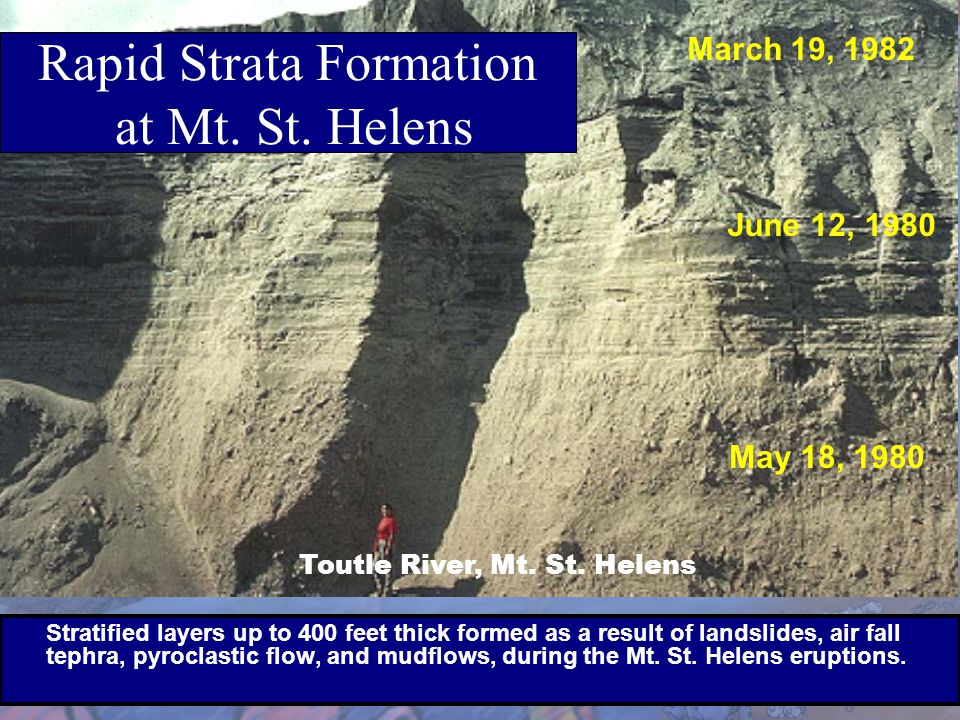
Visit the fossil museum:
www.flickr.com/photos/101536517@N06/sets/72157641367196613/
Just how good are peer reviews of scientific papers?
www.sciencemag.org/content/342/6154/60.full
www.examiner.com/article/want-to-publish-science-paper-ju...
The neo-Darwinian idea that the human genome consists entirely of an accumulation of billions of mutations is, quite obviously, completely bonkers. Nevertheless, it is compulsorily taught in schools and universities as 'science'.
ROMA ARCHEOLOGICA & RESTAURO ARCHITETTURA 2020. Rome, a New Museum of Fascism. Mayor Raggi blocks the proposal. La Repubblica (03/08/2020). The blocking of the new Museum, Not so much for Political or Idealogical Reasonings. But More Realistically, Because Rome's City Museums are in a State of Neglect, Underfunded and Periodically Looted (1995-2020). wp.me/pbMWvy-rT
1). ROME: A Museum of Fascism in Rome, the Jewish community: "Useless for memory." And Mayor Raggi Blocks the motion. La Repubblica (03/08/2020).
The debate on the 'Museum of Fascism' erupted following the earlier article in the La Repubblica (03/08/2020). From the Jewish community in Rome to the members of the anti-Fascists ANPI organization asking Mayor Raggi to block the proposal by three council members of the City of Rome to develop a new Museum of Fascism in Rome. With Mayor Raggi stating: "Rome is an anti-Fascist city, make no doubt about it..."
Fonte / source:
--- Museo del fascismo a Roma, comunità ebraica: "inutile per la Memoria". E la Raggi stoppa la mozione.
La Repubblica (03/08/2020).
roma.repubblica.it/cronaca/2020/08/03/news/museo_del_fasc...
2). ROME: A Museum of Fascism in Rome, Rome Town-Counsel member Gemma Guerrini, reply to Mayor Raggi: "I am proposing the new Museum, first as a historian and secondly as a politician." La Repubblica (03/08/2020).
The City of Rome and other institutions in Rome have proposed a new Museum of Fascism (see: Storia in Rete [01/2012] & IL TEMPO [27/11/2011]) for a decade or more. Counsel member Dr. Gemma Guerrini, said technically Mayor Raggi cannot block the motion or ask the majority of the her fellow party members not to vote agianst the the proposal. (...) Dr. Guerrini, went on to say: "...History must be written without prejudice. If I want to write an essay on fascism, I do not call it an anti-fascist essay. If we read and study the documentary materials, as historians (Dr. Guerrini - a paleontologist), we must face uncomfortable pages on fascism."
Fonte / source:
--- Museo del fascismo a Roma, Guerrini fa dietrofront: "Ho ragionato prima da storica e poi da politica."
La Repubblica (03/08/2020).
roma.repubblica.it/cronaca/2020/08/03/news/roma_guerrini_...
Foto / fonte / source:
--- Mauro Pagliai, “Son of the Century.” SKYPIXEL (29 Jan. 2020), in:
ROMA ARCHEOLOGICA e RESTAURO ARCHITETTURA: Dario Franceschini / MIBACT – SELEZIONE PUBBLICA PER I DIRETTORI DEI MUSEI ITALIANI | BANDO INTERNAZIONALE 2020 / CALL FOR APPLICATIONS – DIRECTORS OF ITALIAN MUSEUMS. The MIBACT & The Times London U.K. (01 Feb. 2020). [Italiano & English].
S.v.,
3). ROMA ARCHEOLOGICA & RESTAURO ARCHITETTURA 2020. Un Museo sul fascismo a Roma, in Aula la mozione della consigliera 5 Stelle. Agenzia Nova & La Repubblica (03/08/2020), Storia in Rete (01/2012) & IL TEMPO (27/11/2011). wp.me/pbMWvy-rH
4). ROME - A New Museum of Fascism in Rome. Dr. Gemma Guerrini & Mayor Virginia Raggi have not addressed the serious issues confronting the City of Rome's current or planned Museums which are Seriously Neglected, Unfunded and Periodically Looted (03/08/2020).
4.1). Rome - City Museums Neglected, Underfunded and Periodically Looted.
--- Museum of Roman Civilization / EUR district: The Museum of Roman Civilization located in the EUR district of Rome, although construction began in the late 1930s and continued up until the early 1940s, after after a delay was not opened to the public in 1955-56. The Museum of Roman Civilization has stored in its basement 500 crates of articfacts and related archivial records of the important from the Fascist era urban and archaeological systemization of Rome starting in the late 1920s and up-to the early 1940s. Many of these crates contain important artifacts unearthed (early Rome thru Renaissance Rome) in the area of the Imperial Fora and the Velia hill during the construction of the Via dell' Impero (now Via dei Fori Imperiali). In the late 2000s, the city of Rome began re-examining, studying and cataloguing this important artifacts. As of today 2020, the status of the these artifacts and un-edited archivial records from the 1930s have not been published? The large sections of the Museum of Roman Civilization has been closed to the public and has not recieved the funding needed t0 properly care for the museum and or the important artifacts housed in the museum and the crates of artifacts from the 1930s.
ROMA ARCHEOLOGIA e RESTAURO ARCHITETTURA: Museo della Civiltà Romana e del Planetario, ripartono i lavori, COMUNE DI ROMA (27/04/2017) & FOTO di Dott.ssa Elizabetta Rossi, Riapriamo Il Museo della Civiltà Romana / FACEBOOK (01/05/2017).
www.flickr.com/photos/imperial_fora_of_rome/33577303773
ROMA ARCHEOLOGIA e RESTAURO ARCHITETTURA: L' abbondono del Museo della Civilta` Romana, di Emanuela Verga. Corriere Della Sera (26/05/2011): 14.
www.flickr.com/photos/imperial_fora_of_rome/5760864225
ROMA ARCHEOLOGIA e RESTAURO ARCHITETTURA: Via dell' Impero / Fori Imperiali - Una piage del Archeologia Italiana - gli scavi inediti (1939-2009) - Indiana Jones ai Fori Imperiali, il Mistero delle 500 casse, Riemergono il reperti catalogati nel 1939. C.d.S.(12/09/2010): 3
www.flickr.com/photos/imperial_fora_of_rome/4988366532
www.flickr.com/photos/imperial_fora_of_rome/4988355704
Also see:
ROMA ARCHEOLOGIA e RESTAURO ARCHITETTURA: 618 stolen archaeological artifacts recovered, etc. Including a fragment of the FORMA URBIS ROMAE [area of the Tempio di Minerva Calcidica in the Campius Marius]. Il Messaggero (06/02/2008).
www.flickr.com/photos/imperial_fora_of_rome/2515127737
--- The Antiquarium on the Celian Hill: in the late 1880s thru 1939, the Antiquarium on the Celian Hill would serve as a collection site administered by the city of Rome to house the vast volume of archaeological materials or fragmentary architectural elements (dating from Roman Antiquity to the Renaissance era) unearthed throughout the city. In 1939-40, the Antiquarium on the Celian Hill was closed due to structure damage to building during the construction of the nearby Rome - Metro B 'Colosseum' subway line. In the late 1950s or early 1960s, various artifacts held in several dozen or more crates where transformed to various other museum sites administered by the city of Rome, and finally in the 1990s (?) ending up in the basement of the Museum of Roman Civilization / EUR district. Today 2020, the Antiquarium on the Celian Hill is closed and in a sad state of decay; see:
ROMA ARCHEOLOGIA & RESTAURO ARCHITETTURA: Manlio Lilli, Beni culturali: a Roma la Sovraintendenza cerca volontari. IL FATTO QUOTIDIANO (14|11|2014).
www.flickr.com/photos/imperial_fora_of_rome/15789195072
Also see:
ROMA ARCHEOLOGIA e RESTAURO ARCHITETTURA: The Hidden Treasures of Rome | Capitoline Project Publication | the University of Missouri | Comune di Roma (2014 | 2017) & Confederazione Italiana Archeologi (11|11|2014).
www.flickr.com/photos/imperial_fora_of_rome/34247622354
--- The Palazzo Rivaldi / Velia Hill: in the mid-1990s, Mayor of Rome Francesco Rutelli proposed that Palazzo Rivaldi / Velia Hill would serve as a new museum for the Imperial Fora. The Palazzo partially survived following the demolition and clearing of the Velia hill in the late 1920s and early 1930s during the construction of the Via dell' Impero (now the Via dei Fori Imperiali). Today as of 2020, the Palazzo Rivaldi is still closed and abandoned overlooking the now ongoing construction of the new Metro C 'Fori Imperiali' Subway station (2015-20); see:
ROMA ARCHEOLOGIA e RESTAURO ARCHITETTURA: Italia - Agenzia del Demanio: the 16th cent. "Palazzo Silvestri-Rivaldi" along the Via dei Fori to be Sold for Private Development. CORRIERE DELLA SERA (25/01/2017) & LA REPUBBLICA (06/02/2004), 5.
www.flickr.com/photos/imperial_fora_of_rome/31929062353
--- The Visitor Center of the Imperial Fora: In 1999, the City of Rome opened the New Visitor Center of the Imperial Fora on the corner of the Via Cavour and the Via dei Fori Imperiali. In 2002, the small Visitor Center was transfered to its permanent site located next to the Palazzo Rivaldi / Velia Hill. Between 2002-12; the small Visitor Center was one of the most interesting and innovation site's in Rome because if offered the visitor to the Imperial Fora a unique array of information on the ancient-thru-modern history of the Imperial Fora (available in both Italian and English). Including a detailed new model of the monumental complex of the ancient Imperial Fora in antiquity, in the scale of 1:500 meters.
After 2012, the visitor center was transformed into a "PIT Fori Imperiali, Punto Informativo Turistico", then afterwards it was somwhat abandoned and neglected; see:
ROMA ARCHEOLOGICA e RESTAURO ARCHITETTURA: “PIT Fori Imperiali, Punto Informativo Turistico / Il Visitor Center dei Fori Imperiali e` SUK.” Remo Tagliacozzo CEO ZETEMA & Sindaca Virginia Raggi, in: Zètema Progetto Cultura S.r.l. & TRIPADVISOR (2019).
www.flickr.com/photos/imperial_fora_of_rome/49364314908
Also see:
ROMA ARCHEOLOGIA e RESTAURO ARCHITETTURA: A Roma il Visitor Center su via dei Fori Imperiali - Fori, nell' oasi per turisti solo topo e immondizia, Laura Larcan - Facebook | Il Messaggero (09/08/2016).
www.flickr.com/photos/imperial_fora_of_rome/33654383164
--- The Museum of the City of Rome from 'Romolo ad Albertone' (2010 - onwards).
In the late 2000s, the City of Rome proposed creating a new Museum of the City of Rome from 'Romulas to Aberto Sordi', with the new Museum located on the former site of the closed and former 'Museo dell’Impero Romano' (1927); located adjacent at the base of the Palatine Hill and the nearby Circus Maximus. The new museum would be a modern state-of-art-museum merging tradtional museum settings with internet and then new 'innovative' social media resources. Problematically, besides the restoration of the former 'Museo dell’Impero Romano', the city of Rome also proposed transforming sections of the building to include a new 5-star hotel and resturant. Today, the planning and funding status of the new and or former museum, hotel and resturant is unknown?
ROMA ARCHEOLOGICA & RESTAURO ARCHITETTURA: Il Museo della Città? Apre nel 2012. Ecco il progetto in via dei Cerchi: 54 sale da Romolo ad Albertone. IL MESSAGGERO (05/01/2010): 1 & 33.
www.flickr.com/photos/imperial_fora_of_rome/4247766393/
Also see:
ROMA ARCHEOLOGICA & RESTAURO ARCHITETTURA: Enrico Silverio, “21 aprile 1927: l’inaugurazione del Museo dell’Impero Romano,” in: CIVILTÀ ROMANA III (2016) & BOLLETTINO DEI MUSEI COMUNALI DI ROMA (2014).
www.flickr.com/photos/imperial_fora_of_rome/28066495009/
www.flickr.com/photos/imperial_fora_of_rome/39845719671/
--- The Ara Pacis Museum: in the early to mid 1990s, former Mayor Francesco Rutelli proposed creating a new Museum for the Ara Pacis Monument in Rome, with the new Ara Pacis museum to be completed in time for the Jubilee Year 2000 celebration in Rome (Dec. 1999 - Jan. 2001). Problematically, Mayor Rutelli was less concerned about protecting the Ara Pacis Monument; but, more concerned with transforming the monument into a museum show place which included "...a library, a bookstore, a café, and an auditorium capable of seating about a hundred and fifty people." In which added additional cost to the new museum, but also considerably delayed the official opening of the new museum, years after the end of the Jubilee Year 2000 celebration; see:
ROMA, "NON FATELO", in: John Seabrook, “Rome Renovation - Can Richard Meier undo what Augustus and Mussolini wrought?” in: THE NEW YORKER, Vol. 81, No. 11 (2 May 2005): 56-64 [in PDF].
www.flickr.com/photos/imperial_fora_of_rome/14997011141/
4.2). Rome - The Italian State Museums Neglected & Underfunded; see:
--- The Museum of the Roman Forum: Between 1900-12, Italian Architect Giacomo Boni (Archaeological Director of the Roman Forum [1898-1925]) created the Museum of the Roman Forum. The Museum would serve as museum, but also a library and archive for the history of the Roman Forum. In 1939-40, the Museum of the Roman Forum was closed due to the wartime emergency. Now 70 years later the Museum is still closed to the public and scholars alike; see:
Dr. Alfonsina Russo (ed.), Parco archeologico del Colosseo. Rome: Electra (2018-20), pp. 1-61 [in PDF].
www.flickr.com/photos/imperial_fora_of_rome/49359261982
Also see:
Rome - Excavating The Centre of Rome's Great Civilisation - Revealing the Story of the Forum - The Results of Commendatore Boni's Nine Years Work in Rome, in: Suppliment to the Sphere, 21 September (1907).
www.flickr.com/photos/imperial_fora_of_rome/24875845892
--- The Museum of the Palatine Hill (2011): In early August 2011, Dr. Rossella Rea reported that several employee's from the Museum of the Palatine Hill stole 40.000 Euro's / or nearly $50,ooo USD in museum entrance fee's; see:
Il Messaggero (08/08/2011) & Corriere della Sera (09/08/2011).
www.flickr.com/photos/imperial_fora_of_rome/6025744682
S.v.,
--- ROMA ARCHEOLOGICA & RESTAURO ARCHITETTURA 2020. Sindaca Raggi & ex-Sindaco Rutelli (1995) gioca a fare politica con il patrimonio urbano di Roma. Raggi: "La fermata Amba Aradam della Metro C sarà intitola a Giorgio Marincola." La Repubblica (01/08/2020) & (13-19/09/1995). wp.me/pbMWvy-rD
Knockinnon is nearly very interesting, but isn't! The reasoning behind that curious assessment is that is was apparently never finished. Had it been, it would have been interesting, because it was going to be a fairly significant establishment. Furthermore it was sited in a natural defensive spot and has excellent views up and down the coast, so it would have been a prominent landmark. It is said that Knockinnon was started by William, 2nd Earl of Caithness, but due to his death at the battle of Flodden in 1513, construction stopped and it was never completed.
(The square pit was a quarry, probably post-dating the castle construction.)
Richard Henry Brunton FRGS MICE (26 December 1841 – 24 April 1901) was the so-called "Father of Japanese lighthouses". Brunton was born in Muchalls, Kincardineshire, Scotland. He was employed by the government of Meiji period Japan as a foreign advisor (o-yatoi gaikokujin), primarily to build lighthouses.
Over a period of seven and a half years he designed and supervised the building of 26 Japanese lighthouses in the Western style, which became known as Brunton's "children". To operate the lighthouses he established a system of lighthouse keepers, based on the one used in Scotland. He also helped found Japan's first school of civil engineering. In 1871, he was received by Emperor Meiji in recognition of his efforts.
Brunton was born in the Coastguard House (now 11 Marine Terrace) at Muchalls, Fetteresso in The Mearns. After training as a railway engineer he joined the Stevenson brothers (David and Thomas Stevenson) who were engaged by the British government to build lighthouses.
Under pressure from British minister Sir Harry Parkes to fulfil its obligations to make the waters and harbors of Japan safe for shipping, the Tokugawa shogunate hired the Edinburgh-based firm of D. and T. Stevenson to chart coastal waters and to build lighthouses where appropriate. The project had already begun under French foreign advisor Léonce Verny, but was not proceeding fast enough for the British.
Brunton was sent from Edinburgh in August 1868 to head the project after being recommended to the Japanese government by the Stevensons, despite the fact that he had no experience in lighthouse building at all. He was accompanied by his wife, sister-in-law and two assistants. The party received word while docked at Aden of the fall of the Tokugawa shogunate and its replacement by the Meiji government, and decided to continue on to Japan, reasoning that the new government was still bound by the international commitments of its predecessor. Over the next seven and a half years he designed and supervised the building of 26 Japanese lighthouses in the Western style, along with two lightvessels. (There had been Japanese lighthouses before then, but they were short and squat buildings, such as the old Shirasu lighthouse now in the grounds of Kokura castle in Kitakyushu.) Brunton was accompanied by his wife and two assistants.
Brunton also established a system of lighthouse keepers, modeled on the Northern Lighthouse Board in Scotland.
Aside from his work on lighthouses around Japan, Brunton also surveyed and drew the first detailed maps of Yokohama, planned its sewage system, street paving and gas lights, established a telegraph system, and designed and built the settlement's first iron bridge. He also helped found Japan's first school of civil engineering. In recognition of his efforts, he was received by Emperor Meiji in an audience in 1871.
Brunton returned to London on a leave of absence in July 1872, and was enlisted to assist the Iwakura Mission during its visit. In September, Brunton took Ito Hirobumi and a group of his assistants to visit 28 factories around London making a variety of manufactured goods, and continued on to Birmingham, Manchester and Liverpool before rejoining the main group of the Iwakura Mission in Edinburgh in early October.
After disagreeing with Japanese officials he left Japan in March, 1876, later receiving a prize for his paper "Japan Lights".
On his return he first set up in Glasgow for Young's Paraffin Oil, before moving to South London in 1881 making architectural plasterwork, where he remained until his death.
Brunton wrote a memoir of his time in Japan, titled Pioneer Engineering in Japan: A Record of Work in helping to Re-Lay the Foundations of Japanese Empire (1868-1876). However, it was not published until the 1990s, when it was printed by separate publishers under two different names: Building Japan 1868-1876 and Schoolmaster to an Empire: Richard Henry Brunton in Meiji Japan, 1868-1876. (See below.)
The former, containing the text (with some modified spellings) as edited by William Elliot Griffis at the turn of the twentieth century, contains plates with photos and illustrations. The latter however, purports to be based on a manuscript predating the heavy editing of Griffis, while retaining updated versions of Griffis's footnotes.
Building Japan 1868-1876 by Richard Henry Brunton with an introduction by Hugh Cortazzi, Japan Library Limited, 1991, ISBN 1-873410-05-0
Schoolmaster to an Empire by R. Henry Brunton, edited by Edward R. Beauchamp, Greenwood Press, 1991, ISBN 0-313-27795-8
In his memoir, Brunton describes in some detail the burial of Frank Toovey Lake, a midshipman who was sailing with him on HMS Manilla when he was making his first survey of locations to site lighthouses. His high regard for the care that the islanders gave to the grave was, as he himself admitted in his book, in contrast to his general impression of the Japanese.
West Norwood Cemetery, West Norwood, London SE27 9JU
Rapid strata formation in soft sand (field evidence).
Photo of strata formation in soft sand on a beach, created by tidal action of the sea.
Formed in a single, high tidal event. Stunning evidence which displays multiple strata/layers.
Why this is so important ....
It has long been assumed, ever since the 17th century, that layers/strata observed in sedimentary rocks were built up gradually, layer upon layer, over many years. It certainly seemed logical at the time, from just looking at rocks, that lower layers would always be older than the layers above them, i.e. that lower layers were always laid down first followed, in time, by successive layers on top.
This was assumed to be true and became known as the superposition principle.
It was also assumed that a layer comprising a different material from a previous layer, represented a change in environmental conditions/factors.
These changes in composition of layers or strata were considered to represent different, geological eras on a global scale, spanning millions of years. This formed the basis for the Geologic Column, which is used to date rocks and also fossils. The evolutionary, 'fossil record' was based on the vast ages and assumed geological eras of the Geologic Column.
There was also circular reasoning applied with the assumed age of 'index' fossils (based on evolutionary beliefs & preconceptions) used to date strata in the Geologic Column. Dating strata from the assumed age of (index) fossils is known as Biostratigraphy.
We now know that, although these assumptions seemed logical, they are not supported by the evidence.
At the time, the mechanics of stratification were not properly known or studied.
An additional factor was that this assumed superposition and uniformitarian model became essential, with the wide acceptance of Darwinism, for the long ages required for progressive microbes-to-human evolution. There was no incentive to question or challenge the superposition, uniformitarian model, because the presumed, fossil 'record' had become dependant on it, and any change in the accepted model would present devastating implications for Darwinism.
This had the unfortunate effect of linking the study of geology so closely to Darwinism, that any study independent of Darwinian considerations was effectively stymied. This link of geology with Darwinian preconceptions is known as biostratigraphy.
Some other field evidence, in various situations, can be observed here: www.flickr.com/photos/101536517@N06/sets/72157635944904973/
and also in the links to stunning, experimental evidence, carried out by sedimentologists, given later.
_______________________________________________
GEOLOGIC PRINCIPLES (established by Nicholas Steno in the 17th Century):
What Nicolas Steno believed about strata formation is the basis of the principle of Superposition and the principle of Original Horizontality.
dictionary.sensagent.com/Law_of_superposition/en-en/
“Assuming that all rocks and minerals had once been fluid, Nicolas Steno reasoned that rock strata were formed when particles in a fluid such as water fell to the bottom. This process would leave horizontal layers. Thus Steno's principle of original horizontality states that rock layers form in the horizontal position, and any deviations from this horizontal position are due to the rocks being disturbed later.”)
BEDDING PLANES.
'Bedding plane' describes the surface in between each stratum which are formed during sediment deposition.
science.jrank.org/pages/6533/Strata.html
“Strata form during sediment deposition, that is, the laying down of sediment. Meanwhile, if a change in current speed or sediment grain size occurs or perhaps the sediment supply is cut off, a bedding plane forms. Bedding planes are surfaces that separate one stratum from another. Bedding planes can also form when the upper part of a sediment layer is eroded away before the next episode of deposition. Strata separated by a bedding plane may have different grain sizes, grain compositions, or colours. Sometimes these other traits are better indicators of stratification as bedding planes may be very subtle.”
______________________________________________
Several catastrophic events, flash floods, volcanic eruptions etc. have forced Darwinian, influenced geologists to admit to rapid stratification in some instances. However they claim it is a rare phenomenon, which they have known about for many years, and which does nothing to invalidate the Geologic Column, the fossil record, evolutionary timescale, or any of the old assumptions regarding strata formation, sedimentation and the superposition principle. They fail to face up to the fact that rapid stratification is not an extraordinary phenonemon, but rather the prevailing and normal mechanism of sedimentary deposition whenever and wherever there is moving, sediment-laden water. The experimental evidence demonstrates the mechanism and a mass of field evidence in normal (non-catastrophic) conditions shows it is a normal everyday occurrence.
It is clear from the experimental evidence that the usual process of stratification is - that strata are not formed by horizontal layers being laid on top of each other in succession, as was assumed. But by sediment being sorted in the flowing water and laid down diagonally in the direction of flow. See diagram:
www.flickr.com/photos/truth-in-science/39821536092/in/dat...
The field evidence (in the image) presented here - of rapid, simultaneous stratification refutes the Superposition Principle and the Principle of Lateral Continuity.
We now know, the Superposition Principle only applies on a rare occasion where sedimentary deposits are laid down in still water.
Superposition is required for the long evolutionary timescale, but the evidence shows it is not the general rule, as was once believed. Most sediment is laid down in moving water, where particle segregation is the general rule, resulting in the simultaneous deposition of strata/layers as shown in the photo.
See many other examples of rapid stratification (with geological features): www.flickr.com/photos/101536517@N06/sets/72157635944904973/
Rapid, simultaneous formation of layers/strata, through particle segregation in moving water, is so easily created it has even been described by sedimentologists (working on flume experiments) as a law ...
"Upon filling the tank with water and pouring in sediments, we immediately saw what was to become the rule: The sediments sorted themselves out in very clear layers. This became so common that by the end of two weeks, we jokingly referred to Andrew's law as "It's difficult not to make layers," and Clark's law as "It's easy to make layers." Later on, I proposed the "law" that liquefaction destroys layers, as much to my surprise as that was." Ian Juby, www.ianjuby.org/sedimentation/
The example in the photo is the result of normal, everyday tidal action in a single incident. Where the water current or movement is more turbulent, violent, or catastrophic, great depths (many metres) of stratified sediment can be laid down in a short time. Certainly not the many millions of years assumed by evolutionists.
The composition of strata formed in any deposition event. is related to whatever materials are in the sediment mix, not to any particular timescale. Whatever is in the mix will be automatically sorted into strata/layers. It could be sand, or other material added from mud slides, erosion of chalk deposits, coastal erosion, volcanic ash etc. Any organic material (potential fossils), alive or dead, engulfed by, or swept into, a turbulent sediment mix, will also be sorted and buried within the rapidly, forming layers.
See many other examples of rapid stratification with geological features: www.flickr.com/photos/101536517@N06/sets/72157635944904973/
Stratified, soft sand deposit. demonstrates the rapid, stratification principle.
Important, field evidence which supports the work of the eminent, sedimentologist Dr Guy Berthault MIAS - Member of the International Association of Sedimentologists.
(Dr Berthault's experiments (www.sedimentology.fr/)
And also the experimental work of Dr M.E. Clark (Professor Emeritus, U of Illinois @ Urbana), Andrew Rodenbeck and Dr. Henry Voss, (www.ianjuby.org/sedimentation/)
Location: Sandown, Isle of Wight. Formed 16/01/2018 This field evidence demonstrates that multiple strata in sedimentary deposits do not need millions of years to form and can be formed rapidly. This natural example confirms the principle demonstrated by the sedimentation experiments carried out by Dr Guy Berthault and other sedimentologists. It calls into question the standard, multi-million year dating of sedimentary rocks, and the dating of fossils by depth of burial or position in the strata.
Mulltiple strata/layers are evident in this example.
Dr Berthault's experiments (www.sedimentology.fr/) and other experiments (www.ianjuby.org/sedimentation/) and field studies of floods and volcanic action show that, rather than being formed by gradual, slow deposition of sucessive layers superimposed upon previous layers, with the strata or layers representing a particular timescale, particle segregation in moving water or airborne particles can form strata or layers very quickly, frequently, in a single event.
And, most importantly, lower strata are not older than upper strata, they are the same age, having been created in the same sedimentary episode.
Such field studies confirm experiments which have shown that there is no longer any reason to conclude that strata/layers in sedimentary rocks relate to different geological eras and/or a multi-million year timescale. www.youtube.com/watch?v=5PVnBaqqQw8&feature=share&.... they also show that the relative position of fossils in rocks is not indicative of an order of evolutionary succession. Obviously, the uniformitarian principle, on which the geologic column is based, can no longer be considered valid. And the multi-million, year dating of sedimentary rocks and fossils needs to be reassessed. Rapid deposition of stratified sediments also explains the enigma of polystrate fossils, i.e. large fossils that intersect several strata. In some cases, tree trunk fossils are found which intersect the strata of sedimentary rock up to forty feet in depth. upload.wikimedia.org/wikipedia/commons/thumb/0/08/Lycopsi... They must have been buried in stratified sediment in a short time (certainly not millions, thousands, or even hundreds of years), or they would have rotted away. youtu.be/vnzHU9VsliQ
In fact, the vast majority of fossils are found in good, intact condition, which is testament to their rapid burial. You don't get good fossils from gradual burial, because they would be damaged or destroyed by decay, predation or erosion. The existence of so many fossils in sedimentary rock on a global scale is stunning evidence for the rapid depostion of sedimentary rock as the general rule. It is obvious that all rock containing good intact fossils was formed from sediment laid down in a very short time, not millions, or even thousands of years.
See set of photos of other examples of rapid stratification: www.flickr.com/photos/101536517@N06/sets/72157635944904973/
Carbon dating of coal should not be possible if it is millions of years old, yet significant amounts of Carbon 14 have been detected in coal and other fossil material, which indicates that it is less than 50,000 years old. www.ldolphin.org/sewell/c14dating.html
www.grisda.org/origins/51006.htm
Evolutionists confidently cite multi-million year ages for rocks and fossils, but what most people don't realise is that no one actually knows the age of sedimentary rocks or the fossils found within them. So how are evolutionists so sure of the ages they so confidently quote? The astonishing thing is they aren't. Sedimentary rocks cannot be dated by radiometric methods*, and fossils can only be dated to less than 50,000 years with Carbon 14 dating. The method evolutionists use is based entirely on assumptions. Unbelievably, fossils are dated by the assumed age of rocks, and rocks are dated by the assumed age of fossils, that's right ... it is known as circular reasoning.
* Regarding the radiometric dating of igneous rocks, which is claimed to be relevant to the dating of sedimentary rocks, in an occasional instance there is an igneous intrusion associated with a sedimentary deposit -
Prof. Aubouin says in his Précis de Géologie: "Each radioactive element disintegrates in a characteristic and constant manner, which depends neither on the physical state (no variation with pressure or temperature or any other external constraint) nor on the chemical state (identical for an oxide or a phosphate)."
"Rocks form when magma crystallizes. Crystallisation depends on pressure and temperature, from which radioactivity is independent. So, there is no relationship between radioactivity and crystallisation.
Consequently, radioactivity doesn't date the formation of rocks. Moreover, daughter elements contained in rocks result mainly from radioactivity in magma where gravity separates the heavier parent element, from the lighter daughter element. Thus radiometric dating has no chronological signification." Dr. Guy Berthault www.sciencevsevolution.org/Berthault.htm
Visit the fossil museum:
www.flickr.com/photos/101536517@N06/sets/72157641367196613/
Just how good are peer reviews of scientific papers?
www.sciencemag.org/content/342/6154/60.full
www.examiner.com/article/want-to-publish-science-paper-ju...
The neo-Darwinian idea that the human genome consists entirely of an accumulation of billions of mutations is, quite obviously, completely bonkers. Nevertheless, it is compulsorily taught in schools and universities as 'science'.
In part, anyway. :-) He complimented my shoulders and back, saying I should show them off. Perhaps I look a little less than delicate from that viewpoint... ;-D
Rapid strata formation in soft sand (field evidence).
Photo of strata formation in soft sand on a beach, created by tidal action of the sea.
Formed in a single, high tidal event. Stunning evidence which displays multiple strata/layers.
Why this is so important ....
It has long been assumed, ever since the 17th century, that layers/strata observed in sedimentary rocks were built up gradually, layer upon layer, over many years. It certainly seemed logical at the time, from just looking at rocks, that lower layers would always be older than the layers above them, i.e. that lower layers were always laid down first followed, in time, by successive layers on top.
This was assumed to be true and became known as the superposition principle.
It was also assumed that a layer comprising a different material from a previous layer, represented a change in environmental conditions/factors.
These changes in composition of layers or strata were considered to represent different, geological eras on a global scale, spanning millions of years. This formed the basis for the Geologic Column, which is used to date rocks and also fossils. The evolutionary, 'fossil record' was based on the vast ages and assumed geological eras of the Geologic Column.
There was also circular reasoning applied with the assumed age of 'index' fossils (based on evolutionary beliefs & preconceptions) used to date strata in the Geologic Column. Dating strata from the assumed age of (index) fossils is known as Biostratigraphy.
We now know that, although these assumptions seemed logical, they are not supported by the evidence.
At the time, the mechanics of stratification were not properly known or studied.
An additional factor was that this assumed superposition and uniformitarian model became essential, with the wide acceptance of Darwinism, for the long ages required for progressive microbes-to-human evolution. There was no incentive to question or challenge the superposition, uniformitarian model, because the presumed, fossil 'record' had become dependant on it, and any change in the accepted model would present devastating implications for Darwinism.
This had the unfortunate effect of linking the study of geology so closely to Darwinism, that any study independent of Darwinian considerations was effectively stymied. This link of geology with Darwinian preconceptions is known as biostratigraphy.
Some other field evidence, in various situations, can be observed here: www.flickr.com/photos/101536517@N06/sets/72157635944904973/
and also in the links to stunning, experimental evidence, carried out by sedimentologists, given later.
_______________________________________________
GEOLOGIC PRINCIPLES (established by Nicholas Steno in the 17th Century):
What Nicolas Steno believed about strata formation is the basis of the principle of Superposition and the principle of Original Horizontality.
dictionary.sensagent.com/Law_of_superposition/en-en/
“Assuming that all rocks and minerals had once been fluid, Nicolas Steno reasoned that rock strata were formed when particles in a fluid such as water fell to the bottom. This process would leave horizontal layers. Thus Steno's principle of original horizontality states that rock layers form in the horizontal position, and any deviations from this horizontal position are due to the rocks being disturbed later.”)
BEDDING PLANES.
'Bedding plane' describes the surface in between each stratum which are formed during sediment deposition.
science.jrank.org/pages/6533/Strata.html
“Strata form during sediment deposition, that is, the laying down of sediment. Meanwhile, if a change in current speed or sediment grain size occurs or perhaps the sediment supply is cut off, a bedding plane forms. Bedding planes are surfaces that separate one stratum from another. Bedding planes can also form when the upper part of a sediment layer is eroded away before the next episode of deposition. Strata separated by a bedding plane may have different grain sizes, grain compositions, or colours. Sometimes these other traits are better indicators of stratification as bedding planes may be very subtle.”
______________________________________________
Several catastrophic events, flash floods, volcanic eruptions etc. have forced Darwinian, influenced geologists to admit to rapid stratification in some instances. However they claim it is a rare phenomenon, which they have known about for many years, and which does nothing to invalidate the Geologic Column, the fossil record, evolutionary timescale, or any of the old assumptions regarding strata formation, sedimentation and the superposition principle. They fail to face up to the fact that rapid stratification is not an extraordinary phenonemon, but rather the prevailing and normal mechanism of sedimentary deposition whenever and wherever there is moving, sediment-laden water. The experimental evidence demonstrates the mechanism and a mass of field evidence in normal (non-catastrophic) conditions shows it is a normal everyday occurrence.
It is clear from the experimental evidence that the usual process of stratification is - that strata are not formed by horizontal layers being laid on top of each other in succession, as was assumed. But by sediment being sorted in the flowing water and laid down diagonally in the direction of flow. See diagram:
www.flickr.com/photos/truth-in-science/39821536092/in/dat...
The field evidence (in the image) presented here - of rapid, simultaneous stratification refutes the Superposition Principle and the Principle of Lateral Continuity.
We now know, the Superposition Principle only applies on a rare occasion where sedimentary deposits are laid down in still water.
Superposition is required for the long evolutionary timescale, but the evidence shows it is not the general rule, as was once believed. Most sediment is laid down in moving water, where particle segregation is the general rule, resulting in the simultaneous deposition of strata/layers as shown in the photo.
See many other examples of rapid stratification (with geological features): www.flickr.com/photos/101536517@N06/sets/72157635944904973/
Rapid, simultaneous formation of layers/strata, through particle segregation in moving water, is so easily created it has even been described by sedimentologists (working on flume experiments) as a law ...
"Upon filling the tank with water and pouring in sediments, we immediately saw what was to become the rule: The sediments sorted themselves out in very clear layers. This became so common that by the end of two weeks, we jokingly referred to Andrew's law as "It's difficult not to make layers," and Clark's law as "It's easy to make layers." Later on, I proposed the "law" that liquefaction destroys layers, as much to my surprise as that was." Ian Juby, www.ianjuby.org/sedimentation/
The field example in the photo is the result of normal, everyday tidal action formed in a single incident,
Where the water current or movement is more turbulent, violent, or catastrophic, great depths (many metres) of stratified sediment can be laid down in a short time. Certainly not the many millions of years assumed by evolutionists.
The composition of strata formed in any deposition event. is related to whatever materials are in the sediment mix, not to any particular timescale. Whatever is in the mix will be automatically sorted into strata/layers. It could be sand, or other material added from mud slides, erosion of chalk deposits, coastal erosion, volcanic ash etc. Any organic material (potential fossils), alive or dead, engulfed by, or swept into, a turbulent sediment mix, will also be sorted and buried within the rapidly, forming layers.
See many other examples of rapid stratification with geological features: www.flickr.com/photos/101536517@N06/sets/72157635944904973/
Stratified, soft sand deposit. demonstrates the rapid, stratification principle.
Important, field evidence which supports the work of the eminent, sedimentologist Dr Guy Berthault MIAS - Member of the International Association of Sedimentologists.
(Dr Berthault's experiments (www.sedimentology.fr/)
And also the experimental work of Dr M.E. Clark (Professor Emeritus, U of Illinois @ Urbana), Andrew Rodenbeck and Dr. Henry Voss, (www.ianjuby.org/sedimentation/)
Location: Yaverland, Isle of Wight. photographed 04/06/2018, formed several months earlier and in the early stages of consolidation.
This field evidence demonstrates that multiple strata in sedimentary deposits do not need millions of years to form and can be formed rapidly. This natural example confirms the principle demonstrated by the sedimentation experiments carried out by Dr Guy Berthault and other sedimentologists. It calls into question the standard, multi-million year dating of sedimentary rocks, and the dating of fossils by depth of burial or position in the strata.
Mulltiple strata/layers are evident in this example.
Dr Berthault's experiments (www.sedimentology.fr/) and other experiments (www.ianjuby.org/sedimentation/) and field studies of floods and volcanic action show that, rather than being formed by gradual, slow deposition of sucessive layers superimposed upon previous layers, with the strata or layers representing a particular timescale, particle segregation in moving water or airborne particles can form strata or layers very quickly, frequently, in a single event.
And, most importantly, lower strata are not older than upper strata, they are the same age, having been created in the same sedimentary episode.
Such field studies confirm experiments which have shown that there is no longer any reason to conclude that strata/layers in sedimentary rocks relate to different geological eras and/or a multi-million year timescale. www.youtube.com/watch?v=5PVnBaqqQw8&feature=share&.... they also show that the relative position of fossils in rocks is not indicative of an order of evolutionary succession. Obviously, the uniformitarian principle, on which the geologic column is based, can no longer be considered valid. And the multi-million, year dating of sedimentary rocks and fossils needs to be reassessed. Rapid deposition of stratified sediments also explains the enigma of polystrate fossils, i.e. large fossils that intersect several strata. In some cases, tree trunk fossils are found which intersect the strata of sedimentary rock up to forty feet in depth. upload.wikimedia.org/wikipedia/commons/thumb/0/08/Lycopsi... They must have been buried in stratified sediment in a short time (certainly not millions, thousands, or even hundreds of years), or they would have rotted away. youtu.be/vnzHU9VsliQ
In fact, the vast majority of fossils are found in good, intact condition, which is testament to their rapid burial. You don't get good fossils from gradual burial, because they would be damaged or destroyed by decay, predation or erosion. The existence of so many fossils in sedimentary rock on a global scale is stunning evidence for the rapid depostion of sedimentary rock as the general rule. It is obvious that all rock containing good intact fossils was formed from sediment laid down in a very short time, not millions, or even thousands of years.
See set of photos of other examples of rapid stratification: www.flickr.com/photos/101536517@N06/sets/72157635944904973/
Carbon dating of coal should not be possible if it is millions of years old, yet significant amounts of Carbon 14 have been detected in coal and other fossil material, which indicates that it is less than 50,000 years old. www.ldolphin.org/sewell/c14dating.html
www.grisda.org/origins/51006.htm
Evolutionists confidently cite multi-million year ages for rocks and fossils, but what most people don't realise is that no one actually knows the age of sedimentary rocks or the fossils found within them. So how are evolutionists so sure of the ages they so confidently quote? The astonishing thing is they aren't. Sedimentary rocks cannot be dated by radiometric methods*, and fossils can only be dated to less than 50,000 years with Carbon 14 dating. The method evolutionists use is based entirely on assumptions. Unbelievably, fossils are dated by the assumed age of rocks, and rocks are dated by the assumed age of fossils, that's right ... it is known as circular reasoning.
* Regarding the radiometric dating of igneous rocks, which is claimed to be relevant to the dating of sedimentary rocks, in an occasional instance there is an igneous intrusion associated with a sedimentary deposit -
Prof. Aubouin says in his Précis de Géologie: "Each radioactive element disintegrates in a characteristic and constant manner, which depends neither on the physical state (no variation with pressure or temperature or any other external constraint) nor on the chemical state (identical for an oxide or a phosphate)."
"Rocks form when magma crystallizes. Crystallisation depends on pressure and temperature, from which radioactivity is independent. So, there is no relationship between radioactivity and crystallisation.
Consequently, radioactivity doesn't date the formation of rocks. Moreover, daughter elements contained in rocks result mainly from radioactivity in magma where gravity separates the heavier parent element, from the lighter daughter element. Thus radiometric dating has no chronological signification." Dr. Guy Berthault www.sciencevsevolution.org/Berthault.htm
"A team of Russian sedimentologists directed by Alexander Lalomov (Russian Academy of Sciences’ Institute of Ore Deposits) applied paleohydraulic analyses to geological formations in Russia. One example is the publication of a report in 2007 by the Lithology and Mineral Resources journal of the Russian Academy of Sciences. It concerns the Crimean Peninsular. It shows that the time of sedimentation of the sequence studied corresponds to a virtually instantaneous episode whilst according to stratigraphy it took several millions of years. Moreover, a recent report concerning the North-West Russian plateau in the St. Petersburg region shows that the time of sedimentation was much shorter than that attributed to it by the stratigraphic time-scale: 0.05% of the time."
www.sciencevsevolution.org/Berthault.htm
Rapid strata formation and rapid erosion at Mount St Helens.
slideplayer.com/slide/5703217/18/images/28/Rapid+Strata+F...
Visit the fossil museum:
www.flickr.com/photos/101536517@N06/sets/72157641367196613/
Just how good are peer reviews of scientific papers?
www.sciencemag.org/content/342/6154/60.full
www.examiner.com/article/want-to-publish-science-paper-ju...
The neo-Darwinian idea that the human genome consists entirely of an accumulation of billions of mutations is, quite obviously, completely bonkers. Nevertheless, it is compulsorily taught in schools and universities as 'science'.
Rapid strata formation in soft sand (field evidence).
Photo of strata formation in soft sand on a beach, created by tidal action of the sea.
Formed in a single, high tidal event. Stunning evidence which displays multiple strata/layers.
Why this is so important ....
It has long been assumed, ever since the 17th century, that layers/strata observed in sedimentary rocks were built up gradually, layer upon layer, over many years. It certainly seemed logical at the time, from just looking at rocks, that lower layers would always be older than the layers above them, i.e. that lower layers were always laid down first followed, in time, by successive layers on top.
This was assumed to be true and became known as the superposition principle.
It was also assumed that a layer comprising a different material from a previous layer, represented a change in environmental conditions/factors.
These changes in composition of layers or strata were considered to represent different, geological eras on a global scale, spanning millions of years. This formed the basis for the Geologic Column, which is used to date rocks and also fossils. The evolutionary, 'fossil record' was based on the vast ages and assumed geological eras of the Geologic Column.
There was also circular reasoning applied with the assumed age of 'index' fossils (based on evolutionary beliefs & preconceptions) used to date strata in the Geologic Column. Dating strata from the assumed age of (index) fossils is known as Biostratigraphy.
We now know that, although these assumptions seemed logical, they are not supported by the evidence.
At the time, the mechanics of stratification were not properly known or studied.
An additional factor was that this assumed superposition and uniformitarian model became essential, with the wide acceptance of Darwinism, for the long ages required for progressive microbes-to-human evolution. There was no incentive to question or challenge the superposition, uniformitarian model, because the presumed, fossil 'record' had become dependant on it, and any change in the accepted model would present devastating implications for Darwinism.
This had the unfortunate effect of linking the study of geology so closely to Darwinism, that any study independent of Darwinian considerations was effectively stymied. This link of geology with Darwinian preconceptions is known as biostratigraphy.
Some other field evidence can be observed here: www.flickr.com/photos/101536517@N06/sets/72157635944904973/
and also in the links to stunning, experimental evidence, carried out by sedimentologists, given later.
_______________________________________________
GEOLOGIC PRINCIPLES (established by Nicholas Steno in the 17th Century):
What Nicolas Steno believed about strata formation is the basis of the principle of Superposition and the principle of Original Horizontality.
dictionary.sensagent.com/Law_of_superposition/en-en/
“Assuming that all rocks and minerals had once been fluid, Nicolas Steno reasoned that rock strata were formed when particles in a fluid such as water fell to the bottom. This process would leave horizontal layers. Thus Steno's principle of original horizontality states that rock layers form in the horizontal position, and any deviations from this horizontal position are due to the rocks being disturbed later.”)
BEDDING PLANES.
'Bedding plane' describes the surface in between each stratum which are formed during sediment deposition.
science.jrank.org/pages/6533/Strata.html
“Strata form during sediment deposition, that is, the laying down of sediment. Meanwhile, if a change in current speed or sediment grain size occurs or perhaps the sediment supply is cut off, a bedding plane forms. Bedding planes are surfaces that separate one stratum from another. Bedding planes can also form when the upper part of a sediment layer is eroded away before the next episode of deposition. Strata separated by a bedding plane may have different grain sizes, grain compositions, or colours. Sometimes these other traits are better indicators of stratification as bedding planes may be very subtle.”
______________________________________________
Several catastrophic events, flash floods, volcanic eruptions etc. have forced Darwinian, influenced geologists to admit to rapid stratification in some instances. However they claim it is a rare phenomenon, which they have known about for many years, and which does nothing to invalidate the Geologic Column, the fossil record, evolutionary timescale, or any of the old assumptions regarding strata formation, sedimentation and the superposition principle. They fail to face up to the fact that rapid stratification is not an extraordinary phenonemon, but rather the prevailing and normal mechanism of sedimentary deposition whenever and wherever there is moving, sediment-laden water. The experimental evidence demonstrates the mechanism and a mass of field evidence in normal (non-catastrophic) conditions shows it is a normal everyday occurrence.
It is clear from the experimental evidence that the usual process of stratification is - that strata are not formed by horizontal layers being laid on top of each other in succession, as was assumed. But by sediment being sorted in the flowing water and laid down diagonally in the direction of flow. See diagram:
www.flickr.com/photos/truth-in-science/39821536092/in/dat...
The field evidence (in the image) presented here - of rapid, simultaneous stratification refutes the Superposition Principle, the Principle of Original Horizontality and the Principle of Lateral Continuity.
We now know, the Superposition Principle only applies on a rare occasion where sedimentary deposits are laid down in still water.
Superposition is required for the long evolutionary timescale, but the evidence shows it is not the general rule, as was once believed. Most sediment is laid down in moving water, where particle segregation is the general rule, resulting in the simultaneous deposition of strata/layers as shown in the photo.
See many other examples of rapid stratification (with geological features): www.flickr.com/photos/101536517@N06/sets/72157635944904973/
Rapid, simultaneous formation of layers/strata, through particle segregation in moving water, is so easily created it has even been described by sedimentologists (working on flume experiments) as a law ...
"Upon filling the tank with water and pouring in sediments, we immediately saw what was to become the rule: The sediments sorted themselves out in very clear layers. This became so common that by the end of two weeks, we jokingly referred to Andrew's law as "It's difficult not to make layers," and Clark's law as "It's easy to make layers." Later on, I proposed the "law" that liquefaction destroys layers, as much to my surprise as that was." Ian Juby, www.ianjuby.org/sedimentation/
The example in the photo is the result of normal, everyday tidal action in a single incident. Where the water current or movement is more turbulent, violent, or catastrophic, great depths (many metres) of stratified sediment can be laid down in a short time. Certainly not the many millions of years assumed by evolutionists.
The composition of strata formed in any deposition event. is related to whatever materials are in the sediment mix, not to any particular timescale. Whatever is in the mix will be automatically sorted into strata/layers. It could be sand, or other material added from mud slides, erosion of chalk deposits, coastal erosion, volcanic ash etc. Any organic material (potential fossils), alive or dead, engulfed by, or swept into, a turbulent sediment mix, will also be sorted and buried within the rapidly, forming layers.
See many other examples of rapid stratification with geological features: www.flickr.com/photos/101536517@N06/sets/72157635944904973/
Stratified, soft sand deposit. demonstrates the rapid, stratification principle.
Important, field evidence which supports the work of the eminent, sedimentologist Dr Guy Berthault MIAS - Member of the International Association of Sedimentologists.
(Dr Berthault's experiments (www.sedimentology.fr/)
And also the experimental work of Dr M.E. Clark (Professor Emeritus, U of Illinois @ Urbana), Andrew Rodenbeck and Dr. Henry Voss, (www.ianjuby.org/sedimentation/)
Location: Sandown, Isle of Wight. Formed 22/04/2018, This field evidence demonstrates that multiple strata in sedimentary deposits do not need millions of years to form and can be formed rapidly. This natural example confirms the principle demonstrated by the sedimentation experiments carried out by Dr Guy Berthault and other sedimentologists. It calls into question the standard, multi-million year dating of sedimentary rocks, and the dating of fossils by depth of burial or position in the strata.
Mulltiple strata/layers are evident in this example.
Dr Berthault's experiments (www.sedimentology.fr/) and other experiments (www.ianjuby.org/sedimentation/) and field studies of floods and volcanic action show that, rather than being formed by gradual, slow deposition of sucessive layers superimposed upon previous layers, with the strata or layers representing a particular timescale, particle segregation in moving water or airborne particles can form strata or layers very quickly, frequently, in a single event.
And, most importantly, lower strata are not older than upper strata, they are the same age, having been created in the same sedimentary episode.
Such field studies confirm experiments which have shown that there is no longer any reason to conclude that strata/layers in sedimentary rocks relate to different geological eras and/or a multi-million year timescale. www.youtube.com/watch?v=5PVnBaqqQw8&feature=share&.... they also show that the relative position of fossils in rocks is not indicative of an order of evolutionary succession. Obviously, the uniformitarian principle, on which the geologic column is based, can no longer be considered valid. And the multi-million, year dating of sedimentary rocks and fossils needs to be reassessed. Rapid deposition of stratified sediments also explains the enigma of polystrate fossils, i.e. large fossils that intersect several strata. In some cases, tree trunk fossils are found which intersect the strata of sedimentary rock up to forty feet in depth. upload.wikimedia.org/wikipedia/commons/thumb/0/08/Lycopsi... They must have been buried in stratified sediment in a short time (certainly not millions, thousands, or even hundreds of years), or they would have rotted away. youtu.be/vnzHU9VsliQ
In fact, the vast majority of fossils are found in good, intact condition, which is testament to their rapid burial. You don't get good fossils from gradual burial, because they would be damaged or destroyed by decay, predation or erosion. The existence of so many fossils in sedimentary rock on a global scale is stunning evidence for the rapid depostion of sedimentary rock as the general rule. It is obvious that all rock containing good intact fossils was formed from sediment laid down in a very short time, not millions, or even thousands of years.
See set of photos of other examples of rapid stratification: www.flickr.com/photos/101536517@N06/sets/72157635944904973/
Carbon dating of coal should not be possible if it is millions of years old, yet significant amounts of Carbon 14 have been detected in coal and other fossil material, which indicates that it is less than 50,000 years old. www.ldolphin.org/sewell/c14dating.html
www.grisda.org/origins/51006.htm
Evolutionists confidently cite multi-million year ages for rocks and fossils, but what most people don't realise is that no one actually knows the age of sedimentary rocks or the fossils found within them. So how are evolutionists so sure of the ages they so confidently quote? The astonishing thing is they aren't. Sedimentary rocks cannot be dated by radiometric methods*, and fossils can only be dated to less than 50,000 years with Carbon 14 dating. The method evolutionists use is based entirely on assumptions. Unbelievably, fossils are dated by the assumed age of rocks, and rocks are dated by the assumed age of fossils, that's right ... it is known as circular reasoning.
* Regarding the radiometric dating of igneous rocks, which is claimed to be relevant to the dating of sedimentary rocks, in an occasional instance there is an igneous intrusion associated with a sedimentary deposit -
Prof. Aubouin says in his Précis de Géologie: "Each radioactive element disintegrates in a characteristic and constant manner, which depends neither on the physical state (no variation with pressure or temperature or any other external constraint) nor on the chemical state (identical for an oxide or a phosphate)."
"Rocks form when magma crystallizes. Crystallisation depends on pressure and temperature, from which radioactivity is independent. So, there is no relationship between radioactivity and crystallisation.
Consequently, radioactivity doesn't date the formation of rocks. Moreover, daughter elements contained in rocks result mainly from radioactivity in magma where gravity separates the heavier parent element, from the lighter daughter element. Thus radiometric dating has no chronological signification." Dr. Guy Berthault www.sciencevsevolution.org/Berthault.htm
Visit the fossil museum:
www.flickr.com/photos/101536517@N06/sets/72157641367196613/
Just how good are peer reviews of scientific papers?
www.sciencemag.org/content/342/6154/60.full
www.examiner.com/article/want-to-publish-science-paper-ju...
The neo-Darwinian idea that the human genome consists entirely of an accumulation of billions of mutations is, quite obviously, completely bonkers. Nevertheless, it is compulsorily taught in schools and universities as 'science'.
Rapid strata formation in soft sand (field evidence).
Photo of strata formation in soft sand on a beach, created by tidal action of the sea.
Formed in a single, high tidal event. Stunning evidence which displays multiple strata/layers.
Why this is so important ....
It has long been assumed, ever since the 17th century, that layers/strata observed in sedimentary rocks were built up gradually, layer upon layer, over many years. It certainly seemed logical at the time, from just looking at rocks, that lower layers would always be older than the layers above them, i.e. that lower layers were always laid down first followed, in time, by successive layers on top.
This was assumed to be true and became known as the superposition principle.
It was also assumed that a layer comprising a different material from a previous layer, represented a change in environmental conditions/factors.
These changes in composition of layers or strata were considered to represent different, geological eras on a global scale, spanning millions of years. This formed the basis for the Geologic Column, which is used to date rocks and also fossils. The evolutionary, 'fossil record' was based on the vast ages and assumed geological eras of the Geologic Column.
There was also circular reasoning applied with the assumed age of 'index' fossils (based on evolutionary beliefs & preconceptions) used to date strata in the Geologic Column. Dating strata from the assumed age of (index) fossils is known as Biostratigraphy.
We now know that, although these assumptions seemed logical, they are not supported by the evidence.
At the time, the mechanics of stratification were not properly known or studied.
An additional factor was that this assumed superposition and uniformitarian model became essential, with the wide acceptance of Darwinism, for the long ages required for progressive microbes-to-human evolution. There was no incentive to question or challenge the superposition, uniformitarian model, because the presumed, fossil 'record' had become dependant on it, and any change in the accepted model would present devastating implications for Darwinism.
This had the unfortunate effect of linking the study of geology so closely to Darwinism, that any study independent of Darwinian considerations was effectively stymied. This link of geology with Darwinian preconceptions is known as biostratigraphy.
Some other field evidence, in various situations, can be observed here: www.flickr.com/photos/101536517@N06/sets/72157635944904973/
and also in the links to stunning, experimental evidence, carried out by sedimentologists, given later.
_______________________________________________
GEOLOGIC PRINCIPLES (established by Nicholas Steno in the 17th Century):
What Nicolas Steno believed about strata formation is the basis of the principle of Superposition and the principle of Original Horizontality.
dictionary.sensagent.com/Law_of_superposition/en-en/
“Assuming that all rocks and minerals had once been fluid, Nicolas Steno reasoned that rock strata were formed when particles in a fluid such as water fell to the bottom. This process would leave horizontal layers. Thus Steno's principle of original horizontality states that rock layers form in the horizontal position, and any deviations from this horizontal position are due to the rocks being disturbed later.”)
BEDDING PLANES.
'Bedding plane' describes the surface in between each stratum which are formed during sediment deposition.
science.jrank.org/pages/6533/Strata.html
“Strata form during sediment deposition, that is, the laying down of sediment. Meanwhile, if a change in current speed or sediment grain size occurs or perhaps the sediment supply is cut off, a bedding plane forms. Bedding planes are surfaces that separate one stratum from another. Bedding planes can also form when the upper part of a sediment layer is eroded away before the next episode of deposition. Strata separated by a bedding plane may have different grain sizes, grain compositions, or colours. Sometimes these other traits are better indicators of stratification as bedding planes may be very subtle.”
______________________________________________
Several catastrophic events, flash floods, volcanic eruptions etc. have forced Darwinian, influenced geologists to admit to rapid stratification in some instances. However they claim it is a rare phenomenon, which they have known about for many years, and which does nothing to invalidate the Geologic Column, the fossil record, evolutionary timescale, or any of the old assumptions regarding strata formation, sedimentation and the superposition principle. They fail to face up to the fact that rapid stratification is not an extraordinary phenonemon, but rather the prevailing and normal mechanism of sedimentary deposition whenever and wherever there is moving, sediment-laden water. The experimental evidence demonstrates the mechanism and a mass of field evidence in normal (non-catastrophic) conditions shows it is a normal everyday occurrence.
It is clear from the experimental evidence that the usual process of stratification is - that strata are not formed by horizontal layers being laid on top of each other in succession, as was assumed. But by sediment being sorted in the flowing water and laid down diagonally in the direction of flow. See diagram:
www.flickr.com/photos/truth-in-science/39821536092/in/dat...
The field evidence (in the image) presented here - of rapid, simultaneous stratification refutes the Superposition Principle and the Principle of Lateral Continuity.
We now know, the Superposition Principle only applies on a rare occasion where sedimentary deposits are laid down in still water.
Superposition is required for the long evolutionary timescale, but the evidence shows it is not the general rule, as was once believed. Most sediment is laid down in moving water, where particle segregation is the general rule, resulting in the simultaneous deposition of strata/layers as shown in the photo.
See many other examples of rapid stratification (with geological features): www.flickr.com/photos/101536517@N06/sets/72157635944904973/
Rapid, simultaneous formation of layers/strata, through particle segregation in moving water, is so easily created it has even been described by sedimentologists (working on flume experiments) as a law ...
"Upon filling the tank with water and pouring in sediments, we immediately saw what was to become the rule: The sediments sorted themselves out in very clear layers. This became so common that by the end of two weeks, we jokingly referred to Andrew's law as "It's difficult not to make layers," and Clark's law as "It's easy to make layers." Later on, I proposed the "law" that liquefaction destroys layers, as much to my surprise as that was." Ian Juby, www.ianjuby.org/sedimentation/
The example in the photo is the result of normal, everyday tidal action formed in a single incident. Where the water current or movement is more turbulent, violent, or catastrophic, great depths (many metres) of stratified sediment can be laid down in a short time. Certainly not the many millions of years assumed by evolutionists.
The composition of strata formed in any deposition event. is related to whatever materials are in the sediment mix, not to any particular timescale. Whatever is in the mix will be automatically sorted into strata/layers. It could be sand, or other material added from mud slides, erosion of chalk deposits, coastal erosion, volcanic ash etc. Any organic material (potential fossils), alive or dead, engulfed by, or swept into, a turbulent sediment mix, will also be sorted and buried within the rapidly, forming layers.
See many other examples of rapid stratification with geological features: www.flickr.com/photos/101536517@N06/sets/72157635944904973/
Stratified, soft sand deposit. demonstrates the rapid, stratification principle.
Important, field evidence which supports the work of the eminent, sedimentologist Dr Guy Berthault MIAS - Member of the International Association of Sedimentologists.
(Dr Berthault's experiments (www.sedimentology.fr/)
And also the experimental work of Dr M.E. Clark (Professor Emeritus, U of Illinois @ Urbana), Andrew Rodenbeck and Dr. Henry Voss, (www.ianjuby.org/sedimentation/)
Location: Sandown, Isle of Wight. Formed 31/01/2019
This field evidence demonstrates that multiple strata in sedimentary deposits do not need millions of years to form and can be formed rapidly. This natural example confirms the principle demonstrated by the sedimentation experiments carried out by Dr Guy Berthault and other sedimentologists. It calls into question the standard, multi-million year dating of sedimentary rocks, and the dating of fossils by depth of burial or position in the strata.
Mulltiple strata/layers are evident in this example.
Dr Berthault's experiments (www.sedimentology.fr/) and other experiments (www.ianjuby.org/sedimentation/) and field studies of floods and volcanic action show that, rather than being formed by gradual, slow deposition of sucessive layers superimposed upon previous layers, with the strata or layers representing a particular timescale, particle segregation in moving water or airborne particles can form strata or layers very quickly, frequently, in a single event.
And, most importantly, lower strata are not older than upper strata, they are the same age, having been created in the same sedimentary episode.
Such field studies confirm experiments which have shown that there is no longer any reason to conclude that strata/layers in sedimentary rocks relate to different geological eras and/or a multi-million year timescale. www.youtube.com/watch?v=5PVnBaqqQw8&feature=share&.... they also show that the relative position of fossils in rocks is not indicative of an order of evolutionary succession. Obviously, the uniformitarian principle, on which the geologic column is based, can no longer be considered valid. And the multi-million, year dating of sedimentary rocks and fossils needs to be reassessed. Rapid deposition of stratified sediments also explains the enigma of polystrate fossils, i.e. large fossils that intersect several strata. In some cases, tree trunk fossils are found which intersect the strata of sedimentary rock up to forty feet in depth. upload.wikimedia.org/wikipedia/commons/thumb/0/08/Lycopsi... They must have been buried in stratified sediment in a short time (certainly not millions, thousands, or even hundreds of years), or they would have rotted away. youtu.be/vnzHU9VsliQ
In fact, the vast majority of fossils are found in good, intact condition, which is testament to their rapid burial. You don't get good fossils from gradual burial, because they would be damaged or destroyed by decay, predation or erosion. The existence of so many fossils in sedimentary rock on a global scale is stunning evidence for the rapid depostion of sedimentary rock as the general rule. It is obvious that all rock containing good intact fossils was formed from sediment laid down in a very short time, not millions, or even thousands of years.
See set of photos of other examples of rapid stratification: www.flickr.com/photos/101536517@N06/sets/72157635944904973/
Carbon dating of coal should not be possible if it is millions of years old, yet significant amounts of Carbon 14 have been detected in coal and other fossil material, which indicates that it is less than 50,000 years old. www.ldolphin.org/sewell/c14dating.html
www.grisda.org/origins/51006.htm
Evolutionists confidently cite multi-million year ages for rocks and fossils, but what most people don't realise is that no one actually knows the age of sedimentary rocks or the fossils found within them. So how are evolutionists so sure of the ages they so confidently quote? The astonishing thing is they aren't. Sedimentary rocks cannot be dated by radiometric methods*, and fossils can only be dated to less than 50,000 years with Carbon 14 dating. The method evolutionists use is based entirely on assumptions. Unbelievably, fossils are dated by the assumed age of rocks, and rocks are dated by the assumed age of fossils, that's right ... it is known as circular reasoning.
* Regarding the radiometric dating of igneous rocks, which is claimed to be relevant to the dating of sedimentary rocks, in an occasional instance there is an igneous intrusion associated with a sedimentary deposit -
Prof. Aubouin says in his Précis de Géologie: "Each radioactive element disintegrates in a characteristic and constant manner, which depends neither on the physical state (no variation with pressure or temperature or any other external constraint) nor on the chemical state (identical for an oxide or a phosphate)."
"Rocks form when magma crystallizes. Crystallisation depends on pressure and temperature, from which radioactivity is independent. So, there is no relationship between radioactivity and crystallisation.
Consequently, radioactivity doesn't date the formation of rocks. Moreover, daughter elements contained in rocks result mainly from radioactivity in magma where gravity separates the heavier parent element, from the lighter daughter element. Thus radiometric dating has no chronological signification." Dr. Guy Berthault www.sciencevsevolution.org/Berthault.htm
Rapid strata formation and rapid erosion at Mount St Helens.
slideplayer.com/slide/5703217/18/images/28/Rapid+Strata+F...
Visit the fossil museum:
www.flickr.com/photos/101536517@N06/sets/72157641367196613/
Just how good are peer reviews of scientific papers?
www.sciencemag.org/content/342/6154/60.full
www.examiner.com/article/want-to-publish-science-paper-ju...
The neo-Darwinian idea that the human genome consists entirely of an accumulation of billions of mutations is, quite obviously, completely bonkers. Nevertheless, it is compulsorily taught in schools and universities as 'science'.
YOKOSUKA, Japan - (June 7, 2016) CommanderSeventh Fleet, Vice Adm. Joseph Aucoin and Commander Naval Forces Japan, Rear Adm. Matthew Carter hold an all hands call for all khaki leaders (E-7 and above) on board Fleet Activities Yokosuka, Japan, June 7. The two admirals explained to the assembled leaders the reasoning behind a temporary liberty curtailment and alcohol restriction in Japan and challenged the khakis to take ownership in the recent spike in alcohol related incidents. Both leaders plan on conducting similar discussions throughout Japan. (U.S. Navy photo by ABH2 Vincent Arnuco/RELEASED)
Rapid strata formation in soft sand (field evidence).
Photo of strata formation in soft sand on a beach, created by tidal action of the sea.
Formed in a single, high tidal event. Stunning evidence which displays multiple strata/layers.
Why this is so important ....
It has long been assumed, ever since the 17th century, that layers/strata observed in sedimentary rocks were built up gradually, layer upon layer, over many years. It certainly seemed logical at the time, from just looking at rocks, that lower layers would always be older than the layers above them, i.e. that lower layers were always laid down first followed, in time, by successive layers on top.
This was assumed to be true and became known as the superposition principle.
It was also assumed that a layer comprising a different material from a previous layer, represented a change in environmental conditions/factors.
These changes in composition of layers or strata were considered to represent different, geological eras on a global scale, spanning millions of years. This formed the basis for the Geologic Column, which is used to date rocks and also fossils. The evolutionary, 'fossil record' was based on the vast ages and assumed geological eras of the Geologic Column.
There was also circular reasoning applied with the assumed age of 'index' fossils (based on evolutionary beliefs & preconceptions) used to date strata in the Geologic Column. Dating strata from the assumed age of (index) fossils is known as Biostratigraphy.
We now know that, although these assumptions seemed logical, they are not supported by the evidence.
At the time, the mechanics of stratification were not properly known or studied.
An additional factor was that this assumed superposition and uniformitarian model became essential, with the wide acceptance of Darwinism, for the long ages required for progressive microbes-to-human evolution. There was no incentive to question or challenge the superposition, uniformitarian model, because the presumed, fossil 'record' had become dependant on it, and any change in the accepted model would present devastating implications for Darwinism.
This had the unfortunate effect of linking the study of geology so closely to Darwinism, that any study independent of Darwinian considerations was effectively stymied. This link of geology with Darwinian preconceptions is known as biostratigraphy.
Some other field evidence, in various situations, can be observed here: www.flickr.com/photos/101536517@N06/sets/72157635944904973/
and also in the links to stunning, experimental evidence, carried out by sedimentologists, given later.
_______________________________________________
GEOLOGIC PRINCIPLES (established by Nicholas Steno in the 17th Century):
What Nicolas Steno believed about strata formation is the basis of the principle of Superposition and the principle of Original Horizontality.
dictionary.sensagent.com/Law_of_superposition/en-en/
“Assuming that all rocks and minerals had once been fluid, Nicolas Steno reasoned that rock strata were formed when particles in a fluid such as water fell to the bottom. This process would leave horizontal layers. Thus Steno's principle of original horizontality states that rock layers form in the horizontal position, and any deviations from this horizontal position are due to the rocks being disturbed later.”)
BEDDING PLANES.
'Bedding plane' describes the surface in between each stratum which are formed during sediment deposition.
science.jrank.org/pages/6533/Strata.html
“Strata form during sediment deposition, that is, the laying down of sediment. Meanwhile, if a change in current speed or sediment grain size occurs or perhaps the sediment supply is cut off, a bedding plane forms. Bedding planes are surfaces that separate one stratum from another. Bedding planes can also form when the upper part of a sediment layer is eroded away before the next episode of deposition. Strata separated by a bedding plane may have different grain sizes, grain compositions, or colours. Sometimes these other traits are better indicators of stratification as bedding planes may be very subtle.”
______________________________________________
Several catastrophic events, flash floods, volcanic eruptions etc. have forced Darwinian, influenced geologists to admit to rapid stratification in some instances. However they claim it is a rare phenomenon, which they have known about for many years, and which does nothing to invalidate the Geologic Column, the fossil record, evolutionary timescale, or any of the old assumptions regarding strata formation, sedimentation and the superposition principle. They fail to face up to the fact that rapid stratification is not an extraordinary phenonemon, but rather the prevailing and normal mechanism of sedimentary deposition whenever and wherever there is moving, sediment-laden water. The experimental evidence demonstrates the mechanism and a mass of field evidence in normal (non-catastrophic) conditions shows it is a normal everyday occurrence.
It is clear from the experimental evidence that the usual process of stratification is - that strata are not formed by horizontal layers being laid on top of each other in succession, as was assumed. But by sediment being sorted in the flowing water and laid down diagonally in the direction of flow. See diagram:
www.flickr.com/photos/truth-in-science/39821536092/in/dat...
The field evidence (in the image) presented here - of rapid, simultaneous stratification refutes the Superposition Principle and the Principle of Lateral Continuity.
We now know, the Superposition Principle only applies on a rare occasion where sedimentary deposits are laid down in still water.
Superposition is required for the long evolutionary timescale, but the evidence shows it is not the general rule, as was once believed. Most sediment is laid down in moving water, where particle segregation is the general rule, resulting in the simultaneous deposition of strata/layers as shown in the photo.
See many other examples of rapid stratification (with geological features): www.flickr.com/photos/101536517@N06/sets/72157635944904973/
Rapid, simultaneous formation of layers/strata, through particle segregation in moving water, is so easily created it has even been described by sedimentologists (working on flume experiments) as a law ...
"Upon filling the tank with water and pouring in sediments, we immediately saw what was to become the rule: The sediments sorted themselves out in very clear layers. This became so common that by the end of two weeks, we jokingly referred to Andrew's law as "It's difficult not to make layers," and Clark's law as "It's easy to make layers." Later on, I proposed the "law" that liquefaction destroys layers, as much to my surprise as that was." Ian Juby, www.ianjuby.org/sedimentation/
The example in the photo is the result of normal, everyday tidal action in a single incident. Where the water current or movement is more turbulent, violent, or catastrophic, great depths (many metres) of stratified sediment can be laid down in a short time. Certainly not the many millions of years assumed by evolutionists.
The composition of strata formed in any deposition event. is related to whatever materials are in the sediment mix, not to any particular timescale. Whatever is in the mix will be automatically sorted into strata/layers. It could be sand, or other material added from mud slides, erosion of chalk deposits, coastal erosion, volcanic ash etc. Any organic material (potential fossils), alive or dead, engulfed by, or swept into, a turbulent sediment mix, will also be sorted and buried within the rapidly, forming layers.
See many other examples of rapid stratification with geological features: www.flickr.com/photos/101536517@N06/sets/72157635944904973/
Stratified, soft sand deposit. demonstrates the rapid, stratification principle.
Important, field evidence which supports the work of the eminent, sedimentologist Dr Guy Berthault MIAS - Member of the International Association of Sedimentologists.
(Dr Berthault's experiments (www.sedimentology.fr/)
And also the experimental work of Dr M.E. Clark (Professor Emeritus, U of Illinois @ Urbana), Andrew Rodenbeck and Dr. Henry Voss, (www.ianjuby.org/sedimentation/)
Location: Sandown, Isle of Wight. Formed 16/01/2018 This field evidence demonstrates that multiple strata in sedimentary deposits do not need millions of years to form and can be formed rapidly. This natural example confirms the principle demonstrated by the sedimentation experiments carried out by Dr Guy Berthault and other sedimentologists. It calls into question the standard, multi-million year dating of sedimentary rocks, and the dating of fossils by depth of burial or position in the strata.
Mulltiple strata/layers are evident in this example.
Dr Berthault's experiments (www.sedimentology.fr/) and other experiments (www.ianjuby.org/sedimentation/) and field studies of floods and volcanic action show that, rather than being formed by gradual, slow deposition of sucessive layers superimposed upon previous layers, with the strata or layers representing a particular timescale, particle segregation in moving water or airborne particles can form strata or layers very quickly, frequently, in a single event.
And, most importantly, lower strata are not older than upper strata, they are the same age, having been created in the same sedimentary episode.
Such field studies confirm experiments which have shown that there is no longer any reason to conclude that strata/layers in sedimentary rocks relate to different geological eras and/or a multi-million year timescale. www.youtube.com/watch?v=5PVnBaqqQw8&feature=share&.... they also show that the relative position of fossils in rocks is not indicative of an order of evolutionary succession. Obviously, the uniformitarian principle, on which the geologic column is based, can no longer be considered valid. And the multi-million, year dating of sedimentary rocks and fossils needs to be reassessed. Rapid deposition of stratified sediments also explains the enigma of polystrate fossils, i.e. large fossils that intersect several strata. In some cases, tree trunk fossils are found which intersect the strata of sedimentary rock up to forty feet in depth. upload.wikimedia.org/wikipedia/commons/thumb/0/08/Lycopsi... They must have been buried in stratified sediment in a short time (certainly not millions, thousands, or even hundreds of years), or they would have rotted away. youtu.be/vnzHU9VsliQ
In fact, the vast majority of fossils are found in good, intact condition, which is testament to their rapid burial. You don't get good fossils from gradual burial, because they would be damaged or destroyed by decay, predation or erosion. The existence of so many fossils in sedimentary rock on a global scale is stunning evidence for the rapid depostion of sedimentary rock as the general rule. It is obvious that all rock containing good intact fossils was formed from sediment laid down in a very short time, not millions, or even thousands of years.
See set of photos of other examples of rapid stratification: www.flickr.com/photos/101536517@N06/sets/72157635944904973/
Carbon dating of coal should not be possible if it is millions of years old, yet significant amounts of Carbon 14 have been detected in coal and other fossil material, which indicates that it is less than 50,000 years old. www.ldolphin.org/sewell/c14dating.html
www.grisda.org/origins/51006.htm
Evolutionists confidently cite multi-million year ages for rocks and fossils, but what most people don't realise is that no one actually knows the age of sedimentary rocks or the fossils found within them. So how are evolutionists so sure of the ages they so confidently quote? The astonishing thing is they aren't. Sedimentary rocks cannot be dated by radiometric methods*, and fossils can only be dated to less than 50,000 years with Carbon 14 dating. The method evolutionists use is based entirely on assumptions. Unbelievably, fossils are dated by the assumed age of rocks, and rocks are dated by the assumed age of fossils, that's right ... it is known as circular reasoning.
* Regarding the radiometric dating of igneous rocks, which is claimed to be relevant to the dating of sedimentary rocks, in an occasional instance there is an igneous intrusion associated with a sedimentary deposit -
Prof. Aubouin says in his Précis de Géologie: "Each radioactive element disintegrates in a characteristic and constant manner, which depends neither on the physical state (no variation with pressure or temperature or any other external constraint) nor on the chemical state (identical for an oxide or a phosphate)."
"Rocks form when magma crystallizes. Crystallisation depends on pressure and temperature, from which radioactivity is independent. So, there is no relationship between radioactivity and crystallisation.
Consequently, radioactivity doesn't date the formation of rocks. Moreover, daughter elements contained in rocks result mainly from radioactivity in magma where gravity separates the heavier parent element, from the lighter daughter element. Thus radiometric dating has no chronological signification." Dr. Guy Berthault www.sciencevsevolution.org/Berthault.htm
Visit the fossil museum:
www.flickr.com/photos/101536517@N06/sets/72157641367196613/
Just how good are peer reviews of scientific papers?
www.sciencemag.org/content/342/6154/60.full
www.examiner.com/article/want-to-publish-science-paper-ju...
The neo-Darwinian idea that the human genome consists entirely of an accumulation of billions of mutations is, quite obviously, completely bonkers. Nevertheless, it is compulsorily taught in schools and universities as 'science'.
Is the timing deliberate or coincidental? March 11 will be the last day that California school students statewide will be required to wear face masks. On that date two years earlier, the World Health Organization declared SARS-CoV-2 (severe acute respiratory syndrome Coronavirus 2)/COVID-19 a pandemic. Shall we just call the crisis over, with lifting of the order that compels kids to cover up?
Hold on. The kids locally aren't so lucky. San Diego school district will still require students and staff to wear masks. Reasoning: True that the governor has relaxed rules, but the Centers for Disease Control and Prevention considers the county to be high risk and the organization’s guidance supersedes that from the state.
Ah, yeah.
Youngsters have proven to be remarkably resilient resisting the Novel Coronavirus, which long ago made questionable the policy of masking students. From Feb. 18, 2022 Harvard Medical School primer “Coronavirus outbreak and kids“: Children, including very young children, can develop COVID-19. Many of them have no symptoms. Those that do get sick tend to experience milder symptoms such as low-grade fever, fatigue, and cough”.
Qualifying that the loss of any child is unbearably tragic, the data reveals few kids are dying. According to the Centers for Disease Control and Prevention, from Jan. 1, 2020 through Feb. 19, 2022, the number of reported COVID-19 deaths for Americans age 0 to 17 is 851—or 0.09 percent of the 934,146 grand total for the United States. The majority of deaths with the disease is greatest among those 55 or older: 832,063, or 89 percent.
For comparison, according to the CDC: “Every year in the United States, there are an estimated 3,960 fatal unintentional drownings, including boating-related drowning—that is an average of 11 drowning deaths per day” and “8,080 non-fatal drownings—that is an average of 22 non-fatal drownings per day”.
Focusing in, the CDC continues: “The U.S. Coast Guard reported 613 boating-related deaths in 2019—79 percent of these deaths were drowning related, and of those who died from drowning 86 percent were not wearing life jackets”. Children are at the highest risk of drowning, which for ages 1-14 “is the second leading cause of unintentional injury death after motor vehicle crashes”.
So school kids are required to wear masks that provide nominal value but can boat at high risk without a life preserver. Bicycle helmets, anyone? In data published last year, the CDC reports that in 2018, among Americans 17 and younger, there were 14,403 “emergency department visits for all non-fatal bicycle-related traumatic brain injuries”.
There are dozens of examples like these that illuminate lack of common sense about protecting youngsters. Masks are restrictive and not that necessary, while kids are permitted to engage in riskier activities, and not necessarily with recommended protective equipment.
For parents, there may be psychological relief from pandemic paranoia when kids wear masks. I can’t even guess the reasoning behind public health policy, which makes little sense in the wake of what we know about kids’ robust immune response to Coronavirus. For sure, anyone of any age with one or more of several comorbidities—diabetes and obesity among them—are exceptions and considerably at higher risk to COVID-19 complications or even death.
The he kids passing through the Kindergarten gate at Alice Birney Elementary deserve facial freedom and expression. But they won't have it, anytime soon.
Rapid strata formation in soft sand (field evidence).
Photo of strata formation in soft sand on a beach, created by tidal action of the sea.
Formed in a single, high tidal event. Stunning evidence which displays multiple strata/layers.
Why this is so important ....
It has long been assumed, ever since the 17th century, that layers/strata observed in sedimentary rocks were built up gradually, layer upon layer, over many years. It certainly seemed logical at the time, from just looking at rocks, that lower layers would always be older than the layers above them, i.e. that lower layers were always laid down first followed, in time, by successive layers on top.
This was assumed to be true and became known as the superposition principle.
It was also assumed that a layer comprising a different material from a previous layer, represented a change in environmental conditions/factors.
These changes in composition of layers or strata were considered to represent different, geological eras on a global scale, spanning millions of years. This formed the basis for the Geologic Column, which is used to date rocks and also fossils. The evolutionary, 'fossil record' was based on the vast ages and assumed geological eras of the Geologic Column.
There was also circular reasoning applied with the assumed age of 'index' fossils (based on evolutionary beliefs & preconceptions) used to date strata in the Geologic Column. Dating strata from the assumed age of (index) fossils is known as Biostratigraphy.
We now know that, although these assumptions seemed logical, they are not supported by the evidence.
At the time, the mechanics of stratification were not properly known or studied.
An additional factor was that this assumed superposition and uniformitarian model became essential, with the wide acceptance of Darwinism, for the long ages required for progressive microbes-to-human evolution. There was no incentive to question or challenge the superposition, uniformitarian model, because the presumed, fossil 'record' had become dependant on it, and any change in the accepted model would present devastating implications for Darwinism.
This had the unfortunate effect of linking the study of geology so closely to Darwinism, that any study independent of Darwinian considerations was effectively stymied. This link of geology with Darwinian preconceptions is known as biostratigraphy.
Some other field evidence, in various situations, can be observed here: www.flickr.com/photos/101536517@N06/sets/72157635944904973/
and also in the links to stunning, experimental evidence, carried out by sedimentologists, given later.
_______________________________________________
GEOLOGIC PRINCIPLES (established by Nicholas Steno in the 17th Century):
What Nicolas Steno believed about strata formation is the basis of the principle of Superposition and the principle of Original Horizontality.
dictionary.sensagent.com/Law_of_superposition/en-en/
“Assuming that all rocks and minerals had once been fluid, Nicolas Steno reasoned that rock strata were formed when particles in a fluid such as water fell to the bottom. This process would leave horizontal layers. Thus Steno's principle of original horizontality states that rock layers form in the horizontal position, and any deviations from this horizontal position are due to the rocks being disturbed later.”)
BEDDING PLANES.
'Bedding plane' describes the surface in between each stratum which are formed during sediment deposition.
science.jrank.org/pages/6533/Strata.html
“Strata form during sediment deposition, that is, the laying down of sediment. Meanwhile, if a change in current speed or sediment grain size occurs or perhaps the sediment supply is cut off, a bedding plane forms. Bedding planes are surfaces that separate one stratum from another. Bedding planes can also form when the upper part of a sediment layer is eroded away before the next episode of deposition. Strata separated by a bedding plane may have different grain sizes, grain compositions, or colours. Sometimes these other traits are better indicators of stratification as bedding planes may be very subtle.”
______________________________________________
Several catastrophic events, flash floods, volcanic eruptions etc. have forced Darwinian, influenced geologists to admit to rapid stratification in some instances. However they claim it is a rare phenomenon, which they have known about for many years, and which does nothing to invalidate the Geologic Column, the fossil record, evolutionary timescale, or any of the old assumptions regarding strata formation, sedimentation and the superposition principle. They fail to face up to the fact that rapid stratification is not an extraordinary phenonemon, but rather the prevailing and normal mechanism of sedimentary deposition whenever and wherever there is moving, sediment-laden water. The experimental evidence demonstrates the mechanism and a mass of field evidence in normal (non-catastrophic) conditions shows it is a normal everyday occurrence.
It is clear from the experimental evidence that the usual process of stratification is - that strata are not formed by horizontal layers being laid on top of each other in succession, as was assumed. But by sediment being sorted in the flowing water and laid down diagonally in the direction of flow. See diagram:
www.flickr.com/photos/truth-in-science/39821536092/in/dat...
The field evidence (in the image) presented here - of rapid, simultaneous stratification refutes the Superposition Principle and the Principle of Lateral Continuity.
We now know, the Superposition Principle only applies on a rare occasion where sedimentary deposits are laid down in still water.
Superposition is required for the long evolutionary timescale, but the evidence shows it is not the general rule, as was once believed. Most sediment is laid down in moving water, where particle segregation is the general rule, resulting in the simultaneous deposition of strata/layers as shown in the photo.
See many other examples of rapid stratification (with geological features): www.flickr.com/photos/101536517@N06/sets/72157635944904973/
Rapid, simultaneous formation of layers/strata, through particle segregation in moving water, is so easily created it has even been described by sedimentologists (working on flume experiments) as a law ...
"Upon filling the tank with water and pouring in sediments, we immediately saw what was to become the rule: The sediments sorted themselves out in very clear layers. This became so common that by the end of two weeks, we jokingly referred to Andrew's law as "It's difficult not to make layers," and Clark's law as "It's easy to make layers." Later on, I proposed the "law" that liquefaction destroys layers, as much to my surprise as that was." Ian Juby, www.ianjuby.org/sedimentation/
The example in the photo is the result of normal, everyday tidal action in a single incident. Where the water current or movement is more turbulent, violent, or catastrophic, great depths (many metres) of stratified sediment can be laid down in a short time. Certainly not the many millions of years assumed by evolutionists.
The composition of strata formed in any deposition event. is related to whatever materials are in the sediment mix, not to any particular timescale. Whatever is in the mix will be automatically sorted into strata/layers. It could be sand, or other material added from mud slides, erosion of chalk deposits, coastal erosion, volcanic ash etc. Any organic material (potential fossils), alive or dead, engulfed by, or swept into, a turbulent sediment mix, will also be sorted and buried within the rapidly, forming layers.
See many other examples of rapid stratification with geological features: www.flickr.com/photos/101536517@N06/sets/72157635944904973/
Stratified, soft sand deposit. demonstrates the rapid, stratification principle.
Important, field evidence which supports the work of the eminent, sedimentologist Dr Guy Berthault MIAS - Member of the International Association of Sedimentologists.
(Dr Berthault's experiments (www.sedimentology.fr/)
And also the experimental work of Dr M.E. Clark (Professor Emeritus, U of Illinois @ Urbana), Andrew Rodenbeck and Dr. Henry Voss, (www.ianjuby.org/sedimentation/)
Location: Sandown, Isle of Wight. Formed 21/02/2018 This field evidence demonstrates that multiple strata in sedimentary deposits do not need millions of years to form and can be formed rapidly. This natural example confirms the principle demonstrated by the sedimentation experiments carried out by Dr Guy Berthault and other sedimentologists. It calls into question the standard, multi-million year dating of sedimentary rocks, and the dating of fossils by depth of burial or position in the strata.
Mulltiple strata/layers are evident in this example.
Dr Berthault's experiments (www.sedimentology.fr/) and other experiments (www.ianjuby.org/sedimentation/) and field studies of floods and volcanic action show that, rather than being formed by gradual, slow deposition of sucessive layers superimposed upon previous layers, with the strata or layers representing a particular timescale, particle segregation in moving water or airborne particles can form strata or layers very quickly, frequently, in a single event.
And, most importantly, lower strata are not older than upper strata, they are the same age, having been created in the same sedimentary episode.
Such field studies confirm experiments which have shown that there is no longer any reason to conclude that strata/layers in sedimentary rocks relate to different geological eras and/or a multi-million year timescale. www.youtube.com/watch?v=5PVnBaqqQw8&feature=share&.... they also show that the relative position of fossils in rocks is not indicative of an order of evolutionary succession. Obviously, the uniformitarian principle, on which the geologic column is based, can no longer be considered valid. And the multi-million, year dating of sedimentary rocks and fossils needs to be reassessed. Rapid deposition of stratified sediments also explains the enigma of polystrate fossils, i.e. large fossils that intersect several strata. In some cases, tree trunk fossils are found which intersect the strata of sedimentary rock up to forty feet in depth. upload.wikimedia.org/wikipedia/commons/thumb/0/08/Lycopsi... They must have been buried in stratified sediment in a short time (certainly not millions, thousands, or even hundreds of years), or they would have rotted away. youtu.be/vnzHU9VsliQ
In fact, the vast majority of fossils are found in good, intact condition, which is testament to their rapid burial. You don't get good fossils from gradual burial, because they would be damaged or destroyed by decay, predation or erosion. The existence of so many fossils in sedimentary rock on a global scale is stunning evidence for the rapid depostion of sedimentary rock as the general rule. It is obvious that all rock containing good intact fossils was formed from sediment laid down in a very short time, not millions, or even thousands of years.
See set of photos of other examples of rapid stratification: www.flickr.com/photos/101536517@N06/sets/72157635944904973/
Carbon dating of coal should not be possible if it is millions of years old, yet significant amounts of Carbon 14 have been detected in coal and other fossil material, which indicates that it is less than 50,000 years old. www.ldolphin.org/sewell/c14dating.html
www.grisda.org/origins/51006.htm
Evolutionists confidently cite multi-million year ages for rocks and fossils, but what most people don't realise is that no one actually knows the age of sedimentary rocks or the fossils found within them. So how are evolutionists so sure of the ages they so confidently quote? The astonishing thing is they aren't. Sedimentary rocks cannot be dated by radiometric methods*, and fossils can only be dated to less than 50,000 years with Carbon 14 dating. The method evolutionists use is based entirely on assumptions. Unbelievably, fossils are dated by the assumed age of rocks, and rocks are dated by the assumed age of fossils, that's right ... it is known as circular reasoning.
* Regarding the radiometric dating of igneous rocks, which is claimed to be relevant to the dating of sedimentary rocks, in an occasional instance there is an igneous intrusion associated with a sedimentary deposit -
Prof. Aubouin says in his Précis de Géologie: "Each radioactive element disintegrates in a characteristic and constant manner, which depends neither on the physical state (no variation with pressure or temperature or any other external constraint) nor on the chemical state (identical for an oxide or a phosphate)."
"Rocks form when magma crystallizes. Crystallisation depends on pressure and temperature, from which radioactivity is independent. So, there is no relationship between radioactivity and crystallisation.
Consequently, radioactivity doesn't date the formation of rocks. Moreover, daughter elements contained in rocks result mainly from radioactivity in magma where gravity separates the heavier parent element, from the lighter daughter element. Thus radiometric dating has no chronological signification." Dr. Guy Berthault www.sciencevsevolution.org/Berthault.htm
Visit the fossil museum:
www.flickr.com/photos/101536517@N06/sets/72157641367196613/
Just how good are peer reviews of scientific papers?
www.sciencemag.org/content/342/6154/60.full
www.examiner.com/article/want-to-publish-science-paper-ju...
The neo-Darwinian idea that the human genome consists entirely of an accumulation of billions of mutations is, quite obviously, completely bonkers. Nevertheless, it is compulsorily taught in schools and universities as 'science'.
There is something between our brains, something mysterious… .., beyond logical reasoning. the energy is there and feels ....where we we can use it to the dimension of unlimited imagination...
-----------------------------rant 73 Febro. 09,2021
We are afraid to tell our familes.....so we are just posting it here! She is a black toy born without a tail.
Our reasoning~We have only increased our canine footprint a little!
John wanted to adopt another Standard. This is the compromise!
Rapid strata formation in soft sand (field evidence).
Photo of strata formation in soft sand on a beach, created by tidal action of the sea.
Formed in a single, high tidal event. Stunning evidence which displays multiple strata/layers.
Why this is so important ....
It has long been assumed, ever since the 17th century, that layers/strata observed in sedimentary rocks were built up gradually, layer upon layer, over many years. It certainly seemed logical at the time, from just looking at rocks, that lower layers would always be older than the layers above them, i.e. that lower layers were always laid down first followed, in time, by successive layers on top.
This was assumed to be true and became known as the superposition principle.
It was also assumed that a layer comprising a different material from a previous layer, represented a change in environmental conditions/factors.
These changes in composition of layers or strata were considered to represent different, geological eras on a global scale, spanning millions of years. This formed the basis for the Geologic Column, which is used to date rocks and also fossils. The evolutionary, 'fossil record' was based on the vast ages and assumed geological eras of the Geologic Column.
There was also circular reasoning applied with the assumed age of 'index' fossils (based on evolutionary beliefs & preconceptions) used to date strata in the Geologic Column. Dating strata from the assumed age of (index) fossils is known as Biostratigraphy.
We now know that, although these assumptions seemed logical, they are not supported by the evidence.
At the time, the mechanics of stratification were not properly known or studied.
An additional factor was that this assumed superposition and uniformitarian model became essential, with the wide acceptance of Darwinism, for the long ages required for progressive microbes-to-human evolution. There was no incentive to question or challenge the superposition, uniformitarian model, because the presumed, fossil 'record' had become dependant on it, and any change in the accepted model would present devastating implications for Darwinism.
This had the unfortunate effect of linking the study of geology so closely to Darwinism, that any study independent of Darwinian considerations was effectively stymied. This link of geology with Darwinian preconceptions is known as biostratigraphy.
Some other field evidence, in various situations, can be observed here: www.flickr.com/photos/101536517@N06/sets/72157635944904973/
and also in the links to stunning, experimental evidence, carried out by sedimentologists, given later.
_______________________________________________
GEOLOGIC PRINCIPLES (established by Nicholas Steno in the 17th Century):
What Nicolas Steno believed about strata formation is the basis of the principle of Superposition and the principle of Original Horizontality.
dictionary.sensagent.com/Law_of_superposition/en-en/
“Assuming that all rocks and minerals had once been fluid, Nicolas Steno reasoned that rock strata were formed when particles in a fluid such as water fell to the bottom. This process would leave horizontal layers. Thus Steno's principle of original horizontality states that rock layers form in the horizontal position, and any deviations from this horizontal position are due to the rocks being disturbed later.”)
BEDDING PLANES.
'Bedding plane' describes the surface in between each stratum which are formed during sediment deposition.
science.jrank.org/pages/6533/Strata.html
“Strata form during sediment deposition, that is, the laying down of sediment. Meanwhile, if a change in current speed or sediment grain size occurs or perhaps the sediment supply is cut off, a bedding plane forms. Bedding planes are surfaces that separate one stratum from another. Bedding planes can also form when the upper part of a sediment layer is eroded away before the next episode of deposition. Strata separated by a bedding plane may have different grain sizes, grain compositions, or colours. Sometimes these other traits are better indicators of stratification as bedding planes may be very subtle.”
______________________________________________
Several catastrophic events, flash floods, volcanic eruptions etc. have forced Darwinian, influenced geologists to admit to rapid stratification in some instances. However they claim it is a rare phenomenon, which they have known about for many years, and which does nothing to invalidate the Geologic Column, the fossil record, evolutionary timescale, or any of the old assumptions regarding strata formation, sedimentation and the superposition principle. They fail to face up to the fact that rapid stratification is not an extraordinary phenonemon, but rather the prevailing and normal mechanism of sedimentary deposition whenever and wherever there is moving, sediment-laden water. The experimental evidence demonstrates the mechanism and a mass of field evidence in normal (non-catastrophic) conditions shows it is a normal everyday occurrence.
It is clear from the experimental evidence that the usual process of stratification is - that strata are not formed by horizontal layers being laid on top of each other in succession, as was assumed. But by sediment being sorted in the flowing water and laid down diagonally in the direction of flow. See diagram:
www.flickr.com/photos/truth-in-science/39821536092/in/dat...
The field evidence (in the image) presented here - of rapid, simultaneous stratification refutes the Superposition Principle and the Principle of Lateral Continuity.
We now know, the Superposition Principle only applies on a rare occasion where sedimentary deposits are laid down in still water.
Superposition is required for the long evolutionary timescale, but the evidence shows it is not the general rule, as was once believed. Most sediment is laid down in moving water, where particle segregation is the general rule, resulting in the simultaneous deposition of strata/layers as shown in the photo.
See many other examples of rapid stratification (with geological features): www.flickr.com/photos/101536517@N06/sets/72157635944904973/
Rapid, simultaneous formation of layers/strata, through particle segregation in moving water, is so easily created it has even been described by sedimentologists (working on flume experiments) as a law ...
"Upon filling the tank with water and pouring in sediments, we immediately saw what was to become the rule: The sediments sorted themselves out in very clear layers. This became so common that by the end of two weeks, we jokingly referred to Andrew's law as "It's difficult not to make layers," and Clark's law as "It's easy to make layers." Later on, I proposed the "law" that liquefaction destroys layers, as much to my surprise as that was." Ian Juby, www.ianjuby.org/sedimentation/
The example in the photo is the result of normal, everyday tidal action formed in a single incident, and subsequently eroded by water flow revealing the strata/layers.
Where the water current or movement is more turbulent, violent, or catastrophic, great depths (many metres) of stratified sediment can be laid down in a short time. Certainly not the many millions of years assumed by evolutionists.
The composition of strata formed in any deposition event. is related to whatever materials are in the sediment mix, not to any particular timescale. Whatever is in the mix will be automatically sorted into strata/layers. It could be sand, or other material added from mud slides, erosion of chalk deposits, coastal erosion, volcanic ash etc. Any organic material (potential fossils), alive or dead, engulfed by, or swept into, a turbulent sediment mix, will also be sorted and buried within the rapidly, forming layers.
See many other examples of rapid stratification with geological features: www.flickr.com/photos/101536517@N06/sets/72157635944904973/
Stratified, soft sand deposit. demonstrates the rapid, stratification principle.
Important, field evidence which supports the work of the eminent, sedimentologist Dr Guy Berthault MIAS - Member of the International Association of Sedimentologists.
(Dr Berthault's experiments (www.sedimentology.fr/)
And also the experimental work of Dr M.E. Clark (Professor Emeritus, U of Illinois @ Urbana), Andrew Rodenbeck and Dr. Henry Voss, (www.ianjuby.org/sedimentation/)
Location: Sandown, Isle of Wight. Photographed 17/11/2018 This field evidence demonstrates that multiple strata in sedimentary deposits do not need millions of years to form and can be formed rapidly. This natural example confirms the principle demonstrated by the sedimentation experiments carried out by Dr Guy Berthault and other sedimentologists. It calls into question the standard, multi-million year dating of sedimentary rocks, and the dating of fossils by depth of burial or position in the strata.
Mulltiple strata/layers are evident in this example.
Dr Berthault's experiments (www.sedimentology.fr/) and other experiments (www.ianjuby.org/sedimentation/) and field studies of floods and volcanic action show that, rather than being formed by gradual, slow deposition of sucessive layers superimposed upon previous layers, with the strata or layers representing a particular timescale, particle segregation in moving water or airborne particles can form strata or layers very quickly, frequently, in a single event.
And, most importantly, lower strata are not older than upper strata, they are the same age, having been created in the same sedimentary episode.
Such field studies confirm experiments which have shown that there is no longer any reason to conclude that strata/layers in sedimentary rocks relate to different geological eras and/or a multi-million year timescale. www.youtube.com/watch?v=5PVnBaqqQw8&feature=share&.... they also show that the relative position of fossils in rocks is not indicative of an order of evolutionary succession. Obviously, the uniformitarian principle, on which the geologic column is based, can no longer be considered valid. And the multi-million, year dating of sedimentary rocks and fossils needs to be reassessed. Rapid deposition of stratified sediments also explains the enigma of polystrate fossils, i.e. large fossils that intersect several strata. In some cases, tree trunk fossils are found which intersect the strata of sedimentary rock up to forty feet in depth. upload.wikimedia.org/wikipedia/commons/thumb/0/08/Lycopsi... They must have been buried in stratified sediment in a short time (certainly not millions, thousands, or even hundreds of years), or they would have rotted away. youtu.be/vnzHU9VsliQ
In fact, the vast majority of fossils are found in good, intact condition, which is testament to their rapid burial. You don't get good fossils from gradual burial, because they would be damaged or destroyed by decay, predation or erosion. The existence of so many fossils in sedimentary rock on a global scale is stunning evidence for the rapid depostion of sedimentary rock as the general rule. It is obvious that all rock containing good intact fossils was formed from sediment laid down in a very short time, not millions, or even thousands of years.
See set of photos of other examples of rapid stratification: www.flickr.com/photos/101536517@N06/sets/72157635944904973/
The law of superposition falsified:
malagabay.files.wordpress.com/2013/07/law-of-superpositio...

Carbon dating of coal should not be possible if it is millions of years old, yet significant amounts of Carbon 14 have been detected in coal and other fossil material, which indicates that it is less than 50,000 years old. www.ldolphin.org/sewell/c14dating.html
www.grisda.org/origins/51006.htm
Evolutionists confidently cite multi-million year ages for rocks and fossils, but what most people don't realise is that no one actually knows the age of sedimentary rocks or the fossils found within them. So how are evolutionists so sure of the ages they so confidently quote? The astonishing thing is they aren't. Sedimentary rocks cannot be dated by radiometric methods*, and fossils can only be dated to less than 50,000 years with Carbon 14 dating. The method evolutionists use is based entirely on assumptions. Unbelievably, fossils are dated by the assumed age of rocks, and rocks are dated by the assumed age of fossils, that's right ... it is known as circular reasoning.
* Regarding the radiometric dating of igneous rocks, which is claimed to be relevant to the dating of sedimentary rocks, in an occasional instance there is an igneous intrusion associated with a sedimentary deposit -
Prof. Aubouin says in his Précis de Géologie: "Each radioactive element disintegrates in a characteristic and constant manner, which depends neither on the physical state (no variation with pressure or temperature or any other external constraint) nor on the chemical state (identical for an oxide or a phosphate)."
"Rocks form when magma crystallizes. Crystallisation depends on pressure and temperature, from which radioactivity is independent. So, there is no relationship between radioactivity and crystallisation.
Consequently, radioactivity doesn't date the formation of rocks. Moreover, daughter elements contained in rocks result mainly from radioactivity in magma where gravity separates the heavier parent element, from the lighter daughter element. Thus radiometric dating has no chronological signification." Dr. Guy Berthault www.sciencevsevolution.org/Berthault.htm
Rapid strata formation and rapid erosion at Mount St Helens.
slideplayer.com/slide/5703217/18/images/28/Rapid+Strata+F...
Visit the fossil museum:
www.flickr.com/photos/101536517@N06/sets/72157641367196613/
Just how good are peer reviews of scientific papers?
www.sciencemag.org/content/342/6154/60.full
www.examiner.com/article/want-to-publish-science-paper-ju...
The neo-Darwinian idea that the human genome consists entirely of an accumulation of billions of mutations is, quite obviously, completely bonkers. Nevertheless, it is compulsorily taught in schools and universities as 'science'.
CHOICES
Mat 24:4 And Jesus answered and said unto them, Take heed that no man deceive you.
Mat 24:5 For many shall come in my name, saying, I am Christ; and shall deceive many.
There is a lot to choose from out there, man has made God very complicated as though we are left to figure out God by our own reasoning. After Jesus died on the cross and before he ascended to heaven he said, I must go away so the comforter can come, that is the Holy spirit. With Christ in us we are given the ability to understand who He is and who we are. We are mighty in Christ, problems accrue when we place our own agendas over the truth of the word of God, when this happens man ends up with a golden calf and a religious spirit. A religious spirit produces judgment and judgment produces separation. The world tends to judge God by the actions of “religious” men as though God had anything to do with their foolishness. The lord loves you and wants a relationship with you, a personal relationship. In that relationship He will point out what is sin in your life and guide you into a more fruitful life. Please remember that it is not your sins that sends you to hell, Christ paid for your sins on the cross, but rather it is ones rejection of the Lord and His grace, God will never send someone to hell, people make that choice for themselves.
If you have not accepted Christ into your heart please do so, it doesn’t take any special prayer or anyone to lead you just a desire to be with the one who loved you first.
. . . the text is too long for one photo - the second part you find in: Rama - 8ddb
_____________________________________________
Rama (/ˈrɑːmə/; Sanskrit: राम Rāma) also known as Raghava, is the seventh avatar of the Hindu god Vishnu, and a king of Ayodhya. Rama is also the protagonist of the Hindu epic Ramayana, which narrates his idealistic ideas and his greatness. Rama is one of the many popular figures and deities in Hinduism, specifically Vaishnavism and Vaishnava religious scriptures in South and Southeast Asia. Along with Krishna, Rama is considered to be one of the most important avatars of Vishnu. In a few Rama-centric sects, he is considered the Supreme Being, rather than an avatar.
Born as the eldest son of Kausalya and Dasharatha, king of Ayodhya, Rama is referred to within Hinduism as Maryada Purushottama, literally the Perfect Man or Lord of Self-Control or Lord of Virtue. His wife Sita is considered by Hindus to be an avatar of Lakshmi and the embodiment of perfect womanhood.
Rama's life and journey is one of adherence to dharma despite harsh tests and obstacles and many pains of life and time. For the sake of his father's honour, Rama abandons his claim to Ayodhaya's throne to serve an exile of fourteen years in the forest. His wife Sita and brother Lakshmana decide to join him, and all three spend the fourteen years in exile together. While in exile, Sita is kidnapped by Ravana, the Rakshasa monarch of Lanka. After a long and arduous search, Rama fights a colossal war against Ravana's armies. In a war of powerful and magical beings, greatly destructive weaponry and battles, Rama slays Ravana in battle and liberates his wife. Having completed his exile, Rama returns to be crowned king in Ayodhya and eventually becomes emperor, rules with happiness, peace, duty, prosperity and justice - a period known as Ram Rajya.
The legend of Rama is deeply influential and popular in the societies of the Indian subcontinent and across South East Asia. Rama is revered for his unending compassion, courage and devotion to religious values and duty.
ETYMOLOGY
The name Rama appears repeatedly in Hindu scriptures. Besides the name of the protagonist of the Ramayana (subject of the current article), the name is also given to other heroes including Parashu-Rama (Bhargava Rama) and Balarama (Bala-Rama).
In the Vishnu sahasranama, Rama is the 394th name of Vishnu. In the interpretation of Adi Shankara's commentary, translated by Swami Tapasyananda of the Ramakrishna Mission, Rama has two meanings: the supreme Brahman who is the eternally blissful spiritual Self in whom yogis delight, or the One (i.e., Vishnu) who out of His own will assumed the enchanting form of Rama, the son of Dasaratha.
Other names of Rama include Ramavijaya (Javanese), Phreah Ream (Khmer), Phra Ram (Lao and Thai), Megat Seri Rama (Malay), Raja Bantugan (Maranao) and Ramar (Tamil).
The greatness of chanting of Rama's name is mentioned in the Ramacharitamanasa.
In Sanskrit, the word Rama (राम) means 'charming'. The name is commonly given to male in India and Nepal.
Some of the popular names of Rama are:
Rama - charming
Ramachandra - Rama with a moon Raghava - descendent of Raghu
Siyaavar - husband of Sita
Ayodhyapati - king of Ayodhya
Dashrathaputra - son of Dasharatha
Maryada-Purushottam - best ideal man
Shriram
Dashrathi - Son of King Dashrath
SOURCES
The primary source of the life and journey of Rama is the epic Ramayana as composed by the Rishi Valmiki. The Vishnu Purana also recounts Rama as Vishnu's seventh avatar, and in the Bhagavata Purana, ninth skandha, adhyayas 10 & 11, the story of the Ramayana is again recounted in brief up to and including the slaying of Ravana and Prince Rama's return to Ayodhya. Additionally, the tales of Rama are reverently spoken of in the Mahabharata. The earliest documentation of Ram is in the Buddhist text of Dasharatha Jataka.
Composition of Ramayana in its current form is usually dated to 7th - 4th Century BCE. However, other scriptures in Sanskrit also reflect the life of Ramayana. The followers of Madhvacharya believe that an older version of the Ramayana, the mula-Ramayana, previously existed. They consider it to have been more authoritative than the version by Valmiki. Another important shortened version of the epic in Sanskrit is the Adhyatma Ramayana. The seventh century CE Sanskrit "Bhatti's Poem" Bhaṭṭikāvya of Bhatti who lived in Gujarat, is a retelling of the epic that simultaneously illustrates the grammatical examples for Pāṇini's Aṣṭādhyāyī as well as the major figures of speech and the Prakrit language.
Versions of the Ramayana exist in most major Indian languages; examples that elaborate on the life, deeds and divine philosophies of Rama include the epic poem Ramavataram by the 12th-century poet Kambar in Tamil, and Ramcharitmanas, a Hindi version of the Ramayana by the 16th-century saint, Tulsidas. Contemporary versions of the Ramayana include Sri Ramayana Darshanam by Kuvempu in Kannada and Ramayana Kalpavruksham by Viswanatha Satyanarayana in Telugu, both of which have been awarded the Jnanpith Award. The epic has transformed across the diverse regions of India, which boast their own unique languages and cultural traditions.
The essential tale of Rama has also spread across Southeast Asia, and evolved into unique renditions of the epic – incorporating local history, folktales, religious values as well as unique features from the languages and literary discourse. The Kakawin Ramayana of Java, Indonesia, the Ramakavaca of Bali, Hikayat Seri Rama of Malaysia, Maradia Lawana of the Philippines, Ramakien of Thailand (which calls him Phra Ram) are great works with many unique characteristics and differences in accounts and portrayals of the legend of Rama. The legends of Rama are witnessed in elaborate illustration at the Wat Phra Kaew temple in Bangkok. The national epic of Myanmar, Yama Zatdaw is essentially the Burmese Ramayana, where Rama is named Yama. In the Reamker of Cambodia, Rama is known as Preah Ream. In the Phra Lak Phra Lam of Laos, Gautama Buddha is regarded as an incarnation of Rama.
The mythological sources propose that Rama was born about 1.2 million years ago, during the Treta Yuga, age that lasted 1,296,000 years and his birthday Rama Navami is celebrated in the month of April/May To the Valmiki Ramayana, Rama was born in Ayodhya, India, on 9th day (now celebrated across India as Ram Navami) of Chaitra lunar month (March–April), when Moon and Jupiter were rising in the east in Cancer sign and four other planets (Sun, Mars, Saturn, Venus) were exalted in their exaltation signs. Based on these star alignments, a few astrologers claimed to have calculated the exact date of birth of Lord Rama as 10 January 5114 BC between 12 noon and 1pm.
Childhood
BIRTH AS AN AVATAR
The Ramayana speaks of how the earth goddess Bhudevi, came to the creator-god Brahma begging to be rescued from evil kings who were plundering her resources and destroying life through bloody wars and evil conduct. The deva (gods) also came to Brahma fearful of the rule of Ravana, the ten-headed rakshasa emperor of Lanka. Ravana had overpowered the devas and now ruled the heavens, the earth and the netherworlds. Although a powerful and noble monarch, he was also arrogant, destructive and a patron of evil doers. He had boons that gave him immense strength and was invulnerable to all living and celestial beings, except man and animals.
Brahma, Bhumidevi and the other gods requested Vishnu, the Preserver, to intervene and free the Earth from Ravana's tyrannical rule. Vishnu promised to kill Ravana by incarnating as a man – the eldest son of Kosala's king Dasharatha. According to the Ramayana, king Dasharata remained childless for a long time and finally decided to perform a putrakameshti yaga under the supervision of the royal priest. During the ritual, Prajapati arose from the sacrificial fire and gave a vessel of sacred potion to Dasharata for distribution to his three wives. The three queens drank the divine potion and conceived four sons: Rama, Bharata, Lakshmana and Shatrughna.
Goddess Lakshmi took birth as Sita in order to accompany her consort Vishnu and was found by king Janaka of Mithila while he was ploughing a field. Vishnu's eternal companion, the Shesha is said to have incarnated as Lakshmana to stay at his Lord's side on earth. Throughout his life, no one, except a few select sages (among which are included Vasishta, Sharabhanga, Agastya and Vishwamitra) know of his destiny. Rama is continually revered by the many sages he encounters through his life, but only the most learned and exalted know of his true identity. At the end of the war between Rama and Ravana, just as Sita passes her Agni pariskha, Brahma, Indra and the gods, the celestial sages and Shiva appear out of the sky. They affirm Sita's purity and ask him to end this terrible test. Thanking the avatar for delivering the universe from the grips of evil, they reveal Rama's divine identity upon the culmination of his mission.
Other scriptures provide other reasons for the avatar. The chastity of Vrinda, wife of the demon Jalandhara, that protects the life of her husband is destroyed by Vishnu by deceit so that Shiva can slay the demon. She curses Vishnu to be born on earth and that in this birth of his, his wife's (Lakshmi as Sita) purity and chastity will be a question in his mind throughout his life and he will be separated from her and live with sadness and grief.
Another legend narrates that Jaya and Vijaya, the gatekeepers of Vishnu, were cursed by the Four Kumaras to be born on earth three lives; Vishnu took avatars each time to free them of their earthy existence. They as born as Ravana and his brother Kumbhakarna, who are both killed by Rama. Also, due to a boon, Kashyapa and Aditi are born as the parents of Rama, Dasharatha and Kausalya. In another version, Svayambhuva Manu and his wife Satarupa are blessed to be born as Rama's parents.
Another tale says that the sage Narada cursed Vishnu to be born on earth as a king, to be helped by monkeys and suffer separation from his wife. Narada also curses Jaya and Vijaya to be born as the demon brothers.
INITIATION OF THE AVATAR
Sage Vishwamitra takes the two princes, Rama and Lakshmana, to his ashram, as he needs Rama's help in slaying several Rakshasas that have been harassing him and several other sages living in the area. Rama's first encounter is with a Rakshasi named Taataka, who is a celestial nymph cursed to take the form of a demoness. Vishwamitra explains that she has polluted much of the habitat where the sages reside and there will not be any contentment until she is destroyed. Rama has some reservations about killing a woman, but since Taataka poses such a big threat to the Rishis and he is expected to follow their word, he fights with Taataka and kills her with an arrow. After her death, the surrounding forest becomes greener and cleaner. Vishwamitra presents Rama with several astras and sastras (divine weapons) that will be of use to him in the future, and Rama masters the knowledge of all the weapons and their uses. Vishwamitra then tells Rama and Lakshmana that soon, he along with some of his disciples, will perform a yagna for seven days and nights that will be of great benefit to the world, and the two princes must keep close watch for the two sons of Taadaka, Mareecha and Subahu, who will try to defile the yagna at all costs. The princes therefore keep a strong vigil for all of the days, and on the seventh day they spot Maricha and Subahu coming with a whole host of Raakshasas ready to pour bones and blood into the fire. Rama points his bow at the two, and with one arrow kills Subahu, and with the other arrow flings Mareecha thousands of miles away into the ocean. Rama deals with the rest of the demons. The yagna is completed successfully
Rama also frees Ahalya, the wife of Gautama Maharishi, from a curse. She was cursed to turn into stone by her husband after a displeasing incident. However, the dust on Rama's feet touched the stone and turned it back into a woman again. Gautama Maharishi was gratified that everything was back to normal again.
Sage Vishwamitra then takes the two princes to the Swayamvara a wedding ceremony for Sita. The challenge is to string the bow of Shiva (Pinaka) and shoot an arrow from it. This task is considered impossible for any ordinary king or living being, as this is the personal weapon of Shiva, more powerful, holy and of divine creation than conceivable. While attempting to string the bow, Rama breaks it in two. This feat of strength spreads his fame across the worlds and seals his marriage to Sita, celebrated as Vivaha Panchami.
After Rama weds Sita and the entire royal family and the Ayodhya army begin their journey back, the great rishi Parashurama (Bhargava Rama) appears before them, having descended from his mountainous hermitage. Parashurama is an extremely powerful rishi, responsible for killing all of the world's tyrannical and oppressive emperors and kings 21 times. He is the sixth Avatara of Vishnu, and finds it unbelievable that anybody could break the bow of Shiva. Considering himself to still be the most powerful warrior-rishi on earth, he brings with them the bow of Vishnu (Saranga), and intends to challenge Rama to prove his strength by stringing it, and then fighting a battle with him to prove superiority. Although the entire Ayodhya army is forestalled by his mystical power, Rama is himself angered. He respectfully bows to Parashurama, and within a twinkling of an eyelid snatches the bow of Vishnu, (that is his own, an example of irony here) strings it, places an arrow and points it straight at the challenger's heart. Rama asks Parashurama what he will give as a target to the arrow. At this point, Parashurama feels himself devoid of the tremendous mystical energy he possessed for so long. He realizes that Rama is Vishnu incarnate, his successor and definitely his superior. He accepts Rama's superiority, devotes his tapasya to him, pays homage to Rama and promises to return to his hermitage and leave the world of men.Rama then shoots the arrow up into the sky with Vishnu's bow, performing a feat true to his supreme, divine nature with his natural weapon. His overpowering of Parashurama and using the supreme weapon with incredible ease and perfection dazzle the spectators and his relatives, but no one save Parashurama and Vasishta associate this with his true identity. It is said that the Rama's arrow is still flying across space, across time and across all of the universe. The day it will return to earth, it is said, it will bring the end of the world. Others say that the flying arrow destroys all evil on earth to uphold dharma and righteousness.
DHARMA OF EXILE
King Dasaratha announces to Ayodhya that he plans to crown Rama, his eldest child the Yuvaraja (crown prince). While the news is welcomed by everyone in the kingdom, the mind of queen Kaikeyi is poisoned by her wicked maid-servant, Manthara. Kaikeyi, who is initially pleased for Rama, is made to fear for the safety and future of her son Bharata. Fearing that Rama would ignore or possibly victimize his younger brother for the sake of power, Kaikeyi demands that Dasaratha banish Rama to a forest exile for fourteen years, and that Bharata be crowned in Rama's place. She had been granted two boons by the king when she had saved his life a long time ago in battle, and the queen now used them to serve her purpose. The king's court and the people are outraged at this turn of events. Dasaratha loved and cherished Rama dearly, and is in personal turmoil. Completely estranged now from his younger wife, he abhors the prospect of separation from Rama. But Rama realizes that the king must not break a solemn promise at any time, and neither should a son disobey his father's command. Sita joins her husband in exile despite his discouraging her, as it is her duty and out of love for Rama that she must be at his side at all times. His younger brother Lakshmana also immediately decides to join Rama rather than remain in the city. As he leaves for exile, the people of Ayodhya are deeply saddened and angered at Dasaratha and Kaikeyi. Dasaratha's heart is broken and he collapses and dies during the night of the sixth day, unable to bear the agony of separation from Rama. Despite the reasoning of Vashistha and the pleas of his brothers, Rama refuses to return. Although horrified at the news of his father's death, Rama finds it impossible that he should break his dead father's word. Rama does not bear any anger towards Kaikeyi, believing firmly in the power of destiny. According to the explanation of the classic, this exile actually presents Rama the opportunity to confront Ravana and his evil empire.
RAMA AND SITA
Rama and Sita are the protagonists in one of the most famous[peacock term] love stories of all time. Described as being deeply in love, Sita and Rama are theologically understood as Incarnations of Lakshmi and Vishnu respectively. When Rama is banished from the kingdom, he attempts to convince Sita not to join him in a potentially dangerous and certainly arduous existence in the jungle, but Sita rejects this. When Rama orders her in his capacity as husband, Sita rejects it, asserting that it was an essential duty of a wife to be at her husband's side come good or ill. Rama in turn is assiduously protective and caring for Sita throughout the exile.
When Sita is kidnapped by Ravana, both Sita and Rama undergo great personal hardships during their separation. Sita protects her chastity assiduously, and survives over a year in captivity on the strength of her love and attention to religious values and duty. She is completely unfettered in her resolve despite Ravana's courting, cajoling and threats. Meanwhile, Rama, not knowing who had kidnapped Sita or where was she taken, often succumbs to despair and tears, denouncing himself for failing to defend her and agonizing over her safety and pain. Sita knows that it is in Rama's destiny to fight to rescue her (she refuses to be rescued thus by Hanuman, who discovers her), but is deeply anxious for his safety and fearful of Ravana's power.
The 'Wedding of Rama and Sita' concerns two entities coming together to form a whole. An Indian marriage forges an alliance not only between two people, but also two families. The marriage of Sita and Rama creates an alliance between two people, two families, and two kingdoms: Mithila, home of Sita, and Kosala, home of Rama. Furthermore, Rama's marriage to Sita on earth parallels the celestial union of Vishnu and Lakshmi; each deity took birth on earth, and so when Rama marries Sita, he is actually reuniting with his divine consort Lakshmi, Goddess of Good Fortune, who brings prosperity to Kosala. At an allegorical level, the union of Rama and Sita represents the relationship between God and the devotee, with Rama as the beloved divine king and Sita as his devotee. Finally, at a societal level, the dance drama brings together north and south Indian dance traditions.
AGNI PARIKSHA
Lord Rama sent a messenger to Ravana that said, "Come to me and I will forgive you," before he slays Ravana. After Rama slays Ravana and wins the war, Sita wants to come before him in the state which over a year's imprisonment had reduced her to, but Rama arranges for Sita to be bathed and given beautiful garments before they are re-united. But even as Sita comes before him in great excitement and happiness,the society starts doubting Sita's purity so Rama decided to prove that his Sita is still pure and chaste in front of the society, so he tells her that she has to give Agni pariksha. At this sudden turn of events, all the vanaras, rakshasas, Sugriva, Hanuman and Lakshmana are deeply shocked.
Sita begs Lakshmana to build her a pyre upon which she could end her life, as she could not live without Rama. At this point, Lakshmana is angered at Rama for the first time in his life, but following Rama's nod, he builds a pyre for Sita. At the great shock and sorrow of the watchers, Sita sits into the flames. But to their astonishment and wonder, she is completely unharmed. Instead, she glows radiantly from the centre of the pyre. But the gods headed by Brahma and Shiva appear, reveal Rama's and Sita's true identity and requests that Rama take Sita back as she is truly pure. Rama replies that he had never doubted her purity for a second, but, the people of the world would not have accepted or honoured her as a queen or a woman if she had not passed this Agni pariksha before the eyes of hundreds. Agni would destroy the impure and sinful, but not touch the pure and innocent, irrespective of Parvati's/Adishakti's curse on him. There is a version of Tulsidas's Ramacharitamanasa, which is popular, which states that Rama had Sita under the protection of Agni God. After Sita was released it was necessary to bring her out of security of Agni god.[50] This finds echo in the sthala purana of Tirupathi. Another version of this, used in Ramanand Sagar's Ramayan, was that Rama had known Sita was going to be abducted by Ravana ahead of time. So he entrusted her to Agni, the god of fire. Rama did this so that he, who in reality was Vishnu, could kill Ravana. Sita, in turn, left behind a "shadow", or twin-like version of herself behind. The "shadow" Sita had been abducted by Ravana. Therefore, the lila of Agni Pariksha was to retrieve the genuine Sita from the temporary care of Agni Deva. Rama explains this to Lakshmana before the "Pariksha" is done. This version has also been written in the Ram Charit Manas.
SITAS´S EXILE
In the Uttara Kanda, Rama banishes his wife Sita, even as she is pregnant, asking Lakshmana to deliver her safely to the forest. He does so after receiving word that some of his subjects in Ayodhya believed that Sita was unfit due to her long captivity in Ravana's city. As a king is expected to uphold moral principles, Rama reluctantly banished Sita in order to uphold his duty. Sita took refuge under the noble sage Valmiki.
A legend by Rishi Agastya in the epic states that Vishnu in a previous age had been cursed by Rishi Bhrigu, whose wife had been killed by Vishnu for sheltering his enemies escaping from battle. The Rishi condemns Vishnu to be denied for a long age the companionship of his soul mate, just as Vishnu, had deprived the Rishi of his loving wife. Thus Rama, Vishnu's incarnation, must live the rest of his life without Sita.
Many Hindus, such as the followers of Sri Vaishnavism, consider this entire section of the Ramayana to be interpolated, and thus they do not accept the authenticity of this story claiming that Sita was banished. An alternate narration of Ramayana does not state it so. It says that Sita later lived in her father's kingdom of Mithila with her sons Lava and Kusha as per the North Indian (especially in Uttar Pradesh and Bihar) custom that children be brought up in their nanihal, or maternal grandmother's place. Sita and her sons later live in Valmiki's ashram for the boys' education and military training. As per Tulsidas's Ramcharitmanas, both the princes grew extremely intelligent and strong under Rishi Valmiki's tutelage.
CHILDREN
According to legend, Kusha and Lava are the twin sons of Lord Rama and Sita. Born in the forest after the banishment of Sita from Ayodhya, the twins were educated and trained in military skills as their mother took refuge in Sage Valmiki's ashram, located in a forest on the banks of the River Tamsa.
As Rama performed the Ashvamedha Yajna, a horse strayed into their forest, Rama sent Hanuman to retrieve the horses. Rama's sons Luv and Kush captured the horses. Hanuman, seeing Luv and Kush recognised that they were the son's of Rama. He let them capture him and tie him up. There Hanuman started meditating on the name Rama. Worried Rama sent his brothers to look for the horses. As they saw Hanuman tied up and two boys guarding him, they thought that the two boy had stolen the horses. So Ramas brothers started attacking Luv and Kush. Although Rama's brothers should have won, but Luv and Kush defeated them all, knocking them unconscious. Luv and Kush were protected by Hanuman. Then Rama himself went looking for the horses fearing that Hanuman and his brothers had been attacked. On his way there, Rama intuitively knew that Luv and Kush were his sons and purposely slept on his chariot to delay tension and confrontation with his sons as he knew it would be inappropriate for a father to fight his sons. Upon reaching the battlefield, the sage Valmiki interrupted the potential battle between father and sons by explaining to Rama that Luv and Kush were his sons. A familial reunion took place.
When Devi Sita found out that Lava and Kusha had defeated Ayodhya's forces, she proudly revealed their/her identity. Rama desired Sita and his sons to live with him in his kingdom but as this took place, the general population of the kingdom resented Sita from returning. In response, Sita forsaked her like and sought final refuge in the arms of her mother Bhumidevi, the Goddess Mother Earth and ultimately returned to Rama in the form of Vishnu in Vishnu's abode - indicating that forced separation from her beloved husband is only limited in life on earth compared to her eternal union with her beloved in life after death.
LATER LIFE
Rama's reign is known as the Rama Rajya which lasted for 11,000 years. During this period, people were healthy, holy, satisfied and lived with complete peace and harmony. There was no evil, no wars, no natural calamity and no diseases. Rama ruled the whole earth without using military force as all kings submitted themselves to him. His brothers Bharata and Shatrughna settled in their later lives. Bharata, with the help of his uncle Yudhajita, conquered the eastern land of the Gandharvas and ruled it. Shatrughna slew the Asura Lavana and founded the city of Mathura. Rama acquired a rare gem from Rishi Agastya which entombed the powers of the gods Indra, Varuna, Yama and Kubera, which helped the king rule efficiently. After his reign, Rama and his brothers and his allies peacefully left the earth on the river Sarayu abandoning their mortal bodies. Valmiki Ramayana mentions an abode named Santanaka invested with all spiritual qualities and located beyond Brahmaloka, which was attained by all followers of Rama, after Rama along with his brothers, entered into Vaishnava potency. Lava and Kusha ruled Kosala and continued the solar race.
MARYADA PURUSHOTTAMA
As a person, Rama personifies the characteristics of an ideal person (purushottama) who is to be emulated. He had within him all the desirable virtues that any individual would seek to aspire, and he fulfils all his moral obligations (maryada). Rama's purity and piety in his intentions and actions inspires affection and devotion for him from a variety of characters from different backgrounds. For example, he gave up his rightful claim to the throne, and agreed to go into exile for fourteen years, to fulfill the vow that his father had given to Kaikeyi, one of King Dashratha's wives. This is in spite of the fact that Kaikeyi's son, Bharat, begged him to return to Ayodhya and said that he did not want to rule in place of Rama. But Rama considered his dharma as a son above that of his own birthright and his life's ambition. For such supreme sacrifices, and many other qualities, Rama is considered a maryada purushottamor the best of upholders of Dharma, a basically human but exemplary figure Some of his ideals are as follows: 1. At the time when it was normal for kings to have more than one wife, Rama gave the ideal of having a single wife. In Balakanda of Valmiki Ramayana it is written that Rama and Sita resided in each other's heart.
2. Rama always followed his promise at any cost. In fact, he went to forest to make his father's promise to Kaikeyi true. Another instance was when, he had promised the Spirit of Time that during their conversation, if anyone was to intrude, Rama would have pronounce an instant death sentence upon the individual. They were intruded upon by his beloved younger brother Lakshmana, and to keep his part of the promise, pronounced the death sentence. There are many examples of Rama's promises which he kept. Most important are the promise to sages to save their lives from Rakshasas, getting back Sugreeva's kingdom, making Vibhishana the king of Lanka.
3. Excellent friend: Rama had very touching relations with his friends irrespective of their status. Some of his friends are Nishada-raja Guha, King of Nishaadas (a caste whose profession was hunting the birds), Sugreeva (the Vanara king) and Vibhishana a Rakshasa.
4. Even towards his enemies, Rama showed great nobility and virtue. To gather information about the enemy army's strengths and weaknesses, Ravana sent two of his spies, Suka and Sarana, to the Vanara camps. Disguised as Vanaras they blended into the enemy camp, but Vibhishana saw through their deceit. The duo sought Rama's protection when the monkey warriors thrashed them. Rama gave them refuge. He then asked them what their mission was and whether they fulfilled it. After listening to them, he sent for a Vanara to give them a proper tour of all the Vanara camps and give them all the information they desired about the major soldiers and their strengths. He then told the spies to give this message to Ravana. "Tomorrow morning, I will destroy all of Lanka. Keep all sides of your palace well defended and be ready with all of your men by sunrise." The spies were greatly astonished with Rama's charisma, courage, and adherence to the codes of war. After Rama gave them leave, they knew that their king was bound to lose against this virtuous and courageous man. When Ravana first fought with Rama, Rama defeated him to such an extent that Ravana lost his charioteer, horses, chariot, flag, weapons and armor. Though the situation was at his advantage, Rama instead praised Ravana for a great fight that day, and asked him to retire and take rest, as he must be quite tired. Ravana was greatly embarrassed at this, but he was also gratified that Rama saved his life, and this led him to consider for a moment whether to retreat and give Sita back...
COMPANIONS
Even as Rama is the ideal conception of manhood, he is often aided and complemented in different situations by the characteristics by those who accompany him. They serve Rama devotedly, at great personal risk and sacrifice.
BHARATA AND LAKSHMANA
Absent when Rama is exiled, upon his return Bharata is appalled to learn of the events. And even though Kaikeyi had done all this for his benefit, Bharata is angered at the suggestion that he should take Ayodhya's throne. Denouncing his mother, Bharata proclaims to the city that he would go to the forest to fetch Rama back, and would serve out his term of exile himself. Although initially resentful and suspicious, the people of Ayodhya hail Bharata's selfless nature and courageous act. Despite his fervent pleas to return, Rama asserts that he must stay in the forest to keep his father's word. He orders Bharata to perform his duty as king of Ayodhya, especially important after Dasaratha's death, and orders Shatrughna to support and serve him. Returning saddened to the city, Bharata refuses to wear the crown or sit on the throne. Instead, he places the slippers of Rama that he had taken back with him on the throne, and rules Ayodhya assiduously keeping Rama's beliefs and values in mind. When Rama finally returns, Bharata runs personally to welcome him back. Bharata is hailed for his devotion to his elder brother and dharma, distinguished from Lakshmana as he is left on his own for fourteen years. But he unfailingly denies self-interest throughout this time, ruling the kingdom only in Rama's name. Vasishtha proclaims that no one had better learnt dharma than Bharata, and for this piety he forms an essential part of the conception of perfect manhood, of the Seventh Avatara of Vishnu. Shatrughna's role to Bharata is akin to that of Lakshmana to Rama. Believed to be one-quarter of Vishnu incarnated, or as the incarnation of his eternal companion, Ananta Sesha, Lakshmana is always at Rama's side. Although unconstrained by Dasaratha's promise to Kaikeyi, Lakshmana resists Rama's arguments and accompanies him and Sita into the forest. During the years of exile, Lakshmana constantly serves Rama and Sita – building huts, standing guard and finding new routes. When Sita is kidnapped, Rama blazes with his divine power and in his immense rage, expresses the desire to destroy all creation. Lakshmana prays and pleads for Rama to calm himself, and despite the shock of the moment and the promise of travails to come, begin an arduous but systematic search for Sita. During times when the search is proving fruitless and Rama fears for Sita, and expresses despair in his grief and loneliness, Lakshmana encourages him, providing hope and solace.When Rama in his despair fears that Sugriva has forgotten his promise to help him trace Sita, Lakshmana goes to Kishkindha to remind the complacent monarch of his promise to help. Lakshmana twangs the bow inside the hall quaking the entire building and threatens to destroy Sugriva and the monkey kingdom with his own divine power. Lakshmana is unable to tolerate Sugriva breaking his vow to Rama while enjoying material and sensual pleasures while Rama suffers alone. It is only through the diplomatic intervention of Queen Tara, Sugriva's wife, that Lakshmana is pacified. Tara then scolds and galvanises Sugriva into honoring his promise to Rama. Sugriva and Rama are then reconciled with the help of Lakshmana and Tara. Sugriva sends the monkey hoards to find the location of Sita and lead the monkey army into battle against the demonic forces of Ravana.Lakshmana is uniquely responsible for slaying Indrajit, the invincible son of Ravana who had humiliated Indra and the devas, and outwitted the brothers and the Vanaras on several occasions. Rishi Agastya later points out that this victory was the turning point of the conflict. Rama is often overcome with emotion and deep affection for Lakshmana, acknowledging how important and crucial Lakshmana's love and support was for him. He also trusts Lakshmana to carry out difficult orders – Lakshmana was asked to take Sita to the ashrama of Valmiki, where she was to spend her exile. Lakshmana's deep love for Rama, his unconditional service and sacrifice, as well as qualities of practical judgment and clear-headedness make him Rama's superior in certain situations and perspectives. Lakshmana symbolizes a man's duty to his family, brothers and friends, and forms an essential part of the conception of ideal manhood, that Rama primarily embodies.
JATAYU, HANUMAN AND VIBHEESHNA
When Rama and Lakshmana begin the desperate search to discover where Sita had been taken, after traversing a distance in many directions, they come across the magical eagle Jatayu, who is dying. They discover from Jatayu that a rakshasa was flying away with a crying, struggling Sita towards the south. Jatayu had flown to the rescue of Sita, but owing to his age and the rakshasa's power, had been defeated. With this, Jatayu dies in Rama's arms. Rama is overcome with love and affection for the bird which sacrificed its own life for Sita, and the rage of his death returns to him in the climactic battle with Ravana.Rama's only allies in the struggle to find Sita are the Vanaras of Kishkindha. Finding a terrified Sugriva being hunted by his own brother, king Vali, Rama promises to kill Vali and free Sugriva of the terror and the unjust charge of plotting to murder Vali. The two swear everlasting friendship over sacred fire. Rama's natural piety and compassion, his sense of justice and duty, as well as his courage despite great personal suffering after Sita's kidnapping inspire devotion from the Vanaras and Sugriva, but especially Hanuman, Sugriva's minister. Devoted to Rama, Hanuman exerts himself greatly over the search for Sita. He is the first to discover that Sita was taken to Lanka, and volunteers to use his divine gifts in a dangerous reconnaissance of Lanka, where he is to verify Sita's presence. Hanuman hands Rama's ring to Sita, as a mark of Rama's love and his imminent intention of rescuing her. Though captured, he candidly delivers Rama's message to Ravana to immediately release Sita, and when his tail is burned, he flies and sets Lanka on fire. When Lakshmana is struck down and near death and Rama overcome with love and concern for his brother, Hanuman flies to the Himalayas on the urgent mission to fetch the sanjeevani medicinal herbs, bringing the entire mountain to Lanka so that no time is lost in saving Lakshmana. The Vanaras fight the rakshasas, completely devoted to Rama's cause. They angrily dismiss Ravana's efforts to create international divisions within their army when he suggested that Rama considered them, monkeys, as mere animals. At the end of the war, Indra restores life to the millions of fallen Vanaras.Before the onset of war, rakshasa prince Vibheeshana, Ravana's youngest brother comes to join Rama. Although he loves his brother and Lanka, he fails in repeated efforts to make Ravana follow religious values and return Sita. Vibheeshana believes that Ravana's arrogance and callousness will cause the destruction of Lanka, which is a gross violation of a king's duty, and that Ravana's actions have only propagated evil. Vibheeshana refuses to defend the evil of Ravana's ways and inspired by Rama's compassion and piety, leaves Lanka to join the Vanara Army. His knowledge of rakshasa ways and Ravana's mind help Rama and the Vanaras overcome black magic and mystical weapons. At the end of the war, Rama crowns Vibheeshana as the king of Lanka. Vibheeshana, and to a greater extent Hanuman, embody the perfect devotee in the wider conception of perfect manhood.
RAMA IN WAR
When Rama is thirteen years old, he and his brother Lakshmana are taken by Vishwamitra to the forests, with the purpose of killing rakshasas who are wrecking the tapasya and sacrifices of brahmins. When asked to slay the demoness, Rama demurs, considering it sinful to kill a woman. But Vishwamitra explains that evil has no gender. Rama replies that "My father asked me to follow your orders, I will obey them even if it is a sin". Rama proceeds to slay Tadaka, a cursed yaksha demoness. The killing of Tadaka liberates the yaksha soul who was cursed for a sin, and had to adopt a rakshasi's body. It restores the purity of the sacrifices of the brahmins who live nearby, and protects the animals who live in the forest, and travelers. Rama and Lakshmana are taught the advanced military arts and given the knowledge of all celestial weapons by Vishwamitra. The main purpose of Vishwamitra's exursion is to conduct his yagna without interruption from two evil demons, Maricha and Subahu sons of Tadaka. Rama and Lakshmana guard the sacrifice, and when the two demons appear, Rama shoots an arrow named Manava Astra that carries Maricha across the lands and into the ocean, but does not kill him. Rama and his brother then proceed to kill Subahu and accompanying demons. Rama explains to Lakshmana that leaving Maricha alive was an act of compassion, but the others did not heed the point and chose to attack. During the forest exile, sages plead for protection and help against evil rakshasas who spoil their sacrifices and religious activities and terrorize them. Many rakshasas had even killed and eaten sages and innocent people. At Janasthana, Rama uses his exceptional prowess to single-handedly kill over fourteen thousand demon hordes led by the powerful Khara, who is a cousin of Ravana and Dushana . . .
____________________________
for further reading go to: Rama - 8ddb
Rapid strata formation in soft sand (field evidence).
Photo of strata formation in soft sand on a beach, created by tidal action of the sea.
Formed in a single, high tidal event. Stunning evidence which displays multiple strata/layers.
Why this is so important ....
It has long been assumed, ever since the 17th century, that layers/strata observed in sedimentary rocks were built up gradually, layer upon layer, over many years. It certainly seemed logical at the time, from just looking at rocks, that lower layers would always be older than the layers above them, i.e. that lower layers were always laid down first followed, in time, by successive layers on top.
This was assumed to be true and became known as the superposition principle.
It was also assumed that a layer comprising a different material from a previous layer, represented a change in environmental conditions/factors.
These changes in composition of layers or strata were considered to represent different, geological eras on a global scale, spanning millions of years. This formed the basis for the Geologic Column, which is used to date rocks and also fossils. The evolutionary, 'fossil record' was based on the vast ages and assumed geological eras of the Geologic Column.
There was also circular reasoning applied with the assumed age of 'index' fossils (based on evolutionary beliefs & preconceptions) used to date strata in the Geologic Column. Dating strata from the assumed age of (index) fossils is known as Biostratigraphy.
We now know that, although these assumptions seemed logical, they are not supported by the evidence.
At the time, the mechanics of stratification were not properly known or studied.
An additional factor was that this assumed superposition and uniformitarian model became essential, with the wide acceptance of Darwinism, for the long ages required for progressive microbes-to-human evolution. There was no incentive to question or challenge the superposition, uniformitarian model, because the presumed, fossil 'record' had become dependant on it, and any change in the accepted model would present devastating implications for Darwinism.
This had the unfortunate effect of linking the study of geology so closely to Darwinism, that any study independent of Darwinian considerations was effectively stymied. This link of geology with Darwinian preconceptions is known as biostratigraphy.
Some other field evidence can be observed here: www.flickr.com/photos/101536517@N06/sets/72157635944904973/
and also in the links to stunning, experimental evidence, carried out by sedimentologists, given later.
_______________________________________________
GEOLOGIC PRINCIPLES (established by Nicholas Steno in the 17th Century):
What Nicolas Steno believed about strata formation is the basis of the principle of Superposition and the principle of Original Horizontality.
dictionary.sensagent.com/Law_of_superposition/en-en/
“Assuming that all rocks and minerals had once been fluid, Nicolas Steno reasoned that rock strata were formed when particles in a fluid such as water fell to the bottom. This process would leave horizontal layers. Thus Steno's principle of original horizontality states that rock layers form in the horizontal position, and any deviations from this horizontal position are due to the rocks being disturbed later.”)
BEDDING PLANES.
'Bedding plane' describes the surface in between each stratum which are formed during sediment deposition.
science.jrank.org/pages/6533/Strata.html
“Strata form during sediment deposition, that is, the laying down of sediment. Meanwhile, if a change in current speed or sediment grain size occurs or perhaps the sediment supply is cut off, a bedding plane forms. Bedding planes are surfaces that separate one stratum from another. Bedding planes can also form when the upper part of a sediment layer is eroded away before the next episode of deposition. Strata separated by a bedding plane may have different grain sizes, grain compositions, or colours. Sometimes these other traits are better indicators of stratification as bedding planes may be very subtle.”
______________________________________________
Several catastrophic events, flash floods, volcanic eruptions etc. have forced Darwinian, influenced geologists to admit to rapid stratification in some instances. However they claim it is a rare phenomenon, which they have known about for many years, and which does nothing to invalidate the Geologic Column, the fossil record, evolutionary timescale, or any of the old assumptions regarding strata formation, sedimentation and the superposition principle. They fail to face up to the fact that rapid stratification is not an extraordinary phenonemon, but rather the prevailing and normal mechanism of sedimentary deposition whenever and wherever there is moving, sediment-laden water. The experimental evidence demonstrates the mechanism and a mass of field evidence in normal (non-catastrophic) conditions shows it is a normal everyday occurrence.
It is clear from the experimental evidence that the usual process of stratification is - that strata are not formed by horizontal layers being laid on top of each other in succession, as was assumed. But by sediment being sorted in the flowing water and laid down diagonally in the direction of flow. See diagram:
www.flickr.com/photos/truth-in-science/39821536092/in/dat...
The field evidence (in the image) presented here - of rapid, simultaneous stratification refutes the Superposition Principle and the Principle of Lateral Continuity.
We now know, the Superposition Principle only applies on a rare occasion where sedimentary deposits are laid down in still water.
Superposition is required for the long evolutionary timescale, but the evidence shows it is not the general rule, as was once believed. Most sediment is laid down in moving water, where particle segregation is the general rule, resulting in the simultaneous deposition of strata/layers as shown in the photo.
See many other examples of rapid stratification (with geological features): www.flickr.com/photos/101536517@N06/sets/72157635944904973/
Rapid, simultaneous formation of layers/strata, through particle segregation in moving water, is so easily created it has even been described by sedimentologists (working on flume experiments) as a law ...
"Upon filling the tank with water and pouring in sediments, we immediately saw what was to become the rule: The sediments sorted themselves out in very clear layers. This became so common that by the end of two weeks, we jokingly referred to Andrew's law as "It's difficult not to make layers," and Clark's law as "It's easy to make layers." Later on, I proposed the "law" that liquefaction destroys layers, as much to my surprise as that was." Ian Juby, www.ianjuby.org/sedimentation/
The example in the photo is the result of normal, everyday tidal action in a single incident. Where the water current or movement is more turbulent, violent, or catastrophic, great depths (many metres) of stratified sediment can be laid down in a short time. Certainly not the many millions of years assumed by evolutionists.
The composition of strata formed in any deposition event. is related to whatever materials are in the sediment mix, not to any particular timescale. Whatever is in the mix will be automatically sorted into strata/layers. It could be sand, or other material added from mud slides, erosion of chalk deposits, coastal erosion, volcanic ash etc. Any organic material (potential fossils), alive or dead, engulfed by, or swept into, a turbulent sediment mix, will also be sorted and buried within the rapidly, forming layers.
See many other examples of rapid stratification with geological features: www.flickr.com/photos/101536517@N06/sets/72157635944904973/
Stratified, soft sand deposit. demonstrates the rapid, stratification principle.
Important, field evidence which supports the work of the eminent, sedimentologist Dr Guy Berthault MIAS - Member of the International Association of Sedimentologists.
(Dr Berthault's experiments (www.sedimentology.fr/)
And also the experimental work of Dr M.E. Clark (Professor Emeritus, U of Illinois @ Urbana), Andrew Rodenbeck and Dr. Henry Voss, (www.ianjuby.org/sedimentation/)
Location: Sandown, Isle of Wight. Formed 06/06/2018, This field evidence demonstrates that multiple strata in sedimentary deposits do not need millions of years to form and can be formed rapidly. This natural example confirms the principle demonstrated by the sedimentation experiments carried out by Dr Guy Berthault and other sedimentologists. It calls into question the standard, multi-million year dating of sedimentary rocks, and the dating of fossils by depth of burial or position in the strata.
Mulltiple strata/layers are evident in this example.
Note the human footprints in the soft sand deposit.
Dr Berthault's experiments (www.sedimentology.fr/) and other experiments (www.ianjuby.org/sedimentation/) and field studies of floods and volcanic action show that, rather than being formed by gradual, slow deposition of sucessive layers superimposed upon previous layers, with the strata or layers representing a particular timescale, particle segregation in moving water or airborne particles can form strata or layers very quickly, frequently, in a single event.
And, most importantly, lower strata are not older than upper strata, they are the same age, having been created in the same sedimentary episode.
Such field studies confirm experiments which have shown that there is no longer any reason to conclude that strata/layers in sedimentary rocks relate to different geological eras and/or a multi-million year timescale. www.youtube.com/watch?v=5PVnBaqqQw8&feature=share&.... they also show that the relative position of fossils in rocks is not indicative of an order of evolutionary succession. Obviously, the uniformitarian principle, on which the geologic column is based, can no longer be considered valid. And the multi-million, year dating of sedimentary rocks and fossils needs to be reassessed. Rapid deposition of stratified sediments also explains the enigma of polystrate fossils, i.e. large fossils that intersect several strata. In some cases, tree trunk fossils are found which intersect the strata of sedimentary rock up to forty feet in depth. upload.wikimedia.org/wikipedia/commons/thumb/0/08/Lycopsi... They must have been buried in stratified sediment in a short time (certainly not millions, thousands, or even hundreds of years), or they would have rotted away. youtu.be/vnzHU9VsliQ
In fact, the vast majority of fossils are found in good, intact condition, which is testament to their rapid burial. You don't get good fossils from gradual burial, because they would be damaged or destroyed by decay, predation or erosion. The existence of so many fossils in sedimentary rock on a global scale is stunning evidence for the rapid depostion of sedimentary rock as the general rule. It is obvious that all rock containing good intact fossils was formed from sediment laid down in a very short time, not millions, or even thousands of years.
See set of photos of other examples of rapid stratification: www.flickr.com/photos/101536517@N06/sets/72157635944904973/
Carbon dating of coal should not be possible if it is millions of years old, yet significant amounts of Carbon 14 have been detected in coal and other fossil material, which indicates that it is less than 50,000 years old. www.ldolphin.org/sewell/c14dating.html
www.grisda.org/origins/51006.htm
Evolutionists confidently cite multi-million year ages for rocks and fossils, but what most people don't realise is that no one actually knows the age of sedimentary rocks or the fossils found within them. So how are evolutionists so sure of the ages they so confidently quote? The astonishing thing is they aren't. Sedimentary rocks cannot be dated by radiometric methods*, and fossils can only be dated to less than 50,000 years with Carbon 14 dating. The method evolutionists use is based entirely on assumptions. Unbelievably, fossils are dated by the assumed age of rocks, and rocks are dated by the assumed age of fossils, that's right ... it is known as circular reasoning.
* Regarding the radiometric dating of igneous rocks, which is claimed to be relevant to the dating of sedimentary rocks, in an occasional instance there is an igneous intrusion associated with a sedimentary deposit -
Prof. Aubouin says in his Précis de Géologie: "Each radioactive element disintegrates in a characteristic and constant manner, which depends neither on the physical state (no variation with pressure or temperature or any other external constraint) nor on the chemical state (identical for an oxide or a phosphate)."
"Rocks form when magma crystallizes. Crystallisation depends on pressure and temperature, from which radioactivity is independent. So, there is no relationship between radioactivity and crystallisation.
Consequently, radioactivity doesn't date the formation of rocks. Moreover, daughter elements contained in rocks result mainly from radioactivity in magma where gravity separates the heavier parent element, from the lighter daughter element. Thus radiometric dating has no chronological signification." Dr. Guy Berthault www.sciencevsevolution.org/Berthault.htm
Visit the fossil museum:
www.flickr.com/photos/101536517@N06/sets/72157641367196613/
Just how good are peer reviews of scientific papers?
www.sciencemag.org/content/342/6154/60.full
www.examiner.com/article/want-to-publish-science-paper-ju...
The neo-Darwinian idea that the human genome consists entirely of an accumulation of billions of mutations is, quite obviously, completely bonkers. Nevertheless, it is compulsorily taught in schools and universities as 'science'.
The KOM League
Flash Report
For week of
August 7 thru 13, 2016
Introduction:
Time passes rapidly and keeping up with all the surviving members of the KOM league is a daunting task. In this section of obituaries are death dates of; April 10, 1949, February 25, 2015, July 25, 2015, and January 29, 2016. The most recent death came as a shock for I found and spoke with the gentleman, for the first time in December of 2015, following a two decade attempt at doing so. Within a month of that conversation he died and it took me eight months to find out about his passing.
Each time I read an obituary the Bible verse found in Hebrew 9:27 comes to mind. I could recite it here but if you look it up on your own it will stay with you longer. I am thankful that judgement is in the hands of a Higher Power not talking media heads, politicans, pollsters or voters. That is my political statement of the week.
****
Richard E. Sager –1946 Pittsburg, Kansas Browns
To date, Richard Sager was the most difficult former KOM leaguer to locate or determine their fate. When he reported to Pittsburg, Kans. in 1946, as a pitcher, his hometown was listed as West Coxsackie, New York. Over the two decades of searching for him there weren’t many clues. It was established, to my satisfaction, that he enlisted in the U. S. Army or December 12, 1942 at Albany, New York and that his father worked in either a pharmacy or a medical laboratory in 1925.
On August 4, 2016 I somehow came across a newspaper in the New York State Library. The name of the publication was the Green County Examiner Recorder which was published weekly in Catskill, New York. The April 14th 1949 edition was printed on Thursday which gave me the answer to the day of Sager’s passing. Here is the obituary and you’ll see he had to die on April 11th even though that fact wasn’t stated specifically. No date of his birth was given but by deductive reasoning he was born in 1924. The Pittsburg, Kansas Morning Sun listed his age as 22 when the St. Louis Browns assigned him to the KOM league. Later I located Sager’s tombstone and it lists his year of birth as 1924 and that he served in the Army Air Corps. www.findagrave.com/cgi-bin/fg.cgi?page=gr&GRid=161047716 Thus, his birthday would have come after April 14 of 1924.
The obituary:
Robert E. Sager-24, son of the late Fred and Elizabeth Young Sager passed away at Memorial Hospital, Catskill on Monday. Funeral services will be held from his late home on Hailey Street, Coxsackie, this afternoon at 2:30 p. m.. Burial will be in Riverside Cemetery. Full military rites will be accorded to the deceased who was a veteran of WW 2. Surviving are a sister, Mrs. Dorothy Schoonmaker and a brother, Donald, both of Coxsackie.
Comment:
Sager is another of the many former KOM leaguers who never appeared in any record book. Honestly, after all the years of searching I never expected to find a trace of him. However, it has been a challenge to document the coming and going of every person to have worn the uniform of a KOM league team and now the list of guys still not found, or their fate determined, is down to 90 out of around 1600 who played in at least one game.
****
Elden Edgar McHugh – Miami Blues 1946
www.legacy.com/obituaries/dodgeglobe/obituary.aspx?page=l...
Photo of deceased is on the aforementioned site. Compare it with the link I have for him in the introduction to this article.
Introduction:
Since the start of searching for former KOM leaguers I had no success in locating Elden Edgar McHugh who played for the Miami, OK Blues in 1946. Then came December of 2015 and in the last Flash Report of the year I wrote an article about finding McHugh, in Kansas City, Mo. and even included a photo of him with his Dodge City, Kans. High School basketball team. www.flickr.com/photos/60428361@N07/23565523889/ How thankful I am that I found him for just over a month after doing so he passed away. I just located his obituary on August, 1, 2016. His obituary matches the story he related in our interview with the interview information being a bit more descriptive.
Obituary:
Elden Edgar McHugh, 92, was called to his Heavenly home on Friday, January 29, 2016. A celebration of Elden's life will be held 1:00 PM, Friday, February 5, 2016 at the Avondale United Methodist Church. Visitation will held from 12:00-1:00 PM. Burial in Dodge City Cemetery at a later date. In lieu of flowers, memorial contributions may be made to Avandale United Methodist Church.
Elden was born September 20, 1923 in Bucklin, KS to Anna and Perry McHugh. The fourth son of 5 boys, Elden and his family moved to Dodge City, KS where he and his brothers grew up together during the Great Depression. Elden loved to play sports of all kinds and was the first All State Tackle for his high school team, the Dodge City Red Demons. After high school, Elden joined the Army Air Corps where he served in the European theater of WWII as a tail gunner in a bombing squadron. From November 1944 to March 1945, Elden's unit flew 27 missions over Europe and North Africa.
When Elden returned home he met and married Frances Jean Carey. Together they raised two children and shared over 67 years of marriage. The family moved to Pineville, LA when Elden was transferred by Farmland Industries to manage the office of their newly built ammonia plan in nearby Pollock, LA. Later he was transferred to Kansas City's home office in 1979 where he later retired. Elden and Frances stayed in Kansas City for the remainder of his life. Elden was long-time member of the Avondale United Methodist Church.
He was preceded in death by: parents; older brothers, Orville, Harold and Virgil McHugh and younger brother, Noble McHugh. Elden is survived by; wife, Frances (Cary) McHugh, Kansas City, MO; son & daughter-in-law, Tim & Susan McHugh, Covington, LA; daughter, Sandra McHugh-DeAtley, Kansas City, MO; grandsons, Nick DeAtley, Hunter, Cole and Wesley McHugh as well as eleven nieces and nephews. (arr. Heartland Cremation 816-313-1677)
Published in Dodge City Daily Globe on Feb. 3, 2016
Ed note:
With the passing of Elden McHugh the lone surviving member of the 1946 Miami, Okla. Blues is Robert E. Field of Hutchinson, Kansas. On August 27th he will celebrate his 94th birthday. I have known Field for many years. In his youth he was the batboy for the Hutchinson Pirates of the Western Association during the 1937-38 seasons. One of the players during his batboy tenure was Frankie Gustine who encouraged him to try out for professional baseball when he was old enough. www.google.com/webhp?sourceid=chrome-instant&ion=1&am...
__________________________________________________________________________
****
William Frederick Conroy Jr.-- Carthage Cubs 1950
www.legacy.com/obituaries/chicagotribune/obituary.aspx?pi...
William Conroy Jr, 81, of Palos Park at rest Feb. 25, 2013. Veteran of the United States Army. Devoted husband of 56 years to Dorothy (nee Griffin). Father of William III (Karen), Kathleen (John) Steed, Kevin (Helen), James (Roseanne), Gregory (Roseann), and Jean (Mark) Link. Cherished grandfather of Jennifer (Adam) Cresse, William IV (Patricia), Timothy, Maura, Meghan, Daniel, Kerry, Kylan, Erin, Abigail, Patrick, Ryan, Emily (Landon) Thomas, Brenna, Kaitlyn, Michael, Meghan, Colleen, Devin, and Sean. Great-grandfather of Andrew, William V, Patrick, and Alex. Dear brother of the late Rosalie (late John) O'Brien, Marguerite (John) Knoebel, the late Thomas (Diane), and Patrick (Kathy). Fond uncle and friend of many. Mass celebrating the life of William Conroy Jr March 16, 2013 at 10:00 AM. Our Lady of the Woods Church 10731 W 131st Street Orland Park, IL 60462.
Published in a Chicago Tribune Media Group Publication on Feb. 28, 2013
Ed comment:
Conroy was an 18-year old third baseman when he reported to Carthage for the 1950 season. He was born October 7, 1931 in Chicago, Ill. He was left Carthage on May 25th of that year and went to Nazareth, Penn. in the North Atlantic league. He spent time with Danville, Ill. of the Mississippi Ohio, Janesville, Wisc. and Visalia, Calif. of the California leagues in 1951.
Conroy was another of the former KOM leaguers with who I communicated and like most of the guys they were thrilled to have been able to play baseball and then to be remembered a half century later.
____________________________________________________________________________
****
Frederick Stephens Carthage Cubs 1949
qctimes.com/news/local/obituaries/frederick-stephens/arti...
ROCK ISLAND — Frederick Stephens, 83, passed away peacefully at his home in Rock Island, surrounded by his loving family on July 25, 2015.
Cremation will take place at Trimble Crematory, and there will be no services. The Cremation Society of the Quad-Cities served the family.
Fred was born Aug. 9, 1931, to Alvin and Myrtle Stephens. He graduated from Wilton High School in 1948.
He was united in marriage to Bonnie Johansen in 1950 at the Little Brown Church in the Vale.
Those left to honor his memory include his wife of 64 years, Bonnie; their children, Randall Stephens of California, Gregory Stephens of Moline and Vicki (Barry) Neal of Bloominton, Minn.; grandsons, Derek Neal and Kevin Neal (fiancé, Laura Johnson); brothers, Alvin Stephens of Sun City, Calif., and Douglas (Jean) Stephens of Gilbert, Ariz.; and sisters, Glenda Johnson of Moscow, Iowa, and Rea Kay Bohnsack of Wilton, Iowa. He was preceded in death by his parents; a brother, Russell Stephens; and a sister, Sylvia Jacobs.
The family wishes to extend a special thank you to Genesis Hospice.
Ed comment:
Contact had been made with Stephens a number of years ago. He was a shortstop, for a brief time with the Carthage Cubs in 1949. Upon reporting to the team his hometown was listed as Wilton Junction, Iowa in the local newspaper. However he was born in Cranston, Iowa. During his first season in professional baseball he also played for Clinton, Iowa in the Central Association.
After his one year in the Chicago Cub chain he was picked up by the Philadelphia Phillies and played for that organization at Bradford, Penn., Lima, Ohio and Salina, Kansas. His major handicap was hitting the baseball. He was a 185 pounder who hit his weight exactly at Salina--.185 and came close to it with Clinton, Iowa when he hit .182. He hit .060 below that figure while at Carthage. But, when I last spoke with him he said he was having better luck at his favorite pastime, going to the local casinos.
______________________________________________________________________________
A Flash Report reader gets won bobble head
For the past couple of years one of my most frequent contributors of stories and comments has been Bernie Gerl of Joliet, Illinois. He was a survivor of the Duluth , Minn. Dukes bus crash in 1948 that stands alone as the worst incident in the history of professional baseball. Recently, he was awarded with his own bobble head. To see it and Bernie go to this site:
www.duluthnewstribune.com/sports/baseball/4084640-former-...
______________________________________________________________________________
Former Iola Cub bares the naked truth (really)
This is a message from Shawna Clough written for her father, Russell White. A few months ago I located the three-game performer for the 1946 Iola Cubs. That story was carried in the Flash Report at the time White was located.
Hello John, after reading these KOM reports, some of them have been rather down lately, so I convinced my Dad to tell you a little about himself. (Ed note: Down as in depressing due to obituaries much like this report.)
Here is what Russell White had to say:
I have been a little lax in writing to you as so many things happening, you'd think we were in the prime of our lives.
So, to settle things down and get on with the story, "This is my life."
(I was) Born April 27, 1926 on an Indian reservation in Oakville, WA. Wasn't there too long, only until the age of two when my Dad got a job in another town.
At six, we had moved and rented a house in Home, WA (a nudist colony). At seven (we) had moved to Longbranch, WA where I attended grade school. Proceeded to Vaughn to attend high school and where my short baseball career was started.
Having started in centerfield, I soon was called to pitch and did so until I graduated. In high school at that time, a scout from the Chicago Cubs was sitting in the stands and interviewed me and I was off to Visalia, CA to play with the Visalia Cubs (C), then was sent to Iola, Kansas (D) league where I pitched for the Iola Cubs to get prepared for the jump to the "Big League".
Unfortunately, this did not happen, as the story goes I found out later, my mother said she needed me home rather than me playing baseball. I regret that it happened that way, but - I would not have met Lauretta Murphy the love of my life. I had, before going to Visalia, drove school bus at the school where she went to, and taken a post grad course presumably wanting to be an archeologist.
After coming back from Iola, I played some baseball with the Cammarano Bros. in Tacoma, WA, the Gig Harbor Merchants, Port Townsend and Longbranch teams.
I then got a job working on a 65' freight boat trucking hay and feed to co-ops on the Sound (Puget), also became an engineer for a while. It had a 1912 steam landing barge motor in it. Like you John, I could go on forever about it but that's another story. It ran aground on a reef in the Sound and was then retired.
After that, I had begun cementing a relationship with this little Irish gal that I had met before, then I got a job as a meter reader for the local light company and retired from it in 1988 after 38 years. And to make a long story short, we tied the knot August 14, 1948 and on that date August 14, 2016 we will have been together for 68 years.
I may be leaving out a lot of my life story but the only thing that really matters to me is your "stab in the dark" and the "blast from the past" that brought my short story out of hiding.
I thank you again John for the call that made my day for the rest of my life. Russell White
__________________________________________________________________________
Mistakes become opportunities
In the previous edition of this publication I enclosed a link for Jerry Staab which announced the former Blackwell Bronco and his wife had celebrated their 60th wedding anniversary. Well that story was true, mostly.
Shortly, like within ten seconds of it reaching Walter Babcock, on Cape Cod, Mass., he sent me a note that it was Ed Staab, not Jerry, who pitched for the Ft. Leonard Wood Hilltoppers in 1953 and led the team to the National Baseball Congress Tournament in Wichita, Kansas. Of course, being of superior intellect and memory I knew Babcock was right. Moments later Babcock advised me to locate Ed Staab for him and this is the sequence in which the “search” unfolded.
JOHN, THANKS FOR THE INFORMATION, BUT IT IS THE WRONG STAAB. DARLEEN AND ED WERE FROM BROKEN BOW, NEBRASKA THEY MOVED TO CALIF. AND WE VISITED THEM THERE. THAN THEY MOVED TO ARKANSAS TO BE NEAR THEIR SON. THAT IS THE LAST WE HAVE EVER HEARD FROM THEM. WE HAVE TRIED TO LOCATE THEM BUT WE HAVE NEVER SUCCEEDED. MAYBE YOU CAN FIND THEM FOR ME. WALT
Ed reply:
Huh!! I must have lost my mind. The Staab's I communicated with over the years had moved to Colorado and were from Wichita. Mrs. Staab was from the Blasi family who were amateur and professional baseball players from Wichita and a couple are in the Kansas Baseball Hall of Fame. Richard Blasi played in the first game Bartlesville ever played in 1946, he had a triple and never played in another game.
Send me everything you have on Staab and I'll apologize in the next Flash Report to my five or six readers and then go in search of the "real" Staabs.
Gerald Raymond Staab played for Blackwell, OK in 1952 and then went into the Army. Obviously, he isn't the same guy who pitched for Ft. Wood. Do you have Ed's middle name. My Staab was from Wichita and moved to Longmont, Colorado.
I think I mentioned Edward Staab to Gerald Staab's wife a long time ago and if I'm not mistaken I think they were cousins.
Ed note to Babcock a few minutes later
Edward and Darleen Staab were living in Kearney, Nebraska in 1955 and he was enrolled in college. I can find a Darleen Alethia Staab who once lived in Orange, Calif. and now resides in Clarksville, Tenn. This Edward Staab has the middle initial "R."
The only other Darleen or Darlene Staab listed anywhere is in the State of Wisconsin.
There are still a lot of Staab's in Broken Bow. Here is a link to those with telephones. www.switchboard.com/name/staab/broken-bow-neb
Ed note to Babcock in an attempt to get feedback on efforts to date
I guess you got my message about the Staabs. If they lived in Nebraska and then went to California they are now in Clarksville, Tenn.
Babcock’s reply:
JOHN, THAT IS CORRECT INFO. HOW DO I GET A PHONE NUMBER? WALT
Ed reply:
You can get the information in various ways such as; going on Switchboard.com, operator information, guessing or wait to see if I can find one.
Ed reply about five minutes later
Try 913 552-_ _ _ _. The address is 215 Uffelman Drive. Clarksville, TN
Ask him if he is any kin to Jerry Staab who used to live in Wichita, Kansas. I think they are cousins. That's about it. Ed is now 85 so call him soon.
Babcock’s reply
JOHN, THANKS FOR YOUR EFFORT. IT WAS A WRONG TELEPHONE NUMBER, BUT I WILL WRITE HIM A LETTER AND HOPE I GET IN TOUCH WITH HIM. THANKS, WALT
Ed reply:
I'll try another way to find it. Try 931 648 _ _ _ _. If that doesn't work try 931 362 _ _ _ _. I believe that will get you his son.
Babcock’s reply:
JOHN, THANKS A LOT. I GOT IN TOUCH WITH MARK, ED’S SON, AND HE GAVE ME ED’S NUMBER. HAD A SHORT TALK WITH HIS SON AND ED ALSO. ED’S WIFE HAD A STROKE AND HE MOVED INTO AN ASSISTED LIVING PLACE WHERE THEY CAN HELP HIM CARE FOR HER. HE SAID HE WAS USING A CANE FOR BALANCE. IT WAS NICE TO CHAT WITH AN OLD FRIEND. I FELT HE MAY HAVE A FEW HEALTH PROBLEMS THE WAY HIS VOICE SOUNDED. THANKS AGAIN. WALT
Ed reply:
See what happens when I made a mistake and had Jerry in the role of Ed. I think there were about a half dozen of the Staabs who were cousins that played professional baseball in the 50's and even into the mid 60's. They were from places like Wichita and Catharine, Kansas into the Broken Bow and Lincoln, Nebraska areas. I think one of those boys even lived for a time in Paris. That isn't the place where they speak French but in Missouri where they speak the local tongue.
Ed note:
Edwin Roy Staab began his baseball career in 1951 with Duluth, Minn. in the Northern league. He started off with a 5-6 record his initial year and in 1952 he posted a 16-5 record. When he was drafted into the Army he was sent to Ft. Leonard Wood, Missouri where he picked up the same pitching form he had demonstrated with Duluth in 1952.
______________________________________________________________________________
Extra credit reading assignment
One in a while I come across an interesting tale of a former KOM leaguer who went on to make his mark in life in a field other than baseball. A shortstop who stopped off briefly Carthage, Missouri, in 1949, later became a highly successful assistant and head coach in Wisconsin.
Bruce Knapton’s exploits are contained in the following story:
www.beloit.edu/archives/documents/archival_collections/fa...
____________________________________________________________________________
Midweek quiz results.
Well, the quiz I shared in mid-week about a former KOM leaguer doing a bunch of things resulted in the same outcome as when I shared it six years ago. Everyone responding was incorrect except for the person who stated “I don’t know.” He really wasn’t alone for no one else came up with the correct answer, either.
That quiz can be chalked up to my reporting over the years not being very good or else people can’t remember what was shared in past reports. That quiz was in a KOM League Remembered newsletter when it was still being printed, stapled, folded, addressed, stamped and taken to the United States Postal Service where it was mutilated and very often not delivered. That quiz was also featured in three editions of the Flash Reports during January of 2010. As I recall there were only two readers who came up with the correct answer. One was former Carthage Cub pitcher, Paul Hoffmeister and Larry Gilmore of Arkansas City, Kansas who was the son-in-law of Howard Scheurich . Scheurich was mentioned in a recent Flash Report as having passed away and was one local ballplayer Mickey Mantle couldn’t hit.
I had to mention Mickey Mantle for every response received, sans one, with regard to the quiz thought it was him. Here are the quiz questions and answers.
ANSWER IS JOE STANKA
The response to each of the points regarding the quiz.:
• Born in a small Oklahoma town in 1931. --- Born in Waynoka, Okla. July 23, 1931
• An all-around athlete. Played basketball, football and baseball in high school. Waynoka
High School.
• Signed with a New York affiliated Major League team. ---Signed with Brooklyn Dodgers in 1950
• Played in KOM league during first year. His initial foray into the league was anything but spectacular. --- Played for Ponca City Dodgers and also with Shawnee of the Sooner State league.
• Played on a pennant winning and league playoff championship KOM league team. Played for both the 1950 and 1951 champion Ponca City Dodgers.
• Married his high school sweetheart after her graduation. --- He had graduated prior to her. The wedding was in December. Married Jean McDaniel on December 13, 1949.
• His wife wrote a book which now brings over $100 a copy on e-bay. ---Title of book "Character, Culture and Crises." A great story of the hardships of a family of a baseball player struggling to make it to the big-time. This book carries the haunting account of how a gift Stanka won for being the MVP of the 1964 Japanese Series was instrumental in the death of one of his son’s. Hey folks, this is a great book.
• Was the father of four.--- Three sons and a daughter
• Recruited heavily by a major Oklahoma university.--- Recruited by the legendary Henry Iba to play basketball for Oklahoma A &M. That is now Oklahoma State Univ. He attended college for one year playing on the freshman team.
• Made it to the Major Leagues.--- (American League) Joined the Chicago White Sox in late 1959.
• Loved the taste of alcohol and in his later years finally gave it up along with cigarettes.--- He gave up alcohol before giving up "the weed."
• A baseball field in his home town is named for him.--- Field was named in his honor at Waynoka.
• A bona-fide .300 hitter. --- Hit .333 for the White Sox in 1959. Had one hit in three at bats.
• Was the star of a Championship Series.--- Japanese Major League series in 1964.
• Won a MVP award.---- Pitching hero of the 1964 Japan Series throwing three shutouts
• Was an idol of millions. ----Kids in Japan worshipped Stanka as much as Mantle was idolized in America .
• Appeared on the popular TV show “What’s My Line” after the 1964 Series of which this Editor has a copy of that telecast. --- One of the panelist even guessed that the mystery guest was Mickey Mantle.
• After baseball career ended moved from his native Oklahoma to Texas.--- Resides in Fulshear, Texas
Some of you might be curious as to why I would rerun an old quiz. Quite simply I was wondering if anyone out there ever reads the Flash Reports. I learned by the quiz that a few people still do. The first time I released the quiz I received some disgruntled comments that I “tricked” the readers and the second time around elicited the same remarks.
______________________________________________________________________________
Now comes the best part of any of these reports—the end.
Each week starts with a clean slate and I have no idea if a Flash Report will be prepared or not. Like the Maytag repairman I wait by the telephone or my computer terminal to see if anyone has anything to share. With the transmission of this report I’m back to a clean slate and there will only be another report if someone has a question or comment to share with Gordon Jump. Who’s Mr. Jump, you ask? He was a staff personality who was with WIBW in Topeka, Kansas whose big role came in the national syndicated sitcom WKRP in Cincinnati. After that show breathed his last breath Jump was hired as the Maytag repairman who sat around all day hoping to get a telephone call. I know a Maytag owner who said Jump attended all of the company’s conventions and if he ever met you he never forgot your name. In that comparison “John Hall is no Gordon Jump.”
i never can understand the reasoning behind the auto industry's rationale for naming cars.
now, some names, like Cutlass, Le Sabre, Grand National, they make sense.
but then you take... Mustang, which by itself is cool, but then they add Cobra? this is where i get lost, as a mustang is a horse and a cobra is a snake and . . . i didn't think horses liked snakes, because i remember in a few different cowboy movies wherein the horse would rear up at a snake in the path, trying to unsaddle its rider and get away.
Torino. what is that? its like . . . Toronado, but not like tornado.
Skylark? isnt that some lame little bird? Falcon is cool, i'd bet it could eat a few Skylarks for lunch.
VW has a neat habit of naming some of their models after wind and sea currents. Jetta, Golf, and Scirroco just to give you a trio.
and the first, true muscle car, the Pontiac GTO? Gran Turismo Omalagotta? please... its an upgraded Tempest...
and, on a side note, the 1966 Pontiac Tempest is my most favorite car of all time. its aesthetically more appealing than the Lemans, which is an options package on the Tempest, and while not as valuable as the 66' GTO, which is the options package on the Lemans, it is, to me, the better car, if only for the tail lights, which they changed for the GTO of that year.
but i'm getting away from what i originally started talking about, and that is names...
i'd rather have a Super 88 than a Delta 88...
64 olds cutlass convertible, yolo county courthouse, woodland, ca, hey...
I’m not much for lobster eating.
The hard-shelled monster bug lies low beneath the cold water of Maine’s rugged coast.
It is a delicacy for many.
Even on the menu at McDonald’s in Maine.
There are no sandy beaches at Owl’s head.
Nowhere to sit still while the tide furiously rises up and down.
The water is deep.
It is cold and unforgiving.
The sky and sun are strong with bright light and shadows.
You understand the reasoning on why artists flock and settle there for summers.
Climbing the pebbles that range from a size of a quarter to that of a large bus.
Strong ankles and foot balance a must on this coast.
The search for sea glass continues each year as if it is a pearl in a clam shell.
Lobster is there for those that have the finer tastes.
I’ll settle for a perfect Wasses “everything” hot dog when in Maine.
Its like the lobster’s junky long lost cousin that shows up in summer.
Meerkats are born with hair but not full coats and with their eyes closed. They will live in the wild up to 10 years. However, in captivity they can live to be 15 years of age. Although they are relatively healthy animals, they are unfortunately prone to bovine tuberculosis and have been known to get rabies. When they are adults at about one year of age they will weigh around 2 pounds (750 - 820 grams) and stand an average of 12 inches high (30 centimeters). When they are on all four of their feet their height is only 6 inches (15 centimeters). Like all mongooses, they are agile hunters; however, they differ considerably from most of their other relatives. Unlike the typical mongoose of which there are around 35 types, Meerkats live in communities and depend on one another for survival. There are three other types of sociable mongooses, the Banded, the Kousi Mansi and the Dwarf mongooses. They also live in groups, but are not usually found in the Kalahari desert. While most mongooses are nocturnal, Meerkats hunt during the day. They live at night in burrows, which are complex tunnel systems consisting of mounds, access holes, and tunnels which lead to numerous sleeping chambers. A Meerkat community is called a mob or gang, and can number up to 40. There is always a dominate alpha male and dominate alpha female in each gang. The Meerkats larger mongoose relatives typically live alone or in pairs. These intelligent animals are extremely communicative and posses a large vocabulary. They flourish in their environment and are not endangered.
Meerkats live in southern part of Africa which is dominated by the Kalahari desert - The Kalahari spreads over the countries of South Africa, Namibia, Angola, Botswana, and Zimbabwe. The Kalahari desert has little rainfall and an arid climate with open plains. It spreads across the Southern part of Africa covering over one million square miles and is 10 times the size of Great Britain. The land is covered by a porous or soft sand that in many places is bright orange in color. The temperature in the summer months of October to April can reach 115 (f) or around 40 (c) which can give a sand temperature of 158 (f) or 70(c). In this harsh environment the difference between being in the sun and shade can be up to 86 (f) or 30 (c). The winter months from May to September are very different from the summer, you will see highs around 70 (f) or 22 (c) during the short days and lows at night down to 14 (f) or -10 (c). Winter is the dry season.
The average rainfall is 12 inches (300 millimeters) which comes between January and April. This is towards the end of the summer. There is little surface water but there is quite a bit of moisture below the sand. Generally, the broad plains of the Kalahari are covered with a thin coat of different types of grass and thorn scrub. When it rains during the summer, which is rare, the desert transforms into a lush carpet of plants, grasses, and flowers.
The Kalahari consists of both soft and compacted sands, ranging in color from bright orange to white. Meerkats like the soft sand when digging for food as it lessons the energy requirements in this harsh environment. However, they prefer compact sand to build their burrows which would collapse in softer sands. There could be any number of reasons Meerkats flourish in this environment, though all relate to competition for food and predators. One could speculate that the Meerkat may be a weaker type of mongoose that would find competing for food with other mongooses a tremendous hardship or that their coats would stand out making them easy prey for others. What is known is that Meerkats have specially adapted to the Kalahari, which is described later. The Yellow and the Slender mongooses also live in the Kalahari but generally live in harmony with the Meerkats. This is primarily because they each have a different diet and are not in competition for food. Unfortunately the Yellow mongoose will sometimes eat a Meerkat pup (baby), so meerkats will keep their distance from Yellows when there are pups around. Many other animals have also adapted over time in order to survive in this harsh environment, making the Kalahari a remarkable and interesting place. Even within this barren and harsh environment, animals and plant life flourish.
Animals in the Kalahari have a 40% lower metabolic rate then their counterparts in other parts of the world. This adaptation allows animals to survive with less food and water. Of course,the Kalahari's intense heat puts animals at risk of overheating, making the ability to efficiently regulate body temperature a necessity. Body size is key, the smaller the animal the faster the loss and gain of body heat. The "mouse-to-elephant curve" measures this relationship. The general idea is as follows, a gerbil has a 50 times higher metabolic rate than a elephant (per gram of bodyweight); therefore, the amount of energy from food that the gerbil needs to maintain its body temperature is greater than the elephants, making the need for food gathering almost constant. The Meerkat looses 5% of its body weight over night making the search for food very important every day. Can you imagine losing 5% of your body weight over night ? They can also get their fluid requirements from what they eat, so water sources while not a neccessity are helpful.
by: Lester Levy Jr
Meerkats.net
Meerkat characteristics - Meerkats at adulthood will grow to a standing height of 12 inches (30 centimeters) and weigh around 2 lbs. (750-820 grams). A pregnant female will weigh around 2.8 lb. (1.1 kilos). Their legs are short and their bodies are long and thin. Their tails are also long and thin with a dark tip. The reason for the dark tip is to identify other gang members while foraging for food. Meerkats forage for food with their tails in an upright position enabling them to easily identify their fellow gang members. Meerkats reach sexual maturity at 10 months and adulthood at 11 months. Both males and females share similar physical traits such as short hair and gray or tan markings. The markings on their backs are unique and no two are the same. They have dark brown or black bands around their eyes. Their ears are tipped with black or dark brown. They have dark bands on their sides and back. Their faces and throat are predominately a shade of white. There are four digits on each foot with very sharp non-retractile claws which are curved. They use their claws to dig their burrows. Meerkats also have the unique ability to close their ears, this is to keep dirt out while they burrow, which they do quite often.
Meerkats fur ranges in color from silver to orange to brown. Much of this depends on the subspecies as well as the sand color in which they live.Even in close proximity in the Kalahari you will find Meerkats with tanish fur in the dried out riverbeds and orange fur in the dunes above. Their coats have a great ability to act as both an insulation to keep heat in and an exhaust system to prevent them from overheating in the harsh climate. In the winter they will spread their hair out so to create a heat insulation effect much like a wet suit. Their stomach acts as a sort of solar panel during the winter months. Under a thin layer of stomach hair is a patch of dark skin which collects heat from the winter sun in order to provide warmth on cool days.
Meerkats vision is outstanding. They have a dark band around their eyes, which reduces any glare from the sun. As a result, Meerkats have the ability to see a predatory bird as they look directly into the sun. A Meerkat removes sand from its eyes by blinking. Between the eye and eye lid there is a white membrane called the nictitating membrane. This membrane acts as a windshield wiper and removes sand from their eyes with every blink. However, their ability to see things close up is not as good. Furthermore, they seem to have a problem with depth perception, not being able to focus within 20 feet (6 meters) of themselves. Often they will bob their head up and down trying to get the perspective right. As a result of this nearsightedness, they will often miss food directly in front of them. They often depend on their sense of smell to find food.
babies eating scorpion
meerkat.org
Meerkat cuisine .- Agile Meerkats always forage for their food in groups but catch and eat their food alone as their diet usually consist of small portions. As they search for their food they spread apart from one another on the desert floor. This distance between foraging Meerkats averages from 6 feet (2 meters) to 45 feet (15 meters), but can extend to 150 feet (50meters). The distance often depends on the availability of food. Generally Meerkats stay at their burrow one or two nights, so there line of foraging is usually from one burrow system to the next. During the winter when there is no grass and food is sparse they have been seen being as far as 150 feet (50 meters) apart. In the late summer when desert grass may reach three feet high and food is abundant they will forage about 6 feet (2 meters) apart. Meerkats frequently communicate with each other while they are looking for food in order to warn of possible dangers in the area or hear a distress call if one gets lost. Usually there is a Meerkat acting as a sentry watching for danger as the others look for food. This is usually the one that is the best fed at the time, there is no evidence that either sex has a predominance for sentry duty. If trouble arises, an alarm is sounded by the sentry and the gang will band together in a mob ( a mob is when Meerkats band together to fight) to assess what the danger is, and take appropriate defense actions. Meerkats will sometimes collect food for their pups and babysitters back at the den. The young pups as they learn to search for food will follow the adults to help supplement their diet. Current studies show that the pup that gives the loudest begging call gets the most food from the adults.
Most of the Meerkats food is found underground and their specially adapted bodies are perfect for this. Their front claws are curved and act as shovels. They often have to dig their own body weight in dirt just to get a small insect. Foraging for a Meerkat means digging here and there and occasionally finding a tasty morsel on the surface then moving forward with the gang on the endless search for food. A typical Meerkats diet consists of worms, crickets, grasshoppers, small rodents, lizards, small snakes, birds, eggs, fruit, and ant larvae (which they especially love). Insects are a particularly good source of nutrition for the Meerkats because they reproduce rapidly and supply an almost constant food source. I have even had the rare chance to see a Meerkat find a Kalahari truffle which is rare and very expensive in stores. He seemed to enjoy it immensely. Meerkats also love to eat poisonous scorpions which are plentiful. They do this by quickly biting off their stingers and then consuming the rest. Meerkats appear to be resistant to many deadly venom's which greatly increases the variety of their diet. A Meerkat will often drag any poisonous prey such as a scorpion or millipede across the sand before eating it. They do this to remove the chemical defenses of their soon to be meal. They will make use of a water source if one is nearby but Meerkats have developed the ability to get all their liquid requirements from their diet. In the summer, the Meerkats must work harder to get their food because the insects have burrowed deeper in the sand in order to be closer to moisture. The rain brings the insects back to the surface, which means feast to the Meerkat.
The Meerkat home - As mentioned previously, the Meerkats live in underground burrows which consist of entrance holes, tunnels, and sleeping chambers. There may be up to 70 different entrances to the burrow system which may also serve as an exit if the Meerkat is inside the burrow system. They are territorial and maintain an area of about one to three square miles. Their territorial expansion depends on the size of the gang, as well as, the abundance of food and water in the area. Meerkats mark their territory with the use of their anal gland or saliva from their cheek. This marking is done by the alpha male of the gang. They will protect their boundaries ferociously against other gangs. They have from 6 to 15 dens in their territory and will move dens every day or two. The breeding burrow ,which is where the offspring are born, is an exception to the frequent moves. Meerkats will stay at a breeding burrow for about three weeks. It is at this time that the young are able leave the burrow and start to learn to forage for food with the adults. In addition to this, the parasite loads become heavy in the burrow and fill with ticks, fleas and other undesirables after three weeks. Breeding burrows differ from other burrows in that they will have higher mounds of sand around the entrance holes. This is a result of the continual renovation of the tunnels and sleeping chambers necessary for the longer stays. The mounds of dirt around the entrances can reach up to three feet high. When breeding is successful Meerkats often return to the same breeding burrows to have there young. As the Meerkats rotate burrows, the insect population of each abandoned burrow has the opportunity to multiply. Furthermore, the burrow system itself needs to regenerate while the feces left behind becomes food for other animals and the parasite load decreases. When dens are not being used, snakes and ground squirrels often find them to be convenient residences. Mixed everywhere in the Meerkat territory are bolt holes. A bolt hole is a small system of entrances and tunnels between burrows. These bolt holes give Meerkats a place to take cover if danger arises if they are out foraging.
The strategic reasoning behind such an elaborate construction of multiple entrances, is to provide many alternative exits if a dangerous intruder should invade their home. Likewise they have multiple entrances in the burrow if the danger is from the outside. They sleep in groups, cuddled up or on top of each other for warmth as they are particularly sensitive to the cold. In the summer they tend to space out when they sleep. Their sleeping chambers are usually 6 to 8 feet under ground. This keeps the temperature in the sleeping chamber at a more constant level, cooler in the summer and warmer in the winter. There are several sleeping chambers in the den but they will only use one at a time, in the breeding burrows there will be more sleeping chambers. They will move sleeping chamber because of build up of contaminates. What may seem odd to you is, Meerkats will urinate in their dens. This could be for several reasons first it may aid in a marking system to one another. Second Meerkats don't survive well alone so to go outside at night to go to the bathroom is not a prudent thing. In captivity though Meerkats can be trained to go to the bathroom in a litter box. There are certain beetles that share their den that they don't eat. These insects will eat their deification. Above the tunnel system, there is usually a dirt mound resulting from all of their excavation. This higher vantage point serves as a lookout point for the small Meerkats. From this outpost of sorts, they can survey the terrain for predators. This done in the the morning before they leave the burrow for foraging and in the evening before they go to bed.
Other animals, such as squirrels or the yellow mongoose, sometimes share the Meerkats burrow. Because these animals do not compete with the Meerkats for food, they are allowed to share the den. When pup are born they will keep the yellow mongoose away because they will eat a Meerkat pup. Predators, such as cobras, are not welcome houseguests. Meerkats will purposely harass a cobra in the open so to discourage it from entering the den.
Meerkats sometimes move their territories when food becomes to sparse or when another gang of Meerkats forces them from their previous den. Often territories overlap one another and a stronger Meerkat gang will overtake a weaker gangs burrow system. This forces the weaker gang to take the loss and try to expand in another direction, or wait tell they are stronger and retake the lost burrow system.
Family standing on home
meerkat.org
babies feeding
meerkat.org
Mating and reproduction - Meerkats try, but do not usually mate for life. Mating in the gang is suppose to be reserved for the alpha male and alpha female, but things happen to change this. First the alpha male might die or be overthrown by another male from inside their gang or another gang. Or the alpha female might mate with a male from a wondering male from another gang while out foraging for food, the alpha male never knowing. What they won't do is mate with another direct family member. When the dominate female is ready to breed she will chase away all the other beta families that can bear children, this will be females at 10 months and older. The temporary outcast will follow the gang until the alpha female has had her pups (babies) and regains her strength. This is done because she wants only her offspring in the gang and another beta female might try and displace her during her weakened time of giving birth. The trailing females often get impregnated from males from other gangs they encounter. Often they will abort these births. If the do give birth they will attempt to sneak them in with the pups of the alpha female. The alpha female will if she notices kill and eat the beta females babies. The beta female have about a 20% chance of getting the young snack in with the alphas females pups. A interesting note, if the alpha female pup die, no other meerkat will eat them. A few days after the birth of the alphas pups, the once outlasted females will rejoin the gang and help with the giving milk to the new pups if they are able. It was once observed that a beta female killed the alpha females pups just after birth and replace them with her pups a few days later, the alpha female not knowing the difference. They can breed every two months but tend to successfully breed two to three times a year depending on food availability. There was one gang observed breeding four times in a year. The gestational period is 70 days resulting in a litter of usually five to six. The pregnant female will increase her body weigh approximately 40% gestation (see - Meerkats are a type of mongoose). The babies, called pups, are born with sparse fur and eyes closed. For the first two weeks they stay in the sleeping chamber and drink their mothers or milk producing females. The third week they will venture outside and stay around the burrow system with a babysitter. . During this period when the alpha female is not feeding the young, babysitters will watch the pups while the alpha female goes out to feed, fortifying her supply of milk and her strength. She will do less sentry duty at this time and never babysitting. From week 4 to week 6 the pups will forage with their elders getting nourishment from both milk and insects. At 6 weeks to 16 weeks they will find their own food as well as be supplemented by the elders, and no longer getting milk. Studies show that the pups that make the loudest begging calls get fed the most from the elders. After sixteen weeks they are on there own to find there food Each pup will be taken on by a adult Meerkat which will act as a mentor, who will take the responsibility to teach the pup necessary skills for foraging for food as well as responding to danger. Male Meerkats tend to mentor male pups and female Meerkats tend to mentor the female pups. Many of skills Meerkats have are taught by the mentors rather then being instinctual.
Meerkats reach sexual maturity at 10 months, and reach adulthood at 11 months. After 10 months a Meerkat may venture out of the gang looking for breeding opportunities. They may also leave to form new gangs or join other gangs. They also may stay with their original gang for up to three years before venturing out. They also may leave in groups of two or three. It takes a brave Meerkat to leave the gang because the road out if filled with many dangers for the sole are small group.
Typical day of a Meerkat - Meerkats are extremely social animals. Observing Meerkats is a wonderful experience. They love grooming one another, wrestling and playing with one other. They have avid curiosities and can make a toy of almost anything. Even with all this play, Meerkats do not ignore the need for security. One Meerkat always seems to be a sentry and stands guard to keep the gang safe.
There typical day consist of, they wake up early in the morning as the first rays of sun stretch across the Kalahari. The first to come out of the burrow is usually the last one in from the preceding night. This Meerkat surveys the area to make sure the coast is clear after that the others start to rise one by one from several entrances. They start by soaking up the sun to warm up there bodies from the nights sleep by facing the sun and using their stomachs as solar panels.. One may observe some digging around the entrances, this seems to be more like exercise to warm their bodies up. Then the young start to scurry around play and grooming one another, as the elders spend time grooming sunning. Once hunger starts to set in, the search for food is on. The alpha male sets the direction for the day and decide weather or not to move towards another burrow system.. Scurrying hear and there and digging here and there, but always one is on sentry. As the day goes on and the heat sets in they will stop for a rest. These rest periods are longer during the summers but so are the days. As the day cools they are off again in the afternoon in search of food. Just before sunset they will arrive at the den for the night. At this time they will commence on repairs of the den as well as well deserved grooming and giving one another affection which is really marking one another with the anal gland or cheek saliva. As the sun falls, they descend one by one into the burrow for sleep all huddled together. Lastly, they don't like the rain and will stay in their burrow and not forage for food until the rain stops.
Interestingly enough Meerkats seem to identify one another my smell rather than sight. That is why the are constantly marking one another. For instance if a Meerkat gets separated for some time and try to rejoin the gang, the gang will think it is a intruder and get in a mobbing defense stance ( mobbing is when they huddle together so to look bigger and present aggressive behavior) until they smell what they think is the unknown Meerkat. Once the sent is recognized everything is fine.
Two babies playing - by -Alain Degre
A sentry in a tree
by:Alain Degre
Meerkats social structure - To survive, Meerkats must live in groups for protection, as the desert presents many challenges. Each Meerkat has an important, role to perform. It was first thought Meerkats had well defined roles in their gang from being a sentry to baby sitting to foraging for food for the young. Recent studies have disprove this and actually show that hormonal changes in Meerkats influence their behavior. Also the conditions around the burrow system effect their responsibilities. When food and water is abundant more time is spent being sentries, renovating the burrow systems, relaxing and caring for the young. Some things are instinctual while others are taught to the pups by the elders. For example raising young is a learned behavior for Meerkats. If a pup is separated at birth and kept as a pet, and the pup gets pregnant. She will not know how to raise her young or teach them how to forage for food. Meerkat roles vary:
alpha male - Dominate male of the gang, has breeding rights to the alpha female. The dominate male is not necessarily decided by the largest male in the gang.
alpha female - Dominate female of the gang, all betas are subservient to her. Only one that is suppose to breed in the gang.
beta male - Subservient males will leave the gang by 3 years in search of better breeding opportunities. They are 10 months or older
beta female - Subservient females will support the alpha Meerkats. They will be driven temporally from the gang by the alpha female when she is ready to get pregnant. They will leave the gang by 3 years in search of better breeding opportunities. At 10 months or older they are at sexual maturity.
pups - Meerkat babies, 10 months or younger.
babysitter - Stays with the pups while the gang is out foraging for food. Different gang members take the responsibility different days, this is not domiated by males of females. Generally though the least hungry Meerkat will do the babysitting. The alpha female never baby-sits. This duty is for Meerkats 6 months or older.
sentry - Watches over the gang to spot danger. It is either done standing on the ground or climbing a tree or bush. Known to climb up to 30 feet in a tree to do sentry duty. This duty is not dominated by males or female. There is a sentry on watch both at the burrow system as well as when the gang is foraging for food. During times of less available food less sentry duty is done when searching for food.
excavating - Necessary to renovate burrow systems. Often Meerkats will get one behind another and work together to move sand out of the burrow system. Like how firemen would hand buckets of water to one another to put out a fire in the old days.
mentoring - A elder Meerkat will take on the responsibility of teach a pup the do's and do don'ts of being a Meerkat. This includes how to raise young, how to forage for food, and what dangers lurk about.
grooming - Meerkats like to groom one another, and in fact have a natural reflex to groom when the area where there back and tail meet is stimulated. They will remove ticks and fleas from one anther and actually eat them, though these parasites are not a normal part of the diet
play fighting - Often done by the young in the morning and to a lesser degree in the evening. Adults will also play fight. This teaches the young to fight as well puts a dominance order to the gang.
Beta males and famales often leave the gang by three years to live with different gangs or join together to form different gangs in order to increase their chances to breed. Meerkats that embark on this journey alone or in groups of two or three face great danger, as Meerkats are most vulnerable when they few in number. Sometimes Meerkats will ally themselves with one another and takeover another gang, and getting rid of the competitive alpha male and perhaps the alpha female.
The size and makeup of the meerkat community determines what duties each will have. There is usually a dominate male and female in the community although there also seems to be a second in command. I have seen a case where the alpha female was killed and the alpha male did not seem to know what to do. He had not taken on another alpha female because that would mean a female from the outside. It was felt he would at some point leave the gang in search of throwing out another alpha male from a rival gang. The alpha male is responsible for marking the territory, some of the foraging trips turn into more of scouting trips so the alpha male can mark the outer boundaries of the territory. These tend to be days of more movement and less foraging for food.
Fights happen between rival Meerkat gangs. It generally happens for two reasons. One is territory conflict. When one gang encroaches on another gangs territory. Once the two gangs come in contact with one another they group up together and fluff their fur out and jump up and down to make themselves appear bigger, also making allot of noise. This is called mobbing. Each gang is assessing the others strength. Sometimes they separating and go opposite directions other times a ferocious fight breaks out. Meerkats will kill rival gang members if they can. Also during a fight 2 or 3 Meerkats may jump on a rival biting and scratching him. It will look like a big pile of dust. During or directly after attacks, the dominant male will take a few minutes to asses the situation and decide weather there was a victory or his gang members have fled, in this case he will retreat himself. The other case happens when roaming Meerkats either solo or in small groups are looking for better breeding possibilities try to join other gangs. Mobbing occurs and they may be or may not be successful at joining the gang..
#How did the Meerkat evolve
How did the Meerkat evolve - According to Sean Doolan, they evolved from the southern tip of Africa or the Cape of Good Hope,where a type of extinct Meerkat, called the Suricata Suricatta major, has been found . The extinct Meerkat was similar to the banded mongoose. The current theory is that the Meerkat evolved from the banded mongoose. As the weather climate changed in the region, so did the Meerkats ability to survive in drier conditions.
Why the meerkat stands - Meerkats walk and run on all four, there head is only six inches above ground in this state. When they stand, their total height is 12 inches, providing them with a much better vantage point to see danger. In order to attain an even better vantage point, they will also climb trees and bushes. Their vision is good but depth perception does not appear to be as strong. They bob their head up and down to get distance measurement when objects or close. this gives them different focal points.When facing a threat, they will stand, arch their bodies and erect their tails in an attempt to appear bigger.
What threatens Meerkats? - The threats to a meerkat come from sky, land and weather. In the sky, the Martial Eagle, with a wing span of six feet, can easily prey on adults, while other smaller birds of prey prefer to snatch the young. When the winged predator is seen the alarm goes out and all sprint for nearby bolt holes. If they are not near any bolt holes the will lie on the ground and depend on camouflage They also may take cover in thorny bushes where the birds dare not venture. On the ground, the jackal and other wild cats are the Meerkats primary foe; however, when banded together, Meerkats have the ability to chase away a jackal. Badgers can also be a threat, as their burrowing can penetrate the Meerkats den making them more vulnerable prey. As mentioned previously, the cobra sometimes threatens meerkat young. Meerkats will mob a cobra relentlessly if it tries to enter their burrow. They are agile enough to avoid a snakes strike. They even have the ability to kill a cobra. If they come across one while our foraging they will temporarily mob it and once the situation is under control move on. A puff header snake will also eat Meerkat pups. I have read about a sighting in which a group of Banded mongooses actually climbed a tree to rescue one of their family members from a eagle. Both the Banded mongoose and the meerkat have similar social habits.
Meerkats are also threatened by other competitive gangs as mentioned above. The sentry's alarm will sound if another gang of Meerkats is encroaching upon marked territory. The fights are fierce but sometimes fatal as submission is the goal. The winners, usually the larger of the groups, take or keep the burrow system in question. One interesting note after the fight and Meerkats try and rejoin there gang small fight break out because they have difficulty recognizing each other by sight. The Meerkat rejoining their gang may smell like the rival gang. After the conflict, the winners will hug and congratulate each other with human-like gestures, this is rely remarking each other.. Often non-dominant Meerkats defect from the losing group to the winner's side.
The summer rains also threaten the Meerkats. When rain approaches, the sentry sends the alarm off. As there are often newborns during this time, they must make sure the are on high ground so to avoid a flooding of the burrow system. The alpha female will transport the young one by one to the higher ground burrow. At night they may get stuck in a flooding burrow system.
The most famous of all Meerkats - There are two famous Meerkats that should be mentioned One is Timone, who was featured in the Lion King. Timone, the cartoon character, is based on the real-life Meerkat Timone who which is domesticated resides outside of Palm Springs, California at the only private refuge for Meerkats in existence. For more information, visit www.meerkats.com. You can actually go and visit Timone and hand feed other Meerkats there. I did and it was a terrific experience.
The second is Ziziphus of the Lazuli gang. She is a wild Meerkat and lives in the Kalahari and has been the subject of numerous documentaries and films. One of her more prominent projects is Walking With Meerkats which is a National Geographic documtory filmed in 2000.
Meerkat communication - Meerkats constantly communicate with one another in three different ways: scent, sound, and body language. There have over 20 different sounds that have been recorded which have different meanings. These calls can be broken down into six different groups: lost calls, alarm calls, leading the group calls, pup feeding calls, guarding calls, and foraging calls. For example, while out looking for food, they are are constantly communicating in what sounds like a kind of growling. It helps them to keep track of one another's location since they forage up to 15 feet (5 meters) apart. When the young are learning how to forage, they are very loud and can be heard up to a hundred yards away. If they become separated from the adults, the volume of their cries increases so that an adult will come to get them. They have numerous sounds that are used when grooming and playing
When on guard duty, there is an entirely different assortment of sounds employed. These sounds are constant and communicate to everyone else what is happening during the watch. When everything is fine, the sentry emits mellow tones. When a predator is spotted at a distance, a beeping sound is given, almost like a yellow alert. If the predator gets closer, the sound differentiates depending on the type of predator. The martial eagle tends to get the most frantic alarm even from great distance. Meerkats allow some predators to get very close before they sound the red alert (up to 100 feet from the den).
One last interesting point, sound can be broken up into one, two, three, and even four syllable calls.
How the seasons effect Meerkats -
In the Savanna desert, temperatures can vary greatly. Remember, Meerkats live on southern hemisphere as opposed to the United States and Europe which are on the northern hemisphere. South of the equator and the seasons are opposite of those in the northern hemisphere. The Kalahari summer is considered the wet season, . The summer months October to April temperature can reach 115 (f) or around 40 (c) which can give a sand temperature of 158 (f) or 70(c). In this harsh environment the difference between being in the sun and shade can be up to 86 (f) or 30 (c). The winter months from May to September are very different from the summer, you will see highs around 70 (f) or 22 (c) during the short days and lows at night down below freezing to 14 (f) or -10 (c). Winter is the dry season. Because of these dramatic temperature changes, their feeding habits change accordingly
In the wet season or summer, Meerkats get up early in order to avoid looking for food in the heat. As the day gets warmer, they look for food in shaded areas. At mid-day they return to their den or find a nice, shaded spot for a mid-day nap. If they nap outside, they will lie on their belly with legs stretched out and often throw cooler sand on their back. They will pant during the summer this aids in reducing their body temperature. The yellow mongoose shares this behavior. They wake for a late afternoon feeding which ends at sunset. This season is a virtual feast for Meerkats, as the rain brings out an abundance of food and vegetation especially towards the end of summer from January to April. Grasses on the dunes can reach heights of over three feet tall! Meerkats will eat to their hearts content and their little bellies stick out.
In the dry season or winter, they wait until it warms up a little (9 a.m.) to go and look for food. No mid-day naps at this time. They stay out all day and get back around 4:30 p.m. Meerkats then remain in their den to avoid the rapid and severe temperature change night brings. Food is not as abundant during this time and foraging for food is more difficult. They have to do allot more digging and cover more territory to find adequate nutrition. They will also eat ants, ant eggs, millipedes, and small beetles which are less appealing to them than their summer favorites of lizards, insect larvae, and scorpions.
Meerkats like most other living creatures change their behavior patterns as conditions change. As one reads about the charertistics of any animal you must know whether the animal was observed in captivity or in the wild. Unfortunately most of what has been written about Meerkats has been in captivity, because of the remote habitat where they live makes it hard reach. Therefor it is interesting to understand how their behavior changes when confined to zoos.
The gang will find many differences in captivity. For example food will be abundant and the normal procurement of food such as digging is not necessary. Also space is significantly limited. So the Meerkats will not migrate from burrow to burrow, but stay in one burrow system. They also are not able to forage for food keeping them within meters of there burrow system for their whole lives. Predators are non existent in captivity so there alert systems are dulled. In captivity one will find Meerkats living longer and bigger. Meerkats do fine in captivity, in fact for the Meerkat which spends most of its time looking for food in the wild, this is probably a vacation. In captivity Meerkats are known to mate up to twice a year while in the wild they only mate once a year. Their cuisine is quite different to. In captivity the keepers may feed mice, worms and other sorted insects locally available. A Scorpion, a Meerkat delight would never be seen. Meerkats that don't get along with the gang will be separated and put in another habitat.
Would Meerkats make good pets? - The answer to this question is no, not really. In the United States, you need special permits to keep these animals. The government mandates strict specification for Meerkats enclosures as well as their climate. Meerkats will think your family is their gang and the are the alpha. When you have guest to your home they will get aggressive towards them. A host of other animals would make more appropriate pets! I have run into many people in southern part of Africa that keep Meerkats as pets and say they can be friendly. They are terrific pets though if you have a scorpion infestation problem.
The reader must be thinking that this question has no validity, since not born a woman chooses, is Morphological. Well, you are right my dear reader, but women are made, i mean, being a woman represents a huge amount of ideologies that have a little or nothing to do with the woman's morphology. Then, the gender identity that is given to woman is to be feminine and when this is not fullfilled as it should be, the designation of woman become diffuse.
For example, I have deep voice, short hair, I wear wide clothes, I don't wear heels neather skirts, and I just carry on one earring. Morphologically, I am a woman, however when I am outside people use to name me as if I were a man, often at stores people say: what do you want sir?
Being woman, Morphologically means to be born with vagina and sines, besides some characteristics that variates from woman to woman, like notorious hips, a small waist, small hands, facial hair and corporal hair, particularitities that in fact are not decisive when recognizing a Morphological woman, like are it the two that I enunciated at the beginning.
I ask you: does the fact of has been borned with vagina and sines, determine me to give birth a son or marry a man? Actually no, this is a question based on a cultural twist. Being borned in this shape does not imply having a son neather marrying a man, nor having a relationship
with him.
However, in today's world, in the real world, specifically the world of Western culture, this reasoning is accepted as true by most people, claiming for example that God made us for such purposes, or anatomically agree with what nature gave us the way we designed it to term complement to the opposite sex and thus generate new specimens of the human race.
"The sense is not the object or person or thing, or is in the word. We are the ones that put the sense so strongly that after a while seems like a natural and inevitable thing. The meaning is constructed by the system of representation. "
"This is what children learn, and how they become, not merely biological but cultural subjects individuals. They learn the system and the conventions of representation codes of their languages and culture, to equip them with a 'know-how' culture that enables them to function as subjects culturally competent. "
As subjects belonging to this culture, we learnt what a woman represents, therefore, learned to represent us as women, were not born with it within us biologically. Now you my dear reader can give me the reason that women are not born, we become women.
Well, from my experience I can tell you that understand this clarifies and explains things a bit because in my lifetime I have never been able to feel comfortable with being a woman, not because I want to be a man, because for me the femininity as I have been describing to this point has not been characteristic, was formed more as an absence, in this way, each time I appointed to call me "woman" I never saw me like a "woman", I acquired the identity of the vampire, I looked into a mirror that was not my own , which does not represent me, this image was no meaningless , its silence is that perturbing discomfort.
This makes no sense if my peers do not resonate; on the one hand, in one hand, i didnt look like the girly girls, i wasnt particulary delicate, never played with dolls, or used dress; on the other hand, and they did notice it and would exclude me from their games for the same reason.
That dislocation on identity, not recognizing myself as being feminine became a conflict , it was not only the impresion i had of myself, but also how the girls felt about me not being as feminine as they where; when they legitimized me as different, there was not only an appearance, was a collective that classified me as different, and they noticed radically excluded; gesture that made me be aware that I was, that I meant difference.
Simultaneously there was another voice uttering the same speech, my mom, she did not point at me for being different, she only pointed at me for what was "right",was the "ideal" representation of how should a woman be, basically i should be like her, if we think that she was my immediate identity (mirror), my adjacent authority. In essence, it had to seem like her. But it was not like that, which started to define a type of self-censorship, a self-recognition as different, which is within its limits, its boundaries, not reflection.
... Distinctness, the outline of a particular identity would be traced within the margin of the "others".
That: "not fit", this divergence with the reflection, that opacity in the identity, this ambiguity, that non sense, that non sense, made it difucult and confusing to understand myself under that image i was - why do not I am like the rest? then why should i look like the rest?. - somehow i felt imcomplete and felt lots of anger for that reason, -censorship became self-censorship-.
Thus, accelerated the rejection of the feminine, tied my masculine image to symbolize the abjection of the feminine as the identity. - Abortion as a mark of femininity, as measured and evaluated body. - Disgusts her (my) threwup rejection and form, to designate "contradiction" in the feminine, saturated that "not fit" as appropriate as a stud.
I built diffuse gender identity: a woman with very masculine, that is a dissolution / separation of gender representation, I mean, I adopted a non-clear shape, different from the models of representation, acquired a meaning ambiguous, a designation confuses its limits, that becomes problematic in relation to the feminine and masculine, as cultural representations of biological sex.
I identified with gender discomfort - a situation that is not really very hard to encourage - because female and male categories are unambiguous, this means that it is for women only women, is a designation that provides values of "equivalent" and proportional, where the woman is the feminine noun and adjective is its only for the designation of gender identity, then, any woman who is rendered differently would be considered ambiguous, beyond the limits of what female, in effect would be greater or lesser degree men, for the binary system of gender identities and the pure character in the way it establishes its concept (meaning, the name), make any alteration in its representation more or less excluded degree that gender identity of the noun index, hence we begin to generate some suspicion on whether or not women because they are not represented as such, does not look like one, does not look feminine.
I consolidated like deformed for the "world" as an incoherent speech in / with the sign-graphy are the one I represent me, or rather, I formed an incoherent speech in my performativity that the "receiver" was out of the limits of what he meant by women. However, this nebula lenses of you, the reader / receiver to recognize me with my performativity sui generis, when reading me, is determined by the context of it, say it is rather a type of lens, which in accordance with the vision that gives decodes of "x" as the message.
To put it in clear terms, what I shall like this: one day I was walking down the street and a man who was there, told me in passing, "wow, just missing the antenna." Proposition which can be translated in these terms: what he was seeing was more like a man than a woman, he could recognize me as a biological woman, but it was ludicrous to think that it was not for the signs I saw in my appearance. What do expect from me? I expected to find: a woman looking for woman?, Does a woman look feminine?, What is performa in what he recognized as a woman? he wanted to see me fine, with blower, long hair, earrings, heels, well perfumed, with one of these symbols put to me as a woman in full and not as a man undone.
But he has told me that and I have understood what he meant and why he said, that I have understood the message, it means that we share a conceptual map, we learned the same thing by speaking the same language, belong to same place, at the same context, we know that the feminine is representing a woman and know how it is in our culture.
Even more significant is the knowledge that he uttered this trial was a man referring to a woman who seemed as women, it gives a panorama of how order is established cultural meanings of how they are represented from hegemony. It is clear that we are part of a society that is established under a patriarchal hierarchy, most authorities takes a man: this way we see male presidents, priests, parents who keep most of our homes, etc.. If we change the gender perspective we will first ladies, nuns and homemakers, trades in relation to men are less important, lower status, lower power and note also that these trades are subject to the male, the first lady arrives to be as the wife of the president, the nun is the servant of God but can not utter the speech to the believers in the church as the father, housewife serves her husband. The mean male trades occupations women and men, mean to women.
If you've thought about letting my love
Remember the path where I found you
If you plan to change your destiny
Remember a little
Who made you a woman.
... Language as a system formed externally and within the symbolic order whose themes are built on the ideology, institutions and discursive formations.
This means a woman is socially established language, from the institution and on behalf of hegemony, since that's where the speeches are broadcast on how a woman should behave. So we do believe that power, the institution (roughly: the State, the Church and the Family) is led by men and that this was what was set as hegemony through history, we understand that under this paradigm established what represents a woman, meant that from thence the feminine and masculine in outlook is where the meaning was.
This relationship of power was what was said at trial that the man nodded at me, him from the "power" be conferred on man as a woman I preached it, not feel embarrassed to do so, just did; statement from his voice, legitimated by the hegemony that confers a particular power: it puts us head, marks an unequal and hierarchical relationship on us. That's why it becomes particularly important the fact that he delivered on what the trial was about the character of my femininity, he meant to me as I woman, I appointed aberration, I regulated, as expressed in public, I scoffed at public has shown it to others, unlike what I said I should be, apparently, exercised its power.
Never the same, our bodies as women. Never safe, never like them. We are afraid of sex, humiliation, sex abroad. His manliness, his famous male solidarity is built upon the exclusion of our bodies, is woven in such times. It's a deal that rests on our inferiority. Their laughter of guys, including the laughter of the strongest ...
We represent a man's otherness, a difference with respect to men, what makes us a negativity which reveals that there are men, meaning that we are different, our limits on what we represent, what we are, what we mean, is within the boundaries of masculinity, are a subset, in contrast we find our ways, our sense.
As a woman I represent that no man, from the hierarchy had to represent me, along the lines of this speech I had to mean that define, in this direction had to straighten my femininity in this value system that provided that the women were seen as such, they wore makeup, playing with dolls, wearing dress or skirt, wore two earrings, were delicate, painted their lips and red nails, were cordial, nice, motherly, hardworking, ... - ornamental devices to serve man. -
And it is this situation that becomes clearer significantly because my gender identity was configured as problematic, for what was being called to be represented in a particular order of values, why I hit particular gender identities as girls from my garden and so macho man stop me in the street, because my mom was a significant and decisive representation for me.
Plainly understood to be representing me as a woman while he was being regulated to carry it out, but would always be marked; understood that this situation predated me as a subject, then relax, because I did not bring me as anomalous, but everything was provisions of the "world" so that my form is understood as deformed.
The representation is not as the manifestation of everything inside is a coherent and discrete subject but defined as imprecise dominance that pervades the purely imaginary boundaries of self and other, private and public, body and object and so on.
Andrea Barragán
This was a special request from a regular contributor who wrote "my reasoning for this being that a batch of AEC Swift chassis with the Alexander W-Type body intended for South Wales Transport were transferred to London Country Bus Services by the National Bus Company". Here it is proving that the Y-Type looks right in just about any livery (14-May-11).
STRICTLY COPYRIGHT: You may download a copy of any image for your personal use, but it would be an offence to remove the copyright information or to post it elsewhere without the express permission of the copyright owner
Madraza de Granada, ﻣﺩﺭﺴة , Université Arabe de Grenade
English :
From Wikipedia, the free encyclopedia
(Spanish: Madraza de Granada, also Yusufiyya, Casa de la Ciencia, Palacio de la Madraza) was a Madrasah or mosque school in Granada, Andalusia, Spain. It was founded in 1349 by the Nasrid monarch Yusuf I, Sultan of Granada.The building is currently part of the University of Granada and is the seat of the Real Academia de Bellas Artes de Nuestra Señora de las Angustias ("Royal Academy of Fine Arts of Our Lady of Sorrows")
It is located on the street now known as Calle Oficios. The madrasah was built at the heart of the city, near the main mosque (now the site of the Granada Cathedral) and the Alcaicería, then the elite bazaar where silk, gold, linen and other cloth were traded. Ibn al-Khatib was an early student there; among his teachers were Ibn al-Fajjar, Ibn Marzuq, and Ibn al-Hayy (language and law); Ibn al-Hakam and the poet Ibn al-Yayyab (rhetoric); and Sheik Yahya ibn Hudayl (medicine and philosophy).
Among the subjects taught were theology, law, medicine, astronomy, logic, mathematics including geometry, and mechanics.
Ibn Hazm (Fisal) gives us some indication of the curriculum of the "Andalusian school of philosophy": "Consecrate the first fruits of your intelligence to mathematics and begin your scientific education by his deep study of the properties of numbers. Then gradually pass to consider the position of the stars, the apparent shape of the celestial sphere, how to verify the passage of the sun, moon and five planets (…) all other phenomena and accidents physical and atmospheric. Add to this the reading of certain books of the Greeks in which they determine the laws governing discursive reasoning."
The building
As was typical of the works of Yusuf I, the building was splendid with a white marble entrance whose remains are now in the Archaeological Museum of Granada. The building was originally organized around a pool in the center.
The façade was decorated with inscriptions of poetry and philosophy. Among these were the words "If in your spirit you provide a place for the desire to study and to flee from the shadows of ignorance, you will find in it the beautiful tree of honor. Make study shine like stars to the great, and to those who are not, bring to them the same brilliance."
After the completion of the Reconquista and the conversion to the Cabildo an adjacent house was annexed to enlarge the building. The octagonal Mudéjar Sala de Cabildos was constructed in this era; its 1513 decoration included an inscription alluding to the Christian conquest of the city. Eventually the pool was filled in and converted to other uses, although even after the modifications of 1554–1556, Francisco Henríquez de Jorquera describes a patio with a pool and a garden. The building was subject to major modifications, especially in the 1722–1729 at the height of the Baroque, so that what we have today is essentially an 18th-century building with elements of older buildings. The oratory or mihrab is original from the 14th century; the Sala de los Caballeros XXIV is Mudéjar.
The building, which belongs to the University of Granada,underwent extensive archeological excavations in 2006–2007.As of February 2009, restoration of the interior was just beginning, and the building is not currently open to the public.
History
The Madrasah functioned as a university until late 1499 or early 1500, under the Treaty of Granada (1491), under which the sultan Boabdil of the Emirate of Granada surrendered to the Catholic Monarchs Ferdinand and Isabella. However, towards the end of 1499, the policy of tolerance and compliance with that treaty under archbishop Hernando de Talavera, came to an abrupt end with the arrival in Granada of Gonzalo Jiménez de Cisneros, who substituted a policy of forced religious conversions.
This new policy led to an uprising in Granada, above all in the Albaicín. Cisneros took advantage of the situation to assault the Madrasah, the contents of whose library was brought to the plaza of Bib-Rambla and burned in a public bonfire. Once pillaged and closed, the building was designated in 1500 by Ferdinand II to be the new Casa del Cabildo (city hall).
In 1858 the town hall moved to the Plaza del Carmen, and the building was sold to be used as a textile warehouse. Two years later, the principal inscription of the Mihrab was discovered. There was also some fire damage in this era; the Echeverría family, owners of the building, hired Mariano Contreras, the same architect who restored the Alhambra, to undertake the repairs.
The city bought back the building in the early 20th century, leading to further restoration work in 1939. There was an unsuccessful attempt in 1942 to turn the building into the seat of a new Instituto de los Reyes Católicos del Consejo Superior de Investigaciones Cientificas ("Catholic Monarchs Institute of the Superior Council of Scientific Investigations"). In 1976, the building became part of the University of Granada.
Español:
Detalle de la fachada de la Madraza de Granada.
La Madraza de Granada (del árabe ﻣﺩﺭﺴة escuela; también llamada Yusufiyya, Casa de la Ciencia o Palacio de la Madraza) fue la primera universidad con la que contó Granada, en España. Fue inaugurada en 1349 por el rey nazarí Yusuf I de Granada.1 En la actualidad este palacio pertenece a la Universidad de Granada, dedicándose casi todo el edificio para actividades culturales. También es la sede de la Real Academia de Bellas Artes de Nuestra Señora de las Angustias.
Situada en la que actualmente se denomina calle Oficios, la madraza se encontraba en uno de los sitios privilegiados de la ciudad, junto a la Mezquita Mayor y la Alcaicería, la zona más noble del comercio. Entre sus profesores podemos nombrar a Ibn al-Fajjar, Ibn Lubb, Ibn Marzuk, al-Maqqari, Ibn al-Jatib, etc. Impartía, entre otras, enseñanzas de derecho, medicina y matemáticas.
Su arquitectura, como todas las obras de Yusuf I, era esplendorosa, con portada de mármol blanco cuyos restos se conservan en el Museo Arqueológico de Granada. El edificio se organizaba a partir de una alberca central (las recientes excavaciones arqueológicas realizadas en el edificio han incorporado estos restos al palacio). Dentro del mismo destaca la sala del Oratorio musulmán del siglo XIV y en planta superior el salón de Caballeros XXIV que conserva una impresionante armadura mudéjar del siglo XVI en la sala que sirvió como lugar de reuniones de los regidores de la ciudad tras la reconquista.
Entre los poemas que la decoraban podía leerse: "Si en tu espíritu hace asiento el deseo del estudio y de huir de las sombras de la ignorancia, hallarás en ella el hermoso árbol del honor. Hace el estudio brillar como estrellas a los grandes, y a los que no lo son los eleva a igual lucimiento".3
La Madraza funcionó como Universidad hasta finales de 1499 o principios de 1500, pues en las Capitulaciones, tras la conquista castellana, se hacía constar que la madraza seguiría funcionando como tal. Pero, hacia finales de 1499, con la llegada a Granada de Gonzalo Jiménez de Cisneros, la política de tolerancia y cumplimiento de las Capitulaciones que había venido desarrollando el arzobispo Hernando de Talavera fue sustituida por la conversión forzosa.4
Esta nueva política llevó a la sublevación de los moriscos, concentrados sobre todo en el Albaicín. La situación fue aprovechada por Cisneros para asaltar la Madraza, cuya biblioteca fue llevada a la plaza de Bib-Rambla y quemada en hoguera pública. Una vez expoliada y clausurada, el edificio de la Madraza fue donado por Fernando II de Aragón, en 1500, para el Cabildo (Ayuntamiento).
Actualmente, el edificio de la madraza pertenece a la Universidad de Granada.1 En los años 2006 y 2007 ha sido profundamente restaurado y se ha realizado también una excavación arqueológica del mismo. Desde finales de 2011 terminada la última fase de las restauraciones, la Madraza ha vuelto a abrirse al público, siendo uno de los edificios emblemáticos de la Universidad.
Rapid strata formation in soft sand (field evidence).
Photo of strata formation in soft sand on a beach, created by tidal action of the sea.
Formed in a single, high tidal event. Stunning evidence which displays multiple strata/layers.
Why this is so important ....
It has long been assumed, ever since the 17th century, that layers/strata observed in sedimentary rocks were built up gradually, layer upon layer, over many years. It certainly seemed logical at the time, from just looking at rocks, that lower layers would always be older than the layers above them, i.e. that lower layers were always laid down first followed, in time, by successive layers on top.
This was assumed to be true and became known as the superposition principle.
It was also assumed that a layer comprising a different material from a previous layer, represented a change in environmental conditions/factors.
These changes in composition of layers or strata were considered to represent different, geological eras on a global scale, spanning millions of years. This formed the basis for the Geologic Column, which is used to date rocks and also fossils. The evolutionary, 'fossil record' was based on the vast ages and assumed geological eras of the Geologic Column.
There was also circular reasoning applied with the assumed age of 'index' fossils (based on evolutionary beliefs & preconceptions) used to date strata in the Geologic Column. Dating strata from the assumed age of (index) fossils is known as Biostratigraphy.
We now know that, although these assumptions seemed logical, they are not supported by the evidence.
At the time, the mechanics of stratification were not properly known or studied.
An additional factor was that this assumed superposition and uniformitarian model became essential, with the wide acceptance of Darwinism, for the long ages required for progressive microbes-to-human evolution. There was no incentive to question or challenge the superposition, uniformitarian model, because the presumed, fossil 'record' had become dependant on it, and any change in the accepted model would present devastating implications for Darwinism.
This had the unfortunate effect of linking the study of geology so closely to Darwinism, that any study independent of Darwinian considerations was effectively stymied. This link of geology with Darwinian preconceptions is known as biostratigraphy.
Some other field evidence, in various situations, can be observed here: www.flickr.com/photos/101536517@N06/sets/72157635944904973/
and also in the links to stunning, experimental evidence, carried out by sedimentologists, given later.
_______________________________________________
GEOLOGIC PRINCIPLES (established by Nicholas Steno in the 17th Century):
What Nicolas Steno believed about strata formation is the basis of the principle of Superposition and the principle of Original Horizontality.
dictionary.sensagent.com/Law_of_superposition/en-en/
“Assuming that all rocks and minerals had once been fluid, Nicolas Steno reasoned that rock strata were formed when particles in a fluid such as water fell to the bottom. This process would leave horizontal layers. Thus Steno's principle of original horizontality states that rock layers form in the horizontal position, and any deviations from this horizontal position are due to the rocks being disturbed later.”)
BEDDING PLANES.
'Bedding plane' describes the surface in between each stratum which are formed during sediment deposition.
science.jrank.org/pages/6533/Strata.html
“Strata form during sediment deposition, that is, the laying down of sediment. Meanwhile, if a change in current speed or sediment grain size occurs or perhaps the sediment supply is cut off, a bedding plane forms. Bedding planes are surfaces that separate one stratum from another. Bedding planes can also form when the upper part of a sediment layer is eroded away before the next episode of deposition. Strata separated by a bedding plane may have different grain sizes, grain compositions, or colours. Sometimes these other traits are better indicators of stratification as bedding planes may be very subtle.”
______________________________________________
Several catastrophic events, flash floods, volcanic eruptions etc. have forced Darwinian, influenced geologists to admit to rapid stratification in some instances. However they claim it is a rare phenomenon, which they have known about for many years, and which does nothing to invalidate the Geologic Column, the fossil record, evolutionary timescale, or any of the old assumptions regarding strata formation, sedimentation and the superposition principle. They fail to face up to the fact that rapid stratification is not an extraordinary phenonemon, but rather the prevailing and normal mechanism of sedimentary deposition whenever and wherever there is moving, sediment-laden water. The experimental evidence demonstrates the mechanism and a mass of field evidence in normal (non-catastrophic) conditions shows it is a normal everyday occurrence.
It is clear from the experimental evidence that the usual process of stratification is - that strata are not formed by horizontal layers being laid on top of each other in succession, as was assumed. But by sediment being sorted in the flowing water and laid down diagonally in the direction of flow. See diagram:
www.flickr.com/photos/truth-in-science/39821536092/in/dat...
The field evidence (in the image) presented here - of rapid, simultaneous stratification refutes the Superposition Principle and the Principle of Lateral Continuity.
We now know, the Superposition Principle only applies on a rare occasion where sedimentary deposits are laid down in still water.
Superposition is required for the long evolutionary timescale, but the evidence shows it is not the general rule, as was once believed. Most sediment is laid down in moving water, where particle segregation is the general rule, resulting in the simultaneous deposition of strata/layers as shown in the photo.
See many other examples of rapid stratification (with geological features): www.flickr.com/photos/101536517@N06/sets/72157635944904973/
Rapid, simultaneous formation of layers/strata, through particle segregation in moving water, is so easily created it has even been described by sedimentologists (working on flume experiments) as a law ...
"Upon filling the tank with water and pouring in sediments, we immediately saw what was to become the rule: The sediments sorted themselves out in very clear layers. This became so common that by the end of two weeks, we jokingly referred to Andrew's law as "It's difficult not to make layers," and Clark's law as "It's easy to make layers." Later on, I proposed the "law" that liquefaction destroys layers, as much to my surprise as that was." Ian Juby, www.ianjuby.org/sedimentation/
The field example in the photo is the result of normal, everyday tidal action formed in a single incident,
Where the water current or movement is more turbulent, violent, or catastrophic, great depths (many metres) of stratified sediment can be laid down in a short time. Certainly not the many millions of years assumed by evolutionists.
The composition of strata formed in any deposition event. is related to whatever materials are in the sediment mix, not to any particular timescale. Whatever is in the mix will be automatically sorted into strata/layers. It could be sand, or other material added from mud slides, erosion of chalk deposits, coastal erosion, volcanic ash etc. Any organic material (potential fossils), alive or dead, engulfed by, or swept into, a turbulent sediment mix, will also be sorted and buried within the rapidly, forming layers.
See many other examples of rapid stratification with geological features: www.flickr.com/photos/101536517@N06/sets/72157635944904973/
Stratified, soft sand deposit. demonstrates the rapid, stratification principle.
Important, field evidence which supports the work of the eminent, sedimentologist Dr Guy Berthault MIAS - Member of the International Association of Sedimentologists.
(Dr Berthault's experiments (www.sedimentology.fr/)
And also the experimental work of Dr M.E. Clark (Professor Emeritus, U of Illinois @ Urbana), Andrew Rodenbeck and Dr. Henry Voss, (www.ianjuby.org/sedimentation/)
Location: Yaverland, Isle of Wight. photographed 25/04/2018, formed several months earlier and in the early stages of consolidation.
This field evidence demonstrates that multiple strata in sedimentary deposits do not need millions of years to form and can be formed rapidly. This natural example confirms the principle demonstrated by the sedimentation experiments carried out by Dr Guy Berthault and other sedimentologists. It calls into question the standard, multi-million year dating of sedimentary rocks, and the dating of fossils by depth of burial or position in the strata.
Mulltiple strata/layers are evident in this example.
Dr Berthault's experiments (www.sedimentology.fr/) and other experiments (www.ianjuby.org/sedimentation/) and field studies of floods and volcanic action show that, rather than being formed by gradual, slow deposition of sucessive layers superimposed upon previous layers, with the strata or layers representing a particular timescale, particle segregation in moving water or airborne particles can form strata or layers very quickly, frequently, in a single event.
And, most importantly, lower strata are not older than upper strata, they are the same age, having been created in the same sedimentary episode.
Such field studies confirm experiments which have shown that there is no longer any reason to conclude that strata/layers in sedimentary rocks relate to different geological eras and/or a multi-million year timescale. www.youtube.com/watch?v=5PVnBaqqQw8&feature=share&.... they also show that the relative position of fossils in rocks is not indicative of an order of evolutionary succession. Obviously, the uniformitarian principle, on which the geologic column is based, can no longer be considered valid. And the multi-million, year dating of sedimentary rocks and fossils needs to be reassessed. Rapid deposition of stratified sediments also explains the enigma of polystrate fossils, i.e. large fossils that intersect several strata. In some cases, tree trunk fossils are found which intersect the strata of sedimentary rock up to forty feet in depth. upload.wikimedia.org/wikipedia/commons/thumb/0/08/Lycopsi... They must have been buried in stratified sediment in a short time (certainly not millions, thousands, or even hundreds of years), or they would have rotted away. youtu.be/vnzHU9VsliQ
In fact, the vast majority of fossils are found in good, intact condition, which is testament to their rapid burial. You don't get good fossils from gradual burial, because they would be damaged or destroyed by decay, predation or erosion. The existence of so many fossils in sedimentary rock on a global scale is stunning evidence for the rapid depostion of sedimentary rock as the general rule. It is obvious that all rock containing good intact fossils was formed from sediment laid down in a very short time, not millions, or even thousands of years.
See set of photos of other examples of rapid stratification: www.flickr.com/photos/101536517@N06/sets/72157635944904973/
Carbon dating of coal should not be possible if it is millions of years old, yet significant amounts of Carbon 14 have been detected in coal and other fossil material, which indicates that it is less than 50,000 years old. www.ldolphin.org/sewell/c14dating.html
www.grisda.org/origins/51006.htm
Evolutionists confidently cite multi-million year ages for rocks and fossils, but what most people don't realise is that no one actually knows the age of sedimentary rocks or the fossils found within them. So how are evolutionists so sure of the ages they so confidently quote? The astonishing thing is they aren't. Sedimentary rocks cannot be dated by radiometric methods*, and fossils can only be dated to less than 50,000 years with Carbon 14 dating. The method evolutionists use is based entirely on assumptions. Unbelievably, fossils are dated by the assumed age of rocks, and rocks are dated by the assumed age of fossils, that's right ... it is known as circular reasoning.
* Regarding the radiometric dating of igneous rocks, which is claimed to be relevant to the dating of sedimentary rocks, in an occasional instance there is an igneous intrusion associated with a sedimentary deposit -
Prof. Aubouin says in his Précis de Géologie: "Each radioactive element disintegrates in a characteristic and constant manner, which depends neither on the physical state (no variation with pressure or temperature or any other external constraint) nor on the chemical state (identical for an oxide or a phosphate)."
"Rocks form when magma crystallizes. Crystallisation depends on pressure and temperature, from which radioactivity is independent. So, there is no relationship between radioactivity and crystallisation.
Consequently, radioactivity doesn't date the formation of rocks. Moreover, daughter elements contained in rocks result mainly from radioactivity in magma where gravity separates the heavier parent element, from the lighter daughter element. Thus radiometric dating has no chronological signification." Dr. Guy Berthault www.sciencevsevolution.org/Berthault.htm
"A team of Russian sedimentologists directed by Alexander Lalomov (Russian Academy of Sciences’ Institute of Ore Deposits) applied paleohydraulic analyses to geological formations in Russia. One example is the publication of a report in 2007 by the Lithology and Mineral Resources journal of the Russian Academy of Sciences. It concerns the Crimean Peninsular. It shows that the time of sedimentation of the sequence studied corresponds to a virtually instantaneous episode whilst according to stratigraphy it took several millions of years. Moreover, a recent report concerning the North-West Russian plateau in the St. Petersburg region shows that the time of sedimentation was much shorter than that attributed to it by the stratigraphic time-scale: 0.05% of the time."
www.sciencevsevolution.org/Berthault.htm
Rapid strata formation and rapid erosion at Mount St Helens.
slideplayer.com/slide/5703217/18/images/28/Rapid+Strata+F...
Visit the fossil museum:
www.flickr.com/photos/101536517@N06/sets/72157641367196613/
Just how good are peer reviews of scientific papers?
www.sciencemag.org/content/342/6154/60.full
www.examiner.com/article/want-to-publish-science-paper-ju...
The neo-Darwinian idea that the human genome consists entirely of an accumulation of billions of mutations is, quite obviously, completely bonkers. Nevertheless, it is compulsorily taught in schools and universities as 'science'.
Forecasting ferociousness,
Finding forgiveness.
Dreaming dreams,
Delicate decadence.
Losing license,
to take my time,
Righteous reasoning,
in justification of mine;
existence.
Isaac Watts ( 17 July 1674 – 25 November 1748) was an English Christian minister, hymnwriter, theologian and logician. A prolific and popular hymn writer, his work was part of evangelization. He was recognized as the "Father of English Hymnody", credited with some 750 hymns. Many of his hymns remain in use today and have been translated into numerous languages.
Born in Southampton, England, in 1674, Watts was brought up in the home of a committed religious Nonconformist; his father, also Isaac Watts, had been incarcerated twice for his views. At King Edward VI School, Watts had a classical education, learning Latin, Greek and Hebrew.
From an early age, Watts displayed a propensity for rhyme. Once, he responded when asked why he had his eyes open during prayers:
A little mouse for want of stairs
ran up a rope to say its prayers.
Receiving corporal punishment for this, he cried:
O father, father, pity take
And I will no more verses make.
Because he was a Nonconformist, Watts could not attend Oxford or Cambridge, which were each restricted to Anglicans, as were government positions at the time. He went to the Dissenting Academy at Stoke Newington in 1690. Much of the remainder of his life centred around that village, which is now part of Inner London.
Following his education, Watts was called as pastor of a large independent chapel in London, where he helped train preachers, despite his poor health. Isaac Watts held religious opinions that were more non-denominational or ecumenical than was at that time common for a Nonconformist; he had a greater interest in promoting education and scholarship than preaching for any particular sect.
Taking work as a private tutor, Watts lived with the Nonconformist Hartopp family at Fleetwood House, on Church Street in Stoke Newington. Through them he became acquainted with their immediate neighbours, Sir Thomas Abney and Lady Mary.
Invited for a week to Hertfordshire, Watts eventually lived for a total of 36 years in the Abney household, most of the time at Abney House, their second residence. (Lady Mary had inherited the Manor of Stoke Newington in 1701 from her late brother, Thomas Gunston.)
On the death of Sir Thomas Abney in 1722, the widow Lady Mary and her last unmarried daughter, Elizabeth, moved all her household to Abney Hall from Hertfordshire. She invited Watts to continue with their household. He lived at Abney Hall until his death in 1748.
Watts particularly enjoyed the grounds at Abney Park, which Lady Mary planted with two elm walks leading down to an island heronry in the Hackney Brook. Watts often sought inspiration there for the many books and hymns he wrote.
Watts died in Stoke Newington in 1748, and was buried in Bunhill Fields. He left an extensive legacy of hymns, treatises, educational works and essays. His work was influential amongst Nonconformist independents and religious revivalists of the 18th century, such as Philip Doddridge, who dedicated his best-known work to Watts.
Sacred music scholar Stephen Marini (2003) describes the ways in which Watts contributed to English hymnody. Notably, Watts led by including new poetry for "original songs of Christian experience" to be used in worship. The older tradition was based on the poetry of the Bible, notably the Psalms. This had developed from the teachings of the 16th-century Reformation leader John Calvin, who initiated the practice of creating verse translations of the Psalms in the vernacular for congregational singing. Watts' introduction of extra-Biblical poetry opened up a new era of Protestant hymnody as other poets followed in his path.
Watts also introduced a new way of rendering the Psalms in verse for church services. The Psalms were originally written in Biblical Hebrew within Judaism. In early Christendom, they were affirmed in the Biblical canon as part of the Old Testament. Watts proposed that the metrical translations of the Psalms as sung by Protestant Christians should give them a specifically Christian perspective. While he granted that David [to whom authorship of many of the Psalms is traditionally ascribed] was unquestionably a chosen instrument of God, Watts claimed that his religious understanding could not have fully apprehended the truths later revealed through Jesus Christ. The Psalms should therefore be "renovated" as if David had been a Christian, or as Watts put it in the title of his 1719 metrical Psalter, they should be "imitated in the language of the New Testament."
Marini discerns two particular trends in Watts' verses, which he calls "emotional subjectivity" and "doctrinal objectivity". By the former he means that "Watts' voice broke down the distance between poet and singer and invested the text with personal spirituality." As an example of this, he cites "When I Survey the Wondrous Cross". By "doctrinal objectivity," Marini means that Watts verse achieved an "axiomatic quality" that "presented Christian doctrinal content with the explicit confidence that befits affirmations of faith." As examples, Marini cites the hymns "Joy to the World" as well as "From All That Dwell Below the Skies":
From all that dwell below the skies
Let the Creator's praise arise;
Let the Redeemer's name be sung
Through every land, by every tongue.
Besides writing hymns, Isaac Watts was also a theologian and logician, writing books and essays on these subjects.
Watts wrote a text book on logic which was particularly popular; its full title was, Logic, or The Right Use of Reason in the Enquiry After Truth With a Variety of Rules to Guard Against Error in the Affairs of Religion and Human Life, as well as in the Sciences. This was first published in 1724, and it was printed in twenty editions.
Watts wrote this work for beginners of logic, and arranged the book methodically. He divided the content of his elementary treatment of logic into four parts: perception, judgement, reasoning, and method, which he treated in this order. Each of these parts is divided into chapters, and some of these chapters are divided into sections. The content of the chapters and sections is subdivided by the following devices: divisions, distributions, notes, observations, directions, rules, illustrations, and remarks. Every contentum of the book comes under one or more of these headings, and this methodical arrangement serves to make the exposition clear.
In Watts' Logic, there are notable departures from other works of the time, and some notable innovations. The influence of British empiricism may be seen, especially that of contemporary philosopher and empiricist John Locke. Logic includes several references to Locke and his Essay Concerning Human Understanding, in which he espoused his empiricist views. Watts was careful to distinguish between judgements and propositions, unlike some other logic authors. According to Watts, judgement is "to compare... ideas together, and to join them by affirmation, or disjoin then by negation, according as we find them to agree or disagree". He continues, "when mere ideas are joined in the mind without words, it is rather called a judgement; but when clothed with words it is called a proposition". Watts' Logic follows the scholastic tradition and divides propositions into universal affirmative, universal negative, particular affirmative, and particular negative.
In the third part, Watts discusses reasoning and argumentation, with particular emphasis on the theory of syllogism. This was considered a centrally important part of classical logic. According to Watts, and in keeping with logicians of his day, Watts defined logic as an art (see liberal arts), as opposed to a science. Throughout Logic, Watts revealed his high conception of logic by stressing the practical side of logic, rather than the speculative side. According to Watts, as a practical art, logic can be really useful in any inquiry, whether it is an inquiry in the arts, or inquiry in the sciences, or inquiry of an ethical kind. Watts' emphasis on logic as a practical art distinguishes his book from others.
By stressing a practical and non-formal part of logic, Watts gave rules and directions for any kind of inquiry, including the inquiries of science and the inquiries of philosophy. These rules of inquiry were given in addition to the formal content of classical logic common to text books on logic from that time. Watts' conception of logic as being divided into its practical part and its speculative part marks a departure from the conception of logic of most other authors. His conception of logic is more akin to that of the later, nineteenth-century logician, C.S. Peirce.
Isaac Watts' Logic became the standard text on logic at Oxford, Cambridge, Harvard and Yale, being used at Oxford for well over 100 years. C.S. Peirce, the great nineteenth-century logician, wrote favorably of Watts' Logic. When preparing his own text book, entitled A Critick of Arguments: How to Reason (also known as the Grand Logic), Peirce wrote, 'I shall suppose the reader to be acquainted with what is contained in Dr Watts' Logick, a book... far superior to the treatises now used in colleges, being the production of a man distinguished for good sense.'
Watts followed the Logic in 1741 by a supplement, The Improvement of the Mind. This also went through numerous editions and later inspired Michael Faraday. It was also widely used as a moral textbook in schools.
On his death, Isaac Watts' papers were given to Yale University in the Colony of Connecticut, which Nonconformists had established. King Edward VI School, which he attended, named one of its houses "Watts" in his honour.
The Church of England and Lutheran Church remember Watts (and his priestly service) annually in the Calendar of Saints on November 25, and the Episcopal Church on the following day.
The earliest surviving built memorial to Isaac Watts is at Westminster Abbey; this was completed shortly after his death. His much-visited chest tomb at Bunhill Fields, dates from 1808, replacing the original that had been paid for and erected by Lady Mary Abney and the Hartopp family. A stone bust of Watts is installed at the Nonconformist Dr Williams's Library, in central London. The earliest public statue, erected in 1845, stands at Abney Park, where Watts had lived for more than 30 years at the manor house, where he also died. The park was later devoted to uses as a cemetery and public arboretum. A later, rather similar statue was funded by public subscription and erected in a new Victorian public park named for Watts in Southampton, the city of his birth. In the mid-nineteenth century, the Congregational Dr Watts Memorial Hall was built in Southampton and named for him. After World War II, it was lost to redevelopment. The Isaac Watts Memorial United Reformed Church was built on the site and named for him. One of the earliest built memorials may also now be lost: a bust to Watts that was commissioned on his death for the London chapel with which he was associated. The chapel was demolished in the late 18th century; remaining parts of the memorial were rescued at the last minute by a wealthy landowner for installation in his chapel near Liverpool. It is unclear whether the bust survives. The stone statue in front of the Abney Park Chapel at Dr Watts' Walk, Abney Park Cemetery, was erected in 1845 by public subscription. It was designed by the leading British sculptor, Edward Hodges Baily RA FRS. A scheme for a commemorative statue on this spot had first been promoted in the late 1830s by George Collison, who in 1840 published an engraving as the frontispiece of his book about cemetery design in Europe and America; and at Abney Park Cemetery in particular. This first cenotaph proposal was never commissioned, and Baily's later design was adopted in 1845. In 1974, the City of Southampton (Watts' home city) commemorated the 300 year anniversary of his birth by commissioning the biography Isaac Watts Remembered, written by David G. Fountain, who like Watts, was also a non-conformist minister from Southampton.