View allAll Photos Tagged Reasoning
Steve and I just recently had our ten month aniversary. I woke up and he was next to my bed, holding this rose. Reasoning be because of a verse in the bible saying how your wife is "as beautiful as a rose." He's beyond sweet, and alllllll mine ;)
Sorry i haven't been updating often! i plan on quickly getting out of that habit. especially with college photography classes on the way :)
Rapid strata formation in soft sand (field evidence).
Photo of strata formation in soft sand on a beach, created by tidal action of the sea.
Formed in a single, high tidal event. Stunning evidence which displays multiple strata/layers.
Why this is so important ....
It has long been assumed, ever since the 17th century, that layers/strata observed in sedimentary rocks were built up gradually, layer upon layer, over many years. It certainly seemed logical at the time, from just looking at rocks, that lower layers would always be older than the layers above them, i.e. that lower layers were always laid down first followed, in time, by successive layers on top.
This was assumed to be true and became known as the superposition principle.
It was also assumed that a layer comprising a different material from a previous layer, represented a change in environmental conditions/factors.
These changes in composition of layers or strata were considered to represent different, geological eras on a global scale, spanning millions of years. This formed the basis for the Geologic Column, which is used to date rocks and also fossils. The evolutionary, 'fossil record' was based on the vast ages and assumed geological eras of the Geologic Column.
There was also circular reasoning applied with the assumed age of 'index' fossils (based on evolutionary preconceptions) used to date strata in the Geologic Column.
We now know that, although these assumptions seemed logical, they are not supported by the evidence.
At the time, the mechanics of stratification were not properly known or studied.
An additional factor was that this assumed superposition and uniformitarian model became essential, with the wide acceptance of Darwinism, for the long ages required for progressive microbes-to-human evolution. There was no incentive to question or challenge the superposition, uniformitarian model, because the presumed, fossil 'record' had become dependant on it, and any change in the accepted model would present devastating implications for Darwinism.
This had the unfortunate effect of linking the study of geology so closely to Darwinism, that any study independent of Darwinian considerations was effectively stymied. This link of geology with Darwinian preconceptions is known as biostratigraphy.
Some of the wealth of evidence can be observed here: www.flickr.com/photos/101536517@N06/sets/72157635944904973/
and also in the links to stunning, experimental evidence, carried out by sedimentologists, given later.
Several catastrophic events, flash floods, volcanic eruptions etc. have forced Darwinian influenced geologists to admit to rapid stratification in some instances. However they claim it is a rare phenomenon, which they known about for many years, and which does nothing to invalidate the Geologic Column, the fossil record, evotuionary timescale, or any of the old assumptions regarding strata formation, sedimentation and the superposition principle. They fail to face up to the fact that rapid stratification is not an extraordinary phenonemon, but rather the prevailing and normal mechanism of sedimantary deposition whenever and wherever there is moving, sediment-laden water. The experimental evidence demonstrates the mechanism and a mass of field evidence in normal (non-catastrophic) conditions shows it is a normal everyday occurrence.
It is clear from the experimental evidence that the usual process of stratification is - that strata are not formed by horizontal layers being laid on top of each other in succession, as was assumed. But by sediment being sorted in the flowing water and laid down diagonally in the direction of flow.
_______________________________________________
GEOLOGIC PRINCIPLES (established by Nicholas Steno in the 17th Century):
What Nicolas Steno believed about strata formation is the basis of the principle of Superposition and the principle of Original Horizontality.
dictionary.sensagent.com/Law_of_superposition/en-en/
“Assuming that all rocks and minerals had once been fluid, Nicolas Steno reasoned that rock strata were formed when particles in a fluid such as water fell to the bottom. This process would leave horizontal layers. Thus Steno's principle of original horizontality states that rock layers form in the horizontal position, and any deviations from this horizontal position are due to the rocks being disturbed later.”)
BEDDING PLANES.
'Bedding plane' describes the surface in between each stratum which are formed during sediment deposition.
science.jrank.org/pages/6533/Strata.html
“Strata form during sediment deposition, that is, the laying down of sediment. Meanwhile, if a change in current speed or sediment grain size occurs or perhaps the sediment supply is cut off, a bedding plane forms. Bedding planes are surfaces that separate one stratum from another. Bedding planes can also form when the upper part of a sediment layer is eroded away before the next episode of deposition. Strata separated by a bedding plane may have different grain sizes, grain compositions, or colours. Sometimes these other traits are better indicators of stratification as bedding planes may be very subtle.”
______________________________________________
Several catastrophic events, flash floods, volcanic eruptions etc. have forced Darwinian, influenced geologists to admit to rapid stratification in some instances. However they claim it is a rare phenomenon, which they have known about for many years, and which does nothing to invalidate the Geologic Column, the fossil record, evotuionary timescale, or any of the old assumptions regarding strata formation, sedimentation and the superposition principle. They fail to face up to the fact that rapid stratification is not an extraordinary phenonemon, but rather the prevailing and normal mechanism of sedimentary deposition whenever and wherever there is moving, sediment-laden water. The experimental evidence demonstrates the mechanism and a mass of field evidence in normal (non-catastrophic) conditions shows it is a normal everyday occurrence.
It is clear from the experimental evidence that the usual process of stratification is - that strata are not formed by horizontal layers being laid on top of each other in succession, as was assumed. But by sediment being sorted in the flowing water and laid down diagonally in the direction of flow. See diagram:
www.flickr.com/photos/truth-in-science/39821536092/in/dat...
The field evidence (in the image) presented here - of rapid, simultaneous stratification refutes the Superposition Principle, and the Principle of Lateral Continuity.
We now know, the Superposition Principle only applies on a rare occasion of sedimentary deposits in perfectly, still water. Superposition is required for the long evolutionary timescale, but the evidence shows it is not the general rule, as was once believed. Most sediment is laid down in moving water, where particle segregation is the general rule, resulting in the simultaneous deposition of strata/layers as shown in the photo.
See many other examples of rapid stratification with geological features: www.flickr.com/photos/101536517@N06/sets/72157635944904973/
Rapid, simultaneous formation of layers/strata, through particle segregation in moving water, is so easily created it has even been described by sedimentologists (working on flume experiments) as a law ...
"Upon filling the tank with water and pouring in sediments, we immediately saw what was to become the rule: The sediments sorted themselves out in very clear layers. This became so common that by the end of two weeks, we jokingly referred to Andrew's law as "It's difficult not to make layers," and Clark's law as "It's easy to make layers." Later on, I proposed the "law" that liquefaction destroys layers, as much to my surprise as that was." Ian Juby, www.ianjuby.org/sedimentation/
The example in the photo is the result of normal, everyday tidal action in a single incident. Where the water current or movement is more turbulent, violent, or catastrophic, great depths (many metres) of stratified sediment can be laid down in a short time. Certainly not the many millions of years assumed by evolutionists.
The composition of strata formed in any deposition event. is related to whatever materials are in the sediment mix, not to any particular timescale. Whatever is in the mix will be automatically sorted into strata/layers. It could be sand, or other material added from mud slides, erosion of chalk deposits, coastal erosion, volcanic ash etc. Any organic material (potential fossils), alive or dead, engulfed by, or swept into, a turbulent sediment mix, will also be sorted and buried within the rapidly, forming layers.
See many other examples of rapid stratification with geological features: www.flickr.com/photos/101536517@N06/sets/72157635944904973/
Stratified, soft sand deposit. demonstrates the rapid, stratification principle.
Important, field evidence which supports the work of the eminent, sedimentologist Dr Guy Berthault MIAS - Member of the International Association of Sedimentologists.
(Dr Berthault's experiments (www.sedimentology.fr/)
And also the experimental work of Dr M.E. Clark (Professor Emeritus, U of Illinois @ Urbana), Andrew Rodenbeck and Dr. Henry Voss, (www.ianjuby.org/sedimentation/)
Location: Sandown, Isle of Wight. Formed 19/01/2018, This field evidence demonstrates that multiple strata in sedimentary deposits do not need millions of years to form and can be formed rapidly. This natural example confirms the principle demonstrated by the sedimentation experiments carried out by Dr Guy Berthault and other sedimentologists. It calls into question the standard, multi-million year dating of sedimentary rocks, and the dating of fossils by depth of burial or position in the strata.
Mulltiple strata/layers are evident in this example.
Dr Berthault's experiments (www.sedimentology.fr/) and other experiments (www.ianjuby.org/sedimentation/) and field studies of floods and volcanic action show that, rather than being formed by gradual, slow deposition of sucessive layers superimposed upon previous layers, with the strata or layers representing a particular timescale, particle segregation in moving water or airborne particles can form strata or layers very quickly, frequently, in a single event.
And, most importantly, lower strata are not older than upper strata, they are the same age, having been created in the same sedimentary episode.
Such field studies confirm experiments which have shown that there is no longer any reason to conclude that strata/layers in sedimentary rocks relate to different geological eras and/or a multi-million year timescale. www.youtube.com/watch?v=5PVnBaqqQw8&feature=share&.... they also show that the relative position of fossils in rocks is not indicative of an order of evolutionary succession. Obviously, the uniformitarian principle, on which the geologic column is based, can no longer be considered valid. And the multi-million, year dating of sedimentary rocks and fossils needs to be reassessed. Rapid deposition of stratified sediments also explains the enigma of polystrate fossils, i.e. large fossils that intersect several strata. In some cases, tree trunk fossils are found which intersect the strata of sedimentary rock up to forty feet in depth. upload.wikimedia.org/wikipedia/commons/thumb/0/08/Lycopsi... They must have been buried in stratified sediment in a short time (certainly not millions, thousands, or even hundreds of years), or they would have rotted away. youtu.be/vnzHU9VsliQ
In fact, the vast majority of fossils are found in good, intact condition, which is testament to their rapid burial. You don't get good fossils from gradual burial, because they would be damaged or destroyed by decay, predation or erosion. The existence of so many fossils in sedimentary rock on a global scale is stunning evidence for the rapid depostion of sedimentary rock as the general rule. It is obvious that all rock containing good intact fossils was formed from sediment laid down in a very short time, not millions, or even thousands of years.
See set of photos of other examples of rapid stratification: www.flickr.com/photos/101536517@N06/sets/72157635944904973/
Carbon dating of coal should not be possible if it is millions of years old, yet significant amounts of Carbon 14 have been detected in coal and other fossil material, which indicates that it is less than 50,000 years old. www.ldolphin.org/sewell/c14dating.html
www.grisda.org/origins/51006.htm
Evolutionists confidently cite multi-million year ages for rocks and fossils, but what most people don't realise is that no one actually knows the age of sedimentary rocks or the fossils found within them. So how are evolutionists so sure of the ages they so confidently quote? The astonishing thing is they aren't. Sedimentary rocks cannot be dated by radiometric methods*, and fossils can only be dated to less than 50,000 years with Carbon 14 dating. The method evolutionists use is based entirely on assumptions. Unbelievably, fossils are dated by the assumed age of rocks, and rocks are dated by the assumed age of fossils, that's right ... it is known as circular reasoning.
* Regarding the radiometric dating of igneous rocks, which is claimed to be relevant to the dating of sedimentary rocks, in an occasional instance there is an igneous intrusion associated with a sedimentary deposit -
Prof. Aubouin says in his Précis de Géologie: "Each radioactive element disintegrates in a characteristic and constant manner, which depends neither on the physical state (no variation with pressure or temperature or any other external constraint) nor on the chemical state (identical for an oxide or a phosphate)."
"Rocks form when magma crystallizes. Crystallisation depends on pressure and temperature, from which radioactivity is independent. So, there is no relationship between radioactivity and crystallisation.
Consequently, radioactivity doesn't date the formation of rocks. Moreover, daughter elements contained in rocks result mainly from radioactivity in magma where gravity separates the heavier parent element, from the lighter daughter element. Thus radiometric dating has no chronological signification." Dr. Guy Berthault www.sciencevsevolution.org/Berthault.htm
Visit the fossil museum:
www.flickr.com/photos/101536517@N06/sets/72157641367196613/
Just how good are peer reviews of scientific papers?
www.sciencemag.org/content/342/6154/60.full
www.examiner.com/article/want-to-publish-science-paper-ju...
The neo-Darwinian idea that the human genome consists entirely of an accumulation of billions of mutations is, quite obviously, completely bonkers. Nevertheless, it is compulsorily taught in schools and universities as 'science'.
Holga 120N
Los Angeles, California
December 2010
Flickr Explore #208!
The reasoning behind the burnt edges roots back to my childhood ultimately; I always had a fascination with flames. The true reason for this particular photograph is that I had accidentally whited out the edges of the print while using the enlarger. This resulted in useless prints. By burning the edges I created an interesting finish to the print and made the flaws unnoticable. RC paper has more than one layer, so I was able to make "tears" in the paper. I browned the white space by holding the flame about a half-inch from the paper. All in all, the print turned out much better than expected.
Rapid strata formation in soft sand (field evidence).
Photo of strata formation in soft sand on a beach, created by tidal action of the sea.
Formed in a single, high tidal event. Stunning evidence which displays multiple strata/layers.
Why this is so important ....
It has long been assumed, ever since the 17th century, that layers/strata observed in sedimentary rocks were built up gradually, layer upon layer, over many years. It certainly seemed logical at the time, from just looking at rocks, that lower layers would always be older than the layers above them, i.e. that lower layers were always laid down first followed, in time, by successive layers on top.
This was assumed to be true and became known as the superposition principle.
It was also assumed that a layer comprising a different material from a previous layer, represented a change in environmental conditions/factors.
These changes in composition of layers or strata were considered to represent different, geological eras on a global scale, spanning millions of years. This formed the basis for the Geologic Column, which is used to date rocks and also fossils. The evolutionary, 'fossil record' was based on the vast ages and assumed geological eras of the Geologic Column.
There was also circular reasoning applied with the assumed age of 'index' fossils (based on evolutionary beliefs & preconceptions) used to date strata in the Geologic Column. Dating strata from the assumed age of (index) fossils is known as Biostratigraphy.
We now know that, although these assumptions seemed logical, they are not supported by the evidence.
At the time, the mechanics of stratification were not properly known or studied.
An additional factor was that this assumed superposition and uniformitarian model became essential, with the wide acceptance of Darwinism, for the long ages required for progressive microbes-to-human evolution. There was no incentive to question or challenge the superposition, uniformitarian model, because the presumed, fossil 'record' had become dependant on it, and any change in the accepted model would present devastating implications for Darwinism.
This had the unfortunate effect of linking the study of geology so closely to Darwinism, that any study independent of Darwinian considerations was effectively stymied. This link of geology with Darwinian preconceptions is known as biostratigraphy.
Some other field evidence, in various situations, can be observed here: www.flickr.com/photos/101536517@N06/sets/72157635944904973/
and also in the links to stunning, experimental evidence, carried out by sedimentologists, given later.
_______________________________________________
GEOLOGIC PRINCIPLES (established by Nicholas Steno in the 17th Century):
What Nicolas Steno believed about strata formation is the basis of the principle of Superposition and the principle of Original Horizontality.
dictionary.sensagent.com/Law_of_superposition/en-en/
“Assuming that all rocks and minerals had once been fluid, Nicolas Steno reasoned that rock strata were formed when particles in a fluid such as water fell to the bottom. This process would leave horizontal layers. Thus Steno's principle of original horizontality states that rock layers form in the horizontal position, and any deviations from this horizontal position are due to the rocks being disturbed later.”)
BEDDING PLANES.
'Bedding plane' describes the surface in between each stratum which are formed during sediment deposition.
science.jrank.org/pages/6533/Strata.html
“Strata form during sediment deposition, that is, the laying down of sediment. Meanwhile, if a change in current speed or sediment grain size occurs or perhaps the sediment supply is cut off, a bedding plane forms. Bedding planes are surfaces that separate one stratum from another. Bedding planes can also form when the upper part of a sediment layer is eroded away before the next episode of deposition. Strata separated by a bedding plane may have different grain sizes, grain compositions, or colours. Sometimes these other traits are better indicators of stratification as bedding planes may be very subtle.”
______________________________________________
Several catastrophic events, flash floods, volcanic eruptions etc. have forced Darwinian, influenced geologists to admit to rapid stratification in some instances. However they claim it is a rare phenomenon, which they have known about for many years, and which does nothing to invalidate the Geologic Column, the fossil record, evolutionary timescale, or any of the old assumptions regarding strata formation, sedimentation and the superposition principle. They fail to face up to the fact that rapid stratification is not an extraordinary phenonemon, but rather the prevailing and normal mechanism of sedimentary deposition whenever and wherever there is moving, sediment-laden water. The experimental evidence demonstrates the mechanism and a mass of field evidence in normal (non-catastrophic) conditions shows it is a normal everyday occurrence.
It is clear from the experimental evidence that the usual process of stratification is - that strata are not formed by horizontal layers being laid on top of each other in succession, as was assumed. But by sediment being sorted in the flowing water and laid down diagonally in the direction of flow. See diagram:
www.flickr.com/photos/truth-in-science/39821536092/in/dat...
The field evidence (in the image) presented here - of rapid, simultaneous stratification refutes the Superposition Principle and the Principle of Lateral Continuity.
We now know, the Superposition Principle only applies on a rare occasion where sedimentary deposits are laid down in still water.
Superposition is required for the long evolutionary timescale, but the evidence shows it is not the general rule, as was once believed. Most sediment is laid down in moving water, where particle segregation is the general rule, resulting in the simultaneous deposition of strata/layers as shown in the photo.
See many other examples of rapid stratification (with geological features): www.flickr.com/photos/101536517@N06/sets/72157635944904973/
Rapid, simultaneous formation of layers/strata, through particle segregation in moving water, is so easily created it has even been described by sedimentologists (working on flume experiments) as a law ...
"Upon filling the tank with water and pouring in sediments, we immediately saw what was to become the rule: The sediments sorted themselves out in very clear layers. This became so common that by the end of two weeks, we jokingly referred to Andrew's law as "It's difficult not to make layers," and Clark's law as "It's easy to make layers." Later on, I proposed the "law" that liquefaction destroys layers, as much to my surprise as that was." Ian Juby, www.ianjuby.org/sedimentation/
The example in the photo is the result of normal, everyday tidal action in a single incident. Where the water current or movement is more turbulent, violent, or catastrophic, great depths (many metres) of stratified sediment can be laid down in a short time. Certainly not the many millions of years assumed by evolutionists.
The composition of strata formed in any deposition event. is related to whatever materials are in the sediment mix, not to any particular timescale. Whatever is in the mix will be automatically sorted into strata/layers. It could be sand, or other material added from mud slides, erosion of chalk deposits, coastal erosion, volcanic ash etc. Any organic material (potential fossils), alive or dead, engulfed by, or swept into, a turbulent sediment mix, will also be sorted and buried within the rapidly, forming layers.
See many other examples of rapid stratification with geological features: www.flickr.com/photos/101536517@N06/sets/72157635944904973/
Stratified, soft sand deposit. demonstrates the rapid, stratification principle.
Important, field evidence which supports the work of the eminent, sedimentologist Dr Guy Berthault MIAS - Member of the International Association of Sedimentologists.
(Dr Berthault's experiments (www.sedimentology.fr/)
And also the experimental work of Dr M.E. Clark (Professor Emeritus, U of Illinois @ Urbana), Andrew Rodenbeck and Dr. Henry Voss, (www.ianjuby.org/sedimentation/)
Location: Sandown, Isle of Wight. Formed 08/12/2017 This field evidence demonstrates that multiple strata in sedimentary deposits do not need millions of years to form and can be formed rapidly. This natural example confirms the principle demonstrated by the sedimentation experiments carried out by Dr Guy Berthault and other sedimentologists. It calls into question the standard, multi-million year dating of sedimentary rocks, and the dating of fossils by depth of burial or position in the strata.
Mulltiple strata/layers are evident in this example.
Dr Berthault's experiments (www.sedimentology.fr/) and other experiments (www.ianjuby.org/sedimentation/) and field studies of floods and volcanic action show that, rather than being formed by gradual, slow deposition of sucessive layers superimposed upon previous layers, with the strata or layers representing a particular timescale, particle segregation in moving water or airborne particles can form strata or layers very quickly, frequently, in a single event.
And, most importantly, lower strata are not older than upper strata, they are the same age, having been created in the same sedimentary episode.
Such field studies confirm experiments which have shown that there is no longer any reason to conclude that strata/layers in sedimentary rocks relate to different geological eras and/or a multi-million year timescale. www.youtube.com/watch?v=5PVnBaqqQw8&feature=share&.... they also show that the relative position of fossils in rocks is not indicative of an order of evolutionary succession. Obviously, the uniformitarian principle, on which the geologic column is based, can no longer be considered valid. And the multi-million, year dating of sedimentary rocks and fossils needs to be reassessed. Rapid deposition of stratified sediments also explains the enigma of polystrate fossils, i.e. large fossils that intersect several strata. In some cases, tree trunk fossils are found which intersect the strata of sedimentary rock up to forty feet in depth. upload.wikimedia.org/wikipedia/commons/thumb/0/08/Lycopsi... They must have been buried in stratified sediment in a short time (certainly not millions, thousands, or even hundreds of years), or they would have rotted away. youtu.be/vnzHU9VsliQ
In fact, the vast majority of fossils are found in good, intact condition, which is testament to their rapid burial. You don't get good fossils from gradual burial, because they would be damaged or destroyed by decay, predation or erosion. The existence of so many fossils in sedimentary rock on a global scale is stunning evidence for the rapid depostion of sedimentary rock as the general rule. It is obvious that all rock containing good intact fossils was formed from sediment laid down in a very short time, not millions, or even thousands of years.
See set of photos of other examples of rapid stratification: www.flickr.com/photos/101536517@N06/sets/72157635944904973/
Carbon dating of coal should not be possible if it is millions of years old, yet significant amounts of Carbon 14 have been detected in coal and other fossil material, which indicates that it is less than 50,000 years old. www.ldolphin.org/sewell/c14dating.html
www.grisda.org/origins/51006.htm
Evolutionists confidently cite multi-million year ages for rocks and fossils, but what most people don't realise is that no one actually knows the age of sedimentary rocks or the fossils found within them. So how are evolutionists so sure of the ages they so confidently quote? The astonishing thing is they aren't. Sedimentary rocks cannot be dated by radiometric methods*, and fossils can only be dated to less than 50,000 years with Carbon 14 dating. The method evolutionists use is based entirely on assumptions. Unbelievably, fossils are dated by the assumed age of rocks, and rocks are dated by the assumed age of fossils, that's right ... it is known as circular reasoning.
* Regarding the radiometric dating of igneous rocks, which is claimed to be relevant to the dating of sedimentary rocks, in an occasional instance there is an igneous intrusion associated with a sedimentary deposit -
Prof. Aubouin says in his Précis de Géologie: "Each radioactive element disintegrates in a characteristic and constant manner, which depends neither on the physical state (no variation with pressure or temperature or any other external constraint) nor on the chemical state (identical for an oxide or a phosphate)."
"Rocks form when magma crystallizes. Crystallisation depends on pressure and temperature, from which radioactivity is independent. So, there is no relationship between radioactivity and crystallisation.
Consequently, radioactivity doesn't date the formation of rocks. Moreover, daughter elements contained in rocks result mainly from radioactivity in magma where gravity separates the heavier parent element, from the lighter daughter element. Thus radiometric dating has no chronological signification." Dr. Guy Berthault www.sciencevsevolution.org/Berthault.htm
Visit the fossil museum:
www.flickr.com/photos/101536517@N06/sets/72157641367196613/
Just how good are peer reviews of scientific papers?
www.sciencemag.org/content/342/6154/60.full
www.examiner.com/article/want-to-publish-science-paper-ju...
The neo-Darwinian idea that the human genome consists entirely of an accumulation of billions of mutations is, quite obviously, completely bonkers. Nevertheless, it is compulsorily taught in schools and universities as 'science'.
Rapid strata formation in soft sand (field evidence).
Photo of strata formation in soft sand on a beach, created by tidal action of the sea.
Formed in a single, high tidal event. Stunning evidence which displays multiple strata/layers.
Why this is so important ....
It has long been assumed, ever since the 17th century, that layers/strata observed in sedimentary rocks were built up gradually, layer upon layer, over many years. It certainly seemed logical at the time, from just looking at rocks, that lower layers would always be older than the layers above them, i.e. that lower layers were always laid down first followed, in time, by successive layers on top.
This was assumed to be true and became known as the superposition principle.
It was also assumed that a layer comprising a different material from a previous layer, represented a change in environmental conditions/factors.
These changes in composition of layers or strata were considered to represent different, geological eras on a global scale, spanning millions of years. This formed the basis for the Geologic Column, which is used to date rocks and also fossils. The evolutionary, 'fossil record' was based on the vast ages and assumed geological eras of the Geologic Column.
There was also circular reasoning applied with the assumed age of 'index' fossils (based on evolutionary beliefs & preconceptions) used to date strata in the Geologic Column. Dating strata from the assumed age of (index) fossils is known as Biostratigraphy.
We now know that, although these assumptions seemed logical, they are not supported by the evidence.
At the time, the mechanics of stratification were not properly known or studied.
An additional factor was that this assumed superposition and uniformitarian model became essential, with the wide acceptance of Darwinism, for the long ages required for progressive microbes-to-human evolution. There was no incentive to question or challenge the superposition, uniformitarian model, because the presumed, fossil 'record' had become dependant on it, and any change in the accepted model would present devastating implications for Darwinism.
This had the unfortunate effect of linking the study of geology so closely to Darwinism, that any study independent of Darwinian considerations was effectively stymied. This link of geology with Darwinian preconceptions is known as biostratigraphy.
Some other field evidence, in various situations, can be observed here: www.flickr.com/photos/101536517@N06/sets/72157635944904973/
and also in the links to stunning, experimental evidence, carried out by sedimentologists, given later.
_______________________________________________
GEOLOGIC PRINCIPLES (established by Nicholas Steno in the 17th Century):
What Nicolas Steno believed about strata formation is the basis of the principle of Superposition and the principle of Original Horizontality.
dictionary.sensagent.com/Law_of_superposition/en-en/
“Assuming that all rocks and minerals had once been fluid, Nicolas Steno reasoned that rock strata were formed when particles in a fluid such as water fell to the bottom. This process would leave horizontal layers. Thus Steno's principle of original horizontality states that rock layers form in the horizontal position, and any deviations from this horizontal position are due to the rocks being disturbed later.”)
BEDDING PLANES.
'Bedding plane' describes the surface in between each stratum which are formed during sediment deposition.
science.jrank.org/pages/6533/Strata.html
“Strata form during sediment deposition, that is, the laying down of sediment. Meanwhile, if a change in current speed or sediment grain size occurs or perhaps the sediment supply is cut off, a bedding plane forms. Bedding planes are surfaces that separate one stratum from another. Bedding planes can also form when the upper part of a sediment layer is eroded away before the next episode of deposition. Strata separated by a bedding plane may have different grain sizes, grain compositions, or colours. Sometimes these other traits are better indicators of stratification as bedding planes may be very subtle.”
______________________________________________
Several catastrophic events, flash floods, volcanic eruptions etc. have forced Darwinian, influenced geologists to admit to rapid stratification in some instances. However they claim it is a rare phenomenon, which they have known about for many years, and which does nothing to invalidate the Geologic Column, the fossil record, evolutionary timescale, or any of the old assumptions regarding strata formation, sedimentation and the superposition principle. They fail to face up to the fact that rapid stratification is not an extraordinary phenonemon, but rather the prevailing and normal mechanism of sedimentary deposition whenever and wherever there is moving, sediment-laden water. The experimental evidence demonstrates the mechanism and a mass of field evidence in normal (non-catastrophic) conditions shows it is a normal everyday occurrence.
It is clear from the experimental evidence that the usual process of stratification is - that strata are not formed by horizontal layers being laid on top of each other in succession, as was assumed. But by sediment being sorted in the flowing water and laid down diagonally in the direction of flow. See diagram:
www.flickr.com/photos/truth-in-science/39821536092/in/dat...
The field evidence (in the image) presented here - of rapid, simultaneous stratification refutes the Superposition Principle and the Principle of Lateral Continuity.
We now know, the Superposition Principle only applies on a rare occasion where sedimentary deposits are laid down in still water.
Superposition is required for the long evolutionary timescale, but the evidence shows it is not the general rule, as was once believed. Most sediment is laid down in moving water, where particle segregation is the general rule, resulting in the simultaneous deposition of strata/layers as shown in the photo.
See many other examples of rapid stratification (with geological features): www.flickr.com/photos/101536517@N06/sets/72157635944904973/
Rapid, simultaneous formation of layers/strata, through particle segregation in moving water, is so easily created it has even been described by sedimentologists (working on flume experiments) as a law ...
"Upon filling the tank with water and pouring in sediments, we immediately saw what was to become the rule: The sediments sorted themselves out in very clear layers. This became so common that by the end of two weeks, we jokingly referred to Andrew's law as "It's difficult not to make layers," and Clark's law as "It's easy to make layers." Later on, I proposed the "law" that liquefaction destroys layers, as much to my surprise as that was." Ian Juby, www.ianjuby.org/sedimentation/
The example in the photo is the result of normal, everyday tidal action formed in a single incident. Where the water current or movement is more turbulent, violent, or catastrophic, great depths (many metres) of stratified sediment can be laid down in a short time. Certainly not the many millions of years assumed by evolutionists.
The composition of strata formed in any deposition event. is related to whatever materials are in the sediment mix, not to any particular timescale. Whatever is in the mix will be automatically sorted into strata/layers. It could be sand, or other material added from mud slides, erosion of chalk deposits, coastal erosion, volcanic ash etc. Any organic material (potential fossils), alive or dead, engulfed by, or swept into, a turbulent sediment mix, will also be sorted and buried within the rapidly, forming layers.
See many other examples of rapid stratification with geological features: www.flickr.com/photos/101536517@N06/sets/72157635944904973/
Stratified, soft sand deposit. demonstrates the rapid, stratification principle.
Important, field evidence which supports the work of the eminent, sedimentologist Dr Guy Berthault MIAS - Member of the International Association of Sedimentologists.
(Dr Berthault's experiments (www.sedimentology.fr/)
And also the experimental work of Dr M.E. Clark (Professor Emeritus, U of Illinois @ Urbana), Andrew Rodenbeck and Dr. Henry Voss, (www.ianjuby.org/sedimentation/)
Location: Sandown, Isle of Wight. Formed 30/01/2019
This field evidence demonstrates that multiple strata in sedimentary deposits do not need millions of years to form and can be formed rapidly. This natural example confirms the principle demonstrated by the sedimentation experiments carried out by Dr Guy Berthault and other sedimentologists. It calls into question the standard, multi-million year dating of sedimentary rocks, and the dating of fossils by depth of burial or position in the strata.
Mulltiple strata/layers are evident in this example.
Dr Berthault's experiments (www.sedimentology.fr/) and other experiments (www.ianjuby.org/sedimentation/) and field studies of floods and volcanic action show that, rather than being formed by gradual, slow deposition of sucessive layers superimposed upon previous layers, with the strata or layers representing a particular timescale, particle segregation in moving water or airborne particles can form strata or layers very quickly, frequently, in a single event.
And, most importantly, lower strata are not older than upper strata, they are the same age, having been created in the same sedimentary episode.
Such field studies confirm experiments which have shown that there is no longer any reason to conclude that strata/layers in sedimentary rocks relate to different geological eras and/or a multi-million year timescale. www.youtube.com/watch?v=5PVnBaqqQw8&feature=share&.... they also show that the relative position of fossils in rocks is not indicative of an order of evolutionary succession. Obviously, the uniformitarian principle, on which the geologic column is based, can no longer be considered valid. And the multi-million, year dating of sedimentary rocks and fossils needs to be reassessed. Rapid deposition of stratified sediments also explains the enigma of polystrate fossils, i.e. large fossils that intersect several strata. In some cases, tree trunk fossils are found which intersect the strata of sedimentary rock up to forty feet in depth. upload.wikimedia.org/wikipedia/commons/thumb/0/08/Lycopsi... They must have been buried in stratified sediment in a short time (certainly not millions, thousands, or even hundreds of years), or they would have rotted away. youtu.be/vnzHU9VsliQ
In fact, the vast majority of fossils are found in good, intact condition, which is testament to their rapid burial. You don't get good fossils from gradual burial, because they would be damaged or destroyed by decay, predation or erosion. The existence of so many fossils in sedimentary rock on a global scale is stunning evidence for the rapid depostion of sedimentary rock as the general rule. It is obvious that all rock containing good intact fossils was formed from sediment laid down in a very short time, not millions, or even thousands of years.
See set of photos of other examples of rapid stratification: www.flickr.com/photos/101536517@N06/sets/72157635944904973/
Carbon dating of coal should not be possible if it is millions of years old, yet significant amounts of Carbon 14 have been detected in coal and other fossil material, which indicates that it is less than 50,000 years old. www.ldolphin.org/sewell/c14dating.html
www.grisda.org/origins/51006.htm
Evolutionists confidently cite multi-million year ages for rocks and fossils, but what most people don't realise is that no one actually knows the age of sedimentary rocks or the fossils found within them. So how are evolutionists so sure of the ages they so confidently quote? The astonishing thing is they aren't. Sedimentary rocks cannot be dated by radiometric methods*, and fossils can only be dated to less than 50,000 years with Carbon 14 dating. The method evolutionists use is based entirely on assumptions. Unbelievably, fossils are dated by the assumed age of rocks, and rocks are dated by the assumed age of fossils, that's right ... it is known as circular reasoning.
* Regarding the radiometric dating of igneous rocks, which is claimed to be relevant to the dating of sedimentary rocks, in an occasional instance there is an igneous intrusion associated with a sedimentary deposit -
Prof. Aubouin says in his Précis de Géologie: "Each radioactive element disintegrates in a characteristic and constant manner, which depends neither on the physical state (no variation with pressure or temperature or any other external constraint) nor on the chemical state (identical for an oxide or a phosphate)."
"Rocks form when magma crystallizes. Crystallisation depends on pressure and temperature, from which radioactivity is independent. So, there is no relationship between radioactivity and crystallisation.
Consequently, radioactivity doesn't date the formation of rocks. Moreover, daughter elements contained in rocks result mainly from radioactivity in magma where gravity separates the heavier parent element, from the lighter daughter element. Thus radiometric dating has no chronological signification." Dr. Guy Berthault www.sciencevsevolution.org/Berthault.htm
Rapid strata formation and rapid erosion at Mount St Helens.
slideplayer.com/slide/5703217/18/images/28/Rapid+Strata+F...

Visit the fossil museum:
www.flickr.com/photos/101536517@N06/sets/72157641367196613/
Just how good are peer reviews of scientific papers?
www.sciencemag.org/content/342/6154/60.full
www.examiner.com/article/want-to-publish-science-paper-ju...
The neo-Darwinian idea that the human genome consists entirely of an accumulation of billions of mutations is, quite obviously, completely bonkers. Nevertheless, it is compulsorily taught in schools and universities as 'science'.
2013 Copyright Susan Ogden
I never want to leave either...
i miss my beach, especially after the shocking sight that met my eyes when i went out to husk some corn at the edge of the woods today. There...sitting on the black metal ledge of one of the dump truck roll off containers, was a VERY autumn looking leaf. All reds and golds and oranges, smeared across the face of it....brazenly staring at me. Stopped me in my tracks, it did. i took an iphone shot of it for instagram....recording forever the moment i felt my heart sink with the knowledge that summer is almost gone. It is only August....please, Mom Nature....SLOW DOWN. i feel despair, forming along the edges of my being...dread can not be far behind. If you must make fall arrive so soon, i am begging you Mother Nature, let fall linger well into at least December...even January....(sigh....my plea's are falling on deaf ears, but i have to try reasoning with her...winter makes me cry.)
Rapid strata formation in soft sand (field evidence).
Photo of strata formation in soft sand on a beach, created by tidal action of the sea.
Formed in a single, high tidal event. Stunning evidence which displays multiple strata/layers.
Why this is so important ....
It has long been assumed, ever since the 17th century, that layers/strata observed in sedimentary rocks were built up gradually, layer upon layer, over many years. It certainly seemed logical at the time, from just looking at rocks, that lower layers would always be older than the layers above them, i.e. that lower layers were always laid down first followed, in time, by successive layers on top.
This was assumed to be true and became known as the superposition principle.
It was also assumed that a layer comprising a different material from a previous layer, represented a change in environmental conditions/factors.
These changes in composition of layers or strata were considered to represent different, geological eras on a global scale, spanning millions of years. This formed the basis for the Geologic Column, which is used to date rocks and also fossils. The evolutionary, 'fossil record' was based on the vast ages and assumed geological eras of the Geologic Column.
There was also circular reasoning applied with the assumed age of 'index' fossils (based on evolutionary beliefs & preconceptions) used to date strata in the Geologic Column. Dating strata from the assumed age of fossils is known as Biostratigraphy.
We now know that, although these assumptions seemed logical, they are not supported by the evidence.
At the time, the mechanics of stratification were not properly known or studied.
An additional factor was that this assumed superposition and uniformitarian model became essential, with the wide acceptance of Darwinism, for the long ages required for progressive microbes-to-human evolution. There was no incentive to question or challenge the superposition, uniformitarian model, because the presumed, fossil 'record' had become dependant on it, and any change in the accepted model would present devastating implications for Darwinism.
This had the unfortunate effect of linking the study of geology so closely to Darwinism, that any study independent of Darwinian considerations was effectively stymied. This link of geology with Darwinian preconceptions is known as biostratigraphy.
Some of the wealth of evidence can be observed here: www.flickr.com/photos/101536517@N06/sets/72157635944904973/
and also in the links to stunning, experimental evidence, carried out by sedimentologists, given later.
_______________________________________________
GEOLOGIC PRINCIPLES (established by Nicholas Steno in the 17th Century):
What Nicolas Steno believed about strata formation is the basis of the principle of Superposition and the principle of Original Horizontality.
dictionary.sensagent.com/Law_of_superposition/en-en/
“Assuming that all rocks and minerals had once been fluid, Nicolas Steno reasoned that rock strata were formed when particles in a fluid such as water fell to the bottom. This process would leave horizontal layers. Thus Steno's principle of original horizontality states that rock layers form in the horizontal position, and any deviations from this horizontal position are due to the rocks being disturbed later.”)
BEDDING PLANES.
'Bedding plane' describes the surface in between each stratum which are formed during sediment deposition.
science.jrank.org/pages/6533/Strata.html
“Strata form during sediment deposition, that is, the laying down of sediment. Meanwhile, if a change in current speed or sediment grain size occurs or perhaps the sediment supply is cut off, a bedding plane forms. Bedding planes are surfaces that separate one stratum from another. Bedding planes can also form when the upper part of a sediment layer is eroded away before the next episode of deposition. Strata separated by a bedding plane may have different grain sizes, grain compositions, or colours. Sometimes these other traits are better indicators of stratification as bedding planes may be very subtle.”
______________________________________________
Several catastrophic events, flash floods, volcanic eruptions etc. have forced Darwinian influenced geologists to admit to rapid stratification in some instances. However they claim it is a rare phenomenon, which they known about for many years, and which does nothing to invalidate the Geologic Column, the fossil record, evotuionary timescale, or any of the old assumptions regarding strata formation, sedimentation and the superposition principle. They fail to face up to the fact that rapid stratification is not an extraordinary phenonemon, but rather the prevailing and normal mechanism of sedimantary deposition whenever and wherever there is moving, sediment-laden water. The experimental evidence demonstrates the mechanism and a mass of field evidence in normal (non-catastrophic) conditions shows it is a normal everyday occurrence.
It is clear from the experimental evidence that the usual process of stratification is - that strata are not formed by horizontal layers being laid on top of each other in succession, as was assumed. But by sediment being sorted in the flowing water and laid down diagonally in the direction of flow.
Several catastrophic events, flash floods, volcanic eruptions etc. have forced Darwinian, influenced geologists to admit to rapid stratification in some instances. However they claim it is a rare phenomenon, which they have known about for many years, and which does nothing to invalidate the Geologic Column, the fossil record, evotuionary timescale, or any of the old assumptions regarding strata formation, sedimentation and the superposition principle. They fail to face up to the fact that rapid stratification is not an extraordinary phenonemon, but rather the prevailing and normal mechanism of sedimentary deposition whenever and wherever there is moving, sediment-laden water. The experimental evidence demonstrates the mechanism and a mass of field evidence in normal (non-catastrophic) conditions shows it is a normal everyday occurrence.
It is clear from the experimental evidence that the usual process of stratification is - that strata are not formed by horizontal layers being laid on top of each other in succession, as was assumed. But by sediment being sorted in the flowing water and laid down diagonally in the direction of flow. See diagram:
www.flickr.com/photos/truth-in-science/39821536092/in/dat...
The field evidence (in the image) presented here - of rapid, simultaneous stratification refutes the Superposition Principle, and the Principle of Lateral Continuity.
We now know, the Superposition Principle only applies on a rare occasion of sedimentary deposits in perfectly, still water. Superposition is required for the long evolutionary timescale, but the evidence shows it is not the general rule, as was once believed. Most sediment is laid down in moving water, where particle segregation is the general rule, resulting in the simultaneous deposition of strata/layers as shown in the photo.
See many other examples of rapid stratification with geological features: www.flickr.com/photos/101536517@N06/sets/72157635944904973/
Rapid, simultaneous formation of layers/strata, through particle segregation in moving water, is so easily created it has even been described by sedimentologists (working on flume experiments) as a law ...
"Upon filling the tank with water and pouring in sediments, we immediately saw what was to become the rule: The sediments sorted themselves out in very clear layers. This became so common that by the end of two weeks, we jokingly referred to Andrew's law as "It's difficult not to make layers," and Clark's law as "It's easy to make layers." Later on, I proposed the "law" that liquefaction destroys layers, as much to my surprise as that was." Ian Juby, www.ianjuby.org/sedimentation/
The example in the photo is the result of normal, everyday tidal action in a single incident. Where the water current or movement is more turbulent, violent, or catastrophic, great depths (many metres) of stratified sediment can be laid down in a short time. Certainly not the many millions of years assumed by evolutionists.
The composition of strata formed in any deposition event. is related to whatever materials are in the sediment mix, not to any particular timescale. Whatever is in the mix will be automatically sorted into strata/layers. It could be sand, or other material added from mud slides, erosion of chalk deposits, coastal erosion, volcanic ash etc. Any organic material (potential fossils), alive or dead, engulfed by, or swept into, a turbulent sediment mix, will also be sorted and buried within the rapidly, forming layers.
See many other examples of rapid stratification with geological features: www.flickr.com/photos/101536517@N06/sets/72157635944904973/
Stratified, soft sand deposit. demonstrates the rapid, stratification principle.
Important, field evidence which supports the work of the eminent, sedimentologist Dr Guy Berthault MIAS - Member of the International Association of Sedimentologists.
(Dr Berthault's experiments (www.sedimentology.fr/)
And also the experimental work of Dr M.E. Clark (Professor Emeritus, U of Illinois @ Urbana), Andrew Rodenbeck and Dr. Henry Voss, (www.ianjuby.org/sedimentation/)
Location: Sandown, Isle of Wight. Formed 18/02/2018, This field evidence demonstrates that multiple strata in sedimentary deposits do not need millions of years to form and can be formed rapidly. This natural example confirms the principle demonstrated by the sedimentation experiments carried out by Dr Guy Berthault and other sedimentologists. It calls into question the standard, multi-million year dating of sedimentary rocks, and the dating of fossils by depth of burial or position in the strata.
Mulltiple strata/layers are evident in this example.
Dr Berthault's experiments (www.sedimentology.fr/) and other experiments (www.ianjuby.org/sedimentation/) and field studies of floods and volcanic action show that, rather than being formed by gradual, slow deposition of sucessive layers superimposed upon previous layers, with the strata or layers representing a particular timescale, particle segregation in moving water or airborne particles can form strata or layers very quickly, frequently, in a single event.
And, most importantly, lower strata are not older than upper strata, they are the same age, having been created in the same sedimentary episode.
Such field studies confirm experiments which have shown that there is no longer any reason to conclude that strata/layers in sedimentary rocks relate to different geological eras and/or a multi-million year timescale. www.youtube.com/watch?v=5PVnBaqqQw8&feature=share&.... they also show that the relative position of fossils in rocks is not indicative of an order of evolutionary succession. Obviously, the uniformitarian principle, on which the geologic column is based, can no longer be considered valid. And the multi-million, year dating of sedimentary rocks and fossils needs to be reassessed. Rapid deposition of stratified sediments also explains the enigma of polystrate fossils, i.e. large fossils that intersect several strata. In some cases, tree trunk fossils are found which intersect the strata of sedimentary rock up to forty feet in depth. upload.wikimedia.org/wikipedia/commons/thumb/0/08/Lycopsi... They must have been buried in stratified sediment in a short time (certainly not millions, thousands, or even hundreds of years), or they would have rotted away. youtu.be/vnzHU9VsliQ
In fact, the vast majority of fossils are found in good, intact condition, which is testament to their rapid burial. You don't get good fossils from gradual burial, because they would be damaged or destroyed by decay, predation or erosion. The existence of so many fossils in sedimentary rock on a global scale is stunning evidence for the rapid depostion of sedimentary rock as the general rule. It is obvious that all rock containing good intact fossils was formed from sediment laid down in a very short time, not millions, or even thousands of years.
See set of photos of other examples of rapid stratification: www.flickr.com/photos/101536517@N06/sets/72157635944904973/
Carbon dating of coal should not be possible if it is millions of years old, yet significant amounts of Carbon 14 have been detected in coal and other fossil material, which indicates that it is less than 50,000 years old. www.ldolphin.org/sewell/c14dating.html
www.grisda.org/origins/51006.htm
Evolutionists confidently cite multi-million year ages for rocks and fossils, but what most people don't realise is that no one actually knows the age of sedimentary rocks or the fossils found within them. So how are evolutionists so sure of the ages they so confidently quote? The astonishing thing is they aren't. Sedimentary rocks cannot be dated by radiometric methods*, and fossils can only be dated to less than 50,000 years with Carbon 14 dating. The method evolutionists use is based entirely on assumptions. Unbelievably, fossils are dated by the assumed age of rocks, and rocks are dated by the assumed age of fossils, that's right ... it is known as circular reasoning.
* Regarding the radiometric dating of igneous rocks, which is claimed to be relevant to the dating of sedimentary rocks, in an occasional instance there is an igneous intrusion associated with a sedimentary deposit -
Prof. Aubouin says in his Précis de Géologie: "Each radioactive element disintegrates in a characteristic and constant manner, which depends neither on the physical state (no variation with pressure or temperature or any other external constraint) nor on the chemical state (identical for an oxide or a phosphate)."
"Rocks form when magma crystallizes. Crystallisation depends on pressure and temperature, from which radioactivity is independent. So, there is no relationship between radioactivity and crystallisation.
Consequently, radioactivity doesn't date the formation of rocks. Moreover, daughter elements contained in rocks result mainly from radioactivity in magma where gravity separates the heavier parent element, from the lighter daughter element. Thus radiometric dating has no chronological signification." Dr. Guy Berthault www.sciencevsevolution.org/Berthault.htm
Visit the fossil museum:
www.flickr.com/photos/101536517@N06/sets/72157641367196613/
Just how good are peer reviews of scientific papers?
www.sciencemag.org/content/342/6154/60.full
www.examiner.com/article/want-to-publish-science-paper-ju...
The neo-Darwinian idea that the human genome consists entirely of an accumulation of billions of mutations is, quite obviously, completely bonkers. Nevertheless, it is compulsorily taught in schools and universities as 'science'.
Kindness is the pervasive tendency to be nice to people. Kindness is compassion, concern for the welfare of others, a propensity to do favors for them, to take care of them, and to perform good deeds. Acts of kindness may be expressed in fleeting acts directed towards strangers and in profound acts directed to friends and family. Kind people go beyond smiles and pleasantries and choose to go out of their way to assist others in unfortunate circumstances. There is a real caring and concern for others. Kindness has a powerful effect on others. Research has shown that merely seeing someone else act in an altruistic way leads others to do the same, at least in the short run. An altruist intentionally acts for another’s sake as an end in itself. Those who score high for kindness will likely score high in other-oriented emotions and strengths and may have a sophisticated and developed ability for moral reasoning. It is also likely that they have a personal ethic of responsibility to care for the welfare of others.
“The meaning of life is to find your gift. The purpose of life is to give it away.”
- Pablo Picasso
Don't sell yourself short, maximise your presence in life by making use of your top strengths. But first, you need to know what they are. To take the only free scientifically backed personality test available today visit www.revisedperception.com/
David Luddy
Revised Perception
YOKOSUKA, Japan - (June 7, 2016) CommanderSeventh Fleet, Vice Adm. Joseph Aucoin and Commander Naval Forces Japan, Rear Adm. Matthew Carter hold an all hands call for all khaki leaders (E-7 and above) on board Fleet Activities Yokosuka, Japan, June 7. The two admirals explained to the assembled leaders the reasoning behind a temporary liberty curtailment and alcohol restriction in Japan and challenged the khakis to take ownership in the recent spike in alcohol related incidents. Both leaders plan on conducting similar discussions throughout Japan. (U.S. Navy photo by ABH2 Vincent Arnuco/RELEASED)
Rapid strata formation in soft sand (field evidence).
Photo of strata formation in soft sand on a beach, created by tidal action of the sea.
Formed in a single, high tidal event. Stunning evidence which displays multiple strata/layers.
Why this is so important ....
It has long been assumed, ever since the 17th century, that layers/strata observed in sedimentary rocks were built up gradually, layer upon layer, over many years. It certainly seemed logical at the time, from just looking at rocks, that lower layers would always be older than the layers above them, i.e. that lower layers were always laid down first followed, in time, by successive layers on top.
This was assumed to be true and became known as the superposition principle.
It was also assumed that a layer comprising a different material from a previous layer, represented a change in environmental conditions/factors.
These changes in composition of layers or strata were considered to represent different, geological eras on a global scale, spanning millions of years. This formed the basis for the Geologic Column, which is used to date rocks and also fossils. The evolutionary, 'fossil record' was based on the vast ages and assumed geological eras of the Geologic Column.
There was also circular reasoning applied with the assumed age of 'index' fossils (based on evolutionary beliefs & preconceptions) used to date strata in the Geologic Column. Dating strata from the assumed age of (index) fossils is known as Biostratigraphy.
We now know that, although these assumptions seemed logical, they are not supported by the evidence.
At the time, the mechanics of stratification were not properly known or studied.
An additional factor was that this assumed superposition and uniformitarian model became essential, with the wide acceptance of Darwinism, for the long ages required for progressive microbes-to-human evolution. There was no incentive to question or challenge the superposition, uniformitarian model, because the presumed, fossil 'record' had become dependant on it, and any change in the accepted model would present devastating implications for Darwinism.
This had the unfortunate effect of linking the study of geology so closely to Darwinism, that any study independent of Darwinian considerations was effectively stymied. This link of geology with Darwinian preconceptions is known as biostratigraphy.
Some other field evidence, in various situations, can be observed here: www.flickr.com/photos/101536517@N06/sets/72157635944904973/
and also in the links to stunning, experimental evidence, carried out by sedimentologists, given later.
_______________________________________________
GEOLOGIC PRINCIPLES (established by Nicholas Steno in the 17th Century):
What Nicolas Steno believed about strata formation is the basis of the principle of Superposition and the principle of Original Horizontality.
dictionary.sensagent.com/Law_of_superposition/en-en/
“Assuming that all rocks and minerals had once been fluid, Nicolas Steno reasoned that rock strata were formed when particles in a fluid such as water fell to the bottom. This process would leave horizontal layers. Thus Steno's principle of original horizontality states that rock layers form in the horizontal position, and any deviations from this horizontal position are due to the rocks being disturbed later.”)
BEDDING PLANES.
'Bedding plane' describes the surface in between each stratum which are formed during sediment deposition.
science.jrank.org/pages/6533/Strata.html
“Strata form during sediment deposition, that is, the laying down of sediment. Meanwhile, if a change in current speed or sediment grain size occurs or perhaps the sediment supply is cut off, a bedding plane forms. Bedding planes are surfaces that separate one stratum from another. Bedding planes can also form when the upper part of a sediment layer is eroded away before the next episode of deposition. Strata separated by a bedding plane may have different grain sizes, grain compositions, or colours. Sometimes these other traits are better indicators of stratification as bedding planes may be very subtle.”
______________________________________________
Several catastrophic events, flash floods, volcanic eruptions etc. have forced Darwinian, influenced geologists to admit to rapid stratification in some instances. However they claim it is a rare phenomenon, which they have known about for many years, and which does nothing to invalidate the Geologic Column, the fossil record, evolutionary timescale, or any of the old assumptions regarding strata formation, sedimentation and the superposition principle. They fail to face up to the fact that rapid stratification is not an extraordinary phenonemon, but rather the prevailing and normal mechanism of sedimentary deposition whenever and wherever there is moving, sediment-laden water. The experimental evidence demonstrates the mechanism and a mass of field evidence in normal (non-catastrophic) conditions shows it is a normal everyday occurrence.
It is clear from the experimental evidence that the usual process of stratification is - that strata are not formed by horizontal layers being laid on top of each other in succession, as was assumed. But by sediment being sorted in the flowing water and laid down diagonally in the direction of flow. See diagram:
www.flickr.com/photos/truth-in-science/39821536092/in/dat...
The field evidence (in the image) presented here - of rapid, simultaneous stratification refutes the Superposition Principle and the Principle of Lateral Continuity.
We now know, the Superposition Principle only applies on a rare occasion where sedimentary deposits are laid down in still water.
Superposition is required for the long evolutionary timescale, but the evidence shows it is not the general rule, as was once believed. Most sediment is laid down in moving water, where particle segregation is the general rule, resulting in the simultaneous deposition of strata/layers as shown in the photo.
See many other examples of rapid stratification (with geological features): www.flickr.com/photos/101536517@N06/sets/72157635944904973/
Rapid, simultaneous formation of layers/strata, through particle segregation in moving water, is so easily created it has even been described by sedimentologists (working on flume experiments) as a law ...
"Upon filling the tank with water and pouring in sediments, we immediately saw what was to become the rule: The sediments sorted themselves out in very clear layers. This became so common that by the end of two weeks, we jokingly referred to Andrew's law as "It's difficult not to make layers," and Clark's law as "It's easy to make layers." Later on, I proposed the "law" that liquefaction destroys layers, as much to my surprise as that was." Ian Juby, www.ianjuby.org/sedimentation/
The example in the photo is the result of normal, everyday tidal action formed in a single incident. Where the water current or movement is more turbulent, violent, or catastrophic, great depths (many metres) of stratified sediment can be laid down in a short time. Certainly not the many millions of years assumed by evolutionists.
The composition of strata formed in any deposition event. is related to whatever materials are in the sediment mix, not to any particular timescale. Whatever is in the mix will be automatically sorted into strata/layers. It could be sand, or other material added from mud slides, erosion of chalk deposits, coastal erosion, volcanic ash etc. Any organic material (potential fossils), alive or dead, engulfed by, or swept into, a turbulent sediment mix, will also be sorted and buried within the rapidly, forming layers.
See many other examples of rapid stratification with geological features: www.flickr.com/photos/101536517@N06/sets/72157635944904973/
Stratified, soft sand deposit. demonstrates the rapid, stratification principle.
Important, field evidence which supports the work of the eminent, sedimentologist Dr Guy Berthault MIAS - Member of the International Association of Sedimentologists.
(Dr Berthault's experiments (www.sedimentology.fr/)
And also the experimental work of Dr M.E. Clark (Professor Emeritus, U of Illinois @ Urbana), Andrew Rodenbeck and Dr. Henry Voss, (www.ianjuby.org/sedimentation/)
Location: Yaverland, Isle of Wight. Formed 31/01/2019
This field evidence demonstrates that multiple strata in sedimentary deposits do not need millions of years to form and can be formed rapidly. This natural example confirms the principle demonstrated by the sedimentation experiments carried out by Dr Guy Berthault and other sedimentologists. It calls into question the standard, multi-million year dating of sedimentary rocks, and the dating of fossils by depth of burial or position in the strata.
Mulltiple strata/layers are evident in this example.
Dr Berthault's experiments (www.sedimentology.fr/) and other experiments (www.ianjuby.org/sedimentation/) and field studies of floods and volcanic action show that, rather than being formed by gradual, slow deposition of sucessive layers superimposed upon previous layers, with the strata or layers representing a particular timescale, particle segregation in moving water or airborne particles can form strata or layers very quickly, frequently, in a single event.
And, most importantly, lower strata are not older than upper strata, they are the same age, having been created in the same sedimentary episode.
Such field studies confirm experiments which have shown that there is no longer any reason to conclude that strata/layers in sedimentary rocks relate to different geological eras and/or a multi-million year timescale. www.youtube.com/watch?v=5PVnBaqqQw8&feature=share&.... they also show that the relative position of fossils in rocks is not indicative of an order of evolutionary succession. Obviously, the uniformitarian principle, on which the geologic column is based, can no longer be considered valid. And the multi-million, year dating of sedimentary rocks and fossils needs to be reassessed. Rapid deposition of stratified sediments also explains the enigma of polystrate fossils, i.e. large fossils that intersect several strata. In some cases, tree trunk fossils are found which intersect the strata of sedimentary rock up to forty feet in depth. upload.wikimedia.org/wikipedia/commons/thumb/0/08/Lycopsi... They must have been buried in stratified sediment in a short time (certainly not millions, thousands, or even hundreds of years), or they would have rotted away. youtu.be/vnzHU9VsliQ
In fact, the vast majority of fossils are found in good, intact condition, which is testament to their rapid burial. You don't get good fossils from gradual burial, because they would be damaged or destroyed by decay, predation or erosion. The existence of so many fossils in sedimentary rock on a global scale is stunning evidence for the rapid depostion of sedimentary rock as the general rule. It is obvious that all rock containing good intact fossils was formed from sediment laid down in a very short time, not millions, or even thousands of years.
See set of photos of other examples of rapid stratification: www.flickr.com/photos/101536517@N06/sets/72157635944904973/
Carbon dating of coal should not be possible if it is millions of years old, yet significant amounts of Carbon 14 have been detected in coal and other fossil material, which indicates that it is less than 50,000 years old. www.ldolphin.org/sewell/c14dating.html
www.grisda.org/origins/51006.htm
Evolutionists confidently cite multi-million year ages for rocks and fossils, but what most people don't realise is that no one actually knows the age of sedimentary rocks or the fossils found within them. So how are evolutionists so sure of the ages they so confidently quote? The astonishing thing is they aren't. Sedimentary rocks cannot be dated by radiometric methods*, and fossils can only be dated to less than 50,000 years with Carbon 14 dating. The method evolutionists use is based entirely on assumptions. Unbelievably, fossils are dated by the assumed age of rocks, and rocks are dated by the assumed age of fossils, that's right ... it is known as circular reasoning.
* Regarding the radiometric dating of igneous rocks, which is claimed to be relevant to the dating of sedimentary rocks, in an occasional instance there is an igneous intrusion associated with a sedimentary deposit -
Prof. Aubouin says in his Précis de Géologie: "Each radioactive element disintegrates in a characteristic and constant manner, which depends neither on the physical state (no variation with pressure or temperature or any other external constraint) nor on the chemical state (identical for an oxide or a phosphate)."
"Rocks form when magma crystallizes. Crystallisation depends on pressure and temperature, from which radioactivity is independent. So, there is no relationship between radioactivity and crystallisation.
Consequently, radioactivity doesn't date the formation of rocks. Moreover, daughter elements contained in rocks result mainly from radioactivity in magma where gravity separates the heavier parent element, from the lighter daughter element. Thus radiometric dating has no chronological signification." Dr. Guy Berthault www.sciencevsevolution.org/Berthault.htm
Rapid strata formation and rapid erosion at Mount St Helens.
slideplayer.com/slide/5703217/18/images/28/Rapid+Strata+F...
Visit the fossil museum:
www.flickr.com/photos/101536517@N06/sets/72157641367196613/
Just how good are peer reviews of scientific papers?
www.sciencemag.org/content/342/6154/60.full
www.examiner.com/article/want-to-publish-science-paper-ju...
The neo-Darwinian idea that the human genome consists entirely of an accumulation of billions of mutations is, quite obviously, completely bonkers. Nevertheless, it is compulsorily taught in schools and universities as 'science'.
Rapid strata formation in soft sand (field evidence).
Photo of strata formation in soft sand on a beach, created by tidal action of the sea.
Formed in a single, high tidal event. Stunning evidence which displays multiple strata/layers.
Why this is so important ....
It has long been assumed, ever since the 17th century, that layers/strata observed in sedimentary rocks were built up gradually, layer upon layer, over many years. It certainly seemed logical at the time, from just looking at rocks, that lower layers would always be older than the layers above them, i.e. that lower layers were always laid down first followed, in time, by successive layers on top.
This was assumed to be true and became known as the superposition principle.
It was also assumed that a layer comprising a different material from a previous layer, represented a change in environmental conditions/factors.
These changes in composition of layers or strata were considered to represent different, geological eras on a global scale, spanning millions of years. This formed the basis for the Geologic Column, which is used to date rocks and also fossils. The evolutionary, 'fossil record' was based on the vast ages and assumed geological eras of the Geologic Column.
There was also circular reasoning applied with the assumed age of 'index' fossils (based on evolutionary preconceptions) used to date strata in the Geologic Column.
We now know that, although these assumptions seemed logical, they are not supported by the evidence.
At the time, the mechanics of stratification were not properly known or studied.
An additional factor was that this assumed superposition and uniformitarian model became essential, with the wide acceptance of Darwinism, for the long ages required for progressive microbes-to-human evolution. There was no incentive to question or challenge the superposition, uniformitarian model, because the presumed, fossil 'record' had become dependant on it, and any change in the accepted model would present devastating implications for Darwinism.
This had the unfortunate effect of linking the study of geology so closely to Darwinism, that any study independent of Darwinian considerations was effectively stymied.
Some of the wealth of field evidence can be observed here: www.flickr.com/photos/101536517@N06/sets/72157635944904973/
and also in the links to stunning, experimental evidence, carried out by sedimentologists, given later.
_______________________________________________
GEOLOGIC PRINCIPLES (established by Nicholas Steno in the 17th Century):
What Nicolas Steno believed about strata formation is the basis of the principle of Superposition and the principle of Original Horizontality.
dictionary.sensagent.com/Law_of_superposition/en-en/
“Assuming that all rocks and minerals had once been fluid, Nicolas Steno reasoned that rock strata were formed when particles in a fluid such as water fell to the bottom. This process would leave horizontal layers. Thus Steno's principle of original horizontality states that rock layers form in the horizontal position, and any deviations from this horizontal position are due to the rocks being disturbed later.”)
BEDDING PLANES.
'Bedding plane' describes the surface in between each stratum which are formed during sediment deposition.
science.jrank.org/pages/6533/Strata.html
“Strata form during sediment deposition, that is, the laying down of sediment. Meanwhile, if a change in current speed or sediment grain size occurs or perhaps the sediment supply is cut off, a bedding plane forms. Bedding planes are surfaces that separate one stratum from another. Bedding planes can also form when the upper part of a sediment layer is eroded away before the next episode of deposition. Strata separated by a bedding plane may have different grain sizes, grain compositions, or colours. Sometimes these other traits are better indicators of stratification as bedding planes may be very subtle.”
______________________________________________
Several catastrophic events, flash floods, volcanic eruptions etc. have forced Darwinian influenced geologists to admit to rapid stratification in some instances. However they claim it is a rare phenomenon, which they have known about for many years, and which does nothing to invalidate the Geologic Column, the fossil record, evotuionary timescale, or any of the old assumptions regarding strata formation, sedimentation and the superposition principle. They fail to face up to the fact that rapid stratification is not an extraordinary phenonemon, but rather the prevailing and normal mechanism of sedimantary deposition whenever and wherever there is moving, sediment-laden water. The experimental evidence demonstrates the mechanism and a mass of field evidence in normal (non-catastrophic) conditions shows it is a normal everyday occurrence.
It is clear from the experimental evidence that the usual process of stratification is - that strata are not formed by horizontal layers being laid on top of each other in succession, as was assumed. But by sediment being sorted in the flowing water and laid down diagonally in the direction of flow. see diagram:
www.flickr.com/photos/truth-in-science/39821536092/in/dat...
The field evidence (in the image) presented here - of rapid, simultaneous stratification refutes the Superposition Principle and the Principle of Lateral Continuity.
We now know, the Superposition Principle only applies on a rare occasion of sedimentary deposits in perfectly, still water. Superposition is required for the long evolutionary timescale, but the evidence shows it is not the general rule, as was once believed. Most sediment is laid down in moving water, where particle segregation is the general rule, resulting in the simultaneous deposition of strata/layers as shown in the photo.
See many other examples of rapid stratification with geological features: www.flickr.com/photos/101536517@N06/sets/72157635944904973/
Rapid, simultaneous formation of layers/strata, through particle segregation in moving water, is so easily created it has even been described by sedimentologists (working on flume experiments) as a law ...
"Upon filling the tank with water and pouring in sediments, we immediately saw what was to become the rule: The sediments sorted themselves out in very clear layers. This became so common that by the end of two weeks, we jokingly referred to Andrew's law as "It's difficult not to make layers," and Clark's law as "It's easy to make layers." Later on, I proposed the "law" that liquefaction destroys layers, as much to my surprise as that was." Ian Juby, www.ianjuby.org/sedimentation/
The example in the photo is the result of normal, everyday tidal action i a single incident. Where the water current or movement is more turbulent, violent, or catastrophic, great depths (many metres) of stratified sediment can be laid down in a short time. Certainly not the many millions of years assumed by evolutionists.
The composition of strata formed in any deposition event. is related to whatever materials are in the sediment mix, not to any particular timescale. Whatever is in the mix will be automatically sorted into strata/layers. It could be sand, or other material added from mud slides, erosion of chalk deposits, coastal erosion, volcanic ash etc. Any organic material (potential fossils), alive or dead, engulfed by, or swept into, a turbulent sediment mix, will also be sorted and buried within the rapidly, forming layers.
See many other examples of rapid stratification with geological features: www.flickr.com/photos/101536517@N06/sets/72157635944904973/
Stratified, soft sand deposit. demonstrates the rapid, stratification principle.
Important, field evidence which supports the work of the eminent, sedimentologist Dr Guy Berthault MIAS - Member of the International Association of Sedimentologists.
(Dr Berthault's experiments (www.sedimentology.fr/)
And also the experimental work of Dr M.E. Clark (Professor Emeritus, U of Illinois @ Urbana), Andrew Rodenbeck and Dr. Henry Voss, (www.ianjuby.org/sedimentation/)
Location: Sandown beach, Isle of Wight. Formed 20/01/2018, This field evidence demonstrates that multiple strata in sedimentary deposits do not need millions of years to form and can be formed rapidly. This natural example confirms the principle demonstrated by the sedimentation experiments carried out by Dr Guy Berthault and other sedimentologists. It calls into question the standard, multi-million year dating of sedimentary rocks, and the dating of fossils by depth of burial or position in the strata.
Mulltiple strata/layers are evident in this example.
Dr Berthault's experiments (www.sedimentology.fr/) and other experiments (www.ianjuby.org/sedimentation/) and field studies of floods and volcanic action show that, rather than being formed by gradual, slow deposition of sucessive layers superimposed upon previous layers, with the strata or layers representing a particular timescale, particle segregation in moving water or airborne particles can form strata or layers very quickly, frequently, in a single event.
And, most importantly, lower strata are not older than upper strata, they are the same age, having been created in the same sedimentary episode.
Such field studies confirm experiments which have shown that there is no longer any reason to conclude that strata/layers in sedimentary rocks relate to different geological eras and/or a multi-million year timescale. www.youtube.com/watch?v=5PVnBaqqQw8&feature=share&.... they also show that the relative position of fossils in rocks is not indicative of an order of evolutionary succession. Obviously, the uniformitarian principle, on which the geologic column is based, can no longer be considered valid. And the multi-million, year dating of sedimentary rocks and fossils needs to be reassessed. Rapid deposition of stratified sediments also explains the enigma of polystrate fossils, i.e. large fossils that intersect several strata. In some cases, tree trunk fossils are found which intersect the strata of sedimentary rock up to forty feet in depth. upload.wikimedia.org/wikipedia/commons/thumb/0/08/Lycopsi... They must have been buried in stratified sediment in a short time (certainly not millions, thousands, or even hundreds of years), or they would have rotted away. youtu.be/vnzHU9VsliQ
In fact, the vast majority of fossils are found in good, intact condition, which is testament to their rapid burial. You don't get good fossils from gradual burial, because they would be damaged or destroyed by decay, predation or erosion. The existence of so many fossils in sedimentary rock on a global scale is stunning evidence for the rapid depostion of sedimentary rock as the general rule. It is obvious that all rock containing good intact fossils was formed from sediment laid down in a very short time, not millions, or even thousands of years.
See set of photos of other examples of rapid stratification: www.flickr.com/photos/101536517@N06/sets/72157635944904973/
Carbon dating of coal should not be possible if it is millions of years old, yet significant amounts of Carbon 14 have been detected in coal and other fossil material, which indicates that it is less than 50,000 years old. www.ldolphin.org/sewell/c14dating.html
www.grisda.org/origins/51006.htm
Evolutionists confidently cite multi-million year ages for rocks and fossils, but what most people don't realise is that no one actually knows the age of sedimentary rocks or the fossils found within them. So how are evolutionists so sure of the ages they so confidently quote? The astonishing thing is they aren't. Sedimentary rocks cannot be dated by radiometric methods*, and fossils can only be dated to less than 50,000 years with Carbon 14 dating. The method evolutionists use is based entirely on assumptions. Unbelievably, fossils are dated by the assumed age of rocks, and rocks are dated by the assumed age of fossils, that's right ... it is known as circular reasoning.
* Regarding the radiometric dating of igneous rocks, which is claimed to be relevant to the dating of sedimentary rocks, in an occasional instance there is an igneous intrusion associated with a sedimentary deposit -
Prof. Aubouin says in his Précis de Géologie: "Each radioactive element disintegrates in a characteristic and constant manner, which depends neither on the physical state (no variation with pressure or temperature or any other external constraint) nor on the chemical state (identical for an oxide or a phosphate)."
"Rocks form when magma crystallizes. Crystallisation depends on pressure and temperature, from which radioactivity is independent. So, there is no relationship between radioactivity and crystallisation.
Consequently, radioactivity doesn't date the formation of rocks. Moreover, daughter elements contained in rocks result mainly from radioactivity in magma where gravity separates the heavier parent element, from the lighter daughter element. Thus radiometric dating has no chronological signification." Dr. Guy Berthault www.sciencevsevolution.org/Berthault.htm
Visit the fossil museum:
www.flickr.com/photos/101536517@N06/sets/72157641367196613/
Just how good are peer reviews of scientific papers?
www.sciencemag.org/content/342/6154/60.full
www.examiner.com/article/want-to-publish-science-paper-ju...
The neo-Darwinian idea that the human genome consists entirely of an accumulation of billions of mutations is, quite obviously, completely bonkers. Nevertheless, it is compulsorily taught in schools and universities as 'science'.
Rapid strata formation in soft sand (field evidence).
Photo of strata formation in soft sand on a beach, created by tidal action of the sea.
Formed in a single, high tidal event. Stunning evidence which displays multiple strata/layers.
Why this is so important ....
It has long been assumed, ever since the 17th century, that layers/strata observed in sedimentary rocks were built up gradually, layer upon layer, over many years. It certainly seemed logical at the time, from just looking at rocks, that lower layers would always be older than the layers above them, i.e. that lower layers were always laid down first followed, in time, by successive layers on top.
This was assumed to be true and became known as the superposition principle.
It was also assumed that a layer comprising a different material from a previous layer, represented a change in environmental conditions/factors.
These changes in composition of layers or strata were considered to represent different, geological eras on a global scale, spanning millions of years. This formed the basis for the Geologic Column, which is used to date rocks and also fossils. The evolutionary, 'fossil record' was based on the vast ages and assumed geological eras of the Geologic Column.
There was also circular reasoning applied with the assumed age of 'index' fossils (based on evolutionary beliefs & preconceptions) used to date strata in the Geologic Column. Dating strata from the assumed age of (index) fossils is known as Biostratigraphy.
We now know that, although these assumptions seemed logical, they are not supported by the evidence.
At the time, the mechanics of stratification were not properly known or studied.
An additional factor was that this assumed superposition and uniformitarian model became essential, with the wide acceptance of Darwinism, for the long ages required for progressive microbes-to-human evolution. There was no incentive to question or challenge the superposition, uniformitarian model, because the presumed, fossil 'record' had become dependant on it, and any change in the accepted model would present devastating implications for Darwinism.
This had the unfortunate effect of linking the study of geology so closely to Darwinism, that any study independent of Darwinian considerations was effectively stymied. This link of geology with Darwinian preconceptions is known as biostratigraphy.
Some other field evidence can be observed here: www.flickr.com/photos/101536517@N06/sets/72157635944904973/
and also in the links to stunning, experimental evidence, carried out by sedimentologists, given later.
_______________________________________________
GEOLOGIC PRINCIPLES (established by Nicholas Steno in the 17th Century):
What Nicolas Steno believed about strata formation is the basis of the principle of Superposition and the principle of Original Horizontality.
dictionary.sensagent.com/Law_of_superposition/en-en/
“Assuming that all rocks and minerals had once been fluid, Nicolas Steno reasoned that rock strata were formed when particles in a fluid such as water fell to the bottom. This process would leave horizontal layers. Thus Steno's principle of original horizontality states that rock layers form in the horizontal position, and any deviations from this horizontal position are due to the rocks being disturbed later.”)
BEDDING PLANES.
'Bedding plane' describes the surface in between each stratum which are formed during sediment deposition.
science.jrank.org/pages/6533/Strata.html
“Strata form during sediment deposition, that is, the laying down of sediment. Meanwhile, if a change in current speed or sediment grain size occurs or perhaps the sediment supply is cut off, a bedding plane forms. Bedding planes are surfaces that separate one stratum from another. Bedding planes can also form when the upper part of a sediment layer is eroded away before the next episode of deposition. Strata separated by a bedding plane may have different grain sizes, grain compositions, or colours. Sometimes these other traits are better indicators of stratification as bedding planes may be very subtle.”
______________________________________________
Several catastrophic events, flash floods, volcanic eruptions etc. have forced Darwinian, influenced geologists to admit to rapid stratification in some instances. However they claim it is a rare phenomenon, which they have known about for many years, and which does nothing to invalidate the Geologic Column, the fossil record, evolutionary timescale, or any of the old assumptions regarding strata formation, sedimentation and the superposition principle. They fail to face up to the fact that rapid stratification is not an extraordinary phenonemon, but rather the prevailing and normal mechanism of sedimentary deposition whenever and wherever there is moving, sediment-laden water. The experimental evidence demonstrates the mechanism and a mass of field evidence in normal (non-catastrophic) conditions shows it is a normal everyday occurrence.
It is clear from the experimental evidence that the usual process of stratification is - that strata are not formed by horizontal layers being laid on top of each other in succession, as was assumed. But by sediment being sorted in the flowing water and laid down diagonally in the direction of flow. See diagram:
www.flickr.com/photos/truth-in-science/39821536092/in/dat...
The field evidence (in the image) presented here - of rapid, simultaneous stratification refutes the Superposition Principle
We now know, the Superposition Principle only applies on a rare occasion where sedimentary deposits are laid down in still water.
Superposition is required for the long evolutionary timescale, but the evidence shows it is not the general rule, as was once believed. Most sediment is laid down in moving water, where particle segregation is the general rule, resulting in the simultaneous deposition of strata/layers as shown in the photo.
See many other examples of rapid stratification (with geological features): www.flickr.com/photos/101536517@N06/sets/72157635944904973/
Rapid, simultaneous formation of layers/strata, through particle segregation in moving water, is so easily created it has even been described by sedimentologists (working on flume experiments) as a law ...
"Upon filling the tank with water and pouring in sediments, we immediately saw what was to become the rule: The sediments sorted themselves out in very clear layers. This became so common that by the end of two weeks, we jokingly referred to Andrew's law as "It's difficult not to make layers," and Clark's law as "It's easy to make layers." Later on, I proposed the "law" that liquefaction destroys layers, as much to my surprise as that was." Ian Juby, www.ianjuby.org/sedimentation/
The example in the photo is the result of normal, everyday tidal action in a single incident. Where the water current or movement is more turbulent, violent, or catastrophic, great depths (many metres) of stratified sediment can be laid down in a short time. Certainly not the many millions of years assumed by evolutionists.
The composition of strata formed in any deposition event. is related to whatever materials are in the sediment mix, not to any particular timescale. Whatever is in the mix will be automatically sorted into strata/layers. It could be sand, or other material added from mud slides, erosion of chalk deposits, coastal erosion, volcanic ash etc. Any organic material (potential fossils), alive or dead, engulfed by, or swept into, a turbulent sediment mix, will also be sorted and buried within the rapidly, forming layers.
See many other examples of rapid stratification with geological features: www.flickr.com/photos/101536517@N06/sets/72157635944904973/
Stratified, soft sand deposit. demonstrates the rapid, stratification principle.
Important, field evidence which supports the work of the eminent, sedimentologist Dr Guy Berthault MIAS - Member of the International Association of Sedimentologists.
(Dr Berthault's experiments (www.sedimentology.fr/)
And also the experimental work of Dr M.E. Clark (Professor Emeritus, U of Illinois @ Urbana), Andrew Rodenbeck and Dr. Henry Voss, (www.ianjuby.org/sedimentation/)
Location: Sandown, Isle of Wight. Formed 25/04/2018, This field evidence demonstrates that multiple strata in sedimentary deposits do not need millions of years to form and can be formed rapidly. This natural example (deposited against the sea wall) confirms the principle demonstrated by the sedimentation experiments carried out by Dr Guy Berthault and other sedimentologists. It calls into question the standard, multi-million year dating of sedimentary rocks, and the dating of fossils by depth of burial or position in the strata.
Mulltiple strata/layers are evident in this example.
Dr Berthault's experiments (www.sedimentology.fr/) and other experiments (www.ianjuby.org/sedimentation/) and field studies of floods and volcanic action show that, rather than being formed by gradual, slow deposition of sucessive layers superimposed upon previous layers, with the strata or layers representing a particular timescale, particle segregation in moving water or airborne particles can form strata or layers very quickly, frequently, in a single event.
And, most importantly, lower strata are not older than upper strata, they are the same age, having been created in the same sedimentary episode.
Such field studies confirm experiments which have shown that there is no longer any reason to conclude that strata/layers in sedimentary rocks relate to different geological eras and/or a multi-million year timescale. www.youtube.com/watch?v=5PVnBaqqQw8&feature=share&.... they also show that the relative position of fossils in rocks is not indicative of an order of evolutionary succession. Obviously, the uniformitarian principle, on which the geologic column is based, can no longer be considered valid. And the multi-million, year dating of sedimentary rocks and fossils needs to be reassessed. Rapid deposition of stratified sediments also explains the enigma of polystrate fossils, i.e. large fossils that intersect several strata. In some cases, tree trunk fossils are found which intersect the strata of sedimentary rock up to forty feet in depth. upload.wikimedia.org/wikipedia/commons/thumb/0/08/Lycopsi... They must have been buried in stratified sediment in a short time (certainly not millions, thousands, or even hundreds of years), or they would have rotted away. youtu.be/vnzHU9VsliQ
In fact, the vast majority of fossils are found in good, intact condition, which is testament to their rapid burial. You don't get good fossils from gradual burial, because they would be damaged or destroyed by decay, predation or erosion. The existence of so many fossils in sedimentary rock on a global scale is stunning evidence for the rapid depostion of sedimentary rock as the general rule. It is obvious that all rock containing good intact fossils was formed from sediment laid down in a very short time, not millions, or even thousands of years.
See set of photos of other examples of rapid stratification: www.flickr.com/photos/101536517@N06/sets/72157635944904973/
Carbon dating of coal should not be possible if it is millions of years old, yet significant amounts of Carbon 14 have been detected in coal and other fossil material, which indicates that it is less than 50,000 years old. www.ldolphin.org/sewell/c14dating.html
www.grisda.org/origins/51006.htm
Evolutionists confidently cite multi-million year ages for rocks and fossils, but what most people don't realise is that no one actually knows the age of sedimentary rocks or the fossils found within them. So how are evolutionists so sure of the ages they so confidently quote? The astonishing thing is they aren't. Sedimentary rocks cannot be dated by radiometric methods*, and fossils can only be dated to less than 50,000 years with Carbon 14 dating. The method evolutionists use is based entirely on assumptions. Unbelievably, fossils are dated by the assumed age of rocks, and rocks are dated by the assumed age of fossils, that's right ... it is known as circular reasoning.
* Regarding the radiometric dating of igneous rocks, which is claimed to be relevant to the dating of sedimentary rocks, in an occasional instance there is an igneous intrusion associated with a sedimentary deposit -
Prof. Aubouin says in his Précis de Géologie: "Each radioactive element disintegrates in a characteristic and constant manner, which depends neither on the physical state (no variation with pressure or temperature or any other external constraint) nor on the chemical state (identical for an oxide or a phosphate)."
"Rocks form when magma crystallizes. Crystallisation depends on pressure and temperature, from which radioactivity is independent. So, there is no relationship between radioactivity and crystallisation.
Consequently, radioactivity doesn't date the formation of rocks. Moreover, daughter elements contained in rocks result mainly from radioactivity in magma where gravity separates the heavier parent element, from the lighter daughter element. Thus radiometric dating has no chronological signification." Dr. Guy Berthault www.sciencevsevolution.org/Berthault.htm
Visit the fossil museum:
www.flickr.com/photos/101536517@N06/sets/72157641367196613/
Just how good are peer reviews of scientific papers?
www.sciencemag.org/content/342/6154/60.full
www.examiner.com/article/want-to-publish-science-paper-ju...
The neo-Darwinian idea that the human genome consists entirely of an accumulation of billions of mutations is, quite obviously, completely bonkers. Nevertheless, it is compulsorily taught in schools and universities as 'science'.
Funny how i find myself in love with you
If i could buy my reasoning I'd would pay to lose
One half won't do
I've asked myself
How much do you commit yourself?
It's my life
Don't you forget
It's my life
It never ends
Funny how i blind myself
I never knew if i was sometimes played upon
Afraid to lose
I'd tell myself what good you do
Convince myself
It's my life
Don't you forget
It's my life
It never ends
I've asked myself
How much do you commit yourself?
It's my life
Don't you forget
Caught in the crowd
It never ends.
Students rated their enjoyment of cookies in short supply more than those cookies described as plentiful in supply. They were also willing to pay more for the short-supply cookies. They reasoned that other people must know something they didn’t.
(Worchel, Lee & Adewole, 1975)
Slowly but surely the Nocturn moc I am making is coming together.
The largest obstacle for myself was the legs, with everything I created prior being unsatisfactory or looking out of place. However I believe these legs fit perfectly with the vision I have for this moc.
Also for those who might ask, I am completely removing the green from Nocturn's color scheme, with "Lore" reasoning to come when the moc is finished. I'll give ya a hint, his tentacle plays a large part in why the green is removed.
Rapid strata formation in soft sand (field evidence).
Photo of strata formation in soft sand on a beach, created by tidal action of the sea.
Formed in a high tidal event. Stunning evidence which displays multiple strata/layers.
Why this is so important ....
It has long been assumed, ever since the 17th century, that layers/strata observed in sedimentary rocks were built up gradually, layer upon layer, over many years. It certainly seemed logical at the time, from just looking at rocks, that lower layers would always be older than the layers above them, i.e. that lower layers were always laid down first followed, in time, by successive layers on top.
This was assumed to be true and became known as the superposition principle.
It was also assumed that a layer comprising a different material from a previous layer, represented a change in environmental conditions/factors.
These changes in composition of layers or strata were considered to represent different, geological eras on a global scale, spanning millions of years. This formed the basis for the Geologic Column, which is used to date rocks and also fossils. The evolutionary, 'fossil record' was based on the vast ages and assumed geological eras of the Geologic Column.
There was also circular reasoning applied with the assumed age of 'index' fossils (based on evolutionary beliefs & preconceptions) used to date strata in the Geologic Column. Dating strata from the assumed age of (index) fossils is known as Biostratigraphy.
We now know that, although these assumptions seemed logical, they are not supported by the evidence.
At the time, the mechanics of stratification were not properly known or studied.
An additional factor was that this assumed superposition and uniformitarian model became essential, with the wide acceptance of Darwinism, for the long ages required for progressive microbes-to-human evolution. There was no incentive to question or challenge the superposition, uniformitarian model, because the presumed, fossil 'record' had become dependant on it, and any change in the accepted model would present devastating implications for Darwinism.
This had the unfortunate effect of linking the study of geology so closely to Darwinism, that any study independent of Darwinian considerations was effectively stymied. This link of geology with Darwinian preconceptions is known as biostratigraphy.
Some other field evidence, in various situations, can be observed here: www.flickr.com/photos/101536517@N06/sets/72157635944904973/
and also in the links to stunning, experimental evidence, carried out by sedimentologists, given later.
_______________________________________________
GEOLOGIC PRINCIPLES (established by Nicholas Steno in the 17th Century):
What Nicolas Steno believed about strata formation is the basis of the principle of Superposition and the principle of Original Horizontality.
dictionary.sensagent.com/Law_of_superposition/en-en/
“Assuming that all rocks and minerals had once been fluid, Nicolas Steno reasoned that rock strata were formed when particles in a fluid such as water fell to the bottom. This process would leave horizontal layers. Thus Steno's principle of original horizontality states that rock layers form in the horizontal position, and any deviations from this horizontal position are due to the rocks being disturbed later.”)
BEDDING PLANES.
'Bedding plane' describes the surface in between each stratum which are formed during sediment deposition.
science.jrank.org/pages/6533/Strata.html
“Strata form during sediment deposition, that is, the laying down of sediment. Meanwhile, if a change in current speed or sediment grain size occurs or perhaps the sediment supply is cut off, a bedding plane forms. Bedding planes are surfaces that separate one stratum from another. Bedding planes can also form when the upper part of a sediment layer is eroded away before the next episode of deposition. Strata separated by a bedding plane may have different grain sizes, grain compositions, or colours. Sometimes these other traits are better indicators of stratification as bedding planes may be very subtle.”
______________________________________________
Several catastrophic events, flash floods, volcanic eruptions etc. have forced Darwinian, influenced geologists to admit to rapid stratification in some instances. However they claim it is a rare phenomenon, which they have known about for many years, and which does nothing to invalidate the Geologic Column, the fossil record, evolutionary timescale, or any of the old assumptions regarding strata formation, sedimentation and the superposition principle. They fail to face up to the fact that rapid stratification is not an extraordinary phenonemon, but rather the prevailing and normal mechanism of sedimentary deposition whenever and wherever there is moving, sediment-laden water. The experimental evidence demonstrates the mechanism and a mass of field evidence in normal (non-catastrophic) conditions shows it is a normal everyday occurrence.
It is clear from the experimental evidence that the usual process of stratification is - that strata are not formed by horizontal layers being laid on top of each other in succession, as was assumed. But by sediment being sorted in the flowing water and laid down diagonally in the direction of flow. See diagram:
www.flickr.com/photos/truth-in-science/39821536092/in/dat...
The field evidence (in the image) presented here - of rapid, simultaneous stratification refutes the Superposition Principle and the Principle of Lateral Continuity.
We now know, the Superposition Principle only applies on a rare occasion where sedimentary deposits are laid down in still water.
Superposition is required for the long evolutionary timescale, but the evidence shows it is not the general rule, as was once believed. Most sediment is laid down in moving water, where particle segregation is the general rule, resulting in the simultaneous deposition of strata/layers as shown in the photo.
See many other examples of rapid stratification (with geological features): www.flickr.com/photos/101536517@N06/sets/72157635944904973/
Rapid, simultaneous formation of layers/strata, through particle segregation in moving water, is so easily created it has even been described by sedimentologists (working on flume experiments) as a law ...
"Upon filling the tank with water and pouring in sediments, we immediately saw what was to become the rule: The sediments sorted themselves out in very clear layers. This became so common that by the end of two weeks, we jokingly referred to Andrew's law as "It's difficult not to make layers," and Clark's law as "It's easy to make layers." Later on, I proposed the "law" that liquefaction destroys layers, as much to my surprise as that was." Ian Juby, www.ianjuby.org/sedimentation/
The example in the photo is the result of normal, everyday tidal action formed in a single incident. Where the water current or movement is more turbulent, violent, or catastrophic, great depths (many metres) of stratified sediment can be laid down in a short time. Certainly not requiring the many millions of years assumed by evolutionists.
The composition of strata formed in any deposition event. is related to whatever materials are in the sediment mix, not to any particular timescale. Whatever is in the mix will be automatically sorted into strata/layers. It could be sand, or other material added from mud slides, erosion of chalk deposits, coastal erosion, volcanic ash etc. Any organic material (potential fossils), alive or dead, engulfed by, or swept into, a turbulent sediment mix, will also be sorted and buried within the rapidly, forming layers.
See many other examples of rapid stratification with geological features: www.flickr.com/photos/101536517@N06/sets/72157635944904973/
Stratified, soft sand deposit. demonstrates the rapid, stratification principle.
Important, field evidence which supports the work of the eminent, sedimentologist Dr Guy Berthault MIAS - Member of the International Association of Sedimentologists.
(Dr Berthault's experiments (www.sedimentology.fr/)
And also the experimental work of Dr M.E. Clark (Professor Emeritus, U of Illinois @ Urbana), Andrew Rodenbeck and Dr. Henry Voss, (www.ianjuby.org/sedimentation/)
Location: Sandown, Isle of Wight. Photographed: 27/02/2020
This field evidence demonstrates that multiple strata in sedimentary deposits do not need millions of years to form and can be formed rapidly. This natural example confirms the principle demonstrated by the sedimentation experiments carried out by Dr Guy Berthault and other sedimentologists. It calls into question the standard, multi-million year dating of sedimentary rocks, and the dating of fossils by depth of burial or position in the strata.
Mulltiple strata/layers are evident in this example.
Dr Berthault's experiments (www.sedimentology.fr/) and other experiments (www.ianjuby.org/sedimentation/) and field studies of floods and volcanic action show that, rather than being formed by gradual, slow deposition of sucessive layers superimposed upon previous layers, with the strata or layers representing a particular timescale, particle segregation in moving water or airborne particles can form strata or layers very quickly, frequently, in a single event.
And, most importantly, lower strata are not older than upper strata, they are the same age, having been created in the same sedimentary episode.
Such field studies confirm experiments which have shown that there is no longer any reason to conclude that strata/layers in sedimentary rocks relate to different geological eras and/or a multi-million year timescale. www.youtube.com/watch?v=5PVnBaqqQw8&feature=share&.... they also show that the relative position of fossils in rocks is not indicative of an order of evolutionary succession. Obviously, the uniformitarian principle, on which the geologic column is based, can no longer be considered valid. And the multi-million, year dating of sedimentary rocks and fossils needs to be reassessed. Rapid deposition of stratified sediments also explains the enigma of polystrate fossils, i.e. large fossils that intersect several strata. In some cases, tree trunk fossils are found which intersect the strata of sedimentary rock up to forty feet in depth. upload.wikimedia.org/wikipedia/commons/thumb/0/08/Lycopsi... They must have been buried in stratified sediment in a short time (certainly not millions, thousands, or even hundreds of years), or they would have rotted away. youtu.be/vnzHU9VsliQ
In fact, the vast majority of fossils are found in good, intact condition, which is testament to their rapid burial. You don't get good fossils from gradual burial, because they would be damaged or destroyed by decay, predation or erosion. The existence of so many fossils in sedimentary rock on a global scale is stunning evidence for the rapid depostion of sedimentary rock as the general rule. It is obvious that all rock containing good intact fossils was formed from sediment laid down in a very short time, not millions, or even thousands of years.
See set of photos of other examples of rapid stratification: www.flickr.com/photos/101536517@N06/sets/72157635944904973/
Carbon dating of coal should not be possible if it is millions of years old, yet significant amounts of Carbon 14 have been detected in coal and other fossil material, which indicates that it is less than 50,000 years old. www.ldolphin.org/sewell/c14dating.html
www.grisda.org/origins/51006.htm
Evolutionists confidently cite multi-million year ages for rocks and fossils, but what most people don't realise is that no one actually knows the age of sedimentary rocks or the fossils found within them. So how are evolutionists so sure of the ages they so confidently quote? The astonishing thing is they aren't. Sedimentary rocks cannot be dated by radiometric methods*, and fossils can only be dated to less than 50,000 years with Carbon 14 dating. The method evolutionists use is based entirely on assumptions. Unbelievably, fossils are dated by the assumed age of rocks, and rocks are dated by the assumed age of fossils, that's right ... it is known as circular reasoning.
* Regarding the radiometric dating of igneous rocks, which is claimed to be relevant to the dating of sedimentary rocks, in an occasional instance there is an igneous intrusion associated with a sedimentary deposit -
Prof. Aubouin says in his Précis de Géologie: "Each radioactive element disintegrates in a characteristic and constant manner, which depends neither on the physical state (no variation with pressure or temperature or any other external constraint) nor on the chemical state (identical for an oxide or a phosphate)."
"Rocks form when magma crystallizes. Crystallisation depends on pressure and temperature, from which radioactivity is independent. So, there is no relationship between radioactivity and crystallisation.
Consequently, radioactivity doesn't date the formation of rocks. Moreover, daughter elements contained in rocks result mainly from radioactivity in magma where gravity separates the heavier parent element, from the lighter daughter element. Thus radiometric dating has no chronological signification." Dr. Guy Berthault www.sciencevsevolution.org/Berthault.htm
Radiometric dating based on unverifiable assumptions.
scienceagainstevolution.info/v8i8f.htm
Rapid strata formation and rapid erosion at Mount St Helens.
slideplayer.com/slide/5703217/18/images/28/Rapid+Strata+F...
Visit the fossil museum:
www.flickr.com/photos/101536517@N06/sets/72157641367196613/
Just how good are peer reviews of scientific papers?
www.sciencemag.org/content/342/6154/60.full
www.examiner.com/article/want-to-publish-science-paper-ju...
The neo-Darwinian idea that the human genome consists entirely of an accumulation of billions of mutations is, quite obviously, completely bonkers. Nevertheless, it is compulsorily taught in schools and universities as 'science'.
www.flickr.com/photos/truth-in-science/35505679183
Dr James Tour - 'The Origin of Life' - Abiogenesis decisively refuted.
youtu.be/B1E4QMn2mxk
Emotion is more powerful than reason. Emotion is the driving force behind thinking and reasoning. Emotional intelligence increases the mind’s ability to make positive, brilliant decisions.
Don't try to escape your emotions. Just learn to deal with them in a positive way. Our emotions shape who we are as people. Most important learn to NEVER apologize for showing your emotions. It shows you care it shows you have a heart, it shows you are reaching your strength and desires.
Just learn to balance them. There's always a positive in a negative. Embrace your emotions and you will grow.
I used to be ashamed of showing any sort of sadness or anger. Once I learned to embrace it and realize anytime I showed emotion it was just because I cared deeply about something. I saw that is was shaping me into the positive person I am today and shaping me into someone who is trying to move forward from a deeply powerful past. I was learning my depths and seeing who I wanted to be and where I wanted to go. My path is chosen now I just have to work on perfecting it and guiding me in a continued good direction. Holding in and ignoring your emotions and embracing in the negative will destroy you and your dreams. Emotion is a good thing. It lets you express who you are. If you use them in the right ways...
Rapid strata formation experiment.
A simple experiment, as above, can be performed by anyone with an empty plastic bottle.
Why is this important?
It has long been assumed, ever since the 17th century, that layers/strata observed in sedimentary rocks were built up gradually, layer upon layer, over many years. It certainly seemed logical at the time, from just looking at rocks, that lower layers would always be older than the layers above them, i.e. that lower layers were always laid down first followed, in time, by successive layers on top. Indeed, micro-strata were regarded as being somewhat similar to tree rings, indicative of a relative timescale (annual/seasonal).
This was assumed to be true and became known as the superposition principle.
It was also assumed that a layer/stratum comprising a different material from a previous layer, represented a change in environmental conditions/factors.
Changes in composition of layers or strata were considered to represent different, geological eras on a global scale, spanning millions of years. This formed the basis for the Geologic Column, which is used to date rocks and also fossils found within the rocks.
The evolutionary, 'fossil record' was based on the vast ages and assumed geological eras of the Geologic Column.
A sort of circular reasoning was applied with the assumed age of 'index' fossils (based on the preconceived idea of evolutionary progression) used to date strata in the Geologic Column.
Although these assumptions may have seemed logical at the time, we now know they are not supported by the evidence.
The mechanics of stratification had not been properly studied.
An additional and unfortunate factor was that the assumed superposition and uniformitarian model became essential, with the general acceptance of Darwinism, for the vast (multi-million-year) ages required for progressive, microbes-to-human evolution.
Thus, because the presumed, fossil record had become dependant on it, there was no incentive to question or challenge the superposition, uniformitarian model, especially as any change in the status quo would present devastating implications for Darwinism.
Unfortunately, the effect of linking the study of geology so closely to Darwinist ideology effectively stymied any study which didn’t treat the presumed, evolutionary, fossil record as though it was an irrefutable factor. The linking of geology/stratification with Darwinism is known as biostratigraphy.
There is now a wealth of evidence which refutes the old assumptions regarding strata formation. Some recent, field evidence can be observed here: www.flickr.com/photos/101536517@N06/sets/72157635944904973/
and also in the links to stunning, experimental evidence, carried out by sedimentologists, given later.
_______________________________________________
GEOLOGIC PRINCIPLES (established by Nicholas Steno in the 17th Century):
What Nicolas Steno believed about strata formation is the basis of the principle of Superposition and the principle of Original Horizontality.
dictionary.sensagent.com/Law_of_superposition/en-en/
“Assuming that all rocks and minerals had once been fluid, Nicolas Steno reasoned that rock strata were formed when particles in a fluid such as water fell to the bottom. This process would leave horizontal layers. Thus Steno's principle of original horizontality states that rock layers form in the horizontal position, and any deviations from this horizontal position are due to the rocks being disturbed later.”)
BEDDING PLANES.
'Bedding plane' describes the surface in between each stratum which are formed during sediment deposition.
science.jrank.org/pages/6533/Strata.html
“Strata form during sediment deposition, that is, the laying down of sediment. Meanwhile, if a change in current speed or sediment grain size occurs or perhaps the sediment supply is cut off, a bedding plane forms. Bedding planes are surfaces that separate one stratum from another. Bedding planes can also form when the upper part of a sediment layer is eroded away before the next episode of deposition. Strata separated by a bedding plane may have different grain sizes, grain compositions, or colours. Sometimes these other traits are better indicators of stratification as bedding planes may be very subtle.”
______________________________________________
Several catastrophic events, flash floods, volcanic eruptions etc. have forced Darwinian influenced geologists to admit to rapid stratification in some instances. However, they claim it is an occasional, or very rare phenomenon, which they have known about for many years, and which does not invalidate the Geologic Column, the fossil record, evotuionary timescale, or any of the old assumptions regarding strata formation, sedimentation and the superposition principle. They fail to face up to the fact that rapid stratification is not an extraordinary phenonemon, but rather the prevailing mechanism of sedimentary deposition occurring whenever and wherever there is moving, sediment-laden water.
Experimental evidence demonstrates the mechanism and a wealth of field evidence in normal (non-catastrophic) conditions shows it is a normal, everyday occurrence.
It is clear from experimental evidence that strata are not usually formed by horizontal layers being laid on top of each other in succession, as was assumed, but by sediment being sorted in moving/flowing water and laid down diagonally in the direction of flow. See diagram.
Rapid strata formation at Mount St Helens.
slideplayer.com/slide/5703217/18/images/28/Rapid+Strata+F...
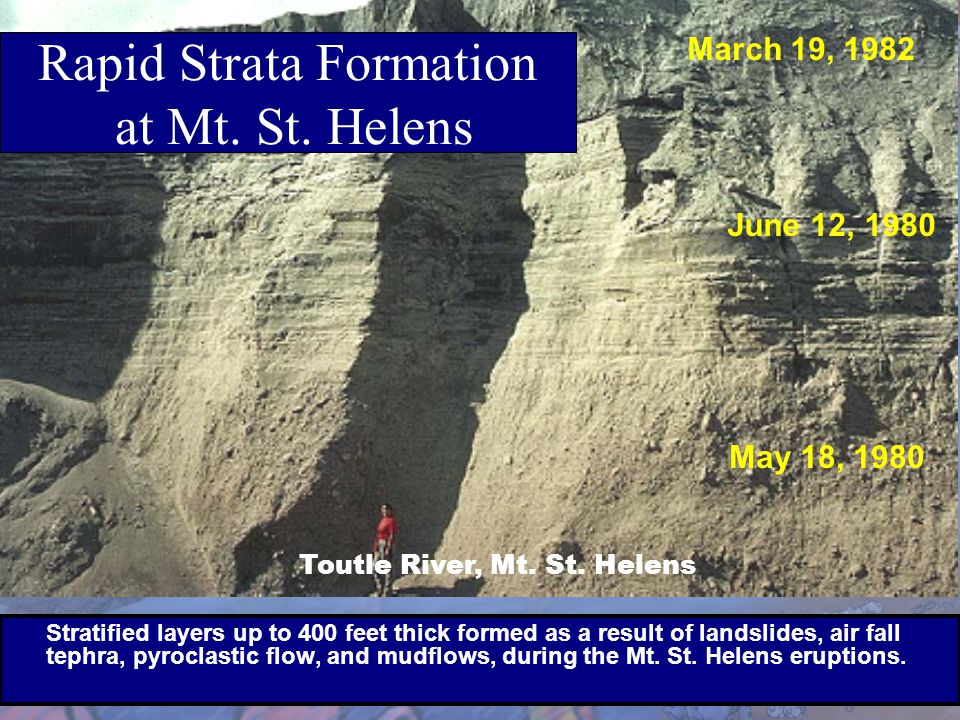
www.flickr.com/photos/truth-in-science/39821536092
In the diagram (link above), (Y) which is the normal, everyday mechanism for strata formation (discovered by experiments), we can see that a fossil (A) in the top strata is actually older than a fossil (B) in the middle strata. And both fossils (A) & (B) are older than the fossil (C) in the bottom strata.
Put simply, when a stratified, sedimentary deposit is laid down in flowing water, all the strata upstream is deposited before all the strata downstream. This means all strata upstream is always older than all strata downstream.
So strata at the top can actually be older than strata at the bottom of a rock formation. Which strata is older in sedimentary rock can only be determined if we know the direction of the water current at the time the sedimentary deposit was laid down.
This completely overturns the idea that fossils found in lower strata must always be older than those in upper strata. it completely debunks the idea of index fossils (biostratigraphy) and of a fossil record based on depth of burial or geological/ecological eras.
Examples:
www.flickr.com/photos/truth-in-science/45113754412
www.flickr.com/photos/truth-in-science/29224301937
www.flickr.com/photos/truth-in-science/40393875072
www.flickr.com/photos/truth-in-science/44552032162
We now know, the Superposition Principle only applies on a rare occasion of sedimentary deposition in perfectly, still water. Superposition is required for the long evolutionary timescale, but the evidence shows it is not the general rule, as was once believed. Most sediment is laid down in moving water, where particle segregation is the general rule, resulting in the simultaneous deposition of strata/layers as shown in these photos ...
Rapid stratification with geological features: www.flickr.com/photos/101536517@N06/sets/72157635944904973/
Rapid, simultaneous formation of layers/strata, through particle segregation in moving water, is so easily created it has even been described by sedimentologists (working on flume experiments) as a law ...
"Upon filling the tank with water and pouring in sediments, we immediately saw what was to become the rule: The sediments sorted themselves out in very clear layers. This became so common that by the end of two weeks, we jokingly referred to Andrew's law as "It's difficult not to make layers," and Clark's law as "It's easy to make layers." Later on, I proposed the "law" that liquefaction destroys layers, as much to my surprise as that was." Ian Juby, www.ianjuby.org/sedimentation/
Examples in the photos www.flickr.com/photos/101536517@N06/sets/72157635944904973/
are the result of normal, everyday tidal action each occurring in a single incident. Where the water current or movement is more turbulent, violent, or catastrophic, considerable depths (many metres) of stratified sediment can be laid down in a short time. It does not require the many millions of years assumed to be necessary by evolutionists.
It is also evident that the composition of individual stratum formed in any deposition event. is related to whatever materials are in the sediment mix, not to any particular timescale. Whatever is in the mix will be automatically sorted into strata/layers. It could be sand, or other material added from mud slides, erosion of chalk deposits, coastal erosion, volcanic ash etc. Any organic material (potential fossils), alive or dead, engulfed by, or swept into, a turbulent sediment mix will also be sorted and buried within the rapidly, forming layers.
Experiments demonstrate the rapid, stratification principle.
and field evidence supports the work of the eminent, sedimentologist Dr Guy Berthault MIAS - Member of the International Association of Sedimentologists.
(Dr Berthault's experiments (www.sedimentology.fr/)
And also the experimental work of Dr M.E. Clark (Professor Emeritus, U of Illinois @ Urbana), Andrew Rodenbeck and Dr. Henry Voss, (www.ianjuby.org/sedimentation/)
Rapid strata formation videos:
A wealth of field evidence demonstrates that multiple strata in sedimentary deposits do not need millions of years to form and can be formed rapidly. The natural examples observed in field studies confirm the principle demonstrated by sedimentation experiments carried out by Dr Guy Berthault and other sedimentologists. It calls into question the widely accepted, multi-million year dating of sedimentary rocks, and the dating of fossils by depth of burial or position in the strata.
Dr Berthault's experiments (www.sedimentology.fr/) and other experiments (www.ianjuby.org/sedimentation/) combined with field studies of floods and volcanic action show that, rather than being formed by gradual, slow deposition of sucessive layers superimposed upon previous layers, with the strata or layers representing a particular timescale, particle segregation in moving water or airborne particles can form strata or layers very quickly, and frequently in a single event.
Most importantly, in such cases, lower strata are not older than upper strata, they are the same age, having been created in the same sedimentary episode.
Field studies of natural, stratification processes confirm the experiments carried out by sedimentologists and show that there is no longer any reason to conclude that strata/layers in sedimentary rocks relate to different geological eras and/or a multi-million year timescale. www.youtube.com/watch?v=5PVnBaqqQw8&feature=share&.... they also show that the relative position of fossils in rocks is not indicative of an order of evolutionary succession.
Obviously, the uniformitarian principle, on which the geologic column is based, can no longer be considered valid. And the multi-million, year dating of sedimentary rocks and fossils certainly needs to be reassessed.
The observed, rapid deposition of stratified sediments also explains the enigma of polystrate fossils, i.e. large fossils that intersect several strata. In some cases, tree trunk fossils are found which intersect the strata of sedimentary rock up to forty feet in depth. upload.wikimedia.org/wikipedia/commons/thumb/0/08/Lycopsi... They must have been buried in stratified sediment in a short time (certainly not millions, thousands, or even hundreds of years), or they would have rotted away. youtu.be/vnzHU9VsliQ
The vast majority of fossils are found in good, intact condition, which is testament to their rapid burial. You don't get good fossils from gradual burial, because they would be damaged or destroyed by decay, predation or erosion. The existence of so many fossils in sedimentary rock on a global scale is stunning evidence for the rapid depostion of sedimentary rock as the general rule. It is obvious that virtually all rock formations which contain good, intact fossils were formed from sediment laid down in a very short time, not millions, or even thousands of years.
See set of photos of other examples of rapid stratification: www.flickr.com/photos/101536517@N06/sets/72157635944904973/
Carbon dating of coal should not be possible if it is millions of years old, yet significant amounts of Carbon 14 have been detected in coal and other fossil material, which indicates that it is less than 50,000 years old. www.ldolphin.org/sewell/c14dating.html
www.grisda.org/origins/51006.htm
Evolutionists confidently cite multi-million year ages for rocks and fossils, but what most people don't realise is that no one actually knows the age of sedimentary rocks or the fossils found within them. So how are evolutionists so sure of the ages they so confidently quote? The astonishing thing is they aren't. Sedimentary rocks cannot be dated by radiometric methods*, and fossils can only be dated to less than 50,000 years with Carbon 14 dating. The method evolutionists use is based entirely on assumptions. Unbelievably, fossils are dated by the assumed age of rocks, and rocks are dated by the assumed age of fossils, that's right ... it is known as circular reasoning.
* Regarding the radiometric dating of igneous rocks, which is claimed to be relevant to the dating of sedimentary rocks, in an occasional instance there is an igneous intrusion associated with a sedimentary deposit -
Prof. Aubouin says in his Précis de Géologie: "Each radioactive element disintegrates in a characteristic and constant manner, which depends neither on the physical state (no variation with pressure or temperature or any other external constraint) nor on the chemical state (identical for an oxide or a phosphate)."
"Rocks form when magma crystallizes. Crystallisation depends on pressure and temperature, from which radioactivity is independent. So, there is no relationship between radioactivity and crystallisation.
Consequently, radioactivity doesn't date the formation of rocks. Moreover, daughter elements contained in rocks result mainly from radioactivity in magma where gravity separates the heavier parent element, from the lighter daughter element. Thus radiometric dating has no chronological signification." Dr. Guy Berthault www.sciencevsevolution.org/Berthault.htm
Radiometric dating based on unverifiable assumptions.
scienceagainstevolution.info/v8i8f.htm
Geology the dreadful science. Principle of Superposition falsified.
malagabay.wordpress.com/2013/07/08/geology-the-dreadful-s...
More about strata formation.
creation.com/geological-strata
Visit the fossil museum:
www.flickr.com/photos/101536517@N06/sets/72157641367196613/
Just how good are peer reviews of scientific papers?
www.sciencemag.org/content/342/6154/60.full
www.examiner.com/article/want-to-publish-science-paper-ju...
The neo-Darwinian idea that the human genome consists entirely of an accumulation of billions of mutations is, quite obviously, completely bonkers. Nevertheless, it is compulsorily taught in schools and universities as 'science'.
I moved to Ocean City, realizing how different it is from Bucks County, Pennsylvania, and reasoning that my approach to photography may need to change. The ocean and a bay are very different than farms, a river, and canals.
On our first tired walk from the apartment, this afternoon, Janice and I watched as this gull pulled a starfish from the water, transported to a nearby dock, and ate it. The bird seemed excited about his catch. If he could talk, perhaps he would even brag.
The experience suggested that the scenery may have changed, but perhaps my approach needs to be the same as always: to allow the beauty to find me.
Rapid strata formation in soft sand (field evidence).
Photo of strata formation in soft sand on a beach, created by tidal action of the sea.
Formed in a single, high tidal event. Stunning evidence which displays multiple strata/layers.
Why this is so important ....
It has long been assumed, ever since the 17th century, that layers/strata observed in sedimentary rocks were built up gradually, layer upon layer, over many years. It certainly seemed logical at the time, from just looking at rocks, that lower layers would always be older than the layers above them, i.e. that lower layers were always laid down first followed, in time, by successive layers on top.
This was assumed to be true and became known as the superposition principle.
It was also assumed that a layer comprising a different material from a previous layer, represented a change in environmental conditions/factors.
These changes in composition of layers or strata were considered to represent different, geological eras on a global scale, spanning millions of years. This formed the basis for the Geologic Column, which is used to date rocks and also fossils. The evolutionary, 'fossil record' was based on the vast ages and assumed geological eras of the Geologic Column.
There was also circular reasoning applied with the assumed age of 'index' fossils (based on evolutionary beliefs & preconceptions) used to date strata in the Geologic Column. Dating strata from the assumed age of (index) fossils is known as Biostratigraphy.
We now know that, although these assumptions seemed logical, they are not supported by the evidence.
At the time, the mechanics of stratification were not properly known or studied.
An additional factor was that this assumed superposition and uniformitarian model became essential, with the wide acceptance of Darwinism, for the long ages required for progressive microbes-to-human evolution. There was no incentive to question or challenge the superposition, uniformitarian model, because the presumed, fossil 'record' had become dependant on it, and any change in the accepted model would present devastating implications for Darwinism.
This had the unfortunate effect of linking the study of geology so closely to Darwinism, that any study independent of Darwinian considerations was effectively stymied. This link of geology with Darwinian preconceptions is known as biostratigraphy.
Some other field evidence, in various situations, can be observed here: www.flickr.com/photos/101536517@N06/sets/72157635944904973/
and also in the links to stunning, experimental evidence, carried out by sedimentologists, given later.
_______________________________________________
GEOLOGIC PRINCIPLES (established by Nicholas Steno in the 17th Century):
What Nicolas Steno believed about strata formation is the basis of the principle of Superposition and the principle of Original Horizontality.
dictionary.sensagent.com/Law_of_superposition/en-en/
“Assuming that all rocks and minerals had once been fluid, Nicolas Steno reasoned that rock strata were formed when particles in a fluid such as water fell to the bottom. This process would leave horizontal layers. Thus Steno's principle of original horizontality states that rock layers form in the horizontal position, and any deviations from this horizontal position are due to the rocks being disturbed later.”)
BEDDING PLANES.
'Bedding plane' describes the surface in between each stratum which are formed during sediment deposition.
science.jrank.org/pages/6533/Strata.html
“Strata form during sediment deposition, that is, the laying down of sediment. Meanwhile, if a change in current speed or sediment grain size occurs or perhaps the sediment supply is cut off, a bedding plane forms. Bedding planes are surfaces that separate one stratum from another. Bedding planes can also form when the upper part of a sediment layer is eroded away before the next episode of deposition. Strata separated by a bedding plane may have different grain sizes, grain compositions, or colours. Sometimes these other traits are better indicators of stratification as bedding planes may be very subtle.”
______________________________________________
Several catastrophic events, flash floods, volcanic eruptions etc. have forced Darwinian, influenced geologists to admit to rapid stratification in some instances. However they claim it is a rare phenomenon, which they have known about for many years, and which does nothing to invalidate the Geologic Column, the fossil record, evolutionary timescale, or any of the old assumptions regarding strata formation, sedimentation and the superposition principle. They fail to face up to the fact that rapid stratification is not an extraordinary phenonemon, but rather the prevailing and normal mechanism of sedimentary deposition whenever and wherever there is moving, sediment-laden water. The experimental evidence demonstrates the mechanism and a mass of field evidence in normal (non-catastrophic) conditions shows it is a normal everyday occurrence.
It is clear from the experimental evidence that the usual process of stratification is - that strata are not formed by horizontal layers being laid on top of each other in succession, as was assumed. But by sediment being sorted in the flowing water and laid down diagonally in the direction of flow. See diagram:
www.flickr.com/photos/truth-in-science/39821536092/in/dat...
The field evidence (in the image) presented here - of rapid, simultaneous stratification refutes the Superposition Principle and the Principle of Lateral Continuity.
We now know, the Superposition Principle only applies on a rare occasion where sedimentary deposits are laid down in still water.
Superposition is required for the long evolutionary timescale, but the evidence shows it is not the general rule, as was once believed. Most sediment is laid down in moving water, where particle segregation is the general rule, resulting in the simultaneous deposition of strata/layers as shown in the photo.
See many other examples of rapid stratification (with geological features): www.flickr.com/photos/101536517@N06/sets/72157635944904973/
Rapid, simultaneous formation of layers/strata, through particle segregation in moving water, is so easily created it has even been described by sedimentologists (working on flume experiments) as a law ...
"Upon filling the tank with water and pouring in sediments, we immediately saw what was to become the rule: The sediments sorted themselves out in very clear layers. This became so common that by the end of two weeks, we jokingly referred to Andrew's law as "It's difficult not to make layers," and Clark's law as "It's easy to make layers." Later on, I proposed the "law" that liquefaction destroys layers, as much to my surprise as that was." Ian Juby, www.ianjuby.org/sedimentation/
The example in the photo is the result of normal, everyday tidal action formed in a single incident. Where the water current or movement is more turbulent, violent, or catastrophic, great depths (many metres) of stratified sediment can be laid down in a short time. Certainly not the many millions of years assumed by evolutionists.
The composition of strata formed in any deposition event. is related to whatever materials are in the sediment mix, not to any particular timescale. Whatever is in the mix will be automatically sorted into strata/layers. It could be sand, or other material added from mud slides, erosion of chalk deposits, coastal erosion, volcanic ash etc. Any organic material (potential fossils), alive or dead, engulfed by, or swept into, a turbulent sediment mix, will also be sorted and buried within the rapidly, forming layers.
See many other examples of rapid stratification with geological features: www.flickr.com/photos/101536517@N06/sets/72157635944904973/
Stratified, soft sand deposit. demonstrates the rapid, stratification principle.
Important, field evidence which supports the work of the eminent, sedimentologist Dr Guy Berthault MIAS - Member of the International Association of Sedimentologists.
(Dr Berthault's experiments (www.sedimentology.fr/)
And also the experimental work of Dr M.E. Clark (Professor Emeritus, U of Illinois @ Urbana), Andrew Rodenbeck and Dr. Henry Voss, (www.ianjuby.org/sedimentation/)
Location: Sandown, Isle of Wight. Photographed: 12/03/2019
This field evidence demonstrates that multiple strata in sedimentary deposits do not need millions of years to form and can be formed rapidly. This natural example confirms the principle demonstrated by the sedimentation experiments carried out by Dr Guy Berthault and other sedimentologists. It calls into question the standard, multi-million year dating of sedimentary rocks, and the dating of fossils by depth of burial or position in the strata.
Mulltiple strata/layers are evident in this example.
Dr Berthault's experiments (www.sedimentology.fr/) and other experiments (www.ianjuby.org/sedimentation/) and field studies of floods and volcanic action show that, rather than being formed by gradual, slow deposition of sucessive layers superimposed upon previous layers, with the strata or layers representing a particular timescale, particle segregation in moving water or airborne particles can form strata or layers very quickly, frequently, in a single event.
And, most importantly, lower strata are not older than upper strata, they are the same age, having been created in the same sedimentary episode.
Such field studies confirm experiments which have shown that there is no longer any reason to conclude that strata/layers in sedimentary rocks relate to different geological eras and/or a multi-million year timescale. www.youtube.com/watch?v=5PVnBaqqQw8&feature=share&.... they also show that the relative position of fossils in rocks is not indicative of an order of evolutionary succession. Obviously, the uniformitarian principle, on which the geologic column is based, can no longer be considered valid. And the multi-million, year dating of sedimentary rocks and fossils needs to be reassessed. Rapid deposition of stratified sediments also explains the enigma of polystrate fossils, i.e. large fossils that intersect several strata. In some cases, tree trunk fossils are found which intersect the strata of sedimentary rock up to forty feet in depth. upload.wikimedia.org/wikipedia/commons/thumb/0/08/Lycopsi... They must have been buried in stratified sediment in a short time (certainly not millions, thousands, or even hundreds of years), or they would have rotted away. youtu.be/vnzHU9VsliQ
In fact, the vast majority of fossils are found in good, intact condition, which is testament to their rapid burial. You don't get good fossils from gradual burial, because they would be damaged or destroyed by decay, predation or erosion. The existence of so many fossils in sedimentary rock on a global scale is stunning evidence for the rapid depostion of sedimentary rock as the general rule. It is obvious that all rock containing good intact fossils was formed from sediment laid down in a very short time, not millions, or even thousands of years.
See set of photos of other examples of rapid stratification: www.flickr.com/photos/101536517@N06/sets/72157635944904973/
Carbon dating of coal should not be possible if it is millions of years old, yet significant amounts of Carbon 14 have been detected in coal and other fossil material, which indicates that it is less than 50,000 years old. www.ldolphin.org/sewell/c14dating.html
www.grisda.org/origins/51006.htm
Evolutionists confidently cite multi-million year ages for rocks and fossils, but what most people don't realise is that no one actually knows the age of sedimentary rocks or the fossils found within them. So how are evolutionists so sure of the ages they so confidently quote? The astonishing thing is they aren't. Sedimentary rocks cannot be dated by radiometric methods*, and fossils can only be dated to less than 50,000 years with Carbon 14 dating. The method evolutionists use is based entirely on assumptions. Unbelievably, fossils are dated by the assumed age of rocks, and rocks are dated by the assumed age of fossils, that's right ... it is known as circular reasoning.
* Regarding the radiometric dating of igneous rocks, which is claimed to be relevant to the dating of sedimentary rocks, in an occasional instance there is an igneous intrusion associated with a sedimentary deposit -
Prof. Aubouin says in his Précis de Géologie: "Each radioactive element disintegrates in a characteristic and constant manner, which depends neither on the physical state (no variation with pressure or temperature or any other external constraint) nor on the chemical state (identical for an oxide or a phosphate)."
"Rocks form when magma crystallizes. Crystallisation depends on pressure and temperature, from which radioactivity is independent. So, there is no relationship between radioactivity and crystallisation.
Consequently, radioactivity doesn't date the formation of rocks. Moreover, daughter elements contained in rocks result mainly from radioactivity in magma where gravity separates the heavier parent element, from the lighter daughter element. Thus radiometric dating has no chronological signification." Dr. Guy Berthault www.sciencevsevolution.org/Berthault.htm
Rapid strata formation and rapid erosion at Mount St Helens.
slideplayer.com/slide/5703217/18/images/28/Rapid+Strata+F...
Visit the fossil museum:
www.flickr.com/photos/101536517@N06/sets/72157641367196613/
Just how good are peer reviews of scientific papers?
www.sciencemag.org/content/342/6154/60.full
www.examiner.com/article/want-to-publish-science-paper-ju...
The neo-Darwinian idea that the human genome consists entirely of an accumulation of billions of mutations is, quite obviously, completely bonkers. Nevertheless, it is compulsorily taught in schools and universities as 'science'.
In August 2013, Arriva Yorkshire 639 was transferred to Heckmondwike depot. The reasoning for such was unclear, until rumours started circulating saying that the Volvo B7RLEs at the depot were to be sent to Blackburn for a refurbishment.
On the 13th August 2013, 1108 (YJ08 DVO) entered service, looking a little strange as it now wears Arriva's "Interurban" scheme as opposed to the older style livery.
Here is 1108, departing the White Rose Centre (15/8/13) on a 221 service to Mirfield.
I can't explain too much of the reasoning behind this otherwise 'you know who' will find out 'you know what'! Jxo
P.s. There is NO BROWN in this pouch!!!! The solid fabric is black.
I saw this small family on a local pond this morning and was interested to know what they might be. My ability to identify anything but the most common birds is pretty lamentable - but can I assume that the adult is a cross between a Mallard and a "farmyard" duck (do the species interbreed?) and that the 2, very dissimilar, ducklings are just variants one step down the ancestral line? I also presume that this must be a second brood as they are still quite small and we are in August now.
Can anyone confirm that my reasoning is correct?
Thanks!
This man was very obviously mentally ill and homeless. There are so many homeless people living in San Diego, CA. The mentally ill here really have no assistance and if they need medication, they wouldnt have the means to be assessed and the reasoning to do so, it is a big problem here. I have talked to many homeless people in San Diego, most arent on the streets by choice.
Branches of the subconscious capture in photography, linking photographs together and constantly questioning the reasonings of the composition.
Rapid strata formation in soft sand (field evidence).
Photo of strata formation in soft sand on a beach, created by tidal action of the sea.
Formed in a single, high tidal event. Stunning evidence which displays multiple strata/layers.
Why this is so important ....
It has long been assumed, ever since the 17th century, that layers/strata observed in sedimentary rocks were built up gradually, layer upon layer, over many years. It certainly seemed logical at the time, from just looking at rocks, that lower layers would always be older than the layers above them, i.e. that lower layers were always laid down first followed, in time, by successive layers on top.
This was assumed to be true and became known as the superposition principle.
It was also assumed that a layer comprising a different material from a previous layer, represented a change in environmental conditions/factors.
These changes in composition of layers or strata were considered to represent different, geological eras on a global scale, spanning millions of years. This formed the basis for the Geologic Column, which is used to date rocks and also fossils. The evolutionary, 'fossil record' was based on the vast ages and assumed geological eras of the Geologic Column.
There was also circular reasoning applied with the assumed age of 'index' fossils (based on evolutionary beliefs & preconceptions) used to date strata in the Geologic Column. Dating strata from the assumed age of (index) fossils is known as Biostratigraphy.
We now know that, although these assumptions seemed logical, they are not supported by the evidence.
At the time, the mechanics of stratification were not properly known or studied.
An additional factor was that this assumed superposition and uniformitarian model became essential, with the wide acceptance of Darwinism, for the long ages required for progressive microbes-to-human evolution. There was no incentive to question or challenge the superposition, uniformitarian model, because the presumed, fossil 'record' had become dependant on it, and any change in the accepted model would present devastating implications for Darwinism.
This had the unfortunate effect of linking the study of geology so closely to Darwinism, that any study independent of Darwinian considerations was effectively stymied. This link of geology with Darwinian preconceptions is known as biostratigraphy.
Some other field evidence, in various situations, can be observed here: www.flickr.com/photos/101536517@N06/sets/72157635944904973/
and also in the links to stunning, experimental evidence, carried out by sedimentologists, given later.
_______________________________________________
GEOLOGIC PRINCIPLES (established by Nicholas Steno in the 17th Century):
What Nicolas Steno believed about strata formation is the basis of the principle of Superposition and the principle of Original Horizontality.
dictionary.sensagent.com/Law_of_superposition/en-en/
“Assuming that all rocks and minerals had once been fluid, Nicolas Steno reasoned that rock strata were formed when particles in a fluid such as water fell to the bottom. This process would leave horizontal layers. Thus Steno's principle of original horizontality states that rock layers form in the horizontal position, and any deviations from this horizontal position are due to the rocks being disturbed later.”)
BEDDING PLANES.
'Bedding plane' describes the surface in between each stratum which are formed during sediment deposition.
science.jrank.org/pages/6533/Strata.html
“Strata form during sediment deposition, that is, the laying down of sediment. Meanwhile, if a change in current speed or sediment grain size occurs or perhaps the sediment supply is cut off, a bedding plane forms. Bedding planes are surfaces that separate one stratum from another. Bedding planes can also form when the upper part of a sediment layer is eroded away before the next episode of deposition. Strata separated by a bedding plane may have different grain sizes, grain compositions, or colours. Sometimes these other traits are better indicators of stratification as bedding planes may be very subtle.”
______________________________________________
Several catastrophic events, flash floods, volcanic eruptions etc. have forced Darwinian, influenced geologists to admit to rapid stratification in some instances. However they claim it is a rare phenomenon, which they have known about for many years, and which does nothing to invalidate the Geologic Column, the fossil record, evolutionary timescale, or any of the old assumptions regarding strata formation, sedimentation and the superposition principle. They fail to face up to the fact that rapid stratification is not an extraordinary phenonemon, but rather the prevailing and normal mechanism of sedimentary deposition whenever and wherever there is moving, sediment-laden water. The experimental evidence demonstrates the mechanism and a mass of field evidence in normal (non-catastrophic) conditions shows it is a normal everyday occurrence.
It is clear from the experimental evidence that the usual process of stratification is - that strata are not formed by horizontal layers being laid on top of each other in succession, as was assumed. But by sediment being sorted in the flowing water and laid down diagonally in the direction of flow. See diagram:
www.flickr.com/photos/truth-in-science/39821536092/in/dat...
The field evidence (in the image) presented here - of rapid, simultaneous stratification refutes the Superposition Principle and the Principle of Lateral Continuity.
We now know, the Superposition Principle only applies on a rare occasion where sedimentary deposits are laid down in still water.
Superposition is required for the long evolutionary timescale, but the evidence shows it is not the general rule, as was once believed. Most sediment is laid down in moving water, where particle segregation is the general rule, resulting in the simultaneous deposition of strata/layers as shown in the photo.
See many other examples of rapid stratification (with geological features): www.flickr.com/photos/101536517@N06/sets/72157635944904973/
Rapid, simultaneous formation of layers/strata, through particle segregation in moving water, is so easily created it has even been described by sedimentologists (working on flume experiments) as a law ...
"Upon filling the tank with water and pouring in sediments, we immediately saw what was to become the rule: The sediments sorted themselves out in very clear layers. This became so common that by the end of two weeks, we jokingly referred to Andrew's law as "It's difficult not to make layers," and Clark's law as "It's easy to make layers." Later on, I proposed the "law" that liquefaction destroys layers, as much to my surprise as that was." Ian Juby, www.ianjuby.org/sedimentation/
The example in the photo is the result of normal, everyday tidal action formed in a single incident, and subsequently eroded by water flow revealing the strata/layers.
Where the water current or movement is more turbulent, violent, or catastrophic, great depths (many metres) of stratified sediment can be laid down in a short time. Certainly not the many millions of years assumed by evolutionists.
The composition of strata formed in any deposition event. is related to whatever materials are in the sediment mix, not to any particular timescale. Whatever is in the mix will be automatically sorted into strata/layers. It could be sand, or other material added from mud slides, erosion of chalk deposits, coastal erosion, volcanic ash etc. Any organic material (potential fossils), alive or dead, engulfed by, or swept into, a turbulent sediment mix, will also be sorted and buried within the rapidly, forming layers.
See many other examples of rapid stratification with geological features: www.flickr.com/photos/101536517@N06/sets/72157635944904973/
Stratified, soft sand deposit. demonstrates the rapid, stratification principle.
Important, field evidence which supports the work of the eminent, sedimentologist Dr Guy Berthault MIAS - Member of the International Association of Sedimentologists.
(Dr Berthault's experiments (www.sedimentology.fr/)
And also the experimental work of Dr M.E. Clark (Professor Emeritus, U of Illinois @ Urbana), Andrew Rodenbeck and Dr. Henry Voss, (www.ianjuby.org/sedimentation/)
Location: Sandown, Isle of Wight. Formed 15/01/2018 This field evidence demonstrates that multiple strata in sedimentary deposits do not need millions of years to form and can be formed rapidly. This natural example confirms the principle demonstrated by the sedimentation experiments carried out by Dr Guy Berthault and other sedimentologists. It calls into question the standard, multi-million year dating of sedimentary rocks, and the dating of fossils by depth of burial or position in the strata.
Mulltiple strata/layers are evident in this example.
Dr Berthault's experiments (www.sedimentology.fr/) and other experiments (www.ianjuby.org/sedimentation/) and field studies of floods and volcanic action show that, rather than being formed by gradual, slow deposition of sucessive layers superimposed upon previous layers, with the strata or layers representing a particular timescale, particle segregation in moving water or airborne particles can form strata or layers very quickly, frequently, in a single event.
And, most importantly, lower strata are not older than upper strata, they are the same age, having been created in the same sedimentary episode.
Such field studies confirm experiments which have shown that there is no longer any reason to conclude that strata/layers in sedimentary rocks relate to different geological eras and/or a multi-million year timescale. www.youtube.com/watch?v=5PVnBaqqQw8&feature=share&.... they also show that the relative position of fossils in rocks is not indicative of an order of evolutionary succession. Obviously, the uniformitarian principle, on which the geologic column is based, can no longer be considered valid. And the multi-million, year dating of sedimentary rocks and fossils needs to be reassessed. Rapid deposition of stratified sediments also explains the enigma of polystrate fossils, i.e. large fossils that intersect several strata. In some cases, tree trunk fossils are found which intersect the strata of sedimentary rock up to forty feet in depth. upload.wikimedia.org/wikipedia/commons/thumb/0/08/Lycopsi... They must have been buried in stratified sediment in a short time (certainly not millions, thousands, or even hundreds of years), or they would have rotted away. youtu.be/vnzHU9VsliQ
In fact, the vast majority of fossils are found in good, intact condition, which is testament to their rapid burial. You don't get good fossils from gradual burial, because they would be damaged or destroyed by decay, predation or erosion. The existence of so many fossils in sedimentary rock on a global scale is stunning evidence for the rapid depostion of sedimentary rock as the general rule. It is obvious that all rock containing good intact fossils was formed from sediment laid down in a very short time, not millions, or even thousands of years.
See set of photos of other examples of rapid stratification: www.flickr.com/photos/101536517@N06/sets/72157635944904973/
Carbon dating of coal should not be possible if it is millions of years old, yet significant amounts of Carbon 14 have been detected in coal and other fossil material, which indicates that it is less than 50,000 years old. www.ldolphin.org/sewell/c14dating.html
www.grisda.org/origins/51006.htm
Evolutionists confidently cite multi-million year ages for rocks and fossils, but what most people don't realise is that no one actually knows the age of sedimentary rocks or the fossils found within them. So how are evolutionists so sure of the ages they so confidently quote? The astonishing thing is they aren't. Sedimentary rocks cannot be dated by radiometric methods*, and fossils can only be dated to less than 50,000 years with Carbon 14 dating. The method evolutionists use is based entirely on assumptions. Unbelievably, fossils are dated by the assumed age of rocks, and rocks are dated by the assumed age of fossils, that's right ... it is known as circular reasoning.
* Regarding the radiometric dating of igneous rocks, which is claimed to be relevant to the dating of sedimentary rocks, in an occasional instance there is an igneous intrusion associated with a sedimentary deposit -
Prof. Aubouin says in his Précis de Géologie: "Each radioactive element disintegrates in a characteristic and constant manner, which depends neither on the physical state (no variation with pressure or temperature or any other external constraint) nor on the chemical state (identical for an oxide or a phosphate)."
"Rocks form when magma crystallizes. Crystallisation depends on pressure and temperature, from which radioactivity is independent. So, there is no relationship between radioactivity and crystallisation.
Consequently, radioactivity doesn't date the formation of rocks. Moreover, daughter elements contained in rocks result mainly from radioactivity in magma where gravity separates the heavier parent element, from the lighter daughter element. Thus radiometric dating has no chronological signification." Dr. Guy Berthault www.sciencevsevolution.org/Berthault.htm
Rapid strata formation at Mount St Helens.
slideplayer.com/slide/5703217/18/images/28/Rapid+Strata+F...
Visit the fossil museum:
www.flickr.com/photos/101536517@N06/sets/72157641367196613/
Just how good are peer reviews of scientific papers?
www.sciencemag.org/content/342/6154/60.full
www.examiner.com/article/want-to-publish-science-paper-ju...
The neo-Darwinian idea that the human genome consists entirely of an accumulation of billions of mutations is, quite obviously, completely bonkers. Nevertheless, it is compulsorily taught in schools and universities as 'science'.
Rapid strata formation in soft sand (field evidence).
Photo of strata formation in soft sand on a beach, created by tidal action of the sea.
Formed in a single, high tidal event. Stunning evidence which displays multiple strata/layers.
Why this is so important ....
It has long been assumed, ever since the 17th century, that layers/strata observed in sedimentary rocks were built up gradually, layer upon layer, over many years. It certainly seemed logical at the time, from just looking at rocks, that lower layers would always be older than the layers above them, i.e. that lower layers were always laid down first followed, in time, by successive layers on top.
This was assumed to be true and became known as the superposition principle.
It was also assumed that a layer comprising a different material from a previous layer, represented a change in environmental conditions/factors.
These changes in composition of layers or strata were considered to represent different, geological eras on a global scale, spanning millions of years. This formed the basis for the Geologic Column, which is used to date rocks and also fossils. The evolutionary, 'fossil record' was based on the vast ages and assumed geological eras of the Geologic Column.
There was also circular reasoning applied with the assumed age of 'index' fossils (based on evolutionary beliefs & preconceptions) used to date strata in the Geologic Column. Dating strata from the assumed age of (index) fossils is known as Biostratigraphy.
We now know that, although these assumptions seemed logical, they are not supported by the evidence.
At the time, the mechanics of stratification were not properly known or studied.
An additional factor was that this assumed superposition and uniformitarian model became essential, with the wide acceptance of Darwinism, for the long ages required for progressive microbes-to-human evolution. There was no incentive to question or challenge the superposition, uniformitarian model, because the presumed, fossil 'record' had become dependant on it, and any change in the accepted model would present devastating implications for Darwinism.
This had the unfortunate effect of linking the study of geology so closely to Darwinism, that any study independent of Darwinian considerations was effectively stymied. This link of geology with Darwinian preconceptions is known as biostratigraphy.
Some other field evidence, in various situations, can be observed here: www.flickr.com/photos/101536517@N06/sets/72157635944904973/
and also in the links to stunning, experimental evidence, carried out by sedimentologists, given later.
_______________________________________________
GEOLOGIC PRINCIPLES (established by Nicholas Steno in the 17th Century):
What Nicolas Steno believed about strata formation is the basis of the principle of Superposition and the principle of Original Horizontality.
dictionary.sensagent.com/Law_of_superposition/en-en/
“Assuming that all rocks and minerals had once been fluid, Nicolas Steno reasoned that rock strata were formed when particles in a fluid such as water fell to the bottom. This process would leave horizontal layers. Thus Steno's principle of original horizontality states that rock layers form in the horizontal position, and any deviations from this horizontal position are due to the rocks being disturbed later.”)
BEDDING PLANES.
'Bedding plane' describes the surface in between each stratum which are formed during sediment deposition.
science.jrank.org/pages/6533/Strata.html
“Strata form during sediment deposition, that is, the laying down of sediment. Meanwhile, if a change in current speed or sediment grain size occurs or perhaps the sediment supply is cut off, a bedding plane forms. Bedding planes are surfaces that separate one stratum from another. Bedding planes can also form when the upper part of a sediment layer is eroded away before the next episode of deposition. Strata separated by a bedding plane may have different grain sizes, grain compositions, or colours. Sometimes these other traits are better indicators of stratification as bedding planes may be very subtle.”
______________________________________________
Several catastrophic events, flash floods, volcanic eruptions etc. have forced Darwinian, influenced geologists to admit to rapid stratification in some instances. However they claim it is a rare phenomenon, which they have known about for many years, and which does nothing to invalidate the Geologic Column, the fossil record, evolutionary timescale, or any of the old assumptions regarding strata formation, sedimentation and the superposition principle. They fail to face up to the fact that rapid stratification is not an extraordinary phenonemon, but rather the prevailing and normal mechanism of sedimentary deposition whenever and wherever there is moving, sediment-laden water. The experimental evidence demonstrates the mechanism and a mass of field evidence in normal (non-catastrophic) conditions shows it is a normal everyday occurrence.
It is clear from the experimental evidence that the usual process of stratification is - that strata are not formed by horizontal layers being laid on top of each other in succession, as was assumed. But by sediment being sorted in the flowing water and laid down diagonally in the direction of flow. See diagram:
www.flickr.com/photos/truth-in-science/39821536092/in/dat...
The field evidence (in the image) presented here - of rapid, simultaneous stratification refutes the Superposition Principle and the Principle of Lateral Continuity.
We now know, the Superposition Principle only applies on a rare occasion where sedimentary deposits are laid down in still water.
Superposition is required for the long evolutionary timescale, but the evidence shows it is not the general rule, as was once believed. Most sediment is laid down in moving water, where particle segregation is the general rule, resulting in the simultaneous deposition of strata/layers as shown in the photo.
See many other examples of rapid stratification (with geological features): www.flickr.com/photos/101536517@N06/sets/72157635944904973/
Rapid, simultaneous formation of layers/strata, through particle segregation in moving water, is so easily created it has even been described by sedimentologists (working on flume experiments) as a law ...
"Upon filling the tank with water and pouring in sediments, we immediately saw what was to become the rule: The sediments sorted themselves out in very clear layers. This became so common that by the end of two weeks, we jokingly referred to Andrew's law as "It's difficult not to make layers," and Clark's law as "It's easy to make layers." Later on, I proposed the "law" that liquefaction destroys layers, as much to my surprise as that was." Ian Juby, www.ianjuby.org/sedimentation/
The example in the photo is the result of normal, everyday tidal action in a single incident. Where the water current or movement is more turbulent, violent, or catastrophic, great depths (many metres) of stratified sediment can be laid down in a short time. Certainly not the many millions of years assumed by evolutionists.
The composition of strata formed in any deposition event. is related to whatever materials are in the sediment mix, not to any particular timescale. Whatever is in the mix will be automatically sorted into strata/layers. It could be sand, or other material added from mud slides, erosion of chalk deposits, coastal erosion, volcanic ash etc. Any organic material (potential fossils), alive or dead, engulfed by, or swept into, a turbulent sediment mix, will also be sorted and buried within the rapidly, forming layers.
See many other examples of rapid stratification with geological features: www.flickr.com/photos/101536517@N06/sets/72157635944904973/
Stratified, soft sand deposit. demonstrates the rapid, stratification principle.
Important, field evidence which supports the work of the eminent, sedimentologist Dr Guy Berthault MIAS - Member of the International Association of Sedimentologists.
(Dr Berthault's experiments (www.sedimentology.fr/)
And also the experimental work of Dr M.E. Clark (Professor Emeritus, U of Illinois @ Urbana), Andrew Rodenbeck and Dr. Henry Voss, (www.ianjuby.org/sedimentation/)
Location: Sandown, Isle of Wight. Formed 08/12/2017 This field evidence demonstrates that multiple strata in sedimentary deposits do not need millions of years to form and can be formed rapidly. This natural example confirms the principle demonstrated by the sedimentation experiments carried out by Dr Guy Berthault and other sedimentologists. It calls into question the standard, multi-million year dating of sedimentary rocks, and the dating of fossils by depth of burial or position in the strata.
Mulltiple strata/layers are evident in this example.
Dr Berthault's experiments (www.sedimentology.fr/) and other experiments (www.ianjuby.org/sedimentation/) and field studies of floods and volcanic action show that, rather than being formed by gradual, slow deposition of sucessive layers superimposed upon previous layers, with the strata or layers representing a particular timescale, particle segregation in moving water or airborne particles can form strata or layers very quickly, frequently, in a single event.
And, most importantly, lower strata are not older than upper strata, they are the same age, having been created in the same sedimentary episode.
Such field studies confirm experiments which have shown that there is no longer any reason to conclude that strata/layers in sedimentary rocks relate to different geological eras and/or a multi-million year timescale. www.youtube.com/watch?v=5PVnBaqqQw8&feature=share&.... they also show that the relative position of fossils in rocks is not indicative of an order of evolutionary succession. Obviously, the uniformitarian principle, on which the geologic column is based, can no longer be considered valid. And the multi-million, year dating of sedimentary rocks and fossils needs to be reassessed. Rapid deposition of stratified sediments also explains the enigma of polystrate fossils, i.e. large fossils that intersect several strata. In some cases, tree trunk fossils are found which intersect the strata of sedimentary rock up to forty feet in depth. upload.wikimedia.org/wikipedia/commons/thumb/0/08/Lycopsi... They must have been buried in stratified sediment in a short time (certainly not millions, thousands, or even hundreds of years), or they would have rotted away. youtu.be/vnzHU9VsliQ
In fact, the vast majority of fossils are found in good, intact condition, which is testament to their rapid burial. You don't get good fossils from gradual burial, because they would be damaged or destroyed by decay, predation or erosion. The existence of so many fossils in sedimentary rock on a global scale is stunning evidence for the rapid depostion of sedimentary rock as the general rule. It is obvious that all rock containing good intact fossils was formed from sediment laid down in a very short time, not millions, or even thousands of years.
See set of photos of other examples of rapid stratification: www.flickr.com/photos/101536517@N06/sets/72157635944904973/
Carbon dating of coal should not be possible if it is millions of years old, yet significant amounts of Carbon 14 have been detected in coal and other fossil material, which indicates that it is less than 50,000 years old. www.ldolphin.org/sewell/c14dating.html
www.grisda.org/origins/51006.htm
Evolutionists confidently cite multi-million year ages for rocks and fossils, but what most people don't realise is that no one actually knows the age of sedimentary rocks or the fossils found within them. So how are evolutionists so sure of the ages they so confidently quote? The astonishing thing is they aren't. Sedimentary rocks cannot be dated by radiometric methods*, and fossils can only be dated to less than 50,000 years with Carbon 14 dating. The method evolutionists use is based entirely on assumptions. Unbelievably, fossils are dated by the assumed age of rocks, and rocks are dated by the assumed age of fossils, that's right ... it is known as circular reasoning.
* Regarding the radiometric dating of igneous rocks, which is claimed to be relevant to the dating of sedimentary rocks, in an occasional instance there is an igneous intrusion associated with a sedimentary deposit -
Prof. Aubouin says in his Précis de Géologie: "Each radioactive element disintegrates in a characteristic and constant manner, which depends neither on the physical state (no variation with pressure or temperature or any other external constraint) nor on the chemical state (identical for an oxide or a phosphate)."
"Rocks form when magma crystallizes. Crystallisation depends on pressure and temperature, from which radioactivity is independent. So, there is no relationship between radioactivity and crystallisation.
Consequently, radioactivity doesn't date the formation of rocks. Moreover, daughter elements contained in rocks result mainly from radioactivity in magma where gravity separates the heavier parent element, from the lighter daughter element. Thus radiometric dating has no chronological signification." Dr. Guy Berthault www.sciencevsevolution.org/Berthault.htm
Visit the fossil museum:
www.flickr.com/photos/101536517@N06/sets/72157641367196613/
Just how good are peer reviews of scientific papers?
www.sciencemag.org/content/342/6154/60.full
www.examiner.com/article/want-to-publish-science-paper-ju...
The neo-Darwinian idea that the human genome consists entirely of an accumulation of billions of mutations is, quite obviously, completely bonkers. Nevertheless, it is compulsorily taught in schools and universities as 'science'.
Rapid strata formation in soft sand (field evidence).
Photo of strata formation in soft sand on a beach, created by tidal action of the sea.
Formed in a single, high tidal event. Stunning evidence which displays multiple strata/layers.
Why this is so important ....
It has long been assumed, ever since the 17th century, that layers/strata observed in sedimentary rocks were built up gradually, layer upon layer, over many years. It certainly seemed logical at the time, from just looking at rocks, that lower layers would always be older than the layers above them, i.e. that lower layers were always laid down first followed, in time, by successive layers on top.
This was assumed to be true and became known as the superposition principle.
It was also assumed that a layer comprising a different material from a previous layer, represented a change in environmental conditions/factors.
These changes in composition of layers or strata were considered to represent different, geological eras on a global scale, spanning millions of years. This formed the basis for the Geologic Column, which is used to date rocks and also fossils. The evolutionary, 'fossil record' was based on the vast ages and assumed geological eras of the Geologic Column.
There was also circular reasoning applied with the assumed age of 'index' fossils (based on evolutionary beliefs & preconceptions) used to date strata in the Geologic Column. Dating strata from the assumed age of fossils is known as Biostratigraphy.
We now know that, although these assumptions seemed logical, they are not supported by the evidence.
At the time, the mechanics of stratification were not properly known or studied.
An additional factor was that this assumed superposition and uniformitarian model became essential, with the wide acceptance of Darwinism, for the long ages required for progressive microbes-to-human evolution. There was no incentive to question or challenge the superposition, uniformitarian model, because the presumed, fossil 'record' had become dependant on it, and any change in the accepted model would present devastating implications for Darwinism.
This had the unfortunate effect of linking the study of geology so closely to Darwinism, that any study independent of Darwinian considerations was effectively stymied. This link of geology with Darwinian preconceptions is known as biostratigraphy.
Some of the wealth of evidence can be observed here: www.flickr.com/photos/101536517@N06/sets/72157635944904973/
and also in the links to stunning, experimental evidence, carried out by sedimentologists, given later.
_______________________________________________
GEOLOGIC PRINCIPLES (established by Nicholas Steno in the 17th Century):
What Nicolas Steno believed about strata formation is the basis of the principle of Superposition and the principle of Original Horizontality.
dictionary.sensagent.com/Law_of_superposition/en-en/
“Assuming that all rocks and minerals had once been fluid, Nicolas Steno reasoned that rock strata were formed when particles in a fluid such as water fell to the bottom. This process would leave horizontal layers. Thus Steno's principle of original horizontality states that rock layers form in the horizontal position, and any deviations from this horizontal position are due to the rocks being disturbed later.”)
BEDDING PLANES.
'Bedding plane' describes the surface in between each stratum which are formed during sediment deposition.
science.jrank.org/pages/6533/Strata.html
“Strata form during sediment deposition, that is, the laying down of sediment. Meanwhile, if a change in current speed or sediment grain size occurs or perhaps the sediment supply is cut off, a bedding plane forms. Bedding planes are surfaces that separate one stratum from another. Bedding planes can also form when the upper part of a sediment layer is eroded away before the next episode of deposition. Strata separated by a bedding plane may have different grain sizes, grain compositions, or colours. Sometimes these other traits are better indicators of stratification as bedding planes may be very subtle.”
______________________________________________
Several catastrophic events, flash floods, volcanic eruptions etc. have forced Darwinian, influenced geologists to admit to rapid stratification in some instances. However they claim it is a rare phenomenon, which they have known about for many years, and which does nothing to invalidate the Geologic Column, the fossil record, evotuionary timescale, or any of the old assumptions regarding strata formation, sedimentation and the superposition principle. They fail to face up to the fact that rapid stratification is not an extraordinary phenonemon, but rather the prevailing and normal mechanism of sedimentary deposition whenever and wherever there is moving, sediment-laden water. The experimental evidence demonstrates the mechanism and a mass of field evidence in normal (non-catastrophic) conditions shows it is a normal everyday occurrence.
It is clear from the experimental evidence that the usual process of stratification is - that strata are not formed by horizontal layers being laid on top of each other in succession, as was assumed. But by sediment being sorted in the flowing water and laid down diagonally in the direction of flow. See diagram:
www.flickr.com/photos/truth-in-science/39821536092/in/dat...
The field evidence (in the image) presented here - of rapid, simultaneous stratification refutes the Superposition Principle, and the Principle of Lateral Continuity.
We now know, the Superposition Principle only applies on a rare occasion of sedimentary deposits in perfectly, still water. Superposition is required for the long evolutionary timescale, but the evidence shows it is not the general rule, as was once believed. Most sediment is laid down in moving water, where particle segregation is the general rule, resulting in the simultaneous deposition of strata/layers as shown in the photo.
See many other examples of rapid stratification with geological features: www.flickr.com/photos/101536517@N06/sets/72157635944904973/
Rapid, simultaneous formation of layers/strata, through particle segregation in moving water, is so easily created it has even been described by sedimentologists (working on flume experiments) as a law ...
"Upon filling the tank with water and pouring in sediments, we immediately saw what was to become the rule: The sediments sorted themselves out in very clear layers. This became so common that by the end of two weeks, we jokingly referred to Andrew's law as "It's difficult not to make layers," and Clark's law as "It's easy to make layers." Later on, I proposed the "law" that liquefaction destroys layers, as much to my surprise as that was." Ian Juby, www.ianjuby.org/sedimentation/
The example in the photo is the result of normal, everyday tidal action in a single incident. Where the water current or movement is more turbulent, violent, or catastrophic, great depths (many metres) of stratified sediment can be laid down in a short time. Certainly not the many millions of years assumed by evolutionists.
The composition of strata formed in any deposition event. is related to whatever materials are in the sediment mix, not to any particular timescale. Whatever is in the mix will be automatically sorted into strata/layers. It could be sand, or other material added from mud slides, erosion of chalk deposits, coastal erosion, volcanic ash etc. Any organic material (potential fossils), alive or dead, engulfed by, or swept into, a turbulent sediment mix, will also be sorted and buried within the rapidly, forming layers.
See many other examples of rapid stratification with geological features: www.flickr.com/photos/101536517@N06/sets/72157635944904973/
Stratified, soft sand deposit. demonstrates the rapid, stratification principle.
Important, field evidence which supports the work of the eminent, sedimentologist Dr Guy Berthault MIAS - Member of the International Association of Sedimentologists.
(Dr Berthault's experiments (www.sedimentology.fr/)
And also the experimental work of Dr M.E. Clark (Professor Emeritus, U of Illinois @ Urbana), Andrew Rodenbeck and Dr. Henry Voss, (www.ianjuby.org/sedimentation/)
Location: Sandown, Isle of Wight. Formed 23/02/2018, This field evidence demonstrates that multiple strata in sedimentary deposits do not need millions of years to form and can be formed rapidly. This natural example confirms the principle demonstrated by the sedimentation experiments carried out by Dr Guy Berthault and other sedimentologists. It calls into question the standard, multi-million year dating of sedimentary rocks, and the dating of fossils by depth of burial or position in the strata.
Mulltiple strata/layers are evident in this example.
Dr Berthault's experiments (www.sedimentology.fr/) and other experiments (www.ianjuby.org/sedimentation/) and field studies of floods and volcanic action show that, rather than being formed by gradual, slow deposition of sucessive layers superimposed upon previous layers, with the strata or layers representing a particular timescale, particle segregation in moving water or airborne particles can form strata or layers very quickly, frequently, in a single event.
And, most importantly, lower strata are not older than upper strata, they are the same age, having been created in the same sedimentary episode.
Such field studies confirm experiments which have shown that there is no longer any reason to conclude that strata/layers in sedimentary rocks relate to different geological eras and/or a multi-million year timescale. www.youtube.com/watch?v=5PVnBaqqQw8&feature=share&.... they also show that the relative position of fossils in rocks is not indicative of an order of evolutionary succession. Obviously, the uniformitarian principle, on which the geologic column is based, can no longer be considered valid. And the multi-million, year dating of sedimentary rocks and fossils needs to be reassessed. Rapid deposition of stratified sediments also explains the enigma of polystrate fossils, i.e. large fossils that intersect several strata. In some cases, tree trunk fossils are found which intersect the strata of sedimentary rock up to forty feet in depth. upload.wikimedia.org/wikipedia/commons/thumb/0/08/Lycopsi... They must have been buried in stratified sediment in a short time (certainly not millions, thousands, or even hundreds of years), or they would have rotted away. youtu.be/vnzHU9VsliQ
In fact, the vast majority of fossils are found in good, intact condition, which is testament to their rapid burial. You don't get good fossils from gradual burial, because they would be damaged or destroyed by decay, predation or erosion. The existence of so many fossils in sedimentary rock on a global scale is stunning evidence for the rapid depostion of sedimentary rock as the general rule. It is obvious that all rock containing good intact fossils was formed from sediment laid down in a very short time, not millions, or even thousands of years.
See set of photos of other examples of rapid stratification: www.flickr.com/photos/101536517@N06/sets/72157635944904973/
Carbon dating of coal should not be possible if it is millions of years old, yet significant amounts of Carbon 14 have been detected in coal and other fossil material, which indicates that it is less than 50,000 years old. www.ldolphin.org/sewell/c14dating.html
www.grisda.org/origins/51006.htm
Evolutionists confidently cite multi-million year ages for rocks and fossils, but what most people don't realise is that no one actually knows the age of sedimentary rocks or the fossils found within them. So how are evolutionists so sure of the ages they so confidently quote? The astonishing thing is they aren't. Sedimentary rocks cannot be dated by radiometric methods*, and fossils can only be dated to less than 50,000 years with Carbon 14 dating. The method evolutionists use is based entirely on assumptions. Unbelievably, fossils are dated by the assumed age of rocks, and rocks are dated by the assumed age of fossils, that's right ... it is known as circular reasoning.
* Regarding the radiometric dating of igneous rocks, which is claimed to be relevant to the dating of sedimentary rocks, in an occasional instance there is an igneous intrusion associated with a sedimentary deposit -
Prof. Aubouin says in his Précis de Géologie: "Each radioactive element disintegrates in a characteristic and constant manner, which depends neither on the physical state (no variation with pressure or temperature or any other external constraint) nor on the chemical state (identical for an oxide or a phosphate)."
"Rocks form when magma crystallizes. Crystallisation depends on pressure and temperature, from which radioactivity is independent. So, there is no relationship between radioactivity and crystallisation.
Consequently, radioactivity doesn't date the formation of rocks. Moreover, daughter elements contained in rocks result mainly from radioactivity in magma where gravity separates the heavier parent element, from the lighter daughter element. Thus radiometric dating has no chronological signification." Dr. Guy Berthault www.sciencevsevolution.org/Berthault.htm
Visit the fossil museum:
www.flickr.com/photos/101536517@N06/sets/72157641367196613/
Just how good are peer reviews of scientific papers?
www.sciencemag.org/content/342/6154/60.full
www.examiner.com/article/want-to-publish-science-paper-ju...
The neo-Darwinian idea that the human genome consists entirely of an accumulation of billions of mutations is, quite obviously, completely bonkers. Nevertheless, it is compulsorily taught in schools and universities as 'science'.
Rapid strata formation in soft sand (field evidence).
Photo of strata formation in soft sand on a beach, created by tidal action of the sea.
Formed in a single, high tidal event. Stunning evidence which displays multiple strata/layers.
Why this is so important ....
It has long been assumed, ever since the 17th century, that layers/strata observed in sedimentary rocks were built up gradually, layer upon layer, over many years. It certainly seemed logical at the time, from just looking at rocks, that lower layers would always be older than the layers above them, i.e. that lower layers were always laid down first followed, in time, by successive layers on top.
This was assumed to be true and became known as the superposition principle.
It was also assumed that a layer comprising a different material from a previous layer, represented a change in environmental conditions/factors.
These changes in composition of layers or strata were considered to represent different, geological eras on a global scale, spanning millions of years. This formed the basis for the Geologic Column, which is used to date rocks and also fossils. The evolutionary, 'fossil record' was based on the vast ages and assumed geological eras of the Geologic Column.
There was also circular reasoning applied with the assumed age of 'index' fossils (based on evolutionary beliefs & preconceptions) used to date strata in the Geologic Column. Dating strata from the assumed age of (index) fossils is known as Biostratigraphy.
We now know that, although these assumptions seemed logical, they are not supported by the evidence.
At the time, the mechanics of stratification were not properly known or studied.
An additional factor was that this assumed superposition and uniformitarian model became essential, with the wide acceptance of Darwinism, for the long ages required for progressive microbes-to-human evolution. There was no incentive to question or challenge the superposition, uniformitarian model, because the presumed, fossil 'record' had become dependant on it, and any change in the accepted model would present devastating implications for Darwinism.
This had the unfortunate effect of linking the study of geology so closely to Darwinism, that any study independent of Darwinian considerations was effectively stymied. This link of geology with Darwinian preconceptions is known as biostratigraphy.
Some other field evidence, in various situations, can be observed here: www.flickr.com/photos/101536517@N06/sets/72157635944904973/
and also in the links to stunning, experimental evidence, carried out by sedimentologists, given later.
_______________________________________________
GEOLOGIC PRINCIPLES (established by Nicholas Steno in the 17th Century):
What Nicolas Steno believed about strata formation is the basis of the principle of Superposition and the principle of Original Horizontality.
dictionary.sensagent.com/Law_of_superposition/en-en/
“Assuming that all rocks and minerals had once been fluid, Nicolas Steno reasoned that rock strata were formed when particles in a fluid such as water fell to the bottom. This process would leave horizontal layers. Thus Steno's principle of original horizontality states that rock layers form in the horizontal position, and any deviations from this horizontal position are due to the rocks being disturbed later.”)
BEDDING PLANES.
'Bedding plane' describes the surface in between each stratum which are formed during sediment deposition.
science.jrank.org/pages/6533/Strata.html
“Strata form during sediment deposition, that is, the laying down of sediment. Meanwhile, if a change in current speed or sediment grain size occurs or perhaps the sediment supply is cut off, a bedding plane forms. Bedding planes are surfaces that separate one stratum from another. Bedding planes can also form when the upper part of a sediment layer is eroded away before the next episode of deposition. Strata separated by a bedding plane may have different grain sizes, grain compositions, or colours. Sometimes these other traits are better indicators of stratification as bedding planes may be very subtle.”
______________________________________________
Several catastrophic events, flash floods, volcanic eruptions etc. have forced Darwinian, influenced geologists to admit to rapid stratification in some instances. However they claim it is a rare phenomenon, which they have known about for many years, and which does nothing to invalidate the Geologic Column, the fossil record, evolutionary timescale, or any of the old assumptions regarding strata formation, sedimentation and the superposition principle. They fail to face up to the fact that rapid stratification is not an extraordinary phenonemon, but rather the prevailing and normal mechanism of sedimentary deposition whenever and wherever there is moving, sediment-laden water. The experimental evidence demonstrates the mechanism and a mass of field evidence in normal (non-catastrophic) conditions shows it is a normal everyday occurrence.
It is clear from the experimental evidence that the usual process of stratification is - that strata are not formed by horizontal layers being laid on top of each other in succession, as was assumed. But by sediment being sorted in the flowing water and laid down diagonally in the direction of flow. See diagram:
www.flickr.com/photos/truth-in-science/39821536092/in/dat...
The field evidence (in the image) presented here - of rapid, simultaneous stratification refutes the Superposition Principle and the Principle of Lateral Continuity.
We now know, the Superposition Principle only applies on a rare occasion where sedimentary deposits are laid down in still water.
Superposition is required for the long evolutionary timescale, but the evidence shows it is not the general rule, as was once believed. Most sediment is laid down in moving water, where particle segregation is the general rule, resulting in the simultaneous deposition of strata/layers as shown in the photo.
See many other examples of rapid stratification (with geological features): www.flickr.com/photos/101536517@N06/sets/72157635944904973/
Rapid, simultaneous formation of layers/strata, through particle segregation in moving water, is so easily created it has even been described by sedimentologists (working on flume experiments) as a law ...
"Upon filling the tank with water and pouring in sediments, we immediately saw what was to become the rule: The sediments sorted themselves out in very clear layers. This became so common that by the end of two weeks, we jokingly referred to Andrew's law as "It's difficult not to make layers," and Clark's law as "It's easy to make layers." Later on, I proposed the "law" that liquefaction destroys layers, as much to my surprise as that was." Ian Juby, www.ianjuby.org/sedimentation/
The example in the photo is the result of normal, everyday tidal action formed in a single incident. Where the water current or movement is more turbulent, violent, or catastrophic, great depths (many metres) of stratified sediment can be laid down in a short time. Certainly not the many millions of years assumed by evolutionists.
The composition of strata formed in any deposition event. is related to whatever materials are in the sediment mix, not to any particular timescale. Whatever is in the mix will be automatically sorted into strata/layers. It could be sand, or other material added from mud slides, erosion of chalk deposits, coastal erosion, volcanic ash etc. Any organic material (potential fossils), alive or dead, engulfed by, or swept into, a turbulent sediment mix, will also be sorted and buried within the rapidly, forming layers.
See many other examples of rapid stratification with geological features: www.flickr.com/photos/101536517@N06/sets/72157635944904973/
Stratified, soft sand deposit. demonstrates the rapid, stratification principle.
Important, field evidence which supports the work of the eminent, sedimentologist Dr Guy Berthault MIAS - Member of the International Association of Sedimentologists.
(Dr Berthault's experiments (www.sedimentology.fr/)
And also the experimental work of Dr M.E. Clark (Professor Emeritus, U of Illinois @ Urbana), Andrew Rodenbeck and Dr. Henry Voss, (www.ianjuby.org/sedimentation/)
Location: Sandown, Isle of Wight. Photographed: 12/03/2019
This field evidence demonstrates that multiple strata in sedimentary deposits do not need millions of years to form and can be formed rapidly. This natural example confirms the principle demonstrated by the sedimentation experiments carried out by Dr Guy Berthault and other sedimentologists. It calls into question the standard, multi-million year dating of sedimentary rocks, and the dating of fossils by depth of burial or position in the strata.
Mulltiple strata/layers are evident in this example.
Dr Berthault's experiments (www.sedimentology.fr/) and other experiments (www.ianjuby.org/sedimentation/) and field studies of floods and volcanic action show that, rather than being formed by gradual, slow deposition of sucessive layers superimposed upon previous layers, with the strata or layers representing a particular timescale, particle segregation in moving water or airborne particles can form strata or layers very quickly, frequently, in a single event.
And, most importantly, lower strata are not older than upper strata, they are the same age, having been created in the same sedimentary episode.
Such field studies confirm experiments which have shown that there is no longer any reason to conclude that strata/layers in sedimentary rocks relate to different geological eras and/or a multi-million year timescale. www.youtube.com/watch?v=5PVnBaqqQw8&feature=share&.... they also show that the relative position of fossils in rocks is not indicative of an order of evolutionary succession. Obviously, the uniformitarian principle, on which the geologic column is based, can no longer be considered valid. And the multi-million, year dating of sedimentary rocks and fossils needs to be reassessed. Rapid deposition of stratified sediments also explains the enigma of polystrate fossils, i.e. large fossils that intersect several strata. In some cases, tree trunk fossils are found which intersect the strata of sedimentary rock up to forty feet in depth. upload.wikimedia.org/wikipedia/commons/thumb/0/08/Lycopsi... They must have been buried in stratified sediment in a short time (certainly not millions, thousands, or even hundreds of years), or they would have rotted away. youtu.be/vnzHU9VsliQ
In fact, the vast majority of fossils are found in good, intact condition, which is testament to their rapid burial. You don't get good fossils from gradual burial, because they would be damaged or destroyed by decay, predation or erosion. The existence of so many fossils in sedimentary rock on a global scale is stunning evidence for the rapid depostion of sedimentary rock as the general rule. It is obvious that all rock containing good intact fossils was formed from sediment laid down in a very short time, not millions, or even thousands of years.
See set of photos of other examples of rapid stratification: www.flickr.com/photos/101536517@N06/sets/72157635944904973/
Carbon dating of coal should not be possible if it is millions of years old, yet significant amounts of Carbon 14 have been detected in coal and other fossil material, which indicates that it is less than 50,000 years old. www.ldolphin.org/sewell/c14dating.html
www.grisda.org/origins/51006.htm
Evolutionists confidently cite multi-million year ages for rocks and fossils, but what most people don't realise is that no one actually knows the age of sedimentary rocks or the fossils found within them. So how are evolutionists so sure of the ages they so confidently quote? The astonishing thing is they aren't. Sedimentary rocks cannot be dated by radiometric methods*, and fossils can only be dated to less than 50,000 years with Carbon 14 dating. The method evolutionists use is based entirely on assumptions. Unbelievably, fossils are dated by the assumed age of rocks, and rocks are dated by the assumed age of fossils, that's right ... it is known as circular reasoning.
* Regarding the radiometric dating of igneous rocks, which is claimed to be relevant to the dating of sedimentary rocks, in an occasional instance there is an igneous intrusion associated with a sedimentary deposit -
Prof. Aubouin says in his Précis de Géologie: "Each radioactive element disintegrates in a characteristic and constant manner, which depends neither on the physical state (no variation with pressure or temperature or any other external constraint) nor on the chemical state (identical for an oxide or a phosphate)."
"Rocks form when magma crystallizes. Crystallisation depends on pressure and temperature, from which radioactivity is independent. So, there is no relationship between radioactivity and crystallisation.
Consequently, radioactivity doesn't date the formation of rocks. Moreover, daughter elements contained in rocks result mainly from radioactivity in magma where gravity separates the heavier parent element, from the lighter daughter element. Thus radiometric dating has no chronological signification." Dr. Guy Berthault www.sciencevsevolution.org/Berthault.htm
Rapid strata formation and rapid erosion at Mount St Helens.
slideplayer.com/slide/5703217/18/images/28/Rapid+Strata+F...
Visit the fossil museum:
www.flickr.com/photos/101536517@N06/sets/72157641367196613/
Just how good are peer reviews of scientific papers?
www.sciencemag.org/content/342/6154/60.full
www.examiner.com/article/want-to-publish-science-paper-ju...
The neo-Darwinian idea that the human genome consists entirely of an accumulation of billions of mutations is, quite obviously, completely bonkers. Nevertheless, it is compulsorily taught in schools and universities as 'science'.
Rapid strata formation in soft sand (field evidence).
Photo of strata formation in soft sand on a beach, created by tidal action of the sea.
Formed in a single, high tidal event. Stunning evidence which displays multiple strata/layers.
Why this is so important ....
It has long been assumed, ever since the 17th century, that layers/strata observed in sedimentary rocks were built up gradually, layer upon layer, over many years. It certainly seemed logical at the time, from just looking at rocks, that lower layers would always be older than the layers above them, i.e. that lower layers were always laid down first followed, in time, by successive layers on top.
This was assumed to be true and became known as the superposition principle.
It was also assumed that a layer comprising a different material from a previous layer, represented a change in environmental conditions/factors.
These changes in composition of layers or strata were considered to represent different, geological eras on a global scale, spanning millions of years. This formed the basis for the Geologic Column, which is used to date rocks and also fossils. The evolutionary, 'fossil record' was based on the vast ages and assumed geological eras of the Geologic Column.
There was also circular reasoning applied with the assumed age of 'index' fossils (based on evolutionary beliefs & preconceptions) used to date strata in the Geologic Column. Dating strata from the assumed age of (index) fossils is known as Biostratigraphy.
We now know that, although these assumptions seemed logical, they are not supported by the evidence.
At the time, the mechanics of stratification were not properly known or studied.
An additional factor was that this assumed superposition and uniformitarian model became essential, with the wide acceptance of Darwinism, for the long ages required for progressive microbes-to-human evolution. There was no incentive to question or challenge the superposition, uniformitarian model, because the presumed, fossil 'record' had become dependant on it, and any change in the accepted model would present devastating implications for Darwinism.
This had the unfortunate effect of linking the study of geology so closely to Darwinism, that any study independent of Darwinian considerations was effectively stymied. This link of geology with Darwinian preconceptions is known as biostratigraphy.
Some other field evidence, in various situations, can be observed here: www.flickr.com/photos/101536517@N06/sets/72157635944904973/
and also in the links to stunning, experimental evidence, carried out by sedimentologists, given later.
_______________________________________________
GEOLOGIC PRINCIPLES (established by Nicholas Steno in the 17th Century):
What Nicolas Steno believed about strata formation is the basis of the principle of Superposition and the principle of Original Horizontality.
dictionary.sensagent.com/Law_of_superposition/en-en/
“Assuming that all rocks and minerals had once been fluid, Nicolas Steno reasoned that rock strata were formed when particles in a fluid such as water fell to the bottom. This process would leave horizontal layers. Thus Steno's principle of original horizontality states that rock layers form in the horizontal position, and any deviations from this horizontal position are due to the rocks being disturbed later.”)
BEDDING PLANES.
'Bedding plane' describes the surface in between each stratum which are formed during sediment deposition.
science.jrank.org/pages/6533/Strata.html
“Strata form during sediment deposition, that is, the laying down of sediment. Meanwhile, if a change in current speed or sediment grain size occurs or perhaps the sediment supply is cut off, a bedding plane forms. Bedding planes are surfaces that separate one stratum from another. Bedding planes can also form when the upper part of a sediment layer is eroded away before the next episode of deposition. Strata separated by a bedding plane may have different grain sizes, grain compositions, or colours. Sometimes these other traits are better indicators of stratification as bedding planes may be very subtle.”
______________________________________________
Several catastrophic events, flash floods, volcanic eruptions etc. have forced Darwinian, influenced geologists to admit to rapid stratification in some instances. However they claim it is a rare phenomenon, which they have known about for many years, and which does nothing to invalidate the Geologic Column, the fossil record, evolutionary timescale, or any of the old assumptions regarding strata formation, sedimentation and the superposition principle. They fail to face up to the fact that rapid stratification is not an extraordinary phenonemon, but rather the prevailing and normal mechanism of sedimentary deposition whenever and wherever there is moving, sediment-laden water. The experimental evidence demonstrates the mechanism and a mass of field evidence in normal (non-catastrophic) conditions shows it is a normal everyday occurrence.
It is clear from the experimental evidence that the usual process of stratification is - that strata are not formed by horizontal layers being laid on top of each other in succession, as was assumed. But by sediment being sorted in the flowing water and laid down diagonally in the direction of flow. See diagram:
www.flickr.com/photos/truth-in-science/39821536092/in/dat...
The field evidence (in the image) presented here - of rapid, simultaneous stratification refutes the Superposition Principle and the Principle of Lateral Continuity.
We now know, the Superposition Principle only applies on a rare occasion where sedimentary deposits are laid down in still water.
Superposition is required for the long evolutionary timescale, but the evidence shows it is not the general rule, as was once believed. Most sediment is laid down in moving water, where particle segregation is the general rule, resulting in the simultaneous deposition of strata/layers as shown in the photo.
See many other examples of rapid stratification (with geological features): www.flickr.com/photos/101536517@N06/sets/72157635944904973/
Rapid, simultaneous formation of layers/strata, through particle segregation in moving water, is so easily created it has even been described by sedimentologists (working on flume experiments) as a law ...
"Upon filling the tank with water and pouring in sediments, we immediately saw what was to become the rule: The sediments sorted themselves out in very clear layers. This became so common that by the end of two weeks, we jokingly referred to Andrew's law as "It's difficult not to make layers," and Clark's law as "It's easy to make layers." Later on, I proposed the "law" that liquefaction destroys layers, as much to my surprise as that was." Ian Juby, www.ianjuby.org/sedimentation/
The example in the photo is the result of normal, everyday tidal action formed in a single incident, and subsequently eroded by water flow revealing the strata/layers.
Where the water current or movement is more turbulent, violent, or catastrophic, great depths (many metres) of stratified sediment can be laid down in a short time. Certainly not the many millions of years assumed by evolutionists.
The composition of strata formed in any deposition event. is related to whatever materials are in the sediment mix, not to any particular timescale. Whatever is in the mix will be automatically sorted into strata/layers. It could be sand, or other material added from mud slides, erosion of chalk deposits, coastal erosion, volcanic ash etc. Any organic material (potential fossils), alive or dead, engulfed by, or swept into, a turbulent sediment mix, will also be sorted and buried within the rapidly, forming layers.
See many other examples of rapid stratification with geological features: www.flickr.com/photos/101536517@N06/sets/72157635944904973/
Stratified, soft sand deposit. demonstrates the rapid, stratification principle.
Important, field evidence which supports the work of the eminent, sedimentologist Dr Guy Berthault MIAS - Member of the International Association of Sedimentologists.
(Dr Berthault's experiments (www.sedimentology.fr/)
And also the experimental work of Dr M.E. Clark (Professor Emeritus, U of Illinois @ Urbana), Andrew Rodenbeck and Dr. Henry Voss, (www.ianjuby.org/sedimentation/)
Location: Sandown, Isle of Wight. Photographed 17/11/2018 This field evidence demonstrates that multiple strata in sedimentary deposits do not need millions of years to form and can be formed rapidly. This natural example confirms the principle demonstrated by the sedimentation experiments carried out by Dr Guy Berthault and other sedimentologists. It calls into question the standard, multi-million year dating of sedimentary rocks, and the dating of fossils by depth of burial or position in the strata.
Mulltiple strata/layers are evident in this example.
Dr Berthault's experiments (www.sedimentology.fr/) and other experiments (www.ianjuby.org/sedimentation/) and field studies of floods and volcanic action show that, rather than being formed by gradual, slow deposition of sucessive layers superimposed upon previous layers, with the strata or layers representing a particular timescale, particle segregation in moving water or airborne particles can form strata or layers very quickly, frequently, in a single event.
And, most importantly, lower strata are not older than upper strata, they are the same age, having been created in the same sedimentary episode.
Such field studies confirm experiments which have shown that there is no longer any reason to conclude that strata/layers in sedimentary rocks relate to different geological eras and/or a multi-million year timescale. www.youtube.com/watch?v=5PVnBaqqQw8&feature=share&.... they also show that the relative position of fossils in rocks is not indicative of an order of evolutionary succession. Obviously, the uniformitarian principle, on which the geologic column is based, can no longer be considered valid. And the multi-million, year dating of sedimentary rocks and fossils needs to be reassessed. Rapid deposition of stratified sediments also explains the enigma of polystrate fossils, i.e. large fossils that intersect several strata. In some cases, tree trunk fossils are found which intersect the strata of sedimentary rock up to forty feet in depth. upload.wikimedia.org/wikipedia/commons/thumb/0/08/Lycopsi... They must have been buried in stratified sediment in a short time (certainly not millions, thousands, or even hundreds of years), or they would have rotted away. youtu.be/vnzHU9VsliQ
In fact, the vast majority of fossils are found in good, intact condition, which is testament to their rapid burial. You don't get good fossils from gradual burial, because they would be damaged or destroyed by decay, predation or erosion. The existence of so many fossils in sedimentary rock on a global scale is stunning evidence for the rapid depostion of sedimentary rock as the general rule. It is obvious that all rock containing good intact fossils was formed from sediment laid down in a very short time, not millions, or even thousands of years.
See set of photos of other examples of rapid stratification: www.flickr.com/photos/101536517@N06/sets/72157635944904973/
Carbon dating of coal should not be possible if it is millions of years old, yet significant amounts of Carbon 14 have been detected in coal and other fossil material, which indicates that it is less than 50,000 years old. www.ldolphin.org/sewell/c14dating.html
www.grisda.org/origins/51006.htm
Evolutionists confidently cite multi-million year ages for rocks and fossils, but what most people don't realise is that no one actually knows the age of sedimentary rocks or the fossils found within them. So how are evolutionists so sure of the ages they so confidently quote? The astonishing thing is they aren't. Sedimentary rocks cannot be dated by radiometric methods*, and fossils can only be dated to less than 50,000 years with Carbon 14 dating. The method evolutionists use is based entirely on assumptions. Unbelievably, fossils are dated by the assumed age of rocks, and rocks are dated by the assumed age of fossils, that's right ... it is known as circular reasoning.
* Regarding the radiometric dating of igneous rocks, which is claimed to be relevant to the dating of sedimentary rocks, in an occasional instance there is an igneous intrusion associated with a sedimentary deposit -
Prof. Aubouin says in his Précis de Géologie: "Each radioactive element disintegrates in a characteristic and constant manner, which depends neither on the physical state (no variation with pressure or temperature or any other external constraint) nor on the chemical state (identical for an oxide or a phosphate)."
"Rocks form when magma crystallizes. Crystallisation depends on pressure and temperature, from which radioactivity is independent. So, there is no relationship between radioactivity and crystallisation.
Consequently, radioactivity doesn't date the formation of rocks. Moreover, daughter elements contained in rocks result mainly from radioactivity in magma where gravity separates the heavier parent element, from the lighter daughter element. Thus radiometric dating has no chronological signification." Dr. Guy Berthault www.sciencevsevolution.org/Berthault.htm
Rapid strata formation and rapid erosion at Mount St Helens.
slideplayer.com/slide/5703217/18/images/28/Rapid+Strata+F...
Visit the fossil museum:
www.flickr.com/photos/101536517@N06/sets/72157641367196613/
Just how good are peer reviews of scientific papers?
www.sciencemag.org/content/342/6154/60.full
www.examiner.com/article/want-to-publish-science-paper-ju...
The neo-Darwinian idea that the human genome consists entirely of an accumulation of billions of mutations is, quite obviously, completely bonkers. Nevertheless, it is compulsorily taught in schools and universities as 'science'.
I haven't posted a planet in a while, so here we go. Normally planets are inside out, but this one has been made outside in so the people don't fall off. Hopefully you understand my reasoning :)
“I am quite sure now that often, very often, in matters concerning religion and politics a man's reasoning powers are not above the monkey's” ~ Mark Twain
Rapid strata formation in soft sand (field evidence).
Photo of strata formation in soft sand on a beach, created by tidal action of the sea.
Formed in a single, high tidal event. Stunning evidence which displays multiple strata/layers.
Why this is so important ....
It has long been assumed, ever since the 17th century, that layers/strata observed in sedimentary rocks were built up gradually, layer upon layer, over many years. It certainly seemed logical at the time, from just looking at rocks, that lower layers would always be older than the layers above them, i.e. that lower layers were always laid down first followed, in time, by successive layers on top.
This was assumed to be true and became known as the superposition principle.
It was also assumed that a layer comprising a different material from a previous layer, represented a change in environmental conditions/factors.
These changes in composition of layers or strata were considered to represent different, geological eras on a global scale, spanning millions of years. This formed the basis for the Geologic Column, which is used to date rocks and also fossils. The evolutionary, 'fossil record' was based on the vast ages and assumed geological eras of the Geologic Column.
There was also circular reasoning applied with the assumed age of 'index' fossils (based on evolutionary beliefs & preconceptions) used to date strata in the Geologic Column. Dating strata from the assumed age of (index) fossils is known as Biostratigraphy.
We now know that, although these assumptions seemed logical, they are not supported by the evidence.
At the time, the mechanics of stratification were not properly known or studied.
An additional factor was that this assumed superposition and uniformitarian model became essential, with the wide acceptance of Darwinism, for the long ages required for progressive microbes-to-human evolution. There was no incentive to question or challenge the superposition, uniformitarian model, because the presumed, fossil 'record' had become dependant on it, and any change in the accepted model would present devastating implications for Darwinism.
This had the unfortunate effect of linking the study of geology so closely to Darwinism, that any study independent of Darwinian considerations was effectively stymied. This link of geology with Darwinian preconceptions is known as biostratigraphy.
Some other field evidence, in various situations, can be observed here: www.flickr.com/photos/101536517@N06/sets/72157635944904973/
and also in the links to stunning, experimental evidence, carried out by sedimentologists, given later.
_______________________________________________
GEOLOGIC PRINCIPLES (established by Nicholas Steno in the 17th Century):
What Nicolas Steno believed about strata formation is the basis of the principle of Superposition and the principle of Original Horizontality.
dictionary.sensagent.com/Law_of_superposition/en-en/
“Assuming that all rocks and minerals had once been fluid, Nicolas Steno reasoned that rock strata were formed when particles in a fluid such as water fell to the bottom. This process would leave horizontal layers. Thus Steno's principle of original horizontality states that rock layers form in the horizontal position, and any deviations from this horizontal position are due to the rocks being disturbed later.”)
BEDDING PLANES.
'Bedding plane' describes the surface in between each stratum which are formed during sediment deposition.
science.jrank.org/pages/6533/Strata.html
“Strata form during sediment deposition, that is, the laying down of sediment. Meanwhile, if a change in current speed or sediment grain size occurs or perhaps the sediment supply is cut off, a bedding plane forms. Bedding planes are surfaces that separate one stratum from another. Bedding planes can also form when the upper part of a sediment layer is eroded away before the next episode of deposition. Strata separated by a bedding plane may have different grain sizes, grain compositions, or colours. Sometimes these other traits are better indicators of stratification as bedding planes may be very subtle.”
______________________________________________
Several catastrophic events, flash floods, volcanic eruptions etc. have forced Darwinian, influenced geologists to admit to rapid stratification in some instances. However they claim it is a rare phenomenon, which they have known about for many years, and which does nothing to invalidate the Geologic Column, the fossil record, evolutionary timescale, or any of the old assumptions regarding strata formation, sedimentation and the superposition principle. They fail to face up to the fact that rapid stratification is not an extraordinary phenonemon, but rather the prevailing and normal mechanism of sedimentary deposition whenever and wherever there is moving, sediment-laden water. The experimental evidence demonstrates the mechanism and a mass of field evidence in normal (non-catastrophic) conditions shows it is a normal everyday occurrence.
It is clear from the experimental evidence that the usual process of stratification is - that strata are not formed by horizontal layers being laid on top of each other in succession, as was assumed. But by sediment being sorted in the flowing water and laid down diagonally in the direction of flow. See diagram:
www.flickr.com/photos/truth-in-science/39821536092/in/dat...
The field evidence (in the image) presented here - of rapid, simultaneous stratification refutes the Superposition Principle and the Principle of Lateral Continuity.
We now know, the Superposition Principle only applies on a rare occasion where sedimentary deposits are laid down in still water.
Superposition is required for the long evolutionary timescale, but the evidence shows it is not the general rule, as was once believed. Most sediment is laid down in moving water, where particle segregation is the general rule, resulting in the simultaneous deposition of strata/layers as shown in the photo.
See many other examples of rapid stratification (with geological features): www.flickr.com/photos/101536517@N06/sets/72157635944904973/
Rapid, simultaneous formation of layers/strata, through particle segregation in moving water, is so easily created it has even been described by sedimentologists (working on flume experiments) as a law ...
"Upon filling the tank with water and pouring in sediments, we immediately saw what was to become the rule: The sediments sorted themselves out in very clear layers. This became so common that by the end of two weeks, we jokingly referred to Andrew's law as "It's difficult not to make layers," and Clark's law as "It's easy to make layers." Later on, I proposed the "law" that liquefaction destroys layers, as much to my surprise as that was." Ian Juby, www.ianjuby.org/sedimentation/
The example in the photo is the result of normal, everyday tidal action formed in a single incident. Where the water current or movement is more turbulent, violent, or catastrophic, great depths (many metres) of stratified sediment can be laid down in a short time. Certainly not the many millions of years assumed by evolutionists.
The composition of strata formed in any deposition event. is related to whatever materials are in the sediment mix, not to any particular timescale. Whatever is in the mix will be automatically sorted into strata/layers. It could be sand, or other material added from mud slides, erosion of chalk deposits, coastal erosion, volcanic ash etc. Any organic material (potential fossils), alive or dead, engulfed by, or swept into, a turbulent sediment mix, will also be sorted and buried within the rapidly, forming layers.
See many other examples of rapid stratification with geological features: www.flickr.com/photos/101536517@N06/sets/72157635944904973/
Stratified, soft sand deposit. demonstrates the rapid, stratification principle.
Important, field evidence which supports the work of the eminent, sedimentologist Dr Guy Berthault MIAS - Member of the International Association of Sedimentologists.
(Dr Berthault's experiments (www.sedimentology.fr/)
And also the experimental work of Dr M.E. Clark (Professor Emeritus, U of Illinois @ Urbana), Andrew Rodenbeck and Dr. Henry Voss, (www.ianjuby.org/sedimentation/)
Location: Yaverland, Isle of Wight. Photographed: 14/03/2019
This field evidence demonstrates that multiple strata in sedimentary deposits do not need millions of years to form and can be formed rapidly. This natural example confirms the principle demonstrated by the sedimentation experiments carried out by Dr Guy Berthault and other sedimentologists. It calls into question the standard, multi-million year dating of sedimentary rocks, and the dating of fossils by depth of burial or position in the strata.
Mulltiple strata/layers are evident in this example.
Dr Berthault's experiments (www.sedimentology.fr/) and other experiments (www.ianjuby.org/sedimentation/) and field studies of floods and volcanic action show that, rather than being formed by gradual, slow deposition of sucessive layers superimposed upon previous layers, with the strata or layers representing a particular timescale, particle segregation in moving water or airborne particles can form strata or layers very quickly, frequently, in a single event.
And, most importantly, lower strata are not older than upper strata, they are the same age, having been created in the same sedimentary episode.
Such field studies confirm experiments which have shown that there is no longer any reason to conclude that strata/layers in sedimentary rocks relate to different geological eras and/or a multi-million year timescale. www.youtube.com/watch?v=5PVnBaqqQw8&feature=share&.... they also show that the relative position of fossils in rocks is not indicative of an order of evolutionary succession. Obviously, the uniformitarian principle, on which the geologic column is based, can no longer be considered valid. And the multi-million, year dating of sedimentary rocks and fossils needs to be reassessed. Rapid deposition of stratified sediments also explains the enigma of polystrate fossils, i.e. large fossils that intersect several strata. In some cases, tree trunk fossils are found which intersect the strata of sedimentary rock up to forty feet in depth. upload.wikimedia.org/wikipedia/commons/thumb/0/08/Lycopsi... They must have been buried in stratified sediment in a short time (certainly not millions, thousands, or even hundreds of years), or they would have rotted away. youtu.be/vnzHU9VsliQ
In fact, the vast majority of fossils are found in good, intact condition, which is testament to their rapid burial. You don't get good fossils from gradual burial, because they would be damaged or destroyed by decay, predation or erosion. The existence of so many fossils in sedimentary rock on a global scale is stunning evidence for the rapid depostion of sedimentary rock as the general rule. It is obvious that all rock containing good intact fossils was formed from sediment laid down in a very short time, not millions, or even thousands of years.
See set of photos of other examples of rapid stratification: www.flickr.com/photos/101536517@N06/sets/72157635944904973/
Carbon dating of coal should not be possible if it is millions of years old, yet significant amounts of Carbon 14 have been detected in coal and other fossil material, which indicates that it is less than 50,000 years old. www.ldolphin.org/sewell/c14dating.html
www.grisda.org/origins/51006.htm
Evolutionists confidently cite multi-million year ages for rocks and fossils, but what most people don't realise is that no one actually knows the age of sedimentary rocks or the fossils found within them. So how are evolutionists so sure of the ages they so confidently quote? The astonishing thing is they aren't. Sedimentary rocks cannot be dated by radiometric methods*, and fossils can only be dated to less than 50,000 years with Carbon 14 dating. The method evolutionists use is based entirely on assumptions. Unbelievably, fossils are dated by the assumed age of rocks, and rocks are dated by the assumed age of fossils, that's right ... it is known as circular reasoning.
* Regarding the radiometric dating of igneous rocks, which is claimed to be relevant to the dating of sedimentary rocks, in an occasional instance there is an igneous intrusion associated with a sedimentary deposit -
Prof. Aubouin says in his Précis de Géologie: "Each radioactive element disintegrates in a characteristic and constant manner, which depends neither on the physical state (no variation with pressure or temperature or any other external constraint) nor on the chemical state (identical for an oxide or a phosphate)."
"Rocks form when magma crystallizes. Crystallisation depends on pressure and temperature, from which radioactivity is independent. So, there is no relationship between radioactivity and crystallisation.
Consequently, radioactivity doesn't date the formation of rocks. Moreover, daughter elements contained in rocks result mainly from radioactivity in magma where gravity separates the heavier parent element, from the lighter daughter element. Thus radiometric dating has no chronological signification." Dr. Guy Berthault www.sciencevsevolution.org/Berthault.htm
Rapid strata formation and rapid erosion at Mount St Helens.
slideplayer.com/slide/5703217/18/images/28/Rapid+Strata+F...
Visit the fossil museum:
www.flickr.com/photos/101536517@N06/sets/72157641367196613/
Just how good are peer reviews of scientific papers?
www.sciencemag.org/content/342/6154/60.full
www.examiner.com/article/want-to-publish-science-paper-ju...
The neo-Darwinian idea that the human genome consists entirely of an accumulation of billions of mutations is, quite obviously, completely bonkers. Nevertheless, it is compulsorily taught in schools and universities as 'science'.
www.flickr.com/photos/truth-in-science/35505679183
Dr James Tour - 'The Origin of Life'
Asakura Yoh (麻倉 葉 Asakura Yō) is the main protagonist in the Shaman King manga and anime series. He is the main heir of the Asakura Family and the maternal twin brother of the series' main antagonist, Asakura Hao. During the Shaman Fight in Tokyo 2000, he becomes a member and the leader of Team "Funbari Onsen". Sometime after the tournament, Yoh marries his longtime fiancé, Kyōyama Anna, and together they had a son, named Asakura Hana.
For the Flower of Maize, Yoh and Anna are Phillip M. Wyden's Helpers on Team Gilgames.
Appearance
Asakura Yoh is 13 years old at the beginning of the Shaman King series and a normal teenage boy. He has neck-length dark brown hair and he is constantly seen wearing a pair of orange headphones behind or on his ears. He normally wears his school uniform with his shirt constantly open but when it gets cold he will button up his shirt, wear a necktie and the standard school uniform jacket.
In combat, he wore a black vest and trimmed shorts with an orange lining, and wrap-up sandals. During the second round of the Shaman Fights, he is depicted wearing a shirt with a Funbari Onsen advertisement on it and sweatpants with sandals, and long black trousers, also with wrap up sandals.
In between the battles of the Second Round of the Shaman Fights, he wore a yukata, a blue robe tied together with an orange sash around the waist, where he keeps Amidamaru's memory tablet. Around his chest of his robes is yet another advertisement for Funbari Onsen and over his shoulders, he also wears a black cape.
Around the age of 17 and when Hana was still only a baby, he began to dress in jeans pants, a short-sleeved white t-shirt and a plaid printed scarf. His hair was slightly longer and just past his shoulders. At the age of 22 Yoh's hair is now waist length and wavier. He no longer wears his orange-colored headphones and bear claw necklace and instead of an open shirt, he now wears a plain white t-shirt. Attached to his orange pants is one of Hao's star earrings and he now wears brown leather sandals.
Personality
As a slacker by nature, Yoh maintains a carefree, laid back attitude about everything, even while achieving his goal of becoming Shaman King. Because he was alienated by everyone outside of the family, he instead chose to bond with other spirits and has decided that anyone who can see spirits cannot be evil.
Although generally seen as lazy and uncaring about most things, Yoh holds wisdom well beyond his age as he thinks outside common norms and principles, with many people being unable to read his flexible and unique nature. While his comments and general demeanour give an impression of irresponsibility and lack of commitment, which has often infuriated others, Yoh operates out of a sense of empathy. He does his utmost to help others (and himself) to stop carrying unnecessary burdens that wear him down, and potentially lead to self-destruction, something that is not initially perceived at first glance from his attitude, but has caused the many people he has met to start questioning themselves and the path they should follow. His signature phrase "Everything will work out" (なんとかなる nantoka naru) is a means by which he believes things will eventually turn out for the better, without stressing oneself unnecessarily over the things they are able to handle. Despite not looking like it, Yoh acts seriously in most all instances, but always tries to keep true to himself.
Because of his empathic nature, Yoh is rarely on bad terms with anyone and always decides to make friends with the people he meets. He even cares deeply about his friends, even at one point quitting the Shaman Fight out of a deal with Iron Maiden Jeanne to revive Tao Ren. Although he deep down disliked the idea of abandoning the fight, he nonetheless resolved himself, as he could not be at peace with himself knowing his friend was dead while being able to do something. It is also as a result of his empathy that he is able to try and understand his opponents' reasonings and motivations, comprehending their stances, but also showing where such beliefs might be misplaced and downright damaging to others and themselves.
Despite this, Yoh is openly against senseless violence and indiscriminate murder, showing uncharacteristic rage when people's lives are lost. He vehemently disagrees with the idea of revenge, as he believes it is an endless cycle of mutual hatred that only causes harm and never brings any conclusion or satisfaction and even drags third parties into the struggle, which will subsequently seek revenge on their wrongdoers in a never ending pool of spilled blood and conflict. He nonetheless, understands that actions have consequences and that such displays of irrational hatred will find themselves reversed, although he doesn't personally approve of such outcomes full of misery. It is because of these beliefs, that Yoh does in fact hold a negative view of humanity as well, as it is their greedy, self-centered nature that has caused great harm to the world for no real reason, but nonetheless doesn't succumb to the same levels of extreme misanthropy as Hao.
Even though it is rarely seen, Yoh truly loves Anna and has decided that, when he becomes Shaman King, he will make her life easy. Simply seeing her face for the first time, it made him blush. Before he left for America for the Shaman Fight, as Anna would ask him "Tonight... may I sleep beside you?" and his response was "Yes."
Abilities and Powers
Ever since Anna became his fiancée, Yoh has constantly been submitted to exhausting and painful training which in turn caused him to gain a tougher and stronger body. During the battle, he is very flexible, intuitive, and completely relaxed and calm at the same time. It is due to this relaxed and calm attitude that he learns to negate Furyoku attacks, a skill that is likened to a grass straw bending with the wind to avoid breaking. He later develops this skill into a technique that completely nullifies Furyoku and he learns to channel it through his Over Soul or using it by grabbing his opponent directly for more devastating effects.
Yoh becomes one of the Five Elemental Warriors and attunes his Furyoku to that of earth, this is first shown as he used metal to survive the lightning attack from Tao Ren. While fighting his way through the Plants, Kyōyama Anna looked through the Furyoku values of Yoh and the others. There it is revealed that his Furyoku is about 108,000.
Shamanic Techniques
As a shaman, Yoh has learned many techniques, amongst others from his grandfather, Anna, the cat spirit Matamune, and the Gandhara teams.
Ko-Oni Strike (小鬼ストライク Ko'oni Sutoraiku): One of the Asakura Family's onmyôji magic, Yoh summons Kooni from leaves; however, he never truly mastered the technique but displayed the capacity to use it at age 10, under the tutelage of his grandfather. At best, he could only invoke three from the leaves.
Ultra Senji Ryakketsu: Mikazuki no Harae (超·占事略決 三日月ミカヅキノ祓ハラエ Chō Senji Ryakuketsu Mikazuki no Harae, literally meaning "Full Moon Purification"): Yoh swings the O.S. "Oni Goroshi" in a wide sweep, resembling a crescent moon, and slashes through the target's body. It was used to vanquish the Oh-Oni that Anna created; however, it also depleted the reserve furyoku within Matamune, and as a result, sent him to the hereafter.
Sankiraimon (三帰礼文 , literally meaning "Three Refuges Prayer"): A sutra (お経 Okyō) taught to him by Anna, it is a Buddhist exorcism chant that will send any spirit with knowledge of Buddhism who hears it to the hereafter. However, the sutra does not work on spirits from different cultures.
Shamanic Oracle: A divination technique from the Chō-Senjiryakketsu, it enables the user to read an opponent's furyoku, determine its course, and dodge their attack. Effective use can render most magical attacks ineffective.
Weapons
Harusame was the personal sword of Amidamaru when he was still alive. Yoh acquired it after defeating Tokageroh, who had stolen it from the museum to get revenge against Amidamaru. Yoh later uses the Harusame as the main medium for his Over Souls.
The Futunomitama no Turugi is a red knife-shaped rock that has been owned by the Asakura Family ever since the time of Asakura Hao. It was once owned by a sword god and even though it is only made of rock, it is the perfect medium to create a sword Over Soul.
Spirits
Amidamaru is a 600-year old samurai that is Yoh's first guardian ghost. Always sticking by Yoh's side, Amidamaru is loyal and trustworthy and can enter Yoh's body through Soul Integration and later the Over Soul. Amidamaru is very powerful but quite taciturn and extremely devoted to Yoh calling him "Yō-Dono"(Master Yoh in the English version).
During the second round of the Shaman Fights, the Gandhara determined that Yoh was one of the Five Elemental Warriors, and according to Pascual Abaj, Yoh was destined to use the Spirit of Earth due to its connection to trees and metal. Yoh has only been seen using the Spirit of Earth to create gravity fields as a way of protecting himself and others from various attacks.
History
On May 12, 1985 in Izumo Shimane, Japan, Yoh was born as the younger twin of Asakura Hao. Yoh spent most of his early childhood living in Izumo with his mother, as well as his father's apprentice Tamamura Tamao. His grandfather, Yohmei, helped raise him in their family's ways of shamanism. For the most part, during his childhood, Yoh was rather lonesome, having virtually no friends outside his family and the spirits because of his shamanic heritage. Yoh was regularly an outcast by normal people, alienated because of his powers so he spends most of his time listening to music by his favorite artist, SOUL BOB. However, he always envisioned a better life for himself. This became his motivation to become Shaman King. Yoh's ambitions to become Shaman King began at age 4, when his grandfather told him about the Great Spirit and Yoh being the slacker that he was saw the possibility of an easy life and, from that day, decided to become Shaman King.
His training progressed slowly, but at age ten, Yoh was told of his engagement to the young itako, named Kyōyama Anna. It was at this time that he also gained his first Guardian Ghost, Matamune of the Cats—a cat spirit who had served the Asakura Family for over a thousand years. At Yohmei's request, Matamune returned from the underworld to escort Yoh to Mt. Osore, where he was to meet Anna, who had just finished her itako training with Yoh's grandmother, Asakura Kino. On his first day in Mt. Osore, Yoh encounters a young girl who receives him in a cool reception, leaving Yoh reeling. Awhile after, he was attacked by an oni on the streets, only to be saved by Matamune. Despite this, the two would eventually arrived at Kino's home and were properly introduced to his fiancée who turned out to be the girl from earlier, much to Yoh's shock and surprise. Though upset at first, Yoh slowly uncovered the mystery behind Anna and her Reishi ability. During a battle with an oni, Yoh's bravery coaxed emotion from Anna, whose negative emotions formed the oni, and dissolved it, though it cost Matamune the last of the reiryoku, causing him to disappear.
Coming to Tokyo
When Yoh moved to Funbari Hills to participate in the Shaman Fight in Tokyo and to find a ghost of his own. There he met the first friends he ever had Oyamada Manta, at the Funbari Hill cemetery after he enrolled at Funbari ga Oka, the same school as Manta. He fought with Ryu who had beaten Manta up, with the help of Amidamaru. Yoh used Soul Integration to merge with Amidamaru and to defeat Ryu. That was the time that Yoh chose Amidamaru to be his partner. However, much to Yoh's disappointment, Amidamaru declined.
Manta dragged Yoh along and told Yoh that it was not a good idea to be partnered up with Amidamaru. Yoh felt no evil in him and tried to discover why he declined. When they arrived at the Funbari Local Museum, they both saw the old and rusted Harusame sword and later at night they found a crying Mosuke, who had crafted the sword. He started explaining the past about his promise and that both waited 600 years. Yoh merged with Mosuke to craft the new sword for Amidamaru for the promise and showed the newly crafted sword to him. Amidamaru then decided to partner up with Yoh. Yoh later returned the Harusame back at the museum.
They had many adventures together, like freeing an angry earthbound spirit from a billboard, stopping a bully from throwing his life away, and rescuing children from a fire.
Shaman Fights in Tokyo
Silva from the Patch Tribe encountered Yoh at Amidamaru's gravesite and challenged him to a test to gain entry to the Shaman Fight. In order to acquire the Oracle Bell that would function as a permit, Yoh had to hit Silva just once. Yoh accepted and the battle commenced.
Yoh quickly integrated Amidamaru into himself and went in to strike, but hit Silva's O.S. Silver Shield and wondered what happened. Silva explained the Over Soul concept and sturck back with both Silver Horn, Silver Tail, and Silver Rod, slamming Yoh into the ground. However, Yoh figured out how to use the Over Soul and placed Amidamaru inside the Harusame. It succeeded and created an overflowing uncontrolled version of his very first Over Soul. Seeing this Silva swapped the Silver Arms to his O.S. Totem Pole Cannon formation and fired a blast of Furyoku. With the muscle memory gained from being fused with Amidamaru so many times, Yoh used the Buddha-Strike and deflected Silva's attack right back at him. This act made a cut in Silva's headband, thus hitting him and earning him the Oracle Bell and the right to participate in the Shaman Fight.
When Yoh returns home Anna chastises him for the Oracle Bell, thinking it's a pager and the hair on him, thinking he was with another woman. To prove her wrong Yoh decides to show her his Over Soul but fails because he is out of Furyoku. Yoh is about to be beaten by Anna, but the Oracle Bell beeps and Yoh is given his first match against someone named HoroHoro, taking place in the middle of an open square.
Before the fights start Yoh is given a battle costume from Anna something he openly complains about until Anna says she spends all night personally sewing it. Suddenly a voice calls out for Yoh above them and Horohoro drops sixty stories high and attacks Yoh to get his Over Soul working. The fight begins with Horohoro attacking, who at first dominated the match. After a while Yoh asks him what his dream is, to which Horohoro tells him his dream to create a massive field of butterbur. Yoh cries for him and considers forfeiting until Anna knocks Yoh back to his senses. The battle resumes and Horohoro attacks head-on but Yoh is ready for him. Yoh quickly counters everything Horohoro can dish out to the point where Yoh melts down all of the Musso Kurppe Horohoro had. Horohoro uses his most powerful attack of a massive avalanche. It worked to a point but Yoh busted through it and struck Horohoro ending the match and allowing Yoh to win his first match.
Yoh is put up against Johann Faust VIII in his second match of the Shaman Fight. Yoh ends up in Yokohama Cemetery for his next match Anna left with Silva to do something. Faust arrives and gave greetings to Yoh, and then proceeds to enthrall both Manta and Yoh with his history. He then pulls out Eliza Faust's skeletal remains while Manta runs off. Manta is however easily captured by Faust and is cut open. As Yoh goes through the summoned skeletons to hit Faust and rescues Manta, the Bell beeps announcing the start of the fight. Yoh worries about his friend but can not do anything but wrap a jacket around Manta's wound. Yoh fights Faust's undead skeletal soldiers but usees most of his Furyoku up. Silva finally shows up but cannot interfere because of the rules of the fight.
Faust focuses his Furyoku into Eliza while breaking three ribs and puncturing Yoh's left lung. Yoh tries to turn the tables on Faust's strategy against him and but can not fight off Faust's full power. Faust finally charges all of his Furyoku into Eliza and charges straight at Yoh who is able to cut down Eliza's legs. Yoh, however, looses as he runs out of Furyoku and is unable to maintain his Over Soul. this made Faust angered by a previous comment from Yoh about Eliza then attacks again but this time with a twenty-two-ton giant skeleton. just then Ren saves him and tells Yoh to train since they both will fight once more in three months.
Yoh winds up at the hospital after the fight to treat his injuries. Manta goes to his room and Yoh said that he didn't want to be Manta's best friend anymore causing Manta to run away. Yoh explains to Anna that he really did not want to do that but had to since he did not want to put Manta in such great danger.
As Yoh goes back home to Izumo the next day for training. Yoh meets his grandfather at the family mansion and tells him what he needs to do. Yohmei explains that Yoh must die and leads him to the Yomi Cave. He would wander the cave for seven days and nights with none of his five senses. He emerges seven days later to see Anna, Tamao, Manta, Ryu, and Amidamaru. Yoh is his usual self after emerging and Anna asks why he is not half dead to which Yoh answers it does not matter. The next day Yohmei gives Yoh one last test to strike down all his Shikigami. Yoh does so in one hit and gains a new Over Soul. Amidamaru starts talking out of nowhere and this makes Yoh panic. Yohmei explains that his Over Soul is on a much higher plane than before so Amidamaru can talk in Over Soul form. As Yoh leaves Izumo the next day full of confidence that he would win for sure.
Yoh prepares for his fight against Tao Ren and heads out to the location which is Mata Cemetery in West Tokyo. He waits with Manta until Ren shows up with a grand entrance, on a horse, and then taunts Yoh. Amidamaru and Bason attack each other and Ren dismounts his horse. The Oracle Bell rings and the match begins with Ren attacking Yoh violently. After a long series of furies and violent attacks, Ren is finally able to strike Yoh from a blind spot but Yoh easily blocks it and a shocked Ren wonders how he was able to see that. Suddenly Amidamaru opens his eyes and explains to Ren that Yoh also got his eyes. This opening allows Yoh to use a Buddha-strike finally breaking Ren's Over Soul.
Instead of just recreating his Over Soul though, Ren powers up his Over Soul and manifests Bason's entire upper body, except for the arms, on his Guandao. Charging straight towards Yoh, Ren smashed his Over Soul down on him like a hammer and proceeds to throw him into the air through his second attack is blocked. Ren materializing Bason's arms and slams Yoh into the ground. Yoh loses his Over Soul, but quickly recovers and Ren furiously continues his attacks against Yoh.
Yoh realizes that Ren is using more Furyoku in his Over Soul than he is and Amidamaru says Yoh must power up but Yoh says that he will stay as he is now and trust in Amidamaru. Ren seizes the opportunity and strikes but Yoh gets through it and destroys Ren's big Over Soul forcing him to lose a lot of Furyoku in one shot. Ren is quite furious about the loss and attacks again but does not know his attacks are landing. Yoh loses four Over Souls but stays calm. Ren has had enough and uses his horse and Bason at full power and goes in for the kill. Yoh counters with his own powered-up Over Soul and they both crash. Both Ren's and Yoh's Over Souls are destroyed at the same time and the match ends in a draw. Silva appears and tells them they have both passed to the second round. Yoh is overjoyed that he has passed and does not have to be punished by Anna. Yoh and Ren go to the opening ceremony and take a much-deserved break from fighting.
Yoh, Horohoro, Ren, Anna, Tamao, Pirika, and all the spirits are at Yoh's celebrating their entrance to the shaman fight. They party for most of the night. Ren leaves that night to head back to China and Yoh sees him off. A few days later Two Buddhist monks show up at Izumo. Yoh and Tamao believe that they are just normal monks asking for cash until they send Ponchi and Conchi to heaven. Yoh asks who they are and they capture Amidimaru's Memorial tablet explaining that they are the BoZ Brothers and they want to be Shaman King. Yoh attacks them to try to get back what they stole but is pinned down by the brother's spirits. Yoh busts through most of them but the BoZ keep using more and more Over Souls knocking Yoh down. The BoZ move in for the kill but Ryu shows up cutting down all of the Over Souls. Ryu reveals he is now a fully trained shaman and has won two matches already. The BoZ interrupt and try telling him their name but are cut down and the car they use is now in two pieces, forcing them to run
Bason all of a sudden crashes into the house and tells everyone that Ren has been imprisoned by his father. Bason explains some of what happened and disappears looking like he died again but reappears apologizing that he got carried away. Yoh quickly goes to China straight to the Tao compound.
Yoh, Ryu, Manta, Horohoro, and Bason enter the Tao compound and are greeted by Tao En's elite Jiang Shi, the Gohukuseitai. One of them cut Ryu's hair in two while the other attack Yoh and company but Horohoro move them to a safe spot. After Horohoro and Ryu manage to take down one each, they tell Yoh to find Ren while they handle the rest.
Finding both Ren and Jun in the dungeon, Yoh frees both of them and on their way back up defeat the Torture Brothers together with Ren. As they reach the entrance they find that both Horohoro and Ryu have been defeated by the remaining Jiang Shi that Manta identifies as Shamon, who also easily got the upper hand against Ren and Yoh, They are both saved by the arrival of Jun and Pyron who defeated with a single blow.
As they go upstairs they are confronted by the gigantic En who appears before him out of nowhere. Even though they all attack him violently he continues to regenerate from the impossible wounds and easily beats them up. It is only when Ren regains his "path" that he is able to see through the gigantic body, revealing it to be nothing but a mere Over Soul.
The night before Yoh leaves, Anna asks him if she could sleep with him, and Yoh accepts.
Traveling Through America
Yoh goes to the military base to go to the next point. He meets many Shamans that have passed the first round. Ren is there too, eating Takoyaki. The gang takes a break before the next test and come across Hao. Hao tells them to be prepared for a plane ride. Hao hits Horohoro so fast the gang could not sense it. Ren Over Souls and tries hitting Hao but misses because of the Spirit of Fire. Hao allies appear and they leave. The gang talks about what just happened and notice the Patch plane. Yoh is in his own world wondering why Hao looks like him. They all get on the plane and go to America. Goldva announces that the Over Soul plane will disappear soon and force the shamans to find the way to the Patch village on their own.
The plane disappears and the gang is dropped on Route 66, they survived the drop by using their Over Souls before they hit the ground and letting it take the damage. Amidamaru tries finding a town but can not find anything but the road. Ryu uses Big Thumb Over Soul to get Billy. Amidimaru marvels at the American West and Yoh likes it saying that it is good just going somewhere for change and is kind of like an adventure.
They go to the next town and find Lilirara who shows them the Patch Hao's past. They stay the night at her house and she hands them a map of their next destination. The gang goes to a hotel and sleep there for the night. The gang meets Lyserg Diethel the next day. Lyserg defeats Ren and Horohoro with ease. Yoh stops Lyserg when he attacks him. Lyserg is not done and uses the big ben wireframe. Yoh destroys it with help from Amidimaru. Yoh allows Lyserg to join them later.
They finally get to the Patch Village after a few days and adventures. Just outside the village, the gang encounters Hao's followers. The followers remark how much Asakura Yoh resembles Asakura Hao. Boris Tepes Dracula attacks but Ryu takes him down. Yoh climbs to where Boris landed and is appalled by what happened next. The X-Laws killed Boris and takedown Bill. Yoh stops the X-laws before they can kill him. Yoh attacks Marco Lasso for being a hairbreadth from killing Bill but Harsuame was broken in the process. Marco lets him live for being brave enough to fight him. The X-laws leave with Lyserg being happy at what the X-laws did. The gang takes Bill and goes to the Patch Village. The gang wanders underground for a while but realize that the path they took was so full of twists and turns that they got lost. They realize it was instinctual that they were lead there. Bill wakes up and tells the group that something bigger is coming and why the Patch put so many twists and turns. Bill then faints again and they finally enter patch village.
Shaman Fights Second Round
Yoh has a dream and wakes up in the Patch Restoration Chamber. Yoh shakes his head to clear it and finds Silva. Silva explains that the dream was a mere vision of the great spirit. Yoh sees the great spirit for the first time and gains great knowledge about the past, present, and future of the earth and he realizes the great spirit is a shapeless mass of trillions of ghosts and spirits. Yoh nearly faints again from the stress of the Great Spirit's power. Silva catches him and offers him some soup to calm his nerves and recover. Yoh is led out and sees Ryu and Horohoro. Ren is outside staring straight into the Great Spirit. Yoh and company roam the Patch Village for food and watching the competition.
Yoh and company wander past a gift shop and hear Anna complaining about a keychain. Yoh is alarmed by this and tells Anna to pay full price. Anna chastises him for his manner of dress and tells him about Manta and Tamao being inside the village. Chocolove McDonnell appears and explains that the next part of the fight will be a three on three-team battle. Chocolove also explains the three powers in this fight Hao's teams, the X-Laws, and the Buddhist Monk Faction of Gandhara. Anna realizes this fight will not be as easy as they thought. Ren puts his team together on the spot and goes off to register. Ryu wants Lyserg to be the final member of their team, but neither he nor anyone else has seen him or is able to find him.
Anna suggests Faust knowing what he can do in battle. They go to find a team member but find Faust with Manta on his lap. Faust asks if he can join them but is shot down by Ryu demanding that Lyserg be their final member. Faust leaves with Manta still on his lap.
The next three months were uneventful though they did get Faust to join and they master Hao's book. The team enters the fight as Team "Funabari Onsen". The Team is put up against Team "Iceman". Before the fight even starts Yoh uses his power to give a show of the "Spirit of Sword". Pino of the Iceman is thinking over the battle but the fight starts. The Iceman start fighting and targets Faust but is beaten back by Faust's new massive Over Soul O.S. Mephisto E. The Iceman target Ryu next but is also beaten back by the massive Over Soul O.S. Yamato no Orochi Go. Pino is frightened and backs off and he decides to attack Yoh. Yoh is blasted with a frozen shockwave. The attack does nothing and Yoh is fine due to the techniques he learns from Hao's book. Yoh tells the Icemen to come once more at full power.
The Iceman oblige with their most powerful move. Yoh uses his spirit of sword and defeats the Iceman. The gang celebrates with the Icemen and enjoy a break before they fight again.
Yoh suddenly arrives to save Team Ren from one of Hao's teams with a single slice of his Over Soul. Manta, following Yoh's instructions, brings the Iron Maiden to resurrect Ren. Horohoro leaves in frustration after hearing Yoh's deal with the X-laws, stating that he will kill Yoh if Ren is still dead. Jeanne tells Yoh that he is to withdraw from the competition in return for Ren's resurrection. Yoh agrees to these terms, surprising Marco. Team Funbari Hot Springs leaves the X-laws to fulfill their side.
Hao upon learning of Yoh's withdrawal sends Opacho on her first errand to ensure that Yoh stays in the Shaman Fight or else he will destroy the Golem and the children. Anna and Amidamaru convince Yoh to follow his heart. Leading to his confrontation with the X-laws. Using an Over Soul of himself with Mikihisa's spirits as a decoy, Yoh obliterates the angels and comes close to attacking the shamans themselves. However, Lyserg and Marco stop him. Only to get assistance from Luchist with his angel, Lucifer who quickly turns the tides. Yoh reveals that Marco's "masterpiece" is actually Jeanne and that Luchist plans to destroy the X-laws completely.
He tells Lyserg to create an Over Soul of himself using Mikihisa's spirits and Jeanne. While using Zeruel to bring Jeanne from her underwater torture. Yoh distracts Luchist from Marco only to be at his mercy. Shamash saves Yoh, who is relieved not to be executed. They destroy Lucifer which causes Luchist to faint.
After witnessing the new Over Souls from Team "The Ren", Yoh leaves immediately with Faust and Ryu for some serious training. After the training, Ryu comments on how awesome Yoh's new Over Soul is. Sati suddenly appears beside them and reveals that Yoh is to be one of the five warriors. She challenges Yoh to a fight but because time is running out, she uses a mantra and sends Yoh to Hell.
In Hell, Amidamaru and even Harusame appear next to Yoh. When they are greeted by the Oh-Oni from the past, Yoh believes the Matamune is there as well but does not find him. Yoh is led to the first level of Hell where Oh-Oni leaves Yoh to fight his next opponent. On the top of the stairs, he meets a person who looks similar to his father. Yoh cuts off his mask and calls him an imposter. The stranger replies that he is no imposter but the one and only Asakura Yohken. The very person who defeated Hao way back in 500 years ago.
Yohken quickly shouts to Matamune and he uses Ogre Slayer to tear through Yoh's arms. Yoh realizes that it is through willpower and thought that allowed Yohken to summon the Ogre Slayer. Using it himself, he is able to heal his arms and summon the Futunomitama no Turugi. He comments on how similar it is to an Over Soul and attacks Yohken with his new Over Soul: Spirit of the Sword: White Swan. With Harusame in his right hand as a sword and Futsu-no-Mitama on his left hand as a shield, Yohken realizes the power of such a combination and is pleased to finally face a worthy opponent.
Yohken retorts to using his most powerful technique the Dai Tengu. Somehow, Yoh counters the maneuver with his new technique: Amida-style: Na-Avidya. With it, Yoh purifies the Tengu and wins the fight. Only then does he ask to talk with Yohken and eventually Yohken realizes his arrogance made him blind to his situation. Suddenly, a Cho-Oni crushes Yohken's spirit and Yoh loses it. He crushes all the Onis except for one who is amazed by Yoh's spirit and tells him to go to Enma Daioh.
Yoh is eventually resurrected by Faust just as Ryu begins to attack Hao's men. Yoh takes down them with relative ease even though they were given immense strength from the Star Festival. Afterward, Yoh tracks down Anna in the forest where she under attack by Hao. Yoh convinces Hao to stop and the two have coffee together.
Before Team "Funbari Onsen" goes up against Team "The Ren", Ren announces how foolish Yoh is and that Hao will not except mercy from him. During the match, Yoh reveals his belief that Hao has no friends and is quickly attacked by Horohoro. Ryu intercepts him but loses his arms to his ice attack. Faust tries to heal Ryu but Ren fires a lightning bolt through him. With only Yoh able to fight he unveils his Over Soul and counters with Na-Avidya. Ren and Horohoro team up and take down Yoh. However, Yoh keeps coming back up because Ren did not have the heart to kill him.
The fight is eventually interrupted by the return of Lyserg and the rest of Team "X-I". Sati also appears and announced that Team "Kabbalahers" and her own Team forfeit and knowing that Team "Hana-Gumi" would do the same against Team "Hoshi-Gumi" both Team "Funbari Onsen" and Team "The Ren" gains a spot in the finals thus ending the fight.
Invading the Plants
Yoh, Ren, Horohoro, Ryu, Lyserg, Faust, Opacho, Chocolove, and Jeanne entered the Patch Plants in hopes of stopping Hao from becoming Shaman King. Yoh and the company entered the doors of the plants and encountered Silva. Yoh fought Silva with his second Over Soul and Yoh nearly won but Silva used the Patch song to increase his power and ignore wounds. he had to use his newly learned armor Over Soul and knocked out Silva. Silva awoke and wondered why he was not dead.
He managed to convey his desire not to kill unless he had to and Silva let them go into the plants. Yoh does not have much of a role in the plants until the lake plant where he took Faust's place after Faust had lost to the Patch Official Radim and then the grassland plant when he heals Horohoro of his injuries by placing the spirit of Faust in his body.
As the group finally arrives at the 10th and final "Plant of the Universe" they realize that there is no oxygen and no gravity and begin to wonder how they are supposed to fight in there. At first, Lyserg suggests that they all protect themselves with their own personal O.S. but Ryu suddenly interrupts and suggests that they all use the heads of his O.S. Yamato No Orochi so that the rest can fight at full strength. As Ren questions the responsibility he would suddenly have he says that he wants to be useful too as the seven is currently his best place.
When Hao finally awakens he sends a message to the Oracle Bells that reads "'so small".
He enters the final plant and effortlessly kills everyone with a simple glance, excluding Rutherfor, Opacho, and Yoh. Opacho commented that the Hao she knew wasn't here anymore and Yoh was able to deduce that Hao was controlling his body even though his spirit had already moved on as the Shaman King. Yoh then states that this Hao is nothing but a walking dead corpse and decapitates it. Hao, however, doesn't die most likely due to being omnipotent after his merge with the Great Spirit.
After he grins, Yoh's soul and Amidamaru are seen being absorbed by Hao. When Yoh wakes up, he realizes he must be inside the Great Spirit and Hao appears, revealing that he's actually inside him and in the highest society of the Great Spirit, the society of the Shaman King where only people Hao wishes to enter may come. The two start a conversation during which Yoh reveals that he too dislikes humans because they really are destroying the Earth. But he also admits that he could never go as far as to kill them, so Hao orders him to leave. Somehow Yoh is not banished and Ren, Lyserg, Chocolove, and Horohoro appear too. A fierce battle between the 5 Elemental Warriors and the Shaman King begins, only they are evenly matched by the Great Spirit`s Over Soul. Before Hao can destroy the Elemental Warriors with a black hole, the Soul Train appears to anchor the five. Yoh is able to calm down Hao and tells him that his late mother was always beside him as a spirit. After Hao reconciles with his mother, he lets everyone return to Earth but told Yoh that he still hates humankind, only will let them sort out their problems before he passes judgment, and not to be so impertinent.
Funbari no Uta
During the time skip between the main series and Funbari no Uta, Anna has married Yoh and has given birth to a boy named Asakura Hana. She and Yoh begin traveling the world with their infant son, but while in the Middle East they were killed and ended up in Hao's realm in the Great Spirit. There Anna forces him to revive all three of them through blackmail. Hao does so while implanting Oni's into Hana to act as a fail-safe to prevent him from dying. Sometime after this Hana is given to Tamao to be raised under her care and after Anna and Yoh have been away for a long time, Hana comes to believe Tamao is his real mother. Anna was briefly seen in the Funbari no Uta walking with an adult Asakura Yoh, from the Funbari Hill station back to the Inn.
When Yoh and Anna finally arrive in Funbari they get lost in the airport, something that greatly annoys Ren when he learns of it and calls for Ryu to pick them up. When Chocolove, Ren, and Horohoro discuss their last encounter with Hao, Yoh and Anna finally arrive and Yoh says his catchphrase that "everything will work out in the end" and says that it will because that is what they promised him. Yoh is revealed to have grown very tall and his hair is extremely long. He then awkwardly tries to apologize for his and Anna's absence by saying that they had things to do all around the world and could not come back earlier. At first, Hana seems to be in tears and even stutters the word "daddy" but suddenly attacks Yoh with a Welcome Home Kick right to his gut.
Reunion party
The Five Warriors and Manta reunite.
As they return to the Funbari Inn, Yoh and Anna sit down at the shrine of their dead friends and family and make their prayers. Towards the end, Ryu prepares a feast and they are all seen having a party together and even Manta arrives at the joy of everyone except Ren who was attacking Horohoro.
Later during the night, a parcel arrives from the Patch Village and Anna comes in to reveal it is a book over the Shaman Fights that had transpired in Tokyo. She says that their battle has not yet ended and that they should remember that the next Shaman Fights are only half a millennium away. When Yoh, lying in front of her, says that it was so far ahead in time that even the Oh-Oni would laugh at her she stomps on his face and calls him naïve. As the group muses over who could have written it, Yoh gets up and asks Anna directly while tending to his sore cheek. She says that the next fight maybe five centuries away but she still wants one of the Asakura descendants to take the Shaman King crown, and orders Yoh to start reading it. She gives Yoh a death glare and says that he dare not forget the promise he made her.
Flowers
He is only mentioned by name and appears in a flashback and a 13-year-old version of himself is summoned by his brother, Hao, to test his son who is the same age.
Trivia
The kanji for Yoh's name 葉 means "leaf" in Japanese.
His name "Yoh" alternatively means "Yo", the North American slang interjection of greeting.
His orange colored headphones were actually "stolen" or at least, taken without permission from his father, Asakura Mikihisa. In addition, the Soul Bob records were initially Mikihisa's and Yoh took them along with the headphones.
He and Anna got married after finishing middle school.
Yoh's hobby is listening to music.
Yoh's favorite food is curry udon.
😁✔😂✅😀💯😉🔱😍✴🤔🎯🍔😏🐶🏯😭📣
___________________________________________
A year of the shows and performers of the Bijou Planks.
This is a gashapon toy we picked up a long time ago in Japan. I believe he had a eye hook screwed into his head with a key chain.
Shaman King
Yoh Asakura
@Newcastle on service X71 to Consett. this is particularly odd for a Sunday. The allocation is a red spare Citaro (5337/8) or 5419. Since 5419 was on loan to Chester depot due to vehicle shortages, and 5338 off road for misc. reasonings, 5254 came into action.
15/1/17.
For who I am and want to be
more than just a
Time Freeze moment in time
but a continuous movement
in the flow of life in being,
wanting to experience
the joy of sharing
caring and learning more
by the marvellous ability
of all my senses involved
In exploring and learning
the feeling of being human
being in love and living
being alive, with a little lust
a lot of laughter,
loads of illuminate luster
of pure intentions
a radiant energy of sincerity
with a warm glow of compassion
from the fire of passion
the light of understanding
with a point of view
looking from all angles
seeing different dimensions
reasoning multiple perceptions
numerous interpretations
in reasoning to the point of
comprehension and understanding
leaving enough room for an open mind
not having a definite answer
to every question or reason but
clearness about conveying the message
about personal expectations and limits
dreams, thoughts and wants
in a clear understanding of
being respected for who I am
my views, choices and wishes
for mutualistic relationships provide
a kind of social interaction
developing balance and harmony
between all involved
producing calming music to all ears
being tuned in and in tune...
By Marina vd B 19 February 2014 All Rights Reserved ©
2022 Reading List
•Top Fiction: The Periodic Table, Primo Levi; These are just such a lovely set of stories of life great (war) and small (little relations) mixed in with a very personal and practical view of chemistry.
•Top Non-Fiction: Science and Human Behavior, B.F. Skinner; Even though this is dated and abandoned by modern psychology I find myself referring to this book more than others as it is so relevant to modern issues of AI, A/B Testing, and social media.
•Top Business: Treasure Islands, Nicholas Shaxson; I find this book persuasive on how financial malfeasance really does effect the real world we all have to live in.
www.icloud.com/pages/0de1rgmN8YVR0hCsqZWMdNPMg#rss-2022-r...
Full List
1.Being Ram Dass, Ram Dass; A history of the counterculture by one of its icons. The mix of psychology, Buhdism, and Hinduism is peculiar and western and deeply personal to Ram Dass. It gave me insights and context into many personalities that influenced my early life: Leary, Muktanada, Keasey, Sai Baba, and ZBS productions. I was disappointed in his reliance on miracles to explain is devotion to Mittenanda, but it did show what was best in the self actualization movement and how to end well.
2.How to Read a Book, Mortimer J Adler; This time I spent quite a bit of attention on the notion of meaning, truth, and tradition. I believe if you read for meaning then Truth must be important to you, otherwise it is just entertainment. “Terms” can only achieve meaning and work within a given tradition or literature. Not all traditions are equal, and believe that just as mathematics is an overly specific language, you can reason and find truth within a tradition, but you can assess the falsity of a tradition by comparing it to pragmatic concerns with the physical world. This brings up concerns with a post modernists view has real consequences for reasoning about the natural world.
3.Paradise Lost, John Milton; This is the story we all know of the Bible that isn’t in the Bible. The ultimate sin is “pride,” Satan is the serpent and the seducer, Eve is blonde, and Jesus is doubly a king (of heaven and earth). The book does show off its time, clearly responding to the Glorious Revolution and anti-Catholic in nature, not mention Satan’s use of canon.
4.Science and Human Behavior, B.F. Skinner; This book encourages a purely external black box view of human being with consciousness and cognition as unimportant characteristics. What is impressive is not the shortcoming of this technique found in the last 70 years (CBT, Neural Imaging, Deep-Learning) but the shear efficacy of the approach at predicting and controlling human behavior. His lessons on the failures of punishment, and the importance of distributed control structures have become increasingly important as behavior controlling power has become much more centralized through entertainment and advertising companies.
5.The Rise of Rome, Anthony Everett; I modern telling of Republican Rome, that always starts with the myth and then explains the confirmation and differences of modern scholarship, but keeps to the classical narrative of Rome as that is what drives its importance to us. The importance of civilian Militia to Rome and their obsession with order and ambivalence to Greece are well described, the section on Hannibal was very good to make some sense of Punic/Phonetian/Catheginian/Spanish all fit together as the semetic rival of Rome.
6.The Aeneid, Virgil, tr. Cecil Day-Lewis; A great epic poem that feels a bit like a Greek epic remix with so many of Ulysses and other Greek adventures revisited, but characters have so many more inner voices and are so much more psychologically modern.
7.Great Courses Aeneid, prof Elizabeth Vandiver; It was interesting the degree the book was meant to justify Augustus Caesar, from simple examples like the Trojan Games, to explain the war on Carthage, and to justify the importance of Piety/Duty. Also the idea that he mixes both the Odyssey and the Iliad in reverse order to bring those stories to a wider audience is fascinating, and how this is the only details extent of the Trojan Horse.
8.The Perfect Storm, Sebastian Junger; A surprisingly amusing journalistic book of how to write a story about a lost boat in which we don’t know what happened and the whole story is done by simile of the similar stories. The stories of modern fishing and how hard and brutal life can still be due to weather and the realities of the sea.
9.Children of Gebelawi, Naguib Mahfouz; A story that mostly uses ordinary people in a realistic violent patriarchy as metaphor for the Judo-Christian-Islamic tradition and by extension our modern world. The story creates an emotional understanding of the middle eastern cultures of what is both loved and hated within their own culture, but with a desire for freedom and fairness that externally we assume means independence.
10.A True History of the United States: Indigenous Genocide, Racialized Slavery, Hyper-Capitalism, Militarist Imperialism and Other Overlooked Aspects of American Exceptionalism, Daniel A. Sjursen; An attempt at a 21st century Progressive’s history of the United States. It feels a bit awkward as it tells the story of America through its military conflicts, which doesn’t always align well with the important events for its oppressed peoples, also the book does not define nore justify concern about equity or hyper-capitalism. More complete than Zinn’s book but still not a stand-alone history and starts to feel journalistic starting with George Bush Jr. The pre-Bill of rights section is by far the best covering the complexities of colonial times and an unusually in-depth analysis of the Spanish American war. FDR and Russian apologist tendencies are mediocre.
11.Economics Facts and Fallacies, Thomas Sowell; Fairly basic economic analysis of tradeoffs and incentives, from a very conservative African American Economist. Generally well argued and very clear, though not always covering all the data. Not very persuasive on executive pay, excellent examples of the problems with statistical comparisons for economic development for wages, women, and blacks around non-comparable demographics age, education, marriage status. I agree with his analysis that the real problem with gender pay inequality is a problem with marriage and motherhood, I disagree that this is not a problem.
12.Arabian Nights and Days, Mafouz Naguib; A selection of 1001 nights stories, converted to a slightly more modern and real world and given specific moral meanings. The themes of the corruption of power from position, wealth, or invisibility caps is very present. The Sultan is ultimately creating corruption through his abuse of power, the book leaves unanswered to what degree we can ever achieve forgiveness for our sins.
13.The Koran, Mohamed tr. N.J. Dawood; A much more clear and prescriptive religious text than the bible. The retold stories include Adam and Satan, where Satan denies man's dominion over the earth, Moses where even clear miracles are denied, Jesus has a virgin mother but got has no son nor wife. Alms/Charity are always repeated ass is the care of orphans.
14.Cleopatra: A Biography, Michael Grant; Tries to tell the story from Cleopatra’s point of view, relying heavily on an optimistic strategic view of what could have been to her interest. In this story Cleopatra is the Hellenic Queen and represents the traditions of Alexander. She becomes a competent extension of the Tolomeis traditions working hard with vision and ruthlessness to maintain the power of her family within its own traditions. Relied surprisingly heavily on coin evidence and it was fun though not inherently convincing to mix in poetry through the ages to describe the possible scenes.
15.The Canterbury Tales, Geofrey Chaucer; Modern spelling and pronunciation, but original words. Was excellent storytelling, a collection of short stories that speak to each other as a series. Curious mixture of baudy and pious that feels surprisingly like Shakespeare (also the overlap of historic and classical themes). Many if not most of the stories are taken from other sources and are reset to give them a specific impact, that still resonates until today with the humor~ and lessons even if we moderns miss the stereotypes of the time.
16.Cleopatra: A Life, Stacy Schiff; This was a specific attempt at a positive view of Cleopatra as a competent ruler. The author correctly interprets that the primary stories we have have all been tainted by a conqueror who needed to have a villain to justify his war. Her arguments are convincing that Cleopatra was an active and judicious ruler working for her own self interest, she expanded her empire substantially, she reduced her own infighting, increased wealth and power though she eventually lost the entire kindgdom.
17.Immune, Philipp Dettmer; This is narrative biology, really optimized for kids to learn their first cellular system. It is up to date and current on the science but eliminates the biochemistry on the immune system, I learned about feedback loop of Macrophages/Neutrophil, Dendritic messengers, Lymphocyte (T&B) activation with silly analogies that are memorable.
18.The Bhagavad Gita, Traditional tr. Swami Swarupananda; It is interesting to read the raw text with its curious mixtures of things. I was most surprised by the mixing of caste called out as one of the obvious and greatest sins. I also found the mixing of the ideas that I am more familiar with from Chinese traditions such as the importance of duty (confucianism) and unattachment (buddhism). The lesson I took the most was the focus on accomplishment of duty without the aim for attaining Glory of the universe even if evil actions are taken, they can be forgiven if they follow the glorification of god. This produces a strong social structure without revenge and incrimination. This is a very un-Christian solution to the problem of Evil, as it always exists with us, and it exists without intent, but we can only overcome it (not individually) by maintaining society/duty.
19.A Short History of Artificial Intelligence, Michael Wooldridge; This books feels weak when compared to Mitchel’s AI book as it fails to really explain how different techniques work and covers a bit of the same history. This book is more in the history and makes it much more clear how much AI has always been part of mainstream software history, as the “Intelligence” has never been precise, the best insight of this book was the importance of computation complexity theory on the limits of AI, and why a combination of deep neural nets and monte-carlo strategies have only superficially solved the problem for some very deterministic cases like games. The second big insight was how much Brook’s strategy of interactive “intelligence” (roomba like) produces powerful results, but has no theoretical structure for progression.
20.The Sandman (01-75) & Audio Book, Neil Gaiman; Literary Horror, but still a comic book. The audiobook felt so much darker than the comic. It is a writers book, it is about the power of stories, both to create the gods and let them live on, the stories we create to punish ourselves (hell, furies) and the nightmares to guide us, and how end of each story is a little death that doesn’t
21.The Peloponnesian War, Thucydides tr. Benjamin Jowett; this almost feels like a modern history other than the unquoted speeches that are one the best parts of the book, the various rhetorical devices are masterworks. For Thucydides the war is a conflict between the slow alliance building oligarchs of Sparta and the mercurial imperialists of Athens. One offering honor and stability and other wealth and democracy. Nicias is my favorite General who doesn’t want to go to war but tries and fails. It feels a bit like a modern history book, and it is a great adventure story in its own right with detailed local politics with twisting alliances.
22.Treasure Islands, Nicholas Shaxson; I do prefer the author's term secrecy jurisdiction s over Tax havens. It makes it clear it is a way to legally hide things from laws. Tax is lost which while that has negative consequences especially for the poor and weak it is side story from the evasion of legislation, and encouraging crime and corruption. The author's pro legislation, kaysien, labour movement opinions distract from how lack of rule of law hurt us all, even Delaware, Zürich, and the city of London.
23.Old Man's War Series (Old Man’s War, The Ghost Brigades, The Last Colony, Zoe’s Tale, The Human Division, The End of All Things), John Scalzi; The series has too much plot and not enough character or setting, it goes from super soldier, to frontier, to teenage team, to band of misfits save the world adventure stories. The world is a screed against sectionalism, and panegyric to individualism and the power of choice. The tension between these drives the relationships with the Aliens and development of human society.
24.Do Dice Play God, Ian Stewart; This is a book of practical mathematics, it focuses on statistics, unlike Taleb who really focuses on the meaning of uncertainty, this explains a difference between randomness (true incompressible information) and unpredictability (deterministic chaos). It goes well beyond the history of statistics and into dynamic equations and partial differential estimations and the how and why these techniques have been developed. Basically the practical side of the most advanced mathematics I studied. Stewart is determinist and makes an argument we should look for deterministic chaos in systems such as quantum.
25.Superior: the return of race science, Angela Saini; The book is a journalist look into biological racism's history, disproof, and revival. The author approaches the subject as a Briton of Indian decent, points out the two biggest proponents of eugenics we're the USA and Nazi Germany, how statistically there is more variation within any identified racial group than between any of them and how race consciousness especially in medicine combined with new national narratives is bringing back biological (scientific) racism.
26.Under the Volcano, Malcolm Lowery; This is a very lyrical novel, that has great depth of character stuffed into 1 day and 1 hour a year later. The story is set with the tension of 1938 as an implicit background, and individuals whose horrible fate seems avoidable if they could just for a moment be something other than their ordinary selves. The Consul can observe and analyze the world in detail, but cannot make even simple choices in his anxiety and alcoholism, Yvonne has independently struck upon the same idea as the Consul to escape but cannot articulate it to him in his malaise to force it to reality, Hugh wants desperately to make his mark on the world, but always chooses the hopeless irrelevant path of history, when opportunity is so close but he cannot know. It leaves me thinking of how many decisions in our life are close to something that could make us better, but the default is to remain stuck where we are.
27.American Cartel, Scott Higham, Sari Horwitz; It is a two part story, starts with a crime novel and switches to an unfinished courtroom drama. I can almost sympathize with the manufacturers and distributors' claim that they are not responsible for prescribing or handing out the drugs, but the ‘71 controlled substance act gave the distributors the impossible task of regulating the distribution of what made them money. The story doesn’t explain why those groups went to Trump, but the ineffectiveness of the law to curb the distribution and death (even when doctors and pharmacists could be jailed), the revolving door of regulators and advisors, the lobbying to make it impossible to enforce the laws left many communities with nothing but anger and woe.
28.Understanding Power, Noam Chomsky; A primer on American leftist ideology, and a guidebook for Q-Anon. I did not know Chomsky’s past in the peace movement, or the American Communist party. Fundamentally he is an Anrcho-Syndicalist who has extreme faith in the ability of planners. He is very good at guiding a reader through institutional analysis, but as the book progresses he takes to much of the aims and institutions as responsibility for the outcomes. “they” must of planned it and made it happen. He is well read in history but provides a sometimes bizarre but not unsupportable view of facts, like people forced off farms into industry. His anti-Expert views, then demanding that aims can easily become results creates a perfect motte-bailey argument pattern for conspiracy theories, now popularized by the far right.
29.The Hunchback of Notre Dame, Victor Hugo; An ode to Medieval Paris, with a believable world with ridiculously over the top operatic characters and plot. Esmerelda and Frolio are both entirely corrupted by lust, there is no real redemption for Quasimodo who overcomes his position in society that believes that the soul must follow the body, leaving everything in tragedy. Even while maudlin over the top the details and dialog are fantastic, the philosophizing on architecture and poets is hilarious and insightful, I am left of thinking how the times and place make the man.
30.How Numbers Work, New Scientist; Fun superficial survey of modern mathematics, some little history like base10 and decimals moving from China to India to Europe, a very consise explanation ofhow set theory can ground numbers, cute applications of stats to the real world, the big names like Hilbert and Weil get little vignettes, the phycs and philosophy was just weak, casual read I recommend it to my kids
31.Proof: The Science of Booze, Adam Rogers; This was a fun book, mycology and biochemistry. The importance of the yeast, how the enzymes of malt work, good fun casual science read with a little bit of politics and history thrown in.
32.Invisible Man, Ralph Ellison; re-read last time I read it I was in high school, and I barely remember it but it is fantastic, I would classify it more as a middle-age book than a coming of age book. It is deeply about the African American experience that still exists today, but that is used to show sharp relief of more general problems of how we find our place in society,. The anonymous author is invisible in many ways, the biggest is that he cannot be recognized for who he is, unlike the modern focus on identitarian politics. This focus is on how our history must effect us but we still desire freedom and recognition as individuals, not live other peoples dreams for them. I find the section on the inadequacy of the freedom of the duplicitous hipster Rinehart as inadequate, interesting and convincing.
33.Che Guevara: A Revolutionary Life, Jon Lee Anderson; This was an excellent biography that gives strong historical perspective and evaluates the existing controversies. Che comes out as an amazing leader through his passion for a fair society for socialist man Well done biography giving a sense of characters and balancing the historic controversies of the subject. I very much appreciated the level of context of the Americas in the ‘50s as a background setting. Che comes through as a quirky and unique individual, who provided leadership through strong conviction, and unflinching dedication to his ideals. The story is ultimately tragic, not due to the death and horror that he wrought, but how in life we can only learn one set of hard won lessons of loyalty and universally high standards for mankind that served Che so well in Cuba failed utterly in the Congo and Bolivia leading to his failure and death. His thesis of “Gorilla war as the crucible to forge the socialist man” is both true and inadequate. It was true as only extreme hardship could provide an environment to force people to work together wholeheartedly as one without conventions and institutions, but inadequate for creating a complete society.
34.The World According to Physics, Jim Al-Khalili; This a book about physics in 2020’s, it explains the 3 foundations of Relativity, Quantum, and Thermodynamics at their current state for the non-mathematical. I think the failure to address the dimensionality problems of Superstrings and the divide by 0 problems of merging Relativity and Quantum was sad even for a non-mathematical summary, but he does a great job of addressing the big problems of physics why unified theories are hard and desirable, why quantum is so important to the real world, the realists demands, why esoteric particles are so important to find, why holographic theory is important for cross-over from the large to the small.
35.The Periodic Table, Primo Levi; a beautiful collection of stories about life, work, the material world, growing up, and growing old. The background of his experience in concentration camp keeps the story somber, but his playful look at his youth and becoming a chemist, and making friends keeps the collection cheerful and insightful to human characters. Vanadium is such a short and concise look at many of the complexities of coming to terms with the ordinary horror of IG Farben employees and the inability to fully appreciate the enormity of the camps.
36.Talent is Overrated, Geoff Colvin; I was looking for ideas to improve underperforming teams, what I got was a refresher on the importance of deliberate practice: intentional, responsive, specific, and repeatable practice is what makes great performance. General skills/IQ allow people to get to a basic level fast, but does not speed up specific performance, also specific practice can even overcome much of the general failures of aging. The ability to apply this to teams was only through simile and didn‘t provide direct guidance. But is a good reminder of just how important intentionality is any result.
37.101 Wilderness Survival Skills, Kevin Estell; This was 80% covered in the old Boy Scout handbook, it reminded me of a set of skills that do make me feel more comfortable outside even if I rarely use them. I agree with the incredible nature of 550 paracord, but it is a bit more “survivalist” oriented than my relationship with the outside. It did make me think about emergency preparedness and the basic usefulness of knife, “cord”, and fire skills. I don’t really know how to teach fire skills to my kids in our modern low fire world.
38.Baltasar and Blimunda, José Saramago; The compelling plot is driven by the magical realism narrative and love of Baltasar and Blimunda, but the main thrust of the book is the condemnation of the church & monarchy failing to take care of the people and the great waste of wealth. The naive and omniscient across time narrator sets a sarcastic tone to the book to offset the saccharin love of the main characters, but their relationships with others are subtle and realistic: the monk, the music master, the sister, the father, and the workers are all beautiful vignettes.
39.The New Puritans: How the Religion of Social Justice Captured the Western World, Andrew Doyle; A very contemporary work with an obnoxious beginning. The worst parts of the book are the complaints and examples of Woke aggression, the best part is the intellectual history of related topics and terms. I am unpersuaded that calling people their preferred pronouns is anything other than polite, but I do agree it should not be legally enforced, which leads to my strong sympathies with defense of Liberal Enlightenment ideology and primacy of reasoned argument as a method of social and material progress that must be defended and encouraged.
40.What I Didn’t Learn in Business School, Jay B. Barney; A fictional novel of management consultants as a pedagogical tool for business. It works OK, to explain the importance of real world experience to utilize NPV, 5-Forces, etc…, the need for diverse experiences to get at data, and the unrelenting importance of relationships and teamwork.
41.The Golden Notebook, Doris Lessing; This is surprisingly readable, technically complicated book, the divisions into a writer’s versions of herself and multiple fictionalized versions of the characters lives, reactions and experience divided up by themes. The themes that left an impression on me were those of the communists and feminism. The focus on ideology that is supposed to be good but became corrupt echos of itself, self aware and embarrassed of its own failure. The relations between genders is deeply personal leaving open tradeoffs of independence and community, the social needs and expectations that come bundled in ways that even when the law allows cannot be taken apart leaving individuals unsatisfied. Watching the world the views of an empath who knows what everyone feels from the their body languages and is intellectual aware of how she is influenced by others but incapable of resisting was well portrayed.
2016 a class mercedes reliable
2016 a class mercedes reliable – Will the lines Design Urban and also AMG Line along with the layout plans Evening plan Unique package deal as well as AMG Unique bundle Mercedes-Benz complies with the tested item reasoning for the A-Class. The adjustments ...
Part 3
[this particular section was difficult to write in a way that made sense especially the part when i'm describing the shape of the rock outcropping, sorry if its confusing]
From here I knew I needed to stay high as I traversed the mountainside before dropping down into Bench Canyon. I stood surveying what lay ahead. I don't remember my reasoning for my next decision, maybe it was the heat and fatigue setting in, maybe it appeared to be too steep to safely cross, but whatever it was my next decision made the whole situation worse. I decided to climb down where this slopes and the adjacent one converged.
At one point on the climb down I came to a forested area on my left that offered shade. While I was within the trees a feeling of being watched fell over me and all my hairs stood up as goosebumps traveled down my spine. Looking around as well as up into the canopy I didn't see anything but I hurriedly left the shade of the trees behind for more openness.
Eventually I stopped and pulled out my map to figure out where I was. According to my map I had just descended almost 800 ft in about half a mile and to get back on course I would need to go back up what I just came down, however, to my right was a steep talus and scree slope that if I climbed it, it would take me to where I needed to be without retracing my steps. So that is what I decided to do.
This slope was extremely steep and was mostly covered by small talus blocks sitting atop scree that, under my weight, would slide downhill a few inches or was just loose scree that would slow any forward progress because for every three steps forward I took I would slide one step back. Because of this I tried to climb where the vegetation grew, but even that was difficult as stickers and twigs kept getting in my shoes and stuck in my socks.
Ahead of me rock outcroppings rose out of the scree and talus, so I started heading for the closest one. I finally reached the outcropping that I had been aiming for. Once I climbed onto it I was relieved of my ordeal of loose, steep scree. I took a short break here on solid rock before continuing.
The outcropping rose steeply out of the mountainside and a ledge wrapped around it to the other side, while the rock continued above the ledge before tapering off on top. Below the ledge the rock was almost straight vertical and below that the slope I had just climbed fell steeply down and away. After the short break to catch my breath I got up and walked along the ledge to get around and to the top of the rock, but while doing this simple task my camera almost killed me. I had it around my neck and slung over one shoulder so it was on my left side, the side that was facing the rock. As I was walking along the ledge, with the steep drop off on my right side, the lens my camera bumped the rock, causing me to loose my balance and lean towards the right. For a brief few seconds, but what felt like a lot longer I was teetering precariously between falling down the steep mountainside and regaining my balance, my heavy pack trying to pull me further over the edge. I was able to regain my balance and save myself from what would have been certain doom. I reached the other side and a safe place to sit. I was shaking but relived I was still alive. I checked my camera lens and was glad the lens cap was still on (it has a habit of popping off) otherwise the scratched lens cap would have been a scratched glass lens and an expensive repair or replacement.
From here I could see the top a short distance away. I climbed over a few more large rocks outcroppings, then I was at the top or so I thought. It was a false summit. It was however solid earth, not scree, not talus or rock of any kind but hard packed dirt and the actual top was just a few tens of paces away. I climbed the rest of the way up to it and finally I was where I was suppose to be. But a steep downhill climb to my destination lay before me.
According to my map I had just ascended almost 900 ft in just over half a mile.
From here I saw my destination below, Bench Canyon (9680); a creek meandering through a glacial carved valley scattered with small pines growing around the it. The valley made an S-curve as it gently sloped up in the direction of Blue Lake and Blue Pass. (photo)
I began descending to an area of white granite slabs where a small pond had formed on top of them as the creek meandered over their polished surfaces. As I climbed down I came across an unexpected sight, a trail. A primitive trail but a trail nonetheless. I have never before been so happy to see a trail. I followed it down most of the way to the pond, then just as soon as it appeared it vanished but I didn't care because it was all down hill from here. The downhill terrain then leveled out onto glacial polished, white granite and after a few more steps I reached the pool.
I finally made it. I dropped my pack, literally this time, and collapsed next to the tranquil water. I mustered what little energy I had left to remove my shoes and socks and the rest of my clothes, then I lied down in the cool, clear, shallow water to soaked my weary, tired body...
The Holsten Gate ("Holstein Tor", later "Holstentor") is a city gate marking off the western boundary of the old center of the Hanseatic city of Lübeck. This Brick Gothic construction is one of the relics of Lübeck’s medieval city fortifications and the only remaining city gate, except for the Citadel Gate ("Burgtor"). Because its two round towers and arched entrance are so well known it is regarded today as a symbol of this German city, and together with the old city centre (Altstadt) of Lübeck it has been a UNESCO World Heritage Site since 1987.
APPEARIANCE
The Holsten Gate is composed of a south tower, a north tower and a central building. It has four floors, except for the ground floor of the central block, where the gate’s passageway is located. The side facing west (away from the city) is called the “field side”, the side facing the city the “city side”. The two towers and the central block appear as one construction when viewed from the city side. On the field side, the three units can be clearly differentiated. Here the two towers form semicircles which at their widest point extend 3.5 metres beyond the central block. The towers have conical roofs; the central block has a pediment.
PASSAGEWAY & INSCRIPTIONS
The passageway once had two gates on the field side, which have not survived. A portcullis installed in 1934 does not correspond to the original security installations. Instead, there was once a so-called "pipe organ" at this location, with individual bars which could be lowered separately rather than together as a set. Thus it was possible to first lower all but one or two rods, leaving a small gap for their own men to slip through later. There is an inscription over the passageway on both the city side and the field side.
On the city side it reads, “SPQL” and is framed by the years 1477 and 1871, the former being the supposed date of construction (the correct date is, however, now known to be 1478), the latter being the date of the gate’s restoration and the founding of the German Reich. This inscription was modeled on the Roman “SPQR” (Latin populusque Senatus Romanus - the Senate and People of Rome) and stands for Senatus populusque Lubecensis. It was, however, affixed only in 1871. There was previously no inscription at this location. It would also have been pointless, since the view of the lower parts of the Holsten Gate from the city side was obscured by high walls.
There is another inscription on the field side. The text is “concordia domi foris pax” (“harmony within, peace without”). This inscription is also from 1871 and is a shortened form of the text which had previously been on the (not preserved) foregate: “Concordia domi et pax foris sane res est omnium pulcherrima” (“Harmony within and peace without are indeed the greatest good of all”; see “Outer Holsten Gate” below).
FORTIFICATIONS ON THE FIELD SIDE
Functionally, the field and the city side have very different designs. While the city side is richly decorated with windows, this would be inappropriate on the field side considering the possibility of, combat situations. On the field side there are accordingly only a few small windows. In addition, the walls are interspersed with embrasures. Also, the wall thickness on the field side is greater than on the city side: 3.5 metres compared to less than 1 metre. The reasoning during construction may have been to be able to quickly destroy the gate from the city side in an emergency, so that it would not fall into enemy hands as a bulwark.
The loopholes and the openings of the gun chambers are directed toward the field side. In each tower there were three gun chambers each on the ground, first and second floors. Those on the ground floor have not been preserved. Since the building has subsided over the centuries, they are now 50 centimetres below ground level, and even below the new flooring. On the first upper storey there are, in addition to the aforementioned chambers, two slits for small guns which were above and between the three chambers. There are also small openings on the third upper storey with forward- and downward-directed slits for firing small arms.
The central block has no loopholes. The windows above the passage were also designed for dousing invaders with pitch or boiling water.
ORNAMENTATION
The most striking nonfunctional embellishments are two so-called terra-cotta stripes which encircle the building. These consist of individual tiles, most of which are square with sides of 55 centimetres. Each tile bears one of three different ornaments: either an arrangement of four heraldic lilies, a symmetrical lattice, or a representation of four thistle leaves. There is no apparent order to these recurring symbols, but each group of eight tiles is always followed by a tile with a different design. It has the form of a heraldic shield and bears either the Lübeck heraldic eagle or a stylized tree. These shields are flanked by two male figures who function as bearers of a coat of arms.
The terra-cotta stripes were repaired during restoration work between 1865 and 1870. Only three of the original tiles are preserved as museum specimens. The new tiles approximate the former design, although liberties were taken during the restoration. For example, the design of the heraldic eagle motif is by no means a reflection of the original.
The pediment was also not faithfully restored, but this is not the fault of the restorers, since in the 19th century it had long been gone and its original appearance was unknown. An old view on an altarpiece in the Lübeck fortress monastery shows a Holsten Gate with five pediment towers. But since this picture shows the Holsten Gate in the middle of a fantasy landscape of mountains and forests the credibility of the representation is disputed. Today, three towers crown the pediment, but they are visible only from the city side.
INTERIOR
Both tower interiors have the same design. The ground floor and first upper story have the highest ceilings, while the floors above are much lower. Two narrow spiral staircases wind their way upwards, in each case between the central building and the adjacent tower. On each floor corridors connect the rooms of the central block with tower rooms at the same level. The ceiling of the north tower’s second floor has been removed, so that today the second and third upper storeys there share a common space. This change dates from 1934 and does not reflect the original situation.
The gun chambers are in front of the loopholes. Today there are guns in the chambers of the second floor, but they are not originals and were placed there at a late date. Above the gun chambers are hooks from which chains were suspended and attached to the cannon to cushion the recoil after firing. The higher gun chambers of the first upper storey could only be accessed with ladders.
HISTORY
The rich and wealthy Hanseatic city of Lübeck felt the need in the course of the centuries to protect itself from outside threats with ever stronger walls and fortifications. Three gates gave access to the city: the Citadel Gate in the north, Mill Gate in the south, and the Holsten Gate in the west. To the east, the city was protected by the dammed Wakenitz River. Here, the less martial Hüxter Gate led out of the city.
These city gates were initially simple gates which were repeatedly strengthened over time so that they eventually all had an outer, middle and inner gate. Today, only fragments remain of these ancient city gates. The gate now known as the Citadel Gate is the former Interior Citadel Gate; the Middle and Outer Citadel Gates no longer exist. All three Mill Gates have completely disappeared. The gate now known as the Holsten Gate is the former Middle Holsten Gate; there was also an (older) Inner Holsten Gate, an Outer Holsten Gate, and even a fourth gate, known as the Second Outer Holsten Gate. So the history of the Holsten Gate is actually the history of four consecutive gates, although only one of them is left.
The names of the individual gates changed as a matter of course as their components emerged and disappeared. The Middle Holsten Gate was once the Outer Holsten Gate before the gates on either side were constructed. Still today there is a great deal of confusion about the names as one studies the historical record. The four gates and their history are described below.
INNER HOLSTEN GATE
The oldest Holsten Gate guarded the nearby banks of the Trave River. One had to leave the city through this gate in order to get to the Holsten Bridge, which crossed the river. It is not known when a gate was erected here for the first time. The Holsten Bridge was first mentioned in a 1216 deed signed by the king of Denmark. It is likely that already at that time there was a gate and a city wall along the Trave River. The designations “Holsten Bridge” (and “Holsten Gate”) are simply a consequence of the fact that the city’s western exit was in the direction of Holstein.
Historical records indicate that the Holsten Bridge and Holsten Gate were renewed in 1376. There is good evidence for the appearance of the gate erected at that time in a woodcut of a view of the city of Lübeck produced by Elias Diebel. Although this is a city view from the eastern, Wakenitz side of the old inner city hill, the artist has folded out essential parts of the gate’s west side, so that they too become visible. It was a rectangular tower with a wooden gallery on the upper part.
At an unknown date in the 17th century, the Inner Holsten Gate was replaced by a smaller, simple half-timbered gate - possibly because no point was seen in having a strong inner gate in light of the strong outer fortifications which had been erected in the meantime. The Inner Holsten Tor was connected to the dwelling of the tollkeeper, who guarded the access to the city at this location.
The half-timbered gate was replaced by a simple iron gate in 1794, which in turn was demolished in 1828, together with the tollkeeper’s house and the city wall along the Trave River.
It is likely that there was a gate also on the opposite bank of the Trave at an early date. But nothing is known of its appearance. If it existed, it was torn down before or after the construction of the Middle Holsten Gate.
MIDDLE HOLSTEN GATE
In the 15th century the entire gate construction was considered to be inadequate. The proliferation of firearms and canon made stronger fortifications necessary. It was decided to build another gate - the Outer Holsten Gate, later known as the Middle Holsten Gate and today only as the Holsten Gate. Funding was secured by a legacy of the councilman John Broling amounting to 4,000 Lübeck marks. In 1464 the city’s architect, Hinrich Helmstede, began construction, which was completed in 1478. It was erected on a seven-metre high hill raised for the purpose. Already during the construction period this foundation proved to be unstable. The south tower sagged because of the marshy ground and already during ongoing constructions attempts were made to compensate for its inclination.
OUTER HOLSTENN GATE
The exterior Holsten Gate was also known as the Renaissance Gate, the Foregate or the Crooked Gate. It was constructed in the 16th century when a wall was built west of the Middle Holsten Gate into which a gate was inserted. The outer Holsten Gate was completed in 1585. The new gate obstructed the view of the Middle Holsten Gate since its eastern exit was located only 20 metres from that construction. A walled area known as the Zwinger was created between the two gates.
Its foregate was small compared with the approximately one hundred years older Middle Holsten Gate, but much more richly decorated on the field side. The city side was by contrast left plain. The Outer Holsten Gate was the first gate to bear an inscription. It read, "Pulchra res est pax foris et concordia domi – MDLXXXV" ("It is wonderful to have peace without and harmony within - 1585") and was placed on the city side. It was later moved to the field side and slightly modified ("Concordia domi et foris pax sane res est omnium pulcherrima", "harmony within and peace without are the greatest good of all"). Connected to the gate was the home of the Wall Master, who was responsible for the maintenance of the fortifications.
The builder of the Renaissance gate was probably the city architect Hermann von Rode, who designed the front following Dutch prototypes. For example, the Nieuwe Oosterpoort in Hoorn is directly comparable. This gate existed for about 250 years and was in the end sacrificed to the railway; it was demolished in 1853 to make room for the first Lübeck train station and tracks. Today, this station no longer exists either; the present station is located about 500 metres to the west.
SECOND OUTER HOLSTEN GATE
At the beginning of the 17th century new city walls were built in front of the city moat, under the supervision of military engineer Johhann von Brüssel. As part of this construction a fourth Holsten Gate was built in 1621. It was completely integranted into the high walls and topped by an octagonal tower. The archways bore the inscriptions “Si Deus pro nobis, quis contra nos” ( "If God be for us, who can be against us?" on the city side and “sub alis altissimi ( "Under the protection of the Most High" on the field side. This gate was the last of the four Holsten Gates to be constructed and the first to disappear, namely in 1808.
DEMOLITION & RESTAURATION IN 19TH CENTURY
In the course of industrialization, the fortifications were considered to be only annoying obstacles. In 1808 the second outer Holsten Gate was demolished, in 1828 the inner Holsten Gate, and in 1853 the outer Holsten Gate. It was then considered to be only as a matter of time before the Middle Holsten Gate, the only remaining of the four gates, would be torn down. Indeed, in 1855, Lübeck citizens petitioned the Senate to finally demolish the remaining gate, since it hindered the extension of the railway facilities. This petition had 683 signatures.
However, there was at that time also growing resistance to the destruction of old buildings. Thus August Reichensperger wrote in 1852, “Even Lübeck, once the proud head of the Hanseatic League, does not seem able to endure the reflection of its former glory. It maims, crops and covers up so assiduously that “modern Enlightenment” will soon have nothing to be ashamed of any more”.[2] When King Frederick William IV of Prussia heard of this, he sent Prussia’s then-curator of historic monuments, Ferdinand von Quast, to salvage whatever could be saved.[3]
Controversy over the demolition went on for a long time. A decision was made only in 1863 when the Lübeck citizens decided by a majority of just one vote not to demolish the building but to instead extensively restore it. Meanwhile, the gate was in very bad condition, since every year it had sunk a few centimetres further into the ground. The lowest loopholes were already 50 centimetres below ground, and the inclination of the entire gate was beginning to be dangerous. This drastically altered the statics of the building, so that its collapse was feared. The Holsten Gate was thoroughly restored, with work continuing into 1871.
Afterwards there was a change in the relationship of the Lübeck population to the Holsten Gate. It was no longer perceived as a troublesome ruin, but as a symbol of a proud past. In 1925, the German Association of Cities made the Holstentor its symbol. As early as 1901, the marzipan manufacturer Niederegger used the Holsten gate in its company trademark. Other Lübeck companies did the same.
RESTAURATION IN 1934/36
Since the towers continued to slant and their collapse could still not be ruled out, a second restoration became necessary. This occurred in the years 1933-34, during which the Holsten Gate was stabilized so that it finally stood firm. In this final restoration, reinforced concrete anchors were used to secure the towers, which were girded by iron rings. Changes were, however, also made which did not correspond with the original character of the gate, including the above-mentioned merging of north tower floors. The Nazis turned the Holsten Gate into a museum. It was called the Hall of Honor and Glory, and was supposed to represent Lübeck and German history from the perspective of Nazi ideology.
In the second half of the 20th century minor repairs were made to the Holsten Gate which are no longer in line with current standards for architectural conservation.
RESTAURATION 2008/06
From March 2005 to December 2006, the Holsten Gate was again restored. The restoration was estimated to cost around one million euros, with 498,000 euros (the originally planned cost) being provided by the German Foundation for Monument Protection and the Possehl Foundation. The remaining costs were primarily covered through donations from individuals, companies and academic institutions. A swastika dating from 1934 was cut out and taken away by unknown parties a few days after the scaffolding was installed for the repairs. It was considered to be the last swastika still remaining on a public building in Germany and was supposed to be concealed with metal sheeting as part of the restoration work. A plate with the date 2006 was put up where the stolen swastika had been to commemorate the completion of restoration work.
On 2 December 2006, the Holstentor reopened to the public as part of a light show created by the artist Michael Batz. For safety reasons the gate had been obscured during restoration by a high resolution depiction of the gate before work had begun, printed on scaffolding tarpaulins.
THE HOLSTEN GATE TODAY
In 1950 the Holsten Gate again served as a museum, this time for municipal history. Relics from historic Lübeck were presented, the development of medieval Lübeck was shown using models and pictures, and models of the ships of the Hanseatic League and the flagship “Eagle of Lübeck” were exhibited. The features of this museum were also not historically accurate. For example, the museum also included a torture chamber with a dungeon, a rack and other torture devices. But the Holsten Gate had never contained anything like that.
The two monumental iron statues of reclining lions placed in an area in front of the Holsten Gate designed by Harry Maasz date from 1823 and are unsigned They are attributed to Christian Daniel Rauch and may possibly have been made with the collaboration of a member of Rauch’s workshop, Th. Kalide (1801-1863). One lion is asleep, the other is awake and attentively regards the other. They were originally placed in front of the house built in 1840 by the Lübeck merchant and art collector John Daniel Jacobj (1798-1847) at Große Petersgrube 18. In 1873 they were placed in front of the Hotel Stadt Hamburg am Klingenberg until its destruction in 1942 during World War II, and only later in front of the Holsten Gate. They are complemented by a bronze statue on the other side of the street, the Striding Antilope, by the sculptor Fritz Behn.
The Holsten Gate Museum was modernized in 2002. Not only was the torture chamber removed; all rooms were redesigned according tor a new concept that involved the integration of image and sound documentation. As of 2006, the museum has been managed by the Cultural Foundation of the Hanseatic City of Lübeck.
SURROUNDINGS
The Holsten Gate is located in the Lübeck city wall complex on the main access road connecting the main railway station with the suburb of St. Lorenz and crossing the Puppen Bridge. The Holsten Gate Square (“Holstentorplatz”) is enclosed on one side by a branch of the Deutsche Bundesbank; with new construction extending the original Reichsbank building to the rear. On the other side there is the brick expressionist Holsten Gate Hall (“Holstentorhalle”) between the historic salt warehouses and the DGB’s House of Trade Unions (“Gewerkschaftshaus”). This building was altered with funds from the Possehl Foundation to create a rehearsal and teaching facility for Lübeck’s University of Music (“Musikhochschule Lübeck”) was rebuilt. Another pedestrian bridge over the Upper Trave River was completed in spring 2007 to provide a connection the university’s main building complex in the old city centre.
MISCELLANEOUS
ON CURRENCIES & POSTAGE STAMPS
The Holsten Gate appears on the 50 DM bank notes produced from 1960 to 1991 and on the German two-euro coin issued in 2006.
In 1948 it appeared on the four highest denominations (DM 1, DM 2, DM 3 and DM 5) of the first long-term series of postage stamps in German mark currency, which featured buildings. In 2000 it appeared on the 5 DM and 10 DM postage stamp of another series, "Places of Interest".
WIKIPEDIA
GUESS WHO I GOT.
ORIGINAL NOIR.
Noir was always my grail...earlier this year I bought my Regeneration Noir, Piper, and she is what got me back into dolls. I've passed up a couple of originals since then, reasoning that because I had Piper, I didn't need an original Noir anymore.
But then this girl showed up on eBay with a starting bid of $30, and of course there was no way I could pass her up.
I ended up winning her for $86 plus shipping. I paid $90 for Piper.
I'M SO GLAD I GOT HER. Noir was the second Pullip I ever saw and the first one I desperately wanted.
She may not be as 'special' or as valuable as she was before the regens came out(I have noticed a lot of the original girls decline in price a LOT lately), but I'm still so glad to have her and she is already so special to me.
Sorry for the long description.
Her name is Echo. But I'll probably just mostly call her Noir. Usually with my dolls I don't do that, but I think I'm having a hard case here thinking of her as anything but Noir!
Snowy Owl (Bubo scandiacus) photographed in a Seattle neighborhood last winter (2012) with my Olympus E-3 + 50-200mm. We take regular walks in this area, it's not far from home, so we'd always look up to see if there was a Snowy on the rooftop. There were three regular winter Snowy Owl residents there this year.
The Snowies often perched and slept near chimneys this winter in Seattle and we weren't sure if it was for a wind break, warmth or protection from the crows who like to mob them. Perhaps all three reasons ... or other, more mysterious owl reasonings.