View allAll Photos Tagged Reasoning
Rapid strata formation in soft sand (field evidence).
Photo of strata formation in soft sand on a beach, created by tidal action of the sea.
Formed in a single, high tidal event. Stunning evidence which displays multiple strata/layers.
Why this is so important ....
It has long been assumed, ever since the 17th century, that layers/strata observed in sedimentary rocks were built up gradually, layer upon layer, over many years. It certainly seemed logical at the time, from just looking at rocks, that lower layers would always be older than the layers above them, i.e. that lower layers were always laid down first followed, in time, by successive layers on top.
This was assumed to be true and became known as the superposition principle.
It was also assumed that a layer comprising a different material from a previous layer, represented a change in environmental conditions/factors.
These changes in composition of layers or strata were considered to represent different, geological eras on a global scale, spanning millions of years. This formed the basis for the Geologic Column, which is used to date rocks and also fossils. The evolutionary, 'fossil record' was based on the vast ages and assumed geological eras of the Geologic Column.
There was also circular reasoning applied with the assumed age of 'index' fossils (based on evolutionary beliefs & preconceptions) used to date strata in the Geologic Column. Dating strata from the assumed age of (index) fossils is known as Biostratigraphy.
We now know that, although these assumptions seemed logical, they are not supported by the evidence.
At the time, the mechanics of stratification were not properly known or studied.
An additional factor was that this assumed superposition and uniformitarian model became essential, with the wide acceptance of Darwinism, for the long ages required for progressive microbes-to-human evolution. There was no incentive to question or challenge the superposition, uniformitarian model, because the presumed, fossil 'record' had become dependant on it, and any change in the accepted model would present devastating implications for Darwinism.
This had the unfortunate effect of linking the study of geology so closely to Darwinism, that any study independent of Darwinian considerations was effectively stymied. This link of geology with Darwinian preconceptions is known as biostratigraphy.
Some other field evidence, in various situations, can be observed here: www.flickr.com/photos/101536517@N06/sets/72157635944904973/
and also in the links to stunning, experimental evidence, carried out by sedimentologists, given later.
_______________________________________________
GEOLOGIC PRINCIPLES (established by Nicholas Steno in the 17th Century):
What Nicolas Steno believed about strata formation is the basis of the principle of Superposition and the principle of Original Horizontality.
dictionary.sensagent.com/Law_of_superposition/en-en/
“Assuming that all rocks and minerals had once been fluid, Nicolas Steno reasoned that rock strata were formed when particles in a fluid such as water fell to the bottom. This process would leave horizontal layers. Thus Steno's principle of original horizontality states that rock layers form in the horizontal position, and any deviations from this horizontal position are due to the rocks being disturbed later.”)
BEDDING PLANES.
'Bedding plane' describes the surface in between each stratum which are formed during sediment deposition.
science.jrank.org/pages/6533/Strata.html
“Strata form during sediment deposition, that is, the laying down of sediment. Meanwhile, if a change in current speed or sediment grain size occurs or perhaps the sediment supply is cut off, a bedding plane forms. Bedding planes are surfaces that separate one stratum from another. Bedding planes can also form when the upper part of a sediment layer is eroded away before the next episode of deposition. Strata separated by a bedding plane may have different grain sizes, grain compositions, or colours. Sometimes these other traits are better indicators of stratification as bedding planes may be very subtle.”
______________________________________________
Several catastrophic events, flash floods, volcanic eruptions etc. have forced Darwinian, influenced geologists to admit to rapid stratification in some instances. However they claim it is a rare phenomenon, which they have known about for many years, and which does nothing to invalidate the Geologic Column, the fossil record, evolutionary timescale, or any of the old assumptions regarding strata formation, sedimentation and the superposition principle. They fail to face up to the fact that rapid stratification is not an extraordinary phenonemon, but rather the prevailing and normal mechanism of sedimentary deposition whenever and wherever there is moving, sediment-laden water. The experimental evidence demonstrates the mechanism and a mass of field evidence in normal (non-catastrophic) conditions shows it is a normal everyday occurrence.
It is clear from the experimental evidence that the usual process of stratification is - that strata are not formed by horizontal layers being laid on top of each other in succession, as was assumed. But by sediment being sorted in the flowing water and laid down diagonally in the direction of flow. See diagram:
www.flickr.com/photos/truth-in-science/39821536092/in/dat...
The field evidence (in the image) presented here - of rapid, simultaneous stratification refutes the Superposition Principle and the Principle of Lateral Continuity.
We now know, the Superposition Principle only applies on a rare occasion where sedimentary deposits are laid down in still water.
Superposition is required for the long evolutionary timescale, but the evidence shows it is not the general rule, as was once believed. Most sediment is laid down in moving water, where particle segregation is the general rule, resulting in the simultaneous deposition of strata/layers as shown in the photo.
See many other examples of rapid stratification (with geological features): www.flickr.com/photos/101536517@N06/sets/72157635944904973/
Rapid, simultaneous formation of layers/strata, through particle segregation in moving water, is so easily created it has even been described by sedimentologists (working on flume experiments) as a law ...
"Upon filling the tank with water and pouring in sediments, we immediately saw what was to become the rule: The sediments sorted themselves out in very clear layers. This became so common that by the end of two weeks, we jokingly referred to Andrew's law as "It's difficult not to make layers," and Clark's law as "It's easy to make layers." Later on, I proposed the "law" that liquefaction destroys layers, as much to my surprise as that was." Ian Juby, www.ianjuby.org/sedimentation/
The example in the photo is the result of normal, everyday tidal action formed in a single incident. Where the water current or movement is more turbulent, violent, or catastrophic, great depths (many metres) of stratified sediment can be laid down in a short time. Certainly not the many millions of years assumed by evolutionists.
The composition of strata formed in any deposition event. is related to whatever materials are in the sediment mix, not to any particular timescale. Whatever is in the mix will be automatically sorted into strata/layers. It could be sand, or other material added from mud slides, erosion of chalk deposits, coastal erosion, volcanic ash etc. Any organic material (potential fossils), alive or dead, engulfed by, or swept into, a turbulent sediment mix, will also be sorted and buried within the rapidly, forming layers.
See many other examples of rapid stratification with geological features: www.flickr.com/photos/101536517@N06/sets/72157635944904973/
Stratified, soft sand deposit. demonstrates the rapid, stratification principle.
Important, field evidence which supports the work of the eminent, sedimentologist Dr Guy Berthault MIAS - Member of the International Association of Sedimentologists.
(Dr Berthault's experiments (www.sedimentology.fr/)
And also the experimental work of Dr M.E. Clark (Professor Emeritus, U of Illinois @ Urbana), Andrew Rodenbeck and Dr. Henry Voss, (www.ianjuby.org/sedimentation/)
Location: Sandown, Isle of Wight. Photographed: 08/03/2019
This field evidence demonstrates that multiple strata in sedimentary deposits do not need millions of years to form and can be formed rapidly. This natural example confirms the principle demonstrated by the sedimentation experiments carried out by Dr Guy Berthault and other sedimentologists. It calls into question the standard, multi-million year dating of sedimentary rocks, and the dating of fossils by depth of burial or position in the strata.
Mulltiple strata/layers are evident in this example.
Dr Berthault's experiments (www.sedimentology.fr/) and other experiments (www.ianjuby.org/sedimentation/) and field studies of floods and volcanic action show that, rather than being formed by gradual, slow deposition of sucessive layers superimposed upon previous layers, with the strata or layers representing a particular timescale, particle segregation in moving water or airborne particles can form strata or layers very quickly, frequently, in a single event.
And, most importantly, lower strata are not older than upper strata, they are the same age, having been created in the same sedimentary episode.
Such field studies confirm experiments which have shown that there is no longer any reason to conclude that strata/layers in sedimentary rocks relate to different geological eras and/or a multi-million year timescale. www.youtube.com/watch?v=5PVnBaqqQw8&feature=share&.... they also show that the relative position of fossils in rocks is not indicative of an order of evolutionary succession. Obviously, the uniformitarian principle, on which the geologic column is based, can no longer be considered valid. And the multi-million, year dating of sedimentary rocks and fossils needs to be reassessed. Rapid deposition of stratified sediments also explains the enigma of polystrate fossils, i.e. large fossils that intersect several strata. In some cases, tree trunk fossils are found which intersect the strata of sedimentary rock up to forty feet in depth. upload.wikimedia.org/wikipedia/commons/thumb/0/08/Lycopsi... They must have been buried in stratified sediment in a short time (certainly not millions, thousands, or even hundreds of years), or they would have rotted away. youtu.be/vnzHU9VsliQ
In fact, the vast majority of fossils are found in good, intact condition, which is testament to their rapid burial. You don't get good fossils from gradual burial, because they would be damaged or destroyed by decay, predation or erosion. The existence of so many fossils in sedimentary rock on a global scale is stunning evidence for the rapid depostion of sedimentary rock as the general rule. It is obvious that all rock containing good intact fossils was formed from sediment laid down in a very short time, not millions, or even thousands of years.
See set of photos of other examples of rapid stratification: www.flickr.com/photos/101536517@N06/sets/72157635944904973/
Carbon dating of coal should not be possible if it is millions of years old, yet significant amounts of Carbon 14 have been detected in coal and other fossil material, which indicates that it is less than 50,000 years old. www.ldolphin.org/sewell/c14dating.html
www.grisda.org/origins/51006.htm
Evolutionists confidently cite multi-million year ages for rocks and fossils, but what most people don't realise is that no one actually knows the age of sedimentary rocks or the fossils found within them. So how are evolutionists so sure of the ages they so confidently quote? The astonishing thing is they aren't. Sedimentary rocks cannot be dated by radiometric methods*, and fossils can only be dated to less than 50,000 years with Carbon 14 dating. The method evolutionists use is based entirely on assumptions. Unbelievably, fossils are dated by the assumed age of rocks, and rocks are dated by the assumed age of fossils, that's right ... it is known as circular reasoning.
* Regarding the radiometric dating of igneous rocks, which is claimed to be relevant to the dating of sedimentary rocks, in an occasional instance there is an igneous intrusion associated with a sedimentary deposit -
Prof. Aubouin says in his Précis de Géologie: "Each radioactive element disintegrates in a characteristic and constant manner, which depends neither on the physical state (no variation with pressure or temperature or any other external constraint) nor on the chemical state (identical for an oxide or a phosphate)."
"Rocks form when magma crystallizes. Crystallisation depends on pressure and temperature, from which radioactivity is independent. So, there is no relationship between radioactivity and crystallisation.
Consequently, radioactivity doesn't date the formation of rocks. Moreover, daughter elements contained in rocks result mainly from radioactivity in magma where gravity separates the heavier parent element, from the lighter daughter element. Thus radiometric dating has no chronological signification." Dr. Guy Berthault www.sciencevsevolution.org/Berthault.htm
Rapid strata formation and rapid erosion at Mount St Helens.
slideplayer.com/slide/5703217/18/images/28/Rapid+Strata+F...

Visit the fossil museum:
www.flickr.com/photos/101536517@N06/sets/72157641367196613/
Just how good are peer reviews of scientific papers?
www.sciencemag.org/content/342/6154/60.full
www.examiner.com/article/want-to-publish-science-paper-ju...
The neo-Darwinian idea that the human genome consists entirely of an accumulation of billions of mutations is, quite obviously, completely bonkers. Nevertheless, it is compulsorily taught in schools and universities as 'science'.
Rapid strata formation in soft sand (field evidence).
Photo of strata formation in soft sand on a beach, created by tidal action of the sea.
Formed in a single, high tidal event. Stunning evidence which displays multiple strata/layers.
Why this is so important ....
It has long been assumed, ever since the 17th century, that layers/strata observed in sedimentary rocks were built up gradually, layer upon layer, over many years. It certainly seemed logical at the time, from just looking at rocks, that lower layers would always be older than the layers above them, i.e. that lower layers were always laid down first followed, in time, by successive layers on top.
This was assumed to be true and became known as the superposition principle.
It was also assumed that a layer comprising a different material from a previous layer, represented a change in environmental conditions/factors.
These changes in composition of layers or strata were considered to represent different, geological eras on a global scale, spanning millions of years. This formed the basis for the Geologic Column, which is used to date rocks and also fossils. The evolutionary, 'fossil record' was based on the vast ages and assumed geological eras of the Geologic Column.
There was also circular reasoning applied with the assumed age of 'index' fossils (based on evolutionary beliefs & preconceptions) used to date strata in the Geologic Column. Dating strata from the assumed age of (index) fossils is known as Biostratigraphy.
We now know that, although these assumptions seemed logical, they are not supported by the evidence.
At the time, the mechanics of stratification were not properly known or studied.
An additional factor was that this assumed superposition and uniformitarian model became essential, with the wide acceptance of Darwinism, for the long ages required for progressive microbes-to-human evolution. There was no incentive to question or challenge the superposition, uniformitarian model, because the presumed, fossil 'record' had become dependant on it, and any change in the accepted model would present devastating implications for Darwinism.
This had the unfortunate effect of linking the study of geology so closely to Darwinism, that any study independent of Darwinian considerations was effectively stymied. This link of geology with Darwinian preconceptions is known as biostratigraphy.
Some other field evidence, in various situations, can be observed here: www.flickr.com/photos/101536517@N06/sets/72157635944904973/
and also in the links to stunning, experimental evidence, carried out by sedimentologists, given later.
_______________________________________________
GEOLOGIC PRINCIPLES (established by Nicholas Steno in the 17th Century):
What Nicolas Steno believed about strata formation is the basis of the principle of Superposition and the principle of Original Horizontality.
dictionary.sensagent.com/Law_of_superposition/en-en/
“Assuming that all rocks and minerals had once been fluid, Nicolas Steno reasoned that rock strata were formed when particles in a fluid such as water fell to the bottom. This process would leave horizontal layers. Thus Steno's principle of original horizontality states that rock layers form in the horizontal position, and any deviations from this horizontal position are due to the rocks being disturbed later.”)
BEDDING PLANES.
'Bedding plane' describes the surface in between each stratum which are formed during sediment deposition.
science.jrank.org/pages/6533/Strata.html
“Strata form during sediment deposition, that is, the laying down of sediment. Meanwhile, if a change in current speed or sediment grain size occurs or perhaps the sediment supply is cut off, a bedding plane forms. Bedding planes are surfaces that separate one stratum from another. Bedding planes can also form when the upper part of a sediment layer is eroded away before the next episode of deposition. Strata separated by a bedding plane may have different grain sizes, grain compositions, or colours. Sometimes these other traits are better indicators of stratification as bedding planes may be very subtle.”
______________________________________________
Several catastrophic events, flash floods, volcanic eruptions etc. have forced Darwinian, influenced geologists to admit to rapid stratification in some instances. However they claim it is a rare phenomenon, which they have known about for many years, and which does nothing to invalidate the Geologic Column, the fossil record, evolutionary timescale, or any of the old assumptions regarding strata formation, sedimentation and the superposition principle. They fail to face up to the fact that rapid stratification is not an extraordinary phenonemon, but rather the prevailing and normal mechanism of sedimentary deposition whenever and wherever there is moving, sediment-laden water. The experimental evidence demonstrates the mechanism and a mass of field evidence in normal (non-catastrophic) conditions shows it is a normal everyday occurrence.
It is clear from the experimental evidence that the usual process of stratification is - that strata are not formed by horizontal layers being laid on top of each other in succession, as was assumed. But by sediment being sorted in the flowing water and laid down diagonally in the direction of flow. See diagram:
www.flickr.com/photos/truth-in-science/39821536092/in/dat...
The field evidence (in the image) presented here - of rapid, simultaneous stratification refutes the Superposition Principle and the Principle of Lateral Continuity.
We now know, the Superposition Principle only applies on a rare occasion where sedimentary deposits are laid down in still water.
Superposition is required for the long evolutionary timescale, but the evidence shows it is not the general rule, as was once believed. Most sediment is laid down in moving water, where particle segregation is the general rule, resulting in the simultaneous deposition of strata/layers as shown in the photo.
See many other examples of rapid stratification (with geological features): www.flickr.com/photos/101536517@N06/sets/72157635944904973/
Rapid, simultaneous formation of layers/strata, through particle segregation in moving water, is so easily created it has even been described by sedimentologists (working on flume experiments) as a law ...
"Upon filling the tank with water and pouring in sediments, we immediately saw what was to become the rule: The sediments sorted themselves out in very clear layers. This became so common that by the end of two weeks, we jokingly referred to Andrew's law as "It's difficult not to make layers," and Clark's law as "It's easy to make layers." Later on, I proposed the "law" that liquefaction destroys layers, as much to my surprise as that was." Ian Juby, www.ianjuby.org/sedimentation/
The example in the photo is the result of normal, everyday tidal action formed in a single incident, and subsequently eroded by water flow revealing the strata/layers.
Where the water current or movement is more turbulent, violent, or catastrophic, great depths (many metres) of stratified sediment can be laid down in a short time. Certainly not the many millions of years assumed by evolutionists.
The composition of strata formed in any deposition event. is related to whatever materials are in the sediment mix, not to any particular timescale. Whatever is in the mix will be automatically sorted into strata/layers. It could be sand, or other material added from mud slides, erosion of chalk deposits, coastal erosion, volcanic ash etc. Any organic material (potential fossils), alive or dead, engulfed by, or swept into, a turbulent sediment mix, will also be sorted and buried within the rapidly, forming layers.
See many other examples of rapid stratification with geological features: www.flickr.com/photos/101536517@N06/sets/72157635944904973/
Stratified, soft sand deposit. demonstrates the rapid, stratification principle.
Important, field evidence which supports the work of the eminent, sedimentologist Dr Guy Berthault MIAS - Member of the International Association of Sedimentologists.
(Dr Berthault's experiments (www.sedimentology.fr/)
And also the experimental work of Dr M.E. Clark (Professor Emeritus, U of Illinois @ Urbana), Andrew Rodenbeck and Dr. Henry Voss, (www.ianjuby.org/sedimentation/)
Location: Yaverland, Isle of Wight. Formed 31/01/2019
This field evidence demonstrates that multiple strata in sedimentary deposits do not need millions of years to form and can be formed rapidly. This natural example confirms the principle demonstrated by the sedimentation experiments carried out by Dr Guy Berthault and other sedimentologists. It calls into question the standard, multi-million year dating of sedimentary rocks, and the dating of fossils by depth of burial or position in the strata.
Mulltiple strata/layers are evident in this example.
Dr Berthault's experiments (www.sedimentology.fr/) and other experiments (www.ianjuby.org/sedimentation/) and field studies of floods and volcanic action show that, rather than being formed by gradual, slow deposition of sucessive layers superimposed upon previous layers, with the strata or layers representing a particular timescale, particle segregation in moving water or airborne particles can form strata or layers very quickly, frequently, in a single event.
And, most importantly, lower strata are not older than upper strata, they are the same age, having been created in the same sedimentary episode.
Such field studies confirm experiments which have shown that there is no longer any reason to conclude that strata/layers in sedimentary rocks relate to different geological eras and/or a multi-million year timescale. www.youtube.com/watch?v=5PVnBaqqQw8&feature=share&.... they also show that the relative position of fossils in rocks is not indicative of an order of evolutionary succession. Obviously, the uniformitarian principle, on which the geologic column is based, can no longer be considered valid. And the multi-million, year dating of sedimentary rocks and fossils needs to be reassessed. Rapid deposition of stratified sediments also explains the enigma of polystrate fossils, i.e. large fossils that intersect several strata. In some cases, tree trunk fossils are found which intersect the strata of sedimentary rock up to forty feet in depth. upload.wikimedia.org/wikipedia/commons/thumb/0/08/Lycopsi... They must have been buried in stratified sediment in a short time (certainly not millions, thousands, or even hundreds of years), or they would have rotted away. youtu.be/vnzHU9VsliQ
In fact, the vast majority of fossils are found in good, intact condition, which is testament to their rapid burial. You don't get good fossils from gradual burial, because they would be damaged or destroyed by decay, predation or erosion. The existence of so many fossils in sedimentary rock on a global scale is stunning evidence for the rapid depostion of sedimentary rock as the general rule. It is obvious that all rock containing good intact fossils was formed from sediment laid down in a very short time, not millions, or even thousands of years.
See set of photos of other examples of rapid stratification: www.flickr.com/photos/101536517@N06/sets/72157635944904973/
Carbon dating of coal should not be possible if it is millions of years old, yet significant amounts of Carbon 14 have been detected in coal and other fossil material, which indicates that it is less than 50,000 years old. www.ldolphin.org/sewell/c14dating.html
www.grisda.org/origins/51006.htm
Evolutionists confidently cite multi-million year ages for rocks and fossils, but what most people don't realise is that no one actually knows the age of sedimentary rocks or the fossils found within them. So how are evolutionists so sure of the ages they so confidently quote? The astonishing thing is they aren't. Sedimentary rocks cannot be dated by radiometric methods*, and fossils can only be dated to less than 50,000 years with Carbon 14 dating. The method evolutionists use is based entirely on assumptions. Unbelievably, fossils are dated by the assumed age of rocks, and rocks are dated by the assumed age of fossils, that's right ... it is known as circular reasoning.
* Regarding the radiometric dating of igneous rocks, which is claimed to be relevant to the dating of sedimentary rocks, in an occasional instance there is an igneous intrusion associated with a sedimentary deposit -
Prof. Aubouin says in his Précis de Géologie: "Each radioactive element disintegrates in a characteristic and constant manner, which depends neither on the physical state (no variation with pressure or temperature or any other external constraint) nor on the chemical state (identical for an oxide or a phosphate)."
"Rocks form when magma crystallizes. Crystallisation depends on pressure and temperature, from which radioactivity is independent. So, there is no relationship between radioactivity and crystallisation.
Consequently, radioactivity doesn't date the formation of rocks. Moreover, daughter elements contained in rocks result mainly from radioactivity in magma where gravity separates the heavier parent element, from the lighter daughter element. Thus radiometric dating has no chronological signification." Dr. Guy Berthault www.sciencevsevolution.org/Berthault.htm
Rapid strata formation and rapid erosion at Mount St Helens.
slideplayer.com/slide/5703217/18/images/28/Rapid+Strata+F...
Visit the fossil museum:
www.flickr.com/photos/101536517@N06/sets/72157641367196613/
Just how good are peer reviews of scientific papers?
www.sciencemag.org/content/342/6154/60.full
www.examiner.com/article/want-to-publish-science-paper-ju...
The neo-Darwinian idea that the human genome consists entirely of an accumulation of billions of mutations is, quite obviously, completely bonkers. Nevertheless, it is compulsorily taught in schools and universities as 'science'.
Christ Returns
The Sign of That Day Coming
The Problems with Pretribulationism
© 2008 by Stephen Amy
Pretribulationism, the teaching that the church wil be taken out of the world before the time of the great tribulation, is problematic. There is no question that the Scriptures teach the visible second coming of the Lord Jesus in glory with His angels, and that when He comes the Church will be caught up to meet Him in the air. But no Scriptures state or imply that the Lord Jesus is coming before the great tribulation.
While many who teach and believe this doctrine are sincere, an examination of cited Scripture passages and the doctrinal reasoning employed to support this doctrine reveal faulty Bible study methodology.
Reading in the "Light" of Hypothesis versus The Word
The cornerstone of this methodology is the reading of unclear passages of Scriptures in the light or bias of the pretribulation hypothesis. Correct Bible study requires that unclear passages of Scripture be read in the light of clearer passages that speak about the same subject. Scripture interprets Scripture. A clearly stated hypothesis should never be used to clarify the meaning of an unclear Scripture passage. Context, language, intent of the author, and other clearer Scripture passages should be used.
The following is an example of reading an unclear Bible passage in the light of a hypothesis.
False hypothesis: The Bible teaches that UFOs with people from other planets have visited the earth. This is supported by the following Scriptures:
"Then it came about as they were going along and talking, that behold, there appeared a chariot of fire and horses of fire which separated the two of them. And Elijah went up by a whirlwind to heaven." (2 Kings 2:11)
"And as I looked, behold, a storm wind was coming from the north, a great cloud with fire flashing forth continually and a bright light around it, and in its midst something like glowing metal in the midst of the fire." (Ezekiel 1:4).
Incorrect reasoning and conclusion: A chariot of fire that flies like a whirlwind into heaven with Elijah is just another way of describing a flying saucer. Glowing metal in the midst of a storm cloud of fire is Ezekiel's way of describing a flying saucer. The passages cited support and confirm that UFOs from other planets have visited the earth.
The Problem Method
The hypothesis, with all of its details, was introduced first. This created a certain light or context in the mind of the reader. Next, the passages were read to support the hypothesis. Ignored were the Biblical contexts which said nothing about flying saucers or other planets. The hypothesis achieved undeserved authority because it was proposed to be a plausible explanation of the Scriptures cited.
The Rise of Pretribulationism
In early 19th century Ireland, the doctrine of the pretribulation rapture of the church grew from the use of the above method. A clear hypothesis was stated, and various, less specific passages were appealed to for support. In an environment of renewed interest in prophecy, the doctrine grew like wildfire.
Following is an examination of Scriptures often cited to support the pretribulation hypothesis. After examining the passage and the arguments presented for its meaning, ask these questions:
* What does this passage clearly and unmistakably say?
* If the meaning of the passage is not clear by itself, what clear and unambiguous Scripture passages or methods am I using to understand the passage?
* Am I arriving at the meaning of the Scripture with the aid of the hypothesis?
The Church and God's Wrath
1 Thess. 5:9 "For God has not destined us for wrath, but for obtaining salvation through our Lord Jesus Christ."
Pretribulation reasoning:
* The great tribulation is uniquely a time of God's wrath.
* God's wrath is poured out on all inhabitants of the earth.
* God has not destined true believers for wrath.
Incorrect conclusion: The church cannot be present on the earth during the time of the great tribulation because the wrath of God would necessarily be directed toward it. Therefore the church must be raptured before the great tribulation. One pretribulation author, John Walvoord, says: "The church therefore cannot enter 'the great day of their wrath'" (Rev. 6:17).
Problems with this reasoning:
First, every reader should study the Bible reference John Walvoord and others use to support the above conclusion. The passage makes no such claim. While it is true that God's wrath is poured out during the great tribulation (Rev. 6:17, 15:1, 16:1), it is not true that all persons on the earth at the time of the tribulation are the subjects of God's wrath. The book of Revelation speaks about saints living on earth during the time that God's wrath is being displayed (7:14, 11:3-12, 12:6, 13-17, 13:7, 14:12, 16:15). Some of these saints are the very agents of God's wrath (Rev.11:5-6). Jesus taught his disciples that the saints would be on the earth during the great tribulation, and then gathered together after the tribulation (Matt. 24:3-31, note vv. 29-31). The saints are not the target of God's wrath during this time, but are persecuted by the beast (Rev. 13:7). When God comes, his wrath is directed toward those who are persecuting the saints, and He provides relief for the suffering saints (2 Thess. 1:6-10).
Pretribulation authors typically acknowledge that there will be saints on the earth during the tribulation, but they deny that such saints are members of the church. This assertion grows from dispensationalism, a method of interpreting Scripture that distinguishes Israel from the church in the last days. Thus they explain that although saints can be on the earth, the church is not. But there can be no doubt that believing Jews are portrayed as members of the church (from Pentecost to the coming of the Lord) in such passages as Eph. 2:14; Rev. 2:8-11, and Rev. 3:7-13. The dispensationalist's assertion that believing Israel is not to be confused with the church during the time portrayed in Revelation fails to consider that: (1) believing Jews and gentiles go through the tribulation (Rev. 7:4-8, 9-14); (2) the church, since the time of Pentecost, has been composed of Jews and gentiles; and (3) the book of Revelation is written "to the churches" (Rev. 22:16).
Thus, being present on earth during the great tribulation does not contradict the fact that God has not destined us for wrath. When the true believers of the church are present during the time of the tribulation, and looking forward to the rapture, they will be comforted and encouraged when they read: God has not destined us for wrath but for obtaining salvation through our Lord Jesus Christ.
Philadelphia Kept From That Hour
"Because you have kept the word of my perseverance, I also will keep you from the hour of testing, that hour which is about to come upon the whole world, to test those who dwell upon the earth." Rev. 3:10.
Pretribulation reasoning:
* The members of the church in Philadelphia are promised that they will be "kept from the hour of testing."
* Philadelphia, the church addressed, must represent the entire church prior to the time of the great tribulation.
* The "hour of testing" is interpreted to mean the entire time of the great tribulation. To be "kept from the hour of testing" is interpreted to mean that the church will be raptured from the earth.
Incorrect conclusion: The church in Philadelphia is promised that it will be "kept from the hour," which must mean "be raptured from the earth," before the time of the great tribulation. The church in Philadelphia represents the whole true church of all believers just before the time of the tribulation. So the church will be raptured before the tribulation.
Problems with this reasoning:
In Revelation 2 and 3, seven contemporary churches are addressed. Five churches are warned to repent, while two churches, Philadelphia and Smyrna, are consoled and encouraged. To interpret the church of Philadelphia as representative of the entire church violates the context that presents it as one of seven churches. No passage of Scripture suggests that Philadelphia alone represents the entire church at the time preceding the great tribulation, while all the other six churches do not. Such an assertion is an arbitrary reading in the light of pretribulation hypothesis, not the results of exegesis.
The "hour of testing" may be the time of the great tribulation, or it may be some segment before, during, or after the great tribulation. Whatever the meaning, the promise to be kept from it is only significant to the church in Philadelphia.
To be "kept from the hour" could be interpreted various ways, including death before the onset of a particular time, or preservation and protection during such time. Indeed, the Lord Jesus, when praying for the church asks that they be "kept from the evil one," but specifically notes that He is not praying that they be "taken from the world" (John 17:15). To insist that "kept" means "raptured" is an arbitrary reading in the light of a hypothesis, not the result of any Scripture passage that teaches "kept" equals "raptured." It might be reasonable to suggest "kept" equals "raptured" if we had any passage of Scripture that presented the church being raptured (caught-up, removed, gathered) before the great tribulation, but no such passage exists. To conclude the meaning of this passage in the "light" of pretribulation hypothesis, and then use this passage as the basis of the pretribulation hypothesis, is a blatant example of circular reasoning.
Plausible meaning of the passage:
The first chapter of Revelation identifies all the churches as lampstands. In chapters 2 and 3, both Philadelphia and Smyrna stand without criticism before the Lord while the other five churches are warned to repent. Chapter 11 describes the ministry, death, resurrection, and rapture of two witnesses after identifying them as "the two lampstands that stand" (the churches of Philadelphia and Smyrna). These two churches are protected by God while they carry out a unique ministry for 3 1/2 years. After their ministry is finished, the beast makes war with them and kills them. After 3 1/2 days, they are resurrected and raptured into the presence of the Lord. The protection by the Lord for their witness during the forty-two months, and their subsequent rapture before the events of the bowls, is the probable realization of the Lord's earlier promise to Philadelphia.
Apostasy or Rapture: Taken out of the way
"For the mystery of lawlessness is already at work; only he who now restrains will do so until he is taken out of the way." (2 Thess. 2:7).
Pretribulation reasoning:
* "He who now restrains" is a reference to the Holy Spirit, the church or the Holy Spirit as He indwells the church.
* The phrase "taken out of the way" equals the events of the rapture.
* The man of lawlessness appears (and consequently the tribulation begins) only after "he who now restrains" is "taken out of the way."
Incorrect conclusion: He who now restrains (the Holy Spirit in the church) is taken out of the way (that is, taken out of the world), thus the church is taken out of the world before the tribulation begins.
Problems with this reasoning:
There is no general agreement among commentators regarding the meaning or even proper translation of the text rendered as "he who now restrains." It might better be translated, "he who now holds fast." In either case, the pretribulation hypothesis is improperly assumed so that "taken out of the way" equals "raptured out of the world."
The phrase "taken out of the way" is literally "comes to be out of the midst." It is an explanation of the results of the apostasy that precedes the revelation of the man of sin introduced at the beginning of the passage.
The general context and language of 2 Thess. 2 does not support, and in fact contradicts, the pretribulation hypothesis.
The apostle Paul introduces this discussion with the fact that the apostasy would precede the appearance of the man of lawlessness and, consequently, the day of the Lord. The apostle does not introduce the passage with notification to the Thessalonians that they would be raptured before the appearance of the man of sin. On the contrary, the apostle argues that:
* Apostasy, a falling away from the faith, would happen first.
* The man of lawlessness would appear.
* The man of lawlessness and day of the Lord had not yet appeared.
* The apostasy had not occurred.
* The Thessalonians were holding fast the faith (the opposite of apostasy).
Whatever the meaning of 2 Thess. 2, it is necessary to notice that rapture (our "gathering together to Him") is discussed as an event that follows apostasy and the revelation of the man of lawlessness (2 Thess. 2:3)
If Paul wanted to convince this church that the day of the Lord had not yet occurred and thus support the idea of a pretribulation raputure, he could have simply said, "The rapture happens first, and you Thessalonians HAVE NOT BEEN RAPTURED!" But he did not.
Errors from Implication and Silence
The Time of Jacob's Trouble
The pretribulation hypothesis points to the fact that the great tribulation is the time of "Jacob's trouble" (Jer. 30:7). Some infer from this that the church is not the focus of the tribulation and would not be expected to be on the earth during this time. However, even a casual reading of Jeremiah 30 reveals that the nations of the world are all drawn into the events described there, not just Jacob.
In addition, the fact that this period of time is called "Jacob's trouble" does not invite us to conclude that "Jacob" is not the church, or a name equivalent to the church in end-times. Indeed, in the first century of the church's existence, "Jacob" was the predominant member of the church. The pretribulation argument that "Jacob's trouble" is not the church's trouble would have been nonsensical to John (himself a Jew) and to the early recipients of the book of Revelation.
And why would the fact that it is the time of Jacob's trouble necessarily exclude anyone else of any description? This reasoning is again the product of dispensationalism, which insists that believing Jews are not members of the church in the end-times.
The Term "Church" Not in Revelation 4-21 But Certainly on Earth
Some have claimed that because the term "church" does not occur in Revelation chapters 4 through 21, the church is not involved in the events portrayed, and therefore must have been raptured before these events. However, seven churches are addressed as present in their earthly cities in chapters 2 and 3, and they are not portrayed as having been raptured anywhere in those passages. In fact, they are warned of the consequences of Jesus' coming. So we would logically expect to find them where we last saw them, in Ephesus, Smyrna, Pergamum, Thyatira, Sardis, Philadelphia, and Laodicea. One pretribulation author, attempting to overcome this difficulty, suggested that John is a symbol of the church, and portrays the rapture of the church when he is instructed to "come up here" (4:1). But this method would leave the gate wide open for us to interpret almost any symbol as the church in chapters 4-21.
This argument from silence is self-destructive to the pretribulation hypothesis since the word for rapture, or any description of it, does not occur with reference to the specific term "church" anywhere in Revelation. Should not pretribulationists wonder why a book written to the churches about the revelation of Jesus Christ has no mention of the rapture of the "church" on any page, according to their terms?
Hypothesis: That There Exists Two Distinct Classes of Christ Returns Passages
It is under this heading, in the name of graduate credentials and the Greek language, that this argument is mounted. Certain verses are selected as "rapture passages" according to a supposed academic criteria, while others are chosen as Second Coming passages because they meet a different criteria. The criteria of one group is supposed to logically exclude the other group. That, however, is where the problem is. It is important for all to note from the outset that none of the passages speak about a PRE-TRIBULATION COMING OF THE LORD. It is not the intent of this paper to point out every instance or error made by Pretribulationists, so I will give some examples of wrongfully dividing passages of Scripture on the basis of the Pretribulation Hypothesis and/or Dispensationalism.
John 14:2-3 versus Matthew 24:29-31
The above two passage represent classic examples of the kind of argument that divides one passage as a so-called rapture passage (John 14:2-3) against a second coming passage (Matthew 24:29-31).
To fully experience the absurdity of this rewriting of Scripture, every reader should obtain Dr. John Walvoord's book, The Rapture Question. Go straight to page 70 and start reading. After you have finished reading the subject of that heading, Going To The Father's House, you will find that Dr. Walvoord has argued, by direct implication, that if you are a "saint" gathered in the sky in Matthew 24 in the second coming of our Lord, you certainly are not a beneficiary of the promises he made to the disciples who gathered in the upper room shortly after he taught them of his coming on Mt Olivet. If you're going to the place Jesus prepared, you are certainly not going to expect to be the elect gathered by the angels. Dr. Walvoord went on to teach that the promise made in the upper room is to the church for a trip from earth to heaven, to the place He prepared for them, while believing Israel, not the church, is to receive, in the post tribulation 2nd coming, an earthly kingdom, where they will reign with Christ for a thousand years.
* Problem 1: In the upper room discourse the Lord Jesus does not use the word "heaven" (in spite of what Dr. Walvoord says), and He could have easily been going away to prepare the place in the Father's house from which these very men would reign for 1000 years. There is nothing spoken here by Jesus which disallows any saint from reigning on earth in the place in the Father's house the Lord Jesus prepared for them. To say that the place being prepared by Jesus is not in the Fathers house, if it is "down there on earth" versus "up there in heaven," is an argument begging many questions, not the least of which is who said so?
* Problem 2: Where is Christ for one thousand years, in heaven with the disciples and others, or on earth, with Israel and others?
* Problem 3: Where would these Jewish Christian disciples believe they were going to spend the one thousand years, in heaven or on earth?
* Problem 4: When Peter, James, John, and Andrew, (founding leaders of the church, and, men who were Jews who knew the promises to Israel) were present for the Mt. Olivet discourse, later heard Jesus say in the upper room, "I am going to prepare a place for you...I am coming again," did they, like Walvoord, believe that Jesus was talking about a coming other than the coming that they had questioned him about when walking by the temple?
* Problem 5: Jesus never mentions the Church or Israel to His disciples in either the upper room discourse or Mt. Olivet. But in the upper room He did say something about the Way, the Truth, and the Life. [Lord Jesus help us!]
Read John 14 and then read Matthew 24, and then ask yourself or discuss with a friend, or better yet, someone who is known as quite logical, are the data stated in the two groups of data, in the two passages, actually exclusive of each other?
Put yourself in Peter's, James', John's, and Andrew's sandals a couple days after the Lord Jesus ascended. Someone asks you about when Jesus is going to come again. This someone is a converted Jew living in Jerusalem. What are you going to tell him? Are you going to tell him about two separate future comings of the Lord, one a Rapture for the church to a home in heaven, the other a quite visible Second Coming for believing Israel for a job on earth? Are you going to say Jesus can come at any minute, even before I finish this sentence, or are your going to say we must see the temple torn down, rebuilt, Israel torn down, rebuilt, reoccupied in 1948?
Pretribulational/Dispensational Corruption of Prophetic Scriptures
Dispensationalism views the Bible through a filter that says believing Israel is to be handled separately and is separate from the church. Thus, when the church is raptured before the tribulation, that is a gentile affair. At the occasion of the 2nd coming, that is a Jewish affair. Believing "elect" Jews, "Israel" will reign with Christ in His kingdom on earth. Never mind that the church is founded on believing Jewish apostles, Jewish converts, and has many Jewish converts to this day. Never mind that the churches of Smyrna and Philadelphia are addressed as Jewish believers, making Jewish believers two of the seven churches addressed in the day of the Lord by John (the "two lampstands" that stand).
The apostles never taught dispensationalism in any of their letters to the churches, but did teach the unity of Jews and gentiles in Jesus (Eph. 2)
The Church Raptured
This approach neglects to recognize that the language of Revelation largely employs symbols, some of which represent the church. The golden lampstands are immediately defined by the angel in chapters 1-3 as churches. If we find the term "lampstand," or any other term synonymous with church in chapters 4-21, then the argument from silence fails by definition. But, even if no term for the church is found in these chapters, an argument from silence proves only what it says, which is nothing.
However, five terms for church are used in Revelation 4-21. "Lampstand," "temple" "city" and "witnesses" are used in chapter 11, and in chapter 21 we find "bride." John is instructed to "rise and measure the temple of God" (11:1), a term that stands for the whole church of Jews and gentiles (1 Cor. 3:16; Eph. 2:21). When Jesus commissions his church he calls them His witnesses, "You shall be My witnesses in..." (Acts 1:8). In Revelation 11 the chapter describes the ministry of two witnesses during the time of the great tribulation, and identifies these two witnesses as "the two lampstands that stand before the Lord." Because we were introduced in chapters 1-3 to seven lampstands (the whole church), and noticed that two of these lampstands stood without accusation before the Lord, the two lampstands of chapter 11 are obviously these two churches (see: The Two Witnesses). These two churches were distinguished from the other five in the scene where John is instructed to measure those who worship at the altar, believing Jews, from the outer court, believing gentiles. Paul uses language picturing the church as a virgin betrothed to Christ, in his second letter to the church of Corinth (2 Cor. 11:2), while the author of Hebrews describes the church as "the city of the living God, the heavenly Jerusalem ... church of the first born" (Heb. 12:22-23). The pretribulationists' insistence that the temple of Revelation 11 is a literal building directly contradicts Jesus' own statement that the temple would not be standing in the end-times (Matt. 24:2), and that he would make the members of the Philadelphian church "pillars in the temple... (3:12)."
As mentioned above, saints are portrayed on earth throughout the chapters that describe the events of the great tribulation. How is it possible to be a post-Pentecost saint and not be a member of the church, unless one imports a hyper-dispensationalist hypothesis that "explains" how tribulation saints are not in the church?
Revelation 22:16 specifically says that the testimony of the book of Revelation is "for the churches."
The Term "Rapture" Not In Matthew 24:31
It is argued that because the term for "rapture" is not used in Matt. 24:31, the rapture is not being discussed. But using this reasoning no passage except 1 Thess. 4:17 would qualify as a "rapture" passage. Furthermore, neither 2 Thess. 2:1, ("our gathering together to Him") nor Rev. 11:12 ("Come up here") would qualify as a rapture passage.
Statements to Israel or the Church?
It is also argued that the Lord's statements in Matthew 24 to His inner circle of disciples are to be interpreted as a sermon directed to Israel, not instructions to the founding leaders of the Christian church. But the term "Israel" is not used to describe His disciples in Matthew 24. It is further asserted that Jesus, when addressing the very same disciples a short time later in the upper room, addressed them as the foundational Christians of the church, and that He spoke to them about a pretribulation rapture of the church. But the terms church and rapture are not used at all in the upper room discourse, and the disciples are told to have courage because of coming tribulation (John 16:33).
However, the gathering of saints from the sky (an accurate description of rapture, cf. 1 Thess. 4:15 ff.) is described in detail in Matt. 24:31, specifically occurring "after the tribulation of those days" Matt. 24:29.
Argument from Imminence: Coming like a thief
Pretribulationism improperly insists that the doctrine of the imminent return of Christ be stated thus:
Christ can and should be expected to return and rapture the church at any moment. No prophetic events will intervene between now and the rapture of the church.
To support this definition of imminence, John 14:3 and 1 Thess. 4-5 are cited. But a single reading of these passages reveals that the coming of the Lord is not discussed as an event to be expected at any moment. Even when Paul writes that the day of the Lord comes as a thief in the night (1 Thess. 5:2), he emphasizes that such is the case only for unbelievers. He clearly states that the day will not overtake the Thessalonians like a thief (1 Thess. 5:4).
1 Thess. 4-5 teaches the imminence of "the day of the Lord" (1 Thess. 5:2). The day of the Lord is a time frame with events that precede, attend, and follow the coming of Jesus. This is proved in Revelation 1:10. Thus, to say, "Jesus can arrive at any minute and rapture the church" is different than saying that the events that signal His coming could begin at any minute.
The pretribulationist does not adhere to imminent return as he has defined it. His literature contains comments that suggest the coming of the Lord is now closer than ever before as certain current events have unfolded as fulfillment of prophecy. How often has it been suggested that the Lord is nearer because of the re-gathering of Israel as a nation in 1948? This is specifically mentioned as a fulfillment of prophecy from Ezekiel 37:12. Could the Lord have returned before 1948? Is imminence (as defined above by dispensationalism) true only since 1948? Or what about the proposed rebuilding of the temple that has so often been rumored by pretribulation Christian television hosts?
Because these Scriptures do not teach the imminent return as defined by pretribulationism, one author reasons in the following manner:
"If the teaching of Christ had been to the intent that His coming for them was after the Great Tribulation, it is difficult to see how this message [John 14] would have been a source of solace to their troubled hearts." [The Rapture Question, pg. 73 John Walvoord]
If our source of joy or sorrow is related to our personal circumstances of suffering or the lack of it in this life, then I understand Walvoord's statement. But if the source of the disciples' (and our) joy lies in being with the Lord, from whom we are now parted, then Walvoord's statement is puzzling. Jesus' words in John 14 and 1 Thess. 4:13-18 are a limitless source of comfort in that we know that in spite of death or tribulation, Jesus has overcome the world and is coming again for us. To postulate, as Walvoord does, that Jesus was comforting His disciples by assuring them of no tribulation or involvement in the great tribulation virtually contradicts everything Christ had told them up to that point.
If it is true that even one prophetic event remains to be fulfilled before the coming of Christ, then imminence as defined by the pretribulation hypothesis, is discredited. (The reader is urged to review the things that will precede "our gathering together to Him" in 2 Thess. 2:1-7.)
Argument from reputation or popularity
The arguments in favor of pretribulationism that carry the most weight are generally unspoken: (1) "If [some important teacher] believes and teaches the pretribulation rapture of the church, then it must be true." How could a person of such reputation be wrong? (2) There are so many people that believe it, it must be true.
These arguments are perhaps the most difficult of all to defeat. Whatever a Christian teacher of good reputation teaches is likely to be believed by a great number of others who trust that teacher. Here, the lessons of history should caution us. Loyalty to a reputable teacher or pastor is important, but we are never relieved of the responsibility to search the Scriptures. Loyalty and respect do not suggest or imply the sort of mindless obedience that has been at the foundation of large cults surrounding notorious charismatic personalities.
There is no question that pretribulationism is popular today. The best selling fictional Left Behind series proved its popularity. But not one apostle or church father ever taught pretribulationism. There is no record that pretribulationism was ever taught before the early 1800s.
P.S. To Fearful and Faith-weak Pastors
I know that there are a good number of pastors, who, like me, came out of school, pre-trib, and no longer believe it. Each of those men know that there are a great number of evangelical churches which would automatically ask them to leave their existing position or screen them out of consideration for a position when they declare their changed doctrinal belief. This is where integrity and obedience comes in to play, and the fear of the Lord. Re-read Revelation 22:18-19.
18 I testify to everyone who hears the words of the prophecy of this book: if anyone adds to them, God shall add to him the plagues which are written in this book; 19 and if anyone takes away from the words of the book of this prophecy, God shall take away his part from the tree of life and from the holy city, which are written in this book.
The New American Standard Bible, (La Habra, California: The Lockman Foundation) 1977.
Get on your knees and get right with the Lord, and then get out your pen and write a letter to your church explaining what happened to you, how and why. God will be glorified. You will be blessed. Your flock will be properly prepared.
The Danger of Pretribulationism
The danger of pretribulationism lies in the potential for disillusionment and disbelief when end-time events unfold in the way actually described in the Bible. Will those caught in the events of the tribulation lose their faith when pretribulationism is not borne out? Having heard their leaders describe pretribulationism with the same fervor as they describe the resurrection, will they abandon a belief in the resurrection when it becomes obvious pretribulation rapture in not true?
I believe that the student of prophecy should note that some significant warnings are found in the Bible concerning what we believe about the end-times: Matt. 24:4; Rev. 22:18-19, 2 Thess. 2:3.
The Fact of Tribulation Taught by Jesus
Unlike hypothetical pretribulationism, the Lord Jesus clearly stated the following words which were recorded by His disciple Matthew in the Word of God.
29 "But immediately after the tribulation of those days the sun will be darkened, and the moon will not give its light, and the stars will fall from the sky, and the powers of the heavens will be shaken, 30 and then the sign of the Son of Man will appear in the sky, and then all the tribes of the earth will mourn, and they will see the Son of Man coming on the clouds of the sky with power and great glory. 31 And He will send forth His angels with a great trumpet and they will gather together His elect from the four winds, from one end of the sky to the other."
One of the more interesting live requests I’ve received recently was for “John Barleycorn,” requested here last weekend in its guise as the title track of a 1970 album by Steve Winwood’s Traffic . I enjoy the song partly for its Joycean associations, and partly because it was a staple at the Crewe Sing Out folk club, The Brunswick, where I first encountered traditional song as a youth. Wikipedia notes that “Countless versions of this song exist. A version of the song is included in the Bannatyne Manuscript of 1568, and English broadside versions from the 17th century are common. Robert Burns published his own version in 1782, and modern versions abound. Burns's version makes the tale somewhat mysterious and, although not the original, it became the model for most subsequent versions of the ballad. . . .
Some have interpreted the story of John Barleycorn as representing a pagan practice. It has also been suggested that John Barleycorn, or rather an early form of the song, may have been used by the early church in Saxon England to ease the conversion of pagans to Christianity from their native Anglo-Saxon polytheism. The reasoning behind this idea is that John Barleycorn represented the ideology of nature cycles, spirits and the harvest of the pagan religion (and may have represented human sacrifice also) but that the song was Christianized in order to show John Barleycorn as a Christ-like figure.
Barleycorn, the personification of the barley, encounters great suffering before succumbing to an unpleasant death. However, as a result of this death bread can be produced; therefore, Barleycorn dies so that others may live. Finally his body will be eaten as the bread. Compare this with the Christian concepts of the Sacrament and of Transubstantiation and it is not difficult to imagine how the song might have been beneficial to Christianity. A popular hymn, "We Plough the Fields and Scatter", is often sung at Harvest Festival to the same tune” (John Barleycorn).
Wikipedia also cites an association with Frazer’s The Golden Bough, the possibility of masonic imagery in Burns’s version, and a long list of modern versions: “Fire + Ice, Gae Bolg, Bert Jansch, The John Renbourn Group, Pentangle, Martin Carthy, the Watersons, Steeleye Span, Jethro Tull, Fairport Convention, The Minstrels of Mayhem, Frank Black, Chris Wood, Woody Lissauer, Maddy Prior, Heather Alexander, Tim van Eyken and many other performers. The song is also a central part of Simon Emmerson's The Imagined Village project. Martin and Eliza Carthy perform the song alongside Paul Weller on The Imagined Village album. Billy Bragg sang in Weller's place on live performances” (John Barleycorn).
I sing a version with a chorus (“There’s beer all in the barrel . . .” etc.) which is often left out. I’ve also been doing an Irish song called “The Curragh of Kildare,” picked up from Cherish the Ladies, which lacks the chorus in its Scots manifestation as a Burns ballad “The Winter It Is Past.” Paraic Keane (a Dubliner himself) was surprised when I introduced “Peggy Gordon” as Scottish recently, saying he thought it was a Dublin song. At Mudcat Café, a popular spot for cyberfolkies to discuss arcana, it’s been theorized that Peggy Gordon’s got Nova Scotian ingredients, as “it doesn't fit that travelling to England from Scotland would be far across the briny sea, ye could just get a bus!”
For Easter on Sunday at The Field, I performed Ralph McTell’s “Jesus Wept,” deliberately leaving out one (excellent) verse so as not to cause anybody to choke:
“Rumours started flying, about water into wine
Giving sight to the blind, and that he’d even raised the dead.
And the biggest miracle was that everyone believed them
And that’s why Jesus wept.”
However, my most interesting discovery this week concerned the song “Spancil Hill,” which I’ve started doing. John and Eamonn expressed approval of my version, but said it sounds very little like any version they’ve heard before. I actually modified it from the singing of my friend Bobby O’Donovan, the narrative of an exile waking in a dream surrounded by his old schoolfriends proving irresistible. I’d wondered who was responsible for what appeared to me to be a feat of narrative imagination, and on getting around to it this week I found to my astonishment that it’s a true story :
“All the characters and places in this song are real.
Spancil Hill (or "Spancilhill") is also the name of the "District Electoral Division" as well of a small settlement in East County Clare, about 5 km east of Ennis, on the regional road (R352) to Tulla. However, the actual name of the central settlement is "Cross of Spancilhill", as mentioned in the song. The area was originally called Cnoc Fuar Choile (the hill of the cold wood), a name that was somehow anglicised to Spancil Hill.
Michael Considine was born around 1850 and emigrated to the USA from Spancillhill at around 1870. Some of his siblings came with him, but some stayed behind. One of his brothers, Patrick, died, leaving his widow to look after a five month old son called John.
Working in Boston for about two years, he went to the USA with the intention of bringing his sweetheart over and for them to be married when he had made enough money for the passage. His sweetheart was "Mack the Ranger's daughter" and not "Ned the Farmer's daughter" as in the popularised version. The Ranger's house was within eyesight from Michael Considine's home as was the tailor Quigley's.
He stayed in Boston for two years or so before moving to California. At the age of 23, he suffered from ill health for a long time and, knowing he hadn't long to live, he wrote the poem "Spancilhill" to be sent home in remembrance of his love and it was kept safe by his six year old nephew, John Considine.
Michael Considine died sometime in 1873. And it seems that he went home somehow, either dead or alive, as he is buried in the Spancilhill graveyard. Mary MacNamara remained faithful to his memory and never married.
On a discussion forum on mudcat.org, Frank McGrath from the Nenagh Singer Circle reports how the original version was handed down:
In the late 1930s or early '40s, Robbie McMahon, a local folk singer and composer, during an Irish traditional music session in Spancil Hill, was in a neighbour's house with some friends singing when someone suggested singing "Spancillhill". The woman of the house, Moira Keane, left the room and when she came back said, "If ye are going to sing that song ye might as well sing it right" and she gave Robbie the original song.
Some time later at another session in the parish Robbie was asked to sing "Spancilhill" when a gruff voice in the corner growled out "Don't sing that song". When asked "Why not?" the voice barked back " 'Cos ye don't know it."
Robbie, however insisted he did and launched into the version he'd gotten from Moira Keane. After singing a few lines Robbie noticed the gruff man sitting up and paying attention. As Robbie progressed with the song the gruff man foostered more and more with his cap and became agitated. When the song ended, the gruff voice in the corner demanded "Where did ya get that song?". The gruff old man seemed both perturbed and pleased.
Moira Keane was the gruff man's aunt and the gruff man was 76 year old John Considine, who had kept his uncle Mike's song safe for 70 years” (Spancil Hill).
Berrhug. “Ye Wish Ye Were Where?” Thesession.org. Feb 17 2004. Online. Internet. Accessed March 24 2008. Available: www.thesession.org/discussions/display/2948/comments
“John Barleycorn.” Wikipedia. Online. Internet. Accessed March 24 2008. Available: en.wikipedia.org/wiki/John_Barleycorn
McTell, Ralph. “Jesus Wept.” Sand in Your Shoes. C.D.: Red House, 1995.
“Spancil Hill.” Wikipedia. Online. Internet. Accessed March 24 2008. Available: en.wikipedia.org/wiki/Spancill_Hill
Rapid strata formation in soft sand (field evidence).
Photo of strata formation in soft sand on a beach, created by tidal action of the sea.
Formed in a single, high tidal event. Stunning evidence which displays multiple strata/layers.
Why this is so important ....
It has long been assumed, ever since the 17th century, that layers/strata observed in sedimentary rocks were built up gradually, layer upon layer, over many years. It certainly seemed logical at the time, from just looking at rocks, that lower layers would always be older than the layers above them, i.e. that lower layers were always laid down first followed, in time, by successive layers on top.
This was assumed to be true and became known as the superposition principle.
It was also assumed that a layer comprising a different material from a previous layer, represented a change in environmental conditions/factors.
These changes in composition of layers or strata were considered to represent different, geological eras on a global scale, spanning millions of years. This formed the basis for the Geologic Column, which is used to date rocks and also fossils. The evolutionary, 'fossil record' was based on the vast ages and assumed geological eras of the Geologic Column.
There was also circular reasoning applied with the assumed age of 'index' fossils (based on evolutionary beliefs & preconceptions) used to date strata in the Geologic Column. Dating strata from the assumed age of (index) fossils is known as Biostratigraphy.
We now know that, although these assumptions seemed logical, they are not supported by the evidence.
At the time, the mechanics of stratification were not properly known or studied.
An additional factor was that this assumed superposition and uniformitarian model became essential, with the wide acceptance of Darwinism, for the long ages required for progressive microbes-to-human evolution. There was no incentive to question or challenge the superposition, uniformitarian model, because the presumed, fossil 'record' had become dependant on it, and any change in the accepted model would present devastating implications for Darwinism.
This had the unfortunate effect of linking the study of geology so closely to Darwinism, that any study independent of Darwinian considerations was effectively stymied. This link of geology with Darwinian preconceptions is known as biostratigraphy.
Some other field evidence, in various situations, can be observed here: www.flickr.com/photos/101536517@N06/sets/72157635944904973/
and also in the links to stunning, experimental evidence, carried out by sedimentologists, given later.
_______________________________________________
GEOLOGIC PRINCIPLES (established by Nicholas Steno in the 17th Century):
What Nicolas Steno believed about strata formation is the basis of the principle of Superposition and the principle of Original Horizontality.
dictionary.sensagent.com/Law_of_superposition/en-en/
“Assuming that all rocks and minerals had once been fluid, Nicolas Steno reasoned that rock strata were formed when particles in a fluid such as water fell to the bottom. This process would leave horizontal layers. Thus Steno's principle of original horizontality states that rock layers form in the horizontal position, and any deviations from this horizontal position are due to the rocks being disturbed later.”)
BEDDING PLANES.
'Bedding plane' describes the surface in between each stratum which are formed during sediment deposition.
science.jrank.org/pages/6533/Strata.html
“Strata form during sediment deposition, that is, the laying down of sediment. Meanwhile, if a change in current speed or sediment grain size occurs or perhaps the sediment supply is cut off, a bedding plane forms. Bedding planes are surfaces that separate one stratum from another. Bedding planes can also form when the upper part of a sediment layer is eroded away before the next episode of deposition. Strata separated by a bedding plane may have different grain sizes, grain compositions, or colours. Sometimes these other traits are better indicators of stratification as bedding planes may be very subtle.”
______________________________________________
Several catastrophic events, flash floods, volcanic eruptions etc. have forced Darwinian, influenced geologists to admit to rapid stratification in some instances. However they claim it is a rare phenomenon, which they have known about for many years, and which does nothing to invalidate the Geologic Column, the fossil record, evolutionary timescale, or any of the old assumptions regarding strata formation, sedimentation and the superposition principle. They fail to face up to the fact that rapid stratification is not an extraordinary phenonemon, but rather the prevailing and normal mechanism of sedimentary deposition whenever and wherever there is moving, sediment-laden water. The experimental evidence demonstrates the mechanism and a mass of field evidence in normal (non-catastrophic) conditions shows it is a normal everyday occurrence.
It is clear from the experimental evidence that the usual process of stratification is - that strata are not formed by horizontal layers being laid on top of each other in succession, as was assumed. But by sediment being sorted in the flowing water and laid down diagonally in the direction of flow. See diagram:
www.flickr.com/photos/truth-in-science/39821536092/in/dat...
The field evidence (in the image) presented here - of rapid, simultaneous stratification refutes the Superposition Principle, Principle of Original Horizontality and the Principle of Lateral Continuity.
We now know, the Superposition Principle only applies on a rare occasion where sedimentary deposits are laid down in still water.
Superposition is required for the long evolutionary timescale, but the evidence shows it is not the general rule, as was once believed. Most sediment is laid down in moving water, where particle segregation is the general rule, resulting in the simultaneous deposition of strata/layers as shown in the photo.
See many other examples of rapid stratification (with geological features): www.flickr.com/photos/101536517@N06/sets/72157635944904973/
Rapid, simultaneous formation of layers/strata, through particle segregation in moving water, is so easily created it has even been described by sedimentologists (working on flume experiments) as a law ...
"Upon filling the tank with water and pouring in sediments, we immediately saw what was to become the rule: The sediments sorted themselves out in very clear layers. This became so common that by the end of two weeks, we jokingly referred to Andrew's law as "It's difficult not to make layers," and Clark's law as "It's easy to make layers." Later on, I proposed the "law" that liquefaction destroys layers, as much to my surprise as that was." Ian Juby, www.ianjuby.org/sedimentation/
The example in the photo is the result of normal, everyday tidal action formed in a single incident, and subsequently eroded by water flow revealing the strata/layers.
Where the water current or movement is more turbulent, violent, or catastrophic, great depths (many metres) of stratified sediment can be laid down in a short time. Certainly not the many millions of years assumed by evolutionists.
The composition of strata formed in any deposition event. is related to whatever materials are in the sediment mix, not to any particular timescale. Whatever is in the mix will be automatically sorted into strata/layers. It could be sand, or other material added from mud slides, erosion of chalk deposits, coastal erosion, volcanic ash etc. Any organic material (potential fossils), alive or dead, engulfed by, or swept into, a turbulent sediment mix, will also be sorted and buried within the rapidly, forming layers.
See many other examples of rapid stratification with geological features: www.flickr.com/photos/101536517@N06/sets/72157635944904973/
Stratified, soft sand deposit. demonstrates the rapid, stratification principle.
Important, field evidence which supports the work of the eminent, sedimentologist Dr Guy Berthault MIAS - Member of the International Association of Sedimentologists.
(Dr Berthault's experiments (www.sedimentology.fr/)
And also the experimental work of Dr M.E. Clark (Professor Emeritus, U of Illinois @ Urbana), Andrew Rodenbeck and Dr. Henry Voss, (www.ianjuby.org/sedimentation/)
Location: Sandown, Isle of Wight. Photographed 17/11/2018 This field evidence demonstrates that multiple strata in sedimentary deposits do not need millions of years to form and can be formed rapidly. This natural example confirms the principle demonstrated by the sedimentation experiments carried out by Dr Guy Berthault and other sedimentologists. It calls into question the standard, multi-million year dating of sedimentary rocks, and the dating of fossils by depth of burial or position in the strata.
Mulltiple strata/layers are evident in this example.
Dr Berthault's experiments (www.sedimentology.fr/) and other experiments (www.ianjuby.org/sedimentation/) and field studies of floods and volcanic action show that, rather than being formed by gradual, slow deposition of sucessive layers superimposed upon previous layers, with the strata or layers representing a particular timescale, particle segregation in moving water or airborne particles can form strata or layers very quickly, frequently, in a single event.
And, most importantly, lower strata are not older than upper strata, they are the same age, having been created in the same sedimentary episode.
Such field studies confirm experiments which have shown that there is no longer any reason to conclude that strata/layers in sedimentary rocks relate to different geological eras and/or a multi-million year timescale. www.youtube.com/watch?v=5PVnBaqqQw8&feature=share&.... they also show that the relative position of fossils in rocks is not indicative of an order of evolutionary succession. Obviously, the uniformitarian principle, on which the geologic column is based, can no longer be considered valid. And the multi-million, year dating of sedimentary rocks and fossils needs to be reassessed. Rapid deposition of stratified sediments also explains the enigma of polystrate fossils, i.e. large fossils that intersect several strata. In some cases, tree trunk fossils are found which intersect the strata of sedimentary rock up to forty feet in depth. upload.wikimedia.org/wikipedia/commons/thumb/0/08/Lycopsi... They must have been buried in stratified sediment in a short time (certainly not millions, thousands, or even hundreds of years), or they would have rotted away. youtu.be/vnzHU9VsliQ
In fact, the vast majority of fossils are found in good, intact condition, which is testament to their rapid burial. You don't get good fossils from gradual burial, because they would be damaged or destroyed by decay, predation or erosion. The existence of so many fossils in sedimentary rock on a global scale is stunning evidence for the rapid depostion of sedimentary rock as the general rule. It is obvious that all rock containing good intact fossils was formed from sediment laid down in a very short time, not millions, or even thousands of years.
See set of photos of other examples of rapid stratification: www.flickr.com/photos/101536517@N06/sets/72157635944904973/
The law of superposition falsified:
malagabay.files.wordpress.com/2013/07/law-of-superpositio...

Carbon dating of coal should not be possible if it is millions of years old, yet significant amounts of Carbon 14 have been detected in coal and other fossil material, which indicates that it is less than 50,000 years old. www.ldolphin.org/sewell/c14dating.html
www.grisda.org/origins/51006.htm
Evolutionists confidently cite multi-million year ages for rocks and fossils, but what most people don't realise is that no one actually knows the age of sedimentary rocks or the fossils found within them. So how are evolutionists so sure of the ages they so confidently quote? The astonishing thing is they aren't. Sedimentary rocks cannot be dated by radiometric methods*, and fossils can only be dated to less than 50,000 years with Carbon 14 dating. The method evolutionists use is based entirely on assumptions. Unbelievably, fossils are dated by the assumed age of rocks, and rocks are dated by the assumed age of fossils, that's right ... it is known as circular reasoning.
* Regarding the radiometric dating of igneous rocks, which is claimed to be relevant to the dating of sedimentary rocks, in an occasional instance there is an igneous intrusion associated with a sedimentary deposit -
Prof. Aubouin says in his Précis de Géologie: "Each radioactive element disintegrates in a characteristic and constant manner, which depends neither on the physical state (no variation with pressure or temperature or any other external constraint) nor on the chemical state (identical for an oxide or a phosphate)."
"Rocks form when magma crystallizes. Crystallisation depends on pressure and temperature, from which radioactivity is independent. So, there is no relationship between radioactivity and crystallisation.
Consequently, radioactivity doesn't date the formation of rocks. Moreover, daughter elements contained in rocks result mainly from radioactivity in magma where gravity separates the heavier parent element, from the lighter daughter element. Thus radiometric dating has no chronological signification." Dr. Guy Berthault www.sciencevsevolution.org/Berthault.htm
Rapid strata formation and rapid erosion at Mount St Helens.
slideplayer.com/slide/5703217/18/images/28/Rapid+Strata+F...
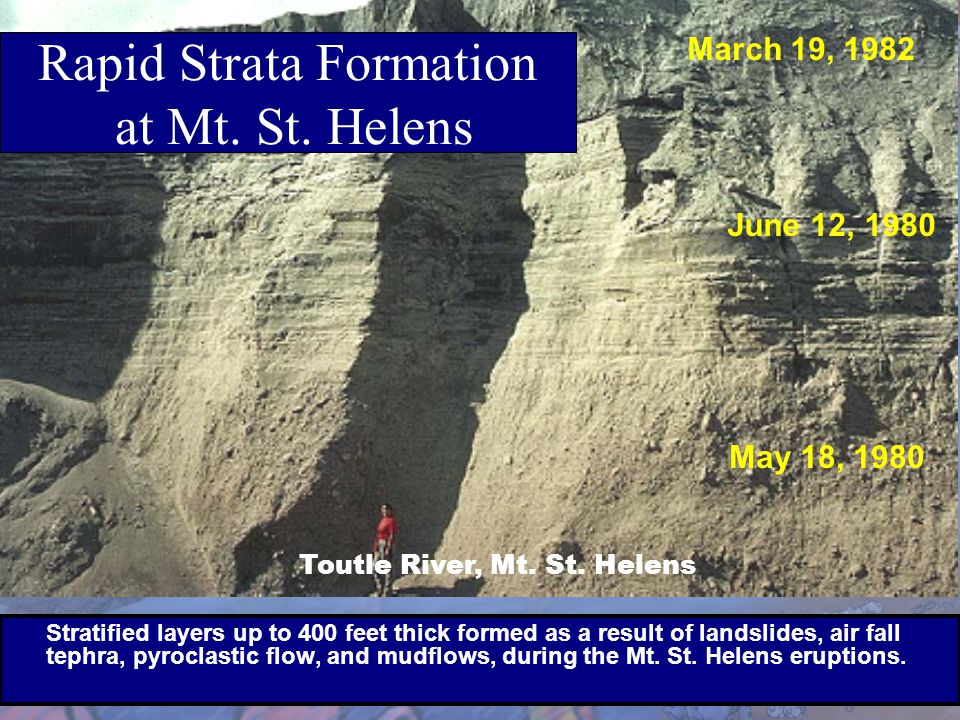
Visit the fossil museum:
www.flickr.com/photos/101536517@N06/sets/72157641367196613/
Just how good are peer reviews of scientific papers?
www.sciencemag.org/content/342/6154/60.full
www.examiner.com/article/want-to-publish-science-paper-ju...
The neo-Darwinian idea that the human genome consists entirely of an accumulation of billions of mutations is, quite obviously, completely bonkers. Nevertheless, it is compulsorily taught in schools and universities as 'science'.
Every single day of our lives we wake up thinking of achieving something. We have a clear image of what we want in our minds, ideas about what we expect, about how things should be, about what we deserve. Ideas about the final result of our actions according to our linear and logical reasoning which often forgets that change can happen (...)
read more on my blog: myhealingmoments.blogspot.com.es/2013/05/day-36580.html
Hybrid Reasoning and the Future of Iconic Representations by Catherine Recanati of Laboratoire d'Informatique de l'Université Paris Nord
Three Points - Hybrid Reasoning and the Future of Iconic Representations
1. Icons or diagrammatic objects can be used as first class citizens (= normal syntactical objects) in safe inferential systems.
2. Diagrammatic representations have a limited power of abstraction but are computationally very efficient.
3. Diagrammatic and logico-linguistic representations having dual and complementary properties, their combining in [Hybrid Reasoning Systems] HRS is very promising.
in Technical Session # 4 : Reasoning chaired by Steve Omohundro of Self-Aware Systems at the The First Conference on Artificial General Intelligence (AGI-08)
This room is The Zone, at the FedEx Institute of Technology, University of Memphis. It was a very good venue for this conference.
Artificial General Intelligence (AGI) research focuses on the original and ultimate goal of AI -- to create intelligence as a whole, by exploring all available paths, including theoretical and experimental computer science, cognitive science, neuroscience, and innovative interdisciplinary methodologies. AGI is also called Strong AI in the AI community.
Another good reference is Artificial General Intelligence : A Gentle Introduction by Pei Wang
I030208 146
Rapid strata formation in soft sand (field evidence).
Photo of strata formation in soft sand on a beach, created by tidal action of the sea.
Formed in a single, high tidal event. Stunning evidence which displays multiple strata/layers.
Why this is so important ....
It has long been assumed, ever since the 17th century, that layers/strata observed in sedimentary rocks were built up gradually, layer upon layer, over many years. It certainly seemed logical at the time, from just looking at rocks, that lower layers would always be older than the layers above them, i.e. that lower layers were always laid down first followed, in time, by successive layers on top.
This was assumed to be true and became known as the superposition principle.
It was also assumed that a layer comprising a different material from a previous layer, represented a change in environmental conditions/factors.
These changes in composition of layers or strata were considered to represent different, geological eras on a global scale, spanning millions of years. This formed the basis for the Geologic Column, which is used to date rocks and also fossils. The evolutionary, 'fossil record' was based on the vast ages and assumed geological eras of the Geologic Column.
There was also circular reasoning applied with the assumed age of 'index' fossils (based on evolutionary preconceptions) used to date strata in the Geologic Column.
We now know that, although these assumptions seemed logical, they are not supported by the evidence.
At the time, the mechanics of stratification were not properly known or studied.
An additional factor was that this assumed superposition and uniformitarian model became essential, with the wide acceptance of Darwinism, for the long ages required for progressive microbes-to-human evolution. There was no incentive to question or challenge the superposition, uniformitarian model, because the presumed, fossil 'record' had become dependant on it, and any change in the accepted model would present devastating implications for Darwinism.
This had the unfortunate effect of linking the study of geology so closely to Darwinism, that any study independent of Darwinian considerations was effectively stymied. This link of geology with Darwinian preconceptions is known as biostratigraphy.
Some of the wealth of evidence can be observed here: www.flickr.com/photos/101536517@N06/sets/72157635944904973/
and also in the links to stunning, experimental evidence, carried out by sedimentologists, given later.
_______________________________________________
GEOLOGIC PRINCIPLES (established by Nicholas Steno in the 17th Century):
What Nicolas Steno believed about strata formation is the basis of the principle of Superposition and the principle of Original Horizontality.
dictionary.sensagent.com/Law_of_superposition/en-en/
“Assuming that all rocks and minerals had once been fluid, Nicolas Steno reasoned that rock strata were formed when particles in a fluid such as water fell to the bottom. This process would leave horizontal layers. Thus Steno's principle of original horizontality states that rock layers form in the horizontal position, and any deviations from this horizontal position are due to the rocks being disturbed later.”)
BEDDING PLANES.
'Bedding plane' describes the surface in between each stratum which are formed during sediment deposition.
science.jrank.org/pages/6533/Strata.html
“Strata form during sediment deposition, that is, the laying down of sediment. Meanwhile, if a change in current speed or sediment grain size occurs or perhaps the sediment supply is cut off, a bedding plane forms. Bedding planes are surfaces that separate one stratum from another. Bedding planes can also form when the upper part of a sediment layer is eroded away before the next episode of deposition. Strata separated by a bedding plane may have different grain sizes, grain compositions, or colours. Sometimes these other traits are better indicators of stratification as bedding planes may be very subtle.”
______________________________________________
Several catastrophic events, flash floods, volcanic eruptions etc. have forced Darwinian influenced geologists to admit to rapid stratification in some instances. However they claim it is a rare phenomenon, which they known about for many years, and which does nothing to invalidate the Geologic Column, the fossil record, evotuionary timescale, or any of the old assumptions regarding strata formation, sedimentation and the superposition principle. They fail to face up to the fact that rapid stratification is not an extraordinary phenonemon, but rather the prevailing and normal mechanism of sedimantary deposition whenever and wherever there is moving, sediment-laden water. The experimental evidence demonstrates the mechanism and a mass of field evidence in normal (non-catastrophic) conditions shows it is a normal everyday occurrence.
It is clear from the experimental evidence that the usual process of stratification is - that strata are not formed by horizontal layers being laid on top of each other in succession, as was assumed. But by sediment being sorted in the flowing water and laid down diagonally in the direction of flow.
Several catastrophic events, flash floods, volcanic eruptions etc. have forced Darwinian, influenced geologists to admit to rapid stratification in some instances. However they claim it is a rare phenomenon, which they have known about for many years, and which does nothing to invalidate the Geologic Column, the fossil record, evotuionary timescale, or any of the old assumptions regarding strata formation, sedimentation and the superposition principle. They fail to face up to the fact that rapid stratification is not an extraordinary phenonemon, but rather the prevailing and normal mechanism of sedimentary deposition whenever and wherever there is moving, sediment-laden water. The experimental evidence demonstrates the mechanism and a mass of field evidence in normal (non-catastrophic) conditions shows it is a normal everyday occurrence.
It is clear from the experimental evidence that the usual process of stratification is - that strata are not formed by horizontal layers being laid on top of each other in succession, as was assumed. But by sediment being sorted in the flowing water and laid down diagonally in the direction of flow. See diagram:
www.flickr.com/photos/truth-in-science/39821536092/in/dat...
The field evidence (in the image) presented here - of rapid, simultaneous stratification refutes the Superposition Principle, the Principle of Original Horizontality and the Principle of Lateral Continuity.
We now know, the Superposition Principle only applies on a rare occasion of sedimentary deposits in perfectly, still water. Superposition is required for the long evolutionary timescale, but the evidence shows it is not the general rule, as was once believed. Most sediment is laid down in moving water, where particle segregation is the general rule, resulting in the simultaneous deposition of strata/layers as shown in the photo.
See many other examples of rapid stratification with geological features: www.flickr.com/photos/101536517@N06/sets/72157635944904973/
Rapid, simultaneous formation of layers/strata, through particle segregation in moving water, is so easily created it has even been described by sedimentologists (working on flume experiments) as a law ...
"Upon filling the tank with water and pouring in sediments, we immediately saw what was to become the rule: The sediments sorted themselves out in very clear layers. This became so common that by the end of two weeks, we jokingly referred to Andrew's law as "It's difficult not to make layers," and Clark's law as "It's easy to make layers." Later on, I proposed the "law" that liquefaction destroys layers, as much to my surprise as that was." Ian Juby, www.ianjuby.org/sedimentation/
The example in the photo is the result of normal, everyday tidal action in a single incident. Where the water current or movement is more turbulent, violent, or catastrophic, great depths (many metres) of stratified sediment can be laid down in a short time. Certainly not the many millions of years assumed by evolutionists.
The composition of strata formed in any deposition event. is related to whatever materials are in the sediment mix, not to any particular timescale. Whatever is in the mix will be automatically sorted into strata/layers. It could be sand, or other material added from mud slides, erosion of chalk deposits, coastal erosion, volcanic ash etc. Any organic material (potential fossils), alive or dead, engulfed by, or swept into, a turbulent sediment mix, will also be sorted and buried within the rapidly, forming layers.
See many other examples of rapid stratification with geological features: www.flickr.com/photos/101536517@N06/sets/72157635944904973/
Stratified, soft sand deposit. demonstrates the rapid, stratification principle.
Important, field evidence which supports the work of the eminent, sedimentologist Dr Guy Berthault MIAS - Member of the International Association of Sedimentologists.
(Dr Berthault's experiments (www.sedimentology.fr/)
And also the experimental work of Dr M.E. Clark (Professor Emeritus, U of Illinois @ Urbana), Andrew Rodenbeck and Dr. Henry Voss, (www.ianjuby.org/sedimentation/)
Location: Sandown, Isle of Wight. Formed 18/01/2018, This field evidence demonstrates that multiple strata in sedimentary deposits do not need millions of years to form and can be formed rapidly. This natural example confirms the principle demonstrated by the sedimentation experiments carried out by Dr Guy Berthault and other sedimentologists. It calls into question the standard, multi-million year dating of sedimentary rocks, and the dating of fossils by depth of burial or position in the strata.
Mulltiple strata/layers are evident in this example.
Dr Berthault's experiments (www.sedimentology.fr/) and other experiments (www.ianjuby.org/sedimentation/) and field studies of floods and volcanic action show that, rather than being formed by gradual, slow deposition of sucessive layers superimposed upon previous layers, with the strata or layers representing a particular timescale, particle segregation in moving water or airborne particles can form strata or layers very quickly, frequently, in a single event.
And, most importantly, lower strata are not older than upper strata, they are the same age, having been created in the same sedimentary episode.
Such field studies confirm experiments which have shown that there is no longer any reason to conclude that strata/layers in sedimentary rocks relate to different geological eras and/or a multi-million year timescale. www.youtube.com/watch?v=5PVnBaqqQw8&feature=share&.... they also show that the relative position of fossils in rocks is not indicative of an order of evolutionary succession. Obviously, the uniformitarian principle, on which the geologic column is based, can no longer be considered valid. And the multi-million, year dating of sedimentary rocks and fossils needs to be reassessed. Rapid deposition of stratified sediments also explains the enigma of polystrate fossils, i.e. large fossils that intersect several strata. In some cases, tree trunk fossils are found which intersect the strata of sedimentary rock up to forty feet in depth. upload.wikimedia.org/wikipedia/commons/thumb/0/08/Lycopsi... They must have been buried in stratified sediment in a short time (certainly not millions, thousands, or even hundreds of years), or they would have rotted away. youtu.be/vnzHU9VsliQ
In fact, the vast majority of fossils are found in good, intact condition, which is testament to their rapid burial. You don't get good fossils from gradual burial, because they would be damaged or destroyed by decay, predation or erosion. The existence of so many fossils in sedimentary rock on a global scale is stunning evidence for the rapid depostion of sedimentary rock as the general rule. It is obvious that all rock containing good intact fossils was formed from sediment laid down in a very short time, not millions, or even thousands of years.
See set of photos of other examples of rapid stratification: www.flickr.com/photos/101536517@N06/sets/72157635944904973/
Carbon dating of coal should not be possible if it is millions of years old, yet significant amounts of Carbon 14 have been detected in coal and other fossil material, which indicates that it is less than 50,000 years old. www.ldolphin.org/sewell/c14dating.html
www.grisda.org/origins/51006.htm
Evolutionists confidently cite multi-million year ages for rocks and fossils, but what most people don't realise is that no one actually knows the age of sedimentary rocks or the fossils found within them. So how are evolutionists so sure of the ages they so confidently quote? The astonishing thing is they aren't. Sedimentary rocks cannot be dated by radiometric methods*, and fossils can only be dated to less than 50,000 years with Carbon 14 dating. The method evolutionists use is based entirely on assumptions. Unbelievably, fossils are dated by the assumed age of rocks, and rocks are dated by the assumed age of fossils, that's right ... it is known as circular reasoning.
* Regarding the radiometric dating of igneous rocks, which is claimed to be relevant to the dating of sedimentary rocks, in an occasional instance there is an igneous intrusion associated with a sedimentary deposit -
Prof. Aubouin says in his Précis de Géologie: "Each radioactive element disintegrates in a characteristic and constant manner, which depends neither on the physical state (no variation with pressure or temperature or any other external constraint) nor on the chemical state (identical for an oxide or a phosphate)."
"Rocks form when magma crystallizes. Crystallisation depends on pressure and temperature, from which radioactivity is independent. So, there is no relationship between radioactivity and crystallisation.
Consequently, radioactivity doesn't date the formation of rocks. Moreover, daughter elements contained in rocks result mainly from radioactivity in magma where gravity separates the heavier parent element, from the lighter daughter element. Thus radiometric dating has no chronological signification." Dr. Guy Berthault www.sciencevsevolution.org/Berthault.htm
Visit the fossil museum:
www.flickr.com/photos/101536517@N06/sets/72157641367196613/
Just how good are peer reviews of scientific papers?
www.sciencemag.org/content/342/6154/60.full
www.examiner.com/article/want-to-publish-science-paper-ju...
The neo-Darwinian idea that the human genome consists entirely of an accumulation of billions of mutations is, quite obviously, completely bonkers. Nevertheless, it is compulsorily taught in schools and universities as 'science'.
Recent update(group 2). D 2nd reason y I have this collection - see the photo www.flickr.com/photos/cliffather/1286721245/in/dateposted/ See the reasoning here: www.pinterest.com/cliffather/my-faves/
CHIBITRONICS CIRCUIT ART + OZOBOTS ROBOTIC PROGRAMMING
One of the STEAM Camp’s key missions is to create innovative ways to play, learn and socially interact in an expanding digital world. Students using Ozobots are learning sequential thinking, logical reasoning and coding concepts. These critical life skills enable students from all walks of life to succeed in the future digital age. Our students learn how to channel their ideas into reality, creating private games, secret codes and their very own robotic equations, putting them at the forefront of learning without even realizing it. When playing digital apps with a physical toy, it bridges the gap between the physical and digital realm - creating a whole new world of educational play. Such activities help us present an innovative way to teach subjects like programming, math and science in classrooms. Kids become engaged and inspired lifelong learners when topics come alive.
___________
About STEAM Camp
STEAM Camp introduces participants to potential careers within Science, Technology, Engineering Art and Mathematics. Campers will learn about educational decisions that will prepare them for these careers. STEAM Camp also focuses on how these careers often require similar, overlapping skills. This is a connected educational approach designed to share a well-rounded experience. Middle school students presented by the Urban League of Greater Madison, Girl Scouts of Badgerland Wisconsin and Big Brothers, Big Sisters of Dane County. This will be a constructive and collaborative experience. Campers will discover together how to explore these exciting careers.
Rather than maintain their own warehouses and haulage fleets, many supermarkets and High Street retailers prefer to employ specialist contractors. The Tesco or Dixons lorries you see on the motorway probably belong to a "logistics" company such as Excel or Tibbett & Britten, which have "dedicated" fleets specially painted for their clients. The client supermarket is then free ...so the reasoning runs... to concentrate on its "core business". I apologise for all these dissociative inverted commas, but this is a jargon-ridden industry.
The arrangement is not necessarily good for employees. The client always has the whip-hand, and the contractor lives in terror of losing the contract. The contractor accordingly avoids making himself unpopular with the client by bringing to the client's attention anything it may not wish to hear about, especially if it involves additional expenditure. Worn out equipment is not replaced, improvements are not undertaken, repairs are not made, nothing gets better. The canteen becomes too small for the number of staff and most of them spend their lunch breaks sitting glumly in their cars. Most firms have long since ceased to provide a canteen serving freshly prepared food. Vending machines and microwave ovens are substituted.
The contractors have usually undertaken to do the job for an agreed sum. The client drip-feeds it to the contractor in monthly instalments and leaves him to spend it as required. Managers know that the best way of pleasing their superiors is to come in under budget ...i.e. to get the job done for less than the sum they've been given to do it. The saving is clear profit for the contractor. My employers, Messrs Damage & Sendit are pastmasters at this kind of wheeze. The office cleaners have been cut down from morning and afternoon to afternoon only. Saturday is a slack day and with the air of someone granting an over-generous concession against their better judgement, the firm allows its staff to go home early if the work is completed ...unpaid that is. Every week a notice goes up detailing the amount spent on employing agency staff to cover for sickness. This is a falsification since the amount saved by not paying the people who are out sick is not deducted from the figure shown. The saving made by sending everyone home three hours early every Saturday is never mentioned of course. The company tries not to award sick pay ...technically a concession rather than an entitlement... by waiting for the employee to claim it. Those who make such claims meet such a stonewall of delay and obstructiveness that they often give up and don't try again.
But still, it could be worse. Yesterday I heard of a certain "budget" supermarket which employs people on a 20-hours-per-week contract. Oh, they get 40 hours work; the other 20 is overtime. The scam is that the company need only grant half the normal holiday entitlement. But 20 hours is paid at overtime rate every week, right? Well, actually, no, just at normal time. Of course there is now a virtually botomless supply of "economic migrants" who will jump at jobs like this.
Here we see an unaccustomed state of order and tidyness outside Damage & Sendit's warehouse. Inside, our "hygiene" operative was sweeping behind the rubbish-trap metal skirtings which protect the walls from impact by forklift truck. Then I understood ...a deputation of high-ups from the client company were coming round on a tour of inspection the next day.
Rapid strata formation in soft sand (field evidence).
Photo of strata formation in soft sand on a beach, created by tidal action of the sea.
Formed in a single, high tidal event. Stunning evidence which displays multiple strata/layers.
Why this is so important ....
It has long been assumed, ever since the 17th century, that layers/strata observed in sedimentary rocks were built up gradually, layer upon layer, over many years. It certainly seemed logical at the time, from just looking at rocks, that lower layers would always be older than the layers above them, i.e. that lower layers were always laid down first followed, in time, by successive layers on top.
This was assumed to be true and became known as the superposition principle.
It was also assumed that a layer comprising a different material from a previous layer, represented a change in environmental conditions/factors.
These changes in composition of layers or strata were considered to represent different, geological eras on a global scale, spanning millions of years. This formed the basis for the Geologic Column, which is used to date rocks and also fossils. The evolutionary, 'fossil record' was based on the vast ages and assumed geological eras of the Geologic Column.
There was also circular reasoning applied with the assumed age of 'index' fossils (based on evolutionary beliefs & preconceptions) used to date strata in the Geologic Column. Dating strata from the assumed age of (index) fossils is known as Biostratigraphy.
We now know that, although these assumptions seemed logical, they are not supported by the evidence.
At the time, the mechanics of stratification were not properly known or studied.
An additional factor was that this assumed superposition and uniformitarian model became essential, with the wide acceptance of Darwinism, for the long ages required for progressive microbes-to-human evolution. There was no incentive to question or challenge the superposition, uniformitarian model, because the presumed, fossil 'record' had become dependant on it, and any change in the accepted model would present devastating implications for Darwinism.
This had the unfortunate effect of linking the study of geology so closely to Darwinism, that any study independent of Darwinian considerations was effectively stymied. This link of geology with Darwinian preconceptions is known as biostratigraphy.
Some other field evidence can be observed here: www.flickr.com/photos/101536517@N06/sets/72157635944904973/
and also in the links to stunning, experimental evidence, carried out by sedimentologists, given later.
_______________________________________________
GEOLOGIC PRINCIPLES (established by Nicholas Steno in the 17th Century):
What Nicolas Steno believed about strata formation is the basis of the principle of Superposition and the principle of Original Horizontality.
dictionary.sensagent.com/Law_of_superposition/en-en/
“Assuming that all rocks and minerals had once been fluid, Nicolas Steno reasoned that rock strata were formed when particles in a fluid such as water fell to the bottom. This process would leave horizontal layers. Thus Steno's principle of original horizontality states that rock layers form in the horizontal position, and any deviations from this horizontal position are due to the rocks being disturbed later.”)
BEDDING PLANES.
'Bedding plane' describes the surface in between each stratum which are formed during sediment deposition.
science.jrank.org/pages/6533/Strata.html
“Strata form during sediment deposition, that is, the laying down of sediment. Meanwhile, if a change in current speed or sediment grain size occurs or perhaps the sediment supply is cut off, a bedding plane forms. Bedding planes are surfaces that separate one stratum from another. Bedding planes can also form when the upper part of a sediment layer is eroded away before the next episode of deposition. Strata separated by a bedding plane may have different grain sizes, grain compositions, or colours. Sometimes these other traits are better indicators of stratification as bedding planes may be very subtle.”
______________________________________________
Several catastrophic events, flash floods, volcanic eruptions etc. have forced Darwinian, influenced geologists to admit to rapid stratification in some instances. However they claim it is a rare phenomenon, which they have known about for many years, and which does nothing to invalidate the Geologic Column, the fossil record, evolutionary timescale, or any of the old assumptions regarding strata formation, sedimentation and the superposition principle. They fail to face up to the fact that rapid stratification is not an extraordinary phenonemon, but rather the prevailing and normal mechanism of sedimentary deposition whenever and wherever there is moving, sediment-laden water. The experimental evidence demonstrates the mechanism and a mass of field evidence in normal (non-catastrophic) conditions shows it is a normal everyday occurrence.
It is clear from the experimental evidence that the usual process of stratification is - that strata are not formed by horizontal layers being laid on top of each other in succession, as was assumed. But by sediment being sorted in the flowing water and laid down diagonally in the direction of flow. See diagram:
www.flickr.com/photos/truth-in-science/39821536092/in/dat...
The field evidence (in the image) presented here - of rapid, simultaneous stratification refutes the Superposition Principle and the Principle of Lateral Continuity.
We now know, the Superposition Principle only applies on a rare occasion where sedimentary deposits are laid down in still water.
Superposition is required for the long evolutionary timescale, but the evidence shows it is not the general rule, as was once believed. Most sediment is laid down in moving water, where particle segregation is the general rule, resulting in the simultaneous deposition of strata/layers as shown in the photo.
See many other examples of rapid stratification (with geological features): www.flickr.com/photos/101536517@N06/sets/72157635944904973/
Rapid, simultaneous formation of layers/strata, through particle segregation in moving water, is so easily created it has even been described by sedimentologists (working on flume experiments) as a law ...
"Upon filling the tank with water and pouring in sediments, we immediately saw what was to become the rule: The sediments sorted themselves out in very clear layers. This became so common that by the end of two weeks, we jokingly referred to Andrew's law as "It's difficult not to make layers," and Clark's law as "It's easy to make layers." Later on, I proposed the "law" that liquefaction destroys layers, as much to my surprise as that was." Ian Juby, www.ianjuby.org/sedimentation/
The example in the photo is the result of normal, everyday tidal action in a single incident. Where the water current or movement is more turbulent, violent, or catastrophic, great depths (many metres) of stratified sediment can be laid down in a short time. Certainly not the many millions of years assumed by evolutionists.
The composition of strata formed in any deposition event. is related to whatever materials are in the sediment mix, not to any particular timescale. Whatever is in the mix will be automatically sorted into strata/layers. It could be sand, or other material added from mud slides, erosion of chalk deposits, coastal erosion, volcanic ash etc. Any organic material (potential fossils), alive or dead, engulfed by, or swept into, a turbulent sediment mix, will also be sorted and buried within the rapidly, forming layers.
See many other examples of rapid stratification with geological features: www.flickr.com/photos/101536517@N06/sets/72157635944904973/
Stratified, soft sand deposit. demonstrates the rapid, stratification principle.
Important, field evidence which supports the work of the eminent, sedimentologist Dr Guy Berthault MIAS - Member of the International Association of Sedimentologists.
(Dr Berthault's experiments (www.sedimentology.fr/)
And also the experimental work of Dr M.E. Clark (Professor Emeritus, U of Illinois @ Urbana), Andrew Rodenbeck and Dr. Henry Voss, (www.ianjuby.org/sedimentation/)
Location: Sandown, Isle of Wight. Formed 25/04/2018, This field evidence demonstrates that multiple strata in sedimentary deposits do not need millions of years to form and can be formed rapidly. This natural example confirms the principle demonstrated by the sedimentation experiments carried out by Dr Guy Berthault and other sedimentologists. It calls into question the standard, multi-million year dating of sedimentary rocks, and the dating of fossils by depth of burial or position in the strata.
Mulltiple strata/layers are evident in this example.
Dr Berthault's experiments (www.sedimentology.fr/) and other experiments (www.ianjuby.org/sedimentation/) and field studies of floods and volcanic action show that, rather than being formed by gradual, slow deposition of sucessive layers superimposed upon previous layers, with the strata or layers representing a particular timescale, particle segregation in moving water or airborne particles can form strata or layers very quickly, frequently, in a single event.
And, most importantly, lower strata are not older than upper strata, they are the same age, having been created in the same sedimentary episode.
Such field studies confirm experiments which have shown that there is no longer any reason to conclude that strata/layers in sedimentary rocks relate to different geological eras and/or a multi-million year timescale. www.youtube.com/watch?v=5PVnBaqqQw8&feature=share&.... they also show that the relative position of fossils in rocks is not indicative of an order of evolutionary succession. Obviously, the uniformitarian principle, on which the geologic column is based, can no longer be considered valid. And the multi-million, year dating of sedimentary rocks and fossils needs to be reassessed. Rapid deposition of stratified sediments also explains the enigma of polystrate fossils, i.e. large fossils that intersect several strata. In some cases, tree trunk fossils are found which intersect the strata of sedimentary rock up to forty feet in depth. upload.wikimedia.org/wikipedia/commons/thumb/0/08/Lycopsi... They must have been buried in stratified sediment in a short time (certainly not millions, thousands, or even hundreds of years), or they would have rotted away. youtu.be/vnzHU9VsliQ
In fact, the vast majority of fossils are found in good, intact condition, which is testament to their rapid burial. You don't get good fossils from gradual burial, because they would be damaged or destroyed by decay, predation or erosion. The existence of so many fossils in sedimentary rock on a global scale is stunning evidence for the rapid depostion of sedimentary rock as the general rule. It is obvious that all rock containing good intact fossils was formed from sediment laid down in a very short time, not millions, or even thousands of years.
See set of photos of other examples of rapid stratification: www.flickr.com/photos/101536517@N06/sets/72157635944904973/
Carbon dating of coal should not be possible if it is millions of years old, yet significant amounts of Carbon 14 have been detected in coal and other fossil material, which indicates that it is less than 50,000 years old. www.ldolphin.org/sewell/c14dating.html
www.grisda.org/origins/51006.htm
Evolutionists confidently cite multi-million year ages for rocks and fossils, but what most people don't realise is that no one actually knows the age of sedimentary rocks or the fossils found within them. So how are evolutionists so sure of the ages they so confidently quote? The astonishing thing is they aren't. Sedimentary rocks cannot be dated by radiometric methods*, and fossils can only be dated to less than 50,000 years with Carbon 14 dating. The method evolutionists use is based entirely on assumptions. Unbelievably, fossils are dated by the assumed age of rocks, and rocks are dated by the assumed age of fossils, that's right ... it is known as circular reasoning.
* Regarding the radiometric dating of igneous rocks, which is claimed to be relevant to the dating of sedimentary rocks, in an occasional instance there is an igneous intrusion associated with a sedimentary deposit -
Prof. Aubouin says in his Précis de Géologie: "Each radioactive element disintegrates in a characteristic and constant manner, which depends neither on the physical state (no variation with pressure or temperature or any other external constraint) nor on the chemical state (identical for an oxide or a phosphate)."
"Rocks form when magma crystallizes. Crystallisation depends on pressure and temperature, from which radioactivity is independent. So, there is no relationship between radioactivity and crystallisation.
Consequently, radioactivity doesn't date the formation of rocks. Moreover, daughter elements contained in rocks result mainly from radioactivity in magma where gravity separates the heavier parent element, from the lighter daughter element. Thus radiometric dating has no chronological signification." Dr. Guy Berthault www.sciencevsevolution.org/Berthault.htm
Visit the fossil museum:
www.flickr.com/photos/101536517@N06/sets/72157641367196613/
Just how good are peer reviews of scientific papers?
www.sciencemag.org/content/342/6154/60.full
www.examiner.com/article/want-to-publish-science-paper-ju...
The neo-Darwinian idea that the human genome consists entirely of an accumulation of billions of mutations is, quite obviously, completely bonkers. Nevertheless, it is compulsorily taught in schools and universities as 'science'.
Today, my sister turns sixteen. I have failed in my goal to turn her into either a nun or a lesbian, the reasoning being that neither one would result in an unwanted pregnancy. I have scared her straight enough to finish school without trying drugs(hopefully) or letting her boyfriend do dirty dirty things to her. Much as, in the role of brother, I hate to even think about such things, I have no choice, as I occasionally obsess about every single thing in this world that seeks to keep my sister from being a rocket scientist. Sometimes it's the drummer in the school band who wants to make smoochy smoochy. Sometimes it's the uncle who believes in neither evolution or dinosaurs. Only two more years of buying her shoes in an attempt to buy both love and a pledge of staying on the straight & narrow. Then she'll go to whatever college she wants, and I can breathe easy.
For at the very least, a good five seconds.
Happy birthday, Hyacinth, you sasquatch.
I think I see the reasoning behind this interesting sign, but it looked so incongruous. Santa Monica Pier, California.
Rapid strata formation in soft sand (field evidence).
Photo of strata formation in soft sand on a beach, created by tidal action of the sea.
Formed in a single, high tidal event. Stunning evidence which displays multiple strata/layers.
Why this is so important ....
It has long been assumed, ever since the 17th century, that layers/strata observed in sedimentary rocks were built up gradually, layer upon layer, over many years. It certainly seemed logical at the time, from just looking at rocks, that lower layers would always be older than the layers above them, i.e. that lower layers were always laid down first followed, in time, by successive layers on top.
This was assumed to be true and became known as the superposition principle.
It was also assumed that a layer comprising a different material from a previous layer, represented a change in environmental conditions/factors.
These changes in composition of layers or strata were considered to represent different, geological eras on a global scale, spanning millions of years. This formed the basis for the Geologic Column, which is used to date rocks and also fossils. The evolutionary, 'fossil record' was based on the vast ages and assumed geological eras of the Geologic Column.
There was also circular reasoning applied with the assumed age of 'index' fossils (based on evolutionary beliefs & preconceptions) used to date strata in the Geologic Column. Dating strata from the assumed age of (index) fossils is known as Biostratigraphy.
We now know that, although these assumptions seemed logical, they are not supported by the evidence.
At the time, the mechanics of stratification were not properly known or studied.
An additional factor was that this assumed superposition and uniformitarian model became essential, with the wide acceptance of Darwinism, for the long ages required for progressive microbes-to-human evolution. There was no incentive to question or challenge the superposition, uniformitarian model, because the presumed, fossil 'record' had become dependant on it, and any change in the accepted model would present devastating implications for Darwinism.
This had the unfortunate effect of linking the study of geology so closely to Darwinism, that any study independent of Darwinian considerations was effectively stymied. This link of geology with Darwinian preconceptions is known as biostratigraphy.
Some other field evidence, in various situations, can be observed here: www.flickr.com/photos/101536517@N06/sets/72157635944904973/
and also in the links to stunning, experimental evidence, carried out by sedimentologists, given later.
_______________________________________________
GEOLOGIC PRINCIPLES (established by Nicholas Steno in the 17th Century):
What Nicolas Steno believed about strata formation is the basis of the principle of Superposition and the principle of Original Horizontality.
dictionary.sensagent.com/Law_of_superposition/en-en/
“Assuming that all rocks and minerals had once been fluid, Nicolas Steno reasoned that rock strata were formed when particles in a fluid such as water fell to the bottom. This process would leave horizontal layers. Thus Steno's principle of original horizontality states that rock layers form in the horizontal position, and any deviations from this horizontal position are due to the rocks being disturbed later.”)
BEDDING PLANES.
'Bedding plane' describes the surface in between each stratum which are formed during sediment deposition.
science.jrank.org/pages/6533/Strata.html
“Strata form during sediment deposition, that is, the laying down of sediment. Meanwhile, if a change in current speed or sediment grain size occurs or perhaps the sediment supply is cut off, a bedding plane forms. Bedding planes are surfaces that separate one stratum from another. Bedding planes can also form when the upper part of a sediment layer is eroded away before the next episode of deposition. Strata separated by a bedding plane may have different grain sizes, grain compositions, or colours. Sometimes these other traits are better indicators of stratification as bedding planes may be very subtle.”
______________________________________________
Several catastrophic events, flash floods, volcanic eruptions etc. have forced Darwinian, influenced geologists to admit to rapid stratification in some instances. However they claim it is a rare phenomenon, which they have known about for many years, and which does nothing to invalidate the Geologic Column, the fossil record, evolutionary timescale, or any of the old assumptions regarding strata formation, sedimentation and the superposition principle. They fail to face up to the fact that rapid stratification is not an extraordinary phenonemon, but rather the prevailing and normal mechanism of sedimentary deposition whenever and wherever there is moving, sediment-laden water. The experimental evidence demonstrates the mechanism and a mass of field evidence in normal (non-catastrophic) conditions shows it is a normal everyday occurrence.
It is clear from the experimental evidence that the usual process of stratification is - that strata are not formed by horizontal layers being laid on top of each other in succession, as was assumed. But by sediment being sorted in the flowing water and laid down diagonally in the direction of flow. See diagram:
www.flickr.com/photos/truth-in-science/39821536092/in/dat...
The field evidence (in the image) presented here - of rapid, simultaneous stratification refutes the Superposition Principle and the Principle of Lateral Continuity.
We now know, the Superposition Principle only applies on a rare occasion where sedimentary deposits are laid down in still water.
Superposition is required for the long evolutionary timescale, but the evidence shows it is not the general rule, as was once believed. Most sediment is laid down in moving water, where particle segregation is the general rule, resulting in the simultaneous deposition of strata/layers as shown in the photo.
See many other examples of rapid stratification (with geological features): www.flickr.com/photos/101536517@N06/sets/72157635944904973/
Rapid, simultaneous formation of layers/strata, through particle segregation in moving water, is so easily created it has even been described by sedimentologists (working on flume experiments) as a law ...
"Upon filling the tank with water and pouring in sediments, we immediately saw what was to become the rule: The sediments sorted themselves out in very clear layers. This became so common that by the end of two weeks, we jokingly referred to Andrew's law as "It's difficult not to make layers," and Clark's law as "It's easy to make layers." Later on, I proposed the "law" that liquefaction destroys layers, as much to my surprise as that was." Ian Juby, www.ianjuby.org/sedimentation/
The example in the photo is the result of normal, everyday tidal action formed in a single incident. Where the water current or movement is more turbulent, violent, or catastrophic, great depths (many metres) of stratified sediment can be laid down in a short time. Certainly not the many millions of years assumed by evolutionists.
The composition of strata formed in any deposition event. is related to whatever materials are in the sediment mix, not to any particular timescale. Whatever is in the mix will be automatically sorted into strata/layers. It could be sand, or other material added from mud slides, erosion of chalk deposits, coastal erosion, volcanic ash etc. Any organic material (potential fossils), alive or dead, engulfed by, or swept into, a turbulent sediment mix, will also be sorted and buried within the rapidly, forming layers.
See many other examples of rapid stratification with geological features: www.flickr.com/photos/101536517@N06/sets/72157635944904973/
Stratified, soft sand deposit. demonstrates the rapid, stratification principle.
Important, field evidence which supports the work of the eminent, sedimentologist Dr Guy Berthault MIAS - Member of the International Association of Sedimentologists.
(Dr Berthault's experiments (www.sedimentology.fr/)
And also the experimental work of Dr M.E. Clark (Professor Emeritus, U of Illinois @ Urbana), Andrew Rodenbeck and Dr. Henry Voss, (www.ianjuby.org/sedimentation/)
Location: Sandown, Isle of Wight. Photographed: 12/03/2019
This field evidence demonstrates that multiple strata in sedimentary deposits do not need millions of years to form and can be formed rapidly. This natural example confirms the principle demonstrated by the sedimentation experiments carried out by Dr Guy Berthault and other sedimentologists. It calls into question the standard, multi-million year dating of sedimentary rocks, and the dating of fossils by depth of burial or position in the strata.
Mulltiple strata/layers are evident in this example.
Dr Berthault's experiments (www.sedimentology.fr/) and other experiments (www.ianjuby.org/sedimentation/) and field studies of floods and volcanic action show that, rather than being formed by gradual, slow deposition of sucessive layers superimposed upon previous layers, with the strata or layers representing a particular timescale, particle segregation in moving water or airborne particles can form strata or layers very quickly, frequently, in a single event.
And, most importantly, lower strata are not older than upper strata, they are the same age, having been created in the same sedimentary episode.
Such field studies confirm experiments which have shown that there is no longer any reason to conclude that strata/layers in sedimentary rocks relate to different geological eras and/or a multi-million year timescale. www.youtube.com/watch?v=5PVnBaqqQw8&feature=share&.... they also show that the relative position of fossils in rocks is not indicative of an order of evolutionary succession. Obviously, the uniformitarian principle, on which the geologic column is based, can no longer be considered valid. And the multi-million, year dating of sedimentary rocks and fossils needs to be reassessed. Rapid deposition of stratified sediments also explains the enigma of polystrate fossils, i.e. large fossils that intersect several strata. In some cases, tree trunk fossils are found which intersect the strata of sedimentary rock up to forty feet in depth. upload.wikimedia.org/wikipedia/commons/thumb/0/08/Lycopsi... They must have been buried in stratified sediment in a short time (certainly not millions, thousands, or even hundreds of years), or they would have rotted away. youtu.be/vnzHU9VsliQ
In fact, the vast majority of fossils are found in good, intact condition, which is testament to their rapid burial. You don't get good fossils from gradual burial, because they would be damaged or destroyed by decay, predation or erosion. The existence of so many fossils in sedimentary rock on a global scale is stunning evidence for the rapid depostion of sedimentary rock as the general rule. It is obvious that all rock containing good intact fossils was formed from sediment laid down in a very short time, not millions, or even thousands of years.
See set of photos of other examples of rapid stratification: www.flickr.com/photos/101536517@N06/sets/72157635944904973/
Carbon dating of coal should not be possible if it is millions of years old, yet significant amounts of Carbon 14 have been detected in coal and other fossil material, which indicates that it is less than 50,000 years old. www.ldolphin.org/sewell/c14dating.html
www.grisda.org/origins/51006.htm
Evolutionists confidently cite multi-million year ages for rocks and fossils, but what most people don't realise is that no one actually knows the age of sedimentary rocks or the fossils found within them. So how are evolutionists so sure of the ages they so confidently quote? The astonishing thing is they aren't. Sedimentary rocks cannot be dated by radiometric methods*, and fossils can only be dated to less than 50,000 years with Carbon 14 dating. The method evolutionists use is based entirely on assumptions. Unbelievably, fossils are dated by the assumed age of rocks, and rocks are dated by the assumed age of fossils, that's right ... it is known as circular reasoning.
* Regarding the radiometric dating of igneous rocks, which is claimed to be relevant to the dating of sedimentary rocks, in an occasional instance there is an igneous intrusion associated with a sedimentary deposit -
Prof. Aubouin says in his Précis de Géologie: "Each radioactive element disintegrates in a characteristic and constant manner, which depends neither on the physical state (no variation with pressure or temperature or any other external constraint) nor on the chemical state (identical for an oxide or a phosphate)."
"Rocks form when magma crystallizes. Crystallisation depends on pressure and temperature, from which radioactivity is independent. So, there is no relationship between radioactivity and crystallisation.
Consequently, radioactivity doesn't date the formation of rocks. Moreover, daughter elements contained in rocks result mainly from radioactivity in magma where gravity separates the heavier parent element, from the lighter daughter element. Thus radiometric dating has no chronological signification." Dr. Guy Berthault www.sciencevsevolution.org/Berthault.htm
Rapid strata formation and rapid erosion at Mount St Helens.
slideplayer.com/slide/5703217/18/images/28/Rapid+Strata+F...
Visit the fossil museum:
www.flickr.com/photos/101536517@N06/sets/72157641367196613/
Just how good are peer reviews of scientific papers?
www.sciencemag.org/content/342/6154/60.full
www.examiner.com/article/want-to-publish-science-paper-ju...
The neo-Darwinian idea that the human genome consists entirely of an accumulation of billions of mutations is, quite obviously, completely bonkers. Nevertheless, it is compulsorily taught in schools and universities as 'science'.
Rapid strata formation in soft sand (field evidence).
Photo of strata formation in soft sand on a beach, created by tidal action of the sea.
Formed in a single, high tidal event. Stunning evidence which displays multiple strata/layers.
Why this is so important ....
It has long been assumed, ever since the 17th century, that layers/strata observed in sedimentary rocks were built up gradually, layer upon layer, over many years. It certainly seemed logical at the time, from just looking at rocks, that lower layers would always be older than the layers above them, i.e. that lower layers were always laid down first followed, in time, by successive layers on top.
This was assumed to be true and became known as the superposition principle.
It was also assumed that a layer comprising a different material from a previous layer, represented a change in environmental conditions/factors.
These changes in composition of layers or strata were considered to represent different, geological eras on a global scale, spanning millions of years. This formed the basis for the Geologic Column, which is used to date rocks and also fossils. The evolutionary, 'fossil record' was based on the vast ages and assumed geological eras of the Geologic Column.
There was also circular reasoning applied with the assumed age of 'index' fossils (based on evolutionary beliefs & preconceptions) used to date strata in the Geologic Column. Dating strata from the assumed age of (index) fossils is known as Biostratigraphy.
We now know that, although these assumptions seemed logical, they are not supported by the evidence.
At the time, the mechanics of stratification were not properly known or studied.
An additional factor was that this assumed superposition and uniformitarian model became essential, with the wide acceptance of Darwinism, for the long ages required for progressive microbes-to-human evolution. There was no incentive to question or challenge the superposition, uniformitarian model, because the presumed, fossil 'record' had become dependant on it, and any change in the accepted model would present devastating implications for Darwinism.
This had the unfortunate effect of linking the study of geology so closely to Darwinism, that any study independent of Darwinian considerations was effectively stymied. This link of geology with Darwinian preconceptions is known as biostratigraphy.
Some other field evidence, in various situations, can be observed here: www.flickr.com/photos/101536517@N06/sets/72157635944904973/
and also in the links to stunning, experimental evidence, carried out by sedimentologists, given later.
_______________________________________________
GEOLOGIC PRINCIPLES (established by Nicholas Steno in the 17th Century):
What Nicolas Steno believed about strata formation is the basis of the principle of Superposition and the principle of Original Horizontality.
dictionary.sensagent.com/Law_of_superposition/en-en/
“Assuming that all rocks and minerals had once been fluid, Nicolas Steno reasoned that rock strata were formed when particles in a fluid such as water fell to the bottom. This process would leave horizontal layers. Thus Steno's principle of original horizontality states that rock layers form in the horizontal position, and any deviations from this horizontal position are due to the rocks being disturbed later.”)
BEDDING PLANES.
'Bedding plane' describes the surface in between each stratum which are formed during sediment deposition.
science.jrank.org/pages/6533/Strata.html
“Strata form during sediment deposition, that is, the laying down of sediment. Meanwhile, if a change in current speed or sediment grain size occurs or perhaps the sediment supply is cut off, a bedding plane forms. Bedding planes are surfaces that separate one stratum from another. Bedding planes can also form when the upper part of a sediment layer is eroded away before the next episode of deposition. Strata separated by a bedding plane may have different grain sizes, grain compositions, or colours. Sometimes these other traits are better indicators of stratification as bedding planes may be very subtle.”
______________________________________________
Several catastrophic events, flash floods, volcanic eruptions etc. have forced Darwinian, influenced geologists to admit to rapid stratification in some instances. However they claim it is a rare phenomenon, which they have known about for many years, and which does nothing to invalidate the Geologic Column, the fossil record, evolutionary timescale, or any of the old assumptions regarding strata formation, sedimentation and the superposition principle. They fail to face up to the fact that rapid stratification is not an extraordinary phenonemon, but rather the prevailing and normal mechanism of sedimentary deposition whenever and wherever there is moving, sediment-laden water. The experimental evidence demonstrates the mechanism and a mass of field evidence in normal (non-catastrophic) conditions shows it is a normal everyday occurrence.
It is clear from the experimental evidence that the usual process of stratification is - that strata are not formed by horizontal layers being laid on top of each other in succession, as was assumed. But by sediment being sorted in the flowing water and laid down diagonally in the direction of flow. See diagram:
www.flickr.com/photos/truth-in-science/39821536092/in/dat...
The field evidence (in the image) presented here - of rapid, simultaneous stratification refutes the Superposition Principle and the Principle of Lateral Continuity.
We now know, the Superposition Principle only applies on a rare occasion where sedimentary deposits are laid down in still water.
Superposition is required for the long evolutionary timescale, but the evidence shows it is not the general rule, as was once believed. Most sediment is laid down in moving water, where particle segregation is the general rule, resulting in the simultaneous deposition of strata/layers as shown in the photo.
See many other examples of rapid stratification (with geological features): www.flickr.com/photos/101536517@N06/sets/72157635944904973/
Rapid, simultaneous formation of layers/strata, through particle segregation in moving water, is so easily created it has even been described by sedimentologists (working on flume experiments) as a law ...
"Upon filling the tank with water and pouring in sediments, we immediately saw what was to become the rule: The sediments sorted themselves out in very clear layers. This became so common that by the end of two weeks, we jokingly referred to Andrew's law as "It's difficult not to make layers," and Clark's law as "It's easy to make layers." Later on, I proposed the "law" that liquefaction destroys layers, as much to my surprise as that was." Ian Juby, www.ianjuby.org/sedimentation/
The field example in the photo is the result of normal, everyday tidal action formed in a single incident,
Where the water current or movement is more turbulent, violent, or catastrophic, great depths (many metres) of stratified sediment can be laid down in a short time. Certainly not the many millions of years assumed by evolutionists.
The composition of strata formed in any deposition event. is related to whatever materials are in the sediment mix, not to any particular timescale. Whatever is in the mix will be automatically sorted into strata/layers. It could be sand, or other material added from mud slides, erosion of chalk deposits, coastal erosion, volcanic ash etc. Any organic material (potential fossils), alive or dead, engulfed by, or swept into, a turbulent sediment mix, will also be sorted and buried within the rapidly, forming layers.
See many other examples of rapid stratification with geological features: www.flickr.com/photos/101536517@N06/sets/72157635944904973/
Stratified, soft sand deposit. demonstrates the rapid, stratification principle.
Important, field evidence which supports the work of the eminent, sedimentologist Dr Guy Berthault MIAS - Member of the International Association of Sedimentologists.
(Dr Berthault's experiments (www.sedimentology.fr/)
And also the experimental work of Dr M.E. Clark (Professor Emeritus, U of Illinois @ Urbana), Andrew Rodenbeck and Dr. Henry Voss, (www.ianjuby.org/sedimentation/)
Location: Yaverland, Isle of Wight. photographed 04/06/2018, formed several months earlier and in the early stages of consolidation.
This field evidence demonstrates that multiple strata in sedimentary deposits do not need millions of years to form and can be formed rapidly. This natural example confirms the principle demonstrated by the sedimentation experiments carried out by Dr Guy Berthault and other sedimentologists. It calls into question the standard, multi-million year dating of sedimentary rocks, and the dating of fossils by depth of burial or position in the strata.
Mulltiple strata/layers are evident in this example.
Dr Berthault's experiments (www.sedimentology.fr/) and other experiments (www.ianjuby.org/sedimentation/) and field studies of floods and volcanic action show that, rather than being formed by gradual, slow deposition of sucessive layers superimposed upon previous layers, with the strata or layers representing a particular timescale, particle segregation in moving water or airborne particles can form strata or layers very quickly, frequently, in a single event.
And, most importantly, lower strata are not older than upper strata, they are the same age, having been created in the same sedimentary episode.
Such field studies confirm experiments which have shown that there is no longer any reason to conclude that strata/layers in sedimentary rocks relate to different geological eras and/or a multi-million year timescale. www.youtube.com/watch?v=5PVnBaqqQw8&feature=share&.... they also show that the relative position of fossils in rocks is not indicative of an order of evolutionary succession. Obviously, the uniformitarian principle, on which the geologic column is based, can no longer be considered valid. And the multi-million, year dating of sedimentary rocks and fossils needs to be reassessed. Rapid deposition of stratified sediments also explains the enigma of polystrate fossils, i.e. large fossils that intersect several strata. In some cases, tree trunk fossils are found which intersect the strata of sedimentary rock up to forty feet in depth. upload.wikimedia.org/wikipedia/commons/thumb/0/08/Lycopsi... They must have been buried in stratified sediment in a short time (certainly not millions, thousands, or even hundreds of years), or they would have rotted away. youtu.be/vnzHU9VsliQ
In fact, the vast majority of fossils are found in good, intact condition, which is testament to their rapid burial. You don't get good fossils from gradual burial, because they would be damaged or destroyed by decay, predation or erosion. The existence of so many fossils in sedimentary rock on a global scale is stunning evidence for the rapid depostion of sedimentary rock as the general rule. It is obvious that all rock containing good intact fossils was formed from sediment laid down in a very short time, not millions, or even thousands of years.
See set of photos of other examples of rapid stratification: www.flickr.com/photos/101536517@N06/sets/72157635944904973/
Carbon dating of coal should not be possible if it is millions of years old, yet significant amounts of Carbon 14 have been detected in coal and other fossil material, which indicates that it is less than 50,000 years old. www.ldolphin.org/sewell/c14dating.html
www.grisda.org/origins/51006.htm
Evolutionists confidently cite multi-million year ages for rocks and fossils, but what most people don't realise is that no one actually knows the age of sedimentary rocks or the fossils found within them. So how are evolutionists so sure of the ages they so confidently quote? The astonishing thing is they aren't. Sedimentary rocks cannot be dated by radiometric methods*, and fossils can only be dated to less than 50,000 years with Carbon 14 dating. The method evolutionists use is based entirely on assumptions. Unbelievably, fossils are dated by the assumed age of rocks, and rocks are dated by the assumed age of fossils, that's right ... it is known as circular reasoning.
* Regarding the radiometric dating of igneous rocks, which is claimed to be relevant to the dating of sedimentary rocks, in an occasional instance there is an igneous intrusion associated with a sedimentary deposit -
Prof. Aubouin says in his Précis de Géologie: "Each radioactive element disintegrates in a characteristic and constant manner, which depends neither on the physical state (no variation with pressure or temperature or any other external constraint) nor on the chemical state (identical for an oxide or a phosphate)."
"Rocks form when magma crystallizes. Crystallisation depends on pressure and temperature, from which radioactivity is independent. So, there is no relationship between radioactivity and crystallisation.
Consequently, radioactivity doesn't date the formation of rocks. Moreover, daughter elements contained in rocks result mainly from radioactivity in magma where gravity separates the heavier parent element, from the lighter daughter element. Thus radiometric dating has no chronological signification." Dr. Guy Berthault www.sciencevsevolution.org/Berthault.htm
"A team of Russian sedimentologists directed by Alexander Lalomov (Russian Academy of Sciences’ Institute of Ore Deposits) applied paleohydraulic analyses to geological formations in Russia. One example is the publication of a report in 2007 by the Lithology and Mineral Resources journal of the Russian Academy of Sciences. It concerns the Crimean Peninsular. It shows that the time of sedimentation of the sequence studied corresponds to a virtually instantaneous episode whilst according to stratigraphy it took several millions of years. Moreover, a recent report concerning the North-West Russian plateau in the St. Petersburg region shows that the time of sedimentation was much shorter than that attributed to it by the stratigraphic time-scale: 0.05% of the time."
www.sciencevsevolution.org/Berthault.htm
Rapid strata formation and rapid erosion at Mount St Helens.
slideplayer.com/slide/5703217/18/images/28/Rapid+Strata+F...
Visit the fossil museum:
www.flickr.com/photos/101536517@N06/sets/72157641367196613/
Just how good are peer reviews of scientific papers?
www.sciencemag.org/content/342/6154/60.full
www.examiner.com/article/want-to-publish-science-paper-ju...
The neo-Darwinian idea that the human genome consists entirely of an accumulation of billions of mutations is, quite obviously, completely bonkers. Nevertheless, it is compulsorily taught in schools and universities as 'science'.
Rapid strata formation in soft sand (field evidence).
Photo of strata formation in soft sand on a beach, created by tidal action of the sea.
Formed in a single, high tidal event. Stunning evidence which displays multiple strata/layers.
Why this is so important ....
It has long been assumed, ever since the 17th century, that layers/strata observed in sedimentary rocks were built up gradually, layer upon layer, over many years. It certainly seemed logical at the time, from just looking at rocks, that lower layers would always be older than the layers above them, i.e. that lower layers were always laid down first followed, in time, by successive layers on top.
This was assumed to be true and became known as the superposition principle.
It was also assumed that a layer comprising a different material from a previous layer, represented a change in environmental conditions/factors.
These changes in composition of layers or strata were considered to represent different, geological eras on a global scale, spanning millions of years. This formed the basis for the Geologic Column, which is used to date rocks and also fossils. The evolutionary, 'fossil record' was based on the vast ages and assumed geological eras of the Geologic Column.
There was also circular reasoning applied with the assumed age of 'index' fossils (based on evolutionary preconceptions) used to date strata in the Geologic Column.
We now know that, although these assumptions seemed logical, they are not supported by the evidence.
At the time, the mechanics of stratification were not properly known or studied.
An additional factor was that this assumed superposition and uniformitarian model became essential, with the wide acceptance of Darwinism, for the long ages required for progressive microbes-to-human evolution. There was no incentive to question or challenge the superposition, uniformitarian model, because the presumed, fossil 'record' had become dependant on it, and any change in the accepted model would present devastating implications for Darwinism.
This had the unfortunate effect of linking the study of geology so closely to Darwinism, that any study independent of Darwinian considerations was effectively stymied. This link of geology with Darwinian preconceptions is known as biostratigraphy.
Some of the wealth of evidence can be observed here: www.flickr.com/photos/101536517@N06/sets/72157635944904973/
and also in the links to stunning, experimental evidence, carried out by sedimentologists, given later.
_______________________________________________
GEOLOGIC PRINCIPLES (established by Nicholas Steno in the 17th Century):
What Nicolas Steno believed about strata formation is the basis of the principle of Superposition and the principle of Original Horizontality.
dictionary.sensagent.com/Law_of_superposition/en-en/
“Assuming that all rocks and minerals had once been fluid, Nicolas Steno reasoned that rock strata were formed when particles in a fluid such as water fell to the bottom. This process would leave horizontal layers. Thus Steno's principle of original horizontality states that rock layers form in the horizontal position, and any deviations from this horizontal position are due to the rocks being disturbed later.”)
BEDDING PLANES.
'Bedding plane' describes the surface in between each stratum which are formed during sediment deposition.
science.jrank.org/pages/6533/Strata.html
“Strata form during sediment deposition, that is, the laying down of sediment. Meanwhile, if a change in current speed or sediment grain size occurs or perhaps the sediment supply is cut off, a bedding plane forms. Bedding planes are surfaces that separate one stratum from another. Bedding planes can also form when the upper part of a sediment layer is eroded away before the next episode of deposition. Strata separated by a bedding plane may have different grain sizes, grain compositions, or colours. Sometimes these other traits are better indicators of stratification as bedding planes may be very subtle.”
______________________________________________
Several catastrophic events, flash floods, volcanic eruptions etc. have forced Darwinian, influenced geologists to admit to rapid stratification in some instances. However they claim it is a rare phenomenon, which they have known about for many years, and which does nothing to invalidate the Geologic Column, the fossil record, evotuionary timescale, or any of the old assumptions regarding strata formation, sedimentation and the superposition principle. They fail to face up to the fact that rapid stratification is not an extraordinary phenonemon, but rather the prevailing and normal mechanism of sedimentary deposition whenever and wherever there is moving, sediment-laden water. The experimental evidence demonstrates the mechanism and a mass of field evidence in normal (non-catastrophic) conditions shows it is a normal everyday occurrence.
It is clear from the experimental evidence that the usual process of stratification is - that strata are not formed by horizontal layers being laid on top of each other in succession, as was assumed. But by sediment being sorted in the flowing water and laid down diagonally in the direction of flow. See diagram:
www.flickr.com/photos/truth-in-science/39821536092/in/dat...
The field evidence (in the image) presented here - of rapid, simultaneous stratification refutes the Superposition Principle, the Principle of Original Horizontality and the Principle of Lateral Continuity.
We now know, the Superposition Principle only applies on a rare occasion of sedimentary deposits in perfectly, still water. Superposition is required for the long evolutionary timescale, but the evidence shows it is not the general rule, as was once believed. Most sediment is laid down in moving water, where particle segregation is the general rule, resulting in the simultaneous deposition of strata/layers as shown in the photo.
See many other examples of rapid stratification with geological features: www.flickr.com/photos/101536517@N06/sets/72157635944904973/
Rapid, simultaneous formation of layers/strata, through particle segregation in moving water, is so easily created it has even been described by sedimentologists (working on flume experiments) as a law ...
"Upon filling the tank with water and pouring in sediments, we immediately saw what was to become the rule: The sediments sorted themselves out in very clear layers. This became so common that by the end of two weeks, we jokingly referred to Andrew's law as "It's difficult not to make layers," and Clark's law as "It's easy to make layers." Later on, I proposed the "law" that liquefaction destroys layers, as much to my surprise as that was." Ian Juby, www.ianjuby.org/sedimentation/
The example in the photo is the result of normal, everyday tidal action in a single incident. Where the water current or movement is more turbulent, violent, or catastrophic, great depths (many metres) of stratified sediment can be laid down in a short time. Certainly not the many millions of years assumed by evolutionists.
The composition of strata formed in any deposition event. is related to whatever materials are in the sediment mix, not to any particular timescale. Whatever is in the mix will be automatically sorted into strata/layers. It could be sand, or other material added from mud slides, erosion of chalk deposits, coastal erosion, volcanic ash etc. Any organic material (potential fossils), alive or dead, engulfed by, or swept into, a turbulent sediment mix, will also be sorted and buried within the rapidly, forming layers.
See many other examples of rapid stratification with geological features: www.flickr.com/photos/101536517@N06/sets/72157635944904973/
Stratified, soft sand deposit. demonstrates the rapid, stratification principle.
Important, field evidence which supports the work of the eminent, sedimentologist Dr Guy Berthault MIAS - Member of the International Association of Sedimentologists.
(Dr Berthault's experiments (www.sedimentology.fr/)
And also the experimental work of Dr M.E. Clark (Professor Emeritus, U of Illinois @ Urbana), Andrew Rodenbeck and Dr. Henry Voss, (www.ianjuby.org/sedimentation/)
Location: Sandown, Isle of Wight. Formed 09/12/2017, This field evidence demonstrates that multiple strata in sedimentary deposits do not need millions of years to form and can be formed rapidly. This natural example confirms the principle demonstrated by the sedimentation experiments carried out by Dr Guy Berthault and other sedimentologists. It calls into question the standard, multi-million year dating of sedimentary rocks, and the dating of fossils by depth of burial or position in the strata.
Mulltiple strata/layers are evident in this example.
Dr Berthault's experiments (www.sedimentology.fr/) and other experiments (www.ianjuby.org/sedimentation/) and field studies of floods and volcanic action show that, rather than being formed by gradual, slow deposition of sucessive layers superimposed upon previous layers, with the strata or layers representing a particular timescale, particle segregation in moving water or airborne particles can form strata or layers very quickly, frequently, in a single event.
And, most importantly, lower strata are not older than upper strata, they are the same age, having been created in the same sedimentary episode.
Such field studies confirm experiments which have shown that there is no longer any reason to conclude that strata/layers in sedimentary rocks relate to different geological eras and/or a multi-million year timescale. www.youtube.com/watch?v=5PVnBaqqQw8&feature=share&.... they also show that the relative position of fossils in rocks is not indicative of an order of evolutionary succession. Obviously, the uniformitarian principle, on which the geologic column is based, can no longer be considered valid. And the multi-million, year dating of sedimentary rocks and fossils needs to be reassessed. Rapid deposition of stratified sediments also explains the enigma of polystrate fossils, i.e. large fossils that intersect several strata. In some cases, tree trunk fossils are found which intersect the strata of sedimentary rock up to forty feet in depth. upload.wikimedia.org/wikipedia/commons/thumb/0/08/Lycopsi... They must have been buried in stratified sediment in a short time (certainly not millions, thousands, or even hundreds of years), or they would have rotted away. youtu.be/vnzHU9VsliQ
In fact, the vast majority of fossils are found in good, intact condition, which is testament to their rapid burial. You don't get good fossils from gradual burial, because they would be damaged or destroyed by decay, predation or erosion. The existence of so many fossils in sedimentary rock on a global scale is stunning evidence for the rapid depostion of sedimentary rock as the general rule. It is obvious that all rock containing good intact fossils was formed from sediment laid down in a very short time, not millions, or even thousands of years.
See set of photos of other examples of rapid stratification: www.flickr.com/photos/101536517@N06/sets/72157635944904973/
Carbon dating of coal should not be possible if it is millions of years old, yet significant amounts of Carbon 14 have been detected in coal and other fossil material, which indicates that it is less than 50,000 years old. www.ldolphin.org/sewell/c14dating.html
www.grisda.org/origins/51006.htm
Evolutionists confidently cite multi-million year ages for rocks and fossils, but what most people don't realise is that no one actually knows the age of sedimentary rocks or the fossils found within them. So how are evolutionists so sure of the ages they so confidently quote? The astonishing thing is they aren't. Sedimentary rocks cannot be dated by radiometric methods*, and fossils can only be dated to less than 50,000 years with Carbon 14 dating. The method evolutionists use is based entirely on assumptions. Unbelievably, fossils are dated by the assumed age of rocks, and rocks are dated by the assumed age of fossils, that's right ... it is known as circular reasoning.
* Regarding the radiometric dating of igneous rocks, which is claimed to be relevant to the dating of sedimentary rocks, in an occasional instance there is an igneous intrusion associated with a sedimentary deposit -
Prof. Aubouin says in his Précis de Géologie: "Each radioactive element disintegrates in a characteristic and constant manner, which depends neither on the physical state (no variation with pressure or temperature or any other external constraint) nor on the chemical state (identical for an oxide or a phosphate)."
"Rocks form when magma crystallizes. Crystallisation depends on pressure and temperature, from which radioactivity is independent. So, there is no relationship between radioactivity and crystallisation.
Consequently, radioactivity doesn't date the formation of rocks. Moreover, daughter elements contained in rocks result mainly from radioactivity in magma where gravity separates the heavier parent element, from the lighter daughter element. Thus radiometric dating has no chronological signification." Dr. Guy Berthault www.sciencevsevolution.org/Berthault.htm
Visit the fossil museum:
www.flickr.com/photos/101536517@N06/sets/72157641367196613/
Just how good are peer reviews of scientific papers?
www.sciencemag.org/content/342/6154/60.full
www.examiner.com/article/want-to-publish-science-paper-ju...
The neo-Darwinian idea that the human genome consists entirely of an accumulation of billions of mutations is, quite obviously, completely bonkers. Nevertheless, it is compulsorily taught in schools and universities as 'science'.
Rapid strata formation in soft sand (field evidence).
Photo of strata formation in soft sand on a beach, created by tidal action of the sea.
Formed in a single, high tidal event. Stunning evidence which displays multiple strata/layers.
Why this is so important ....
It has long been assumed, ever since the 17th century, that layers/strata observed in sedimentary rocks were built up gradually, layer upon layer, over many years. It certainly seemed logical at the time, from just looking at rocks, that lower layers would always be older than the layers above them, i.e. that lower layers were always laid down first followed, in time, by successive layers on top.
This was assumed to be true and became known as the superposition principle.
It was also assumed that a layer comprising a different material from a previous layer, represented a change in environmental conditions/factors.
These changes in composition of layers or strata were considered to represent different, geological eras on a global scale, spanning millions of years. This formed the basis for the Geologic Column, which is used to date rocks and also fossils. The evolutionary, 'fossil record' was based on the vast ages and assumed geological eras of the Geologic Column.
There was also circular reasoning applied with the assumed age of 'index' fossils (based on evolutionary beliefs & preconceptions) used to date strata in the Geologic Column. Dating strata from the assumed age of (index) fossils is known as Biostratigraphy.
We now know that, although these assumptions seemed logical, they are not supported by the evidence.
At the time, the mechanics of stratification were not properly known or studied.
An additional factor was that this assumed superposition and uniformitarian model became essential, with the wide acceptance of Darwinism, for the long ages required for progressive microbes-to-human evolution. There was no incentive to question or challenge the superposition, uniformitarian model, because the presumed, fossil 'record' had become dependant on it, and any change in the accepted model would present devastating implications for Darwinism.
This had the unfortunate effect of linking the study of geology so closely to Darwinism, that any study independent of Darwinian considerations was effectively stymied. This link of geology with Darwinian preconceptions is known as biostratigraphy.
Some other field evidence, in various situations, can be observed here: www.flickr.com/photos/101536517@N06/sets/72157635944904973/
and also in the links to stunning, experimental evidence, carried out by sedimentologists, given later.
_______________________________________________
GEOLOGIC PRINCIPLES (established by Nicholas Steno in the 17th Century):
What Nicolas Steno believed about strata formation is the basis of the principle of Superposition and the principle of Original Horizontality.
dictionary.sensagent.com/Law_of_superposition/en-en/
“Assuming that all rocks and minerals had once been fluid, Nicolas Steno reasoned that rock strata were formed when particles in a fluid such as water fell to the bottom. This process would leave horizontal layers. Thus Steno's principle of original horizontality states that rock layers form in the horizontal position, and any deviations from this horizontal position are due to the rocks being disturbed later.”)
BEDDING PLANES.
'Bedding plane' describes the surface in between each stratum which are formed during sediment deposition.
science.jrank.org/pages/6533/Strata.html
“Strata form during sediment deposition, that is, the laying down of sediment. Meanwhile, if a change in current speed or sediment grain size occurs or perhaps the sediment supply is cut off, a bedding plane forms. Bedding planes are surfaces that separate one stratum from another. Bedding planes can also form when the upper part of a sediment layer is eroded away before the next episode of deposition. Strata separated by a bedding plane may have different grain sizes, grain compositions, or colours. Sometimes these other traits are better indicators of stratification as bedding planes may be very subtle.”
______________________________________________
Several catastrophic events, flash floods, volcanic eruptions etc. have forced Darwinian, influenced geologists to admit to rapid stratification in some instances. However they claim it is a rare phenomenon, which they have known about for many years, and which does nothing to invalidate the Geologic Column, the fossil record, evolutionary timescale, or any of the old assumptions regarding strata formation, sedimentation and the superposition principle. They fail to face up to the fact that rapid stratification is not an extraordinary phenonemon, but rather the prevailing and normal mechanism of sedimentary deposition whenever and wherever there is moving, sediment-laden water. The experimental evidence demonstrates the mechanism and a mass of field evidence in normal (non-catastrophic) conditions shows it is a normal everyday occurrence.
It is clear from the experimental evidence that the usual process of stratification is - that strata are not formed by horizontal layers being laid on top of each other in succession, as was assumed. But by sediment being sorted in the flowing water and laid down diagonally in the direction of flow. See diagram:
www.flickr.com/photos/truth-in-science/39821536092/in/dat...
The field evidence (in the image) presented here - of rapid, simultaneous stratification refutes the Superposition Principle and the Principle of Lateral Continuity.
We now know, the Superposition Principle only applies on a rare occasion where sedimentary deposits are laid down in still water.
Superposition is required for the long evolutionary timescale, but the evidence shows it is not the general rule, as was once believed. Most sediment is laid down in moving water, where particle segregation is the general rule, resulting in the simultaneous deposition of strata/layers as shown in the photo.
See many other examples of rapid stratification (with geological features): www.flickr.com/photos/101536517@N06/sets/72157635944904973/
Rapid, simultaneous formation of layers/strata, through particle segregation in moving water, is so easily created it has even been described by sedimentologists (working on flume experiments) as a law ...
"Upon filling the tank with water and pouring in sediments, we immediately saw what was to become the rule: The sediments sorted themselves out in very clear layers. This became so common that by the end of two weeks, we jokingly referred to Andrew's law as "It's difficult not to make layers," and Clark's law as "It's easy to make layers." Later on, I proposed the "law" that liquefaction destroys layers, as much to my surprise as that was." Ian Juby, www.ianjuby.org/sedimentation/
The example in the photo is the result of normal, everyday tidal action in a single incident. Where the water current or movement is more turbulent, violent, or catastrophic, great depths (many metres) of stratified sediment can be laid down in a short time. Certainly not the many millions of years assumed by evolutionists.
The composition of strata formed in any deposition event. is related to whatever materials are in the sediment mix, not to any particular timescale. Whatever is in the mix will be automatically sorted into strata/layers. It could be sand, or other material added from mud slides, erosion of chalk deposits, coastal erosion, volcanic ash etc. Any organic material (potential fossils), alive or dead, engulfed by, or swept into, a turbulent sediment mix, will also be sorted and buried within the rapidly, forming layers.
See many other examples of rapid stratification with geological features: www.flickr.com/photos/101536517@N06/sets/72157635944904973/
Stratified, soft sand deposit. demonstrates the rapid, stratification principle.
Important, field evidence which supports the work of the eminent, sedimentologist Dr Guy Berthault MIAS - Member of the International Association of Sedimentologists.
(Dr Berthault's experiments (www.sedimentology.fr/)
And also the experimental work of Dr M.E. Clark (Professor Emeritus, U of Illinois @ Urbana), Andrew Rodenbeck and Dr. Henry Voss, (www.ianjuby.org/sedimentation/)
Location: Sandown, Isle of Wight. Formed 08/12/2017 This field evidence demonstrates that multiple strata in sedimentary deposits do not need millions of years to form and can be formed rapidly. This natural example confirms the principle demonstrated by the sedimentation experiments carried out by Dr Guy Berthault and other sedimentologists. It calls into question the standard, multi-million year dating of sedimentary rocks, and the dating of fossils by depth of burial or position in the strata.
Mulltiple strata/layers are evident in this example.
Dr Berthault's experiments (www.sedimentology.fr/) and other experiments (www.ianjuby.org/sedimentation/) and field studies of floods and volcanic action show that, rather than being formed by gradual, slow deposition of sucessive layers superimposed upon previous layers, with the strata or layers representing a particular timescale, particle segregation in moving water or airborne particles can form strata or layers very quickly, frequently, in a single event.
And, most importantly, lower strata are not older than upper strata, they are the same age, having been created in the same sedimentary episode.
Such field studies confirm experiments which have shown that there is no longer any reason to conclude that strata/layers in sedimentary rocks relate to different geological eras and/or a multi-million year timescale. www.youtube.com/watch?v=5PVnBaqqQw8&feature=share&.... they also show that the relative position of fossils in rocks is not indicative of an order of evolutionary succession. Obviously, the uniformitarian principle, on which the geologic column is based, can no longer be considered valid. And the multi-million, year dating of sedimentary rocks and fossils needs to be reassessed. Rapid deposition of stratified sediments also explains the enigma of polystrate fossils, i.e. large fossils that intersect several strata. In some cases, tree trunk fossils are found which intersect the strata of sedimentary rock up to forty feet in depth. upload.wikimedia.org/wikipedia/commons/thumb/0/08/Lycopsi... They must have been buried in stratified sediment in a short time (certainly not millions, thousands, or even hundreds of years), or they would have rotted away. youtu.be/vnzHU9VsliQ
In fact, the vast majority of fossils are found in good, intact condition, which is testament to their rapid burial. You don't get good fossils from gradual burial, because they would be damaged or destroyed by decay, predation or erosion. The existence of so many fossils in sedimentary rock on a global scale is stunning evidence for the rapid depostion of sedimentary rock as the general rule. It is obvious that all rock containing good intact fossils was formed from sediment laid down in a very short time, not millions, or even thousands of years.
See set of photos of other examples of rapid stratification: www.flickr.com/photos/101536517@N06/sets/72157635944904973/
Carbon dating of coal should not be possible if it is millions of years old, yet significant amounts of Carbon 14 have been detected in coal and other fossil material, which indicates that it is less than 50,000 years old. www.ldolphin.org/sewell/c14dating.html
www.grisda.org/origins/51006.htm
Evolutionists confidently cite multi-million year ages for rocks and fossils, but what most people don't realise is that no one actually knows the age of sedimentary rocks or the fossils found within them. So how are evolutionists so sure of the ages they so confidently quote? The astonishing thing is they aren't. Sedimentary rocks cannot be dated by radiometric methods*, and fossils can only be dated to less than 50,000 years with Carbon 14 dating. The method evolutionists use is based entirely on assumptions. Unbelievably, fossils are dated by the assumed age of rocks, and rocks are dated by the assumed age of fossils, that's right ... it is known as circular reasoning.
* Regarding the radiometric dating of igneous rocks, which is claimed to be relevant to the dating of sedimentary rocks, in an occasional instance there is an igneous intrusion associated with a sedimentary deposit -
Prof. Aubouin says in his Précis de Géologie: "Each radioactive element disintegrates in a characteristic and constant manner, which depends neither on the physical state (no variation with pressure or temperature or any other external constraint) nor on the chemical state (identical for an oxide or a phosphate)."
"Rocks form when magma crystallizes. Crystallisation depends on pressure and temperature, from which radioactivity is independent. So, there is no relationship between radioactivity and crystallisation.
Consequently, radioactivity doesn't date the formation of rocks. Moreover, daughter elements contained in rocks result mainly from radioactivity in magma where gravity separates the heavier parent element, from the lighter daughter element. Thus radiometric dating has no chronological signification." Dr. Guy Berthault www.sciencevsevolution.org/Berthault.htm
Rapid strata formation at Mount St Helens.
slideplayer.com/slide/5703217/18/images/28/Rapid+Strata+F...
Visit the fossil museum:
www.flickr.com/photos/101536517@N06/sets/72157641367196613/
Just how good are peer reviews of scientific papers?
www.sciencemag.org/content/342/6154/60.full
www.examiner.com/article/want-to-publish-science-paper-ju...
The neo-Darwinian idea that the human genome consists entirely of an accumulation of billions of mutations is, quite obviously, completely bonkers. Nevertheless, it is compulsorily taught in schools and universities as 'science'.
Morrison Culvert
The Morrison Culvert in Warren County, Warren, PA was started in 1859 and completed in Mar. of 1860.
It was built by Struthers, Curtis, and Co. out of Warren, PA for the Sunbury & Erie Railroad.
The engraving on the keystone reads, J.E. Bering P.A. Engineer, Struthers & Co. Contractors, T.J. Hoskinson
Engineer in Charge, John McLaughlin Master Mason, 1860.
The culvert goes over a dirt road and Morrison Run itself. I suspect the reasoning for the elaborate culvert was
that there was a dam and mill at Morrison Run from that time period. I can't imagine them blocking off traffic to
such a vital resource at that time. Evidence of the dam can still be seen approx. 200 yards South West up Morrison
Run.
The Sunbury & Erie Railroad was chartered in 1837 which made it the oldest chartered Railroad in the United
States. It was surveyed the 1st time in 1838, 8 years before the Pennsylvania Railroad, then again in 1839. After
these two surveys it lay dormant till 1852 when a 3rd survey was completed in that year. A couple of reasons that
contributed to its dormancy was due to in part to the Panic of 1837 which lasted intermittently till 1843 and the
untimely death of one of its main financial contributors Nicholas Biddle in 1844.
Its main supporter from the beginning even prior to 1837 was Thomas Struthers an enterprising lawyer in Warren,
PA, which he revived interest in the railroad in 1851. In 1852 new president, secretary, etc were voted in and a
pamphlet circulated. In the fall of that year it was reported that a surveyor was to be in Warren County,
Sheffield, PA for surveying and by 1853 a complete resurvey was completed of the railroad.
Construction began in 1853 of Sunbury & Erie Railroad on the 1st link of 28 miles from Milton to Williamsport, PA
and was in use by Dec.14th, 1854. In Oct. 27, 1855 the construction started for the link between Erie & Warren, PA,
by Struthers, Curtis, and Co., to which incidentally Thomas Struthers was the owner of. The Panic of 1857 brought
construction to standstill except for between Erie & Warren, PA, (Western Division). in Feb. 1858 it was reported
that there was approx. 300 Laborers and 100 Horses & carts scattered over a distance of 30 miles working on the
Western Division end, (Erie to Warren). Also by 1858 Thomas Struthers was a member of the House Of Representatives.
In the spring of 1859 it was reported that 110 miles from Sinnemahoning to Warren and 52 miles from Erie to Warren
were graded and ready for iron and rails. By 12/15/1859 it was reported that the North bound trains were running
for at least for 2 weeks, even though there was Western Division sections of the grade that were partially
ballasted, some with no ballast, and some with no chairs to which the rails were fastened to the ties. By Mar. of
1860 the sections were ballasted. Incidentally it was reported in 1860 that Sunbury & Erie Railroad had transported
some 22,119 barrels of oil, large in part due to the oil strike of Aug 27, 1859 by Col. Edwin L. Drake.
In 1861 the Sunbury & Erie Railroad were in financial difficulties and went to the State of Pennsylvania and the
Pennsylvania Railroad. The name was changed on Mar. 7, 1861 to the Philadelphia & Erie Railroad, by the state of
Pennsylvania and on Jan. 6, 1862 the Pennsylvania Railroad executed a lease with Philadelphia Railroad for 999
Years. By Oct. 4 of 1864 the Philadelphia & Erie Railroad was completely opened to traffic. Eventually on May 1st,
1907 the Pennsylvania Railroad had completely acquired and absorbed the P&E RR into it's system becoming eventually
the Penn Central. Currently the grade is used in Warren, PA by Allegheny & Eastern Railroad Company.
Starring Charles Drake, Karin Booth, Billy Chapin, Taylor Holmes, and Steven Geray. Directed by Lee Sholem.
It was a "boy and his robot" movie where scientists develop a robot spaceman with the intention of substituting it for real astronauts on early test flights. It was a bit cliched, but the producers thought that Robot spelled backwards would make a great name for the film.
Dr. Harrison and Prof. Nordstrom develop the robot Tobor for space flight, intending that he should be controlled by ESP. They announce their plans at a press conference which will spread the news worldwide, then they become concerned that press conference security was breached because an extra person attended and they wouldn't want the information falling into the wrong hands! The extra person was a spy; he and his henchmen kidnap Nordstrom and his grandson, but Nordstrom cleverly signals Tobor to charge to the rescue. The spies tear open the boy's shirt and threaten to use a blowtorch on him, and the composition makes the torch appear to be pointed at the boy's temple while he concentrates on summoning his hero Tobor. .
Niche market movies were not a new concept in the 50s. Tobor was designed for pre-teen matinee audiences. Knowing this, the film needs to be cut some slack for not grappling with deep concepts or dramatic action. It's a kids' movie. As such, Tobor amounts to a sort of sci-fi "lite." Nonetheless, it's worthwhile viewing for its expansion on the robot archetype.
Synopsis
Dr. Harrison quits his job at a (pre-NASA) space agency because he doesn't believe humans should go into space. He joins an older scientist, Dr. Nordstrom, who agrees and is working on a super robot to do that task instead. They work together in Nordstrom's basement lab, eventually unveiling their creation to a select group of fellow scientists. Tobor (robot spelled backwards) has the strength and durability to withstand the harshness of space. He can be controlled remotely, but also has enough onboard intelligence to operate independently. He's also been given some fuzzy abilities to "sense" emotions and read thoughts.
A communist spy had infiltrated the group of scientists. The spies decide they must steal Tobor before he's handed over to the American government. Meanwhile, Nordstrom's grandson, nicknamed "Gadge" has become fascinated with Tobor. Since Tobor has reasoning and emotions, he and Gadge develop a friendship bond. Nordstrom's home security thwarts the spies' attempt to steal Tobor. They then arrange a kidnapping of Nordstrom and Gadge to at least learn his secrets. Nordstrom has Tobor's remote controls with him (an ear piece and special pen), so instructs Tobor to rescue them. The spies figure out that Nordstrom is stalling, get angry and destroy the pen. Tobor stops cold. Harrison switches Tobor to telepathic mode. Tobor resumes, following Gadge's thoughts. Tobor breaks into the spies hideout and fights them. Harrison and the military arrive and all is well. Tobor has proven his abilities and given a deep space mission. Nordstrom and Gadge watch the liftoff. The end.
Tobor is a Disney-esque variety of sci-fi, which has a certain charm. It has the same simpler ethos as the old serials, Flash Gordon or Buck Rogers. Tobor himself is totally the star and reasonably well done for a low-budget film. Given the evolution of the robot archetype within sci-fi, Tobor adds some qualities which are somewhat ahead of the curve. The movie's wide-eyed adoration of science and technology is interesting, especially given the decades of technophobia movies which will crop up later. In Tobor, technology is our steadfast friend -- and savior.
This, while shallow, is very clear. The communist spies want to steal Tobor. Dr. Nordstrom worries that Tobor's advanced programming to be subverted into destructive uses.
Robot Power! -- Prior to Tobor, robots had been by typified as strong, silent brutes -- usually with destructive powers.
Tobor is endowed with the ability for independent thought AND to sense emotions. This moves Tobor out of the typical realm of mindless mechanical minion and closer to the role of artificial human. For decades, writers and audiences would remain fascinated with the idea of a robot which is almost human (Star Trek TNG's "Data" character, Robin Williams in Millennium Man, and the little boy in Spielberg's A.I., etc.). This is aided by Tobor have a sort of face too. Compare Tobor to Gog and Magog in Gog released earlier in 1954. Gog's design was intentionally NOT humanoid.
Tobor panders to its audience, in this case 8 to 12 year olds. Pandering movies are interesting for how the protagonist(s) tend to be superlative and their antagonists are bumbling fools. This will be a frequent undercurrent in teen pandering movies to come. The teens are the smart ones who save the world, while the adults are all idiots who should never be trusted with the world. Tobor isn't quite that flagrant, but is clearly geared towards a point of view from a 12-year-old in the 50s.
While the sub-genre of technophobia would be gearing up in the years to come, Tobor stands out as one of the technology-through-rose-colored glasses movies. Unlike the rather customary robot rampage scene, Tobor remains under control of his human masters -- he only looks like he's rampaging. With his artificial intelligence and emotional programming, Tobor is a technological expression of Nietzsche's übermensch -- the "superman" which mere man was supposed to "evolve" into.
No Babes -- A minor point. Tobor does not carry off a swooned shapely babe as shown in the poster. This abducting-our-women trope gets a lot of exposure in 50s sci-fi -- especially the posters. Sometimes the poster fits, such as the ones for Creature from the Black Lagoon ('54). There, the gill-man does abduct the beautiful woman. Or Robot Monster ('53) in which Ro-Man does carry off young Alice with the intent of "having" her. All too often, however, the only babe abducted is the one on the poster. The movie has no such scene. Given Tobor's target audience,
Rapid strata formation in soft sand (field evidence).
Photo of strata formation in soft sand on a beach, created by tidal action of the sea.
Formed in a single, high tidal event. Stunning evidence which displays multiple strata/layers.
Why this is so important ....
It has long been assumed, ever since the 17th century, that layers/strata observed in sedimentary rocks were built up gradually, layer upon layer, over many years. It certainly seemed logical at the time, from just looking at rocks, that lower layers would always be older than the layers above them, i.e. that lower layers were always laid down first followed, in time, by successive layers on top.
This was assumed to be true and became known as the superposition principle.
It was also assumed that a layer comprising a different material from a previous layer, represented a change in environmental conditions/factors.
These changes in composition of layers or strata were considered to represent different, geological eras on a global scale, spanning millions of years. This formed the basis for the Geologic Column, which is used to date rocks and also fossils. The evolutionary, 'fossil record' was based on the vast ages and assumed geological eras of the Geologic Column.
There was also circular reasoning applied with the assumed age of 'index' fossils (based on evolutionary beliefs & preconceptions) used to date strata in the Geologic Column. Dating strata from the assumed age of (index) fossils is known as Biostratigraphy.
We now know that, although these assumptions seemed logical, they are not supported by the evidence.
At the time, the mechanics of stratification were not properly known or studied.
An additional factor was that this assumed superposition and uniformitarian model became essential, with the wide acceptance of Darwinism, for the long ages required for progressive microbes-to-human evolution. There was no incentive to question or challenge the superposition, uniformitarian model, because the presumed, fossil 'record' had become dependant on it, and any change in the accepted model would present devastating implications for Darwinism.
This had the unfortunate effect of linking the study of geology so closely to Darwinism, that any study independent of Darwinian considerations was effectively stymied. This link of geology with Darwinian preconceptions is known as biostratigraphy.
Some other field evidence, in various situations, can be observed here: www.flickr.com/photos/101536517@N06/sets/72157635944904973/
and also in the links to stunning, experimental evidence, carried out by sedimentologists, given later.
_______________________________________________
GEOLOGIC PRINCIPLES (established by Nicholas Steno in the 17th Century):
What Nicolas Steno believed about strata formation is the basis of the principle of Superposition and the principle of Original Horizontality.
dictionary.sensagent.com/Law_of_superposition/en-en/
“Assuming that all rocks and minerals had once been fluid, Nicolas Steno reasoned that rock strata were formed when particles in a fluid such as water fell to the bottom. This process would leave horizontal layers. Thus Steno's principle of original horizontality states that rock layers form in the horizontal position, and any deviations from this horizontal position are due to the rocks being disturbed later.”)
BEDDING PLANES.
'Bedding plane' describes the surface in between each stratum which are formed during sediment deposition.
science.jrank.org/pages/6533/Strata.html
“Strata form during sediment deposition, that is, the laying down of sediment. Meanwhile, if a change in current speed or sediment grain size occurs or perhaps the sediment supply is cut off, a bedding plane forms. Bedding planes are surfaces that separate one stratum from another. Bedding planes can also form when the upper part of a sediment layer is eroded away before the next episode of deposition. Strata separated by a bedding plane may have different grain sizes, grain compositions, or colours. Sometimes these other traits are better indicators of stratification as bedding planes may be very subtle.”
______________________________________________
Several catastrophic events, flash floods, volcanic eruptions etc. have forced Darwinian, influenced geologists to admit to rapid stratification in some instances. However they claim it is a rare phenomenon, which they have known about for many years, and which does nothing to invalidate the Geologic Column, the fossil record, evolutionary timescale, or any of the old assumptions regarding strata formation, sedimentation and the superposition principle. They fail to face up to the fact that rapid stratification is not an extraordinary phenonemon, but rather the prevailing and normal mechanism of sedimentary deposition whenever and wherever there is moving, sediment-laden water. The experimental evidence demonstrates the mechanism and a mass of field evidence in normal (non-catastrophic) conditions shows it is a normal everyday occurrence.
It is clear from the experimental evidence that the usual process of stratification is - that strata are not formed by horizontal layers being laid on top of each other in succession, as was assumed. But by sediment being sorted in the flowing water and laid down diagonally in the direction of flow. See diagram:
www.flickr.com/photos/truth-in-science/39821536092/in/dat...
The field evidence (in the image) presented here - of rapid, simultaneous stratification refutes the Superposition Principle and the Principle of Lateral Continuity.
We now know, the Superposition Principle only applies on a rare occasion where sedimentary deposits are laid down in still water.
Superposition is required for the long evolutionary timescale, but the evidence shows it is not the general rule, as was once believed. Most sediment is laid down in moving water, where particle segregation is the general rule, resulting in the simultaneous deposition of strata/layers as shown in the photo.
See many other examples of rapid stratification (with geological features): www.flickr.com/photos/101536517@N06/sets/72157635944904973/
Rapid, simultaneous formation of layers/strata, through particle segregation in moving water, is so easily created it has even been described by sedimentologists (working on flume experiments) as a law ...
"Upon filling the tank with water and pouring in sediments, we immediately saw what was to become the rule: The sediments sorted themselves out in very clear layers. This became so common that by the end of two weeks, we jokingly referred to Andrew's law as "It's difficult not to make layers," and Clark's law as "It's easy to make layers." Later on, I proposed the "law" that liquefaction destroys layers, as much to my surprise as that was." Ian Juby, www.ianjuby.org/sedimentation/
The example in the photo is the result of normal, everyday tidal action in a single incident. Where the water current or movement is more turbulent, violent, or catastrophic, great depths (many metres) of stratified sediment can be laid down in a short time. Certainly not the many millions of years assumed by evolutionists.
The composition of strata formed in any deposition event. is related to whatever materials are in the sediment mix, not to any particular timescale. Whatever is in the mix will be automatically sorted into strata/layers. It could be sand, or other material added from mud slides, erosion of chalk deposits, coastal erosion, volcanic ash etc. Any organic material (potential fossils), alive or dead, engulfed by, or swept into, a turbulent sediment mix, will also be sorted and buried within the rapidly, forming layers.
See many other examples of rapid stratification with geological features: www.flickr.com/photos/101536517@N06/sets/72157635944904973/
Stratified, soft sand deposit. demonstrates the rapid, stratification principle.
Important, field evidence which supports the work of the eminent, sedimentologist Dr Guy Berthault MIAS - Member of the International Association of Sedimentologists.
(Dr Berthault's experiments (www.sedimentology.fr/)
And also the experimental work of Dr M.E. Clark (Professor Emeritus, U of Illinois @ Urbana), Andrew Rodenbeck and Dr. Henry Voss, (www.ianjuby.org/sedimentation/)
Location: Sandown, Isle of Wight. Formed 08/12/2017, This field evidence demonstrates that multiple strata in sedimentary deposits do not need millions of years to form and can be formed rapidly. This natural example confirms the principle demonstrated by the sedimentation experiments carried out by Dr Guy Berthault and other sedimentologists. It calls into question the standard, multi-million year dating of sedimentary rocks, and the dating of fossils by depth of burial or position in the strata.
Mulltiple strata/layers are evident in this example.
Dr Berthault's experiments (www.sedimentology.fr/) and other experiments (www.ianjuby.org/sedimentation/) and field studies of floods and volcanic action show that, rather than being formed by gradual, slow deposition of sucessive layers superimposed upon previous layers, with the strata or layers representing a particular timescale, particle segregation in moving water or airborne particles can form strata or layers very quickly, frequently, in a single event.
And, most importantly, lower strata are not older than upper strata, they are the same age, having been created in the same sedimentary episode.
Such field studies confirm experiments which have shown that there is no longer any reason to conclude that strata/layers in sedimentary rocks relate to different geological eras and/or a multi-million year timescale. www.youtube.com/watch?v=5PVnBaqqQw8&feature=share&.... they also show that the relative position of fossils in rocks is not indicative of an order of evolutionary succession. Obviously, the uniformitarian principle, on which the geologic column is based, can no longer be considered valid. And the multi-million, year dating of sedimentary rocks and fossils needs to be reassessed. Rapid deposition of stratified sediments also explains the enigma of polystrate fossils, i.e. large fossils that intersect several strata. In some cases, tree trunk fossils are found which intersect the strata of sedimentary rock up to forty feet in depth. upload.wikimedia.org/wikipedia/commons/thumb/0/08/Lycopsi... They must have been buried in stratified sediment in a short time (certainly not millions, thousands, or even hundreds of years), or they would have rotted away. youtu.be/vnzHU9VsliQ
In fact, the vast majority of fossils are found in good, intact condition, which is testament to their rapid burial. You don't get good fossils from gradual burial, because they would be damaged or destroyed by decay, predation or erosion. The existence of so many fossils in sedimentary rock on a global scale is stunning evidence for the rapid depostion of sedimentary rock as the general rule. It is obvious that all rock containing good intact fossils was formed from sediment laid down in a very short time, not millions, or even thousands of years.
See set of photos of other examples of rapid stratification: www.flickr.com/photos/101536517@N06/sets/72157635944904973/
Carbon dating of coal should not be possible if it is millions of years old, yet significant amounts of Carbon 14 have been detected in coal and other fossil material, which indicates that it is less than 50,000 years old. www.ldolphin.org/sewell/c14dating.html
www.grisda.org/origins/51006.htm
Evolutionists confidently cite multi-million year ages for rocks and fossils, but what most people don't realise is that no one actually knows the age of sedimentary rocks or the fossils found within them. So how are evolutionists so sure of the ages they so confidently quote? The astonishing thing is they aren't. Sedimentary rocks cannot be dated by radiometric methods*, and fossils can only be dated to less than 50,000 years with Carbon 14 dating. The method evolutionists use is based entirely on assumptions. Unbelievably, fossils are dated by the assumed age of rocks, and rocks are dated by the assumed age of fossils, that's right ... it is known as circular reasoning.
* Regarding the radiometric dating of igneous rocks, which is claimed to be relevant to the dating of sedimentary rocks, in an occasional instance there is an igneous intrusion associated with a sedimentary deposit -
Prof. Aubouin says in his Précis de Géologie: "Each radioactive element disintegrates in a characteristic and constant manner, which depends neither on the physical state (no variation with pressure or temperature or any other external constraint) nor on the chemical state (identical for an oxide or a phosphate)."
"Rocks form when magma crystallizes. Crystallisation depends on pressure and temperature, from which radioactivity is independent. So, there is no relationship between radioactivity and crystallisation.
Consequently, radioactivity doesn't date the formation of rocks. Moreover, daughter elements contained in rocks result mainly from radioactivity in magma where gravity separates the heavier parent element, from the lighter daughter element. Thus radiometric dating has no chronological signification." Dr. Guy Berthault www.sciencevsevolution.org/Berthault.htm
Rapid strata formation at Mount St Helens.
slideplayer.com/slide/5703217/18/images/28/Rapid+Strata+F...
Visit the fossil museum:
www.flickr.com/photos/101536517@N06/sets/72157641367196613/
Just how good are peer reviews of scientific papers?
www.sciencemag.org/content/342/6154/60.full
www.examiner.com/article/want-to-publish-science-paper-ju...
The neo-Darwinian idea that the human genome consists entirely of an accumulation of billions of mutations is, quite obviously, completely bonkers. Nevertheless, it is compulsorily taught in schools and universities as 'science'.
-Comme vous pouvez le voir je philosophe:Je vais vous parler du raisonnement déductif:
-Tous les chats sont mortels
Archimède est mortel
Donc Archimède est...un chat!
Que pensez-vous de ce syllogisme?
Per te Francesco
Come potete vederlo,faccio della filosofia:Io ti racconto il ragionamento deduttivo:
Tutti i gatti sono mortali
Archimede è mortale
Cosi Archimede è...un gatto
Cosa ne pensi di questo syllogismo
In English
As you can see,I'm a philosopher;I want to tell you about the deductive reasoning:
All cats are mortal
Archimedes is deadly
So Archimedes is.....a cat!
What do you think about this syllogism?
Rapid strata formation in soft sand (field evidence).
Photo of strata formation in soft sand on a beach, created by tidal action of the sea.
Formed in a single, high tidal event. Stunning evidence which displays multiple strata/layers.
Why this is so important ....
It has long been assumed, ever since the 17th century, that layers/strata observed in sedimentary rocks were built up gradually, layer upon layer, over many years. It certainly seemed logical at the time, from just looking at rocks, that lower layers would always be older than the layers above them, i.e. that lower layers were always laid down first followed, in time, by successive layers on top.
This was assumed to be true and became known as the superposition principle.
It was also assumed that a layer comprising a different material from a previous layer, represented a change in environmental conditions/factors.
These changes in composition of layers or strata were considered to represent different, geological eras on a global scale, spanning millions of years. This formed the basis for the Geologic Column, which is used to date rocks and also fossils. The evolutionary, 'fossil record' was based on the vast ages and assumed geological eras of the Geologic Column.
There was also circular reasoning applied with the assumed age of 'index' fossils (based on evolutionary beliefs & preconceptions) used to date strata in the Geologic Column. Dating strata from the assumed age of (index) fossils is known as Biostratigraphy.
We now know that, although these assumptions seemed logical, they are not supported by the evidence.
At the time, the mechanics of stratification were not properly known or studied.
An additional factor was that this assumed superposition and uniformitarian model became essential, with the wide acceptance of Darwinism, for the long ages required for progressive microbes-to-human evolution. There was no incentive to question or challenge the superposition, uniformitarian model, because the presumed, fossil 'record' had become dependant on it, and any change in the accepted model would present devastating implications for Darwinism.
This had the unfortunate effect of linking the study of geology so closely to Darwinism, that any study independent of Darwinian considerations was effectively stymied. This link of geology with Darwinian preconceptions is known as biostratigraphy.
Some other field evidence, in various situations, can be observed here: www.flickr.com/photos/101536517@N06/sets/72157635944904973/
and also in the links to stunning, experimental evidence, carried out by sedimentologists, given later.
_______________________________________________
GEOLOGIC PRINCIPLES (established by Nicholas Steno in the 17th Century):
What Nicolas Steno believed about strata formation is the basis of the principle of Superposition and the principle of Original Horizontality.
dictionary.sensagent.com/Law_of_superposition/en-en/
“Assuming that all rocks and minerals had once been fluid, Nicolas Steno reasoned that rock strata were formed when particles in a fluid such as water fell to the bottom. This process would leave horizontal layers. Thus Steno's principle of original horizontality states that rock layers form in the horizontal position, and any deviations from this horizontal position are due to the rocks being disturbed later.”)
BEDDING PLANES.
'Bedding plane' describes the surface in between each stratum which are formed during sediment deposition.
science.jrank.org/pages/6533/Strata.html
“Strata form during sediment deposition, that is, the laying down of sediment. Meanwhile, if a change in current speed or sediment grain size occurs or perhaps the sediment supply is cut off, a bedding plane forms. Bedding planes are surfaces that separate one stratum from another. Bedding planes can also form when the upper part of a sediment layer is eroded away before the next episode of deposition. Strata separated by a bedding plane may have different grain sizes, grain compositions, or colours. Sometimes these other traits are better indicators of stratification as bedding planes may be very subtle.”
______________________________________________
Several catastrophic events, flash floods, volcanic eruptions etc. have forced Darwinian, influenced geologists to admit to rapid stratification in some instances. However they claim it is a rare phenomenon, which they have known about for many years, and which does nothing to invalidate the Geologic Column, the fossil record, evolutionary timescale, or any of the old assumptions regarding strata formation, sedimentation and the superposition principle. They fail to face up to the fact that rapid stratification is not an extraordinary phenonemon, but rather the prevailing and normal mechanism of sedimentary deposition whenever and wherever there is moving, sediment-laden water. The experimental evidence demonstrates the mechanism and a mass of field evidence in normal (non-catastrophic) conditions shows it is a normal everyday occurrence.
It is clear from the experimental evidence that the usual process of stratification is - that strata are not formed by horizontal layers being laid on top of each other in succession, as was assumed. But by sediment being sorted in the flowing water and laid down diagonally in the direction of flow. See diagram:
www.flickr.com/photos/truth-in-science/39821536092/in/dat...
The field evidence (in the image) presented here - of rapid, simultaneous stratification refutes the Superposition Principle and the Principle of Lateral Continuity.
We now know, the Superposition Principle only applies on a rare occasion where sedimentary deposits are laid down in still water.
Superposition is required for the long evolutionary timescale, but the evidence shows it is not the general rule, as was once believed. Most sediment is laid down in moving water, where particle segregation is the general rule, resulting in the simultaneous deposition of strata/layers as shown in the photo.
See many other examples of rapid stratification (with geological features): www.flickr.com/photos/101536517@N06/sets/72157635944904973/
Rapid, simultaneous formation of layers/strata, through particle segregation in moving water, is so easily created it has even been described by sedimentologists (working on flume experiments) as a law ...
"Upon filling the tank with water and pouring in sediments, we immediately saw what was to become the rule: The sediments sorted themselves out in very clear layers. This became so common that by the end of two weeks, we jokingly referred to Andrew's law as "It's difficult not to make layers," and Clark's law as "It's easy to make layers." Later on, I proposed the "law" that liquefaction destroys layers, as much to my surprise as that was." Ian Juby, www.ianjuby.org/sedimentation/
The example in the photo is the result of normal, everyday tidal action formed in a single incident. Where the water current or movement is more turbulent, violent, or catastrophic, great depths (many metres) of stratified sediment can be laid down in a short time. Certainly not the many millions of years assumed by evolutionists.
The composition of strata formed in any deposition event. is related to whatever materials are in the sediment mix, not to any particular timescale. Whatever is in the mix will be automatically sorted into strata/layers. It could be sand, or other material added from mud slides, erosion of chalk deposits, coastal erosion, volcanic ash etc. Any organic material (potential fossils), alive or dead, engulfed by, or swept into, a turbulent sediment mix, will also be sorted and buried within the rapidly, forming layers.
See many other examples of rapid stratification with geological features: www.flickr.com/photos/101536517@N06/sets/72157635944904973/
Stratified, soft sand deposit. demonstrates the rapid, stratification principle.
Important, field evidence which supports the work of the eminent, sedimentologist Dr Guy Berthault MIAS - Member of the International Association of Sedimentologists.
(Dr Berthault's experiments (www.sedimentology.fr/)
And also the experimental work of Dr M.E. Clark (Professor Emeritus, U of Illinois @ Urbana), Andrew Rodenbeck and Dr. Henry Voss, (www.ianjuby.org/sedimentation/)
Location: Sandown, Isle of Wight. Formed 31/01/2019
This field evidence demonstrates that multiple strata in sedimentary deposits do not need millions of years to form and can be formed rapidly. This natural example confirms the principle demonstrated by the sedimentation experiments carried out by Dr Guy Berthault and other sedimentologists. It calls into question the standard, multi-million year dating of sedimentary rocks, and the dating of fossils by depth of burial or position in the strata.
Mulltiple strata/layers are evident in this example.
Dr Berthault's experiments (www.sedimentology.fr/) and other experiments (www.ianjuby.org/sedimentation/) and field studies of floods and volcanic action show that, rather than being formed by gradual, slow deposition of sucessive layers superimposed upon previous layers, with the strata or layers representing a particular timescale, particle segregation in moving water or airborne particles can form strata or layers very quickly, frequently, in a single event.
And, most importantly, lower strata are not older than upper strata, they are the same age, having been created in the same sedimentary episode.
Such field studies confirm experiments which have shown that there is no longer any reason to conclude that strata/layers in sedimentary rocks relate to different geological eras and/or a multi-million year timescale. www.youtube.com/watch?v=5PVnBaqqQw8&feature=share&.... they also show that the relative position of fossils in rocks is not indicative of an order of evolutionary succession. Obviously, the uniformitarian principle, on which the geologic column is based, can no longer be considered valid. And the multi-million, year dating of sedimentary rocks and fossils needs to be reassessed. Rapid deposition of stratified sediments also explains the enigma of polystrate fossils, i.e. large fossils that intersect several strata. In some cases, tree trunk fossils are found which intersect the strata of sedimentary rock up to forty feet in depth. upload.wikimedia.org/wikipedia/commons/thumb/0/08/Lycopsi... They must have been buried in stratified sediment in a short time (certainly not millions, thousands, or even hundreds of years), or they would have rotted away. youtu.be/vnzHU9VsliQ
In fact, the vast majority of fossils are found in good, intact condition, which is testament to their rapid burial. You don't get good fossils from gradual burial, because they would be damaged or destroyed by decay, predation or erosion. The existence of so many fossils in sedimentary rock on a global scale is stunning evidence for the rapid depostion of sedimentary rock as the general rule. It is obvious that all rock containing good intact fossils was formed from sediment laid down in a very short time, not millions, or even thousands of years.
See set of photos of other examples of rapid stratification: www.flickr.com/photos/101536517@N06/sets/72157635944904973/
Carbon dating of coal should not be possible if it is millions of years old, yet significant amounts of Carbon 14 have been detected in coal and other fossil material, which indicates that it is less than 50,000 years old. www.ldolphin.org/sewell/c14dating.html
www.grisda.org/origins/51006.htm
Evolutionists confidently cite multi-million year ages for rocks and fossils, but what most people don't realise is that no one actually knows the age of sedimentary rocks or the fossils found within them. So how are evolutionists so sure of the ages they so confidently quote? The astonishing thing is they aren't. Sedimentary rocks cannot be dated by radiometric methods*, and fossils can only be dated to less than 50,000 years with Carbon 14 dating. The method evolutionists use is based entirely on assumptions. Unbelievably, fossils are dated by the assumed age of rocks, and rocks are dated by the assumed age of fossils, that's right ... it is known as circular reasoning.
* Regarding the radiometric dating of igneous rocks, which is claimed to be relevant to the dating of sedimentary rocks, in an occasional instance there is an igneous intrusion associated with a sedimentary deposit -
Prof. Aubouin says in his Précis de Géologie: "Each radioactive element disintegrates in a characteristic and constant manner, which depends neither on the physical state (no variation with pressure or temperature or any other external constraint) nor on the chemical state (identical for an oxide or a phosphate)."
"Rocks form when magma crystallizes. Crystallisation depends on pressure and temperature, from which radioactivity is independent. So, there is no relationship between radioactivity and crystallisation.
Consequently, radioactivity doesn't date the formation of rocks. Moreover, daughter elements contained in rocks result mainly from radioactivity in magma where gravity separates the heavier parent element, from the lighter daughter element. Thus radiometric dating has no chronological signification." Dr. Guy Berthault www.sciencevsevolution.org/Berthault.htm
Rapid strata formation and rapid erosion at Mount St Helens.
slideplayer.com/slide/5703217/18/images/28/Rapid+Strata+F...
Visit the fossil museum:
www.flickr.com/photos/101536517@N06/sets/72157641367196613/
Just how good are peer reviews of scientific papers?
www.sciencemag.org/content/342/6154/60.full
www.examiner.com/article/want-to-publish-science-paper-ju...
The neo-Darwinian idea that the human genome consists entirely of an accumulation of billions of mutations is, quite obviously, completely bonkers. Nevertheless, it is compulsorily taught in schools and universities as 'science'.
YOKOSUKA, Japan - (June 7, 2016) CommanderSeventh Fleet, Vice Adm. Joseph Aucoin and Commander Naval Forces Japan, Rear Adm. Matthew Carter hold an all hands call for all khaki leaders (E-7 and above) on board Fleet Activities Yokosuka, Japan, June 7. The two admirals explained to the assembled leaders the reasoning behind a temporary liberty curtailment and alcohol restriction in Japan and challenged the khakis to take ownership in the recent spike in alcohol related incidents. Both leaders plan on conducting similar discussions throughout Japan. (U.S. Navy photo by ABH2 Vincent Arnuco/RELEASED)
Rapid strata formation in soft sand (field evidence).
Photo of strata formation in soft sand on a beach, created by tidal action of the sea.
Formed in a single, high tidal event. Stunning evidence which displays multiple strata/layers.
Why this is so important ....
It has long been assumed, ever since the 17th century, that layers/strata observed in sedimentary rocks were built up gradually, layer upon layer, over many years. It certainly seemed logical at the time, from just looking at rocks, that lower layers would always be older than the layers above them, i.e. that lower layers were always laid down first followed, in time, by successive layers on top.
This was assumed to be true and became known as the superposition principle.
It was also assumed that a layer comprising a different material from a previous layer, represented a change in environmental conditions/factors.
These changes in composition of layers or strata were considered to represent different, geological eras on a global scale, spanning millions of years. This formed the basis for the Geologic Column, which is used to date rocks and also fossils. The evolutionary, 'fossil record' was based on the vast ages and assumed geological eras of the Geologic Column.
There was also circular reasoning applied with the assumed age of 'index' fossils (based on evolutionary beliefs & preconceptions) used to date strata in the Geologic Column. Dating strata from the assumed age of (index) fossils is known as Biostratigraphy.
We now know that, although these assumptions seemed logical, they are not supported by the evidence.
At the time, the mechanics of stratification were not properly known or studied.
An additional factor was that this assumed superposition and uniformitarian model became essential, with the wide acceptance of Darwinism, for the long ages required for progressive microbes-to-human evolution. There was no incentive to question or challenge the superposition, uniformitarian model, because the presumed, fossil 'record' had become dependant on it, and any change in the accepted model would present devastating implications for Darwinism.
This had the unfortunate effect of linking the study of geology so closely to Darwinism, that any study independent of Darwinian considerations was effectively stymied. This link of geology with Darwinian preconceptions is known as biostratigraphy.
Some other field evidence can be observed here: www.flickr.com/photos/101536517@N06/sets/72157635944904973/
and also in the links to stunning, experimental evidence, carried out by sedimentologists, given later.
_______________________________________________
GEOLOGIC PRINCIPLES (established by Nicholas Steno in the 17th Century):
What Nicolas Steno believed about strata formation is the basis of the principle of Superposition and the principle of Original Horizontality.
dictionary.sensagent.com/Law_of_superposition/en-en/
“Assuming that all rocks and minerals had once been fluid, Nicolas Steno reasoned that rock strata were formed when particles in a fluid such as water fell to the bottom. This process would leave horizontal layers. Thus Steno's principle of original horizontality states that rock layers form in the horizontal position, and any deviations from this horizontal position are due to the rocks being disturbed later.”)
BEDDING PLANES.
'Bedding plane' describes the surface in between each stratum which are formed during sediment deposition.
science.jrank.org/pages/6533/Strata.html
“Strata form during sediment deposition, that is, the laying down of sediment. Meanwhile, if a change in current speed or sediment grain size occurs or perhaps the sediment supply is cut off, a bedding plane forms. Bedding planes are surfaces that separate one stratum from another. Bedding planes can also form when the upper part of a sediment layer is eroded away before the next episode of deposition. Strata separated by a bedding plane may have different grain sizes, grain compositions, or colours. Sometimes these other traits are better indicators of stratification as bedding planes may be very subtle.”
______________________________________________
Several catastrophic events, flash floods, volcanic eruptions etc. have forced Darwinian, influenced geologists to admit to rapid stratification in some instances. However they claim it is a rare phenomenon, which they have known about for many years, and which does nothing to invalidate the Geologic Column, the fossil record, evolutionary timescale, or any of the old assumptions regarding strata formation, sedimentation and the superposition principle. They fail to face up to the fact that rapid stratification is not an extraordinary phenonemon, but rather the prevailing and normal mechanism of sedimentary deposition whenever and wherever there is moving, sediment-laden water. The experimental evidence demonstrates the mechanism and a mass of field evidence in normal (non-catastrophic) conditions shows it is a normal everyday occurrence.
It is clear from the experimental evidence that the usual process of stratification is - that strata are not formed by horizontal layers being laid on top of each other in succession, as was assumed. But by sediment being sorted in the flowing water and laid down diagonally in the direction of flow. See diagram:
www.flickr.com/photos/truth-in-science/39821536092/in/dat...
The field evidence (in the image) presented here - of rapid, simultaneous stratification refutes the Superposition Principle and the Principle of Lateral Continuity.
We now know, the Superposition Principle only applies on a rare occasion where sedimentary deposits are laid down in still water.
Superposition is required for the long evolutionary timescale, but the evidence shows it is not the general rule, as was once believed. Most sediment is laid down in moving water, where particle segregation is the general rule, resulting in the simultaneous deposition of strata/layers as shown in the photo.
See many other examples of rapid stratification (with geological features): www.flickr.com/photos/101536517@N06/sets/72157635944904973/
Rapid, simultaneous formation of layers/strata, through particle segregation in moving water, is so easily created it has even been described by sedimentologists (working on flume experiments) as a law ...
"Upon filling the tank with water and pouring in sediments, we immediately saw what was to become the rule: The sediments sorted themselves out in very clear layers. This became so common that by the end of two weeks, we jokingly referred to Andrew's law as "It's difficult not to make layers," and Clark's law as "It's easy to make layers." Later on, I proposed the "law" that liquefaction destroys layers, as much to my surprise as that was." Ian Juby, www.ianjuby.org/sedimentation/
The example in the photo is the result of normal, everyday tidal action in a single incident. Where the water current or movement is more turbulent, violent, or catastrophic, great depths (many metres) of stratified sediment can be laid down in a short time. Certainly not the many millions of years assumed by evolutionists.
The composition of strata formed in any deposition event. is related to whatever materials are in the sediment mix, not to any particular timescale. Whatever is in the mix will be automatically sorted into strata/layers. It could be sand, or other material added from mud slides, erosion of chalk deposits, coastal erosion, volcanic ash etc. Any organic material (potential fossils), alive or dead, engulfed by, or swept into, a turbulent sediment mix, will also be sorted and buried within the rapidly, forming layers.
See many other examples of rapid stratification with geological features: www.flickr.com/photos/101536517@N06/sets/72157635944904973/
Stratified, soft sand deposit. demonstrates the rapid, stratification principle.
Important, field evidence which supports the work of the eminent, sedimentologist Dr Guy Berthault MIAS - Member of the International Association of Sedimentologists.
(Dr Berthault's experiments (www.sedimentology.fr/)
And also the experimental work of Dr M.E. Clark (Professor Emeritus, U of Illinois @ Urbana), Andrew Rodenbeck and Dr. Henry Voss, (www.ianjuby.org/sedimentation/)
Location: Sandown, Isle of Wight. Formed 06/06/2018, This field evidence demonstrates that multiple strata in sedimentary deposits do not need millions of years to form and can be formed rapidly. This natural example confirms the principle demonstrated by the sedimentation experiments carried out by Dr Guy Berthault and other sedimentologists. It calls into question the standard, multi-million year dating of sedimentary rocks, and the dating of fossils by depth of burial or position in the strata.
Mulltiple strata/layers are evident in this example.
Dr Berthault's experiments (www.sedimentology.fr/) and other experiments (www.ianjuby.org/sedimentation/) and field studies of floods and volcanic action show that, rather than being formed by gradual, slow deposition of sucessive layers superimposed upon previous layers, with the strata or layers representing a particular timescale, particle segregation in moving water or airborne particles can form strata or layers very quickly, frequently, in a single event.
And, most importantly, lower strata are not older than upper strata, they are the same age, having been created in the same sedimentary episode.
Such field studies confirm experiments which have shown that there is no longer any reason to conclude that strata/layers in sedimentary rocks relate to different geological eras and/or a multi-million year timescale. www.youtube.com/watch?v=5PVnBaqqQw8&feature=share&.... they also show that the relative position of fossils in rocks is not indicative of an order of evolutionary succession. Obviously, the uniformitarian principle, on which the geologic column is based, can no longer be considered valid. And the multi-million, year dating of sedimentary rocks and fossils needs to be reassessed. Rapid deposition of stratified sediments also explains the enigma of polystrate fossils, i.e. large fossils that intersect several strata. In some cases, tree trunk fossils are found which intersect the strata of sedimentary rock up to forty feet in depth. upload.wikimedia.org/wikipedia/commons/thumb/0/08/Lycopsi... They must have been buried in stratified sediment in a short time (certainly not millions, thousands, or even hundreds of years), or they would have rotted away. youtu.be/vnzHU9VsliQ
In fact, the vast majority of fossils are found in good, intact condition, which is testament to their rapid burial. You don't get good fossils from gradual burial, because they would be damaged or destroyed by decay, predation or erosion. The existence of so many fossils in sedimentary rock on a global scale is stunning evidence for the rapid depostion of sedimentary rock as the general rule. It is obvious that all rock containing good intact fossils was formed from sediment laid down in a very short time, not millions, or even thousands of years.
See set of photos of other examples of rapid stratification: www.flickr.com/photos/101536517@N06/sets/72157635944904973/
Carbon dating of coal should not be possible if it is millions of years old, yet significant amounts of Carbon 14 have been detected in coal and other fossil material, which indicates that it is less than 50,000 years old. www.ldolphin.org/sewell/c14dating.html
www.grisda.org/origins/51006.htm
Evolutionists confidently cite multi-million year ages for rocks and fossils, but what most people don't realise is that no one actually knows the age of sedimentary rocks or the fossils found within them. So how are evolutionists so sure of the ages they so confidently quote? The astonishing thing is they aren't. Sedimentary rocks cannot be dated by radiometric methods*, and fossils can only be dated to less than 50,000 years with Carbon 14 dating. The method evolutionists use is based entirely on assumptions. Unbelievably, fossils are dated by the assumed age of rocks, and rocks are dated by the assumed age of fossils, that's right ... it is known as circular reasoning.
* Regarding the radiometric dating of igneous rocks, which is claimed to be relevant to the dating of sedimentary rocks, in an occasional instance there is an igneous intrusion associated with a sedimentary deposit -
Prof. Aubouin says in his Précis de Géologie: "Each radioactive element disintegrates in a characteristic and constant manner, which depends neither on the physical state (no variation with pressure or temperature or any other external constraint) nor on the chemical state (identical for an oxide or a phosphate)."
"Rocks form when magma crystallizes. Crystallisation depends on pressure and temperature, from which radioactivity is independent. So, there is no relationship between radioactivity and crystallisation.
Consequently, radioactivity doesn't date the formation of rocks. Moreover, daughter elements contained in rocks result mainly from radioactivity in magma where gravity separates the heavier parent element, from the lighter daughter element. Thus radiometric dating has no chronological signification." Dr. Guy Berthault www.sciencevsevolution.org/Berthault.htm
Visit the fossil museum:
www.flickr.com/photos/101536517@N06/sets/72157641367196613/
Just how good are peer reviews of scientific papers?
www.sciencemag.org/content/342/6154/60.full
www.examiner.com/article/want-to-publish-science-paper-ju...
The neo-Darwinian idea that the human genome consists entirely of an accumulation of billions of mutations is, quite obviously, completely bonkers. Nevertheless, it is compulsorily taught in schools and universities as 'science'.
The ultimate "Who-Done-It" game, where 1-4 players combine human deductive reasoning with advanced computer logic to solve over 130,000 totally different murder mysteries.
Bang! Bang! Shots ring out in the big city. A body lies alone at the docks. The funeral dirge sounds. 19 colorful characters at the scene of the crime flee to other parts of town. As one of the “private eyes” assigned to the case, you must interrogate these suspects. Players compete, using logic and deduction, to be first to identify the murderer.
Rapid strata formation in soft sand (field evidence).
Photo of strata formation in soft sand on a beach, created by tidal action of the sea.
Formed in a single, high tidal event. Stunning evidence which displays multiple strata/layers.
Why this is so important ....
It has long been assumed, ever since the 17th century, that layers/strata observed in sedimentary rocks were built up gradually, layer upon layer, over many years. It certainly seemed logical at the time, from just looking at rocks, that lower layers would always be older than the layers above them, i.e. that lower layers were always laid down first followed, in time, by successive layers on top.
This was assumed to be true and became known as the superposition principle.
It was also assumed that a layer comprising a different material from a previous layer, represented a change in environmental conditions/factors.
These changes in composition of layers or strata were considered to represent different, geological eras on a global scale, spanning millions of years. This formed the basis for the Geologic Column, which is used to date rocks and also fossils. The evolutionary, 'fossil record' was based on the vast ages and assumed geological eras of the Geologic Column.
There was also circular reasoning applied with the assumed age of 'index' fossils (based on evolutionary beliefs & preconceptions) used to date strata in the Geologic Column. Dating strata from the assumed age of (index) fossils is known as Biostratigraphy.
We now know that, although these assumptions seemed logical, they are not supported by the evidence.
At the time, the mechanics of stratification were not properly known or studied.
An additional factor was that this assumed superposition and uniformitarian model became essential, with the wide acceptance of Darwinism, for the long ages required for progressive microbes-to-human evolution. There was no incentive to question or challenge the superposition, uniformitarian model, because the presumed, fossil 'record' had become dependant on it, and any change in the accepted model would present devastating implications for Darwinism.
This had the unfortunate effect of linking the study of geology so closely to Darwinism, that any study independent of Darwinian considerations was effectively stymied. This link of geology with Darwinian preconceptions is known as biostratigraphy.
Some other field evidence can be observed here: www.flickr.com/photos/101536517@N06/sets/72157635944904973/
and also in the links to stunning, experimental evidence, carried out by sedimentologists, given later.
_______________________________________________
GEOLOGIC PRINCIPLES (established by Nicholas Steno in the 17th Century):
What Nicolas Steno believed about strata formation is the basis of the principle of Superposition and the principle of Original Horizontality.
dictionary.sensagent.com/Law_of_superposition/en-en/
“Assuming that all rocks and minerals had once been fluid, Nicolas Steno reasoned that rock strata were formed when particles in a fluid such as water fell to the bottom. This process would leave horizontal layers. Thus Steno's principle of original horizontality states that rock layers form in the horizontal position, and any deviations from this horizontal position are due to the rocks being disturbed later.”)
BEDDING PLANES.
'Bedding plane' describes the surface in between each stratum which are formed during sediment deposition.
science.jrank.org/pages/6533/Strata.html
“Strata form during sediment deposition, that is, the laying down of sediment. Meanwhile, if a change in current speed or sediment grain size occurs or perhaps the sediment supply is cut off, a bedding plane forms. Bedding planes are surfaces that separate one stratum from another. Bedding planes can also form when the upper part of a sediment layer is eroded away before the next episode of deposition. Strata separated by a bedding plane may have different grain sizes, grain compositions, or colours. Sometimes these other traits are better indicators of stratification as bedding planes may be very subtle.”
______________________________________________
Several catastrophic events, flash floods, volcanic eruptions etc. have forced Darwinian, influenced geologists to admit to rapid stratification in some instances. However they claim it is a rare phenomenon, which they have known about for many years, and which does nothing to invalidate the Geologic Column, the fossil record, evolutionary timescale, or any of the old assumptions regarding strata formation, sedimentation and the superposition principle. They fail to face up to the fact that rapid stratification is not an extraordinary phenonemon, but rather the prevailing and normal mechanism of sedimentary deposition whenever and wherever there is moving, sediment-laden water. The experimental evidence demonstrates the mechanism and a mass of field evidence in normal (non-catastrophic) conditions shows it is a normal everyday occurrence.
It is clear from the experimental evidence that the usual process of stratification is - that strata are not formed by horizontal layers being laid on top of each other in succession, as was assumed. But by sediment being sorted in the flowing water and laid down diagonally in the direction of flow. See diagram:
www.flickr.com/photos/truth-in-science/39821536092/in/dat...
The field evidence (in the image) presented here - of rapid, simultaneous stratification refutes the Superposition Principle, the Principle of Original Horizontality and the Principle of Lateral Continuity.
We now know, the Superposition Principle only applies on a rare occasion where sedimentary deposits are laid down in still water.
Superposition is required for the long evolutionary timescale, but the evidence shows it is not the general rule, as was once believed. Most sediment is laid down in moving water, where particle segregation is the general rule, resulting in the simultaneous deposition of strata/layers as shown in the photo.
See many other examples of rapid stratification (with geological features): www.flickr.com/photos/101536517@N06/sets/72157635944904973/
Rapid, simultaneous formation of layers/strata, through particle segregation in moving water, is so easily created it has even been described by sedimentologists (working on flume experiments) as a law ...
"Upon filling the tank with water and pouring in sediments, we immediately saw what was to become the rule: The sediments sorted themselves out in very clear layers. This became so common that by the end of two weeks, we jokingly referred to Andrew's law as "It's difficult not to make layers," and Clark's law as "It's easy to make layers." Later on, I proposed the "law" that liquefaction destroys layers, as much to my surprise as that was." Ian Juby, www.ianjuby.org/sedimentation/
The example in the photo is the result of normal, everyday tidal action in a single incident. Where the water current or movement is more turbulent, violent, or catastrophic, great depths (many metres) of stratified sediment can be laid down in a short time. Certainly not the many millions of years assumed by evolutionists.
The composition of strata formed in any deposition event. is related to whatever materials are in the sediment mix, not to any particular timescale. Whatever is in the mix will be automatically sorted into strata/layers. It could be sand, or other material added from mud slides, erosion of chalk deposits, coastal erosion, volcanic ash etc. Any organic material (potential fossils), alive or dead, engulfed by, or swept into, a turbulent sediment mix, will also be sorted and buried within the rapidly, forming layers.
See many other examples of rapid stratification with geological features: www.flickr.com/photos/101536517@N06/sets/72157635944904973/
Stratified, soft sand deposit. demonstrates the rapid, stratification principle.
Important, field evidence which supports the work of the eminent, sedimentologist Dr Guy Berthault MIAS - Member of the International Association of Sedimentologists.
(Dr Berthault's experiments (www.sedimentology.fr/)
And also the experimental work of Dr M.E. Clark (Professor Emeritus, U of Illinois @ Urbana), Andrew Rodenbeck and Dr. Henry Voss, (www.ianjuby.org/sedimentation/)
Location: Sandown, Isle of Wight. Formed 23/02/2018, This field evidence demonstrates that multiple strata in sedimentary deposits do not need millions of years to form and can be formed rapidly. This natural example confirms the principle demonstrated by the sedimentation experiments carried out by Dr Guy Berthault and other sedimentologists. It calls into question the standard, multi-million year dating of sedimentary rocks, and the dating of fossils by depth of burial or position in the strata.
Mulltiple strata/layers are evident in this example.
Dr Berthault's experiments (www.sedimentology.fr/) and other experiments (www.ianjuby.org/sedimentation/) and field studies of floods and volcanic action show that, rather than being formed by gradual, slow deposition of sucessive layers superimposed upon previous layers, with the strata or layers representing a particular timescale, particle segregation in moving water or airborne particles can form strata or layers very quickly, frequently, in a single event.
And, most importantly, lower strata are not older than upper strata, they are the same age, having been created in the same sedimentary episode.
Such field studies confirm experiments which have shown that there is no longer any reason to conclude that strata/layers in sedimentary rocks relate to different geological eras and/or a multi-million year timescale. www.youtube.com/watch?v=5PVnBaqqQw8&feature=share&.... they also show that the relative position of fossils in rocks is not indicative of an order of evolutionary succession. Obviously, the uniformitarian principle, on which the geologic column is based, can no longer be considered valid. And the multi-million, year dating of sedimentary rocks and fossils needs to be reassessed. Rapid deposition of stratified sediments also explains the enigma of polystrate fossils, i.e. large fossils that intersect several strata. In some cases, tree trunk fossils are found which intersect the strata of sedimentary rock up to forty feet in depth. upload.wikimedia.org/wikipedia/commons/thumb/0/08/Lycopsi... They must have been buried in stratified sediment in a short time (certainly not millions, thousands, or even hundreds of years), or they would have rotted away. youtu.be/vnzHU9VsliQ
In fact, the vast majority of fossils are found in good, intact condition, which is testament to their rapid burial. You don't get good fossils from gradual burial, because they would be damaged or destroyed by decay, predation or erosion. The existence of so many fossils in sedimentary rock on a global scale is stunning evidence for the rapid depostion of sedimentary rock as the general rule. It is obvious that all rock containing good intact fossils was formed from sediment laid down in a very short time, not millions, or even thousands of years.
See set of photos of other examples of rapid stratification: www.flickr.com/photos/101536517@N06/sets/72157635944904973/
Carbon dating of coal should not be possible if it is millions of years old, yet significant amounts of Carbon 14 have been detected in coal and other fossil material, which indicates that it is less than 50,000 years old. www.ldolphin.org/sewell/c14dating.html
www.grisda.org/origins/51006.htm
Evolutionists confidently cite multi-million year ages for rocks and fossils, but what most people don't realise is that no one actually knows the age of sedimentary rocks or the fossils found within them. So how are evolutionists so sure of the ages they so confidently quote? The astonishing thing is they aren't. Sedimentary rocks cannot be dated by radiometric methods*, and fossils can only be dated to less than 50,000 years with Carbon 14 dating. The method evolutionists use is based entirely on assumptions. Unbelievably, fossils are dated by the assumed age of rocks, and rocks are dated by the assumed age of fossils, that's right ... it is known as circular reasoning.
* Regarding the radiometric dating of igneous rocks, which is claimed to be relevant to the dating of sedimentary rocks, in an occasional instance there is an igneous intrusion associated with a sedimentary deposit -
Prof. Aubouin says in his Précis de Géologie: "Each radioactive element disintegrates in a characteristic and constant manner, which depends neither on the physical state (no variation with pressure or temperature or any other external constraint) nor on the chemical state (identical for an oxide or a phosphate)."
"Rocks form when magma crystallizes. Crystallisation depends on pressure and temperature, from which radioactivity is independent. So, there is no relationship between radioactivity and crystallisation.
Consequently, radioactivity doesn't date the formation of rocks. Moreover, daughter elements contained in rocks result mainly from radioactivity in magma where gravity separates the heavier parent element, from the lighter daughter element. Thus radiometric dating has no chronological signification." Dr. Guy Berthault www.sciencevsevolution.org/Berthault.htm
Visit the fossil museum:
www.flickr.com/photos/101536517@N06/sets/72157641367196613/
Just how good are peer reviews of scientific papers?
www.sciencemag.org/content/342/6154/60.full
www.examiner.com/article/want-to-publish-science-paper-ju...
The neo-Darwinian idea that the human genome consists entirely of an accumulation of billions of mutations is, quite obviously, completely bonkers. Nevertheless, it is compulsorily taught in schools and universities as 'science'.
I'm not real sure about the reasoning behind this. Maybe a Walgreens employee has an electric car. I seriously doubt anyone's going to shop in Walgreens long enough to charge their car.
You can still see the outlines on the wall of an outmoded technology - phone booths.
Rapid strata formation in soft sand (field evidence).
Photo of strata formation in soft sand on a beach, created by tidal action of the sea.
Formed in a single, high tidal event. Stunning evidence which displays multiple strata/layers.
Why this is so important ....
It has long been assumed, ever since the 17th century, that layers/strata observed in sedimentary rocks were built up gradually, layer upon layer, over many years. It certainly seemed logical at the time, from just looking at rocks, that lower layers would always be older than the layers above them, i.e. that lower layers were always laid down first followed, in time, by successive layers on top.
This was assumed to be true and became known as the superposition principle.
It was also assumed that a layer comprising a different material from a previous layer, represented a change in environmental conditions/factors.
These changes in composition of layers or strata were considered to represent different, geological eras on a global scale, spanning millions of years. This formed the basis for the Geologic Column, which is used to date rocks and also fossils. The evolutionary, 'fossil record' was based on the vast ages and assumed geological eras of the Geologic Column.
There was also circular reasoning applied with the assumed age of 'index' fossils (based on evolutionary beliefs & preconceptions) used to date strata in the Geologic Column. Dating strata from the assumed age of (index) fossils is known as Biostratigraphy.
We now know that, although these assumptions seemed logical, they are not supported by the evidence.
At the time, the mechanics of stratification were not properly known or studied.
An additional factor was that this assumed superposition and uniformitarian model became essential, with the wide acceptance of Darwinism, for the long ages required for progressive microbes-to-human evolution. There was no incentive to question or challenge the superposition, uniformitarian model, because the presumed, fossil 'record' had become dependant on it, and any change in the accepted model would present devastating implications for Darwinism.
This had the unfortunate effect of linking the study of geology so closely to Darwinism, that any study independent of Darwinian considerations was effectively stymied. This link of geology with Darwinian preconceptions is known as biostratigraphy.
Some other field evidence, in various situations, can be observed here: www.flickr.com/photos/101536517@N06/sets/72157635944904973/
and also in the links to stunning, experimental evidence, carried out by sedimentologists, given later.
_______________________________________________
GEOLOGIC PRINCIPLES (established by Nicholas Steno in the 17th Century):
What Nicolas Steno believed about strata formation is the basis of the principle of Superposition and the principle of Original Horizontality.
dictionary.sensagent.com/Law_of_superposition/en-en/
“Assuming that all rocks and minerals had once been fluid, Nicolas Steno reasoned that rock strata were formed when particles in a fluid such as water fell to the bottom. This process would leave horizontal layers. Thus Steno's principle of original horizontality states that rock layers form in the horizontal position, and any deviations from this horizontal position are due to the rocks being disturbed later.”)
BEDDING PLANES.
'Bedding plane' describes the surface in between each stratum which are formed during sediment deposition.
science.jrank.org/pages/6533/Strata.html
“Strata form during sediment deposition, that is, the laying down of sediment. Meanwhile, if a change in current speed or sediment grain size occurs or perhaps the sediment supply is cut off, a bedding plane forms. Bedding planes are surfaces that separate one stratum from another. Bedding planes can also form when the upper part of a sediment layer is eroded away before the next episode of deposition. Strata separated by a bedding plane may have different grain sizes, grain compositions, or colours. Sometimes these other traits are better indicators of stratification as bedding planes may be very subtle.”
______________________________________________
Several catastrophic events, flash floods, volcanic eruptions etc. have forced Darwinian, influenced geologists to admit to rapid stratification in some instances. However they claim it is a rare phenomenon, which they have known about for many years, and which does nothing to invalidate the Geologic Column, the fossil record, evolutionary timescale, or any of the old assumptions regarding strata formation, sedimentation and the superposition principle. They fail to face up to the fact that rapid stratification is not an extraordinary phenonemon, but rather the prevailing and normal mechanism of sedimentary deposition whenever and wherever there is moving, sediment-laden water. The experimental evidence demonstrates the mechanism and a mass of field evidence in normal (non-catastrophic) conditions shows it is a normal everyday occurrence.
It is clear from the experimental evidence that the usual process of stratification is - that strata are not formed by horizontal layers being laid on top of each other in succession, as was assumed. But by sediment being sorted in the flowing water and laid down diagonally in the direction of flow. See diagram:
www.flickr.com/photos/truth-in-science/39821536092/in/dat...
The field evidence (in the image) presented here - of rapid, simultaneous stratification refutes the Superposition Principle and the Principle of Lateral Continuity.
We now know, the Superposition Principle only applies on a rare occasion where sedimentary deposits are laid down in still water.
Superposition is required for the long evolutionary timescale, but the evidence shows it is not the general rule, as was once believed. Most sediment is laid down in moving water, where particle segregation is the general rule, resulting in the simultaneous deposition of strata/layers as shown in the photo.
See many other examples of rapid stratification (with geological features): www.flickr.com/photos/101536517@N06/sets/72157635944904973/
Rapid, simultaneous formation of layers/strata, through particle segregation in moving water, is so easily created it has even been described by sedimentologists (working on flume experiments) as a law ...
"Upon filling the tank with water and pouring in sediments, we immediately saw what was to become the rule: The sediments sorted themselves out in very clear layers. This became so common that by the end of two weeks, we jokingly referred to Andrew's law as "It's difficult not to make layers," and Clark's law as "It's easy to make layers." Later on, I proposed the "law" that liquefaction destroys layers, as much to my surprise as that was." Ian Juby, www.ianjuby.org/sedimentation/
The example in the photo is the result of normal, everyday tidal action in a single incident. Where the water current or movement is more turbulent, violent, or catastrophic, great depths (many metres) of stratified sediment can be laid down in a short time. Certainly not the many millions of years assumed by evolutionists.
The composition of strata formed in any deposition event. is related to whatever materials are in the sediment mix, not to any particular timescale. Whatever is in the mix will be automatically sorted into strata/layers. It could be sand, or other material added from mud slides, erosion of chalk deposits, coastal erosion, volcanic ash etc. Any organic material (potential fossils), alive or dead, engulfed by, or swept into, a turbulent sediment mix, will also be sorted and buried within the rapidly, forming layers.
See many other examples of rapid stratification with geological features: www.flickr.com/photos/101536517@N06/sets/72157635944904973/
Stratified, soft sand deposit. demonstrates the rapid, stratification principle.
Important, field evidence which supports the work of the eminent, sedimentologist Dr Guy Berthault MIAS - Member of the International Association of Sedimentologists.
(Dr Berthault's experiments (www.sedimentology.fr/)
And also the experimental work of Dr M.E. Clark (Professor Emeritus, U of Illinois @ Urbana), Andrew Rodenbeck and Dr. Henry Voss, (www.ianjuby.org/sedimentation/)
Location: Sandown, Isle of Wight. Formed 15/01/2018 This field evidence demonstrates that multiple strata in sedimentary deposits do not need millions of years to form and can be formed rapidly. This natural example confirms the principle demonstrated by the sedimentation experiments carried out by Dr Guy Berthault and other sedimentologists. It calls into question the standard, multi-million year dating of sedimentary rocks, and the dating of fossils by depth of burial or position in the strata.
Mulltiple strata/layers are evident in this example.
Dr Berthault's experiments (www.sedimentology.fr/) and other experiments (www.ianjuby.org/sedimentation/) and field studies of floods and volcanic action show that, rather than being formed by gradual, slow deposition of sucessive layers superimposed upon previous layers, with the strata or layers representing a particular timescale, particle segregation in moving water or airborne particles can form strata or layers very quickly, frequently, in a single event.
And, most importantly, lower strata are not older than upper strata, they are the same age, having been created in the same sedimentary episode.
Such field studies confirm experiments which have shown that there is no longer any reason to conclude that strata/layers in sedimentary rocks relate to different geological eras and/or a multi-million year timescale. www.youtube.com/watch?v=5PVnBaqqQw8&feature=share&.... they also show that the relative position of fossils in rocks is not indicative of an order of evolutionary succession. Obviously, the uniformitarian principle, on which the geologic column is based, can no longer be considered valid. And the multi-million, year dating of sedimentary rocks and fossils needs to be reassessed. Rapid deposition of stratified sediments also explains the enigma of polystrate fossils, i.e. large fossils that intersect several strata. In some cases, tree trunk fossils are found which intersect the strata of sedimentary rock up to forty feet in depth. upload.wikimedia.org/wikipedia/commons/thumb/0/08/Lycopsi... They must have been buried in stratified sediment in a short time (certainly not millions, thousands, or even hundreds of years), or they would have rotted away. youtu.be/vnzHU9VsliQ
In fact, the vast majority of fossils are found in good, intact condition, which is testament to their rapid burial. You don't get good fossils from gradual burial, because they would be damaged or destroyed by decay, predation or erosion. The existence of so many fossils in sedimentary rock on a global scale is stunning evidence for the rapid depostion of sedimentary rock as the general rule. It is obvious that all rock containing good intact fossils was formed from sediment laid down in a very short time, not millions, or even thousands of years.
See set of photos of other examples of rapid stratification: www.flickr.com/photos/101536517@N06/sets/72157635944904973/
Carbon dating of coal should not be possible if it is millions of years old, yet significant amounts of Carbon 14 have been detected in coal and other fossil material, which indicates that it is less than 50,000 years old. www.ldolphin.org/sewell/c14dating.html
www.grisda.org/origins/51006.htm
Evolutionists confidently cite multi-million year ages for rocks and fossils, but what most people don't realise is that no one actually knows the age of sedimentary rocks or the fossils found within them. So how are evolutionists so sure of the ages they so confidently quote? The astonishing thing is they aren't. Sedimentary rocks cannot be dated by radiometric methods*, and fossils can only be dated to less than 50,000 years with Carbon 14 dating. The method evolutionists use is based entirely on assumptions. Unbelievably, fossils are dated by the assumed age of rocks, and rocks are dated by the assumed age of fossils, that's right ... it is known as circular reasoning.
* Regarding the radiometric dating of igneous rocks, which is claimed to be relevant to the dating of sedimentary rocks, in an occasional instance there is an igneous intrusion associated with a sedimentary deposit -
Prof. Aubouin says in his Précis de Géologie: "Each radioactive element disintegrates in a characteristic and constant manner, which depends neither on the physical state (no variation with pressure or temperature or any other external constraint) nor on the chemical state (identical for an oxide or a phosphate)."
"Rocks form when magma crystallizes. Crystallisation depends on pressure and temperature, from which radioactivity is independent. So, there is no relationship between radioactivity and crystallisation.
Consequently, radioactivity doesn't date the formation of rocks. Moreover, daughter elements contained in rocks result mainly from radioactivity in magma where gravity separates the heavier parent element, from the lighter daughter element. Thus radiometric dating has no chronological signification." Dr. Guy Berthault www.sciencevsevolution.org/Berthault.htm
Visit the fossil museum:
www.flickr.com/photos/101536517@N06/sets/72157641367196613/
Just how good are peer reviews of scientific papers?
www.sciencemag.org/content/342/6154/60.full
www.examiner.com/article/want-to-publish-science-paper-ju...
The neo-Darwinian idea that the human genome consists entirely of an accumulation of billions of mutations is, quite obviously, completely bonkers. Nevertheless, it is compulsorily taught in schools and universities as 'science'.
Banksia shuttleworthiana
Previously known as Dryandra shuttleworthiana
Grows to 1m tall.
florabase.dpaw.wa.gov.au/browse/profile/32074
Reasoning (easy to understand) behind the change from Dryandra to Banksia florabase.dpaw.wa.gov.au/articles/dryandra-banksia/
Went to the West Indies and FORGOT Barbie at home!! Now I need to go back just to take Barbie pics … that’s my reasoning anyway 😁
Looking NNW from I-64 overlooking River Road between Clay St. [later Witherspoon St.] and Adams St..
Holloway Ready-Mix concrete plant, 1220 River Road, with tilt mixer at right, so-named because the mixing drum is raised and tilted to pour the concrete into the truck.
[The 1982 Louisville City Directory lists 1220 River Road as "vacant", while the 1977 Directory lists it as "American Oil Co. (Terminal)".]
At Riverway Louisville Terminal, 1201 River Road, a large pile of road salt is covered by a striped tarp weighed down by old tires connected with rope.
As of 2013, Tumbleweed Tex Mex Grill (1201 River Road) is located just left of the salt piles, about where the blue hopper is in this photo.
.
Ohio River mile 603.
Louisville, Kentucky.
January 1988.
File # 88a081.
_____________________________________________________________________________________
From The History of Riverway:
"On January 4, 1972, an enterprise that eventually became Riverway Louisville Terminal Co. began operation primarily loading and unloading coal, fertilizer, salt and steel. Located at mile 603 on the Ohio River, the terminal occupied approximately 14 acres of property with nearly 1100 feet of river frontage footage. Situated on the site were eight liquid storage tanks with total holding capacity of 110,000 barrels of fuel or 20,300 tons of liquid fertilizer. A petroleum dock was situated just west of a barge loading area. Six rail lines could accommodate up to 100 rail cars. The conveyor belt could load or off-load 700 tons of coal per hour.
The reasoning behind owning a terminal in Louisville was quite simple -- grain loadings from St. Paul to New Orleans, salt from New Orleans to Louisville and coal from Louisville to St. Paul. The strategy never entirely worked out, but the terminal was quite successful. The terminal property was donated to the City of Louisville in 1995 as part of the Waterfront Development Initiative."
____________________________________________________________________________
.
35 mm Kodachrome.
Plustek OpticFilm 7600i and Silverfast 8.
Picture Window 6.
JPEG quality 95.
Rapid strata formation in soft sand (field evidence).
Photo of strata formation in soft sand on a beach, created by tidal action of the sea.
Formed in a high tidal event. Stunning evidence which displays multiple strata/layers.
Why this is so important ....
It has long been assumed, ever since the 17th century, that layers/strata observed in sedimentary rocks were built up gradually, layer upon layer, over many years. It certainly seemed logical at the time, from just looking at rocks, that lower layers would always be older than the layers above them, i.e. that lower layers were always laid down first followed, in time, by successive layers on top.
This was assumed to be true and became known as the superposition principle.
It was also assumed that a layer comprising a different material from a previous layer, represented a change in environmental conditions/factors.
These changes in composition of layers or strata were considered to represent different, geological eras on a global scale, spanning millions of years. This formed the basis for the Geologic Column, which is used to date rocks and also fossils. The evolutionary, 'fossil record' was based on the vast ages and assumed geological eras of the Geologic Column.
There was also circular reasoning applied with the assumed age of 'index' fossils (based on evolutionary beliefs & preconceptions) used to date strata in the Geologic Column. Dating strata from the assumed age of (index) fossils is known as Biostratigraphy.
We now know that, although these assumptions seemed logical, they are not supported by the evidence.
At the time, the mechanics of stratification were not properly known or studied.
An additional factor was that this assumed superposition and uniformitarian model became essential, with the wide acceptance of Darwinism, for the long ages required for progressive microbes-to-human evolution. There was no incentive to question or challenge the superposition, uniformitarian model, because the presumed, fossil 'record' had become dependant on it, and any change in the accepted model would present devastating implications for Darwinism.
This had the unfortunate effect of linking the study of geology so closely to Darwinism, that any study independent of Darwinian considerations was effectively stymied. This link of geology with Darwinian preconceptions is known as biostratigraphy.
Some other field evidence, in various situations, can be observed here: www.flickr.com/photos/101536517@N06/sets/72157635944904973/
and also in the links to stunning, experimental evidence, carried out by sedimentologists, given later.
_______________________________________________
GEOLOGIC PRINCIPLES (established by Nicholas Steno in the 17th Century):
What Nicolas Steno believed about strata formation is the basis of the principle of Superposition and the principle of Original Horizontality.
dictionary.sensagent.com/Law_of_superposition/en-en/
“Assuming that all rocks and minerals had once been fluid, Nicolas Steno reasoned that rock strata were formed when particles in a fluid such as water fell to the bottom. This process would leave horizontal layers. Thus Steno's principle of original horizontality states that rock layers form in the horizontal position, and any deviations from this horizontal position are due to the rocks being disturbed later.”)
BEDDING PLANES.
'Bedding plane' describes the surface in between each stratum which are formed during sediment deposition.
science.jrank.org/pages/6533/Strata.html
“Strata form during sediment deposition, that is, the laying down of sediment. Meanwhile, if a change in current speed or sediment grain size occurs or perhaps the sediment supply is cut off, a bedding plane forms. Bedding planes are surfaces that separate one stratum from another. Bedding planes can also form when the upper part of a sediment layer is eroded away before the next episode of deposition. Strata separated by a bedding plane may have different grain sizes, grain compositions, or colours. Sometimes these other traits are better indicators of stratification as bedding planes may be very subtle.”
______________________________________________
Several catastrophic events, flash floods, volcanic eruptions etc. have forced Darwinian, influenced geologists to admit to rapid stratification in some instances. However they claim it is a rare phenomenon, which they have known about for many years, and which does nothing to invalidate the Geologic Column, the fossil record, evolutionary timescale, or any of the old assumptions regarding strata formation, sedimentation and the superposition principle. They fail to face up to the fact that rapid stratification is not an extraordinary phenonemon, but rather the prevailing and normal mechanism of sedimentary deposition whenever and wherever there is moving, sediment-laden water. The experimental evidence demonstrates the mechanism and a mass of field evidence in normal (non-catastrophic) conditions shows it is a normal everyday occurrence.
It is clear from the experimental evidence that the usual process of stratification is - that strata are not formed by horizontal layers being laid on top of each other in succession, as was assumed. But by sediment being sorted in the flowing water and laid down diagonally in the direction of flow. See diagram:
www.flickr.com/photos/truth-in-science/39821536092/in/dat...
The field evidence (in the image) presented here - of rapid, simultaneous stratification refutes the Superposition Principle and the Principle of Lateral Continuity.
We now know, the Superposition Principle only applies on a rare occasion where sedimentary deposits are laid down in still water.
Superposition is required for the long evolutionary timescale, but the evidence shows it is not the general rule, as was once believed. Most sediment is laid down in moving water, where particle segregation is the general rule, resulting in the simultaneous deposition of strata/layers as shown in the photo.
See many other examples of rapid stratification (with geological features): www.flickr.com/photos/101536517@N06/sets/72157635944904973/
Rapid, simultaneous formation of layers/strata, through particle segregation in moving water, is so easily created it has even been described by sedimentologists (working on flume experiments) as a law ...
"Upon filling the tank with water and pouring in sediments, we immediately saw what was to become the rule: The sediments sorted themselves out in very clear layers. This became so common that by the end of two weeks, we jokingly referred to Andrew's law as "It's difficult not to make layers," and Clark's law as "It's easy to make layers." Later on, I proposed the "law" that liquefaction destroys layers, as much to my surprise as that was." Ian Juby, www.ianjuby.org/sedimentation/
The example in the photo is the result of normal, everyday tidal action formed in a single incident. Where the water current or movement is more turbulent, violent, or catastrophic, great depths (many metres) of stratified sediment can be laid down in a short time. Certainly not requiring the many millions of years assumed by evolutionists.
The composition of strata formed in any deposition event. is related to whatever materials are in the sediment mix, not to any particular timescale. Whatever is in the mix will be automatically sorted into strata/layers. It could be sand, or other material added from mud slides, erosion of chalk deposits, coastal erosion, volcanic ash etc. Any organic material (potential fossils), alive or dead, engulfed by, or swept into, a turbulent sediment mix, will also be sorted and buried within the rapidly, forming layers.
See many other examples of rapid stratification with geological features: www.flickr.com/photos/101536517@N06/sets/72157635944904973/
Stratified, soft sand deposit. demonstrates the rapid, stratification principle.
Important, field evidence which supports the work of the eminent, sedimentologist Dr Guy Berthault MIAS - Member of the International Association of Sedimentologists.
(Dr Berthault's experiments (www.sedimentology.fr/)
And also the experimental work of Dr M.E. Clark (Professor Emeritus, U of Illinois @ Urbana), Andrew Rodenbeck and Dr. Henry Voss, (www.ianjuby.org/sedimentation/)
Location: Sandown, Isle of Wight. Photographed: 12/11/2019
This field evidence demonstrates that multiple strata in sedimentary deposits do not need millions of years to form and can be formed rapidly. This natural example confirms the principle demonstrated by the sedimentation experiments carried out by Dr Guy Berthault and other sedimentologists. It calls into question the standard, multi-million year dating of sedimentary rocks, and the dating of fossils by depth of burial or position in the strata.
Mulltiple strata/layers are evident in this example.
Dr Berthault's experiments (www.sedimentology.fr/) and other experiments (www.ianjuby.org/sedimentation/) and field studies of floods and volcanic action show that, rather than being formed by gradual, slow deposition of sucessive layers superimposed upon previous layers, with the strata or layers representing a particular timescale, particle segregation in moving water or airborne particles can form strata or layers very quickly, frequently, in a single event.
And, most importantly, lower strata are not older than upper strata, they are the same age, having been created in the same sedimentary episode.
Such field studies confirm experiments which have shown that there is no longer any reason to conclude that strata/layers in sedimentary rocks relate to different geological eras and/or a multi-million year timescale. www.youtube.com/watch?v=5PVnBaqqQw8&feature=share&.... they also show that the relative position of fossils in rocks is not indicative of an order of evolutionary succession. Obviously, the uniformitarian principle, on which the geologic column is based, can no longer be considered valid. And the multi-million, year dating of sedimentary rocks and fossils needs to be reassessed. Rapid deposition of stratified sediments also explains the enigma of polystrate fossils, i.e. large fossils that intersect several strata. In some cases, tree trunk fossils are found which intersect the strata of sedimentary rock up to forty feet in depth. upload.wikimedia.org/wikipedia/commons/thumb/0/08/Lycopsi... They must have been buried in stratified sediment in a short time (certainly not millions, thousands, or even hundreds of years), or they would have rotted away. youtu.be/vnzHU9VsliQ
In fact, the vast majority of fossils are found in good, intact condition, which is testament to their rapid burial. You don't get good fossils from gradual burial, because they would be damaged or destroyed by decay, predation or erosion. The existence of so many fossils in sedimentary rock on a global scale is stunning evidence for the rapid depostion of sedimentary rock as the general rule. It is obvious that all rock containing good intact fossils was formed from sediment laid down in a very short time, not millions, or even thousands of years.
See set of photos of other examples of rapid stratification: www.flickr.com/photos/101536517@N06/sets/72157635944904973/
Carbon dating of coal should not be possible if it is millions of years old, yet significant amounts of Carbon 14 have been detected in coal and other fossil material, which indicates that it is less than 50,000 years old. www.ldolphin.org/sewell/c14dating.html
www.grisda.org/origins/51006.htm
Evolutionists confidently cite multi-million year ages for rocks and fossils, but what most people don't realise is that no one actually knows the age of sedimentary rocks or the fossils found within them. So how are evolutionists so sure of the ages they so confidently quote? The astonishing thing is they aren't. Sedimentary rocks cannot be dated by radiometric methods*, and fossils can only be dated to less than 50,000 years with Carbon 14 dating. The method evolutionists use is based entirely on assumptions. Unbelievably, fossils are dated by the assumed age of rocks, and rocks are dated by the assumed age of fossils, that's right ... it is known as circular reasoning.
* Regarding the radiometric dating of igneous rocks, which is claimed to be relevant to the dating of sedimentary rocks, in an occasional instance there is an igneous intrusion associated with a sedimentary deposit -
Prof. Aubouin says in his Précis de Géologie: "Each radioactive element disintegrates in a characteristic and constant manner, which depends neither on the physical state (no variation with pressure or temperature or any other external constraint) nor on the chemical state (identical for an oxide or a phosphate)."
"Rocks form when magma crystallizes. Crystallisation depends on pressure and temperature, from which radioactivity is independent. So, there is no relationship between radioactivity and crystallisation.
Consequently, radioactivity doesn't date the formation of rocks. Moreover, daughter elements contained in rocks result mainly from radioactivity in magma where gravity separates the heavier parent element, from the lighter daughter element. Thus radiometric dating has no chronological signification." Dr. Guy Berthault www.sciencevsevolution.org/Berthault.htm
Radiometric dating based on unverifiable assumptions.
scienceagainstevolution.info/v8i8f.htm
Rapid strata formation and rapid erosion at Mount St Helens.
slideplayer.com/slide/5703217/18/images/28/Rapid+Strata+F...
Visit the fossil museum:
www.flickr.com/photos/101536517@N06/sets/72157641367196613/
Just how good are peer reviews of scientific papers?
www.sciencemag.org/content/342/6154/60.full
www.examiner.com/article/want-to-publish-science-paper-ju...
The neo-Darwinian idea that the human genome consists entirely of an accumulation of billions of mutations is, quite obviously, completely bonkers. Nevertheless, it is compulsorily taught in schools and universities as 'science'.
www.flickr.com/photos/truth-in-science/35505679183
Dr James Tour - 'The Origin of Life' - Abiogenesis decisively refuted.
youtu.be/B1E4QMn2mxk
This image may be used as a free stock photo for non-adult contexts with proper photographer attribution.
I've only posted this because I have absolutely no idea whatsoever the reasoning behind it.....period!
We've all looked at flickr's explore, some of us have achieved an explore and most lust for an explore. There are a million discussions how to achieve an explore and just as many who really don't seem to care but want to figure it out anyway(?)
This last image I posted hit a massive top ten explore, (only my second time), went straight to #3 as of 27/09/10 [Edit - creeped up to #2!] and then stayed there. Was I pleased? Well of course I was but I have no idea whatsoever the reasoning behind it. The best I can figure out for the views is that it started popping up on the 'interestingness' page, (as shown above), hit loads of views from there and launched straight into explore thereafter.
Here's the thing though - it's a test shot, pure and simple.
The original was, erm, let's just say not very well planned out, poorly shot as far as lens composition, (this is a heavy crop!), but exactly the result I was expecting with the idea behind what I was doing. So I was happy with the result and just wanted to share what I've been playing around with, the main reason being about getting some feedback from friends on the idea before I start wasting time pursuing further shots.
It seems I may have stumbled upon a good idea, or at least the reception seems to suggest that........
So my apologies to anyone who commented, faved or whatever on this last image if I haven't yet visited you. I like to keep my contacts list low so that I can concentrate on feedback with people who I've been a contact with for a long time on flickr and who've provided invaluable help, conversation and become good friends. I like the same with my membership of groups so that I can keep track of discussions and pretty much purely for my own interest. I tend to avoid 'post one, award one, comment three' type groups as I'm more interested in good feedback as well as conversation rather than simple one word 'feedback' and awards.
So again my apologies, it's all left me somewhat overwhelmed and would take me months to really visit everyone's stream and provide the same concentration, interest and level of feedback and conversation that I like to give to my regular contacts.
A big thankyou to you all the same though and a really big thanks to those of you that appreciated the idea and links I provided to further your interests :-)
However, I still like that a test shot taken on a basic dSLR, a flash cobbled together from a disposable camera and shot in my own backyard got this sort of reception. Saves me the hassle of forking out for a 'good' dSLR, expensive flash equipment and scouting for 'fantastic' locations!
Rapid strata formation in soft sand (field evidence).
Photo of strata formation in soft sand on a beach, created by tidal action of the sea.
Formed in a single, high tidal event. Stunning evidence which displays multiple strata/layers.
Why this is so important ....
It has long been assumed, ever since the 17th century, that layers/strata observed in sedimentary rocks were built up gradually, layer upon layer, over many years. It certainly seemed logical at the time, from just looking at rocks, that lower layers would always be older than the layers above them, i.e. that lower layers were always laid down first followed, in time, by successive layers on top.
This was assumed to be true and became known as the superposition principle.
It was also assumed that a layer comprising a different material from a previous layer, represented a change in environmental conditions/factors.
These changes in composition of layers or strata were considered to represent different, geological eras on a global scale, spanning millions of years. This formed the basis for the Geologic Column, which is used to date rocks and also fossils. The evolutionary, 'fossil record' was based on the vast ages and assumed geological eras of the Geologic Column.
There was also circular reasoning applied with the assumed age of 'index' fossils (based on evolutionary beliefs & preconceptions) used to date strata in the Geologic Column. Dating strata from the assumed age of (index) fossils is known as Biostratigraphy.
We now know that, although these assumptions seemed logical, they are not supported by the evidence.
At the time, the mechanics of stratification were not properly known or studied.
An additional factor was that this assumed superposition and uniformitarian model became essential, with the wide acceptance of Darwinism, for the long ages required for progressive microbes-to-human evolution. There was no incentive to question or challenge the superposition, uniformitarian model, because the presumed, fossil 'record' had become dependant on it, and any change in the accepted model would present devastating implications for Darwinism.
This had the unfortunate effect of linking the study of geology so closely to Darwinism, that any study independent of Darwinian considerations was effectively stymied. This link of geology with Darwinian preconceptions is known as biostratigraphy.
Some other field evidence can be observed here: www.flickr.com/photos/101536517@N06/sets/72157635944904973/
and also in the links to stunning, experimental evidence, carried out by sedimentologists, given later.
_______________________________________________
GEOLOGIC PRINCIPLES (established by Nicholas Steno in the 17th Century):
What Nicolas Steno believed about strata formation is the basis of the principle of Superposition and the principle of Original Horizontality.
dictionary.sensagent.com/Law_of_superposition/en-en/
“Assuming that all rocks and minerals had once been fluid, Nicolas Steno reasoned that rock strata were formed when particles in a fluid such as water fell to the bottom. This process would leave horizontal layers. Thus Steno's principle of original horizontality states that rock layers form in the horizontal position, and any deviations from this horizontal position are due to the rocks being disturbed later.”)
BEDDING PLANES.
'Bedding plane' describes the surface in between each stratum which are formed during sediment deposition.
science.jrank.org/pages/6533/Strata.html
“Strata form during sediment deposition, that is, the laying down of sediment. Meanwhile, if a change in current speed or sediment grain size occurs or perhaps the sediment supply is cut off, a bedding plane forms. Bedding planes are surfaces that separate one stratum from another. Bedding planes can also form when the upper part of a sediment layer is eroded away before the next episode of deposition. Strata separated by a bedding plane may have different grain sizes, grain compositions, or colours. Sometimes these other traits are better indicators of stratification as bedding planes may be very subtle.”
______________________________________________
Several catastrophic events, flash floods, volcanic eruptions etc. have forced Darwinian, influenced geologists to admit to rapid stratification in some instances. However they claim it is a rare phenomenon, which they have known about for many years, and which does nothing to invalidate the Geologic Column, the fossil record, evolutionary timescale, or any of the old assumptions regarding strata formation, sedimentation and the superposition principle. They fail to face up to the fact that rapid stratification is not an extraordinary phenonemon, but rather the prevailing and normal mechanism of sedimentary deposition whenever and wherever there is moving, sediment-laden water. The experimental evidence demonstrates the mechanism and a mass of field evidence in normal (non-catastrophic) conditions shows it is a normal everyday occurrence.
It is clear from the experimental evidence that the usual process of stratification is - that strata are not formed by horizontal layers being laid on top of each other in succession, as was assumed. But by sediment being sorted in the flowing water and laid down diagonally in the direction of flow. See diagram:
www.flickr.com/photos/truth-in-science/39821536092/in/dat...
The field evidence (in the image) presented here - of rapid, simultaneous stratification refutes the Superposition Principle, the Principle of Original Horizontality and the Principle of Lateral Continuity.
We now know, the Superposition Principle only applies on a rare occasion where sedimentary deposits are laid down in still water.
Superposition is required for the long evolutionary timescale, but the evidence shows it is not the general rule, as was once believed. Most sediment is laid down in moving water, where particle segregation is the general rule, resulting in the simultaneous deposition of strata/layers as shown in the photo.
See many other examples of rapid stratification (with geological features): www.flickr.com/photos/101536517@N06/sets/72157635944904973/
Rapid, simultaneous formation of layers/strata, through particle segregation in moving water, is so easily created it has even been described by sedimentologists (working on flume experiments) as a law ...
"Upon filling the tank with water and pouring in sediments, we immediately saw what was to become the rule: The sediments sorted themselves out in very clear layers. This became so common that by the end of two weeks, we jokingly referred to Andrew's law as "It's difficult not to make layers," and Clark's law as "It's easy to make layers." Later on, I proposed the "law" that liquefaction destroys layers, as much to my surprise as that was." Ian Juby, www.ianjuby.org/sedimentation/
The example in the photo is the result of normal, everyday tidal action in a single incident. Where the water current or movement is more turbulent, violent, or catastrophic, great depths (many metres) of stratified sediment can be laid down in a short time. Certainly not the many millions of years assumed by evolutionists.
The composition of strata formed in any deposition event. is related to whatever materials are in the sediment mix, not to any particular timescale. Whatever is in the mix will be automatically sorted into strata/layers. It could be sand, or other material added from mud slides, erosion of chalk deposits, coastal erosion, volcanic ash etc. Any organic material (potential fossils), alive or dead, engulfed by, or swept into, a turbulent sediment mix, will also be sorted and buried within the rapidly, forming layers.
See many other examples of rapid stratification with geological features: www.flickr.com/photos/101536517@N06/sets/72157635944904973/
Stratified, soft sand deposit. demonstrates the rapid, stratification principle.
Important, field evidence which supports the work of the eminent, sedimentologist Dr Guy Berthault MIAS - Member of the International Association of Sedimentologists.
(Dr Berthault's experiments (www.sedimentology.fr/)
And also the experimental work of Dr M.E. Clark (Professor Emeritus, U of Illinois @ Urbana), Andrew Rodenbeck and Dr. Henry Voss, (www.ianjuby.org/sedimentation/)
Location: Sandown, Isle of Wight. Formed 04/06/2018, This field evidence demonstrates that multiple strata in sedimentary deposits do not need millions of years to form and can be formed rapidly. This natural example confirms the principle demonstrated by the sedimentation experiments carried out by Dr Guy Berthault and other sedimentologists. It calls into question the standard, multi-million year dating of sedimentary rocks, and the dating of fossils by depth of burial or position in the strata.
Mulltiple strata/layers are evident in this example.
Note the bird and human footprints on the surface. Footprints are often found as fossil imprints within the strata of sedimentary rock. If this deposit was undisturbed until the next deposition event and subsequent events, the footprints would be covered and preserved in the strata.
Dr Berthault's experiments (www.sedimentology.fr/) and other experiments (www.ianjuby.org/sedimentation/) and field studies of floods and volcanic action show that, rather than being formed by gradual, slow deposition of sucessive layers superimposed upon previous layers, with the strata or layers representing a particular timescale, particle segregation in moving water or airborne particles can form strata or layers very quickly, frequently, in a single event.
And, most importantly, lower strata are not older than upper strata, they are the same age, having been created in the same sedimentary episode.
Such field studies confirm experiments which have shown that there is no longer any reason to conclude that strata/layers in sedimentary rocks relate to different geological eras and/or a multi-million year timescale. www.youtube.com/watch?v=5PVnBaqqQw8&feature=share&.... they also show that the relative position of fossils in rocks is not indicative of an order of evolutionary succession. Obviously, the uniformitarian principle, on which the geologic column is based, can no longer be considered valid. And the multi-million, year dating of sedimentary rocks and fossils needs to be reassessed. Rapid deposition of stratified sediments also explains the enigma of polystrate fossils, i.e. large fossils that intersect several strata. In some cases, tree trunk fossils are found which intersect the strata of sedimentary rock up to forty feet in depth. upload.wikimedia.org/wikipedia/commons/thumb/0/08/Lycopsi... They must have been buried in stratified sediment in a short time (certainly not millions, thousands, or even hundreds of years), or they would have rotted away. youtu.be/vnzHU9VsliQ
In fact, the vast majority of fossils are found in good, intact condition, which is testament to their rapid burial. You don't get good fossils from gradual burial, because they would be damaged or destroyed by decay, predation or erosion. The existence of so many fossils in sedimentary rock on a global scale is stunning evidence for the rapid depostion of sedimentary rock as the general rule. It is obvious that all rock containing good intact fossils was formed from sediment laid down in a very short time, not millions, or even thousands of years.
See set of photos of other examples of rapid stratification: www.flickr.com/photos/101536517@N06/sets/72157635944904973/
Carbon dating of coal should not be possible if it is millions of years old, yet significant amounts of Carbon 14 have been detected in coal and other fossil material, which indicates that it is less than 50,000 years old. www.ldolphin.org/sewell/c14dating.html
www.grisda.org/origins/51006.htm
Evolutionists confidently cite multi-million year ages for rocks and fossils, but what most people don't realise is that no one actually knows the age of sedimentary rocks or the fossils found within them. So how are evolutionists so sure of the ages they so confidently quote? The astonishing thing is they aren't. Sedimentary rocks cannot be dated by radiometric methods*, and fossils can only be dated to less than 50,000 years with Carbon 14 dating. The method evolutionists use is based entirely on assumptions. Unbelievably, fossils are dated by the assumed age of rocks, and rocks are dated by the assumed age of fossils, that's right ... it is known as circular reasoning.
* Regarding the radiometric dating of igneous rocks, which is claimed to be relevant to the dating of sedimentary rocks, in an occasional instance there is an igneous intrusion associated with a sedimentary deposit -
Prof. Aubouin says in his Précis de Géologie: "Each radioactive element disintegrates in a characteristic and constant manner, which depends neither on the physical state (no variation with pressure or temperature or any other external constraint) nor on the chemical state (identical for an oxide or a phosphate)."
"Rocks form when magma crystallizes. Crystallisation depends on pressure and temperature, from which radioactivity is independent. So, there is no relationship between radioactivity and crystallisation.
Consequently, radioactivity doesn't date the formation of rocks. Moreover, daughter elements contained in rocks result mainly from radioactivity in magma where gravity separates the heavier parent element, from the lighter daughter element. Thus radiometric dating has no chronological signification." Dr. Guy Berthault www.sciencevsevolution.org/Berthault.htm
Visit the fossil museum:
www.flickr.com/photos/101536517@N06/sets/72157641367196613/
Just how good are peer reviews of scientific papers?
www.sciencemag.org/content/342/6154/60.full
www.examiner.com/article/want-to-publish-science-paper-ju...
The neo-Darwinian idea that the human genome consists entirely of an accumulation of billions of mutations is, quite obviously, completely bonkers. Nevertheless, it is compulsorily taught in schools and universities as 'science'.
No, I actually believe this one is a juvenile Sharp shinned hawk.
My reasoning for the Sharpie ID; yellow eye of juvie, eye seems closer to the middle of the head than towards the beak. The coloring of the head and nape feathers seem relatively constant, giving it a hooded appearance versus a capped look of a Cooper's. The streaking on the chest continues into the stomach region, whereas a Cooper's belly is white. Finally the legs; IMO they look pencil thin versus thicker/shorter of the Cooper's.
But feel free to disagree and if you do, please point out why you would ID this bird as a Cooper's.
Photomontage by Kevin McGee
Inspired by economic research, this photomontage questions the deception that goes unnoticed in everyday life. We often compare two completely different things as "apples and oranges," but are they really so different? Perhaps these objects and events seem like one idea, but turn out to be another. Deception can go unnoticed until we reach our hands into the fantasy we think we see and extract the cold, hard truth. Through statistics, logic, and reasoning, we can pick out the proverbial "wolf in sheep's clothing" or find the stress behind the smile.
IMAGES USED:
Left Hand: Left hand news, photo taken September 2005 by Erich Ferdinand. Creative Commons Attribution 2.0 Generic License. Attribute: Erich Ferdinand www.flickr.com/photos/68387408@N00/45821784/in/photolist-...
Right Hand: Working on a Monday, photo taken May 2012 by Sonia Belviso. Creative Commons Attribution 2.0 Generic License. Attribute: Sonia Belviso www.flickr.com/photos/62604802@N08/7243965740/in/photolis...
Orange Slice: Sunny Delight, oranges blocking the sun, photo taken December 25, 2008 by Nikki. Creative Commons Attribution-NonCommercial 2.0 Generic License. Attribute: Nikki
www.flickr.com/photos/19619770@N00/3159168427/in/photolis...
Cloudy Sky: Cloudy sky in Tver', Tverskaya Oblast, Russia, photo taken July 2010 by Nikolay Verin. Creative Commons Attribution-NonCommercial-ShareAlike 2.0 Generic License. Attribute: Nikolay Verin. www.flickr.com/photos/52179136@N03/4812293222/in/photolis...
Apple: Green Apple Sliced in half, photo taken June 2013 by Ahmed AlHallak. Creative Commons Attribution-NonCommercial-ShareAlike 2.0 Generic License. Attribute: Ahmed AlHallak
www.flickr.com/photos/97241213@N06/9000520010/in/photolis...
Wolf: Wolf in Tierpark Hellabrunn, photo taken January 2014, in Harlaching, Munich, Bavaria, by Alois Staudacher. Creative Commons Attribution 2.0 Generic License. Attribute: Alois Staudacher.
www.flickr.com/photos/93290777@N07/12220847016/in/photoli...
City Night: Washington Street, Between Bromfield Street and School Street, Near corner of Milk Street, photo taken in Boston, Massachusetts, 1954-1959, by Nishan Bichajian. Creative Commons Attribution 2.0 Generic License. Attribute: MIT-Libraries, Gyorgy Kepes (researcher), Kevin Lynch (researcher), Nishan Bichajian (photographer)
www.flickr.com/photos/8057117@N03/3381821169/in/photolist...
Sheep: Sheep: Yorkshire Dales, photo taken May 2011 by Ambersky235. Creative Commons Attribution-NonCommercial-ShareAlike 2.0 Generic License. Attribute: Ambersky235
www.flickr.com/photos/37177488@N06/5706120371/in/photolis...
Stressed Man: Despair and stress, photo taken October 2013 by Andrew Reid Wildman. Creative Commons Attribution-ShareAlike 2.0 Generic License. Attribute: Andrew Reid Wildman
www.flickr.com/photos/95501481@N02/10299042344/in/photoli...
Woman: Maggie’s smile, photo taken May 2008 by Katie Laird. Creative Commons Attribution-NonCommercial-ShareAlike 2.0 Generic License. Attribute: Katie Laird.
www.flickr.com/photos/48889057845@N01/2459583180/in/photo...
I'm sure that I'm not the only person who has noticed that people are happy to believe, and share, total nonsense with absolutely no basis, and no attempt at evidence / reasoning; if it's in a meme. This is exasperating, and I have learned that logic and evidence carry no weight with such folks.
So, I have decided to respond in kind. Note that while I made a point of "watermarking" it, people are welcome to share it, or download it and use it in comments, consistent with the goals of seeking rational, evidenced based discussions. And, without regard for political (or other) perspectives.
Hopefully, it is obvious that the models whose pictures I included have no responsibility in this, although I would like to think that they support rational thought.
Peabody Essex Museum
XYZT is an immersive art exhibition comprised of 10 interactive virtual environments generated using math and physics models. In a darkened gallery, guests use their own movement and gestures to interact with light in a series of digital landscapes inspired by nature. Specific sensations, such as walking in the grass or putting your hands into the sand, are transposed into abstract, sensory encounters with lines, dots and letters.
XYZT creators Adrien Mondot and Claire Bardainne, French artists/performers/computer scientists, describe the installations as "a journey through nature revisited." Each letter in "XYZT" identifies the movement of a point in space - horizontal (X), vertical (Y), depth (Z) and time (T). The experience melds playful exploration with scientific reasoning, as each installation is accompanied by a video label on the nature of the underlying physical behavior, complete with excerpts from related dance performances.
“It is our own vanity that makes the vanity of others intolerable to us” ~François de la Rochefoucauld
Sometimes, I get slammed by people who don't quite understand the whole concept and reasoning behind Project 365. I try to explain it, but eventually, the other person leaves the conversation having no doubt, that this year-long exercise, has no other purpose but to feed my own vanity... This makes me a bit sad, but everyone's entitled to their own opinion.
It's so easy to be disheartened by negative comments other people make about us, and if we listened and take all of these "negativisms" to heart, surely nothing would get done; perhaps, flickr would be half-empty, or man may have never landed on the moon.
To each their own, I say. I think I would be a damned fool if I have found something I think I'm marginally good at, and not attempt to get better at doing whatever it is. I don't fancy myself a model - far from it, but if I can get to understand my crazy self through self-portraiture, and hone whatever skills I have, I'd be even crazier not to do it. Ooops, that sounds defensively vain, but oh well, it's already Day 127, I'm in too deep now...
Do what makes YOU happy. Follow what inspires you. At the end of the day, you can either be your own best friend or your worst enemy. As long as you're not hurting anyone else, continue on your path and follow your passions.
Life's too short.
Brainstorm Session with NCHD Sindh Mar6, 2015 at Karachi University
Brainstorming Session
1. Challenges for universal primary education in Pakistan.
2. Role of NCHD and PHDF to increase the literacy rate.
3. Success and Failure of Plan already implemented.
4. Reasoning for High Drop out of students.
5. Improvement of Infrastructure needed for improving literacy rate.
6. How to incorporate technology for basic education?
7. Capacity building and teachers training programs and etc.
Participants: Mr.Pervaiz Lodhie Member PHDF, Madam Humaira Hashmi Director Operations NCHD Sindh, Mr.Anees Ur Rehman Chairman Fund Raising Committee Rotery Club,Dr. Iqbal Muhammad Choudry Director HEJ Research Institute of Chemistry Karachi University.Mr.Abdul Wajid Shaikh DGM Karachi and Jamshoro, Mr.Daim Janwri DGM Thatta, Mr.Muneer Memon DGM Badin, Mr.Pir Niaz Jan DGM TM Khan, Dr Anwar Rajar DGM Matiari, Mr.Riaz Ahmed Aagro DGM Tando Allahyar, Mr.Sher Muhammad Mangrio ADGM Umer Kot,Mr.Abdul Fatah Moro DGM SBA&N.Feroz,Mr.Ayaz Shaikh DGM Larkana,Mr.Rizawan Memon ADGM Shikarpur, Mr.Javed Mangi ADGM Sukkur,Miss.Qamar u Nisa ADGM Ghotiki,Mr.Ali Madad Bozdar ADGM Jacab abad, Mr.Sajjad Ali Memon PCE, Mr.Hamza Lashari PCL,Miss.Zeesha Khuwaja Provincial Manager.
Madam Humaira Hashmi ( Director Operations NCHD Sindh ) provided detailed presentation about NCHD Programs i.e. UPE, Literacy, BBSYDP Projects and also about MALALA and OWN School initiatives. It also includes the detailed briefing of NCHD’s national and provincial achievements. The achievements and efforts were widely appreciated by the Participants.
Dr. Iqbal Muhammad Choudry Director HEJ Research Institute of Chemistry Karachi University highlighted the importance of education and appreciated the role of NCHD in bridging the gap between strategy formulation and strategy execution to enhance Literacy rate and Universal Primary Education (UPE) with a view to fulfilling Millennium Development Goals (MDGs). He further ensured his volunteer support in teachers’ training and development for the provision of intellectual volunteers for the training of teachers all across the board. He further said that socio-economic development of Brazil, South Korea and Malaysia is largely attributed to effective education systems. In addition to that he urged government to increase budget allocation for the education sector.
Anees Ur Rehman Chairman Fund Raising Committee Rotery Club explained the role of private sector for enhancement of education. He said that Rotery club is already working for improvements in education. He affirmed his support to NCHD and also ensured that they would also undertake filed visits in collaboration with NCHD aiming at enhancement of School initiatives.
Pervaiz Lodhie Member PHDF provided detailed information regarding background of PHDF its working style and the current role. He also explained the collaboration of PHDF with NCHD & Govt of Pakistan. He also conducted interactive session with the participants about the models of UPE and Literacy. He also discussed about the use of technology to improve the education and teacher’s training.
All DGMs shared the achievements of their respective districts in the UPE and Literacy and also provided feedback to further improve the execution of strategies at the district level.
Prevez Lodhi sb appreciated the work, efforts and achievement of NCHD and focused on proper showcasing of NCHD work to share with the national and international donor community to attract them to support education through NCHD. He suggested all DGMs of NCHD to share success story reports & documentaries of schools/ literacy centers on social groups.
He further shared that his meeting with Baligh ur Rehman (Minister for Professional Education and Technical Training) has been fixed in which he will discuss about NCHD.
Wessex Archaeology’s work within the Abbey Vaults has revealed burial remains dating to the 8th or 9th century AD, including at least two ‘charcoal burials’.
This unusual burial rite entailed laying the body or coffin on layer of charcoal or depositing charcoal over/around them, in some cases both. The reasoning behind this funerary rite remains obscure, though it has been suggested that it may be associated with ideas of physical and/or spiritual cleanliness and protection.
To find out more follow this link
Rapid strata formation in soft sand (field evidence).
Photo of strata formation in soft sand on a beach, created by tidal action of the sea.
Formed in a single, high tidal event. Stunning evidence which displays multiple strata/layers.
Why this is so important ....
It has long been assumed, ever since the 17th century, that layers/strata observed in sedimentary rocks were built up gradually, layer upon layer, over many years. It certainly seemed logical at the time, from just looking at rocks, that lower layers would always be older than the layers above them, i.e. that lower layers were always laid down first followed, in time, by successive layers on top.
This was assumed to be true and became known as the superposition principle.
It was also assumed that a layer comprising a different material from a previous layer, represented a change in environmental conditions/factors.
These changes in composition of layers or strata were considered to represent different, geological eras on a global scale, spanning millions of years. This formed the basis for the Geologic Column, which is used to date rocks and also fossils. The evolutionary, 'fossil record' was based on the vast ages and assumed geological eras of the Geologic Column.
There was also circular reasoning applied with the assumed age of 'index' fossils (based on evolutionary beliefs & preconceptions) used to date strata in the Geologic Column. Dating strata from the assumed age of (index) fossils is known as Biostratigraphy.
We now know that, although these assumptions seemed logical, they are not supported by the evidence.
At the time, the mechanics of stratification were not properly known or studied.
An additional factor was that this assumed superposition and uniformitarian model became essential, with the wide acceptance of Darwinism, for the long ages required for progressive microbes-to-human evolution. There was no incentive to question or challenge the superposition, uniformitarian model, because the presumed, fossil 'record' had become dependant on it, and any change in the accepted model would present devastating implications for Darwinism.
This had the unfortunate effect of linking the study of geology so closely to Darwinism, that any study independent of Darwinian considerations was effectively stymied. This link of geology with Darwinian preconceptions is known as biostratigraphy.
Some other field evidence, in various situations, can be observed here: www.flickr.com/photos/101536517@N06/sets/72157635944904973/
and also in the links to stunning, experimental evidence, carried out by sedimentologists, given later.
_______________________________________________
GEOLOGIC PRINCIPLES (established by Nicholas Steno in the 17th Century):
What Nicolas Steno believed about strata formation is the basis of the principle of Superposition and the principle of Original Horizontality.
dictionary.sensagent.com/Law_of_superposition/en-en/
“Assuming that all rocks and minerals had once been fluid, Nicolas Steno reasoned that rock strata were formed when particles in a fluid such as water fell to the bottom. This process would leave horizontal layers. Thus Steno's principle of original horizontality states that rock layers form in the horizontal position, and any deviations from this horizontal position are due to the rocks being disturbed later.”)
BEDDING PLANES.
'Bedding plane' describes the surface in between each stratum which are formed during sediment deposition.
science.jrank.org/pages/6533/Strata.html
“Strata form during sediment deposition, that is, the laying down of sediment. Meanwhile, if a change in current speed or sediment grain size occurs or perhaps the sediment supply is cut off, a bedding plane forms. Bedding planes are surfaces that separate one stratum from another. Bedding planes can also form when the upper part of a sediment layer is eroded away before the next episode of deposition. Strata separated by a bedding plane may have different grain sizes, grain compositions, or colours. Sometimes these other traits are better indicators of stratification as bedding planes may be very subtle.”
______________________________________________
Several catastrophic events, flash floods, volcanic eruptions etc. have forced Darwinian, influenced geologists to admit to rapid stratification in some instances. However they claim it is a rare phenomenon, which they have known about for many years, and which does nothing to invalidate the Geologic Column, the fossil record, evolutionary timescale, or any of the old assumptions regarding strata formation, sedimentation and the superposition principle. They fail to face up to the fact that rapid stratification is not an extraordinary phenonemon, but rather the prevailing and normal mechanism of sedimentary deposition whenever and wherever there is moving, sediment-laden water. The experimental evidence demonstrates the mechanism and a mass of field evidence in normal (non-catastrophic) conditions shows it is a normal everyday occurrence.
It is clear from the experimental evidence that the usual process of stratification is - that strata are not formed by horizontal layers being laid on top of each other in succession, as was assumed. But by sediment being sorted in the flowing water and laid down diagonally in the direction of flow. See diagram:
www.flickr.com/photos/truth-in-science/39821536092/in/dat...
The field evidence (in the image) presented here - of rapid, simultaneous stratification refutes the Superposition Principle and the Principle of Lateral Continuity.
We now know, the Superposition Principle only applies on a rare occasion where sedimentary deposits are laid down in still water.
Superposition is required for the long evolutionary timescale, but the evidence shows it is not the general rule, as was once believed. Most sediment is laid down in moving water, where particle segregation is the general rule, resulting in the simultaneous deposition of strata/layers as shown in the photo.
See many other examples of rapid stratification (with geological features): www.flickr.com/photos/101536517@N06/sets/72157635944904973/
Rapid, simultaneous formation of layers/strata, through particle segregation in moving water, is so easily created it has even been described by sedimentologists (working on flume experiments) as a law ...
"Upon filling the tank with water and pouring in sediments, we immediately saw what was to become the rule: The sediments sorted themselves out in very clear layers. This became so common that by the end of two weeks, we jokingly referred to Andrew's law as "It's difficult not to make layers," and Clark's law as "It's easy to make layers." Later on, I proposed the "law" that liquefaction destroys layers, as much to my surprise as that was." Ian Juby, www.ianjuby.org/sedimentation/
The example in the photo is the result of normal, everyday tidal action formed in a single incident. Where the water current or movement is more turbulent, violent, or catastrophic, great depths (many metres) of stratified sediment can be laid down in a short time. Certainly not the many millions of years assumed by evolutionists.
The composition of strata formed in any deposition event. is related to whatever materials are in the sediment mix, not to any particular timescale. Whatever is in the mix will be automatically sorted into strata/layers. It could be sand, or other material added from mud slides, erosion of chalk deposits, coastal erosion, volcanic ash etc. Any organic material (potential fossils), alive or dead, engulfed by, or swept into, a turbulent sediment mix, will also be sorted and buried within the rapidly, forming layers.
See many other examples of rapid stratification with geological features: www.flickr.com/photos/101536517@N06/sets/72157635944904973/
Stratified, soft sand deposit. demonstrates the rapid, stratification principle.
Important, field evidence which supports the work of the eminent, sedimentologist Dr Guy Berthault MIAS - Member of the International Association of Sedimentologists.
(Dr Berthault's experiments (www.sedimentology.fr/)
And also the experimental work of Dr M.E. Clark (Professor Emeritus, U of Illinois @ Urbana), Andrew Rodenbeck and Dr. Henry Voss, (www.ianjuby.org/sedimentation/)
Location: Yaverland, Isle of Wight. Photographed: 14/03/2019
This field evidence demonstrates that multiple strata in sedimentary deposits do not need millions of years to form and can be formed rapidly. This natural example confirms the principle demonstrated by the sedimentation experiments carried out by Dr Guy Berthault and other sedimentologists. It calls into question the standard, multi-million year dating of sedimentary rocks, and the dating of fossils by depth of burial or position in the strata.
Mulltiple strata/layers are evident in this example.
Dr Berthault's experiments (www.sedimentology.fr/) and other experiments (www.ianjuby.org/sedimentation/) and field studies of floods and volcanic action show that, rather than being formed by gradual, slow deposition of sucessive layers superimposed upon previous layers, with the strata or layers representing a particular timescale, particle segregation in moving water or airborne particles can form strata or layers very quickly, frequently, in a single event.
And, most importantly, lower strata are not older than upper strata, they are the same age, having been created in the same sedimentary episode.
Such field studies confirm experiments which have shown that there is no longer any reason to conclude that strata/layers in sedimentary rocks relate to different geological eras and/or a multi-million year timescale. www.youtube.com/watch?v=5PVnBaqqQw8&feature=share&.... they also show that the relative position of fossils in rocks is not indicative of an order of evolutionary succession. Obviously, the uniformitarian principle, on which the geologic column is based, can no longer be considered valid. And the multi-million, year dating of sedimentary rocks and fossils needs to be reassessed. Rapid deposition of stratified sediments also explains the enigma of polystrate fossils, i.e. large fossils that intersect several strata. In some cases, tree trunk fossils are found which intersect the strata of sedimentary rock up to forty feet in depth. upload.wikimedia.org/wikipedia/commons/thumb/0/08/Lycopsi... They must have been buried in stratified sediment in a short time (certainly not millions, thousands, or even hundreds of years), or they would have rotted away. youtu.be/vnzHU9VsliQ
In fact, the vast majority of fossils are found in good, intact condition, which is testament to their rapid burial. You don't get good fossils from gradual burial, because they would be damaged or destroyed by decay, predation or erosion. The existence of so many fossils in sedimentary rock on a global scale is stunning evidence for the rapid depostion of sedimentary rock as the general rule. It is obvious that all rock containing good intact fossils was formed from sediment laid down in a very short time, not millions, or even thousands of years.
See set of photos of other examples of rapid stratification: www.flickr.com/photos/101536517@N06/sets/72157635944904973/
Carbon dating of coal should not be possible if it is millions of years old, yet significant amounts of Carbon 14 have been detected in coal and other fossil material, which indicates that it is less than 50,000 years old. www.ldolphin.org/sewell/c14dating.html
www.grisda.org/origins/51006.htm
Evolutionists confidently cite multi-million year ages for rocks and fossils, but what most people don't realise is that no one actually knows the age of sedimentary rocks or the fossils found within them. So how are evolutionists so sure of the ages they so confidently quote? The astonishing thing is they aren't. Sedimentary rocks cannot be dated by radiometric methods*, and fossils can only be dated to less than 50,000 years with Carbon 14 dating. The method evolutionists use is based entirely on assumptions. Unbelievably, fossils are dated by the assumed age of rocks, and rocks are dated by the assumed age of fossils, that's right ... it is known as circular reasoning.
* Regarding the radiometric dating of igneous rocks, which is claimed to be relevant to the dating of sedimentary rocks, in an occasional instance there is an igneous intrusion associated with a sedimentary deposit -
Prof. Aubouin says in his Précis de Géologie: "Each radioactive element disintegrates in a characteristic and constant manner, which depends neither on the physical state (no variation with pressure or temperature or any other external constraint) nor on the chemical state (identical for an oxide or a phosphate)."
"Rocks form when magma crystallizes. Crystallisation depends on pressure and temperature, from which radioactivity is independent. So, there is no relationship between radioactivity and crystallisation.
Consequently, radioactivity doesn't date the formation of rocks. Moreover, daughter elements contained in rocks result mainly from radioactivity in magma where gravity separates the heavier parent element, from the lighter daughter element. Thus radiometric dating has no chronological signification." Dr. Guy Berthault www.sciencevsevolution.org/Berthault.htm
Rapid strata formation and rapid erosion at Mount St Helens.
slideplayer.com/slide/5703217/18/images/28/Rapid+Strata+F...
Visit the fossil museum:
www.flickr.com/photos/101536517@N06/sets/72157641367196613/
Just how good are peer reviews of scientific papers?
www.sciencemag.org/content/342/6154/60.full
www.examiner.com/article/want-to-publish-science-paper-ju...
The neo-Darwinian idea that the human genome consists entirely of an accumulation of billions of mutations is, quite obviously, completely bonkers. Nevertheless, it is compulsorily taught in schools and universities as 'science'.
www.flickr.com/photos/truth-in-science/35505679183
Dr James Tour - 'The Origin of Life' - Abiogenesis decisively refuted.
Fangruida famous classic 500 selection (multi-lingual global version control, e-books)
Sound shook the world, a permanent favorite sayings ------ Fangruida classic quotations motto Selected Translations (English, French, German, Russian, Spanish, Japanese, multilingual electronic version control Version 2012- 3.02)
Fang Rui Da life work a lot, widespread popular that many of his classic quotes the classic motto, inspirational, gives a reverie, giving encouragement, giving teachings, gives insights. Admire and read of him classic quotations classic motto, as if reciting a poem as in, one of which enjoy a painting, listening to a song sounds romantic dance, this is the real charm of the square where the motto Investor quotations. herein is a selection of II. According to the author and the author wishes to question, selected multi-language version control, so that the parties to the reader and appreciation. square Investor classic quotations set of natural science, social science and literature and art in a beautiful, elegant, deep, subtle, mood, right, worthy of the world famous celebrities masterpiece. concise, three words two languages, the finishing touch, the words intended to do endless. Such learning and studying, you can achieve pleasing results, truly understand and analyze every word, every precise meaning and profound concept of the word. So, these are masterpieces, not because of the time and place and change. There are a lot of doubts in the interpretation of the e-book version, elaborate parties Investor classic quotations classic maxim, some more accurate complete Some lacks, and did not really understand and appreciate square Investor classic quotations classic maxim meaning lies. After worth complemented amended. multilingual control version, is to make up for this kind of loss and miscarriage of justice, but also compile and translation have been and author's discussion and validation, without any copyright disputes, authorized by the author disclosed in the city. for the public to enjoy reading. <>, <>, <> and so will continue to publish the advent of appreciation for readers around the world. Finally, for the assistance and edit the translation of you to express my deep gratitude to the friendly colleagues.
(Eds: otis Translation: Adeline / Augelire proofread: fred Audit: Boris)
July 2011 in Paris, Copenhagen, Amsterdam, New York.
_____________________________________________________________
Look at the history of the human individual, but is a few decades, centuries, but rather look at the history of the entire human population is a few hundred thousand years, and put him constantly Expansion of the natural world to appreciate and taste.
Human society is not an abstract body, but a real kaleidoscope.
Humanity the greatest and most powerful place is not that he's tough and mana, the first is constant self-denial.
As long as human society, everything is forward series, regardless of the final outcome of this evolution of how loud or how ruthless .----- (square Investor famous classic).
When life is about to end, you first farewell this life is not only the world, but nature and the universe temporary farewell.
World as colorful palette, from time to time to issue a variety of transformation, some beautiful, some haze, some wonderful, some gray.
The world is not eternal day regulation and order, but the world would not be a permanent disorder or chaos filled the whole planet. Order and disorder kept forever in grafting seesaw. Otherwise, the whole of nature and human society will tends to destroy or complete collapse collapse .---- square Investor classic saying.
Where that is the reality of existence, the reality of it all is that there are no real existence and no existence in reality, as absurd .------- are Fangruida famous classic)
God created the world, the world that God created.
Only human beings truly enter into the kingdom of heaven, in order to truly comprehend the beauty of paradise.
Desires and greed, is a cross to a natural divide human society from the animal kingdom; wisdom and labor - wealth, a huge man from the animal cross the bridge to a rational human society.
Reason and truth is eternal connection, on the contrary, wild and falsehood connection, and ultimately not waiting astray is a failure.
World Vientiane, everyone is in a hurry to come and go, but some passing away, but you can still figure detour back; some people do not leave, the soul has been long dead ..... everyone can flirtation, history will provide wonderful variety of rodeo arena.
That the world is too beautiful rose garden with flowers, it was a naive and childish;. That the world is Heilongtan dark, it is a sad and incompetence of the world is a reality, but also a bit romantic and sentimental .--- - Fangruida classic saying.
Immature and pessimism can not create the world, only the courage and strength to innovation in the world.
World colorful, flowers Tuyan, but that does not mean all the world to disorganized, chaotic disorder. The world and the universe is not chaos to Jiuxing flying, yin and yang imbalance; the world and the universe through its self-regulation, self-compliance with its reasoning, the chaos and gradually establish a new domain.
Simply conquer and dominate the world, is purely natural animal beast game; build the world heaven, can be completely freed from the Beast game.
Natural human animal is not terrible, terrible is its endless sprawl and expansion, it will allow to create into a ruin, so rational degenerate into evil, let wisdom destruction in stupidity. (Fangruida famous classic)
World history is not with petals that can weave together a beautiful wreath, world history throughout human history actually use the compilation of flesh and blood and sweat out of scroll paintings depicting famous classic .----- Fangruida
Great natural, great universe, it really is the mother of all mankind and life.
Numerous sequences of human history, always natural and ruthlessly presented or presented. Offside and transposition only in the basic sorting sequence appear positive, rebellious or dislocation will be replaced this kind of evolved into a history of bumps and setbacks. In other words, the natural history of mankind is only positive, reverse or reverse does not occur. The difference with this is the natural evolution of the universe sequence, forward and inversion often exchange.
Anatomy of the whole human society, which is the anatomical structure of the human body and the whole of nature is closely related to the world of him and the interdependence of social groups and individual tectonic structure.
If we say that the universe will collapse to collapse, then that is to say, prior to this human society and self-collapse of extinction. The real danger is not that the hazards and predators, but in human society and human beings defects and significant inhibition and overcome mistakes and I do not know , which will itself lead completely destroyed.
Wonderful and fanciful fantasy world is illusory phantom or mirage and reality difficult to build human society is the most real world and can not decline to exist forever. (Fangruida famous classic).
The world is not "Superman", the world's only permanent hard work in the vast field of farming labor husband kept it .----(Fangruida famous classic)
The sun rises in the east every day, day after day, life swing. Nature has actually been displaced, and human world is also moving in the displacement movement. Earth life can be resurrected in the other planets, it is a gift from God and good luck.
Animal world can not rudderless, lions, tigers, wolves, the sheep, horses, geese, monkeys ..... human society is the family of the group, could not disorderly, "the leader, the leading pack ., "Otherwise, everything will do everything to destroy or perish subvert the natural and fundamental law, it is very scary silly deteriorate even in the solar system, the sun is the king of the Ninth; no sun, the earth, the moon will zero.
Day after day, year after year, the Earth, the moon, the sun is constantly rotated; life, the human heart is with the rotation of day and night constantly pulsates ...... Seen in this light, Once stagnation, rotating and pulsating, nature and life will be how the outcome, rotating planets and life beat, it does not mean all the success Shengongguifu nature of human society, for him, the rotation will always be unalterable..; The first thing you want to beat is the survival of human life, the human world and the natural world if radical departure, beating of human life and the entire human society will tend to collapse and die.
There are a variety of life perception and interpretation, some clear, some obscure, some bright, some dark. In fact, both positive and anti, right and wrong, are left in the world and future generations valuable voice.
The struggle of life, wealth, power, fame, status, love, family, career, trying to brilliant pinnacle, everything can not be overstated. In fact, whether or halfway up the mountain to reach the summit, or in the foothills, is a kind of happiness and enjoyment The natural world is always bland, calm as the sea, the human world though a little more luster and warmth, but also in flat calm situation, although sometimes reveal a storm, high Wutu onwards, influence or change their own life trajectory.
Creating the world's history, rather, created the first insight into the world of deep eyes of individuals and groups. Absence or lack of such vision and starting line, must be attributed to arrogance and defeat.
Thousands of the world, thousands of images. Thousands of pairs of eyes, thousands of hands. Myriad masterpiece, thousands of souls. In this absolutely thousands among the only altars and shrines in addition to the idol, is the soul and sense Money makes the sedative comfort. As everyone knows, regardless of the fate of Jian wrong, the world is still good for the good to suffer for the music, to generate Bo death, repeatedly, during the era of generations, the most common interpretation of the most widespread human history.
World often emerged outstanding figures of the gods, can epoch, badly can be interpreted from the myths and legends; but from nature and reality is often absurd theory of a weird or just give up.
People out from nature, and not simply out of the world of human society. On the contrary, nature can only come out from nature, but does not come out from the world of human life. (Fangruida famous classic)
World sideways look, rainbow Jinxia sky; world bristling see if inverted observed haze over the Thunder, the scene is easy enough, haze Thunder sky, rainbow Jinxia everywhere.(Jinxia ---- beautiful pink clouds)
And nonsense are raving idiot, proverbs and reason is the only path to truth.
The unexamined not create the world, wasted years of mediocrity; only diligent, chest Tao Wu slightly in order to lead the world, innovation in the world.
Eternal life is worth, rather than length.
The world is mortal beings, not a genius and a saint can substitute the no genius and saints, beings naturally generated, no beings, genius and saints will be gone.
No one can accurately predict the future of nature and the world, but human wisdom advanced super location but can draw no less natural universe and human society generally rough image for the future. Even far beyond the vision of God.
Human nature is present in higher animals on the natural world, although it has a powerful transformation force wisdom and creativity, but not completely out of nature, after all, a fundamental fantasy or fiction of human nature and animal instinct has been completely isolated gene molecular bodiless not fanaticism is ignorant, because he was not placed in front of infantilism is the first force manic hysteria syndrome. (Fangruida famous classic)
This world is the greatest bible, every day opened a new page, the key is how you follow my handwriting writing left by their predecessors various chapters .------ (Fangruida classic saying.)
Wine is mellow, as long as there is revelry, pure spring water also exudes good taste.
History of the universe, pure natural history of human society history, both the trajectory of human history itself, but also the inevitable process of natural history is full of impassable and escape various blind spots and bane. Neglect or ignore these, will make human society more bizarre history .------- (Fangruida famous classic)
Fangruida famous classic 500 selection (multi-lingual global version control, e-books)
Sound shook the world, a permanent favorite sayings ------ Fangruida classic quotations motto Selected Translations (English, French, German, Russian, Spanish, Japanese, multilingual electronic version control Version 2012- 3.02)
Fang Rui Da life work a lot, widespread popular that many of his classic quotes the classic motto, inspirational, gives a reverie, giving encouragement, giving teachings, gives insights. Admire and read of him classic quotations classic motto, as if reciting a poem as in, one of which enjoy a painting, listening to a song sounds romantic dance, this is the real charm of the square where the motto Investor quotations. herein is a selection of II. According to the author and the author wishes to question, selected multi-language version control, so that the parties to the reader and appreciation. square Investor classic quotations set of natural science, social science and literature and art in a beautiful, elegant, deep, subtle, mood, right, worthy of the world famous celebrities masterpiece. concise, three words two languages, the finishing touch, the words intended to do endless. Such learning and studying, you can achieve pleasing results, truly understand and analyze every word, every precise meaning and profound concept of the word. So, these are masterpieces, not because of the time and place and change. There are a lot of doubts in the interpretation of the e-book version, elaborate parties Investor classic quotations classic maxim, some more accurate complete Some lacks, and did not really understand and appreciate square Investor classic quotations classic maxim meaning lies. After worth complemented amended. multilingual control version, is to make up for this kind of loss and miscarriage of justice, but also compile and translation have been and author's discussion and validation, without any copyright disputes, authorized by the author disclosed in the city. for the public to enjoy reading. <>, <>, <> and so will continue to publish the advent of appreciation for readers around the world. Finally, for the assistance and edit the translation of you to express my deep gratitude to the friendly colleagues.
(Eds: otis Translation: Adeline / Augelire proofread: fred Audit: Boris)
July 2011 in Paris, Copenhagen, Amsterdam, New York.
_____________________________________________________________
Look at the history of the human individual, but is a few decades, centuries, but rather look at the history of the entire human population is a few hundred thousand years, and put him constantly Expansion of the natural world to appreciate and taste.
Human society is not an abstract body, but a real kaleidoscope.
Humanity the greatest and most powerful place is not that he's tough and mana, the first is constant self-denial.
As long as human society, everything is forward series, regardless of the final outcome of this evolution of how loud or how ruthless .----- (square Investor famous classic).
When life is about to end, you first farewell this life is not only the world, but nature and the universe temporary farewell.
World as colorful palette, from time to time to issue a variety of transformation, some beautiful, some haze, some wonderful, some gray.
The world is not eternal day regulation and order, but the world would not be a permanent disorder or chaos filled the whole planet. Order and disorder kept forever in grafting seesaw. Otherwise, the whole of nature and human society will tends to destroy or complete collapse collapse .---- square Investor classic saying.
Where that is the reality of existence, the reality of it all is that there are no real existence and no existence in reality, as absurd .------- are Fangruida famous classic)
God created the world, the world that God created.
Only human beings truly enter into the kingdom of heaven, in order to truly comprehend the beauty of paradise.
Desires and greed, is a cross to a natural divide human society from the animal kingdom; wisdom and labor - wealth, a huge man from the animal cross the bridge to a rational human society.
Reason and truth is eternal connection, on the contrary, wild and falsehood connection, and ultimately not waiting astray is a failure.
World Vientiane, everyone is in a hurry to come and go, but some passing away, but you can still figure detour back; some people do not leave, the soul has been long dead ..... everyone can flirtation, history will provide wonderful variety of rodeo arena.
That the world is too beautiful rose garden with flowers, it was a naive and childish;. That the world is Heilongtan dark, it is a sad and incompetence of the world is a reality, but also a bit romantic and sentimental .--- - Fangruida classic saying.
Immature and pessimism can not create the world, only the courage and strength to innovation in the world.
World colorful, flowers Tuyan, but that does not mean all the world to disorganized, chaotic disorder. The world and the universe is not chaos to Jiuxing flying, yin and yang imbalance; the world and the universe through its self-regulation, self-compliance with its reasoning, the chaos and gradually establish a new domain.
Simply conquer and dominate the world, is purely natural animal beast game; build the world heaven, can be completely freed from the Beast game.
Natural human animal is not terrible, terrible is its endless sprawl and expansion, it will allow to create into a ruin, so rational degenerate into evil, let wisdom destruction in stupidity. (Fangruida famous classic)
World history is not with petals that can weave together a beautiful wreath, world history throughout human history actually use the compilation of flesh and blood and sweat out of scroll paintings depicting famous classic .----- Fangruida
Great natural, great universe, it really is the mother of all mankind and life.
Numerous sequences of human history, always natural and ruthlessly presented or presented. Offside and transposition only in the basic sorting sequence appear positive, rebellious or dislocation will be replaced this kind of evolved into a history of bumps and setbacks. In other words, the natural history of mankind is only positive, reverse or reverse does not occur. The difference with this is the natural evolution of the universe sequence, forward and inversion often exchange.
Anatomy of the whole human society, which is the anatomical structure of the human body and the whole of nature is closely related to the world of him and the interdependence of social groups and individual tectonic structure.
If we say that the universe will collapse to collapse, then that is to say, prior to this human society and self-collapse of extinction. The real danger is not that the hazards and predators, but in human society and human beings defects and significant inhibition and overcome mistakes and I do not know , which will itself lead completely destroyed.
Wonderful and fanciful fantasy world is illusory phantom or mirage and reality difficult to build human society is the most real world and can not decline to exist forever. (Fangruida famous classic).
The world is not "Superman", the world's only permanent hard work in the vast field of farming labor husband kept it .----(Fangruida famous classic)
The sun rises in the east every day, day after day, life swing. Nature has actually been displaced, and human world is also moving in the displacement movement. Earth life can be resurrected in the other planets, it is a gift from God and good luck.
Animal world can not rudderless, lions, tigers, wolves, the sheep, horses, geese, monkeys ..... human society is the family of the group, could not disorderly, "the leader, the leading pack ., "Otherwise, everything will do everything to destroy or perish subvert the natural and fundamental law, it is very scary silly deteriorate even in the solar system, the sun is the king of the Ninth; no sun, the earth, the moon will zero.
Day after day, year after year, the Earth, the moon, the sun is constantly rotated; life, the human heart is with the rotation of day and night constantly pulsates ...... Seen in this light, Once stagnation, rotating and pulsating, nature and life will be how the outcome, rotating planets and life beat, it does not mean all the success Shengongguifu nature of human society, for him, the rotation will always be unalterable..; The first thing you want to beat is the survival of human life, the human world and the natural world if radical departure, beating of human life and the entire human society will tend to collapse and die.
There are a variety of life perception and interpretation, some clear, some obscure, some bright, some dark. In fact, both positive and anti, right and wrong, are left in the world and future generations valuable voice.
The struggle of life, wealth, power, fame, status, love, family, career, trying to brilliant pinnacle, everything can not be overstated. In fact, whether or halfway up the mountain to reach the summit, or in the foothills, is a kind of happiness and enjoyment The natural world is always bland, calm as the sea, the human world though a little more luster and warmth, but also in flat calm situation, although sometimes reveal a storm, high Wutu onwards, influence or change their own life trajectory.
Creating the world's history, rather, created the first insight into the world of deep eyes of individuals and groups. Absence or lack of such vision and starting line, must be attributed to arrogance and defeat.
Thousands of the world, thousands of images. Thousands of pairs of eyes, thousands of hands. Myriad masterpiece, thousands of souls. In this absolutely thousands among the only altars and shrines in addition to the idol, is the soul and sense Money makes the sedative comfort. As everyone knows, regardless of the fate of Jian wrong, the world is still good for the good to suffer for the music, to generate Bo death, repeatedly, during the era of generations, the most common interpretation of the most widespread human history.
World often emerged outstanding figures of the gods, can epoch, badly can be interpreted from the myths and legends; but from nature and reality is often absurd theory of a weird or just give up.
People out from nature, and not simply out of the world of human society. On the contrary, nature can only come out from nature, but does not come out from the world of human life. (Fangruida famous classic)
World sideways look, rainbow Jinxia sky; world bristling see if inverted observed haze over the Thunder, the scene is easy enough, haze Thunder sky, rainbow Jinxia everywhere.
And nonsense are raving idiot, proverbs and reason is the only path to truth.
The unexamined not create the world, wasted years of mediocrity; only diligent, chest Tao Wu slightly in order to lead the world, innovation in the world.
Eternal life is worth, rather than length.
The world is mortal beings, not a genius and a saint can substitute the no genius and saints, beings naturally generated, no beings, genius and saints will be gone.
No one can accurately predict the future of nature and the world, but human wisdom advanced super location but can draw no less natural universe and human society generally rough image for the future. Even far beyond the vision of God.
Human nature is present in higher animals on the natural world, although it has a powerful transformation force wisdom and creativity, but not completely out of nature, after all, a fundamental fantasy or fiction of human nature and animal instinct has been completely isolated gene molecular bodiless not fanaticism is ignorant, because he was not placed in front of infantilism is the first force manic hysteria syndrome. (Fangruida famous classic)
This world is the greatest bible, every day opened a new page, the key is how you follow my handwriting writing left by their predecessors various chapters .------ (Fangruida classic saying.)
Wine is mellow, as long as there is revelry, pure spring water also exudes good taste.
History of the universe, pure natural history of human society history, both the trajectory of human history itself, but also the inevitable process of natural history is full of impassable and escape various blind spots and bane. Neglect or ignore these, will make human society more bizarre history .------- (Fangruida famous classic)
Fangrui famous classic 500 selection (multi-lingual global version control, e-books) Sound shook the world, a permanent favorite sayings ------ Fangrui classic quotations motto Selected Translations (English, French, German, Russian, Spanish, Japanese, multilingual electronic version control Version 2012- 3.02) Fang Rui Da life work a lot, widespread popular that many of his classic quotes the classic motto, inspirational, gives a reverie, giving encouragement, giving teachings, gives insights. Admire and read of him classic quotations classic motto, as if reciting a poem as in, one of which enjoy a painting, listening to a song sounds romantic dance, this is the real charm of the square where the motto Investor quotations. herein is a selection of II. According to the author and the author wishes to question, selected multi-language version control, so that the parties to the reader and appreciation. square Investor classic quotations set of natural science, social science and literature and art in a beautiful, elegant, deep, subtle, mood, right, worthy of the world famous celebrities masterpiece. concise, three words two languages, the finishing touch, the words intended to do endless. Such learning and studying, you can achieve pleasing results, truly understand and analyze every word, every precise meaning and profound concept of the word. So, these are masterpieces, not because of the time and place and change. There are a lot of doubts in the interpretation of the e-book version, elaborate parties Investor classic quotations classic maxim, some more accurate complete Some lacks, and did not really understand and appreciate square Investor classic quotations classic maxim meaning lies. After worth complemented amended. multilingual control version, is to make up for this kind of loss and miscarriage of justice, but also compile and translation have been and author's discussion and validation, without any copyright disputes, authorized by the author disclosed in the city. for the public to enjoy reading. <>, <>, <> and so will continue to publish the advent of appreciation for readers around the world. Finally, for the assistance and edit the translation of you to express my deep gratitude to the friendly colleagues. (Eds: otis Translation: Adeline / Augelire proofread: fred Audit: Boris) July 2011 in Paris, Copenhagen, Amsterdam, New York. _____________________________________________________________ Look at the history of the human individual, but is a few decades, centuries, but rather look at the history of the entire human population is a few hundred thousand years, and put him constantly Expansion of the natural world to appreciate and taste. Human society is not an abstract body, but a real kaleidoscope. Humanity the greatest and most powerful place is not that he's tough and mana, the first is constant self-denial. As long as human society, everything is forward series, regardless of the final outcome of this evolution of how loud or how ruthless .----- (square Investor famous classic). When life is about to end, you first farewell this life is not only the world, but nature and the universe temporary farewell. World as colorful palette, from time to time to issue a variety of transformation, some beautiful, some haze, some wonderful, some gray. The world is not eternal day regulation and order, but the world would not be a permanent disorder or chaos filled the whole planet. Order and disorder kept forever in grafting seesaw. Otherwise, the whole of nature and human society will tends to destroy or complete collapse collapse .---- square Investor classic saying. Where that is the reality of existence, the reality of it all is that there are no real existence and no existence in reality, as absurd .------- are Fangruida famous classic) God created the world, the world that God created. Only human beings truly enter into the kingdom of heaven, in order to truly comprehend the beauty of paradise. Desires and greed, is a cross to a natural divide human society from the animal kingdom; wisdom and labor - wealth, a huge man from the animal cross the bridge to a rational human society. Reason and truth is eternal connection, on the contrary, wild and falsehood connection, and ultimately not waiting astray is a failure. World Vientiane, everyone is in a hurry to come and go, but some passing away, but you can still figure detour back; some people do not leave, the soul has been long dead ..... everyone can flirtation, history will provide wonderful variety of rodeo arena. That the world is too beautiful rose garden with flowers, it was a naive and childish;. That the world is Heilongtan dark, it is a sad and incompetence of the world is a reality, but also a bit romantic and sentimental .--- - Fangruida classic saying. Immature and pessimism can not create the world, only the courage and strength to innovation in the world. World colorful, flowers Tuyan, but that does not mean all the world to disorganized, chaotic disorder. The world and the universe is not chaos to Jiuxing flying, yin and yang imbalance; the world and the universe through its self-regulation, self-compliance with its reasoning, the chaos and gradually establish a new domain. Simply conquer and dominate the world, is purely natural animal beast game; build the world heaven, can be completely freed from the Beast game. Natural human animal is not terrible, terrible is its endless sprawl and expansion, it will allow to create into a ruin, so rational degenerate into evil, let wisdom destruction in stupidity. (Fangruida famous classic) World history is not with petals that can weave together a beautiful wreath, world history throughout human history actually use the compilation of flesh and blood and sweat out of scroll paintings depicting famous classic .----- Fangruida Great natural, great universe, it really is the mother of all mankind and life. Numerous sequences of human history, always natural and ruthlessly presented or presented. Offside and transposition only in the basic sorting sequence appear positive, rebellious or dislocation will be replaced this kind of evolved into a history of bumps and setbacks. In other words, the natural history of mankind is only positive, reverse or reverse does not occur. The difference with this is the natural evolution of the universe sequence, forward and inversion often exchange. Anatomy of the whole human society, which is the anatomical structure of the human body and the whole of nature is closely related to the world of him and the interdependence of social groups and individual tectonic structure. If we say that the universe will collapse to collapse, then that is to say, prior to this human society and self-collapse of extinction. The real danger is not that the hazards and predators, but in human society and human beings defects and significant inhibition and overcome mistakes and I do not know , which will itself lead completely destroyed. Wonderful and fanciful fantasy world is illusory phantom or mirage and reality difficult to build human society is the most real world and can not decline to exist forever. (Fangruida famous classic). The world is not "Superman", the world's only permanent hard work in the vast field of farming labor husband kept it .----(Fangruida famous classic) The sun rises in the east every day, day after day, life swing. Nature has actually been displaced, and human world is also moving in the displacement movement. Earth life can be resurrected in the other planets, it is a gift from God and good luck. Animal world can not rudderless, lions, tigers, wolves, the sheep, horses, geese, monkeys ..... human society is the family of the group, could not disorderly, "the leader, the leading pack ., "Otherwise, everything will do everything to destroy or perish subvert the natural and fundamental law, it is very scary silly deteriorate even in the solar system, the sun is the king of the Ninth; no sun, the earth, the moon will zero. Day after day, year after year, the Earth, the moon, the sun is constantly rotated; life, the human heart is with the rotation of day and night constantly pulsates ...... Seen in this light, Once stagnation, rotating and pulsating, nature and life will be how the outcome, rotating planets and life beat, it does not mean all the success Shengongguifu nature of human society, for him, the rotation will always be unalterable..; The first thing you want to beat is the survival of human life, the human world and the natural world if radical departure, beating of human life and the entire human society will tend to collapse and die. There are a variety of life perception and interpretation, some clear, some obscure, some bright, some dark. In fact, both positive and anti, right and wrong, are left in the world and future generations valuable voice. The struggle of life, wealth, power, fame, status, love, family, career, trying to brilliant pinnacle, everything can not be overstated. In fact, whether or halfway up the mountain to reach the summit, or in the foothills, is a kind of happiness and enjoyment The natural world is always bland, calm as the sea, the human world though a little more luster and warmth, but also in flat calm situation, although sometimes reveal a storm, high Wutu onwards, influence or change their own life trajectory. Creating the world's history, rather, created the first insight into the world of deep eyes of individuals and groups. Absence or lack of such vision and starting line, must be attributed to arrogance and defeat. Thousands of the world, thousands of images. Thousands of pairs of eyes, thousands of hands. Myriad masterpiece, thousands of souls. In this absolutely thousands among the only altars and shrines in addition to the idol, is the soul and sense Money makes the sedative comfort. As everyone knows, regardless of the fate of Jian wrong, the world is still good for the good to suffer for the music, to generate Bo death, repeatedly, during the era of generations, the most common interpretation of the most widespread human history. World often emerged outstanding figures of the gods, can epoch, badly can be interpreted from the myths and legends; but from nature and reality is often absurd theory of a weird or just give up. People out from nature, and not simply out of the world of human society. On the contrary, nature can only come out from nature, but does not come out from the world of human life. (Fangruida famous classic) World sideways look, rainbow Jinxia sky; world bristling see if inverted observed haze over the Thunder, the scene is easy enough, haze Thunder sky, rainbow Jinxia everywhere. And nonsense are raving idiot, proverbs and reason is the only path to truth. The unexamined not create the world, wasted years of mediocrity; only diligent, chest Tao Wu slightly in order to lead the world, innovation in the world. Eternal life is worth, rather than length. The world is mortal beings, not a genius and a saint can substitute the no genius and saints, beings naturally generated, no beings, genius and saints will be gone. No one can accurately predict the future of nature and the world, but human wisdom advanced super location but can draw no less natural universe and human society generally rough image for the future. Even far beyond the vision of God. Human nature is present in higher animals on the natural world, although it has a powerful transformation force wisdom and creativity, but not completely out of nature, after all, a fundamental fantasy or fiction of human nature and animal instinct has been completely isolated gene molecular bodiless not fanaticism is ignorant, because he was not placed in front of infantilism is the first force manic hysteria syndrome. (Fangruida famous classic) This world is the greatest bible, every day opened a new page, the key is how you follow my handwriting writing left by their predecessors various chapters .------ (Fangruida classic saying.) Wine is mellow, as long as there is revelry, pure spring water also exudes good taste. History of the universe, pure natural history of human society history, both the trajectory of human history itself, but also the inevitable process of natural history is full of impassable and escape various blind spots and bane. Neglect or ignore these, will make human society more bizarre history .------- (Fangruida famous classic)
Fangruida famous classic 500 selection (multi-lingual global version control, e-books) Sound shook the world, a permanent favorite sayings ------ Fangruida classic quotations motto Selected Translations (English, French, German, Russian, Spanish, Japanese, multilingual electronic version control Version 2012- 3.02) Fang Rui Da life work a lot, widespread popular that many of his classic quotes the classic motto, inspirational, gives a reverie, giving encouragement, giving teachings, gives insights. Admire and read of him classic quotations classic motto, as if reciting a poem as in, one of which enjoy a painting, listening to a song sounds romantic dance, this is the real charm of the square where the motto Investor quotations. herein is a selection of II. According to the author and the author wishes to question, selected multi-language version control, so that the parties to the reader and appreciation. square Investor classic quotations set of natural science, social science and literature and art in a beautiful, elegant, deep, subtle, mood, right, worthy of the world famous celebrities masterpiece. concise, three words two languages, the finishing touch, the words intended to do endless. Such learning and studying, you can achieve pleasing results, truly understand and analyze every word, every precise meaning and profound concept of the word. So, these are masterpieces, not because of the time and place and change. There are a lot of doubts in the interpretation of the e-book version, elaborate parties Investor classic quotations classic maxim, some more accurate complete Some lacks, and did not really understand and appreciate square Investor classic quotations classic maxim meaning lies. After worth complemented amended. multilingual control version, is to make up for this kind of loss and miscarriage of justice, but also compile and translation have been and author's discussion and validation, without any copyright disputes, authorized by the author disclosed in the city. for the public to enjoy reading. <>, <>, <> and so will continue to publish the advent of appreciation for readers around the world. Finally, for the assistance and edit the translation of you to express my deep gratitude to the friendly colleagues. (Eds: otis Translation: Adeline / Augelire proofread: fred Audit: Boris) July 2011 in Paris, Copenhagen, Amsterdam, New York. _____________________________________________________________ Look at the history of the human individual, but is a few decades, centuries, but rather look at the history of the entire human population is a few hundred thousand years, and put him constantly Expansion of the natural world to appreciate and taste. Human society is not an abstract body, but a real kaleidoscope. Humanity the greatest and most powerful place is not that he's tough and mana, the first is constant self-denial. As long as human society, everything is forward series, regardless of the final outcome of this evolution of how loud or how ruthless .----- (square Investor famous classic). When life is about to end, you first farewell this life is not only the world, but nature and the universe temporary farewell. World as colorful palette, from time to time to issue a variety of transformation, some beautiful, some haze, some wonderful, some gray. The world is not eternal day regulation and order, but the world would not be a permanent disorder or chaos filled the whole planet. Order and disorder kept forever in grafting seesaw. Otherwise, the whole of nature and human society will tends to destroy or complete collapse collapse .---- square Investor classic saying. Where that is the reality of existence, the reality of it all is that there are no real existence and no existence in reality, as absurd .------- are Fangruida famous classic) God created the world, the world that God created. Only human beings truly enter into the kingdom of heaven, in order to truly comprehend the beauty of paradise. Desires and greed, is a cross to a natural divide human society from the animal kingdom; wisdom and labor - wealth, a huge man from the animal cross the bridge to a rational human society. Reason and truth is eternal connection, on the contrary, wild and falsehood connection, and ultimately not waiting astray is a failure. World Vientiane, everyone is in a hurry to come and go, but some passing away, but you can still figure detour back; some people do not leave, the soul has been long dead ..... everyone can flirtation, history will provide wonderful variety of rodeo arena. That the world is too beautiful rose garden with flowers, it was a naive and childish;. That the world is Heilongtan dark, it is a sad and incompetence of the world is a reality, but also a bit romantic and sentimental .--- - Fangruida classic saying. Immature and pessimism can not create the world, only the courage and strength to innovation in the world. World colorful, flowers Tuyan, but that does not mean all the world to disorganized, chaotic disorder. The world and the universe is not chaos to Jiuxing flying, yin and yang imbalance; the world and the universe through its self-regulation, self-compliance with its reasoning, the chaos and gradually establish a new domain. Simply conquer and dominate the world, is purely natural animal beast game; build the world heaven, can be completely freed from the Beast game. Natural human animal is not terrible, terrible is its endless sprawl and expansion, it will allow to create into a ruin, so rational degenerate into evil, let wisdom destruction in stupidity. (Fangruida famous classic) World history is not with petals that can weave together a beautiful wreath, world history throughout human history actually use the compilation of flesh and blood and sweat out of scroll paintings depicting famous classic .----- Fangruida Great natural, great universe, it really is the mother of all mankind and life. Numerous sequences of human history, always natural and ruthlessly presented or presented. Offside and transposition only in the basic sorting sequence appear positive, rebellious or dislocation will be replaced this kind of evolved into a history of bumps and setbacks. In other words, the natural history of mankind is only positive, reverse or reverse does not occur. The difference with this is the natural evolution of the universe sequence, forward and inversion often exchange. Anatomy of the whole human society, which is the anatomical structure of the human body and the whole of nature is closely related to the world of him and the interdependence of social groups and individual tectonic structure. If we say that the universe will collapse to collapse, then that is to say, prior to this human society and self-collapse of extinction. The real danger is not that the hazards and predators, but in human society and human beings defects and significant inhibition and overcome mistakes and I do not know , which will itself lead completely destroyed. Wonderful and fanciful fantasy world is illusory phantom or mirage and reality difficult to build human society is the most real world and can not decline to exist forever. (Fangruida famous classic). The world is not "Superman", the world's only permanent hard work in the vast field of farming labor husband kept it .----(Fangruida famous classic) The sun rises in the east every day, day after day, life swing. Nature has actually been displaced, and human world is also moving in the displacement movement. Earth life can be resurrected in the other planets, it is a gift from God and good luck. Animal world can not rudderless, lions, tigers, wolves, the sheep, horses, geese, monkeys ..... human society is the family of the group, could not disorderly, "the leader, the leading pack ., "Otherwise, everything will do everything to destroy or perish subvert the natural and fundamental law, it is very scary silly deteriorate even in the solar system, the sun is the king of the Ninth; no sun, the earth, the moon will zero. Day after day, year after year, the Earth, the moon, the sun is constantly rotated; life, the human heart is with the rotation of day and night constantly pulsates ...... Seen in this light, Once stagnation, rotating and pulsating, nature and life will be how the outcome, rotating planets and life beat, it does not mean all the success Shengongguifu nature of human society, for him, the rotation will always be unalterable..; The first thing you want to beat is the survival of human life, the human world and the natural world if radical departure, beating of human life and the entire human society will tend to collapse and die. There are a variety of life perception and interpretation, some clear, some obscure, some bright, some dark. In fact, both positive and anti, right and wrong, are left in the world and future generations valuable voice. The struggle of life, wealth, power, fame, status, love, family, career, trying to brilliant pinnacle, everything can not be overstated. In fact, whether or halfway up the mountain to reach the summit, or in the foothills, is a kind of happiness and enjoyment The natural world is always bland, calm as the sea, the human world though a little more luster and warmth, but also in flat calm situation, although sometimes reveal a storm, high Wutu onwards, influence or change their own life trajectory. Creating the world's history, rather, created the first insight into the world of deep eyes of individuals and groups. Absence or lack of such vision and starting line, must be attributed to arrogance and defeat. Thousands of the world, thousands of images. Thousands of pairs of eyes, thousands of hands. Myriad masterpiece, thousands of souls. In this absolutely thousands among the only altars and shrines in addition to the idol, is the soul and sense Money makes the sedative comfort. As everyone knows, regardless of the fate of Jian wrong, the world is still good for the good to suffer for the music, to generate Bo death, repeatedly, during the era of generations, the most common interpretation of the most widespread human history. World often emerged outstanding figures of the gods, can epoch, badly can be interpreted from the myths and legends; but from nature and reality is often absurd theory of a weird or just give up. People out from nature, and not simply out of the world of human society. On the contrary, nature can only come out from nature, but does not come out from the world of human life. (Fangruida famous classic) World sideways look, rainbow Jinxia sky; world bristling see if inverted observed haze over the Thunder, the scene is easy enough, haze Thunder sky, rainbow Jinxia everywhere. And nonsense are raving idiot, proverbs and reason is the only path to truth. The unexamined not create the world, wasted years of mediocrity; only diligent, chest Tao Wu slightly in order to lead the world, innovation in the world. Eternal life is worth, rather than length. The world is mortal beings, not a genius and a saint can substitute the no genius and saints, beings naturally generated, no beings, genius and saints will be gone. No one can accurately predict the future of nature and the world, but human wisdom advanced super location but can draw no less natural universe and human society generally rough image for the future. Even far beyond the vision of God. Human nature is present in higher animals on the natural world, although it has a powerful transformation force wisdom and creativity, but not completely out of nature, after all, a fundamental fantasy or fiction of human nature and animal instinct has been completely isolated gene molecular bodiless not fanaticism is ignorant, because he was not placed in front of infantilism is the first force manic hysteria syndrome. (Fangruida famous classic) This world is the greatest bible, every day opened a new page, the key is how you follow my handwriting writing left by their predecessors various chapters .------ (Fangruida classic saying.) Wine is mellow, as long as there is revelry, pure spring water also exudes good taste. History of the universe, pure natural history of human society history, both the trajectory of human history itself, but also the inevitable process of natural history is full of impassable and escape various blind spots and bane. Neglect or ignore these, will make human society more bizarre history .------- (Fangruida famous classic)