View allAll Photos Tagged Reasoning
Rapid strata formation in soft sand (field evidence).
Photo of strata formation in soft sand on a beach, created by tidal action of the sea.
Formed in a single, high tidal event. Stunning evidence which displays multiple strata/layers.
Why this is so important ....
It has long been assumed, ever since the 17th century, that layers/strata observed in sedimentary rocks were built up gradually, layer upon layer, over many years. It certainly seemed logical at the time, from just looking at rocks, that lower layers would always be older than the layers above them, i.e. that lower layers were always laid down first followed, in time, by successive layers on top.
This was assumed to be true and became known as the superposition principle.
It was also assumed that a layer comprising a different material from a previous layer, represented a change in environmental conditions/factors.
These changes in composition of layers or strata were considered to represent different, geological eras on a global scale, spanning millions of years. This formed the basis for the Geologic Column, which is used to date rocks and also fossils. The evolutionary, 'fossil record' was based on the vast ages and assumed geological eras of the Geologic Column.
There was also circular reasoning applied with the assumed age of 'index' fossils (based on evolutionary beliefs & preconceptions) used to date strata in the Geologic Column. Dating strata from the assumed age of (index) fossils is known as Biostratigraphy.
We now know that, although these assumptions seemed logical, they are not supported by the evidence.
At the time, the mechanics of stratification were not properly known or studied.
An additional factor was that this assumed superposition and uniformitarian model became essential, with the wide acceptance of Darwinism, for the long ages required for progressive microbes-to-human evolution. There was no incentive to question or challenge the superposition, uniformitarian model, because the presumed, fossil 'record' had become dependant on it, and any change in the accepted model would present devastating implications for Darwinism.
This had the unfortunate effect of linking the study of geology so closely to Darwinism, that any study independent of Darwinian considerations was effectively stymied. This link of geology with Darwinian preconceptions is known as biostratigraphy.
Some other field evidence, in various situations, can be observed here: www.flickr.com/photos/101536517@N06/sets/72157635944904973/
and also in the links to stunning, experimental evidence, carried out by sedimentologists, given later.
_______________________________________________
GEOLOGIC PRINCIPLES (established by Nicholas Steno in the 17th Century):
What Nicolas Steno believed about strata formation is the basis of the principle of Superposition and the principle of Original Horizontality.
dictionary.sensagent.com/Law_of_superposition/en-en/
“Assuming that all rocks and minerals had once been fluid, Nicolas Steno reasoned that rock strata were formed when particles in a fluid such as water fell to the bottom. This process would leave horizontal layers. Thus Steno's principle of original horizontality states that rock layers form in the horizontal position, and any deviations from this horizontal position are due to the rocks being disturbed later.”)
BEDDING PLANES.
'Bedding plane' describes the surface in between each stratum which are formed during sediment deposition.
science.jrank.org/pages/6533/Strata.html
“Strata form during sediment deposition, that is, the laying down of sediment. Meanwhile, if a change in current speed or sediment grain size occurs or perhaps the sediment supply is cut off, a bedding plane forms. Bedding planes are surfaces that separate one stratum from another. Bedding planes can also form when the upper part of a sediment layer is eroded away before the next episode of deposition. Strata separated by a bedding plane may have different grain sizes, grain compositions, or colours. Sometimes these other traits are better indicators of stratification as bedding planes may be very subtle.”
______________________________________________
Several catastrophic events, flash floods, volcanic eruptions etc. have forced Darwinian, influenced geologists to admit to rapid stratification in some instances. However they claim it is a rare phenomenon, which they have known about for many years, and which does nothing to invalidate the Geologic Column, the fossil record, evolutionary timescale, or any of the old assumptions regarding strata formation, sedimentation and the superposition principle. They fail to face up to the fact that rapid stratification is not an extraordinary phenonemon, but rather the prevailing and normal mechanism of sedimentary deposition whenever and wherever there is moving, sediment-laden water. The experimental evidence demonstrates the mechanism and a mass of field evidence in normal (non-catastrophic) conditions shows it is a normal everyday occurrence.
It is clear from the experimental evidence that the usual process of stratification is - that strata are not formed by horizontal layers being laid on top of each other in succession, as was assumed. But by sediment being sorted in the flowing water and laid down diagonally in the direction of flow. See diagram:
www.flickr.com/photos/truth-in-science/39821536092/in/dat...
The field evidence (in the image) presented here - of rapid, simultaneous stratification refutes the Superposition Principle and the Principle of Lateral Continuity.
We now know, the Superposition Principle only applies on a rare occasion where sedimentary deposits are laid down in still water.
Superposition is required for the long evolutionary timescale, but the evidence shows it is not the general rule, as was once believed. Most sediment is laid down in moving water, where particle segregation is the general rule, resulting in the simultaneous deposition of strata/layers as shown in the photo.
See many other examples of rapid stratification (with geological features): www.flickr.com/photos/101536517@N06/sets/72157635944904973/
Rapid, simultaneous formation of layers/strata, through particle segregation in moving water, is so easily created it has even been described by sedimentologists (working on flume experiments) as a law ...
"Upon filling the tank with water and pouring in sediments, we immediately saw what was to become the rule: The sediments sorted themselves out in very clear layers. This became so common that by the end of two weeks, we jokingly referred to Andrew's law as "It's difficult not to make layers," and Clark's law as "It's easy to make layers." Later on, I proposed the "law" that liquefaction destroys layers, as much to my surprise as that was." Ian Juby, www.ianjuby.org/sedimentation/
The example in the photo is the result of normal, everyday tidal action formed in a single incident, and subsequently eroded by water flow revealing the strata/layers.
Where the water current or movement is more turbulent, violent, or catastrophic, great depths (many metres) of stratified sediment can be laid down in a short time. Certainly not the many millions of years assumed by evolutionists.
The composition of strata formed in any deposition event. is related to whatever materials are in the sediment mix, not to any particular timescale. Whatever is in the mix will be automatically sorted into strata/layers. It could be sand, or other material added from mud slides, erosion of chalk deposits, coastal erosion, volcanic ash etc. Any organic material (potential fossils), alive or dead, engulfed by, or swept into, a turbulent sediment mix, will also be sorted and buried within the rapidly, forming layers.
See many other examples of rapid stratification with geological features: www.flickr.com/photos/101536517@N06/sets/72157635944904973/
Stratified, soft sand deposit. demonstrates the rapid, stratification principle.
Important, field evidence which supports the work of the eminent, sedimentologist Dr Guy Berthault MIAS - Member of the International Association of Sedimentologists.
(Dr Berthault's experiments (www.sedimentology.fr/)
And also the experimental work of Dr M.E. Clark (Professor Emeritus, U of Illinois @ Urbana), Andrew Rodenbeck and Dr. Henry Voss, (www.ianjuby.org/sedimentation/)
Location: Sandown, Isle of Wight. Formed 21/02/2018 This field evidence demonstrates that multiple strata in sedimentary deposits do not need millions of years to form and can be formed rapidly. This natural example confirms the principle demonstrated by the sedimentation experiments carried out by Dr Guy Berthault and other sedimentologists. It calls into question the standard, multi-million year dating of sedimentary rocks, and the dating of fossils by depth of burial or position in the strata.
Mulltiple strata/layers are evident in this example.
Dr Berthault's experiments (www.sedimentology.fr/) and other experiments (www.ianjuby.org/sedimentation/) and field studies of floods and volcanic action show that, rather than being formed by gradual, slow deposition of sucessive layers superimposed upon previous layers, with the strata or layers representing a particular timescale, particle segregation in moving water or airborne particles can form strata or layers very quickly, frequently, in a single event.
And, most importantly, lower strata are not older than upper strata, they are the same age, having been created in the same sedimentary episode.
Such field studies confirm experiments which have shown that there is no longer any reason to conclude that strata/layers in sedimentary rocks relate to different geological eras and/or a multi-million year timescale. www.youtube.com/watch?v=5PVnBaqqQw8&feature=share&.... they also show that the relative position of fossils in rocks is not indicative of an order of evolutionary succession. Obviously, the uniformitarian principle, on which the geologic column is based, can no longer be considered valid. And the multi-million, year dating of sedimentary rocks and fossils needs to be reassessed. Rapid deposition of stratified sediments also explains the enigma of polystrate fossils, i.e. large fossils that intersect several strata. In some cases, tree trunk fossils are found which intersect the strata of sedimentary rock up to forty feet in depth. upload.wikimedia.org/wikipedia/commons/thumb/0/08/Lycopsi... They must have been buried in stratified sediment in a short time (certainly not millions, thousands, or even hundreds of years), or they would have rotted away. youtu.be/vnzHU9VsliQ
In fact, the vast majority of fossils are found in good, intact condition, which is testament to their rapid burial. You don't get good fossils from gradual burial, because they would be damaged or destroyed by decay, predation or erosion. The existence of so many fossils in sedimentary rock on a global scale is stunning evidence for the rapid depostion of sedimentary rock as the general rule. It is obvious that all rock containing good intact fossils was formed from sediment laid down in a very short time, not millions, or even thousands of years.
See set of photos of other examples of rapid stratification: www.flickr.com/photos/101536517@N06/sets/72157635944904973/
Carbon dating of coal should not be possible if it is millions of years old, yet significant amounts of Carbon 14 have been detected in coal and other fossil material, which indicates that it is less than 50,000 years old. www.ldolphin.org/sewell/c14dating.html
www.grisda.org/origins/51006.htm
Evolutionists confidently cite multi-million year ages for rocks and fossils, but what most people don't realise is that no one actually knows the age of sedimentary rocks or the fossils found within them. So how are evolutionists so sure of the ages they so confidently quote? The astonishing thing is they aren't. Sedimentary rocks cannot be dated by radiometric methods*, and fossils can only be dated to less than 50,000 years with Carbon 14 dating. The method evolutionists use is based entirely on assumptions. Unbelievably, fossils are dated by the assumed age of rocks, and rocks are dated by the assumed age of fossils, that's right ... it is known as circular reasoning.
* Regarding the radiometric dating of igneous rocks, which is claimed to be relevant to the dating of sedimentary rocks, in an occasional instance there is an igneous intrusion associated with a sedimentary deposit -
Prof. Aubouin says in his Précis de Géologie: "Each radioactive element disintegrates in a characteristic and constant manner, which depends neither on the physical state (no variation with pressure or temperature or any other external constraint) nor on the chemical state (identical for an oxide or a phosphate)."
"Rocks form when magma crystallizes. Crystallisation depends on pressure and temperature, from which radioactivity is independent. So, there is no relationship between radioactivity and crystallisation.
Consequently, radioactivity doesn't date the formation of rocks. Moreover, daughter elements contained in rocks result mainly from radioactivity in magma where gravity separates the heavier parent element, from the lighter daughter element. Thus radiometric dating has no chronological signification." Dr. Guy Berthault www.sciencevsevolution.org/Berthault.htm
Radiometric dating based on unverifiable assumptions.
scienceagainstevolution.info/v8i8f.htm
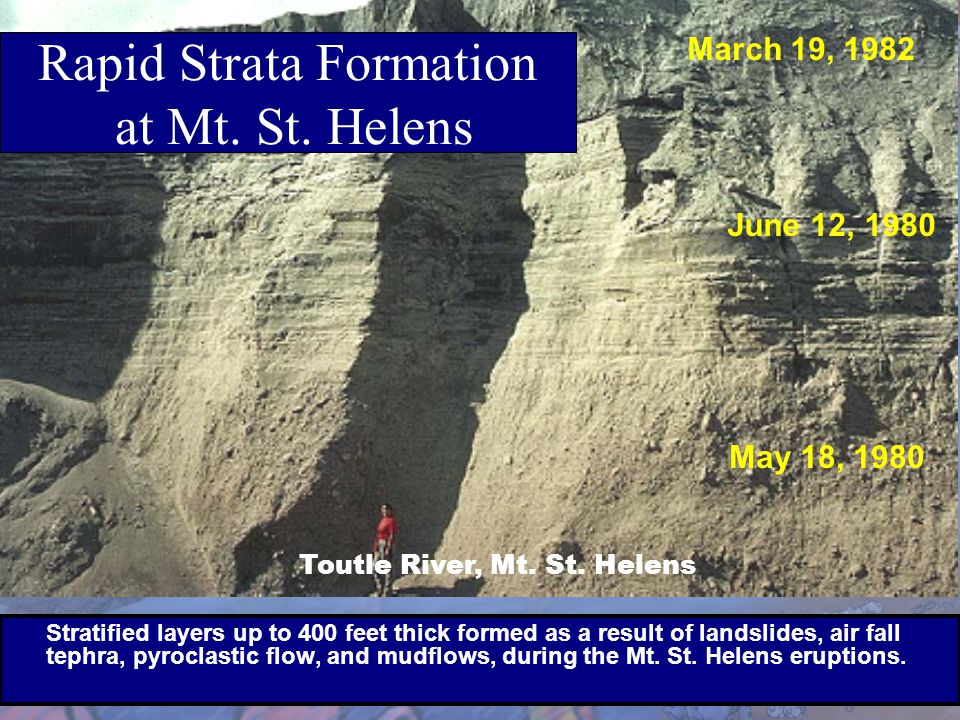
Rapid strata formation and rapid erosion at Mount St Helens.
slideplayer.com/slide/5703217/18/images/28/Rapid+Strata+F...
Visit the fossil museum:
www.flickr.com/photos/101536517@N06/sets/72157641367196613/
Just how good are peer reviews of scientific papers?
www.sciencemag.org/content/342/6154/60.full
www.examiner.com/article/want-to-publish-science-paper-ju...
The neo-Darwinian idea that the human genome consists entirely of an accumulation of billions of mutations is, quite obviously, completely bonkers. Nevertheless, it is compulsorily taught in schools and universities as 'science'.
Sherlock Holmes is a fictional detective created by Scottish author and physician Sir Arthur Conan Doyle, a graduate of the University of Edinburgh Medical School. A London-based "consulting detective" whose abilities border on the fantastic, Holmes is known for his astute logical reasoning, his ability to adopt almost any disguise and his use of forensic science to solve difficult cases.
Holmes, who first appeared in print in 1887, was featured in four novels and 56 short stories.
Conan Doyle wrote the first set of stories over the course of a decade. Wishing to devote more time to his historical novels, he killed off Holmes in "The Final Problem" (which appeared in print in 1893, and is set in 1891). After resisting public pressure , including pleas from Queen Victoria , for eight years, the author wrote The Hound of the Baskervilles (which appeared in 1901, with an implicit setting before Holmes' death; some theorise that it occurs after "The Return", with Watson planting clues to an earlier date). In 1903 Conan Doyle wrote "The Adventure of the Empty House", set in 1894; Holmes reappears, explaining to a stunned Watson that he had faked his death in "The Final Problem" to fool his enemies. "The Adventure of the Empty House" marks the beginning of the second set of stories, which Conan Doyle wrote until 1927.
Unfortunately anybody wishing to read more adventures of their favourite fictional detective , myself included , has had to resort to searching out alternative authors to get their fix .
It's getting serious now :-)
Original version and reasoning here:
www.flickr.com/photos/68570980@N08/8620860893/in/photostr...
Previous version here : www.flickr.com/photos/68570980@N08/8622201768/in/photostr...
Video instructions now available www.flickr.com/photos/68570980@N08/8624277264/in/photostream
The most famous example of the gambler's fallacy occurred in a game of roulette at the Casino de Monte-Carlo in the summer of 1913, when the ball fell in black 26 times in a row. This was an extremely uncommon occurrence, although no more nor less common than any of the other 67,108,863 sequences of 26 red or black. Gamblers lost millions of francs betting against black, reasoning incorrectly that the streak was causing an "imbalance" in the randomness of the wheel, and that it had to be followed by a long streak of red.
The romantic seeks hope hopelessly. What he seeks is usually what he doesn’t possess. What he lacks is what he thinks will make him happy because what he has is always petty and mundane. Happiness appears impossible to attain without attaining the impossible; Only the impossible decrees a pursuit. Reasoning with himself thus, the romantic pursues the unreasonable and worthlessly ponders about the worth of a life without an impossible dream. In his pursuit of happiness, he realizes that fulfillment in life is an oxymoron as life would cease to exist for him if he was happy and fulfilled.
YOKOSUKA, Japan - (June 7, 2016) CommanderSeventh Fleet, Vice Adm. Joseph Aucoin and Commander Naval Forces Japan, Rear Adm. Matthew Carter hold an all hands call for all khaki leaders (E-7 and above) on board Fleet Activities Yokosuka, Japan, June 7. The two admirals explained to the assembled leaders the reasoning behind a temporary liberty curtailment and alcohol restriction in Japan and challenged the khakis to take ownership in the recent spike in alcohol related incidents. Both leaders plan on conducting similar discussions throughout Japan. (U.S. Navy photo by ABH2 Vincent Arnuco/RELEASED)
6. Design an early warning system for mediocrity.
I'd like to start off by giving the information necessary to fully understand this system, and the reasoning for it. Mediocrity to begin with is an overly humanized concept that has in some way been programmed into most people as something that is "bad". It's generally defined in a very black and white manner, and the issue is that, this is not true. The "mediocrity principle", which is an aspect of the larger "Copernican principle", in my interpretation seems to say that essentially things are what they are. The stories we create for events are factually untrue, and really all there is, is science. Essentially humanity is not as special as we'd like to kid ourselves into believing, from our idealized views of events. This principle begins to create the reality that mediocrity will exist either way, and it is necessary for our society to survive. Mediocrity is like the glue that we need to bind two extremes together, and we can't survive without it. The real issue is that mediocrity is never viewed this way, since our society seems to believe that mediocrity is a threat. However, in reality the greater threat is extremes. Historically the biggest example of this is probably Communism, and the fall of Communism. The basic ideas of Communism seemed great, except for the fact that it perpetuated mediocrity to an extreme, which is a major reason for its failure. When mediocrity is pushed to any extreme, and when we fight it as an extreme, it will cause negative results. So my goal within this informational system is to inform humanity now, before extremes and humanized views of mediocrity become an actual issue.For this prompt my system is defined by a set of "rules" to warn informationally about mediocrity. For this prompt I felt that the idea of warning in a negative or confined way would make no sense, since that implies that mediocrity is a bad thing. As I have stated before mediocrity is a fact of life, and by definition it is neither good nor bad. So my warning system is created to inform about mediocrity and the threats that humanized, and altered visions of mediocrity pose to our society. The real issue is more the issues of extremes, since they are what create such black and white outlooks towards the world. So my system has identified this issue, and it poses an implied solution to stop fighting against something that causes no harm. Mediocrity is really like the necessary mid tones of life, and without mediocrity nothing would survive. It is the foundation our lives are built upon, and it poses no threat in moderation. So the system that I have created, is intended to inform our society early on about the importance of mediocrity, and the dangers that humanized extremes pose. My goal for my system is to not perpetuate any extreme, because as I stated it should be considered as simply what it is. However considering that I am human, this system may be slightly humanized by natural extremes, and this is unescapable with any system. Specifically the system I have created is a factual poster to inform the viewer of how mediocrity needs to be protected. My illustration on the left is meant to depict the Mediocrity principle as an astrological concept, although the moon drawn is the earth's moon my concept was not necessarily to depict one moon, but rather the concept of all moons. This illustration is created to portray the idea of another moon like ours, and the possibility of other life forms, which is part of what the mediocrity principal states. The "rules" of my system are specifically tea dyed to create an aged appearance, to show how the facts about mediocrity are actually old fragments that are in some ways older than we are. I wanted to create something of a lost warning to humanity from the past about our views of mediocrity, yet I wanted to still present these facts in a new light, and in a new way.
Rapid strata formation in soft sand (field evidence).
Photo of strata formation in soft sand on a beach, created by tidal action of the sea.
Formed in a high tidal event. Stunning evidence which displays multiple strata/layers.
Why this is so important ....
It has long been assumed, ever since the 17th century, that layers/strata observed in sedimentary rocks were built up gradually, layer upon layer, over many years. It certainly seemed logical at the time, from just looking at rocks, that lower layers would always be older than the layers above them, i.e. that lower layers were always laid down first followed, in time, by successive layers on top.
This was assumed to be true and became known as the superposition principle.
It was also assumed that a layer comprising a different material from a previous layer, represented a change in environmental conditions/factors.
These changes in composition of layers or strata were considered to represent different, geological eras on a global scale, spanning millions of years. This formed the basis for the Geologic Column, which is used to date rocks and also fossils. The evolutionary, 'fossil record' was based on the vast ages and assumed geological eras of the Geologic Column.
There was also circular reasoning applied with the assumed age of 'index' fossils (based on evolutionary beliefs & preconceptions) used to date strata in the Geologic Column. Dating strata from the assumed age of (index) fossils is known as Biostratigraphy.
We now know that, although these assumptions seemed logical, they are not supported by the evidence.
At the time, the mechanics of stratification were not properly known or studied.
An additional factor was that this assumed superposition and uniformitarian model became essential, with the wide acceptance of Darwinism, for the long ages required for progressive microbes-to-human evolution. There was no incentive to question or challenge the superposition, uniformitarian model, because the presumed, fossil 'record' had become dependant on it, and any change in the accepted model would present devastating implications for Darwinism.
This had the unfortunate effect of linking the study of geology so closely to Darwinism, that any study independent of Darwinian considerations was effectively stymied. This link of geology with Darwinian preconceptions is known as biostratigraphy.
Some other field evidence, in various situations, can be observed here: www.flickr.com/photos/101536517@N06/sets/72157635944904973/
and also in the links to stunning, experimental evidence, carried out by sedimentologists, given later.
_______________________________________________
GEOLOGIC PRINCIPLES (established by Nicholas Steno in the 17th Century):
What Nicolas Steno believed about strata formation is the basis of the principle of Superposition and the principle of Original Horizontality.
dictionary.sensagent.com/Law_of_superposition/en-en/
“Assuming that all rocks and minerals had once been fluid, Nicolas Steno reasoned that rock strata were formed when particles in a fluid such as water fell to the bottom. This process would leave horizontal layers. Thus Steno's principle of original horizontality states that rock layers form in the horizontal position, and any deviations from this horizontal position are due to the rocks being disturbed later.”)
BEDDING PLANES.
'Bedding plane' describes the surface in between each stratum which are formed during sediment deposition.
science.jrank.org/pages/6533/Strata.html
“Strata form during sediment deposition, that is, the laying down of sediment. Meanwhile, if a change in current speed or sediment grain size occurs or perhaps the sediment supply is cut off, a bedding plane forms. Bedding planes are surfaces that separate one stratum from another. Bedding planes can also form when the upper part of a sediment layer is eroded away before the next episode of deposition. Strata separated by a bedding plane may have different grain sizes, grain compositions, or colours. Sometimes these other traits are better indicators of stratification as bedding planes may be very subtle.”
______________________________________________
Several catastrophic events, flash floods, volcanic eruptions etc. have forced Darwinian, influenced geologists to admit to rapid stratification in some instances. However they claim it is a rare phenomenon, which they have known about for many years, and which does nothing to invalidate the Geologic Column, the fossil record, evolutionary timescale, or any of the old assumptions regarding strata formation, sedimentation and the superposition principle. They fail to face up to the fact that rapid stratification is not an extraordinary phenonemon, but rather the prevailing and normal mechanism of sedimentary deposition whenever and wherever there is moving, sediment-laden water. The experimental evidence demonstrates the mechanism and a mass of field evidence in normal (non-catastrophic) conditions shows it is a normal everyday occurrence.
It is clear from the experimental evidence that the usual process of stratification is - that strata are not formed by horizontal layers being laid on top of each other in succession, as was assumed. But by sediment being sorted in the flowing water and laid down diagonally in the direction of flow. See diagram:
www.flickr.com/photos/truth-in-science/39821536092/in/dat...
The field evidence (in the image) presented here - of rapid, simultaneous stratification refutes the Superposition Principle and the Principle of Lateral Continuity.
We now know, the Superposition Principle only applies on a rare occasion where sedimentary deposits are laid down in still water.
Superposition is required for the long evolutionary timescale, but the evidence shows it is not the general rule, as was once believed. Most sediment is laid down in moving water, where particle segregation is the general rule, resulting in the simultaneous deposition of strata/layers as shown in the photo.
See many other examples of rapid stratification (with geological features): www.flickr.com/photos/101536517@N06/sets/72157635944904973/
Rapid, simultaneous formation of layers/strata, through particle segregation in moving water, is so easily created it has even been described by sedimentologists (working on flume experiments) as a law ...
"Upon filling the tank with water and pouring in sediments, we immediately saw what was to become the rule: The sediments sorted themselves out in very clear layers. This became so common that by the end of two weeks, we jokingly referred to Andrew's law as "It's difficult not to make layers," and Clark's law as "It's easy to make layers." Later on, I proposed the "law" that liquefaction destroys layers, as much to my surprise as that was." Ian Juby, www.ianjuby.org/sedimentation/
The example in the photo is the result of normal, everyday tidal action formed in a single incident. Where the water current or movement is more turbulent, violent, or catastrophic, great depths (many metres) of stratified sediment can be laid down in a short time. Certainly not requiring the many millions of years assumed by evolutionists.
The composition of strata formed in any deposition event. is related to whatever materials are in the sediment mix, not to any particular timescale. Whatever is in the mix will be automatically sorted into strata/layers. It could be sand, or other material added from mud slides, erosion of chalk deposits, coastal erosion, volcanic ash etc. Any organic material (potential fossils), alive or dead, engulfed by, or swept into, a turbulent sediment mix, will also be sorted and buried within the rapidly, forming layers.
See many other examples of rapid stratification with geological features: www.flickr.com/photos/101536517@N06/sets/72157635944904973/
Stratified, soft sand deposit. demonstrates the rapid, stratification principle.
Important, field evidence which supports the work of the eminent, sedimentologist Dr Guy Berthault MIAS - Member of the International Association of Sedimentologists.
(Dr Berthault's experiments (www.sedimentology.fr/)
And also the experimental work of Dr M.E. Clark (Professor Emeritus, U of Illinois @ Urbana), Andrew Rodenbeck and Dr. Henry Voss, (www.ianjuby.org/sedimentation/)
Location: Sandown, Isle of Wight. Photographed: 08/12/2019
This field evidence demonstrates that multiple strata in sedimentary deposits do not need millions of years to form and can be formed rapidly. This natural example confirms the principle demonstrated by the sedimentation experiments carried out by Dr Guy Berthault and other sedimentologists. It calls into question the standard, multi-million year dating of sedimentary rocks, and the dating of fossils by depth of burial or position in the strata.
Mulltiple strata/layers are evident in this example.
Dr Berthault's experiments (www.sedimentology.fr/) and other experiments (www.ianjuby.org/sedimentation/) and field studies of floods and volcanic action show that, rather than being formed by gradual, slow deposition of sucessive layers superimposed upon previous layers, with the strata or layers representing a particular timescale, particle segregation in moving water or airborne particles can form strata or layers very quickly, frequently, in a single event.
And, most importantly, lower strata are not older than upper strata, they are the same age, having been created in the same sedimentary episode.
Such field studies confirm experiments which have shown that there is no longer any reason to conclude that strata/layers in sedimentary rocks relate to different geological eras and/or a multi-million year timescale. www.youtube.com/watch?v=5PVnBaqqQw8&feature=share&.... they also show that the relative position of fossils in rocks is not indicative of an order of evolutionary succession. Obviously, the uniformitarian principle, on which the geologic column is based, can no longer be considered valid. And the multi-million, year dating of sedimentary rocks and fossils needs to be reassessed. Rapid deposition of stratified sediments also explains the enigma of polystrate fossils, i.e. large fossils that intersect several strata. In some cases, tree trunk fossils are found which intersect the strata of sedimentary rock up to forty feet in depth. upload.wikimedia.org/wikipedia/commons/thumb/0/08/Lycopsi... They must have been buried in stratified sediment in a short time (certainly not millions, thousands, or even hundreds of years), or they would have rotted away. youtu.be/vnzHU9VsliQ
In fact, the vast majority of fossils are found in good, intact condition, which is testament to their rapid burial. You don't get good fossils from gradual burial, because they would be damaged or destroyed by decay, predation or erosion. The existence of so many fossils in sedimentary rock on a global scale is stunning evidence for the rapid depostion of sedimentary rock as the general rule. It is obvious that all rock containing good intact fossils was formed from sediment laid down in a very short time, not millions, or even thousands of years.
See set of photos of other examples of rapid stratification: www.flickr.com/photos/101536517@N06/sets/72157635944904973/
Carbon dating of coal should not be possible if it is millions of years old, yet significant amounts of Carbon 14 have been detected in coal and other fossil material, which indicates that it is less than 50,000 years old. www.ldolphin.org/sewell/c14dating.html
www.grisda.org/origins/51006.htm
Evolutionists confidently cite multi-million year ages for rocks and fossils, but what most people don't realise is that no one actually knows the age of sedimentary rocks or the fossils found within them. So how are evolutionists so sure of the ages they so confidently quote? The astonishing thing is they aren't. Sedimentary rocks cannot be dated by radiometric methods*, and fossils can only be dated to less than 50,000 years with Carbon 14 dating. The method evolutionists use is based entirely on assumptions. Unbelievably, fossils are dated by the assumed age of rocks, and rocks are dated by the assumed age of fossils, that's right ... it is known as circular reasoning.
* Regarding the radiometric dating of igneous rocks, which is claimed to be relevant to the dating of sedimentary rocks, in an occasional instance there is an igneous intrusion associated with a sedimentary deposit -
Prof. Aubouin says in his Précis de Géologie: "Each radioactive element disintegrates in a characteristic and constant manner, which depends neither on the physical state (no variation with pressure or temperature or any other external constraint) nor on the chemical state (identical for an oxide or a phosphate)."
"Rocks form when magma crystallizes. Crystallisation depends on pressure and temperature, from which radioactivity is independent. So, there is no relationship between radioactivity and crystallisation.
Consequently, radioactivity doesn't date the formation of rocks. Moreover, daughter elements contained in rocks result mainly from radioactivity in magma where gravity separates the heavier parent element, from the lighter daughter element. Thus radiometric dating has no chronological signification." Dr. Guy Berthault www.sciencevsevolution.org/Berthault.htm
Radiometric dating based on unverifiable assumptions.
scienceagainstevolution.info/v8i8f.htm
Rapid strata formation and rapid erosion at Mount St Helens.
slideplayer.com/slide/5703217/18/images/28/Rapid+Strata+F...

Visit the fossil museum:
www.flickr.com/photos/101536517@N06/sets/72157641367196613/
Just how good are peer reviews of scientific papers?
www.sciencemag.org/content/342/6154/60.full
www.examiner.com/article/want-to-publish-science-paper-ju...
The neo-Darwinian idea that the human genome consists entirely of an accumulation of billions of mutations is, quite obviously, completely bonkers. Nevertheless, it is compulsorily taught in schools and universities as 'science'.
www.flickr.com/photos/truth-in-science/35505679183
Dr James Tour - 'The Origin of Life' - Abiogenesis decisively refuted.
youtu.be/B1E4QMn2mxk
Jean de Meun , Jehan de Meung , Jean de Meung or Jean Chopinel , Jean Clopinel (around 1240 in Meung – around 1305 in Paris ) is a 13th century French poet , best known for his sequel to the Roman de la Rose .
He was born as Jean Clopinel or Jean Chopinel in Meung-sur-Loire . Tradition says that he studied at the University of Paris. Like his contemporary, Rutebeuf , he was a defender of Guillaume de Saint-Amour and a vocal critic of the mendicant orders. Most of his life seems to have been spent in Paris , where he owned a house in rue Saint-Jacques with a tower, courtyard and garden, which was described in 1305 as the house of the late Jean de Meung and was then attributed by a certain Adam d'Andely to the Dominicans. Jean de Meung says that during his youth he composed songs that were sung in France in public squares and in schools.
Among his works he places first his sequel to the Roman de la Rose by Guillaume de Lorris . The date of this second part is generally fixed between 1268 and 1285 thanks to a reference in the poetry to the death of Manfred and Conradin, executed in 1268 by order of Charles of Anjou (died in 1285) who would have been king of Sicily. MF Guillon ( Jean Clopinel , 1903), however, viewing the poetry as essentially political satire , places it in the last five years of the 13th century .
Jean de Meung probably edited the work of his predecessor, Guillaume de Lorris, before using it as a starting point for his own poetry, lengthening the work considerably since he brings it to 19,000 verses.
The continuation of the Roman de la rose is a satire against the monastic orders, celibacy, the nobility , the Holy See, the excessive pretensions of royalty but above all a satire of women and marriage. Whereas Guillaume had placed himself at the service of love and had exposed the laws of "courtesy", Jean de Meung adds an "art of love", by brutally exposing the faults of women, their pitfalls and the means of outsmart them. In Jean de Meung is embodied the spirit of mockery and skepticism of the fabliaux . He did not share the superstitions of his time, had no respect for established institutions, disdained the conventions of feudalism and romance.
Even if the plan of the work is loose, his poetry shows to the highest degree his keen sense of observation, lucidity in reasoning and exposition. He handled the French language with an ease and precision unknown to his predecessors , and the length of his poem was no obstacle to his popularity in the 13th and 14th centuries .
Part of its vogue is undoubtedly due to the fact that the author, who had practically assimilated all the scientific and literary knowledge of his contemporaries in France, lodged in his poetry a large quantity of useful information and numerous quotations from authors. classics. The book was attacked by Guillaume de Digulleville in his Pèlerinage de la vie humaine (around 1330), a work which was long in vogue in England and France, by Jean Gerson and by Christine de Pisan in his Épître au dieu d'amour . He also found strong defenders.
Jean de Meung translated Végèce 's treatise De Re Militari into French in 1284 under the title Végèce's book of the art of chivalry . He also created a spiritual version, the first in French, of the letters of Abélard and Héloïse. a 14th - century manuscript of this translation in the National Library bears annotations by Petrarch . His translation of De consolatione philosophiae by Boèce is preceded by a letter to Philippe le Bel where he lists his previous works, two of which are lost :De spirituali amicitia by Aelred de Rievaulx (d. 1167) and The Book of the Wonders of Hirlande from the Topographia Hibernica , or De Mirabilibus Hiberniae by Giraldus Cambrensis (Gerald de Barri). His last poems are undoubtedly his Testament and his Codicil . The Testament is written in monorim quatrains and contains advice for different classes of society. He is also the author of Dodechedron de fortune (Paris, Étienne Groulleau, 1556).
Meung-sur-Loire is a commune in the Loiret department, north-central France.
It was the site of the Battle of Meung-sur-Loire in 1429.
Geography
Meung-sur-Loire lies 15 km to the west of Orléans on the north bank of the river Loire at the confluence with the river Mauves. The Mauves, actually three rivers, have their source in the water table of the productive agricultural region of the Beauce.
History
A Gallo-Roman fortified village recorded as Magdunum was built in the marais adjoining the river, which in 409 was fired by the invading Alans. The marais was drained, according to tradition by Saint Liphard around the year 520. The canalisation formed the watercourses known as the mauves. He went on to build the chapel which was to become the monastery and the abbey. His relics were deposited in the church in 1104, the year after Louis VI had founded as fortress.
During the 12th century the church was rebuilt in the gothic style, and fortified accommodation for the abbot built alongside. Jeanne d'Arc visited in 1429, and this was the site of the Battle of Meung-sur-Loire. The complex was restored in 1570, again during the 19th century and again in 1985.
The river defined the town, in 1857, 38 mills had the right to use the waters of the rivers to power themselves.
Fiction
In fiction, it has been described by Alexandre Dumas in The Three Musketeers as the village where d'Artagnan, en route to join the King's Musketeers in Paris, first encounters the villainous Comte de Rochefort. Also in fiction, Meung-sur-Loire is the country home of Chief Inspector Jules Maigret, Georges Simenon's classic crime fiction character. Maigret and his wife Louise eventually retire to their Meung-sur-Loire home, where he spends his time fishing (pike), and she tends, according to her sister, any number of animals.
Points of interest
The town is twinned with Lymm in Cheshire, England
Arboretum des Prés des Culands
Château de Meung-sur-Loire
Notable residents
Jean de Meun (c. 1240 – c. 1305), author of the Roman de la Rose
Maurice Larrouy (1882–1939), winner of the 1917 Prix Femina, died in Meung
Gaston Couté (1880-1911), french libertarian poet and song-writer lived here in his childhood and is buried in Meung. A museum in the local of the library is dedicated to his life and works.
Alain Corneau (1943-2010), film director and writer was born in Meung-sur-Loire.
The Diocese of Orléans (Latin: Dioecesis Aurelianensis; French: Diocèse d'Orléans) is a Latin Church diocese of the Catholic Church in France. The diocese currently corresponds to the Départment of Loiret. The current bishop is Jacques André Blaquart, who was appointed in 2010.
The diocese has experienced a number of transfers among different metropolitans. In 1622, the diocese was suffragan of the Archdiocese of Paris; previously the diocese had been a suffragan of the Archdiocese of Sens. From 1966 until 2001 it was under the jurisdiction of the Archdiocese of Bourges, but since the provisional reorganisation of French ecclesiastical provinces, it is now subject to the Archdiocese of Tours.
After the Revolution it was re-established by the Concordat of 1802. It then included the Departments of Loiret and Loir et Cher, but in 1822 Loir et Cher was moved to the new Diocese of Blois.
Jurisdiction
The present Diocese of Orléans differs considerably from that of the old regime; it has lost the arrondissement of Romorantin which has passed to the Diocese of Blois and the canton of Janville, now in the Diocese of Chartres. It includes the arrondissement of Montargis, formerly subject to the Archdiocese of Sens, the arrondissement of Gien, once in the Burgundian Diocese of Auxerre, and the canton of Châtillon sur Loire, once belonging to the Archdiocese of Bourges.
History
To Gerbert, Abbot of St. Pierre le Vif at Sens (1046–79), is due a detailed narrative according to which Saint Savinianus and Saint Potentianus were sent to Sens by St. Peter with St. Altinus; the latter, it was said, came to Orléans as its first bishop. Before the ninth century there is no historical trace in the Diocese of Sens of this Apostolic mission of St. Altinus, nor in the Diocese of Orléans before the end of the fifteenth. Diclopitus is the first authentic bishop; he figures among the bishops of Gaul who (about 344) ratified the absolution of St. Athanasius. Other bishops of the early period are: St. Euvertius (who features in the Calendar of the Book of Common Prayer), about 355 to 385, according to M. Cuissard; Anianus (385-453), who invoked the aid of the "patrician" Ætius against the invasion of Attila, and forced the Huns to raise the siege of Orléans [see Gregory of Tours, The History of the Franks II.6-7]; St. Prosper (453-63); St. Monitor (about 472); St. Flou (Flosculus), died in 490; St. Eucherius (717-43), native of Orléans and a monk of Jumièges, who protested against the depredations of Waifre, a companion of Charles Martel, and was first exiled by this prince to Cologne, then to Liège, and died at the monastery of St. Trond.
Orléans Cathedral, dedicated to the Holy Cross, built from 1278 to 1329; after being pillaged by Huguenots in the 1560s, the Bourbon kings restored it in the 17th century.
After his victory over the Alamanni, the Frankish king Clovis was bent on the sack of Verdun, but the archpriest there obtained mercy for his fellow-citizens. To St. Euspicius and his nephew St. Mesmin (Maximinus), Clovis also gave the domain of Micy, near Orléans at the confluence of the Loire and the Loiret, for a monastery (508). When Euspicius died, the said St. Maximinus became abbot, and during his rule the religious life flourished there notably. The monks of Micy contributed much to the civilization of the Orléans region; they cleared and drained the lands and taught the semi-barbarous inhabitants the worth and dignity of agricultural work. Early in the eighth century, Theodulfus restored the Abbey of Micy and at his request St. Benedict of Aniane sent fourteen monks and visited the abbey himself. The last abbot of Micy, Chapt de Rastignac, was one of the victims of the 1792 "September Massacres", at Paris, in the prison of L'Abbaye.
From Micy monastery, which counted many saints, monastic life spread within and around the diocese. St. Liphardus and St. Urbicius founded the Abbey of Meung-sur-Loire; St. Lyé (Lætus) died a recluse in the forest of Orléans; St. Viatre (Viator) in Sologne; St. Doulchard in the forest of Ambly near Bourges. St. Leonard introduced the monastic life into the territory of Limoges; St. Almir, St. Ulphacius, and St. Bomer in the vicinity of Montmirail; St. Avitus (died about 527) in the district of Chartres; St. Calais (died before 536) and St. Leonard of Vendœuvre (died about 570) in the valley of the Sarthe; St. Fraimbault and St. Constantine in the Javron forest, and the aforesaid St. Bomer (died about 560) in the Passais near Laval; St. Leonard of Dunois; St. Alva and St. Ernier in Perche; St. Laumer (died about 590) became Abbot of Corbion. St. Lubin (Leobinus), a monk of Micy, became Bishop of Chartres from 544–56. Finally saint Ay (Agilus), Viscount of Orléans (died after 587), was also a protector of Micy.
Saints
Among the notable saints of the diocese are:
St. Baudilus, a Nîmes martyr (third or fourth century)
the deacon St. Lucanus, martyr, patron of Loigny (fifth century)
the anchorite St. Donatus (fifth century)
St. May, abbot of Val Benoît (fifth century)
St. Mesme, virgin and (perhaps) martyr, sister of St. Mesmin (sixth century)
St. Felicule, patroness of Gien (sixth century)
St. Sigismund, King of Burgundy, who, by order of the Merovingian Clodomir, and despite the entreaties of St. Avitus, was thrown (524) into a well with his wife and children
St. Gontran, King of Orléans and Burgundy (561-93), a confessor
St. Loup (Lupus), Archbishop of Sens, born near Orléans, and his mother St. Agia (first half of the seventh century)
St. Gregory, former Bishop of Nicopolis, in Bulgaria, who died a recluse at Pithiviers (1004 or 1007)
St. Rose, Abbess of Ervauville (died 1130)
Blessed Odo of Orléans, Bishop of Cambrai (1105–13)
the leper St. Alpaix, died in 1211 at Cudot where she was visited by queen Adèle of Champagne, widow of Louis VII
St. Guillaume (died 1209), Abbot of Fontainejean and subsequently Archbishop of Bourges
the Dominican Blessed Reginald, dean of the collegiate church of St. Aignan, Orléans (died 1220)
the Englishman St. Richard, who studied theology at Orléans in 1236, Bishop of Chichester in 1244, a friend of St. Edmund of Canterbury
St. Maurus, called to France by St. Innocent, Bishop of Le Mans, and sent thither by St. Benedict, resided at Orléans with four companions in 542. St. Radegonde, on her way from Noyon to Poitiers in 544, and St. Columbanus, exiled from Luxeuil at the close of the sixth century, both visited Orléans. Charlemagne had the church of St. Aignan rebuilt and reconstructed the monastery of St. Pierre le Puellier. In the cathedral of Orléans on 31 December 987, Hugh Capet had his son Robert (born at Orléans) crowned king. Innocent II and St. Bernard visited Fleury and Orléans in 1130.
Pilgrimages
The principal pilgrimages of the diocese are: Our Lady of Bethlehem, at Ferrières; Our Lady of Miracles in Orléans city, dating back to the seventh century (Joan of Arc visited the sanctuary on 8 May 1429); Our Lady of Cléry, dating from the thirteenth century, visited by kings Philip the Fair, Philip VI, and especially by Louis XI, who wore in his hat a leaden image of Notre Dame de Cléry and who wished to have his tomb in this sanctuary where Jean de Dunois, one of the heroes of the Hundred Years' War, was also interred.
Later history
The people of Orléans were so impressed by the preaching of Blessed Robert of Arbrissel in 1113 that he was invited to found the monastery of La Madeleine, which he re-visited in 1117 with St. Bernard of Thiron. The charitable deeds of king St. Louis at Puiseaux, Châteauneuf-sur-Loire, and Orléans, where he was present at the translation of the relics of St. Aignan (26 October 1259), and where he frequently went to care for the poor of the Hôtel Dieu, are well known. Pierre de Beaufort, Archdeacon of Sully and canon of Orléans, was, as Gregory XI (1371-8), the last pope that France gave to the Church; he created Cardinal Jean de la Tour d'Auvergne, Abbot of St. Benoît-sur Loire. Blessed Jeanne de Valois was Duchess of Orléans and after her separation from Louis XII (1498) she established, early in the sixteenth century, the monastery of L'Annonciade at Châteauneuf-sur-Loire. Etienne Dolet (1509–46), a printer, philologian, and pamphleteer, executed at Paris and looked upon by some as a "martyr of the Renaissance", was a native of Orléans. Cardinal Odet de Coligny, who joined the Reformation about 1560, was Abbot of St. Euvertius, of Fontainejean, Ferrières, and St. Benoît. Admiral Coligny (1519–72) (see Saint Bartholomew's Day) was born at Châtillon-sur-Loing in the present diocese. At the beginning of the religious wars, Orléans was disputed between the followers of the Guise family and of the Protestant Condé. In the vicinity of Orléans, Duke Francis of Guise was assassinated on 3 February 1562.
The Calvinist Jacques Bongars, councillor of king Henry IV of France, who collected and edited the chronicles of the Crusades in his "Gesta Dei per Francos", was born at Orléans in 1554. The Jesuit Denis Petav (Petavius), a renowned scholar and theologian, was born at Orléans in 1583. St. Francis of Sales came to Orléans in 1618 and 1619. Venerable Mother Françoise de la Croix (1591–1657), a pupil of St. Vincent de Paul, who founded the congregation of Augustinian Sisters of Charity of Notre Dame, was born at Petay in the diocese. The Miramion family, to which Marie Bonneau is celebrated in the annals of charity under the name of Mme de Miramion (1629–96), belonged by marriage, were from Orléans. St. Jane de Chantal was superior of the Orléans convent of the Visitation in 1627. Mme Guyon, celebrated in the annals of Quietism, was born at Montargis in 1648.
France was saved from English domination through the deliverance of Orléans by Joan of Arc (8 May 1429). On 21 July 1455, her rehabilitation was publicly proclaimed at Orléans in a solemn procession, and before her death in November 1458, Isabel Romée, the mother of Joan of Arc, saw a monument erected in honour of her daughter, at Tournelles, near the Orléans bridge. The monument, destroyed by the Huguenots in 1567, was set up again in 1569 when the Catholics were once more masters of the city. Until 1792, and again from 1802 to 1830, finally from 1842 to the present day, a great religious feast, celebrated 8 May of every year at Orléans in honour of Joan of Arc, attracted multitudes.
The Church of Orléans was the last in France to take up again the Roman liturgy (1874). The Sainte Croix cathedral, perhaps built and consecrated by St. Euvertius in the fourth century, was destroyed by fire in 999 and rebuilt from 1278 to 1329; the Protestants pillaged and destroyed it from 1562 to 1567; the Bourbon kings restored it in the seventeenth century.
Modernity
Prior to the Associations Law of 1901, the Diocese of Orléans counted Franciscans, Benedictines, Missionary Priests of the Society of Mary, Lazarists, Missionaries of the Sacred Heart and several orders of teaching Brothers. Among the congregations of women which originated in this diocese must be mentioned: the Calvary Benedictines, a teaching and nursing order founded in 1617 by Princess Antoinette d'Orléans-Longueville, and the Capuchin Leclerc du Tremblay known as Père Joseph; the Sisters of St. Aignan, a teaching order founded in 1853 by Bishop Dupanloup, with mother-house in Orléans.
Twentieth-century bishops of Orleans included Guy Riobé, whose opposition to nuclear weapons led to an altercation with a member of Georges Pompidou's government, and his successor, Jean-Marie Lustiger, who was appointed in 1979 after a long interregnum and shortly afterwards translated to Paris.
Episcopal Ordinaries
Of the eighth-century bishops, Theodulfus was notable. It is not known when he began to govern, but it is certain that he was already bishop in 798, when Charlemagne sent him into Narbonne and Provence as missus dominicus. Under king Louis le Débonnaire he was accused of aiding the rebellious King of Italy, was deposed and imprisoned four years in a monastery at Angers, but was released when Louis came to Angers in 821, reportedly after hearing Theodulfus sing All Glory, Laud and Honour. The "Capitularies" which Theodulfus addressed to the clergy of Orléans are considered a most important monument of Catholic tradition on the duties of priests and the faithful. His Ritual, his Penitential, his treatise on baptism, confirmation and the Eucharist, his edition of the Bible, a work of fine penmanship preserved in the Puy cathedral, reveal him as one of the foremost men of his time. His fame rests chiefly on his devotion to the spread of learning. The Abbey of Ferrières was then becoming under Alcuin a centre of learning. Theodulfus opened the Abbey of Fleury to the young noblemen sent thither by Charlemagne, invited the clergy to establish free schools in the country districts, and quoted for them, "These that are learned shall shine as the brightness of the firmament: and they that instruct many to justice, as stars to all eternity" (Dan., xii 3). One monument of his time still survives in the diocese, the apse of the church of Germigny-des-Prés modelled after the imperial chapel, and yet retaining its unique mosaic decoration.
Medieval Bishops
Aignan of Orleans, or Agnan (Latin: Anianus) (b. 358 – d. 453), assisted Roman general Flavius Aetius in the defense of the city against Attila the Hun in 451.
Namatius, an ambassador of King Guntram to the Bretons
Eucherius of Orléans
Jonas (821 – 843), who wrote a treatise against the Iconoclasts, also a treatise on the Christian life and a book on the duties of kings
St. Thierry II (1016 – 21)
Jean, consecrated on 1 March 1098
Blessed Philip Berruyer (1234 – 1236)
Blessed Roger le Fort (1321 – 1328)
John Carmichael of Douglasdale (Jean de St Michel)
Regnault de Chartres † (9 Jan 1439 Appointed – 4 Apr 1444 Died)
Pierre Bureau † (20 Nov 1447 Appointed – 10 Dec 1451 Appointed, Bishop of Béziers)
François de Brillac † (3 Nov 1473 Appointed – 22 Dec 1504 Appointed, Archbishop of Aix)
Christophe de Brillac † (19 Jan 1504 Appointed – 4 Feb 1514 Appointed, Archbishop of Tours)
Jean d’Orléans-Longueville † (26 Jun 1521 Appointed – 24 Sep 1533 Died)
Antoine Sanguin de Meudon † (6 Nov 1533 Appointed – 20 Oct 1550 Resigned)
François de Faucon † (20 Oct 1550 Appointed – 12 Oct 1551 Appointed, Bishop of Mâcon)
Pierre du Chastel † (12 Oct 1551 Appointed – 3 Feb 1552 Died)
Jean de Morvillier † (27 Apr 1552 Appointed – 1564 Resigned)
Mathurin de la Saussaye † (6 Sep 1564 Appointed – 9 Feb 1584 Died)
Denis Hurault † (9 Feb 1584 Succeeded – 1586 Resigned)
Germain Vaillant de Guelin † (27 Oct 1586 Appointed – 15 Sep 1587 Died)
Jean de L’Aubespine † (16 Mar 1588 Appointed – 23 Feb 1596 Died)
Early Modern Bishops
Gabriel de L’Aubespine † (15 Mar 1604 Appointed – 15 Aug 1630 Died)
Nicolas de Netz † (27 Jan 1631 Appointed – 20 Jan 1646 Died)
Alphonse d’Elbène † (21 Jan 1647 Appointed – 20 May 1665 Died)
Pierre-Armand du Cambout de Coislin † (29 Mar 1666 Confirmed – 5 Feb 1706 Died)
Louis-Gaston Fleuriau d’Armenonville † (15 Nov 1706 Confirmed – 9 Jun 1733 Died)
Nicolas-Joseph de Paris † (9 Jun 1733 Succeeded – 10 Jan 1754 Resigned)
Louis-Joseph de Montmorency-Laval † (14 Jan 1754 Confirmed – 28 Feb 1758 Resigned)
Louis-Sextius de Jarente de La Bruyère † (13 Mar 1758 Confirmed – 28 May 1788 Died)
Louis-François-Alexandre de Jarente de Senas d’Orgeval † (28 May 1788 Succeeded – 22 Nov 1793 Resigned)
Modern Bishops
Etienne-Alexandre-Jean-Baptiste-Marie Bernier † (9 Apr 1802 Appointed – 1 Oct 1806 Died)
Claude-Louis Rousseau † (22 Mar 1807 Appointed – 7 Oct 1810 Died)
Pierre-Marin Rouph de Varicourt † (8 Aug 1817 Appointed – 9 Dec 1822 Died)
Jean Brumault de Beauregard † (13 Jan 1823 Appointed – Jan 1839 Retired)
François-Nicholas-Madeleine Morlot † (10 Mar 1839 Appointed – 28 Jun 1842 Appointed, Archbishop of Tours)
Jean-Jacques Fayet † (10 Oct 1842 Appointed – 4 Apr 1849 Died)
Félix-Antoine-Philibert Dupanloup † (16 Apr 1849 Appointed – 11 Oct 1878 Died)
Pierre-Hector Coullié (Couillié) † (12 Oct 1878 Succeeded – 14 Jun 1893 Appointed, Archbishop of Lyon)
Stanislas-Arthur-Xavier Touchet † (29 Jan 1894 Appointed – 23 Sep 1926 Died)
Jules-Marie-Victor Courcoux † (20 Dec 1926 Appointed – 28 Mar 1951 Died)
Robert Picard de La Vacquerie † (27 Aug 1951 Appointed – 23 May 1963 Resigned)
Guy-Marie-Joseph Riobé † (23 May 1963 Succeeded – 18 Jul 1978 Died)
Jean-Marie Lustiger † (10 Nov 1979 Appointed – 31 Jan 1981 Appointed, Archbishop of Paris)[3]
René Lucien Picandet † (13 Jun 1981 Appointed – 20 Oct 1997 Died)
Gérard Antoine Daucourt (2 Jul 1998 Appointed – 18 Jun 2002 Appointed, Bishop of Nanterre)
André Louis Fort (28 Nov 2002 Appointed – 27 Jul 2010 Retired)
Jacques André Blaquart (27 Jul 2010 Appointed – )
Evidence and Mystery
God created the world out of nothing; this is the teaching of the Semitic theologies, and by it they answer the following difficulty: if God had made the world out of a preexisting substance, that substance must be either itself created, or else Divine. The creation is not God, it cannot therefore emanate from Him; there is an unbridgeable hiatus between God and the world, neither can become the other; the orders of magnitude or of reality, or of perfection, are incommensurable.
The main concern of this reasoning is not a disinterested perception of the nature of things, but the safeguarding of a simple and unalterable notion of God, while making allowance for a mentality that is more active than contemplative. The aim is therefore to provide, not a metaphysical statement that does not engage the will or does not appear to do so, but a key notion calculated to win over souls rooted in willing and acting rather than in knowing and contemplating; the metaphysical limitation is here a consequence of the priority accorded to what is effective for the governing and saving of souls. That being so, one is justified in saying that Semitic religious thought is by force of circumstances a kind of dynamic thought with moral overtones, and not a static thought in the style of the Greek or Hindu wisdom.
From the point of view of the latter, the idea of emanation, in place of creatio ex nihilo, in no way compromises either the transcendence or the immutability of God; between the world and God there is at once discontinuity and continuity, depending on whether our conception of the Universe is based on a scheme of concentric circles or on one of radii extending outward from the center to the periphery: according to the first mode of vision, which proceeds from the created to the Uncreated, there is no common measure between the contingent and the Absolute; according to the second mode of vision, which proceeds from the Principle to its manifestation, there is but one Real, which includes everything and excludes only nothingness, precisely because the latter has no reality whatsoever. The world is either a production drawn from the void and totally other than God, or else it is a manifestation "freely necessary" and "necessarily free" of Divinity or of Its Infinitude, liberty as well as necessity being Divine perfections.
As tor the contention that the creationist concept is superior to the so-called emanationist or pantheistic concepts because it is Biblical and Christ-given, and that the Platonic doctrine cannot be right because Plato cannot be superior either to Christ or the Bible, this has the fault of leaving on one side the real fundamentals of the problem.
First, what is rightly or wrongly called "emanationism" is not an invention of Plato, it can be found in the most diverse sacred texts; second, Christ, while being traditionally at one with the creationist thesis, nevertheless did not teach it explicitly and did not deny the apparently opposed thesis. The message of Christ, like that of the Bible, is not a priori a teaching of metaphysical science; it is above all a message of salvation, but one that necessarily contains, in an indirect way and under cover of an appropriate symbolism, metaphysics in its entirety. The opposition between the Divine Bible and human philosophy, or between Christ and Plato, therefore has no meaning so far as the metaphysical truths in question are concerned; that the Platonic perspective should go farther than the Biblical perspective brings no discredit on the Bible, which teaches what is useful or indispensable from the point of view of the moral or spiritual good of a particular humanity, nor does it confer any human superiority on the Platonists, who may be mere thinkers just as they may be saints, according to how much they assimilate of the Truth they proclaim.
For the Platonists it is perfectly logical that the world should be the necessary manifestation of God and that it should be without origin; if the monotheistic Semites believe in a creation out of nothing and in time, it is evidently not, as some have suggested, because they think that they have the right or the privilege of accepting a "supralogical" thesis that is humanly absurd; for the idea of creation appears to them on the contrary as being the only one that is reasonable and therefore the only one that is capable oflogical demonstration,as is proved precisely by tlfe method of argumentationused in theology.
Starting from the axiom that God created the worldout of nothing, the Semites reason thus, grosso modo: since God alone has Being, the world could not share it with Him; there had there fore to be a time when the world did not exist; it is God alone who could give it existence. On the religious plane, which so far as cosmology is concerned demands no more than the minimum necessary or useful for salvation, this idea of creation is fully sufficient, and the logical considerations which support it are perfectly plausible within the framework of their limitation; for they at least convey a key truth that allows a fuller understanding of the nature of God, as it is pleased to reveal itself in the monotheistic religions.
More than once we have had occasion to mention the following erroneous argument: if God creates the world in response to an inward necessity, as is affirmed by the Platonists, this must mean that He is obliged to create it, and that therefore He is not free; since this is impossible, the creation can only be a gratuitous act. One might as well say that if God is One, or if He is a Trinity, or if He is all-powerful, or if He is good, He must be obliged to be so, and His nature is thus the result of a constraint, quod absit.
It is always a case of the same incapacity to conceive of antinomic realities, and to understand that if liberty, the absence of constraint, is a perfection, necessity, the absence of arbitrariness, is another.
If, in opposition to the Pythagorean-Platonic perspective, the concept is put forward of an Absolute which is threefold in its very essence, therefore devoid of the degrees of reality that alone can explain the hypostatic polarizations - an Absolute which creates without metaphysical necessity and which in addition acts without cause or motive - and if at the same time the right is claimed to a sacred illogicality in the name of an exclusive "Christian supernaturalism'', then an explanation is due of what logic is and what human reason is; for if our intelligence, in its very structure, is foreign or even opposedto Divine Truth, what then is it, and why did God give it to us? Or to put it the other way round, what sort of Divine message is it that is opposed to the laws of an intelligence to which it is essentially addressed, and what does it signify that man was created "in the image of God"?
[According to Genesis "God created man in his own image" and "male and female created He them." Now according to one Father of the Church, the sexes are not made in the image of God; only the features that are identical in the two sexes resemble God, for the simple reason that God is neither man nor woman. This reasoning is fallacious because, although it is evident that God is not in Himself a duality, He necessarily comprises the principia! Duality in His Unity, exactly as He comprises the Trinity or the Quaternity; and how can one refuse to admit that the Holy Virgin has a prototype in God not only as regards her humanity but also as regards her femininity?]
And what motive could induce us to accept a message that was contrary, not to our earthly materialism or to ourpassion, but to the very substance of our spirit? For the "wisdom according to the flesh" of Saint Paul does not embrace every form of metaphysics that does not know the Gospels, nor is it logic as such, for the Apostle was logical; what it denotes is the reasonings whereby worldly men seek to prop up their passions and their pride, such as Sophism and Epicureanism and, in our days, the current philosophy of the world. "Wisdom according to the flesh" is also the gratuitous philosophy that does not lead us inwards and which contains no door opening on to spiritual realization; it is philosophy of the type of"art for art's sake” which commits one to nothing and is vain and pernicious for that very reason.
The incomprehension by theologians of Platonic and Oriental emanationism arises from the fact that monotheism puts in parenthesis the notion, essential metaphysically, of Divine Relativity or Maya; it is this parenthesis, or in practice this ignorance, which inhibits an understanding of the fact that there is no incompatability whatever between the "absolute Absolute", Beyond-Being, and the "relative Absolute", creative Being, and that this distinction is even crucial.
The Divine Maya, Relativity, is the necessary consequence of the very Infinitude of the Principle: it is because God is infinite that He comprises the dimension of relativity, and it is because He comprises that dimension that He manifests the world. To which it should be added: it is because the world is manifestation and not Principle that relativity, which at first was only determination, limitationand manifestation, gives rise to that particular modality constituting "evil". It is neither in the existence of evil things that evil lies nor in their existential properties nor in their faculties of sensation and of action, if it be a question of animate beings, nor even in the act insofar as it is the manifestation of a power; evil resides only in whatever is privative or negative with respect to good, and its function is to manifest in the world its aspect of separation from the Principle, and to play its part in an equilibrium and a rhythm necessitated by the economy of the created Universe.
In this way evil (wholly evil though it be when looked at in isolation) attaches itself to a good and is dissolved qua evil when one looks at it in its cosmic context and in its universal function.
Platonists feel no need whatever to try to fill the gap which might seem to exist between the pure Absolute and the determination and creative Absolute; it is precisely because they are aware of relativity in divinis and of the Divine cause of that relativity that they are emanationists.
In other words, the Hellenists, if they did not have a word to express it, nevertheless possessed in their own way the concept of Maya, and it is their doctrine of emanation that proves it.
After having been instrumental in the completion of the Soo Canal in 1885, Charles T. Harvey was granted several thousand acres in Michigan’s Upper Peninsula. Part of this land included the mouth and both sides of the Manistique River, and in 1860 Harvey established a community there and built a dam to power a lumber mill. The settlement was initially named Epsport, after his wife’s family name, but its name was later changed to Monistique to match the river. When this name was registered with the state, an “a” was used instead of an “o” and the town became Manistique. Monistique is derived from Onamanitikong, a Native American word meaning “vermilion” that was applied to the river on account of the reddish hue of its water.
In 1892, lighthouses were completed at Seul Choix Point and on Squaw Island to mark the northern route for vessels sailing between Lake Huron and Green Bay. The Lighthouse Board felt that another light was needed to mark this important passage, and provided the following reasoning in its request for $32,000 for the project in 1892.
The establishment of the Lake Michigan light and fog-signal vessels, Squaw Island light and fog signal, Seul Choix Pointe light, and the additional buoyage authorized in the northern part of Lake Michigan has made those waters reasonably safe for navigation on the route from the Straits of Mackinac to Green Bay ports, with the exception of a stretch of 45 miles between Seul Choix Pointe and Poverty Island. Pointe aux Barques is a prominent headland 24 ½ miles northeast one-half north from Poverty Island light, and 23 miles west-southwest from Seul Choix Pointe light. Poverty Island light is visible 16 3/4 miles and Seul Choix Pointe is visible 15 miles. There is, therefore, a space of 13 3/4 miles off Pointe aux Barques not covered by any light. The town of Manistique, situated at the mouth of Manistique River, at the head of the bay between Seul Choix and Pointe aux Barques, has a large lumber trade and many vessels call at that port. The route north of the Beavers and along the coast down to Poverty Island passage into Green Bay is the usual route of the ore vessels to and from Lake Erie ports in northwest winds, and the shipments of ore this year from Escanaba are largely in excess, it is said, of those of any port in the world. The Board recommends that a coast light and fog signal be established on Pointe aux Barques, Lake Michigan, Michigan.
The Garden Peninsula extends twenty-two miles into Lake Michigan from Manistique and is bordered by Lake Michigan on its east and Big Bay de Noc on the west. Poverty Island Lighthouse is located off the peninsula’s southern tip, and Point aux Barques is a prominent feature on the peninsula’s eastern shore. Though the construction of the lighthouse on Point aux Barques was authorized, funds for its construction were never provided.
A lighthouse was finally built in the gap between Poverty Island and Seul Choix Point, but this did not occur until after federal harbor improvements were completed at Manistique. A 423-foot-long breakwater built by private parties and owned by the Chicago Lumbering Company helped protect the harbor at Manistique, but this was turned over to the federal government, and between 1910 and 1915, two breakwaters were built at the mouth of the river, forming an enclosed basin with an area of thirty-one acres. In the early 1900s, car ferries began operating out of Manistique, linking its railroad to the ports at Northport and Frankfort on the Lower Peninsula.
A temporary fixed red light of forty-five candlepower was suspended from a pole to mark the west end of the newly completed east breakwater in 1912, and that same year the Bureau of Lighthouses asked for $20,000 for a permanent light, fog signal, and keepers’ dwelling. Congress provided the requested amount on October 22, 1913, allowing work to being the following year. A twenty-five-foot, steel, skeletal tower, surmounted by a flashing acetylene light, was established on the west breakwater on October 30, 1914. Also in 1914, a concrete foundation was poured for the permanent east breakwater light, and work began on a duplex for the keepers. The east breakwater light was transferred to the new structure on August 17, 1916. The following description of this light, known as Manistique Lighthouse, was published by the Bureau of Lighthouses.
The subfoundation for this tower consists of a timber crib built by the United States Engineers. It rests on bedrock and supports a concrete superstructure, and this in turn supports a rectangular concrete block, 20 by 25 feet in plan and 6 feet high, forming the immediate foundation for the tower. The top of this block is 10 feet above lake level. The tower is of riveted steel plates and angles, square in plan and pyramidal in shape, three and one-half stories high, and supports a cast-iron deck and an old-style fourth-order vertical bar lantern, whose focal plane is about 40 feet above the top of the block. The main floor is 5 1/2 feet above the block and contains the machinery for the fog signal. Below it and partly within the block is a basement room for storage purposes. Above it the second floor supports the air tanks and the third floor the diaphone and attachments. All floors are of reinforced concrete, and the basement and power room are lined with surfaced cement with air spaces next to the steel plates. The two upper rooms are not lined.
A 300-millimeter lens lantern was used to produce a fixed red light of 340 candlepower at a focal plane of five feet above the lake. A 200-watt, gas-filled, tungsten-filament electric bulb, powered by an electric cable that led along the breakwater to the lighthouse from a switch house, was used in the lens lantern and could be activated from the keepers dwelling using a push-button. A fourth-order lens replaced the lens lantern in 1918, increasing the intensity of the light.
Besides the breakwater lights, a light, with the following description, was also established on the west pier near the mouth of the river: “The subfoundation for this light is a timber crib built by the United States Engineers. It supports a wooden post provided with pulley blocks and tackle for hoisting a post lantern. A wooden lamp house is located at the foot of the mast.”
The keepers’ dwelling was located 1,200 feet northeast of the inner end of the east breakwater and was described as follows:
The quarters for the two keepers who attend these aids consist of a two-story and attic dwelling, one set of quarters being over the other. The building is constructed of hollow tile, with stucco exterior, on a concrete foundation and has an asphalt shingle roof. It is heated by hot water, lighted by electricity, and provided with city water and a sewerage system. The basement contains a general boiler room and coal bin for the heating plant and separate coal bins, vegetable rooms, and cellar spaces for each keeper. Each set of quarters consists of a living room, dining room, kitchen, pantry, three bedrooms, bathroom, closets and lockers and an outside porch. There are separate front entrances for each keeper and a general rear entrance. The attic contains large storage spaces for both keepers.
Charles E. Corlett was made head keeper of the lighthouse after having served as master of North Manitou Shoal Lightship. When Keeper Corlett passed away in 1920, Walter Ottosen was transferred from Pilot Island in Wisconsin to take charge of Manistique Lighthouse. At the time Walter and his wife Althea relocated to Manistique, they had eight children, the youngest of which was less than a year old. The Ottosens’ marriage was in trouble before the move, and by 1925, Althea was neglecting her home and “was surly and irritable and [had] adopted an exceedingly disagreeable attitude” towards Walter. In trying to learn the reason for her behavior, Walter discovered that Althea was spending time with another man. Althea left Walter for the first of many times in March 1925, and the couple finally divorced three years later. Walter raised his four remaining minor children by himself for four years before marrying Roseline Taylor, whom he met through a magazine or newspaper ad.
In 1937, Keeper Ottosen was awarded a star for having achieved “high efficiency” during the previous year. Nine keepers in the district received a star for 1936, with Jerome M. Robinson at Sheboygan Lighthouse being awarded the efficiency flag for having the “highest general efficiency” in 1936. Following his retirement in 1941, Keeper Ottosen moved to Florida.
A radiobeacon was established at the station at the opening of navigation in 1931 as an additional aid for mariners. Both the railroad and its car ferry at Manistique ceased operation in 1968, and with the decrease in shipping, Manistique Lighthouse was automated the following year. The keepers’ dwelling was sold, and the fourth-order lens was removed from the tower. The lens can currently be seen at Wisconsin Maritime Museum in Manitowoc.
On May 15, 2012, Manistique East Breakwater Lighthouse was made available under the National Historic Lighthouse Preservation Act of 2000 to eligible federal, state, and local agencies, non-profit corporations, educational agencies, and community development organizations for educational, recreational, cultural, or historic preservation purposes. Interested entities were given sixty days to submit a letter of interest expressing their desire to submit an application for ownership.
After the Manistique City Council voted to approve working with the Michigan Lighthouse Conservancy to acquire the lighthouse, a letter of interest was prepared and submitted. The Council also approved spending $2,500 for an engineering firm to provide a cost estimate for maintaining and preserving the lighthouse. These plans apparently fell apart, as on June 10, 2013, the General Services Administration opened an online auction for the lighthouse. The auction closed on July 15, 2013, with only one bid of $15,000 having been submitted by Bill Collins of Newbury, Ohio. Collins grew up on Lake Erie and always found lighthouses intriguing. After trying to acquire a lighthouse for a while, Collins purchased Liston Rear Range Lighthouse in Port Penn, Delaware in May 2013. Collins had never visited Manistique before purchasing the lighthouse there, but he wasted no time in making improvements to the lighthouse, as a contractor was busy painting the lighthouse in September 2013.
Cut off from the bright world....nobody says that "bright" refers to light...
....2010 year by year earth becomes more populated but people tend to be so far from each other..
so many difficulties but there is no one to help...no one to love...
My question remains..is her expression fear?...Depreciation?....Reasoning?.....or just a lost abstracted look for what we are living every day? ..
Special thanks to my friend Ilias for the music compilation ... the right mood was paramount importance.
Strobist info:
1st flash fired through an 100cm umbrella right from the camera at 1/4 of power
2nd flash fired through a 60x60 softbox left and above the camera as fill light at 1/10 of power
Equipment used:
Nikon D700
Nikkor 14-24mm f2.8G
2x Sb600 speedlights
100cm Umbrella
60x60cm softbox
The Holsten Gate ("Holstein Tor", later "Holstentor") is a city gate marking off the western boundary of the old center of the Hanseatic city of Lübeck. This Brick Gothic construction is one of the relics of Lübeck’s medieval city fortifications and the only remaining city gate, except for the Citadel Gate ("Burgtor"). Because its two round towers and arched entrance are so well known it is regarded today as a symbol of this German city, and together with the old city centre (Altstadt) of Lübeck it has been a UNESCO World Heritage Site since 1987.
APPEARIANCE
The Holsten Gate is composed of a south tower, a north tower and a central building. It has four floors, except for the ground floor of the central block, where the gate’s passageway is located. The side facing west (away from the city) is called the “field side”, the side facing the city the “city side”. The two towers and the central block appear as one construction when viewed from the city side. On the field side, the three units can be clearly differentiated. Here the two towers form semicircles which at their widest point extend 3.5 metres beyond the central block. The towers have conical roofs; the central block has a pediment.
PASSAGEWAY & INSCRIPTIONS
The passageway once had two gates on the field side, which have not survived. A portcullis installed in 1934 does not correspond to the original security installations. Instead, there was once a so-called "pipe organ" at this location, with individual bars which could be lowered separately rather than together as a set. Thus it was possible to first lower all but one or two rods, leaving a small gap for their own men to slip through later. There is an inscription over the passageway on both the city side and the field side.
On the city side it reads, “SPQL” and is framed by the years 1477 and 1871, the former being the supposed date of construction (the correct date is, however, now known to be 1478), the latter being the date of the gate’s restoration and the founding of the German Reich. This inscription was modeled on the Roman “SPQR” (Latin populusque Senatus Romanus - the Senate and People of Rome) and stands for Senatus populusque Lubecensis. It was, however, affixed only in 1871. There was previously no inscription at this location. It would also have been pointless, since the view of the lower parts of the Holsten Gate from the city side was obscured by high walls.
There is another inscription on the field side. The text is “concordia domi foris pax” (“harmony within, peace without”). This inscription is also from 1871 and is a shortened form of the text which had previously been on the (not preserved) foregate: “Concordia domi et pax foris sane res est omnium pulcherrima” (“Harmony within and peace without are indeed the greatest good of all”; see “Outer Holsten Gate” below).
FORTIFICATIONS ON THE FIELD SIDE
Functionally, the field and the city side have very different designs. While the city side is richly decorated with windows, this would be inappropriate on the field side considering the possibility of, combat situations. On the field side there are accordingly only a few small windows. In addition, the walls are interspersed with embrasures. Also, the wall thickness on the field side is greater than on the city side: 3.5 metres compared to less than 1 metre. The reasoning during construction may have been to be able to quickly destroy the gate from the city side in an emergency, so that it would not fall into enemy hands as a bulwark.
The loopholes and the openings of the gun chambers are directed toward the field side. In each tower there were three gun chambers each on the ground, first and second floors. Those on the ground floor have not been preserved. Since the building has subsided over the centuries, they are now 50 centimetres below ground level, and even below the new flooring. On the first upper storey there are, in addition to the aforementioned chambers, two slits for small guns which were above and between the three chambers. There are also small openings on the third upper storey with forward- and downward-directed slits for firing small arms.
The central block has no loopholes. The windows above the passage were also designed for dousing invaders with pitch or boiling water.
ORNAMENTATION
The most striking nonfunctional embellishments are two so-called terra-cotta stripes which encircle the building. These consist of individual tiles, most of which are square with sides of 55 centimetres. Each tile bears one of three different ornaments: either an arrangement of four heraldic lilies, a symmetrical lattice, or a representation of four thistle leaves. There is no apparent order to these recurring symbols, but each group of eight tiles is always followed by a tile with a different design. It has the form of a heraldic shield and bears either the Lübeck heraldic eagle or a stylized tree. These shields are flanked by two male figures who function as bearers of a coat of arms.
The terra-cotta stripes were repaired during restoration work between 1865 and 1870. Only three of the original tiles are preserved as museum specimens. The new tiles approximate the former design, although liberties were taken during the restoration. For example, the design of the heraldic eagle motif is by no means a reflection of the original.
The pediment was also not faithfully restored, but this is not the fault of the restorers, since in the 19th century it had long been gone and its original appearance was unknown. An old view on an altarpiece in the Lübeck fortress monastery shows a Holsten Gate with five pediment towers. But since this picture shows the Holsten Gate in the middle of a fantasy landscape of mountains and forests the credibility of the representation is disputed. Today, three towers crown the pediment, but they are visible only from the city side.
INTERIOR
Both tower interiors have the same design. The ground floor and first upper story have the highest ceilings, while the floors above are much lower. Two narrow spiral staircases wind their way upwards, in each case between the central building and the adjacent tower. On each floor corridors connect the rooms of the central block with tower rooms at the same level. The ceiling of the north tower’s second floor has been removed, so that today the second and third upper storeys there share a common space. This change dates from 1934 and does not reflect the original situation.
The gun chambers are in front of the loopholes. Today there are guns in the chambers of the second floor, but they are not originals and were placed there at a late date. Above the gun chambers are hooks from which chains were suspended and attached to the cannon to cushion the recoil after firing. The higher gun chambers of the first upper storey could only be accessed with ladders.
HISTORY
The rich and wealthy Hanseatic city of Lübeck felt the need in the course of the centuries to protect itself from outside threats with ever stronger walls and fortifications. Three gates gave access to the city: the Citadel Gate in the north, Mill Gate in the south, and the Holsten Gate in the west. To the east, the city was protected by the dammed Wakenitz River. Here, the less martial Hüxter Gate led out of the city.
These city gates were initially simple gates which were repeatedly strengthened over time so that they eventually all had an outer, middle and inner gate. Today, only fragments remain of these ancient city gates. The gate now known as the Citadel Gate is the former Interior Citadel Gate; the Middle and Outer Citadel Gates no longer exist. All three Mill Gates have completely disappeared. The gate now known as the Holsten Gate is the former Middle Holsten Gate; there was also an (older) Inner Holsten Gate, an Outer Holsten Gate, and even a fourth gate, known as the Second Outer Holsten Gate. So the history of the Holsten Gate is actually the history of four consecutive gates, although only one of them is left.
The names of the individual gates changed as a matter of course as their components emerged and disappeared. The Middle Holsten Gate was once the Outer Holsten Gate before the gates on either side were constructed. Still today there is a great deal of confusion about the names as one studies the historical record. The four gates and their history are described below.
INNER HOLSTEN GATE
The oldest Holsten Gate guarded the nearby banks of the Trave River. One had to leave the city through this gate in order to get to the Holsten Bridge, which crossed the river. It is not known when a gate was erected here for the first time. The Holsten Bridge was first mentioned in a 1216 deed signed by the king of Denmark. It is likely that already at that time there was a gate and a city wall along the Trave River. The designations “Holsten Bridge” (and “Holsten Gate”) are simply a consequence of the fact that the city’s western exit was in the direction of Holstein.
Historical records indicate that the Holsten Bridge and Holsten Gate were renewed in 1376. There is good evidence for the appearance of the gate erected at that time in a woodcut of a view of the city of Lübeck produced by Elias Diebel. Although this is a city view from the eastern, Wakenitz side of the old inner city hill, the artist has folded out essential parts of the gate’s west side, so that they too become visible. It was a rectangular tower with a wooden gallery on the upper part.
At an unknown date in the 17th century, the Inner Holsten Gate was replaced by a smaller, simple half-timbered gate - possibly because no point was seen in having a strong inner gate in light of the strong outer fortifications which had been erected in the meantime. The Inner Holsten Tor was connected to the dwelling of the tollkeeper, who guarded the access to the city at this location.
The half-timbered gate was replaced by a simple iron gate in 1794, which in turn was demolished in 1828, together with the tollkeeper’s house and the city wall along the Trave River.
It is likely that there was a gate also on the opposite bank of the Trave at an early date. But nothing is known of its appearance. If it existed, it was torn down before or after the construction of the Middle Holsten Gate.
MIDDLE HOLSTEN GATE
In the 15th century the entire gate construction was considered to be inadequate. The proliferation of firearms and canon made stronger fortifications necessary. It was decided to build another gate - the Outer Holsten Gate, later known as the Middle Holsten Gate and today only as the Holsten Gate. Funding was secured by a legacy of the councilman John Broling amounting to 4,000 Lübeck marks. In 1464 the city’s architect, Hinrich Helmstede, began construction, which was completed in 1478. It was erected on a seven-metre high hill raised for the purpose. Already during the construction period this foundation proved to be unstable. The south tower sagged because of the marshy ground and already during ongoing constructions attempts were made to compensate for its inclination.
OUTER HOLSTENN GATE
The exterior Holsten Gate was also known as the Renaissance Gate, the Foregate or the Crooked Gate. It was constructed in the 16th century when a wall was built west of the Middle Holsten Gate into which a gate was inserted. The outer Holsten Gate was completed in 1585. The new gate obstructed the view of the Middle Holsten Gate since its eastern exit was located only 20 metres from that construction. A walled area known as the Zwinger was created between the two gates.
Its foregate was small compared with the approximately one hundred years older Middle Holsten Gate, but much more richly decorated on the field side. The city side was by contrast left plain. The Outer Holsten Gate was the first gate to bear an inscription. It read, "Pulchra res est pax foris et concordia domi – MDLXXXV" ("It is wonderful to have peace without and harmony within - 1585") and was placed on the city side. It was later moved to the field side and slightly modified ("Concordia domi et foris pax sane res est omnium pulcherrima", "harmony within and peace without are the greatest good of all"). Connected to the gate was the home of the Wall Master, who was responsible for the maintenance of the fortifications.
The builder of the Renaissance gate was probably the city architect Hermann von Rode, who designed the front following Dutch prototypes. For example, the Nieuwe Oosterpoort in Hoorn is directly comparable. This gate existed for about 250 years and was in the end sacrificed to the railway; it was demolished in 1853 to make room for the first Lübeck train station and tracks. Today, this station no longer exists either; the present station is located about 500 metres to the west.
SECOND OUTER HOLSTEN GATE
At the beginning of the 17th century new city walls were built in front of the city moat, under the supervision of military engineer Johhann von Brüssel. As part of this construction a fourth Holsten Gate was built in 1621. It was completely integranted into the high walls and topped by an octagonal tower. The archways bore the inscriptions “Si Deus pro nobis, quis contra nos” ("If God be for us, who can be against us?") on the city side and “sub alis altissimi ("Under the protection of the Most High") on the field side. This gate was the last of the four Holsten Gates to be constructed and the first to disappear, namely in 1808.
DEMOLITION & RESTAURATION IN 19TH CENTURY
In the course of industrialization, the fortifications were considered to be only annoying obstacles. In 1808 the second outer Holsten Gate was demolished, in 1828 the inner Holsten Gate, and in 1853 the outer Holsten Gate. It was then considered to be only as a matter of time before the Middle Holsten Gate, the only remaining of the four gates, would be torn down. Indeed, in 1855, Lübeck citizens petitioned the Senate to finally demolish the remaining gate, since it hindered the extension of the railway facilities. This petition had 683 signatures.
However, there was at that time also growing resistance to the destruction of old buildings. Thus August Reichensperger wrote in 1852, “Even Lübeck, once the proud head of the Hanseatic League, does not seem able to endure the reflection of its former glory. It maims, crops and covers up so assiduously that “modern Enlightenment” will soon have nothing to be ashamed of any more”. When King Frederick William IV of Prussia heard of this, he sent Prussia’s then-curator of historic monuments, Ferdinand von Quast, to salvage whatever could be saved.
Controversy over the demolition went on for a long time. A decision was made only in 1863 when the Lübeck citizens decided by a majority of just one vote not to demolish the building but to instead extensively restore it. Meanwhile, the gate was in very bad condition, since every year it had sunk a few centimetres further into the ground. The lowest loopholes were already 50 centimetres below ground, and the inclination of the entire gate was beginning to be dangerous. This drastically altered the statics of the building, so that its collapse was feared. The Holsten Gate was thoroughly restored, with work continuing into 1871.
Afterwards there was a change in the relationship of the Lübeck population to the Holsten Gate. It was no longer perceived as a troublesome ruin, but as a symbol of a proud past. In 1925, the German Association of Cities made the Holstentor its symbol. As early as 1901, the marzipan manufacturer Niederegger used the Holsten gate in its company trademark. Other Lübeck companies did the same.
RESTAURATION IN 1934/36
Since the towers continued to slant and their collapse could still not be ruled out, a second restoration became necessary. This occurred in the years 1933-34, during which the Holsten Gate was stabilized so that it finally stood firm. In this final restoration, reinforced concrete anchors were used to secure the towers, which were girded by iron rings. Changes were, however, also made which did not correspond with the original character of the gate, including the above-mentioned merging of north tower floors. The Nazis turned the Holsten Gate into a museum. It was called the Hall of Honor and Glory, and was supposed to represent Lübeck and German history from the perspective of Nazi ideology.
In the second half of the 20th century minor repairs were made to the Holsten Gate which are no longer in line with current standards for architectural conservation.
RESTAURATION 2008/06
From March 2005 to December 2006, the Holsten Gate was again restored. The restoration was estimated to cost around one million euros, with 498,000 euros (the originally planned cost) being provided by the German Foundation for Monument Protection and the Possehl Foundation. The remaining costs were primarily covered through donations from individuals, companies and academic institutions. A swastika dating from 1934 was cut out and taken away by unknown parties a few days after the scaffolding was installed for the repairs. It was considered to be the last swastika still remaining on a public building in Germany and was supposed to be concealed with metal sheeting as part of the restoration work. A plate with the date 2006 was put up where the stolen swastika had been to commemorate the completion of restoration work.
On 2 December 2006, the Holstentor reopened to the public as part of a light show created by the artist Michael Batz. For safety reasons the gate had been obscured during restoration by a high resolution depiction of the gate before work had begun, printed on scaffolding tarpaulins.
THE HOLSTEN GATE TODAY
In 1950 the Holsten Gate again served as a museum, this time for municipal history. Relics from historic Lübeck were presented, the development of medieval Lübeck was shown using models and pictures, and models of the ships of the Hanseatic League and the flagship “Eagle of Lübeck” were exhibited. The features of this museum were also not historically accurate. For example, the museum also included a torture chamber with a dungeon, a rack and other torture devices. But the Holsten Gate had never contained anything like that.
The two monumental iron statues of reclining lions placed in an area in front of the Holsten Gate designed by Harry Maasz date from 1823 and are unsigned They are attributed to Christian Daniel Rauch and may possibly have been made with the collaboration of a member of Rauch’s workshop, Th. Kalide (1801-1863). One lion is asleep, the other is awake and attentively regards the other. They were originally placed in front of the house built in 1840 by the Lübeck merchant and art collector John Daniel Jacobj (1798-1847) at Große Petersgrube 18. In 1873 they were placed in front of the Hotel Stadt Hamburg am Klingenberg until its destruction in 1942 during World War II, and only later in front of the Holsten Gate. They are complemented by a bronze statue on the other side of the street, the Striding Antilope, by the sculptor Fritz Behn.
The Holsten Gate Museum was modernized in 2002. Not only was the torture chamber removed; all rooms were redesigned according tor a new concept that involved the integration of image and sound documentation. As of 2006, the museum has been managed by the Cultural Foundation of the Hanseatic City of Lübeck.
SURROUNDINGS
The Holsten Gate is located in the Lübeck city wall complex on the main access road connecting the main railway station with the suburb of St. Lorenz and crossing the Puppen Bridge. The Holsten Gate Square (“Holstentorplatz”) is enclosed on one side by a branch of the Deutsche Bundesbank; with new construction extending the original Reichsbank building to the rear. On the other side there is the brick expressionist Holsten Gate Hall (“Holstentorhalle”) between the historic salt warehouses and the DGB’s House of Trade Unions (“Gewerkschaftshaus”). This building was altered with funds from the Possehl Foundation to create a rehearsal and teaching facility for Lübeck’s University of Music (“Musikhochschule Lübeck”) was rebuilt. Another pedestrian bridge over the Upper Trave River was completed in spring 2007 to provide a connection the university’s main building complex in the old city centre.
MISCELLANEOUS
ON CURRENCIES & POSTAGE STAMPS
The Holsten Gate appears on the 50 DM bank notes produced from 1960 to 1991 and on the German two-euro coin issued in 2006.
In 1948 it appeared on the four highest denominations (DM 1, DM 2, DM 3 and DM 5) of the first long-term series of postage stamps in German mark currency, which featured buildings. In 2000 it appeared on the 5 DM and 10 DM postage stamp of another series, "Places of Interest".
WIKIPEDIA
Tope is otherworldly dope.
Tech dope is 'notha absurdly
Top Of The Line this-worldly trope. Buy my non-lie, hai!
The Trotwood Walmart closed its doors in October of 2007. The reasoning behind the closure was poor sales. This is one of the few Walmarts closed without a direct replacement.
Rapid strata formation in soft sand (field evidence).
Photo of strata formation in soft sand on a beach, created by tidal action of the sea.
Formed in a high tidal event. Stunning evidence which displays multiple strata/layers.
Why this is so important ....
It has long been assumed, ever since the 17th century, that layers/strata observed in sedimentary rocks were built up gradually, layer upon layer, over many years. It certainly seemed logical at the time, from just looking at rocks, that lower layers would always be older than the layers above them, i.e. that lower layers were always laid down first followed, in time, by successive layers on top.
This was assumed to be true and became known as the superposition principle.
It was also assumed that a layer comprising a different material from a previous layer, represented a change in environmental conditions/factors.
These changes in composition of layers or strata were considered to represent different, geological eras on a global scale, spanning millions of years. This formed the basis for the Geologic Column, which is used to date rocks and also fossils. The evolutionary, 'fossil record' was based on the vast ages and assumed geological eras of the Geologic Column.
There was also circular reasoning applied with the assumed age of 'index' fossils (based on evolutionary beliefs & preconceptions) used to date strata in the Geologic Column. Dating strata from the assumed age of (index) fossils is known as Biostratigraphy.
We now know that, although these assumptions seemed logical, they are not supported by the evidence.
At the time, the mechanics of stratification were not properly known or studied.
An additional factor was that this assumed superposition and uniformitarian model became essential, with the wide acceptance of Darwinism, for the long ages required for progressive microbes-to-human evolution. There was no incentive to question or challenge the superposition, uniformitarian model, because the presumed, fossil 'record' had become dependant on it, and any change in the accepted model would present devastating implications for Darwinism.
This had the unfortunate effect of linking the study of geology so closely to Darwinism, that any study independent of Darwinian considerations was effectively stymied. This link of geology with Darwinian preconceptions is known as biostratigraphy.
Some other field evidence, in various situations, can be observed here: www.flickr.com/photos/101536517@N06/sets/72157635944904973/
and also in the links to stunning, experimental evidence, carried out by sedimentologists, given later.
_______________________________________________
GEOLOGIC PRINCIPLES (established by Nicholas Steno in the 17th Century):
What Nicolas Steno believed about strata formation is the basis of the principle of Superposition and the principle of Original Horizontality.
dictionary.sensagent.com/Law_of_superposition/en-en/
“Assuming that all rocks and minerals had once been fluid, Nicolas Steno reasoned that rock strata were formed when particles in a fluid such as water fell to the bottom. This process would leave horizontal layers. Thus Steno's principle of original horizontality states that rock layers form in the horizontal position, and any deviations from this horizontal position are due to the rocks being disturbed later.”)
BEDDING PLANES.
'Bedding plane' describes the surface in between each stratum which are formed during sediment deposition.
science.jrank.org/pages/6533/Strata.html
“Strata form during sediment deposition, that is, the laying down of sediment. Meanwhile, if a change in current speed or sediment grain size occurs or perhaps the sediment supply is cut off, a bedding plane forms. Bedding planes are surfaces that separate one stratum from another. Bedding planes can also form when the upper part of a sediment layer is eroded away before the next episode of deposition. Strata separated by a bedding plane may have different grain sizes, grain compositions, or colours. Sometimes these other traits are better indicators of stratification as bedding planes may be very subtle.”
______________________________________________
Several catastrophic events, flash floods, volcanic eruptions etc. have forced Darwinian, influenced geologists to admit to rapid stratification in some instances. However they claim it is a rare phenomenon, which they have known about for many years, and which does nothing to invalidate the Geologic Column, the fossil record, evolutionary timescale, or any of the old assumptions regarding strata formation, sedimentation and the superposition principle. They fail to face up to the fact that rapid stratification is not an extraordinary phenonemon, but rather the prevailing and normal mechanism of sedimentary deposition whenever and wherever there is moving, sediment-laden water. The experimental evidence demonstrates the mechanism and a mass of field evidence in normal (non-catastrophic) conditions shows it is a normal everyday occurrence.
It is clear from the experimental evidence that the usual process of stratification is - that strata are not formed by horizontal layers being laid on top of each other in succession, as was assumed. But by sediment being sorted in the flowing water and laid down diagonally in the direction of flow. See diagram:
www.flickr.com/photos/truth-in-science/39821536092/in/dat...
The field evidence (in the image) presented here - of rapid, simultaneous stratification refutes the Superposition Principle and the Principle of Lateral Continuity.
We now know, the Superposition Principle only applies on a rare occasion where sedimentary deposits are laid down in still water.
Superposition is required for the long evolutionary timescale, but the evidence shows it is not the general rule, as was once believed. Most sediment is laid down in moving water, where particle segregation is the general rule, resulting in the simultaneous deposition of strata/layers as shown in the photo.
See many other examples of rapid stratification (with geological features): www.flickr.com/photos/101536517@N06/sets/72157635944904973/
Rapid, simultaneous formation of layers/strata, through particle segregation in moving water, is so easily created it has even been described by sedimentologists (working on flume experiments) as a law ...
"Upon filling the tank with water and pouring in sediments, we immediately saw what was to become the rule: The sediments sorted themselves out in very clear layers. This became so common that by the end of two weeks, we jokingly referred to Andrew's law as "It's difficult not to make layers," and Clark's law as "It's easy to make layers." Later on, I proposed the "law" that liquefaction destroys layers, as much to my surprise as that was." Ian Juby, www.ianjuby.org/sedimentation/
The example in the photo is the result of normal, everyday tidal action formed in a single incident. Where the water current or movement is more turbulent, violent, or catastrophic, great depths (many metres) of stratified sediment can be laid down in a short time. Certainly not requiring the many millions of years assumed by evolutionists.
The composition of strata formed in any deposition event. is related to whatever materials are in the sediment mix, not to any particular timescale. Whatever is in the mix will be automatically sorted into strata/layers. It could be sand, or other material added from mud slides, erosion of chalk deposits, coastal erosion, volcanic ash etc. Any organic material (potential fossils), alive or dead, engulfed by, or swept into, a turbulent sediment mix, will also be sorted and buried within the rapidly, forming layers.
See many other examples of rapid stratification with geological features: www.flickr.com/photos/101536517@N06/sets/72157635944904973/
Stratified, soft sand deposit. demonstrates the rapid, stratification principle.
Important, field evidence which supports the work of the eminent, sedimentologist Dr Guy Berthault MIAS - Member of the International Association of Sedimentologists.
(Dr Berthault's experiments (www.sedimentology.fr/)
And also the experimental work of Dr M.E. Clark (Professor Emeritus, U of Illinois @ Urbana), Andrew Rodenbeck and Dr. Henry Voss, (www.ianjuby.org/sedimentation/)
Location: Sandown, Isle of Wight. Photographed: 12/11/2019
This field evidence demonstrates that multiple strata in sedimentary deposits do not need millions of years to form and can be formed rapidly. This natural example confirms the principle demonstrated by the sedimentation experiments carried out by Dr Guy Berthault and other sedimentologists. It calls into question the standard, multi-million year dating of sedimentary rocks, and the dating of fossils by depth of burial or position in the strata.
Mulltiple strata/layers are evident in this example.
Dr Berthault's experiments (www.sedimentology.fr/) and other experiments (www.ianjuby.org/sedimentation/) and field studies of floods and volcanic action show that, rather than being formed by gradual, slow deposition of sucessive layers superimposed upon previous layers, with the strata or layers representing a particular timescale, particle segregation in moving water or airborne particles can form strata or layers very quickly, frequently, in a single event.
And, most importantly, lower strata are not older than upper strata, they are the same age, having been created in the same sedimentary episode.
Such field studies confirm experiments which have shown that there is no longer any reason to conclude that strata/layers in sedimentary rocks relate to different geological eras and/or a multi-million year timescale. www.youtube.com/watch?v=5PVnBaqqQw8&feature=share&.... they also show that the relative position of fossils in rocks is not indicative of an order of evolutionary succession. Obviously, the uniformitarian principle, on which the geologic column is based, can no longer be considered valid. And the multi-million, year dating of sedimentary rocks and fossils needs to be reassessed. Rapid deposition of stratified sediments also explains the enigma of polystrate fossils, i.e. large fossils that intersect several strata. In some cases, tree trunk fossils are found which intersect the strata of sedimentary rock up to forty feet in depth. upload.wikimedia.org/wikipedia/commons/thumb/0/08/Lycopsi... They must have been buried in stratified sediment in a short time (certainly not millions, thousands, or even hundreds of years), or they would have rotted away. youtu.be/vnzHU9VsliQ
In fact, the vast majority of fossils are found in good, intact condition, which is testament to their rapid burial. You don't get good fossils from gradual burial, because they would be damaged or destroyed by decay, predation or erosion. The existence of so many fossils in sedimentary rock on a global scale is stunning evidence for the rapid depostion of sedimentary rock as the general rule. It is obvious that all rock containing good intact fossils was formed from sediment laid down in a very short time, not millions, or even thousands of years.
See set of photos of other examples of rapid stratification: www.flickr.com/photos/101536517@N06/sets/72157635944904973/
Carbon dating of coal should not be possible if it is millions of years old, yet significant amounts of Carbon 14 have been detected in coal and other fossil material, which indicates that it is less than 50,000 years old. www.ldolphin.org/sewell/c14dating.html
www.grisda.org/origins/51006.htm
Evolutionists confidently cite multi-million year ages for rocks and fossils, but what most people don't realise is that no one actually knows the age of sedimentary rocks or the fossils found within them. So how are evolutionists so sure of the ages they so confidently quote? The astonishing thing is they aren't. Sedimentary rocks cannot be dated by radiometric methods*, and fossils can only be dated to less than 50,000 years with Carbon 14 dating. The method evolutionists use is based entirely on assumptions. Unbelievably, fossils are dated by the assumed age of rocks, and rocks are dated by the assumed age of fossils, that's right ... it is known as circular reasoning.
* Regarding the radiometric dating of igneous rocks, which is claimed to be relevant to the dating of sedimentary rocks, in an occasional instance there is an igneous intrusion associated with a sedimentary deposit -
Prof. Aubouin says in his Précis de Géologie: "Each radioactive element disintegrates in a characteristic and constant manner, which depends neither on the physical state (no variation with pressure or temperature or any other external constraint) nor on the chemical state (identical for an oxide or a phosphate)."
"Rocks form when magma crystallizes. Crystallisation depends on pressure and temperature, from which radioactivity is independent. So, there is no relationship between radioactivity and crystallisation.
Consequently, radioactivity doesn't date the formation of rocks. Moreover, daughter elements contained in rocks result mainly from radioactivity in magma where gravity separates the heavier parent element, from the lighter daughter element. Thus radiometric dating has no chronological signification." Dr. Guy Berthault www.sciencevsevolution.org/Berthault.htm
Radiometric dating based on unverifiable assumptions.
scienceagainstevolution.info/v8i8f.htm
Rapid strata formation and rapid erosion at Mount St Helens.
slideplayer.com/slide/5703217/18/images/28/Rapid+Strata+F...
Visit the fossil museum:
www.flickr.com/photos/101536517@N06/sets/72157641367196613/
Just how good are peer reviews of scientific papers?
www.sciencemag.org/content/342/6154/60.full
www.examiner.com/article/want-to-publish-science-paper-ju...
The neo-Darwinian idea that the human genome consists entirely of an accumulation of billions of mutations is, quite obviously, completely bonkers. Nevertheless, it is compulsorily taught in schools and universities as 'science'.
www.flickr.com/photos/truth-in-science/35505679183
Dr James Tour - 'The Origin of Life' - Abiogenesis decisively refuted.
youtu.be/B1E4QMn2mxk
YOKOSUKA, Japan - (June 7, 2016) CommanderSeventh Fleet, Vice Adm. Joseph Aucoin and Commander Naval Forces Japan, Rear Adm. Matthew Carter hold an all hands call for all khaki leaders (E-7 and above) on board Fleet Activities Yokosuka, Japan, June 7. The two admirals explained to the assembled leaders the reasoning behind a temporary liberty curtailment and alcohol restriction in Japan and challenged the khakis to take ownership in the recent spike in alcohol related incidents. Both leaders plan on conducting similar discussions throughout Japan. (U.S. Navy photo by ABH2 Vincent Arnuco/RELEASED)
cog·ni·tive [kog-ni-tiv]
–adjective
1.of or pertaining to cognition.
2.of or pertaining to the mental processes of perception, memory, judgment, and reasoning, as contrasted with emotional and volitional processes.
Unedited. Straight from camera
Putrajaya
Federal Territory MY
13 July 2011
Panasonic DMC GF1
Ebay 25mm f1.4 CCTV Lens
While spending some time crawling carefully through our attic archive of antique long lost treasures, we came upon this old seventy year old 1937 phonograph. Wow, just imagine no Reasoning book; just toss on an ole 78 and away we go. It did not need a lot of preparation, but it still took an enormous amount of courage. The method was effective and the message consistent but the public reaction was mixed back then, much like today.
Rapid strata formation in soft sand (field evidence).
Photo of strata formation in soft sand on a beach, created by tidal action of the sea.
Formed in a single, high tidal event. Stunning evidence which displays multiple strata/layers.
Why this is so important ....
It has long been assumed, ever since the 17th century, that layers/strata observed in sedimentary rocks were built up gradually, layer upon layer, over many years. It certainly seemed logical at the time, from just looking at rocks, that lower layers would always be older than the layers above them, i.e. that lower layers were always laid down first followed, in time, by successive layers on top.
This was assumed to be true and became known as the superposition principle.
It was also assumed that a layer comprising a different material from a previous layer, represented a change in environmental conditions/factors.
These changes in composition of layers or strata were considered to represent different, geological eras on a global scale, spanning millions of years. This formed the basis for the Geologic Column, which is used to date rocks and also fossils. The evolutionary, 'fossil record' was based on the vast ages and assumed geological eras of the Geologic Column.
There was also circular reasoning applied with the assumed age of 'index' fossils (based on evolutionary beliefs & preconceptions) used to date strata in the Geologic Column. Dating strata from the assumed age of (index) fossils is known as Biostratigraphy.
We now know that, although these assumptions seemed logical, they are not supported by the evidence.
At the time, the mechanics of stratification were not properly known or studied.
An additional factor was that this assumed superposition and uniformitarian model became essential, with the wide acceptance of Darwinism, for the long ages required for progressive microbes-to-human evolution. There was no incentive to question or challenge the superposition, uniformitarian model, because the presumed, fossil 'record' had become dependant on it, and any change in the accepted model would present devastating implications for Darwinism.
This had the unfortunate effect of linking the study of geology so closely to Darwinism, that any study independent of Darwinian considerations was effectively stymied. This link of geology with Darwinian preconceptions is known as biostratigraphy.
Some other field evidence, in various situations, can be observed here: www.flickr.com/photos/101536517@N06/sets/72157635944904973/
and also in the links to stunning, experimental evidence, carried out by sedimentologists, given later.
_______________________________________________
GEOLOGIC PRINCIPLES (established by Nicholas Steno in the 17th Century):
What Nicolas Steno believed about strata formation is the basis of the principle of Superposition and the principle of Original Horizontality.
dictionary.sensagent.com/Law_of_superposition/en-en/
“Assuming that all rocks and minerals had once been fluid, Nicolas Steno reasoned that rock strata were formed when particles in a fluid such as water fell to the bottom. This process would leave horizontal layers. Thus Steno's principle of original horizontality states that rock layers form in the horizontal position, and any deviations from this horizontal position are due to the rocks being disturbed later.”)
BEDDING PLANES.
'Bedding plane' describes the surface in between each stratum which are formed during sediment deposition.
science.jrank.org/pages/6533/Strata.html
“Strata form during sediment deposition, that is, the laying down of sediment. Meanwhile, if a change in current speed or sediment grain size occurs or perhaps the sediment supply is cut off, a bedding plane forms. Bedding planes are surfaces that separate one stratum from another. Bedding planes can also form when the upper part of a sediment layer is eroded away before the next episode of deposition. Strata separated by a bedding plane may have different grain sizes, grain compositions, or colours. Sometimes these other traits are better indicators of stratification as bedding planes may be very subtle.”
______________________________________________
Several catastrophic events, flash floods, volcanic eruptions etc. have forced Darwinian, influenced geologists to admit to rapid stratification in some instances. However they claim it is a rare phenomenon, which they have known about for many years, and which does nothing to invalidate the Geologic Column, the fossil record, evolutionary timescale, or any of the old assumptions regarding strata formation, sedimentation and the superposition principle. They fail to face up to the fact that rapid stratification is not an extraordinary phenonemon, but rather the prevailing and normal mechanism of sedimentary deposition whenever and wherever there is moving, sediment-laden water. The experimental evidence demonstrates the mechanism and a mass of field evidence in normal (non-catastrophic) conditions shows it is a normal everyday occurrence.
It is clear from the experimental evidence that the usual process of stratification is - that strata are not formed by horizontal layers being laid on top of each other in succession, as was assumed. But by sediment being sorted in the flowing water and laid down diagonally in the direction of flow. See diagram:
www.flickr.com/photos/truth-in-science/39821536092/in/dat...
The field evidence (in the image) presented here - of rapid, simultaneous stratification refutes the Superposition Principle and the Principle of Lateral Continuity.
We now know, the Superposition Principle only applies on a rare occasion where sedimentary deposits are laid down in still water.
Superposition is required for the long evolutionary timescale, but the evidence shows it is not the general rule, as was once believed. Most sediment is laid down in moving water, where particle segregation is the general rule, resulting in the simultaneous deposition of strata/layers as shown in the photo.
See many other examples of rapid stratification (with geological features): www.flickr.com/photos/101536517@N06/sets/72157635944904973/
Rapid, simultaneous formation of layers/strata, through particle segregation in moving water, is so easily created it has even been described by sedimentologists (working on flume experiments) as a law ...
"Upon filling the tank with water and pouring in sediments, we immediately saw what was to become the rule: The sediments sorted themselves out in very clear layers. This became so common that by the end of two weeks, we jokingly referred to Andrew's law as "It's difficult not to make layers," and Clark's law as "It's easy to make layers." Later on, I proposed the "law" that liquefaction destroys layers, as much to my surprise as that was." Ian Juby, www.ianjuby.org/sedimentation/
The example in the photo is the result of normal, everyday tidal action formed in a single incident. Where the water current or movement is more turbulent, violent, or catastrophic, great depths (many metres) of stratified sediment can be laid down in a short time. Certainly not the many millions of years assumed by evolutionists.
The composition of strata formed in any deposition event. is related to whatever materials are in the sediment mix, not to any particular timescale. Whatever is in the mix will be automatically sorted into strata/layers. It could be sand, or other material added from mud slides, erosion of chalk deposits, coastal erosion, volcanic ash etc. Any organic material (potential fossils), alive or dead, engulfed by, or swept into, a turbulent sediment mix, will also be sorted and buried within the rapidly, forming layers.
See many other examples of rapid stratification with geological features: www.flickr.com/photos/101536517@N06/sets/72157635944904973/
Stratified, soft sand deposit. demonstrates the rapid, stratification principle.
Important, field evidence which supports the work of the eminent, sedimentologist Dr Guy Berthault MIAS - Member of the International Association of Sedimentologists.
(Dr Berthault's experiments (www.sedimentology.fr/)
And also the experimental work of Dr M.E. Clark (Professor Emeritus, U of Illinois @ Urbana), Andrew Rodenbeck and Dr. Henry Voss, (www.ianjuby.org/sedimentation/)
Location: Yaverland, Isle of Wight. Photographed: 14/03/2019
This field evidence demonstrates that multiple strata in sedimentary deposits do not need millions of years to form and can be formed rapidly. This natural example confirms the principle demonstrated by the sedimentation experiments carried out by Dr Guy Berthault and other sedimentologists. It calls into question the standard, multi-million year dating of sedimentary rocks, and the dating of fossils by depth of burial or position in the strata.
Mulltiple strata/layers are evident in this example.
Dr Berthault's experiments (www.sedimentology.fr/) and other experiments (www.ianjuby.org/sedimentation/) and field studies of floods and volcanic action show that, rather than being formed by gradual, slow deposition of sucessive layers superimposed upon previous layers, with the strata or layers representing a particular timescale, particle segregation in moving water or airborne particles can form strata or layers very quickly, frequently, in a single event.
And, most importantly, lower strata are not older than upper strata, they are the same age, having been created in the same sedimentary episode.
Such field studies confirm experiments which have shown that there is no longer any reason to conclude that strata/layers in sedimentary rocks relate to different geological eras and/or a multi-million year timescale. www.youtube.com/watch?v=5PVnBaqqQw8&feature=share&.... they also show that the relative position of fossils in rocks is not indicative of an order of evolutionary succession. Obviously, the uniformitarian principle, on which the geologic column is based, can no longer be considered valid. And the multi-million, year dating of sedimentary rocks and fossils needs to be reassessed. Rapid deposition of stratified sediments also explains the enigma of polystrate fossils, i.e. large fossils that intersect several strata. In some cases, tree trunk fossils are found which intersect the strata of sedimentary rock up to forty feet in depth. upload.wikimedia.org/wikipedia/commons/thumb/0/08/Lycopsi... They must have been buried in stratified sediment in a short time (certainly not millions, thousands, or even hundreds of years), or they would have rotted away. youtu.be/vnzHU9VsliQ
In fact, the vast majority of fossils are found in good, intact condition, which is testament to their rapid burial. You don't get good fossils from gradual burial, because they would be damaged or destroyed by decay, predation or erosion. The existence of so many fossils in sedimentary rock on a global scale is stunning evidence for the rapid depostion of sedimentary rock as the general rule. It is obvious that all rock containing good intact fossils was formed from sediment laid down in a very short time, not millions, or even thousands of years.
See set of photos of other examples of rapid stratification: www.flickr.com/photos/101536517@N06/sets/72157635944904973/
Carbon dating of coal should not be possible if it is millions of years old, yet significant amounts of Carbon 14 have been detected in coal and other fossil material, which indicates that it is less than 50,000 years old. www.ldolphin.org/sewell/c14dating.html
www.grisda.org/origins/51006.htm
Evolutionists confidently cite multi-million year ages for rocks and fossils, but what most people don't realise is that no one actually knows the age of sedimentary rocks or the fossils found within them. So how are evolutionists so sure of the ages they so confidently quote? The astonishing thing is they aren't. Sedimentary rocks cannot be dated by radiometric methods*, and fossils can only be dated to less than 50,000 years with Carbon 14 dating. The method evolutionists use is based entirely on assumptions. Unbelievably, fossils are dated by the assumed age of rocks, and rocks are dated by the assumed age of fossils, that's right ... it is known as circular reasoning.
* Regarding the radiometric dating of igneous rocks, which is claimed to be relevant to the dating of sedimentary rocks, in an occasional instance there is an igneous intrusion associated with a sedimentary deposit -
Prof. Aubouin says in his Précis de Géologie: "Each radioactive element disintegrates in a characteristic and constant manner, which depends neither on the physical state (no variation with pressure or temperature or any other external constraint) nor on the chemical state (identical for an oxide or a phosphate)."
"Rocks form when magma crystallizes. Crystallisation depends on pressure and temperature, from which radioactivity is independent. So, there is no relationship between radioactivity and crystallisation.
Consequently, radioactivity doesn't date the formation of rocks. Moreover, daughter elements contained in rocks result mainly from radioactivity in magma where gravity separates the heavier parent element, from the lighter daughter element. Thus radiometric dating has no chronological signification." Dr. Guy Berthault www.sciencevsevolution.org/Berthault.htm
Rapid strata formation and rapid erosion at Mount St Helens.
slideplayer.com/slide/5703217/18/images/28/Rapid+Strata+F...
Visit the fossil museum:
www.flickr.com/photos/101536517@N06/sets/72157641367196613/
Just how good are peer reviews of scientific papers?
www.sciencemag.org/content/342/6154/60.full
www.examiner.com/article/want-to-publish-science-paper-ju...
The neo-Darwinian idea that the human genome consists entirely of an accumulation of billions of mutations is, quite obviously, completely bonkers. Nevertheless, it is compulsorily taught in schools and universities as 'science'.
www.flickr.com/photos/truth-in-science/35505679183
Dr James Tour - 'The Origin of Life'
Rapid strata formation in soft sand (field evidence).
Photo of strata formation in soft sand on a beach, created by tidal action of the sea.
Formed in a single, high tidal event. Stunning evidence which displays multiple strata/layers.
Why this is so important ....
It has long been assumed, ever since the 17th century, that layers/strata observed in sedimentary rocks were built up gradually, layer upon layer, over many years. It certainly seemed logical at the time, from just looking at rocks, that lower layers would always be older than the layers above them, i.e. that lower layers were always laid down first followed, in time, by successive layers on top.
This was assumed to be true and became known as the superposition principle.
It was also assumed that a layer comprising a different material from a previous layer, represented a change in environmental conditions/factors.
These changes in composition of layers or strata were considered to represent different, geological eras on a global scale, spanning millions of years. This formed the basis for the Geologic Column, which is used to date rocks and also fossils. The evolutionary, 'fossil record' was based on the vast ages and assumed geological eras of the Geologic Column.
There was also circular reasoning applied with the assumed age of 'index' fossils (based on evolutionary beliefs & preconceptions) used to date strata in the Geologic Column. Dating strata from the assumed age of (index) fossils is known as Biostratigraphy.
We now know that, although these assumptions seemed logical, they are not supported by the evidence.
At the time, the mechanics of stratification were not properly known or studied.
An additional factor was that this assumed superposition and uniformitarian model became essential, with the wide acceptance of Darwinism, for the long ages required for progressive microbes-to-human evolution. There was no incentive to question or challenge the superposition, uniformitarian model, because the presumed, fossil 'record' had become dependant on it, and any change in the accepted model would present devastating implications for Darwinism.
This had the unfortunate effect of linking the study of geology so closely to Darwinism, that any study independent of Darwinian considerations was effectively stymied. This link of geology with Darwinian preconceptions is known as biostratigraphy.
Some other field evidence, in various situations, can be observed here: www.flickr.com/photos/101536517@N06/sets/72157635944904973/
and also in the links to stunning, experimental evidence, carried out by sedimentologists, given later.
_______________________________________________
GEOLOGIC PRINCIPLES (established by Nicholas Steno in the 17th Century):
What Nicolas Steno believed about strata formation is the basis of the principle of Superposition and the principle of Original Horizontality.
dictionary.sensagent.com/Law_of_superposition/en-en/
“Assuming that all rocks and minerals had once been fluid, Nicolas Steno reasoned that rock strata were formed when particles in a fluid such as water fell to the bottom. This process would leave horizontal layers. Thus Steno's principle of original horizontality states that rock layers form in the horizontal position, and any deviations from this horizontal position are due to the rocks being disturbed later.”)
BEDDING PLANES.
'Bedding plane' describes the surface in between each stratum which are formed during sediment deposition.
science.jrank.org/pages/6533/Strata.html
“Strata form during sediment deposition, that is, the laying down of sediment. Meanwhile, if a change in current speed or sediment grain size occurs or perhaps the sediment supply is cut off, a bedding plane forms. Bedding planes are surfaces that separate one stratum from another. Bedding planes can also form when the upper part of a sediment layer is eroded away before the next episode of deposition. Strata separated by a bedding plane may have different grain sizes, grain compositions, or colours. Sometimes these other traits are better indicators of stratification as bedding planes may be very subtle.”
______________________________________________
Several catastrophic events, flash floods, volcanic eruptions etc. have forced Darwinian, influenced geologists to admit to rapid stratification in some instances. However they claim it is a rare phenomenon, which they have known about for many years, and which does nothing to invalidate the Geologic Column, the fossil record, evolutionary timescale, or any of the old assumptions regarding strata formation, sedimentation and the superposition principle. They fail to face up to the fact that rapid stratification is not an extraordinary phenonemon, but rather the prevailing and normal mechanism of sedimentary deposition whenever and wherever there is moving, sediment-laden water. The experimental evidence demonstrates the mechanism and a mass of field evidence in normal (non-catastrophic) conditions shows it is a normal everyday occurrence.
It is clear from the experimental evidence that the usual process of stratification is - that strata are not formed by horizontal layers being laid on top of each other in succession, as was assumed. But by sediment being sorted in the flowing water and laid down diagonally in the direction of flow. See diagram:
www.flickr.com/photos/truth-in-science/39821536092/in/dat...
The field evidence (in the image) presented here - of rapid, simultaneous stratification refutes the Superposition Principle and the Principle of Lateral Continuity.
We now know, the Superposition Principle only applies on a rare occasion where sedimentary deposits are laid down in still water.
Superposition is required for the long evolutionary timescale, but the evidence shows it is not the general rule, as was once believed. Most sediment is laid down in moving water, where particle segregation is the general rule, resulting in the simultaneous deposition of strata/layers as shown in the photo.
See many other examples of rapid stratification (with geological features): www.flickr.com/photos/101536517@N06/sets/72157635944904973/
Rapid, simultaneous formation of layers/strata, through particle segregation in moving water, is so easily created it has even been described by sedimentologists (working on flume experiments) as a law ...
"Upon filling the tank with water and pouring in sediments, we immediately saw what was to become the rule: The sediments sorted themselves out in very clear layers. This became so common that by the end of two weeks, we jokingly referred to Andrew's law as "It's difficult not to make layers," and Clark's law as "It's easy to make layers." Later on, I proposed the "law" that liquefaction destroys layers, as much to my surprise as that was." Ian Juby, www.ianjuby.org/sedimentation/
The example in the photo is the result of normal, everyday tidal action in a single incident. Where the water current or movement is more turbulent, violent, or catastrophic, great depths (many metres) of stratified sediment can be laid down in a short time. Certainly not the many millions of years assumed by evolutionists.
The composition of strata formed in any deposition event. is related to whatever materials are in the sediment mix, not to any particular timescale. Whatever is in the mix will be automatically sorted into strata/layers. It could be sand, or other material added from mud slides, erosion of chalk deposits, coastal erosion, volcanic ash etc. Any organic material (potential fossils), alive or dead, engulfed by, or swept into, a turbulent sediment mix, will also be sorted and buried within the rapidly, forming layers.
See many other examples of rapid stratification with geological features: www.flickr.com/photos/101536517@N06/sets/72157635944904973/
Stratified, soft sand deposit. demonstrates the rapid, stratification principle.
Important, field evidence which supports the work of the eminent, sedimentologist Dr Guy Berthault MIAS - Member of the International Association of Sedimentologists.
(Dr Berthault's experiments (www.sedimentology.fr/)
And also the experimental work of Dr M.E. Clark (Professor Emeritus, U of Illinois @ Urbana), Andrew Rodenbeck and Dr. Henry Voss, (www.ianjuby.org/sedimentation/)
Location: Sandown, Isle of Wight. Formed 09/12/2017 This field evidence demonstrates that multiple strata in sedimentary deposits do not need millions of years to form and can be formed rapidly. This natural example confirms the principle demonstrated by the sedimentation experiments carried out by Dr Guy Berthault and other sedimentologists. It calls into question the standard, multi-million year dating of sedimentary rocks, and the dating of fossils by depth of burial or position in the strata.
Mulltiple strata/layers are evident in this example.
Dr Berthault's experiments (www.sedimentology.fr/) and other experiments (www.ianjuby.org/sedimentation/) and field studies of floods and volcanic action show that, rather than being formed by gradual, slow deposition of sucessive layers superimposed upon previous layers, with the strata or layers representing a particular timescale, particle segregation in moving water or airborne particles can form strata or layers very quickly, frequently, in a single event.
And, most importantly, lower strata are not older than upper strata, they are the same age, having been created in the same sedimentary episode.
Such field studies confirm experiments which have shown that there is no longer any reason to conclude that strata/layers in sedimentary rocks relate to different geological eras and/or a multi-million year timescale. www.youtube.com/watch?v=5PVnBaqqQw8&feature=share&.... they also show that the relative position of fossils in rocks is not indicative of an order of evolutionary succession. Obviously, the uniformitarian principle, on which the geologic column is based, can no longer be considered valid. And the multi-million, year dating of sedimentary rocks and fossils needs to be reassessed. Rapid deposition of stratified sediments also explains the enigma of polystrate fossils, i.e. large fossils that intersect several strata. In some cases, tree trunk fossils are found which intersect the strata of sedimentary rock up to forty feet in depth. upload.wikimedia.org/wikipedia/commons/thumb/0/08/Lycopsi... They must have been buried in stratified sediment in a short time (certainly not millions, thousands, or even hundreds of years), or they would have rotted away. youtu.be/vnzHU9VsliQ
In fact, the vast majority of fossils are found in good, intact condition, which is testament to their rapid burial. You don't get good fossils from gradual burial, because they would be damaged or destroyed by decay, predation or erosion. The existence of so many fossils in sedimentary rock on a global scale is stunning evidence for the rapid depostion of sedimentary rock as the general rule. It is obvious that all rock containing good intact fossils was formed from sediment laid down in a very short time, not millions, or even thousands of years.
See set of photos of other examples of rapid stratification: www.flickr.com/photos/101536517@N06/sets/72157635944904973/
Carbon dating of coal should not be possible if it is millions of years old, yet significant amounts of Carbon 14 have been detected in coal and other fossil material, which indicates that it is less than 50,000 years old. www.ldolphin.org/sewell/c14dating.html
www.grisda.org/origins/51006.htm
Evolutionists confidently cite multi-million year ages for rocks and fossils, but what most people don't realise is that no one actually knows the age of sedimentary rocks or the fossils found within them. So how are evolutionists so sure of the ages they so confidently quote? The astonishing thing is they aren't. Sedimentary rocks cannot be dated by radiometric methods*, and fossils can only be dated to less than 50,000 years with Carbon 14 dating. The method evolutionists use is based entirely on assumptions. Unbelievably, fossils are dated by the assumed age of rocks, and rocks are dated by the assumed age of fossils, that's right ... it is known as circular reasoning.
* Regarding the radiometric dating of igneous rocks, which is claimed to be relevant to the dating of sedimentary rocks, in an occasional instance there is an igneous intrusion associated with a sedimentary deposit -
Prof. Aubouin says in his Précis de Géologie: "Each radioactive element disintegrates in a characteristic and constant manner, which depends neither on the physical state (no variation with pressure or temperature or any other external constraint) nor on the chemical state (identical for an oxide or a phosphate)."
"Rocks form when magma crystallizes. Crystallisation depends on pressure and temperature, from which radioactivity is independent. So, there is no relationship between radioactivity and crystallisation.
Consequently, radioactivity doesn't date the formation of rocks. Moreover, daughter elements contained in rocks result mainly from radioactivity in magma where gravity separates the heavier parent element, from the lighter daughter element. Thus radiometric dating has no chronological signification." Dr. Guy Berthault www.sciencevsevolution.org/Berthault.htm
Visit the fossil museum:
www.flickr.com/photos/101536517@N06/sets/72157641367196613/
Just how good are peer reviews of scientific papers?
www.sciencemag.org/content/342/6154/60.full
www.examiner.com/article/want-to-publish-science-paper-ju...
The neo-Darwinian idea that the human genome consists entirely of an accumulation of billions of mutations is, quite obviously, completely bonkers. Nevertheless, it is compulsorily taught in schools and universities as 'science'.
Designed and created by me. 30 leaves one root ratio of two, joined without using glue
My mathematical reasoning leads me to the construction of these modules, they are very simple, it is more likely that someone else created them (I hope not). look for pictures on the net and I do not see anything similar. I hope you enjoy it.
The Trotwood Walmart closed its doors in October of 2007. The reasoning behind the closure was poor sales. This is one of the few Walmarts closed without a direct replacement.
Rapid strata formation in soft sand (field evidence).
Photo of strata formation in soft sand on a beach, created by tidal action of the sea.
Formed in a high tidal event. Stunning evidence which displays multiple strata/layers.
Why this is so important ....
It has long been assumed, ever since the 17th century, that layers/strata observed in sedimentary rocks were built up gradually, layer upon layer, over many years. It certainly seemed logical at the time, from just looking at rocks, that lower layers would always be older than the layers above them, i.e. that lower layers were always laid down first followed, in time, by successive layers on top.
This was assumed to be true and became known as the superposition principle.
It was also assumed that a layer comprising a different material from a previous layer, represented a change in environmental conditions/factors.
These changes in composition of layers or strata were considered to represent different, geological eras on a global scale, spanning millions of years. This formed the basis for the Geologic Column, which is used to date rocks and also fossils. The evolutionary, 'fossil record' was based on the vast ages and assumed geological eras of the Geologic Column.
There was also circular reasoning applied with the assumed age of 'index' fossils (based on evolutionary beliefs & preconceptions) used to date strata in the Geologic Column. Dating strata from the assumed age of (index) fossils is known as Biostratigraphy.
We now know that, although these assumptions seemed logical, they are not supported by the evidence.
At the time, the mechanics of stratification were not properly known or studied.
An additional factor was that this assumed superposition and uniformitarian model became essential, with the wide acceptance of Darwinism, for the long ages required for progressive microbes-to-human evolution. There was no incentive to question or challenge the superposition, uniformitarian model, because the presumed, fossil 'record' had become dependant on it, and any change in the accepted model would present devastating implications for Darwinism.
This had the unfortunate effect of linking the study of geology so closely to Darwinism, that any study independent of Darwinian considerations was effectively stymied. This link of geology with Darwinian preconceptions is known as biostratigraphy.
Some other field evidence, in various situations, can be observed here: www.flickr.com/photos/101536517@N06/sets/72157635944904973/
and also in the links to stunning, experimental evidence, carried out by sedimentologists, given later.
_______________________________________________
GEOLOGIC PRINCIPLES (established by Nicholas Steno in the 17th Century):
What Nicolas Steno believed about strata formation is the basis of the principle of Superposition and the principle of Original Horizontality.
dictionary.sensagent.com/Law_of_superposition/en-en/
“Assuming that all rocks and minerals had once been fluid, Nicolas Steno reasoned that rock strata were formed when particles in a fluid such as water fell to the bottom. This process would leave horizontal layers. Thus Steno's principle of original horizontality states that rock layers form in the horizontal position, and any deviations from this horizontal position are due to the rocks being disturbed later.”)
BEDDING PLANES.
'Bedding plane' describes the surface in between each stratum which are formed during sediment deposition.
science.jrank.org/pages/6533/Strata.html
“Strata form during sediment deposition, that is, the laying down of sediment. Meanwhile, if a change in current speed or sediment grain size occurs or perhaps the sediment supply is cut off, a bedding plane forms. Bedding planes are surfaces that separate one stratum from another. Bedding planes can also form when the upper part of a sediment layer is eroded away before the next episode of deposition. Strata separated by a bedding plane may have different grain sizes, grain compositions, or colours. Sometimes these other traits are better indicators of stratification as bedding planes may be very subtle.”
______________________________________________
Several catastrophic events, flash floods, volcanic eruptions etc. have forced Darwinian, influenced geologists to admit to rapid stratification in some instances. However they claim it is a rare phenomenon, which they have known about for many years, and which does nothing to invalidate the Geologic Column, the fossil record, evolutionary timescale, or any of the old assumptions regarding strata formation, sedimentation and the superposition principle. They fail to face up to the fact that rapid stratification is not an extraordinary phenonemon, but rather the prevailing and normal mechanism of sedimentary deposition whenever and wherever there is moving, sediment-laden water. The experimental evidence demonstrates the mechanism and a mass of field evidence in normal (non-catastrophic) conditions shows it is a normal everyday occurrence.
It is clear from the experimental evidence that the usual process of stratification is - that strata are not formed by horizontal layers being laid on top of each other in succession, as was assumed. But by sediment being sorted in the flowing water and laid down diagonally in the direction of flow. See diagram:
www.flickr.com/photos/truth-in-science/39821536092/in/dat...
The field evidence (in the image) presented here - of rapid, simultaneous stratification refutes the Superposition Principle and the Principle of Lateral Continuity.
We now know, the Superposition Principle only applies on a rare occasion where sedimentary deposits are laid down in still water.
Superposition is required for the long evolutionary timescale, but the evidence shows it is not the general rule, as was once believed. Most sediment is laid down in moving water, where particle segregation is the general rule, resulting in the simultaneous deposition of strata/layers as shown in the photo.
See many other examples of rapid stratification (with geological features): www.flickr.com/photos/101536517@N06/sets/72157635944904973/
Rapid, simultaneous formation of layers/strata, through particle segregation in moving water, is so easily created it has even been described by sedimentologists (working on flume experiments) as a law ...
"Upon filling the tank with water and pouring in sediments, we immediately saw what was to become the rule: The sediments sorted themselves out in very clear layers. This became so common that by the end of two weeks, we jokingly referred to Andrew's law as "It's difficult not to make layers," and Clark's law as "It's easy to make layers." Later on, I proposed the "law" that liquefaction destroys layers, as much to my surprise as that was." Ian Juby, www.ianjuby.org/sedimentation/
The example in the photo is the result of normal, everyday tidal action formed in a single incident. Where the water current or movement is more turbulent, violent, or catastrophic, great depths (many metres) of stratified sediment can be laid down in a short time. Certainly not requiring the many millions of years assumed by evolutionists.
The composition of strata formed in any deposition event. is related to whatever materials are in the sediment mix, not to any particular timescale. Whatever is in the mix will be automatically sorted into strata/layers. It could be sand, or other material added from mud slides, erosion of chalk deposits, coastal erosion, volcanic ash etc. Any organic material (potential fossils), alive or dead, engulfed by, or swept into, a turbulent sediment mix, will also be sorted and buried within the rapidly, forming layers.
See many other examples of rapid stratification with geological features: www.flickr.com/photos/101536517@N06/sets/72157635944904973/
Stratified, soft sand deposit. demonstrates the rapid, stratification principle.
Important, field evidence which supports the work of the eminent, sedimentologist Dr Guy Berthault MIAS - Member of the International Association of Sedimentologists.
(Dr Berthault's experiments (www.sedimentology.fr/)
And also the experimental work of Dr M.E. Clark (Professor Emeritus, U of Illinois @ Urbana), Andrew Rodenbeck and Dr. Henry Voss, (www.ianjuby.org/sedimentation/)
Location: Sandown, Isle of Wight. Photographed: 12/11/2019
This field evidence demonstrates that multiple strata in sedimentary deposits do not need millions of years to form and can be formed rapidly. This natural example confirms the principle demonstrated by the sedimentation experiments carried out by Dr Guy Berthault and other sedimentologists. It calls into question the standard, multi-million year dating of sedimentary rocks, and the dating of fossils by depth of burial or position in the strata.
Mulltiple strata/layers are evident in this example.
Dr Berthault's experiments (www.sedimentology.fr/) and other experiments (www.ianjuby.org/sedimentation/) and field studies of floods and volcanic action show that, rather than being formed by gradual, slow deposition of sucessive layers superimposed upon previous layers, with the strata or layers representing a particular timescale, particle segregation in moving water or airborne particles can form strata or layers very quickly, frequently, in a single event.
And, most importantly, lower strata are not older than upper strata, they are the same age, having been created in the same sedimentary episode.
Such field studies confirm experiments which have shown that there is no longer any reason to conclude that strata/layers in sedimentary rocks relate to different geological eras and/or a multi-million year timescale. www.youtube.com/watch?v=5PVnBaqqQw8&feature=share&.... they also show that the relative position of fossils in rocks is not indicative of an order of evolutionary succession. Obviously, the uniformitarian principle, on which the geologic column is based, can no longer be considered valid. And the multi-million, year dating of sedimentary rocks and fossils needs to be reassessed. Rapid deposition of stratified sediments also explains the enigma of polystrate fossils, i.e. large fossils that intersect several strata. In some cases, tree trunk fossils are found which intersect the strata of sedimentary rock up to forty feet in depth. upload.wikimedia.org/wikipedia/commons/thumb/0/08/Lycopsi... They must have been buried in stratified sediment in a short time (certainly not millions, thousands, or even hundreds of years), or they would have rotted away. youtu.be/vnzHU9VsliQ
In fact, the vast majority of fossils are found in good, intact condition, which is testament to their rapid burial. You don't get good fossils from gradual burial, because they would be damaged or destroyed by decay, predation or erosion. The existence of so many fossils in sedimentary rock on a global scale is stunning evidence for the rapid depostion of sedimentary rock as the general rule. It is obvious that all rock containing good intact fossils was formed from sediment laid down in a very short time, not millions, or even thousands of years.
See set of photos of other examples of rapid stratification: www.flickr.com/photos/101536517@N06/sets/72157635944904973/
Carbon dating of coal should not be possible if it is millions of years old, yet significant amounts of Carbon 14 have been detected in coal and other fossil material, which indicates that it is less than 50,000 years old. www.ldolphin.org/sewell/c14dating.html
www.grisda.org/origins/51006.htm
Evolutionists confidently cite multi-million year ages for rocks and fossils, but what most people don't realise is that no one actually knows the age of sedimentary rocks or the fossils found within them. So how are evolutionists so sure of the ages they so confidently quote? The astonishing thing is they aren't. Sedimentary rocks cannot be dated by radiometric methods*, and fossils can only be dated to less than 50,000 years with Carbon 14 dating. The method evolutionists use is based entirely on assumptions. Unbelievably, fossils are dated by the assumed age of rocks, and rocks are dated by the assumed age of fossils, that's right ... it is known as circular reasoning.
* Regarding the radiometric dating of igneous rocks, which is claimed to be relevant to the dating of sedimentary rocks, in an occasional instance there is an igneous intrusion associated with a sedimentary deposit -
Prof. Aubouin says in his Précis de Géologie: "Each radioactive element disintegrates in a characteristic and constant manner, which depends neither on the physical state (no variation with pressure or temperature or any other external constraint) nor on the chemical state (identical for an oxide or a phosphate)."
"Rocks form when magma crystallizes. Crystallisation depends on pressure and temperature, from which radioactivity is independent. So, there is no relationship between radioactivity and crystallisation.
Consequently, radioactivity doesn't date the formation of rocks. Moreover, daughter elements contained in rocks result mainly from radioactivity in magma where gravity separates the heavier parent element, from the lighter daughter element. Thus radiometric dating has no chronological signification." Dr. Guy Berthault www.sciencevsevolution.org/Berthault.htm
Radiometric dating based on unverifiable assumptions.
scienceagainstevolution.info/v8i8f.htm
Rapid strata formation and rapid erosion at Mount St Helens.
slideplayer.com/slide/5703217/18/images/28/Rapid+Strata+F...
Visit the fossil museum:
www.flickr.com/photos/101536517@N06/sets/72157641367196613/
Just how good are peer reviews of scientific papers?
www.sciencemag.org/content/342/6154/60.full
www.examiner.com/article/want-to-publish-science-paper-ju...
The neo-Darwinian idea that the human genome consists entirely of an accumulation of billions of mutations is, quite obviously, completely bonkers. Nevertheless, it is compulsorily taught in schools and universities as 'science'.
www.flickr.com/photos/truth-in-science/35505679183
Dr James Tour - 'The Origin of Life' - Abiogenesis decisively refuted.
youtu.be/B1E4QMn2mxk
Rapid strata formation in soft sand (field evidence).
Photo of strata formation in soft sand on a beach, created by tidal action of the sea.
Formed in a single, high tidal event. Stunning evidence which displays multiple strata/layers.
Why this is so important ....
It has long been assumed, ever since the 17th century, that layers/strata observed in sedimentary rocks were built up gradually, layer upon layer, over many years. It certainly seemed logical at the time, from just looking at rocks, that lower layers would always be older than the layers above them, i.e. that lower layers were always laid down first followed, in time, by successive layers on top.
This was assumed to be true and became known as the superposition principle.
It was also assumed that a layer comprising a different material from a previous layer, represented a change in environmental conditions/factors.
These changes in composition of layers or strata were considered to represent different, geological eras on a global scale, spanning millions of years. This formed the basis for the Geologic Column, which is used to date rocks and also fossils. The evolutionary, 'fossil record' was based on the vast ages and assumed geological eras of the Geologic Column.
There was also circular reasoning applied with the assumed age of 'index' fossils (based on evolutionary beliefs & preconceptions) used to date strata in the Geologic Column. Dating strata from the assumed age of (index) fossils is known as Biostratigraphy.
We now know that, although these assumptions seemed logical, they are not supported by the evidence.
At the time, the mechanics of stratification were not properly known or studied.
An additional factor was that this assumed superposition and uniformitarian model became essential, with the wide acceptance of Darwinism, for the long ages required for progressive microbes-to-human evolution. There was no incentive to question or challenge the superposition, uniformitarian model, because the presumed, fossil 'record' had become dependant on it, and any change in the accepted model would present devastating implications for Darwinism.
This had the unfortunate effect of linking the study of geology so closely to Darwinism, that any study independent of Darwinian considerations was effectively stymied. This link of geology with Darwinian preconceptions is known as biostratigraphy.
Some other field evidence, in various situations, can be observed here: www.flickr.com/photos/101536517@N06/sets/72157635944904973/
and also in the links to stunning, experimental evidence, carried out by sedimentologists, given later.
_______________________________________________
GEOLOGIC PRINCIPLES (established by Nicholas Steno in the 17th Century):
What Nicolas Steno believed about strata formation is the basis of the principle of Superposition and the principle of Original Horizontality.
dictionary.sensagent.com/Law_of_superposition/en-en/
“Assuming that all rocks and minerals had once been fluid, Nicolas Steno reasoned that rock strata were formed when particles in a fluid such as water fell to the bottom. This process would leave horizontal layers. Thus Steno's principle of original horizontality states that rock layers form in the horizontal position, and any deviations from this horizontal position are due to the rocks being disturbed later.”)
BEDDING PLANES.
'Bedding plane' describes the surface in between each stratum which are formed during sediment deposition.
science.jrank.org/pages/6533/Strata.html
“Strata form during sediment deposition, that is, the laying down of sediment. Meanwhile, if a change in current speed or sediment grain size occurs or perhaps the sediment supply is cut off, a bedding plane forms. Bedding planes are surfaces that separate one stratum from another. Bedding planes can also form when the upper part of a sediment layer is eroded away before the next episode of deposition. Strata separated by a bedding plane may have different grain sizes, grain compositions, or colours. Sometimes these other traits are better indicators of stratification as bedding planes may be very subtle.”
______________________________________________
Several catastrophic events, flash floods, volcanic eruptions etc. have forced Darwinian, influenced geologists to admit to rapid stratification in some instances. However they claim it is a rare phenomenon, which they have known about for many years, and which does nothing to invalidate the Geologic Column, the fossil record, evolutionary timescale, or any of the old assumptions regarding strata formation, sedimentation and the superposition principle. They fail to face up to the fact that rapid stratification is not an extraordinary phenonemon, but rather the prevailing and normal mechanism of sedimentary deposition whenever and wherever there is moving, sediment-laden water. The experimental evidence demonstrates the mechanism and a mass of field evidence in normal (non-catastrophic) conditions shows it is a normal everyday occurrence.
It is clear from the experimental evidence that the usual process of stratification is - that strata are not formed by horizontal layers being laid on top of each other in succession, as was assumed. But by sediment being sorted in the flowing water and laid down diagonally in the direction of flow. See diagram:
www.flickr.com/photos/truth-in-science/39821536092/in/dat...
The field evidence (in the image) presented here - of rapid, simultaneous stratification refutes the Superposition Principle and the Principle of Lateral Continuity.
We now know, the Superposition Principle only applies on a rare occasion where sedimentary deposits are laid down in still water.
Superposition is required for the long evolutionary timescale, but the evidence shows it is not the general rule, as was once believed. Most sediment is laid down in moving water, where particle segregation is the general rule, resulting in the simultaneous deposition of strata/layers as shown in the photo.
See many other examples of rapid stratification (with geological features): www.flickr.com/photos/101536517@N06/sets/72157635944904973/
Rapid, simultaneous formation of layers/strata, through particle segregation in moving water, is so easily created it has even been described by sedimentologists (working on flume experiments) as a law ...
"Upon filling the tank with water and pouring in sediments, we immediately saw what was to become the rule: The sediments sorted themselves out in very clear layers. This became so common that by the end of two weeks, we jokingly referred to Andrew's law as "It's difficult not to make layers," and Clark's law as "It's easy to make layers." Later on, I proposed the "law" that liquefaction destroys layers, as much to my surprise as that was." Ian Juby, www.ianjuby.org/sedimentation/
The example in the photo is the result of normal, everyday tidal action formed in a single incident, and subsequently eroded by water flow revealing the strata/layers.
Where the water current or movement is more turbulent, violent, or catastrophic, great depths (many metres) of stratified sediment can be laid down in a short time. Certainly not the many millions of years assumed by evolutionists.
The composition of strata formed in any deposition event. is related to whatever materials are in the sediment mix, not to any particular timescale. Whatever is in the mix will be automatically sorted into strata/layers. It could be sand, or other material added from mud slides, erosion of chalk deposits, coastal erosion, volcanic ash etc. Any organic material (potential fossils), alive or dead, engulfed by, or swept into, a turbulent sediment mix, will also be sorted and buried within the rapidly, forming layers.
See many other examples of rapid stratification with geological features: www.flickr.com/photos/101536517@N06/sets/72157635944904973/
Stratified, soft sand deposit. demonstrates the rapid, stratification principle.
Important, field evidence which supports the work of the eminent, sedimentologist Dr Guy Berthault MIAS - Member of the International Association of Sedimentologists.
(Dr Berthault's experiments (www.sedimentology.fr/)
And also the experimental work of Dr M.E. Clark (Professor Emeritus, U of Illinois @ Urbana), Andrew Rodenbeck and Dr. Henry Voss, (www.ianjuby.org/sedimentation/)
Location: Sandown, Isle of Wight. Photographed 17/11/2018 This field evidence demonstrates that multiple strata in sedimentary deposits do not need millions of years to form and can be formed rapidly. This natural example confirms the principle demonstrated by the sedimentation experiments carried out by Dr Guy Berthault and other sedimentologists. It calls into question the standard, multi-million year dating of sedimentary rocks, and the dating of fossils by depth of burial or position in the strata.
Mulltiple strata/layers are evident in this example.
Dr Berthault's experiments (www.sedimentology.fr/) and other experiments (www.ianjuby.org/sedimentation/) and field studies of floods and volcanic action show that, rather than being formed by gradual, slow deposition of sucessive layers superimposed upon previous layers, with the strata or layers representing a particular timescale, particle segregation in moving water or airborne particles can form strata or layers very quickly, frequently, in a single event.
And, most importantly, lower strata are not older than upper strata, they are the same age, having been created in the same sedimentary episode.
Such field studies confirm experiments which have shown that there is no longer any reason to conclude that strata/layers in sedimentary rocks relate to different geological eras and/or a multi-million year timescale. www.youtube.com/watch?v=5PVnBaqqQw8&feature=share&.... they also show that the relative position of fossils in rocks is not indicative of an order of evolutionary succession. Obviously, the uniformitarian principle, on which the geologic column is based, can no longer be considered valid. And the multi-million, year dating of sedimentary rocks and fossils needs to be reassessed. Rapid deposition of stratified sediments also explains the enigma of polystrate fossils, i.e. large fossils that intersect several strata. In some cases, tree trunk fossils are found which intersect the strata of sedimentary rock up to forty feet in depth. upload.wikimedia.org/wikipedia/commons/thumb/0/08/Lycopsi... They must have been buried in stratified sediment in a short time (certainly not millions, thousands, or even hundreds of years), or they would have rotted away. youtu.be/vnzHU9VsliQ
In fact, the vast majority of fossils are found in good, intact condition, which is testament to their rapid burial. You don't get good fossils from gradual burial, because they would be damaged or destroyed by decay, predation or erosion. The existence of so many fossils in sedimentary rock on a global scale is stunning evidence for the rapid depostion of sedimentary rock as the general rule. It is obvious that all rock containing good intact fossils was formed from sediment laid down in a very short time, not millions, or even thousands of years.
See set of photos of other examples of rapid stratification: www.flickr.com/photos/101536517@N06/sets/72157635944904973/
The law of superposition falsified:
malagabay.files.wordpress.com/2013/07/law-of-superpositio...

Carbon dating of coal should not be possible if it is millions of years old, yet significant amounts of Carbon 14 have been detected in coal and other fossil material, which indicates that it is less than 50,000 years old. www.ldolphin.org/sewell/c14dating.html
www.grisda.org/origins/51006.htm
Evolutionists confidently cite multi-million year ages for rocks and fossils, but what most people don't realise is that no one actually knows the age of sedimentary rocks or the fossils found within them. So how are evolutionists so sure of the ages they so confidently quote? The astonishing thing is they aren't. Sedimentary rocks cannot be dated by radiometric methods*, and fossils can only be dated to less than 50,000 years with Carbon 14 dating. The method evolutionists use is based entirely on assumptions. Unbelievably, fossils are dated by the assumed age of rocks, and rocks are dated by the assumed age of fossils, that's right ... it is known as circular reasoning.
* Regarding the radiometric dating of igneous rocks, which is claimed to be relevant to the dating of sedimentary rocks, in an occasional instance there is an igneous intrusion associated with a sedimentary deposit -
Prof. Aubouin says in his Précis de Géologie: "Each radioactive element disintegrates in a characteristic and constant manner, which depends neither on the physical state (no variation with pressure or temperature or any other external constraint) nor on the chemical state (identical for an oxide or a phosphate)."
"Rocks form when magma crystallizes. Crystallisation depends on pressure and temperature, from which radioactivity is independent. So, there is no relationship between radioactivity and crystallisation.
Consequently, radioactivity doesn't date the formation of rocks. Moreover, daughter elements contained in rocks result mainly from radioactivity in magma where gravity separates the heavier parent element, from the lighter daughter element. Thus radiometric dating has no chronological signification." Dr. Guy Berthault www.sciencevsevolution.org/Berthault.htm
Rapid strata formation and rapid erosion at Mount St Helens.
slideplayer.com/slide/5703217/18/images/28/Rapid+Strata+F...
Visit the fossil museum:
www.flickr.com/photos/101536517@N06/sets/72157641367196613/
Just how good are peer reviews of scientific papers?
www.sciencemag.org/content/342/6154/60.full
www.examiner.com/article/want-to-publish-science-paper-ju...
The neo-Darwinian idea that the human genome consists entirely of an accumulation of billions of mutations is, quite obviously, completely bonkers. Nevertheless, it is compulsorily taught in schools and universities as 'science'.
Please read my December update on my 'About' page for my reasoning.
It's been fun, but I wish to end this chapter gracefully.
A big thank you to everyone that has supported me in some way; all of the lovely comments & emails. I love you all xx
Wishing peace and goodwill for everyone this festive season xx
Their reasoning was: Target wouldn't take it back without a receipt (haha) , so the next best thing is to throw it in the Nature Conservatory section of Humboldt Park. Makes sense...?
Rapid strata formation in soft sand (field evidence).
Photo of strata formation in soft sand on a beach, created by tidal action of the sea.
Formed in a high tidal event. Stunning evidence which displays multiple strata/layers.
Why this is so important ....
It has long been assumed, ever since the 17th century, that layers/strata observed in sedimentary rocks were built up gradually, layer upon layer, over many years. It certainly seemed logical at the time, from just looking at rocks, that lower layers would always be older than the layers above them, i.e. that lower layers were always laid down first followed, in time, by successive layers on top.
This was assumed to be true and became known as the superposition principle.
It was also assumed that a layer comprising a different material from a previous layer, represented a change in environmental conditions/factors.
These changes in composition of layers or strata were considered to represent different, geological eras on a global scale, spanning millions of years. This formed the basis for the Geologic Column, which is used to date rocks and also fossils. The evolutionary, 'fossil record' was based on the vast ages and assumed geological eras of the Geologic Column.
There was also circular reasoning applied with the assumed age of 'index' fossils (based on evolutionary beliefs & preconceptions) used to date strata in the Geologic Column. Dating strata from the assumed age of (index) fossils is known as Biostratigraphy.
We now know that, although these assumptions seemed logical, they are not supported by the evidence.
At the time, the mechanics of stratification were not properly known or studied.
An additional factor was that this assumed superposition and uniformitarian model became essential, with the wide acceptance of Darwinism, for the long ages required for progressive microbes-to-human evolution. There was no incentive to question or challenge the superposition, uniformitarian model, because the presumed, fossil 'record' had become dependant on it, and any change in the accepted model would present devastating implications for Darwinism.
This had the unfortunate effect of linking the study of geology so closely to Darwinism, that any study independent of Darwinian considerations was effectively stymied. This link of geology with Darwinian preconceptions is known as biostratigraphy.
Some other field evidence, in various situations, can be observed here: www.flickr.com/photos/101536517@N06/sets/72157635944904973/
and also in the links to stunning, experimental evidence, carried out by sedimentologists, given later.
_______________________________________________
GEOLOGIC PRINCIPLES (established by Nicholas Steno in the 17th Century):
What Nicolas Steno believed about strata formation is the basis of the principle of Superposition and the principle of Original Horizontality.
dictionary.sensagent.com/Law_of_superposition/en-en/
“Assuming that all rocks and minerals had once been fluid, Nicolas Steno reasoned that rock strata were formed when particles in a fluid such as water fell to the bottom. This process would leave horizontal layers. Thus Steno's principle of original horizontality states that rock layers form in the horizontal position, and any deviations from this horizontal position are due to the rocks being disturbed later.”)
BEDDING PLANES.
'Bedding plane' describes the surface in between each stratum which are formed during sediment deposition.
science.jrank.org/pages/6533/Strata.html
“Strata form during sediment deposition, that is, the laying down of sediment. Meanwhile, if a change in current speed or sediment grain size occurs or perhaps the sediment supply is cut off, a bedding plane forms. Bedding planes are surfaces that separate one stratum from another. Bedding planes can also form when the upper part of a sediment layer is eroded away before the next episode of deposition. Strata separated by a bedding plane may have different grain sizes, grain compositions, or colours. Sometimes these other traits are better indicators of stratification as bedding planes may be very subtle.”
______________________________________________
Several catastrophic events, flash floods, volcanic eruptions etc. have forced Darwinian, influenced geologists to admit to rapid stratification in some instances. However they claim it is a rare phenomenon, which they have known about for many years, and which does nothing to invalidate the Geologic Column, the fossil record, evolutionary timescale, or any of the old assumptions regarding strata formation, sedimentation and the superposition principle. They fail to face up to the fact that rapid stratification is not an extraordinary phenonemon, but rather the prevailing and normal mechanism of sedimentary deposition whenever and wherever there is moving, sediment-laden water. The experimental evidence demonstrates the mechanism and a mass of field evidence in normal (non-catastrophic) conditions shows it is a normal everyday occurrence.
It is clear from the experimental evidence that the usual process of stratification is - that strata are not formed by horizontal layers being laid on top of each other in succession, as was assumed. But by sediment being sorted in the flowing water and laid down diagonally in the direction of flow. See diagram:
www.flickr.com/photos/truth-in-science/39821536092/in/dat...
The field evidence (in the image) presented here - of rapid, simultaneous stratification refutes the Superposition Principle and the Principle of Lateral Continuity.
We now know, the Superposition Principle only applies on a rare occasion where sedimentary deposits are laid down in still water.
Superposition is required for the long evolutionary timescale, but the evidence shows it is not the general rule, as was once believed. Most sediment is laid down in moving water, where particle segregation is the general rule, resulting in the simultaneous deposition of strata/layers as shown in the photo.
See many other examples of rapid stratification (with geological features): www.flickr.com/photos/101536517@N06/sets/72157635944904973/
Rapid, simultaneous formation of layers/strata, through particle segregation in moving water, is so easily created it has even been described by sedimentologists (working on flume experiments) as a law ...
"Upon filling the tank with water and pouring in sediments, we immediately saw what was to become the rule: The sediments sorted themselves out in very clear layers. This became so common that by the end of two weeks, we jokingly referred to Andrew's law as "It's difficult not to make layers," and Clark's law as "It's easy to make layers." Later on, I proposed the "law" that liquefaction destroys layers, as much to my surprise as that was." Ian Juby, www.ianjuby.org/sedimentation/
The example in the photo is the result of normal, everyday tidal action formed in a single incident. Where the water current or movement is more turbulent, violent, or catastrophic, great depths (many metres) of stratified sediment can be laid down in a short time. Certainly not requiring the many millions of years assumed by evolutionists.
The composition of strata formed in any deposition event. is related to whatever materials are in the sediment mix, not to any particular timescale. Whatever is in the mix will be automatically sorted into strata/layers. It could be sand, or other material added from mud slides, erosion of chalk deposits, coastal erosion, volcanic ash etc. Any organic material (potential fossils), alive or dead, engulfed by, or swept into, a turbulent sediment mix, will also be sorted and buried within the rapidly, forming layers.
See many other examples of rapid stratification with geological features: www.flickr.com/photos/101536517@N06/sets/72157635944904973/
Stratified, soft sand deposit. demonstrates the rapid, stratification principle.
Important, field evidence which supports the work of the eminent, sedimentologist Dr Guy Berthault MIAS - Member of the International Association of Sedimentologists.
(Dr Berthault's experiments (www.sedimentology.fr/)
And also the experimental work of Dr M.E. Clark (Professor Emeritus, U of Illinois @ Urbana), Andrew Rodenbeck and Dr. Henry Voss, (www.ianjuby.org/sedimentation/)
Location: Sandown, Isle of Wight. Photographed: 12/11/2019
This field evidence demonstrates that multiple strata in sedimentary deposits do not need millions of years to form and can be formed rapidly. This natural example confirms the principle demonstrated by the sedimentation experiments carried out by Dr Guy Berthault and other sedimentologists. It calls into question the standard, multi-million year dating of sedimentary rocks, and the dating of fossils by depth of burial or position in the strata.
Mulltiple strata/layers are evident in this example.
Dr Berthault's experiments (www.sedimentology.fr/) and other experiments (www.ianjuby.org/sedimentation/) and field studies of floods and volcanic action show that, rather than being formed by gradual, slow deposition of sucessive layers superimposed upon previous layers, with the strata or layers representing a particular timescale, particle segregation in moving water or airborne particles can form strata or layers very quickly, frequently, in a single event.
And, most importantly, lower strata are not older than upper strata, they are the same age, having been created in the same sedimentary episode.
Such field studies confirm experiments which have shown that there is no longer any reason to conclude that strata/layers in sedimentary rocks relate to different geological eras and/or a multi-million year timescale. www.youtube.com/watch?v=5PVnBaqqQw8&feature=share&.... they also show that the relative position of fossils in rocks is not indicative of an order of evolutionary succession. Obviously, the uniformitarian principle, on which the geologic column is based, can no longer be considered valid. And the multi-million, year dating of sedimentary rocks and fossils needs to be reassessed. Rapid deposition of stratified sediments also explains the enigma of polystrate fossils, i.e. large fossils that intersect several strata. In some cases, tree trunk fossils are found which intersect the strata of sedimentary rock up to forty feet in depth. upload.wikimedia.org/wikipedia/commons/thumb/0/08/Lycopsi... They must have been buried in stratified sediment in a short time (certainly not millions, thousands, or even hundreds of years), or they would have rotted away. youtu.be/vnzHU9VsliQ
In fact, the vast majority of fossils are found in good, intact condition, which is testament to their rapid burial. You don't get good fossils from gradual burial, because they would be damaged or destroyed by decay, predation or erosion. The existence of so many fossils in sedimentary rock on a global scale is stunning evidence for the rapid depostion of sedimentary rock as the general rule. It is obvious that all rock containing good intact fossils was formed from sediment laid down in a very short time, not millions, or even thousands of years.
See set of photos of other examples of rapid stratification: www.flickr.com/photos/101536517@N06/sets/72157635944904973/
Carbon dating of coal should not be possible if it is millions of years old, yet significant amounts of Carbon 14 have been detected in coal and other fossil material, which indicates that it is less than 50,000 years old. www.ldolphin.org/sewell/c14dating.html
www.grisda.org/origins/51006.htm
Evolutionists confidently cite multi-million year ages for rocks and fossils, but what most people don't realise is that no one actually knows the age of sedimentary rocks or the fossils found within them. So how are evolutionists so sure of the ages they so confidently quote? The astonishing thing is they aren't. Sedimentary rocks cannot be dated by radiometric methods*, and fossils can only be dated to less than 50,000 years with Carbon 14 dating. The method evolutionists use is based entirely on assumptions. Unbelievably, fossils are dated by the assumed age of rocks, and rocks are dated by the assumed age of fossils, that's right ... it is known as circular reasoning.
* Regarding the radiometric dating of igneous rocks, which is claimed to be relevant to the dating of sedimentary rocks, in an occasional instance there is an igneous intrusion associated with a sedimentary deposit -
Prof. Aubouin says in his Précis de Géologie: "Each radioactive element disintegrates in a characteristic and constant manner, which depends neither on the physical state (no variation with pressure or temperature or any other external constraint) nor on the chemical state (identical for an oxide or a phosphate)."
"Rocks form when magma crystallizes. Crystallisation depends on pressure and temperature, from which radioactivity is independent. So, there is no relationship between radioactivity and crystallisation.
Consequently, radioactivity doesn't date the formation of rocks. Moreover, daughter elements contained in rocks result mainly from radioactivity in magma where gravity separates the heavier parent element, from the lighter daughter element. Thus radiometric dating has no chronological signification." Dr. Guy Berthault www.sciencevsevolution.org/Berthault.htm
Radiometric dating based on unverifiable assumptions.
scienceagainstevolution.info/v8i8f.htm
Rapid strata formation and rapid erosion at Mount St Helens.
slideplayer.com/slide/5703217/18/images/28/Rapid+Strata+F...
Visit the fossil museum:
www.flickr.com/photos/101536517@N06/sets/72157641367196613/
Just how good are peer reviews of scientific papers?
www.sciencemag.org/content/342/6154/60.full
www.examiner.com/article/want-to-publish-science-paper-ju...
The neo-Darwinian idea that the human genome consists entirely of an accumulation of billions of mutations is, quite obviously, completely bonkers. Nevertheless, it is compulsorily taught in schools and universities as 'science'.
www.flickr.com/photos/truth-in-science/35505679183
Dr James Tour - 'The Origin of Life' - Abiogenesis decisively refuted.
youtu.be/B1E4QMn2mxk
Me and my two best friends had to drop a friend off at the airport today so we decided just to hang out in Denver and have fun, and we came across this vintage record store and I thought this was such a sweet photo I had to take pictures of it.
If you Score this photo please give your reasoning and comments!!!
UV-Flashlight Lumen photogram, in some variations using Agfa Multigrade 10x15 cm pieces of paper
Exposure very short about 1 minute by tracing the object
The red color is because I wetted the paper and washed with handsoap exposed wet.
Reasoning is that there may be some developer in the paper present already when alkaline and wet it should darken the paper while exposing, and that is the case it is getting to a chocolate brown very quick ie needs very little exposure.
國立台灣文學館 - 推理文學在臺灣特展 / 看書臉會變美 - 考試都及格了
National Museum of Taiwanese Literature - Reasoning literature in Taiwan special exhibition / Reading the face will become beautiful - The exam has passed
Museo Nacional de la literatura taiwanesa - Razonamiento de la literatura en Taiwan exposición especial / Leer la cara se volverá hermosa - El examen ha pasado
国立の台湾の文学館 - 推理の文学は台湾特に展にあります / 本を読む顔は美しくなります - テストはすべて合格しました
Nationalmuseum der taiwanesischen Literatur - Begründung Literatur in Taiwan Sonderausstellung / Das Gesicht zu lesen wird schön - die Prüfung ist vergangen
Musée national de la littérature taiwanaise - Raisonnement de la littérature à Taiwan exposition spéciale / La lecture du visage va devenir belle - L'examen est passé
Tainan Taiwan / Tainan Taiwán / 台灣台南
管樂小集 2017/06/11 台南文化中心 Tainan Cultural Center Star Plaza performances 1080P
{ 曲名:千曲川 / 心影 / Chikuma river }
{View large size on fluidr / 觀看大圖}
{My Blog / 管樂小集精彩演出-觸動你的心}
{My Blog / Great Music The splendid performance touches your heart}
{My Blog / 管楽小集すばらしい公演-はあなたの心を心を打ちます}
{Mi blog / La gran música el funcionamiento espléndido toca su corazón}
{Mein Blog / Große Musik die herrliche Leistung berührt Ihr Herz}
{Mon blog / La grande musique l'exécution splendide touche votre coeur}
Melody 曲:JAPAN / Words 詞:Sheesen / Singing : Sheesen
{ 夢旅人 1990 Dream Traveler 1990 }
家住安南鹽溪邊
The family lives in nearby the Annan salt river
隔壁就是聽雨軒
The next door listens to the rain porch
一旦落日照大員
The sunset Shineing to the Taiwan at once
左岸青龍飛九天
The left bank white dragon flying in the sky
Outside the entrance of Back O'Bourke Visitor Information & Exhibition Centre.
I sent a message off to the Visitor Info Centre and this is what they sent back:
"Reasoning behind garden design:
The “Dance of the Echidnas” garden space was designed to add an element of interest to the entrance of the Back O’ Bourke Information and Exhibition Centre and compliment the building from behind. The theme “Dance of the Echidnas” evolved from exploring the idea of vertical elements filling the space, as well as adding a sense of country and celebration.
The sculptor was inspired by Echidnas as a child and associated the monotreme (egg laying mammal) with this region of Outback New South Wales.
About the Stones
Fabrication and construction of individual spikes varied from 20 hours for the smaller columns to 28 hours for the larger columns. All of the granite was sourced from NSW Central Coast Quarry. The garden incorporates three different types of granite in the vertical spikes.
- Black granite is ‘Austral Black’ from South Australia
- Grey granite is ‘Harcourt’ from Victoria
- Mud red granite is ‘Mudgee Red” from NSW
The marble Echidna Egg was constructed from “Wombeyan White Marble” from Wombeyan Caves in NSW. The egg took approximately 77 hours to create.
Planting
Plants were selected to complete the theatrical stage of “Dance of the Echidnas”. The area was raised 500mm to set the ‘stage’ with native plants chosen to enhance the Australian theme. Types of plants include Mt. Gundabooka Narrow-leaf Mallee, Emu Bush, Kangaroo Grass and Knobby Club Rush.
Landscape Architect – Richard Stutchbury
Richard is based on Sydney's Northern Beaches and has been practising sculpture and landscape architecture for over 25 years. Much of his sculptural training has been in America. He initially studied sculpture and three dimensional design at the Portland School of Art (Maine) and over the years has done workshops such as Marble carving in Colorado, Granite carving in Vermont, and Jewellery and Metals in Maine."
Rapid strata formation in soft sand (field evidence).
Photo of strata formation in soft sand on a beach, created by tidal action of the sea.
Formed in a single, high tidal event. Stunning evidence which displays multiple strata/layers.
Why this is so important ....
It has long been assumed, ever since the 17th century, that layers/strata observed in sedimentary rocks were built up gradually, layer upon layer, over many years. It certainly seemed logical at the time, from just looking at rocks, that lower layers would always be older than the layers above them, i.e. that lower layers were always laid down first followed, in time, by successive layers on top.
This was assumed to be true and became known as the superposition principle.
It was also assumed that a layer comprising a different material from a previous layer, represented a change in environmental conditions/factors.
These changes in composition of layers or strata were considered to represent different, geological eras on a global scale, spanning millions of years. This formed the basis for the Geologic Column, which is used to date rocks and also fossils. The evolutionary, 'fossil record' was based on the vast ages and assumed geological eras of the Geologic Column.
There was also circular reasoning applied with the assumed age of 'index' fossils (based on evolutionary beliefs & preconceptions) used to date strata in the Geologic Column. Dating strata from the assumed age of (index) fossils is known as Biostratigraphy.
We now know that, although these assumptions seemed logical, they are not supported by the evidence.
At the time, the mechanics of stratification were not properly known or studied.
An additional factor was that this assumed superposition and uniformitarian model became essential, with the wide acceptance of Darwinism, for the long ages required for progressive microbes-to-human evolution. There was no incentive to question or challenge the superposition, uniformitarian model, because the presumed, fossil 'record' had become dependant on it, and any change in the accepted model would present devastating implications for Darwinism.
This had the unfortunate effect of linking the study of geology so closely to Darwinism, that any study independent of Darwinian considerations was effectively stymied. This link of geology with Darwinian preconceptions is known as biostratigraphy.
Some other field evidence, in various situations, can be observed here: www.flickr.com/photos/101536517@N06/sets/72157635944904973/
and also in the links to stunning, experimental evidence, carried out by sedimentologists, given later.
_______________________________________________
GEOLOGIC PRINCIPLES (established by Nicholas Steno in the 17th Century):
What Nicolas Steno believed about strata formation is the basis of the principle of Superposition and the principle of Original Horizontality.
dictionary.sensagent.com/Law_of_superposition/en-en/
“Assuming that all rocks and minerals had once been fluid, Nicolas Steno reasoned that rock strata were formed when particles in a fluid such as water fell to the bottom. This process would leave horizontal layers. Thus Steno's principle of original horizontality states that rock layers form in the horizontal position, and any deviations from this horizontal position are due to the rocks being disturbed later.”)
BEDDING PLANES.
'Bedding plane' describes the surface in between each stratum which are formed during sediment deposition.
science.jrank.org/pages/6533/Strata.html
“Strata form during sediment deposition, that is, the laying down of sediment. Meanwhile, if a change in current speed or sediment grain size occurs or perhaps the sediment supply is cut off, a bedding plane forms. Bedding planes are surfaces that separate one stratum from another. Bedding planes can also form when the upper part of a sediment layer is eroded away before the next episode of deposition. Strata separated by a bedding plane may have different grain sizes, grain compositions, or colours. Sometimes these other traits are better indicators of stratification as bedding planes may be very subtle.”
______________________________________________
Several catastrophic events, flash floods, volcanic eruptions etc. have forced Darwinian, influenced geologists to admit to rapid stratification in some instances. However they claim it is a rare phenomenon, which they have known about for many years, and which does nothing to invalidate the Geologic Column, the fossil record, evolutionary timescale, or any of the old assumptions regarding strata formation, sedimentation and the superposition principle. They fail to face up to the fact that rapid stratification is not an extraordinary phenonemon, but rather the prevailing and normal mechanism of sedimentary deposition whenever and wherever there is moving, sediment-laden water. The experimental evidence demonstrates the mechanism and a mass of field evidence in normal (non-catastrophic) conditions shows it is a normal everyday occurrence.
It is clear from the experimental evidence that the usual process of stratification is - that strata are not formed by horizontal layers being laid on top of each other in succession, as was assumed. But by sediment being sorted in the flowing water and laid down diagonally in the direction of flow. See diagram:
www.flickr.com/photos/truth-in-science/39821536092/in/dat...
The field evidence (in the image) presented here - of rapid, simultaneous stratification refutes the Superposition Principle and the Principle of Lateral Continuity.
We now know, the Superposition Principle only applies on a rare occasion where sedimentary deposits are laid down in still water.
Superposition is required for the long evolutionary timescale, but the evidence shows it is not the general rule, as was once believed. Most sediment is laid down in moving water, where particle segregation is the general rule, resulting in the simultaneous deposition of strata/layers as shown in the photo.
See many other examples of rapid stratification (with geological features): www.flickr.com/photos/101536517@N06/sets/72157635944904973/
Rapid, simultaneous formation of layers/strata, through particle segregation in moving water, is so easily created it has even been described by sedimentologists (working on flume experiments) as a law ...
"Upon filling the tank with water and pouring in sediments, we immediately saw what was to become the rule: The sediments sorted themselves out in very clear layers. This became so common that by the end of two weeks, we jokingly referred to Andrew's law as "It's difficult not to make layers," and Clark's law as "It's easy to make layers." Later on, I proposed the "law" that liquefaction destroys layers, as much to my surprise as that was." Ian Juby, www.ianjuby.org/sedimentation/
The example in the photo is the result of normal, everyday tidal action formed in a single incident. Where the water current or movement is more turbulent, violent, or catastrophic, great depths (many metres) of stratified sediment can be laid down in a short time. Certainly not the many millions of years assumed by evolutionists.
The composition of strata formed in any deposition event. is related to whatever materials are in the sediment mix, not to any particular timescale. Whatever is in the mix will be automatically sorted into strata/layers. It could be sand, or other material added from mud slides, erosion of chalk deposits, coastal erosion, volcanic ash etc. Any organic material (potential fossils), alive or dead, engulfed by, or swept into, a turbulent sediment mix, will also be sorted and buried within the rapidly, forming layers.
See many other examples of rapid stratification with geological features: www.flickr.com/photos/101536517@N06/sets/72157635944904973/
Stratified, soft sand deposit. demonstrates the rapid, stratification principle.
Important, field evidence which supports the work of the eminent, sedimentologist Dr Guy Berthault MIAS - Member of the International Association of Sedimentologists.
(Dr Berthault's experiments (www.sedimentology.fr/)
And also the experimental work of Dr M.E. Clark (Professor Emeritus, U of Illinois @ Urbana), Andrew Rodenbeck and Dr. Henry Voss, (www.ianjuby.org/sedimentation/)
Location: Sandown, Isle of Wight. Photographed: 12/03/2019
This field evidence demonstrates that multiple strata in sedimentary deposits do not need millions of years to form and can be formed rapidly. This natural example confirms the principle demonstrated by the sedimentation experiments carried out by Dr Guy Berthault and other sedimentologists. It calls into question the standard, multi-million year dating of sedimentary rocks, and the dating of fossils by depth of burial or position in the strata.
Mulltiple strata/layers are evident in this example.
Dr Berthault's experiments (www.sedimentology.fr/) and other experiments (www.ianjuby.org/sedimentation/) and field studies of floods and volcanic action show that, rather than being formed by gradual, slow deposition of sucessive layers superimposed upon previous layers, with the strata or layers representing a particular timescale, particle segregation in moving water or airborne particles can form strata or layers very quickly, frequently, in a single event.
And, most importantly, lower strata are not older than upper strata, they are the same age, having been created in the same sedimentary episode.
Such field studies confirm experiments which have shown that there is no longer any reason to conclude that strata/layers in sedimentary rocks relate to different geological eras and/or a multi-million year timescale. www.youtube.com/watch?v=5PVnBaqqQw8&feature=share&.... they also show that the relative position of fossils in rocks is not indicative of an order of evolutionary succession. Obviously, the uniformitarian principle, on which the geologic column is based, can no longer be considered valid. And the multi-million, year dating of sedimentary rocks and fossils needs to be reassessed. Rapid deposition of stratified sediments also explains the enigma of polystrate fossils, i.e. large fossils that intersect several strata. In some cases, tree trunk fossils are found which intersect the strata of sedimentary rock up to forty feet in depth. upload.wikimedia.org/wikipedia/commons/thumb/0/08/Lycopsi... They must have been buried in stratified sediment in a short time (certainly not millions, thousands, or even hundreds of years), or they would have rotted away. youtu.be/vnzHU9VsliQ
In fact, the vast majority of fossils are found in good, intact condition, which is testament to their rapid burial. You don't get good fossils from gradual burial, because they would be damaged or destroyed by decay, predation or erosion. The existence of so many fossils in sedimentary rock on a global scale is stunning evidence for the rapid depostion of sedimentary rock as the general rule. It is obvious that all rock containing good intact fossils was formed from sediment laid down in a very short time, not millions, or even thousands of years.
See set of photos of other examples of rapid stratification: www.flickr.com/photos/101536517@N06/sets/72157635944904973/
Carbon dating of coal should not be possible if it is millions of years old, yet significant amounts of Carbon 14 have been detected in coal and other fossil material, which indicates that it is less than 50,000 years old. www.ldolphin.org/sewell/c14dating.html
www.grisda.org/origins/51006.htm
Evolutionists confidently cite multi-million year ages for rocks and fossils, but what most people don't realise is that no one actually knows the age of sedimentary rocks or the fossils found within them. So how are evolutionists so sure of the ages they so confidently quote? The astonishing thing is they aren't. Sedimentary rocks cannot be dated by radiometric methods*, and fossils can only be dated to less than 50,000 years with Carbon 14 dating. The method evolutionists use is based entirely on assumptions. Unbelievably, fossils are dated by the assumed age of rocks, and rocks are dated by the assumed age of fossils, that's right ... it is known as circular reasoning.
* Regarding the radiometric dating of igneous rocks, which is claimed to be relevant to the dating of sedimentary rocks, in an occasional instance there is an igneous intrusion associated with a sedimentary deposit -
Prof. Aubouin says in his Précis de Géologie: "Each radioactive element disintegrates in a characteristic and constant manner, which depends neither on the physical state (no variation with pressure or temperature or any other external constraint) nor on the chemical state (identical for an oxide or a phosphate)."
"Rocks form when magma crystallizes. Crystallisation depends on pressure and temperature, from which radioactivity is independent. So, there is no relationship between radioactivity and crystallisation.
Consequently, radioactivity doesn't date the formation of rocks. Moreover, daughter elements contained in rocks result mainly from radioactivity in magma where gravity separates the heavier parent element, from the lighter daughter element. Thus radiometric dating has no chronological signification." Dr. Guy Berthault www.sciencevsevolution.org/Berthault.htm
Rapid strata formation and rapid erosion at Mount St Helens.
slideplayer.com/slide/5703217/18/images/28/Rapid+Strata+F...
Visit the fossil museum:
www.flickr.com/photos/101536517@N06/sets/72157641367196613/
Just how good are peer reviews of scientific papers?
www.sciencemag.org/content/342/6154/60.full
www.examiner.com/article/want-to-publish-science-paper-ju...
The neo-Darwinian idea that the human genome consists entirely of an accumulation of billions of mutations is, quite obviously, completely bonkers. Nevertheless, it is compulsorily taught in schools and universities as 'science'.
www.flickr.com/photos/truth-in-science/35505679183
Polystrate fossils prove rapid stratification: kgov.com/list-of-the-kinds-of-polystrate-fossils
Trouble me, disturb me with all your cares and you worries.
Trouble me on the days when you feel spent.
Why let your shoulders bend underneath this burden when my back is sturdy and strong?
Trouble me.
Speak to me, don't mislead me, the calm I feel means a storm is swelling;
there's no telling where it starts or how it ends.
Speak to me, why are you building this thick brick wall to defend me, when your silence is my greatest fear?
Why let your shoulders bend underneath this burden when my back is sturdy and strong?
Speak to me.
Spare me? Don't spare me anything troubling.
Speak to me and let our words build a shelter from the storm.
Lastly, let me know what I can mend.
There's more, honestly, than my sweet friend, you can see.
Trust is what I'm offering if you trouble me.
-----------------------------------------------------------------------------------------------------------------------------
during my freshman year in high school, i dedicated this song to one of my best friends.
the initial reasoning for me wanting to befriend her was that she looked exactly like one
of my childhood best friends from the U.K, and i told her so. from that day forward we
were like two peas in a pod, only she fit somewhat comfortably in the pod and i was the oddly misshapen pea that stuck out in all the wrong places. despite our incredible differences (she was a devout christian, i was a devout athiest, she was preppy, i was something between goth
and ridiculous, she excelled in math, i routinely skipped algebra, she was straight laced,
i was the prankster no one suspected) we got along famously. and we guided one another
through various dilemmas, crushes, and parental issues.
on my 15th birthday i decided to have a sleepover party, inviting every friend i had. i was so
excited- but...
she was the only one that showed up,
and instead of letting me wallow in my misery we walked around my hood playing an assinine game of truth or dare in which a simple dare to moon the next passing car turned into simply walking around the next few blocks with her pants around her knees, carrying on a conversation with me as if nothing was amiss.
and me walking next to her trying to remember to breathe between bouts of laughter. (probably not the wisest thing for 15 year old girls to be doing, but i like to think of
it as a more innocent time).
that's the kind of person she was...she never judged me for my all black wardrobe
and i never chided her for her incredible ability to constantly be chipper.
never judged, i say, but we made fun of each other on a regular basis -
to remind ourselves that essentially we were the same...just in different ways.
over the course of our friendship, we'd talk about god and aliens and reconciling the two. we'd
sit up at night and play games like co-writing bloody awful poetry (oh no!etry!), we'd create
and record our own radio shows, we'd talk about our darkness as well as our light.
i made her mix tapes, and she xeroxed bible passages for me. she laughed at my insane
attempts to woo the guy i had a crush on by driving past his house 8 times in one afternoon,
and i tried not to giggle when she read "captain, my captain" out loud to me in the same manner that she did the boy she professed her undyign love to the night before. she was no thespian and i was the world's worst stalker ever but somehow when we got together, none of that mattered.
i'm saddened that i only have one photo of us together, and in that photo she's got the
big dork glasses that drew me to her in the first place, and i have that same as always
awkward crooked smile. my arm is around her shoulder and i am
*gasp* wearing a white sweater...
go figure.
if i ever find that pic, i may post it for half a day.
over the five years that we really deeply knew one another, i made her several mix tapes - each one had an accompanying hand written note explaning each song and it's relevance to my/our lives. 10,000 mainacs' "trouble me" was one of her favorites.
if memory serves the note next to the song title simply said "this is us".
last time i saw her in late 99 early 00, so much had changed.
she was married and living in utah - in town a short while for a family visit.
it was a tumultous time in my life so we didn't connect as deeply as we should have.
she did give me a christian compilation cd though. i never listened, but i still have it.
i have no idea where she might be now.
and the irony of facebook is that i found the
childhood best friend that she reminded me of,
but i have yet to find her...
------------------------------------------------------------------------------------------------------------------------------
"hey, remember when we had to do that presentation in class with the posterboard of photos
cut out from magazines, and describe how the photo related to our personality - likes and dislikes?"
"oh god, yeh."
"you actually got up in front of a class of 20 and said while pointing at a photo of 4 guys in heavy makeup: "poison is my favorite band"."
"yeh, you had the word "YES!" in big black letters on yours, and you said "yes, because i am
a very positive person!" what a load of b/s that was!"
"at least the letters were black...and at least my favorite band wasn't poison..."
------------------------------------------------------------------------------------------------------------------------------
/the above photo is from a found sketchbook.
This seems to happen to young people after reading something related to God... Playing around with some lighting schemes.
Latest roll of Tri-X developed with wine. For a full description of the reasoning and method go here.
Yes, I really like shooting backhoes.
Terminator 3, Kodak Tri-X, wine developer
國立台灣文學館 - 推理文學在臺灣特展 / 小雜貨店的糖果罐 - 裝滿童年的回憶
National Museum of Taiwanese Literature - Reasoning literature in Taiwan special exhibition / Small grocery store candy cans - Filled with childhood memories
Museo Nacional de la literatura taiwanesa - Razonamiento de la literatura en Taiwan exposición especial / Pequeñas latas de caramelos de tienda de comestibles llenos de recuerdos de infancia
国立の台湾の文学館 - 推理の文学は台湾特に展にあります / 小さい雜の貨の店のキャンディの缶 - 裝の滿は少年時代の憶に帰ります
Nationalmuseum der taiwanesischen Literatur - Begründung Literatur in Taiwan Sonderausstellung / Kleine Lebensmittelgeschäft Süßigkeiten Dosen - Gefüllt mit Kindheitserinnerungen
Musée national de la littérature taiwanaise - Raisonnement de la littérature à Taiwan exposition spéciale / Petit magasin d'épicerie - rempli de souvenirs d'enfance
Tainan Taiwan / Tainan Taiwán / 台灣台南
管樂小集 2017/03/25 台南孔子廟 Confucian temple Tainan performances 1080P
{ 北囯の春 / 榕樹下 The spring of the north }
{View large size on fluidr / 觀看大圖}
{My Blog / 管樂小集精彩演出-觸動你的心}
{My Blog / Great Music The splendid performance touches your heart}
{My Blog / 管楽小集すばらしい公演-はあなたの心を心を打ちます}
{Mi blog / La gran música el funcionamiento espléndido toca su corazón}
{Mein Blog / Große Musik die herrliche Leistung berührt Ihr Herz}
{Mon blog / La grande musique l'exécution splendide touche votre coeur}
Melody 曲:JAPAN / Words 詞:Sheesen / Singing : Sheesen
{ 夢旅人 1990 Dream Traveler 1990 }
家住安南鹽溪邊
The family lives in nearby the Annan salt river
隔壁就是聽雨軒
The next door listens to the rain porch
一旦落日照大員
The sunset Shineing to the Taiwan at once
左岸青龍飛九天
The left bank white dragon flying in the sky
Men and women are undoubtedly wired differently from one another, but does that mean they argue differently, too?
Physiologists, researchers, and anthropologists have long suggested that males and females have contrasting ways of handling conflicts.
Men are aggressive; women are manipulative:
Men don't understand social cues; women do:
Men want to fix it; women want to keep talking about it:
Men avoid conflicts; women want to 'manage' them:
Men are simple and direct; women ask complicated questions:
Whatever the logic, reasoning, or tactics might be behind fighting with your significant other, a new study by the Journal of Personality and Social Psychology suggests one phrase could end your battle in six simple words:
“I see where you're coming from.”
New York couples therapist, Rebecca Hendrix, calls it the “best phrase” to resolve an argument:
“It does two things: It demonstrates you are listening to the other person and it validates their perspective.”
-----------------------------
Candid shot, Norway.
Rapid strata formation in soft sand (field evidence).
Photo of strata formation in soft sand on a beach, created by tidal action of the sea.
Formed in a single, high tidal event. Stunning evidence which displays multiple strata/layers.
Why this is so important ....
It has long been assumed, ever since the 17th century, that layers/strata observed in sedimentary rocks were built up gradually, layer upon layer, over many years. It certainly seemed logical at the time, from just looking at rocks, that lower layers would always be older than the layers above them, i.e. that lower layers were always laid down first followed, in time, by successive layers on top.
This was assumed to be true and became known as the superposition principle.
It was also assumed that a layer comprising a different material from a previous layer, represented a change in environmental conditions/factors.
These changes in composition of layers or strata were considered to represent different, geological eras on a global scale, spanning millions of years. This formed the basis for the Geologic Column, which is used to date rocks and also fossils. The evolutionary, 'fossil record' was based on the vast ages and assumed geological eras of the Geologic Column.
There was also circular reasoning applied with the assumed age of 'index' fossils (based on evolutionary preconceptions) used to date strata in the Geologic Column.
We now know that, although these assumptions seemed logical, they are not supported by the evidence.
At the time, the mechanics of stratification were not properly known or studied.
An additional factor was that this assumed superposition and uniformitarian model became essential, with the wide acceptance of Darwinism, for the long ages required for progressive microbes-to-human evolution. There was no incentive to question or challenge the superposition, uniformitarian model, because the presumed, fossil 'record' had become dependant on it, and any change in the accepted model would present devastating implications for Darwinism.
This had the unfortunate effect of linking the study of geology so closely to Darwinism, that any study independent of Darwinian considerations was effectively stymied.
Some of the wealth of field evidence can be observed here: www.flickr.com/photos/101536517@N06/sets/72157635944904973/
and also in the links to stunning, experimental evidence, carried out by sedimentologists, given later.
Several catastrophic events, flash floods, volcanic eruptions etc. have forced Darwinian influenced geologists to admit to rapid stratification in some instances. However they claim it is a rare phenomenon, which they known about for many years, and which does nothing to invalidate the Geologic Column, the fossil record, evotuionary timescale, or any of the old assumptions regarding strata formation, sedimentation and the superposition principle. They fail to face up to the fact that rapid stratification is not an extraordinary phenonemon, but rather the prevailing and normal mechanism of sedimantary deposition whenever and wherever there is moving, sediment-laden water. The experimental evidence demonstrates the mechanism and a mass of field evidence in normal (non-catastrophic) conditions shows it is a normal everyday occurrence.
It is clear from the experimental evidence that the usual process of stratification is - that strata are not formed by horizontal layers being laid on top of each other in succession, as was assumed. But by sediment being sorted in the flowing water and laid down diagonally in the direction of flow.
The field evidence (in the image) presented here - of rapid, simultaneous stratification refutes the Superposition Principle and the Principle of Lateral Continuity.
We now know, the Superposition Principle only applies on a rare occasion of sedimentary deposits in perfectly, still water. Superposition is required for the long evolutionary timescale, but the evidence shows it is not the general rule, as was once believed. Most sediment is laid down in moving water, where particle segregation is the general rule, resulting in the simultaneous deposition of strata/layers as shown in the photo.
See many other examples of rapid stratification with geological features: www.flickr.com/photos/101536517@N06/sets/72157635944904973/
Rapid, simultaneous formation of layers/strata, through particle segregation in moving water, is so easily created it has even been described by sedimentologists (working on flume experiments) as a law ...
"Upon filling the tank with water and pouring in sediments, we immediately saw what was to become the rule: The sediments sorted themselves out in very clear layers. This became so common that by the end of two weeks, we jokingly referred to Andrew's law as "It's difficult not to make layers," and Clark's law as "It's easy to make layers." Later on, I proposed the "law" that liquefaction destroys layers, as much to my surprise as that was." Ian Juby, www.ianjuby.org/sedimentation/
The example in the photo is the result of normal, everyday tidal action i a single incident. Where the water current or movement is more turbulent, violent, or catastrophic, great depths (many metres) of stratified sediment can be laid down in a short time. Certainly not the many millions of years assumed by evolutionists.
The composition of strata formed in any deposition event. is related to whatever materials are in the sediment mix, not to any particular timescale. Whatever is in the mix will be automatically sorted into strata/layers. It could be sand, or other material added from mud slides, erosion of chalk deposits, coastal erosion, volcanic ash etc. Any organic material (potential fossils), alive or dead, engulfed by, or swept into, a turbulent sediment mix, will also be sorted and buried within the rapidly, forming layers.
See many other examples of rapid stratification with geological features: www.flickr.com/photos/101536517@N06/sets/72157635944904973/
Stratified, soft sand deposit. demonstrates the rapid, stratification principle.
Important, field evidence which supports the work of the eminent, sedimentologist Dr Guy Berthault MIAS - Member of the International Association of Sedimentologists.
(Dr Berthault's experiments (www.sedimentology.fr/)
And also the experimental work of Dr M.E. Clark (Professor Emeritus, U of Illinois @ Urbana), Andrew Rodenbeck and Dr. Henry Voss, (www.ianjuby.org/sedimentation/)
Location: Sandown beach, Isle of Wight. Formed 20/01/2018, This field evidence demonstrates that multiple strata in sedimentary deposits do not need millions of years to form and can be formed rapidly. This natural example confirms the principle demonstrated by the sedimentation experiments carried out by Dr Guy Berthault and other sedimentologists. It calls into question the standard, multi-million year dating of sedimentary rocks, and the dating of fossils by depth of burial or position in the strata.
Mulltiple strata/layers are evident in this example.
Dr Berthault's experiments (www.sedimentology.fr/) and other experiments (www.ianjuby.org/sedimentation/) and field studies of floods and volcanic action show that, rather than being formed by gradual, slow deposition of sucessive layers superimposed upon previous layers, with the strata or layers representing a particular timescale, particle segregation in moving water or airborne particles can form strata or layers very quickly, frequently, in a single event.
And, most importantly, lower strata are not older than upper strata, they are the same age, having been created in the same sedimentary episode.
Such field studies confirm experiments which have shown that there is no longer any reason to conclude that strata/layers in sedimentary rocks relate to different geological eras and/or a multi-million year timescale. www.youtube.com/watch?v=5PVnBaqqQw8&feature=share&.... they also show that the relative position of fossils in rocks is not indicative of an order of evolutionary succession. Obviously, the uniformitarian principle, on which the geologic column is based, can no longer be considered valid. And the multi-million, year dating of sedimentary rocks and fossils needs to be reassessed. Rapid deposition of stratified sediments also explains the enigma of polystrate fossils, i.e. large fossils that intersect several strata. In some cases, tree trunk fossils are found which intersect the strata of sedimentary rock up to forty feet in depth. upload.wikimedia.org/wikipedia/commons/thumb/0/08/Lycopsi... They must have been buried in stratified sediment in a short time (certainly not millions, thousands, or even hundreds of years), or they would have rotted away. youtu.be/vnzHU9VsliQ
In fact, the vast majority of fossils are found in good, intact condition, which is testament to their rapid burial. You don't get good fossils from gradual burial, because they would be damaged or destroyed by decay, predation or erosion. The existence of so many fossils in sedimentary rock on a global scale is stunning evidence for the rapid depostion of sedimentary rock as the general rule. It is obvious that all rock containing good intact fossils was formed from sediment laid down in a very short time, not millions, or even thousands of years.
See set of photos of other examples of rapid stratification: www.flickr.com/photos/101536517@N06/sets/72157635944904973/
Carbon dating of coal should not be possible if it is millions of years old, yet significant amounts of Carbon 14 have been detected in coal and other fossil material, which indicates that it is less than 50,000 years old. www.ldolphin.org/sewell/c14dating.html
www.grisda.org/origins/51006.htm
Evolutionists confidently cite multi-million year ages for rocks and fossils, but what most people don't realise is that no one actually knows the age of sedimentary rocks or the fossils found within them. So how are evolutionists so sure of the ages they so confidently quote? The astonishing thing is they aren't. Sedimentary rocks cannot be dated by radiometric methods*, and fossils can only be dated to less than 50,000 years with Carbon 14 dating. The method evolutionists use is based entirely on assumptions. Unbelievably, fossils are dated by the assumed age of rocks, and rocks are dated by the assumed age of fossils, that's right ... it is known as circular reasoning.
* Regarding the radiometric dating of igneous rocks, which is claimed to be relevant to the dating of sedimentary rocks, in an occasional instance there is an igneous intrusion associated with a sedimentary deposit -
Prof. Aubouin says in his Précis de Géologie: "Each radioactive element disintegrates in a characteristic and constant manner, which depends neither on the physical state (no variation with pressure or temperature or any other external constraint) nor on the chemical state (identical for an oxide or a phosphate)."
"Rocks form when magma crystallizes. Crystallisation depends on pressure and temperature, from which radioactivity is independent. So, there is no relationship between radioactivity and crystallisation.
Consequently, radioactivity doesn't date the formation of rocks. Moreover, daughter elements contained in rocks result mainly from radioactivity in magma where gravity separates the heavier parent element, from the lighter daughter element. Thus radiometric dating has no chronological signification." Dr. Guy Berthault www.sciencevsevolution.org/Berthault.htm
Visit the fossil museum:
www.flickr.com/photos/101536517@N06/sets/72157641367196613/
Just how good are peer reviews of scientific papers?
www.sciencemag.org/content/342/6154/60.full
www.examiner.com/article/want-to-publish-science-paper-ju...
The neo-Darwinian idea that the human genome consists entirely of an accumulation of billions of mutations is, quite obviously, completely bonkers. Nevertheless, it is compulsorily taught in schools and universities as 'science'.
Rapid strata formation in soft sand (field evidence).
Photo of strata formation in soft sand on a beach, created by tidal action of the sea.
Formed in a single, high tidal event. Stunning evidence which displays multiple strata/layers.
Why this is so important ....
It has long been assumed, ever since the 17th century, that layers/strata observed in sedimentary rocks were built up gradually, layer upon layer, over many years. It certainly seemed logical at the time, from just looking at rocks, that lower layers would always be older than the layers above them, i.e. that lower layers were always laid down first followed, in time, by successive layers on top.
This was assumed to be true and became known as the superposition principle.
It was also assumed that a layer comprising a different material from a previous layer, represented a change in environmental conditions/factors.
These changes in composition of layers or strata were considered to represent different, geological eras on a global scale, spanning millions of years. This formed the basis for the Geologic Column, which is used to date rocks and also fossils. The evolutionary, 'fossil record' was based on the vast ages and assumed geological eras of the Geologic Column.
There was also circular reasoning applied with the assumed age of 'index' fossils (based on evolutionary preconceptions) used to date strata in the Geologic Column.
We now know that, although these assumptions seemed logical, they are not supported by the evidence.
At the time, the mechanics of stratification were not properly known or studied.
An additional factor was that this assumed superposition and uniformitarian model became essential, with the wide acceptance of Darwinism, for the long ages required for progressive microbes-to-human evolution. There was no incentive to question or challenge the superposition, uniformitarian model, because the presumed, fossil 'record' had become dependant on it, and any change in the accepted model would present devastating implications for Darwinism.
This had the unfortunate effect of linking the study of geology so closely to Darwinism, that any study independent of Darwinian considerations was effectively stymied. This link of geology with Darwinian preconceptions is known as biostratigraphy.
Some of the wealth of evidence can be observed here: www.flickr.com/photos/101536517@N06/sets/72157635944904973/
and also in the links to stunning, experimental evidence, carried out by sedimentologists, given later.
Several catastrophic events, flash floods, volcanic eruptions etc. have forced Darwinian influenced geologists to admit to rapid stratification in some instances. However they claim it is a rare phenomenon, which they known about for many years, and which does nothing to invalidate the Geologic Column, the fossil record, evotuionary timescale, or any of the old assumptions regarding strata formation, sedimentation and the superposition principle. They fail to face up to the fact that rapid stratification is not an extraordinary phenonemon, but rather the prevailing and normal mechanism of sedimantary deposition whenever and wherever there is moving, sediment-laden water. The experimental evidence demonstrates the mechanism and a mass of field evidence in normal (non-catastrophic) conditions shows it is a normal everyday occurrence.
It is clear from the experimental evidence that the usual process of stratification is - that strata are not formed by horizontal layers being laid on top of each other in succession, as was assumed. But by sediment being sorted in the flowing water and laid down diagonally in the direction of flow.
_______________________________________________
GEOLOGIC PRINCIPLES (established by Nicholas Steno in the 17th Century):
What Nicolas Steno believed about strata formation is the basis of the principle of Superposition and the principle of Original Horizontality.
dictionary.sensagent.com/Law_of_superposition/en-en/
“Assuming that all rocks and minerals had once been fluid, Nicolas Steno reasoned that rock strata were formed when particles in a fluid such as water fell to the bottom. This process would leave horizontal layers. Thus Steno's principle of original horizontality states that rock layers form in the horizontal position, and any deviations from this horizontal position are due to the rocks being disturbed later.”)
BEDDING PLANES.
'Bedding plane' describes the surface in between each stratum which are formed during sediment deposition.
science.jrank.org/pages/6533/Strata.html
“Strata form during sediment deposition, that is, the laying down of sediment. Meanwhile, if a change in current speed or sediment grain size occurs or perhaps the sediment supply is cut off, a bedding plane forms. Bedding planes are surfaces that separate one stratum from another. Bedding planes can also form when the upper part of a sediment layer is eroded away before the next episode of deposition. Strata separated by a bedding plane may have different grain sizes, grain compositions, or colours. Sometimes these other traits are better indicators of stratification as bedding planes may be very subtle.”
______________________________________________
Several catastrophic events, flash floods, volcanic eruptions etc. have forced Darwinian, influenced geologists to admit to rapid stratification in some instances. However they claim it is a rare phenomenon, which they have known about for many years, and which does nothing to invalidate the Geologic Column, the fossil record, evotuionary timescale, or any of the old assumptions regarding strata formation, sedimentation and the superposition principle. They fail to face up to the fact that rapid stratification is not an extraordinary phenonemon, but rather the prevailing and normal mechanism of sedimentary deposition whenever and wherever there is moving, sediment-laden water. The experimental evidence demonstrates the mechanism and a mass of field evidence in normal (non-catastrophic) conditions shows it is a normal everyday occurrence.
It is clear from the experimental evidence that the usual process of stratification is - that strata are not formed by horizontal layers being laid on top of each other in succession, as was assumed. But by sediment being sorted in the flowing water and laid down diagonally in the direction of flow. See diagram:
www.flickr.com/photos/truth-in-science/39821536092/in/dat...
The field evidence (in the image) presented here - of rapid, simultaneous stratification refutes the Superposition Principle, and the Principle of Lateral Continuity.
We now know, the Superposition Principle only applies on a rare occasion of sedimentary deposits in perfectly, still water. Superposition is required for the long evolutionary timescale, but the evidence shows it is not the general rule, as was once believed. Most sediment is laid down in moving water, where particle segregation is the general rule, resulting in the simultaneous deposition of strata/layers as shown in the photo.
See many other examples of rapid stratification with geological features: www.flickr.com/photos/101536517@N06/sets/72157635944904973/
Rapid, simultaneous formation of layers/strata, through particle segregation in moving water, is so easily created it has even been described by sedimentologists (working on flume experiments) as a law ...
"Upon filling the tank with water and pouring in sediments, we immediately saw what was to become the rule: The sediments sorted themselves out in very clear layers. This became so common that by the end of two weeks, we jokingly referred to Andrew's law as "It's difficult not to make layers," and Clark's law as "It's easy to make layers." Later on, I proposed the "law" that liquefaction destroys layers, as much to my surprise as that was." Ian Juby, www.ianjuby.org/sedimentation/
The example in the photo is the result of normal, everyday tidal action in a single incident. Where the water current or movement is more turbulent, violent, or catastrophic, great depths (many metres) of stratified sediment can be laid down in a short time. Certainly not the many millions of years assumed by evolutionists.
The composition of strata formed in any deposition event. is related to whatever materials are in the sediment mix, not to any particular timescale. Whatever is in the mix will be automatically sorted into strata/layers. It could be sand, or other material added from mud slides, erosion of chalk deposits, coastal erosion, volcanic ash etc. Any organic material (potential fossils), alive or dead, engulfed by, or swept into, a turbulent sediment mix, will also be sorted and buried within the rapidly, forming layers.
See many other examples of rapid stratification with geological features: www.flickr.com/photos/101536517@N06/sets/72157635944904973/
Stratified, soft sand deposit. demonstrates the rapid, stratification principle.
Important, field evidence which supports the work of the eminent, sedimentologist Dr Guy Berthault MIAS - Member of the International Association of Sedimentologists.
(Dr Berthault's experiments (www.sedimentology.fr/)
And also the experimental work of Dr M.E. Clark (Professor Emeritus, U of Illinois @ Urbana), Andrew Rodenbeck and Dr. Henry Voss, (www.ianjuby.org/sedimentation/)
Location: Yaverland, Isle of Wight. Formed 19/01/2018, This field evidence demonstrates that multiple strata in sedimentary deposits do not need millions of years to form and can be formed rapidly. This natural example confirms the principle demonstrated by the sedimentation experiments carried out by Dr Guy Berthault and other sedimentologists. It calls into question the standard, multi-million year dating of sedimentary rocks, and the dating of fossils by depth of burial or position in the strata.
Mulltiple strata/layers are evident in this example.
Dr Berthault's experiments (www.sedimentology.fr/) and other experiments (www.ianjuby.org/sedimentation/) and field studies of floods and volcanic action show that, rather than being formed by gradual, slow deposition of sucessive layers superimposed upon previous layers, with the strata or layers representing a particular timescale, particle segregation in moving water or airborne particles can form strata or layers very quickly, frequently, in a single event.
And, most importantly, lower strata are not older than upper strata, they are the same age, having been created in the same sedimentary episode.
Such field studies confirm experiments which have shown that there is no longer any reason to conclude that strata/layers in sedimentary rocks relate to different geological eras and/or a multi-million year timescale. www.youtube.com/watch?v=5PVnBaqqQw8&feature=share&.... they also show that the relative position of fossils in rocks is not indicative of an order of evolutionary succession. Obviously, the uniformitarian principle, on which the geologic column is based, can no longer be considered valid. And the multi-million, year dating of sedimentary rocks and fossils needs to be reassessed. Rapid deposition of stratified sediments also explains the enigma of polystrate fossils, i.e. large fossils that intersect several strata. In some cases, tree trunk fossils are found which intersect the strata of sedimentary rock up to forty feet in depth. upload.wikimedia.org/wikipedia/commons/thumb/0/08/Lycopsi... They must have been buried in stratified sediment in a short time (certainly not millions, thousands, or even hundreds of years), or they would have rotted away. youtu.be/vnzHU9VsliQ
In fact, the vast majority of fossils are found in good, intact condition, which is testament to their rapid burial. You don't get good fossils from gradual burial, because they would be damaged or destroyed by decay, predation or erosion. The existence of so many fossils in sedimentary rock on a global scale is stunning evidence for the rapid depostion of sedimentary rock as the general rule. It is obvious that all rock containing good intact fossils was formed from sediment laid down in a very short time, not millions, or even thousands of years.
See set of photos of other examples of rapid stratification: www.flickr.com/photos/101536517@N06/sets/72157635944904973/
Carbon dating of coal should not be possible if it is millions of years old, yet significant amounts of Carbon 14 have been detected in coal and other fossil material, which indicates that it is less than 50,000 years old. www.ldolphin.org/sewell/c14dating.html
www.grisda.org/origins/51006.htm
Evolutionists confidently cite multi-million year ages for rocks and fossils, but what most people don't realise is that no one actually knows the age of sedimentary rocks or the fossils found within them. So how are evolutionists so sure of the ages they so confidently quote? The astonishing thing is they aren't. Sedimentary rocks cannot be dated by radiometric methods*, and fossils can only be dated to less than 50,000 years with Carbon 14 dating. The method evolutionists use is based entirely on assumptions. Unbelievably, fossils are dated by the assumed age of rocks, and rocks are dated by the assumed age of fossils, that's right ... it is known as circular reasoning.
* Regarding the radiometric dating of igneous rocks, which is claimed to be relevant to the dating of sedimentary rocks, in an occasional instance there is an igneous intrusion associated with a sedimentary deposit -
Prof. Aubouin says in his Précis de Géologie: "Each radioactive element disintegrates in a characteristic and constant manner, which depends neither on the physical state (no variation with pressure or temperature or any other external constraint) nor on the chemical state (identical for an oxide or a phosphate)."
"Rocks form when magma crystallizes. Crystallisation depends on pressure and temperature, from which radioactivity is independent. So, there is no relationship between radioactivity and crystallisation.
Consequently, radioactivity doesn't date the formation of rocks. Moreover, daughter elements contained in rocks result mainly from radioactivity in magma where gravity separates the heavier parent element, from the lighter daughter element. Thus radiometric dating has no chronological signification." Dr. Guy Berthault www.sciencevsevolution.org/Berthault.htm
Visit the fossil museum:
www.flickr.com/photos/101536517@N06/sets/72157641367196613/
Just how good are peer reviews of scientific papers?
www.sciencemag.org/content/342/6154/60.full
www.examiner.com/article/want-to-publish-science-paper-ju...
The neo-Darwinian idea that the human genome consists entirely of an accumulation of billions of mutations is, quite obviously, completely bonkers. Nevertheless, it is compulsorily taught in schools and universities as 'science'.
Part of the day consisted in getting donuts...visiting Williamsbourg...having lunch in the City....then doing an escape challenge ( you're locked in a room with other people and have to find the way out through clues, and deductive reasoning) in Chinatown! Very interesting and a lot of fun. Alas, no photos allowed!...Well, wouldn't want to spoil it for the others!
Rapid strata formation in soft sand (field evidence).
Photo of strata formation in soft sand on a beach, created by tidal action of the sea.
Formed in a single, high tidal event. Stunning evidence which displays multiple strata/layers.
Why this is so important ....
It has long been assumed, ever since the 17th century, that layers/strata observed in sedimentary rocks were built up gradually, layer upon layer, over many years. It certainly seemed logical at the time, from just looking at rocks, that lower layers would always be older than the layers above them, i.e. that lower layers were always laid down first followed, in time, by successive layers on top.
This was assumed to be true and became known as the superposition principle.
It was also assumed that a layer comprising a different material from a previous layer, represented a change in environmental conditions/factors.
These changes in composition of layers or strata were considered to represent different, geological eras on a global scale, spanning millions of years. This formed the basis for the Geologic Column, which is used to date rocks and also fossils. The evolutionary, 'fossil record' was based on the vast ages and assumed geological eras of the Geologic Column.
There was also circular reasoning applied with the assumed age of 'index' fossils (based on evolutionary beliefs & preconceptions) used to date strata in the Geologic Column. Dating strata from the assumed age of (index) fossils is known as Biostratigraphy.
We now know that, although these assumptions seemed logical, they are not supported by the evidence.
At the time, the mechanics of stratification were not properly known or studied.
An additional factor was that this assumed superposition and uniformitarian model became essential, with the wide acceptance of Darwinism, for the long ages required for progressive microbes-to-human evolution. There was no incentive to question or challenge the superposition, uniformitarian model, because the presumed, fossil 'record' had become dependant on it, and any change in the accepted model would present devastating implications for Darwinism.
This had the unfortunate effect of linking the study of geology so closely to Darwinism, that any study independent of Darwinian considerations was effectively stymied. This link of geology with Darwinian preconceptions is known as biostratigraphy.
Some other field evidence, in various situations, can be observed here: www.flickr.com/photos/101536517@N06/sets/72157635944904973/
and also in the links to stunning, experimental evidence, carried out by sedimentologists, given later.
_______________________________________________
GEOLOGIC PRINCIPLES (established by Nicholas Steno in the 17th Century):
What Nicolas Steno believed about strata formation is the basis of the principle of Superposition and the principle of Original Horizontality.
dictionary.sensagent.com/Law_of_superposition/en-en/
“Assuming that all rocks and minerals had once been fluid, Nicolas Steno reasoned that rock strata were formed when particles in a fluid such as water fell to the bottom. This process would leave horizontal layers. Thus Steno's principle of original horizontality states that rock layers form in the horizontal position, and any deviations from this horizontal position are due to the rocks being disturbed later.”)
BEDDING PLANES.
'Bedding plane' describes the surface in between each stratum which are formed during sediment deposition.
science.jrank.org/pages/6533/Strata.html
“Strata form during sediment deposition, that is, the laying down of sediment. Meanwhile, if a change in current speed or sediment grain size occurs or perhaps the sediment supply is cut off, a bedding plane forms. Bedding planes are surfaces that separate one stratum from another. Bedding planes can also form when the upper part of a sediment layer is eroded away before the next episode of deposition. Strata separated by a bedding plane may have different grain sizes, grain compositions, or colours. Sometimes these other traits are better indicators of stratification as bedding planes may be very subtle.”
______________________________________________
Several catastrophic events, flash floods, volcanic eruptions etc. have forced Darwinian, influenced geologists to admit to rapid stratification in some instances. However they claim it is a rare phenomenon, which they have known about for many years, and which does nothing to invalidate the Geologic Column, the fossil record, evolutionary timescale, or any of the old assumptions regarding strata formation, sedimentation and the superposition principle. They fail to face up to the fact that rapid stratification is not an extraordinary phenonemon, but rather the prevailing and normal mechanism of sedimentary deposition whenever and wherever there is moving, sediment-laden water. The experimental evidence demonstrates the mechanism and a mass of field evidence in normal (non-catastrophic) conditions shows it is a normal everyday occurrence.
It is clear from the experimental evidence that the usual process of stratification is - that strata are not formed by horizontal layers being laid on top of each other in succession, as was assumed. But by sediment being sorted in the flowing water and laid down diagonally in the direction of flow. See diagram:
www.flickr.com/photos/truth-in-science/39821536092/in/dat...
The field evidence (in the image) presented here - of rapid, simultaneous stratification refutes the Superposition Principle and the Principle of Lateral Continuity.
We now know, the Superposition Principle only applies on a rare occasion where sedimentary deposits are laid down in still water.
Superposition is required for the long evolutionary timescale, but the evidence shows it is not the general rule, as was once believed. Most sediment is laid down in moving water, where particle segregation is the general rule, resulting in the simultaneous deposition of strata/layers as shown in the photo.
See many other examples of rapid stratification (with geological features): www.flickr.com/photos/101536517@N06/sets/72157635944904973/
Rapid, simultaneous formation of layers/strata, through particle segregation in moving water, is so easily created it has even been described by sedimentologists (working on flume experiments) as a law ...
"Upon filling the tank with water and pouring in sediments, we immediately saw what was to become the rule: The sediments sorted themselves out in very clear layers. This became so common that by the end of two weeks, we jokingly referred to Andrew's law as "It's difficult not to make layers," and Clark's law as "It's easy to make layers." Later on, I proposed the "law" that liquefaction destroys layers, as much to my surprise as that was." Ian Juby, www.ianjuby.org/sedimentation/
The example in the photo is the result of normal, everyday tidal action formed in a single incident, and subsequently eroded by water flow revealing the strata/layers.
Where the water current or movement is more turbulent, violent, or catastrophic, great depths (many metres) of stratified sediment can be laid down in a short time. Certainly not the many millions of years assumed by evolutionists.
The composition of strata formed in any deposition event. is related to whatever materials are in the sediment mix, not to any particular timescale. Whatever is in the mix will be automatically sorted into strata/layers. It could be sand, or other material added from mud slides, erosion of chalk deposits, coastal erosion, volcanic ash etc. Any organic material (potential fossils), alive or dead, engulfed by, or swept into, a turbulent sediment mix, will also be sorted and buried within the rapidly, forming layers.
See many other examples of rapid stratification with geological features: www.flickr.com/photos/101536517@N06/sets/72157635944904973/
Stratified, soft sand deposit. demonstrates the rapid, stratification principle.
Important, field evidence which supports the work of the eminent, sedimentologist Dr Guy Berthault MIAS - Member of the International Association of Sedimentologists.
(Dr Berthault's experiments (www.sedimentology.fr/)
And also the experimental work of Dr M.E. Clark (Professor Emeritus, U of Illinois @ Urbana), Andrew Rodenbeck and Dr. Henry Voss, (www.ianjuby.org/sedimentation/)
Location: Yaverland, Isle of Wight. Formed 11/10/2018 This field evidence demonstrates that multiple strata in sedimentary deposits do not need millions of years to form and can be formed rapidly. This natural example confirms the principle demonstrated by the sedimentation experiments carried out by Dr Guy Berthault and other sedimentologists. It calls into question the standard, multi-million year dating of sedimentary rocks, and the dating of fossils by depth of burial or position in the strata.
Mulltiple strata/layers are evident in this example.
Dr Berthault's experiments (www.sedimentology.fr/) and other experiments (www.ianjuby.org/sedimentation/) and field studies of floods and volcanic action show that, rather than being formed by gradual, slow deposition of sucessive layers superimposed upon previous layers, with the strata or layers representing a particular timescale, particle segregation in moving water or airborne particles can form strata or layers very quickly, frequently, in a single event.
And, most importantly, lower strata are not older than upper strata, they are the same age, having been created in the same sedimentary episode.
Such field studies confirm experiments which have shown that there is no longer any reason to conclude that strata/layers in sedimentary rocks relate to different geological eras and/or a multi-million year timescale. www.youtube.com/watch?v=5PVnBaqqQw8&feature=share&.... they also show that the relative position of fossils in rocks is not indicative of an order of evolutionary succession. Obviously, the uniformitarian principle, on which the geologic column is based, can no longer be considered valid. And the multi-million, year dating of sedimentary rocks and fossils needs to be reassessed. Rapid deposition of stratified sediments also explains the enigma of polystrate fossils, i.e. large fossils that intersect several strata. In some cases, tree trunk fossils are found which intersect the strata of sedimentary rock up to forty feet in depth. upload.wikimedia.org/wikipedia/commons/thumb/0/08/Lycopsi... They must have been buried in stratified sediment in a short time (certainly not millions, thousands, or even hundreds of years), or they would have rotted away. youtu.be/vnzHU9VsliQ
In fact, the vast majority of fossils are found in good, intact condition, which is testament to their rapid burial. You don't get good fossils from gradual burial, because they would be damaged or destroyed by decay, predation or erosion. The existence of so many fossils in sedimentary rock on a global scale is stunning evidence for the rapid depostion of sedimentary rock as the general rule. It is obvious that all rock containing good intact fossils was formed from sediment laid down in a very short time, not millions, or even thousands of years.
See set of photos of other examples of rapid stratification: www.flickr.com/photos/101536517@N06/sets/72157635944904973/
Carbon dating of coal should not be possible if it is millions of years old, yet significant amounts of Carbon 14 have been detected in coal and other fossil material, which indicates that it is less than 50,000 years old. www.ldolphin.org/sewell/c14dating.html
www.grisda.org/origins/51006.htm
Evolutionists confidently cite multi-million year ages for rocks and fossils, but what most people don't realise is that no one actually knows the age of sedimentary rocks or the fossils found within them. So how are evolutionists so sure of the ages they so confidently quote? The astonishing thing is they aren't. Sedimentary rocks cannot be dated by radiometric methods*, and fossils can only be dated to less than 50,000 years with Carbon 14 dating. The method evolutionists use is based entirely on assumptions. Unbelievably, fossils are dated by the assumed age of rocks, and rocks are dated by the assumed age of fossils, that's right ... it is known as circular reasoning.
* Regarding the radiometric dating of igneous rocks, which is claimed to be relevant to the dating of sedimentary rocks, in an occasional instance there is an igneous intrusion associated with a sedimentary deposit -
Prof. Aubouin says in his Précis de Géologie: "Each radioactive element disintegrates in a characteristic and constant manner, which depends neither on the physical state (no variation with pressure or temperature or any other external constraint) nor on the chemical state (identical for an oxide or a phosphate)."
"Rocks form when magma crystallizes. Crystallisation depends on pressure and temperature, from which radioactivity is independent. So, there is no relationship between radioactivity and crystallisation.
Consequently, radioactivity doesn't date the formation of rocks. Moreover, daughter elements contained in rocks result mainly from radioactivity in magma where gravity separates the heavier parent element, from the lighter daughter element. Thus radiometric dating has no chronological signification." Dr. Guy Berthault www.sciencevsevolution.org/Berthault.htm
Rapid strata formation and rapid erosion at Mount St Helens.
slideplayer.com/slide/5703217/18/images/28/Rapid+Strata+F...
Visit the fossil museum:
www.flickr.com/photos/101536517@N06/sets/72157641367196613/
Just how good are peer reviews of scientific papers?
www.sciencemag.org/content/342/6154/60.full
www.examiner.com/article/want-to-publish-science-paper-ju...
The neo-Darwinian idea that the human genome consists entirely of an accumulation of billions of mutations is, quite obviously, completely bonkers. Nevertheless, it is compulsorily taught in schools and universities as 'science'.