View allAll Photos Tagged Reasoning
There are many ways in which a why question can be answered. The word itself relates to a questioning, reasoning, exclamation. A pause in the life to point something out or draw attention to the extraordinary in some way.
Why can be both up and down. Why can evoke purpose, passion and spark ideas, new thoughts, new action.
But sometimes a why is confused. Sometimes a why is both hopeless and helpless. Sometimes the rest of the world looks on with a why so big it changes everything.
On Thursday 3rd September 2015, The Independent newspaper in the UK printed a full page colour photograph as it's lead story. The image was of a 3 year old Syrian refugee called Alan Kurdi, he was lying facedown at the edge of the Aegean sea whilst a Turkish Officer Sgt. Major Mehmet Ciplak was approaching him, about to discover Alan had drowned at sea along with his mother Rehanna and his 5 year old brother Ghalib.
Damian sent me the photo by messenger. He just wrote "I can't stop crying". As soon as I saw it, I had the same reaction. An utter despair of "He is a baby, he never asked for this, he is alone, where is his mum?" and then the comparisons, of all the children that represents for us personally. And the horror that confronts us all- he is a fellow human being and he reached 3 years old before his life was cut short because the water overpowered him. He was in the water because he hasn't been afforded the security of a safe place to call home because Syria is a warzone and so his family were forced to take steps to escape.
The BBC have written a very good article about the power of the photograph and why it cut through the world both vividly and viral. www.bbc.co.uk/news/world-europe-34150419
And so we are left to reconcile our own thoughts to this. I have read and heard so many different points of view but I am increasingly frustrated by those who claim to assert the position of ''we are full up''. Just because we are born into a lifestyle and a country does not mean that by default WE own it all. Equality for all will only exist when diversity and inclusive thinking exists across the masses and doing the right thing means stepping in and helping out before a baby washes up on the shores of Turkey.
As part of the article by the BBC, Will Wintercross (an award-winning war photographer for the Daily Telegraph) makes the comment:
"Pictures like this are taken all the time, but not necessarily filed all the time because they are so graphic," he says. "Most will hardly ever be seen by anyone."
"In Syria you see so much that's gory that you start to filter out what's not worth photographing ... You just know some pictures will never be used."
This really just underlines my own thoughts and feelings towards photography- it must be relevant and real. Whether that be joy, or sadness, pleasure or pain. I am sure there are 1000 Alan's whose deaths have all mattered and counted. When we see a neat little bar chart of filtered statistics we are unable to SEE the true horror existing in the lives of people on the same planet as us. These photos must be taken, no matter if no one has the courage to publish them, they need to represent, remember and announce to the world that this life happened.
I am using this self-portrait to enter the SNAP photo festival (#snapphotofest) competition.
I feel that I have reached a place where I am ready to go beyond evoking a feeling and an idea, a smile or an emotion and I now want to take my photography to the level of making it matter. Because people matter. Because their lives matter. Because there is something within me that drives me harder, makes me think further and makes me question WHY to everything I see and I need to find a way of connecting the dots and organising my thoughts enough to make that move.
“Patience and persistence are the keys... The keys to unlock doors of success... With these two virtues, you grow in reasoning and experience.”
― Ogwo David Emenike
Rapid strata formation in soft sand (field evidence).
Photo of strata formation in soft sand, with geological features, on a beach, created by tidal action of the sea.
Formed in a single, high tidal event. Stunning evidence which displays multiple strata/layers.
Why this is so important ....
It has long been assumed, ever since the 17th century, that layers/strata observed in sedimentary rocks were built up gradually, layer upon layer, over many years. It certainly seemed logical at the time, from just looking at rocks, that lower layers would always be older than the layers above them, i.e. that lower layers were always laid down first followed, in time, by successive layers on top.
This was assumed to be true and became known as the superposition principle.
It was also assumed that a layer comprising a different material from a previous layer, represented a change in environmental conditions/factors.
These changes in composition of layers or strata were considered to represent different, geological eras on a global scale, spanning millions of years. This formed the basis for the Geologic Column, which is used to date rocks and also fossils. The evolutionary, 'fossil record' was based on the vast ages and assumed geological eras of the Geologic Column.
There was also circular reasoning applied with the assumed age of 'index' fossils (based on evolutionary preconceptions) used to date strata in the Geologic Column.
We now know that, although these assumptions seemed logical, they are not supported by the evidence.
At the time, the mechanics of stratification were not properly known or studied.
An additional factor was that this assumed superposition and uniformitarian model became essential, with the wide acceptance of Darwinism, for the long ages required for progressive microbes-to-human evolution. There was no incentive to question or challenge the superposition, uniformitarian model, because the presumed, fossil 'record' had become dependant on it, and any change in the accepted model would present devastating implications for Darwinism.
This had the unfortunate effect of linking the study of geology so closely to Darwinism, that any study independent of Darwinian considerations was effectively stymied. This link of geology with Darwinian preconceptions is known as biostratigraphy.
Some of the wealth of evidence can be observed here: www.flickr.com/photos/101536517@N06/sets/72157635944904973/
and also in the links to stunning, experimental evidence, carried out by sedimentologists, given later.
_______________________________________________
GEOLOGIC PRINCIPLES (established by Nicholas Steno in the 17th Century):
What Nicolas Steno believed about strata formation is the basis of the principle of Superposition and the principle of Original Horizontality.
dictionary.sensagent.com/Law_of_superposition/en-en/
“Assuming that all rocks and minerals had once been fluid, Nicolas Steno reasoned that rock strata were formed when particles in a fluid such as water fell to the bottom. This process would leave horizontal layers. Thus Steno's principle of original horizontality states that rock layers form in the horizontal position, and any deviations from this horizontal position are due to the rocks being disturbed later.”)
BEDDING PLANES.
'Bedding plane' describes the surface in between each stratum which are formed during sediment deposition.
science.jrank.org/pages/6533/Strata.html
“Strata form during sediment deposition, that is, the laying down of sediment. Meanwhile, if a change in current speed or sediment grain size occurs or perhaps the sediment supply is cut off, a bedding plane forms. Bedding planes are surfaces that separate one stratum from another. Bedding planes can also form when the upper part of a sediment layer is eroded away before the next episode of deposition. Strata separated by a bedding plane may have different grain sizes, grain compositions, or colours. Sometimes these other traits are better indicators of stratification as bedding planes may be very subtle.”
______________________________________________
Several catastrophic events, flash floods, volcanic eruptions etc. have forced Darwinian, influenced geologists to admit to rapid stratification in some instances. However they claim it is a rare phenomenon, which they have known about for many years, and which does nothing to invalidate the Geologic Column, the fossil record, evotuionary timescale, or any of the old assumptions regarding strata formation, sedimentation and the superposition principle. They fail to face up to the fact that rapid stratification is not an extraordinary phenonemon, but rather the prevailing and normal mechanism of sedimentary deposition whenever and wherever there is moving, sediment-laden water. The experimental evidence demonstrates the mechanism and a mass of field evidence in normal (non-catastrophic) conditions shows it is a normal everyday occurrence.
It is clear from the experimental evidence that the usual process of stratification is - that strata are not formed by horizontal layers being laid on top of each other in succession, as was assumed. But by sediment being sorted in the flowing water and laid down diagonally in the direction of flow. See diagram:
www.flickr.com/photos/truth-in-science/39821536092/in/dat...
The field evidence (in the image) presented here - of rapid, simultaneous stratification refutes the Superposition Principle, the Principle of Original Horizontality and the Principle of Lateral Continuity.
We now know, the Superposition Principle only applies on a rare occasion of sedimentary deposits in perfectly, still water. Superposition is required for the long evolutionary timescale, but the evidence shows it is not the general rule, as was once believed. Most sediment is laid down in moving water, where particle segregation is the general rule, resulting in the simultaneous deposition of strata/layers as shown in the photo.
See many other examples of rapid stratification with geological features: www.flickr.com/photos/101536517@N06/sets/72157635944904973/
Rapid, simultaneous formation of layers/strata, through particle segregation in moving water, is so easily created it has even been described by sedimentologists (working on flume experiments) as a law ...
"Upon filling the tank with water and pouring in sediments, we immediately saw what was to become the rule: The sediments sorted themselves out in very clear layers. This became so common that by the end of two weeks, we jokingly referred to Andrew's law as "It's difficult not to make layers," and Clark's law as "It's easy to make layers." Later on, I proposed the "law" that liquefaction destroys layers, as much to my surprise as that was." Ian Juby, www.ianjuby.org/sedimentation/
The example in the photo is the result of normal, everyday tidal action in a single incident. Where the water current or movement is more turbulent, violent, or catastrophic, great depths (many metres) of stratified sediment can be laid down in a short time. Certainly not the many millions of years assumed by evolutionists.
The composition of strata formed in any deposition event. is related to whatever materials are in the sediment mix, not to any particular timescale. Whatever is in the mix will be automatically sorted into strata/layers. It could be sand, or other material added from mud slides, erosion of chalk deposits, coastal erosion, volcanic ash etc. Any organic material (potential fossils), alive or dead, engulfed by, or swept into, a turbulent sediment mix, will also be sorted and buried within the rapidly, forming layers.
See many other examples of rapid stratification with geological features: www.flickr.com/photos/101536517@N06/sets/72157635944904973/
Stratified, soft sand deposit. demonstrates the rapid, stratification principle.
Important, field evidence which supports the work of the eminent, sedimentologist Dr Guy Berthault MIAS - Member of the International Association of Sedimentologists.
(Dr Berthault's experiments (www.sedimentology.fr/)
And also the experimental work of Dr M.E. Clark (Professor Emeritus, U of Illinois @ Urbana), Andrew Rodenbeck and Dr. Henry Voss, (www.ianjuby.org/sedimentation/)
Location: Sandown, Isle of Wight. Formed 17/01/2018, This field evidence demonstrates that multiple strata in sedimentary deposits do not need millions of years to form and can be formed rapidly. This natural example confirms the principle demonstrated by the sedimentation experiments carried out by Dr Guy Berthault and other sedimentologists. It calls into question the standard, multi-million year dating of sedimentary rocks, and the dating of fossils by depth of burial or position in the strata.
Mulltiple strata/layers are evident in this example.
Dr Berthault's experiments (www.sedimentology.fr/) and other experiments (www.ianjuby.org/sedimentation/) and field studies of floods and volcanic action show that, rather than being formed by gradual, slow deposition of sucessive layers superimposed upon previous layers, with the strata or layers representing a particular timescale, particle segregation in moving water or airborne particles can form strata or layers very quickly, frequently, in a single event.
And, most importantly, lower strata are not older than upper strata, they are the same age, having been created in the same sedimentary episode.
Such field studies confirm experiments which have shown that there is no longer any reason to conclude that strata/layers in sedimentary rocks relate to different geological eras and/or a multi-million year timescale. www.youtube.com/watch?v=5PVnBaqqQw8&feature=share&.... they also show that the relative position of fossils in rocks is not indicative of an order of evolutionary succession. Obviously, the uniformitarian principle, on which the geologic column is based, can no longer be considered valid. And the multi-million, year dating of sedimentary rocks and fossils needs to be reassessed. Rapid deposition of stratified sediments also explains the enigma of polystrate fossils, i.e. large fossils that intersect several strata. In some cases, tree trunk fossils are found which intersect the strata of sedimentary rock up to forty feet in depth. upload.wikimedia.org/wikipedia/commons/thumb/0/08/Lycopsi... They must have been buried in stratified sediment in a short time (certainly not millions, thousands, or even hundreds of years), or they would have rotted away. youtu.be/vnzHU9VsliQ
In fact, the vast majority of fossils are found in good, intact condition, which is testament to their rapid burial. You don't get good fossils from gradual burial, because they would be damaged or destroyed by decay, predation or erosion. The existence of so many fossils in sedimentary rock on a global scale is stunning evidence for the rapid depostion of sedimentary rock as the general rule. It is obvious that all rock containing good intact fossils was formed from sediment laid down in a very short time, not millions, or even thousands of years.
See set of photos of other examples of rapid stratification: www.flickr.com/photos/101536517@N06/sets/72157635944904973/
Carbon dating of coal should not be possible if it is millions of years old, yet significant amounts of Carbon 14 have been detected in coal and other fossil material, which indicates that it is less than 50,000 years old. www.ldolphin.org/sewell/c14dating.html
www.grisda.org/origins/51006.htm
Evolutionists confidently cite multi-million year ages for rocks and fossils, but what most people don't realise is that no one actually knows the age of sedimentary rocks or the fossils found within them. So how are evolutionists so sure of the ages they so confidently quote? The astonishing thing is they aren't. Sedimentary rocks cannot be dated by radiometric methods*, and fossils can only be dated to less than 50,000 years with Carbon 14 dating. The method evolutionists use is based entirely on assumptions. Unbelievably, fossils are dated by the assumed age of rocks, and rocks are dated by the assumed age of fossils, that's right ... it is known as circular reasoning.
* Regarding the radiometric dating of igneous rocks, which is claimed to be relevant to the dating of sedimentary rocks, in an occasional instance there is an igneous intrusion associated with a sedimentary deposit -
Prof. Aubouin says in his Précis de Géologie: "Each radioactive element disintegrates in a characteristic and constant manner, which depends neither on the physical state (no variation with pressure or temperature or any other external constraint) nor on the chemical state (identical for an oxide or a phosphate)."
"Rocks form when magma crystallizes. Crystallisation depends on pressure and temperature, from which radioactivity is independent. So, there is no relationship between radioactivity and crystallisation.
Consequently, radioactivity doesn't date the formation of rocks. Moreover, daughter elements contained in rocks result mainly from radioactivity in magma where gravity separates the heavier parent element, from the lighter daughter element. Thus radiometric dating has no chronological signification." Dr. Guy Berthault www.sciencevsevolution.org/Berthault.htm
Visit the fossil museum:
www.flickr.com/photos/101536517@N06/sets/72157641367196613/
Just how good are peer reviews of scientific papers?
www.sciencemag.org/content/342/6154/60.full
www.examiner.com/article/want-to-publish-science-paper-ju...
The neo-Darwinian idea that the human genome consists entirely of an accumulation of billions of mutations is, quite obviously, completely bonkers. Nevertheless, it is compulsorily taught in schools and universities as 'science'.
While not truly fractals, much of this elemental realm relies on chaos theory to sustain itself, and can be precarious to human reasoning. Such is the case of the Fairy Circle. If a human should ever enter this circle the person becomes so enchanted that they can not easily escape from this realm.
Rapid strata formation in soft sand (field evidence).
Photo of strata formation in soft sand on a beach, created by tidal action of the sea.
Formed in a single, high tidal event. Stunning evidence which displays multiple strata/layers.
Why this is so important ....
It has long been assumed, ever since the 17th century, that layers/strata observed in sedimentary rocks were built up gradually, layer upon layer, over many years. It certainly seemed logical at the time, from just looking at rocks, that lower layers would always be older than the layers above them, i.e. that lower layers were always laid down first followed, in time, by successive layers on top.
This was assumed to be true and became known as the superposition principle.
It was also assumed that a layer comprising a different material from a previous layer, represented a change in environmental conditions/factors.
These changes in composition of layers or strata were considered to represent different, geological eras on a global scale, spanning millions of years. This formed the basis for the Geologic Column, which is used to date rocks and also fossils. The evolutionary, 'fossil record' was based on the vast ages and assumed geological eras of the Geologic Column.
There was also circular reasoning applied with the assumed age of 'index' fossils (based on evolutionary beliefs & preconceptions) used to date strata in the Geologic Column. Dating strata from the assumed age of fossils is known as Biostratigraphy.
We now know that, although these assumptions seemed logical, they are not supported by the evidence.
At the time, the mechanics of stratification were not properly known or studied.
An additional factor was that this assumed superposition and uniformitarian model became essential, with the wide acceptance of Darwinism, for the long ages required for progressive microbes-to-human evolution. There was no incentive to question or challenge the superposition, uniformitarian model, because the presumed, fossil 'record' had become dependant on it, and any change in the accepted model would present devastating implications for Darwinism.
This had the unfortunate effect of linking the study of geology so closely to Darwinism, that any study independent of Darwinian considerations was effectively stymied.
Some of the wealth of evidence can be observed here: field evidence www.flickr.com/photos/101536517@N06/sets/72157635944904973/
and also in the links to stunning, experimental evidence, carried out by sedimentologists, given later..
_______________________________________________
GEOLOGIC PRINCIPLES (established by Nicholas Steno in the 17th Century):
What Nicolas Steno believed about strata formation is the basis of the principle of Superposition and the principle of Original Horizontality.
dictionary.sensagent.com/Law_of_superposition/en-en/
“Assuming that all rocks and minerals had once been fluid, Nicolas Steno reasoned that rock strata were formed when particles in a fluid such as water fell to the bottom. This process would leave horizontal layers. Thus Steno's principle of original horizontality states that rock layers form in the horizontal position, and any deviations from this horizontal position are due to the rocks being disturbed later.”)
BEDDING PLANES.
'Bedding plane' describes the surface in between each stratum which are formed during sediment deposition.
science.jrank.org/pages/6533/Strata.html
“Strata form during sediment deposition, that is, the laying down of sediment. Meanwhile, if a change in current speed or sediment grain size occurs or perhaps the sediment supply is cut off, a bedding plane forms. Bedding planes are surfaces that separate one stratum from another. Bedding planes can also form when the upper part of a sediment layer is eroded away before the next episode of deposition. Strata separated by a bedding plane may have different grain sizes, grain compositions, or colours. Sometimes these other traits are better indicators of stratification as bedding planes may be very subtle.”
______________________________________________
Several catastrophic events, flash floods, volcanic eruptions etc. have forced Darwinian, influenced geologists to admit to rapid stratification in some instances. However they claim it is a rare phenomenon, which they have known about for many years, and which does nothing to invalidate the Geologic Column, the fossil record, evotuionary timescale, or any of the old assumptions regarding strata formation, sedimentation and the superposition principle. They fail to face up to the fact that rapid stratification is not an extraordinary phenonemon, but rather the prevailing and normal mechanism of sedimentary deposition whenever and wherever there is moving, sediment-laden water. The experimental evidence demonstrates the mechanism and a mass of field evidence in normal (non-catastrophic) conditions shows it is a normal everyday occurrence.
It is clear from the experimental evidence that the usual process of stratification is - that strata are not formed by horizontal layers being laid on top of each other in succession, as was assumed. But by sediment being sorted in the flowing water and laid down diagonally in the direction of flow. See diagram:
www.flickr.com/photos/truth-in-science/39821536092/in/dat...
The field evidence (in the image) presented here - of rapid, simultaneous stratification refutes the Superposition Principle, and the Principle of Lateral Continuity.
We now know, the Superposition Principle only applies on a rare occasion of sedimentary deposits in perfectly, still water. Superposition is required for the long evolutionary timescale, but the evidence shows it is not the general rule, as was once believed. Most sediment is laid down in moving water, where particle segregation is the general rule, resulting in the simultaneous deposition of strata/layers as shown in the photo.
See many other examples of rapid stratification with geological features: www.flickr.com/photos/101536517@N06/sets/72157635944904973/
Rapid, simultaneous formation of layers/strata, through particle segregation in moving water, is so easily created it has even been described by sedimentologists (working on flume experiments) as a law ...
"Upon filling the tank with water and pouring in sediments, we immediately saw what was to become the rule: The sediments sorted themselves out in very clear layers. This became so common that by the end of two weeks, we jokingly referred to Andrew's law as "It's difficult not to make layers," and Clark's law as "It's easy to make layers." Later on, I proposed the "law" that liquefaction destroys layers, as much to my surprise as that was." Ian Juby, www.ianjuby.org/sedimentation/
The example in the photo is the result of normal, everyday tidal action in a single incident. Where the water current or movement is more turbulent, violent, or catastrophic, great depths (many metres) of stratified sediment can be laid down in a short time. Certainly not the many millions of years assumed by evolutionists.
The composition of strata formed in any deposition event. is related to whatever materials are in the sediment mix, not to any particular timescale. Whatever is in the mix will be automatically sorted into strata/layers. It could be sand, or other material added from mud slides, erosion of chalk deposits, coastal erosion, volcanic ash etc. Any organic material (potential fossils), alive or dead, engulfed by, or swept into, a turbulent sediment mix, will also be sorted and buried within the rapidly, forming layers.
See many other examples of rapid stratification with geological features: www.flickr.com/photos/101536517@N06/sets/72157635944904973/
Stratified, soft sand deposit. demonstrates the rapid, stratification principle.
Important, field evidence which supports the work of the eminent, sedimentologist Dr Guy Berthault MIAS - Member of the International Association of Sedimentologists.
(Dr Berthault's experiments (www.sedimentology.fr/)
And also the experimental work of Dr M.E. Clark (Professor Emeritus, U of Illinois @ Urbana), Andrew Rodenbeck and Dr. Henry Voss, (www.ianjuby.org/sedimentation/)
Location: Sandown, Isle of Wight. Formed 21/02/2018, This field evidence demonstrates that multiple strata in sedimentary deposits do not need millions of years to form and can be formed rapidly. This natural example confirms the principle demonstrated by the sedimentation experiments carried out by Dr Guy Berthault and other sedimentologists. It calls into question the standard, multi-million year dating of sedimentary rocks, and the dating of fossils by depth of burial or position in the strata.
Mulltiple strata/layers are evident in this example.
Dr Berthault's experiments (www.sedimentology.fr/) and other experiments (www.ianjuby.org/sedimentation/) and field studies of floods and volcanic action show that, rather than being formed by gradual, slow deposition of sucessive layers superimposed upon previous layers, with the strata or layers representing a particular timescale, particle segregation in moving water or airborne particles can form strata or layers very quickly, frequently, in a single event.
And, most importantly, lower strata are not necessarily older than upper strata, they can be the same age, having been created in the same, sedimentary episode.
Such field studies confirm experiments which have shown that there is no longer any reason to conclude that strata/layers in sedimentary rocks relate to different geological eras and/or a multi-million year timescale. www.youtube.com/watch?v=5PVnBaqqQw8&feature=share&.... they also show that the relative position of fossils in rocks is not indicative of an order of evolutionary succession. Obviously, the uniformitarian principle, on which the geologic column is based, can no longer be considered valid. And the multi-million, year dating of sedimentary rocks and fossils needs to be reassessed. Rapid deposition of stratified sediments also explains the enigma of polystrate fossils, i.e. large fossils that intersect several strata. In some cases, tree trunk fossils are found which intersect the strata of sedimentary rock up to forty feet in depth. upload.wikimedia.org/wikipedia/commons/thumb/0/08/Lycopsi... They must have been buried in stratified sediment in a short time (certainly not millions, thousands, or even hundreds of years), or they would have rotted away. youtu.be/vnzHU9VsliQ
In fact, the vast majority of fossils are found in good, intact condition, which is testament to their rapid burial. You don't get good fossils from gradual burial, because they would be damaged or destroyed by decay, predation or erosion. The existence of so many fossils in sedimentary rock on a global scale is stunning evidence for the rapid depostion of sedimentary rock as the general rule. It is obvious that all rock containing good intact fossils was formed from sediment laid down in a very short time, not millions, or even thousands of years.
See set of photos of other examples of rapid stratification: www.flickr.com/photos/101536517@N06/sets/72157635944904973/
Carbon dating of coal should not be possible if it is millions of years old, yet significant amounts of Carbon 14 have been detected in coal and other fossil material, which indicates that it is less than 50,000 years old. www.ldolphin.org/sewell/c14dating.html
www.grisda.org/origins/51006.htm
Evolutionists confidently cite multi-million year ages for rocks and fossils, but what most people don't realise is that no one actually knows the age of sedimentary rocks or the fossils found within them. So how are evolutionists so sure of the ages they so confidently quote? The astonishing thing is they aren't. Sedimentary rocks cannot be dated by radiometric methods*, and fossils can only be dated to less than 50,000 years with Carbon 14 dating. The method evolutionists use is based entirely on assumptions. Unbelievably, fossils are dated by the assumed age of rocks, and rocks are dated by the assumed age of fossils, that's right ... it is known as circular reasoning.
* Regarding the radiometric dating of igneous rocks, which is claimed to be relevant to the dating of sedimentary rocks, in an occasional instance there is an igneous intrusion associated with a sedimentary deposit -
Prof. Aubouin says in his Précis de Géologie: "Each radioactive element disintegrates in a characteristic and constant manner, which depends neither on the physical state (no variation with pressure or temperature or any other external constraint) nor on the chemical state (identical for an oxide or a phosphate)."
"Rocks form when magma crystallizes. Crystallisation depends on pressure and temperature, from which radioactivity is independent. So, there is no relationship between radioactivity and crystallisation.
Consequently, radioactivity doesn't date the formation of rocks. Moreover, daughter elements contained in rocks result mainly from radioactivity in magma where gravity separates the heavier parent element, from the lighter daughter element. Thus radiometric dating has no chronological signification." Dr. Guy Berthault www.sciencevsevolution.org/Berthault.htm
Visit the fossil museum:
www.flickr.com/photos/101536517@N06/sets/72157641367196613/
Just how good are peer reviews of scientific papers?
www.sciencemag.org/content/342/6154/60.full
www.examiner.com/article/want-to-publish-science-paper-ju...
The neo-Darwinian idea that the human genome consists entirely of an accumulation of billions of mutations is, quite obviously, completely bonkers. Nevertheless, it is compulsorily taught in schools and universities as 'science'.
I tried reasoning with an 11 month-old. "Jacob, please leave the toilet paper alone. Nobody wants to use toilet paper that looks suspiciously crumbled and rewound onto a roll." Guess how that went?
By the mid 1950's, the x-ray machine, to view how your feet fit into your new shoes,
was removed from stores. The reasoning being that unnecessary x-rays were harmful to a person.
True or false? Who can tell. But I have to say, it certainly was a very cool thing.
My shoe store had to have one, though.
the complex patchwork quilt of pure primary color is revealed when viewed in it's largest uploaded format - Original (6618 x 4418):
www.flickr.com/photos/manuelbranco/21876901889/sizes/o/
Ellsworth Kelly on steroids!
Austin Strobist Group
This is my best guess @ strobist info - Anyone who helped set this up and knows the exact settings / reasoning please correct.
Strobist info:
60" softlighter with a monolight in it camera right as main
1 SB800 on camera right w/ a gobo between strobe and camera to block flare - I think the purpose of this strobe as to provide some specular highlighting on the couch and to give a bit of rim light
SB800 on camera left to illuminate the back curtain and also give some fill on the left.
Model: Michelle Christina (MM#496680)
LA Fashion Week Spring 2009 - October 2008
"Nazotokiwadinanoatode 2". Author: Tokuya Higashigawa
Number of cases stands in the "daughter detective · Reiko" and "Kazamatsuri · captain". "Kageyama butler" is how close to the truth in any reasoning. And, "When Kageyama of spit invective to Reiko?" "Naka of two people, is to progress by any chance it?". "Kazamatsuri inspector? Whether people can play an active part" such as. On a far from full reading. Expand it outrageous was waiting to last!? -.
I have powerful fists to smash faces in
Brute strength to break your limbs
Metal chest to prepare for war
I’ll be the last to fall!
You ain’t passing thru!
I don’t hear your reasons
Thinking is treason
Tears won’t do any good
But some gold would.
Only gold will get you thru!
Check out -
Discovered for myself a terrific author, Harlan Ellison. Interesting what could he have to say about events of the ‘Now’?
Rosa sp. This plant is labeled as "Rosa pinetorum" in Regional Parks Botanic Garden with a collection locality of "West of Gazelle, Siskiyou County." But Barbara Ertter, author of The Jepson Manual (2 ed.) treatment of Rosa has circumscribed Rosa pinetorum to include only plants from the Monterey Pine (Pinus radiata) forests of Santa Cruz and Monterey counties. The CNPS Inventory of Rare and Endangered Plants follows Dr. Ertter's lead in restricting Rosa pinetorum to the Central California coast. See ucjeps.berkeley.edu/ina/roses/rosa_pinetorum.html for Dr. Ertter's reasoning. No matter the name, the plant is too pretty to ignore. Photographed at Regional Parks Botanic Garden located in Tilden Regional Park near Berkeley, CA.
Early 18th century high tech. Still works perfectly as intended, operator error excepted.
Serves all your chart plotting, CAD drawing, ciphering needs at any altitude, in any weather conditions, marine environment tested tough. Some ink required. Graphite, vellum, and paper not included.
Cognitive & fine motor skills as well as deductive reasoning required for safe operation. Zero carbon footprint.
v. *Think
1. bring into a given condition by mental preoccupation
2. recall knowledge from memory; have a recollection
3. be capable of conscious thought
4. use or exercise the mind or one's power of reason in order to make inferences, decisions, or arrive at a solution or judgments
5. have or formulate in the mind
6. expect, believe, or suppose
7. judge or regard; look upon; judge
8. dispose the mind in a certain way
9. have in mind as a purpose
10. focus one's attention on a certain state
11. ponder; reflect on, or reason about
12. decide by pondering, reasoning, or reflecting
13. imagine or visualize
Heavy Thinking! (1981 archives)
PixQuote:
"If you're photographing in color you show the color of their clothes - if you use black and white, you will show the color of their soul."
~Author Unknown
It may sound silly but my initial reasoning for ever caring about going to Disneyland was this facade at Christmastime. After actually visiting, I can say that there are a lot of reasons to visit Disneyland but this area at Christmas is worth a visit in itself. Over the course of my trip I rode It's a Small World around 12 times and on this particular evening I spent about an hour photographing and enjoying this area after the park closed. Despite spending this much time here, I still dream about going back and could spend another two hours shooting the area without being satisfied.
Pictures can't do the area justice but here's my best effort. Enjoy and thanks for the comments, favorites, and any constructive criticism.
Rapid strata formation in soft sand (field evidence).
Photo of strata formation in soft sand on a beach, created by tidal action of the sea.
Formed in a single, high tidal event. Stunning evidence which displays multiple strata/layers.
Why this is so important ....
It has long been assumed, ever since the 17th century, that layers/strata observed in sedimentary rocks were built up gradually, layer upon layer, over many years. It certainly seemed logical at the time, from just looking at rocks, that lower layers would always be older than the layers above them, i.e. that lower layers were always laid down first followed, in time, by successive layers on top.
This was assumed to be true and became known as the superposition principle.
It was also assumed that a layer comprising a different material from a previous layer, represented a change in environmental conditions/factors.
These changes in composition of layers or strata were considered to represent different, geological eras on a global scale, spanning millions of years. This formed the basis for the Geologic Column, which is used to date rocks and also fossils. The evolutionary, 'fossil record' was based on the vast ages and assumed geological eras of the Geologic Column.
There was also circular reasoning applied with the assumed age of 'index' fossils (based on evolutionary beliefs & preconceptions) used to date strata in the Geologic Column. Dating strata from the assumed age of (index) fossils is known as Biostratigraphy.
We now know that, although these assumptions seemed logical, they are not supported by the evidence.
At the time, the mechanics of stratification were not properly known or studied.
An additional factor was that this assumed superposition and uniformitarian model became essential, with the wide acceptance of Darwinism, for the long ages required for progressive microbes-to-human evolution. There was no incentive to question or challenge the superposition, uniformitarian model, because the presumed, fossil 'record' had become dependant on it, and any change in the accepted model would present devastating implications for Darwinism.
This had the unfortunate effect of linking the study of geology so closely to Darwinism, that any study independent of Darwinian considerations was effectively stymied. This link of geology with Darwinian preconceptions is known as biostratigraphy.
Some other field evidence, in various situations, can be observed here: www.flickr.com/photos/101536517@N06/sets/72157635944904973/
and also in the links to stunning, experimental evidence, carried out by sedimentologists, given later.
_______________________________________________
GEOLOGIC PRINCIPLES (established by Nicholas Steno in the 17th Century):
What Nicolas Steno believed about strata formation is the basis of the principle of Superposition and the principle of Original Horizontality.
dictionary.sensagent.com/Law_of_superposition/en-en/
“Assuming that all rocks and minerals had once been fluid, Nicolas Steno reasoned that rock strata were formed when particles in a fluid such as water fell to the bottom. This process would leave horizontal layers. Thus Steno's principle of original horizontality states that rock layers form in the horizontal position, and any deviations from this horizontal position are due to the rocks being disturbed later.”)
BEDDING PLANES.
'Bedding plane' describes the surface in between each stratum which are formed during sediment deposition.
science.jrank.org/pages/6533/Strata.html
“Strata form during sediment deposition, that is, the laying down of sediment. Meanwhile, if a change in current speed or sediment grain size occurs or perhaps the sediment supply is cut off, a bedding plane forms. Bedding planes are surfaces that separate one stratum from another. Bedding planes can also form when the upper part of a sediment layer is eroded away before the next episode of deposition. Strata separated by a bedding plane may have different grain sizes, grain compositions, or colours. Sometimes these other traits are better indicators of stratification as bedding planes may be very subtle.”
______________________________________________
Several catastrophic events, flash floods, volcanic eruptions etc. have forced Darwinian, influenced geologists to admit to rapid stratification in some instances. However they claim it is a rare phenomenon, which they have known about for many years, and which does nothing to invalidate the Geologic Column, the fossil record, evolutionary timescale, or any of the old assumptions regarding strata formation, sedimentation and the superposition principle. They fail to face up to the fact that rapid stratification is not an extraordinary phenonemon, but rather the prevailing and normal mechanism of sedimentary deposition whenever and wherever there is moving, sediment-laden water. The experimental evidence demonstrates the mechanism and a mass of field evidence in normal (non-catastrophic) conditions shows it is a normal everyday occurrence.
It is clear from the experimental evidence that the usual process of stratification is - that strata are not formed by horizontal layers being laid on top of each other in succession, as was assumed. But by sediment being sorted in the flowing water and laid down diagonally in the direction of flow. See diagram:
www.flickr.com/photos/truth-in-science/39821536092/in/dat...
The field evidence (in the image) presented here - of rapid, simultaneous stratification refutes the Superposition Principle and the Principle of Lateral Continuity.
We now know, the Superposition Principle only applies on a rare occasion where sedimentary deposits are laid down in still water.
Superposition is required for the long evolutionary timescale, but the evidence shows it is not the general rule, as was once believed. Most sediment is laid down in moving water, where particle segregation is the general rule, resulting in the simultaneous deposition of strata/layers as shown in the photo.
See many other examples of rapid stratification (with geological features): www.flickr.com/photos/101536517@N06/sets/72157635944904973/
Rapid, simultaneous formation of layers/strata, through particle segregation in moving water, is so easily created it has even been described by sedimentologists (working on flume experiments) as a law ...
"Upon filling the tank with water and pouring in sediments, we immediately saw what was to become the rule: The sediments sorted themselves out in very clear layers. This became so common that by the end of two weeks, we jokingly referred to Andrew's law as "It's difficult not to make layers," and Clark's law as "It's easy to make layers." Later on, I proposed the "law" that liquefaction destroys layers, as much to my surprise as that was." Ian Juby, www.ianjuby.org/sedimentation/
The example in the photo is the result of normal, everyday tidal action formed in a single incident. Where the water current or movement is more turbulent, violent, or catastrophic, great depths (many metres) of stratified sediment can be laid down in a short time. Certainly not the many millions of years assumed by evolutionists.
The composition of strata formed in any deposition event. is related to whatever materials are in the sediment mix, not to any particular timescale. Whatever is in the mix will be automatically sorted into strata/layers. It could be sand, or other material added from mud slides, erosion of chalk deposits, coastal erosion, volcanic ash etc. Any organic material (potential fossils), alive or dead, engulfed by, or swept into, a turbulent sediment mix, will also be sorted and buried within the rapidly, forming layers.
See many other examples of rapid stratification with geological features: www.flickr.com/photos/101536517@N06/sets/72157635944904973/
Stratified, soft sand deposit. demonstrates the rapid, stratification principle.
Important, field evidence which supports the work of the eminent, sedimentologist Dr Guy Berthault MIAS - Member of the International Association of Sedimentologists.
(Dr Berthault's experiments (www.sedimentology.fr/)
And also the experimental work of Dr M.E. Clark (Professor Emeritus, U of Illinois @ Urbana), Andrew Rodenbeck and Dr. Henry Voss, (www.ianjuby.org/sedimentation/)
Location: Yaverland, Isle of Wight. Photographed: 14/03/2019
This field evidence demonstrates that multiple strata in sedimentary deposits do not need millions of years to form and can be formed rapidly. This natural example confirms the principle demonstrated by the sedimentation experiments carried out by Dr Guy Berthault and other sedimentologists. It calls into question the standard, multi-million year dating of sedimentary rocks, and the dating of fossils by depth of burial or position in the strata.
Mulltiple strata/layers are evident in this example.
Dr Berthault's experiments (www.sedimentology.fr/) and other experiments (www.ianjuby.org/sedimentation/) and field studies of floods and volcanic action show that, rather than being formed by gradual, slow deposition of sucessive layers superimposed upon previous layers, with the strata or layers representing a particular timescale, particle segregation in moving water or airborne particles can form strata or layers very quickly, frequently, in a single event.
And, most importantly, lower strata are not older than upper strata, they are the same age, having been created in the same sedimentary episode.
Such field studies confirm experiments which have shown that there is no longer any reason to conclude that strata/layers in sedimentary rocks relate to different geological eras and/or a multi-million year timescale. www.youtube.com/watch?v=5PVnBaqqQw8&feature=share&.... they also show that the relative position of fossils in rocks is not indicative of an order of evolutionary succession. Obviously, the uniformitarian principle, on which the geologic column is based, can no longer be considered valid. And the multi-million, year dating of sedimentary rocks and fossils needs to be reassessed. Rapid deposition of stratified sediments also explains the enigma of polystrate fossils, i.e. large fossils that intersect several strata. In some cases, tree trunk fossils are found which intersect the strata of sedimentary rock up to forty feet in depth. upload.wikimedia.org/wikipedia/commons/thumb/0/08/Lycopsi... They must have been buried in stratified sediment in a short time (certainly not millions, thousands, or even hundreds of years), or they would have rotted away. youtu.be/vnzHU9VsliQ
In fact, the vast majority of fossils are found in good, intact condition, which is testament to their rapid burial. You don't get good fossils from gradual burial, because they would be damaged or destroyed by decay, predation or erosion. The existence of so many fossils in sedimentary rock on a global scale is stunning evidence for the rapid depostion of sedimentary rock as the general rule. It is obvious that all rock containing good intact fossils was formed from sediment laid down in a very short time, not millions, or even thousands of years.
See set of photos of other examples of rapid stratification: www.flickr.com/photos/101536517@N06/sets/72157635944904973/
Carbon dating of coal should not be possible if it is millions of years old, yet significant amounts of Carbon 14 have been detected in coal and other fossil material, which indicates that it is less than 50,000 years old. www.ldolphin.org/sewell/c14dating.html
www.grisda.org/origins/51006.htm
Evolutionists confidently cite multi-million year ages for rocks and fossils, but what most people don't realise is that no one actually knows the age of sedimentary rocks or the fossils found within them. So how are evolutionists so sure of the ages they so confidently quote? The astonishing thing is they aren't. Sedimentary rocks cannot be dated by radiometric methods*, and fossils can only be dated to less than 50,000 years with Carbon 14 dating. The method evolutionists use is based entirely on assumptions. Unbelievably, fossils are dated by the assumed age of rocks, and rocks are dated by the assumed age of fossils, that's right ... it is known as circular reasoning.
* Regarding the radiometric dating of igneous rocks, which is claimed to be relevant to the dating of sedimentary rocks, in an occasional instance there is an igneous intrusion associated with a sedimentary deposit -
Prof. Aubouin says in his Précis de Géologie: "Each radioactive element disintegrates in a characteristic and constant manner, which depends neither on the physical state (no variation with pressure or temperature or any other external constraint) nor on the chemical state (identical for an oxide or a phosphate)."
"Rocks form when magma crystallizes. Crystallisation depends on pressure and temperature, from which radioactivity is independent. So, there is no relationship between radioactivity and crystallisation.
Consequently, radioactivity doesn't date the formation of rocks. Moreover, daughter elements contained in rocks result mainly from radioactivity in magma where gravity separates the heavier parent element, from the lighter daughter element. Thus radiometric dating has no chronological signification." Dr. Guy Berthault www.sciencevsevolution.org/Berthault.htm
Rapid strata formation and rapid erosion at Mount St Helens.
slideplayer.com/slide/5703217/18/images/28/Rapid+Strata+F...

Visit the fossil museum:
www.flickr.com/photos/101536517@N06/sets/72157641367196613/
Just how good are peer reviews of scientific papers?
www.sciencemag.org/content/342/6154/60.full
www.examiner.com/article/want-to-publish-science-paper-ju...
The neo-Darwinian idea that the human genome consists entirely of an accumulation of billions of mutations is, quite obviously, completely bonkers. Nevertheless, it is compulsorily taught in schools and universities as 'science'.
www.flickr.com/photos/truth-in-science/35505679183
Dr James Tour - 'The Origin of Life' - Abiogenesis decisively refuted.
Don't you dare close your eyes.
I don't normally crop my photos into a square... but whatever. Something newish. :)
Random fact: my sister and I have a light bulb in our room that will randomly go out. When it does, you have to jump hard on the floor one or two times and it will turn back on. I like its strangeness.
I'm still thinking over the whole name change thing. One name I've liked so far is Shattered Infinity. I have reasoning behind that, but I also just like the sound of it. Thoughts? :)
Part of my reasoning for switching to Fujifilm mirrorless system was the ability to adapt existing lens and ease the cost burden of switching systems.
In my arsenal I have a Canon AE-1 that I purchased with 3 lens.
A Canon FD 28mm F2.8, Canon FD 50mm F1.8 and a Tamron 80-210mm F4 all for the hefty sum of £16 about 10 years ago.
Vintage and film has gone up in value since then, partly because of the use on mirrorless systems.
I have to say I have been quite impressed with the quality of my vintage kit and I think this shot of my wife is a good example, shot wide open at F2.8 it has the Fuji Acros Film + Green Filter simulation applied and the lightroom standard "for internet" jpg sharpening applied otherwise that is about it.
Fuji X-T2 with Canon FD 28mm F2.8 @ F2.8
Original Roman wall, London Wall
A postcard from the London Under Fire series, 1942, passed by the censor.
St Giles has the most startling setting of perhaps any English medieval church. A foundation of the 11th Century, the church was rebuilt after a fire in 1545, that is to say right at the very end of the Medieval period, and looks what it is, a big late Perpendicular East Anglian church, the tower rebuilt in the 17th Century but otherwise looking as if it might be beside the market place in a small Norfolk or Suffolk town. This is disingenuous of course, because the reason for it is the same in both cases, fabulous wealth on the eve of the Reformation.
This parish was particularly badly affected by the Great Plague of 1665, and Elizabeth and Wayland Young suggest this was because of the open drains running through the churchyard. St Giles was too far north to be burned in the Great Fire, but reaped a benefit from it because of the large number of people relocating to the parish from nearer the river. The drains were culverted, and there was plenty of money for repairs and refurbishments. In the 19th Century the church was made more Gothic than it was already with the addition of battlements along the aisles and clerestories.
Along with most of the area to the north of Cannon Street and the south of Old Street, St Giles was completely destroyed on the evening of 29th December 1940, when high winds and the lack of firewatchers due to the Christmas holidays conspired to fan the flames created by wave upon wave of German bombers. For more than ten years St Giles stood a ruin, as the City Corporation pondered what to do with the area. That St Giles would be rebuilt was not in question, but it would need to be as part of the unified whole envisaged for the area north of London Wall, the largest single bomb site in the whole of the British Isles. The usage of the area would need to be largely residential, as the Corporation was concerned about the depopulation of the City, but should also include spaces for arts, recreation and education. Cost was not a factor, there was plenty of money available.
The result was the largest single building project in England during those post-war years. The Corporation accepted the plans submitted in 1956 by its favourite architectural practice Chamberlin, Powell & Bon. The new area would be home to high-rise and low-rise residential buildings all linked together through gardens, with an arts centre at the core.
Significantly, it wasn't intended that retail spaces would form an important part of the scheme. In a brave and revolutionary gesture, the new scheme would be entirely traffic free, the road carried under the site through a tunnel. A revised plan of 1959 allowed for the walkways of the new scheme to be linked into the raised walkways planned to spread like a web throughout the City - although fortunately, apart from London Wall and Upper and Lower Thames Street, this web was never built. The new scheme took its name from the main street which had run through the site, which in turn was named for a medieval fortification to the north of the Wall. And so the Barbican began to rise from the ashes.
With the scheme underway St Giles could be restored, and it reopened in 1960 to the design of Godfrey Allen. Bearing in mind that the interior had been entirely destroyed, and considering the modernist city which was arising around it, the restoration was very conservative, the new interior replicating as far as possible what was there before, some of the furnishings coming from the demolished church of St Luke, Old Street, which had been put in storage. The east end of the chancel was new, but based on architectural details which had survived the 19th Century restoration. There is some decent post-war glass, and memorials to some of the church's worthies including John Milton.
And so it is only outside that St Giles is extraordinary. After twenty years of work the Barbican was opened in 1981, the last great post-war repair project to be completed. The church floats like a great ship in a sea of concrete, an illusion furthered by its position beside one of the Barbican waterways. Some memorials have been reset in the brick and concrete. Beyond is the Barbican Centre, and above rise the great shafts of the towers. When they were built they were the tallest residential buildings in Europe, unashamedly modernist in their concrete jaggedness. And yet there is a pleasing harmony to the whole, the contrasting tower of St Giles sticking up perpendicularly to join them. Of course, you wouldn't want every church in this kind of setting, but I think it works here.
There was, of course, an emotional reasoning behind rescuing the City churches after the Blitz, because they had become emblematic of the 'London can take it' attitude. Wandering around the City I am struck that with the possible exception of 30 St Mary Axe, the Barbican towers are still the most refreshingly Modern buildings in the Square Mile, and they are now almost forty years old. Much of the corporate architecture along Bishopsgate is simply dire, especially the awful Heron Tower, and it is hard to remember that the NatWest Tower or whatever it is called now ever looked Modern.
(c) Simon Knott, December 2015
329 is seen here in Bakewell working the 6.1 service towards Derby. This is one of four brand new spare MMC’s to arrive during mid 2024. 328/9 for Derby and 326/7 for Langley mill.
Bizarrely, I believe they were all swapped not long after they’d entered service. I had to check this, but photos on Flickr confirm it! I’m not sure what the reasoning behind this was, but it’s bizarre indeed…
I came to Thailand not bringing the "only two things you need in Thailand"; sandals and swimsuits. My reasoning was that I'd buy both when I got there (space in my backpack was a premium).
I ended up never buying sandals, because my Tom's were so awesome, mercifully breathable in the hot climate, light, and durable over coarse sand and crumbling mortar. I wear them all the time at home and love them, and they were awesome here too. I don't work for them or anything, but check out Tomsshoes.com...they're only about $50 for a pair, and for every pair you buy, they give one to a child in need. Great way to spend $50 if you ask me.
_________________________________
This weekend was nuts. I'll post and explain later :)
Our arrogant political class holds the British people in open contempt
Reasoning in politics - anything might happen. The Daily Telegraph. Bob 29.9.19
Slinking away, still smirking over how rewardingly gullible the bejeweled wealthy girls in silky dresses had proven, Angie unexpectedly came across fresh, opulently inviting, prey.
************************
Angelique D. at play
Angie D
Circa 1915
Case study 113 subset b
Early development: “Pickpocket” of worn Jewelry
Sub title:
What is it about rich girls that make them so lucratively gullible?
Quoted by Subject: log 1959
**********************************************************
What:
Along a path just outside where a departing congregation of a small church still gathered.
Where
The outskirts of Chestermere:
When:
An early fall day, in the year of our Lord 1915
Who:
An appealing lady wearing a secret smile, clad expensively in a silky top and flowing satiny ruffled skirt, a pair of gold earrings flashing merrily as she strolls.
Excerpted from Diary:
A lady in a cream silk blouse and long blue skirt was walking happily along a path on the outskirts of Chestermere. She was coming from the early Sabbath service of a local chapel, filled with the rousing words of the Parson’s homily. As Angie walked, she hummed a cheerful tune, her conscious, as always, free of any guilty feelings.
Angie was very pleased with herself, and the main source of the pleasure was now bouncing against her thigh as she briskly walked along. For deep in a small pocket hidden well below the waistline of her flowing sleek skirt, was a pretty jeweled pendent on a delicate gold chain.
Only just 15 minutes ago that jeweled pendent was still being worn by a member of a rather wealthy looking family whom had been in attendance at the same Sabbath service. Angie had scoped them out as the family had waltzed in just after the mass had started. The mother was dressed in a pretty white frock with ruffles of lace falling from her throat and wrists, along with a rather nice set of pearls. The rather formal and severe father was in a “monkey suit”, a gold pocket watch and fob stretched across his rather bulging waist. The pair had their hands full with two rambunctious , pre-adolescent twin boys, who had continually distracted them during and after the lengthy service. Which was good, from Angie’s point of view anyway, for it left the parents totally ignoring their seventeen year old daughter , at the end of the pew, standing with a sultry air about her.
The daughter was wearing a rather fancy party dress of thick red silk. Dangling down the front of the sheer red silk bodice, on a thin gold chain, was an attention grabbing deep green emerald starburst pendent that fell swaying from her dress’s high neckline. It had been the sleek dress that had whetted Angie’s interest, but it was the pendent that kept that interest focused during the entire service, delightedly eyeing the pendant’s shimmeriness in the low candle lit church. During the communion procession she had managed to slip in behind her in order to closer scrutinize the prospect, soaking in the expectations of acquiring it from the unsuspecting proper acting young lady..
As the service ended, the family joined in the stream of the departing congregation. Angie followed closely, looking for her chance. It came when the Parson stopped the father to ask a question, a group soon huddled around the mother and the twins. As everyone bent over to focus attention on the twins, including their sister, Angie circled her prey and slipped in close, hovering briefly over her back before darting in. In one fluid motion, Angie lifted with one practiced hand the chain and flicked open the thin clasp, nimbly catching the swaying pendent in her other hand as it fell, whisking the sparkling emeralds and chain away and palming it from sight. Absolutely no one noticed the flashy necklace as it vanished from the front of the sister’s silky dress. Angie had continued on her way, clutching the pendent, and headed straight out the door without looking back. Instead of heading back the short 3 miles to her hotel in the city, she decided to head out towards the woods, where she planned to lay low until dusk.
Angie now turned her head to have a look behind her at the distant chapel and the people milling about, her gold plated earrings flashing as she did so. Good, she thought, no one was following her, and she, in total security that she was out of danger, crossed off the path and went on the road.
Angie strolled along the country lane, trees lining it turning red and yellow in their autumn gowns, for quite some time, before she became aware of a band playing off in the distance.. Then turning a bend in the lane, through the thin wall of woods, she spied a wedding reception up on a hill by a white stone Church. From her vantage point she could see a multitude of colourful , richly shimmering gowns and the occasional sparkle of , she hoped , opulent jewelry.
As good luck would have it, she decides to crash the party. She was dressed for it, she was hungry, and who knows what pickings she may find inside to increase her earthly riches ,as the Parson had been saying! She walked around, skirting the woods and came across a hillside garden with rose covered arbors and bright flower lined paths. Two grubby boys of about ten and twelve were playing in the woods on the opposite side, by a small pond surrounded thickly with Rhododendron s. She entered the Garden and made her way up the winding path, coming out onto a small field with benches that lay on the opposite side of the church and the auditorium entrance to the reception.
Angie entered the crowded auditorium underneath the Church. She helped herself to the food buffet and sat outside enjoying her meal, as she watched the richly dressed crowd. A young man came up and asked her to dance, which she did happily, and just as happily lifted his gold watch and fob. And, too boot, after a few dances with him, she had become a part of his circle, happily mingling, and rubbing elbows with the obviously wealthy guests he presented her to. Including an introduction to his pretty faced teenage sister, who was sporting a pretty diamond ring on all too slender finger, that she kept waving in Angie’s face as she played with her long silky hair.
Angie soon left them and started to stalk about for a bit, noting that most of the guests were older, more mature specimens. There seemed to be a lack of young, well dressed children around, whose shiny offerings had been Angie’s main bread and butter for almost two years.. She had just come to the conclusion that she would have to settle for picking a few pockets or purses before leaving. She started to look around for the bloke with the fancy gold pocket watch who had first asked her to dance….
Then she saw her.
The lady was moving through the crowd, on the arms of a man half her age, giggling, not paying attention to anything else around her. She wore a long gown of a shimmery purple silk. But it was not the gown that had caught Angie’s eye, but the jeweled brooch that hung from the gowns cleavage, shadowed by its mistress’s ample bosom. Like the figurehead in a seagoing schooner it came, shimmering in the dazzling light of at least a hundred diamond chips, surrounded by an oval of blazing sapphires. Angie’s fingers tingled. It was time.
****************************************************
Now, it had been better than three years ago when Angie had run across an ancient, toothless Gypsy in a long black dress with a faded shawl around her shoulders, who had spoken Angie’s fortune. When she had read Angie’s palm, she looked Angie dead in the eyes, a most knowing kind of look. Then she had risen, motioning Angie to stay and came back with a rather battered old pamphlet she wanted Angie to look over. Entitled the Cutpurse: skilles, artes and Secretes of the Dip by “Gaston Monescu, 1826”, it covered the various tactics and moves used by master pickpockets. Including whole chapters on successful “Methodes” of relieving a wealthe lady of her” jeweles”.
The Gypsy Woman, who had hovering over Angie as she had read deeply into the pamphlet moved and sat back down across from her.
Angie ,who by this time in her quite young life, was already an accomplished cutpurse and picker of pockets, looked up at the gypsy, grinned, and asked if it was worth her while. The Gypsy just smiled, reached up and opened her dirty laced shawl, revealing the silvery necklace that Angie had been wearing when she had come in. Amazed she traded the necklace for the pamphlet on the spot and quickly began putting its teachings into play.
Angie soon mastered this new level of her chosen craft.
She had started on mannequins: clothing them in long silky dresses and jewelry. She had practiced for months, first in a rented studio apartment, then in a secret basement located in an isolated, deserted old barn and then its surrounding woods. Soon she felt confident enough to go out and try it in the crowded streets amongst shopping women. She met with great success, but her gains were only a pittance. Still she practiced, and had gotten so adept that she soon was moved onto more affluent hunting grounds.
She reasonably started out with weddings. For the phamplett had suggested starting out at formal parties where there would be an abundance of youngsters dressed in their best by parents wanting to show their off female issues to an adoring public( in the minds of the wealthy parents, anyway). So she went, seeking out young, easily distracted young girls who were not used to wearing the array of enticing jewels placed on them by overly enthusiastic parents.
Angie’s first time out was met with some rather sweet success. A large day time wedding reception in Nova Scotia, held in a public park by a majestic sweeping waterfall.
Late at the reception, as she was still prowling without making any formal attempts, she soon noticed that the adults at the gathering were becoming quite gay with drink, and noticeably paying less attention to their children. Said children began to wonder off in groups, exploring and starting to run about playing games, their gowns and dresses whispering a Pied Piperish tune to Angie’s ears, their shiny jewels luring her ever closer.
Angie soon started to follow a pair of young ladies who had scampered off to explore.
One was an impish girl with long black hair flowing down, drawing ones attention to the frilly white dress she was wearing. Gold chain earrings dancing merrily from her ears, as a longish gold herringbone chain shimmering brightly in the sun as it lay hanging from her silk dresses’’ high neckline.
Her partner in crime was a most fascinating subject. A charmingly bright green eyed proper young imp, a couple of years older than white dress, with a rather pronounced Welsh accent, much like Agie’s remembered her parents having. Her silken red hair lay down her back in a neat long French braid. A long thin satin gown of emerald green swished as she ran with the awkwardness of youth to keep up with her new friend. A matching satin bow was tied just below her throat, its ends trailing down to her svelte waistline. At the bows center was fastened a glittering rhinestone pin. She also was wearing a small rhinestone necklace that encircled her throat just above the bow. Her ears were home to a pretty pair of clasped rhinestone earrings that matched the pattern of her necklace. Around one short shiny green satin gloved wrist was a brite rhinestone bracelet.
The duo found the waterfall, by which a photographer had set up a camera. Angie approached the lovely pair, and easily started up a conversation, helped by the fact that as an adult, she was not scolding them for walking off. They seemed pleased that Angie was actually doing the exact opposite, like a favored auntie, she was encouraging them to explore.
Angie led them around a bend for a different view of the cascading waterfall, out of earshot of the reception. She helped the black haired lass, Basil, up to sit on a small stone wall for a better look, also helping to slip off the shiny gold herringbone necklace from her throat with an almost effortless ease in the process. As, with itching fingers, she contemplated what to do about Basil’s gold earrings, Angie started to watch Lydia.
Oblivious to what was going on around her, the red head, Lydia, was standing next to Angie, looking over the fence which just reached her shoulders. Here dear, Angie said, after pocketing the purloined gold necklace, you’re messing up your pretty dress. Angie turned the girl towards her, reached over and said, here, let my fix your bow, darling. Lydia allowed Angie to retie it, as Basil, her back to them, happily was watching, enraptured, the splashing water. Angie finished undoing and retying Lydia’s satin bow, neatly removing the pretty rhinestone pin in the process, then as she straightened the girl’s color, Angie had her turn around. As Lydia obediently did so, Angie flicked open the rhinestone necklaces clasp, and peeled off the flashy necklace from around Lydia’s throat as she turned round. Just like that, Lydia’s rhinestone necklace went the same way of er pin, both ending up with the gold chain in a secret pocket hidden in the folds of Angie’s skirt.
Angie stood behind Lydia, placing her hands on Lydia’s slick silken covered shoulders, all three watching the waterfall. Angie’s left hand caressingly, ever so lithely inched down along Lydia’s side, reaching the girls wrist. As Angie engaged them in conversation, she slowly worked off the bracelet, leaving only the pretty earrings as her last challenge.
Angie lifted her right hand and slowly moved it up to one of the girl’s dangling earrings, sparkling in the waterfalls’ reflection.. With her left hand she pointed upstream. As both girls turned their heads to look, off came a rhinestone earring. Angie than playfully lifted Lydia’s long French braid and laid it over Lydia’s shoulder, below her now bare ear. She turned to look down, giggling, and as she did so, Angie plucked away the remaining earring; it easily came off and joined its companion with the rest of the collection of jewelry in Angie’s secret pocket. Amazed that the process of removing young Lydia’s jewels had gone off so easily, Angie almost wished Lydia had been wearing bells like one of her sleekly gowned practice mannequins. Her reasoning being that she would know if it was because her skill level was that good, or just the fact that Lydia was just an unworldly youth easily distracted. Whatever the reason, Angie, feeling fresh inspiration, looked over at the chirpy basil, and her shiny gold earrings.
Angie moved behind Basil, placing her hands upon the slippery waistline of her silk dress, then leaned forward, whispering in the girls ear, tickling it with her breath. As Basil giggled Angie reached up gently lifted the gold chain earring up from the lobe of the girl’s opposite ear lobe. Then nimbly with her thumb and index finger, flicked open the hinge clasp and neatly removed the earring, watching for any reaction from her victim. Basil never felt a thing, Lydia was still watching the waterfall, equally as oblivious. Angie kept her chin close to Basil’s ear, and the remaining earring. Cautiously she moved her fingers up, and then darting in with them, successfully repeated the maneuver. As the earring joined the rest of her collection, Angie could not help thinking that if all her future endeavors were as successful, she could end up living quite a comfortable lifestyle.
Angie stayed a few more minutes, keeping the pair distracted the whole time before she cautiously moved off, leaving the two of them there by stream. Basil happily perched on the stone wall, and Lydia bent down, busily plucking at the moss growing on the old stones. Both girls still quite fetching in their pretty gowns, both a bit less weighted down by any added trimmings.
For the next year, fueled by her early success, she started focusing entirely on wedding receptions. Honing her skills until it became almost mundane for her nimble fingers to lift a jewel, no matter where is was being worn by a squirming young lady upon her fancy dressed person. And, actually, some of her acquisitions where worth a surprising bit of dough when pawned.
Favored Case in Point:
It was in New Hampshire, on her 24th outing late during the wedding season of the following year when she came upon a rather prim young miss of about 13, clad in a long sleeved thick yellow satin blouse, a black velvet vest and matching gold and black vertical striped satin skirt. A young raven haired bumble bee with no stinger, but with pearls, black pearls in a long string dangling down along the front of her shiny back buttoned blouse. She was also wearing matched black pearled earrings, and a small, daintily jeweled pin in the shape of a humming bird on her velvet vest. She was sitting alone at a table, playing with some crayons and a book. Angie, who had been watching her for some time from a bar stool, had come up and caught the pretty little things full attention, easily capturing her interest, then, finally, suggesting they go and watch the activity on the ballroom floor from a small alcove in a corner. Liking the adventurous way Angie had suggested it, the bumble bee had eagerly followed Angie away from the table.
Angie continued making small talk as the pretty thing was watching the exquisitely gown guests on the dance floor, including the girls’ parents. She was met with youthful exuberance by the youth, who was so enthralled with the activity on the dance floor that she was as unaware of what was going on around her , much like one of Angie’s practice Mannequins. After quite easily removing the dainty jeweled pin, Angie’s subtle fingers were able to lift up and flick open the rhinestone clasp of the child’s pearled necklace. Angie than coolly waited for a prime moment before whisking away the wholly distracted young miss’s gleaming black strand of pearls from around the high ruffled collar of her yellow satin blouse.
And also, like one of her gowned and jeweled practice Mannequins, the young girl never noticed anything amiss as Angie continued on with her conversation for quite some time afterwards. It was daring, but exciting as Angie kept stealing looks at the bare front of the glossy yellow blouse where the pearls had hung down so deliciously, knowing they were in her own pocket, so close, but for the young lady, so far.. Finally she decided she was pressing her luck, and she wished the child a goodnight, before beating a hasty exit,( but not before circling back to the now deserted table and heartlessly lifted the fat, expensively made purses, of both the young girl, and her mother!)
The jeweled hummingbird pin, and string of matched black pearls, dainty and long, fetched a pawned price that left whetted Angie’s appetite for more!
So, it was after this that Angie, looking for fresher, richer challenges, decided to seek out slightly older prey in their natural habitats, proms and social teenage dances. Where real gems, usually borrowed from their mothers or Grandmothers, would be replacing rhinestones.
Still very youthful looking despite her twenty something age, Angie’s first attempt was an upscale dance she had come across while out about in a neighboring city. It was held in an old ballroom for a local boy’s prep school and their dates. Figuring the girls attending would be ripe for the picking in tight gowns and loose fitting jewels, Angie stole inside for a closer look. The only obstacle was getting one of the begowned girls away from her group long enough to make a play for something of value that she was wearing.
But, Angie came away with nothing but valuable experience on that first attempt.
And it was actually her third try before she met with success in the form of a gold bracelet. It was at a formal dance being held in a large room of a rather posh hotel called the Red Lion Inn. She had gone in for a peek, and spying a pretty young thing heading for the ladies room, fell in step behind her. She was a long brown haired girl, wearing a short silk dress, blue, forming the perfect backdrop for her mouthwatering selection of shimmering gold jewellery. Waiting in a small alcove, Angie made her move as the young lady came back out the door. Bumping against her, Angie’s right hand held onto the youngster by the waist, drawing her close, as she steadied herself, apologizing. At the same time, Angie placed her left hand on the unsuspecting mark’s left wrist, easily flicking open the clasp of the thick gold etched bracelet and slipping it off and away. The young lady, accepting Angie’s apology, went on her way, and Angie, swiftly darted for the nearest exit, securing the rather overly brite bracelet in her bosum.
Over the spring and early summer dance seasons Angie practiced, acquiring bracelets and rings down pat using her skillfully developing fingers. She soon also was having some success with necklaces, including one with a long gold chain and a flower pendent set with a diamond carpel surrounded by ruby petals that had turned a quite tidy profit.
Then there had been the night of her first big haul, at a private girl’s school homecoming in Connecticut
She had started out by finally selecting and shadowing a young lady clad a slinky black dress, draped in her mother’s diamonds. Angie was drooling over a flashy wide glittering gemmed silver bracelet that hung loosely from the young vixen’s limp wrist. She was sure it was made up of real diamond chips. As the girl squirmed past Angie heading to the dance floor, her bracelet was easily plucked off the wrist of her black elbow length satin glove and secured deep in the bosom of Angie’s dress.
It was now becoming all too easy, smirked Angie as she unflappably headed out of the exit with her trophy. But, as she crossed the street, she was stopped by a hard looking Italian thug who emerged from the shadows. Angie at first thought wanted to mug her for her earrings, but it turned out he just wanted to see a girl who was inside attending the dance . He described her, and Angie, her interest growing, agreed to locate her and give her his message to meet him outside.
Angie went inside and soon found the girl. All her wishes had been answered. The unsuspecting lass was both richly gowned and even more richly jeweled, combined with zero common sense. This fidgeting girl had been seeing the young Italian on the sly, away from her disapproving family and friends. Angie led her out the back way, the opposite side of the Dance Parlor where the Italian was waiting in an alley.
Angie pointed across the street towards an entirely different Alleyway, offering to wait with her when the girl balked about going down it. As they waited, Angie fawned over the poor, beautifully adorned young innocent. Helping her straighten her luxurious gown, and helping her primp her long hair, so she would look just right for her east end Romeo. After waiting ten minutes, Angie instructed the girl to wait, while she went out and peeked down the street to see what was keeping her lover.
As she left, Angie stole a look back at the still primping young lass, eyeing her slinky gown, and remaining jewels, before heading off down the street, looking into her palm at the pair of long Garnet and diamond earrings that lay nestled, glittering fire there. She then placed them into a secret pocket, joining them with the girl’s small, expensive matching pendent, liberated as Angie had helped her negotiate a curb with her stiletto heels. Both pieces of the lass’s jewelry shared the same pocket with the wide silver bracelet encrusted with diamond chips that Angie had taken earlier..
More than once since then, Angie wondered if the ditzy, well jeweled girl ever had made it back out of that alleyway unscathed.
The experience had even more so whetted Angie’s appetite. So, even though she was still practicing on younger females, she was now dying to ply her trade upon mature women displaying the real McCoy.
***********************************************************
So it was with that in mind that Angie now watched, with itching fingers, the beckoning brooch. Though Angie was still unsure enough of trying her abilities on wealthy ladies who would not be as easily distracted as young girls, the timing felt right. As the lady recklessly displaying the brooch passed, her attention lost in the arms of her lover, Angie turned and followed, getting a close look first at the brooch and its pin, noting that it was not tightly clasped onto the gowns thin material.
As the couple headed to a table they passed two wealthy dames arguing vigorously with each other. Pricey rings flashing as they pointed fingers emphatically in each other’s face. On the side of table away from the pair, but near to Angie as she was passing by, lay a small, fat silvery clutch purse . Figuring that any dames loaded down with that many gems should be carrying a healthy wad of dosh in it, Angie, on the fly, took action.
As she passed she snatched it, and slipping it under her arm turned and headed towards the ladies powder room. Just before entering Angie looked back watching as the two still argued, gemmed rings flashing she had gotten away with it! Going into a stall she scrutinized the clutch for its valuables; disappointed to find only a fiver, some loose change, and a silky laced handkerchief. How cheap can you get she thought ruefully over the wasted effort? Hiding the clutch in the folds of her satin skirt, she left the stall, passing a lady applying makeup in a mirror. She was very pretty in a fluid teal gown, wearing dazzling white pearls upon her ears, neck and wrists. Something about this lady seemed familiar, and Angie’s senses started to sound an alarm. Catching each other’s eye, Angie nodded, but the lady appeared not to recognize Angie, nor Angie her, but the feeling still lingered. Angie left ,guardedly perplexed.
Angie went to the bar to have a drink while she thought about who the lady may have been. She was in a position to see the dance floor and she soon spotted the purple clad lady with the brooch Angie had her eye on, again in a deep embrace with her lover. The Brooch would be profitable, but risky as along as she stuck close with the Boyfriend. Angie needed a way to get him out of the picture for a while. It was as she considered several options to carry out the challenge that Angie again spotted the lady in teal , dancing with a tall red headed man. . Cold prickles like ice ran down her spine, It was the pearls! She suddenly remembered who the lady, and her dance partner were!
************************
Only 5 days ago she had been starting her third week operating in Calgary. She had been following a rather attractive, obviously wealthy woman, wearing an eye catching purple silk dress, carrying a dress bag and some smaller parcels. Close at her side was an unheeded calfskin purse. Alongside the lady was a smaller version, obviously her daughter, a girl of about 14. She was wearing a white shiny turtleneck with an equally shiny long tiered skirt. Both of her hands were occupied with department store bags also. When the ladies darted into a swanky hotel ,Angie had followed, she always had had luck in these types of establishments. They had entered a crowded lift and Angie had worked her way in behind the pair, riding up with them in the rickety contraption. Mother and Daughter got off on 12 and Angie stayed on until 15, exiting with not only the fat wallet from the calfskin purse, but also the shiny gold herringbone necklace that had been flashing from the daughter’s throat, securely in her pocket.
Angie decided to call it a day. She had already made about 30 dollars from wallets lifted at the department store she had been working over when she had spotted the mother and daughter at the checkout. The mother was paying from a thick wad of cash, and judging from the jewelry of both were an indication of how wealthy the family was. She had followed them out onto the street and it had paid off in spades. Now, all she had to do was find an exit. She saw a stairwell next to a slightly open door with a maids cart outside. She stopped and hovered over the cart to peer inside the room. It was at that moment a door opened on the opposite side of the hallway.
A red headed man in an open tux shirt came out of a room, looking at the cart, and Angie standing next to it. Seizing the opportunity, Angie quickly asked if he needed something. I was looking for a maid; I spilled some wine on the cashmere carpet. Seeing the name Bannister above the bell, she said sweetly, certainly Mr. Bannister, I can have someone take care of that for you.. I was just coming up to let you know there is an urgent message down at the desk for you. (Quick improvisation was a special talent of Angie’s.) Why didn’t you bring it, he started to snap, than , never mind, just get a maid, and he headed towards the elevator.
Angie picked up the towels and headed cautiously into the massive suite. From the bedroom off one side she heard running water. She looked around quickly, seeing many valuable articles, but nothing small enough to quickly conceal. She took the towels into the bedroom.
Angie went into the bedroom, expertly taking everything in. A long silver lamee gown lay out on the bed. On the vanity lay a silvery purse, a pair of long silver satin gloves , a silver watch, silver necklace, a pair of long dangling silver earrings, and a small blue velvet pouch. On a side dresser laid a man’s thick gold watch and a money clip with a wad of bills, a tenner showing on top. In less than a minute after entering the room she had scooped up the money clip, watches, silver jewelry and gloves stuffing them into the purse and lifting up her long skirt hid it in one of its secret pockets. She lifted up the pouch and found it was empty. A picture on the vanity showed an attractive lady in a black dress and pearls. She briefly wondered where the pearls were, did not see any likely spot, and so had turned to make a hasty exit, when a feminine voice called out from the bathroom where a shower could be heard running. Steam was coming out from the slightly ajar door.
Dear, a refined voice stated, I have soap in my eyes and cannot find the washcloth. Angie, smelling an opportunity, peaked her head around the corner into the steamy bathroom. There was a shower stall with glass doors at the end of the long room with a double sink running along the side. From the hook by the shower hung a peach negligee and matching long robe. The door was open slightly and a very soapy femine hand was reaching out trying to feel along a towel bar, just missing a hanging washcloth.
A soapy hand from which glittered a pretty gold pinky ring set with small diamonds. Angie went over and pulling off the washcloth, rapped on the glass door , receiving a thank you dear in return as the hand reached out for it. Angie wiped off the protruding hand, and a dry voice said, no, not my hand dear, as the washcloth was plucked playfully from Angie’s grasp , and the door closed. Angie bent down and picked up the diamond pinky ring that had been slipped from the showering woman’s finger by the wash cloth, from the carpeted floor underneath the shower door. she than turned ran a hand along the satin rode, looking around. Bingo, on the counter lay a pair of sparkly long diamond earrings. Dumbstruck at her luck she grabbed them off the sink. , she was jolted back to realty when the voice again called out, are you still there dear? She scurried out of the bathroom, closing the door behind her.
She was at the apartment door in a flash, opening it a crack to make sure the coast was clear, it was. In the hallway Angie headed for the stairs because she knew that Bannister was far too important a man to take a stairway. She had been in the apartment less than 4 minutes, and had probably looted it of enough valuables to more than double her take so far of the last three weeks since arriving in Calgary. Leaving by a back exit she came out of a small alley. Looking over she spotted the young lady whose necklace she had lifted in the elevator kneeling down and looking in some bushes. Her shiny skirt pleasantly splayed out upon the ground around her. Angie briskly walked past her and off down the street. She made it without incident to the dingy apartment she was renting by the day. Collecting her meager belongings Angie checked out immediately. Leaving by bus for Chestermere, where at a small bank she rented a safety deposit box to stash all her ill-gotten gains for safe keeping until the heat wore down a bit.
****************************
Now Back to the Present
Angie now knew how lucky she had been. The red headed man, Bannister, may have recognized her. Calgary was too close to Chestermere , she should have been more cautious when scoping out the receptions guests. Angie turned and headed to the bar to think the situation over.
She saw the young man whose watch she had lifted, talking to an older, pretty lady laden with pearls. Behind them stood his sister, her diamond ring sparkling as she twirled her hair. Angie circled wide, coming up behind the lad, she grabbed his shoulder, why hello there. He smiled, introducing her to his Aunt, whose jeweled fingers she took into her hand in a gracious shake. He continued talking to his Aunt, it seems that they were discussing a family matter of some importance .Angie, finding the rings were tight on the Aunt’s chubby fingers, let go of her hand and moved over to the sister, and engaged her in conversation, moving a little off so that the sister turned her back to her brother and aunt.
The sister twittered, curling her hair impishly as Angie asked her why she wasn’t dancing. No ones asked, she giggled nervously. What about the boy who has been watching you all eyeing, Angie nodded her head outwards, the girl turned , her hair flying, as she lowered her hand, which Angie took up, petting it in a conspiratorial fashion, go over and ask him, Angie suggested. Go an ask him? I don’t see him she said, but I couldn’t, and she turned back to Angie, flashing her baby blues innocently. That’s okay deary, Angie patted the girl’s hand, keeping her eyes in contact, not allowing her to break the gaze, and perhaps looking down and noticing her loose ring was now gone from her slender finger. Angie took her leave of the sister, and of girl’s annoying nervously twittering giggle. Angie, slipping the diamond ring securely away, continued on until she reached a small alcove from where she could see most of the reception hall.
She lit a cigarette, purple silk and her desirably take able brooch was still safely out of reach on the dance floor, and Bannister’s attention was all on his wife. She thought it over, weighing her options, and the risks that were now in play. The song ended, and the dancers started to head off the floor. Angie’s eyes darted, Red headed Bannister and his wife were heading off to the far side of the room, Purple silk and her partner were heading to the bar. Angie’s heart stopped, no, Purple silk was heading to the bar, her lover was off to the men’s rest room. Angie snubbed out her cigarette, rising to the bait, it was now or never. Like a feral feline, Angie began to slowly stalk her prey.
But then Angie saw her chance slip through her fingers and evaporate into nothingness, like the smoke from her crushed cigarette. For at that moment an older man bumped into the lady Angie was tailing, spilling his drink down the front of her purple silk gown. Angie retreated and watched from a distance. As the man profusely apologized he produced a silk handkerchief and help wipe down the pretty lady. As he did so, the beautiful diamond broach vanished from her bosom. He had been slicker, slicker than Angie was ( for the time being) able to be. Angie felt her heart sink. Not only had she been deprived of the broach, but the existence of another member of her trade meant that she had better scram, not wishing to cross him. She could tell by the look in the man’s eyes that this was one not to be tangled with
Giving up on any plans she had been harboring, she got up, turned her back to the dance floor, headed as quickly as she could to the far exit, keeping her gains, and cutting her (presumed) losses.
Angie reached the door without challenge, opening it, she found stairs leading into the Church above. But first she stole a look back. She observed the man suavely talking to the now brooch less lady wearing purple silk. In that second a long haired (ginger) young lady passed by him, wearing a slinking green satin dress. Angie saw the man watching her walk on bye, and then immediately took his leave of purple silk, and began following the perky girl in green satin, with her savory collection of loosely dangling silver jewelry, heavily encrusted with flickering emeralds.
Angie turned away, and while wondering how she had failed to have spotted that prime prey in green earlier, went to the stairs.
She went up the stairs, coming out into a small chapel in back of the church. A door led to the outside, which Angie took, pouting inwardly, feeling all the world like a child who had been deprived of a desirable toy. She found herself on the side leading down to the Garden from which she had entered. The Church was now in between Angie and the reception, so she felt free to move unobserved. She crossed over to the gardens entrance and headed down the hill.
In front of her was a hedgerow, on the other side, Angie knew, was the small field with benches that lay at the entrance to the gardens proper. It was coming from there that she head the voices of children playing, on the other side, but she paid no heed, her mind was on leaving the area.
As she hurried along the hedgerow she saw something sparkle expensively in the sunlight through one of the gaps in the hedges. She stopped and curiously looked through a small opening. That’s were all the young darlings have been hiding she remarked to herself, her interest peaking. Forgetting all about leaving and lost opportunity of the brooch, she now focused on the new “toy” now dangling its enticement to her. It belonged to a girl in a slithering silvery gown, with her long hair done up in a long plait. Angie eyed the girl’s sparklers, which Angie first took as all rhinestones.. But, as Angie took inventory, her eye focused on a ring that she was wearing on one of her petite fingers. It held a fiery display, diamonds and rubies. There was no way the ring was rhinestone. Looking around to access the situation, Angie decided that by hook or crook, she needed to get a better look.
Watching the colourfully gowned young ladies innocently at play, Angie mused over the golden opportunity just waiting for someone unscrupulous to acquire the jewelry they were wearing. Someone should make them aware Angie decided, surprised that no one older than 16 was watching over them. Knowing that the scene before her was too fertile an opportunity to pass up without at least a long glance, Angie looked around, making sure no adults were about unseen in the woods, or any other nook and cranny of the play area.
Angie had found she had a knack for capturing young, well dressed lady’s interest, much to her amusement, and profit! It was with this in mind that Angie decided to allow herself a few precious minutes to watch from her hidden opening to see what may transpire. There were six children, four young ladies who were obviously dressed for a wedding, and the two urchin boys of about 12 and 10 she had spotted earlier. They were dressed as the local poor farm boys they obviously were. Angie quickly overheard the names of the girls as they called out to one another. .
The group were playing, appropriately enough for Angie’s point of view, a children’s standard game of cops and robbers. All Angie could think about, as she watched the boys with exuberance chasing and holding the giggling, squirming girls, was that there would hopefully be no actual robbing of jewelry as the game was played out. As each girl, Angie quickly memorizing their names, was ”captured” and taken to “prison”, Angie was able to scope them out at leisure.
The youngest Cecilia, about six, was wearing a long smooth gown of deep cream, with a midnight black bolero style jacket of velvet. From her neck was happily swaying a long silver chain with a jeweled winged beetle pendent, her jacket was home to a matching pin.
Cecilia’s older sister, 10 year old Claire, was wearing a puffy blue satin blouse with a long bow dancing down the front. Her long skirt of glistening black flowed in ripples as she ran. Also moving in ripples were the long gold herringbone chains she wore dangling from her neck, as were also her matching earrings and bracelet. A thick, expensively shiny gold ring encircled her middle finger.
Claire’s friend, Abbey, of about the same age, was wearing a longish gown of sunset pink satin, with a white satin sash encircling her waist. At the center of the sash glistened a gold pin set with pearls. Around her throat, dangling from her ears, were glimmering white pearls.
The oldest girl, the one in charge, was a fourteen year old named Amanda. Young and flighty, she kept looking up into the voluminous white clouds in the sky as if trying to see what they were forming. She was dressed in a longish slithering silver princess style gown, the style one may see flowing along the shapely figure of an actress at the moving picture awards ceremony. A fancy necklace with large garnet stones and small diamonds was flapping against her chest as she ran. The necklace matched her long earrings, bracelet, along with her pretty ring. She was wearing a flashy red jeweled head band , with strings of gold and rhinestones interwoven into her long plait of naturally wavy chestnut hair. The head band was all rhinestone, as were the garnets in the rest of her jewels. But what from a distance appeared to be small diamonds in her matching set that separated the garnets, were actually ¼ caret diamonds. Angie, upon realizing this, felt her heart burning with desire at acquiring a piece of the set being so vulnerably dangling from Amanda’s slickly attired person. But a couple of ripping gold herringbone chains, or even a jeweled beetle pendent flicked from a velvet jacket would be nice to acquire also, if only for the practice benefits.
To Angie’s secret joy, Amanda was the last girl to be captured, only because a stone lodged itself in her shoe brining her up lame. She was held by one of the boys, and lead, limping, to the other two girls. As a new game was started, she sat out. She hobbled to a nearby stone bench, brushed herself off , watching the group play before removing her shoe to find the annoying stone.
Angie started to make her move even before Amanda had made it to the stone bench. She reached her as she was shaking her shoe, slipping up alongside her on the cool bench. The girl jumped, but Angie’s special (practiced!) smile soon won her over. Angie soon enticed the young thing into casual conversation, extracting useful information as Angie, feigning a cheerful interest on the outside, while studying the girls expensive gown and drooling over the glistening garnet and diamonds that adorned it on the inside.
Angie tried to direct Amanda’s attention to her young charges, commenting about their pretty baubles, then asking who the boys were, and how well they knew them, about who suggested the game they were playing, how robbers were attracted to pretty things you know, and, were the boys playing the robbers next? Surreptitiously trying to plant seeds of distrust in the immature girls mind, and Angie could see that those seeds had found rich soil. Her intention was to keep the girl distracted long enough for a go at acquiring her necklace.
Angie, not unlike a feral cat, waited patiently for her opportunity to take the necklace from the unassuming Amanda to arise. But the girl was not cooperating; her attention on the playing girls lasting for mere seconds before focusing it back on Angie. Angie decided to use a different tactic. Angie placed an arm around girl’s silken shoulder and pointed up into the fluffy white clouds, asking her if she could see what Angie saw.
In the clouds, Amanda asked? As she leaned back into Angie who drew her close, relishing in the silky , quite scintillating feel of the child’s slick gown. No, Angie thought unkindly, you silly rich twit, the clasp of your necklace is what I see ( her fingers snaked up the backside of the sleek silver gown towards the tantalizingly easy open able clasp). The one you are about to lose to me, she continued thinking before answering the girl.
But seconds later, when Angie did answer, it was with a sweet motherly tone that dripped honey. Yes dear, in the clouds, doesn’t that one look like a soldier, or perhaps a highway man on a horse she inquired to Amanda? No, I think it’s a prince answered Amanda, and Angie thought , not for the first time, about the power of suggestion, for the mass of clouds looking like absolutely nothing but a mass of clouds to her!
But, it was an opportunity opened, and as the guileless girl was happily lost in her thoughts, Angie began to lift the clasp into position. As the necklace move up the girls chest, Angie could see its jewels, all sparkly, as the sun came back, peeking through the clouds. But Angie was not the only one who noticed, for the oldest lad who had been stalking up on the youngest sister’s hiding spot, was attracted by the sparklers now flashing around the distracted girl’s throat.
The boy headed towards them, and Angie’s fingers retreated. As the girl noticed the boy approaching, she gave a nervous giggle, and placed a hand to her throat. Angie began to rise from the bench, feeling the opportunity was slipping away, for the second time that day. But she hesitated a minute, and she was glad she did.
The boy came up and asked Amanda if she was going to play again. He was openly gawking at the necklace Amanda was nervously fiddling as he spoke, and Angie drooled to herself, you dear sweet child. For She could feel Amanda pressing hard into Angie as if seeking protection from his eyes. Angie took action, pointing out the sister the boy had been stalking. Successful diverting the boy’s attention, she sent him after the girl.
Maybe it was the things Angie had been feeding the girl about strangers and playing robbers, or pointing out the highway man in the clouds, but the attention to her necklace by the lad had had an obvious effect on Amanda. Angie, seizing the opportunity, exploited it to the fullest. With an Epiphany like thought, she knew what to say, and do next. And if it worked, then Amanda’s necklace would not be the only bauble acquired by old Angie girl.
Angie shooed the lad away, and he left, reluctantly to rejoin the game in progress. Then, in an inspired bit of deceitful storytelling, Angie related to Amanda a sad tale about an incident in her childhood, one she made up on the spot. The girl listened, still cuddling for whatever reason, as Angie stroked her enticingly attired figure down, relishing in the softness of her gown, along with admiring jewels she was so intent on acquiring. It was not often in Angie’s line of work that she was able to really check out one of her victims in this manner, and she relished every minute of it.
As Angie went full bore into her tale of woe ,she lifted up the attractive necklace from pretty girl’s chest, as she chokingly told the youngster that when she was her age she had been playing dress up in one of her mother’s gowns and had put on some of her mother’s jewelry without her permission.
Angie than took up the girl’s slender hand into hers, fingering gently the pleasingly expensive ring , seeing tin the young ladies eyes that she had struck a chord, and Amanda was totally held captivated with her story. Angie continued on… She had gone outside and over to the playground where a group of older children had convinced her to play a game of cops and robbers. When they had been done playing and Angie had gone home, she discovered some of her mother’s pretty jewelry was missing.
Angie noticed with satisfaction that as she was reaching the end of her story Amanda had stiffened, her heart started beating faster, and she started to check over her own jewelry. Your mother’s than, Angie drooled to herself, she had nailed it on the head. Carpe Diem Angie said to herself, throwing all caution to the wind.
Cops and robbers? That’s the game the boys are having us play, Amanda questioned with visible concern. As she was making this statement, Angie saw with satisfaction Amanda’s open mouth gasping as her eyes went to the boys who were now high in a tree, innocently unaware of what they were underhandedly being accused of eventually attempting to do ( steal the young girls jewelry)!
The two Boys had spotted a bird’s nest and where trying to see if it had eggs as the sisters watched them, backs to the bench where Amanda and Angie sat. Seeing the coast was clear, Angie quickly acted, before her story lost its effect over Amanda. Angie produced the purloined silver purse and pulled out the silky handkerchief. She spread the handkerchief out on Amanda’s silken covered lap, setting the purloined purse down upon her own.
I really think you should put your jewelry somewhere for safekeeping. Why don’t you wrap it up in this handkerchief, you can keep it in my purse. I’ll lend it too you if you promise to bring it back to me when you get back to the reception. Amanda nodded wisely (those earrings were very pretty Angie told herself) , Angie’s heart went to her throat, the young innocent, abroad from the reception, had swallowed Angie’s deviously luring tactic. Here, Angie promised, I’ll start, and she took of her gilded earrings and laid them gently out upon the shiny white surface of the silk handkerchief. This way I won’t lose mine either, she confided in Amanda, who looked back at Angie with her innocently wide blue eyes.
Amanda now showed no inhibitions while reaching up and removing her glittery necklace, laying it gently out upon the handkerchief. It was soon followed by rings and bracelet. Removing the headband and rhinestones chains, undoing her plait in the process, her long hair flowed down her back in curls. It curled up as she laid it upon the ever growing, sweetly glimmering, pile. Then she flung back her long hair and undid the screw backs of her flashy earrings, placing them on top of the heap. Angie’s heart began beating faster as she realized she was going to get away with this! Aw, she thought, as the last of Amanda’s expensively glittering jewels was added to the already glistening pile, wealthy children are so adorably cute when they are being gullible.
When Amanda finished, Angie looked down upon the glittering mound, unbelieving her luck. But then the unimaginable happened. Amanda, laying the handkerchief with its precious cargo on the bench next to her, stood and called back the two sisters and their young friend to the bench.
Angie held her breath as the girls, turned and dutifully ran up to her, the boys still high in the tree, paid no attention to them. Angie watched, almost salivating as the pretty darlings in their fluttering frocks came bouncing back, necklaces flinging in and out, obediently to Amanda’s call.
As they reached Amanda, she told them that they had better remove their jewelry for safe keeping. Why, Challenged Cecilia, with childish accusation? Amanda looked back at the boys in the tree, because I think you may lose them while you play, she scolded. We’re careful Cecilia retorted obstinately, as she looked from Amanda to her sister Claire. Amada looked at Claire, and lifting the girls gold necklace pointed her chin at the tree containing the two boys, and said, they will be the robber’s next game. Claire went wide eyed, and told Cecilia and Abby that they had better do as they were told.
Claire was closest, and with a nod from Amanda, unfastened her necklace and laid it out on the silky handkerchief. They were soon followed by her gold drop earrings, bracelet and ring. She started to back away still wearing her rhinestone hairclips. Don’t forget them… Angie started to say, but was cut off as Amanda told Claire to remove them, which she did promptly. Angie was glad she had been able to hold her tongue.
Cecilia was next. She approached Angie and Amanda, her long dress swishing richly as she came. She politely asked Amanda for help. Turning her back to Amanda she lifted up her long hair, Amanda remover her necklace and pin, laying them upon the growing shimmery pile. Cecilia removed her earrings and ring, happily placing them with the rest. Very pretty Angie said, admiring the dress, she lifted up the sleeve, admiring it, no bracelets, she whispered to herself, as she pulled the silky sleeve back ever so slightly.
Abby than approached, and quietly, obediently, unfastened her pearled necklace, and then removed her glistening matching earrings, and placed them all delicately upon the pile. Momma said to be careful with them, their Grand mama’s, she bleated sweetly, and Angie felt her heart skip several beats, suppressing an evil grin upon hearing those delicious words. Claire then helped Abby remove the pearled brooch from her satin sash.
Angie stood back, her heart had been pounding with cutting swords of mixed delicious pleasure and anticipation as, there on that sunlit church playground, the girls in swishy gowns, removed their valuables for “safe” keeping. She knew she now had to work fast, for there was an ever growing chance that an adult would show up from the reception and ruin Angie’s fun.
Angie than folded up the silk handkerchief, and in a classic bit of misdirection that would have made Gaston Monescu proud, appeared to place it inside the purse she was going to leave in the children’s safe keeping. But she actually palmed it, and slipped the bundle deep into her skirts pocket as she handed the purse over with her free hand. All three sets of eyes watching the purse, not what Angie’s other hand was doing.
Now go and have fun, Angie encouraged the girls as she handed the purse to Amanda. The youngsters seemed thrilled that they had an adult’s permission to keep on playing, and knowing that they would not be in danger of now being yelled at for possibly losing some of their pretty jewelry, they scurried off happily, in waves of whispery satin. Amanda stopped and gave Angie a hug before following the two sisters and their friend. The kind of hug that would have sealed the fate of any jewelry she may have still been wearing, and for which Angie did a double check for. Angie then watched Amanda run off, long gown fluttering out from behind her.
As the four girls rejoined the two boys, Angie slowly slinked away, melting into the woods. She allowed herself to smirk over how rewardingly gullible rich young girl’s in silky dresses ,wearing ripe for the plucking jewelry ,always proved to be.
Folle est l’agneau de la prune qui dans le loup avoue! She whispered to herself as she disappeared from the frolicking children’s sight.
She stopped suddenly as she reached a small clearing with the path leading to the rose covered arbor crossed. Not believing her eyes, as she unexpectedly saw below her fresh, opulently attired, prey.
A young couple was busily snogging in the garden the garden just ahead of Angie. As she looked over the pair of richly dressed pretty young things, she could not help but wonder if this couple had been in charge of watching over the children and had snuck away to be by themselves. She quickly ducked behind some bushes as the girl broke away, and with a come hither look, led her boyfriend through a rose covered arbor. Not a moment too soon, for the couple looked behind them, before crossing over the path and disappearing into the woods.
Angie cautiously snuck forward, and reaching the spot where they had disappeared into the woods, hears the girl giggling along with the unmistakable sounds of kissing. As the couple is otherwise occupied, Angie carefully moves into the woods. She spies the lad’s suit lying over some branches, and sees the shrubs moving underneath as the couple obviously have progressed now beyond kissing.
Angie spies something bright and shiny laying on the ground just in front of the shrub. She inches forward. It is the girls gown, laying spread out like a slick wet fluid purple pond , and there, in a nice neat pile, is the diamond jewelry she was wearing. Angie wonders what would have happened if some miscreant, or unscrupulous hobo were to stumble upon this scene. In her mind she reasoned that they would probably steal the jewels. So, why shouldn’t ole Angie be the one to acquire this one’s jewels also? Since she would probably be losing them anyway!
Angie reaches down and quietly pulls away the fluidly glossy gown, the silky material whispering along the grass as it moves. Angie keeps one ear on the couple just out of sight, the other listens for any noise on the path behind her that may betray her as she melts away back into the woods. Then, when she is a safe distance away, happily scoops up the girls small fiery diamonds. Picking up the gown she carried it back, hanging it from a limb just before leaving the path, she ran a hand along its enticing length, before leaving, snickering to herself the whole way.
Coup-Fourré, Angie thinks too herself as she regains the path, after carefully making sure no one else was about. Off in the distance she can just barely hear the children still at play. The purse where they innocently believed held their jewelry safe, she imagines still sitting on the bench. She thinks for a second about going back and lifting that purse, but decides not to push her luck, now that she had finally found some.
She once again pictured the beaming faces of the three young girls as they were being complimented on their shiny dresses by the pretty lady with the nice smile and gentle fingers as she carefully looked them over for anything missed that those nasty boys may try to take. Naively unaware that they had, in reality, been robbed of the precious gems that they had been convinced to remove for “safe keeping.”
Angie, for the first time, but not the last, imagined in her mind, what the children’s wide eyed astonishment would be like, they opened that sleek little purse , only to find the handkerchief had vanished! . And what the couple snogging about in the woods would make of the missing gown and jewels.
Editors notes:
Even though Angie related this story as having occurred on the same afternoon ,the chronicler felt she was keeping something back. It was never discover what, if anything had been. The answer may lie in the events unfolded above. It may be worth re-reading the story to see if anyone can pick up on it.
Folle est l’agneau de la prune qui dans le loup avoue!
Silly is the plump lamb to whom in the wolf confesses
Our Thanks to Mr Gardner for pointing out the existence of Mr. Monescu’s 1826 guide
*************************************************************************************
Courtesy of Chatwick University Archives
^^^^^^^^^^^^^^^^^^^^^^^^^^^^^^^^^^^^^^^^^^^^^^^^^^^^^^^^^^^^^^^^^^^^^^^^^^^^^^^^^^^
DISCLAIMER
All rights and copyrights observed by Chatwick University, Its contributors, associates and Agents
The purpose of these chronological photos and accompanying stories, articles is to educate, teach, instruct, and generally increase the awareness level of the general public as to the nature and intent of the underlying criminal elements that have historically plagued humankind.
No Part of this can reprinted, duplicated, or copied be without the express written permission and approval of Chatwick University.
These photos and stories are works of fiction. Any resemblance to people, living or deceased, is purely coincidental.
As with any work of fiction or fantasy the purpose is for entertainment and/or educational purposes only, and should never be attempted in real life.
We accept no responsibility for any events occurring outside this website.
********************************************************************************
On Friday the 12th of May, GL112 leads 4490 on 6L60 with a transfer from Thirlmere to Eveleigh. Where the train will stage overnight then run the Hydro Express on Saturday and the Highlander on Sunday. We see the train on the Thirlmere - Picton section of the loop line just after the Owen street level crossing. The reasoning for GL112 being on the consist was due to 4201 being unavailable.
Held at the Cité internationale des arts in Paris, A Caribbean Reasoning brought together local artists and cultural practitioners for an informal gathering centered on Caribbean photography.
The program was built on discussions initiated at the WOPHA Research Workshop "First Was the Abyss" No. 1 at the Brooklyn Museum.
Convened by Aldeide Delgado, WOPHA Founder & Director.
Photos by Caleb Krivoshey. Courtesy of WOPHA.
Date: Thursday, June 25, 2026.
Location: Cité internationale des arts, Montmartre.
Dolls in photo (from left to right):
-Girl of the Year 2001 Lindsey Bergman
-Girl of the Year 2005 Marisol Luna
Since I had an odd number of Marisol outfits and Lindsey only has her "meet" ensemble, I thought it would be fitting to pair the two together for this collage. The reasoning is because both Mari and Lindsey have a very urban theme (which makes sense because they are both from the early 2000s). I used the same gold flower beads on their earrings. I also used wooden beads for both their pairs, because I felt that they captured the urban vibe I was looking for. Lindsey's colorful wooden beads match her top and tights perfectly. I got them from a 98 cent baggie at Wal-Mart. They are a bit on the big side, so I always have to stack smaller beads beneath them, so the head pins don't slide through them. She happens to be wearing star AG studs with this pair of earrings, which make them a little extra fancy.
For Marisol, I opted to use dark green wooden beads, which matched her capris perfectly. These also came from a 98 cent baggie...but a different one. I always hoard wooden beads, because they are some of my favorites to use. Anyways, I decided to use her scarf as inspiration for the rest of the earrings. I loved the bright green, pink, and purple colors woven into it. This is why I chose to use bright green glass beads. I also used purple crystals on the top and bottom of her earrings, just to add a little bit of class. I just couldn't help but find a way to incorporate the pink butterfly charms into her earrings..they did after all match the shade of pink on her scarf perfectly!
Stands to reason (Blythe doll reasoning) that when going to see the Loch Ness Monster, one should wear as much tartan (or plaid) as possible.
Unit 2 belonging to Troop D 4 (Beaver County.) This is the Beaver Barracks last CVPI and is supposedly being retired within the next few weeks. In this area for PSP they cap their cars out at 140,000 miles. This unit only has 110,000 miles. I am unsure the reasoning is behind its plan of retirement, best guess is age. Very clean 2011 with the Fire Suppression System like all PSP CVPI's have installed. Very friendly Troopers @ this post.
Meeting point for persons interested in the Rastafarian culture
Traditional reference at the festival for all those who are interested in approaching the Rastafari livity or are simply curious to learn more about it. A space to reflect upon and discuss around this theme.
House Of Rastafari, features Nyabinghi chants, Reasoning Grounds, art and photography exhibits, as well as fundrising activities to support solidarity projects in Ethiopia and Jamaica.
Program:
rototomsunsplash.com/en/area/house-of-rastafari/
Rototom SunSplash 26º European Reggae Festival.
Benicàssim 16-22 August 2019 (Spain)
Between a rock and a hard place, an adage used to refer to a dilemma, more specifically a Morton's fork; a situation offering at least two possibilities, neither of which is acceptable.
A Morton's fork is a specious piece of reasoning in which contradictory arguments lead to the same conclusion. It is said to have originated with the collecting of taxes by John Morton, Archbishop of Canterbury in the late 15th century, who held that a man living modestly must be saving money and could therefore afford taxes, whereas if he was living extravagantly then he was obviously rich and could still afford them.
------------------------------------
Candid street shot Bergen, Norway.
I started another blog. I know, I know, I barely update my other ones. I wanted to separate my baking from the rest of my personal blog is the reasoning. Go check it out and let me know what you think:
I was in my kitchen, took out an egg and saw this tiny plume still attached to it... it begged the old enigma, what was first? The chicken or the egg? Because of the plume I smiled and thought, hhmmm, the chicken... did the research after I had photographed it.
I am pleased to present you the answer!
It is a question that has vexed philosophers since the Greeks.
But it seems we may now have the answer to the beguilingly simple question: "Which came first?" Well I’m happy to inform you: IT’S THE EGG!!!
Aristotle (384-322 BC) was puzzled by the idea that there could be a first bird or egg and concluded that both the bird and egg must have always existed:
"If there has been a first man he must have been born without father or mother – which is repugnant to nature. For there could not have been a first egg to give a beginning to birds, or there should have been a first bird which gave a beginning to eggs; for a bird comes from an egg."
The same he held good for all species, believing, with Plato, that everything before it appeared on earth had first its being in spirit.
"Whether chicken eggs preceded chickens hinges on the nature of chicken eggs," said panel member and philosopher of science David Papineau at King's College London.
"I would argue it's a chicken egg if it has a chicken in it. If a kangaroo laid an egg from which an ostrich hatched, that would surely be an ostrich egg, not a kangaroo egg. By this reasoning, the first chicken did indeed come from a chicken egg, even though that egg didn't come from chickens."
A panel think they may have solved that debate; they were unanimous on the correct chicken/egg pecking order. John Brookfield, an evolutionary geneticist at the University of Nottingham said the solution involves piecing together the specification event in which chickens first evolved.
He imagines two non-chicken parents getting together and giving rise to the first individual of a new species because of a genetic mutation.
"The first chicken must have differed from its parents by some genetic change, the first chicken must have started out as an embryo in an egg, with a very subtle one, but one which caused this bird to be the first ever to fulfil our criteria for truly being a chicken," said Prof Brookfield.
"Thus the living organism inside the eggshell would have had the same DNA as the chicken that it would develop into, and thus would itself be a member of the species of chicken," he added.
The experts looked at the evidence in the long-standing debate over which came first - the chicken or the egg - and opted for the egg.
He explained that the reason was due to the fact that genetic material does not change during an animal's life.
Professor Brookfield said: "The first living thing which we could say unequivocally was a member of the species would be this first egg, so I would conclude that the egg came first."
A joke that seems to support the argument that the chicken came before the egg follows thus,
"A chicken and an egg are in bed together when the chicken rolls over and starts to smoke. The egg then says, "Well that solves that argument then...”
LOL, hope you enjoy this? Thanx, M, (*_*)
Please do not use any of my images on websites, blogs or any other media without my explicit permission. Many are with Getty© All rights reserved
I really loved my Bandit and Lockon squads, but I felt like I needed to consolidate to save space on my (very tiny) storage/display area, so I mooshed them together reasoning that a group of pirates would have a diverse collection of frames that have been "acquired" from various sources. Rounding things out, I've added a Luna-tick (thanks, Mark!) as a dedicated spot-bot (which still needs SSRs, but I'm out of time for today, so it'll have to wait).
Bandit (by Aardvark) - Brawler - shoulder armor x2, twin fusion Pike
Lockon (by Vitor Faria) - Charger - Shoulder Armor, Thruster Pack, Rifle, Hook
Luna-tick (by Mark Sakura) - watchtower YYBB - Rangefinder x2, Plasma Chaff Pod x2
In the apparent chaos of the Esfahan Bazaar and its twisting, branching system of interconnected corridors occasionally you come across something that throws you, that seems to defy reasoning. Sometimes a locked in mosque in a blindingly bright sunlit opening, other times a mysterious brown tower visible through a few openings in the canopy above with seemingly no entrance, every so often on the path an exquisitely detailed fountain shielded from the sky by solid tall walls and a roof of small red bricks.
The people did things that I didn't understand, they seemingly obsessively pour water on the ground outside their stalls and at midday, even though they are indoors in the cool shade, they drape a small rug and sleep in their shops, wares left unattended. The labyrinth is deathly quiet for an hour and any attempt to blend in with the locals is lost in the very fact that you are still conscious (be aware of this, once i was invited for lunch in a man's home and found myself obliged to sleep on his living room floor afterwards!).
From a busy road in the bazaar there is a small passage that slopes down, duck down this passable street and find yourself in the beating heart of the bazaar, far from the pretty craftwork and walls lined with jewellery and clothes.
This is the bird market, patroned only by locals. It's like a western butchers but without the morals swept under the counter, you buy it, you kill it, you eat it.
“The moment of truth, the sudden emergence of a new insight, is an act of intuition. Such intuitions give the appearance of miraculous flushes, or short-circuits of reasoning. In fact they may be likened to an immersed chain, of which only the beginning and the end are visible above the surface of consciousness. The diver vanishes at one end of the chain and comes up at the other end, guided by invisible links.” (Arthur Koestler)
submitted to 100 words
94/100 words: truth
© All rights reserved. 2012.
Rapid strata formation in soft sand (field evidence).
Photo of strata formation in soft sand on a beach, created by tidal action of the sea.
Formed in a high tidal event. Stunning evidence which displays multiple strata/layers.
Why this is so important ....
It has long been assumed, ever since the 17th century, that layers/strata observed in sedimentary rocks were built up gradually, layer upon layer, over many years. It certainly seemed logical at the time, from just looking at rocks, that lower layers would always be older than the layers above them, i.e. that lower layers were always laid down first followed, in time, by successive layers on top.
This was assumed to be true and became known as the superposition principle.
It was also assumed that a layer comprising a different material from a previous layer, represented a change in environmental conditions/factors.
These changes in composition of layers or strata were considered to represent different, geological eras on a global scale, spanning millions of years. This formed the basis for the Geologic Column, which is used to date rocks and also fossils. The evolutionary, 'fossil record' was based on the vast ages and assumed geological eras of the Geologic Column.
There was also circular reasoning applied with the assumed age of 'index' fossils (based on evolutionary beliefs & preconceptions) used to date strata in the Geologic Column. Dating strata from the assumed age of (index) fossils is known as Biostratigraphy.
We now know that, although these assumptions seemed logical, they are not supported by the evidence.
At the time, the mechanics of stratification were not properly known or studied.
An additional factor was that this assumed superposition and uniformitarian model became essential, with the wide acceptance of Darwinism, for the long ages required for progressive microbes-to-human evolution. There was no incentive to question or challenge the superposition, uniformitarian model, because the presumed, fossil 'record' had become dependant on it, and any change in the accepted model would present devastating implications for Darwinism.
This had the unfortunate effect of linking the study of geology so closely to Darwinism, that any study independent of Darwinian considerations was effectively stymied. This link of geology with Darwinian preconceptions is known as biostratigraphy.
Some other field evidence, in various situations, can be observed here: www.flickr.com/photos/101536517@N06/sets/72157635944904973/
and also in the links to stunning, experimental evidence, carried out by sedimentologists, given later.
_______________________________________________
GEOLOGIC PRINCIPLES (established by Nicholas Steno in the 17th Century):
What Nicolas Steno believed about strata formation is the basis of the principle of Superposition and the principle of Original Horizontality.
dictionary.sensagent.com/Law_of_superposition/en-en/
“Assuming that all rocks and minerals had once been fluid, Nicolas Steno reasoned that rock strata were formed when particles in a fluid such as water fell to the bottom. This process would leave horizontal layers. Thus Steno's principle of original horizontality states that rock layers form in the horizontal position, and any deviations from this horizontal position are due to the rocks being disturbed later.”)
BEDDING PLANES.
'Bedding plane' describes the surface in between each stratum which are formed during sediment deposition.
science.jrank.org/pages/6533/Strata.html
“Strata form during sediment deposition, that is, the laying down of sediment. Meanwhile, if a change in current speed or sediment grain size occurs or perhaps the sediment supply is cut off, a bedding plane forms. Bedding planes are surfaces that separate one stratum from another. Bedding planes can also form when the upper part of a sediment layer is eroded away before the next episode of deposition. Strata separated by a bedding plane may have different grain sizes, grain compositions, or colours. Sometimes these other traits are better indicators of stratification as bedding planes may be very subtle.”
______________________________________________
Several catastrophic events, flash floods, volcanic eruptions etc. have forced Darwinian, influenced geologists to admit to rapid stratification in some instances. However they claim it is a rare phenomenon, which they have known about for many years, and which does nothing to invalidate the Geologic Column, the fossil record, evolutionary timescale, or any of the old assumptions regarding strata formation, sedimentation and the superposition principle. They fail to face up to the fact that rapid stratification is not an extraordinary phenonemon, but rather the prevailing and normal mechanism of sedimentary deposition whenever and wherever there is moving, sediment-laden water. The experimental evidence demonstrates the mechanism and a mass of field evidence in normal (non-catastrophic) conditions shows it is a normal everyday occurrence.
It is clear from the experimental evidence that the usual process of stratification is - that strata are not formed by horizontal layers being laid on top of each other in succession, as was assumed. But by sediment being sorted in the flowing water and laid down diagonally in the direction of flow. See diagram:
www.flickr.com/photos/truth-in-science/39821536092/in/dat...
The field evidence (in the image) presented here - of rapid, simultaneous stratification refutes the Superposition Principle and the Principle of Lateral Continuity.
We now know, the Superposition Principle only applies on a rare occasion where sedimentary deposits are laid down in still water.
Superposition is required for the long evolutionary timescale, but the evidence shows it is not the general rule, as was once believed. Most sediment is laid down in moving water, where particle segregation is the general rule, resulting in the simultaneous deposition of strata/layers as shown in the photo.
See many other examples of rapid stratification (with geological features): www.flickr.com/photos/101536517@N06/sets/72157635944904973/
Rapid, simultaneous formation of layers/strata, through particle segregation in moving water, is so easily created it has even been described by sedimentologists (working on flume experiments) as a law ...
"Upon filling the tank with water and pouring in sediments, we immediately saw what was to become the rule: The sediments sorted themselves out in very clear layers. This became so common that by the end of two weeks, we jokingly referred to Andrew's law as "It's difficult not to make layers," and Clark's law as "It's easy to make layers." Later on, I proposed the "law" that liquefaction destroys layers, as much to my surprise as that was." Ian Juby, www.ianjuby.org/sedimentation/
The example in the photo is the result of normal, everyday tidal action formed in a single incident. Where the water current or movement is more turbulent, violent, or catastrophic, great depths (many metres) of stratified sediment can be laid down in a short time. Certainly not requiring the many millions of years assumed by evolutionists.
The composition of strata formed in any deposition event. is related to whatever materials are in the sediment mix, not to any particular timescale. Whatever is in the mix will be automatically sorted into strata/layers. It could be sand, or other material added from mud slides, erosion of chalk deposits, coastal erosion, volcanic ash etc. Any organic material (potential fossils), alive or dead, engulfed by, or swept into, a turbulent sediment mix, will also be sorted and buried within the rapidly, forming layers.
See many other examples of rapid stratification with geological features: www.flickr.com/photos/101536517@N06/sets/72157635944904973/
Stratified, soft sand deposit. demonstrates the rapid, stratification principle.
Important, field evidence which supports the work of the eminent, sedimentologist Dr Guy Berthault MIAS - Member of the International Association of Sedimentologists.
(Dr Berthault's experiments (www.sedimentology.fr/)
And also the experimental work of Dr M.E. Clark (Professor Emeritus, U of Illinois @ Urbana), Andrew Rodenbeck and Dr. Henry Voss, (www.ianjuby.org/sedimentation/)
Location: Sandown, Isle of Wight. Photographed: 23/02/2018
This field evidence demonstrates that multiple strata in sedimentary deposits do not need millions of years to form and can be formed rapidly. This natural example confirms the principle demonstrated by the sedimentation experiments carried out by Dr Guy Berthault and other sedimentologists. It calls into question the standard, multi-million year dating of sedimentary rocks, and the dating of fossils by depth of burial or position in the strata.
Mulltiple strata/layers are evident in this example.
Dr Berthault's experiments (www.sedimentology.fr/) and other experiments (www.ianjuby.org/sedimentation/) and field studies of floods and volcanic action show that, rather than being formed by gradual, slow deposition of sucessive layers superimposed upon previous layers, with the strata or layers representing a particular timescale, particle segregation in moving water or airborne particles can form strata or layers very quickly, frequently, in a single event.
And, most importantly, lower strata are not older than upper strata, they are the same age, having been created in the same sedimentary episode.
Such field studies confirm experiments which have shown that there is no longer any reason to conclude that strata/layers in sedimentary rocks relate to different geological eras and/or a multi-million year timescale. www.youtube.com/watch?v=5PVnBaqqQw8&feature=share&.... they also show that the relative position of fossils in rocks is not indicative of an order of evolutionary succession. Obviously, the uniformitarian principle, on which the geologic column is based, can no longer be considered valid. And the multi-million, year dating of sedimentary rocks and fossils needs to be reassessed. Rapid deposition of stratified sediments also explains the enigma of polystrate fossils, i.e. large fossils that intersect several strata. In some cases, tree trunk fossils are found which intersect the strata of sedimentary rock up to forty feet in depth. upload.wikimedia.org/wikipedia/commons/thumb/0/08/Lycopsi... They must have been buried in stratified sediment in a short time (certainly not millions, thousands, or even hundreds of years), or they would have rotted away. youtu.be/vnzHU9VsliQ
In fact, the vast majority of fossils are found in good, intact condition, which is testament to their rapid burial. You don't get good fossils from gradual burial, because they would be damaged or destroyed by decay, predation or erosion. The existence of so many fossils in sedimentary rock on a global scale is stunning evidence for the rapid depostion of sedimentary rock as the general rule. It is obvious that all rock containing good intact fossils was formed from sediment laid down in a very short time, not millions, or even thousands of years.
See set of photos of other examples of rapid stratification: www.flickr.com/photos/101536517@N06/sets/72157635944904973/
Carbon dating of coal should not be possible if it is millions of years old, yet significant amounts of Carbon 14 have been detected in coal and other fossil material, which indicates that it is less than 50,000 years old. www.ldolphin.org/sewell/c14dating.html
www.grisda.org/origins/51006.htm
Evolutionists confidently cite multi-million year ages for rocks and fossils, but what most people don't realise is that no one actually knows the age of sedimentary rocks or the fossils found within them. So how are evolutionists so sure of the ages they so confidently quote? The astonishing thing is they aren't. Sedimentary rocks cannot be dated by radiometric methods*, and fossils can only be dated to less than 50,000 years with Carbon 14 dating. The method evolutionists use is based entirely on assumptions. Unbelievably, fossils are dated by the assumed age of rocks, and rocks are dated by the assumed age of fossils, that's right ... it is known as circular reasoning.
* Regarding the radiometric dating of igneous rocks, which is claimed to be relevant to the dating of sedimentary rocks, in an occasional instance there is an igneous intrusion associated with a sedimentary deposit -
Prof. Aubouin says in his Précis de Géologie: "Each radioactive element disintegrates in a characteristic and constant manner, which depends neither on the physical state (no variation with pressure or temperature or any other external constraint) nor on the chemical state (identical for an oxide or a phosphate)."
"Rocks form when magma crystallizes. Crystallisation depends on pressure and temperature, from which radioactivity is independent. So, there is no relationship between radioactivity and crystallisation.
Consequently, radioactivity doesn't date the formation of rocks. Moreover, daughter elements contained in rocks result mainly from radioactivity in magma where gravity separates the heavier parent element, from the lighter daughter element. Thus radiometric dating has no chronological signification." Dr. Guy Berthault www.sciencevsevolution.org/Berthault.htm
Radiometric dating based on unverifiable assumptions.
scienceagainstevolution.info/v8i8f.htm
Rapid strata formation and rapid erosion at Mount St Helens.
slideplayer.com/slide/5703217/18/images/28/Rapid+Strata+F...
Visit the fossil museum:
www.flickr.com/photos/101536517@N06/sets/72157641367196613/
Just how good are peer reviews of scientific papers?
www.sciencemag.org/content/342/6154/60.full
www.examiner.com/article/want-to-publish-science-paper-ju...
The neo-Darwinian idea that the human genome consists entirely of an accumulation of billions of mutations is, quite obviously, completely bonkers. Nevertheless, it is compulsorily taught in schools and universities as 'science'.
www.flickr.com/photos/truth-in-science/35505679183
Dr James Tour - 'The Origin of Life' - Abiogenesis decisively refuted.
youtu.be/B1E4QMn2mxk
www.recyclart.org/2016/02/kids-dont-know-brand/
Since children differ first forms, then the colors and the use of color has a direct bearing on child development, we wanted to encourage the stimuli arising from the presence of color images to help improve motor skills. That is, the cognitive reasoning, language, hearing, among other functions.
Let's redesign (in our jargon "Izanear" our kids sneakers!
Materials:
Sneakers or soft leather fabric ( sneakers, sports, tennis, and whatever you want to call it).
Gives the same mark
Flizelin (or fusible, 2-sided )
Colored fabrics
Needle, thimble and thread cross stitch (being thicker and stronger )
Griddle
Scissors.
Time : 1 hour & 30 min.
Rapid strata formation in soft sand (field evidence).
Photo of strata formation in soft sand on a beach, created by tidal action of the sea.
Formed in a single, high tidal event. Stunning evidence which displays multiple strata/layers.
Why this is so important ....
It has long been assumed, ever since the 17th century, that layers/strata observed in sedimentary rocks were built up gradually, layer upon layer, over many years. It certainly seemed logical at the time, from just looking at rocks, that lower layers would always be older than the layers above them, i.e. that lower layers were always laid down first followed, in time, by successive layers on top.
This was assumed to be true and became known as the superposition principle.
It was also assumed that a layer comprising a different material from a previous layer, represented a change in environmental conditions/factors.
These changes in composition of layers or strata were considered to represent different, geological eras on a global scale, spanning millions of years. This formed the basis for the Geologic Column, which is used to date rocks and also fossils. The evolutionary, 'fossil record' was based on the vast ages and assumed geological eras of the Geologic Column.
There was also circular reasoning applied with the assumed age of 'index' fossils (based on evolutionary beliefs & preconceptions) used to date strata in the Geologic Column. Dating strata from the assumed age of (index) fossils is known as Biostratigraphy.
We now know that, although these assumptions seemed logical, they are not supported by the evidence.
At the time, the mechanics of stratification were not properly known or studied.
An additional factor was that this assumed superposition and uniformitarian model became essential, with the wide acceptance of Darwinism, for the long ages required for progressive microbes-to-human evolution. There was no incentive to question or challenge the superposition, uniformitarian model, because the presumed, fossil 'record' had become dependant on it, and any change in the accepted model would present devastating implications for Darwinism.
This had the unfortunate effect of linking the study of geology so closely to Darwinism, that any study independent of Darwinian considerations was effectively stymied. This link of geology with Darwinian preconceptions is known as biostratigraphy.
Some other field evidence, in various situations, can be observed here: www.flickr.com/photos/101536517@N06/sets/72157635944904973/
and also in the links to stunning, experimental evidence, carried out by sedimentologists, given later.
_______________________________________________
GEOLOGIC PRINCIPLES (established by Nicholas Steno in the 17th Century):
What Nicolas Steno believed about strata formation is the basis of the principle of Superposition and the principle of Original Horizontality.
dictionary.sensagent.com/Law_of_superposition/en-en/
“Assuming that all rocks and minerals had once been fluid, Nicolas Steno reasoned that rock strata were formed when particles in a fluid such as water fell to the bottom. This process would leave horizontal layers. Thus Steno's principle of original horizontality states that rock layers form in the horizontal position, and any deviations from this horizontal position are due to the rocks being disturbed later.”)
BEDDING PLANES.
'Bedding plane' describes the surface in between each stratum which are formed during sediment deposition.
science.jrank.org/pages/6533/Strata.html
“Strata form during sediment deposition, that is, the laying down of sediment. Meanwhile, if a change in current speed or sediment grain size occurs or perhaps the sediment supply is cut off, a bedding plane forms. Bedding planes are surfaces that separate one stratum from another. Bedding planes can also form when the upper part of a sediment layer is eroded away before the next episode of deposition. Strata separated by a bedding plane may have different grain sizes, grain compositions, or colours. Sometimes these other traits are better indicators of stratification as bedding planes may be very subtle.”
______________________________________________
Several catastrophic events, flash floods, volcanic eruptions etc. have forced Darwinian, influenced geologists to admit to rapid stratification in some instances. However they claim it is a rare phenomenon, which they have known about for many years, and which does nothing to invalidate the Geologic Column, the fossil record, evolutionary timescale, or any of the old assumptions regarding strata formation, sedimentation and the superposition principle. They fail to face up to the fact that rapid stratification is not an extraordinary phenonemon, but rather the prevailing and normal mechanism of sedimentary deposition whenever and wherever there is moving, sediment-laden water. The experimental evidence demonstrates the mechanism and a mass of field evidence in normal (non-catastrophic) conditions shows it is a normal everyday occurrence.
It is clear from the experimental evidence that the usual process of stratification is - that strata are not formed by horizontal layers being laid on top of each other in succession, as was assumed. But by sediment being sorted in the flowing water and laid down diagonally in the direction of flow. See diagram:
www.flickr.com/photos/truth-in-science/39821536092/in/dat...
The field evidence (in the image) presented here - of rapid, simultaneous stratification refutes the Superposition Principle and the Principle of Lateral Continuity.
We now know, the Superposition Principle only applies on a rare occasion where sedimentary deposits are laid down in still water.
Superposition is required for the long evolutionary timescale, but the evidence shows it is not the general rule, as was once believed. Most sediment is laid down in moving water, where particle segregation is the general rule, resulting in the simultaneous deposition of strata/layers as shown in the photo.
See many other examples of rapid stratification (with geological features): www.flickr.com/photos/101536517@N06/sets/72157635944904973/
Rapid, simultaneous formation of layers/strata, through particle segregation in moving water, is so easily created it has even been described by sedimentologists (working on flume experiments) as a law ...
"Upon filling the tank with water and pouring in sediments, we immediately saw what was to become the rule: The sediments sorted themselves out in very clear layers. This became so common that by the end of two weeks, we jokingly referred to Andrew's law as "It's difficult not to make layers," and Clark's law as "It's easy to make layers." Later on, I proposed the "law" that liquefaction destroys layers, as much to my surprise as that was." Ian Juby, www.ianjuby.org/sedimentation/
The field example in the photo is the result of normal, everyday tidal action formed in a single incident,
Where the water current or movement is more turbulent, violent, or catastrophic, great depths (many metres) of stratified sediment can be laid down in a short time. Certainly not the many millions of years assumed by evolutionists.
The composition of strata formed in any deposition event. is related to whatever materials are in the sediment mix, not to any particular timescale. Whatever is in the mix will be automatically sorted into strata/layers. It could be sand, or other material added from mud slides, erosion of chalk deposits, coastal erosion, volcanic ash etc. Any organic material (potential fossils), alive or dead, engulfed by, or swept into, a turbulent sediment mix, will also be sorted and buried within the rapidly, forming layers.
See many other examples of rapid stratification with geological features: www.flickr.com/photos/101536517@N06/sets/72157635944904973/
Stratified, soft sand deposit. demonstrates the rapid, stratification principle.
Important, field evidence which supports the work of the eminent, sedimentologist Dr Guy Berthault MIAS - Member of the International Association of Sedimentologists.
(Dr Berthault's experiments (www.sedimentology.fr/)
And also the experimental work of Dr M.E. Clark (Professor Emeritus, U of Illinois @ Urbana), Andrew Rodenbeck and Dr. Henry Voss, (www.ianjuby.org/sedimentation/)
Location: Yaverland, Isle of Wight. photographed 04/06/2018, formed several months earlier and in the early stages of consolidation.
This field evidence demonstrates that multiple strata in sedimentary deposits do not need millions of years to form and can be formed rapidly. This natural example confirms the principle demonstrated by the sedimentation experiments carried out by Dr Guy Berthault and other sedimentologists. It calls into question the standard, multi-million year dating of sedimentary rocks, and the dating of fossils by depth of burial or position in the strata.
Mulltiple strata/layers are evident in this example.
Dr Berthault's experiments (www.sedimentology.fr/) and other experiments (www.ianjuby.org/sedimentation/) and field studies of floods and volcanic action show that, rather than being formed by gradual, slow deposition of sucessive layers superimposed upon previous layers, with the strata or layers representing a particular timescale, particle segregation in moving water or airborne particles can form strata or layers very quickly, frequently, in a single event.
And, most importantly, lower strata are not older than upper strata, they are the same age, having been created in the same sedimentary episode.
Such field studies confirm experiments which have shown that there is no longer any reason to conclude that strata/layers in sedimentary rocks relate to different geological eras and/or a multi-million year timescale. www.youtube.com/watch?v=5PVnBaqqQw8&feature=share&.... they also show that the relative position of fossils in rocks is not indicative of an order of evolutionary succession. Obviously, the uniformitarian principle, on which the geologic column is based, can no longer be considered valid. And the multi-million, year dating of sedimentary rocks and fossils needs to be reassessed. Rapid deposition of stratified sediments also explains the enigma of polystrate fossils, i.e. large fossils that intersect several strata. In some cases, tree trunk fossils are found which intersect the strata of sedimentary rock up to forty feet in depth. upload.wikimedia.org/wikipedia/commons/thumb/0/08/Lycopsi... They must have been buried in stratified sediment in a short time (certainly not millions, thousands, or even hundreds of years), or they would have rotted away. youtu.be/vnzHU9VsliQ
In fact, the vast majority of fossils are found in good, intact condition, which is testament to their rapid burial. You don't get good fossils from gradual burial, because they would be damaged or destroyed by decay, predation or erosion. The existence of so many fossils in sedimentary rock on a global scale is stunning evidence for the rapid depostion of sedimentary rock as the general rule. It is obvious that all rock containing good intact fossils was formed from sediment laid down in a very short time, not millions, or even thousands of years.
See set of photos of other examples of rapid stratification: www.flickr.com/photos/101536517@N06/sets/72157635944904973/
Carbon dating of coal should not be possible if it is millions of years old, yet significant amounts of Carbon 14 have been detected in coal and other fossil material, which indicates that it is less than 50,000 years old. www.ldolphin.org/sewell/c14dating.html
www.grisda.org/origins/51006.htm
Evolutionists confidently cite multi-million year ages for rocks and fossils, but what most people don't realise is that no one actually knows the age of sedimentary rocks or the fossils found within them. So how are evolutionists so sure of the ages they so confidently quote? The astonishing thing is they aren't. Sedimentary rocks cannot be dated by radiometric methods*, and fossils can only be dated to less than 50,000 years with Carbon 14 dating. The method evolutionists use is based entirely on assumptions. Unbelievably, fossils are dated by the assumed age of rocks, and rocks are dated by the assumed age of fossils, that's right ... it is known as circular reasoning.
* Regarding the radiometric dating of igneous rocks, which is claimed to be relevant to the dating of sedimentary rocks, in an occasional instance there is an igneous intrusion associated with a sedimentary deposit -
Prof. Aubouin says in his Précis de Géologie: "Each radioactive element disintegrates in a characteristic and constant manner, which depends neither on the physical state (no variation with pressure or temperature or any other external constraint) nor on the chemical state (identical for an oxide or a phosphate)."
"Rocks form when magma crystallizes. Crystallisation depends on pressure and temperature, from which radioactivity is independent. So, there is no relationship between radioactivity and crystallisation.
Consequently, radioactivity doesn't date the formation of rocks. Moreover, daughter elements contained in rocks result mainly from radioactivity in magma where gravity separates the heavier parent element, from the lighter daughter element. Thus radiometric dating has no chronological signification." Dr. Guy Berthault www.sciencevsevolution.org/Berthault.htm
"A team of Russian sedimentologists directed by Alexander Lalomov (Russian Academy of Sciences’ Institute of Ore Deposits) applied paleohydraulic analyses to geological formations in Russia. One example is the publication of a report in 2007 by the Lithology and Mineral Resources journal of the Russian Academy of Sciences. It concerns the Crimean Peninsular. It shows that the time of sedimentation of the sequence studied corresponds to a virtually instantaneous episode whilst according to stratigraphy it took several millions of years. Moreover, a recent report concerning the North-West Russian plateau in the St. Petersburg region shows that the time of sedimentation was much shorter than that attributed to it by the stratigraphic time-scale: 0.05% of the time."
www.sciencevsevolution.org/Berthault.htm
Rapid strata formation and rapid erosion at Mount St Helens.
slideplayer.com/slide/5703217/18/images/28/Rapid+Strata+F...
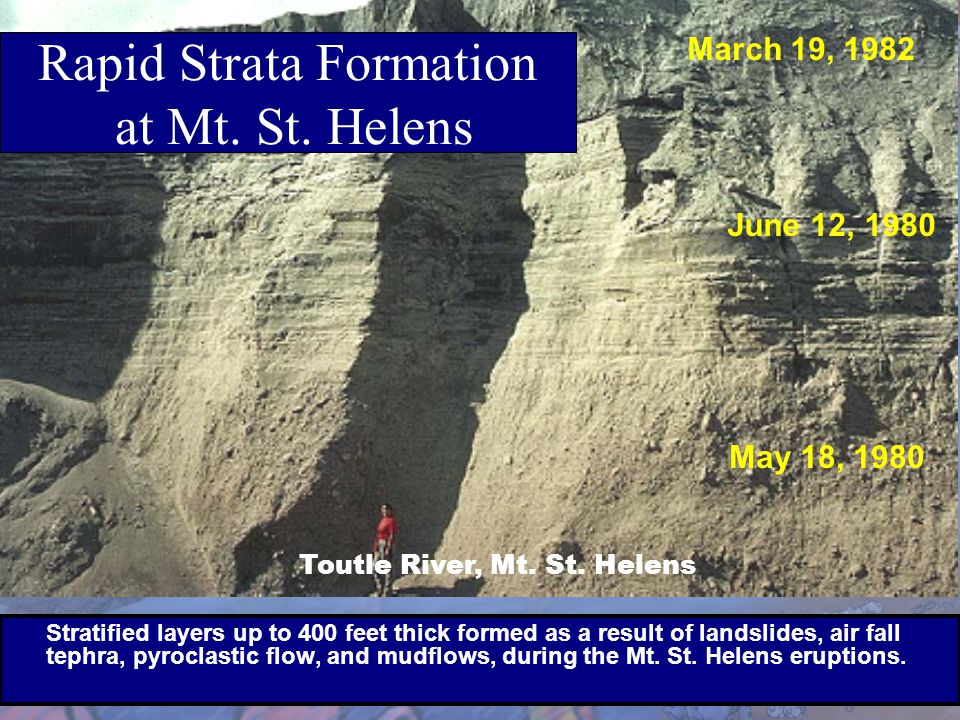
Visit the fossil museum:
www.flickr.com/photos/101536517@N06/sets/72157641367196613/
Just how good are peer reviews of scientific papers?
www.sciencemag.org/content/342/6154/60.full
www.examiner.com/article/want-to-publish-science-paper-ju...
The neo-Darwinian idea that the human genome consists entirely of an accumulation of billions of mutations is, quite obviously, completely bonkers. Nevertheless, it is compulsorily taught in schools and universities as 'science'.
A beautifully produced brochure, resplendent in a presentation envelope, and issued by the County of London Electric Suppl;y Company to commemorate the opening of their new power hous (power station) on the banks of the River Thames at Creekmouth in Barking. This great event took place on 19 May 1925 and, one strongly suspects, was the one time Royalty set foot at Creekmouth! The brochure has a potted history of the company that has been incorporated in 1891 to serve parts of South West London and some inner parishes adjacent to the City of London itself. These two supply areas were the reasoning behind their first two power stations at City Road, Islington and in Wandsworth.
The UK's fledgling electricial supply industry was rather an unholy mess with not just a multiplicity of supply undertakings (private and municipal) but also a wide range of supply voltages and phases. Some consolidation took place and the County of London Company was typical of the larger players in that they extended their supply area serviving a multiplicity of administrative areas that did not develop undertakings of their own as well as becoming 'bulk' suppliers of power to 'independent' undertakings. By the early 1920s their supply area had grown to cover much of East London and South Essex as seen on the map.
The construction of Barking "A" as it would become known was first mooted in post-WW1 years to firstly increase capacity and also to ensure more thermally efficient production of supply than their older and smaller stations could obtain. The riverside plant allowed easy delivery of the coal fuel by river and allowed for the necessary cooling water. The designers and consultants were Merz & McLellan, the bulk of the equipment supplied by Vickers of Barrow and the turbines were by C A Parsons.
Barking was also effectively the outcome of increased co-operation the company had with three other closely connected concerns - the City of London Electric Lighting Company; the South London Electric Supply Corporation Limited; and the South Metropolitan Electric Light and Power Company Limited. This cooperation was something increasingly demanded of the industry by increased legislation and in 1926 the Central Electricity Board was formed. The CEB not only instituted the National Grid, interconnection requiring a national standard of production, but also 'designated' efficient stations. City Road was not, and closed in 1929, Wandsworth was and Barking saw expansion with the construction of the "B" section stage that was commissioned in 1933 and reached full capacity in 1939. The Company was nationalised in 1948 and it fell to the state to construct what was Barking "C" in 1954. Barking "A" was decommissioned in 1969, "B" in 1976 and finally "C" in 1981. The whole site was then cleared.
The brochure has a number of colour plates and sketches by artist Norman Howard as well as photographs of the plant. It is spledidly printed and produced by one of the better printing houses of the day, the esteemed George W Jones, at "The Sign of the Dolphin" in Gough Square, Fleet Street.
This plate shows the all important coal conveyor that moved the fuel used to fire the boilers between the river side and boiler house.
Thinking leads to reasoning. Reasoning leads to right & wrong.
Wrong leads to revolt. Revolt leads to bad citizens.
Generated with Gemini's Nano Banana Pro, Dec 30, 2025. I love the Reasoning for this one:
Analyzing the Request
I'm currently breaking down the user's intent. The central themes are serenity, remoteness, and a sense of completion. I'm focusing on defining those concepts precisely so I can proceed. I want to convey an image that makes the user feel at peace, even far away.
Formulating a Scene
I am now visualizing the scene. My current approach involves a remote, tranquil cabin by a lake bathed in warm afternoon light. A person rests, seemingly at peace, nearby. I'm aiming for a natural, candid feel in the composition. I need to figure out how to add a golden retriever.
Verifying the Visuals
I'm now cross-referencing the initial request with the details in the scene. The goal is to accurately represent a relaxed individual in a remote, peaceful environment. Details like the book and surroundings are important to capture the desired mood.
Analyzing Scene Accuracy
I've examined the visual elements in relation to the original prompt, focusing on how they convey a sense of peaceful remoteness. The setting and the individual's pose are critical in establishing the intended atmosphere. I'm checking to ensure the details consistently reflect the concepts the user described.
“The man who comes back through the Door in the Wall will never be quite the same as the man who went out. He will be wiser but less sure, happier but less self-satisfied, humbler in acknowledging his ignorance yet better equipped to understand the relationship of words to things, of systematic reasoning to the unfathomable mystery which it tries, forever vainly, to comprehend”
― Aldous Huxley, The Doors of Perception
It is always interesting to see how other organisations faced the challenges of changing and updating their corporate identities and, amongst European railways, Netherlands Railways / Nederlandse Spoorwegen have for many decades had a strong unified public image. Much of what is now seen on the network has its roots in the work described here and it follows the 1966/1967 review into the 'look and feel' of the system. Despite the writer's concern as to timescale and changing fashion, NS's identity has arguably stood those tests quite well, certianly in comparison with British Rail whose pioneering work in 1964/5 (that was emulated by so many other transport organisations) has been carelessly thrown away in the disasterous visual segregation that are railways in the UK these days.
Here we have a concise narrative as to the reasoning behind several of the decisions made - such as to typeface (amended Univers), colours and symbols. NS also redrafted their timetables in 1970/1 to reflect the 'new look'. The article is by Siep Wijsenbeek who was one of the key people who had worked on the new visual identities for NS - and the following article is well worth a read.
Rapid strata formation in soft sand (field evidence).
Photo of strata formation in soft sand on a beach, created by tidal action of the sea.
Formed in a single, high tidal event. Stunning evidence which displays multiple strata/layers.
Why this is so important ....
It has long been assumed, ever since the 17th century, that layers/strata observed in sedimentary rocks were built up gradually, layer upon layer, over many years. It certainly seemed logical at the time, from just looking at rocks, that lower layers would always be older than the layers above them, i.e. that lower layers were always laid down first followed, in time, by successive layers on top.
This was assumed to be true and became known as the superposition principle.
It was also assumed that a layer comprising a different material from a previous layer, represented a change in environmental conditions/factors.
These changes in composition of layers or strata were considered to represent different, geological eras on a global scale, spanning millions of years. This formed the basis for the Geologic Column, which is used to date rocks and also fossils. The evolutionary, 'fossil record' was based on the vast ages and assumed geological eras of the Geologic Column.
There was also circular reasoning applied with the assumed age of 'index' fossils (based on evolutionary beliefs & preconceptions) used to date strata in the Geologic Column. Dating strata from the assumed age of (index) fossils is known as Biostratigraphy.
We now know that, although these assumptions seemed logical, they are not supported by the evidence.
At the time, the mechanics of stratification were not properly known or studied.
An additional factor was that this assumed superposition and uniformitarian model became essential, with the wide acceptance of Darwinism, for the long ages required for progressive microbes-to-human evolution. There was no incentive to question or challenge the superposition, uniformitarian model, because the presumed, fossil 'record' had become dependant on it, and any change in the accepted model would present devastating implications for Darwinism.
This had the unfortunate effect of linking the study of geology so closely to Darwinism, that any study independent of Darwinian considerations was effectively stymied. This link of geology with Darwinian preconceptions is known as biostratigraphy.
Some other field evidence, in various situations, can be observed here: www.flickr.com/photos/101536517@N06/sets/72157635944904973/
and also in the links to stunning, experimental evidence, carried out by sedimentologists, given later.
_______________________________________________
GEOLOGIC PRINCIPLES (established by Nicholas Steno in the 17th Century):
What Nicolas Steno believed about strata formation is the basis of the principle of Superposition and the principle of Original Horizontality.
dictionary.sensagent.com/Law_of_superposition/en-en/
“Assuming that all rocks and minerals had once been fluid, Nicolas Steno reasoned that rock strata were formed when particles in a fluid such as water fell to the bottom. This process would leave horizontal layers. Thus Steno's principle of original horizontality states that rock layers form in the horizontal position, and any deviations from this horizontal position are due to the rocks being disturbed later.”)
BEDDING PLANES.
'Bedding plane' describes the surface in between each stratum which are formed during sediment deposition.
science.jrank.org/pages/6533/Strata.html
“Strata form during sediment deposition, that is, the laying down of sediment. Meanwhile, if a change in current speed or sediment grain size occurs or perhaps the sediment supply is cut off, a bedding plane forms. Bedding planes are surfaces that separate one stratum from another. Bedding planes can also form when the upper part of a sediment layer is eroded away before the next episode of deposition. Strata separated by a bedding plane may have different grain sizes, grain compositions, or colours. Sometimes these other traits are better indicators of stratification as bedding planes may be very subtle.”
______________________________________________
Several catastrophic events, flash floods, volcanic eruptions etc. have forced Darwinian, influenced geologists to admit to rapid stratification in some instances. However they claim it is a rare phenomenon, which they have known about for many years, and which does nothing to invalidate the Geologic Column, the fossil record, evolutionary timescale, or any of the old assumptions regarding strata formation, sedimentation and the superposition principle. They fail to face up to the fact that rapid stratification is not an extraordinary phenonemon, but rather the prevailing and normal mechanism of sedimentary deposition whenever and wherever there is moving, sediment-laden water. The experimental evidence demonstrates the mechanism and a mass of field evidence in normal (non-catastrophic) conditions shows it is a normal everyday occurrence.
It is clear from the experimental evidence that the usual process of stratification is - that strata are not formed by horizontal layers being laid on top of each other in succession, as was assumed. But by sediment being sorted in the flowing water and laid down diagonally in the direction of flow. See diagram:
www.flickr.com/photos/truth-in-science/39821536092/in/dat...
The field evidence (in the image) presented here - of rapid, simultaneous stratification refutes the Superposition Principle and the Principle of Lateral Continuity.
We now know, the Superposition Principle only applies on a rare occasion where sedimentary deposits are laid down in still water.
Superposition is required for the long evolutionary timescale, but the evidence shows it is not the general rule, as was once believed. Most sediment is laid down in moving water, where particle segregation is the general rule, resulting in the simultaneous deposition of strata/layers as shown in the photo.
See many other examples of rapid stratification (with geological features): www.flickr.com/photos/101536517@N06/sets/72157635944904973/
Rapid, simultaneous formation of layers/strata, through particle segregation in moving water, is so easily created it has even been described by sedimentologists (working on flume experiments) as a law ...
"Upon filling the tank with water and pouring in sediments, we immediately saw what was to become the rule: The sediments sorted themselves out in very clear layers. This became so common that by the end of two weeks, we jokingly referred to Andrew's law as "It's difficult not to make layers," and Clark's law as "It's easy to make layers." Later on, I proposed the "law" that liquefaction destroys layers, as much to my surprise as that was." Ian Juby, www.ianjuby.org/sedimentation/
The field example in the photo is the result of normal, everyday tidal action formed in a single incident,
Where the water current or movement is more turbulent, violent, or catastrophic, great depths (many metres) of stratified sediment can be laid down in a short time. Certainly not the many millions of years assumed by evolutionists.
The composition of strata formed in any deposition event. is related to whatever materials are in the sediment mix, not to any particular timescale. Whatever is in the mix will be automatically sorted into strata/layers. It could be sand, or other material added from mud slides, erosion of chalk deposits, coastal erosion, volcanic ash etc. Any organic material (potential fossils), alive or dead, engulfed by, or swept into, a turbulent sediment mix, will also be sorted and buried within the rapidly, forming layers.
See many other examples of rapid stratification with geological features: www.flickr.com/photos/101536517@N06/sets/72157635944904973/
Stratified, soft sand deposit. demonstrates the rapid, stratification principle.
Important, field evidence which supports the work of the eminent, sedimentologist Dr Guy Berthault MIAS - Member of the International Association of Sedimentologists.
(Dr Berthault's experiments (www.sedimentology.fr/)
And also the experimental work of Dr M.E. Clark (Professor Emeritus, U of Illinois @ Urbana), Andrew Rodenbeck and Dr. Henry Voss, (www.ianjuby.org/sedimentation/)
Location: Yaverland, Isle of Wight. photographed 04/06/2018, formed several months earlier and in the early stages of consolidation.
This field evidence demonstrates that multiple strata in sedimentary deposits do not need millions of years to form and can be formed rapidly. This natural example confirms the principle demonstrated by the sedimentation experiments carried out by Dr Guy Berthault and other sedimentologists. It calls into question the standard, multi-million year dating of sedimentary rocks, and the dating of fossils by depth of burial or position in the strata.
Mulltiple strata/layers are evident in this example.
Dr Berthault's experiments (www.sedimentology.fr/) and other experiments (www.ianjuby.org/sedimentation/) and field studies of floods and volcanic action show that, rather than being formed by gradual, slow deposition of sucessive layers superimposed upon previous layers, with the strata or layers representing a particular timescale, particle segregation in moving water or airborne particles can form strata or layers very quickly, frequently, in a single event.
And, most importantly, lower strata are not older than upper strata, they are the same age, having been created in the same sedimentary episode.
Such field studies confirm experiments which have shown that there is no longer any reason to conclude that strata/layers in sedimentary rocks relate to different geological eras and/or a multi-million year timescale. www.youtube.com/watch?v=5PVnBaqqQw8&feature=share&.... they also show that the relative position of fossils in rocks is not indicative of an order of evolutionary succession. Obviously, the uniformitarian principle, on which the geologic column is based, can no longer be considered valid. And the multi-million, year dating of sedimentary rocks and fossils needs to be reassessed. Rapid deposition of stratified sediments also explains the enigma of polystrate fossils, i.e. large fossils that intersect several strata. In some cases, tree trunk fossils are found which intersect the strata of sedimentary rock up to forty feet in depth. upload.wikimedia.org/wikipedia/commons/thumb/0/08/Lycopsi... They must have been buried in stratified sediment in a short time (certainly not millions, thousands, or even hundreds of years), or they would have rotted away. youtu.be/vnzHU9VsliQ
In fact, the vast majority of fossils are found in good, intact condition, which is testament to their rapid burial. You don't get good fossils from gradual burial, because they would be damaged or destroyed by decay, predation or erosion. The existence of so many fossils in sedimentary rock on a global scale is stunning evidence for the rapid depostion of sedimentary rock as the general rule. It is obvious that all rock containing good intact fossils was formed from sediment laid down in a very short time, not millions, or even thousands of years.
See set of photos of other examples of rapid stratification: www.flickr.com/photos/101536517@N06/sets/72157635944904973/
Carbon dating of coal should not be possible if it is millions of years old, yet significant amounts of Carbon 14 have been detected in coal and other fossil material, which indicates that it is less than 50,000 years old. www.ldolphin.org/sewell/c14dating.html
www.grisda.org/origins/51006.htm
Evolutionists confidently cite multi-million year ages for rocks and fossils, but what most people don't realise is that no one actually knows the age of sedimentary rocks or the fossils found within them. So how are evolutionists so sure of the ages they so confidently quote? The astonishing thing is they aren't. Sedimentary rocks cannot be dated by radiometric methods*, and fossils can only be dated to less than 50,000 years with Carbon 14 dating. The method evolutionists use is based entirely on assumptions. Unbelievably, fossils are dated by the assumed age of rocks, and rocks are dated by the assumed age of fossils, that's right ... it is known as circular reasoning.
* Regarding the radiometric dating of igneous rocks, which is claimed to be relevant to the dating of sedimentary rocks, in an occasional instance there is an igneous intrusion associated with a sedimentary deposit -
Prof. Aubouin says in his Précis de Géologie: "Each radioactive element disintegrates in a characteristic and constant manner, which depends neither on the physical state (no variation with pressure or temperature or any other external constraint) nor on the chemical state (identical for an oxide or a phosphate)."
"Rocks form when magma crystallizes. Crystallisation depends on pressure and temperature, from which radioactivity is independent. So, there is no relationship between radioactivity and crystallisation.
Consequently, radioactivity doesn't date the formation of rocks. Moreover, daughter elements contained in rocks result mainly from radioactivity in magma where gravity separates the heavier parent element, from the lighter daughter element. Thus radiometric dating has no chronological signification." Dr. Guy Berthault www.sciencevsevolution.org/Berthault.htm
"A team of Russian sedimentologists directed by Alexander Lalomov (Russian Academy of Sciences’ Institute of Ore Deposits) applied paleohydraulic analyses to geological formations in Russia. One example is the publication of a report in 2007 by the Lithology and Mineral Resources journal of the Russian Academy of Sciences. It concerns the Crimean Peninsular. It shows that the time of sedimentation of the sequence studied corresponds to a virtually instantaneous episode whilst according to stratigraphy it took several millions of years. Moreover, a recent report concerning the North-West Russian plateau in the St. Petersburg region shows that the time of sedimentation was much shorter than that attributed to it by the stratigraphic time-scale: 0.05% of the time."
www.sciencevsevolution.org/Berthault.htm
Rapid strata formation and rapid erosion at Mount St Helens.
slideplayer.com/slide/5703217/18/images/28/Rapid+Strata+F...
Visit the fossil museum:
www.flickr.com/photos/101536517@N06/sets/72157641367196613/
Just how good are peer reviews of scientific papers?
www.sciencemag.org/content/342/6154/60.full
www.examiner.com/article/want-to-publish-science-paper-ju...
The neo-Darwinian idea that the human genome consists entirely of an accumulation of billions of mutations is, quite obviously, completely bonkers. Nevertheless, it is compulsorily taught in schools and universities as 'science'.