View allAll Photos Tagged Reasoning
31528 First Glasgow
URS318X
on Union Street, Glasgow.
I'm not sure the reasoning this was out on the 100, but it was a very welcome addition to the Glasgow scene, and significantly different to the Enviro400H's I was hoping to see in the city!
Australia.
Bolwell produced sports cars in Australia from 1962-79.
The first production vehicle was the 1962-64 Mk.IV. Campbell Bolwell’s reasoning was that no-one would want to buy the first guinea pig model from any manufacturer. So the Mk.IV was the first.
1964-66 Mk V had an E type Jag look, Holdens 6 cyl, 75 made.
1968 Mk VI, (SR6) one off mid-engined racing car.
1967-72 Mk VII; fastback, four fender vents, Holden 6 cyl. 400 made
1970-74 Mk VIII Bolwell Nagari, the first with a name; 'Nagari' and was a fully built production car and favoured Ford parts, including their V8 engines. Previous models were kit cars and used Holden parts. The Nagari had a one piece fibreglass body, six fender vents. A convertible available from 1972. Early cars were Ford Windsor V8 powered with Cortina parkers, later cars Ford Cleveland V8 powered and MG parkers. 100 coupes and 18 convertibles produced
Came home found the trashcan tipped over, and the trash bag inside were gone. It's not a trash day, and I was working on the driveway about 50 meters away the whole time. Reasoning tells me it's got to be a bear since foxes and cats wouldn't take the whole bag. Security camera footage confirms the saying: one man's trash is a bear's treasure, or something like that.
Rapid strata formation in soft sand (field evidence).
Photo of strata formation in soft sand on a beach, created by tidal action of the sea.
Formed in a single, high tidal event. Stunning evidence which displays multiple strata/layers.
Why this is so important ....
It has long been assumed, ever since the 17th century, that layers/strata observed in sedimentary rocks were built up gradually, layer upon layer, over many years. It certainly seemed logical at the time, from just looking at rocks, that lower layers would always be older than the layers above them, i.e. that lower layers were always laid down first followed, in time, by successive layers on top.
This was assumed to be true and became known as the superposition principle.
It was also assumed that a layer comprising a different material from a previous layer, represented a change in environmental conditions/factors.
These changes in composition of layers or strata were considered to represent different, geological eras on a global scale, spanning millions of years. This formed the basis for the Geologic Column, which is used to date rocks and also fossils. The evolutionary, 'fossil record' was based on the vast ages and assumed geological eras of the Geologic Column.
There was also circular reasoning applied with the assumed age of 'index' fossils (based on evolutionary preconceptions) used to date strata in the Geologic Column.
We now know that, although these assumptions seemed logical, they are not supported by the evidence.
At the time, the mechanics of stratification were not properly known or studied.
An additional factor was that this assumed superposition and uniformitarian model became essential, with the wide acceptance of Darwinism, for the long ages required for progressive microbes-to-human evolution. There was no incentive to question or challenge the superposition, uniformitarian model, because the presumed, fossil 'record' had become dependant on it, and any change in the accepted model would present devastating implications for Darwinism.
This had the unfortunate effect of linking the study of geology so closely to Darwinism, that any study independent of Darwinian considerations was effectively stymied.
Some of the wealth of field evidence can be observed here: www.flickr.com/photos/101536517@N06/sets/72157635944904973/
and also in the links to stunning, experimental evidence, carried out by sedimentologists, given later.
Several catastrophic events, flash floods, volcanic eruptions etc. have forced Darwinian influenced geologists to admit to rapid stratification in some instances. However they claim it is a rare phenomenon, which they known about for many years, and which does nothing to invalidate the Geologic Column, the fossil record, evotuionary timescale, or any of the old assumptions regarding strata formation, sedimentation and the superposition principle. They fail to face up to the fact that rapid stratification is not an extraordinary phenonemon, but rather the prevailing and normal mechanism of sedimantary deposition whenever and wherever there is moving, sediment-laden water. The experimental evidence demonstrates the mechanism and a mass of field evidence in normal (non-catastrophic) conditions shows it is a normal everyday occurrence.
It is clear from the experimental evidence that the usual process of stratification is - that strata are not formed by horizontal layers being laid on top of each other in succession, as was assumed. But by sediment being sorted in the flowing water and laid down diagonally in the direction of flow.
_______________________________________________
GEOLOGIC PRINCIPLES (established by Nicholas Steno in the 17th Century):
What Nicolas Steno believed about strata formation is the basis of the principle of Superposition and the principle of Original Horizontality.
dictionary.sensagent.com/Law_of_superposition/en-en/
“Assuming that all rocks and minerals had once been fluid, Nicolas Steno reasoned that rock strata were formed when particles in a fluid such as water fell to the bottom. This process would leave horizontal layers. Thus Steno's principle of original horizontality states that rock layers form in the horizontal position, and any deviations from this horizontal position are due to the rocks being disturbed later.”)
BEDDING PLANES.
'Bedding plane' describes the surface in between each stratum which are formed during sediment deposition.
science.jrank.org/pages/6533/Strata.html
“Strata form during sediment deposition, that is, the laying down of sediment. Meanwhile, if a change in current speed or sediment grain size occurs or perhaps the sediment supply is cut off, a bedding plane forms. Bedding planes are surfaces that separate one stratum from another. Bedding planes can also form when the upper part of a sediment layer is eroded away before the next episode of deposition. Strata separated by a bedding plane may have different grain sizes, grain compositions, or colours. Sometimes these other traits are better indicators of stratification as bedding planes may be very subtle.”
______________________________________________
Several catastrophic events, flash floods, volcanic eruptions etc. have forced Darwinian, influenced geologists to admit to rapid stratification in some instances. However they claim it is a rare phenomenon, which they have known about for many years, and which does nothing to invalidate the Geologic Column, the fossil record, evotuionary timescale, or any of the old assumptions regarding strata formation, sedimentation and the superposition principle. They fail to face up to the fact that rapid stratification is not an extraordinary phenonemon, but rather the prevailing and normal mechanism of sedimentary deposition whenever and wherever there is moving, sediment-laden water. The experimental evidence demonstrates the mechanism and a mass of field evidence in normal (non-catastrophic) conditions shows it is a normal everyday occurrence.
It is clear from the experimental evidence that the usual process of stratification is - that strata are not formed by horizontal layers being laid on top of each other in succession, as was assumed. But by sediment being sorted in the flowing water and laid down diagonally in the direction of flow. See diagram:
www.flickr.com/photos/truth-in-science/39821536092/in/dat...
The field evidence (in the image) presented here - of rapid, simultaneous stratification refutes the Superposition Principle, and the Principle of Lateral Continuity.
We now know, the Superposition Principle only applies on a rare occasion of sedimentary deposits in perfectly, still water. Superposition is required for the long evolutionary timescale, but the evidence shows it is not the general rule, as was once believed. Most sediment is laid down in moving water, where particle segregation is the general rule, resulting in the simultaneous deposition of strata/layers as shown in the photo.
See many other examples of rapid stratification with geological features: www.flickr.com/photos/101536517@N06/sets/72157635944904973/
Rapid, simultaneous formation of layers/strata, through particle segregation in moving water, is so easily created it has even been described by sedimentologists (working on flume experiments) as a law ...
"Upon filling the tank with water and pouring in sediments, we immediately saw what was to become the rule: The sediments sorted themselves out in very clear layers. This became so common that by the end of two weeks, we jokingly referred to Andrew's law as "It's difficult not to make layers," and Clark's law as "It's easy to make layers." Later on, I proposed the "law" that liquefaction destroys layers, as much to my surprise as that was." Ian Juby, www.ianjuby.org/sedimentation/
The example in the photo is the result of normal, everyday tidal action in a single incident. Where the water current or movement is more turbulent, violent, or catastrophic, great depths (many metres) of stratified sediment can be laid down in a short time. Certainly not the many millions of years assumed by evolutionists.
The composition of strata formed in any deposition event. is related to whatever materials are in the sediment mix, not to any particular timescale. Whatever is in the mix will be automatically sorted into strata/layers. It could be sand, or other material added from mud slides, erosion of chalk deposits, coastal erosion, volcanic ash etc. Any organic material (potential fossils), alive or dead, engulfed by, or swept into, a turbulent sediment mix, will also be sorted and buried within the rapidly, forming layers.
See many other examples of rapid stratification with geological features: www.flickr.com/photos/101536517@N06/sets/72157635944904973/
Stratified, soft sand deposit. demonstrates the rapid, stratification principle.
Important, field evidence which supports the work of the eminent, sedimentologist Dr Guy Berthault MIAS - Member of the International Association of Sedimentologists.
(Dr Berthault's experiments (www.sedimentology.fr/)
And also the experimental work of Dr M.E. Clark (Professor Emeritus, U of Illinois @ Urbana), Andrew Rodenbeck and Dr. Henry Voss, (www.ianjuby.org/sedimentation/)
Location: Sandown beach, Isle of Wight. Formed 15/01/2018, This field evidence demonstrates that multiple strata in sedimentary deposits do not need millions of years to form and can be formed rapidly. This natural example confirms the principle demonstrated by the sedimentation experiments carried out by Dr Guy Berthault and other sedimentologists. It calls into question the standard, multi-million year dating of sedimentary rocks, and the dating of fossils by depth of burial or position in the strata.
Mulltiple strata/layers are evident in this example.
Dr Berthault's experiments (www.sedimentology.fr/) and other experiments (www.ianjuby.org/sedimentation/) and field studies of floods and volcanic action show that, rather than being formed by gradual, slow deposition of sucessive layers superimposed upon previous layers, with the strata or layers representing a particular timescale, particle segregation in moving water or airborne particles can form strata or layers very quickly, frequently, in a single event.
And, most importantly, lower strata are not older than upper strata, they are the same age, having been created in the same sedimentary episode.
Such field studies confirm experiments which have shown that there is no longer any reason to conclude that strata/layers in sedimentary rocks relate to different geological eras and/or a multi-million year timescale. www.youtube.com/watch?v=5PVnBaqqQw8&feature=share&.... they also show that the relative position of fossils in rocks is not indicative of an order of evolutionary succession. Obviously, the uniformitarian principle, on which the geologic column is based, can no longer be considered valid. And the multi-million, year dating of sedimentary rocks and fossils needs to be reassessed. Rapid deposition of stratified sediments also explains the enigma of polystrate fossils, i.e. large fossils that intersect several strata. In some cases, tree trunk fossils are found which intersect the strata of sedimentary rock up to forty feet in depth. upload.wikimedia.org/wikipedia/commons/thumb/0/08/Lycopsi... They must have been buried in stratified sediment in a short time (certainly not millions, thousands, or even hundreds of years), or they would have rotted away. youtu.be/vnzHU9VsliQ
In fact, the vast majority of fossils are found in good, intact condition, which is testament to their rapid burial. You don't get good fossils from gradual burial, because they would be damaged or destroyed by decay, predation or erosion. The existence of so many fossils in sedimentary rock on a global scale is stunning evidence for the rapid depostion of sedimentary rock as the general rule. It is obvious that all rock containing good intact fossils was formed from sediment laid down in a very short time, not millions, or even thousands of years.
See set of photos of other examples of rapid stratification: www.flickr.com/photos/101536517@N06/sets/72157635944904973/
Carbon dating of coal should not be possible if it is millions of years old, yet significant amounts of Carbon 14 have been detected in coal and other fossil material, which indicates that it is less than 50,000 years old. www.ldolphin.org/sewell/c14dating.html
www.grisda.org/origins/51006.htm
Evolutionists confidently cite multi-million year ages for rocks and fossils, but what most people don't realise is that no one actually knows the age of sedimentary rocks or the fossils found within them. So how are evolutionists so sure of the ages they so confidently quote? The astonishing thing is they aren't. Sedimentary rocks cannot be dated by radiometric methods*, and fossils can only be dated to less than 50,000 years with Carbon 14 dating. The method evolutionists use is based entirely on assumptions. Unbelievably, fossils are dated by the assumed age of rocks, and rocks are dated by the assumed age of fossils, that's right ... it is known as circular reasoning.
* Regarding the radiometric dating of igneous rocks, which is claimed to be relevant to the dating of sedimentary rocks, in an occasional instance there is an igneous intrusion associated with a sedimentary deposit -
Prof. Aubouin says in his Précis de Géologie: "Each radioactive element disintegrates in a characteristic and constant manner, which depends neither on the physical state (no variation with pressure or temperature or any other external constraint) nor on the chemical state (identical for an oxide or a phosphate)."
"Rocks form when magma crystallizes. Crystallisation depends on pressure and temperature, from which radioactivity is independent. So, there is no relationship between radioactivity and crystallisation.
Consequently, radioactivity doesn't date the formation of rocks. Moreover, daughter elements contained in rocks result mainly from radioactivity in magma where gravity separates the heavier parent element, from the lighter daughter element. Thus radiometric dating has no chronological signification." Dr. Guy Berthault www.sciencevsevolution.org/Berthault.htm
Visit the fossil museum:
www.flickr.com/photos/101536517@N06/sets/72157641367196613/
Just how good are peer reviews of scientific papers?
www.sciencemag.org/content/342/6154/60.full
www.examiner.com/article/want-to-publish-science-paper-ju...
The neo-Darwinian idea that the human genome consists entirely of an accumulation of billions of mutations is, quite obviously, completely bonkers. Nevertheless, it is compulsorily taught in schools and universities as 'science'.
Pica pica
Avrasya saksağanı
Eurasian magpie or common magpie
Pie bavarde
Elster
The Eurasian magpie is one of the most intelligent birds, and it is believed to be one of the most intelligent of all non-human animals. The expansion of its nidopallium is approximately the same in its relative size as the brain of chimpanzees, gorillas, orangutans and humans. It is the only bird known to pass the mirror test, along with very few other non-avian species.
The Eurasian magpie or common magpie (Pica pica) is a resident breeding bird throughout the northern part of the Eurasian continent. It is one of several birds in the crow family (corvids) designated magpies, and belongs to the Holarctic radiation of "monochrome" magpies. In Europe, "magpie" is used by English speakers as a synonym for the Eurasian magpie: the only other magpie in Europe is the Iberian magpie (Cyanopica cooki), which is limited to the Iberian Peninsula.
The Eurasian magpie is almost identical in appearance to the North American black-billed magpie (Pica hudsonia) and at one time the two species were considered to be conspecific.[ In 2000, the American Ornithologists' Union decided to treat the black-billed magpie as a separate species based on studies of the vocalization and behaviour that indicated that the black-billed magpie was closer to the yellow-billed magpie (Pica nuttalli) than to the Eurasian magpie
Etymology
The prefix "mag" dates from the 16th century and comes from the short form of the given name Margaret, which was once used to mean women in general (as Joe or Jack is used for men today); the pie's call was considered to sound like the idle chattering of a woman, and so it came to be called the "Mag pie". "Pie" as a term for the bird dates to the 13th century, and the word "pied", first recorded in 1552, became applied to other birds that resembled the magpie in having black-and-white plumage.
Feeding
The magpie is omnivorous, eating young birds and eggs, small mammals, insects, scraps and carrion, acorns, grain, and other vegetable substances.
Intelligence
The Eurasian magpie is believed to be not only among the most intelligent of birds, but also among the most intelligent of all animals. Along with the western jackdaw, the Eurasian magpie's nidopallium is approximately the same relative size as those in chimpanzees and humans and significantly larger than the gibbons. Like other corvids, such as ravens and crows, their total brain-to-body mass ratio is equal to most great apes and cetaceans. A 2004 review suggests that the intelligence of the corvid family to which the Eurasian magpie belongs is equivalent to that of the great apes (chimpanzees, bonobos, gorillas and orangutans) in terms of social cognition, causal reasoning, flexibility, imagination and prospection.
Magpies have been observed engaging in elaborate social rituals, possibly including the expression of grief. Mirror self-recognition has been demonstrated in European magpies, making them one of only a few species known to possess this capability. The cognitive abilities of the Eurasian magpie are regarded as evidence that intelligence evolved independently in both corvids and primates. This is indicated by tool use, an ability to hide and store food across seasons, episodic memory, and using their own experience to predict the behavior of conspecifics. Another behaviour exhibiting intelligence is cutting their food in correctly sized proportions for the size of their young. In captivity, magpies have been observed counting up to get food, imitating human voices, and regularly using tools to clean their own cages. In the wild, they organise themselves into gangs and use complex strategies hunting other birds and when confronted by predators.
Status
The Eurasian magpie has an extremely large range. The European population is estimated to be between 7.5 and 19 million breeding pairs. Allowing for the birds breeding in other continents, the total population is estimated to be between 46 and 228 million individuals. The population trend in Europe has been stable since 1980. There is no evidence of any serious overall decline in numbers, so the species is classified by the International Union for Conservation of Nature as being of Least Concern.
Reference: en.wikipedia.org/wiki/Eurasian_magpie
Location: Warsaw
One of the few US-spec Audis, I'm sure. This one looks actually farily good in matte-black, the red stripe is a bit much, but it fits. The reasoning behind the plate is probably "mirin" as a (common) shortening for "admiring"; although its meaning is slightly narrowed to represent a sensation of envy rather than looking-up.
W = Mazowieckie
Another of my very few Deltic shots.
After some serious detective work, I've deduced that this was taken on the 1st March 1979. My reasoning is thus: it's taken on my late father's 120 roll Agfa Isolette: I was only allowed to use that camera on very few occasions: this was the day that KGV did a 125th Anniversary run from Paddington to Didcot (failed and had a 47 on the return).
As luck would have it, the fantastic www.napierchronicles.co.uk has 55019 working the 1S28 13:00 Kings Cross - Edinburgh.
Possibly my connections are tenuous, but with no other information to hand I'm going to accept my own assumptions!
Fortunately, 55019 is still with us today courtesy of the Deltic Preservation Society.
Rapid strata formation in soft sand (field evidence).
Photo of strata formation in soft sand on a beach, created by tidal action of the sea.
Formed in a single, high tidal event. Stunning evidence which displays multiple strata/layers.
Why this is so important ....
It has long been assumed, ever since the 17th century, that layers/strata observed in sedimentary rocks were built up gradually, layer upon layer, over many years. It certainly seemed logical at the time, from just looking at rocks, that lower layers would always be older than the layers above them, i.e. that lower layers were always laid down first followed, in time, by successive layers on top.
This was assumed to be true and became known as the superposition principle.
It was also assumed that a layer comprising a different material from a previous layer, represented a change in environmental conditions/factors.
These changes in composition of layers or strata were considered to represent different, geological eras on a global scale, spanning millions of years. This formed the basis for the Geologic Column, which is used to date rocks and also fossils. The evolutionary, 'fossil record' was based on the vast ages and assumed geological eras of the Geologic Column.
There was also circular reasoning applied with the assumed age of 'index' fossils (based on evolutionary beliefs & preconceptions) used to date strata in the Geologic Column. Dating strata from the assumed age of (index) fossils is known as Biostratigraphy.
We now know that, although these assumptions seemed logical, they are not supported by the evidence.
At the time, the mechanics of stratification were not properly known or studied.
An additional factor was that this assumed superposition and uniformitarian model became essential, with the wide acceptance of Darwinism, for the long ages required for progressive microbes-to-human evolution. There was no incentive to question or challenge the superposition, uniformitarian model, because the presumed, fossil 'record' had become dependant on it, and any change in the accepted model would present devastating implications for Darwinism.
This had the unfortunate effect of linking the study of geology so closely to Darwinism, that any study independent of Darwinian considerations was effectively stymied. This link of geology with Darwinian preconceptions is known as biostratigraphy.
Some other field evidence, in various situations, can be observed here: www.flickr.com/photos/101536517@N06/sets/72157635944904973/
and also in the links to stunning, experimental evidence, carried out by sedimentologists, given later.
_______________________________________________
GEOLOGIC PRINCIPLES (established by Nicholas Steno in the 17th Century):
What Nicolas Steno believed about strata formation is the basis of the principle of Superposition and the principle of Original Horizontality.
dictionary.sensagent.com/Law_of_superposition/en-en/
“Assuming that all rocks and minerals had once been fluid, Nicolas Steno reasoned that rock strata were formed when particles in a fluid such as water fell to the bottom. This process would leave horizontal layers. Thus Steno's principle of original horizontality states that rock layers form in the horizontal position, and any deviations from this horizontal position are due to the rocks being disturbed later.”)
BEDDING PLANES.
'Bedding plane' describes the surface in between each stratum which are formed during sediment deposition.
science.jrank.org/pages/6533/Strata.html
“Strata form during sediment deposition, that is, the laying down of sediment. Meanwhile, if a change in current speed or sediment grain size occurs or perhaps the sediment supply is cut off, a bedding plane forms. Bedding planes are surfaces that separate one stratum from another. Bedding planes can also form when the upper part of a sediment layer is eroded away before the next episode of deposition. Strata separated by a bedding plane may have different grain sizes, grain compositions, or colours. Sometimes these other traits are better indicators of stratification as bedding planes may be very subtle.”
______________________________________________
Several catastrophic events, flash floods, volcanic eruptions etc. have forced Darwinian, influenced geologists to admit to rapid stratification in some instances. However they claim it is a rare phenomenon, which they have known about for many years, and which does nothing to invalidate the Geologic Column, the fossil record, evolutionary timescale, or any of the old assumptions regarding strata formation, sedimentation and the superposition principle. They fail to face up to the fact that rapid stratification is not an extraordinary phenonemon, but rather the prevailing and normal mechanism of sedimentary deposition whenever and wherever there is moving, sediment-laden water. The experimental evidence demonstrates the mechanism and a mass of field evidence in normal (non-catastrophic) conditions shows it is a normal everyday occurrence.
It is clear from the experimental evidence that the usual process of stratification is - that strata are not formed by horizontal layers being laid on top of each other in succession, as was assumed. But by sediment being sorted in the flowing water and laid down diagonally in the direction of flow. See diagram:
www.flickr.com/photos/truth-in-science/39821536092/in/dat...
The field evidence (in the image) presented here - of rapid, simultaneous stratification refutes the Superposition Principle and the Principle of Lateral Continuity.
We now know, the Superposition Principle only applies on a rare occasion where sedimentary deposits are laid down in still water.
Superposition is required for the long evolutionary timescale, but the evidence shows it is not the general rule, as was once believed. Most sediment is laid down in moving water, where particle segregation is the general rule, resulting in the simultaneous deposition of strata/layers as shown in the photo.
See many other examples of rapid stratification (with geological features): www.flickr.com/photos/101536517@N06/sets/72157635944904973/
Rapid, simultaneous formation of layers/strata, through particle segregation in moving water, is so easily created it has even been described by sedimentologists (working on flume experiments) as a law ...
"Upon filling the tank with water and pouring in sediments, we immediately saw what was to become the rule: The sediments sorted themselves out in very clear layers. This became so common that by the end of two weeks, we jokingly referred to Andrew's law as "It's difficult not to make layers," and Clark's law as "It's easy to make layers." Later on, I proposed the "law" that liquefaction destroys layers, as much to my surprise as that was." Ian Juby, www.ianjuby.org/sedimentation/
The example in the photo is the result of normal, everyday tidal action formed in a single incident, and subsequently eroded by water flow revealing the strata/layers.
Where the water current or movement is more turbulent, violent, or catastrophic, great depths (many metres) of stratified sediment can be laid down in a short time. Certainly not the many millions of years assumed by evolutionists.
The composition of strata formed in any deposition event. is related to whatever materials are in the sediment mix, not to any particular timescale. Whatever is in the mix will be automatically sorted into strata/layers. It could be sand, or other material added from mud slides, erosion of chalk deposits, coastal erosion, volcanic ash etc. Any organic material (potential fossils), alive or dead, engulfed by, or swept into, a turbulent sediment mix, will also be sorted and buried within the rapidly, forming layers.
See many other examples of rapid stratification with geological features: www.flickr.com/photos/101536517@N06/sets/72157635944904973/
Stratified, soft sand deposit. demonstrates the rapid, stratification principle.
Important, field evidence which supports the work of the eminent, sedimentologist Dr Guy Berthault MIAS - Member of the International Association of Sedimentologists.
(Dr Berthault's experiments (www.sedimentology.fr/)
And also the experimental work of Dr M.E. Clark (Professor Emeritus, U of Illinois @ Urbana), Andrew Rodenbeck and Dr. Henry Voss, (www.ianjuby.org/sedimentation/)
Location: Yaverland, Isle of Wight. Photographed 17/11/2018 This field evidence demonstrates that multiple strata in sedimentary deposits do not need millions of years to form and can be formed rapidly. This natural example confirms the principle demonstrated by the sedimentation experiments carried out by Dr Guy Berthault and other sedimentologists. It calls into question the standard, multi-million year dating of sedimentary rocks, and the dating of fossils by depth of burial or position in the strata.
Mulltiple strata/layers are evident in this example.
Dr Berthault's experiments (www.sedimentology.fr/) and other experiments (www.ianjuby.org/sedimentation/) and field studies of floods and volcanic action show that, rather than being formed by gradual, slow deposition of sucessive layers superimposed upon previous layers, with the strata or layers representing a particular timescale, particle segregation in moving water or airborne particles can form strata or layers very quickly, frequently, in a single event.
And, most importantly, lower strata are not older than upper strata, they are the same age, having been created in the same sedimentary episode.
Such field studies confirm experiments which have shown that there is no longer any reason to conclude that strata/layers in sedimentary rocks relate to different geological eras and/or a multi-million year timescale. www.youtube.com/watch?v=5PVnBaqqQw8&feature=share&.... they also show that the relative position of fossils in rocks is not indicative of an order of evolutionary succession. Obviously, the uniformitarian principle, on which the geologic column is based, can no longer be considered valid. And the multi-million, year dating of sedimentary rocks and fossils needs to be reassessed. Rapid deposition of stratified sediments also explains the enigma of polystrate fossils, i.e. large fossils that intersect several strata. In some cases, tree trunk fossils are found which intersect the strata of sedimentary rock up to forty feet in depth. upload.wikimedia.org/wikipedia/commons/thumb/0/08/Lycopsi... They must have been buried in stratified sediment in a short time (certainly not millions, thousands, or even hundreds of years), or they would have rotted away. youtu.be/vnzHU9VsliQ
In fact, the vast majority of fossils are found in good, intact condition, which is testament to their rapid burial. You don't get good fossils from gradual burial, because they would be damaged or destroyed by decay, predation or erosion. The existence of so many fossils in sedimentary rock on a global scale is stunning evidence for the rapid depostion of sedimentary rock as the general rule. It is obvious that all rock containing good intact fossils was formed from sediment laid down in a very short time, not millions, or even thousands of years.
See set of photos of other examples of rapid stratification: www.flickr.com/photos/101536517@N06/sets/72157635944904973/
Carbon dating of coal should not be possible if it is millions of years old, yet significant amounts of Carbon 14 have been detected in coal and other fossil material, which indicates that it is less than 50,000 years old. www.ldolphin.org/sewell/c14dating.html
www.grisda.org/origins/51006.htm
Evolutionists confidently cite multi-million year ages for rocks and fossils, but what most people don't realise is that no one actually knows the age of sedimentary rocks or the fossils found within them. So how are evolutionists so sure of the ages they so confidently quote? The astonishing thing is they aren't. Sedimentary rocks cannot be dated by radiometric methods*, and fossils can only be dated to less than 50,000 years with Carbon 14 dating. The method evolutionists use is based entirely on assumptions. Unbelievably, fossils are dated by the assumed age of rocks, and rocks are dated by the assumed age of fossils, that's right ... it is known as circular reasoning.
* Regarding the radiometric dating of igneous rocks, which is claimed to be relevant to the dating of sedimentary rocks, in an occasional instance there is an igneous intrusion associated with a sedimentary deposit -
Prof. Aubouin says in his Précis de Géologie: "Each radioactive element disintegrates in a characteristic and constant manner, which depends neither on the physical state (no variation with pressure or temperature or any other external constraint) nor on the chemical state (identical for an oxide or a phosphate)."
"Rocks form when magma crystallizes. Crystallisation depends on pressure and temperature, from which radioactivity is independent. So, there is no relationship between radioactivity and crystallisation.
Consequently, radioactivity doesn't date the formation of rocks. Moreover, daughter elements contained in rocks result mainly from radioactivity in magma where gravity separates the heavier parent element, from the lighter daughter element. Thus radiometric dating has no chronological signification." Dr. Guy Berthault www.sciencevsevolution.org/Berthault.htm
Rapid strata formation and rapid erosion at Mount St Helens.
slideplayer.com/slide/5703217/18/images/28/Rapid+Strata+F...
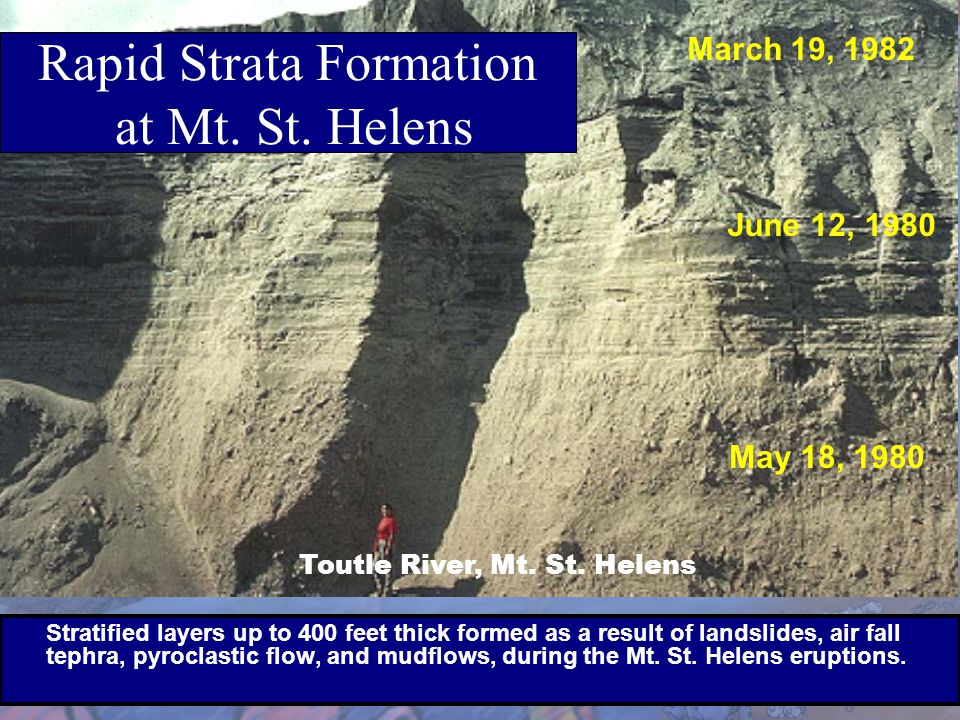
Visit the fossil museum:
www.flickr.com/photos/101536517@N06/sets/72157641367196613/
Just how good are peer reviews of scientific papers?
www.sciencemag.org/content/342/6154/60.full
www.examiner.com/article/want-to-publish-science-paper-ju...
The neo-Darwinian idea that the human genome consists entirely of an accumulation of billions of mutations is, quite obviously, completely bonkers. Nevertheless, it is compulsorily taught in schools and universities as 'science'.
國立台灣文學館 - 推理文學在臺灣特展 / 偵探總是注意時間 - 破案關鍵也許是時鐘
National Museum of Taiwanese Literature - Reasoning literature in Taiwan special exhibition / Detective always pay attention to time - Solve the key may be the clock
Museo Nacional de la literatura taiwanesa - Razonamiento de la literatura en Taiwan exposición especial / Detective siempre preste atención al tiempo - Resolver la clave puede ser el reloj
国立の台湾の文学館 - 推理の文学は台湾特に展にあります / 探偵はいつも時間に注意します - 刑事事件を解決する肝心な点は多分時計です
Nationalmuseum der taiwanesischen Literatur - Begründung Literatur in Taiwan Sonderausstellung / Detektiv immer auf die Zeit achten - Lösen Sie den Schlüssel kann die Uhr sein
Musée national de la littérature taiwanaise - Raisonnement de la littérature à Taiwan exposition spéciale / Le détective attribue toujours l'attention au temps - Résolvez la clé peut-être l'horloge
Tainan Taiwan / Tainan Taiwán / 台灣台南
管樂小集 2017/06/11 台南文化中心 Tainan Cultural Center Star Plaza performances 1080P
{ 曲名:千曲川 / 心影 / Chikuma river }
{View large size on fluidr / 觀看大圖}
{My Blog / 管樂小集精彩演出-觸動你的心}
{My Blog / Great Music The splendid performance touches your heart}
{My Blog / 管楽小集すばらしい公演-はあなたの心を心を打ちます}
{Mi blog / La gran música el funcionamiento espléndido toca su corazón}
{Mein Blog / Große Musik die herrliche Leistung berührt Ihr Herz}
{Mon blog / La grande musique l'exécution splendide touche votre coeur}
Melody 曲:JAPAN / Words 詞:Sheesen / Singing : Sheesen
{ 夢旅人 1990 Dream Traveler 1990 }
家住安南鹽溪邊
The family lives in nearby the Annan salt river
隔壁就是聽雨軒
The next door listens to the rain porch
一旦落日照大員
The sunset Shineing to the Taiwan at once
左岸青龍飛九天
The left bank white dragon flying in the sky
Photo of strata formation in soft sand on a beach, created by tidal action of the sea.
Stratified, soft sand deposit. demonstrates the rapid stratification principle.
This close up photo shows the detail, see distance photo for the context here: www.flickr.com/photos/truth-in-science/31322567145
Rapidly deposited, sandbank with geological features of sedimentary rock, i.e. strata, folded strata and faulting. Formed in a single, tidal event of turbulent, high tide with gale force winds.
Rapid stratification. Field evidence.
Location: Sandown beach, Isle of Wight. Formed on 17/11/2016, Overall depth of deposit: approx 20 inches.
This field evidence demonstrates that multiple strata in sedimentary deposits do not need millions of years to form and can be formed rapidly. This natural example confirms the principle demonstrated by the sedimentation experiments carried out by Dr Guy Berthault and other sedimentologists. It calls into question the standard, multi-million year dating of sedimentary rocks, and the dating of fossils by depth of burial or position in the strata.
Strata lines/layers are clearly visible in this photo.
Dr Berthault's experiments (sedimentology.fr/) and other experiments (ianjuby.org/sedimentation/) and field studies of floods and volcanic action show that, rather than being formed by gradual, slow deposition of sediment, with the strata or layers representing a timescale or even a particular, environmental epoch, particle segregation in moving water or airborne particles can form strata or layers very quickly. Such field studies and the experiments show that there is no longer any reason to conclude that strata in sedimentary rocks relate to different geological eras and/or a multi-million year timescale. www.youtube.com/watch?v=5PVnBaqqQw8&feature=share&.... It also shows that the relative position of fossils in rocks is not indicative of an order of evolutionary succession. Obviously, the uniformitarian principle, on which the geologic column is based, can no longer be considered valid. And the multi-million, year dating of sedimentary rocks and fossils needs to be reassessed. Rapid deposition of stratified sediments also explains the enigma of polystrate fossils, i.e. large fossils that intersect several strata. In some cases, tree trunk fossils are found which intersect the strata of sedimentary rock up to forty feet in depth. upload.wikimedia.org/wikipedia/commons/thumb/0/08/Lycopsi... They must have been buried in stratified sediment in a short time (certainly not millions or even thousands of years), or they would have rotted away. youtu.be/vnzHU9VsliQ
See set of photos of another example of rapid stratification: www.flickr.com/photos/101536517@N06/sets/72157635944904973/
Carbon dating of coal should not be possible if it is millions of years old, yet significant amounts of Carbon 14 have been detected in coal and other fossil material, which indicates that it is less than 50,000 years old. www.ldolphin.org/sewell/c14dating.html
www.grisda.org/origins/51006.htm
Evolutionists confidently cite multi-million year ages for rocks and fossils, but what most people don't realise is that no one actually knows the age of sedimentary rocks or the fossils found within them. So how are evolutionists so sure of the ages they so confidently quote? The astonishing thing is they aren't. Sedimentary rocks cannot be dated by radiometric methods, and fossils can only be dated to less than 50,000 years with Carbon 14 dating. The method evolutionists use is based entirely on assumptions. Unbelievably, fossils are dated by the assumed age of rocks, and rocks are dated by the assumed age of fossils, that's right ... it is known as circular reasoning.
www.nhm.ac.uk/nature-online/science-of-natural-history/th...
Visit the fossil museum:
www.flickr.com/photos/101536517@N06/sets/72157641367196613/
Just how good are peer reviews of scientific papers?
www.sciencemag.org/content/342/6154/60.full
www.examiner.com/article/want-to-publish-science-paper-ju...
...what ELSE would explain why I find myself wrapped like this?! Repeatedly. Like - almost every day in the winter around the house. And not feeling in the least odd. :) GOT to be a memory from another time & place....! :)
國立台灣文學館 - 推理文學在臺灣特展 / 眼前不一定是真相 - 關鍵的鑰匙開啓大門
National Museum of Taiwanese Literature - Reasoning literature in Taiwan special exhibition / The front is not necessarily the truth - The key to open the door
Museo Nacional de la literatura taiwanesa - Razonamiento de la literatura en Taiwan exposición especial / El frente no es necesariamente la verdad - La llave para abrir la puerta
国立の台湾の文学館 - 推理の文学は台湾特に展にあります / 目の前に真相ですとは限りません - 肝心な鍵は表門を開きます
Nationalmuseum der taiwanesischen Literatur - Begründung Literatur in Taiwan Sonderausstellung / Die Front ist nicht unbedingt die Wahrheit - der Schlüssel, um die Tür zu öffnen
Musée national de la littérature taiwanaise - Raisonnement de la littérature à Taiwan exposition spéciale / Le front n'est pas nécessairement la vérité - La clé pour ouvrir la porte
Tainan Taiwan / Tainan Taiwán / 台灣台南
管樂小集 2017/03/25 台南孔子廟 Confucian temple Tainan performances 1080P
{ 北囯の春 / 榕樹下 The spring of the north }
{View large size on fluidr / 觀看大圖}
{My Blog / 管樂小集精彩演出-觸動你的心}
{My Blog / Great Music The splendid performance touches your heart}
{My Blog / 管楽小集すばらしい公演-はあなたの心を心を打ちます}
{Mi blog / La gran música el funcionamiento espléndido toca su corazón}
{Mein Blog / Große Musik die herrliche Leistung berührt Ihr Herz}
{Mon blog / La grande musique l'exécution splendide touche votre coeur}
Melody 曲:JAPAN / Words 詞:Sheesen / Singing : Sheesen
{ 夢旅人 1990 Dream Traveler 1990 }
家住安南鹽溪邊
The family lives in nearby the Annan salt river
隔壁就是聽雨軒
The next door listens to the rain porch
一旦落日照大員
The sunset Shineing to the Taiwan at once
左岸青龍飛九天
The left bank white dragon flying in the sky
YOKOSUKA, Japan - (June 7, 2016) CommanderSeventh Fleet, Vice Adm. Joseph Aucoin and Commander Naval Forces Japan, Rear Adm. Matthew Carter hold an all hands call for all khaki leaders (E-7 and above) on board Fleet Activities Yokosuka, Japan, June 7. The two admirals explained to the assembled leaders the reasoning behind a temporary liberty curtailment and alcohol restriction in Japan and challenged the khakis to take ownership in the recent spike in alcohol related incidents. Both leaders plan on conducting similar discussions throughout Japan. (U.S. Navy photo by ABH2 Vincent Arnuco/RELEASED)
Three Short Teachings
By Dilgo Khyentse Rinpoche:
Thoughts and the Mind
Like waves, all the activities of this life have rolled endlessly on, one after the other, yet they have left us feeling empty-handed. Myriads of thoughts have run through our mind, each one giving birth to many more, but what they have done is to increase our confusion and dissatisfaction.
When we closely examine the ordinary habits that underlie whatever we do and try to discover where they come from, we find that their very source is our failure to investigate them properly. We operate under the deluded assumption that everything has some sort of true, substantial reality. But when we look more carefully, we find that the phenomenal world is like a rainbow—vivid and colourful, but without any tangible existence.
When a rainbow appears in the sky we see many beautiful colours—yet a rainbow is not something we can clothe ourselves with, or wear as an ornament. There is nothing we can take hold of; it is simply something that appears to us through the conjunction of various conditions. Thoughts arise in the mind in just the same way. They have no tangible reality or intrinsic existence at all. There is therefore no logical reason why thoughts should have so much power over us, nor any reason why we should be enslaved by them.
Mind is what creates both samsara and nirvana. Yet there is nothing much to it—it is just thoughts. Once we recognize that thoughts are empty, the mind will no longer have the power to deceive us. But as long as we take our deluded thoughts as real, they will continue to torment us mercilessly, as they have been doing throughout countless past lives. To gain control over the mind, we need to be aware of what to do and what to avoid, and we also need to be alert and vigilant, constantly examining all our thoughts, words and actions.
To cut through the mind’s clinging, it is important to understand that all appearances are void, like the appearance of water in a mirage. Beautiful forms are of no benefit to the mind, nor can ugly forms harm it in any way. Sever the ties of hope and fear, attraction and repulsion, and remain in equanimity in the understanding that all phenomena are nothing more than projections of your own mind.
Once you have realized absolute truth, then you will see the whole, infinite display of relative phenomena that appears within it as no more than an illusion or a dream. To realize that appearance and voidness are one is what is called simplicity, or freedom from conceptual limitations.
Self and others
As you wish to be happy, so you should wish others to be happy too. As you wish to be free from suffering, so you should wish that all beings may also be free from suffering. You should think, “May all living creatures find happiness and the cause of happiness. May they be free from suffering and the cause of suffering. May they always have perfect happiness free from suffering. May they live in equanimity, without attachment or hatred but with love towards all without any discrimination.”
To feel overflowing love and almost unbearable compassion for all living creatures is the best way to fulfil the wishes of all the Buddhas and Bodhisattvas. Even if for the moment you cannot actually help anyone in an external way, meditate on love and compassion constantly over the months and years until compassion is knit inseparably into the very fabric of your mind.
As you try to practise and progress on the path, it is essential to remember that your efforts are for the sake of others. Be humble and remember that all your exertions are child’s play compared to the vast and infinite activity of the Bodhisattvas. Like parents providing for the children they love so much, never think that you have done too much for others—or even enough. Even if you finally manage to establish all living creatures in perfect Buddhahood, simply think that all your wishes have been fulfilled. There must never be so much as a trace of hope for any benefit for oneself in return.
The essence of the Bodhisattva practice is to go beyond self-clinging and dedicate yourself to serving others. The Bodhisattva’s activity hinges on the mind, not on how your actions might appear externally. True generosity is the absence of clinging, ultimate discipline is the absence of desire, and authentic patience is the absence of hatred. Bodhisattvas are able to give away their kingdom, their body, their dearest possessions, because they have completely overcome any inner impoverishment and are unconditionally ready to fulfil the needs of others.
Practice
The teachings we need most are those that will actually strengthen and inspire our practice. It is all very well to receive teachings as high as the sky, but the sky is not that easy to grasp. Start with practices which you can truly assimilate—developing determination to be free of ordinary concerns, nurturing love and compassion—and as you gain stability in your practice you will eventually be able to master all the higher teachings.
The only way to achieve liberation from samsara and attain the omniscience of enlightenment is to rely on an authentic spiritual teacher. An authentic spiritual teacher is like the sail that enables a boat to cross the ocean swiftly.
The sun and moon are reflected in clear, still water instantly. Similarly, the blessings of the Three Jewels are always present for those who have complete confidence in them. The sun’s rays fall everywhere uniformly, but only where they are focused through a magnifying glass can they set dry grass on fire. When the all-pervading rays of the Buddhas’ compassion are focused through the magnifying glass of your faith and devotion, the flame of blessings blazes up in your being.
Obstacles can arise from good as well as bad circumstances, but they should never deter or overpower you. Be like the earth, which supports all living creatures indiscriminately, without distinguishing good from bad. The earth is simply there. Your practice should be strengthened by the difficult situations you encounter, just as a bonfire in a strong wind is not blown out, but blazes even brighter.
When someone harms you, see him as a kind teacher who is showing you the path to liberation and merits your respect. Pray that you may be able to help him as much as you can, and whatever happens, never hope for an opportunity for vengeance. It is particularly admirable to bear patiently the harm and scorn of people who have less education, strength or skill than you.
Look right into it, and you will see that the person who is harmed, the person who does the harm, and the harm itself are all totally devoid of any inherent reality. Who, then, is going to get angry at mere delusions? Faced with these empty appearances, is there anything to be lost or gained? Is there anything to be liked or disliked? It is all like an empty sky. Recognize that!
Once you control the anger within, you will discover that there is not a single adversary left outside. But as long as you pay heed to your hatred and attempt to overcome your external opponents, even if you succeed, more will inevitably rise up in their place. Even if you managed to overpower everyone in the whole world, your anger would only grow stronger; to follow it will never make it subside. The only really intolerable enemy is hatred itself. To defeat the enemy of hatred it is necessary to meditate one-pointedly on patience and love until they truly take root in your being. Then there can be no outer adversaries.
Ask yourself how many of the billions of inhabitants of this planet have any idea of how rare it is to have been born as a human being. How many of those who understand the rarity of human birth ever think of using that chance to practise the Dharma? How many of those who think of starting to practise actually do so? How many of those who start continue to practise? How many of those who continue attain ultimate realization? Indeed, those who attain ultimate realization, compared to those who do not, are as few as the stars you can see at daybreak compared to the myriad stars you can see in the clear night sky.
As long as you, like most people, fail to recognize the true value of human existence you will just fritter your life away in futile activity and distraction. When life comes all too soon to its inevitable end, you will not have achieved anything worthwhile at all. But once you really see the unique opportunity that human life can bring, you will definitely direct all your energy into reaping its true worth by putting the Dharma into practice.
If you make use of your human birth in the right way, you can achieve enlightenment in this very lifetime. All the great Siddhas of the past were born as ordinary people. But by entering the Dharma, following a realized teacher and devoting their whole lives to practising the instructions they received, they were able to manifest the enlightened activities of great Bodhisattvas.
Translated by the Padmakara Translation Group
From Dilgo Khyentse Rinpoche
Editions Padmakara
Hello,
It's been a while since I have done anything of sorts that are in Lego relation. It's not that I am not into it anymore, It's just that different priorities are in place now being a fully adult now. Which means a full time job, social life, rent, all sorts of gross things.
I'm sorry to say, those of you who are wondering what happened to the amped up series I was working on (Halo Elimination). It's had been disbanded. Reasoning is half way through filming the first season, 4 of the main character voice actors ditched. Now I'm sure a lot of you where more than happy to fill the roles, it was quite disarming for me to find out. Their characters where loosely based on them. Which would have made things awkward. With that I lost interest in the series. And I waited to regain inspiration to recreate it. Never came back... So I'm sorry to those who were looking forward to it.
Now will more Lego stuff from me ever return? Probably. Just a ways into the future when I actually have the space to do what I want to do. Which means maybe even pulling out a brickfilm or two here and there. But yes. Just not right now.
And lastly. If you guys didn't already I did start a gaming channel. My friends encouraged me to do so. I'm loving these types of videos and editing them. The support is a little lower then what I want right now but that's Okay. All my current effort is trying to make those in the best ways I can. If you guys wouldn't mind checking it out. I would very much appreciate the support.
Thanks you to everyone who supported me in the past years. I very much appreciated it!
Audrey: "Giant took me to her LYS (Local Yarn Shop - the Granny Squares in Newtown) to shop for yet more knitting wool.
Giant really does not need more yarn, she really does not need another knitting project. But there is no reasoning with her - sometimes it is best to simply humour the poor thing and hope the madness passes quickly."
Unit 2 belonging to Troop D 4 (Beaver County.) This is the Beaver Barracks last CVPI and is supposedly being retired within the next few weeks. (Since retired) In this area for PSP they cap their cars out at 140,000 miles. This unit only has 110,000 miles. I am unsure the reasoning is behind its plan of retirement, best guess is age. Very clean 2011 with the Fire Suppression System like all PSP CVPI's have installed. Very friendly Troopers @ this post.
Albert Dekker stars as Alexander Thorkel, a mad scientist who pursues a fantastic experiment deep in the Peruvian jungle. He uses radioactivity to miniaturize living things, including humans, reasoning that if people were one-tenth their normal size, there would be ten times as much food to go around. When fellow scientists penetrate his jungle retreat, the paranoid Dr. Thorkel shrinks them down to size to protect his secret, even killing one of them to demonstrate his power. Here is a link to the movie trailer:
www.youtube.com/watch?v=xlSqylxm3jo
Will Garth, the author of the novel based on the movie, is a house pseudonym. Authorship is often misattributed to Henry Kuttner because of his shorter magazine version from the film script published in “Thrilling Wonder Stories.” The actual author of the novel is likely Alexander Samalman.
The Trotwood Walmart closed its doors in October of 2007. The reasoning behind the closure was poor sales. This is one of the few Walmarts closed without a direct replacement.
A recent innovation for LOROL services is the use of platform 11 at Stratford for two departures, the 10.49 to Richmond seen here and the 12.36 to Clapham Junction, rather than from the normal dedicated platforms 1 & 2. I am not sure what the reasoning behind this is but does provide a short section of rare track for the dedicated track basher.
Unit 2 belonging to Troop D 4 (Beaver County.) This is the Beaver Barracks last CVPI and is supposedly being retired within the next few weeks. In this area for PSP they cap their cars out at 140,000 miles. This unit only has 110,000 miles. I am unsure the reasoning is behind its plan of retirement, best guess is age. Very clean 2011 with the Fire Suppression System like all PSP CVPI's have installed. Very friendly Troopers @ this post.
*69/365 Since coming home for break I've gotten into food photography and the reasoning is pretty simple. Being surrounded by good food and good people can be a great inspiration for anything creative. I saw some tomatoes my mom had out on the counter so grabbed those and decided to set up a kitchen scene. Just like any typical food shot, I used a spray bottle to get those cool looking beads of water to really make things look fresh. Processing was done in Lightroom and Photoshop.
Strobist
Canon 430EXII low camera left into umbrella at 1/64
Vivitar 285HV high camera right into umbrella at 1/16
Triggered by PW's
Explore #152, my first ever! Cheers guys!
This colt is one of a dozen horses confiscated from their owner for neglect. The sheriff's dept here has them grazing near my workplace so they can be nursed back to good health and then they will be auctioned off to (hopefully) more responsible and caring owners. The owners are facing animal cruelty and neglect charges. I cannot fathom why some people acquire an animal and then fail to care for it. But, there are those who do the same to their own children and that is beyond reasoning.
God = good vs. Devil = evil
I know, the words are not related and it's just a neat coincidence that they are so similar, with only one letter difference on each side. But this dichotomy summarises a certain world view nicely.
Many people think the difference between religious people and atheists is that the former believe in God and the latter don't. Although this is true I don't think it is the point. If the question about the existence of God were that important there would be much less conflict between the different religious groups. But there is much more disagreement between and within the religions than between believers and atheists. And whereas the former conflicts are often violent the latter is mostly just a theoretical argument. Militant Muslims, Christians, Jews and Buddhists mostly kill, torture and maim other religious people, rarely atheists. Most victims of jihad are themselves Muslims.
If there were a scientific proof of the existence of God it would not change a thing, even for atheists. It's a bit like knowing that the answer to the meaning of life is 42, it doesn't say anything. In the 1980s famous German playboy Gunter Sachs published a scientific proof that the zodiac circle has a statistically significant impact on human life. But even though I couldn't find any mistake in his methodology I didn't start reading my horoscope. It changed nothing. Kurt Gödel apparently produced a proof of the existence of God towards the end of his career but it didn't even change the mind of the few people who understood it. These proofs say nothing about God but only show the powers and limitations of scientific (Sachs) and logical (Gödel) reasoning. It's like saying "42".
Whether someone believes in God or not doesn't depend on rigorous reasoning or logical conclusions. Religious people believe in God because they were educated to do so and feel obliged. Or they feel at home in a religious community. Or they can't bear the thought of death being the end of everything. Or they find consolation in the idea of a higher being that cares for them and hears their prayers. It's not that a systematic proof of the existence of God convinced them. Likewise, when I decided to reject the beliefs of my parents and to become an atheist it was not because I read Russell or Dawkins - that came much later. It was because I felt uncomfortable with the thought of someone watching and judging me permanently and wanting to be honoured and praised all the time. It reminded me of totalitarianism.
Coming back to where I started I think the belief in a personified evil (devil) is what really sets religious people and atheists apart, much more than the belief in God (good). I don't believe in evil. Of course there are things like earthquakes, pollution and cancer - they are bad, but not the result of an intentional evil force. One may argue that IS and Al-Qaeda are evil but they are in fact pious religious people with good intentions. They are convinced they're implementing God's will. They are holier than I. They sacrifice a life of comfort for the holy war, some of them give their life away for their cause. And there are plenty of bad people out there who are not considerate and don't mind hurting others. But these are individuals, not part of a bigger evil movement. They do bad things but they don't achieve much beyond their immediate environment.
The belief in evil is the main source of superstition, racism, prejudice, hatred, violence and war. It was behind the burning of witches, the gassing of Jews and 9/11.
I find it easier to believe in good than in evil. I see many consistently and persistently good things around me: The universe, evolution, beautiful nature, good food, happiness, music, progress in the search for truth. The reason why I perceive them as good does not result from a universal definition of "good" (I don't think there is one) or from a divine arrangement. It's because my body perceives them with delight. That's a result of evolution, experience and emotions. And because all humans happen to belong to the same species of animal many people have similar feelings and there has been a lot of persistent cooperation in the creation of good things over the centuries. With setbacks and false starts, I admit, but overall not so bad.
The history of the universe, evolution, the creativity unfolding in the movements of art and advances in science and technology: These are long storylines that lead to outcomes which I perceive as good. Whereas the bad developments usually don't survive long because they become victims of their own destructive forces. Naturally, there is not much international cooperation of movements against foreigners because that would require xenophobes to work with their enemies. Bad people are bad to other people, including other bad people, so there's not much productive long-term collaboration between them.
Few people nowadays imagine God as an old man with long beard sitting on a cloud and watching what we're doing down here on earth. Even the most conservative religious people have a more abstract concept of God today. Depending to what level of abstraction you are ready to go there may be a point somewhere where a very abstract belief in God is not too different from my belief in the "good". This is why I say that the belief in a personified evil is a much more significant difference between religious people and atheists than the belief in God.
The whole story about good and evil doesn’t hold water anyway. Christians, for example, tell me that God is the force of good and the Devil is the force of evil and they are fighting each other. And on Judgement Day the good souls will join God in heaven but he will send the bad ones down to hell where the devil rules. So in that instance God and the devil cooperate, violating their own principles. God supports the evil things that are going on in hell and the devil punishes the evil souls although they have worked for his side. It doesn’t make sense.
After 2 previous trips to the area I finally made my first Burro sightings as I commuted from Ridgecrest through the Panamint Valley.These Wild Donkeys can be found throughout the Death Valley National Park however their future is uncertain with the National Park service signing a contract for all the Wild Donkeys to be round up and removed from the park with the next 5 years.Reasoning for the removal in these are a non native species to the park,There are estimated to be some 2500 Burros in the park. This young Burro stands with its mother not far out of shot on a late evening in the Panamint Valley.
Rapid strata formation in soft sand (field evidence).
Photo of strata formation in soft sand on a beach, created by tidal action of the sea.
Formed in a single, high tidal event. Stunning evidence which displays multiple strata/layers.
Why this is so important ....
It has long been assumed, ever since the 17th century, that layers/strata observed in sedimentary rocks were built up gradually, layer upon layer, over many years. It certainly seemed logical at the time, from just looking at rocks, that lower layers would always be older than the layers above them, i.e. that lower layers were always laid down first followed, in time, by successive layers on top.
This was assumed to be true and became known as the superposition principle.
It was also assumed that a layer comprising a different material from a previous layer, represented a change in environmental conditions/factors.
These changes in composition of layers or strata were considered to represent different, geological eras on a global scale, spanning millions of years. This formed the basis for the Geologic Column, which is used to date rocks and also fossils. The evolutionary, 'fossil record' was based on the vast ages and assumed geological eras of the Geologic Column.
There was also circular reasoning applied with the assumed age of 'index' fossils (based on evolutionary beliefs & preconceptions) used to date strata in the Geologic Column. Dating strata from the assumed age of (index) fossils is known as Biostratigraphy.
We now know that, although these assumptions seemed logical, they are not supported by the evidence.
At the time, the mechanics of stratification were not properly known or studied.
An additional factor was that this assumed superposition and uniformitarian model became essential, with the wide acceptance of Darwinism, for the long ages required for progressive microbes-to-human evolution. There was no incentive to question or challenge the superposition, uniformitarian model, because the presumed, fossil 'record' had become dependant on it, and any change in the accepted model would present devastating implications for Darwinism.
This had the unfortunate effect of linking the study of geology so closely to Darwinism, that any study independent of Darwinian considerations was effectively stymied. This link of geology with Darwinian preconceptions is known as biostratigraphy.
Some other field evidence can be observed here: www.flickr.com/photos/101536517@N06/sets/72157635944904973/
and also in the links to stunning, experimental evidence, carried out by sedimentologists, given later.
_______________________________________________
GEOLOGIC PRINCIPLES (established by Nicholas Steno in the 17th Century):
What Nicolas Steno believed about strata formation is the basis of the principle of Superposition and the principle of Original Horizontality.
dictionary.sensagent.com/Law_of_superposition/en-en/
“Assuming that all rocks and minerals had once been fluid, Nicolas Steno reasoned that rock strata were formed when particles in a fluid such as water fell to the bottom. This process would leave horizontal layers. Thus Steno's principle of original horizontality states that rock layers form in the horizontal position, and any deviations from this horizontal position are due to the rocks being disturbed later.”)
BEDDING PLANES.
'Bedding plane' describes the surface in between each stratum which are formed during sediment deposition.
science.jrank.org/pages/6533/Strata.html
“Strata form during sediment deposition, that is, the laying down of sediment. Meanwhile, if a change in current speed or sediment grain size occurs or perhaps the sediment supply is cut off, a bedding plane forms. Bedding planes are surfaces that separate one stratum from another. Bedding planes can also form when the upper part of a sediment layer is eroded away before the next episode of deposition. Strata separated by a bedding plane may have different grain sizes, grain compositions, or colours. Sometimes these other traits are better indicators of stratification as bedding planes may be very subtle.”
______________________________________________
Several catastrophic events, flash floods, volcanic eruptions etc. have forced Darwinian, influenced geologists to admit to rapid stratification in some instances. However they claim it is a rare phenomenon, which they have known about for many years, and which does nothing to invalidate the Geologic Column, the fossil record, evolutionary timescale, or any of the old assumptions regarding strata formation, sedimentation and the superposition principle. They fail to face up to the fact that rapid stratification is not an extraordinary phenonemon, but rather the prevailing and normal mechanism of sedimentary deposition whenever and wherever there is moving, sediment-laden water. The experimental evidence demonstrates the mechanism and a mass of field evidence in normal (non-catastrophic) conditions shows it is a normal everyday occurrence.
It is clear from the experimental evidence that the usual process of stratification is - that strata are not formed by horizontal layers being laid on top of each other in succession, as was assumed. But by sediment being sorted in the flowing water and laid down diagonally in the direction of flow. See diagram:
www.flickr.com/photos/truth-in-science/39821536092/in/dat...
The field evidence (in the image) presented here - of rapid, simultaneous stratification refutes the Superposition Principle and the Principle of Lateral Continuity.
We now know, the Superposition Principle only applies on a rare occasion where sedimentary deposits are laid down in still water.
Superposition is required for the long evolutionary timescale, but the evidence shows it is not the general rule, as was once believed. Most sediment is laid down in moving water, where particle segregation is the general rule, resulting in the simultaneous deposition of strata/layers as shown in the photo.
See many other examples of rapid stratification (with geological features): www.flickr.com/photos/101536517@N06/sets/72157635944904973/
Rapid, simultaneous formation of layers/strata, through particle segregation in moving water, is so easily created it has even been described by sedimentologists (working on flume experiments) as a law ...
"Upon filling the tank with water and pouring in sediments, we immediately saw what was to become the rule: The sediments sorted themselves out in very clear layers. This became so common that by the end of two weeks, we jokingly referred to Andrew's law as "It's difficult not to make layers," and Clark's law as "It's easy to make layers." Later on, I proposed the "law" that liquefaction destroys layers, as much to my surprise as that was." Ian Juby, www.ianjuby.org/sedimentation/
The example in the photo is the result of normal, everyday tidal action in a single incident. Where the water current or movement is more turbulent, violent, or catastrophic, great depths (many metres) of stratified sediment can be laid down in a short time. Certainly not the many millions of years assumed by evolutionists.
The composition of strata formed in any deposition event. is related to whatever materials are in the sediment mix, not to any particular timescale. Whatever is in the mix will be automatically sorted into strata/layers. It could be sand, or other material added from mud slides, erosion of chalk deposits, coastal erosion, volcanic ash etc. Any organic material (potential fossils), alive or dead, engulfed by, or swept into, a turbulent sediment mix, will also be sorted and buried within the rapidly, forming layers.
See many other examples of rapid stratification with geological features: www.flickr.com/photos/101536517@N06/sets/72157635944904973/
Stratified, soft sand deposit. demonstrates the rapid, stratification principle.
Important, field evidence which supports the work of the eminent, sedimentologist Dr Guy Berthault MIAS - Member of the International Association of Sedimentologists.
(Dr Berthault's experiments (www.sedimentology.fr/)
And also the experimental work of Dr M.E. Clark (Professor Emeritus, U of Illinois @ Urbana), Andrew Rodenbeck and Dr. Henry Voss, (www.ianjuby.org/sedimentation/)
Location: Sandown, Isle of Wight. Formed 06/06/2018, This field evidence demonstrates that multiple strata in sedimentary deposits do not need millions of years to form and can be formed rapidly. This natural example confirms the principle demonstrated by the sedimentation experiments carried out by Dr Guy Berthault and other sedimentologists. It calls into question the standard, multi-million year dating of sedimentary rocks, and the dating of fossils by depth of burial or position in the strata.
Mulltiple strata/layers are evident in this example.
Dr Berthault's experiments (www.sedimentology.fr/) and other experiments (www.ianjuby.org/sedimentation/) and field studies of floods and volcanic action show that, rather than being formed by gradual, slow deposition of sucessive layers superimposed upon previous layers, with the strata or layers representing a particular timescale, particle segregation in moving water or airborne particles can form strata or layers very quickly, frequently, in a single event.
And, most importantly, lower strata are not older than upper strata, they are the same age, having been created in the same sedimentary episode.
Such field studies confirm experiments which have shown that there is no longer any reason to conclude that strata/layers in sedimentary rocks relate to different geological eras and/or a multi-million year timescale. www.youtube.com/watch?v=5PVnBaqqQw8&feature=share&.... they also show that the relative position of fossils in rocks is not indicative of an order of evolutionary succession. Obviously, the uniformitarian principle, on which the geologic column is based, can no longer be considered valid. And the multi-million, year dating of sedimentary rocks and fossils needs to be reassessed. Rapid deposition of stratified sediments also explains the enigma of polystrate fossils, i.e. large fossils that intersect several strata. In some cases, tree trunk fossils are found which intersect the strata of sedimentary rock up to forty feet in depth. upload.wikimedia.org/wikipedia/commons/thumb/0/08/Lycopsi... They must have been buried in stratified sediment in a short time (certainly not millions, thousands, or even hundreds of years), or they would have rotted away. youtu.be/vnzHU9VsliQ
In fact, the vast majority of fossils are found in good, intact condition, which is testament to their rapid burial. You don't get good fossils from gradual burial, because they would be damaged or destroyed by decay, predation or erosion. The existence of so many fossils in sedimentary rock on a global scale is stunning evidence for the rapid depostion of sedimentary rock as the general rule. It is obvious that all rock containing good intact fossils was formed from sediment laid down in a very short time, not millions, or even thousands of years.
See set of photos of other examples of rapid stratification: www.flickr.com/photos/101536517@N06/sets/72157635944904973/
Carbon dating of coal should not be possible if it is millions of years old, yet significant amounts of Carbon 14 have been detected in coal and other fossil material, which indicates that it is less than 50,000 years old. www.ldolphin.org/sewell/c14dating.html
www.grisda.org/origins/51006.htm
Evolutionists confidently cite multi-million year ages for rocks and fossils, but what most people don't realise is that no one actually knows the age of sedimentary rocks or the fossils found within them. So how are evolutionists so sure of the ages they so confidently quote? The astonishing thing is they aren't. Sedimentary rocks cannot be dated by radiometric methods*, and fossils can only be dated to less than 50,000 years with Carbon 14 dating. The method evolutionists use is based entirely on assumptions. Unbelievably, fossils are dated by the assumed age of rocks, and rocks are dated by the assumed age of fossils, that's right ... it is known as circular reasoning.
* Regarding the radiometric dating of igneous rocks, which is claimed to be relevant to the dating of sedimentary rocks, in an occasional instance there is an igneous intrusion associated with a sedimentary deposit -
Prof. Aubouin says in his Précis de Géologie: "Each radioactive element disintegrates in a characteristic and constant manner, which depends neither on the physical state (no variation with pressure or temperature or any other external constraint) nor on the chemical state (identical for an oxide or a phosphate)."
"Rocks form when magma crystallizes. Crystallisation depends on pressure and temperature, from which radioactivity is independent. So, there is no relationship between radioactivity and crystallisation.
Consequently, radioactivity doesn't date the formation of rocks. Moreover, daughter elements contained in rocks result mainly from radioactivity in magma where gravity separates the heavier parent element, from the lighter daughter element. Thus radiometric dating has no chronological signification." Dr. Guy Berthault www.sciencevsevolution.org/Berthault.htm
Visit the fossil museum:
www.flickr.com/photos/101536517@N06/sets/72157641367196613/
Just how good are peer reviews of scientific papers?
www.sciencemag.org/content/342/6154/60.full
www.examiner.com/article/want-to-publish-science-paper-ju...
The neo-Darwinian idea that the human genome consists entirely of an accumulation of billions of mutations is, quite obviously, completely bonkers. Nevertheless, it is compulsorily taught in schools and universities as 'science'.
Australia.
Bolwell produced sports cars in Australia from 1962-79.
The first production vehicle was the 1962-64 Mk.IV. Campbell Bolwell’s reasoning was that no-one would want to buy the first guinea pig model from any manufacturer. So the Mk.IV was the first.
1964-66 Mk V had an E type Jag look, Holdens 6 cyl, 75 made.
1968 Mk VI, (SR6) one off mid-engined racing car.
1967-72 Mk VII; fastback, four fender vents, Holden 6 cyl. 400 made
1970-74 Mk VIII Bolwell Nagari, the first with a name; 'Nagari' and was a fully built production car and favoured Ford parts, including their V8 engines. Previous models were kit cars and used Holden parts. The Nagari had a one piece fibreglass body, six fender vents. A convertible available from 1972. Early cars were Ford Windsor V8 powered with Cortina parkers, later cars Ford Cleveland V8 powered and MG parkers (this car). 100 coupes and 18 convertibles produced
Rapid strata formation in soft sand (field evidence).
Photo of strata formation in soft sand on a beach, created by tidal action of the sea.
Formed in a single, high tidal event. Stunning evidence which displays multiple strata/layers.
Why this is so important ....
It has long been assumed, ever since the 17th century, that layers/strata observed in sedimentary rocks were built up gradually, layer upon layer, over many years. It certainly seemed logical at the time, from just looking at rocks, that lower layers would always be older than the layers above them, i.e. that lower layers were always laid down first followed, in time, by successive layers on top.
This was assumed to be true and became known as the superposition principle.
It was also assumed that a layer comprising a different material from a previous layer, represented a change in environmental conditions/factors.
These changes in composition of layers or strata were considered to represent different, geological eras on a global scale, spanning millions of years. This formed the basis for the Geologic Column, which is used to date rocks and also fossils. The evolutionary, 'fossil record' was based on the vast ages and assumed geological eras of the Geologic Column.
There was also circular reasoning applied with the assumed age of 'index' fossils (based on evolutionary beliefs & preconceptions) used to date strata in the Geologic Column. Dating strata from the assumed age of (index) fossils is known as Biostratigraphy.
We now know that, although these assumptions seemed logical, they are not supported by the evidence.
At the time, the mechanics of stratification were not properly known or studied.
An additional factor was that this assumed superposition and uniformitarian model became essential, with the wide acceptance of Darwinism, for the long ages required for progressive microbes-to-human evolution. There was no incentive to question or challenge the superposition, uniformitarian model, because the presumed, fossil 'record' had become dependant on it, and any change in the accepted model would present devastating implications for Darwinism.
This had the unfortunate effect of linking the study of geology so closely to Darwinism, that any study independent of Darwinian considerations was effectively stymied. This link of geology with Darwinian preconceptions is known as biostratigraphy.
Some other field evidence, in various situations, can be observed here: www.flickr.com/photos/101536517@N06/sets/72157635944904973/
and also in the links to stunning, experimental evidence, carried out by sedimentologists, given later.
_______________________________________________
GEOLOGIC PRINCIPLES (established by Nicholas Steno in the 17th Century):
What Nicolas Steno believed about strata formation is the basis of the principle of Superposition and the principle of Original Horizontality.
dictionary.sensagent.com/Law_of_superposition/en-en/
“Assuming that all rocks and minerals had once been fluid, Nicolas Steno reasoned that rock strata were formed when particles in a fluid such as water fell to the bottom. This process would leave horizontal layers. Thus Steno's principle of original horizontality states that rock layers form in the horizontal position, and any deviations from this horizontal position are due to the rocks being disturbed later.”)
BEDDING PLANES.
'Bedding plane' describes the surface in between each stratum which are formed during sediment deposition.
science.jrank.org/pages/6533/Strata.html
“Strata form during sediment deposition, that is, the laying down of sediment. Meanwhile, if a change in current speed or sediment grain size occurs or perhaps the sediment supply is cut off, a bedding plane forms. Bedding planes are surfaces that separate one stratum from another. Bedding planes can also form when the upper part of a sediment layer is eroded away before the next episode of deposition. Strata separated by a bedding plane may have different grain sizes, grain compositions, or colours. Sometimes these other traits are better indicators of stratification as bedding planes may be very subtle.”
______________________________________________
Several catastrophic events, flash floods, volcanic eruptions etc. have forced Darwinian, influenced geologists to admit to rapid stratification in some instances. However they claim it is a rare phenomenon, which they have known about for many years, and which does nothing to invalidate the Geologic Column, the fossil record, evolutionary timescale, or any of the old assumptions regarding strata formation, sedimentation and the superposition principle. They fail to face up to the fact that rapid stratification is not an extraordinary phenonemon, but rather the prevailing and normal mechanism of sedimentary deposition whenever and wherever there is moving, sediment-laden water. The experimental evidence demonstrates the mechanism and a mass of field evidence in normal (non-catastrophic) conditions shows it is a normal everyday occurrence.
It is clear from the experimental evidence that the usual process of stratification is - that strata are not formed by horizontal layers being laid on top of each other in succession, as was assumed. But by sediment being sorted in the flowing water and laid down diagonally in the direction of flow. See diagram:
www.flickr.com/photos/truth-in-science/39821536092/in/dat...
The field evidence (in the image) presented here - of rapid, simultaneous stratification refutes the Superposition Principle and the Principle of Lateral Continuity.
We now know, the Superposition Principle only applies on a rare occasion where sedimentary deposits are laid down in still water.
Superposition is required for the long evolutionary timescale, but the evidence shows it is not the general rule, as was once believed. Most sediment is laid down in moving water, where particle segregation is the general rule, resulting in the simultaneous deposition of strata/layers as shown in the photo.
See many other examples of rapid stratification (with geological features): www.flickr.com/photos/101536517@N06/sets/72157635944904973/
Rapid, simultaneous formation of layers/strata, through particle segregation in moving water, is so easily created it has even been described by sedimentologists (working on flume experiments) as a law ...
"Upon filling the tank with water and pouring in sediments, we immediately saw what was to become the rule: The sediments sorted themselves out in very clear layers. This became so common that by the end of two weeks, we jokingly referred to Andrew's law as "It's difficult not to make layers," and Clark's law as "It's easy to make layers." Later on, I proposed the "law" that liquefaction destroys layers, as much to my surprise as that was." Ian Juby, www.ianjuby.org/sedimentation/
The example in the photo is the result of normal, everyday tidal action formed in a single incident. Where the water current or movement is more turbulent, violent, or catastrophic, great depths (many metres) of stratified sediment can be laid down in a short time. Certainly not the many millions of years assumed by evolutionists.
The composition of strata formed in any deposition event. is related to whatever materials are in the sediment mix, not to any particular timescale. Whatever is in the mix will be automatically sorted into strata/layers. It could be sand, or other material added from mud slides, erosion of chalk deposits, coastal erosion, volcanic ash etc. Any organic material (potential fossils), alive or dead, engulfed by, or swept into, a turbulent sediment mix, will also be sorted and buried within the rapidly, forming layers.
See many other examples of rapid stratification with geological features: www.flickr.com/photos/101536517@N06/sets/72157635944904973/
Stratified, soft sand deposit. demonstrates the rapid, stratification principle.
Important, field evidence which supports the work of the eminent, sedimentologist Dr Guy Berthault MIAS - Member of the International Association of Sedimentologists.
(Dr Berthault's experiments (www.sedimentology.fr/)
And also the experimental work of Dr M.E. Clark (Professor Emeritus, U of Illinois @ Urbana), Andrew Rodenbeck and Dr. Henry Voss, (www.ianjuby.org/sedimentation/)
Location: Yaverland, Isle of Wight. Photographed: 14/03/2019
This field evidence demonstrates that multiple strata in sedimentary deposits do not need millions of years to form and can be formed rapidly. This natural example confirms the principle demonstrated by the sedimentation experiments carried out by Dr Guy Berthault and other sedimentologists. It calls into question the standard, multi-million year dating of sedimentary rocks, and the dating of fossils by depth of burial or position in the strata.
Mulltiple strata/layers are evident in this example.
Dr Berthault's experiments (www.sedimentology.fr/) and other experiments (www.ianjuby.org/sedimentation/) and field studies of floods and volcanic action show that, rather than being formed by gradual, slow deposition of sucessive layers superimposed upon previous layers, with the strata or layers representing a particular timescale, particle segregation in moving water or airborne particles can form strata or layers very quickly, frequently, in a single event.
And, most importantly, lower strata are not older than upper strata, they are the same age, having been created in the same sedimentary episode.
Such field studies confirm experiments which have shown that there is no longer any reason to conclude that strata/layers in sedimentary rocks relate to different geological eras and/or a multi-million year timescale. www.youtube.com/watch?v=5PVnBaqqQw8&feature=share&.... they also show that the relative position of fossils in rocks is not indicative of an order of evolutionary succession. Obviously, the uniformitarian principle, on which the geologic column is based, can no longer be considered valid. And the multi-million, year dating of sedimentary rocks and fossils needs to be reassessed. Rapid deposition of stratified sediments also explains the enigma of polystrate fossils, i.e. large fossils that intersect several strata. In some cases, tree trunk fossils are found which intersect the strata of sedimentary rock up to forty feet in depth. upload.wikimedia.org/wikipedia/commons/thumb/0/08/Lycopsi... They must have been buried in stratified sediment in a short time (certainly not millions, thousands, or even hundreds of years), or they would have rotted away. youtu.be/vnzHU9VsliQ
In fact, the vast majority of fossils are found in good, intact condition, which is testament to their rapid burial. You don't get good fossils from gradual burial, because they would be damaged or destroyed by decay, predation or erosion. The existence of so many fossils in sedimentary rock on a global scale is stunning evidence for the rapid depostion of sedimentary rock as the general rule. It is obvious that all rock containing good intact fossils was formed from sediment laid down in a very short time, not millions, or even thousands of years.
See set of photos of other examples of rapid stratification: www.flickr.com/photos/101536517@N06/sets/72157635944904973/
Carbon dating of coal should not be possible if it is millions of years old, yet significant amounts of Carbon 14 have been detected in coal and other fossil material, which indicates that it is less than 50,000 years old. www.ldolphin.org/sewell/c14dating.html
www.grisda.org/origins/51006.htm
Evolutionists confidently cite multi-million year ages for rocks and fossils, but what most people don't realise is that no one actually knows the age of sedimentary rocks or the fossils found within them. So how are evolutionists so sure of the ages they so confidently quote? The astonishing thing is they aren't. Sedimentary rocks cannot be dated by radiometric methods*, and fossils can only be dated to less than 50,000 years with Carbon 14 dating. The method evolutionists use is based entirely on assumptions. Unbelievably, fossils are dated by the assumed age of rocks, and rocks are dated by the assumed age of fossils, that's right ... it is known as circular reasoning.
* Regarding the radiometric dating of igneous rocks, which is claimed to be relevant to the dating of sedimentary rocks, in an occasional instance there is an igneous intrusion associated with a sedimentary deposit -
Prof. Aubouin says in his Précis de Géologie: "Each radioactive element disintegrates in a characteristic and constant manner, which depends neither on the physical state (no variation with pressure or temperature or any other external constraint) nor on the chemical state (identical for an oxide or a phosphate)."
"Rocks form when magma crystallizes. Crystallisation depends on pressure and temperature, from which radioactivity is independent. So, there is no relationship between radioactivity and crystallisation.
Consequently, radioactivity doesn't date the formation of rocks. Moreover, daughter elements contained in rocks result mainly from radioactivity in magma where gravity separates the heavier parent element, from the lighter daughter element. Thus radiometric dating has no chronological signification." Dr. Guy Berthault www.sciencevsevolution.org/Berthault.htm
Rapid strata formation and rapid erosion at Mount St Helens.
slideplayer.com/slide/5703217/18/images/28/Rapid+Strata+F...

Visit the fossil museum:
www.flickr.com/photos/101536517@N06/sets/72157641367196613/
Just how good are peer reviews of scientific papers?
www.sciencemag.org/content/342/6154/60.full
www.examiner.com/article/want-to-publish-science-paper-ju...
The neo-Darwinian idea that the human genome consists entirely of an accumulation of billions of mutations is, quite obviously, completely bonkers. Nevertheless, it is compulsorily taught in schools and universities as 'science'.
www.flickr.com/photos/truth-in-science/35505679183
Dr James Tour - 'The Origin of Life' - Abiogenesis decisively refuted.
For Dave C. and other Flickr friends too,, there is a lot of *soul* to this one. First, my father was a most mercurial man. In this telegram he seems sweet as pie. Within a year, he would tell me not to ever darken his door again. There was no reasoning with him. It was his way or the highway. A few years later, my mother (who was also hard sometimes) would talk him into having a relationship with me and my children again. He would seem to reconcile, only to have old anger simmering and then disown me again for some new offense that he imagined I had done. He could be so loving, and then such a tyrant. A therapist asked me one time, if my father had disowned me once, then how could that be that there were two more times, years apart? Wasn't disowning pretty final? I replied that each time, I hurt as if it were going to be forever, and she would just have to have known my father. He would act as if we had reconciled, but then get in little jabs during innocent conversations, until the next time. At least, this telegram was really sweet, and also, toward his 81st year, I spent some rewarding and loving time with him , and he and I both kept the topics to nothing but pleasant. My parents lived in Texas at the time, and I lived in Oregon. I knew when I drove back home that I would probably not see him again, and I was right.
Second, after carefully moving many, many times in my life, with an abundance of family cards and this telegram, and many photos (I was am still am sort of the family archivist), I decided to give my daughter, when she turned 40, some/most of her baby cards and much of her artwork she drew from kindergarten to roughly 2nd grade. Before I gave her the originals, I photographed many of them. I also gave her, her own originals, plus some I enhanced because of some age spots or minor wear and tear. I gave her a choice of her actual work or my fix-ups, and sometimes she chose both. Meanwhile, though I had kept them pretty safe for 40 years, she had them only about 4 years and her home (and my granddaughter's home also) burned to the ground, along with much of the landscaping and woods, and vehicles and storage sheds. That was the Holiday Farm/McKenzie Fire from September 7/8 of this year (2020). Approximately 700 family type homes were lost, and about 300 businesses. I believe that the wildfire is mostly contained now, but there are still some areas/spots that are smoldering. It has been over 2 months now, and not as much in the news.
Per chance she had them in off-site storage, and they are still safe, but I don't think so.
(DSCN0472TelegramfromDadwhenJenniferborn)
Rapid strata formation in soft sand (field evidence).
Photo of strata formation in soft sand on a beach, created by tidal action of the sea.
Formed in a single, high tidal event. Stunning evidence which displays multiple strata/layers.
Why this is so important ....
It has long been assumed, ever since the 17th century, that layers/strata observed in sedimentary rocks were built up gradually, layer upon layer, over many years. It certainly seemed logical at the time, from just looking at rocks, that lower layers would always be older than the layers above them, i.e. that lower layers were always laid down first followed, in time, by successive layers on top.
This was assumed to be true and became known as the superposition principle.
It was also assumed that a layer comprising a different material from a previous layer, represented a change in environmental conditions/factors.
These changes in composition of layers or strata were considered to represent different, geological eras on a global scale, spanning millions of years. This formed the basis for the Geologic Column, which is used to date rocks and also fossils. The evolutionary, 'fossil record' was based on the vast ages and assumed geological eras of the Geologic Column.
There was also circular reasoning applied with the assumed age of 'index' fossils (based on evolutionary beliefs & preconceptions) used to date strata in the Geologic Column. Dating strata from the assumed age of (index) fossils is known as Biostratigraphy.
We now know that, although these assumptions seemed logical, they are not supported by the evidence.
At the time, the mechanics of stratification were not properly known or studied.
An additional factor was that this assumed superposition and uniformitarian model became essential, with the wide acceptance of Darwinism, for the long ages required for progressive microbes-to-human evolution. There was no incentive to question or challenge the superposition, uniformitarian model, because the presumed, fossil 'record' had become dependant on it, and any change in the accepted model would present devastating implications for Darwinism.
This had the unfortunate effect of linking the study of geology so closely to Darwinism, that any study independent of Darwinian considerations was effectively stymied. This link of geology with Darwinian preconceptions is known as biostratigraphy.
Some other field evidence can be observed here: www.flickr.com/photos/101536517@N06/sets/72157635944904973/
and also in the links to stunning, experimental evidence, carried out by sedimentologists, given later.
_______________________________________________
GEOLOGIC PRINCIPLES (established by Nicholas Steno in the 17th Century):
What Nicolas Steno believed about strata formation is the basis of the principle of Superposition and the principle of Original Horizontality.
dictionary.sensagent.com/Law_of_superposition/en-en/
“Assuming that all rocks and minerals had once been fluid, Nicolas Steno reasoned that rock strata were formed when particles in a fluid such as water fell to the bottom. This process would leave horizontal layers. Thus Steno's principle of original horizontality states that rock layers form in the horizontal position, and any deviations from this horizontal position are due to the rocks being disturbed later.”)
BEDDING PLANES.
'Bedding plane' describes the surface in between each stratum which are formed during sediment deposition.
science.jrank.org/pages/6533/Strata.html
“Strata form during sediment deposition, that is, the laying down of sediment. Meanwhile, if a change in current speed or sediment grain size occurs or perhaps the sediment supply is cut off, a bedding plane forms. Bedding planes are surfaces that separate one stratum from another. Bedding planes can also form when the upper part of a sediment layer is eroded away before the next episode of deposition. Strata separated by a bedding plane may have different grain sizes, grain compositions, or colours. Sometimes these other traits are better indicators of stratification as bedding planes may be very subtle.”
______________________________________________
Several catastrophic events, flash floods, volcanic eruptions etc. have forced Darwinian, influenced geologists to admit to rapid stratification in some instances. However they claim it is a rare phenomenon, which they have known about for many years, and which does nothing to invalidate the Geologic Column, the fossil record, evolutionary timescale, or any of the old assumptions regarding strata formation, sedimentation and the superposition principle. They fail to face up to the fact that rapid stratification is not an extraordinary phenonemon, but rather the prevailing and normal mechanism of sedimentary deposition whenever and wherever there is moving, sediment-laden water. The experimental evidence demonstrates the mechanism and a mass of field evidence in normal (non-catastrophic) conditions shows it is a normal everyday occurrence.
It is clear from the experimental evidence that the usual process of stratification is - that strata are not formed by horizontal layers being laid on top of each other in succession, as was assumed. But by sediment being sorted in the flowing water and laid down diagonally in the direction of flow. See diagram:
www.flickr.com/photos/truth-in-science/39821536092/in/dat...
The field evidence (in the image) presented here - of rapid, simultaneous stratification refutes the Superposition Principle and the Principle of Lateral Continuity.
We now know, the Superposition Principle only applies on a rare occasion where sedimentary deposits are laid down in still water.
Superposition is required for the long evolutionary timescale, but the evidence shows it is not the general rule, as was once believed. Most sediment is laid down in moving water, where particle segregation is the general rule, resulting in the simultaneous deposition of strata/layers as shown in the photo.
See many other examples of rapid stratification (with geological features): www.flickr.com/photos/101536517@N06/sets/72157635944904973/
Rapid, simultaneous formation of layers/strata, through particle segregation in moving water, is so easily created it has even been described by sedimentologists (working on flume experiments) as a law ...
"Upon filling the tank with water and pouring in sediments, we immediately saw what was to become the rule: The sediments sorted themselves out in very clear layers. This became so common that by the end of two weeks, we jokingly referred to Andrew's law as "It's difficult not to make layers," and Clark's law as "It's easy to make layers." Later on, I proposed the "law" that liquefaction destroys layers, as much to my surprise as that was." Ian Juby, www.ianjuby.org/sedimentation/
The example in the photo is the result of normal, everyday tidal action in a single incident. Where the water current or movement is more turbulent, violent, or catastrophic, great depths (many metres) of stratified sediment can be laid down in a short time. Certainly not the many millions of years assumed by evolutionists.
The composition of strata formed in any deposition event. is related to whatever materials are in the sediment mix, not to any particular timescale. Whatever is in the mix will be automatically sorted into strata/layers. It could be sand, or other material added from mud slides, erosion of chalk deposits, coastal erosion, volcanic ash etc. Any organic material (potential fossils), alive or dead, engulfed by, or swept into, a turbulent sediment mix, will also be sorted and buried within the rapidly, forming layers.
See many other examples of rapid stratification with geological features: www.flickr.com/photos/101536517@N06/sets/72157635944904973/
Stratified, soft sand deposit. demonstrates the rapid, stratification principle.
Important, field evidence which supports the work of the eminent, sedimentologist Dr Guy Berthault MIAS - Member of the International Association of Sedimentologists.
(Dr Berthault's experiments (www.sedimentology.fr/)
And also the experimental work of Dr M.E. Clark (Professor Emeritus, U of Illinois @ Urbana), Andrew Rodenbeck and Dr. Henry Voss, (www.ianjuby.org/sedimentation/)
Location: Sandown, Isle of Wight. Formed 18/02/2018, This field evidence demonstrates that multiple strata in sedimentary deposits do not need millions of years to form and can be formed rapidly. This natural example confirms the principle demonstrated by the sedimentation experiments carried out by Dr Guy Berthault and other sedimentologists. It calls into question the standard, multi-million year dating of sedimentary rocks, and the dating of fossils by depth of burial or position in the strata.
Mulltiple strata/layers are evident in this example.
Dr Berthault's experiments (www.sedimentology.fr/) and other experiments (www.ianjuby.org/sedimentation/) and field studies of floods and volcanic action show that, rather than being formed by gradual, slow deposition of sucessive layers superimposed upon previous layers, with the strata or layers representing a particular timescale, particle segregation in moving water or airborne particles can form strata or layers very quickly, frequently, in a single event.
And, most importantly, lower strata are not older than upper strata, they are the same age, having been created in the same sedimentary episode.
Such field studies confirm experiments which have shown that there is no longer any reason to conclude that strata/layers in sedimentary rocks relate to different geological eras and/or a multi-million year timescale. www.youtube.com/watch?v=5PVnBaqqQw8&feature=share&.... they also show that the relative position of fossils in rocks is not indicative of an order of evolutionary succession. Obviously, the uniformitarian principle, on which the geologic column is based, can no longer be considered valid. And the multi-million, year dating of sedimentary rocks and fossils needs to be reassessed. Rapid deposition of stratified sediments also explains the enigma of polystrate fossils, i.e. large fossils that intersect several strata. In some cases, tree trunk fossils are found which intersect the strata of sedimentary rock up to forty feet in depth. upload.wikimedia.org/wikipedia/commons/thumb/0/08/Lycopsi... They must have been buried in stratified sediment in a short time (certainly not millions, thousands, or even hundreds of years), or they would have rotted away. youtu.be/vnzHU9VsliQ
In fact, the vast majority of fossils are found in good, intact condition, which is testament to their rapid burial. You don't get good fossils from gradual burial, because they would be damaged or destroyed by decay, predation or erosion. The existence of so many fossils in sedimentary rock on a global scale is stunning evidence for the rapid depostion of sedimentary rock as the general rule. It is obvious that all rock containing good intact fossils was formed from sediment laid down in a very short time, not millions, or even thousands of years.
See set of photos of other examples of rapid stratification: www.flickr.com/photos/101536517@N06/sets/72157635944904973/
Carbon dating of coal should not be possible if it is millions of years old, yet significant amounts of Carbon 14 have been detected in coal and other fossil material, which indicates that it is less than 50,000 years old. www.ldolphin.org/sewell/c14dating.html
www.grisda.org/origins/51006.htm
Evolutionists confidently cite multi-million year ages for rocks and fossils, but what most people don't realise is that no one actually knows the age of sedimentary rocks or the fossils found within them. So how are evolutionists so sure of the ages they so confidently quote? The astonishing thing is they aren't. Sedimentary rocks cannot be dated by radiometric methods*, and fossils can only be dated to less than 50,000 years with Carbon 14 dating. The method evolutionists use is based entirely on assumptions. Unbelievably, fossils are dated by the assumed age of rocks, and rocks are dated by the assumed age of fossils, that's right ... it is known as circular reasoning.
* Regarding the radiometric dating of igneous rocks, which is claimed to be relevant to the dating of sedimentary rocks, in an occasional instance there is an igneous intrusion associated with a sedimentary deposit -
Prof. Aubouin says in his Précis de Géologie: "Each radioactive element disintegrates in a characteristic and constant manner, which depends neither on the physical state (no variation with pressure or temperature or any other external constraint) nor on the chemical state (identical for an oxide or a phosphate)."
"Rocks form when magma crystallizes. Crystallisation depends on pressure and temperature, from which radioactivity is independent. So, there is no relationship between radioactivity and crystallisation.
Consequently, radioactivity doesn't date the formation of rocks. Moreover, daughter elements contained in rocks result mainly from radioactivity in magma where gravity separates the heavier parent element, from the lighter daughter element. Thus radiometric dating has no chronological signification." Dr. Guy Berthault www.sciencevsevolution.org/Berthault.htm
Visit the fossil museum:
www.flickr.com/photos/101536517@N06/sets/72157641367196613/
Just how good are peer reviews of scientific papers?
www.sciencemag.org/content/342/6154/60.full
www.examiner.com/article/want-to-publish-science-paper-ju...
The neo-Darwinian idea that the human genome consists entirely of an accumulation of billions of mutations is, quite obviously, completely bonkers. Nevertheless, it is compulsorily taught in schools and universities as 'science'.
Rapid strata formation in soft sand (field evidence).
Photo of strata formation in soft sand on a beach, created by tidal action of the sea.
Formed in a single, high tidal event. Stunning evidence which displays multiple strata/layers.
Why this is so important ....
It has long been assumed, ever since the 17th century, that layers/strata observed in sedimentary rocks were built up gradually, layer upon layer, over many years. It certainly seemed logical at the time, from just looking at rocks, that lower layers would always be older than the layers above them, i.e. that lower layers were always laid down first followed, in time, by successive layers on top.
This was assumed to be true and became known as the superposition principle.
It was also assumed that a layer comprising a different material from a previous layer, represented a change in environmental conditions/factors.
These changes in composition of layers or strata were considered to represent different, geological eras on a global scale, spanning millions of years. This formed the basis for the Geologic Column, which is used to date rocks and also fossils. The evolutionary, 'fossil record' was based on the vast ages and assumed geological eras of the Geologic Column.
There was also circular reasoning applied with the assumed age of 'index' fossils (based on evolutionary beliefs & preconceptions) used to date strata in the Geologic Column. Dating strata from the assumed age of (index) fossils is known as Biostratigraphy.
We now know that, although these assumptions seemed logical, they are not supported by the evidence.
At the time, the mechanics of stratification were not properly known or studied.
An additional factor was that this assumed superposition and uniformitarian model became essential, with the wide acceptance of Darwinism, for the long ages required for progressive microbes-to-human evolution. There was no incentive to question or challenge the superposition, uniformitarian model, because the presumed, fossil 'record' had become dependant on it, and any change in the accepted model would present devastating implications for Darwinism.
This had the unfortunate effect of linking the study of geology so closely to Darwinism, that any study independent of Darwinian considerations was effectively stymied. This link of geology with Darwinian preconceptions is known as biostratigraphy.
Some other field evidence, in various situations, can be observed here: www.flickr.com/photos/101536517@N06/sets/72157635944904973/
and also in the links to stunning, experimental evidence, carried out by sedimentologists, given later.
_______________________________________________
GEOLOGIC PRINCIPLES (established by Nicholas Steno in the 17th Century):
What Nicolas Steno believed about strata formation is the basis of the principle of Superposition and the principle of Original Horizontality.
dictionary.sensagent.com/Law_of_superposition/en-en/
“Assuming that all rocks and minerals had once been fluid, Nicolas Steno reasoned that rock strata were formed when particles in a fluid such as water fell to the bottom. This process would leave horizontal layers. Thus Steno's principle of original horizontality states that rock layers form in the horizontal position, and any deviations from this horizontal position are due to the rocks being disturbed later.”)
BEDDING PLANES.
'Bedding plane' describes the surface in between each stratum which are formed during sediment deposition.
science.jrank.org/pages/6533/Strata.html
“Strata form during sediment deposition, that is, the laying down of sediment. Meanwhile, if a change in current speed or sediment grain size occurs or perhaps the sediment supply is cut off, a bedding plane forms. Bedding planes are surfaces that separate one stratum from another. Bedding planes can also form when the upper part of a sediment layer is eroded away before the next episode of deposition. Strata separated by a bedding plane may have different grain sizes, grain compositions, or colours. Sometimes these other traits are better indicators of stratification as bedding planes may be very subtle.”
______________________________________________
Several catastrophic events, flash floods, volcanic eruptions etc. have forced Darwinian, influenced geologists to admit to rapid stratification in some instances. However they claim it is a rare phenomenon, which they have known about for many years, and which does nothing to invalidate the Geologic Column, the fossil record, evolutionary timescale, or any of the old assumptions regarding strata formation, sedimentation and the superposition principle. They fail to face up to the fact that rapid stratification is not an extraordinary phenonemon, but rather the prevailing and normal mechanism of sedimentary deposition whenever and wherever there is moving, sediment-laden water. The experimental evidence demonstrates the mechanism and a mass of field evidence in normal (non-catastrophic) conditions shows it is a normal everyday occurrence.
It is clear from the experimental evidence that the usual process of stratification is - that strata are not formed by horizontal layers being laid on top of each other in succession, as was assumed. But by sediment being sorted in the flowing water and laid down diagonally in the direction of flow. See diagram:
www.flickr.com/photos/truth-in-science/39821536092/in/dat...
The field evidence (in the image) presented here - of rapid, simultaneous stratification refutes the Superposition Principle and the Principle of Lateral Continuity.
We now know, the Superposition Principle only applies on a rare occasion where sedimentary deposits are laid down in still water.
Superposition is required for the long evolutionary timescale, but the evidence shows it is not the general rule, as was once believed. Most sediment is laid down in moving water, where particle segregation is the general rule, resulting in the simultaneous deposition of strata/layers as shown in the photo.
See many other examples of rapid stratification (with geological features): www.flickr.com/photos/101536517@N06/sets/72157635944904973/
Rapid, simultaneous formation of layers/strata, through particle segregation in moving water, is so easily created it has even been described by sedimentologists (working on flume experiments) as a law ...
"Upon filling the tank with water and pouring in sediments, we immediately saw what was to become the rule: The sediments sorted themselves out in very clear layers. This became so common that by the end of two weeks, we jokingly referred to Andrew's law as "It's difficult not to make layers," and Clark's law as "It's easy to make layers." Later on, I proposed the "law" that liquefaction destroys layers, as much to my surprise as that was." Ian Juby, www.ianjuby.org/sedimentation/
The example in the photo is the result of normal, everyday tidal action formed in a single incident, and subsequently eroded by water flow revealing the strata/layers.
Where the water current or movement is more turbulent, violent, or catastrophic, great depths (many metres) of stratified sediment can be laid down in a short time. Certainly not the many millions of years assumed by evolutionists.
The composition of strata formed in any deposition event. is related to whatever materials are in the sediment mix, not to any particular timescale. Whatever is in the mix will be automatically sorted into strata/layers. It could be sand, or other material added from mud slides, erosion of chalk deposits, coastal erosion, volcanic ash etc. Any organic material (potential fossils), alive or dead, engulfed by, or swept into, a turbulent sediment mix, will also be sorted and buried within the rapidly, forming layers.
See many other examples of rapid stratification with geological features: www.flickr.com/photos/101536517@N06/sets/72157635944904973/
Stratified, soft sand deposit. demonstrates the rapid, stratification principle.
Important, field evidence which supports the work of the eminent, sedimentologist Dr Guy Berthault MIAS - Member of the International Association of Sedimentologists.
(Dr Berthault's experiments (www.sedimentology.fr/)
And also the experimental work of Dr M.E. Clark (Professor Emeritus, U of Illinois @ Urbana), Andrew Rodenbeck and Dr. Henry Voss, (www.ianjuby.org/sedimentation/)
Location: Sandown, Isle of Wight. Photographed 17/11/2018 This field evidence demonstrates that multiple strata in sedimentary deposits do not need millions of years to form and can be formed rapidly. This natural example confirms the principle demonstrated by the sedimentation experiments carried out by Dr Guy Berthault and other sedimentologists. It calls into question the standard, multi-million year dating of sedimentary rocks, and the dating of fossils by depth of burial or position in the strata.
Mulltiple strata/layers are evident in this example.
Dr Berthault's experiments (www.sedimentology.fr/) and other experiments (www.ianjuby.org/sedimentation/) and field studies of floods and volcanic action show that, rather than being formed by gradual, slow deposition of sucessive layers superimposed upon previous layers, with the strata or layers representing a particular timescale, particle segregation in moving water or airborne particles can form strata or layers very quickly, frequently, in a single event.
And, most importantly, lower strata are not older than upper strata, they are the same age, having been created in the same sedimentary episode.
Such field studies confirm experiments which have shown that there is no longer any reason to conclude that strata/layers in sedimentary rocks relate to different geological eras and/or a multi-million year timescale. www.youtube.com/watch?v=5PVnBaqqQw8&feature=share&.... they also show that the relative position of fossils in rocks is not indicative of an order of evolutionary succession. Obviously, the uniformitarian principle, on which the geologic column is based, can no longer be considered valid. And the multi-million, year dating of sedimentary rocks and fossils needs to be reassessed. Rapid deposition of stratified sediments also explains the enigma of polystrate fossils, i.e. large fossils that intersect several strata. In some cases, tree trunk fossils are found which intersect the strata of sedimentary rock up to forty feet in depth. upload.wikimedia.org/wikipedia/commons/thumb/0/08/Lycopsi... They must have been buried in stratified sediment in a short time (certainly not millions, thousands, or even hundreds of years), or they would have rotted away. youtu.be/vnzHU9VsliQ
In fact, the vast majority of fossils are found in good, intact condition, which is testament to their rapid burial. You don't get good fossils from gradual burial, because they would be damaged or destroyed by decay, predation or erosion. The existence of so many fossils in sedimentary rock on a global scale is stunning evidence for the rapid depostion of sedimentary rock as the general rule. It is obvious that all rock containing good intact fossils was formed from sediment laid down in a very short time, not millions, or even thousands of years.
See set of photos of other examples of rapid stratification: www.flickr.com/photos/101536517@N06/sets/72157635944904973/
Carbon dating of coal should not be possible if it is millions of years old, yet significant amounts of Carbon 14 have been detected in coal and other fossil material, which indicates that it is less than 50,000 years old. www.ldolphin.org/sewell/c14dating.html
www.grisda.org/origins/51006.htm
Evolutionists confidently cite multi-million year ages for rocks and fossils, but what most people don't realise is that no one actually knows the age of sedimentary rocks or the fossils found within them. So how are evolutionists so sure of the ages they so confidently quote? The astonishing thing is they aren't. Sedimentary rocks cannot be dated by radiometric methods*, and fossils can only be dated to less than 50,000 years with Carbon 14 dating. The method evolutionists use is based entirely on assumptions. Unbelievably, fossils are dated by the assumed age of rocks, and rocks are dated by the assumed age of fossils, that's right ... it is known as circular reasoning.
* Regarding the radiometric dating of igneous rocks, which is claimed to be relevant to the dating of sedimentary rocks, in an occasional instance there is an igneous intrusion associated with a sedimentary deposit -
Prof. Aubouin says in his Précis de Géologie: "Each radioactive element disintegrates in a characteristic and constant manner, which depends neither on the physical state (no variation with pressure or temperature or any other external constraint) nor on the chemical state (identical for an oxide or a phosphate)."
"Rocks form when magma crystallizes. Crystallisation depends on pressure and temperature, from which radioactivity is independent. So, there is no relationship between radioactivity and crystallisation.
Consequently, radioactivity doesn't date the formation of rocks. Moreover, daughter elements contained in rocks result mainly from radioactivity in magma where gravity separates the heavier parent element, from the lighter daughter element. Thus radiometric dating has no chronological signification." Dr. Guy Berthault www.sciencevsevolution.org/Berthault.htm
Rapid strata formation and rapid erosion at Mount St Helens.
slideplayer.com/slide/5703217/18/images/28/Rapid+Strata+F...
Visit the fossil museum:
www.flickr.com/photos/101536517@N06/sets/72157641367196613/
Just how good are peer reviews of scientific papers?
www.sciencemag.org/content/342/6154/60.full
www.examiner.com/article/want-to-publish-science-paper-ju...
The neo-Darwinian idea that the human genome consists entirely of an accumulation of billions of mutations is, quite obviously, completely bonkers. Nevertheless, it is compulsorily taught in schools and universities as 'science'.
“The lonely individual craves and needs the “ice-cold reasoning” of coherent logical fantasies that appear “like a last support in a world where nobody is reliable and nothing can be relied upon.”
There can be substantial space for private and social freedom under authoritarian regimes. But totalitarianism demands that its subjects abandon even nonpolitical and social bonds such as family ties and cultural interests.
A community of chess players, Arendt writes, cannot be tolerated in a totalitarian state because the players, protected from loneliness by their bonds, do not experience the lonely person’s “feeling of being expendable”; that feeling of superfluousness is what prepares man for totalitarian domination.
Only the lonely man “derives his sense of having a place in the world only from his belonging to a movement.” ―Roger Berkowitz
lareviewofbooks.org/article/arendt-matters-revisiting-ori...
I've shared several photos of my car now, so here's a couple of photos of my dad's old car, his third to be exact. It's a 1999 Proton Wira Aeroback 1.5. I was only 5-years-old when my dad bought the Wira in February 1999, I can barely recall any memories from those early days... but the following years held some of my most fond and also some of my most sour childhood memories. I'll start by saying that no other car has come closer to my heart since. All of the ups and downs for the 12 years or so we've had the Wira, it all made up for a very memorable experience.
I never really drove the Wira, but I'm pretty sure I started it once... in a petrol station if I'm not mistaken. I can only share comments from a kid's perspective, but with some mature reasoning, so please do forgive me for the following comments, most of which are somewhat shallow and ambiguous. By the time I was old enough to comprehend the automobile in more technical terms, the Wira was no longer in the family.
From what little I can recall in the early years, one such moment has stood out more prominently from the rest; that moment in the late evening when you hear that memorable horn from your dad's car. Ohhh man, I swear, that is the best sound ever if you're a little kid. ''Ma, dad's here !'' or ''I'm coming (to open to gate) !'' ... I'd run all the way down to open the (manually operated) front gate for my dad. I don't know why, but it was always oddly satisfying as a kid. Of course, I was always happy to see my dad every evening after work, but I was equally happy to see the Wira too. To me, the Wira was an extension of my dad, they were inseparable. As I grew older, I became less and less inclined to open the front gate whenever my dad came back, passing the responsibility on to my mom and younger sister. Maybe it was the PlayStation, maybe it was the internet, or maybe (and most likely) it was just part of growing up. These days, we've an electric auto-gate, which means we don't need to run all the way down to the front gate anymore... but I feel as though we've lost 'something' despite the added convenience.
The Wira took me to school in the early days, and when class ended for day, I would eagerly wait for my dad and his Wira. Most of the time, he wouldn't even need to honk, because I'd spot the Wira from a hundred or so feet away and be standing in wait. Despite the widespread popularity of the Wira, I strongly feel that the specific trim variant we've purchased is rather rare. It's the 1.5-litre variant (which is one up from the base 1.3-litre), but in bog-standard guise. The front and rear bumpers are just hard plastic (yep, unpainted plastic !), there were no rear parking sensors (my dad never trusted sensors anyway !), good 'ol steel wheels with hubcaps (amazingly, those hubcaps were very durable !), a regular interior (which had a rather awful looking light green tinge to it), and a 5-speed manual transmission (my dad prefers manuals, but he was forced to buy an automatic when he bought his fourth car because it wasn't offered with a manual !). Airbags and ABS were out of the question. The 1.5-litre engine, previously used in the 80s Proton Saga, is fitted with a carburettor... which meant poor fuel efficiency, but fortunately, being a manual, fuel consumption figures could be held at an acceptable level.
The Wira had been in at least four accidents over our 12 years of ownership, possibly several more. Once a car rear-ended us at a large intersection, I remember that one quite clearly as I was in the car. In another accident, the Wira was sandwiched between two cars near a toll gate, I was there too. Then there was the incident where my sister accidentally opened the rear-right passenger door while stationary in front of a traffic light, which clipped a moving motorcyclist, I witnessed this one as well. The worst one however, was when a tree (!) fell on the poor Wira on one stormy day... I never got to see the extent of the damage, but if it's any indication, my dad had to car pool with his colleagues for some time while he waited for the car to be repaired.
Even when we bought the new Proton Saga in 2007, I always felt that the Wira was the superior car. It was more powerful, more spacious and somewhat more upmarket (for its time). The Saga felt better at first, but after some time, I began to feel that it was just a brand new, old car.
We made frequent road trips in the Wira. We often travelled from our home in Petaling Jaya to the small city of Ipoh to the north, a journey of about 200km (or 400km to and fro). The Wira was a decent highway cruiser... but only when the air-conditioning worked. Speaking about the AC... I must make mention that this little write-up will be incomplete without some elaboration on our Wira's reliability. Well, in general, it was not a good experience... at least, based on what I could recall as a kid. The air-conditioning failed frequently and often unpredictably. The power windows have been replaced sooo many times... it came to a point where my dad just gave up and thought it wasn't worth wasting money and time on frequent visits to the workshops. Then there's the interior... the switchgear lost what little tactile feel they had over time (they became less smooth to the touch / operation). Some parts even broke, several times at that. There was always this fear whenever I operated the switchgear; I really didn't want to break any of the buttons. The central locking was more of an inconvenience because it would only lock / unlock a few doors, and not all of them. The radio failed early on... not just in the literal sense, but also failed in the sense that it was fitted with a cassette player (in 1999) ! Nonetheless, the Wira was mechanically reliable... for the most part. Apart from the rusting radiator and some other small bits, the car never let us down until the late 2000s when more serious problems started to surface.
One of my most frequent questions to my dad would be ''Pa, when are you going to buy a new car ?''; I think that sums up what I thought of the Wira as a kid. However, by the time I grew older and started college, when my dad bought his fourth car, a 2011 Toyota Corolla Altis 1.8E in mid-2011, I realized that the Wira was much more than a car, it was my childhood, it's the reason why I'm still here typing this little write-up. There was this one instance where I had a serious, potentially life threatening Asthma attack (in 2006, if I'm not mistaken) and if it weren't for the Wira and my dad's driving skills, I wouldn't have made it to the clinic in time. The Wira was there for me the whole time, but it took me over 10 years to truly realize that... and to appreciate and value her loyal service to my family.
In 2012, my dad sold the Wira to my cousin brother because we didn't have enough parking space for 4 family cars. Unfortunately, my cousin brother had butchered the Wira with tasteless modifications, where the Wira was previously in largely stock condition. Plus, he just didn't give a damn about the car, as evident by the amount of exterior damage it sustained in just 2 years of his ownership. I don't even want to think about what the interior looks like. The large dent on the rear tailgate, below the spoiler (visible in the above photo) was not there when my dad owned the Wira. Worst of all, sometime in 2014, the Wira was stolen (!) at night. The police later recovered it, abandoned with a large parking fine no less in late 2014. The police requested my cousin brother to claim the car as soon as possible, but it's been months now and there has been no updates from him... he probably can't be bothered.
It's so disheartening to see the Wira treated this way after all it has done for my family in the 12 years we've had it. It makes me mad even. I have contemplated buying it back from my cousin brother, but at his stage, it's much too late, the car is in a terrible state, the cost of repairs alone would massively outweigh the cost of purchase. Ahh well. At least I have these two priceless photos of the good 'ol Wira. I'll try to dig up some more if possible.
This isn't one of my usual write-ups, it's a love letter to a car which has shaped my life into what it is today. Despite the bumpy ride, I love my Proton Wira... I love her very, very much. :]
Sherlock Holmes is a fictional detective created by Scottish author and physician Sir Arthur Conan Doyle, a graduate of the University of Edinburgh Medical School. A London-based "consulting detective" whose abilities border on the fantastic, Holmes is known for his astute logical reasoning, his ability to adopt almost any disguise and his use of forensic science to solve difficult cases.
Holmes, who first appeared in print in 1887, was featured in four novels and 56 short stories.
Conan Doyle wrote the first set of stories over the course of a decade. Wishing to devote more time to his historical novels, he killed off Holmes in "The Final Problem" (which appeared in print in 1893, and is set in 1891). After resisting public pressure , including pleas from Queen Victoria , for eight years, the author wrote The Hound of the Baskervilles (which appeared in 1901, with an implicit setting before Holmes' death; some theorise that it occurs after "The Return", with Watson planting clues to an earlier date). In 1903 Conan Doyle wrote "The Adventure of the Empty House", set in 1894; Holmes reappears, explaining to a stunned Watson that he had faked his death in "The Final Problem" to fool his enemies. "The Adventure of the Empty House" marks the beginning of the second set of stories, which Conan Doyle wrote until 1927.
Unfortunately anybody wishing to read more adventures of their favourite fictional detective , myself included , has had to resort to searching out alternative authors to get their fix .
The most famous example of the gambler's fallacy occurred in a game of roulette at the Casino de Monte-Carlo in the summer of 1913, when the ball fell in black 26 times in a row. This was an extremely uncommon occurrence, although no more nor less common than any of the other 67,108,863 sequences of 26 red or black. Gamblers lost millions of francs betting against black, reasoning incorrectly that the streak was causing an "imbalance" in the randomness of the wheel, and that it had to be followed by a long streak of red.
The romantic seeks hope hopelessly. What he seeks is usually what he doesn’t possess. What he lacks is what he thinks will make him happy because what he has is always petty and mundane. Happiness appears impossible to attain without attaining the impossible; Only the impossible decrees a pursuit. Reasoning with himself thus, the romantic pursues the unreasonable and worthlessly ponders about the worth of a life without an impossible dream. In his pursuit of happiness, he realizes that fulfillment in life is an oxymoron as life would cease to exist for him if he was happy and fulfilled.
YOKOSUKA, Japan - (June 7, 2016) CommanderSeventh Fleet, Vice Adm. Joseph Aucoin and Commander Naval Forces Japan, Rear Adm. Matthew Carter hold an all hands call for all khaki leaders (E-7 and above) on board Fleet Activities Yokosuka, Japan, June 7. The two admirals explained to the assembled leaders the reasoning behind a temporary liberty curtailment and alcohol restriction in Japan and challenged the khakis to take ownership in the recent spike in alcohol related incidents. Both leaders plan on conducting similar discussions throughout Japan. (U.S. Navy photo by ABH2 Vincent Arnuco/RELEASED)
6. Design an early warning system for mediocrity.
I'd like to start off by giving the information necessary to fully understand this system, and the reasoning for it. Mediocrity to begin with is an overly humanized concept that has in some way been programmed into most people as something that is "bad". It's generally defined in a very black and white manner, and the issue is that, this is not true. The "mediocrity principle", which is an aspect of the larger "Copernican principle", in my interpretation seems to say that essentially things are what they are. The stories we create for events are factually untrue, and really all there is, is science. Essentially humanity is not as special as we'd like to kid ourselves into believing, from our idealized views of events. This principle begins to create the reality that mediocrity will exist either way, and it is necessary for our society to survive. Mediocrity is like the glue that we need to bind two extremes together, and we can't survive without it. The real issue is that mediocrity is never viewed this way, since our society seems to believe that mediocrity is a threat. However, in reality the greater threat is extremes. Historically the biggest example of this is probably Communism, and the fall of Communism. The basic ideas of Communism seemed great, except for the fact that it perpetuated mediocrity to an extreme, which is a major reason for its failure. When mediocrity is pushed to any extreme, and when we fight it as an extreme, it will cause negative results. So my goal within this informational system is to inform humanity now, before extremes and humanized views of mediocrity become an actual issue.For this prompt my system is defined by a set of "rules" to warn informationally about mediocrity. For this prompt I felt that the idea of warning in a negative or confined way would make no sense, since that implies that mediocrity is a bad thing. As I have stated before mediocrity is a fact of life, and by definition it is neither good nor bad. So my warning system is created to inform about mediocrity and the threats that humanized, and altered visions of mediocrity pose to our society. The real issue is more the issues of extremes, since they are what create such black and white outlooks towards the world. So my system has identified this issue, and it poses an implied solution to stop fighting against something that causes no harm. Mediocrity is really like the necessary mid tones of life, and without mediocrity nothing would survive. It is the foundation our lives are built upon, and it poses no threat in moderation. So the system that I have created, is intended to inform our society early on about the importance of mediocrity, and the dangers that humanized extremes pose. My goal for my system is to not perpetuate any extreme, because as I stated it should be considered as simply what it is. However considering that I am human, this system may be slightly humanized by natural extremes, and this is unescapable with any system. Specifically the system I have created is a factual poster to inform the viewer of how mediocrity needs to be protected. My illustration on the left is meant to depict the Mediocrity principle as an astrological concept, although the moon drawn is the earth's moon my concept was not necessarily to depict one moon, but rather the concept of all moons. This illustration is created to portray the idea of another moon like ours, and the possibility of other life forms, which is part of what the mediocrity principal states. The "rules" of my system are specifically tea dyed to create an aged appearance, to show how the facts about mediocrity are actually old fragments that are in some ways older than we are. I wanted to create something of a lost warning to humanity from the past about our views of mediocrity, yet I wanted to still present these facts in a new light, and in a new way.
Location: Potsdam - 908km from home.
Quite an interesting plate, as the spacing is very off to spell "Ebru W". I know Ebru is a very common Turkish name, but I guess I'll never find out what's the reasoning behind this plate.
UW = London (Central)
Rapid strata formation in soft sand (field evidence).
Photo of strata formation in soft sand on a beach, created by tidal action of the sea.
Formed in a high tidal event. Stunning evidence which displays multiple strata/layers.
Why this is so important ....
It has long been assumed, ever since the 17th century, that layers/strata observed in sedimentary rocks were built up gradually, layer upon layer, over many years. It certainly seemed logical at the time, from just looking at rocks, that lower layers would always be older than the layers above them, i.e. that lower layers were always laid down first followed, in time, by successive layers on top.
This was assumed to be true and became known as the superposition principle.
It was also assumed that a layer comprising a different material from a previous layer, represented a change in environmental conditions/factors.
These changes in composition of layers or strata were considered to represent different, geological eras on a global scale, spanning millions of years. This formed the basis for the Geologic Column, which is used to date rocks and also fossils. The evolutionary, 'fossil record' was based on the vast ages and assumed geological eras of the Geologic Column.
There was also circular reasoning applied with the assumed age of 'index' fossils (based on evolutionary beliefs & preconceptions) used to date strata in the Geologic Column. Dating strata from the assumed age of (index) fossils is known as Biostratigraphy.
We now know that, although these assumptions seemed logical, they are not supported by the evidence.
At the time, the mechanics of stratification were not properly known or studied.
An additional factor was that this assumed superposition and uniformitarian model became essential, with the wide acceptance of Darwinism, for the long ages required for progressive microbes-to-human evolution. There was no incentive to question or challenge the superposition, uniformitarian model, because the presumed, fossil 'record' had become dependant on it, and any change in the accepted model would present devastating implications for Darwinism.
This had the unfortunate effect of linking the study of geology so closely to Darwinism, that any study independent of Darwinian considerations was effectively stymied. This link of geology with Darwinian preconceptions is known as biostratigraphy.
Some other field evidence, in various situations, can be observed here: www.flickr.com/photos/101536517@N06/sets/72157635944904973/
and also in the links to stunning, experimental evidence, carried out by sedimentologists, given later.
_______________________________________________
GEOLOGIC PRINCIPLES (established by Nicholas Steno in the 17th Century):
What Nicolas Steno believed about strata formation is the basis of the principle of Superposition and the principle of Original Horizontality.
dictionary.sensagent.com/Law_of_superposition/en-en/
“Assuming that all rocks and minerals had once been fluid, Nicolas Steno reasoned that rock strata were formed when particles in a fluid such as water fell to the bottom. This process would leave horizontal layers. Thus Steno's principle of original horizontality states that rock layers form in the horizontal position, and any deviations from this horizontal position are due to the rocks being disturbed later.”)
BEDDING PLANES.
'Bedding plane' describes the surface in between each stratum which are formed during sediment deposition.
science.jrank.org/pages/6533/Strata.html
“Strata form during sediment deposition, that is, the laying down of sediment. Meanwhile, if a change in current speed or sediment grain size occurs or perhaps the sediment supply is cut off, a bedding plane forms. Bedding planes are surfaces that separate one stratum from another. Bedding planes can also form when the upper part of a sediment layer is eroded away before the next episode of deposition. Strata separated by a bedding plane may have different grain sizes, grain compositions, or colours. Sometimes these other traits are better indicators of stratification as bedding planes may be very subtle.”
______________________________________________
Several catastrophic events, flash floods, volcanic eruptions etc. have forced Darwinian, influenced geologists to admit to rapid stratification in some instances. However they claim it is a rare phenomenon, which they have known about for many years, and which does nothing to invalidate the Geologic Column, the fossil record, evolutionary timescale, or any of the old assumptions regarding strata formation, sedimentation and the superposition principle. They fail to face up to the fact that rapid stratification is not an extraordinary phenonemon, but rather the prevailing and normal mechanism of sedimentary deposition whenever and wherever there is moving, sediment-laden water. The experimental evidence demonstrates the mechanism and a mass of field evidence in normal (non-catastrophic) conditions shows it is a normal everyday occurrence.
It is clear from the experimental evidence that the usual process of stratification is - that strata are not formed by horizontal layers being laid on top of each other in succession, as was assumed. But by sediment being sorted in the flowing water and laid down diagonally in the direction of flow. See diagram:
www.flickr.com/photos/truth-in-science/39821536092/in/dat...
The field evidence (in the image) presented here - of rapid, simultaneous stratification refutes the Superposition Principle and the Principle of Lateral Continuity.
We now know, the Superposition Principle only applies on a rare occasion where sedimentary deposits are laid down in still water.
Superposition is required for the long evolutionary timescale, but the evidence shows it is not the general rule, as was once believed. Most sediment is laid down in moving water, where particle segregation is the general rule, resulting in the simultaneous deposition of strata/layers as shown in the photo.
See many other examples of rapid stratification (with geological features): www.flickr.com/photos/101536517@N06/sets/72157635944904973/
Rapid, simultaneous formation of layers/strata, through particle segregation in moving water, is so easily created it has even been described by sedimentologists (working on flume experiments) as a law ...
"Upon filling the tank with water and pouring in sediments, we immediately saw what was to become the rule: The sediments sorted themselves out in very clear layers. This became so common that by the end of two weeks, we jokingly referred to Andrew's law as "It's difficult not to make layers," and Clark's law as "It's easy to make layers." Later on, I proposed the "law" that liquefaction destroys layers, as much to my surprise as that was." Ian Juby, www.ianjuby.org/sedimentation/
The example in the photo is the result of normal, everyday tidal action formed in a single incident. Where the water current or movement is more turbulent, violent, or catastrophic, great depths (many metres) of stratified sediment can be laid down in a short time. Certainly not requiring the many millions of years assumed by evolutionists.
The composition of strata formed in any deposition event. is related to whatever materials are in the sediment mix, not to any particular timescale. Whatever is in the mix will be automatically sorted into strata/layers. It could be sand, or other material added from mud slides, erosion of chalk deposits, coastal erosion, volcanic ash etc. Any organic material (potential fossils), alive or dead, engulfed by, or swept into, a turbulent sediment mix, will also be sorted and buried within the rapidly, forming layers.
See many other examples of rapid stratification with geological features: www.flickr.com/photos/101536517@N06/sets/72157635944904973/
Stratified, soft sand deposit. demonstrates the rapid, stratification principle.
Important, field evidence which supports the work of the eminent, sedimentologist Dr Guy Berthault MIAS - Member of the International Association of Sedimentologists.
(Dr Berthault's experiments (www.sedimentology.fr/)
And also the experimental work of Dr M.E. Clark (Professor Emeritus, U of Illinois @ Urbana), Andrew Rodenbeck and Dr. Henry Voss, (www.ianjuby.org/sedimentation/)
Location: Sandown, Isle of Wight. Photographed: 08/12/2019
This field evidence demonstrates that multiple strata in sedimentary deposits do not need millions of years to form and can be formed rapidly. This natural example confirms the principle demonstrated by the sedimentation experiments carried out by Dr Guy Berthault and other sedimentologists. It calls into question the standard, multi-million year dating of sedimentary rocks, and the dating of fossils by depth of burial or position in the strata.
Mulltiple strata/layers are evident in this example.
Dr Berthault's experiments (www.sedimentology.fr/) and other experiments (www.ianjuby.org/sedimentation/) and field studies of floods and volcanic action show that, rather than being formed by gradual, slow deposition of sucessive layers superimposed upon previous layers, with the strata or layers representing a particular timescale, particle segregation in moving water or airborne particles can form strata or layers very quickly, frequently, in a single event.
And, most importantly, lower strata are not older than upper strata, they are the same age, having been created in the same sedimentary episode.
Such field studies confirm experiments which have shown that there is no longer any reason to conclude that strata/layers in sedimentary rocks relate to different geological eras and/or a multi-million year timescale. www.youtube.com/watch?v=5PVnBaqqQw8&feature=share&.... they also show that the relative position of fossils in rocks is not indicative of an order of evolutionary succession. Obviously, the uniformitarian principle, on which the geologic column is based, can no longer be considered valid. And the multi-million, year dating of sedimentary rocks and fossils needs to be reassessed. Rapid deposition of stratified sediments also explains the enigma of polystrate fossils, i.e. large fossils that intersect several strata. In some cases, tree trunk fossils are found which intersect the strata of sedimentary rock up to forty feet in depth. upload.wikimedia.org/wikipedia/commons/thumb/0/08/Lycopsi... They must have been buried in stratified sediment in a short time (certainly not millions, thousands, or even hundreds of years), or they would have rotted away. youtu.be/vnzHU9VsliQ
In fact, the vast majority of fossils are found in good, intact condition, which is testament to their rapid burial. You don't get good fossils from gradual burial, because they would be damaged or destroyed by decay, predation or erosion. The existence of so many fossils in sedimentary rock on a global scale is stunning evidence for the rapid depostion of sedimentary rock as the general rule. It is obvious that all rock containing good intact fossils was formed from sediment laid down in a very short time, not millions, or even thousands of years.
See set of photos of other examples of rapid stratification: www.flickr.com/photos/101536517@N06/sets/72157635944904973/
Carbon dating of coal should not be possible if it is millions of years old, yet significant amounts of Carbon 14 have been detected in coal and other fossil material, which indicates that it is less than 50,000 years old. www.ldolphin.org/sewell/c14dating.html
www.grisda.org/origins/51006.htm
Evolutionists confidently cite multi-million year ages for rocks and fossils, but what most people don't realise is that no one actually knows the age of sedimentary rocks or the fossils found within them. So how are evolutionists so sure of the ages they so confidently quote? The astonishing thing is they aren't. Sedimentary rocks cannot be dated by radiometric methods*, and fossils can only be dated to less than 50,000 years with Carbon 14 dating. The method evolutionists use is based entirely on assumptions. Unbelievably, fossils are dated by the assumed age of rocks, and rocks are dated by the assumed age of fossils, that's right ... it is known as circular reasoning.
* Regarding the radiometric dating of igneous rocks, which is claimed to be relevant to the dating of sedimentary rocks, in an occasional instance there is an igneous intrusion associated with a sedimentary deposit -
Prof. Aubouin says in his Précis de Géologie: "Each radioactive element disintegrates in a characteristic and constant manner, which depends neither on the physical state (no variation with pressure or temperature or any other external constraint) nor on the chemical state (identical for an oxide or a phosphate)."
"Rocks form when magma crystallizes. Crystallisation depends on pressure and temperature, from which radioactivity is independent. So, there is no relationship between radioactivity and crystallisation.
Consequently, radioactivity doesn't date the formation of rocks. Moreover, daughter elements contained in rocks result mainly from radioactivity in magma where gravity separates the heavier parent element, from the lighter daughter element. Thus radiometric dating has no chronological signification." Dr. Guy Berthault www.sciencevsevolution.org/Berthault.htm
Radiometric dating based on unverifiable assumptions.
scienceagainstevolution.info/v8i8f.htm
Rapid strata formation and rapid erosion at Mount St Helens.
slideplayer.com/slide/5703217/18/images/28/Rapid+Strata+F...
Visit the fossil museum:
www.flickr.com/photos/101536517@N06/sets/72157641367196613/
Just how good are peer reviews of scientific papers?
www.sciencemag.org/content/342/6154/60.full
www.examiner.com/article/want-to-publish-science-paper-ju...
The neo-Darwinian idea that the human genome consists entirely of an accumulation of billions of mutations is, quite obviously, completely bonkers. Nevertheless, it is compulsorily taught in schools and universities as 'science'.
www.flickr.com/photos/truth-in-science/35505679183
Dr James Tour - 'The Origin of Life' - Abiogenesis decisively refuted.
youtu.be/B1E4QMn2mxk
Jean de Meun , Jehan de Meung , Jean de Meung or Jean Chopinel , Jean Clopinel (around 1240 in Meung – around 1305 in Paris ) is a 13th century French poet , best known for his sequel to the Roman de la Rose .
He was born as Jean Clopinel or Jean Chopinel in Meung-sur-Loire . Tradition says that he studied at the University of Paris. Like his contemporary, Rutebeuf , he was a defender of Guillaume de Saint-Amour and a vocal critic of the mendicant orders. Most of his life seems to have been spent in Paris , where he owned a house in rue Saint-Jacques with a tower, courtyard and garden, which was described in 1305 as the house of the late Jean de Meung and was then attributed by a certain Adam d'Andely to the Dominicans. Jean de Meung says that during his youth he composed songs that were sung in France in public squares and in schools.
Among his works he places first his sequel to the Roman de la Rose by Guillaume de Lorris . The date of this second part is generally fixed between 1268 and 1285 thanks to a reference in the poetry to the death of Manfred and Conradin, executed in 1268 by order of Charles of Anjou (died in 1285) who would have been king of Sicily. MF Guillon ( Jean Clopinel , 1903), however, viewing the poetry as essentially political satire , places it in the last five years of the 13th century .
Jean de Meung probably edited the work of his predecessor, Guillaume de Lorris, before using it as a starting point for his own poetry, lengthening the work considerably since he brings it to 19,000 verses.
The continuation of the Roman de la rose is a satire against the monastic orders, celibacy, the nobility , the Holy See, the excessive pretensions of royalty but above all a satire of women and marriage. Whereas Guillaume had placed himself at the service of love and had exposed the laws of "courtesy", Jean de Meung adds an "art of love", by brutally exposing the faults of women, their pitfalls and the means of outsmart them. In Jean de Meung is embodied the spirit of mockery and skepticism of the fabliaux . He did not share the superstitions of his time, had no respect for established institutions, disdained the conventions of feudalism and romance.
Even if the plan of the work is loose, his poetry shows to the highest degree his keen sense of observation, lucidity in reasoning and exposition. He handled the French language with an ease and precision unknown to his predecessors , and the length of his poem was no obstacle to his popularity in the 13th and 14th centuries .
Part of its vogue is undoubtedly due to the fact that the author, who had practically assimilated all the scientific and literary knowledge of his contemporaries in France, lodged in his poetry a large quantity of useful information and numerous quotations from authors. classics. The book was attacked by Guillaume de Digulleville in his Pèlerinage de la vie humaine (around 1330), a work which was long in vogue in England and France, by Jean Gerson and by Christine de Pisan in his Épître au dieu d'amour . He also found strong defenders.
Jean de Meung translated Végèce 's treatise De Re Militari into French in 1284 under the title Végèce's book of the art of chivalry . He also created a spiritual version, the first in French, of the letters of Abélard and Héloïse. a 14th - century manuscript of this translation in the National Library bears annotations by Petrarch . His translation of De consolatione philosophiae by Boèce is preceded by a letter to Philippe le Bel where he lists his previous works, two of which are lost :De spirituali amicitia by Aelred de Rievaulx (d. 1167) and The Book of the Wonders of Hirlande from the Topographia Hibernica , or De Mirabilibus Hiberniae by Giraldus Cambrensis (Gerald de Barri). His last poems are undoubtedly his Testament and his Codicil . The Testament is written in monorim quatrains and contains advice for different classes of society. He is also the author of Dodechedron de fortune (Paris, Étienne Groulleau, 1556).
Meung-sur-Loire is a commune in the Loiret department, north-central France.
It was the site of the Battle of Meung-sur-Loire in 1429.
Geography
Meung-sur-Loire lies 15 km to the west of Orléans on the north bank of the river Loire at the confluence with the river Mauves. The Mauves, actually three rivers, have their source in the water table of the productive agricultural region of the Beauce.
History
A Gallo-Roman fortified village recorded as Magdunum was built in the marais adjoining the river, which in 409 was fired by the invading Alans. The marais was drained, according to tradition by Saint Liphard around the year 520. The canalisation formed the watercourses known as the mauves. He went on to build the chapel which was to become the monastery and the abbey. His relics were deposited in the church in 1104, the year after Louis VI had founded as fortress.
During the 12th century the church was rebuilt in the gothic style, and fortified accommodation for the abbot built alongside. Jeanne d'Arc visited in 1429, and this was the site of the Battle of Meung-sur-Loire. The complex was restored in 1570, again during the 19th century and again in 1985.
The river defined the town, in 1857, 38 mills had the right to use the waters of the rivers to power themselves.
Fiction
In fiction, it has been described by Alexandre Dumas in The Three Musketeers as the village where d'Artagnan, en route to join the King's Musketeers in Paris, first encounters the villainous Comte de Rochefort. Also in fiction, Meung-sur-Loire is the country home of Chief Inspector Jules Maigret, Georges Simenon's classic crime fiction character. Maigret and his wife Louise eventually retire to their Meung-sur-Loire home, where he spends his time fishing (pike), and she tends, according to her sister, any number of animals.
Points of interest
The town is twinned with Lymm in Cheshire, England
Arboretum des Prés des Culands
Château de Meung-sur-Loire
Notable residents
Jean de Meun (c. 1240 – c. 1305), author of the Roman de la Rose
Maurice Larrouy (1882–1939), winner of the 1917 Prix Femina, died in Meung
Gaston Couté (1880-1911), french libertarian poet and song-writer lived here in his childhood and is buried in Meung. A museum in the local of the library is dedicated to his life and works.
Alain Corneau (1943-2010), film director and writer was born in Meung-sur-Loire.
The Diocese of Orléans (Latin: Dioecesis Aurelianensis; French: Diocèse d'Orléans) is a Latin Church diocese of the Catholic Church in France. The diocese currently corresponds to the Départment of Loiret. The current bishop is Jacques André Blaquart, who was appointed in 2010.
The diocese has experienced a number of transfers among different metropolitans. In 1622, the diocese was suffragan of the Archdiocese of Paris; previously the diocese had been a suffragan of the Archdiocese of Sens. From 1966 until 2001 it was under the jurisdiction of the Archdiocese of Bourges, but since the provisional reorganisation of French ecclesiastical provinces, it is now subject to the Archdiocese of Tours.
After the Revolution it was re-established by the Concordat of 1802. It then included the Departments of Loiret and Loir et Cher, but in 1822 Loir et Cher was moved to the new Diocese of Blois.
Jurisdiction
The present Diocese of Orléans differs considerably from that of the old regime; it has lost the arrondissement of Romorantin which has passed to the Diocese of Blois and the canton of Janville, now in the Diocese of Chartres. It includes the arrondissement of Montargis, formerly subject to the Archdiocese of Sens, the arrondissement of Gien, once in the Burgundian Diocese of Auxerre, and the canton of Châtillon sur Loire, once belonging to the Archdiocese of Bourges.
History
To Gerbert, Abbot of St. Pierre le Vif at Sens (1046–79), is due a detailed narrative according to which Saint Savinianus and Saint Potentianus were sent to Sens by St. Peter with St. Altinus; the latter, it was said, came to Orléans as its first bishop. Before the ninth century there is no historical trace in the Diocese of Sens of this Apostolic mission of St. Altinus, nor in the Diocese of Orléans before the end of the fifteenth. Diclopitus is the first authentic bishop; he figures among the bishops of Gaul who (about 344) ratified the absolution of St. Athanasius. Other bishops of the early period are: St. Euvertius (who features in the Calendar of the Book of Common Prayer), about 355 to 385, according to M. Cuissard; Anianus (385-453), who invoked the aid of the "patrician" Ætius against the invasion of Attila, and forced the Huns to raise the siege of Orléans [see Gregory of Tours, The History of the Franks II.6-7]; St. Prosper (453-63); St. Monitor (about 472); St. Flou (Flosculus), died in 490; St. Eucherius (717-43), native of Orléans and a monk of Jumièges, who protested against the depredations of Waifre, a companion of Charles Martel, and was first exiled by this prince to Cologne, then to Liège, and died at the monastery of St. Trond.
Orléans Cathedral, dedicated to the Holy Cross, built from 1278 to 1329; after being pillaged by Huguenots in the 1560s, the Bourbon kings restored it in the 17th century.
After his victory over the Alamanni, the Frankish king Clovis was bent on the sack of Verdun, but the archpriest there obtained mercy for his fellow-citizens. To St. Euspicius and his nephew St. Mesmin (Maximinus), Clovis also gave the domain of Micy, near Orléans at the confluence of the Loire and the Loiret, for a monastery (508). When Euspicius died, the said St. Maximinus became abbot, and during his rule the religious life flourished there notably. The monks of Micy contributed much to the civilization of the Orléans region; they cleared and drained the lands and taught the semi-barbarous inhabitants the worth and dignity of agricultural work. Early in the eighth century, Theodulfus restored the Abbey of Micy and at his request St. Benedict of Aniane sent fourteen monks and visited the abbey himself. The last abbot of Micy, Chapt de Rastignac, was one of the victims of the 1792 "September Massacres", at Paris, in the prison of L'Abbaye.
From Micy monastery, which counted many saints, monastic life spread within and around the diocese. St. Liphardus and St. Urbicius founded the Abbey of Meung-sur-Loire; St. Lyé (Lætus) died a recluse in the forest of Orléans; St. Viatre (Viator) in Sologne; St. Doulchard in the forest of Ambly near Bourges. St. Leonard introduced the monastic life into the territory of Limoges; St. Almir, St. Ulphacius, and St. Bomer in the vicinity of Montmirail; St. Avitus (died about 527) in the district of Chartres; St. Calais (died before 536) and St. Leonard of Vendœuvre (died about 570) in the valley of the Sarthe; St. Fraimbault and St. Constantine in the Javron forest, and the aforesaid St. Bomer (died about 560) in the Passais near Laval; St. Leonard of Dunois; St. Alva and St. Ernier in Perche; St. Laumer (died about 590) became Abbot of Corbion. St. Lubin (Leobinus), a monk of Micy, became Bishop of Chartres from 544–56. Finally saint Ay (Agilus), Viscount of Orléans (died after 587), was also a protector of Micy.
Saints
Among the notable saints of the diocese are:
St. Baudilus, a Nîmes martyr (third or fourth century)
the deacon St. Lucanus, martyr, patron of Loigny (fifth century)
the anchorite St. Donatus (fifth century)
St. May, abbot of Val Benoît (fifth century)
St. Mesme, virgin and (perhaps) martyr, sister of St. Mesmin (sixth century)
St. Felicule, patroness of Gien (sixth century)
St. Sigismund, King of Burgundy, who, by order of the Merovingian Clodomir, and despite the entreaties of St. Avitus, was thrown (524) into a well with his wife and children
St. Gontran, King of Orléans and Burgundy (561-93), a confessor
St. Loup (Lupus), Archbishop of Sens, born near Orléans, and his mother St. Agia (first half of the seventh century)
St. Gregory, former Bishop of Nicopolis, in Bulgaria, who died a recluse at Pithiviers (1004 or 1007)
St. Rose, Abbess of Ervauville (died 1130)
Blessed Odo of Orléans, Bishop of Cambrai (1105–13)
the leper St. Alpaix, died in 1211 at Cudot where she was visited by queen Adèle of Champagne, widow of Louis VII
St. Guillaume (died 1209), Abbot of Fontainejean and subsequently Archbishop of Bourges
the Dominican Blessed Reginald, dean of the collegiate church of St. Aignan, Orléans (died 1220)
the Englishman St. Richard, who studied theology at Orléans in 1236, Bishop of Chichester in 1244, a friend of St. Edmund of Canterbury
St. Maurus, called to France by St. Innocent, Bishop of Le Mans, and sent thither by St. Benedict, resided at Orléans with four companions in 542. St. Radegonde, on her way from Noyon to Poitiers in 544, and St. Columbanus, exiled from Luxeuil at the close of the sixth century, both visited Orléans. Charlemagne had the church of St. Aignan rebuilt and reconstructed the monastery of St. Pierre le Puellier. In the cathedral of Orléans on 31 December 987, Hugh Capet had his son Robert (born at Orléans) crowned king. Innocent II and St. Bernard visited Fleury and Orléans in 1130.
Pilgrimages
The principal pilgrimages of the diocese are: Our Lady of Bethlehem, at Ferrières; Our Lady of Miracles in Orléans city, dating back to the seventh century (Joan of Arc visited the sanctuary on 8 May 1429); Our Lady of Cléry, dating from the thirteenth century, visited by kings Philip the Fair, Philip VI, and especially by Louis XI, who wore in his hat a leaden image of Notre Dame de Cléry and who wished to have his tomb in this sanctuary where Jean de Dunois, one of the heroes of the Hundred Years' War, was also interred.
Later history
The people of Orléans were so impressed by the preaching of Blessed Robert of Arbrissel in 1113 that he was invited to found the monastery of La Madeleine, which he re-visited in 1117 with St. Bernard of Thiron. The charitable deeds of king St. Louis at Puiseaux, Châteauneuf-sur-Loire, and Orléans, where he was present at the translation of the relics of St. Aignan (26 October 1259), and where he frequently went to care for the poor of the Hôtel Dieu, are well known. Pierre de Beaufort, Archdeacon of Sully and canon of Orléans, was, as Gregory XI (1371-8), the last pope that France gave to the Church; he created Cardinal Jean de la Tour d'Auvergne, Abbot of St. Benoît-sur Loire. Blessed Jeanne de Valois was Duchess of Orléans and after her separation from Louis XII (1498) she established, early in the sixteenth century, the monastery of L'Annonciade at Châteauneuf-sur-Loire. Etienne Dolet (1509–46), a printer, philologian, and pamphleteer, executed at Paris and looked upon by some as a "martyr of the Renaissance", was a native of Orléans. Cardinal Odet de Coligny, who joined the Reformation about 1560, was Abbot of St. Euvertius, of Fontainejean, Ferrières, and St. Benoît. Admiral Coligny (1519–72) (see Saint Bartholomew's Day) was born at Châtillon-sur-Loing in the present diocese. At the beginning of the religious wars, Orléans was disputed between the followers of the Guise family and of the Protestant Condé. In the vicinity of Orléans, Duke Francis of Guise was assassinated on 3 February 1562.
The Calvinist Jacques Bongars, councillor of king Henry IV of France, who collected and edited the chronicles of the Crusades in his "Gesta Dei per Francos", was born at Orléans in 1554. The Jesuit Denis Petav (Petavius), a renowned scholar and theologian, was born at Orléans in 1583. St. Francis of Sales came to Orléans in 1618 and 1619. Venerable Mother Françoise de la Croix (1591–1657), a pupil of St. Vincent de Paul, who founded the congregation of Augustinian Sisters of Charity of Notre Dame, was born at Petay in the diocese. The Miramion family, to which Marie Bonneau is celebrated in the annals of charity under the name of Mme de Miramion (1629–96), belonged by marriage, were from Orléans. St. Jane de Chantal was superior of the Orléans convent of the Visitation in 1627. Mme Guyon, celebrated in the annals of Quietism, was born at Montargis in 1648.
France was saved from English domination through the deliverance of Orléans by Joan of Arc (8 May 1429). On 21 July 1455, her rehabilitation was publicly proclaimed at Orléans in a solemn procession, and before her death in November 1458, Isabel Romée, the mother of Joan of Arc, saw a monument erected in honour of her daughter, at Tournelles, near the Orléans bridge. The monument, destroyed by the Huguenots in 1567, was set up again in 1569 when the Catholics were once more masters of the city. Until 1792, and again from 1802 to 1830, finally from 1842 to the present day, a great religious feast, celebrated 8 May of every year at Orléans in honour of Joan of Arc, attracted multitudes.
The Church of Orléans was the last in France to take up again the Roman liturgy (1874). The Sainte Croix cathedral, perhaps built and consecrated by St. Euvertius in the fourth century, was destroyed by fire in 999 and rebuilt from 1278 to 1329; the Protestants pillaged and destroyed it from 1562 to 1567; the Bourbon kings restored it in the seventeenth century.
Modernity
Prior to the Associations Law of 1901, the Diocese of Orléans counted Franciscans, Benedictines, Missionary Priests of the Society of Mary, Lazarists, Missionaries of the Sacred Heart and several orders of teaching Brothers. Among the congregations of women which originated in this diocese must be mentioned: the Calvary Benedictines, a teaching and nursing order founded in 1617 by Princess Antoinette d'Orléans-Longueville, and the Capuchin Leclerc du Tremblay known as Père Joseph; the Sisters of St. Aignan, a teaching order founded in 1853 by Bishop Dupanloup, with mother-house in Orléans.
Twentieth-century bishops of Orleans included Guy Riobé, whose opposition to nuclear weapons led to an altercation with a member of Georges Pompidou's government, and his successor, Jean-Marie Lustiger, who was appointed in 1979 after a long interregnum and shortly afterwards translated to Paris.
Episcopal Ordinaries
Of the eighth-century bishops, Theodulfus was notable. It is not known when he began to govern, but it is certain that he was already bishop in 798, when Charlemagne sent him into Narbonne and Provence as missus dominicus. Under king Louis le Débonnaire he was accused of aiding the rebellious King of Italy, was deposed and imprisoned four years in a monastery at Angers, but was released when Louis came to Angers in 821, reportedly after hearing Theodulfus sing All Glory, Laud and Honour. The "Capitularies" which Theodulfus addressed to the clergy of Orléans are considered a most important monument of Catholic tradition on the duties of priests and the faithful. His Ritual, his Penitential, his treatise on baptism, confirmation and the Eucharist, his edition of the Bible, a work of fine penmanship preserved in the Puy cathedral, reveal him as one of the foremost men of his time. His fame rests chiefly on his devotion to the spread of learning. The Abbey of Ferrières was then becoming under Alcuin a centre of learning. Theodulfus opened the Abbey of Fleury to the young noblemen sent thither by Charlemagne, invited the clergy to establish free schools in the country districts, and quoted for them, "These that are learned shall shine as the brightness of the firmament: and they that instruct many to justice, as stars to all eternity" (Dan., xii 3). One monument of his time still survives in the diocese, the apse of the church of Germigny-des-Prés modelled after the imperial chapel, and yet retaining its unique mosaic decoration.
Medieval Bishops
Aignan of Orleans, or Agnan (Latin: Anianus) (b. 358 – d. 453), assisted Roman general Flavius Aetius in the defense of the city against Attila the Hun in 451.
Namatius, an ambassador of King Guntram to the Bretons
Eucherius of Orléans
Jonas (821 – 843), who wrote a treatise against the Iconoclasts, also a treatise on the Christian life and a book on the duties of kings
St. Thierry II (1016 – 21)
Jean, consecrated on 1 March 1098
Blessed Philip Berruyer (1234 – 1236)
Blessed Roger le Fort (1321 – 1328)
John Carmichael of Douglasdale (Jean de St Michel)
Regnault de Chartres † (9 Jan 1439 Appointed – 4 Apr 1444 Died)
Pierre Bureau † (20 Nov 1447 Appointed – 10 Dec 1451 Appointed, Bishop of Béziers)
François de Brillac † (3 Nov 1473 Appointed – 22 Dec 1504 Appointed, Archbishop of Aix)
Christophe de Brillac † (19 Jan 1504 Appointed – 4 Feb 1514 Appointed, Archbishop of Tours)
Jean d’Orléans-Longueville † (26 Jun 1521 Appointed – 24 Sep 1533 Died)
Antoine Sanguin de Meudon † (6 Nov 1533 Appointed – 20 Oct 1550 Resigned)
François de Faucon † (20 Oct 1550 Appointed – 12 Oct 1551 Appointed, Bishop of Mâcon)
Pierre du Chastel † (12 Oct 1551 Appointed – 3 Feb 1552 Died)
Jean de Morvillier † (27 Apr 1552 Appointed – 1564 Resigned)
Mathurin de la Saussaye † (6 Sep 1564 Appointed – 9 Feb 1584 Died)
Denis Hurault † (9 Feb 1584 Succeeded – 1586 Resigned)
Germain Vaillant de Guelin † (27 Oct 1586 Appointed – 15 Sep 1587 Died)
Jean de L’Aubespine † (16 Mar 1588 Appointed – 23 Feb 1596 Died)
Early Modern Bishops
Gabriel de L’Aubespine † (15 Mar 1604 Appointed – 15 Aug 1630 Died)
Nicolas de Netz † (27 Jan 1631 Appointed – 20 Jan 1646 Died)
Alphonse d’Elbène † (21 Jan 1647 Appointed – 20 May 1665 Died)
Pierre-Armand du Cambout de Coislin † (29 Mar 1666 Confirmed – 5 Feb 1706 Died)
Louis-Gaston Fleuriau d’Armenonville † (15 Nov 1706 Confirmed – 9 Jun 1733 Died)
Nicolas-Joseph de Paris † (9 Jun 1733 Succeeded – 10 Jan 1754 Resigned)
Louis-Joseph de Montmorency-Laval † (14 Jan 1754 Confirmed – 28 Feb 1758 Resigned)
Louis-Sextius de Jarente de La Bruyère † (13 Mar 1758 Confirmed – 28 May 1788 Died)
Louis-François-Alexandre de Jarente de Senas d’Orgeval † (28 May 1788 Succeeded – 22 Nov 1793 Resigned)
Modern Bishops
Etienne-Alexandre-Jean-Baptiste-Marie Bernier † (9 Apr 1802 Appointed – 1 Oct 1806 Died)
Claude-Louis Rousseau † (22 Mar 1807 Appointed – 7 Oct 1810 Died)
Pierre-Marin Rouph de Varicourt † (8 Aug 1817 Appointed – 9 Dec 1822 Died)
Jean Brumault de Beauregard † (13 Jan 1823 Appointed – Jan 1839 Retired)
François-Nicholas-Madeleine Morlot † (10 Mar 1839 Appointed – 28 Jun 1842 Appointed, Archbishop of Tours)
Jean-Jacques Fayet † (10 Oct 1842 Appointed – 4 Apr 1849 Died)
Félix-Antoine-Philibert Dupanloup † (16 Apr 1849 Appointed – 11 Oct 1878 Died)
Pierre-Hector Coullié (Couillié) † (12 Oct 1878 Succeeded – 14 Jun 1893 Appointed, Archbishop of Lyon)
Stanislas-Arthur-Xavier Touchet † (29 Jan 1894 Appointed – 23 Sep 1926 Died)
Jules-Marie-Victor Courcoux † (20 Dec 1926 Appointed – 28 Mar 1951 Died)
Robert Picard de La Vacquerie † (27 Aug 1951 Appointed – 23 May 1963 Resigned)
Guy-Marie-Joseph Riobé † (23 May 1963 Succeeded – 18 Jul 1978 Died)
Jean-Marie Lustiger † (10 Nov 1979 Appointed – 31 Jan 1981 Appointed, Archbishop of Paris)[3]
René Lucien Picandet † (13 Jun 1981 Appointed – 20 Oct 1997 Died)
Gérard Antoine Daucourt (2 Jul 1998 Appointed – 18 Jun 2002 Appointed, Bishop of Nanterre)
André Louis Fort (28 Nov 2002 Appointed – 27 Jul 2010 Retired)
Jacques André Blaquart (27 Jul 2010 Appointed – )