View allAll Photos Tagged Reasoning
This is not a new MOC. I mean, just take a look at the dust on it.
This ship started out as one of two identical ships. I forget the exact reasoning now, but at some point I decided to make this one all rusty and decrepit. I had planned on using it for my FEZ webcomic, but that has kinda stalled.....
Albert Dekker stars as Alexander Thorkel, a mad scientist who pursues a fantastic experiment deep in the Peruvian jungle. He uses radioactivity to miniaturize living things, including humans, reasoning that if people were one-tenth their normal size, there would be ten times as much food to go around. When fellow scientists penetrate his jungle retreat, the paranoid Dr. Thorkel shrinks them down to size to protect his secret, even killing one of them to demonstrate his power.
“Dr. Cyclops” was directed by Ernest B. Schoedsack, who directed “King Kong” for producer Merian C. Cooper.
Movie trailer: www.youtube.com/watch?v=xlSqylxm3jo
Another good-bye to my son as he left early this morning to return to the land of books and intellectual reasoning.
I miss him already.
SET 1 – West Point Wal-Mart
Besides the already-uncommon logo, something else about this store that makes it even more unique is the fact that it’s one of very few (well, comparatively, anyway) “green” Wal-Marts ever to have existed. By that, I’m referring to the fact that the color scheme of the façade – instead of Wal-Mart’s usual blue, red, and gray of the 90s and 2000s – was green, tan, and white.
It’s my understanding that this paint scheme was adopted as a way of making the stores look a little more upscale – presumably also tying in with the more architecturally interesting façade – and possibly also improving the image of the chain, trying to distance itself from its existing colors which by then had become all but synonymous with the discounter. For at least one other onetime green Walmart, yet another reasoning was given: the Oxford Wal-Mart originally opened as a green store so as to appease residents concerned about all the trees that had to be razed for the construction! (Here on Alt Hwy 45 in West Point, I doubt that reasoning would have worked as well, but who knows :P )
That Oxford store, by the way, is no longer green, and indeed most green Walmarts over the years have obviously since repainted to newer looks – the idea that the paint scheme was a way of making the stores more custom and upscale sadly dropped in favor of yet more cookie-cutter looking stores. It would seem to me that the green design died off with the old Wal-Mart logo, which makes it especially fitting that both of them are still surviving together here in West Point… probably until the bitter end (that is, whenever the store’s first remodel will ever take place).
(c) 2022 Retail Retell
These places are public so these photos are too, but just as I tell where they came from, I'd appreciate if you'd say who :)
Entropy, as expressed by the Second Law of Thermodynamics, is an all pervasive natural force, similar in importance to gravity or electro- magnetism. Its attributes involve the flow of what we call "time". It shows why time travel is impossible and why water only runs downhill. Entropy permeates all aspects of human existence. Entropy explains why it is easy to lose money and difficult to make money. Entropy is the force behind Murphy's Law: Anything that can go wrong, must go wrong. Is time-travel impossible? Why does water only run downhill? Why is it easy to lose money but difficult to acquire it? The answer to these and many other puzzling questions rests in the Second Law of Thermodynamics, in Entropy. The so-called Second Law relates closely to the term Entropy. An understanding of this fundamental law of nature and its ramification provides great insights in the way the world really works. Entropy, as expressed by the Second Law, is the ultimate Natural Law because it determines the flow of what we call "time". Thus, entropy deals with the very existence of the universe. The term entropy describes phenomena that have the most profound effect on all events in human existence, including our ability to achieve happiness by aligning ourselves with Objective Reality.
The Second Law holds a unique position in science because it has never evolved from a theory such as the Theory of Relativity or the Theory of Quantum Mechanics. The Second Law is empirical. There is no fully satisfactory theoretical proof for the Second Law, although there are some connections to Quantum Mechanics, Probability and Relativity. Once a Unified Field Theory, the Theory of Everything, is developed, it will and must account for Entropy. Many scientists, who claimed that this Law is paradoxical in nature, have tried to attack it. However, in all instances the alleged paradoxes were due to faulty reasoning. The Second Law has prevailed and has established itself as the most fundamental of all Natural Laws.
The profound nature of the Second Law manifests itself in every aspect of human existence. It covers questions pertaining to the obscure beginnings of the universe to the way we pour milk in our coffee. I remember my high school teacher posing the question: You have a cup of very hot coffee that you would like to drink as soon as possible, let us say, within 5 minutes. Should you first add the desired quantity of cold milk to the coffee and then let the coffee sit for 5 minutes? Alternatively, do you let the coffee sit for 5 minutes and then add the same quantity of milk?
The answer is not intuitive but it is simple, if we are familiar with the Second Law: The rate of heat exchange between the hot coffee and the ambient air depends on their temperature differential. The higher the temperature differential, the faster will be the rate of exchange. Within the 5-minute waiting period, heat transfers to the air at a higher rate if we do not add the cold milk initially to the coffee. If we add the milk at the beginning, instead of at the end of the 5 minutes, the energy transfer will slow down and the coffee will be markedly hotter at the end of 5 minutes.
This revelation does not appear to be a momentous event. It was only intended to indicate the pervasiveness of the Second Law, especially in view of the fact that most people are seemingly ignorant of it. The point is, the Second Law is not intuitive. We have to acquire the relevant knowledge by a rational thought process in order to take advantage of it. The cup of coffee is not important but the principle behind the cup permeates all of our existence: In order to optimize the effectiveness of our actions it is helpful to understand the implications of Entropy.
Entropy describes the degradation of energy to perform work. What is energy? On the high school level, we simply defined energy as the capacity to do work. However, the real question is, What factor, precisely, is doing this work? Why does energy have the capacity to perform work? The HOWs in life are easy, the WHYs are the tough ones.
Energy is the raw material of the universe. At the time of the Big Bang, about 13.7 billion years ago, there was nothing but raw energy. There was no mass with a physical attribute. It was only much later in the nascent universe that this primal energy transformed itself into physical mass, stars, nebula and black holes. Stars, and particularly supernovas, are the factories of the elements, such as iron, from which human beings are formed.
As we know from Einstein's famous formula E = m c^2, mass and energy are freely convertible into each other. The Hydrogen Bomb demonstrates this conversion in a spectacular fashion. Most of the energy it generates is due to the conversion of matter into energy. Such conversion of matter into energy, and vice-versa, is also a less spectacular event in everyday phenomena although it is usually so minuscule as to escape our attention: When we exercise vigorously, we convert chemical energy into radiated heat energy. All this radiated energy that leaves our body has mass, just as light has energy and weight, although it will not register on our bathroom scale.
In cognizance of these basic facts, we can stipulate that energy is the basic raw material that makes up the universe and all that is contained within it, including human beings. The essence of the universe is the unity of energy, time and space.
Energy is essentially a heat phenomenon. Heat and work are mechanisms by which systems exchange energy with one another. The mechanical equivalent of heat is called a Joule. 4.2 joules are the equivalent of one calorie, the amount of heat required to raise the temperature of one gram of water by one degree Celsius.
In order for energy to perform work, a difference must exist between energy at a high potential and energy at a more randomized, diluted, potential. The term entropy is a measure of the degree to which energy has lost the capacity to perform useful work. Entropy signifies the dilution, the randomization of energy. We may look at water in two lakes, connected by a canal. Unless the lakes are at a different level, unless they are at a different energy potential, there is plenty of water, but all this water has no potential energy and cannot perform any useful work because it cannot change levels. This ability or inability to perform useful work is an analogy to and is at the heart of the term entropy and the Second Law of Thermodynamics.
Let us back up a little: This whole subject of Thermodynamics sounds like a very complicated affair. Indeed, it is both very simple and extremely complex. There are three Laws of Thermodynamics, but we need to concern ourselves only with the first two laws because they are closely interwoven and can actually be expressed in one sentence: The total energy content of the universe is constant and the total entropy, the non-usable energy, is constantly increasing. There you have it: The combination of the first and second law of thermodynamics.
Very interesting, but what does it mean? It means that energy cannot be created or destroyed. It can be transformed into mass, chemical energy, heat energy, latent energy and work, but it cannot be created and it cannot disappear. Energy is also in a constant, inevitable and irreversible process of becoming increasingly randomized. Salt crystals may be dissolved in a beaker of water without losing its identity as salt. The salt became more randomized when it dissolved in the water. The Law of Entropy decrees that it cannot reconvert itself to the less randomized, crystalline version. The salt cannot reconstitute itself as crystals, unless we introduce external energy to evaporate the water.
The amount of energy in the universe was established at the time of the Big Bang. At that point, energy was extremely concentrated and ordered. Since then, the universe has expanded vastly and energy has become more diluted and randomized. It is inherent in the nature of the universe that this process must and will continue. If it were to stop, the universe would cease to exist.
This increasing randomization of energy, entropy, is part of the structure of the universe. The energy dilemma does not involve the amount of energy that is available; it involves the form in which the energy is available. The universe is involved in a constant process of converting one form of energy into another form and in doing so, it inevitably must convert part of the original energy into more randomized, less usable, heat energy. Potential energy is organized energy whereas heat represents randomized, disorganized energy. Heat energy is irretrievable energy. Although the energy contained in heat is not destroyed, it has become unavailable for producing work. All forms of energy are degraded incessantly and irreversibly to an inferior, lower-quality, more-randomized form of energy: Heat.
By the same principle, the solar energy that pours out of the furnace of the sun travels on and on until it eventually becomes scattered throughout the universe: It becomes so randomized that it becomes unusable for the performance of work. Therefore, we must stipulate that entropy, as a measure of the randomness of energy in the universe, is always increasing.
The question arises, what will happen when all the usable energy in the universe is converted into randomized heat energy and is no longer capable of performing such work as expanding the universe. We refer to this condition as the Heat Death of the Universe: Once all the energy in the universe is converted to and randomized as heat, then the universe will be in a state of energy equilibrium, everything will be of the same temperature and entropy will remain constant. This is where science gets more complicated and involves the microwave background radiation consisting of photons near, but not quite at, absolute Zero. Scientists have recently detected this microwave background radiation and have thus confirmed the connectivity between Thermodynamics and Quantum Mechanics.
Before we go on to some practical manifestations of entropy, we need to be aware of a very important characteristic of entropy: The Laws of Thermodynamics pertain only to a system that we refer to as a closed system: An entity that does not exchange energy, information or mass with anything outside the system. The universe in its totality is a closed system because no new energy is injected into it. Therefore, all laws of Thermodynamics apply to the universe. Earth is not a closed system because our sun constantly injects it with new energy. This infusion of energy into the non-closed system of the earth makes it possible to comply with the Second Law while achieving an increase in the complexity of life forms, as necessitated by the process of evolution.
The laws of thermodynamics are among the very few laws of nature that describe phenomena that are an integral part of the origin of the universe, of the Big Bang. The other laws in this category are gravity, relativity, nuclear binding forces and electromagnetism. Human beings need not concern themselves with the effects of relativity or quantum mechanics. However, the phenomena of thermodynamics constantly and profoundly affect all human beings.
If there are any laws that have truly universal applicability and that also affect ordinary human affairs, they are the Laws of Thermodynamics. The following statement contains the essence of Entropy: In any transformation of energy from one form to another, useful energy is lost irreversibly. The German physicist Clausius first used the term Entropy in 1865 to describe the nature of the Second Law of Thermodynamics. Even great physicists of that period, like James Maxwell, had trouble with a concept involving only negatives and dealing with the idea of measuring a state of disorder. Today we can condense the statement of Entropy by stating: Entropy in a closed system can never decrease. There are no exceptions to this statement.
The Second Law decrees that water can only flow downhill. Objects do not run uphill by themselves. If we wish to have water run uphill, we must supply outside energy to pump it up the hill.
A clock gradually runs down because the latent energy in its spring is used to run the clock and part of this energy is converted to irretrievable heat. Because the heat cannot be reconstituted into usable energy, this energy is lost irretrievably and the clock cannot rewind itself.
Even in the most complex energy transformations, there is a forward direction to the process because only an outside energy source can reverse a heat-process within a closed system. The burning of gasoline in a car creates mechanical energy and heat. However, no process in the universe will allow the exhaust gases to re-combine with the heat energy and reconstitute the original gasoline: The heat energy of the burning gasoline has achieved a higher and irreversible state of randomization: The entropy of the system, and the universe, is irreversibly increased, as required by the Second Law.
The close relationship of entropy to the statistical laws of probability becomes clear when we hold a stack of five coins in a hand and throw them on a flat surface. Instead of retaining their previous order and proximity, they scatter and increase their randomness. The fall of the coins generated and dissipated the tiniest little bit of heat and the lack of this heat prevented the coins from reforming in the same stack as before. Entropy always drives all transformation of energy in such a way as to increase irreversible randomness.
Ice must have a tendency to melt because H2O molecules in ice crystals are more orderly than in the form of water. Ice crystals tend to become randomized by changing from orderly ice crystals to a more disorderly state as a liquid.
Water must evaporate: A gaseous structure is more randomized than a liquid state.
Time can only flow in one direction: The arrow of time can only move from the dead past to the non-existing future. The Second Law is closely interwoven with the laws of probability. Therefore, the laws of entropy are statistical laws. If we apply statistical laws applicable to entropy to future events, they provide meaningful results; if we apply them to past events, they are meaningless. Therefore, time can flow only from the dead past toward the future, which does not yet exist. Time travel will always remain impossible: It is inherently impossible to move from one state of non-existence to other states of non-existence. The Second Law decrees that the universe would have to cease to exist in order to allow for time-travel.
The laws of thermodynamics are the descriptors of the universe and do not permit perpetual motion machines. We would only waste our time and money if we were to attempt building a machine that not only can run forever, but that could even produce excess energy while doing so.
Heat flows from a hot object to a cold object, never the other way around. When we drop a hot peace of metal in a container of cold water, the metal cools and the water heats up until their temperatures have equalized. During this process the entropy, the randomness of the system consisting of the water and the metal, increases and no further useful work can be performed because there is no longer a temperature differential between the water and the metal: The system has become randomized.
This manifestation of the Second Law can be stated quite simply: Heat energy will not flow from a cooler to a warmer body. It would be foolish to try to warm our hands on a block of ice although there is considerable heat in the ice. If we compare the heat of ice with the heat of liquid hydrogen, ice would appear to be very hot, indeed. It would be easy to build a machine that runs on the heat differential between the cold block of ice and the much colder liquid hydrogen. However, since the heat in the ice is at a much lower level than the heat in our body, heat cannot flow from the ice to our hands. We cannot warm our hands by immersing them in ice. We have always known this fact. Now we know why we cannot warm our hand by touching a block of ice.
Bridges and buildings will inevitably collapse, unless entropy is counteracted by the addition of new energy, such as money, energy, power or labor, to the system. If we do not paint the bridge, it will eventually, but inevitably, collapse.
Money is not energy but it represents energy. Therefore, money becomes randomized automatically, in compliance with the Second Law. As we only know too well, money has a distinct tendency to dissipate, to randomize. On the other hand, the creation of wealth requires an infusion of energy from a source outside the system, such as a competent strategy or the contribution of additional capital or labor.
We know empirically, that things do not organize themselves into artifacts that are more complex unless new energy is inserted from outside the system. This fact is obvious because a broken window will not repair itself. Without competent management, without the energy to organize and structure transactions, a business will fail, a victim of entropy.
Without new software, without the infusion of new energy from outside the computer system, a computer will never acquire new capabilities, but its hard-drive will fill up with defects and clutter due to the degeneration of the data it holds. A well known fact.
The Second Law of Thermodynamics is closely interwoven with the future of the universe and with all life on earth. Sometimes people say that the existence of life on earth violates or contradicts the Second Law. However, this is not the case; we know of nothing in the universe that violates the Second Law.
The definition of life revolves around three prerequisites: The organism must be able to replicate itself, the organism must be capable of energy conversion and the organism must be subject to evolution. The essence of evolution is an increase in complexity, as is obvious when we consider the evolution of living organisms over eons of time.
An increase in complexity entails an increase in the orderliness of the organizational character of the organism: Life represents a decrease of entropy, a decrease of randomness. Such a decrease in randomization can only come about as a result of an infusion of energy from the outside of the closed system, from the outside of the organism. Therefore, the ability to utilize energy by converting it to a usable form, is the essence of all things that we call alive or living. In the case of life on earth, the outside energy is derived from the sun. No sunlight, no life on earth.
This is the chain of life on earth: No energy, no evolution. -- No evolution, no life -- No energy, no life
The discussion of energy is significant, because nothing happens in the universe without energy. The whole universe is a cauldron of energy conversions. As far as human beings are concerned, we need to remember that the standard of living of a person or a nation is determined primarily by the availability of usable energy sources, such as oil or nuclear energy. Without sources of energy to turn our wheels and to compensate for entropy, humanity would revert to the primeval existence of hunters and gatherers.
Many people have trouble understanding the principle of entropy because it is a concept of negatives, because it is a measure of the disorder, of the randomness of a closed system. Every biochemical function requires a decrease in entropy, which can only be achieved by the infusion of energy into a life-sustaining system.
Many people erroneously believe that everything that we use up can be recycled and reused if we only develop the appropriate technology. However, the Second Law makes it inherently impossible to achieve complete reconstitution or recycling. In order to recycle a used product, we must insert additional energy in the collecting, transportation and reprocessing of used materials and this energy expenditure contributes to the overall entropy, the randomness, of the environment. Thus, discards can be recycled only by the expenditure of additional energy and at the expense of increasing the entropy of the universe as a whole. On a light note: Every time someone lights a cigarette, he increases the entropy of the universe and contributes to the energy death of the universe.
Why is this discussion of entropy and the Second Law so important to us, to ordinary human beings? After all, most of us are more concerned with living a happy life, than the heat death of the universe. The problem is that the Second Law has a tendency to interfere with our happiness because it has a pervasive, pernicious effect on our lives. It is imperative that we are aware of the impairments caused by entropy in order to counteract them effectively.
If we encounter a problem in life, it is most important to be fully cognizant of the precise nature and cause of the problem. In trying to resolve the problem, it would be counter-productive to invoke the help of imagined superior beings, instead of dealing with the problem in a realistic, purposeful manner. Unless we understand the nature of entropy, we cannot resolve the deleterious effects that make it difficult to achieve desired results. Therefore, a profound knowledge of the Second Law is extremely important to our quest for happiness.
"Murphy's Law" is well known. After allowing for many humorous embellishments and variations on the basic theme, Mr. Murphy’s proposition states: "Anything that can go wrong will go wrong." A corollary version claims: "Left to themselves, things tend to go from bad to worse".
We laugh about this aspect of life because we have all experienced the effect of Mr. Murphy's Law on many occasions. Rather than recognize Murphy's Law as a humorous version of a basic law of nature, we usually look upon it as a quirk of nature. Nothing could be further from the truth: When we look at the Second Law of Thermodynamics, we realize that Mr. Murphy's law is an inescapable consequence of the principle of Entropy.
Unless we constantly insert new energy into a house by maintaining it, painting it, repairing it, the structure will eventually but inevitably be leveled to the ground. Its molecules will move from a lower level of randomization, from structure, to a higher level of randomization, towards unstructured debris.
Entropy is the reason why paint peels, why hot coffee turns cold. Furthermore, entropy is the reason why investments have a preordained inclination to go sour -- unless we enhance success by inserting into the investment system additional energy in the form of strategy, work, calculated risk or other forms of energy. Entropy ensures that sugar, which becomes more randomized when it is dissolved in water, will not reconstitute itself in the crystalline form -- unless we apply heat energy from outside the system and evaporate the water.
Wherever we look, whatever we do, we must be acutely aware of the immutable laws of thermodynamics, especially the easily overlooked Second Law: Entropy. This fundamental law of physics ranks with other fundamental manifestations of the universe such as gravity, time and electromagnetism.
Anything that can go wrong not only will go wrong, it must go wrong, as decreed by the Second Law of Thermodynamics
Friend was testing out his new pipe and attempting to reason why he couldn't blow smoke rings. He'll get it eventually. :) Nikon D5000 Lens. 85mm 1.8 Lighting. Lamp and LED flashlight
Rapid strata formation in soft sand (field evidence).
Photo of strata formation in soft sand on a beach, created by tidal action of the sea.
Formed in a high tidal event. Stunning evidence which displays multiple strata/layers.
Why this is so important ....
It has long been assumed, ever since the 17th century, that layers/strata observed in sedimentary rocks were built up gradually, layer upon layer, over many years. It certainly seemed logical at the time, from just looking at rocks, that lower layers would always be older than the layers above them, i.e. that lower layers were always laid down first followed, in time, by successive layers on top.
This was assumed to be true and became known as the superposition principle.
It was also assumed that a layer comprising a different material from a previous layer, represented a change in environmental conditions/factors.
These changes in composition of layers or strata were considered to represent different, geological eras on a global scale, spanning millions of years. This formed the basis for the Geologic Column, which is used to date rocks and also fossils. The evolutionary, 'fossil record' was based on the vast ages and assumed geological eras of the Geologic Column.
There was also circular reasoning applied with the assumed age of 'index' fossils (based on evolutionary beliefs & preconceptions) used to date strata in the Geologic Column. Dating strata from the assumed age of (index) fossils (faunal succession) is known as Biostratigraphy.
We now know that, although these assumptions seemed logical, they are not supported by the evidence.
At the time, the mechanics of stratification were not properly known or studied.
An additional factor was that this assumed superposition and uniformitarian model became essential, with the wide acceptance of Darwinism, for the long ages required for progressive microbes-to-human evolution. There was no incentive to question or challenge the superposition, uniformitarian model, because the presumed, fossil 'record' had become dependant on it, and any change in the accepted model would present devastating implications for Darwinism.
This had the unfortunate effect of linking the study of geology so closely to Darwinism, that any study independent of Darwinian considerations was effectively stymied. This link of geology with Darwinian preconceptions is known as biostratigraphy.
Some other field evidence, in various situations, can be observed here: www.flickr.com/photos/101536517@N06/sets/72157635944904973/
and also in the links to stunning, experimental evidence, carried out by sedimentologists, given later.
_______________________________________________
GEOLOGIC PRINCIPLES (established by Nicholas Steno in the 17th Century):
What Nicolas Steno believed about strata formation is the basis of the principle of Superposition and the principle of Original Horizontality.
dictionary.sensagent.com/Law_of_superposition/en-en/
“Assuming that all rocks and minerals had once been fluid, Nicolas Steno reasoned that rock strata were formed when particles in a fluid such as water fell to the bottom. This process would leave horizontal layers. Thus Steno's principle of original horizontality states that rock layers form in the horizontal position, and any deviations from this horizontal position are due to the rocks being disturbed later.”)
BEDDING PLANES.
'Bedding plane' describes the surface in between each stratum which are formed during sediment deposition.
science.jrank.org/pages/6533/Strata.html
“Strata form during sediment deposition, that is, the laying down of sediment. Meanwhile, if a change in current speed or sediment grain size occurs or perhaps the sediment supply is cut off, a bedding plane forms. Bedding planes are surfaces that separate one stratum from another. Bedding planes can also form when the upper part of a sediment layer is eroded away before the next episode of deposition. Strata separated by a bedding plane may have different grain sizes, grain compositions, or colours. Sometimes these other traits are better indicators of stratification as bedding planes may be very subtle.”
______________________________________________
Several catastrophic events, flash floods, volcanic eruptions etc. have forced Darwinian, influenced geologists to admit to rapid stratification in some instances. However they claim it is a rare phenomenon, which they have known about for many years, and which does nothing to invalidate the Geologic Column, the fossil record, evolutionary timescale, or any of the old assumptions regarding strata formation, sedimentation and the superposition principle. They fail to face up to the fact that rapid stratification is not an extraordinary phenonemon, but rather the prevailing and normal mechanism of sedimentary deposition whenever and wherever there is moving, sediment-laden water. The experimental evidence demonstrates the mechanism and a mass of field evidence in normal (non-catastrophic) conditions shows it is a normal everyday occurrence.
It is clear from the experimental evidence that the usual process of stratification is - that strata are not formed by horizontal layers being laid on top of each other in succession, as was assumed. But by sediment being sorted in the flowing water and laid down diagonally in the direction of flow. See diagram:
www.flickr.com/photos/truth-in-science/39821536092/in/dat...
The field evidence (in the image) presented here - of rapid, simultaneous stratification refutes the Superposition Principle and the Principle of Lateral Continuity.
We now know, the Superposition Principle only applies on a rare occasion where sedimentary deposits are laid down in still water.
Superposition is required for the long evolutionary timescale, but the evidence shows it is not the general rule, as was once believed. Most sediment is laid down in moving water, where particle segregation is the general rule, resulting in the simultaneous deposition of strata/layers as shown in the photo.
See many other examples of rapid stratification (with geological features): www.flickr.com/photos/101536517@N06/sets/72157635944904973/
Rapid, simultaneous formation of layers/strata, through particle segregation in moving water, is so easily created it has even been described by sedimentologists (working on flume experiments) as a law ...
"Upon filling the tank with water and pouring in sediments, we immediately saw what was to become the rule: The sediments sorted themselves out in very clear layers. This became so common that by the end of two weeks, we jokingly referred to Andrew's law as "It's difficult not to make layers," and Clark's law as "It's easy to make layers." Later on, I proposed the "law" that liquefaction destroys layers, as much to my surprise as that was." Ian Juby, www.ianjuby.org/sedimentation/
The example in the photo is the result of normal, everyday tidal action formed in a single incident. Where the water current or movement is more turbulent, violent, or catastrophic, great depths (many metres) of stratified sediment can be laid down in a short time. Certainly not requiring the many millions of years assumed by evolutionists.
The composition of strata formed in any deposition event. is related to whatever materials are in the sediment mix, not to any particular timescale. Whatever is in the mix will be automatically sorted into strata/layers. It could be sand, or other material added from mud slides, erosion of chalk deposits, coastal erosion, volcanic ash etc. Any organic material (potential fossils), alive or dead, engulfed by, or swept into, a turbulent sediment mix, will also be sorted and buried within the rapidly, forming layers.
www.flickr.com/photos/truth-in-science/39821536092/in/alb...
See many other examples of rapid stratification with geological features: www.flickr.com/photos/101536517@N06/sets/72157635944904973/
Stratified, soft sand deposit. demonstrates the rapid, stratification principle.
Important, field evidence which supports the work of the eminent, sedimentologist Dr Guy Berthault MIAS - Member of the International Association of Sedimentologists.
(Dr Berthault's experiments (www.sedimentology.fr/)
And also the experimental work of Dr M.E. Clark (Professor Emeritus, U of Illinois @ Urbana), Andrew Rodenbeck and Dr. Henry Voss, (www.ianjuby.org/sedimentation/)
Other experimental work:
arxiv.org/pdf/cond-mat/9809432.pdf
www.nature.com/articles/386379a0
Location: Sandown, Isle of Wight. Photographed: 08/12/2017
This field evidence demonstrates that multiple strata in sedimentary deposits do not need millions of years to form and can be formed rapidly. This natural example confirms the principle demonstrated by the sedimentation experiments carried out by Dr Guy Berthault and other sedimentologists. It calls into question the standard, multi-million year dating of sedimentary rocks, and the dating of fossils by depth of burial or position in the strata.
Mulltiple strata/layers are evident in this example.
Dr Berthault's experiments (www.sedimentology.fr/) and other experiments (www.ianjuby.org/sedimentation/) and field studies of floods and volcanic action show that, rather than being formed by gradual, slow deposition of sucessive layers superimposed upon previous layers, with the strata or layers representing a particular timescale, particle segregation in moving water or airborne particles can form strata or layers very quickly, frequently, in a single event.
youtu.be/wFST2C32hMQ
youtu.be/SE8NtWvNBKI
And, most importantly, lower strata are not older than upper strata, they are the same age, having been created in the same sedimentary episode.
Such field studies confirm experiments which have shown that there is no longer any reason to conclude that strata/layers in sedimentary rocks relate to different geological eras and/or a multi-million year timescale. www.youtube.com/watch?v=5PVnBaqqQw8&feature=share&.... they also show that the relative position of fossils in rocks is not indicative of an order of evolutionary succession. Obviously, the uniformitarian principle, on which the geologic column is based, can no longer be considered valid. And the multi-million, year dating of sedimentary rocks and fossils needs to be reassessed. Rapid deposition of stratified sediments also explains the enigma of polystrate fossils, i.e. large fossils that intersect several strata. In some cases, tree trunk fossils are found which intersect the strata of sedimentary rock up to forty feet in depth. upload.wikimedia.org/wikipedia/commons/thumb/0/08/Lycopsi... They must have been buried in stratified sediment in a short time (certainly not millions, thousands, or even hundreds of years), or they would have rotted away. youtu.be/vnzHU9VsliQ
In fact, the vast majority of fossils are found in good, intact condition, which is testament to their rapid burial. You don't get good fossils from gradual burial, because they would be damaged or destroyed by decay, predation or erosion. The existence of so many fossils in sedimentary rock on a global scale is stunning evidence for the rapid depostion of sedimentary rock as the general rule. It is obvious that all rock containing good intact fossils was formed from sediment laid down in a very short time, not millions, or even thousands of years.
See set of photos of other examples of rapid stratification: www.flickr.com/photos/101536517@N06/sets/72157635944904973/
Carbon dating of coal should not be possible if it is millions of years old, yet significant amounts of Carbon 14 have been detected in coal and other fossil material, which indicates that it is less than 50,000 years old. www.ldolphin.org/sewell/c14dating.html
www.grisda.org/origins/51006.htm
Evolutionists confidently cite multi-million year ages for rocks and fossils, but what most people don't realise is that no one actually knows the age of sedimentary rocks or the fossils found within them. So how are evolutionists so sure of the ages they so confidently quote? The astonishing thing is they aren't. Sedimentary rocks cannot be dated by radiometric methods*, and fossils can only be dated to less than 50,000 years with Carbon 14 dating. The method evolutionists use is based entirely on assumptions. Unbelievably, fossils are dated by the assumed age of rocks, and rocks are dated by the assumed age of fossils, that's right ... it is known as circular reasoning.
* Regarding the radiometric dating of igneous rocks, which is claimed to be relevant to the dating of sedimentary rocks, in an occasional instance there is an igneous intrusion associated with a sedimentary deposit -
Prof. Aubouin says in his Précis de Géologie: "Each radioactive element disintegrates in a characteristic and constant manner, which depends neither on the physical state (no variation with pressure or temperature or any other external constraint) nor on the chemical state (identical for an oxide or a phosphate)."
"Rocks form when magma crystallizes. Crystallisation depends on pressure and temperature, from which radioactivity is independent. So, there is no relationship between radioactivity and crystallisation.
Consequently, radioactivity doesn't date the formation of rocks. Moreover, daughter elements contained in rocks result mainly from radioactivity in magma where gravity separates the heavier parent element, from the lighter daughter element. Thus radiometric dating has no chronological signification." Dr. Guy Berthault www.sciencevsevolution.org/Berthault.htm
Radiometric dating based on unverifiable assumptions.
scienceagainstevolution.info/v8i8f.htm
Rapid strata formation and rapid erosion at Mount St Helens.
slideplayer.com/slide/5703217/18/images/28/Rapid+Strata+F...
Published papers
efficalis.com/sedimentology/paper
Visit the fossil museum:
www.flickr.com/photos/101536517@N06/sets/72157641367196613/
Just how good are peer reviews of scientific papers?
www.sciencemag.org/content/342/6154/60.full
www.examiner.com/article/want-to-publish-science-paper-ju...
The neo-Darwinian idea that the human genome consists entirely of an accumulation of billions of mutations is, quite obviously, completely bonkers. Nevertheless, it is compulsorily taught in schools and universities as 'science'.
www.flickr.com/photos/truth-in-science/35505679183
Dr James Tour - 'The Origin of Life' - Abiogenesis decisively refuted.
youtu.be/B1E4QMn2mxk
Darwinism. An interview with Dr Purdom. youtu.be/hG0MIyySsPQ
Rapid stratification refutes evolutionist timescale
evidenceoverignorance.wordpress.com/rapid-stratification-2/ evidenceoverignorance.wordpress.com/rapid-stratification-2/
Further reading:
Geology, the dreadful science.
malagabay.wordpress.com/2013/07/08/geology-the-dreadful-s...
malagabay.files.wordpress.com/2013/07/law-of-superpositio...
Polystrate fossils prove rapid stratification. kgov.com/list-of-the-kinds-of-polystrate-fossils List of polystrate fossils: kgov.com/list-of-the-kinds-of-polystrate-fossils
Rapid stratification refutes evolution timescale:
evidenceoverignorance.wordpress.com/rapid-stratification-2/
Soft tissue, including DNA, found in fossils claimed to be millions of years old. Peer-reviewed journal articles on surviving endogenous biological material including tissue and DNA. docs.google.com/spreadsheets/d/1eXtKzjWP2B1FMDVrsJ_992ITF...
Published paper:
www.scirp.org/(S(351jmbntvnsjt1aadkposzje))/reference/ReferencesPapers.aspx?ReferenceID=974471
Bijou Creek flood.
pubs.geoscienceworld.org/sepm/jsedres/article-abstract/37...
Greenland ice core dating.
answersingenesis.org/environmental-science/ice-age/do-gre...
The Chinese fossil faking industry.
www.scientificamerican.com/article/how-fake-fossils-perve...
Fake Chinese fossils
www.paleodirect.com/fake-chinese-fossils-fossil-forgery-f...
aka: Lethal Neglect
One of the methods suggested to get rid of "inferior" populations was euthanasia. A
1911 Carnegie Institute report mentioned euthanasia as one of its recommended
"solutions" to the problem of cleansing society of unfit genetic attributes. The most
commonly suggested method was to set up local gas chambers. However, many in the
eugenics movement did not believe that Americans were ready to implement a large-scale
euthanasia program, so many doctors had to find clever ways of subtly implementing
eugenic euthanasia in various medical institutions. For example, a mental institution in
Lincoln, Illinois fed its incoming patients milk infected with tuberculosis (reasoning that
genetically fit individuals would be resistant), resulting in 30-40% annual death rates.
Other doctors practiced euthanasia through various forms of lethal neglect...
A beautifully produced brochure, resplendent in a presentation envelope, and issued by the County of London Electric Supply Company to commemorate the opening of their new power house (power station) on the banks of the River Thames at Creekmouth in Barking. This great event took place on 19 May 1925 and, one strongly suspects, was the one time Royalty set foot at Creekmouth! The brochure has a potted history of the company that has been incorporated in 1891 to serve parts of South West London and some inner parishes adjacent to the City of London itself. These two supply areas were the reasoning behind their first two power stations at City Road, Islington and in Wandsworth.
The UK's fledgling electricial supply industry was rather an unholy mess with not just a multiplicity of supply undertakings (private and municipal) but also a wide range of supply voltages and phases. Some consolidation took place and the County of London Company was typical of the larger players in that they extended their supply area serviving a multiplicity of administrative areas that did not develop undertakings of their own as well as becoming 'bulk' suppliers of power to 'independent' undertakings. By the early 1920s their supply area had grown to cover much of East London and South Essex as seen on the map.
The construction of Barking "A" as it would become known was first mooted in post-WW1 years to firstly increase capacity and also to ensure more thermally efficient production of supply than their older and smaller stations could obtain. The riverside plant allowed easy delivery of the coal fuel by river and allowed for the necessary cooling water. The designers and consultants were Merz & McLellan, the bulk of the equipment supplied by Vickers of Barrow and the turbines were by C A Parsons.
Barking was also effectively the outcome of increased co-operation the company had with three other closely connected concerns - the City of London Electric Lighting Company; the South London Electric Supply Corporation Limited; and the South Metropolitan Electric Light and Power Company Limited. This cooperation was something increasingly demanded of the industry by increased legislation and in 1926 the Central Electricity Board was formed. The CEB not only instituted the National Grid, interconnection requiring a national standard of production, but also 'designated' efficient stations. City Road was not, and closed in 1929, Wandsworth was and Barking saw expansion with the construction of the "B" section stage that was commissioned in 1933 and reached full capacity in 1939. The Company was nationalised in 1948 and it fell to the state to construct what was Barking "C" in 1954. Barking "A" was decommissioned in 1969, "B" in 1976 and finally "C" in 1981. The whole site was then cleared.
The brochure has a number of colour plates and sketches by artist Norman Howard as well as photographs of the plant. It is spledidly printed and produced by one of the better printing houses of the day, the esteemed George W Jones, at "The Sign of the Dolphin" in Gough Square, Fleet Street. This illustration shows what the station would have looked like if all the originally intended phases had been constructed as originally intended. The site that would over time become home to three 'stations'.
di·lem·ma (n)
A situation with unsatisfactory choices: a situation in which somebody must choose one of two or more unsatisfactory alternatives.
An argument leading to undesirable choice: in logic, a form of reasoning that, though valid, leads to two undesirable alternatives.
===============
Created in Fractal Explorer 2.02.
Birch Shieldbugs found in the Carlisle area of Cumbria in 2015: Overview
As numerous shots of Birch Shieldbug adults and final-instar nymphs were taken last year, my focus for 2015 was mainly on the earlier instars.
Nine batches of first-instar nymphs were found between 5 July and 11 September: eight in High Stand Plantation and one in Kingmoor North. All of these were located on the leaves of small, catkin-bearing birch trees. Interestingly, no eggs were found, which presumably means that either these are much harder to spot than the nymphs, or that the eggs hatch out relatively shortly after being laid (I base this inference on the fact that over the same period I found four batches of Bronze Shieldbug eggs, and this species is probably less common).
Despite the fact that the total number of first-instars found must have amounted to almost 200, it proved to be surprisingly difficult to keep track of the later instars. On one occasion I failed to find a single nymph on a 4m-high sapling which just a few days earlier had been home to about 40 hatchlings! Nevertheless, I did ultimately manage to achieve my objective and photograph the missing instars. The last adults of the year (two) were found on 4 December in Finglandrigg Wood, compared with 13 November last year at the same site.
The following length measurements were taken on a variety of nymphs, and are discussed further in the Note on Identification below.
First-instar: 1.4 mm (13 Sep)*
Second-instar: 1.4mm (12 Jul), 1.5mm (18 Sep)
Third-instar: 2.6mm, 2.6mm, 3.2mm, 3.3mm (24 Jul)
Fourth-instar: 4.7mm (30 Aug), 4.5mm (teneral, 7 Sep)
Fifth-instar: 7.4mm (23 Sep)
(*Estimated by photographing the leaf held against my measurement grid)
All Birch Shieldbug photos taken this year and submitted to Flickr are included in my Birch Shieldbug (Year 2015) album, where more detailed information can be found. All of the shots included in the montage - with the exception of Photo 9 - are taken from here. This particular photo was taken last year, and is included in my Shieldbugs of Cumbria album. (Once I'd knocked off all the nymphs I rather lost interest in this species, and didn't take any decent quality shots of any of this year's adults!) The contents of the montage are as follow:
Photo 1: Adult (overwintered), Finglandrigg Wood, 8 May
Photo 2 (A): First-instar nymphs, High Stand Plantation, 9 July
Photo 2 (B): First-instar nymphs, High Stand Plantation, 9 July
Photo 2 (C): First-instar nymphs, High Stand Plantation, 11 August
Photo 2 (D): First-instar nymphs, Kingmoor North, 11 September
Photo 3: Second-instar nymphs and tenerals, Kingmoor North, 18 September
Photo 4: Second-instar nymphs, High Stand Plantation, 12 July
Photo 5: Third-instar nymph, High Stand Plantation, 24 July
Photo 6: Fourth-instar nymph, Finglandrigg Wood, 30 August 15
Photo 7: Final-instar nymph, High Stand Plantation, 4 September
Photo 8: Final-instar nymph, Kingmoor North, 23 September
Photo 9: Adult, Glasson Moss, 23 August 2014
Note on identification: Although I saw my first early-instar nymphs on 5 July, it wasn't till mid-September that I felt I could identify all of the first three nymphal stages with any confidence! This was partly due to the fact that there seems to be some confusion elsewhere on exactly what constitutes a first-instar Birch Shieldbug nymph. In order to avoid any ambiguity, I've explained my reasoning below.
Working on the assumption that a first-instar nymph is the nymph that first appear when an egg hatches - even if it doesn't actually move - then clearly the four batches of nymphs show in Photo 2 are first-instars. The last one of these batches was monitored on a daily basis for a week (from 11 September) till the nymphs started to moult into the second nymphal stage, as shown in Photo 3. So despite the fact that these don't appear to be noticeably larger than the first-instars, it is my understanding they still constitute second-instar nymphs. The nymphs shown in Photo 4 were found to be essentially the same size as those of Photo 3, and so largely on that basis, they were also classified as second-instars.
The nymphs shown in Photos 7 and 8 are obviously final-instars, and it can be inferred from the degree of development of the wing buds that the one shown in Photo 6 is a fourth-instar. The nymph shown in Photo 5 was assumed to be a third-instar largely on the basis of its length measurement, as it neatly spanned the size gap between second and fourth-instars.
The word "aikido" is formed of three kanji:
合 - ai - joining, unifying, combining, fit
気 - ki - spirit, energy, mood, morale
道 - dō - way, path
気 is often used as a feeling as in 気がする('I feel', as in terms of thinking but with less cognitive reasoning) 気持ち(feeling/sensation) 気分(mood/morale). Also Energy or force. 電気(electricity) 磁気 (magnetism).
From Wikipedia, the free encyclopedia
On the 6th October 2018 Class 37 no. 37275 rolls down Goodrington Bank with the 1510 Kingswear to Paignton.
The Class 37/0 had arrived from the South Devon Railway the previous day and will replace Class 25 no. 25185 that heads the other way. The reasoning is a Class 37 will be more suitable for the heavy trains on the Torbay line...the replacement has a hard act to follow.
I'm sick and I'm tired of reasoning
just want to break out shake off this skin
I can't escape myself
All my problems lume larger than life
I can swallow another slice
Seems like my shadow marks every strike
can't learn to live with what's trapped inside
I can't escape myself
So many feelings end up in here
left so alone I'm with oh, an atmoshere
I'm sick and I'm tired of reasoning
just want to break out shake off this skin
I can't escape myslef
In the early fog
before the birdsong
I walked through the mist
that clung to my hair
and wrapped around the
folds of my jacket
what was this disparity
this presence of fog
denial of sun
I considered it for a season
a temporary season
of reasoning
that led me to a stream
flowing slow through the dawn
in the early fog
before the birdsong
KDS
"You should tell your sickness that you've had enough and you would appreciate if it would just move on.
It's time to break-up with your cold.
Maybe just reasoning with it might work if nothing else has. "it's not you it's me" or "we are moving too quickly" The cold may respond with things like "but how about all the fever and chills I have given you?" and then you can kindly let your cold know that those things are signs of infatuation, not love. and you should go your seperate ways, and if it is true love one day you might get sick again, but right now it's gotta let go.
But giving it miso soup is sending mixed messages."
i'm ready to move on.
miso, lemons, and white rice, you've done me right.
Rapid strata formation in soft sand (field evidence).
Photo of samples taken from rapidly, stratified deposits on a beach, created by tidal action of the sea.
Stunning evidence which displays multiple strata/layers. These samples, taken from rapidly formed, stratified deposits, show evidence of rapid consolidation.
Beginning to turn into rock, they are solid enough to be handled quite roughly without breaking.
They would crumble under pressure or if hit with a hard object. However, the process of petrification has clearly commenced within just a few months.
Rapidly formed in a tidal event during winter, the deposits laid undisturbed until these samples were taken at the beginning of June.
This is evidence that, given the right conditions, undisturbed sediment can rapidly solidify into rock, it does not need millions of years.
An interesting feature is the embedded stones in the large sample. This demonstrates how objects such as shells, bones etc. could be rapidly buried in a deposit, forming fossils as the sediment solidifies.
Field evidence now shows that:
1. Multiple strata can be formed rapidly.
2. Stratified deposits can rapidly solidify into rock.
Why this is so important ....
It has long been assumed, ever since the 17th century, that layers/strata observed in sedimentary rocks were built up gradually, layer upon layer, over many years. It certainly seemed logical at the time, from just looking at rocks, that lower layers would always be older than the layers above them, i.e. that lower layers were always laid down first followed, in time, by successive layers on top.
This was assumed to be true and became known as the superposition principle.
It was also assumed that a layer comprising a different material from a previous layer, represented a change in environmental conditions/factors.
These changes in composition of layers or strata were considered to represent different, geological eras on a global scale, spanning millions of years. This formed the basis for the Geologic Column, which is used to date rocks and also fossils. The evolutionary, 'fossil record' was based on the vast ages and assumed geological eras of the Geologic Column.
There was also circular reasoning applied with the assumed age of 'index' fossils (based on evolutionary beliefs & preconceptions) used to date strata in the Geologic Column. Dating strata from the assumed age of (index) fossils is known as Biostratigraphy.
We now know that, although these assumptions seemed logical, they are not supported by the evidence.
At the time, the mechanics of stratification were not properly known or studied.
An additional factor was that this assumed superposition and uniformitarian model became essential, with the wide acceptance of Darwinism, for the long ages required for progressive microbes-to-human evolution. There was no incentive to question or challenge the superposition, uniformitarian model, because the presumed, fossil 'record' had become dependant on it, and any change in the accepted model would present devastating implications for Darwinism.
This had the unfortunate effect of linking the study of geology so closely to Darwinism, that any study independent of Darwinian considerations was effectively stymied. This link of geology with Darwinian preconceptions is known as biostratigraphy.
Other (field) evidence, in various situations, can be observed here: www.flickr.com/photos/101536517@N06/sets/72157635944904973/
and also in the links to stunning, experimental evidence, carried out by sedimentologists, given later.
_______________________________________________
GEOLOGIC PRINCIPLES (established by Nicholas Steno in the 17th Century):
What Nicolas Steno believed about strata formation is the basis of the principle of Superposition and the principle of Original Horizontality.
dictionary.sensagent.com/Law_of_superposition/en-en/
“Assuming that all rocks and minerals had once been fluid, Nicolas Steno reasoned that rock strata were formed when particles in a fluid such as water fell to the bottom. This process would leave horizontal layers. Thus Steno's principle of original horizontality states that rock layers form in the horizontal position, and any deviations from this horizontal position are due to the rocks being disturbed later.”)
BEDDING PLANES.
'Bedding plane' describes the surface in between each stratum which are formed during sediment deposition.
science.jrank.org/pages/6533/Strata.html
“Strata form during sediment deposition, that is, the laying down of sediment. Meanwhile, if a change in current speed or sediment grain size occurs or perhaps the sediment supply is cut off, a bedding plane forms. Bedding planes are surfaces that separate one stratum from another. Bedding planes can also form when the upper part of a sediment layer is eroded away before the next episode of deposition. Strata separated by a bedding plane may have different grain sizes, grain compositions, or colours. Sometimes these other traits are better indicators of stratification as bedding planes may be very subtle.”
______________________________________________
Several catastrophic events, flash floods, volcanic eruptions etc. have more recently forced Darwinian, influenced geologists to admit to rapid stratification in some instances. However, they claim it is a rare phenomenon, which they have known about for many years, and which does nothing to invalidate the Geologic Column, the fossil record, evolutionary timescale, biostratigraphy, or any of the old assumptions regarding strata formation, sedimentation and the superposition principle.
They refuse to face up to the fact that rapid stratification is not an extraordinary phenonemon, but rather the prevailing and normal mechanism of sedimentary deposition, whenever and wherever there is moving, sediment-laden water. Experimental evidence demonstrates the mechanism, and a mass of field evidence in normal (non-catastrophic) conditions shows it can be a normal, everyday occurrence.
It is clear from the experimental evidence that the usual process of stratification (strata formation) is - that strata are not formed by horizontal layers being laid on top of each other in succession over a long period of time, as was assumed. But by sediment being sorted in the flowing water and laid down diagonally in the direction of flow. See diagram:
www.flickr.com/photos/truth-in-science/39821536092/in/dat...
See many examples of rapid stratification (with geological features): www.flickr.com/photos/101536517@N06/sets/72157635944904973/
The field evidence presented here - of rapid, simultaneous stratification refutes the Superposition Principle, the Principle of Original Horizontality and the Principle of Lateral Continuity.
We now know, the Superposition Principle only applies on a rare occasion where sedimentary deposits are laid down in still water.
Superposition is required for the long evolutionary timescale, but the evidence shows it is not the general rule, as was once believed. Most sediment is laid down in moving water, where particle segregation is the general rule, resulting in the simultaneous deposition of strata/layers as shown in the photos.
Rapid, simultaneous formation of layers/strata, through particle segregation in moving water, is so easily created it has even been described by sedimentologists (working on flume experiments) as a law ...
"Upon filling the tank with water and pouring in sediments, we immediately saw what was to become the rule: The sediments sorted themselves out in very clear layers. This became so common that by the end of two weeks, we jokingly referred to Andrew's law as "It's difficult not to make layers," and Clark's law as "It's easy to make layers." Later on, I proposed the "law" that liquefaction destroys layers, as much to my surprise as that was." Ian Juby, www.ianjuby.org/sedimentation/
The examples in the photos are the result of normal, everyday tidal action in a single incident. Where the water current or movement is more turbulent, violent, or catastrophic, great depths (many metres) of stratified sediment can be laid down in a short time. Certainly not the many millions of years assumed by evolutionists.
The varying composition of strata formed in any deposition event. is related to whatever materials are in the sediment mix, not to any particular timescale. Whatever is in the mix will be automatically sorted into strata/layers. It could be sand, or other material added from mud slides, erosion of chalk deposits, coastal erosion, volcanic ash etc. Any organic material (potential fossils), alive or dead, engulfed by, or swept into, a turbulent sediment mix, will also be sorted and buried within the rapidly, forming layers.
Stratified, soft sand deposits. demonstrate the rapid, stratification principle.
Important, field evidence which supports the work of the eminent, sedimentologist Dr Guy Berthault MIAS - Member of the International Association of Sedimentologists.
(Dr Berthault's experiments (www.sedimentology.fr/)
And also the experimental work of Dr M.E. Clark (Professor Emeritus, U of Illinois @ Urbana), Andrew Rodenbeck and Dr. Henry Voss, (www.ianjuby.org/sedimentation/)
Dr Berthault's experiments (www.sedimentology.fr/) and other experiments (www.ianjuby.org/sedimentation/) and field studies of floods and volcanic action show that, rather than being formed by gradual, slow deposition of sucessive layers superimposed upon previous layers, with the strata or layers representing a particular timescale, particle segregation in moving water or airborne particles can form strata or layers very quickly, frequently, in a single event.
And, most importantly, lower strata are not older than upper strata, they are the same age, having been created in the same sedimentary episode.
Such field studies confirm experiments which have shown that there is no longer any reason to conclude that strata/layers in sedimentary rocks relate to different geological eras and/or a multi-million year timescale. www.youtube.com/watch?v=5PVnBaqqQw8&feature=share&.... they also show that the relative position of fossils in rocks is not indicative of an order of evolutionary succession. Obviously, the uniformitarian principle, on which the geologic column is based, can no longer be considered valid. And the multi-million, year dating of sedimentary rocks and fossils needs to be reassessed. Rapid deposition of stratified sediments also explains the enigma of polystrate fossils, i.e. large fossils that intersect several strata. In some cases, tree trunk fossils are found which intersect the strata of sedimentary rock up to forty feet in depth. upload.wikimedia.org/wikipedia/commons/thumb/0/08/Lycopsi... They must have been buried in stratified sediment in a short time (certainly not millions, thousands, or even hundreds of years), or they would have rotted away. youtu.be/vnzHU9VsliQ
In fact, the vast majority of fossils are found in good, intact condition, which is testament to their rapid burial. You don't get good fossils from gradual burial, because they would be damaged or destroyed by decay, predation or erosion. The existence of so many fossils in sedimentary rock on a global scale is stunning evidence for the rapid depostion of sedimentary rock as the general rule. It is obvious that all rock containing good intact fossils was formed from sediment laid down in a very short time, not millions, or even thousands of years.
See set of photos of other examples of rapid stratification: www.flickr.com/photos/101536517@N06/sets/72157635944904973/
Carbon dating of coal should not be possible if it is millions of years old, yet significant amounts of Carbon 14 have been detected in coal and other fossil material, which indicates that it is less than 50,000 years old. www.ldolphin.org/sewell/c14dating.html
www.grisda.org/origins/51006.htm
Evolutionists confidently cite multi-million year ages for rocks and fossils, but what most people don't realise is that no one actually knows the age of sedimentary rocks or the fossils found within them. So how are evolutionists so sure of the ages they so confidently quote? The astonishing thing is they aren't. Sedimentary rocks cannot be dated by radiometric methods*, and fossils can only be dated to less than 50,000 years with Carbon 14 dating. The method evolutionists use is based entirely on assumptions. Unbelievably, fossils are dated by the assumed age of rocks, and rocks are dated by the assumed age of fossils, that's right ... it is known as circular reasoning.
* Regarding the radiometric dating of igneous rocks, which is claimed to be relevant to the dating of sedimentary rocks, in an occasional instance there is an igneous intrusion associated with a sedimentary deposit -
Prof. Aubouin says in his Précis de Géologie: "Each radioactive element disintegrates in a characteristic and constant manner, which depends neither on the physical state (no variation with pressure or temperature or any other external constraint) nor on the chemical state (identical for an oxide or a phosphate)."
"Rocks form when magma crystallizes. Crystallisation depends on pressure and temperature, from which radioactivity is independent. So, there is no relationship between radioactivity and crystallisation.
Consequently, radioactivity doesn't date the formation of rocks. Moreover, daughter elements contained in rocks result mainly from radioactivity in magma where gravity separates the heavier parent element, from the lighter daughter element. Thus radiometric dating has no chronological signification." Dr. Guy Berthault www.sciencevsevolution.org/Berthault.htm
Visit the fossil museum:
www.flickr.com/photos/101536517@N06/sets/72157641367196613/
Just how good are peer reviews of scientific papers?
www.sciencemag.org/content/342/6154/60.full
www.examiner.com/article/want-to-publish-science-paper-ju...
The neo-Darwinian idea that the human genome consists entirely of an accumulation of billions of mutations is, quite obviously, completely bonkers. Nevertheless, it is compulsorily taught in schools and universities as 'science'.
The Challenger crewmember remains are being transferred from 7 hearse vehicles to a MAC C-141 transport plane at the Kennedy Space Center's Shuttle Landing Facility for transport to Dover Air Force Base, Delaware. The STS-51L crew consisted of: Mission Specialist, Ellison S. Onizuka, Teacher in Space Participant Sharon Christa McAuliffe, Payload Specialist, Greg Jarvis and Mission Specialist, Judy Resnik. In the front row from left to right: Pilot Mike Smith, Commander, Dick Scobee and Mission Specialist, Ron McNair.
As we investigate the reasoning of the STS-107 breakup, we cannot ignore the horrible fate of the crew. Here is an account of the final moments of not only the Columbia, but the Challenger crew.
_______________________________
Was Columbia in reentry LOS at the time of breakup?
No. Both voice communication and data telemetry were still being received right up to the breakup of Columbia. Unlike previous manned programs - Mercury, Gemini and Apollo, as well as the Russian Soyuz vehicles - the Shuttle does not have a loss-of-signal phase during reentry. The reason is actually pretty simple.
First off, understand that the blackout period is caused by a sheath of ionized air, formed during the high-heating, high-deceleration phase of re-entry, through which radio waves cannot penetrate. This is what every manned flight from Mercury thru Apollo experienced, and provided much of the suspense and drama during the reentry phase of John Glenn's Friendship 7 Mercury flight. Even the Shuttle experienced the same effect during its early flights.
The communications loss due to the blackout period was resolved after the second Tracking Data and Relay Satellite (TDRS) was placed in orbit. The reason is that the ionization sheath is open at the trailing end behind the Shuttle, providing a hole through which communication with the shuttle can be maintained with the favorably positioned TDRS. This second TDRS also allows communication during the other portions of entry that did not exist prior to its placement in 1988 - a period roughly from the time of the de-orbit OMS burn to an altitude of 200,000 feet for a landing at Edwards Air Force Base, barring passes over ground sites.
So, with two functioning TDRS satellites in operation, communications with the Shuttle can be maintained throughout the entire reentry phase of the mission.
What happened to the crew when Columbia broke up?
Actually, it's better to speculate on the fate of the crew cabin, and then decide for yourself what probably happened to the crew.
Once the cabin tore loose from the rest of the fuselage and all electrical power was lost, the cabin was probably hammered, buffeted and braked by atmospheric drag as it continued its re-entry. The cabin would have been heated by the surrounding shock-induced plasma, and as G-forces built up the integrity of the heat-weakened aluminum infrastructure would have been compromised and the cabin would eventually collapse in on itself. Some fragmentation would have no doubt taken place, and pieces would have broken loose and fallen behind and below the cabin's path as they slowed down quicker in the atmospheric drag.
This speculation is based on some of the findings of the investigation into the loss of Challenger in 1986. As with Columbia, the initial impressions on the fate of the Challenger crew was that they had perished instantly when the shuttle came apart a minute after launch. However, when the crew cabin was found relatively intact a few months later did it become apparent that the cabin had in fact separated cleanly from the fuselage, continued on a parabolic arc to an altitude of ~65,000 feet, and then fell back to impact in the Atlantic Ocean with a force of 200 G’s. Even then, the cabin was still relatively intact despite hitting the surface of the ocean with that degree of force.
When the cabin broke loose from the rest of Challenger, it became separated from all electrical and life support resources. Save for a few seconds of air in the lines, very shortly after separation the crew would have been without any life support. Upon recovery it was found that the state of some life-support equipment indicated that at least some of the crew had survived the initial breakup were able to activate their safety equipment. Three of the four Personal Egress Air Packs (PEAP) located behind each seat on the Shuttle had in fact been activated. However, because the crew were not wearing any sort of pressure suits, the PEAPs would not have provided the required amount of breathable air necessary to retain consciousness at the altitudes the cabin reached. The team of coroners and medical specialists that performed the autopsies of the remains concluded that that the crew were soon all unconscious shortly after the cabin began its final arc of transit, and were most likely not killed until the impact with the ocean, two minutes after the External Tank exploded.
It should be noted that since the loss of Challenger, many of the contingency plans were revised extensively. As a result, Columbia’s crew were equipped with better survival gear, including pressure suits and personal parachutes. Assuming they were conscious of the emergency, the Columbia crew would have closed their visors when cabin pressure was lost, which would have automatically pressurized the suits. At that point, the only thing the crew would have needed to do would have been to wait until the cabin fell below 15,000', blow the escape hatch, extend the egress pole, slide out and away from the orbiter down the pole, and parachute to safety. This is how the procedure works in theory, and provided the cabin stayed relatively intact until 15,000'. Since this did not happen, it can be assumed that the cabin was compromised in such a way that the crew had no opportunity to attempt any sort of egress.
In Hemphill, searchers found what are believed to be human remains, and what appeared to be gauges and other Columbia components in a farmer's field on 2/10/03. Although no details were given on the human remains, over 100 pieces of debris ranging from gauges to switches and other components, many of which still had the wires attached to them. Remains that a hospital employee identified as charred torso, thigh bone and skull on a rural road near other unspecified debris in Hemphill, east of Nacogdoches. Remains identified as a charred human leg on a farm in Sabine County, about 50 miles (80 km) east of Nacogdoches.
"Elsewhere around Norwood, even grimmer discoveries were being made. Deputy Faron Howell was in charge of search teams that soon began stumbling across human remains.
"There was a hand, and a foot, then a leg from the knee down. One of my men found a human heart. The biggest piece was a torso, the upper bit with the chest ripped in half." A thigh bone and a skull, the flesh torn away, were also located."
The Unthinkable Fate of the Challenger Crew
The last words captured by the fight voice recorder in Challenger were not Commander Francis Scobee's haunting, "Go at throttle up." Three seconds later, Pilot Michael Smith uttered, "Uh oh," at the very moment that all electronic data from the spacecraft was lost.
The public has never heard the inflection of Smith's words, nor the ambient noise in the cabin that underscored them (you can read a transcript here). Despite the existence of evidence of what happened after Challenger's 73 seconds of flight, little of that reality is part of the public's consciousness, understanding, or recollection of the events of January 28, 1986. In part, this can be attributed to a justifiable desire to believe in a merciful outcome: that Christa McAuliffe and the shuttle astronauts all died instantly in what appeared from the ground to be an explosion. But like Smith's instinctive interjection, telltale signs exist that our worst nightmare about the Challenger disaster may have been true. It was very likely that the mid-air blast was not strong enough to kill the crew - and that at least some of the seven astronauts were terrifyingly aware of the impending fate.
More about Challenger
On July 28, 1986, Dr. Joseph P. Kerwin, director of Life Sciences at the Johnson Space Center, submitted his report on the cause of death of the Challenger astronauts. The crew module was found that March in 100 feet of water, about 18 miles from the launch site in a location coded "contact 67." While references to the crew were stricken from the report, details about the condition of the module provide many clues about the fate of the astronauts. Kerwin wrote that the cause of the crew's death was inconclusive, but that the force of the initial explosion was too weak to have caused death or even serious injury. This was a direct contradiction to NASA's standard line about the crew's fate, that they were vaporized in the explosion and suffered no further.
If the astronauts were not killed by the blast, then how long did they survive? Challenger as a whole was destroyed at 48,000 feet, but the crew module continued its flight upward for 25 more seconds (to 65,000 feet) before pitching straight down and falling into the Atlantic Ocean.
Evidence that at least some of the crew survived included the recovered personal egress air packs, or PEAPs, designed to provide oxygen to the crew in case they had to ditch the craft in a ground emergency. (NASA had no protocol for in-flight shuttle emergencies in 1986.) Each pack contained several minutes of breathing air, but the tanks had to be opened manually. Salvagers recovered four PEAPs; three of them had been opened. The one belonging to Michael Smith was mounted behind his seat, so it's likely another crewmember had leaned forward to activate it.
Kerwin and his experts theorized that the loss of cabin pressure inside the module could have knocked out the crew within a matter of seconds, but damage from the 200-mph impact made determining the rate of depressurization impossible. The air from the PEAPs would not be enough to keep the crew conscious during a rapid drop in pressure. But a rapid drop in pressure would likely have ripped up the middeck floor, which did not occur. A slow or gradual drop in pressure would keep the crew conscious much longer, and the impact at the bottom of that tumble was harsher on the crew's bodies than any car or plane crash would have been.
In either scenario, it is likely that some - if not all - of the crew were awake and coherent after the disintegration of Challenger, and were conscious long enough to feel the module pitch its nose straight down, to see the blue sky in the cockpit window rotate away in favor of the continent below, and to experience a weightless free fall toward the ocean that lasted a full two minutes and 55 seconds. It is a horrifying scenario so extreme that it's unlikely that even 25 more years will be enough to contemplate it objectively.
For now, many still choose to believe that the men and women aboard the Challenger didn't survive the explosion and were unaware that their loved ones on the ground were watching them descend in a plume of smoke to their deaths. Perhaps that belief holds some truth. Or perhaps, it simply serves to bring some peace to the earthbound souls left in the wake of the Challenger's loss.
Challenger was one of NASA's greatest successes - but also one of its darkest legacies.
It was initially built between 1975 and 1978 to be a test vehicle, but was later converted into a fully fledged spacecraft.
In its heyday, it completed nine milestone missions - from launching the first female astronaut into space to taking part in the first repair of a satellite by an astronaut.
But it was also the vehicle that very nearly ended the space program when a probe into the 1986 disaster found that the shuttle was doomed before it had even taken off.
Roger Boisjoly, a NASA contractor at rocket-builder Morton Thiokol Inc, warned in 1985 that seals on the booster rocket joints could fail in freezing temperatures.
'The result would be a catastrophe of the highest order — loss of human life,' he wrote in a memo.
On the eve of the ill-fated flight, Boisjoly and several colleagues reiterated their concerns and argued against launching because of predicted cold weather at the Kennedy Space Center.
But they were overruled by Morton Thiokol managers, who gave NASA the green light.
After the accident, Boisjoly testified to a presidential commission investigating the Challenger accident.
The group determined that hot gases leaked through a joint in one of the booster rockets shortly after blastoff that ended with the explosion of the shuttle's hydrogen fuel.
Boisjoly died in 2012 aged 73.
HOW CREW DIED ACCORDING TO NASA STUDY
(The following information appeared on the NASA Headquarters Website.)
On July 28, 1986 Rear Admiral Richard H. Truly, NASA's Associate Administrator for Space Flight and a former astronaut, released this report from Joseph P. Kerwin, biomedical specialist from the Johnson Space Center in Houston, Texas, relating to the deaths of the astronauts in the Challenger accident. Dr. Kerwin had been commissioned to undertake this study soon after the accident on January 28, 1986. A copy of this report is available in the NASA Historical Reference Collection, History Office, NASA Headquarters, Washington, DC.]
****************************************************************
RADM Richard H. Truly
Associate Administrator for Space Flight
NASA Headquarters
Code M
Washington, DC 20546
Dear Admiral Truly:
The search for wreckage of the Challenger crew cabin has been completed. A team of engineers and scientists has analyzed the wreckage and all other available evidence in an attempt to determine the cause of death of the Challenger crew. This letter is to report to you on the results of this effort. The findings are inconclusive. The impact of the crew compartment with the ocean surface was so violent that evidence of damage occurring in the seconds which followed the explosion was masked. Our final conclusions are:
·the cause of death of the Challenger astronauts cannot be positively determined;
·the forces to which the crew were exposed during Orbiter breakup were probably not sufficient to cause death or serious injury; and
·the crew possibly, but not certainly, lost consciousness in the seconds following Orbiter breakup due to in-flight loss of crew module pressure.
Our inspection and analyses revealed certain facts which support the above conclusions, and these are related below: The forces on the Orbiter at breakup were probably too low to cause death or serious injury to the crew but were sufficient to separate the crew compartment from the forward fuselage, cargo bay, nose cone, and forward reaction control compartment. The forces applied to the Orbiter to cause such destruction clearly exceed its design limits. The data available to estimate the magnitude and direction of these forces included ground photographs and measurements from onboard accelerometers, which were lost two-tenths of a second after vehicle breakup.
Two independent assessments of these data produced very similar estimates. The largest acceleration pulse occurred as the Orbiter forward fuselage separated and was rapidly pushed away from the external tank. It then pitched nose-down and was decelerated rapidly by aerodynamic forces. There are uncertainties in our analysis; the actual breakup is not visible on photographs because the Orbiter was hidden by the gaseous cloud surrounding the external tank. The range of most probable maximum accelerations is from 12 to 20 G's in the vertical axis. These accelerations were quite brief. In two seconds, they were below four G's; in less than ten seconds, the crew compartment was essentially in free fall. Medical analysis indicates that these accelerations are survivable, and that the probability of major injury to crew members is low.
After vehicle breakup, the crew compartment continued its upward trajectory, peaking at an altitude of 65,000 feet approximately 25 seconds after breakup. It then descended striking the ocean surface about two minutes and forty-five seconds after breakup at a velocity of about 207 miles per hour. The forces imposed by this impact approximated 200 G's, far in excess of the structural limits of the crew compartment or crew survivability levels.
The separation of the crew compartment deprived the crew of Orbiter-supplied oxygen, except for a few seconds supply in the lines. Each crew member's helmet was also connected to a personal egress air pack (PEAP) containing an emergency supply of breathing air (not oxygen) for ground egress emergencies, which must be manually activated to be available. Four PEAP's were recovered, and there is evidence that three had been activated. The nonactivated PEAP was identified as the Commander's, one of the others as the Pilot's, and the remaining ones could not be associated with any crew member. The evidence indicates that the PEAP's were not activated due to water impact.
It is possible, but not certain, that the crew lost consciousness due to an in-flight loss of crew module pressure. Data to support this is:
·The accident happened at 48,000 feet, and the crew cabin was at that altitude or higher for almost a minute. At that altitude, without an oxygen supply, loss of cabin pressure would have caused rapid loss of consciousness and it would not have been regained before water impact.
·PEAP activation could have been an instinctive response to unexpected loss of cabin pressure.
·If a leak developed in the crew compartment as a result of structural damage during or after breakup (even if the PEAP's had been activated), the breathing air available would not have prevented rapid loss of consciousness.
·The crew seats and restraint harnesses showed patterns of failure which demonstrates that all the seats were in place and occupied at water impact with all harnesses locked. This would likely be the case had rapid loss of consciousness occurred, but it does not constitute proof.
Much of our effort was expended attempting to determine whether a loss of cabin pressure occurred. We examined the wreckage carefully, including the crew module attach points to the fuselage, the crew seats, the pressure shell, the flight deck and middeck floors, and feedthroughs for electrical and plumbing connections. The windows were examined and fragments of glass analyzed chemically and microscopically. Some items of equipment stowed in lockers showed damage that might have occurred due to decompression; we experimentally decompressed similar items without conclusive results.
Impact damage to the windows was so extreme that the presence or absence of in-flight breakage could not be determined. The estimated breakup forces would not in themselves have broken the windows. A broken window due to flying debris remains a possibility; there was a piece of debris imbedded in the frame between two of the forward windows. We could not positively identify the origin of the debris or establish whether the event occurred in flight or at water impact. The same statement is true of the other crew compartment structure. Impact damage was so severe that no positive evidence for or against in-flight pressure loss could be found.
Finally, the skilled and dedicated efforts of the team from the Armed Forces Institute of Pathology, and their expert consultants, could not determine whether in-flight lack of oxygen occurred, nor could they determine the cause of death.
/signed/
Joseph P. Kerwin
"Exactly what happened..."
In February 2001 a visitor to my "Icarus Rising" site asked if I could tell her "exactly what happened" in the Challenger disaster. After chuckling for a moment over the fact that whole books have been written on that topic, I sat down and typed out for her the following summary of events, which is based upon my examination of print and video records of the disaster.
The extreme cold of the night before had chilled the rubber insulating O-rings in the right solid rocket booster's aft field joint (the joint near the SRB's lower supporting strut that attached it to the external fuel tank) well below their specified operating temperature. Because no shuttle had ever been launched in such cold weather, engineers at Morton Thiokol (the company that manufactures the boosters) had no data to say just what would happen in such conditions, although their examination of retrieved boosters from previous launches had led them to conclude that lower launch temperatures directly affected the O-rings' ability to seal the joints properly upon SRB ignition. This sealing failure was called "blow-by" and was indicated by evidence of hot gases from the firing of the SRBs having eroded the O-rings during flight. The lower the temperature, the greater the blow-by. In fact, one SRB used on a 1983 Challenger launch had actually sustained a complete O-ring failure resulting in hot gases escaping from the joint, but the moment of failure had occurred after the SRBs had separated from the external tank. If it had happened half a minute or so earlier, we would today be talking about the 1983 Challenger disaster. Nevertheless, Morton Thiokol engineers could not categorically say that the seal would fail if the shuttle were launched in sub-freezing temperatures, only that it might, and so their "no-go" recommendation was overruled by Morton Thiokol managers, who in turn gave the "go" to NASA managers. In fairness to those who approved the launch, evidence of "blow-by" had been observed during launches when the air temperature was as high as 73 degrees, and they argued that "blow-by" appeared to happen no matter what the temperature was (of course, this should have been taken as evidence that the entire O-ring and joint configuration needed to be redesigned anyway).
When the SRBs were ignited at liftoff on January 28, both the primary and the secondary O-rings at the right SRB's aft field joint failed as engineers had feared they would. Evidence of this failure took the form of high-speed video images that showed seven discrete puffs of dark black smoke emanating from the area of the right SRB's aft field joint during the first two seconds after liftoff. However, the leak apparently sealed itself after that, probably plugged by debris from burned fuel and the failed O-ring seals.
This temporary plug appeared to stay in place for the next 56 seconds until the shuttle entered the zone of maximum dynamic pressure, called Max Q, during which shuttles ordinarily experience increased atmospheric stress as they climb toward orbit (later data showed that the stress Challenger endured that day was greater than on any previous launch but still within design specifications). At 58 seconds after launch, however, long-range video showed a flicker appearing in the area of the right SRB's aft field joint and quickly expanding to a continuous plume of flame; the stress of going through Max Q coupled with the throttling up of the shuttle's main engines apparently had broken the debris plug at the joint, allowing a 6,000 degree flame to escape through the side of the booster. The slip stream caused by the shuttle's nearly 1,500 mile-per-hour speed deflected the plume toward the SRB's lower supporting strut and the external fuel tank. The increasing loss of chamber pressure in the right SRB due to the leak caused the shuttle's guidance system to compensate for the loss of thrust on the right side by swiveling the shuttle's engines and the SRBs' nozzles in an attempt to keep Challenger on course. At 66 seconds after liftoff, data showed a significant loss of fuel pressure from the external tank to the main engines, indicating a growing hydrogen fuel leak, which fed the growing flame from the right SRB's failed joint. By this time the SRB's supporting strut had been severely weakened by exposure to the flame, as had the surface of the external tank. At 70 seconds after liftoff, long-range video showed a circumferential leak of hydrogen gas about a third of the way up on the external tank, indicating that the hydrogen innertank had failed. A bright, sustained glow also appeared between the external tank and the underside of the shuttle. At 72 seconds, data showed extreme movement of the right SRB relative to the left booster and the shuttle, indicating that the lower supporting strut had broken away completely.
At this point several simultaneous events occurred that resulted in the destruction of the shuttle. Probably at the same time that the SRB supporting strut failed, the lower third of the external tank fell away, releasing the hydrogen innertank's remaining load of liquid hydrogen. This release propelled the upper part of the hydrogen innertank upward into the liquid oxygen tank above it. At about the same moment, the right SRB pivoted around its remaining upper strut, its nose cone smashing into the top of the external tank. This resulted in the release of all of the remaining liquid hydrogen and oxygen fuel, which vaporized instantly in the thin atmosphere nine miles up. This sudden fuel vaporization produced what appeared to be a fireball or fiery explosion but was really a combination of reflected sunlight, radiance from the brightness of the SRBs' exhaust nozzles and some local burning of gases within the expanding vapor cloud. Because of the right SRB's pivoting around its upper attachment, its motion suddenly pointed Challenger to the left, with the result that the shuttle was no longer pointed in the same direction that it was flying. The resulting aerodynamic stress from this "broadside" effect at nearly 2,000 miles per hour was more than the shuttle was built to withstand, and the forward part of the shuttle broke away from the payload bay. The nose of the shuttle became separated from the crew cabin, the steering rockets in the nose releasing their fuel in an explosive burn. The rest of the shuttle, its forward end suddenly opened like a tube to the supersonic wind, blew apart from the inside out. All of this happened within the space of a second or so. Contrary to initial speculation, there was no actual explosion (in spite of Tom Brokaw's citing of scientists at the time who likened the force of the "explosion" to that of "a small nuclear blast"); what we saw was the dramatic vaporization of Challenger's liquid fuel in the thin atmosphere as the shuttle broke up under severe aerodynamic stress. Challenger was not blasted to pieces by an explosion; it was blown apart by aerodynamics.
The crew cabin's momentum after the breakup quickly carried it upward to an altitude of around twelve miles before aerodynamics and gravity slowed its ascent and the cabin began the long fall to the ocean. What happened to the crew after the breakup and during the fall will never be fully answered. When the cabin broke away from the rest of the shuttle, it lost all its electrical power and oxygen supplies. If the cabin depressurized due to the breakup, then the crew would have quickly begun losing consciousness due to lack of oxygen. The fact that three out of four recovered PEAPs (Personal Egress Air Packs) had been activated and partially used indicates that at least some of the crew survived the breakup long enough to take some action to try to stay alive. Their having turned on the PEAPs does not prove that the cabin lost pressure but does show that at least some of the crew, all of whom were wearing air-tight flight helmets, believed that pressure had been lost or was being lost (otherwise, the packs wouldn't have been activated). If the cabin indeed lost pressure after the breakup, then the crew in all likelihood lost consciousness, although the short time between breakup and the cabin's impact with the ocean means that, barring cardiac arrest, they were alive but unconscious when the cabin hit the water. If, on the other hand, the cabin maintained its pressure, then they were likely alive and awake until the end. A third possibility is that the cabin depressurized at the altitude of shuttle breakup but repressurized as it fell into the denser atmosphere near sea level, which raises the nightmarish possibility that the astronauts passed out after the breakup only to regain consciousness in time to see the ocean's surface racing toward them at 200 miles per hour. Regardless of whether they were conscious or unconscious during the fall, any astronauts still alive died instantly upon impact with the ocean's surface. Damage to the cabin from its hitting the ocean's surface made it impossible to determine what damage, if any, had happened to the cabin during the breakup, which is why it's impossible to say just what happened to the crew during the fall. (The alleged "transcript" of the crew's fall to the ocean that has been published in tabloid magazines and on some Internet sites is only a hoax.)
國立台灣文學館 - 推理文學在臺灣特展 / 書可以讀 - 也可以當飾品
National Museum of Taiwanese Literature - Reasoning literature in Taiwan special exhibition / Books can read - Can also be jewelry
Museo Nacional de la literatura taiwanesa - Razonamiento de la literatura en Taiwan exposición especial / Los libros pueden leer - También puede ser joyas
国立の台湾の文学館 - 推理の文学は台湾特に展にあります / 本は読むことができます - アクセサリになることができますも
Nationalmuseum der taiwanesischen Literatur - Begründung Literatur in Taiwan Sonderausstellung / Bücher können lesen - Kann auch Schmuck sein
Musée national de la littérature taiwanaise - Raisonnement de la littérature à Taiwan exposition spéciale / Les livres peuvent lire - Peut aussi être des bijoux
Tainan Taiwan / Tainan Taiwán / 台灣台南
管樂小集 2017/07/02 安平古堡 Fort Zeelandia performances 1080P
{ 霧子のタンゴ Kiriko's Tango 懷念的播音員 }
{View large size on fluidr / 觀看大圖}
{My Blog / 管樂小集精彩演出-觸動你的心}
{My Blog / Great Music The splendid performance touches your heart}
{My Blog / 管楽小集すばらしい公演-はあなたの心を心を打ちます}
{Mi blog / La gran música el funcionamiento espléndido toca su corazón}
{Mein Blog / Große Musik die herrliche Leistung berührt Ihr Herz}
{Mon blog / La grande musique l'exécution splendide touche votre coeur}
Melody 曲:JAPAN / Words 詞:Sheesen / Singing : Sheesen
{ 夢旅人 1990 Dream Traveler 1990 }
家住安南鹽溪邊
The family lives in nearby the Annan salt river
隔壁就是聽雨軒
The next door listens to the rain porch
一旦落日照大員
The sunset Shineing to the Taiwan at once
左岸青龍飛九天
The left bank white dragon flying in the sky
Reasoning that the smoke-filled air of Yosemite might be cleaner at higher elevations, my I drove up to Tuolumne Meadows, where I found the smoke was just as thick from fires burning on the East side. Still, it was cooler. The landscape took on muted tones of warm light and by late afternoon, the air had cleared a bit.
sigh...I love it - but sometimes it makes me want to jump off a cliff! Internet was down for over a day at home (gasp!) and then after buying a new Monitor for work I was down for 1/2 a day getting the new graphics card installed so the resolution looked right. ARGH!
So, Happy late Bokeh Wednesday! and since I'm posting this so late, HBWH too!! ;-) Missed ya'll.....need to catch up...
Another random fact: Hubby is very private - and insisted I take all our boys photos off a public forum like flickr. This kills me. I understand his reasoning (too many freaks out there) but my favorite photography is photos of children, mine especially :( I guess I need to find a new "specialty", at least on flickr...... (me=bummed)
A beautifully produced brochure, resplendent in a presentation envelope, and issued by the County of London Electric Supply Company to commemorate the opening of their new power house (power station) on the banks of the River Thames at Creekmouth in Barking. This great event took place on 19 May 1925 and, one strongly suspects, was the one time Royalty set foot at Creekmouth! The brochure has a potted history of the company that has been incorporated in 1891 to serve parts of South West London and some inner parishes adjacent to the City of London itself. These two supply areas were the reasoning behind their first two power stations at City Road, Islington and in Wandsworth.
The UK's fledgling electricial supply industry was rather an unholy mess with not just a multiplicity of supply undertakings (private and municipal) but also a wide range of supply voltages and phases. Some consolidation took place and the County of London Company was typical of the larger players in that they extended their supply area serviving a multiplicity of administrative areas that did not develop undertakings of their own as well as becoming 'bulk' suppliers of power to 'independent' undertakings. By the early 1920s their supply area had grown to cover much of East London and South Essex as seen on the map.
The construction of Barking "A" as it would become known was first mooted in post-WW1 years to firstly increase capacity and also to ensure more thermally efficient production of supply than their older and smaller stations could obtain. The riverside plant allowed easy delivery of the coal fuel by river and allowed for the necessary cooling water. The designers and consultants were Merz & McLellan, the bulk of the equipment supplied by Vickers of Barrow and the turbines were by C A Parsons.
Barking was also effectively the outcome of increased co-operation the company had with three other closely connected concerns - the City of London Electric Lighting Company; the South London Electric Supply Corporation Limited; and the South Metropolitan Electric Light and Power Company Limited. This cooperation was something increasingly demanded of the industry by increased legislation and in 1926 the Central Electricity Board was formed. The CEB not only instituted the National Grid, interconnection requiring a national standard of production, but also 'designated' efficient stations. City Road was not, and closed in 1929, Wandsworth was and Barking saw expansion with the construction of the "B" section stage that was commissioned in 1933 and reached full capacity in 1939. The Company was nationalised in 1948 and it fell to the state to construct what was Barking "C" in 1954. Barking "A" was decommissioned in 1969, "B" in 1976 and finally "C" in 1981. The whole site was then cleared.
The brochure has a number of colour plates and sketches by artist Norman Howard as well as photographs of the plant. It is spledidly printed and produced by one of the better printing houses of the day, the esteemed George W Jones, at "The Sign of the Dolphin" in Gough Square, Fleet Street.
This will be for Letter Y when that comes due on ABCs and 123s group. It is a double scar from knee surgery about 30 years apart. My latter surgeon did not want to follow the former surgeon's stitching exactly. I don't know if that was ego or safety or style or what his reasoning actually was all about.
The first surgery, I was bucked off a horse and my knee and boot caught in one stirrup a few seconds before it came loose and I smashed to the ground. I think they did not have artificial knee replacements back then, but I did tear some tendons/ligaments or such and definitely had knee surgery. They could not do it for 8 days because I got a concussion when I hit the ground, and I guess they don't like to operate until they are sure you are OK from that. That was in Springfield, Lane County, Oregon, USA. I happen to have moved back to Springfield, Oregon many years later. However, the second surgery (30 years later) was in Corvallis, Benton County, Oregon.
The 30 years later operation in Corvallis was to insert an artificial right knee.
After some other moves, I ended up back in Springfield, and actually saw the surgeon who had operated on me 30 years before. He was just getting ready to retire. When I saw him way back, I think he had only been in practice a year or two.
This was a selfie, but only of my knee.
Additional Info: My husband came out to the pasture to help me up. I did stand up, but then I collapsed to the ground as my knee did not hold. He wanted me to get up again. I said, No!" He or some other people called for an ambulance. When it first arrived, there was not an ambulance, but an enormous red fire truck. I exclaimed, "My knee buckled on me! I'm not on fire!!!" Then an ambulance arrived and away I went to a hospital. I thought it was a terrible waste of money to send the huge fire truck, but it was explained to me that they have all the emergency equipment. "Oh, I said!"
Simple image.. just like the light and the colours
I would like to thank everyone for their thoughts and comments in the debate that ensued with yesterdays photograph and the narrative I posted...
Special mention to John (Jonron239) for your erudite summation and reasoning on why we need shots like the one below.. I think in future if I happen to see a moment that should be preserved I will risk taking the shot!!. :-)))
After yesterday's fired up catch for this bus, I decided to get this silently for myself, and even recorded it, must I say this reminded me of 315's LDPs a lot, the Euro4-ness, the eloquent calm attitude (not exactly nippy but wouldn't mind a thrash or a kickdown), and barely anything else.
The obvious reasoning behind this transfer from Barking (RR) was due to the crash of SEN43 which had it's windscreen frame torn off due to an LT reversing into it inside Stockwell (SW), it seems an extra spare was always needed since LDP271 randomly visited around July-ish 2016.
Whilst the above is the only explanation, why it strayed on 322 is something that's rather interesting than the intended 315, gain more attention from enthusiasts? (Okay not realistic enough)
Euro 4
Allison 2100 5-speed
Cummins ISBe4.5 140hp
Dennis Dart SLF 8.9m
East Lancs Myllennium (Esteem front)
Weighs 6840kg
B24F + 23 standees
Rowan Telmac seating
If you say San Giovanni in Turin 'll respond immediately "fireworks " and " Bonfire ." On June 24, is in fact the expected date on which the town of Savoy , everything stops , take to the streets and they party . Continuing , perhaps unconsciously , a tradition thousands of years. The feast of St. John shall be the same reasoning as the pagan ritual of the summer solstice , a step that brings the Earth from the predominance of the lunar to the solar calendar, the shortest night of the year. The rite served to exorcise the fear of change, to cross what was considered a night full of energy : the hills and the mountains were lit fires to hunt demons and witches and prevent disease. And ' typical Piedmontese the belief that the bonfires of Saint John would serve to preserve the fruits of the earth, to ensure good harvests, protect against thunder , hail and livestock diseases . Among the most curious rites of St. John 's to burn the old grass in bonfires and collect new ones to know the future ( as the saying goes , "Saint John does not want to deceive "); to buy garlic for ensure a good year , to collect a branch of fern at midnight and keep it at home to increase their earnings . The night of June 23 is also the right time to harvest the nuts still immature and prepare the " walnut " . St. John is the patron saint of Turin almost since time immemorial : as early as 602 , at the time of the Duke Agilulfo , existed in the city a church dedicated to him. Turin , since the Middle Ages , stopped in honor of the patron for two days at that time citizens and peasants of the surrounding countryside flocked to watch the traditional running of the bulls in the Borgo Dora . The bonfire was lit by the youngest son of the prince and the central square lit up the night of June 23. The only time Christians were really the procession from the Cathedral to the Town Hall with the relics of the saint and the blessing that put an end to the games and competitions of the festival ( XV- XVI century ) . The tradition was interrupted in mid-nineteenth century and resumed in 1971 on the initiative of Associassion PIEMONTEISA : today the feast is channeled in the most harmless rituals , with historical parades in costume, offering of candles in the Cathedral by the couple , the gift of Charity ( blessed bread seasoned with pepper and saffron offered to civil authorities , military and religious ) and the traditional large bonfire omen.
Dr. Sharma and shared with Dr. Judith Ho that he believes that one of the biggest problems right across the U.S. in the assessment and treatment of substance abuse disorders is that we are putting people in process groups that cannot process information because we are not measuring cognitive function. Understanding the effects of addiction on cognitive function is a key to changing behavior in those affected. For quite some time doctors and psychologists have had the tools to measure brain function yet they’re not being used in a systematic way. If we collect and measure the data it can be used to analyze, interpret and ultimately inform treatment plans. Dr. Sharma stated that establishing standards of assessment it really quite simple yet it is not happening. The treatment community has been stuck in a mind set with an unwillingness to change. It is time for a paradigm shift and he called upon the substance abuse treatment community to establish measurement based assessment, treatment and follow-up. First it’s important to understand what cognitive function is and how it affects substance use disorders and mental illnesses. Cognitive function are the basic functions that enables us to think. We navigate through everyday life by using functions such as memory, attention, reasoning and problem solving. We use these skills almost unconsciously. New information comes to you, you pay attention to it, you absorb that information and you decide what is important and what to keep. With cognitive disorders there you are not able to keep that information because your brain function has decreased due to illness or other circumstances such as alcohol or drug addiction. In the substance abuse treatment community we should be assessing attention, memory, reasoning and problem solving because cognitive impairment impacts response to treatment including a patient not understanding what is wrong with them. Unfortunately it has been the norm to treat substance abuse with cognitive behavioral therapy (CBT) such as process groups. And process groups require somebody to sit down and absorbing information from someone else and make sense of that information and then utilize the information so they can change behavior. make sense of that information, effectively rendering the treatment useless to the patient. The person seeking treatment is left wondering how is it possible to change if I can’t process the information. However it isn’t the patient who needs to change but the providers who need to change their methods of collecting and analyzing the cognitive function of the patient and work to establish measurement based assessment and standards of care.
About Dr. Tonmoy Sharma, CEO, Sovereign Health Group. Over a career spanning 30 years Dr. Sharma has served primarily as an acclaimed researcher having led countless international mental health clinical research trials, taught and trained students as a neuro-scientist and served as author or co-author of more than 200 peer-reviewed published articles and five books on schizophrenia and mental illness. His entire career has been dedicated to putting his vast knowledge to further the mental health field with insights into pharmacology and cognitive impairment treatment. Dr Sharma recognizes that the substance abuse treatment community is heading towards an inevitable next step in its evolution to ensure it continues to improve the quality of patients’ treatment. Today Dr. Sharma is committed to tirelessly promote and call for measurement-based care (MBC) in the diagnosis and treatment of addiction and mental health cognitive impairments so that a national standard measurement scale for level of addiction, and normalcy symptoms can be identified to standardize care and standardize treatment. For more on Tonmoy Sharma, CEO of Sovereign Health Group go to LinkedIn www.linkedin.com/in/tonmoysharmaceo
About Dr. Ho. A licensed and board certified clinical psychologist, Dr Judy Ho, Ph. D. offers her expertise on a variety of national television shows. Based in Los Angeles, she provides professional services in psychological testing and forensic expert work.
Hey its been 2 weeks or just a week since i haven't been on. Oops, well i have reasoning
1) school has been A double snakes you figure it out, and has been taking up WAYY too much time
2) my computer was acting weird including my mouse which was horrid. I got a new mouse and my computer is fine ^_^
3) i had no inspiration at all. I had no clue on what i wanted to do UNTIL, i looked at Misty and her eyes told me, take.a.picture.of.meeeee. And so i did i have a connection with my dolls don't judge. I have her with her Hara bag, and some cute shorts And a blue pullover that i need to fix up a bit. But overall i love this picture!! And hope you do too! I will try to post every weekend okay? ^_• thanks for understanding Wonderful people!!!-chuuuu~ <- idk why i added that just go with it.
Part of my Independence Day celebration.
I'll be celebrating my independence and freedom every day the rest of the year and the rest of my life! There's nowhere I'd rather be :-)
My personal independence and freedom were unexpectedly forced on me. I fought it a bit and it took a while to accept and adapt to it. Looking back, it was a blessing in disguise. Possibly done intentionally in my best interest to save me. Maybe it was for Joe. It's had a marked positive effect on him too. He's much calmer and at ease. Whatever the reasoning, we're finding our groove and rhythm and it's pretty cool :-)
I have enough positive energy to power a small village!
"This was the unfortunate child who, on December 25,1886, went to Notre-Dame de Paris for Christmas services. I was then beginning to write and it seemed to me that in Catholic ceremonies, considered with a superior dilettantism, I would find an appropriate excitement and the subject of some decadent exercises. It was in these arrangements that, bent and shoved by the crowd, I attended the high Mass with mediocre pleasure. Then, having nothing better to do, I returned to Vespers. The children of the master's degree in white dresses and the students of the small seminary of St Nicolas du Chardonnet who attended them, were singing what I later knew to be the Magnificat. I myself was standing in the crowd, next to the second pillar at the entrance of the choir on the right side of the sacristy. And then came the event that dominated my whole life. In an instant my heart was touched and I believed. I believed, with such a force of adherence, such an upheaval of my whole being, such a powerful conviction, such a certainty leaving no room for any kind of doubt, that since then, all the books, all the reasoning, all the chance of a troubled life, have not been able to shake my faith, nor, indeed, to touch it".
The Photography of Christ:Dear Sir, I read with the strongest interest the opuscule that you had the kind thought to send me: Christ in his passion revealed by the Holy Shroud of Turin. I have the striking images that accompany it4 are considered at length.. I don' t Wishes it to reach the general public and help Christianity in France to realize the importance of this religious event which is discovery.
photograph of the Holy Shroud of Turin. It's so important that
I can only compare it to a second resurrection. I am referring by the thought to this sinister period from 1890 to 1910,
where my youth and my mature age passed, a period of materialism and materialism. of aggressive and triumphant scepticism, dominated by the figure of Ernest. Renan.. How much effort, then, to obscure the divinity of Christ, to veiling this unbearable face, to flatten the Christian fact, to erase it
the contours under the criss-crossed strips of erudition and doubt! The little pieces of the Gospel were no more than a mass of incoherent and suspicious materials, where every amateur was going to search the elements of a construction as pretentious as it is temporary. The figure of Jesus was drowned until it disappeared in a fog of historical, mystagogical and romantic literature. I mean, we had successful! Jesus Christ, it was only a pale outline, a few words, a few words. lineaments fluid and ready to go. Madeleine could now go to the tomb. His Lord was taken from him. And now, after centuries gone by, the obliterated image suddenly reappears. underneath the fabric with appalling truthfulness, with authenticity, no more. only an irrefutable document, but a current fact. The interval of the nineteen centuries is destroyed all at once. The past is transferred in the immediate future. "What our eyes have seen," says St. John,"what we have seen," says St. John.
let us at leisure consider, what our hands have done with the Word of life, what we have done, what we have done with it.
is not only an official document, as would be, for example, an official signed and initialled: it is a verbatim record of the proceedings, a large judgment duly signed and initialled.
a decal, it's an image bearing her own caution. Plus
that an image is a presence! More than a presence, it's a photograph, something printed and unalterable. And more than just a photograph, it's a "negative ", i. e. a hidden activity (a bit like the Sacred Scripture itself, will I take the liberty of suggesting) and able, under the objective, to achieve positive evidence!
All of a sudden,in 1898, after Strauss, after Renan, at Loisy6's very time.and as a coronation of this prodigious work of excavation and exegesis.realized by the century that will end, we are in possession of the photograph of Christ! Like that!
It's Him! It's His face! This face that so many saints and prophets have been consumed with the desire to contemplate, following this word of the Word of God.
Psalm:"My face has sought You: Lord, I will seek Your face ". It is in us! From this life, we are allowed as long as we want to
to consider the Son of God face to face! Because a photograph is not a portrait of a man's hand. Between that face and us there was no one as a human intermediary. It is He who materially impregnated this plate, and it is this plate in turn that comes to take possession of our spirit What a face! We understand these executioners who couldn't stand it. and who, in order to overcome it, are still trying today, as they can, to hide it. I will express my thoughts by saying that what we brings this wonderful appearance, it is even less a vision of overwhelming majesty that the feeling in us, beneath sin, of our complete and radical indignity, the exterminating conscience of our nothingness. There are in these closed eyes, in this definitive figure and as a mark of eternity, something destructive. Like a sword strike in the heart that brings death, it brings consciousness. Something so horrible and beautiful that there's no way to get him.to escape only through worship.
Photography has given us back this body that the greatest mystics have barely dared to consider, literally martyred since the plant. from feet to the top, all wrapped in whiplashes, all dressed up.of this sacred flesh has escaped. to the atrocious inquisition of Justice, these straps armed with lead and lead
hooks on it unleashed!
He was born in Villeneuve-sur-Fère (Aisne), into a family of farmers and government officials. His father, Louis-Prosper, dealt in mortgages and bank transactions. His mother, the former Louise Cerveaux, came from a Champagne family of Catholic farmers and priests. Having spent his first years in Champagne, he studied at the lycée of Bar-le-Duc and at the Lycée Louis-le-Grand in 1881, when his parents moved to Paris. An unbeliever in his teenage years, he experienced a sudden conversion at the age of eighteen on Christmas Day 1886 while listening to a choir sing Vespers in the cathedral of Notre Dame de Paris: "In an instant, my heart was touched, and I believed." He would remain a strong Catholic for the rest of his life. He studied at the Paris Institute of Political Studies (better known as Sciences Po).
The young Claudel seriously considered entering a Benedictine monastery, but in the end began a career in the French diplomatic corps, in which he would serve from 1893 to 1936. He was first vice-consul in New York (April 1893), and later in Boston (December 1893). He was French consul in China (1895–1909), including consul in Shanghai (June 1895), and vice-consul in Fuzhou (October 1900), consul in Tianjin (Tientsin) (1906–1909), in Prague (December 1909), Frankfurt am Main (October 1911), Hamburg (October 1913), ministre plénipotentiaire in Rio de Janeiro (1916), Copenhagen (1920), ambassador in Tokyo (1922–1928), Washington, D.C. (1928–1933) and Brussels (1933–1936). While he served in Brazil during the First World War he supervised the continued provision of food supplies from South America to France. (His secretaries during the Brazil mission included Darius Milhaud, later world-famous as a composer, and who wrote incidental music to a number of Claudel's plays.) In 1930, Claudel received an LL.D. from Bates College.
In 1936 he retired to his château in Brangues (Isère).
Claudel married Reine Sainte-Marie-Perrin on 15 March 1906.
In his youth Claudel was heavily influenced by the poetry of Arthur Rimbaud and the Symbolists. Like them, he was horrified by modern materialist views of life. Unlike most of them[citation needed], his response was to embrace Catholicism. All his writings are passionate rejections of the idea of a mechanical or random universe, instead proclaiming the deep spiritual meaning of human life founded on God's all-governing grace and love.
Claudel wrote in a unique verse style. He rejected traditional metrics in favour of long, luxuriant, unrhymed lines of free verse, the so-called verset claudelien, influenced by the Latin psalms of the Vulgate. His language and imagery was often lush, mystical, exhilarating, consciously 'poetical'; the settings of his plays tended to be romantically distant, medieval France or sixteenth-century Spanish South America, yet spiritually all-encompassing, transcending the level of material realism. He used scenes of passionate, obsessive human love to convey with great power God's infinite love for humanity. His plays were often extraordinarily long, sometimes stretching to eleven hours, and pressed the realities of material staging to their limits. Yet they were physically staged, at least in part, to rapturous acclaim, and are not merely closet dramas. The most famous of his plays are Le Partage de Midi ("The Break of Noon", 1906), L'Annonce Faite a Marie ("The Tidings Brought to Mary", 1910) focusing on the themes of sacrifice, oblation and sanctification through the tale of a young medieval French peasant woman who contracts leprosy, and Le Soulier de Satin ("The Satin Slipper", 1931), his deepest exploration of human and divine love and longing set in the Spanish empire of the siglo de oro, which was staged at the Comédie-Française in 1943. In later years he wrote texts to be set to music, most notably "Jeanne d'Arc au Bûcher" ("Joan of Arc at the Stake", 1939), an "opera-oratario" with music by Arthur Honegger.
Claudel was always a controversial figure during his lifetime, and remains so today. His devout Catholicism and his right-wing political views, both slightly unusual stances among his intellectual peers, made him, and continue to make him, unpopular in many circles
His address of a poem ("Paroles au Maréchal," "Words to the Marshal") to Marshal Philippe Pétain after the defeat of France in 1940, commending Petain for picking up and salvaging France's broken, wounded body, has been unflatteringly remembered, though it is less a paean to Petain than a patriotic lament over the condition of France. As a Catholic, he could not avoid a certain sense of bitter satisfaction at the fall of the anti-clerical French Third Republic. However, accusations that he was a collaborationist based on the 1941 poem ignore the fact that support for Marshal Petain and the surrender was, in the catastrophic atmosphere of defeat, emotional collapse and exhaustion in 1941, widespread throughout the French populace (witness the large majority vote in favour of Petain and the dissolution of the Third Republic in the French Parliament in 1940, with support stretching across the political spectrum). Claudel's diaries make clear his consistent contempt for Nazism (condemning it as early as 1930 as "demonic" and "wedded to Satan," and referring to communism and Nazism as "Gog and Magog"), and his attitude to the Vichy regime quickly hardened into opposition.
He also committed his sister Camille Claudel to a psychiatric hospital in March 1913, where she remained for the last 30 years of her life, visiting her seven times in those 30 years (see Camille Claudel's Wiki page for further details).Records show that while she did have mental lapses, she was clear-headed while working on her art. An exhibition of her bronzes in the Swiss Foundation Gianadda from 16 November 1990 until February 1991 shows clearly what can be considered only a small proof of the timeless beauty of her sculptures, inspired by a genuine talent. Doctors tried to convince the family that she need not be in the institution, but still they kept her there. (The story forms the subject of a novel by Michèle Desbordes, La Robe bleue, The Blue Dress.)
Despite sharing in his earlier years in the old-fashioned antisemitism of conservative France, his response to the radical racialist Nazi version was unequivocal; he had written an open letter to the World Jewish Conference in 1935 condemning the Nuremberg Laws as "abominable and stupid." The sister of his daughter-in-law had married a Jew, Paul-Louis Weiller, who was arrested by the Vichy government in October 1940. Claudel went to Vichy to intercede for him, to no avail; luckily Weiller managed to escape (with Claudel's assistance, the authorities suspected) and flee to New York. Claudel made known his anger at the Vichy government's anti-Jewish legislation, courageously writing a published letter to the Chief Rabbi, Israel Schwartz, in 1941 to express "the disgust, horror, and indignation that all decent Frenchmen and especially Catholics feel in respect of the injustices, the despoiling, all the ill treatment of which our Jewish compatriots are now the victims... Israel is always the eldest son of the promise [of God], as it is today the eldest son of suffering." The Vichy authorities responded by having Claudel's house searched and keeping him under observation. His support for Charles de Gaulle and the Free French forces culminated in his victory ode addressed to de Gaulle when Paris was liberated in 1944.
Claudel, a conservative of the old school, was clearly not a fascist. The French writers who were attracted by, and collaborated with, the Nazi "New Order" in Europe, much younger men like Louis-Ferdinand Céline and Pierre Drieu la Rochelle, tended to come from a very different background to Claudel's: they were nihilists, ex-dadaists, and futurists rather than old-fashioned Catholics (neither of the other two major French Catholic writers, François Mauriac and Georges Bernanos, were supporters of the Nazi occupation or the Vichy regime).
An interesting parallel to Claudel, for Anglophones, is T. S. Eliot, whose later political and religious views were similar to Claudel's. As with Eliot, even those who dislike Claudel's religious and political beliefs, have generally admitted his genius as a writer. The British poet W. H. Auden, at that time a left-leaning agnostic, acknowledged the importance of Paul Claudel in his famous poem "In Memory of W. B. Yeats" (1939). Writing about Yeats, Auden says in lines 52–55:
Time that with this strange excuse/Pardoned Kipling and his views,/And will pardon Paul Claudel,/Pardons him for writing well. (These lines are from the originally published version; they were excised by Auden in a later revision.)
Jean-Charles de Castelbajac wrote a song "La soeur de Paul" pour Mareva Galanter/2010. George Steiner, in The Death of Tragedy, calls him one of the three "masters of drama" in the twentieth century.
Paul Claudel was elected to the Académie française on 4 April 1946.
As well as his verse dramas, Claudel also wrote much lyric poetry, for example the Cinq Grandes Odes (Five Great Odes)
Claudel, a conservative of the old school, was clearly not a fascist. The French writers who were attracted by, and collaborated with, the Nazi "New Order" in Europe, much younger men like Louis-Ferdinand Céline and Pierre Drieu la Rochelle, tended to come from a very different background to Claudel's, nihilists, ex-dadaists, and futurists rather than old-fashioned Catholics (neither of the other two major French Catholic writers, François Mauriac and Georges Bernanos, were supporters of the Nazi occupation or the Vichy regime).
An interesting parallel to Claudel, for Anglophones, is T. S. Eliot, whose later political and religious views were similar to Claudel's. As with Eliot, even those who dislike Claudel's religious and political beliefs, have generally admitted his genius as a writer. The British poet W. H. Auden, at that time a left-leaning agnostic, acknowledged the importance of Paul Claudel in his famous poem "In Memory of W. B. Yeats" (1939). Writing about Yeats, Auden says in lines 52-55:
"Time that with this strange excuse/Pardoned Kipling and his views,/And will pardon Paul Claudel,/Pardons him for writing well." (These lines are from the originally published version; they were excised by Auden in a later revision.)
Jean-Charles de Castelbajac wrote a song "La soeur de Paul" pour Mareva Galanter/2010. George Steiner, in "The Death of Tragedy," calls him one of the three "masters of drama" in the twentieth century.
Paul Claudel was elected to the Académie française on 4 April 1946.
Paul Claudel évoque sa conversion le jour de Noël
" Les cinq grandes odes ", Paul Claudel (1906-1910) - Ode II, "Salut donc, ô monde nouveau à mes yeux..."
L'expérience mystique
Une expérience poétique
Un lyrisme religieux
L'oeuvre de Claudel ne se comprend pas sans la puissante inspiration religieuse qui l'anime. Depuis qu'il eut la révélation de l'existence de Dieu le jour de Noël."Tel était le malheureux enfant qui, le 25 décembre 1886, se rendit à Notre-Dame de Paris pour y suivre les offices de Noël. Je commençais alors à écrire et il me semblait que dans les cérémonies catholiques, considérées avec un dilettantisme supérieur, je trouverai un excitant approprié et la matière de quelques exercices décadents. C'est dans ces dispositions que, coudoyé et bousculé par la foule, j'assistai, avec un plaisir médiocre, à la grand-messe. Puis, n'ayant rien de mieux à faire, je revins aux vêpres. Les enfants de la maîtrise en robes blanches et les élèves du petit séminaire de saint Nicolas du Chardonnet qui les assistaient, étaient en train de chanter ce que je sus plus tard être la Magnificat. J'étais moi-même debout dans la foule, près du second pilier à l'entrée du choeur à droite du côté de la sacristie. Et c'est alors que se produisit l'événement qui domine toute ma vie. En un instant mon coeur fut touché et je crus. Je crus, d'une telle force d'adhésion, d'un tel soulèvement de tout mon être, d'une conviction si puissante, d'une telle certitude ne laissant place à aucune espèce de doute, que, depuis, tous les livres, tous les raisonnements, tous les hasards d'une vie agitée, n'ont pu ébranler ma foi, ni, à vrai dire, la toucher."
L'esprit de Dieu m'a ravi tout d'un coup par-dessus le mur et me voici dans ce pays inconnu.
Oû est le vent maintenant ? oû est la mer? oû la route qui ma mené jusqu'ici...
Oû sont les hommes?il n'y a plus rien que le ciel toujours pur. Oû est l'ancienne tempête?
Je prête l'oreille:et n'y a plus que cet arbre qui frémit.
J'écoute: et il n'y que cette feuille insistante.
Je sais que la lutte est finie...
Il y a eu le passé, mais il n'est plus. Je sens sur ma face un souffle plus froid.
Voici de nouveau la Présence, l'effrayante solitude, et soudain le souffle de nouveau sur ma face.
Seigneur, ma vigne est en ma présence et je vois ma délivrance ne peut plus m'échapper.
Celui qui connaît la délivrance, il se rit maintenant de tout les lien, et qui comprendra le rire qu'il a son coeur?
Il regarde toutes choses et rit.
Seigneur, il fait bon pour nous en ce lieu,que je ne retourne pas à la vue des hommes,que je sois plus connu d'aucun d'eux,
Et comme l'étoile éternelle.
Sa lumière,qu'il ne reste rien en moi que la voix seule.
Le verbe intelligible et la parole exprimée et la qui est l'esprit et l'eau....
Frère, je ne puis vous donner mon coeur, mais ou la matière ne sert point vaut et va la parole subtile.
Et moi-même avec une intelligence éternelle.
Ecoute, mon enfant et incline vers moi la tête, et te donnerais mon âme.
CINQ GRANDES ODES L ESPRIT ET L EAU
PAUL CLAUDEL
Cher Monsieur,
J'ai lu avec le plus vif intérêt l’opuscule que vous avez eu l'aimable pensée de m'envoyer : Le Christ dans sa passion révélée par le Saint Suaire de Turin. J'ai longuement considéré les saisissantes images qui l’accompagnent4
. Je souhaite qu'il atteigne le grand public et qu'il aide la chrétienté de France à réaliser l'importance de cet événement religieux qu'est la découverte photographique du Saint Suaire de Turin. Une importance si grande que
je ne puis la comparer qu'à une seconde résurrection.
Je me reporte par la pensée à cette sinistre période qui va de 1890 à 1910,où s'est écoulée ma jeunesse et mon âge mûr, période de matérialisme et de scepticisme agressifs et triomphants et que domine la figure d'Ernest
Renan. Que d'efforts alors pour obscurcir la divinité du Christ, pour voiler ce visage insoutenable, pour aplatir le fait chrétien, pour en effacer les contours sous les bandelettes entrecroisées de l'érudition et du doute ! L’Évangile mis en petits morceaux ne constituait plus qu'un amas de
matériaux incohérents et suspects, où chaque amateur allait rechercher les éléments d'une construction aussi prétentieuse que provisoire. La figure de Jésus était noyée jusqu'à disparaître dans un brouillard de
littérature historique, mystagogique et romanesque. Enfin, on avait réussi ! Jésus-Christ, ce n’était plus qu'un pâle contour, quelques linéaments fluides et tout prêts à s'effacer. Madeleine pouvait maintenant aller au tombeau. On lui avait enlevé son Seigneur. Et voilà qu'après les siècles écoulés, l'image oblitérée reparaît tout à coup sous le tissu avec une véracité épouvantable, avec l'authenticité, non plus
seulement d'un document irréfragable, mais d’un fait actuel. L'intervalle des dix-neuf siècles est anéanti d'un seul coup. Le passé est transféré dans l’immédiat. "Ce que nos yeux ont vu ", dit saint Jean, ce que nous avons à loisir considéré, ce que nos mains ont manié du Verbe de vie, ce n’est pas seulement une pièce officielle, comme serait, par exemple, un
procès-verbal, une grosse de jugement dûment signée et paraphée : c'est un décalque, c’est une image portant avec elle sa propre caution. Plus qu'une image, c'est une présence ! Plus qu'une présence, c'est une photographie,
quelque chose d'imprimé et d'inaltérable. Et plus qu’une photographie, c'est un "négatif ", c’est-à-dire une activité cachée (un peu comme la Sainte Écriture elle-même, prendrai-je la liberté de suggérer) et capable, sous l'objectif, de réaliser en positif une évidence ! Tout à coup,
en 1898, après Strauss, après Renan, au temps même de Loisy6, et comme un couronnement de ce travail prodigieux de fouilles et d'exégèse réalisé par le siècle qui va finir, nous sommes en possession de la photographie du Christ ! Comme cela ! C'est Lui ! C'est Son visage ! Ce visage que tant de saints et de prophètes ont été consumés du désir de contempler, suivant cette parole du psaume : "Ma face T'a recherché : Seigneur, je rechercherai Ta face ". Il est à
nous ! Dès cette vie, il nous est permis tant que nous voulons de considérer le Fils de Dieu face à face ! Car une photographie, ce n'est pas un portrait fait de main d'homme. Entre ce visage et nous il n'y a pas eu d'intermédiaire humain. C'est Lui matériellement qui a imprégné cette
plaque, et c'est cette plaque à son tour qui vient prendre possession de notre esprit. Quel visage !
Voilà pour la convenance subjective. Mais que dire de la coïncidence matérielle et de la superposition minutieuse et détaillée du document ainsi placé entre nos mains et du quadruple récit de la Passion ? Tous les traits en sont là inscrits, ineffaçables : les plaies des mains, celles des
pieds, celle du côté jusqu'au cœur, celle de l'épaule ; la couronne d'épines qui nous rappelle l’interrogation de Pilate "Ergo tu Rex es ? ", et ces traces de la flagellation, si réelles que la vue encore aujourd'hui nous en fait frémir. La photographie nous a rendu ce corps que les plus grands mystiques ont à peine osé envisager, martyrisé littéralement depuis la plante des pieds jusqu’à la cime, tout enveloppé de coups de fouet, tout habillé de blessures, en sorte que pas un pouce de cette chair sacrée n'a échappé à l'atroce inquisition de la Justice, ces lanières armées de plombs et de
crochets sur elle déchaînées !... Ce ne sont point des phrases que nous déchiffrons ligne à ligne : c’est toute la Passion d'un seul coup qu’on nous livre en pleine figure. L'heure même est écrite : c’est le soir, il fallait se presser ; la hâte avec laquelle on a roulé ce corps souillé dans un linge, sans prendre le temps de le nettoyer pour obéir aux prescriptions du
Sabbat immédiat. Le temps pendant lequel cet enveloppement a duré et qui est indiqué par l'avancement du travail destructeur sur le cadavre. L’obligation clairement imposée aux amis du Christ de procéder à ce supplément de toilette funèbre que l’intervention du Sabbat les avait
obligés d’ajourner. La disponibilité elle-même de cette carapace rejetée ainsi qu'une dépouille d'insecte après la mue ; enfin, malgré les explications ingénieuses des savants qui se sont occupés du Saint Suaire, il est bien difficile de voir, dans cette impression détaillée du corps du Christ en négatif sur une toile non préparée et grâce uniquement à quelques
aromates disposés au hasard, un phénomène purement naturel. II n'y a, dans la vaste expérience que nous possédons des ensevelissements antiques, aucun analogue. Une vertu est sortie de Lui et a laissé cette trace prodigieuse. Il n’est pas moins remarquable que, pendant toute cette suite de siècles et d'événements, les différents incendies qui ont
attaqué le Suaire aient respecté l’image sacrée et que leurs vestiges ne constituent autour d'elle qu'une espèce d'encadrement ! Aussi quelle reconnaissance devons-nous aux autorités civiles et religieuses qui ont enfin permis l'examen minutieux de l'insigne relique et aux hommes de science qui l'ont étudiée avec tant d'ingéniosité et de bonne
foi, tels que M. Paul Vignon ! Le moment est venu des vulgarisations, et c'est à ce titre que je salue avec joie le travail si remarquable que vous m’avez envoyé et auquel je souhaite la plus large diffusion.
Paul Claudel
I got her back in the studio recently. The concept is obviously just to mirror the suit of cards on face. But, the reasoning behind picking these two cards is pretty straight forward if you've had the chance to get to know this young lady. She's a proud member of the Delta Sigma Theta sorority and her number on her pledge line was(is) "6". We chose the queen because it's a pretty definitive face card and diamonds because what woman doesn't like those. Lol! She's still holding it down for Classique Couture by B. Pureese. :) The concept was different, yet a lot of fun.
Model: Tera'B, follow her Twitter @Tb_crimsonblaze
MUA: The ever phenomenal, Jasmine Krishaun
© 2014. All Rights Reserved. Use of this image is prohibited without the expressed written permission of Armand Johnson.
P.S. I'M ON INSTAGRAM NOW!
This is the third edition book in J. Michael Augustyniak's "Barbie Exclusives" series. I got this one significantly later than the first two, which is why it is pictured separately. While there are of course similarities between this edition and its two predecessors, I definitely feel that this one is worth having in a Barbie identification book collection. My main reasoning for purchasing this edition was its inclusion of Barbie exclusives through 2004. It seems that interest in writing Barbie books died down sometime in the mid 90s, meaning that there just aren't many ones out there that cover the late 90s and onward dolls. This is a travesty for those of us collectors, like myself, who enjoy the newer generations of Barbies. Since it's such a rare treat to find any information about this era of dolls, especially in book form, I was dead set on adding this book to my collection someday. It is harder to find online than the first two editions for some reason (maybe it was less produced, or simply because it is newer). But even so, I still was able to find a good deal on this book--$14 (which included shipping). I also saw sold listings on eBay that ended with even cheaper prices (like in the $10 range), which is awesome considering this book retailed for about $30 and is hardcover.
The major difference between this book and the other two in its set is the fact that it does not cover collector Barbies, unless they were a store exclusive of sorts. If you note that the first two books are called "Barbie Exclusives and More"...that "and more" part indicating the inclusion of collector dolls. I don't personally mind though, as I have Augustyniak's "Collector's Encyclopedia of Barbie Doll Collector's Editions" book, which covers up until the 2008 dolls. So if you are looking for information on collector dolls, I'd recommend that book. Other than that, it seems that this edition features all the same dolls as the previous ones, but four additional years of Barbie (from 2001 to 2004). Of course, like with all of Augustyniak's books, you have to keep in mind that he always liked to go by release date, not box date. So these dolls are mostly dated 2003 and older. I'd say that all the photographs of the older dolls are in the other books as well--the spreads can look nearly identical. This was something I found frustrating when I purchased my other two "Barbie Exclusives" books. I admit I felt a little lied to as it was advertised as being "necessary" to own all three books, when all the information seems to be in each one. But sometimes it's easy to overlook a photograph in one book, but it stands out in another, so I don't mind so much. Although I do feel it would have been more practical had Augustyniak simply released the newer years by themselves, and maybe then each doll spread could have been more detailed.
Not every doll in this book has a head shot. I understand this though as there are so many years and variations packed into this one edition. However, if Augustyniak only did this book on 2001 to 2004 dolls, he could have fit more facial closeups in this book. Many of these dolls are very tricky to find photos of online, so having the hard copy reference of their faces would have been really handy. But I don't think that this fact takes away from the book at all. If I had owned this book much sooner, I would have been able to identify so many more of my dolls/outfits with ease. This would have aided me too when I was assisting other people in the identification of their dolls. Scrolling through countless eBay listings and hunting for decent doll websites is much less convenient and pleasurable than using a good old fashioned book. I also would like to note that ALL the ethnic variations of these exclusive dolls are also pictured in the book, which is fabulous. In some of Augustyniak's other works, he not only does not picture ethnic variations, but he doesn't even mention them. This can make doll identification more confusing, since you have to rely on guess work. So I very much appreciate all the beautiful photos of these ethnic variations (it would have made my life a lot easier several years ago when identifying my 2001 AA Seasons's Sparkle doll).
This book does not just cover Barbie herself. You can find a plethora of information on Kelly, Ken, Skipper, and all of the other characters from Barbie's franchise here. There are also pages upon pages dedicated to exclusive fashion packs, playsets, and other Barbie related merchandise (like teddy bears and what not). It's not just the vintage exclusive fashions and playsets either--I was so delighted to find several pages devoted to the elusive 2000s fashion gift set exclusives. These in particular are so very difficult to find pictures of online. Sadly, it does not seem that Augustyniak took the time to include stock numbers for all of these newer fashions, like he did for the older ones. But hey, a picture is all you really need to roughly identify a clothing article.
One of the other aspects of this book I particularly enjoy is the fact that Augustyniak was generous with comparison photos. By this I mean he oftentimes included a photo of the original release of the doll, and placed it next to the re-release version. This is very useful when it comes to those simplified KB Toys repackaged dolls, like Pajama Fun, Happenin' Hair, Hollywood Nails, etc. By having the original doll shown, you can blatantly see what was omitted from the later versions, and also the slight modifications that may or may not have been made to the dolls. I'm sure that these kinds of cheap re-release dolls would be confusing to identify for those collectors who did not purchase dolls in this time frame (for me I knew of their existence already as I shopped mostly at KB Toys as a kid). Every doll from a line is pictured somewhere in this book, even if they do not have a facial close-up as I mentioned earlier. Everything is organized by store as well, and in chronological order, which makes it fairly easy to navigate through this book.
All in all, I am already obsessed with this "Barbie Exclusives Third Edition" book. Within the first twenty minutes of owning it, I was able to identify an outfit that otherwise would have remained a mystery. It was pleasurable flipping through this thick book. Despite the fact that many of these photos were recycled from the previous editions, I still loved seeing them again. And there were dolls that I never paid any mind to in the previous books, that caught my eye in this one. The quality of the photographs is clear and crisp, making this book ideal for doll identification. Since this book spans so many decades of Barbie, and includes countless variations of dollies, it is a massively valuable resource for doll identification. I can honestly say that this is probably my favorite "Barbie Exclusives" book in my collection, and knowing how much information was packed into it now, I'd be willing to pay double the price for it!
Brian Passed Feb. 20, 2016.
As the winds carry, reasoning slow, acceptance endearing, palpably low.
May there be a torch, Drums, a file, and an airbrush for Brian, wherever he is now... But most of all peace
Day 19
Another early morning, another beautiful dawn.
No excuses/reasoning though other than a confused body clock.
However, I feel like I was rewarded for my diligence.
Had it narrowed down to three and it was hard to choose from. Decided to go with this one, mainly because birds flew into my shot. And you can't say no to birds..
In the interest of sticking to the rules, you'll have to go into my photostream/album to find my spares. I think I could get away with it if it was just two, but three feels like I'm disrespecting..
Pentax KP, 35-105
Something or nothing?
There are only two alternatives, something or nothing. Existence or non-existence?
Existence is a fact!
We know something exists (the physical universe),
but why?
Two questions arise …why is there something rather than nothing?
And where did that something come from?
Obviously, something cannot arise from nothing, no sane person would entertain such an impossible concept. However, an incredible fantasy that the universe created itself from nothing, is being proposed by some, high profile atheists, and presented to the public as though it is science. A sort of ‘theory of everything’ that purports to eliminate a creator.
For example, the campaigning, militant atheist Lawrence Krauss has written a book which claims the universe can come from nothing, ‘A Universe from Nothing’.
Anyone who is silly enough to spend money on a book which makes such a wild, impossible claim, soon realises that Krauss’s ‘nothing’ is not nothing at all, but an exercise in ‘smoke and mirrors’. His ‘nothing’ involves the pre-existence of certain, natural laws, space/time and quantum effects. That is certainly not 'nothing'. And his book, with the deceptive title, simply kicks the problem of - why there is something rather than nothing? into the long grass.
Video clip:
Famous, militant atheist, Richard Dawkins tries to define 'nothing' as 'something', and is surprised and shocked when the audience sensibly reacts with laughter.
www.youtube.com/watch?v=b6H9XirkhZY
Another, well, publicised example, of the universe allegedly being able to arise from nothing of its own volition, was the one presented by the late Professor Stephen Hawking, and summed up by him in a single sentence:
“Because there is a law, such as gravity, the universe can and will create itself from nothing”
It is not intelligent, sensible or scientific to believe that everything created itself from nothing.
In a state of infinite and eternal nothingness, nothing exists and nothing happens - EVER.
Nothing means absolutely ‘nothing’. Nothing tangible and no physical laws, no information, not even abstract things, like mathematics. If nothing exists there can be no numbers or anything based on numbers. Nothing is just a plain ‘zero’, with no positive integer 0+0=0, it can never be anything else.
Furthermore, you don’t need to be a genius, or a scientist, to understand that something CANNOT create itself.
Put simply, it is self-evident that - to create itself, a thing would have to pre-exist its own creation to carry out the act of creating itself. In which case, it already exists.
And, if anything at all exists, i.e. in Hawking's example ‘gravity’, it cannot be called 'nothing'.
Furthermore, ‘gravity’ cannot be a creative agent, it is merely an inherent property of matter – it is obvious that a property of something cannot create that which it is a property of. Also, how can something pre-exist that which it is a property of?
Thus, we are obliged to conclude that nonsense remains nonsense, even when presented by highly regarded scientists.
“Fallacies remain fallacies, even when they become fashionable.” GK Chesterton.
Such nonsensical propositions are vain attempts to undermine the well, established and logically based, law of cause and effect, which is fatal to atheist ideology.
Incredibly, Professor Stephen Hawking's so-called replacement for God completely ignores this crucially important, law of cause and effect, which applies to ALL temporal (natural) entities, without exception.
Therefore, his natural, 'theory of everything' which he rashly summed up in a single sentence can, similarly, be debunked in a single sentence ...
Because there is a law of cause and effect, the universe can't and won't create itself from nothing.
THE QUANTUM EFFECTS SMOKE AND MIRRORS TRICK ...
What about the idea, proposed by some atheists, that quantum mechanics, or a so-called god-particle, is the answer to the origin of the universe and of everything from nothing without the need for any cause?
We can state quite categorically that quantum effects could not have anything to do with an origin of the universe from nothing.
Why?
It is common sense that something CANNOT come from nothing, and that EVERY natural occurrence needs an adequate cause. Micro or sub-atomic particles are not an exception.
There are NO exceptions.
However, atheists refuse to accept the reality that a natural origin of the universe from nothing must be deemed impossible. Apparently, they think if they propose it could happen - little by little - it will become plausible and be readily accepted by a credulous public.
Their reasoning appears to be if you are able to make it as small, make it sound as simple, as less complex as you can, in that way, you could get people to believe virtually anything is possible.
This is exactly the same little-by-little approach that atheists apply to the origin of life and progressive evolution.
We are obliged to ask ...
What makes atheists think that it is easier for something to come from nothing if it is smaller or simpler?
Is it any easier or more credible for a grain of sand to come from nothing than it would be for a boulder?
Of course it isn’t - it makes no difference whatsoever.
Something cannot come from nothing, period! - And that is an irrefutable fact.
Size or lack of complexity can’t alter that.
Nevertheless, atheists still think that…. although people might realise that you couldn’t get a grain of sand from nothing, any more than you could a boulder, what if we propose the something which came from nothing is the smallest thing imaginable?
What about the quantum world – how about a sub-atomic particle?
That must make the proposition of something from nothing appear much more plausible.
What if we could find such a particle - a sort of ‘god’ particle (a substitute for God)? A supernatural, first cause (a creator God) would then be made redundant.
Problem would be solved - apparently!
If we could get people to believe that, even if the problem of the origin of everything, without an adequate cause, hasn’t been solved completely, at least science' is well on the way to solving it.
Of course, if anyone still insists that even a simple, sub-atomic particle cannot possibly come from nothing, we can always propose that nothing isn’t really nothing, but ‘something’, i.e. space/time.
It shouldn’t be too difficult to get gullible people, those in awe of anything (claimed to be) scientific, to accept that. Unfortunately, many people do.
However, the idea of a so-called ‘God’ particle has always been an OBVIOUS misnomer to anyone with any common sense, but militant atheists loved the notion and, predictably, the popular, secularist, media hacks also loved it.
What they either failed to realise (or deliberately failed to admit) is that not only is it just as impossible for a particle (however small) to arise of its own volition from nothing, as anything else, but also the smaller, simpler and less complex a proposed, first cause becomes, the more IMPOSSIBLE it is for it to be a first cause of the universe.
A simple, sub-atomic particle CANNOT possibly be the first cause, it CANNOT replace God ... because, not only is it impossible for it to be uncaused, it is also clearly not adequate for the effect/result.
So, atheists, while trying to fool people into thinking that it is easier for something to come from nothing, if it is simple and microscopic, actually shoot themselves in the foot....
The little by little approach which they apply to the origin of life and progressive evolution doesn’t work for the origin of the universe.
An effect CANNOT be greater than its cause.
The first cause of the universe, as well as not being a contingent, temporal entity, cannot be something simpler or less complex than everything that follows it, which is the sum total of the universe itself.
The first cause of the universe MUST be adequate to produce the universe in its entirely and complexity - and that means every property and quality it contains.
Sub-atomic particles or quantum effects are OBVIOUSLY not up to the job, any more than any of the other natural, first causes proposed by atheists.
So atheists are flogging a dead horse by thinking they can replace God with quantum mechanics, which may be interesting phenomenon, but the one thing it is absolutely certain they are not, is a first cause of the universe.
THE QUESTION OF PURPOSE ....
A further nail in the coffin of bogus, atheist science is the existence of order.
Atheists assume that the universe is purposeless, but they cannot explain the existence of order.
The development of order requires an organizational element.
To do useful work, or to counter the effects of entropy, energy needs to be directed or guided.
Raw energy alone actually tends to increase the effects of entropy, it doesn't increase order.
The organizational principle in living systems is provided by the informational element encoded in DNA.
Atheists have yet to explain how that first, genetic information arose of its own volition in the so-called Primordial Soup?
Natural laws pertinent to all natural entities, they guide the behaviour of energy and matter, but also serve to limit it, because natural laws are based only on the inherent properties of matter and energy.
So ... natural laws describe inherent properties of matter/energy, and natural processes operate only within the confines of natural laws which are based on their own properties. They can never exceed the parameters of those laws.
RANDOMNESS?
The much acclaimed, Dawkinsian principle that randomness can develop into order by means of a sieving process, such as shaken pebbles being sorted by falling through a hole of a particular size is erroneous, because it completely ignores the regulatory influence of natural laws on the outcome, which are not at all random.
If we can predict the outcome in advance, as we can with Dawkins' example, it cannot be called random. We CAN predict the outcome because we know that the pebbles will behave according to the regulatory influence of natural laws, such as the law of gravity. If there was no law of gravity, then Dawkins' pebbles, when shaken, would not fall through the hole, they would not be sorted, they would act completely unpredictably, possibly floating about in the air in all directions. In that case, the randomness would not result in any order. That is true randomness.
Dawkins' randomness, allegedly developing into order, is not random at all, the outcome is predictable and controlled by natural laws and the inherent properties of matter. He is starting with 2 organizational principles, natural laws and the inherent, ordered structure and properties of matter, and he calls that randomness!
Bogus science indeed!
This tells us that order is already there at the beginning of the universe, in the form of natural laws and the ordered composition and structure of matter .... it doesn't just develop from random events.
Natural laws?
A major problem for atheists is to explain where natural laws came from?
In a purposeless universe there should be no regulatory principles at all.
Firstly, we would not expect anything to exist, we would expect eternal nothingness.
Secondly, even if we overlook that impossible hurdle, and assume by some amazing fluke and contrary to logic, something was able to create itself from nothing ….. we would expect the ‘something’ would have no ordered structure, and no laws based on that ordered structure. We would expect it to behave randomly and chaotically.
This is an absolutely fundamental question to which atheists have no answer. The basic properties of matter/energy, and the universe, scream …. ‘purpose’.
Atheists say the exact opposite.
Furthermore, if we consider the accepted, atheist belief; that matter is inherently predisposed to produce life and the genetic information for life, whenever environmental conditions are conducive (so-called abiogenesis), where does that predisposition for life come from? How does matter/energy possess such a property as the potential/blueprint for life?
Abiogenesis is undeniably indicative of the existence of purpose.
This means, once again, atheists are hoisted on their own petard, and the atheist idea of a random, purposeless, universe is left completely in tatters.
GOD OF THE GAPS?
Atheists often say: you can’t fill gaps in knowledge with a supernatural, first cause.
But we are not talking about filling gaps, we are talking about a fundamental issue ... the origin of everything in the material realm.
The first cause is not a gap, it is the beginning - and many of the greatest scientists in the history of science had no problem whatsoever with the logic that - a natural, first cause was impossible, and the only possible option was a supernatural creator.
Why do atheists have such a problem with it?
A TRIGGER?
Atheists also seem to think that to explain the origin of the universe without a God, simply involves explaining what triggered it, as though its formation from that point on, just happens automatically.
This has been compared by some as similar to lighting the blue touch paper of a firework. They think that if they can propose such a naturalistic trigger, then God is made redundant.
That may sound plausible to some members of the public, who take such pronouncements at face value, and are somewhat in awe of anything that is claimed to be 'scientific'.
But it is obvious to anyone who thinks seriously about it, that a mere trigger is not necessarily an adequate cause.
A trigger presupposes that there is some sort of a mechanism/blueprint/plan already existing which is ready to spring into action if it is provided with an appropriate trigger. So a trigger is not a sole cause, or a first cause, it is merely one contributing cause.
Natural things do only what they are programmed to do, i.e. they obey natural laws and the demands of their own pre-ordered composition and structure. Lighting blue touch paper would do absolutely nothing, unless there is a carefully designed and manufactured firework already attached to it.
THE EXISTENCE OF SPACE.
What about the idea proposed by some atheists that space must have always existed, and therefore the first cause was not the only eternally, uncaused self-existent power?
This implies that the first cause was limited by a self-existent rival (space,) which was also uncaused, and therefore the first cause could not be infinite and could not even be a proper first cause, because there was something it didn’t cause i.e. ‘space’.
There seems to be some confusion here about what ‘space’ actually is.
Space is part of the created universe, it is what lies between and around material objects in the cosmos, if there were no material objects, and their associated physical effects, in the cosmos, there would be no space. The confusion lies in the failure to distinguish between empty space and nothing. Nothing is the absence of everything, whereas space is a medium in which cosmic bodies and other physical effects exist. ‘Empty’ space is just the space between objects. So space is not an uncaused, eternally self-existent entity, it is dependent, for its own existence, on the material objects existing within it.
What about nothing?
Is that an uncaused eternally self-existent thing?
Firstly, it is not a thing, it is the absence of all things (no thing). So has nothing always existed? Well, yes it essentially would have always existed, but only if a first cause didn’t exist. If there is a first cause that is eternally self-existent, then there is no such thing as absolute nothing, because nothing is the absence of everything. If a first cause exists (which it had to, or the universe wouldn't exist), then any proposed eternal ‘nothing’ has always contained something, and therefore there has never been ‘nothing’.
What about the idea that the first cause created everything from nothing? Obviously, the ‘nothing’ that is meant here is … nothing material, i.e. the absence of any material or natural entities.
The uncaused, first cause cannot have a material nature, because all material things are contingent, so the first cause brought material things into being, when nothing material had previously existed. That is what is meant by creation from nothing.
So. what existed outside of the eternally existent, first cause? Obviously no other thing existed outside of the first cause, the first cause was the only thing that existed.
So. did the first cause exist in a sea of eternally existent nothingness?
No! the first cause was not nothing, it was ‘something’. Thus, to ask what surrounded the something that is the first cause is not a valid question, because if something exists - that is not ‘nothing’.
This means that such a notion of ‘nothing’ couldn't exist, only something – i.e. the eternally existent first cause. If you have a box with something in it, you wouldn’t say there is both something and nothing in the box. You would say there is something in the box, regardless of whether there was some empty space around the thing in the box.
WHY WE NEED RELIGION.
Once we admit the obvious fact that the universe cannot arise of its own accord from nothing (nothing will remain nothing forever), the only alternative is that ‘something’ has always existed – an infinite ‘something’. For anything to happen, such as the origin of the universe, the infinite something, cannot just exist in a state of eternal, passive inactivity, it must be capable of positive activity.
If we examine the characteristics, powers, qualities and attributes which exist now, we must conclude that the ‘something’, that has always existed, must have amazing (godlike) powers to be able to produce all the wonderful qualities we see in the universe, including: information, natural laws, life, intelligence, consciousness, etc.
This means we are compelled to believe in some sort of ‘godlike entity’. The only question is - which god?
Is the godlike entity a creator, or simply nature or natural forces as atheists claim?
Seeking an answer to that question is the essential role of religion, which properly seeks the answer by applying logic and reason, supported by natural laws and scientific principles, rather than relying entirely on blind faith.
Why God MUST exist ...
Is the inescapable verdict of logic and natural laws ...
There are only two states of being (existence) – temporal and infinite. That. which has a beginning, is ‘temporal’. That which has no beginning is ‘infinite’.
Everything that exists must be one or the other.
The temporal (unlike the infinite) is not autonomous or non-contingent, it essentially relies on something else for its beginning (its cause) and its continued existence.
The universe and all natural things are temporal. Hence, they ALL require a cause or causes.
They could NOT exist without a cause to bring them into being. This is a FACT accepted by science, and enshrined in the Law of Cause and Effect.
The Law of Cause and Effect tells us that every effect requires a cause. And that - an effect cannot be greater than its cause/s.
This is a fundamental principle, essential to the scientific method.
“All natural science is based on the hypothesis of the complete causal connection of all events” Dr Albert Einstein. The Collected Papers of Albert Einstein, Hebrew University and Princeton University Press p.183
No temporal effect can be greater than (superior to) the sum-total of its cause or causes
It is obvious that - something cannot give what it doesn’t possess.
A temporal entity can be a subsidiary cause of another temporal entity, but cannot be the initial (first) cause of the entire, temporal realm - which includes ALL natural effects and entities.
Consider this simple chain of causes and effects:
A causes B
B causes C
C causes D
D causes E
‘A, B, C & D’ are all causes and may all look similar, but they are not, there is an enormous and crucial difference between them. Causes B, C & D are fundamentally different from cause A.
Why?
Because A is the very first cause and thus had no previous cause. It exists without a cause. It doesn’t rely on anything else for its existence, it is completely independent of causes - while B, C & D would not exist without A. They are entirely dependent on A.
Causes; B, C & D are also effects, whereas A is not an effect, only a cause.
So, we can say that the first cause ‘A’ is both self-existent and necessary. It is necessary because the rest of the chain of causes and effects could not exist without it.
We also must say that the subsequent causes and effects B, C, D and E are all contingent. That is; they are not self-existent, they all depend entirely on other causes to exist. We can also say that A is eternally self-existent, i.e. it has always existed, it had no beginning.
Why?
Because if A came into being at some point, there must have been something other than itself that brought it into being … which would mean A was not the first cause (A could not create A) … the something that brought A into being would be the first cause. In which case, A would be contingent and no different from B, C, D & E. We can also say that A is adequate to produce all the properties of B, C, D & E.
Why?
Well, in the case of E, we can see that it relies entirely on D for its existence. E can in no way be superior to D, because D had to contain within itself everything necessary to produce E.
The same applies to D, it cannot be superior to C. Furthermore, neither E or D can be superior to C, because both rely on C for their existence, and C had to contain everything necessary to produce D & E.
Likewise, with B, which is wholly responsible for the existence of C, D & E.
As they all depend on A for their existence and all their properties, abilities and potentials, none can be superior to A, whether singly or combined. A had to contain everything necessary to produce B, C, D & E including all their properties, abilities and potentials.
Thus, we deduce that; nothing in the universe can be superior in any way to the very first cause of the universe, because the whole universe, and all material things that exist, depend entirely on the abilities and properties of the first cause to produce them.
Conclusion …
A first cause must be uncaused, must have always existed, and cannot be in any way inferior to all subsequent causes and effects. In other words, the first cause of the universe must be eternally, self-existent and omnipotent (greater than everything that exists). No natural entity can have those attributes, that is why a Supernatural, Creator God MUST exist.
Entropy
The initial (first) cause of the temporal realm had to be something non-temporal (uncaused), without a beginning, i.e. something infinite.
The word ‘temporal’ is derived from tempus, Latin for time. - All temporal things are subject to time - and, as well as having a beginning in time, natural things can also expect to naturally degenerate, with the passage of time, towards a decline in function, order and existence. The material universe is slowly in decline and dying.
The natural realm is not just temporal, but also temporary (finite). Science acknowledges this with the Second Law of Thermodynamics (law of entropy).
As all natural things are temporal, we know that the initial (first), infinite cause of everything temporal cannot be a natural agent or entity. All natural things are finite, they all have a beginning and an end.
The first cause of everything simply could not be a natural entity. Because, as well as requiring a beginning and a cause, any natural entity, due to entropy, could not survive throughout eternity, without deterioration and ultimate extinction.
The infinite, first cause of everything natural can also be regarded as ‘supernatural’, in the sense that it is not subject to natural laws that are intrinsic only to natural things, which it caused.
This fact is verified by science, in the First Law of Thermodynamics, which tells us that there is no ‘natural’ means by which matter/energy can be created.
However, as the first cause existed before the natural realm (which is subject to natural laws, without exception), the issue of the first cause being exempt from natural laws (supernatural) is not something extraordinary or magical. It is the original and normal default state of the infinite.
If the material universe was infinite, entropy wouldn’t exist. Entropy is a characteristic only of natural entities.
The infinite cannot be subject to entropy, it does not deteriorate, it remains the same forever.
Entropy can apply only to temporal, natural entities.
Therefore, we know that the material universe, as a temporal entity, had to have a beginning and, being subject to entropy, will have an end.
That which existed before the universe, as an original cause of everything material, had to be infinite, because you cannot have an infinite chain of temporal (material) events. The temporal can only exist if it is sustained by the infinite.
As all natural entities are temporal, the (infinite) first cause could not possibly be a natural entity.
So, the Second Law of Thermodynamics supports and confirms the only logical conclusion we can reach from the Law of Cause and Effect, that a natural, first cause is impossible, according to science.
This is fatal to the atheist ideology of naturalism because it means there is no alternative to an infinite, supernatural, first cause (a Creator God).
The Bible explains that the universe was created perfect, without the effects of entropy such as decay, corruption and degeneration. It was the sin of humankind that corrupted the physical creation, resulting in physical death and universal entropy ...
Scripture: Romans 8:18–25
"I consider that the sufferings of this present time are not worth comparing with the glory that is to be revealed to us. For the creation waits with eager longing for the revealing of the sons of God; for the creation was subjected to futility, not of its own will but by the will of him who subjected it in hope; because the creation itself will be set free from its bondage to decay and obtain the glorious liberty of the children of God. We know that the whole creation has been groaning in travail together until now; and not only the creation, but we ourselves, who have the first fruits of the Spirit, groan inwardly as we wait for adoption as sons, the redemption of our bodies. For in this hope we were saved. Now hope that is seen is not hope. For who hopes for what he sees? But if we hope for what we do not see, we wait for it with patience."
Can there be multiple infinite, first causes? It is evident that there can be only one ‘infinite’ entity. If, for example, there are two infinite entities, neither could have its own, unique properties.
Why?
Because, unless they possessed identical properties, neither would be infinite. However, if they both possessed the very same properties, there would be no distinction between them, they would be identical and thus a single entity.
To put it another way …
God, as an infinite being, can only be a single entity, if He was not, and there was another infinite being, the properties which were pertinent to the other infinite being would be a limitation on His infinite character, and vice versa. So, neither entity would be infinite.
Creation - an act of will?
For an infinite cause to produce a temporal effect, such as the universe, an active character and an act of will must be involved. If the first cause was just a blind, mechanistic, natural thing, the universe would just be a continuation of the infinite nature of the first cause, not temporal (subject to time). For example, if the nature of water in infinite time was to be frozen, it would continue its frozen nature infinitely. There must be an active agent involved.
Time applies to the temporal, not the infinite. The infinite is omnipresent, it always was, it always is, and it always will be. It is the “Alpha and the Omega” as the Bible explains.
Jesus claimed to be omnipresent, when referred to Himself as “I am”. He was revealing that His spirit was the infinite, Divine spirit (the infinite, first cause of everything temporal).
Therefore, what we know about the characteristics of this supernatural entity, are as follows:
The single, supernatural entity:
1. Has always existed, has no cause, and is not subject to time. (is infinite, eternally self-existent, autonomous and non-contingent).
2. Is the first, original and deliberate cause of everything temporal (including the universe and every natural entity and effect).
3. Cannot be, in any way, inferior to any temporal or natural thing that exists.
In simple terms, this means that the single, infinite, supernatural, first cause of everything that exists in the temporal realm, has the capability of creating everything that exists, and cannot be inferior in any powers and attributes to anything that exists. This is the entity we recognise as the creator God.
The Bible tells us that we were made in the image of this God. This is logical because it is obvious, we cannot be superior to this God (an effect cannot be greater than its cause).
So, all our qualities and attributes must be possessed by the God in whose image we were made.
All our attributes come from the creator, or supernatural, first cause.
Remember, the logic that something cannot give what it doesn’t possess.
We have life. Thus, our creator must have life.
We are intelligent. Thus, our creator must be intelligent.
We are conscious. Thus, our creator must be conscious.
We can love. Thus, our creator must love, and is the original source of ALL love.
We understand justice. Thus, our creator must be just, etc. etc.
Therefore, we can logically discern the character and attributes of the creator from what is seen in His creation.
This FACT - that an effect cannot be greater than its cause/s, is recognised as a basic principle of science, and is it crucial to understanding the nature and attributes of the first cause.
It means nothing in the universe that exists, resulting from the action of the first cause, can be in anyway superior to the first cause. We must conclude that, at least, some attributes of the first cause can be seen in the universe.
Atheists frequently ask how can we possibly know what God is like?
The Bible (which is inspired by God) tells us many things about the character of God, but regardless of scripture, the universe itself gives us evidence of God’s nature.
For example: can the properties of human beings, in any way, be superior to the first cause?
To suggest they are, would be to violate the scientific principle that an effect cannot be greater than its cause.
All the powers, properties, qualities and attributes we observe in the universe, including all human qualities, must be also evident in the first cause.
If there is life in the universe, the first cause must have life.
If there is intelligence in the universe the first cause must have intelligence.
The same applies to consciousness, skill, design, purpose, justice, love, beauty, forgiveness, mercy etc.
Therefore, we must conclude that the eternally, self-existent, non-natural (supernatural), first cause, has life, is conscious, has intelligence and created the temporal as an act of will.
We know, from the law of cause and effect, that the first cause cannot possibly be any of the natural processes frequently proposed by atheists, such as: the so-called, big bang explosion, singularity or quantum mechanics.
They are all temporal, moreover, it is obvious that none of them are adequate to produce the effect. They are all grossly inferior to the result.
To sum up:
Using impeccable logic and reason, supported by our understanding of established, natural, physical laws (which apply to everything of a natural, temporal nature) acknowledged by science, humans have been able to discover the existence of a single, infinite, supernatural, living, intelligent, loving and just creator God.
God discovered, not invented!
Contrary to the narrative perpetuated by atheists, a personal, creator God is not a “human invention”, and He is certainly not a backward substitute for reason or science, but rather, He is an enlightened, human discovery, based on unimpeachable logic, reason, rationality, natural laws and scientific understanding.
The real character of atheism unmasked.
Is belief in God just superstitious, backward thinking, suitable only for the uneducated or scientific illiterates, as atheists would have us believe?
Stephen Hawking is widely acknowledged as the best brain in modern atheism, his natural explanation for the origin of the universe "Because there is a law, such as gravity, the universe can and will create itself from nothing" was claimed by some, to have made belief in a creator God redundant. This is an atheistic, natural, creation story, summed up in a single sentence.
When we realise what atheists actually believe, it doesn’t take a genius to understand that it is atheism, not monotheism, which is a throwback to an unenlightened period in human history. It is a throwback to a time when Mother Nature or other natural or material, temporal entities were regarded by some as having autonomous, godlike, creative powers –
“the universe can and will create itself from nothing”
The discredited concept of worshipping nature itself (naturalism) or various material things (Sun, Moon, idols etc.) as some sort of autonomous, non-contingent, creative, or self-creative agents, used to be called paganism. Now it has been re-invented as 21st century atheism ...
The truth about modern atheism is it is just pagan naturalist beliefs repackaged.
“It is absurd for the Evolutionist to complain that it is unthinkable for an admittedly unthinkable God to make everything out of nothing, and then pretend that it is more thinkable that nothing should turn itself into everything.” - G.K. Chesterton.
God’s power.
Everything that exists is dependent on the original and ultimate cause (God) for its origin, continued existence and operation.
This means God affords everything all the power it needs to function. Everything operates only with God’s power. We couldn’t even lift a little finger, if the power to do so was not permitted by God.
What caused God?
Ever since the 18th century, atheist philosophers such as David Hume, Bertrand Russell etc. have attempted to debunk the logical evidence for a creator God, as the infinite, first cause and creator of the universe.
The basic premise of their argument is that a long chain of causes and effects, going back in time, did not necessarily require a beginning (no first cause, but rather an infinite regress). And that, if every effect requires an adequate cause (as the Law of Cause and Effect states), then God (a first cause) could no more exist without a cause, than anything else.
This latter point is summed up in the what many atheists regard as the killer question:
“What caused God then?”
This question wasn’t sensible in the 18th century, and is not sensible today, but incredibly, many atheists still think it is a good argument against the Law of Cause and Effect and continue to use it.
As explained previously, the Law of Cause and Effect applies to all temporal entities.
Temporal entities have a beginning, and therefore need a cause. They are all contingent and dependent on a cause or causes for their beginning and existence, without exception.
It is obvious to any sensible person that the very first cause, because it is FIRST, had nothing preceding it.
First means 'first', it doesn’t mean second or third. If we could go back far enough with a chain of causes and effects, however long the chain, at some stage we must reach an ultimate beginning, i.e. the cause which is first, having no previous cause. This first cause must have always existed with no beginning. It is essentially self-existent from an infinite past and for an infinite future. It must be completely autonomous and non-contingent, not relying on any cause or anything else for its existence. Not temporal, but infinite.
So, the answer to the question is that - God was not caused, only temporal entities (such as ALL natural things) essentially require a cause.
God is the eternally, self-existent, ultimate, non-contingent, supernatural, first. infinite cause of everything temporal.
As explained earlier, the first cause could not be a natural entity, it had to be supernatural, as ALL natural entities are temporal and contingent (they all require causes).
Is the atheist, infinite regress argument sensible?
This is the argument against the need for a first cause of the universe. The proposition is that; a long chain of natural causes and effects, going back in time, did not necessarily require a beginning (an infinite regress). This proposition is nonsensical.
Why?
It is self-evident that you cannot have a chain of temporal effects going backwards in time, forever. It is the inherent nature of all temporal things to have a beginning. Likewise, for a long chain of temporal causes and effects, there must be a beginning at some point in time. Contingent things do not become non-contingent, simply by being in a long chain.
Temporal + temporal can never equal infinite.
Moreover, the Second Law of Thermodynamics tells us that everything physical is subject to entropy.
Therefore, it is an absurd notion that there could be a long chain of temporal elements in which, although every individual link in the chain requires a beginning, the complete chain does not. And, although every individual link in the chain is subject to the law of entropy, the chain as a whole is not, and is miraculously unaffected by the effects of entropy, throughout an infinite past, which would have caused its demise.
What about the idea that infinite regress is acceptable in maths?
Maths is a type of information - and information, like truth, is not purely physical.
It can require physical media to make it tangible, but while the physical media is always subject to entropy, information is not. 1+1 = 2 will always be true, it is unaffected by time, or even whether there are any humans left to do mathematical calculations.
Jesus said; Heaven and Earth may pass away, but my words will go on forever. Jesus is pointing out that truth and information are unaffected by entropy.
For example: historical truths, such as the fact that Henry VIII had six wives, will always be true. Time cannot erode or change that truth. Even if all human records of this truth were destroyed, it would never cease to be true.
As the Christian, apologist Peter Keeft has made clear, maths is entirely dependent on a positive integer, i.e. the number one. Without this positive integer, no maths is possible. Two is 2 ones, three is 3 ones, etc.
The concept of the number one also exists as a characteristic of the one, infinite, first cause. - God is one. - God embodies that positive integer (number one/first cause), essential for the operation of maths. Without the number one, there could be no number two or three, etc. etc. There could be no positive numbers, no negative numbers and no fractions.
The fact that an infinite ‘first’ cause exists, means that number one is bound to exist. In a state of eternal and infinite nothingness, there would be no information and no numbers and nothing would be ‘first’. So, like everything else, maths is made possible only by the existence of the one, infinite, first cause (God).
Why is there entropy, decay, death and corruption if the natural world was created perfect?
The universe was created by God, especially for humans, but how could it be perfect - if the humans He created out of love, and for love, were given no freedom of choice?
Free choice is essential for perfect love in a perfect creation. Love must be voluntary it cannot be forced. With free choice, love can be accepted or rejected, if love is rejected (which is the essence of sin) the universe cannot remain in a perfect state. Freedom of choice is also a potential for sin which undermines the original perfection of the creation. It is love which is the key to perfection in God's Creation.
Anti-love ....
Sin, is an offence against perfect, unselfish love. All love originates from God (the first cause of everything) and we are invited to be part of an eternal circle of love - receiving love and giving love. Love proceeds from God to us, we accept His love, spread it around to all humankind, and return it to God. God’s laws are to help us recognise behaviour that is anti-love.
SIN, IN ESSENCE – IS ANTI-LOVE.
God (the supernatural, first cause) is infinite, the natural world is NOT. The natural world is contingent, temporal and temporary. The natural realm has a beginning, it requires an adequate cause, and is subject to time and gradual deterioration which will eventually result in its demise.
God as the perfect, infinite being - has no beginning, no cause, is eternally self-existent, and is not subject to time. He made the creation perfect, but it could only remain perfect, and unaffected by entropy, while it was maintained and sustained by the infinite. Sin, an offence against perfect love, sullied the perfection of the creation.
kgov.com/big-bang-predictions
Dr James Tour - 'The Origin of Life' - Abiogenesis decisively refuted.
youtu.be/B1E4QMn2mxk
Practicing with make up and trying new outfits while traveling.
I had only two pairs of pantyhose and two pairs of stockings with me. [The stockings were still with me from previous travels, see the 1992-05-17 (Madison, Wisconsin) album.] Unfortunately I ruined the two pairs of pantyhose and so had only the stockings to wear. During my previous experience I did find them comfortable for "everyday activities."
I took them on an "extended outing" by going to the post office and a restaurant. As before I enjoyed the occasional rubbing and Shh-Shh sound, but didn't enjoy the pulling of the individual garters that occurred when using stairs or while driving. (See end note for interesting memory.) By the way, the stocking shade is taupe. I think this shade produces a much better leg look than off black or black.
End Note: In the sixties, when pantyhose were first becoming popular, I remember reading an article on the advantages of pantyhose over stockings and garters. One advantage was safer driving. The reasoning was that the tug of the garter on the stocking caused one to overcompensate when depressing the accelerator leading to greater acceleration, but with pantyhose this did not occur. This article was probably put out by the Pantyhose Promotion Partnership.
Unit 2 belonging to Troop D 4 (Beaver County.) This is the Beaver Barracks last CVPI and is supposedly being retired within the next few weeks. In this area for PSP they cap their cars out at 140,000 miles. This unit only has 110,000 miles. I am unsure the reasoning is behind its plan of retirement, best guess is age. Very clean 2011 with the Fire Suppression System like all PSP CVPI's have installed. Very friendly Troopers @ this post.
The beauty of curves has been fascinating me daily. I am not about making images look unrealistic, but more lively and beautiful. I want to have images I enjoy looking at and appreciating.
Now, as far as the reasoning for the powerlines being in the picture... For the last two years, I have been intrigued by how much of man's creation is in the way of being able to view God's wonderful creation.
Do you think the powerlines add to the photo or take away from the beauty of the cloud formation?
Ever since Darwin, enormous amounts of time, effort and money have been expended in the bid to find proof for evolutionary beliefs, but any real evidence remains as elusive as ever.
In spite of this, the supporters of evolution have successfully managed to persuade the general public, and much of the scientific establishment, that evolution has been proven, beyond any reasonable doubt.
However, many, individual scientists have very serious reservations about the way this has been achieved, and by the dubious, scientific nature of much of the evidence which has been regularly presented to the public as 'proof' over many years.
Indeed, all sincere scientists should be disturbed by an ideological crusade (carried out in what people believed was the good name of science), which can only be described as a disgrace to science.
The history of the public promotion of evolution is utterly shameful and littered with numerous examples of: inexcusable, scientific error, circular reasoning, indoctrination, disregarding of scientific law, distortion of facts, manipulation and selective interpretation of evidence, preconceived assumptions and even deliberate fraud and faking of evidence.
Here are some of the many examples: -
The Horse Series.
Taught in schools and colleges as a classic proof of evolution. A series of fossils which purported to show the evolutionary progression of the horse's hoof. It is now revealed as not a proper series at all. It was originally cobbled together from unrelated animals, from different continents, starting with a creature similar to an living animal still living today - the hyrax. Furthermore, the number of rib bones varies up and down from one fossil to the next.
The Peppered Moth.
Data was rigged, and moths were glued to trees for photographic ‘evidence’ (the moths do not naturally rest on trees in daytime) to achieve this 'proof' of evolution. Yet, ironically, an increase in the relative number of darker moths due to selective, predatory, bird action cannot be claimed to be an example of progressive (microbes-to-human) evolution. It is merely the selection of a trait already existing in the moth's gene pool (micro-evolution) and not the creation of any new, genetic information.
Embryonic Recapitulation.
Although the German, Darwinian zealot, Dr. Haeckel, was exposed in the 19th century, for deliberately faking the evidence for embryonic recapitulation, it was still presented as scientific evidence for evolution in school textbooks until very recently.
BTW. Adolf Hitler was an avid admirer of the writing of Dr Ernst Haeckel.
Piltdown Man.
This 'ape-man' fossil was certified by leading, evolution 'experts' as incontrovertible evidence of human evolution, for over 40 years, until it was exposed as a crude and deliberate fake. (the suspected ringleader of the fraud, Fr. Teilhard de Chardln, was also involved in the Java Man & Peking Man discoveries). This fake fossil was cited as evidence in the famous, Scopes Trial (subject of the film 'Inherit the Wind') as 'scientific' evidence for evolution.
Nebraska Man.
Given much media publicity directly before the 'Scopes Trial' in a cynical attempt to influence the trial. This much hyped, 'ape-man' fossil eventually turned out to be just a tooth from a type of extinct pig (peccary)!
Orce Man.
A fragment of fossilised skull was proclaimed as more proof of human evolution from apes. However, the media went strangely quiet, when it was discovered that the fossil had, most likely, come from a donkey! Even if it was a hominid fossil, the fragment of skull was too small to support the extravagant claims.
Primordial Soup.
Text books & the popular media routinely present naturally occurring, spontaneous generation of first life on earth as an accepted fact of science. The well established Law of Biogenesis (which totally rules out such, spontaneous generation of life from non-living matter) is completely ignored, as are; laws of probability, the Second Law of Thermodynamics, and Information Theory (which rules out any natural mechanism for creating the original genetic information in the first, living cells).
Feathered dinosaurs.
The recent, obsessive, media preoccupation with promoting dinosaur to bird evolution as a fact, has been accompanied by an amazing proliferation of 'feathered dinosaur', fossil discoveries (mostly from the lucrative, Chinese, fossil-faking industry). It is hardly surprising that they have all failed miserably to live up to the extravagant claims and media ballyhoo whenever the fossils have been allowed a proper, scientifically objective assessment.
Archaeoraptor.
Part of the current, dinosaur to bird frenzy (see above). After the usual media hullabaloo had abated, this 1999 'dinosaur to bird' fossil 'discovered' in China, was found to have been deliberately faked. What a surprise!
Archaeopteryx.
Still regularly promoted as a classic intermediate between reptiles and birds, regardless of the fact that modern type, bird fossils of a much earlier date (evolutionist dating methods) have been discovered. And Archaeopteryx itself is quite obviously just a type of bird, with typical, bird features.
Java Man.
Ape-like fossils found by Dr. Dubois, former pupil of the embryonic recapitulation fraudster Dr. Haeckel. It was declared a human ancestor (homo erectus) on the advice of fraudster, Dr. Haeckel. The find was also visited and verified by the chief suspect of the 'Piltdown man' fraud, Fr.Teilhard de Chardin. A later, reported confession by Dubois that the fossils were actually from a giant gibbon is now disputed by evolutionists, but Dubois' original notes were found to have been suspiciously altered and censored after his death. In spite of these dubious events, evolutionists were reluctant to relegate Java Man to its deserved place in the dustbin of history, and still include it as a human ancestor, in their human, family tree.
2nd Law of Thermodynamics.
Spurious arguments about open and closed systems are used to evade the fact that both the spontaneous generation of life & progressive evolution violate this scientific law. An input of raw (unguided), random energy increases entropy, the opposite of what is required to increase order and complexity.
South West Colorado Man.
Take one fossil tooth of a horse! Add a fertile imagination, wishful thinking and the usual evolutionist hype, and you have yet another ape-man ancestor and more 'proof' of human evolution.
Super bugs.
An increase in antibiotic, resistant bacteria is publicly presented as progressive evolution in action. Regardless of the fact that antibiotic, resistant bacteria have been found in corpses frozen before the use of antibiotics. So here again, adaptive selection of an attribute from an existing gene pool is misrepresented as progressive evolution. There is no evidence of the creation of any new, genetic information which would be essential for upward, microbes-to-human evolution.
Law of Cause and Effect.
An effect shall not be greater than it's producing cause/s.
The claim that naturally selected, random, genetic, copying mistakes (mutations) could produce the new & highly complex information, which would be required to transform microbes into people, ignores this fundamental law.
Peking Man.
Too much monkey business to relate in great detail here.
However, you should know that the chief suspect of the Piltdown Man fraud, Fr. Teilhard de Chardin also visited and verified this extremely dubious, ape-man discovery.
A fragmentary skull was found at an ancient, industrial, limestone burning site (promoted to the public as primitive 'traces of fire'). The site also contained numerous, crushed, monkey skulls and modern-type, human remains.
The Peking Man, skull fragments subsequently disappeared under mysterious circumstances. Very fortuitously, for evolutionists, this prevented any rigorous examination of the Peking Man fragments, which could have debunked it. So it remains in the evolutionist, family tree as an alleged, human ancestor.
Some other, very dubious 'human ancestors' ....
Montana Man.
An extinct dog-like creature.
Nutcracker Man.
An extinct type of ape - (Australopithecus).
The Law of Biogenesis.
This law says that life does not arise of its own volition from sterile matter. It is well established and tested, We rely on it every day in many industries, especially food processing and medical. It has never been falsified, in spite of numerous attempts to do so. Regardless of the proven status of this law, it is disregarded by evolutionists who have invented their own unproven, unscientific law, known as abiogenesis. Abiogenesis says the complete opposite of the Law of Biogenesis. It says that life did arise of its own volition from sterile matter on Earth and will arise from sterile matter wherever environmental conditions are conducive. Abiogenesis assumes (contrary to the evidence) that matter/energy is inherently predisposed to produce life. All that is required is suitable conditions for life, such as the existence of water. There is no explanation of where this puported, inherent predispostion for life comes from, in an allegedly, purposeless universe?
The Orgueil Meteorite.
Organic material, and even plant seeds, were embedded and glued into the Orgueil meteorite and disguised with coal dust to make them look like part of the original meteorite. This was a cynical and fraudulent attempt to fool the world into believing in the discredited, unscientific idea of spontaneous generation of life (abiogenesis), which is essential for progressive evolution to get started. The reasoning being that, if it could be shown that there was some sort of life in space, (abiogenesis) life, arising of its own volition from sterile matter, must have happened in space. This would have enabled evolutionists to declare 'abiogenesis' as a scientific fact.
The 1996, Mars meteorite, micro-fossils (ALH84001). Newspaper headlines screamed that scientists had found evidence of microscopic life (biomorphic’ structures, tubule-like objects that look bacteria) in a meteorite from Mars. The meteorite was found on Earth, in Antarctica, but was claimed to have come from Mars.
Evolutionists were ecstatic, about the news - and were wheeled out in droves on to TV programs, to give their opinions on what this evidence meant for the origin of life on Earth and the whole universe. They wasted no time in crowing that they had been correct about abiogenesis on Earth, because if it could happen on Mars, there was no problem with it happening in the more ideal conditions of Earth. There were even jibes about the Bible being proved wrong.
Of course, when it was discovered that the so-called micro-fossils were not fossils at all, but just natural formations, there were no newspaper headlines. It received very little publicity, and many people continued to believe for many years that remnants of life had actually been discovered on a Mars meteorite. This bogus evidence put the search for life on Mars back on the USA, and international, space agenda, which continues to the present day. This was fortuitous for those seeking government funding for their research. It all goes to show that wishful thinking, based on preconceptions, can apparently make any evidence seem plausible.
The Hopeful Monster theory.
This ludicrous idea was proposed as an answer to the lack of any credible fossil evidence for progressive evolution. It was evolution in big jumps, with enormous changes taking place in a very short time, such as in a single generation, thus leaving no fossil evidence. It was a desperate attempt to explain how microbes-to-human evolution could take place without leaving any evidence.
Punctuated Equilibrium.
An adaptation of the hopeful monster, which proposed periods of rapid evolution, leaving no fossil evidence of intermediates. Followed by long periods of stasis (no evolution), which would result in fossils appearing unchanged for millions of years (so-called 'living fossils). This was another, desperate attempt to explain how microbes-to-human evolution could take place, with no fossil evidence.
All sincere scientists and laypersons must ask themselves, why is all this jiggery-pokery necessary? If evolution really did occur and is still occurring, genuine evidence should be overwhelmingly abundant. Anyhow, why is it so important that the public should be persuaded to believe in progressive evolution? If the motive is purely a desire to spread scientific truth, there can be no justification for such dubious tactics.
So, if you have believed the evolution story and trusted the purveyors of evolutionary beliefs to present their evidence objectively ... please think again!
Those who support truth and integrity in science should actively seek to liberate science from the domination of Darwinian ideologues, which has led to such an abominable perversion of the true meaning and purpose of science, as the examples above demonstrate. It is essential to restore a genuine search for truth as the guiding principle in science. Science should be liberated from the preconceptions, assumptions and dogma of any ideology. To acheive this it is essential that ALL evidence should be considered fairly, and subjected to the proper, rigorous, scientific scrutiny we have a right to expect in a truly honest and objective environment. Supporters of GENUINE science must agree that ideology & indoctrination should have no place in science. We have to reclaim science from the domination of those who have so abused and exploited it for the benefit of their own agenda and vested interests.
When no evidence is evidence.
www.flickr.com/photos/101536517@N06/15157133658
Would you credit it ....
As we can see from the examples above, evolutionists are notorious for presenting to the public, very dubious, and even faked evidence in support of evolution.
Bizarrely, there is even an example of evolutionists faking evidence AGAINST evolution. This is obviously a devious and cynical attempt to discredit all the genuine evidence and arguments against evolution.
Is there any underhand tactics they won't try? The deviousness, and lack of scientific integrity of evolutionists, beggars belief.
Here is an example of evolutionists faking evidence AGAINST evolution.
Onyate Man - Fossil of man being eaten by a dinosaur, and the alleged cover-up ...
Jiggery Pokery, indeed.
Dr James Tour - 'The Origin of Life' - Abiogenesis decisively refuted.
EUbabel. The shocking occult symbolism of the European Union.
peuplesobservateursblog.wordpress.com/2017/09/23/togo-all...
國立台灣文學館 - 推理文學在臺灣特展 / 紛亂的訊息中 - 找出有用的資訊
National Museum of Taiwanese Literature - Reasoning literature in Taiwan special exhibition / In the messy message - Find useful information
Museo Nacional de la literatura taiwanesa - Razonamiento de la literatura en Taiwan exposición especial / En el mensaje desordenado - Buscar información útil
国立の台湾の文学館 - 推理の文学は台湾特に展にあります / 混乱している情報の中 - 役に立つ情報を探し出します
Nationalmuseum der taiwanesischen Literatur - Begründung Literatur in Taiwan Sonderausstellung / In der unordentlichen Nachricht - Finden Sie nützliche Informationen
Musée national de la littérature taiwanaise - Raisonnement de la littérature à Taiwan exposition spéciale / Dans le message désordonné - Trouver des informations utiles
Tainan Taiwan / Tainan Taiwán / 台灣台南
管樂小集 2017/09/08 台南文化中心 Tainan Cultural Center Star Plaza performances 1080P
{View large size on fluidr/觀看大圖}
{My Blog / 管樂小集精彩演出-觸動你的心}
{My Blog / Great Music The splendid performance touches your heart}
{My Blog / 管楽小集すばらしい公演-はあなたの心を心を打ちます}
{Mi blog / La gran música el funcionamiento espléndido toca su corazón}
{Mein Blog / Große Musik die herrliche Leistung berührt Ihr Herz}
{Mon blog / La grande musique l'exécution splendide touche votre coeur}
Melody 曲:JAPAN / Words 詞:Sheesen / Singing : Sheesen
{ 夢旅人 1990 Dream Traveler 1990 }
家住安南鹽溪邊
The family lives in nearby the Annan salt river
隔壁就是聽雨軒
The next door listens to the rain porch
一旦落日照大員
The sunset Shineing to the Taiwan at once
左岸青龍飛九天
The left bank white dragon flying in the sky
This post has been a long time coming and its not really an easy one to write but at the same time I feel like its for positive reasoning.
We've been making wigs now for a long time. Its our only form of income and its something that I have always wanted to do, if not for other people, at least, for myself but when you turn a hobby into a business it becomes very hard to stay passionate about what you are doing. How do you stay motivated to work when what you are doing no longer inspires you?
As my skill-set has grown and my inspiration has come from new sources, I've found myself longing to make things of a more realistic nature. Experiment with hairlines and materials, textures and designs but I've found myself limited by the style of our models. While they are perfect for our bright, fun soy wigs (And we will continue to offer those) Its no fun being restricted to those alone. Due to lack of funds as a wigmaker, we can't easily fork out for different sculpts to compliment what we already have, so I have thought long and hard about this, for months actually and always get scared of making the changes needed to reach the goals I have set for myself.
After seeing my family recently and knowing how badly I want to return to England, I've decided its time to shake things up. An overhaul of our MNF started a few months ago and hopefully they'll be returning home soon but our SDs are the biggest problem. I feel like the time has come to go down a new path, or at least, branch out into new directions. Change is always a scary thing for me, but if moving countries twice and building up the wig shop has taught me anything, it's that change is often needed to grow and thrive.
I don't want to be a one-trick-pony and we have so many plans for future wig ideas and pre-mades that can't work with the current lineup. Letting go is always hard but I feel like being stuck in a rut is much harder when so much depends on what we create.
These guys are up as a feeler for now. Some have some condition issues I'm willing to discuss via FM.
F60 Elf Rin (with culur face up)
F60 Soony (Elf Juri) with ear (gauges) mod by Angeltoast
Littlefee Halloween Day (Faceplate) with culur face up
F60 Celine with Maiya face up (though this has a few scratches and is imperfect)
There may be others that will be added to this list but for now please do contact me if you are interested in any of them.
They are currently head only but I do have Fdoll bodies (with delf girl hands) for cheap (a little on the junky side) that are available with the heads or separately.
LTF body is not for sale as I'm just changing to a different sculpt with a little more forehead c;
Most of my characters have been reshelled into smaller (more portable) shells but I will be looking at more realistic sculpts.
On that note
I am looking for the following heads and will consider trades (Don't have the money to buy them outright until some of these sell though)
LR Aleksander (NS)
Supia Eunice (NS)
Switch heads - Various, especially Yiho (NS)
Dollshe Saint head (Oriental) (i think?)
SDF Summer 13/10 (NS)
It has long been assumed, ever since the 17th century, that layers/strata observed in sedimentary rocks were built up gradually, layer upon layer, over many years. It certainly seemed logical at the time, from just looking at rocks, that lower layers would always be older than the layers above them, i.e. that lower layers were always laid down first followed, in time, by successive layers on top. Indeed, micro-strata were regarded as being somewhat similar to tree rings, indicative of a relative timescale (annual/seasonal).
This was assumed to be true and became known as the superposition principle.
It was also assumed that a layer/stratum comprising a different material from a previous layer, represented a change in environmental conditions/factors.
Changes in composition of layers or strata were considered to represent different, geological eras on a global scale, spanning millions of years. This formed the basis for the Geologic Column, which is used to date rocks and also fossils found within the rocks.
The evolutionary, 'fossil record' was based on the vast ages and assumed geological eras of the Geologic Column.
A sort of circular reasoning was applied with the assumed age of 'index' fossils (based on the preconceived idea of evolutionary progression) used to date strata in the Geologic Column.
Although these assumptions may have seemed logical at the time, we now know they are not supported by the evidence.
The mechanics of stratification had not been properly studied.
An additional and unfortunate factor was that the assumed superposition and uniformitarian model became essential, with the general acceptance of Darwinism, for the vast (multi-million-year) ages required for progressive, microbes-to-human evolution.
Thus, because the presumed, fossil record had become dependant on it, there was no incentive to question or challenge the superposition, uniformitarian model, especially as any change in the status quo would present devastating implications for Darwinism.
Unfortunately, the effect of linking the study of geology so closely to Darwinist ideology effectively stymied any study which didn’t treat the presumed, evolutionary, fossil record as though it was an irrefutable factor. The linking of geology/stratification with Darwinism is known as biostratigraphy.
There is now a wealth of evidence which refutes the old assumptions regarding strata formation. Some recent, field evidence can be observed here: www.flickr.com/photos/101536517@N06/sets/72157635944904973/
and also in the links to stunning, experimental evidence, carried out by sedimentologists, given later.
_______________________________________________
GEOLOGIC PRINCIPLES (established by Nicholas Steno in the 17th Century):
What Nicolas Steno believed about strata formation is the basis of the principle of Superposition and the principle of Original Horizontality.
dictionary.sensagent.com/Law_of_superposition/en-en/
“Assuming that all rocks and minerals had once been fluid, Nicolas Steno reasoned that rock strata were formed when particles in a fluid such as water fell to the bottom. This process would leave horizontal layers. Thus Steno's principle of original horizontality states that rock layers form in the horizontal position, and any deviations from this horizontal position are due to the rocks being disturbed later.”)
BEDDING PLANES.
'Bedding plane' describes the surface in between each stratum which are formed during sediment deposition.
science.jrank.org/pages/6533/Strata.html
“Strata form during sediment deposition, that is, the laying down of sediment. Meanwhile, if a change in current speed or sediment grain size occurs or perhaps the sediment supply is cut off, a bedding plane forms. Bedding planes are surfaces that separate one stratum from another. Bedding planes can also form when the upper part of a sediment layer is eroded away before the next episode of deposition. Strata separated by a bedding plane may have different grain sizes, grain compositions, or colours. Sometimes these other traits are better indicators of stratification as bedding planes may be very subtle.”
______________________________________________
Several catastrophic events, flash floods, volcanic eruptions etc. have forced Darwinian influenced geologists to admit to rapid stratification in some instances. However, they claim it is an occasional, or very rare phenomenon, which they have known about for many years, and which does not invalidate the Geologic Column, the fossil record, evotuionary timescale, or any of the old assumptions regarding strata formation, sedimentation and the superposition principle. They fail to face up to the fact that rapid stratification is not an extraordinary phenonemon, but rather the prevailing mechanism of sedimentary deposition occurring whenever and wherever there is moving, sediment-laden water.
Experimental evidence demonstrates the mechanism and a wealth of field evidence in normal (non-catastrophic) conditions shows it is a normal, everyday occurrence.
It is clear from experimental evidence that strata are not usually formed by horizontal layers being laid on top of each other in succession, as was assumed, but by sediment being sorted in moving/flowing water and laid down diagonally in the direction of flow. See diagram.
Rapid strata formation at Mount St Helens.
slideplayer.com/slide/5703217/18/images/28/Rapid+Strata+F...
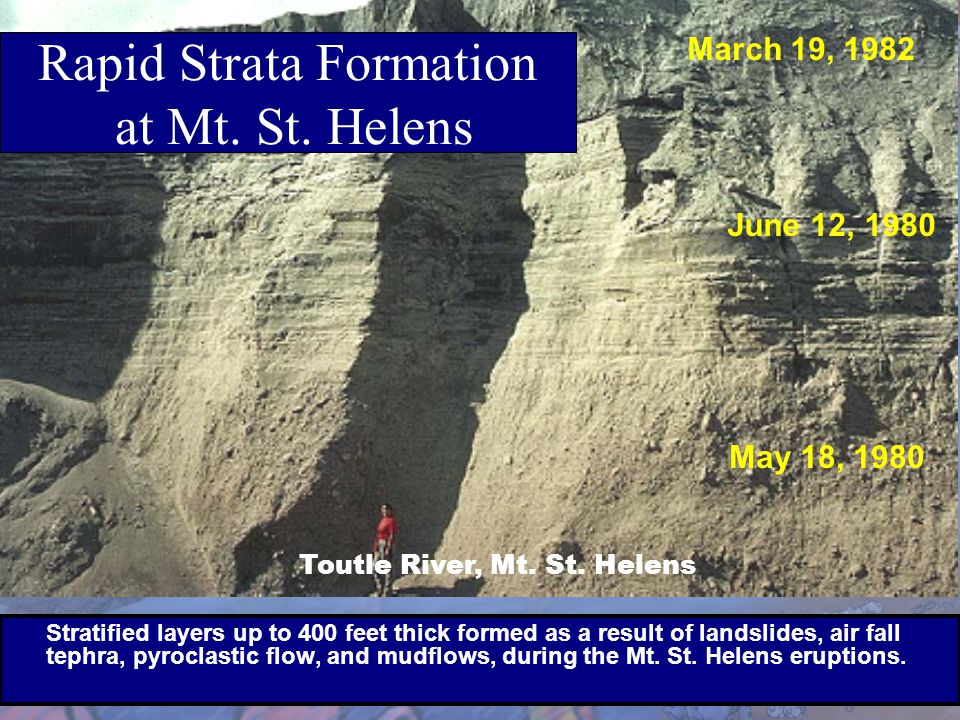
In the diagram (Y) which is the normal, everyday mechanism for strata formation (discovered by experiments), we can see that a fossil (A) in the top strata is actually older than a fossil (B) in the middle strata. And both fossils (A) & (B) are older than the fossil (C) in the bottom strata.
Put simply, when a stratified, sedimentary deposit is laid down in flowing water, all the strata upstream is deposited before all the strata downstream. This means all strata upstream is always older than all strata downstream.
So strata at the top can actually be older than strata at the bottom of a rock formation. Which strata is older in sedimentary rock can only be determined if we know the direction of the water current at the time the sedimentary deposit was laid down.
This completely overturns the idea that fossils found in lower strata must always be older than those in upper strata. it completely debunks the idea of index fossils (biostratigraphy) and of a fossil record based on depth of burial or geological/ecological eras.
Examples:
www.flickr.com/photos/truth-in-science/45113754412
www.flickr.com/photos/truth-in-science/29224301937
www.flickr.com/photos/truth-in-science/40393875072
www.flickr.com/photos/truth-in-science/44552032162
Field evidence of rapid, simultaneous stratification refutes the Superposition Principle and the Principle of Lateral Continuity.
We now know, the Superposition Principle only applies on a rare occasion of sedimentary deposition in perfectly, still water. Superposition is required for the long evolutionary timescale, but the evidence shows it is not the general rule, as was once believed. Most sediment is laid down in moving water, where particle segregation is the general rule, resulting in the simultaneous deposition of strata/layers as shown in these photos ...
Rapid stratification with geological features: www.flickr.com/photos/101536517@N06/sets/72157635944904973/
Rapid, simultaneous formation of layers/strata, through particle segregation in moving water, is so easily created it has even been described by sedimentologists (working on flume experiments) as a law ...
"Upon filling the tank with water and pouring in sediments, we immediately saw what was to become the rule: The sediments sorted themselves out in very clear layers. This became so common that by the end of two weeks, we jokingly referred to Andrew's law as "It's difficult not to make layers," and Clark's law as "It's easy to make layers." Later on, I proposed the "law" that liquefaction destroys layers, as much to my surprise as that was." Ian Juby, www.ianjuby.org/sedimentation/
Examples in the photos www.flickr.com/photos/101536517@N06/sets/72157635944904973/
are the result of normal, everyday tidal action each occurring in a single incident. Where the water current or movement is more turbulent, violent, or catastrophic, considerable depths (many metres) of stratified sediment can be laid down in a short time. It does not require the many millions of years assumed to be necessary by evolutionists.
It is also evident that the composition of individual stratum formed in any deposition event. is related to whatever materials are in the sediment mix, not to any particular timescale. Whatever is in the mix will be automatically sorted into strata/layers. It could be sand, or other material added from mud slides, erosion of chalk deposits, coastal erosion, volcanic ash etc. Any organic material (potential fossils), alive or dead, engulfed by, or swept into, a turbulent sediment mix will also be sorted and buried within the rapidly, forming layers.
Experiments demonstrate the rapid, stratification principle.
and field evidence supports the work of the eminent, sedimentologist Dr Guy Berthault MIAS - Member of the International Association of Sedimentologists.
(Dr Berthault's experiments (www.sedimentology.fr/)
And also the experimental work of Dr M.E. Clark (Professor Emeritus, U of Illinois @ Urbana), Andrew Rodenbeck and Dr. Henry Voss, (www.ianjuby.org/sedimentation/)
Rapid strata formation videos:
A wealth of field evidence demonstrates that multiple strata in sedimentary deposits do not need millions of years to form and can be formed rapidly. The natural examples observed in field studies confirm the principle demonstrated by sedimentation experiments carried out by Dr Guy Berthault and other sedimentologists. It calls into question the widely accepted, multi-million year dating of sedimentary rocks, and the dating of fossils by depth of burial or position in the strata.
Dr Berthault's experiments (www.sedimentology.fr/) and other experiments (www.ianjuby.org/sedimentation/) combined with field studies of floods and volcanic action show that, rather than being formed by gradual, slow deposition of sucessive layers superimposed upon previous layers, with the strata or layers representing a particular timescale, particle segregation in moving water or airborne particles can form strata or layers very quickly, and frequently in a single event.
Most importantly, in such cases, lower strata are not older than upper strata, they are the same age, having been created in the same sedimentary episode.
Field studies of natural, stratification processes confirm the experiments carried out by sedimentologists and show that there is no longer any reason to conclude that strata/layers in sedimentary rocks relate to different geological eras and/or a multi-million year timescale. www.youtube.com/watch?v=5PVnBaqqQw8&feature=share&.... they also show that the relative position of fossils in rocks is not indicative of an order of evolutionary succession.
Obviously, the uniformitarian principle, on which the geologic column is based, can no longer be considered valid. And the multi-million, year dating of sedimentary rocks and fossils certainly needs to be reassessed.
The observed, rapid deposition of stratified sediments also explains the enigma of polystrate fossils, i.e. large fossils that intersect several strata. In some cases, tree trunk fossils are found which intersect the strata of sedimentary rock up to forty feet in depth. upload.wikimedia.org/wikipedia/commons/thumb/0/08/Lycopsi... They must have been buried in stratified sediment in a short time (certainly not millions, thousands, or even hundreds of years), or they would have rotted away. youtu.be/vnzHU9VsliQ
The vast majority of fossils are found in good, intact condition, which is testament to their rapid burial. You don't get good fossils from gradual burial, because they would be damaged or destroyed by decay, predation or erosion. The existence of so many fossils in sedimentary rock on a global scale is stunning evidence for the rapid depostion of sedimentary rock as the general rule. It is obvious that virtually all rock formations which contain good, intact fossils were formed from sediment laid down in a very short time, not millions, or even thousands of years.
See set of photos of other examples of rapid stratification: www.flickr.com/photos/101536517@N06/sets/72157635944904973/
Carbon dating of coal should not be possible if it is millions of years old, yet significant amounts of Carbon 14 have been detected in coal and other fossil material, which indicates that it is less than 50,000 years old. www.ldolphin.org/sewell/c14dating.html
www.grisda.org/origins/51006.htm
Evolutionists confidently cite multi-million year ages for rocks and fossils, but what most people don't realise is that no one actually knows the age of sedimentary rocks or the fossils found within them. So how are evolutionists so sure of the ages they so confidently quote? The astonishing thing is they aren't. Sedimentary rocks cannot be dated by radiometric methods*, and fossils can only be dated to less than 50,000 years with Carbon 14 dating. The method evolutionists use is based entirely on assumptions. Unbelievably, fossils are dated by the assumed age of rocks, and rocks are dated by the assumed age of fossils, that's right ... it is known as circular reasoning.
* Regarding the radiometric dating of igneous rocks, which is claimed to be relevant to the dating of sedimentary rocks, in an occasional instance there is an igneous intrusion associated with a sedimentary deposit -
Prof. Aubouin says in his Précis de Géologie: "Each radioactive element disintegrates in a characteristic and constant manner, which depends neither on the physical state (no variation with pressure or temperature or any other external constraint) nor on the chemical state (identical for an oxide or a phosphate)."
"Rocks form when magma crystallizes. Crystallisation depends on pressure and temperature, from which radioactivity is independent. So, there is no relationship between radioactivity and crystallisation.
Consequently, radioactivity doesn't date the formation of rocks. Moreover, daughter elements contained in rocks result mainly from radioactivity in magma where gravity separates the heavier parent element, from the lighter daughter element. Thus radiometric dating has no chronological signification." Dr. Guy Berthault www.sciencevsevolution.org/Berthault.htm
Radiometric dating based on unverifiable assumptions.
scienceagainstevolution.info/v8i8f.htm
Geology the dreadful science. Principle of Superposition falsified.
malagabay.wordpress.com/2013/07/08/geology-the-dreadful-s...
More about strata formation.
creation.com/geological-strata
Rapid stratification
evidenceoverignorance.wordpress.com/rapid-stratification-2/
Visit the fossil museum:
www.flickr.com/photos/101536517@N06/sets/72157641367196613/
Just how good are peer reviews of scientific papers?
www.sciencemag.org/content/342/6154/60.full
www.examiner.com/article/want-to-publish-science-paper-ju...
The neo-Darwinian idea that the human genome consists entirely of an accumulation of billions of mutations is, quite obviously, completely bonkers. Nevertheless, it is compulsorily taught in schools and universities as 'science'.
I LOVE LONDON! London landmarks - The Palace of Westminster - the Houses of Parliament are the seat of the British government - Big Ben and the London Eye.
[Viewed from Level 5 of the South Bank Centre]
"Myth 1: Never put a baby bird back in its nest. The parents will smell your scent and abandon the chick.
Nope, they won’t! While it’s usually best not to disturb wildlife, this reasoning is hogwash. Most birds have a very poor sense of smell. If a nestling has fallen and you can reach the nest easily, it’s fine to put the baby back in. However, young birds that have already left the nest often hang out on the ground before they can fly well. Check to see if the chick has its feathers. If so, it’s a fledgling, and you don’t need to do anything. Most likely the parents are nearby, keeping an eye out and bringing food.", from the National Wildlife Federation
The trunk Walsall local routes 31/32 are the next routes to be converted over to West Midlands Bus operation. Wright Eclipse bodied Volvo B7RLEs are being used by both NXWM and Diamond, with the 32 now seeing only 6 Bus Per Hour compared to the 31 having 12 per hour. I don’t know the reasoning behind this but it has resulted in the 32 being mainly NXWM Buses, with Diamond just in the Morning/Evening Peak. 2125 was the first NXWM Eclipse painted into the livery, ready in time for the Classic Running Day
The Egyptian circle or ancient wheel of fortune is a Sphinx which represents the mystery of life. It also represents the SELF, the real person behind the mask that we wear (PERSONA). That is to introduce an element of change in the querent's life, such change being in station, position or fortune: such as the rich becoming poor, or the poor becoming rich.The wheel is not always shown inscribed with any lettering. Where this is the case, the letters T-A-R-O (clockwise) or T-O-R-A (counter clockwise) can often be found aligned against four of the spokes, which can also be interpreted as R-O-T-A, the Latin word meaning "wheel". In some decks, such as the Waite, the wheel is also inscribed with additional alchemical symbols representing the four elements: Earth, Air, Fire and Water (which are also said to be represented throughout the Tarot by the four "suits" of Pentacles or Discs, Swords, Wands, and Cups respectively.
At the top of the wheel perches the sphinx, who is there to remind us that if we stay stable amidst turmoil and use reasoning then we can retain the power to change our own lives instead of staying at the mercy of chance.This creature is Anubis – the Egyptian God which guided dead souls and was the giver of new life. Anubis help consciousness rise from lower to higher. The axis mundi (also cosmic axis, world axis, world pillar, center of the world, world tree), in certain beliefs and philosophies, is the world center, or the connection between Heaven and Earth. As the celestial pole and geographic pole, it expresses a point of connection between sky and earth where the four compass directions meet. At this point travel and correspondence is made between higher and lower realms. Communication from lower realms may ascend to higher ones and blessings from higher realms may descend to lower ones and be disseminated to all. The spot functions as the omphalos (navel), the world's point of beginning. The image relates to the center of the earth (perhaps like an umbilical providing nourishment)[citation needed]. It may have the form of a natural object (a mountain, a tree, a vine, a stalk, a column of smoke or fire) or a product of human manufacture (a staff, a tower, a ladder, a staircase, a maypole, a cross, a steeple, a rope, a totem pole, a pillar, a spire). Its proximity to heaven may carry implications that are chiefly religious (pagoda, temple mount, minaret, church) or secular (obelisk, lighthouse, rocket, skyscraper). The image appears in religious and secular contexts.[6] The axis mundi symbol may be found in cultures utilizing shamanic practices or animist belief systems, in major world religions, and in technologically advanced "urban centers". In Mircea Eliade's opinion, "Every Microcosm, every inhabited region, has a Centre; that is to say, a place that is sacred above all."The axis mundi is often associated with mandalas.
The first thing you might not know about obelisks is what they are. If you have ever walked across the Place de la Concorde in Paris, or seen any rendering of ancient Egypt in its glory, you are very familiar with obelisks: vertical stone columns that taper as they rise, topped by a pyramid. .An obelisk (UK: /ˈɒbəlɪsk/; US: /ˈɑːbəlɪsk/, from Ancient Greek: ὀβελίσκος obeliskos; diminutive of ὀβελός obelos, "spit, nail, pointed pillar" is a tall, four-sided, narrow tapering monument which ends in a pyramid-like shape or pyramidion at the top. These were originally called tekhenu by their builders, the Ancient Egyptians. Ancient monolithic megalithic structures have now been identified to as far back a 15,000 years. Monolithic Menhirs (en.wikipedia.org/wiki/Menhir) are the great grand father of the obelisk. Thousands of years before the first Egyptian style obelisk, our distant family gathered together and set aside in some cases, 20 years of work of dozens if not hundreds of people to build and raise up a Menhir. We did this on every single continent that has had human development using carved stones up to 250,000 pounds. Thousands of these megalithic structures have been placed all around the world and many still stand. The Greeks who saw them used the Greek term 'obeliskos' to describe them, and this word passed into Latin and ultimately English. Ancient obelisks are monolithic; that is, they consist of a single stone. Most modern obelisks are made of several stones; some, like the Washington Monument, are buildings.Obelisks were prominent in the architecture of the ancient Egyptians, who placed them in pairs at the entrance of temples. The word "obelisk" as used in English today is of Greek rather than Egyptian origin because Herodotus, the Greek traveller, was one of the first classical writers to describe the objects. A number of ancient Egyptian obelisks are known to have survived, plus the "Unfinished Obelisk" found partly hewn from its quarry at Aswan. These obelisks are now dispersed around the world, and fewer than half of them remain in Egypt. The earliest temple obelisk still in its original position is the 68-foot (20.7 m) 120-metric-ton (130-short-ton)[5] red granite Obelisk of Senusret I of the XIIth Dynasty at Al-Matariyyah in modern Heliopolis. The obelisk symbolized the sun god Ra, and during the brief religious reformation of Akhenaten was said to be a petrified ray of the Aten, the sundisk. It was also thought that the god existed within the structure. Benben was the mound that arose from the primordial waters Nu upon which the creator god Atum settled in the creation story of the Heliopolitan creation myth form of Ancient Egyptian religion. The Benben stone (also known as a pyramidion) is the top stone of the Egyptian pyramid. It is also related to the Obelisk. It is hypothesized by New York University Egyptologist Patricia Blackwell Gary and Astronomy senior editor Richard Talcott that the shapes of the ancient Egyptian pyramid and obelisk were derived from natural phenomena associated with the sun (the sun-god Ra being the Egyptians' greatest deity). The pyramid and obelisk might have been inspired by previously overlooked astronomical phenomena connected with sunrise and sunset: the zodiacal light and sun pillars respectively. The Ancient Romans were strongly influenced by the obelisk form, to the extent that there are now more than twice as many obelisks standing in Rome as remain in Egypt. The ancient Egyptians placed pairs of obelisks at the entrances of their temples. According to Gordon, the columns were associated with the Egyptian sun god, and perhaps represented rays of light. They were often topped with gold, or a natural gold-and-silver alloy called electrum, in order to catch the first rays of the morning light. Twenty-eight Egyptian obelisks remain standing, though only six of them are in Egypt. The rest are scattered across the globe, either gifts from the Egyptian government or plunder by foreign invaders. The symbol originates in a natural and universal psychological perception: that the spot one occupies stands at "the center of the world". This space serves as a microcosm of order because it is known and settled. Outside the boundaries of the microcosm lie foreign realms that, because they are unfamiliar or not ordered, represent chaos, death or night.[8] From the center one may still venture in any of the four cardinal directions, make discoveries, and establish new centers as new realms become known and settled. The name of China, meaning "Middle Nation" (中国 pinyin: Zhōngguó), is often interpreted as an expression of an ancient perception that the Chinese polity (or group of polities) occupied the center of the world, with other lands lying in various directions relative to it.Within the central known universe a specific locale-often a mountain or other elevated place, a spot where earth and sky come closest gains status as center of the center, the axis mundi. High mountains are typically regarded as sacred by peoples living near them. Shrines are often erected at the summit or base.[9] Mount Kunlun fills a similar role in China.[10] For the ancient Hebrews Mount Zion expressed the symbol.[citation needed] Sioux beliefs take the Black Hills as the axis mundi.[citation needed] Mount Kailash is holy to Hinduism and several religions in Tibet. The Pitjantjatjara people in central Australia consider Uluru to be central to both their world and culture. In ancient Mesopotamia the cultures of ancient Sumer and Babylon erected artificial mountains, or ziggurats, on the flat river plain. These supported staircases leading to temples at the top. The Hindu temples in India are often situated on high mountains. E.g. Amarnath, Tirupati, Vaishno Devi etc. The pre-Columbian residents of Teotihuacán in Mexico erected huge pyramids featuring staircases leading to heaven. Jacob's Ladder is an axis mundi image, as is the Temple Mount. For Christians the Cross on Mount Calvary expresses the symbol.The Middle Kingdom, China, had a central mountain, Kunlun, known in Taoist literature as "the mountain at the middle of the world." To "go into the mountains" meant to dedicate oneself to a spiritual life.] Monasteries of all faiths tend, like shrines, to be placed at elevated spots. Wise religious teachers are typically depicted in literature and art as bringing their revelations at world centers: mountains, trees, temples.Because the axis mundi is an idea that unites a number of concrete images, no contradiction exists in regarding multiple spots as "the center of the world". The symbol can operate in a number of locales at once.[7] Mount Hermon was regarded as the axis mundi in Caananite tradition, from where the sons of God are introduced descending in 1 Enoch (1En6:6).[13] The ancient Armenians had a number of holy sites, the most important of which was Mount Ararat, which was thought to be the home of the gods as well as the center of the Universe.[14] Likewise, the ancient Greeks regarded several sites as places of earth's omphalos (navel) stone, notably the oracle at Delphi, while still maintaining a belief in a cosmic world tree and in Mount Olympus as the abode of the gods. Judaism has the Temple Mount, Christianity has the Mount of Olives and Calvary, Islam has Ka'aba, said to be the first building on earth, and the Temple Mount (Dome of the Rock). In Hinduism, Mount Kailash is identified with the mythical Mount Meru and regarded as the home of Shiva; in Vajrayana Buddhism, Mount Kailash is recognized as the most sacred place where all the dragon currents converge and is regarded as the gateway to Shambhala. In Shinto, the Ise Shrine is the omphalos.[citation needed] In addition to the Kunlun Mountains, where it is believed the peach tree of immortality is located, the Chinese folk religion recognizes four other specific mountains as pillars of the world.
Sacred places like Concorde (unite people) constitute world centers (omphalos) with the altar or place of prayer as the axis. Altars, incense sticks, candles and torches form the axis by sending a column of smoke, and prayer, toward heaven. The architecture of sacred places often reflects this role. "Every temple or palace--and by extension, every sacred city or royal residence--is a Sacred Mountain, thus becoming a Centre." The stupa of Hinduism, and later Buddhism, reflects Mount Meru. Cathedrals are laid out in the form of a cross, with the vertical bar representing the union of earth and heaven as the horizontal bars represent union of people to one another, with the altar at the intersection. Pagoda structures in Asian temples take the form of a stairway linking earth and heaven. A steeple in a church or a minaret in a mosque also serve as connections of earth and heaven. Structures such as the maypole, derived from the Saxons' Irminsul, and the totem pole among indigenous peoples of the Americas also represent world axes. The calumet, or sacred pipe, represents a column of smoke (the soul) rising form a world center.[16] A mandala creates a world center within the boundaries of its two-dimensional space analogous to that created in three-dimensional space by a shrine
The first thing you might not know about obelisks is what they are. If you have ever visited the Washington Monument, however, or walked across the Place de la Concorde in Paris, or seen any rendering of ancient Egypt in its glory, you are very familiar with obelisks: vertical stone columns that taper as they rise, topped by a pyramid. Washington’s Monument and the Fascinating History of the Obelisk, by John Steele Gordon, is an absorbing account of the obelisk’s place in human civilization. Here are seven things revealed by Gordon that you might not know about obelisks. The ancient Egyptians placed pairs of obelisks at the entrances of their temples. According to Gordon, the columns were associated with the Egyptian sun god, and perhaps represented rays of light. They were often topped with gold, or a natural gold-and-silver alloy called electrum, in order to catch the first rays of the morning light. Twenty-eight Egyptian obelisks remain standing, though only six of them are in Egypt. The rest are scattered across the globe, either gifts from the Egyptian government or plunder by foreign invaders.
Around 250 B.C., a Greek philosopher named Eratosthenes used an obelisk to calculate the circumference of the Earth. He knew that at noon on the Summer Solstice, obelisks in the city of Swenet (modern day Aswan) would cast no shadow because the sun would be directly overhead (or zero degrees up). He also knew that at that very same time in Alexandria, obelisks did cast shadows. Measuring that shadow against the tip of the obelisk, he came to the conclusion that the difference in degrees between Alexandria and Swenet: seven degrees, 14 minutes—one-fiftieth the circumference of a circle. He applied the physical distance between the two cities and concluded that the circumference of the Earth was (in modern units) 40,000 kilometers. This isn’t the correct number, though his methods were perfect: at the time it was impossible to know the precise distance between Alexandria and Swenet. If we apply Eratosthenes's formula today, we get a number astonishingly close to the actual circumference of the Earth. In fact, even his inexact figure was more precise than the one used by Christopher Columbus 1700 years later. Had he used Eratosthenes’s estimation, Columbus would have known immediately that he hadn’t reached India.True obelisks as conceived by the ancient Egyptians are “monolithic,” or made from a single piece of stone. (The literal translation of monolith—a Greek word—is “one stone.” On that note, the word “obelisk” is also Greek, derived from obeliskos, or skewer. An ancient Egyptian would have called an obelisk a tekhen.)
The obelisk at the center of Place de la Concorde, for example, is monolithic. It is 3300 years old and once marked the entrance to the Temple of Thebes in Egypt. So difficult is the feat of building a monolithic obelisk that Pharaoh Hatshepsut had inscribed at the base of one of her obelisks the proud declaration: “without seam, without joining together.”Nobody knows exactly why obelisks were built, or even how. Granite is really hard—a 6.5 on the Mohs scale (diamond being a 10)—and to shape it, you need something even harder. The metals available at the time were either too soft (gold, copper, bronze) or too difficult to use for tools (iron’s melting point is 1,538 °C; the Egyptians wouldn’t have iron smelting until 600 B.C.). The Egyptians likely used balls of dolerite to shape the obelisks, which, Gordon notes, would have required “an infinity of human effort.” Hundreds of workers would have each had to pound granite into shape using dolerite balls that weighed up to 12 pounds. This doesn’t even address the issue of how one might move a 100-foot, 400-ton column from the quarry to its destination.
The ancient Egyptians placed pairs of obelisks at the entrances of their temples. According to Gordon, the columns were associated with the Egyptian sun god, and perhaps represented rays of light. They were often topped with gold, or a natural gold-and-silver alloy called electrum, in order to catch the first rays of the morning light. Twenty-eight Egyptian obelisks remain standing, though only six of them are in Egypt. The rest are scattered across the globe, either gifts from the Egyptian government or plunder by foreign invaders.
A common shamanic concept, and a universally told story, is that of the healer traversing the axis mundi to bring back knowledge from the other world. It may be seen in the stories from Odin and the World Ash Tree to the Garden of Eden and Jacob's Ladder to Jack and the Beanstalk and Rapunzel. It is the essence of the journey described in The Divine Comedy by Dante Alighieri. The epic poem relates its hero's descent and ascent through a series of spiral structures that take him from through the core of the earth, from the depths of Hell to celestial Paradise. It is also a central tenet in the Southeastern Ceremonial Complex. Anyone or anything suspended on the axis between heaven and earth becomes a repository of potential knowledge. A special status accrues to the thing suspended: a serpent, a victim of crucifixion or hanging, a rod, a fruit, mistletoe. Derivations of this idea find form in the Rod of Asclepius, an emblem of the medical profession, and in the caduceus, an emblem of correspondence and commercial professions. The staff in these emblems represents the axis mundi while the serpents act as guardians of, or guides to, knowledge. Snake lying against Wheel. The snake represents Set, the Egyptian god of evil. He also represents death and rebirth. However the other message of the snake is about creating form from energy. The snake is wrapped around the Magicians waist. Through will and cosmic manifestation creation happens on earth. We are co-creators of our life and destiny. The snake also reminds us that we have to shed the old skin (habits etc) in order to grow the new. he number of The Wheel of Fortune is 10. 10 is often seen as a combination of 0 and 1. Nothing and the first manifestation. The Creator represents 10 therefore because the Creator makes something out of nothing. The creators of the Rider Waite Tarot deck were members of the Golden Dawn, a group that had many teachings based on the mystical Kabbalah of the Jewish nation. When I say Kabbalah forget about monotheism, Judaism, God, and religion for a moment. Kabbalists are mystics in a sense. They believe God is neither male nor female and in fact has many aspects. Their systems are all about learning why we are here, the mystery of the universe and what the big plan is. Inside the Rider Waite deck is a multitude of Kabbalistic meanings. I will briefly explain a few of the Kabbalistic meanings within The Emperor card. Believe me when I say you could learn for the rest of your life about Tarot and Kabbalah and still only scratch the surface. I’m keeping it superficial but easy to understand. I am also using on purpose the word Kabbalah rather than Cabala. The Wheel of Fortune is represented by the letter Kaph – כ – which is the first letter in the name of God. The Wheel of Fortune on The Tree of Life sits on the path between Chesed and Netzach. In Kabbalah the number 10 is a number of completion of a cycle and the beginning of another. We have 10 sephiroth on the Tree of Life describing the process of Creation. We have the 10 commandments which describe how to create a world that reflects God. 10 is also two numbers – 0 and 1. 0 is the Fool (nothing) and 1 is the Magician (manifesting out of nothing). Together they explain how God created the universe. The name of this Wheel is ‘Rewarding Intelligence of Those Who Seek’ and means that those who seek for the understanding of the greater picture will be rewarded. In other words, ‘Seek, and ye shall find’. If we go into more detail we can explore the letters on the orange wheel. In Gematria TARO adds up to 671 and the name of God יהוה adds up to 26. Together the total number is 697 which breaks down to 22.,22 is the number of cards in the Major Arcana deck and the number of Hebrew letters in the alphabet.
Around 250 B.C., a Greek philosopher named Eratosthenes used an obelisk to calculate the circumference of the Earth. He knew that at noon on the Summer Solstice, obelisks in the city of Swenet (modern day Aswan) would cast no shadow because the sun would be directly overhead (or zero degrees up). He also knew that at that very same time in Alexandria, obelisks did cast shadows. Measuring that shadow against the tip of the obelisk, he came to the conclusion that the difference in degrees between Alexandria and Swenet: seven degrees, 14 minutes—one-fiftieth the circumference of a circle. He applied the physical distance between the two cities and concluded that the circumference of the Earth was (in modern units) 40,000 kilometers. This isn’t the correct number, though his methods were perfect: at the time it was impossible to know the precise distance between Alexandria and Swenet. If we apply Eratosthenes's formula today, we get a number astonishingly close to the actual circumference of the Earth. In fact, even his inexact figure was more precise than the one used by Christopher Columbus 1700 years later. Had he used Eratosthenes’s estimation, Columbus would have known immediately that he hadn’t reached India. True obelisks as conceived by the ancient Egyptians are “monolithic,” or made from a single piece of stone. (The literal translation of monolith—a Greek word—is “one stone.” On that note, the word “obelisk” is also Greek, derived from obeliskos, or skewer. An ancient Egyptian would have called an obelisk a tekhen.) The obelisk at the center of Place de la Concorde, for example, is monolithic. It is 3300 years old and once marked the entrance to the Temple of Thebes in Egypt. So difficult is the feat of building a monolithic obelisk that Pharaoh Hatshepsut had inscribed at the base of one of her obelisks the proud declaration: “without seam, without joining together.” Nobody knows exactly why obelisks were built, or even how. Granite is really hard—a 6.5 on the Mohs scale (diamond being a 10)—and to shape it, you need something even harder. The metals available at the time were either too soft (gold, copper, bronze) or too difficult to use for tools (iron’s melting point is 1,538 °C; the Egyptians wouldn’t have iron smelting until 600 B.C.). The Egyptians likely used balls of dolerite to shape the obelisks, which, Gordon notes, would have required “an infinity of human effort.” Hundreds of workers would have each had to pound granite into shape using dolerite balls that weighed up to 12 pounds. This doesn’t even address the issue of how one might move a 100-foot, 400-ton column from the quarry to its destination. While there are many hypotheses, nobody knows precisely how they did it. Until the 19th century, hieroglyphics were thought to be untranslatable—mystical symbols with no coherent message beneath. Jean-François Champollion, a French Egyptologist and linguist, thought differently, and made it his life’s purpose to figure them out. His first success came from the Rosetta Stone, from which he divined the name “Ptolemy” from the symbols. In 1819, “Ptolemy” was also discovered written on an obelisk which had just been brought back to England—the Philae obelisk. The “p,” “o,” and “l” on the obelisk also featured elsewhere on it, in the perfect spots to spell the name “Cleopatra.” (Not that Cleopatra; the much earlier Queen Cleopatra IX of Ptolemy.) With those clues, and using this obelisk, Champollion managed to crack the mysterious code of hieroglyphics, translating their words and thus unlocking the secrets of ancient Egypt. (Almost 200 years later, the European Space Agency’s mission to land a spacecraft on a comet commemorated these events; the spacecraft is named Rosetta. The lander is named Philae.)
87 0011 a 760mm gauge B-BDH built by FAUR (Uzinele 23 August Works) in Romania is seen at Nocrich on the Sibiu to Agnita narrow gauge line which has sadly now closed.
With only two trains a day in each direction on this line when I took this, plus a short working between Sibiu and Cornăţel this train was something of a mystery. It appeared to convey passengers but wasn't in the timetable. Some shunting was about to take place as train 2921 the 11.15 Agnita to Sibiu had failed with 87 0038 having expired in the station. I suspect therefore this loco and set of coaches had worked train 2931 05.00 Cornăţel to Sibiu then instead of sitting all day at Sibu to make the 19.25 back to Cornăţel had instead run as an extra to Nocrich to rescue the failed 11.15 ex Agnita but why bring the coaches and collect passengers on route in the wrong direction ? Something of a mystery ! My only reasoning for this is it might have collected passengers that would otherwise have sat waiting at the unstaffed stations on route for the the 11.15 ex Agnita for what was getting on for over two hours in the baking summer sunshine. At least they were on the move albeit initially in the wrong direction.
Con la siguienta dedicatoria comienza uno de los mejores libros que me he leído en los últimos tiempos:
"Los renglones torcidos de Dios son, en verdad, muy torcidos. Unos hombres y unas mujeres ejemplares, tenaces y hasta heroicos, pretenden enderezarlos. A veces lo consiguen. La profunda admiración que me produjo su labor durante mi estadía voluntaria en un hospital psiquiátrico acreció la gratitud y el respeto que siempre experimenté por la clase médica. De aquí que dedique estas páginas a los médicos, a los enfermeros y enfermeras, a los vigilantes, cuidadores y demás profesionales que emplean sus vidas en el noble y esforzado servicio de los más desventurados errores de la Naturaleza".
Intrigante, atrapa desde el primer momento, increíblemente realista (aunque cueste creerlo!) y con unas reflexiones muy interesantes. Exprime tu cerebro al máximo dándole vueltas a la historia, y de mientras el autor (Torcuato Luca de Tena) deja unas frases IMPRESIONANTES que se te quedan grabadas en la memoria.
“La verdadera locura quizá no sea otra cosa que la sabiduría misma que, cansada de descubrir las vergüenzas del mundo, ha tomado la inteligente resolución de volverse loca” – Enrique Heine
“Las personalidades especialmente exquisitas son más vulnerables que las más zafias; del mismo modo que una taza es más frágil cuanto de mayor calidad sea la porcelana.”
“Toda palabra es eterna.” Conclusión de una charla sobre la duración eterna de las ondas sonoras…
“¡No es usual ver a los ángeles en el infierno!”
“La fobia es un pretexto que ha inventado el organismo para ocultar un terror verdadero, justificado, pero que la mente se empeña en ignorar."
"...Los locos son como los niños. No puede convencérseles con razones porque, al carecer de razón, son incapaces de razonar"
------
With this dedication starts one of the best books I’ve recently read:
"The crooked lines of God are, indeed, very crooked. Some modelic men and some modelic women, tenacious and even heroic, try to straighten them. Sometimes they get it. The deep admiration their work produced to me during my volunteer time at a mental hospital increased the gratitude and respect that I has always experienced by the medical establishment. That is why I dedicate these pages to doctors, nurses and nurses, caretakers, caregivers and other professionals who spend their lives in the noble and courageous service to the most unfortunate mistake of nature. "
It’s intriguing, catches your attention since the first moment, incredibly realistic (although some things are hard to believe!) and really interesting reflections. You have to thought a lot about the story, and the author (Torcuato Luca de Tena) give us amazing quotes, impossible to forget!:
"The real madness may not be anything other than the very wisdom that, tired of discovering the nakedness of the world, has taken the wise decision of going mad" Enrique Heine
"The especially delicious personalities are more vulnerable to the most boorish, the same way that a cup is as fragile as the highest quality of porcelain."
“Every word is eternal”. The conclusion of a talk about the eternal duration of the sound waves…
“It’s not usual to see angels in hell!”
“A phobia is a pretext that body has invented to hide a real, justified fear, which mind insists on ignoring.”
“Madmen are like kids. You can’t convince them with reasons, because, since lacking reason, they are unable of reasoning.”