View allAll Photos Tagged Payloader
NASA’s Europa Clipper mission moves closer to launch as technicians worked on Wednesday, Sept. 11, inside the Payload Hazardous Servicing Facility to prepare the spacecraft for upcoming propellant loading at the agency’s Kennedy Space Center in Florida.
The spacecraft will explore Jupiter’s icy moon Europa, which is considered one of the most promising habitable environments in the solar system. The mission will research whether Europa’s subsurface ocean could hold the conditions necessary for life. Europa could have all the “ingredients” for life as we know it: water, organics, and chemical energy.
Europa Clipper’s launch period opens on Thursday, Oct. 10. It will lift off on a SpaceX Falcon Heavy rocket from Kennedy’s Launch Complex 39A. The spacecraft then will embark on a journey of nearly six years and 1.8 billion miles before reaching Jupiter’s orbit in 2030.
In this image, technicians work to complete operations before propellant load occurs ahead of launch for NASA’s Europa Clipper spacecraft inside the Payload Hazardous Servicing Facility at the agency’s Kennedy Space Center in Florida on Tuesday, Sept. 11, 2024.
Credit: NASA/Kim Shiflett
#NASA #MarshallSpaceFlightCenter #MSFC #Marshall #jpl #nasamarshall #juno #nasajuno #Europa #EuropaClipper
A wonderful and rarely seen artist’s concept of McDonnell Douglas Astronautics Company’s (MDAC), Phase-A 1969/70 ‘drawbridge wing’ orbiter. The orbiter may have just deployed the…uhm…possibly double-stacked? communications satellites in the foreground, still attached to their well-fueled Orbital Transfer Vehicle (OTV)/space tug. IDK really, I’m winging it.
What I assume to be another satellite, with possibly four folded-up solar arrays, and I think, still attached to its booster, is in the background. Since I see no external tanks on its ‘booster’, the payload may be a space/planetary probe, hence possibly disposable? Again, who knows.
Beautiful work by MDAC’s highly talented resident artist, Ron Simpson. All of his stuff is really quite superb.
Trimmed to 8” x 9.8125 from I’m sure its original 8.5” x 11”. Understandably, yet unfortunately, the photo was framed & displayed…for a long time. Despite its mutilation, exposure & injuries, the content still pops. Can you imagine how shit-hot this looked when first printed?!
I knew it! Gorgeous work! Shit-hot is right:
e05.code.blog/2022/06/02/phase-a-orbiter-by-ron-simpson/
Credit: Garrett O’Donoghue/numbers station blog
Only have the static LED lights installed unlike the other strip with multi color/mode, just have to build the packages/cargo that will go with this frame
NASA has selected three commercial Moon landing service providers that will deliver science and technology payloads under Commercial Lunar Payload Services (CLPS) as part of the Artemis program. Each commercial lander will carry NASA-provided payloads that will conduct science investigations and demonstrate advanced technologies on the lunar surface, paving the way for NASA astronauts to land on the lunar surface by 2024.
The selections are:
• Astrobotic of Pittsburgh has been awarded $79.5 million and has proposed to fly as many as 14 payloads to Lacus Mortis, a large crater on the near side of the Moon, by July 2021.
• Intuitive Machines of Houston has been awarded $77 million. The company has proposed to fly as many as five payloads to Oceanus Procellarum, a scientifically intriguing dark spot on the Moon, by July 2021.
• Orbit Beyond of Edison, New Jersey, has been awarded $97 million and has proposed to fly as many as four payloads to Mare Imbrium, a lava plain in one of the Moon’s craters, by September 2020.
This commercial lander from Orbit Beyond of Edison, New Jersey, will carry NASA-provided science and technology payloads to the lunar surface, paving the way for NASA astronauts to land on the Moon by 2024.
All three of the lander models were on display for the announcement of the companies selected to provide the first lunar landers for the Artemis program, on Friday, May 31, 2019, at NASA's Goddard Space Flight Center in Greenbelt, Md.
Read more: go.nasa.gov/2Ki2mJo
Credit: NASA/Goddard/Rebecca Roth
Inside the Payload Hazardous Servicing Facility at NASAâs Kennedy Space Center in Florida, the Backshell-Powered Descent Vehicle and Entry Vehicle assemblies are being attached to the Mars Perseverance rover on May 28, 2020. The cone-shaped backshell contains the parachute, and along with the missionâs heat shield, provides protection for the rover and descent stage during Martian atmospheric entry. The Mars Perseverance rover is scheduled to launch on July 20 atop a United Launch Alliance Atlas V 541 rocket from Pad 41 at nearby Cape Canaveral Air Force Station. The rover is part of NASAâs Mars Exploration Program, a long-term effort of robotic exploration of the Red Planet. The rover will search for habitable conditions in the ancient past and signs of past microbial life on Mars. The Launch Services Program at Kennedy is responsible for launch management. Photo credit: NASA/Christian Mangano
Increased payload capability may not have had much effect for the Bell 412's role as transport helicopter, but it was now also capable of mounting heavier weapons systems, which played a big part of it becoming what it is today. With new EH-191s commencing deliveries shortly after the Bell 412's upgrade program was completed, a handful of Arapahos were converted to gunships on a trial base. The most common gunship configuration was, and still is, side mounted weapon stations similar to that on the UH-1Y, with two 70mm rocket pods and two M134 7.62mm Gatling guns.
Crews rotated to vertical then lifted NASA’s Europa Clipper spacecraft from its protective shipping container after it arrived at the Payload Hazardous Servicing Facility (PHSF) at the agency’s Kennedy Space Center in Florida on May 28.
The spacecraft, which will collect data to help scientists determine if Jupiter’s icy moon Europa could support life, arrived in a United States Air Force C-17 Globemaster III cargo plane at Kennedy’s Launch and Landing Facility on May 23. The Europa Clipper spacecraft will launch on a SpaceX Falcon Heavy rocket from NASA Kennedy’s Launch Complex 39A. The launch period opens Thursday, Oct. 10.
Credit: NASA/Kim Shiflett
#NASA #MarshallSpaceFlightCenter #MSFC #Marshall #jpl #nasamarshall #juno #nasajuno #Europa #EuropaClipper
GH-23F and GH-23M Infantry Dropships
A small craft, the Gaerlan Heinz-23 has been a
versatile and important part of the The Corps' offense and defense since its introduction seventeen years ago. Multiple variations exist, but the most used is the GH-23F [foreground] This "Cricket" variant can carry up to seven Devil Dogs, five fully armed and/or two injured on the bottom wing pylons.
Almost every Marine currently in the Corps has flown into battle strapped to the side of a "Cricket".
Very little armor makes this dropship incredibly fast and maneuverable, even fully loaded with troops.
Alone, the GH-23 has limited armament, just two blast cannons under the bottom wings. However, a veritable cornucopia of weapons systems can be attached in lieu of (or addition to) the Marines, in essentially any combination.
The versatile weapons payload, ability to quickly pick up or drop off troops, and sheer maneuverability (not counting that they were ridiculously cheap to manufacture) made the GH-23 "Cricket" a favorite among The Corps brass and also the Devil Dogs they carried into battle.
“This artist's concept depicts the separation of the Skylab payload shroud. The payload shroud was both an environmental shield and an aerodynamic fairing. Attached to the forward end of the fixed airlock shroud, it protected the airlock, the docking adapter, and the solar observatory before and during launch. It also provided structural support for the solar observatory in the launch configuration. The payload shroud was jettisoned once Skylab reached orbit after separation of the S-II second stage of the Saturn V vehicle. Five major assemblies clustered together made up the orbiting space station called Skylab. The largest of these was the orbital workshop, that housed the crew quarters and a major experiment area. The airlock module, attached to the forward end of the workshop, enabled crewmembers to make excursions outside Skylab. The docking adapter, attached to the forward end of the airlock module, provided the docking port for the Apollo command and service module. The Apollo Telescope Mount was the first manned astronomical observatory designed for solar research from Earth orbit.”
11” x 13.875”. The obvious fold line, with the first hint of an emulsion break, is accompanied by a parallel lesser fold 1.125” from it, suggesting either tight or careless rolling of the photo at some point.
By G. S. Wright. No idea. Although…there is a “Stevens Wright”, who was an artist for McDonnell during the appropriate time. Regardless, the aforementioned Mr. Wright designed the Buffalo Bills’ logo.
www.presstelegram.com/2013/08/19/long-beach-legend-the-en...
Credit: Press Telegram website
The above description is taken from a subsequent (1971) similar artist’s concept linked to below.
The stamped date of the photo prompted me to include the following excerpt, primarily with regard to the name of the subject in the artist’s concept:
“MOVING OUT OF APOLLO'S SHADOW
George Mueller's integrated plan of May 1969 listed Apollo and Skylab as NASA's first manned programs of the 1970s. The agency hoped to move out in two general directions: on one avenue Apollo led to further lunar exploration and the possibility of a lunar base; a second route to Earth-orbital operations began with two Saturn-V workshops and proceeded to a permanent, manned space station with a low-cost Shuttle. Major milestones for the decade included:
1972
- Earth-orbital operations with Saturn-V-launched workshop 1973-Start of post-Apollo lunar exploration
1974
- Suborbital flight tests of Shuttle
- Launch of second Saturn-V workshop
1975
- Initial space station operations
- Orbital Shuttle flights
1976
- Lunar-orbit station
- Full Shuttle operations
Sometime in the 1980s or 1990s, NASA would establish bases in Earth orbit and on the lunar surface and would land men on Mars.1
Paine was anxious to win approval for this ambitious plan in 1959 while public enthusiasm was high. The Space Task Group, a body established by President Nixon to consider America's future space program, provided the administrator an excellent sounding board. In meetings that summer, Paine promoted a manned Mars mission as NASA's next major objective. The task group's September report, America's Next Decades in Space, recommended a balanced manned and unmanned space capability and listed three possible programs leading to a manned landing on Mars before the 21st century. The most ambitious option called for a 50-man, Earth-orbiting station in 1980 and the first Mars flight three years later. Funding would reach $8 billion annually by 1976. The least ambitious option cost half that amount and delayed the Mars expedition until the 1990s. The group's chairman, Vice President Spiro Agnew, endorsed the Martian goal enthusiastically, but elsewhere the proposal fell on barren soil. Opposition appeared in Congress and the press, and the Nixon administration approved less than three-quarters of NASA's proposed $4.5 billion budget for FY 1971. That was one-half billion dollars less than the previous year's appropriation and brought NASA to its lowest level of funding in nine years. On 13 January 1970 Paine briefed the press on the impact of the reduction: NASA would suspend production of the Saturn V, cancel Apollo 20, delay the initial workshop flight until late 1972, and postpone Apollo 18 and 19 until 1974.
The following month NASA renamed its Apollo Applications Program. A widespread dissatisfaction with the acronym AAP had prompted Paine to seek a new name shortly after the dry-workshop decision. A committee considered nearly 100 names ranging from Socrates to LSD and recommended 8, 4 from mythology and 4 from American history. Mueller forwarded the recommendations to NASA's Project Designation Committee with the comment that a name change "could enhance the public's identification with the program and hopefully provide a more manageable term for everyday use." The committee passed over the recommendations and selected, instead, a name submitted by Lt. Col. Donald Steelman, an Air Force officer on duty with NASA in 1968. Skylab, a contraction for "laboratory in the sky," met both of Mueller's objectives as the name was quickly accepted within and outside NASA.[3]
[3] Mueller to Julian Scheer, "Request to NASA Project Designation Committee to Select a New Name for the Apollo Applications Program (AAP)," 15 Oct. 1969; Disher to members of screening committee, "New Name for the Apollo Applications Program," 4 Sept.1969; Belew, "Weekly Notes," 18 Aug. 1969.”
Above from/at:
A heavy space fighter in service with the Rigelian Space Navy. Interchangeable payload compartment allows vehicles to fulfil a variety of roles including planetary bombardment, long range reconnaissance and battlefield logistics.
I wanted to build an asymmetrical ship inspired by the B-Wing from Star Wars. It started out intended to be more of a bounty hunter type ship but kind of drifted to this. I wanted it to be big enough that I could really go to town with a particular style of greebly detailing and I think that came out really well. I also worked a lot on the colour blocking and really like the way the blue sections snake around the ship.
I worked on this for a long time and by the end I’d kind of lost the plot a little. It’s taken me over 6 months to get around to shooting these pics, but looking at them now I feel quite satisfied with the completed model. Maybe I’ll find time to make some different cargo pods and dust down the landing pad I already made for it.
“UNMANNED SATELLITE PLACEMENT--An artist’s concept of a space shuttle vehicle deploying a High Energy Astronomical Observatory in Earth orbit. This particular satellite is actually planned to be launched in 1974 by a Titan III-C launch vehicle into a 200 nautical mile circular, 28 1/2 degree inclined orbit. It is expected to weigh about 23,000 pounds and measure 40 feet in length. But, because of the generous payload capability of the space shuttle system, it is possible that later orbital astronomy goals could be achieved at a substantially smaller expense than other means. The relatively inexpensive flight cost of the reusable space shuttle system might allow for necessary repair-and-update trips to the satellite.”
The orbiter bears a tail number. In possible anticipation of being one of a true fleet of shuttles?
I really don't like these artist's concept/actual photo combinations. New technology/capability that just HAD to be incorporated? In combination with it being more cost effective? Less work/time for which artist's had to be paid? Whatever it was - 👎.
Small consolation: the background photograph of the Florida peninsula, with Cape Canaveral visible, was taken during Gemini IV.
Since the link will soon be useless, it’s photo ID S-65-34717 & S-65-32866:
tothemoon.ser.asu.edu/gallery/Gemini/4/Hasselblad%20500C%...
Credit: "March to the Moon" website
The Delta II rocket with it's NPOESS Preparatory Project (NPP) spacecraft payload is seen shortly after the service structure was rolled back on Thursday, Oct. 27, 2011, at Vandenberg Air Force Base, Calif. NPP is the first NASA satellite mission to address the challenge of acquiring a wide range of land, ocean, and atmospheric measurements for Earth system science while simultaneously preparing to address operational requirements for weather forecasting. NPP is scheduled to launch early Friday morning.
Photo Credit: NASA/Bill Ingalls
NASA Goddard Space Flight Center enables NASA’s mission through four scientific endeavors: Earth Science, Heliophysics, Solar System Exploration, and Astrophysics. Goddard plays a leading role in NASA’s accomplishments by contributing compelling scientific knowledge to advance the Agency’s mission.
Follow us on Twitter
Like us on Facebook
Find us on Instagram
Members of NASA's Nancy Grace Roman Space Telescope propellant, safety, and quality assurance team pose for a photo on Monday July 20, 2026, inside the Payload Hazardous Servicing Facility at NASA’s Kennedy Space Center in Florida, prior to technicians loading propellant into the observatory. With fuel tanks capable of carrying about 290 gallons (roughly 1,100 liters) of hydrazine – a monopropellant not requiring a second chemical to combust – Roman’s primary mission is to settle essential questions about dark energy, exoplanets, and infrared astrophysics by conducting wide-field surveys that explore the universe’s structure, evolution, and composition. Liftoff atop a SpaceX Falcon Heavy rocket from NASA Kennedy’s Launch Complex 39A is targeted no earlier than Sunday, Aug. 30, 2026. Photo credit: NASA/Ben Smegelsky
NASA image use policy.
The James Webb Space Telescope was fuelled inside the payload preparation facility at Europe’s Spaceport in French Guiana ahead of its launch on Ariane 5.
Webb’s thrusters will use this propellant to make critical course-corrections after separation from Ariane 5, to maintain its prescribed orbit about one and a half million kilometres from Earth, and to repoint the observatory and manage its momentum during operations.
Fuelling any satellite is a particularly delicate operation requiring setup of the equipment and connections, fuelling, and then pressurisation.
Webb’s propellant tanks were filled separately with 133 kg of dinitrogen tetroxide oxidiser and 168 kg hydrazine. Oxidiser improves the burn efficiency of the hydrazine fuel.
These propellants are extremely toxic so only a few specialists wearing Self-Contained Atmospheric Protective Ensemble, or ‘scape’ suits, remained in the dedicated fuelling hall for fuelling which took 10 days and ended on 3 December.
The next steps will start soon for ‘combined operations’. This is when specialists working separately to prepare Webb and Ariane 5 will come together as one team. They will place Webb atop its Ariane 5 launch vehicle and encapsulate it inside Ariane 5’s fairing.
Then, no longer visible, Webb, joined with its Ariane 5 launch vehicle will be transferred to the Final Assembly building for the final preparations before launch.
Webb will be the largest, most powerful telescope ever launched into space. As part of an international collaboration agreement, ESA is providing the telescope’s launch service using the Ariane 5 launch vehicle. Working with partners, ESA was responsible for the development and qualification of Ariane 5 adaptations for the Webb mission and for the procurement of the launch service by Arianespace.
Webb is an international partnership between NASA, ESA and the Canadian Space Agency (CSA).
Find out more about Webb in ESA’s launch kit and interactive brochure.
Credits: ESA/CNES/Arianespace/Optique Vidéo du CSG - P Piron
Do you know the temperature of the Moon? ??? NASA's LISTER is ready to drill into the mystery!
After landing on the Moon on March 2, Firefly Aerospace and NASA teams kicked off surface operations for the instruments on the company’s Blue Ghost lunar lander - which included LISTER, one of the seven payloads managed by NASA's Marshall Space Flight Center.
This video shows LISTER drilling 3-m into the Moon’s rock and dust surface (the lunar regolith) in order to determine the heat flow from the interior of the Moon.
Credit: Firefly Aerospace
#NASAMarshall #NASA #NASA #moon #CLPS #CommercialLunarPayloadServices #Lander #LunarLander
Read more about irefly’s Blue Ghost Mission 1
Read more about NASA’s CLPS (Commercial Lunar Payload Services)
On June 18, 1983, the space shuttle Challenger launched from Kennedy Space Center on the STS-7 mission crewed by the first flight American female astronaut, Mission Specialist Sally K. Ride. The mission also carried with it the first Shuttle Payload Satellite, SPAS-1, which contained ten experiments and could be held in the shuttle’s payload bay or deployed and recaptured by the Canadian-built robotic arm or Remote Manipulator System (RMS). The mission served as a spaceborne laboratory for the Office of Space and Terrestrial Applications (OSTA-2) payload. Although originally scheduled to land at Kennedy, inclement weather forced STS-7 to land at Edwards Air Force Base on June 24, 1983.
Image credit: NASA/MSFC
Marshall History Album on Flickr:
www.flickr.com/photos/nasamarshall/sets/72157636868630444/
_____________________________________________
These official NASA photographs are being made available for publication by news organizations and/or for personal use printing by the subject(s) of the photographs. The photographs may not be used in materials, advertisements, products, or promotions that in any way suggest approval or endorsement by NASA. All Images used must be credited. For information on usage rights please visit: www.nasa.gov/audience/formedia/features/MP_Photo_Guidelin...
The Folkvanger is designed to be agile, yet carry a large payload of air to ground firepower. Named after the field of dead warriors in Nordic folklore, where half of fallen soldiers go after dying, while the other half go to Valhalla to prepare for Ragnarock.
Crew: 2 (pilot, and co-pilot/gunner use neural interface to guide it from the ground.
Length: 61.17 ft.
Height: 28.7 ft. on landings
Empty weight: 25,390 lb.
Loaded weight: 29,650 lb.
Max. takeoff weight: 38,000 lb
Powerplant: 2× ARM Gladiator fusion power turboshaft
Rotor systems: 2× 4 blade main rotor,
Performance
Maximum speed: 341 mph
Cruise speed: 198 mph
Range: Unlimited
Service ceiling: 27,000 ft
Armament
Guns: 2× 25 mm Aurora belt feed miniguns,
2130 RPM
Max cap 4000 ×2 rounds feed through the wings from the hull.
Hardpoints: 2
Missiles: 2× 4 Ferris Anti tank missiles Fire and forget type
Lockheart Industries, Phalanx V.T.A.M.
"Vertical Takeoff, And Movement" Infantry Fighting Vehicle.
A revolutionary design that uses gravitational sensitive computers to calculate the exact amount of downward thrust needed to lift the vehicle to the designated safe area off the ground. The VTAM technology allows the craft to be super maneuverable in mostly all known terrain types.
The 7, to 20 foot gap from the ground can negate the effects of mostly all normal land mines, and the Magnetically sealed synthetic armor can deflect most shock waves, and weaker autocannon rounds.
The vehicles main weapon is a 40mm coilgun, capable of slicing through armor. The weapon is powered by an onboard fusion cell, and the vehicle can hold two crewmen, and four infantry.
It's mainly used as a fast reconnaissance vehicle as the lack of any ground resistance allows it to travel at speeds otherwise not possible.
-----------------------------------
More reposts from MP.
Lockheart is a mercenary faction from D&C 2, and any future games that end up being sifi. It officially came into existence in 2118, and lasted past the 2700s spread out into multiple groups. Some groups prosper, while other struggle to survive, or have ceased to exist. I would describe it as a mix between the Helghast, the Enclave, and anything from Ghost in the Shell. It's hard to explain though. They are basically another race, and they can no longer breath normal air as they need trace amounts of specific toxic materials their bodies adapted to breathing.
NASA’s Artemis I Orion capsule is secured on a platform inside the Multi-Payload Processing Facility (MPPF) at Kennedy Space Center in Florida on Jan. 6, 2023. Orion splashed down in the Pacific Ocean at 12:40 p.m. EST on Dec. 11, 2022. The spacecraftwas secured inside the well deck of the USS Portland for the voyage to U.S. Naval Base Sand Diego, arriving on Dec. 13, 2022. Orion was offloaded and transported back to Kennedy for deservicing inside the MPPF. Orion launched atop the Space Launch System rocket on Nov. 16, 2022 at 1:47 a.m. EST from Kennedy’s Launch Complex 39B for a 25-day trip beyond the Moon and back. During the flight, Orion flew farther than any human-rated spacecraft has ever flown, paving the way for human deep space exploration and demonstrating NASA’s commitment and capability to extend human presence to the Moon and beyond. Photo credit: NASA/Ben Smegelsky
“Artist Concept - Planetary payload.”
This is a cropped version of a depiction I’ve come across quite often. Of course, NOT while I look for it, with the foolish/unfounded expectation that if/when I come across it, it’ll have a more substantive caption/description.
So, my usual drivel follows: Something I’ve never noticed before; this is one of the few artist’s concepts, due to the perspective, that provides an excellent view of this near final shuttle design in which the OMS Pod “pods”/fairings extend into the OPEN payload bay doors. Along with the retractable forward reaction control system engines of the time & ‘B-9 environmental robot’ RMS ‘end effector’.
The satellite itself has also always piqued my interest. There’s at least one other image in this family/series that shows the rolled/folded up solar arrays beginning to deploy. With that, note that the primary payload is rather detailed, more than just a generic ‘planetary probe’ configuration. Finally, that’s an Agena tug, or Agena something or another, right?
Possibly by Henry Lozano? Ted Brown? Manuel Alvarez?
An unusually heavy & thick “THIS PAPER MANUFACTURED BY KODAK” watermarked photo paper. Good thing, as this photo has not been taken care of.
Not related, other than being an Agena...and fascinating:
www.thespacereview.com/article/4174/1
Credit: "The Space Review" website
NASA Deputy Administrator Pam Melroy visits Kennedy Space Center in Florida and receives a briefing by team members from the Jet Propulsion Laboratory on the agency’s Psyche spacecraft inside the Payload Hazardous Servicing Facility on May 19, 2022. Melroy is standing in front of the group. The mission is targeting an Aug. 1 launch atop a SpaceX Falcon Heavy rocket from Launch Complex 39A at Kennedy. The spacecraft will use solar-electric propulsion to travel approximately 1.5 billion miles to rendezvous with its namesake asteroid in 2026. The Psyche mission is led by Arizona State University. NASA’s Jet Propulsion Laboratory, which is managed for the agency by Caltech in Pasadena, California, is responsible for the mission’s overall management, system engineering, integration and testing, and mission operations. Maxar Technologies in Palo Alto, California, provided the high-power solar electric propulsion spacecraft chassis. NASA’s Launch Services Program (LSP), based at Kennedy, is managing the launch. Photo credit: NASA JPL/Wes Kuykendall
The James Webb Space Telescope, configured for flight, was moved from the cleanroom to the payload preparation facility for fuelling at Europe’s Spaceport in French Guiana on 11–12 November 2021.
Webb will be loaded with propellants before being mounted on top of the rocket and then encapsulated by the Ariane 5 fairing.
Webb will be the largest, most powerful telescope ever launched into space. As part of an international collaboration agreement, ESA is providing the telescope’s launch service using the Ariane 5 launch vehicle. Working with partners, ESA was responsible for the development and qualification of Ariane 5 adaptations for the Webb mission and for the procurement of the launch service by Arianespace.
Webb is an international partnership between NASA, ESA and the Canadian Space Agency (CSA).
Find out more about Webb in ESA’s launch kit and interactive brochure.
Credits: ESA/CNES/Arianespace/Optique Vidéo du CSG - P Baudon
I attended the "Antique Flywheel Engine & Tractor Show" sponsored by the "Florida Flywheeler's Antique Engine Club" located at 7000 Avon Park Cutoff Road, Fort Mead, FL 33841 on Friday February 21, 2020.
This Photograph shows (left to right) a Yellow Bulldozer, a Paving Roller Number 7574, a Pay Loader and a Fire Truck at the Antique Flywheel and Tractor Show, Fort Meade, Florida.
Several other shows/exhibitions were as follows: Functioning Sawmill Demonstrations, Running 1914 400 HP Snow Making Machine Demonstration, Antique Construction Equipment Demonstrations, Model-T Put-Together Demonstration, Daily Antique Tractor Pulls, Kids Pedal Tractor Pulls on Friday & Saturday, Daily Antique Car Parade, Daily Antique Tractor Parade, Florida Flywheeler Antique Engine Club Gift Shop Opened, Huge Flea Market & the Antique Village (was opened) to Wander Through.
This Place is HUGE ! - - One of the attendants told me it is approx 480 ACRES !
The Mars 2020 rover heat shield is mated to the back shell in the Payload Hazardous Servicing Facility at Kennedy Space Center in Florida on Jan. 10, 2020. Built by Lockheed Martin Space, the heat shield and back shell will protect the rover during its passage to Mars. The Mars 2020 rover is being manufactured at NASA’s Jet Propulsion Laboratory (JPL) in California and, once complete, will be delivered to Kennedy next month. The mission is scheduled to launch from Cape Canaveral Air Force Station in Florida in the summer of 2020. Photo credit: NASA/Kim Shiflett
Technicians prepare the National Oceanic and Atmospheric Administration’s (NOAA) Joint Polar Satellite System-2 (JPSS-2) for stacking atop the Low-Earth Orbit Flight Test of an Inflatable Decelerator (LOFTID) payload inside the Astrotech Space Operations facility at Vandenberg Space Force Base (VSFB) in California on Oct. 5, 2022. JPSS-2 is the third satellite in the Joint Polar Satellite System series. It is scheduled to lift off from VSFB on Nov. 1 from Space Launch Complex-3. JPSS-2, which will be renamed NOAA-21 after reaching orbit, will join a constellation of JPSS satellites that orbit from the North to the South pole, circling Earth 14 times a day and providing a full view of the entire globe twice daily. The NOAA/NASA Suomi National Polar-orbiting Partnership (Suomi NPP) satellite, and NOAA-20, previously known as JPSS-1, are both already in orbit. Each satellite carries at least four advanced instruments to measure weather and climate conditions on Earth. LOFTID is a secondary payload on the mission. It is dedicated to the memory of Bernard Kutter. LOFTID will demonstrate inflatable heat shield technology that could enable a variety of proposed NASA missions to destinations such as Mars, Venus, and Titan, as well as returning heavier payloads from low-Earth orbit. Photo credit: USSF 30th Space Wing/Aaron Taubman
“OFF TO VISIT JUPITER – The Space Shuttle launches its first planetary exploration payload, Jupiter Orbiter Probe, in this artist’s concept of the beginning of the candidate mission. The automatic planetary explorer would ride to Earth orbit in the cargo bay of the shuttle, then be sent hurtling toward its rendezvous with Jupiter by the shuttle’s Interim Upper Stage. After 2.9 years, the orbiter would release the probe toward Jupiter’s atmosphere, and 56 days later would begin orbiting the giant planet. A new camera system on the orbiter would be among the many science experiments. The probe would analyze Jupiter’s atmosphere. Data would be flashed back to the orbiter and relayed on to Earth. The mission is being studied by Caltech’s Jet Propulsion Laboratory for NASA’s Office of Space Science.”
The Magellan radar-mapping spacecraft to Venus would actually become the first planetary exploration mission to be launched from the Space Shuttle, the first one to use the Inertial Upper Stage booster, and the first spacecraft to test aerobraking as a method for circularizing its orbit. Magellan ended an eleven-year gap in U.S. interplanetary probe launches.
Above paraphrased from the Magellan Wikipedia entry.
Although it looks cool, there was no need to include the spacecraft fairing/aerodynamic shroud. 😉
Another beautiful rendition by Ken Hodges. R.I.P. Brother.
STS-95 Payload Specialist John Glenn positions himself to take photos from the Discovery's aft flight deck windows on Flight Day 3.
Credit: NASA
Image Number: S95E5190
Date: October 30, 1998
The Mars 2020 rover undergoes processing inside the Payload Hazardous Servicing Facility at NASA’s Kennedy Space Center in Florida on Feb. 14, 2020. Initial processing took place on Feb. 13, one day after a C-17 aircraft, with the rover aboard, touched down at the Launch and Landing Facility at Kennedy. The cross-country trip began at NASA’s Jet Propulsion Laboratory, where the rover was manufactured. The mission, targeted for mid-July 2020, will launch aboard an Atlas V 541 rocket from Cape Canaveral Air Force Station. NASA’s Launch Services Program based at Kennedy is managing the launch. Click here for more information on the Mars 2020 rover mission. Photo credit: NASA/Kim Shiflett
“SPACE SHUTTLE TRANSPORTS SPACELAB -- A major planned payload for Space Shuttle will be Spacelab, being developed under auspices of European Space Research Organization (ESRO), shown tucked safely in the Space Shuttle orbiter’s huge payload bay in this artist’s concept by Rockwell International Corporation’s Space Division. Shuttle capabilities will make it possible for the world’s leading scientists to go into space to perform their experiments and studies, then return to Earth to put the information to use.”
The same image, bearing “esa”, thus subsequent:
history.nasa.gov/SP-407/part1.htm
Specifically:
history.nasa.gov/SP-407/p17.jpg

A more common “ESRO-marked” Spacelab lithograph (linked below), bares the same exact caption, with the addition of the following:
“…This particular artist’s concept shows the Spacelab configured for an extravehicular activity.”
So…I’m guessing it being configured for an EVA is maybe because the hatch atop the pressurized module is flipped open? If so, I’m further guessing that an airlock was incorporated into the configuration? I never really got into the Spacelab/hab thing, so who knows.
Note in all images what appears to be a deployed solar array/panel at the far aft end of the payload bay, along with the ‘deployed’ forward reaction control system thruster clusters, pods, packages, or whatever they’re called.
By the supremely talented & prolific Manuel E. Alvarez.
Inside the Payload Hazardous Servicing Facility at NASA’s Kennedy Space Center in Florida, the Backshell-Powered Descent Vehicle and Entry Vehicle assemblies are being prepared to be attached to the Mars Perseverance rover on May 4, 2020. The cone-shaped backshell contains the parachute, and along with the mission’s heat shield, provides protection for the rover and descent stage during Martian atmospheric entry. The Mars Perseverance rover is scheduled to launch in mid-July atop a United Launch Alliance Atlas V 541 rocket from Pad 41 at nearby Cape Canaveral Air Force Station. The rover is part of NASA’s Mars Exploration Program, a long-term effort of robotic exploration of the Red Planet. The rover will search for habitable conditions in the ancient past and signs of past microbial life on Mars. The Launch Services Program at Kennedy is responsible for launch management. Photo credit: NASA/Christian Mangano
"The Space Shuttle orbiter has just released an unmanned satellite into earth orbit. Payloads such as this satellite are carried in the orbiter's payload cargo bay, which is 60 feet long and 15 feet in diameter."
The above is associated with caption of the below linked color version. The caption on the verso, other than its associated date, is of no value.
ESA microwave engineers took apart an entire Galileo satellite to reassemble its navigation payload on a laboratory test bench to run it as though it were in orbit – available to investigate the lifetime performance of its component parts, recreate satellite anomalies, and test candidate technologies for Galileo’s future evolution.
Located in the cleanroom environment of the Galileo Payload Laboratory – part of ESA’s Microwave Lab based at its ESTEC technical centre in the Netherlands – the new Galileo IOV Testbed Facility was inaugurated this week with a ceremony attended by Paul Verhoef, ESA Director of Navigation and Franco Ongaro, ESA Director of Technology, Engineering and Quality.
Paul Verhoef congratulated the team and underlined the importance of ESA having these capabilities: ”Such a navigation payload laboratory does not exist in industry. We foresee the testing and validation a number of very innovative ideas for the next series of Galileo satellites, before entering into discussions with industry in the context of the procurement of the Galileo Transition Satellites that has recently begun. This shows the added value of ESA as the design agent and system engineer of the Galileo system.”
“Our Lab has always been very responsive to the testing needs of the Navigation Directorate,’ comments microwave engineer César Miquel España.
“Now this unique facility allows performance of end-to-end testing of a Galileo payload as representatively as possible, using actual Galileo hardware. We can also support investigations of any problems in orbit or plug in future payload hardware as needed. And because each item of equipment is separately temperature controlled we can see how environmental changes affect their performance.”
The Testbed began as an ‘engineering model’ of a first-generation Galileo In-Orbit Validation (IOV) satellite, built by Thales Alenia Space in Italy for ground-based testing. It was delivered to ESTEC in August 2015, along with four truckloads of ground support equipment and other hardware.
That began a long three-year odyssey to first take the satellite apart, then put it back together – akin at times to space archaeology, since the satellite had been designed more than 15 years ago.
“We found lots of documentation on how to integrate the satellite, but nothing on how to take it apart,” adds technician Gearóid Loughnane. “We had to dismantle it very carefully over several weeks to remove the smaller items safely and take out the electrical harness, which ended up as a big spaghetti pile on the floor.”
The next step was to extricate the navigation payload from the satellite platform, and then begin to lay it out to connect it up again. A parallel effort tracked down supporting software from the companies involved, to be able to operate the payload once it was complete, as if it is orbiting in space.
Valuable help came from Surrey Satellite Technology Limited in the UK, Dutch aerospace company Terma that developed Galileo software, and Rovsing in Denmark, supplying ground support equipment.
“A big challenge was tailoring the spacecraft control and monitoring system to work only with the payload units while having to emulate the platform equipment” comments technician Andrew Allstaff.
Comprising equipment produced by companies in seven separate European companies, the Testbed generates navigation signals using actually atomic clocks co-located in the lab, which are then upconverted, amplified and filtered as if for transmission down to Earth.
The idea came from a GIOVE Payload Testbed already in the Lab, which simulates the performance of a test satellite that prepared the way for Galileo. As a next step the team hopes they can one day produce a Galileo ‘Full Operational Capability’ Payload Testbed – the current follow-on to the first-generation IOV satellites.
The next four Galileo FOC satellites are due to be launched by Ariane 5 in July.
Credits: ESA–Cesar Miquel Espana
Technicians check the United Launch Alliance Atlas V payload fairing containing the National Oceanic and Atmospheric Administration’s (NOAA) Joint Polar Satellite System-2 (JPSS-2) inside the Astrotech Space Operations facility at Vandenberg Space Force Base (VSFB) in California on Oct. 12, 2022. JPSS-2 is stacked atop NASA’s Low-Earth Orbit Flight Test of an Inflatable Decelerator (LOFTID) inside the fairing. JPSS-2 is the third satellite in the Joint Polar Satellite System series. It is scheduled to lift off from VSFB on Nov. 1 from Space Launch Complex-3. JPSS-2, which will be renamed NOAA-21 after reaching orbit, will join a constellation of JPSS satellites that orbit from the North to the South pole, circling Earth 14 times a day and providing a full view of the entire globe twice daily. The NOAA/NASA Suomi National Polar-orbiting Partnership (Suomi NPP) satellite, and NOAA-20, previously known as JPSS-1, are both already in orbit. Each satellite carries at least four advanced instruments to measure weather and climate conditions on Earth. LOFTID is a secondary payload on the mission. It is dedicated to the memory of Bernard Kutter. LOFTID will demonstrate inflatable heat shield technology that could enable a variety of proposed NASA missions to destinations such as Mars, Venus, and Titan, as well as returning heavier payloads from low-Earth orbit. Photo credit: USSF 30th Space Wing/Steve Gerlich
Functional testing of NASA’s Mars Helicopter and its cruise stage occurred in the airlock inside Kennedy Space Center’s Payload Hazardous Servicing Facility on March 10, 2020. The helicopter was tested on a stand while the cruise stage was tested on the rotation fixture. The helicopter will be attached to the Mars Perseverance rover during its mission, which is part of NASA's Mars Exploration Program. Perseverance will land on the Red Planet on Feb. 18, 2021. Liftoff aboard a United Launch Alliance Atlas V 541 rocket is targeted for mid-July from Cape Canaveral Air Force Station. NASA’s Launch Services Program based at Kennedy is managing the launch.
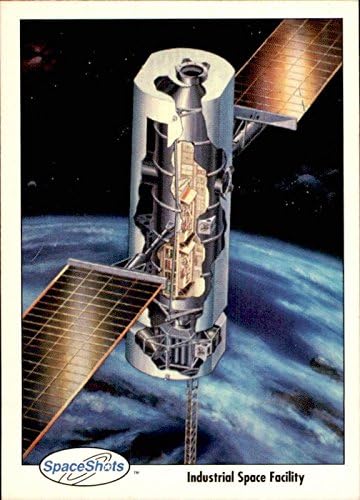
Circa 1985 artist’s concept of the Industrial Space Facility (ISF), a privately owned space station, as proposed by Space Industries Inc.
“After his retirement from NASA in 1982, Dr. Max Faget co-founded Space Industries, Inc. with a major objective to develop a "man tended" Earth orbiting complex for scientific research. Plans were to have the complex carried inside the Space Shuttle's payload bay and released into orbit. Automated micro-gravity, pharmaceutical, and other experiments would operate for several months with retrieval of the results by the Space Shuttle. Political issues relating to NASA's own desire for a large space station and the Space Shuttle Challenger accident eventually derailed this project.”
Above credit:
www.bonhams.com/auctions/17778/lot/1137/
Credit: Bonhams website
Also, per Wikipedia:
“Space Industries was founded in Houston, Texas by Maxime Faget, who had recently retired as chief of engineering and operations at NASA, as well as entrepreneurs James Calaway, Guillermo Trotti, and Larry Bell. Their plan was to build a space station that would feed off the life support system of the space shuttle when it visited, but would not maintain continuous life support between shuttle visits. Faget proposed this plan because maintaining continuous life support would be cost prohibitive.
Joe Allen, a physicist and astronaut, was a partner, as was Westinghouse Electric Corporation. Investors included Roy M. Huffington, an oilman and later United States ambassador to Austria; James Elkins, not to be confused with James A. Elkins who was the co-founder of the Vinson & Elkins law firm; and Walter Mischer, a developer.
Calaway lobbied the United States government to be an anchor tenant in the proposed space station. In 1988, the Reagan Administration requested $700 million from the annual budget in order to participate in the project, but the request was not approved by Congress, and the space station was never built.
The company eventually merged with Calspan Corporation, which in turn merged with General Dynamics Corporation.”
At:
en.wikipedia.org/wiki/Space_Industries_Incorporated
Additional information available at:
forum.nasaspaceflight.com/index.php?topic=33781.0
Credit: NASA SPACEFLIGHT website/forum
www.astronautix.com/i/industrialspacefacility.html
Credit: Astronautix website/Marcus Lindroos
uhclarchives.omeka.net/exhibits/show/faget/industrial/blu...
Credit: University of Houston (Clear Lake) archives website
Who knew? Did you? I didn’t.
It even has the semi-obligatory moon in the distance, although it looks sort of smooth & metallic. Maybe one of the near-perfectly spherical ball bearings being manufactured escaped. Note also the boom extending out from the facility to provide passive gravity gradient atitude stabilization.
Most importantly, the depiction was featured on the obverse of a “SpaceShots, SERIES TWO” trading card, specifically no. 0216.
Check out the following, as I expect the images to have a finite online ‘shelf life’:
images-na.ssl-images-amazon.com/images/I/51HTiajgqKL._AC_...
Credit: Amazon.com website
Further, per NASA Spinoff 1985:
“While some companies are focusing attention on materials processing experiments expected to lead to orbital product manufacture, another group of companies is pursuing a different but related line of commercial space development: fabrication of processing systems and equipment for lease to experimenters.
One such system is the Industrial Space Facility (ISF), being developed by Space Industries, Inc., a company formed only three years ago to pursue commercial space ventures. Shown in cutaway view at left, the ISF in its basic form is a large, solar powered module (35 feet long and 14½ feet in diameter) intended primarily for experimental or operational materials processing in such areas as advanced pharmaceuticals; growing large, ultrapure semiconductor crystals; containerless processing of vastly improved fiber optics; or creation of metal alloys and composites not producible on Earth. The ISF can also serve as a scientific laboratory or as a technology development facility for testing new space equipment and procedures. As many as six modules, each with its own laboratory factory equipment plus power storage, temperature control, communications, data management and other provisions, can be docked together to create what the developers call a "space industrial park."
The ISF is designed as an unmanned automated station, but a unique aspect of the design is provision for 2,500 square feet of pressurized volume in each facility module. Thus, Shuttle-delivered servicing crews will be able to work in a shirtsleeve environment for the two or three days it might take for repairs or adjustments, equipment changeouts, product harvesting and cleaning/restocking production apparatus.
In a Shuttle/ISF resupply and servicing operation, the Shuttle Orbiter is docked to the ISF by means of a berthing adapter. Astronauts enter the pressurized part of the facility module through a docking tunnel. Connected to the facility module is a separable supply module containing oxygen for pressurization and other consumables; resupply modules, six to 11 feet long, will be Shuttle-delivered every three to four months and depleted modules returned to Earth. The periodically man-tended ISF will operate in the same orbit as that of the planned Space Station and it will also be able to dock with the Space Station for servicing.
By agreement, NASA and Space Industries will exchange non-proprietary data and work together on technical matters and operational support requirements. Space Industries has completed preliminary engineering, applied for patents, begun negotiations with equipment suppliers and awarded a contract to Lockheed Missiles & Space Company for the large solar array. Target date for operational service of the fist ISF is 1989”
At/from:
spinoff.nasa.gov/back_issues_archives/1985.pdf
Last, but not least - in all seriousness - the artist's signature of "Li Hua" is visible. Certainly not ‘THE’ Li Hua, so sort of a win? I assume it to be a pseudonym...possibly in homage? If so, by whom? That is, unless the name Li Hua is akin to something like ‘Joe Smith’.
“Drawing, top, shows full scale wooden mockup of reusable orbiter being developed for the U.S. space shuttle system. Other views, counterclockwise, show rocket ports, orbiter payload bay, top view of spacecraft.”
Evident nicely in the ‘top view’, an excellent observation of this particular mockup design, per the "JACQMANS SPACEFLIGHT HISTORY" website:
"As you can see...the mockup still has the original design concept for the OMS engines, i.e. a fairing for the OMS pods extended onto the aft payload bay doors. This design was abandoned very early in the development phase and the pods were designed to be fully self contained and located aft of the payload bay doors. And also the forward RSC thrusters are protected by doors."
Multiple minor dings & less than ‘white glove’ handling fortunately do not detract from the high-gloss image.
Another superior & smooth work by Russ Arasmith.
www.nasa.gov/centers/marshall/history/russ-arasmith-shutt...
“STS-7 SATELLITE VIEW OF ORBITER---The Earth-orbiting Space Shuttle Challenger over a clouded Earth was captured by a 70mm camera onboard the temporarily free-flying Shuttle pallet satellite (SPAS-01) during a busy day 5 on the STS-7 mission. Visible in the cargo bay are the protective cradles for the now vacated Telesat Anik C2 and Palapa B communications satellites, the pallet for the office of Space and Terrestrial Applications, NASA; the remote manipulator system (RMS) and the Ku-band antenna. The RMS and the STS-7 crew of astronauts later retrieved the SPAS and returned it to a stowed position in the payload bay for return to Earth.”
“STS-63 EVA VIEW --- A high angle shot photographed by a space walking crew member showing the Space Shuttle Discovery's forward section and forward cargo bay. The Spacehab-3 and Ku-band antenna are visible. This is one of 16 still photographs released by the NASA Johnson Space Center (JSC) Public Affairs Office (PAO) on February 14, 1995. Onboard the Discovery were astronauts James D. Wetherbee, mission commander; Eileen Collins, pilot; Bernard A. Harris Jr., payload commander; mission specialist’s C. Michael Foale, Janice E. Voss, and cosmonaut Vladimir G. Titov.”
Although I’m really not that into onboard shuttle photography, other than some of those taken of/during EVAs, this one is legitimately an excellent & creative composition. Captured is an excellent smorgasbord ranging from the Portable Foot Restraint (with Astronaut/Payload Commander Bernard A. Harris attached), the RMS end effector & whatever that thing with the axes/coordinate lettering is…that’s also attached, earth’s limb, Orbiter TPS tiles in detail, etc., etc. All topped off by a crew member (his/her right hand at least, maybe even left) visible in the right corner of the left-hand overhead window, seen taking a photograph of the EVA, probably with a Nikon F3 camera.
Additionally, I’m pretty sure the photograph was taken by Mission Specialist C. Michael Foale (see linked image below).
And, t’s even autographed by Mission Specialist Vladimir G. Titov.
Low resolution image & following abridged caption, at:
science.ksc.nasa.gov/mirrors/images/images/pao/STS63/2018...

science.ksc.nasa.gov/mirrors/images/images/pao/STS63/2018...
“A high angle shot photographed by a crewmember during the STS-63 extravehicular activity shows the Space Shuttle Discovery's forward section and cargo bay. The Spacehab-3 and Ku-band antenna are visible.”
Much better:
mirrors.josefsipek.net/www.capcomespace.net/dossiers/espa...

Credit: CAPCOM ESPACE website (mirror)
Very good/interesting reading:
historycollection.jsc.nasa.gov/history/shuttle-mir/people...
Joe Leblanc, Orion payload and cargo manager with Lockheed Martin, secures Commander Moonikin Campos, a sensored stand-in for humans from NASAâs Artemis I mission, inside its transport crate in the Space Station Processing Facility at Kennedy Space Center in Florida on Jan. 10, 2023, for its trip back to NASAâs Johnson Space Center in Houston. Moonikin Campos was secured inside the Orion spacecraft for the mission beyond the Moon and back to Earth. Artemis I Orion launched atop the Space Launch System (SLS) rocket from Kennedyâs Launch Complex 39B on Nov. 16, 2022, at 1:47 a.m. EST for a 25-day trip beyond the Moon and back. During the flight, Orion flew farther than any human-rated spacecraft has ever flown, paving the way for human deep space exploration and demonstrating NASAâs commitment and capability to extend human presence to the Moon and beyond. The primary goal of Artemis I was to thoroughly test the SLS and Orion spacecraftâs integrated systems before crewed missions. Under Artemis, NASA aims to land the first woman and first person of color on the Moon and establish sustainable lunar exploration. Photo credit: NASA/Cory Huston
The fairing of the US Atlas V 411 rocket with ESA’s Solar Orbiter spacecraft inside at the Astrotech payload processing facility near Kennedy Space Center in Florida during launch preparations on 21 January 2020.
Solar Orbiter is an ESA-led space mission with strong NASA participation to study the Sun, its outer atmosphere and what drives the dynamic outflow of solar wind that affects Earth. The spacecraft will observe the Sun's atmosphere up close with high spatial resolution telescopes and compare these observations with measurements taken in the environment directly surrounding the spacecraft – together creating a detailed picture of how the Sun affects the space environment around Earth and further out in the Solar System.
Thanks to its unique — and difficult to achieve — orbit, Solar Orbiter will also provide the first-ever pictures of the Sun's polar regions, offering key insights into the poorly-understood magnetic environment there, which helps drive the Sun’s 11-year solar cycle and its periodic outpouring of solar storms. Solar Orbiter relies on a combination of 10 instruments, built throughout Europe and in the US. The instruments, combining both remote-sensing observations and in situ measurements, were carefully chosen and designed so as to support and amplify each other’s observations, together providing the single, most comprehensive and integrated view of the Sun and its environment ever achieved.
Credits: ESA–S. Corvaja