View allAll Photos Tagged Max
--------------------------------------------------------------------------------------------------
Mah facebook <3 : www.facebook.com/maxtrannn
click favorite button if you like :) ~
Jane seems to have a real talent for capturing some very special moments. We don't get to see our families as often as we would like. However, when we do our interest in photography certainly comes in handy. This is our little nephew Max - who's fast approaching his second birthday :-)
Max needed a headshot for his CV.
Lighting: I wanted to simplify my lighting. I challenged myself to shoot this headshot with speedlights vs. my AD-360's. Two lights (Godox TT600S). The key light is camera right and is in a Jinbei 80cm BD with diffusion material. The kicker is camera left and is in a 60cm Jinbei BD with diffusion material. There is also a silver reflector right in front of the subject to fill in the shadows under the chin, eyes, etc.
Meet Max, a local guy to our base in Rye, South-East England. We had spotted 21 year old Max on the street a few weeks ago and asked if he'd be interested in doing a shoot. This was his first time in front of the camera and we think he did a brilliant job, especially having to get changed on a very windy beach! Some people did get to see a lot more of Max that day!
German postcard by Verlag Hermann Leiser, Berlin-Wilm., no. 781. Photo: N. & C. Hess, Frankfurt a.M.
Max Pallenberg (1877-1934) was an Austrian singer, actor and comedian. He was one of the most important comedians of his time and often played under the direction of Max Reinhardt. Although Pallenberg was successful as a stage comedian, he only incidentally accepted roles in films.
Max Pallenberg was born as Max Pollack in 1877 in Vienna, Austria. Max was the son of Markus Pallenberg, who immigrated to Galicia from Vienna, and his wife Kressel (also Therese) born Korsower. Pallenberg's career started in 1904 and he played in provincial theatres and with touring companies. In 1908, he joined the then-famous Theater an der Wien as an operetta comedian and sang, inter alia, in the world premiere of Franz Lehár's operetta 'Der Graf von Luxemburg' (The Count of Luxembourg. He played in 1910-1911 at the Volkstheater in Vienna. From 1911 on, Pallenberg played in Munich at the Deutsches Theater. In 1914 he was committed by Max Reinhardt to the Deutsches Theater in Berlin. There he achieved his artistic breakthrough. Under the direction of Max Reinhardt, he played brilliant roles such as Schluck in Gerhart Hauptmann's 'Schluck and Jau' and as Peachum in the 'Dreigroschenoper' (Threepenny Opera). Soon he became one of the most famous character comedians of his time. Pallenberg's stellar role was in Erwin Piscator's dramatic adaptation of Jaroslav Hašek's novel 'Der brave Soldat Schwejk' (The Good Soldier Švejk). In 1917 he married Fritzi Massary who became one of the operetta divas of the German stage of the 1920s. His first wife was Betty Franke (1903-1917). They had one child. Pallenberg's most important roles at the Salzburg Festival include Mephisto in Faust, Argan in Mollière's 'Der eingebildet Kranke' (The Imaginary Invalid), the Devil in Jedermann (Everyman), and Truffaldino in Turandot, all directed by Max Reinhardt.
Max Pallenberg also starred in several silent and sound films. He made his film debut in the German short Der fidele Bauer - Ich hab mein Zipfelhaubn/The Merry Farmer - I have my Zipfel hood (Franz Glawatsch, 1908) with Wilhelm Binder and Luise Kartousch. In the early 1910s, he had great success in the cinema with his figure Pampulik and appeared in such Austrian films as Pampulik als Affe/Pampulik as Ape (Alexander Kolowrat, 1912), Pampulik kriegt ein Kind/Pampulik gets a child (Alexander Kolowrat, 1912) and Pampulik hat Hunger/Pampulik is hungry (Alexander Kolowrat, 1913). During World War I followed such films as Max und seine zwei Frauen/Max and his two wives (Heinrich Bolten-Baeckers, 1915) with Martha Novelly, Der rasende Roland/The Racing Roland (Heinrich Bolten-Baeckers, 1915) and Kapellmeister Pflegekind/Conductor Pflegekind (1915). After the war, he appeared in Die Nacht und der Leichnam/The Night and the Corpse (Adolf Abter, 1921) with Ria Jende. Pallenberg also appered in sound films. In Der brave Sünder/The Virtuous Sinner (Fritz Kortner, 1931), he co-starred with Heinz Rühmann. The film is based on the play The Embezzlers which was in turn based on a novel by the Soviet writer Valentin Kataev. Pallenberg had previously rejected all offers to appear in films based on his theatre appearances. He was finally convinced by the producer Arnold Pressburger to try and film one of his stage successes. The film also offered Kortner a chance to fulfil his ambitions to become a director. In the 1930s, Max Pallenberg and Fritzi Massary became the butt of the anti-Semitic propaganda of the upcoming Nazis. The Jewish couple went into exile in Austria. A year later Max died in an airplane crash near Karlovy Vary (Karlsbad) in today's Czech Republic. He had changed his ticket for the five o'clock flight against a ticket which left Prague already at three o'clock. The five o'clock flight arrived on time, Pallenberg's flight however crashed a few minutes after takeoff. He was 56. Pallenberg was cremated at Feuerhalle Simmering, where his ashes are also buried.
Sources: Wikipedia (English and German) and IMDb.
And, please check out our blog European Film Star Postcards.
1. 1970s Advertising - Poster - Peter Max Don't Smoke Cigarettes (USA), 2. Peter Max Earth Summit 1992, 3. Peter Max Different Drummer, 4. Peter Max Mural - Atlantic City Boardwalk, 5. Peter Max, 6. max_love, 7. Peter Max 3, 8. max_aquarius, 9. peter max1, 10. Peter Max 8, 11. Peter Max, 12. Peter Max 2, 13. max_pisces, 14. EARTH DAY, 15. Long Island, New York, 16. Untitled
Created with fd's Flickr Toys.
I've always loved Peter Max. He is pretty much my best day ever.
Yesterday evening I went to see Max at his foster home. He is doing quite well there. He sleeps every night with the daughter Gracie and he tends to stay in the bedroom/bathroom area of the house for now, though he has free access to the entire house. The family loves him and are doing their best to make him feel at home. He is still adapting to his situation, but I am very pleased he is where he's at; I think the foster family will be very good for him.
These were taken with my cell phone.
Per molti potrà sembrare un semplice scatto, senza apparente significato, ma in quel contesto, nel sentire e vedere suonare Max Cottafavi, ho cercato di immortalare qualcosa di insolito, qualcosa che uscisse fuori dai soliti schemi, dal semplice raffigurare un chitarrista che fa vibrare bene le corde della sua chitarra... e così, è uscita fuori questa foto! :)
The beginning of 2024 has not been a good start to The Boeing Company after suffering a major setback following the accident involving an Alaska Airlines Being 737 MAX 9 on 5th January 2024, which saw the aircraft suffering a rapid decompression when the aft door plug blew out on climb out from Portland, Oregon. The resulting accident saw the US FAA issue an emergency airworthiness directive which were also implemented by other aviation agencies, and the eventual grounding of Boeing 737 MAX 9s featuring the plugged doors.
The investigation relating to Alaska Airlines Flight 1282 remains ongoing with the US NTSB being the lead investigators of the accident; however, information continues to come out relating to the accident and the wider issues surrounding Boeing and the use of subcontractors, in this case, Spirit AeroSystems who manufacture the Boeing 737 fuselages.
Since the accident, both Alaska Airlines and United Airlines, the biggest operators of the Boeing 737 MAX 9 at the time of writing noted loose bolts where the plug door assembly is located. Prior to the accident, there have issues relating to missing rivets from select Boeing 737 fuselages that were manufactured by Spirit AeroSystems leading to Boeing's Renton factory to delay deliveries for additional inspections to fuselages when they undergo final assembly.
The case of the incident airframe recently came to light and has been reported by the reputable The Air Current aviation news site; essentially this airframe was amongst the number of fuselages that were inspected by Boeing during final assembly which also saw the aft plug door being removed and incorrectly reinstalled following inspection and prior to delivery... At no time following delivery did Alaska Airlines inspect or remove the plug door during inauguration into traffic.
As airlines have continued to inspect the Boeing 737 MAX 9s and Boeing issuing guidance to resolve these issues, the US FAA have recently lifted the grounding of the Boeing 737 MAX 9s, on the proviso that they have been thoroughly inspected and there are no defects with the plug door. As of 25th January 2024, Copa Airlines were the first airline to reintroduce select Boeing 737 MAX 9s back into service, with Alaska Airlines expected to return their Boeing 737 MAX 9s into service as early as 26th January 2024, and United Airlines reintroducing theirs no later than 28th January 2024.
The grounding has caused further damage to Boeing's reputation, the company still grappling following the 2 previous Boeing 737 MAX 8 accidents in late-2018 and early-2019, the ongoing delayed certification of the Boeing 737 MAX 7, Boeing 737 MAX 10 and the Boeing 777X, as well as slow deliveries of the Boeing 787 following the restarting of their production. Airlines have gone on record to express their dissatisfaction with Boeing over recent issues. Alaska Airlines have also faced criticism for not inspecting the aircraft following delivery from Boeing, and the subject to joke in a sketch by Saturday Night Live.
The FAA as a result of the accident will increase oversight relating to the production of Boeing 737 MAX airframes, to ensure due diligence with quality control inspections; any increase in production rate to the narrow-body jet won't go-ahead unless meeting requirements by the FAA. This year will be make or break for Boeing...
Currently, Alaska Airlines operates 232 Boeing 737s, which includes which includes 11 Boeing 737-700s, 3 Boeing 737-700BDSFs, 59 Boeing 737-800s, 2 Boeing 737-800BCFs, 12 Boeing 737-900s, 79 Boeing 737-900ERs, one Boeing 737 MAX 8 and 65 Boeing 737 MAX 9s. Alaska Airlines have 14 Boeing 737 MAX 8s, 15 Boeing 737 MAX 9s and 102 Boeing 737 MAX 10s on-order.
November Nine Two Zero Alpha Kilo is one of 65 Boeing 737 MAX 9s operated by Alaska Airlines, delivered new to the carrier on 20th September 2021 and she is powered by 2 CFM International LEAP-1B28 engines.
Boeing 737-9 MAX N920AK powers out from Runway 25R at Los Angeles (LAX), California on AS1263 to Redmond Municipal-Roberts Field (RDM), Oregon.
French postcard by Helio Paul et Vigier, Paris. Publicity card for the Pathé-Baby projector.
French comedian Max Linder (1883-1925), with his trademark silk hat, stick and moustache was an influential pioneer of the silent film. He was largely responsible for the creation of the classic style of silent slapstick comedy and he was the highest paid entertainer of his day.
Max Linder was born Gabriel-Maximilien Leuvielle in 1883 in Saint-Loubès, Gironde, France to a Jewish wine growing family. He grew up with a passion for the theater and at 17 he dropped out of school in order to join a touring theater troupe, which did not please his parents.. While working in Paris as an actor in the theater and vaudeville, Leuvielle became fascinated with motion pictures. In 1905 he took a job with Pathé Frères and in the following years he became a comedic actor, director, screenwriter, as well as a producer under the stage name, Max Linder. His debut was La première sortie d'un collégien/First Night Out (1905, Louis J. Gasnier). He created what was probably the first identifiable film character: ‘Max’, an elegant, joyful, romantic, top-hatted dandy, who appeared for the first time in Les Debuts d'un patineur/Max Learns to Skate (1907, Louis J. Gasnier) and would return in successive situation comedies. ‘Gentleman Max’ was frequently in hot water because of his penchant for beautiful women and the good life. When in his credits for Max et la doctoresse/Max and the female doctor (1909, Max Linder) the text “written by Max Linder and played by the author” appeared, it was the first time in film history that an author was mentioned in connection with a cinematic work.
After comedian André Deed went to Italy, Max Linder moved up to the comedy star No. 1 for Pathé. In 1910 he shot one comedy each week. By 1911, Linder was directing all his own films as well as writing the script and the universality of silent films brought Linder fame and fortune throughout Europe. By 1912, he was the highest-paid film star in the world, with an unprecedented salary of one million francs. His success didn't have any limits: whether Spain, Germany, Italy or Russia, Max Linder was everywhere welcomed with enthusiasm during his live entrances in the capital cities. In Russia the police had to call the Army for help so that Linder was able to leave the Moscow railroad station. One of the best and one of his more successful examples of his type of humor is the one-reeler Max et la Statue/Max and the Statue (1912, Max Linder). Max attends a costume ball, dressed as a suit of armor. After drinking too much at the party, he passes out on the sidewalk. Meanwhile, during the evening, a new suit of armor to be unveiled at the Louvre the next day is stolen by a pair of thieves. The police, discovering the theft, stumble upon Max. They take him back to the Louvre where he is unveiled for the Museum committee. They depart, whereupon the thieves return, take Max, and, back in the hideout, attempt to open the armor with tools. Max awakens, scares the burglars, then, in the final frame, strolls away, strumming a guitar. The weekly adventures of Max were impatiently awaited by faithful and enthusiastic audiences. In 1914 Linder decided to realize one of his old dreams: to start a cinema. He bought a cinema in Paris with 1,200 sears, created in 1912, the Kosmorama. The Ciné Max Linder opened in December 1914. World War I brought a temporary end to Linder's career in film. Physically unfit for combat duty, he worked as a dispatch driver during the war until he was seriously wounded. He was gassed, and the illness that resulted would blight his career.
While in the hospital in 1916, Max Linder was visited by George K. Spoor, president of Essanay films. Having lost Charlie Chaplin, Spoor wanted Linder to "take his place" and offered him $5,000 per week to write, direct, and star in 12 three-reel comedies to be made in the studio's Chicago location. Linder went to the USA, but his first few American-made Max films didn't make the same impression as the Chaplin shorts. Recurring ill-health meant that his US films had little of the sparkle of his early French work. After only three were completed Linder headed back to Europa because of a pleurisy (according to Thomas Staedeli), or (according to Wikipedia) because Essanay could no longer afford to sustain the series, and cancelled production of the remaining films on his contract. For the convalescence of his pleurisy Linder went to the lake of Geneva. In 1919 it seemed like Max was his old self again and his screen version of Le Petit Café/The Little Cafe (1919, Raymond Bernard) was received enthusiastically by critics and audiences on both sides of the Atlantic. He made another attempt at filmmaking in Hollywood for the recently-formed United Artists (one of whose founders was Chaplin). He worked as a film producer, screenwriter, director and leading actor in three films: Seven Years Bad Luck (1921, Max Linder), Be My Wife (1921, Max Linder), and the film he considered his best, the inventive parody The Three Must-Get-Theres (1922, Max Linder). Endowed with an overflowing imagination, he filled his films with an inexhaustible variety of gags. For example, Max was the original creator of the genius mirror gag in Seven Years Bad Luck, which the Marx Brothers used so memorably in their film Duck Soup (1933). These later films are now regarded as classics. However, the work exhausted Max, and after finishing the last film he left the United States once again. Back in France he appeared in only two more films. In Au Secours!/Help! (1923, Abel Gance) he played a tragic part; later he forbade the showing because he feared his reputation as a comedian in danger. His last film, Der Zirkuskönig /King of the Circus (1924, Max Linder, Édouard-Émile Violet) with Vilma Bánky, was made in Vienna, Austria. For the film Chevalier Barkas/The Knight Barkas he contacted the in those days unknown director René Clair. But the film would never be realized.
The aftereffects of Max Linder's war service was that he suffered from continuing health problems including bouts of severe depression. In 1923, he married the 18 year old Hélène Peters, a wealthy Paris heiress, with whom he had a daughter, Maud. That same year he closed his Max-Linder cinema in Paris (which he had opened in 1914). The emotional problems besetting Linder evidenced themselves when he and his wife made a suicide pact. In early 1924 they attempted suicide at a hotel in Vienna, Austria. They were found and were recuperated, but on October 31, 1925 Linder and his wife were successful in taking their own lives in Paris. After Linder's death, Chaplin dedicated one of his films: "For the unique Max, the great master - his student Charles Chaplin". But in the ensuing years, Max Linder was relegated to little more than a footnote in film history until 1963 when a compilation film titled En compagnie de Max Linder/Laugh with Max Linder was released, and his daughter made a documentary film titled L'homme au chapeau de soie/The Man in the Silk Hat (1983). Max Linder's comic gestures, planned expressions, anachronisms, contrasts, and use of the unexpected, as well as his comic chase scenes (pursuits) were the comic inspiration for generations of comedians. Max Linder appeared in more than 400 films, mostly short comedies. Only about 82 survive.
Sources: Glen Pringle and Kelly Mavromatis (Silent Star of August), Thomas Staedeli (Cyranos), Michael Brooke (IMDb), Wikipedia, Golden Silents, and IMDb.
German postcard by Verlag Herm. Leiser, Berlin-Wilm., no. 9977. Photo: Gerlach.
French comedian Max Linder (1883-1925), with his trademark silk hat, stick and moustache was an influential pioneer of the silent film. He was largely responsible for the creation of the classic style of silent slapstick comedy and he was the highest-paid entertainer of his day.
For more postcards, a bio and clips check out our blog European Film Star Postcards.
The print shop cat sleeps in a bag of wood shavings and comes out in the morning looking like a porcupine. We lost Max July 1, 2017. He died in his sleep--a sweet guy.
We had a lovely day picnicking and walking on Max Patch on the Appalachian Trail. The views were stunning. Read more here: en.wikipedia.org/wiki/Max_Patch and here en.wikipedia.org/wiki/Appalachian_balds
Don't use this image on websites, blogs or other media without explicit permission. © Barbara Dickie. All rights reserved.
I'm going to veer away from the concert photos for a while and concentrate on photo shoots. Lately I've been feeling that I haven't been growing as a photographer, and so I'm going to put all my creative effort into working on my fashion and conceptual photo shoot skills.
Anyway, on to the picture. This was a debutante my team and I shot a while back, as part of an editorial package we offer for 18th birthday celebrants. This has to be one of my favorite shots from the shoot because of, 1) the set (it's gorgeous) and 2) the movement of the skirt.
This shot used two(2) continuous lights positioned on Max's left and right.
Dear people, I'm Max, a Stabijhoun. The Stabyhoun or Friese Stabij is a rare dog breed that originates from Friesland, a province in the North of the Netherlands.
Today I write a few words to this photo, because my owner is too busy.
Saturday morning we leave to the Alsace in France. Holiday call you that.
I have my 10 tennis balls and other toys ready, so they are not forgotten.
As you see, I have just taken a dive, so I clean departure.
Beste mensen, ik ben Max, een Stabijhoun, meestal Friese Stabij genoemd.
Vandaag schrijf ik een paar woorden bij deze foto, omdat mijn baasje te druk is. Zaterdagmorgen vertrekken wij naar de Elzas in Frankrijk. Vakantie noemen jullie dat.
Ik heb mijn 10 tennisballen en overige speelgoed klaargelegd, zodat ze die niet vergeten. Zoals jullie zien, heb ik even een duik genomen, zodat ik schoon vertrek.
Gillig Phantom and Gillig Advantage buses of the Modesto Area Express at the downtown Modesto transit center.
So for my Spring Break I didn't go anywhere exotic or thrilling. I did, however, go to Florida to visit my Grampa and spend some time with him. He's been the closest to a father figure in my life and he and I used to be very close. With my constant moving and constant stress, I lost touch with him over the last 4 years. I DEEPLY regret the times he came up to visit in Nebraska when I was in high school because I didn't spend much time with him (to me coding and editing photos were so much more "cool" than hanging out with him at 13), so I'm trying to make up for lost time. I know I can never get those years back though, and it kills me.
Anyway, while I've been down here, I've been hanging out with him all day (except for last Sunday and this coming Sunday; those have been Disney days with the guys, who are about 20 minutes from here recording with James Paul Wisner). Since I've been hanging out with him all of the time, I haven't taken any photos (I kind of regret not lugging my camera along to the beach). My Grampa has an ugly little dog, Max, who likes to take my stuff and hide it. This is him.
Canon 5D Mark II 85mm f/1.8
Twitter // www.tjbrandt.com // Facebook
Mad Max (1979). In a dystopic future Australia, a vicious biker gang murder a cop's family and make his fight with them personal. Starring Mel Gibson.
Visual Artist, Max Ernst (2 April 1891 – 1 April 1976) was a German (naturalised American in 1948 and French in 1958) painter, sculptor, graphic artist, and poet. A prolific artist, Ernst was a primary pioneer of the Dada movement and surrealism. He had no formal artistic training, but his experimental attitude toward the making of art resulted in his invention of frottage—a technique that uses pencil rubbings of objects as a source of images—and grattage, an analogous technique in which paint is scraped across canvas to reveal the imprints of the objects placed beneath. He is also noted for his novels consisting of collages.
Early life
Max Ernst was born in Brühl, near Cologne, the third of nine children of a middle-class Catholic family. His father Philipp was a teacher of the deaf and an amateur painter, a devout Christian and a strict disciplinarian. He inspired in Max a penchant for defying authority, while his interest in painting and sketching in nature influenced Max to take up painting. In 1909, Ernst enrolled in the University of Bonn to read philosophy, art history, literature, psychology and psychiatry. He visited asylums and became fascinated with the art work of the mentally ill patients; he also started painting that year, producing sketches in the garden of the Brühl castle, and portraits of his sister and himself. In 1911, Ernst befriended August Macke and joined his Die Rheinischen Expressionisten group of artists, deciding to become an artist.
In 1912, he visited the Sonderbund exhibition in Cologne, where works by Pablo Picasso and post-Impressionists such as Vincent van Gogh and Paul Gauguin profoundly influenced him. His work was exhibited that year together with that of the Das Junge Rheinland group, at Galerie Feldman in Cologne, and then in several group exhibitions in 1913. In his paintings of this period, Ernst adopted an ironic style that juxtaposed grotesque elements alongside Cubist and Expressionist motifs.
In 1914, Ernst met Hans Arp in Cologne. The two became friends and their relationship lasted for fifty years. After Ernst completed his studies in the summer, his life was interrupted by World War I. Ernst was drafted and served both on the Western and the Eastern Fronts. The effect of the war on Ernst was devastating; in his autobiography, he wrote of his time in the army thus: "On the first of August 1914 M[ax].E[rnst]. died. He was resurrected on the eleventh of November 1918". For a brief period on the Western Front, Ernst was assigned to chart maps, which allowed him to continue painting. Several German Expressionist painters died in action during the war, among them August Macke and Franz Marc.
Born: 2 April 1891 Brühl, German Empire
Died: 1 April 1976 (aged 84) Paris, France
orginal photo artblart.files.wordpress.com/2013/08/max-ernst-with-rocki...
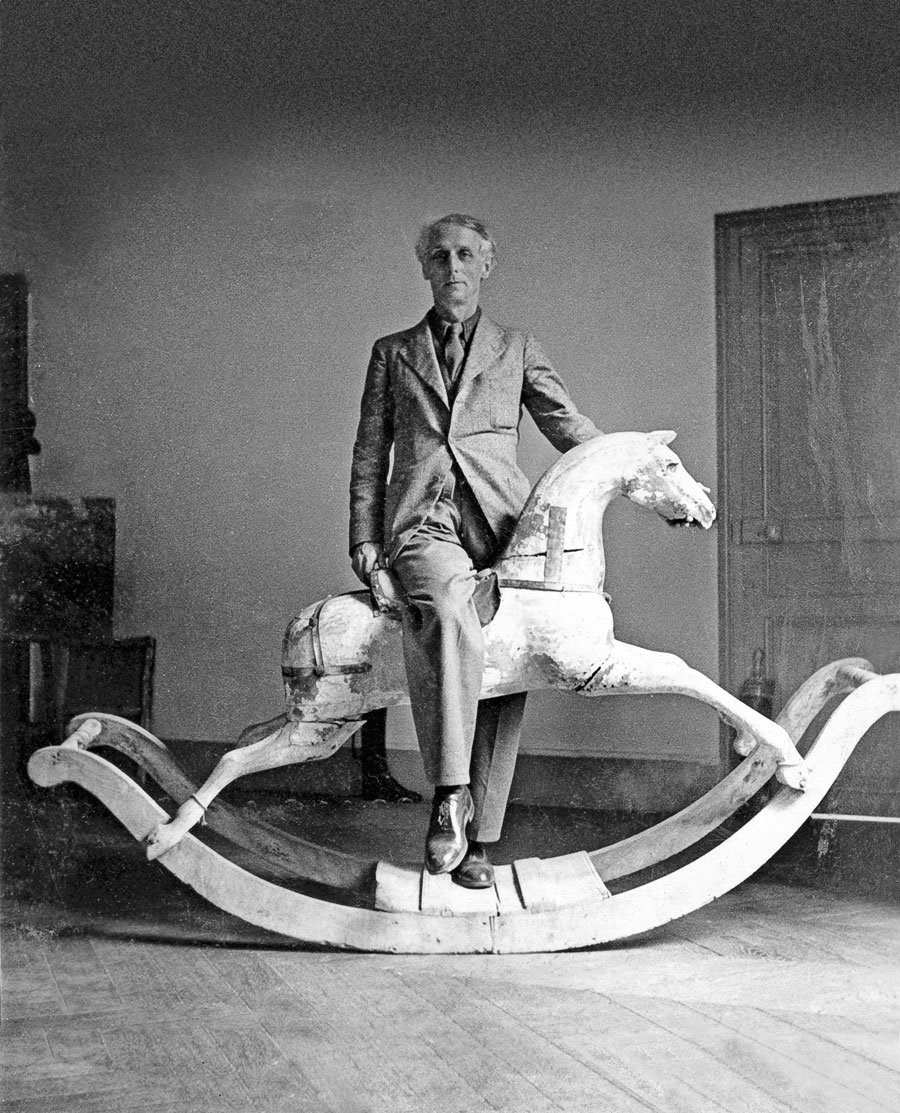
Max Ernst in-Paris www.artrabbit.com/events/max-ernst-an-invitation-to-look-...
en.wikipedia.org/wiki/Max_Ernst
Artwork: TudioJepegii