View allAll Photos Tagged LED
I min tale vendte jeg blandt andet spørgsmålet, om der skal være kvoter, som sikrer kvinder på topposterne. Det, synes jeg, er en dårlig ide.
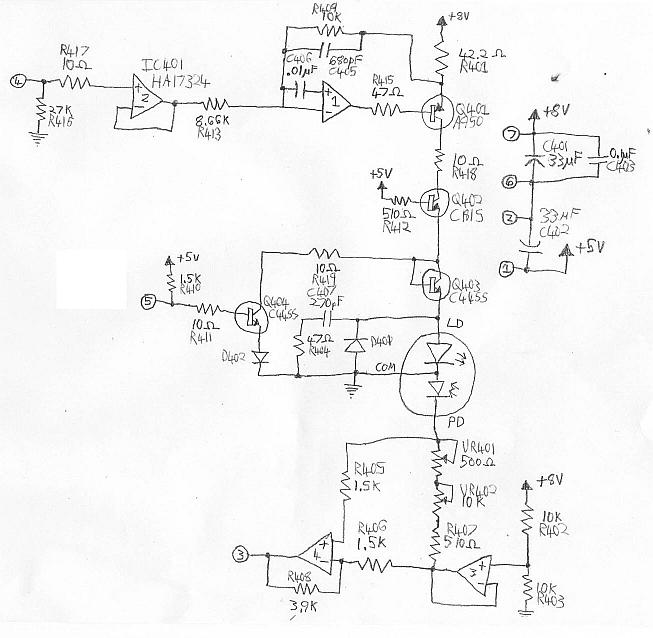
Overview of the UV led modulator.
It consists of an opamp controlled constant current source. The opamp used is the TLC272 (one of my favorite opamps) driving an FZT953 PNP transistor. The current delivered to the UV led is about 18mA.
The LED has a BAT42 diode and a resistor and capacitor snubber over it. The goal is to replace the LED by a 405nm laser diode, these diodes are very sensitive to over and undershoots and need to be carefully protected.
Parallel to the LED is a BS170 mosfet that rapidly turns off and on to modulate the LED.
The schematic is more or less based on this circuit from a Laserjet II laser driver:
www.repairfaq.org/sam/rg1-1594.jpg
On this page:
Art Assignment project for the Whitescapes episode. We were asked to put white on white and then record in two different lights.
This is under an LED spotlight.
Assignment here: www.youtube.com/watch?v=hOHmfuD58lM&feature=youtu.be
Yarn on paper, spelling out a phrase I wrote in my notebook ages ago.
Model Number: YB-A5-MADW21
Base: GU10
Number of LEDs: 21pcs
LED Type: LAMP
Dimension: Φ50*54mm
Voltage: 12V DC
Power: 1W
Luminous Flux: 100LM
Color Temperature: 3000K-10000K
Beam Angle: 120o
C.R.I: > 80
Life Span: 50,000 hours(Average)
LEDs
4” Waterproof Flexible 6 3528 type SMD LED Strip
Input voltage: 12V DC
Long life span: 50,000+ hours
Purchased on ebay for $5 each
Cabinet
Wildwood Designs custom made cube stacks
Product Features:
Light source: Super bright or normal bright 3528 SMD LEDs
Power Factor (PF) > 0.95
Lower electric current for high brightness, therefore less light decay and longer lifespan
80% Energy-saving over traditional fluorescent tubes
Less than 10% luminous decay in 50,000 hours
50,000+ hours lifetime
Aluminum alloy body with transparent or frosted plastic cover
Easy mounting: working without electronic ballast or starter
Solid state, High Shock/Vibration Resistant
No RF Interference
Instant start without Flickering
Low thermal elimination
No mercury and other Hazardous Materials, fully ROHS-Compliant
Wide voltages available: AC85V-165V or AC165V-265V
Applications:
General and commercial lighting for homes, offices, restaurants, hotels, warehouses, factories, parking lots, shopping malls, buses, trains, etc.;
Accent lighting or Task lighting: cabinets, cupboards etc in homes, restaurants or kitchens;
Back lighting for square billboards or advertisement boards;
Display lighting for the articles in stores and shops.
Installation methods:
1. Our LED tubes are completely in consist with traditional fluorescent tubes and therefore it is no need to make special bracket for it.
2. Remove the starter and the whole electronic ballast from the traditional fluorescent light bracket and install the LED tube onto it.
Website: www.haichanglight.com/
I needed an IR emitter source for the Wiimote to try the whiteboard program on my PC. Because Infra-red light is not visible to the human eye, my intention was to use a digital camera's CCD sensor to help me "see the light". In my quest for perfection, I turned on the macro-mode in order to better focus the LED and half-depressed the camera's shutter. One-handed operation of the camera with my left hand (I'm right handed) caused me to depress the shutter a little too hard and snapped this picture of the emitter device and some of the mess on my desk. I found it pretty interesting so I decided to upload it.
My Baroesque Barometric Skirt reflects environmental data, plus my personal temperature - it's a reflection of the self within the bigger picture. What I mean by this is that how I pass through and interact with the ambient environment interests me. To visualise this passage I have created a skirt that uses sensors to glean environmental data in the form of a barometric sensor board, its data more commonly familiar to those who track and predict weather. To the viewer of the skirt, they will see colours changing in real time on four rays of RGB strip, one for each sensor reading.
This is how I’ve put together the electronics inside the skirt: the aforementioned barometric sensor board protrudes from the skirt and gleans the ambient temperature ( Celcius C) around it, the other sensors on the board collect data and via algorithms in the code work out the altitude (meters m) and pressure (Pascal Pa). I’ve used a Shrimp kit, which is similar to the Arduino Uno, that comes as a bag of components and soldered it onto stripboard. Another temperature sensor, measuring my temperature sits on this stripboard, Four lengths of RGB LED strip radiate from the Shrimp circuit and both the stripboard circuit and the RGB LED strip are sewn onto what I call an ‘apron’, which sits under the skirt and is detachable for washing purposes and also as I like to fashion my electronic circuits as interesting pieces to be viewed in their own right.
The code takes the readings from the sensors and runs an algorithm firstly to convert the data into Celcius, meters or Pascals, and then runs another to mix the colours appearing on each corresponding RGB LED strip. There are 7 colours I’ve set to pass through, the lowest reading being blue, followed by cyan, white, green, yellow, magenta and finally red for the highest reading in each sensor reading data band.
It took a months to create the skirt as there was so many iterations between experimenting with circuits around how to make my idea come to life and creating the skirt, testing paint on fabric, choosing a visual metaphor and style of the skirt, then making the skirt. Next finalising choice of the electronics, coding, prototyping, then transferring the circuit to stripboard. Finally soldering everything together and then debugging, testing, making changes to the code, before eventually putting the skirt and the electronics together.
The Baroesque Skirt’s weather artwork was inspired by the characters Amaterasu & Kabegami from the game Okami.
Read more about the Baroesque Skirt: rainycatz.wordpress.com/2012/10/22/baroesque-barometric-s...
GE LEDs illuminate landmarks like London’s Tower Bridge Read More: www.gereports.com/putting-on-the-ritz/
© sergione infuso - all rights reserved
follow me on www.sergione.info
You may not modify, publish or use any files on
this page without written permission and consent.
-----------------------------
Dopo i successi estivi a Roma e Milano, il southern rock dei Blackberry Smoke torna in Italia per un unico appuntamento, l’11 marzo al Fabrique di Milano.
I Blackberry Smoke difficilmente riescono a stare con le mani in mano: il nuovo album “Like An Arrow” è uscito da appena tre giorni e la band è già pronta a presentarlo in tutto il mondo con una lunga serie di show, tra i quali la data italiana. Le canzoni di quest’ultimo lavoro dimostrano quanto quest’autentica rock band americana abbia una costante voglia di mettersi alla prova con nuove idee, suoni e territori musicali non ancora esplorati. «Siamo perfettamente in sintonia in merito a ciò che vogliamo esplorare», dichiara il cantante e autore Charlie Starr. «Non potremmo mai incidere sempre lo stesso album, nonostante ci siano fans che apprezzerebbero: sarebbe troppo scontato. Se i Beatles o i Led Zeppelin l’avessero pensata così, oggi non li ameremmo così tanto».
“Like An Arrow” prosegue il percorso iniziato con i due precedenti album, “The Whippoorwill” (2012) e “Holding All The Roses” (2015). Si apre col brano più heavy finora scritto dai Blackberry Smoke ed esplora il British rock prima di fare tappa in luoghi sacri come Macon, Woodstock, Muscle Shoals e Tulsa, con Starr e i suoi compagni impegnati a seguire le orme di pilastri della musica quali JJ Cale, The Allman Brothers Band e molti altri. Questa voglia di sperimentare pervade tutta la carriera del quintetto sin dal suo esordio, nel 2001. L’etica da classe operaia e l’attitudine alla jam session ha portato la band ad avere uno zoccolo duro di fan che continua a crescere concerto dopo concerto, con una media di 250 show all’anno.
I Blackberry Smoke sono Charlie Starr (voce, chitarra), Richard Turner (voce, basso), Brit Turner (batteria), Paul Jackson (voce, chitarra) e Brandon Still (tastiere).
Hier kommt die ultimative Kameraauflage für alle Situationen, in denen kein Stativ eingesetzt werden kann oder darf: der Bohnensack aus naturbelassenem, offenporigem Rindsleder. Nicht nur, dass sich das Leder wunderbar anfühlt, es dient vor allem dem Zweck, die Kamera sicher zu betten für Aufnahmesituationen, die längere Belichtungszeiten erfordern oder bei denen der Fotograf selber mit aufs Bild möchte.
Mehr ☞ monoc.me/lederbohnensack
Fotos © Jan Kampling gdgts.de/
So, not only was this clock awesome, but all of the clocks in the clock department were set correctly. I'm lying when I say "all." Still, 90%...
LED-Säule mit 2m Höhe und 15cm Durchmesser, Fuß ebenfalls aus Plexiglas. Diese Säule wird von innen mit 2 x Astera AL3M beleuchtet. Die LED-Leuchte hat eine RGBW-Farbmischung und einen starken LI-Akku. Sie ist steuerbar per Infrarot oder per Funk (W-DMX).
Die Säule ist absolut regensicher.
Zu mieten in Berlin und Hannover bei
0thmirageknight.com/led-mirage-sarion-ver/
レッド・ミラージュ (サリオン騎 ver.)
Scale: 1/144
Company: Wave (ウェーブ)
Material: Plastic (プラスチック)
Paints used: TS-30 Silver Leaf, X10 Gun Metal, X12 Gold Leaf, Testors Black Enamel, Tamiya Fine Surface Primer White, Future
On this picture you see a person in a LED-lit white suit that is testing illuminated banners and waving a flag in order to be able to communicate.
credit: Michael Kaczorowski
Persepolis (Old-Persian: Pārśa[2]) was the ceremonial capital of the Achaemenid Empire (ca. 550–330 BC).
Gate of All Nations
Apadana Palace
The Throne Hall
Tombs of Kings
Persepolis is situated 70 km northeast of the modern city of Shiraz in the Fars Province of modern Iran. The earliest remains of Persepolis date from around 515 BCE. UNESCO declared the citadel of Persepolis a World Heritage Site in 1979
Persepolis is near the small river Pulwar, which flows into the river Kur (Cyrus / Kuroush). The site includes a 125,000 square metre terrace, partly artificially constructed and partly cut out of a mountain, with its east side leaning on Kuh-e Rahmet ("the Mountain of Mercy"). The other three sides are formed by retaining walls, which vary in height with the slope of the ground. From 5 to 13 metres on the west side a double stair. From there it gently slopes to the top. To create the level terrace, depressions were filled with soil and heavy rocks, which were joined together with metal clips.
Around 519 BC, construction of a broad stairway was begun. The stairway was planned to be the main entrance to the terrace 20 metres above the ground. The dual stairway, known as the Persepolitan stairway, was built in symmetrically on the western side of the Great Wall. The 111 steps were 6.9 metres wide with treads of 31 centimetres and rises of 10 centimetres. Originally, the steps were believed to have been constructed to allow for nobles and royalty to ascend by horseback. New theories suggest that the shallow risers allowed visiting dignitaries to maintain a regal appearance while ascending. The top of the stairways led to a small yard in the north-eastern side of the terrace, opposite the Gate of Nations.
Grey limestone was the main building material used in Persepolis. After natural rock had been levelled and the depressions filled in, the terrace was prepared. Major tunnels for sewage were dug underground through the rock. A large elevated water storage tank was carved at the eastern foot of the mountain. Professor Olmstead suggested the cistern was constructed at the same time that construction of the towers began.
The uneven plan of the terrace, including the foundation, acted like a castle, whose angled walls enabled its defenders to target any section of the external front. Diodorus writes that Persepolis had three walls with ramparts, which all had towers to provide a protected space for the defense personnel. The first wall was 7 metres tall, the second, 14 metres and the third wall, which covered all four sides, was 27 metres in height, though no presence of the wall exists in modern times
LED display supplier with the turnover ranked 1st in Asia and 3rd over the world for 6 years.
Most reliable manufacture
Best quality LED display
Cheapest LED display
With special dot-by-dot technology on brightness and color
******World Best Prices for Highest Quality*****We can offer:
Outdoor full color LED display
Pixel configuration: 2R1G1B or 1R1G1B
Pitch: 10mm, 12mm, 14mm, 16mm, 20mm, 22mm, 25mm, 32mm
Indoor full color LED display
Pixel configuration: 1R1G1B (SMD 3 in 1)
Pitch: 3mm, 4mm, 6mm, 7. 62mm, 8mm, 10mm, 12mm
We have passed ISO9000 & ISO 14000 certificate (CE & RoHS available if needed)
Would any item interests you, please feel free to contact us.
Jeanius Adual
Email : smileds86@gmail.com
MSN : adual.do@hotmail.com
TEL :+86 134 1051 0101
Lothian's experimental LED front destination screen is seen here working Service 10 and the beauty of electronic devices like this is that they can be changed simply and at the touch of a button. One day this might allow for greater flexibility when it comes to sudden alterations that have to be made along the route.
In this shot note the pinky shade of the intermediate and service number details while the destination 'Western Harbour' is now more bold and in a stronger white. This is clearly visible to the eye but may just have been an error or alteration on the day who knows? One thing is for sure we should be ready to snap at 846 everytime we see her to compare all the different versions of text.
For a look at many of the possible screens Lothian's 846 is capable of showing visit my LED set for some recent examples, including some in-depth technical information on how it all works!
www.flickr.com/photos/stuart_montgomery/sets/721576259550...
Note to the left in this picture Gemini 847 is passing along Princes Street beside the RSA gallery.
The Royal Scottish Academy gallery was designed by William Henry Playfair during the 1820's. Along with the adjacent National Gallery of Scotland, their neo-classical design helped transform Edinburgh in to a modern day Athens of the North.
The statue of Queen Victoria on the top the building was sculpted by Sir John Steell. Exhibition space is shared throughout the year by the RSA with the NGS and other exhibiting societies, notably the Society of Scottish Artists, Visual Arts Scotland and the Royal Society of Watercolourists.