View allAll Photos Tagged Expectations
Please press "L" for better view
Please like my Facebook page www.facebook.com/MaartenCreativePhotography Thanks!
Supra Boats @Supra_Boats is pushing wake boat refinement "beyond better" with unexpected standard features to elevate your experience on the water. 2013 Supra boats literally raise the standards of wake boat design with innovative features that create extreme luxury tempered by intuitive function. Costly upgrades or simply not available on competitor boats, Supra's standard feature-set reads like an all-time most popular options list. From a completely loaded wakeboard tower to a thumping sound system to amazing driver controls to a torquey surf-optimized engine to a huge expandable ballast system to the wake shaping SmartPlate to a ride unaffected by the platform to a plush resilient interior to the ultimate customization with colored decks and hull to a rock star tandem axle trailer, Supra boats are exceeding the highest expectations with an unbelievable set of standard features inside and out.

Roswell S-Bend Tower w/ Bimini, Racks & Speakers
Supra has high standards even above the deck with the completely loaded S-Bend wakeboard tower or the Pro Edge Tower on the SA350-550. This dual-mount tower is standard on all Supra boats. It was designed to offer advantages in visibility, distinct style and accessories included. As an engineering-driven company, Supra Boats made function priority #1 with the S-Bend and Pro Edge. With smooth low-profile one-person folding action and a patented CAM lock mechanism, these Roswell Towers are equal parts form and function. The “S” shape lends itself to an extremely unique profile and the integrated quick-shade bimini, combo racks, four Polk speakers and interior lighting make it a complete package. The Pro Edge takes standards even higher with a new Bridge Block System for folding the tower without interfering with the driver to get under a low bridge. Hand-upholstered vinyl piece and blue LED lighting accents take the Pro Edge "beyond better".
Designed for optimum outdoor sound and styled specifically for use in a marine environment, 10 Polk Audio MM Series speakers are standard in each Supra boat. A unique tweeter-on-grille design eliminates the traditional tweeter post, resulting in a totally sealed front. With waterproof materials, it will stand up to just about any harsh marine environment while sounding great, thanks to Polk marine certification and Polk technology.
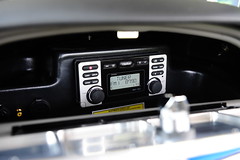
The Clarion deck that drives this incredible sound also leaves the factory in every Supra boat. The Clarion CMD6 marine deck is mounted in the Supra glovebox for ultimate protection. This feature-rich stereo can be controlled from the glovebox location, the driver’s side remote, through the VISION Touch at the dash or the lounge remote in the 22V, SA and 242. The CMD6 offers multi format CD, external USB device and on-deck storage music play as well as full iPOD and iPhone control. Every Supra boat motors off the line ready to rock!
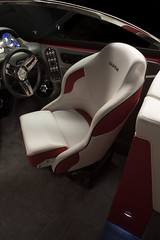
A performance wake boat deserves a performance driver's seat and Supra boats offer one standard. Supra has designed a new racing-style driver's seat with wide high-back comfort that supports a variety of drivers and driving styles. The huge standard flip-up bolster takes your driving experience even higher with a secure comfortable seat that offers perspective and guarantees piece of mind. Want to get even higher? Actuate as much as 4 more inches of E-Boost with a touch of the VISION or the flip of a switch. Adjust it forward and back or simply swivel it around to join the lounge, the Supra Racing Seat is as social as it is supportive.
The Warm-up Seat is standard in all 2013 models so you can extend your day and even your season in a Supra boat. Boating last longer in a Supra! The heated driver's seat radiates comfort with the flip of a switch or it can be programmed as part of your personal Supra Drive Preset. No matter which way you command the Warm-up, the result is a driving experience that is beyond better.
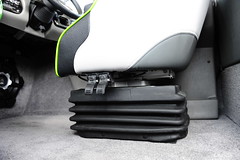
E-Boost Electronic Seat Height
Electronic seat height adjustment or E-Boost is standard on all 2013 Supra boats. The E-Boost Driver's Seat electronically adjusts chair height with the flick of a switch or a touch of the VISION to provide comfortable customizable perspective on the water. Driving with the perfect point of view for you ensures safe worry-free operation of your Supra boat. With a supra you won't be distracted by balancing on a bolster, sitting on your feet or a propping yourself up with a throw cushion. E-Boost raises the luxury, comfort and safety of the Supra Racing Seat to new heights, electronically.
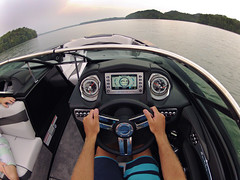
VISION Touch w/ Rider Profiles & GPS Mapping
Harness Supra's powerful performance and refinement with ease thanks to the intuitive control of the all-new VISION Touch dash system. With a tap of your finger on the brilliant 7-inch touch display, manage and monitor everything from Supra's Ride System (SRS) that integrates expandable Flex ballast and wake-shaping SmartPlate and Zero Off speed control to the standard ten-speaker Clarion Polk sound system. Watch full-screen video from a USB or mobile device. Illuminate the cockpit, storage and available underwater LEDs on the quick-touch lighting screen. Even set and recall the perfect driving conditions with new Driver Presets. The Murphy operating system is specifically designed for Supra Boats to offer extreme functionality and ease of use. All it takes is a poke to navigate the VISION, but if you are more comfortable using the 10-button navigation located to the right and left of the screen that is always an option. Customize the look of your VISION Touch with a range of colors and backgrounds and pick the perfect brightness for any time of the day. FInally, at the end of an epic day on the water, let the built-in GPS navigation pilot you back to the dock. The VISION Touch lets you focus on the business of having fun in your Supra boat instead of trying to figure out how to work it.
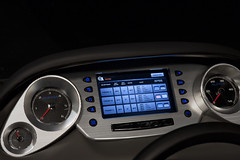
While other manufacturers concentrate on accommodating only the rider with memorable features, Supra doesn't forget about the driver. Supra Driver Presets offer a host of programmable settings that make a day on the water behind the wheel as enjoyable as possible. Driver Presets have the ability to store as many as 3 boat driver profiles that memorize everything from seat height and VISION display colors to seat heat and available druver's zone climate control. Supra tailors the boating experience to you no matter what your role in the boat.
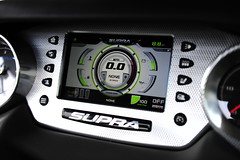
Supra Zero Off integrated speed control is a vital piece of SRS and typically a pricey upgrade in competitor offerings, but standard in all Supra wake boats. Zero Off runs on satellite input and data from the Indmar Engine Management System. It is based completely on the speed across the surface of the water; therefore, there is no requirement for rider weight, crew weight, KX, PX or even any kind of wind adjustment. You simply touch the desired speed on the VISION and go.
You don't need three hands to drive a Supra. The designers at Supra Boats spend a lot of time on the water. They realize you need a way to increase and decrease your speed without taking your hands off the wheel. Standard on all 2013 Supra boats, the Quick-bump Speed Stick allows you to toggle your Zero Off set speed up or down with just a finger tip. Without loosing grasp of the wheel with your right hand you can use a finger to push the lever up or down to adjust your cruising speed while you're under way.
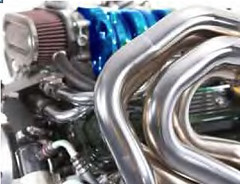
The new 345 Surf engine from Indmar has been made beyond better less than a year after it won the IBEX Innovation Award. This 345 horsepower, 5.7L engine has not only received a color and graphics change, but it is now standard in all 2013 Supra boats. The oversized oil pan and innovative oil air separator are still the stars of this sequential port fuel injected power plant. It’s these two items that increase the longevity of the engine and improve performance even under extreme wake surfing conditions.

Supra Boats provides wake power and versatility with the Flex Ballast System. This flexible ballast configuration swells to as much as 1950 pounds standard with the combination of three sacks standard from the Supra factory. With nearly a ton of water capacity, wakeboarding’s most popular reversible pumps the Jabsco Ballast Puppy fills or drains the entire Flex system in less than 5 minutes, even underway. But it’s not just about the weight, three quick-connect ballast points plumbed on either side of the engine and at midship make this system completely customizable. If you want to go bigger on the port side to create the perfect left-foot-forward wake, snap in the ballast sacks of your choice and shoot the curl. The versatility of the Flex System still monitors and controls the ballast from the dash even when customized. We don't claim to know what your perfect wake is, but we bring you the tools to make it beyond better.

The Supra SmartPlate automatically adjusts to the optimum position, but it can also be adjusted on-the-fly to refine the shape of Supra wakes. Depending on rider skill level, passenger and ballast weight placement and speed the SmartPlate can be set to a range of positions. Controlled through the VISION Touch or as a setting in a Rider Profile, the angle of the plate will affect the wake shape by changing the running attitude of the boat. While some boat manufacturers limit you to a one-dimensional hull design, Supra allows you to command the flow of the water beneath the boat with the SmartPlate. Typically referred to as a “rider” accessory, the SmartPlate’s intelligent design allows it to bolster performance even outside wake sports. Being able to change the running angle of the boat in the water allows you to fine tune not only wakes, but ride and handling as well. Ever been on the lake on a rough day? You can adjust the SmartPlate to smooth out the ride and increase control. This is not just smart, it’s genius.
PURE Surf (Platform Unaffected Ride Experience)
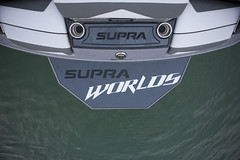
This standard 2-piece tooled fiberglass platform is the purist of the 2013 Supra line. Through bolted to the transom with new stainless steel quick-release bracketry, this swim platform does way more than just aid water entry. Supra's PURE Surf offers a platform unaffected ride experience with specifically engineered corners. The smooth underside also guarantees the flow of water beneath Supra boat hulls is undisturbed especially at surf speeds and running angles. Standard on all Supra boats, PURE Surf is another Supra Ride System (SRS) component allowing you to create a wake sport experience that is all you.

The new Supra Cooler made by AO, standard in all 2013 Supra boats, is the highest quality removable soft-sided cooler available. The specially engineered liner prevents all leaks and sweating, while the three-quarters of an inch thick, high-density, closed cell foam insulation holds ice for as long as 24 hours in 120-degree heat. The Supra-sized dimensions make this 36-can cooler fit in just about any storage area with ease. The Supra Cooler is removable and branded with "Supra Boats" so it can be loaded in the house and taken on any excursion on water or off. Owning a Supra boat can make you cool, literally.
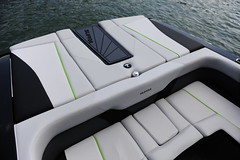
As resilient as the exclusive Syntec NBT (NANO Block Technology) Vinyl is, conscientious boat owners are still conflicted about walking on it. This is why Supra has added the new Transom Walkacross to all 2013 Supra model sun pads standard. This color-matched tooled fiberglass walkway gives you piece of mind on trips in a an out of the boat. Covered in cushioned Supra no-slip SeaDek, the Transom Walkacross creates a functional, comfortable and safe place whether you're walking or laying across it.
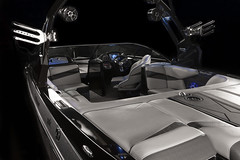
Supra boat interiors are wrapped in exclusive resilient NANO Block Technology (NBT) Vinyl from Syntec. The luxurious colors and plush texture of Syntec vinyl help create an interior design that is as an intricate as it is comforting. NANO Block Technology guards against marks and stains with

While many wake boat manufacturers limit your color choices on the deck and hull of the boat or charge more for dark colors, Supra Boats gives you the choice at no charge. Customize the look of your Supra boat with a black hull and deck or go hot with a Fire Red deck and hull. Or do a little of each with a Fire Red deck and black deck. The choice is yours.
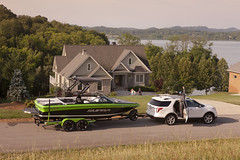
No need to add for the price of a trailer when you purchase a Supra boat. Supra boats come standard with a Tandem Torsion Axle Trailer Boatmate Trailer w/ Alloy Wheels and Disc Brakes on both axles. Boatmate Trailers offer style and performance up to the lofty levels of Supra boats with quality craftsmanship and reliability that deserves to be under a luxury performance wake boat. With standard features likes a swing-a-way tongue, color-matched bolt-on fenders, a self-latching hitch ball actuator, a Fulton F2 trailer jack, a 7-way round tow vehicle plug, a spare tire mount, removable guide poles and a trailer prop guard with rollers. A Boatmate trailer is the perfect match for your Supra boat, both elevate your expectations beyond better.
Featured in the blog of “Damn! I Wish I’d Taken That!”
Sunday March 4, 2012
Flower Power ( 6 of my shots featured today!)
For this photograph, I emulated Julia Margaret Cameron's photography style. Julia Margaret Cameron had many close-up photographs which I had "somewhat mimicked." Furthermore, Julia was an expert at manipulating light and shadows. So, I used a desktop lamp and set the lighting to dim (but not too dim), set the lighting to be slightly low, and used the environment I was in. Julia used a dark room or a garden (?) as her background. So, I used a dark room with blue walls and took it in the evening. Using my phone, I utilized the portrait feature to give it the slight blurriness to emulate the stylistic qualities of Julia's use of emphasized blur. In addition, I tried using a bit of the soft focus that she had in her photographs. Despite her using many negative photographs, I've decided not to, since I wanted to express the colors in the photograph. Using the featured photo edits provided by the phone itself, I lowered the exposure between -70 to -80, the brilliance to -45 to -50, the highlights between 15 to 20, shadows to -6 or -7, contrast 2 or 3, brightness at 30, black point between -60 to -65, the saturation between -24 and -30, vibrance to 100, warmth somewhere at 55 to 60, tint either at 45 to 50, the sharpness at 61, definition at 100, noise reduction at 100, and vignette at 50. I'm not much of a professional at this and didn't have any sort of knowledge on what those features do, but I tried to mimic the features of the photograph to be similar to Julia Margaret Cameron. Therefore, making the lighting and shadows to seem more dramatic. She used props as a type of imagery to create a story. The props I used were a paint brush and towels as a make-up brush and cloaks. Most of her photographs were vertical compositions, so I imagined the rule of thirds and placed myself and little sister near those points of the method. I really admire Julia's stylistic qualities (e.g., close ups, dramatic lighting, subjects weren't the ideal people in the photographs, selective focus, implemented stories in the photos, use of negatives, accidental soft exposures and emphasized blurs, etc.) that stand out to give the romantic literatures, and some royal core vibes or other vibes. One of her qualities in her works that inspired this photograph was her use of allegory, narratives, and literatures. The photographs of hers gave a story for us to implement and understand. So, I used those qualities of hers to make a story of my own in this photo. The photo is called "Painting Expectations." This is kind of like a reference towards the Disney movie, Mulan. Where many expectations were placed onto her to bring honor to her family. In this photo though, it was similar to that. The little girl on the bottom left side (my little sister), is the one who has to hold onto all the expectations given to her to make her family proud. The paint brush that I (the one on the right side) held, is used as imagery and a metaphor that I am the one placing expectations on her and is expecting great things about her. It illustrates families that expect many things from their children, which was my intentions of this photograph. I really love and feel inspired by the beautiful qualities of Julia's photographs.
This photograph is probably the simplest I have made, but it tells a story. Is it better to have zero expectation when you are following a dream or is it better to have your head full of anticipation? I'd say a little bit of both. When you work hard, good things will hopefully come to you. Just do what you love, never stop; and you will eventually get there some day. This is a perfect example on why I love conceptual photography.
Have mind that...
My youngest son,partner and baby "bump"-we had a great time shopping for its first clothes. baby is due in November so plenty of time to amass quite a wardrobe !
My last series of photos inspired by Funny Face/Paris and my last Poppy! She was also my very first Poppy and therefore very special to me.
©PhotographyByMichiale. All images are copyright protected and cannot be used without my permission. please visit me on Facebook, too! www.facebook.com/photographybymichiale
I wondered what the future will be like for this young person. Will he travel to fulfil his dreams. Or will he be left only with expectations?
The log that we hope the camera will capture exciting photos from!
I can see this log from upstairs in our house. I often see a beaver, Great Blue Heron, ducks, geese, swans, etc. in the area. Having great expectations from this trail cam:) We will see.
Supra Boats @Supra_Boats is pushing wake boat refinement "beyond better" with unexpected standard features to elevate your experience on the water. 2013 Supra boats literally raise the standards of wake boat design with innovative features that create extreme luxury tempered by intuitive function. Costly upgrades or simply not available on competitor boats, Supra's standard feature-set reads like an all-time most popular options list. From a completely loaded wakeboard tower to a thumping sound system to amazing driver controls to a torquey surf-optimized engine to a huge expandable ballast system to the wake shaping SmartPlate to a ride unaffected by the platform to a plush resilient interior to the ultimate customization with colored decks and hull to a rock star tandem axle trailer, Supra boats are exceeding the highest expectations with an unbelievable set of standard features inside and out.
Roswell S-Bend Tower w/ Bimini, Racks & Speakers
Supra has high standards even above the deck with the completely loaded S-Bend wakeboard tower or the Pro Edge Tower on the SA350-550. This dual-mount tower is standard on all Supra boats. It was designed to offer advantages in visibility, distinct style and accessories included. As an engineering-driven company, Supra Boats made function priority #1 with the S-Bend and Pro Edge. With smooth low-profile one-person folding action and a patented CAM lock mechanism, these Roswell Towers are equal parts form and function. The “S” shape lends itself to an extremely unique profile and the integrated quick-shade bimini, combo racks, four Polk speakers and interior lighting make it a complete package. The Pro Edge takes standards even higher with a new Bridge Block System for folding the tower without interfering with the driver to get under a low bridge. Hand-upholstered vinyl piece and blue LED lighting accents take the Pro Edge "beyond better".
Designed for optimum outdoor sound and styled specifically for use in a marine environment, 10 Polk Audio MM Series speakers are standard in each Supra boat. A unique tweeter-on-grille design eliminates the traditional tweeter post, resulting in a totally sealed front. With waterproof materials, it will stand up to just about any harsh marine environment while sounding great, thanks to Polk marine certification and Polk technology.
The Clarion deck that drives this incredible sound also leaves the factory in every Supra boat. The Clarion CMD6 marine deck is mounted in the Supra glovebox for ultimate protection. This feature-rich stereo can be controlled from the glovebox location, the driver’s side remote, through the VISION Touch at the dash or the lounge remote in the 22V, SA and 242. The CMD6 offers multi format CD, external USB device and on-deck storage music play as well as full iPOD and iPhone control. Every Supra boat motors off the line ready to rock!
A performance wake boat deserves a performance driver's seat and Supra boats offer one standard. Supra has designed a new racing-style driver's seat with wide high-back comfort that supports a variety of drivers and driving styles. The huge standard flip-up bolster takes your driving experience even higher with a secure comfortable seat that offers perspective and guarantees piece of mind. Want to get even higher? Actuate as much as 4 more inches of E-Boost with a touch of the VISION or the flip of a switch. Adjust it forward and back or simply swivel it around to join the lounge, the Supra Racing Seat is as social as it is supportive.
The Warm-up Seat is standard in all 2013 models so you can extend your day and even your season in a Supra boat. Boating last longer in a Supra! The heated driver's seat radiates comfort with the flip of a switch or it can be programmed as part of your personal Supra Drive Preset. No matter which way you command the Warm-up, the result is a driving experience that is beyond better.
E-Boost Electronic Seat Height
Electronic seat height adjustment or E-Boost is standard on all 2013 Supra boats. The E-Boost Driver's Seat electronically adjusts chair height with the flick of a switch or a touch of the VISION to provide comfortable customizable perspective on the water. Driving with the perfect point of view for you ensures safe worry-free operation of your Supra boat. With a supra you won't be distracted by balancing on a bolster, sitting on your feet or a propping yourself up with a throw cushion. E-Boost raises the luxury, comfort and safety of the Supra Racing Seat to new heights, electronically.
VISION Touch w/ Rider Profiles & GPS Mapping
Harness Supra's powerful performance and refinement with ease thanks to the intuitive control of the all-new VISION Touch dash system. With a tap of your finger on the brilliant 7-inch touch display, manage and monitor everything from Supra's Ride System (SRS) that integrates expandable Flex ballast and wake-shaping SmartPlate and Zero Off speed control to the standard ten-speaker Clarion Polk sound system. Watch full-screen video from a USB or mobile device. Illuminate the cockpit, storage and available underwater LEDs on the quick-touch lighting screen. Even set and recall the perfect driving conditions with new Driver Presets. The Murphy operating system is specifically designed for Supra Boats to offer extreme functionality and ease of use. All it takes is a poke to navigate the VISION, but if you are more comfortable using the 10-button navigation located to the right and left of the screen that is always an option. Customize the look of your VISION Touch with a range of colors and backgrounds and pick the perfect brightness for any time of the day. FInally, at the end of an epic day on the water, let the built-in GPS navigation pilot you back to the dock. The VISION Touch lets you focus on the business of having fun in your Supra boat instead of trying to figure out how to work it.
While other manufacturers concentrate on accommodating only the rider with memorable features, Supra doesn't forget about the driver. Supra Driver Presets offer a host of programmable settings that make a day on the water behind the wheel as enjoyable as possible. Driver Presets have the ability to store as many as 3 boat driver profiles that memorize everything from seat height and VISION display colors to seat heat and available druver's zone climate control. Supra tailors the boating experience to you no matter what your role in the boat.
Supra Zero Off integrated speed control is a vital piece of SRS and typically a pricey upgrade in competitor offerings, but standard in all Supra wake boats. Zero Off runs on satellite input and data from the Indmar Engine Management System. It is based completely on the speed across the surface of the water; therefore, there is no requirement for rider weight, crew weight, KX, PX or even any kind of wind adjustment. You simply touch the desired speed on the VISION and go.
You don't need three hands to drive a Supra. The designers at Supra Boats spend a lot of time on the water. They realize you need a way to increase and decrease your speed without taking your hands off the wheel. Standard on all 2013 Supra boats, the Quick-bump Speed Stick allows you to toggle your Zero Off set speed up or down with just a finger tip. Without loosing grasp of the wheel with your right hand you can use a finger to push the lever up or down to adjust your cruising speed while you're under way.
The new 345 Surf engine from Indmar has been made beyond better less than a year after it won the IBEX Innovation Award. This 345 horsepower, 5.7L engine has not only received a color and graphics change, but it is now standard in all 2013 Supra boats. The oversized oil pan and innovative oil air separator are still the stars of this sequential port fuel injected power plant. It’s these two items that increase the longevity of the engine and improve performance even under extreme wake surfing conditions.
Supra Boats provides wake power and versatility with the Flex Ballast System. This flexible ballast configuration swells to as much as 1950 pounds standard with the combination of three sacks standard from the Supra factory. With nearly a ton of water capacity, wakeboarding’s most popular reversible pumps the Jabsco Ballast Puppy fills or drains the entire Flex system in less than 5 minutes, even underway. But it’s not just about the weight, three quick-connect ballast points plumbed on either side of the engine and at midship make this system completely customizable. If you want to go bigger on the port side to create the perfect left-foot-forward wake, snap in the ballast sacks of your choice and shoot the curl. The versatility of the Flex System still monitors and controls the ballast from the dash even when customized. We don't claim to know what your perfect wake is, but we bring you the tools to make it beyond better.
The Supra SmartPlate automatically adjusts to the optimum position, but it can also be adjusted on-the-fly to refine the shape of Supra wakes. Depending on rider skill level, passenger and ballast weight placement and speed the SmartPlate can be set to a range of positions. Controlled through the VISION Touch or as a setting in a Rider Profile, the angle of the plate will affect the wake shape by changing the running attitude of the boat. While some boat manufacturers limit you to a one-dimensional hull design, Supra allows you to command the flow of the water beneath the boat with the SmartPlate. Typically referred to as a “rider” accessory, the SmartPlate’s intelligent design allows it to bolster performance even outside wake sports. Being able to change the running angle of the boat in the water allows you to fine tune not only wakes, but ride and handling as well. Ever been on the lake on a rough day? You can adjust the SmartPlate to smooth out the ride and increase control. This is not just smart, it’s genius.
PURE Surf (Platform Unaffected Ride Experience)
This standard 2-piece tooled fiberglass platform is the purist of the 2013 Supra line. Through bolted to the transom with new stainless steel quick-release bracketry, this swim platform does way more than just aid water entry. Supra's PURE Surf offers a platform unaffected ride experience with specifically engineered corners. The smooth underside also guarantees the flow of water beneath Supra boat hulls is undisturbed especially at surf speeds and running angles. Standard on all Supra boats, PURE Surf is another Supra Ride System (SRS) component allowing you to create a wake sport experience that is all you.
The new Supra Cooler made by AO, standard in all 2013 Supra boats, is the highest quality removable soft-sided cooler available. The specially engineered liner prevents all leaks and sweating, while the three-quarters of an inch thick, high-density, closed cell foam insulation holds ice for as long as 24 hours in 120-degree heat. The Supra-sized dimensions make this 36-can cooler fit in just about any storage area with ease. The Supra Cooler is removable and branded with "Supra Boats" so it can be loaded in the house and taken on any excursion on water or off. Owning a Supra boat can make you cool, literally.
As resilient as the exclusive Syntec NBT (NANO Block Technology) Vinyl is, conscientious boat owners are still conflicted about walking on it. This is why Supra has added the new Transom Walkacross to all 2013 Supra model sun pads standard. This color-matched tooled fiberglass walkway gives you piece of mind on trips in a an out of the boat. Covered in cushioned Supra no-slip SeaDek, the Transom Walkacross creates a functional, comfortable and safe place whether you're walking or laying across it.
Supra boat interiors are wrapped in exclusive resilient NANO Block Technology (NBT) Vinyl from Syntec. The luxurious colors and plush texture of Syntec vinyl help create an interior design that is as an intricate as it is comforting. NANO Block Technology guards against marks and stains with
While many wake boat manufacturers limit your color choices on the deck and hull of the boat or charge more for dark colors, Supra Boats gives you the choice at no charge. Customize the look of your Supra boat with a black hull and deck or go hot with a Fire Red deck and hull. Or do a little of each with a Fire Red deck and black deck. The choice is yours.
No need to add for the price of a trailer when you purchase a Supra boat. Supra boats come standard with a Tandem Torsion Axle Trailer Boatmate Trailer w/ Alloy Wheels and Disc Brakes on both axles. Boatmate Trailers offer style and performance up to the lofty levels of Supra boats with quality craftsmanship and reliability that deserves to be under a luxury performance wake boat. With standard features likes a swing-a-way tongue, color-matched bolt-on fenders, a self-latching hitch ball actuator, a Fulton F2 trailer jack, a 7-way round tow vehicle plug, a spare tire mount, removable guide poles and a trailer prop guard with rollers. A Boatmate trailer is the perfect match for your Supra boat, both elevate your expectations beyond better.
Supra Boats @Supra_Boats is pushing wake boat refinement "beyond better" with unexpected standard features to elevate your experience on the water. 2013 Supra boats literally raise the standards of wake boat design with innovative features that create extreme luxury tempered by intuitive function. Costly upgrades or simply not available on competitor boats, Supra's standard feature-set reads like an all-time most popular options list. From a completely loaded wakeboard tower to a thumping sound system to amazing driver controls to a torquey surf-optimized engine to a huge expandable ballast system to the wake shaping SmartPlate to a ride unaffected by the platform to a plush resilient interior to the ultimate customization with colored decks and hull to a rock star tandem axle trailer, Supra boats are exceeding the highest expectations with an unbelievable set of standard features inside and out.
Roswell S-Bend Tower w/ Bimini, Racks & Speakers
Supra has high standards even above the deck with the completely loaded S-Bend wakeboard tower or the Pro Edge Tower on the SA350-550. This dual-mount tower is standard on all Supra boats. It was designed to offer advantages in visibility, distinct style and accessories included. As an engineering-driven company, Supra Boats made function priority #1 with the S-Bend and Pro Edge. With smooth low-profile one-person folding action and a patented CAM lock mechanism, these Roswell Towers are equal parts form and function. The “S” shape lends itself to an extremely unique profile and the integrated quick-shade bimini, combo racks, four Polk speakers and interior lighting make it a complete package. The Pro Edge takes standards even higher with a new Bridge Block System for folding the tower without interfering with the driver to get under a low bridge. Hand-upholstered vinyl piece and blue LED lighting accents take the Pro Edge "beyond better".
Designed for optimum outdoor sound and styled specifically for use in a marine environment, 10 Polk Audio MM Series speakers are standard in each Supra boat. A unique tweeter-on-grille design eliminates the traditional tweeter post, resulting in a totally sealed front. With waterproof materials, it will stand up to just about any harsh marine environment while sounding great, thanks to Polk marine certification and Polk technology.
The Clarion deck that drives this incredible sound also leaves the factory in every Supra boat. The Clarion CMD6 marine deck is mounted in the Supra glovebox for ultimate protection. This feature-rich stereo can be controlled from the glovebox location, the driver’s side remote, through the VISION Touch at the dash or the lounge remote in the 22V, SA and 242. The CMD6 offers multi format CD, external USB device and on-deck storage music play as well as full iPOD and iPhone control. Every Supra boat motors off the line ready to rock!
A performance wake boat deserves a performance driver's seat and Supra boats offer one standard. Supra has designed a new racing-style driver's seat with wide high-back comfort that supports a variety of drivers and driving styles. The huge standard flip-up bolster takes your driving experience even higher with a secure comfortable seat that offers perspective and guarantees piece of mind. Want to get even higher? Actuate as much as 4 more inches of E-Boost with a touch of the VISION or the flip of a switch. Adjust it forward and back or simply swivel it around to join the lounge, the Supra Racing Seat is as social as it is supportive.
The Warm-up Seat is standard in all 2013 models so you can extend your day and even your season in a Supra boat. Boating last longer in a Supra! The heated driver's seat radiates comfort with the flip of a switch or it can be programmed as part of your personal Supra Drive Preset. No matter which way you command the Warm-up, the result is a driving experience that is beyond better.
E-Boost Electronic Seat Height
Electronic seat height adjustment or E-Boost is standard on all 2013 Supra boats. The E-Boost Driver's Seat electronically adjusts chair height with the flick of a switch or a touch of the VISION to provide comfortable customizable perspective on the water. Driving with the perfect point of view for you ensures safe worry-free operation of your Supra boat. With a supra you won't be distracted by balancing on a bolster, sitting on your feet or a propping yourself up with a throw cushion. E-Boost raises the luxury, comfort and safety of the Supra Racing Seat to new heights, electronically.
VISION Touch w/ Rider Profiles & GPS Mapping
Harness Supra's powerful performance and refinement with ease thanks to the intuitive control of the all-new VISION Touch dash system. With a tap of your finger on the brilliant 7-inch touch display, manage and monitor everything from Supra's Ride System (SRS) that integrates expandable Flex ballast and wake-shaping SmartPlate and Zero Off speed control to the standard ten-speaker Clarion Polk sound system. Watch full-screen video from a USB or mobile device. Illuminate the cockpit, storage and available underwater LEDs on the quick-touch lighting screen. Even set and recall the perfect driving conditions with new Driver Presets. The Murphy operating system is specifically designed for Supra Boats to offer extreme functionality and ease of use. All it takes is a poke to navigate the VISION, but if you are more comfortable using the 10-button navigation located to the right and left of the screen that is always an option. Customize the look of your VISION Touch with a range of colors and backgrounds and pick the perfect brightness for any time of the day. FInally, at the end of an epic day on the water, let the built-in GPS navigation pilot you back to the dock. The VISION Touch lets you focus on the business of having fun in your Supra boat instead of trying to figure out how to work it.
While other manufacturers concentrate on accommodating only the rider with memorable features, Supra doesn't forget about the driver. Supra Driver Presets offer a host of programmable settings that make a day on the water behind the wheel as enjoyable as possible. Driver Presets have the ability to store as many as 3 boat driver profiles that memorize everything from seat height and VISION display colors to seat heat and available druver's zone climate control. Supra tailors the boating experience to you no matter what your role in the boat.
Supra Zero Off integrated speed control is a vital piece of SRS and typically a pricey upgrade in competitor offerings, but standard in all Supra wake boats. Zero Off runs on satellite input and data from the Indmar Engine Management System. It is based completely on the speed across the surface of the water; therefore, there is no requirement for rider weight, crew weight, KX, PX or even any kind of wind adjustment. You simply touch the desired speed on the VISION and go.
You don't need three hands to drive a Supra. The designers at Supra Boats spend a lot of time on the water. They realize you need a way to increase and decrease your speed without taking your hands off the wheel. Standard on all 2013 Supra boats, the Quick-bump Speed Stick allows you to toggle your Zero Off set speed up or down with just a finger tip. Without loosing grasp of the wheel with your right hand you can use a finger to push the lever up or down to adjust your cruising speed while you're under way.
The new 345 Surf engine from Indmar has been made beyond better less than a year after it won the IBEX Innovation Award. This 345 horsepower, 5.7L engine has not only received a color and graphics change, but it is now standard in all 2013 Supra boats. The oversized oil pan and innovative oil air separator are still the stars of this sequential port fuel injected power plant. It’s these two items that increase the longevity of the engine and improve performance even under extreme wake surfing conditions.
Supra Boats provides wake power and versatility with the Flex Ballast System. This flexible ballast configuration swells to as much as 1950 pounds standard with the combination of three sacks standard from the Supra factory. With nearly a ton of water capacity, wakeboarding’s most popular reversible pumps the Jabsco Ballast Puppy fills or drains the entire Flex system in less than 5 minutes, even underway. But it’s not just about the weight, three quick-connect ballast points plumbed on either side of the engine and at midship make this system completely customizable. If you want to go bigger on the port side to create the perfect left-foot-forward wake, snap in the ballast sacks of your choice and shoot the curl. The versatility of the Flex System still monitors and controls the ballast from the dash even when customized. We don't claim to know what your perfect wake is, but we bring you the tools to make it beyond better.
The Supra SmartPlate automatically adjusts to the optimum position, but it can also be adjusted on-the-fly to refine the shape of Supra wakes. Depending on rider skill level, passenger and ballast weight placement and speed the SmartPlate can be set to a range of positions. Controlled through the VISION Touch or as a setting in a Rider Profile, the angle of the plate will affect the wake shape by changing the running attitude of the boat. While some boat manufacturers limit you to a one-dimensional hull design, Supra allows you to command the flow of the water beneath the boat with the SmartPlate. Typically referred to as a “rider” accessory, the SmartPlate’s intelligent design allows it to bolster performance even outside wake sports. Being able to change the running angle of the boat in the water allows you to fine tune not only wakes, but ride and handling as well. Ever been on the lake on a rough day? You can adjust the SmartPlate to smooth out the ride and increase control. This is not just smart, it’s genius.
PURE Surf (Platform Unaffected Ride Experience)
This standard 2-piece tooled fiberglass platform is the purist of the 2013 Supra line. Through bolted to the transom with new stainless steel quick-release bracketry, this swim platform does way more than just aid water entry. Supra's PURE Surf offers a platform unaffected ride experience with specifically engineered corners. The smooth underside also guarantees the flow of water beneath Supra boat hulls is undisturbed especially at surf speeds and running angles. Standard on all Supra boats, PURE Surf is another Supra Ride System (SRS) component allowing you to create a wake sport experience that is all you.
The new Supra Cooler made by AO, standard in all 2013 Supra boats, is the highest quality removable soft-sided cooler available. The specially engineered liner prevents all leaks and sweating, while the three-quarters of an inch thick, high-density, closed cell foam insulation holds ice for as long as 24 hours in 120-degree heat. The Supra-sized dimensions make this 36-can cooler fit in just about any storage area with ease. The Supra Cooler is removable and branded with "Supra Boats" so it can be loaded in the house and taken on any excursion on water or off. Owning a Supra boat can make you cool, literally.
As resilient as the exclusive Syntec NBT (NANO Block Technology) Vinyl is, conscientious boat owners are still conflicted about walking on it. This is why Supra has added the new Transom Walkacross to all 2013 Supra model sun pads standard. This color-matched tooled fiberglass walkway gives you piece of mind on trips in a an out of the boat. Covered in cushioned Supra no-slip SeaDek, the Transom Walkacross creates a functional, comfortable and safe place whether you're walking or laying across it.
Supra boat interiors are wrapped in exclusive resilient NANO Block Technology (NBT) Vinyl from Syntec. The luxurious colors and plush texture of Syntec vinyl help create an interior design that is as an intricate as it is comforting. NANO Block Technology guards against marks and stains with
While many wake boat manufacturers limit your color choices on the deck and hull of the boat or charge more for dark colors, Supra Boats gives you the choice at no charge. Customize the look of your Supra boat with a black hull and deck or go hot with a Fire Red deck and hull. Or do a little of each with a Fire Red deck and black deck. The choice is yours.
No need to add for the price of a trailer when you purchase a Supra boat. Supra boats come standard with a Tandem Torsion Axle Trailer Boatmate Trailer w/ Alloy Wheels and Disc Brakes on both axles. Boatmate Trailers offer style and performance up to the lofty levels of Supra boats with quality craftsmanship and reliability that deserves to be under a luxury performance wake boat. With standard features likes a swing-a-way tongue, color-matched bolt-on fenders, a self-latching hitch ball actuator, a Fulton F2 trailer jack, a 7-way round tow vehicle plug, a spare tire mount, removable guide poles and a trailer prop guard with rollers. A Boatmate trailer is the perfect match for your Supra boat, both elevate your expectations beyond better.
In this self portrait, I am expressing the trapped, stressed, and semi-overwhelmed side of me. Although it may not seem like it on the outside, there are a lot of things on my plate, which sometimes leads to imbalance and decision making. Featured in my work, I present a level on my head- showing the difficulty of balancing everything that’s on my mind. The shoes that are precariously placed on the level are meant to represent specific aspects of my life that make it so hectic! Such as a soccer and softball cleat, a tennis shoe, school shoes, and a cute, going-out-with-friends shoe. The way the level is unevenly tipping is meant to show the struggle I face everyday with meeting these expectations and making everybody happy- which sometimes takes priority over my personal well being and happiness. The bright and vibrant lighting/colors evoke the positive and upbeat approach that I take on life. No matter how bad the current situation, I try to always look on the better side of things, often using comedy and a smile to cheer others up. Overall, this picture does a good job of helping to show who I am and what I’m all about. I hoping the viewer will easily understand that the shoes are meant to be interpreted as the many facets of my personality. The level on my head is showing that these expectations are always on my mind, stressing me out day to day but also defining my character in the long run.
Heritage/Ride and Stride weekend was a bit hit and miss, to be expected with COVID, I suppose. But churches next to each other open and closed, or open but with different restrictions or no restrictions.
But a 50% open rate wasn't bad.
I was last here in January, when mist shrouded St Michael and the view. It looked grim.
Fast forward to a sunny September lunchtime, and I arrived with low expectations.
A husband and wife team were clearing the summer growth from the path leading to the porch. I stood still until I was noticed by the wife.
She smiled.
The husband carried on strimming. It was a petrol driven one, and was loud.
He stopped, and I saw he had no ear protection and the motor was beside his left ear. I told him to be careful.
You sound like my wife, he said.
Is the church open, I asked.
It is.
Can I go in?
Of course.
We've had a new carpet paid, nice and red.
Indeed they had.
-------------------------------------------
This is an enigma! The medieval church, of which the tower with its fine 14th century west window, survives, was destroyed by fire in the late 18th century. The story of the fires is recorded in Hasted`s History of Kent. It was rebuilt by Henry Holland as a classical box with gothic detailing – for instance the vestry lancet – but this was mostly undone by two Victorian restorations which combined to turn the church into a more standard building. The interior is barn like but the fine glass by Barraud and Westlake is all of a date around 1900, though some more recent repairs have been really botched with naïve faces much in evidence. The pulpit is fine work of the Victorian restoration with curving staircase and on the whole nothing jars. It is a building of two periods – each recorded by plaques and boards – and the crumbling ragstone exterior with galletted blocks gives the impression that it is waiting for the next period of change.
www.kentchurches.info/church.asp?p=Chart+Sutton
-------------------------------------------
CHART SUTTON.
THE next parish southward from Langley is Chart Sutton, or as it should be more properly called, Chart by Sutton, written in Domesday, Certh.
THIS PARISH is but small, the lower or southern ridge of Quarry-hills divides the upper and lower parts of it, the latter is in the district of the Weald, where the country is low and flat, abounding with broad hedge rows, filled with large and spreading oaks. It is exceeding wet and miry in winter, the soil being a deep stiff elay. At the foot of the hill there rises a stream, which having turned a mill, flows from thence southward across this parish, till it joins the branch of the Medway just above Herefeed-bridge; on and about the hill the soil consists of the quarry-stone, thinly covered with a loam, being exceedingly fertile for corn, fruit, and hops. Just above the summit of the hill is the village and church, with Chart-place adjoining to the church-yard; beyond which northward the soil becomes less fertile, being a hungry red earth mixed with flints, which continues till it joins the parish of Langley.
The mention made in the record of Domesday of the three arpends of vineyard in this parish, ought not to be passed by unnoticed here, this being one of several instances of there having been vineyards in this county in very early times. I mean plantations of the grapevine; for I can by no means acquiese in the conjecture, that Vineæ universally meant plantations of apples and pears, at least so far as relates to this county, where the latter were not introduced at the time, nor for some time after the taking of the survey of Domesday. This opinion is further confirmed by the instance of Hamo, bishop of Rochester, who, when Edward II. in his 19th year, was at Bokinsold, in this county, sent that prince a gift both of wine and grapes, from his vineyard at Halling, near Rochester, the episcopal palace where he then resided. These vineyards being likewise measured by the arpend, the same measure that they usually were in France, shews that when the vine was brought from thence and cultivated here, the same kind of measure was continued to the plantations of them, a measure different from that of any other kind of land. Sir Robert Atkins, in his History of Gloucestershire, has indeed given two instances from records in the reigns of king John and king Edward II. to prove the contrary, which might suit exceeding well with the language of his countrymen, and the bleak county of Gloucester, where the grape-vine had never been seen, and the only beverage was that of the apple and pear, which they had dignisified with the appellation of wine. In my memory there have been two exceeding fine vineyards in this county, one at Tunbridgecastle, and the other at Hall-place, in Barming, near Maidstone, from which quantities of exceeding good and well-flavored wine have been produced. This parish of Chart, among others in the same situation, on the side of the quarry hills, is peculiarly adapted to the planting of vines, as well from the warm and nutritive quality of the soil, as its genial aspect, being entirely sheltered from the north and east, and facing the south on the declivity of the hill.
CHART was part of those possessions given by William the Conqueror to his half-brother Odo, bishop of Baieux, under the general title of whose lands it is thus entered in that record.
The same Adam Fitz Hubert holds of the bishop of Baieux, Certh. It was taxed at three sulings. The arable land is eight carucates. In demesne there is one, and twenty villeins, with five borderers having six carucates. There is a church and eight servants, and six acres of meadow. Wood for the pannage of fifty hogs. There are three arpends of vineyard, and a park of beasts of the forest. In the time of king Edward the Confessor, and afterwards, and now, it was and is worth twelve pounds. Alnod Cilt held it.
Four years after the taking the above-mentioned survey, the bishop of Baieux was disgraced, and all his estates were confiscated to the crown.
This estate afterwards became the property of Baldwin de Betun, earl of Albermarle, likewise lord of the manor of Sutton Valence, to which this estate seems to have been accounted an appendage, and it afterwards continued with it, in a like succession of ownership, down to Sir Christopher Desbouverie, who soon after his coming into the possession of it in 1708, on a spot which he had purchased of others, on which there was then only a mean cottage, built for himself a mansion near the church here, where he afterwards resided. (fn. 1) He died possessed of it in 1733, leaving two sons, who both died without issue, and also two daughters, who became their brother's heirs, and on the partition of their inheritance in 1752, this manor was, among others in this neighbourhood, allotted to the share of the youngest, Mrs. Elizabeth Bouverie, now of Teston, who continues owner of it.
NORTON-PLACE is an antient manor and mansion in this parish, though now and for many years since made use of only as a farm-house, situated about half a mile northward from Chart-place. It was antiently the property and residence of the family of Norton, to whom it gave name; and in the south windows of this church there were formerly the essigies of Stephen Norton, who lived in king Richard II.'s reign, with his arms, Argent, a chevron between three crescents azure, on his tabard or surcoat, and Philipott says that he had found in a tournament of the Kentish gentlemen one of this name, in a tabard of the arms above-mentioned, encountering one Christmas, of East Sutton, not far distant, who was in like manner habited in a surcoat charged with his arms, expressive of his name, viz. Gules, upon a bend sable, three wassail bowls, or; which coat was likewise depicted in the south windows of Sutton church. But the partitions inherent to gavelkind, so diminished the patrimony of this family, that in the reign of queen Elizabeth, and afterwards, they were obliged to sell off several parts of it at different times, all which came at length into the possession of Sir Ed ward Hales, created a baronet in 1611, whose grandson and heir of the same name in 1660 purchased of the two coheirs of the family of Norton, married to Denne and Underwood, the seat itself, with the remainder of the land belonging to it, by a fine then levied by them and their husbands for that purpose. His trustees about the year 1670, conveyed it, with the manor of Sutton Valence and Chart before-mentioned, and sundry other premises, to Sir William Drake, of Amersham, with which it was in like manner sold, about the year 1708, to Sir Christopher Desbouverie, whose daughter, Mrs. Elizabeth Bouverie, of Teston, after the death of her two brothers, and a partition of her father's estates between herself and her sister, is now entitled to it.
WALTERS-FOLLY, in the den of Ivetigh, now vulgarly called THE FOLLY, is an estate situated in the southern part of this parish, about a mile below the summit of the hill. It was antiently the property of the family of Ivetigh, antiently spelt Evythye, who implanted their name on it, as they did on other lands in this parish, still called by their name; and though the deeds of this estate, which mention them as possessors of it, do not reach higher than the reign of king Henry VI. yet, undoubtedly, they were owners of it long before.
In the above-mentioned reign, however, this estate was alienated by one of that name to Robert Mascall, who died possessed of it in the 4th year of Edward IV. By his will, dated Nov. 25, that year, he willed his body to be buried in the church yard of this parish. He devised 6s. 8d. towards the pavement of the church, and to the leading of it twenty shillings; all his lands and tenements to his wife, for her life, remainder to his son Thomas, his daughter Elizabeth mentioned in it. His son Thomas Mascall resided here, and some years after his father's death sold it to Wm. Lambe, who changed the name of it to Lambden; in his descendants, who bore for their arms, Sable, on a fess or, two mullets of the field, between three cinquefoils ermine, it continued till it was at length sold to Perry, descended from those of Worcestershire, and it remained in that name till the reign of king Charles I. when Mr. James Perry, of Lenham, dying s.p. his three daughters, Elizabeth, married to Mr. Thomas Petley, of Filston; Anne and Mary became his coheirs, and entitled to this estate, which they afterwards joined in the sale of to Walter, who rebuilt the house on it, which afterwards gained the name of Walter's folly; from one of his descendants it was purchased, in the reign of queen Anne, by Sir Samuel Ongley, of London, who gave it, together with an estate called Elderden, lying at a small distance from it, by will to his nephew, Samuel Ongley, esq. of Old Warden, in Bedfordshire, in tail: on whose death s. p. this estate came by the entail abovementioned to his nephew Robert Henley, esq. who took upon him the name of Ongley, and was in 1776 created baron Ongley, of Ireland, he died in 1785, and his son Robert lord Ongley, is the present owner of it.
ALMNERY-GREEN, usually called Almery green, is a place in the western part of this parish, where there is an estate called Haddis tenement, alias Almery, which was for many generations the residence of the family of Hadde, called in antient writings likewise Le Hadde. Robert Hadde lived here in the reign of king Henry III. as did his son William le Hadde in the next reign of Edward I. (fn. 2) At length about the latter end of the reign of king Edward III. this family divided into two branches, of which Robert le Hadde, the eldest son and heir, settled at Frinsted, where his descendants continued for many generations, and the youngest son inherited this family seat at Chart, which remained in the possessions of his descendants, till Thomas Haddys, in the reign of king Henry VII. leaving two daughters his coheirs, Margaret married first Wm. Wright and afterwards Nicholas Harpur; and Catherine, who married Thomas Bidlake, of Devonshire, this house and estate in Chart became the property of his eldest daughter Margaret, who entitled her husband, William Wright, to it; and he, anno 17 Henry VII. conveyed it to Roger Morys, of Ledes, and after some intermediate owners, it came into the possession of Robert Baker, who in 1612 sold it to Sir Edward Hales, bart. The trustees of whose grandson, Sir Edward Hales, bart. sold it with the manor of Sutton Valence, and his other estates in this parish, to Sir William Drake, of Amersham, with which they were in like manner afterwards sold to Sir Christopher Desbouverie; and on the partition between his two daughters and coheirs, these premises were alloted, with other lands in this and the neighbouring parishes, to Anne, the eldest daughter, married to John Hervey, esq. afterwards of Beechworth, who died possessed of them in 1757, and his grandson Christopher Hervey, esq. is now entitled to them.
There is an estate on ALMNERY-GREEN, which was formerly part of the possessions of the priory of Ledes, and most probably belonging to the almnery of that house, gave name to this place. It the remained with it till the reign of Henry VIII. when the priory being dissolved, this estate came, with the rest of the possessions of it, into the king's hands, and was settled by him in the 32d year of his reign, on his new-erected dean and chapter of Rochester, who are now entitled to the inheritance of it.
LESTED is an antient seat, situated on the northern side of the high road leading from Cocks-heath to Langley-heath, near Chart corner.
It was formerly part of the possessions of the family of Potman. who were possessed of other estates in this parish as has been already mentioned and it continued with them till Sir Richard Potman sold it to Simon Smyth, gent. who resided at Buckland, in Maidstone, whose son Simon was of Boughton Monchensie, and had the arms of his family confirmed to him by Camdem, clarencieux, in 1650. (fn. 3). He left a son Simon, of Lested, (fn. 4) whose widow afterwards remarried George Curteis, esq. sheriff of this county in 1651, when he resided here in her right.
In the descendants of Simon Smyth this estate descended down to the Rev. John Smyth, vicar of this parish, and rector of Hastingleigh, who died in 1732, and was succeeded by his son John Smyth, esq. whose widow, Mrs. Elizabeth Smyth survived him, and afterwards resided in it. She was daughter of Ralph Whitfield, esq. major of the Welsh fuzileers, by whom he left four daughters, Felicia, Elizabeth, Anna Maria, and Dorothea, his coheirs, and they or their respective heirs are now entitled to it.
CHENEYS-COURT is a reputed manor here, which appears in very early times to have been called Hadenesham, and to have been in the possession of Sir Robert de Shurland, a man of great eminence in the reign of king Edward I. who leaving an only daughter and heir, she carried this estate, with other large inheritanbe, in marriage to William de Cheney, of Patricksborne, in whose descendants it continued so long, that they implanted their name on it; at length Sir Thomas Cheney passed it away to John Iden, who died possessed of it in the 4th year of Henry VIII. and one of his descendants, leaving two daughters and coheirs, one of whom married Browne, and the other Barton, the latter of them, in right of his wife, possessed this estate, and in that name it continued till it was at length alienated to Heyward, for Rowland Heyward had the queen's licence, anno 16 Elizabeth, to alienate the messuage and manor, called Chenye-court, to John Long, of Tunbridge; after which it passed to Wolett, and thence to Jordan, and afterwards to that branch of the family of Fane, who were earls of Westmoreland, in which it continued till John, earl of Westmoreland, dying in 1762, s. p. this, among his other estates in this county, is at length, by the limitations of his will, come to the right hon. Thomas, lord le Despencer, who continues the present possessor of it.
There is the appearance of an old manor-pound belonging to it; but there has been no court held for this manor in the memory of man.
THE FAMILY OF SPENCER once possessed an estate in this parish, and resided here for some generations; one of whom John Spencer, esq. was of Chart Sutton, and bore for their arms, Argent, a fess engrailed, in chief three lions rampant, gules, at the latter end of the reign of king Henry VIII. as was his son of the same name afterwards. He left two sons, John and Nicholas, and five daughters, who on their elder brother's death s. p. became his coheirs; and in the beginning of the reign of king Charles I. joined with their respective husbands in the sale of their inheritance in this parish, to Sir Edward Hales, bart. it afterwards passed into the possession of Sir William Drake, and then to Sir Christopher Desbouverie, in whose descendants it has continued in like manner as the rest of his estates in this parish to the present time.
Charities.
RICHARD MASCALL gave by will in 1599, for the better support of the poor the yearly sum of 40s. in land in Ashford, vested in Edward Finch Hatton, esq. and now of the annual produce of 1l. 11s.
JOAN MASCALL gave by will in 1598, for the like use, the annual sum of 10s. in land in this parish, vested in Wm. Spong, and of that annual produce.
The poor constantly maintained by this parish are yearly in number about thirty-five, casually about twenty.
CHART SUTTON is within the ECCLESIASTICAL JURISDICTION of the diocese of Canterbury, and deanry of Sutton,
The church, which stands near the summit of the hill, at a very small distance from Sutton Valence, is dedicated to St. Michael.
This church has been twice set on fire by lightning: the first time, a few years ago, when it was fortunately soon extinguished; the last time was on April 23, 1779, about seven o'clock in the morning, when in a dreadful storm of thunder, the lightning set fire to the beautiful spire steeple of it, and in about three hours time burnt that and the whole building to ashes, excepting the bare walls; since which it has been rebuilt from a plan of Mr. Henry Holland, junior, architect, at the cost of more than 1,300l. collected by a brief throughout the county from house to house, and a liberal contribution made by the neighbouring gentry and clergy.
The church of Chart was given to the priory of Leeds, soon after the foundation of it; the tithes of every kind, arising from the demesnes of the lord of the parish of Chart, and also twenty shillings annual pension from the church, to be paid by the hands of the rector of it, for ever, for the maintenance of the infirmary of the priory, being assigned and granted by archbishop Richard to the canons of the priory. (fn. 5)
In the year 1320, Walter, archbishop of Canterbury, appropriated this church to the priory, and then admitted William de Shoreham to the vicarage of this church; at which time he, by his instrument, endowed the vicarage of it as follows: first, he ordained and decreed, that every vicar, for the time being, should receive all oblations and obits according to the altar of the church, which the rectors of it used of old to receive, together with the tithes of wool, lambs, calves, hogs, hay, flax, hemp, mills, pears, apples, milk, milk-meats, sheep, and of whatever was planted and sowed in gardens; and also, that the prior and convent should bear and exonerate all burthens, ordinary and extraordinary, happening to the church, as well in books, vestments, reparations and rebuildings of it, as often as need should require, the procurations of the archdeacon, and other burthens antiently belonging to it, or which might in future be laid on it. And he further decressed, that the prior and convent should assign of the soil of the church, one acre and an half of land, lying conveniently for a dwelling for the vicar, and should build for him on it a convenient house for him and his successors to dwell in, and that they should pay to him and his successors, as an augmentation of his living, forty shillings sterling yearly.
On the dissolution of the priory of Leeds, in the reign of Henry VIII. this parsonage, with the advowson of the vicarage, came into the hands of the crown, and was by the king settled in his 32d year, on his newerected dean and chapter of Rochester, part of whose inheritance it remains at this time.
¶On the abolition of deans and chapters, this parsonage was surveyed by order of the state in 1649, when it was returned, that the parsonage, or manorhouse of the parsonage, consisted of a hall, a parlour, kitchen, cellar, buttery, five chambers, three garrets, one dairy-house, barn and stable, with all the tithes thereto belonging, and the tithes of as much of Suttonpark as lay within the precincts of Chart parish, with a court and barn-yard; the whole being valued at fifty pounds per annum, and let by the dean and chapter, anno 26 Charles I. by lease to Sir Edward Hales, bart. and Sir John Hales, his son, for twenty-one years, at the yearly rent of 13l 11s. 8d. and one good and seasonable brawn every Christmas, but that the premises were worth over and above, upon improvement, 67l. 3s. 10d. and that the tenant was bound to repair and maintain the chancel of the parish church. At which time the vicarage was valued at thirty-five pounds clear yearly income. (fn. 6)
Among the archives of the dean and chapter of Canterbury is a definitive sentence, made at Cranbrook, anno 1400, concerning the custom and method of taking tithes in this parish, made by Thomas, archbishop of Canterbury, in a cause of tithes, between the prior and convent of Ledes and John Hadde, parishioner of this church.
Mrs. Elizabeth Bouverie, of Teston, is the present lessee of this parsonage. The advowson of the vicarage is reserved by the dean and chapter, in their own hands.
The vicarage is valued in the king's books at 8l. 12s. 8½d. and the yearly tenths at 17s. 3¾d. (fn. 7) It is now of the clear yearly certified value of 47l. 11s. 9¼d.
In 1640 it was valued at thirty pounds per annum, Communicants, 212.
The Rev. John Smyth, vicar gave by will in 1732, two hundred pounds as an augmentation, to enable it to receive the benefit of the like sum from queen Anne's bounty, (fn. 8) with which a small farm of twenty pounds per annum in Ashford parish, has been purchased for the benefit of the vicar and his successors.
The Gumpert Apollo is the perfect synthesis between road vehicle and racing car. It exceeds all expectations with its passion and maximum driving fun. 650 HP, up to 360 km/h top-speed and an acceleration of 0 to 100 km/h in just 3.0 seconds make it a full-blooded super sports car to which there is no alternative. The complete package is available at a cost-performance ratio unequalled in this exclusive vehicle class.
The production process is the one part of the manufacture philosophy in which exclusivity and precision are paramount to speed. Gumpert Sportwagenmanufaktur associates the term ‚manufacture' with it's the commitment to achieve quality and luxury by means of craftsmanship and hand-made production.
Roland Gumpert, founder, managing director and the driving force behind Sportwagenmanufaktur, has created a manufacturing environment that combines engineering excellence with a broad automotive and racing competence. Experts within the motorsports scene are all familiar with the name Gumpert: In the mid 1970s, the long-standing Audi manager was the driving force behind the development of the four-wheel drive "Iltis", the original predecessor of today's "Quattro". In 1979 he not only succeeded in preparing the gnarled four-wheel drive "Iltis" for the Paris-Dakar rally, but also achieved victory. In the years that followed under his management, Audi Sport won a total of 25 World Rally Championship races and was the 4-time winner of the World Rally Championship. Gumpert's professional success is distinguished by his ability to combine innovative ideas with proven technology effectively and successfully.
Gumpert Apollo (2008)
2008 Gumpert Apollo
A team of automotive and motor sports specialists joined forces to pool their enthusiasm and energy into developing and creating the Gumpert Apollo. Their abilities create the space for the finest workmanship and utmost individuality, with the use of high-tech processes and integration of proven standard components securing the technical basis.
With the Gumpert Apollo we are providing a select clientele of ambitious sports drivers and car enthusiasts with the opportunity of experiencing the unique synergy between hand-made high-end components optimised for performance on the road and the track, and of distinguishing themselves from the remainder of the world of sports cars. Up to 100 vehicles will leave the factory each year - just enough to ensure that these exceptional vehicles retain their exclusive status.
Gumpert Sportwagenmanufaktur is an independent, privately financed company. The financial stability of the company is being secured by well-known investors. Their operative commitment will also promote the international sales and distribution of Gumpert Apollo.
The challenge was to develop an exceptional design that combined the extreme aerodynamic requirements of a performance-oriented, purist super sports car with the aesthetic design of an exclusive vehicle. We wanted to achieve the perfect synthesis of design and function. Without compromising. And we have succeeded with Gumpert Apollo: Its silhouette, optimised in numerous wind tunnel tests, reflects its by far superior capabilities.
In its profile, the Gumpert Apollo dynamic appearance is further enhanced by its dimensions (4.46 m length, almost 2 m width and 1.24 m height) and its streamlined, long and wide shoulder lines. The mid-engine layout is emphasised by the cockpit, which is clearly located toward the front of the vehicle, and the long wheel base; both factors ensure optimum driving qualities. Massive air inlets and outlets in the front and on the side in front of and behind the doors leave no doubt about its potency. Above all, though, they supply the two turbo-chargers and the high-performance braking system with enough fresh air to ensure optimum operation for the duration of a race. The high-set air intake for the engine is reminiscent of Formula 1 vehicles and emphasises Gumpert Apollo racing character. The dominant rear provides a view of the diffuser and the underbody, encased completely in carbon, - which, combined with the front diffuser and flow channels, achieves an exceptionally high negative lift for a road vehicle.
Gumpert Apollo leaves a lasting impression on anyone who sees it: It symbolises unusual power, dynamism and sportiness. It reflects above-average performance capability paired with timeless elegance, and even when it is not moving, shows that the design can only adhere to function: driving dynamics.
The secret of Gumpert Apollo is an innovative design concept from racing car engineering. The base and symbolic backbone of Gumpert Apollo consists a round tube frame made of top-quality and highly stable chrome-molybdenum-steel with an integrated monocoque safety cell made of high quality carbon fibre screwed directly onto the frame. The 161 kg (355 lbs.) construction design is so effective, so torsion proof and bend resistant that it complies with both the specifications of the European MOT approval and the international manufacture specifications of motor sports (see annex J of the FIA regulations). Gumpert Apollo succeeds in combining low weight with the rigidity of a racing car, finest driving dynamics and maximum safety. The Gumpert Apollo is one of the safest and most agile vehicles of its class.
PERFORMANCE IN A NEW DIMENSION
The Gumpert Apollo is not the only sports car on the market; however its concept is so unique and realised so consistently that it aspires to redefine the standard for this vehicle class. The Gumpert Apollo has more to offer:
•Approved both for use on the road and on the track
•Maximum safety in accordance with the international motor racing standards
•Low curb weight of below 1,200 kg (2,645 lbs.)
•Perfect road-holding and ultra-precise handling
•Maximum driving pleasure and unbeatable driving performance
•Excellent aerodynamic efficiency and driving dynamics
•Synthesis of reliable racing and series technology
•Unique, futuristic, and striking design
•Best cost-benefit ratio
Despite the series production process, every Gumpert Apollo is unique. It is customized to the owner's wishes and needs and proudly bears his touch. We can also offer you:
•Luxury package with air conditioning, navigation radio with DVD/CD-Player and backwards facing camera with rear-view mirror function
•Car body made of fibreglass (GFK) or carbon-fibre (CFK)
•Carbon fibre for various components and car body parts
•Design variants created by use of different air intakes for the engine
•Carbon rear wing (optional available)
•Engine variants with 650 / 700 / 800 HP output
In addition to these different options and equipment packages, we can of course also accommodate any other special requests made by our customers. Just talk to us.
The consistent achievement of maximum driving dynamics and uncompromising functionality is also visible in the interior design: Every detail was designed according to functional viewpoints equivalent to those of a racing car, yet without neglecting the required amount of comfort and quality.
TAILOR-MADE PURISM AND LUXURY
Light weight was the top priority and has been achieved through the exclusive use of high-tech materials. The instrument panel, like the monocoque it is integrated into, is made of carbon fibre. The seat buckets, too, are fitted into the monocoque - although you will not find seats in the conventional meaning in the Gumpert Apollo. The seat position is adjusted to each customer individually, using padding, upholstery, adjustable pedals, and the steering column. Yet you are not required to forgo proven technology in the Gumpert Apollo: air conditioning, high-end navigation system with an integrated reverse camera, CD/DVD player and much more are available.
The Gumpert Apollo is a tailor-made sports car, and individual masterpiece. In line with this principle, customers can design the interior to meet their preferences, be it pure performance or somewhat more luxurious. Decide the colours and designs yourself, whether leather, seams or embroideries are concerned. We guarantee you a car that will fulfil all of your requirements. Just talk to us.
READY FOR RACETRACK
A sports car's supremacy is not defined by pure engine power alone: only a car that can put this power on the asphalt and create a balance between all occurring internal and external forces will leave the contestants behind, on the road and the race track. The chassis is the key to this supremacy - and Gumpert Apollo has already proven itself spectacularly under the toughest testing conditions on various test tracks, public roads and real racing tracks such as Hockenheim, Imola and the historical "Nordschleife".
The Gumpert Apollo is built as a racing car according to FIA GT and ACO regulations upon request.
Success is one of Gumpert Sportwagenmanufaktur's clearly defined objectives in racing. Naturally the factory benefits from the years of experience in motor sports and the remarkable successes of company owner Roland Gumpert.
The Gumpert Apollo made a great third place with the Belgian racing driver, Ruben Maes, in the cockpit at its racing debut at the Divinol Cup in Hockenheim in April 2005.
PROVEN PERFORMANCE IN A NEW DIMENSION
The impressive power of the high-performance eight cylinder engine is based on proven V8-high-performance aggregates from Audi. In the standard configuration this engine is optimised for use in racing and road vehicles and produces 650 HP as a Biturbo engine. Weighing only 196 kg (432 lbs.), it plays a major role in ensuring the ideal weight and fascinating driving dynamics of Gumpert Apollo. An angle of 90° between the two cylinder banks is a sign of a classic 8-cylinder engine. Efficient utilisation of its remarkable energy in the back wheels guarantees the fully-synchronised, sequential six-speed transmission that incorporates Formula 1 know-how. The short gear paths allow high speed gear changes. The arrangement of the gears in a longitudinal direction in the path of travel ensures a very low centre of gravity and optimum weight distribution. The characteristic sound of the double-flow exhaust system of the Gumpert Apollo with its 3-way catalytic converters says it best - the Gumpert Apollo is pure, unbeatable performance as reflected in the data. Like a comet, the Gumpert Apollo catapults its pilot from 0 to 100 km/h (0-62 mph) in just 3.0 seconds and only requires 8.9 seconds from 0 to 200 km/h (0-124 mph).
For connoisseurs form whom driving fun does not necessarily equal maximum motor performance and ultimate acceleration, the engine is also ideally suited for day-to-day driving at lower speeds.
DRIVING DYNAMICS REDEFINED
The Gumpert Apollo's suspension was developed to ideally complement the body's sophisticated aerodynamics. The resulting is unusual driving dynamics. The Gumpert Apollo is taut but not hard and provides driver and passenger with an extraordinar level of comfort for a car designed purely for performance. It demands the pilot's unswerving attention, yet due to its ultra-precise and predictable driving characteristics does not overwhelm, even at top speed.
An ideal weight balance of 42 to 58 percent between the front and rear axis rounds it off: It provides optimum traction during acceleration, whilst ensuring stable control even when braking in critical situations.
The Gumpert Apollo owes the finely tuned sensitivity of the suspension system and the optimised exertion of power to its double transverse control arm pushrod configuration at the front and back. The double transverse control arms ensure that the tires maintain optimum contact with the road surface, independent of the bound rate of suspension system. The suspension system allows the owner to seamlessly set the ground clearance in a range between 40 and 120 mm (1.57-4.72 in). Sealed uniball joints ensure that the forces are transferred precisely and with little friction. Stabilisers support the efficiency of the suspension and pitch compensation prevents the vehicle from diving during braking and lifting during accelerating. Despite its low trim, the Gumpert Apollo provides long wheel travel in compression and rebound, facilitating the finely-tuned and precise functioning of the absorbers and springs.
The high level of driving dynamics is supported by an agile electro-hydraulic power steering system that provides the driver with direct feedback. In order to securely transfer the 850 nm torque to the road, Gumpert Apollo has a traction control system (TCS) used in motor sports. Developed together with the company Racelogic, the permitted slip can be accurately set on the rear axle - according to the drivers wishes. An optional launch control, adjusted to the Gumpert Apollo especially, ensures swift starts like those of Formula 1. The Gumpert Apollo's driving performance is controlled with a 2-circuit high-performance braking system with adjustable 3-level Bosch-ABS, 378 mm (14.9 in) ventilated discs, and 6-piston callipers on the front and rear axle.
All of these are primary technical principles, the sportive orientation of which could not be clearer. Thanks to its suspension, the Gumpert Apollo proves itself in every curve: It redefines the term ‚driving dynamics'.
TECHNICAL SPECIFICATIONS
•DIMENSIONS◦Length 4,460 mm / 175.6"
◦Width 1,998 mm / 78.6"
◦Height 1,114 mm / 43.8"
◦Wheel base 2,700 mm / 106.3"
◦Wheel gauge ◾front: 1,670 mm / 65.7"
◾back: 1,598 mm / 62.9"
◦Boot volume: 100 l
•WEIGHT◦Kerb weight: below 1,200 kg / 2,645 lbs
◦Allowed total weight: 1,500 kg / 3,306 lbs
◦Approved axle load ◾front: 650 kg / 1,452 lbs
◾back: 900 kg / 1,984 lbs
•ENGINE◦Cylinders: 8
◦Type: 90° - V
◦Valves per cylinder: 5
◦Displacement: 4,163 cm3 / 254 in3
◦Stroke: 93 mm / 3.66"
◦Bore: 84.5 mm / 3.32"
◦Nominal output: 478 kW (650 HP) @ 6,500 rpm
◦Maximum torque: 850 Nm (626.9 lb-ft) @ 4,000 rpm [with 820 Nm @ 2700 rpm]
◦Maximum revs: 7,200 rpm
◦Compression ratio: 9,3
◦Recommended fuel type: 98 ROZ / 88 MOZ
◦Emission standard: Euro 4
•GEARBOX◦Sequential six-speed gear box with synchronisation and oil cooling
◦Twin plate clutch configuration (diameter 200 mm / 7.87" each)
◦Differential lock by Torsen
◦Custom-made gear ratios
•WHEELS◦Tire dimension ◾front: 255/35ZR19
◾back: 345/35ZR19
◦Wheel dimension ◾front: 10J x 19
◾back: 13J x 19
◦Wheel rim type: Aluminium cast wheels with centre lock
•PERFORMANCE◦Top speed: 360 km/h (224 mph)
◦0-100 km/h (0-62 mph): 3.0 s
◦0-200 km/h (0-124 mph): 8.9 s
Highland Park High School / Junior College / Career Academy
In many ways, the histories of Detroit and Highland Park – a separate city located within the borders of Detroit –are very similar. Both cities experienced tremendous growth as a result of the automobile industry, and built up their city services to meet demand. Both cities lost population after the auto industry left. And today, both cities are struggling with how to provide the same city services to fewer people with less tax revenue. Budget cuts have led to the closure of most of Highland Park’s fire stations, libraries, and schools.
A three-block stretch of Highland Street running west from Woodward Avenue was one the civic center of the city. Along Highland and nearby streets were five schools, three churches, two hospitals, and the main library, mixed in with ornate high-rise apartment buildings. In this densely populated neighborhood one could be born, baptized, attend nursery school, elementary school, high school, and college, all without going more than three blocks in any direction. Right at the center of the neighborhood is the old Highland Park High School and Junior College, a block-long slab of quarry-faced limestone that played an important role in the development of Highland Park from an obscure village into an industrial boomtown.
Early days in Highland Park
In 1900, Highland Park was just a small village north of Detroit, population 427. Through the early 1900’s, the city grew as Detroit developed north along Woodward Avenue, spurring residential development. In 1907, Henry Ford began to move his automobile production from the Piquette Avenue Plant in Detroit to a new, much larger factory located in Highland Park. The factory opened in 1909; a year later the population of Highland Park had risen to 4,120 as workers quickly built up neighborhoods around the Ford plant.
Like other early school districts, Highland Park Schools taught from Kindergarten to the 8th grade level, at which point young adults were expected to join the workforce. Starting in 1911, high school courses were introduced, with 42 students enrolled in 9th and 10th grade levels at Stevens Elementary, then moved to the new Ferris School when it opened in November. The next year 11th and 12th grades were introduced. Demand for higher education was enough that by 1912, plans were underway to build a dedicated high school building.
Building a new high school
Initially the board of education wanted to build the new high school east of Woodward Avenue, at Farrand and John R Streets, but instead settled a large rectangular parcel of land along Glendale Street between 2nd and 3rd Avenues. Though the high school would take up only a small part of the land, school officials wanted additional space to expand the school if needed. Excavation at the site began as the first high school class of 14 students graduated from Ferris School in 1913. In 1914, a contract for construction of the new building designed by Wells D. Butterfield was awarded for $460,000. It could comfortably seat 1,000 students, though it was believed that it would be quite a few years before the school reached capacity.
The first unit of Highland Park High School was of English type architecture, laid out with a central mass three stories tall, with two end wings linked by classrooms. The east wing had a 1,100-seat auditorium, and the west wing featured a three-story gymnasium and basement swimming pool. In the center were school offices, a library, and recitation rooms. The exterior was done up in quarry-faced gray limestone, with mouldings and detail work of dressed Bedford stone. Inside the school were long hallways of Caen stone and ornamental carved oak. Dedicated classrooms included sewing, carpentry, machine tooling, botany, chemistry, and drawing.
The cornerstone was laid down in October of 1914. Construction on the high school had progressed far enough that by June of 1915, the auditorium was used for graduation as work on the rest of the building continued. The new building was scheduled to formally open in September, but even before then school administrators were facing an unanticipated problem: overcrowding.
Expansion
Between 1910 and 1916, the population of Highland Park grew from 4,100 to 28,000. By 1920 there would be 46,500 residents, a staggering 1,000% increase in population over just 10 years. Workers from across the globe were drawn to Detroit and Highland Park in particular, by the Ford factory and its promise of a $5 a day wage. The assembly line had revolutionized the way that cars were made, and in doing so, made Highland Park the center of the automotive revolution. The school board found itself with hundreds of new students every year, requiring hasty additions to existing school buildings, and the construction of new schools in neighborhoods that were springing up around town.
By the time Highland Park High School opened in September of 1915, enrollment far exceeded expectations, with 850 students signing up. In 1916, just a year after it opened, that number grew to over 1,000 high school students, filling the school to capacity. Plans for a second unit of the high school for 1,500 additional students to be built next to the first were immediately drawn up, with construction beginning in 1917.
Though the second unit of the high school used identical building materials and same English styling as the first, it was laid out differently. Initially the second unit was intended to be a high school for girls and a junior college, and was built with its own separate gymnasium and swimming pool. Instead of a second auditorium, a larger library and additional classrooms were set aside for a junior college program that would share the building with the girl’s high school. The new high school for girls opened in September of 1918, with a total enrollment of 1,525 students. Highland Park Junior College opened in 1918 as well, with 35 students. Course offerings included French, rhetoric, history, chemistry, zoology, and analytic geometry.
Within a few years the two high school programs merged and became co-ed. In 1927, a vocational education building including an automobile repair lab was built to south of the school, connected by an overhead walkway. A further addition to the vocational wing was added in 1938, and the auditorium was renovated in 1939. The high school thrived, with as many as 3,000 students and a host of extracurricular activities, including athletics, homemaking, and a school radio station.
Great Depression, Second World War
Enrollment at Highland Park Junior College steadily increased to around 300 students by the 1920’s, but slowed in the aftermath of the Great Depression. Lack of adequate space and a drop in the number of students to 159 in 1929 nearly led to the closure of college, but the residents of Highland Park voted to keep it open. This paid off in the long run, as after the Second World War ended enrollment skyrocketed from 117 in 1943 to 1,800 in 1947 as veterans returning to Highland Park used the GI bill to pay for college education.
By the 1940’s, population in Highland Park had peaked. Ford had moved auto production out of Highland Park to a new factory in the suburbs in 1927, and moved its headquarters to Dearborn in 1930. The construction of freeways made it easier for people to live outside the city, hastening an outward flight or residents to the suburbs. The racial composition of Highland Park changed as well. By 1968, over half of the 4,488 students were black, while teachers and administrators were mostly white. Sit-ins protesting the lack of diversity in the school administration were frequent in 1969.
The high school moves out
As part of a district-wide modernization program, several older schools in Highland Park were demolished and replaced with newer buildings in the 1950’s and 60’s. A nursery school was built on the south side of the campus in 1950, and an elementary school was built a block south in 1961. Plans for a new, modern high school to be built north on Woodward Avenue were drawn up in the early 1970’s, which would replace the existing school. The junior college (now a community college) would take over the entire building and expand its vocational offerings.
Construction on the new building was already underway when on the evening of March 18th 1975, a large fire broke out in the gymnasium of the old high school. Stacks of rolled-up wrestling mats were set alight as a practical joke, but the blaze quickly spread out of control, causing the roof and floor to cave into the basement swimming pool. The fire burned for over five hours as firefighters from Highland Park, Detroit, and Hamtramck struggled to contain it to just the gymnasium. While smoke and water damage throughout the high school were repaired fairly quickly, repairing the gymnasium was estimated to cost over $600,000. Since the high school was moving out in the near future, athletics were moved over to the community college building, which had its own pool and gymnasium. In 1977, the new Highland Park Community High School on Woodward Avenue opened, and the community college took over the Glendale campus. A temporary roof was built over the shell of the burned-out gymnasium, as administrators struggled with what to do next.
Not wishing to demolish the handsome limestone façade of the gym, the wing sat empty until 1983, when the community college approached Bloomfield Hills landscape architect James Scott about reusing the space. Scott envisioned turning the empty hall into a “multi-purpose concourse” and performing arts space, linking the two units together. Within a few days his ideas went from sketches to planning, and work began a short time later. The swimming pool, into which burning debris from above had been dumped, was covered by a new floor and sealed off. The open area above was a mix of the old and new, retaining the limestone wall of the adjacent gym, but incorporating modern styling throughout. Hexagons were the dominant theme, with planters turning the concourse into a green space. Work on the renovation concluded in 1985. In the years after the space was used for concerts, special events, and art galleries.
Community college struggles
Though enrollment at Highland Park Community College was 2,000 to 3,000 through most of the 1980’s, the college operated at a deficit that had grown to $1.4 million dollars by 1989. In an effort to save money, school administrators cut the LPN and respiratory therapy programs, sparking a four-day sit in strike by students. Though the administration reverses its decision, the financial situation continued to deteriorate, with accusations of rampant misuse of funds. After missing two consecutive annual audits, Michigan Governer John Engler began to withhold state funding for the college, as investigators report that Highland Park Community College “had the worst facilities of any community college in the state.”
In February of 1995, Governor Engler announced that all funding for the college would be stripped from the budget due to chronic financial and academic problems, stating, “Though the college has a long and distinguished tradition, it has become apparent that it is no longer an economically viable institution." Local representatives fought hard to keep the school open, arguing that it was making progress in fixing its financial situation and that the loss of the school would be devastating to Highland Park’s troubled economy. By December of 1995 the college had run out of money, and closed down.
Highland Park Career Academy, Final Years
The immediate impact of the closing of Highland Park Community College was that students were stranded in mid-study, some just a semester away from graduation. Though other nearby colleges tried to accommodate students, many never finished their studies, and walked away from secondary education. While elected officials fought to get funding restored, the school reopened as the Highland Park Career Academy, offering an alternative high school program and vocational training for students and young adults in the fields of nursing, dental hygiene, and auto repair. In 2001, the Ford Motor Company opened an automotive training center in the vocational education building, complete with demonstration cars.
Highland Park City Schools steadily lost students through the 2000’s, with K-12 enrollment falling to 2,700 by 2008 as students were lured away to other nearby school districts. As schools were funded by the state on a per pupil basis, this led to a major revenue shortfall for Highland Park. On January 23rd, 2009 the school board shut down the career academy with no official notification to parents, laying off 36 teachers to close the budget gap. Students were again left in the lurch with the cancellation of their programs, with few options for continuing their studies elsewhere. and leaving students stranded in mid-study. Only seniors were allowed to stay at the school until the end of the school year, with the remaining students to attend night school at Highland Park Community High School. However, the first scheduled night of classes was canceled without explanation. Most students dropped out, and the building closed for good in the summer of 2009.
For over 90 years, the old high school and college had been the center of Highland Park’s education system. By the time the school closed, the neighborhood and city around it had changed considerably. Ferris School and the hospitals closed in the 1990’s, along with the main library in 2002. The nursery school closed permanently in 2005. Most of the apartment buildings along Glendale and Highland had been vacated years ago, leaving large gaps in the fabric of the neighborhood. In the end, the closing of the career academy wound up costing the school district a large amount of funding, as students dropped out or left for other school districts. With just 969 students enrolled in 2012, the state of Michigan declared a financial emergency, and the Highland Park City Schools were taken over by a state emergency financial manager, who converted the district into a privately operated charter school system.
The new charter school operator found that the three remaining school buildings – Highland Park Community High, Ford, and Barber – were in terrible disrepair, and required proximately expensive work to be brought up to standards. In early 2012, school officials started looking at consolidating all of the schools into one K-12 as a way to save money. One alternative discussed was the reopening of the old high school and college building, which was large enough to support all of the students left in the district. The emergency manager visited the closed building in February to see if it would viable to reopen.
Since its closing in 2009, the old high school and college had been frozen in time, with little more than security and routine maintenance being carried out in its empty halls and classrooms. Though fairly secure for a few years, when the state took over the Highland Park City Schools, patrols at the closed building had been discontinued, leaving the school briefly open to scrappers and metal thieves. In the short time between the state takeover and the resumption of security at the school, scrappers had done enough damage to make reopening the school cost prohibitive. The plan was abandoned in favor of letting the three remaining schools stay open.
In the years since, scrappers and vandals have dismantled the old Highland Park High School. When the local Police department set up two non-working squad cars in the back of the building to deter people from entering, the cars were vandalized and removed less than a month later. In October of 2012 the windows of the school were boarded up, but by that time the damage had been done. The property was put up for sale with an asking price of $3 million dollars.
The ibis extends his feet, expecting the water to be shallow enough to be no deeper than his legs will reach. He relies on his vision to correctly assess the depth of the water and the firmness of the bottom - and to detect any alligators that might be lurking. And he expects all of that to happen in milliseconds as he commits to landing. Seems like a lot to expect, doesn't it?
We make plans, but if you get upset when your plans or expectations have to be revised, you will have a very upsetting life.
You have to be ready and able to change your plans and expectations as situations evolve, as they always do. The ability to adjust your trajectory mid-flight is critical if you are to have a happy landing. Make a plan, take off, and adjust what needs adjusting along the way.
We took a road trip this weekend, and accomplished two-thirds of our intended goals. That's not a bad ratio, considering how little actual planning went into it. Some good food, some not so good food, some good finds, and a bunch of shopping at her favorite stores..
Let's just hope it's true what they say about a 'happy wife'...