View allAll Photos Tagged Comprendre
Burj Khalifa est la plus grande tour du monde (en arabe : برج خليفة, tour de Khalifa). Appelée Burj Dubaï jusqu’à son inauguration, c'est un gratte-ciel situé à Dubaï aux Émirats arabes unis, devenu en mai 2009 la plus haute structure humaine jamais construite. Sa hauteur finale, atteinte le 17 janvier 2009, est de 828 mètres. Elle doit former le cœur d’un nouveau quartier : Downtown Burj Khalifa. Son inauguration et ouverture partielle ont eu lieu le 4 janvier 2010.
À noter que celle-ci sera dépassée par la Kingdom Tower de Djeddah en Arabie saoudite d'ici 2018.
Burj Khalifa fait partie d’un vaste projet urbanistique, immobilier et architectural couvrant une superficie de 2 km2. Il s’agit de créer un nouveau quartier, Downtown Burj Khalifa, un peu au sud du centre historique de Dubaï, et à côté du quartier côtier de Jumeirah (en), mais situé quelques kilomètres à l’intérieur des terres. Ce quartier doit comprendre, outre le gratte-ciel du même nom, un lac artificiel et de nombreux bâtiments de grandes dimensions. En tout, il prévoit un ensemble de 30 000 résidences, neuf hôtels dont The Address Downtown Burj Dubaï achevé en 2008, au moins 19 tours résidentielles, le plus grand centre commercial du monde, le Dubaï Mall qui y a ouvert ses portes en 2008, trois hectares de parcs et le lac artificiel de douze hectares (Lac de Burj Khalifa). Sur ce dernier, la fontaine de Dubaï offre un spectacle aquatique.
Burj Khalifa (Arabic: برج خليفة, "Khalifa Tower", pronounced English /ˈbɜːrdʒ kəˈliːfə/), known as Burj Dubai before its inauguration, is a megatall skyscraper in Dubai, United Arab Emirates. It is the tallest artificial structure in the world, standing at 829.8 m (2,722 ft).[4][9]
Construction of Burj Khalifa began in 2004, with the exterior completed in 2009. The primary structure is reinforced concrete. The building opened in 2010, as part of the new development called Downtown Dubai. It is designed to be the centerpiece of large-scale, mixed-use development. The decision to build the building is reportedly based on the government's decision to diversify from an oil-based economy, and for Dubai to gain international recognition. The building was named in honor of the ruler of Abu Dhabi and president of the United Arab Emirates, Khalifa bin Zayed Al Nahyan; Abu Dhabi and the UAE government lent Dubai money to pay its debts. The building broke numerous height records.
Burj Khalifa was designed by Adrian Smith then of Skidmore, Owings and Merrill (SOM), whose firm also designed the Willis Tower and the One World Trade Center. Hyder Consulting was chosen to be the supervising engineer with NORR Group Consultants International Limited chosen to supervise the architecture of the project. The design of Burj Khalifa is derived from patterning systems embodied in Islamic architecture, incorporating cultural and historical elements particular to the region such as the spiral minaret. The Y-shaped plan is designed for residential and hotel usage. A buttressed core structural system is used to support the height of the building, and the cladding system is designed to withstand Dubai's summer temperatures. A total of 57 elevators and 8 escalators are installed, with the elevators having a capacity of 12 to 14 people per cabin.
Critical reception to Burj Khalifa has been generally positive, and the building received many awards. However, the labor issues during construction have been controversial, since the building was built primarily by workers from South and East Asia, who earned low wages and were reportedly housed in poor conditions. The center of gravity is in the bottom because it stops it from moving from earthquakes.
Exercise COLLABORATIVE SPIRIT 17, which took place at 4th Canadian Division Support Base Petawawa from 19 to 22 September, provided an opportunity for Canadian Army stakeholders and civilian leaders to experience a personal and in-depth understanding of Canadian Army capabilities, equipment as well as the professionalism and skill of Canadian soldiers.
Photo By: Pte Thomas Lee, Garrison Imaging Petawawa
L’exercice COLLABORATIVE SPIRIT 2017, qui s’est tenu à la Base de soutien de la 4e Division du Canada Petawawa, du 19 au 22 septembre, a procuré à des intervenants liés à l’Armée canadienne et à des dirigeants civils une occasion de voir et de bien comprendre personnellement en quoi consistent les capacités et l’équipement de l’Armée canadienne, de même que de se rendre compte du professionnalisme et des compétences des soldats canadiens.
"Les 1.001 fantasies més eròtiques i salvatges de la història", Roser Amills, Cossetània, març 2012 | "Las 1.001 fantasías más eróticas y salvajes de la historia", Lectio Ediciones, marzo 2012
“Amb molt sentit de l'humor i meticulositat, Roser Amills dissecciona i classifica les fantasies de 1.000 personatges cèlebres. I el lector, permetin-me el consell, hauria de transcendir la inicial fascinació de l’entomòleg i deixar-se inspirar.”
Susanna Griso
“No seríem humans sense l’erotisme, la subtilitat no seria una propietat destacada de la nostra espècie. Segurament Plutarc tenia raó, l’erotisme és la desobediència de la raó.”
Eudald Carbonell
“En aquest interessant i desenfadat llibre de Roser Amills es fa evident que, en qüestions de sexualitat, la imaginació és capaç de volar més alt que la realitat. I, com diu l’autora: «com més fantasies siguem capaços de comprendre, millor ens coneixerem».”
Antonio Bolinches
"Les 1.001 fantasies més eròtiques i salvatges de la història", Roser Amills, Cossetània, març 2012 | "Las 1.001 fantasías más eróticas y salvajes de la historia", Lectio Ediciones, marzo 2012
“Amb molt sentit de l'humor i meticulositat, Roser Amills dissecciona i classifica les fantasies de 1.000 personatges cèlebres. I el lector, permetin-me el consell, hauria de transcendir la inicial fascinació de l’entomòleg i deixar-se inspirar.”
Susanna Griso
“No seríem humans sense l’erotisme, la subtilitat no seria una propietat destacada de la nostra espècie. Segurament Plutarc tenia raó, l’erotisme és la desobediència de la raó.”
Eudald Carbonell
“En aquest interessant i desenfadat llibre de Roser Amills es fa evident que, en qüestions de sexualitat, la imaginació és capaç de volar més alt que la realitat. I, com diu l’autora: «com més fantasies siguem capaços de comprendre, millor ens coneixerem».”
Antonio Bolinches
Créditos de la foto: SIQUI SÁNCHEZ
más info del libro en roseramills.com
It will probably take
another
forty-and-some year old
geek
to get this ...
...
I was 13 when Tron came out
and it had quite an effect on me
I had never seen anything like it
Heck ...
there hadn't been anything like this
before !
A bunch of years later
in the university's cafeteria
there was this aracde game
Discs of Tron
One of the rare games I ever played
I held the record for two years
hands down
So
there was no way
I would miss
another occasion
to get back
to it
-------------------
Il faudra probablement
un autre
geek
de quarante et quelques années
pour comprendre ça ...
...
J'avais 13 ans quand Tron est sorti
et ça a eu un certain effet sur moi
Je n'avais rien vu de tel
Hé ...
il n'y avait jamais rien eu de tel
avant !
Pas mal d'années plus tard
dans la cafétéria de l'université
il y a avait ce jeu vidéo
Discs of Tron
L'un des rares jeux auxquels j'ai joué
J'ai eu le record pendans deux ans
facilement
Alors
il n'était pas question
que je manque
une autre occasion
d'y
revenir
"Les 1.001 fantasies més eròtiques i salvatges de la història", Roser Amills, Cossetània, març 2012 | "Las 1.001 fantasías más eróticas y salvajes de la historia", Lectio Ediciones, marzo 2012
“Amb molt sentit de l'humor i meticulositat, Roser Amills dissecciona i classifica les fantasies de 1.000 personatges cèlebres. I el lector, permetin-me el consell, hauria de transcendir la inicial fascinació de l’entomòleg i deixar-se inspirar.”
Susanna Griso
“No seríem humans sense l’erotisme, la subtilitat no seria una propietat destacada de la nostra espècie. Segurament Plutarc tenia raó, l’erotisme és la desobediència de la raó.”
Eudald Carbonell
“En aquest interessant i desenfadat llibre de Roser Amills es fa evident que, en qüestions de sexualitat, la imaginació és capaç de volar més alt que la realitat. I, com diu l’autora: «com més fantasies siguem capaços de comprendre, millor ens coneixerem».”
Antonio Bolinches
Créditos de la foto: SIQUI SÁNCHEZ
más info del libro en roseramills.com
A thought for Flickr :
www.lense.fr/2012/02/10/flickr-est-il-mort-5-raisons-pour...
game of the thrones season 2 ?
www.swissinfo.ch/fre/A_La_une/Archive/La_presse,_barometr...
autre lecture du jour dans Le Temps
www.letemps.ch/Page/Uuid/e43c2a5e-8980-11e1-af9c-1873ee97...|3
lexpansion.lexpress.fr/previsions%2Deconomiques/
sur les peuples premiers...
www.persee.fr/web/revues/home/prescript/article/jsa_0037-...
Kogis & Dolmatoff
Burj Khalifa est la plus grande tour du monde (en arabe : برج خليفة, tour de Khalifa). Appelée Burj Dubaï jusqu’à son inauguration, c'est un gratte-ciel situé à Dubaï aux Émirats arabes unis, devenu en mai 2009 la plus haute structure humaine jamais construite. Sa hauteur finale, atteinte le 17 janvier 2009, est de 828 mètres. Elle doit former le cœur d’un nouveau quartier : Downtown Burj Khalifa. Son inauguration et ouverture partielle ont eu lieu le 4 janvier 2010.
À noter que celle-ci sera dépassée par la Kingdom Tower de Djeddah en Arabie saoudite d'ici 2018.
Burj Khalifa fait partie d’un vaste projet urbanistique, immobilier et architectural couvrant une superficie de 2 km2. Il s’agit de créer un nouveau quartier, Downtown Burj Khalifa, un peu au sud du centre historique de Dubaï, et à côté du quartier côtier de Jumeirah (en), mais situé quelques kilomètres à l’intérieur des terres. Ce quartier doit comprendre, outre le gratte-ciel du même nom, un lac artificiel et de nombreux bâtiments de grandes dimensions. En tout, il prévoit un ensemble de 30 000 résidences, neuf hôtels dont The Address Downtown Burj Dubaï achevé en 2008, au moins 19 tours résidentielles, le plus grand centre commercial du monde, le Dubaï Mall qui y a ouvert ses portes en 2008, trois hectares de parcs et le lac artificiel de douze hectares (Lac de Burj Khalifa). Sur ce dernier, la fontaine de Dubaï offre un spectacle aquatique.
Burj Khalifa (Arabic: برج خليفة, "Khalifa Tower", pronounced English /ˈbɜːrdʒ kəˈliːfə/), known as Burj Dubai before its inauguration, is a megatall skyscraper in Dubai, United Arab Emirates. It is the tallest artificial structure in the world, standing at 829.8 m (2,722 ft).[4][9]
Construction of Burj Khalifa began in 2004, with the exterior completed in 2009. The primary structure is reinforced concrete. The building opened in 2010, as part of the new development called Downtown Dubai. It is designed to be the centerpiece of large-scale, mixed-use development. The decision to build the building is reportedly based on the government's decision to diversify from an oil-based economy, and for Dubai to gain international recognition. The building was named in honor of the ruler of Abu Dhabi and president of the United Arab Emirates, Khalifa bin Zayed Al Nahyan; Abu Dhabi and the UAE government lent Dubai money to pay its debts. The building broke numerous height records.
Burj Khalifa was designed by Adrian Smith then of Skidmore, Owings and Merrill (SOM), whose firm also designed the Willis Tower and the One World Trade Center. Hyder Consulting was chosen to be the supervising engineer with NORR Group Consultants International Limited chosen to supervise the architecture of the project. The design of Burj Khalifa is derived from patterning systems embodied in Islamic architecture, incorporating cultural and historical elements particular to the region such as the spiral minaret. The Y-shaped plan is designed for residential and hotel usage. A buttressed core structural system is used to support the height of the building, and the cladding system is designed to withstand Dubai's summer temperatures. A total of 57 elevators and 8 escalators are installed, with the elevators having a capacity of 12 to 14 people per cabin.
Critical reception to Burj Khalifa has been generally positive, and the building received many awards. However, the labor issues during construction have been controversial, since the building was built primarily by workers from South and East Asia, who earned low wages and were reportedly housed in poor conditions. The center of gravity is in the bottom because it stops it from moving from earthquakes.
Flickr ☆ If you would like to use this photo, contact
www.sebastien-duhamel.com/contact/
___________________________________________________
Reportage, Le pèlerinage à la Mecque &
Manifestations en soutien au peuple Palestinien à Paris
www.flickr.com/photos/sebastienduhamel/sets/7215764584472...
Reportages Éducation et Politiques www.flickr.com/photos/sebastienduhamel/collections/721576...
____________________________________________________
Comité Action Palestine www.comiteactionpalestine.org/word/
____________________________________________________
Association France Palestine Solidarité www.france-palestine.org
fr.wikipedia.org/wiki/Association_France-Palestine_Solida...
____________________________________________________
La Plateforme des ONG françaises pour la Palestine
____________________________________________________
Guerre des mots dans le conflit israélo-palestinien
fr.wikipedia.org/wiki/Guerre_des_mots_dans_le_conflit_isr...
Conflit israélo-palestinien
fr.wikipedia.org/wiki/Conflit_isra%C3%A9lo-palestinien
Guerre médiatique
fr.wikipedia.org/wiki/Guerre_m%C3%A9diatique
____________________________________________________
Investig’Action est un collectif fondé par Michel Collon en 2004. Il regroupe des journalistes, des écrivains, des vidéastes, des traducteurs, des graphistes et toute une série d’autres personnes qui travaillent au développement de l’info alternative. Parce qu’on ne peut laisser des médias dominés par la logique marchande monopoliser l’information sur les guerres, l’économie et les rapports Nord-Sud, Investig’Action milite pour donner la parole aux sans-voix. www.investigaction.net/
Michel Collon fr.wikipedia.org/wiki/Michel_Collon
www.youtube.com/playlist?list=PLHEPfg3y2ElREhhQtAs9MvbU_f...
Michel Collon sur Israël à Ce soir ou Jamais www.youtube.com/watch?v=BnOb8Iq_hwc
____________________________________________________
Comprendre la colonisation israélienne en cinq minutes
www.youtube.com/watch?v=oy9lO1CBoeY
Comprendre les origines de la guerre à Gaza en 5 minutes
www.youtube.com/watch?v=TIaYZEpZSLY
____________________________________________________
Gaza : Un appel mondial pour mettre fin au blocus
ccfd-terresolidaire.org/infos/paix-et-conflits/gaza-un-ap...
____________________________________________________
Médecins du Monde :
La pénurie de médicaments, de consommables et d’équipements estpermanente
www.medecinsdumonde.org/fr/pays/moyen-orient/palestine?gc...
fr.wikipedia.org/wiki/M%C3%A9decins_du_monde
___________________________________________________
Le plus beau Adhan (Appel à la prière Islamique) au monde.
www.youtube.com/watch?v=yjhf8EnUFSI
Très beau adhan dans une église www.youtube.com/watch?v=vYoLK0ir3d0
Magnifique récitation du Coran, une voix extraordinaire ! Abdul Aziz Az Zahrani www.youtube.com/watch?v=plQJS1lHfzo
Final Day- The Final Result For Best Voice Recitation Quran Competition Iran 2017 www.youtube.com/watch?v=rSLadAG3UCY
____________________________________________________
Photographie de Sébastien Duhamel, professionnel de l’image
www.sebastien-duhamel.com/présentation-références/
Derniers reportages photos www.flickr.com/photos/sebastienduhamel/collections/721576...
Classeurs photos www.flickr.com/photos/sebastienduhamel/collections
Albums photos www.flickr.com/photos/sebastienduhamel/sets/
Tournages vimeo.com/137495739
www.dailymotion.com/user/Sebastien_Duhamel/1
___________________________________________________
[NB] Les photos HD sont de 5610x3740
_☆_dans la base Flickr 700x467. Pour une visualisation optimale d’un album, placez la souris sur le bouton du centre en haut à droite de la fenêtre Flickr, puis cliquez sur le bouton.
Pour une visualisation pleine écran cliquez sur la photo et flèches de direction du clavier.
Retour à la navigation :
Classeurs www.flickr.com/photos/sebastienduhamel/collections
Albums www.flickr.com/photos/sebastienduhamel/sets/
Galerie www.flickr.com/photos/sebastienduhamel/
___________________________________________________
Tous droits réservés sans la permission de l’auteur
All Right reserved without permission from the author
Exercise COLLABORATIVE SPIRIT 17, which took place at 4th Canadian Division Support Base Petawawa from 19 to 22 September, provided an opportunity for Canadian Army stakeholders and civilian leaders to experience a personal and in-depth understanding of Canadian Army capabilities, equipment as well as the professionalism and skill of Canadian soldiers.
Photo By: Pte Thomas Lee, Garrison Imaging Petawawa
L’exercice COLLABORATIVE SPIRIT 2017, qui s’est tenu à la Base de soutien de la 4e Division du Canada Petawawa, du 19 au 22 septembre, a procuré à des intervenants liés à l’Armée canadienne et à des dirigeants civils une occasion de voir et de bien comprendre personnellement en quoi consistent les capacités et l’équipement de l’Armée canadienne, de même que de se rendre compte du professionnalisme et des compétences des soldats canadiens.
"Les 1.001 fantasies més eròtiques i salvatges de la història", Roser Amills, Cossetània, març 2012 | "Las 1.001 fantasías más eróticas y salvajes de la historia", Lectio Ediciones, marzo 2012
“Amb molt sentit de l'humor i meticulositat, Roser Amills dissecciona i classifica les fantasies de 1.000 personatges cèlebres. I el lector, permetin-me el consell, hauria de transcendir la inicial fascinació de l’entomòleg i deixar-se inspirar.”
Susanna Griso
“No seríem humans sense l’erotisme, la subtilitat no seria una propietat destacada de la nostra espècie. Segurament Plutarc tenia raó, l’erotisme és la desobediència de la raó.”
Eudald Carbonell
“En aquest interessant i desenfadat llibre de Roser Amills es fa evident que, en qüestions de sexualitat, la imaginació és capaç de volar més alt que la realitat. I, com diu l’autora: «com més fantasies siguem capaços de comprendre, millor ens coneixerem».”
Antonio Bolinches
Créditos de la foto: SIQUI SÁNCHEZ
más info del libro en roseramills.com
Burj Khalifa est la plus grande tour du monde (en arabe : برج خليفة, tour de Khalifa). Appelée Burj Dubaï jusqu’à son inauguration, c'est un gratte-ciel situé à Dubaï aux Émirats arabes unis, devenu en mai 2009 la plus haute structure humaine jamais construite. Sa hauteur finale, atteinte le 17 janvier 2009, est de 828 mètres. Elle doit former le cœur d’un nouveau quartier : Downtown Burj Khalifa. Son inauguration et ouverture partielle ont eu lieu le 4 janvier 2010.
À noter que celle-ci sera dépassée par la Kingdom Tower de Djeddah en Arabie saoudite d'ici 2018.
Burj Khalifa fait partie d’un vaste projet urbanistique, immobilier et architectural couvrant une superficie de 2 km2. Il s’agit de créer un nouveau quartier, Downtown Burj Khalifa, un peu au sud du centre historique de Dubaï, et à côté du quartier côtier de Jumeirah (en), mais situé quelques kilomètres à l’intérieur des terres. Ce quartier doit comprendre, outre le gratte-ciel du même nom, un lac artificiel et de nombreux bâtiments de grandes dimensions. En tout, il prévoit un ensemble de 30 000 résidences, neuf hôtels dont The Address Downtown Burj Dubaï achevé en 2008, au moins 19 tours résidentielles, le plus grand centre commercial du monde, le Dubaï Mall qui y a ouvert ses portes en 2008, trois hectares de parcs et le lac artificiel de douze hectares (Lac de Burj Khalifa). Sur ce dernier, la fontaine de Dubaï offre un spectacle aquatique.
Burj Khalifa (Arabic: برج خليفة, "Khalifa Tower", pronounced English /ˈbɜːrdʒ kəˈliːfə/), known as Burj Dubai before its inauguration, is a megatall skyscraper in Dubai, United Arab Emirates. It is the tallest artificial structure in the world, standing at 829.8 m (2,722 ft).[4][9]
Construction of Burj Khalifa began in 2004, with the exterior completed in 2009. The primary structure is reinforced concrete. The building opened in 2010, as part of the new development called Downtown Dubai. It is designed to be the centerpiece of large-scale, mixed-use development. The decision to build the building is reportedly based on the government's decision to diversify from an oil-based economy, and for Dubai to gain international recognition. The building was named in honor of the ruler of Abu Dhabi and president of the United Arab Emirates, Khalifa bin Zayed Al Nahyan; Abu Dhabi and the UAE government lent Dubai money to pay its debts. The building broke numerous height records.
Burj Khalifa was designed by Adrian Smith then of Skidmore, Owings and Merrill (SOM), whose firm also designed the Willis Tower and the One World Trade Center. Hyder Consulting was chosen to be the supervising engineer with NORR Group Consultants International Limited chosen to supervise the architecture of the project. The design of Burj Khalifa is derived from patterning systems embodied in Islamic architecture, incorporating cultural and historical elements particular to the region such as the spiral minaret. The Y-shaped plan is designed for residential and hotel usage. A buttressed core structural system is used to support the height of the building, and the cladding system is designed to withstand Dubai's summer temperatures. A total of 57 elevators and 8 escalators are installed, with the elevators having a capacity of 12 to 14 people per cabin.
Critical reception to Burj Khalifa has been generally positive, and the building received many awards. However, the labor issues during construction have been controversial, since the building was built primarily by workers from South and East Asia, who earned low wages and were reportedly housed in poor conditions. The center of gravity is in the bottom because it stops it from moving from earthquakes.
Exercise COLLABORATIVE SPIRIT 17, which took place at 4th Canadian Division Support Base Petawawa from 19 to 22 September, provided an opportunity for Canadian Army stakeholders and civilian leaders to experience a personal and in-depth understanding of Canadian Army capabilities, equipment as well as the professionalism and skill of Canadian soldiers.
Photo By: Pte Thomas Lee, Garrison Imaging Petawawa
L’exercice COLLABORATIVE SPIRIT 2017, qui s’est tenu à la Base de soutien de la 4e Division du Canada Petawawa, du 19 au 22 septembre, a procuré à des intervenants liés à l’Armée canadienne et à des dirigeants civils une occasion de voir et de bien comprendre personnellement en quoi consistent les capacités et l’équipement de l’Armée canadienne, de même que de se rendre compte du professionnalisme et des compétences des soldats canadiens.
"Les 1.001 fantasies més eròtiques i salvatges de la història", Roser Amills, Cossetània, març 2012 | "Las 1.001 fantasías más eróticas y salvajes de la historia", Lectio Ediciones, marzo 2012
“Amb molt sentit de l'humor i meticulositat, Roser Amills dissecciona i classifica les fantasies de 1.000 personatges cèlebres. I el lector, permetin-me el consell, hauria de transcendir la inicial fascinació de l’entomòleg i deixar-se inspirar.”
Susanna Griso
“No seríem humans sense l’erotisme, la subtilitat no seria una propietat destacada de la nostra espècie. Segurament Plutarc tenia raó, l’erotisme és la desobediència de la raó.”
Eudald Carbonell
“En aquest interessant i desenfadat llibre de Roser Amills es fa evident que, en qüestions de sexualitat, la imaginació és capaç de volar més alt que la realitat. I, com diu l’autora: «com més fantasies siguem capaços de comprendre, millor ens coneixerem».”
Antonio Bolinches
Créditos de la foto: SIQUI SÁNCHEZ
más info del libro en roseramills.com
Haïti : les racines historiques d’une construction nationale difficile
Deux siècles après son accession à l’indépendance, Haïti se trouve à la croisée des chemins : comment ce pays peut-il rompre avec son passé trouble pour construire une nation forte ?
À l’occasion d’une conférence publique qu’elle livrera au Centre de recherches pour le développement international (CRDI), intitulée Haïti : les racines historiques d’une construction nationale difficile, l’auteure et historienne Suzy Castor explique pourquoi il est essentiel de comprendre l’histoire d’Haïti, depuis l’époque coloniale, au XVIIe siècle, jusqu’au renversement de la dictature, en 1990, pour panser les blessures de la société haïtienne.
Écouter l'enregistrement audio de cette conférence
www.idrc.ca/ev_fr.php?ID=158766_201&ID2=DO_TOPIC
Haiti: Learning from history to build a strong nation
After 200 years of independence, Haiti is at a crossroads: how to throw off the shackles of its troubled history to build a strong nation?
In a public lecture organized by the International Development Research Centre, author and historian Suzy Castor explains why understanding Haiti’s history, from colonialism in the 17th century to the overthrow of dictatorship in 1990, is essential to finding ways of healing the scars of Haitian society.
Listen to the audio recording
Mon Guide Informatique
Vient consulter l’article au complet ici :
Pour voir toutes les astuces informatiques et les guides pour débutants!!
Erwin Wurm ( ° Bruck an der Mur, 1954 ) is an Austrian artist in multiple disciplines, like drawing sculpture, performance, photography and film, in which textile material plays an important role. He has one clear goal: to find and push the boundaries of sculpture. Wurms work is supported by an unconventional understanding of reality. After a couple of major events in his life, the artist came to the belief that nothing is certain and everything is constantly changing. What brought him to recreate reality in an absurd reality that serves often very surreal. Another important theme in his work is the focus on the behavior and fate of man. Our behavior is a tangle of unspoken agreements, wich is his favorite field to work with and he loves to take down. He brings plainly into view politically incorrect attitudes and postures around which hang taboos. Wurms breezy and funny images function always very direct. They balance between humor and discomfort. Humor seems a powerful way to deliver social criticism on a playfull way and to reflect. "Misconcievable" is a typical work of Erwin Wurm with a familiar shape slightly different from reality, so that the image creates doubt and uncertainty at the viewer.
This work of art can be admired at the open-air Middelheim Museum in Antwerp: www.middelheimmuseum.be/en
More about this work: www.middelheimmuseum.be/en/page/erwin-wurm-austria
Erwin Wurm (°Bruck an der Mur, 1954) is een Oostenrijks kunstenaar in meerdere disciplines zoals tekenen, beeldhouwkunst, performance, foto en film, waarin textiel als materiaal een belangrijke rol speelt. Hij heeft daarbij één duidelijk doel voor ogen: de grenzen van de beeldhouwkunst opzoeken en verleggen. Wurms werk is gedragen door een onconventioneel begrip van de realiteit. Na een paar ingrijpende gebeurtenissen in zijn leven, kwam de kunstenaar tot de overtuiging dat niets zeker is en dat alles gedurig in verandering is. Wat hem er toe bracht de realiteit te herscheppen in een absurde realiteit die vaak erg surrealistisch aandoet. Een ander belangrijk thema in zijn werk is de focus op het gedrag en het lot van de mens. Ons gedrag dat een kluwen is van onuitgesproken afspraken is, is zijn favoriete werkterrein om mee aan de slag te gaan en onderuit te halen. Politiek incorrecte houdingen en houdingen waar taboe's rond hangen brengt hij onverbloemd in beeld. Wurms luchtige en grappige beelden functioneren altijd zeer direct. Ze balanceren tussen humor en ongemak. Humor blijkt een krachtig middel om op een speelse manier maatschappijkritiek te leveren en erover te reflecteren. “Misconcievable” of “mogelijks verkeerd te begrijpen” is een typisch werk van Erwin Wurm waarbij een vertrouwde vorm net iets afwijkt van de werkelijkheid, zodat het beeld zorgt voor twijfel en een onzekere houding bij de toeschouwer.
Dit werk is te bewonderen in het Middelheim openlucht museum in Antwerpen: www.middelheimmuseum.be/nl
Erwin Wurm (° Bruck an der Mur, 1954) est un artiste autrichien dans plusieurs disciplines comme le dessin, la sculpture, la performance, la photographie et le film, dans lequel la matière textile joue un rôle important. Il a un objectif clair: trouver et repousser les limites de la sculpture. Le travail de Wurms est soutenu par une notion non conventionnelle de la réalité. Après quelques événements majeurs dans sa vie, l'artiste est venu à la conviction que rien n'est certain et tout est en constante évolution. Ce qui l'a amené à recréer la réalité dans une réalité absurde, souvent très surréaliste. Un autre thème important dans son travail est l'accent mis sur le comportement et le destin de l'homme. Notre comportement qu’ est un enchevêtrement d'accords non-dits, est son domaine préferé pour aller au travail. Il apporte clairement en vue les attitudes politiquement incorrectes et des postures entourés de tabous. Les images drôles et minces de Wurms, fonctionnent toujours très direct. Ils équilibre entre l'humour et l'inconfort. L’ humour semble d’ être un puissant moyen de fournir de critique sociale ludique et de réfléchir à ce sujet. « Misconcievable « ou » peut-être mal comprendre » est une œuvre typique de Erwin Wurm avec une forme familière légèrement différente de la réalité, de sorte que l'image crée une attitude de doute et d’ incertitude au spectateur.
Ce travail peut être admiré dans le musée en plein air Middelheim à Anvers. www.middelheimmuseum.be/nl
Plus d’information sur cette oeuvre: www.middelheimmuseum.be/en/page/erwin-wurm-austria
Flickr ☆ If you would like to use this photo, contact
www.sebastien-duhamel.com/contact/
___________________________________________________
Reportage, Le pèlerinage à la Mecque &
Manifestations en soutien au peuple Palestinien à Paris
www.flickr.com/photos/sebastienduhamel/sets/7215764584472...
Reportages Éducation et Politiques www.flickr.com/photos/sebastienduhamel/collections/721576...
____________________________________________________
Comité Action Palestine www.comiteactionpalestine.org/word/
____________________________________________________
Association France Palestine Solidarité www.france-palestine.org
fr.wikipedia.org/wiki/Association_France-Palestine_Solida...
____________________________________________________
La Plateforme des ONG françaises pour la Palestine
____________________________________________________
Guerre des mots dans le conflit israélo-palestinien
fr.wikipedia.org/wiki/Guerre_des_mots_dans_le_conflit_isr...
Conflit israélo-palestinien
fr.wikipedia.org/wiki/Conflit_isra%C3%A9lo-palestinien
Guerre médiatique
fr.wikipedia.org/wiki/Guerre_m%C3%A9diatique
____________________________________________________
Investig’Action est un collectif fondé par Michel Collon en 2004. Il regroupe des journalistes, des écrivains, des vidéastes, des traducteurs, des graphistes et toute une série d’autres personnes qui travaillent au développement de l’info alternative. Parce qu’on ne peut laisser des médias dominés par la logique marchande monopoliser l’information sur les guerres, l’économie et les rapports Nord-Sud, Investig’Action milite pour donner la parole aux sans-voix. www.investigaction.net/
Michel Collon fr.wikipedia.org/wiki/Michel_Collon
www.youtube.com/playlist?list=PLHEPfg3y2ElREhhQtAs9MvbU_f...
Michel Collon sur Israël à Ce soir ou Jamais www.youtube.com/watch?v=BnOb8Iq_hwc
____________________________________________________
Comprendre la colonisation israélienne en cinq minutes
www.youtube.com/watch?v=oy9lO1CBoeY
Comprendre les origines de la guerre à Gaza en 5 minutes
www.youtube.com/watch?v=TIaYZEpZSLY
____________________________________________________
Gaza : Un appel mondial pour mettre fin au blocus
ccfd-terresolidaire.org/infos/paix-et-conflits/gaza-un-ap...
____________________________________________________
Médecins du Monde :
La pénurie de médicaments, de consommables et d’équipements estpermanente
www.medecinsdumonde.org/fr/pays/moyen-orient/palestine?gc...
fr.wikipedia.org/wiki/M%C3%A9decins_du_monde
___________________________________________________
Le plus beau Adhan (Appel à la prière Islamique) au monde.
www.youtube.com/watch?v=yjhf8EnUFSI
Très beau adhan dans une église www.youtube.com/watch?v=vYoLK0ir3d0
Magnifique récitation du Coran, une voix extraordinaire ! Abdul Aziz Az Zahrani www.youtube.com/watch?v=plQJS1lHfzo
Final Day- The Final Result For Best Voice Recitation Quran Competition Iran 2017 www.youtube.com/watch?v=rSLadAG3UCY
____________________________________________________
Photographie de Sébastien Duhamel, professionnel de l’image
www.sebastien-duhamel.com/présentation-références/
Derniers reportages photos www.flickr.com/photos/sebastienduhamel/collections/721576...
Classeurs photos www.flickr.com/photos/sebastienduhamel/collections
Albums photos www.flickr.com/photos/sebastienduhamel/sets/
Tournages vimeo.com/137495739
www.dailymotion.com/user/Sebastien_Duhamel/1
___________________________________________________
[NB] Les photos HD sont de 5610x3740
_☆_dans la base Flickr 700x467. Pour une visualisation optimale d’un album, placez la souris sur le bouton du centre en haut à droite de la fenêtre Flickr, puis cliquez sur le bouton.
Pour une visualisation pleine écran cliquez sur la photo et flèches de direction du clavier.
Retour à la navigation :
Classeurs www.flickr.com/photos/sebastienduhamel/collections
Albums www.flickr.com/photos/sebastienduhamel/sets/
Galerie www.flickr.com/photos/sebastienduhamel/
___________________________________________________
Tous droits réservés sans la permission de l’auteur
All Right reserved without permission from the author
Flickr ☆ If you would like to use this photo, contact
www.sebastien-duhamel.com/contact/
___________________________________________________
Reportage, Le pèlerinage à la Mecque &
Manifestations en soutien au peuple Palestinien à Paris
www.flickr.com/photos/sebastienduhamel/sets/7215764584472...
Reportages Éducation et Politiques www.flickr.com/photos/sebastienduhamel/collections/721576...
____________________________________________________
Comité Action Palestine www.comiteactionpalestine.org/word/
____________________________________________________
Association France Palestine Solidarité www.france-palestine.org
fr.wikipedia.org/wiki/Association_France-Palestine_Solida...
____________________________________________________
La Plateforme des ONG françaises pour la Palestine
____________________________________________________
Guerre des mots dans le conflit israélo-palestinien
fr.wikipedia.org/wiki/Guerre_des_mots_dans_le_conflit_isr...
Conflit israélo-palestinien
fr.wikipedia.org/wiki/Conflit_isra%C3%A9lo-palestinien
Guerre médiatique
fr.wikipedia.org/wiki/Guerre_m%C3%A9diatique
____________________________________________________
Investig’Action est un collectif fondé par Michel Collon en 2004. Il regroupe des journalistes, des écrivains, des vidéastes, des traducteurs, des graphistes et toute une série d’autres personnes qui travaillent au développement de l’info alternative. Parce qu’on ne peut laisser des médias dominés par la logique marchande monopoliser l’information sur les guerres, l’économie et les rapports Nord-Sud, Investig’Action milite pour donner la parole aux sans-voix. www.investigaction.net/
Michel Collon fr.wikipedia.org/wiki/Michel_Collon
www.youtube.com/playlist?list=PLHEPfg3y2ElREhhQtAs9MvbU_f...
Michel Collon sur Israël à Ce soir ou Jamais www.youtube.com/watch?v=BnOb8Iq_hwc
____________________________________________________
Comprendre la colonisation israélienne en cinq minutes
www.youtube.com/watch?v=oy9lO1CBoeY
Comprendre les origines de la guerre à Gaza en 5 minutes
www.youtube.com/watch?v=TIaYZEpZSLY
____________________________________________________
Gaza : Un appel mondial pour mettre fin au blocus
ccfd-terresolidaire.org/infos/paix-et-conflits/gaza-un-ap...
____________________________________________________
Médecins du Monde :
La pénurie de médicaments, de consommables et d’équipements estpermanente
www.medecinsdumonde.org/fr/pays/moyen-orient/palestine?gc...
fr.wikipedia.org/wiki/M%C3%A9decins_du_monde
___________________________________________________
Le plus beau Adhan (Appel à la prière Islamique) au monde.
www.youtube.com/watch?v=yjhf8EnUFSI
Très beau adhan dans une église www.youtube.com/watch?v=vYoLK0ir3d0
Magnifique récitation du Coran, une voix extraordinaire ! Abdul Aziz Az Zahrani www.youtube.com/watch?v=plQJS1lHfzo
Final Day- The Final Result For Best Voice Recitation Quran Competition Iran 2017 www.youtube.com/watch?v=rSLadAG3UCY
____________________________________________________
Photographie de Sébastien Duhamel, professionnel de l’image
www.sebastien-duhamel.com/présentation-références/
Derniers reportages photos www.flickr.com/photos/sebastienduhamel/collections/721576...
Classeurs photos www.flickr.com/photos/sebastienduhamel/collections
Albums photos www.flickr.com/photos/sebastienduhamel/sets/
Tournages vimeo.com/137495739
www.dailymotion.com/user/Sebastien_Duhamel/1
___________________________________________________
[NB] Les photos HD sont de 5610x3740
_☆_dans la base Flickr 700x467. Pour une visualisation optimale d’un album, placez la souris sur le bouton du centre en haut à droite de la fenêtre Flickr, puis cliquez sur le bouton.
Pour une visualisation pleine écran cliquez sur la photo et flèches de direction du clavier.
Retour à la navigation :
Classeurs www.flickr.com/photos/sebastienduhamel/collections
Albums www.flickr.com/photos/sebastienduhamel/sets/
Galerie www.flickr.com/photos/sebastienduhamel/
___________________________________________________
Tous droits réservés sans la permission de l’auteur
All Right reserved without permission from the author
P1050291
Vous vous méfiez de la politique ou vous n'avez que peu de temps à y consacrer ? Le site "UPR en bref" vous permet de découvrir rapidement les grandes caractéristiques de ce mouvement www.uprenbref.fr/, sinon www.upr.fr/
www.youtube.com/results?search_query=+asselineau+Une+minu...
Adhérer en ligne : www.upr.fr/adhesion-en-ligne
Exercise COLLABORATIVE SPIRIT 17, which took place at 4th Canadian Division Support Base Petawawa from 19 to 22 September, provided an opportunity for Canadian Army stakeholders and civilian leaders to experience a personal and in-depth understanding of Canadian Army capabilities, equipment as well as the professionalism and skill of Canadian soldiers.
Photo By: Pte Thomas Lee, Garrison Imaging Petawawa
L’exercice COLLABORATIVE SPIRIT 2017, qui s’est tenu à la Base de soutien de la 4e Division du Canada Petawawa, du 19 au 22 septembre, a procuré à des intervenants liés à l’Armée canadienne et à des dirigeants civils une occasion de voir et de bien comprendre personnellement en quoi consistent les capacités et l’équipement de l’Armée canadienne, de même que de se rendre compte du professionnalisme et des compétences des soldats canadiens.
"Les 1.001 fantasies més eròtiques i salvatges de la història", Roser Amills, Cossetània, març 2012 | "Las 1.001 fantasías más eróticas y salvajes de la historia", Lectio Ediciones, marzo 2012
“Amb molt sentit de l'humor i meticulositat, Roser Amills dissecciona i classifica les fantasies de 1.000 personatges cèlebres. I el lector, permetin-me el consell, hauria de transcendir la inicial fascinació de l’entomòleg i deixar-se inspirar.”
Susanna Griso
“No seríem humans sense l’erotisme, la subtilitat no seria una propietat destacada de la nostra espècie. Segurament Plutarc tenia raó, l’erotisme és la desobediència de la raó.”
Eudald Carbonell
“En aquest interessant i desenfadat llibre de Roser Amills es fa evident que, en qüestions de sexualitat, la imaginació és capaç de volar més alt que la realitat. I, com diu l’autora: «com més fantasies siguem capaços de comprendre, millor ens coneixerem».”
Antonio Bolinches
Les 1.001 fantasies més eròtiques i salvatges de la història, Roser Amills, Cossetània, març 2012 | Las 1.001 fantasías más eróticas y salvajes de la historia, Lectio Ediciones, marzo 2012
“Amb molt sentit de l'humor i meticulositat, Roser Amills dissecciona i classifica les fantasies de 1.000 personatges cèlebres. I el lector, permetin-me el consell, hauria de transcendir la inicial fascinació de l’entomòleg i deixar-se inspirar.”
Susanna Griso
“No seríem humans sense l’erotisme, la subtilitat no seria una propietat destacada de la nostra espècie. Segurament Plutarc tenia raó, l’erotisme és la desobediència de la raó.”
Eudald Carbonell
“En aquest interessant i desenfadat llibre de Roser Amills es fa evident que, en qüestions de sexualitat, la imaginació és capaç de volar més alt que la realitat. I, com diu l’autora: «com més fantasies siguem capaços de comprendre, millor ens coneixerem».”
Antonio Bolinches
Créditos de la foto: SIQUI SÁNCHEZ
más info del libro en roseramills.com
Flickr ☆ If you would like to use this photo, contact
www.sebastien-duhamel.com/contact/
___________________________________________________
Reportage, Le pèlerinage à la Mecque &
Manifestations en soutien au peuple Palestinien à Paris
www.flickr.com/photos/sebastienduhamel/sets/7215764584472...
Reportages Éducation et Politiques www.flickr.com/photos/sebastienduhamel/collections/721576...
____________________________________________________
Comité Action Palestine www.comiteactionpalestine.org/word/
____________________________________________________
Association France Palestine Solidarité www.france-palestine.org
fr.wikipedia.org/wiki/Association_France-Palestine_Solida...
____________________________________________________
La Plateforme des ONG françaises pour la Palestine
____________________________________________________
Guerre des mots dans le conflit israélo-palestinien
fr.wikipedia.org/wiki/Guerre_des_mots_dans_le_conflit_isr...
Conflit israélo-palestinien
fr.wikipedia.org/wiki/Conflit_isra%C3%A9lo-palestinien
Guerre médiatique
fr.wikipedia.org/wiki/Guerre_m%C3%A9diatique
____________________________________________________
Investig’Action est un collectif fondé par Michel Collon en 2004. Il regroupe des journalistes, des écrivains, des vidéastes, des traducteurs, des graphistes et toute une série d’autres personnes qui travaillent au développement de l’info alternative. Parce qu’on ne peut laisser des médias dominés par la logique marchande monopoliser l’information sur les guerres, l’économie et les rapports Nord-Sud, Investig’Action milite pour donner la parole aux sans-voix. www.investigaction.net/
Michel Collon fr.wikipedia.org/wiki/Michel_Collon
www.youtube.com/playlist?list=PLHEPfg3y2ElREhhQtAs9MvbU_f...
Michel Collon sur Israël à Ce soir ou Jamais www.youtube.com/watch?v=BnOb8Iq_hwc
____________________________________________________
Comprendre la colonisation israélienne en cinq minutes
www.youtube.com/watch?v=oy9lO1CBoeY
Comprendre les origines de la guerre à Gaza en 5 minutes
www.youtube.com/watch?v=TIaYZEpZSLY
____________________________________________________
Gaza : Un appel mondial pour mettre fin au blocus
ccfd-terresolidaire.org/infos/paix-et-conflits/gaza-un-ap...
____________________________________________________
Médecins du Monde :
La pénurie de médicaments, de consommables et d’équipements estpermanente
www.medecinsdumonde.org/fr/pays/moyen-orient/palestine?gc...
fr.wikipedia.org/wiki/M%C3%A9decins_du_monde
___________________________________________________
Le plus beau Adhan (Appel à la prière Islamique) au monde.
www.youtube.com/watch?v=yjhf8EnUFSI
Très beau adhan dans une église www.youtube.com/watch?v=vYoLK0ir3d0
Magnifique récitation du Coran, une voix extraordinaire ! Abdul Aziz Az Zahrani www.youtube.com/watch?v=plQJS1lHfzo
Final Day- The Final Result For Best Voice Recitation Quran Competition Iran 2017 www.youtube.com/watch?v=rSLadAG3UCY
____________________________________________________
Photographie de Sébastien Duhamel, professionnel de l’image
www.sebastien-duhamel.com/présentation-références/
Derniers reportages photos www.flickr.com/photos/sebastienduhamel/collections/721576...
Classeurs photos www.flickr.com/photos/sebastienduhamel/collections
Albums photos www.flickr.com/photos/sebastienduhamel/sets/
Tournages vimeo.com/137495739
www.dailymotion.com/user/Sebastien_Duhamel/1
___________________________________________________
[NB] Les photos HD sont de 5610x3740
_☆_dans la base Flickr 700x467. Pour une visualisation optimale d’un album, placez la souris sur le bouton du centre en haut à droite de la fenêtre Flickr, puis cliquez sur le bouton.
Pour une visualisation pleine écran cliquez sur la photo et flèches de direction du clavier.
Retour à la navigation :
Classeurs www.flickr.com/photos/sebastienduhamel/collections
Albums www.flickr.com/photos/sebastienduhamel/sets/
Galerie www.flickr.com/photos/sebastienduhamel/
___________________________________________________
Tous droits réservés sans la permission de l’auteur
All Right reserved without permission from the author
Lieu de prise de vue:
Cefalù (PA) - Sicilia / Sicile / Sicily
* * * * * * * * * * * * * * * *
METAMORPHOSE D'UN COUCHER DE SOLEIL
* * * * * * * * * * * * * * * *
“Quand je regarde un coucher de soleil et que les émotions me submergent, je ne me demande pas à quelle vitesse tourne la terre, ou à quelle distance se trouve le soleil ou encore à quel point ces derniers sont grands…j'aime cet instant. Point. Cela fait partie de ces moments dans la vie où il n'y a rien à comprendre, où il faut tout simplement savoir apprécier”
“Quando guardo un tramonto e mi emoziono, non mi domando a che velocità gira la terra o a che distanza è il sole o quanto sono grandi... Amo quel momento. Punto. Non c'è da capire, c'è da amare.”
Fabio Volo - E' una vita che ti aspetto
__________________________________________________
© Tous droits réservés / Tutti i diritti riservati / All rights reserved
Please, don't copy and use this image on websites, blogs or
other media without my explicit and written permission
Don't claim as your own | NON-COMMERCIAL PURPOSE
"Les 1.001 fantasies més eròtiques i salvatges de la història", Roser Amills, Cossetània, març 2012 | "Las 1.001 fantasías más eróticas y salvajes de la historia", Lectio Ediciones, marzo 2012
“Amb molt sentit de l'humor i meticulositat, Roser Amills dissecciona i classifica les fantasies de 1.000 personatges cèlebres. I el lector, permetin-me el consell, hauria de transcendir la inicial fascinació de l’entomòleg i deixar-se inspirar.”
Susanna Griso
“No seríem humans sense l’erotisme, la subtilitat no seria una propietat destacada de la nostra espècie. Segurament Plutarc tenia raó, l’erotisme és la desobediència de la raó.”
Eudald Carbonell
“En aquest interessant i desenfadat llibre de Roser Amills es fa evident que, en qüestions de sexualitat, la imaginació és capaç de volar més alt que la realitat. I, com diu l’autora: «com més fantasies siguem capaços de comprendre, millor ens coneixerem».”
Antonio Bolinches
Les 1.001 fantasies més eròtiques i salvatges de la història, Roser Amills, Cossetània, març 2012 | Las 1.001 fantasías más eróticas y salvajes de la historia, Lectio Ediciones, marzo 2012
“Amb molt sentit de l'humor i meticulositat, Roser Amills dissecciona i classifica les fantasies de 1.000 personatges cèlebres. I el lector, permetin-me el consell, hauria de transcendir la inicial fascinació de l’entomòleg i deixar-se inspirar.”
Susanna Griso
“No seríem humans sense l’erotisme, la subtilitat no seria una propietat destacada de la nostra espècie. Segurament Plutarc tenia raó, l’erotisme és la desobediència de la raó.”
Eudald Carbonell
“En aquest interessant i desenfadat llibre de Roser Amills es fa evident que, en qüestions de sexualitat, la imaginació és capaç de volar més alt que la realitat. I, com diu l’autora: «com més fantasies siguem capaços de comprendre, millor ens coneixerem».”
Antonio Bolinches
Créditos de la foto: SIQUI SÁNCHEZ
más info del libro en roseramills.com
"Les 1.001 fantasies més eròtiques i salvatges de la història", Roser Amills, Cossetània, març 2012 | "Las 1.001 fantasías más eróticas y salvajes de la historia", Lectio Ediciones, marzo 2012
“Amb molt sentit de l'humor i meticulositat, Roser Amills dissecciona i classifica les fantasies de 1.000 personatges cèlebres. I el lector, permetin-me el consell, hauria de transcendir la inicial fascinació de l’entomòleg i deixar-se inspirar.”
Susanna Griso
“No seríem humans sense l’erotisme, la subtilitat no seria una propietat destacada de la nostra espècie. Segurament Plutarc tenia raó, l’erotisme és la desobediència de la raó.”
Eudald Carbonell
“En aquest interessant i desenfadat llibre de Roser Amills es fa evident que, en qüestions de sexualitat, la imaginació és capaç de volar més alt que la realitat. I, com diu l’autora: «com més fantasies siguem capaços de comprendre, millor ens coneixerem».”
Antonio Bolinches
Créditos de la foto: SIQUI SÁNCHEZ
más info del libro en roseramills.com
Monte-Carlo (en monégasque Monte-Carlu) est l'un des onze quartiers de la cité-État de la principauté de Monaco. C'est le plus connu, avec son célèbre casino.
Monte-Carlo (le « Mont-Charles ») porte ce nom italien en l'honneur du prince Charles III de Monaco et ce depuis le 1er juillet 1866.
Ce nom a été adapté en monégasque : Monte-Carlu [ˌmõteˈkaʀlu]. Cette appellation récente sonnant particulièrement bien a été donnée au lieu-dit les Spélugues (à comprendre les « Grottes » ; en monégasque Ë Speřüghe, du roman commun et au singulier *speluca, correspondant au latin classique spelunca lui-même issu du grec 'σπήλαιον'='spèlaion' signifiant grotte) après son urbanisation (Casino) : ne disait-on pas que l'ancien nom portait malchance puisqu'en allemand Spelunke (pluriel Spelunken) malgré son étymologie identique, désigne un « établissement douteux ».
Ce sont les règles typographiques relatives aux toponymes en usage à l'Imprimerie nationale qui imposent d'écrire Monte-Carlo avec un trait d'union. Il existe une commune italienne graphiée Montecarlo située dans la province de Lucques en Italie ; ses habitants sont les montecarlesi.
On prononce généralement« Monté-Carlo », mais certains disent « Monté-Carl' ». On n'utilise pas d'autre gentilé que Monégasques pour les habitants de Monte-Carlo.
Monte-Carlo est le quartier le plus célèbre de Monaco, au point d'être parfois confondu avec le pays entier, ou considéré — à tort — comme sa capitale. Les plaques automobiles de la Principauté portent la mention "MC" rappelant Monte Carlo alors qu'il s'agit d'une abréviation de Monaco. RMC (Radio Monte-Carlo) porte le nom du quartier et non celui du pays. Pour les courses automobiles, il y a le Grand Prix automobile de Monaco et le Rallye automobile Monte-Carlo.
Le développement de Monte-Carlo entraîna la création d'une véritable « banlieue » en territoire français qui devint une commune sous le nom de Beausoleil en 1904 et que l'on avait d'abord pensé appeler Monte-Carlo supérieur.
En 1856, le Prince de Monaco, pour créer des ressources, autorise l'ouverture d'un casino. Après une première installation infructueuse dans le Monaco historique (Munegu Autu - Monaco Ville), en 1862, on élève à Monte-Carlo, pour les jeux, une humble bâtisse (inaugurée en 1863) qui reste isolée, nul ne voulant acheter aux alentours un terrain avec obligation de construire. Mais tout va changer quand François Blanc, le directeur du casino de Bad Homburg, ville d'eau hessoise (située dans l'État de Hesse-Hombourg) devient concessionnaire. Grâce à ses talents et à ses capitaux, il réussit là où ses prédécesseurs s'étaient ruinés : en peu d'années, la vogue est acquise et une ville couvre bientôt le plateau de ses constructions de luxe.
En 1911, la constitution monégasque divisa la principauté en trois communes, la Commune de Monte-Carlo fut ainsi créée couvrant également les actuels quartiers de La Rousse/Saint Roman, Larvotto/Bas Moulins et Saint Michel. En 1917, on revint à une commune unique pour toute la principauté.
-----------------------
Monte Carlo é um dos 11 bairros de Mónaco. Conhecida estância luxuosa, conhecida pelo seu glamour, celebridades que enxameiam as revistas cor de rosa, praias e casinos.
É aí que se situa o Circuito do Mónaco, onde decorre o Grande Prémio do Mónaco de Fórmula 1. É palco, ainda, de competições de boxe, apresentações de moda e outros eventos de grande repercussão cultural.
Em uma pesquisa realizada em 2009 pelo Global Property Guide ("Word´s Most Expensives Residential Real Estate Markets 2009"), os imóveis em Monte Carlo foram considerados os mais caros do mundo, com o metro quadrado custando 47.578 dólares, mais que o dobro da segunda colocada, Moscou
______________________
Monte Carlo (French: Monte-Carlo, Occitan: Montcarles, Monégasque: Monte-Carlu) is one of Monaco's administrative areas.The official capital is the city of Monaco, which is coterminous with the country itself.
Monte Carlo is widely known for its casino. The permanent population is about 3,000. Monte Carlo quarter includes not only Monte Carlo proper where the Le Grand Casino is located, it also includes the neighbourhoods of Saint-Michel, Saint-Roman/Tenao, and the beach community of Larvotto. It borders the French town of Beausoleil (sometimes referred to as Monte-Carlo-Supérieur).
Founded in 1866, Monte Carlo has a name of Italian origin meaning "Mount Charles", in honor of the then-reigning prince, Charles III of Monaco. The specific mountain is the escarpment at the foot of the Maritime Alps on which the town stands.
The history of the area and the ruling Grimaldi family, however, dates back centuries. The port of Monaco is first mentioned in historical records as early as 43 BC, when Julius Caesar concentrated his fleet there while waiting in vain for Pompey. In the 12th century, the area fell under the sovereignty of Genoa, which was granted the entire coastline from Porto Venere to Monaco. After much conflict, the Grimaldis regained the rock in 1295, but suffered a significant amount of opposition in the ensuing years. In 1506 the Monegasques, under Lucien, Lord of Monaco, were under siege for some four months by the Genoan army, which had ten times the number of men. Monaco officially received full autonomy in 1524, but experienced difficulty retaining power, and on occasions briefly fell under the domination of Spain, Sardinia, and France.
By the 1850s, Monaco’s reigning family was almost bankrupt; this was a result of the loss of two towns, Menton and Roquebrune, which had provided most of the principality’s revenues with their lemon, orange and olive crops.[3] At the time, a number of small towns in Europe were growing prosperous from the establishment of casinos, notably in German towns such as Baden-Baden and Homburg[disambiguation needed]. In 1856, Charles III of Monaco granted a concession to Napoleon Langlois and Albert Aubert to establish a sea-bathing facility for the treatment of various diseases, and to build a German-style casino in Monaco.[3] The initial casino was opened in La Condamine in 1862, but was not a success; its present location in the area called "Les Spelugues" (The Caves) of Monte Carlo, came only after several relocations in the years that followed. The success of the casino grew slowly, largely due to the area's inaccessibility from much of Europe. The installation of the railway in 1868, however, brought with it an influx of people into Monte Carlo and saw it grow in wealth.[3]
In 1911, when the Constitution divided the principality of Monaco in 3 municipalities, the municipality of Monte Carlo was created covering the existing neighborhoods of La Rousse / Saint Roman, Larvotto / Bas Moulins and Saint Michel. The municipalities were merged into one in 1917, after accusations that the government was acting according to the motto "divide and conquer" and they were accorded the status of wards (quartiers) thereafter. Today, Monaco is divided into 10 wards, with an eleventh ward planned (but currently postponed) to encompass land reclaimed from the sea (see the "Administrative Divisions" section of Monaco for additional details).
The quarter of Monte Carlo was served by tramways from 1900 to 1953, linking all parts of Monaco. In 2003, a new cruise ship pier was completed in the harbour at Monte Carlo.
Burj Khalifa est la plus grande tour du monde (en arabe : برج خليفة, tour de Khalifa). Appelée Burj Dubaï jusqu’à son inauguration, c'est un gratte-ciel situé à Dubaï aux Émirats arabes unis, devenu en mai 2009 la plus haute structure humaine jamais construite. Sa hauteur finale, atteinte le 17 janvier 2009, est de 828 mètres. Elle doit former le cœur d’un nouveau quartier : Downtown Burj Khalifa. Son inauguration et ouverture partielle ont eu lieu le 4 janvier 2010.
À noter que celle-ci sera dépassée par la Kingdom Tower de Djeddah en Arabie saoudite d'ici 2018.
Burj Khalifa fait partie d’un vaste projet urbanistique, immobilier et architectural couvrant une superficie de 2 km2. Il s’agit de créer un nouveau quartier, Downtown Burj Khalifa, un peu au sud du centre historique de Dubaï, et à côté du quartier côtier de Jumeirah (en), mais situé quelques kilomètres à l’intérieur des terres. Ce quartier doit comprendre, outre le gratte-ciel du même nom, un lac artificiel et de nombreux bâtiments de grandes dimensions. En tout, il prévoit un ensemble de 30 000 résidences, neuf hôtels dont The Address Downtown Burj Dubaï achevé en 2008, au moins 19 tours résidentielles, le plus grand centre commercial du monde, le Dubaï Mall qui y a ouvert ses portes en 2008, trois hectares de parcs et le lac artificiel de douze hectares (Lac de Burj Khalifa). Sur ce dernier, la fontaine de Dubaï offre un spectacle aquatique.
Burj Khalifa (Arabic: برج خليفة, "Khalifa Tower", pronounced English /ˈbɜːrdʒ kəˈliːfə/), known as Burj Dubai before its inauguration, is a megatall skyscraper in Dubai, United Arab Emirates. It is the tallest artificial structure in the world, standing at 829.8 m (2,722 ft).[4][9]
Construction of Burj Khalifa began in 2004, with the exterior completed in 2009. The primary structure is reinforced concrete. The building opened in 2010, as part of the new development called Downtown Dubai. It is designed to be the centerpiece of large-scale, mixed-use development. The decision to build the building is reportedly based on the government's decision to diversify from an oil-based economy, and for Dubai to gain international recognition. The building was named in honor of the ruler of Abu Dhabi and president of the United Arab Emirates, Khalifa bin Zayed Al Nahyan; Abu Dhabi and the UAE government lent Dubai money to pay its debts. The building broke numerous height records.
Burj Khalifa was designed by Adrian Smith then of Skidmore, Owings and Merrill (SOM), whose firm also designed the Willis Tower and the One World Trade Center. Hyder Consulting was chosen to be the supervising engineer with NORR Group Consultants International Limited chosen to supervise the architecture of the project. The design of Burj Khalifa is derived from patterning systems embodied in Islamic architecture, incorporating cultural and historical elements particular to the region such as the spiral minaret. The Y-shaped plan is designed for residential and hotel usage. A buttressed core structural system is used to support the height of the building, and the cladding system is designed to withstand Dubai's summer temperatures. A total of 57 elevators and 8 escalators are installed, with the elevators having a capacity of 12 to 14 people per cabin.
Critical reception to Burj Khalifa has been generally positive, and the building received many awards. However, the labor issues during construction have been controversial, since the building was built primarily by workers from South and East Asia, who earned low wages and were reportedly housed in poor conditions. The center of gravity is in the bottom because it stops it from moving from earthquakes.
Burj Khalifa est la plus grande tour du monde (en arabe : برج خليفة, tour de Khalifa). Appelée Burj Dubaï jusqu’à son inauguration, c'est un gratte-ciel situé à Dubaï aux Émirats arabes unis, devenu en mai 2009 la plus haute structure humaine jamais construite. Sa hauteur finale, atteinte le 17 janvier 2009, est de 828 mètres. Elle doit former le cœur d’un nouveau quartier : Downtown Burj Khalifa. Son inauguration et ouverture partielle ont eu lieu le 4 janvier 2010.
À noter que celle-ci sera dépassée par la Kingdom Tower de Djeddah en Arabie saoudite d'ici 2018.
Burj Khalifa fait partie d’un vaste projet urbanistique, immobilier et architectural couvrant une superficie de 2 km2. Il s’agit de créer un nouveau quartier, Downtown Burj Khalifa, un peu au sud du centre historique de Dubaï, et à côté du quartier côtier de Jumeirah (en), mais situé quelques kilomètres à l’intérieur des terres. Ce quartier doit comprendre, outre le gratte-ciel du même nom, un lac artificiel et de nombreux bâtiments de grandes dimensions. En tout, il prévoit un ensemble de 30 000 résidences, neuf hôtels dont The Address Downtown Burj Dubaï achevé en 2008, au moins 19 tours résidentielles, le plus grand centre commercial du monde, le Dubaï Mall qui y a ouvert ses portes en 2008, trois hectares de parcs et le lac artificiel de douze hectares (Lac de Burj Khalifa). Sur ce dernier, la fontaine de Dubaï offre un spectacle aquatique.
Burj Khalifa (Arabic: برج خليفة, "Khalifa Tower", pronounced English /ˈbɜːrdʒ kəˈliːfə/), known as Burj Dubai before its inauguration, is a megatall skyscraper in Dubai, United Arab Emirates. It is the tallest artificial structure in the world, standing at 829.8 m (2,722 ft).[4][9]
Construction of Burj Khalifa began in 2004, with the exterior completed in 2009. The primary structure is reinforced concrete. The building opened in 2010, as part of the new development called Downtown Dubai. It is designed to be the centerpiece of large-scale, mixed-use development. The decision to build the building is reportedly based on the government's decision to diversify from an oil-based economy, and for Dubai to gain international recognition. The building was named in honor of the ruler of Abu Dhabi and president of the United Arab Emirates, Khalifa bin Zayed Al Nahyan; Abu Dhabi and the UAE government lent Dubai money to pay its debts. The building broke numerous height records.
Burj Khalifa was designed by Adrian Smith then of Skidmore, Owings and Merrill (SOM), whose firm also designed the Willis Tower and the One World Trade Center. Hyder Consulting was chosen to be the supervising engineer with NORR Group Consultants International Limited chosen to supervise the architecture of the project. The design of Burj Khalifa is derived from patterning systems embodied in Islamic architecture, incorporating cultural and historical elements particular to the region such as the spiral minaret. The Y-shaped plan is designed for residential and hotel usage. A buttressed core structural system is used to support the height of the building, and the cladding system is designed to withstand Dubai's summer temperatures. A total of 57 elevators and 8 escalators are installed, with the elevators having a capacity of 12 to 14 people per cabin.
Critical reception to Burj Khalifa has been generally positive, and the building received many awards. However, the labor issues during construction have been controversial, since the building was built primarily by workers from South and East Asia, who earned low wages and were reportedly housed in poor conditions. The center of gravity is in the bottom because it stops it from moving from earthquakes.
These are my personal notes taken during a geology presentation at the "Neoproterozoic-Cambrian Biological Revolutions" Paleontological Society short course, which was held in Denver, Colorado, USA in fall 2004. I give the notes here because they may be of some interest. Do not expect them to always be in complete sentences, etc.
-----------------------------------
Early Skeletal Fossils
Presented by: Stefan Bengtson (Department of Palaeozoology, Swedish Museum of Natural History, Stockholm, Sweden) (www.nrm.se/en/menu/researchandcollections/departments/pal...)
6 November 2004
----------
Looking at small shelly fossils. Bengtson loathes that term, but it’s impossible to fight the tide. The term was coined by Matthews in 1975.
Biominerals - at least 60 different minerals are known; only a few are used to make skeletons - opal, calcite, magnesian calcite, aragonite, dahllite, francolite, amorphous calcium phosphate, pyrite, greigite, magnetite.
The most common way for organisms to make a mineral is to seal it within a cell, like sponge spicules (siliceous, calcareous) and octocoral (?) spicules, such as Microcoryne (a possible fossil octocoral spicule).
Another simple way to make a skeleton is to make a tube (a mineralized sheath) - Cloudina was the first to do this (~550 million years old in China, for example). Holes are known in Cloudina tubes - only certain-sized tubes have the holes (caused by a predator seeking out certain-sized prey).
(acces.ens-lyon.fr/acces/terre/limites/Temps/allee/compren...)
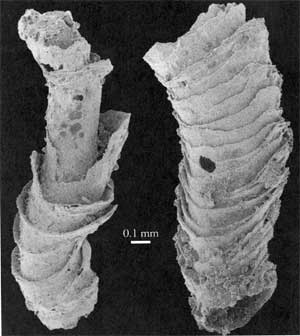
“Clover animal limestone” of Rosén (1919) - contain triradiate tubes. These were first discovered by a Swede - they are now known as anabaritids. (www.phys.kanagawa-u.ac.jp/~usami/boundary/fig/L/anabarite...)

Other types of tubes are conchs - more modern looking. Example: hyoliths. (3.bp.blogspot.com/_VA6LePZ6KNY/RuofbDVSEII/AAAAAAAAAFk/X7...)

Example: Archaeospira (a stem-group mollusc).
Cupitheca - has a sophisticated skeleton; a tube-dwelling animal. It threw off older parts of the tube & walled off the tube.
Sclerites - includes jaw-like forms (Cyrtochites) (a predators), but not from a known animal body plan.
Includes Scoponodus - mystery sclerites.
Includes Microdictyon - made less sense that Scoponodus; Microdictyon was originally interpreted as the basal skeleton or support for egg laying - all wrong.
(2.bp.blogspot.com/_VA6LePZ6KNY/R5P4LeyDs4I/AAAAAAAAAUY/8A...)
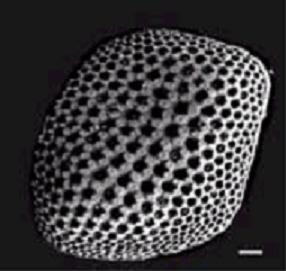
Complete fossils from the Chengjiang (Lower Cambrian of Yunnan, China) showed them to be velvet worm shoulder pads.
(41.media.tumblr.com/tumblr_mahwvgFml61rrpn3bo3_500.jpg)
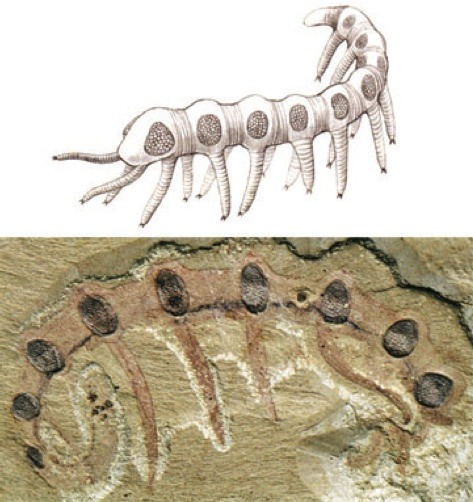
“Tommotian trilobite” - an enigmatic sclerite was found in the basal Tommotian (lower Lower Cambrian) (Fedorov et al., 1979). The actual specimen is not trilobite-like in appearance - is called Tumulduria. Tumulduria is of unknown affinities - it's a weakly mineralized plate.
Includes Paracarinachites - have a lamellar structure, have growth lamellae. It is not chiton-like.
Includes Allonia, a chancelloriid. (www-personal.umich.edu/~wstoddar/chancelloria.jpg)

Whole organisms have been found in Cambrian-aged Burgess Shale/Chengjiang-type deposits (= soft-bodied fossil deposits). Chancelloriids have a different kind of sclerite - they have coelosclerites (hollow sclerites). It’s probably easy to make hollow sclerites (this potentially results in phylogenetic determination problems). Chancelloriids were discovered by a Swede, one year before Walcott did. Chancelloriids have platelets in the integument (this is seen in British Columbia's Burgess Shale and at the Chengjiang deposit in China). The integument is continuous, with sclerites; the only difference between integument & sclerites is mineralization of sclerites.
Reconstructions of sclerite-bearing animals often look like loaves of bread with sclerites.
Siphogonuchitids - sometimes find sclerites fused into scales - scaly sclerites.
Halkieriids - hollow sclerites.
The scleritome was found by Peel and Conway Morris in the Lower Cambrian of North Greenland. Halkieriids were stem-group molluscs or stem-group lophophorates.
(www.blackwellpublishing.com/paleobiology/jpg/300_96dpi/c1...)
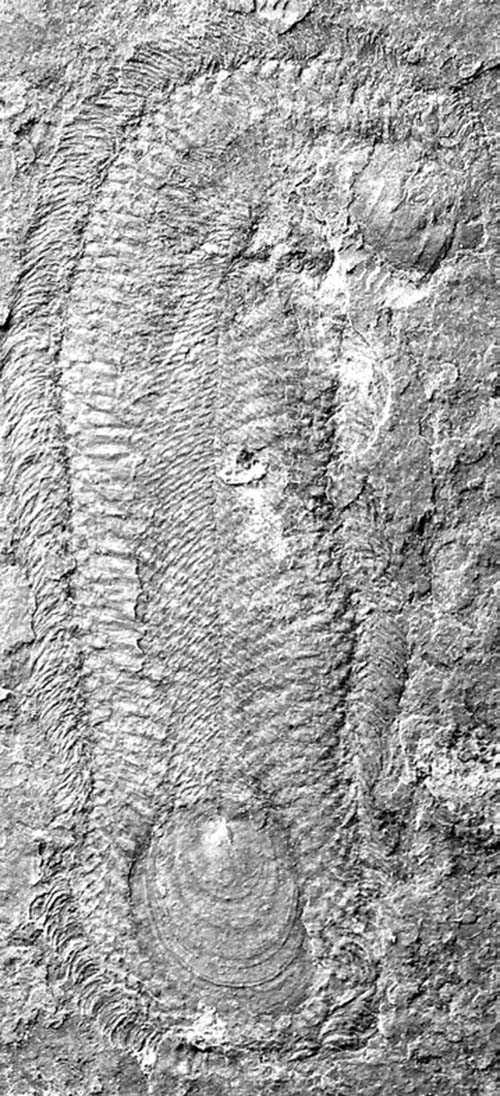
Tommotiids - may not be a phylogenetic grouping; sclerites are phosphatic, with accretionary growth, can have sclerite merging.
Example: Eccentrotheca displays very diverse shapes - “guano”; made by a sloppy animal.
Example: Lapworthella, Camenella (has left- & right-handed sclerites).
Tannuolina - a tommotiid? related to Camenella? This also has left- & right-handed sclerites. Two mitral sclerites can be fused in Tannuolina. Were there 4 rows of sclerites on a slug?
Dailyatia - another tommotiid. Variously reconstructed as loaves with scales.
Roger Thomas et al. (2000) defined skeletal space. Animals use most available skeletal space. But, there are combinations that are ridiculous and animals recognize this and don’t use those.
Spines & scales - useful & common structures (protection is the primary function of these) - note a cactus and a pine cone.
The modern, deep-sea scaly foot gastropod (Crysomallon squamiferum - bomaicruz.southernfriedscience.com/wp-content/uploads/201...) - has an aragonite shell with pyrite and greigite scales covering the foot - may be a modified operculum. Greigite (Fe3S4) is the sulfide equivalent to magnetite, so it is also magnetic.
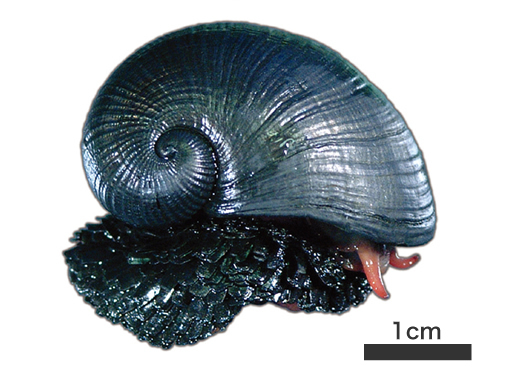
Such structures may have formed with the help of bacteria, but mediated by the gastropod.
There’s a choice of minerals for skeletonization - animals use 4 basic groups of minerals to make skeletons - why the choices are made isn’t always clear.
But, sometimes the “why” is known - chitons have a magnetite radula - it is very hard for scraping rocks.
The Precambrian-Cambrian boundary is a mineralization phenomenon.
Why mineralization? Detoxification idea - Ca is toxic at high levels - but can get rid of it or incorporate it into the skeleton for protection or mechanical improvements in the body.
The type of minerals used by organisms may be based on where the skeleton originated.
Massive phosphate deposits occur near the Precambrian-Cambrian boundary (like the 599 million year old Doushantuo Formation of South China). This is near the beginning of everything.
--------------
"Les 1.001 fantasies més eròtiques i salvatges de la història", Roser Amills, Cossetània, març 2012 | "Las 1.001 fantasías más eróticas y salvajes de la historia", Lectio Ediciones, marzo 2012
“Amb molt sentit de l'humor i meticulositat, Roser Amills dissecciona i classifica les fantasies de 1.000 personatges cèlebres. I el lector, permetin-me el consell, hauria de transcendir la inicial fascinació de l’entomòleg i deixar-se inspirar.”
Susanna Griso
“No seríem humans sense l’erotisme, la subtilitat no seria una propietat destacada de la nostra espècie. Segurament Plutarc tenia raó, l’erotisme és la desobediència de la raó.”
Eudald Carbonell
“En aquest interessant i desenfadat llibre de Roser Amills es fa evident que, en qüestions de sexualitat, la imaginació és capaç de volar més alt que la realitat. I, com diu l’autora: «com més fantasies siguem capaços de comprendre, millor ens coneixerem».”
Antonio Bolinches
Créditos de la foto: SIQUI SÁNCHEZ
más info del libro en roseramills.com
Burj Khalifa est la plus grande tour du monde (en arabe : برج خليفة, tour de Khalifa). Appelée Burj Dubaï jusqu’à son inauguration, c'est un gratte-ciel situé à Dubaï aux Émirats arabes unis, devenu en mai 2009 la plus haute structure humaine jamais construite. Sa hauteur finale, atteinte le 17 janvier 2009, est de 828 mètres. Elle doit former le cœur d’un nouveau quartier : Downtown Burj Khalifa. Son inauguration et ouverture partielle ont eu lieu le 4 janvier 2010.
À noter que celle-ci sera dépassée par la Kingdom Tower de Djeddah en Arabie saoudite d'ici 2018.
Burj Khalifa fait partie d’un vaste projet urbanistique, immobilier et architectural couvrant une superficie de 2 km2. Il s’agit de créer un nouveau quartier, Downtown Burj Khalifa, un peu au sud du centre historique de Dubaï, et à côté du quartier côtier de Jumeirah (en), mais situé quelques kilomètres à l’intérieur des terres. Ce quartier doit comprendre, outre le gratte-ciel du même nom, un lac artificiel et de nombreux bâtiments de grandes dimensions. En tout, il prévoit un ensemble de 30 000 résidences, neuf hôtels dont The Address Downtown Burj Dubaï achevé en 2008, au moins 19 tours résidentielles, le plus grand centre commercial du monde, le Dubaï Mall qui y a ouvert ses portes en 2008, trois hectares de parcs et le lac artificiel de douze hectares (Lac de Burj Khalifa). Sur ce dernier, la fontaine de Dubaï offre un spectacle aquatique.
Burj Khalifa (Arabic: برج خليفة, "Khalifa Tower", pronounced English /ˈbɜːrdʒ kəˈliːfə/), known as Burj Dubai before its inauguration, is a megatall skyscraper in Dubai, United Arab Emirates. It is the tallest artificial structure in the world, standing at 829.8 m (2,722 ft).[4][9]
Construction of Burj Khalifa began in 2004, with the exterior completed in 2009. The primary structure is reinforced concrete. The building opened in 2010, as part of the new development called Downtown Dubai. It is designed to be the centerpiece of large-scale, mixed-use development. The decision to build the building is reportedly based on the government's decision to diversify from an oil-based economy, and for Dubai to gain international recognition. The building was named in honor of the ruler of Abu Dhabi and president of the United Arab Emirates, Khalifa bin Zayed Al Nahyan; Abu Dhabi and the UAE government lent Dubai money to pay its debts. The building broke numerous height records.
Burj Khalifa was designed by Adrian Smith then of Skidmore, Owings and Merrill (SOM), whose firm also designed the Willis Tower and the One World Trade Center. Hyder Consulting was chosen to be the supervising engineer with NORR Group Consultants International Limited chosen to supervise the architecture of the project. The design of Burj Khalifa is derived from patterning systems embodied in Islamic architecture, incorporating cultural and historical elements particular to the region such as the spiral minaret. The Y-shaped plan is designed for residential and hotel usage. A buttressed core structural system is used to support the height of the building, and the cladding system is designed to withstand Dubai's summer temperatures. A total of 57 elevators and 8 escalators are installed, with the elevators having a capacity of 12 to 14 people per cabin.
Critical reception to Burj Khalifa has been generally positive, and the building received many awards. However, the labor issues during construction have been controversial, since the building was built primarily by workers from South and East Asia, who earned low wages and were reportedly housed in poor conditions. The center of gravity is in the bottom because it stops it from moving from earthquakes.
Trekking in Spiti, from village to village, is the best way to understand agriculture in Himalaya. www.trekking-himalaya.spiti.com
Randonner de village en village, au Spiti, permet de comprendre l agriculture en Himalaya.
P1040230
Vous vous méfiez de la politique ou vous n'avez que peu de temps à y consacrer ? Le site "UPR en bref" vous permet de découvrir rapidement les grandes caractéristiques de ce mouvement www.uprenbref.fr/, sinon www.upr.fr/
www.youtube.com/results?search_query=+asselineau+Une+minu...
Adhérer en ligne : www.upr.fr/adhesion-en-ligne
"Quando a última árvore tiver caído,
Quando o último rio tiver secado,
Quando o último peixe for pescao,
Finalmente irão entender Que dinheiro não se come"
***
"When the last tree has fallen
When the last river has dried,
When the last fish is Pescaia,
Finally understand what money will not eat "
***
"Quand le dernier arbre est tombé
Quand la dernière rivière aura séché,
Quand le dernier poisson est Pescaia,
Enfin comprendre ce que l'argent ne mange pas "
***
"Cuando el último árbol haya caído
Cuando el último río se haya secado,
Cuando el último pez es Pescaia,
Por fin entiendo lo que el dinero no se come "
***
"Quando l'ultimo albero è caduto
Quando l'ultimo fiume si è essiccato,
Quando l'ultimo pesce è Pescaia,
Finalmente capire quali soldi non si mangia "
Exercise COLLABORATIVE SPIRIT 17, which took place at 4th Canadian Division Support Base Petawawa from 19 to 22 September, provided an opportunity for Canadian Army stakeholders and civilian leaders to experience a personal and in-depth understanding of Canadian Army capabilities, equipment as well as the professionalism and skill of Canadian soldiers.
Photo By: Pte Thomas Lee, Garrison Imaging Petawawa
L’exercice COLLABORATIVE SPIRIT 2017, qui s’est tenu à la Base de soutien de la 4e Division du Canada Petawawa, du 19 au 22 septembre, a procuré à des intervenants liés à l’Armée canadienne et à des dirigeants civils une occasion de voir et de bien comprendre personnellement en quoi consistent les capacités et l’équipement de l’Armée canadienne, de même que de se rendre compte du professionnalisme et des compétences des soldats canadiens.
Exercise COLLABORATIVE SPIRIT 17, which took place at 4th Canadian Division Support Base Petawawa from 19 to 22 September, provided an opportunity for Canadian Army stakeholders and civilian leaders to experience a personal and in-depth understanding of Canadian Army capabilities, equipment as well as the professionalism and skill of Canadian soldiers.
Photo By: Pte Thomas Lee, Garrison Imaging Petawawa
L’exercice COLLABORATIVE SPIRIT 2017, qui s’est tenu à la Base de soutien de la 4e Division du Canada Petawawa, du 19 au 22 septembre, a procuré à des intervenants liés à l’Armée canadienne et à des dirigeants civils une occasion de voir et de bien comprendre personnellement en quoi consistent les capacités et l’équipement de l’Armée canadienne, de même que de se rendre compte du professionnalisme et des compétences des soldats canadiens.
Full moon at Tsomoriri lake, 4600 meters of height, Ladakh, India.
Trekking around this lake, hundred kilometers in four days, is easier with daily practice of yoga and massage. This is the concept of Eric Lon, masseur physiotherapist.
Please have a look to the other pics of the set: "Trek from Spiti to Ladakh".
photo viewed 90 times on february 16 2010.
Pleine lune sur le lac Tsomoriri, Ladakh, à l'altitude de 4600 mètres.
On y randonne: cent kilomètres en quatre jours. C'est plus facile en pratiquant quotidiennement du yoga et du massage sous la direction d'Eric Lon, masseur kinésithérapeute.
Pour mieux comprendre cette haute randonnée, visitez la série Flickr: "Trek from Spiti to Ladakh".
photo vue 90 fois au 16 fevrier 2010
Villa Arson - DOUBLE BIND / ARRÊTEZ D’ESSAYER DE ME COMPRENDRE !
"A Constructed World, Boris Achour, Bas Jan Ader, Jérôme Allavena, Art & Language, Renaud Auguste-Dormeuil, Gilles Barbier, Robert Barry, Erick Beltrán, Stéphane Bérard, Berdaguer & Péjus, Dominique Blais, Mel Bochner, Julien Bouillon, Pascal Broccolichi, Marcel Broodthaers, Cercle Ramo Nash, Marc Chevalier, Ma Chong, Gérard Collin-Thiébaut, François Curlet & Michel François, Anthony Duchêne, Jean Dupuy, Eric Duyckaerts, Omer Fast, Robert Filliou, Francesco Finizio, Henry Flynt, Ryan Gander, Jean-Baptiste Ganne, Dora Garcia, Mark Geffriaud, Alexandre Gérard, Claire Glorieux, Dan Graham, Joseph Grigely, Brion Gysin & Ian Sommerville, Raymond Hains, Temo Javakhi, David Jourdan, Ben Kinmont, Nicholas Knight, Silvia Kolbowski, Jirí Kovanda, Christine Kozlov, Joris Lacoste, Thierry Lagalla, Alvin Lucier, Christian Marclay, Aurélien Mole, Robert Morris, Bruce Nauman, Dennis Oppenheim, Philippe Parreno, Gaël Peltier, Alexandre Perigot, Antoine Poncet, Will Potter, Noël Ravaud, Bettina Samson, Mathieu Schmitt, Yann Sérandour, Richard Serra, Pierre Thoretton, Lawrence Weiner, Cerith Wyn Evans, Raphaël Zarka."
"Les 1.001 fantasies més eròtiques i salvatges de la història", Roser Amills, Cossetània, març 2012 | "Las 1.001 fantasías más eróticas y salvajes de la historia", Lectio Ediciones, marzo 2012
“Amb molt sentit de l'humor i meticulositat, Roser Amills dissecciona i classifica les fantasies de 1.000 personatges cèlebres. I el lector, permetin-me el consell, hauria de transcendir la inicial fascinació de l’entomòleg i deixar-se inspirar.”
Susanna Griso
“No seríem humans sense l’erotisme, la subtilitat no seria una propietat destacada de la nostra espècie. Segurament Plutarc tenia raó, l’erotisme és la desobediència de la raó.”
Eudald Carbonell
“En aquest interessant i desenfadat llibre de Roser Amills es fa evident que, en qüestions de sexualitat, la imaginació és capaç de volar més alt que la realitat. I, com diu l’autora: «com més fantasies siguem capaços de comprendre, millor ens coneixerem».”
Antonio Bolinches
"Les 1.001 fantasies més eròtiques i salvatges de la història", Roser Amills, Cossetània, març 2012 | "Las 1.001 fantasías más eróticas y salvajes de la historia", Lectio Ediciones, marzo 2012
“Amb molt sentit de l'humor i meticulositat, Roser Amills dissecciona i classifica les fantasies de 1.000 personatges cèlebres. I el lector, permetin-me el consell, hauria de transcendir la inicial fascinació de l’entomòleg i deixar-se inspirar.”
Susanna Griso
“No seríem humans sense l’erotisme, la subtilitat no seria una propietat destacada de la nostra espècie. Segurament Plutarc tenia raó, l’erotisme és la desobediència de la raó.”
Eudald Carbonell
“En aquest interessant i desenfadat llibre de Roser Amills es fa evident que, en qüestions de sexualitat, la imaginació és capaç de volar més alt que la realitat. I, com diu l’autora: «com més fantasies siguem capaços de comprendre, millor ens coneixerem».”
Antonio Bolinches
Créditos de la foto: SIQUI SÁNCHEZ
más info del libro en roseramills.com
Burj Khalifa est la plus grande tour du monde (en arabe : برج خليفة, tour de Khalifa). Appelée Burj Dubaï jusqu’à son inauguration, c'est un gratte-ciel situé à Dubaï aux Émirats arabes unis, devenu en mai 2009 la plus haute structure humaine jamais construite. Sa hauteur finale, atteinte le 17 janvier 2009, est de 828 mètres. Elle doit former le cœur d’un nouveau quartier : Downtown Burj Khalifa. Son inauguration et ouverture partielle ont eu lieu le 4 janvier 2010.
À noter que celle-ci sera dépassée par la Kingdom Tower de Djeddah en Arabie saoudite d'ici 2018.
Burj Khalifa fait partie d’un vaste projet urbanistique, immobilier et architectural couvrant une superficie de 2 km2. Il s’agit de créer un nouveau quartier, Downtown Burj Khalifa, un peu au sud du centre historique de Dubaï, et à côté du quartier côtier de Jumeirah (en), mais situé quelques kilomètres à l’intérieur des terres. Ce quartier doit comprendre, outre le gratte-ciel du même nom, un lac artificiel et de nombreux bâtiments de grandes dimensions. En tout, il prévoit un ensemble de 30 000 résidences, neuf hôtels dont The Address Downtown Burj Dubaï achevé en 2008, au moins 19 tours résidentielles, le plus grand centre commercial du monde, le Dubaï Mall qui y a ouvert ses portes en 2008, trois hectares de parcs et le lac artificiel de douze hectares (Lac de Burj Khalifa). Sur ce dernier, la fontaine de Dubaï offre un spectacle aquatique.
Burj Khalifa (Arabic: برج خليفة, "Khalifa Tower", pronounced English /ˈbɜːrdʒ kəˈliːfə/), known as Burj Dubai before its inauguration, is a megatall skyscraper in Dubai, United Arab Emirates. It is the tallest artificial structure in the world, standing at 829.8 m (2,722 ft).[4][9]
Construction of Burj Khalifa began in 2004, with the exterior completed in 2009. The primary structure is reinforced concrete. The building opened in 2010, as part of the new development called Downtown Dubai. It is designed to be the centerpiece of large-scale, mixed-use development. The decision to build the building is reportedly based on the government's decision to diversify from an oil-based economy, and for Dubai to gain international recognition. The building was named in honor of the ruler of Abu Dhabi and president of the United Arab Emirates, Khalifa bin Zayed Al Nahyan; Abu Dhabi and the UAE government lent Dubai money to pay its debts. The building broke numerous height records.
Burj Khalifa was designed by Adrian Smith then of Skidmore, Owings and Merrill (SOM), whose firm also designed the Willis Tower and the One World Trade Center. Hyder Consulting was chosen to be the supervising engineer with NORR Group Consultants International Limited chosen to supervise the architecture of the project. The design of Burj Khalifa is derived from patterning systems embodied in Islamic architecture, incorporating cultural and historical elements particular to the region such as the spiral minaret. The Y-shaped plan is designed for residential and hotel usage. A buttressed core structural system is used to support the height of the building, and the cladding system is designed to withstand Dubai's summer temperatures. A total of 57 elevators and 8 escalators are installed, with the elevators having a capacity of 12 to 14 people per cabin.
Critical reception to Burj Khalifa has been generally positive, and the building received many awards. However, the labor issues during construction have been controversial, since the building was built primarily by workers from South and East Asia, who earned low wages and were reportedly housed in poor conditions. The center of gravity is in the bottom because it stops it from moving from earthquakes.
10 juin 1944, c'est jour de distribution de tabac ,..., la vision d'Oradour bascule dans l'effroi. C'est une belle journée de printemps qui s'annonce, les enfants retournent en classe et le déjeuner se termine doucement dans le restaurant Milord ou encore chez les particuliers. Il y a quatre jours que le débarquement en Normandie a eu lieu, les troupes de soldats allemands remontent sur le front. La résistance fait tout pour les retarder ou les en empêcher.
Depuis le débarquement, la Résistance amplifie ses actes contre la progression des Allemands et leur remontée vers la Normandie. Plusieurs incidents et la position de faiblesse des S.S. va motiver l'exécution d'un acte destiné à impressionner (et surprendre) la population et (peut-être) calmer l'ardeur des résistants. C'est une méthode que les S.S. ont eu l'habitude de pratiquer sur le front de Russie. Ainsi les Allemands choisissent un village sans passé avec le maquis ou la résistance, un lieu tranquille, pour se venger. Le choix est aussi fait en fonction de la taille du village et des capacités des S.S.
En début d'après-midi, les Waffen S.S. encerclent Oradour et rabattent vers le centre-bourg les personnes qui travaillent dans les champs. La population est rassemblée sur la place principale (le Champ de Foire) pour le prétexte d'un contrôle d'identité. Les hommes sont séparés des femmes et des enfants qui seront menés dans l'église.
Les hommes sont répartis en six groupes et menés dans les plus grandes remises ou granges d'Oradour où les allemands ont installé des mitrailleuses.
A 16 heures, et en quelques secondes les hommes sont abattus sans comprendre pourquoi. Certaines victimes recevront le coup de grâce. Les allemands recouvrent les corps de matériaux combustibles et mettent le feu dans ces lieux de supplices ainsi qu'aux maisons. Seulement cinq hommes pourront sortir de la grange Laudy sans être abattus par les bourreaux.
A 17 heures, c'est malheureusement au tour des femmes et des enfants (400 personnes) réunis dans la petite église. Les allemands déposent une caisse au milieu de la foule, au milieu de l'édifice. Il en dépasse un cordon qu'ils allument. Cette caisse destinée à asphyxier, explose et met en éclat les vitraux. L'asphyxie ne s'opère alors pas comme les allemands le prévoyaient. C'est alors qu'ils tirent sur les femmes et les enfants. (Aujourd'hui, on peut encore voir les impacts des balles sur les murs intérieurs de l'église). Une femme, Mme Rouffanche, parvient à s'enfuir par un vitrail. Elle est suivie par une autre femme et son bébé. Les cris du bébé alertant les allemands, ces trois personnes sont mitraillées. Seule Mme Rouffanche, bien que blessée, survit en se cachant dans un rang de petits pois dans le jardin du presbytère.
A 19 heures, le tramway venant de Limoges arrive sur Oradour. Les occupants sont emmenés dans une ferme proche. Ce n'est qu'en fin de soirée qu'il sont relâchés.
Le pillage et la destruction du village se poursuit en fin d'après-midi. Les personnes qui sont simplement blessées meurent brûlées vives.
Au lendemain, il n'existe plus que des pans de murs calcinés desquels s'échappent encore de la fumée. Oradour-sur-Glane est rayé de la carte avec ses habitants (328 constructions et 642 victimes). On ne compte que six survivants au massacre (personnes s'étant échappées des lieux de supplice) : 5 hommes et une femme. Quelques autres personnes échappent à la tragédie car elles sont absentes du bourg ou se sont cachées ou enfuies à l'arrivée des allemands par crainte.
Oradour-sur-Glane is a town and commune in the Haute-Vienne département of west-central France.
The original village was destroyed on June 10, 1944, when 642 of its inhabitants were murdered by a German Waffen-SS company. A new village was built post-war on a nearby site and the original has been maintained as a memorial.
In the days leading up to the Allied D-Day landings at Normandy, the local French Resistance increased its activities in order to disrupt local German forces and to hinder communications. 2nd SS Panzer Division Das Reich was ordered to make its way across the country to the anticipated fighting in Normandy. Along the way, the Germans came under attack and sabotage by the French Resistance and, in turn, attacked and killed many French civilians.
Early on the morning of June 10, 1944, Sturmbannführer Adolf Diekmann, commanding the I battalion of the 4th Waffen-SS ("Der Führer") Panzer-Grenadier Regiment, informed Sturmbannführer Otto Weidinger at regimental headquarters that he had been approached by two French civilians who claimed that a German officer was being held by the Resistance in Oradour-sur-Vayres, a nearby town. The captured German was alleged to be Sturmbannführer Helmut Kämpfe, commander of the 2nd SS Panzer Reconnaissance Battalion, who may have been captured by the Maquis the day before.
On June 10, Diekmann's battalion sealed off the town of Oradour-sur-Glane, having confused it with nearby Oradour-sur-Vayres (some disagreement on this point, see esp. Max Hastings, Das Reich, who states reasons for believing no such confusion), and ordered all the townspeople – and anyone who happened to be in or nearby the town – to assemble in the village square, ostensibly to have their identity papers examined. In addition to the residents of the village, the SS also apprehended six people who did not live there but had the misfortune of riding their bikes through town when the Germans arrived.
All the women and children were then taken to and locked in the church while the village itself was looted. Meanwhile, the men were led to six barns and sheds where machine-gun nests were already in place. According to the account of a survivor, the soldiers began shooting at them, aiming for their legs so that they would die more slowly. Once the victims were no longer able to move, the soldiers covered their bodies with fuel and set the barns on fire. Only five men escaped; 190 men died.
The soldiers then proceeded to the church and put an incendiary device in place there. After it was ignited, women and children tried to flee from the doors and windows of the church but were met with machine-gun fire. Two hundred forty-seven women and two hundred five children died in the mayhem. Only one woman survived, 47-year-old local housewife Marguerite Rouffanche. She had managed to slide out of a small window at the back of the church and hid in the bushes overnight until the Germans had moved on. Another small group of about twenty villagers had fled Oradour-sur-Glane as soon as the soldiers had appeared. That night, the remainder of the village was razed.
A few days later, survivors were allowed to bury the dead. It was found that 642 inhabitants of Oradour-sur-Glane had been brutally murdered in a matter of hours.
Sturmbannführer Adolf Diekmann claimed that it was a just retaliation due to partisan activity in nearby Tulle and the kidnapping of Helmut Kämpfe. The German Nazi authorities wanted to prosecute Diekmann for the massacre, but he was killed in action some days later before he could stand trial.
On January 12, 1953, a trial began before a military tribunal in Bordeaux, France, against the surviving 65 of the approximately 200 German soldiers who had been involved. Only 21 of them were present (many living in West Germany and the German Democratic Republic would not allow them to be extradited). Seven of them were Germans, while the other 14 were Alsatians, i.e., French nationals of German ethnicity who had been regarded as members of the "Reich" by the Nazis. All but one of them claimed to have been drafted into the Waffen-SS against their will (the so-called malgré-nous).
The trial caused a huge protest in Alsace, forcing the French authorities to split the process into two separate ones according to the nationality of the defendants. On February 11, 20 defendants were found guilty. Continuing uproar (including calls for autonomy) in Alsace pressed the French parliament to pass an amnesty law for all malgré-nous on February 19, and the convicted Alsatians were released shortly afterwards. This, in turn, caused bitter protest in the Limousin region.
By 1958, all the German defendants had been released as well. General Heinz Lammerding of the Das Reich division, who had given the orders for the measures against the Resistance, died in 1971 after a successful entrepreneurial career. At the time of the trial, he lived in Düsseldorf, Germany, which was located inside the British occupation zone of West Germany, and the French government never obtained his extradition from the British authorities.[1]
The last trial against a former Waffen-SS member took place in 1983. Shortly before, former SS-Obersturmführer Heinz Barth had been tracked down in the German Democratic Republic GDR. Barth had participated in the Oradour-sur-Glane massacre as a platoon leader in the Der Führer Regiment, commanding forty-five soldiers. He was amongst other war criminals charged with having given orders to shoot twenty men in a garage. Barth was sentenced to life imprisonment by the 1st Senate of the City Court of Berlin. He was released from prison in the reunified Germany in 1997 and died in August 2007.
After the war, General Charles de Gaulle of France decided that the village would never be rebuilt. Instead, it would remain as a memorial to the cruelty of Nazi occupation. In 1999, French President Jacques Chirac dedicated a visitors' centre, the Centre de la Mémoire, in Oradour-sur-Glane and named the site a Village Martyr.
PANRURALA #02 – Croix celtique Fontenoy
Mon nouveau projet "Panrurala" explore la beauté rurale de la Belgique. Cette semaine, je présente: Croix celtique Fontenoy. Mon projet vise à montrer la beauté des bâtiments et des paysages ruraux en utilisant des collages panoramiques. J'utilise cette même méthode pour ma série “Panurbana” (www.panurbana.nl), qui est centrée sur Amsterdam, ma ville natale. Comme je passe actuellement une grande partie de l'année dans le Tournaisis, une région que je ne connais pas encore très bien, je demande aux habitants de partager des informations et des anecdotes pour m'aider à mieux comprendre et apprécier la région.
PANRURALA #02 – Celtic Cross of Fontenoy
My new project "Panrurala" explores the rural beauty of Belgium. This week, I present: the Celtic Cross of Fontenoy. My project aims to show the beauty of rural buildings and landscapes using panoramic collages. I use this same method for my "Panurbana" series (www.panurbana.nl), which focuses on Amsterdam, my home town. As I currently spend a lot of time in the Tournaisis, a region I'm still getting to know, I'm asking local residents to share information and stories to help me better understand and appreciate the area.
Pour comprendre et nous aider, allez nous retrouver sur le Blog Merci! :
To understand and help us, go on the Blog Thanks:
rochersrotheneuf.wordpress.com/
mais aussi sur /but also on Facebook:
www.facebook.com/pages/LErmite-de-Roth%C3%A9neuf-Abb%C3%A...
"Les 1.001 fantasies més eròtiques i salvatges de la història", Roser Amills, Cossetània, març 2012 | "Las 1.001 fantasías más eróticas y salvajes de la historia", Lectio Ediciones, marzo 2012
“Amb molt sentit de l'humor i meticulositat, Roser Amills dissecciona i classifica les fantasies de 1.000 personatges cèlebres. I el lector, permetin-me el consell, hauria de transcendir la inicial fascinació de l’entomòleg i deixar-se inspirar.”
Susanna Griso
“No seríem humans sense l’erotisme, la subtilitat no seria una propietat destacada de la nostra espècie. Segurament Plutarc tenia raó, l’erotisme és la desobediència de la raó.”
Eudald Carbonell
“En aquest interessant i desenfadat llibre de Roser Amills es fa evident que, en qüestions de sexualitat, la imaginació és capaç de volar més alt que la realitat. I, com diu l’autora: «com més fantasies siguem capaços de comprendre, millor ens coneixerem».”
Antonio Bolinches
Créditos de la foto: SIQUI SÁNCHEZ
más info del libro en roseramills.com
Burj Khalifa est la plus grande tour du monde (en arabe : برج خليفة, tour de Khalifa). Appelée Burj Dubaï jusqu’à son inauguration, c'est un gratte-ciel situé à Dubaï aux Émirats arabes unis, devenu en mai 2009 la plus haute structure humaine jamais construite. Sa hauteur finale, atteinte le 17 janvier 2009, est de 828 mètres. Elle doit former le cœur d’un nouveau quartier : Downtown Burj Khalifa. Son inauguration et ouverture partielle ont eu lieu le 4 janvier 2010.
À noter que celle-ci sera dépassée par la Kingdom Tower de Djeddah en Arabie saoudite d'ici 2018.
Burj Khalifa fait partie d’un vaste projet urbanistique, immobilier et architectural couvrant une superficie de 2 km2. Il s’agit de créer un nouveau quartier, Downtown Burj Khalifa, un peu au sud du centre historique de Dubaï, et à côté du quartier côtier de Jumeirah (en), mais situé quelques kilomètres à l’intérieur des terres. Ce quartier doit comprendre, outre le gratte-ciel du même nom, un lac artificiel et de nombreux bâtiments de grandes dimensions. En tout, il prévoit un ensemble de 30 000 résidences, neuf hôtels dont The Address Downtown Burj Dubaï achevé en 2008, au moins 19 tours résidentielles, le plus grand centre commercial du monde, le Dubaï Mall qui y a ouvert ses portes en 2008, trois hectares de parcs et le lac artificiel de douze hectares (Lac de Burj Khalifa). Sur ce dernier, la fontaine de Dubaï offre un spectacle aquatique.
Burj Khalifa (Arabic: برج خليفة, "Khalifa Tower", pronounced English /ˈbɜːrdʒ kəˈliːfə/), known as Burj Dubai before its inauguration, is a megatall skyscraper in Dubai, United Arab Emirates. It is the tallest artificial structure in the world, standing at 829.8 m (2,722 ft).[4][9]
Construction of Burj Khalifa began in 2004, with the exterior completed in 2009. The primary structure is reinforced concrete. The building opened in 2010, as part of the new development called Downtown Dubai. It is designed to be the centerpiece of large-scale, mixed-use development. The decision to build the building is reportedly based on the government's decision to diversify from an oil-based economy, and for Dubai to gain international recognition. The building was named in honor of the ruler of Abu Dhabi and president of the United Arab Emirates, Khalifa bin Zayed Al Nahyan; Abu Dhabi and the UAE government lent Dubai money to pay its debts. The building broke numerous height records.
Burj Khalifa was designed by Adrian Smith then of Skidmore, Owings and Merrill (SOM), whose firm also designed the Willis Tower and the One World Trade Center. Hyder Consulting was chosen to be the supervising engineer with NORR Group Consultants International Limited chosen to supervise the architecture of the project. The design of Burj Khalifa is derived from patterning systems embodied in Islamic architecture, incorporating cultural and historical elements particular to the region such as the spiral minaret. The Y-shaped plan is designed for residential and hotel usage. A buttressed core structural system is used to support the height of the building, and the cladding system is designed to withstand Dubai's summer temperatures. A total of 57 elevators and 8 escalators are installed, with the elevators having a capacity of 12 to 14 people per cabin.
Critical reception to Burj Khalifa has been generally positive, and the building received many awards. However, the labor issues during construction have been controversial, since the building was built primarily by workers from South and East Asia, who earned low wages and were reportedly housed in poor conditions. The center of gravity is in the bottom because it stops it from moving from earthquakes.