View allAll Photos Tagged Coherence
Ainsi, sans le vouloir, j'ai versé mon être, aux anciens sentiers, luxuriante et d'or.
Pourtant, j'ai regardé.
Toujours.
Cohérence ...
Nice est une ville du sud-est de la France, préfecture du département des Alpes-Maritimes et deuxième ville de la région Provence-Alpes-Côte d'Azur derrière Marseille. Située à l'extrémité sud-est de la France, à une trentaine de kilomètres de la frontière italienne, elle est établie sur les bords de la mer Méditerranée, le long de la baie des Anges et à l'embouchure du Paillon.
Avec 344 875 habitants en 20081, elle est la cinquième commune de France en termes de population (après Paris, Marseille, Lyon et Toulouse). Son agglomération est également la cinquième de France (après Paris, Marseille, Lyon et Lille) et regroupe 946 630 habitants (2007)2. Elle est enfin située au cœur d'une aire urbaine de 999 678 habitants (2007)3 et d'un espace urbain, l' « espace urbain Nice-Côte-d'Azur » qui compte une population de 1 293 381 habitants (2007)4. La ville est le centre d'une communauté urbaine, Nice Côte d'Azur, la septième de France, qui rassemble vingt-sept communes et 535 543 habitants5. Le Scot de Nice (Schéma de cohérence territoriale), créé en 2003, regroupe vingt-neuf communes. Sa population est estimée à 517 500 habitants en 20056.
Située entre mer et montagnes, capitale économique de la Côte d'Azur, Nice bénéficie d'importants atouts naturels. Le tourisme, le commerce et les administrations (publiques ou privées) occupent une place importante dans l'activité économique de la ville. Elle possède la deuxième capacité hôtelière du pays7 et accueille chaque année 4 millions de touristes8. Elle dispose également du troisième aéroport de France9,10 et de deux palais des congrès dédiés au tourisme d'affaires. La ville possède aussi une université et plusieurs quartiers d'affaires. Nice est enfin dotée de certains équipements culturels importants. Elle possède ainsi plusieurs musées, un théâtre national, un opéra, une bibliothèque à vocation régionale, un conservatoire à rayonnement régional et des salles de concert.
Capitale historique du comté de Nice, elle a appartenu à la Provence avant de rejoindre la Maison de Savoie en 1388 et plus tard le royaume de Piémont-Sardaigne. Nice ne devint définitivement française qu'en 1860. Ses habitants s'appellent les Niçois(es).
____________
Nice é uma cidade francesa, situada no departamento francês dos Alpes Marítimos e na região de Provença-Alpes-Costa Azul. Nice conta com 347.900 habitantes (2005) e sua área metropolitana tem 968.903 habitantes (2007). Depois do Congresso de Viena (1815), voltou a fazer parte do reino da Sardenha, um dos que formaram a Itália moderna. Foi definitivamente anexada à França em 1860, por meio do tratado de Villafranca.
Algumas placas indicam, além da forma francesa Nice, a forma provençal Nissa. A origem do nome vem do grego Nikaia - vitoriosa - e a versão latina é Nicæa.
_____________
Nice is the fifth most populous city in France, after Paris, Marseille, Lyon and Toulouse, with a population of 348,721 within its administrative limits on a land area of 71.92 km2 (28 sq mi). The urban area of Nice extends beyond the administrative city limits with a population of over 955,000[1] on an area of 721 km2 (278 sq mi). Located on the south east coast of France on the Mediterranean Sea, Nice is second largest French city on the Mediterranean coast.
The city is nicknamed Nice la Belle (Nissa la Bella in Niçard), which means Nice the Beautiful. Nice is the capital city of the Alpes Maritimes department, and the second biggest city of the Region Provence-Alpes-Côte d'Azur after Marseille.
The area of today’s Nice is believed to be among the oldest human settlements in Europe. One of the archaeological sites, Terra Amata, displays evidence of a very early usage of fire. Around 350 BCE, Greeks of Marseille founded a permanent settlement and called it Nikaia, after Nike, the goddess of victory.[2]
Throughout the ages the town changed hands many times. Its strategic location and port significantly contributed to its maritime strength. For years, it was an Italian dominion, then became part of France in 1860. Culturally and architecturally enriched over time, today Nice has become a truly cosmopolitan tourist destination.[3] The spectacular natural beauty of the Nice area and its mild Mediterranean climate came to the attention of the English upper classes in the second half of the 18th century, when an increasing number of aristocratic families took to spending their winter there. The city’s main seaside promenade, the Promenade des Anglais (‘the Walkway of the English’) owes its name to the earliest visitors to the resort.[4] For decades now, the picturesque Nicean surroundings have attracted not only those in search of relaxation, but also those seeking inspiration. The clear air and soft light has been of particular appeal to some of Western culture’s most outstanding painters, such as Marc Chagall, Henri Matisse, Niki de Saint Phalle and Arman. Their work is commemorated in many of the city’s museums, including Musée Marc Chagall, Musée Matisse and Musée des Beaux-Arts Jules Chéret.[5] The climate and landscape are still what attracts most visitors today. It has the second largest hotel capacity in the country[6] and it’s the second-most visited place in France after Paris, receiving 4 million tourists every year.[7] It also has the second busiest airport in France after Paris[8] and two convention centers dedicated to business tourism. The city also has a university, several business districts and some major cultural facilities, such as museums, a national theater, an opera house with a regional library and several concert halls and casinos. It is the historical capital city of the County of Nice (Comté de Nice).
Nice experiences a Mediterranean climate. The summer's/holiday season lasts for 6 months, from May to October, although also in April and November sometimes there are temperatures above 20 °C (68 °F). Winters are mild, with average temperatures of 13.4 °C (56.1 °F) during the day and 5.8 °C (42.4 °F) at night in the period from December to February.
a trepadeira encarnada.
-----------------------------------
Thank you very much to who invited me for their groups.
From now on I will only add pictures where I am not forced to give awards. It is a coherence subject. In my group I thank that the members comment on but I don't force anybody to that. I love to feel free. Addictions... ;)
(Muito obrigado a quem me convidou para os seus grupos. A partir de agora só adicionarei fotos onde não seja obrigada a premiar. É uma questão de coerência. No meu grupo agradeço que comentem mas não obrigo ninguém a isso. Gosto de me sentir livre. Vícios..;)
Federation Square is the size of a city block or 38,000 square metres (3.8 hectares) and is built on top of a working railway. Unlike traditional public spaces like Venice’s San Marco or New York’s Rockefeller Centre, Fed Square is made up of a series of interlocking and cascading spaces. Buildings open at all angles into the city, creating unexpected connections and vistas. In response to the brief, the design was heavily influenced by the idea of ‘Federation’, of bringing disparate parts together to form a coherent whole.
The Fractal Façade
Federation Square’s distinctive fractal façade, utilises new understandings of surface geometries to allow for the individual buildings within Federation Square to be differentiated from each other, whilst maintaining an overall coherence. Three cladding materials: sandstone, zinc (perforated and solid) and glass have been used within a triangular pinwheel grid. This modular system uses five single triangles (all of the same size and proportion) to make up a larger triangular ‘panel’. Following the same geometrical logic, five panels are joined together to create a larger triangular ‘mega panel’, which is then mounted onto the structural frame to form the visible façade.
Source: www.fedsquare.com/information/about-us/history-design/
Visit my website: Southeast Asia Images
I find a place to think. Imagine words that shape thoughts. Imagine shaping words into thoughts. How do I begin? Here, now. Take a breath. Thoughts whistle in the wind, write what comes to mind. Rushing down mountainsides, write and write. Meandering along the valleys, clarifying, refining ideas. Textures of the landscape, plays of light, subtleties of colour, a picture begins to take shape. Ambiguities and playfulness open out to calmness and coherence. With a nice cup of coffee.
Shaping Thoughts 2
Imagine writing about the word 'shape'. Writing about shaping your thoughts into words, writing words that shape your thoughts. Where to begin? How do I feel? Take a breath. How can I begin to organise and refine my ideas? Begin by writing anything that comes to mind, but also have in mind that you want to have a piece of writing that resonates in insightful ways with your imagination.
Shaping Thoughts 3 - mainly Ai
Define 'Shape' in Writing: Start by exploring what 'shape' means in the context of writing. It can refer to the structure and form of a piece, how ideas are organised, and the overall impact of the writing. As one writer notes, "shape" in writing is about more than just the physical arrangement of words; it's about the emotional and thematic coherence that makes a piece resonate with readers.
Shaping Your Thoughts into Words: Consider the process of translating your thoughts into coherent written form. This involves not just putting words on paper but also refining and clarifying your ideas. One effective strategy is to write freely at first, getting all your surface-level thoughts out, and then revisiting the material to uncover deeper insights. This can help you identify the core themes and emotions that drive your writing.
Writing Words That Shape Your Thoughts: Reflect on how the act of writing can influence your thinking. The language you use and the way you structure your sentences can shape your perceptions and understanding. For example, studies have shown that the language we speak can affect how we perceive the world, influencing our memory, cognition, and even our sense of self. By choosing your words carefully, you can guide your own thoughts and those of your readers.
Practical Writing Strategies: To put these ideas into practice, consider the following strategies:
Freewriting: Start by writing without stopping, allowing your thoughts to flow freely. This can help you bypass initial self-censorship and uncover deeper insights.
Outlining: For longer pieces, create an outline to organise your thoughts and ensure a logical flow. This can help you see the bigger picture and make necessary adjustments.
Revising: Revisit your writing to refine and clarify your ideas. This is where the "knitting" process comes in, where you stitch together the different elements of your writing to create a cohesive whole.
Reflect on the Impact: Finally, reflect on how the process of writing has shaped your thoughts. Consider what new insights you've gained and how your understanding of the topic has evolved. This reflection can provide valuable material for your writing and help you grow as a writer.
By following these steps, you can begin to explore the multifaceted concept of 'shape' in writing and how it can enhance both your writing process and the impact of your words.
Thornton Dial, Soul Train at Dartmouth's Hood Museum.
I asked her for her back and she took the baseball cap out of her purse and put it on. She'd come specifically to see this exhibit. I don't think she thought about matching her shirt.
Boulevard Saint-Michel & Place Saint-Michel 26/09/2020 10h56
Boulevard, Place and Fontaine Saint-Michel in the soft September morning light.
Fontaine Saint-Michèl
One of the symboles of the second French Empire in Paris is this monumental fountain contructed between 1858 and 1860 in the 6ème arrondissement of Paris. Designed by the architect Gabriel Davioud.
The fontaine Saint-Michel was part of the great project for the reconstruction of Paris overseen by Baron Haussmann during the French Second Empire. In 1855 Haussmann completed an enormous new boulevard, originally called boulevard de Sébastopol-rive-gauche, now called Boulevard Saint-Michel, which opened up the small place Pont-Saint-Michel into a much larger space. Haussmann asked the architect of the service of promenades and plantations of the prefecture, Gabriel Davioud, to design a fountain which would be appropriate in scale to the new square. As the architect of the prefecture, he was able to design not only the fountain but also the facades of the new buildings around it, giving coherence to the square, but he also had to deal with the demands of the prefet and city administration, which was paying for the project. [ Wikipedia ]
St Andrew's Church is a Church of England parish church in Presteigne, Powys, Wales. It was first constructed in the 9th century by the Anglo-Saxons and retains elements of the original Anglo-Saxon church within a Norman renovation and later Victorian restoration. It is a Grade I listed building.
In the 9th century, Anglo-Saxons built St Andrew's Church next to the River Lugg. Following the Norman conquest of Wales, when the majority of the church was damaged during an attack by the Welsh, the Normans constructed a church incorporating the Anglo-Saxon north aisle. In the 12th–13th centuries the church was enlarged and a bell tower was constructed with a new nave and south aisle constructed by canons from Wigmore Abbey.
In 1868, a restoration of the church financed by Sir Richard Green-Price and undertaken by Sir George Gilbert Scott was carried out. Inside he repaired the original roof and wooden belfry but removed the west gallery and added a new nave, chancel and sanctuary. On the exterior, he changed the design to reflect the popular Gothic Revival architecture at the time. In doing so he added a vestry, transepts and a new spire for the bell tower.
A memorial to Joseph Baker, for whom Mount Baker in Washington state, United States is named, was installed in the chapel of the church as he had retired to Presteigne. A 13th-century coffin lid, possibly from a member of the Mortimer Family, is also installed in the north side of the church. It was granted Grade II*-listed status in 1985 for being "a virtually complete example of the rural work of Sir George Gilbert Scott's office; whilst the church does retain significant medieval fabric, the consistency and coherence of its restoration make it a remarkably clear statement of Ecclesiological principles."
In 1914, the Welsh Church Act 1914 was passed by the Parliament of the United Kingdom to disestablish the Church in Wales from the Church of England. Owing the enactment of the disestablishment being delayed by the Suspensory Act 1914, in 1915 seventeen parishes (including Presteigne with Discoed) were balloted by the Welsh Church Commissioners in a referendum as to whether they wanted to remain part of the Church of England or join the Church in Wales. These parishes were given the choice because their parish boundaries crossed the geographical borders between England and Wales. St Andrew's parishioners voted 595–289 to remain part of the Church of England despite the church being located in Wales. As a result of the decision in the referendum, St Andrew's Church remained a part of the Diocese of Hereford.
This description incorporates text from the English Wikipedia.
(2) SMGO
If realistic pictures of great execution were described as paintings that only luck voice, the superflowing plastic Gleitzeit painting only luck the tune.
The attempt to communicate visual art through speech is a continuation of an art experiment that started as long ago in ancient Egypt, in archaic Greece, in medieval art where scrolls come out of the mouths from figures to show what they were saying.
When Jaisini paints straight on canvas without preliminary sketch he is close to a transitory moment of creation that becomes an apogee of human effort when an artist doesn’t premeditate art but pushed himself to make future visible not yet existing in any other form or ready sketch.
The artist’s mind is a container of his picture’s idea.
At this moment of art making many factors contribute to the execution of the painting. Questioning this many times anyone will hardly get the final answer because of the nature of inquiry to explain the moment of high inspiration. How a man could paint complex paintings that allow endless topics to write about? Meanwhile Jaisini paints in short time duration of few hours bringing out something never seen before and of immediate production, not the result of prepared studies and sketches.
Watching Jaisini speaking I try to see anything that could connect to his art.
Language of gestures and words could explain the artist’s language of color and imagery. Jaisini seems to be tense and relaxed simultaneously.
His human condition overcomes regular norms of life. He is instantly analytical and frivolous and like a great actor doesn’t need a mask or a make-up to enforce his transition in a role. For him paintings are like roles where he can explore ambiguities through faces of the images and linear plastic. A skillful master he in fact never contributed time to polish his skills.
The mastery comes from another source. The freshness of his approach maybe explained by the authentic method and refusal to overdo or over practice that often is an enemy of creativity substituting productivity for inspiration. An artist who is a mass producer of his one discovery is not an artist but a craftsman manufacturing artifacts automatically. Jaisini had never repeated himself in predictable way. The artist pointed out that he can’t repeat any of his painting when he might even intent to adding that it is too complicated and impossible to remember the way it was once painted, the layer of colors, the spontaneity of the line is unattainable for repetition.
I was interested to create a connection with thoughts and visual subjects of complexity because of their strong potential to communicate.
Communication with these paintings has resulted in desire to write and even to start a new art of imagination.
I think that Jaisini’s entanglement of lines and thoughts, colors and images had trapped me. The plasticity of line is something programmed to catch the attention. When you think that you just caught the line it runs away as flirtatious suitor. The plastic configuration of line that allures you with superflowing outlines is as potent in words and in vision as for instance a succulent fruit, a seductive nude, and aroma of flowers. The plasticity invites you to puzzle out hidden content as if it was a personal secret.
You might not stop even if it takes time as in my case after my curiosity was never satisfied with finding explanation.
First I wanted to see the pictures and with time I was seeing in them more and more. But when I tried to establish meaning of the paintings the things I saw were changing. With time I returned to the stage of pure seeing but it was not the same as if I was already a different person. Apparently the mind is so avid to learn and find meanings that it will go on searching and integrating as if it is hungering for new all the time ready to devour new food for mind and uncover mysteries. Based on cognitive psychology people perceive reality and think through clusters of meanings. The style of Jaisini is based on creation of such clusters with information for the eye, mind, and instinct.
The picture offers certain clues and the picture’s puzzle adjusts to viewer’s capacity of understanding and seeing the idea in connection between reality and puzzle-like artistic formula.
The coherence of the picture can be reached by different approaches either through thinking, or seeing, by intuitive comprehension, or knowledge.
Jaisini’s line clusters do not claim to construct reality. They aim to present us with alternative connection to reality. And it is a self-conscious exercise of seeing but not believing, believing but not feeling, feeling but not knowing. The artist motivates us to experience many levels of this self-conscious exercise. Jaisini places more force of signification on linear spontaneity such as free flow, causality of the line that compete with conceptual activity of meaning creating that is a brain teasing game.
It was set up by the artist to bring out such a creation that when you are tired of looking you can think and read. The special achievement of Jaisini is his mastery over causality and non-tension of line that is a great tool to cultivate subconscious comfort and willingness to further understanding.
The original impulse of Show Must GO On creation drove the artist’s hand to build the meaning and idea, but at the same time the overall compositional elements of this painting are hardly explainable or meaningful.
It seems that this picture is a contest of subject matter against pure form, pure spatial balance with only purpose of space elaboration. Jaisini seems to consciously use his emotion of sorrow, emotion from musical stimulation to find unusual combinations of images, colors, and linear patterns. The painting’s ensemble of images is the most surprising in relation to title and original motive. The central main image of man in SMGO is being pulled by two opposing forces of creation and destruction, most likely self-destruction if read into the picture’s context. There is also a complex subject of rape that is presented in the painting.
In our minds and epoch rape symbolic seems to completely loose its original artistic context when the heroic rape was produced during the 15th through 18th centuries in pursuit of marital doctrine and to serve as erotic stimulation, sometimes to assert political authority.
Jaisini’s impulse to suggest a “heroic” rape from comes from an ingrain artistic reaction to the outside world as eternal antagonistic power to creativity. In such art as of Jaisini the symbolic of sexual nature transforms into yet another level of meaning. In classical art sexual subjects and images of rape were meant to justify violence against woman in a high fashion of submissiveness to husband and sacrifice for family. In Gleitzeit art presence of sexual symbolic is disinherits social quality.
It is a tool for creating figurative contrasts and points of higher sensibility.
At the same time imagery inherit a history of meaning in art and therefore can emit additional aspect of possible meaning. In that capacity Jaisini’s paintings are magnets for the mind. The line reminds a lasso that traps the prey. Jaisini’s visual manner of creating a tangled line derives from the deep-seated character of a hunter who has to capture his subject and tighten it up. But the picture’s composition is never strained. It is at the moment of creation and capture. The prey that could be the artist’s thought of an image is not restricted to one meaning, one vision. It is on a brink of new development. Just as interpretation of the picture.
Tradition in art to portray scenes of hunting traces back to ancient Greek but is transformed now in purely formal development of line that is not easily comprehended because in the art of Jaisini there is no figurative scenes of hunt or pursuit, no heroes with role ranks.
In Show Must Go On a central figure of a man non-ambiguously enters a figure of submissive person. It looks like a “heroic” rape scene but not as a classical representation of a god or a hero chasing a woman or a youth.
The painting doesn’t represent metaphorically sexual desire of Greek art’s sample where sexual relations were transformed in a metaphor of hunt.
This version is easily eliminated as the scene in Show Must Go On is homoerotic and the violated figure is not of youth or of an attractive appearance. As in many traditional images of “heroic” rape in the one in SMGO no one suffered great harm. A classical happy ending of marital story doesn’t apply to the concept of Show Must Go On that puts attacker in a position of victim. He is a victim of a personal creative urge of an artist who sacrifices something not known to majority of people shown by the unusual development when the raper in turn is violated by a portrayed predator (a sword-fish) who enters from the back and aims at his heart.
The image of submissive man might take on a role of bride who doesn’t resist the event of rape. His role of a silent victim seems to be a bigger burden then a role of transgressor or the rapist. Jaisini creates unique transformations in each of his work. The singer is this central man-rapist is not accidentally depicted as athletically build one to highlight a sensation of attractiveness worthy of assault. The transgressor is more worthy the assault then his victim. The prototype of a singer, Freddie Mercury, is not athletic.
The central man’s visual image doesn’t correspond to the initial inspiration.
The transformation changes percept of things when the prototype of the singer originally is not the body builder type.
The victimization by creative process is a complex subject taking in account the process of spontaneous painting style. In the works of Jaisini there are no pornographicall images, but sensuality is intense. It is achieved by the curvilinear plastic entrapping with line’s contact points accented by special symbolism making sensuality tangible without realistic portrayals.
One of the painting’s concepts is to show a victim of creative urge.
The mechanism of the offered role change is even more complex taking in account process of painting when the artist starts his work from a fleeting vision from mind finishing his painting in one session. It means that Jaisini executes inner thought and formulates it even before he fully understands what is done. That may explain mastery of the fresh and brisk approach of painting and unusual associations.
The main image of male in the painting who is rushing forward seems to be a deliberately provocative indication of an intercourse in bizarre set up. But the figure of aggressor is vulnerable by the depiction of a sward-fish attack.
Is this predator is a truer portrayal of maleness than of the central man meant to be masculine and aggressive but renewed in meaning with additional context of victimization. This image is going through immediate unusual change into a new type of androgen.
The man (creator) has attractiveness of female as recent popular incarnations of the androgen images in popular culture singers with strong sexual charge such as Alice Cooper, Freddie Mercury, Robert Plant.
The expression of sexual ambivalence in the artist establishes a fascinating game that exploits the confusion surrounding the male and female roles.
Salisbury Cathedral
Salisbury Cathedral is an Anglican cathedral in the city of Salisbury, Wiltshire. The cathedral is built in the Early English Gothic style and was constructed over a relatively short period, some 38 years between 1220 and 1258, it has a unity and coherence that is unusual in medieval English cathedrals. The tower and spire were completed by 1330 and at 404 feet is the tallest medieval spire in England.
Cluster meanings
People perceive reality as cognitive psychology explains thinking through clusters of formulated meanings.
The whole style of painting Jaisini built is based on creation of such clusters that contain information for the eye and the mind.
The picture offers certain clues.
The picture’s puzzle could adjust to the viewer’s capacity to see the idea, connection between reality and artistic puzzle-like formula.
The coherence of picture could be reached through different approaches, either thinking or seeing, maybe by intuitive comprehension or knowledge.
Jaisini’s line clusters do not claim to construct reality.
They aim to present us with an alternative connection with reality.
It is a self-conscious exercise of seeing but not believing, supposing but not sensing, feeling but not perceiving.
Jaisini motivates to experience many levels of self-conscious exercise.
He triggers off the viewer by a puzzle and new transformation of a myth, by new variations and relations of colors, by exchange of shapes with void and spatial intrigue of linear spontaneity creating a session of hypnosis with a purpose to bring the viewer’s eye to a level of sophistication comparable to the artist’s.
Jaisini sets priority of significance on linear spontaneity such as free flow, causality of the line together with color purity and spatial intricacy.
At the same time conceptual activity of meaning-creation is a brain teasing game that can take turn or even put aside formal exploration of the painting.
It was set so by the artist for the viewer who gets tired seeing an option to start reading.
Great achievement of Jaisini is the mastery over causality, elimination of any artificial rigidity, non-tension of linear plasticism that is a great tool to cultivate subconscious comfort and willingness to further understanding of art.
Line enclosure is an element of externality (the artist’s command).
In postmodern art such external command of an artist’s hand was abolished due to the lowering of painting quality standard and discourse into over mechanization with hollowing of the meaning and reduction of painting to a color pallet as a decorative spot or introverted symbol.
The weak side of such style is yearning for addition, necessity to place another painting next to it and more of different styles in order to stimulate the postmodern painting’s presence with lost meaning, reason or fashion.
In decorative purpose like that point of true creativity is missing altogether.
A possession of a true art piece is comparable to possession of relic that works in mysterious way bringing luck to the house, creating new stories to tell. In this respect a painting by Jaisini eliminates artificial rigidity.
It is an exhibition in itself said by the owner of a gallery who is experienced in evaluating visual effect and compares one painting with an entire exhibition.
I as a writer found that Jaisini’s pictures capable to capture interest of a beholder to the point of desire to start studying art to better understand the complexity of one painting.
In Jaisini’s case one wouldn’t say, hey, I could paint like that.
Jaisini himself pointed out that it’s almost impossible to repeat painting or remember the way he had painted his picture.
Structure of style’s elements to create formal meaning coherence
St Pancras, Ipswich, Suffolk
Until its clearance in the post-war years, the area spreading eastwards of Ipswich town centre was a vast slum. The Rope Walk area was redeveloped and is now home to Suffolk New College and parts of the University. The housing in the Cox Lane area became a car park. I met a man a few years ago who always tries to park his car on the site of the house where he grew up.
Two grand red brick churches survive as islands. The Anglican St Michael is now a burnt out shell. It was declared redundant in the 1990s, and in truth it is hard to see how it can ever have been needed as more than a triumphalist gesture, with the parish church of St Helen only a hundred yards or so away. It was destroyed by fire in March 2011. Still standing tall is George Goldie's 1861 Catholic church of St Pancras. Seen from across the car park, the only clue that it was once tightly surrounded by poor people's houses is that there are no windows in the wall of the north aisle. As at Brighton's St Bartholomew, this great ship was designed to sail above roof tops.
St Pancras looks like a bit dropped off, and that is exactly what it is. Goldie's commission was for the huge, recently demolished School of Jesus and Mary on the campus of the Woodbridge Road church of St Mary, and this town centre church in the same style. St Pancras was intended to be the start of a church of cathedral scale, of which the surviving church was but the chancel. At the time, Ipswich was in the Diocese of Northampton. Today, it is in the Diocese of East Anglia, with a great stone Gothic cathedral at Norwich. But the Norwich cathedral, built as the church of St John the Baptist, and the equally grand Our Lady and the English Martyrs in Cambridge, were both begun a good thirty years after St Pancras. If it had ever been finished, St Pancras would have been one of the biggest red brick churches in England.
The north elevation is stark, that on the south side rather more comfy, with good modern glass in the south aisle windows. The most impressive view is from the west, where the vast rose window fills in what would have been the top of the chancel arch. Here, where the 1970s parish hall stands, would have been the crossing tower, with transepts either side. Looking further west, the nave would have stretched, and here is perhaps one of the reasons why St Pancras the great was never built. Immediately to the west of the church, across Cox lane, stands the fortress-like Christ Church. Although the present building post-dates St Pancras, there has been a Congregationalist church on the site for more than three hundred years, and the planned Catholic church would have stretched in front of it. Given the ecclesiastical politics of the late 19th century, one can't imagine them giving up the site very lightly.
The Catholic presence in Ipswich had been re-established in the 1790s, at the time of the French Revolution, by a refugee Priest, Louis Simon. He said Mass in the home of a rich local lady Margaret Wood, and then with her help established a mission church near the Woodbridge Road barracks. This church, St Anthony, formed the transepts of the building that still survives as the parish hall of the 1960 St Mary.
After the re-establishment of the Catholic hierarchy in England in 1850, which you can read about on the entry for St Mary, the plan was to create a town centre profile for the Church, and this was why Goldie was commissioned to build St Pancras. However, anti-Catholic feeling was rather stronger than it had been seventy years previously. On a night in November 1862, the protestant ministers of the town whipped up such a state of hysteria that angry mobs ran through Ipswich smashing windows of Catholic churches, homes and businesses.
Although the exterior of this building is rather severe, the inside is a delight, quite the loveliest Victorian interior in Ipswich. It doesn't have the gravitas of St Mary le Tower, or the mystery of St Bartholomew, but it is a cascade of red and white brick banding, cast-iron pillars and wall tiling. Along with the statues and the candles and the smell of incense, it is everything a 19th century town centre church should be.
The post-Vatican II re-ordering of the sanctuary has not destroyed its coherence (or, indeed, the traditionalist flavour of the liturgy here). Above the altar, Christ stands in majesty, flanked by the four evangelists. The tabernacle is set curiously off-centre to the south.
Exposed as St Pancras is in comparison with many town centre churches, it is always full of light, and this light takes on the resonances of some good glass. The west window was filled with a design depicting the descent of the Holy Spirit as recently as 2001, by the Danielle Hopkinson studio. As a point of interest, they also did the glass in my front door. This is unfortunately obscured by a massive organ (the west window, not my front door). Below the west gallery is the baptistery, one of Ipswich's busiest, and just some of the church's collection of devotional statues. In the south aisle are three sets of triple lancets. The older glass in the most easterly depicts St Thomas, St Andrew and St John. The splendid 1974 glass by John Lawson in the other two sets depicts St Martin de Porres and St Francis of Assisi.
Not many people live in the parish itself, but as the busiest town centre church in Ipswich St Pancras continues to have a major role to play. Its Masses attract people from far and wide, including many from the town's sizeable minority communities. Perhaps this is because it does have such a traditionalist flavour, but also perhaps because of the work of the tireless and charismatic Parish Priest, Father 'Sam' Leeder. 'He's been here for forty years, and is a familiar character in the town centre, wandering the streets and talking to local traders, as well as being the cornerstone of the town's scouts. Ipswich would be diminished without him.
iss065e033969 (May 12, 2021) --- NASA astronaut and Expedition 65 Flight Engineer Shane Kimbrough sets up near-infrared medical-imaging gear, also called optical coherence tomography, to capture detailed views of an astronaut's retina inside the International Space Station's U.S. Destiny laboratory module.
The fresco decoration of the Hall of Justice of the fortress of Angera constitutes one of the main figurative testimonies of the development phase of the Gothic pictorial language in the Lombard territory; it also proposes a rare and early example of painting with profane themes, of historical-political and celebratory significance.
The room, on the second floor of the Visconti wing of the building, has a rectangular plan, divided into two parts by a pointed arch. The ceiling, formed by cross vaults, is covered by a lively decoration with geometric motifs, with squares and rounds interwoven to form a sort of sumptuous painted fabric. The six bays of the walls, illuminated by large windows with two lights, host the pictorial decoration, which is divided into three superimposed registers within large arches defined by ornamental borders with stylized stars and flowers: the narrative scenes, in the center, are surmounted by a high band with astrological-astronomical subjects, while the lowest register is formed by a lozenge decoration that supported an elegant painted veil, now almost completely disappeared.
The cycle narrates the deeds of Ottone Visconti, archbishop and lord of Milan from 1277 after the victory obtained in Desio over the opposing Torriani family. Since a long time, studies have linked the frescoes to a precise literary source, the Liber de gestis in civitate Mediolani, a work in praise of the Visconti family written by the monk Stefanardo da Vimercate probably in the last decade of the thirteenth century; the tituli that accompany the scenes are inspired by it, while other Latin inscriptions report, to complete the upper decorative band, some verses of the astrological treatise De Sphaera.
From a stylistic point of view, the author of the paintings shows a marked taste for the complex layout of the scenes, while neglecting the coherence of the figure-architecture relationship; the forms are simplified and the faces, lacking in individual characterization, derive strong consistency from the resentful linear definition and the thick dark outlines; these elements constitute an evident link with the thirteenth-century pictorial tradition of Byzantine matrix, probably filtered through the knowledge of works from the Veneto area. Moreover, the attention that will be typically Lombardy for the realistic definition of details or for the description of costumes is already present and alive.
The brilliant overall effect of the room is enhanced by the whirlwind of colors of the vault, a real explosion of chromatic happiness that finds immediate comparisons in the vault of S. Bassiano in Lodi Vecchio, also decorated with joyful secular subjects.
The representations of the planets and the signs of the zodiac are still linked to those astrological-astronomical themes that had an enormous development since the beginning of the Christian Middle Ages and in particular in the Romanesque period; connected to the scansion of time and of the different working activities - in particular agricultural and pastoral -, they had multiple ethical, civil and religious implications. Situated in the courtroom of the Rocca, the cycle must have had the value of an exemplum for those who were called to judge, through the underlining of motifs such as the clemency of the winner on the vanquished enemy or the subjection of earthly power to the stars and to Fortune, and with precise indications on the virtues that should accompany the exercise of power.
As for the dating of the paintings, critics have expressed themselves in various ways, with wide oscillations between 1277 of the battle of Desio and 1314, the year in which Matteo Visconti definitively acquired possession of the fortress after a period of domination by the Torriani and other families.
A few days ago a new post was published on the Huffington Post post del Huffington, about Alain Laboile, an excellent French photographer who has made his children the centre of his work.
The translation of the text that appears in the blog (which you can read below) is the work of Mark Donnelly . A great thank you to Mark for always looking for the best translation and to Alain for his great work and collaboration.
Don´t forget that you can share this on facebook, tweet, mail, subscribe etc……
The Little Savages
Some photographers focus all their attention on something specific; following, encompassing, showing, interpreting and reinventing it in each image, giving shape to a never-ending puzzle that gives form to its own life. All their work revolves around one subject and pushes boundaries little by little without straying too far away from what gives coherence and direction to their work. Something like that can be said of the photographic work of Alain Laboile, a French sculptor who approaches the world of photography portraying his closest surroundings, his daily goings-on and especially the day to day lives of his six children omnipresent in his work (even in his self-portrait)
He arrives to the world of stills because of an interest in insects; macro is his first stop. Soon he discovers a theme, his theme and one that he develops tirelessly with passion. He moves from the microcosm of insects to a greater cosmos, that of his family and its natural habitat – a house in the country and its surroundings. This is the beginning of a gallery of images that surprise us with their naturalness in which the children loose themselves, where the idea of freedom is transmitted without intervention and where the children play. They camp out on their land, have fun and discover bare foot, naked and free a world with no rules or hierarchy. The photos take us to a primitive time. They seem like an anthropological study of a child tribe that grows in harmony in its surroundings far from technology, rules and closed spaces.
We rediscover a lost paradise that he shows us with purity and limitless transparency, with no recreations, a true childhood with no false poses or forced smiles. And so we enter into a world of games with no limits where at any given moment what is real comes into touch with a child’s fantasy. In this picture where the movement and lack of sharpness help to multiply this magic we see that all is possible in the land of the imagination: a young boy seems to be attacked by a little sorcerer flying on his broom with his wand in hand while a young girl sits on the steps contemplating the scene just like us!
Alain Laboile (Bordeaux, France, 1968)
Alain spends his time between sculpture and photography. His sculpture work demands a physical commitment in that he has to solder, cut metal, make noise and face the limitations of the material he is trying to mould or change. It is a long physical journey to represent his mental image. Photography seems the antithesis of this. In his photos he tries to capture what goes on around him in a spontaneous and immediate way with no control of the final result.
He discovers photography in 2004. For three years he photographs insects until little by little he starts to portray his family. By participating in several competitions he is able to build up his camera equipment. Fascinated by street photography but living in the country, he applies this fascination to his children and their surroundings maintaining the essence of street photography to capture spontaneous moments. His photos have become his own diary. You only have to look at his children and let yourself go in their creativity: when things happen in his viewfinder all he has to do is press the button. It is as easy as that according to Alain although his portraits are a beautiful and exotic island in the ocean of family photographs that are floating out there on the web.
George Square is the earliest, as well as the largest of the Georgian squares of Edinburgh, having been begun about 1766 and completed about 1785.
Numbers 55-60 George Square designed by the architect James Brown in 1766 and built from 1774-1779 is an important surviving component of the square. George Square was the earliest and most ambitious scheme of unified town planning attempted in Edinburgh to date. The classical details of the doorpieces and regulated style of windows give the terrace coherence although there is considerable variation in the materials used in construction and in the height of the terraces. The concept of terraces with individual houses designed for occupation by one family was relatively new in Edinburgh where tenement living had been the norm and proved an immediate success with the aristocracy and leading citizens. This part of the square is little altered externally and while there have been a number successive occupants and uses, there are many surviving 18th century interior features. The terrace is also still an important element in the streetscape and the post-war university campus, which was expanded here from 1960 onward.
The importance of George Square lies in its pioneering design in the Scottish context. In England squares of houses had been built since the Great Fire of London, the first one to have a garden at its centre dating from the 1680s, while squares governed by sets of rules followed in the 1720s. Thereafter squares increased in number and scale both in England and Ireland and became an important feature of Georgian town planning from the mid-18th century to early 19th century across Britain. Some small scale projects such as Brown Square also designed by James Brown and John Adam's Adam Square (both now demolished) had been built in the early 1760s in Edinburgh but George Square represents a milestone in the development of planning in Edinburgh because of its size and the coherence of its design.
The conception of James Brown's George Square probably predates James Craig's New Town plan by a number of months. The Town Council of Edinburgh resolved to set up a subcommittee to develop the New Town project and to advertise a competition for a plan in January 1766. In May of that year competition entries were received and the results became known in August. However by comparison, James Brown had acquired the lands on which George Square is built in 1761 and the first occupant had moved into the square during 1766. The scheme must have been proposed some time before and therefore George Square is significant because of its early date as well as the concept of its design and the scale of the project.
It has generally been assumed that during the course of development of George Square the use of rubble walls with whin pinnings gave way to more regular coursing and droved ashlar suggesting that building began at the north end of this terrace and moved southwards. In fact, this is not borne out by studying the dates at which the buildings were occupied. In this terrace, at number 60 the walls are of rubble with pinnings. It was first occupied in 1774. Number 29 on the west side of the square, James Brown's own house, which is of dressed ashlar, was built and occupied by 1770, thus predating number 60 by four years. Therefore there must have been an element of choice by the client: the early buildings are not all of rubble and later ones of dressed ashlar.
The individual houses in George Square generally followed the standard Georgian pattern developed in London in the early 18th century, and used extensively by the older John Wood in Bath in the 1750s, three bays wide with the entrance door to one side. This pattern was to become the norm in houses in the New Town – for example in George Street, Heriot Row and Charlotte Square. It is possible that the pattern was introduced by James Brown into Scotland. The earliest houses built in the New Town – Thistle Court is thought to be the earliest or the houses in St Andrew Square which followed in the 1770s- do not use the three bay pattern and it is only slightly later that this was generally adopted. This adds to the significance of the surviving houses in George Square.
George Square was also a pioneer in the concept of a central semi-private garden area as opposed to many earlier British and Continental examples which had communal areas suitable for public gatherings and entertainments. James Brown clearly intended the gardens to be ornamental pleasure grounds, which were to be kept 'in good order and in an ornate manner' as indicated in his rules. It was not until 1813 that animals were removed from the railed off central area and gardens established. That year the proprietors organised for the Commissioners of George Square District to employ a person to prepare a plan and estimate the expense of laying out the ground after which John Hay, gardener, was employed to carry out the improvements. Robert Kirkwood's map of 1817 shows planting around the edges and around a central circular feature with paths leading to the four sides of the square.
Numbers 55-60 George Square have been altered at various different times and several have been connected internally to enable horizontal circulation. However some fine late 18th century details are still in place as well as some added in the 19th century. The interior details of numbers 57 and 58 (originally one large house but subdivided in the 1820s) are particularly noteworthy and include a fine 18th century staircase with iron balusters and timber rail, some good surviving 18th timberwork including dadoes in the public rooms and door and window architraves.
James Brown (1729-1807) was the second son of a William Brown of Lindsaylands, a Commissioner of Supply. James Brown's older brother was George Brown, an army officer, who became the laird of Elliston and Lindsaylands on his father's death in 1757 and was Receiver-General of Excise in Scotland. The square was named after him. As the son of a landed gentleman, James Brown may have had a scholarly rather than a practicaltraining. After developing Brown Square in the early 1760s, he purchased the lands of Ross House in 1761 and drew up plans for George Square and the surrounding area. Brown developed the areas around George Square in the 1780s and was involved in various projects such as the Riding School and the development of South Bridge. He was clearly held in considerable esteem by the city fathers as he was one of the trustees engaged to ensure that the Act of Parliament for building South Bridge and the wide range of improvements connected with this were carried out.
[Historic Environment Scotland]
digital painted and drawn
layers manipulated with in gimp or pixlr and then blended.
~
The biosphere
The troposphere
The layer of global quality of life (QOL), mental/physical health and ability
The layer of love, power/consciousness and sexuality
The layer of existential coherence
Lunch Time (c) Gleitzeit Essays Circa 1995 By Yustas K Gottlieb New York City
The creation of meaning.
There might be elements found in the painting that are purely spontaneous without meaning, elements that attract attention because they don’t belong to context.
While those elements seem to be an excess of the artistic imagination, they create possibilities for the painting to metamorphose.
In the course of creation these elements, which I might call complimentary and closest to the artist’s personal nature, become more meaningful.
The presence of those elements indicate something more interesting then artistic causality.
The passage from one condition to another is the strength of Jaisini’s images.
Main elements are never really main.
In Lunch Time composition center is figure of a man with uplifted chin.
This nude figure is accentuated by emphasis of lighting that forwards man’s right shoulder and haunch.
The color of the lighted body is most natural color of flesh.
The flowing movement establishes current for the many images existing in a complex composition vortex.
The central figure holds composition unity of high intensity and endless dissection of space.
The central figure is in a way overpowered by surrounding figures and might loose its gravity at that point when painting is observed in total.
Other many figures and elements draw attention and keep it actively engaged.
The work possesses many sets of meanings.
They could lead to the title of the work, Lunch Time.
The way to the title is not an easy one.
Pictures elements and images in direct view are almost irreconcilable with given idea’s hint.
The whole composition could be understood as an artistic indulgence of artificiality and fantasy.
The interpretations, the enjoyment might be produced by the encoded inter textual connotations, the puzzle link between images and the title.
The stylistic logic in Lunch Time or other mysterious works of Jaisini are devoid of artistic sequential logic.
However the established intrinsic evolution of logic is relevant to the picture’s content.
As in theatrical play when strength of artistic expression creates significance in episode and improvisational frivolities of acting.
And potentially subversive, nonsensical instruments establish additional emphasis to structural logic.
The connection exists in several different layers in art of Jaisini.
In enclosure of line, in emergence of images, in tonal balance, in color interplay thus his paintings are never monotonous, never stop capturing imagination and desire to understand the principle of creation.
Structure of Style’s Elements to Create Formal Meaning Coherence
Art of Jaisini has self-reflexive quality with a tendency to point at its materiality, picturesque surface as an essence of painting medium that aims to bring out new ways of seeing through appealing manner, calling attention to the visual means by complex mechanism of inspiration and idea inception.
In the art of Jaisini the configuration of complex meanings does not result in spatial coherence.
The style exists outside each work’s idea.
The style is not repetitive, but nevertheless perceptible.
Each work is complex and different, but the magic of the artist is even greater in creating his signature style in the diverse array of paintings.
It creates richness and fullness in each work alone, but then the absolute profuseness of entire endeavor.
When I affix photographs on a white wall near by my working station and look at those pictures while writing I’m entrapped in the permanent emotion of elation, in non-stop euphoria of confronting and describing these art works.
I am able to catch a view of something truly inexpressible, the phenomenon of human capabilities.
10 photographs (reproduction of paintings) represent a part of larger number of works, which Jaisini created in his early period during 90-s decade.
But looking at each work I would think that it might take a decade to execute just one such a work.
Studying Jaisini’s paintings I know that each carries a very curious message besides being enough interesting in plain observation without any meaning deconstruction.
Meaning should be understood to be complimentary to the visual image.
While Jaisini sets up the conceptual game to compliment the style he created a painting that can stay for independent fable, the fact of its existence, the fact that it was possible to create such a complex beauty in brief execution time.
This is an effort of a man overstepping his human capacity.
I’d like to underline the idea that the art work like these of Jaisini would stay through the test of time and subsist in time when people will learn to process complex visuals as a norm.
Dissecting these paintings by color I was baffled to find out that each painting contains myriad of color and tone combination in one space.
Jaisini is burdened to create something he will not dislike the next day. This might explain relentless effort, spontaneous splendor, absence of one dead spot in the painting, and one dry, lost part.
The work either brilliant or none and extremity of human effort offered by Jaisini is a gift estimated in time of conscious growth and common progress of human mental capacity.
I think that traditional category of painting id not suitable for art like this being new in a complex approach with equally ingenious technique.
A new word should be invented to describe such a painting, for example a science of paintography?
Jaisini uses ingredients of existing physiological constructs: man and woman, man and women, reincarnation of man in animal, man turning into woman, man as puppet or mythical god, hermaphrodite, ancient androgen but in a new role, man-creator, man transgressor, thinker and eternal toiler, man dreamer and more.
These constructs contain infinite potential to create visual combinations, interesting pairings, metaphors, which later disseminate the coherence on a formal level.
Jaisini is interested to create readable meaning for the purpose of involving viewers into processing of art.
Generality of his art is a style with fluidity, connectives of line and parallel development of another line from dimension of thought.
He unites particular elements into encircled interaction.
He also creates subjectivity by producing fragmentation of space and endowing it abstract quality.
In the overall view images become one immediate flow of line containing color, tonal spots and texture.
Thus the art of Jaisini has many discursive lines of coherence: a suggestion to follow the enclosure of the line, the contextual puzzle, the textural richness, the endless cutting of the space that demonstrates an abstract nature of style.
The whole intent of the style is to show that potential of art reached through a personal effort continues to push forward when the creator is qualified for the job.
The double/triple potentiality of the concept is a defining feature of a new art that Jaisini’s paintings represent in art based on coherence of concept imposed form outside and, to a certain point, detach from the fable’s content and elaboration.
Postmodern art favors to test some art that might happen in future. Some artists return to mastery that could unite conceptual and technical, visual and abstract, mysterious and simple, self-sufficient and vital.
Those expectations are all realized by P. Jaisini a capable painter who brings many new principles to the old canvas format. He disperses new externality with various incentives.
Returning to the subject of naming new style it seems that Jaisini is more a scenarist then a painter.
Art history demonstrates that analysis of painting was based on one side fruitful for philosophical elaboration, be it an abstract or representational style.
Latest period in art, postmodern, evolved painting into installation art, digital art and other directions with not that much of revolutionary improvements in respect to continuation of tradition to focus on one artistic side but with new visual tools.
The same human heads are seen in the monitors and screens, same movements as it was performed for centuries on stages, same sound effects.
New technology multiplies old scenery.
Only the complexity of principles could produce not a test but a totally new creation when plurality unites instead of endlessly repeating same old themes even if electronically.
What is special about art of Jaisini is that in the painting there is a scenario of a whole play or a movie.
That could be a realization of contemporary man’s vision when two-dimensional surface is transformed in theatrical performance by just one attempt of immediate session of painting.
Federation Square is the size of a city block or 38,000 square metres (3.8 hectares) and is built on top of a working railway. Unlike traditional public spaces like Venice’s San Marco or New York’s Rockefeller Centre, Fed Square is made up of a series of interlocking and cascading spaces. Buildings open at all angles into the city, creating unexpected connections and vistas. In response to the brief, the design was heavily influenced by the idea of ‘Federation’, of bringing disparate parts together to form a coherent whole.
The Fractal Façade
Federation Square’s distinctive fractal façade, utilises new understandings of surface geometries to allow for the individual buildings within Federation Square to be differentiated from each other, whilst maintaining an overall coherence. Three cladding materials: sandstone, zinc (perforated and solid) and glass have been used within a triangular pinwheel grid. This modular system uses five single triangles (all of the same size and proportion) to make up a larger triangular ‘panel’. Following the same geometrical logic, five panels are joined together to create a larger triangular ‘mega panel’, which is then mounted onto the structural frame to form the visible façade.
Source: www.fedsquare.com/information/about-us/history-design/
Visit my website: Southeast Asia Images
La Cappella dei Pazzi, Basilica di Santa Croce, Firenze.
| Getty Images |
(One more inside)
The Pazzi Chapel is a religious building in Florence, central Italy, considered to be one of the masterpieces of Renaissance architecture. It is located in the "first cloister" of the Basilica di Santa Croce.
Though funds for the chapel were assembled in 1429 by Andrea Pazzi, head of the Pazzi family, whose wealth was second only to the Medici, construction did not begin until about 1441. The chapel was completed in the 1460s, almost two decades after the death of the architect, Filippo Brunelleschi, himself.
The main purpose of the building was obviously for the teaching of monks and other religious purposes. However, a suspected ulterior motive was for the Pazzi family to make a mark on the city of Florence Italy,to show their wealth and power in Renaissance era Italy. The fact that the city was at war with a neighboring city at the time and still acquired the funds to build this chapel showed the importance it had to the Pazzi family and the people of Florence.
Was a work of Filippo Brunelleschi, it now seems that he most probably was responsible for the plan, which is based on simple geometrical forms, the square and the circle, but not for the building's execution and detailing. A façade that he had begun, and of which only the lower register can be seen, was partially obscured by the addition of a porch. The main inspiration for this piece was the Dominican monastery of Santa Maria Novella in Florence Italy.
The size of the chapel was predetermined by existing walls, creating an unusual situation, however, where the space was not square as in the Old Sacristy, which was the model for this building, but rectangular and transept-like and thus in contradistinction to the square, axially-placed altar. Despite this, and its complex history, the building gives us insight into the ambitions of Renaissance architects in their struggle to bring coherence to the architectural language of columns, pilasters, arches and vaults. Between the pilasters in the transept there are tall, blank, round headed panels and, above them, roundels, common Renaissance decorative motifs. The architectural elements of the interior are all in pietra serena ("serene stone"). The building also used bearing masonry in its construction, which is mason units or concrete blocks with lime and man made adhesives to stick them together.
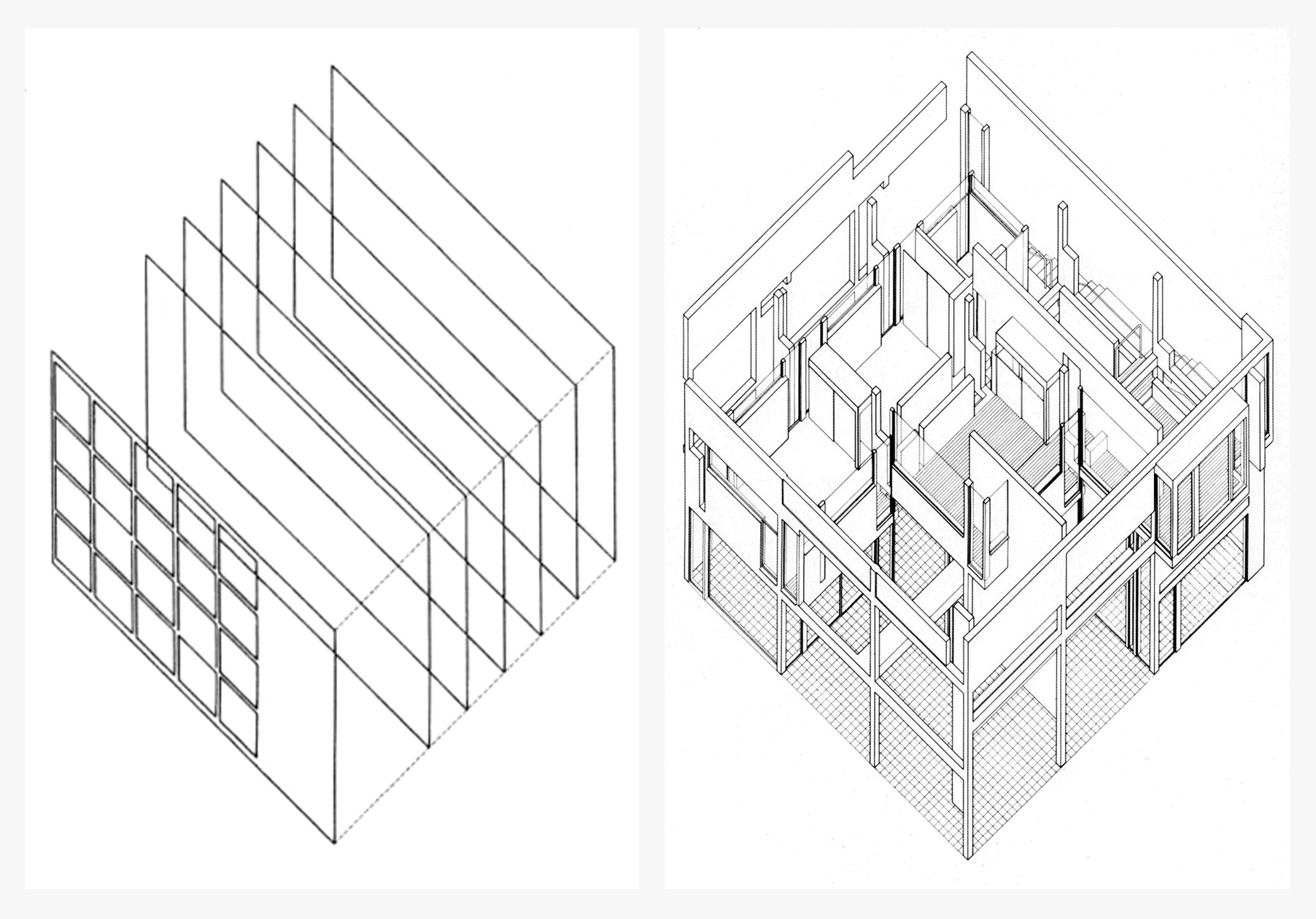
Giuseppe Terragni's infamous Casa Del Fascio (today casa del populi) built in 1935 as a symbol for the superiority of the rising fascist party shows mainly Terragnis superiority in comosing space with complexity and coherence. The balance of rules and exceptions and the impressive control of light fascinated architects and theorists (such as Peter Eisenman who analysed the building properly) for decades.
architecturality.files.wordpress.com/2010/10/terragni_eis...
LIFE LIST:
1) Thank GOD Daily.
2) Every morning, think of one thing that will make me smile.
3) Love as many animals as possible
4) Hug Trevor Daily. Many Times.
5) Keep appointments
6) Be on time.
7) Be Trustworthy
8) Keep in Touch
9) Don't feel guilty for wanting to be alone
10) Spend time alone
11) Laugh Often
12) Hold an Orangutan
13) Visit CoCo!
14) See Halle Berry In a Globetopper.
15) Meet OPRAH
16) Go To Africa
17) Cultivate Peace
18) Don't Yell
19) Visit the Ocean more
20) Get a pool and swim daily
21) TRAVEL TRAVEL TRAVEL
22) Feel Passionate
23) Follow My Passion
24) Play.
25) Dance.
26) Play Guitar more
27) Learn Spanish fluently
28) Learn Italian
29) Rent a house on Fire Island
30) See "The View" Live
31) Rent a Villa In Tuscany
32) Think Positve
33) Breathe Deeply.
34) Speak slower
35) Really listen
36) Read
37) Craft
38) Tell Friends often how important they are to me.
39) FINISH NOVEL
40) Sell on EBAY
41) Organize Flickr Photos
42) Allow others to see their Flame.
43) Change a Child's Life.
44) Bring out the Best in others.
45) Don't Worry. Silliest emotion.
46) Believe
47) Keep the Faith.
48) Exercise this 50 year old body!
49) Put Family Videos Onto DVD'S!
50) Kiss Pooter Daily
51) Build Home Extension
52) Help Build a Habitat Home
53) Do Meals On Wheels Every Summer
54) Write more poetry
55) More DEcoupage
56) BEAD BEAD BEAD
57) Go Camping AGAIN!
58) Go Skiing Again!
59) Look People in the Eye
60) Sit Up Straight
61) Moisturize
62) Hydrate Often
63) Swim With the Dolphins again...
64) Get Out Of Debt
65) Save Money
66) Recognize the Gift
67) Learn ASL
68) Take Joy In Life
69) MORE SEX
70) Do Good Work
71) Share what I know.
72) Play piano more
73) Say something nice to myself in the mirror daily.
74) Have someone who will be there for me
75) Donate Hair for women needing wigs
76) Do Not Harbor Negativity.
77) ACCEPT
78) TRANSCEND
79) Notice the Stars Everyday
80) Do a Jigsaw Puzzle
81) Paint by Numbers
82) SEND in Children's Pelican Book
83) Learn Tai Chai or other Martial Arts
84) Be Still
85) Be in the moment
86) Say "I'm sorry" if I mean it and not say it if I don't.
87)Tell the TRUTH
88) SEEK Truth
89) Commune with Nature Daily
90) Do a mosaic with tile
91) Organize Sort Scan Discard slides photos in boxes
92) Today, Make a difference in someone's life.
93) Hug/ Connect with Ellen DeGeneres!
94) Project Confidence Clarity Coherence
95) Write continually
96) See the absurdity of my own mortality and Laugh.
97) Share Light
98) Thank my Body
99) SING LOUDLY
100) Get A House with a LOT of land
101) NYC--- YEARLY
102) Go OUT to the movies more
103) Continue to speak to the Angels
Here's the Travel List:
Vancouver
Tuscany
Florence
Africa
Kyoto
Ireland/ English countryside
Switzerland
Tetons (Wyoming)
Greece
New Brunswick
Madagascar
New Zealand
TIBET
St. John/ Virgin Islands with Rob this time
104)
The fresco decoration of the Hall of Justice of the fortress of Angera constitutes one of the main figurative testimonies of the development phase of the Gothic pictorial language in the Lombard territory; it also proposes a rare and early example of painting with profane themes, of historical-political and celebratory significance.
The room, on the second floor of the Visconti wing of the building, has a rectangular plan, divided into two parts by a pointed arch. The ceiling, formed by cross vaults, is covered by a lively decoration with geometric motifs, with squares and rounds interwoven to form a sort of sumptuous painted fabric. The six bays of the walls, illuminated by large windows with two lights, host the pictorial decoration, which is divided into three superimposed registers within large arches defined by ornamental borders with stylized stars and flowers: the narrative scenes, in the center, are surmounted by a high band with astrological-astronomical subjects, while the lowest register is formed by a lozenge decoration that supported an elegant painted veil, now almost completely disappeared.
The cycle narrates the deeds of Ottone Visconti, archbishop and lord of Milan from 1277 after the victory obtained in Desio over the opposing Torriani family. Since a long time, studies have linked the frescoes to a precise literary source, the Liber de gestis in civitate Mediolani, a work in praise of the Visconti family written by the monk Stefanardo da Vimercate probably in the last decade of the thirteenth century; the tituli that accompany the scenes are inspired by it, while other Latin inscriptions report, to complete the upper decorative band, some verses of the astrological treatise De Sphaera.
From a stylistic point of view, the author of the paintings shows a marked taste for the complex layout of the scenes, while neglecting the coherence of the figure-architecture relationship; the forms are simplified and the faces, lacking in individual characterization, derive strong consistency from the resentful linear definition and the thick dark outlines; these elements constitute an evident link with the thirteenth-century pictorial tradition of Byzantine matrix, probably filtered through the knowledge of works from the Veneto area. Moreover, the attention that will be typically Lombardy for the realistic definition of details or for the description of costumes is already present and alive.
The brilliant overall effect of the room is enhanced by the whirlwind of colors of the vault, a real explosion of chromatic happiness that finds immediate comparisons in the vault of S. Bassiano in Lodi Vecchio, also decorated with joyful secular subjects.
The representations of the planets and the signs of the zodiac are still linked to those astrological-astronomical themes that had an enormous development since the beginning of the Christian Middle Ages and in particular in the Romanesque period; connected to the scansion of time and of the different working activities - in particular agricultural and pastoral -, they had multiple ethical, civil and religious implications. Situated in the courtroom of the Rocca, the cycle must have had the value of an exemplum for those who were called to judge, through the underlining of motifs such as the clemency of the winner on the vanquished enemy or the subjection of earthly power to the stars and to Fortune, and with precise indications on the virtues that should accompany the exercise of power.
As for the dating of the paintings, critics have expressed themselves in various ways, with wide oscillations between 1277 of the battle of Desio and 1314, the year in which Matteo Visconti definitively acquired possession of the fortress after a period of domination by the Torriani and other families.
St Pancras, Ipswich, Suffolk
Until its clearance in the post-war years, the area spreading eastwards of Ipswich town centre was a vast slum. The Rope Walk area was redeveloped and is now home to Suffolk New College and parts of the University. The housing in the Cox Lane area became a car park. I met a man a few years ago who always tries to park his car on the site of the house where he grew up.
Two grand red brick churches survive as islands. The Anglican St Michael is now a burnt out shell. It was declared redundant in the 1990s, and in truth it is hard to see how it can ever have been needed as more than a triumphalist gesture, with the parish church of St Helen only a hundred yards or so away. It was destroyed by fire in March 2011. Still standing tall is George Goldie's 1861 Catholic church of St Pancras. Seen from across the car park, the only clue that it was once tightly surrounded by poor people's houses is that there are no windows in the wall of the north aisle. As at Brighton's St Bartholomew, this great ship was designed to sail above roof tops.
St Pancras looks like a bit dropped off, and that is exactly what it is. Goldie's commission was for the huge, recently demolished School of Jesus and Mary on the campus of the Woodbridge Road church of St Mary, and this town centre church in the same style. St Pancras was intended to be the start of a church of cathedral scale, of which the surviving church was but the chancel. At the time, Ipswich was in the Diocese of Northampton. Today, it is in the Diocese of East Anglia, with a great stone Gothic cathedral at Norwich. But the Norwich cathedral, built as the church of St John the Baptist, and the equally grand Our Lady and the English Martyrs in Cambridge, were both begun a good thirty years after St Pancras. If it had ever been finished, St Pancras would have been one of the biggest red brick churches in England.
The north elevation is stark, that on the south side rather more comfy, with good modern glass in the south aisle windows. The most impressive view is from the west, where the vast rose window fills in what would have been the top of the chancel arch. Here, where the 1970s parish hall stands, would have been the crossing tower, with transepts either side. Looking further west, the nave would have stretched, and here is perhaps one of the reasons why St Pancras the great was never built. Immediately to the west of the church, across Cox lane, stands the fortress-like Christ Church. Although the present building post-dates St Pancras, there has been a Congregationalist church on the site for more than three hundred years, and the planned Catholic church would have stretched in front of it. Given the ecclesiastical politics of the late 19th century, one can't imagine them giving up the site very lightly.
The Catholic presence in Ipswich had been re-established in the 1790s, at the time of the French Revolution, by a refugee Priest, Louis Simon. He said Mass in the home of a rich local lady Margaret Wood, and then with her help established a mission church near the Woodbridge Road barracks. This church, St Anthony, formed the transepts of the building that still survives as the parish hall of the 1960 St Mary.
After the re-establishment of the Catholic hierarchy in England in 1850, which you can read about on the entry for St Mary, the plan was to create a town centre profile for the Church, and this was why Goldie was commissioned to build St Pancras. However, anti-Catholic feeling was rather stronger than it had been seventy years previously. On a night in November 1862, the protestant ministers of the town whipped up such a state of hysteria that angry mobs ran through Ipswich smashing windows of Catholic churches, homes and businesses.
Although the exterior of this building is rather severe, the inside is a delight, quite the loveliest Victorian interior in Ipswich. It doesn't have the gravitas of St Mary le Tower, or the mystery of St Bartholomew, but it is a cascade of red and white brick banding, cast-iron pillars and wall tiling. Along with the statues and the candles and the smell of incense, it is everything a 19th century town centre church should be.
The post-Vatican II re-ordering of the sanctuary has not destroyed its coherence (or, indeed, the traditionalist flavour of the liturgy here). Above the altar, Christ stands in majesty, flanked by the four evangelists. The tabernacle is set curiously off-centre to the south.
Exposed as St Pancras is in comparison with many town centre churches, it is always full of light, and this light takes on the resonances of some good glass. The west window was filled with a design depicting the descent of the Holy Spirit as recently as 2001, by the Danielle Hopkinson studio. As a point of interest, they also did the glass in my front door. This is unfortunately obscured by a massive organ (the west window, not my front door). Below the west gallery is the baptistery, one of Ipswich's busiest, and just some of the church's collection of devotional statues. In the south aisle are three sets of triple lancets. The older glass in the most easterly depicts St Thomas, St Andrew and St John. The splendid 1974 glass by John Lawson in the other two sets depicts St Martin de Porres and St Francis of Assisi.
Not many people live in the parish itself, but as the busiest town centre church in Ipswich St Pancras continues to have a major role to play. Its Masses attract people from far and wide, including many from the town's sizeable minority communities. Perhaps this is because it does have such a traditionalist flavour, but also perhaps because of the work of the tireless and charismatic Parish Priest, Father 'Sam' Leeder. 'He's been here for forty years, and is a familiar character in the town centre, wandering the streets and talking to local traders, as well as being the cornerstone of the town's scouts. Ipswich would be diminished without him.
Stranger #80 – David
I had seen a new group of fundraisers in the streets. I was curious enough about them to try and avoid them as much as I could, not because I didn’t want to listen to what they had to say about the non profit they were raising funds for but because there were fundraisers I would have loved to have as strangers but who approached me first or weren’t strangers any more by the time they were off work. I waited until their day was done and as David was going I approached him. Initially, David thought I was a professional photographer and that I wanted to sell him whatever picture I’d take of him. I explained the 100 strangers project and ethos to him. We walked and talked before I took his picture.
David is a fundraiser. He works for one one of the largest fundraising companies in France. “We get paid by the hour, not by the donation form. I think that’s more ethical, less stressful. When you get paid by the donation form, you end up targeting people most likely to donate: students, young adults. I was a beach photographer in Saint Tropez. I would take pictures of people, walk up to them and say “Hi I’ve taken your picture, I can delete it or I can sell it to you if you’re interested.” I wanted to move. I went to Lyon, I applied for a job as a fundraiser. I like being in contact with people, working for good causes. NGOs are subcontracting fundraising to companies like the one I work for, that means they don’t have to pay fundraisers all year round, just when they need to. A few years down the line, I’d like to be able not to work any more, to have some real estate that would give me an income, I’d travel. What I’d like to tell my younger self? Trust yourself! I’d tell people: Support each other! The happiest memory from my childhood? That’s a tough one. It was my birthday, during breakfast I broke my bowl of chocolate. I didn’t know what would happen to me, I was scared. My uncle came in and told me it was okay. That’s not very happy.”
When I sent him the picture I’d taken of him, David asked me why I didn’t do black and white. I explained that as most of my project so far has been in colour I keep my portraits in colour for unity’s sake but I’ll post a black and white version as a comment for comparison’s sake.
Thank you very much David!
This picture is #80 in my 100 strangers project. Find out more about the project and see pictures taken by other photographers at the 100 Strangers Flickr Group page
This is my 75th submission to the Human Family Group. To view more street portraits and stories visit The Human Family Flickr Group page
J’avais remarqué un nouveau groupe de recruteurs de donateurs dans les rues, j’étais suffisamment curieux à leur sujet pour tenter de les éviter non pas pour ne pas avoir à écouter ce qu’ils auraient à me dire sur l’association pour laquelle ils recrutent des dons mais parce qu’il y avait déjà eu un certain nombre de recruteurs de donateurs que j’aimerais aimer avoir comme inconnu-e-s mais qui m’ont abordé en premier ou tout simplement qui ne m’étaient plus inconnus au moment où ils ne travaillaient plus. J’ai attendu que leur travail soit fini et alors que David partait, je l’ai abordé. Initialement, David a cru que j’étais photographe professionnel et que je voulais lui vendre les photos que j’allais prendre de lui. Je lui ai expliqué le projet 100 strangers. Nous avons marché et discuté un moment avant que je le prenne en photo.
David est recruteur de donateurs. Il travaille pour la plus grande entreprise de recruteurs de dons en France. “On est payés à l’heure, pas au bulletin. Je trouve ça plus éthique, moins stressant. Quand les gens sont payés au bulletin, ils finissent par cibler ceux qui ont le plus de chances de donner: les étudiants, les jeunes adultes. J’étais photographe de plage à Saint Tropez avant. Je prenais les gens en photo, ensuite j’allais leur parler “Salut, je vous ai pris en photo, je peux effacer les photos ou vous les vendre si vous êtes intéressés” Je voulais bouger de Saint Tropez. Je suis allé à Lyon, j’ai postule pour devenir recruteur. J’aime le contact humain dans ce que je fais, le fait d’aider des bonnes causes. On est sous traitants, on ne travaille pas directement pour l’association pour laquelle on recrute des donateurs. Ça évite à l’asso de payer des gens toute l’année, juste quand ils en ont besoin. D’ici quelques années j’aimerais ne plus avoir à travailler, avoir investi dans l’immobilier, faire des air bnb qui me fournissent des revenus, pouvoir voyager. Ce que j’aimerais me dire quand j’étais plus jeune? Aie confiance en toi! Un conseil que j’aimerais donner aux gens? Soyez solidaires! Le meilleur souvenir de mon enfance? Ça c’est dur. C’était mon anniversaire. Au petit déjeuner, j’ai cassé mon bol de chocolat. Je savais pas ce qui allait m’arriver. Mon oncle est entré et il m’a dit “c’est pas grave!”. C’est pas très heureux.”
Lorsque je lui ai envoyé la photo que j’avais prise de lui, David m’a demandé pourquoi je ne fais pas de noir et blanc. Je lui ai expliqué que du fait que mon projet jusque maintenant est en couleur, je continue en couleur pour une question de cohérence mais je joindrai une version en noir et blanc en commentaire pour la comparaison.
Merci beaucoup David!
Cette photo est la #80 dans mon projet 100 strangers. Apprenez-en plus au sujet du projet et visionnez les photos prises par d’autres photographes sur la page Flickr du groupe 100 Strangers
C’est ma 75ème participation au groupe The Human Family. Pour voir plus de portraits de rue et d’histoires, visitez la page Flickr du groupe The Human Family
"The patient is young" is true to some degree – the lower the age of the patient (measured e.g. in years), the more the sentence is true. The word Advaita is a composite of two Sanskrit words: Advaita is often translated as "non-duality," but a more apt translation is "non-secondness." Advaita has several meanings: As Gaudapada states, when a distinction is made between subject and object, people grasp to objects, which is samsara. By realizing one's true identity as Brahman, there is no more grasping, and the mind comes to rest. Nonduality of Atman and Brahman, the famous diction of Advaita Vedanta that Atman is not distinct from Brahman; the knowledge of this identity is liberating. Monism: there is no other reality than Brahman, that "Reality is not constituted by parts," that is, ever-changing 'things' have no existence of their own, but are appearances of the one Existent, Brahman; and that there is in reality no duality between the "experiencing self" (jiva) and Brahman, the Ground of Being. The word Vedānta is a composition of two Sanskrit words: The word Veda refers to the whole corpus of vedic texts, and the word "anta" means 'end'. The meaning of Vedānta can be summed up as "the end of the vedas" or "the ultimate knowledge of the vedas". Vedānta is one of six orthodox schools of Hindu philosophy. Truth of a fuzzy proposition is a matter of degree. I recommend to everybody interested in fuzzy logic that they sharply distinguish fuzziness from uncertainty as a degree of belief (e.g. probability). Compare the last proposition with the proposition "The patient will survive next week". This may well be considered as a crisp proposition which is either (absolutely) true or (absolutely) false; but we do not know which is the case. We may have some probability (chance, degree of belief) that the sentence is true; but probability is not a degree of truth. In metrology (the science of measurement), it is acknowledged that for any measure we care to make, there exists an amount of uncertainty about its accuracy, but this degree of uncertainty is conventionally expressed with a magnitude of likelihood, and not as a degree of truth. In 1975, Lotfi A. Zadeh introduced a distinction between "Type 1 fuzzy sets" without uncertainty and "Type 2 fuzzy sets" with uncertainty, which has been widely accepted. Simply put, in the former case, each fuzzy number is linked to a non-fuzzy (natural) number, while in the latter case, each fuzzy number is linked to another fuzzy number.Problems of vagueness and fuzziness have probably always existed in human experience. From ancient history, philosophers and scientists have reflected about those kinds of problems. The ancient Sorites paradox first raised the logical problem of how we could exactly define the threshold at which a change in quantitative gradation turns into a qualitative or categorical difference. With some physical processes this threshold is relatively easy to identify. For example, water turns into steam at 100 °C or 212 °F (the boiling point depends partly on atmospheric pressure, which decreases at higher altitudes). With many other processes and gradations, however, the point of change is much more difficult to locate, and remains somewhat vague. Thus, the boundaries between qualitatively different things may be unsharp: we know that there are boundaries, but we cannot define them exactly. The Nordic myth of Loki's wager suggested that concepts that lack precise meanings or precise boundaries of application cannot be usefully discussed at all.[9] However, the 20th-century idea of "fuzzy concepts" proposes that "somewhat vague terms" can be operated with, since we can explicate and define the variability of their application by assigning numbers to gradations of applicability. This idea sounds simple enough, but it had large implications. The intellectual origins of the species of fuzzy concepts as a logical category have been traced back to a diversity of famous and less well-known thinkers,[10] including (among many others) Eubulides, Plato, Cicero, Georg Wilhelm Friedrich Hegel,[11] Karl Marx and Friedrich Engels, Friedrich Nietzsche, Hugh MacColl,[13] Charles S. Peirce, Max Black,[15] Jan Łukasiewicz,[16] Emil Leon Post, Alfred Tarski,Georg Cantor, Nicolai A. Vasiliev,[19] Kurt Gödel, Stanisław Jaśkowski[20] and Donald Knuth. Across at least two and a half millennia, all of them had something to say about graded concepts with unsharp boundaries. This suggests at least that the awareness of the existence of concepts with "fuzzy" characteristics, in one form or another, has a very long history in human thought. Quite a few logicians and philosophers have also tried to analyze the characteristics of fuzzy concepts as a recognized species, sometimes with the aid of some kind of many-valued logic or substructural logic. An early attempt in the post-WW2 era to create a theory of sets where set membership is a matter of degree was made by Abraham Kaplan and Hermann Schott in 1951. They intended to apply the idea to empirical research. Kaplan and Schott measured the degree of membership of empirical classes using real numbers between 0 and 1, and they defined corresponding notions of intersection, union, complementation and subset.[22] However, at the time, their idea "fell on stony ground".[23] J. Barkley Rosser Sr. published a treatise on many-valued logics in 1952, anticipating "many-valued sets".[24] Another treatise was published in 1963 by Aleksandr A. Zinov'ev and others In 1964, the American philosopher William Alston introduced the term "degree vagueness" to describe vagueness in an idea that results from the absence of a definite cut-off point along an implied scale (in contrast to "combinatory vagueness" caused by a term that has a number of logically independent conditions of application). The German mathematician Dieter Klaua [de] published a German-language paper on fuzzy sets in 1965, but he used a different terminology (he referred to "many-valued sets", not "fuzzy sets"). Two popular introductions to many-valued logic in the late 1960s were by Robert J. Ackermann and Nicholas Rescher respectively.] Rescher's book includes a bibliography on fuzzy theory up to 1965, which was extended by Robert Wolf for 1966–1974.[30] Haack provides references to significant works after 1974.[31] Bergmann provides a more recent (2008) introduction to fuzzy reasoning.
According to the modern idea of the continuum fallacy, the fact that a statement is to an extent vague, does not automatically mean that it is invalid. The problem then becomes one of how we could ascertain the kind of validity that the statement does have.Nondualism is a fuzzy concept, for which many definitions can be found. According to David Loy, since there are similar ideas and terms in a wide variety of spiritualities and religions, ancient and modern, no single definition for the English word "nonduality" can suffice, and perhaps it is best to speak of various "nondualities" or theories of nonduality.[10] Loy sees non-dualism as a common thread in Taoism, Mahayana Buddhism, and Advaita Vedanta,distinguishes "Five Flavors Of Nonduality":
Advaita, nondual awareness, the nondifference of subject and object, or nonduality between subject and object. According to Loy, in the Upanishads " It is most often expressed as the identity between Atman (the self) and Brahman.". Monism, the nonplurality of the world. Although the phenomenal world appears as a plurality of "things", in reality they are "of a single cloth". Brahmanical and non-Brahmanical ascetic traditions of the first millennium BCE developed in close interaction, utilizing proto-Samkhya enumerations (lists) analyzing experience in the context of meditative practices providing liberating insight into the nature of experience. The first millennium CE saw a movement towards postulating an underlying "basis of unity," both in the Buddhist Madhyamaka and Yogacara schools, and in Advaita Vedanta, collapsing phenomenal reality into a "single substrate or underlying principle." From Dualism to Oneness in Psychoanalysis: A Zen Perspective on the Mind-Body Question focuses on the shift in psychoanalytic thought, from a view of mind-body dualism to a contemporary non-dualistic perspective. The Perennial philosophy has its roots in the Renaissance interest in neo-Platonism and its idea of The One, from which all existence emanates. Marsilio Ficino (1433–1499) sought to integrate Hermeticism with Greek and Jewish-Christian thought, discerning a Prisca theologia which could be found in all age Giovanni Pico della Mirandola (1463–94) suggested that truth could be found in many, rather than just two, traditions. He proposed a harmony between the thought of Plato and Aristotle, and saw aspects of the Prisca theologia in Averroes, the Koran, the Cabala and other sources. Agostino Steuco (1497–1548) coined the term philosophia perennis."Dual" comes from Latin "duo," two, prefixed with "non-" meaning "not"; "non-dual" means "not-two." When referring to nondualism, Hinduism generally uses the Sanskrit term Advaita, while Buddhism uses Advaya (Tibetan: gNis-med, Chinese: pu-erh, Japanese: fu-ni). "Advaita" (अद्वैत) is from Sanskrit roots a, not; dvaita, dual. As Advaita, it means "not-two." or "one without a second," and is usually translated as "nondualism", "nonduality" and "nondual". The term "nondualism" and the term "advaita" from which it originates are polyvalent terms. "Advaya" (अद्वय) is also a Sanskrit word that means "identity, unique, not two, without a second," and typically refers to the two truths doctrine of Mahayana Buddhism, especially Madhyamaka.
The English term "nondual" was informed by early translations of the Upanishads in Western languages other than English from 1775. These terms have entered the English language from literal English renderings of "advaita" subsequent to the first wave of English translations of the Upanishads. These translations commenced with the work of Müller (1823–1900), in the monumental Sacred Books of the East (1879). Max Müller rendered "advaita" as "Monism", as have many recent scholars. However, some scholars state that "advaita" is not really monism. Nondual awareness, also called pure consciousness or awareness, contentless consciousness, consciousness-as-such, and Minimal Phenomenal Experience, is a topic of phenomenological research. As described in Samkhya-Yoga and other systems of meditation, and referred to as, for example, Turya and Atman, pure awareness manifests in advanced states of meditation. Unitarian Universalism had a strong impact on Ram Mohan Roy and the Brahmo Samaj, and subsequently on Swami Vivekananda. Vivekananda was one of the main representatives of Neo-Vedanta, a modern interpretation of Hinduism in line with western esoteric traditions, especially Transcendentalism, New Thought and Theosophy. His reinterpretation was, and is, very successful, creating a new understanding and appreciation of Hinduism within and outside India, and was the principal reason for the enthusiastic reception of yoga, transcendental meditation and other forms of Indian spiritual self-improvement in the West. Narendranath Datta (Swami Vivekananda) became a member of a Freemasonry lodge "at some point before 1884" and of the Sadharan Brahmo Samaj in his twenties, a breakaway faction of the Brahmo Samaj led by Keshab Chandra Sen and Debendranath Tagore.Ram Mohan Roy (1772-1833), the founder of the Brahmo Samaj, had a strong sympathy for the Unitarians, who were closely connected to the Transcendentalists, who in turn were interested in and influenced by Indian religions early on. It was in this cultic milieu that Narendra became acquainted with Western esotericism. Debendranath Tagore brought this "neo-Hinduism" closer in line with western esotericism, a development which was furthered by Keshubchandra Sen, who was also influenced by transcendentalism, which emphasised personal religious experience over mere reasoning and theology. Sen's influence brought Vivekananda fully into contact with western esotericism, and it was also via Sen that he met Ramakrishna. Vivekananda's acquaintance with western esotericism made him very successful in western esoteric circles, beginning with his speech in 1893 at the Parliament of Religions. Vivekananda adapted traditional Hindu ideas and religiosity to suit the needs and understandings of his western audiences, who were especially attracted by and familiar with western esoteric traditions and movements like Transcendentalism and New thought. In 1897 he founded the Ramakrishna Mission, which was instrumental in the spread of Neo-Vedanta in the west, and attracted people like Alan Watts. Aldous Huxley, author of The Perennial Philosophy, was associated with another neo-Vedanta organisation, the Vedanta Society of Southern California, founded and headed by Swami Prabhavananda. Together with Gerald Heard, Christopher Isherwood, and other followers he was initiated by the Swami and was taught meditation and spiritual practices. Neo-Vedanta was well-received among Theosophists, Christian Science, and the New Thought movement; Christian Science in turn influenced the self-study teaching A Course in Miracles.Pure consciousness is distinguished from the workings of the mind, and "consists in nothing but the being seen of what is seen." Gamma & Metzinger (2021) present twelve factors in their phenomenological analysis of pure awareness experienced by meditators, including luminosity; emptiness and non-egoic self-awareness; and witness-consciousness.A main modern proponent of perennialism was Aldous Huxley, who was influenced by Vivekananda's Neo-Vedanta and Universalism. This popular approach finds supports in the "common-core thesis". According to the "common-core thesis", different descriptions can mask quite similar if not identical experiences:
According to Elias Amidon there is an "indescribable, but definitely recognizable, reality that is the ground of all being." According to Renard, these are based on an experience or intuition of "the Real". According to Amidon, this reality is signified by "many names" from "spiritual traditions throughout the world": [N]ondual awareness, pure awareness, open awareness, presence-awareness, unconditioned mind, rigpa, primordial experience, This, the basic state, the sublime, buddhanature, original nature, spontaneous presence, the oneness of being, the ground of being, the Real, clarity, God-consciousness, divine light, the clear light, illumination, realization and enlightenment. According to Renard, nondualism as common essence prefers the term "nondualism", instead of monism, because this understanding is "nonconceptual", "not graspapable in an idea" Even to call this "ground of reality", "One", or "Oneness" is attributing a characteristic to that ground of reality. The only thing that can be said is that it is "not two" or "non-dual": [N]o unmediated experience is possible, and that in the extreme, language is not simply used to interpret experience but in fact constitutes experience. The idea of a common essence has been questioned by Yandell, who discerns various "religious experiences" and their corresponding doctrinal settings, which differ in structure and phenomenological content, and in the "evidential value" they present. The specific teachings and practices of a specific tradition may determine what "experience" someone has, which means that this "experience" is not the proof of the teaching, but a result of the teaching. The notion of what exactly constitutes "liberating insight" varies between the various traditions, and even within the traditions. Bronkhorst for example notices that the conception of what exactly "liberating insight" is in Buddhism was developed over time. Whereas originally it may not have been specified, later on the Four Truths served as such, to be superseded by pratityasamutpada, and still later, in the Hinayana schools, by the doctrine of the non-existence of a substantial self or person. And Schmithausen notices that still other descriptions of this "liberating insight" exist in the Buddhist canon.nsight (prajna, kensho, satori, gnosis, theoria, illumination), especially enlightenment or the realization of the illusory nature of the autonomous "I" or self, is a key element in modern western nondual thought. It is the personal realization that ultimate reality is nondual, and is thought to be a validating means of knowledge of this nondual reality. This insight is interpreted as a psychological state, and labeled as religious or mystical experience. According to Hori, the notion of "religious experience" can be traced back to William James, who used the term "religious experience" in his book, The Varieties of Religious Experience. The origins of the use of this term can be dated further back. In the 18th, 19th, and 20th centuries, several historical figures put forth very influential views that religion and its beliefs can be grounded in experience itself. While Kant held that moral experience justified religious beliefs, John Wesley in addition to stressing individual moral exertion thought that the religious experiences in the Methodist movement (paralleling the Romantic Movement) were foundational to religious commitment as a way of life. Wayne Proudfoot traces the roots of the notion of "religious experience" to the German theologian Friedrich Schleiermacher (1768–1834), who argued that religion is based on a feeling of the infinite. The notion of "religious experience" was used by Schleiermacher and Albert Ritschl to defend religion against the growing scientific and secular critique, and defend the view that human (moral and religious) experience justifies religious beliefs. Such religious empiricism would be later seen as highly problematic and was – during the period in-between world wars – famously rejected by Karl Barth. In the 20th century, religious as well as moral experience as justification for religious beliefs still holds sway. Some influential modern scholars holding this liberal theological view are Charles Raven and the Oxford physicist/theologian Charles Coulson. The notion of "religious experience" was adopted by many scholars of religion, of which William James was the most influential. The notion of "experience" has been criticised. Robert Sharf points out that "experience" is a typical Western term, which has found its way into Asian religiosity via western influences.Insight is not the "experience" of some transcendental reality, but is a cognitive event, the (intuitive) understanding or "grasping" of some specific understanding of reality, as in kensho,or anubhava. "Pure experience" does not exist; all experience is mediated by intellectual and cognitive activity A pure consciousness without concepts, reached by "cleaning the doors of perception", would be an overwhelming chaos of sensory input without coherence.A major force in the mutual influence of eastern and western ideas and religiosity was the Theosophical Society.It searched for ancient wisdom in the east, spreading eastern religious ideas in the west One of its salient features was the belief in "Masters of Wisdom", "beings, human or once human, who have transcended the normal frontiers of knowledge, and who make their wisdom available to others". The Theosophical Society also spread western ideas in the east, aiding a modernisation of eastern traditions, and contributing to a growing nationalism in the Asian colonies.Transcendentalism was an early 19th-century liberal Protestant movement that developed in the 1830s and 1840s in the Eastern region of the United States. It was rooted in English and German Romanticism, the Biblical criticism of Herder and Schleiermacher, and the skepticism of Hume. The Transcendentalists emphasised an intuitive, experiential approach of religion. Following Schleiermacher, an individual's intuition of truth was taken as the criterion for truth. In the late 18th and early 19th century, the first translations of Hindu texts appeared, which were read by the Transcendentalists and influenced their thinking. The Transcendentalists also endorsed universalist and Unitarianist ideas, leading to Unitarian Universalism, the idea that there must be truth in other religions as well, since a loving God would redeem all living beings, not just Christians.Western esotericism (also called esotericism and esoterism) is a scholarly term for a wide range of loosely related ideas and movements which have developed within Western society. They are largely distinct both from orthodox Judeo-Christian religion and from Enlightenment rationalism. The earliest traditions which later analysis would label as forms of Western esotericism emerged in the Eastern Mediterranean during Late Antiquity, where Hermetism, Gnosticism, and Neoplatonism developed as schools of thought distinct from what became mainstream Christianity. In Renaissance Europe, interest in many of these older ideas increased, with various intellectuals seeking to combine "pagan" philosophies with the Kabbalah and with Christian philosophy, resulting in the emergence of esoteric movements like Christian theosophy."Dual" comes from Latin "duo," two, prefixed with "non-" meaning "not"; "non-dual" means "not-two." When referring to nondualism, Hinduism generally uses the Sanskrit term Advaita, while Buddhism uses Advaya (Tibetan: gNis-med, Chinese: pu-erh, Japanese: fu-ni). "Advaita" (अद्वैत) is from Sanskrit roots a, not; dvaita, dual. As Advaita, it means "not-two."[1][8] or "one without a second,"[8] and is usually translated as "nondualism", "nonduality" and "nondual". The term "nondualism" and the term "advaita" from which it originates are polyvalent terms. "Advaya" (अद्वय) is also a Sanskrit word that means "identity, unique, not two, without a second," and typically refers to the two truths doctrine of Mahayana Buddhism, especially Madhyamaka. The English term "nondual" was informed by early translations of the Upanishads in Western languages other than English from 1775. These terms have entered the English language from literal English renderings of "advaita" subsequent to the first wave of English translations of the Upanishads. These translations commenced with the work of Müller (1823–1900), in the monumental Sacred Books of the East (1879). Max Müller rendered "advaita" as "Monism", as have many recent scholars. However, some scholars state that "advaita" is not really monism
en.wikipedia.org/wiki/Nondualism
A fuzzy concept is a kind of concept of which the boundaries of application can vary considerably according to context or conditions, instead of being fixed once and for all. This means the concept is vague in some way, lacking a fixed, precise meaning, without however being unclear or meaningless altogether.It has a definite meaning, which can be made more precise only through further elaboration and specification - including a closer definition of the context in which the concept is used. The study of the characteristics of fuzzy concepts and fuzzy language is called fuzzy semantics. The inverse of a "fuzzy concept" is a "crisp concept" (i.e. a precise concept).
A fuzzy concept is understood by scientists as a concept which is "to an extent applicable" in a situation. That means the concept has gradations of significance or unsharp (variable) boundaries of application. A fuzzy statement is a statement which is true "to some extent", and that extent can often be represented by a scaled value. The term is also used these days in a more general, popular sense – in contrast to its technical meaning – to refer to a concept which is "rather vague" for any kind of reason. In the past, the very idea of reasoning with fuzzy concepts faced considerable resistance from academic elites. They did not want to endorse the use of imprecise concepts in research or argumentation. Yet although people might not be aware of it, the use of fuzzy concepts has risen gigantically in all walks of life from the 1970s onward. That is mainly due to advances in electronic engineering, fuzzy mathematics and digital computer programming. The new technology allows very complex inferences about "variations on a theme" to be anticipated and fixed in a program. New neuro-fuzzy computational methods make it possible to identify, measure and respond to fine gradations of significance with great precision. It means that practically useful concepts can be coded and applied to all kinds of tasks, even if ordinarily these concepts are never precisely defined. Nowadays engineers, statisticians and programmers often represent fuzzy concepts mathematically, using fuzzy logic, fuzzy values, fuzzy variables and fuzzy sets."There exists strong evidence, established in the 1970s in the psychology of concepts... that human concepts have a graded structure in that whether or not a concept applies to a given object is a matter of degree, rather than a yes-or-no question, and that people are capable of working with the degrees in a consistent way. This finding is intuitively quite appealing, because people say "this product is more or less good" or "to a certain degree, he is a good athlete", implying the graded structure of concepts. In his classic paper, Zadeh called the concepts with a graded structure fuzzy concepts and argued that these concepts are a rule rather than an exception when it comes to how people communicate knowledge. Moreover, he argued that to model such concepts mathematically is important for the tasks of control, decision making, pattern recognition, and the like. Zadeh proposed the notion of a fuzzy set that gave birth to the field of fuzzy logic..."Hence, a concept is generally regarded as "fuzzy" in a logical sense if:defining characteristics of the concept apply to it "to a certain degree or extent" (or, more unusually, "with a certain magnitude of likelihood").
or, the boundaries of applicability (the truth-value) of a concept can vary in degrees, according to different conditions.
or, the fuzzy concept itself straightforwardly consists of a fuzzy set, or a combination of such sets.
The fact that a concept is fuzzy does not prevent its use in logical reasoning; it merely affects the type of reasoning which can be applied (see fuzzy logic). If the concept has gradations of meaningful significance, it is necessary to specify and formalize what those gradations are, if they can make an important difference. Not all fuzzy concepts have the same logical structure, but they can often be formally described or reconstructed using fuzzy logic or other substructural logics.The advantage of this approach is, that numerical notation enables a potentially infinite number of truth-values between complete truth and complete falsehood, and thus it enables - in theory, at least - the greatest precision in stating the degree of applicability of a logical rule..In philosophical logic and linguistics, fuzzy concepts are often regarded as vague concepts which in their application, or formally speaking, are neither completely true nor completely false, or which are partly true and partly false; they are ideas which require further elaboration, specification or qualification to understand their applicability (the conditions under which they truly make sense). The "fuzzy area" can also refer simply to a residual number of cases which cannot be allocated to a known and identifiable group, class or set if strict criteria are used. The collaborative written works of French philosopher Gilles Deleuze and French psychoanalyst Félix Guattari refer occasionally to fuzzy sets in conjunction with their idea of multiplicities. In A Thousand Plateaus, they note that "a set is fuzzy if its elements belong to it only by virtue of specific operations of consistency and consolidation, which themselves follow a special logic", and in What Is Philosophy?, a work dealing with the functions of concepts, they write that concepts as a whole are "vague or fuzzy sets, simple aggregates of perceptions and affections, which form within the lived as immanent to a subject" In mathematics and statistics, a fuzzy variable (such as "the temperature", "hot" or "cold") is a value which could lie in a probable range defined by some quantitative limits or parameters, and which can be usefully described with imprecise categories (such as "high", "medium" or "low") using some kind of scale or conceptual hierarchy.n mathematics and computer science, the gradations of applicable meaning of a fuzzy concept are described in terms of quantitative relationships defined by logical operators. Such an approach is sometimes called "degree-theoretic semantics" by logicians and philosophers, but the more usual term is fuzzy logic or many-valued logic. The novelty of fuzzy logic is, that it "breaks with the traditional principle that formalisation should correct and avoid, but not compromise with, vagueness". The basic idea of fuzzy logic is that a real number is assigned to each statement written in a language, within a range from 0 to 1, where 1 means that the statement is completely true, and 0 means that the statement is completely false, while values less than 1 but greater than 0 represent that the statements are "partly true", to a given, quantifiable extent. Susan Haack comments: "Whereas in classical set theory an object either is or is not a member of a given set, in fuzzy set theory membership is a matter of degree; the degree of membership of an object in a fuzzy set is represented by some real number between 0 and 1, with 0 denoting no membership and full membership." ..."Truth" in this mathematical context usually means simply that "something is the case", or that "something is applicable". This makes it possible to analyze a distribution of statements for their truth-content, identify data patterns, make inferences and predictions, and model how processes operate. Petr Hájek claimed that "fuzzy logic is not just some "applied logic", but may bring "new light to classical logical problems", and therefore might be well classified as a distinct branch of "philosophical logic" similar to e.g. modal logics.Fuzzy logic offers computationally-oriented systems of concepts and methods, to formalize types of reasoning which are ordinarily approximate only, and not exact. In principle, this allows us to give a definite, precise answer to the question, "To what extent is something the case?", or, "To what extent is something applicable?". Via a series of switches, this kind of reasoning can be built into electronic devices. That was already happening before fuzzy logic was invented, but using fuzzy logic in modelling has become an important aid in design, which creates many new technical possibilities. Fuzzy reasoning (i.e., reasoning with graded concepts) turns out to have many practical uses. It is nowadays widely used in:
The programming of vehicle and transport electronics, household appliances, video games, language filters, robotics, and driverless vehicles. Fuzzy logic washing machines are gaining popularity. All kinds of control systems that regulate access, traffic, movement, balance, conditions, temperature, pressure, routers etc. Electronic equipment used for pattern recognition, surveying and monitoring (including radars, satellites, alarm systems and surveillance systems).
Cybernetics research, artificial intelligence,[54] virtual intelligence, machine learning, database design and soft computing research. "Fuzzy risk scores" are used by project managers and portfolio managers to express financial risk assessments. It looks like fuzzy logic will eventually be applied in almost every aspect of life, even if people are not aware of it, and in that sense fuzzy logic is an astonishingly successful invention.[58] The scientific and engineering literature on the subject is constantly increasing.
en.wikipedia.org/wiki/Fuzzy_concept
Advaita Vedanta (/ʌdˈvaɪtə vɛˈdɑːntə/; Sanskrit: अद्वैत वेदान्त, IAST: Advaita Vedānta) is a Hindu sādhanā, a path of spiritual discipline and experience, and the oldest extant tradition of the orthodox Hindu school Vedānta. The term Advaita (literally "non-secondness", but usually rendered as "nondualism",and often equated with monism[note 3]) refers to the idea that Brahman alone is ultimately real, while the transient phenomenal world is an illusory appearance (maya) of Brahman. In this view, jivatman, the experiencing self, is ultimately non-different ("na aparah") from Ātman-Brahman, the highest Self or Reality.The jivatman or individual self is a mere reflection or limitation of singular Ātman in a multitude of apparent individual bodies. In the Advaita tradition, moksha (liberation from suffering and rebirth),is attained through recognizing this illusoriness of the phenomenal world and disidentification from the body-mind complex and the notion of 'doership',[note 5] and acquiring vidyā (knowledge) of one's true identity as Atman-Brahman, self-luminous (svayam prakāśa)[note 6] awareness or Witness-consciousness. Upanishadic statements such as tat tvam asi, "that['s how] you are," destroy the ignorance (avidyā) regarding one's true identity by revealing that (jiv)Ātman is non-different from immortal[note 8] Brahman. While the prominent 8th century Vedic scholar and teacher (acharya) Adi Shankara emphasized that, since Brahman is ever-present, Brahman-knowledge is immediate and requires no 'action', that is, striving and effort,[15][16][17] the Advaita tradition also prescribes elaborate preparatory practice, including contemplation of the mahavakyas and accepting yogic samadhi as a means to knowledge, posing a paradox which is also recognized in other spiritual disciplines and traditions. Advaita Vedānta adapted philosophical concepts from Buddhism, giving them a Vedantic basis and interpretation,and was influenced by, and influenced, various traditions and texts of Indian philosophy, While Adi Shankara is generally regarded as the most prominent exponent of the Advaita Vedānta tradition,[26] his early influence has been questioned, as his prominence started to take shape only centuries later in the 14th century, with the ascent of Sringeri matha and its jagadguru Vidyaranya (Madhava, 14th cent.) in the Vijayanagara Empire.[note 11] While Shankara did not embrace Yoga,[37] the Advaita Vedānta tradition in medieval times explicitly incorporated elements from the yogic tradition and texts like the Yoga Vasistha and the Bhagavata Purana, culminating in Swami Vivekananda's full embrace and propagation of Yogic samadhi as an Advaita means of knowledge and liberation. In the 19th century, due to the influence of Vidyaranya's Sarvadarśanasaṅgraha, the importance of Advaita Vedānta was overemphasized by Western scholarship,[42] and Advaita Vedānta came to be regarded as the paradigmatic example of Hindu spirituality, despite the numerical dominance of theistic Bhakti-oriented religiosity. In modern times, Advaita views appear in various Neo-Vedānta movements. While "a preferred terminology" for Upanisadic philosophy "in the early periods, before the time of Shankara" was Puruṣavāda,[50][note 13] the Advaita Vedānta school has historically been referred to by various names, such as Advaita-vada (speaker of Advaita), Abheda-darshana (view of non-difference), Dvaita-vada-pratisedha (denial of dual distinctions), and Kevala-dvaita (non-dualism of the isolated). It is also called māyāvāda by Vaishnava opponents, akin to Madhyamaka Buddhism, due to their insistence that phenomena ultimately lack an inherent essence or reality,[ According to Richard King, a professor of Buddhist and Asian studies, the term Advaita first occurs in a recognizably Vedantic context in the prose of Mandukya Upanishad.[51] In contrast, according to Frits Staal, a professor of philosophy specializing in Sanskrit and Vedic studies, the word Advaita is from the Vedic era, and the Vedic sage Yajnavalkya (8th or 7th-century BCE is credited to be the one who coined it] Stephen Phillips, a professor of philosophy and Asian studies, translates the Advaita containing verse excerpt in Brihadaranyaka Upanishad, as "An ocean, a single seer without duality becomes he whose world is Brahman.While the term "Advaita Vedanta" in a strict sense may refer to the scholastic tradition of textual exegesis established by Shankara, "advaita" in a broader sense may refer to a broad current of advaitic thought, which incorporates advaitic elements with yogic thought and practice and other strands of Indian religiosity, such as Kashmir Shaivism and the Nath tradition. The first connotation has also been called "Classical Advaita" and "doctrinal Advaita," and its presentation as such is due to mediaeval doxographies,the influence of Orientalist Indologists like Paul Deussen, and the Indian response to colonial influences, dubbed neo-Vedanta by Paul Hacker, who regarded it as a deviation from "traditional" Advaita Vedanta.Yet, post-Shankara Advaita Vedanta incorporated yogic elements, such as the Yoga Vasistha, and influenced other Indian traditions, and neo-Vedanta is based on this broader strand of Indian thought. This broader current of thought and practice has also been called "greater Advaita Vedanta," "vernacular advaita,"and "experiential Advaita." It is this broader advaitic tradition which is commonly presented as "Advaita Vedanta," though the term "advaitic" may be more apt.The nondualism of Advaita Vedānta is often regarded as an idealist monism. According to King, Advaita Vedānta developed "to its ultimate extreme" the monistic ideas already present in the Upanishads. In contrast, states Milne, it is misleading to call Advaita Vedānta "monistic," since this confuses the "negation of difference" with "conflation into one."Advaita is a negative term (a-dvaita), states Milne, which denotes the "negation of a difference," between subject and object, or between perceiver and perceived. According to Deutsch, Advaita Vedānta teaches monistic oneness, however without the multiplicity premise of alternate monism theories.According to Jacqueline Suthren Hirst, Adi Shankara positively emphasizes "oneness" premise in his Brahma-sutra Bhasya 2.1.20, attributing it to all the Upanishads. Nicholson states Advaita Vedānta contains realistic strands of thought, both in its oldest origins and in Shankara's writings.
en.wikipedia.org/wiki/Advaita_Vedanta#Svayam_prakāśa_(self-luminosity)
Male common ostriches, Struthio camelus, in Tarangire national park.
Does observing ostriches still count as "birding"?
See the associated article here:
www.cloudynights.com/articles/cat/articles/unique-binary-...
M53 (NGC 5024) is a well organized globular cluster in Coma Berenices, discovered in 1775 by German astronomer Johann Bode, then independently discovered by Messier in 1777, and described as a "nebula". William Herschel was the first to resolve it into stars using a larger telescope. He documented it as, "...one of the most beautiful objects I remember to have seen in the heavens." With angular diameter of 13 arcmin, and integrated apparent magnitude of 8.3 (V), it is easily observed in small telescopes as an oval nebulosity, but requires larger apertures for resolution. Its brightest stars are listed as magnitude 13.8, and are predominantly population II red giants. Its lowest metallicity stars indicate the cluster started forming around 12.67 billion years ago. From its estimated mass of 826,000 solar, we can approximate its tidal diameter of nearly 1,600 light years, and well over a million member stars. In its central region, the stars are on average only 0.3 light years apart. The cluster lies at a heliocentric distance of 58,000 ly, and is approaching us at 63 km/s. Situated within the Sgr Dwarf stellar stream, about 60,000 ly above the Galactic plane, along with its binary companion NGC 5053, it is one of the more outlying globular clusters. Considering its well preserved structural coherence during a turbulent history, it is not unreasonable to hypothesize the presence of a central black hole population, or a dense subhalo envelope of dark matter.
NGC 5053 is a very peculiar globular cluster in Coma Berenices, first documented by W. Herschel in 1784. Visually, it is very faint, irregularly oval in shape, gradually brighter toward the center. Compared with its spectacular binary companion, M53, it has only modest stellar content, low luminosity of 40,000 solar, a relatively small physical diameter of 160 ly, and a smaller tidal diameter around 580 ly. Because of loose appearance, low stellar density, absence of a concentrated bright nucleus, and low stellar velocity dispersion, the nature of this cluster as a globular has been doubted for a long time. However, the color-magnitude diagram (CMD) and the HR diagram show a population of blue straggler stars, ten RR Lyrae "cluster variables", and a "knee" between the main sequence and the giant branch characteristic of globular clusters. Tidal disruptions, relatively low total mass, and absence of stabilizing black holes or a dark matter envelope might explain the cluster's peculiar morphological features. Its angular size is 10.5 arcmin, integrated apparent magnitude 9.96 (V), and estimated heliocentric distance 53,500 ly, receding at 43 km/sec. Its brightest red giant stars are of apparent magnitude 14, and horizontal-branch stars average around 16.7. While it is accessible to small apertures photographically, substantial telescopes are required for visual observation. The cluster is remarkable for its extremely low average spectroscopic metallicity of -2.45 dex, among the lowest for Galactic globular clusters. However, based on the age of its oldest individual stars, it seems to have started forming several hundred million years after M53, approximately 12.29 billion years ago.
Marco Bischof's widely acclaimed book has already sold some 30'000 German-language copies (9th printing) since its publication in March 1995, and the success is continuing. It is the first comprehensive book on the world market for the general and scientific public on one of the hottest fields of frontier science which is about to lead to major conceptual breakthroughs and many useful applications in biophysics, biomedical science, biology, biotechnology, environmental science and food technology. Thousands of medical doctors, scientists, and interested laypersons in Germany, Switzerland and Austria who from the many newspaper and magazine articles and from several TV features in the last couple of years were aware of this development of potential breakthroughs in a number of scientific disciplines and wanted to obtain more precise and broadly accessible information have been waiting for this book that will remain the definitive publication on the topic for many years to come. Russian and Chinese translations are in preparation. The book has been awarded the 1995 Book Price by the Scientific and Medical Network (U.K.) and the Swiss Award 1997 by the Swiss Parapsychological Foundation.
What are biophotons ?
Biophotons, or ultraweak photon emissions of biological systems, are weak electromagnetic waves in the optical range of the spectrum - in other words: light. All living cells of plants, animals and human beings emit biophotons which cannot be seen by the naked eye but can be measured by special equipment developed by German researchers.
This light emission is an expression of the functional state of the living organism and its measurement therefore can be used to assess this state. Cancer cells and healthy cells of the same type, for instance, can be discriminated by typical differences in biophoton emission. After an initial decade and a half of basic research on this discovery, biophysicists of various European and Asian countries are now exploring the many interesting applications which range across such diverse fields as cancer research, non-invasive early medical diagnosis, food and water quality testing, chemical and electromagnetic contamination testing, cell communication, and various applications in biotechnology.
According to the biophoton theory developed on the base of these discoveries the biophoton light is stored in the cells of the organism - more precisely, in the DNA molecules of their nuclei - and a dynamic web of light constantly released and absorbed by the DNA may connect cell organelles, cells, tissues, and organs within the body and serve as the organism's main communication network and as the principal regulating instance for all life processes. The processes of morphogenesis, growth, differentiation and regeneration are also explained by the structuring and regulating activity of the coherent biophoton field. The holographic biophoton field of the brain and the nervous system, and maybe even that of the whole organism, may also be basis of memory and other phenomena of consciousness, as postulated by neurophysiologist Karl Pribram an others. The consciousness-like coherence properties of the biophoton field are closely related to its base in the properties of the physical vacuum and indicate its possible role as an interface to the non-physical realms of mind, psyche and consciousness.
The discovery of biophoton emission also lends scientific support to some unconventional methods of healing based on concepts of homeostasis (self-regulation of the organism), such as various somatic therapies, homeopathy and acupuncture. The "ch'i" energy flowing in our bodies' energy channels (meridians) which according to Traditional Chinese Medicine regulates our body functions may be related to node lines of the organism's biophoton field. The "prana" of Indian Yoga physiology may be a similar regulating energy force that has a basis in weak, coherent electromagnetic biofields.
Background
First discovered in 1923 by Russian medical scientist Professor Alexander G.Gurvich (who named them "mitogenetic rays") and in the 1930s widely researched in Europe and the USA, biophotons have been rediscovered and backed since the 1970s by ample experimental and theoretical evidence by European scientists. In 1974 German biophysicist Fritz-Albert Popp has proved their existence, their origin from the DNA and later their coherence (laser-like nature), and has developed biophoton theory to explain their possible biological role and the ways in which they may control biochemical processes, growth, differentiation etc. Popp's biophoton theory leads to many startling insights into the life processes and may well provide one of the major elements of a future theory of life and holistic medical practice based on such an approach. The importance of the discovery has been confirmed by eminent scientists such as Herbert Froehlich and Nobel laureate Ilya Prigogine. Since 1992, the International Institute of Biophysics, a network of research laboratories in more than 10 countries, based in Germany, is coordinating research in this field which promises rapid development in the next decade.
Aims of the book
To date the few books about biophotons have been highly technical and written mainly in German. Not even among these, there was any single book integrating all that is known today about this fascinating field of science which is likely to become soon a much discussed topic also in the English-speaking world. The author, who in 1994-95 has served as Managing Director of the International Institute of Biophysics at Neuss (Germany) and still is a member of the Board of Directors of this institute, has closely followed biophoton research since 1977 and so was predestined to write the first comprehensive account of the subject ever made. His aim was to reach a wider public among scientists, medical doctors and the scientifically aware. The book which embeds the more technical parts in a popular treatment of the historical antecedents of the concept of "energy bodies", "life energies" and biolectricity, and to the ages-old scientific controversy between vitalistic and mechanistic trends in biology and medicine, also appeals to a general readership interested in new developments in the biological and physical sciences and in medicine and in their interplay with consciousness research and new age ideas.
1. Elements of a physics of the living
What are photons ? / What are biophotons ? / What is the origin of biophoton emission ? / The coherence of biophotons / Regulation by the biophoton field / The network of light metabolism / The present state of the discussion / Biophoton theory and alternative medicine / Biophoton theory as a basis for a scientific theory of life appropriate to nature / The new concept of the cell / The big network / From the molecular to the field perspective / Significance of the new concept / Will biology turn out to be more fundamental than physics ? / Possibilities of misuse / Which philosophy will prevail ?
PART I. Prehistory
2. The Aura
The concept of nonmaterial "energy bodies" / Subtle bodies of light / "Mana" and "inner fire" / Indian, Tibetan and Chinese concepts / Visionary concept of the "essential light" of man / Paracelsus' "archaeus"
3.Electrobiology and vitalism
Bioelectricity / The vitalistic tradition / Romantic medicine: illness as a developmental crisis / Claude Bernard's homeostasis: self-regulation of the organism
4. Scientific Medicine
At the origin of modern electrophysiology: the injury current / The Berlin school of physiology: the "overcoming" of vitalism / The "Bernstein hypothesis" of the membrane potential: paradigm of the new "scientific medicine" / The link between electricity and life energy is severed / "Scientific medicine" conquers the US and the world / Ehrlich's "receptor theory"
5. From Mesmer to Reich
Mesmer's "animal magnetism" / Baron Reichenbach's "odic force" / Wilhelm Reich's "orgone"
6. The inconquerable aura
Kilner's aura screens / Albert Hofmann: the aura is subjective / A contemporary description of the aura / The biophysical basis of the aura
7. Electromagnetic man
Blondlot's "N-rays" / Hofmann finds "head and hand rays" / An early Swiss pioneer of electrobiology / The beginnings of modern electrobiology: Burr's "electrodynamic field" / Electromagnetic field structure at the beginning of embryonic development / Electrical determination of ovulation / The connection between electrodynamic field and the psyche / Electrical indications of illness / Robert O.Becker rehabilitates Matteucci's injury current / The body's own electrical regeneration system / Successful electrical stimulation of bone repair / The discovery of the "perineural DC system" / Brain and nervous system: a combination of analog and digital information coding ?
PART II: Beginnings
8. Alexander Gurvich and mitogenetic radiation
The onion root experiment of 1922 / Cells emit light at birth and at death / Cellular radiation and cancer / The theory of the biological field / The "unequilibrated molecular complexes" / Gurvich as a pioneer of modern biophysical concepts / The fate of mitogenetic research / The two schools of biophoton research / The reasons for the ending of Western mitogenetic research before World War II / After World War II
9. Fritz-Albert Popp: How a physicist came to the light
The riddle of cancer genesis / Light in the organism ? / The Kaznacheev experiment / The foundations for biophoton theory are laid
10. ....and there was light !
The first rigorous proof for the existence of the cell emission / Enormous enhancement of chemical reactivity / Experimental proof for Prigogine's theory
11. A stony way to knowledge
The "imperfection theory" / Lossless circulation of light in the cell / Is plant and animal tissue transparent for light ? / A challenge to laboratory physics / Recognition comes
12. From chaos to order : Prigogine's "dissipative structures" and Froehlich's "Bose-condensate"
The biochemical world picture / Dissipative structures / Coherent electromagnetic interactions
13. The bio-informatics of electromagnetic interactions
Our radiation environment / Ionizing radiation / Non-ionizing radiation / UV radiation / UV light and the immune system / The visible light / The role of the pineal / Antagonistic effects of colored light / How light enters into the body / Fundamental light sensitivity / High-frequency radiation / Electromagnetic pollution / Two opposite views on biological communication / ULF, ELF and VLF (low frequency) radiation / Weather radiation / The correspondence between weather radiation and brainwaves / On the search for a new explanation of radiation effects
14. A scientific revolution
Meaningful event or blind mechanism ? / The Berlin and the Goettingen schools of thought / An antipode of molecular biology: Georges Lakhovsky / A pioneer of the new thinking: Vladimir Vernadsky / Presman's revolutionary concept / New approaches come to prevail only very slowly / Non-equilibrium thermodynamics and the principle of least effort / The two currents in science: mechanists vs. vitalists / Quantitative power thinking versus the wisdom of non-violence / The intelligence of nature
PART III . Fundamentals
15. The ecology and the physiology of light
The radiation of the sun and the self-regulation of "Gaia". Photosynthesis / Skin and eyes as "light valves" / The role of melanin in the transduction of light
16. Organisms as light stores
Coherent sunlight / The cavity model / Hyperbolic decay / Organisms are biological lasers
17. DNA: Light storage in spiral molecules
Replication / Repair / Transcription / Translation / DNA hyperstructures / The ethidium bromide experiment / DNA the most important source of biophoton emission / The exciplex model of DNA / DNA as lasering matter / The origin of Schroedinger's "order suction" (?) : Bose-condensation in DNA / Photon-phonon-interaction / DNA as a pulsating "light pump" / A hierarchy of light-active molecule systems / Molecular and cellular pulsations / Melanins as collaborators of DNA ? / DNA predestined to be the central control of the biophoton field / The antenna geometry of DNA
18. Coherent states: Organisms at the threshold between Yin and Yang
The bioplasma concept / The biological laser field: dynamic stability at the laser threshold / The peculiarity of biological coherence / The Dicke theory and "Cavity Quantum Electrodynamics" / Actual and potential information / Biological consequences
19. The genesis and development of life in the biophoton field
Matter consists of vibrations / Particles and fields originate from the "void" / Quantum physics treats reality according to acustical laws / Jenny's "cymatics" as a model of morphogenesis / The basic mechanism of morphogenesis: Interference / The importance of frequency / Light as the organizing principle of matter / Material structures as antennae for radiation / Evolution in the radiation field / The communication experiments / The residual light amplifier makes biophotons visible for the first time / When blood cells communicate / Evolution as the expansion of coherent states
20. The biophoton field as morphogenetic field: The development of the embryo
Field properties of organisms / The field description of the cleaving process shows harmonical laws / Holographic properties / Further stages of embryonic development: The dialectics of internal and surface cellular fields / The transition from cleavage to gastrulation: From point symmetry to axial symmetry / The genesis of partial fields / The phase of the genesis of germinal layers: a sensitive stage
21. The three germinal layers
Germinal layers as energy systems / Dissimilar degree of coherence of the three systems
22. The regulation of differentiation and growth by the biophoton field
Properties of organisms that are not determined by genetic activity / junk genes ? / The "c value paradoxon" / Non-genetic role of DNA ? / The exciplex model of DNA solves open problems in biology / The complementarity of growth and differentiation / The electromagnetic model of cell differentiation and growth confirmed experimentally
23. Biochemical regulation
Coordinated and ordered biochemical activity through the biophoton field / The biochemistry of the cell in a new light / The role of photon frequencies and of the particle geometry / Dynamical structuring of the regulating field / Are biological rhythms controlled by the biophoton field ? / Homeostasis through light-controlled entropy gradients / The entire metabolic work accomplished by biophotons ?
24. Harmonical structures
Mitotic spindle ordered by cavity waves ? / Microtubuli as optical waveguides ? / Cell skeleton built up by light ? / The role of water / Order and water metabolism in the cell are linked / Vibrating musculature / A complex resonance structure makes the organism react very sensitively / States of tension / Biophotons in the nervous system / Holographic biophoton fields in the brain / Altered states of consciousness / A coupling between the nervous system and other oscillators in the organism ? / Our odorous aura
PART IV. Applications
25. Illness and health
Health as a coherent state / Illness as a developmental crisis / Stages of illness / Immunological resistance and effectiveness of substances explainable through biophoton field
26. Regulation forms and types of illness
Polar ordering of regulation systems / Reactive types and the proneness towards certain illnesses / Yin and Yang illnesses / Pischinger's "Basic regulatory system" as a basis for all regulations
27. Cancer: Loss of coherence and of the ability to store light
Cancer tissue has different emission / The tumor is the symptom, not the illness / A fast and cheap tumor test
28. Homeopathic principles as a "guiding line" for modern medicine
Holistic regulation through vibrations / High potencies improve the coherence of the organism and are effective on the causal level / Homeopathic effects not explainable biochemically / Electromagnetic fields can substiute substances / The memory of water / Coherence therapy
29. Urine, blood, and breath tests; smoking test
The luminescence of urine indicates illnesses / Has blood radiation a diagnostic value ? / Blood and urine of smokers show stronger emission / Luminescent breath
30. A test for determining immunological resistance
Radiant phagocytes / A Tibetan drug under test / Biophoton measurements on the flu remedy Echinacine
31. Food quality analysis
In fact we eat sunlight / A concentration of the sunlight towards DNA / ATP as a light carrier / Not the caloric but the information content determines the quality of foodstuffs / The light storage capacity of the "living macromolecules" / Fats and sunlight / A test system for Popp's hypothesis / Free range eggs clearly distinguishable from battery eggs / Is it possible to discriminate biological from conventional foodstuffs ? / Different production and fertilization methods as well as contamination by pesticides and heavy metals engender different biophoton emissions / Bacterial contamination in beer can be detected at an early stage / Biophoton method is superior to biochemical analysis in some essential aspects / The result in the controversy about biological products / Detection of oxidative degradation of organic substances
32. Agriculture
Improvement of quality and yield through "resonance stimulation" by laser light / Bad quality and low resistance of glass-house products due to lack of UV light / Electromagnetic stimulation of growth (electroculture) / Acoustic stimulation of plant growth
33. Water research and "biological activity"
Water - an enigmatic substance / Water structures - facts and speculations / The memory of water / Are biological experiments and biophoton measurements more adequate than other methods of investigation ? / Is the structural aspect of water overemphasized ? / Different types of water can be differentiated / The discrimination of natural and synthetic substances based on their "biological activity"
34. Environmental pollution
Gaseous pollutants / Biophoton emission as a measure of the Relative Biological Effectiveness (RBE) of ionizing radiation / Synergetic mechanisms of damage
35. Dying forests
Water lentils as bio-indicators / Nuclear plants and dying forests: is there a connection ? / Electrochemical smog and dying forests
36. Methods of bioelectronic diagnosis
1. The Bioelectronic Test according to Vincent / Bioelectronic measurements of body fluids to assess Claude Bernard's "terrain" / Cancer prognosis possible ?
2. Electroacupuncture / Electroacupuncture according to Voll (EAV) / Electroacupuncture according to Croon ("Electroneural diagnostics") / The "Ryodoraku method" of Nakatani / The AMI method of Motoyama
3. The bases of acupuncture / A possible participation of meridians in the formation of embryonic organs / Meridians may be not material channels but node lines of the biophoton field / Acupuncture points electrically distinguished / A new method shows if someone is healthy or ill / The stimulation of acupuncture points / Biophoton research furnishes bases for electrodiagnostics
4. Kirlian photography / Between bioelectrical measurement and biophoton measurement / Distribution of electrical charge on the skin is fundamental / Diagnostic evaluation still in its beginnings / New technical developments / Use for quality analysis of foodstuffs and liquids
5. Whole body biophoton diagnostics / The biophysical basis of the aura / The works of Gulyaev and Godik / Thermoregulation diagnostics / Biophoton measurements on humans / "Hand radiation" and healers / The whole-body biophoton diagnostics project
37. Methods of bioelectronic therapy
1. MORA and radionics
2. Electrotherapy / An old tradition / Electrotherapy in the 19th century / High-frequency AC therapy / ELF therapy
3. Chromotherapy (Therapy with colored light) / Ghadiali's chromotherapy / Beginnings of modern light therapy / The actual situation of chromotherapy
4. Laser therapy / Soft-laser applications with weak light / The work of Inyushin / Laser stimulation of tissue regeneration / Laser stimulation of acupuncture points / The mechanism of soft laser therapy / Resonance stimulation of the biophoton field
PART V. Outlook
38. The biophoton field - mediator between body and soul ?
Biophotons - to be analysed in the framework of current science / Is there an even more fundamental level of the organism "behind" the biophoton field ? / The rebirth of the "ether" / The zero-point energy of the vacuum / Bearden's "scalar fields" / Wheeler's "quantum foam" / Bohm's "implicate order" / Burkhard Heim's six-dimensional world model / Photons as mediators between matter and spirit ? / The consciousness-like aspects of matter / Coherence as a bridge to the realm of consciousness / Biophoton theory and the vacuum field / Organisms may control their own space structure and flow of time: Dubrov's theory of "biogravitation" / Pulsation between space and "counter-space": biological space and the ether in the anthroposophical doctrine / The polarity between levity and gravity / The pulse of life
Marco Bischof
522 pp., more than 160 illustrations, 5 color plates, extensive bibliography and index.
German publisher: Zweitausendeins, Frankfurt.
Publication date: March 1995
Actual edition (May 1998): 9th printing
Total number of copies sold in German-language market: 27'000
ISBN 3-86150-095-7
World rights: Zweitausendeins.
showcase Exquisite...Vitrine Exquise: Avec la participation de Art Orienté Objet, James Lee Byars, Jimmie Durham, ExtraLucide, Olivier Mosset, Matt Mullican, Rebecca Purcell, Dana Sherwood, Morgane Tschiember, Robert Williams et Raphaël Zarka. Commissariat : Sarina Basta
To understand the archetypal signature of the rose, it is necessary to suspend one’s intellectual and cultural connections to it and simply be open to the “presence” of the rose. This popular flower has a complicated symbology with paradoxical meanings. It is at once a symbol of both purity and passion, both heavenly perfection and earthly desire; both virginity and fertility; both death and life. The rose is the flower of the goddesses Isis and Venus but also the blood of Osiris, Adonis, and Christ.
The Egyptians early in their history realized the connection of the heart to the pulse. An ancient Egyptian medical treatise of the heart says that it "speaks in the vessels of all the members." It is not suprising then that they believed that the heart held the mind and soul of the individual. Another Egyptian author stated emphatically that "the actions of the arms, the movement of the legs, the motion of every other member is done according to the orders of the heart that has conceived them." It was sometimes said of the dead that their hearts had "departed" because it was believed that . It was the heart which was weighed against the feather of truth in the hall of Ma'at during the diving judgement of the deceased. A heart unburdened with the weight of sin and corruption would balance with the feather and its possessor would enjoy the eternal afterlife. The vital importance of the heart in determining the fate of the deceased in the afterlife lead to a chapter in the Book of the Dead (Spell 30) where the deceased implores his heart not to betray him. In part, it reads: "O my heart which I had from my mother, O my heart which I had upon earth, do not rise up against me as a witness in the presence of the Lord of Things; do not speak against me concerning what I have done, do not bring up anything against me in the presence of the Great God, Lord of the West." Many "heart" scarabs were manufactured in Egypt. These scarabs were designed to be placed over the heart of the deceased. On one side a carving of a scarab was featured. On the other side Spell 30 was inscribed.
During the embalming process, the Egyptians removed most of the internal organs from the body. However, they always left the heart inside the body. The brain was removed using a long bronze hook which was inserted up the nose. The Egyptians were not exactly sure what the brain did, although many believed that its job was to produce snot. According to the priests of Memphis, the god Ptah conceived of all things in his heart and brought them into being by speaking their names.
What is Heart Intelligence? And, what exactly is the difference between Heart Intelligence, IQ, and EQ? In this article, I’ll give you a clear definition of each, and at the end, I will tell you what you can do next to start accessing the intelligence, wisdom and power of your heart. These days everyone is talking about the Heart. Every where you look and listen, people from all religions, cultures, and ages speak about the heart as if was the true center of wisdom: ‘follow your heart’, ‘connect to your heart’, ‘lead from the heart’, ‘speak from the heart’, ‘consult your heart’…
Surely, if Aristoteles were alive today, there would be a big smile on his face! A student of Plato and tutor to Alexander the Great, Aristoteles believed and taught a ‘cardiocentric‘ model of human anatomy where the heart was the true center of human intelligence and not the brain. For the past 30 years Scientist at the HeartMath Institute as well as hundreds of independent researchers, including researchers in the fields neurocardiology, have been speaking about Heart Intelligence, a higher level of awareness that arises from the heart. The human heart has approximately 40,000 neural cells. This means the heart has it’s own nervous system, which actually sends more information to the brain, than the brain sends to the heart! From a biophysical perspective, every heart contraction creates a wave that pushes blood through the veins and arteries providing the energetic signal that helps synchronize all the cells of the body, including the brain. From a hormonal perspective, the heart is a hormone-producing endocrine gland, producing ANF to control blood- pressure, adrenaline, dopamine, and oxytocin (the love hormone). Oxytocin reduces fear, increases eye-contact, and increases trust and generosity. From an electromagnetic perspective, the heart’s electromagnetic field is 5,000 times more powerful than the brain’s! Our heart’s electromagnetic field expands and touches those within 8 – 25 feet of where we are positioned! What science is doing is validating what our spiritual traditions have been telling us for thousands of years: that the heart stands at the center of an intelligence system that gives us access to not only our soul’s wisdom, but the wisdom contained in the entire Universe!
What is Heart Intelligence?
Heart Intelligence (also known as HQ or Heart IQ) is a higher level of awareness that arises when you are able to integrate your physical, mental, emotional and spiritual intelligence.
When fully embodied and integrated, Heart Intelligence gives you the ability to be fully real, present, connected and heart-directed in every area of your life so that you can experience greater levels of performance, creativity, intuition and higher order thinking. What’s the difference between Mental Intelligence, Emotional Intelligence, and Heart Intelligence? Physical Intelligence is the natural intelligence of the body and each one of it’s parts. It’s the consciousness or programming behind each cell, our DNA and molecular structure that tells the body exactly what to do and when. This is how physical healing takes place.
Mental Intelligence, also known as IQ (Intelligence Quotient) is the measure of your ability to think and reason. This intelligence is normally associated with the left side of your brain that thinks in terms of logic, and language. Emotional Intelligence, also referred to as EQ (Emotional Quotient), is your ability to identify and assess your emotions and the emotions of others. This intelligence is normally associated with the right side of your brain, that associated with creativity and emotions.
Spiritual Intelligence, also referred to as SQ, is the intelligence or wisdom of the soul. Think of this as the accumulation of wisdom your soul has acquired as it journey through different dimensions and lifetimes. It’s also an intelligence that connects us to the Greater Intelligence system we call God, Spirit, the Universe, the Great Spirit, or simply Life.
For example, there is increasing evidence suggesting that the cardioelectromagenetic field can actually affect human beings in close proximity.These signals are stronger in amplitude when in direct contact, but are still detectable up to several feet away from the source. Through these interactions, the heart transfers energies between human beings. The heart can therefore be characterized as the engine for distributing and controlling energy of the human body.
These extraordinary results illustrate that the heart is not only responsible for blood regulations, but is also a very powerful intelligence system. This made me wonder, could intelligence be distributed through the body in ways we might not expect? Could this information sent to the brain perhaps even influence emotional states? Or provide insight into some of the unexplained links between "mental" and "bodily" diseases
Our current human experience, the everyday life we all seem willing to participate in, takes its toll, and many people feel that living the lifestyles we do, struggling to pay bills and constantly working, is not a natural way of life for the human race. It’s an experience that makes it hard to maintain a “high frequency” or positive state. What makes this unfortunate reality even more perplexing is the fact that it doesn’t have to be this way — we are capable of so much more. At the same time, many people around the world are struggling to feed, clothe, and shelter themselves. The Earth is being destroyed and our time to turn things around seems to be limited. This is a hard truth that we very much need to address, and we have a number of options to choose from that could alleviate these problems. It can be difficult to maintain a positive state of mind when we see so many terrible things happening in the world, but we cannot create the kind of change we’re looking for unless we do so from a positive, peaceful state.
Despite all of the negativity in the world and our individual struggles, many people do manage to find inner peace and moments of joy, and that’s pretty remarkable. It’s all about perspective — it’s seeing the bigger picture and changing the way you look at things. Happiness is no doubt an inside job, but with a human experience that is not resonating with many it can be hard to maintain. This is evident in a variety of different areas where people are starting to stand up and demand change. More and more people are wanting something different, wanting a life where everybody can thrive and feel good about themselves and their place in the world. If one is suffering, we all suffer — that’s the way we feel here at CE and it’s clear that many are resonating with that message. The funny thing about our feelings is that, for the most part, they are a result of our own choices. We can choose to change the way we feel just by changing our thoughts. Negative emotions are usually a result of the thoughts we have about the people, things, or events in our lives. At the end of the day, it’s just a human experience, and all experiences are opportunities for learning and growth. The bottom line is, feelings of love, gratitude, and compassion — any positive feelings whatsoever — have a larger impact than we could have ever imagined. These are all characteristics of consciousness, and as quantum physics is showing us, consciousness plays a definite role in the creation of our reality. If this is true, then how we feel about things must play a role, too, and with the research coming out from the Institute of HeartMath, it doesn’t seem unreasonable to suggest that feeling good might very well be fundamental to creating global change.
“A fundamental conclusion of the new physics also acknowledges that the observer creates the reality. As observers, we are personally involved with the creation of our own reality. Physicists are being forced to admit that the universe is a ‘mental’ construction. Pioneering physicist Sir James Jeans wrote: ‘The stream of knowledge is heading toward a non-mechanical reality; the universe begins to look more like a great thought than like a great machine. Mind no longer appears to be an accidental intruder into the realm of matter, we ought rather hail it as the creator and governor of the realm of matter. Get over it, and accept the inarguable conclusion. The universe is immaterial-mental and spiritual.’ It have done some amazing work shedding light on the science of the heart.An internationally recognized nonprofit research and education organization, the Institute of HeartMath dedicates itself to helping people reduce stress, self-regulate emotions, and build energy and resilience for healthy, happy lives. HeartMath tools, technology, and training teach people to rely on the intelligence of their hearts in concert with that of their minds at home, school, work, and play.A large portion of their research has investigated heart and brain interaction. Researchers have examined how the heart and brain communicate with each other and how that affects our consciousness and the way in which we perceive our world. For example, when a person is feeling really positive emotions like gratitude, love, or appreciation, the heart beats out a certain message. Because the heart beats out the largest electromagnetic field produced in the body, it can yield significant data for researchers. This is very important work, as it shows how the heart plays an important role far beyond what is commonly known. For instance, did you know that your heart emits electromagnetic fields that change according to your emotions, or that the human heart has a magnetic field that can be measured up to several feet away from the human body? Did you know that positive emotions create physiological benefits in your body, and that you can boost your immune system by conjuring up positive emotions? Did you know that negative emotions can create nervous system chaos, and that positive emotions do the complete opposite? Did you know that the heart has a system of neurons that have both short term and long term memory, and that their signals sent to the brain can affect our emotional experiences? Did you know that in fetal development, the heart forms and starts beating before the brain is developed? Did you know that a mother’s brainwaves can synchronize to her baby’s heartbeats? Did you know that the heart sends more information to the brain than vice versa?
Your heart, when energized, has the capacity to unify, or bring into a state of coherence all systems in your body. This includes not only all your organs but also your intelligences. Doing this will allow you experience a state of flow, or Coherence. Coherence (also known as psycho-physiological coherence), can be understood as the capacity to flow and the capacity to accept things as they happen: accept life and accept the moment-to-moment experience. When we experience coherence, we tend to be in an accepting state that allows us to flow with rather than resist the unfolding of events. Coherence is a fluid state; a state that is relaxed; a state in which you have your full attention on the here and now—you inhabit your moment, your body, and your mind in the most relaxed and joyful way. From this space, you can respond to life from a deeper place of Love, Compassion, and Acceptance which we call the Heart. You can think of Heart Intelligence as the process of integrating the heart, body, and mind so that you can access the Heart behind the heart.
The numerological elements of the rose are also present in Guild documents and meetings. In general, the rose represents the number five. This is because the wild rose has five petals, and the total petals on roses are in multiples of five. Geometrically, the rose corresponds with the pentagram and pentagon. Five represents the Fifth Element, the life force, the heart or essence of something. In an absolute sense, the rose has represented the expanding awareness of life through the development of the senses. Six-petaled varieties indicate balance and love; seven-petaled varieties indicate transformative passion; and rare eight-petaled roses indicate regeneration, a new cycle, or a higher level of space and time. The rose is one of the fundamental symbols of alchemy and became the philosophical basis of Rosicrucian alchemy. It was so important to alchemists that there are many texts called “Rosarium” (Rosary), and all these texts deal with the relationship between the archetypal King and Queen. We have noted the Rosarium of Jaros Griemiller, an original member of the Guild. Another important Rosarium was prepared by alchemist Arnold de Villanova, who also interacted with Guild members. In alchemy, the rose is primarily a symbol of the operation of Conjunction, the Mystical Marriage of opposites. It represents the regeneration of separated essences and their resurrection on a new level. In the Practice of Psychotherapy, Carl Jung discussed the archetypal underpinnings of love between people in terms of the rose: “The wholeness which is a combination of ‘I and you’ is part of a transcendent unity whose nature can only be grasped in symbols like the rose or the coniunctio (Conjunction).” In alchemy the red rose is regarded as a masculine, active, expansive principle of solar spirit (Sulfur), where the white rose represents the feminine, receptive, contractive principle of lunar soul (Salt). The combination of white and red roses (spirit and soul) symbolizes the birth of the Philosopher’s Child (Mercury). During the operation of Conjunction, the relationship of the masculine red rose to the feminine white rose is the same relationship depicted in alchemical images of the Red King and the White Queen or the Red Sun and White Moon. White roses were linked to the White Phase of the Work (albedo) and the White Stone of Multiplication, while the red rose was associated with the Red Phase and the Red Stone of Projection. The single golden (or gilded) rose is a symbol completion of the Great Work or of some consummate achievement in personal or laboratory alchemy. The Popes used to bless a Golden Rose on the fourth Sunday in Lent, as a symbol of their spiritual power and the certainty of resurrection and immortality. In alchemical terms, the golden rose means a successful marriage of opposites to produce the Golden Child, the perfected essence of both King and Queen. Because Mary is the Christian model of union with God, the rose and the rosary became symbols of the union between god and mankind. Scenes of Mary in a rose garden or under a rose arbor or before a tapestry of roses reinforces this idea. Mary holds a rose and not a scepter in the art of the Middle Ages, which means her power comes from divine love. The rose garden in alchemical drawings is a symbol of sacred space. It could mean a meditation chamber or tabernacle, an altar, a sacred place in nature, or paradise itself. In all these instances, the rose garden is the mystical bridal chamber, the place of the mystic marriage. The rose has obvious connections with sexual energy in alchemy. The “rose colored blood of the alchemical redeemer” or the “warm red tincture” were references to healing effects of purified (alchemically distilled or sublimated) sexual energy. For instance, the Renaissance alchemist Gerhardt Dorn calls rose-colored blood a vegetabile naturae whereas ordinary blood was a vegetabile materiae. In other words, rose-colored blood carries the natural essence or soul, while ordinary blood simply functions on the physical level to supply oxygen to cells, etc. That is the meaning of the alchemical phrase, “The soul of the Stone is in its blood,” or as Carl Jung put it: “The rose red color is related to the aqua permanens and the soul, which are extracted from the prima materia.” The sword and knife, symbols of the Separation operation, carry such power in alchemy partly because of their ability to draw blood. In spiritual alchemy, the single red rose represents the mystic center of a person, his or her heart of hearts – one’s true nature. It also represents the process of purification to reveal one’s essence or the inner “pearl beyond price.” Sufi spiritual alchemist Rumi described this idea when he wrote: "In the driest whitest stretch of pain's infinite desert, I lost my sanity and found this rose." As a symbol of the Mystical Marriage on a personal level, the red rose represents a special kind of love in which one “melts away” into the beauty of another, and the old identity is surrendered for that of the beloved or a higher identity within oneself. In this sense, the rose is a symbol of complete surrender and permanent transmutation. Alchemist Daniel Maier discusses the symbolism of the rose in his Septimana Philosophica: “The rose is the first, most beautiful and perfect of flowers. It is guarded because it is a virgin, and the guard is thorns. The Gardens of Philosophy are planted with many roses, both red and white, which colors are in correspondence with gold and silver. The center of the rose is green and is emblematical of the Green Lion [First Matter]. Even as a natural rose is a pleasure to the senses and life of man, on account of its sweetness and salubrity, so is the Philosophical Rose exhilarating to the heart and a giver of strength to the brain. Just as the natural rose turns to the sun and is refreshed by rain, so is the Philosophical Matter prepared in blood, grown in light, and in and by these made perfect." Because of its association with the workings of the heart, the rose in alchemy has come to symbolize secrets of the heart or things that cannot be spoken or an oath of silence in general. In the folded structure of the rose, the flower seems to be concealing a secret inner core. “Mystery glows in the rose bed and the secret is hidden in the rose,” wrote the twelfth-century Persian alchemist Farid ud-din Attar. During Alchemy Guild meetings, a red rose hung from the ceiling indicates the material to be discussed is confidential for members only and is to be kept secret. On the Guild’s websites and in its printed matter, a red rose icon or the Latin phrase “sub rosa” (“under the rose”) indicates the material is secret. Clicking on this icon on websites will take the visitor to password-protected areas intended for members only. This concept originates in the hermetic tradition of hanging red roses from the ceiling of meetings to indicate that discretion was called for and none of the information discussed should leave the room. The symbol was used in a number of hermetic organizations in the late Middle Ages and Renaissance and was well known to alchemists. For instance, in Sebastian Brant's fifteenth-century alchemical treatise “Narrenschiff” (“Ship of Fools”), the author warns: “What here we do say, shall under roses stay.”
The importance of defending airfields against attack was realised before the outbreak of World War II and a strategy evolved as the war went on. Initially based on the principle of defence against air attack, anti-aircraft guns, air raid shelters and dispersed layouts, with fighter or `blast' pens to protect dispersed aircraft, are characteristics of this early phase. With time, however, the capture of the airfield became a more significant threat, and it was in this phase that the majority of surviving defence structures were constructed, mostly in the form of pillboxes and other types of machine gun post. The scale of airfield defence depended on the likelihood of attack, with those airfields in south or east England, and those close to navigable rivers, ports and dockyards being more heavily defended. But the types of structure used were fairly standard. For defence against air attack there were anti-aircraft gun positions, either small machine gun posts or more substantial towers for Bofors guns; air raid shelters were common, with many examples on each airfield; and for aircraft, widely dispersed to reduce the potential effects of attack, fighter pens were provided. These were groups together, usually in threes, and took the form of `E' shaped earthworks with shelter for ground crew. Night fighter stations also had sleep shelters where the crew could rest. For defence against capture, pillboxes were provided. These fortified gun positions took many forms, from standard ministry designs used throughout Britain and in all contexts, to designs specifically for airfield defence. Three Pickett-Hamilton forts were issued to many airfields and located on the flying field itself. Normally level with the ground, these forts were occupied by two persons who entered through the roof before raising the structure by a pneumatic mechanism to bring fire on the invading force. Other types of gun position include the Seagull trench, a complex linear defensive position, and rounded `Mushroom' pillboxes, while fighter pens were often protected by defended walls. Finally, airfield defence was co-ordinated from a Battle Headquarters, a heavily built structure of which under and above ground examples are known. Defences survive on a number of airfields, though few in anything like the original form or configuration, or with their Battle Headquarters. Examples are considered to be of particular importance where the defence provision is near complete, or where a portion of the airfield represents the nature of airfield defence that existed more widely across the site. Surviving structures will often be given coherence and context by surviving lengths of perimeter track and the concrete dispersal pads. In addition, some types of defence structure are rare survivals nationally, and all examples of Pickett- Hamilton forts, fighter pens and their associated sleep shelters, gun positions and Battle Headquarters closely associated with defence structures, are of national importance.
Despite the loss of parts of West Malling airfield to modern development, elements of its World War II defences survive well and represent a range of structures originally present. The Pickett-Hamilton fort is a well-preserved example of a rare form of gun emplacement, 242 of which were installed on 82 airfields in 1940-41 by a commercial construction company. The structure remains substantially unchanged and still retains all the principal elements of its original design, including its operating equipment. Its use in this location illustrates the often unique character of airfield structures, in this case specifically designed for the defence of the flying field. The anti-aircraft defences at West Malling are also notable for the survival of a Bofors Light Anti-aircraft gun tower at the north western corner of the former airfield, one of only three examples recorded on airfields nationally (the other two survive at Brooklands and Weston-super-Mare). As such, it is an important historic structure, serving as a physical record of similar emplacements which have been demolished elsewhere. The Type 24 irregular hexagonal pillbox is the most common form of pillbox built between 1939 and 1941. Pillboxes are especially representative of World War II defence structures and its association with the adjacent airfield adds to the significance of the structure. The pillbox, located on the southern side of West Malling airfield survives comparatively well. Its presence, as well as the strengthening of its walls in concrete, illustrates the perceived vulnerability of the airfield to attack by heavy German artillery. The importance of the surviving defence structures at West Malling is further enhanced by the overall significance of the airfield itself and the necessity to safeguard crucial elements in the defence of Britain against the threat of invasion during the greatest conflict of the 20th century.
Details
The monument, which falls into three separate areas, includes a Bofors Light Anti-aircraft gun tower, a Pickett-Hamilton fort and a Type 24 pillbox. These structures formed part of the World War II defences of West Malling airfield, situated at Kings Hill, on top of the Greensand ridge, about 5km west of Maidstone. West Malling opened in 1930 as a private airfield for the Maidstone School of Flying, and was subsequently registered as Maidstone airport two years later. With the outbreak of World War II the airfield, which fell within Fighter Command's strategically important 11 Group (that part of Fighter Command covering the south east of England), was requisitioned by the RAF and soon re-opened as a front line fighter station in June 1940, and a satellite airfield to Biggin Hill, the principal fighter station in the area. A series of German bombing raids in August 1940 rendered the airfield unserviceable during the Battle of Britain, although it became a leading night fighter station the following year and played a key role in the 1944 campaign, code named Operation Diver, to defend the South East against the V1 flying bomb. With the end of the war West Malling became the main rehabilitation centre for prisoners of war returning from Germany. By this time its former grass runways, reinforced with Somerfield track (a heavy steel netting), had been replaced in concrete to meet the needs of the new jet aircraft. After the war the airfield was used for peacetime training, and during the 1960s the station was placed on `care and maintenance' by the RAF. The site was acquired by Kent County Council in 1970 and many of the airfield buildings are now used as offices by Tonbridge and Malling Borough Council. Since the 1990s, parts of the airfield have been lost to modern development. With the deepening threat of German invasion, the defence of Britain's airfields became a high priority during 1940. Fear of German `blitzkrieg' or `lightening' war tactics (involving rapid assault by air and seaborne troops, as witnessed in Europe in the Spring of 1940), led to the implementation of a national strategy for the defence of airfields in September 1940. West Malling was identified as one of 149 important airfields, located within 20 miles of vulnerable ports which could be targets for seaborne landings. Heavy defence of these airfields was therefore crucial to prevent capture of strategic landing grounds by enemy paratroops or gliderborne forces, rapidly followed by the arrival of transport aircraft carrying the principal invasion force. By the end of 1940, three Pickett-Hamilton forts had been installed at West Malling. These structures were designed in June 1940 by the New Kent Construction Company, specifically for the close defence of airfield runways. One of these forts was located towards the northern end of the flying field and survives next to what is now a modern access track. The structure consists of two, vertically sunken concrete cylinders, one mounted inside the other. The inner cylinder, known as the lifting head, remains in its lowered position, flush with the ground surface. The lifting head, pierced with three apertures for its main Vickers or Bren gun, was designed to be raised to its firing position by means of a pneumatic jack, supplemented by a manual pump for emergency use. The fort retains most of its original features, including its internal operating equipment as well as the access hatch in the lid of the lifting head through which the crew of two men entered at ground level. The second fort was removed from the airfield in 1983, and survives on display at the Imperial War Museum, Duxford. The location of the third fort has not yet been identified. Adjacent to the southern perimeter track at West Malling is a Type 24 hexagonal pillbox which originally formed part of an inner and outer series of about 20-30 pillboxes. The small squat structure measures about 6m by 5.5m and is entered through a doorway on its longer eastern side. The entrance is protected by a low externally attached brick wall, and is flanked by one of two loopholes, the second of which is located in the opposite wall of the pillbox. In accordance with orders issued in 1941, the walls of the original brick built structure were thickened by the external application of reinforced concrete, and evidence suggests that at least two additional loopholes were also blocked at this time. These measures were intended to strengthen pillboxes at vulnerable locations against heavy German artillery. The presence of a recess in the edge of the roof above each opening suggests that further protection for the gun crew may have been provided in the form of shields, designed to deflect flame-throwers. A rare surviving example of a Bofors Light Anti-aircraft gun tower also survives close to a modern roundabout, at the north western approach to the airfield. The concrete and brick built tower appears to conform to type `DFW 55087', which was designed at the end of 1939, with the earliest examples constructed during the first half of 1940. The tower was designed to raise a 40mm Bofors gun and its operational equipment, above surrounding obstacles in order to achieve an all-round field of fire in defending the airfield from attack by fast moving, low flying enemy aircraft. The tower stands to a height of about 20m and consists of two parallel, independent structures, separated for much of their height by a 1m gap and linked at intervals by cantilevered concrete bridges to allow movement between the towers. At ground level, the gap functioned as a passageway, providing access to the chambers on either side. The combined structure measures 9m from north to south by 4m east to west and each tower was constructed on four levels: three internal levels contained the magazine and accommodation chambers, lit by vertical two-light windows. The emplacement was located on the flat concrete roof, which projects beyond the brick walls of the tower and was reached via a ladder from the chamber below. The ordnance was centrally mounted on the roof of the northern tower and was served by ammunition lockers at each corner of the roof space. The roof of the southern tower supported the target predictor and was separated from the gun platform by a narrow intervening gap, above the passage below, to insulate this sensitive equipment from the vibration of the Bofors gun. Several temporary station buildings survive around the airfield perimeter. These derelict structures include externally rendered, temporary brick buildings, dispersed from the main technical site in anticipation of concentrated bombing raids. These structures are not included in the current scheduling. Among the more architecturally sophisticated airfield buildings, the Neo-Georgian style Officers' Mess is Listed Grade II. Several semi-sunken Stanton air raid shelters survive, in buried form, near the barrack buildings. These are infilled and are not therefore included in the scheduling. Other structures associated with the defence of the airfield, such as the battle headquarters and the protected aircraft dispersal pens, were destroyed towards the end of the 20th century, although further, as yet unidentified elements may survive beyond the area of the monument. All modern fixtures and fittings associated with the Bofors tower, including modern doors and window boxes, and all modern materials and equipment stored within the tower are excluded from the scheduling; the ground beneath these features, or the structures to which they are attached, however, is included.
MAP EXTRACT The site of the monument is shown on the attached map extract. It includes a 2 metre boundary around the archaeological features, considered to be essential for the monument's support and preservation.
As a child, I marveled at double rainbows, and their origin – the double internal reflection of sunlight in drops of watery mist. They are very cool, and not because of fairies or pots of gold… =)
Raindrops are not shaped like drops – the coherence of rainbows would not occur with teardrops. With spheres, you get internal reflection bounces sending the light back to the viewer, but slightly refracted, generating the color bands (diagrams). So, the color coherence is due to the angle between the viewer and the array of spheres.
The sun has to be behind you. I have always suspected that if the earth’s horizon was not there or if you could view from a high platform with the sunlight streaming below, you would see a "rain circle" rather than a half-circle "bow”. It was just a theory, as I never got high enough.
I finally saw a full rain circle a few days ago. It was too big to capture in frame, but here is a quarter of it.
This is the final original that will be enlarged 930% to 40 foot wide. The REASON for that size is the coherence of the complex proposal- not apparent at smaller sizes.
Amiens Cathedral, in the heart of Picardy, is one of the largest classic 13th-century Gothic churches. It is notable for the coherence of its plan, the beauty of its three-tier interior elevation, and the particularly fine display of sculptures on the principal facade.
Working with flowers from a previous bouquet.
A couple of thoughts about "Beauty, Reflected....
"A person is only beautiful, when their own beauty, is reflecting on to others." ~~~~ Tara Grady
"As any jazz musician knows, it takes flexibility and adaptability for improvisation to create beauty." ~~~ Doc Childre and Bruce Cryer, From Chaos to Coherence
Here is one of a number of beautiful versions of ....
~~~~~~~ performed by Alex Britti, Joe Cocker & Pavarotti
Nice est une ville du sud-est de la France, préfecture du département des Alpes-Maritimes et deuxième ville de la région Provence-Alpes-Côte d'Azur derrière Marseille. Située à l'extrémité sud-est de la France, à une trentaine de kilomètres de la frontière italienne, elle est établie sur les bords de la mer Méditerranée, le long de la baie des Anges et à l'embouchure du Paillon.
Avec 344 875 habitants en 20081, elle est la cinquième commune de France en termes de population (après Paris, Marseille, Lyon et Toulouse). Son agglomération est également la cinquième de France (après Paris, Marseille, Lyon et Lille) et regroupe 946 630 habitants (2007)2. Elle est enfin située au cœur d'une aire urbaine de 999 678 habitants (2007)3 et d'un espace urbain, l' « espace urbain Nice-Côte-d'Azur » qui compte une population de 1 293 381 habitants (2007)4. La ville est le centre d'une communauté urbaine, Nice Côte d'Azur, la septième de France, qui rassemble vingt-sept communes et 535 543 habitants5. Le Scot de Nice (Schéma de cohérence territoriale), créé en 2003, regroupe vingt-neuf communes. Sa population est estimée à 517 500 habitants en 20056.
Située entre mer et montagnes, capitale économique de la Côte d'Azur, Nice bénéficie d'importants atouts naturels. Le tourisme, le commerce et les administrations (publiques ou privées) occupent une place importante dans l'activité économique de la ville. Elle possède la deuxième capacité hôtelière du pays7 et accueille chaque année 4 millions de touristes8. Elle dispose également du troisième aéroport de France9,10 et de deux palais des congrès dédiés au tourisme d'affaires. La ville possède aussi une université et plusieurs quartiers d'affaires. Nice est enfin dotée de certains équipements culturels importants. Elle possède ainsi plusieurs musées, un théâtre national, un opéra, une bibliothèque à vocation régionale, un conservatoire à rayonnement régional et des salles de concert.
Capitale historique du comté de Nice, elle a appartenu à la Provence avant de rejoindre la Maison de Savoie en 1388 et plus tard le royaume de Piémont-Sardaigne. Nice ne devint définitivement française qu'en 1860. Ses habitants s'appellent les Niçois(es).
____________
Nice é uma cidade francesa, situada no departamento francês dos Alpes Marítimos e na região de Provença-Alpes-Costa Azul. Nice conta com 347.900 habitantes (2005) e sua área metropolitana tem 968.903 habitantes (2007). Depois do Congresso de Viena (1815), voltou a fazer parte do reino da Sardenha, um dos que formaram a Itália moderna. Foi definitivamente anexada à França em 1860, por meio do tratado de Villafranca.
Algumas placas indicam, além da forma francesa Nice, a forma provençal Nissa. A origem do nome vem do grego Nikaia - vitoriosa - e a versão latina é Nicæa.
_____________
Nice is the fifth most populous city in France, after Paris, Marseille, Lyon and Toulouse, with a population of 348,721 within its administrative limits on a land area of 71.92 km2 (28 sq mi). The urban area of Nice extends beyond the administrative city limits with a population of over 955,000[1] on an area of 721 km2 (278 sq mi). Located on the south east coast of France on the Mediterranean Sea, Nice is second largest French city on the Mediterranean coast.
The city is nicknamed Nice la Belle (Nissa la Bella in Niçard), which means Nice the Beautiful. Nice is the capital city of the Alpes Maritimes department, and the second biggest city of the Region Provence-Alpes-Côte d'Azur after Marseille.
The area of today’s Nice is believed to be among the oldest human settlements in Europe. One of the archaeological sites, Terra Amata, displays evidence of a very early usage of fire. Around 350 BCE, Greeks of Marseille founded a permanent settlement and called it Nikaia, after Nike, the goddess of victory.[2]
Throughout the ages the town changed hands many times. Its strategic location and port significantly contributed to its maritime strength. For years, it was an Italian dominion, then became part of France in 1860. Culturally and architecturally enriched over time, today Nice has become a truly cosmopolitan tourist destination.[3] The spectacular natural beauty of the Nice area and its mild Mediterranean climate came to the attention of the English upper classes in the second half of the 18th century, when an increasing number of aristocratic families took to spending their winter there. The city’s main seaside promenade, the Promenade des Anglais (‘the Walkway of the English’) owes its name to the earliest visitors to the resort.[4] For decades now, the picturesque Nicean surroundings have attracted not only those in search of relaxation, but also those seeking inspiration. The clear air and soft light has been of particular appeal to some of Western culture’s most outstanding painters, such as Marc Chagall, Henri Matisse, Niki de Saint Phalle and Arman. Their work is commemorated in many of the city’s museums, including Musée Marc Chagall, Musée Matisse and Musée des Beaux-Arts Jules Chéret.[5] The climate and landscape are still what attracts most visitors today. It has the second largest hotel capacity in the country[6] and it’s the second-most visited place in France after Paris, receiving 4 million tourists every year.[7] It also has the second busiest airport in France after Paris[8] and two convention centers dedicated to business tourism. The city also has a university, several business districts and some major cultural facilities, such as museums, a national theater, an opera house with a regional library and several concert halls and casinos. It is the historical capital city of the County of Nice (Comté de Nice).
Nice experiences a Mediterranean climate. The summer's/holiday season lasts for 6 months, from May to October, although also in April and November sometimes there are temperatures above 20 °C (68 °F). Winters are mild, with average temperatures of 13.4 °C (56.1 °F) during the day and 5.8 °C (42.4 °F) at night in the period from December to February.
Whenever “the shadows of faith” (C, 131) overtook him, Teilhard was comforted by the coherence, integrity, and power of his synthesis. “I am prepared to press on to the end along a road in which each step makes me more certain, towards horizons that are ever more shrouded in mist” (C, 132)
-Teilhard's Mysticism: Seeing the Inner Face of Evolution by Kathleen Duffy
Teilhard’s approach to mysticism was holistic. He knew that the intimate interaction of scientific observation and imaginative intuition is vital for anyone who sets out to discover the essence of the natural world.5 Just as science alone can never plumb the inner depths of nature, so a mysticism that is ignorant of the dynamics of the physical world can never truly know God. He hoped that one day the sciences would treat all facets of reality, that they would allow for the action of all sorts of forces: physical forces that determine interactions in matter, psychological forces that influence human interactions, as well as the super-personal Force at the heart of matter that attracts all things into ultimate unity.
-Teilhard's Mysticism: Seeing the Inner Face of Evolution by Kathleen Duffy
Out of chaos there emerged emotional coherence; the power of her turbulent desire was transformed into a passion to care; a commitment to truth became a driving force; beneath her intellectual and emotional vitality she found an undercurrent of wisdom; and in the secrecy of an untidy bathroom her heart’s deepest longing was met in the practice of adoration.
-Etty Hillesum: A Life Transformed
Patrick Woodhouse
Here is the presentation of my ongoing exhibit @ JAS Gallery Paris, you have until December 24th if you would like to come.
English and French.
Texts and photographs are copyright Cedric Guilleminot.
Ice Dreams (English)
Stranded on a beach of black volcanic sand, strange formations of millenary ice make a last stand before drifting away at sea, never to return. These ephemeral totems, sculpted by Elemental forces, are the gateway to a phantasmagorical dream, a dream in which ice under the spell of arctic light would have a soul.
In the Southeast of Iceland lies a kingdom of ice, Vatnajökull, Europe's largest glacier. Recent changes in the Earth's climate are causing the recession of it's glacial tongues, giving birth to a natural marvel, the proglacial moraine lake of Jökulsárlón.
The ice lagoon is home to giants in search of temporary refuge, dramatic icebergs who bear the marks of their volcanic ancestry. After a journey of a thousand or so years, the glacier sets its offspring free, each a unique amalgamation of billions of snowflakes, in a process known as calving.
For an estimated five years, they drift towards the mouth of the lagoon and erode under the combined effects of wind, tide, sun and friction, until they are small enough to channel out to sea. Engulfed in the fury of the receding tide most are propelled into the open ocean never to be seen again.
Some more defiant, brave the elements for a few hours as they become stranded on an adjacent beach of black volcanic sand only to be submerged by the next tide. Totems of their own destruction, Moais in more than one way.
Here, in their last hours of glory, they will throne as ephemeral gems of raw crystalline beauty, untouched by man yet masterfully carved by seemingly arbitrary forces. They will capture, transform and reflect the magic of each drop of light whilst withstanding the battering of the waves and the blasting of the sand.
The improbability of such perfection void of any sense of purpose, other than that of being, draws me in. Perfect for but a moment in time, for as they alter to their liquid state so they are condemned to oblivion.
Their call echoes within, and the thought emerges, that maybe, just maybe, through my camera I could offer them a second of eternity before they seal their fate and perpetuate the cycle of water.
Over the course of a year and six trips, I have worked to reveal their individuality, as portraiture in landscape. Getting both the appropriate natural light and the presence of the model to coincide was perhaps the greatest challenge.
Under the magic of the midnight sun and in the deep of the arctic winter, when tide and time, when subject and photographer are forced into coherence, these ice monoliths reveal a soul. Perhaps it was all just a dream, Ice Dreams.
© Cedric Guilleminot
Ice Dreams (French)
Echouées sur une plage de sable volcanique noir, d'étranges formations de glace millénaire font leur dernière apparition avant de se perdre dans la mer, pour ne jamais revenir. Ces totems éphémères, sculptés par les forces élémentaires, ouvrent la voie vers un rêve fantasmagorique, un rêve dans lequel la glace, sous l'emprise de la lumière arctique aurait une âme.
Au sud est de l'Islande se trouve un royaume de glace, Vatnajökull, le plus grand glacier d'Europe. Les récents bouleversements climatiques provoquent le recul de ses fronts glaciaires, donnant naissance, paradoxalement, à une merveille de la nature, le lac morainique pro-glaciaire de Jökulsárlón.
Ce lagon est la demeure de géants en quête d'un refuge temporaire, des icebergs pittoresques arborant les cicatrices de leur passé volcanique. Après un périple de quelques milliers d'années, le glacier y libère ses progénitures, chacune d’elles une fusion unique de milliards de flocons de neige.
Sur une durée de cinq ans, ces icebergs dérivent vers l'embouchure du lagon et s'érodent sous les effets combinés du vent, des marées et du soleil, et ce, jusqu'au moment où leur taille leur permet enfin de voguer vers l'océan. Alors, aspirés par la furie de la marée descendante, la plupart disparaissent, rejetés vers le large.
Certains, plus téméraires, bravent les éléments et s'échouent sur la plage attenante de sable noir. Une trêve de courte durée ; la prochaine marée les submergera à tout jamais. Totems de leur propre destruction, Moais à plus d'un titre.
Joyaux éphémères, beautés sauvages et cristallines, vierges de tout intervention humaine, ces sculptures magistrales ne seraient que l'oeuvre de forces aléatoires. Dans leurs dernières heures de gloire, ces icebergs trônent, apprivoisent et restituent la magie de chaque particule de lumière, ultime résistance face à l'assaut des vagues et au déferlement du sable.
Cette improbable perfection est envoutante, sans raison d'être autre que d'exister. Elle me fascine elle m’attire, tant elle est fugace, tant leur retour à l'état liquide les condamnera à l'oubli.
Leur appel résonne, et l'idée émerge alors en moi que peut être, peut être seulement, je pourrais leur offrir un instant d'éternité avant qu'elles ne scellent leur destin en perpétuant de nouveau le cycle de l'eau.
Au cours de six voyages entrepris sur un an, j'ai voulu révéler leur individualité, sublimer leur portrait. Le plus grand défi étant sans doute que la lumière souhaitée coïncide avec la présence du modèle.
Sous le charme du soleil de minuit et dans la profondeur de l'hiver arctique, lorsque temps et marée, sujet et photographe sont contraints à la cohérence, ces monolithes de glace révèlent une âme. Peut-être n'était-ce qu'un rêve, un rêve de glace.
© Cedric Guilleminot
Processed with Silver Efex Pro 2
Pete Doherty – Brixton Jamm – 1st May 2017
Two sets – one at 5pm and one at 8.30pm – what could possibly go wrong ? At 5pm twitter rumours were that Pete was in St Leonards. At 8.30pm he hadn’t played a note for the first show. Oh well, it was going to be a late one…not totally unexpected was it ? At 11.45pm the second show got underway – and two minutes or so of a deliciously chaotic ‘Twist and Shout’ hinted at the possibilities. From then on it was rather like listening to someone turn the tuning dial on an old fashioned radio – songs drifted in and out of focus – moments of brilliance and coherence followed by moments of utter madness. If you like Pete you’d have liked (some of) this. If you didn’t…well you’d have given up the wait long ago. In truth he needs more support and direction from his band – Mick Whitnall alone was unable to provide the impetus to keep the set on track – but you might argue this is part of the appeal. What I’m sure of is someone – a friend, a band member, a manager – needs to help or else nights like this will drift even more towards self-indulgent chaos. And it will all end abruptly. And badly. Don’t waste the talent Pete.
Brixton Jamm, South London, UK
Testing, Testing, ... BANG!!!
Nondestructive testing
Nondestructive testing or Non-destructive testing (NDT) is a wide group of analysis techniques used in science and industry to evaluate the properties of a material, component or system without causing damage.[1] The terms Nondestructive examination (NDE), Nondestructive inspection (NDI), and Nondestructive evaluation (NDE) are also commonly used to describe this technology.[2] Because NDT does not permanently alter the article being inspected, it is a highly valuable technique that can save both money and time in product evaluation, troubleshooting, and research. Common NDT methods include ultrasonic, magnetic-particle, liquid penetrant, radiographic, remote visual inspection (RVI), eddy-current testing,[1] and low coherence interferometry.[3][4] NDT is commonly used in forensic engineering, mechanical engineering, petroleum engineering, electrical engineering, civil engineering, systems engineering, aeronautical engineering, medicine, and art.[1] Innovations in the field of nondestructive testing have had a profound impact on medical imaging, including on echocardiography, medical ultrasonography, and digital radiography.
Methods[edit]
NDT methods may rely upon use of electromagnetic radiation, sound, and inherent properties of materials to examine samples. This includes some kinds of microscopy to examine external surfaces in detail, although sample preparation techniques for metallography, optical microscopy and electron microscopy are generally destructive as the surfaces must be made smooth through polishing or the sample must be electron transparent in thickness. The inside of a sample can be examined with penetrating radiation, such as X-rays, neutrons or terahertz radiation. Sound waves are utilized in the case of ultrasonic testing. Contrast between a defect and the bulk of the sample may be enhanced for visual examination by the unaided eye by using liquids to penetrate fatigue cracks. One method (liquid penetrant testing) involves using dyes, fluorescent or non-fluorescent, in fluids for non-magnetic materials, usually metals. Another commonly used NDT method used on ferrous materials involves the application of fine iron particles (either liquid or dry dust) that are applied to a part while it is in an externally magnetized state (magnetic-particle testing). The particles will be attracted to leakage fields within the test object, and form on the objects surface. Magnetic particle testing can reveal surface & some sub-surface defects within the part. Thermoelectric effect (or use of the Seebeck effect) uses thermal properties of an alloy to quickly and easily characterize many alloys. The chemical test, or chemical spot test method, utilizes application of sensitive chemicals that can indicate the presence of individual alloying elements. Electrochemical methods, such as electrochemical fatigue crack sensors, utilize the tendency of metal structural material to oxidize readily in order to detect progressive damage.
Analyzing and documenting a non-destructive failure mode can also be accomplished using a high-speed camera recording continuously (movie-loop) until the failure is detected. Detecting the failure can be accomplished using a sound detector or stress gauge which produces a signal to trigger the high-speed camera. These high-speed cameras have advanced recording modes to capture some non-destructive failures.[5] After the failure the high-speed camera will stop recording. The capture images can be played back in slow motion showing precisely what happen before, during and after the non-destructive event, image by image.
A small aside to the project to present you my tribute to the work on the cover of Spirou of March 2, 2022, signed by Arthur de Pins.
When I received it, I was thrilled: the ideas were flying because I have the colors used in my stock of Lego bricks.
Some concessions however:
- I could have used a Star Wars TIE fighter canopy but I don't have one. So I decided to build it myself. The result is less successful but the color code is respected.
- The door of the shuttle is difficult to make at this scale. So I kept it closed, and decided to advance a few minutes in time to keep some consistency with the cover.
- I didn't have enough 1 x 1 round plates to make the 4 tubes above the gas station building. I was able to make two.
- I didn't have the right pieces in bright orange to make the sign above the door, I just removed it.
- Finally, making diagonal stripes is a challenge with bricks, I kept the crenelated spirit easier to manage.
A creation that I decided to keep for the moment and that will be presented in an exhibition.
What do you think of it?
-------------------------------------------------------------------
Petit aparté au projet pour vous présenter mon hommage au travail sur la couverture du Spirou du 2 mars 2022, signée par Arthur de Pins.
Quand je l'ai reçu, coup de coeur : les idées ont fusé car je possède les couleurs utilisées dans mon stock de briques Lego.
Quelques concessions cependant :
- J'aurai pu utiliser une verrière de chasseur TIE Star Wars mais je n'en ai pas. J'ai donc décidé de la construire moi-même. Le résultat est moins réussi mais le code couleur est respecté.
- La porte de la navette est difficile à réaliser à cette échelle. Je l'ai donc gardé fermée, et décidé d'avancer de quelques minutes dans le temps pour garder une certaine cohérence avec la couverture.
- Je n'avais pas assez de round plates 1 x 1 pour réaliser les 4 tubes au-dessus du bâtiment de la station service. J'ai pu en faire deux.
- Je n'ai pas les bonnes pièces en bright orange pour faire l'enseigne au-dessus de la porte, je l'ai tout simplement enlevée.
- enfin, faire des bandes diagonales est une gageure avec les briques, j'ai gardé l'esprit crénelé plus simple à gérer.
Une création que j'ai décidé de garder pour le moment et qui sera présentée en exposition.
Qu'en pensez-vous ?