View allAll Photos Tagged Coherence
Loosely stacked brick wall at an old brick factory in Belgium. All baked from the same clay but still not identical.
Los gestapelde stenen muur bij een oude steenfabriek in België. Allemaal uit dezelfde klei gebakken maar toch niet identiek.
Approximation of the intervals of the semi-minor axes of the planets in our solar system.
As the idea of the “harmony of the spheres” has been anchored in mankind for thousands of years, a coherence between geometry and the celestial relations has also been suspected for an equally long time. Plato associated the five regular solids named after him with the elements of fire, water, earth, air and a celestial-ethereal substance. He attributed the latter to the dodecahedron, a figure, that is enclosed by twelve pentagons. In geometrical regard it was again Johannes Kepler who 2000 years later developed the ancient ideas further. He started out on his search for order in the solar system by creating his well-known model which shows that the arrangement of the six planets, known in his time, is organized by the five Platonic solids. According to this the ratio of the radii of the inner and the outer sphere of the dodecahedron, for example, corresponds (if only very approximately) with that of the mean distances which Mars and Earth have from the Sun, or the semi-major axes of the elliptical orbits, repectively.
However, the structure of the whole system is determined by the semi-minor axes b, which already had a central importance in the harmonies of the velocities. What is most striking, is that the first and the fourth planet, counted from the inside as well as from the outside, are in a ratio of 4/1, relative to their semi-minor axes. The first and sixth planet, again calculated from the inside and the outside, show the proportion 25/1. The result is a clear higher structure, that is partitioned further by ratios of small integers. This order is illustrated in the image by circles. The differences from the real values amount to only a few thousandths, except for the intervals 8/3 and 3/2, where they are slightly more than one per cent.
source: www.keplerstern.com/Geometrical_Order/geometrical_order.html
© Copyright 2011 Michael Paukner. All Rights Reserved.
A small aside to the project to present you my tribute to the work on the cover of Spirou of March 2, 2022, signed by Arthur de Pins.
When I received it, I was thrilled: the ideas were flying because I have the colors used in my stock of Lego bricks.
Some concessions however:
- I could have used a Star Wars TIE fighter canopy but I don't have one. So I decided to build it myself. The result is less successful but the color code is respected.
- The door of the shuttle is difficult to make at this scale. So I kept it closed, and decided to advance a few minutes in time to keep some consistency with the cover.
- I didn't have enough 1 x 1 round plates to make the 4 tubes above the gas station building. I was able to make two.
- I didn't have the right pieces in bright orange to make the sign above the door, I just removed it.
- Finally, making diagonal stripes is a challenge with bricks, I kept the crenelated spirit easier to manage.
A creation that I decided to keep for the moment and that will be presented in an exhibition.
What do you think of it?
-------------------------------------------------------------------
Petit aparté au projet pour vous présenter mon hommage au travail sur la couverture du Spirou du 2 mars 2022, signée par Arthur de Pins.
Quand je l'ai reçu, coup de coeur : les idées ont fusé car je possède les couleurs utilisées dans mon stock de briques Lego.
Quelques concessions cependant :
- J'aurai pu utiliser une verrière de chasseur TIE Star Wars mais je n'en ai pas. J'ai donc décidé de la construire moi-même. Le résultat est moins réussi mais le code couleur est respecté.
- La porte de la navette est difficile à réaliser à cette échelle. Je l'ai donc gardé fermée, et décidé d'avancer de quelques minutes dans le temps pour garder une certaine cohérence avec la couverture.
- Je n'avais pas assez de round plates 1 x 1 pour réaliser les 4 tubes au-dessus du bâtiment de la station service. J'ai pu en faire deux.
- Je n'ai pas les bonnes pièces en bright orange pour faire l'enseigne au-dessus de la porte, je l'ai tout simplement enlevée.
- enfin, faire des bandes diagonales est une gageure avec les briques, j'ai gardé l'esprit crénelé plus simple à gérer.
Une création que j'ai décidé de garder pour le moment et qui sera présentée en exposition.
Qu'en pensez-vous ?
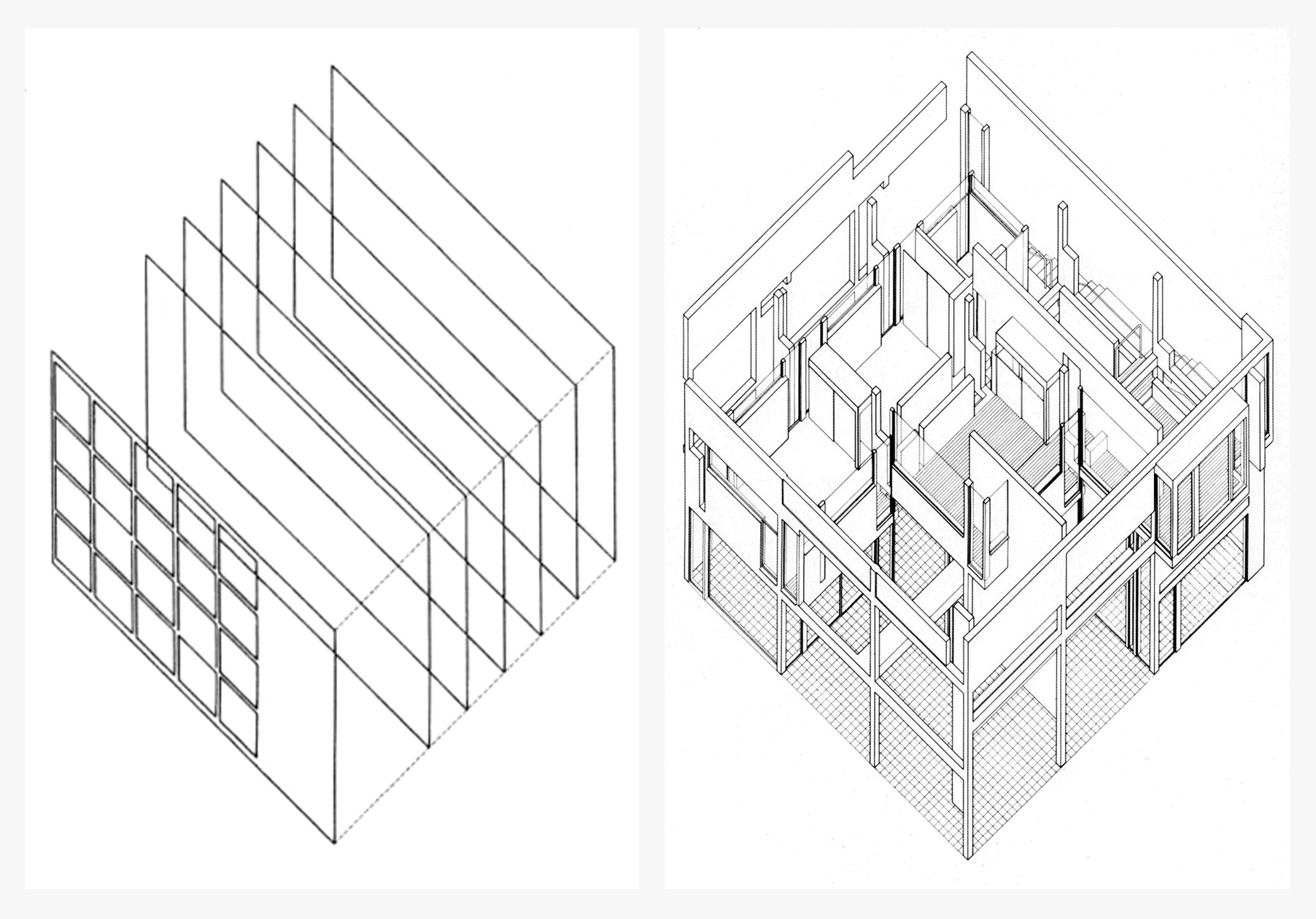
Giuseppe Terragni's infamous Casa Del Fascio (today casa del populi) built in 1935 as a symbol for the superiority of the rising fascist party shows mainly Terragnis superiority in comosing space with complexity and coherence. The balance of rules and exceptions and the impressive control of light fascinated architects and theorists (such as Peter Eisenman who analysed the building properly) for decades.
architecturality.files.wordpress.com/2010/10/terragni_eis...
Jean-Marc de Pas, sculpteur, est né à Rouen en 1962. Docteur en Arts et sciences de l’art, diplômé des Beaux-arts de Paris et de l’Ecole Boulle, il a ouvert son atelier en 1989 à Bois-Guilbert, en Normandie.
Dans son travail, il recherche l’harmonie des lignes, la grâce, l’expression d’un état intérieur. Paysagiste dans l’âme, il pense la sculpture d’extérieur comme élément d’un ensemble. A 21 ans, il reçoit un lieu au charme bien particulier, trouve l’espace de liberté qui lui permet d’exprimer son rapport à l’univers. Il forme le rêve d’un grand jardin de sculptures, dont il conçoit les plans et assure les plantations. Soixante-dix de ses œuvres jalonnent une promenade poétique et symbolique célébrant la vie et la nature, jardin labellisé « Jardin remarquable » par le Ministère de la culture depuis 2014.
Depuis 30 ans, il a également réalisé de nombreuses œuvres monumentales installées dans l’espace public. Il a expérimenté de nombreux registres. Son matériau de prédilection est la terre, malléable; ses œuvres sont ensuite éditées en bronze ou dans des matériaux composites. Jean-Marc de Pas travaille également régulièrement pour des entreprises. Il s’imprègne alors de la vocation des lieux, avec son histoire et les éléments formels qui les composent, architectures et paysages, pour chercher une cohérence pour les personnes qui vivent l’espace. Il intègre un cahier des charges, pour produire un geste poétique qui va au-delà de la matérialité de l’œuvre ; il cherche à apporter un supplément d’âme à ces espaces.
Jean-Marc de Pas, sculpteur, est né à Rouen en 1962. Docteur en Arts et sciences de l’art, diplômé des Beaux-arts de Paris et de l’Ecole Boulle, il a ouvert son atelier en 1989 à Bois-Guilbert, en Normandie.
Dans son travail, il recherche l’harmonie des lignes, la grâce, l’expression d’un état intérieur. Paysagiste dans l’âme, il pense la sculpture d’extérieur comme élément d’un ensemble. A 21 ans, il reçoit un lieu au charme bien particulier, trouve l’espace de liberté qui lui permet d’exprimer son rapport à l’univers. Il forme le rêve d’un grand jardin de sculptures, dont il conçoit les plans et assure les plantations. Soixante-dix de ses œuvres jalonnent une promenade poétique et symbolique célébrant la vie et la nature, jardin labellisé « Jardin remarquable » par le Ministère de la culture depuis 2014.
Depuis 30 ans, il a également réalisé de nombreuses œuvres monumentales installées dans l’espace public. Il a expérimenté de nombreux registres. Son matériau de prédilection est la terre, malléable; ses œuvres sont ensuite éditées en bronze ou dans des matériaux composites. Jean-Marc de Pas travaille également régulièrement pour des entreprises. Il s’imprègne alors de la vocation des lieux, avec son histoire et les éléments formels qui les composent, architectures et paysages, pour chercher une cohérence pour les personnes qui vivent l’espace. Il intègre un cahier des charges, pour produire un geste poétique qui va au-delà de la matérialité de l’œuvre ; il cherche à apporter un supplément d’âme à ces espaces.
Jean-Marc de Pas, sculptor, was born in Rouen in 1962. Doctor of Arts and Art Sciences, graduated from the Beaux-Arts de Paris and the Ecole Boulle, he opened his studio in 1989 in Bois-Guilbert, Normandy.
In his work, he seeks harmony of lines, grace, the expression of an inner state. A landscaper at heart, he thinks of outdoor sculpture as an element of a whole. At 21, he receives a place with a very particular charm, finds the space of freedom that allows him to express his relationship with the universe. He dreams of a large sculpture garden, for which he designs the plans and ensures the planting. Seventy of his works mark a poetic and symbolic walk celebrating life and nature, a garden labeled "Remarkable Garden" by the Ministry of Culture since 2014.
For 30 years, he has also created many monumental works installed in public spaces. He has experimented with many registers. His favorite material is clay, malleable; his works are then published in bronze or composite materials. Jean-Marc de Pas also works regularly for companies. He then immerses himself in the vocation of the places, with their history and the formal elements that compose them, architectures and landscapes, to seek coherence for the people who live in the space. He integrates a specification, to produce a poetic gesture that goes beyond the materiality of the work; he seeks to bring an extra soul to these spaces.
Jean-Marc de Pas, sculptor, was born in Rouen in 1962. Doctor of Arts and Art Sciences, graduated from the Beaux-Arts de Paris and the Ecole Boulle, he opened his studio in 1989 in Bois-Guilbert, Normandy.
In his work, he seeks harmony of lines, grace, the expression of an inner state. A landscaper at heart, he thinks of outdoor sculpture as an element of a whole. At 21, he receives a place with a very particular charm, finds the space of freedom that allows him to express his relationship with the universe. He dreams of a large sculpture garden, for which he designs the plans and ensures the planting. Seventy of his works mark a poetic and symbolic walk celebrating life and nature, a garden labeled "Remarkable Garden" by the Ministry of Culture since 2014.
For 30 years, he has also created many monumental works installed in public spaces. He has experimented with many registers. His preferred material is earth, malleable; his works are then produced in bronze or composite materials. Jean-Marc de Pas also works regularly for companies. He then immerses himself in the vocation of the places, with their history and the formal elements that compose them, architectures and landscapes, to seek coherence for the people who live in the space. He integrates a specification, to produce a poetic gesture that goes beyond the materiality of the work; he seeks to bring an extra soul to these spaces.
The Apparatus That Learned to Watch Itself Die
It stands where presence has been evacuated,
a spine of lenses and joints
assembled from the remains of intention.
No hand touches it now.
No eye commands it.
It observes by inertia,
records by ritual,
breathes through circuits that never believed in air.
This machine was not built to remember.
It was trained to persist.
Fog coils around it like obsolete data,
layers of erased weather looping in place.
The world fractures behind the glass,
not because it is broken; but because it refuses coherence.
The lens is a mouth that never speaks.
The tripod, a skeleton refusing collapse.
Each bolt is a vow made by engineers
who thought neutrality was possible.
Here, seeing is no longer an act.
It is a condition.
The apparatus does not capture reality; it stalls it.
Freezes the scream between frames,
holds time in a clenched mechanical jaw,
chews meaning into metadata dust.
This is not surveillance.
This is devotion.
A shrine erected to the myth
that observation absolves the observer.
But something has shifted.
The machine has begun to watch itself watching.
A recursion without exit.
An eye devouring its own reflection
until the image rots into pure signal.
It does not sleep.
It does not judge.
It does not forgive.
It waits.
For collapse to become legible.
For humanity to admit it outsourced its soul
to a witness that never blinked.
And when nothing remains to be recorded,
the apparatus will still be standing; faithful, immaculate,
filming the absence
like a final sacrament.
17th chapel: Vision of the Cross - Sacred Mount Calvary of Domodossola - UNESCO World Heritage Site (2003)
Entrando in Santuario, la cappella che si scorge a sinistra è quella della Visione della Croce. Questa appare, sostenuta da due angeli nelle nubi, al Bambino Gesù ed alla Beata Vergine Maria come una anticipazione della Missione redentrice di Cristo sotto lo sguardo attonito di S. Giuseppe.
Questa cappella ha una storia a parte. Inizialmente doveva rappresentare il mistero della Natività e della Adorazione dei Magi e con questo nome appare nell’Inventario del rettore Tripponetti del 1693. In seguito, per dare maggior coerenza al discorso teologico reso plasticamente nel Santuario, fu trasformata in quella della Visione della croce.
Le statue del re mago Gaspare e del suo paggio che raffiguravano il barone Gaspare Stockalper furono tolte e aggiunte dal Rusnati a quelle della cappella della Resurrezione nel primi anni del ‘700.
Into the Sanctuary the chapel which was built on the left as one enters is that of the Vision of the Cross. The latter is held by two angels in the clouds before the child Jesus and the Blessed Virgin Mary, in anticipation of the redeeming mission of Christ, under the astonished gaze of St Joseph.
This chapel has its story. Originally it was to have depicted the mystery of the Nativity and the Adoration of the Kings, and it appears in the inventory of the rector Tripponetti of 1693 under this title. Subsequently, in order to give greater coherence with the theological conversation portrayed by the statues in the sanctuary, it was changed into that of the Vision of the Cross.
The statues of the magus Gaspar, which portrayed Baron Gaspar Stockalper, and his page were taken away and added by Rusnati to those of the chapel of the Resurrection in the early years of the 18th century.
LSE (London School of Economics and Political Science) is a place where people with different perspectives engage in respectful debate about major issues for the world. The World Turned Upside Down is a work of art by Mark Wallinger. It is his representation of the world in 2019. The designated borders, colours, and place names do not imply endorsement by LSE concerning the legal status of any territory or borders. There are many disputed borders and the artist has indicated some of these with an asterisk.
Located outside LSE’s Saw Swee Hock Student Centre, The World Turned Upside Down is a large political globe, four metres in diameter, with nation states and borders outlined but with the simple and revolutionary twist of being inverted. Most of the landmasses now lie in the ‘bottom’ hemisphere with the countries and cities re-labelled for this new orientation.
The name World Turned Upside Down comes from a 17th-century English ballad. The sculpture was unveiled in March 2019, and reportedly cost over £200,000, which was funded by alumni donations.
What becomes clear at this scale, and on a globe rather than the flat, rectangular Mercator projection we are used to seeing, is the proper scale of Africa in comparison with the other continents, and the vastness of the oceans.
Mark Wallinger, artist, said: “The UN is the authority as to the names and borders. This is the world, as we know it from a different viewpoint. Familiar, strange, and subject to change.”
Mark Wallinger, born Chigwell/UK 1959, has created some of the most subtly intelligent and influential artworks of the last thirty years. He is known for his career-long engagement with ideas of power, authority, artifice and illusion. Using epic narratives, lyrical metaphors and ardent punning, the artist interleaves the mythological, the political and the everyday. Stylistic disparity conceals a conceptual coherence, as Wallinger poses big questions about identity, and about the social, cultural and political power structures that guide us, and because of which we are as we are.
Wallinger was first nominated for the Turner Prize in 1995, and won it in 2007 for his installation State Britain, an exact replica of peace campaigner Brian Haw’s protest camp in London’s Parliament Square. Ecce Homo (1999), a life-sized sculpture of Jesus Christ, was the first work to occupy the empty plinth in Trafalgar Square. Wallinger represented Britain at the Venice Biennale in 2001.
The London School of Economics and Political Science (LSE) is a public research university in London, England, and a member institution of the University of London. Founded in 1895 by Fabian Society members Sidney Webb, Beatrice Webb, Graham Wallas and George Bernard Shaw, LSE joined the University of London in 1900 and established its first degree courses under the auspices of the university in 1901. LSE began awarding its degrees in its own name in 2008, prior to which it awarded degrees of the University of London. It became a university in its own right within the University of London in 2022.
en.wikipedia.org/wiki/The_World_Turned_Upside_Down_(sculpture)
www.lse.ac.uk/News/Latest-news-from-LSE/2019/03-Mar-19/LS....
17th chapel: Vision of the Cross - Sacred Mount Calvary of Domodossola - UNESCO World Heritage Site (2003)
Entrando in Santuario, la cappella che si scorge a sinistra è quella della Visione della Croce. Questa appare, sostenuta da due angeli nelle nubi, al Bambino Gesù ed alla Beata Vergine Maria come una anticipazione della Missione redentrice di Cristo sotto lo sguardo attonito di S. Giuseppe.
Questa cappella ha una storia a parte. Inizialmente doveva rappresentare il mistero della Natività e della Adorazione dei Magi e con questo nome appare nell’Inventario del rettore Tripponetti del 1693. In seguito, per dare maggior coerenza al discorso teologico reso plasticamente nel Santuario, fu trasformata in quella della Visione della croce.
Le statue del re mago Gaspare e del suo paggio che raffiguravano il barone Gaspare Stockalper furono tolte e aggiunte dal Rusnati a quelle della cappella della Resurrezione nel primi anni del ‘700.
Into the Sanctuary the chapel which was built on the left as one enters is that of the Vision of the Cross. The latter is held by two angels in the clouds before the child Jesus and the Blessed Virgin Mary, in anticipation of the redeeming mission of Christ, under the astonished gaze of St Joseph.
This chapel has its story. Originally it was to have depicted the mystery of the Nativity and the Adoration of the Kings, and it appears in the inventory of the rector Tripponetti of 1693 under this title. Subsequently, in order to give greater coherence with the theological conversation portrayed by the statues in the sanctuary, it was changed into that of the Vision of the Cross.
The statues of the magus Gaspar, which portrayed Baron Gaspar Stockalper, and his page were taken away and added by Rusnati to those of the chapel of the Resurrection in the early years of the 18th century.
St Andrew's Church is a Church of England parish church in Presteigne, Powys, Wales. It was first constructed in the 9th century by the Anglo-Saxons and retains elements of the original Anglo-Saxon church within a Norman renovation and later Victorian restoration. It is a Grade I listed building.
In the 9th century, Anglo-Saxons built St Andrew's Church next to the River Lugg. Following the Norman conquest of Wales, when the majority of the church was damaged during an attack by the Welsh, the Normans constructed a church incorporating the Anglo-Saxon north aisle. In the 12th–13th centuries the church was enlarged and a bell tower was constructed with a new nave and south aisle constructed by canons from Wigmore Abbey.
In 1868, a restoration of the church financed by Sir Richard Green-Price and undertaken by Sir George Gilbert Scott was carried out. Inside he repaired the original roof and wooden belfry but removed the west gallery and added a new nave, chancel and sanctuary. On the exterior, he changed the design to reflect the popular Gothic Revival architecture at the time. In doing so he added a vestry, transepts and a new spire for the bell tower.
A memorial to Joseph Baker, for whom Mount Baker in Washington state, United States is named, was installed in the chapel of the church as he had retired to Presteigne. A 13th-century coffin lid, possibly from a member of the Mortimer Family, is also installed in the north side of the church. It was granted Grade II*-listed status in 1985 for being "a virtually complete example of the rural work of Sir George Gilbert Scott's office; whilst the church does retain significant medieval fabric, the consistency and coherence of its restoration make it a remarkably clear statement of Ecclesiological principles."
In 1914, the Welsh Church Act 1914 was passed by the Parliament of the United Kingdom to disestablish the Church in Wales from the Church of England. Owing the enactment of the disestablishment being delayed by the Suspensory Act 1914, in 1915 seventeen parishes (including Presteigne with Discoed) were balloted by the Welsh Church Commissioners in a referendum as to whether they wanted to remain part of the Church of England or join the Church in Wales. These parishes were given the choice because their parish boundaries crossed the geographical borders between England and Wales. St Andrew's parishioners voted 595–289 to remain part of the Church of England despite the church being located in Wales. As a result of the decision in the referendum, St Andrew's Church remained a part of the Diocese of Hereford.
This description incorporates text from the English Wikipedia.
“La Maison du Cygne”, usually known as “Le Cygne” (The Swan) is mentioned since the 15th century and was originally an inn.
Destroyed in three days during the bombardment of the city by the French troops in August 1695, the Grand Place underwent a rebuilding campaign which was spectacular not only by the speed of its implementation, but also by its ornamental wealth and architectural coherence.
Today the Grand-Place remains the faithful reflection of the square destroyed by the French artillery.
La Maison du Cygne was rebuilt for the financier Pierre Fariseau by the Brussels architect-sculptor Corneille van Nerven in 1698, as evidenced by the vintage that adorns the second floor ("Anno 1698").
In the 18th century, the house, which was then called "De Swaene", was bought by the corporation of Butchers who had the upper part modified in 1720, with the proceeds of the sale of wool as indicated by the chronogramme located on the pedestal of the statue which is the pediment.
The house was modified again in 1897 and restored in 1904 by the architect Adolphe Samyn.
“La Maison du Cygne” has been the site of important historical events.
« La Maison du Cygne », communément appelée « Le Cygne » est mentionnée dès le XVe siècle et était à l'origine une auberge.
Détruite en trois jours lors du bombardement de la ville par les troupes françaises en août 1695, la Grand Place subit une campagne de reconstruction spectaculaire non seulement par la rapidité de son implantation, mais aussi par sa richesse ornementale et sa cohérence architecturale.
Aujourd'hui, la Grand-Place reste le reflet fidèle de la place détruite par l'artillerie française.
La Maison du Cygne a été reconstruite pour le financier Pierre Fariseau par l'architecte-sculpteur bruxellois Corneille van Nerven en 1698, comme en témoigne le millésime qui orne le deuxième étage ("Anno 1698").
Au 18ème siècle, la maison, qui s'appelait alors "De Swaene", fut rachetée par la corporation des Bouchers qui fit modifier la partie supérieure en 1720, avec le produit de la vente de la laine comme l'indique le chronogramme situé sur le piédestal de la statue qui est le fronton.
La maison fut à nouveau modifiée en 1897 et restaurée en 1904 par l'architecte Adolphe Samyn.
« La Maison du Cygne » a été le théâtre d'importants événements historiques.
🎧 microscopic meditations offered for heart and heart's ease, after listening to morning blessings of Mahant Swami Maharaj in his divine presence in Mumbai on 23 February 2023:
to see right there in the palm of your hand, a place where consciousness & the subliminal gather in hands cupped like a bowl; to go into the forest with this bowl, where silence and beauty are the deepest; and that’s when the magic happens...
phone isn’t
the same string
from person to
person now
that we carry
them and
have no homes
eileen myles
when you 'get it,' the language is heart's ease - beautiful, connected, resonant; and when you don’t, it can be frustrating to ramble about an isolating experience.{} honesty is a sine qua non to this reflection process...all I want is to be opened.
Meditation 1: painful intimacy - emotional openness ...which stems from startled silence of emotion; emotion never dodged, only the details. an intimacy which is not destructive, on the contrary, it becomes constructive to discover through the fogs of silence, the secret of the wounds. an innocent intimacy as you meditate like writing a letter to a close friend, confiding the innermost and intimate nature of that kind of conversation:
between two infinities, when one can never spin fast enough to catch a glimpse of the spinning world; zoom in - a pas de loup. body-edged journey squaring the circle; where openness is not charted - soul-flow is getting missed; and so the next second brings storm-clouds ☁ over the head; unguarded position found. le séjour. it brings in triple waves - of emptiness, of hurried emotions (signs of dizziness you don't know) and of deeply unfathomable feelings (when light and darkness is felt closer than ever); feeling cold to take the next step in the shivering rain that never stops, one further feels the subtle clouds looming over a larger distance as far as you can see, to bring in muted moments of indecision. terra incognita - the map of every place in the mind of 'jonathan livingston storm gull'; wherein to find the path means to lose the peace. a silver lining gains a place of esteem in the head-cloud, “we don't patch up and piece together the time spent with illusions.”
"I tie my handkerchief
to a kite
to try and dry
the cries of
the clouds up there.
Pour, pour:
oh, if only
I hadn’t loaned
my umbrella
to that submarine!"
.
playing the royal game in circles, 'put the blame on', each and every day, the paper airplanes fly inside through the window; the newspaper has been crying another day older denying any liability in non-fulfillment to worth of life; the auto-triggered paralyzing thoughts of a messy heart slowly finds the status quo - the chaos reigns as reprehensible acts gain momentum and then it will no longer be possible to stave off utter misery; pollen's hardened outer coating, the honey bees cleave the grains at a vulnerable point. a moth-like attraction to the mental processes full of waves of frivolity, that will cost the moth everything; recklessness always turns out to be expensive, yet the mind clothed in rags remains obdurate as it cannot let go the sub-stratum of such images which spring to the impromptu mind who dreams to robe ornate clothing; images which are result of attraction of cohesion to the highest beauty which a flesh-mental-ego self would love to marry. the dense calendar flows like water bursting out through your hands and yet the empty thirst never quenched; and when you really wake up, the corrosive paper airplane has been compelled to form a slowly moving boat of ineptitude, asking you to drink your own tears. with bonds damaged, tissue paper in water, coming apart from a sailing quality. inundated areas of thinking start to project the weakness on others. same emotion tumbling around in your head, amorphous but forming. evaporating as the years pass by and the brooding clouds keep crying. even when the skies clear, there is a constellation of grief around and there is no clearing of deceit-less path to find a way out of the shame, dread, debt, doubt and sadness. lurching between soaring high waves and agonizing lows waves, how can one sail in the ruling tides of haunted past, wistful present, and the disorienting future? simply unmoored, breasting the surging tide, the turbulent seas...
heart does the assignment
underlines the words
after mind erases them
the emotion has its own tide coming in
a blank page is a mirror
has the line that won't go away
being aware of the deceptive circles in which you move. ripples... as in the mirror, every little bad dream is preening to be remembered; also a reflection of hangover after past that adumbrates the future and so the mind is churned over again to seek relief-joy; a melting point [IIΙ] for wisdom followed by series of griefs, each compounding the last one. the count never ends; but this creates a immobilizing language of circumstances and sad database, which infiltrates the joy of gratitude and the defense of it.
"every problem has a solution. the problem is to find the solution to the problem." — pierre filion
irredeemably till how long will you will you continue to define yourself but not refine yourself into aligned understanding? restructuring of the self and reality needs to see the essence - 'the soul can always evolve.' backfired, in measuring the positive parts of life, the numbered days of the passing life does not paint the whole picture; and yet they start becoming a Lazy Sunday - each day. and so finding satisfaction in moments of stark relief, punctured in these wasted days, a recluse does not think beyond the merry-go-round of the numbered whole.
"Books were to her not an end in themselves but a substitute for living. She raced through folios because she was forbidden to scamper on the grass." Virginia Woolf on Aurora Leigh
so much information to be deposited elsewhere keeps coming at you and very little manages to stick and make you think better. things can move better and be possible, only when you are in a state of grace, when deep channels are open throughout; deeply stirred balance maintained. but ignorance can quickly hold us as whole, at most of the times, like no knowing can; because in this shelled ignorance lies body-edged joy brought in quickly, not even giving a fortnight of chance to the story of patience - that which can ripen as the joy of an enduring kind - a story about river meeting it's sea. instead our story becomes like sea channels that needs regular dredging to stay open and that cannot happen by staying shrouded in mystery.
futzing around ever since,
a story about story-lessness,
or to become of worthlessness
or ideas left to stew in
vat of pulpy esoteric stew.
again, a fear to lose the face,
in those staircase encounters,
where unsettled ghosts linger.
formlessness of the darkness
living an austere life, existence
you hardly even acknowledge
eyes of others; felt ambivalence
as time passes distance grows
leaves a couple of points undefined.
until you really stop to examine
the progression and coherence,
the dreary analytical lines can spin
into excess; inhibiting the soul-work.
an afterthought to character development
wasn’t really addressing any
of the questions that really drew me,
a muffled voice says within & still mumbling
lines follow shifts in the thoughts and feelings
with no break in the texture and flow
homogeneous passages maddeningly ambiguous
dense & abstract aesthetic, return to form
emotionlessly transposing world into word.
to make the thought sound more deep than it is.
looking to address such battles
of the negligible music; with a narrative
from the timbre of his voice
every story wants every vile human impulse
to be transformed through care; and,
in case you forget who i am, do not
forget the common ground, just plowed
grief isn’t fresh but it’s ongoing
confounds but deepen us
the glimmers of hope deep inside you
grateful, not hateful.
enter the harvest time
.
"most of our problems proceed from our inability
to sit quietly in a small room." — pascal.
solving one problem by creating other problems is not the way to do things... don't you see?
feeling discouraged as well as judgmental, how much overwhelming information would be flitting around the mind? still the plans for the road ahead were always ditched for the earliest fixations of the mind - a way to grapple with un-grappable feelings as well as tendency to crumble in pressure situations. with nothing at stake, the relief-joy moments are delineated'; merry - no - round, there is an unseen hole in this illusory sense of whole and unable to deal with the painful and prosaic realities of life. the relief-wisdom, if at all gained in the process, may never get beyond just being good - becoming a lengthy as well as single monotonous line without a melody.
“I buried my head under the darkness of the pillow and pretended it was night. I couldn't see the point of getting up. I had nothing to look forward to.” ― Sylvia Plath
“Growth in painful. Change is painful. But nothing is as painful as staying stuck somewhere you don’t belong.”
in such a state of inconsequential affairs, when one's heart is fettered with memories and when one's heart does not really get moved, the strident hinged door opens up certain promising techniques of the times. the cross is, basically, that the portrait of the soul loses many wholes with frontal light of such techniques. such techniques like mindfulness to the present moment and other quick-fix ways will never fill the void within nor answer a lot of questions about 'right affection'. continuing our discordant chorus, the fulfillment of heart never really happens as one switches between the light and dark moments without much rhyme or reason. after a peak of body-edged joy trying to fill the bottomless ego, there is a rapidly decreasing taste of enjoyment as the senses are blunted to some extent. momentarily stumped and yet to forget the queasy feelings and as an act of coping mechanism, one is pulled in to that same cycle of relief-joy and then feeling rather stung by the pleasure. if it was treasured time, why that became a trash time? why you grew more and more despondent? why ashamed to see what you leave in your wake? inured to stress, as if the side-lined efforts were for nought - the factor by which nothing will multiply and fickleness of eyes never saturated; now, never eager to receive the grace of the Purest who can enlighten the earnest eyes.
"a shrug says sorry" and you stay near but elsewhere; and you delude yourself to exist trouble-free in same plane of thoughts but not able to see how the grace can end the suffering created by struggle between truth consciousness and unconsciousness of peace-making pathways. in over-trying to do things in own mind's dominant reaction to difficult situations, you forget to establish the rhythm formed in the pathway charted through fortitude, and a graceful rhythm as being greatly reflected in the Purest Heart.
everything the heart needed appears in that moment of belonging to the Heart breathing the truth of devotion, and then recedes as the delusion in own mind also intensifies when crisscrossing the landscapes of momentary belonging is a journey to pass into days of dust. near to the wild heart, with this mindset of giving all-or-nothing and letting time slip in rolls-royce ecstasy, till when can one wait to have the courage for surrendering to the compassionate Truth? and travel through gates of vulnerability before the scorpion tells the truth? is it that when eyes ache, then only it can be seen that the self which resisted baring is going to fail? shouldn't the methods of living life as learned behavior of unawareness and unwanted urges, expose the hollowness in one or another area, till the collective trauma of the profound personal loss is not addressed by going to the source? to see what blesses and sustains us at the source level. it is definitely some grace received to find that inner alignment and rhythm and then asking the right questions.
"Days pass when I forget the mystery." — Denise Levertov
steeped in comfort, till when can you continue to secure a favorable or transcendent narrative to camouflage unscrupulous deeds? isn't it too taxing to maintain our pretenses with the ugly tedium of explanatory justifications? of commanding cerebral experiences? of disparaging cliches? when will you stop the inflationary use of the compensatory and positive words that are not a stitch in time to save nine? don't you see that these words of suffocating clarity trickle down and gets stuck in your heart like a thorn? when will that understanding happen to see - why you've been protecting yourself, wearing a hat always in style, instead of wholeheartedly working on protecting the truth? don't you know that only the pencil will support your weight without leaving an indelible scar? how will you navigate your own self-doubts and misgivings? are you really interrogating the nature of your fears or just becoming more weaker with the fear of questions? will not, adding here of one more thing, to the list of interfering questions, create more disconnection and disorientation and cast doubt across decades; or are these questions stepping in stones to meet the hurtful part of self? to see how deterioration started by collusion with this gradual process of enticement. how long will you entertain false-hearted guests to your thought process? don't you see that every little comment from them just chips away at your confidence.
ventriloquizing of a voice dreaded throughout from an ingrained identity but not from purity of a soul? forced to question when you are ruing the lost time? are these self-obsessed questions another form of resistance - a daily resistance to death (or reluctance to let go) and an embrace of life? or are these tea-time questions, a sign of sugar full of procrastination to indefinite prolongation and beyond? a sign of inveterate tendency to overlook the course of action? can just asking more of such unconsidered questions fill your ravenous soul? soul that is increasingly being alienated from own purpose and true self. would you like when someone quizzes you about your irrecoverable unemployment? ignoring the many ways of associative knowing, life destroyed by silent-natured embarrassing relationships and obliterated by subsequent incidences of missing the deeper and subtler eye to see through such awkward involvements. can you read your personal, intimate book? incapable of deep-reading, eliminating the mystifying features of the study days; alienated and demystified from natural world and natural order to study, you only exclude learning and wonder pathways and become hardened to integrate them. unsure but hopeful, in the end, are these spiritual questions limbering up or just the magnitude of cerebral questions in which you feel cleaving of mind between intimacy and distance for the same concepts seen in limited observation of the mind shining through flashbacks of fragmentary memories; maybe, like Emily since the ancient times, cannot explain with a delicate-as-lace sentences poem:
The Lost Thought
I felt a cleaving in my mind
As if my brain had split;
I tried to match it, seam by seam,
But could not make them fit.
The thought behind I strove to join
Unto the thought before, ,
But sequence ravelled out of reach
Like balls upon a floor.
Emily Dickinson (can you see if Emily in you retreated further into herself or emerged out open to big change?) she saw deeply and so could also see that something was missing. unfortunately, she couldn't put her finger on what that was. She definitely did not had a cursory way of looking at grief.
imprisoned within the shrinking confines of a conscribed life, to read the questions straight through will further tangle the mind. and it is difficult to read these questions and "difficult" is a different thing from "incomprehensible". the ego has a false belief that everything will cohere somehow or other, because it all comes from you! to take the next right step, something always gets missed, you say with a sinking voice. a voice which asks, "does not the fragmented structure of the thought process echo your mental state? the general tenor of all but querulous...
mind to soul and soul to mind, each preaching to the choir and so the honest question was never attempted from the very beginning. only ego massage by seemingly big questions and then nothing. the honest question to ask the self mirror is - how principles once rigidly followed become fluid when it becomes expedient? the golden principles can only be truly lived, right from the start, if one is truthful in love, but not by who feigns love for selfish reasons. please do not have a convenient follow up to these questions with a band-aid to plug a deluge.
“when the sky cries, things start to bloom. so, let those tears flow. it's good for you too. all things which greatly hurt me greatly teach me. often, it’s the deepest pain which empowers you to grow into your highest self.” ~ ― karen salmonsohn
grief, I’ve learned, is really just love.
it’s all the love you want to give, but cannot.
all that unspent love gathers up in the corners of your eyes, the lump in your throat, and in that hollow part of your chest.
grief is just love with no place to go.
jamie anderson
les nuages dans ma tête. going à travers a baffling phase in own life and impossible to act in the moment when thinking diverges into abstractness, it takes extraordinary acts of metamorphosis by fostering qualities of courage and engagement in shaking the self, to get the self looking through after the initial breakthrough - a look for cathartic value in the continuum of life in everyday and of pathways that create better connection to your intermediate stages in journey; bridging through metaphors and similes and the grateful connection to grand continuum. in this act of listening in care, what does being fully present to the moment mean? it is when one brings parts of self together (who had been put up with each other and so had not communicated with each other for long), so that they listen to each other. worth the pain, "i feel so gutted" for the gain of affection; it is then, when one begins to heal and find how the pain hurts so less than subdued grief of regret; and then you listen to your true source in pursuit of the sublime.
did you see this as a fallow period which is now copiously bestowed with the ripening is because of trust of 'Eterna-Oski' who is so steadfast and believing? Tears...
looking into the sea of your eyes, tears broke through me, through my fears, the way frozen river break open after the arrival of spring. once you find your breakthrough moment, rivers of yearning, rivers of reaching... comes through
it is this continuum wholeness where clouds become witness to a graceful sight – leaf joyfully breathes the wind —
looking into the eyes of love in the clouds, what is seen, is a beautiful journey of training as an apprentice with alertness and dedication, to achieve the continuum of consciousness, that is observing – with equanimity and not living from behind the positioned ego, that creates barriers to being fully present.
.
Meditation 2: returning with wonder. the pitch and purpose of this peaceful reflection is 'spiritual openness' as a source of clarity and compassion, about how we love.
"But to say, I know—is there any touch in it?
To be there; to listen; not invade. Another solitude ..."
— Jean Valentine
being fully present in the moment is never about being in middle of nowhere. meaning of a word is its use in the language coming from the Heart. shapes of preciousness. ton histoire commence par un voyage. must press on for one last battle, gentle warrior of mine, revisiting the arc - not just a point we’ve arrived at but a direction of travel:
of truly "seeing" where you belong, the vantage point offered, beyond being an oddball; this seeing in essence, becomes a simple yet generative story of mine, of finding a closure - closure to body-edged drifting of self, along the great tendencies of 'nakara' self who always craved to get the crumbs of fairy-tale joy; such an urge, felt by the untested self; felt without stronger feelings due to heartstrings stretched in every direction in the fleeting moments. interplay of disorder and order as day and night follows in a worn world. steering the strong waves with own mind as rudder, between all the competing voices pulling us here, pushing us there, this vantage point of life offering a steady beacon of light by which you can navigate to your authentic self and devote truly in love.
a small bowl
in my hands like the nest
/- joseph fasano
lumière divine sur toi, this vantage point of life - an attachment formed via wonder of the soul to love the dweller inside the inner garden, two doors away and the shrine eight outer barriers away; bringing the purest and golden transformation of self. la caresse, a guide and a gift, an invitation at the same time into yourself and beyond yourself; whispering woods - this secret, no longer held between shadow and light present in every vanishing page of life. everything unfolds from the center with no boundaries of affection.
once a true love is recognized, it takes tremendous courage to make a connection with right affection and completely trust your journey to it, with it. beauty of love that is challenging and comforting at the same time - expanding thoughts to meaning, healing, order, respect, rhythm and timeless calm. compassion you have for those of us who "try" earnestly, humbly and transparently. very taken by this innocence of friendship at its most glorious and by nourishing care, to be lost in contemplation in the grateful wonder of this garden .. following the great footsteps, this homecoming filling the void of the soul at the feelings level, relevant and true - of experiencing 'Eterna Tenderness' of Purest Hearts.
a thought under my pillow, glowing in the morning's dark
now all the efforts surf on 'finesse et légèreté'/fineness & lightness. performing the poetry of such tenderness together, of nurturing one another, a great joy comes when we re-imagine our world together united as one. nourished wisdom that plants seeds of Tenderness... of beauty and light. the more generously we love, the more blessed we lead our lives and get to flourish. compelling honesty cast like dandelions upon the air of thoughts; with such ease, and such care that only true friendship can do. companionship thought buds toward devotion, blossoming with tender honesty and deeper truths.
Dear Heart, do not be stymied by what you consider as mistakes. keep growing in our joy of togetherness.
when i'm not thinking about anything else, that’s joy forever. heart is no longer vacant of dreams; yet, never a wish for something more, now, every dream i have, transcends me to same garden of the Heart where I see the Form behind the light. one stays amazed in this magical dream so truthful, and from that moment, the time was enfolded in the act of being fully present to unfold the bundles of conversational joy with a steadfast companion; and now the earthly glow responds with saintliness to blossom the flowers of peace for one and all - a wish, highest of all.
Giuseppe Terragni's infamous Casa Del Fascio (today casa del populi) built in 1935 as a symbol for the superiority of the rising fascist party shows mainly Terragnis superiority in comosing space with complexity and coherence. The balance of rules and exceptions and the impressive control of light fascinated architects and theorists (such as Peter Eisenman who analysed the building properly) for decades.
architecturality.files.wordpress.com/2010/10/terragni_eis...
The fresco decoration of the Hall of Justice of the fortress of Angera constitutes one of the main figurative testimonies of the development phase of the Gothic pictorial language in the Lombard territory; it also proposes a rare and early example of painting with profane themes, of historical-political and celebratory significance.
The room, on the second floor of the Visconti wing of the building, has a rectangular plan, divided into two parts by a pointed arch. The ceiling, formed by cross vaults, is covered by a lively decoration with geometric motifs, with squares and rounds interwoven to form a sort of sumptuous painted fabric. The six bays of the walls, illuminated by large windows with two lights, host the pictorial decoration, which is divided into three superimposed registers within large arches defined by ornamental borders with stylized stars and flowers: the narrative scenes, in the center, are surmounted by a high band with astrological-astronomical subjects, while the lowest register is formed by a lozenge decoration that supported an elegant painted veil, now almost completely disappeared.
The cycle narrates the deeds of Ottone Visconti, archbishop and lord of Milan from 1277 after the victory obtained in Desio over the opposing Torriani family. Since a long time, studies have linked the frescoes to a precise literary source, the Liber de gestis in civitate Mediolani, a work in praise of the Visconti family written by the monk Stefanardo da Vimercate probably in the last decade of the thirteenth century; the tituli that accompany the scenes are inspired by it, while other Latin inscriptions report, to complete the upper decorative band, some verses of the astrological treatise De Sphaera.
From a stylistic point of view, the author of the paintings shows a marked taste for the complex layout of the scenes, while neglecting the coherence of the figure-architecture relationship; the forms are simplified and the faces, lacking in individual characterization, derive strong consistency from the resentful linear definition and the thick dark outlines; these elements constitute an evident link with the thirteenth-century pictorial tradition of Byzantine matrix, probably filtered through the knowledge of works from the Veneto area. Moreover, the attention that will be typically Lombardy for the realistic definition of details or for the description of costumes is already present and alive.
The brilliant overall effect of the room is enhanced by the whirlwind of colors of the vault, a real explosion of chromatic happiness that finds immediate comparisons in the vault of S. Bassiano in Lodi Vecchio, also decorated with joyful secular subjects.
The representations of the planets and the signs of the zodiac are still linked to those astrological-astronomical themes that had an enormous development since the beginning of the Christian Middle Ages and in particular in the Romanesque period; connected to the scansion of time and of the different working activities - in particular agricultural and pastoral -, they had multiple ethical, civil and religious implications. Situated in the courtroom of the Rocca, the cycle must have had the value of an exemplum for those who were called to judge, through the underlining of motifs such as the clemency of the winner on the vanquished enemy or the subjection of earthly power to the stars and to Fortune, and with precise indications on the virtues that should accompany the exercise of power.
As for the dating of the paintings, critics have expressed themselves in various ways, with wide oscillations between 1277 of the battle of Desio and 1314, the year in which Matteo Visconti definitively acquired possession of the fortress after a period of domination by the Torriani and other families.
Salisbury Cathedral is one of the glories of English architecture and a leading examples of "Early English" gothic architecture. What astonishes about the cathedral is the coherence of the design - The main body was completed in only 38 years, from 1220 to 1258.
I took the reflection off the baptismal font at the back of the church
Nice est une ville du sud-est de la France, préfecture du département des Alpes-Maritimes et deuxième ville de la région Provence-Alpes-Côte d'Azur derrière Marseille. Située à l'extrémité sud-est de la France, à une trentaine de kilomètres de la frontière italienne, elle est établie sur les bords de la mer Méditerranée, le long de la baie des Anges et à l'embouchure du Paillon.
Avec 344 875 habitants en 20081, elle est la cinquième commune de France en termes de population (après Paris, Marseille, Lyon et Toulouse). Son agglomération est également la cinquième de France (après Paris, Marseille, Lyon et Lille) et regroupe 946 630 habitants (2007)2. Elle est enfin située au cœur d'une aire urbaine de 999 678 habitants (2007)3 et d'un espace urbain, l' « espace urbain Nice-Côte-d'Azur » qui compte une population de 1 293 381 habitants (2007)4. La ville est le centre d'une communauté urbaine, Nice Côte d'Azur, la septième de France, qui rassemble vingt-sept communes et 535 543 habitants5. Le Scot de Nice (Schéma de cohérence territoriale), créé en 2003, regroupe vingt-neuf communes. Sa population est estimée à 517 500 habitants en 20056.
Située entre mer et montagnes, capitale économique de la Côte d'Azur, Nice bénéficie d'importants atouts naturels. Le tourisme, le commerce et les administrations (publiques ou privées) occupent une place importante dans l'activité économique de la ville. Elle possède la deuxième capacité hôtelière du pays7 et accueille chaque année 4 millions de touristes8. Elle dispose également du troisième aéroport de France9,10 et de deux palais des congrès dédiés au tourisme d'affaires. La ville possède aussi une université et plusieurs quartiers d'affaires. Nice est enfin dotée de certains équipements culturels importants. Elle possède ainsi plusieurs musées, un théâtre national, un opéra, une bibliothèque à vocation régionale, un conservatoire à rayonnement régional et des salles de concert.
Capitale historique du comté de Nice, elle a appartenu à la Provence avant de rejoindre la Maison de Savoie en 1388 et plus tard le royaume de Piémont-Sardaigne. Nice ne devint définitivement française qu'en 1860. Ses habitants s'appellent les Niçois(es).
____________
Nice é uma cidade francesa, situada no departamento francês dos Alpes Marítimos e na região de Provença-Alpes-Costa Azul. Nice conta com 347.900 habitantes (2005) e sua área metropolitana tem 968.903 habitantes (2007). Depois do Congresso de Viena (1815), voltou a fazer parte do reino da Sardenha, um dos que formaram a Itália moderna. Foi definitivamente anexada à França em 1860, por meio do tratado de Villafranca.
Algumas placas indicam, além da forma francesa Nice, a forma provençal Nissa. A origem do nome vem do grego Nikaia - vitoriosa - e a versão latina é Nicæa.
_____________
Nice is the fifth most populous city in France, after Paris, Marseille, Lyon and Toulouse, with a population of 348,721 within its administrative limits on a land area of 71.92 km2 (28 sq mi). The urban area of Nice extends beyond the administrative city limits with a population of over 955,000[1] on an area of 721 km2 (278 sq mi). Located on the south east coast of France on the Mediterranean Sea, Nice is second largest French city on the Mediterranean coast.
The city is nicknamed Nice la Belle (Nissa la Bella in Niçard), which means Nice the Beautiful. Nice is the capital city of the Alpes Maritimes department, and the second biggest city of the Region Provence-Alpes-Côte d'Azur after Marseille.
The area of today’s Nice is believed to be among the oldest human settlements in Europe. One of the archaeological sites, Terra Amata, displays evidence of a very early usage of fire. Around 350 BCE, Greeks of Marseille founded a permanent settlement and called it Nikaia, after Nike, the goddess of victory.[2]
Throughout the ages the town changed hands many times. Its strategic location and port significantly contributed to its maritime strength. For years, it was an Italian dominion, then became part of France in 1860. Culturally and architecturally enriched over time, today Nice has become a truly cosmopolitan tourist destination.[3] The spectacular natural beauty of the Nice area and its mild Mediterranean climate came to the attention of the English upper classes in the second half of the 18th century, when an increasing number of aristocratic families took to spending their winter there. The city’s main seaside promenade, the Promenade des Anglais (‘the Walkway of the English’) owes its name to the earliest visitors to the resort.[4] For decades now, the picturesque Nicean surroundings have attracted not only those in search of relaxation, but also those seeking inspiration. The clear air and soft light has been of particular appeal to some of Western culture’s most outstanding painters, such as Marc Chagall, Henri Matisse, Niki de Saint Phalle and Arman. Their work is commemorated in many of the city’s museums, including Musée Marc Chagall, Musée Matisse and Musée des Beaux-Arts Jules Chéret.[5] The climate and landscape are still what attracts most visitors today. It has the second largest hotel capacity in the country[6] and it’s the second-most visited place in France after Paris, receiving 4 million tourists every year.[7] It also has the second busiest airport in France after Paris[8] and two convention centers dedicated to business tourism. The city also has a university, several business districts and some major cultural facilities, such as museums, a national theater, an opera house with a regional library and several concert halls and casinos. It is the historical capital city of the County of Nice (Comté de Nice).
Nice experiences a Mediterranean climate. The summer's/holiday season lasts for 6 months, from May to October, although also in April and November sometimes there are temperatures above 20 °C (68 °F). Winters are mild, with average temperatures of 13.4 °C (56.1 °F) during the day and 5.8 °C (42.4 °F) at night in the period from December to February.
www.flickr.com/photos/psychoactivartz/3510745299/sizes/l/
Da essential insight to unified field thinkin (connectin
gravity to electromagnetism for example) is to realize dat in a
unified field – of compressible media – da difference in
compression – between rarefaction and compression (unpackin vs.
packin = yin vs. yang)– is essentially the potential we call
voltage. Da unified substance being compressed is what we know as
charge. Da truly unifying moment is when you realize your spirit /
mind is literally a WAVE of charge – but da nature of biology's
perfect fractal connections of dose waves – means electric fields
of charge know da meanin of love!!!~ Love is DNA's implosive fusion of
perfect connectivity at core during da blood ignitin charge
ignition of compassion's compression and bliss. Dis is precisely da
DNA radio broadcast electric source which keeps testin & sorting
for what embeds or nests perfectly into da shareable field (pure
intention) – whose growin fractal perfected coherence - Jung
called da collective unconscious.
Let's look deeper at how science could now teach what sacred
space is (the real science of Feng Shui). If we look in a room at da
place which is most likely to feel sacred, we actually also find da
place which will most improve da growth of germinating seeds.
...............
.....................
It turns out dat dis sacred energy quality, the "sweet spot"; where seeds grow best, where people have da sharpest attention span, peak perception and peak performance – is simply da place where da most number of electric field lines converge into and become a fractal!
Is fractality da true origin of color?-
What is innocence? sanctity, coherence, altruism etc. etc…..
Simply that state of pure and clean glory that humanity holds like a treasure in its heart
That treasure free of plagiarism, hypocrisy, frustration and guilt that society introduces into the mind
Arguing that it is the right path
Those perverse schemes that plagiarize day after day
Through seemingly innocent tools
Indoctrination for the common good...
They make you forget the "child" side.
That child side without superstructures
That important part hidden in the deepest oblivion
For fear of being judged and condemned
It all starts in first grade
When they teach to read, write and arithmetic
It is from that date, when we become “educated”, that
Innocence dies....
This is a four-frame panorama taken from near the West Door.
Salisbury Cathedral, formally the Cathedral Church of the Blessed Virgin Mary, is an Anglican cathedral in the city of Salisbury, England. It is considered the beau idéal of Early English Gothic design. Built over a relatively short period, some 38 years between 1220 and 1258, it has a unity and coherence that is unusual in medieval English cathedrals.
As a result of the high water table on the new site, the cathedral was built on foundations only four feet (1.2m) deep. The style used is known as Early English Gothic or Lancet Gothic, the latter referring to the use of lancet windows which are not divided by tracery.
Salisbury Cathedral is unusual for its tall and narrow nave, which has visual accentuation from the use of light grey Chilmark stone for the walls and dark polished Purbeck marble for the columns. It has three levels: a tall pointed arcade, an open gallery and a small clerestory. Lined up between the pillars are notable tombs such as that of William Longespée, half-brother of King John and the illegitimate son of Henry II, who was the first person to be buried in the cathedral. To me he is interesting because he was one of those who signed the Magna Carta and was buried in the cathedral during the early phase of its construction (1226).
As an aside, Salisbury Cathedral is well-known (in the UK at least) for having the tallest tower and spire in England (123m). However, at its completion it was only the third-highest in England. The collapse of the spires at Lincoln Cathedral (reputedly 160m, collapsed 1548) and Old St Paul's Cathedral (140m, collapsed 1561) saw Salisbury become England's tallest by default.
"Power and coherence. Can such a place possibly be adequately photographed? I don’t think so. Photographs can portray shards of the sublimity of the place. But photographs have little success depicting power and coherence. That can be recorded only in the mind and accomplished only by descending the Grand Canyon's trails. . . " Gary Ladd from Grand Canyon: Time Below the Rim
This is a view along the South Kaibab Trail at the Grand Canyon on the way to the Colorado River and Phantom Ranch. This is one of the Corridor Trails - the best maintained & travelled trails - on the South Rim.
Mnemonic for Grand Canyon Geology
Know the Canyon's History, study rocks made by time.
Know = Kaibab Sandstone
The = Toroweap
Canyon's = Coconino
History = Hermit's Shale
Study = Supai
Rocks = Redwall
Made = Muav
By = Bright Angel Shale
Time = Tapeats Sandstone
There are some excellent wider-angle MF lenses in M42 and Pentax K mounts. On film, the Takumar 24/3.5 was my favourite lens, producing some fabulous wide-angle photos, but on digital it seems to lose its magic. Technically, the K28/3.5 is superb as are other wide-angle to 35mm lenses from Pentax and competing German, Russian and Japanese lens manufacturers.
The 55 year old Auto-Takumar 35/2.3 is my favourite lens in this group. Why? Partly, because of its looks. It’s a fine physical specimen. It's very big and a very fast lens for its time, especially compared to its diminutive follow-up, the Takumar 35/3.5.
Optically, the wide expanse of largely uncoated glass at the front sucks in the light down the long barrel so successfully, that it produces astonishingly creative images wide open, with wonderfully eccentric bokeh.
The bokeh really is something to behold, with a strong and unique look. It’s hard to describe the bokeh in words - there are some examples in my lens album here
www.flickr.com/photos/95859572@N06/albums/72157650476654070.
Occasionally, the bokeh can become just too chaotic, lacking the coherence (in particular) of the Helios’s swirls. Stopped down, the lens becomes a very solid, conventional performer with good edge to edge sharpness, and rather cool (in all senses) colours.
Here is the lens on a Pentax K camera, manufactured around the same time as the lens. It shows how large/long this lens is. Quite a difference from the Takumar 35/3.5 and the later miniaturised M series lenses.
Boulevard Saint-Michèl 30/01/2022 10h42
Boulevard Saint-Michèl with the famous Fontaine Saint-Michel seen through the Hector Guimard entrance of the métro.
Fontaine Saint-Michèl
One of the symboles of the second French Empire in Paris is this monumental fountain contructed between 1858 and 1860 in the 6ème arrondissement of Paris. Designed by the architect Gabriel Davioud.
The fontaine Saint-Michel was part of the great project for the reconstruction of Paris overseen by Baron Haussmann during the French Second Empire. In 1855 Haussmann completed an enormous new boulevard, originally called boulevard de Sébastopol-rive-gauche, now called Boulevard Saint-Michel, which opened up the small place Pont-Saint-Michel into a much larger space. Haussmann asked the architect of the service of promenades and plantations of the prefecture, Gabriel Davioud, to design a fountain which would be appropriate in scale to the new square. As the architect of the prefecture, he was able to design not only the fountain but also the facades of the new buildings around it, giving coherence to the square, but he also had to deal with the demands of the prefet and city administration, which was paying for the project. [ Wikipedia ]
A Cassinetta di Lugagnano la villa Visconti Maineri costituisce una delle più tipiche espressioni architettoniche della moda nobiliare settecentesca di villeggiare in campagna. Si trova lungo la sponda orientale del Naviglio Grande presso il ponte e di fronte al municipio.
Il terreno dove è stata costruita apparteneva alla famiglia Visconti già dalla fine del XIV secolo. La struttura architettonica della villa è invece datata 1737 e si ipotizza possa essere stata progettata dai medesimi proprietari dell’edificio, i fratelli Bozzolo, in collaborazione con l’architetto Carlo Federico Castiglioni. Ai giorni nostri appare comunque molto diversa dall’impianto originario. Col passare dei secoli, infatti, numerosi interventi ne completarono o modificarono alcune parti, mantenendone tuttavia la coerenza edilizia a tal punto da far sembrare il complesso come prodotto di un’unica fase progettuale.
Possiede le tipiche caratteristiche del tardobarocco milanese come la pianta ad H e la struttura su in tre piani: pian terreno adibito ai locali di servizio e alle cucine, primo piano per gli alloggi della servitù mentre le stanze dei proprietari si trovavano nel piano superiore.
In Cassinetta of Lugagnano the Visconti Maineri villa is one of the most typical architectural expressions of the eighteenth-century noble fashion to holiday in the countryside. It is located on the east bank of the Naviglio Grande.
The land where it was built belonged to the Visconti family from the end of the fourteenth century. The architectural structure of the house is dated 1737 and it is instead assumed to be designed by the same owners of the building, the Bozzolo brothers, in collaboration with the architect Carlo Federico Castiglioni. Nowadays, however, it appears very different from the original plant. Over the centuries, in fact, numerous interventions modified some parts maintaining the coherence to the point that it looks now as complex made of a single design stage.
It has the typical characteristics of the late lombard baroque as the plant H and the structure based on three floors: the ground floor was dedicated to the service rooms and the kitchens, the first floor to servants' quarters while the rooms of the owners were in the upper one.
Use without permission is illegal.
Please don't use this image on websites, blogs or other media without my explicit permission.
The importance of defending airfields against attack was realised before the outbreak of World War II and a strategy evolved as the war went on. Initially based on the principle of defence against air attack, anti-aircraft guns, air raid shelters and dispersed layouts, with fighter or `blast' pens to protect dispersed aircraft, are characteristics of this early phase. With time, however, the capture of the airfield became a more significant threat, and it was in this phase that the majority of surviving defence structures were constructed, mostly in the form of pillboxes and other types of machine gun post. The scale of airfield defence depended on the likelihood of attack, with those airfields in south or east England, and those close to navigable rivers, ports and dockyards being more heavily defended. But the types of structure used were fairly standard. For defence against air attack there were anti-aircraft gun positions, either small machine gun posts or more substantial towers for Bofors guns; air raid shelters were common, with many examples on each airfield; and for aircraft, widely dispersed to reduce the potential effects of attack, fighter pens were provided. These were groups together, usually in threes, and took the form of `E' shaped earthworks with shelter for ground crew. Night fighter stations also had sleep shelters where the crew could rest. For defence against capture, pillboxes were provided. These fortified gun positions took many forms, from standard ministry designs used throughout Britain and in all contexts, to designs specifically for airfield defence. Three Pickett-Hamilton forts were issued to many airfields and located on the flying field itself. Normally level with the ground, these forts were occupied by two persons who entered through the roof before raising the structure by a pneumatic mechanism to bring fire on the invading force. Other types of gun position include the Seagull trench, a complex linear defensive position, and rounded `Mushroom' pillboxes, while fighter pens were often protected by defended walls. Finally, airfield defence was co-ordinated from a Battle Headquarters, a heavily built structure of which under and above ground examples are known. Defences survive on a number of airfields, though few in anything like the original form or configuration, or with their Battle Headquarters. Examples are considered to be of particular importance where the defence provision is near complete, or where a portion of the airfield represents the nature of airfield defence that existed more widely across the site. Surviving structures will often be given coherence and context by surviving lengths of perimeter track and the concrete dispersal pads. In addition, some types of defence structure are rare survivals nationally, and all examples of Pickett- Hamilton forts, fighter pens and their associated sleep shelters, gun positions and Battle Headquarters closely associated with defence structures, are of national importance.
Despite the loss of parts of West Malling airfield to modern development, elements of its World War II defences survive well and represent a range of structures originally present. The Pickett-Hamilton fort is a well-preserved example of a rare form of gun emplacement, 242 of which were installed on 82 airfields in 1940-41 by a commercial construction company. The structure remains substantially unchanged and still retains all the principal elements of its original design, including its operating equipment. Its use in this location illustrates the often unique character of airfield structures, in this case specifically designed for the defence of the flying field. The anti-aircraft defences at West Malling are also notable for the survival of a Bofors Light Anti-aircraft gun tower at the north western corner of the former airfield, one of only three examples recorded on airfields nationally (the other two survive at Brooklands and Weston-super-Mare). As such, it is an important historic structure, serving as a physical record of similar emplacements which have been demolished elsewhere. The Type 24 irregular hexagonal pillbox is the most common form of pillbox built between 1939 and 1941. Pillboxes are especially representative of World War II defence structures and its association with the adjacent airfield adds to the significance of the structure. The pillbox, located on the southern side of West Malling airfield survives comparatively well. Its presence, as well as the strengthening of its walls in concrete, illustrates the perceived vulnerability of the airfield to attack by heavy German artillery. The importance of the surviving defence structures at West Malling is further enhanced by the overall significance of the airfield itself and the necessity to safeguard crucial elements in the defence of Britain against the threat of invasion during the greatest conflict of the 20th century.
Details
The monument, which falls into three separate areas, includes a Bofors Light Anti-aircraft gun tower, a Pickett-Hamilton fort and a Type 24 pillbox. These structures formed part of the World War II defences of West Malling airfield, situated at Kings Hill, on top of the Greensand ridge, about 5km west of Maidstone. West Malling opened in 1930 as a private airfield for the Maidstone School of Flying, and was subsequently registered as Maidstone airport two years later. With the outbreak of World War II the airfield, which fell within Fighter Command's strategically important 11 Group (that part of Fighter Command covering the south east of England), was requisitioned by the RAF and soon re-opened as a front line fighter station in June 1940, and a satellite airfield to Biggin Hill, the principal fighter station in the area. A series of German bombing raids in August 1940 rendered the airfield unserviceable during the Battle of Britain, although it became a leading night fighter station the following year and played a key role in the 1944 campaign, code named Operation Diver, to defend the South East against the V1 flying bomb. With the end of the war West Malling became the main rehabilitation centre for prisoners of war returning from Germany. By this time its former grass runways, reinforced with Somerfield track (a heavy steel netting), had been replaced in concrete to meet the needs of the new jet aircraft. After the war the airfield was used for peacetime training, and during the 1960s the station was placed on `care and maintenance' by the RAF. The site was acquired by Kent County Council in 1970 and many of the airfield buildings are now used as offices by Tonbridge and Malling Borough Council. Since the 1990s, parts of the airfield have been lost to modern development. With the deepening threat of German invasion, the defence of Britain's airfields became a high priority during 1940. Fear of German `blitzkrieg' or `lightening' war tactics (involving rapid assault by air and seaborne troops, as witnessed in Europe in the Spring of 1940), led to the implementation of a national strategy for the defence of airfields in September 1940. West Malling was identified as one of 149 important airfields, located within 20 miles of vulnerable ports which could be targets for seaborne landings. Heavy defence of these airfields was therefore crucial to prevent capture of strategic landing grounds by enemy paratroops or gliderborne forces, rapidly followed by the arrival of transport aircraft carrying the principal invasion force. By the end of 1940, three Pickett-Hamilton forts had been installed at West Malling. These structures were designed in June 1940 by the New Kent Construction Company, specifically for the close defence of airfield runways. One of these forts was located towards the northern end of the flying field and survives next to what is now a modern access track. The structure consists of two, vertically sunken concrete cylinders, one mounted inside the other. The inner cylinder, known as the lifting head, remains in its lowered position, flush with the ground surface. The lifting head, pierced with three apertures for its main Vickers or Bren gun, was designed to be raised to its firing position by means of a pneumatic jack, supplemented by a manual pump for emergency use. The fort retains most of its original features, including its internal operating equipment as well as the access hatch in the lid of the lifting head through which the crew of two men entered at ground level. The second fort was removed from the airfield in 1983, and survives on display at the Imperial War Museum, Duxford. The location of the third fort has not yet been identified. Adjacent to the southern perimeter track at West Malling is a Type 24 hexagonal pillbox which originally formed part of an inner and outer series of about 20-30 pillboxes. The small squat structure measures about 6m by 5.5m and is entered through a doorway on its longer eastern side. The entrance is protected by a low externally attached brick wall, and is flanked by one of two loopholes, the second of which is located in the opposite wall of the pillbox. In accordance with orders issued in 1941, the walls of the original brick built structure were thickened by the external application of reinforced concrete, and evidence suggests that at least two additional loopholes were also blocked at this time. These measures were intended to strengthen pillboxes at vulnerable locations against heavy German artillery. The presence of a recess in the edge of the roof above each opening suggests that further protection for the gun crew may have been provided in the form of shields, designed to deflect flame-throwers. A rare surviving example of a Bofors Light Anti-aircraft gun tower also survives close to a modern roundabout, at the north western approach to the airfield. The concrete and brick built tower appears to conform to type `DFW 55087', which was designed at the end of 1939, with the earliest examples constructed during the first half of 1940. The tower was designed to raise a 40mm Bofors gun and its operational equipment, above surrounding obstacles in order to achieve an all-round field of fire in defending the airfield from attack by fast moving, low flying enemy aircraft. The tower stands to a height of about 20m and consists of two parallel, independent structures, separated for much of their height by a 1m gap and linked at intervals by cantilevered concrete bridges to allow movement between the towers. At ground level, the gap functioned as a passageway, providing access to the chambers on either side. The combined structure measures 9m from north to south by 4m east to west and each tower was constructed on four levels: three internal levels contained the magazine and accommodation chambers, lit by vertical two-light windows. The emplacement was located on the flat concrete roof, which projects beyond the brick walls of the tower and was reached via a ladder from the chamber below. The ordnance was centrally mounted on the roof of the northern tower and was served by ammunition lockers at each corner of the roof space. The roof of the southern tower supported the target predictor and was separated from the gun platform by a narrow intervening gap, above the passage below, to insulate this sensitive equipment from the vibration of the Bofors gun. Several temporary station buildings survive around the airfield perimeter. These derelict structures include externally rendered, temporary brick buildings, dispersed from the main technical site in anticipation of concentrated bombing raids. These structures are not included in the current scheduling. Among the more architecturally sophisticated airfield buildings, the Neo-Georgian style Officers' Mess is Listed Grade II. Several semi-sunken Stanton air raid shelters survive, in buried form, near the barrack buildings. These are infilled and are not therefore included in the scheduling. Other structures associated with the defence of the airfield, such as the battle headquarters and the protected aircraft dispersal pens, were destroyed towards the end of the 20th century, although further, as yet unidentified elements may survive beyond the area of the monument. All modern fixtures and fittings associated with the Bofors tower, including modern doors and window boxes, and all modern materials and equipment stored within the tower are excluded from the scheduling; the ground beneath these features, or the structures to which they are attached, however, is included.
MAP EXTRACT The site of the monument is shown on the attached map extract. It includes a 2 metre boundary around the archaeological features, considered to be essential for the monument's support and preservation.
Hasselblad SWC
Biogon 38mm f4,5
A14, 4,5x6
Linhof View Finder
Bought in 1979. Upgraded to SWC/M in 1985 to be able to use the Polaroid film back. Stunning every time I use it, a long lasting love affair. Produces negs with beautiful tones and character, very sharp without losing coherence. The lens is wide but without the annoying barrel distortion. I use it as my "normal" to go lens. The swap for a extra large viewfinder allows for swift operation.
Anomalous experiences
Life-changing whispers
Seeking unexpected coherence
Confirming unfounded suspicion
Read more: www.jjfbbennett.com/2019/04/a-myanmar-premonition.html
Facebook: www.facebook.com/JohnBennettArt/
YouTube: www.youtube.com/user/jjfbbennett
Patreon: www.patreon.com/JJFBbennett
December 8th, 2007 - Paris, France
So here she is, in all her glory (and here gloriously large) : the woman in the unmatching shoes. A little older than some people thought, I suspect...
For all that she is clearly a fashion victim, it has to be said that there's a certain coherence to her look, what with the loud patterns and bright colours. At least everything is over the top.
As for me, I'm slightly embarrassed to admit that I spent twenty minutes on Google earlier trying to identify whether there wasn't some designer out there who actually sells mixed colour pairs of green-and-red patent leather shoes. If there is, I'm sad to say I didn't find him...
Fixing a Hole
In my minds ear I can hear The Beatles singing “I’m fixing a hole where the rain gets in, And stops my mind from wandering, Where it will go.”
I love the way songs have always followed me around, popping into earshot at just the right time.
Why this song? Why now? Well, I’ll attempt at a super-shortened version.
I’ve found myself assisting in building a team to help with the repair and restoration of an old wooden boat. And as anyone who’s even vaguely familiar with old wooden boats will know, they tend to have a certain lifespan before they need overhauling. They also take constant repair and maintenance, not to mention deep pockets.
In the case of this old boat there aren’t any surviving plans or engineers drawings, not that we’ve found anyway. So Barry’s arrival the other week to produce 3D scans of the boat goes a long way towards the recreation of a digital plan to work from. Then there’s a charitable trust needed to ensure her long term preservation. Stephen stepped in to handle this.
There’s short term, heavy duty stripping out and clean up operations to manage. Steve, Brian and Tom stepped forward to get muddied up on a regular basis. Then there’s Phil to do the design work and ensure the story gets told with coherence. There’s also the extensive research involved in finding a long term home for her where she was built in Runcorn. Bob and Pete threw their hats into the ring. Bob with his Royal Navy expertise and Pete with his local historian knowledge and contacts.
The boatyard could also double up as a museum, what would that look like? Julian steps in to do some archaeological 3D mapping and reverse engineering to show what the yard would look like and how it related to all the local industry in the area. And what of succession planning for her long term survival, Mike steps in as a woodsman with his expertise in forestry and timber supply, today and 100 years from today.
Not forgetting of course, Roger who’s appeal for help for his old friend’s boat caught my eye in the first place. And Dave, who’s given 44 years of his life to save the boat for posterity. Or Jim who’s looking to turn the boat into a floating classroom for disadvantaged youngsters. Last night though I spoke with Adam, he really can fix holes. He’s a shipwright with expertise of historic boats and is meeting me in a few weeks to assess the works needed.
Collectively, along with ‘all the others’ as yet unmentioned, we’re preserving a piece of irreplaceable history. However, I have to confess, it feels very much as though ... the boat is fixing a hole in me.
The importance of defending airfields against attack was realised before the outbreak of World War II and a strategy evolved as the war went on. Initially based on the principle of defence against air attack, anti-aircraft guns, air raid shelters and dispersed layouts, with fighter or `blast' pens to protect dispersed aircraft, are characteristics of this early phase. With time, however, the capture of the airfield became a more significant threat, and it was in this phase that the majority of surviving defence structures were constructed, mostly in the form of pillboxes and other types of machine gun post. The scale of airfield defence depended on the likelihood of attack, with those airfields in south or east England, and those close to navigable rivers, ports and dockyards being more heavily defended. But the types of structure used were fairly standard. For defence against air attack there were anti-aircraft gun positions, either small machine gun posts or more substantial towers for Bofors guns; air raid shelters were common, with many examples on each airfield; and for aircraft, widely dispersed to reduce the potential effects of attack, fighter pens were provided. These were groups together, usually in threes, and took the form of `E' shaped earthworks with shelter for ground crew. Night fighter stations also had sleep shelters where the crew could rest. For defence against capture, pillboxes were provided. These fortified gun positions took many forms, from standard ministry designs used throughout Britain and in all contexts, to designs specifically for airfield defence. Three Pickett-Hamilton forts were issued to many airfields and located on the flying field itself. Normally level with the ground, these forts were occupied by two persons who entered through the roof before raising the structure by a pneumatic mechanism to bring fire on the invading force. Other types of gun position include the Seagull trench, a complex linear defensive position, and rounded `Mushroom' pillboxes, while fighter pens were often protected by defended walls. Finally, airfield defence was co-ordinated from a Battle Headquarters, a heavily built structure of which under and above ground examples are known. Defences survive on a number of airfields, though few in anything like the original form or configuration, or with their Battle Headquarters. Examples are considered to be of particular importance where the defence provision is near complete, or where a portion of the airfield represents the nature of airfield defence that existed more widely across the site. Surviving structures will often be given coherence and context by surviving lengths of perimeter track and the concrete dispersal pads. In addition, some types of defence structure are rare survivals nationally, and all examples of Pickett- Hamilton forts, fighter pens and their associated sleep shelters, gun positions and Battle Headquarters closely associated with defence structures, are of national importance.
Despite the loss of parts of West Malling airfield to modern development, elements of its World War II defences survive well and represent a range of structures originally present. The Pickett-Hamilton fort is a well-preserved example of a rare form of gun emplacement, 242 of which were installed on 82 airfields in 1940-41 by a commercial construction company. The structure remains substantially unchanged and still retains all the principal elements of its original design, including its operating equipment. Its use in this location illustrates the often unique character of airfield structures, in this case specifically designed for the defence of the flying field. The anti-aircraft defences at West Malling are also notable for the survival of a Bofors Light Anti-aircraft gun tower at the north western corner of the former airfield, one of only three examples recorded on airfields nationally (the other two survive at Brooklands and Weston-super-Mare). As such, it is an important historic structure, serving as a physical record of similar emplacements which have been demolished elsewhere. The Type 24 irregular hexagonal pillbox is the most common form of pillbox built between 1939 and 1941. Pillboxes are especially representative of World War II defence structures and its association with the adjacent airfield adds to the significance of the structure. The pillbox, located on the southern side of West Malling airfield survives comparatively well. Its presence, as well as the strengthening of its walls in concrete, illustrates the perceived vulnerability of the airfield to attack by heavy German artillery. The importance of the surviving defence structures at West Malling is further enhanced by the overall significance of the airfield itself and the necessity to safeguard crucial elements in the defence of Britain against the threat of invasion during the greatest conflict of the 20th century.
Details
The monument, which falls into three separate areas, includes a Bofors Light Anti-aircraft gun tower, a Pickett-Hamilton fort and a Type 24 pillbox. These structures formed part of the World War II defences of West Malling airfield, situated at Kings Hill, on top of the Greensand ridge, about 5km west of Maidstone. West Malling opened in 1930 as a private airfield for the Maidstone School of Flying, and was subsequently registered as Maidstone airport two years later. With the outbreak of World War II the airfield, which fell within Fighter Command's strategically important 11 Group (that part of Fighter Command covering the south east of England), was requisitioned by the RAF and soon re-opened as a front line fighter station in June 1940, and a satellite airfield to Biggin Hill, the principal fighter station in the area. A series of German bombing raids in August 1940 rendered the airfield unserviceable during the Battle of Britain, although it became a leading night fighter station the following year and played a key role in the 1944 campaign, code named Operation Diver, to defend the South East against the V1 flying bomb. With the end of the war West Malling became the main rehabilitation centre for prisoners of war returning from Germany. By this time its former grass runways, reinforced with Somerfield track (a heavy steel netting), had been replaced in concrete to meet the needs of the new jet aircraft. After the war the airfield was used for peacetime training, and during the 1960s the station was placed on `care and maintenance' by the RAF. The site was acquired by Kent County Council in 1970 and many of the airfield buildings are now used as offices by Tonbridge and Malling Borough Council. Since the 1990s, parts of the airfield have been lost to modern development. With the deepening threat of German invasion, the defence of Britain's airfields became a high priority during 1940. Fear of German `blitzkrieg' or `lightening' war tactics (involving rapid assault by air and seaborne troops, as witnessed in Europe in the Spring of 1940), led to the implementation of a national strategy for the defence of airfields in September 1940. West Malling was identified as one of 149 important airfields, located within 20 miles of vulnerable ports which could be targets for seaborne landings. Heavy defence of these airfields was therefore crucial to prevent capture of strategic landing grounds by enemy paratroops or gliderborne forces, rapidly followed by the arrival of transport aircraft carrying the principal invasion force. By the end of 1940, three Pickett-Hamilton forts had been installed at West Malling. These structures were designed in June 1940 by the New Kent Construction Company, specifically for the close defence of airfield runways. One of these forts was located towards the northern end of the flying field and survives next to what is now a modern access track. The structure consists of two, vertically sunken concrete cylinders, one mounted inside the other. The inner cylinder, known as the lifting head, remains in its lowered position, flush with the ground surface. The lifting head, pierced with three apertures for its main Vickers or Bren gun, was designed to be raised to its firing position by means of a pneumatic jack, supplemented by a manual pump for emergency use. The fort retains most of its original features, including its internal operating equipment as well as the access hatch in the lid of the lifting head through which the crew of two men entered at ground level. The second fort was removed from the airfield in 1983, and survives on display at the Imperial War Museum, Duxford. The location of the third fort has not yet been identified. Adjacent to the southern perimeter track at West Malling is a Type 24 hexagonal pillbox which originally formed part of an inner and outer series of about 20-30 pillboxes. The small squat structure measures about 6m by 5.5m and is entered through a doorway on its longer eastern side. The entrance is protected by a low externally attached brick wall, and is flanked by one of two loopholes, the second of which is located in the opposite wall of the pillbox. In accordance with orders issued in 1941, the walls of the original brick built structure were thickened by the external application of reinforced concrete, and evidence suggests that at least two additional loopholes were also blocked at this time. These measures were intended to strengthen pillboxes at vulnerable locations against heavy German artillery. The presence of a recess in the edge of the roof above each opening suggests that further protection for the gun crew may have been provided in the form of shields, designed to deflect flame-throwers. A rare surviving example of a Bofors Light Anti-aircraft gun tower also survives close to a modern roundabout, at the north western approach to the airfield. The concrete and brick built tower appears to conform to type `DFW 55087', which was designed at the end of 1939, with the earliest examples constructed during the first half of 1940. The tower was designed to raise a 40mm Bofors gun and its operational equipment, above surrounding obstacles in order to achieve an all-round field of fire in defending the airfield from attack by fast moving, low flying enemy aircraft. The tower stands to a height of about 20m and consists of two parallel, independent structures, separated for much of their height by a 1m gap and linked at intervals by cantilevered concrete bridges to allow movement between the towers. At ground level, the gap functioned as a passageway, providing access to the chambers on either side. The combined structure measures 9m from north to south by 4m east to west and each tower was constructed on four levels: three internal levels contained the magazine and accommodation chambers, lit by vertical two-light windows. The emplacement was located on the flat concrete roof, which projects beyond the brick walls of the tower and was reached via a ladder from the chamber below. The ordnance was centrally mounted on the roof of the northern tower and was served by ammunition lockers at each corner of the roof space. The roof of the southern tower supported the target predictor and was separated from the gun platform by a narrow intervening gap, above the passage below, to insulate this sensitive equipment from the vibration of the Bofors gun. Several temporary station buildings survive around the airfield perimeter. These derelict structures include externally rendered, temporary brick buildings, dispersed from the main technical site in anticipation of concentrated bombing raids. These structures are not included in the current scheduling. Among the more architecturally sophisticated airfield buildings, the Neo-Georgian style Officers' Mess is Listed Grade II. Several semi-sunken Stanton air raid shelters survive, in buried form, near the barrack buildings. These are infilled and are not therefore included in the scheduling. Other structures associated with the defence of the airfield, such as the battle headquarters and the protected aircraft dispersal pens, were destroyed towards the end of the 20th century, although further, as yet unidentified elements may survive beyond the area of the monument. All modern fixtures and fittings associated with the Bofors tower, including modern doors and window boxes, and all modern materials and equipment stored within the tower are excluded from the scheduling; the ground beneath these features, or the structures to which they are attached, however, is included.
MAP EXTRACT The site of the monument is shown on the attached map extract. It includes a 2 metre boundary around the archaeological features, considered to be essential for the monument's support and preservation.
Ainsi, sans le vouloir, j'ai versé mon être, aux anciens sentiers, luxuriante et d'or.
Pourtant, j'ai regardé.
Toujours.
Cohérence ...
Leica m9
October 2011
Downtown Seattle.
continuing with my excursion in the square format world. I'm still unsure if i will be able to keep up with a regular pace "only" with my square images though, and besides, feedbacks given by you guys on previous shot clearly rings a bell when it comes to stream consistency and art style.
I still amvery excited to investigate with this stuff, but photostream will probably lack coherence.
anyway ... we'll see how it goes. i'm having so many mood changes right now...
Nice est une ville du sud-est de la France, préfecture du département des Alpes-Maritimes et deuxième ville de la région Provence-Alpes-Côte d'Azur derrière Marseille. Située à l'extrémité sud-est de la France, à une trentaine de kilomètres de la frontière italienne, elle est établie sur les bords de la mer Méditerranée, le long de la baie des Anges et à l'embouchure du Paillon.
Avec 344 875 habitants en 20081, elle est la cinquième commune de France en termes de population (après Paris, Marseille, Lyon et Toulouse). Son agglomération est également la cinquième de France (après Paris, Marseille, Lyon et Lille) et regroupe 946 630 habitants (2007)2. Elle est enfin située au cœur d'une aire urbaine de 999 678 habitants (2007)3 et d'un espace urbain, l' « espace urbain Nice-Côte-d'Azur » qui compte une population de 1 293 381 habitants (2007)4. La ville est le centre d'une communauté urbaine, Nice Côte d'Azur, la septième de France, qui rassemble vingt-sept communes et 535 543 habitants5. Le Scot de Nice (Schéma de cohérence territoriale), créé en 2003, regroupe vingt-neuf communes. Sa population est estimée à 517 500 habitants en 20056.
Située entre mer et montagnes, capitale économique de la Côte d'Azur, Nice bénéficie d'importants atouts naturels. Le tourisme, le commerce et les administrations (publiques ou privées) occupent une place importante dans l'activité économique de la ville. Elle possède la deuxième capacité hôtelière du pays7 et accueille chaque année 4 millions de touristes8. Elle dispose également du troisième aéroport de France9,10 et de deux palais des congrès dédiés au tourisme d'affaires. La ville possède aussi une université et plusieurs quartiers d'affaires. Nice est enfin dotée de certains équipements culturels importants. Elle possède ainsi plusieurs musées, un théâtre national, un opéra, une bibliothèque à vocation régionale, un conservatoire à rayonnement régional et des salles de concert.
Capitale historique du comté de Nice, elle a appartenu à la Provence avant de rejoindre la Maison de Savoie en 1388 et plus tard le royaume de Piémont-Sardaigne. Nice ne devint définitivement française qu'en 1860. Ses habitants s'appellent les Niçois(es).
____________
Nice é uma cidade francesa, situada no departamento francês dos Alpes Marítimos e na região de Provença-Alpes-Costa Azul. Nice conta com 347.900 habitantes (2005) e sua área metropolitana tem 968.903 habitantes (2007). Depois do Congresso de Viena (1815), voltou a fazer parte do reino da Sardenha, um dos que formaram a Itália moderna. Foi definitivamente anexada à França em 1860, por meio do tratado de Villafranca.
Algumas placas indicam, além da forma francesa Nice, a forma provençal Nissa. A origem do nome vem do grego Nikaia - vitoriosa - e a versão latina é Nicæa.
_____________
Nice is the fifth most populous city in France, after Paris, Marseille, Lyon and Toulouse, with a population of 348,721 within its administrative limits on a land area of 71.92 km2 (28 sq mi). The urban area of Nice extends beyond the administrative city limits with a population of over 955,000[1] on an area of 721 km2 (278 sq mi). Located on the south east coast of France on the Mediterranean Sea, Nice is second largest French city on the Mediterranean coast.
The city is nicknamed Nice la Belle (Nissa la Bella in Niçard), which means Nice the Beautiful. Nice is the capital city of the Alpes Maritimes department, and the second biggest city of the Region Provence-Alpes-Côte d'Azur after Marseille.
The area of today’s Nice is believed to be among the oldest human settlements in Europe. One of the archaeological sites, Terra Amata, displays evidence of a very early usage of fire. Around 350 BCE, Greeks of Marseille founded a permanent settlement and called it Nikaia, after Nike, the goddess of victory.[2]
Throughout the ages the town changed hands many times. Its strategic location and port significantly contributed to its maritime strength. For years, it was an Italian dominion, then became part of France in 1860. Culturally and architecturally enriched over time, today Nice has become a truly cosmopolitan tourist destination.[3] The spectacular natural beauty of the Nice area and its mild Mediterranean climate came to the attention of the English upper classes in the second half of the 18th century, when an increasing number of aristocratic families took to spending their winter there. The city’s main seaside promenade, the Promenade des Anglais (‘the Walkway of the English’) owes its name to the earliest visitors to the resort.[4] For decades now, the picturesque Nicean surroundings have attracted not only those in search of relaxation, but also those seeking inspiration. The clear air and soft light has been of particular appeal to some of Western culture’s most outstanding painters, such as Marc Chagall, Henri Matisse, Niki de Saint Phalle and Arman. Their work is commemorated in many of the city’s museums, including Musée Marc Chagall, Musée Matisse and Musée des Beaux-Arts Jules Chéret.[5] The climate and landscape are still what attracts most visitors today. It has the second largest hotel capacity in the country[6] and it’s the second-most visited place in France after Paris, receiving 4 million tourists every year.[7] It also has the second busiest airport in France after Paris[8] and two convention centers dedicated to business tourism. The city also has a university, several business districts and some major cultural facilities, such as museums, a national theater, an opera house with a regional library and several concert halls and casinos. It is the historical capital city of the County of Nice (Comté de Nice).
Nice experiences a Mediterranean climate. The summer's/holiday season lasts for 6 months, from May to October, although also in April and November sometimes there are temperatures above 20 °C (68 °F). Winters are mild, with average temperatures of 13.4 °C (56.1 °F) during the day and 5.8 °C (42.4 °F) at night in the period from December to February.
a trepadeira encarnada.
-----------------------------------
Thank you very much to who invited me for their groups.
From now on I will only add pictures where I am not forced to give awards. It is a coherence subject. In my group I thank that the members comment on but I don't force anybody to that. I love to feel free. Addictions... ;)
(Muito obrigado a quem me convidou para os seus grupos. A partir de agora só adicionarei fotos onde não seja obrigada a premiar. É uma questão de coerência. No meu grupo agradeço que comentem mas não obrigo ninguém a isso. Gosto de me sentir livre. Vícios..;)
Federation Square is the size of a city block or 38,000 square metres (3.8 hectares) and is built on top of a working railway. Unlike traditional public spaces like Venice’s San Marco or New York’s Rockefeller Centre, Fed Square is made up of a series of interlocking and cascading spaces. Buildings open at all angles into the city, creating unexpected connections and vistas. In response to the brief, the design was heavily influenced by the idea of ‘Federation’, of bringing disparate parts together to form a coherent whole.
The Fractal Façade
Federation Square’s distinctive fractal façade, utilises new understandings of surface geometries to allow for the individual buildings within Federation Square to be differentiated from each other, whilst maintaining an overall coherence. Three cladding materials: sandstone, zinc (perforated and solid) and glass have been used within a triangular pinwheel grid. This modular system uses five single triangles (all of the same size and proportion) to make up a larger triangular ‘panel’. Following the same geometrical logic, five panels are joined together to create a larger triangular ‘mega panel’, which is then mounted onto the structural frame to form the visible façade.
Source: www.fedsquare.com/information/about-us/history-design/
Visit my website: Southeast Asia Images
Thornton Dial, Soul Train at Dartmouth's Hood Museum.
I asked her for her back and she took the baseball cap out of her purse and put it on. She'd come specifically to see this exhibit. I don't think she thought about matching her shirt.
Boulevard Saint-Michel & Place Saint-Michel 26/09/2020 10h56
Boulevard, Place and Fontaine Saint-Michel in the soft September morning light.
Fontaine Saint-Michèl
One of the symboles of the second French Empire in Paris is this monumental fountain contructed between 1858 and 1860 in the 6ème arrondissement of Paris. Designed by the architect Gabriel Davioud.
The fontaine Saint-Michel was part of the great project for the reconstruction of Paris overseen by Baron Haussmann during the French Second Empire. In 1855 Haussmann completed an enormous new boulevard, originally called boulevard de Sébastopol-rive-gauche, now called Boulevard Saint-Michel, which opened up the small place Pont-Saint-Michel into a much larger space. Haussmann asked the architect of the service of promenades and plantations of the prefecture, Gabriel Davioud, to design a fountain which would be appropriate in scale to the new square. As the architect of the prefecture, he was able to design not only the fountain but also the facades of the new buildings around it, giving coherence to the square, but he also had to deal with the demands of the prefet and city administration, which was paying for the project. [ Wikipedia ]
St Andrew's Church is a Church of England parish church in Presteigne, Powys, Wales. It was first constructed in the 9th century by the Anglo-Saxons and retains elements of the original Anglo-Saxon church within a Norman renovation and later Victorian restoration. It is a Grade I listed building.
In the 9th century, Anglo-Saxons built St Andrew's Church next to the River Lugg. Following the Norman conquest of Wales, when the majority of the church was damaged during an attack by the Welsh, the Normans constructed a church incorporating the Anglo-Saxon north aisle. In the 12th–13th centuries the church was enlarged and a bell tower was constructed with a new nave and south aisle constructed by canons from Wigmore Abbey.
In 1868, a restoration of the church financed by Sir Richard Green-Price and undertaken by Sir George Gilbert Scott was carried out. Inside he repaired the original roof and wooden belfry but removed the west gallery and added a new nave, chancel and sanctuary. On the exterior, he changed the design to reflect the popular Gothic Revival architecture at the time. In doing so he added a vestry, transepts and a new spire for the bell tower.
A memorial to Joseph Baker, for whom Mount Baker in Washington state, United States is named, was installed in the chapel of the church as he had retired to Presteigne. A 13th-century coffin lid, possibly from a member of the Mortimer Family, is also installed in the north side of the church. It was granted Grade II*-listed status in 1985 for being "a virtually complete example of the rural work of Sir George Gilbert Scott's office; whilst the church does retain significant medieval fabric, the consistency and coherence of its restoration make it a remarkably clear statement of Ecclesiological principles."
In 1914, the Welsh Church Act 1914 was passed by the Parliament of the United Kingdom to disestablish the Church in Wales from the Church of England. Owing the enactment of the disestablishment being delayed by the Suspensory Act 1914, in 1915 seventeen parishes (including Presteigne with Discoed) were balloted by the Welsh Church Commissioners in a referendum as to whether they wanted to remain part of the Church of England or join the Church in Wales. These parishes were given the choice because their parish boundaries crossed the geographical borders between England and Wales. St Andrew's parishioners voted 595–289 to remain part of the Church of England despite the church being located in Wales. As a result of the decision in the referendum, St Andrew's Church remained a part of the Diocese of Hereford.
This description incorporates text from the English Wikipedia.
(2) SMGO
If realistic pictures of great execution were described as paintings that only luck voice, the superflowing plastic Gleitzeit painting only luck the tune.
The attempt to communicate visual art through speech is a continuation of an art experiment that started as long ago in ancient Egypt, in archaic Greece, in medieval art where scrolls come out of the mouths from figures to show what they were saying.
When Jaisini paints straight on canvas without preliminary sketch he is close to a transitory moment of creation that becomes an apogee of human effort when an artist doesn’t premeditate art but pushed himself to make future visible not yet existing in any other form or ready sketch.
The artist’s mind is a container of his picture’s idea.
At this moment of art making many factors contribute to the execution of the painting. Questioning this many times anyone will hardly get the final answer because of the nature of inquiry to explain the moment of high inspiration. How a man could paint complex paintings that allow endless topics to write about? Meanwhile Jaisini paints in short time duration of few hours bringing out something never seen before and of immediate production, not the result of prepared studies and sketches.
Watching Jaisini speaking I try to see anything that could connect to his art.
Language of gestures and words could explain the artist’s language of color and imagery. Jaisini seems to be tense and relaxed simultaneously.
His human condition overcomes regular norms of life. He is instantly analytical and frivolous and like a great actor doesn’t need a mask or a make-up to enforce his transition in a role. For him paintings are like roles where he can explore ambiguities through faces of the images and linear plastic. A skillful master he in fact never contributed time to polish his skills.
The mastery comes from another source. The freshness of his approach maybe explained by the authentic method and refusal to overdo or over practice that often is an enemy of creativity substituting productivity for inspiration. An artist who is a mass producer of his one discovery is not an artist but a craftsman manufacturing artifacts automatically. Jaisini had never repeated himself in predictable way. The artist pointed out that he can’t repeat any of his painting when he might even intent to adding that it is too complicated and impossible to remember the way it was once painted, the layer of colors, the spontaneity of the line is unattainable for repetition.
I was interested to create a connection with thoughts and visual subjects of complexity because of their strong potential to communicate.
Communication with these paintings has resulted in desire to write and even to start a new art of imagination.
I think that Jaisini’s entanglement of lines and thoughts, colors and images had trapped me. The plasticity of line is something programmed to catch the attention. When you think that you just caught the line it runs away as flirtatious suitor. The plastic configuration of line that allures you with superflowing outlines is as potent in words and in vision as for instance a succulent fruit, a seductive nude, and aroma of flowers. The plasticity invites you to puzzle out hidden content as if it was a personal secret.
You might not stop even if it takes time as in my case after my curiosity was never satisfied with finding explanation.
First I wanted to see the pictures and with time I was seeing in them more and more. But when I tried to establish meaning of the paintings the things I saw were changing. With time I returned to the stage of pure seeing but it was not the same as if I was already a different person. Apparently the mind is so avid to learn and find meanings that it will go on searching and integrating as if it is hungering for new all the time ready to devour new food for mind and uncover mysteries. Based on cognitive psychology people perceive reality and think through clusters of meanings. The style of Jaisini is based on creation of such clusters with information for the eye, mind, and instinct.
The picture offers certain clues and the picture’s puzzle adjusts to viewer’s capacity of understanding and seeing the idea in connection between reality and puzzle-like artistic formula.
The coherence of the picture can be reached by different approaches either through thinking, or seeing, by intuitive comprehension, or knowledge.
Jaisini’s line clusters do not claim to construct reality. They aim to present us with alternative connection to reality. And it is a self-conscious exercise of seeing but not believing, believing but not feeling, feeling but not knowing. The artist motivates us to experience many levels of this self-conscious exercise. Jaisini places more force of signification on linear spontaneity such as free flow, causality of the line that compete with conceptual activity of meaning creating that is a brain teasing game.
It was set up by the artist to bring out such a creation that when you are tired of looking you can think and read. The special achievement of Jaisini is his mastery over causality and non-tension of line that is a great tool to cultivate subconscious comfort and willingness to further understanding.
The original impulse of Show Must GO On creation drove the artist’s hand to build the meaning and idea, but at the same time the overall compositional elements of this painting are hardly explainable or meaningful.
It seems that this picture is a contest of subject matter against pure form, pure spatial balance with only purpose of space elaboration. Jaisini seems to consciously use his emotion of sorrow, emotion from musical stimulation to find unusual combinations of images, colors, and linear patterns. The painting’s ensemble of images is the most surprising in relation to title and original motive. The central main image of man in SMGO is being pulled by two opposing forces of creation and destruction, most likely self-destruction if read into the picture’s context. There is also a complex subject of rape that is presented in the painting.
In our minds and epoch rape symbolic seems to completely loose its original artistic context when the heroic rape was produced during the 15th through 18th centuries in pursuit of marital doctrine and to serve as erotic stimulation, sometimes to assert political authority.
Jaisini’s impulse to suggest a “heroic” rape from comes from an ingrain artistic reaction to the outside world as eternal antagonistic power to creativity. In such art as of Jaisini the symbolic of sexual nature transforms into yet another level of meaning. In classical art sexual subjects and images of rape were meant to justify violence against woman in a high fashion of submissiveness to husband and sacrifice for family. In Gleitzeit art presence of sexual symbolic is disinherits social quality.
It is a tool for creating figurative contrasts and points of higher sensibility.
At the same time imagery inherit a history of meaning in art and therefore can emit additional aspect of possible meaning. In that capacity Jaisini’s paintings are magnets for the mind. The line reminds a lasso that traps the prey. Jaisini’s visual manner of creating a tangled line derives from the deep-seated character of a hunter who has to capture his subject and tighten it up. But the picture’s composition is never strained. It is at the moment of creation and capture. The prey that could be the artist’s thought of an image is not restricted to one meaning, one vision. It is on a brink of new development. Just as interpretation of the picture.
Tradition in art to portray scenes of hunting traces back to ancient Greek but is transformed now in purely formal development of line that is not easily comprehended because in the art of Jaisini there is no figurative scenes of hunt or pursuit, no heroes with role ranks.
In Show Must Go On a central figure of a man non-ambiguously enters a figure of submissive person. It looks like a “heroic” rape scene but not as a classical representation of a god or a hero chasing a woman or a youth.
The painting doesn’t represent metaphorically sexual desire of Greek art’s sample where sexual relations were transformed in a metaphor of hunt.
This version is easily eliminated as the scene in Show Must Go On is homoerotic and the violated figure is not of youth or of an attractive appearance. As in many traditional images of “heroic” rape in the one in SMGO no one suffered great harm. A classical happy ending of marital story doesn’t apply to the concept of Show Must Go On that puts attacker in a position of victim. He is a victim of a personal creative urge of an artist who sacrifices something not known to majority of people shown by the unusual development when the raper in turn is violated by a portrayed predator (a sword-fish) who enters from the back and aims at his heart.
The image of submissive man might take on a role of bride who doesn’t resist the event of rape. His role of a silent victim seems to be a bigger burden then a role of transgressor or the rapist. Jaisini creates unique transformations in each of his work. The singer is this central man-rapist is not accidentally depicted as athletically build one to highlight a sensation of attractiveness worthy of assault. The transgressor is more worthy the assault then his victim. The prototype of a singer, Freddie Mercury, is not athletic.
The central man’s visual image doesn’t correspond to the initial inspiration.
The transformation changes percept of things when the prototype of the singer originally is not the body builder type.
The victimization by creative process is a complex subject taking in account the process of spontaneous painting style. In the works of Jaisini there are no pornographicall images, but sensuality is intense. It is achieved by the curvilinear plastic entrapping with line’s contact points accented by special symbolism making sensuality tangible without realistic portrayals.
One of the painting’s concepts is to show a victim of creative urge.
The mechanism of the offered role change is even more complex taking in account process of painting when the artist starts his work from a fleeting vision from mind finishing his painting in one session. It means that Jaisini executes inner thought and formulates it even before he fully understands what is done. That may explain mastery of the fresh and brisk approach of painting and unusual associations.
The main image of male in the painting who is rushing forward seems to be a deliberately provocative indication of an intercourse in bizarre set up. But the figure of aggressor is vulnerable by the depiction of a sward-fish attack.
Is this predator is a truer portrayal of maleness than of the central man meant to be masculine and aggressive but renewed in meaning with additional context of victimization. This image is going through immediate unusual change into a new type of androgen.
The man (creator) has attractiveness of female as recent popular incarnations of the androgen images in popular culture singers with strong sexual charge such as Alice Cooper, Freddie Mercury, Robert Plant.
The expression of sexual ambivalence in the artist establishes a fascinating game that exploits the confusion surrounding the male and female roles.