View allAll Photos Tagged Coherence
Dhanbad (Inde) - L’un des principes d’une série photographique est de tourner autour du sujet pour varier les angles et les attitudes. Cette technique d’approche permet de d’affiner la composition, tout en proposant au maquettiste un choix entre plusieurs photos d’un même sujet pour sa mise en page. Le choix iconographique est un vrai travail créatif car une excellente photo mise en vis à vis d’une image de moindre qualité peut réduire l’impacte de la bonne photo. Comme le photographe, le maquettiste doit avoir l’œil. L’idéal est que le metteur en page travaille en accord avec l’auteur de la photo. Ce n’est malheureusement pas toujours le cas.
Pour ces deux glaneurs de charbon, j’ai dû faire une dizaine de photos en dix minutes. L’idée étant de n’en conserver une seule. J’en ai au moins trois où l’homme en arrière plan jette un morceau de minerai figé en l’air par une vitesse élevée (minimum 1/500). Finalement, j’ai retenu cette photo moins spectaculaire, mais qui en raison de la vue plongeante, s’insère avec d’autres photos de glaneurs pris sous des angles différents. Ce genre de reportage prend un peu de temps, car pour l’editing final, il faut éviter de se retrouver avec les mêmes personnages. Ce qui oblige à ne pas se restreindre dans le nombre de photos (ce qui n’exempte pas de réfléchir avant de déclencher) et à écarter de bonnes photos pour éviter les redondances. Un choix cornélien au service de la cohérence du reportage.
Dhanbad (India) - One of the principles of a photographic series is to rotate around the subject to vary the angles and attitudes. This approach technique makes it possible to refine the composition, while offering the page designer a choice between several photos of the same subject for its layout. The iconographic choice is a real creative work because an excellent photo placed opposite an image of lower quality can reduce the impact of the good photo. Like the photographer, the layout designer must have an eye. The ideal is for the layout designer to work in agreement with the author of the photo. This is unfortunately not always the case.
For these two coal gleaners, I had to take around ten photos in ten minutes. The idea being to keep only one. I have at least three where the man at the bottom throws a piece of frozen ore in the air at a high speed (minimum 1/500). Finally, I selected this less spectacular photo, but which, due to the bird's eye view, fits in with other photos of gleaners taken from different angles. This type of report takes a little time, because for the final editing, you have to avoid ending up with the same characters. This means not restricting yourself in the number of photos (which does not exempt you from thinking before shooting) and discarding good photos to avoid redundancies. A difficult choice in the service of the coherence of the report.
Phare de Saint-Mathieu.
Sul promontorio di Saint-Mathieu si trovano non solo le rovine di un'abbazia, ma anche un faro e un moderno semaforo.
Se questo insieme può sembrare barocco (al punto che alcuni avevano avanzato l'idea, nell'ambito di un restauro dell'abbazia, di smantellare il faro per ricostruirlo più lontano), il sito conserva tuttavia la sua coerenza, poiché questi elementi sono legati dalla loro storia.
(Wikipedia)
On the promontory of Saint-Mathieu are not only the ruins of an abbey, but also a lighthouse and a modern semaphore.
Although this ensemble may seem baroque (to the point that some had put forward the idea, as part of a restoration of the abbey, of dismantling the lighthouse to rebuild it further away), the site nevertheless retains its coherence, since these elements are linked by their history.
(Wikipedia)
IMG20240520102331m
Plougonvelin, Finistere, Bretagne, "Phare de Saint-Mathieu"
Which is also the title of a really bad 1984 sci fi/ horror movie comet movie, others such as "Coherence" are a little better (maybe).
Comet captures in action for October 14 2024
This is the "Soleri Bridge" on the Scottsdale Waterfront. This is just south of the Southwest corner of Scottsdale Road and Camelback Road. I had an opportunity to walk around Scottsdale Fashion Square and The Waterfront.
scottsdalepublicart.org/work/soleri-bridge-and-plaza/
"Scottsdale’s breathtaking Soleri Bridge and Plaza, by renowned artist, architect, and philosopher Paolo Soleri, is at once a pedestrian passage, solar calendar, and gathering place along the Scottsdale Waterfront. The public space in Old Town Scottsdale appeals to a diverse audience, ranging from casual Waterfront visitors and local residents to students, tourists, architects, and art lovers. By celebrating solar events, the signature bridge and plaza unify the past and the present. The site of the waterway, rich with historic undertones, mingles with modern cultures striving for coherence between humanity and nature.
The bridge is anchored by two 64-foot pylons and is 27 feet wide on the south side narrowing to 18 feet on the north. Situated at a true north axis, the bridge is intended to mark solar events produced by the sun’s shadow. The 6-inch gap between both sets of pylons allows the sun to create a shaft of light as the earth moves. Each solar noon—which can vary up to 40 minutes from 12 p.m. noon—light coming through the gap produces a shadow. The length of this shaft of light varies depending upon the time of year.
One of the most imaginative thinkers of our time, Paolo Soleri dedicated his life to addressing the ecological and social concerns raised by modern urban existence. Soleri’s career contained significant accomplishments in the field of architecture and urban planning. He conceived the idea of arcology: architecture with ecology. His seminal work of arcology—Arcosanti—continues under construction to this day, 50 years after its inception. Soleri’s design of the bridge and plaza encourages awareness of our connections to the sun and the natural world. Although designing bridges for 60 years, this was the first commissioned and completed bridge for the then 91-year old Soleri."
A colleague of mine said that the flowers look like yellow raindrops. I lack imagination for this, I see only small, dainty yellow flowers ^^
Apart from that i like to look at this picture very much, because it fills me with satisfaction in view of its coherence :))
Once upon a time I promised myself and even stated in the comment of one of my pictures to keep some variety in my photostream. And because I do believe in coherence, I posted some 20 pictures with the same topic - Lisbon - including several windows, some rusty and some not. So much for variety o_0
Probably the reason is I didn't take of lately many pictures when in London, and again I keep being fascinated by all the possible interpretations you can attach to a window. A window often feel like the point where two separate worlds or realities enter in contact, or the point where they are separated. A window feel a bit like an eye, and even though William Blake wouldn't trust his eye to tell him what reality is more than he would have trusted a window to do so, the evident connection still plays in our minds.
I definitely hope to post a flower or something else, next time :)
Although a scattering may be both inevitable and imminent, it is merely another turn of the Spiral, whereas the inherent inner coherence prevails despite all seemings.
... and a prize winner too! norfolklibrary.org/index.html
If you're starting to experience the dissolution of your universe there are two probable causes:
-A tear in the fabric of reality where physical laws start to “unravel” from the edges inward, or-
-A dimensional overlap where this universe is being overwritten by another, causing everything to lose coherence.
Of course this could all be caused by some cosmic reset, where the simulation program rendering your world is being shut down or refreshed. You decide.
Image imagined in MidJourney AI and finished with Topaz Studio and Lightroom Classic.
If you've been following us for a while here or especially on tumblr, you'll know that we shoot in a lot of different formats, but like to save our very best for Flickr. This means there's a lot of medium format and Polaroids, with only the occasional 35mm film photo and even rarer, digital. It's tough trying to find a balance between what we post here while still keeping some coherence to our stream.
Sometimes though, we really love a photo, like this one, which may not necessarily fit in our usual 'style' - it's both digital and quite edited (we liked the shot but the colours didn't exactly fit), which we don't often post here but we couldn't help ourselves. Hopefully you like it too!
Tumblr / Etsy / Facebook / More from this shoot <3
Nikon D80 + Adobe Photoshop CS3.
December 31, 2012.
Excerpt from www.thecounty.ca/wp-content/uploads/2020/08/Picton-Main-S...:
Heritage Attributes of the Character Areas
Main Street West
• Its role as the western gateway to Main Street and the Down- town Core.
• The predominance of 19th century residential buildings, in particular on the north side of the street, many of which have been adapted to accommodate commercial uses.
• The 2 to 2½ storey heights of the buildings.
• The varied and deeper setbacks of the buildings and larger lots, than are found elsewhere on Main Street.
• The remaining mature trees, grassed verges and front yards, creating a softer character in selected areas.
• The cenotaph and surrounding parkette.
Downtown Core:
• The consistent street wall created by the 2 and 3-storey commercial blocks.
• The punctuation of the street wall by landmark buildings, including the Regent Theatre, the Carnegie Library, the Armoury, the Royal Hotel and the North American Hotel.
• The “civic centre” created by the Armoury, the Carnegie Library and former Post Office building, and the community activities and functions that they accommodate.
• The pedestrian connections and views to adjacent streets and residential neighbourhoods created by the mid-block laneways.
• The visual coherence created by the consistent (2 and 3 storey) height, massing, parapets, roof forms, regular pattern of fenestration, materials (most commonly brick), detailing and setbacks of the buildings.
• The pattern of ground-floor storefronts.
• The quality of the pedestrian realm created by the intimate scale, sense of enclosure and street amenities.
Palermo’s Palazzo delle Poste e Telegrafi (1929–1934)
Your frontal composition is perfect for this building because it was conceived as a demonstration of strict order and modular clarity. Designed by Angiolo Mazzoni in the language of Italian Rationalism, the post-and-telegraph headquarters asserts itself on Via Roma with a deep, temple-like portico of ten colossal columns and a heavy entablature. Behind that disciplined façade is a reinforced-concrete frame clad in locally quarried Billiemi stone, laid out with rigorous symmetry around two side courtyards. The frontality of your shot heightens the building’s serial rhythm—the equal intercolumniation, the stacked horizontal bands, and the measured void of the portico—which are all about efficiency, legibility, and civic monumentality. Even small details were designed for coherence, from the custom metalwork to the calibrated lighting, and the entrance sequence pivots around a large elliptical staircase that dramatizes movement within an otherwise tightly ordered plan.
Wikipedia
Wikipedia
Balarm.it
dialecticsofmodernity.manchester.ac.uk
The interiors extend this programmatic clarity into a visionary register: the Conference Room carries five Futurist panels by Benedetta Cappa Marinetti—a cycle on land, sea, air, telegraph and radio communications—made specifically for this building, with additional works by Tato and Piero Bevilacqua, plus a bronze Diana cacciatrice by Corrado Vigni. Reading the architecture through your frontal view, you’re foregrounding exactly what the project celebrates: communication, modern services, and a state-of-the-art public machine expressed through proportion, repetition, and an almost didactic symmetry—without needing any extra scenography.
Wikipedia
(Key dates for reference: construction 1929–1934; inauguration 28 October 1934.)
Wikipedia
At the end of the 2040s, Ansui had entrenched themselves deeply into the Eurasian State Apparatus. A massive expansion of their armed forces, Ansui had a nearly 70,000 strong personal army stationed mostly in the Major cities of Eurasia and Japan. Their joint units with Eurasia now comprised upwards of 40,000 soldiers, spread into a series of elite regiments. Not everyone in Eurasia agreed, at this point there were still communist hardliners in government who were disgusted with how such a large corporation had so much influence. Factions began to form in the military and by 2050 Eurasia's command lacked coherence and shots were already being fired between branches. Ansui took their chance and began extracting members of the government who didn't fit their vision. The first shots fired were in private penthouses in the countryside, as joint units working hand in hand with traditional Ansui forces captured high ranking officials and shipped them to blacksites in Japan and Mexico. The largest nation in the history of the world was quietly becoming the puppet of a super corporation and it was only going to get worse.
Lighting kinda sucked outside today but here's my latest little vignette, WiD's current contest is wrapping up soon so get your entries in!
Court Zwolle, Zwolle, The Netherlands – architect: De Architekten Cie – project architect Rob Hootsmans – 2004-2013.
The design consists of a newly constructed building (16,420 m² gross floor area + a two-story underground car park) and renovation of the existing building (11,725 m² gross floor area). The new building will be located next to the existing building, and it will adjoin the historic canal of Zwolle at a crossroads of many directions and routes. The client and user found it important to give the expansion a transparent and accessible character, based on the statement "The Administration of Justice is at the centre of society, the Administration of Justice belongs to society". The design for the new building was created based on the demand for a new, timeless whole with a clear distinction between new and existing parts. In order to connect to the sculptural volume of architect Jo Kruger, a strong relationship with the surroundings had to be created: the contours of our design for the new building are determined from an urban planning point of view by directions and borders, heights and even the positions of trees.
The construction of the new building is characterized by a classic organization into three parts: a closed pedestal, a public part surrounded by columns and a cornice with a restricted working area. The public layer will consist of a double-height floor encircled by a public waiting area, hearing rooms, council chambers and a library. Finally, the upper layer will consist of three restricted floors with offices for the staff of the judiciary and the Public Prosecution Service. The construction principle, installation concept and the use of materials for the interior are determined for each layer according to its function. In contrast with the closed and inward-facing character of Kruger's building, the new building is highly transparent and emphasizes the public character of the court. For instance, the public waiting area is orientated towards the surroundings, and thus forms a part of the city. The facade of the new building will be made of glass. The facade is pulled around the building like a pleated skirt, thereby creating a crenulated structure. A fragmentary reflection of the surroundings can be seen in the facade. The "pleats" will vary in height, and their depth is derived from Kruger's natural stone facade, creating formal coherence with the existing structure.
Commissioned by Rowland Egerton-Warburton, the house was designed by local architect George Latham, and as they were both keen to get the period detail right, they visited lots of genuine Elizabethan and Jacobean houses in the area. Apparently all its components - windows, doors, chimneys etc. - were based on existing ones, but somehow the overall design lacks coherence, and it's been described as 'Jacobethan'. Even since it was built in 1845, it has undergone considerable changes, and the porticoed porch on the south side was so draughty that the current entrance on the west front was used instead. It did have plumbing, however, which was pretty advanced for 1845. The underlying clay has caused lots of problems, as has dry rot, so in 1967 various parts were demolished.
These decorated chimney pots bear testimony to the research done by George Latham.
Presence is a rare quality in a world of 20-second sound bites, nonstop stimulation, and gnawing anxiety. What underlies presence? Clearly, it is not intellectual prowess or Mensa would rule the world. More than once we all have been bored to tears by the intellectual aloofness of someone disconnected from everyday reality, adrift in a conceptual universe of his or her own creation...Could presence be heart-generated coherence in the world of personal magnetics? People with presence have an ineffable quality about them; they are "present," surprisingly attentive, and undistracted. A fullness, a centeredness, a wholeness radiates from them. We enjoy being "in their presence." You can build presence. It is the natural radiance of heart security.
From Chaos to Coherence
These new experiments have come from the first 3 years if work with drawings and the camera.
I have found that certain materials are very difficult to combine so that there is some sort of coherence. Often it just looks like strips of coloured paper, or paper and glass separate but there is no unity. Metal is very hard to incorporate with other materials such as fabric or paper. These attempts became more frequent towards the end of May of this year and so I have settled into the challenge to see what can come of it. The first 6 intersections are what I consider to be the most successful so far and I hope are not the last.
•°°○°The man-eating lion of shripur°○°°•
the emperor of the forest covered all the questions and yet any conclusion this crowned character reached were unresolved by another one.
since the different elements in the forest resonate with one another, they created an atmosphere for your glory. as everyone of us seemed to be tied by our secrets and lies, no one asked for answer to the questions nor anyone wants to give them! all-together, the supreme wish in the self keeps the nature of accumulation. the force to purloin that desired thing, even if in a skewed way never brings coherence and honesty to the answers, as the hard questions keep up with the exceeding score. and when you romped through the questions and collected the pleasure in certain minor moments, you don’t necessarily know what causes your major and minor emotions; and what patterns stay, of presences and voices held in a captive cycle - closed enough, like a narrowing down spiral in which you get closer to the center, each time with the repetitive cycle - to the selfish beginning by which you fleshed a few things out. keeping busy with survival, each assessment brings the same result subject to the pressures and contingencies of space and time - tugged in conflicting directions by your own identity. so many battles lost to greed, showing you ultimate hollowness of power. in retrospect you question yourself, of how you tried to come out of this center, "i sewed in further nodes of connections, like burnt threads only to emerge forty-seven or one hundred pages later."
the dreams of creating new nodes of connection through powers of deduction - i.e; wisdom gained from each of the past cycle can seem like furthering of contrivances and play of symbolic gestures and in effect, reductive; simply because that abandonment of the self did not happen, which echoes the voices of the captive cycle.
that self in front of a mirror, that is held to be the inmost essence of truth, only hears words enacting a certain condescension —“I the mirror, am looking into your mind and see all your inner thoughts, impulses, tendencies, all the conflicting inner desires, delusions, debilitating drives, deeds of shame, suppressed dreams and all the regrets and know them much better than you do (for that reflects ambiguity).” and you cannot break this mirror nor embrace its intimidating reflection, that is being accompanied with blind arrogance of the subtle mind. inaudible condescension is usually present, just underneath the surface, of supposedly the right guide under the guise of friendship. your inner self could truly sense this tone of disconnection and knows that the rhythm which creates harmony in mind & gratefulness in heart is something different; that which your projected identity could not hold it and so you continue to shine the accumulated self in 'mirror of surface'. the flame of millions of suns of your soul cannot be killed, but can stay hidden for long by the enormous clouds. the Heart within feels the music clear♪, soon clouded by invisible walls of the undernourished mind (+ paucity in the mind of different contexts) who riots everything out. it is mind's identity which does not want to belong but occupy, trouncing the heart which always serves. refusal to take on the old ways of seeing, for the mind's identity likes to continue the grip on operational kingdom born of the body ∞⃝.
there is the root to the truth we don't want to see. burning at each end of the body as well as the mind swept, the soul still returns to occupy the body; this body made up of the endless labyrinth of accumulated body of information - threadbare and stained. each transgression to next life, remembered; memories form the triadic waves that bring in tempestuous emotions and brings out tremulous motions of a familiar but a timorous self, in the moment when you hear the rustling noise in the bushes.
"Do not be afraid of your own heart beating
Look at very small things with your eyes
& stay warm" - Bernadette Mayer
this graceful moment was to go out of the frontier of self as well as out of this weariness of mine and courageously come out of all the hiding places so that you enter a central conversation where transformation is possible through a kind glance and graceful intimacy. to be far away from yourself, from your kingdom, so that you are in touch with moments of truth, this divine conversation, the core correspondence, so as to never return back to any indulgent moments, nor be alone again, in the night of indifference. never returning to those answers which created locus of concealment, but sharing heart of those answers which brought to you eternal peace. roaring with laughter for your belief filled to the brim - "some dark chocolate and faith in the poison and you're golden!". theories, speculations, stories, impostures but not seeing that the sun will not just shine only for me!" it was lot about what we enabled when we deliberately looked away from something.
this great meeting, this revelatory moment... when you are gifted to see the abundance within, so beautifully reflected in this kind and compassionate moment. that supreme source of abundance does not destabilize you as you presumed, nor cuts through you; cutting through everything you felt - ignored, impenetrable and disorienting darkness, numbness, isolation, illness, ignorance; nor a self-regard that causes to transgress personal boundaries, but simply forms a connection and takes you Home. this is not that worldly supremacy ushered into prejudice, that only offers you a place in the kingdom whose might is strength in numbers and whose spread is systemic, pervasive, insidious, pernicious and soul-damaging. true supremacy lies in constant offering of selfless love, of everything a soul needs and with great gentleness, offering a forever space in own Heart which is the abode of peace.
listening to that Generous Master Song, you feel the warmth of a loving glow and as your senses calm, your honest prayers glow the words, "Thank You"
Excerpt from martigny.ch:
Switzerland's first modern square, designed in 1819, built mainly between 1820 and 1914, the Place Centrale, called Grande Place until 1899, is today one of the strong symbols of the City of Martigny.
Its creation took place the day after the glacial debacle of Giétroz (06.16.1818). It was the work of a family and political clan from which emerges the extraordinary personality of Philippe Morand (1773-1856). A political and commercial pioneer, this Savoyard, who arrived in Martigny at the age of 22, immediately seized the opportunity offered by this disaster, being charged by the Municipality to rebuild the district of the City. Associated with his two brothers-in-law, he skillfully negotiates the purchase of the large devastated orchard from the family of Kalbermatten de Sion, owner of the Auberge de la Grand'Maison, arguing that the land in question will be intended for a public place and to the beautification of the City district. The deed of sale was signed on December 23, 1818 for the sum of 3,360 Swiss francs.
Philippe Morand's project? Create a place symbolizing the community of the time, that of Grand Martigny. Believing in the sacred union of the plain and the mountain, in the omnipotence of civilization, open to a certain idea of emerging freedom, he dreams of a place that reflects these values and becomes a real center of commerce regional. If the municipal authorities will be informed of this purchase in June 1819 only, they enact the same year a schedule of conditions registering in priority the symmetry and the unit as principles. Two houses will be built to the north and south of the square by the brothers-in-law of said Morand and will serve as a prototype: on the north side, this is building n ° 8 (Maison Joseph Félix Piotaz 1821-1822), the work of a Piedmontese mason; south side, of building no .3-5 (Maison Robatel, then Ducrey, 1832-1833). These buildings illustrate in particular the principle of public arcades on the ground floor which must remain free so that the population can walk around and take shelter.
However, the completion of the Grande Place proved to be difficult: in about fifteen years, only four houses were erected. Philippe Morand's dream comes face to face with reality: the inhabitants' lack of resources and the break-up of Grand Martigny. Although Regulation 1819 no longer applied since the middle of the XIX th century, the buildings are struggling to raise and instead appears still incomplete in 1914 on the side of the road to the Great Saint Bernard; it was not until 1930 to see the completion of the "built perimeter" delimiting the Place Centrale. Despite everything, it is clear that the buildings built in 1890 imitate the first houses, which gives the whole a certain architectural coherence.
Crossed by a milling throughout the XIX th century, the Grand Place, yet designed in 1818 without trees in the manner of a true forum, is being decorated in 1861 of its 154 plane trees, from Ardèche (France) for a total of 308 francs , plus 58 ct. per tree for transport. Countless improvements will follow, including: the inauguration in 1876 of the statue of Gustave Courbet, sometimes called Helvetia, sometimes Liberty, transferred since in the district of Plaisance; the embellishment of the top of the square with a fountain in the 1880s; the installation of a meteorological column by the Société pour le développement de Martigny in 1906. From that date and until 1956, the Place Centrale became the place of passage for the tram then connecting Martigny-Ville station to Martigny-Bourg. Note also that the bandstand, built in 1912 and project of the architect C. Besson (1869-1944), was moved to the old meadow Ganioz during the renovation of 2010-2012 at the end of an architecture competition and a participatory citizen approach.
Over the course of its successive redevelopments, this emblematic square - disproportionate for its time - has become the heart of Martigny. Among the first public places of Switzerland in the XIX th century, the Central Square is still today a privileged place of conviviality, meetings and intercultural exchange, the image of his city Martigny.
The building to the right is the entrance to the archeological site of the 1st century Roman baths, for which Bath is named. Most of the exceptional Georgian architecture in the city is a result of the 18th century rediscovery of the thermal waters. After this Bath became a kind of winter resort for the rich and famous. They of course needed fabulous residences and gardens, and the architectural beauty and coherence of the whole city is undeniable. It must have fallen out of fashion at some point, because while we were there we met locals who spoke of living in the 1960s as students on a shoestring in some of its most famous buildings. Today, judging from real estate prices, it is back to being a place for the one percenters--and of course the tourists who in daylight hours fill up this square.
Excepting some partial remains of the Roman bath complex, I believe Bath Abbey (center) is the oldest substantial structure in the city. There was probably a pagan temple here in ancient times, replaced by a succession of Saxon and Norman churches before the current building, which was begun as a Benedictine abbey church in the early 16th century. Owing to the English Reformation it was not, in fact, an abbey church for very long. And as with so many of these buildings today, it's fairly clear that while technically still a place of worship, it is probably more correct to call it first and foremost a tourist attraction. Bath Abbey, Bath, England.
Commissioned by Rowland Egerton-Warburton, the house was designed by local architect George Latham, and as they were both keen to get the period detail right, they visited lots of genuine Elizabethan and Jacobean houses in the area. Apparently all its components - windows, doors, chimneys etc. - were based on existing ones, but somehow the overall design lacks coherence, and it's been described as 'Jacobethan'. Even since it was built in 1845, it has undergone considerable changes, and the porticoed porch on the south side was so draughty that the current entrance on the west front was used instead. It did have plumbing, however, which was pretty advanced for 1845. The underlying clay has caused lots of problems, as has dry rot, so in 1967 various parts were demolished.
The fresco decoration of the Hall of Justice of the fortress of Angera constitutes one of the main figurative testimonies of the development phase of the Gothic pictorial language in the Lombard territory; it also proposes a rare and early example of painting with profane themes, of historical-political and celebratory significance.
The room, on the second floor of the Visconti wing of the building, has a rectangular plan, divided into two parts by a pointed arch. The ceiling, formed by cross vaults, is covered by a lively decoration with geometric motifs, with squares and rounds interwoven to form a sort of sumptuous painted fabric. The six bays of the walls, illuminated by large windows with two lights, host the pictorial decoration, which is divided into three superimposed registers within large arches defined by ornamental borders with stylized stars and flowers: the narrative scenes, in the center, are surmounted by a high band with astrological-astronomical subjects, while the lowest register is formed by a lozenge decoration that supported an elegant painted veil, now almost completely disappeared.
The cycle narrates the deeds of Ottone Visconti, archbishop and lord of Milan from 1277 after the victory obtained in Desio over the opposing Torriani family. Since a long time, studies have linked the frescoes to a precise literary source, the Liber de gestis in civitate Mediolani, a work in praise of the Visconti family written by the monk Stefanardo da Vimercate probably in the last decade of the thirteenth century; the tituli that accompany the scenes are inspired by it, while other Latin inscriptions report, to complete the upper decorative band, some verses of the astrological treatise De Sphaera.
From a stylistic point of view, the author of the paintings shows a marked taste for the complex layout of the scenes, while neglecting the coherence of the figure-architecture relationship; the forms are simplified and the faces, lacking in individual characterization, derive strong consistency from the resentful linear definition and the thick dark outlines; these elements constitute an evident link with the thirteenth-century pictorial tradition of Byzantine matrix, probably filtered through the knowledge of works from the Veneto area. Moreover, the attention that will be typically Lombardy for the realistic definition of details or for the description of costumes is already present and alive.
The brilliant overall effect of the room is enhanced by the whirlwind of colors of the vault, a real explosion of chromatic happiness that finds immediate comparisons in the vault of S. Bassiano in Lodi Vecchio, also decorated with joyful secular subjects.
The representations of the planets and the signs of the zodiac are still linked to those astrological-astronomical themes that had an enormous development since the beginning of the Christian Middle Ages and in particular in the Romanesque period; connected to the scansion of time and of the different working activities - in particular agricultural and pastoral -, they had multiple ethical, civil and religious implications. Situated in the courtroom of the Rocca, the cycle must have had the value of an exemplum for those who were called to judge, through the underlining of motifs such as the clemency of the winner on the vanquished enemy or the subjection of earthly power to the stars and to Fortune, and with precise indications on the virtues that should accompany the exercise of power.
As for the dating of the paintings, critics have expressed themselves in various ways, with wide oscillations between 1277 of the battle of Desio and 1314, the year in which Matteo Visconti definitively acquired possession of the fortress after a period of domination by the Torriani and other families.
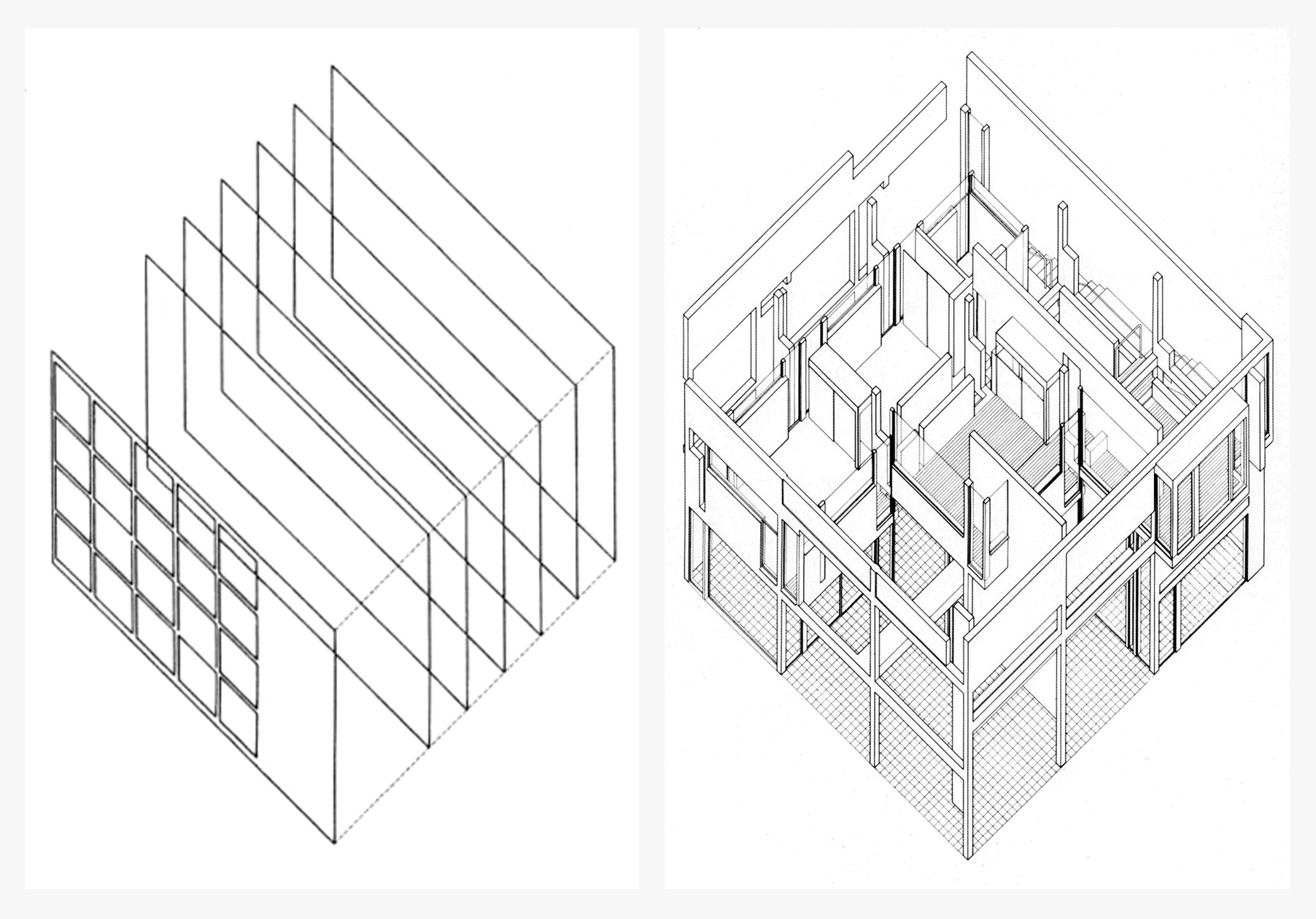
Giuseppe Terragni's infamous Casa Del Fascio (today casa del populi) built in 1935 as a symbol for the superiority of the rising fascist party shows mainly Terragnis superiority in comosing space with complexity and coherence. The balance of rules and exceptions and the impressive control of light fascinated architects and theorists (such as Peter Eisenman who analysed the building properly) for decades.
architecturality.files.wordpress.com/2010/10/terragni_eis...
Hypixel is the biggest Minecraft Java server and within that server there's a gamemode called ''Skyblock'' where you spawn on an island with little ressources and you have to survive. As easy as it sounds, the hypixel Skyblock is litteraly a whole MMORPG in Minecraft with hundred of things to do and place to discover
That's why I decided to recreate the private island of the Skyblock as game accurate as possible.
I was extremely inspired by the MOC made by Cheesey Studio in his video on the Hypixel Youtube Channel, go watch his build !
In contrary to Cheesey Studio 's MOC, I dediced to use dark bluish gray for the stone and dark gray for the andesite in order to keep a coherence with the other micro MOC I made.
Hope you like it!
Hypixel is the biggest Minecraft Java server and within that server there's a gamemode called ''Skyblock'' where you spawn on an island with little ressources and you have to survive. As easy as it sounds, the hypixel Skyblock is litteraly a whole MMORPG in Minecraft with hundred of things to do and place to discover
That's why I decided to recreate the private island of the Skyblock as game accurate as possible. It's the second part, where you can enter into the main island of the skyblock
I was extremely inspired by the MOC made by Cheesey Studio in his video on the Hypixel Youtube Channel, go watch his build !
In contrary to Cheesey Studio 's MOC, I dediced to use dark bluish gray for the stone and dark gray for the andesite in order to keep a coherence with the other micro MOC I made.
I got hard time attributing color to each blocks, cause the lego palette in limited and the island in the game uses a lot of differents blocks
For exemple, the diorite is in light bluish gray and not white cause too bright (and yeah not very light bluish gray)
The stone, polished andesite and stone brick are using dark bluish gray because too similar in shades
The gray terracotta and the gray wool are using black cause there's nothing less dark (pearl dark gray does not contain enough plate and bricks)
The roof of the portal was very hard to make accurate and it's actually not accurate currently.
Hope you like it!
« Only connect » was the leitmotiv of E.M. Forster’s novel « Howard’s End ».
After racking my brains to find a suitable topic to honor this beautiful project, the notion of connection was the one that stood out as the most encompassing. One of the things that strike me and affect me most in our society is how disconnected humans have grown from nature, destroying – for the sake of fleeting individual profit and comfort - an environment that was kind enough to give them birth and feed them for eons of time. If only we could « connect », and see ourselves as part of the harmonious whole that Nature is, rather than isolated from it and dominating it, I’m convinced that every single living being (human or non human) on this planet would find the peace that they’re entitled to. Surely, no one can live a happy existence with a sense of separatedness. We all need to make sense of isolated fragments by linking them together into some kind of coherent purpose. This topic is a tribute to the wonderful connection inherent in our world, which we unfortunately seem to have lost the ability to see and feel, let alone honor. It’s an invitation to see and create unity, reconcialiation and harmony through links, threads and correspondances, and thus to produce coherence and meaning, which is to me one of the deepest sources of joy.
Body and mind, past and present, male and female, Human and non Human – we are ONE. Let’ s turn « versus » into « with » !
On display at the Norwegian National Museum, Oslo
Property of the Museum of Cultural History of the University of Oslo.
Wood, carved and incised
This panel, carved in high relief with nested medallions, is one of the few surviving fragments from the Vegusdal stave church in Agder. It depicts scenes from the Völsung legend—specifically, the hero Sigurd killing the dwarf-smith Regin. en.wikipedia.org/wiki/V%C3%B6lsunga_saga
What We Know:
The panel dates to the early 13th century. It is one of a pair that framed the main portal of the church, greeting worshipers as they entered.
The circular medallion at the top of the panel illustrates the episode where Sigurd, having slain the dragon Fafnir, turns on Regin. In most literary versions, Sigurd beheads Regin, but the carving instead shows a violent abdominal thrust.
Below Regin’s mouth is a carved stream or ribbon-like motif, long interpreted as blood.
From a forensic standpoint, a gut wound would not typically cause blood to gush from the mouth. That symptom is more plausibly linked to trauma to the lungs or throat. If symbolic, the motif may reflect the soul’s departure or a stylized convention to mark death.
Sigurd appears to brace himself against the rim of the medallion in order to thrust his blade with more force, while Regin’s impalement causes his puppet-like feet slip from the opposite edge—making the physical frame part of the drama.
What Remains Unclear:
Why such a stark deviation from the canonical beheading narrative? Was the artist drawing on oral variants?
What did medieval viewers make of this moment? Did they interpret it as symbolic, literal, or theological? Did they perceive the narrative as a holdover from the pagan world? Was it viewed as a cautionary tale, a moral allegory, or a decorative flourish?
Did 13th-century parishioners understand this as a sacred threshold charged with meaning—or simply as narrative art?
The Question of Meaning:
Narrative Ambiguity: Even the literal storyline is unstable. The carving appears to show Sigurd stabbing Regin in the abdomen, with some material—likely blood—gushing from his mouth. This contradicts saga sources in which Sigurd decapitates Regin. Is this an error, a reinterpretation, or a local variant? The dissonance between text and image resists resolution.
Contemporary Reception:
Thirteenth-century viewers were mostly illiterate and dependent on local oral traditions, visual fluency, and possibly clerical guidance. The scene could have been interpreted as heroic, cautionary, or moral, but the lack of contemporary records leaves all such interpretations speculative.
Patronal Intent:
Who chose this scene—and why? Was it a community decision, an individual patron, or the carver’s initiative? Perhaps the Völsung theme was used not for its theological coherence but for its cultural cachet, drawing on admired tales in a flexible, prestigious, and symbolic way. There is no way to know.
Why It Matters:
This carving is more than an illustration—it is a reflection on storytelling itself. Sigurd and Regin interact not just with each other, but with the frame that contains them. Sigurd leverages the circular boundary; Regin slides off it. The scene breaks the fourth wall of medieval art, making the medallion both stage and structure.
The drama is intensified by its placement at the church's entrance. Whether didactic, mnemonic, or mythic, it served to provoke thought—perhaps even when the sermon inside failed to do so.
In the panel below, a rearing horse appears to strike a human figure with its foreleg—an anatomically implausible blow, yet one rendered with comic violence. The emotional register here is complex: darkly humorous, unsettling, and immediate.
The Fate of the Church and Its Panels:
Stave churches were timber-framed Christian buildings found across medieval Norway, named for the "staves" (upright posts) that formed their structural core. Their heyday was the 12th to 14th centuries, with over a thousand built across the country. Today, fewer than thirty survive, and of those, very few retain narrative carvings like the Vegusdal panels.
The Vegusdal church, located in southern Norway, stood for centuries before it was dismantled in about 1720. Its figural panels—likely once discarded or repurposed—survived thanks to antiquarian interest in the 19th century, when a nascent preservation movement began to see value in what had once been dismissed as outmoded or papist.
The broader losses are staggering. Most stave churches were demolished or "modernized" beyond recognition after the Reformation. Lutheran reformers, Enlightenment-era renovators, and later architectural purists often showed little concern for the carved legends and monsters at their doors. Some panels were burned, others planed down or whitewashed; still others were discarded when churches were replaced with larger, plainer structures.
This wasn't always iconoclastic rage—it was often indifference. Panels rich in mythic or theological symbolism became illegible to later generations and thus expendable. As a result, what survives is not representative but exceptional: fragments like the Vegusdal portal that narrowly escaped destruction.
Each panel lost represents not just a work of art, but a worldview, a narrative gesture, a set of meanings that will never again be fully understood.
Thresholds of Meaning:
The essential paradox of medieval doorway sculpture is that its richest images are placed where people spend the least time. The Vegusdal panels—like many narrative portals in Romanesque and Gothic churches—present complex, layered iconography at a threshold rather than in a space meant for contemplation. And yet, that’s precisely the point.
The doorway as liminal space:
Crossing the threshold into the sanctuary was not a casual act—it symbolized a passage from the worldly to the sacred. The imagery at the portal condensed spiritual or moral lessons into a kind of visual incantation. You weren’t expected to study it then and there; rather, it set a tone, planted a question, or created a mnemonic impression.
Communal familiarity:
In small, closely knit communities, repeated exposure across years or decades could foster shared knowledge of these images. Local clergy or elders may have used them in catechesis or storytelling. So even brief encounters at the door might have drawn from, and contributed to, a deeper cultural reservoir.
Oral culture and storytelling:
Unlike modern viewers, medieval congregants lived in a world where visual art, spoken narrative, and communal ritual were deeply intertwined. Stories like that of Sigurd were known beyond the church; seeing them rendered in wood—at the door to God’s house—invited reflection on what they meant in a Christian moral framework.
Mental stimulation? Yes, and more: These carvings could offer visual escape or engagement—even humor or horror. But their location suggests something ritualistic: they were meant to frame the act of entering, not to be passively admired. You saw them again and again, each time perhaps noticing a new detail or feeling a new association.
Few labels in modern museums do justice to the philosophical richness of such works. To honor these carvings is to accept that their meanings resist easy resolution—that their power lies in ambiguity, embodiment, and emotional immediacy. They remain charged, even now, with a mythic force that exceeds the frame.
This text is a collaboration with Chat GPT
The Vanishing of Ethan Carter
Feeling fluids fantastically flowing
Knowing knowledge of nothingness nearing
Inner standing intuition intuitively instant
Wisdom of worlds wondrously whirling
Content in contention creating creation
Trusting time to timelessly topple
Accepting ascension absconding allegiance
Confidently constructing cosmic coherence
Compassion commands complete concentration
Cycles of echoes in parallel spirals
The Source shining electrically burning
Meaningless melting smiling and loving
Judgement less judgment judging’s for judges
Limitless loving learning’s liberation
Swimming and surfing eternal vibration
Sleeplessly sleeping a secret sensation
Loving life’s labours and passionate questions
Inspiring insistence acceptance alluring
Now is the time for completing completion.
The drizzle of stars scattered across this image forms a galaxy known as UGC 4879. UGC 4879 is an irregular dwarf galaxy — as the name suggests, galaxies of this type are a little smaller and messier than their cosmic cousins, lacking the majestic swirl of a spiral or the coherence of an elliptical.
This galaxy is also very isolated. There are about 2.3 million light years between UGC 4879 and its closest neighbor, Leo A, which is about the same distance as that between the Andromeda Galaxy and the Milky Way.
This galaxy’s isolation means that it has not interacted with any surrounding galaxies, making it an ideal laboratory for studying star formation uncomplicated by interactions with other galaxies. Studies of UGC 4879 have revealed a significant amount of star formation in the first 4 billion years after the Big Bang, followed by a strange 9-billion-year lull in star formation that ended 1 billion years ago by a more recent re-ignition. The reason for this behavior, however, remains mysterious, and the solitary galaxy continues to provide ample study material for astronomers looking to understand the complex mysteries of star birth throughout the universe.
_____________________________________________
These official NASA photographs are being made available for publication by news organizations and/or for personal use printing by the subject(s) of the photographs. The photographs may not be used in materials, advertisements, products, or promotions that in any way suggest approval or endorsement by NASA. All Images used must be credited. For information on usage rights, click here.
Salisbury Cathedral is one of the glories of English architecture and a leading examples of "Early English" gothic architecture. What astonishes about the cathedral is the coherence of the design - The main body was completed in only 38 years, from 1220 to 1258.
I took the reflection off the baptismal font at the back of the church
Excerpt from www.thecounty.ca/wp-content/uploads/2020/08/Picton-Main-S...:
Heritage Attributes of the Character Areas
Main Street West
• Its role as the western gateway to Main Street and the Down- town Core.
• The predominance of 19th century residential buildings, in particular on the north side of the street, many of which have been adapted to accommodate commercial uses.
• The 2 to 2½ storey heights of the buildings.
• The varied and deeper setbacks of the buildings and larger lots, than are found elsewhere on Main Street.
• The remaining mature trees, grassed verges and front yards, creating a softer character in selected areas.
• The cenotaph and surrounding parkette.
Downtown Core:
• The consistent street wall created by the 2 and 3-storey commercial blocks.
• The punctuation of the street wall by landmark buildings, including the Regent Theatre, the Carnegie Library, the Armoury, the Royal Hotel and the North American Hotel.
• The “civic centre” created by the Armoury, the Carnegie Library and former Post Office building, and the community activities and functions that they accommodate.
• The pedestrian connections and views to adjacent streets and residential neighbourhoods created by the mid-block laneways.
• The visual coherence created by the consistent (2 and 3 storey) height, massing, parapets, roof forms, regular pattern of fenestration, materials (most commonly brick), detailing and setbacks of the buildings.
• The pattern of ground-floor storefronts.
• The quality of the pedestrian realm created by the intimate scale, sense of enclosure and street amenities.
“Freedom! To fill people's mailboxes, eyes, ears and brains with commercial rubbish against their will, television programs that are impossible to watch with a sense of coherence. Freedom!”
―(Aleksandr I. Solzhenitsyn)―
Fast car atop a s l o w (motionless) mailbox.
The ornate transom grille at 23 S. Wacker, part of the Roanoke Building in Chicago’s Loop, exemplifies Beaux-Arts metalwork at its most theatrical—its looping strapwork, classical bust, and balanced symmetry projecting commercial confidence through architectural opulence.
Style & Era:
The transom grille exemplifies the Beaux-Arts and Chicago School architectural traditions that flourished in the early 1900s, blending classical motifs with bold commercial grandeur. Though the Roanoke Building underwent several architectural interventions—its original construction in 1915, its heightening in 1925, and Art Deco modifications in the 1930s—this entrance clearly belongs to the late Beaux-Arts phase or an early Art Deco–influenced neoclassical revival, when ornamental metalwork was used to convey both elegance and corporate permanence.
Material & Technique:
This transom is a hybrid of cast bronze or brass and likely wrought iron filigree, finished with a golden patina that has aged into a stately antique tone. These materials were typical of grand commercial buildings whose entrances were designed to project stability, prestige, and wealth.
Design Features:
Ornamental Number “23”:
Centered within a circular cartouche, the address is framed by interlacing scrolls and ribbon-like strapwork, arranged in a symmetrical and almost heraldic composition—an abstract expression of order and refinement rather than organic decoration.
Cartouches and Geometric Ornament:
The surrounding motifs include laurel-wreath cartouches, interlaced strapwork and scrolls, and other classically derived bands, invoking the disciplined rhythm of classical ornament and suggesting continuity with Renaissance and Baroque architectural traditions.
Classical Bust:
At the base of the transom grille, a female bust—not a mask—emerges from an ornamental escutcheon. Truncated just below the shoulders, the figure recalls an allegorical muse or personification—perhaps representing Commerce, Architecture, or Civic Virtue. Her serene expression and classical coiffure ground the exuberant metalwork in a humanizing focal point, typical of Beaux-Arts symbolism.
Architectural Framing:
The grille is set within a deeply recessed arched bay, bordered by paneled moldings that evoke coffered stonework. A relief medallion crowns the arch, completing the composition with a sense of ceremonial gravity. The ensemble functions not merely as ornament but as a threshold statement, dignifying entry into the building’s commercial interior.
✦ Historical Context of the Roanoke Building ✦
Originally designed in 1915 by the firm Holabird & Roche, the Roanoke Building was expanded in 1925 to become a 36-story tower and later received selective Art Deco updates in 1931. This transom grille, however, preserves the earlier Beaux-Arts spirit, which prized craftsmanship and ornamental coherence.
Throughout its successive alterations and renamings—including a midcentury period as the Chicago City Centre—the building retained key historic components of its street-level façades. Its ornate metal entryways remain among the finest surviving examples of early skyscraper decorative metalwork in Chicago’s Loop, comparable in richness and ambition to the Rookery, the Marquette Building, and the Chicago Board of Trade.
Protected today under landmark status, the Roanoke’s entrances illustrate the continuity between architecture and civic identity in early 20th-century Chicago—a period when even utilitarian portals were rendered as expressions of urban grandeur.
This text is a collaboration with ChatGPT.
The Carrousel and Tuileries Gardens
The Tuileries are the largest and oldest public park in Paris. Their official incorporation into the Musée du Louvre on January 1, 2005, reestablished the historic coherence of the vast royal palace and its grounds. The gardens were an integral part of the palatial scheme created by the kings of France. With their landscaping, vistas, and sculptures, they provide the perfect complement to the buildings. The preservation of this exceptional historic monument and the interlinking of the Tuileries and Carrousel gardens have made it possible to bring a major art form—that of landscape design—into the Louvre.
In group Fictitious Reality 44TH Exhibition-Martha MGR
Visit my Blog
This flower exists among the grass, but it doesn’t hide.
It is thick, bold, visible.
It doesn’t adapt. It doesn’t disappear into the background.
It is built according to a natural order that needs no approval: the Fibonacci sequence.
It is proof that beauty, coherence, and strength exist even where no one is looking.
I left the flower in color, turning the grass black and white—
to make it clear what matters, what deserves to stand out, what must no longer be lost in the background.
This flower is me: I do not blend in.
I resist.
In a precise, full form—yet invisible to most.
I am not seeking approval. I am existing.
And that is enough.
1- "Heart of Adam" Mural on the back wall of the CKD "Clinical and Educational Center" Łódź . The work was inspired by Michelangelo's fresco "The Creation of Adam" in the Sistine Chapel. The mural alludes to medicine. The design was created by Piotr Chrzanowski, and Wojciech Żyznowski, Alan Osiecki, and Maciej Maślanka also contributed to the artwork.
The artist rationalized the biblical motif by weaving a DNA strand and chemical formulas into the composition, reflecting the scientific nature of the location.
This is a meeting of mysticism and science: God creates man, and man discovers DNA, science—there is a certain coherence here. CKD.
2- "All About Eve" - a mural in front of the Clinic (CKD), corresponding to "Adam's Heart," a work created on the A4/CKD building, refers to contemporary medical progress and the use of cutting-edge technologies in this field. Both works metaphorically depict the shared evolution of humanity and medicine, from their shared beginning (Adam) to the present day (Eve). Łódź, Poland.
Thank you all for comments & faves :)
Commencée vers 1120 par Étienne de Baugé, elle fut achevée en 1146, et le porche quelques années plus tard. Elle est bâtie sur le modèle de l'abbatiale de Paray-le-Monial.
Le portail est l'élément le plus remarquable de la cathédrale. Il a été réalisé, au moins pour le Jugement dernier, par Gislebert, qui signe de son nom aux pieds du Christ (Gyslebertus hoc fecit)
On a une représentation optimiste du Jugement dernier, en cohérence avec l'époque prospère de sa réalisation. Jugé barbare par les chanoines, le tympan fut plâtré en 1766, ce qui préserva l'ouvrage de possibles dégradations lors de la Révolution française. Peu après le passage de Stendhal à Autun, d'autres chanoines le dégagèrent, sans la tête qui manquait au Christ. Ce n'est qu'après la Seconde Guerre mondiale que le chanoine Denis Grivot la retrouva et la remit à sa place.
Begun around 1120 by Étienne de Baugé, it was completed in 1146, and the porch a few years later. It is built on the model of the abbey of Paray-le-Monial.
The portal is the most remarkable element of the cathedral. It was made, at least for the Last Judgment, by Gislebert, who signs his name at the feet of Christ (Gyslebertus hoc fecit)
We have an optimistic representation of the Last Judgment, consistent with the prosperous era of its realization. Considered barbaric by the canons, the tympanum was plastered over in 1766, which preserved the work from possible damage during the French Revolution. Shortly after Stendhal passed through Autun, other canons freed him, without the head that Christ lacked. It was only after the Second World War that Canon Denis Grivot found her and put her back in her place.
(Wikipedia)
This photo wraps up my "Monochrome Hawaii" series. A companion essay is posted on my blog, which hopefully will help to thread these images together and provide certain coherence.
St Andrew's Church is a Church of England parish church in Presteigne, Powys, Wales. It was first constructed in the 9th century by the Anglo-Saxons and retains elements of the original Anglo-Saxon church within a Norman renovation and later Victorian restoration. It is a Grade I listed building.
In the 9th century, Anglo-Saxons built St Andrew's Church next to the River Lugg. Following the Norman conquest of Wales, when the majority of the church was damaged during an attack by the Welsh, the Normans constructed a church incorporating the Anglo-Saxon north aisle. In the 12th–13th centuries the church was enlarged and a bell tower was constructed with a new nave and south aisle constructed by canons from Wigmore Abbey.
In 1868, a restoration of the church financed by Sir Richard Green-Price and undertaken by Sir George Gilbert Scott was carried out. Inside he repaired the original roof and wooden belfry but removed the west gallery and added a new nave, chancel and sanctuary. On the exterior, he changed the design to reflect the popular Gothic Revival architecture at the time. In doing so he added a vestry, transepts and a new spire for the bell tower.
A memorial to Joseph Baker, for whom Mount Baker in Washington state, United States is named, was installed in the chapel of the church as he had retired to Presteigne. A 13th-century coffin lid, possibly from a member of the Mortimer Family, is also installed in the north side of the church. It was granted Grade II*-listed status in 1985 for being "a virtually complete example of the rural work of Sir George Gilbert Scott's office; whilst the church does retain significant medieval fabric, the consistency and coherence of its restoration make it a remarkably clear statement of Ecclesiological principles."
In 1914, the Welsh Church Act 1914 was passed by the Parliament of the United Kingdom to disestablish the Church in Wales from the Church of England. Owing the enactment of the disestablishment being delayed by the Suspensory Act 1914, in 1915 seventeen parishes (including Presteigne with Discoed) were balloted by the Welsh Church Commissioners in a referendum as to whether they wanted to remain part of the Church of England or join the Church in Wales. These parishes were given the choice because their parish boundaries crossed the geographical borders between England and Wales. St Andrew's parishioners voted 595–289 to remain part of the Church of England despite the church being located in Wales. As a result of the decision in the referendum, St Andrew's Church remained a part of the Diocese of Hereford.
This description incorporates text from the English Wikipedia.
Colour returned from sticky spider web in white LED light. The effect is somewhat similar to sunlight speckle and coloured sun circles what also require partial coherence. The radial foundation lines and the centre of the web that lacks the sticky droplets return no light and appear invisible. The spider is overexposed. The image was taken at night using the led light on the camera as the only significant illumination.