View allAll Photos Tagged Approach
I spent some time over the holidays working on this photograph from our trip to the Outer Banks last spring. Given that we had such clear skies throughout the majority of our stay, I'm thankful that I had the opportunity to take advantage of some approaching rain showers the first morning to get this image. Happy New Year!
EXIF DATA
------------------------------------
Canon 5D Mark II
Canon EF 24-105 mm f/4 L USM
ISO-200
f/5.6
240 seconds
B+W CP
B+W ND110
_____________________________________________________________________________
Approaching the small village of Ullenhall along Perry Mill Lane with the Church of St. Mary, Ullenhall in the distance to the left.
A great blue heron comes in for a landing at Mallard Lake in the Wehr Nature Center of Franklin, Wisconsin.
+++ DISCLAIMER +++
Nothing you see here is real, even though the conversion or the presented background story might be based historical facts. BEWARE!
Some background:
In 1964 the Royal Air Force specified a requirement (Air Staff Target (AST) 362) for a new fast jet trainer to replace the Folland Gnat. The SEPECAT Jaguar was originally intended for this role, but it was soon realized that it would be too complex an aircraft for fast jet training and only a small number of two-seat versions were purchased. Accordingly, in 1968, Hawker Siddeley Aviation (HSA) began studies for a simpler aircraft, initially as special project (SP) 117. The design team was led by Ralph Hooper.
This project was funded by the company as a private venture, in anticipation of possible RAF interest. The design was conceived of as having tandem seating and a combat capability in addition to training, as it was felt the latter would improve export sales potential. By the end of the year HSA had submitted a proposal to the Ministry of Defense based on the design concept, and in early 1970 the RAF issued Air Staff Target (AST) 397 which formalized the requirement for new trainers of this type. The RAF selected the HS.1182 for their requirement on 1 October 1971 and the principal contract, for 175 aircraft, was signed in March 1972.
Design of the Hawk was conventional by any approach. The two-seat crew - made up of an instructor in the rear cockpit and his student pilot in the front - sat in tandem under a wide field-of-view canopy. Controls at each position were redundant with the instructor having the ability to override student functions as needed. The cockpit was situated well-forward in the design behind a pointed, sloped-down nose assembly. Intakes to aspirate the single engine mounting came in the form of two half-circle openings to either side of the rear cockpit. The turbofan engine was buried deep within the short fuselage which was streamlined with a certain engineering elegance common to British military aircraft.
The intake ducts bulged out at the fuselage sides but were absorbed into the fuselage proper to continue the aircraft's smooth design layout. Wings were fitted amidships and sported modest sweep along the leading edge and lesser sweep along the trailing edge. They were also low-mounted assemblies along the fuselage to help increased expediency for ground operation. The empennage was traditional with a single vertical tail fin flanked by a pair of downward-canted horizontal tail planes. The tail planes were all-moving surfaces to add to the Hawk's agility. Small ventral strakes were noted along the empennage base. The undercarriage was conventional in layout and consisted of two main single-wheeled landing gear legs and a single-wheeled nose leg. The main legs retracted inwards towards centerline while the nose leg retracted forwards.
Standard armament for the Hawk was an optional gun pod commonly fitted to the centerline hard point under the fuselage (there were, in effect, five total hard points). The gun pod housed a 30mm ADEN series cannon for close-in work but remained an optional fixture. There were originally two underwing hard points (later expanded to four) cleared for the carrying of external munitions including guided/homing missiles, rocket pods and conventional drop bombs with the two inner-most hard points plumbed to accept fuel from external drop tanks. Up to 6,800lbs of external stores could be lifted by the Hawk airframe.
The prototype aircraft first flew on 21 August 1974. All development aircraft were built on production jigs; the program remained on time and to budget throughout. The Hawk T1 entered RAF service in late 1976. The first export Hawk 50 flew on 17 May 1976. This variant had been specifically designed for the dual-role of lightweight fighter and advanced trainer. It had a greater weapons capacity than the T.1, featured a total of five hard points, avionics improvements, the ability to carry larger drop tanks of 590 liter (156 US gallon) capacity, and an uprated engine which made the Hawk 50 qualified for 30% greater takeoff weight than the RAF's Hawk T.1.
One of the initial foreign customers was the Finnish Air Force (Suomen Ilmavoimat). In January 1978, Britain and Finland announced a deal to in which the Finnish Air Force was to receive 50 Hawk Mk. 51s in 1980. The Finnish Hawk 51s had a unique avionics fit, used a Saab RS-2 gunsight, and were fitted with a VKT 12.7 millimeter gun pod instead of the 30 millimeter Aden cannon pod provided with the T.1. Interestingly, Finnish Hawks are in some cases fitted with the Russian R-60 (AA-8) AAM, and they are also used for reconnaissance, carrying Vinten optical-infrared camera pods. The first four Hawks in the Finnish order were built in the UK, with the other 46 assembled from kits by Valmet of Finland.
These aircraft were built in Finland under licence by Valtion lentokonetehdas. At that time. the Finnish Air Force was still limited to 60 first-line fighter aircraft by the Paris Peace Treaty of 1947. But by acquiring Hawks, which counted as trainers rather than fighters, capacity could be increased while continuing treaty compliance. These conditions were nullified during the 1990s by the break-up of the Soviet Union, though.
Seven additional Mk. 51As were delivered in 1993–94 to make up for losses, and due to rising levels of metal fatigue, a major structural reinforcement program was carried out to extend the operational life of Finland's Hawks during the 1990s.
More variants of the Hawk followed and common improvements to the base design typically include increased range, more powerful engines, redesigned wing and undercarriage, the addition of radar and forward-looking infrared (FLIR), GPS navigation, and night vision compatibility. Later models were manufactured with a great variety in terms of avionics and system compatibility to suit the individual customer nation. Cockpit functionality was often rearranged and programmed, too, in order to be common to an operator's main fighter fleet to increase the Hawk's training value.
General characteristics:
Crew: 2: student, instructor
Length: 12.43 m (40 ft 9 in)
Wingspan: 9.94 m (32 ft 7 in)
Height: 3.98 m (13 ft 1 in)
Wing area: 16.70 m2 (179.64 ft²)
Empty weight: 4,480 kg (9,880 lb)
Useful load: 3,000 kg (6,600 lb)
Max takeoff weight: 9,100 kg (20,000 lb)
Powerplant:
1× Rolls-Royce Adour Mk. 851 non-afterburning turbofan with 23,1 kN (5.200 lbf) static thrust
Performance:
Maximum speed: Mach 0.84 (1,028 km/h, 638 mph) at altitude
Range: 2,520 km (1,360 nmi, 1,565 mi)
Service ceiling: 13,565 m (44,500 ft)
Rate of climb: 47 m/s (9,300 ft/min)
Thrust/weight: 0.65
Armament:
No internal armament, but an optional VKT 12.7 millimeter gun in a centerline pod;
Up to 2.200 lb (1.000 kg) of weapons on four underwing hard points, including 4× AAMs like
AIM-9 Sidewinder or R-60 (AA-8 'Aphid'), bombs of up to 1.000 lb (454 kg) caliber, unguided rocket
pods, drop tanks or reconnaissance pods with cameras
The kit and its assembly:
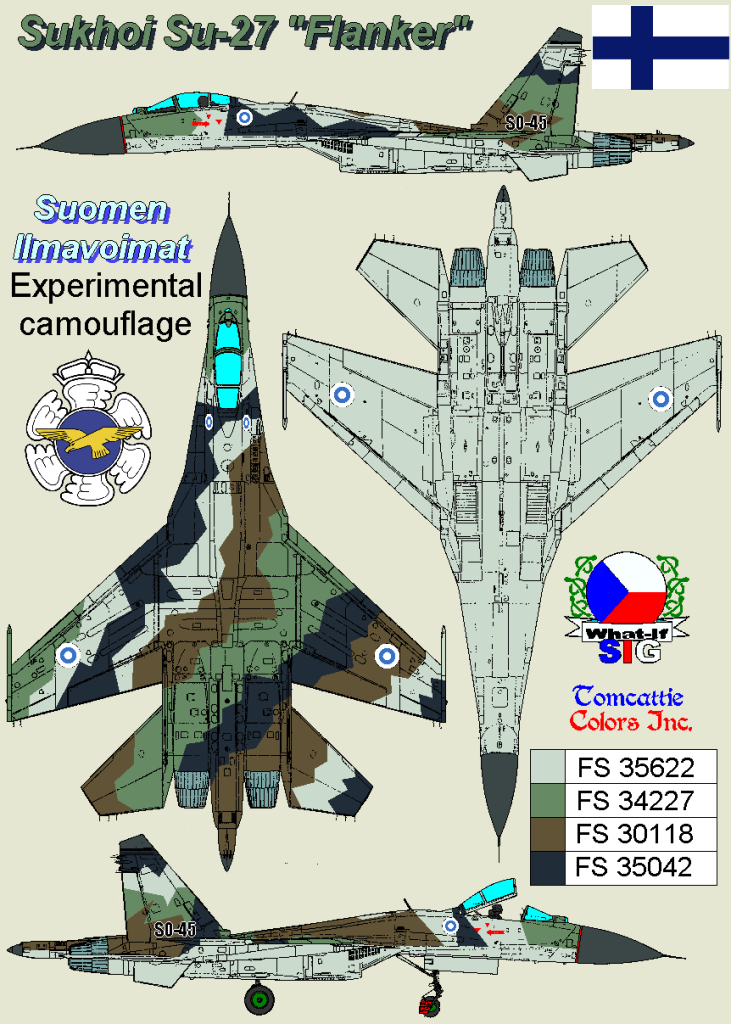
A simple build, sparked from a short-notice inspiration when I did online legwork for paint schemes. Then I stumbled upon profiles of fictional Finnish MiG-29 and Su-27, posted in 2011 by fellow member Wenzel from the CZ What if SIG a.k.a. PantherG at whatifmodelers.com, featuring interesting, fictional four-tone splinter schemes:
i730.photobucket.com/albums/ww303/PoorWhistler/Doodles/Su...
i730.photobucket.com/albums/ww303/PoorWhistler/Doodles/Mi...
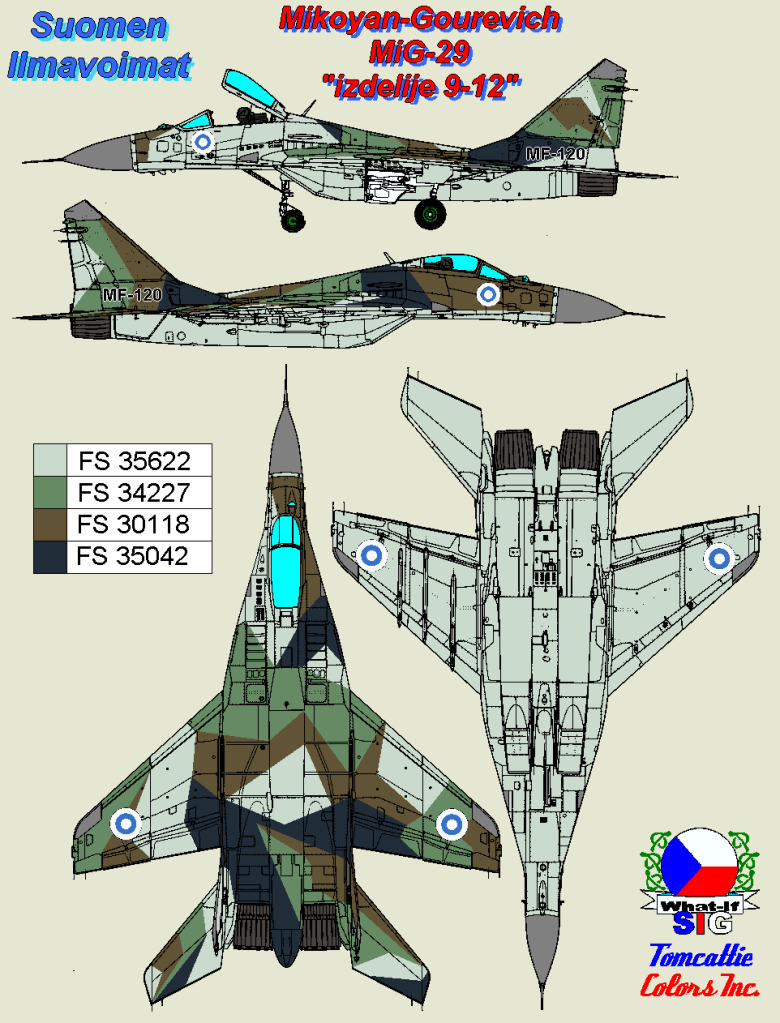
These got me thinking, but instead of building one of the Russian fighters I wondered how this camouflage concept would look on a smaller aircraft already in Ilmavoimat service. This led directly to the Hawk 51!
Thankfully, there are several kits available for this aircraft, and I settled upon the relatively new Airfix kit from 2007. It's main selling point was that it actually contains parts and decals for a Finnish aircraft, esp. a set of the modern, very tiny roundels.
Good experience with recent Airfix offerings were confirmed. Effectively, the Airfix Hawk is a nice and simple build, done in just one and a half day. One of the kit’s positive features is the crew: there are actually two modern and well-sculpted pilot figures included, a rarity these days.
The kit was mostly built OOB, only mods are a cover inside of the ventral air brake (which can be built into open position, but this leaves an ugly seam visible) and some extra antennae. Fit is good (not perfect, though), and only little PSR was needed - biggest issue was the ventral wing/fuselage intersection, esp. its rear end.
One truly tricky feat is the mounting of the protective clear separating screen between the cockpit seats – the clear wall has (somehow) to be glued into the clear canopy, without any reference where to actually place it. Altogether a risky business, and I was lucky to get the wall into place with only a little white glue so that a total mess could be avoided. The positive thing about this construction is that you can mount the canopy in open position with the wall inside.
The engraved panel lines appear a little massive at first glance (far from Matchbox' trenches on the Hawk 200, though!), but once you add paint the kit this evens out and looks much better than on the sprues. A nice and literally simple kit!
Painting and markings:
The more challenging part of the build - and I stuck closely to the inspiring profiles and their color choice, choosing a pattern of diagonal "splinter stripes" in rather unique tones:
• FS 35042 (USN Sea Blue; Humbrol 181)
• FS 34227 (Intermediate Green; Humbrol 120)
• FS 30118 (US Field Drab; Humbrol 142)
• FS 35622 (IDF Pale Blue; Humbrol 122), which was also used for the undersides
Painting was done free-handedly, with brushes and some tape for masking, and I stuck to the original color suggestions except for the pure FS35622 on the upper surfaces: I toned it slightly down with a little RLM76 (Humbrol 247), but it is still very bright and the contrast between all colors is really harsh.
Anyway, painting the splinter scheme was easier than it seems, since the areas of each of the four upper side tones was rather small, so that the straight lines were rather short. Only the tight edges needed some corrections, but that was mostly mended during the washing/shading process.
As a design twist, the drop tanks (taken OOB, these are the bigger tanks for the Hawk's export versions) and their respective pylons received the colors of the standard Ilmavoimat Hawks: the pylons were painted in a light olive green (Humbrol 159) while the tanks were painted in a murky, dark brown (a mix of Humbrol 10 and 66) with pale grey (Humbrol 166) undersides.
The cockpit interior was painted in Gull Gray (FS 36231), while other interior surfaces and the landing gear were kept in lighter RAF Aircraft Grey.
For the markings I relied upon the OOB decal sheet; deviating from the inspiring profiles I stuck to the OOB tiny Finnish roundels that were introduced in the Nineties, and they go well with this experimental scheme. Otherwise, markings are rather minimal, just a lot of stencils were applied, the Airfix OOB sheet is pretty exhaustive (with a zillion of stencils, merely 1x1mm in size… There are even decals to be placed on landing gear joints!? Seriously?). As a side benefit, the OOB Finnish aircraft comes with low-viz stencils, placed on a green background. On the fictional splinter livery of my build they blend well into the overall look, the whole aircraft looks very natural (but still original).
In order to emphasize the engraved panel line the kit received a black ink wash and some panel shading through dry-brushing on the upper surfaces, with only slightly lighter tones (e. g. RAL 5008 on the dark blue and RAF Cockpit Green on the FS 34227). I just wanted a subtle effect. Finally, after the decals had been applied, the kit was sealed with matt acrylic varnish (Italeri).
A quick and pleasant build, and it's actually a relaxing experience to build something OOB, without transplants, major, Frankenstein-ish surgery and endless PSR sessions. In fact, the Airfix Bae Hawk kit makes it easy for the builder to create a decent model with little effort. You see that some thought went into the moulds and the kit’s construction.
The fictional four-tone splinter scheme looks really weird, though, almost like an anniversary scheme? O.K., it is, according to its creator, actually based/inspired by a pre-WWII Fokker D.VII fighter in Finnish service, but this real life version was created from different and less “loud” colors! Anyway, this Hawk is colorful in a certain way, even though I have doubts concerning its camouflage’s effectiveness? However, it’s a nice, bright addition to the whif collection. :D
As the ferry from Cul-de-Sac neared Pinel Island, it approached a small dock in an area called Yellow Beach.
Riverside, IL: View southwest from the Herbert Road pedestrian crossing as a BNSF Railway unit tank car train approaches eastbound.
Saturday morning, I was walking over the bridge from Evening Island when I noticed the sound of distant thunder and an ominous strom approaching from the west. Luckily I had my raincoat. Chicago Botanic Garden Jun 12, 2010 L1100874.dng
Look closely - a spaceship is closing in on us! Progress approaching to dock with the Space Station yesterday. Credit: Chris Hadfield Twitter account
Thank fully this loco is still with us Class 40 40012 comes up to the junction at Chester while working the 10:45 Manchester Victoria to Holyhead service 14/08/1982.
image Kevin Connolly - All rights reserved so please do no use this without my explicit permission
Mallet 0-4-4-0 tanks Nos.442-59 and 442-55 head an Arbaroba to Asmara villager's excursion towards the capital city at sunset on 10th December 2014.
© Copyright Gordon Edgar - Strictly no unauthorised use
The White Place, as Georgia O'Keeffe called Plaza Blanca, is a geologic formation in Abiquiu New Mexico that often inspired her paintings. There are hiking trails through the canyon and hoodoos, but I was not comfortable setting out alone. Other people did come to the overlook, everyone seemed to feel the magic of the place.
The White Place is owned by Dar Al Islam. The Center is housed in a Arabic mosque-like building, which brings home how similar desert architecture is across the world. Unfortunately it was closed when I was there, so I could not explore it directly, or thank them for preserving Miss O'Keeffe's beloved landscape. But per their website:
"Dar Al Islam is a non-profit organization dedicated to cultivating greater understanding of Islam among Americans in order to establish our commonalities and build stronger relationships. We are committed, via our Mission, our Vision and our Approach, to an integrated, appreciative society."
Another in the "Dogs Playing Poker" series.(I say that because of this particular kind of lighting.)
+++++++++++++++++++++++
Mosley's front right leg shows the pressure bandage she had on for a week after elbow surgery to drain fluid from it..Bless her heart! For being only 6 months old, this baby has seen the inside of the vet's office alot and been on alot of meds for one thing and another. Good thing she's so resilient!
Elbow: somehow she managed to whack her leg on something so vigorously that she bruised it deeply and it raised a huge sac of fluid the size of a plumb on her elbow over night...! Never a dull moment with our gorgeous baby girl. MIchael positively dotes on her! He has to be the one to take her to the vet every time!
El Cerrito, CA
Catch my iphone photography on Instagram: followgram.me/meganwolfe
Or see a collection of shots on my website: www.meganwolfephoto.com
BR Standard 9F 2-10-0 steam locomotive No. 92214 built at Swindon Works during October 1959 recreats the S&DJRs Pines Express as it cautiously negotiates the new track formation on the approach to Wiliton station whilst heading for Minehead during the West Somerset Railways Spring Gala.
© Anthony Haynes - All rights reserved so please do not use this image without my explicit permission.
Approaching Storm, Millerton Lake, CA. Febuary 13, 2009
Camera: Nikon D200
Exposure: 1/30
Aperture: f/11.0
Focal Length: 40 mm
Singh Ray 3-Stop Hard Neutral Density Grad. Filter.
Single image, not a HDR.
Please view my photostream on Flickr Hive Mind
Copyright ©Robert Pearce. All rights reserved. Any use, including copying, saving, reproduction, alteration, or manipulation of digital image files, requires permission from Robert Pearce. This photograph is not in the public domain. It may not be used on websites, blogs, or in any other media without explicit advance permission from Robert Pearce. Please contact Robert Pearce at sierrasolstice@gmail.com
Westjet Airlines Disney Frozen Livery 737-800 (C-GWSV) on final approach to LAX Runway 24R. (05/30/16)
With 67029 at the rear the DB Management train approaches Bath Spa whilst working Paddington to Severnside (1Z05 07:53 Paddington to Severnside) on 7th February 2018. This was an opening special for the Sita waste terminal at Severnside giving the customer a jolly for the day.