View allAll Photos Tagged 508TH
BREAKING NEWS My 508th picture to be viewed over 1,000 times (January 2016). First uploaded September 2012.
This photograph was published in an online magazine article in PUREWOW titled:
'' 23 Cats That Act Like Dogs, In Case You’re Looking for the Best of Both Worlds '' By Sarah Ashley on September 20th 2021
PUREWOW is part of the Gallery Media Group ©2010-2022 Wow Media with an audience of 90 Million.
©All photographs on this site are copyright: ©DESPITE STRAIGHT LINES (Paul Williams) 2011 – 2021 & GETTY IMAGES ®
No license is given nor granted in respect of the use of any copyrighted material on this site other than with the express written agreement of ©DESPITE STRAIGHT LINES (Paul Williams). No image may be used as source material for paintings, drawings, sculptures, or any other art form without permission and/or compensation to ©DESPITE STRAIGHT LINES (Paul Williams)
.
.
I would like to say a huge and heartfelt 'THANK YOU' to GETTY IMAGES, and the 41.595+ Million visitors to my FLICKR site.
***** Selected for sale in the GETTY IMAGES COLLECTION on August 5th 2021
CREATIVE RF gty.im/1332259763 MOMENT ROYALTY FREE COLLECTION**
This photograph became my 5,508th frame to be selected for sale in the Getty Images collection and I am very grateful to them for this wonderful opportunity.
©DESPITE STRAIGHT LINES (Paul Williams)
.
.
Photograph taken at an altitude of Fifty two metres at 18:20pm on an overcast summer evening on Tuesday 3rd August 2021, off Hythe Avenue and Chessington Avenue in Bexleyheath, Kent.
New to my neighbourhood is this magnificent young Chausie, a hybrid originally bred from the non domestic species Jungle cat (Felis Chaus) and a greater number of domestic cats (Felis Silvestris catus).
This one is absolutely gorgeous, incredibly friendly and the single greatest predatory hunter I have ever witnessed in my garden, catching several mice in one sitting with consumate ease. This is a brown ticked variant of the species that live to around 14 years and are highly intelligent, social and loving.
Chausie kittens in the UK fetch between eight hundred and two thousand pounds each.
Nikon D850 Focal length: 600mm Shutter speed: 1/125s Aperture: f/7.1 iso640 Hand held with Tamron VC Vibration control set to ON (Position 1) 14 Bit uncompressed RAW NEF file size L (8256 x 5504 pixels) FX (36 x 24) Focus mode: AF-C AF-Area mode: 3D-tracking AF-C Priority Selection: Release. Nikon Back button focusing enabled 3D Tracking watch area: Normal 55 Tracking points Exposure mode: Manual exposure mode Metering mode: Matrix metering White balance on: Auto1 (5960k) Colour space: RGB Picture control: Neutral (Sharpening +2)
Tamron SP 150-600mm F/5-6.3 Di VC USD G2. Nikon GP-1 GPS module. Lee SW150 MKII filter holder. Lee SW150 95mm screw in adapter ring. Lee SW150 circular polariser glass filter.Lee SW150 Filters field pouch. Hoodman HEYENRG round eyepiece oversized eyecup.Mcoplus professional MB-D850 multi function battery grip 6960.Two Nikon EN-EL15a batteries (Priority to battery in Battery grip). Black Rapid Curve Breathe strap. My Memory 128GB Class 10 SDXC 80MB/s card. Lowepro Flipside 400 AW camera bag.
LATITUDE: N 51d 28m 28.05s
LONGITUDE: E 0d 8m 10.56s
ALTITUDE: 52.00m
RAW (TIFF) FILE: 130.00MB NEF FILE: 91.5MB
PROCESSED (JPeg) FILE: 46.70MB
PROCESSING POWER:
Nikon D850 Firmware versions C 1.10 (9/05/2019) LD Distortion Data 2.018 (18/02/20) LF 1.00
HP 110-352na Desktop PC with AMD Quad-Core A6-5200 APU 64Bit processor. Radeon HD8400 graphics. 8 GB DDR3 Memory with 1TB Data storage. 64-bit Windows 10. Verbatim USB 2.0 1TB desktop hard drive. WD My Passport Ultra 1tb USB3 Portable hard drive. Nikon ViewNX-1 64bit Version 1.4.1 (18/02/2020). Nikon Capture NX-D 64bit Version 1.6.2 (18/02/2020). Nikon Picture Control Utility 2 (Version 2.4.5 (18/02/2020). Nikon Transfer 2 Version 2.13.5. Adobe photoshop Elements 8 Version 8.0 64bit.
A New Jersey Army National Guard Soldier with the 143rd Transportation Company has her temperature checked during medical screening for state activation at the Teaneck Armory in Teaneck, N.J., March 19, 2020. The New Jersey National Guard has more than 150 members activated to support state and local authorities during the COVID-19 outbreak. Bother the 508th and 143rd will be working with the New Jersey Department of Health and local first responders at a mobile testing facility located at Bergen Community College in Paramus, N.J. (U.S. Air National Guard photo by Master Sgt. Matt Hecht)
The sun is beginning to set over Juventae Chasma, a large canyon system located a little northeast of the Valles Marineris system. Bluffs inside this canyon record the region's history. At center left, a bluff contains regular sedimentary layers, likely indicating long-term climatic changes associated with variations in the Martian orbit.
A thick layer of sediment forms a flat floor on the canyon. A series of deep scours resembling a wake have formed just downstream of a small ridge, suggesting that this canyon was once scoured by extensive floods.
This image was acquired by the Mars Express HRSC during the spacecraft's 12,508th orbit around Mars, November 4, 2013.
Image Credit: ESA/DLR/FU Berlin/J. Cowart, CC BY-SA 3.0 IGO
Cute little babies will always steal the show :-)
I've seen the wee one on Alberta Street sitting on his Dad's lap at an outdoor café. I couldn't resist his sweetness and asked permission to photograph. Mom said I got providing I'd send the pictures. I said I always did.
Chase is 25 y/o and works as a chef. One day he will have a place of his own. He has always loved to cook food, and much younger he has even tattooed on his fingers: Chef Life.
Destiny stays at home and takes care of baby Ezra.
A friendly, young family. I wish you three good luck and thank you for sharing a few moments together in life.
This is my 508th submission to The Human Family group.
Visit the group here to see more portraits and stories: www.flickr.com/groups/thehumanfamily.
ALLEN MITCHELL BURDETT, JR., was “to the Army” born on 25 August 1921, in Washington, DC. The military ran deep in the blood of his ancestors; they fought in every American conflict since the Revolutionary War. His father, a highly respected military judge, became the Army’s senior JAG colonel.
As a Boy Scout at Fort Leavenworth, Kansas, Allen began his lifelong friendship with a future USMA classmate, Arch Hamblen. Upon graduation from Western High School in Washington, DC, in 1939, he was appointed to USMA by Senator Richard Russell of Georgia. West Point was a challenge, a joy, and the beginning of lifetime friendships. He was commissioned in the Infantry and he and Arch continued a close association throughout several assignments, both overseas and Stateside.
Following the Basic Infantry Course at Fort Benning, Georgia, he joined the newly activated 63rd “Blood and Fire” Infantry Division, Camp Van Dorn, Mississippi. During World War II, Allen commanded a rifle company in the European Theater. His chaplain at that time, Raphael Miller, described Allen’s openness and friendliness as evidence of genuine concern and affection for people. He had a deep personal faith and a great reliance on prayer. He stayed on in Germany after the war ended, serving in the operations section of Seventh and Third Armies and with the U.S. Constabulary before returning to the States in 1947.
On 19 April 1948, Allen and Antoinette Salley were married in Asheville, North Carolina. After three years as Assistant PMS&T at Georgia Tech, he attended Infantry School at Fort Benning in 1950 and stayed to serve with the 508th Airborne Regimental Combat Team. In 1953 he graduated from the Command and General Staff College.
Allen was next assigned to Korea, where he served as a battalion commander in the 31st Infantry Regiment, 7th Infantry Division. Returning Stateside, he completed the Armed Forces Staff College before assuming duties as the first Army representative to the newly established Air Force Academy, then in Denver.
On graduation from the Army War College and the Army Aviation School, he was posted to the staff of the Aviation School at Fort Rucker, Alabama, from 1960-62. From 1962-65 he served as executive officer to the Assistant Secretary of the Army for Research and Development in Washington.
In 1965 he joined the 11th Air Assault Division at Fort Benning, which was reorganized into the 1st Cavalry Division (Airmobile) and deployed to Vietnam. He commanded the Division’s 11th Aviation Group for almost a year before returning to Washington in 1966 to become military assistant to the Deputy Director of Defense Research and Engineering (Tactical Warfare Programs). In 1966 he was promoted to brigadier general. During this period he received a master’s degree in International Affairs from George Washington University.
In 1968, Allen returned to Viemam as an assistant division commander of the 101st Airborne Division and in 1969 commanded the 1st Aviation Brigade there. General Mel Zais, Commander of the 101st Airborne Division, wrote, “I know I can rely on him to complete the toughest mission and achieve perfection.”
His next assignment took him back to Washington in 1970 as Director of Army Aviation, until later that year when he was selected to command the Army Aviation Center. Fort Rucker Chaplain Burton Hatch, in a prayer at Allen’s funeral, gave thanks for his faithfulness to his Lord, his family, and his country; for his gracious manner and his firm handshake that brought encouragement and inspiration to all who knew him. At his induction into the Army Aviation Hall of Fame in 1980, Allen was cited as having greatly enhanced the role of Army Aviation on the modern battlefield.
In 1973, Allen was promoted to lieutenant general and assumed command of III Corps and Fort Hood, Texas. In 1975 he took command of the Fifth U.S. Army, Fort Sam Houston, Texas, and commanded until his retirement in June 1978, after 35 years of active military service. Dr. Duncan Stewart, Fifth Army Chaplain and pastor of Covenant Presbyterian Church, spoke of the sad impact of Allen’s death on the church and the city of which he was a part.
Photo from the Gerd Killian collection, scan kindly provided by Klaus Held for inclusion on this page.
München-Riem
1968-07-19 (19 July 1968)
92633
Douglas C-47D
10246
Royal Hellenic Air Force
The BAC One-Eleven in the background is probably Bavaria’s D-ANDY also reported at Riem that day. Another Royal Hellenic Air Force C-47D, 92622, was noted at Riem about two months later, on 11 September 1968. Otherwise, I have no further reports of any RHAF C-47s at Riem in the 1960s or 1970s. However, sister ship 92629 was displayed and performed at the Landsberg Air Base open day in September 1977, about 60 km from Munich.
Information from joebaugher.com:
42-24384 (MSN 10246) delivered to USAAF Sep 13, 1943. Oran, Algeria 21Oct43. 62nd Troop Carrier Squadron, 314th Troop Carrier Group, Ninth Air Force, Saltby (Station 538). Transported paratroopers of the Headquarters, 508th Parachute Infantry Regiment to a drop zone one mile NW of Picauville, Normandy, France on Mission ‘Boston’ 6Jun44.
Condemned May 31, 1946, salvaged; Babb Co, Inc, Glendale, CA; Mutual Defense Assistance Program as 49-2633; rebuilt by Aviation Maintenance Company, Van Nuys, Glendale, CA; departed Van Nuys c30Nov49; To Royal Hellenic AF as 49-2633
More information from joebaugher.com about the Skytrains for Greece and this particular airframe:
49-2612/2641 Douglas C-47 Skytrain: Early model C-47s acquired from commercial sources in the USA by Babb Corporation, rebuilt by Aviation Maintenance Company, Van Nuys, Glendale, CA to USAF Contract AF 5725.
Delivered to Royal Hellenic Air Force under MDAP as 92612/92641. Renamed Hellenic AF from 1973.
49-2633 (MSN 10246) delivered to USAAF 13Sep43 as 42-24384; Oran, Algiers 21Oct43; 8th Air Force 8Apr44; 9th Air Force; Condemned 31May46; salvaged; Babb Co, Inc, Glendale, CA; Mutual Defense Assistance Program as 49-2633; rebuilt by Aviation Maintenance Company, Van Nuys, Glendale, CA; departed Van Nuys c30Nov49; Royal Hellenic Air Force as 49-2633; 355 Transport Squadron, Elefsis; WFU 22Feb77
92633 landing at MLA in July 1970 (revised camouflage):
scontent-fra5-1.xx.fbcdn.net/v/t1.6435-9/67403389_9395898...

92633 without camouflage, date unknown:
www.colori.nl/vliegtuigen/Aircraft110/92633.jpg
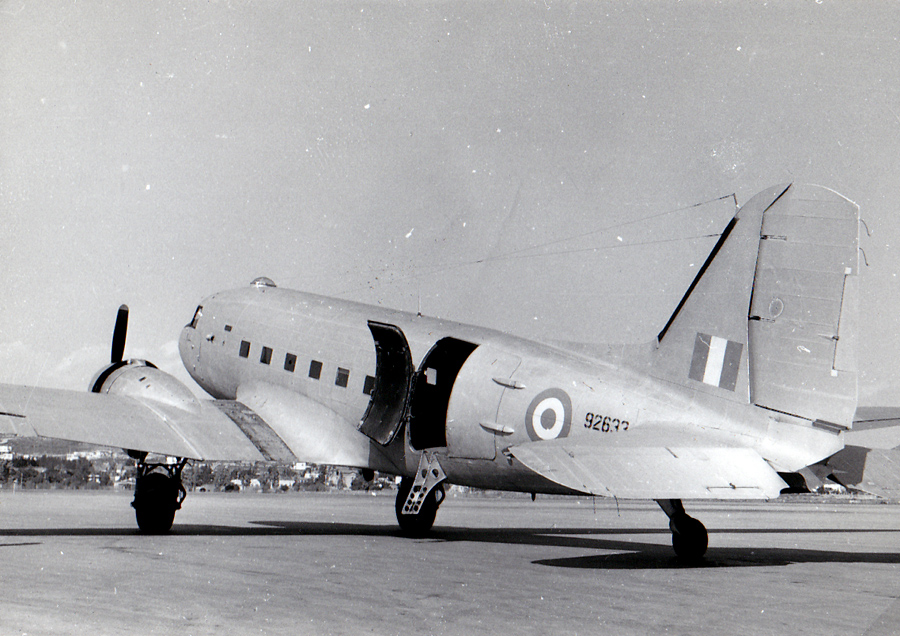
Scan from black-and-white print.
USAF (United States Air Force)
F-84G-41-RE Thunderjet (52-3323)
Seen here during operation "Longstride", a trip to England via Nouasseur Air Base (French Morocco) in 1953 with three air refueling by the new KC-97 Stratotanker.
SAC (Strategic Air Command) 31st FEW 40th Air Division, Turner AFB, Georgia 1953.
Salvaged at Dallas, Texas 1957.
F-84G-20-RE Thunderjet (51-1247)
SAC (Strategic Air Command) 508th SFW 40th Air Division Turner AFB Georgia 1952.
Withdrawn from use at the AMARC Bone Yard, Davis Monthan AFB 1957.
This guy is part of the 508th PIR Living History Group. Photographed at the “On the Home Front 1939-45” weekend at Rufford Park Nottinghamshire, England. He was very knowledgeable on the military equipment and it’s use, as well as the history of the Regiment.
During World War II, the 508th Parachute Infantry Regiment (508th PIR or Red Devils) was a regiment of the 82d Airborne Division.
In 1944 this unit had it’s base camp at Wollaton Park, Nottinghamshire, England.
After service in Operation Overlord jumping on 6 June 1944 the unit returned to its billet at Wollaton Park and prepared for its part in Operation Market Garden jumping in 17 September 1944. The regiment later played a part in the Battle of the Bulge.
Colour version:
U.S. Air Force Capts. Brandon Leigh, left, and Jeff Pecora with the 817th Expeditionary Airlift Squadron Detachment 1 based out of Manas Transition Center, Kyrgyzstan, pilot a C-17 Globemaster III aircraft carrying Soldiers with the 1st Battalion, 294th Infantry Regiment, Guam Army National Guard, from Kabul, Afghanistan, Dec. 29, 2013. (DoD photo by Sgt. Eddie Siguenza, U.S. Army National Guard/Released)
New Jersey National Guard Soldiers and Airmen from 1st Battalion, 114th Infantry Regiment, 508th Military Police Company, 108th Wing, and 177th Fighter Wing arrive near the Capitol to set up security positions in Washington, D.C., Jan. 12, 2021. National Guard Soldiers and Airmen from several states have traveled to Washington to provide support to federal and district authorities leading up to the 59th Presidential Inauguration. (U.S. Air National Guard photo by Master Sgt. Matt Hecht)
New Jersey National Guard Soldiers and Airmen from 1st Battalion, 114th Infantry Regiment, 508th Military Police Company, 108th Wing, and 177th Fighter Wing arrive near the Capitol to set up security positions in Washington, D.C., Jan. 12, 2021. National Guard Soldiers and Airmen from several states have traveled to Washington to provide support to federal and district authorities leading up to the 59th Presidential Inauguration. (U.S. Air National Guard photo by Master Sgt. Matt Hecht)
A paratrooper from 1st Battalion, 508th Parachute Infantry Regiment scans for a simulated enemy during a training patrol alongside British paratroopers of 2PARA, 16 Air Assault Brigade on December 1, 2018 in Kenya, Africa. The training scenario was part of Operation Askari Storm, a multinational training exercise occurring in Kenya, Africa between U.S., British and other partner-nation forces. The training focuses on increasing the readiness and interoperability of the participating forces while placing them in tough, realistic scenarios against simulated near-peer adversaries.
U.S. Army Soldiers from the 1st Battalion, 508th Parachute Infantry Regiment, 4th Brigade Combat Team, 82nd Airborne Division, conduct a static line airdrop from U.S. Air Force C-17 Globemaster III aircraft during Joint Operational Access Exercise (JOAX) 13-02, Feb. 24, 2013, at Sicily drop zone, Fort Bragg, N.C. JOAX 13-02 is a combined exercise which enables U.S. and Canadian mobility aircrews to train with paratroopers from the U.S. Army's 82nd Airborne Division on projecting combat power in a denied environment. (DoD photo by Tech. Sgt. Jason Robertson, U.S. Air Force/Released)
U.S. Army Spc. Cameron St. Onge with Charlie Company, 1st Battalion, 17th Infantry Regiment, 5th Stryker Brigade Combat Team, 2nd Infantry Division lends a helping hand to a fellow Charlie Company member, Pfc. Dustin Mesinhimer, while crossing a river during a joint patrol with soldiers from 2nd Battalion, 508th Parachute Infantry Regiment, 82nd Airborne Division in the Arghandab River Valley, Kandahar province, Afghanistan, Dec. 13, 2009. (U.S. Air Force photo by Master Sgt. Juan Valdes/Released)
Joint Combat Camera Afghanistan
Date: 12.13.2009
Location: Arghandab River Valley, AF
Related Photos: dvidshub.net/r/jm5py5
A New Jersey Army National Guard Soldier has her blood drawn during in-processing and medical screening for state activation at the Teaneck Armory in Teaneck, N.J., March 19, 2020. The New Jersey National Guard has more than 150 members activated to support state and local authorities during the COVID-19 outbreak. Bother the 508th and 143rd will be working with the New Jersey Department of Health and local first responders at a mobile testing facility located at Bergen Community College in Paramus, N.J. (U.S. Air National Guard photo by Master Sgt. Matt Hecht)
The F-105 Thunderchief, which would become a legend in the history of the Vietnam War, started out very modestly as a proposal for a large, supersonic replacement for the RF-84F Thunderflash tactical reconnaissance fighter in 1951. Later this was expanded by Republic’s famous chief designer, Alexander Kartveli, to a nuclear-capable, high-speed, low-altitude penetration tactical fighter-bomber which could also replace the F-84 Thunderstreak.
The USAF liked the idea, as the F-84 had shown itself to be at a disadvantage against Chinese and Soviet-flown MiG-15s over Korea, and ordered 200 of the new design before it was even finalized. This order was reduced to only 37 aircraft with the end of the Korean War, but nonetheless the first YF-105A Thunderchief flew in October 1955. Although it was equipped with an interim J57 engine and had drag problems, it still achieved supersonic speed. When the design was further refined as the YF-105B, with the J75 engine and area ruling, it went over Mach 2. This was in spite of the fact that the design had mushroomed in size from Kartveli’s initial idea to one of the largest and heaviest fighter ever to serve with the USAF: fully loaded, the F-105 was heavier than a B-17 bomber. The USAF ordered 1800 F-105s, though this would be reduced to 830 examples.
Almost immediately, the F-105 began to be plagued with problems. Some of the trouble could be traced to the normal teething problems of any new aircraft, but for awhile it seemed the Thunderchief was too hot to handle, with a catastrophically high accident rate. This led to the aircraft getting the nickname of “Thud,” supposedly for the sound it made when hitting the ground, along with other not-so-affectionate monikers such as “Ultra Hog” and “Squat Bomber.” Despite its immense size and bad reputation, however, the F-105 was superb at high speeds, especially at low level, was difficult to stall, and its cockpit was commended for its ergonomic layout. Earlier “narrow-nose” F-105Bs were replaced by wider-nosed, radar-equipped F-105Ds, the mainline version of the Thunderchief, while two-seat F-105Fs were built as conversion trainers.
Had it not been for the Vietnam War, however, the F-105 might have gone down in history as simply another mildly successful 1950s era design. Deployed to Vietnam at the beginning of the American involvement there in 1964, the Thunderchief was soon heading to North Vietnam to attack targets there in the opening rounds of Operation Rolling Thunder; this was in spite of the fact that the F-105 was designed primarily as a low-level (and, as its pilots insisted, one-way) tactical nuclear bomber. Instead, F-105s were heading north festooned with conventional bombs.
As Rolling Thunder gradually expanded to all of North Vietnam, now-camouflaged Thuds “going Downtown” became iconic, fighting their way through the densest concentration of antiaircraft fire in history, along with SAMs and MiG fighters. The F-105 now gained a reputation for something else: toughness, a Republic hallmark. Nor were they defenseless: unlike the USAF’s primary fighter, the F-4 Phantom II, the F-105 retained an internal 20mm gatling cannon, and MiG-17s which engaged F-105s was far from a foregone conclusion, as 27 MiGs were shot down by F-105s for the loss of about 20. If nothing else, Thud pilots no longer burdened with bombs could simply elect to head home at Mach 2 and two thousand feet, outdistancing any MiG defenders.
If the Thud had any weakness, it was its hydraulic system, which was found to be extremely vulnerable to damage. However, it was likely more due to poor tactics and the restrictive Rules of Engagement, which sent F-105s into battle on predictable routes, unable to return fire on SAM sites until missiles were launched at them, and their F-4 escorts hamstrung by being forced to wait until MiGs were on attack runs before the MiGs could be engaged. The tropical climate also took a toll on man and machine, with the end result that 382 F-105s were lost over Vietnam, nearly half of all Thuds ever produced and the highest loss rate of any USAF aircraft.
The combination of a high loss rate and the fact that the F-105 really was not designed to be used in the fashion it was over Vietnam led to the type’s gradual withdrawal after 1968 in favor of more F-4s and a USAF version of the USN’s A-7 Corsair II. An improved all-weather bombing system, Thunderstick II, was given to a few of the F-105D survivors, but this was not used operationally.
The Thud soldiered on another decade in Air National Guard and Reserve units until February 1984, when the type was finally retired in favor of the F-16, and its spiritual successor, the A-10 Thunderbolt II.
This F-105B, 57-5808, served most of its career with the 23rd Tactical Fighter Wing at McConnell AFB, Kansas, training prospective Thud pilots for service in Southeast Asia. As the surviving F-105Ds came home, the B-models were sent to Air National Guard and Reserve units; 57-5808 ended up with the 177th TFW (New Jersey ANG) at Atlantic City from 1970 to 1974, before ending its career with the USAF Reserve's 508th TFG at Hill AFB, Utah. Retired in 1980, it was scrapped in 1987.
Showing a somewhat unusual variation of Southeast Asia camouflage, this shot of 57-5808 was probably taken at McConnell, and not by my dad. Given what looks like to be a F-86H Sabre and an EB-66 Destroyer in the background, this was probably taken in the late 1960s.
(Disclaimer: I found this picture among other photos in my dad’s slides. I’m not sure who took them; some of them may be his. If any of these pictures are yours or you know who took them, let me know and I will remove them from Flickr, unless I have permission to let them remain. These photos are historical artifacts, in many cases of aircraft long since gone to the scrapyard, so I feel they deserve to be shared to the public at large—to honor the men and women who flew and maintained them.)
Paratroopers from 1st Battalion, 508th Parachute Infantry Regiment conduct security halt during a training patrol alongside British paratroopers of 2PARA, 16 Air Assault Brigade on November 27, 2018 in Kenya, Africa. The training scenario was part of Operation Askari Storm, a multinational training exercise occurring in Kenya, Africa between U.S., British and other partner-nation forces. The training focuses on increasing the readiness and interoperability of the participating forces while placing them in tough, realistic scenarios against simulated near-peer adversaries.
According to the Air Force Historical Research Agency (AFHRA/RSA), Maxwell
AFB, AL, the museum's F-105B has the following history:
F-105B, s/n 57-5803, was manufactured by Republic Aircraft, Farmingdale NY
and delivered to the USAF on 10 Sep 1959. Its assignments were:
Sep 1959 - Retained by manufacturer
Jun 1960 - To Wright Air Development Division (ARDC) Wright-Patterson AFB OH
(converted to JF-105B)
Mar 1961 - To Mobile Air Materiel Area AL (to F-105B)
Jul 1962 - To 4th Tactical Fighter Wing (TAC), Seymour Johnson AFB NC
Jun 1964 - To Mobile Air Materiel Area AL
Jun 1965 - To 4520th Combat Crew Training Wing (TAC), Nellis AFB NV
Oct 1967 - To 23rd Tactical Fighter Wing (TAC), McConnell AFB KS
Jun 1970 - To 177th Tactical Fighter Wing (ANG) Atlantic City AP NJ
Nov 1972 - To 945th Military Airlift Group (AFRES), Hill AFB
Jan 1973 - To 508th Tactical Fighter Group (AFRES), Hill AFB UT
Jan 1980 - To 466th Tactical Fighter Squadron (AFRES), Hill AFB UT
Nov 1980 - Dropped from inventory by transfer to museum or school
57-5803 was also used as a prop for the movie "Firefox" with Clint Eastwood. Filming took place in 1981 at March AFB when the museum was located on base.
U.S. Army Sgt. Ana Karen Cordoba, left, with the 508th Military Police Company, New Jersey Army National Guard, embraces her mother during a homecoming ceremony at the New Jersey National Guard Armory in Lawrenceville, N.J., June 6, 2013. Nearly 140 Soldiers with the unit returned from a nine-month deployment to Kabul province, Afghanistan. (DoD photo by Master Sgt. Mark C. Olsen, U.S. Air National Guard/Released)
U.S. Soldiers with 1st Battalion, 69th Infantry Regiment, New York National Guard, man a security post near the Capitol in Washington, D.C., Jan. 12, 2021. National Guard Soldiers and Airmen from several states have traveled to Washington to provide support to federal and district authorities leading up to the 59th Presidential Inauguration. (U.S. Air National Guard photo by Master Sgt. Matt Hecht)
D-Day Paratrooper George Shenkle with re-enactors
Air Mobility Command Museum
Dover, DE
April 2015
More info about Mr. Shenkle's special event:
Republic F-105F-1-RE Thunderchief, 63-8287 Thunderchief "RK" 333rd Tactical Fighter Squadron, 355th Tactical Fighter Wing, Takhli RTAFB,
Chanute Air Museum
20150311 - 7197/98
20150821 - 5766
20150911 – 6473
20151031 – 5539
One of the Century series of USAF Interceptor Fighters and Fighter/Bombers of the 1950-1960 Era
Service History
1964 18th Tactical Fighter Wing, Kadena AB Okinawa Japan
1967 23rd Tactical Fighter Wing, McConnell AFB Kansas
1967 333rd;354th & 357th Tactical Fighter Squadrons,
355th Tactical Fighter Wing, Takhli RTAFB, Thailand
In September 1967, hit trees in bad weather and crash landed near Takhli RTAFB, Thailand, salvaged and repaired
1970 305th Tactical Fighter Squadron, 507th Tactical Fighter Wing Tinker AFB Oklahoma
1979 465th Tactical Fighter Squadron, 507th Tactical Fighter Wing Tinker AFB Oklahoma
1981 466th Tactical Fighter Squadron, 301st Tactical 508th Tactical Fighter Group Hill AFB Utah
1984 Last Flight of a F-105F to Chanute AFB, then displayed at the Thunderbird Air Park
1993 Chanute Air Museum
2017 The Aviation Museum of Kentucky
March Field Air Museum, Riverside California, 20180215
North American F-100C-5-NA Super Sabre, 54-1786,
“SK” 188th Tactical Fighter Squadron, (New Mexico ANG), deployed to the 31st Tactical Fighter Wing, Tuy Hoa AB, Vietnam
March Field AFB Museum 20180315
Service history
450th Fighter-Day Wing, Foster AFB, Texas,
322nd Fighter-Day Group, Foster AFB, Texas,
450th Fighter-Day Wing, Foster AFB, Texas,
31st Tactical Fighter Wing, Turner AFB, Georgia
450th Fighter-Day Wing, Foster AFB, Texas,
4510th Combat Crew Training Wing, Luke AFB, Arizona
4520th Combat Training Wing, Nellis AFB, Nevada
4510th Combat Crew Training Wing, Luke AFB, Arizona
188th Tactical Fighter Squadron, 150th Tactical Fighter Group, Kirtland AFB, New Mexico,
188th Tactical Fighter Squadron, 150th Tactical Fighter Group, Cannon AFB, New Mexico,
31st Tactical Fighter Wing, Tiy Hoa AB, Vietnam
188th Tactical Fighter Squadron, 150th Tactical Fighter Group, Kirtland AFB, New Mexico,
McDonnell F-101B-110-MC Voodoo, 59-0418
136th Fighter Interceptor Squadron, 107th Fighter Interception Group,
March Field Air Museum 20180215
One of the Century series of USAF Interceptor Fighters and Fighter/Bombers of the 1950-1960 Era
Service History
1960 49th Fighter Interceptor Squadron, Griffiss AFB New York
1968 60th Fighter Interceptor Squadron, 35th Air Division, Otis AFB Massachusetts
1971 136th Fighter Interceptor Squadron, 107th Fighter Interception Group, New York ANG, Niagara Falls Air Reserve Base (Niagara Falls International Airport)
1972 Written off at Niagara Falls Airport
Repaired and sent to March Air Museum
Convair F-102A-60-CO, Delta Dagger, 56-1114,
Service Record
52nd Fighter Group Suffolk County AFB, NY, Air Defence Command, USAF
79th Fighter Group Youngstow, OH, Air Defence Command, USAF
1st Fighter Group Selfridge AFB, MI, Air Defence Command, USAF
114th Fighter Group Joe Foss Airport Sioux Falls, SD, ANG
144th Fighter Group Fresno Air Terminal CA, ANG
March Field Air Museum 20180215
Republic F-105B-20-RE Thunderchief, 57-5803, "HI" 466th Tactical Fighter Squadron, 508th Tactical Fighter Wing, Hill AFB, Air Force Reserve Command,
March Field Air Museum
Service History
1959 Edwards AFB California,
1960 Eglin AFB (Test Aircraft)
1960 Wright Patterson AFB Ohio (Test Aircraft for in-flight refuelling probe)
1962 4th Tactical Fighter Wing Seymour Johnson AFB
1965 4537th Fighter Weapons Squadron, Nellis AFB Nevada
1968 23rd Tactical fighter Wing McConnell AFB Kansas
1970 Transferred to Air National Guard
1972 Transferred to AF Reserve Hill AFB
1980 To March Museum
Paratroopers from 1st Battalion, 508th Parachute Infantry Regiment conduct a training patrol alongside British paratroopers of 2PARA, 16 Air Assault Brigade on November 27, 2018 in Kenya, Africa. The training scenario was part of Operation Askari Storm, a multinational training exercise occurring in Kenya, Africa between U.S., British and other partner-nation forces. The training focuses on increasing the readiness and interoperability of the participating forces while placing them in tough, realistic scenarios against simulated near-peer adversaries.
U.S. Army Soldiers with Charlie Company, 1-114th Infantry Regiment, New Jersey Army National Guard, load their backpacks on to a bus at the National Guard Armory at Blackwood, N.J., Jan. 9, 2021. The Soldiers are part of nearly 500 New Jersey Citizen-Soldiers and Airmen deploying to Washington, D.C. The mission is to support the District of Columbia National Guard and local law enforcement, providing security, protection of national monuments, and ensuring the peaceful transfer of power. The mission will last at a minimum until Inauguration Day Jan. 20. In addition to the 114th, Soldiers from the 102nd Cavalry Regiment and the 508th Military Police Company, as well as Airmen from the 108th Wing and 177th Fighter Wing will be deploying in support of this mission. (New Jersey National Guard photo by Mark C. Olsen)
New Jersey National Guard Soldiers and Airmen from 1st Battalion, 114th Infantry Regiment, 508th Military Police Company, 108th Wing, and 177th Fighter Wing arrive near the Capitol to set up security positions in Washington, D.C., Jan. 12, 2021. National Guard Soldiers and Airmen from several states have traveled to Washington to provide support to federal and district authorities leading up to the 59th Presidential Inauguration. (U.S. Air National Guard photo by Master Sgt. Matt Hecht)
c/n B-40.
Built 1959.
US military serial ‘57-5803’.
On display at the March Field Museum, Riverside, CA, USA.
28-2-2016
The following service history comes from the excellent museum website:-
“Manufactured by Republic Aircraft, Farmingdale NY
and delivered to the USAF on 10 Sep 1959. Its assignments were:
Sep 1959 - Retained by manufacturer
Jun 1960 - To Wright Air Development Division (ARDC) Wright-Patterson AFB OH
(converted to JF-105B)
Mar 1961 - To Mobile Air Materiel Area AL (to F-105B)
Jul 1962 - To 4th Tactical Fighter Wing (TAC), Seymour Johnson AFB NC
Jun 1964 - To Mobile Air Materiel Area AL
Jun 1965 - To 4520th Combat Crew Training Wing (TAC), Nellis AFB NV
Oct 1967 - To 23rd Tactical Fighter Wing (TAC), McConnell AFB KS
Jun 1970 - To 177th Tactical Fighter Wing (ANG) Atlantic City AP NJ
Nov 1972 - To 945th Military Airlift Group (AFRES), Hill AFB
Jan 1973 - To 508th Tactical Fighter Group (AFRES), Hill AFB UT
Jan 1980 - To 466th Tactical Fighter Squadron (AFRES), Hill AFB UT
Nov 1980 - Dropped from inventory by transfer to museum or school”
A Soldier with the New Jersey Army National Guard’s 508th Military Police Company stands at a security post near the Capitol in Washington, D.C., Jan. 11, 2021. National Guard Soldiers and Airmen from several states have traveled to Washington to provide support to federal and district authorities leading up to the 59th Presidential Inauguration. (U.S. Army National Guard photo by Master Sgt. Andrew Walker)
A paratrooper from 1st Battalion, 508th Parachute Infantry Regiment scans for a simulated enemy from a fighting position December 1, 2018 in Kenya, Africa. The training scenario was part of Operation Askari Storm, a multinational training exercise occurring in Kenya, Africa between U.S., British and other partner-nation forces. The training focuses on increasing the readiness and interoperability of the participating forces while placing them in tough, realistic scenarios against simulated near-peer adversaries.
U.S. Army Soldiers with the New Jersey National Guard’s 508th Military Police Company form up for a security detail near the Capitol in Washington, D.C., Jan. 11, 2021. National Guard Soldiers and Airmen from several states have traveled to Washington to provide support to federal and district authorities leading up to the 59th Presidential Inauguration. (U.S. Air National Guard photo by Master Sgt. Matt Hecht)
A Soldier with the New Jersey Army National Guard’s 508th Military Police Company provides additional training points to Soldiers from the New Jersey Army Guard’s 1st Battalion, 114th Infantry Regiment, prior to the infantry Soldiers going on duty in Washington, D.C., Jan. 16, 2021. National Guard Soldiers and Airmen from several states have traveled to Washington to provide support to federal and district authorities leading up to the 59th Presidential Inauguration. (U.S. Army photo by Sgt. 1st Class Whitney Hughes)
The 508th Parachute Infantry Regiment (508th PIR, "Red Devils" or "Fury from the Sky") is an airborne infantry regiment in the United States Army, first formed in 1942. The unit participated in Operation Overlord, jumping into Normandy at 2:15 a.m. on 6 June 1944. Their immediate objectives were to capture Sainte-Mère-Église, secure crossings at the Merderet River near laFiere and Chef-du-Pont, and establish a defensive line north from Neuville-au-Plain to Breuzeville-au-Plain. There they were to tie in with the 502nd Infantry Regiment. Like most paratroop units in Operation Overlord, they were dropped in the wrong locations and had extraordinary difficulty linking up with each other. During the June 6th assault, a 508th platoon leader, Lt.Robert P. Mathias, would be the first American officer killed by German fire on D-Day. The 508th Parachute Infantry is cited for outstanding performance of duty in action against the enemy between 6 and 9 June 1944, during the invasion of France. The Regiment landed by parachute shortly after 0200 hours, 6 June 1944. Intense antiaircraft and machine-gun fire was directed against the approaching planes and parachutist drops. Enemy mobile antiairborne landing groups immediately engaged assembled elements of the Regiment and reinforced their opposition with heavily supported reserve units. Elements of the Regiment seized Hill 30, in the wedge between the Merderet and Douve Rivers, and fought vastly superior enemy forces for three days. From this position, they continually threatened German units moving in from the west, as well as the enemy forces opposing the crossing of our troops over the Merderet near La Fiere and Chef-du-Pont.
They likewise denied the enemy opportunity to throw reinforcements to the east where they could oppose the beach landings. The troops on Hill 30 finally broke through to join the airborne troops at the bridgehead west of La Fiere on 9 June 1944. They had repelled continuous attacks from infantry, tanks, mortars, and artillery for more than 60 hours without resupply. Other elements of the 508th Parachute Infantry fought courageously in the bitter fighting west of the Merderet River and in winning the bridgeheads across that river at La Fiere and Chef-du- Pont. The regiment secured its objectives through heroic determination and initiative. Every member performed his duties with exemplary aggressiveness and superior skill. The courage and devotion to duty shown by members of the 508th Parachute Infantry are worthy of emulation and reflect the highest traditions of the Army of the United States.
Recently returned 1st Sgt. Joseph P.C. Prieto surprised his daughter Allison in her sixth grade class at June 7, 2013 at Sayreville Middle School in Parlin, N.J. Prieto returned from a nine-month deployment along with nearly 140 members of the 508th Military Police Company, June 6. Prieto is assigned to the New Jersey Army National Guard. (U.S. Air National Guard photo by Master Sgt. Mark C. Olsen)
PICAUVILLE, France -- Tech. Sgt. Brandon Lockhart, a combat controller working to secure the landing zone here, June 8, adjust his headset, which he uses to communicate with the control tower, pilots and ground personnel. The event hosted more than 50,000 spectators who witnessed approximately 750 paratroopers from the U.S., Canada, France, Germany, Italian, Netherlands and United Kingdom jump to commemorate the 70th anniversary of the battles that took place around Normandy and the paratroopers and Soldiers who fought on the same ground they were on. The event was one of several commemorations of the 70th Anniversary of D-Day operations conducted by the Allies during WWII, June 6, 1944. Task Force Normandy, led by the 173rd Airborne Brigade out of Vicenza, Italy, has organized 650 personnel from twenty U.S. units and six nations, at the invitation of the French government, to participate in the events happening across the region of Normandy. For more information on the events and the history of the operations conducted here, go to www.eucom.mil/key-activities/featured-events/d-day-june-6.... (U.S. Army photo by Sgt. Daniel Cole)
Army Sgt. 1st Class Carlos M. Santos-Silva
Died March 22, 2010 serving during Operation Enduring Freedom
32, of Clarksville, Tenn.; assigned to 2nd Battalion, 508th Parachute Infantry Regiment, 4th Brigade Combat Team, 82nd Airborne Division, Fort Bragg, N.C.; died March 22 at COP Nolen, Afghanistan, of wounds suffered when enemy forces attacked his vehicle with an IED.
SANTOS-SILVA, CARLOS M
SFC US ARMY
DATE OF BIRTH: 11/04/1977
DATE OF DEATH: 03/22/2010
BURIED AT: SECTION 60 SITE 9150
ARLINGTON NATIONAL CEMETERY
militarytimes.com/valor/army-sgt-1st-class-carlos-m-santo...
www.arlingtoncemetery.net/cmsantos-silvia.htm
Section 60 Arlington National Cemetery - Arlington County, Virginia - Google Map - additional views
COLLEVILLE-SUR-MER, France -- A black and white photo of a young couple stands here June 6, in front of the headstone of Pvt. George M. Harris, a Soldier assigned to 47th Infantry, 9th Division during WWII. The Normandy American Cemetery and Memorial hosted over 10,000 visitors today, including approximately 400 WWII veterans, for a ceremony commemorating the memory of the Soldiers who gave their lives 70 years ago fighting to end the Nazi occupation of Europe. The event was one of several commemorations of the 70th Anniversary of D-Day operations conducted by the Allies during WWII, June 6, 1944. Task Force Normandy, led by the 173rd Airborne Brigade out of Vicenza, Italy, has organized 650 personnel from twenty U.S. units and six nations, at the invitation of the French government, to participate in the events happening across the Normandy region. For more information on the events and the history of the operations conducted here, go tohttp://www.eucom.mil/key-activities/featured-events/d-day-june-6-1944. (U.S. Army photo by Sgt. Daniel Cole)
PICAUVILLE, France –- Spc. Michael Sage, a paratrooper and Human Intelligence Collector assigned to 173rd Airborne Brigade, gathers the last part of his parachute after a safe landing here June 8, during an event where paratroopers from the U.S., Canada, France, Germany, Italian, Netherlands and United Kingdom perform airborne operations together. The event hosted more than 50,000 spectators who witnessed approximately 750 paratroopers jump to commemorate the 70th anniversary of the battles that took place around Normandy and the paratroopers and Soldiers who fought on the same ground they were on. The event was one of several commemorations of the 70th Anniversary of D-Day operations conducted by the Allies during WWII, June 6, 1944. Task Force Normandy, led by the 173rd Airborne Brigade out of Vicenza, Italy, has organized 650 personnel from twenty U.S. units and six nations, at the invitation of the French government, to participate in the events happening across the region of Normandy. For more information on the events and the history of the operations conducted here, go to www.eucom.mil/key-activities/featured-events/d-day-june-6.... (U.S. Army photo by Sgt. Daniel Cole)
Built by Republic Aircraft, the F-105 was designed as a supersonic, single-seat, fighter-bomber able to carry nuclear weapons and heavy bomb loads over great distances at high speeds. It made its first flight on October 12, 1955. The first F-105D (58-1146) flew on 9 June 1959. The TAC at Nellis AFB, Nevada, accepted the first F-105D on September 28, 1960. The initial contract for 59 F-105Ds was increased to nearly 300 by the end of 1961. Ultimately, 610 F-105Ds were built.
The F-105D variant was an all-weather fighter-bomber version, fitted with monopulse and Doppler radar for night or bad weather operations. This radar was capable of terrain avoidance commands. The original weapons bay, designed for nuclear stores, was sealed and fitted with additional fuel tanks. Bombs were carried on multiple weapons racks on the centerline of the fuselage, and on wing pylons. The aircraft was fitted with a retractable in-flight refueling probe. During the Vietnam War, F-105 units operated from bases in Thailand.
The F-105D was the major production version of the Thunderchief series. It was an all-weather version of the day-only F-105B. Externally, the -D differed from the -B in having a slightly longer and wider nose, which housed the AN/ASG-19 "Thunderstick" system designed to meet new all-weather requirements specified in the November 1957. The AN/ASG-19 was designed around the NASARR R-14A all-purpose monopulse radar. This was optimized in both air-to-ground and air-to-air modes and was capable of performing both low-level and high-altitude missions. The aircraft was equipped with a General Electric FC-5 flight control system that operated in conjunction with the R-14A radar to provide the F-105D with full all-weather capability. The system included a bomb-toss computer, a sight system, an AN/APN-131 Doppler navigator, an air data computer, missile launch computer, autopilot, and search and ranging radar. The radar installation also incorporated a terrain guidance mode permitting the pilot to descend through bad weather in unfamiliar territory and to hug the ground, avoiding detection.
A J75-P-19W jet engine equipped with water injection powered the F-105D. A new cockpit was provided with a vertical instrument panel. The higher gross weight of the -D version required the provision of a stronger main landing gear and more robust brakes. In addition, a pitot tube was mounted on the extreme tip of the nose. The aircraft were otherwise quite similar to other F-105s. The F-105D had an arrester hook mounted on the rear of the ventral fin. This hook was intended to engage a wire in case the aircraft overshot the end of the runway during a landing. The Thunderchief was not capable of carrier-based operations.
The 335th Tactical Fighter Squadron of the 4th Tactical Fighter Wing was the first unit to receive the new F-105D. It exchanged its older F-105Bs for the new D-model in June 1960. The Thunderchief's first European deployment came in May of 1961, when the 36th TFW based at Bitburg in Germany received its first F-105Ds. It was soon followed by the 49th TFW. F-105Ds were also supplied to the 4520th Combat Crew Training Wing based at Nellis AFB, the 36th TFW (22nd, 23rd, and 53rd Squadrons), the 49th TFW (7th, 8th, and 9th Squadrons), the 18th Fighter Bomber Wing (12th, 44th, and 67th squadrons), the 355th FBW (354th and 357th Squadrons), and the 388th TFW. The 36th and 49th Wings went to Europe at the end of 1961 to provide NATO with nuclear strike capability. The 8th and 18th Wings were stationed in Japan from 1962 onwards.
In June 1961, during special tests at Eglin AFB in Florida, the F-105D demonstrated its ability to carry and deliver seven tons of bombs. This was the heaviest load of bombs ever carried by a single-engine fighter. This feat was repeated in October 1961 at Fort Bragg, North Carolina. President Kennedy was one of the brass hats in attendance.
The F-105D was originally intended for the nuclear strike role, with the primary armament being a "special store" (a nuclear weapon) housed in the internal weapons bay. This weapon was usually a Mk 28 or a Mk 43. However, a Mk 61 could be carried underneath the left or right inboard under wing pylon and a Mk 57 or a Mk 61 could be carried underneath the centerline pylon. But, as nuclear war became less and less likely, the nuclear weapon carried in the internal weapons bay was usually replaced by a 390-gallon internal fuel tank.
The Thunderchief made an excellent tactical bomber. With the exception of the ammunition for the M61A1 cannon, all the ordnance was carried externally. With multiple ejector racks the F-105D could carry an impressive load of external fuel, ECM gear, and up to eight 750-lb. bombs on long-range missions. On short-range missions, it could carry sixteen 750-lb. bombs. Alternative combat loads consisted of two 3000-lb. bombs or three drop tanks. On a typical mission over North Vietnam, the F-105D carried six 750-lb. bombs or five 1,000-lb. bombs, along with two 450 US-gallon drop tanks. The -D also carried the Martin AGM-12 Bullpup air-to-surface missile. This weapon proved ineffective in Vietnam against hardened targets. The F-105D was also capable of carrying 2.75-inch rocket pods, napalm canisters, as well as four AIM-9 Sidewinder infrared homing air-to-air missiles. The M61A1 Gatling-type, 20-mm cannon proved highly effective in the dual role of air-to-air combat and ground strafing. With its size and range, the F-105D could carry twice the bomb load further and faster than the F-100. Initially, the hydraulic system was susceptible to failure due to battle damage. Modifications in that system improved the F-105s ability to withstand enemy fire.
The F-105D was somewhat less successful as an air-to-air weapon, often challenged by enemy MiG-17 and MiG-21 fighters. The "Thud" was not as maneuverable as more nimble MiGs. Additionally, because the aircraft's ordnance was carried externally, maximum performance could only be reached once the bombs and rockets had been jettisoned or after the aircraft was clear of the target. However, when attacked, the enormous thrust of the J75 engine enabled a "slick" Thunderchief to fly supersonic "on the deck", quickly leaving its pursuers behind. F-105Ds did manage to shoot down 27-1/2 enemy fighters during 1966 and 1967. 20-mm Vulcan cannon shots accomplished most of these, and two were downed by Sidewinders.
Strikes against targets near Hanoi involved 1250-mile round trips from Tahkli. High ambient temperatures, normal for Thailand, handicapped takeoff performance. This required takeoffs with less than a maximum fuel load. Consequently, F-105Ds operating out of bases in Thailand usually had were refueled by KC-135s over Laos before crossing into North Vietnam. Refueling operations often were repeated on the way back, especially if afterburners had been used to evade enemy defenses. On occasion, KC-135 tankers would take extra risks and penetrate into North Vietnamese airspace to come to the rescue of F-105Ds short on fuel or suffering from battle damage. Many an F-105 pilot escaped from being an unwilling guest in the "Hanoi Hilton" because of the courage and skill of KC-135 crews. When approaching Hanoi from Thailand, the F-105Ds had to cross "Thud Ridge", the name given by Thunderchief pilots to a series of hills located between the Red and Black Rivers. Once over "Thud Ridge," the F-105s would approach their targets low and fast, an environment in which the F-105D excelled. Maneuverability and stability during low-level, high-speed flight were excellent because of the aircraft's high wing loading.
Throughout the Vietnam War, the F-105D was modified to meet changing conditions. Many F-105Ds were retrofitted with armor plating, backup flight control systems, X-band beacons, more effective radar altimeters, and AN/ASG-19 Thunderstick gun/bombsights. This sight provided for blind or visual weapons delivery, using automatic or manually-controlled weapons release. The pilot ejection seat was improved and AN/APR-25(U)-26(V) radar homing and warning (RHAW) antennae were added to the tip of the vertical fin. The RHAW helped to warn the pilot when MiGs were sneaking up on his tail and targeting his aircraft with radar. In addition, F-105D refueling probes were improved.
Several F-105Ds were provided with a combat camera mounted in a protrusion on the lower nose just behind the radome. Many F-105Ds were fitted in the field with ram air intake scoops on the rear fuselage to address an afterburner cooling problem that had resulted in some engine fires. Unfortunately, heat and high humidity often played havoc with the reliability of delicate electronic systems, with failures often occurring just at inopportune times.
In 1969, 30 F-105Ds were re-equipped with AN/ARN-92 LORAN equipment for more precise navigation. These planes could be identified by the presence of a long dorsal spine extending all the way from the canopy to the tail fin. They were known as "Thunderstick IIs," T-Stick II for short. The first T-Stick aircraft flew on August 9, 1969. They served with the 23rd TFW in the continental US, but never saw any combat.
Thunderchiefs in Vietnam flew more than 20,000 combat missions. 350 Thunderchiefs (-Ds and -Fs) were lost in combat, most of them to North Vietnamese anti-aircraft fire. This was more than half of all Thunderchiefs built. 126 F-105s were lost in 1966 alone, 103 of them to AAA. At one stage in 1965-1968, it was calculated that an F-105 pilot stood only a 75 percent chance of surviving 100 missions over North Vietnam.
Following their withdrawal from Southeast Asia, the few Thunderchiefs to survive combat in Vietnam served with active duty Air Force units for two more years, primarily with the 23rd TFW at McConnell AFB and with the 18th TFW at Kadena AB on Okinawa. Beginning in 1971, some of these aircraft were handed over to the Air National Guard. The ANG operated them until 1983 when the last Thud was retired. Other F-105Ds were transferred to the Air Force Reserve.
The Air Force Reserve acquired its first F-105Ds in July 1972. The last Air Force reserve unit to operate the F-105D, the 466th TFS of the 508th TFW, made the last flight with the type on February 25, 1984.
New Jersey National Guard Soldiers and Airmen from 1st Battalion, 114th Infantry Regiment, 508th Military Police Company, 108th Wing, and 177th Fighter Wing arrive near the Capitol to set up security positions in Washington, D.C., Jan. 12, 2021. National Guard Soldiers and Airmen from several states have traveled to Washington to provide support to federal and district authorities leading up to the 59th Presidential Inauguration. (U.S. Air National Guard photo by Master Sgt. Matt Hecht)
Sainte-Mère-Eglise, le jour le plus long du 505th.
Bien qu’une heure du matin soit passée en ce 6 juin 1944, les habitants du village de Sainte-Mère-Eglise se pressent sur la place de l’église. Malgré le couvre-feu et alertés par le tocsin, ils ont découvert la maison en feu de Julia Pommier et s’affairent le long d’une chaîne humaine afin de circonscrire l’incendie. Encadrés par les soldats allemands du Grenadier-Régiment 1058, 91. Infanterie-Division, les normands perçoivent un bruit au loin. Depuis 23h, ce vrombissement se fait entendre, mais là, le bruit s’amplifie.
Puis dans la nuit, les civils sont médusés : des avions passent en formation. Une première vague, puis une deuxième venant de l’Ouest survole la péninsule du Cotentin. Les habitants, comme l’occupant allemand, sentaient que quelque chose se préparait, que les alliés allaient bientôt tenter de percer ce Mur de l’Atlantique. Mais ils ignoraient où et quand ?
Il est 1h15 (heure française) et la troisième vague se présente au-dessus de Sainte-Mère-Eglise. Soudain, les C-47 crachent leurs volées de parachutistes, pris pour cibles par les rafales allemandes. Les hommes de la 82nd US Airborne Division s’élancent vers le sol de France, au Nord-Ouest du futur secteur Utah Beach. Le Jour J, les régiments de la division aéroportée ont 3 missions principales :
•Le 505th Parachute Infantry Régiment doit s’emparer de Sainte-Mère-Eglise, codé Brooklyn pour les alliés, et de son réseau de communications stratégiques sur la RN13. Le 505th doit également capturer et tenir deux ponts sur le Merderet, à La Fière et Chef-du-Pont. Puis les paras devront signaler et sécuriser la Landing Zone W pour les planeurs.
•Le 507th PIR doit cloisonner le secteur à l’Ouest du Merderet et soutenir le 505th pour la défense des ponts.
•Le 508th PIR doit détruire les ponts de Beuzeville et former la réserve de la division.
Cependant les tirs de la Flak ennemie et le stress des pilotes de C-47 rendent les largages des parachutistes difficiles. Devant être droppés plus au Sud, vers Sainte-Marie-du-Mont, des membres de la 101st US Airborne Division se retrouvent largués avec leurs camarades de la 82nd Airborne.
Il est 1h15, et ce sont d'abord les boys des 502nd et 506th PIR, 101st US Airborne, qui se balancent au-dessus du bourg de Sainte-Mère-Eglise. Le maire Alexandre Renaud enjoint ses administrés à se rendre aux abris. La F Compagny du 505th arrive ensuite sur le guêpier de la place du village. Les allemands ouvrent le feu sur les corolles flottant au vent. Alfred Van Holsbeck se dirige vers les flammes de la maison Pommier. Il hurle, puis péri dans le brasier. Destinée cruelle, des hommes meurent avant d'avoir touché le sol. Six parachutistes pendent aux arbres, tués dans leurs harnais.
L’institutrice va aux toilettes quand une ombre imposante apparait. Robert Murphy vient de toucher terre à vingt mètres d’elle. Les arbres de la place de l’église reçoivent la visite du para Blanchard, qui pour se dégager et échapper à la tuerie, sectionne ses sangles et un de ses deux pouces sans s’en apercevoir. Cliff Maughan atterrit dans le jardin de Mr Monnier, le vétérinaire, et est mis en joue par Werner, un officier allemand. Mais ce dernier, comprenant l’importance du largage américain, se rend à son tour au soldat Maughan.
Au coin Nord-Ouest de l’église, John M. Steele reste accroché par son parachute à l’édifice. Quant à Kenneth Russel, sa toile se prend au toit du transept Nord. En essayant de prendre son poignard, Steele le fait maladroitement tomber à proximité d’un allemand. Le feldgrau lève la tête et ouvre le feu sur le para, le blessant au pied. Steele se résout alors à faire le mort pendant deux à trois heures, malmené par le bruyant tumulte des cloches. Positionné dans le clocher, Rudolf May agrippe le parachute de Steele et hisse l’américain hors du vide (fait prisonnier, Steele parviendra à s’échapper deux ou trois jours plus tard. Il souffrira plusieurs semaines de surdité, mais réalisera son quatrième saut de combat lors de l’opération Market Garden en Hollande en septembre 1944).
Aux alentours, des éléments du 505th PIR ont atterri et se sont regroupés pour donner l’assaut. Dans le même temps les allemands sont perplexes face aux évènements. Ils quittent le bourg et partent en direction du Sud vers le château de Fauville.
Le 3/505th avance prudemment dans les rues de la commune, bientôt rejoint par le Lieutenant-Colonel Krause et 158 hommes. Vers 5h, Sainte-Mère-Eglise est aux mains des américains, et pour quelques minutes à 6h30, le drapeau étoilé flotte sur l’hôtel de ville. Vers 9h, 360 paras du 3/505th tiennent le village, retranchés derrière 7 barrages routiers.
Néanmoins, les paras du Général Ridgway doivent empêcher les contre-attaques dans le secteur. Le 2/505th se met en position défensive au Nord, à Neuville-au-Plain. Leur commandant, le Lieutenant-Colonel Vandervoort se déplace dans une remorque à munition, la cheville gauche brisée lors de son atterrissage. Son supérieur, le Colonel Ekman, n’arrivait pas à joindre le 3rd battalion. Inquiet, il a donc ordonné à Vandervoort de rejoindre le groupe de Krause.
Les américains doivent encaisser les nombreux assauts des allemands, déterminés à reprendre possession du village et de son nœud routier. Dès 9h30, les combats sont acharnés et les Sainte-Mère-Eglisais paient un lourd tribut pour leur libération. Blessé trois fois dans la journée, Le Lieutenant-Colonel Krause laisse la place à Vandervoort et au Major Hagan. Au crépuscule du D-Day, Sainte-Mère-Eglise est un bastion isolé. Les parachutistes accusent de lourdes pertes et le moral est bas. Le 7 juin, même sans nouvelles du VIIth US Corps débarqué la veille sur Utah Beach, ils doivent tenir leur avantage. Car à 9h, l’artillerie allemande fracasse l’entrée Nord du village. Des blindés s’approchent sur la RN13, mais les paras neutralisent la menace. Enfin, vers 15h, le contact est établi avec des GI’s du 8th Infantry Régiment, 4th US Infantry Division. Après l’emploi d’autres tirs d’artillerie, les allemands relâchent peu à peu leur pression dans la soirée. Après 40 heures de combats, les habitants peuvent souffler et savourer la fin de l’Occupation.
Pour les hommes de la 82nd US Airborne Division, la Bataille de Normandie commence, Sainte-Mère-Eglise n’étant que la première étape d’une campagne qui durera 35 jours.
L'ultime tir du Sergent Ray
Le Jour J, le Sergent John P. Ray (photo ci-contre) est membre de la Fox Compagny du 505th PIR. Il glisse avec son parachute le long du toit de l’église de Sainte-Mère-Eglise puis chute lourdement. Un autre para de sa compagnie, John Steele, voit sa toile s’accrocher au clocher. Il n'est pas seul, car Kenneth Russel est également en mauvaise posture, lui-aussi resté suspendu un peu plus bas contre le transept de l'église. Un allemand assiste à ces péripéties. Cependant ce dernier remarque aussi au sol le Sgt Ray et fait d’abord feu sur lui, le touchant mortellement à l'estomac. Puis l’allemand vise John Steele et Kenneth Russel. Soudain, le Sgt Ray se redresse et abat son agresseur dans un ultime effort. Il sauve ainsi la vie de ses camarades mais succombe ensuite. Sa tombe se trouve au cimetière militaire américain de Colleville-sur-mer, plot E, rangée 26, tombe 36.
Devant l’église est aujourd'hui placé un monument qui rappelle la libération de la commune par les paras américains. A l’intérieur du bâtiment religieux deux vitraux rendent hommage aux hommes de la 82nd US Airborne Division, et un mannequin placé sur le clocher envoi un clin d’oeil à l’odyssée de John Steele (décédé le 16 mai 1969). Des impacts sont encore visibles sur la façade, car les troupes aéroportées ont dû tirer sur le clocher pour déloger des vigies allemandes.
Rendez-vous à l'Airborne Muséum, à droite de la place de l’église. Trois bâtiments, dont la première pierre fut posée par le Général Gavin en 1962, vous propose de revivre et comprendre les préparatifs et l’action des 82nd et 101st US Airborne Divisions. L’un abrite un planeur Waco, le seul d’Europe. On y voit notamment une réplique d’un rupert, ces mannequins largués lors de l'opération Titanic pour leurrer l’ennemi allemand. L’autre abrite un C-47, et des bornes présentent une riche documentation sur la libération du village. Deux films racontent les évènements de l’opération Overlord.
Une extension a été inaugurée en mai 2014 et permet aux visiteurs de s'immerger dans l'épopée des paras américains aux premières heures de la Libération de la France. Devant l’accueil (ou se trouvait la fameuse maison en flammes), un Char américain Sherman et un canon sont exposés.
A l’intérieur du village une dizaine de panneaux jalonnent les rues et racontent les évènements passés. La commune regroupe également plusieurs magasins de militaria, qui font le bonheur des amateurs de tous horizons.
Sainte-Mère-Eglise abrita le premier cimetière américain de la Libération et regroupait 13 000 dépouilles (photos ci-dessous). En 1948, les corps furent rapatriés soit aux Etats-Unis, ou déposés aux cimetières de Saint-James et Colleville-sur-mer. Une stèle commémorative près du complexe sportif marque depuis l’emplacement ou il se trouvait auparavant (voir l'article Les cimetières provisoires américains de Sainte-Mère-Eglise).
New Jersey National Guard Soldiers, 508th Military Police Company, construct hospital beds at East Orange General Hospital, East Orange, N.J., April 29, 2020. The National Guard is assisting the New Jersey Office of Emergency Management in reopening a wing of the East Orange General Hospital in response to the COVID-19 relief effort. (U.S. Army National Guard photo by Spc. Michael Schwenk)
Sainte-Mère-Eglise, le jour le plus long du 505th.
Bien qu’une heure du matin soit passée en ce 6 juin 1944, les habitants du village de Sainte-Mère-Eglise se pressent sur la place de l’église. Malgré le couvre-feu et alertés par le tocsin, ils ont découvert la maison en feu de Julia Pommier et s’affairent le long d’une chaîne humaine afin de circonscrire l’incendie. Encadrés par les soldats allemands du Grenadier-Régiment 1058, 91. Infanterie-Division, les normands perçoivent un bruit au loin. Depuis 23h, ce vrombissement se fait entendre, mais là, le bruit s’amplifie.
Puis dans la nuit, les civils sont médusés : des avions passent en formation. Une première vague, puis une deuxième venant de l’Ouest survole la péninsule du Cotentin. Les habitants, comme l’occupant allemand, sentaient que quelque chose se préparait, que les alliés allaient bientôt tenter de percer ce Mur de l’Atlantique. Mais ils ignoraient où et quand ?
Il est 1h15 (heure française) et la troisième vague se présente au-dessus de Sainte-Mère-Eglise. Soudain, les C-47 crachent leurs volées de parachutistes, pris pour cibles par les rafales allemandes. Les hommes de la 82nd US Airborne Division s’élancent vers le sol de France, au Nord-Ouest du futur secteur Utah Beach. Le Jour J, les régiments de la division aéroportée ont 3 missions principales :
•Le 505th Parachute Infantry Régiment doit s’emparer de Sainte-Mère-Eglise, codé Brooklyn pour les alliés, et de son réseau de communications stratégiques sur la RN13. Le 505th doit également capturer et tenir deux ponts sur le Merderet, à La Fière et Chef-du-Pont. Puis les paras devront signaler et sécuriser la Landing Zone W pour les planeurs.
•Le 507th PIR doit cloisonner le secteur à l’Ouest du Merderet et soutenir le 505th pour la défense des ponts.
•Le 508th PIR doit détruire les ponts de Beuzeville et former la réserve de la division.
Cependant les tirs de la Flak ennemie et le stress des pilotes de C-47 rendent les largages des parachutistes difficiles. Devant être droppés plus au Sud, vers Sainte-Marie-du-Mont, des membres de la 101st US Airborne Division se retrouvent largués avec leurs camarades de la 82nd Airborne.
Il est 1h15, et ce sont d'abord les boys des 502nd et 506th PIR, 101st US Airborne, qui se balancent au-dessus du bourg de Sainte-Mère-Eglise. Le maire Alexandre Renaud enjoint ses administrés à se rendre aux abris. La F Compagny du 505th arrive ensuite sur le guêpier de la place du village. Les allemands ouvrent le feu sur les corolles flottant au vent. Alfred Van Holsbeck se dirige vers les flammes de la maison Pommier. Il hurle, puis péri dans le brasier. Destinée cruelle, des hommes meurent avant d'avoir touché le sol. Six parachutistes pendent aux arbres, tués dans leurs harnais.
L’institutrice va aux toilettes quand une ombre imposante apparait. Robert Murphy vient de toucher terre à vingt mètres d’elle. Les arbres de la place de l’église reçoivent la visite du para Blanchard, qui pour se dégager et échapper à la tuerie, sectionne ses sangles et un de ses deux pouces sans s’en apercevoir. Cliff Maughan atterrit dans le jardin de Mr Monnier, le vétérinaire, et est mis en joue par Werner, un officier allemand. Mais ce dernier, comprenant l’importance du largage américain, se rend à son tour au soldat Maughan.
Au coin Nord-Ouest de l’église, John M. Steele reste accroché par son parachute à l’édifice. Quant à Kenneth Russel, sa toile se prend au toit du transept Nord. En essayant de prendre son poignard, Steele le fait maladroitement tomber à proximité d’un allemand. Le feldgrau lève la tête et ouvre le feu sur le para, le blessant au pied. Steele se résout alors à faire le mort pendant deux à trois heures, malmené par le bruyant tumulte des cloches. Positionné dans le clocher, Rudolf May agrippe le parachute de Steele et hisse l’américain hors du vide (fait prisonnier, Steele parviendra à s’échapper deux ou trois jours plus tard. Il souffrira plusieurs semaines de surdité, mais réalisera son quatrième saut de combat lors de l’opération Market Garden en Hollande en septembre 1944).
Aux alentours, des éléments du 505th PIR ont atterri et se sont regroupés pour donner l’assaut. Dans le même temps les allemands sont perplexes face aux évènements. Ils quittent le bourg et partent en direction du Sud vers le château de Fauville.
Le 3/505th avance prudemment dans les rues de la commune, bientôt rejoint par le Lieutenant-Colonel Krause et 158 hommes. Vers 5h, Sainte-Mère-Eglise est aux mains des américains, et pour quelques minutes à 6h30, le drapeau étoilé flotte sur l’hôtel de ville. Vers 9h, 360 paras du 3/505th tiennent le village, retranchés derrière 7 barrages routiers.
Néanmoins, les paras du Général Ridgway doivent empêcher les contre-attaques dans le secteur. Le 2/505th se met en position défensive au Nord, à Neuville-au-Plain. Leur commandant, le Lieutenant-Colonel Vandervoort se déplace dans une remorque à munition, la cheville gauche brisée lors de son atterrissage. Son supérieur, le Colonel Ekman, n’arrivait pas à joindre le 3rd battalion. Inquiet, il a donc ordonné à Vandervoort de rejoindre le groupe de Krause.
Les américains doivent encaisser les nombreux assauts des allemands, déterminés à reprendre possession du village et de son nœud routier. Dès 9h30, les combats sont acharnés et les Sainte-Mère-Eglisais paient un lourd tribut pour leur libération. Blessé trois fois dans la journée, Le Lieutenant-Colonel Krause laisse la place à Vandervoort et au Major Hagan. Au crépuscule du D-Day, Sainte-Mère-Eglise est un bastion isolé. Les parachutistes accusent de lourdes pertes et le moral est bas. Le 7 juin, même sans nouvelles du VIIth US Corps débarqué la veille sur Utah Beach, ils doivent tenir leur avantage. Car à 9h, l’artillerie allemande fracasse l’entrée Nord du village. Des blindés s’approchent sur la RN13, mais les paras neutralisent la menace. Enfin, vers 15h, le contact est établi avec des GI’s du 8th Infantry Régiment, 4th US Infantry Division. Après l’emploi d’autres tirs d’artillerie, les allemands relâchent peu à peu leur pression dans la soirée. Après 40 heures de combats, les habitants peuvent souffler et savourer la fin de l’Occupation.
Pour les hommes de la 82nd US Airborne Division, la Bataille de Normandie commence, Sainte-Mère-Eglise n’étant que la première étape d’une campagne qui durera 35 jours.
L'ultime tir du Sergent Ray
Le Jour J, le Sergent John P. Ray (photo ci-contre) est membre de la Fox Compagny du 505th PIR. Il glisse avec son parachute le long du toit de l’église de Sainte-Mère-Eglise puis chute lourdement. Un autre para de sa compagnie, John Steele, voit sa toile s’accrocher au clocher. Il n'est pas seul, car Kenneth Russel est également en mauvaise posture, lui-aussi resté suspendu un peu plus bas contre le transept de l'église. Un allemand assiste à ces péripéties. Cependant ce dernier remarque aussi au sol le Sgt Ray et fait d’abord feu sur lui, le touchant mortellement à l'estomac. Puis l’allemand vise John Steele et Kenneth Russel. Soudain, le Sgt Ray se redresse et abat son agresseur dans un ultime effort. Il sauve ainsi la vie de ses camarades mais succombe ensuite. Sa tombe se trouve au cimetière militaire américain de Colleville-sur-mer, plot E, rangée 26, tombe 36.
Devant l’église est aujourd'hui placé un monument qui rappelle la libération de la commune par les paras américains. A l’intérieur du bâtiment religieux deux vitraux rendent hommage aux hommes de la 82nd US Airborne Division, et un mannequin placé sur le clocher envoi un clin d’oeil à l’odyssée de John Steele (décédé le 16 mai 1969). Des impacts sont encore visibles sur la façade, car les troupes aéroportées ont dû tirer sur le clocher pour déloger des vigies allemandes.
Rendez-vous à l'Airborne Muséum, à droite de la place de l’église. Trois bâtiments, dont la première pierre fut posée par le Général Gavin en 1962, vous propose de revivre et comprendre les préparatifs et l’action des 82nd et 101st US Airborne Divisions. L’un abrite un planeur Waco, le seul d’Europe. On y voit notamment une réplique d’un rupert, ces mannequins largués lors de l'opération Titanic pour leurrer l’ennemi allemand. L’autre abrite un C-47, et des bornes présentent une riche documentation sur la libération du village. Deux films racontent les évènements de l’opération Overlord.
Une extension a été inaugurée en mai 2014 et permet aux visiteurs de s'immerger dans l'épopée des paras américains aux premières heures de la Libération de la France. Devant l’accueil (ou se trouvait la fameuse maison en flammes), un Char américain Sherman et un canon sont exposés.
A l’intérieur du village une dizaine de panneaux jalonnent les rues et racontent les évènements passés. La commune regroupe également plusieurs magasins de militaria, qui font le bonheur des amateurs de tous horizons.
Sainte-Mère-Eglise abrita le premier cimetière américain de la Libération et regroupait 13 000 dépouilles (photos ci-dessous). En 1948, les corps furent rapatriés soit aux Etats-Unis, ou déposés aux cimetières de Saint-James et Colleville-sur-mer. Une stèle commémorative près du complexe sportif marque depuis l’emplacement ou il se trouvait auparavant (voir l'article Les cimetières provisoires américains de Sainte-Mère-Eglise).
PICAUVILLE, France –- French paratroopers prepare to land while performing airborne operations here June 8, during an event where paratroopers from the U.S., Canada, France, Germany, Italian, Netherlands and United Kingdom jumped together from Air Force cargo planes. The event hosted more than 50,000 spectators who witnessed approximately 750 paratroopers jump to commemorate the 70th anniversary of the battles that took place around Normandy and the paratroopers and Soldiers who fought on the same ground they were on. The event was one of several commemorations of the 70th Anniversary of D-Day operations conducted by the Allies during WWII, June 6, 1944. Task Force Normandy, led by the 173rd Airborne Brigade out of Vicenza, Italy, has organized 650 personnel from twenty U.S. units and six nations, at the invitation of the French government, to participate in the events happening across the region of Normandy. For more information on the events and the history of the operations conducted here, go to <a href=http://www.eucom.mil/key-activities/featured-events/d-day-june-6-1944
1st Lieutenant John A. Quaid (or Jack to his family), was a paratrooper with the 508th PIR, who were based in Northern Ireland prior to D-Day. This photo is probably somewhere on the North coast. The 508th was based at Cromore estate near Portstewart in late 1943 and early 1944.
Note: The two men nearest are dressed in M1941 jackets and leggings above their boots, all non-standard field items for airborne troops. A number of other period photos of the 505th PIR in Northern Ireland also show men wearing these items.
Thanks to Melissa Jordan for permission to upload these images and share his story. A full account of Jacks contribution to D-Day can be found on the accompanying image in the photostream or for further information these links: www.merujo.com/2010/06/in-my-hands-faded-history.html
Also: www.findagrave.com/cgi-bin/fg.cgi?page=gr&GRid=55889504