View allAll Photos Tagged virtuous
In his Libellus, Jordan of Saxony gives the names of Saint Dominic’s parents as Felix and Jane. She had three sons, of whom the first, it is reported, was from a previous marriage. Rodrigo of Serrato bears witness that she was a woman ‘virtuous, chaste, prudent, and full of compassion for the poor and the afflicted; among all the women of the region she was outstanding for her good reputation’. She died at the beginning of the 13th Century; her relics were at one time removed from Calaruega but once again rest there. Her cult was confirmed by Pope Leo XII on 1 October 1828. Today, 2 August, is her feast day.
The enthroned and bearded personification of Honor receives the victor's laurel crown from Virtue and Victory. Majesty and Respect sit like handmaidens at Honor's feet, and the most lauded rulers of history, each identified by name, flank his throne; below are ten virtuous women, plucked from mythology, the Bible and more recent apocryphal histories. The central scribe peruses the list of Honor's celebrants, whilst in the foreground an unruly mob of historical and literary protagonists beseige Honor's pavilion.
This tapestry was part of a seven-piece set presenting an allegorical guide to the qualities which a successful ruler should espouse. The set was made for Cardinal Erard de la Marck (1472–1538), Prince-Bishop of Liège, and loyal envoy and financial backer of Holy Roman Emperor Charles V.
Signatures, Inscriptions, and Markings
Inscription: Names of characters, in Latin, at center, top: VICTUS (probably a misreading at cartoon or weaving stage for VIRTUS- Virtue); MAIESTAS (Majesty); REVER[N]TIA (Respect); VICTORIA (Victory).
Top tier of rulers, inscribed left to right: GODEEREDUS BUHONIUS (Godfrey of Bouillon); S. LODOVICUS (Louis IX of France); CAROL MAGN (Charlemagne); CONSTANTINUS (Emperor Constantine); DAVID (King David); OCTAVIUS (Emperor Augustus); ABRAM (Abraham); ALEXANDER MAGN (Alexander the Great).
Second tier of virtuous females: FLORE[N]TIA ROMITIA (Florence of Rome); PENELOPE (Penelope); SOMRAMIS (Semiramis); HELENA (Empress Helena); HESTER (Esther); DEBORA (the prophet Deborah); SABA (Queen of Sheba); ASIA (the continent Asia, at this time iconographically associated with the spread of Fame).
Mounting the steps to enter Honor’s pavilion are, at the left, SERTORIUS (General Sertorius) and MARCELLA (Consul Marcellus), crowned by DIGNITE (Dignity) and TRIU[M]PH (Triumph); at the right, PHOCAS (Phocias) and PHUS (unidentifiable) welcome two additional unnamed protagonists.
At upper corners: NATURA (Nature); SCRIPTRAS (Scripture).
Amongst the foreground proragonists are: IORAM (Joram), IULIANUS APOSTATA (Julian the Apostate), JEROBOAM (Jereboam), HELENA (Helen of Troy) and PARIS (Paris), TARQUIN (Sextus Tarquinius), MELISA (probably an error due to reweaving of MEDUSA), IEZEBEL (Jezebel), NERO (Emperor Nero), MARCUS ANTONI (Mark Anthony), HOLOFERNES (Holofernes) and SARDANAPALUS (King Sardanapalus)
Three inscriptions in cartouches along the uppermost register of the border: “QUISQUIS UT AD CLARUM STUDIOSUS SCANDAT HONOREM / NATURA ASSIDUIS PROVOCAT ALMA TUBIS” (“Generous nature urges with constant trumpets / Anyone to ascend zealously to glorious Honor”); “CANDIDA QUOS MISIT VIRTUS HONOR ARCE RECEPTANS / LAUREAT AMBITIO QUOS TULIT INDE FUGAT” (“Those whom shining Virtue sent, Honor receives and crowns in the citadel. Those whom Ambition inspired, he makes flee from there”); “SEDULO DOCTA IUBET MODULIS SCRIPTURA DISERTIS / NE QUIS HONORIPAROS TARDET INITRE LARES” (“Scholarly Scriptura ordains with skillful means measures that no one should delay to enter the house of Honor”).
La personificazione in trono e barbuto di Honor riceve la corona d'alloro del vincitore da Virtue and Victory. Maestà e rispetto siedono come ancelle ai piedi di Onore, ei più lodati regnanti della storia, ciascuno identificato dal nome, fiancheggiano il suo trono; sotto ci sono dieci donne virtuose, strappate alla mitologia, alla Bibbia e alle più recenti storie apocrife. Lo scriba centrale esamina la lista dei celebranti di Honor, mentre in primo piano una folla indisciplinata di protagonisti storici e letterari blocca il padiglione di Honor.
Questo arazzo faceva parte di un set di sette pezzi che presentava una guida allegorica alle qualità che un governante di successo dovrebbe sposare. Il set è stato fatto per il cardinale Erard de la Marck (1472-1538), principe-vescovo di Liegi, e inviato leale e finanziatore del Sacro Romano Imperatore Carlo V.
Firme, iscrizioni e segni
Iscrizione: Nomi di personaggi, in latino, al centro, in alto: VICTUS (probabilmente una lettura errata del cartone animato o del palcoscenico per VIRTUS- Virtù); MAIESTAS (Maestà); REVER [N] TIA (Rispetto); VICTORIA (vittoria).
Top livello di sovrani, inscritto da sinistra a destra: GODEEREDUS BUHONIUS (Godfrey of Bouillon); S. LODOVICUS (Luigi IX di Francia); CAROL MAGN (Carlo Magno); COSTANTINO (imperatore Costantino); DAVID (King David); Ottaviano (imperatore Augusto); ABRAM (Abraham); ALEXANDER MAGN (Alessandro Magno).
Secondo livello di femmine virtuose: FLORE [N] TIA ROMITIA (Firenze di Roma); PENELOPE (Penelope); SOMRAMIS (Semiramis); HELENA (Imperatrice Elena); HESTER (Esther); DEBORA (il profeta Deborah); SABA (Regina di Saba); ASIA (il continente asiatico, in questo momento iconograficamente associato alla diffusione di Fame).
I passi per entrare nel padiglione di Honor sono, a sinistra, SERTORIUS (generale Sertorius) e MARCELLA (console Marcello), incoronati da DIGNITE (Dignity) e TRIU [M] PH (Triumph); a destra, PHOCAS (Phocias) e PHUS (non identificabili) danno il benvenuto a due altri protagonisti senza nome.
Agli angoli superiori: NATURA (natura); SCRIPTRAS (Scrittura).
Tra i proragonisti in primo piano ci sono: IORAM (Joram), IULIANUS APOSTATA (Julian the Apostate), JEROBOAM (Jereboam), HELENA (Helen of Troy) e PARIS (Parigi), TARQUIN (Sextus Tarquinius), MELISA (probabilmente un errore dovuto al riavvolgimento di MEDUSA), IEZEBEL (Jezebel), NERO (Imperatore Nerone), MARCUS ANTONI (Mark Anthony), HOLOFERNES (Oloferne) e SARDANAPALUS (Re Sardanapalus)
Tre iscrizioni in cartiglio lungo il registro superiore del confine: "QUISQUIS UT AD CLARUM STUDIOSUS SCANDAT HONOREM / NATURA ASSIDUIS PROVOCAT ALMA TUBIS" ("La natura generosa spinge con trombe costanti / Chiunque ascenda zelantemente al glorioso Onore"); "CANDIDA QUOS MISIT VIRTUS HONOR ARCE RECEPTANS / LAUREAT AMBITIO QUOS TULIT INDE FUGAT" ("Coloro che brillano di virtù, Honor riceve e incorona nella cittadella, quelli che l'ambizione ha ispirato, fugge da lì"); "SEDULO DOCTA IUBET MODULIS SCRIPTURA DISERTIS / NE QUIS HONORIPAROS TARDET INITRE LARES" ("La Scriptura ordinata con mezzi abili misura che nessuno dovrebbe ritardare per entrare nella casa d'onore")
A long planned visit to Leeds to record the church.
Leeds is just off the M20, and nearby to Leeds Castle, which means the roads are often busy. St Nicholas is on the main road leading up the down, but before the road gets narrow as it winds between the timber framed houses. Thankfully there is good parking next door, so we were able to get off the main road and out of the traffic, as unbeknown to us, there was a classical music show on that night, and most of Kent were going and in the process of arriving.
--------------------------------------------
One of the largest twelfth-century towers in Kent. The arch between tower and nave is of three very plain orders with no hint of the usual zigzag moulding of the period, and is so large that a meeting room has recently been built into it. The nave has three bay aisles and short chapels to north and south of the chancel. The outstanding rood screen was partially reconstructed in 1892, and runs the full width of nave and aisles - with the staircase doorways in the south aisle. That the chancel was rebuilt in the sixteenth century may be seen by the plain sedilia through which is cut one of two hagioscopes from chapels to chancel. The north chapel contains some good seventeenth- and eighteenth-century tablets and monuments. The stained glass shows some excellent examples of the work of Heaton, Butler and Bayne (south aisle) whilst there is an uncharacteristically poor example of the work of C.E. Kempe & Co. Ltd. in the north aisle. The church has recently been reordered to provide a spacious, light and manageable interior with excellent lighting and a welcoming atmosphere without damaging the character of the building.
www.kentchurches.info/church.asp?p=Leeds
------------------------------------------
LEEDS
IS the next parish southward from Hollingborne. Kilburne says, that one Ledian, a chief counsellor to king Ethelbert II. who began his reign in 978, raised a fortress here, which was called in Latin, from him, Ledani Castrum, and in process of time in English, LEEDS. This castle was afterwards demolished by the Danes, and continued in that situation till the time of the Norman conquest.
THE PRESENT CASTLE is situated at the southeast boundary of this parish, adjoining to Bromfield, which includes a part of the castle itself. It is situated in the midst of the park, an ample description of it the reader will find hereafter. The Lenham rivulet takes its course through the park, and having supplied the moat, in which the castle stands, and the several waters in the grounds there, and having received into it the several small streamlets from Hollingborne, and one from the opposite side, which comes from Leeds abbey, it flows on, and at a small distance from Caring street, in this parish, adjoining to Bersted, the principal estate of which name there belongs to the Drapers company, it turns a mill, and then goes on to Maidstone, where it joins the river Medway. The high road from Ashford and Lenham runs close by the outside of the pales of Leeds park, at the northern boundary of the parish next to Hollingborne, and thence goes on towards Bersted and Maidstone, from which the park is distant a little more than five miles; here the soil is a deep sand, but near the river it changes to a black moorish earth. Southward from the castle the ground rises, at about three quarters of a mile south-west from it is Leeds abbey, the front of which is a handsome well-looking building, of the time of queen Elizabeth. It is not unpleasantly situated on a gentle eminence, and is well watered by a small stream which rises just above it, and here turns a mill. It is well cloathed with wood at the back part of it, to which the ground still keeps rising; adjoining to the abbey grounds westward is Leeds-street, a long straggling row of houses, near a mile in length, having the church at the south end of it; here the soil becomes a red unfertile earth much mixed with slints, which continues till it joins to Langley and Otham.
LEEDS was part of those possessions given by William the Conqueror to his half-brother Odo, bishop of Baieux; accordingly it is thus entered, under the general title of that prelate's lands, in the survey of Domesday, taken in the year 1080.
Adelold holds of the bishop (of Baieux) Esiedes. It was taxed at three sulings. The arable land is twelve carucates. In demesne there are two carucates, and twenty-eight villeins, with eight borderers, having seven carucates. There is a church, and eighteen servants. There are two arpends of vineyard, and eight acres of meadow. Wood for the pannage of twenty bogs, and five mills of the villeins. In the time of king Edward the Confessor, it was worth sixteen pounds, the like when be received it, now twenty pounds, and yet it pays twentyfive pounds. Earl Leuuin held it.
Of this manor the abbot of St. Augustine has half a suling, which is worth ten shillings, in exchange of the park of the bishop of Baieux. The earl of Ewe has four denns of this manor, which are worth twenty shillings.
The mention of the two arpends of vineyard in the above survey, is another instance of there having been such in this county in early times, some further observations of which the reader will find in the description of the parish of Chart Sutton, not far distant, and he will likewise observe, that at the above time the bishop of Baieux had a park here, which he acquired by exchange with the abbot of St. Augustine, who must therefore have had possessions here before that time.
On the bishop of Baieux's disgrace, about four years after the taking of the above-mentioned survey, this estate, among the rest of his possessions, became consiscated to the crown.
After which it was granted by king William to the eminent family of Crevequer, called in antient charters Creveceur, and in Latin, De Crepito Corde, who at first made Chatham in this county their seat, or caput baroniæ, i. e. the principal manor of their barony, for some time, until they removed hither, being before frequently written Domini de Cetham.
Robert, son of Hamon de Crevequer, who had probably a grant of Leeds from the Conqueror, appears to have held it of the king, as of his castle of Dover, in capite by barony, their barony, which consisted of five knight's sees, being stiled Baronia de Crevequer . (fn. 1) He erected the castle here, to which he asterwards removed the capital seat of his barony. This castle being environed with water, was frequently mentioned in antient writings by the name of Le Mote. In the north-west part of it he built a chapel, in which he placed three canons, which on his foundation of the priory of Leeds, in the 19th year of king Henry I. he removed thither.
His descendant, Hamon de Crevequer, lived in the reign of king Henry III. in the 19th year of which, he was joined with Walterand Teutonicus, or Teys, in the wardenship of the five ports, and the next year had possession granted to him of the lands of William de Albrincis or Averenches, whose daughter and heir Maud he had married. He died in the 47th year of king Henry III. possessed of the manor of Ledes, held of the king in capite, as belonging to his barony of Chatham; upon which Robert, his grandson, viz. son of Hamon his son, who died in his life-time, succeeded him as his heir, and in the 52d year of that reign, exchanged the manor of Ledes, with its appurtenances, together with a moiety of all his fees, with Roger de Leyburne, for the manors of Trottesclyve and Flete. He lest William de Leyburne, his son and heir, who in the 2d year of king Edward I. had possession granted to him of the manor of Ledes, as well as of the rest of his inheritance, of which Eleanor, countess of Winchester, his father's widow, was not endowed. (fn. 2)
His son, William de Leyborne, observing that the king looked on the strength of this fortress with a jealous eye, in the beginning of king Edward Ist.'s reign reinstated the crown in the possession of both the manor and castle; and the king having, in his 27th year married Margaret, sister of Philip, king of France, he settled them, being then of the clear yearly value of 21l. 6s. 8d. among other premises, as part of her dower. She survived the king her husband, who died in 1307, and in the 5th year of the next reign of king Edward II. by the king's recommendation, appointed Bartholomew de Badlesmere, a nobleman of great power and eminence, and much in that prince's favor, governor of this castle. (fn. 3) She died possessed of them in the 10th year of that reign; on which they came once more into the hands of the crown, and in the beginning of the next year the king appointed Bartholomew de Badlesmere, above-mentioned, governor of this castle, as well as of that of Bristol. In the 11th year of that reign, the king granted to him in see, this manor and castle, and the advowson of the priory of Ledes, in exchange for the manor of Addresley, in Shropshire. Being possessed of great possessions, especially in this county, he was usually stiled, the rich lord Badlesmere of Ledes. Being pussed up through ambition and his great wealth, he forgot his allegiance, and associated himself with the earl of Lancaster, and the discontented barons; which the king being well informed of, resolved, if possible, to gain possession of this strong fortress of Ledes: to effect which, under pretence of the queen's going on a pilgrimage to Canterbury, she set forward for that city with a large train of attendants, and, with a secret intention of surprising this castle, sent her marshal with others of her servants, to prepare lodging for her and her suit in it. The lord Badlesmere's family, that is, his wife, son, and four daughters, were at that time in it, together with all his treasure, deposited there for safety, under the care of Thomas Colepeper, the castellan, who refused the queen's servants admittance, and on her coming up, peremptorily persisted in denying her or any one entrance, without letters from his lord. The queen, upon this, made some attempt to gain admittance by force, and a skirmish ensued, in which one or more of her attendants were slain, but being repulsed, she was obliged to relinquish her design, and to retire for a lodging elsewhere.
The king, chagrined at the failure of his scheme, and highly resenting the indignity offered to the queen, sent a force under the earls of Pembroke and Richmond, to besiege the castle; (fn. 4) and those within it finding no hopes of relief, for though the lord Badlesmere had induced the barons to endeavours to raise the siege, yet they never advanced nearer than Kingston, yielded it up. Upon which, the lady Badlesmere and her children were sent prisoners to the tower of London, Thomas Colepeper, the castellan, was hung up, and the king took possession of the castle, as well as of all the lord Badlesmere's goods and treasures in it. But by others, Thomas de Aldone is said to have been castellan at this time, and that the castle being taken, he, with the lord Badlesmere's wife, his only son Giles, his daughters, Sir Bartholomew de Burgershe, and his wife, were sent to the tower of London by the king's order; and that afterwards, he caused Walter Colepeper, bailiff of the Seven Hundreds, to be drawn in a pitiable manner at the tails of horses, and to be hung just by this castle; on which Thomas Colepeper, and others, who were with him in Tunbridge castle, hearing of the king's approach, sled to the barons.
After which the lord Badlesmere, being taken prisoner in Yorkshire, was sent to Canterbury, and there drawn and hanged at the gallows of Blean, and his head being cut off, was set on a pole on Burgate, in that city. Upon which the manor and castle of Leeds, became part of the royal revenue and the castle remained in a most ruinous condition till the year 1359, anno 34 Edward III. in which year that munisicent prelate, William of Wickham, was constituted by the king, chief warden and surveyor of his castle of Ledes, among others, (fn. 5) having power to appoint all workmen, to provide materials, and to order every thing with regard to building and repairs; and in those manors to hold leets and other courts of trespass and misdemeanors, and to enquire of the king's liberties and rights; and from his attention to the re-edisying and rebuilding the rest of them, there is little doubt but he restored this of Leeds to a very superior state to whatever it had been before, insomuch, that it induced king Richard to visit it several times, particularly in his 19th year, in which several of his instruments were dated at his castle of Ledes; and it appears to have been at that time accounted a fortress of some strength, for in the beginning of the next reign, that unfortunate prince was, by order of king Henry IV. sent prisoner to this castle; and that king himself resided here part of the month of April in his 2d year.
After which, archbishop Arundel, whose mind was by no means inferior to his high birth, procured a grant of this castle, where he frequently resided and kept his court, whilst the process against the lord Cobham was carrying forward, and some of his instruments were dated from his castle of Ledes in the year 1413, being the year in which he died. On his death it reverted again to the crown, and became accounted as one of the king's houses, many of the principal gentry of the county being instrusted with the custody of it:
In the 7th year of king Henry V. Joane of Navarre, the second queen of the late king Henry IV. being accused of conspiring against the life of the king, her son-in-law, was committed to Leeds-castle, there to remain during the king's pleasure; and being afterwards ordered into Sir John Pelham's custody, he removed her to the castle of Pevensey, in Sussex.
In the 18th year of king Henry VI. archbishop Chichele sat at the king's castle of Leeds, in the process against Eleanor, duchess of Gloucester, for forcery and witchcrast.
King Edward IV. in his 11th year, made Ralph St. Leger, esq. of Ulcomb, who had served the office of sheriff of this county three years before, constable of this castle for life, and annexed one of the parks as a farther emolument to that office. He died that year, and was buried with his ancestors at Ulcomb.
Sir Thomas Bourchier resided at Leeds castle in the 1st year of king Richard III. in which year he had commission, among others of the principal gentry of this county, to receive the oaths of allegiance to king Richard, of the inhabitants of the several parts of Kent therein mentioned; in which year, the king confirmed the liberties of Leeds priory, in recompence of twentyfour acres of land in Bromfield, granted for the enlargement of his park of Ledes.
In the 4th year of king Henry VIII. Henry Guildford, esq. had a grant of the office of constable of Leeds castle, and of the parkership of it; and in the 12th year of that reign, he had a grant of the custody of the manor of Leeds, with sundry perquisities, for forty years. He died in the 23d year of that reign, having re-edisied great part of the castle, at the king's no small charge.
But the fee simple of the manor and castle of Leeds remained in the hands of the crown, till Edward VI. in his 6th year, granted them, with their appurtenances in the parishes of Leeds, Langley, and Sutton, to Sir Anthony St. Leger, lord deputy of Ireland, to hold in capite by knight's service.
His son, Sir Warham St. Leger, succeeded him in this manor and castle, and was afterwards chief governor of Munster, in Ireland, in which province he was unfortunately slain in 1599, (fn. 6) but before his death he alienated this manor and castle to Sir Richard Smyth, fourth son of Thomas Smyth, esq. of Westenhanger, commonly called Customer Smyth.
Sir Richard Smyth resided at Leeds castle, of which he died possessed in 1628, and was buried in Ashford church, where there is a costly monument erected to his memory.
Sir John Smith, his only son, succeeded his father, and resided at Leeds castle, and dying s. p. in 1632, was buried in this church; upon which his two sisters, Alice, wife of Sir Timothy Thornhill, and Mary, of Maurice Barrow, esq. became his coheirs, and entitled their respective husbands to the property of this manor and castle, which they afterwards joined in the sale of to Sir T. Culpeper, of Hollingborne, who settled this estate, after his purchase of it, on his eldest son Cheney Culpeper, remainder to his two other sons, Francis and Thomas. Cheney Culpeper, esq. resided at Leedscastle for some time, till at length persuading his brother Sir Thomas Culpeper, of Hollingborne, (then his only surviving brother, Francis being dead. s. p.) to cut off the entail of this estate, he alienated it to his cousin Sir John Colepeper, lord Colepeper, only son of Sir John Culpeper, of Wigsell, in Sussex, whose younger brother Francis was of Greenway-court, in Hollingborne, and was father of Sir Thomas Culpeper, the purchaser of this estate as before-mentioned.
Sir John Colepeper represented this county in parliament in the 16th year of king Charles I. and being a person, who by his abilities had raised himself much in the king's favor, was made of his privy council, and chancellor of the exchequer, afterwards master of the rolls, and governor of the Isle of Wight. During the troubles of that monarch, he continued stedfast to the royal cause, and as a reward for his services, was in 1644 created lord Colepeper, baron of Thoresway, in Lincolnshire.
After the king's death he continued abroad with king Charles II. in his exile. During his absence, Leeds-castle seems to have been in the possession of the usurping powers, and to have been made use of by them, for the assembling of their committee men and sequestrators, and for a receptacle to imprison the ejected ministers, for in 1652, all his estates had been declared by parliament forfeited, for treason against the state. He died in 1660, a few weeks only after the restoration, and was buried at Hollingborne. He bore for his arms, Argent, a bend ingrailed gules, the antient bearing of this family; he left by his second wife Judith, daughter of Sir Thomas Culpeper, of Hollingborne, several children, of whom Thomas was his successor in title and estates, and died without male issue as will be mentioned hereafter, John succeeded his brother in the title, and died in 1719 s. p. and Cheney succeeded his brother in the title, and died at his residence of Hoston St. John, in 1725, s. p. likewise, by which the title became extinct; they all, with the rest of the branch of the family, lie buried at Hollingborne. Thomas, lord Colepeper, the eldest son, succeeded his father in title, and in this manor and castle, where he resided, and having married Margaret, daughter of Signior Jean de Hesse, of a noble family in Germany, he left by her a sole daughter and heir Catherine, who intitled her husband Thomas, lord Fairfax, of Cameron, in Scotland, to this manor and castle, with his other estates in this neighbourhood.
The family of Fairfax appear by old evidences in the hands of the family to have been in possession of lands in Yorkshire near six hundred years ago. Richard Fairfax was possessed of lands in that county in the reign of king John, whose grandson William Fairfax in the time of king Henry III. purchased the manor of Walton, in the West Riding, where he and his successors resided for many generations afterwards, and from whom descended the Fairfax's, of Walton and Gilling, in Yorkshire; of whom, Sir Thomas Fairfax, of Gilling, was created viscount Fairfax, of the kingdom of Ireland, which title became extinct in 1772; and from a younger branch of them descended Sir Thomas Fairfax, of Denton, who lived in queen Elizabeth's reign, and changed the original field of his coat armour from argent to or, bearing for his arms, Or, 3 bars gemelles, gules, surmounted of a lion rampant, sable, crown'd, of the first, and was father of Sir. T. Fairfax, who was, for his services to James and Charles I. created in 1627 lord Fairfax, baron of Cameron, in Scotland. He died in 1640, having had ten sons and two daughters; of whom, Ferdinando was his successor; Henry was rector of Bolton Percy, and had two sons, Henry, who became lord Fairfax, and Bryan, who was ancestor of Bryan Fairfax, late commissioner of the customs; and colonel Charles Fairfax, of Menston, was the noted antiquary, whose issue settled there.
Ferdinando, the second lord Fairfax, in the civil wars of king Charles I. was made general of the parliamentary forces, and died at York in 1646. His son, Sir Thomas Fairfax, succeeded him as lord Fairfax, and in all his posts under the parliament, and was that famous general so noted in English history during the civil wars, being made commander in chief of all the parliamentary forces; but at last he grew so weary of the distress and confusion which his former actions had brought upon his unhappy country, that he heartily concurred in the restoration of king Charles II. After which he retired to his seat at Bilborough, in Yorkshire, where he died in 1671, and was buried there, leaving by Anne, daughter and coheir of Horatio, lord Vere of Tilbury, a truly loyal and virtuous lady, an only daughter; upon which the title devolved to Henry Fairfax, esq. of Oglesthorpe, in Yorkshire, his first cousin, eldest son of Henry, rector of Bolton Percy, the second son of Thomas, the first lord Fairfax. Henry, lord Fairfax, died in 1680, and was succeeded by his eldest son Thomas, fifth lord Fairfax, who was bred to a military life, and rose to the rank of a brigadier-general. He represented Yorkshire in several parliaments and marrying Catherine, daughter and heir of Thomas, lord Colepeper, possessed, in her right this manor and castle, and other large possessions, as before-mentioned. (fn. 7)
He died possessed of them in 1710, leaving three sons and four daughters, Thomas, who succeeded him as lord Fairfax; Henry Culpeper, who died unmarried, in 1734; and Robert, of whom hereafter. Of the daughters, Margaret married David Wilkins, D. D. and prebendary of Canterbury, and Francis married Denny Martin, esq. Thomas, lord Fairfax, the son, resided at Leeds-castle till his quitting England, to reside on his great possessions in Virginia, where he continued to the time of his death. On his departure from England, he gave up the possession of this manor and castle, with his other estates in this neighbourhood, to his only surviving brother, the hon. Robert Fairfax, who afterwards resided at Leeds-castle, and on his brother's death unmarried, in 1782, succeeded to the title of lord Fairfax. He was at first bred to a military life, but becoming possessed of Leeds castle, he retired there, and afterwards twice served in parliament for the town of Maidstoue, as he did afterwards in two successive parliaments for this county. He was twice married; first to Marsha, daughter and coheir of Anthony Collins, esq. of Baddow, in Essex, by whom he had one son, who died an instant; and, secondly, to one of the daughters of Thomas Best, esq. of Chatham, who died s. p. in 1750. Lord Fairfax dying s. p. in 1793, this castle and manor, with the rest of his estates in this county, came to his nephew the Rev. Denny Martin, the eldest son of his sister Frances, by Denny Martin, esq. of Loose, who had before his uncle's death been created D. D. and had, with the royal licence, assumed the name and arms of Fairfax. Dr. Fairfax is the present possessor of this manor and castle, and resides here, being at present unmarried.
A court leet and court baron is held for the manor of Leeds, at which three borsholders are appointed. It is divided into six divisions, or yokes as they are called, viz. Church-yoke, Ferinland-yoke, Mill-yoke, Russerken-yoke, Stockwell-yoke, and Lees-yoke.
THE WINTER NOTEBOOKS, Page 6 (Detail)
Page 6 of The Winter Notebooks, is the artist's revisiting of another major work previously completed: THE PROCRUSTES TRILOGY, Procrustes In Situ, Oratorio and Martyrs of the Cities of the Plain.
The handwritten words on the figure are transcribed below:
"THE PROCRUSTES TRILOGY was initiated in 48 A.H. with Procrustes In Situ. Throughout the following five years my preoccupation with this monster of the Thesian myth became obsessional. Threading back through the eternal Now of Procrustes In Situ, two events emerged to illustrate Procrustes at his most extreme…two acts of holocaust: Oratorio, an event knotted in linear time during the Nazi persecution of the Jews, and Martyrs of the Cities of the Plain, dating back to the prehistory of biblical time. Both events live on politically, socially, and psychologically within the Now. By dating the Now from the Third Holocaust, which occurred at Hiroshima on the sixth of August, Nineteen Hundred and Forty Five, the Trilogy becomes a play in four acts. The fourth and final event will be the Fourth Holocaust. There will be no fifth. There will be no other.
Procrustes was first introduced into our lexicon of metaphors through the trials and triumphs of the mythical Greek hero, Theseus, as a robber-innkeeper who haunted the road near Eleusis. When travelers accepted his hospitality, he made them lie on one of two beds: one very long, the other very short. If the guest was too long for the short bed, Procrustes cut off his legs until he was short enough; if he lay on the long bed, Procrustes stretched him until he fitted it. In the legend, Theseus slays Procrustes. Once personified, however, like all enduring metaphors, Procrustes refused to die. Through metaphor, he illustrates a truth and, as a truth, he lives on throughout the evolving triumphs and tragedies of the human condition. His existence is indelible.
At approximately the time the myths were personifying the attributes of Procrustes as villainous, a writer named J, in the kingdom of Judah, was illustrating these same qualities as virtuous in the first chapters of the Old Testament. This clash of metaphors exists today in the war between humanism and theism.
Procrustes In Situ attempts to illustrate the obvious and redundant visages of Procrustes. He is omnipresent within the human condition: cutting, trimming and stretching each individual to fit the beds of conformity. During this phase of the Trilogy, I came to see how essential he is to everything that we are. Without Procrustes, there is no coherence. Procrustes is the antithesis of chaos. He is also the enemy of Art.
Procrustes thrives on repeat, stasis, and order. His sole purpose is to determine and control. Anything that threatens his authority and the dimensions of his beds is trimmed away or stretched beyond its viable scope of importance. The enforced illusions of Procrustes are in constant conflict with the Artist’s desire for truth, no matter what the cost.
In Procrustes In Situ, the connection between Procrustes and nature, sexuality and reproduction is considered. The linear extension of the species gives Procrustes great authority within the strictures of society. This is acknowledged in the beds of the mother, the father, the young woman, the young man, the child, and fear. Procrustes controls these beds through instinct. We are born into them. By these he controls us all. Chaos is not a threat to Procrustes in his natural form but rather to the illusions that that form has itself constructed. It is this illusion of identity that centers the drama of Procrustes: Theseus versus Procrustes, Art versus culture, chaos versus illusion.
Procrustes In Situ sets the stage for the following two acts of the Trilogy: Oratorio portrays an event that occurred during the Second Holocaust, a performance of the Verdi Requiem at the Terezín concentration camp in 1944, with full orchestra and chorus of Jewish prisoners, for an audience of Nazis. The Procrustean overtones here are so obvious as to be grotesque and hideous in their irony. That this event precedes the Third Holocaust by barely a year increases its tragi-comedic theatricality. The laughter of Procrustes is his most terrifying edge and here, in Oratorio, it is in full display.
The Second Holocaust completes the cycle of biblical time initiated by J in the book of Genesis making possible the fulfillment of prophecies. The significance of Oratorio is not the tragedy of the Jews but rather the paradox of theism: one man’s God is another man’s Satan.
The portrayal of Jews in performance of a doctrinal Catholic requiem in a Nazi concentration camp is irony of such magnitude as to make Procrustes himself blush. The similarities of facial contortions involved with singing, screaming, and lamentation are so obvious as to be banal. The permission and encouragement of the Nazi propagandists for such a grandiose undertaking in the face of appalling circumstances is sadism of procrustean virtue.
Martyrs of the Cities of the Plain examines the First Holocaust. Based on the blue triangle that descends the back panel of Procrustes In Situ, the third section of the Trilogy concerns itself with the destruction of the cities Admah, Gomorrah, Sodom, and Zeboiim which the Old Testament attributes to the wrath of God. It examines the procrustean constrictions of patriarchy and the liberating challenge of feminine entelechy through the songs of Procrustes and the opposing chants of Chance, Being, and Desire. Masculine gestalt versus feminine insurrection.
As the pen of J transported good and evil into biblical time, the following centuries of hermeneutics turned the holocaust of the Cities of the Plain into a simplistic hatred of homosexuality.
Ascribing to a Father-god absolute judgement of good versus evil set the illusion that has dominated the religions of Abraham through the millennia: God destroys bad people and rewards good people. Through this lens, men have assumed their superiority.
J, by transporting the monotheistic Father-god of the Israelite tribes onto the pages of literature, initiated the gestalt of metaphors upon which linear history has based its illusions. By casting one protagonist as the sole arbiter of the human drama, J created a monster of deception and paradox, the sort of creature that Greek myth sends its heroes to defeat. He is Procrustes.
As J concretized monotheism in the Old Testament, a Greek poet named Hesiod was composing his Theogony of polytheism. These two dramatizations of the human condition have traversed the centuries in the hermeneutics of morals and ethics.
When J ascribed to the Father-god the destruction of the Cities of the Plain in terms of good and evil, he placed nature within the paradigm of moral rectitude. God’s will became the supreme wisdom of Patriarchy and all its contingent hermeneutics. The Israelites became god’s chosen people and the saga of the religions of Abraham began. By the time of the Second Holocaust, the Father-god had assumed two additional profiles, Christianity and Islam, and in the Second Holocaust, god turned his wrath against the Jews. A year later, in replication of his annihilation of the Cities of the Plain, he would rain death upon the cities of Hiroshima and Nagasaki. The Fourth Holocaust will be the last and all non-believers will be slaughtered by his wrath. What an ugly and ignorant scenario!
The gestalt of monotheism, with all its attendant metaphors and hermeneutics, is simply bad art. How much richer in imagination and complexity, Hellenic mythology. Comparing the nomadic expediencies of monotheism with Hesiod’s Theogony is like comparing a water jug to the Parthenon.
Compared to the Israelite tribes, the Cities of the Plain were highly civilized societies. To joyously praise their destruction in the worship of a Father-god’s wrath rather than admit to schadenfreude has been the basic theme for centuries of monotheistic history. As long as a Father-god exists, war will never cease. History will remain a drumbeat in constant repeat until the fourth and final holocaust.
THE PROCRUSTES TRILOGY exists for me as an attempt to understand the artist’s plight. (Interestingly, the dictionary gives the word plight two definitions: one is “a condition, state, or situation, especially an unfavorable one.” The other is: “to give in pledge, as one’s word, or to pledge, as one’s honor; danger, risk.”) The artist, as prototype for singularity versus the conforming group, confronts the beds of Procrustes as intrinsic within natural and social Isness.
The grotesqueries of Oratorio attempt to portray the open hostility that exists between culture and Art. In the faux setting of the Terezín ghetto in Birkenau, Procrustes was operating with deft facility and terrible humor. Verdi’s Requiem was cut short to fit a Nazi time schedule and the musicians who performed this propaganda were shipped off to Auschwitz, their talents of no further value.
If an artist believes that Art is purifying and spiritualizing, what differentiates artists who worked inside Terezín and those who worked outside? Jewish musicians performed Verdi’s Requiem for a Nazi audience and were destroyed because the culture had decided to purify itself. German musicians performed Beethoven’s Ninth Symphony for German audiences and exalted the Nazi culture with the Ode To Joy. It is impossible to imagine any audience not being moved by either work. It is the culture that qualifies the emotion. And what of Wagner? And what of the musicians who performed during the Nazi regime. Were they collaborators because they believed in the power of Art no matter what its audience? No matter what its consequence? What is the moral equivalency here? Wherein lies an artist’s loyalty and honor?
Did the Jewish musicians of Terezín not know that they were collaborating with Nazi propaganda any more than German musicians knew of Nazi atrocities? Can an artist refuse his responsibility to Art?
Martyrs of the Cities of the Plain mirrors the artist’s plight set forth in Oratorio. The eight testimonies of the four voices of Art are inscribed on the four-sexed sails of the Traveler.
By casting the voice of the artist as creator, heretic, healer and slave, an attempt is made to stage individual diversity on the beds of Procrustes.
As the Israelite Father-god rained death on the Cities of the Plain in an attempt to sever the two ancillary sexes from natural selection and societal acceptance, all living things were sacrificed to his dedication. This biblical example of the triumph of good over evil regardless of natural truths and objective ethics persists and continues to martyr the human condition to the plagues of mono-theism. God the Father is now positioned to destroy us all in the Fourth and final holocaust.
Homosexuality is part of Isness. To seek its eradication is to murder one’s children in a conflagration of hate and ignorance and fear. Even the Jews, in the agony of their own holocaust, seek to purify their martyrdom by cutting away the martyrs of the Cities of the Plain. Procrustes is omnipresent. No one eludes his beds. His delight. His laughter. His irony.
By setting a Father-god over the Isness of Being, humankind will always and ever be at war with itself, its nature, its self-recognition and realization.
The four sails of Martyrs of the Cities of the Plain are situated between the entelechies of masculine and feminine. The red monologues of War, Religion, and Commerce, with their corresponding heads and drawings of the male body, stand in opposition to the blue essays of Isness with its heads and drawings of the female body.
The blue and red commentaries flowing across either side of the sails relate past and present to the procrustean Now. (These inscriptions relate back to the diatribe that moves across the seven embossed prints of PROCRUSTES INN REGISTER.)*
In opposition to the Songs of Procrustes performed by War, Religion and Commerce, the alcove of feminine entelechy, personified by Chance, Being, and Desire, lies outside the Inn of Procrustes with its beds of conformity. This alcove, formed by the flowing blue inscription across the four sails of the traveler and the two walls of writings and drawings, attempts to define the true face of Theseus, not as a mythical hero, but as any human being who struggles with the destructive forces of dogma. Only truth can slay Procrustes. Only courage can lay waste his beds. Only empathy can destroy the accommodating hatred of his Inn.
Encased in the armor of helmet, miter, and bowler, Procrustes controls the history of men."
*PROCRUSTES INN REGISTER is a suite of engravings and monologues derived from the Preparatory Study that forms one wall of Procrustes In Situ.
Collection:
Crocker Art Museum
Sacramento, California
Victoria Street was threatened by developers in the 1970s. They were involved with organised crime. Some of the protesters were murdered. The state government was deeply corrupt and paid off by the sociopathic businessmen.
Trees in shot are the London Plane (Platanus × acerifolia).
Many senior police were corrupt. The commisioner of police was corrupt. And the top politician of New South Wales, the state premier was corrupt.
Thanks to virtuous and brave individuals, the area was saved and Victoria Street is now known as one of the jewels of the city of Sydney.
Believed to have been built in the 10th year of Chiwu, the Eastern Wu Dynasty in the Three kingdoms (247 BC), and subsequently relocated to its present location in the 9th year of South Song Emperor's Jiading era (1216 BC).
The temple has been restored several times since the Yuan Dynasty, but was finally destroyed in taipingtianguo leaving only dafou hall as the surviving piece. In 1921, the hall of the three saints was added and the present scale came gradually in to being. Following that, in 1999, the temple was renovated on a large scale and developed its current charm.
Jingan temple loosely translates as ‘the hall of heavenly kings, the hall of the three saints, the hall of virtuous works and the Abbot's Chambers’. Zhenyanzong, a school of Buddhism forums, are held in the Abbot's chambers, and there are 5 such meetings held each year. In addition, the memorial hall of master Dadechisong of the Zhenyanzong and some historic relics, like stele, with the inscription of Guangzong emperor of the Song Dynasty, and bell of the second year of Hongwu.
Second wife of writer and mathematician Sir Samuel Morland (1625-95) who is buried at Hammersmith in London. He was the inventor of the speaking trumpet and improver of the fire engine among other things and assistant to Thurloe (secretary to Oliver Cromwell). At the Restoration of Charles II in 1660 he was knighted and created a Baronet and Gentleman of the Privy Chamber. Samuel married Carola in the Abbey on 26 October 1670. The monument is of black and white marbles by sculptor William Stanton and was erected by Sir Samuel with inscriptions in English, Hebrew and Greek, to show off his learning in these languages. The English reads:
Carola daughter of Roger Harsnett Esqr. and of Carola his wife, ye truly loving (and as truly beloved) wife of Samuel Morland Kt. & Bart.[Baronet], bare a second son Oct. 4th, died October 10th in the year of our Lord 1674 aged 23
The Hebrew part can be translated:
Blessed be thou of the Lord, my honoured wife! Thy memory shall be a blessing, O virtuous woman
The Greek can be translated:
When I think of thy mildness, patience, and charity, modesty and piety, I lament thee, O most excellent creature! and grieve accordingly: but not like those who have no hope; for I believe and expect the Resurrection of them that sleep in Christ.
[Westminster Abbey]
Taken inside Westminster Abbey
Westminster Abbey (The Collegiate Church of St Peter)
In the 1040s King Edward (later St Edward the Confessor) established his royal palace by the banks of the river Thames on land known as Thorney Island. Close by was a small Benedictine monastery founded under the patronage of King Edgar and St Dunstan around 960A.D. This monastery Edward chose to re-endow and greatly enlarge, building a large stone church in honour of St Peter the Apostle. This church became known as the "west minster" to distinguish it from St Paul's Cathedral (the east minster) in the City of London. Unfortunately, when the new church was consecrated on 28th December 1065 the King was too ill to attend and died a few days later. His mortal remains were entombed in front of the High Altar.
The only traces of Edward's monastery to be seen today are in the round arches and massive supporting columns of the undercroft and the Pyx Chamber in the cloisters. The undercroft was originally part of the domestic quarters of the monks. Among the most significant ceremonies that occurred in the Abbey at this period was the coronation of William the Conqueror on Christmas day 1066, and the "translation" or moving of King Edward's body to a new tomb a few years after his canonisation in 1161.
Edward's Abbey survived for two centuries until the middle of the 13th century when King Henry III decided to rebuild it in the new Gothic style of architecture. It was a great age for cathedrals: in France it saw the construction of Amiens, Evreux and Chartres and in England Canterbury, Winchester and Salisbury, to mention a few. Under the decree of the King of England, Westminster Abbey was designed to be not only a great monastery and place of worship, but also a place for the coronation and burial of monarchs. This church was consecrated on 13th October 1269. Unfortunately the king died before the nave could be completed so the older structure stood attached to the Gothic building for many years.
Every monarch since William the Conqueror has been crowned in the Abbey, with the exception of Edward V and Edward VIII (who abdicated) who were never crowned. The ancient Coronation Chair can still be seen in the church.
It was natural that Henry III should wish to translate the body of the saintly Edward the Confessor into a more magnificent tomb behind the High Altar in his new church. This shrine survives and around it are buried a cluster of medieval kings and their consorts including Henry III, Edward I and Eleanor of Castile, Edward III and Philippa of Hainault, Richard II and Anne of Bohemia and Henry V.
There are around 3,300 burials in the church and cloisters and many more memorials. The Abbey also contains over 600 monuments, and wall tablets – the most important collection of monumental sculpture anywhere in the country. Notable among the burials is the Unknown Warrior, whose grave, close to the west door, has become a place of pilgrimage. Heads of State who are visiting the country invariably come to lay a wreath at this grave.
A remarkable new addition to the Abbey was the glorious Lady chapel built by King Henry VII, first of the Tudor monarchs, which now bears his name. This has a spectacular fan-vaulted roof and the craftsmanship of Italian sculptor Pietro Torrigiano can be seen in Henry's fine tomb. The chapel was consecrated on 19th February 1516. Since 1725 it has been associated with the Most Honourable Order of the Bath and the banners of the current Knights Grand Cross surround the walls. The Battle of Britain memorial window by Hugh Easton can be seen at the east end in the Royal Air Force chapel. A new stained glass window above this, by Alan Younger, and two flanking windows with a design in blue by Hughie O'Donoghue, give colour to this chapel.
Two centuries later a further addition was made to the Abbey when the western towers (left unfinished from medieval times) were completed in 1745, to a design by Nicholas Hawksmoor.
Little remains of the original medieval stained glass, once one of the Abbey's chief glories. Some 13th century panels can be seen in the Queen's Diamond Jubilee Galleries. The great west window and the rose window in the north transept date from the early 18th century but the remainder of the glass is from the 19th century onwards. The newest stained glass is in The Queen Elizabeth II window, designed by David Hockney.
History did not cease with the dissolution of the medieval monastery on 16th January 1540. The same year Henry VIII erected Westminster into a cathedral church with a bishop (Thomas Thirlby), a dean and twelve prebendaries (now known as Canons). The bishopric was surrendered on 29th March 1550 and the diocese was re-united with London, Westminster being made by Act of Parliament a cathedral church in the diocese of London. Mary I restored the Benedictine monastery in 1556 under Abbot John Feckenham.
But on the accession of Elizabeth I the religious houses revived by Mary were given by Parliament to the Crown and the Abbot and monks were removed in July 1559. Queen Elizabeth I, buried in the north aisle of Henry VII's chapel, refounded the Abbey by a charter dated 21 May 1560 as a Collegiate Church exempt from the jurisdiction of archbishops and bishops and with the Sovereign as its Visitor. Its Royal Peculiar status from 1534 was re-affirmed by the Queen and In place of the monastic community a collegiate body of a dean and prebendaries, minor canons and a lay staff was established and charged with the task of continuing the tradition of daily worship (for which a musical foundation of choristers, singing men and organist was provided) and with the education of forty Scholars who formed the nucleus of what is now Westminster School (one of the country's leading independent schools). In addition the Dean and Chapter were responsible for much of the civil government of Westminster, a role which was only fully relinquished in the early 20th century.
[Westminster Abbey]
Fight the Good Fight (Lyrics). - Triumph
www.youtube.com/watch?v=QEgpcgO4Hvk
Visit this location at Holy Ghost Headquarter Ministries in Second Life
Bernard Mandeville - The Fable of the Bees
Pelican Classics AC16, 1970
Cover: A detail from 'An Election - IV: Chairing the Member' by William Hogarth
Bernard Mandeville's political satire, The Fable of the Bees, uses the allegory of a prosperous but corrupt beehive to argue that private vices (like greed, luxury, and self-interest) are essential for public benefits (commerce, industry, and a thriving society).
A shocking idea in his time that challenged the belief that virtue alone built nations and influenced Enlightenment thinkers like Adam Smith. He satirized hypocrisy by showing that a virtuous, honest society collapses, while the "vicious" one flourishes, revealing the complex interplay between individual desires and social prosperity.
Find this below article at:
www.cnn.com/2008/US/07/31/jphillips.fate/index.html
Commentary: Black Americans should be masters of our fate
* Story Highlights
* First-time possession of crack carries more severe sentence than powder cocaine
* Phillips: Disparity doesn't prove racism, it was prompted by 1980s crime wave
* One-parent families are responsible for many social ills, he says
* People should try to live virtuous lives and take control of their fate, Phillips says
By Joseph C. Phillips
Special to CNN
Editor's Note: Actor and writer Joseph C. Phillips has appeared widely on television, including on "The Cosby Show," "General Hospital" and "Without a Trace," and in films and theater. He writes a syndicated column and is the author of the book, "He Talk Like A White Boy."
(CNN) -- I was truly honored to participate in the CNN documentary "Black in America."
As often happens in projects of such ambition, it is difficult for everyone to have sufficient time to flesh out ideas. Though I went on tape with the program's producers for several hours, it just wasn't possible to explore all of my ideas at length. Working in Hollywood, I am used to ending up on the cutting room floor. That's life in the big city.
Soledad O'Brien and I had a long conversation about sentencing disparities among black and white criminals -- specifically, the disparity between sentencing for crack cocaine and powder cocaine. The context of our conversation concerned whether the sentencing disparity was evidence of the racism inherent in the criminal justice system.
Despite efforts by the Supreme Court and the U.S. Sentencing Commission to increase flexibility in sentencing, the punishment for possession by a first-time offender of more than 5 grams of crack cocaine is a minimum 5-year prison sentence -- while possession of any amount of powder cocaine is a misdemeanor punishable by no more than a year in prison.
In the mid-1980s, when these mandatory minimum sentences came into effect, America was experiencing a surge in violent crime, much of it fueled by the introduction of a new and extremely profitable (to say nothing of addictive) form of cocaine -- crack.
There was tremendous violence associated with the crack cocaine trade as drug gangs fought over territory. The media told us that our neighborhoods were filling with crack babies -- children born addicted to cocaine because their mothers smoked the deadly toxin while pregnant. Our representatives in Congress, particularly the Congressional Black Caucus, decided to take a tough stance and supported harsh sentencing guidelines for selling crack cocaine.
I have little sympathy for men and women who prey on the innocent hardworking members of the community. I am particularly critical of men who are guilty of criminal behavior, as this runs counter to what I see as one of the primary duties of men: to be guardians of the home and of the community, not parasites on that community. I am, however, uncertain that society gains very much by sentencing thousands of young black men to prison for nonviolent drug offenses. The sentences introduce them to a system from which it is difficult to extricate themselves and begins the downward path to joblessness, absentee fatherhood and more criminal behavior -- in short, creating more of the very behavior we are trying to discourage.
The disparity in the guidelines' impact does not in my mind prove systemic racism. I would, however, argue that it does not represent the best the American justice system has to offer and in fact undermines faith in that very system, especially among black folk.
Studies show that more than 50 percent of inmates have drug and alcohol problems. When we are discussing nonviolent offenders, I think it may be prudent to spend a bit more time with rehabilitation as opposed to tossing folk in jail. We have tried for many years to attack the supply side of this equation; it is in my humble opinion time to begin addressing the demand side and approach the drug war as a health issue.
We also need to get a handle on single parenthood and absentee fathers. Responsible members of our community cannot stress enough the effects of single parenthood on the development of children and how that development translates into criminal behavior in the community.
Studies indicate that nearly 90 percent of the change in violent crime rates in a neighborhood can be accounted for by the change in percentages of out-of-wedlock births.
Children from fatherless homes are:
• 9 times more likely to drop out of high school.
• 10 times more likely to abuse chemical substances.
• 20 times more likely to end up in prison.
These are sobering statistics. A change in the sentencing guidelines for crack cocaine will have very little effect if we do not begin to commit this community to raising our children in two-parent homes.
Finally, there must be a corresponding responsibility on the part of citizens to avoid drugs and alcohol and obey the law. There must also be a continued demand by the rest of us that our fellow citizens engage in moral and ethical behavior. We must insist that concepts like nobility, duty and honor are not sacrificed on the altar of relativism. Nothing distresses me more than the e-mails I receive attempting to explain away the antisocial and criminal behavior of some of our neighbors as the result of poverty and or racism. (Left unanswered, of course, is why they who have also been targets of racism and economic hardship are not engaged in criminal behavior.)
To suggest that people attempt to live lives of virtue is not simplistic. It is in fact wisdom that is preached in our houses of worship each and every Sabbath day. Whether it concerns sexual behavior, decisions concerning our education or how we conceive of civil behavior, when it comes to creating lives of purpose and fulfillment nothing will replace the individual accessing the wisdom that has been passed down from antiquity. In the words of the poet William Ernest Henley:
It matters not how strait the gate,
How charged with punishments the scroll,
I am the master of my fate:
I am the captain of my soul.
The opinions expressed in this commentary are solely those of the writer.
All AboutCrime • Illegal Drugs
" In departure of the illustrious man Sir Arthur Acland, golden knight, who departed from this life on the 26th day of December in the year of Our Lord 1610 of his age 37
Also the noble and truly virtuous ladie Elynor daughter & coheire of Robert Malet of Wolleigh in the countie of Devon esq; wife first to Sir Arthur Acland of Acland knight; and afterwards to Sir Francis Vincent of Stoke Daubernon in ye countie of surrie knight & Baronet; who exchanged this life for a better August ye 10th 1645 aged 72
"Madam to say you'r dead were but to tell
A lie or make the poet infidell,
You in your vertue live immortall that,
Free fro(m) ye dart of death or stroke of fate,
You in yo(u)r children live yo(u)r progenie,
And that's a kind of immortalitie,
Yo(u)r body doth but sleep yo(u)r grave's a bed,
Yo(u)r stone a pillowe whereo(n) to lye yo(u)r head,
Till vertue, children, body, soule anon,
Shall all meet in the Resurrection"
Sir Arthur b1573 was the heir of Hugh Acland 1622 of Acland, Sheriff of Devon by Margaret 1619 daughter of Thomas Monke of Potheridge House Merton by Frances daughter of Arthur Plantagenet, 1st Viscount Lisle illegitimate son of King Edward IV
He bought Killerton manor from Thomas Drewe son of Edward Drewe 1598 www.flickr.com/gp/52219527@N00/1pD8bM ===
He m Eleanor 1573-1645 co-heiress of Robert Mallet 1577 of Wooleigh Barton in Beaford , Great Torrington by Elizabeth Rolle www.flickr.com/gp/52219527@N00/DM413t who later married Arthur's uncle Sir John Acland 1620 of Columb John www.flickr.com/gp/52219527@N00/Vsm767 who left his estates to Arthur's father Hugh.
Children
1. Sir John Acland, 1st Baronet c.1591-1647, ancestor of the Aclands of Killerton === m his step sister Elizabeth 1671 daughter of Anthony Vincent of Stoke D'Abernon.+++ by Sarah flic.kr/p/d8QLSS daughter of Sir Amias Paulet of Hinton St George flic.kr/p/q6UTJm and Margaret Hervey flic.kr/p/wmSsae
2. Elizabeth b1596 m1 Thomas son of William Waldegrave & Jemima Bacon m2 Sir Anthony Vincent, 2nd Baronet
3. Anne dsp
Widow Eleanor m2 Anthony Vincent of Stoke D'Abernon +++
en.wikipedia.org/wiki/Arthur_Acland_(died_1610)
The crude unsightly overpaint has now been removed to reveal the earlier more natural paint schemes www.mcneilage-conservation.co.uk/index.php?page=st-paul-s...
- Landkey church Devon
Picture with thanks - Mike Searle CCL
The Iron Academy sword was forged by David DelaGardelle for the Iron Academy school, a school based out of Raleigh North Carolina that was founded to help craft young men into honorable, virtuous, humble, and Godly leaders for future generations.
Crafted to be large, powerful, imposing, yet precisely balanced and swift moving in the hand of its wielder. The blade was forged and hand ground out of high carbon 1075 steel, with mild steel blued fittings and a walnut wood core grip wrapped with veggie tanned blood red leather.
The overall design is a hybrid blend of many late medieval Northern European swords, while still having its own distinctive bold voice in its design and aesthetics.
Crafted to inspire and empower its wielder with strength and responsibility, no matter how young or old the wielding warrior of the sword may be.
Down the length of the fullers the hand engraved phrases read:
"Live Pure, Speak True, Right Wrong, Follow The King."
And on the other side:
"Iron Academy - Because Biblical Manhood Is Never An Accident"
Stats:
OAL: 43"
Blade length: 32 1/2"
Blade Width: 2"
Grip Length: 8 1/2"
Balance point: 2 1/4" from the guard
Blade Steel: 1075 high carbon
Fittings: Blued Mild Steel
Grip: Wooden core with Veggie Tanned Leather Wrap
www.messersmith.name/wordpress/2011/01/03/weird-light-dal...
It's a new year. I have my work cut out for me. Most of the horribly unpleasant chores which were generated by Eunie's illness and subsequent death have now been disposed of by a mixture of desperate prayer and grim determination. Some things are improving. I'm marking 2011 as The Year of Rehabilitation.
As one friend recently pointed out to me, 2011 is also the Year of the Rabbit, according to the Chinese Zodiac. I give absolutely no credence to anything vaguely astrological (as opposed to astronomy, in which I am very interested), but sometimes it's amusing to delve into the ways others view reality. I Googled Year of the Rabbit and came up with this outlandish description of those born under that sign.
People born in the Year of the Rabbit are articulate, talented, and ambitious. They are virtuous, reserved, and have excellent taste. Rabbit people are admired, trusted, and are often financially lucky. They are fond of gossip but are tactful and generally kind. Rabbit people seldom lose their temper. They are clever at business and being conscientious, never back out of a contract. They would make good gamblers for they have the uncanny gift of choosing the right thing. However, they seldom gamble, as they are conservative and wise. They are most compatible with those born in the years of the Sheep, Pig, and Dog.
Well, I'm here to tell you that practically none of that applies to me. I will admit to being vaguely articulate, but ambitious - HAH! I don't have an ambitious bone in my body. I'm happy to just sail along. It is true that nowadays I seldom lose my temper, but that is mostly because of good training from my wife. Forget about clever at business also, but my word is my bond. It is correct about gambling. I believe that it's foolish. Whatever wisdom I might have was born of error recognised as such.
So much for astrology.
However I did appreciate this bit of wishful thinking from another site.
According to Chinese tradition, the Rabbit brings a year in which you can catch your breath and calm your nerves.
I could use some of that, but I don't need astrology to deliver it. Do I sound as if I'm trashing astrology? No, I'm not. All I'm saying is that it doesn't fit into my world view. Arguing about world views is someone else's job.
Good friend Monty Armstrong came over on Thursday afternoon for a dive, along with sweet Meri, Monty's dear wife. We set into place a new buoy in front of my dock to keep Faded Glory from drifting off. I very much appreciated this, since the buoy and its heavy chain have been sitting in my lounge room for quite a while. We went to Dallman Passage. The water was murky and the light was poor. It did, however create some interesting images.
The weird light lent a ghostly appearance to many of the coral colonies:

I'm reasonably sure that this colony is sick. It looks to me as if it's bleached. Bleaching occurs when something causes the coral polyps which make up the colony to expel the symbiotic protozoa which live in the coral and play a crucial role in its health. You can read more about it in Wikipedia.
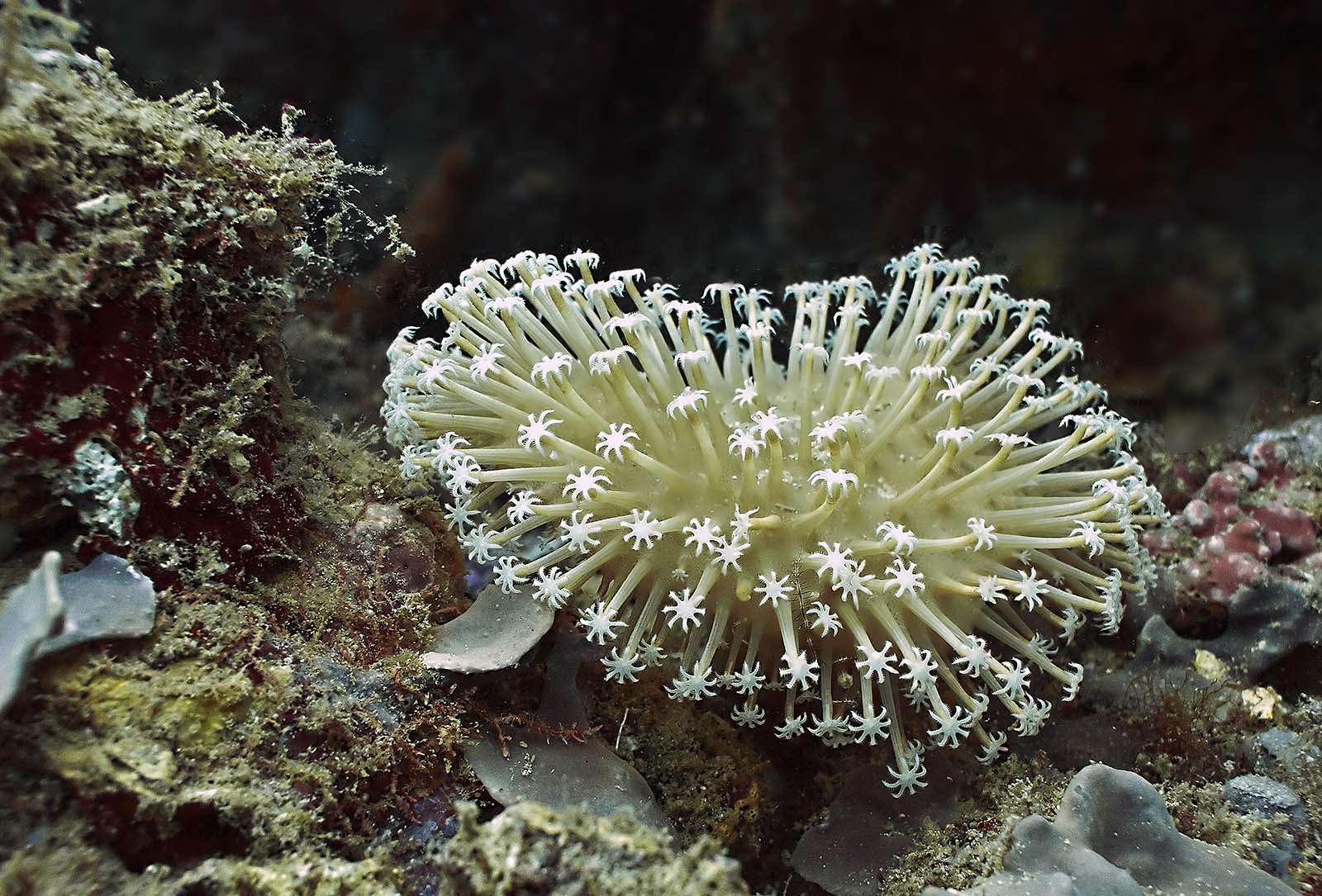
The strange light also made this Solitary Coral (Fungia fungites) glow:

I've not seen one of this yellow colour. It may be a natural variation or it may be bleached.
In most of these shots, the background appears very dark. That is because of the high contrast ratio between highly reflective objects and other less reflective ones. It was an unusual condition worth capturing. I was also using a very small aperture (ƒ/8.0) in order to get the greatest depth of field (the maximum amount of the image in focus):
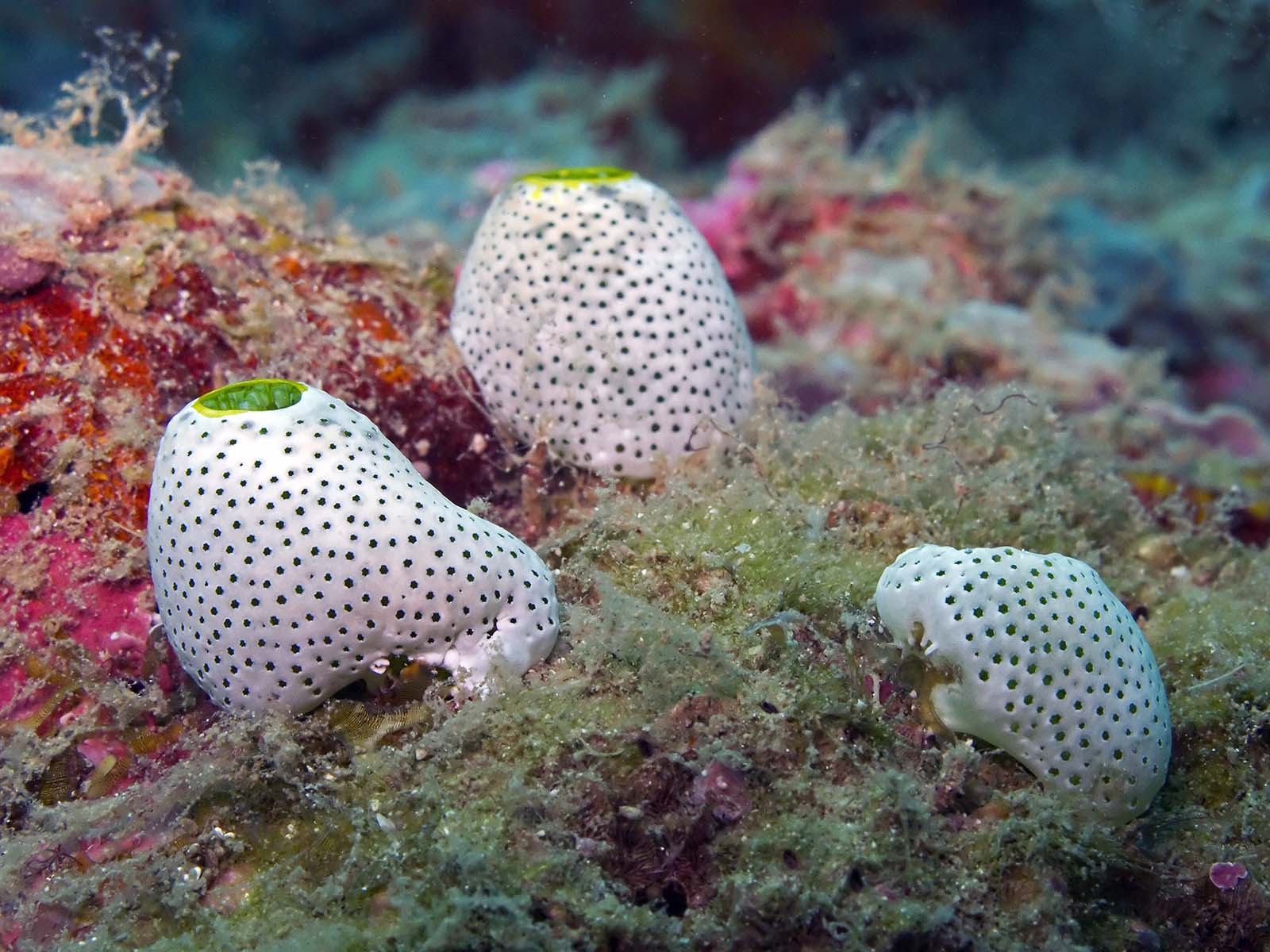
As we descended to twenty metres, the light dropped to practically nothing and I was forced to turn on my flash. In this shot of Sea Squirts (Didemnum molle) you can see an unnatural rosy glow in the highly reflective white areas:
This shot of an Epaulette Soldierfish (Myripristis kuntee) is interesting because of the parasitic isopod which has attached itself to the fish's head:
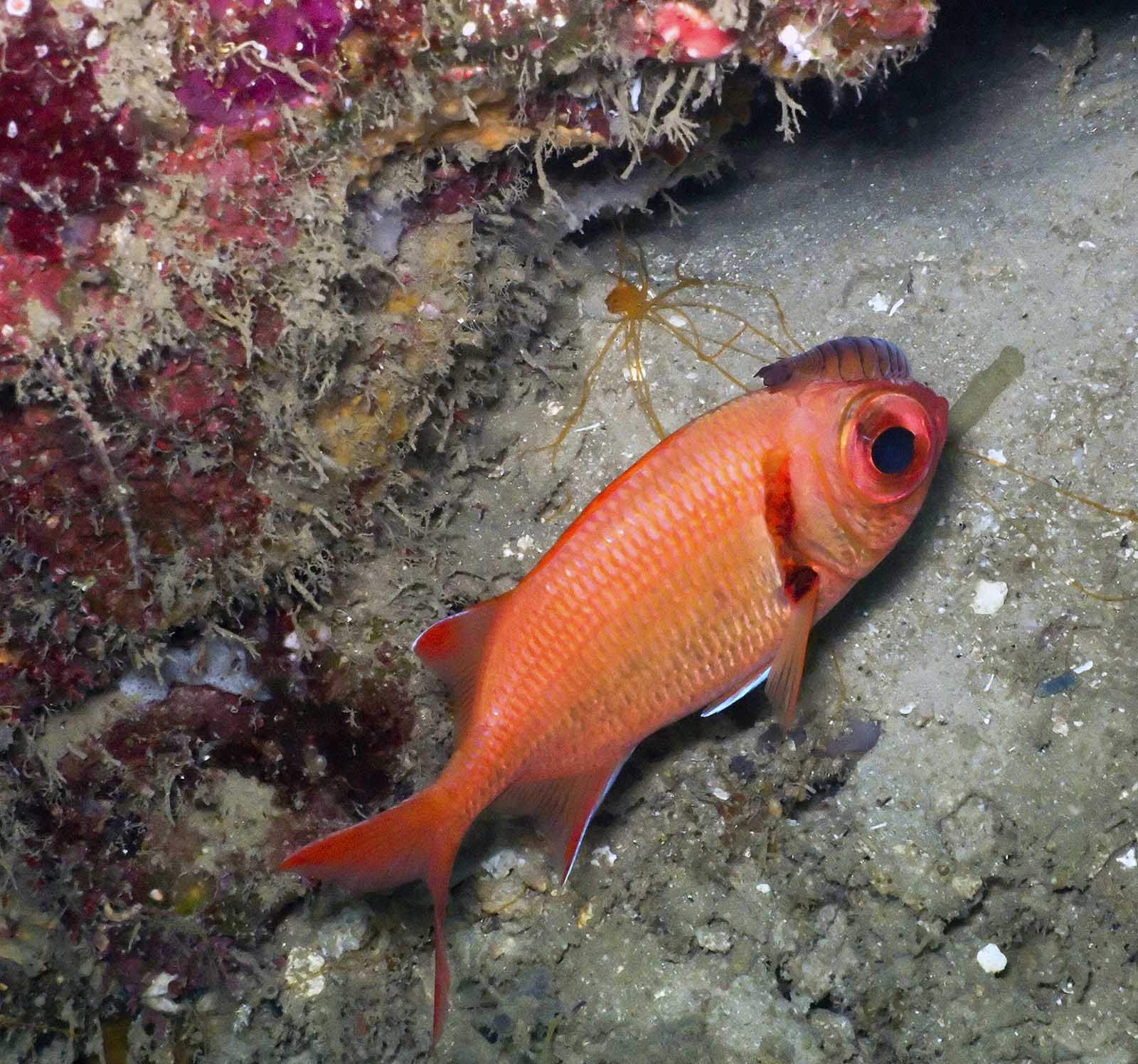
It is amusing that, in this case, being parasitised might have an advantage. It seems that females are more attracted to males who wear a silly hat. You can read a little more about it here in this post.
The small aperture paid off in this shot, which shows a group of Reticulated Dascyllus (Dascyllys reticulatus) darting in and out of the protective coral:

With the low light level, a long slow shutter speed was demanded. I think that this shot was taken about about 1/20 second. That's too slow to stop the motions of the fish, so they look a little blurry. However, if you look at it positively, it does convey a sense of motion.
This week I start a major remodelling job on myself.
The Iron Academy sword was forged by David DelaGardelle for the Iron Academy school, a school based out of Raleigh North Carolina that was founded to help craft young men into honorable, virtuous, humble, and Godly leaders for future generations.
Crafted to be large, powerful, imposing, yet precisely balanced and swift moving in the hand of its wielder. The blade was forged and hand ground out of high carbon 1075 steel, with mild steel blued fittings and a walnut wood core grip wrapped with veggie tanned blood red leather.
The overall design is a hybrid blend of many late medieval Northern European swords, while still having its own distinctive bold voice in its design and aesthetics.
Crafted to inspire and empower its wielder with strength and responsibility, no matter how young or old the wielding warrior of the sword may be.
Down the length of the fullers the hand engraved phrases read:
"Live Pure, Speak True, Right Wrong, Follow The King."
And on the other side:
"Iron Academy - Because Biblical Manhood Is Never An Accident"
Stats:
OAL: 43"
Blade length: 32 1/2"
Blade Width: 2"
Grip Length: 8 1/2"
Balance point: 2 1/4" from the guard
Blade Steel: 1075 high carbon
Fittings: Blued Mild Steel
Grip: Wooden core with Veggie Tanned Leather Wrap
In 1868, four Irish Christian brothers, P.A. Treacy, D.F. Bodkin, J.B. Lynch and P.J. Nolan, arrived in Melbourne to open a new Christian school in the booming, and somewhat wild, city at the behest of Bishop Gould. They began teaching in 1869 in a small rented primary school behind St. Francis’ Church in Lonsdale Street. However, they really wanted something more permanent than the rented school they had, and they also wished to have a monastery in which to reside, rather than the rented rooms in Fitzroy that they had taken as a temporary measure.
With help from the Irish Catholic Church, they acquired a parcel of land along the wide boulevard of Victoria Parade in East Melbourne. In 1871 their dreams were realised when a new bluestone college was blessed by Bishop Gould in the presence of the venerable Archbishop of Sydney, the Archbishop Polding. They called their new school Parade College, after the name of the street it was built on, and dedicated it to Mary Immaculate.
The building is an imposing three storey bluestone structure that was built to the designs of Melbourne architect William Wilkinson Wardell (1823 – 1899), who also designed the nearby St. Patrick’s Cathedral. The building has been designed in the popular Victorian Gothic style, a mostly ecclesiastical architectural style. It features gothic style windows on the Victoria Parade facade, and a double storey verandah of cast iron on the rear of the building, which when it was built, would have taken in beautiful views of the nearby Fitzroy Gardens and the burgeoning city beyond it. The building also included a beautiful chapel on the third floor, accessed via a stairwell that was also designed in the Gothic style. The chapel is small; however it makes up in beauty what it lacks in size, with a vaulted pressed metal ceiling and beautiful stained glass windows.
On the school’s first day, more than one hundred boys were enrolled and the number increased steadily as accommodation became available. As time went on, more Brothers arrived at Parade College from Ireland, and so the number of boys attending the school could increase. In 1902 the school building was extended yet again and finally completed William Wardell’s original designs. It is this building that we see today. This building was affectionately known as the "Old Bluestone Pile" and the school’s song takes its name from this building.
Gothic architecture was perceived by the pious Victorians as an expression of religious, and therefore, moral values, and this may be the reason why architects preferred to build schools in this style throughout the Nineteenth Century. Its revival was seen as virtuous and equated with moral revival; the perfect environment in which to educate young minds. For this reason an ecclesiastical character was predominant even on buildings that were not necessarily religious.
In 1999 after being located in Clayton for 25 years, the Catholic Theological College moved into the former Parade College building (which had been sold in 1994) alongside which it built a new modern building designed by Gregory Burgess.
William Wilkinson Wardell was a civil engineer and architect born in England. He studied under Gothic architect Augustus Pugin, who became his friend as well as his mentor. Between 1846 and 1858 he designed over thirty churches in England, which was a very prodigious output, and he had a flourishing business. Some of the churches he designed include: St Birinus, Bridge End, Dorchester-on-Thames which was worked on between 1846 and 1849, and Greenwich’s Our Lady Star of the Sea which was worked on between 1846 and 1851. By 1858, Mr. Wardell’s health was suffering and his doctors felt that the warmer climate afforded by Australia might be more beneficial to his health. Therefore he, his wife Lucy, his two sons and daughter migrated after Mr. Wardell obtained the position of "Government Architect" to the city of Melbourne. In Melbourne he is known for designing the first St Mary’s Church in East St Kilda in 1859 and the second in 1897, Government House Melbourne in 1876, the ANZ Gothic bank in Collins Street in 1877, and St Patrick’s Cathedral which was completed in 1897 but was still being modified by Mr. Wardell at the time of his death. He is also known in Sydney for designing, the ASN Co. Building in 1884, St John’s College at the University of Sydney, which was completed after a breakdown in relations between the architect and the Sydney City Council, and St Mary’s Cathedral which was not completed until after his death. Mr. Wardell died at his home, “Upton Grange” in North Sydney in November 1899 of heart failure and pleurisy, but left behind a rich legacy in Australia, not only of the commercial and ecclesiastical buildings that he created, but for the numerous private houses and mansions that he designed.
In addition to Flatlandia, it was also Malloreigh's birthday. I met up with her, Allie, Bronwen, & Kerry for brunch at Virtuous Pie. I got breakfast tacos with tater tots, and they were so good. Afterwards we walked over and sat in MacLean Park for awhile. I walked to Flatland around 2:30, and there was lots happening— music, art, food, haircuts, drinks. Maddie was there with our dad, who hung out listening to music until it was time for him to leave for work. The music for the most part was really great, and I was expecting to feel overwhelmed and want to leave before the end, but I had a nice seat on the bench by the fence and ended up staying until the last band finished! Jeff picked me up on his way home from work, with enough time to come in and say a quick hello before everyone started to disperse. 224/365.
Maulana Noor Muhammad Shaheed Wazir South Waziristan Wana
Religious and worldly success depend upon the regional peace
Preface
The verse of the Holy Quran which was recited before you, clearly depicts the meekly benediction/prayer of the venerable messenger, Hazrat Ibrahim Alai Salam. Thousand created messengers trace back to Hazrat Ibrahim.It is He who laid the foundation of Bait ullah (Makkah) Hazrat Ismail made great contribution in the construction of Makkah.Only the mutual co-operation of the father and his son took part in the construction of Makkah.There was no architecture no labourer and no co-ordinator only and only Hazrat Ibrahim and Hazrat Ismail were busy in the construction. God had great respect for him because every benediction of him was accepted in the court of Allah. Not only his prayers were given due place in the court of Allah but it were kept safe in the shape of verses in the holy Quran and Muslims the followers of Hazrat Muhammad (PBUH)will gain benefits from it. It was Hazrat Ibrahim who cherished Umat-i-Muhammad with the name of
"Musclemen ''
Hazrat Ibrahim not only prayed to God for the creation of Hazrat Muhammad but also bestowed the followers of him with great name of the Muslims .It means Din-i-Mohammadi (Islam) is infect the religion (Milat-I-Ibrahimi) and those terms of Milt-I-Ibrahim which are liked by God are key to success for the Umat-i-Muhammad.
In the Holy Quran Allah says, this religion (Islam) is the religion of your father, Hazrat Ibrahim and who named you Muslimeen.
God says those who followed the path of Hazrat Ibrahim are successful and those who missed the way fell in to the ditch of destruction.
I would like to tell you one but most his precious prayers so that we can analysis it that how and to what extent we follow the Millet- Ibrahim and to what extent we are going far from it dear and honourable listeners.
If we consider attentively over the benediction of Hazrat Ibrahim, then it would clear to us that Hazrat Ibrahim had prayed to God that O, God make this city the centre of peace and sermity before the prayer for the creation of Holy prophet Hazrat Muhammad for the future generation.
Ideology of tribal pashtoon about the social and city life:-
Consider that Hazrat Ibrahim was constructing Kaaba in the desert and along with that he was praying for its peace and serenity, Being a desert place he prayed for its civility citizenship is possible when different human being line together and where everyone teies his best for the betterment of society, because the needs of the dense population can not be fulfilled by a few people. The greater the business activities are the more facilities will be there and number of population will be also increased, but it is the irony of time that pashtoon tribes being igranate of cultural and social are against the law of nature. It is common in pashtoon tribes that of some one deal in a business, he does not another person to start that business which he owns.
For example if some one invest money hospital than he his a keen desire not to be started another hospital by any one else in that area . If some one put money in starting crushing machine then it will be his wish not to started this business by any one else . it is clear that due to the individual in culmination toward business is the key to destruction of the social and economical activities .although the holy quran his depicted nearly 1400 years ago that told the success of worldly depend upon the city life where one can had all kinds of facilities of life , in short where there is dense population , there is way of life , if some one construct a huge building on a levelled gourd are on any mountain , he would get no due facilities there .it is clear fact , that where there is a dense of doctors and medical stores ,there would be inclination of people towards it .where there is a scarcity of doctor and medical store ,there will be less inclination of people, business centre , there would be great shopping . But the scarcity of shops and shopping centre shows the less percentage of shopping .It is clear fact that pashtoon tribes have no inclination toward the dense business centre and trading company. It is their ill-views of the said way of business .They prefer individual trading over city life.
Now we consider the benediction of Hazrat Ibrahim thousand years ago Hazrat Ibrahim has virtuous benediction his lips through the divine force in which the importance of city life is depicted clear, So when he laid the foundation of Kaaba he also put tress on the importance of city life but the strength of city life needs great peace that is why ,he prayed O ,Allah make this city the centre of peace when he laid he laid the foundation of kaaba.He knew that the people would come to this great centre and would gain celestial teaching then they would convey the divine teaching to their own areas .But it was possible due to its peace ,because city life depend upon its structure.
The purpose of sacred land
The purpose of sacred land means such a land where there is a security and peace for the creatures of Allah, such a land where there are no massacre, no fear for even a bird and no fear of attack on animal-life.
Every one is secured .Not only the living creatures but non living creatures should be free of any restriction .Tress and plants should be kept sound so that ,they can play duel role in keeping the earth green and fertile.
Hazrat Mohammad(PBUH) announces in Medina that I have prohibited the both sides of Medina for any kind of hunting .There would be no hunting at the prohibited area .No one would tease even trees and plants in the said area.
Now a days a huge gathering of Muslims join Kaaba to perform pilgrimage, but the philosophy and the teaching of pilgrimage are being neglected .A lot of Muslims have performed pilgrimage .The people to different field of life have performed pilgrimage. They have themselves noticed the sighs of kaaka .But tell me how many pilgrims have stopped ,the cutting of trees, How many people being pilgrims have said good –bye to hunting and played due tale an stopping of other from grunting have they ever thought that the trees are the ornament for an area and the chirping of the birds make that area like a paradise ,so we should not spoil their lives, Anyhow this is the day of following of the memory of Hazrat Ibrahim .Once the (Sahaba Karam)asked from the Holy Prophet about the importance of the sacrifice .He answered them that this is sumnah of Hazrat Ibrahim.
My venerable scholars and listener, the purpose of my speech is that the sunnat-i-Ibrahim has Created place and serenity for the Umat-i-Mohd where there will be peace there will imbruement of religion and worldly success. and there will be regional progress on the peak point .If there is no peace and stability in an area and every one feels fear and uncertainty then the destitution of religion and worldly affairs will be strew, whether it is a small Terri Tory or country event the wheel universe ,the danger of destruelion will be on the peak point.
The speciality of Pakistan from religious point of view:
Every wane of us knows better that Pakistan was created on the base of Islam and for this purpose our forefather and Nobles bave offered many sacrifices .More than fifty year have gone since the creating Pakistan but the Lords of power cold not arrange any special programme of broad casting of the celestial teaching of urn and Hadith in this Islamic democratise country .Up till now ,the real aim of it could not come to its expectation .However Pakistan is very ahead countries .Most of us have seen U.A.E which genial the Islamic biremes through them .But characterization on the top of it .In Pakistan we can’t amagrve it. However, Iwas discussing the stability of piece in Islam that it is the key to success of a region and the saes for the betterment of worldly success sofr.
Whiter it is a day or might, if there is no peace them there ,neither the Islamic teachings would make due progress nor the faith can be improred properly .
Ibrahim-i-tProceduse of peace and Stability at Mila
Already said that the procedure at Milt- Ibrahim is that there is peace for every thing not only for man but living thing (Animal and non living thing enjoy it, except few things which are lawful(plants)to be killed at every place where it is sacred plea or non became they are harmful to man such as snake ,scorpion etc or harmful animal which is dangerous for man .so, it is clear that if some creatures are harmful to other creatures no shelten is given to them whether, they found shetten in the home of Allah.
The Scarify of peace at Pashtoon regions specially in tribal area:
Unfotimarely,in Pakistan specially tribal are victim ty scarify of peace and stability .Out worldly the main reason of it is its illiteracy,because the maind portion of its population is facing illiteracy.Due to illiteracy the people are mostly take interest in hunting the extinxt generation of hunting victom of theirs eagerness race of it and now , we can not see them any where ,It is irony of time , that even seasonalbirds aer decreasing day by day.
Rakish youg Pashtoon have male the lices of xranes very miserable .In short , the xharter which was presented for the betterment of human beings by Hazrat Ibrahim is being neglected by pashtoon .Neither the life and property of man is safe nor the lives of animals and plants aer safe and secused .The forests are being cut violently,no ney plants are planted ,If the alternate of gas was not arranged them a day will come,that people will purchade the fined wood from other area on hervy prices .Listen you people aer not only destroying your lives but also crushing touy forth coming generation .My heart is bleeding with prief .
How WANA was a beautiful reguon and how we sponked it for a small benefit .Keep in mind the forth coming generation would not for give us specially,when they will come to know that our forefather had a great and volwalds xhances for earninf.But these hunger –on pieple destroyed the natural resources of income with out any struggle.When the cutting of teees was staited at that time Iagain and again was tilling them on the pulp it not to cut the,the day will come that its fifty diles price would be one thousand,but no gave attention to my advice.Today you are ovserbing with your own eyes.In that time you sold the fifty kiles of pinus on there hundreds but now its price is six thousands per to day if the forest of pinus would dace been saced uou would have got due money.
It is the irony of time that even for the sake of only one thousand rupees the tiny frees of these precious fruits are being cut ruthlessly .Hane uou ever thought about this matter that why Allah has stopped the blessing of rain.Remember the main reas on of it is cutting of the forests .These forests aer the product of Allah .He is the creator of it.Therough these forests Allah had created the earth very beautiful and through the rains these natural trees and plants are irrigated .But we could not thank of these special blessings of Allah .Due to this we are deprived of the blessing of rain .Every owner shows anger over has possissious so,why Allah would not feel anger over the cutting of forests ,that is why he has closed the doors of blessings .
To day we need even the drop of water the surface of water is to day by day .We are obsfacle in the declining way of consfrictopm pf Dams,therefore no special arrangmint of storing water aer to ve seen in future .God knows better when will we come on due line and when will we feel our advantages and loses of our selves.
Tree plantantion is the sunnah of the Holy Prophet Hazrat Muuhammad (SAW),To day we aer going against the tree plantation and are in favour of cutting of the trees .
Think over this matter that our Holy Prophet (SAW)was against of cutting frees and was in favour of plantation .The pious of to day will wondr to know that Holy Prophet(SAW)has planted three hundreds frees with his won hands and also prayed for those who plant the fruity trees ,I swear by Allah that the sweetness and juice which are available in wana fruits will not be available neither in Baluchistan fruits nor in Afghanistan fruits.But the people of WANA are unaware of the importance of the fruits of SWA .Up hill not, they could not make compromise over the small Dams for the betterment of uncultivated and baren land the gardens fall victom to any discess If there wil be no mat who can investigate the disease .Without investigation in the plants are sprinkled wity spray which are harmful not binificial for them.
They don,t think that with personal capital one wateful can establish such a plant where the fruits we can prepare pickleand from other drunks /imbilbed .So in this way the annwal income which is gained theough furits and vegetables we can get double profit from the wasteful fruit and vegetables if they are properly used.
My heart fill ,with grief when Isee the miserable condition of our people ,they are so ill-minded that a person who comes from Afghanistan shows them the golden dreams of richness.He tells them that he has a fifteen years experience in the field them why poppy cultivation .thay don,t even think that if he has experience in this field then why this man who is the enemy of human beings who consider himself useful man would have been wandered with so miserable condition .He would have not come to wazristan if he were so rich and good in his field .He would have millionar and were not lavuirer in our area Greed makes man blind .Allah has created a lot of resources in our own home ,we can get due wealth from these resources.But weare idll and lazy and donot use our own talents .For God sake take benefits from yors resources and workhard ,In this era the greatest virtn/reward is your won hands earning of livings.Now adays the sitnations ate critcal other wisc, wana was the center of peace for neighbour labours.
There was no better place of employment rather than wana for the neighbour peoples ,Trading and business became faint due to uncertainity of the sitnations.
Coparis on of restriction between Pakistan and other countries Hazrat Maulana Darkhawsti has been great scholar and Sheikh-ul-Hadith and Hafiz-ul-Hadith .He had nearly learnt by heart one Lac sayings(Hadiths),One day I had gone to him .He told me that if yor faced any difficulty then you should read such and such verses,Insha ullah,you would get rid of that problem .I used that verses ,It proved benefial .I till a wonderful incident about its far teaching result.One I went to U.A.E after per forming Hayj one day I went to I raniborder along with my friends,On return we were passing the check post ,Every one of us was asked about passport and doucmints .By chance ,My colleagues /mates negotiated with them on this matter but they could not agree .Finally,I was orderd to be landed down from the car no sooner did I take down from the car ,I that cerses came into my mind .I began to recite in my heart.After the cmmpletion of wazifa (verses)their behaviors chahged they came near and told me ,O ,Shiekh please forgive us,when I sat down in the car they once again come to me and reguested meekly please forgive us and rimenber us in your prayors.
The aim of my saying is that in foreign coutries there is severeprinaiples that every time ,the passejer have to keep the nexxssary dicilmints with ginself other wise he can fale any problem any time .In foreign countries there serere principles that every time,the passenger have to keep the necessary ducoments with himself other wise he can face any problem any time.In foreifn countries one can line even a day without passport and visa because there are severe principles for the passengers .Take the exaple of Makka where one can not enter without visa and passport ,thogh Allah says in the Holy Quran that the foreigners and the citizens have equal rights in this city .It is the only and only Pakistan where one can enter with out any passport and visa .There is no restriction on any foreigens .Anyhow ,Pakistani have is critical ,we know that the foreign contries crpecially the west have fully contril over us which is infact the have fully contril over Muslims say that Allah is with us.Have we ever seen our actions what kind of actions we are doing .Cheating is our profession ,we are spoiling our generation by smuggling .In that God is with us ,can a Muslim claim of good Muslim if he is going aguinst virtme of Islam.Some misleads are so large in our socilty that one can not imagine even in Europe or other west countries .If we are going on wrong direction then we can not cdaim to be a good muslims.
When the Holy Prpohet (SWA)left this world then it was necessary for the followers to continues his mission .Ansars nominated one of Muslim for this post of caliph when Hazrat Umar Farooq came to know about this matter .He immediately went to Hazrat Abu Bakr.He toldhim that ruling power diserved only that person who has the help of Allah ,It was the only Abu Bakr who desceved the commanding .When Holy Prophet (SWA) and abu Bakr were stayingin the cave Hira ,at that Hazrat Mohd (SWA) told him donot worry became ,Allah is with us.Hazrat Umar Farooq told rnlingpower.Dueto his timely decusion the Muslims became secuse from termoling to day we are facing a crucial time,in such a crucial time ,The sitnation aer once again uncontrollable ,then no one will save us from destruction .
The third issue was the labor force. If Mengistu kind of liked the region, he also thought the native people (ie. Nuer, Anuak) were "good for nothing". He decided to displace workers from the highlands to Gambella. For the engineers of the regime, the plan had the effect of a virtuous circle: the Highlands were considered as overpopulated (there are still) and all this population could not be fed (we were in the 80's period of droughts and famines), that was the problem. So displacing people to Gambella was the solution: less people to feed in the Highlands, more people producing food in Gambella. It could have been the miracle of productivity and food security.
150.000 highlanders were settled (by force or not, who knows?) in the region. Unfortunately the farms were not finished, all the financial means were allocated for the wars and to starve the regions at war. Moereover the highlanders were not physically prepared to the tropical conditions, they were permanently sick of malaria, river blindness, etc. Finally Mengistu was overthrowned. The engineers were takend to develop the northern region and everybody forgot about Gambella.
The Productivity Miracle never occured. The resettlers remained in the region, actually jobless. An other factor appeared: their settlement had completely disturbed the traditional equilibria and let the region in a permanent state of tensions, conflits with some recurrent crisis of violence. The Productivity Miracle turned to marginalisation and hell [?]
The cultural attractions that I visited in Korea all had signs such as this that gave details in English. These I photographed for future "reference" use, when identifying slides once "back home."
Deoksu'gung palace (덕수궁, 德壽宮, "Palace of Virtuous Longevity"), Seoul.
1980 July 24.
The Iron Academy sword was forged by David DelaGardelle for the Iron Academy school, a school based out of Raleigh North Carolina that was founded to help craft young men into honorable, virtuous, humble, and Godly leaders for future generations.
Crafted to be large, powerful, imposing, yet precisely balanced and swift moving in the hand of its wielder. The blade was forged and hand ground out of high carbon 1075 steel, with mild steel blued fittings and a walnut wood core grip wrapped with veggie tanned blood red leather.
The overall design is a hybrid blend of many late medieval Northern European swords, while still having its own distinctive bold voice in its design and aesthetics.
Crafted to inspire and empower its wielder with strength and responsibility, no matter how young or old the wielding warrior of the sword may be.
Down the length of the fullers the hand engraved phrases read:
"Live Pure, Speak True, Right Wrong, Follow The King."
And on the other side:
"Iron Academy - Because Biblical Manhood Is Never An Accident"
Stats:
OAL: 43"
Blade length: 32 1/2"
Blade Width: 2"
Grip Length: 8 1/2"
Balance point: 2 1/4" from the guard
Blade Steel: 1075 high carbon
Fittings: Blued Mild Steel
Grip: Wooden core with Veggie Tanned Leather Wrap
virtuous patience
the tabby cat's own preserve
lesson to be learned
no critic so sweet
as the one who shines her light
on words gone missing
every writer needs
a cat who listens well to
stories read aloud
Sardinia's most long-established saltworks stretches across the 2700 hectares of the Santa Gilla basin: for almost 90 years, mankind and nature have been working in perfect synergy thanks to the far-sighted ambition of engineer Luigi Conti Vecchi who, in the late 1920s, implemented a pioneering project to reclaim the basin by building an immense saltworks and, in the process, contributing to the economic and social development of this depressed area on the outskirts of the city. There arose a flourishing, virtuous and forward-looking business: an eco-sustainable, self-sufficient chemical plant around which orbited a ‘salt community’ endowed with houses, schools and recreational facilities for the families of the owners, managers and employees who lived together in the village of Macchiareddu.
There is now a train tour in the ticket includes: self guided tour of the historic 1930s buildings and guided tour on a little train through the saltworks.
Ferdowsi, Shahnameh
Herat, c.1444
Patron: Mohammad Juki b. Shah Rokh
Opaque watercolour, ink and gold on paper
London, Royal Asiatic Society, Persian MS 239, fol. 243r
After a long and prosperous reign, the virtuous Key Khosrow prayed that he might die before succumbing to pride. He renounced his kingship, gave away his treasures, left the throne to Lohrasp, and made his way into the mountains accompanied by his closest paladins. He asked them to leave him and return to the valley. Zal, Rostam and Gudarz obeyed him reluctantly, but others remained. Key Khosrow spent the night reading the Avesta (the primary collection of sacred Zoroastrian texts) and bade his companions farewell. In the morning they searched for him in vain, fell asleep and were buried in the snow.
Ignoring the text, the artist has created a charming image of travellers caught in the snow. Chinese motifs, such as the swirling purplish-gray clouds and the tree stump delicately covered in snow, mingle with gestures observed from life.
Medallion, Tius Bythiniae after 134, Æ 11.43 g. ANTINOOC - ΗΡΩC Bare headed and draped bust l. Rev. ΤΙΑ − ΝΩΝ Winged caduceus. BMC Bythinia –. SNG von Aulock –. Blum –.
Apparently unique and unpublished and in exceptional state of preservation for a coin
of Antinous. A very attractive portrait well struck in high relief
and a lovely green patina, extremely fine
The appearance on coinage of Antinous, the favourite companion of the emperor Hadrian, is remarkable, for he was not related to the emperor by blood or marriage, and was never an heir-apparent. Indeed, Antinous is honoured only after his death and deification. On this coin from Antinous’ native province of Bithynia he is described as a hero, a mortal who, through virtuous acts attains immortality. Considering his exalted status, he frequently was assimilated with gods, usually Apollo, Hermes, Dionysus, Iacchus and Osiris.
Antinous’ cult was wide-spread, and a great many busts were produced: at least 1,500 can be presumably attested, of which at least 115 survive today. His coinage was also substantial, with more than 30 mints striking approximately 150 different issues. Though most of these coins were struck during the reign of Hadrian, concentrating from 134 to 137, it is believed that a few mints continued to strike them as late as the reign of Marcus Aurelius, and that his hometown of Bithynium (Claudiopolis) perhaps issued them as late as the time of Caracalla.
Emperors other than Hadrian used the reverse type of a winged caduceus at this mint, including Antoninus Pius for his heir Marcus Aurelius, and Severus Alexander about a century after Antinous had died. Regionally, the type may have an antecedent on coins of this design issued by the Bithynian king Prusias II in the 2nd Century B.C.
NAC51, 282
A bottle of La Mère Vertus from Brasserie Artisanale Millevertus in Breuvanne-Tintigny, Belgium, at Le Vaudrée II in Liège.
Millevertus La Mère Vertus is a 9% abv abbey tripel, or "Une Sacrée Triple" (sacred tripel) as the label says, brewed with 5 types of malt and 5 varieties of hops. It poured a hazy golden amber with a white head. It smelled of sweet, ripe berries with hints of candy sugar. Mouthfeel was medium heavy with a soft carbonation. Flavor started out with ripe berries and candy sugar but the sweetness is balanced by a good bitterness in the finish. Unfortunately I also got some alcohol in the taste.
La Mère Vertus or "Virtuous Mother" is a fairly sweet beer but far from what I would call a tripel, it's also slightly tainted by a taste of alcohol. So, all in all a bit disappointing.
A Solemn Act of Consecration to the Immaculate Heart of Mary
Most Holy Virgin Mary, tender Mother of men, to fulfill the desires of the Sacred Heart of Jesus and the request of the Vicar of Your Son on earth, we consecrate ourselves and our families to your Sorrowful and Immaculate Heart, O Queen of the Most Holy Rosary, and we recommend to You, all the people of our country and all the world.
Please accept our consecration, dearest Mother, and use us as You wish to accomplish Your designs in the world.
O Sorrowful and Immaculate Heart of Mary, Queen of the Most Holy Rosary, and Queen of the World, rule over us, together with the Sacred Heart of Jesus Christ, Our King. Save us from the spreading flood of modern paganism; kindle in our hearts and homes the love of purity, the practice of a virtuous life, an ardent zeal for souls, and a desire to pray the Rosary more faithfully.
We come with confidence to You, O Throne of Grace and Mother of Fair Love. Inflame us with the same Divine Fire which has inflamed Your own Sorrowful and Immaculate Heart. Make our hearts and homes Your shrine, and through us, make the Heart of Jesus, together with your rule, triumph in every heart and home.
Amen.
--Venerable Pope Pius XII
THE PROCRUSTES TRILOGY
Procrustes In Situ
Oratorio—Variation On A Theme By Joseph Bor
Martyrs of the Cities of the Plain
PROCRUSTES IN SITU, overall plan
About the entire PROCRUSTES TRILOGY, Robert Cremean wrote the following:
THE PROCRUSTES TRILOGY was initiated in 48 A.H. with PROCRUSTES IN SITU. Throughout the following five years my preoccupation with this monster of the Thesian myth became obsessional. Threading back through the eternal Now of PROCRUSTES IN SITU, two events emerged to illustrate Procrustes at his most extreme…two acts of holocaust: ORATORIO, an event knotted in linear time during the Nazi persecution of the Jews, and MARTYRS OF THE CITIES OF THE PLAIN, dating back to the prehistory of biblical time. Both events live on politically, socially, and psychologically within the Now. By dating the Now from the Third Holocaust, which occurred at Hiroshima on the sixth of August, Nineteen Hundred and Forty Five, the Trilogy becomes a play in four acts. The fourth and final event will be the Fourth Holocaust. There will be no fifth. There will be no other.
Procrustes was first introduced into our lexicon of metaphors through the trials and triumphs of the mythical Greek hero, Theseus, as a robber-innkeeper who haunted the road near Eleusis. When travelers accepted his hospitality, he made them lie on one of two beds: one very long, the other very short. If the guest was too long for the short bed, Procrustes cut off his legs until he was short enough; if he lay on the long bed, Procrustes stretched him until he fitted it. In the legend, Theseus slays Procrustes. Once personified, however, like all enduring metaphors, Procrustes refused to die. Through metaphor, he illustrates a truth and, as a truth, he lives on throughout the evolving triumphs and tragedies of the human condition. His existence is indelible.
At approximately the time the myths were personifying the attributes of Procrustes as villainous, a writer named J, in the kingdom of Judah, was illustrating these same qualities as virtuous in the first chapters of the Old Testament. This clash of metaphors exists today in the war between humanism and theism.
PROCRUSTES IN SITU attempts to illustrate the obvious and redundant visages of Procrustes. He is omnipresent within the human condition: cutting, trimming and stretching each individual to fit the beds of conformity. During this phase of the Trilogy, I came to see how essential he is to everything that we are. Without Procrustes, there is no coherence. Procrustes is the antithesis of chaos. He is also the enemy of Art.
Procrustes thrives on repeat, stasis, and order. His sole purpose is to determine and control. Anything that threatens his authority and the dimensions of his beds is trimmed away or stretched beyond its viable scope of importance. The enforced illusions of Procrustes are in constant conflict with the Artist’s desire for truth, no matter what the cost.
In PROCRUSTES IN SITU, the connection between Procrustes and nature, sexuality and reproduction is considered. The linear extension of the species gives Procrustes great authority within the strictures of society. This is acknowledged in the beds of the mother, the father, the young woman, the young man, the child, and fear. Procrustes controls these beds through instinct. We are born into them. By these he controls us all. Chaos is not a threat to Procrustes in his natural form but rather to the illusions that that form has itself constructed. It is this illusion of identity that centers the drama of Procrustes: Theseus versus Procrustes, Art versus culture, chaos versus illusion.
PROCRUSTES IN SITU sets the stage for the following two acts of the Trilogy: ORATORIO portrays an event that occurred during the Second Holocaust, a performance of the Verdi Requiem at the Terezín concentration camp in 1944, with full orchestra and chorus of Jewish prisoners, for an audience of Nazis. The Procrustean overtones here are so obvious as to be grotesque and hideous in their irony. That this event precedes the Third Holocaust by barely a year increases its tragi-comedic theatricality. The laughter of Procrustes is his most terrifying edge and here, in ORATORIO, it is in full display. The Second Holocaust completes the cycle of biblical time initiated by J in the book of Genesis making possible the fulfillment of prophecies. The significance of ORATORIO is not the tragedy of the Jews but rather the paradox of theism: one man’s God is another man’s Satan.The portrayal of Jews in performance of a doctrinal Catholic requiem in a Nazi concentration camp is irony of such magnitude as to make Procrustes himself blush. The similarities of facial contortions involved with singing, screaming, and lamentation are so obvious as to be banal. The permission and encouragement of the Nazi propagandists for such a grandiose undertaking in the face of appalling circumstances is sadism of procrustean virtue.
MARTYRS OF THE CITIES OF THE PLAIN examines the First Holocaust. Based on the blue triangle that descends the back panel of PROCRUSTES IN SITU, the third section of the Trilogy concerns itself with the destruction of the cities Admah, Gomorrah, Sodom, and Zeboiim which the Old Testament attributes to the wrath of God. It examines the procrustean constrictions of patriarchy and the liberating challenge of feminine entelechy through the songs of Procrustes and the opposing chants of Chance, Being, and Desire. Masculine gestalt versus feminine insurrection.
As the pen of J transported good and evil into biblical time, the following centuries of hermeneutics turned the holocaust of the Cities of the Plain into a simplistic hatred of homosexuality.
Ascribing to a Father-god absolute judgement of good versus evil set the illusion that has dominated the religions of Abraham through the millennia: God destroys bad people and rewards good people. Through this lens, men have assumed their superiority.
J, by transporting the monotheistic Father-god of the Israelite tribes onto the pages of literature, initiated the gestalt of metaphors upon which linear history has based its illusions. By casting one protagonist as the sole arbiter of the human drama, J created a monster of deception and paradox, the sort of creature that Greek myth sends its heroes to defeat. He is Procrustes.
As J concretized monotheism in the Old Testament, a Greek poet named Hesiod was composing his Theogony of polytheism. These two dramatizations of the human condition have traversed the centuries in the hermeneutics of morals and ethics.
When J ascribed to the Father-god the destruction of the Cities of the Plain in terms of good and evil, he placed nature within the paradigm of moral rectitude. God’s will became the supreme wisdom of Patriarchy and all its contingent hermeneutics. The Israelites became god’s chosen people and the saga of the religions of Abraham began. By the time of the Second Holocaust, the Father-god had assumed two additional profiles, Christianity and Islam, and in the Second Holocaust, god turned his wrath against the Jews. A year later, in replication of his annihilation of the Cities of the Plain, he would rain death upon the cities of Hiroshima and Nagasaki. The Fourth Holocaust will be the last and all non-believers will be slaughtered by his wrath. What an ugly and ignorant scenario!
The gestalt of monotheism, with all its attendant metaphors and hermeneutics, is simply bad art. How much richer in imagination and complexity, Hellenic mythology. Comparing the nomadic expediencies of monotheism with Hesiod’s Theogony is like comparing a water jug to the Parthenon.
Compared to the Israelite tribes, the Cities of the Plain were highly civilized societies. To joyously praise their destruction in the worship of a Father-god’s wrath rather than admit to schadenfreude has been the basic theme for centuries of monotheistic history. As long as a Father-god exists, war will never cease. History will remain a drumbeat in constant repeat until the fourth and final holocaust.
THE PROCRUSTES TRILOGY exists for me as an attempt to understand the artist’s plight. (Interestingly, the dictionary gives the word plight two definitions: one is “a condition, state, or situation, especially an unfavorable one.” The other is: “to give in pledge, as one’s word, or to pledge, as one’s honor; danger, risk.”) The artist, as prototype for singularity versus the conforming group, confronts the beds of Procrustes as intrinsic within natural and social Isness.
The grotesqueries of ORATORIO attempt to portray the open hostility that exists between culture and Art. In the faux setting of the Terezín ghetto in Birkenau, Procrustes was operating with deft facility and terrible humor. Verdi’s Requiem was cut short to fit a Nazi time schedule and the musicians who performed this propaganda were shipped off to Auschwitz, their talents of no further value.
If an artist believes that Art is purifying and spiritualizing, what differentiates artists who worked inside Terezín and those who worked outside? Jewish musicians performed Verdi’s Requiem for a Nazi audience and were destroyed because the culture had decided to purify itself. German musicians performed Beethoven’s Ninth Symphony for German audiences and exalted the Nazi culture with the Ode To Joy. It is impossible to imagine any audience not being moved by either work. It is the culture that qualifies the emotion. And what of Wagner? And what of the musicians who performed during the Nazi regime. Were they collaborators because they believed in the power of Art no matter what its audience? No matter what its consequence? What is the moral equivalency here? Wherein lies an artist’s loyalty and honor?
Did the Jewish musicians of Terezín not know that they were collaborating with Nazi propaganda any more than German musicians knew of Nazi atrocities? Can an artist refuse his responsibility to Art?
MARTYRS OF THE CITIES OF THE PLAIN mirrors the artist’s plight set forth in ORATORIO. The eight testimonies of the four voices of Art are inscribed on the four-sexed sails of the Traveler.
By casting the voice of the artist as creator, heretic, healer and slave, an attempt is made to stage individual diversity on the beds of Procrustes.
As the Israelite Father-god rained death on the Cities of the Plain in an attempt to sever the two ancillary sexes from natural selection and societal acceptance, all living things were sacrificed to his dedication. This biblical example of the triumph of good over evil regardless of natural truths and objective ethics persists and continues to martyr the human condition to the plagues of mono-theism. God the Father is now positioned to destroy us all in the Fourth and final holocaust.
Homosexuality is part of Isness. To seek its eradication is to murder one’s children in a conflagration of hate and ignorance and fear. Even the Jews, in the agony of their own holocaust, seek to purify their martyrdom by cutting away the martyrs of the Cities of the Plain. Procrustes is omnipresent. No one eludes his beds. His delight. His laughter. His irony.
By setting a Father-god over the Isness of Being, humankind will always and ever be at war with itself, its nature, its self-recognition and realization.
The four sails of MARTYRS OF THE CITIES OF THE PLAIN are situated between the entelechies of masculine and feminine. The red monologues of War, Religion, and Commerce, with their corresponding heads and drawings of the male body, stand in opposition to the blue essays of Isness with its heads and drawings of the female body.
The blue and red commentaries flowing across either side of the sails relate past and present to the procrustean Now. (These inscriptions relate back to the diatribe that moves across the seven embossed prints of PROCRUSTES INN REGISTER.)*
In opposition to the Songs of Procrustes performed by War, Religion and Commerce, the alcove of feminine entelechy, personified by Chance, Being, and Desire, lies outside the Inn of Procrustes with its beds of conformity. This alcove, formed by the flowing blue inscription across the four sails of the traveler and the two walls of writings and drawings, attempts to define the true face of Theseus, not as a mythical hero, but as any human being who struggles with the destructive forces of dogma. Only truth can slay Procrustes. Only courage can lay waste his beds. Only empathy can destroy the accommodating hatred of his Inn.
Encased in the armor of helmet, miter, and bowler, Procrustes controls the history of men.
*PROCRUSTES INN REGISTER is a suite of engravings and monologues derived from the Preparatory Study that forms one wall of PROCRUSTES IN SITU.
Collection:
Fresno Art Museum
Fresno, California
(Robert Cremean: Metaphor and Process, the video, may be seen at www.youtube.com/watch?v=mgrxW8xSvrA)
I seek refuge in Allah from Satan, the outcast.
In the name of Allah, the Beneficent, the Merciful.
Allah’s peace be upon Prophet Muhammad (S.A.W), the glorious Prophet of Islam, and on his Companions and his followers.
TASAWWUF
"There is no doubt that Tasawwuf is an important branch of Islam. The word itself may have been derived form the Arabic word "Soof" (Wool) or from "Safa" (cleanliness), but its foundation lies in one’s personal sincerity in seeking Allah’s nearness and trying to live a life pleasing to Him. Study of the Quran, the Hadith, and the practical life of the holy Prophet Muhammad (S.A.W) and his faithful Companions provide unmistakable support to this reality." (Hazrat Moulana Allah Yar Khan (R.A)
SUFISM, AN ESSENTIAL PART OF ISLAM
Doubts exist not only in the minds of the Muslim faithful but also among the Ulema, notably the exoteric about Tasawwuf and its votaries. Often they lead to misunderstanding, as if Shariah and Tariqah were two separate entries, or that Tasawwuf was some obscure discipline foreign to Islam, or that it was altogether above the established laws and injunctions of our Religion. To help remove these misgivings and to reassure seekers, as well as scholars, our Sheikh Hazrat Moulana Allah Yar Khan (R.A), Sheikh Silsila Naqshbandia Awaisia, wrote Al-Jamal Wal Kamal, Aqaid-O-Kamalaat Ulmai-e-Deoband, Binat-e-Rasool (S.A.W), Daamad-e-Ali (R.A), Dalael-us-Salook, Ejaad-e-Mazhab Shia, Hayat-un-Nabi (S.A.W), Hayat Barzakhia, Ilm-o-Irfan, Niffaz-e-Shariat Aur Fiqah-e-Jaferia, Saif-e-Owaisi, Shikast-e-Ahdai Hussain and Tahkeek Halal Haram books.
BIOGRAPHY
Sheikh Allah Yar Khan was born in Chakrala, a remote village of Mianwali District of Pakistan, in 1904. He completed his religious education in 1934. The very year, he met Shaykh Abdul Rahim, who took him to the shrine of Shaykh Allah Deen Madni. By Divine Will his spiritual connection was right away established with the saint of the 10th century Hijra (sixteenth century) and he started receiving spiritual beneficence. His sublime education in Sufism, signifying progressive spiritual growth and advancement, continued for about twenty-five years. In 1962 he was directed to carry out the propagation of Prophetic blessings - a noble mission that he accomplished with singular enthusiasm and devotion for a period spanning half a century. Anybody who visited him was duly rewarded with a share of spiritual bliss as per his/her sincerity and capacity. Shaykh Allah Yar Khan's mission produced men and women of deep spiritual vision and distinction.
Although Hazrat Moulana Allah Yar Khan (R.A) have lived a major portion of his life as a scholar, with the avowed mission of illuminating the truth of Islam and the negation of fallacious sects, and this would appear quite removed from Tasawwuf, yet the only practical difference between the two, namely the use of the former as a media to expound the truth, and the latter to imbue people with positive faith. Nevertheless, people are amazed that a man, who until the other day, was known as a dialectician and a preacher of Islam, is not only talking of Mystic Path, but is also claiming spiritual bonds with the veteran Sufi Masters of the Past. This amazement is obviously out of place in the view of Quranic injunction: This is the bounty of Allah which He gives to whom He wills. (62:4)
THE PURIFICATION OF THE SOUL
The purification of the soul always formed part of the main mission of the Prophets; that is, the dissemination and propagation of the Devine Message. This responsibility later fell directly on the shoulders of the true Ulema in the Ummah of the last Prophet Muhammad (S.A.W), who, as his genuine successors, have continued to shed brave light in every Dark Age of materialism and sacrilege. In the present age of ruinous confusion, the importance of this responsibility has increased manifold; of the utter neglect of Islam by Muslims has not only driven them to misery, but also grievously weakened their bonds of faith in Allah and His Prophet Muhammad (S.A.W). The decay in their belief and consequent perversion in their conduct has reached a stage that any attempt to pull them out of the depth of ignominy and the heedless chaos of faithlessness, attracts grave uncertainties and apprehensions rather than a encouraging will to follow the Shariah, to purify the soul and to reform within. The Quranic Verse: Layers upon layers of darkness… (24:40) provides the nearest expression of their present state.
SHARIAH & SUFISM
Any action against the Sunnah (Prophet’s way of life) cannot be called Sufism. Singing and dancing, and the prostration on tombs are not part of Sufism. Nor is predicting the future and predicting the outcome of cases in the courts of law, a part of Sufism. Sufis are not required to abandon their worldly possessions or live in the wilderness far from the practical world. In fact these absurdities are just its opposites. It is an established fact that Tazkiyah (soul purification) stands for that inner purity which inspires a person’s spirit to obey the holy Prophet Muhammad (S.A.W). If a false claimant of Sufism teaches tricks and jugglery, ignoring religious obligations, he is an impostor. A true Sheikh will lead a believer to the august spiritual audience of the holy Prophet Muhammad (S.A.W). If you are fortunate enough to be blessed with the company of an accomplished spiritual guide and Sheikh of Sufism, and if you follow his instructions, you will observe a positive change in yourself, transferring you from vice to virtue.
ISLAM, AS A COMPLETE CODE OF LIFE
Islam, as a complete code of life or Deen, was perfected during the life of the Holy Prophet Muhammad (S.A.W). He was the sole teacher and his mosque was the core institution for the community. Although Islam in its entirety was practiced during that blessed era, the classification and compilation of its knowledge into distinct branches like ‘Tafsir’ (interpretation of the Quran), Hadith (traditions or sayings of the holy Prophet- SAWS), Fiqh (Islamic law), and Sufism (the soul purification) were undertaken subsequently. This Deen of Allah passed from the holy Prophet Muhammad (S.A.W) to his illustrious Companions in two ways: the outward and the inward. The former comprised the knowledge defined by speech and conduct, i.e., the Quran and Sunnah. The latter comprised the invisible blessings or the Prophetic lights transmitted by his blessed self. These blessings purified the hearts and instilled in them a passionate desire to follow Islam with utmost love, honesty and loyalty.
WHAT’S SUFISM
Sufism is the attempt to attain these Barakah (Blessings). The Companions handed down Prophet Muhammad (S.A.W) teachings as well as blessings to the Taba’een. Their strong hearts were capable of infusing these blessings into the hearts of their followers. Both aspects of Islam were similarly passed on by the Taba’een to the Taba Taba’een. The compilation of knowledge and its interpretation led to the establishment of many schools of religious thought; famous four being the Hanafi, the Hanbali, the Maliki, and the Shafa'i, all named after their founders. Similarly, in order to acquire, safeguard and distribute his blessings, an organized effort was initiated by four schools of Sufism: The Naqshbandia, the Qadria, the Chishtia, and the Suharwardia. These schools were also named after their organizers and came to be known as Sufi Orders. All these Orders intend to purify the hearts of sincere Muslims with Prophetic lights. These Sufi Orders also grew into many branches with the passage of time and are known by other names as well. The holy Quran has linked success in this life and the Hereafter with Tazkiyah (soul purification). He, who purified, is successful. (87: 14) Sufi Orders of Islam are the institutions where the basics of Tazkiyah (soul purification) and its practical application are taught. They have graded programs in which every new seeker is instructed in Zikr-e Lisani (oral Zikr) and is finally taught the Zikr-e Qalbi (Remembrance in heart).
ZIKR-E QALBI
However, in the Naqshbandia Order, Zikr-e Qalbi is practiced from the very beginning. Adherence to the Sunnah (Prophet’s way of life) is greatly emphasized in this Order, because the seeker achieves greater and quicker progress through its blessings. The essence of Zikr is that the Qalb should sincerely accept Islamic beliefs and gain the strength to follow the Sunnah with even greater devotion. ‘If the heart is acquainted with Allah and is engaged in His Zikr; then it is filled with Barakaat-e Nabuwwat (Prophetic blessings) which infuse their purity in the mind and body. This not only helps in controlling sensual drives but also removes traces of abhorrence, voracity, envy and insecurity from human soul. The person therefore becomes an embodiment of love, both for the Divine and the corporeal. This is the meaning of a Hadith, “There is a lump of flesh in the human body; if it goes astray the entire body is misguided, and if it is reformed the entire body is reformed. Know that this lump is the Qalb”.’
PAS ANFAS
Recent History Khawajah Naqshband (d. 1389 CE) organized the Naqshbandia Order at Bukhara (Central Asia). This Order has two main branches – the Mujaddidia and the Owaisiah. The former is identified with Sheikh Ahmed Sirhindi, known as Mujaddid Alif Sani (literally: reviver of the second Muslim millennium), a successor to Khawajah Baqi Billah, who introduced the Order to the Indo- Pakistan sub-continent. The Owaisiah Order employs a similar method of Zikr but acquires the Prophetic blessings in the manner of Khawajah Owais Qarni, who received this beneficence from the Holy Prophet Muhammad (S.A.W) without a formal physical meeting. The Zikr employed by the Naqshbandia is ‘Zikr-e Khafi Qalbi’ (remembrance of Allah’s Name within the heart) and the method is termed ‘Pas Anfas’, which (in Persian) means guarding every breath. The Chain of Transmission of these Barakah, of course, emanates from the holy Prophet- SAWS.
SPIRITUAL BAI’AT (OATH OF ALLEGIANCE
It is necessary in all Sufi Orders that the Sheikh and the seekers must be contemporaries and must physically meet each other for the transfer of these blessings. However, the Naqshbandia Owaisiah Order goes beyond this requirement and Sufis of this Order receive these Barakah regardless of physical meeting with their Sheikh or even when the Sheikh is not their contemporary. Yet, it must be underscored that physical meeting with the Sheikh of this Order still holds great importance in dissemination of these Barakah. Sheikh Sirhindi writes about the Owaisiah Order in his book ‘Tazkirah’: ‘It is the most sublime, the most exalted, and the most effective…and the highest station of all others is only its stepping stone.’ By far the greatest singular distinction of the Naqshbandia Owaisiah Order is the honor of Spiritual Bai’at (Oath of Allegiance) directly at the blessed hands of the holy Prophet Muhammad (S.A.W).
SHEIKH HAZRAT MOULANA ALLAH YAR KHAN (R.A)
The Reviver Sheikh Allah Yar Khan was born in Chikrala, a remote village of Mianwali District of Pakistan, in 1904. He completed his religious education in 1934. The same year, he met Sheikh ‘Abdul Rahim, who took him to the shrine of Sheikh Allah Deen Madni. By Divine Will his spiritual connection was immediately established with the saint of the 10th century Hijra (sixteenth century CE) and he started receiving spiritual beneficence. His sublime education in Sufism, signifying progressive spiritual growth and advancement, continued for about twenty-five years, after which he was directed to undertake the propagation of Prophetic blessings - a noble mission that he accomplished with singular zeal and dedication for a period spanning half a century. Anybody who visited him was duly rewarded with a share of spiritual bliss commensurate with his/her sincerity and capacity. Sheikh Allah Yar Khan’s mission produced men and women of deep spiritual vision and eminence. He authored eighteen books, the most distinguished being Dalael us-Sulook (Sufism - An Objective Appraisal), Hayat-e Barzakhiah (Life Beyond Life) and Israr ul- Haramain (Secrets of the two holy Mosques). He was undoubtedly one of the most distinguished Sufi saints of the Muslim Ummah and a reviver of the Naqshbandia Owaisiah Order. He passed away on 18 February 1984 in Islamabad at the age of eighty.
THE CHAIN OF TRANSMISSION OF NAQSHBANDIA OWAISIAH
1. Hazrat Muhammad ur-Rasool Allah (Sall Allah-o Alaihi wa Sallam), 2. Hazrat Abu Bakr Siddiq (Radhi Allah-o Unho), 3. Hazrat Imam Hassan Basri (Rahmat Ullah Alaihi), 4. Hazrat Daud Tai (Rahmat Ullah Alaihi), 5. Hazrat Junaid Baghdadi (Rahmat Ullah Alaihi), 6. Hazrat Ubaid Ullah Ahrar (Rahmat Ullah Alaihi), 7. Hazrat Abdur Rahman Jami (Rahmat Ullah Alaihi), 8. Hazrat Abu Ayub Muhammad Salih (Rahmat Ullah Alaihi), 9. Hazrat Allah Deen Madni (Rahmat Ullah Alaihi), 10. Hazrat Moulana Allah Yar Khan (Rahmat Ullah Alaihi).
THE SPIRIT OR RUH
The spirit or Ruh of every person is a created reflection of the Divine Attributes and it originates in Alam-e Amar (Realm of Command). Its food is the Light of Allah or the Divine Refulgence, which it acquires from the Realm of Command through the holy Prophet Muhammad (may Allah’s choicest favors and peace be upon him), whose status in the spiritual world is like that of the sun in the solar system. The Quran refers to him as the ‘bright lamp’. Indeed, he is the divinely selected channel of all Barakah. All Exalted Messengers themselves receive these Barakah from him.
LATAIF
The human Ruh also possesses vital organs like the physical body; through which it acquires its knowledge, food and energy. These are called Lataif (singular Latifah: subtlety). Scholars of various Sufi Orders have associated them with specific areas of the human body. The Naqshbandia Owaisiah Order identifies these Lataif as follows. First - Qalb: This spiritual faculty is located within the physical heart. Its function is Zikr. Its strength increases one’s capacity for Allah’s Zikr. Second – Ruh: The site of this Latifah, which is a distinct faculty of the human Ruh, is on the right side of the chest at the level of Qalb. Its primary function is concentration towards Allah. Third – Sirri: This is located above the Qalb and functions to make possible Kashf. Forth – Khaffi: This is located above the Ruh and functions to perceive the omnipresence of Allah. Fifth – Akhfa: This is located in the middle of chest, at the centre of the first four Lataif and makes it possible for the Ruh to perceive the closeness of Allah, Who is closer to us than our own selves. Sixth – Nafs: This Latifah is located at the forehead and functions to purify the human soul. Seventh – Sultan al-Azkar: This Latifah is located at the top centre of the head and serves to absorb the Barakah of Allah into the entire body, so that every cell resonates with Zikr.
FIVE EXALTED MESSENGERS OF GOD
There are Five Exalted Messengers among the many known and unknown Messengers of Allah. They are Hazrat Muhammad, Hazrat Nuh (Noah), Hazrat Ibrahim (Abraham), Hazrat Musa (Moses), and Hazrat Esa (Jesus), peace be upon them all. Hazrat Adam is the first Prophet of Allah and the father of mankind. Each Latifah is associated with a particular Prophet. The Barakah and lights from Hazrat Adam (peace be upon him), descend on the first Latifah Qalb; its lights are reflected from the first heaven and are yellowish. The second Latifah is associated with Hazrat Nuh and Hazrat Ibrahim (peace be upon them). Its lights descend from the second heaven and appear as golden red. The lights descending upon the third Latifah are from Hazrat Musa (peace be upon him) and are white. One the fourth Latifah, the lights of Hazrat Esa (peace be upon him) descend from the fourth heaven and are deep blue. The fifth Latifah receives its Barakah directly from the holy Prophet Muhammad (may Allah’s choicest favors and peace be upon him). The lights associated with this Latifah are green, descend from the fifth heaven, and overwhelm all the first four Lataif. The Lights descending upon the sixth and seventh Lataif are the Divine Lights, whose color and condition cannot be determined. These are like flashes of lightening that defy comprehension. If Allah blesses a seeker with Kashf, he can observe all of this. The vision is slightly diffused in the beginning, but gradually the clarity improves.
SULOOK
Stages of the Path After all seven Lataif of a seeker have been illuminated with Divine Lights through Tawajjuh of the Sheikh and his Ruh has acquired the ability to fly, the Sheikh initiates its journey on the sublime Path of Divine nearness. The Path is known as Sulook, and its stages are not hypothetical imaginations but real and actually existing stations on the spiritual Path. These are also referred to as Meditations, because a seeker mentally meditates about a station while his/her Ruh actually ascends towards it. The first three stations that form the base of whole Sulook are described as; Ahadiyyat, a station of Absolute Unity of Divinity. It is above and beyond the seven heavens. It is so vast a station that the seven heavens and all that they encompass are lost within Ahadiyyat as a ring is lost in a vast desert. Its lights are white in color. Maiyyat station denotes Divine Company, ‘He is with you, wherever you might be.’ This station is so vast that Ahadiyyat along with the seven heavens beneath are lost within it as a ring is lost in a desert. Its lights are green in color. Aqrabiyyat station denotes Divine Nearness, ‘He is nearer to you than your life- vein.’ Again, Aqrabiyyat is vast as compared to Maiyyat in the same proportion. Its lights are golden red and are reflected from the Divine Throne. It is indeed the greatest favor of Almighty Allah that He blesses a seeker with an accomplished Sheikh, who takes him to these sublime stations. The final station that a seeker attains to during his/her lifetime becomes his/her Iliyyeen (blessed abode) in Barzakh and his/her Ruh stays at this station after death.
ZIKR
Why is Zikr Necessary for Everyone? Allah ordains every soul in the Quran to Perform Zikr. This not only means reciting the Quran and Tasbeeh but also Zikr-e Qalb. It is only through Zikr-e Qalbi that Prophetic Lights reach the depths of human soul and purify it from all vice and evil. Zikr infuses a realization of constant Divine Presence and a seeker feels great improvement in the level of sincerity and love towards Allah and the holy Prophet- SAWS. Such levels of sincerity, love and feelings of Divine Presence can never be obtained without Zikr. It would be a mistake to believe that Zikr may be a requirement only for the very pious and virtuous people. Zikr provides the Prophetic blessings which are in effect the life line of every human soul. It transforms even the most corrupted humans into virtuous souls by bringing out the best in them. The fact is that Zikr is the only way to achieve true contentment and satisfaction in life. The holy Quran has pointed to this eternal fact that it is only through Zikr Allah that hearts can find satisfaction. Such satisfaction and peace are the ultimate requirements of every person, regardless of religion, race and ethnicity. Practicing Zikr regularly removes all traces of anxiety and restlessness, and guides the human soul to eternal bliss and peace.
KHALIFA MAJAZEEN
Hazrat Moulana Allah Yar Khan (R.A), during his life time in 1974, presented a nomination list to Prophet Muhammad (S.A.W), during Maraqba, of expected Khalifa Majazeen for Silsila Naqshbandia Awaisia. Prophet Muhammad (S.A.W) approved some names, deleted some of the names, and added down the name of Major Ghulam Muhammad as also Khalifa Majaaz of Silsila Naqshbandia Awaisia (which was not previously included in the list)
The approved names at that time included:
1. Mr. Muhammad Akram Awan Sahib,
2. Mr. Sayed Bunyad Hussain Shah Sahib,
3. Mr. Major Ahsan Baig Sahib,
4. Mr. Col. Matloob Hussain Sahib,
5. Mr. Major Ghulam Muhammad Sahib of Wan Bhachran Mianwali,
6. Mr. Molvi Abdul Haq Sahib,
7. Mr. Hafiz Abdul Razzaq Sahib,
8. Mr. Hafiz Ghulam Qadri Sahib,
9. Mr. Khan Muhammad Irani Sahib,
10. Mr. Maolana Abdul Ghafoor Sahib,
11. Mr. Syed Muhammad Hassan Sahib of Zohb.
These Majazeen were authorized to; held Majalis of Zikar (Pas Anfas) in their respective areas, arrange Majalis of Zikar in neighboring areas, train them on the way of Sulook, prepare them for Spiritual Bai’at (Oath of Allegiance), and present them to Sheikh Hazrat Moulana Allah Yar Khan for Spiritual Bai’at at the Hand of Prophet Muhammad (S.A.W), in the life of Hazrat Moulana Allah Yar Khan (R.A), and were all equal in status as Khalifa Majaaz of Hazrat Moulana Allah Yar Khan (R.A).
Presently we are following Hazrat Major ® Ghulam Muhammad Sahib, Khalifa Majaaz of Hazrat Moulana Allah Yar Khan (R.A).
Photo by Silvava Mitne
Recado e historia de Silvana Mitne
Boa tarde amigos,
Venho trazer notícias da minha princesa Menina.
Desde que ela foi internada na clínica Midas Dog, apresentando um aborto, aonde a placenta estava exposta, a vulva dela sempre ficava visível, a principio foi diagnosticado uma incontinência urinária, que esperaríamos com o tempo voltar ao normal, ela teve alta da clínica, foi para o hotelzinho do Jello, que carinhosamente tem cuidado dela com muito amor.
Na segunda-feira quando estive lá para levar os outros cachorros, ele me contou que a vulva estava muito inchada, sangrando e ele estava muito preocupado, falou que gostaria que ela passasse em um veterinário, como minha vida está uma loucura, eu autorizei ele a chamar o veterinário que cuida do canil dele para que fosse atender a Menina, eu pagaria a consulta e todo procedimento, depois marcaríamos a castração dela, assim que ela estivesse melhor.
O veterinário esteve lá ontem, após exame, foi descoberto que ela tem um pequeno tumor na vagina, a vulva estava exposta, com inflamação, infecção, foi feito uma micro-cirurgia, com procedimento anestésico, foi colocado a vulva para dentro e dado uns pontinhos, ela foi medicada e está tomando antiflamatório e antibiótico por 10 dias e terá que ser observada, o veterinário foi super legal, cobrou R$ 50,00 por todo atendimento e procedimento.
Ela precisa urgente de fralda descartável tamanho GG, não está fácil encontrar, eu comprei 6 pacotes de tamanho G, mas está acabando, se alguém puder comprar e me entregar, eu estarei indo lá amanhã de manhã, para levar as coisas delas, gente, eu preciso muito de ajuda, estou com 13 cachorros lá no Jello, 5 no Pet Days, 2 no Canil Virtuous e 19 em casa, não está fácil, falta de tudo, a ajuda tem sido pouca, os cachorros precisam comer, precisam ser medicados, vacinados, vermifugados, estou com 4 precisando castrar, 6 precisando ser vacinados e eu não tenho de onde tirar, peço pelo amor de Deus, que você me ajudem, a luta é árdua, os cheques pré-datados estão caindo e eu estou desesperada, falo sério, não está fácil me manter na proteção animal, segunda-feira tenho 2 cheques no valor total de R$ 1.800,00 caindo na minha conta, como vou cobrir se tenho um limite de R$ 350,00? Se voltar estarei me queimando com o veterinário que me ajuda muito, por favor, me ajudem mesmo que seja com R$ 1,00.
Preciso de Revolution para os 13 cachorros que estão no Jello, todos de tamanho médio para grande, o Jello vai ver se consegue comprar com desconto pra mim, mas preciso pagar.
Comprei 4 pacotes de ração de 25 kgs para todos, mas daqui a uns 10 dias estará acabando, a Menina ganhou ontem 2 pacotes de Premier de 15 kgs da Cláudia, graças a Deus, amanhã irei levar e ela terá ração Super Premium para comer, é só dela, para que melhore suas condições físicas.
Quem quiser ir conhecê-la e conhecer os outros peludos que estão no Jello, é só me avisar, o local que eles estão é super agradável, é delicioso para passear, sem contar com a hospitalidade da família Mutres, que não deixa nada a desejar.
Agradeço a todos que tem me ajudado e a todos que poderão me ajudar desta vez.
Deus os abençoe ricamente!
Silvana Mitne
Minha conta:
Banco Bradesco
Agência: 2272-1
Conta corrente: 16527-1
Silvana Pereira de Camargo Mitne
----- Original Message -----
From: Silvana Mitne
Sent: Monday, August 18, 2008 9:59 AM
Subject: Notícias da Pit Bull Menina
Bom dia amigos,
Venho trazer notícias da Pit Bull Menina.
Ela teve alta da clínica e na quarta-feira da semana passada foi para um hotelzinho na Divisa de São Bernardo do Campo.
Ela está super bem, tem recebido muito amor do Gello e da sua mãe, que tem a Menina como sua netinha, tá sendo super paparicada, ganhou esta cadeira de rodas, mas que não está sendo útil, pois inclina pra frente e a derruba, ela não gosta desta cadeira, fica aflita para sair e aperta as patas, está usando fraldas descartáveis, pois está muito assada, ganhou sapatinhos para poder se arrastar e não ferir as patas, está comendo super bem, está com incontinência urinária, é feliz, carinhosa, se dá bem com outros cachorros, é uma fofa.
A parte da clínica ainda está pendente, foi pago uma parte, mas ainda tem um valor super alto, de R$ 2.700,00, se alguém puder colaborar, mas a partir da semana passada, só será aceito valores pago direto na clínica, eu não quero mais receber na minha conta, ficou combinado que o pessoa da Tam que a encontrou assuma os valores restante, mas que a pessoa que for ajudar, acerte diretamente com a clínica, mas por favor, envie um e-mail comunicando que ajudou e o valor que ajudou, para que tenhamos controle.
Ela está neste canil com a diária de R$ 20,00, está pagou por 10 dias, se alguém puder pagar algumas diárias, com certeza ajudaria muito, pois não temos previsão de quando ela poderá ir para um adotante, este valor pode ser depositado na minha conta e eu pago o hotelzinho.
A Menina precisa de algumas coisas, se alguém puder comprar e fazer uma doação, eu fico muito agradecida:
Fraldas descartáveis para cachorro fêmea, tamanho GG (Ela usa um pacote por dia) Comprei 6 sábado, mas já está para acabar.
Ração Super Premium (Proplan, Royal Canin, Maxi e etc)
Sapatinhos para pata traseira
Edredom para ela se deitar, usa uns 3 por dia, pode ser edredom de humanos, de solteiro, na casa Zêlo existem vários em promoção.
Precisa de uma cadeira de rodas que se adapte ao seu corpo e ela tenha segurança, se alguém puder doar uma, ajudaria muito, ela ama passear em meio aos outros cachorros.
Quem puder doar estes itens, é só me avisar e se puder entregar na minha casa, eu agradeço muito, quem puder, me dê um retorno e eu passo meu endereço.
Se alguém quiser ir visitá-la, todos os sábados eu irei passar a tarde com ela, é só me avisar que combinamos de ir juntos, se quiser ir durante a semana, me liga que podemos combinar.
A Pit Bull Menina só será doada a uma pessoa que tenha verdadeiro amor por um cachorro deficiente, que possa ter condições de cuidar, amar e dar o melhor por ela, caso contrário, ela não sairá do Gello, pois lá ela está sendo muito amada, tá ganhando amor, carinho, caldo para sua recuperação, vai fazer fisioterapia e se Deus quiser, um dia voltará a andar, eu creio em milagres!
Divulguem este e-mail a todos, por favor!
Endereço da Clínica que tem a pendência da Pit Bull Menina:
Midas Dog
Avenida Indianópolis, 3.175 Indianópolis São Paulo/SP
Fones: (011)-5594-6367 e 5589-8909
Abre de segunda a sábado: Das 8:30 as 22:00
Para depositar ajuda para as diárias:
Banco Bradesco
Agência: 2272-1
Conta Corrente: 16527-1
Silvana Pereira de Camargo Mitne
Fones: (011)-5044-4065 e 9995-0516
dmitne@uol.com.br
Deus abençoe-os ricamente!
Silvana Mitne
Boa tarde amigos,
Todos sabem que ser protetora de animais, não é fácil, todos os dias deparamos com animais doentes, machucados, sub-nutridos, é uma luta árdua e diária.
Tenho alguns colaboradores da causa que me ajudam muito, se faço o que faço é porque tenho estas pessoas que me ajudam, sou muito grata a todos.
Todos os meus peludos são doados saudáveis, tratados, castrados, vacinados, vermifugados e os Pit Bulls microchipados.
Vou me virando com a as ajudas, com rifas, bicos, táxi-dog, hotelzinho de final de semana, faço aqui em casa com os cachorros de amigos, clientes, vou vivendo um dia por vez, mas não é fácil.
Estou precisando muito de prendas para fazer rifa, se alguém puder doar alguma coisa, meus peludos agradecem muito.
Toda forma de ajuda, tudo que é usado para os animais é muito bem vindo.
No momento estou precisando de tudo isto:
1- Sabão em pó para lavar os cobertores, edredons de todos os cachorros que estão em hotelzinho
2- Cobertor, edredom, de humanos mesmo, pode ser usado, tudo é aproveitado
3- Fraldas descartáveis tamanho GG para a Pit Bull Menina
4- Revolution para cachorros de 10 a 20 kg e de 20 kg a 40 kg
5- Produtos de limpeza tipo Sanol que não faz mal para os cachorros
6- Pegue e leve, é um cinturão que sustenta o cachorro que não anda, para locomover e exercitar a Pit Bull Menina, custa em torno de R$ 170,00 na Vet-Car(http://www.vetcar.com.br/index2.html)
7- Vacinas V-08 e Raiva para 10 cães
8- Vermífugos dos bons que pega todos os tipos de vermes
9- Ajuda para pagar as clínicas:
Pet Days: Rua Graúna, 60 Moema/SP (Fone: (11)-5041-2044)
Petstuff: Avenida Miruna, 436 Moema/SP (Fone: (11)-5561-4316)
Midas Dog: Avenida Indianópolis, 3.175 Indianópolis/SP (Fone: (11)-5594-6367)
Minha conta:
Banco Bradesco
Agência: 2272-1
Conta corrente: 16527-1
Silvana Pereira de Camargo Mitne
Coloquei tudo que preciso para que todos possam ver que tem várias formas de ajudar a manter os animais abandonados.
Qualquer coisa, é só falar comigo.
Deus abençoe-os ricamente!
Silvana Mitne
Fones: (11)-5044-4065 e 9995-0516
dmitne@uol.com.br
Sterbebilder or death cards were prayer cards traditionally handed out at funerals, as a remembrance of the deceased.
Lorenz Diener, a farmer from Untersur died quickly and unexpectedly after receiving his last rites following an accident after 3 years of services at the age of 36 years and 5 months. He has been called to a better world.
Italian postcard. Mercedes Brignone as Queen Gertrude and Armand Pouget as King Claudius in Amleto (Eleuterio Rodolfi 1917). Caption: The wedding of Gertrud and Claudius: "Yes, him! That incestuous beast won to his shameful lust the will of my [most seeming-virtuous] queen." (spoken by The Ghost in Shakespeare's Hamlet).
Mercedes Brignone (1885-1967) was an Italian theatre, film and television actress. She was a major star in Italian silent cinema of the 1910s and early 1920s. In the 1930s and early 1940s she often played secondary parts in Italian sound films. Armand Pouget (?-?) was a French actor who starred in Italian silent cinema.
Jacopo Chimenti, called Empoli (1551-1640), active in Florence
Susanna in the bath, 1600
As the Old Testament tells, went the beautiful Susanna on a hot day to her garden to take a bath. There she was spied upon by two men. They were waiting for the moment when Susanna would send her maidens away to seduce her.
Susanna, however, resisted virtuously and entered history and art as the hero of chastity and godliness.
Jacopo Chimenti, genannt Empoli (1551-1640), tätig in Florenz
Susanna im Bade, 1600
Wie das Alte Testament erzählt, ging die schöne Susanna an einem heißen Tag in ihren Garten, um ein Bad zu nehmen. Dort belauerten sie zwei Männer. Sie warteten auf den Augenblick, da Susanna ihre Mägde wegschicken würde, um sie zu verführen.
Tugendhaft widerstand jedoch Susanna und ging in Geschichte und Kunst als Heldin der Keuschheit und Gottesfurcht ein.
Austria Kunsthistorisches Museum
Federal Museum
Logo KHM
Regulatory authority (ies)/organs to the Federal Ministry for Education, Science and Culture
Founded 17 October 1891
Headquartered Castle Ring (Burgring), Vienna 1, Austria
Management Sabine Haag
www.khm.at website
Main building of the Kunsthistorisches Museum at Maria-Theresa-Square
The Kunsthistorisches Museum (KHM abbreviated) is an art museum in Vienna. It is one of the largest and most important museums in the world. It was opened in 1891 and 2012 visited of 1.351.940 million people.
The museum
The Kunsthistorisches Museum is with its opposite sister building, the Natural History Museum (Naturhistorisches Museum), the most important historicist large buildings of the Ringstrasse time. Together they stand around the Maria Theresa square, on which also the Maria Theresa monument stands. This course spans the former glacis between today's ring road and 2-line, and is forming a historical landmark that also belongs to World Heritage Site Historic Centre of Vienna.
History
Archduke Leopold Wilhelm in his Gallery
The Museum came from the collections of the Habsburgs, especially from the portrait and armor collections of Ferdinand of Tyrol, the collection of Emperor Rudolf II (most of which, however scattered) and the art collection of Archduke Leopold Wilhelm into existence. Already In 1833 asked Joseph Arneth, curator (and later director) of the Imperial Coins and Antiquities Cabinet, bringing together all the imperial collections in a single building .
Architectural History
The contract to build the museum in the city had been given in 1858 by Emperor Franz Joseph. Subsequently, many designs were submitted for the ring road zone. Plans by August Sicard von Sicardsburg and Eduard van der Null planned to build two museum buildings in the immediate aftermath of the Imperial Palace on the left and right of the Heroes' Square (Heldenplatz). The architect Ludwig Förster planned museum buildings between the Schwarzenberg Square and the City Park, Martin Ritter von Kink favored buildings at the corner Währingerstraße/ Scots ring (Schottenring), Peter Joseph, the area Bellariastraße, Moritz von Loehr the south side of the opera ring, and Ludwig Zettl the southeast side of the grain market (Getreidemarkt).
From 1867, a competition was announced for the museums, and thereby set their current position - at the request of the Emperor, the museum should not be too close to the Imperial Palace, but arise beyond the ring road. The architect Carl von Hasenauer participated in this competition and was able the at that time in Zürich operating Gottfried Semper to encourage to work together. The two museum buildings should be built here in the sense of the style of the Italian Renaissance. The plans got the benevolence of the imperial family. In April 1869, there was an audience with of Joseph Semper at the Emperor Franz Joseph and an oral contract was concluded, in July 1870 was issued the written order to Semper and Hasenauer.
Crucial for the success of Semper and Hasenauer against the projects of other architects were among others Semper's vision of a large building complex called "Imperial Forum", in which the museums would have been a part of. Not least by the death of Semper in 1879 came the Imperial Forum not as planned for execution, the two museums were built, however.
Construction of the two museums began without ceremony on 27 November 1871 instead. Semper moved to Vienna in the sequence. From the beginning, there were considerable personal differences between him and Hasenauer, who finally in 1877 took over sole construction management. 1874, the scaffolds were placed up to the attic and the first floor completed, built in 1878, the first windows installed in 1879, the Attica and the balustrade from 1880 to 1881 and built the dome and the Tabernacle. The dome is topped with a bronze statue of Pallas Athena by Johannes Benk.
The lighting and air conditioning concept with double glazing of the ceilings made the renunciation of artificial light (especially at that time, as gas light) possible, but this resulted due to seasonal variations depending on daylight to different opening times .
Kuppelhalle
Entrance (by clicking the link at the end of the side you can see all the pictures here indicated!)
Grand staircase
Hall
Empire
The Kunsthistorisches Museum was on 17 October 1891 officially opened by Emperor Franz Joseph I. Since 22 October 1891 , the museum is accessible to the public. Two years earlier, on 3 November 1889, the collection of arms, Arms and Armour today, had their doors open. On 1 January 1890 the library service resumed its operations. The merger and listing of other collections of the Highest Imperial Family from the Upper and Lower Belvedere, the Hofburg Palace and Ambras in Tyrol will need another two years.
189, the farm museum was organized in seven collections with three directorates:
Directorate of coins, medals and antiquities collection
The Egyptian Collection
The Antique Collection
The coins and medals collection
Management of the collection of weapons, art and industrial objects
Weapons collection
Collection of industrial art objects
Directorate of Art Gallery and Restaurieranstalt (Restoration Office)
Collection of watercolors, drawings, sketches, etc.
Restoration Office
Library
Very soon the room the Court Museum (Hofmuseum) for the imperial collections was offering became too narrow. To provide temporary help, an exhibition of ancient artifacts from Ephesus in the Theseus Temple was designed. However, additional space had to be rented in the Lower Belvedere.
1914, after the assassination of Franz Ferdinand, heir to the throne, his " Estonian Forensic Collection " passed to the administration of the Court Museum. This collection, which emerged from the art collection of the house of d' Este and world travel collection of Franz Ferdinand, was placed in the New Imperial Palace since 1908. For these stocks, the present collection of old musical instruments and the Museum of Ethnology emerged.
The First World War went by, apart from the oppressive economic situation without loss. The farm museum remained during the five years of war regularly open to the public.
Until 1919 the K.K. Art Historical Court Museum was under the authority of the Oberstkämmereramt (head chamberlain office) and belonged to the House of Habsburg-Lorraine. The officials and employees were part of the royal household.
First Republic
The transition from monarchy to republic, in the museum took place in complete tranquility. On 19 November 1918 the two imperial museums on Maria Theresa Square were placed under the state protection of the young Republic of German Austria. Threatening to the stocks of the museum were the claims raised in the following weeks and months of the "successor states" of the monarchy as well as Italy and Belgium on Austrian art collection. In fact, it came on 12th February 1919 to the violent removal of 62 paintings by armed Italian units. This "art theft" left a long time trauma among curators and art historians.
It was not until the Treaty of Saint-Germain of 10 September 1919, providing in Article 195 and 196 the settlement of rights in the cultural field by negotiations. The claims of Belgium, Czechoslovakia, and Italy again could mostly being averted in this way. Only Hungary, which presented the greatest demands by far, was met by more than ten years of negotiation in 147 cases.
On 3 April 1919 was the expropriation of the House of Habsburg-Lorraine by law and the acquisition of its property, including the "Collections of the Imperial House" , by the Republic. Of 18 June 1920 the then provisional administration of the former imperial museums and collections of Este and the secular and clergy treasury passed to the State Office of Internal Affairs and Education, since 10 November 1920, the Federal Ministry of the Interior and Education. A few days later it was renamed the Art History Court Museum in the "Kunsthistorisches Museum, Vienna State", 1921 "Kunsthistorisches Museum" . Of 1st January 1921 the employees of the museum staff passed to the state of the Republic.
Through the acquisition of the former imperial collections owned by the state, the museum found itself in a complete new situation. In order to meet the changed circumstances in the museum area, designed Hans Tietze in 1919 the "Vienna Museum program". It provided a close cooperation between the individual museums to focus at different houses on main collections. So dominated exchange, sales and equalizing the acquisition policy in the interwar period. Thus resulting until today still valid collection trends. Also pointing the way was the relocation of the weapons collection from 1934 in its present premises in the New Castle, where since 1916 the collection of ancient musical instruments was placed.
With the change of the imperial collections in the ownership of the Republic the reorganization of the internal organization went hand in hand, too. Thus the museum was divided in 1919 into the
Egyptian and Near Eastern Collection (with the Oriental coins)
Collection of Classical Antiquities
Collection of ancient coins
Collection of modern coins and medals
Weapons collection
Collection of sculptures and crafts with the Collection of Ancient Musical Instruments
Picture Gallery
The Museum 1938-1945
Count Philipp Ludwig Wenzel Sinzendorf according to Rigaud. Clarisse 1948 by Baroness de Rothschildt "dedicated" to the memory of Baron Alphonse de Rothschildt; restituted to the Rothschilds in 1999, and in 1999 donated by Bettina Looram Rothschild, the last Austrian heiress.
With the "Anschluss" of Austria to the German Reich all Jewish art collections such as the Rothschilds were forcibly "Aryanised". Collections were either "paid" or simply distributed by the Gestapo at the museums. This resulted in a significant increase in stocks. But the KHM was not the only museum that benefited from the linearization. Systematically looted Jewish property was sold to museums, collections or in pawnshops throughout the empire.
After the war, the museum struggled to reimburse the "Aryanised" art to the owners or their heirs. They forced the Rothschild family to leave the most important part of their own collection to the museum and called this "dedications", or "donations". As a reason, was the export law stated, which does not allow owners to perform certain works of art out of the country. Similar methods were used with other former owners. Only on the basis of international diplomatic and media pressure, to a large extent from the United States, the Austrian government decided to make a change in the law (Art Restitution Act of 1998, the so-called Lex Rothschild). The art objects were the Rothschild family refunded only in the 1990s.
The Kunsthistorisches Museum operates on the basis of the federal law on the restitution of art objects from the 4th December 1998 (Federal Law Gazette I, 181 /1998) extensive provenance research. Even before this decree was carried out in-house provenance research at the initiative of the then archive director Herbert Haupt. This was submitted in 1998 by him in collaboration with Lydia Grobl a comprehensive presentation of the facts about the changes in the inventory levels of the Kunsthistorisches Museum during the Nazi era and in the years leading up to the State Treaty of 1955, an important basis for further research provenance.
The two historians Susanne Hehenberger and Monika Löscher are since 1st April 2009 as provenance researchers at the Kunsthistorisches Museum on behalf of the Commission for Provenance Research operating and they deal with the investigation period from 1933 to the recent past.
The museum today
Today the museum is as a federal museum, with 1st January 1999 released to the full legal capacity - it was thus the first of the state museums of Austria, implementing the far-reaching self-financing. It is by far the most visited museum in Austria with 1.3 million visitors (2007).
The Kunsthistorisches Museum is under the name Kunsthistorisches Museum and Museum of Ethnology and the Austrian Theatre Museum with company number 182081t since 11 June 1999 as a research institution under public law of the Federal virtue of the Federal Museums Act, Federal Law Gazette I/115/1998 and the Museum of Procedure of the Kunsthistorisches Museum and Museum of Ethnology and the Austrian Theatre Museum, 3 January 2001, BGBl II 2/ 2001, in force since 1 January 2001, registered.
In fiscal 2008, the turnover was 37.185 million EUR and total assets amounted to EUR 22.204 million. In 2008 an average of 410 workers were employed.
Management
1919-1923: Gustav Glück as the first chairman of the College of science officials
1924-1933: Hermann Julius Hermann 1924-1925 as the first chairman of the College of the scientific officers in 1925 as first director
1933: Arpad Weixlgärtner first director
1934-1938: Alfred Stix first director
1938-1945: Fritz Dworschak 1938 as acting head, from 1938 as a chief in 1941 as first director
1945-1949: August von Loehr 1945-1948 as executive director of the State Art Collections in 1949 as general director of the historical collections of the Federation
1945-1949: Alfred Stix 1945-1948 as executive director of the State Art Collections in 1949 as general director of art historical collections of the Federation
1949-1950: Hans Demel as administrative director
1950: Karl Wisoko-Meytsky as general director of art and historical collections of the Federation
1951-1952: Fritz Eichler as administrative director
1953-1954: Ernst H. Buschbeck as administrative director
1955-1966: Vincent Oberhammer 1955-1959 as administrative director, from 1959 as first director
1967: Edward Holzmair as managing director
1968-1972: Erwin Auer first director
1973-1981: Friderike Klauner first director
1982-1990: Hermann Fillitz first director
1990: George Kugler as interim first director
1990-2008: Wilfried Seipel as general director
Since 2009: Sabine Haag as general director
Collections
To the Kunsthistorisches Museum are also belonging the collections of the New Castle, the Austrian Theatre Museum in Palais Lobkowitz, the Museum of Ethnology and the Wagenburg (wagon fortress) in an outbuilding of Schönbrunn Palace. A branch office is also Ambras in Innsbruck.
Kunsthistorisches Museum (main building)
Picture Gallery
Egyptian and Near Eastern Collection
Collection of Classical Antiquities
Vienna Chamber of Art
Numismatic Collection
Library
New Castle
Ephesus Museum
Collection of Ancient Musical Instruments
Arms and Armour
Archive
Hofburg
The imperial crown in the Treasury
Imperial Treasury of Vienna
Insignia of the Austrian Hereditary Homage
Insignia of imperial Austria
Insignia of the Holy Roman Empire
Burgundian Inheritance and the Order of the Golden Fleece
Habsburg-Lorraine Household Treasure
Ecclesiastical Treasury
Schönbrunn Palace
Imperial Carriage Museum Vienna
Armory in Ambras Castle
Ambras Castle
Collections of Ambras Castle
Major exhibits
Among the most important exhibits of the Art Gallery rank inter alia:
Jan van Eyck: Cardinal Niccolò Albergati, 1438
Martin Schongauer: Holy Family, 1475-80
Albrecht Dürer : Trinity Altar, 1509-16
Portrait Johann Kleeberger, 1526
Parmigianino: Self Portrait in Convex Mirror, 1523/24
Giuseppe Arcimboldo: Summer 1563
Michelangelo Merisi da Caravaggio: Madonna of the Rosary 1606/ 07
Caravaggio: Madonna of the Rosary (1606-1607)
Titian: Nymph and Shepherd to 1570-75
Portrait of Jacopo de Strada, 1567/68
Raffaello Santi: Madonna of the Meadow, 1505 /06
Lorenzo Lotto: Portrait of a young man against white curtain, 1508
Peter Paul Rubens: The altar of St. Ildefonso, 1630-32
The Little Fur, about 1638
Jan Vermeer: The Art of Painting, 1665/66
Pieter Bruegel the Elder: Fight between Carnival and Lent, 1559
Kids, 1560
Tower of Babel, 1563
Christ Carrying the Cross, 1564
Gloomy Day (Early Spring), 1565
Return of the Herd (Autumn), 1565
Hunters in the Snow (Winter) 1565
Bauer and bird thief, 1568
Peasant Wedding, 1568/69
Peasant Dance, 1568/69
Paul's conversion (Conversion of St Paul), 1567
Cabinet of Curiosities:
Saliera from Benvenuto Cellini 1539-1543
Egyptian-Oriental Collection:
Mastaba of Ka Ni Nisut
Collection of Classical Antiquities:
Gemma Augustea
Treasure of Nagyszentmiklós
Gallery: Major exhibits
Collection: Willard Dickerman Straight and Early U.S.-Korea Diplomatic Relations, Cornell University Library
Title: [Japanese army at the main get of Toksu Palace, Taeanmun]
Date: ca. 1904
Place: Asia: South Korea; Seoul
Type: Photographs
Description: The main gate of 'Toksugung' (Palace of Virtuous Long Life), 'Taeanmun'. Obviously, a dignitary (perhaps the king of Korea himself) is just being carried into the city in the palanquin to the left. The carriers of the palanquin are noticeably Korean. There is a Japanese band in the background, and Japanese troops are at attention. Originally named 'Taeanmun', this main gate to the palace faced south. Later, it was moved to face the east and burnt down in 1904. Rebuilt in 1906, its name was changed to 'Taehanmun'. The three Chinese characters for 'Taehanmun' were written by Nam Chongchol, the Mayor of Seoul. Source: www.lifeinkorea.com/Travel2/65 (viewed May 9, 2003)
Identifier: 1260.57.19.03
Persistent URI: http://hdl.handle.net/1813.001/5xmc
There are no known U.S. copyright restrictions on this image. The digital file is owned by the Cornell University Library which is making it freely available with the request that, when possible, the Library be credited as its source.
We had some help with the geocoding from Web Services by Yahoo!
Hundreds thousands schoolchildren from all over Thailand join the the 6th V-Star Challenge Day at Dhammakaya temple.
The “World Morality Restoration Project” aims to create the youth leaders who are the virtuous models called V-Stars (Virtuous Stars). V-Star children will be trained by the daily routine until it becomes their habit. Moreover, V-Star children have to do the social creative activities and study about the Triple Gems. This is the cooperation among the main institutes of Thai societies which are homes, temples, and schools. The previous operation was very successful, both quantity and quality. In the quantity aspect, there were more educational institutes and students participating in this project and in the quality aspect, the participating schools satisfied their students’ behavioral changes (moral behavior).
More info: www.dmc.tv/pages/en/scoop/V-Star-2012.html
Sony A77 + Sony 16-50mm f2.8 SAL1650 SSM lens
Ponder with me after reading below in Bible’s Ezra 9:6: “I said: ‘My God, I am too ashamed and confounded to raise my face to you, O my God, for our wicked deeds are heaped up above our heads and our guilt reaches up to heaven.’”
________________________
Please view Today's Featured FOTO and read comments thereon at
www.flickr.com/photos/goesjm/2724613534/?addedcomment=1#c...
________________________
The business of the court is to try the case, and not the man; and a very bad man may have a very righteous cause.
Thompson v. Church, 1 Root 312 (1791)
In former days, everyone found the assumption of innocence so easy; today we find fatally easy the assumption of guilt.
Amanda Cross, Poetic Justice (1970)
I know not whether laws be right
Or whether laws be wrong;
All that we know who lie in gaol
Is that the wall is strong;
And that each day is like a year,
A year whose days are long
Oscar Wilde
The Ballad of Reading Gaol, 1898
More lawyers (considering the number who play the game intensively) have been ruined by politics than by liquor, women or the stock market.
Arthur Garfield Hays
City Lawyer (1942)
__________________________
www.brainyquote.com/quotes/authors/w/william_shakespeare....
William Shakespeare, English Dramatist Quotes
Born April 26, 1564; Died April 23, 1616
The object of art is to give life a shape.
The robbed that smiles, steals something from the thief.
The stroke of death is as a lover's pinch, which hurts and is desired.
The undiscovered country from whose bourn no traveler returns.
The valiant never taste of death but once.
The very substance of the ambitious is merely the shadow of a dream.
There have been many great men that have flattered the people who ne'er loved them.
There is a tide in the affairs of men, Which taken at the flood, leads on to fortune. Omitted, all the voyage of their life is bound in shallows and in miseries. On such a full sea are we now afloat. And we must take the current when it serves, or lose our ventures.
There is nothing either good or bad but thinking makes it so.
There was never yet fair woman but she made mouths in a glass.
______________________
EXPLORE # 126, # 313 on Thursday, August 14, 2008
Trust in the Lord with all thine heart; and lean not unto thine own understanding.
In all thy ways acknowledge him, and he shall direct thy paths.
Be not wise in thine own eyes: fear the Lord, and depart from evil.
Proverbs 3:5-7 King James Version
Scroll for a Keystone (AEthelmearc AoA level award for service)
Inspired by an unknown source.
Words are by myself:
To all gentle men and women these present letters hearing or seeing humble recommendation by Thomas Byron and Ariella, Rightful King and Queen of Sylvan AEthelmearc. It is so that many persons moved of noble courage purposing to exercise and use virtuous manners and conditions by ability of which Our eyes have fallen upon a discrete and notable man called Cormacc mac Gille Bridghe, born in the Barony of Endless Hills, who, We have been told, has done many acts of service including acting as knight marshal and autocrat. So pleased are We that We are moved to induct the said Cormacc into the Noble Order of the Keystone and give to him the badge of the Order that he may wear and use in war and in peace for the perpetual memory of the service which he has done for Crown, Kingdom and Barony. Into witness of which We have written these present letters and presented them on the twenty and eighth day of May, AS 51, in Our castle in Abhainn Ciach Ghlais.
inspired by the grant of arms of William Swayne, 1461.
குறள் 46:
அறத்தாற்றின் இல்வாழ்க்கை ஆற்றின் புறத்தாற்றில்
போஒய்ப் பெறுவ எவன்.
What will he who lives virtuously in the domestic state gain by going into the other, (ascetic) state ?.
ஒருவன் அறநெறியில் இல்வாழ்க்கையைச் செலுத்தி வாழ்வானானால், அத்தகையவன் வேறு நெறியில் சென்று பெறத்தக்கது என்ன?.
The Ushi-Oni is actually an ox demon. There are ox-headed sea monsters, ox-headed flying heads (redundant?), ox-headed octopi, ox-headed squirrels… and ox-headed spiders. The most common ones are house-sized giant spiders with ox heads. And they are not friendly, not at all. Most Ushi-Oni are beastly, but some are intelligent enough to converse – and one virtuous example even donated his horns to a temple! But really, I am just bringing them up because I own a figure of one that was probably meant to be a Tsuchigumo.
Featured on Life In Plastic: nerditis.com/2014/06/20/life-in-plastic-special-the-night...
A long planned visit to Leeds to record the church.
Leeds is just off the M20, and nearby to Leeds Castle, which means the roads are often busy. St Nicholas is on the main road leading up the down, but before the road gets narrow as it winds between the timber framed houses. Thankfully there is good parking next door, so we were able to get off the main road and out of the traffic, as unbeknown to us, there was a classical music show on that night, and most of Kent were going and in the process of arriving.
--------------------------------------------
One of the largest twelfth-century towers in Kent. The arch between tower and nave is of three very plain orders with no hint of the usual zigzag moulding of the period, and is so large that a meeting room has recently been built into it. The nave has three bay aisles and short chapels to north and south of the chancel. The outstanding rood screen was partially reconstructed in 1892, and runs the full width of nave and aisles - with the staircase doorways in the south aisle. That the chancel was rebuilt in the sixteenth century may be seen by the plain sedilia through which is cut one of two hagioscopes from chapels to chancel. The north chapel contains some good seventeenth- and eighteenth-century tablets and monuments. The stained glass shows some excellent examples of the work of Heaton, Butler and Bayne (south aisle) whilst there is an uncharacteristically poor example of the work of C.E. Kempe & Co. Ltd. in the north aisle. The church has recently been reordered to provide a spacious, light and manageable interior with excellent lighting and a welcoming atmosphere without damaging the character of the building.
www.kentchurches.info/church.asp?p=Leeds
------------------------------------------
LEEDS
IS the next parish southward from Hollingborne. Kilburne says, that one Ledian, a chief counsellor to king Ethelbert II. who began his reign in 978, raised a fortress here, which was called in Latin, from him, Ledani Castrum, and in process of time in English, LEEDS. This castle was afterwards demolished by the Danes, and continued in that situation till the time of the Norman conquest.
THE PRESENT CASTLE is situated at the southeast boundary of this parish, adjoining to Bromfield, which includes a part of the castle itself. It is situated in the midst of the park, an ample description of it the reader will find hereafter. The Lenham rivulet takes its course through the park, and having supplied the moat, in which the castle stands, and the several waters in the grounds there, and having received into it the several small streamlets from Hollingborne, and one from the opposite side, which comes from Leeds abbey, it flows on, and at a small distance from Caring street, in this parish, adjoining to Bersted, the principal estate of which name there belongs to the Drapers company, it turns a mill, and then goes on to Maidstone, where it joins the river Medway. The high road from Ashford and Lenham runs close by the outside of the pales of Leeds park, at the northern boundary of the parish next to Hollingborne, and thence goes on towards Bersted and Maidstone, from which the park is distant a little more than five miles; here the soil is a deep sand, but near the river it changes to a black moorish earth. Southward from the castle the ground rises, at about three quarters of a mile south-west from it is Leeds abbey, the front of which is a handsome well-looking building, of the time of queen Elizabeth. It is not unpleasantly situated on a gentle eminence, and is well watered by a small stream which rises just above it, and here turns a mill. It is well cloathed with wood at the back part of it, to which the ground still keeps rising; adjoining to the abbey grounds westward is Leeds-street, a long straggling row of houses, near a mile in length, having the church at the south end of it; here the soil becomes a red unfertile earth much mixed with slints, which continues till it joins to Langley and Otham.
LEEDS was part of those possessions given by William the Conqueror to his half-brother Odo, bishop of Baieux; accordingly it is thus entered, under the general title of that prelate's lands, in the survey of Domesday, taken in the year 1080.
Adelold holds of the bishop (of Baieux) Esiedes. It was taxed at three sulings. The arable land is twelve carucates. In demesne there are two carucates, and twenty-eight villeins, with eight borderers, having seven carucates. There is a church, and eighteen servants. There are two arpends of vineyard, and eight acres of meadow. Wood for the pannage of twenty bogs, and five mills of the villeins. In the time of king Edward the Confessor, it was worth sixteen pounds, the like when be received it, now twenty pounds, and yet it pays twentyfive pounds. Earl Leuuin held it.
Of this manor the abbot of St. Augustine has half a suling, which is worth ten shillings, in exchange of the park of the bishop of Baieux. The earl of Ewe has four denns of this manor, which are worth twenty shillings.
The mention of the two arpends of vineyard in the above survey, is another instance of there having been such in this county in early times, some further observations of which the reader will find in the description of the parish of Chart Sutton, not far distant, and he will likewise observe, that at the above time the bishop of Baieux had a park here, which he acquired by exchange with the abbot of St. Augustine, who must therefore have had possessions here before that time.
On the bishop of Baieux's disgrace, about four years after the taking of the above-mentioned survey, this estate, among the rest of his possessions, became consiscated to the crown.
After which it was granted by king William to the eminent family of Crevequer, called in antient charters Creveceur, and in Latin, De Crepito Corde, who at first made Chatham in this county their seat, or caput baroniæ, i. e. the principal manor of their barony, for some time, until they removed hither, being before frequently written Domini de Cetham.
Robert, son of Hamon de Crevequer, who had probably a grant of Leeds from the Conqueror, appears to have held it of the king, as of his castle of Dover, in capite by barony, their barony, which consisted of five knight's sees, being stiled Baronia de Crevequer . (fn. 1) He erected the castle here, to which he asterwards removed the capital seat of his barony. This castle being environed with water, was frequently mentioned in antient writings by the name of Le Mote. In the north-west part of it he built a chapel, in which he placed three canons, which on his foundation of the priory of Leeds, in the 19th year of king Henry I. he removed thither.
His descendant, Hamon de Crevequer, lived in the reign of king Henry III. in the 19th year of which, he was joined with Walterand Teutonicus, or Teys, in the wardenship of the five ports, and the next year had possession granted to him of the lands of William de Albrincis or Averenches, whose daughter and heir Maud he had married. He died in the 47th year of king Henry III. possessed of the manor of Ledes, held of the king in capite, as belonging to his barony of Chatham; upon which Robert, his grandson, viz. son of Hamon his son, who died in his life-time, succeeded him as his heir, and in the 52d year of that reign, exchanged the manor of Ledes, with its appurtenances, together with a moiety of all his fees, with Roger de Leyburne, for the manors of Trottesclyve and Flete. He lest William de Leyburne, his son and heir, who in the 2d year of king Edward I. had possession granted to him of the manor of Ledes, as well as of the rest of his inheritance, of which Eleanor, countess of Winchester, his father's widow, was not endowed. (fn. 2)
His son, William de Leyborne, observing that the king looked on the strength of this fortress with a jealous eye, in the beginning of king Edward Ist.'s reign reinstated the crown in the possession of both the manor and castle; and the king having, in his 27th year married Margaret, sister of Philip, king of France, he settled them, being then of the clear yearly value of 21l. 6s. 8d. among other premises, as part of her dower. She survived the king her husband, who died in 1307, and in the 5th year of the next reign of king Edward II. by the king's recommendation, appointed Bartholomew de Badlesmere, a nobleman of great power and eminence, and much in that prince's favor, governor of this castle. (fn. 3) She died possessed of them in the 10th year of that reign; on which they came once more into the hands of the crown, and in the beginning of the next year the king appointed Bartholomew de Badlesmere, above-mentioned, governor of this castle, as well as of that of Bristol. In the 11th year of that reign, the king granted to him in see, this manor and castle, and the advowson of the priory of Ledes, in exchange for the manor of Addresley, in Shropshire. Being possessed of great possessions, especially in this county, he was usually stiled, the rich lord Badlesmere of Ledes. Being pussed up through ambition and his great wealth, he forgot his allegiance, and associated himself with the earl of Lancaster, and the discontented barons; which the king being well informed of, resolved, if possible, to gain possession of this strong fortress of Ledes: to effect which, under pretence of the queen's going on a pilgrimage to Canterbury, she set forward for that city with a large train of attendants, and, with a secret intention of surprising this castle, sent her marshal with others of her servants, to prepare lodging for her and her suit in it. The lord Badlesmere's family, that is, his wife, son, and four daughters, were at that time in it, together with all his treasure, deposited there for safety, under the care of Thomas Colepeper, the castellan, who refused the queen's servants admittance, and on her coming up, peremptorily persisted in denying her or any one entrance, without letters from his lord. The queen, upon this, made some attempt to gain admittance by force, and a skirmish ensued, in which one or more of her attendants were slain, but being repulsed, she was obliged to relinquish her design, and to retire for a lodging elsewhere.
The king, chagrined at the failure of his scheme, and highly resenting the indignity offered to the queen, sent a force under the earls of Pembroke and Richmond, to besiege the castle; (fn. 4) and those within it finding no hopes of relief, for though the lord Badlesmere had induced the barons to endeavours to raise the siege, yet they never advanced nearer than Kingston, yielded it up. Upon which, the lady Badlesmere and her children were sent prisoners to the tower of London, Thomas Colepeper, the castellan, was hung up, and the king took possession of the castle, as well as of all the lord Badlesmere's goods and treasures in it. But by others, Thomas de Aldone is said to have been castellan at this time, and that the castle being taken, he, with the lord Badlesmere's wife, his only son Giles, his daughters, Sir Bartholomew de Burgershe, and his wife, were sent to the tower of London by the king's order; and that afterwards, he caused Walter Colepeper, bailiff of the Seven Hundreds, to be drawn in a pitiable manner at the tails of horses, and to be hung just by this castle; on which Thomas Colepeper, and others, who were with him in Tunbridge castle, hearing of the king's approach, sled to the barons.
After which the lord Badlesmere, being taken prisoner in Yorkshire, was sent to Canterbury, and there drawn and hanged at the gallows of Blean, and his head being cut off, was set on a pole on Burgate, in that city. Upon which the manor and castle of Leeds, became part of the royal revenue and the castle remained in a most ruinous condition till the year 1359, anno 34 Edward III. in which year that munisicent prelate, William of Wickham, was constituted by the king, chief warden and surveyor of his castle of Ledes, among others, (fn. 5) having power to appoint all workmen, to provide materials, and to order every thing with regard to building and repairs; and in those manors to hold leets and other courts of trespass and misdemeanors, and to enquire of the king's liberties and rights; and from his attention to the re-edisying and rebuilding the rest of them, there is little doubt but he restored this of Leeds to a very superior state to whatever it had been before, insomuch, that it induced king Richard to visit it several times, particularly in his 19th year, in which several of his instruments were dated at his castle of Ledes; and it appears to have been at that time accounted a fortress of some strength, for in the beginning of the next reign, that unfortunate prince was, by order of king Henry IV. sent prisoner to this castle; and that king himself resided here part of the month of April in his 2d year.
After which, archbishop Arundel, whose mind was by no means inferior to his high birth, procured a grant of this castle, where he frequently resided and kept his court, whilst the process against the lord Cobham was carrying forward, and some of his instruments were dated from his castle of Ledes in the year 1413, being the year in which he died. On his death it reverted again to the crown, and became accounted as one of the king's houses, many of the principal gentry of the county being instrusted with the custody of it:
In the 7th year of king Henry V. Joane of Navarre, the second queen of the late king Henry IV. being accused of conspiring against the life of the king, her son-in-law, was committed to Leeds-castle, there to remain during the king's pleasure; and being afterwards ordered into Sir John Pelham's custody, he removed her to the castle of Pevensey, in Sussex.
In the 18th year of king Henry VI. archbishop Chichele sat at the king's castle of Leeds, in the process against Eleanor, duchess of Gloucester, for forcery and witchcrast.
King Edward IV. in his 11th year, made Ralph St. Leger, esq. of Ulcomb, who had served the office of sheriff of this county three years before, constable of this castle for life, and annexed one of the parks as a farther emolument to that office. He died that year, and was buried with his ancestors at Ulcomb.
Sir Thomas Bourchier resided at Leeds castle in the 1st year of king Richard III. in which year he had commission, among others of the principal gentry of this county, to receive the oaths of allegiance to king Richard, of the inhabitants of the several parts of Kent therein mentioned; in which year, the king confirmed the liberties of Leeds priory, in recompence of twentyfour acres of land in Bromfield, granted for the enlargement of his park of Ledes.
In the 4th year of king Henry VIII. Henry Guildford, esq. had a grant of the office of constable of Leeds castle, and of the parkership of it; and in the 12th year of that reign, he had a grant of the custody of the manor of Leeds, with sundry perquisities, for forty years. He died in the 23d year of that reign, having re-edisied great part of the castle, at the king's no small charge.
But the fee simple of the manor and castle of Leeds remained in the hands of the crown, till Edward VI. in his 6th year, granted them, with their appurtenances in the parishes of Leeds, Langley, and Sutton, to Sir Anthony St. Leger, lord deputy of Ireland, to hold in capite by knight's service.
His son, Sir Warham St. Leger, succeeded him in this manor and castle, and was afterwards chief governor of Munster, in Ireland, in which province he was unfortunately slain in 1599, (fn. 6) but before his death he alienated this manor and castle to Sir Richard Smyth, fourth son of Thomas Smyth, esq. of Westenhanger, commonly called Customer Smyth.
Sir Richard Smyth resided at Leeds castle, of which he died possessed in 1628, and was buried in Ashford church, where there is a costly monument erected to his memory.
Sir John Smith, his only son, succeeded his father, and resided at Leeds castle, and dying s. p. in 1632, was buried in this church; upon which his two sisters, Alice, wife of Sir Timothy Thornhill, and Mary, of Maurice Barrow, esq. became his coheirs, and entitled their respective husbands to the property of this manor and castle, which they afterwards joined in the sale of to Sir T. Culpeper, of Hollingborne, who settled this estate, after his purchase of it, on his eldest son Cheney Culpeper, remainder to his two other sons, Francis and Thomas. Cheney Culpeper, esq. resided at Leedscastle for some time, till at length persuading his brother Sir Thomas Culpeper, of Hollingborne, (then his only surviving brother, Francis being dead. s. p.) to cut off the entail of this estate, he alienated it to his cousin Sir John Colepeper, lord Colepeper, only son of Sir John Culpeper, of Wigsell, in Sussex, whose younger brother Francis was of Greenway-court, in Hollingborne, and was father of Sir Thomas Culpeper, the purchaser of this estate as before-mentioned.
Sir John Colepeper represented this county in parliament in the 16th year of king Charles I. and being a person, who by his abilities had raised himself much in the king's favor, was made of his privy council, and chancellor of the exchequer, afterwards master of the rolls, and governor of the Isle of Wight. During the troubles of that monarch, he continued stedfast to the royal cause, and as a reward for his services, was in 1644 created lord Colepeper, baron of Thoresway, in Lincolnshire.
After the king's death he continued abroad with king Charles II. in his exile. During his absence, Leeds-castle seems to have been in the possession of the usurping powers, and to have been made use of by them, for the assembling of their committee men and sequestrators, and for a receptacle to imprison the ejected ministers, for in 1652, all his estates had been declared by parliament forfeited, for treason against the state. He died in 1660, a few weeks only after the restoration, and was buried at Hollingborne. He bore for his arms, Argent, a bend ingrailed gules, the antient bearing of this family; he left by his second wife Judith, daughter of Sir Thomas Culpeper, of Hollingborne, several children, of whom Thomas was his successor in title and estates, and died without male issue as will be mentioned hereafter, John succeeded his brother in the title, and died in 1719 s. p. and Cheney succeeded his brother in the title, and died at his residence of Hoston St. John, in 1725, s. p. likewise, by which the title became extinct; they all, with the rest of the branch of the family, lie buried at Hollingborne. Thomas, lord Colepeper, the eldest son, succeeded his father in title, and in this manor and castle, where he resided, and having married Margaret, daughter of Signior Jean de Hesse, of a noble family in Germany, he left by her a sole daughter and heir Catherine, who intitled her husband Thomas, lord Fairfax, of Cameron, in Scotland, to this manor and castle, with his other estates in this neighbourhood.
The family of Fairfax appear by old evidences in the hands of the family to have been in possession of lands in Yorkshire near six hundred years ago. Richard Fairfax was possessed of lands in that county in the reign of king John, whose grandson William Fairfax in the time of king Henry III. purchased the manor of Walton, in the West Riding, where he and his successors resided for many generations afterwards, and from whom descended the Fairfax's, of Walton and Gilling, in Yorkshire; of whom, Sir Thomas Fairfax, of Gilling, was created viscount Fairfax, of the kingdom of Ireland, which title became extinct in 1772; and from a younger branch of them descended Sir Thomas Fairfax, of Denton, who lived in queen Elizabeth's reign, and changed the original field of his coat armour from argent to or, bearing for his arms, Or, 3 bars gemelles, gules, surmounted of a lion rampant, sable, crown'd, of the first, and was father of Sir. T. Fairfax, who was, for his services to James and Charles I. created in 1627 lord Fairfax, baron of Cameron, in Scotland. He died in 1640, having had ten sons and two daughters; of whom, Ferdinando was his successor; Henry was rector of Bolton Percy, and had two sons, Henry, who became lord Fairfax, and Bryan, who was ancestor of Bryan Fairfax, late commissioner of the customs; and colonel Charles Fairfax, of Menston, was the noted antiquary, whose issue settled there.
Ferdinando, the second lord Fairfax, in the civil wars of king Charles I. was made general of the parliamentary forces, and died at York in 1646. His son, Sir Thomas Fairfax, succeeded him as lord Fairfax, and in all his posts under the parliament, and was that famous general so noted in English history during the civil wars, being made commander in chief of all the parliamentary forces; but at last he grew so weary of the distress and confusion which his former actions had brought upon his unhappy country, that he heartily concurred in the restoration of king Charles II. After which he retired to his seat at Bilborough, in Yorkshire, where he died in 1671, and was buried there, leaving by Anne, daughter and coheir of Horatio, lord Vere of Tilbury, a truly loyal and virtuous lady, an only daughter; upon which the title devolved to Henry Fairfax, esq. of Oglesthorpe, in Yorkshire, his first cousin, eldest son of Henry, rector of Bolton Percy, the second son of Thomas, the first lord Fairfax. Henry, lord Fairfax, died in 1680, and was succeeded by his eldest son Thomas, fifth lord Fairfax, who was bred to a military life, and rose to the rank of a brigadier-general. He represented Yorkshire in several parliaments and marrying Catherine, daughter and heir of Thomas, lord Colepeper, possessed, in her right this manor and castle, and other large possessions, as before-mentioned. (fn. 7)
He died possessed of them in 1710, leaving three sons and four daughters, Thomas, who succeeded him as lord Fairfax; Henry Culpeper, who died unmarried, in 1734; and Robert, of whom hereafter. Of the daughters, Margaret married David Wilkins, D. D. and prebendary of Canterbury, and Francis married Denny Martin, esq. Thomas, lord Fairfax, the son, resided at Leeds-castle till his quitting England, to reside on his great possessions in Virginia, where he continued to the time of his death. On his departure from England, he gave up the possession of this manor and castle, with his other estates in this neighbourhood, to his only surviving brother, the hon. Robert Fairfax, who afterwards resided at Leeds-castle, and on his brother's death unmarried, in 1782, succeeded to the title of lord Fairfax. He was at first bred to a military life, but becoming possessed of Leeds castle, he retired there, and afterwards twice served in parliament for the town of Maidstoue, as he did afterwards in two successive parliaments for this county. He was twice married; first to Marsha, daughter and coheir of Anthony Collins, esq. of Baddow, in Essex, by whom he had one son, who died an instant; and, secondly, to one of the daughters of Thomas Best, esq. of Chatham, who died s. p. in 1750. Lord Fairfax dying s. p. in 1793, this castle and manor, with the rest of his estates in this county, came to his nephew the Rev. Denny Martin, the eldest son of his sister Frances, by Denny Martin, esq. of Loose, who had before his uncle's death been created D. D. and had, with the royal licence, assumed the name and arms of Fairfax. Dr. Fairfax is the present possessor of this manor and castle, and resides here, being at present unmarried.
A court leet and court baron is held for the manor of Leeds, at which three borsholders are appointed. It is divided into six divisions, or yokes as they are called, viz. Church-yoke, Ferinland-yoke, Mill-yoke, Russerken-yoke, Stockwell-yoke, and Lees-yoke.
Famous trail in Finale Ligure Italy, in the background Varigotti.
On this trail was shooted the MTB Film Virtuous
Gps track on www.turbolince.com
This is a deluxe copy of the Quintet (Khamsah) of Amīr Khusraw Dihlavī (d.725 AH /1325 CE). Although now incomplete, this manuscript was penned in nastaʿlīq script by the famous late 16th century Mughal calligrapher Muḥammad Ḥusayn Zarrīn Qalam al-Kashmīrī and decorated by a number of illuminators and painters. Its illustrations are signed by eleven painters: Laʿl (Lāl), Manūhar, Sānwalah, Farrukh, Alīqulī, Dharamdās, Narsing, Jagannāth, Miskīnā, Mukund, and Sūrdās Gujarātī. On the other hand, its headpieces and a medallion are inscribed with the names of Ḥusayn Naqqāsh, Manṣūr Naqqāsh, Khvājah Jān Shīrāzī, and Luṭf Allāh Muẕahhib. The codex has beautifully decorated borders with vegetal, bird, animal motifs and human figures. The figures are portrayed in various traditional activities such as praying, reading and hunting.
This illustration depicts the twentieth maqāla (discourse), which emphasizes female virtue. The king relentlessly pursues the female protagonist, claiming that he cannot resist her beautiful eyes. To escape his amorous advances, the woman plucks out her eyes and sends them to him. She thus chooses virtue over all else, even her ability to see.
To explore fully digitized manuscripts with a virtual page-turning application, please visit Walters Ex Libris.