View allAll Photos Tagged synched
As you can see, she's wearing Papin's skirt. :) I had to synch it up quite a bit for her, but it made for such a cute outfit. ~_~ Oh, and her shoes are borrowed from Frankie.
My biggest complaint about the MH dolls is the lack of clothes for them. On the one hand, it's nice that they do so many different things with the make-up and hair on their dolls, but I really don't like the idea of buying a new doll EVERY TIME. I know there is a fashion pack for D and Frankie coming out, but it's too little too late, IMO. The sports outfits are cute, yes, but what I really need is outfits! Pieces! Shirts, skirts, SHOES, etc. If they could wear clothes from other cheap American fashion dolls it wouldn't be a problem, but their shape means that most of it fits funny if you can make it work at all.
But like I said, I do like the dolls and I do like various versions of the dolls. I just really don't want to have a million of the same doll just for the variants, dammit. :p
Speaking of outfits, I'd really love to have stock D's outfit without having to buy the doll, if somebody has her outfit just laying around and doesn't want it. I'd be happy to take it off your hands! ^^;
Píc này pé Rei ds cho tuôi:-p.....Úp đễ ghi Desr thôi.^^ hehe
--------------------------------------------------------------------
Dnay do thời tiết hay s bệnh miết:( k ăn ún đc dì toàn nằm đó(:| Hoiz... Mong là mau hếc bệnh dì còn tỷ kèo đag đợi\m/=]]]] Còn sắp tới sn nữa chứ:-p....Thíc qá đi:x....Tks tbay luông bên cạnh hõi thăm qan tâm t :x Nhìu khi còn chữi t đũ đìu k bíc tự lo cứ bệnh qài nhưng ai mà mún chứ:))))...bệnh k đc đi chơi bùn vl luog í:-s.......Hếc bệnh sớm là đi hại não v' tBay:)))))))
----------------------------------------------------------------------------
Sắp sn SynChor r:x......SynChor phãi luông vuôi vẽ và hp bên Trí.ph` nhá:..!!! Hiệc là đi v' tbay toàn cười k thôi.^^ Thoải mái k chút áp lực.^^ hihi....Tks tbay nhìu lắm;))...hehe.......BFF❌*
--------------------------------------------------------------------------
Cần lắm
Cần lắm ngay lúc này
Cần khóc cho vơi đầy
Cần đi đâu đó xa chốn đây
Cần khoảng không một mình
Cần biến mất vô hình
Cần lắm giấc ngủ yên bình.
Người đã xa ta rồi, người bước đi quá vội
Còn riêng ta trong đêm mịt tối
Người để lại những nụ cười hờ hững
Bỏ lại một người ở sau lưng.
[ĐK:]
Biết đâu chữ ngờ, cũng biết không bao giờ
Có thể nào quay ngược thời gian
Mà sao bao bết thương vẫn chưa lành vấn vương
Gửi đợi chờ vào hư vô.
Cố quên trong lòng, cố gắng nuôi hi vọng
Cố giấu chôn sâu một niềm đau
Càng tránh né nỗi đau, nỗi đau càng khắc sâu
Miệng gượng cười, lòng đau gấp trăm lần.
------------------------------------------------------------------
Đừn't chùa nhá.:p Fav or Cmt if u like^^
~ y!h : suly_ng0x_h0k_kh0x_dzj_aj ... mến thì add nà:p
~ Alone r:)) Ai hốt đi:)=]]]]]]]]]]
On this night after a little trial and error I stuck to 2sec exposures. I began each exposure with the scene in focus, and began the exposure as a fireworks was launched, and then turned the focus ring during the exposure. Even then I came back with a lot of misses, where the transition from focus to blur was not in synch with the pacing of the fireworks. But because fireworks most often are fired in sets the focus blur - when you’re lucky - is timed nicely with some of them; and the combination of focus blurred fireworks and sharper ones is a nice mix.
In this exposure (started just 3secs after the previous photo) I managed to turn the focus ring a bit farther during the 2 sec exposure resulting in some larger out of focus elements, easily seen in the halos around the artificial lights of the scene. The more out of focus a light element becomes, the dimmer it gets, preventing the sharper/brighter in-focus lights from getting washed out. But for the fireworks which are moving and changing brightness during the exposure it’s easy for the in focused parts of the exposure to get washed out by brighter out of focus fireworks.
One thing I wished I had done was have the lens aperture wide open instead of at f11, doing so would have kept the out of focus elements of the lights rounder. This could be done by using an ND filter to compensate for opening the aperture and still keep the exposure to 2sec. Poets Beach, Portland, Oregon OM26040

You will need red/cyan colored shades to see the stereoscopic effect. Get your 3D glasses for free!
On location in Essex. The idea was to go for a cliched Cowgirl Americana look. Easily done. Balancing the setting sun with my 580EX speedlight not so easily done. Still came out with some strong images finally after much pressing of buttons and trial and error!
Strobist Info: Canon 508EX on camera. Auto WB. ETTL - hey when I get that PW or PC synch cord I'll do things manually the proper way. Bear with me.
Three exposures used for the HDR image 1/3s. apart, combined as a composite.
Amazingly the turbine speed synched with the motor drive!

You will need red/cyan colored shades to see the stereoscopic effect. Get your 3D glasses for free!

You will need red/cyan colored shades to see the stereoscopic effect. Get your 3D glasses for free!
// Accessing... \\
\\ Login Confirmed... //
// Access Granted. \\
\\ Accessed: Commander Redwing’s Files //
// LOG 63.1: Rho Cortack IV - Pre Mission Check \\
This mission felt different, it felt weird.
Usually before a mission I felt antsy, excited, hyperactivity usually would creep it’s way into my body. But this was different, my armor felt heavier, denser, but no more protective. It felt like a burden. But I had no reason to feel this way, the hard plastoid would save me on multiple occasions every mission, whether from blades, blaster bolts or the elements.
I shrugged the feeling off, thinking it was a product of the new gear. The boys were getting dressed up, everyone grabbing their own gear and organizing their own divisions. My command had expanded for this mission, promoted directly up 3 ranks, I had well over 10 times more men to keep my eye on. To take some responsibility off my shoulders I had designated roles to my closest brothers, Pharaoh and Titan, assigning them to create two divisions.
Looking out across the hangar I could see that my predictions were correct. Titan polished and wiped down a brand new modified Z6 rotaty cannon surely starting a heavy division. While Pharaoh as promised was taking after myself by donning a jetpack and tossing fuel canisters to some ARFs. He then picked up his new ARF helmet, inscribed with the symbol of his first assignment, for old times sake he said.
The symbol brought my attention back to my lap. Where my chest plate lay face up. I was inscribing and painting my previous master’s symbol, a Shyyyo bird.
Coming from a half spiritual, half warrior species, Master Kailon was labeled “Shyyyo” by the females of his village. Choosing the massive bird because of it’s massive migrations. But was labeled smaller birds like convor and nuna by the males who saw him as weak for exploring instead of training. When he joined the Jedi he embraced the massive Shyyyo bird as his symbol, painting it on his shoulder armor in purple paint, made from jogan fruit he often bought. A reminder of his family, good and bad.
The bird was painted in red on my chestplate to honor his memory. An ancient mandalorian code labelled red as the color of respect and honor for a past mentor or leader. It was perfect.
Donning my new chestplate, helmet and fancy DC-17s in my belt holsters I stood to stretch. Too feel the new armor out. Hearing stomping feet and the common sound of soldiers snapping to attention, I turned # to see a hangar full of soldiers, engineers, pilots, brothers.
A truly breathtaking sight to behold, such a large audience at your command. Poised to hear your next word. Ready for any order. These men were bred for war, and I was going to show the exactly that.
// LOG 63.5: Rho Cortack IV: Enemy Contact \\
After dropping sub atmosphere, we glided through dense clouds, leaving the previous blaster fire of the space skirmish, we had safely made it planet side.
Emerging from the dense clouds I could see my Battalion spread out in dozens of gunships, all diving down to the surface. Then suddenly multiple exploded into black fireballs of smoke. Increasing their speed towards the surface. Multiple gunships plummeted below. Scorching the rock in black ash and craters.
Every ship was a dozen or more men, I felt a twinge of a sharp pain every impact and the heavy feeling returned. Clouding my thoughts, I winced at the doubts and the visions of mass injury and lifeless bodies.
// LOG 63.5: Rho Cortack IV - Surface Contact \\
At least half the LAATs had made it to the surface intact, landing on the front, we joined the rest of the 253rd in stone trenches, jumping in and double checking casualties and weapons.
I jumped into a trench with some of Vornsk Company, they were trailing there own commander and general who had led one of the first pushes. They advised to sty low, and there advice was backed by the volley of continuous red beams above our helmets. We were stuck.
I asked over comms for Sergeant Sparrow, curious what was left of his squad or him. He responded quickly.
“Our gunship took slight damage sir, we were forced to make an early landing. We are on the ridge two clicks south west of the main force sir, what do you advise?”
Glancing behind us, my thermal vision located the burning ship, as well as various bodies. “Do you have sight lines on anything in front of us?” A sharp flash of light temporarily blinded the thermal sensors. Sparrow’s squad had their rifles out and were aimed on our position.
“Yes sir. We can see you and the enemies front line.”
“What do you see?”
“Droids sir, so many droids. They have turret emplacements that seem to be holding down the majority of our forces.”
“Manned turrets?”
“Yes sir.”
“Blast them on my command, we’re breaching that line.”
“We’ll be ready sir.”
I contacted a sergeant of Vornsk Company, informing them of the plan. We would surprise the droids by taking out their turrets and rushing their trenches.
I slowly reached behind my helmet, peering over the edge of the trench and quickly tapped the plastoid covering twice.
“THWACK—THWACK—THWACK”
Before I could finish the second tap, blue beams darted across the battlefield as the red beams slowed.
Raising my vibrojato above my head I yelled
“FOR THE REPUBLIC!!!”
As I stepped above the edge of the trench and charged forward, troopers rose all around me in synch and charged as one. Returning my call.
“For Tal’Akaata!! For the Republic!!”
// LOG 63.12: Rho Cortack IV - New Separatist Toy \\
We had been pacing through the separatist’s corridors and mining facilities for what felt like a rotation or more. I had joined the heavy troops for the time being, accompanying Titan and the majority of Blood Battalion. Joined by 2 troopers from the recon division to scout ahead.
In that moment, one of them yelled back towards us. Sergeant Spectre and an ARF trooper he brought with him had been up ahead for a little while now, searching the expansive system of caverns for more droids or as they called trandoshans, ‘wets.’
“Sir! We have a few wets up here, you are clear to enter the cavern.”
Titan’s grimace could be felt from underneath his helmet. I nodded in agreement “We are on our way, but next time please call em organics or lizards.” They had learned this new lingo from squad leader Weeper and his new commando team. It seemed to catch on in the recon division at least, probably promoted by Pharaoh to get under Titan’s skin.
“Yes sir. 2 or 3 organics in here commander. Be careful of the heavy machinery.”
Reaching the last set of blast doors, they whirred open and revealed a massive open corridor perched on the side of the ravine. Covered in mechanics and cylindrical storage pods, the cavern seemed void of movement or life, besides the faint glow of the local fauna. Blasted fungi, covering bits of everything, the stuff smelled as bad as bantha poodoo.
The boys and I crept our way into the large interior, scoping mechanics and scanning every corner and crevice of the large hangar like room.
“CLACK, CLCK—SHHKK”
A large switch slammed downward and the room’s lights flickered out. Leaving only a faint light emitting from each cluster of fungi.
“Agh—unghh, ahkk!”
A struggle could be heard faintly in the distance. The sound of a clone smacking metal rang throughout the cavern, the rattling echoed throughout the ravine.
“Activate thermal vision boys.” I commanded as whirring mechanisms replaced the sounds of struggle.
Through my visor the body of a clone could be seen slumped against the cavern’s wall. Limp and heat quickly fading from the clone’s body. Turning blue and fading into the darkness around him. As that clone faded, another clone seemed to levitate into the air. Squirming and beating something in front of him with his fist while holding his throat with the other. He rose slowly as if being force choked. Without any thermal readings around the trooper there was no other explanation.
As the heat began to fade from the second clone, a small thermal reading slowly revealed itself. A small sensor, like that on a B2 battle droid, it became the only thing visual on our sensors.
“Thermals off, turn your flashlights on!”
The whirring subsided and beams of light canvassed the hall in white light. Before us stood a towering guardian, as if sculpted out of metal and cortosis. The massive figure rose higher in front of us, focusing it’s single red sensor on myself.
A droid. Taller, stronger... stranger than we had ever seen before. Clad in strange armor from head to toe, boasting massive arms and a second smaller set. It was enough to make a clone run and hide, but not the Blood Battalion.
Titan pulled a DC-17s from one of my holsters and fired a single shot down the corridor. Lighting the corridor’s walls in a red hue, the laser struck the droids central sensor. But instead of scorching the metal or melting through the hard exterior, the bolt simply diffused on contact, disappearing as soon as it had been fired.
He placed the pistol back in my utility belt and a gulp was audible under that plastoid shell and toughened facade. He pulled his rotary cannon from his back and planted his feet readying himself. Then letting the barrel rotate faster and faster before raining hell on this hellish opponent.

You will need red/cyan colored shades to see the stereoscopic effect. Get your 3D glasses for free!
Visited 11 Oct 2024 - friend focussing his Leica IIa-synch:
First shots with Leica IIIb (1938) + Summaron 35mm f2.8 on Jessops PAN 100S, rated at iso 40 due to 15 years old film.
Developer: HC-110; dilution H, 1:63 for 12min @ 24C. Camera seems light tight and the shutter works fine on all speeds.
Scanned on Nikon Coolscan 8000
Was at it again this weekend, shooting random photos out the side window of a truck while racing down country highways. It's become a weird sort of ritual; reminiscent of conducting a seance in hopes of conjuring some sign from the spirit world. In this case the goal is to tap into whatever darkness exists just beyond the shoulder of the road. I've always imagined that great energy exists along the corridors formed by roads. So many people's energy being channeled over the exact same pathway for years on end. How could it not be? Happy people, sad people, sick people; grieving people, all sorts of emotions play out. It's not something you can readily discern while driving; I tend to feel it more while walking along roadways. And even more so if I simply stop and stand. I wonder at times if this energy is what I'm synching with during these completely random, point and shoot photo sessions. The compositions are totally happenstance; I decide when to press the shutter but the rest is up to fate. Yesterday's session yielded about 60 ho-hum shots, evocative of nothing. And then there was this frame; the last of the series. The proverbial dark one, I always seem to capture at least one of these. This one presents a lonely farmhouse with nothing overtly sinister, yet the entire image seems to say otherwise. The photo is flawed, but in a way that seems to enhance rather than detract. There's a motion blur in the foreground while the distant house is in focus. It's a weird effect that I actually also notice with my eyes while driving. Closeup objects blur while distant ones remain sharp. The photos conveys that perfectly. The image also captured the strangeness surrounding the mail and newspaper boxes. Tilted, crooked, and what in the world is that draping on the newspaper box? Had I an hour to spend here with full access to the property, I'm not sure I could have developed a better overall composition. Or one that conveyed the sinister feel of this one.
A couple of mallards out for a fun day of water skiing.
Taken in the Corte Madera, CA marsh.
ODC, "Symmetry"
Hình này là tối hqa đi Sn BoChor:x....Mah Best❌p..... Sn vuôi vl:)) Hội ngộ F.Luv:p...8 tỷ chịn❌)))))) Cười đao bụng....Ăn ún nhậu nhẹt chụp tỷ hìh:x [ Hình nhân vật 9 + Tự sứn sẽ Úp trog Bonus nhé..!! ] =]]]]]]]]]]]]]]]]]....Đi sn xog tà qa SynChor 8 tý:p...R chay dòng dòng r về:)) Nhà rũ đi ăn khuya:))))) No tỹ tỹ.....Về còn ráng onl tý r mới ngũ;x:)))
- Chũ nhật 26-2 : Đi sem phim v' nhà r đi Sắm đồ:x plaplapla..!!!!
-------------------------------------------------------------------
~ * HPBD to BoChor * : Sn vuôi vẽ nha m:x.... t iu m lắm...Always is best friends:xxxx
~ * HPBD to Ty * : Sn vuôi vẽ nha vợ:x...cyz:p....K đc bùn nữa bíc k...Từ từ r giãi quyết:) Có dì cứ nói v' c;)
~ * HPBD to Pun : Hehe....Chúc Pun lúc nào cũm vuôi vẽ , hp nè:x.....3 thương út :x=]]
----------------------------------------------------------------------------
Lời hứa:-j.....Tất cã sẽ nhah chóng phai theo thời gian....Hứa thề làm cái đ' dì cũm = 0 :))))))))
Lit with flash from the side, on a slow synch, to highlight the dripping honey and light painted for the rest of the exposure.
I had the most enjoyment eating it afterwards.

You will need red/cyan colored shades to see the stereoscopic effect. Get your 3D glasses for free!
The Nikon FM2n is the best medium-compact mechanical shutter SLR camera ever made. There are other bodies from other manufacturers that have been favorably compared, such as the Olympus OM-3 and the Leica R6.2. These other cameras indeed have certain features, e.g., spot metering capability, that are not found on the FM2n. However, they have disadvantages, too. The Olympus system is smaller than Nikon, and lenses and accessories are presumably less abundant on the used market. The Leica system is substantially more expensive used, especially the lenses, and the Leica R series never became that popular (as opposed to Leica's M-Series). The design of the FM2n has been highly refined over several generations of the FM product line. It is part of the enormous Nikon system of manual focus and auto focus cameras. Many Nikon bodies are available on the used market. And the FM2n is just an absolutely great camera.
The FM2n is the final all-mechanical version of the FM Series that began with the FM in 1977 as an upgrade to the classic Nikkormat FT3 (early 1977). The FM was subsequently updated and modernized with various versions of the FM, FM2 (1982) and FM2n which were developed over the years, with the FM2n finally introduced in 1984. The FM2n remained in production until 2001. There was actually one additional major upgrade after the FM2n, which was the FM3A (2001-2006; 1991). The FM3A is the most advanced of the FM Series, with a hybrid mechanical/electronic shutter, an FE2 style readout, and all of the other features of the FE2. From a technological point of view, the FM3A is really cool and unique. However, due to some of the feature advantages that I will discuss below, the FM2n is still a very attractive option for all manual film shooting . The FM3A is relatively more expensive on the used market, with relatively high prices for the occasional NIB sample, or even very clean used camera.
Check out the FM3A here:
www.flickr.com/photos/trphotoguy/23145338649/in/album-721...
The standard FM2n was available in silver chrome and black paint. Both look great.
There were a few special versions of the FM2n that were introduced. The most interesting one is the FM2/T (1993-1997). The FM2/T is exactly the same mechanically as the latest FM2n, except that the top and bottom covers are made out of titanium. Please refer to my separate page on the FM2/T, which is one of the most beautiful SLR cameras ever made:
www.flickr.com/photos/trphotoguy/16514084188/in/album-721...
My own experience with the FM line actually started with the FM2n. Previously, I had been using the Nikon F2 Photomic AS and Nikon FE combination; my F2 was the reliable all-mechanical body, and I used the FE as an electronic backup when needing something smaller than the F2, or when wanting to shoot quicker with the FE in aperture priority mode, or just for a different kind of film. (Back then, photographers still looked askance at electronic cameras compared with tried and true mechanical ones.) However, when I finally upgraded from the F2 to the new F3HP, it was time to switch around and get the FM2n as a mechanical backup to the electronic F3HP.
Since my experience with the FM Series started with the FM2n, and given that the FM2n would be the best body of the series to go with on the used market today, I will focus my comments on the FM2n.
As with the prior models of the FM Series, the FM2n takes either a 3V lithium battery, two 1.55V silver oxide batteries, or two 1.5V alkalines. Quite standard for Nikon bodies of the that era. I usually prefer to just go with a single 3V lithium to enjoy the long shelf life, but of course the other two types work fine too, as needed. Since the small batteries are used only for the light meter, they seem to last forever and are not necessary for camera operation at all shutter speeds.
The FM series is built with a copper-aluminum-silicon (copper-silumin) alloy body. I find the size and weight of the FM2n to be perfect, especially with wide-angle through medium telephoto Nikkor manual focus prime lenses. The body size is not too big or too small. Its size is large enough to hold securely, but still smaller than full size professional bodies like the concurrent F3HP. It is not as small as the Contax S2, Pentax MX, or even the Olympus OM-3, which are considered small compact bodies and sometimes feel a bit too small to get a good grip. The FM2n weighs in at only 540g without lens, and of course the weight of the batteries is insignificant, compared with the multiple AA batteries or other larger batteries in future electronic bodies. The FM2n fits great in a dedicated case, or a spongy snug-fit case, or a small camera bag with a few lenses. It is an excellent size for travel use.
The FM2n body by itself, like all those in the FM Series, feels a bit light and even insubstantial when held without a lens attached. However, once a lens is attached, the lens/camera combination has the perfect balance, size and weight. It has a highly luxurious and precision feel and sound when held in your hands and used. I most often use Ai-S primes from 20/2.8 to 200/4 and the system is wonderful to operate with all of those lenses. However, once you start getting into bigger and heavier lenses such as, for example, the 80-200/2.8, the camera feels a big too light and out of balance. Also, on fatter lenses, you may need to use a rubber tripod filler ring to keep the lens rings from touching the tripod head.
Operation of the FM2n is really smooth. All of the top controls are on the right side of the camera. The shutter speed ring is tall, large and has an easy-to-turn knurled grip. It is easy to grab with thumb and forefinger when the film advance lever is pulled out to turn on the camera. The film advance lever motion is amazingly smooth, although the lever is single-stroke only, unlike the levers on the F, F2 and F3. But the stoke is not very big, so a quick easy stroke quickly winds to the next frame. ASA/ISO setting is embedded into the top of the shutter speed dial. Shutter speed and ISO markings are clear and easy to read. The ISO range of the FM2n is 12 - 6400, wide enough to handle virtually all situations. The small multiple-exposure lever is located under the film advance lever, out of the way but easy to turn when you need it. The mechanical shutter release button is large and located at just the right location near the front of the body. It takes a standard mechanical cable release. The shutter release button has a fairly long travel, but it works well with just the right amount of resistance to allow you to half press for an exposure reading, and then make a short continued push to achieve an immediate shutter release. The shutter has a relatively quiet, pleasing and precision-like sound. The film counter is just in front of release crank and is easy to read.
One of the biggest advantage of the Nikon film SLR lens mount (the "F mount") is that it is the only SLR camera mount that has stayed virtually the same from the time of the first Nikon F and Nikkormat FS/FT through to the most current small and full frame Nikon digital SLRs. Except for the requirement that relatively newer Nikon film SLRs require Ai or Ai-converted lenses, all manual focus Nikon F mount lenses can be used on autofocus bodies, and most full-frame auto-focus Nikon F mount lenses (pre-G type) can be used on all old manual focus bodies. I don't know of any other SLR manufacturer that can make such a claim. Thus, it is convenient to use the FM2N together with a modern Nikon autofocus film or digital SLR because you can often use the same lenses on both bodies.
Loading Nikkor lenses onto any FM Series is quick and positive. Just line up the black dot on the lens with the dot on the camera body and twist the lens counter-clockwise. Of course, there is no need to line up the claw on Ai Nikkor aperture rings with an exposure meet pin on the body; this old system became obsolete after the Nikkormat FT2/EL generation. Unfortunately, the FM Series lens mount lost the retractable meter coupling lever after the original FM body; thus the FM2n won't accept (in stop down mode) any pre-Ai or non-Ai's lenses that you might own. To remove a lens, just press the lens release button on the left front of the body and twist clockwise.
The only control on the top left of the camera is the film rewind/back opening mechanism. Twist the back opening lever counter-clockwise and put the rewind crank upwards to open the camera back. Since the camera only has a manual exposure meter mode, unlike the FE/FE2, the rewind crank mechanism includes no exposure compensation dial. Film loading is traditional style and almost foolproof. Like many Nikon and other cameras of this generation, you need to stick the film leader into a slot on the take-up spool and insure that the latch in the spool engages a film perforation. This system is more reliable than that on newer Nikon bodies where you simply lay the film leader flat next to an index line. With the FM2n, if you are careful when you load the film, you can get an extra exposure on frame 0.
The viewfinder of the FM Series has been gradually improved over the life of the series, but remains essentially the same in the FM2n version. A slight disadvantage of the FM series viewfinder is that, unlike the 100% frame coverage of a pro-level Nikon F series camera, the FM's frame coverage is only 93%. This is not unusual in a pro-sumer level camera, but you need to be aware that objects that are outside the field of view in will be captured on your film. (Maybe it wasn't a problem with mounted slides?) The viewfinder contains all of the information that you need for convenient camera setting. There is a mechanical readout for the selected shutter speed on the left side of the viewfinder. There is also a aperture direct readout (ADR) at the center top of the viewfinder. The exposure meter indicator on the right of the viewfinder utilizes three red light emitting diodes. This is my favorite type of exposure meter readout design, which I learned to like on the earlier Nikon F2 Photomic AS. It is also the same system as that on cameras such as the Leica M6TTL or current MP. First of all and most importantly, the diodes are easy to see in all lighting conditions, light and dark. The LEDs are bright enough to be clearly visible on a sunny day, but also not so bright that they blind you in a dark location. Also, exposure adjustment is extremely rapid and precise.
I normally set the shutter speed first, depending on what I am trying to do. Then push the shutter release button down half way and twist the lens aperture ring on the lens until only the center LED circle lights up. As you move away from correct exposure, the LED display changes to a combined +o or o- (when you are over or underexposed by between 1/5 and one stop-), and finally to a single + or - (when you are over or underexposed by more than one stop).The three-diode system of the FM Series is superior to the match needle system of the aperture priority capable FE Series and the hybrid FM3A. While the match needle system is nice and clear in bright light, it is almost impossible to see the display to adjust exposure in dark environments - although the meter itself is very sensitive. On the other hand, an advantage of the match needle system is that you receive direct visual indication of a wider range of exposure divergence, compared with the LED system. Also, you can directly see intermediate shutter speeds in Aperture Priority mode.
The FM2 and FM2n exposure meter uses a pair of silicon photodiodes (SPDs) for exposure measurement. This was the latest generation of exposure meter technology, after Cadmium Sulfide (CdS) technology in the Nikkormat FT (1965) through the FT3 (1977) and gallium-arsenide-phosphide photodiodes in the original FM (1977). Silicon photodiodes provide quick response and stability, and apparently lower manufacturing cost for Nikon, compared with the prior generation. Exposure measurement range of the FM2n is EV 1 to EV 18 at ASA/ISO 100 and with a 50mm f/1.4 lens. This supports a aperture/shutter speed range of 1 sec. at f/1.4 through 1/4000 sec. at f/8. That range is pretty good for most situations, and a step up from the Nikkormat FT - FT3's range of EV 3 - EV 17. The FM2n is exactly on par with the Nikon F3HP. However, it is not as sensitive as the EV -2 to EV +17 range on the F2 Photomic AS, or the EV 0 to EV 21 range of the Nikon F4.
Since the FM Series cameras have manual exposure mode only, there is obviously no exposure lock button. Exposure lock is one thing that can be frustrating on cameras like the F3HP and FE/FE2. It is often easier, even on these cameras with aperture priority mode, to just use manual exposure mode and set the exposure directly. It is quicker and more comfortable than pointing the camera to where you can measure the proper exposure, pushing the exposure lock button an holding the button down will recomposing a shooting. Anyway, you don't need to worry about any of that on the manual mode only FM2n.
The center of the viewfinder display, with the standard K2-Type focusing screen, contains a small central horizontal split image, surrounded by a microprism donut, which is further surrounded by a large matte donut and a 12mm diameter circle. But utilizing both the split-image and microprism collar, you can manually focus on almost any subject very quickly. Turn the camera at a slight angle when focusing if necessary to find a straight line. I can't resist pointing out that with well-maintained manual focus Nikkor primes, such as Ai-S lenses, focusing ring operation is buttery smooth, with just the right amount of viscous resistance. With the no-slip knurled focusing rings, focusing is quick and accurate. The FM2n system provides three different interchangeable focusing screen types for various applications.Mostly, the standard K2-Type screen is sufficient. The B2 type screen removes the split image and microprism focusing aids, while the E2 type is the same as the B2, except with horizontal and vertical etched lines. FM/FE series focusing screens were improved (from the "K" series to the "K2" series) to provide a brighter viewfinder image starting with the FM2/FE2 generation. Focusing screens were further improved on the final FM3A to avoid split-image blackout with lenses with maximum aperture of f/5.6 or less.
The outer circle encloses the central area which carries a 60% exposure meter weight, with the area outside the circle comprising the remaining 40%. The most important thing to know about an exposure measurement system is how it weights various areas of the viewfinder image so that you can determine how to use it in each situation. The 60/40 system works fine for most situations. It is vast improvement over the classic full-frame averaging system, which was used on Pentax Spotmatic models, the earliest Nikkormat FT, and other cameras. For these averaging systems, if you wanted a proper exposure, you could not include a bright light or big sky in any area of the frame. Still, with the 60/40 system, you need to determine where to point the camera when manually setting the exposure. Find an areas that is representative of the subject, but which is not overly influenced by a bright light, a bright sky, a dark background, etc. Also make sure to select an area that approximates 18% gray, such as a dense area of green trees in a landscape image. If you cannot find an area that is equivalent to 18% gray that fills the 12mm circle, for example, inside the Haleakala volcano crater on Maui, HI, or a bright snowscape, then you need to manually compensate the exposure by appropriately changing the aperture or shutter speed.
Two contemporaneous Nikon bodies with the FM2n, the F3HP and the FA had different exposure metering patterns. The F3HP applies a heavier weight of 80% to the viewfinder's 12mm circle, making it easier to isolate an area that is 18% gray, without surrounding high-contrast areas influencing the exposure reading too much. The FA is the first Nikon body to include a multi-segment metering pattern, in addition to 60/40 centerweight. The 5-segment pattern on the FA and first generation software were the first Nikon attempt to correct the weaknesses of the traditional center-weight averaging system. While early multi-pattern systems on cameras such as the FA, F4, F800 and F90/F90x did a pretty good and steadily improving job in most low contrast situations, in difficult situations, they still didn't work as well as the center weight system with appropriate exposure compensation, which was found on the FM2n. Of course, you have to know what you are doing in such situations! On later-generation cameras, the more highly refined high-tech multi-pattern (matrix) systems, such as on the F5, F6 and the newest digital SLRs, finally do a good job even with difficult lighting. Modern Nikon bodies generally use a 75/25 weight in their default center-weight metering modes.
The latest FM2n incorporates a vertical-travel, metal focal plane shutter with aluminum curtains. Older versions of the FM2N have shutters with titanium curtains. Shutter speed range on the FM2N is 1 sec. through 1/4000 sec. For those of us who started back when the fastest shutter speed as 1/1000 sec. or even slower, 1/4000 sec. sounds amazingly fast. In fact, 1/4000 sec. is plenty fast enough for most situations with film. On the slow end, the camera itself can only operate up to 1 sec., but it is an easy matter to calculate and shoot exposures of any length at the Bulb setting, using a tripod, a standard shutter release cable, and a hand-held light meter. Of course, since the camera has a mechanical shutter, you can shoot exposures of any length and never worry about draining your battery. One slight disadvantage of the FM2n's mechanical shutter is that it cannot be set for intermediate shutter speeds. On an electronic body such as the FE2 or FM3A, you can utilize any intermediate shutter speed in aperture priority mode. (Of course, unlike the FE/FA series, the FM-series meters can't measure Bulb setting shutter speeds.)
There are just a few more features that should be mentioned. On the right front side of the body are located a depth-of-field preview lever and a self timer lever. Like many other cameras, you can check actual depth of field at the set aperture by pressing the depth-of-field lever. The image darkens if the lens is not set to maximum aperture, but you can get a good idea of the expected DOF with your lens/aperture combination. Actually, this lever is not really required with manual focus Nikkor lenses, because such lenses include an easy to read DOF index on the lens barrel. Many AF Nikkor lenses also have DOF index marks. The FM Series bodies have a mechanical self-timer with a delay of up to approximately 10 seconds. While these cameras do not have a mirror lock-up switch per se, you can simulate MLU by using the self-timer lever. When the shutter release button is pressed after the self-timer is set, the mirror swings up at the start of the timer count.
Finally, a hot-shoe contact is installed on top of the prism housing for flash photography. The FM2n does not support automatic TTL flash control. You need to use an FE2 or FM3A if you want that feature. (If you know how to use guide numbers and manual flash, you can still do full-flash or fill-flash photography without any problem, of course). However, the FM2n, like the FE2, has a very fast maximum flash synch speed of 1/250 sec. There is an extra contact on the hot shoe that communicates the flash charging status to the camera a lights a red diode "ready light" in the viewfinder when the flash is ready to shoot. Of course, the FM2n works with any Nikon flash unit. The contemporaneous SB-24 and SB-26 work great. However, if you will be doing a lot of flash photography in the FM line, the FE2 and FM3A are more useful as they both offer automatic TTL flash control.
In addition to the vast selection of Nikkor (and third-party) lenses that are available for the Nikon F mount, the FM2n also accepts various other useful Nikon accessories. One of the most useful is the MD-12 motor drive. This motor drive unit works on all FM Series bodies (and even the Nikon FA) and allows rapid fire or remote shooting up to 3.2 frames per second. Years ago, I used to keep it attached to the camera and carried it around much of the time. However, the MD-12 is quite heavy, especially when loaded with the eight required AA batteries. These days, it would obviously be better to use a more modern camera is you want portable and higher-speed motor drive. Other useful optional accessories (which work with all FM and FE series bodies) are the MF-16 data back, the DB-2 Anti-Cold Battery Pack (particularly useful for the FM2n, which would be the perfect camera to take on a dog sled expedition to the North Pole!), the DR-3 and DG-2 viewfinder eyepieces, and various eyepiece correction lenses.
Copyright © 2013 - 2016 Timothy A. Rogers. All rights reserved.
(DSC_6157fin1)
What makes this bumble bee on currant bloom different is that I used my flash at 174000-sec from around 20-feet away, as "fill flash." Only experience photographers will realize how ground breaking the ability to synchronize the flash and shutter at such high speeds is. Most have heard of "fill flash", which in the case lights more details in the bee's black area. Also, the cottonwood pollen (the white silky strands) is more lit.
Tomorrow I'll be shooting flowers, where I can shoot the flower at 1/4000-sec to make the background almost black and the flash lights the flower pedals to show them in great detail and color. We'll see....

Art Deco architecture at Elgin Street / Beech Street
You will need red/cyan colored shades to see the stereoscopic effect. Get your 3D glasses for free!
stephen james hart © 2008
Model: Bokeh and Sign
Styling: Me
Photography/Processing: Stephen
Thanks everyone for the testimonials!
Happy New Year for 2009.
I hope that 2008 was a good year for all of you.
"Get the courage to ask that special someone 'out' this summer"
In Two Thousand & Eight, I met these amazing people (in no order)...
- Lauren, Kristine, Simon, Desi, Grace Ann, Kjersti, Sarai, Kristin, Antoinette, xdesx, Miriam, Jack Grace, Lesliie, Sami (S), Kori, Izzy, INGE!!, fivefortyfive, Brandi (lohan look out!), lindsey, -fiona-, Sunshine, Allison Killa, Heyit'sthatgirl, Taylor
I know that I've missed out someone....sorry if it's you....but to EVERYONE: I <3 YOU
2/50 - The Love Project

You will need red/cyan colored shades to see the stereoscopic effect. Get your 3D glasses for free!
2 second exposure, using the studio strobe's modeling light for the ghostly portion, rear curtain synch flash to catch Kyra at the end of the exposure time. We had a fun time shooting is a dark studio!

You will need red/cyan colored shades to see the stereoscopic effect. Get your 3D glasses for free!
23/52
Okay so just decided that this isn't going to be all self-portraits in my 52 weeks. Sometimes I like to just direct haha.
Anyway this is Yuge! She was just one of the many amazing photographers that I met up with at the Chicago meetup on Monday. It was so much fun and the best part is that since we all live by each other we can meet up multiple times throughout the year. This is just one of the conceptual things I was able to squeeze out while everyone else was taking portraits.
You should definitely check out Yuge's work because she is phenomenal.
See some of my portrait work on my Facebook page, just click the link below.
Posting a black and white version in the comments, it was hard to decide but thanks go out to Cierra, Ben, Morey, and Adam for helping me decide.
Also you should view this large to get the full effect
Portfolio Website |500px | Tumblr | Twitter | Ask me anything | Facebook Page
Also I'm on instagram: tnick2

You will need red/cyan colored shades to see the stereoscopic effect. Get your 3D glasses for free!
That was my very first shot with this antique Royer 6X9 (1949) and I had no idea whether or not the speed were still in synch.
I met a photographer and her model and they kindly accepted to stand still while I was struggling with my settings.

You will need red/cyan colored shades to see the stereoscopic effect. Get your 3D glasses for free!

You will need red/cyan colored shades to see the stereoscopic effect. Get your 3D glasses for free!

You will need red/cyan colored shades to see the stereoscopic effect. Get your 3D glasses for free!

You will need red/cyan colored shades to see the stereoscopic effect. Get your 3D glasses for free!

You will need red/cyan colored shades to see the stereoscopic effect. Get your 3D glasses for free!
This particular morning I was out earlier than normal, thank goodness, and feeling ready to capture the sunrise; however, I blew a water line in my truck on the way up the mountain and found myself stranded. Should I stay an repair the coolant hose or should I start the trek for the peak and risk being far too late for sunrise and missing the shot. It was an easy choice.
Once I looked up and saw blue hour fading and sunrise approaching that was the catalyst for my motivation. It was now or never if I had a chance to capture the sunrise.
I grabbed my gear and made my way through the snow covered forest floor, up the steepest parts of the mountain. It was a tough slog and I was completely out of breath when I reached the summit but all the while the colors in the sky were beckoning me to hurry now. Faster now! No time to hesitate now. I was compelled and propelled by the anticipation of capturing the shot.
In my head there were only two considerations, first was to hustle and get up there with time to set up and capture the sunrise and the second was a dizzying mix of technical data that I would need to pull off the shot: ISO, aperture, cable release... Bracketing! Can't forget that... 5 or 7? And so on.
With no time to spare and colors bursting in all directions I was exhausted yet ecstatic to have made it to the top! Hope you enjoy the view!
A 4 image panorama, stitched together in Lightroom, of a sunrise selfie taken from Mt. Prevost overlooking the Cowichan Valley and coastal islands.
Ps. I managed to repair the waterline, which had simply popped off on one end, by lashing some Para-chord around it and synching it as tight as possible (after wrestling with the clamp for 40 minutes). With some water from a nearby stream I was topped up and ready to make my descent. Win win!
Leaving Artomatic on opening night there was some sort of performance piece happening in the lobby. It was about 1:30, we'd been closed since 1, so I'm not really sure what it was all about.... two women dressed in orange and peach kimono sort of things, with obi and everything, walking very very slowly and in synch from the elevators to the front door.
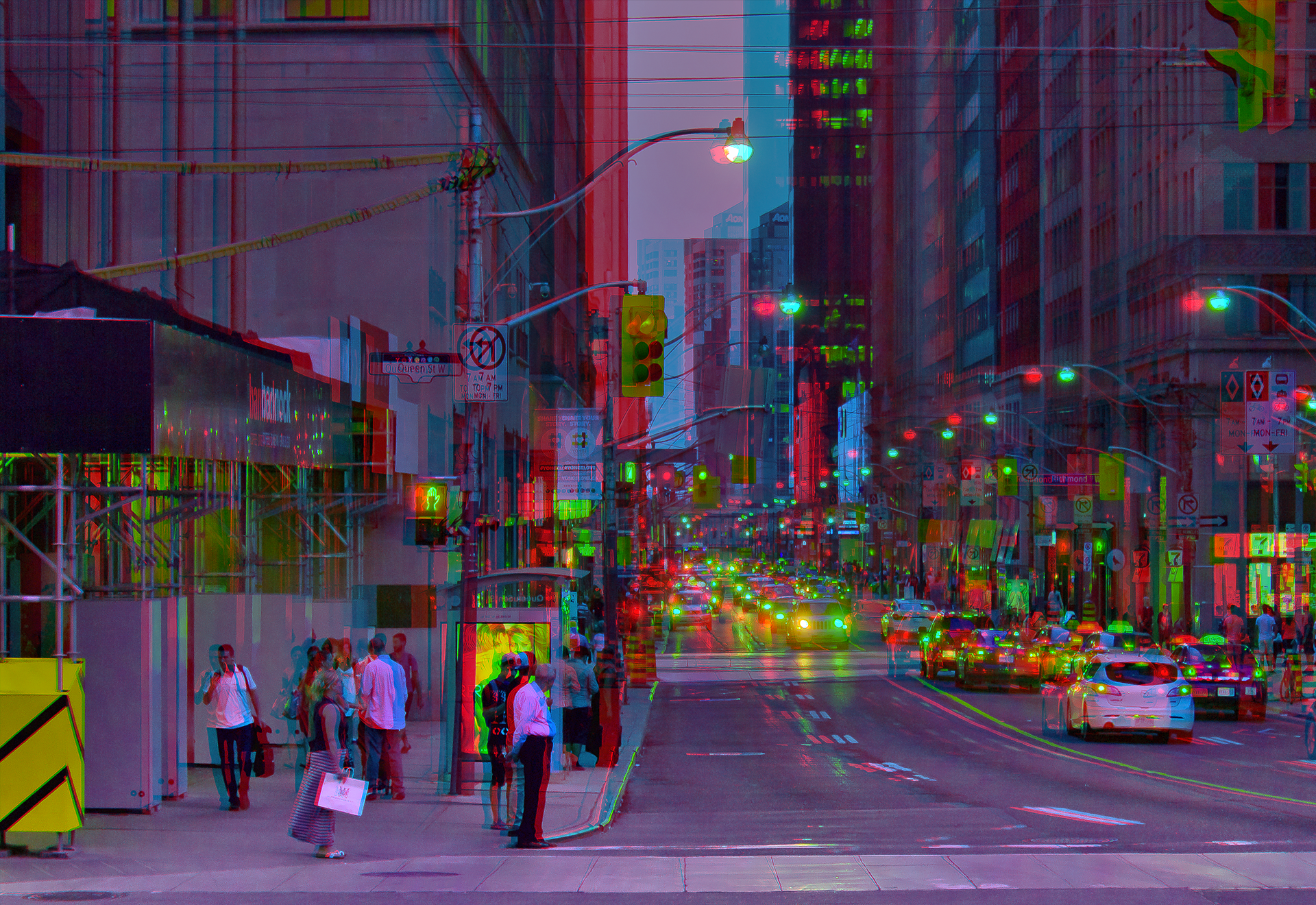
You will need red/cyan colored shades to see the stereoscopic effect. Get your 3D glasses for free!
The Nikon FE2 is a significant upgrade to its predecessor, the Nikon FE. The FE2 came out in 1983, about five years after the release of the FE in 1978. Like the FM2N, the design of the FE2 was highly refined over two generations and various other upgrades. The FE2 is a great travel camera for film. It is relatively small and light, compared with both large fully-automated film SLR cameras and large full-frame FX or even crop sensor DX digital SLR cameras. However, the quality of the images it can produce are the same or better than those of a full-frame digital camera, especially when the film is scanned with a commercial-grade scanner. You can fit the camera with two or three small prime lenses and an electronic flash in a regular size fanny pack. The FE2 has most of the advantages of the FE and then some. The main improvements in the FE2 over the FE, which will be discussed in more detail below, are (1) TTL flash metering capability, (2) maximum shutter speed increased from 1/1000 sec. to 1/4000 sec., (3) 1/3 stop exposure compensation instead of only 1/2 stop, (3) brighter viewfinder than the FE, with improved focusing screens, and (4) flash synch speed and mechanical shutter speed both increased to 1/250 sec. from 1/90 sec. for mechanical shutter speed and 1/125 sec. maximum flash synch speed on the FE.
I became a constant user of the original FE soon after it came out in 1978 as a backup body to my pro-level Nikon F2 Photomic AS. Then, for a long time, I variously used an F3HP, F4 and F90X together with an FM2N for a second body. Of course, after that, digital SLRs started to take off and film became obsolete for most applications. However, for travel, especially in the modern age of restrictions on flight check-in and carry-on baggage, I like to keep my travel camera system as small as possible but still keep maximum image quality. The fully mechanical FM2N itself is almost the perfect travel camera. However, may people like to use flash with film lots of in addition to shooting landscapes and street images, may shooters like to take pictures of my friends and family, sometimes inside a building or at night. So the ability of the FE2 to support TTL flash is a big advantage over the FE or FM2N.
The FE2 was in production from 1983 to 1987, concurrent actually with the experimental and more high-tech FA. Finally, in 1988, both the FE2 and FA were replaced with the new style F801 (N8008), which had the metering system of the FA plus autofocus and built-in auto-wind. There was actually one additional major upgrade to the FM2N/FE3, and that is the FM3A, which was released much later (2001-2006; 1991). The FM3A is the most advanced of the FM/FE Series, with a hybrid mechanical/electronic shutter, an FE2 style metering indicator, and all of the other features of the FE2.
The FE2 was available in silver chrome and black paint. I have the black paint version, and the finish still looks great today, with only a bit of very minor wear and tear. When I compare the black finishes on the FE and FE2, the finish on the FE's black metal plates and dials is significantly more matte than the relatively shiny finish on the FE2. Comparing side by side, the matte finish on the older FE is definitely cooler. I have not looked closely at a chrome FE and FE2, but I have read that the chrome FE's finish is also slightly nicer than the chrome finish on the FE2. Anyway, the black FE2 also looks great. Although my FE2 has been to the shop a few times for regular maintenance, it has thankfully never had any breakdown. Some might argue that the all mechanical FM series is more repairable than an electronic camera like the FE2 over a multi-decade lifespan, and that may be true. But the FE2 is relatively simple compared with later advanced electronic cameras, so I am hopeful that my favorite camera technician will be able to keep my FE2 running for a long time to come.
All FM/FE-style bodies work great today with a wide variety of old and modern Nikon F mount lenses. Some people prefer the FE over the FE2 due to its ability to shoot more images per roll, slightly more convenient battery check, and most importantly, ability to mount pre-Ai lenses with the camera’s retractable meter coupling lever.
Unlike the single large 6 volt battery in the older Nikon EL-2, the FE and FE2 alike take either a 3V lithium battery, two 1.55V silver oxide batteries, or two 1.5V alkalines. This was standard for Nikon bodies of that era. I usually prefer to just go with a single 3V lithium to enjoy the long shelf life, but of course the other two types work fine too. Even though the small batteries control both the light meter and electronic shutter (but obviously not film advance or any autofocus), they still seem to last forever. I really liked the battery check lever on the back left of the FE, which is missing on the FE2. On the FE, you just need to push the lever down with your left thumb, and if the batteries are good, the red diode will light; no need to look through the viewfinder to check the batteries. On the FE2; you have to check battery power by movement of the viewfinder needle instead.
The FM/FE series is built with a copper-aluminum-silicon (copper-silumin) alloy body. I find the size and weight of the FE2 to be perfect, especially with wide-angle through medium telephoto Nikkor manual focus prime lenses. The body size is not too big or too small. Its size is large enough to hold securely, but still smaller than full size professional bodies like the F2AS or F3HP. It is not as small as the (mechanical) Contax S2, Pentax MX, or even the Olympus OM-3, which are considered small compact bodies and sometimes feel a bit too small to get a good grip. The FE2 weighs in at only 550g, without lens, even less than the FE's 590g. Of course, the weight of the batteries is insignificant, compared with the multiple AA batteries or other larger batteries in future electronic bodies. You can actually hang the FE2 with a small lens around your neck or shoulder and almost not notice the weight. The FE2 fits great into a dedicated case, or a spongy snug-fit case, or a small camera bag with a few lenses.
The FE2 body, like all cameras in the FM/FE series, feels a bit light and even insubstantial when held without a lens attached (The FE2 weighs virtually the same as the FM2N, which is only 10g lighter at 540g). However, once a lens is attached in the wide-angle to medium telephoto size range, especially any Nikkor manual focus primes, the lens/camera combination has the perfect balance, size and weight. It has a highly luxurious and precision feel and sound when held in your hands and used, although the sound is perhaps not as pleasing as that of the FM2N. I most often use Ai-S primes from 20/2.8 to 200/4 and the system is wonderful to operate with all of those lenses. However, once you start getting into bigger and heavier lenses such as, for example, the 80-200/2.8, the camera feels a big too light and out of balance. Also, on fatter lenses, you may need to use a rubber tripod spacer ring to keep the lens rings from touching the tripod head.
Operation of the FE2 is really smooth. The shutter speed ring is large and has an easy to turn knurled grip, although it is not quite as tall as that on the FM2N. The shutter speed dial on the FE2 offers noticeably more resistance than the dial on the FE due to the more robust click stops on the FE2. But still, it is easy to grab the shutter speed dial with your thumb and forefinger when the film advance lever is pulled out to turn on the camera. For safety purposes, you need to push the central button on the shutter speed dial to turn it off of "Auto". The film advance lever motion is amazingly smooth, although the lever is single-stroke only, unlike the levers on the F, F2 and F3. But the stroke is not very big, so a quick easy stroke quickly winds to the next frame. ASA/ISO setting is set by a ring that surrounds the rewind lever. The exposure compensation setting is located on the same ring as the ASA/ISO setting, and has a range from -2 to +2 EV in one-third stop increments, an improvement over the half-stop increments on the FE. Shutter speed and ISO markings are clear and easy to read. The ISO range of the FE2 (and also the FE) is 12 - 4000, wide enough to handle virtually all situations, though slightly narrower than the FM2N, which reaches up to 6400. The small multiple-exposure lever is located under the film advance lever, out of the way but easy to turn when you need it. The shutter release button is located at just the right location near the front of the body. It takes a standard mechanical cable release. The shutter release button on the FE2 (and FM2N) is a more modern, wider design compared with the relatively narrower release on the FE. The shutter release button on the older FE seems to have a slightly shorter travel than the FE2 and FM2N, and therefore feels slightly more instantaneous. Anyway, the shutter release on the FE2 works well with just the right amount of resistance to allow you to half press for an exposure reading, with just a short continued push to achieve an immediate shutter release. The electronic shutter on the FE2 has about the same loudness as the mechanical shutter on the FM2N, but the character of the sound is different. My FE2 has a honeycomb titanium shutter. Apparently, on later serial numbers, the FE2's shutter was changed to an even more improved aluminum design. The film counter is just in front of release crank and is easy to read.
One of the biggest advantages of the Nikon film SLR lens mount (the "F mount") is that it is the only SLR camera mount that has stayed virtually the same from the time of the first Nikon F and Nikkormat FS/FT through to the most current small and full frame Nikon digital SLRs. Except for the requirement that relatively newer Nikon film SLRs require Ai or Ai-converted lenses, all manual focus Nikon F mount lenses can be used on autofocus bodies, and most full-frame auto-focus Nikon F mount lenses can be used on all old manual focus bodies. I don't know of any other manufacturer that can make such a claim. Thus, it is convenient to use the FE2 together with a modern Nikon autofocus film or digital SLR because you can often use the same lenses on both bodies.
The FE and FM were the last bodies in that line to directly accept unmodified pre-Ai lenses because they included a retractable meter coupling lever. Of course, with pre-Ai lenses, you still need to use stop-down exposure metering. There are many excellent pre-Ai lenses available on the used market, and to use any such lenses that have not been converted to Ai, the FE and FM cameras would be a better choice than the FE2 or FM2n. Alternatively, you can probably still get an independent camera technician to convert any pre-Ai lens to Ai using scavenged parts, although Nikon itself presumably long ago stopped providing such service.
Loading Nikkor lenses onto any FM/FE Series body is quick and positive. Just line up the black dot on the lens with the dot on the camera body and twist the lens counter-clockwise. Of course, there is no need to line up the claw on Ai Nikkor aperture rings with an exposure meter pin on the body; this old system became obsolete after the Nikkormat FT2/EL-W generation. To remove a lens, just press the lens release button on the left front of the body and twist clockwise.
To load or unload film, twist the back opening lever counter-clockwise and pull the rewind crank upwards to open the camera back. Film loading is traditional style and almost foolproof. Like many Nikon and other cameras of this generation, you need to stick the film leader into a slot on the take-up spool and insure that the sprocket in the spool engages a film perforation. In my experience, this system is slower but more reliable than that on newer Nikon bodies where you simply lay the film leader flat next to an index line. Unlike the FE, the FE2 prevents you from accidentally loading the film with the shutter speed dial set to "A" and ending up with very long shutter activations if you try to wind to the first frame with the lens cap on. I can't count how many times I ran into this problem on my old FE. The FE2 defaults to M250 until the first official frame is reached. The slight downside is that you are unable to squeeze a few extra exposures off the beginning of the role (unless you use 1/250 sec. and Sunny 16 or an external exposure meter!).
The focusing screens of the FM/FE Series were improved and brightened with the release of the FM2/FE2. The original screens on the FE are about 1 stop dimmer than the later second generation. (Note: first and generation screens are interchangeable with exposure compensation). A slight disadvantage of the FM/FE series viewfinders is that, unlike the 100% frame coverage of a pro-level Nikon F series camera, the FE2's frame coverage is only 93%. This is not unusual in a pro-sumer level camera, but you need to be aware that objects that are outside the field of view in the viewfinder will be captured on your film. The viewfinder contains all of the information that you need for convenient camera setting. There is an aperture direct readout (ADR) at the center top of the viewfinder, same as on all FM/FE series cameras. The exposure meter uses a match needle system on the left side of the viewfinder. I actually prefer the three red light emitting diode system of the FM series, which is easier to see in all light conditions. However, the match needle system on the FE2, like the FE, is perfectly fine and is just as easy to see in most normal lighting conditions. The viewfinder of the FE2 is exactly the same as the FE, except that the shutter speed display range has been expanded beyond 1/1000 sec. to 1/4000 sec. Also, the FE2 adds a red LED on the right side of the viewfinder that lights up then exposure compensation is set to other than "0". This fixes a problem on the FE, where you could easily set exposure compensation then forget to turn it off, since there is no indication in the viewfinder that it is still on.
I often use both Manual exposure measurement and Aperture Priority exposure measurement on this camera, depending on the situation. In Manual metering, you simply adjust the shutter speed and aperture until the green and black needles line up. The black needle indicates the recommended shutter speed for the given aperture, and the green needle indicates the set shutter speed. In Auto metering (Aperture priority) you set the shutter speed dial to Auto which causes the green needle to lock on "A" in the viewfinder. The camera automatically selects the appropriate shutter speed, and the black needle indicates that speed in the viewfinder. While the match needle system is nice and clear in bright light, it is almost impossible to see the display to adjust exposure in dark environments. On the other hand, an advantage of the match needle system is that you receive direct visual confirmation of a wider range of exposure divergence, compared with the LED system.
The FE2, like the FE, FM2 and FM2n exposure meters uses a pair of silicon photodiodes (SPDs) for exposure measurement. This was the latest generation of exposure meter technology, after Cadmium Sulfide (CdS) technology in the Nikkormat FT (1965) through the FT3 (1977) and gallium-arsenide-phosphide photodiodes in the FM (1977). Silicon photodiodes provide quick response and stability, and apparently lower manufacturing cost for Nikon, compared with the prior generation. Exposure measurement range of the FE2 is the same as all FM/FE series cameras, i.e., EV 1 to EV 18 at ASA/ISO 100 and with a 50mm f/1.4 lens. This supports an aperture/shutter speed range of 1 sec. at f/1.4 through 1/1000 sec. at f/16. That range is pretty good for most situations, and a step up from the Nikkormat FT - FT3's range of EV 3 - EV 17. The FE2 is exactly on par with the Nikon F3HP. However, it is not as sensitive as the EV -2 to EV +17 range on the F2 Photomic AS, or the EV 0 to EV 21 range of the later Nikon F4.
Exposure lock is one thing that is slightly inconvenient on the FE/FE2. I sometimes find it easier, even on these cameras with aperture priority mode, to just use manual exposure mode and set the exposure directly. I find it quicker and more comfortable than pointing the camera to where you can measure the proper exposure, pushing the exposure lock button an holding the button in while recomposing and shooting. However, exposure lock on the FE2 is certainly usable. On the older FE, while locking exposure locks the shutter speed at the time the lock button is pressed, the black shutter speed needle in the viewfinder continues to move. This situation was fixed in the FE2, where the black shutter speed needle locks in place when the exposure lock is pressed. By the way, I am more apt to use Aperture priority exposure measurement and exposure lock with electronic Contax SLRs, which allow you to turn on the exposure lock by turning a switch after you achieve the proper exposure setting, and it stays on at a fixed EV until you turn it off. In other words, in the Contax world, after locking the exposure, changes in aperture affect the shutter speed and vice versa in order to keep correct exposure. The Nikon exposure lock only locks the shutter speed, so any changes to the aperture after the shutter speed is locked will change the exposure.
The center of the viewfinder display, with the standard K-Type focusing screen, contains a small central horizontal split image, surrounded by a microprism donut, which is further surrounded by a large matte donut and a 12mm diameter circle. But utilizing both the split-image and microprism collar, you can manually focus on almost any subject very quickly. Turn the camera at a slight angle when focusing if necessary to find a straight line. I can't resist pointing out that with well-maintained manual focus Nikkor primes, such as Ai-S lenses, focusing ring operation is buttery smooth, with just the right amount of viscous resistance. With the no-slip knurled focusing rings on the Ai-S lenses, focusing is quick and accurate. The FE2 provides three different interchangeable focusing screen types for various applications. I never needed to use any except the standard K2-Type screen. The B2 type screen removes the split image and microprism focusing aids, while the E2 type is the same as the B2, except with horizontal and vertical etched lines. As indicated previously, FM/FE series focusing screens were improved (from the "K" series to the "K2" series) to provide a brighter viewfinder image starting with the FM2/FE2 generation. Focusing screens on the FM3A were further improved so that their split-image rangefinders don’t go dark with lenses that have maximum aperture of f/5.6 or less.
The outer circle in the viewfinder encloses the central area that carries a 60% exposure meter weight, with the area outside the circle comprising the remaining 40%. The most important thing to know about an exposure measurement system is how it weights various areas of the viewfinder image so that you can determine how to use it in each situation. The 60/40 system works fine for most situations. It is vast improvement over the classic full-frame averaging system, which was used on a Pentax Spotmatic models, the earliest Nikkormat FT, and other cameras. For these averaging systems, if you wanted a proper exposure, you could not include a bright light or big sky in any area of the frame. Still, with the 60/40 system, you need to determine where to point the camera when manually setting the exposure. Find an areas that is representative of the subject, but which is not overly influenced by a bright light, a bright sky, a dark background, etc. Also make sure to select an area that approximates 18% gray, such as a dense area of green trees in a landscape image. If you cannot find an area that is equivalent to 18% gray that fills the 12mm circle, for example, inside the Haleakala volcano crater on Maui, HI, or a bright snowscape, then you need to compensate the exposure by appropriately changing the aperture or shutter speed in Manual mode, or by changing the exposure compensation dial in Auto mode.
Two contemporaneous Nikon bodies with the FE/FE2, the F3HP and the FA, had different exposure metering patterns. The F3HP, with its 80/20 heavy centerweight, makes it easier to find an area that is 18% gray, without surrounding high-contrast areas influencing the exposure reading too much. The FA is the first Nikon body to include, in addition to 60/40 centerweight, a multi-segment metering pattern (called AMP or "Automatic Multi-Pattern" in the FA; in later Nikon bodies, this metering pattern is referred to as "Matrix Metering"). The 5-segment pattern on the FA and its first generation software were the first Nikon attempt to correct the weaknesses of the traditional center-weight averaging system. While early multi-pattern systems on cameras such as the FA, F4, F800 and F90/F90x did a pretty good and steadily improving job in most normal situations, in difficult situations, they still didn't work as well as the center weight system with appropriate exposure compensation, as is utilized on the FE2. Of course, you have to know what you are doing in such situations! Newer film cameras, such as the F5 and F6, as well as advanced digital Nikons, with their advanced color matrix systems, finally do a good job even in difficult lighting situations. Modern Nikon bodies generally use a 75/25 weight in their center-weight metering modes.
The FE2 incorporates a vertical-travel, metal focal plane shutter with honeycomb titanium or aluminum curtains. Shutter speed range on the FE2 is an expanded 8 sec. through 1/4000 sec, which is acceptable even today. This is a big improvement over the shutter on the original FE, which maxed out at 1/1000 sec. On the slow end, the longest 8 sec. shutter speed (same as the FE) is a convenience to those of us who were previously used to using a shutter release cable for any exposure longer than a second. One advantage of the FE2's electronic shutter over the FM2n's mechanical shutter is that when in Auto (Aperture Priority) mode, the FE2 can select any intermediate shutter speed. In manual mode, you can only select the standard shutter speeds that are indicated on the shutter speed dial. The FE2 has one mechanical shutter speed, 1/250 sec., which is a separate selection on the shutter speed dial. The single mechanical shutter speed on the earlier FE is 1/90 sec. Users might argue whether it is better to have a backup speed of 1/90 sec. for available light, or 1/250 sec. for bright daylight. In any event, given the FE2's great reliability and long battery life, I have never had a need to use the 1/250 sec. mechanical shutter speed.
There are just a few more features that I want to mention. On the right front side of the body are located a depth-of-field preview lever and a self timer lever. Like many other cameras, you can check actual depth of field at the set aperture by pressing the depth-of-field lever. The image darkens if the lens is not set for maximum aperture, but you can get a good idea of the expected DOF with your lens/aperture combination. Actually, this lever is not really required with manual focus Nikkor lenses, because such lenses include an easy to read DOF index on the lens barrel. Many AF Nikkor lenses also have DOF index marks. The FE2 bodies have a mechanical self-timer with a delay of up to approximately 10 seconds. While these cameras do not have a mirror lock-up switch per se, you can simulate MLU by using the self-timer lever. When the shutter release button is pressed after the self-timer is set, the mirror swings up at the start of the timer count.
Finally, a hot-shoe contact is installed on top of the prism housing for flash photography. As already mentioned, the FE2 supports automatic TTL flash control with a four-contact hot shoe. The older FE only had a two-contact hot shoe for manual and non-TTL auto flash exposure. The FE2's maximum flash synch speed is 1/250 sec. This capability is still basically current today, significantly better than 1/125 sec. on the FE, and an improvement over all prior Nikon bodies except the FM2. On both the FE and FE2, one of the flash contacts communicates the flash charging status to the camera and lights a red diode "ready light" in the viewfinder when the flash is ready to shoot. Of course, the FE2 works with any Nikon flash unit. I use my SB-24 and SB-26 and they work great. If you will be doing a lot of flash photography, the FE2, along with the FA and FM3A, with TTL flash support, are better choices than the FE and prior Nikon bodies.
In addition to the vast selection of Nikkor and third-party lenses that are available for the Nikon F mount, the FE2 also accepts various other useful Nikon accessories. One of the most useful is the MD-12 motor drive (and also the earlier MD-11). This motor drive unit works on all FM/FE series bodies (and even the Nikon FA) and allows rapid fire or remote shooting up to 3.2 frames per second. However, the MD-12 is quite heavy, especially when loaded with the eight required AA batteries. These days, it would obviously be better to use a more modern camera is you want portable and higher-speed motor drive. Other useful optional accessories (which work with all FM and FE series bodies) are the MF-16 data back, the DB-2 Anti-Cold Battery Pack, the DR-3 and DG-2 viewfinder eyepieces, and various eyepiece correction lenses.
Copyright © 2013 - 2016 Timothy A. Rogers. All rights reserved.
(DSC_6194fin2)
This evening in my computer room I discovered a wasp chewing one of my plastic frozen dinner bowl flash diffusers. I had noticed a few wasps buzzing around my basement over the last week or so, would catch them, then release them outside. The computer room door is left open and any flying insect will eventually find its way in there. The wasp was busily chewing away on the bowl, with the chewed area appearing as a rough spot below its closest foot. Shreds of plastic can be seen clinging to its mandibles. It didn't appear to be in a hurry so I decided to use this opportunity to try a macro test with an old enlarger lens by reverse mounting it on the front of my old Nikon AI-S 105mm f/2.5 lens.
I had fitted an empty 52mm filter ring onto an old Leica snap-on lens shade (UFOO-1956) that fits a 9cm Elmar and 13.5cm Hektor lens. This allows it to be mounted backwards onto any lens I have that takes a 52mm filter. Three old enlarger lenses in my inventory are quite small and have a raised aperture ring configuration that allows them to be fitted (reversed) into the end of the shade that has the push-button operated retractible "lugs" used to mount the shade onto the front of a Leica lens. These lugs bear against the sloped surface of the aperture ring, gripping it firmly. The particular enlarger lens used for reversing was an old "Laminex" 90mm f/4.5 that was in a box of optical "junk" someone gave me. The Nikon AI-S 105mm f/2.5 was set at it's closest focusing distance... 3.5 feet. The aperture was set at f/16. I very briefly considered taking a number of photos for "stacking", but this shot looked so good on playback that I decided not to. An attempt at a "rapid fire" shooting sequence for stacking a few years ago blew the flash in this camera so I use it with a small Nikon speedlight (SB-23). Because of the D40 "hybrid" shutter, it synchs up to the top speed of the camera... 1/4000 sec.
Using another frozen dinner bowl diffuser, I was able to pop off a series of shots without disturbing the wasp. The only reaction to the multiple flashes, and repositioning of the bowl it was busy with, was a short pause (seen here), and a brief waving of the antennae. Then... it was back to more chewing. I have no idea why it was engaged in this unusual activity. They'll chew wood to make pulp for nest construction... but plastic??? The dinner bowl diffuser it was chewing on is several years old, so no food residue can possibly be present. Besides, it was physically chewing, scoring, shredding the material... not feeding on anything.
After a 20 minute shooting session I CAREFULLY and SLOWLY carried the diffuser, with the wasp along for the ride, upstairs, out onto the back porch, and sent it on its way back to wherever it came from.
DSC-2540

You will need red/cyan colored shades to see the stereoscopic effect. Get your 3D glasses for free!

Something weird happened with this shot ... ;-) but I also quite like it .. :-)
Lesson No:5 get good synch with the flash and turn off the pre-flash? Hey ho ... this is still great fun to do and I'm enjoying it .... I can see some potential in this shot, just trying to be different ... Oh well must try again .... Strawberries and cream coming soon .... ;-)
Thanks for looking .. Steve
The Iron Wolf with his Mech
Those do-gooders over at Cooperworks in Detroit need some real opposition! BMW have pulled their fingers out with this Panzer Mech.
Armed with dual synched batteries of armour piercing and inferno round loaded .50 cals this Mech is ready for anything.
Moc has articulated legs moving front tracks and a swivel head for playability.
------------------
For the Weird Wars contest over at Brickarms.
Brickarms used
" crate lids for the roof of the mechs head
1 crate for the front viewing window on head
12 .50 cal barrels
2 tripod legs as braces
1 OM Kar98 supply attached to side.
6 x uclips on legs to attach armour plates
1 brickarms bayonet "antenna"
Brickarms extended family pieces
Brickmania Track links on feet
2 x catspaw customs hex plates on back of legs.

You will need red/cyan colored shades to see the stereoscopic effect. Get your 3D glasses for free!
The Sheraton Grand Hotel & Spa, a five star hotel opened in 1985
The Bell Tower
The Bell Tower sits in Festival Square on Lothian Road, Edinburgh in front of the Sheraton Hotel.
The tower has chiming bells and a clock with a face on each side and was presented to the City of Edinburgh in 1962 by the whisky distillers Arthur Bell & Sons Ltd.
It used to be sited on the opposite side of the street in front of the Usher Hall but as the chimes disrupted concerts (the large hourly bell and four quarter-hour chimes could be clearly heard over the music ) and a mechanical fault caused them to fall out of synch with the clock-faces so it had to be silenced in 2002.
Then in 2010 it was moved to its current position and the chimes restored. A new mechanism allows the chimes to be temporarily disconnected on demand, and improved soundproofing inside the Usher Hall means problem solved.
Plaque on the tower reads "The Bell Tower presented to the City of Edinburgh by Arthur Bell & Sons Ltd., Scotch Whisky Distillers, Perth 1962."
The clock is made by James Ritchie & Son, Edinburgh. The Bell Clock Tower was designed by T.W. Alexander of West Linton and built by Stuart McLashen & Co, of Canonmills.