View allAll Photos Tagged synched
Rest in peace Pope Francis
Prompt
In the unmistakable style of Luis Royo, a metallic silverpoint pencil sketch portrays a religious figure, resembling the Pope, walking through a vibrant green field towards a giant hand reaching down from a dramatic, cloudy sky | spiritual, hopeful, divine | realistic painting, dramatic lighting::1.3 | golden hour lighting, volumetric clouds, detailed textures, hyperrealistic, 8k resolution | --ar 2:3 --v 6.0 --q 2 --s 75 --c 30 . The wedding of intricate details, side-angle view, fusion of watercolor hues blending into a faded grey background, lustrous light tracing over her synched muscles, assassin's grace. Keywords: Mort
Jacob McGrath from Dream State Circus gave participants in the L I G H T P L A Y workshop a once in a decade opportunity to photograph high octane fire-juggling and fire-twirling using slow synch flash. His show was just amazing and it left everyone absolutely awed! Check out Dream State Circus at: www.dreamstatecircus.com/
Strobist: Yongnuo yn600ex-rt ii (ETTL and HSS) in Cactus CB-60 24" softbox, camera right. 32" silver reflector camera left.
Yongnuo YN-E3-RT trigger
Canon EOS Rebel T5i - Canon EF 50mm f/1.8 STM
ISO 100 - f/1.8 - 1/1000s
An A-B-B-A set of F's consisting of the 68C-68B-89B-70C have just made their pickup at Kingsford and are back on their train and will soon head for Crivitz. Train schedules are out of synch once again which has put this train here in the late afternoon rather than the usual mid-morning appearance.
Put some people together for a while in a (literal of metaphorical) jungle, and soon enough they'll start acting the same way, mimicking one another...
The question here upon observing this image is... Were they just feeling hot? Shy? Tired?
What do YOU think?
Subway car
E Line.
New York City.
Taken with an iPhone 4 using Hipstamatic app, processed with CameraBag app and Picnik.com
The Royal Jordanian Falcons letting go of the gas to fall back towards the ground. They know how to synchronize in a very eye-pleasing manner.
On Explore 2013-07-19, highest at #3

You will need red/cyan colored shades to see the stereoscopic effect. Get your 3D glasses for free!

You will need red/cyan colored shades to see the stereoscopic effect. Get your 3D glasses for free!

You will need red/cyan colored shades to see the stereoscopic effect. Get your 3D glasses for free!

You will need red/cyan colored shades to see the stereoscopic effect. Get your 3D glasses for free!

You will need red/cyan colored shades to see the stereoscopic effect. Get your 3D glasses for free!
First of the season along the upper trail, Riverfront Park, Meridian Township, Michigan
Shot with single off-camera flash (Leica SF60/Leica SF C1 trigger), modified with rectangular diffuser, placed to left and slightly below subject, high-speed synch, TTL metering.

You will need red/cyan colored shades to see the stereoscopic effect. Get your 3D glasses for free!
I used the Fuji app, remote setting to frame this photo with my smartphone - LG Stylo4 - synched with my Fuji X-Pro2. I placed my camera on the table, framed the shot, nudging the camera while pretending to text. Interesting technique. Acros film simulation in LR CC and some slight cropping.
Model: Shane McBright Villa Real
Strobist info:
3 Genesis G-400 on a 5 foot softbox on both sides and 3 foot smaller softbox way up front synched w/ pocket wizard

You will need red/cyan colored shades to see the stereoscopic effect. Get your 3D glasses for free!
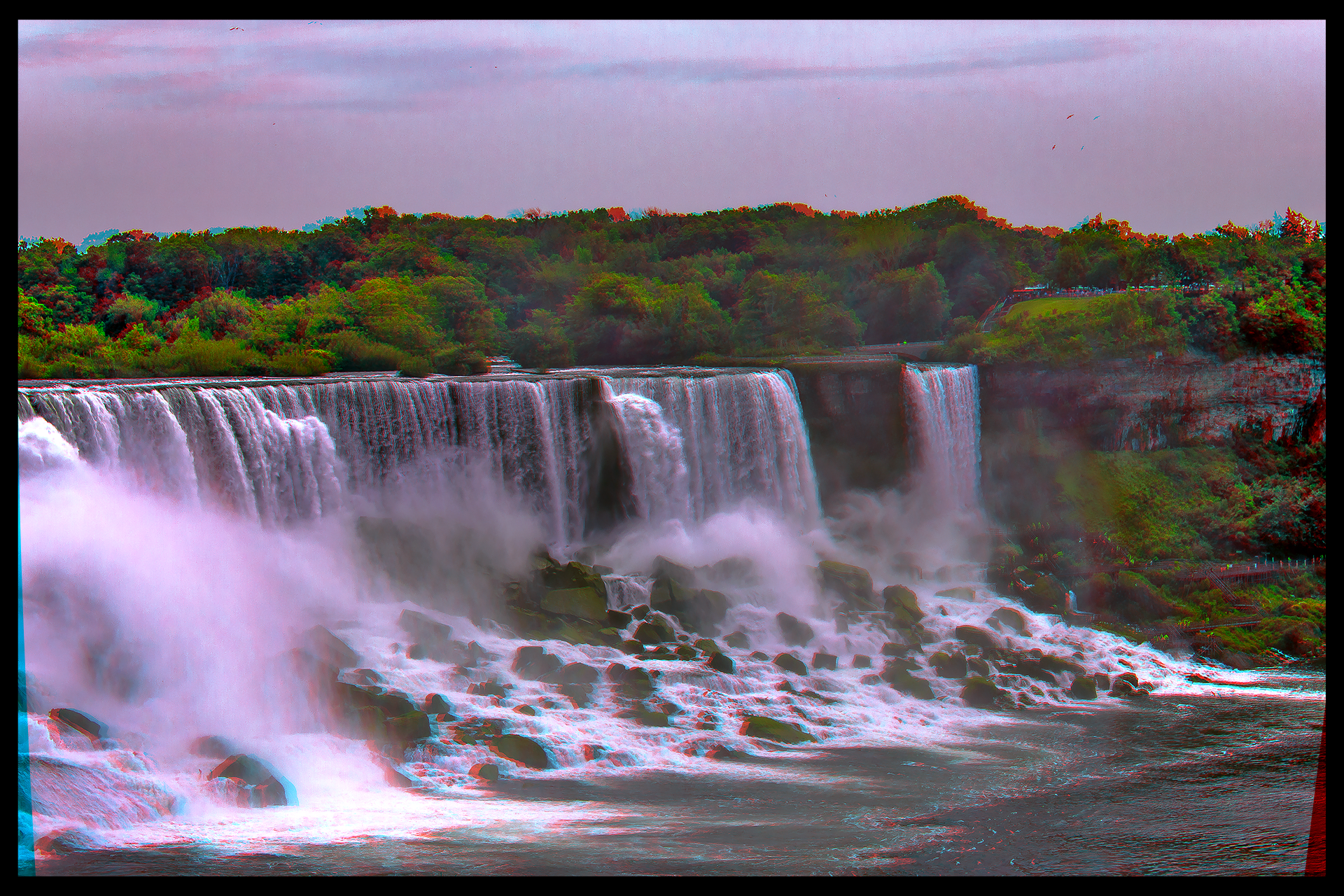
You will need red/cyan colored shades to see the stereoscopic effect. Get your 3D glasses for free!
→ Watch F U L L S I Z E @ 1920x1340 resolution ... ←

You will need red/cyan colored shades to see the stereoscopic effect. Get your 3D glasses for free!

You will need red/cyan colored shades to see the stereoscopic effect. Get your 3D glasses for free!
This image was taken during my trip to the beautiful island of Maui. It was the first Hawaiian island I've visited, and it holds a very special place in my heart. During the wee hours of the morning, I drove out to Secret Beach. It's a more quiet and intimate spot, which was pretty much paradise within paradise for me. The ocean's power could be felt just listening to the waves, inhaling and exhaling as a living entity. It quickly turned into a meditative experience for me, and I found myself synching my breathing with the waves. As within, so without...
My neighbor's crabapple is not in synch with the seasons. On the plus side, the blossoms have provided me two seasons of photo ops
I like to dream yes,
right between my sound machine
on a cloud of sound
I drift in the night
any place it goes is right
goes far, flies near,
to the stars away from here ...
Steppenwolf performing live (lip synching :)
on the Smothers Brothers show - 1969
On this night after a little trial and error I stuck to 2sec exposures. I began each exposure with the scene in focus, and began the exposure as a fireworks was launched, and then turned the focus ring during the exposure. Even then I came back with a lot of misses, where the transition from focus to blur was not in synch with the pacing of the fireworks. But because fireworks most often are fired in sets, the focus blur - when you’re lucky - is timed nicely with some of them; and the combination of focus blurred fireworks and sharper ones is a nice mix. Which is what I like about the exposure above.
Thanks to Russ Scheid / Karma Groovy who sent out the article, Photographer Beautifully ‘Breaks the Rules’ With Abstract Fireworks Photos by Kate Garibaldi on PetaPixel where you can see some of the large variety of possible results from using this technique from more experienced hands. Poets Beach, Portland, Oregon OM26039

The Hockey hall of Fame Exterior Sculptures
You will need red/cyan colored shades to see the stereoscopic effect. Get your 3D glasses for free!
(With Ai-S Nikkor 50mm f/1.4 and 24mm f/2.8)
The Nikon FE is an upgrade to the earlier generation Nikon EL-2 in the same way that the FM was an upgrade from the earlier generation Nikkormat/Nikomat FT-3. For both upgrades, the change, from the point of view of the user, is more in external design rather than camera features. The biggest change was the move from the large compact form factor Nikkormat design to the medium compact FM/FE design. In terms of actual features, both new cameras are very similar to their predecessors. Like the FM2N, the design of the FE2 was highly refined over two generations and several other upgrades. Thus, the original FE was Nikon's first effort at an electronic camera in the new medium compact form factor.
Actually, I became a constant user of the original FE soon after it came out in 1978 as a backup body to my pro-level Nikon F2 Photomic AS. Back in the days of the Nikon F and Nikon F2, the pro-level cameras were all-mechanical designs. When electronic shutter SLRs started to come to the market, many photographers, including myself, were not ready to give up our super reliable all-mechanical cameras for the newfangled electronic shutter bodies. However, the FE, being much smaller and lighter than the F2AS, was the perfect size and weight as a second body. How strange to think today that the mechanical body would be the main one, and the electronic camera would be the backup! Anyway, even though the FE was supposed to be a backup, I used it often over the F2AS due to its Auto Exposure convenience, as well as smaller size and weight. Back then, we never dreamed of still-undeveloped future advances such as TTL auto flash control, other exposure modes, and other exposure metering methods. We just knew that the FE had all of the manual control features of the F2AS with the added benefit of Aperture Priority exposure metering for use in hurried situations.
The FE was in production from 1978 to 1983, when it was replaced by the upgraded FE2. The FE2 was a much modernized version of the FE and remained in production until 1987. There was actually one additional major upgrade after the FE2, which was the FM3A (2001-2006). The FM3A is the most advanced of the FM/FE Series, with a hybrid mechanical/electronic shutter, an FE2-style exposure meter display, and all of the other features of the FE2. One other sibling of the FE that I have not yet mentioned is the FA, which coexisted during the same product life as the FE2. The FA had much more advanced exposure measurement and metering modes than the FE/FE2 and even the FM3A. Both the FE2 and FA were replaced by the F801 in 1988 after Nikon and the industry moved to auto focus and built-in power winders for most of their electronic cameras.
The FE was available in silver chrome and black paint. I have the black paint version, and the finish still looks great today in 2013, with only a bit of very minor wear and tear. Indeed, when I compare the black finishes on the FE and FE2, the finish on the FE's black metal plates and dials is significantly more matte than the relatively shiny finish on the FE2. Comparing side by side, the matte finish on the older FE is definitely cooler. The FE has aged well. Although my FE has been into the shop a few times for minor maintenance, it has thankfully never had a major breakdown. Some might argue that all mechanical FM series is more repairable than an electronic camera like the FE over a multi-decade lifespan, and that may be true. But the FE is relatively simple compared with later advanced electronic cameras, so I am hopeful that my favorite camera technician will be able to keep my FE running for a long time to come.
If I had to choose today between the FE and FE2, I would go with the later generation FE2. However, if you came across an excellent condition FE body, it would still work great today with a wide variety of old and modern Nikon F mount lenses. In fact, some people prefer the FE over the FE2 due to its ability to shoot more images per roll, its slightly more convenient battery check, and most importantly, its ability to mount pre-Ai lenses with its retractable meter coupling lever.
Unlike the single large 6 volt battery in the prior Nikon EL-2, the FE takes either a 3V lithium battery, two 1.55V silver oxide batteries, or two 1.5V alkalines. Quite standard for Nikon bodies of that era. I usually prefer to just go with a single 3V lithium to enjoy the long shelf life, but of course the other two types work fine too. Even though the small batteries control both the light meter and electronic shutter (but obviously not film advance or any autofocus), they still seem to last forever. I really like the battery check lever on the back left of the FE. Just push the lever down with your left thumb, and if the batteries are good, the red diode will light; no need to look through the viewfinder to check the batteries. The battery check light disappeared on the FE2; you have to check battery power by movement of the viewfinder needle instead.
The FM/FE series is built with a copper-aluminum-silicon (copper-silumin) alloy body. I find the size and weight of the FE to be perfect, especially with wide-angle through medium telephoto Nikkor manual focus prime lenses. The body size is not too big or too small. Its size is large enough for the user to hold securely, but still smaller than full size professional bodies like the F2AS or F3HP. It is not as small as the (mechanical) Contax S2, Pentax MX, or even the Olympus OM-3, which are considered small compact bodies and sometimes feel a bit too small to get a good grip. The FE weighs in at only 590g without lens, and of course the weight of the batteries is insignificant, compared with the multiple AA batteries or other larger batteries in future electronic bodies. The FE fits great into a dedicated case, or a spongy snug-fit case, or a small camera bag with a few lenses. It is an excellent size for travel use.
The FE body by itself, like all those in the FM/FE Series, feels a bit light and even insubstantial when held without a lens attached (although the FE is slightly heavier than the FM2N). However, once a lens in the wide-angle to medium telephoto size range is attached, especially those AiS Nikkor manual focus primes, the lens/camera combination has the perfect balance, size and weight. It has a highly luxurious and precision feel and shutter sound when held in your hands and used, although the sound is perhaps not as pleasing as that of the FM2N. I most often use Ai-S primes from 20/2.8 to 200/4 and the system is wonderful to operate with all of those lenses. However, once you start getting into bigger and heavier lenses such as, for example, the 80-200/2.8, the camera feels a bit too light and out of balance. Also, on fatter lenses, you may need to use a rubber tripod spacer ring to keep the lens rings from touching the tripod head.
Operation of the FE is really smooth. The shutter speed ring is large and has an easy to turn knurled grip, although it is not quite as tall as that on the FM2N. The shutter speed dial on my FE turns noticeably more smoothly than the dial on my FE2. It is easy to grab with thumb and forefinger when the film advance lever is pulled out to turn on the camera. For safety purposes, you need to push the central button on the shutter speed dial to turn it off of "Auto". The film advance lever motion is amazingly smooth, although the lever is single-stroke only, unlike the levers on the F, F2 and F3. But the stroke is not very big, so a quick easy stroke quickly winds to the next frame. ASA/ISO setting is set by a ring that surrounds the rewind lever. The exposure compensation setting is located on the same ring as the ASA/ISO setting, and has a range from -2 to +2 EV in half-stop increments. Shutter speed and ISO markings are clear and easy to read. The ISO range of the FE (and also the FE2) is 12 - 4000, wide enough to handle virtually all situations, though slightly narrower than the FM2N, which reaches up to 6400. The small multiple-exposure lever is located under the film advance lever, out of the way but easy to turn when you need it. The shutter release button is located at just the right location near the front of the body. It takes a standard mechanical cable release. The shutter release button is narrower than that on the later FE2 and FM2N, but still works fine. Indeed, the shutter release button on the FE seems to have a slightly shorter travel than the FE2 and FM2N, and therefore feels slightly more instantaneous. It works well with just the right amount of resistance to allow you to half press for an exposure reading, with just a short continued push to achieve an immediate shutter release. The electronic shutter on the FE has about the same loudness as the mechanical shutter on the FM2N, but the character of the sound is different. The film counter is just in front of release crank and is easy to read.
One of the biggest advantages of the Nikon film SLR lens mount (the "F mount") is that it is the only SLR camera mount that has stayed virtually the same from the time of the first Nikon F and Nikkormat FS/FT through to the most current small and full frame Nikon digital SLRs. Except for the requirement that relatively newer Nikon film SLRs require Ai or Ai-converted lenses, all manual focus Nikon F mount lenses can be used on autofocus bodies, and most full-frame auto-focus Nikon F mount lenses can be used on all old manual focus bodies. I don't know of any other SLR manufacturer that can make such a claim. Thus, it is convenient to use the FE together with a modern Nikon autofocus film or digital SLR because you can often use the same lenses on both bodies.
The FE and FM were the last bodies in that line to directly accept unmodified pre-Ai lenses because they included a retractable meter coupling lever. Of course, with pre-Ai lenses, you still need to use stop-down exposure metering. Still there are many excellent pre-Ai lenses on the market, and to use any such lenses that have not been converted to Ai, the FE and FM cameras would be a good choice.
Loading Nikkor lenses onto any FM/FE Series is quick and positive. Just line up the black dot on the lens with the dot on the camera body and twist the lens counter-clockwise. Of course, there is no need to line up the claw on Ai Nikkor aperture rings with an exposure meter pin on the body; this old system became obsolete after the Nikkormat FT2/EL-W generation. To remove a lens, just press the lens release button on the left front of the body and twist clockwise.
To load or unload film, twist the back opening lever counter-clockwise and pull the rewind crank upwards to open the camera back. Film loading is traditional style and almost foolproof. Like many Nikon and other cameras of this generation, you need to stick the film leader into a slot on the take-up spool and insure that the sprocket in the spool engages a film perforation. In my experience, this system is slower but more reliable than that on newer Nikon bodies where you simply lay the film leader flat next to an index line. If you are careful when you load the film, you can get a few extra exposures on the film before frame 1 because the camera does not prevent you from doing so (unlike the FE2).
The focusing screens of the FM/FE Series were improved and brightened with the release of the FM2/FE2. The original screens on the FE are about 1 stop dimmer than the later second generation. (Note: first and generation screens are interchangeable with exposure compensation). A slight disadvantage of the FM/FE series viewfinder is that, unlike the 100% frame coverage of a pro-level Nikon F series camera, the FE's frame coverage is only 93%. This is not unusual in a prosumer level camera, but you need to be aware that objects that are outside the field of view will be captured on your film. The viewfinder contains all of the information that you need for convenient camera setting. There is an aperture direct readout (ADR) at the center top of the viewfinder, same as on all FM/FE series cameras. The exposure meter uses a match system on the left side of the viewfinder. I actually prefer the three red light emitting diode system of the FM series, which is easier to see in all light conditions. However, the match needle system on the FE is perfectly fine and is just as easy to see most normal lighting conditions.
I often use both Manual exposure measurement and Aperture Priority exposure measurement on this camera, depending on the situation. In Manual metering, you simply adjust the shutter speed and aperture until the green and black needles line up. The black needle indicates the recommended shutter speed for the given aperture, and the green needle indicates the set shutter speed. In Auto metering (Aperture Priority) you set the shutter speed dial to Auto which causes the green needle to lock on "A" in the viewfinder. The camera automatically selects the appropriate shutter speed, and the black needle indicates that speed in the viewfinder. While the match needle system is nice and clear in bright light, it is almost impossible to see the display to adjust exposure in dark environments. On the other hand, an advantage of the match needle system is that you receive direct visual confirmation of a wider range of exposure divergence, compared with the LED system.
The FE, like the FE2, FM2 and FM2n exposure meters uses a pair of silicon photodiodes (SPDs) for exposure measurement. This is the latest generation of exposure meter technology, after Cadmium Sulfide (CdS) technology in the Nikkormat FT (1965) through the FT3 (1977) and gallium-arsenide-phosphide photodiodes in the FM (1977). Silicon photodiodes provide quick response and stability, and apparently lower manufacturing cost for Nikon, compared with the prior generation. Exposure measurement range of the FE is the same as all FM/FE series cameras, i.e., EV 1 to EV 18 at ASA/ISO 100 and with a 50mm f/1.4 lens. This supports an aperture/shutter speed range of 1 sec. at f/1.4 through 1/1000 sec. at f/16. That range is pretty good for most situations, and a step up from the Nikkormat FT - FT3's range of EV 3 - EV 17. The FE is exactly on par with the Nikon F3HP. However, it is not as sensitive as the EV -2 to EV +17 range on the F2 Photomic AS, or the EV 0 to EV 21 range of the later Nikon F4.
Exposure lock is one thing that is slightly inconvenient on the FE/FE2. I sometimes find it easier, even on these cameras with aperture priority mode, to just use manual exposure mode and set the exposure directly. I find it quicker and more comfortable than pointing the camera to where you can measure the proper exposure, pushing the exposure lock button and holding the button in while recomposing and shooting. However, exposure lock on the FE series is certainly usable. On the FE, however, while locking the exposure locks the shutter speed at the time the lock button is pressed, the black shutter speed needle in the viewfinder continues to move. This situation was fixed in the FE2, where the black shutter speed needle locks in place when the exposure lock is pressed. By the way, I am more apt to use Aperture priority exposure measurement and exposure lock with electronic Contax SLRs, which allow you to turn on the exposure lock by turning a switch after you achieve the proper exposure setting, and it stays on at a fixed EV until you turn it off. In other words, in the Contax world, after locking the exposure, changes in aperture affect the shutter speed and vice versa in order to keep correct exposure. The Nikon exposure lock only locks the shutter speed, so any changes to the aperture after the shutter speed is locked will change the exposure.
The center of the viewfinder display, with the standard K-Type focusing screen, contains a small central horizontal split image, surrounded by a microprism collar, which is further surrounded by a large matte donut and a 12mm diameter circle. But utilizing both the split-image and microprism collar, you can manually focus on almost any subject very quickly. Turn the camera at a slight angle when focusing if necessary to find a straight line. I can't resist pointing out that with well-maintained manual focus Nikkor primes, such as Ai-S lenses, focusing ring operation is buttery smooth, with just the right amount of viscous resistance. With the no-slip knurled focusing rings on the Ai-S lenses, focusing is quick and accurate. The FE provides three different interchangeable focusing screen types for various applications. I never needed to use any except the standard K-Type screen. The B type screen removes the split image and microprism focusing aids, while the E type is the same as the B, except with horizontal and vertical etched lines. As indicated previously, FM/FE series focusing screens were improved (from the "K" series to the "K2" series) to provide a brighter viewfinder image starting with the later FM2/FE2 generation. (The FM3A screens are even further improved, and its split image focusing aid does not darken with lenses with maximum aperture of f/5.6 or less).
The outer circle in the viewfinder encloses the central area which carries a 60% exposure meter weight, with the area outside the circle comprising the remaining 40%. The most important thing to know about an exposure measurement system is how it weights various areas of the viewfinder image so that you can determine how to use it in each situation. The 60/40 system works fine for most situations. It is vast improvement over the classic full-frame averaging system, which was used on a Pentax Spotmatic models, the earliest Nikkormat FT, and other cameras. For these averaging systems, if you wanted a proper exposure, you could not include a bright light or big sky in any area of the frame. Still, with the 60/40 system, you need to determine where to point the camera when manually setting the exposure. Find an areas that is representative of the subject, but which is not overly influenced by a bright light, a bright sky, a dark background, etc. Also make sure to select an area that approximates 18% gray, such as a dense area of green trees in a landscape image. If you cannot find an area that is equivalent to 18% gray that fills the 12mm circle, for example, inside the Haleakala volcano crater on Maui, HI, or a bright snowscape, then you need to compensate the exposure by appropriately changing the aperture or shutter speed in Manual mode, or by changing the exposure compensation dial in Auto mode.
Two contemporaneous Nikon bodies with the FE/FE2, the F3HP and the FA, had different exposure metering patterns. The F3HP, with its 80/20 heavy centerweight, makes it easier to find an area that is 18% gray, without surrounding high-contrast areas influencing the exposure reading too much. The FA is the first Nikon body to include, in addition to 60/40 centerweight, a multi-segment metering pattern (called AMP or "Automatic Multi-Pattern" in the FA; in later Nikon bodies, this metering pattern is referred to as "Matrix Metering"). The 5-segment pattern on the FA and its first generation software were the first Nikon attempt to correct the weaknesses of the traditional center-weight averaging system. While early multi-pattern systems on cameras such as the FA, F4, F800 and F90/F90x did a pretty good and steadily improving job in most low contrast situations, in difficult situations, they still didn't work as well as the center weight system with appropriate exposure compensation, as is utilized on the FE. Of course, you have to know what you are doing in such situations! Nnewer cameras, such as the F5 and F6, with their advanced color matrix systems, finally do a good job even in difficult lighting situations. Modern Nikon bodies generally use a 75/25 weight as the default in their center-weight metering modes.
The FE incorporates a vertical-travel, metal focal plane shutter with aluminum curtains. Shutter speed range on the FE is a relatively limited 8 sec. through 1/1000 sec, which at the time was considered luxurious at the slow end and standard at the fast end. Usually the 1/1000 maximum shutter speed did not feel like a limitation since we were generally using fairly slow film. Still, I did need a neutral density filter on a very few occasions. On the slow end, the longer shutter speed was a convenience to those of us who were used to using a shutter release cable for any exposure longer than a second. One advantage of the FE's electronic shutter over the FM2n's mechanical shutter is that when in Auto (Aperture Priority) mode, the FE can select any intermediate shutter speed. In manual mode, you can only select the standard shutter speeds that are indicated on the shutter speed dial. The FE has one mechanical shutter speed, 1/90 sec., which is a selection on the shutter speed dial. The single mechanical shutter speed on the later FE2 is 1/250 sec. Users might argue whether it is better to have a backup speed of 1/90 sec. for available light, or 1/250 sec. for bright daylight. In any event, given the FE's great reliability and long battery life, I have never had a need to use the 1/90 sec. mechanical shutter speed.
There are just a few more features that I want to mention. On the right front side of the body are located a depth-of-field preview lever and a self timer lever. Like many other cameras, you can check actual depth of field at the set aperture by pressing the depth-of-field lever. The image darkens if the lens is not set for maximum aperture, but you can get a good idea of the expected DOF with your lens/aperture combination. Actually, this lever is not really required with manual focus Nikkor lenses, because such lenses include an easy to read DOF index on the lens barrel. Many AF Nikkor lenses also have DOF index marks. The FE bodies have a mechanical self-timer with a delay of up to approximately 8 - 14 seconds. While these cameras do not have a mirror lock-up switch per se, you can simulate MLU by using the self-timer lever. When the shutter release button is pressed after the self-timer is set, the mirror swings up at the start of the timer count.
Finally, a hot-shoe contact is installed on top of the prism housing for flash photography. The FE does not support automatic TTL flash control. You need to use an FE2, an FA or an FM3A if you want that feature. (If you know how to use guide numbers and manual flash, you can still do full-flash or fill-flash photography without any problem, of course. You can also use electronic flash devices in Auto (non-TTL) mode.) The FE has a maximum flash synch speed of 1/125 sec. This is significantly better than all prior Nikon bodies except the FM, but still not as good as the 1/250 maximum synch speed on the later FE2, FM2N, and FM3A. There is an extra contact on the hot shoe that communicates the flash charging status to the camera and lights a red diode "ready light" in the viewfinder when the flash is ready to shoot. Of course, the FE works with any Nikon flash unit. I use my SB-24 and SB-26 and they work great. However, if you will be doing a lot of flash photography, the FE2, FA or FM3A, with TTL flash support, are probably better choices.
In addition to the vast selection of Nikkor and third-party lenses that are available for the Nikon F mount, the FE also accepts various other useful Nikon accessories. One of the most useful is the MD-12 motor drive (and also the earlier MD-11). This motor drive unit works on all FM/FE series bodies (and even the Nikon FA) and allows rapid fire or remote shooting up to 3.2 frames per second. Back in the day, I used to keep it attached to the camera and carried it around much of the time. However, the MD-12 is quite heavy, especially when loaded with the eight required AA batteries. These days, it would obviously be better to use a more modern camera if you want portable and higher-speed motor drive. Other useful optional accessories (which work with all FM and FE series bodies) are the MF-16 data back, the DB-2 Anti-Cold Battery Pack, the DR-3 and DG-2 viewfinder eyepieces, and various eyepiece correction lenses.
Copyright © 2013 - 2016 Timothy A. Rogers. All rights reserved.
(DSC_6186fin2)

You will need red/cyan colored shades to see the stereoscopic effect. Get your 3D glasses for free!


You will need red/cyan colored shades to see the stereoscopic effect. Get your 3D glasses for free!

You will need red/cyan colored shades to see the stereoscopic effect. Get your 3D glasses for free!

You will need red/cyan colored shades to see the stereoscopic effect. Get your 3D glasses for free!
street performing mobile metal sculpture, synched to music and flame throwing. Berlin
adapted Kodak Cine 50mm f1.6

Look around where I took this photo!
You will need red/cyan colored shades to see the stereoscopic effect. Get your 3D glasses for free!
This couple walked from across the square where I observed them. When they approached closer, I snapped several pictures. This being my favorite. A friend commented it is very unsual for humans to extend their arm with palm up during a conversation. I did not have a basis to rebut them. On further thought, it was raining and she could be just checking how intense its coming down. Also, people read into quite a bit from how he is clearly looking at his phone seemingly not listening to her. Then notice how they are in synch as well.
we spent the weekend out near Glamis, CA, at the Imperial Sand Dunes, testing some new gear & synch speeds. All in all, I'd say we're reasonably happy. Still some kinks to work out, but we got a couple good shots & had fun ripping around in the sand.
This is a Kawi rider shredding the lip off this dune just prior to eating a faceful of sand.
It's just before noon here with the sun mostly at his back (slightly front). We needed a ton of light to compete, so we went for 2 Einsteins, both outfitted with long throw reflectors, at full power. I parked it just below the lip & let the rider rip around me in circles, kicking sand everywhere, to grab this frame. My camera is f'd now...
→ Watch F U L L S I Z E @1920x1260 resolution ... ←

Explore the area with Google Maps!
You will need red/cyan colored shades to see the stereoscopic effect. Get your 3D glasses for free!

Captain Scarlet! Dum De Dum De Du-DuDum!
Originally shown in September 1967, Captain Scarlet and the Mysterons was Gerry Anderson's follow-up to the stunningly successful Thunderbirds.
The show follows the classic Anderson theme of a group of specialists saving the earth each week, but this time the baddies were really threatening. The invisible Mysterons could take over people and objects, using them for their own ends. Whether or not Captain Scarlet and Spectrum defeated them in the final episode is never made clear...
The show was forward-thinking - not only did it feature female fighter pilots (albeit very pretty ones with big hair) but also Gerry's first black character. He had wanted to include non-Caucasian characters for a while, but selling the programmes to the American south in the 60s made it impossible. The climate had changed by 1967, and the Trinidadian Lieutenant Green and Japanese Harmony Angel were introduced.
Colonel White Gerry Anderson always felt that each of his shows should be unique, and wanted to make a more serious, lifelike adventure series. Although it was filmed in 'Supermarionation', the puppets' proportions were kept close to those of real people. Whilst they look much more realistic, it made them much more difficult to manipulate convincingly.
The dialogue for each show would be recorded in advance, and the puppets' mouths were moved using an electromagnet to produce convincing lip-synch. Two versions of sets were built - one at one third scale for the models, and full scale versions if any 'hand work' was needed.