View allAll Photos Tagged rocketengine
J-2X rocket engine testing continues at NASA's Stennis Space Center in Mississippi with the second in a series of tests conducted on Feb. 27. The 550-second, full-duration test provided critical information on the combustion stability of the engine and on its performance with the nozzle extension. Engineers also continued evaluation of the test stand's clamshell configuration, as well as calibration of the facility's cryogenic flow meters. J-2X engine testing allows engineers to collect additional data on the next-generation engine that will provide upper-stage power for the new Space Launch System (SLS) under development. NASA's new SLS rocket is being developed to enable missions farther into space than ever. The SLS Program is managed by the NASA's Marshall Space Flight Center in Huntsville, Ala. Following this series of tests on the A-2 Test Stand, Engine No. 10002 will be transferred to the site's A-1 stand to undergo gimbal (or pivot) tests for the first time. The J-2X engine is the first human-rated liquid oxygen and liquid hydrogen engine developed in the United States in four decades. It is being designed and built for NASA by Pratt & Whitney Rocketdyne of Canoga Park, Calif.
Image credit: NASA/SSC
View original image/caption:
www.nasa.gov/exploration/systems/sls/j2x/j2x_feb27_1.html
More about the J-2X Engine Development:
There's a Flickr photoset about the J-2X egnine development, if you'd like to know more: www.flickr.com/photos/28634332@N05/sets/72157625345364038/
_____________________________________________
These official NASA photographs are being made available for publication by news organizations and/or for personal use printing by the subject(s) of the photographs. The photographs may not be used in materials, advertisements, products, or promotions that in any way suggest approval or endorsement by NASA. All Images used must be credited. For information on usage rights please visit: www.nasa.gov/audience/formedia/features/MP_Photo_Guidelin...
Engineers install J-2X engine E10002 in the A-1 test stand at NASA's Stennis Space Center. The installation is in preparation for a new series of tests, where the engine will be gimbaled, or pivoted, during test firings.
Gimbal tests are an important part of the design process. When this upper stage engine is used in space, it will need to be able to move freely to steer NASA's Space Launch System, or SLS -- an advanced heavy-lift launch vehicle that will provide an entirely new national capability for human exploration beyond Earth’s orbit. This is the first full engine to be installed in the A-1 test stand in almost a decade and the first time gimbal tests will be performed since testing on the space shuttle main engines.
A series of tests was completed on the E10002 engine in the A-2 test stand prior to its installation on the A-1 test stand at Stennis. Once this series of tests is complete, the engine will be removed, and preparations will be made to begin testing the RS-25 engine on the A-1 stand in 2014. RS-25 engines from the Space shuttle inventory will power the core stage of SLS, while the J-2X engine will power the upper stage of the evolved launch vehicle. The SLS Program is managed at NASA’s Marshall Space Flight Center. The J-2X engine is being built by Pratt & Whitney Rocketdyne.
Image credit: NASA/SSC
View original image/caption:
www.nasa.gov/exploration/systems/sls/j2x/j2x_full_1.html
More about the J-2X Engine Development:
There's a Flickr photoset about the J-2X egnine development, if you'd like to know more: www.flickr.com/photos/28634332@N05/sets/72157625345364038/
_____________________________________________
These official NASA photographs are being made available for publication by news organizations and/or for personal use printing by the subject(s) of the photographs. The photographs may not be used in materials, advertisements, products, or promotions that in any way suggest approval or endorsement by NASA. All Images used must be credited. For information on usage rights please visit: www.nasa.gov/audience/formedia/features/MP_Photo_Guidelin...
NASA engineers conducted the first in a new round of tests on the next-generation J-2X rocket engine Feb. 15 at Stennis Space Center. The 35-second test continued progress in development of the engine that will provide upper-stage power for NASA's new Space Launch System, which will enable missions farther into space than ever. The SLS Program is managed at NASA's Marshall Space Flight Center in Huntsville, Ala. The new round of tests on J-2X engine number 10002 on the A-2 Test Stand at Stennis will provide critical performance data for the engine. Once the series is completed, the engine will be transferred to the A-1 Test Stand at Stennis to undergo a series of gimbal (or pivot) tests for the first time. The J-2X engine is the first human-rated liquid oxygen and liquid hydrogen engine developed in the United States in decades. It is being designed and built by NASA and partner Pratt & Whitney Rocketdyne of Canoga Park, Calif.
Image credit: NASA/SSC
View original image/caption:
www.nasa.gov/exploration/systems/sls/j2x/j2x_feb15_2.html
More about the J-2X Engine Development:
There's a Flickr photoset about the J-2X egnine development, if you'd like to know more: www.flickr.com/photos/28634332@N05/sets/72157625345364038/
_____________________________________________
These official NASA photographs are being made available for publication by news organizations and/or for personal use printing by the subject(s) of the photographs. The photographs may not be used in materials, advertisements, products, or promotions that in any way suggest approval or endorsement by NASA. All Images used must be credited. For information on usage rights please visit: www.nasa.gov/audience/formedia/features/MP_Photo_Guidelin...
NASA’s Mars Ascent Vehicle (MAV) would be the first rocket to launch from the surface of Mars, or any planet. One of the recent tests conducted for the Mars Sample Return program was a hot fire of the solid rocket motor 2 (SRM2), one of the two motors needed for the launch.
NASA's Marshall Space Flight Center is designing, building, and testing MAV along with the project’s two primary contractors, Lockheed Martin Space and Northrop Grumman.
Image credit: NASA
#NASA #MarshallSpaceFlightCenter #MSFC #Mars #MarsSampleReturn #MarsAscentVehicle #RedPlanet #NASA #SpaceExploration
More about the Mars Ascent Vehicle
J-2X rocket engine testing continues at NASA's Stennis Space Center in Mississippi with the second in a series of tests conducted on Feb. 27. The 550-second, full-duration test provided critical information on the combustion stability of the engine and on its performance with the nozzle extension. Engineers also continued evaluation of the test stand's clamshell configuration, as well as calibration of the facility's cryogenic flow meters. J-2X engine testing allows engineers to collect additional data on the next-generation engine that will provide upper-stage power for the new Space Launch System (SLS) under development. NASA's new SLS rocket is being developed to enable missions farther into space than ever. The SLS Program is managed by the NASA's Marshall Space Flight Center in Huntsville, Ala. Following this series of tests on the A-2 Test Stand, Engine No. 10002 will be transferred to the site's A-1 stand to undergo gimbal (or pivot) tests for the first time. The J-2X engine is the first human-rated liquid oxygen and liquid hydrogen engine developed in the United States in four decades. It is being designed and built for NASA by Pratt & Whitney Rocketdyne of Canoga Park, Calif.
Image credit: NASA/SSC
View original image/caption:
www.nasa.gov/exploration/systems/sls/j2x/j2x_feb27_2.html
More about the J-2X Engine Development:
There's a Flickr photoset about the J-2X egnine development, if you'd like to know more: www.flickr.com/photos/28634332@N05/sets/72157625345364038/
_____________________________________________
These official NASA photographs are being made available for publication by news organizations and/or for personal use printing by the subject(s) of the photographs. The photographs may not be used in materials, advertisements, products, or promotions that in any way suggest approval or endorsement by NASA. All Images used must be credited. For information on usage rights please visit: www.nasa.gov/audience/formedia/features/MP_Photo_Guidelin...
A critical auxiliary target for NASA’s Artemis II mission is ready for flight following testing at United Launch Alliance’s (ULA) Florida facility. Teams with the company added the target onto the in-space propulsion stage for NASA’s SLS (Space Launch System) rocket at ULA’s Delta Operations Center at Cape Canaveral Space Force Station in Florida, May 16. Following the safe separation of NASA’s Orion spacecraft from the rocket’s upper stage, the four astronauts aboard Orion will use the target affixed to the in-space stage for a proximity operations demonstration to test Orion’s piloting qualities. The recently installed target underwent illumination testing in May to ensure the target will be visible in the different lighting conditions of space.
The SLS rocket delivers propulsion in phases to send the Artemis missions to the Moon. Its ICPS (interim cryogenic propulsion stage) and its single RL10 engine fires twice during the Artemis II mission to put the Orion spacecraft and astronauts into a high-Earth orbit, where they will then check out Orion’s manual handling qualities using the ICPS and its auxiliary target before then heading to the Moon.
During the demonstration, astronauts will use the two-foot target to test navigation and other critical Orion systems to assess its ability to approach and fly alongside another large spacecraft in space before future Artemis missions that require docking capabilities.
NASA is working to land the first woman and first person of color on the Moon under Artemis. SLS is part of NASA’s backbone for deep space exploration, along with the Orion spacecraft, advanced spacesuits and rovers, the Gateway in orbit around the Moon, and commercial human landing systems. SLS is the only rocket that can send Orion, astronauts, and supplies to the Moon in a single mission.
Image credit: ULA
#NASA #NASAMarshall #sls #spacelaunchsystem #nasasls #exploration #rocket #artemis #ArtemisII #ICPS
Early (ca. 1961) Thiokol Chemical Corporation artist's concept of possibly an Apollo/Nova(?) liftoff. I can't really identify the vehicle design. Possibly a direct ascent version of...whatever it is? The appearance/design was most likely irrelevant, since what is being promoted here is Thiokol's capability to provide the motors to make it happen.
To me, the artwork is an amalgamation. Understandable - if the time period is right - with much in flux at the time:
The mobile service structure has a DoD/military look - hardened and covered; The tower/gantry looks like something for an unmanned vehicle, like Atlas, Atlas-Agena, Atlas-Centaur, etc.; The launch escape tower looks like it came off of a Mercury Redstone/Atlas; and the first stage (composed of solid rocket motors(?)) looks a lot like contemporary boosters...like say a Delta II? Actually, it even has a Russian Proton booster look...hmm. Capped off with it being a night launch from some remote & secluded launch site.
I like it...evokes a "CLASSIFIED" feeling.
Test engineers hoist the J-2X engine for installation into the A-2 Test Stand at the Stennis Space Center in Mississippi.
Image credit: NASA/SSC
View original image/caption:
www.nasa.gov/exploration/systems/sls/j2x/j2x_engine10002_...
More about the J-2X Engine Development:
There's a Flickr photoset about the J-2X egnine development, if you'd like to know more: www.flickr.com/photos/28634332@N05/sets/72157625345364038/
_____________________________________________
These official NASA photographs are being made available for publication by news organizations and/or for personal use printing by the subject(s) of the photographs. The photographs may not be used in materials, advertisements, products, or promotions that in any way suggest approval or endorsement by NASA. All Images used must be credited. For information on usage rights please visit: www.nasa.gov/audience/formedia/features/MP_Photo_Guidelin...
Retired Space Shuttle Endeavour
California Science Center
Los Angeles, California
View of the orbiter's three liquid-fueled engines
"Mission 26: The Big Endeavour:"
californiasciencecenter.org/exhibits/mission-26-the-big-e...
California Science Center:
NASA's home page for the Space Shuttle program, featuring links to history, information about each spacecraft, missions, images, etc. See:
Two J-2X engines and a power pack, developed for NASA by Pratt & Whitney Rocketdyne, sit side-by-side at John C. Stennis Space Center in Mississippi as work continues on the Space Launch System.
Engine 10001, far left, has been removed from the A-2 test stand after being hot-fire tested 21 times, for a total of 2,697 seconds. The engine is now undergoing a series of post-test inspections.
A J-2X powerpack, center, has been removed from test stand A-1 to receive additional instrumentation. So far, the powerpack has been hot-fire tested 10 times, for a total of 4,162 seconds. Once it goes back into the test stand at Stennis, the powerpack will be hot-fire tested three more times, for a total of 6,000 seconds among its 13 planned tests.
Meanwhile, assembly on the second J-2X engine, known as Engine 10002 and located to the far right, has begun in earnest, with engine completion scheduled for this November. Engine 10002 is about 15 percent complete.
The J-2X is a highly efficient and versatile advanced rocket engine with the ideal thrust and performance characteristics to power the upper stage of NASA's Space Launch System, a new heavy-lift launch vehicle capable of missions beyond low-Earth orbit. Fueled by liquid oxygen and liquid hydrogen, the J-2X builds on heritage designs but relies on nearly a half-century of NASA spaceflight experience and technological and manufacturing advances to deliver up to 294,000 pounds of thrust, powering exploration to new destinations in our solar system. The J-2X is the first new liquid oxygen and liquid hydrogen rocket engine developed in 40 years that will be rated to carry humans into space.
Credit: NASA/SSC
View NASA feature:
www.nasa.gov/exploration/systems/sls/j2x/engines_powerpac...
More about the J-2X Engine Development:
There's a Flickr photoset about the J-2X egnine development, if you'd like to know more: www.flickr.com/photos/28634332@N05/sets/72157625345364038/
_____________________________________________
These official NASA photographs are being made available for publication by news organizations and/or for personal use printing by the subject(s) of the photographs. The photographs may not be used in materials, advertisements, products, or promotions that in any way suggest approval or endorsement by NASA. All Images used must be credited. For information on usage rights please visit: www.nasa.gov/audience/formedia/features/MP_Photo_Guidelin...
Fabrication is under way on a 7,755-pound thrust frame adapter to be installed on the A-1 Test Stand at NASA's Stennis Space Center in south Mississippi. The new adapter is needed to enable testing of RS-25 rocket engines (former space shuttle main engines), which will be used to provide core-stage power for NASA's new Space Launch System. NASA has worked with contractor teams at Stennis to design and fabricate the adapter, which is scheduled to be completed and installed on the test stand by November 2013. The SLS Program is managed at NASA's Marshall Space Flight Center in Huntsville, Ala.
Image credit: NASA/SSC
Read more:
www.nasa.gov/exploration/systems/sls/multimedia/gallery/r...
More about SLS:
www.nasa.gov/exploration/systems/sls/index.html
Space Launch System Flickr photoset:
www.flickr.com/photos/28634332@N05/sets/72157627559536895/
_____________________________________________
These official NASA photographs are being made available for publication by news organizations and/or for personal use printing by
the subject(s) of the photographs. The photographs may not be used in materials, advertisements, products, or promotions that in any
way suggest approval or endorsement by NASA. All Images used must be credited. For information on usage rights please visit: www.nasa.gov/audience/formedia/features/MP_Photo_Guidelin...
This is a commissioned piece for a Lawn Mower and Snowblower Repair Shop.
Brush Pen on Bristol Board.
Painted in Photoshop.
Seen in the Rocket Garden at the Kennedy Space Center in Florida are a Juno I (vertical, centre), an Thor-Delta (right), a Saturn IB (horizontal, centre) and an F-1 engine (left).
The Juno I was a four-stage American booster rocket which launched America's first satellite, Explorer 1, in 1958. A member of the Redstone rocket family, it was derived from the Jupiter-C sounding rocket. It is commonly confused with the Juno II launch vehicle, which was derived from the PGM-19 Jupiter medium-range ballistic missile.
The Thor-Delta, also known as Delta DM-19 or just Delta was an early American expendable launch system used for 12 orbital launches in the early 1960s. A derivative of the Thor-Able, it was a member of the Thor family of rockets, and the first member of the Delta family.
The Saturn IB was a launch vehicle commissioned by NASA for the Apollo programme. It replaced the S-IV second stage of the Saturn I with the much more powerful S-IVB, able to launch a partially-fuelled Apollo Command/Service Module (CSM) or a fully-fuelled Lunar Module (LM) into low Earth orbit for early flight tests before the larger Saturn V needed for lunar flight was ready.
The F-1 is a gas-generator cycle rocket engine developed by Rocketdyne in the late 1950s and used in the Saturn V rocket in the 1960s and early 1970s. Five F-1 engines were used in the S-IC first stage of each Saturn V, which served as the main launch vehicle of the Apollo programme. The F-1 remains the most powerful single-combustion chamber liquid-propellant rocket engine ever developed.
Scanned from a negative.
Two...three(?) Rocketdyne G-38(?), S-3D(?), early H-1(?) rocket engines undergoing static firing a long long time ago, at either EAFB or (more likely) SSTF/SSFL.
They're one of these:
www.astronautix.com/l/lr79.html
Credit: A HUGE shout-out to the Astronautix website
Photo developed using that thick, high gloss celluloid/film-like paper, which seems to have been a mid/late 50's - very early 60's thing.
Great (as always) pertinent (I think) content, at both of these superlative (confirmed) websites:
heroicrelics.org/info/s-3d/s-3d-overview.html
And:
www.drewexmachina.com/2014/06/09/a-history-of-american-ro...
www.drewexmachina.com/2018/10/06/juno-v-the-birth-of-the-...
A rotating detonation rocket engine, or RDRE, is an advanced rocket engine design that could significantly change how future propulsion systems are built...and a NASA intern designed, built, and tested it.
Dalton Luedke, an aerospace engineering student at Georgia Tech, recently completed his NASA Internships with the advanced liquid propulsion team at NASA's Marshall Space Flight Center, where he led the design and testing of the sub-scale engine known as MARLEN (maturation of additive really little engines) that enabled Marshall engineers to assess how different designs impact combustor performance metrics.
In this image, Thomas Teasley, left, a liquid propulsion engineer at NASA’s Marshall Space Flight Center, and Dalton Luedke display Luedke’s subscale engine, MARLEN.
Image credit: NASA/Kendall Feist
#NASA #NASAMarshall #rocketengine #intern
Three Rocketdyne G-38, S-3D(?), early H-1(?) rocket engines undergoing test firing a long long time ago, at either EAFB or (more likely) SSTF/SSFL I believe.
They're one of these:
www.astronautix.com/l/lr79.html
Credit: A HUGE shoutout to the Astronautix website
Great (as always) pertinent (I think) content, at both of these superlative (confirmed) websites:
heroicrelics.org/info/s-3d/s-3d-overview.html
And:
www.drewexmachina.com/2014/06/09/a-history-of-american-ro...
www.drewexmachina.com/2018/10/06/juno-v-the-birth-of-the-...
Media and social media followers had an invitation to watch as NASA tested the RS-25 engine like those that will power the rocket that launches astronauts on missions to an asteroid and to Mars. The test took place on Thursday, August 13, at NASA’s Stennis Space Center in Mississippi.
Test engineers hoist the J-2X engine for installation into the A-2 Test Stand at the Stennis Space Center in Mississippi.
Image credit: NASA/SSC
View original image/caption:
www.nasa.gov/exploration/systems/sls/j2x/j2x_engine10002_...
More about the J-2X Engine Development:
There's a Flickr photoset about the J-2X egnine development, if you'd like to know more: www.flickr.com/photos/28634332@N05/sets/72157625345364038/
_____________________________________________
These official NASA photographs are being made available for publication by news organizations and/or for personal use printing by the subject(s) of the photographs. The photographs may not be used in materials, advertisements, products, or promotions that in any way suggest approval or endorsement by NASA. All Images used must be credited. For information on usage rights please visit: www.nasa.gov/audience/formedia/features/MP_Photo_Guidelin...
The Rocketdyne F-1 engine, with 1.5 million pounds of thrust, was the power plant for the first stage of the 363-foot long Saturn V launch vehicle that took the first astronauts to the Moon for six successful landing missions between 1969 and 1972 in the Project Apollo program. The first stage of the Saturn V had five F-1's for a total lift-off thrust of 7.5 million pounds. The fully-fueled Saturn V weighed 6.1 million pounds.
Lucy In The Sky With [Shock] Diamonds. This is probably what John was actually singing about.
New technology sometimes begets new effects; shock diamonds in this instance, as a result of the atmospheric interaction of the supersonic exhaust plumes of an aerospace propulsion system .
“Aerojet-General Corporation artist’s concept shows how the Apollo spacecraft’s Service Module engine will look firing during night flight. Coloration of the Service Propulsion System thrust chamber and skirt shows temperature ranging from 5000°F. at the chamber throat to 1200°F. at the skirt extension after a few seconds of engine operation. Glass filament is used in the thrust chamber area. The engine skirt is formed of titanium and columbium. Aerojet’s SPS develops in excess of 20,000 pounds of thrust, making it America’s largest and most powerful spacecraft rocket engine. The Service Propulsion System, produced for NASA’s Apollo spacecraft under contract to North American Rockwell Space Division, is capable of providing more than 35 separate firings of varying duration.”
8.5" x 11".
Compare/contrast. Interesting that the respective glowing areas of the two engines are inverted:
mobile.twitter.com/SpaceX/status/1076838618692493313/photo/1
Credit: SpaceX
Check this one out. No idea what the engine is and obviously not in flight, yet another totally different appearance:
qph.c7.quoracdn.net/main-qimg-099ffe22085d444e4d61a6c61a9...
Credit: Quora website
Despite its appearance, the photograph has not been folded, spindled or mutilated. The artist appears to have used the Impasto painting technique for the overall scene, with the CSM & SPS plume painted “normally”.
I think this is the work of George Mathis.
One of the many "Apollo Space Flight Vehicles" artist concepts produced as the Apollo Program evolved and progressed. This one also incorporates a first flight accomplished annotation, along with those planned. Note also what appears to be a blacked out line under the Saturn V "First Flight" notation.
Note also the alpha-numeric photograph identification being within the image, not in the white margin/border. This can be seen in multiple artist renderings during this time period, due to the re-issue of earlier renditions, to more accurately depict whatever changes had occurred, while still maintaining the overall content/appearance. Most likely, in the original publication of the photo, the blacked out area referenced an expected first manned Saturn V flight date.
Also:
“Artist concept of the Saturn V and the uprated Saturn I, Apollo space flight vehicles.”
Above description per that associated with S67-28065.
PictionID:53759227 - Catalog:14_031756 - Title:GD/Astronautics Details: Missile 90 Test Firing; View of Fuel Injection Plate Date: 08/06/1959 - Filename:14_031756.tif - Images from the Convair/General Dynamics Astronautics Atlas Negative Collection. The processing, cataloging and digitization of these images has been made possible by a generous National Historical Publications and Records grant from the National Archives and Records Administration---Please Tag these images so that the information can be permanently stored with the digital file.---Repository: San Diego Air and Space Museum
The 103-foot tall Titan II rocket was used to send stuff up into space. It was basically a refurbished ICBM ... an old nuke! According to Wikipedia, "[t]he first launch occurred on 5 September 1988, carrying a classified payload for the U.S. National Reconnaissance Office. Thirteen were launched, with the fourteenth going to the Evergreen Aviation Museum" (Emphasis mine).
In a complete "coincidence," the October 25, 1988 edition of the Eugene Register-Guard featured this item on page 13:
The F-1 is a gas-generator cycle rocket engine developed by Rocketdyne in the late 1950s and used in the Saturn V rocket in the 1960s and early 1970s. Five F-1 engines were used in the S-IC first stage of each Saturn V, which served as the main launch vehicle in the Apollo program. The F-1 remains the most powerful single-chamber liquid-fueled rocket engine ever developed.
en.wikipedia.org/wiki/F-1_(rocket_engine)
Image from the Teledyne Ryan Archives, donated to SDASM in the 1990s. -----Please Tag these images so that the information can be permanently stored with the digital file.---Repository: San Diego Air and Space Museum
F-1 engine thrust chamber assembly line, for the C-5 Advanced Saturn moon rocket. Manufactured by Rocketdyne, a division of North American Aviation Inc.
Excellent F-1 reading:
www.thespacereview.com/article/3724/1
Credit: The Space Review website
The J-2X powerpack is installed and ready for testing in the A-1 test stand at the Stennis Space Center.
For engineers working on the J-2X engine program, installation of the upgraded J-2X powerpack on the A-1 Test Stand on Dec. 5 had to feel like a long-awaited holiday gift.
The powerpack consists of a gas generator and turbopumps and is a critical component for the new engine. It is responsible for pumping liquid hydrogen and liquid oxygen into the engine’s main combustion chamber to produce the needed thrust capability. Arrival and installation of the next-generation engine component marked the culmination of more than two years of extensive modification work to prepare the A-1 stand for the critical test series. The major work effort began after NASA engineers completed an initial series of tests on a heritage J-2 engine powerpack in mid-2008.
Read the NASA Web feature:
www.nasa.gov/mission_pages/j2x/11-152.html
Image credit: NASA/SSC
More about the J-2X Engine Development:
There's a Flickr photoset about the J-2X egnine development, if you'd like to know more: www.flickr.com/photos/28634332@N05/sets/72157625345364038/
_____________________________________________
These official NASA photographs are being made available for publication by news organizations and/or for personal use printing by the subject(s) of the photographs. The photographs may not be used in materials, advertisements, products, or promotions that in any way suggest approval or endorsement by NASA. All Images used must be credited. For information on usage rights please visit: www.nasa.gov/audience/formedia/features/MP_Photo_Guidelin...
F-1 engines being readied for a static test at the NASA "High Thrust Test Area", Edwards AFB, California.
TIMELESS - these engineering marvels look phenomenal, on or off, whether they're vertical, horizontal, inverted, attached to a Saturn V or a test stand, on a transport dolly...even on the ocean floor all crumpled up.
Excellent F-1 reading:
www.thespacereview.com/article/3724/1
Credit: The Space Review website
TRW's Lunar Module Descent Engine (LMDE)/Descent Propulsion System (DPS) no. 1021 (if the number taped to the support rig is correct/accurate), is manipulated by TRW technicians. Note what appears to be a wall-mounted LMDE poster/print in the background on the right.
Per a Boeing report, dated 28 October 1968:
ntrs.nasa.gov/archive/nasa/casi.ntrs.nasa.gov/19700027045...
LMDE no. 1021, along with engine numbers 1015, 1020, 1023, 1024, 1025, 1025, 1028, 1030, 1034, 1036, 1037, 1038, 1039 and 1042, were the subjects of an analysis on the performance of "production configuration Apollo Spacecraft engines".
While I doubt it ever flew, 1021 does appear to have the distinction as having undergone the earliest acceptance testing, 14 July 1966 (at least WRT specific impulse measurements), out of the above historic, trailblazing & distinguished group.
Too too much useless peripheral information? You betcha...but I'm retired, so I have the time - at least for now - to go down rabbit holes for this kind of obscure sh!t...and I enjoy it - at least for now. ;-)
Additional excellent LMDE content:
o-d-i-n.org/wp/wp-content/uploads/2015/03/PDF/mechanical-...
PictionID:54505397 - Catalog:Centaur RL10 Engine display 1968 - Title:Array - Filename:Centaur RL10 Engine display 1968.JPG - ---- Images from the Convair/General Dynamics Astronautics Atlas Negative Collection. The processing, cataloging and digitization of these images has been made possible by a generous National Historical Publications and Records grant from the National Archives and Records Administration---Please Tag these images so that the information can be permanently stored with the digital file.---Repository: San Diego Air and Space Museum
One of the five F-1 rocket engines on the Saturn V first stage. Each of these engines produced approximately 1.5 million pounds of thrust.
For more information about the Saturn V, see:
airandspace.si.edu/explore-and-learn/topics/apollo/apollo...
Photographed at Kennedy Space Center
Cape Canaveral, Florida
September 2001
(Scanned 35mm color negative)
-----
Kennedy Space Center:
This is a twin-chambered rocket engine, operated by the 'thermal ignition' principle where the by-products of decomposed liquid high-test peroxide (HTP) are used to sustain combustion of aviation kerosene fuel.
Designed and developed at the Napier Flight Development Establishment at Luton, the Double Scorpion was originally intended to boost the high-altitude combat performance of the Lightning interceptor, but as it turned out, it was never fitted into a Lightning. It was first run on 19 May 1956 and just one day later it was also fired in the air, whilst mounted in the bomb-bay of an English Electric Canberra B.2.
Two Canberras were fitted with Double Scorpions to facilitate testing of improved high-altitude performance. On 28 August 1957, Canberra B.2 WK163, reached an altitude of 44,000 feet on its two standard Rolls-Royce Avon turbojets. At this point, the Double Scorpion rocket engine was started and the Canberra rapidly climbed to a new world-record height for manned aircraft of 70,310 feet (21,430m).
The Double Scorpion produced 6,000 lb of thrust when both chambers were firing. It is 856mm long, 584mm wide and weighs 98 kg. However, the project was cancelled in February 1959 after £1.25 million had been spent.
The example seen above has been sectioned (cutaway) to allow a look at its internal composition, presumably for training purposes. Today, it can be found in the RAF Museum at Hendon.
Early (ca. 1961) Thiokol Chemical Corporation artist's concept of possibly an Apollo/Nova(?) lunar lander lifting off (per the handwritten annotation on the verso).
I can't really identify the vehicle design, other than it possibly being a direct ascent version of some sort. The appearance/design was most likely irrelevant, since what is being promoted here is Thiokol's capability to provide the motors to make it happen.
Has a 1950's sci-fi look...kind of 'Forbidden Planet'-like.
Copyright © 2014 by Craig Paup. All rights reserved.
Any use, printed or digital, in whole or edited, requires my written permission.
“In position is the second of eight engines that will power the first Saturn I booster being built by Chrysler Corporation Space Division at the George C. Marshall Space Flight Center’s Michoud Operations plant here. The eight engines will have capability of 32,000,000 horsepower – more power than could be generated by a line of automobiles stretching from New Orleans to Chicago moving at full speed. The Saturn I booster is described as the workhorse of the space age and is expected to play vital roles in Project Apollo, or man’s trip to the moon.”
Hand-highlighted areas are due to this photo having been used for news/press release purposes, and I'm assuming the primitive printing techniques of the time required the highlighting to provide definition and delineation within the photo.
Beautifully composed promotional artwork by resident Aerojet-General Corporation artist George Mathis, featuring the company's first stage engines for the Gemini/Titan II launch vehicle - in full-throttle glory - with the profiles of two unknown/generic Gemini Astronauts. Although…the one on the left is rather “Cernanesque”.
8.5" x 11".
Check it out:
ntserver1.wsulibs.wsu.edu/masc/masctour/mathis/index.html
Credit: Washington State University website
PictionID:55550466 - Catalog:14_037114 - Title:GD/Astronautics Details: Richardson Viewer-Engines Looking at Film Date: 06/09/1960 - Filename:14_037114.tif - ---- Images from the Convair/General Dynamics Astronautics Atlas Negative Collection. The processing, cataloging and digitization of these images has been made possible by a generous National Historical Publications and Records grant from the National Archives and Records Administration---Please Tag these images so that the information can be permanently stored with the digital file.---Repository: San Diego Air and Space Museum
Media and NASA Social participants take a group photo in front of the test stand B-2. NASA is nearing completion
on two major structural
restoration construction
packages for the B-2 Test Stand at
the agency’s Stennis Space Center
near Bay St. Louis, Mississippi, marking
critical milestones for testing the
core stage of the new Space Launch
System (SLS).
PictionID:53758851 - Catalog:14_031725 - Title:GD/Astronautics Details: Rocket Engine - Filename:14_031725.tif - Images from the Convair/General Dynamics Astronautics Atlas Negative Collection. The processing, cataloging and digitization of these images has been made possible by a generous National Historical Publications and Records grant from the National Archives and Records Administration---Please Tag these images so that the information can be permanently stored with the digital file.---Repository: San Diego Air and Space Museum
During the tour of Stennis Space Center, participants of the NASA SOCIAL met with Alan Murphy, NASA Barge Pegasus Lead at NASA Marshall Space Flight Center. "Modifications were needed to the barge due to the increase in size of the SLS Core Stage over the Space Shuttle External Tank -- the Core Stage being more than 50 feet taller and three times heavier than the External Tank . The Pegasus will be used to ship the Core Stage from the Michoud facility in New Orleans to the Kennedy Space Center." Alan Murphy
Five J-2 rocket engines at the base of the Saturn V second stage.
For more information about the Saturn V, see:
airandspace.si.edu/explore-and-learn/topics/apollo/apollo...
Photographed at Kennedy Space Center
Cape Canaveral, Florida
September 2001
(Scanned 35mm color negative)
-----
Kennedy Space Center:
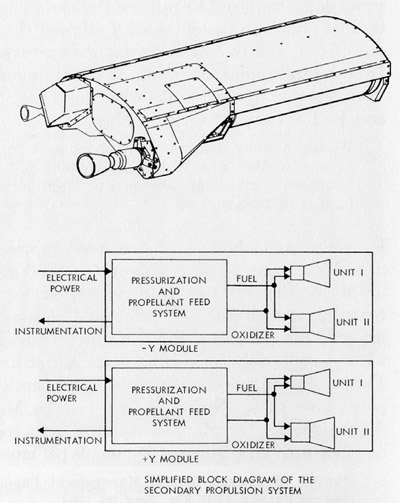
“Artist’s conception of the rendezvous and docking maneuver in space when the two-man National Aeronautics and Space Administration Gemini spacecraft mates with the Agena Target Vehicle. Textron’s Bell Aerosystems Company builds the 16,000-pound thrust Agena liquid rocket engine for the target vehicle (at right) as well as a twin-module secondary propulsion system which fits snugly astride the Agena’s aft rack. The secondary propulsion system orients the propellant in the tanks of the Agena vehicle and adjusts its orbit.”
Secondary propulsion system? Who knew? Did you?? I didn’t!!!
“Mated”? Was the caption writer not familiar with “docked”? Ugh.
Interesting:
www.nasa.gov/history/SP-4002/p2b.htm
Specifically:
www.nasa.gov/wp-content/uploads/static/history/SP-4002/im...
I’ve never seen this at such an amazing resolution.
digitalsc.lib.vt.edu/Ms1989-029/Ms1989-029_B06_F1b_Photo_...
Credit: Virginia Tech Special Collections and University Archives website
“Outer Space Pacemaker
Tomorrow’s rocket engine is as big as today’s spacecraft: The 1.5-million-pound-thrust M-1 rocket engine being developed for NASA’s Lewis Research Center in Cleveland is one-third its final length and already is nearly as large as the two-man Gemini spacecraft. The full M-1 engine, being made by Aerojet-General Corp.’s Liquid Rocket Operations, will be 17 feet in diameter and 26 feet long. The Gemini spacecraft has a maximum diameter of 7 ½ feet and is 19 feet long.”
Also:
“The two-man Gemini spacecraft is displayed next to the upper part of an M-1 engine. The Gemini would have fit within the engine bell of a completed engine.”
At/from:
www.thespacereview.com/article/4506/1
To include the image:
www.thespacereview.com/archive/4506g.jpg
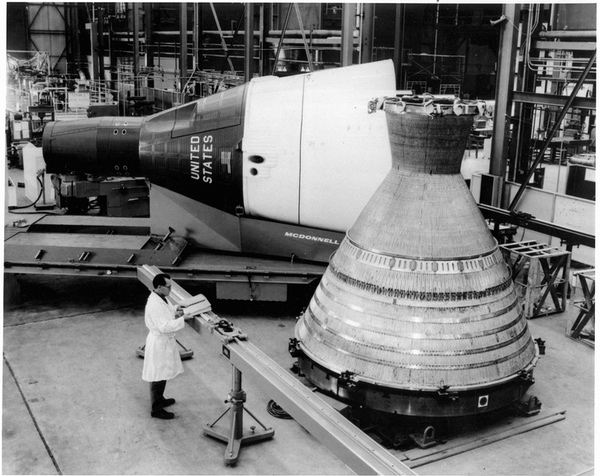
Both above credit: “The Space Review” website
Additional information:
forum.nasaspaceflight.com/index.php?topic=58031.0
Credit: NASASpaceFlight.com forum/website
www.secretprojects.co.uk/threads/aerojet-general-m-1-rock...
Credit: SECRET PROJECTS website
Yet again, the amazing resolution of these vintage photographs, further enabled by my considerate & conscientious 1200-dpi scans, reveals & resolves a sign/placard in the background, toward the upper left, bearing "TITAN I ENGINE ASSEMBLY AREA".
Therefore, the photograph likely having been taken ca. 1964 at the latest (based on the stamped date on the verso), at Aerojet-General's Rancho Cordova (Sacramento), CA facility/plant.
Further value-added reading:
amp.sacbee.com/news/business/article147280324.html
Credit: “The Sacramento Bee” online website
www.comstocksmag.com/article/back-story-rocket-company-ro...
Credit: “Comstock’s Magazine” website
www.l3harris.com/aerojet-rocketdyne-history
Credit: L3 Harris website
Spuren der ehemaligen V2 Rüstungsproduktion.
Traces of the V2 Rocketengine facility.
Urbextour with JoniB, Bunkersachse, Marko Bunker and Bunkerpaule.
Local call number: RC08584
Title: Testing the XLR-115 hydrogen fueled rocket engine at the Florida Research and Development Center: Apix, Florida
Date: 1958
General note: In the late 1950s, the U.S. government created a fictitious town named Apix (Air Products Incorportated, Experimental) to build and test rocket engines powered by liquid hydrogen in order to keep pace with the Soviet Union. Highly classified and requiring a large degree of secrecy, the project was given the code name "Suntan." Land near the testing ground was platted for houses to conceal the true nature of the site and Apix was even given a bogus population to add to its cover as a small fertilizer-producing community. By June 1959, the use of liquid hydrogen was determined to be too costly, the project was abandoned, and Apix dismantled.
Physical descrip: 1 photoprint - col. - 8 x 10 in.
Series Title: Reference Collection
Repository: State Library and Archives of Florida, 500 S. Bronough St., Tallahassee, FL 32399-0250 USA. Contact: 850.245.6700. Archives@dos.myflorida.com
Persistent URL: www.floridamemory.com/items/show/31535
“AEROJET APOLLO MOON ROCKET -- Apollo astronauts depend on this rocket engine built by Aerojet-General Corporation to provide the pushing power to make major course changes for the Apollo spacecraft during earth orbital and lunar missions. It is the Service Propulsion System rocket engine which produces 20,500 pounds of thrust and stands 13 feet four inches tall.”
In color; however, disparate photo numbers suggest it being another engine::
2.bp.blogspot.com/-Sz9rFfKdvwk/Viz_rvRXhkI/AAAAAAAAC9U/l0...
.jpg)
Credit: The excellent Exo Cruiser website
See also:
airandspace.si.edu/collection-objects/rocket-engine-liqui...