View allAll Photos Tagged pigmentation
An Eastern Squirrel lacking pigmentation which resulted in this very light colouring.
Lemoine Point, Kingston Ontario
Thanks to everyone who takes the time to view, comment, and fave my photo. Take care and have a lovely day!
While I was driving in the desert heading back to this Masirah Island where I work, saw this Lizard on a top of a large bush. Quickly returned back to the spot to capture this very rare lizard, then it started running away from me. It opened its mouth to scare me, didn’t want to take a chance as I did not know about its behavior. But I managed to get few shots.
Taken some 30km away from Sinaw town towards Shanna, Oman, in 2008.
Spiny-tailed Lizards are primarily herbivorous, but occasionally eat insects, especially when young. They spend most of their waking hours basking in the sun, hiding in underground chambers at daytime or when danger appears. They tend to establish themselves in hilly, rocky areas with good shelter and accessible vegetation.
Their size ranges from 25 cm (10 in) to 91 cm (36 in) or more. Hatchlings or neonates are usually no more than 7–10 cm (3–4 in) in length. Like many reptiles, these lizards' colors change according to the temperature; during cool weather they appear dull and dark but the colors become lighter in warm weather, especially when basking; the darker pigmentation allows their skin to absorb sunlight more effectively.
Their spiked tail is muscular and heavy, and can be swung at an attacker with great velocity, usually accompanied by hissing and an open-mouthed display of (small) teeth. They generally sleep in their burrows with their tails closest to the opening, in order to thwart intruders.
A female lizard can lay anywhere from 5 to 40 eggs, depending on age and species.
Feb 2, 2009 #54 on Explore
White lions are a rare mutation of a species found in South Africa. the cubs are from an uncommon subspecies that is nearly extinct in the wild.
Fewer than 100 are known to exist. White lions are not albino as they have pigmentation which shows particularly in eye, paw pad and lip colour. The correct term for their condition is leucism, a state where there is near-normal eye colour, but loss of pigment in the skin and fur.
The cause of the unusual colouration is the same as for the white tiger. A recessive gene which results in the white appearance is found in a very small number of captive lions.
The white lion is occasionally found in wildlife reserves in South Africa and is a rare color mutation of the Kruger subspecies of lion (Panthera leo krugeri). It has been perpetuated by selective breeding in zoos around the world. White lions are not a separate subspecies and they have never been common in the wild. Regarded as divine by locals,[1] white lions first came to public attention in the 1970s in Chris McBride's book The White Lions of Timbavati. White cubs occasionally turn up among tawny lions in the Timbavati and Kruger National Park regions. Because the gene is recessive and is masked by the normal tawny color, white lions remain rare in the wild and only occur when two lions carrying the mutant gene are mated together. The greatest population of white lions is in zoos where they are deliberately bred for color. The population of the white lion is unknown but the most recent count was in 2004 and 30 were alive. White lions are Endangered. White lions are not albino lions. Instead, the white color is caused by a recessive gene known as chinchilla or color inhibitor. They vary from blonde through to near white, however some can also be red. This coloration gives white lions a distinct disadvantage in nature because they are highly visible. This gives them away to their prey and makes them an attractive target for hunters
Greetings to all from Florida.....I am on holidays for 3 weeks ( 7 days left ) but wanted to share a few of my holiday photos with you all !!!!
warm wishes !!!!!!! to all...
to view all the photos so far from my trip please have a look in the set ( Florida holiday Jan/Feb 2009 ) for more photos from our trip and I will try to add more when I can....
"Omo" The leucistic Giraffe (Giraffa tippelskirchi). He is not albino, but leuucistic, having a partial loss of pigmentation. I think he is unique to Africa.
Tasnim 11, Mehedi 06 and their grandfather Shukur Mia Family members with an unusual pigmentation show off their shockingly bright, blue eyes. Eyes of this colour are rare for people of a darker skin tone, and the cause is a lack of melanin pigment in the iris of the eye. Lower levels of melanin are more commonly found in people with lighter skin tones, meaning they are more likely to have lighter coloured eyes. The grandfather's name is Shukur Mia, who is photographed with his granddaughter Tasnim and grandson Mehedi. The picture taken from a village home of Chittagong city in Bangladesh.
I saw this interesting fish on the south side of Honaunau Bay. It seemed to be a loner, and when it approached other yellow tangs, they seemed to drive it away. This tang is leucistic meaning it is lacking some of its natural pigmentation. According to the internet, it is not an albino.
Did you know that the Blue Jay only appears to have a vivid blue colororation? It doesn't really. In fact, as far as blue in birds is concerned, it's not just the Blue Jay that only appears to be blue, for blue pigment does not exist in any birds! So, are we seeing things? Well, not really. The blue color results from a refraction of light by the inner structure of the feather material. In other words, the blue is a structural color, not a pigmentation color. If the feather is crushed, the blue color will disappear. Better still, if you look at the feather by transmitted light rather than reflected light ... that is, place it so that the feather is directly between you and a light source ... an ordinary light bulb, for example ... that blue color will disappear and the feather will appear gray!!! How do I know? Well, with all these Blue Jays being around, every once in awhile there's a stray feather to be found. So, I've actually carried out that little experiment myself.
Now, as for the pink color ... that does exist. :-) Interestingly enough, though, a truly blue rose does not exist in nature either, because the rose lacks the gene that has the ability to produce a truly blue color. Like a lot of things these days, though, scientists have produced one by genetic modification.
Anyway, the next time you see a Blue Jay ... or any other bird with blue coloration ... keep in mind that you are only seeing that blue color because light rays have been bent by the internal structure of the bird's feathers, not by any blue pigmentation in those feathers.
Class dismissed! :-)
Most of the Rock Pigeons I post here are in the clutches of a predator. or fleeing from one. Without them there would be no Falcon show at the terminal.
I thought I would give the Pigeon a little love on my photostream.
City dwelling Rock Pigeons come in a wide variety of colour patterns beyond the standard configuration as described in the Cornell Lab of of Ornithology:
"Variable in color, but most birds are bluish gray with two black bands on the wing and a black tip to the tail. Most birds have iridescent throat feathers. Wing patterns may include two bars, dark spots, or can be plain. The tail is usually dark tipped."
I did a little research regarding why there is so much variation among the thousands we see at the terminal or in any other city.
The quote below is from Bio Med Central (BMC) in the US
"Feral pigeons (Columba livia) show two major melanin-based colorations: a red coloration due to pheomelanic pigment and a black coloration due to eumelanic pigment. Furthermore, within each color type, feral pigeons display continuous variation in the amount of melanin pigment present in the feathers, with individuals varying from pure white to a full dark melanic color. Coloration is highly heritable and it has been suggested that it is under natural or sexual selection, or both."
( I learned three new words I probably will never use)
Most of the other less scientifically oriented articles I read simply reiterate the above quote and state that because the original Rock pigeons have been bred by humans for hundreds of years and sometimes selectively for colour and other traits, there is a wide variation in colour in the feral population as these Pigeons found their way into unrestrained circumstances and randomly passed on the wide range of possible pigmentation to their offspring over thousands of generations.
Highest Explore Position #173 ~ On August 22nd 2008.
Foxes - British Wildlife Centre, Surrey, England - Sunday August 17th 2008.
Click here to see the Larger image
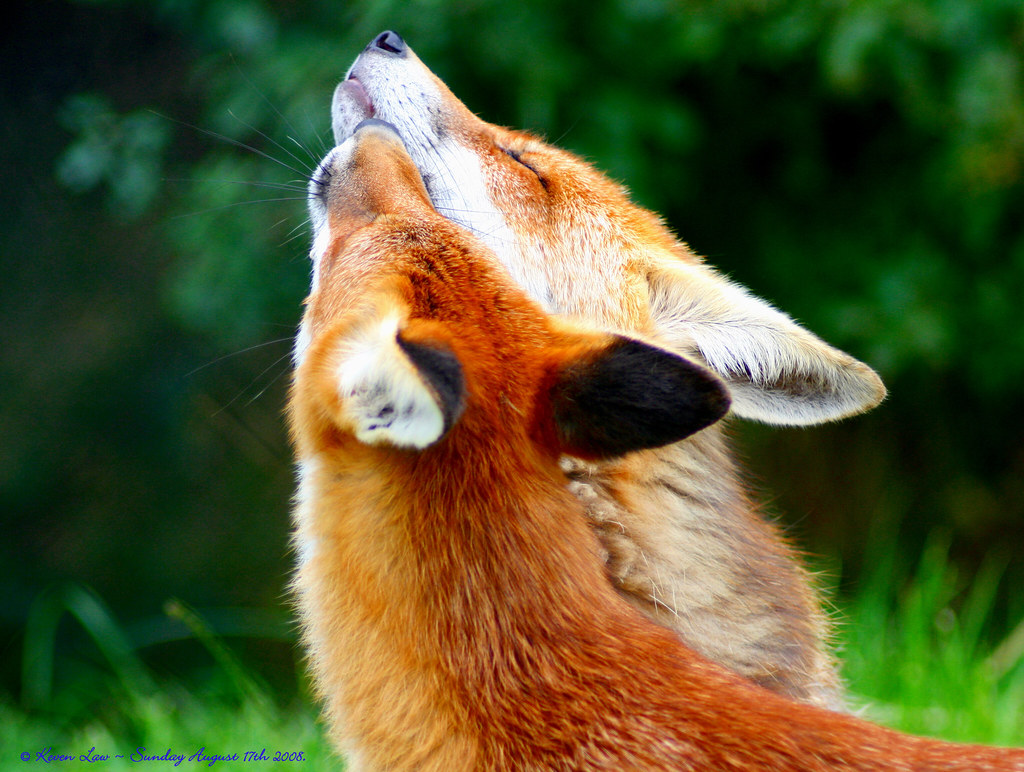
Fox is a name applied to any of roughly 27 species of small to medium-sized canids, characterized by possessing a long, narrow snout, and a bushy tail, or "brush". By far the most common and widespread species of fox is the red fox (Vulpes vulpes), although various species are found on almost every continent. The presence of fox-like carnivores all over the globe has led to their appearance in the popular culture and folklore of many nations, tribes, and other cultural groups.
Etymology ~ The Modern English "fox" is derived from Old English fox. The Old English word itself comes from the Proto-Germanic word *fukh – compare German Fuchs, Gothic fauho, Old Norse foa and Dutch vos. It corresponds to the Proto-Indo-European word *puke meaning "tail" (compare Sanskrit puccha, also "tail"). The bushy tail is also the source of the word for fox in Welsh: llwynog, from llwyn, "bush", Lithuanian: uodegis, from uodega, "tail", and Portuguese: raposa, from rabo, "tail".
General characteristics ~ Most foxes live 2 to 3 years, but they can survive for up to 10 years or even longer in captivity. Foxes are generally smaller than other members of the family Canidae such as wolves, jackals, and domestic dogs. Dogs (male foxes) weigh on average, 5.9kg and vixens (female foxes) weigh less, at 5.2kg (13 lbs and 11.5 lbs, respectively). Fox-like features typically include an acute muzzle (a "fox face") and bushy tail. Other physical characteristics vary according to their habitat. For example, the fennec fox (and other species of foxes adapted to life in the desert, such as the kit fox) has large ears and short fur, whereas the Arctic fox has small ears and thick, insulating fur.
Another example is the red fox which has a typical auburn pelt, the tail normally ending with white marking.
Unlike many canids, foxes are usually not pack animals. Typically, they are solitary, opportunistic feeders that hunt live prey (especially rodents). Using a pouncing technique practiced from an early age, they are usually able to kill their prey quickly. Foxes also gather a wide variety of other foods ranging from grasshoppers to fruit and berries.
Foxes are normally extremely wary of humans and are not kept as pets (with the exception of the fennec); however, the silver fox was successfully domesticated in Russia after a 45 year selective breeding program. This selective breeding also resulted in physical and behavioural traits appearing that are frequently seen in domestic cats, dogs, and other animals: pigmentation changes, floppy ears, and curly tails.
Diet ~ The diet of foxes comprises rodents, insects, worms, fruit, fish, birds, eggs, and all other kinds of small animals. The fox generally consumes around 1 kg of food every day. Foxes that live in neighborhoods mainly depend on household waste and even rodents and birds that keep moving around these areas. Foxes are known to cache their food, burying the excess for later consumption.
They mostly thrive in the higher latitudes, suburban and even urban environments both in Europe and in North America. They are found also in Eurasia, North Africa, India (Ladakh, Himalayas, Jammu and Kashmir, Rajasthan and Gujarat), China, Japan and in Australia.
Conservation ~ Foxes are readily found in cities and cultivated areas and (depending upon species) seem to adapt reasonably well to human presence.
Red foxes have been introduced into Australia and some other countries for hunting. Australia lacks similar carnivores, and the introduced foxes prey on native wildlife, some to the point of extinction. A similar introduction occurred in the seventeenth and eighteenth centuries in temperate North America, where European reds (Vulpes vulpes) were brought to the colonies for fox hunting, where they decimated the American red fox population through more aggressive hunting and breeding. Interbreeding with American reds, traits of the European red eventually pervaded the gene pool, leaving European and American foxes now virtually identical.
Other fox species do not adapt as well as the red fox, and are endangered in their native environments. Key among these are the crab-eating fox (Cerdocyon thous) and the African bat-eared fox. Other foxes such as fennec foxes, are not endangered, but will be if humans encroach further into their habitat.
Foxes have been successfully employed to control pests on fruit farms, where they leave the fruit intact.
Historians believe foxes were imported into non-native environments long before the colonial era. The first example of the introduction of the fox into a new habitat by humans seems to be Neolithic Cyprus. Stone carvings representing foxes have been found in the early settlement of Göbekli Tepe in eastern Turkey.
Very rarely, the Bengal Tiger produces white specimens. The earliest recordings of sightings of white tigers date from the mid 16th century, but only a dozen sightings have been noted in the last 100 years. The last wild white tiger was sighted in 1951! White tigers are neither a separate sub species nor albino, but instead have reduced pigmentation. White tigers are produced when two carriers of the recessive gene, who may not necessarily be white themselves, breed. This condition is known as leucism.
A juvenile instar of ~0.5 mm. Definite signs of the pigmentation pattern beginning to develop here.
[Part of a garden survey of the "novel" springtail Katiannidae Genus nov.1 sp. nov. that I'm doing for FransJanssens@www.collembola.org to establish the size and differences between the various instars.
Canon MP-E65mm Macro (at 5x) + 1.4x tele-extender + 25mm extension tube + diffused MT24-EX Twinlite flash. Heavily cropped.]
A blue rose is a flower of the genus Rosa (family Rosaceae) that presents blue-to-violet pigmentation instead of the more common red, white, or yellow.
Laguna Colorado, Bolivia.
After a siesta and lunch we headed off to La Laguna Colorado. Its a rather shallow pool of water in the Altiplano region of Bolivia. Its also home to a rather large population of Flamingos that were all feasting. The red colour is caused by algae and pigmentation of sediment and its contrasted greatly by the white of the borax (a type of sodium).
Its a stunning scene that is visually epic. Its not many places you get a red coloured lagoon. And to mention god damn Flamingos.
The orange tip butterfly, Anthocharis cardamines,(Pieridae, Lepidoptera) is mainly found throughout Europe and temperate Asia . The males feature wings with a signature orange pigmentation.
Males and females of this species occupy different habitats: males mostly frequent the edges of forests whereas females frequent meadows.
Karen asked Hershey to " speak " what came out was more of a faint gurgle...however, he did manage to open his mouth wide enough for us to see the pigmentation on his tongue. Thank god he didn't have bad doggy breath !!
Photo credits go to Karen...
The white tiger or bleached tiger is a pigmentation variant of the Bengal tiger, which is reported in the wild from time to time in the Indian states of Madhya Pradesh, Assam, West Bengal and Bihar in the Sunderbans region and especially in the former State of Rewa. Such a tiger has the black stripes typical of the Bengal tiger, but carries a white or near-white coat.
Lego Simpsons 71005
The Simpsons is an American adult animated sitcom created by Matt Groening for the Fox Broadcasting Company.The series is a satirical depiction of a middle class American lifestyle epitomized by its family of the same name, which consists of Homer, Marge, Bart, Lisa, and Maggie. The show is set in the fictional town of Springfield and parodies American culture, society, television, and many aspects of the human condition.
The family was conceived by Groening shortly before a solicitation for a series of animated shorts with the producer James L. Brooks. Groening created a dysfunctional family and named the characters after members of his own family, substituting Bart for his own name. The shorts became a part of The Tracey Ullman Show on April 19, 1987. After a three-season run, the sketch was developed into a half-hour prime time show and was an early hit for Fox, becoming the network's first series to land in the Top 30 ratings in a season (1989–1990).
Since its debut on December 17, 1989, the show has broadcast 548 episodes and the 25th season began on September 30, 2013. The Simpsons is the longest-running American sitcom, the longest-running American animated program, and in 2009 it surpassed Gunsmoke as the longest-running American primetime, scripted television series. The Simpsons Movie, a feature-length film, was released in theaters worldwide on July 26 and 27, 2007, and grossed over $527 million.
--------------
Les Simpson (The Simpsons) est une série télévisée d'animation américaine créée par Matt Groening et diffusée depuis le 17 décembre 1989 sur le réseau FOX.
Elle met en scène les Simpson, stéréotype d'une famille de classe moyenne. Leurs aventures servent une satire du mode de vie américain. Les membres de la famille, tous ayant la pigmentation de peau de couleur jaune, sont Homer, Marge, Bart, Lisa et Maggie.
[My Portfotolio] [My Google + ]
Thanks to all for visits and faves :)
See it in Originale (1500 x 686) !!!!!!
[My GETTY Images @] [My MOST FAVE on Flickriver] [My RECENT on Fluidr] [My STREAM on Darckr]
Caméra Sony NEX-5
Exposition 13s
Ouverture f/11.0
Longueur focale 100 mm (Minolta 100mm f2 + Kenko 25mm)
Vitesse ISO 200
Détection du degré d'exposition +1.3 EV
Lots of these globular springtails in leaf-litter at the moment. This individual was under a piece of fallen bark in a local churchyard. Around 1.5mm.
This is a male. They often have pigmented "cheeks"; where the pigmentation reaches the underside of the eye. The genital papilla is visible to, just anterior to the final abdominal segments (the small abdomen). Dicyrtomina saundersi also has pigmentation in the form of a multi-barred cross on the rear of the large abdomen.
This is my first time seeing pups of this colour, and the first time we've had pups of such a colour born in our hamstery. For a few days I was wondering at their odd pigmentations.
It is very difficult to photograph their coats to the exact shade as they look kinda grey in some angles, and a faint gold in other angles.
The closest colours I've seen that resemble the coats of these two pups is called the Yellow-blue.
More about the coat colours in this litter :)
Disclaimer:
Please do not try this with your own hamsters, unless you are very sure of what you are doing. Behind the scenes preparation was involved in this photo and no hamsters were injured during or after this photo was taken. Thank you for your concern.
Gisteren tijdens een wandeling deze merel tegengekomen. Voor het eerst dat ik zoiets zie, en dus even moeten googlen.
Leucisme is een afwijking bij dieren en mensen die leidt tot een verminderde pigmentatie. Leucisme lijkt op albinisme en wordt daar soms mee verward. Zie verder:
nl.wikipedia.org/wiki/Leucisme
Yesterday encountered this blackbird during a walk. For the first time that I see something like that, and so I have to google it.
Leucism is a deviation in animals and people that leads to a reduced pigmentation. Leucism is similar to albinism and is sometimes confused with it. See further:
en.wikipedia.org/wiki/Leucisme
Welcome to my Flickr space & thank you for visiting,
hope you enjoy my images.
Don't use this image on any media without my permission.
You can contact me on my website at:
Many thanks to everyone who takes the time to look,
like and comment on my pictures.
Thanks for > 9 000 000 views.
The humpback whale (Megaptera novaeangliae) is a species of baleen whale. It is a rorqual (a member of the family Balaenopteridae) and is the only species in the genus Megaptera.
The adult humpback whale is generally 14–15 m (46–49 ft), though longer lengths of 16–17 m (52–56 ft) have been recorded. Females are usually 1–1.5 m (3 ft 3 in – 4 ft 11 in) longer than males.
The species can reach body masses of 40 metric tons (44 short tons). Calves are born at around 4.3 m (14 ft) long with a weight of 680 kg (1,500 lb).
The body is bulky with a thin rostrum and proportionally long flippers, each around one-third of its body length.[15][16] It has a short dorsal fin that varies from nearly non-existent to somewhat long and curved.
As a rorqual, the humpback has grooves between the tip of the lower jaw and the navel. They are relatively few in number in this species, ranging from 14–35. The mouth is lined with baleen plates, which number 270-400 for both sides.
Unique among large whales, humpbacks have bumps or tubercles on the head and front edge of the flippers; the tail fluke has a jagged trailing edge.
The tubercles on the head are 5–10 cm (2.0–3.9 in) thick at the base and poke up to 6.5 cm (2.6 in). They are mostly hollow in the center, often containing at least one fragile hair that erupts 1–3 cm (0.39–1.18 in) from the skin and is 0.1 mm (0.0039 in) thick. The tubercles develop early in the womb and may have a sensory function as they are rich in nerves.
The dorsal or upper-side of the animal is generally black; the ventral or underside has various levels of black and white coloration. Whales in the southern hemisphere tend to have more white pigmentation. The flippers can vary from all-white to white only on the undersurface.
The varying color patterns and scars on the tail flukes distinguish individual animals. The end of the genital slit of the female is marked by a round feature, known as the hemispherical lobe, which visually distinguishes males and females.
This image was taken from the breakwater at Honningsvag Harbour in Norway
The undersides of the leaves of this oxalis species have the appearance of being perpetually covered with dew. The illusion is due to these globular, water filled cells on the leaf undersides: they have virtually no pigmentation (the green appearance in this image is due to chlorophyll in the underlying cells). This species is adapted to drier growing conditions, and I suspect that these cells are an adaptation for the plant to conserve moisture during times of drought.
“Bahama Pintail Duck”
Judy Royal Glenn Photography
I was thrilled to be greeted by a Bahama Pintail duck when we arrived at the Jardin Botanique De Deshaies in Guadeloupe. He kinda took my breath away—he is gorgeous. This duck has a mutation called leucistic which means it has less pigmentation in the skin.
This dabbling duck has several other names as well i.e. white-cheeked pintail and summer duck. You may choose to call him whichever you want. To put the icing on the cake, he was swimming in a pond full of coy.
Please feel free to visit my website:
L'hétero brillant
Collembola Heteromurus nitidus
Hi everyone, i have not much time for share with you my recents finds.. i'm sorry ! i hope you are fine .this pigmentation-deprived springtail is dressed with scales
This album's name is dedicated to my favourite game of all time Elder Scrolls Online and race of all time, The Argonians (reptile humanoids). There's a story for you to read below about some of them towards the bottom.
What does Ku Vastei mean? Read below
By Lights-the-Way, Mystic of the Mages Guild
It is hard to describe the culture of my people. Often my tongue stumbles as I try to explain, but it is my hope that ink and quill will give me time enough to gather my thoughts. And perhaps, though such writing, I will finally connect the parts of me that now feel so divided; my homeland of Murkmire and my new life within the Mages Guild.
These journals are to become my ku-vastei. And, as I write that, I can think of no better topic to begin with.
Ku-vastei roughly translates to "the catalyst of needed change," though such a direct translation in no way does justice to the original meaning. Another translation could be "that which creates the needed pathway for change to occur" or even "the spark which ignites the flame which must come into being."
Perhaps a more direct analysis should be first presented. Ku-vastei is a noun, a thing or person. Vastei directly translates to change, an important part of my culture. Ku is harder to speak of. It is that which leads to change, though not that which creates change. An important role, as stagnation is a fate worse than death.
Take a boulder which sits atop a cliff, teetering in place. It must fall eventually. The ku-vastei does not push the boulder off the cliff; rather, it picks the pebble which holds the rock in place. And so it falls, not by a push, but by a pathway cleared.
Ku-vastei is revered, just as change itself is revered, for to look back at what was means to stumble as you move forward. Sometimes, a little push in the right direction is all someone needs to remember such wisdom. Other times, they may need to be shoved.
-------------------------------------
The Gee-Rusleel Tribe
by Emmanubeth Hurrent, the Wayfarers' Society of Wayrest
I've had the privilege to speak to two different Miredancer elders now, and I've learned a great deal from both of these conversations. The "Gee-Rusleel," as they call themselves, are among the most introspective Argonians I've met in my travels. They also tend to be the most pleasant. For all their reclusiveness and wariness, I've never met a people more willing to share a meal or a game of Shells and Stones. They are skilled crafters, with a particular knack for working with Hist amber and egg shells. They are also peerless navigators, guiding their flat-bottom boats effortlessly through the swamp, master weavers, and skilled cartographers.
The most defining characteristic of the Miredancer tribe, however, is piety. This deep reverence for the Hist has earned them the right to name a "Sap-Speaker" for countless generations.
According to the elders I spoke with, the Sap-Speaker is the Hist's direct intermediary. (This is, of course, subject to debate. Many tribes boast unique methods of communion with the Hist. But as far as I have seen, the Miredancers make the most compelling case for the methods they use.) Sap-Speakers often go into seclusion for days or even weeks on end, venturing either down into the roots or high into the canopy of leaves in the uppermost branches. Here, they commune with the Hist. Indeed, the word that one of the elders used was "journey."
These journeys into the Hist tax the Sap-Speakers, but are thoroughly private affairs. After days by themselves, the Sap-Speakers emerge to hide away with old books, scrolls, and tablets. I asked after the purpose of these periods of seclusion, and this is what the elders told me. "The Sap-Speaker enters the embrace of the Hist to learn from the great tree," one elder said. "While in close contact with the roots and branches, the Sap-Speaker receives visions and other forms of communication that neither you nor I would understand."
The other elder continued. "Even the Sap-Speaker finds some of what is shown to be mystifying and confusing. I have heard that a Sap-Speaker is treated to ancient metaphors, arcane secrets, and visions that make little sense to creatures so far removed from sap and pulp." Apparently, the second period of seclusion allows the Sap-Speaker time to reflect on what he or she was shown, as well as time to consult with the ancient writings of Sap-Speakers who came before. After a suitable period of study and reflection, the Sap-Speaker emerges to reveal the Hist's will to the tribe.
I attempted to get more information about what happens while the Sap-Speaker meditates among the roots or branches, but I'm not sure the elders knew much more. They did tell me that the only nourishment the Sap-Speaker receives during these periods of seclusion is provided by the Hist itself in the form of sap, leaves, and the otherwise forbidden fruit of the tree.
There is a price to pay for the gift of Hist communion, however. Ingesting large quantities of Hist sap is a dangerous affair, even for Argonians. Sap-Speakers routinely suffer the effects of sap-poisoning, including "gold tongue" (permanent change of mouth pigmentation to a golden hue), unbidden hallucinations, "bark-scale" (thickening and darkening of surface scales), and other maladies they were reticent to talk about. The current Sap-Speaker, Thumarz, was in seclusion during my visit to the tribal village. I hope to meet him someday. If he's half as wise as the elders I interacted with, I'd no doubt learn a great deal from him.
Despite their deeply religious nature, the Miredancers also seem to have an obsession with games of all types. They are particularly fond of the games Nine-Shells and Shells and Stones, as well as sports such as the popular "teeba-hatsei" (also known as "hip and tail ball.") In addition to lovingly explaining their own games, they wanted to know everything I could tell them about the games we play back in Wayrest. I must admit, their enthusiasm was quite infectious! And I found it highly amusing to watch them try to re-create Deceiver's Bones from the vague description I provided.
The Miredancers are also inveterate gamblers, but they often forget to collect their winnings. Unlike the games of men and mer, Miredancer competitions appear to be completely devoid of malice or injured pride. Victory and defeat seem more like afterthoughts than objectives, due in no small part to their phlegmatic disposition. As in most things, their focus is strictly on the moment—the now. It pains me to leave their village, but I still have many more tribes to study. I doubt any of them will be as fascinating or as friendly as the Miredancers.
["the tribe is not currently in the game but in the world of the game"]
The white peacock is not a species of peacock; it is a special peacock that has been born all white, due to a genetic variation. White peacocks are not albino. Albino animals have a complete lack of colour and red or pink eyes, and albino skin is very pale. White peafowl have blue eyes and coloured skin. Leucism is a genetic mutation that causes loss of pigmentation. Animals with leucism retain their normal eye colour. It’s the feathers that do not have pigmentation. White feathers depend on which genes are dominant and which are recessive.
White peacocks are not found in the wild. Patches of white would make the peacocks more visible to predators. The theory is that the recessive white coloration genes emerge in animals kept in captivity. This sometimes occurs with pet birds or animals. This gene mutation explains the existence of white peafowls.
Peacocks are native to India.
Peacocks fan out these feathers to present to females during mating season.
The male’s display of their train includes rattling and wing shaking, in an effort to impress females. It is the dance of the peacock that determines which peacock is preferred by peahens.
EXPLORE FRONT PAGE - March 19, 2009 #28
Thanks to Rodelicious for the FP news and screenshot that he saved and sent and to Tadoette for the news and link to Explore. More thanks and my sincere gratitude to all of you my flickr friends who always visit, fave, invite and leave comments on my photos. XOXO to all! TGBTG!
WIKIPEDIA says: The fundus of the eye is the interior surface of the EYE, opposite the lens, and includes the retina, optic disc, macula and fovea, and posterior pole. The fundus can be viewed with an ophthalmoscope.
The color of the fundus varies both between and within species. In one study of primates the retina is blue, green, yellow, orange, and red; only the human fundus (from a lightly pigmented blond person) is red. The major differences noted among the "higher" primate species were size and regularity of the border of macular area, size and shape of the optic disc, apparent 'texturing' of retina, and pigmentation of retina.
The eye's fundus is the only part of the human body where the microcirculation can be observed directly. The diameter of the blood vessels around the optic disc is about 150 μm, and an ophthalmoscope allows observation of blood vessels with diameters as small as 10 μm.
I posted this because my hubby told me that diseases such as hemorrhages, glaucoma, cotton wool spots, exudates, blood vessel abnormalities and pigmentation can be detected from observation of eye fundus. (Note: This is not my eye but my hubby's eye).
Some other globular springtails from my trip to Weston Park this morning. Top right looks like Sphaeridia pumilis. All others are Sminthurinus species. Top left looks a bit like the one I posted previously but with less dark pigmentation patches. Bottom left looks like it may be Sminthurinus reticulatus and bottom right Sminthurinus aureus forma ochropus.
Like all other birds in blue, Indigos appear blue structurally -- not because of blue pigmentation. Port Huron SGA.
Well I went back to Sheffield Botanical Gardens today and found some very interesting Collembola. This one in particular is very interesting, these were the smallest Sminthurinus species I have found to date, they were about 0.5mm-0.6mm, the closest match I can find is Sminthurinus minutus, but I think this is an American species and I can find no British records.
The head has very distinctive orange pigmentation, white eyebrows and a clear band across the middle of the head, the abdomen is black with underlying orange/red (No white spots on any of the individuals) and orange antennae, the ends of the legs look to be orange. Any ideas Frans????
These were found in the hothouse/glasshouse, so there is a chance they are imports. I really struggled photographing these, I could hardly see these and I think I was getting misting on my lens.
***Just been informed that this is likely to be Sminthurinus minutus and is the first European record of this species :o)***
VIEW LARGE
The White-cheeked turaco (Tauraco leucotis) is a Turaco that is found in humid forests; the highlands in Ethiopia, extreme South East Eritrea and Sudan.
A Turaco (often called Touraco in UK) is a fruit-eating African bird of the family Musophagidae, order Cuculiformes.
Measures approximately 42-43cm beak to tail, and weighs between 200-315g.
Turacos are the only birds to possess true red and green pigmentation. When you look at most birds, the color you are seeing is a reflection produced by the feather structure. The turaco's red pigment (turacin) and green pigment (turacoverdin) both contain copper. In fact, if you stirred a glass of water with a red turaco feather, the water would turn pink!
O turaco tem uma característica muito particular no mundo das aves: o brilho metálico de sua plumagem é devido à presença de pigmentos a base de cobre. Um desses pigmentos, a turacina, é vermelho; o outro, a turacoverdina, é verde. A turacina é solúvel em água, e é por isso que às vezes as penas vermelhas das asas do turaco se apresentam descoloridas
The flower may be Echinacea. The blue color may be a result of thin film interference as well as pruinosity. I know it is angle dependent but then most wave phenomenon are except for simple reflection and colors produced by pigmentation.
A portrait of another woman of the Himba tribe of Namibia. Her hair piece and braids have the same red pigmentation from the earth as her body. From one woman to another, I loved this way of enhancing one's beauty and her jewelry was "to die for."
A leucistic eastern gray squirrel I came across one day in Boston public garden. I had never seen one of these before and have not seen another since. We hung out for a while and he seemed very intrigued by the big glass lens watching him.
Leucism is a condition that results in a partial loss of pigmentation, particularly in the fur, while retaining darker colored eyes and other features. The selective pigmentation loss of only the fur is what distinguishes this from albinism.
I first photographed this bird on September 2, 2017 (flic.kr/p/Y7XL3N) about a mile up-river from this spot. I spotted him again today while riding my bike along the river walk. I returned to the car for my camera but by the time I got back he was hunkered down for a mid-day nap. I waited about 20 minutes before he rose up and stretched his wings.
Leucism is a condition in which there is partial loss of pigmentation in an animal resulting in white, pale, or patchy coloration of the skin, hair, feathers, scales or cuticle, but not the eyes. ... Unlike albinism, it is caused by a reduction in multiple types of pigment, not just melanin.
Nikon D7200, Nikon 200-500mm. 1/320 sec at f/8, ISO 200, 480mm.
7 Jul 2018, Columbia River Walk, Columbia, SC, USA.
Cliffside Lane, The Ridge, Fair Oaks / Sacramento County, California
This skipper appears to have lost some of its pigmentation, a process called leucism, which I've never seen in butterflies before.
Update on this skipper image. I posted this same image in Only Butterflies! and Brian Orion, a member of the group feels that this is a faded Eufala Skipper and now that I re-looked at the image I have to agree as there are several markings on the ventral forewing that matches the Eufala Skipper.
One of the few species of diurnal owl, the great Snowy Owl (Bubo scandiacus) has evolved with little pigmentation in its feathers. This not only helps to camouflage these birds of prey, but also provides more space for air to be held within its feathers, keeping them warm. When seen, these beautiful birds are often spotted near airfields or farmland, perched on telephone poles, as these landscapes are similar to the tundras of the north and allow them to hunt in the ambushing style that they prefer.
Early 2014 saw an eruption of snowies across much of the northeast U.S. It is believed that this high density of owls was due not to a food shortage up north, but a surplus which caused a population spike!
Throwback Thursday: This photo is a reprocessing of an early 2014 shot, minimizing noise and artifacts.
Similar to albinism which means the animal lacks pigmentation, there is also erythrism, sometimes called erythrochroism, which instead makes them red or pink.
More than all other animals, grasshoppers happen to suffer from this, but it still looks quite alien, wouldn't you say? Like a tiny plastic toy or something.
This one is just a nymph, and typically the pink ones tend to be nymphs as the intense colour makes them easier to spot for predators so fewer survive to adult form. As there are several species which look just the same as nymphs, I can't say which exact species this is, but the white eyes make it look really cool in my book!
Part 1, a full body shot, here: www.flickr.com/photos/tinyturtle/48122391991/
Details best viewed in Original Size.
I photographed this white Tiger (using negative film) in the lobby of the Mirage Hotel in Las Vegas back when Siegfried & Roy were giving filled-to-capacity performances. Many years later I digitized this image and others via an Epson Perfection 3170 photo scanner. Recently I discovered that I had never uploaded the resulting images to Flick’r and have decided to test viewer acceptance with this one.
The white tiger or bleached tiger is a pigmentation variant of the mainland Asian tiger. It is reported in the wild from time to time in the Indian states of Madhya Pradesh, Assam, West Bengal, Bihar, Odisha, in the Sunderbans region and especially in the former State of Rewa. It has the typical black stripes of a tiger, but its coat is otherwise white or near-white. The white Bengal tigers are distinctive due to the color of their fur. The white fur is caused by a lack of the pigment, which is found in Bengal tigers with orange color fur. When compared to Bengal tigers, the white Bengal tigers tend to grow faster and heavier than the orange Bengal tiger. They also tend to be somewhat bigger at birth, and as fully grown adults. White Bengal tigers are fully grown when they are 2–3 years of age. White male tigers reach weights of 440 to 510 lbs. (200 to 230 kg) and can grow up to 10 feet (3 meters) in length. As with all tigers, the white Bengal tiger's stripes are like fingerprints, with no two tigers having the same pattern. The stripes of the tiger are a pigmentation of the skin; if an individual were to be shaved, its distinctive coat pattern would still be visible. For a white Bengal tiger to be born, both parents must carry the unusual gene for white coloring, which only happens naturally about once in 10,000 births. Dark-striped white individuals are well-documented in the Bengal tiger subspecies (Panthera tigris) as well as having been reported historically in several other subspecies. Currently, several hundred white tigers are in captivity worldwide, with about one hundred being found in India. Their unique white color fur has made them popular in entertainment showcasing exotic animals, and at zoos. Their rarity could be because the recessive allele is the result of a one-time mutation or because white tigers lack adequate camouflage, reducing their ability to stalk prey or avoid other predators and thus survive in the wild.
Because of the extreme rarity of the white tiger allele in the wild, the breeding pool was limited to the small number of white tigers in captivity. According to Kailash Sankhala, the last white tiger ever seen in the wild was shot in 1958. Today there is a large number of white tigers in captivity. A white Amur tiger may have been born at Center Hill and has given rise to a strain of white Amur tigers. A man named Robert Baudy realized that his tigers had white genes when a tiger he sold to Marwell Zoo in England developed white spots, and bred them accordingly. The Lowry Park Zoo in Tampa Bay had four of these white Amur tigers, descended from Robert Baudy's stock. To preserve more genetic diversity and avoid genetic defects, the Association of Zoos and Aquariums barred member zoos from intentionally breeding to produce white tigers, white lions, or king cheetahs in a white paper adopted by the board of directors in July 2011. The paper explains that selecting for or against any particular allele would result in a loss of genetic diversity. Instead, the alleles should be maintained at their natural frequencies. Inbreeding to produce abnormal appearances can also produce congenital defects that impact health and welfare. Sometimes the traits themselves can cause problems, such as albinism's visual and neural effects. Additionally, animals with an abnormal appearance do not serve as well as ambassadors for their species in the zoos' mission to educate the public.
Info above was extracted from Wikipedia.
Explored December 11, 2023.
This album's name is dedicated to my favourite game of all time Elder Scrolls Online and race of all time, The Argonians (reptile humanoids). There's a story for you to read below about some of them towards the bottom.
What does Ku Vastei mean? Read below
By Lights-the-Way, Mystic of the Mages Guild
It is hard to describe the culture of my people. Often my tongue stumbles as I try to explain, but it is my hope that ink and quill will give me time enough to gather my thoughts. And perhaps, though such writing, I will finally connect the parts of me that now feel so divided; my homeland of Murkmire and my new life within the Mages Guild.
These journals are to become my ku-vastei. And, as I write that, I can think of no better topic to begin with.
Ku-vastei roughly translates to "the catalyst of needed change," though such a direct translation in no way does justice to the original meaning. Another translation could be "that which creates the needed pathway for change to occur" or even "the spark which ignites the flame which must come into being."
Perhaps a more direct analysis should be first presented. Ku-vastei is a noun, a thing or person. Vastei directly translates to change, an important part of my culture. Ku is harder to speak of. It is that which leads to change, though not that which creates change. An important role, as stagnation is a fate worse than death.
Take a boulder which sits atop a cliff, teetering in place. It must fall eventually. The ku-vastei does not push the boulder off the cliff; rather, it picks the pebble which holds the rock in place. And so it falls, not by a push, but by a pathway cleared.
Ku-vastei is revered, just as change itself is revered, for to look back at what was means to stumble as you move forward. Sometimes, a little push in the right direction is all someone needs to remember such wisdom. Other times, they may need to be shoved.
-------------------------------------
The Gee-Rusleel Tribe
by Emmanubeth Hurrent, the Wayfarers' Society of Wayrest
I've had the privilege to speak to two different Miredancer elders now, and I've learned a great deal from both of these conversations. The "Gee-Rusleel," as they call themselves, are among the most introspective Argonians I've met in my travels. They also tend to be the most pleasant. For all their reclusiveness and wariness, I've never met a people more willing to share a meal or a game of Shells and Stones. They are skilled crafters, with a particular knack for working with Hist amber and egg shells. They are also peerless navigators, guiding their flat-bottom boats effortlessly through the swamp, master weavers, and skilled cartographers.
The most defining characteristic of the Miredancer tribe, however, is piety. This deep reverence for the Hist has earned them the right to name a "Sap-Speaker" for countless generations.
According to the elders I spoke with, the Sap-Speaker is the Hist's direct intermediary. (This is, of course, subject to debate. Many tribes boast unique methods of communion with the Hist. But as far as I have seen, the Miredancers make the most compelling case for the methods they use.) Sap-Speakers often go into seclusion for days or even weeks on end, venturing either down into the roots or high into the canopy of leaves in the uppermost branches. Here, they commune with the Hist. Indeed, the word that one of the elders used was "journey."
These journeys into the Hist tax the Sap-Speakers, but are thoroughly private affairs. After days by themselves, the Sap-Speakers emerge to hide away with old books, scrolls, and tablets. I asked after the purpose of these periods of seclusion, and this is what the elders told me. "The Sap-Speaker enters the embrace of the Hist to learn from the great tree," one elder said. "While in close contact with the roots and branches, the Sap-Speaker receives visions and other forms of communication that neither you nor I would understand."
The other elder continued. "Even the Sap-Speaker finds some of what is shown to be mystifying and confusing. I have heard that a Sap-Speaker is treated to ancient metaphors, arcane secrets, and visions that make little sense to creatures so far removed from sap and pulp." Apparently, the second period of seclusion allows the Sap-Speaker time to reflect on what he or she was shown, as well as time to consult with the ancient writings of Sap-Speakers who came before. After a suitable period of study and reflection, the Sap-Speaker emerges to reveal the Hist's will to the tribe.
I attempted to get more information about what happens while the Sap-Speaker meditates among the roots or branches, but I'm not sure the elders knew much more. They did tell me that the only nourishment the Sap-Speaker receives during these periods of seclusion is provided by the Hist itself in the form of sap, leaves, and the otherwise forbidden fruit of the tree.
There is a price to pay for the gift of Hist communion, however. Ingesting large quantities of Hist sap is a dangerous affair, even for Argonians. Sap-Speakers routinely suffer the effects of sap-poisoning, including "gold tongue" (permanent change of mouth pigmentation to a golden hue), unbidden hallucinations, "bark-scale" (thickening and darkening of surface scales), and other maladies they were reticent to talk about. The current Sap-Speaker, Thumarz, was in seclusion during my visit to the tribal village. I hope to meet him someday. If he's half as wise as the elders I interacted with, I'd no doubt learn a great deal from him.
Despite their deeply religious nature, the Miredancers also seem to have an obsession with games of all types. They are particularly fond of the games Nine-Shells and Shells and Stones, as well as sports such as the popular "teeba-hatsei" (also known as "hip and tail ball.") In addition to lovingly explaining their own games, they wanted to know everything I could tell them about the games we play back in Wayrest. I must admit, their enthusiasm was quite infectious! And I found it highly amusing to watch them try to re-create Deceiver's Bones from the vague description I provided.
The Miredancers are also inveterate gamblers, but they often forget to collect their winnings. Unlike the games of men and mer, Miredancer competitions appear to be completely devoid of malice or injured pride. Victory and defeat seem more like afterthoughts than objectives, due in no small part to their phlegmatic disposition. As in most things, their focus is strictly on the moment—the now. It pains me to leave their village, but I still have many more tribes to study. I doubt any of them will be as fascinating or as friendly as the Miredancers.
["the tribe is not currently in the game but in the world of the game"]
A juvenile leucistic starling waiting impatiently to be fed.
Leucism (/ˈluːsɪzəm, -kɪz-/) is a condition in which there is partial loss of pigmentation in an animal—which causes white, pale, or patchy coloration of the skin, hair, feathers, scales or cuticles, but not the eyes. It is occasionally spelled leukism.
Excerpt from en.wikipedia.org/wiki/Axolotl:
The axolotl (Ambystoma mexicanum) is a paedomorphic salamander closely related to the tiger salamander. It is unusual among amphibians in that it reaches adulthood without undergoing metamorphosis. Instead of taking to the land, adults remain aquatic and gilled. The species was originally found in several lakes underlying what is now Mexico City, such as Lake Xochimilco and Lake Chalco. These lakes were drained by Spanish settlers after the conquest of the Aztec Empire, leading to the destruction of much of the axolotl's natural habitat.
A sexually mature adult axolotl, at age 18–27 months, ranges in length from 15 to 45 cm (6 to 18 in), although a size close to 23 cm (9 in) is most common and greater than 30 cm (12 in) is rare. Axolotls possess features typical of salamander larvae, including external gills and a caudal fin extending from behind the head to the vent. External gills are usually lost when salamander species mature into adulthood, although the axolotl maintains this feature.[15] This is due to their neoteny evolution, where axolotls are much more aquatic than other salamander species.
Their heads are wide, and their eyes are lidless. Their limbs are underdeveloped and possess long, thin digits. Males are identified by their swollen cloacae lined with papillae, while females are noticeable for their wider bodies full of eggs. Three pairs of external gill stalks (rami) originate behind their heads and are used to move oxygenated water. The external gill rami are lined with filaments (fimbriae) to increase surface area for gas exchange. Four-gill slits lined with gill rakers are hidden underneath the external gills, which prevent food from entering and allow particles to filter through.
Axolotls have barely visible vestigial teeth, which develop during metamorphosis. The primary method of feeding is by suction, during which their rakers interlock to close the gill slits. External gills are used for respiration, although buccal pumping (gulping air from the surface) may also be used to provide oxygen to their lungs.[15] Buccal pumping can occur in a two-stroke manner that pumps air from the mouth to the lungs, and with four-stroke that reverses this pathway with compression forces.
Axolotls exhibit diverse color variations driven by mutations in their pigmentation genes. These genes play a crucial role in determining the coloration of these unique creatures.
Many *Morpho butterflies are coloured in metallic, shimmering shades of blue and green. These colours are not a result of pigmentation but rather are an example of iridescence: the extremely fine lamellated scales covering the Morpho's wings reflect incident light repeatedly at successive layers, leading to interference effects that depend on both wavelength and angle of incidence/observance. Thus the colours produced vary with viewing angle, however they are actually surprisingly uniform, perhaps due to the tetrahedral (diamond-like) structural arrangement of the scales or diffraction from overlying cell layers. This structure may be called a photonic crystal. The iridescent lamellae are present on the dorsal side of their wings only, leaving the ventral side a drab brown.
Iridescent Blue Morpho, Montreal Botanical Garden, Quebec, Canada.
PixQuote:
"Good photographic compositiion is merely the strongest way of seeing."
-Edward Weston