View allAll Photos Tagged pigmentation
Laguna Colorada (Red Lagoon) is a shallow salt lake in the southwest of the altiplano of Bolivia, within Eduardo Avaroa Andean Fauna National Reserve and close to the border with Chile.
The lake contains borax islands, whose white color contrasts with the reddish color of its waters, which is caused by red sediments and pigmentation of some algae.
James's flamingos abound in the area. Also it is possible to find Andean and Chilean flamingos, but in a minor quantity.
---Wikipedia
The humpback whale (Megaptera novaeangliae) is a species of baleen whale. It is a rorqual (a member of the family Balaenopteridae) and is the only species in the genus Megaptera.
The adult humpback whale is generally 14–15 m (46–49 ft), though longer lengths of 16–17 m (52–56 ft) have been recorded. Females are usually 1–1.5 m (3 ft 3 in – 4 ft 11 in) longer than males.
The species can reach body masses of 40 metric tons (44 short tons). Calves are born at around 4.3 m (14 ft) long with a weight of 680 kg (1,500 lb).
The body is bulky with a thin rostrum and proportionally long flippers, each around one-third of its body length.[15][16] It has a short dorsal fin that varies from nearly non-existent to somewhat long and curved.
As a rorqual, the humpback has grooves between the tip of the lower jaw and the navel. They are relatively few in number in this species, ranging from 14–35. The mouth is lined with baleen plates, which number 270-400 for both sides.
Unique among large whales, humpbacks have bumps or tubercles on the head and front edge of the flippers; the tail fluke has a jagged trailing edge.
The tubercles on the head are 5–10 cm (2.0–3.9 in) thick at the base and poke up to 6.5 cm (2.6 in). They are mostly hollow in the center, often containing at least one fragile hair that erupts 1–3 cm (0.39–1.18 in) from the skin and is 0.1 mm (0.0039 in) thick. The tubercles develop early in the womb and may have a sensory function as they are rich in nerves.
The dorsal or upper-side of the animal is generally black; the ventral or underside has various levels of black and white coloration. Whales in the southern hemisphere tend to have more white pigmentation. The flippers can vary from all-white to white only on the undersurface.
The varying color patterns and scars on the tail flukes distinguish individual animals. The end of the genital slit of the female is marked by a round feature, known as the hemispherical lobe, which visually distinguishes males and females.
Humpback whales have exceptionally long pectoral fins. Though slender, the flippers can reach to a third of their body length, making them up to 5 metres (16ft) long in adult whales. The fins are primarily used for manoeuvring and providing sudden bursts of acceleration.
This image was taken from the breakwater at Honningsvag Harbour in Norway.
Details best viewed in Original Size.
The white tiger or bleached tiger is a leucistic pigmentation variant of the Bengal tiger, Siberian tiger and hybrids between the two. It is reported in the wild from time to time in the Indian states of Madhya Pradesh, Assam, West Bengal, Bihar, and Odisha, in the Sunderbans region and especially in the former State of Rewa. It has the typical black stripes of a tiger, but carries a white or near-white coat. When compared to Bengal tigers, the white Bengal tigers tend to grow faster and heavier than the orange Bengal tiger. They also tend to be somewhat bigger at birth, and as fully grown adults. White Bengal tigers are fully grown when they are 2–3 years of age. White male tigers reach weights of 440 to 510 lbs. (200 to 230 kg) and can grow up to 10 feet (3m) in length. As with all tigers, the white Bengal tiger’s stripes are like fingerprints, with no two tigers having the same pattern. The stripes of the tiger are a pigmentation of the skin; if an individual were to be shaved, its distinctive coat pattern would still be visible. For a white Bengal tiger to be born, both parents must carry the unusual gene for white coloring, which only happens naturally about once in 10,000 births. Dark-striped white individuals are well-documented in the Bengal tiger subspecies (Panthera tigris) as well as having been reported historically in several other subspecies. Currently, several hundred white tigers are in captivity worldwide, with about one hundred being found in India. Their unique white color fur has made them popular in entertainment showcasing exotic animals, and at zoos.
Info above was extracted from Wikipedia.
This image languished in my archives for over a decade after my visit to Beijing before I uploaded it to Flick’r.
The incredible variations in the pigmentation of Faversham's Early Purple Orchids, from near white (A true non-pigmented species does exist, var. alba) light pinks, commonly seen around the south of Faversham and a true rich purple, all seen in a single small spinney just outside Stalisfield this afternoon, nature is fab!
This is one of our city's famous white gators. They were found in 1987 not far from where I live. They were 2 weeks old, 18 of them. This gal (the original 18 are all female) is having a hard time due to not having pigmentation. This is not an albino alligator but leucistic alligator. I wish I could take credit for the cool lighting but I can't. They have her behind glass (yes this is an aquarium type shot) and ultra low lighting which is better for her skin pigment.
The lake contains borax islands, whose white color contrasts with the reddish color of its waters, which is caused by red sediments and pigmentation of some algae.
(wiki)
Jones Beach, Long Island, NY
"leucism: an abnormal condition of reduced pigmentation affecting various animals (such as birds, mammals, and reptiles) that is marked by overall pale color or patches of reduced coloring and is caused by a genetic mutation which inhibits melanin and other pigments from being deposited in feathers, hair, or skin" - Merriam-Webster Dictionary
Activated 7-dehydrocholesterol Capsules :)
It’s a sad measure of the burden of failure in my life that no one has yet described me as ‘handsome’ uncoerced. You’d think I would have had some chance, at least, since I was born light blonde, blue-eyed and pleasantly freckled…
It was not to be. And my hope is waning… Well. Completely dead, actually.
The best I have managed so far for a description is ‘lovely man’. This has happened in so many independent contexts now that I tend to burst out laughing if someone says it (much to their perplexity!).
Can you imagine, though, how galling this would-be accolade is to someone who has striven all their life to be a hysteria-inducing, testosterone-filled, rippling hunk of seductive (to women) allure?
No. Believe me. You can’t.
I mean, ‘lovely man’ is not quite the same thing is it really? Not by a long shot. Well, let’s be frank, not even by a long-range intercontinental ballistic missile...
But I suppose it could be worse…
Maybe… perhaps :(
At least I am sure now that my Maker has a well-developed sense of ironic humour... as if I didn’t know that anyway!
But I digress and drag you through the despondent slough of my self-pity.
The point of the preamble, of course, is that fair-complexioned people are genetically adapted to live in the higher latitudes, where their skin needs to produce sufficient Vitamin D in the meagre sun.
I live at latitude 51.683638 North. In North American terms that’s a latitude north of Calgary, about the bottom of Hudson Bay. In the southern hemisphere that would be equivalent to about halfway between Australia’s southern coast and Antarctica.
Here in winter a decent candle is brighter than the sun most of the day, or so it seems.
Vitamin D is vital to maintaining bones and calcium levels in the body. It’s one of the vitamins that is only soluble in oil and it’s not stored, so we rely on our skins to make it. The lack of pigmentation in the skin maximises the manufacture in weak sunlight.
Or these days in winter we take supplements.
And in summer we use sunblock :)
So now you know, if you didn’t before, why a lot of Scandinavians are blonde. But it fails miserably, of course, to explain why I was born in the tropics...
This is a picture of Vitamin D capsules in an antique liqueur glass for the Macro Mondays theme “Contained”. I’d often thought the capsules made interesting shapes and light lenses so I wanted give the idea a try.
The bowl of the glass is 50,800 microns wide, so we are within the group’s limits ;) Yey!
PS I have just returned from over three weeks of famliness which, although fun, has meant that I am way behind on everyone’s photostreams. I doubt that I shall be able to do them justice but I hope, at least, to make a few comments here and there.
Thank you for taking the time to look. I hope you enjoy the image. Happy Macro Mondays :)
[Tripod mount; delayed shutter; manual focus; LED pencil torch lighting from above and behind; black card behind.
Developed in Capture One using levels to take out the background and adjusting the colour to get rid of a green cast and warm it up a bit.
Into Affinity for a bit of retouching.
Sharpened with High Pass/Linear blend.
Added a glow using a Lens Blur filter in Lighten blend mode with reduced opacity to balance the effect. I know this takes off the sharpness but I wanted a bit of fun and I was tired of the everything-must-be-pin-sharp yoke.
Extended the canvas to change the composition a bit, adding more black background; levelled it too as the tripod can’t have been level with the table.]
me, I writhe in dirty sheets
while staring at blue walls
and nothing.
I have gotten so used to melancholia
that
I greet it like an old
friend.
Charles Bukowski
Ordo: Asparagales Link, Handbuch [Link] 1: 272. 1829
Familia: Asparagaceae Juss. 1789., Gen. Pl.: 40. 1789
Subfamilia: Agavoideae Herb., Amaryllidaceae: 48, 57, 67, 121. Apr 1837 (Agaveae)
Tribu: Yucceae Bartl., Ord. Nat. Pl.: 50. 1830 (Yuccea)
Genus: Yucca L., Sp. Pl. 1: 319. 1753
Sektio: Chaenocarpa Engelm., Botany (Fortieth Parallel) 496. 1871
Series Filamentosae x (Ser. Filamentosae x Ser. Elatae)
Yucca Hybrid JBR 2011.04.2
Y. sp. 'Kartausgarten' JBR 004 x [Yucca x filata ( x elata) fh 1180.88; made by Hochstätter in 1999 – Behan's No. 4 aka 'Big Mama']
The fresh fruits of this clon show a reddish tint as an influence of the Y. Kartausgarten, however the size and shape of the pollen donor! The reddish pigmentation is still recognizable even when dry!
I'm really hoping that this is Dicyrtomina minuta, mainly because it's a tick on the species list, not a lot of pigmentation on this individual and the yellow colour makes me think it is minuta, the other possibility is ornata. Anyway, I liked this little lady against a dark background, I thought she was very striking.
I wish everybody a very HAPPY NEARLY THE WEEKEND LOL, lets hope this miserable weather breaks and we get some decent weather, hope all my Scottish contacts aren't taking too much of a battering from those winds :)
VIEW ON BLACK
The Grand Prismatic Spring in Yellowstone National Park is the largest hot spring in the United States, and the third largest in the world, after Frying Pan Lake in New Zealand and Boiling Lake in Dominica. It is located in the Midway Geyser Basin in the western part of the park
The first records of the spring are from early European explorers and surveyors. In 1839, a group of fur trappers from the American Fur Company crossed the Midway Geyser Basin and made note of a "boiling lake", most likely the Grand Prismatic Spring, with a diameter of 90m. In 1870 the Washburn-Langford-Doane Expedition visited the spring, noting a 15m geyser nearby (later named Excelsior).
The spring was noted by geologists working in the Hayden Geological Survey of 1871, and named by them for its striking colouration. Its colours match the rainbow dispersion of white light by an optical prism: red, orange, yellow, green, and blue.
The vivid colours are the result of microbial mats around the edges of the mineral-rich water. The mats produce colours ranging from green to red; the amount of colour in the microbial mats depends on the ratio of chlorophyll to carotenoids and on the temperature gradient in the run-off. In the summer, the mats tend to be orange and red, whereas in the winter the mats are usually dark green. The centre of the pool is sterile due to extreme heat.
The deep blue colour of the water in the centre of the pool results from the intrinsic blue colour of water. The effect is strongest in the centre because of its sterility and depth.
The spring is approximately 110m in diameter and 50m deep. It discharges an estimated 2,100 litres of 70°C water every minute.
Panthera tigris - Tigre blanc ou Tigre blanc royal - White tiger or Bleached tiger
Anomalie génétique appelée leucistisme ou leucisme. Ce ne sont donc pas des spécimens albinos, qui n'ont quant à eux pas de rayures.
The white tiger or bleached tiger is a leucistic pigmentation variant of the Mainland tiger. It has the typical black stripes of a tiger, but carries a white or near-white coat.
Le nom scientifique Panthera tigris uncia lui est parfois attribué, mais n'a aucune valeur scientifique car le tigre blanc ne constitue pas une sous-espèce de tigre.
The scientific name Panthera tigris uncia is sometimes attributed to it, but has no scientific value because the white tiger is not a subspecies of tiger.
I spent a couple of hours today, happily searching through leaf-litter at a local Staffordshire churchyard. s usual, I was looking for springtails, but it's an environment that's rich in other interesting invertebrates.
Under one leaf I saw this aphid. I usually ignore these, but this one looked a bit different. It had four rows of these dark pigmentation patches along the length of its body. It was around 2mm long (excluding antennae). Not a species that I've seen before.
Female Purple Finch with a lot of yellow on her face, breast and crest. Not sure if this pigmentation or pollen. Andover, NJ
Like all other birds in blue, Indigos appear blue structurally -- not because of blue pigmentation. Port Huron SGA.
Puerta Ayora, Galapagos, June 2018. The size of a male’s feet is important because the birds incubate their eggs using their feet, thus having big feet allows the birds to cover a greater circumference and incubate a larger area of the egg. On the other hand, the blue color has a fascinating relation with the health of a booby and its ability to rear its young. The brilliant blue is a result of carotenoid pigments, which are obtained from the birds’ diet of fresh fish. Carotenoid is an important antioxidant and also stimulates the immune system. Therefore, the pigmentation is understood as an indicator of the bird’s immunological state: only those birds with a strong immune system can afford to expend this pigment on the color of their feet.
A few of the infamous Brevard white squirrels. Photos taken on the grounds of Brevard College, Brevard North Carolina
Please view LARGE against a black background HERE
If the black background doesn’t work, please view just LARGE HERE

Here's the story of how the white squirrels came about:
Brevard’s white squirrels originated from a carnival animal truck. According to Brevard resident Mrs. W.E. Mull, a pair of white squirrels was given to her brother-in-law, H.H. Mull, by Mr. Black of Madison, Florida, in 1949. A carnival truck had overturned near Black’s home and the squirrels were caught by Mr. Black when he observed them playing in his pecan grove.
Mull gave the critters to his niece, Barbara, who unsuccessfully tried to breed them. In 1951 she married and left home. Eventually, one of the white squirrels escaped and Mr. Mull soon let the other one go. Before long, the squirrels began breeding in the wild and appeared in several areas of town.
The white squirrels became so prized that the Brevard City Council voted to approve an ordinance declaring and establishing a sanctuary for squirrels, especially the white ones, in 1986. And that it “shall be unlawful for any person to hunt, kill, trap, or otherwise take any protected squirrels within the city by this section.”
Biologists recognize no known species of all-white squirrels in the world. The Brevard squirrels, with dark eyes and sometimes gray streaked fur, are not albinos==a condition in which an animal’s body has no melanin, a color pigment, resulting in white skin and fur, and pink or reddish eyes.
In addition to Brevard, white squirrels have been spotted in Olney, IL; Versailles, IL; Hodgenville, KY; Marionville, MO; Trenton, NJ; Bloomfield, NY; Greenwood, SC; and Kenton, TN. But only Brevard holds an annual festival in their honor!!
2008 marks the 12th year that Brevard takes a white squirrel count. Each fall Bob Glesener (director of The White Squirrel Research Institute) coordinates this annual survey.
The Institute started as a Brevard College student project in 1997 with four science students and Glesener. After these students graduated, Glesener single-handedly continued the project with the help of volunteers. The purpose of the count is to determine the percentage of white squirrels each year.
The study area is approximately three square miles following the original city limits. It is divided into 35 sectors, each roughly 20-30 acres in size.
During the years of study, the population of the white squirrels in Brevard has held steady at about 25 percent of the entire squirrel population. Although the count is not an actual census, it does give an accurate estimate of the percentage of the white versus gray squirrels.
Using other methods, the Institute has also estimated the squirrel density on the Brevard College campus to be over twice that of most of the rest of the study area. This abundance, coupled with a high percentage of the white variant (over 35%), makes the College with its park-like landscape, one of the best places for visitors to view their first white squirrel.
Each September Glesener recruits volunteers (White Squirrel Spotters) to help with the white squirrel count. If interested, please contact the Heart of Brevard. Or for more information on the results of the annual count, visit www.whitesquirrelinstitute.com
www.brevardnc.org/historyws.php
MELANIE - A FLORIDA CONNECTION? (SEE UPDATE BELOW)
During a vacation excursion to the Orlando area, Bob Glesener happened upon a Wildlife Rehabilitation and Refuge Center known as Back To Nature Wildlife, Inc. There amongst cages housing everything from injured bald eagles to half-wolves was a white squirrel named Melanie (could the name be a play on words referring to the pigment melanin she is so conspicuously lacking?). Melanie shares her cage with her sister Missy who, although raised by human hands from the same litter, is a normal gray squirrel. Melanie, herself, is not only white but has the same basic pattern of pigmentation, i.e. dark eyes, dark markings on the head between the eyes and ears, and a dorsal stripe, as the white squirrels of Brevard. However, her head patch is broader than that of the North Carolina population. It will be interesting to see if Melanie's dorsal strip falls within the limits of variation of the Brevard population, once that study has been completed. Upon first observation, it too would seem to be broader than that of our own squirrels.
According to popular folklore, white squirrels arrived in Brevard from Florida. There a circus caravan wreck had allegedly released white squirrels of questionable origin (Hawaii). The squirrels thrived in a pecan orchard and were harvested for sell by a local entrepreneur. This was in northern Florida between Jacksonville and Tallahassee, possibly near Madison. A friend of the merchant delivered a pair to his niece in Brevard in 1949 who eventually entrusted their care to her grandfather who kept them in a large cage in his backyard on Johnson Street. When one escaped, he released the other. Today, white squirrels with similar markings are found from Cashiers in Jackson County to the west and Hendersonville to the east (a span of approximately 50 miles), interbreeding with native gray squirrels. They apparently spread from Brevard by either migration or trapping. Melanie was captured in Kissimmee FL where observers feared for her survival because of her contrasting coloration (see Melanie's Biography from Back To Nature, Inc.). Other than Melanie, her capturers were unaware of white squirrels in that area at the time; they brought her to the rehab center, not because she was injured, but because they were afraid that being "different" she would be ostracized. However, since the appearance of an article in Back to Nature's newsletter Wildlife Matters, numerous sightings have been reported in the greater Orlando area (including Brevard, Osceola and Polk Counties). Kissimmee is some 160 miles south of where the alleged caravan wreck supposedly happened. Similar sighting have since been made in Jacksonville, Sawdust, Tallahassee, Pensacola as well as other north and central Florida areas. Could genes for the white morph have spread through migration or trapping throughout this vast area since the caravan wreck? Perhaps. Or is it possible that this color variant is actually native to Florida where it occurs in relatively low abundance in comparison to the Brevard NC population. It's also possible that the squirrels are native to only a single locality such as Madison and have been distributed widely in central and northern regions of Florida by purchases from the squirrel merchant for whose existence there is considerable evidence.. Perhaps the circus connection and exotic origin of these squirrels was merely a clever marketing ploy invented by the salesman to generate interest in his living merchandise. After all, Hawaii is an oceanic island with no native terrestrial mammals. There is an all white squirrel found in SE Asia but it belongs to an entirely different genus; the likelihood of freely interbreeding with a members of a different genus half way around the world to slim to say the least. If the Polynesian/Asian origin is improbable, then the circus connection is unnecessary. The squirrels are probably simply Floridians.
UPDATE
In Spring of 1999, Melanie and Missy were released on the grounds of the Tallahassee Museum of History and Natural Science. This was a quality of life issue and represents a personal victory for David Gale who has since left Back to Nature, Inc. (thanks, David, for all your help and cooperation). Melanie joins a few dozen other white squirrels roaming the museum's semi-protected confines (hawks are free to come and go and are known to occassionally prey on the squirrels). The other squirrels which have markings similar to Melanie are not from central Florida but rather from the panhandle area. According to Mike Jones of the Tallahassee Museum: "[someone] moved some white squirrels from Sawdust [Florida] to a hunting and fishing lodge on the Ochlocknee River at Sopchoppy (called the Breakaway Lodge). In the 1960s, a banker from Crawfordville, FL purchased this lodge. His wife was friends with a member of our Board of Directors and offered to release some white squirrels on Museum property. This occurred sometime around 1970." The white squirrel folklore of the Sopchoppy area is remarkably similar to that associated with the Brevard population. In addition to the circus caravan wreck, it also alludes to an exotic origin (China rather than Hawaii). Although I personally put little credence into the Asian origin of either population, the similarity of the legends is intriguing.
www.whitesquirrelinstitute.whitesquirrelfestival.com/Mela...
An Eastern Squirrel lacking pigmentation which resulted in this very light colouring.
Lemoine Point, Kingston Ontario
Feb 2, 2009 #54 on Explore
White lions are a rare mutation of a species found in South Africa. the cubs are from an uncommon subspecies that is nearly extinct in the wild.
Fewer than 100 are known to exist. White lions are not albino as they have pigmentation which shows particularly in eye, paw pad and lip colour. The correct term for their condition is leucism, a state where there is near-normal eye colour, but loss of pigment in the skin and fur.
The cause of the unusual colouration is the same as for the white tiger. A recessive gene which results in the white appearance is found in a very small number of captive lions.
The white lion is occasionally found in wildlife reserves in South Africa and is a rare color mutation of the Kruger subspecies of lion (Panthera leo krugeri). It has been perpetuated by selective breeding in zoos around the world. White lions are not a separate subspecies and they have never been common in the wild. Regarded as divine by locals,[1] white lions first came to public attention in the 1970s in Chris McBride's book The White Lions of Timbavati. White cubs occasionally turn up among tawny lions in the Timbavati and Kruger National Park regions. Because the gene is recessive and is masked by the normal tawny color, white lions remain rare in the wild and only occur when two lions carrying the mutant gene are mated together. The greatest population of white lions is in zoos where they are deliberately bred for color. The population of the white lion is unknown but the most recent count was in 2004 and 30 were alive. White lions are Endangered. White lions are not albino lions. Instead, the white color is caused by a recessive gene known as chinchilla or color inhibitor. They vary from blonde through to near white, however some can also be red. This coloration gives white lions a distinct disadvantage in nature because they are highly visible. This gives them away to their prey and makes them an attractive target for hunters
Greetings to all from Florida.....I am on holidays for 3 weeks ( 7 days left ) but wanted to share a few of my holiday photos with you all !!!!
warm wishes !!!!!!! to all...
to view all the photos so far from my trip please have a look in the set ( Florida holiday Jan/Feb 2009 ) for more photos from our trip and I will try to add more when I can....
"Omo" The leucistic Giraffe (Giraffa tippelskirchi). He is not albino, but leuucistic, having a partial loss of pigmentation. I think he is unique to Africa.
Tasnim 11, Mehedi 06 and their grandfather Shukur Mia Family members with an unusual pigmentation show off their shockingly bright, blue eyes. Eyes of this colour are rare for people of a darker skin tone, and the cause is a lack of melanin pigment in the iris of the eye. Lower levels of melanin are more commonly found in people with lighter skin tones, meaning they are more likely to have lighter coloured eyes. The grandfather's name is Shukur Mia, who is photographed with his granddaughter Tasnim and grandson Mehedi. The picture taken from a village home of Chittagong city in Bangladesh.
I saw this interesting fish on the south side of Honaunau Bay. It seemed to be a loner, and when it approached other yellow tangs, they seemed to drive it away. This tang is leucistic meaning it is lacking some of its natural pigmentation. According to the internet, it is not an albino.
Did you know that the Blue Jay only appears to have a vivid blue colororation? It doesn't really. In fact, as far as blue in birds is concerned, it's not just the Blue Jay that only appears to be blue, for blue pigment does not exist in any birds! So, are we seeing things? Well, not really. The blue color results from a refraction of light by the inner structure of the feather material. In other words, the blue is a structural color, not a pigmentation color. If the feather is crushed, the blue color will disappear. Better still, if you look at the feather by transmitted light rather than reflected light ... that is, place it so that the feather is directly between you and a light source ... an ordinary light bulb, for example ... that blue color will disappear and the feather will appear gray!!! How do I know? Well, with all these Blue Jays being around, every once in awhile there's a stray feather to be found. So, I've actually carried out that little experiment myself.
Now, as for the pink color ... that does exist. :-) Interestingly enough, though, a truly blue rose does not exist in nature either, because the rose lacks the gene that has the ability to produce a truly blue color. Like a lot of things these days, though, scientists have produced one by genetic modification.
Anyway, the next time you see a Blue Jay ... or any other bird with blue coloration ... keep in mind that you are only seeing that blue color because light rays have been bent by the internal structure of the bird's feathers, not by any blue pigmentation in those feathers.
Class dismissed! :-)
Most of the Rock Pigeons I post here are in the clutches of a predator. or fleeing from one. Without them there would be no Falcon show at the terminal.
I thought I would give the Pigeon a little love on my photostream.
City dwelling Rock Pigeons come in a wide variety of colour patterns beyond the standard configuration as described in the Cornell Lab of of Ornithology:
"Variable in color, but most birds are bluish gray with two black bands on the wing and a black tip to the tail. Most birds have iridescent throat feathers. Wing patterns may include two bars, dark spots, or can be plain. The tail is usually dark tipped."
I did a little research regarding why there is so much variation among the thousands we see at the terminal or in any other city.
The quote below is from Bio Med Central (BMC) in the US
"Feral pigeons (Columba livia) show two major melanin-based colorations: a red coloration due to pheomelanic pigment and a black coloration due to eumelanic pigment. Furthermore, within each color type, feral pigeons display continuous variation in the amount of melanin pigment present in the feathers, with individuals varying from pure white to a full dark melanic color. Coloration is highly heritable and it has been suggested that it is under natural or sexual selection, or both."
( I learned three new words I probably will never use)
Most of the other less scientifically oriented articles I read simply reiterate the above quote and state that because the original Rock pigeons have been bred by humans for hundreds of years and sometimes selectively for colour and other traits, there is a wide variation in colour in the feral population as these Pigeons found their way into unrestrained circumstances and randomly passed on the wide range of possible pigmentation to their offspring over thousands of generations.
Highest Explore Position #173 ~ On August 22nd 2008.
Foxes - British Wildlife Centre, Surrey, England - Sunday August 17th 2008.
Click here to see the Larger image
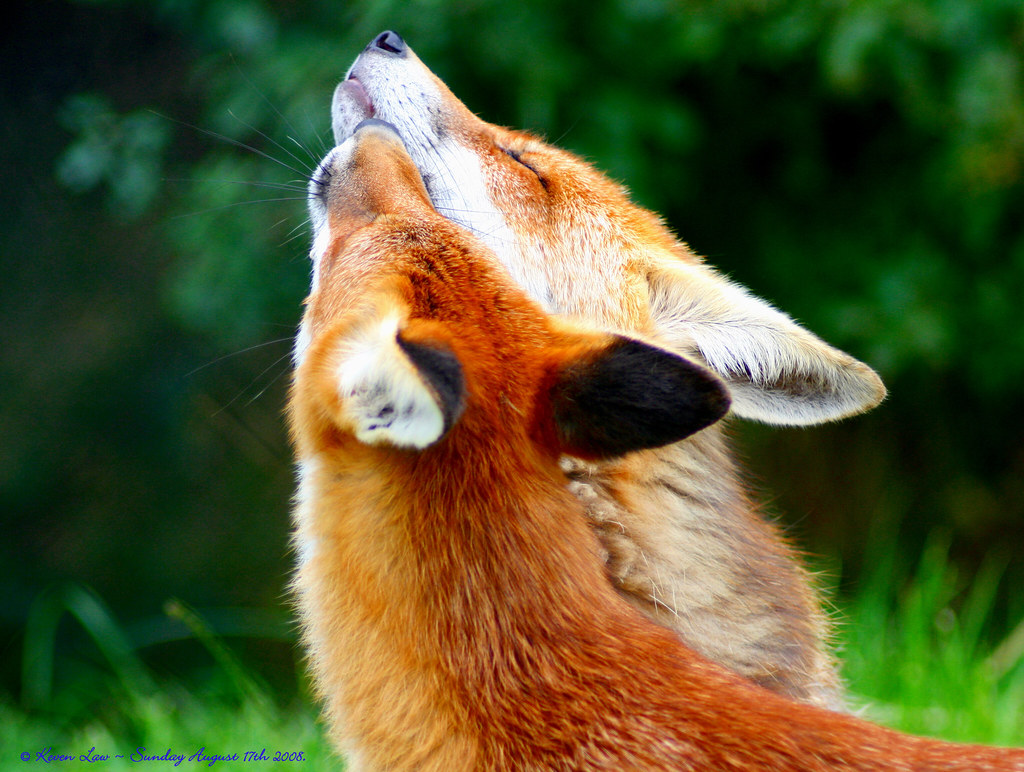
Fox is a name applied to any of roughly 27 species of small to medium-sized canids, characterized by possessing a long, narrow snout, and a bushy tail, or "brush". By far the most common and widespread species of fox is the red fox (Vulpes vulpes), although various species are found on almost every continent. The presence of fox-like carnivores all over the globe has led to their appearance in the popular culture and folklore of many nations, tribes, and other cultural groups.
Etymology ~ The Modern English "fox" is derived from Old English fox. The Old English word itself comes from the Proto-Germanic word *fukh – compare German Fuchs, Gothic fauho, Old Norse foa and Dutch vos. It corresponds to the Proto-Indo-European word *puke meaning "tail" (compare Sanskrit puccha, also "tail"). The bushy tail is also the source of the word for fox in Welsh: llwynog, from llwyn, "bush", Lithuanian: uodegis, from uodega, "tail", and Portuguese: raposa, from rabo, "tail".
General characteristics ~ Most foxes live 2 to 3 years, but they can survive for up to 10 years or even longer in captivity. Foxes are generally smaller than other members of the family Canidae such as wolves, jackals, and domestic dogs. Dogs (male foxes) weigh on average, 5.9kg and vixens (female foxes) weigh less, at 5.2kg (13 lbs and 11.5 lbs, respectively). Fox-like features typically include an acute muzzle (a "fox face") and bushy tail. Other physical characteristics vary according to their habitat. For example, the fennec fox (and other species of foxes adapted to life in the desert, such as the kit fox) has large ears and short fur, whereas the Arctic fox has small ears and thick, insulating fur.
Another example is the red fox which has a typical auburn pelt, the tail normally ending with white marking.
Unlike many canids, foxes are usually not pack animals. Typically, they are solitary, opportunistic feeders that hunt live prey (especially rodents). Using a pouncing technique practiced from an early age, they are usually able to kill their prey quickly. Foxes also gather a wide variety of other foods ranging from grasshoppers to fruit and berries.
Foxes are normally extremely wary of humans and are not kept as pets (with the exception of the fennec); however, the silver fox was successfully domesticated in Russia after a 45 year selective breeding program. This selective breeding also resulted in physical and behavioural traits appearing that are frequently seen in domestic cats, dogs, and other animals: pigmentation changes, floppy ears, and curly tails.
Diet ~ The diet of foxes comprises rodents, insects, worms, fruit, fish, birds, eggs, and all other kinds of small animals. The fox generally consumes around 1 kg of food every day. Foxes that live in neighborhoods mainly depend on household waste and even rodents and birds that keep moving around these areas. Foxes are known to cache their food, burying the excess for later consumption.
They mostly thrive in the higher latitudes, suburban and even urban environments both in Europe and in North America. They are found also in Eurasia, North Africa, India (Ladakh, Himalayas, Jammu and Kashmir, Rajasthan and Gujarat), China, Japan and in Australia.
Conservation ~ Foxes are readily found in cities and cultivated areas and (depending upon species) seem to adapt reasonably well to human presence.
Red foxes have been introduced into Australia and some other countries for hunting. Australia lacks similar carnivores, and the introduced foxes prey on native wildlife, some to the point of extinction. A similar introduction occurred in the seventeenth and eighteenth centuries in temperate North America, where European reds (Vulpes vulpes) were brought to the colonies for fox hunting, where they decimated the American red fox population through more aggressive hunting and breeding. Interbreeding with American reds, traits of the European red eventually pervaded the gene pool, leaving European and American foxes now virtually identical.
Other fox species do not adapt as well as the red fox, and are endangered in their native environments. Key among these are the crab-eating fox (Cerdocyon thous) and the African bat-eared fox. Other foxes such as fennec foxes, are not endangered, but will be if humans encroach further into their habitat.
Foxes have been successfully employed to control pests on fruit farms, where they leave the fruit intact.
Historians believe foxes were imported into non-native environments long before the colonial era. The first example of the introduction of the fox into a new habitat by humans seems to be Neolithic Cyprus. Stone carvings representing foxes have been found in the early settlement of Göbekli Tepe in eastern Turkey.
Very rarely, the Bengal Tiger produces white specimens. The earliest recordings of sightings of white tigers date from the mid 16th century, but only a dozen sightings have been noted in the last 100 years. The last wild white tiger was sighted in 1951! White tigers are neither a separate sub species nor albino, but instead have reduced pigmentation. White tigers are produced when two carriers of the recessive gene, who may not necessarily be white themselves, breed. This condition is known as leucism.
A juvenile instar of ~0.5 mm. Definite signs of the pigmentation pattern beginning to develop here.
[Part of a garden survey of the "novel" springtail Katiannidae Genus nov.1 sp. nov. that I'm doing for FransJanssens@www.collembola.org to establish the size and differences between the various instars.
Canon MP-E65mm Macro (at 5x) + 1.4x tele-extender + 25mm extension tube + diffused MT24-EX Twinlite flash. Heavily cropped.]
A blue rose is a flower of the genus Rosa (family Rosaceae) that presents blue-to-violet pigmentation instead of the more common red, white, or yellow.
I've mentioned in a previous post that the majority of the Katiannidae I'm seeing in the garden at the moment, have reduced levels of pigmentation. Less pigmentation that I recollect in previous years anyway. I've always seen a few, but more this year. Three of these are from today; one from a couple of days back.
Does it mean anything; who knows. Well Frans might! I think I can see the sub-anal appendage in two of these (see added notes). That would make them female.
Laguna Colorado, Bolivia.
After a siesta and lunch we headed off to La Laguna Colorado. Its a rather shallow pool of water in the Altiplano region of Bolivia. Its also home to a rather large population of Flamingos that were all feasting. The red colour is caused by algae and pigmentation of sediment and its contrasted greatly by the white of the borax (a type of sodium).
Its a stunning scene that is visually epic. Its not many places you get a red coloured lagoon. And to mention god damn Flamingos.
The orange tip butterfly, Anthocharis cardamines,(Pieridae, Lepidoptera) is mainly found throughout Europe and temperate Asia . The males feature wings with a signature orange pigmentation.
Males and females of this species occupy different habitats: males mostly frequent the edges of forests whereas females frequent meadows.
Karen asked Hershey to " speak " what came out was more of a faint gurgle...however, he did manage to open his mouth wide enough for us to see the pigmentation on his tongue. Thank god he didn't have bad doggy breath !!
Photo credits go to Karen...
The white tiger or bleached tiger is a pigmentation variant of the Bengal tiger, which is reported in the wild from time to time in the Indian states of Madhya Pradesh, Assam, West Bengal and Bihar in the Sunderbans region and especially in the former State of Rewa. Such a tiger has the black stripes typical of the Bengal tiger, but carries a white or near-white coat.
Lego Simpsons 71005
The Simpsons is an American adult animated sitcom created by Matt Groening for the Fox Broadcasting Company.The series is a satirical depiction of a middle class American lifestyle epitomized by its family of the same name, which consists of Homer, Marge, Bart, Lisa, and Maggie. The show is set in the fictional town of Springfield and parodies American culture, society, television, and many aspects of the human condition.
The family was conceived by Groening shortly before a solicitation for a series of animated shorts with the producer James L. Brooks. Groening created a dysfunctional family and named the characters after members of his own family, substituting Bart for his own name. The shorts became a part of The Tracey Ullman Show on April 19, 1987. After a three-season run, the sketch was developed into a half-hour prime time show and was an early hit for Fox, becoming the network's first series to land in the Top 30 ratings in a season (1989–1990).
Since its debut on December 17, 1989, the show has broadcast 548 episodes and the 25th season began on September 30, 2013. The Simpsons is the longest-running American sitcom, the longest-running American animated program, and in 2009 it surpassed Gunsmoke as the longest-running American primetime, scripted television series. The Simpsons Movie, a feature-length film, was released in theaters worldwide on July 26 and 27, 2007, and grossed over $527 million.
--------------
Les Simpson (The Simpsons) est une série télévisée d'animation américaine créée par Matt Groening et diffusée depuis le 17 décembre 1989 sur le réseau FOX.
Elle met en scène les Simpson, stéréotype d'une famille de classe moyenne. Leurs aventures servent une satire du mode de vie américain. Les membres de la famille, tous ayant la pigmentation de peau de couleur jaune, sont Homer, Marge, Bart, Lisa et Maggie.
[My Portfotolio] [My Google + ]
Thanks to all for visits and faves :)
See it in Originale (1500 x 686) !!!!!!
[My GETTY Images @] [My MOST FAVE on Flickriver] [My RECENT on Fluidr] [My STREAM on Darckr]
Caméra Sony NEX-5
Exposition 13s
Ouverture f/11.0
Longueur focale 100 mm (Minolta 100mm f2 + Kenko 25mm)
Vitesse ISO 200
Détection du degré d'exposition +1.3 EV
Lots of these globular springtails in leaf-litter at the moment. This individual was under a piece of fallen bark in a local churchyard. Around 1.5mm.
This is a male. They often have pigmented "cheeks"; where the pigmentation reaches the underside of the eye. The genital papilla is visible to, just anterior to the final abdominal segments (the small abdomen). Dicyrtomina saundersi also has pigmentation in the form of a multi-barred cross on the rear of the large abdomen.
This is my first time seeing pups of this colour, and the first time we've had pups of such a colour born in our hamstery. For a few days I was wondering at their odd pigmentations.
It is very difficult to photograph their coats to the exact shade as they look kinda grey in some angles, and a faint gold in other angles.
The closest colours I've seen that resemble the coats of these two pups is called the Yellow-blue.
More about the coat colours in this litter :)
Disclaimer:
Please do not try this with your own hamsters, unless you are very sure of what you are doing. Behind the scenes preparation was involved in this photo and no hamsters were injured during or after this photo was taken. Thank you for your concern.
Gisteren tijdens een wandeling deze merel tegengekomen. Voor het eerst dat ik zoiets zie, en dus even moeten googlen.
Leucisme is een afwijking bij dieren en mensen die leidt tot een verminderde pigmentatie. Leucisme lijkt op albinisme en wordt daar soms mee verward. Zie verder:
nl.wikipedia.org/wiki/Leucisme
Yesterday encountered this blackbird during a walk. For the first time that I see something like that, and so I have to google it.
Leucism is a deviation in animals and people that leads to a reduced pigmentation. Leucism is similar to albinism and is sometimes confused with it. See further:
en.wikipedia.org/wiki/Leucisme
Welcome to my Flickr space & thank you for visiting,
hope you enjoy my images.
Don't use this image on any media without my permission.
You can contact me on my website at:
Many thanks to everyone who takes the time to look,
like and comment on my pictures.
Thanks for > 9 000 000 views.
The humpback whale (Megaptera novaeangliae) is a species of baleen whale. It is a rorqual (a member of the family Balaenopteridae) and is the only species in the genus Megaptera.
The adult humpback whale is generally 14–15 m (46–49 ft), though longer lengths of 16–17 m (52–56 ft) have been recorded. Females are usually 1–1.5 m (3 ft 3 in – 4 ft 11 in) longer than males.
The species can reach body masses of 40 metric tons (44 short tons). Calves are born at around 4.3 m (14 ft) long with a weight of 680 kg (1,500 lb).
The body is bulky with a thin rostrum and proportionally long flippers, each around one-third of its body length.[15][16] It has a short dorsal fin that varies from nearly non-existent to somewhat long and curved.
As a rorqual, the humpback has grooves between the tip of the lower jaw and the navel. They are relatively few in number in this species, ranging from 14–35. The mouth is lined with baleen plates, which number 270-400 for both sides.
Unique among large whales, humpbacks have bumps or tubercles on the head and front edge of the flippers; the tail fluke has a jagged trailing edge.
The tubercles on the head are 5–10 cm (2.0–3.9 in) thick at the base and poke up to 6.5 cm (2.6 in). They are mostly hollow in the center, often containing at least one fragile hair that erupts 1–3 cm (0.39–1.18 in) from the skin and is 0.1 mm (0.0039 in) thick. The tubercles develop early in the womb and may have a sensory function as they are rich in nerves.
The dorsal or upper-side of the animal is generally black; the ventral or underside has various levels of black and white coloration. Whales in the southern hemisphere tend to have more white pigmentation. The flippers can vary from all-white to white only on the undersurface.
The varying color patterns and scars on the tail flukes distinguish individual animals. The end of the genital slit of the female is marked by a round feature, known as the hemispherical lobe, which visually distinguishes males and females.
This image was taken from the breakwater at Honningsvag Harbour in Norway
“Bahama Pintail Duck”
Judy Royal Glenn Photography
I was thrilled to be greeted by a Bahama Pintail duck when we arrived at the Jardin Botanique De Deshaies in Guadeloupe. He kinda took my breath away—he is gorgeous. This duck has a mutation called leucistic which means it has less pigmentation in the skin.
This dabbling duck has several other names as well i.e. white-cheeked pintail and summer duck. You may choose to call him whichever you want. To put the icing on the cake, he was swimming in a pond full of coy.
Please feel free to visit my website: