View allAll Photos Tagged interference
A colourful structure of horizontal lines winds from tree to tree bringing an element of logical geometric arrangement to the urban environment, creating a powerful and poetic image. Photo by Kelvin Trundle : Facebook - www.facebook.com/KelvinTrundlephotography/
Now Ibasho gallery in Antwerp makes a little presentation of my work in their bookshop. You can see my prints and portfolio there, though I’ve not made my book yet… Drop in at IBASHO gallery when you visit Antwerp! :)
Generally, hybridisation of macaws in the wild is rare, so I am assuming this Verde Macaw, a cross between a Scarlet Macaw and a Great Green Macaw, may have come about because it was an offspring of two members of a mixed flock of Scarlets and Greens that visited a small Costa Rican farm for a feed and a photographic opportunity for tourists.
A less charitable view is that the farmer was intentionally encouraging cross-breeding for other purposes, including the pet trade. The flock was free to fly in and out of the property at will, but there were a couple of large nest-boxes in view.
Soap film interference take 2. Taken at a higher shutter speed to stop some motion blurring. LED light source
It’s December 1st, time for snowflakes! This one is special for me as it illustrates the magical – albeit disfiguring – process of sublimation. But before we get into all that, I want to remind everyone that my latest snowflake coin from the Royal Canadian Mint is now available – and they are selling out. I’m not sure how fast, but I do know that they have limited sales to one per person on their website: www.mint.ca/en/shop/coins/2023/dollar20-pure-silver-hexag... . Don’t miss out on the first hexagonal coin minted as collector’s Canadian currency.
This image depicts a primary set of five snowflakes, all photographed after they had been resting on the ground for a while. The telltale signs are obvious, starting with the very rounded tips of the outermost branches. By the logic that “what sticks out the farthest, grows the fastest”, the inverse is also true: what sticks out the farthest will sublimate the fastest in a low-humidity environment. Sublimation, for those unfamiliar with the word, is going from a solid state of matter directly to a gas without first becoming a liquid. Snowflakes will return to the air that created them fairly quickly, even in cold weather.
But there’s another area of sublimation that rarely gets discussed: internal or conjoined sublimation. Imagine a disc of air trapped inside a snowflake. As the water molecules sublimate in an enclosed space, they look for another place to attach themselves to. This is less likely to be large flat surfaces and more likely to be corners and edges. As this process continues, the flat surfaces will lose more molecules, and the edges will gain them. A disc, given enough time by this logic, would eventually become a sphere. It gets better (and more beautiful) when you have air trapped between two complex surfaces of different snowflakes effectively “holding hands”.
Vibrant tie-dye colour can be created by means of optical interference in these spaces. The gap between the two branches has to be narrow and the internal cavity mostly or completely closed off from the outside air. As water molecules release themselves in a low-humidity environment, they will re-attach on the surface structures available, in a much more complex manner than a disc becomes a sphere. Still, it’s effective a “rounding out” of the details. If the gap is thin enough, then physics plays a beautiful note to generate colours, the same physics that puts rainbows in soap film.
The fascination comes in the tiniest details around these rainbow puddles of air as well. Look close, and I mean REAL close, and you’ll see a curious trail of tiny bubbles around the larger sources of colour. I’m not a physicist, but I can hypothesize what is happening here: as the outer edges of the structure gather more of the errant water molecules, deviations in the surface topography can close off the structure while leaving little pockets of air behind, these discs then continuing their own fate to become independent spheres.
Sublimation is usually something I avoid; I want to photograph snowflakes as quickly as possible to preserve their original shapes and structures. However, if one allows a snowflake to “age” in a cluster, you might be surprised what treasures you can discover.
I’ll be trying my best to post a new snowflake photograph every other day until Christmas. Stay tuned for more. :)
Broad branches are always a beautiful trait, almost as if this snowflake is a set of seven, including the center. Combined with a splash of colour from thin film interference, there’s a lot of charm here – but there’s also a mystery. The thin sections of the branches have a feature I can’t easily explain.
Let’s use the 2 o’clock branch as a reference, though the same can be seen on all but the bottom branch. The harder area running along the “spine” of the branch is almost in the shape of a half-pipe, like a water slide; I suppose the better reference would be a linear stretch of bobsleigh track? At the top, it’s flush with the broad paddle at the end. At the bottom, it spills out into a larger pool. The easiest way to visualize the height difference is to look at the “wings” on either side of the half-pipe, notably hovering above a lower layer of ice below.
The standard models for snowflake growth have a hard time explaining how these features grow. Split growth can be explained a number of ways, where the most applicable here is that the end of an outward-growing branch tip becomes hollow in the center, creating two parallel planes. The half-pipe feature, however, defies this logic. It could be explained by inward crystal growth, starting on the outer edge of the paddles and working its way back towards the center. I have never seen it manifest in such formations, but it’s the only applicable “rule”.
I should also add that these features would mostly be invisible if not for the use of light reflecting off the surface of the crystal. Had this been photographed in the more traditional method of transmitted light (light that comes from behind the snowflake and passes through the crystal), you would not see the surface contours that identify this mystery. Significant and valuable details can only be seen when you bounce light off the snowflake, like glare off a window.
The bottom branch, however, beats to a different drum. The paddle is sectored, and in the same region as the bobsleigh track we have a ridge hollowed by two lower layers. Note the thickness of the small side-branches just south of the central hexagon as well. Broad branches and thickened features are both representative of consistent, slow growth. A similar dendrite-type snowflake would have grown at least twice as fast to reach the same outer footprint as this crystal.
Also, be sure to check out my latest snowflake coin from the Royal Canadian Mint, my fourth design and the second in the hexagonal pure silver series: www.mint.ca/en/shop/coins/2024/fine-silver-hexagon-coin-w...
Far less symmetrical than yesterday’s, but with a mysterious twist in the center that is definitely worth a closer look. View large!
The center shows signs of thin film interference colours that spread out where bubbles form in the ice. Hopefully I’m not speaking a foreign language at this point, if you’ve read my previous posts you might have an idea how these colours arise. Here’s more info if you’re just catching up: skycrystals.ca/pages/optical-interference-pages.jpg
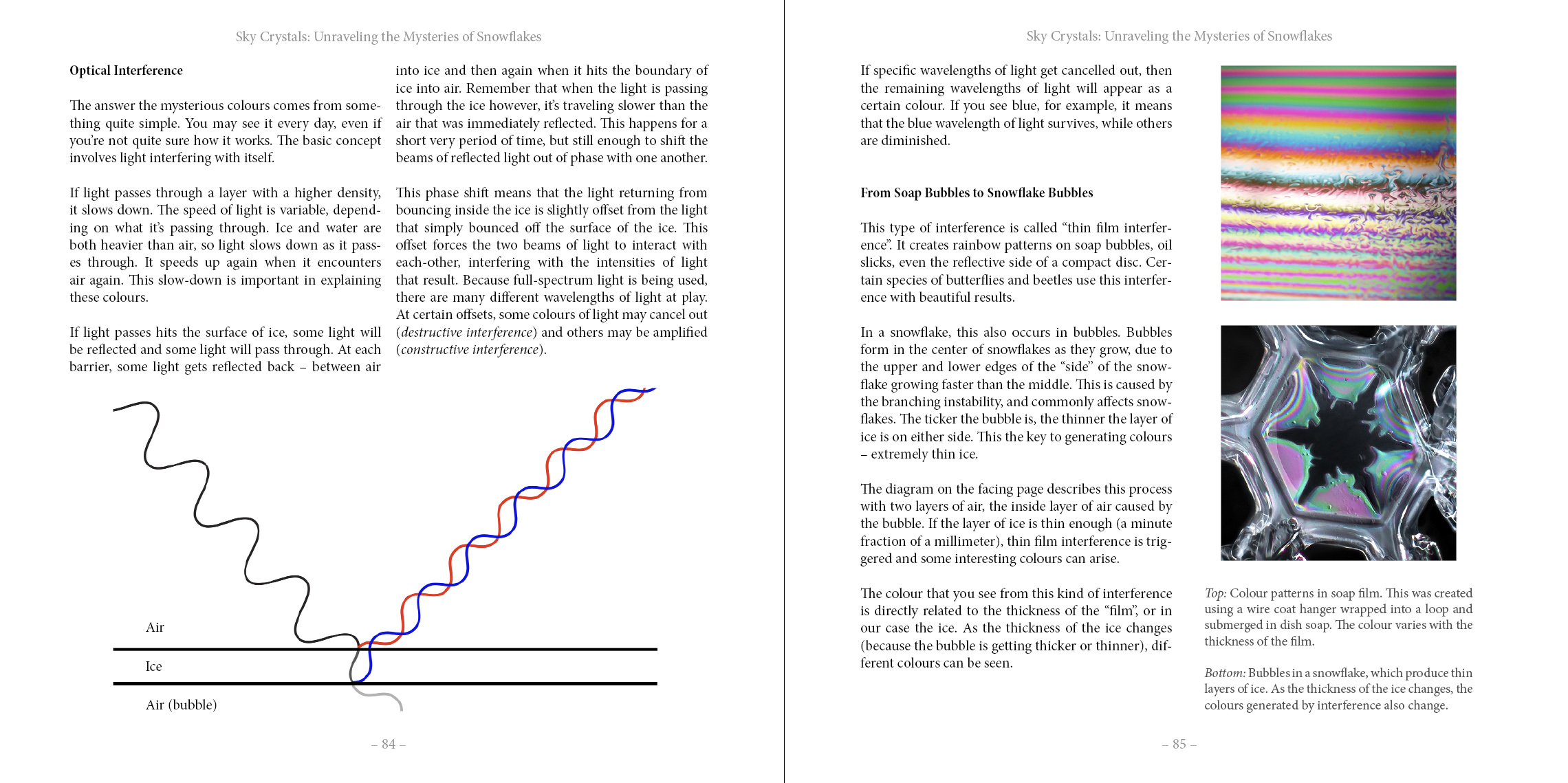
It’s far more difficult to explain the elevation shift between the upper four branches and the bottom two. Clearly they are growing on slightly different planes based on contours and shadows, but usually this kind of separation includes the center of the snowflake in the split. This tiny crystal defies that logic and gives the very center to the lower level, creating only edges that grow off to the upper branches.
My only possible explanation is this: if the initial hexagon crystal was somehow receiving an uneven amount of water vapour, branches might from more quickly in areas of higher humidity. In areas of lower humidity, the edges of a hexagon crystal tend to thicken. If this division of humidity happened during the very early stages of growth (probably due to the aerodynamic properties of the crystal), it could make a thicker ridge on one side while sprouting branches from the other. The thicker ridge would eventually form branches of its own, but with the potential for them to grow at a slightly different elevation.
These conditions would be incredibly rare, but it stands to reason that I have never seen a snowflake quite like this before. Incredibly rare features are bound to show themselves when you look at many thousands of snowflakes specifically seeking them out!
For more fun scientific musings on snowflakes, and for my entire photographic tutorial to makes images like this yourself, check out the book Sky Crystals: skycrystals.ca/book/ - 304ph hardcover book that is exactly what you need to make winter more tolerable. :)
I’ve worked with snowflakes for many years and many thousands of hours. All of that effort has been funneled into a single print, titled “The Snowflake”: skycrystals.ca/poster/ - all of these snowflakes are accurately measured and scaled to relative size of one another. It’s easy to get lost in the details!
Soap film interference. Third go at this with more glycerol in the mix. This stopped the colours swirling around and allowed me to take multiple shots for focus stacking using zerene thus getting the whole frame in focus.
Prints | Facebook | Soundcloud | Instagram | Twitter | G+ | Blog | © Ben Heine
Long exposure with led lights in my studio. Recent photo featuring Zhuzhu. Prints: www.deviantart.com/print/36163268
View my other photos with Zhuzhu at this link. And my other photos with models here.
All my images are copyrighted, please do not use them without permission, thanks.
PS: Please join me on Soundcloud, I plan to add several new musical works there shortly.
For more information about my projects, please contact: info@benheine.com
I don't think that my latest picture did justice to her. So, here, she is, professor Wedgensen from Ground Control. And distortion...
A colourful structure of horizontal lines winds from tree to tree bringing an element of logical geometric arrangement to the urban environment, creating a powerful and poetic image. Photo by Kelvin Trundle : Facebook - www.facebook.com/KelvinTrundlephotography/
While waiting on some special chrome bits for IRL design, I played with translating the model to digital. Orthographic projections like these were a fun result.
(There's also a design video on YouTube.)