View allAll Photos Tagged highest
Highest position: 56 on Thursday, December 28, 2006
-Added to the Cream of the Crop pool as my personal favorite.
Highest Position - Explore #382
Farms are all over Tasmania and where ever you go, you can see cows , sheeps and horses. I love countryside ... and I miss it ...
-----------------------------------------------------------------------------------------------------
Wow , thanks everyone ... my video " Australia " exceeded 1000+ views. If you didn't see it yet , check this out : www.youtube.com/watch?v=zcpgFtPSoaU
-----------------------------------------------------------------------------------------------------
To follow me on twitter :
twitter.com/#!/DamonProduction
To follow me on youtube :
www.youtube.com/DamonProduction
To follow me on facebook :
www.facebook.com/profile.php?id=100001916998689
and my Vimeo account :
vimeo.com/user6631034/videos
The highest peak of the Càntari mountains, the Viglio (2.156 m) in winter dresses itself in pure wonder.
And the fortunate walker hiking it’s slopes nourish himself with magnificent views, deep silence and the poetry which one feels only on the ‘purest’ mountains.
Monti Simbruini natural park, Italy
| Website | Facebook Page | Instagram |
Highest quality prints available, contact me to request your favourite picture.
paul@pauloimages.co.uk
Highest quality prints available, contact me to request your favourite picture.
paul@pauloimages.co.uk
“It has been empirically studied that Pakistan has a potential of producing 92% of its electricity requirements via solar energy, at a rate that’s amongst the highest in the world.”
While IT companies like Apple and Google have been making strides towards ensuring that all their operations are po...
www.globalaffairs.com.pk/pakistan-by-2050-the-highest-sol...
Highest position: #163 on Monday, July 8, 2013
I don't understand how Explore works ,this photo got over 1400 views in less than 24 hours ( which for me is a hell of a lot ) was favorited almost 100 times but has already been dropped from Explore...I don't get it !!
EXPLORE: Highest position: 244 on Friday, December 19, 2008
"Piazza Grande" - Montepulciano (SI) - Tuscany
Nikon D700 FX & Zenitar fisheye 16mm f/2.8
Captured from an old video taken with maximum zoom at this high rock!
Special thanks to: www.flickr.com/photos/buckeye1
Red-billed chough***
Highest quality prints available, contact me to request your favourite picture.
paul@pauloimages.co.uk
Highest quality prints available, contact me to request your favourite picture.
paul@pauloimages.co.uk
#92 Highest Position In Explore
Model : [ ҒåĦōθōЙ ]
Taken In : Brighton
Wow =D .. Now That's What I'd Call A CRAZY Friend =P .. Just Like Me ! ..
You Know, When We Were In Brighton .. I Never Missed A Day Of School ..
Exept When Fahood Came To Brighton And Stayed In Our House ..
He Stayed For 2 Days .. And They Were The BEST I Had In Brighton ! ..
The 2nd Day, We Were Just Back From The Train Station
And We Found Out That There Weren't Any more Trains To London ..
Fahood Stayed With Me 4 Another Night .. And Boy Was It GREAT ! ..
He Was Tired =P And I Was Too ..
From The Moment We Arrived @ 11 PM, I Asked Him If He Wants To Play Cards With Me ..
He Told Me That He Wanted To Sleep .. And I Said It's Ok ..
And From That Moment Till 5 AM, We Were Talking In BED !! ..
=D We Had A BLAST ! I Don't Think That I've EVER Given Away Many Of my Secrets In Such Short Time !
And The Same Goes For Him ! ..
Then @ 5 AM, We Went Out And Walked In Brighton Shooting Photos =D ..
And That Was One Of Them ^^ ..
=) He's A Wonderful Guy & I'm Proud That I Know Him ^^ God Knows He's Like A Brother To Me Now ! ..
And A Crazy One Too ! And That - At Least For Me - ROCKS !! ..
=D Of Course He's Still In London ^^" ..
And I'll Be Waiting 4 Him To Come Back =D And We'll Have Another Blast Here, Hopefully ^^" ..
=D Anyway .. So I Hope He Likes The Shot, And You Do Too ^^" ..
Thanks For Being A Great Model Fahood =D And A Friend ^_^ ..
,
,
Cheers..
Highest position: 231 on Tuesday, February 25, 2014
Please note:
All of my photos are copyrighted with All Rights Reserved.
Do not copy, print, download, display, alter, blog, stream or otherwise use my photos in any manner without my written permission!
DSC_5471
Highest quality prints available, contact me to request your favourite picture.
paul@pauloimages.co.uk
Arches National Park is a national park in eastern Utah, United States. The park is adjacent to the Colorado River, 4 miles (6 km) north of Moab, Utah. More than 2,000 natural sandstone arches are located in the park, including the well-known Delicate Arch, as well as a variety of unique geological resources and formations. The park contains the highest density of natural arches in the world.
The park consists of 310.31 square kilometres (76,680 acres; 119.81 sq mi; 31,031 ha) of high desert located on the Colorado Plateau. The highest elevation in the park is 5,653 feet (1,723 m) at Elephant Butte, and the lowest elevation is 4,085 feet (1,245 m) at the visitor center. The park receives an average of less than 10 inches (250 mm) of rain annually.
Administered by the National Park Service, the area was originally named a national monument on April 12, 1929, and was re designated as a national park on November 12, 1971. The park received more than 1.6 million visitors in 2018.
As stated in the foundation document in U.S. National Park Service website:
The purpose of Arches National Park is to protect extraordinary examples of geologic features including arches, natural bridges, windows, spires, and balanced rocks, as well as other features of geologic, historic, and scientific interest, and to provide opportunities to experience these resources and their associated values in their majestic natural settings.
The national park lies above an underground evaporite layer or salt bed, which is the main cause of the formation of the arches, spires, balanced rocks, sandstone fins, and eroded monoliths in the area. This salt bed is thousands of feet thick in places and was deposited in the Paradox Basin of the Colorado Plateau some 300 million years ago (Mya) when a sea flowed into the region and eventually evaporated. Over millions of years, the salt bed was covered with debris eroded from the Uncompahgre Uplift to the northeast. During the Early Jurassic (about 200 Mya), desert conditions prevailed in the region and the vast Navajo Sandstone was deposited. An additional sequence of stream laid and windblown sediments, the Entrada Sandstone (about 140 Mya), was deposited on top of the Navajo. Over 5,000 feet (1,500 m) of younger sediments were deposited and have been mostly eroded. Remnants of the cover exist in the area including exposures of the Cretaceous Mancos Shale. The arches of the area are developed mostly within the Entrada formation.
The weight of this cover caused the salt bed below it to liquefy and thrust up layers of rock into salt domes. The evaporites of the area formed more unusual "salt anticlines" or linear regions of uplift. Faulting occurred and whole sections of rock subsided into the areas between the domes. In some places, they turned almost on edge. The result of one such 2,500-foot (760 m) displacement, the Moab Fault, is seen from the visitor center.
As this subsurface movement of salt shaped the landscape, erosion removed the younger rock layers from the surface. Except for isolated remnants, the major formations visible in the park today are the salmon-colored Entrada Sandstone, in which most of the arches form, and the buff-colored Navajo Sandstone. These are visible in layer-cake fashion throughout most of the park. Over time, water seeped into the surface cracks, joints, and folds of these layers. Ice formed in the fissures, expanding and putting pressure on surrounding rock, breaking off bits and pieces. Winds later cleaned out the loose particles. A series of free-standing fins remained. Wind and water attacked these fins until, in some, the cementing material gave way and chunks of rock tumbled out. Many damaged fins collapsed. Others, with the right degree of hardness and balance, survived despite their missing sections. These became the famous arches.
Although the park's terrain may appear rugged and durable, it is extremely fragile. More than 1 million visitors each year threaten the fragile high-desert ecosystem. The problem lies within the soil's crust, which is composed of cyanobacteria, algae, fungi, and lichens that grow in the dusty parts of the park. Factors that make Arches National Park sensitive to visitor damage include being a semiarid region, the scarce, unpredictable rainfall, lack of deep freezing, and lack of plant litter, which results in soils that have both a low resistance to and slow recovery from, compressional forces such as foot traffic. Methods of indicating effects on the soil are cytophobic soil crust index, measuring of water infiltration, and t-tests that are used to compare the values from the undisturbed and disturbed areas.
Geological processes that occurred over 300 million years ago caused a salt bed to be deposited, which today lies beneath the landscape of Arches National Park.[ Over time, the salt bed was covered with sediments that eventually compressed into rock layers that have since been named Entrada Standstone. Rock layers surrounding the edge of the salt bed continued to erode and shift into vertical sandstone walls called fins. Sand collected between vertical walls of the fins, then slightly acidic rain combined with carbon dioxide in the air allowed for the chemical formation of carbonic acid within the trapped sand. Over time, the carbonic acid dissolved the calcium carbonate that held the sandstone together. Many of the rock formations have weaker layers of rock on bottom that are holding stronger layers on top. The weaker layers would dissolve first, creating openings in the rock. Gravity caused pieces of the stronger rock layer to fall piece by piece into an arch shape. Arches form within rock fins at points of intense fracturing localization, or weak points in the rock's formation, caused by horizontal and vertical discontinuities. Lastly, water, wind, and time continued this erosion process and ultimately created the arches of Arches National Park. All of the arches in the park are made of Entrada Sandstone, however, there are slight differences in how each arch was developed. This allows the Entrada Sandstone to be categories into 3 groups including Slick rock members, Dewey rock members, and Moab members. Vertical arches can be developed from Slick rock members, a combination of Slick rock members and Moab members, or Slick rock members resting above Dewey rock members. Horizontal arches (also called potholes) are formed when a vertical pothole formation meets a horizontal cave, causing a union into a long arch structure. The erosion process within Arches National Park will continue as time continues to pass. Continued erosion combined with vertical and horizontal stress will eventually cause arches to collapse, but still, new arches will continue to form for thousands of years.
Humans have occupied the region since the last ice age 10,000 years ago. Fremont people and Ancestral Puebloans lived in the area until about 700 years ago. Spanish missionaries encountered Ute and Paiute tribes in the area when they first came through in 1775, but the first European-Americans to attempt settlement in the area were the Mormon Elk Mountain Mission in 1855, who soon abandoned the area. Ranchers, farmers, and prospectors later settled Moab in the neighboring Riverine Valley in the late 1870s. Word of the beauty of the surrounding rock formations spread beyond the settlement as a possible tourist destination.
The Arches area was first brought to the attention of the National Park Service by Frank A. Wadleigh, passenger traffic manager of the Denver and Rio Grande Western Railroad. Wadleigh, accompanied by railroad photographer George L. Beam, visited the area in September 1923 at the invitation of Alexander Ringhoffer, a Hungarian-born prospector living in Salt Valley. Ringhoffer had written to the railroad to interest them in the tourist potential of a scenic area he had discovered the previous year with his two sons and a son-in-law, which he called the Devils Garden (known today as the Klondike Bluffs). Wadleigh was impressed by what Ringhoffer showed him, and suggested to Park Service director Stephen T. Mather that the area be made a national monument.
The following year, additional support for the monument idea came from Laurence Gould, a University of Michigan graduate student (and future polar explorer) studying the geology of the nearby La Sal Mountains, who was shown the scenic area by local physician Dr. J. W. "Doc" Williams.
A succession of government investigators examined the area, in part due to confusion as to the precise location. In the process, the name Devils Garden was transposed to an area on the opposite side of Salt Valley that includes Landscape Arch, the longest arch in the park. Ringhoffer's original discovery was omitted, while another area nearby, known locally as the Windows, was included. Designation of the area as a national monument was supported by the Park Service in 1926 but was resisted by President Calvin Coolidge's Interior Secretary, Hubert Work. Finally, in April 1929, shortly after his inauguration, President Herbert Hoover signed a presidential proclamation creating the Arches National Monument, consisting of two comparatively small, disconnected sections. The purpose of the reservation under the 1906 Antiquities Act was to protect the arches, spires, balanced rocks, and other sandstone formations for their scientific and educational value. The name Arches was suggested by Frank Pinkely, superintendent of the Park Service's southwestern national monuments, following a visit to the Windows section in 1925.
In late 1938, President Franklin D. Roosevelt signed a proclamation that enlarged the Arches to protect additional scenic features and permit the development of facilities to promote tourism. A small adjustment was made by President Dwight Eisenhower in 1960 to accommodate a new road alignment.
In early 1969, just before leaving office, President Lyndon B. Johnson signed a proclamation substantially enlarging the Arches. Two years later, President Richard Nixon signed legislation enacted by Congress, which significantly reduced the total area enclosed, but changed its status. Arches National Park was formally dedicated in May 1972.
In 1980, vandals attempted to use an abrasive kitchen cleanser to deface ancient petroglyphs in the park, prompting park officials to recruit physicist John F. Asmus, who specialized in using lasers to restore works of art, to use his technology to repair the damage. Asmus "zapped the panel with intense light pulses and succeeded in removing most of the cleanser".
Climbing Balanced Rock or any named or unnamed arch in Arches National Park with an opening larger than 3 ft (0.9 m) is banned by park regulations. Climbing on other features in the park is allowed but regulated; in addition, slacklining and BASE jumping are banned parkwide.
Climbing on named arches within the park had long been banned by park regulations, but following Dean Potter's successful free climb on Delicate Arch in May 2006, the wording of the regulations was deemed unenforceable by the park attorney. In response, the park revised its regulations later that month, eventually imposing the current ban on arch climbing in 2014.
Approved recreational activities include auto touring, hiking, bicycling, camping at the Devils Garden campground, backpacking, canyoneering, and rock climbing, with permits required for the last three activities. Guided commercial tours and ranger programs are also available.
Astronomy is also popular in the park due to its dark skies, despite the increasing light pollution from towns such as Moab.
Delicate Arch is the subject of the third 2014 quarter of the U.S. Mint's America the Beautiful Quarters program commemorating national parks and historic sites. The Arches quarter had the highest production of the five 2014 national park quarters, with more than 465 million minted.
American writer Edward Abbey was a park ranger at Arches National Monument in 1956 and 1957, where he kept journals that became his book Desert Solitaire. The success of Abbey's book, as well as interest in adventure travel, has drawn many hikers, mountain bikers, and off-pavement driving enthusiasts to the area. Permitted activities within the park include camping, hiking along designated trails, backpacking, canyoneering, rock climbing, bicycling, and driving along existing roads, both paved and unpaved. The Hayduke Trail, an 812 mi (1,307 km) backpacking route named after one of Edward Abbey's characters, begins in the park.
An abundance of wildlife occurs in Arches National Park, including spadefoot toads, antelope squirrels, scrub jays, peregrine falcons, many kinds of sparrows, red foxes, desert bighorn sheep, kangaroo rats, mule deers, cougars, midget faded rattlesnakes, yucca moths, western rattlesnakes, and collared lizards.
A number of plant species are common in the park, including prickly pear cactus, Indian ricegrass, bunch grasses, cheatgrass, moss, liverworts, Utah juniper, Mormon tea, blackbrush, cliffrose, four-winged saltbrush, pinyon pine, evening primrose, sand verbena, yucca, and sacred datura.
Biological soil crust consisting of cyanobacteria, lichen, mosses, green algae, and microfungi is found throughout southeastern Utah. The fibrous growths help keep soil particles together, creating a layer that is more resistant to erosion. The living soil layer readily absorbs and stores water, allowing more complex forms of plant life to grow in places with low precipitation levels.
Among the notable features of the park are the following:
Balanced Rock – a large balancing rock, the size of three school buses
Courthouse Towers – a collection of tall stone columns
Dark Angel – a free-standing 150 ft-tall (46 m) sandstone pillar at the end of the Devils Garden Trail
Delicate Arch – a lone-standing arch that has become a symbol of Utah and the most recognized arch in the park
Devils Garden – many arches and columns scattered along a ridge
Double Arch – two arches that share a common end
Fiery Furnace – an area of maze-like narrow passages and tall rock columns (see biblical reference, Book of Daniel, chapter 3)
Landscape Arch – a very thin and long arch in the Devils Garden with a span of 290 ft (88 m) (the longest arch in the park)
Petrified Dunes – petrified remnants of dunes blown from the ancient lakes that covered the area
The Phallus – a rock spire that resembles a phallus
Wall Arch – located along the popular Devils Garden Trail; collapsed sometime on August 4/5, 2008
The Three Gossips –a mid-sized sandstone tower located in the Courthouse Towers area.
Utah is a landlocked state in the Mountain West subregion of the Western United States. It borders Colorado to its east, Wyoming to its northeast, Idaho to its north, Arizona to its south, and Nevada to its west. Utah also touches a corner of New Mexico in the southeast. Of the fifty U.S. states, Utah is the 13th-largest by area; with a population over three million, it is the 30th-most-populous and 11th-least-densely populated. Urban development is mostly concentrated in two areas: the Wasatch Front in the north-central part of the state, which is home to roughly two-thirds of the population and includes the capital city, Salt Lake City; and Washington County in the southwest, with more than 180,000 residents. Most of the western half of Utah lies in the Great Basin.
Utah has been inhabited for thousands of years by various indigenous groups such as the ancient Puebloans, Navajo, and Ute. The Spanish were the first Europeans to arrive in the mid-16th century, though the region's difficult geography and harsh climate made it a peripheral part of New Spain and later Mexico. Even while it was Mexican territory, many of Utah's earliest settlers were American, particularly Mormons fleeing marginalization and persecution from the United States via the Mormon Trail. Following the Mexican–American War in 1848, the region was annexed by the U.S., becoming part of the Utah Territory, which included what is now Colorado and Nevada. Disputes between the dominant Mormon community and the federal government delayed Utah's admission as a state; only after the outlawing of polygamy was it admitted in 1896 as the 45th.
People from Utah are known as Utahns. Slightly over half of all Utahns are Mormons, the vast majority of whom are members of the Church of Jesus Christ of Latter-day Saints (LDS Church), which has its world headquarters in Salt Lake City; Utah is the only state where a majority of the population belongs to a single church. A 2023 paper challenged this perception (claiming only 42% of Utahns are Mormons) however most statistics still show a majority of Utah residents belong to the LDS church; estimates from the LDS church suggests 60.68% of Utah's population belongs to the church whilst some sources put the number as high as 68%. The paper replied that membership count done by the LDS Church is too high for several reasons. The LDS Church greatly influences Utahn culture, politics, and daily life, though since the 1990s the state has become more religiously diverse as well as secular.
Utah has a highly diversified economy, with major sectors including transportation, education, information technology and research, government services, mining, multi-level marketing, and tourism. Utah has been one of the fastest growing states since 2000, with the 2020 U.S. census confirming the fastest population growth in the nation since 2010. St. George was the fastest-growing metropolitan area in the United States from 2000 to 2005. Utah ranks among the overall best states in metrics such as healthcare, governance, education, and infrastructure. It has the 12th-highest median average income and the least income inequality of any U.S. state. Over time and influenced by climate change, droughts in Utah have been increasing in frequency and severity, putting a further strain on Utah's water security and impacting the state's economy.
The History of Utah is an examination of the human history and social activity within the state of Utah located in the western United States.
Archaeological evidence dates the earliest habitation of humans in Utah to about 10,000 to 12,000 years ago. Paleolithic people lived near the Great Basin's swamps and marshes, which had an abundance of fish, birds, and small game animals. Big game, including bison, mammoths and ground sloths, also were attracted to these water sources. Over the centuries, the mega-fauna died, this population was replaced by the Desert Archaic people, who sheltered in caves near the Great Salt Lake. Relying more on gathering than the previous Utah residents, their diet was mainly composed of cattails and other salt tolerant plants such as pickleweed, burro weed and sedge. Red meat appears to have been more of a luxury, although these people used nets and the atlatl to hunt water fowl, ducks, small animals and antelope. Artifacts include nets woven with plant fibers and rabbit skin, woven sandals, gaming sticks, and animal figures made from split-twigs. About 3,500 years ago, lake levels rose and the population of Desert Archaic people appears to have dramatically decreased. The Great Basin may have been almost unoccupied for 1,000 years.
The Fremont culture, named from sites near the Fremont River in Utah, lived in what is now north and western Utah and parts of Nevada, Idaho and Colorado from approximately 600 to 1300 AD. These people lived in areas close to water sources that had been previously occupied by the Desert Archaic people, and may have had some relationship with them. However, their use of new technologies define them as a distinct people. Fremont technologies include:
use of the bow and arrow while hunting,
building pithouse shelters,
growing maize and probably beans and squash,
building above ground granaries of adobe or stone,
creating and decorating low-fired pottery ware,
producing art, including jewelry and rock art such as petroglyphs and pictographs.
The ancient Puebloan culture, also known as the Anasazi, occupied territory adjacent to the Fremont. The ancestral Puebloan culture centered on the present-day Four Corners area of the Southwest United States, including the San Juan River region of Utah. Archaeologists debate when this distinct culture emerged, but cultural development seems to date from about the common era, about 500 years before the Fremont appeared. It is generally accepted that the cultural peak of these people was around the 1200 CE. Ancient Puebloan culture is known for well constructed pithouses and more elaborate adobe and masonry dwellings. They were excellent craftsmen, producing turquoise jewelry and fine pottery. The Puebloan culture was based on agriculture, and the people created and cultivated fields of maize, beans, and squash and domesticated turkeys. They designed and produced elaborate field terracing and irrigation systems. They also built structures, some known as kivas, apparently designed solely for cultural and religious rituals.
These two later cultures were roughly contemporaneous, and appear to have established trading relationships. They also shared enough cultural traits that archaeologists believe the cultures may have common roots in the early American Southwest. However, each remained culturally distinct throughout most of their existence. These two well established cultures appear to have been severely impacted by climatic change and perhaps by the incursion of new people in about 1200 CE. Over the next two centuries, the Fremont and ancient Pueblo people may have moved into the American southwest, finding new homes and farmlands in the river drainages of Arizona, New Mexico and northern Mexico.
In about 1200, Shoshonean speaking peoples entered Utah territory from the west. They may have originated in southern California and moved into the desert environment due to population pressure along the coast. They were an upland people with a hunting and gathering lifestyle utilizing roots and seeds, including the pinyon nut. They were also skillful fishermen, created pottery and raised some crops. When they first arrived in Utah, they lived as small family groups with little tribal organization. Four main Shoshonean peoples inhabited Utah country. The Shoshone in the north and northeast, the Gosiutes in the northwest, the Utes in the central and eastern parts of the region and the Southern Paiutes in the southwest. Initially, there seems to have been very little conflict between these groups.
In the early 16th century, the San Juan River basin in Utah's southeast also saw a new people, the Díne or Navajo, part of a greater group of plains Athabaskan speakers moved into the Southwest from the Great Plains. In addition to the Navajo, this language group contained people that were later known as Apaches, including the Lipan, Jicarilla, and Mescalero Apaches.
Athabaskans were a hunting people who initially followed the bison, and were identified in 16th-century Spanish accounts as "dog nomads". The Athabaskans expanded their range throughout the 17th century, occupying areas the Pueblo peoples had abandoned during prior centuries. The Spanish first specifically mention the "Apachu de Nabajo" (Navaho) in the 1620s, referring to the people in the Chama valley region east of the San Juan River, and north west of Santa Fe. By the 1640s, the term Navaho was applied to these same people. Although the Navajo newcomers established a generally peaceful trading and cultural exchange with the some modern Pueblo peoples to the south, they experienced intermittent warfare with the Shoshonean peoples, particularly the Utes in eastern Utah and western Colorado.
At the time of European expansion, beginning with Spanish explorers traveling from Mexico, five distinct native peoples occupied territory within the Utah area: the Northern Shoshone, the Goshute, the Ute, the Paiute and the Navajo.
The Spanish explorer Francisco Vázquez de Coronado may have crossed into what is now southern Utah in 1540, when he was seeking the legendary Cíbola.
A group led by two Spanish Catholic priests—sometimes called the Domínguez–Escalante expedition—left Santa Fe in 1776, hoping to find a route to the California coast. The expedition traveled as far north as Utah Lake and encountered the native residents. All of what is now Utah was claimed by the Spanish Empire from the 1500s to 1821 as part of New Spain (later as the province Alta California); and subsequently claimed by Mexico from 1821 to 1848. However, Spain and Mexico had little permanent presence in, or control of, the region.
Fur trappers (also known as mountain men) including Jim Bridger, explored some regions of Utah in the early 19th century. The city of Provo was named for one such man, Étienne Provost, who visited the area in 1825. The city of Ogden, Utah is named for a brigade leader of the Hudson's Bay Company, Peter Skene Ogden who trapped in the Weber Valley. In 1846, a year before the arrival of members from the Church of Jesus Christ of latter-day Saints, the ill-fated Donner Party crossed through the Salt Lake valley late in the season, deciding not to stay the winter there but to continue forward to California, and beyond.
Members of the Church of Jesus Christ of Latter-day Saints, commonly known as Mormon pioneers, first came to the Salt Lake Valley on July 24, 1847. At the time, the U.S. had already captured the Mexican territories of Alta California and New Mexico in the Mexican–American War and planned to keep them, but those territories, including the future state of Utah, officially became United States territory upon the signing of the Treaty of Guadalupe Hidalgo, February 2, 1848. The treaty was ratified by the United States Senate on March 10, 1848.
Upon arrival in the Salt Lake Valley, the Mormon pioneers found no permanent settlement of Indians. Other areas along the Wasatch Range were occupied at the time of settlement by the Northwestern Shoshone and adjacent areas by other bands of Shoshone such as the Gosiute. The Northwestern Shoshone lived in the valleys on the eastern shore of Great Salt Lake and in adjacent mountain valleys. Some years after arriving in the Salt Lake Valley Mormons, who went on to colonize many other areas of what is now Utah, were petitioned by Indians for recompense for land taken. The response of Heber C. Kimball, first counselor to Brigham Young, was that the land belonged to "our Father in Heaven and we expect to plow and plant it." A 1945 Supreme Court decision found that the land had been treated by the United States as public domain; no aboriginal title by the Northwestern Shoshone had been recognized by the United States or extinguished by treaty with the United States.
Upon arriving in the Salt Lake Valley, the Mormons had to make a place to live. They created irrigation systems, laid out farms, built houses, churches, and schools. Access to water was crucially important. Almost immediately, Brigham Young set out to identify and claim additional community sites. While it was difficult to find large areas in the Great Basin where water sources were dependable and growing seasons long enough to raise vitally important subsistence crops, satellite communities began to be formed.
Shortly after the first company arrived in the Salt Lake Valley in 1847, the community of Bountiful was settled to the north. In 1848, settlers moved into lands purchased from trapper Miles Goodyear in present-day Ogden. In 1849, Tooele and Provo were founded. Also that year, at the invitation of Ute chief Wakara, settlers moved into the Sanpete Valley in central Utah to establish the community of Manti. Fillmore, Utah, intended to be the capital of the new territory, was established in 1851. In 1855, missionary efforts aimed at western native cultures led to outposts in Fort Lemhi, Idaho, Las Vegas, Nevada and Elk Mountain in east-central Utah.
The experiences of returning members of the Mormon Battalion were also important in establishing new communities. On their journey west, the Mormon soldiers had identified dependable rivers and fertile river valleys in Colorado, Arizona and southern California. In addition, as the men traveled to rejoin their families in the Salt Lake Valley, they moved through southern Nevada and the eastern segments of southern Utah. Jefferson Hunt, a senior Mormon officer of the Battalion, actively searched for settlement sites, minerals, and other resources. His report encouraged 1851 settlement efforts in Iron County, near present-day Cedar City. These southern explorations eventually led to Mormon settlements in St. George, Utah, Las Vegas and San Bernardino, California, as well as communities in southern Arizona.
Prior to establishment of the Oregon and California trails and Mormon settlement, Indians native to the Salt Lake Valley and adjacent areas lived by hunting buffalo and other game, but also gathered grass seed from the bountiful grass of the area as well as roots such as those of the Indian Camas. By the time of settlement, indeed before 1840, the buffalo were gone from the valley, but hunting by settlers and grazing of cattle severely impacted the Indians in the area, and as settlement expanded into nearby river valleys and oases, indigenous tribes experienced increasing difficulty in gathering sufficient food. Brigham Young's counsel was to feed the hungry tribes, and that was done, but it was often not enough. These tensions formed the background to the Bear River massacre committed by California Militia stationed in Salt Lake City during the Civil War. The site of the massacre is just inside Preston, Idaho, but was generally thought to be within Utah at the time.
Statehood was petitioned for in 1849-50 using the name Deseret. The proposed State of Deseret would have been quite large, encompassing all of what is now Utah, and portions of Colorado, Idaho, Nevada, Wyoming, Arizona, Oregon, New Mexico and California. The name of Deseret was favored by the LDS leader Brigham Young as a symbol of industry and was derived from a reference in the Book of Mormon. The petition was rejected by Congress and Utah did not become a state until 1896, following the Utah Constitutional Convention of 1895.
In 1850, the Utah Territory was created with the Compromise of 1850, and Fillmore (named after President Fillmore) was designated the capital. In 1856, Salt Lake City replaced Fillmore as the territorial capital.
The first group of pioneers brought African slaves with them, making Utah the only place in the western United States to have African slavery. Three slaves, Green Flake, Hark Lay, and Oscar Crosby, came west with this first group in 1847. The settlers also began to purchase Indian slaves in the well-established Indian slave trade, as well as enslaving Indian prisoners of war. In 1850, 26 slaves were counted in Salt Lake County. Slavery didn't become officially recognized until 1852, when the Act in Relation to Service and the Act for the relief of Indian Slaves and Prisoners were passed. Slavery was repealed on June 19, 1862, when Congress prohibited slavery in all US territories.
Disputes between the Mormon inhabitants and the federal government intensified after the Church of Jesus Christ of Latter-day Saints' practice of polygamy became known. The polygamous practices of the Mormons, which were made public in 1854, would be one of the major reasons Utah was denied statehood until almost 50 years after the Mormons had entered the area.
After news of their polygamous practices spread, the members of the LDS Church were quickly viewed by some as un-American and rebellious. In 1857, after news of a possible rebellion spread, President James Buchanan sent troops on the Utah expedition to quell the growing unrest and to replace Brigham Young as territorial governor with Alfred Cumming. The expedition was also known as the Utah War.
As fear of invasion grew, Mormon settlers had convinced some Paiute Indians to aid in a Mormon-led attack on 120 immigrants from Arkansas under the guise of Indian aggression. The murder of these settlers became known as the Mountain Meadows massacre. The Mormon leadership had adopted a defensive posture that led to a ban on the selling of grain to outsiders in preparation for an impending war. This chafed pioneers traveling through the region, who were unable to purchase badly needed supplies. A disagreement between some of the Arkansas pioneers and the Mormons in Cedar City led to the secret planning of the massacre by a few Mormon leaders in the area. Some scholars debate the involvement of Brigham Young. Only one man, John D. Lee, was ever convicted of the murders, and he was executed at the massacre site.
Express riders had brought the news 1,000 miles from the Missouri River settlements to Salt Lake City within about two weeks of the army's beginning to march west. Fearing the worst as 2,500 troops (roughly 1/3rd of the army then) led by General Albert Sidney Johnston started west, Brigham Young ordered all residents of Salt Lake City and neighboring communities to prepare their homes for burning and evacuate southward to Utah Valley and southern Utah. Young also sent out a few units of the Nauvoo Legion (numbering roughly 8,000–10,000), to delay the army's advance. The majority he sent into the mountains to prepare defenses or south to prepare for a scorched earth retreat. Although some army wagon supply trains were captured and burned and herds of army horses and cattle run off no serious fighting occurred. Starting late and short on supplies, the United States Army camped during the bitter winter of 1857–58 near a burned out Fort Bridger in Wyoming. Through the negotiations between emissary Thomas L. Kane, Young, Cumming and Johnston, control of Utah territory was peacefully transferred to Cumming, who entered an eerily vacant Salt Lake City in the spring of 1858. By agreement with Young, Johnston established the army at Fort Floyd 40 miles away from Salt Lake City, to the southwest.
Salt Lake City was the last link of the First Transcontinental Telegraph, between Carson City, Nevada and Omaha, Nebraska completed in October 1861. Brigham Young, who had helped expedite construction, was among the first to send a message, along with Abraham Lincoln and other officials. Soon after the telegraph line was completed, the Deseret Telegraph Company built the Deseret line connecting the settlements in the territory with Salt Lake City and, by extension, the rest of the United States.
Because of the American Civil War, federal troops were pulled out of Utah Territory (and their fort auctioned off), leaving the territorial government in federal hands without army backing until General Patrick E. Connor arrived with the 3rd Regiment of California Volunteers in 1862. While in Utah, Connor and his troops soon became discontent with this assignment wanting to head to Virginia where the "real" fighting and glory was occurring. Connor established Fort Douglas just three miles (5 km) east of Salt Lake City and encouraged his bored and often idle soldiers to go out and explore for mineral deposits to bring more non-Mormons into the state. Minerals were discovered in Tooele County, and some miners began to come to the territory. Conner also solved the Shoshone Indian problem in Cache Valley Utah by luring the Shoshone into a midwinter confrontation on January 29, 1863. The armed conflict quickly turned into a rout, discipline among the soldiers broke down, and the Battle of Bear River is today usually referred to by historians as the Bear River Massacre. Between 200 and 400 Shoshone men, women and children were killed, as were 27 soldiers, with over 50 more soldiers wounded or suffering from frostbite.
Beginning in 1865, Utah's Black Hawk War developed into the deadliest conflict in the territory's history. Chief Antonga Black Hawk died in 1870, but fights continued to break out until additional federal troops were sent in to suppress the Ghost Dance of 1872. The war is unique among Indian Wars because it was a three-way conflict, with mounted Timpanogos Utes led by Antonga Black Hawk fighting federal and Utah local militia.
On May 10, 1869, the First transcontinental railroad was completed at Promontory Summit, north of the Great Salt Lake. The railroad brought increasing numbers of people into the state, and several influential businessmen made fortunes in the territory.
Main article: Latter Day Saint polygamy in the late-19th century
During the 1870s and 1880s, federal laws were passed and federal marshals assigned to enforce the laws against polygamy. In the 1890 Manifesto, the LDS Church leadership dropped its approval of polygamy citing divine revelation. When Utah applied for statehood again in 1895, it was accepted. Statehood was officially granted on January 4, 1896.
The Mormon issue made the situation for women the topic of nationwide controversy. In 1870 the Utah Territory, controlled by Mormons, gave women the right to vote. However, in 1887, Congress disenfranchised Utah women with the Edmunds–Tucker Act. In 1867–96, eastern activists promoted women's suffrage in Utah as an experiment, and as a way to eliminate polygamy. They were Presbyterians and other Protestants convinced that Mormonism was a non-Christian cult that grossly mistreated women. The Mormons promoted woman suffrage to counter the negative image of downtrodden Mormon women. With the 1890 Manifesto clearing the way for statehood, in 1895 Utah adopted a constitution restoring the right of women's suffrage. Congress admitted Utah as a state with that constitution in 1896.
Though less numerous than other intermountain states at the time, several lynching murders for alleged misdeeds occurred in Utah territory at the hand of vigilantes. Those documented include the following, with their ethnicity or national origin noted in parentheses if it was provided in the source:
William Torrington in Carson City (then a part of Utah territory), 1859
Thomas Coleman (Black man) in Salt Lake City, 1866
3 unidentified men at Wahsatch, winter of 1868
A Black man in Uintah, 1869
Charles A. Benson in Logan, 1873
Ah Sing (Chinese man) in Corinne, 1874
Thomas Forrest in St. George, 1880
William Harvey (Black man) in Salt Lake City, 1883
John Murphy in Park City, 1883
George Segal (Japanese man) in Ogden, 1884
Joseph Fisher in Eureka, 1886
Robert Marshall (Black man) in Castle Gate, 1925
Other lynchings in Utah territory include multiple instances of mass murder of Native American children, women, and men by White settlers including the Battle Creek massacre (1849), Provo River Massacre (1850), Nephi massacre (1853), and Circleville Massacre (1866).
Beginning in the early 20th century, with the establishment of such national parks as Bryce Canyon National Park and Zion National Park, Utah began to become known for its natural beauty. Southern Utah became a popular filming spot for arid, rugged scenes, and such natural landmarks as Delicate Arch and "the Mittens" of Monument Valley are instantly recognizable to most national residents. During the 1950s, 1960s, and 1970s, with the construction of the Interstate highway system, accessibility to the southern scenic areas was made easier.
Beginning in 1939, with the establishment of Alta Ski Area, Utah has become world-renowned for its skiing. The dry, powdery snow of the Wasatch Range is considered some of the best skiing in the world. Salt Lake City won the bid for the 2002 Winter Olympics in 1995, and this has served as a great boost to the economy. The ski resorts have increased in popularity, and many of the Olympic venues scattered across the Wasatch Front continue to be used for sporting events. This also spurred the development of the light-rail system in the Salt Lake Valley, known as TRAX, and the re-construction of the freeway system around the city.
During the late 20th century, the state grew quickly. In the 1970s, growth was phenomenal in the suburbs. Sandy was one of the fastest-growing cities in the country at that time, and West Valley City is the state's 2nd most populous city. Today, many areas of Utah are seeing phenomenal growth. Northern Davis, southern and western Salt Lake, Summit, eastern Tooele, Utah, Wasatch, and Washington counties are all growing very quickly. Transportation and urbanization are major issues in politics as development consumes agricultural land and wilderness areas.
In 2012, the State of Utah passed the Utah Transfer of Public Lands Act in an attempt to gain control over a substantial portion of federal land in the state from the federal government, based on language in the Utah Enabling Act of 1894. The State does not intend to use force or assert control by limiting access in an attempt to control the disputed lands, but does intend to use a multi-step process of education, negotiation, legislation, and if necessary, litigation as part of its multi-year effort to gain state or private control over the lands after 2014.
Utah families, like most Americans everywhere, did their utmost to assist in the war effort. Tires, meat, butter, sugar, fats, oils, coffee, shoes, boots, gasoline, canned fruits, vegetables, and soups were rationed on a national basis. The school day was shortened and bus routes were reduced to limit the number of resources used stateside and increase what could be sent to soldiers.
Geneva Steel was built to increase the steel production for America during World War II. President Franklin D. Roosevelt had proposed opening a steel mill in Utah in 1936, but the idea was shelved after a couple of months. After the attack on Pearl Harbor, the United States entered the war and the steel plant was put into progress. In April 1944, Geneva shipped its first order, which consisted of over 600 tons of steel plate. Geneva Steel also brought thousands of job opportunities to Utah. The positions were hard to fill as many of Utah's men were overseas fighting. Women began working, filling 25 percent of the jobs.
As a result of Utah's and Geneva Steels contribution during the war, several Liberty Ships were named in honor of Utah including the USS Joseph Smith, USS Brigham Young, USS Provo, and the USS Peter Skene Ogden.
One of the sectors of the beachhead of Normandy Landings was codenamed Utah Beach, and the amphibious landings at the beach were undertaken by United States Army troops.
It is estimated that 1,450 soldiers from Utah were killed in the war.
Highest quality prints available, contact me to request your favourite picture.
paul@pauloimages.co.uk
Highest quality prints available, contact me to request your favourite picture.
paul@pauloimages.co.uk
Highest quality prints available, contact me to request your favourite picture.
paul@pauloimages.co.uk
Highest explore: 321 on Monday, November 24, 2008
Another mutt shot. I upload this simply because dog shots seem to get more hits than my normal photos. That and the fact that she's lovely. Can I interest you in looking at the rest of my pictures now you're here? Go on. You know you want to.
Explore highest position: #30. Best viewed large.
Icon Of The Week Contest for March 10-March.17 The Best Of Your Best Group.
Icon of the Week 36 Animal Kingdom (invite only):
Icon Of The Week for Spectacular Animals July 20, 2007 to July 26, 2007
Highest Explore Position #116 On Sunday April 5th 2015.
Sumatran Tiger ~ London Zoo ~ Regents Park ~ London ~ England ~ Friday March 227th 2015.
Click here to see My most interesting images
Purchase some of my images here ~ www.saatchionline.com/art/view/artist/24360/art/1259239 ~ Should you so desire...go on, make me rich..lol...Oh...and if you see any of the images in my stream that you would like and are not there, then let me know and I'll add them to the site for you..:))
You can also buy my WWT cards here (The Otter and the Sunset images) or in the shop at the Wetland Centre in Barnes ~ London ~ www.wwt.org.uk/shop/shop/wwt-greeting-cards/sunset-at-the...
Well, yesterday I was mostly at London Zoo, where I managed to capture this Sumatran Tiger taking it easy 😁😀😊☺
I hope everyone has a fabulous Easter weekend ☺????
~ From Wikipedia, the free encyclopedia ~ The Sumatran tiger (Panthera tigris sumatrae) is a rare tiger subspecies that inhabits the Indonesian island of Sumatra. It was classified as critically endangered by the International Union for Conservation of Nature (IUCN) in 2008 as the population was estimated at 441 to 679 individuals, with no subpopulation larger than 50 individuals and a declining trend.
The Sumatran tiger is the only surviving member of the Sunda Islands group of tigers that included the now extinct Bali tiger and Javan tiger.Sequences from complete mitochondrial genes of 34 tigers support the hypothesis that Sumatran tigers are diagnostically distinct from mainland populations
Distribution and habitat ~ Sumatran tigers persist in isolated populations across Sumatra. They occupy a wide array of habitats, ranging from sea level in the coastal lowland forest of Bukit Barisan Selatan National Park on the southeastern tip of Lampung Province to 3,200 m (10,500 ft) in mountain forests of Gunung Leuser National Park in Aceh Province. They have been repeatedly photographed at 2,600 m (8,500 ft) in a rugged region of northern Sumatra, and are present in 27 habitat patches larger than 250 km2 (97 sq mi).
In 1978, the Sumatran tiger population was estimated at 1,000 individuals, based on responses to a questionnaire survey. In 1985, a total of 26 protected areas across Sumatra containing approximately 800 tigers were identified. In 1992, it was estimated that 400–500 tigers lived in five national parks and two protected areas. At the time, the largest population was reported from the Gunung Leuser National Park as comprising 110 to 180 individuals.
However, a more recent study shows that the Kerinci Seblat National Park in central Sumatra has the highest population of tigers on the island, estimated to be at 165–190 individuals. The park also was shown to have the highest tiger occupancy rate of the protected areas, with 83% of the park showing signs of tigers. In fact, there are more tigers in the Kerinci Seblat National Park than in all of Nepal, and more than in China, Laos, Cambodia and Vietnam combined.
My highest from Liechtenstein, that tiny principality stuck between Switzerland and Austria! FL-plates are common in Zürich, but a bit more difficult to find in Geneva!
Distance from home: 385 km.
Highest Explore Position #370 ~ On July 28th 2008.
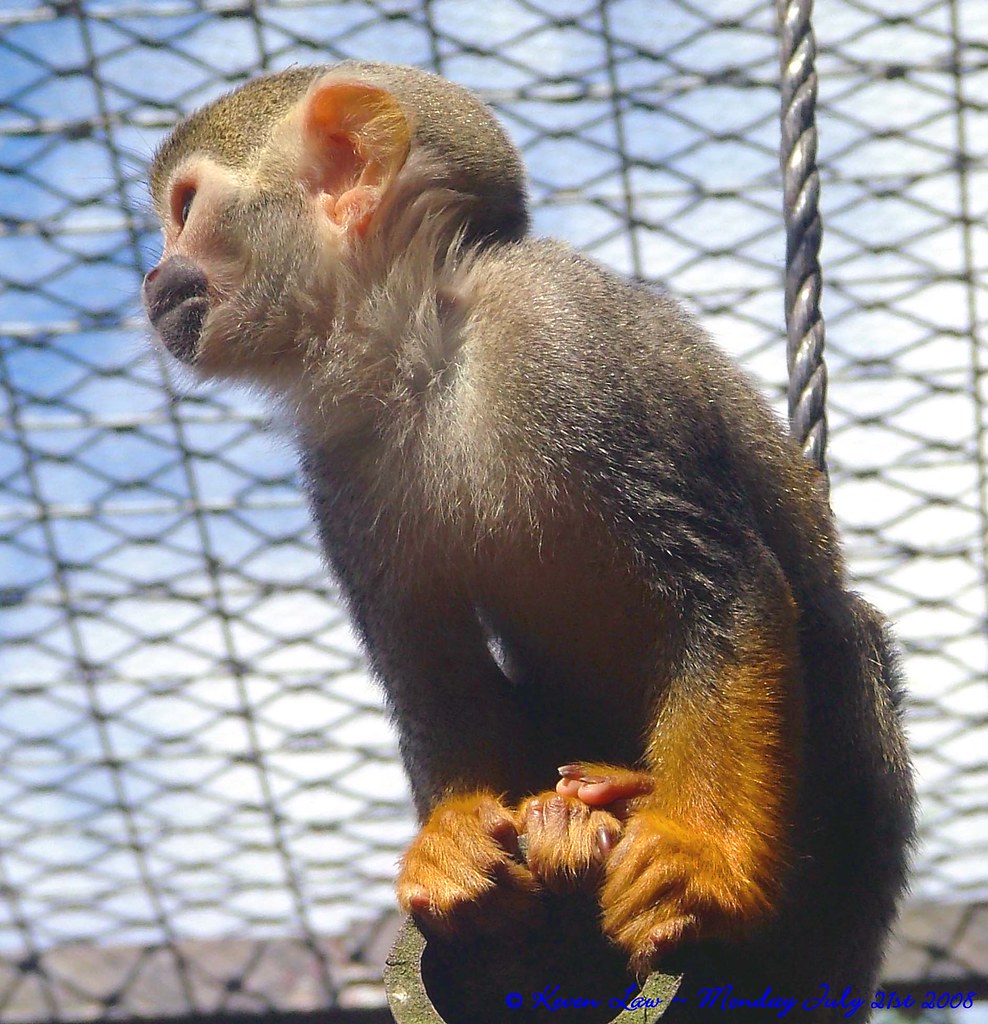
Squirrel Monkey - Colchester Zoo, Colchester, Essex, England - Monday July 21st 2008.
Click here to see the Larger image
Watch U2 here - www.youtube.com/watch?v=5wfub-LbOmk&feature=related
The squirrel monkeys are the New World monkeys of the genus Saimiri. They are the only genus in the subfamily Saimirinae.
Squirrel monkeys live in the tropical forests of Central and South America. Their range extends from Costa Rica through central Brazil and Bolivia.
Squirrel monkey fur is short and close, colored olive at the shoulders and yellowish orange on its back and extremities. Their throat and the ears are white and their mouths are black. The upper part of their head is hairy. This black and white face gives them their German name, "skull monkeys".
Squirrel monkeys grow to 25 to 35 cm, plus a 35 to 42 cm tail. They weigh 750 to 1100g. Remarkably, the brain mass to body mass ratio for squirrel monkeys is 1:17, which gives them the largest brain, proportionately, of all the primates. Humans have a 1:35 ratio.
Female squirrel monkeys have a pseudo-penis that they use to display dominance over smaller monkeys, much like the way the male squirrel monkeys display their dominance.
Squirrel monkeys are sexually dichromatic, (that is the two sexes have different fur colorations) the male Squirrel monkeys have gray crown fur and the females have black crown fur.
Like most of their New World monkey relatives, squirrel monkeys are diurnal and arboreal. Unlike the other New World monkeys, their tail is not used for climbing, but as a kind of "balancing pole" and also as a tool. Their movements in the branches are extremely speedy.
They live together in multi-male/multi-female groups with up to 500 members. These large groups can, however, occasionally break into smaller troops. They have a number of vocal calls, including warning sounds to protect themselves from large falcons, which are a natural threat to them. Their small body size also makes them susceptible to predators such as snakes and felids. For marking territory, squirrel monkeys rub their tail and their skin with their own urine.
Squirrel monkeys are omnivores, eating primarily fruits and insects. Occasionally they also eat nuts, buds, eggs and small vertebrates.
The mating of the squirrel monkeys is subject to seasonal influences. Females give birth to young during the rainy season, after a 150- to 170-day gestation. The mothers exclusively care for the young. Saimiri oerstedti are weaned by 4 months of age, while S. boliviensis are not fully weaned until 18 months old. Female squirrel monkeys reach sexual maturity at age 3 years, while males take until age 5. They live to about 15 years old in the wild, about 20 years in captivity.
The Common Squirrel Monkey S. sciureus is captured for the pet trade and for medical research but it is not endangered. Three squirrel monkey species are in danger of extinction. S. o. oerstedti is listed as "endangered," S. o. citrinellus is listed as "critically endangered" and S. vanzolinii is listed as "Vulnerable.
This is the highest tarmac road in the USA, closed for much of the year.
The epic Mini road trip was in 1962, from Canada to Mexico and back, camping all the way. I am a shadow in the back of the car, Mum is in the front and Dad took the pic on a Zeiss camera. Doesn't Kodachrome catch wonderful blues?
What a journey, you wouldn't do it now in this car, and with a 4 year old, nothing much to distract the painful kid except Winnie the Pooh and the daily inspection of dead insects on the front grille.
The highest peak ever achieved in a car was done on the Ojos del Salado volcano, Atacama Desert, Chile when reached 21,942ft on April 21, 2007, by the Chilean duo of Gonzalo Bravo and Eduardo Canales and their highly modified 1986 Suzuki Samurai.
This LEGO model commemorates that feat and was built for theLet’s Break Some Records LUGNuts build challenge. The stickers don’t quite match the real sponsors, but the resemblance to the real Suzuki is unmistakable.
HIGHEST FLICKR EXPLORE RANKING: 164
The Early English Gothic cathedral of Saint Peter, Saint Paul and Saint Andrew in Peterborough, Cambridgeshire, England, during snow.
Construction of Peterborough Cathedral began in 1118 and was completed in 1237. With its three towering arches - each one of which is 82 feet high - the celebrated West Front is totally unique, without precedent or successor in Medieval architecture, and the cathedral is one of the most important 12th century buildings in Britain to have remained largely intact. Overall height, to the top of the towers, is 156 feet.
This is the third church to have stood on the site: the first, Medeshampstede Abbey, survived from 655 to 870, when the Vikings destroyed it. The second, a Benedictine establishment, lasted from 966 until 1116 before it then burnt down. Guess they got lucky with this one, which has withstood King Henry VIII's 16th century Dissolution of the Monasteries, vandalism during the English Civil War in 1643, and a deliberately-started fire in November 2001.
The cathedral contains the tomb of Henry VIII's first wife Katherine of Aragon (one of the ones he didn't execute or divorce), who died in 1536. In 1587, Mary, Queen of Scots, who had been executed nearby, was buried here, but later moved to Westminster Abbey on the orders of her son, King James I, who presumably felt that Peterborough wasn't a great place to spend all eternity.
Taken in Peterborough, Cambridgeshire, England on January 14, 2013.