View allAll Photos Tagged forward
© Hand Photography - All rights reserved. Please do not use my images without my explicit permission
Mio cugino Mike il leader dei The Forward
My cousin Mike the frontman
The Forward's live show is excellent and pleasant rock music.
Leiden
The plate is irretraceable, but after a little search this electric tricycle looks like a Forward ZK3.
dutch.automaticelectriccar.com/sale-14265946-3-wheel-rick...
The Chinese brand name is 丰沃德 (Fengwode) and apparently Forward Vehicle Industry Co., Ltd. is based in Chongqing
This is where all the weight in Fishbones lives. The large resin flange at the front of this component weighs about 1.5lbs.
Forever Forward advert on the building and on the bus! Go North West 3237. Volvo B9TL / Wright Gemini, new in September 2008 to First Manchester as 37389. About to depart Manchester on route 135 for Bury via Cheetham Hill and Whitefield. 27.11.23
The Merlin HC3 and HC3a are operated by No 28 (AC) Squadron and 78 Squadron at RAF Benson. 78 Squadron was re-formed on 3 Dec 07 to allow for the increase in aircraft after the purchase of the 6 Danish Merlin HC3a earlier in 2007. The Merlin is the first of a new generation of advanced, medium support helicopters for the RAF. It is an all weather, day and night, multi-role helicopter used in both tactical and strategic operational roles. The aircraft carries an impressive defensive-aids suite, which includes a Radar and Laser Warning Receiver, Missile Approach Warners and Directional Infrared Countermeasures equipment, all integrated with an automatic chaff and flare dispensing system. This is one of the most comprehensive defensive aids suites fitted to any helicopter in the world.
To ensure accurate navigation anywhere on the globe, the aircraft’s management computers take data from its laser-gyro, inertial-navigation platform and its doppler system and from air data sources, and combine the information with precise position data received from Global Positioning System satellites.
Navigation at night is enhanced by the crew’s use of display night-vision goggles and by the aircraft’s multi-function turret, which can be fitted with forward- looking infrared radar. To increase the aircraft’s range, the Merlin can be equipped with extended range fuel tanks and is capable of air-to-air refuelling, although this option is not currently used by the RAF. It is also fitted with an active vibration-damping system, which reduces the level of noise and vibration inside the cabin to a level no greater than that of a turboprop aircraft. As a result, crew fatigue is much reduced during long transits and airframe life is increased.
The Merlin is able to carry a diverse range of bulky cargo, either internally or under-slung. Cargo can include artillery, Land Rovers or light-strike vehicles and over five tonnes of freight. The spacious cabin can also accommodate up to 24 fully equipped combat troops and, when required, will convert to carry 16 stretchers for casualty evacuation or during humanitarian and disaster relief operations. Designed to operate away from base workshops and in difficult terrain, the Merlin has state-of-the-art support technology and incorporates aircraft health-and-usage diagnostics and a self-test capability for ease of maintenance.
The Merlin is armed with two general purpose machine guns converted for the air role, although there is provision for additional weaponry to be fitted at a later date.
28 (AC) Squadron officially reformed on 17 July 2001 as home to the Merlin helicopter, a role now shared with 78 Squadron. Merlin helicopters are a vital part of the Joint Helicopter Command alongside their RAF counterparts, the Puma and the Chinook. Since reforming at RAF Benson, the Squadron has developed to incorporate A and B Flights, which are the operational flights, and an embedded Operational Conversion Flight on C Flight.
28 (AC) Squadron officially reformed on 17 July 2001 as home to the Merlin helicopter, a role now shared with 78 Squadron. Merlin helicopters are a vital part of the Joint Helicopter Command alongside their RAF counterparts, the Puma and the Chinook. Since reforming at RAF Benson, the Squadron has developed to incorporate A and B Flights, which are the operational flights, and an embedded Operational Conversion Flight on C Flight.
Awakening
In those days,
we finally chose
to walk like giants
& hold the world
in arms grown strong with love
& there may be many things we forget
in the days to come,
but this will not be one of them.
Story People
Being at London Heathrow, you cannot ignore the abundance of British Airways flights operating into and out of their hub on a daily basis, the flag-carrier operating over half of the landing slots giving them a major presence.
In recent years, the Boeing 787 has become a very versatile wide-body aircraft for British Airways, being the largest operator of the type in Europe with more examples on-order, and is so far the only European airline to have ordered and operate all 3 variants of the aircraft, from the small -8 to the ever increasingly popular and stretched -10.
At present, the Boeing 787-9 makes up the majority of the Boeing 787 fleet with British Airways (which is expected to change in the near future) and in recent years has gone onto becoming an adequate replacement to the former 4-class Boeing 777-200ERs fitted with Rolls-Royce Trent 895 engines which have since been refurbished and now operate in a 3-class arrangement. The Boeing 787-9s operate some of British Airways longest flights to destinations like Australia, China, Japan, Malaysia and Singapore etc.
Given their high profile nature, the aircraft are now between 8 to 10 years old and British Airways standardising their long-haul cabins out of London Heathrow, the Boeing 787-9s are the latest aircraft type in the midst of a major cabin refurbishment programme that began in late-August 2025, and so far the refurbishment programme to fit Club Suites, brand new World Traveller and World Traveller Plus along with new Panasonic eX3 in-flight entertainment is now over a quarter completed with 5 examples now refurbished with 2 currently undergoing work at British Airways Cardiff maintenance facility.
The first Boeing 787-9 to arrive back from refurbishment was back in late-December 2025 just before Christmas, the reintroduction back into service somewhat delayed as the Boeing 787-9 refurbishment incorporated new World Traveller Plus seats compared to the previous refurbishments which utilised a different seat, requiring a new type certificate before going back into service.
There are slight differences to the interior seating layout; First and World Traveller Plus seating count remained the same at 8 and 39 respectively, however Club World did see a slight decrease from 42 to 38 owing to the seats requiring a larger footprint compared to the old ying-yang seats, whilst World Traveller saw a slight increase from 127 to 130 seats. Another change is the reduction of a toilet between the Club World cabin, now reduced from 3 to 2.
As for visual difference between the unrefurbished and refurbished Boeing 787-9s, they can be noticed with the plugged windows. The unrefurbished Boeing 787-9s feature 2 plugged windows forward of Doors L2 and R2; as shown by G-ZBKR above which has been refurbished, those 2 windows are no longer plugged. Aft of Doors L2 and R2, the number of plugged windows has increased from 1 to 3 as shown here.
G-ZBKR was the second Boeing 787-9 to undergo refurbishment, released back into traffic in early-April 2026, over 4 months since the first example was completed. The time between each refurbished Boeing 787-9 returning back into traffic now takes just over a month to complete. It will be well into 2027 by the time the Boeing 787-9 refurbishment programme is completed.
Currently, British Airways operates 42 Boeing 787s, which includes 12 Boeing 787-8s, 18 Boeing 787-9s and 12 Boeing 787-10s. British Airways have 38 Boeing 787-9s on-order.
Zulu Bravo Kilo Romeo is one of 18 Boeing 787-9s operated by British Airways, delivered new to the flag-carrier on 27th March 2018, leased from BBAM since April 2018 and she is powered by 2 Rolls-Royce Trent 1000 engines.
Boeing 787-9 Dreamliner G-ZBKR on final approach into Runway 09L at London Heathrow (LHR) on BA186 from Austin-Bergstrom (AUS), Texas.
Photo © Tristan Savatier - All Rights Reserved - License this photo on www.loupiote.com/48888912848
Share this photo on: facebook • twitter • more...
Water, dish washing liquid (to make bubbles), and some propane pipe under the water. Bubbles get filled with natural gas and are flammable, and they can burn in your hands without burning your skin. Very fun installation at the Hooka dome.
Photo taken at the Burning Man 2019 festival (Black Rock Desert, Nevada).
If you like this photo, follow me on instagram (tristan_sf) and don't hesitate to leave a comment or email me.
One of the lecterns inside the church has a brass plaque embedded.
To the Glory of God and in loving memory of
CHARLES BERJEW BROOKE b.1868 d.1951 and of his wife
MAUD GWENDDOLEN BROOKE b.1872 d.1944 and of their son
CAPT. CHARLES BERJEW BROOKE D.S.O. b.1895 killed in action 1916
The memorial was given by the daughter of Charles Brooke (the father) in 1951.
www.iwm.org.uk/memorials/item/memorial/4326
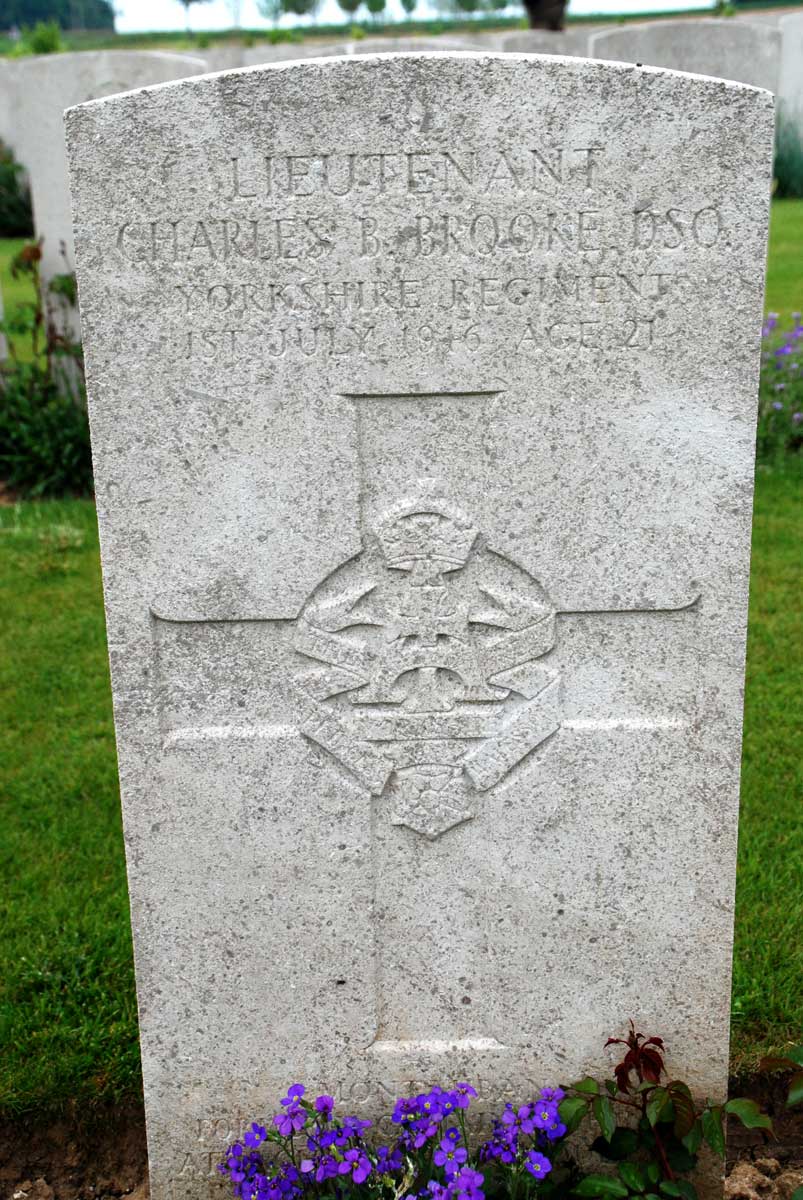
BROOKE, CHARLES BERJEW
Rank:……………………………Lieutenant
Date of Death:…………….01/07/1916
Age:…………………………….21
Regiment:……………………Yorkshire Regiment
formerly Suffolk Regt. (Special Reserve), (formerly attd. 1st Bn.) The Queen's (Royal West Surrey Regiment)
Awards:……………………….D S O
Grave Reference:………..IV. H. 7.
Cemetery:……………………PERONNE ROAD CEMETERY, MARICOURT
Additional Information:
Son of Charles Berjew Brooke and Maud Gwenddolen Brooke, of Colne House, Brantham, Suffolk.
CWGC: www.cwgc.org/find-war-dead/casualty/310713/BROOKE,%20CHAR...
There is no obvious match for Charles in the Soldiers Died in the Great War database – the nearest match is a Cecil Berjew Brooke, a 2nd Lieutenant of the Alexandra Regiment, Battalion Not Shown, who was Killed in Action on the 1st July 1916. As with all Officers, no place of birth or residence is shown.
(Note – references to Alexandra Regiment, Princess of Wales Own and Green Howards are all alternative names for the Yorkshire Regiment).
The Medal Index Card for Second Lieutenant Charles “Beyent” Brooke, Yorkshire Regiment, is held at the National Archive under reference WO 372/3/89092 . He had originally been a Second Lieutenant in the Suffolk Regiment before becoming a Captain during his attachment from the Suffolks to the Royal West Surrey Regiment. He reverted to his former rank on joining the Yorkshire Regiment.
discovery.nationalarchives.gov.uk/details/r/D1503930
The Service Record for 2nd Lieutenant Charles Berjen Brooke, The Suffolk Regiment, are held at the National Archive under reference WO 339/16364
discovery.nationalarchives.gov.uk/details/r/C1070291
Most of any research I could do on this man has already been done – his father collected his letters home and had them privately published as “Letters from the boy”. The last one, dated 30th June 1916, ends:-
It is impossible to fear death out here when one is no longer an individual but a member of a regiment and of an army. To be killed means nothing to me, and it is only you who will suffer for it. You really pay the cost. I have been looking at the stars and thinking what an immense distance they are away! What an insignificant thing the loss of say forty years of life is compared with them. It seems scarcely worth talking about.
Well, good-bye you darlings. Try not to worry about it, and remember that we shall meet again, really quite soon. This letter is going to be posted if -----
Lots of love,
From your loving son Carl.
The same website source adds:-
Charles Berjew Brooke was born on the 7th March 1895 at Colne House, Brantham on River Stour, Suffolk, the only son of Mr Charles Berjew Brooke, an industrialist who manufactured "xylonite", i.e. celluloid. To avoid confusion, the younger Charles was known in the family as "Carl". He had a connection with Wales, because his mother Gwenddolen was the sister of Mrs Gertrude Bailey of "Stelvio" Newport, a lady prominent in her own right, and married to Mr Charles Henry Bailey of the Tyne Engine Works at Newport and Barry.
Carl was educated at Colchester Grammar School, followed by a preparatory school, Bilton Grange near,Rugby, and Bradfield College, Berks. He was interested in becoming a soldier from an early age, an interest stimulated by living near to the military town of Colchester, but a bout of diphtheria prevented him from taking part in strenuous exercise. Instead, to his great joy, he was taught rifle shooting , and was sent to represent the school at Bisley. He was allowed to join the college O.T.C., and awarded his certificate "A" in 1911, with extra marks for originality, and he left on the 31st of July 1913 with the rank of Colour Sergeant.
Carl must have had a flair for languages, as well as science, because he continued his education by studying chemistry in Berlin. Here he eagerly read as many German military books as he could find, including the German Field Service Book, as he intended to sit for the Army Interpreters’ Examination. He thought that every man should be trained, as he was sure that Germany intended to go to war against Britain, and at the end of July 1914, 6 days before war broke out between Britain and Germany, he returned home.
On his return, he applied for a commission in the Suffolk Special Reserve. To his disappointment, he was posted to 3rd Bn Norfolk Reg. in August 1914, but soon transferred to 3rd. Bn. Suffolk Reg. On Sept. 4th he was appointed a temporary Capt., dating from August 14th.
During his training he was marked top out of about thirty who joined with him. He was not to stay with them for long because in December he was attached to the 1st Bn The Queen’s (Royal West Surrey’s) and with 200 other reinforcements was sent out to France to replace the heavy losses they had suffered. In his letters home he described how well behaved his men were when they arrived in France, but he observed, rather wryly, that it could have been because they hadn’t been paid for a fortnight. He also commented on the wild Welsh and Scots who jumped out of the train at every halt and then raced after the train and got in anywhere, causing a lot of trouble and necessitating an "all change" at the next stop.
During his time at the Front he was able to make good use of his German, and he seems to have enjoyed his conversations with the prisoners who were brought in. He was also quite taken with their helmets, but felt that "it would hardly have been polite to bag the poor men’s hats". He also used his time to improve his French, and says that he has a good grasp of "Frenglish". He wrote home quite regularly, with detailed descriptions of life in the trenches. He made light of the fact that he had been shelled quite frequently, describing the sound as being like "water poured into a big jug from a tap"
In June, the War Office wrote to his Colonel asking whether he would recommend Lt. Brooke for a full Captaincy, but the Col. Replied that he had "Not enough service". The London Gazette for Sept. 4th.1915 records: Suffolk Regiment – Lieutenant to be Captain Charles B. Brooke, dating from August 14th, 1915.
On the morning of 25th Sept.1915, he was in action with the 1st Bn. The Queen’s at La Bassee, near Givenchy. All the other officers of B and D companies were killed, leaving him in command of the two companies, as well as some men from the H.L.I. and Oxford L.I. as they rushed the German trenches.
Encouraged by the 19 year old officer, they used up all their supply of bombs as well as those of the Germans before being driven back. Although wounded, Carl was the last to leave the trench, and it was reported that before leaving, he emptied his revolver at the advancing Germans, then threw the empty gun at a German officer, knocking him over.
He was wounded twice, once in the face which tore his cheek and mouth and knocked out two teeth and a serious chest wound, which fortunately, did not damage his lungs. He was admitted to 3rd. General Hospital at Le Treport.
On October 1st, he was sent to Alexandra Hospital for Officers, Millfield Lane, Highgate, London. In January 1916, he was mentioned in despatches, and on 14th he was awarded a D.S.O. for this action. The staff and works people from the village made a presentation to him for bringing honour to the village. His response was typically modest, he said "I was one of the lucky ones. Of course, I am glad to have won the D.S.O., but I want you to think of all those men who will not get anything, and who have deserved a decoration over and over again". He was invited to transfer to the Queen’s, and would have been happy to serve with them as a Lieutenant, but the Army had other plans.
In Feb. 1916 he was chosen for a commission in the Regular Army but it was in the Yorkshire Regiment, (The Green Howards’).Capt. Charles B. Brooke, D.S.O. was to be Sec. Lt., but to retain his higher rank until he joined a Regular Unit. In April 1916 he was sent to the 2nd. Battalion, which was serving with the 30th. division in France. He soon settled down to trench work, saying that his men were the best in the battalion, good at "sticking things" and "quite equal to the Queen’s". He said "I wouldn’t be pushed out of this regiment now". He was offered the chance of being trained as a staff officer, but said that he did not think he would be a success at it.
On the 1st July 1916, the 30th Division was to take Montauban. At 7.30a.m. the battalion was in Headquarters Avenue Trench with a battle strength of 24 officers and 688 other ranks who were to be responsible for occupying and consolidating the German front and support lines once they had been captured.
Carl was in command of "A" company, as it, advanced with "B" company under heavy machine gun fire, followed shortly by "C" and "D". Brooke was mortally wounded in the stomach, remaining alive just long enough for the stretcher bearers to reach the medical officer. His servant, Pte. Readman, reported his death, and that he had been buried at Bois de Talus Cemetery, near Carnoy. Lt.Col. Walter F. Young, commanding 2nd. Yorkshire Regiment wrote movingly of Carl as "a great favourite with all of us", and tried to reassure the family that he had not seemed to be in pain from his wound, and had been able to speak to the doctor before he died, as well as telling the stretcher bearers that it was hard lines being hit in the stomach. Col. Young said that he was most grieved at his loss, but had died as "he would have liked to do". He wrote to Carl’s mother, saying that he felt his loss more than that of any other officer, calling him "the cheeriest and best of good fellows", and describing their mutual enthusiasm for the works of Rudyard Kipling.
On July 3rd 1916, it was announced that 2nd. Lt. C.B. Brooke, D.S.O., was to be Temp. Capt. In Yorkshire Regiment, dated from May 16th. 1916.
www.powell76.talktalk.net/Brooke.htm
www.facebook.com/RoyalAnglianRegMuseum/posts/887556941356589
That final letter was sold at auction in November 2016
www.bristolauctionrooms.co.uk/135-lot-46-July-1st-1916-Ca...
That wasn’t all there was to remember his last hours by.
He was commissioned into 3rd Suffolk in 1914, having been born and raised in Brantham, near Manningtree. He had been wounded badly whilst winning his DSO in early 1916, and we heard of how even after emptying every chamber of his pistol into the advancing enemy, he then hurled his revolver at one of them, knocking him over! After his death on 1st July, his family published the letters he wrote home in a small memorial volume entitled “Letters from The Boy.” It was said that for many years his blood-stained and battered tunic hung in a frame in the hallway of his parents home.
www.friendsofthesuffolkregiment.org/2016-battlefield-tour...
A picture of Charles can be seen as one of the responses on page 1 of this forum query.
1914-1918.invisionzone.com/forums/topic/8032-officers-die...
The Imperial War Museum holds a copy of “Letters from the boy.”
www.iwm.org.uk/collections/item/object/1500034743
Family History websites
www.thosebefore.com/g1/p1386.htm
www.brooksfamilyhistory.co.uk/media/ONS%20-%20CWGC%20upda...
His headstone can be seen here:-
www.ww1-yorkshires.org.uk/jpg-files/overseas-cemeteries/p...
7th March 1895 – Birth……………
This birth date is quoted in the online biography for Charles, as well as one of the family tree links.
The birth of a Charles Berjew Brooke was registered with the Civil Authorities in the District of Samford in Suffolk in the April to June quarter, (Q2), of 1895. Then, as now, you had 42 days after the event to register the birth without facing a fine and a court appearance so a registration in this quarter is not incompatible with the date of birth quoted. Samford District included the Civil Parish of Brantham.
The marriage of his parents, Charles Berjew Brooke and Maud Gwenddolen Buchanan, was recorded in the Islington District of London in the April to June quarter, (Q2), of 1894.
1901 Census of England and Wales
The 6 year old Charles B Brooke, born Brantham, was recorded living at Colne House, Brantham. This was the household of his parents, Charles B., (32, Manager of Brantham Works, British Xyl.Co. Ld., born Liverpool, Lancashire), and Maude G., (26, born Cardiff, Glamorganshire). As well as Charles the couple also have a daughter, Gwenddolen F., (4, born Brantham). Completing the household is father Charles’ unmarried brother in law, Harold G. Buchanan, (22, Superintendent Xyl. Works, born London) and two live in domestic servants.
1911 Census of England and Wales
The 16 year old Charles B. Brooke, born ”Manningtree, Essex”, was recorded as a boarding school student at Bradfield, Reading, Berkshire.
His parents were still recorded living at Colne House, Brantham. Charles Berjew Junior and Mary Gwenddolen Brooke had then been married for 16 years and have had 2 children, both then still alive, but neither was at home. Charles, 42, is recorded as the Xylonite Works manager. Mary was then 38.
His sister Gwenddolen was also at boarding school – in her case at St Felix School, Reydon, Sothwold, Suffolk.
Until September 1911 the quarterly index published by the General Registrars Office did not show information about the mothers maiden name. A check of the General Registrars Office Index of Birth for England and Wales 1911 – 1983 shows no likely additional children of parents Charles and Maud.
Army career…………………………….
The London Gazette dated 8th January 1915 records that on probation Second Lieutenant Charles Berjew Brooke of the 3rd Battalion, The Suffolk Regiment was confirmed in his rank.
www.thegazette.co.uk/London/issue/29035/page/287/data.pdf
1st Queens Battalion War Diary 9th June 1915
Lieut C B Brooke is shown in command of B Coy in place of Lieut W. Nicholas, who was in Hospital.
qrrarchive.websds.net/PDF/QW00119150601.pdf
His promotion to Captain, effective 4th August 1915, appeared in the Supplement to the London Gazette dated Saturday 4 September 1915. Recorded on page 8815, he is shown under the Special Reserve of Officers, Suffolk Regiment.
www.thegazette.co.uk/London/issue/29284/supplement/1
1st Queens Battalion War Diary 25th September 1915
Section B.2. Our leading line advanced at 6.7 a.m. and reached the German 3rd line without great opposition. The attack was evidently a complete surprise.
The Battn. advanced on a frontage of two platoons. D. Coy. (Major BUNBURY) on the right and B. Coy, (Capt. Brooke) on the left. The advance was necessarily slow to keep behind the smoke, B & D Companies reached the German lines and gained touch with the 2/Oxford L.I. and the 2/H L I on the left and right respectively. The Support Company (C Coy) under Captain Weeding held on front line of trenches and, at about 8.15 A M two platoons of this Company reinforced B & D Companies, taking up a supply of Bombs with them, Lieut E D DREW commanded this party.
The Enemy developed a strong bombing attack on both flanks of the Regt., and our men were unable to reply effectively owing to a lack of bombs. About 9.45 a.m. the two and half companies were obliged to fall back into our own lines, under a very heavy machine gun fire from the right flank.
Casualties:- 2Lts A W A BRADSHAW, C D M FOWLER and E I B HOWELL killed & missing, 2 Lt F G PLANT wounded and missing, Major J.K.N. BUNBURY, Capt C B BROOKE, Lieutr H P FOSTER and 2 Lieut R G POYESON-MICES(?) wounded. Other Ranks, 19 Killed, 21 missing believed killed, 138 wounded, 80 Missing and wounded & missing, 7 suffering from gas. 1 died of wounds. Total 265 other ranks.
The remainder of the day was spent in reorganizing the line and in collecting wounded, burying dead etc.
qrrarchive.websds.net/PDF/QW00119150904.pdf
His appointment as Companion of the Distinguished Service Order appears in the Supplement to the London Gazette dated 14th January 1916. He was recorded as The Suffolk Regiment, Special Reserve (attached Royal West Surrey Regiment).
www.thegazette.co.uk/London/issue/29438/supplement/575/da...
The London Gazette dated 18th February 1916 included the notice:-
Alexandra, Princess of Wales’s Own (Yorkshire Regiment).
Captain Charles Berjew Brooke, D.S.O., from The Suffolk Regiment, Special Reserve, to be Second Lieutenant, and to retain his higher rank until ordered to join a Regular unit. Dated 19th February 1916, with seniority from 4th January, 1916, and precedence next above R, de H.M. Bell.
www.thegazette.co.uk/London/issue/29478/page/1812/data.pdf
On the day
Saturday July 1st 1916, Temperature 72°, clear sky
XIII CORPS -CAPTURE OF MONTAUBAN -30th DIVISION
The wire had been cut successfully. The Germans were mostly caught in dugouts, so little resistance was encountered
89th Brigade : starting from four lines of assembly trenches at 7.30 AM ,17th and 20th King's met little resistance and moved on to Casement and Alt Trenches. The 2nd Bedfordshire were in support and mopping-up. The attack pressed on to Dublin Trench. At 8.30 AM the right of the line joined with the French and the left, in the east end of Glatz Redoubt; simultaneously, the 3rd Battalion of the French 153rd Regiment entered Dublin Redoubt at the east of Dublin Trench. The position was consolidated
21st Brigade : The enemy here was also caught in its dugouts so little resistance was encountered
Leading, with 19th Manchesters, 18th King's went forward until they caught up with British barrage at Alt Trench, where they had to wait until the barrage lifted at 7.45 AM , before occupying it. The Manchesters had few losses but the King's were caught by enfilade machine-gun fire from the west side of Railway Valley. Fire from the Warren caused severe casualties among 2nd Green Howards who were in support, and few managed to cross no man's land. A party of Germans came out of a deep dugout and proceeded eastwards but were out-bombed by a party of moppers-up. This enabled 18th King's to advance along Train Alley to Glatz Redoubt, reaching it at 8.35 AM and joining with 89th Brigade
90th Brigade : At 8.30 AM 90th Brigade began its advance on Montauban, passing through 21st Brigade with 16th and 17th Manchesters. The 2nd Royal Scots Fusiliers were in close support. Despite machine-gun fire from Bresleau Alley, they continued their advance, and the German machine-gun was finally wiped out by a Lewis-gun of the 16th Manchesters. Under cover of a smoke-screen, the Manchesters and Royal Scots Fusiliers entered the village of Montauban at 10.05 AM , to find it deserted. By 11 AM the second objective in Montauban Alley was entered. The Germans were pulling back in large numbers. The 16th Manchesters rushed the battery in Caterpillar Valley and captured the first three guns of the battle. Montauban was consolidated.
At 12.30 PM 4th Coy, 20th King's (89th Brigade) attacked La Briqueterie from Dublin Trench under cover of an artillery bombardment
Simultaneously, bombers moved up Nord Alley cutting off the retreat of the garrison. By 12.35 PM La Briqueterie was taken, as were all objectives and the position was consolidated. By 6 PM the road to Maricourt-Montauban had been repaired 200 yards beyond the old German front line
The 30th Division had taken all its objectives
www.bandb-somme-bernafaywood.com/the-great-war/bernafay-w...
There is more on the 30th Divisions’ role here:-
www.longlongtrail.co.uk/battles/battles-of-the-western-fr...
PERONNE ROAD CEMETERY, MARICOURT
Location Information
Maricourt is a village situated on the D938, Albert-Peronne Road, 10.5 kilometres from Albert.
History Information
Maricourt was, at the beginning of the Battles of the Somme 1916, the point of junction of the British and French forces, and within a very short distance of the front line; it was lost in the German advance of March 1918, and recaptured at the end of the following August. The Cemetery, originally known as Maricourt Military Cemetery No.3, was begun by fighting units and Field Ambulances in the Battles of the Somme 1916, and used until August 1917; a few graves were added later in the War, and at the Armistice it consisted of 175 graves which now form almost the whole of Plot I. It was completed after the Armistice by the concentration of graves from the battlefields in the immediate neighbourhood and from certain smaller burial grounds, including:-
BRIQUETERIE EAST CEMETERY, MONTAUBAN, on the East side of the brick-works between Maricourt and Montauban, containing the graves of 46 soldiers from the United Kingdom who fell in the latter half of 1916.
CASEMENT TRENCH CEMETERY, MARICOURT, on the West side of the road to the Briqueterie, in which 163 soldiers from the United Kingdom and one from South Africa were buried in 1916-1918.
FARGNY MILL FRENCH MILITARY CEMETERY, CURLU, on the North bank of the Somme, in which six soldiers from the United Kingdom and two from Australia were buried in 1916-1918.
LA COTE MILITARY CEMETERY, MARICOURT, a little way West of Peronne Road Cemetery, containing the graves of 38 soldiers from the United Kingdom and one from Australia who fell in 1916-1917.
TALUS BOISE BRITISH CEMETERY, CARNOY, between Carnoy and Maricourt, at the South end of a long copse. It was used in the latter half of 1916 and (chiefly by the 5th Royal Berks) in August 1918, and it contained the graves of 175 soldiers from the United Kingdom and five from South Africa.
(Plus other site but whose details indicate none from 1916)
There are now 1348, 1914-18 war casualties commemorated in this site. Of these, 366 are unidentified and special memorials are erected to 26 soldiers from the United Kingdom known or believed to be buried among them. Other special memorials record the names of three soldiers from the United Kingdom, buried in other cemeteries, whose graves could not be found.
CWGC: www.cwgc.org/find-a-cemetery/cemetery/32200/peronne-road-...
As part of the commemoration of the outbreak of the Great War, the Commonwealth War Graves Commission added a number of original documents to their website. One of those on their webpage for Charles Brooke is a Concentration Report. These reports detail an exhumation and move to the current resting place. He was one of at least 10 graves moved from map reference 62c.A.14.b.5.4 into Peronne Road Cemetery. Charles was the only officer – the other nine British soldiers all died in 1918 Someone has written in blue pencil down the side of the report “Maricourt 3/95E”, which might imply they came from either the La Cote Cemetery or Casement Trench Cemetery.
A report prepared for the Commission to take over maintenance of the graves indicates they were at the new location by the start of November 1920.
Postscript………………….
The 1916 Probate Calendar records that Charles Berjew Brooke, of Colne House, Brantham. Suffolk, a Captain 2nd Battalion Yorkshire Regiment D.S.O., died 1 July 1916 in France. Administration of his estate was granted at the Ipswich Court on the 28th August 1916 to Charles Berjew Brooke, (the younger), manager of the British Xylonite company’s Brantham works. His effects were valued at £322 2s 4d.
probatesearch.service.gov.uk/Calendar#calendar
The edition of The Times, dated Monday July 10, 1916 records his death and includes a brief obituary.
CAPTAIN CHARLES BERJEW BROOKE, D.S.O., Yorkshire Regiment, was the only son of Mr. and Mrs. C.B. Brooke, jun. of Colne House, Brantham, Suffolk, and was 21 years of age. He was educated at Belton Grange, near Rugby, and Bradfield College. He was gazetted to the 3rd Suffolk Regiment on the outbreak of war, and was sent to France, attached to the 1st Queen’s, in December 1914, and rose to the rank of captain. He was seriously wounded while leading his company in the attack on September 25, 1915, and was mentioned in dispatches and awarded the D.S.O. In January 1916 he was chosen for a commission in the Regular Army, and was gazetted to the Yorkshire Regiment. He was killed on July 1st “while leading his company into action in this recent attack”.
The Births, Marriages and Deaths announcement in the Western Mail on the following included a note on the death of Charles “On Active Service”.
BROOKE.- On July 1st, in France, Charles Berjew Brooke, D.S.O., Second-lieutenant, Princess of Wales’ Own Yorkshire Regiment, aged 21, only son of Mr. and Mrs. Charles B. Brooke Junr., of Colne House, Brantham, Suffolk, and nephew of Mrs. C.H. Bailey, Stelvio, Newport, Mon.
That final letter was printed in full in the editions of The Surrey Advertiser, dated Saturday, July 22nd 1916 and Monday, July 24, 1916, under the heading Former Queen’s Officer Letter. It is noted that there are many in The Queens who will remember Captain Brooke, and “many others who will find consolation in the letter”. On the same page in the Officers Killed section, as well as his name appearing in the list there is also a few lines about him.
Lieut. and Temp. Capt. Brooke, D.S.O., Yorkshire Regiment, who was killed in action on July 1st, was attached to a battalion of The Queens from December 1914, until he was wounded on September 25th 1915. He was the only son of Mr. and Mrs. C.B. Brooke, Colne House, Brantham, Suffolk, and was 22. His colonel writes: “As soon as he joined us we recognised him as a born leader of men, and I at once put him in command of a company. He was leading it to the assault when he was shot.”
DIM8077 sits at the front of the train at Lawson as it drops off several passengers on a Mount Victoria service.
Lawson, NSW.
Tuesday 7 May 2013.
Sgt. Victor Aguirre, 509th Signal Battalion (rear), observes Spc. James Lagerstrom adjust cables on a satellite dish on communications gear associated with the U.S. Army Africa Forward Command Element.
Photo by Rich Bartell, U.S. Army Africa Public Affairs Office
To learn more about U.S. Army Africa visit our official website at www.usaraf.army.mil
Official Twitter Feed: www.twitter.com/usarmyafrica
Official Vimeo video channel: www.vimeo.com/usarmyafrica
Join the U.S. Army Africa conversation on Facebook: www.facebook.com/ArmyAfrica
When the U.S. Army Africa Forward Command Element rolls onto a C-130 to head to Ghana in August, it will be with state of the art electronics allowing worldwide communications.
The USARAF FCE, similar to a tactical operations center with sophisticated internet and video teleconference capabilities, is a flexible command post that responds to deployment requests through U.S. Africa Command.
“The USARAF FCE can move out and be in any given African country in less than 72 hours,” said Sgt. Maj. Aaron Miller, non-commissioned officer in charge of the USARAF Contingency Command Post.
During a recent tour of the mobile command center, USARAF Commander, Maj. Gen. David R. Hogg saw firsthand the power and flexibility of the mobile command post.
“Our C-130 version of a crisis command headquarters makes USARAF capable of deploying anywhere in the world if needed, but more specifically, anywhere in Africa. We can roll off the plane and within two hours have a fully operationally command and control system to cover any environment, Army pure, joint or inter-agency. We have tremendous capability now,” Hogg said.
Hogg expressed his gratitude to Soldiers of the USARAF G-6, Communications and Information Services and higher headquarters.
“Colonel Joe Angyal and his G-6 staff have done a wonderful job and none of this would have happened without the support of Headquarters Department of the Army. So we definitely want to thank them,” Hogg added.
NEW COMMUNICATIONS GEAR GIVES WORLDWIDE REACH
Recently, USRAF communications Soldiers with the FCE took on the challenges that new electronics can pose. The new system provides worldwide communications capability along with the added ability to work from a remote location with few amenities.
“We have about two weeks of training to smooth out some of the wrinkles” said Maj. Gary Philman, the USARAF signal operations officer and acting chief of the CCP. “We’ve been fortunate to get the new communications package and we’re integrating it with some of our existing systems.”
Philman said the FCE is the deployable headquarters for USARAF, and can be the first organization to hit the ground in advance of a joint task force.
“The FCE staff size depends on the mission request and can vary from eight to more than 20 personnel,” Philman said. “Our commanding general comes with the FCE when requested by an ambassador, [but] it can be commanded by a USARAF staff colonel or the CCP chief,” Philman said.
USARAF Spc. James Lagerstrom, information technology specialist with the CCP, deploys with FCE as one of the Soldiers ensuring the command element’s communications gear is up and running.
“Wherever we go … we can communicate,” Lagerstrom said. “We have internet and even have video teleconference ability [as well as] highly mobile.”
In August the FCE will get a chance do a live shakedown test of its communications equipment in the Republic of Ghana.
This year's crop of Osteospernum daisies should be along soon. We can all look forward to more of their magical spring and summer colour!
I saw this second-generation (1978-'79) Ford Bronco on my way to the drug store after deboarding my CTA Red Line train back to my neighborhood after work today.
When I see this particular generation Bronco, I think not of something sordid from the 1990's. Instead, I'm transported to a childhood trip from Flint in the family Plymouth Volare to a Ford dealership in Detroit.
I had to have been about four years old.
Our family had planned to move to my father's country, Liberia, in 1980. We had made all kinds of preparations - listing our house for sale, getting our affairs in order, and then there was the matter of purchasing a tough, reliable vehicle that would be able to withstand the mountainous terrain of upcountry Liberia.
I remember the Bronco we looked at being beige or tan, with the white, painted roof toward the back. It seemed like a very nicely-appointed truck - in my mind's eye, I think I remember seing an AM/FM radio in the dash.
We didn't buy the Bronco, much to the chagrin of the salesman (Mom had later informed me, when recounting this story to me as an adult).
Liberia went into one of the worst, longest-lasting civil wars in its history in 1980, and our family stayed in the United States while Monrovia, Liberia's then-modern capitol city, was reduced to ruin.
My father has since passed on, but the sight of this two-year-only style of Ford Bronco SUV still reminds me of a road trip to the Motor City to test drive a truck our family ultimately didn't buy, for a move we never made.
en.wikipedia.org/wiki/Ford_Bronco#1978.E2.80.931979
Edgewater, Chicago, Illinois.
On Granville, east of Broadway.
Monday, November 5, 2012.
by: Miguel Angel Martin Bordera
from: Alicante, Comunidad Valenciana, Spain
year: 2017
Step Forward transmits the principles of consciousness and neighborly love, increased through Art.
Euterpe is a giant teenage girl puppet who walks and talks, interacting with Burning Man’s participants to learn from them and to, tenderly, teach them her values.
A young girl dreams of a better world in which everybody loves each other. One day she wakes up in an unknown place where she doesn’t really know if she is awake or in a wonderful dream. She watches in amusement all that takes place around her at the time she gets involved in Burning Man’s experience.
Contact: info@carrosfoc.com
I'm in love with the mods I made to my original design. Now featuring a working drivers hatch as well as opening ammo storage on the turret. Also has a much more realistic rotation point as I had been off before. Other than that it's pretty straight forward. All in all this has gone from a design I was 75% happy with to one I'm 100% happy with. Let me know what you think!
Looking forward on the port side of the tank deck on a sunny day in the Atlantic.
Another one that jumped in and out of Explore #294 best position August 26 2010
PHILIPPINE SEA (Oct. 14, 2021) Aviation Structural Mechanic 3rd Class Jonathan Hernandez, from Fontana, California, directs an MH-60S Sea Hawk, attached to the "Golden Falcons" of Helicopter Sea Combat Squadron (HSC) 12, on the flight deck of the U.S. Navy’s only forward-deployed aircraft carrier, USS Ronald Reagan (CVN 76), during a vertical replenishment. Ronald Reagan, the flagship of Carrier Strike Group (CSG) 5, provides a combat-ready force that protects and defends the United States, and supports alliances, partnerships and collective maritime interests in the Indo-Pacific region. (U.S. Navy photo by Mass Communication Specialist 3rd Class Gray Gibson)