View allAll Photos Tagged follower
Well, I installed the Toa race mod a while ago, and thought it'd be cool to have another toa as a follower. After some work, I managed to implement a simpler follower, but he was linked directly to the player, was of the same element and only followed me around. After that, I managed to create a better version, which was able to fight he enemies that attacked it.
The next version was fully independent, but I was still unable to change the element. More work and I could change the element, but not the colors. Afterwards I've developed an independent, "active" NPC which had all normal dialogue options, as well as the follower options. The main flaw was that it had no voice, and I wasn't able to implement it in a game where I had a race different than the NPC's. The next version included a voice, but still had the CTD bug. Lastly, I've decided to set the colors before implementation in the game (like I always did) but set the race as a normal skyrim NPC, then change it to a Toa in-game. And, it worked. I decided to go for Gali because I wanted to make sure the NPC wasn't linked to the player in any way (for example, both characters have the same sex/colors/etc if they're linked).
Suggestions welcome. All credit for the Toa race mod as well as the Toa sanctuary and Toa weapons mods go to the team behind the development of the Legend of the Toa total conversion mod.
The first Lego model for my 500th Instagram follower Back2Brick.
Back2Brick likes Concept Cars, notably BMWs, and this is the firs model that I have completed.
Shown is some 'arty' editing on the selected model, the BMW CSL Hommage R from a couple of years ago.
Back2Brick also likes Teslas, and so the next model will be shown soon.
Both models have been created such that they can be brick-built. Back2Brick will be able to build his own from the LDD files I will be sending through.
If anyone is listening along - if people are really keen I may make the model(s) available on Rebrickable. If that sounds like you, let me know in the comments.....
Doz Cabezas, AZ, (est. 1879, pop. <25), elevation 5,082 ft. (1,549 m)
"The Dos Cabezasite is the only person on the globe who can sit serenely down and smile, and smile again, amid conditions and adversities which would madden a lowly follower of the lamb. When Gabriel blows his horn he will find some of these genial old fellows sitting on a rock telling each other of the promising future of the camp, or how rich the Juniper mine is." —“Tombstone Epitaph,” 28 Apr 1887
• Dos Cabezas, AZ is a "living" Sonoran Desert ghost town with few remaining residents • located in the Sulphur Springs Valley [photo] of Cochise County • lies beside the Dos Cabezas ("Two Heads") mountain range, named for its twin bald summits
• an historically significant spring with potable water, once known as Dos Cabezas Spring, stands about a half mi. southwest of the town by the old Southern Emigrant Trail, a principal artery of the westward movement • the trail descends to the valley from Apache Spring through Apache Pass
• on 4 Sep 1851, John Russell Bartlett & his Boundary Survey Commission were heading west through what was, for over 300 yrs., Spanish/Mexican territory • most of the land had been ceded to the U.S. in 1848, ending the controversial Mexican-American War, but much of southernmost Arizona & New Mexico remained under the Mexican flag • Bartlett's mission was to work with a Mexican survey team to formally define the post-war US-Mexico border
• the survey was a prelude to the 1853-54 Gadsden Purchase which, for $10MM, acquired 29,670 sq. mi. of Mexican territory south of the Gila River, Cochise County included • the deal was signed by President Franklin Pierce, a northern, anti-abolitionist ("doughface") Democrat • it was intended to facilitate development of a road, canal and/or New Orleans-LA railroad, & to open the southwest to Southern expansion, seemingly ignoring the fact that an economy based on slave-produced cotton was unlikely to flourish in the desert — “Cochise and his Times”
• with potable water a precious commodity for both 2- & 4- legged desert travelers, Apache Spring – like many watering holes – became the site of a stagecoach stop c. 1857 • was operated by the San Antonio-San Diego "San-San" Mail Line, commonly known as "Jackass Mail" • Chiricahua Apache attacks made Apache Pass the most perilous stop on the line's Birch Route [map], named for company owner James Birch (1827-1857) —“The West is Linked”
• the 1,476 mi. daylight-only journey — with daily stops for 2 meals (45 min. each) & team switches (5-10 min.) — typically took less than 30 days & could be as few as 22 • a one-way ticket cost $150, meals & 30 lb. baggage allowance included —“Deconstructing the Jackass Mail Route”
• the Jackass line had a fleet of celerity (mud) wagons, vehicles suited for travel in intense heat over rugged terrain • it also operated fifty 2,500 lb. Concord stagecoaches [photo] manufactured by the Abbot Downing Co. in Concord, NH
"To feel oneself bouncing—now on the hard seat, now against the roof, and now against the side of the wagon—was no joke. Strung beneath the passenger compartment, wide leather straps called 'thorough braces' cradled the coach, causing it to swing front to back. Motion sickness was a common complaint, and ginger root was the favored curative." —Historynet
• each stage could accommodate 9-12 passengers on three benches inside & up to 10 more on the roof • the coaches were drawn by four- & six-mule teams • the company maintained 200 head of mules in its western corrals
“The coach was fitted with three seats, and these were occupied by nine passengers. As occupants of the front and middle seats faced each other, it was necessary for these six people to interlock their knees; and there being room inside for only ten of the twelve legs, each side of the coach was graced by a foot, now dangling near the wheel, now trying in vain to find a place of support..." —”The History of Stagecoaches in Tucson, Arizona”, Bob Ring
• Tips For Stagecoach Travelers, “Cowboy Chronicles”
• The Passenger Experience, “Desert USA”
"The company recommended that each passenger:... should provide himself with a Sharp's rifle, (not carbine,) with accoutrements and one hundred cartridges, a navy sized Colts revolver and two pounds of balls, a belt and holster, knife and sheath..." —“San Diego Herald” 21 Nov 1857
• the line's stations were built 10-40 mi. apart • some provided rudimentary sleeping accommodations; all had water for passengers, drivers ("whips") & their teams • equipped with corrals, the depots served as relay stations where drivers & draft animals were changed • "swing stations" provided no meals, but larger "home stations," often operated by families, were "meal stops":
"…tough beef or pork fried in a grime-blackened skillet, coarse bread, mesquite beans, a mysterious concoction known as 'slumgullion,' lethally black coffee, and a 'nasty compound of dried apples' that masqueraded under the name of apple pie." —True West
• in Sept 1857 Jackass founder James Birch, sailing to California via Panama, was lost at sea along with 419 other passengers & 30K lbs. of gold, in the S.S. Central America disaster • that same month, the Butterfield-Overland Mail line [photos] began St. Louis to San Francisco service, gradually displacing the Jackass line & absorbing many of its stations
• by 1858 a new, fortified stone depot, Ewell's Stage Station [photo] , rose 4 mi. south of Dos Cabezas Spring • it's unclear which stage line erected the building, but around the time of its completion Jackass Mail quit the route, Butterfield-Overland later decided to bypass "Ewell's" & by 1861 it lay in ruins, destroyed by Apaches
• the Ewell name lived on at a tiny, hardscrabble settlement called Ewell Springs & at Dos Cabezas Spring, renamed Ewell's Spring when the original station was built • by 1879 the National Mail & Transportation Co. had established a new Ewell's Station
• Virginia-born Richard Stoddert "Baldy" Ewell (1817-1872) was a Captain in the First U. S. Dragoons, stationed in the Southwest in the 1850s • he resigned from the U.S. Army in 1861 to join the Confederacy • served in the Civil War as senior commander under Stonewall Jackson & Robert E. Lee • it has been argued that his decisions at the Battle of Gettysburg may have decided the outcome of that engagement
• during Ewell's service in the West, Gila Apache raids along the Southern Emigrant Route prompted a military response • he advocated unrestrained combat: "How the Devil can a soldier stop in the midst of battle and summon a jury of matrons to decide whether a redskin pouring bullets into the soldier is a woman or not." • the 1857 Bonneville Expedition, in which Ewell commanded about 300 men, engaged against Apaches at the Gila River
"…the June 27 fight... was short and sweet …Ewell walking away with the lion's share of the honors… Scarcely an Apache escaped. Nearly 40 warriors were killed or wounded and 45 women and children taken captive. … Ewell was freely acknowledged as the hero of the day; his unhesitating leap to action crushed the western Apaches and forced them to sue for peace." —“Robert E. Lee's Hesitant Commander”, Paul D. Casdorph
• From Lt. John Van Deusen Du Bois's account of the engagement: "An Indian was wounded and his wife carried him in her arms to the chaparral and was covering him with brush when the troops came upon them and killed them both... One fine looking Indian brave was captured and by Col. Bonneville's desire, or express command, was taken out with his hands tied and shot like a dog by a Pueblo Indian—not 30 yards from camp... May God grant that Indian fighting may never make me a brute or harden me so that I can act the coward in this way..." —“Journal of Arizona History”, Vo. 43, No. 2, Arizona Historical Society
• c. 1850, gold veins & a few gold nuggets were discovered around Ewell's Station • in the 1860s wildcatters found gold on both sides of the Dos Cabezas range • by 1862 claims were staked & worked near the mountains & in the Apache Pass area —“Index of Mining Properties”
• in 1866 Congress passed a mining act that proclaimed "mineral lands of the public domain... free and open to exploration and occupation" • in 1872 additional stimulus was provided to "promote mineral exploration and development… in the western United States" —“Congressional Research Service”
• in 1878 John Casey (c. 1834-1904), an immigrant from Ireland, staked the first important claim in the Dos Cabezas area • the Juniper, locally known as the "Casey Gold," was located just ~2 miles NE of Ewell's Spring • John & his brother Dan moved into a cabin at the site • by the end of the year a dozen employees were working the mine
• the news that Casey had struck pay dirt & word that a Southern Pacific RR station would soon be built at Willcox – just 14 mi. away – lured scores of prospectors, e.g., Simon Hansen (1852-1929), a recent immigrant from Denmark who filed 27 claims • with the arrival of the new settlers, a small school was erected • on 20 Oct, 1878, the Dos Cabezas Mining District was officially designated
• in 1879 the “Arizona Miner” reported rich silver & gold deposits & claimed a population at Ewell Springs of 2,000 • other accounts, however, suggest that prior to 1920 the local population probably never exceeded 300 —“The Persistence of Mining Settlements in the Arizona Landscape”, Jonathan Lay Harris, 1971
• amid the rapid growth of 1879, the Ewell Springs settlement gave way to Dos Cabezas, a town with its own post office located a bit uphill from Ewell • John Casey is generally considered its founder • Mississippi-born James Monroe Riggs (1835-1912), once a Lt. Col. in the Confederate Army, became Dos Cabezas' 1st postmaster & opened a store he named Traveler's Rest
• by 1880 the nascent town had ~30 adobe houses & 15 families • sixty-five voters were registered in 1882, the year the town's newspaper, the “Dos Cabezas Gold Note”, launched, then promptly closed • in 1884, 42 students enrolled in the town's school
• at its height, Dos Cabezas had ~50 buildings, 3 stores, 3 saloons, 2 dairies, carpenter shops, telegraphic facilities, a mercantile, barber shop, butcher, brewery, brickyard, hotel, dancehall, boarding house, blacksmith shop, 3 livery stables, 3 stamp mills for gold ore & about 300 residents though actually, the area's population was at least 1,500 counting prospectors, miners & other mining co. employees living in the nearby mountains & valleys —Books in Northport
• Dos Cabezas ("Two Heads") was often spelled & pronounced "Dos Cabezos" with an "o" replacing the 2nd "a" in "Cabezas" • the postmaster settled on both spellings, as seen in the town's postmarks • the English translation of Dos Cabezos is "Two Peaks," arguably a more accurate — if less poetic — description of the twin summits than the original • given that the erroneous version was only name registered at U.S. Post Office Department in Washington DC, the interchangeable spellings persisted well into the 20th c.
• in 1880 the railroad arrived in Arizona, a station was established at Willcox & a cranky Scotland-born miner, John Dare Emersley (1826-1899), arrived at Dos Cabezas to prospect for mineral deposits • J.D. was a grad of the U. of Edinburgh, a writer well-versed in science & a botanical collector with a drought-tolerant grass, muhlenbergia emersleyi (bull grass), named for him • was a correspondent for the Engineering & Mining Journal • several other magazines including Scientific American also published him
• according to a miner who knew him, Emersley was apparently a greedy – and unusually tall – claim jumper: "Every old settler in the Globe District remembers Emersley, a seven foot Scotchman who had more claims located than he could work, and jumped more than he could hold." -“Arizona Silver Belt” (Globe, AT), 06 Jan 1883
• the "Scotchman" soon found a gold deposit & staked about 20 claims • he built a cabin nearby at an elevation of ~6,000 ft., & lived a reclusive life • entered into a pact with God, vowing not to develop any of his claims unless he received a sign from above • nevertheless, the work legally required to retain title to his claims produced several tunnels, one, the Roberts, 160' long • the sign from God never materialized and while awaiting it, Emersley died of scurvy
• shortly thereafter “Starved Amid His Riches”, the story of J.D. Emersley, a religious recluse who lived & died on a "mountain of copper," appeared in newspapers throughout the country • Emersley willed his claims to the Lord to be used for the good of all mankind • though this final wish was never fulfilled, the "mountain of copper" story brought yet another wave of prospectors to the Mining District & sparked a local copper boom
• in 1899 a new town, Laub City, was being laid off at the mouth of Mascot Canyon, 2 mi. above Dos Cabezas • John A. Rockfellow (1858-1947) [photo], author of "The Log of an Arizona Trailblazer," performed the survey • Rockefeller's sister was Tucson architect Anne Graham Rockfellow (1866-1954), an MIT grad & designer of the landmark El Conquistador Hotel [photo]
• the townsite was near the Emersley claims, which had been acquired by Dos Cabezas Consolidated Mines • America's coast-to-coast electrification required countless miles of copper power lines, thus "copper camps" like Laub City proliferated & prospered • the town grew & by 1900 warranted its own post office
• Laub City was named for (and possibly by) Henry Laub (1858-1926), a Los Angeles investor born in Kentucky to German-Jewish immigrants • made his first fortune as a liquor merchandiser • later invested in mining, oil & Southeast Arizona real estate
"There is every reason to believe that Dos Cabezas will be one of the greatest mining districts of Arizona" —Henry Laub, 1902
• a worldwide surge in mining caused copper prices to fall as supply outstripped demand • several mining concerns colluded to restrict production in a failed attempt to stabilize the market • Consolidated Mines' financing subsequently dried up & by 1903 Laub City was a ghost town • Dos Cabezas also suffered from the mine closings but managed to hang on as some mines continued to operate
• in 1905 a Wales-born mining engineer, Capt. Benjamin W. Tibbey (1848-1935), arrived in town with a "Mr. Page" • Ben Tibbey's mining career began as a child in a Welch mine • Page was actually T.N. McCauley, a Chicagoan with a checkered career in investment & finance • the two surveyed the mining district • McCauley apparently remained, later claiming he had resided in Emersly's abandoned shack for 2 yrs. • he also quietly filed & acquired claims covering 600 acres
• in June, 1907 McCauley, organized the Mascot Copper Company with a capitalization of $10MM & began large scale development • euphoric reports of massive ore deposits appeared in the local press, e.g., "Many Thousands of Tons of Ore in Sight— Property Bids Fair to Become Arizona's Greatest Copper Producer"
• in 1909 Mascot acquired control of Dos Cabezas Consolidated Mines Co., the original Emersley claims that Laub's group had purchased • McCauley launched a campaign to sell Mascot stock at $3/share, later $4 & finally $5 • his extravagant promotions included investor & press junkets to the mine in private railroad cars, wining & dining at the property's Hospitality House & a lavish stockholders' banquet at the Fairmont Hotel In San Francisco, with the company logo, a swastika, prominently on display [photo]
"The management of the Mascot has to its credit a remarkable series of sensational ore discoveries and few, if any other copper mining companies can match their enviable record in point of actual tonnage when at the same stage of development." —Bisbee Daily Review, 10 Mar 1910
• though stock analysts familiar with McCauley's history as a con artist cautioned their clients, by August, 1910 reports had sales at $300,000 • shareholders owned 25% of the company, the remainder was retained by the promoters
• while actual mining & ore shipments were limited, the company announced that a store, a boarding house, sleeping quarters for employees, & a new office building had been completed • in 1912, as Mascot continued its costly build out & occasionally shipped ore, Arizona Territory gained statehood
• in 1914, the company launched the Mascot Townsite & Realty Co. to sell lots in a new town they were developing in Mascot Canyon:
"UNUSUAL OPPORTUNITY FOR PERSONAL PROFIT By the Purchase of a Lot In the MASCOT TOWNSITE This new town should have a population of 5000 within a few years." - May 1915
• by 1915 the town of Mascot had been established • homes accessed by winding paths rose one above another on terraces • residents pitched in to build a community hall in a single day • a band called the "Merry Miners" was organized to play at Saturday-night dances
"King Copper, the magic community builder, has once more raised his burnished scepter—and once more a tiny mining camp, a mere speck of Arizona landscape, has received the industrial stimulus which should shortly transform it into a factor to be reckoned with among the bustling little cities of the southwest… The tiny mining camp of the past was Dos Cabezas. The coming city is Mascot. —El Paso Herald, 25 Jun 1915
• within 10 yrs. the town would boast ~100 buildings & a population of ~800 • its children were educated at Mascot School & a second school, with 4 teachers between them • many of the town's boys "grew up panning gold to earn money" —Arizona Republic, 04 Mar 1971
• though most of the area's Mexican residents lived in Dos Cabezas, a few, like Esperanza Montoya Padilla (1915-2003), resided in Mascot:
"I was born in Mascot, Arizona, on August 28, 1915… In the early days, when I was a young child, Mascot was very built up; it was blooming. It was also a beautiful place. There were a lot of Cottonwood and oak trees on the road going up towards the mine and streams coming down the mountain. The school was on that road along with a grocery store and even a pool hall. There was a confectionery in the pool hall where they sold goodies like ice cream and candy. There was a community center on the hill where they showed movies. I remember silent movies with Rudolph Valentino. Even the people from Dos Cabezas came up to Mascot for the movies.
At Christmas they put up a tree in the community center, and all the children in town would get their Christmas presents. There was a road coming up from Dos Cabezas to Mascot and all kinds of houses along that road all the way up to the mine. Our house was on that road. I remember a time when everything was caballos – horses pulling wagons. The cars came later of course. —Songs My Mother Sang to Me
• on January 27, 1915, a celebration in Willcox marked the beginning of construction of the Mascot & Western Railroad • a large crowd watched a jubilant T. N. McCauley turn the first shovelful of dirt • the final spike - a copper one - was driven 15 June, 1915 at The Mascot townsite, followed by a "monstrous barbecue" for 4,000 guests [photos] • activities included a tour of a mine and the company's "2-mile" (10,6000') aerial tramway [photo]
"I feel that only great and lasting good can come of this project. It not only means that the Mascot, in itself, is established but it means that many people, who have known Arizona only a place in the desert before, may take home with them the idea of permanency which we enjoy in this great commonwealth." — H.A. Morgan, Bisbee Daily Review, 27 Jun 1915
• in 1916 a drought ravaged the mining district — wells dried up, cattle died & many mines shut down • on 1 July 1917, American Smelting & Refining took out a 20 yr. lease on the Mascot property only to relinquish it less than a yr. later, presumably because the operation was losing money
• with Mascot Copper facing insolvency, McCauley reorganized it via merger • the "new" Central Copper Co. began operations 15 Feb 1919 • McCauley devised a multi-level marketing scheme where stockholders became stock salesmen • the price was set at $0.50/share, purchases limited to $100/person with $10/mo. financing available • the salesmen, using portable hand-cranked projectors, screened movies of the property at small gatherings of prospective buyers
• reportedly 70,000 stockholders invested & were stunned as the price dropped 50% when the stock hit the market • lawsuits were filed • in a display ad published in several newspapers, McCauley denied each charge against the company
• by Jan, 1924, McCauley reported $4,500,000 spent on new construction • by 1926 400 employees were on the payroll, but output of the mines proved marginal • in 1927 stockholders were informed that falling copper & silver prices dictated that ore extraction be reduced to the minimum necessary to cover operating expenses
• the following year the enterprise was taken over by Southwestern Securities Corporation, a holding company • by late 1929 the payroll was down to 26 employees • on February 29, 1932, Southwestern Securities purchased the Mascot Company at public auction for $100,000 • McCauley promptly moved to Tucson, was implicated in a bank scandal, fled to California then disappeared without a trace —“A history of Willcox, Arizona, and Environs”, Vernon Burdette Schultz
• with the failure of Central Copper [photo] & exodus of miners, Dos Cabezas began its final descent, although not devoid of diversions • in spite of frequent mine closings & the onset of the Great Depression, the town fielded a team in the Sulphur Springs Valley Baseball League, which also included a squad representing a C.C.C. camp • Willcox had 2 teams in the league, the Mexicans & the Americans
• among the dwindling Dos Cabezas population was Jack Howard, the man who "sharpened the first tools that opened up the first gold discoveries of Dos Cabezas district" & spent his last 30 yrs. with Mary Katherine Cummings, history's "Big Nose Kate" [photo], memorialized in movies as Katie Elder —“Tombstone Daily Prospector”
• John Jessie “Jack” Howard (1845-1930) was born in Nottingham, England • as one of the first miners in the Dos Cabezas mining district, he is memorialized by Howard Peak & Howard Canyon • lived in the hills near Dos Cabezas • remembered as a crusty churl who hid in a manhole behind his shack to fire at intruders as they rode into range • on the other hand, some of his fellow Dos Cabezans considered him friendly • divorced his wife Mary who, according to court records, "displayed a vile and disagreeable disposition coupled with frequent outbursts of the most violent temper until she made his life a burden he could stand no longer.”
"…witnesses testified about Mary’s barrage of insults that included publicly calling Howard a white-livered son of a b—. She kept a filthy house, never washed dishes or clothing and even threatened to burn down his house and poison his stock." —“He Lived with Big Nose Kate”, True West
• Mary Katherine "Big Nose Kate" Horony (1850-1940) was born in Pest, Hungary, 2nd oldest daughter of Hungarian physician Miklós Horony • emigrated to the U.S. with her family in 1860 • placed in a foster home after her parents died • stowed away on a steamboat to St. Louis, where she became a prostitute • in 1874 was fined for working as a "sporting woman" (prostitute) in a "sporting house" (brothel) in Dodge City, KS, run by Nellie "Bessie" Ketchum, wife of James Earp [video (8:59)]
• moved to Fort Griffin, TX in 1876 • met dentist John "Doc" Holliday, who allegedly said he considered Kate his intellectual equal • Kate introduced Holliday to Wyatt Earp • Doc opened a dental practice but spent most of his time gambling & drinking
• the couple fought regularly, sometimes violently • according to Kate they married in Valdosta, Georgia • moved on to AZ Territory where Kate worked as a prostitute at The Palace Saloon in Prescott • they parted ways but she rejoined Holliday in Tombstone [photos] • claimed to have witnessed the 26 Oct 1881 Gunfight at the O.K. Corral from her window at C.S. Fly's Boarding House
• 19 years later Kate, nearly 50 [photo] & divorced from an abusive husband, was long past her romance with Doc & too old for prostitution • in June 1900, while employed at the Rath Hotel [photo] in Cochise, AT, she answered a want ad for a housekeeper at $20/mo. plus room & board • the ad had been placed by Jack Howard • Kate lived with him as his employee ("servant" according to the 1900 census) until 1930
• on 3 January, Kate walked 3 mi. to the home of Dos Cabezas Postmaster Edwin White.
“Jack died last night, and I stayed up with him all night.”
• Howard was buried in an unmarked grave in Dos Cabezas Cemetery • after living alone for 2 yrs. Kate sold the homestead for $535.30 • In 1931 she wrote Arizona Gov. George W.P. Hunt, requesting admission to the Arizona Pioneers Home at Prescott • although foreign born thus not eligible for admission, she claimed Davenport, Iowa as her birthplace & was accepted • she died 5 days shy of her 90th birthday • was buried under the name "Mary K. Cummings" in the Home's Cemetery—“Big Nose Kate, Independent Woman of the Wild West” —Kyla Cathey
• the Mascot Mine closed in 1930
• the Mascot & WesternRailroad discontinued operations in 1931 — the tracks were taken up four years later
• 1940s Dos Cabezas photos
• in 1949, the U.S. Postal Dept. corrected its spelling of the town's post office from Dos Cabezos to Dos Cabezas
• mid-20th c. Dos Cabezas family [photos]
• the Dos Cabezas's post office was discontinued in 1960
• in 1964 the town's population was down to 12
• McCauley's Mascot Hospitality House was repurposed as part of the Dos Cabezas Spirit & Nature Retreat Bed & Breakfast [photo]
• today, Dos Cabezas is considered a ghost town, its cemetery the town's main attraction
Thank you all for 50 followers! It means so much to me, all of your support and good comments. Thank you!
Cheers to all of you! It's hard to believe half a thousand people are seeing my creations in their Flickr feed! I thought of something quirky to celebrate this milestone, despite I quite liked the minifig Flickr follower counter that I've used before. Hope you don't mind! :)
What's up?
My stream has been a little slow lately. Though I have relatively recently uploaded my mobile suit X-RAY³, that one was done for ages already. In other words, not much beyond some minifigs (some of you appreciate them, but then again I think many of you don't really care).
So where are the big builds?
Well, I've been busy with my internship (I'm in my final week right now), so I'm only building once in a while. However, I am making progress on a large build (96x32!) from the shadows, which has to be finished by October. So that's where part of my attention goes. The rest gets divided over other ideas that I plan to build (Guilds of Historica, sci-fi, Ideas projects...), doing some disassembly, building some sets, and sorting.
I should mention that Guilds of Historica has awakened from it's slumber, and I really want to get some builds out and turn back to my roots as an AFOL. Choices, choices...
What events lie ahead?
I will be displaying at LEGO World Utrecht again, in October, for which I'm coordinating a big layout. In November I'll be exhibiting at Brickmania Antwerp. Hope to see you there!
Tell me, what's that big chaos on the picture?
Glad you ask! :P It's "LEGO Island", my biggest MOC ever! I built it almost 10 years ago, inspired by the theme Islands Extreme Stunts. It's packed with all kinds of vehicles, buildings (well, sort of..) and places to explore; I can share more pics if requested. ;D
I hope I've had you entertained for a few minutes, feel free to ask questions! Have a nice day!
A Sikh is a follower of Sikhism, a monotheistic religion which originated during the 15th century in the Punjab region. The term "Sikh" has its origin in the Sanskrit words शिष्य (śiṣya; disciple, student) or शिक्ष (śikṣa; instruction). A Sikh is a disciple of a guru. According to Article I of the Sikh Rehat Maryada (the Sikh code of conduct), a Sikh is "any human being who faithfully believes in One Immortal Being; ten Gurus, from Guru Nanak to Guru Gobind Singh; Guru Granth Sahib; the teachings of the ten Gurus and the baptism bequeathed by the tenth Guru". "Sikh" properly refers to adherents of Sikhism as a religion, not an ethnic group. However, because Sikhs often share strong ethno-religious ties, many countries, such as the U.K., recognize Sikh as a designated ethnicity on their censuses. The American non-profit organization United Sikhs has fought to have Sikh included on the U.S. census as well, arguing that Sikhs "self-identify as an 'ethnic minority'" and believe "that they are more than just a religion".
Male Sikhs usually have "Singh" (Lion), and female Sikhs have "Kaur" (Princess) as their middle or last name. Sikhs who have undergone the khanḍe-kī-pahul (the Sikh initiation ceremony) may also be recognized by the five Ks: uncut hair (kesh); an iron or steel bracelet (kara); a kirpan (a sword tucked into a gatra strap); kachehra, a cotton undergarment, and kanga, a small wooden comb. Baptized male Sikhs must cover their hair with a turban, which is optional for baptized female Sikhs. The greater Punjab region is the historic homeland of the Sikhs, although significant communities exist around the world.
HISTORY
Sikh political history may be said to begin with the death of the fifth Sikh guru, Guru Arjan Dev, in 1606. Guru Nanak was a religious leader and social reformer in the 15th-century Punjab. Religious practices were formalized by Guru Gobind Singh on 30 March 1699. Singh baptized five people from a variety of social backgrounds, known as the Panj Piare (the five beloved ones) to form the Khalsa, or collective body of initiated Sikhs. Sikhism has generally had amicable relations with other religions, except for the period of Mughal rule in India (1556–1707). Several Sikh gurus were killed by the Mughals for opposing their persecution of minority religious communities including Sikhs. Sikhs subsequently militarized to oppose Mughal rule. The emergence of the Sikh Confederacy under Ranjit Singh was characterized by religious tolerance and pluralism, with Christians, Muslims and Hindus in positions of power. The confederacy is considered the zenith of political Sikhism, encompassing Kashmir, Ladakh and Peshawar. Hari Singh Nalwa, the commander-in-chief of the Sikh army in the North West Frontier, expanded the confederacy to the Khyber Pass. Its secular administration implemented military, economic and governmental reforms. The months leading up to the partition of India in 1947 were marked by conflict in the Punjab between Sikhs and Muslims. This caused the religious migration of Punjabi Sikhs and Hindus from West Punjab, mirroring a similar religious migration of Punjabi Muslims from East Punjab.
The 1960s saw growing animosity between Sikhs and Hindus in India, with the Sikhs demanding the creation of a Punjab state on a linguistic basis similar to other states in India. This was promised to Sikh leader Master Tara Singh by Jawaharlal Nehru, in return for Sikh political support during negotiations for Indian independence. Although the Sikhs obtained the Punjab, they lost Hindi-speaking areas to Himachal Pradesh, Haryana and Rajasthan. Chandigarh was made a union territory and the capital of Haryana and Punjab on 1 November 1966.
Tensions arose again during the late 1970s, fueled by Sikh claims of discrimination and marginalisation by the Hindu-dominated Indian National Congress party and tactics adopted by the Prime Minister Indira Gandhi.
According to Katherine Frank, Indira Gandhi's assumption of emergency powers in 1975 resulted in the weakening of the "legitimate and impartial machinery of government", and her increasing "paranoia" about opposing political groups led her to institute a "despotic policy of playing castes, religions and political groups against each other for political advantage". Sikh leader Jarnail Singh Bhindranwale articulated Sikh demands for justice, and this triggered violence in the Punjab. The prime minister's 1984 defeat of Bhindranwale led to an attack on the Golden Temple in Operation Blue Star and to her assassination by her Sikh bodyguards. Gandhi's assassination resulted in an explosion of violence against Sikh communities and the killing of thousands of Sikhs throughout India. Khushwant Singh described the riots as a Sikh pogrom; he "felt like a refugee in my country. In fact, I felt like a Jew in Nazi Germany". Since 1984, relations between Sikhs and Hindus have moved toward a rapprochement aided by economic prosperity. However, a 2002 claim by the Hindu right-wing Rashtriya Swayamsevak Sangh (RSS) that "Sikhs are Hindus" disturbed Sikh sensibilities. The Khalistan movement campaigns for justice for the victims of the violence, and for the political and economic needs of the Punjab.
In 1996, United Nations Commission on Human Rights Freedom of Religion or Belief Special Rapporteur Abdelfattah Amor (Tunisia, 1993–2004) visited India to report on religious discrimination. The following year Amor concluded, "In India it appears that the situation of the Sikhs in the religious field is satisfactory, but that difficulties are arising in the political (foreign interference, terrorism, etc.), economic (in particular with regard to sharing of water supplies) and even occupational fields. Information received from nongovernment (sic) sources indicates that discrimination does exist in certain sectors of the public administration; examples include the decline in the number of Sikhs in the police force and the military, and the absence of Sikhs in personal bodyguard units since the murder of Indira Gandhi".
Although Sikhs comprise 10 to 15 percent of all ranks of the Indian Army and 20 percent of its officers, they make up 1.87 percent of the Indian population.
During the 1999 Vaisakhi, Sikhs worldwide celebrated the 300th anniversary of the creation of the Khalsa. Canada Post honoured Sikh Canadians with a commemorative stamp in conjunction with the 300th anniversary of Vaisakhi. On April 9, 1999, Indian president K.R. Narayanan issued a stamp commemorating the 300th anniversary of the Khalsa.
DEFINITION
According to Guru Granth Sahib:
One who calls himself a Sikh of the Guru, the True Guru, shall rise in the early morning hours and meditate on the Lord's Name. Upon arising early in the morning, the Sikh is to bathe, and cleanse himself in the pool of nectar. Following the Instructions of the Guru, the Sikh is to chant the Name of the Lord, Har. All sins, misdeeds and negativity shall be erased. Then, at the rising of the sun, the Sikh is to sing Gurbani; whether sitting down or standing up, the Sikh is to meditate on the Lord's Name. One who meditates on my Lord, Har, with every breath and every morsel of food – that Gursikh becomes pleasing to the Guru's Mind. That person, unto whom my Lord and Master is kind and compassionate – upon that Gursikh, the Guru's Teachings are bestowed. Servant Nanak begs for the dust of the feet of that Gursikh, who himself chants the Naam, and inspires others to chant it.
Simran of the Lord's name is a recurring theme of Guru Granth Sahib, and Sukhmani Sahib were composed to allow a devotee to recite Nam throughout the day. Rising at Amrit Velā (before sunrise) is a common Sikh practice. Sikhism considers the spiritual and secular lives to be intertwined: "In the Sikh Weltanschauung ... the temporal world is part of the Infinite and partakes of its characteristics." According to Guru Nanak, living an "active, creative, and practical life" of "truthfulness, fidelity, self-control and purity" is superior to a purely contemplative life.
FIVE Ks
The five Ks (panj kakaar) are five articles of faith which all baptized Sikhs (Amritdhari Sikhs) are obliged to wear. The symbols represent the ideals of Sikhism: honesty, equality, fidelity, meditating on God and never bowing to tyranny. The five symbols are:
- Kesh: Uncut hair, usually tied and wrapped in a Dastar
- Kanga: A wooden comb, usually worn under a Dastar
- Katchera: Cotton undergarments, historically appropriate in battle due to increased mobility when compared to a dhoti. Worn by both sexes, the katchera is a symbol of chastity.
- Kara: An iron bracelet, a weapon and a symbol of eternity
- Kirpan: An iron dagger in different sizes. In the UK Sikhs can wear a small dagger, but in the Punjab they might wear a traditional curved sword from one to three feet in length.
MUSIC & INSTRUMENTS
The Sikhs have a number of musical instruments: the rebab, dilruba, taus, jori and sarinda. Playing the sarangi was encouraged in Guru Har Gobind. The rubab was first played by Bhai Mardana as he accompanied Guru Nanak on his journeys. The jori and sarinda were designed by Guru Arjan. The taus was made by Guru Hargobind, who supposedly heard a peacock singing and wanted to create an instrument mimicking its sounds (taus is the Persian word for peacock). The dilruba was made by Guru Gobind Singh at the request of his followers, who wanted a smaller instrument than the taus. After Japji Sahib, all of the shabda in the Guru Granth Sahib were composed as ragas. This type of singing is known as Gurmat Sangeet.
When they marched into battle, the Sikhs would play a Ranjit Nagara (victory drum) to boost morale. Nagaras (usually two to three feet in diameter, although some were up to five feet in diameter) are played with two sticks. The beat of the large drums, and the raising of the Nishan Sahib, meant that the singhs were on their way.
DISTRIBUTION
Numbering about 27 million worldwide, Sikhs make up 0.39 percent of the world population; approximately 83 percent live in India. About 76 percent of all Sikhs live in the north Indian State of Punjab, where they form a majority (about two-thirds) of the population. Substantial communities of Sikhs (more than 200,000) live in the Indian states or union territories of Haryana (more than 1.1 million), Rajasthan, West Bengal, Uttar Pradesh, Delhi, Maharashtra, Uttarakhand, Madhya Pradesh Assam and Jammu and Kashmir.
Sikh migration from British India began in earnest during the second half of the 19th century, when the British completed their annexation of the Punjab. The British Raj recruited Sikhs for the Indian Civil Service (particularly the British Indian Army), which led to Sikh migration throughout India and the British Empire. During the Raj, semiskilled Sikh artisans were transported from the Punjab to British East Africa to help build railroads. Sikhs emigrated from India and Pakistan after World War II, most going to the United Kingdom but many to North America. Some Sikhs who had settled in eastern Africa were expelled by Ugandan dictator Idi Amin in 1972. Economics is a major factor in Sikh migration, and significant communities exist in the United Kingdom, Canada, the United States, Malaysia, East Africa, Australia and Thailand.
Although the rate of Sikh migration from the Punjab has remained high, traditional patterns of Sikh migration favouring English-speaking countries (particularly the United Kingdom) have changed during the past decade due to stricter immigration laws. Moliner (2006) wrote that as a consequence of Sikh migration to the UK "becom[ing] virtually impossible since the late 1970s", migration patterns evolved to continental Europe. Italy is a rapidly growing destination for Sikh migration, with Reggio Emilia and Vicenza having significant Sikh population clusters. Italian Sikhs are generally involved in agriculture, agricultural processing, the manufacture of machine tools and horticulture.
Primarily for socio-economic reasons, Indian Sikhs have the lowest adjusted growth rate of any major religious group in India, at 16.9 percent per decade (estimated from 1991 to 2001). Johnson and Barrett (2004) estimate that the global Sikh population increases annually by 392,633 (1.7 percent per year, based on 2004 figures); this percentage includes births, deaths and conversions.
REPRESENTATION
Sikhs have been represented in Indian politics by former Indian prime minister Manmohan Singh and the deputy chairman of the Indian Planning Commission, Montek Singh Ahluwalia. Punjab Chief Minister Parkash Singh Badal is also a Sikh. Past Sikh politicians in India include former president Giani Zail Singh, Sardar Swaran Singh (India's first foreign minister), Speaker of Parliament Gurdial Singh Dhillon and former Chief Minister of Punjab Pratap Singh Kairon.
Politicians from the Sikh diaspora include the first Asian American member of the United States Congress, Dalip Singh Saund, British MPs Piara Khabra, Parmjit Dhanda and Paul Uppal, the first couple to sit together in a Commonwealth parliament (Gurmant Grewal and Nina Grewal, who requested a Canadian government apology for the Komagata Maru incident), former Canadian Shadow Social Development Minister Ruby Dhalla, Canadian Minister of State for Sport Baljit Singh Gosal and Legislative Assembly of Ontario members Vic Dhillon and Jagmeet Singh. Ujjal Dosanjh was the New Democratic Party Premier of British Columbia from July 2004 to February 2005, and was later a Liberal frontbench MP in Ottawa. In Malaysia, two Sikhs were elected MPs in the 2008 general elections: Karpal Singh (Bukit Gelugor) and his son, Gobind Singh Deo (Puchong). Two Sikhs were elected assemblymen: Jagdeep Singh Deo (Datuk Keramat) and Keshvinder Singh (Malim Nawar).
Sikhs comprise 10 to 15 percent of all ranks in the Indian Army and 20 percent of its officers, while making up 1.87 percent of the Indian population. The Sikh Regiment is one of the most-decorated regiments in the army, with 73 Battle Honours, 14 Victoria Crosses, 21 first-class Indian Orders of Merit (equivalent to the Victoria Cross), 15 Theatre Honours, five COAS Unit Citations, two Param Vir Chakras, 14 Maha Vir Chakras, five Kirti Chakras, 67 Vir Chakras and 1,596 other awards. The highest-ranking general in the history of the Indian Air Force is a Punjabi Sikh, Marshal of the Air Force Arjan Singh. Plans by the United Kingdom Ministry of Defence for a Sikh infantry regiment were scrapped in June 2007.
Historically, most Indians have been farmers and 66 percent of the Indian population are engaged in agriculture. Indian Sikhs are employed in agriculture to a lesser extent; India's 2001 census found 39 percent of the working population of the Punjab employed in this sector. The success of the 1960s Green Revolution, in which India went from "famine to plenty, from humiliation to dignity", was based in the Punjab (which became known as "the breadbasket of India"). The Punjab is the wealthiest Indian state per capita, with the average Punjabi income three times the national average. The Green Revolution centred on Indian farmers adopting more intensive and mechanised agricultural methods, aided by the electrification of the Punjab, cooperative credit, consolidation of small holdings and the existing, British Raj-developed canal system. According to Swedish political scientist Ishtiaq Ahmad, a factor in the success of the Indian green revolution was the "Sikh cultivator, often the Jat, whose courage, perseverance, spirit of enterprise and muscle prowess proved crucial". However, not all aspects of the green revolution were beneficial. Indian physicist Vandana Shiva wrote that the green revolution made the "negative and destructive impacts of science [i.e. the green revolution] on nature and society" invisible, and was a catalyst for Punjabi Sikh and Hindu tensions despite a growth in material wealth.
Punjabi Sikhs are engaged in a number of professions which include science, engineering and medicine. Notable examples are nuclear scientist Piara Singh Gill (who worked on the Manhattan Project), fibre-optics pioneer Narinder Singh Kapany and physicist, science writer and broadcaster Simon Singh.
In business, the UK-based clothing retailers New Look and the Thai-based Jaspal were founded by Sikhs. India's largest pharmaceutical company, Ranbaxy Laboratories, is headed by Sikhs. UK Sikhs have the highest percentage of home ownership (82 percent) of any religious community. UK Sikhs are the second-wealthiest (after the Jewish community) religious group in the UK, with a median total household wealth of £229,000. In Singapore Kartar Singh Thakral expanded his family's trading business, Thakral Holdings, into total assets of almost $1.4 billion and is Singapore's 25th-richest person. Sikh Bob Singh Dhillon is the first Indo-Canadian billionaire. The Sikh diaspora has been most successful in North America, especially in California’s fertile Central Valley. American Sikh farmers such as Harbhajan Singh Samra and Didar Singh Bains dominate California agriculture, with Samra specialising in okra and Bains in peaches.
Sikh intellectuals, sportsmen and artists include writer Khushwant Singh, England cricketer Monty Panesar, former 400m runner Milkha Singh, Indian wrestler and actor Dara Singh, former Indian hockey team captains Ajitpal Singh and Balbir Singh Sr., former Indian cricket captain Bishen Singh Bedi, Harbhajan Singh (India's most successful off spin cricket bowler), Bollywood actress Neetu Singh, Sunny Leone, actors Parminder Nagra, Neha Dhupia, Gul Panag, Mona Singh, Namrata Singh Gujral, Archie Panjabi and director Gurinder Chadha.
Sikhs have migrated worldwide, with a variety of occupations. The Sikh Gurus preached ethnic and social harmony, and Sikhs comprise a number of ethnic groups. Those with over 1,000 members include the Ahluwalia, Arain, Arora, Bhatra, Bairagi, Bania, Basith, Bawaria, Bazigar, Bhabra, Chamar, Chhimba, Darzi, Dhobi, Gujar, Jatt, Jhinwar, Kahar, Kalal, Kamboj, Khatri, Kumhar, Labana, Lohar, Mahtam, Mazhabi, Megh, Mirasi, Mochi, Nai, Rajput, Ramgarhia, Saini, Sarera, Sikligar, Sunar, Sudh, Tarkhan and Zargar.
An order of Punjabi Sikhs, the Nihang or the Akalis, was formed during Ranjit Singh's time. Under their leader, Akali Phula Singh, they won many battles for the Sikh Confederacy during the early 19th century.
IN THE INDIAN & BRITISH ARMIES
Sikhs supported the British during the Indian Rebellion of 1857. By the beginning of World War I, Sikhs in the British Indian Army totaled over 100,000 (20 percent of the force). Until 1945 fourteen Victoria Crosses were awarded to Sikhs, a per-capita regimental record. In 2002 the names of all Sikh VC and George Cross recipients were inscribed on the monument of the Memorial Gates on Constitution Hill, next to Buckingham Palace. Chanan Singh Dhillon was instrumental in campaigning for the memorial.
During World War I, Sikh battalions fought in Egypt, Palestine, Mesopotamia, Gallipoli and France. Six battalions of the Sikh Regiment were raised during World War II, serving in the Second Battle of El Alamein, the Burma and Italian campaigns and in Iraq and receiving 27 battle honours. Around the world, Sikhs are commemorated in Commonwealth cemeteries.
In the last two world wars 83,005 turban wearing Sikh soldiers were killed and 109,045 were wounded. They all died or were wounded for the freedom of Britain and the world, and during shell fire, with no other protection but the turban, the symbol of their faith.
—General Sir Frank Messervy
British people are highly indebted and obliged to Sikhs for a long time. I know that within this century we needed their help twice [in two world wars] and they did help us very well. As a result of their timely help, we are today able to live with honour, dignity, and independence. In the war, they fought and died for us, wearing the turbans.
—Sir Winston Churchill
IN THE WEST
During the late 19th and early 20th centuries, Sikhs began to emigrate to East Africa, the Far East, Canada, the United States and the United Kingdom. In 1907 the Khalsa Diwan Society was established in Vancouver, and four years later the first gurdwara was established in London. In 1912 the first gurdwara in the United States was founded in Stockton, California.
Since Sikhs (like Middle Eastern men) wear turbans, some in Western countries have been mistaken for Muslim or Arabic men since the September 11 attacks and the Iraq War. Several days after the 9/11 attacks Sikh Balbir Singh Sodhi was murdered by Frank Roque, who thought Sodhi was connected with al-Qaeda. CNN suggested an increase in hate crimes against Sikh men in the United States and the UK after the 9/11 attacks.
Since Sikhism has never actively sought converts, the Sikhs have remained a relatively homogeneous ethnic group. The Kundalini Yoga-based activities of Harbhajan Singh Yogi in his 3HO (Happy, Healthy, Holy) organisation claim to have inspired a moderate growth in non-Indian adherents of Sikhism. In 1998 an estimated 7,800 3HO Sikhs, known colloquially as ‘gora’ (ਗੋਰਾ) or ‘white’ Sikhs, were mainly centred around Española, New Mexico and Los Angeles, California. Sikhs and the Sikh American Legal Defense and Education Fund overturned a 1925 Oregon law banning the wearing of turbans by teachers and government officials.
In an attempt to foster Sikh leaders in the Western world, youth initiatives by a number of organisations have begun. The Sikh Youth Alliance of North America sponsors an annual Sikh Youth Symposium, a public-speaking and debate competition held in gurdwaras throughout the U.S. and Canada.
ART & CULTURE
Sikh art and culture are nearly synonymous with that of the Punjab, and Sikhs are easily recognised by their distinctive turban (Dastar). The Punjab has been called India’s melting pot, due to the confluence of invading cultures (Greek, Mughal and Persian) from the rivers from which the region gets its name. Sikh culture is therefore a synthesis of cultures. Sikhism has forged a unique architecture, which S. S. Bhatti described as "inspired by Guru Nanak’s creative mysticism" and "is a mute harbinger of holistic humanism based on pragmatic spirituality".
During the Mughal and Afghan persecution of the Sikhs during the 17th and 18th centuries, the latter were concerned with preserving their religion and gave little thought to art and culture. With the rise of Ranjit Singh and the Sikh Raj in Lahore and Delhi, there was a change in the landscape of art and culture in the Punjab; Hindus and Sikhs could build decorated shrines without the fear of destruction or looting.
The Sikh Confederacy was the catalyst for a uniquely Sikh form of expression, with Ranjit Singh commissioning forts, palaces, bungas (residential places) and colleges in a Sikh style. Sikh architecture is characterised by gilded fluted domes, cupolas, kiosks, stone lanterns, ornate balusters and square roofs. A pinnacle of Sikh style is Harmandir Sahib (also known as the Golden Temple) in Amritsar.
Sikh culture is influenced by militaristic motifs (with the Khanda the most obvious), and most Sikh artifacts - except for the relics of the Gurus - have a military theme. This theme is evident in the Sikh festivals of Hola Mohalla and Vaisakhi, which feature marching and displays of valor.
Although the art and culture of the Sikh diaspora have merged with that of other Indo-immigrant groups into categories like "British Asian", "Indo-Canadian" and "Desi-Culture", a minor cultural phenomenon which can be described as "political Sikh" has arisen. The art of diaspora Sikhs like Amarjeet Kaur Nandhra and Amrit and Rabindra Kaur Singh (the "Singh Twins") is influenced by their Sikhism and current affairs in the Punjab.
Bhangra and Giddha are two forms of Punjabi folk dancing which have been adapted and pioneered by Sikhs. Punjabi Sikhs have championed these forms of expression worldwide, resulting in Sikh culture becoming linked to Bhangra (although "Bhangra is not a Sikh institution but a Punjabi one").
PAINTING
Sikh painting is a direct offshoot of the Kangra school of painting. In 1810, Ranjeet Singh (1780–1839) occupied Kangra Fort and appointed Sardar Desa Singh Majithia his governor of the Punjab hills. In 1813 the Sikh army occupied Guler State, and Raja Bhup Singh became a vassal of the Sikhs. With the Sikh kingdom of Lahore becoming the paramount power, some of the Pahari painters from Guler migrated to Lahore for the patronage of Maharaja Ranjeet Singh and his Sardars.
The Sikh school adapted Kangra painting to Sikh needs and ideals. Its main subjects are the ten Sikh gurus and stories from Guru Nanak's Janamsakhis. The tenth Guru, Gobind Singh, left a deep impression on the followers of the new faith because of his courage and sacrifices. Hunting scenes and portraits are also common in Sikh painting.
WIKIPEDIA
After a December 19, 2020, tweet by then-President Donald Trump, which called his followers to Washington to protest on January 6, plans were made to erect a functioning gallows on the Capitol grounds. Just after rioters breached the Capitol, Trump tweeted that Mike Pence "didn't have the courage to do what should have been done to protect our Country and our Constitution." Trump supporters began to chant, "Hang Mike Pence." The Vice President was ushered away by the Secret Service to a loading dock to keep him and his family safe.
Despite this reprehensible act by Trump on his own vice president, after he was indicted for obstruction and failing to return classified documents, Pence continued to defend him. In a CNN town hall, he argued "that Donald Trump shouldn’t be indicted even if the Department of Justice finds that he committed a crime. The reason? Because America is 'the symbol of justice.' When called out for the contradiction between this view and Pence’s earlier claim that he is committed to the rule of law, Pence was reduced to stammering through a non-response."
Americans have lost confidence in their government. We no longer trust our legislators and the Supreme Court to solve our country’s problems: income inequality, affordable health care, a woman’s right to decide what’s best for her health, the economy, and climate change. Governance has become a series of battles. It’s no longer just political ideology. We are at war over cultural issues while our politicians ignore our basic needs. And we’ve lost faith in our country’s institutions when ersatz news organizations like Fox knew Donald Trump lost the election but promoted voter fraud to get ratings.
The morals of our GOP legislators and their sycophants are just as important as their economic policy. How can we trust a party that Alex Patton, a Florida-based Republican consultant and pollster, has characterized as a party that “has become mean and driven by emotion on whom we dislike.”? “But,” he says, “that is the driving force in American politics right now.” That is the driving force of the GOP, not the Democrats. This is not an example of the equality of “bothsidesism.”
In my essay, “ It’s Time to Release Our Own Kraken!" I outlined the history of the Republican Party’s “below the belt” tactics. They continue to be underhanded to this day. But with the low level of civility in our present polarized country, many Republican legislators now in office have hit new ethical lows.
As a visual artist who has spent over a decade creating posters about the sorry state of American political discourse, this year I began a new series of portraits, "Faces of the Republican Party." The men and women in this series deserve to be taken to task for their unwillingness to compromise, belief in conspiracy theories, and disdain for the LGBTQ+ community, women’s rights, and our children’s education. The purpose of our government is to solve our nation’s problems. It’s not a place for personal vendettas or manufactured cultural issues.
“Faces of the Republican Party” is not a partisan series of portraits. Merriam-Webster defines the word as “a firm adherent to a party, faction, cause, or person, especially one exhibiting blind, prejudiced, and unreasoning allegiance.” The people depicted in these images are the partisans. Instead, my series is a documentary and op-ed showcasing the facts in 2022. All of them had a hand in trying to overthrow the government. These images are MAGA Republicans who put their blind allegiance to Donald Trump and their careers ahead of the needs of the American people.
Republicans are perfect examples of Patton’s “driving force.” This force is dirty, mean, misogynistic, selfish, and wastes our tax dollars. These people are just a small sampling of individuals responsible for the loss of credibility and faith in America’s institutions. And worse, they couldn’t care less.
Feel free to pass this poster on. It's free to download here (click on the down arrow just to the lower right of the image). Each has a special Creative Common's copyright that allows you to share these images as long as there is attribution, no derivatives, and you do not use these for commercial purposes.
See the rest of the posters from the Chamomile Tea Party! Digital high-resolution downloads are free here (click the down arrow on the lower right side of the image). Other options are available. And join our Facebook group.
Follow the history of our country's political intransigence from 2010 to 2020 through a eight-part exhibit of these posters on Google Arts & Culture.
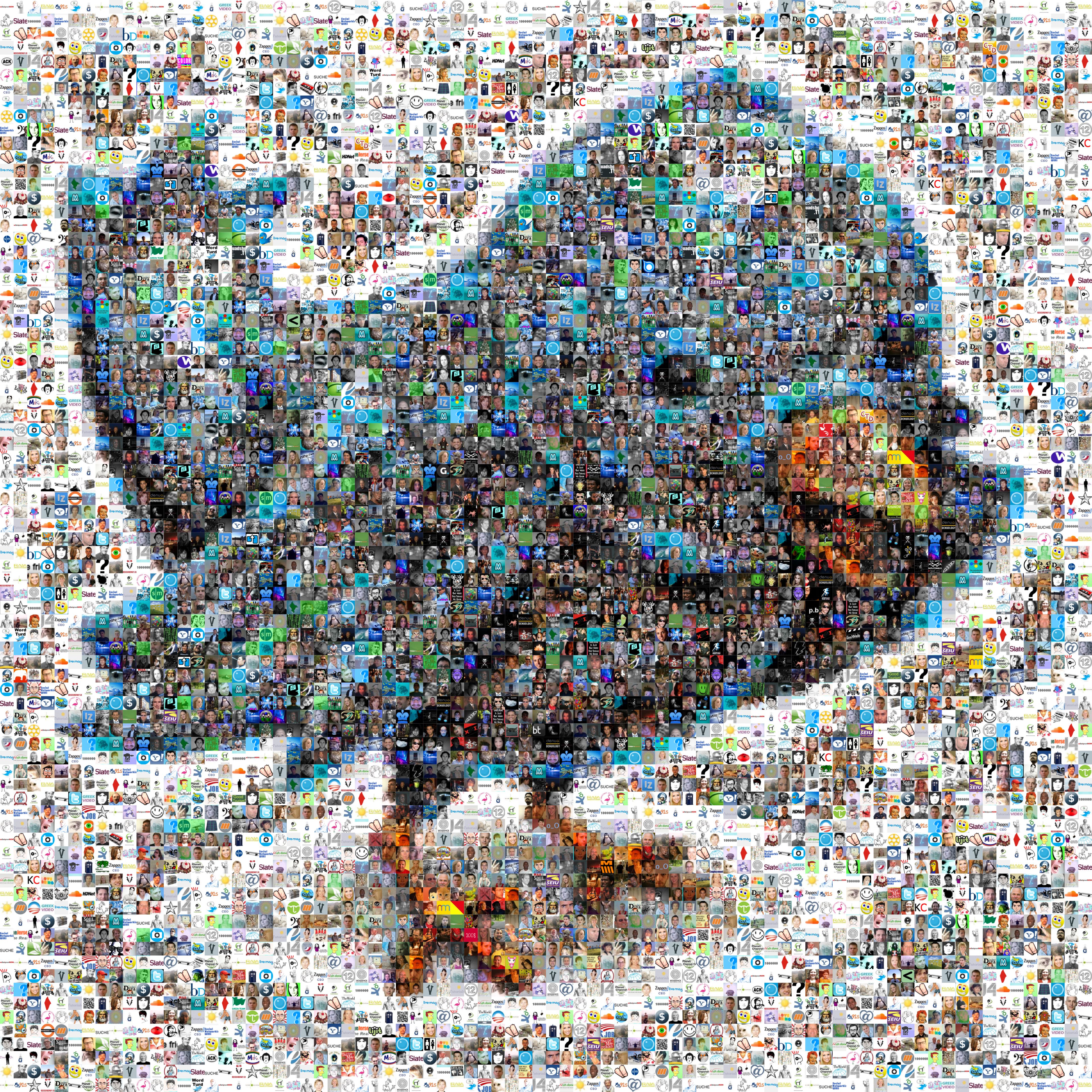
Celebrating 1,000 Twitter followers with a mosaic of all their avatars. See the large or hi-res versions and the "making-of" video.
Listen I know this is six followers late, but uh I decided to do a frame breakdown of my HM6 MklI. Thank you to Letranger Absurde for being the 101th
If anyone wants specific photos just ask.
I got a message from mod-hub and they said I should post my mocs on their site. I'm considering but I need help. What digital software will be able to help me with this?
Arduino + Lego
Parts:
- Arduino Nano
- L298n
- 2 x DC motor (RF-370C XTL-13470)
- 4 x Infrared Line Tracking Sensor Module
- lots of Lego parts
- battery, breadboard...
(not a single Lego part is damaged)
How to connect motor with Lego -> www.youtube.com/watch?v=3nEcxWDQrhw
Thanks to Kalilies <3. Also, I did not resolve eyelids issue. This affect all my characters in-game (also updated Sighne follower). Upper eyelids seems to disapear when you look at character from bigger distance... No idea what caused this and when... After or before I installed chargen extension? Or when I tried LadyHead? Noooo idea.... -.-.
As a professional father, you should take your daughter to see her idol at least three times. Then she could be called a real Idol Follower. lol
I have been continuing to explore the idea of "evidence" and my lifelong fascination with crime and film noir. These images imply a story or some drama unfolding. It's up to you... Shot these on film with a Ricoh Diacord on grainy, 3200 ASA film.
Image ©Philip Krayna, all rights reserved. This image is not in the public domain. Please contact me for permission to download, license, reproduce, or otherwise use this image, or to just say "hello". I value your input and comments.
My loyalty remains with Flickr, however you can also see me more often on Instagram. Follow me: @dyslexsyk
On Grafton Street in August among crowds off a cruise ship I spotted this dedicated follower of fashion. Listen to the link to know how rare a bird this is!
-
للمشاهدة بالحجم الاصلي L كلك على حرف
Taken by : rawan alhazmi
Camera : Canon 600d
Lens : 50mm F/1.8
للتوآصل :~
[ twitter ]
twitter.com/#!/RawanAlhazmi1
,
للآسئلة :~
[ formspring.me ]
formspring.me/rawanalhazmi
,
تآبعوني ع الانستقرام :~
[ instagram ]
rawanalhazmi@
Hello there, In last months I had many changes in my life.
Me and my family moved to Germany and suddenly I have no more access to this account from my computer.
I try again and again and write several mails to customer support and I dont get any answer.
So.... finally I open a New account and Im uploading my New self portraits there because here I can only upload from my phone and thats a big SH**Te
Im so sorry for my nearly 2K Followers. ..
But I hope you all understand my situation.
xoxo
Irina ❤
New account:
Hey friends.
So I've been playing with Ylva around for 3 days now.. And I've come to realize, that this might be one of the few of my characters that are actually in need of companionship. She seems a bit lonely for some reason. Normally I don't do followers as I prefer my character independant and strong enough to fare on their own, but I think Ylva might need a friend.
So I am asking all of you, what follower do you think would fit her?
Ylva: She's rather goofy, not very serious and doesn't like responsibilities as much as she maybe should. She isn't the head-on into battle type, and she prefers to actually keep her big warhammer out of battle if she could. More of a bard and trader than an actual warrior.
Who would fit with her? (I might make some funny comics with her if she has a follower, so let me know!)
So a little while back I reached my goal for a hundred followers, and i finally did it! Thank each and every one of you it means so much to me. Any way lets talk contests!
Premise:
To enter you must make a custom minifigure (or more) of your Smash Bros. main.
Rules:
No more than three customs per entry. All submissions must be entered by May 30. Once you have entered, leave a comment on this photo letting me know you entered. Winners must email or Skype me their addresses when prizes are done.
Prizes:
Third place win their Mii fighter in a "Fighting Mii Team" outfit from classic mode.
Second place wins their Mii fighter in the basic solid color outfit for their Mii and an item of their choice.
First place wins their fully customized Mii with their complete costume and an item of their choice.
Any questions may be asked in the comments. have fun everyone!
« If you appreciate my work and would like to support me becoming an independent photographer, become a Patreon supporter at www.patreon.com/alexdehaas, or buy me a coffee at www.buymeacoffee.com/alexdehaas :) »