View allAll Photos Tagged expected
How We Learn
NPR's "Tell Me More" 8:30 - 9:00 AM doors open, breakfast served; 9:00 - 10:00 AM LIVE SHOW
8:30 am - 10:00 am MDT on Tuesday, July 2, 2013
(Tickets Required) Join NPR's "Tell Me More" for three captivating discussions: In the first, we look at the ways innovations in education are transforming learning experiences for today’s students. Gone are the days when music class was just about listening to Mozart and math class was taught the same way to every student. For the second discussion, we hear from Shabana Basij-Rasikh, who was willing to risk her life in her native Afghanistan for an education. She would finish high school in the United States, eventually graduating from Middlebury College two years ago. Now she speaks about a school she co-founded in Afghanistan that helps young women access education at home and abroad. And finally, we address parenting your twentysomething. No shortage of articles have been written about young people in their twenties, who aren’t making enough money but are making less-than-stellar life decisions. Yet, some suggest that rather than expecting the worst from our 20-year-olds, we ought to set the bar high.
Jessie Woolley-Wilson Lawrence Scripp Joseph P. Parkes Meg Jay Michel Martin Shabana Basij-Rasikh Pamela Cantor Danny Kim
Hotel Jerome Ballroom
Expect media blitz next weekend.
Incidentally, this means I shall have to post the English edition to young Daniel in Miami, because there is a simplified Amercan version they get. Also I have just found out the audio version in the US is read by someone other than Stephen Fry! Better send him CDs too.
I've always wondered why they have that fluffy bit on their wotsits, I know you were thinking it : )
The Neil Young song ' Expecting To Fly ', one of the most beautiful things I've ever heard.......
Heidi Murkoff writes a note and signs her book during a Special Delivery baby shower June 17 at the Kadena Officers' Club on Kadena Air Base. The event helped launch the new Special Delivery Program, in which the USO and the What to Expect Foundation host baby showers at military installations worldwide. Murkoff signed books for expectant mothers at the event. Murkoff is the What to Expect Foundation president and author of a popular book series, which provides information on the different stages of pregnancy and child development. (U.S. Marine Corps photo by Lance Cpl. Devon Tindle/Released)
Yep - those are United Airlines tailfins masked by sheets of rain! My granny used to describe this as: 'hale watter' (whole water - i.e. no spaces between drops!) :-(
We eventually made it to sunny Florida! :-)
Convincing Towns Cup win against City of Derry
by Roger Corbett
Last year’s Towns Cup winners were comprehensively beaten 48-10 in the first round of this year’s competition by a well drilled and cohesive Bangor side.
With conditions very soft underfoot at Upritchard Park, the decision was made to play at the Bangor Grammar School’s new pitch nearby. It was hoped that the firmer ground and better than expected weather would give both sides a good opportunity to play to their respective strengths. As City of Derry 2nds were the current holders of the Towns Cup, and having brought a strong team to defend that position, Bangor were expecting a tough contest.
The visitors kicked off with a slight wind advantage, and pushed forward into Bangor’s twenty two. However, after 7 minutes of play, Bangor produced a fine break through crisp handling and good support that involved several players, before the ball came to Darren Kelly. With 10 metres to go, he powered through the Derry defence to score to the left of the posts. Neil Cuthbertson’s conversion was successful, getting the home side off to a great 7-0 start.
Shortly afterwards, another good combination between forwards and backs saw the ball come to Jason Morgan who seemed sure to score, but the ball somehow slipped from his grasp within sight of the Derry line. From the resulting scrum, Derry won the ball and cleared their lines by kicking for touch. The Bangor lineout was taken cleanly by Kelly, and Bangor picked off where they had left off moments earlier. This time it was Jamie Clegg who made the break before passing outside to Mark Widdowson on the left wing. Although he had to juggle the ball before controlling it, he still managed to squeeze in at the corner for Bangor’s second try. The touchline kick was missed making the score now 12-0 with 14 minutes gone.
City of Derry settled themselves and within 10 minutes were applying sustained pressure in Bangor’s twenty two. Having drawn in Bangor players to a ruck, they quickly passed the ball across their backs to find just enough room to score in the left hand corner. The kick was missed, but the gap had now closed to 12-5.
From Mark Thompson’s restart kick, the ball was knocked on by the City of Derry receiver. The Bangor scrum on the half way line was secured by Clegg before passing to Mike Aspley who accelerated through a gap in the centre, shook off a number of tackles and looked to be through for a score. However, with the City of Derry full back in front of him, Aspley unselfishly passed inside to Morgan who made the last few metres to score under the posts. Cuthberton’s simple kick made the score 19-5.
Most of the attacking play was now coming from the home side, prompting some desperate defending by the visitors. With 35 minutes gone, Derry were penalised for a deliberate knock on within their twenty two. The penalty was kicked to touch, and the subsequent lineout was again taken cleanly, this time by Adam Rushe. In a reversal of the previous try, Morgan took the ball forward before returning the compliment to Aspley to score close to the posts. The conversion brought the score to 26-5.
With the first half drawing to a close, Bangor kept up their pressure, forcing Derry to concede another penalty. From Bangor’s chosen scrum, the ball came to Morgan who, although wrapped up in defenders, managed to off-load to James Henly who made good ground before passing outside to Cuthbertson on the right wing who scored in the corner. His subsequent kick hit the upright and bounced out, but Bangor’s lead as the referee blew for half time was now 31-5.
City of Derry’s half time talk appeared to be paying dividends, as they started the second half with renewed vigour and eventually turned over a Bangor scrum. Having won the ball, they moved it wide to their right wing to score in the corner. Although the kick was missed, they were now in double figures at 31-10, with just a few minutes of the half gone.
Unfortunately, the Derry men were unable to build further from this promising start. On the 15 minute mark, Widdowson took a pass above his head, before side stepping the last defender to dive over in the left hand corner for his second try. A great kick by Cuthbertson made the score 38-10.
Several minutes later, Aspley had another good run, but this time was stopped short of the line. Undeterred, from the Bangor ruck, Andrew Jackson got the ball and, having pushed forward and brought play back into the centre, passed outside to Kelly who powered over from a couple of metres out to score his second try. The kick was missed, making the score 43-10.
With the contest all but over, and waiting for the final whistle, another Bangor attack saw Clegg push through before passing to Widdowson on his left. With defenders in front of him, and with little room to work with, Widdowson chipped over the defence and set off in pursuit. The ball didn’t bounce kindly for him, but did for the supporting Phil Whyte who gathered it well and dived over for a well-deserved try. For the second time in the game, Cuthbertson’s conversion hit the upright, making the final score 48-10.
This was another excellent Bangor performance that has brought a return to the kind of form shown at the start of the season. The timing couldn’t be better as the next game is away to league leaders Clogher Valley, who themselves are enjoying a great run of results.
Bangor side: P Whyte, A Jackson, J Harrison (J Leary), A Rushe, D Kelly, J Henly, R Latimer, J Clegg (c), C Harper, M Thompson, M Widdowson, M Aspley, J Morgan (G Caughey), N Cuthbertson, D Charles
Subs: J Leary, G Caughey
Bangor scores: D Kelly (2T), M Widdowson (2T), J Morgan (1T), M Aspley (1T), N Cuthbertson (1T, 4C), P Whyte (1T)
MODEL: SHANA
PHOTOGRAPHER: E. GRAVES, II
photog@IndieAllure.com
Copyright 2009 All Rights Reserved
****LIGHTING INFO***
Sorry it took me a whole couple of hours to update the lighting info....i guess i shouldn't do anything else first next time
2 off camera strobes, diffused through white umbrella facing each other behind model and background at 1/2
1x strobe off camera and above model at 1/8
Reflector below model on floor at angled up for stomach
1x strobe bounced off gold reflector at 1/16 on model left
for equipment specifics, distance, measurements, etc. message me
LONDON, ENGLAND - MAY 22: Anna Kendrick attends the UK film premiere of 'What To Expect When You're Expecting' at BFI IMAX on May 22, 2012 in London, England. (Photo by Tim Whitby/Getty Images)
Don't expect to see these Eucalyptus trees the next time you visit Monserrate, Bogotá. A split-second after this photo was taken a number of the trees came crashing down to the sound of chainsaws.
Taken September 2006.
I've been expecting this book for long time because my English is not good enough to read the English one. When I woke up this morning (so late ^_^) mom said that Dad had brought 3 books for me. My parenrs visited my aunt and one of her daughters works in a publishing house which published Harry Potter in Vietnamese so it's 30% cheaper ^_^. I have to say I'm a fan of Harry Potter. How about you?
Have a nice weekend, all my friends!
This is a photograph from the East of Ireland Marathon Series Marathon held at Stapelstown, Donadea, Naas, Co. Kildare, Ireland at 09:00 on Saturday 21st of September 2013. This is the first East of Ireland Marathon Series race outside of Dublin and also the first to have been run on rural roads and is race 5 of the East of Ireland Marathon Series 2013.
There was beautiful but warm weather in Stapelstown for the marathon which made conditions tougher than expected. The course brought runners on a loop from the village over towards Prosperous, Co. Kildare, and then back to the finish/refreshment area. The event was very well organised and whilst these races operate with a degree of self sufficiency for runners there was adequate marshalling, course marking, and refreshments available. Well done to all.
The East Of Ireland Marathon Series aims to make marathons affordable and convienient for the runners of Ireland. The serires organisers aim to promote marathon running and to make the process as stress free and enjoyable as possible. All courses are measured to full AAI standards and have a minimum of 10 Entrants. The marathons are self sufficent to a degree although there are limited supplies of water available on the day of the race. There will be no extra frills like chip timing and finish gantrys. However all finishing times are accurately and officially recorded. This is to keep the price down and keep the races as affordable as possible. The East of Ireland Marathon series is all inclusive and welcomes runners who are new to marathon running as well as experienced veterans.
This photograph is part of a Flickr set of photographs we took at this event. The Flickr set is available here [http://www.flickr.com/photos/peterm7/sets/72157635665725976/]. This set includes photographs from the start, in-race, and finish of the race.
Viewing this on a smartphone device?
If you are viewing this Flickr set on a smartphone and you want to see the larger version(s) of this photograph then: scroll down to the bottom of this description under the photograph and click the "View info about this photo..." link. You will be brought to a new page and you should click the link "View All Sizes".
Overall Race Summary
Participants: The East of Ireland marathon series stricly limits the number of participants. There were about 50 participants in the race today.
Weather: There was warm sunny weather for the race with competitors finding the humid conditions very tough as the race progress on around mid day. There was no real wind but a breeze which did help keep runners cool.
Course: The race started at St. Kevin's GAA and proceeded west into Stapelstown Village and reached a turnaround point which brought runners back to the starting point. This meant that runners then had to complete four complete loops of the 6.09 mile loop outlined below. This loop then proceeded directly southwards towards Prosperous but makes a sharp right turn before Properous village. This brings runners onto the Ballynafagh road and northwards back towards Stapelstown village. Runners then run down through the village (passing the finish and refreshment area) to complete the loop. The course is on traffic open country roads.
Location Map: This is the start finish area at Stapelstown National School goo.gl/maps/LbynY
Some Useful Links
A GARMIN GPS Trace of the 6.09 mile loop being used as part of the marathon: connect.garmin.com/activity/326724349
East of Ireland Marathons Facebook Group Page: www.facebook.com/groups/130592073780072/ (you will need a Facebook account to view this)
East of Ireland Marathons Web Homepage: www.eastofirelandmarathons.com/index.php
Professional Photographer Hannah Levy has galleries for several previous East of Ireland Marathons in 2013: www.hannahlevy.com/index/EOI_Marathons/EOI_Marathons.html
Google Streetview Imagery of St. Kevin's GAA Club where parking facilities were provided for the race: goo.gl/maps/FMsl5
Google Streetview Imagery of the Finish Area beside Stapelstown National School: goo.gl/maps/LbynY
Can I use these photographs directly from Flickr on my social media account?
Yes - of course you can. Flickr provides several ways to share this and other photographs in this Flickr set. You can share to: email, Facebook, Pinterest, Twitter, Tumblr, LiveJournal, and Wordpress and Blogger blog sites. Your mobile device will also offer you several different options for sharing this photo page on your social media outlets.
How can I get full resolution copies of these photographs?
All of the photographs posted here on this Flickr set are available free, at no cost, at full image resolution. We take these photographs as a hobby and as a contribution to the running community in Ireland. Our only "cost" is our request that if you are using these images without the watermark: (1) on social media sites such as Facebook, Tumblr, Pinterest, Twitter,LinkedIn, Google+, etc or (2) other websites, blogs, web multimedia, commercial/promotional material that you must provide a link back to our Flickr page to attribute us.
This also extends the use of these images for Facebook profile pictures. In these cases please make a separate wall or blog post with a link to our Flickr page. If you do not know how this should be done for Facebook or other social media please email us and we will be happy to help suggest how to link to us.
Please email petermooney78 AT gmail DOT com with the links to the photographs you would like to obtain a full resolution copy of. We also ask race organisers, media, etc to ask for permission before use of our images for flyers, posters, etc. We reserve the right to refuse a request.
In summary please remember when requesting photographs from us - all we ask is for you to provide a link back to our Flickr set or Flickr pages. You will find the link above clearly outlined in the description text which accompanies this photograph. Taking these photographs and preparing them for online posting does take a significant effort. We are not posting photographs to Flickr for commercial reasons. If you really like what we do please spread the link around your social media, send us an email, leave a comment beside the photographs, send us a Flickr email, etc.
If you would like to contribute something for your photograph(s)?
Many people offer payment for our photographs. As stated above we do not charge for these photographs. We take these photographs as our contribution to the running community in Ireland. If you feel that the photograph(s) you request are good enough that you would consider paying for their purchase from other photographic providers we would suggest that you can provide a donation to any of the great charities in Ireland who do work for Cancer Care or Cancer Research in Ireland.
I ran in the race - but my photograph doesn't appear here in your Flickr set! What gives?
As mentioned above we take these photographs as a hobby and as a voluntary contribution to the running community in Ireland. Very often we have actually ran in the same race and then switched to photographer mode after we finished the race. Consequently, we feel that we have no obligations to capture a photograph of every participant in the race. However, we do try our very best to capture as many participants as possible. But this is sometimes not possible for a variety of reasons:
►You were hidden behind another participant as you passed our camera
►Weather or lighting conditions meant that we had some photographs with blurry content which we did not upload to our Flickr set
►There were too many people - some races attract thousands of participants and as amateur photographs we cannot hope to capture photographs of everyone
►We simply missed you - sorry about that - we did our best!
You can email us petermooney78 AT gmail DOT com to enquire if we have a photograph of you which didn't make the final Flickr selection for the race. But we cannot promise that there will be photograph there. As alternatives we advise you to contact the race organisers to enquire if there were (1) other photographs taking photographs at the race event or if (2) there were professional commercial sports photographers taking photographs which might have some photographs of you available for purchase. You might find some links for further information above.
Don't like your photograph here?
That's OK! We understand!
If, for any reason, you are not happy or comfortable with your picture appearing here in this photoset on Flickr then please email us at petermooney78 AT gmail DOT com and we will remove it as soon as possible. We give careful consideration to each photograph before uploading.
I want to tell people about these great photographs!
Great! Thank you! The best link to spread the word around is probably www.flickr.com/peterm7/sets
As expected... 85mm on a m4/3 body is supper cropped~!!! But love the colors that the lens renders...
Although it's not meant close ups... with closest distance 1m, this lens can take close ups since it's magnifying capabilities... :)
Expected Opening 2030, stay alive!
Above ground construction signs of the new METRO underground line from Chatswood to Bankstown. Looking across intersection of Hunter and Castlereagh Street.
These are my personal notes taken during a geology presentation. I give them here because they may be of some interest. Do not expect the notes to always be in complete sentences, etc.
-----------------------------------
Planet Earth and Its Moon
Presented by: Robert Malcuit (Denison University, Granville, Ohio, USA) (denison.edu/people/robert-malcuit)
24 May 2011
----------
The Moon has been melted down to 600 km. It has an anorthosite crust (light-colored) - ~all plagioclase feldspar-rock. It also has mare with basalts (dark-colored). The Moon is basically black and white. The astronauts who visited observed that the Moon was “black and white and gray” - no colors.
(www.flickr.com/photos/silversolo/16875006978)
(www.flickr.com/photos/jsjgeology/16602236679)
Earth’s composition indicates it is made of chondritic meteorites.
Most scientists have considered the Moon to have had little significance to the history of Earth. This is now known not to be the case.
Without the Moon, Earth’s rotation rate today would be 12 to 14 hours per day.
Earth’s actual 24 hours per day rotation rate is due to tidal friction from the presence of the Moon.
What is the origin of the Moon? Most advocate the impact model. Here, Malcuit is presenting a different view.
Earth is special - it has liquid water at the surface, it has free oxygen in the atmosphere, it has a highly developed biologic system, it has a strong magnetic field (Jupiter and the Sun have way stronger magnetic fields), it has a very large Moon (mass ratio of 1:81), it’s the only planet with true granite, it’s the only planet with continental crust, it’s the only planet with operational plate tectonics.
(nssdc.gsfc.nasa.gov/image/planetary/earth/apollo17_earth.jpg)
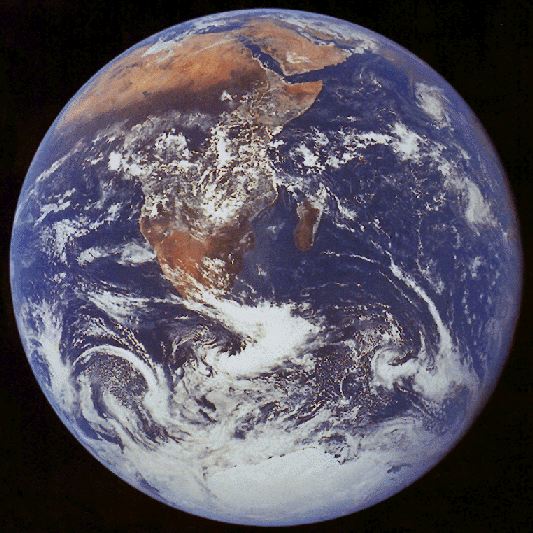
Moon’s mare deposits (younger) have a weaker magnetic signature than the anorthosite crustal rocks (older). This means that the lunar magnetic field died out from 3.9 to 3.6 Ga.
Earth’s continental crust mostly formed over subduction zones.
Earth plate tectonics have been operating since the beginning of the Earth, some say. Others say modern plate tectonics didn’t start until 1 billion years ago. Before that, Earth was too hot to get subduction. But, there are volcanic arcs that predate 1 billion years. However, a different plate tectonics style probably operated then.
If Earth did not have the Moon, Earth’s rotation rate would be ~12 hours/day, there would be no significant tides (only 10 to 15 centimeters from solar tides), there would be no granite and no continents, there would probably be some ocean water, and Earth would have an all-enclosing basaltic crust. Earth would probably develop bacterial life, and maybe algal life. It would have been difficult to have higher forms of life.
If the Moon was larger than it is, Earth would have 36 hours per day, resulting in extremely cold nights.
If the Moon was smaller than it is, Earth would be very different.
Earth is truly in a goldilocks zone.
Harold Urey (1893-1981), the discoverer of heavy hydrogen, said this: the Moon was a very primitive planetoid; it was a “survivor” of a class of planetoids that did not get consumed by collision with other bodies; the Moon is a major recorder of solar system events; the Moon is a captured satellite; the Moon is the “Rosetta Stone of the Solar System”.
Well, the Moon is as old as the Earth, so it is primitive. The Moon may be a little older than the Earth.
The Moon’s maria are in a straight line - the largest is first, the next largest is next, the next largest is next.
--------
The origin of the Moon - 4 models.
1) fission models
2) co-formation models
3) capture models - a minority view; calculations demonstrating capture have only been done at Denison University in Granville, Ohio.
4) giant impact models - a popular view; there’s actually not much evidence for it; proponents can’t make a lunar-sized body from the impact debris; if they can, they can’t get the Moon to be the right composition.
-------
Fission model - Darwin (1880) proposed the fission model. Early Earth spun so fast that the Moon pinched off and orbited Earth. See Wise (1963). Problem with the fission model - how does Earth get to be spinning so quickly for this to happen?
Co-formation model - was popular from 1930 to 1975, after the fission idea died out. Earth and the Moon formed from the same material. Calculations showed that this model didn’t provide a Moon in stable orbit. Plus, Earth & the Moon have different compositions.
Prograde capture model - calculations have been done by Malcuit and others. The Moon moved from a Sun-centered orbit to a geocentric orbit. The energy generated by the Moon capture event was 2.2 x 10 to the 28th power Joules.
Giant impact model - first seriously proposed in 1984 at a Hawaii conference. It has been favored ever since. It doesn’t relate to the geology of Earth or the Moon very well. The model has a Mars-mass body smashing into Proto-Earth. The impact event melts Proto-Earth completely. The debris coalesced into the Moon, which originally formed at 3 Earth radii distance, according to the model. It was 24 hours between the impact and the embryonic Moon. Earth initially rotated ~5 hours per day. No one has made a Moon from the debris, though.
Capture calculations have been done at Denison University since 1987.
---------
A viable Moon origin model has to explain the following:
1) anhydrous nature of the Moon
2) Potassium index (K index) for Solar System bodies (“banana index”) - the potassium content of planetary bodies decreases in a regular way in the Solar System
3) volatile element depletion patterns for Solar System bodies - water and other volatile element contents of planetary bodies decrease in a regular way in the Solar System
4) body density differences - the Moon has a 5 grams/cubic centimeter density; the Earth has a 3.3 g/cc density
5) lunar crust & mare rock dates
6) maria origin
7) asymmetry of lunar mass distribution
8) temporal patterns of lunar rock magnetization
--------
The discovery of Moon water was much hyped - it wasn’t quite a hoax, but it was very overstated - wishful thinking. The very thin, scattered coating of water ice on the Moon was mostly implanted by solar wind. People can’t live on the amount of water there.
--------
The giant impact model talking points:
1) it accounts for the masses of the Moon and the Earth (actually, it doesn’t)
2) it accounts for the angular momentum of the Earth-Moon system (actually, it doesn’t)
3) it accounts for the iron depletion of the Moon (yes, it does)
---------
The tidal capture model talking points:
1) it accounts for the masses of the Moon and the Earth (yes)
2) it accounts for the angular momentum of the Earth-Moon system (yes, it does) - a 10 hours/day rotating Earth that captures the Moon results in an angular momentum that we have now
3) it accounts for iron depletion of the Moon, relative to Earth (this is now explained by the capture model since 2003 understandings)
-------
The Earth-Moon system is unique. Moon origin models require an unusual explanation. Uncommon objects, like the Moon, require an uncommon origin.
Leaning toward the capture model - it was the default explanation from 1975 to 1984.
Capture vs. collision models - a David vs. Goliath scenario.
Tens of millions of dollars have been spent on computer simulations of the giant impact model, mainly at Los Alamos. There’s lots of investment in the impact model.
Earth can’t dissipate the high amounts of energy generated by the capture event over short periods of time. The Moon can.
If capture happened, where did the Moon come from? Didn’t know, originally.
When Malcuit retired in 1999, he still didn’t have an answer.
The capture scenario turns out to be far more complex and fascinating than realized 15 years ago.
Compare the Moon capture model with plate tectonics and Milankovitch climate cyclicity. It took 60 years for plate tectonics to be accepted (1912 to 1972) - a long incubation period for the concept. It took 64 years for the Milankovitch model of Ice Ages to be accepted (1912-1976) - also a long incubation period.
The capture model is simple in principle but complex in the details.
---------
Where did the Moon come from?
Possibilities:
1) near Earth’s orbit. If so, would get a Moon with the same composition as Earth. (which it isn’t)
2) in the inner part of the Asteroid Belt. If so, would get a Moon with ices/water. (which it doesn’t)
3) in the inner part of the Solar System, near the Sun - a near-Sun origin for the Moon was first suggested in the 1970s.
-----------
Relevant ideas - X-Wind Model, Cool Early Earth Model, K Index for Solar System Bodies, calculations by Evans & Tabachnik (1999)
The X-Wind Model allows for an iron-poor Moon forming near the Sun. Calcium-aluminum inclusions (CAIs) in carbonaceous chondrite meteorites are also explained by the X-Wind Model. The giant impact model can’t explain CAIs.
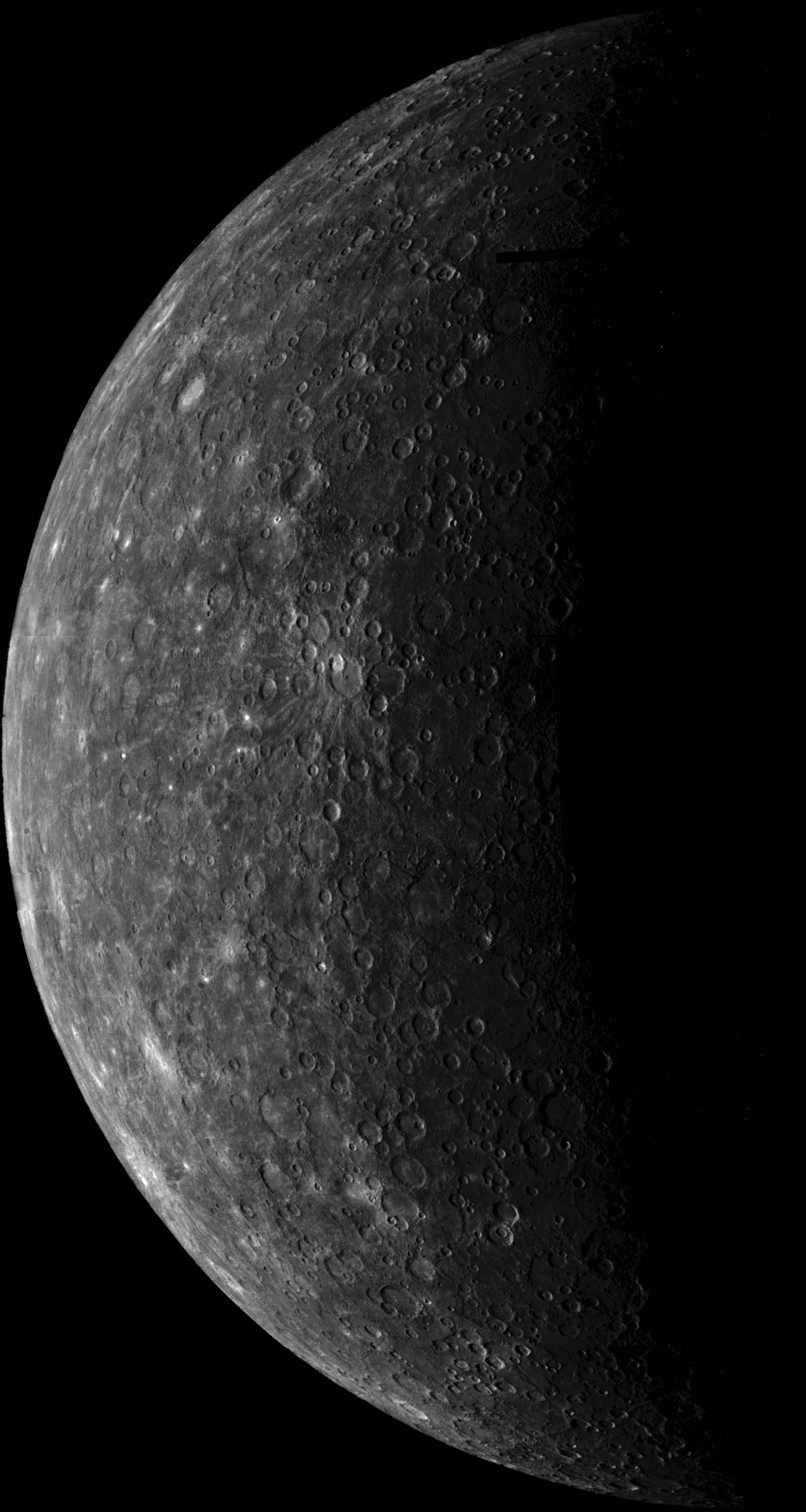
The most stable orbits in the Solar System have been found to occur at 0.1 to 0.2 AU (astronomical units). Orbits at this distance from the Sun are stable for up to 1 billion years. Objects that orbited the Sun at this distance (= closer than Mercury - solarviews.com/raw/merc/mercury.jpg) have been called Vulcanoids. No one has seen a Vulcanoid, it’s been thought. Let’s start the Moon in a Vulcanoid orbit.
Potassium (K) depletion trends:
carbonaceous chondrite meteorites (CI, CM, CV chondrites) have high K contents.
(www.flickr.com/photos/jsjgeology/albums/72157645997754616)
From there, in order of decreasing K content:
Mars (mysite.du.edu/~jcalvert/astro/mars2003.jpg)

Earth
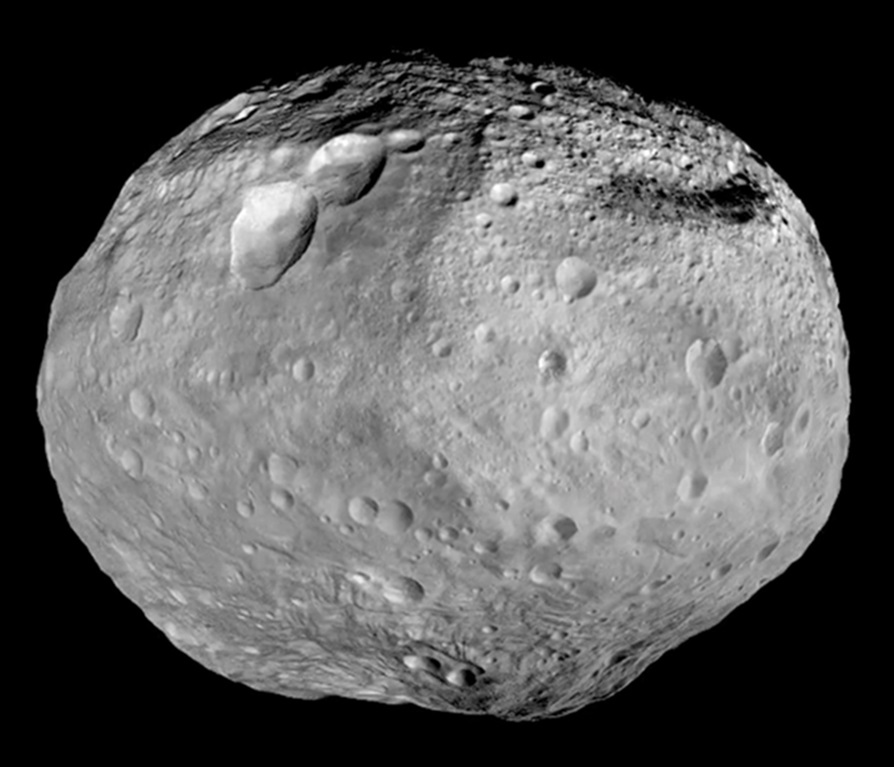
Vesta (= parent body of eucrite meteorites) (upload.wikimedia.org/wikipedia/commons/1/14/Vesta_full_mo...) (www.flickr.com/photos/jsjgeology/14785947504)
Moon
Angra (= parent body of angrite meteorites - not yet identified, but probably in the Asteroid Belt now - www.flickr.com/photos/jsjgeology/5867996330).
The Moon is chemically associated with Vesta and Angra (eucrites & angrites).
Primitive meteorites have chondrules, calcium-aluminum inclusions (CAIs), and matrix. Chondrules are 1-5 mm spherical structures in primitive meteorites (www.flickr.com/photos/jsjgeology/14778331004). Calcium-aluminum inclusions (CAIs) are 1-3 mm spherical structures in primitive meteorites (www.flickr.com/photos/jsjgeology/14787764392). They are rare, except in a meteorite that fell in 1969. The matrix is fine dust - it has element ratios very similar to the Sun.
Compositions of planets & planetoids - Mars is ~90% matrix material. Earth and Venus are a combination of chondrules and matrix + some CAI material. The Moon, Vesta, and Angra have ~90% CAI compositions.
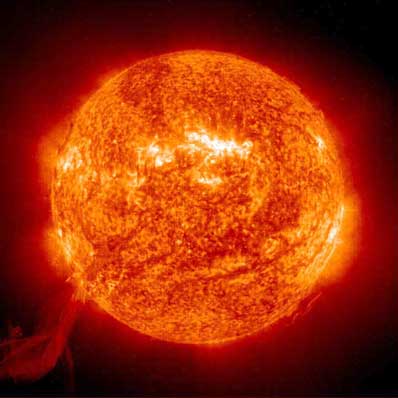
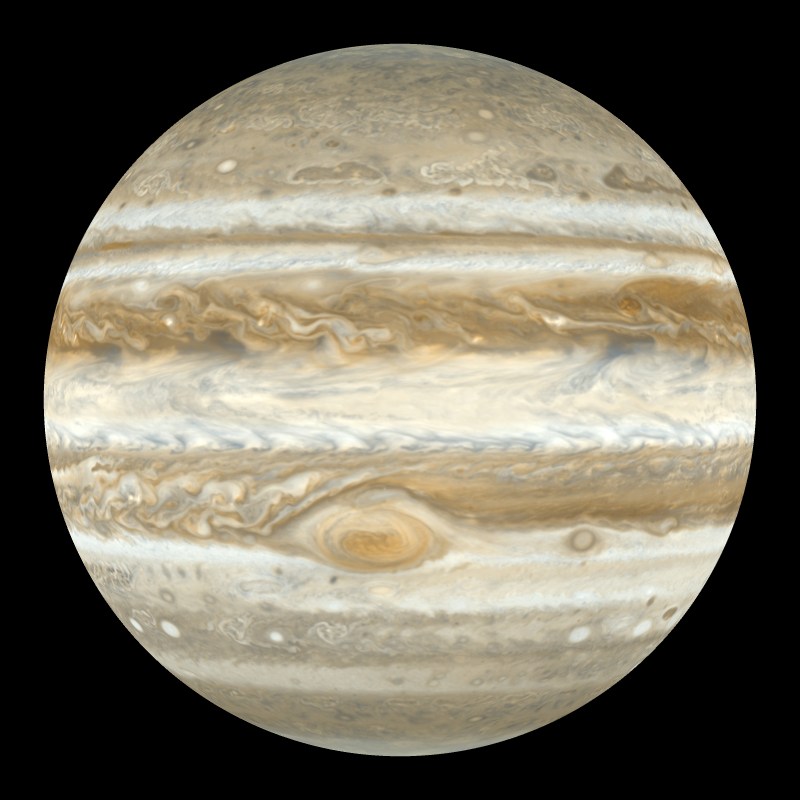
When the Sun formed (very hot) (www.daviddarling.info/images/Sun_021203.jpg), it pushed water and all other volatiles out to the snowline, at 5 AU. Jupiter picked up that material and grew like mad. (sos.noaa.gov/images/Solar_System/jupiter.jpg)
The iron line is at 0.4 AU, where Mercury orbits. ~1200° C. Get a concentration of iron at 0.4 AU - this is why Mercury is so Fe-rich (huge Fe core, compared to planet size).
~0.15 AU is where the Moon formed - inside the iron line, resulting in an Fe-depleted Moon (which it is). ~0.15 AU is a stable orbit zone.
The X-Wind Model explains CAIs - they formed at the reconnection ring shown in an X-Wind diagram and then they got swept elsewhere in the Solar System.
(www.sciencemag.org/content/277/5331/1475/F1.large.jpg)

Cool Early Earth - proposed by John Valley et al. (2002).
4.4 billion year old zircons from the Jack Hills, Australia were discovered in 1986. The zircons indicate Earth was cool at 4.4 Ga - cool enough to have surface water. Many Earth geologic time scales start with the Hadean - Earth was supposed to have been hotter-than-hell back then. 4.4 Ga zircons indicate that wasn’t the case.
The Moon capture event occurred at 3.95 billion years ago. The older lunar maria rocks came into existence then.
Earth’s primitive crust got recycled at 3.95 Ga - this is seen in Australia, Greenland, and South Africa.
Earth was moonless for 600 million years after its formation. Lunar capture started at 3.95 Ga.
Looking at the relationship between Mercury, the Moon, and Vesta. The spacecraft Dawn will orbit Vesta soon.
SPZ - the stable planetoid zone inside Mercury’s orbit. Angra was closest to the Sun, Luna (the Moon) was a bit farther out, and Vesta was a bit farther than that - all inside the orbit of Mercury. The reconnection ring (= CAI formation locality) is inside the orbit of Angra. The area had fluctuating ~1600° K temperatures. There were other bodies in the SPZ - “No Names”.
Why did the Moon get melted to a depth of 600 km? The same thing happened to Mercury.
The Sun entered a T-Tauri stage, after the X-Wind stage. X-Wind involved generation of x-rays and more powerful radiation. The T-Tauri stage was a slow burn - microwave radiation. Luna (Moon), Vesta, and Angra were heated & baked from the outside-in by the T-Tauri event. This melted the top 600 km of the Moon. Luna then had a stronger electromagnetic field.
Luna formed at 0.15 AU and ended up as a Moon of the Earth at 1 AU by prograde gravitational capture - a “benign estrangement” scenario.
Capture models in general - captured bodies can enter a retrograde orbit or a prograde orbit - there’s a 50-50 chance for each. Happily for us, the Moon was captured in a prograde orbit - it has been getting farther away from Earth through time. If it was captured in a retrograde orbit, the Moon would be getting closer to Earth through time - that would be bad.
Vesta was born at 0.19 AU and ended up at 2.4 AU, in the Asteroid Belt. Vesta was tossed around Mercury and Venus. Vesta is too small to have been captured. Options for Vesta - collision with larger bodies or passed by larger bodies. The latter is what happened - it's now in the Asteroid Belt.
Angra was born at 0.1 AU - it’s current location is unknown, but it is probably in the Asteroid Belt.
Adonis - a 0.5 Moon-mass body born at ~0.22 AU. Was gravitationally captured by Venus (0.7 AU) into a retrograde orbit. Adonis approached Venus through geologic time, and eventually coalesced with Venus at ~1 billion years to ~500 million years ago. This is why Venus is a basalt cauldron - a smoldering mass - campfire.andycamper.com/wp-content/media/2011/05/venus.jpg. This is a “fatal attraction” scenario - retrograde capture + coalescence at half a billion to a billion years ago.

Earth would have been like Venus & Adonis if the Moon was captured in retrograde orbit.
So, looking at the Moon as a vulcanoid. Vulcanoids were named in 1978. No one’s seen a vulcanoid. Well, we have been seeing a vulcanoid all this time.
The Moon has a blow-out hole (Mare Orientale - cumbriansky.files.wordpress.com/2012/12/screenshot_2012-1...) - material necked out by tidal disruption and fell back to the Moon’s surface to form the maria in a great circle pattern. ~18 orbits after Moon capture, there was possibly a solar perturbation that pushed the Moon closer to Earth - got maria splashes.

The X-Wind Model well explains CAIs and dehydration events. It doesn’t explain chondrules. The T-Tauri phase microwaved the Moon.
Where did chondrules form? After the dehydration event, the entire inner Solar System must have been chondrules. Chondrules formed by shock waves in the inner Solar System. The shock waves may have originated during Jupiter planetesimal coalescence events. Jupiter formed from large balls of hydrogen and helium and solid material. If two of these balls collided, would get a shock wave. With another ball collision, another shock wave was generated. Chondrules formed by melting of material by the shock waves, like a lightning strike, resulting in droplets in space. They cooled quickly into glass and later crystallized. Very rapid formation for chondrules.
The potassium index pattern developed before chondrules formed.
Earth and Venus are ~the same.
Moon, Adonis, Vesta, Angra - 4 vulcanoids.
Capture is simple in principle. Capture is complex in detail.
Earth has a large Moon - prograde capture.
Triton, a moon of Neptune, was captured for sure - it’s going the wrong way, orbit-wise.
Most of the energy generated by the Moon capture event was absorbed by the Moon.
--------------
See Professor Malcuit's new book, published in 2015: "The Twin Sister Planets Venus and Earth, Why Are They So Different?" (www.springer.com/us/book/9783319113876)
This book summarizes the contents of the above talk.
________________________________________
Summary of talk provided by Professor Malcuit: The origin of the Moon is still an unsolved problem in the natural sciences. In recent years many investigators have jumped onto the “bandwagon” to espouse the merits of the Giant Impact Model. This model proposes that the Moon was formed as a result of a collision of a mars-mass body with the primitive earth about 30 million years after the formation of the Earth. Although the Giant Impact Model appears to be physically possible, at least in part, the model does not relate very well to the rock records of the Earth or the Moon.
The other physically possible model is the Gravitational Capture Model. Most of the recent work, 1972 to present, has been done at Denison University as a combined geology and physics project. Our Capture Model is now undergoing a “renaissance” in light of (1) the Potassium Index for solar system bodies (~1995), (2) the discovery of a multitude of stable planetoid orbits between the orbits of planet Mercury and the Sun (~1999), and (3) the Cool Early Earth Model (~2002). In other words, the Gravitational Capture Model does relate to a number of features of the rock records of both the Earth and the Moon.
This presentation will summarize some of the scientific evidence in favor of the Gravitational Capture Model and compare and contrast this information with the main features of Giant Impact Model.
________________________________________
Biographical information on Professor Malcuit: Bob Malcuit received his Bachelor and Master degrees in Geology from Kent State Univeristy in 1968 and 1970 and his Ph.D in Geology from Michigan State University in 1973. Bob’s current research is in Planetary Geology and one of the themes of several of his projects is that “THE MOON IS THE ROSETTA STONE OF THE SOLAR SYSTEM”. He inherited this concept from Harold Urey (American chemist) and Zdenek Kopal (Czech astronomer). In other words, Bob thinks that the Earth’s Moon is one of the most important recorders of scientific information in the Solar System (a minority view at the present time). He is also promoting the view that without a large satellite like our Moon, planet Earth would be very different from what it is today. For example, without the Moon and the associated rock and ocean tidal action, the Earth would probably not be habitable for life forms higher than bacteria and algae.
--------------
2017 Mid-Season Invitational Finals at Jeunesse Arena in Rio de Janeiro, Rio de Janeiro, Brazil, on 21 May 2017.
Fangruida: human landing on Mars 10 cutting-edge technology
[Fangruida- human landing on Mars 10 innovative and sophisticated technologies]
Aerospace Science and space science and technology major innovation of the most critical of sophisticated technology R & D project
-------------------------------------------------- -------------
Aerospace Science Space Science and Technology on behalf of the world's most cutting-edge leader in high technology, materials, mechatronics, information and communication, energy, biomedical, marine, aviation aerospace, microelectronics, computer, automation, intelligent biochips, use of nuclear energy, light mechanical and electrical integration, astrophysics, celestial chemistry, astrophysics and so a series of geological science and technology. Especially after the moon landing, the further development of mankind to Mars and other planets into the powerful offensive, the world's major powers eager to Daxian hand of God, increase investment, vigorously develop new sophisticated technology projects for space to space. Satellite, space station, the new spacecraft, the new space suits, the new radiation protection materials, intelligent materials, new manufacturing technology, communications technology, computer technology, detector technology, rover, rover technology, biomedical technology, and so one after another, is expected to greater breakthroughs and leaps. For example, rocket technology, spacecraft design, large power spacecraft, spacesuits design improvements, radiation multifunctional composite materials, life health care technology and space medicine, prevention against microgravity microgravity applicable drugs, tracking control technology, landing and return technology. Mars lander and returned safely to Earth as a top priority. Secondly, Mars, the Moon base and the use of transforming Mars, the Moon and other development will follow. Whether the former or the latter, are the modern aerospace science, space science basic research, applied basic research and applied research in the major cutting-edge technology. These major cutting-edge technology research and innovation, not only for human landing on Mars and the safe return of great significance, but for the entire space science, impact immeasurable universe sciences, earth sciences and human life. Here the most critical of the most important research projects of several sophisticated technology research and development as well as its core technology brief. Limit non-scientific techniques include non-technical limits of technology, the key lies in technology research and development of technology maturity, advanced technology, innovative, practical, reliable, practical application, business value and investment costs, and not simply like the idea mature technology achievements, difficult to put into things. This is the high-tech research and development, testing, prototype, test application testing, until the outcome of industrialization. Especially in aerospace technology, advanced, novelty, practicality, reliability, economy, maturity, commercial value and so on. For technical and research purely science fiction and the like may be irrelevant depth, but not as aerospace engineering and technology practice. Otherwise, Mars will become a dream fantasy, and even into settling crashed out of danger.
Regardless of the moon or Mars, many technical difficulties, especially a human landing on Mars and return safely to Earth, technical difficulties mainly in the following aspects. (Transformation of Mars and the Moon and other planets and detect other livable technology more complex and difficult, at this stage it is difficult to achieve and therefore not discussed in detail in this study). In fact, Mars will be the safe return of a full set of technology, space science, aerospace crucial scientific research development, its significance is not confined to Mars simply a return to scientific value, great commercial value, can not be measure.
1. Powered rocket, the spacecraft overall structural design not be too complex large, otherwise, the safety factor to reduce the risk of failure accidents. Fusion rocket engine main problem to be solved is the high-temperature materials and fuel ignition chamber (reaction chamber temperatures of up to tens of millions of supreme billion degrees), fissile class rocket engine whose essence is the miniaturization of nuclear reactors, and placed on the rocket. Nuclear rocket engine fuel as an energy source, with liquid hydrogen, liquid helium, liquid ammonia working fluid. Nuclear rocket engine mounted in the thrust chamber of the reactor, cooling nozzle, the working fluid delivery and control systems and other components. This engine due to nuclear radiation protection, exhaust pollution, reactor control and efficient heat exchanger design and other issues unresolved. Electrothermal rocket engine utilizing heat energy (resistance heating or electric arc heating) working medium (hydrogen, amines, hydrazine ), vaporized; nozzle expansion accelerated after discharged from the spout to generate thrust. Static rocket engine working fluid (mercury, cesium, hydrogen, etc.) from the tank enter the ionization chamber is formed thrust ionized into a plasma jet. Electric rocket engines with a high specific impulse (700-2500 sec), extremely long life (can be repeated thousands of times a starter, a total of up to thousands of hours of work). But the thrust of less than 100N. This engine is only available for spacecraft attitude control, station-keeping and the like. One nuclear - power rocket design is as follows: Firstly, the reactor heats water to make it into steam, and then the high-speed steam ejected, push the rocket. Nuclear rocket using hydrogen as working substance may be a better solution, it is one of the most commonly used liquid hydrogen rocket fuel rocket carrying liquid hydrogen virtually no technical difficulties. Heating hydrogen nuclear reactor, as long as it eventually reaches or exceeds current jet velocity hydrogen rocket engine jet speed, the same weight of the rocket will be able to work longer, it can accelerate the Rockets faster. Here there are only two problems: First, the final weight includes the weight of the rocket in nuclear reactors, so it must be as light as possible. Ultra-small nuclear reactor has been able to achieve. Furthermore, if used in outer space, we can not consider the problem of radioactive residues, simply to just one proton hydrogen nuclei are less likely to produce induced radioactivity, thus shielding layer can be made thinner, injected hydrogen gas can flow directly through the reactor core, it is not easy to solve, and that is how to get back at high speed heated gas is ejected.
Rocket engine with a nuclear fission reactor, based on the heating liquid hydrogen propellant, rather than igniting flammable propellant
High-speed heavy rocket is a major cutting-edge technology. After all, space flight and aircraft carriers, submarines, nuclear reactors differ greatly from the one hand, the use of traditional fuels, on the one hand can be nuclear reactor technology. From the control, for security reasons, the use of nuclear power rocket technology, safe and reliable overriding indicators. Nuclear atomic energy in line with the norms and rules of outer space. For the immature fetal abdominal hatchery technology, and resolutely reject use. This is the most significant development of nuclear-powered rocket principle.
Nuclear-powered spaceship for Use of nuclear power are three kinds:
The first method: no water or air space such media can not be used propeller must use jet approach. Reactor nuclear fission or fusion to produce a lot of heat, we will propellant (such as liquid hydrogen) injection, the rapid expansion of the propellant will be heated and then discharged from the engine speed tail thrust. This method is most readily available.
The second method: nuclear reactor will have a lot of fast-moving ions, these energetic particles moving very fast, so you can use a magnetic field to control their ejection direction. This principle ion rocket similar to the tail of the rocket ejected from the high-speed mobile ions, so that the recoil movement of a rocket. The advantage of this approach is to promote the unusually large ratio, without carrying any medium, continued strong. Ion engine, which is commonly referred to as "electric rocket", the principle is not complicated, the propellant is ionized particles,
Plasma Engine
Electromagnetic acceleration, high-speed spray. From the development trend, the US research scope covers almost all types of electric thrusters, but mainly to the development of ion engines, NASA in which to play the most active intake technology and preparedness plans. "
The third method: the use of nuclear explosions. It is a bold and crazy way, no longer is the use of a controlled nuclear reaction, but to use nuclear explosions to drive the ship, this is not an engine, and it is called a nuclear pulse rocket. This spacecraft will carry a lot of low-yield atomic bombs out one behind, and then detonated, followed by a spacecraft propulsion installation disk, absorbing the blast pushing the spacecraft forward. This was in 1955 to Orion (Project Orion) name of the project, originally planned to bring two thousand atomic bombs, Orion later fetal nuclear thermal rocket. Its principle is mounted on a small rocket reactor, the reactor utilizing thermal energy generated by the propellant is heated to a high temperature, high pressure and high temperature of the propellant from the high-speed spray nozzle, a tremendous impetus.
Common nuclear fission technologies, including nuclear pulse rocket engines, nuclear rockets, nuclear thermal rocket and nuclear stamping rockets to nuclear thermal rocket, for example, the size of its land-based nuclear power plant reactor structure than the much smaller, more uranium-235 purity requirements high, reaching more than 90%, at the request of the high specific impulse engine core temperature will reach about 3000K, require excellent high temperature properties of materials.
Research and test new IT technologies and new products and new technology and new materials, new equipment, things are difficult, design is the most important part, especially in the overall design, technical solutions, technical route, technical process, technical and economic particularly significant. The overall design is defective, technology there are loopholes in the program, will be a major technical route deviation, but also directly related to the success of research trials. so, any time, under any circumstances, a good grasp of the overall control of design, technical design, is essential. otherwise, a done deal, it is difficult save. aerospace technology research and product development is true.
3, high-performance nuclear rocket
Nuclear rocket nuclear fission and fusion energy can rocket rocket two categories. Nuclear fission and fusion produce heat, radiation and shock waves and other large amounts of energy, but here they are contemplated for use as a thermal energy rocket.
Uranium and other heavy elements, under certain conditions, will split their nuclei, called nuclear fission reaction. The atomic bomb is the result of nuclear fission reactions. Nuclear fission reaction to release energy, is a million times more chemical rocket propellant combustion energy. Therefore, nuclear fission energy is a high-performance rocket rockets. Since it requires much less propellant than chemical rockets can, so to its own weight is much lighter than chemical rockets energy. For the same quality of the rocket, the rocket payload of nuclear fission energy is much greater than the chemical energy of the rocket. Just nuclear fission energy rocket is still in the works.
Use of nuclear fission energy as the energy of the rocket, called the atomic rockets. It is to make hydrogen or other inert gas working fluid through the reactor, the hydrogen after the heating temperature quickly rose to 2000 ℃, and then into the nozzle, high-speed spray to produce thrust.
A vision plan is to use liquid hydrogen working fluid, in operation, the liquid hydrogen tank in the liquid hydrogen pump is withdrawn through the catheter and the engine cooling jacket and liquid hydrogen into hydrogen gas, hydrogen gas turbine-driven, locally expansion. Then by nuclear fission reactors, nuclear fission reactions absorb heat released, a sharp rise in temperature, and finally into the nozzle, the rapid expansion of high-speed spray. Calculations show that the amount of atomic payload rockets, rocket high chemical energy than 5-8 times.
Hydrogen and other light elements, under certain conditions, their nuclei convergent synthesis of new heavy nuclei, and release a lot of energy, called nuclear fusion reaction, also called thermonuclear reaction.
Using energy generated by the fusion reaction for energy rocket, called fusion energy rocket or nuclear thermal rockets. But it is also not only take advantage of controlled nuclear fusion reaction to manufacture hydrogen bombs, rockets and controlled nuclear fusion reaction needs still studying it.
Of course there are various research and development of rocket technology and technical solutions to try.
It is envisaged that the rocket deuterium, an isotope of hydrogen with deuterium nuclear fusion reaction of helium nuclei, protons and neutrons, and release huge amounts of energy, just polymerized ionized helium to temperatures up to 100 million degrees the plasma, and then nozzle expansion, high-speed ejection, the exhaust speed of up to 15,000 km / sec, atomic energy is 1800 times the rocket, the rocket is the chemical energy of 3700 times.
Nuclear rocket engine fuel as an energy source, with liquid hydrogen, liquid helium, liquid ammonia working fluid. Nuclear rocket engine mounted in the thrust chamber of the reactor, cooling nozzle, the working fluid delivery and control systems and other components. In a nuclear reactor, nuclear energy into heat to heat the working fluid, the working fluid is heated after expansion nozzle to accelerate to the speed of 6500 ~ 11,000 m / sec from the discharge orifice to produce thrust. Nuclear rocket engine specific impulse (250 to 1000 seconds) long life, but the technology is complex, apply only to long-term spacecraft. This engine due to nuclear radiation protection, exhaust pollution, reactor control and efficient heat exchanger design and other issues not resolved, is still in the midst of trials. Nuclear rocket technology is cutting-edge aerospace science technology, centralized many professional and technical sciences and aerospace, nuclear physics, nuclear chemistry, materials science, the long term future ___-- wide width. The United States, Russia and Europe, China, India, Japan, Britain, Brazil and other countries in this regard have studies, in particular the United States and Russia led the way, impressive. Of course, at this stage of nuclear rocket technology, technology development there are still many difficulties. Fully formed, still to be. But humanity marching to the universe, nuclear reactor applications is essential.
Outer Space Treaty (International Convention on the Peaceful Uses of Outer Space) ****
Use of Nuclear Power Sources in Outer Space Principle 15
General Assembly,
Having considered the report of its thirty-fifth session of the Committee on the Peaceful Uses of Outer Space and the Commission of 16 nuclear
It can be attached in principle on the use of nuclear power sources in outer space of the text of its report, 17
Recognize that nuclear power sources due to small size, long life and other characteristics, especially suitable for use even necessary
For some missions in outer space,
Recognizing also that the use of nuclear power sources in outer space should focus on the possible use of nuclear power sources
Those uses,
Recognizing also that the use of nuclear power sources should include or probabilistic risk analysis is complete security in outer space
Full evaluation is based, in particular, the public should focus on reducing accidental exposure to harmful radiation or radioactive material risk
risk,
Recognizing the need to a set of principles containing goals and guidelines in this regard to ensure the safety of outer space makes
With nuclear power sources,
Affirming that this set principles apply exclusively on space objects for non-power generation, which is generally characteristic
Mission systems and implementation of nuclear power sources in outer space on similar principles and used by,
Recognizing this need to refer to a new set of principles for future nuclear power applications and internationally for radiological protection
The new proposal will be revised
By the following principles on the use of nuclear power sources in outer space.
Principle 1. Applicability of international law
Involving the use of nuclear power sources in outer space activities should be carried out in accordance with international law, especially the "UN
Principles of the Charter "and" States in the Exploration and Use of Outer Space, including the Moon and Other Celestial Bodies Activities
Treaty "3
.
2. The principle terms
1. For the purpose of these principles, "launching State" and "launching State ......" two words mean, in related
Principles related to a time of nuclear power sources in space objects exercises jurisdiction and control of the country.
2. For the purpose of principle 9, wherein the definition of the term "launching State" as contained in that principle.
3. For the purposes of principle 3, the terms "foreseeable" and "all possible" two words are used to describe the actual hair
The overall likelihood of students that it is considered for safety analysis is credible possibilities for a class of things
Member or circumstances. "General concept of defense in depth" when the term applies to nuclear power sources in outer space refers to various settings
Count form and space operations replace or supplement the operation of the system in order to prevent system failures or mitigate thereafter
"Official Records of the General Assembly, Forty-seventh Session, Supplement No. 20" 16 (A / 47/20).
17 Ibid., Annex.
38
fruit. To achieve this purpose is not necessarily required for each individual member has redundant safety systems. Given space
Use and special requirements of various space missions, impossible to any particular set of systems or features can be specified as
Necessary to achieve this purpose. For the purpose of Principle 3 (d) of paragraph 2, "made critical" does not include
Including such as zero-power testing which are fundamental to ensuring system safety required.
Principle 3. Guidelines and criteria for safe use
To minimize the risk of radioactive material in space and the number involved, nuclear power sources in outer space
Use should be limited to non-nuclear power sources in space missions can not reasonably be performed
1. General goals for radiation protection and nuclear safety
(A) States launching space objects with nuclear power sources on board shall endeavor to protect individuals, populations and the biosphere
From radiation hazards. The design and use of space objects with nuclear power sources on board shall ensure that risk with confidence
Harm in the foreseeable operational or accidental circumstances, paragraph 1 (b) and (c) to define acceptable water
level.
Such design and use shall also ensure that radioactive material does not reliably significant contamination of outer space.
(B) the normal operation of nuclear power sources in space objects, including from paragraph 2 (b) as defined in foot
High enough to return to the track, shall be subject to appropriate anti-radiation recommended by the International Commission on Radiological Protection of the public
Protection goals. During such normal operation there shall be no significant radiation exposure;
(C) To limit exposure in accidents, the design and construction of nuclear power source systems shall take into account the international
Relevant and generally accepted radiological protection guidelines.
In addition to the probability of accidents with potentially serious radiological consequences is extremely low, the nuclear power source
Design systems shall be safely irradiated limited limited geographical area, for the individual radiation dose should be
Limited to no more than a year 1mSv primary dose limits. Allows the use of irradiation year for some years 5mSv deputy agent
Quantity limit, but the average over a lifetime effective dose equivalent annual dose not exceed the principal limit 1mSv
degree.
Should make these conditions occur with potentially serious radiological consequences of the probability of the system design is very
small.
Criteria mentioned in this paragraph Future modifications should be applied as soon as possible;
(D) general concept of defense in depth should be based on the design, construction and operation of systems important for safety. root
According to this concept, foreseeable safety-related failures or malfunctions must be capable of automatic action may be
Or procedures to correct or offset.
It should ensure that essential safety system reliability, inter alia, to make way for these systems
Component redundancy, physical separation, functional isolation and adequate independence.
It should also take other measures to increase the level of safety.
2. The nuclear reactor
(A) nuclear reactor can be used to:
39
(I) On interplanetary missions;
(Ii) the second high enough orbit paragraph (b) as defined;
(Iii) low-Earth orbit, with the proviso that after their mission is complete enough to be kept in a nuclear reactor
High on the track;
(B) sufficiently high orbit the orbital lifetime is long enough to make the decay of fission products to approximately actinides
Element active track. The sufficiently high orbit must be such that existing and future outer space missions of crisis
Risk and danger of collision with other space objects to a minimum. In determining the height of the sufficiently high orbit when
It should also take into account the destroyed reactor components before re-entering the Earth's atmosphere have to go through the required decay time
between.
(C) only 235 nuclear reactors with highly enriched uranium fuel. The design shall take into account the fission and
Activation of radioactive decay products.
(D) nuclear reactors have reached their operating orbit or interplanetary trajectory can not be made critical state
state.
(E) nuclear reactor design and construction shall ensure that, before reaching the operating orbit during all possible events
Can not become critical state, including rocket explosion, re-entry, impact on ground or water, submersion
In water or water intruding into the core.
(F) a significant reduction in satellites with nuclear reactors to operate on a lifetime less than in the sufficiently high orbit orbit
For the period (including during operation into the sufficiently high orbit) the possibility of failure, there should be a very
Reliable operating system, in order to ensure an effective and controlled disposal of the reactor.
3. Radioisotope generators
(A) interplanetary missions and other spacecraft out of Earth's gravitational field tasks using radioactive isotopes
Su generator. As they are stored after completion of their mission in high orbit, the Earth can also be used
track. We are required to make the final treatment under any circumstances.
(B) Radioisotope generators shall be protected closed systems, design and construction of the system should
Ensure that in the foreseeable conditions of the track to withstand the heat and aerodynamic forces of re-entry in the upper atmosphere, orbit
Conditions including highly elliptical or hyperbolic orbits when relevant. Upon impact, the containment system and the occurrence of parity
Physical morpheme shall ensure that no radioactive material is scattered into the environment so you can complete a recovery operation
Clear all radioactive impact area.
Principle 4. Safety Assessment
1. When launching State emission consistent with the principles defined in paragraphs 1, prior to the launch in applicable under the
Designed, constructed or manufactured the nuclear power sources, or will operate the space object person, or from whose territory or facility
Transmits the object will be to ensure a thorough and comprehensive safety assessment. This assessment shall cover
All relevant stages of space mission and shall deal with all systems involved, including the means of launching, the space level
Taiwan, nuclear power source and its equipment and the means of control and communication between ground and space.
2. This assessment shall respect the principle of 3 contained in the guidelines and criteria for safe use.
40
3. The principle of States in the Exploration and Use, including the Moon and Other Celestial Bodies Outer Space Activities Article
Results of about 11, this safety assessment should be published prior to each transmit simultaneously to the extent feasible
Note by the approximate intended time of launch, and shall notify the Secretary-General of the United Nations, how to be issued
This safety assessment before the shot to get the results as soon as possible.
Principle 5. Notification of re-entry
1. Any State launching a space object with nuclear power sources in space objects that failed to produce discharge
When radioactive substances dangerous to return to the earth, it shall promptly notify the country concerned. Notice shall be in the following format:
(A) System parameters:
(I) Name of launching State, including which may be contacted in the event of an accident to Request
Information or assistance to obtain the relevant authorities address;
(Ii) International title;
(Iii) Date and territory or location of launch;
(Iv) the information needed to make the best prediction of orbit lifetime, trajectory and impact region;
(V) General function of spacecraft;
(B) information on the radiological risk of nuclear power source:
(I) the type of power source: radioisotopes / reactor;
(Ii) the fuel could fall into the ground and may be affected by the physical state of contaminated and / or activated components, the number of
The amount and general radiological characteristics. The term "fuel" refers to as a source of heat or power of nuclear material.
This information shall also be sent to the Secretary-General of the United Nations.
2. Once you know the failure, the launching State shall provide information on the compliance with the above format. Information should as far as possible
To be updated frequently, and in the dense layers of the Earth's atmosphere is expected to return to a time when close to the best increase
Frequency of new data, so that the international community understand the situation and will have sufficient time to plan for any deemed necessary
National contingency measures.
3. It should also be at the same frequency of the latest information available to the Secretary-General of the United Nations.
Principle 6. consultation
5 According to the national principles provide information shall, as far as reasonably practicable, other countries
Requirements to obtain further information or consultations promptly reply.
Principle 7. Assistance to States
1. Upon receipt of expected with nuclear power sources on space objects and their components will return through the Earth's atmosphere
After know that all countries possessing space monitoring and tracking facilities, in the spirit of international cooperation, as soon as possible to
The Secretary-General of the United Nations and the countries they may have made space objects carrying nuclear power sources
A fault related information, so that the States may be affected to assess the situation and take any
It is considered to be the necessary precautions.
41
2. In carrying space objects with nuclear power sources back to the Earth's atmosphere after its components:
(A) launching State shall be requested by the affected countries to quickly provide the necessary assistance to eliminate actual
And possible effects, including nuclear power sources to assist in identifying locations hit the Earth's surface, to detect the re substance
Quality and recovery or cleanup activities.
(B) All countries with relevant technical capabilities other than the launching State, and with such technical capabilities
International organizations shall, where possible, in accordance with the requirements of the affected countries to provide the necessary co
help.
When according to the above (a) and subparagraph (b) to provide assistance, should take into account the special needs of developing countries.
Principle 8. Responsibility
In accordance with the States in the Exploration and Use of Outer Space, including the Moon and Other Celestial Bodies activities, including the principles of Article
About Article, States shall bear international responsibility for their use of nuclear power sources in outer space relates to the activities
Whether such activities are carried on by governmental agencies or non-governmental entities, and shall bear international responsibility to ensure that this
Such activities undertaken by the country in line with the principles of the Treaty and the recommendations contained therein. If it involves the use of nuclear power sources
Activities in outer space by an international organization, should be done by the international organizations and States to participate in the organization
Undertakes to comply with the principles of the Treaty and the recommendations contained in these responsibilities.
Principle 9. Liability and Compensation
1. In accordance with the principle of States in the Exploration and Use, including the Moon and Other Celestial Bodies Outer Space Activities Article
And the Convention on International Liability for Damage Caused by Space Objects covenant of Article 7
Provisions, which launches or on behalf of the State
Each State launching a space object and each State from which territory or facility a space object is launched
Kinds of space object or damage caused by components shall bear international liability. This fully applies to this
Kind of space object carrying a nuclear power source case. Two or more States jointly launch a space object,
Each launching State shall in accordance with the above Article of the Convention for any damages jointly and severally liable.
2. Such countries under the aforesaid Convention shall bear the damages shall be in accordance with international law and fair and reasonable
The principles set out in order to provide for damages to make a claim on behalf of its natural or juridical persons, national or
International organizations to restore to the state before the occurrence of the damage.
3. For the purposes of this principle, compensation should be made to include reimbursement of the duly substantiated expenses for search, recovery and clean
Cost management work, including the cost of providing assistance to third parties.
10. The principle of dispute settlement
Since the implementation of these principles will lead to any dispute in accordance with the provisions of the UN Charter, by negotiation or
Other established procedures to resolve the peaceful settlement of disputes.
Here quoted the important provisions of the United Nations concerning the use of outer space for peaceful nuclear research and international conventions, the main emphasis on the Peaceful Uses of provisions related constraints .2 the use of nuclear rockets in outer space nuclear studies, etc., can cause greater attention in nuclear power nuclear rocket ship nuclear research, manufacture, use and other aspects of the mandatory hard indicators. this scientists, engineering and technical experts are also important constraints and requirements. as IAEA supervision and management as very important.
2. radiation. Space radiation is one of the greatest threats to the safety of the astronauts, including X-rays, γ-rays, cosmic rays and high-speed solar particles. Better than aluminum protective effect of high polymer composite materials.
3. Air. Perhaps the oxygen needed to rely on oxidation-reduction reaction of hydrogen and ilmenite production of water, followed by water electrolysis to generate oxygen. Mars oxygen necessary for survival but also from the decomposition of water, electrolytically separating water molecules of oxygen and hydrogen, this oxygen equipment has been successfully used in the International Space Station. Oxygen is released into the air to sustain life, the hydrogen system into the water system.
4. The issue of food waste recycling. At present, the International Space Station on the use of dehumidifiers, sucked moisture in the air to be purified, and then changed back to drinkable water. The astronauts' urine and sweat recycling. 5. water. The spacecraft and the space station on purification system also makes urine and other liquids can be purified utilization. 6. microgravity. In microgravity or weightlessness long-term space travel, if protective measures shall not be treated, the astronauts will be muscle atrophy, bone softening health. 7. contact. 8. Insulation, 9 energy. Any space exploration are inseparable from the energy battery is a new super hybrid energy storage device, the asymmetric lead-acid batteries and supercapacitors in the same compound within the system - and the so-called inside, no additional separate electronic control unit, this is an optimal combination. The traditional lead-acid battery PbO2 monomer is a positive electrode plate and a negative electrode plate spongy Pb composition, not a super cell. : Silicon solar cells, multi-compound thin film solar cells, multi-layer polymer-modified electrode solar cells, nano-crystalline solar cells, batteries and super class. For example, the solar aircraft .10. To protect the health and life safety and security systems. Lysophosphatidic acid LPA is a growth factor-like lipid mediators, the researchers found that this substance can on apoptosis after radiation injury and animal cells was inhibited. Stable lysophosphatidic acid analogs having the hematopoietic system and gastrointestinal tract caused by acute radiation sickness protection, knockout experiments show that lysophosphatidic acid receptors is an important foundation for the protection of radiation injury. In addition to work under high pressure, the astronauts face a number of health threats, including motion sickness, bacterial infections, blindness space, as well as psychological problems, including toxic dust. In the weightless environment of space, the astronaut's body will be like in preadolescents, as the emergence of various changes.
Plantar molt
After the environment to adapt to zero gravity, the astronaut's body will be some strange changes. Weightlessness cause fluid flow around the main flow torso and head, causing the astronauts facial swelling and inflammation, such as nasal congestion. During long-term stay in space
Bone and muscle loss
Most people weightlessness caused by the impact may be known bone and muscle degeneration. In addition, the calcium bones become very fragile and prone to fracture, which is why some of the astronauts after landing need on a stretcher.
Space Blindness
Space Blindness refers astronaut decreased vision.
Solar storms and radiation is one of the biggest challenges facing the long-term space flight. Since losing the protection of Earth's magnetic field, astronauts suffer far more than normal levels of radiation. The cumulative amount of radiation exposure in low earth orbit them exceeded by workers close to nuclear reactors, thereby increasing the risk of cancer.
Prolonged space flight can cause a series of psychological problems, including depression or mood swings, vulnerability, anxiety and fear, as well as other sequelae. We are familiar with the biology of the Earth, the Earth biochemistry, biophysics, after all, the Earth is very different astrophysics, celestial chemistry, biophysics and astrophysics, biochemistry and other celestial bodies. Therefore, you must be familiar with and adapt to these differences and changes.
Osteoporosis and its complications ranked first in the space of disease risk.
Long-term health risks associated with flying Topics
The degree of influence long-term biological effects of radiation in human flight can withstand the radiation and the maximum limit of accumulated radiation on physiology, pathology and genetics.
Physiological effects of weightlessness including: long-term bone loss and a return flight after the maximum extent and severity of the continued deterioration of other pathological problems induced by the; maximum flexibility and severity of possible long-term Flight Center in vascular function.
Long-term risk of disease due to the high risk of flight stress, microbial variation, decreased immune function, leading to infections
Radiation hazards and protection
1) radiation medicine, biology and pathway effects Features
Radiation protection for interplanetary flight, since the lack of protective effect of Earth's magnetic field, and by the irradiation time is longer, the possibility of increased radiation hazard.
Analysis of space flight medical problems that may occur, loss of appetite topped the list, sleep disorders, fatigue and insomnia, in addition, space sickness, musculoskeletal system problems, eye problems, infections problems, skin problems and cardiovascular problems
---------------------------------------------------------
Development of diagnostic techniques in orbit, the development of the volume of power consumption, features a wide range of diagnostic techniques, such as applied research of ultrasound diagnostic techniques in the abdominal thoracic trauma, bone, ligament damage, dental / sinus infections and other complications and integrated;
Actively explore in orbit disposal of medical technology, weightlessness surgical methods, development of special surgical instruments, the role of narcotic drugs and the like.
——————————————————————————————-
However, space technology itself is integrated with the use of the most advanced technology, its challenging technical reserves and periodic demanding
With the continuous development of science and technology, space agencies plan a manned landing on the moon and Mars, space exploration emergency medicine current concern.
Space sickness
In the weightless environment of space, in the weightless environment of space, surgery may be extremely difficult and risky.
Robot surgeons
Space disease in three days after entering the space started to ease, although individual astronauts might subsequently relapse. January 2015 NASA declared working on a fast, anti-nausea and nasal sprays. In addition, due to the zero-gravity environment, and anti-nausea drugs can only be administered by injection or transdermal patches manner.
Manned spaceflight in the 21st century is the era of interplanetary flight, aerospace medicine is closely watched era is the era of China's manned space flourish. Only the central issue, and grasp the opportunity to open up a new world of human survival and development.
Various emergency contingency measures in special circumstances. Invisible accident risk prevention. Enhancing drugs and other screening methods immunity aerospace medicine and tissue engineering a microgravity environment. Drug mixture of APS, ginseng polysaccharides, Ganoderma lucidum polysaccharides, polysaccharides and Lentinan, from other compounds. Drug development space syndrome drug, chemical structure modification will be an important part.
These issues are very sensitive, cutting-edge technology is a major difficulty landing on Mars. Countries in the world, especially the world's major space powers in the country strategies and technical research, the results of all kinds continue to emerge. United States, Russia, China, Europe, India, Japan and other countries is different. United States, Russia extraordinary strength. Many patented technology and health, and most belong to the top-secret technology. Especially in aerospace engineering and technological achievements is different from the general scientific literature, practical, commercial, industrial great, especially the performance of patents, know-how, technical drawings, engineering design and other aspects. Present Mars and return safely to Earth, the first manned, significance, everything is hard in the beginning, especially the first person to land on Mars This Mars for Human Sciences Research Mars, the moon, the earth, the solar system and the universe, life and other significant. Its far greater than the value of direct investments and business interests.
In addition, it is the development of new materials, suitable for deep space operations universe, life, and other detection, wider field.
Many aerospace materials, continuous research and development of materials are key areas of aerospace development, including material rocket, the spacecraft materials, the suit materials, radiation materials, materials and equipment, instruments, materials and so on biochemistry.
Temperature metal-based compound with a metal matrix composite body with a more primordial higher temperature strength, creep resistance, impact resistance, thermal fatigue and other excellent high temperature performance.
In B, C, SiC fiber reinforced Ti3Al, TiAl, Ni3Al intermetallic matrix composites, etc.
W Fiber Reinforced with nickel-based, iron-based alloys as well as SiC, TiB2, Si3N4 and BN particle reinforced metal matrix composites
High temperature service conditions require the development of ceramic and carbon-based composite materials, etc., not in this eleven Cheung said.
Fuel storage
In order to survive in space, people need many things: food, oxygen, shelter, and, perhaps most importantly, fuel. The initial quality Mars mission somewhere around 80 percent of the space launch humans will be propellant. The fuel amount of storage space is very difficult.
This difference in low Earth orbit cause liquid hydrogen and liquid oxygen - rocket fuel - vaporization.
Hydrogen is particularly likely to leak out, resulting in a loss of about 4% per month.
When you want to get people to Mars speed to minimize exposure to weightlessness and space radiation hazards
Mars
Landings on the Martian surface, they realized that they reached the limit. The rapid expansion of the thin Martian atmosphere can not be very large parachute, such as those that will need to be large enough to slow down, carry human spacecraft.
Therefore, the parachute strong mass ratio, high temperature resistance, Bing shot performance and other aspects of textile materials used have special requirements, in order to make a parachute can be used in rockets, missiles, Yu arrows spacecraft and other spacecraft recovery, it is necessary to improve the canopy heat resistance, a high melting point polymeric fiber fabric used, the metal fabric, ceramic fiber fabrics, and other devices.
Super rigid parachute to help slow the landing vehicle.
Spacecraft entered the Martian atmosphere at 24,000 km / h. Even after slowing parachute or inflatable, it will be very
Once we have the protection of the Earth magnetic field, the solar radiation will accumulate in the body, a huge explosion threw the spacecraft may potentially lethal doses of radiation astronauts.
In addition to radiation, the biggest challenge is manned trip to Mars microgravity, as previously described.
The moon is sterile. Mars is another case entirely.
With dust treatment measures.
Arid Martian environment to create a super-tiny dust particles flying around the Earth for billions of years.
Apollo moon dust encountered. Ultra-sharp and abrasive lunar dust was named something that can clog the basic functions of mechanical damage. High chloride salt, which can cause thyroid problems in people.
*** Mars geological structure and geological structure of the moon, water on Mars geology, geology of the Moon is very important, because he, like the Earth's geology is related to many important issues. Water, the first element of life, air, temperature, and complex geological formations are geological structure. Cosmic geology research methods, mainly through a variety of detection equipment equipped with a space probe, celestial observations of atmospheric composition, composition and distribution of temperature, pressure, wind speed, vertical structure, composition of the solar wind, the water, the surface topography and Zoning, topsoil the composition and characteristics of the component surface of the rock, type and distribution, stratigraphic sequence, structural system and the internal shell structure.
Mars internal situation only rely on its surface condition of large amounts of data and related information inferred. It is generally believed that the core radius of 1700 km of high-density material composition; outsourcing a layer of lava, it is denser than the Earth's mantle some; outermost layer is a thin crust. Compared to other terrestrial planets, the lower the density of Mars, which indicates that the Martian core of iron (magnesium and iron sulfide) with may contain more sulfur. Like Mercury and the Moon, Mars and lack active plate movement; there is no indication that the crust of Mars occurred can cause translational events like the Earth like so many of folded mountains. Since there is no lateral movement in the earth's crust under the giant hot zone relative to the ground in a stationary state. Slight stress coupled with the ground, resulting in Tharis bumps and huge volcano. For the geological structure of Mars is very important, which is why repeated explorations and studies of Martian geological reasons.
Earth's surface
Each detector component landing site soil analysis:
Element weight percent
Viking 1
Oxygen 40-45
Si 18-25
Iron 12-15
K 8
Calcium 3-5
Magnesium 3-6
S 2-5
Aluminum 2-5
Cesium 0.1-0.5
Core
Mars is about half the radius of the core radius, in addition to the primary iron further comprises 15 to 17% of the sulfur content of lighter elements is also twice the Earth, so the low melting point, so that the core portion of a liquid, such as outside the Earth nuclear.
Mantle
Nuclear outer coating silicate mantle.
Crust
The outermost layer of the crust.
Crustal thickness obtained, the original thickness of the low north 40 km south plateau 70 kilometers thick, an average of 50 kilometers, at least 80 km Tharsis plateau and the Antarctic Plateau, and in the impact basin is thin, as only about 10 kilometers Greece plains.
Canyon of Mars there are two categories: outflow channels (outflow channel) and tree valley (valley network). The former is very large, it can be 100 km wide, over 2000 km long, streamlined, mainly in the younger Northern Hemisphere, such as the plain around Tyre Chris Canyon and Canyon jam.
In addition, the volcanic activity sometimes lava formation lava channels (lava channel); crustal stress generated by fissures, faults, forming numerous parallel extending grooves (fossa), such as around the huge Tharsis volcanic plateau radially distributed numerous grooves, which can again lead to volcanic activity.
Presumably, Mars has an iron as the main component of the nucleus, and contains sulfur, magnesium and other light elements, the nuclear share of Mars, the Earth should be relatively small. The outer core is covered with a thick layer of magnesium-rich silicate mantle, the surface of rocky crust. The density of Earth-like planets Mars is the lowest, only 3.93g / cc.
Hierarchy
The crust
Lunar core
The average density of the Moon is 3.3464 g / cc, the solar system satellites second highest (after Aiou). However, there are few clues mean lunar core is small, only about 350 km radius or less [2]. The core of the moon is only about 20% the size of the moon, the moon's interior has a solid, iron-rich core diameter of about 240 kilometers (150 miles); in addition there is a liquid core, mainly composed of iron outer core, about 330 km in diameter (205 miles), and for the first time compared with the core of the Earth, considered as the earth's outer core, like sulfur and oxygen may have lighter elements [4].
Chemical elements on the lunar surface constituted in accordance with its abundance as follows: oxygen (O), silicon (Si), iron (Fe), magnesium (Mg), calcium (Ca), aluminum (Al), manganese (Mn), titanium ( Ti). The most abundant is oxygen, silicon and iron. The oxygen content is estimated to be 42% (by weight). Carbon (C) and nitrogen (N) only traces seem to exist only in trace amounts deposited in the solar wind brings.
Lunar Prospector from the measured neutron spectra, the hydrogen (H) mainly in the lunar poles [2].
Element content (%)
Oxygen 42%
Silicon 21%
Iron 13%
Calcium 8%
Aluminum 7%
Magnesium 6%
Other 3%
Lunar surface relative content of each element (% by weight)
Moon geological history is an important event in recent global magma ocean crystallization. The specific depth is not clear, but some studies have shown that at least a depth of about 500 kilometers or more.
Lunar landscape
Lunar landscape can be described as impact craters and ejecta, some volcanoes, hills, lava-filled depressions.
Regolith
TABLE bear the asteroid and comets billions of years of bombardment. Over time, the impact of these processes have already broken into fine-grained surface rock debris, called regolith. Young mare area, regolith thickness of about 2 meters, while the oldest dated land, regolith thickness of up to 20 meters. Through the analysis of lunar soil components, in particular the isotopic composition changes can determine the period of solar activity. Solar wind gases possible future lunar base is useful because oxygen, hydrogen (water), carbon and nitrogen is not only essential to life, but also may be useful for fuel production. Lunar soil constituents may also be as a future source of energy.
Here, repeatedly stressed that the geological structure and geological structure of celestial bodies, the Earth, Moon, Mars, or that this human existence and development of biological life forms is very important, especially in a series of data Martian geological structure geological structure is directly related to human landing Mars and the successful transformation of Mars or not. for example, water, liquid water, water, oxygen, synthesis, must not be taken lightly.
____________________________________________________________----
Mars landing 10 Technology
Aerospace Science and space science and technology major innovation of the most critical of sophisticated technology R & D project
[
"1" rocket propulsion technology ion fusion nuclear pulse propulsion rocket powered high-speed heavy rocket technology, space nuclear reactors spacecraft] brought big problems reflected in the nuclear reaction, nuclear radiation on spacecraft launch, control, brakes and other impact.
In particular, for the future of nuclear power spacecraft, the need to solve the nuclear reactor design, manufacture, control, cooling, radiation shielding, exhaust pollution, high thermoelectric conversion efficiency and a series of technical problems.
In particular, nuclear reactors produce radiation on astronauts' health will pose a great threat, which requires the spacecraft to be nuclear radiation shielding to ensure astronaut and ship the goods from radiation and heat from the reactor influence, but this will greatly increase the weight of the detector.
Space nuclear process applications, nuclear reaction decay is not a problem, but in a vacuum, ultra-low temperature environment, the nuclear reaction materials, energy transport materials have very high demands.
Space facing the reality of a nuclear reactor cooling cooling problems. To prevent problems with the reactor, "Washington" aircraft carrier to take four heavy protective measures for the radiation enclosed in the warship. These four measures are: the fuel itself, fuel storage pressure vessel, reactor shell and the hull. US Navy fuel all metal fuel, designed to take the impact resistance of the war, does not release fission product can withstand more than 50 times the gravity of the impact load; product of nuclear fission reactor fuel will never enter loop cooling water. The third layer of protection is specially designed and manufactured the reactor shell. The fourth layer is a very strong anti-impact combat ship, the reactor is arranged in the center of the ship, very safe. Engage in a reactor can only be loaded up to the aircraft, so as to drive the motor, and then drive the propeller. That is the core advantage of the heat generated by the heated gas flow, high temperature high pressure gas discharge backward, thereby generating thrust.
.
After installation AMPS1000 type nuclear power plant, a nuclear fuel assembly: He is a core member of the nuclear fuel chain reaction. Usually made into uranium dioxide, of which only a few percent uranium-235, and most of it is not directly involved in the nuclear fission of uranium 238. The uranium dioxide sintered into cylindrical pieces, into a stainless steel or a zirconium alloy do metal tubes called fuel rods or the original, then the number of fuel rods loaded metal cylinder in an orderly composition of the fuel assembly, and finally put a lot of vertical distribution of fuel assemblies in the reactor.
Nuclear reactor pressure vessel is a housing for containing nuclear fuel and reactor internals, for producing high-quality high-strength steel is made to withstand the pressure of dozens MPa. Import and export of the coolant in the pressure vessel.
The top of the pressure vessel closure, and can be used to accommodate the fixed control rod drive mechanism, pressure vessel head has a semi-circular, flat-topped.
Roof bolt: used to connect the locking pressure vessel head, so that the cylinder to form a completely sealed container.
Neutron Source: Plug in nuclear reactors can provide sufficient neutron, nuclear fuel ignition, to start to enhance the role of nuclear reactors and nuclear power. Neutron source generally composed of radium, polonium, beryllium, antimony production. Neutron source and neutron fission reactors are fast neutron, can not cause fission of uranium 235, in order to slow down, we need to moderator ---- full of pure water in a nuclear reactor. Aircraft carriers, submarines use nuclear reactor control has proven more successful.
Rod: has a strong ability to absorb neutrons, driven by the control rod drive mechanism, can move up and down in a nuclear reactor control rods within the nuclear fuel used to start, shut down the nuclear reactor, and maintain, regulate reactor power. Hafnium control rods in general, silver, indium, cadmium and other metals production.
Control rod drive mechanism: He is the executive body of nuclear reactors operating system and security protection systems, in strict accordance with requirements of the system or its operator control rod drives do move up and down in a nuclear reactor, nuclear reactor for power control. In a crisis situation, you also can quickly control rods fully inserted into the reactor in order to achieve the purpose of the emergency shutdown
Upper and lower support plate: used to secure the fuel assembly. High temperature and pressure inside the reactor is filled with pure water (so called pressurized water reactors), on the one hand he was passing through a nuclear reactor core, cooling the nuclear fuel, to act as a coolant, on the other hand it accumulates in the pressure vessel in play moderated neutrons role, acting as moderator.
Water quality monitoring sampling system:
Adding chemical system: under normal circumstances, for adding hydrazine, hydrogen, pH control agents to the primary coolant system, the main purpose is to remove and reduce coolant oxygen, high oxygen water suppression equipment wall corrosion (usually at a high temperature oxygen with hydrogen, especially at low temperatures during startup of a nuclear reactor with added hydrazine oxygen); when the nuclear reactor control rods stuck for some reason can not shutdown time by the the system can inject the nuclear reactor neutron absorber (such as boric acid solution), emergency shutdown, in order to ensure the safety of nuclear submarines.
Water system: a loop inside the water will be reduced at work, such as water sampling and analysis, equipment leaks, because the shutdown process cooling water and reduction of thermal expansion and contraction.
Equipment cooling water system:
Pressure safety systems: pressure reactor primary coolant system may change rapidly for some reason, the need for effective control. And in severe burn nuclear fuel rods, resulting in a core melt accident, it is necessary to promptly increase the pressure. Turn the regulator measures the electric, heating and cooling water. If necessary, also temporary startup booster pump.
Residual Heat Removal System: reactor scram may be due to an accident, such as when the primary coolant system of the steam generator heat exchanger tube is damaged, it must be urgently closed reactors.
Safety Injection System: The main components of this system is the high-pressure injection pump.
Radioactive waste treatment systems:
Decontamination Systems: for the removal of radioactive deposits equipment, valves, pipes and accessories, and other surfaces.
Europe, the United States and Russia and other countries related to aircraft carriers, submarines, icebreakers, nuclear-powered research aircraft, there are lots of achievements use of nuclear energy, it is worth analysis. However, nuclear reactor technology, rocket ships and the former are very different, therefore, requires special attention and innovative research. Must adopt a new new design techniques, otherwise, fall into the stereotype, it will avail, nothing even cause harm Aerospace.
[ "2" spacecraft structure]
[ "3"] radiation technology is the use of deep-sea sedimentation fabric fabrics deepwater technology development precipitated silver metal fibers or fiber lint and other materials and micronaire value between 4.1 to 4.3 fibers made from blends. For radiation protection field, it greatly enhances the effects of radiation and service life of clothing. Radiation resistant fiber) radiation resistant fiber - fiber polyimide polyimide fibers
60 years the United States has successfully developed polyimide fibers, it has highlighted the high temperature, radiation-resistant, fire-retardant properties.
[ "4" cosmic radiation resistant clothing design multifunctional anti-aging, wear underwear] ① comfort layer: astronauts can not wash clothes in a long flight, a lot of sebum, perspiration, etc. will contaminate underwear, so use soft, absorbent and breathable cotton knitwear making.
② warm layer: at ambient temperature range is not the case, warm layer to maintain a comfortable temperature environment. Choose warm and good thermal resistance large, soft, lightweight material, such as synthetic fibers, flakes, wool and silk and so on.
③ ventilation and cooling clothes clothes
Spacesuit
In astronaut body heat is too high, water-cooled ventilation clothing and clothing to a different way of heat. If the body heat production more than 350 kcal / h (ventilated clothes can not meet the cooling requirements, then that is cooled by a water-cooled suit. Ventilating clothing and water-cooled multi-use compression clothing, durable, flexible plastic tubing, such as polyvinyl chloride pipe or nylon film.
④ airtight limiting layer:
⑤ insulation: astronaut during extravehicular activities, from hot or cold insulation protection. It multilayer aluminized polyester film or a polyimide film and sandwiched between layers of nonwoven fabric to be made.
⑥ protective cover layer: the outermost layer of the suit is to require fire, heat and anti-space radiation on various factors (micrometeorites, cosmic rays, etc.) on the human body. Most of this layer with aluminized fabric.
New space suits using a special radiation shielding material, double design.
And also supporting spacesuit helmet, gloves, boots and so on.
[ "5" space - Aerospace biomedical technology, space, special use of rescue medication Space mental health care systems in space without damage restful sleep positions - drugs, simple space emergency medical system
]
[ "6" landing control technology, alternate control technology, high-performance multi-purpose landing deceleration device (parachute)]
[ "7" Mars truck, unitary Mars spacecraft solar energy battery super multi-legged (rounds) intelligent robot] multifunction remote sensing instruments on Mars, Mars and more intelligent giant telescope
[8 <> Mars warehouse activities, automatic Mars lander - Automatic start off cabin
]
[ "9" Mars - spacecraft docking control system, return to the system design]
Space flight secondary emergency life - support system
Spacecraft automatic, manual, semi-automatic operation control, remote control switch system
Automatic return spacecraft systems, backup design, the spacecraft automatic control operating system modular blocks of]
[10 lunar tracking control system
Martian dust storms, pollution prevention, anti-corrosion and other special conditions thereof
Electric light aircraft, Mars lander, Mars, living spaces, living spaces Mars, Mars entry capsule, compatible utilization technology, plant cultivation techniques, nutrition space - space soil]
Aerospace technology, space technology a lot, a lot of cutting-edge technology. Human landing on Mars technology bear the brunt. The main merge the human landing on Mars 10 cutting-edge technology, in fact, these 10 cutting-edge technology, covering a wide range, focused, and is the key to key technologies. They actually shows overall trends and technology Aerospace Science and Technology space technology. Human triumph Mars and safe return of 10 cutting-edge technology is bound to innovation. Moreover, in order to explore the human Venus, Jupiter satellites and the solar system, the Milky Way and other future development of science and laid the foundation guarantee. But also for the transformation of human to Mars, the Moon and other planets livable provides strong technical support. Aerospace Science and Technology which is a major support system.
Preparation of oxygen, water, synthesis, temperature, radiation, critical force confrontation. Regardless of the moon or Mars, survive three elements bear the brunt.
Chemical formula: H₂O
Formula: H-O-H (OH bond between two angle 104.5 °).
Molecular Weight: 18.016
Chemical Experiment: water electrolysis. Formula: 2H₂O = energized = 2H₂ ↑ + O₂ ↑ (decomposition)
Molecules: a hydrogen atom, an oxygen atom.
Ionization of water: the presence of pure water ionization equilibrium following: H₂O == == H⁺ + OH⁻ reversible or irreversible H₂O + H₂O = = H₃O⁺ + OH⁻.
NOTE: "H₃O⁺" hydronium ions, for simplicity, often abbreviated as H⁺, more accurate to say the H9O4⁺, the amount of hydrogen ion concentration in pure water material is 10⁻⁷mol / L.
Electrolysis of water:
Water at DC, decomposition to produce hydrogen and oxygen, this method is industrially prepared pure hydrogen and oxygen 2H₂O = 2H₂ ↑ + O₂ ↑.
. Hydration Reaction:
Water with an alkaline active metal oxides, as well as some of the most acidic oxide hydration reaction of unsaturated hydrocarbons.
Na₂O + H₂O = 2NaOH
CaO + H₂O = Ca (OH) ₂
SO₃ + H₂O = H₂SO₄
P₂O₅ + 3H₂O = 2H₃PO₄ molecular structure
CH₂ = CH₂ + H₂O ← → C₂H₅OH
6. The diameter of the order of magnitude of 10 water molecules negative power of ten, the water is generally believed that a diameter of 2 to 3 this organization. water
7. Water ionization:
In the water, almost no water molecules ionized to generate ions.
H₂O ← → H⁺ + OH⁻
Heating potassium chlorate or potassium permanganate preparation of oxygen
Pressurized at low temperatures, the air into a liquid, and then evaporated, since the boiling point of liquid nitrogen is -196 deg.] C, lower than the boiling point of liquid oxygen (-183 ℃), so the liquid nitrogen evaporated from the first air, remaining the main liquid oxygen.
Of course, the development of research in space there is a great difference, even more special preparation harsh environments on Earth and synthetic water and oxygen, over the need for more technological breakthroughs.
The main component of air oxygen and nitrogen. The use of oxygen and nitrogen with
Expecting 40 to 60 MPH winds tonight and into the mid morning tomorrow. A much cooler week ahead but once again not much moisture
I expect most people have heard of the conic sections, the circle, ellipse, parabola and hyperbola which can all be formed by slicing a cone with a plane. I've just learned of this geometric method which can be used to find the two foci which are a separate way of defining or constructing an ellipse.
It turns out that if you take two spheres, such that they are tangent to the surface of the cone on a circle, and also tangent to the plane slicing through the cube at one point, those points where each sphere is tangent to the plane will coincide with the foci necessary to construct the same ellipse by finding the curve that is the sum of the distance from any point on the curve to the two foci.
In this image I've taken an overhead perspective view showing the surface area of the ellipse and the two small green spheres I've used to mark its foci or the points at which the spheres embedded in the cone were tangent to its surface.
You know, I think I would really like to study geometry more deeply, best yet as the mathematics of computer graphics. But I would want to study it à la carte, just choose whichever topics seem interesting and fruitful to me, without having to do things in the order someone else decided was best. No prerequisites either. Because if I have to know the math before I can use it then I will never use most of it, because I won't find most of it to be worth my time until I have an application to which it is an essential tool.
That's how I think math and physics should be taught, as the tools you need in order to construct your own video game.
You were probably expecting the foxtrot. I would like to say Hello to everyone it has been a long while. I hope everyone has been well. I use to laugh when people would tell me they just don't have time to do what they would like to do. Well, I'm not laughing anymore. I can't believe that summer has came and went and mostly I'll I did was work. I let everything really get away from me. I hope to be back soon and catch up with everyone. Take care and keep smiling and I'll catch up to you all very soon.
I was expecting a Voyager, but had misread RTT, my aim was to try to make the Arriva Cross Country workhorse look interesting! My location is an over-bridge on a quiet lane that leads from the main A38 road to what appears to be a horse riding centre, a number of adjacent fields had various types/sizes of jumps, this small field looked to be too small for any serious jumping, but I thought it added some interest to what turned out to be an IET. It was working a service it clearly was not designed for and probably only being used because the Mandarins at the DfT insisted. What is happening to our once wonderful railway system?
Great Western Railway’s IET number 800009 works 2E09, the 12.38 Bristol Temple Meads to Worcester Foregate Street on 29 August 2023 at Tumpy Green, between Berkeley Road Junction and Cam & Dursley.
Expect the Unexpected
"If you do not expect the unexpected you will not find it, for it is not to be reached by search or trail."
--Heraclitus
A foggy trail near the Locust Street bridge over the Milwaukee River in Milwaukee, Wisconsin.
Day 178 of 365
Copyright 2022 Scott Norris Creative
scottnorrisphotography.com
scott-norris.pixels.com
BuyMeACoffee.com/scottnorris
#fog #photography #landscape #trail
It's often not the images you expect that suddenly appear in Explore but it's always a nice surprise.
1. Pensive, 2. Prairie Marmot Profile, 3. Tails, 4. Portrait of a Lion, 5. Roots, 6. Olives, 7. First light, 8. Gondolas, St Mark's Basin,
9. Dave & Sommer, 10. Feed Me, 11. Realto Bridge, 12. Phalanopsis on black, 13. An Eeyore moment, 14. Dahlia, 15. Tiny, 16. Mercedes,
17. At it again, mum?, 18. English Lavender, 19. City Hall Colonnade West, 20. Stockholm side street, 21. Stockholm alley, 22. Midnight at Alta, 23. Resting, 24. Oil Beetle,
25. Cruising, 26. Damp Dog, 27. Leonardslee - One of the lakes, 28. Two Feet, 29. Knapweed, 30. Open wide, 31. It's a catch, 32. Stars & Stripes,
33. Reaching out, 34. Anemone alba, 35. Easter Egg, 36. View of Horton Kirby, 37. Whoopee..., 38. Submerged, 39. Backlit Blackthorn, 40. A Fading Rose,
41. Brac photographic portrait, 42. Manic dog inbound 2, 43. Shrugging off winter, 44. Brac re-modelled, 45. Sleepy Morning in the Forest, 46. Pearls on a Peony, 47. Fuschia, 48. Success,
49. Brac Christmas card, 50. Santa Paws !, 51. Forgotten summer, 52. Zak in Black, 53. Crater, 54. Reach for the Sky, 55. Tangerine Dream, 56. Attention!,
57. Zebra, 58. Feathers, 59. Ben, 60. Reflections, 61. Calla Lily, 62. Water lilies, 63. Hautes Pyrenees, 64. Beyond beauty,
65. Dryopteris filixmas leaf, 66. Helianthus annuus Teddy Bear 1, 67. Emergence, 68. Papaver Orientalis 2, 69. Decadence, 70. You called ?, 71. Pink Rose Bud, 72. Red Boat,
73. Red rose, 74. DSC01476a, 75. The long walk, 76. Sunset at Southend, 77. Lotus, 78. Crocus sativus
Created with fd's Flickr Toys.