View allAll Photos Tagged expected
Well, you wouldn’t expect an engineer/test driver from Detroit Speed to drive something boring, would you? Ryan Mathews’ awesome Chevrolet C5 Corvette Z06 is powered by a FAST-fuel injected Kurt Urban LS7 and rides on Detroit Speed-spec JRi coilovers, Essex AP Racing brakes, BFGoodrich g-Force Rival S tires, and 18x11/18x12 Forgeline GF3R wheels finished with Pearl Gray centers, Polished outers, and lightweight titanium hardware! See more at: www.forgeline.com/customer_gallery_view.php?cvk=2052
Photo by Alex Stivaletti.
#Forgeline #GF3R #OpenLug #notjustanotherprettywheel #doyourhomework #madeinUSA #Chevrolet #Chevy #Corvette #C5 #Z06 #C5Z06 #DetroitSpeed #DSE
My monthly walk guided by Roy Hazel & accompanied by Keith Hughes & Bramble. Today the walk was about 12 Hazel miles in weather much better than expected from the forecast. It did start off dismally at Coombe Hill NT carpark about 8.30am but the amazing pollarded trees and bluebells here soon put us in high spirits. Heading South through High Scrub & Dunsmore, turning West eventually at Cobblershill Farm passing along a cunningly hidden path into Hampdenleaf Wood, at the far side briefly stopping for Sheila's bread pudding & a hot drink while enjoying the peaceful vale ahead, gradually being bathed in sunlight, revealing a Brown Hare standing still in the middle of a field of wheat. Across the valley we encountered an odd structure, part church, part medieval building, Little Hampden Church. Over the west side of this ridge and through a bluebell swathed copse across the Prestwood to Askett road & up across wheat and pine wood (passing a large Wellingtonia) to Hampden House in bright sunshine greeted by the sounds of demented barking from beyond a tall Laurel hedge. Giving the house HAHA a slight birth we turned north west up the tree lined avenue & then diagonally across a very stunted & dry field of wheat towards Barnes Grove where realised we should turn NE along Grim@s Dyke & the edge Kingsfield Wood & on into Knighton's Hill Wood, then around Green Hailey Farm leading into the steep descent of Whiteleaf Hill, still in brilliant sunshine, to the welcoming sign of The Red Lion for a refreshing pint of Aylesbury Pale Ale taken outside as we watched a steady stream of AT Bikers struggling past with a clicking of cogs & a lot of puffing. we all agreed one pint was adequate & off we set again across a cricket pitch where members of the team were praying to Mohammed before play, then through a pristine golf course and eventually up the long slog through Grangelands & Rifle Range BBOWLT nature reserve to the foot of Pulpit Hill where a quick bite was taken sat amongst the prickles of a cleared Blacthorn scrub. It was a long & winding plod through Pulpit & Pond Woods down in sight of Chequers through more stunning masses of Bluebells down to across the same road crossed earlier and through yet another field of wheat (this looked much healthier) up to Buckmoorland & up a never-ending sunken lane in dappled sun up to Goodmerhill Wood & on through Fugsdon Wood, eventually regaining the trail that we had descended 7 or so hours earlier. The scene had changed since 8.30am, now heaving with cars, children and dogs. Ditching our rucksacks we staggered a few hundred yards to The Monument to wonder at the view and how far we could see across several counties, even to Kings Wood on the Greensand Ridge. So safe home very weary but all agreed a great walk, certainly the best so far this year. My thanks already given to Roy & Keith, I should like to add thanks to Sheila for her sustaining bread pudding and to Bramble for all her encouragement as I staggered at the rear when every 10 minutes or so she would rush down to find where I was and after a swift pat rushed back to inspect the trail ahead. :)
These are my personal notes taken during a geology presentation. I give them here because they may be of some interest. Do not expect them to always be in complete sentences, etc.
-----------------------------------
Graptolites of the Cincinnatian
Presented by: Rich Fuchs (Dry Dredgers, Cincinnati, Ohio, USA)
21 November 1997 & 28 May 2010
----------
Cincinnatian Series Graptolites:
Geniculograptus is the most common graptolites in the Cincinnatian Series (type Upper Ordovician of North America; outcrop belt in & around Cincinnati, Ohio).
(strata.uga.edu/cincy/fauna/graptolithina/DGGeniculograptu...)

(www.flickr.com/photos/jsjgeology/16771115263)
(www.flickr.com/photos/jsjgeology/17203716088)
The Cincinnatian has biserial and uniserial graptoloid graptolites - uniserial forms are not common, while biserial forms are ~common.
James Hall probably was the first to identify Cincinnatian graptolites. Ruedemann named many Cincinnatian species. John Taylor's 1974 University of Cincinnati Master's thesis was about Cincinnatian graptolites - it has some omissions. One problem is tracing original type specimens. Charles Mitchell & Stig Bergström have revised some Cincinnatian graptolites.
Most Cincinnatian forms have had genus reassignments based on modern genus definitions, which are based on sicula structure (the first theca). Graptolite systematics focuses on the proximal end of the skeleton and how thecae begin to bud off.
The nema is attached to the seafloor or something floating in the water or to a float.
Rich Fuchs hasn’t found nemas attached to floats, probably because they got detached. Rich did find a possible float once. Floats are not found because they float away. Graptolites are worldwide.
Dictyonema was a little bush. (www.flickr.com/photos/jsjgeology/15126818037) It’s now shown upside down (attached to floats & hung down, it’s now thought).
Cincinnatian graptolites are usually simple blades.
Tetragraptus from Australia was pendant with 4 stipes.
(www.geo-tools.com/Images/Gallery/Fossil/Big/036.jpg)

Some graptolites were coiled, like the monograptid Spirograptus (Australia; Lower Ordovician of New York).
(www.graptolit.com/spirograptus.png-for-web.jpg)

Many graptolites were floaters - they did get distributed very widely. Graptolites are used for relative dating & correlation.
Ordovician and Silurian rocks are divided into graptolite biozones. The end-Ordovician experienced an Ice Age - all but 1 or 2 genera of graptolite went extinct. Every post-Ordovician graptolite is related to these 1 or 2 genera. All graptolites went extinct in the mid-Mississippian. They may be alive in the present day, though.
There are 7 orders of graptolites.
Dendroidea - sessile, attached; bush-like; have the longest duration of any graptolite group - Middle Cambrian to Middle Mississippian.
Graptoloidea - planktonic (floaters), attached to a float structure; only Ordovician to Silurian.
Dendroids and graptoloids are found in Cincinnatian rocks.
Graptolites like deep water - they are found in shales. They are very fragile. Shale tends to flake as it ages, so that combination means good graptolites are difficult to find.
Sometimes, graptolites are found on limestone - get better preservation.
The Kope Formation (Edenian Stage, lower Cincinnatian Series, Upper Ordovician) has the best Cincinnatian graptolites. There are 16 genera total in the Cincinnatian, not counting the Utica Shale (Middle Ordovician or Upper Ordovician, depending on who you ask). Same for the Fulton Shale.
There are 31 species of graptolites in the Cincinnatian (Upper Ordovician of the Cincinnati, Ohio area): 9 graptoloid graptolites (Kope Formation to Waynesville Formation), 7 dendroid graptolites (including problematic forms) (Kope Formation to Waynesville Formation), 5 encrusters (Kope Formation to Whitewater Formation), plus other problematic species.
Dendroidea
Dictyonema arbusculum - Cincinnatian, Kope Formation; rare; Rich Fuchs hasn’t found one yet; it resembles Dictyonema flabelliforme.
Acanthograptus ulrichi - a dendroid like Dictyonema arbusculum, except that it’s in the Fairview Formation. Rich hasn’t seen it or found one. Acanthograptus ulrichi is bush-like but with thorns.
(digimuse.nmns.edu.tw/DigiMuse/XML/files/000001/80/27/6f/0...)
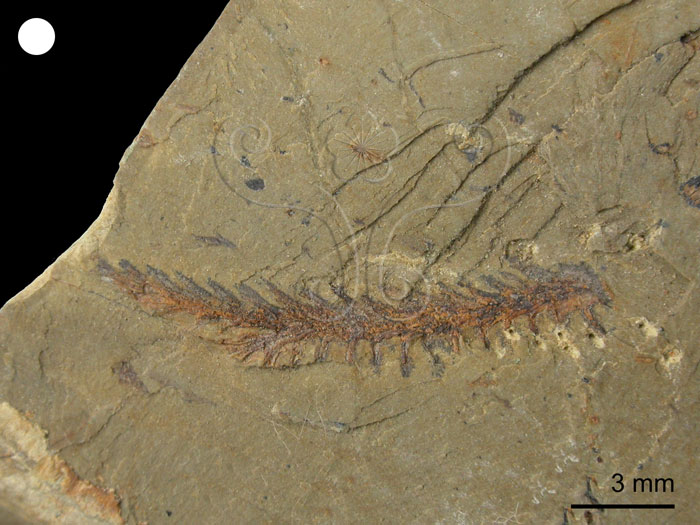
Graptoloidea
The Cincinnatian Series has scandent, reclined, and reflexed forms - these are prevalent in the Upper Ordovician. Pendant, declined, and deflexed forms tend to be Lower Ordovician. So, there’s change through time.
Geniculograptus typicalis typicalis (strata.uga.edu/cincy/fauna/graptolithina/DGGeniculograptu...) (www.flickr.com/photos/jsjgeology/16771115263) (www.flickr.com/photos/jsjgeology/17203716088)
The first identified Cincinnatian graptolite, the most common, and most well studied Cincinnatian graptolite is the graptoloid Geniculograptus typicalis typicalis (there are other subspecies) - it’s common in the Southgate Member of the Kope Formation; it's upper range is not really known, but it goes down into the Middle Ordovician. James Hall’s 1800s list of New York graptolites listed Climacograptus typicalis but no description accompanied the name. Hall named it and figured it. This was the first reference to that graptolite. Ruedemann’s description gave species credit to Hall, though he never originally described Climacograptus typicalis. Ruedemann claims he described it in 1908. James apparently described it in 1892. This species is biserial. Riva recognized that typicalis isn't a Climacograptus. Mitchell, using sicular morphology, put typicalis in Geniculograptus - it is no longer in Climacograptus. Riva also proposed a new genus name (Uticagraptus), but that name was published one month after Mitchell's new genus name. In northern Kentucky, troughs/trough fillings of Geniculograptus have been found with the graptolites all lined up (Ron Fine has found these). Geniculograptus typicalis typicalis is 2 to 5 centimeters long (3/4 inch to 2 inches). Its thecae have a slightly tapering square appearance. These alternate on either side of the virgula.
Geniculograptus typicalis magnificus is a big biserial form in the Maysville Stage. typicalis typicalis has lengths up to 3.5 centimeters (1 3/8 inches), but typicalis magnificus can get to 7 centimeters long (almost 3 inches). It looks like it has smaller thecae, but they are just spread out more, because the rhabdosome is wider between thecae.
Geniculograptus typicalis posterus is a smaller-than-magnificus form in the Fairview Formation.
Geniculograptus pygmaeus is also a now-well studied form. (www.flickr.com/photos/jsjgeology/17389529022) It has been tossed around from time to time as typicalis. It can be confused with typicalis, but it’s a lot smaller than typicalis. pygmaeus is younger - it occurs in the upper Kope Formation and the lower Fairview Formation. pygmaeus and typicalis do overlap, but pygmaeus is younger & typicalis is older. Geniculograptus pygmaeus is usually less than 1 centimeter long and ~1 millimeter or so wide (this species is small & narrow). Geniculograptus typicalis is ~1.25 inches (2 to 3 centimeters) long. Geniculograptus pygmaeus has square thecae that taper more than in Geniculograptus typicalis.
An intermediate form between G. typicalis typicalis and G. pygmaeus is known - it occurs in the top of the Southgate Member of the Kope Formation in Kentucky - it’s not named yet, apparently - Geniculograptus sp. - it is longer and skinnier than pygmaeus, but still smaller than typicalis.
Orthograptus quadrimucronatus - short spines come out from the sides; found in the Kope Formation to Arnheim Formation (the Richmondian Stage form is a subspecies - O. quadrimucronatus richmondensis). Biserial; thecae are more triangular and have thecal spines; the thecae are chevron-shaped (V-shaped), while Geniculograptus, in contrast, has squarish thecae. This is a larger species than Arnheimograptus anacanthus.
(Orthograptus - www.geodil.com/images/30/3004/mid.jpg)

Arnheimograptus anacanthus - found at the Flat Run Trilobite Lagerstätte site near Mt. Orab, Ohio (look for graptolites there, not trilobites!). This is a relatively new genus (named by Mitchell); it is only ~1 centimeter long, with chevron-shaped thecae; biserial.
Dicranograptus nicholsoni (strata.uga.edu/cincy/fauna/graptolithina/DicranograptusNi...) - Rich Fuchs has never seen it; a reclined graptolite - has a scandent portion, then it splits; it has a two-stipe rhabdosome with a biserial extension (Y-shaped rhabdosome - the root is biserial; the two upper branches are uniserial). Occurs in the bottom of the Kope Formation (Fulton Shale Member), which is mostly flooded now by the Ohio River.

Dicellograptus forchammeri (strata.uga.edu/cincy/fauna/graptolithina/DicellograptusFo...) - a uniserial grapolite supposedly in the Fairveiw Formation; formerly Leptograptus annectens (a Ruedemann name). Mitchell and Bergström reassigned it to Dicellograptus, because Leptograptus has a two-stipe rhabdosome. The Cincinnatian form is actually Dicellograptus sp. aff. Dicellograptus forchammeri. It has a V-shaped or U-shaped rhabdosome.

Amplexograptus maxwelli (www.flickr.com/photos/jsjgeology/17203906150) - occurs in the bottom of the Kope Formation, in the Fulton Shale; it is similar to Geniculograptus typicalis posterus, but don't worry - it occurs in beds below water level along the Ohio River in Cincinnati; biserial; square thecae - slightly rounded lip of thecae; tip is different from Geniculograptus.
(Amplexograptus - jpaleontol.geoscienceworld.org/content/76/5/921/F2.large.jpg)

Climacograptus - there’s still one of these in the Fairview Fm.
Uncertain placement graptolites:
Most of what's been assigned to the Cincinnatian dendroid graptolites is Mastigograptus, but there's lots of conjecture about what it is. There are five or so species of Mastigograptus in the Cincinnatian Series. They appear as plain, black lines (flattened tubes) in rock - "pepper rock". The five species range from the Kope Formation to the Waynesville Formation. The best way to figure out the species is to use the stratigraphic horizon.
Mastigograptus tenuiramosus - delicate; occurs in the bottom half of the Kope Formation; usually fragile - forms pepper rock. Pepper rock usually has scolecodonts. Branch angles are at 45°.
Mastigograptus gracillimus (strata.uga.edu/cincy/fauna/graptolithina/MastigograptusGr...) - these are decent-sized fossils compared with Cincinnatian graptoloids; Kope Formation to Fairview Formation.

Mastigograptus perixilis - Waynesville Formation.
(www.flickr.com/photos/jsjgeology/17203569048)
Mastigograptus strictus - has shallow branching angles. Occurs in the Arnheim Formation - can be found at the Flat Run Trilobite Lagerstätte site near Mt. Orab, Ohio. But, it could be the same species as Mastigograptus tenuiramosus.
Mastigograptus multifasciatus - upper Fairview Formation.
Are there visible thecae in Mastigograptus? Ruedemann said thecae in Mastigograptus are known from other areas. Taylor found only one thecae-bearing specimen. Rich has never seen thecae in Cincinnatian Mastigograptus. The Treatise has thecae drawn in on the Mastigograptus illustration.
Mastigograptus is sometimes listed as a dendroid, sometimes listed as uncertain.
Bulman didn’t know where to place Mastigograptus within the graptolites.
Ultrastructure studies show Mastigograptus is a graptolite. But some say they look like seawhips.
Rich Fuchs thinks that Mastigograptus is similar to seawhips. He thinks it is almost definitely not a graptolite. Seawhips are a form of coral (horny coral). After seawhips die, the outer organic material comes off, resulting in a Mastigograptus-like thing.
[Dave Meyer comment: seawhips now are much larger than Mastigograptus, but the point is well taken. There’s nothing saying Ordovician seawhips couldn’t have been small enough to be Mastigograptus.]
Urbanek did an SEM study of Mastigograptus - it’s structure is consistent with graptolites; the chemistry is the same as graptolites; therefore, it could be a graptolite; but, it still could be something else. There’s still no evidence of thecae.
There are 5 or 6 species of Cincinnatian Chaunograptus named. Most are Liberty Formation forms. Most are based on one specimen. Most of the holotypes are now missing (museum-wise). The Smithsonian renumbered their collections a while ago and lost the Chaunograptus. One was lost in a Dayton flood. Few holotypes are left. Chaunograptus are extremely fragile - not often found.
Chaunograptus is an encruster that may not be a graptolite. It is fairly rare and easily overlooked. It is more like to be found in the Richmondian Stage, especially encrusting brachiopod shells. Chaunograptus is classified as a dendroid or uncertain. There are several species, but some don't look like the rest. Ruedemann listed 11 species - 7 were Upper Ordovician - 6 were Cincinnatian. Now we're down to five species. John Taylor said two of them were synonymous. Taylor's thesis says that Chaunograptus shideleri is the same as Chaunograptus delicatus. Most of the species are Richmondian. Chaunograptus fossils have been found at the Newport Shopping Center. Rich Fuchs has found what he calls Chaunograptus contortus and Chaunograptus delicatus in the Kope Formation. This is probably a form whose ranges are not well known.
Chaunograptus contortus - encrusting black spots on nodules. Twisted thecae with extremely thin lines (nemas). Rich Fuchs has found Chaunograptus contortus in the Kope Formation, but it was described from the Liberty Formation. The type is missing - couldn't be found by Taylor.
(www.flickr.com/photos/jsjgeology/17203753020)
(www.flickr.com/photos/jsjgeology/17389341202)
Chaunograptus delicatus - the type specimen is encrusting a nodule; it has thicker lines than C. contortus; the lines trail around; occasional thecae structures; the lines move out from a central point. Also first described from the Liberty Formation. Occurs in the Liberty Formation and Whitewater Formation. The type specimen is known.
(www.flickr.com/photos/jsjgeology/16771017233)
(www.flickr.com/photos/jsjgeology/16771013283)
Chaunograptus vermiformis - Liberty Formation. The type specimen is in the Smithsonian - it's been renumbered, but it has been found.
Chaunograptus macrothecae - Grant Lake Formation. Type specimen can't be found.
Chaunograptus gemmatus - Kope Formation The type specimen (one specimen) is known.
Inocaulis (www.graptolite.net/INOCAUL.jpg) (www.flickr.com/photos/jsjgeology/17203749888) - a worse genus than Mastigograptus in terms of identifying structure and determining affinities. This is a rare fossil that's supposedly a graptolite. Inocaulis is a non-descript collection of tubes, forming a stem - looks like a series of tubes (= the thecae) bundled together. Two Cincinnatian species - Inocaulis simplex (Kope Formation) and Inocaulis grandis (Maysville Stage); it doesn’t look like a graptolite, but it’s listed as a dendroid. Grammaria is a modern hydrozoan (chess.myspecies.info/sites/chess.myspecies.info/files/gra...) - it has a similar arrangement of tubes put together. Inocaulis may be another graptolite that really isn’t.


-------------------
Leica MP
Leica Summicron 35mm f/2 IV "King of Bokeh"
Fuji Neopan Acros II
Zero Imaging 510-Pyro (1+100)
7 min 45 sec 20°C
Scan from negative film
This is my 1st year experimenting/ growing this flower. I was expecting this South African native plant to grow to about 3 or 4 feet (1-1.25m), but this "top" is at about 16 ft. (3.5m) towering over the central flower bed. Cardinal climber vines surround it up in the garden stratosphere...
I expect to find this one out of the cavity, and on a limb, one of these mornings. This was taken through my scope and about 95 yards.
We were expecting some cloud on Sunday night but it remained clear, with a big moon and the temperature fell into single figures, so it's no surprise that our catch was poor compared with those of recent weeks:
List for 13th July 2014:
Map-winged Swift 1
Bird-cherry Ermine 2
Flax Tortrix 1 NFG
Marbled Orchard Tortrix 1
Agriphila straminella 2
Dipleurina lacustrata 6
Garden Pebble 1 NFY
Large Emerald 2
Small Fan-footed Wave 1
Riband Wave 2
Grey Pine Carpet 1
July Highflyer 2
Foxglove Pug 1
Brimstone Moth 1
Light Emerald 1
Barred Red 1
Elephant Hawkmoth 1
Lesser Swallow Prominent 1
Coxcomb Prominent 1
Flame 1
Large Yellow Underwing 1
Lesser Broad-bordered Yellow Underwing 1 NFY
Purple Clay 8
Double Square-spot 3
Dotted Clay 5
Bright-line Brown-eye 2
Antler Moth 2
Clay 12
Smoky Wainscot 3
Dark Arches 7
Clouded-bordered Brindle 1
Dusky Brocade 1
Burnished Brass 1
Took tons of pictures of my friend Allison and her husband Jeff this weekend. She is expecting twins in about 6 weeks! Lots of processing to do. This is the first one I think I have fairly close to "done".
Strobist: borrowed studio strobe with shoot-through umbrella camera right, angled about 45 degrees down and in front of them. Reflector just out of frame camera left by their heads to fill in shadows around the necks.
A woman eagerly expects her date/friend/boss? inside a busy street-side restaurant, Paris, France.
Nikon D300 with 80-200mm f/2.8
Wasn't expecting to see these in Dover today!, and these vehicles are newly aquired by J.D. Smiths Coaching of Challock near Assford, with the Rare Porto? Coach aquired from Carr's Coaches of Pluckley also near Assford, and they had brought School Groups to Dover Castle which is now open again daily except Mondays.
And be sure to check by my other acount: www.flickr.com/photos_user.gne?path=&nsid=77145939%40..., to see what else I saw Very Recently!!
“Desde el pueblo nassa tenemos expectativas grandes de esperanza, de esperanza por la vida, por la paz, por el territorio y, sobre todo, por la defensa de nuestra madre tierra, porque para nosotros la madre tierra es a la que tenemos que defender mucho más. Por eso, debemos protegerla y proteger mucho a los defensores de esta vida”. Esas fueron las palabras de Alcides Muse, indígena de la comunidad nassa del Cauca, quien participó en el primer Puesto de Mando Unificado (PMU) por la Vida del Gobierno del presidente Gustavo Petro.
En este PMU, que contó con la participación y el compromiso de la ministra de Ambiente y Desarrollo Sostenible, Susana Muhamad, el Gobierno Nacional escuchó a diferentes comunidades indígenas, afrodescendientes y campesinas del Cauca, escenario en el que le presentó al país el plan de emergencia para la protección de los líderes y defensores ambientales.
“Veinte líderes sociales ambientales del Magdalena Medio fueron amenazados por oponerse al fracking, 17 funcionarios de Parques Nacionales Naturales fueron asesinados durante la última década. Por eso, como ministra de Ambiente hago presencia en este PMU. Vamos a aportar de formas concretas: mapeando los conflictos socioambientales en todo el país, trabajando para ampliar la democracia ambiental, como también alertando situaciones especiales de colectivos que defienden el ambiente”, afirmó la jefe de la cartera ambiental.
Asimismo, la ministra Muhamad resaltó el compromiso del Gobierno para la pronta ratificación del Acuerdo de Escazú: “Queremos que los actores ambientales tengan un canal para ejercer la democracia ambiental que, además, se debe profundizar con la ratificación del Acuerdo de Escazú en el Congreso. Lo que estamos haciendo hoy aquí, aporta a ese avance del acuerdo, aunque no haya sido aprobado”.
El plan de emergencia cuenta con siete ejes y priorizará sus acciones en 65 municipios y seis capitales: Barranquilla, Bucaramanga, Cali, Medellín, Popayán y Santa Marta.
La estrategia, que se ajustará a las distintas realidades territoriales, dinámicas de la violencia, fuentes de riesgo, conflictos socioambientales, entre otros factores, trabajará en la presencia territorial del Estado y el acompañamiento de la comunidad internacional, en la acción preventiva y estratégica de la fuerza pública en terreno y en medidas de justicia y contra la impunidad.
El Puesto de Mando Unificado por la Vida también contó con la participación del ministro del Interior, Alfonso Prada; el alto comisionado para la Paz, Danilo Rueda; el presidente del Congreso de la República, Roy Barreras, y el defensor del Pueblo, Carlos Camargo, entre otros funcionarios del Gobierno Nacional, líderes de las comunidades, alcaldes y miembros de las fuerzas de seguridad del Estado. / Ago. 20, 2022. (Fotografía Oficial Ministerio de Ambiente y Desarrollo Sostenible / Juan Fernando Betancourt).
Esta fotografía oficial del Ministerio de Ambiente y Desarrollo Sostenible está disponible sólo para ser publicada por las organizaciones de noticias, medios nacionales e internacionales y/o para uso personal de impresión por el sujeto de la fotografía. La fotografía no puede ser alterada digitalmente o manipularse de ninguna manera, y tampoco puede usarse en materiales comerciales o políticos, anuncios, correos electrónicos, productos o promociones que de cualquier manera sugieran aprobación por parte del Ministerio de Ambiente y Desarrollo Sostenible.
Ministerio de Ambiente y Desarrollo Sostenible Página Web / Twitter Facebook / Youtube / Instagram
These are my personal notes taken during a geology presentation. I give them here because they may be of some interest. Do not expect the notes to always be in complete sentences, etc.
-----------------------------------
Mammals and the Cretaceous-Tertiary Mass Extinction
Presented by: John Hunter (Department of Evolution, Ecology, and Organismal Biology, Ohio State University at Newark, Newark, Ohio, USA) (newark.osu.edu/directory/hunter-john.html)
22 May 2012
----------
There are 3 groups of mammals today: monotremes, marsupials, and placentals.
The monotremes are the duck-billed platypus and the echidna. They were widespread across Gondwana in the past. They are now restricted to Australasia.
Marsupials are in Australasia and in North America today.
There are 20 or so orders of placental mammals, living and extinct.
Placentals include primates, which turn out to be related to bats and flying lemurs. Placentals also include the ungulates - the hoofed mammals. The ungulates are an artificial group - they consist of 3 separate groups, actually.
Whales turn out to be in the Artiodactyla.
Mammals have been around since the Late Triassic. A Middle Triassic busted-up mammal braincase has been found in southwestern USA. Well-preserved mammal fossils start in the Late Triassic. Mammals diversify after the Cretaceous. Modern placental orders go to near the base of the Paleocene. Marsupials and monotremes do go into the Cretaceous.
Early mammals include:
Morganucodonts (Late Triassic to Early Jurassic) - they are stem mammals. They have teeth with cusps that slide past each other. These mammals were likely insectivores (insect eaters).
Docodonts (Late Triassic-Late Jurassic) - they have broad, crushing teeth and were likely frugivores (fruit eaters). Their bodies ranged from small & shrew-like to beaver-sized.
Australosphenids (stem monotremes) - they are known from across Gondwana - Australia, Madagascar, South America.
Eutriconodonts (Jurassic-Cretaceous) - bigger & badder mammals, up to ~possum-sized.
Multituberculates (Jurassic-Eocene) - “rodents” of the Mesozoic, although they wouldn’t be mistaken for living rodents. These mammals had cheek teeth with cusps in multiple rows, like a modern rodent molar. Multituberculate mammals had splayed-out-to-the-side limbs. They could reverse their hind feet to hang from tress, like squirrels today.
Stem eutherians (Jurassic-Cretaceous)
Mammals in the Mesozoic were not ecologically dominant - they were small-bodied, nocturnal, and had a small biomass compared with the archosaurs/dinosaurs.
After the Cretaceous-Tertiary extinction, there was a survivorship period in the mammals.
Survivors of the extinction included marsupials (they were in & are still in North America) and multituberculates. The multituberculate mammals persisted until the Eocene, when rodents migrated into North America from Asia. The rodents probably outcompeted the multituberculates.
Mammals diversified in the Paleogene-Neogene.
The Cretaceous-Tertiary transition (K-T) had the greatest number of originations per unit species and the greatest number of extinctions per unit species - lots of turnover.
Mammal body sizes increased through time. The largest single increase occurred at the Cretaceous-Tertiary. After that, there was continued increase in mammal body sizes through the Cenozoic.
See Schulte et al. (2010) - Science 327(1214).
There was a large impact in the Gulf of Mexico, at the Yucatan Peninsula, at 65.5 million years ago - now the Chicxulub Impact Crater. The timing of the impact corresponds with extinction of Cretaceous-only species of plants and animals, and corresponds with a sudden spike in iridium (Ir) in Cretaceous-Tertiary boundary sediments, and also corresponds with a δ13C excursion.
The iridium spike and extinction event also correspond with periods of volcanism in India - the Deccan Traps. Imagine an area the size of Texas suddenly being filled with lava, with lots of poison gases being released. There were multiple episodes of Deccan Traps volcanism - not all of them correspond with the extinction horizon.
Deccan Traps volcanism could have caused the Cretaceous-Tertiay mass extinction, some say.
Others say Deccan Traps volcanism did not cause the mass extinction.
Close to Chicxulub, boundary sections have dozens of meters thick tsunami deposits - very coarse grained sediments - formed quickly and dewatered quickly.
Far away from Chicxulub, for example at Agost, Spain, the boundary section is quite thin.
See Archibald et al. (2010) - Science 328 (21 May 2010). This paper says that the Cretaceous-Tertiary mass extinction had multiple causes - impact + volcanism + marine regression + climate change.
Early Paleocene first appearances of mammals include Purgatorius (Plesiadapiformes) - a primate that possibly goes into the Cretaceous (based on one tooth in a probably-contaminated fossil washing screen) - and Protungulatum (Condylarthra) - now known in the Cretaceous.
John Hunter does mammal fossil field work in southwestern North Dakota, in the Williston Basin. The area has Paleocene- and Cretaceous-aged sedimentary rocks. The contact in the area potentially has Cretaceous-Tertiary fossil records. The area is mostly rangelands/grasslands. It’s usually only the river valleys that have adequate rock exposures, such as along the Yellowstone River and the Little Missouri River, etc. Going north in this field area, one encounters younger sites. Going south in this field area, one encounters older sites.
The area has outcrops of Hell Creek Formation (upper Upper Cretaceous) - it contains dinosaurs + lots of mammal sites. Above that is the Fort Union Group (Paleocene) - its has lots of mammal sites.
Marine rocks occur below the Hell Creek Fm. Marine rocks also come in from the east during the Paleocene - there’s a regression to Hudson Bay in the Middle Paleocene.
In the field, the Hell Creek Fm. outcrops have drab gray colors. Above that, the Fort Union Group outcrops are colored tan + gray.
The Pioneer Trails Region Museum in Bowman, North Dakota has a paleontology curator, Dean Pearson. John Hunter works with him, plus Joe Hartman (works on invertebrate fossils), Dan Peppe (works on fossil plants & paleomagnetic analysis), Antoine Bercovici (works on fossil pollen), and others.
The asteroid layer is a tonstein at the Cretaceous-Tertiary (K-T) boundary in some sections - iridium has been identified in these sections. A good K-T section occurs at Mud Buttes, North Dakota - it has shocked quartz + a pollen change + an iridium spike + spherules.
Sandstone channels can cut out parts of these sections, including the K-T transition. So, the K-T asteroid layer is not found everywhere.
Mammal fossils: mostly isolated teeth + jaw fragments.
See Hunter (1999) - North Dakota Academy of Science.
See Pearson et al. (2002) - Geological Society of America Special Paper 361.
There is very little ecological change in Hell Creek Formation fossils through time. There is no evidence of dinosaurs (or other groups) declining.
At one locality, <1 meter above the K-T boundary, lenses of sediments have the earliest mammals and plants recovered from the post-Cretaceous - these are “day after” biotas. They are the closest-to-the-Cretaceous biotas of Paleocene age identified so far.
The Hell Creek Fm.-Fort Union Group contact is arbitrary - it’s placed at a mappable coal bed. This is somewhat correlative with the Z Coal. “Z Coal” is a term used in eastern Montana - the coal bed splits and joins. The formation contact (= coal bed) is within 1 to 0.5 meters of the iridium spike. So, the “Z Coal” and the iridium spike are pretty close.
Bercovici et al. (2009) - Cretaceous Research.
Floras have been also recovered in these close-to-the-Cretaceous sands.
The fossil record looked at just above the K-T is environmentally sensitive.
Wilkening locality - 5341 fossil vertebrate specimens were recovered (mostly fish, but some mammals, too). The fossils were retrieved by screening/sieving. A freshwater ponding event occurred after K-T at this locality. Found a new species of Mesodma, a multituberculate mammal. Got archaic placental mammals and archaic ungulates. The site is dominated by one species of multituberculate - Mesodma. This animal was 80% of the mammal fauna at the Wilkening locality.
Seeing a surge in multituberculate mammals in the transitional period between the Late Cretaceous and the Early Paleocene. The multituberculates were an opportunistic group following the K-T extinction event. Also seeing a fern spore spike just above K-T. This is the first time a spike in mammals has been found after the K-T.
At other sites, reports of increased numbers of mammals after K-T were dubious - there was often evidence of reworking - hundreds or thousands of years of time may have been compressed, including through the boundary. This will disproportionately represent forms that go extinct.
The Wilkening locality is the first confident occurrence of a multituberculate mammal site after the K-T boundary.
Also looked at Merle’s Mecca locality - dates to ~100,000 years after the K-T (= Eary Paleocene). It is more diverse that the Wilkening locality, in terms of mammal fossils. The mammals at Merle’s Mecca are also more derived.
---------------
For "reasons", we were at Walmer castle tis afternoon.
It was beyond hot.
And then I realised its about 15 years since we were last here, at the seat of the Lord Warden of the Cinque Ports, so chance before the reason, to wander about and take shots.
Did I mention it was hot?
Walmer castle has been converted from a place of defence into the residence of the Lord Warden, a converted Tudor castle, similar to Deal and Winchelsea, though decked out as expected for Wardens such as The Duke of Wellington (he died here, and Queen Elizabeth the Queen Mother.
Before going to Walmer, there was the morning to fill.
No gym for us, so we could lay until seven until the water boiler fired up, that usually wakes me, though Jools had been up an hour by then.
We watered some of the thirstier plants, then sat on the patio until the fierce heat that was too strong for more than a few minutes at nine, made us seek cool shelter back inside.
The cats too take shelter from the heat, when we can stand it we watch wasps stopping to take drinks from the bowl we put out.
Lunch is rolls with either corned beef of roast beef, pickles, and being British, crisps to add the crunch, though from a break with tradition, paprika flavour rather than cheese and onion.
They filled us up, so we retired to the patio, as after lunch the shadows cover the seats, though as the sun doesn't get as high in the sky now, it shines longer under the umbrella.
Just before two we leave for the Castle.
Did I mention it was hot?
It was hot..
A short drive into Walmer, then out through to the coast road, parking near the beach opposite the entrance.
We are members, but would have got in free, as we were here to attend a meeting of U2A, and for me to meet some of my churchcrawling group.
Not sure if I wrote about this, but from the end of September, every two weeks, ten of us will visit a church, and I will struggle to answer questions.
The new group went "live" in the system last Sunday, and in under an hour I had received thirty requests to join. The first ten got in, so we will see how that goes.
Walmer Castle has splendid grounds, lots of plants, especially in the kitchen garden, and being school holidays, there were a few families around, but it wasn't crowded. Photography is still banned inside, so we skipped the castle tour and went straight outside.
There was a couple of shots I wanted, which I got, but really, it was just too hot to be wandering too far out of the shade.
We took shelter on a bench in the shadow of a hedge beside the pond in the Queen Mother's garden, and sat there cooling down until it was time to go into the meeting.
The meeting went on for an hour, in a room with lots of glass, no air conditioning, and with every chair taken, it was humid.
But in the end, we had all introduced ourselves, heard about the organisation, again., we could go and me find Jools.
Who was waiting outside.
Quarter past four, not quite so hot, but hot enough so that we didn't want to do any more walking round the gardens.
We went back to the car, taking the shortcut accessible exit, over the road and then home.
The vet called with news.
Due to us pressing, with information provided with a friend on here, more tests had been done and results were in. No as bad as feared, but enough as a cause for concern.
Scully has to go in on Wednesday for a urine test, but we feel that things are really moving forward. Maybe not at the pace we wanted, but still.
Baby steps.
Not much for tea, as we weren't that hungry.
And an evening filled with cup football, with Norwich away at Watford and so expected to lose. However, Norwich played well, and were 2-0 up by half time, and hung on to win.
Which was nice.
After the football, I went into the back garden to look at the rising waning moon.
A mist had begun to rise, and the moon was barely visible, but appeard as an angry red, partly deflated balloon just above the horizon, before it was lost in the mist and clouds.
----------------------------------------------------------------------------------------
Walmer Castle is an artillery fort originally constructed by Henry VIII in Walmer, Kent, between 1539 and 1540. It formed part of the King's Device programme to protect against invasion from France and the Holy Roman Empire, and defended the strategically important Downs anchorage off the English coast. Comprising a keep and four circular bastions, the moated stone castle covered 0.61 acres (0.25 ha) and had 39 firing positions on the upper levels for artillery. It cost the Crown a total of £27,092 to build the three castles of Walmer, Sandown, and Deal, which lay adjacent to one another along the coast and were connected by earthwork defences.[a] The original invasion threat passed, but during the Second English Civil War of 1648–49, Walmer was seized by pro-Royalist insurgents and was only retaken by Parliamentary forces after several months' fighting.
In the 18th century, Walmer became the official residence of the Lord Warden of the Cinque Ports and was gradually modified from a military fortification into a private residence. Various Prime Ministers and prominent politicians were appointed as Lord Warden, including William Pitt, the Duke of Wellington and Lord Granville, who adapted parts of the Tudor castle as living spaces and constructed extensive gardens around the property. By 1904, the War Office agreed that Walmer had no remaining military utility and it passed to the Ministry of Works. Successive Lord Wardens continued to use the property but it was also opened to the public. Walmer was no longer considered a particularly comfortable or modern residence, however, and Lord Curzon blamed the poor condition of the castle for his wife's death in 1906.
Lord Wardens since the Second World War have included Winston Churchill, Robert Menzies and Queen Elizabeth The Queen Mother, but they have made only intermittent use of Walmer Castle. In the 21st century, Walmer Castle is run as a tourist attraction by English Heritage. The interior of the castle displays a range of historical objects and pictures associated with the property and its Lord Wardens, protected since the 19th century by special legislation. The grounds include the Queen Mother's Garden, designed by Penelope Hobhouse as a 95th birthday gift for Elizabeth in 1997.
Walmer Castle was built to defend the English coast from attack by France and the Holy Roman Empire in the final years of the reign of King Henry VIII. Traditionally the Crown had left coastal defences to the local lords and communities, only taking a modest role in building and maintaining fortifications, and while France and the Empire remained in conflict with one another, maritime raids were common but an actual invasion of England seemed unlikely.[1] Modest defences, based around simple blockhouses and towers, existed in the south-west and along the Sussex coast, with a few more impressive works in the north of England, but in general the fortifications were very limited in scale.
Walmer and the adjacent castles of Deal and Sandown were constructed to protect the Downs in east Kent, an important anchorage formed by the Goodwin Sands which gave access to Deal Beach, on which enemy soldiers could easily be landed.[9] The stone castles were supported by a line of four earthwork forts, known as the Great Turf, the Little Turf Bulwark, the Great White Bulwark of Clay and the Walmer Bulwark, and a 2.5-mile-long (4.0 km) defensive ditch and bank.[10] Collectively the castles became known as the "castles of the Downs" and cost the Crown a total of £27,092 to build.
In the 18th century, Walmer Castle became the official residence of the Lord Warden of the Cinque Ports.[26] The Lord Warden was originally a medieval title linked to five key ports along the coast of England; the position's prominence had faded, but it still retained important judicial and military functions.[30] When Lionel Sackville, 1st Duke of Dorset, was appointed to the post in 1708 he decided that the existing residence in Dover Castle was unsatisfactory, probably because of the semi-ruinous state of the castle, and moved into Walmer Castle instead.[31]
The Duke occupied the post of Lord Warden until 1765, save for two periods when it was filled by James Butler, 2nd Duke of Ormonde and John Sidney, 6th Earl of Leicester.[32] He carried out extensive work to make the castle more habitable, building extensions towards the north bastion and constructing a small house in the south bastion for the soldiers.[26] Under the subsequent Lord Wardens, the politicians Robert Darcy, 4th Earl of Holderness, and Francis North, 1st Earl of Guilford, the castle continued to house artillery but it became increasingly less military in character.[33]
The Prime Minister William Pitt the Younger was then made the Lord Warden in 1792. Pitt was badly in debt and King George III believed that the post, which came with a salary of £3,000 a year, would usefully supplement Pitt's income.[34][b] Pitt made extensive use of the castle and by 1803 he used it as his main residence in an effort to reduce his living costs.[36] Pitt's niece, Lady Hester Stanhope, joined him at Walmer between 1803 and 1806; together with Pitt, she carried out extensive work on the castle gardens, transforming them from a simple kitchen garden into a set of landscaped ornamental enclosures; Stanhope enlisted the Dover militia to help with the landscaping and planting.[37]
With the outbreak of the French Revolutionary Wars, Pitt became energetically involved in the protection of the ports along the coast, entertaining the local garrison commanders, naval captains and the local gentry at Walmer on a regular basis.[38] After Pitt resigned as prime minister in 1801, fears remained of a French invasion and he formed a volunteer cavalry unit at Walmer Castle, where he lived with his new officers.[39] He also formed a unit of bombardier infantry and a fleet of 35 fishing boats called luggers, which he armed with 12-pound (5.4 kg) or 18-pound (8.2 kg) guns, reviewing them from the castle.[40] Stanhope remarked on the constant drilling of army units around the castle during her time there.[41]
Robert Jenkinson, 2nd Earl of Liverpool, took possession of Walmer Castle following the death of Pitt in 1806.[32] Liverpool was a favourite of King George's, and his appointment as Lord Warden was again intended to provide a valuable income and a country retreat.[42] As prime minister, Liverpool used Walmer as a personal retreat and as a location for private political discussions with selected guests.
On Lord Liverpool's death in 1828, Arthur Wellesley, 1st Duke of Wellington and the prime minister at the time, asked King George IV for the post of Lord Warden, primarily because he was seeking the use of Walmer Castle.[44] Wellington took up post in 1829 and considered Walmer to be "the most charming marine residence".[45] He made use of the castle each autumn, entertaining extensively there but living and sleeping in a single room.[46] He was visited there twice by Victoria, once when she was still a princess and later as queen.[47] Wellington let the gardens fall into a poor condition.[48] Wellington died in his room at Walmer on 14 September 1852.[49] His embalmed body was kept in his room to lie in state until 10 November,[50] and when the room was opened for public visitors during the final two days, around 9,000 attended.[51] The Duke's body was finally removed to London via Deal, complete with a military escort.
Breanna wanted Amanda to pretend she was pregnant and made her stick a teddy bear under her shirt.
Hopefully when Amanda's pregnant she won't have such a lumpy baby.
(It was a Panda. Hopefully she won't give birth to one of those either!)
Blimey i wasn't expecting to see this. Good start to the year!!!
1. Camoflaged, 2. Reg ttv, 3. Glenn Patterson Writer, 4. Plum, Ice Cream Scoop and a Velociraptor (?), 5. 4 Clementines a leapin, 6. Chair and Egg, 7. Most of it is......, 8. .,
9. Continental Market in flat pack from the Big Wheel, 10. Don't fence me in, 11. Rainy Day and i'm traipsing around the shops, 12. The Holylands of South Belfast!!, 13. Mural - East Belfast (after Brassai), 14. And the wind blew, 15. Caught gawping, 16. I think Graffiti is wrong!!,
17. Books, 18. In the name of democracy, 19. Old stylee shoppe, 20. How long did you wait for your extension Deirdre?, 21. Duality, 22. Muddy Doll, 23. Refreshments around the pool table, 24. Ok then,
25. Lillian Sloan, 26. In answer to your question Nicky.........., 27. Shankill Road, 28. Orange King Kong, 29. Eric, 30. At the front gate, 31. Practice makes perfect, 32. Follow that Band,
33. Smirky exacts her toll on Revr, 34. Islandmen Project, 35. Propellors, 36. Busker - Cornmarket Belfast, 37. There he sat......, 38. Untitled, 39. flickr.com/photos/23386031@N00/447408129/, 40. Security Barrier,
41. Fly Sweep Soar let democracy go (Parliament Building, Stormont, East Belfast), 42. Police officers St Georges Market, 43. Any fcukin change mate?, 44. Bargain, 45. Early morning paddlers, 46. Belfast Terraced Houses, 47. Kerb crawling Ken and .............., 48. Chill you Loonies,
49. Punk in Orange Doc's, Donegall St Belfast, 50. No Danger, 51. Reg Custom Hse Sq, 52. GAMARJOBAT Festival of Fools Belfast, 53. Parkour/Free Runner Beside the Waterfront Hall Lanyon Place Belfast
Created with fd's Flickr Toys.
The Postcard
A postally unused postcard that was published by C. Richter (Publishers) ltd. of London NW6. The artwork was by Trow, and the card has a divided back.
Trow
"Trow" has been claimed as the pseudonym of Frank Eric Smith, who was born in Salisbury on the 2nd. March 1908, and who lived most of his life in Dorset and Wiltshire. He died on the 5th. October 1985.
According to Smith's family, he drew many seaside postcards in the late 40's and early 50's, and derived his pseudonym from 'Trowbridge', the county town of Wiltshire.
However, Smith claimed to have stopped drawing in 1952, whilst new cards signed "Trow" continued to appear in large numbers until the late 1960's.
It seems that the cards prosecuted by the DPP for indecency in the 1950's were in fact drawn by Thomas Trow (1909-1971) of Stoke on Trent, whose address appears on the reverse of surviving artwork, as the Greyfriars Art Studio.
Okay, I'll admit, I'm not trying to be something I'm clearly not, and that is a portrait photographer.
I have a very hard time shooting people. I'm great at meeting people, talking to people and mingling, but I'm not good at working with people who want their photos taken.
Luckily, this is my wife and the pressure was off....somewhat!
I was hoping to marry my passion for landscape photography, something I know, with taking a photo of a person, something I don't know and get a respectable outcome.
I have to admit I'm pretty happy with these for my experience. I left the pose up to her as she knew what she wanted.