View allAll Photos Tagged effective
Thousands rallied in London as well as other UK cities to demonstrate against a law being passed by Britain's parliament that would effectively outlaw many protests, increase penalties for certain types of demonstration such as blocking roads and give the police far greater powers to stop, search and arrest.
If the measures contained in the government's Police, Crime, Sentencing & Courts (PCSC) Bill had been in place over the last hundred years they may have prevented the suffragette protests of the 1920s, the marches and rallies for greater welfare support in the 1930s, the black civil rights and anti-Vietnam protests of the 1960s, the early gay pride gatherings in the 1970s, the anti-apartheid protests of the 1980s, the occupation of key locations by the Occupy movement and the more recent climate strikes.
The PCSC bill will give the police new powers to ban demonstrations deemed likely to be too noisy or a nuisance to a neighbourhood, to stop and search people without having to prove reasonable suspicion, new powers against 'unauthorised encampments' which travellers fear may be used against their communities and it would also make it illegal for protesters to lock themselves on to objects. The lock on strategy having been used successfully by activists defending the environment and protesting Britain's arms trade.
The bill proposes to increase the maximum prison sentence for someone who destroys a memorial or statue from 3 months to 10 years and It would also mean sentences of up to 10 years for a new crime of causing "serious annoyance." The cumulative impact of the draconian new powers, if enacted, could mean that most meaningful forms of effective protest would be outlawed.
There were many activists at the London rally from communities fearing they could be disproportionately targeted as a result including those supporting the Black Lives Matter movement.
Heavy reFrame
Effective Range: Short
Classification: Melee / Close Combat
Armaments: (1) PA-001TBXMEDIATOR
A unique machine, Marzan Mediators are only piloted by members of the Regal Guard of the Marzan Aristocracy. Visually characterized by Quorus generators throughout it’s reFrame build, these hulking units cleave through the toughest reFrames in two with great ease.
- - -
Read up on the build notes over at my blog :)
Medium reFrame
Effective Range: Medium
Classification: Assault/Tactical
Armaments: (1) AR-FMS00
One of ArmaTech's newest designs, the ARMT-M01A Aras is a high specification machine built for highly tactical operations that require a lot of maneuverability and combat efficiency.
---
Build notes:
This is the very first reFrame that is equipped with the new reFrame v2.0 as its base which features a LEGO minifig pilot in the backpack and double-jointed elbows. It's also using my new favorite foot design taken from the H'Da (heck yeah feet with heels!). The entire build took around 12 hours (roughly 2 days of building on and off). The assault rifle was a design I've been wanting to do for a while and it is modeled after the Famas assault rifle.
---
More info, WIP details, and other LEGO mechs over at my blog:
---
For those interested in LEGO mech building, I put out an eBook over at Amazon Kindle a while back called Mech Wars Instructional Primer. If you’re looking for a resource that could help you start or even improve your mech building skills, you might find this eBook useful :D
The way some people wear masks, they might as well put them on top of their head.
We've had lots of government guidance on how to wash our hands (and even how to ventilate a room) but precious little on how to wear a mask. They probably assumed that people would use their common sense: cover their noses to avoid contracting a respiratory disease. But lots of civilians assume that covering their mouth will suffice. (And others seem to believe that neck breathing is a thing.)
Today the Hereios of the We’re Here! Group are putting things other than hats on our heads.
Burchell's Zebra and Waterbuck
Steppenzebras und Ellipsen-Wasserbock
iSimangaliso Wetland Park (previously known as the Greater St. Lucia Wetland Park) is situated on the east coast of KwaZulu-Natal, South Africa, about 275 kilometres north of Durban. It is South Africa's third-largest protected area, spanning 280 km of coastline, from the Mozambican border in the north to Mapelane south of the Lake St. Lucia estuary, and made up of around 3,280 km2 of natural ecosystems, managed by the iSimangaliso Authority. The park includes:
Lake St. Lucia
St. Lucia Game Reserve
False Bay Park
Kosi Bay
Lake Etrza Nature Reserve
Lake Sibhayi
St. Lucia Marine Reserve
St. Lucia Marine Sanctuary
Sodwana Bay National Park
Mapelane Nature Reserve
Maputaland Marine Reserve
Cape Vidal
Ozabeni
Mfabeni
Tewate Wilderness Area
Mkuze Game Reserve
The park was previously known as the Greater St. Lucia Wetland Park, but was renamed effective 1 November 2007. The word isimangaliso means "a miracle" or "something wondrous" in Zulu. The name came as a result of Shaka's subject having been sent to the land of the Tsonga. When he came back he described the beauty that he saw as a miracle.
The park is dueto be integrated into a transfrontier park, the Ponta do Ouro-Kosi Bay Transfrontier Conservation Area, straddling South Africa, Mozambique, and Eswatini. This is in turn planned to become a part of the greater Greater Lubombo Transfrontier Conservation Area.
Until 1895, the bay had been a home of the Tsonga people and their Tsonga fish kraal. This is the original and the natural home of the Tsonga people and they have lived here for more than 1000 years. Records from early Portuguese sailors rightfully point out this area to be occupied by the Tsonga people and further down south. The area was also known as Tembeland or Thongaland but the name fell into disuse around the early 1900s. The area was ruled by a Tsonga branch of the Vahlanganu (Tembe). The Swiss Missionary, Reverend Henri Alexandra Junod (Known as HA Junod), conducted a scientific and ethnographic study of the Tsonga people during the early 1890s and produced a detailed map, showing the occupation of the bay by the Tsonga Tembe people. The Swiss Missionary, Rev Junod, illustrated in his detailed map that the area was known as Tembeland and that the Tembe capital city was located in the St Lucia bay. Rev Junod's map showed that by 1906, the Tsonga people occupied the land from St Lucia up until Valdezia in the Spelenkon district of the Transvaal province, known today as Limpopo Province. St Lucia bay and Maputo bay are one land and they belong to the Tsonga people, Tsonga villages were built from St Lucia bay until Maputo and they were not separated by any natural division. Around St Lucia, the ruling chief was the Tembe Royal Family, while around Maputo, the ruling class was the Maputo royal family, who are all of the Vahlanganu branch of the Tsonga people. In and around Maputo and St Lucia bay (Tembeland), the language spoken is Ronga, which according to the Swiss Missionary, Rev HA Junod, is not an independent language but a dialect of Xitsonga. According to Rev Junod, Ronga language is so similar to Xitsonga that it cannot be regarded an independent language but is a dialect of a major language known today as Xitsonga.
The Tsonga people were forcefully removed from the park when Britain colonised the area in 1895 and turned the place into a wildlife reserve and established the holiday town of St Lucia. Because of colonisation, the southern part of the park was handed over to the Zulu nation, while the northern part was given to the Tsonga people. Before colonisation, the Tsonga controlled the entire St Lucia bay. Despite colonisation and annexation of land, the Tsonga people still live in the northern part of the park, at Kosi Bay. The Tembe Elephant Park, run by Chief Israel Tembe, is a living history that testify to the rich Tsonga history of this wetland park. Chief Israel Tembe is the custodian of this ancient Tsonga land that was taken away during colonisation. The Tembe kingdom, one of the most powerful kingdoms in Southern Africa before colonisation, was a ruling class for more than eight centuries.
St. Lucia was first named in 1554 Rio dos Medos do Ouro (alternatively Rio dos Médãos do Ouro — River of the Gold Dunes) by the survivors of the Portuguese ship Saint Benedict. At this stage, only the Tugela River mouth was known as St. Lucia. Later, in 1575, the Tugela River was named Tugela. On 13 December 1575, the day of the feast of Saint Lucy, Manuel Peresterello renamed the mouth area to Santa Lucia.
In 1822, St. Lucia was proclaimed by the British as a township.
In 1895, St. Lucia Game Reserve, 30 km north of the town was proclaimed.
In 1971, St. Lucia Lake and the turtle beaches and coral reefs of Maputaland have been listed by the Convention on Wetlands of International Importance (Ramsar Convention).
In December 1999, the park was declared a UNESCO World Heritage Site at an unveiling ceremony, where Nelson Mandela was the guest of honour.
The park was proclaimed a world heritage site because of the rich biodiversity, unique ecosystems and natural beauty occurring in a relatively small area. The reason for the huge diversity in fauna and flora is the great variety of different ecosystems on the park, ranging from coral reefs and sandy beaches to subtropical dune forests, savannas, and wetlands. Animals occurring on the park include elephant, African leopard, black and southern white rhino, buffalo, and in the ocean, whales, dolphins, and marine turtles including the leatherback and loggerhead turtle.
The park is also home to 1,200 Nile crocodiles and 800 hippopotami.
In December 2013, after 44 years of absence, African lions were reintroduced to iSimangaliso.
There are large outcroppings of underwater reefs which are home to brightly coloured fish and corals. Some of the most spectacular coral diversity in the world is located in Sodwana Bay. The reefs are inhabited by colour-changing octopuses and squid ready to ambush unsuspecting prey. Occasionally gigantic whale sharks can be seen gliding through the water, mouth agape to scoop up tiny plankton.
Twenty-four species of bivalve molluscs are recorded in St. Lucia Lake, which constitutes a considerable portion of the park.
(Wikipedia)
Burchell's Zebra [Equus burchelli]
Appearance
Body stripes are less numerous and broader than that of the Cape Mountain Zebra, whereas body stripes extend around the belly. Leg striping is less prominent. Measures 1.3 to 1.4 metres at the shoulder and weighs 300-320 Kg. They have rounded ears approximately 160-170 mm long. Front portion of mane forms a black tuft between the ears. Diet: Predominantly a grazer, feeding in areas with short grass. Zebra have a strong sensitive upper lip with which it gathers herbage by collecting the grass between the lip and the lower incisors before plucking the harvest.
Breeding
Non seasonal breeder, foals may be born in any month. However, under optimal conditions more foals are born during summer. After a gestation period of 360-390 days, a single foal is born, which weighs 30-35 Kg. Foals are weaned at the age of 11 months.
Behaviour
The Burchell's Zebra lives in small family units, which typically consist of one stallion and one mare with their foals. Non-breeding stallions occur in bachelor groups. Herd stallions are between four to 12 years old. Water holes in conjunction with favoured grazing areas attract family groups which collectively congregate in large numbers. They are often seen in close association with Wildebeest, other plains Antelope and Baboons.
Habitat
Short grassland areas within savanna woodland and grassland plains constitute the preferred habitat. Their dependence on water restricts the Burchell's Zebra to wander further than ten to 12 km from water. Densely vegetated areas are avoided.
Where they are found
Unmistakably a member of the horse family. This species is the largest of the two distinct species inhabiting South Africa's wild life domain. The ranges of the Burchell's Zebra and the Cape Mountain Zebra are mutually exclusive. The Cape mountain Zebra is confined to the Cape mountainous regions, whereas that of the Burchell's Zebra coincides with woodland and grassy plains.
Field Notes
The Burchell's Zebra is the closest relative to the extinct Quagga which roamed the southern plains of South Africa until the 19th century, so close in fact that scientists are using DNA from chosen individual to attempt to bring the Quagga back.
Each individual Zebra has unique markings and act in similar fashion as fingerprints in humans. It is said that newborn Zebra stay close to the mother to imprint her patterns. The southern Burchell's Zebra has a distinctive shadow brown stripe in the white stripe, a characteristic which diminishes the further north they occur.
(krugerpark.co.za)
The waterbuck (Kobus ellipsiprymnus) is a large antelope found widely in sub-Saharan Africa. It is placed in the genus Kobus of the family Bovidae. It was first described by Irish naturalist William Ogilby in 1833. The thirteen subspecies are grouped under two varieties: the common or Ellisprymnus waterbuck and the Defassa waterbuck. The head-and-body length is typically between 177–235 cm (70–93 in) and the average height is between 120 and 136 cm (47 and 54 in). A sexually dimorphic antelope, males are taller as well as heavier than females. Males reach approximately 127 cm (50 in) at the shoulder, while females reach 119 cm (47 in). Males typically weigh 198–262 kg (437–578 lb) and females 161–214 kg (355–472 lb). The coat colour varies from brown to grey. The long, spiral horns, present only on males, curve backward, then forward and are 55–99 cm (22–39 in) long.
Waterbuck are rather sedentary in nature. A gregarious animal, the waterbuck may form herds consisting of six to 30 individuals. These groups are either nursery herds with females and their offspring or bachelor herds. Males start showing territorial behaviour from the age of five years, but are most dominant from the age of six to nine. The waterbuck cannot tolerate dehydration in hot weather, and thus inhabits areas close to sources of water. Predominantly a grazer, the waterbuck is mostly found on grassland. In equatorial regions, breeding takes place throughout the year, but births are at their peak in the rainy season. The gestational period lasts for seven to eight months, followed by the birth of a single calf.
Waterbuck inhabit scrub and savanna areas along rivers, lakes and valleys. Due to their requirement for grasslands as well as water, the waterbuck have a sparse ecotone distribution. The IUCN lists the waterbuck as being of Least Concern. More specifically, the common waterbuck is listed as of Least Concern while the defassa waterbuck is Near Threatened. The population trend for both the common and defassa waterbuck is downwards, especially that of the latter, with large populations being eliminated from certain habitats because of poaching and human disturbance.
The scientific name of the waterbuck is Kobus ellipsiprymnus. The waterbuck is one of the six species of the genus Kobus and belongs to the family Bovidae. It was first described by Irish naturalist William Ogilby in 1833. The generic name Kobus is a New Latin word, originating from an African name, koba. The specific name ellipsiprymnus refers to the white elliptical ring on the rump, from the Greek ellipes (ellipse) and prymnos (prumnos, hind part). The animal acquired the vernacular name "waterbuck" due to its heavy dependence on water as compared to other antelopes and its ability to enter into water for defence.
The type specimen of the waterbuck was collected by South African hunter-explorer Andrew Steedman in 1832. This specimen was named Antilope ellipsiprymnus by Ogilby in 1833. This species was transferred to the genus Kobus in 1840, becoming K. ellipsiprymnus. It is usually known as the common waterbuck. In 1835, German naturalist Eduard Rüppell collected another specimen, which differed from Steedman's specimen in having a prominent white ring on its rump. Considering it a separate species, Rüppell gave it the Amharic name "defassa" waterbuck and scientific name Antilope defassa. Modern taxonomists, however, consider the common waterbuck and the defassa waterbuck a single species, K. ellipsiprymnus, given the large number of instances of hybridisation between the two. Interbreeding between the two takes place in the Nairobi National Park owing to extensive overlapping of habitats.
Not many fossils of the waterbuck have been found. Fossils were scarce in the Cradle of Humankind, occurring only in a few pockets of the Swartkrans. On the basis of Valerius Geist's theories about the relation of social evolution and dispersal in ungulates during the Pleistocene the ancestral home of the waterbuck is considered to be the eastern coast of Africa - with the Horn of Africa to the north and the East African Rift Valley to the west.
The waterbuck is the largest amongst the six species of Kobus. It is a sexually dimorphic antelope, with the males nearly 7 percent taller than females and around 8 percent longer. The head-and-body length is typically between 177–235 cm (70–93 in) and the average height is between 120 and 136 cm (47 and 54 in).[10] Males reach approximately 127 cm (50 in) at the shoulder, while females reach 119 cm (47 in). The waterbuck is one of the heaviest antelopes. a newborn typically weighs 13.6 kg (30 lb), and growth in weight is faster in males than in females. Males typically weigh 198–262 kg (437–578 lb) and females 161–214 kg (355–472 lb). The tail is 22–45 cm (8.7–17.7 in) long.
The waterbuck is of a robust build. The shaggy coat is reddish brown to grey, and becomes progressively darker with age. Males are darker than females. Though apparently thick, the hair is sparse on the coat. The hair on the neck is, however, long and shaggy. When sexually excited, the skin of the waterbuck secretes a greasy substance with the odour of musk, giving it the name "greasy kob". The odor of this is so unpleasant that it repels predators. This secretion also assists in water-proofing the body when the animal dives into water. The facial features include a white muzzle and light eyebrows and lighter insides of the ears. There is a cream-coloured patch (called "bib") on the throat. Waterbuck are characterised by a long neck and short, strong and black legs. Females have two nipples. Preorbital glands, foot glands and inguinal glands are absent.
The common waterbuck and the defassa waterbuck are remarkably different in their physical appearances. Measurements indicate greater tail length in the latter, whereas the common waterbuck stand taller than the defassa waterbuck. However, the principal differentiation between the two types is the white ring of hair surrounding the tail on the rump, which is a hollow circle in the common waterbuck but covered with white hair in the defassa waterbuck.
The long, spiral horns curve backward, then forward. Found only on males, the horns range from 55 to 99 cm (22 to 39 in) in length. To some extent, the length of the horns is related to the bull's age. A rudimentary horn in the form of a bone lump may be found on the skulls of females.
Waterbuck are rather sedentary in nature, though some migration may occur with the onset of monsoon. A gregarious animal, the waterbuck may form herds consisting of six to 30 individuals. The various groups are the nursery herds, bachelor herds and territorial males. Herd size increases in summer, whereas groups fragment in the winter months, probably under the influence of food availability. As soon as young males start developing horns (at around seven to nine months of age), they are chased out of the herd by territorial bulls. These males then form bachelor herds and may roam in female home ranges. Females have home ranges stretching over 200–600 hectares (0.77–2.32 sq mi; 490–1,480 acres). A few females may form spinster herds. Though females are seldom aggressive, minor tension may arise in herds.
Males start showing territorial behaviour from the age of five years, but are most dominant from the age of six to nine. Territorial males hold territories 4–146 hectares (0.015–0.564 sq mi; 9.9–360.8 acres) in size. Males are inclined to remain settled in their territories, though over time they may leave inferior territories for more spacious ones. Marking of territories includes no elaborate rituals - dung and urine are occasionally dropped. After the age of ten years, males lose their territorial nature and replaced by a younger bull, following which they recede to a small and unprotected area. There is another social group, that of the satellite males, which are mature bulls as yet without their own territories, who exploit resources, particularly mating opportunities, even in the presence of the dominant bull. The territorial male may allow a few satellite males into his territory, and they may contribute to its defence. However, gradually they may deprive the actual owner of his territory and seize the area for themselves. In a study in the Lake Nakuru National Park, only 7 percent of the adult males held territories, and only half of the territorial males tolerated one or more satellite males.
Territorial males may use several kinds of display. In one type of display, the white patch on the throat and between the eyes is clearly revealed, and other displays can demonstrate the thickness of the neck. These activities frighten trespassers. Lowering of the head and the body depict submission before the territorial male, who stands erect. Fights, which may last up to thirty minutes, involve threat displays typical of bovids accompanied by snorting. Fights may even become so violent that one of the opponents meets its death due to severe abdominal or thoracic wounds. A silent animal, the waterbuck makes use of flehmen response for visual communication and alarm snorts for vocal communication. Waterbuck often enter water to escape from predators which include lions, leopards, cheetahs, African wild dogs and Nile crocodiles (leopards and spotted hyenas prey on juveniles). However, it has been observed that the waterbuck does not particularly like being in water. Waterbuck may run into cover when alarmed, and males often attack predators.
Waterbuck are susceptible to ulcers, lungworm infection and kidney stones. Other diseases from which these animals suffer are foot-and-mouth disease, sindbis fever, yellow fever, bluetongue, bovine virus diarrhoea, brucellosis and anthrax. The waterbuck is more resistant to rinderpest than are other antelopes. They are unaffected by tsetse flies but ticks may introduce parasitic protozoa such as Theileria parva, Anaplasma marginale and Baberia bigemina. 27 species of ixodid tick have been found on waterbuck - a healthy waterbuck may carry a total of over 4000 ticks in their larval or nymphal stages, the most common among them being Amblyomma cohaerens and Rhipicephalus tricuspis. Internal parasites found in waterbuck include tapeworms, liverflukes, stomachflukes and several helminths.
The waterbuck exhibits great dependence on water. It can not tolerate dehydration in hot weather, and thus inhabits areas close to sources of water. However, it has been observed that unlike the other members of its genus (such as the kob and puku), the waterbuck ranges farther into the woodlands while maintaining its proximity to water. With grasses constituting a substantial 70 to 95 percent of the diet, the waterbuck is predominantly a grazer frequenting grasslands. Reeds and rushes like Typha and Phragmites may also be preferred.A study found regular consumption of three grass species round the year: Panicum anabaptistum, Echinochloa stagnina and Andropogon gayanus. Hyparrhenia involucrata, Acroceras amplectens and Oryza barthii along with annual species were the main preference in the early rainy season, while long life grasses and forage from trees constituted three-fourths of the diet in the dry season.
Though the defassa waterbuck were found to have a much greater requirement for protein than the African buffalo and the Beisa oryx, the waterbuck was found to spend much less time on browsing (eating leaves, small shoots and fruits) in comparison to the other grazers. In the dry season about 32 percent of the 24-hour day was spent in browsing, whereas no time was spent on it during the wet season. The choice of grasses varies with location rather than availability; for instance, in western Uganda, while Sporobolus pyramidalis was favoured in some places, Themeda triandra was the main choice elsewhere. The common waterbuck and the defassa waterbuck in the same area may differ in their choices; it has been observed that while the former preferred Heteropogon contortus and Cynodon dactylon, the latter showed less preference for these grasses.
Waterbuck are slower than other antelopes in terms of the rate of maturity. While males become sexually mature at the age of six years, females reach maturity within two to three years. Females may conceive by the age of two-and-a-half years, and remain reproductive for another ten years. In equatorial regions, breeding takes place throughout the year, and births are at their peak in the rainy season. However, breeding is seasonal in the Sudan (south of Sahara), with the mating season lasting four months. The season extends for even longer periods in some areas of southern Africa. Oestrus lasts for a day or less.
Mating begins after the male confirms that the female is in oestrus, which he does by sniffing her vulva and urine. A resistive female would try to bite or even fight off an advancing male. The male exhibits flehmen, and often licks the neck of the female and rubs his face and the base of his horns against her back. There are several attempts at mounting before the actual copulation. The female shifts her tail to one side, while the male clasps her sides with his forelegs and rests on her back during copulation, which may occur as many as ten times.
The gestational period lasts for seven to eight months, followed by the birth of a single calf. Twins are rare. Pregnant females isolate themselves in thickets as parturition approaches. Newborn calves can stand on their feet within a half-hour of birth. The mother eats the afterbirth. She communicates with the calf by bleating or snorting. Calves are kept hidden from two to three weeks up to two months. At about three to four weeks, the calf begins following its mother, who signals it to do so by raising her tail. Though bereft of horns, mothers will fiercely defend their offspring from predators. Calves are weaned at eight months, following which time they join groups of calves of their own age. Young females remain with their mothers in nursery herds, or may also join bachelor herds. The waterbuck lives to 18 years in the wild and 30 years in captivity.
The waterbuck is native to southern and eastern Africa (including countries such as Angola, Botswana, The Democratic Republic of Congo, Ethiopia, Kenya, Namibia, South Africa, Tanzania and Uganda) besides a few countries of western and northern Africa such as Chad, Côte d'Ivoire, Ghana, Mali, Niger, Nigeria and Senegal. Though formerly widespread in sub-Saharan Africa, its numbers have now decreased in most areas.
The common waterbuck is found east of the Eastern African Rift. Its southern range extends to the Hluhluwe-Umfolozi Game Reserve (KwaZulu Natal) and to central Namibia. By contrast, the defassa waterbuck inhabits western and central Africa. The defassa waterbuck occurs west of the Albertine Rift and ranges from Eritrea to Guinea Bissau in the southern Sahel, its most northerly point of distribution being in southern Mali. Its range also stretches east of the Congo basin through Zambia into Angola, while another branch extends to the Zaire River west of the Congo basin. While the common waterbuck is now extinct in Ethiopia, the defassa waterbuck has become extinct in Gambia.
Waterbuck inhabit scrub and savanna areas alongside rivers, lakes and valleys. Due to their requirement for grasslands as well as water, the waterbuck have a sparse distribution across ecotones (areas of interface between two different ecosystems). A study in the Ruwenzori Range showed that the mean density of waterbuck was 5.5 per square mile, and estimates in the Maasai Mara were as low as 1.3 per square mile. It has been observed that territorial size depends on the quality of the habitat, the age and health of the animal and the population density. The greater the age of the animal or the denser the populations, the smaller are the territories. In Queen Elizabeth National Park, females had home ranges 21–61 hectares (0.081–0.236 sq mi; 52–151 acres) in area whereas home ranges for bachelor males averaged between 24–38 hectares (0.093–0.147 sq mi; 59–94 acres). The oldest female (around 18 years old) had the smallest home range.
The International Union for the Conservation of Nature and Natural Resources (IUCN) lists the waterbuck as of least concern (LC). More specifically, the common waterbuck is listed as of Least Concern while the defassa waterbuck is near threatened (NT). The population trend for both the common and defassa waterbuck is decreasing, especially that of the latter, with large populations being eliminated from their habitats due to poaching and human settlement. Their own sedentary nature too is responsible for this to some extent. Numbers have fallen in Queen Elizabeth National Park, Murchison Falls National Park, Akagera National Park, Lake Nakuru National Park, and Comoé National Park. Population decrease in the Lake Nakuru National Park has been attributed to heavy metal poisoning. While cadmium and lead levels were dangerously high in the kidney and the liver, deficiencies of copper, calcium and phosphorus were noted.
Over 60 percent of the defassa waterbuck populations thrive in protected areas, most notably in Niokolo-Koba, Comoe, Mole, Bui, Pendjari, Manovo-Gounda St. Floris, Moukalaba-Doudou, Garamba, Virunga, Omo, Mago, Murchison Falls, Serengeti, and Katavi, Kafue and Queen Elizabeth National Parks, the national parks and hunting zones of North Province (Cameroon), Ugalla River Forest Reserve, Nazinga Game Ranch, Rukwa Valley, Awash Valley, Murule and Arly-Singou. The common waterbuck occurs in Tsavo, Tarangire, Mikumi, Kruger and Lake Nakuru National Parks, Laikipia, Kajiado, Luangwa Valley, Selous and Hluhluwe-Umfolozi game reserves and private lands in South Africa.
(Wikipedia)
Der iSimangaliso Wetland Park (bis Oktober 2007 Greater St. Lucia Wetland Park, danach iSimangaliso Wetland Park) ist ein Nationalpark an der Ostküste der südafrikanischen Provinz KwaZulu-Natal. Der Eingang zum Park befindet sich nahe der Kleinstadt St. Lucia.
Der Nationalpark umfasst die Feucht- und Küstengebiete von Mapelane im Süden bis hinauf zur Sodwana-Bucht im Norden und besteht aus vielen kleinen Schutzgebieten mit subtropischer bis tropischer Vegetation. Im Norden liegen die Mkuze-Sümpfe, während sich im Westen trockene Dornensavannen befinden.
Im Zentrum des Parks befindet sich der St.-Lucia-See, nach dem der Park benannt wurde. Mit einer Länge von 40 Kilometern und einer Breite von bis zu 21 Kilometern beträgt seine Fläche rund 300 km²; damit ist er der größte See Südafrikas. In dem 200 Kilometer langen Küstenstreifen finden sich die zweithöchsten bewaldeten Sanddünen der Welt.
In den Feuchtgebieten leben die größten Krokodil- und Flusspferdbestände Südafrikas. In den Savannen im Westen leben Meerkatzen, Nashörner, Büffel und Leoparden. Zwischen den Seen und Sümpfen brüten Reiher, Pelikane und Störche. Der Park verfügt über die höchste Dichte an Amphibien, darunter viele geschützte Arten. Außerdem kann man auf der Meeresseite Buckelwale sehen.
In der Nähe des Nationalparks befindet sich der Ort St. Lucia, in dem es Übernachtungs-, Freizeit- und Einkaufsmöglichkeiten gibt. St. Lucia ist zudem Ausgangspunkt für Walbeobachtungen und Fahrten auf dem St.-Lucia-See zu den Flusspferden.
Der iSimangaliso Wetland Park wurde 1999 in die Liste des Weltnaturerbes der UNESCO aufgenommen.
2004 wurde die Mündung des Feuchtgebietes durch eine Sanddüne gesperrt, um eine Ölpest nach der Havarie des Frachters Jolly Rubino abzuwehren. Seitdem ist der Wasserspiegel erheblich unter Meeresniveau gesunken, so dass die Maßnahme noch nicht rückgängig gemacht werden konnte.
Bis 2007 hieß der Nationalpark Greater St. Lucia Wetland Park. Seit November 2007 wird er iSimangaliso Wetland Park genannt. isimangaliso bedeutet „Wunder“ und verweist auf ein Zulu-Sprichwort über Ujeqe, einem Hofbeamten des Zulu-König Shaka: Ubone isimanga esabonwa uJeqe kwelama Thonga. – „Wenn Du Wunder gesehen hast, dann hast Du dasselbe gesehen wie Ujeqe in Thonga.“ Thonga oder Tongaland ist ein historischer Name für die Region Maputaland, zu der der Park gehört.
(Wikipedia)
Das Steppenzebra (Equus quagga) oder Pferdezebra ist ein Zebra aus der Familie der Pferde (Equidae) und gehört zur Ordnung der Unpaarhufer (Perissodactyla). Es stellt heute die häufigste Zebra-Art in Afrika dar und ist vom Nordosten bis in den Süden des Kontinents verbreitet. Es lebt gesellig in kleinen Herdenverbänden und ernährt sich hauptsächlich von Gräsern. Im Gegensatz zu den anderen heutigen Pferdearten kommt es auch in teilweise geschlossenen Landschaften vor. Der Bestand, dessen größte Population heute in der Serengeti lebt, gilt als nicht gefährdet. Es werden sechs rezente Unterarten unterschieden, die sich meistens deutlich in der Streifenzeichnung voneinander abheben.
(Wikipedia)
Als Wasserbock werden zwei Arten afrikanischer Antilopen aus der Gattung der Wasserböcke (Kobus) bezeichnet. Man unterscheidet den Ellipsen-Wasserbock (Kobus ellipsiprymnus) und den Defassa-Wasserbock (Kobus defassa). Beide wurden ursprünglich in einer Art zusammengefasst und zur Unterscheidung von den anderen Arten der Gattung Kobus auch unter dem Namen Gemeiner Wasserbock geführt, heute gelten sie als eigenständig.
Der Ellipsen-Wasserbock (Kobus ellipsiprymnus) ist eine große, kräftige, bis zu 270 kg schwere Antilope mit zotteligem, graubraunem Fell und einem weißen Ring um den Schwanzansatz (die namengebende Ellipse). Auch das Gesicht ist teilweise weiß, und ein weißer Streifen zieht sich von der Kehle bis zum Ohrenansatz. Nur die männlichen Tiere tragen lange, stark geringelte, weit geschwungene und nach vorne gerichtete Hörner. Die Schulterhöhe beträgt 1,30 m.
Das Verbreitungsgebiet reicht von Südafrika und Nordost-Namibia über Botswana und Mosambik und die Savannen Ostafrikas bis nach Äthiopien und Somalia.
Diese Antilopenart ist an Dauergewässer gebunden, in deren Nähe sich Wälder oder offenes Grasgelände mit Dickicht und Schilf bewachsene Gebiete befinden. Junge Männchen bilden eigene Herden, Weibchen und Jungtiere leben in Gruppen von 5 bis 10 Tieren zusammen.
Die beiden Wasserbock-Arten sind weniger stark ans Wasser gebunden als andere Vertreter ihrer Gattung. Sie können sich durchaus vom Wasser entfernen und sind dann in der offenen Savanne oder in Wäldern zu finden. Die weiblichen Wasserböcke leben in Herden von etwa fünf, in seltenen Fällen bis zu siebzig Tieren. Ebenfalls Herden bilden junge Männchen. Dagegen werden ältere Männchen zu Einzelgängern, die ein Revier gegen Artgenossen verteidigen und jedes durchziehende Weibchen für sich beanspruchen.
Wasserböcke gehören zu den häufigsten Großsäugetieren Afrikas. Schätzungsweise gibt es etwa 95.000 Defassa-Wasserböcke und 105.000 Ellipsen-Wasserböcke, von denen mehr als die Hälfte in Schutzgebieten lebt. Beide Arten werden seitens der IUCN als gering gefährdet (near threatened) klassifiziert. Die Bestände außerhalb von Schutzgebieten sind durch Jagd und Habitatzerstörung rückläufig.
(Wikipedia)
Chinese New Year lanterns hung up in the atrium of a small shopping mall in Petaling Jaya, a city located just next to Kuala Lumpur, Malaysia
A change in the rates of postage, effective on July 1, 1931, to 3 cents for the 1st ounce or fraction of an ounce, on letters for Canada, the British Empire, the United States, and certain other countries - 13 cents covered both postage and registration on letters weighing not more than 1 ounce.
3 cents forward letter + 10 cents registration fee = 13 cents.
-----------------------------------------------------------------------------------------
KASLO is a small, picturesque mountain village located on the shores of beautiful Kootenay Lake, in the southwest corner of British Columbia known as the West Kootenay region. The largest community on the main (north-south) body of Kootenay Lake, Kaslo had a population of 1,026 as of 2011. Nestled between the Selkirk Mountain Range to the west and the Purcell Mountain Range to the east, perched on the shore of Kootenay Lake and the banks of the Kaslo River, Kaslo is picture postcard pretty from all angles. From humble beginnings as a sawmill site back in 1889, Kaslo’s growth exploded right along with the silver boom of the 19th century. Founded in 1893, Kaslo boasted a population of some 5000 people in its heyday, along with the support structures necessary to keep such a populace happy (mostly hotels and brothels, apparently). Although the silver boom was but a blip in the history of British Columbia, much remains of that era in the Kaslo of today. It was named after John Kasleau, Hudson's Bay Company trapper, who placer mined on the creek.
There seems to be several stories for the naming of Kaslo: - According to D.P. Kane, postmaster in 1905: "Kaslo was named by my brother and myself in the year 1890. Previous to this time my brother and myself staked a pre-emption and a purchase comprising a mile square or 640 acres more or less at the mouth of the river that flows into Kootenay lake at this point. The river was then and had been for many years before named Kaslo so we named the town after the river". ... - Also from D.P. Kane: "For a time when I was alone here I had an old Frenchman trapper staying with me in the cabin for awhile and he told me that years before when the Hudson Bay Company came in on this lake to get lead from the Blue Bell Mine for bullets, that there was a Frenchman with their party by the name of John Kaslo or Kasleau, who came up the lake to the head looking for placer gold and had named the river after his name." LINK - www.geni.com/people/David-Kane/6000000006884427548
The KASLO Post Office was opened - 1 August 1892.
LINK to a list of the Postmasters who served at the KASLO Post Office - recherche-collection-search.bac-lac.gc.ca/eng/home/record...
When this letter was posted at the KASLO Post Office - the Postmaster was David "Dave" Prosser Kane - he served as Postmaster from - 1 February 1905 until his death - 6 March 1937.
David "Dave" Prosser Kane
(b. 2 February 1871 in Paris, Ontario, Canada - d. 6 March 1937 at age 66 in Spokane, Spokane County, Washington, United States / buried in Kaslo, British Columbia)
Dave was reputedly the first person in the Canadian West to become interested in color photography, sending to France for his plates and experimenting in putting photographs on paper even before they appeared in the National Geographic magazine. He served as Kaslo Mayor for several terms; City Councilman for many years; School Board member; JP and juvenile court Judge. Had an insurance agency and served as Postmaster. Active Kaslo Board of Trade member since 1898 inception.
His wife - May Elizabeth (nee Millington) Kane
(b. 3 February 1878 in Dunedin, New Zealand - d. 3 July 1958 at age 80 in Calgary, Alberta) - she played the piano, after her three daughters learned violin and cello, she and her daughters would play for city dances and other festive occasions. They were married - 24 April 1895 in New Westminster, British Columbia.
- sent from - / * KASLO, * / APR 16 / 1934 / B.C. / - MOOD cancel in black ink - (RF B).
MOOD - It is a device which are known as "MOOD" (Money Order Office Datestamp / Device), which were first issued In Canada in 1927 and distinct looking round rubber CDS cancels of about 24 mm diameter (sometimes with ornaments). The definition of these cancels has come to include all circular rubber hammers under about 30mm diameter that were issued before 1973. MOOD cancels are usually seen in various colours, not often in black. MOODs were used concurrently during the period 1928 - 1945, with the majority seen in the 1930's. Almost all MOOD's have a comma after the town name, and this helps to differentiate them from other postmark styles. These devices were issued to post offices in order to date stamp money order and registration receipts as well as official mail. They were occasionally used for postmarking regular mail, but this use was not officially authorized.
- sent by registered mail - / R / KASLO, B.C. / ORIGINAL No. / (959) / - registered boxed marking in black ink
- via - / NELSON / AP 16 / 34 / B.C. / - cds transit backstamp
- arrived at - / LOS ANGELES (ARCADE ANNEX) CALIF, / APR / 19 / 1934 / REGISTERED / - double ring arrival backstamp in purple ink.
Addressed to - Wm. M. Bowen, / 746 Crocker St., / Los Angeles, / California
William Mortan Bowen
(b. 20 May 1865 in Indiana, USA - d. 6 April 1936 at age 70 in Los Angeles, California, USA) - occupation - religious tract producer.
His first wife - Lerna (nee Clifton) Bowen
(b. 1866 - d. ) - they were married - 2 October 1889 in Newport, Jackson County, Arkansas, United States
His second wife - Nellie Amanda (nee Thomas) Bowen
(b. 29 January 1871 in Fairmont Township, Martin, Minnesota, United States – d. 17 June 1957 at age 86 in Los Angeles County, California, USA) - they were married - 19 December 1916 in Los Angeles, California, United States.
His third wife - Ida May (nee McIntire) Bowen
(b. October 1869 in Montezuma, Poweshiek, Iowa, United States – d. 28 November 1932 at age 63 in Los Angeles, California, United States) - they were married - 15 October 1927 in Los Angeles, California, United States.
His fourth wife - Estelle Bell (nee Roe) Bowen
(b. 18 October 1877 in Midlothian, Ellis, Texas, United States - d. ) - they were married - 31 January 1936 in Santa Ana, Orange, California, United States.
His son - Roy Lafayette Bowen
(b. 5 February 1891 in Arkansas - d. 3 September 1962 at age 71 in Los Angeles, California, United States)
(8 April 1936) - BOWEN RITES TO BE TODAY - Tract Society Founder Forecast Own Death - Passes in Sleep - A strange premonition of death expressed by William M. Bowen, who had devoted more than half of his life to religious pursuits, was disclosed last night as relatives and friends prepared for his funeral services today. He died early Monday. Bowen, 70 years of age, was founder of the Free Tract Society in Los Angeles thirty-six years ago and for more than ten years had distributed approximately 20,000,000 tracts a year throughout the world, printed in eight languages. PREMONITION TOLD - His widow, Mrs. Estelle B. Bowen, whom he married last January, accompanied him to Honolulu on his first vacation trip a few weeks ago. Taken ill there, the widow said, Bowen told her he must return to Los Angeles and "put his house In order." Last week Bowen told his son, Roy L. Bowen, that if he had any questions to ask, he should ask them now. This will be my last issue of The Messenger," the elder Bowen said. "I am tired and my work is done." DIES IN SLEEP Quietly, in his sleep. Bowen died of a heart attack just as his last issue of The Messenger was being distributed In the mails. LINK - www.newspapers.com/article/the-los-angeles-times-obituary...
After Decades on York, This Printer of Religious Tracts Is Shutting Down the Press - The Society once printed more than 650 different tracts in 20 languages. They were mass communications before radio or film. During the Great Depression they churned out 20 million pieces a year. William M. Bowen, who started printing tracts for soldiers and sailors during the Spanish American War, founded the organization in 1897 in Salt Lake City. He moved to Los Angeles three years later and built a shop on San Pedro Street downtown. In 1917, he moved to 746 Crocker Street where he died in 1936. His son Roy moved the operation to Eagle Rock, where it lasted until 1962. Brother Ernest Soady took over and moved to MacArthur Park, where he stayed for a little over two decades before relocating to a spacious former upholstery shop on York Boulevard in Highland Park. Link to the complete article - www.lamag.com/citythinkblog/free-tract-society-closing/
(SEPTEMBER 18. 1932) - PRINTER'S LIFE WORK "PREACHING BY PROXY" by Martha Louise Baker - Only a few blocks from the city's business center is an inconspicuous place of business, unique in Its organization, and standing out strangely in contrast with other shops in that locality. It is the printing plant of the Free Tract Society, at 746 Crocker Street, of which William M. Bowen is founder and manager. "Preaching by Proxy" aptly describes this business concern. Here about 20,000.000 pieces of religious literature such as tracts, booklets, mottoes, hymn books and Gospels are printed annually and distributed to the four corners of the globe. And the unique phase of the business that it ls carried on solely by prayer and faith, according to if. proprietor. - LINK to the complete article - www.newspapers.com/article/the-los-angeles-times-printers...
Cougar Warning - West End Of Fish Creek Provincial Park, Calgary.
Effective Date: September 24, 2024 until further notice.
Where: west end of Fish Creek Provincial Park. Affecting areas of Votier’s Flats, Bebo Grove, Shannon Terrace and Marshall Springs day use
Why: Several reports of a juvenile cougar in the west end of Fish Creek Provincial Park.
Be careful, everyone!
--------------------------------------------------------------------------------------
On 24 September 2024, my daughter had a free day, so we set out on a drive to Kananaskis. The weather was beautiful, with a spectacular Chinook Arch that we just had to try and photograph. My photo doesn't come close to showing how stunning it was.
As usual, we travelled south to follow the back way to the mountains. We stopped at a few favourite places to capture the scenery.
Eventually, we reached the home of the cute little Pikas, hoping to see one, even though both of us had seen them on many previous occasions. After three or four rapid shots, we knew we had to continue our drive, as the light starts to fade so much earlier now. I'm never sure how long any drive to the mountains is going to take and I have to make sure I never end up driving anywhere in the dark. Night-driving has been a thing of the past for a number of years now, which is really frustrating.
I hadn't been to Upper Kananaskis Lake for years, so my daughter gave directions. Always a beautiful view.
We certainly got a surprise at one area, when we suddenly spotted a female Wild Turkey walking in the grass along the edge of the road. Neither of us had ever seen this species in Kananaskis. A car travelling in the opposite direction stopped and they asked us if we had ever seen one in K-Country before. Like us, it was a first time for them, too. The bird's behaviour made us think that maybe people have been feeding it, as it approached my car.
CTV News from 21 July 2024:
calgary.ctvnews.ca/surprise-wild-turkey-spotted-in-albert...
Travelling north, we passed a couple of Bighorn Sheep on the highway. Eventually reached Wedge Pond where we stopped to photograph the fall colours. Also watched a tiny Chipmunk there, racing all over the place and trying to catch and eat Thistle seeds.
A quick stop at Barrier Lake brought our Kananaskis drive to an end. Instead of returning the long way we had come, we drove on the main highway #1, then took the road down to Bragg Creek and home from there, to save time. I never drive on the main highway #1 by myself, but it is a much shorter route back home, so it was good that I did it with my daughter to help with directions.
All together, a very enjoyable day out in lovely weather and amazing scenery. Not a lot of fall colour yet, though the Larches are beginning to show their yellows in some places. There were two sad sightings, though - roadkill Red Fox and a Skunk.
Lockheed Martin F-22 "Raptor's" assigned to the 90th Fighter Squadron, Joint Base Elmendorf-Richardson, Alaska, taxi to their parking location at the Royal Australian Air Force Base Amberley flightline for 'Exercise Talisman Sabre 19', July 9. TS19 provides effective and intense training to ensure U.S. Forces are combat ready, capable, interoperable, and deployable on short notice.
From Wikipedia, the free encyclopedia
The Lockheed Martin F-22 Raptor is a fifth-generation, single-seat, twin-engine, all-weather stealth tactical fighter aircraft developed for the United States Air Force (USAF). The result of the USAF's Advanced Tactical Fighter (ATF) program, the aircraft was designed primarily as an air superiority fighter, but also has ground attack, electronic warfare, and signal intelligence capabilities. The prime contractor, Lockheed Martin, built most of the F-22s airframe and weapons systems and conducted final assembly, while Boeing provided the wings, aft fuselage, avionics integration, and training systems.
The aircraft was variously designated F-22 and F/A-22 before it formally entered service in December 2005 as the F-22A. Despite its protracted development and various operational issues, USAF officials consider the F-22 a critical component of the service's tactical air power. Its combination of stealth, aerodynamic performance, and situational awareness enable unprecedented air combat capabilities.
Service officials had originally planned to buy a total of 750 ATFs. In 2009, the program was cut to 187 operational production aircraft due to high costs, a lack of clear air-to-air missions due to delays in Russian and Chinese fighter programs, a ban on exports, and development of the more versatile F-35. The last F-22 was delivered in 2012.
Development
Origins
In 1981, the U.S. Air Force identified a requirement for an Advanced Tactical Fighter (ATF) to replace the F-15 Eagle and F-16 Fighting Falcon. Code named Senior Sky, this air-superiority fighter program was influenced by emerging worldwide threats, including new developments in Soviet air defense systems and the proliferation of the Su-27 Flanker- and MiG-29 Fulcrum-class of fighter aircraft. It would take advantage of the new technologies in fighter design on the horizon, including composite materials, lightweight alloys, advanced flight control systems, more powerful propulsion systems, and most importantly, stealth technology. In 1983, the ATF concept development team became the System Program Office (SPO) and managed the program at Wright-Patterson Air Force Base. The demonstration and validation (Dem/Val) request for proposals (RFP) was issued in September 1985, with requirements placing strong emphasis on stealth and supercruise. Of the seven bidding companies, Lockheed and Northrop were selected on 31 October 1986. Lockheed teamed with Boeing and General Dynamics while Northrop teamed with McDonnell Douglas, and the two contractor teams undertook a 50-month Dem/Val phase, culminating in the flight test of two technology demonstrator prototypes, the YF-22 and the YF-23, respectively.
Dem/Val was focused on risk reduction and technology development plans over specific aircraft designs. Contractors made extensive use of analytical and empirical methods, including computational fluid dynamics, wind-tunnel testing, and radar cross-section calculations and pole testing; the Lockheed team would conduct nearly 18,000 hours of wind-tunnel testing. Avionics development was marked by extensive testing and prototyping and supported by ground and flying laboratories. During Dem/Val, the SPO used the results of performance and cost trade studies conducted by contractor teams to adjust ATF requirements and delete ones that were significant weight and cost drivers while having marginal value. The short takeoff and landing (STOL) requirement was relaxed in order to delete thrust-reversers, saving substantial weight. As avionics was a major cost driver, side-looking radars were deleted, and the dedicated infra-red search and track (IRST) system was downgraded from multi-color to single color and then deleted as well. However, space and cooling provisions were retained to allow for future addition of these components. The ejection seat requirement was downgraded from a fresh design to the existing McDonnell Douglas ACES II. Despite efforts by the contractor teams to rein in weight, the takeoff gross weight estimate was increased from 50,000 lb (22,700 kg) to 60,000 lb (27,200 kg), resulting in engine thrust requirement increasing from 30,000 lbf (133 kN) to 35,000 lbf (156 kN) class.
Each team produced two prototype air vehicles for Dem/Val, one for each of the two engine options. The YF-22 had its maiden flight on 29 September 1990 and in flight tests achieved up to Mach 1.58 in supercruise. After the Dem/Val flight test of the prototypes, on 23 April 1991, Secretary of the USAF Donald Rice announced the Lockheed team as the winner of the ATF competition. The YF-23 design was considered stealthier and faster, while the YF-22, with its thrust vectoring nozzles, was more maneuverable as well as less expensive and risky. The aviation press speculated that the Lockheed team's design was also more adaptable to the U.S. Navy's Navalized Advanced Tactical Fighter (NATF), but by 1992, the Navy had abandoned NATF.
Production and procurement
As the program moved to full-scale development, or the Engineering & Manufacturing Development (EMD) stage, the production version had notable differences from the YF-22, despite having a broadly similar shape. The swept-back angle of the leading edge was decreased from 48° to 42°, while the vertical stabilizers were shifted rearward and decreased in area by 20%. To improve pilot visibility, the canopy was moved forward 7 inches (18 cm), and the engine intakes moved rearward 14 inches (36 cm). The shapes of the wing and stabilator trailing edges were refined to improve aerodynamics, strength, and stealth characteristics. Increasing weight during development caused slight reductions in range and maneuver performance.
Prime contractor Lockheed Martin Aeronautics manufactured the majority of the airframe and performed final assembly at Dobbins Air Reserve Base in Marietta, Georgia; program partner Boeing Defense, Space & Security provided additional airframe components as well as avionics integration and training systems. The first F-22, an EMD aircraft with tail number 4001, was unveiled at Marietta, Georgia, on 9 April 1997, and first flew on 7 September 1997. Production, with the first lot awarded in September 2000, supported over 1,000 subcontractors and suppliers from 46 states and up to 95,000 jobs, and spanned 15 years at a peak rate of roughly two airplanes per month. In 2006, the F-22 development team won the Collier Trophy, American aviation's most prestigious award. Due to the aircraft's advanced nature, contractors have been targeted by cyberattacks and technology theft.
The USAF originally envisioned ordering 750 ATFs at a total program cost of $44.3 billion and procurement cost of $26.2 billion in fiscal year (FY) 1985 dollars, with production beginning in 1994. The 1990 Major Aircraft Review led by Secretary of Defense Dick Cheney reduced this to 648 aircraft beginning in 1996. By 1997, funding instability had further cut the total to 339, which was again reduced to 277 by 2003. In 2004, the Department of Defense (DoD) further reduced this to 183 operational aircraft, despite the USAF's preference for 381. A multi-year procurement plan was implemented in 2006 to save $15 billion, with total program cost projected to be $62 billion for 183 F-22s distributed to seven combat squadrons. In 2008, Congress passed a defense spending bill that raised the total orders for production aircraft to 187.
The first two F-22s built were EMD aircraft in the Block 1.0 configuration for initial flight testing, while the third was a Block 2.0 aircraft built to represent the internal structure of production airframes and enabled it to test full flight loads. Six more EMD aircraft were built in the Block 10 configuration for development and upgrade testing, with the last two considered essentially production quality jets. Production for operational squadrons consisted of 37 Block 20 training aircraft and 149 Block 30/35 combat aircraft; one of the Block 35 aircraft is dedicated to flight sciences at Edwards Air Force Base.
The numerous new technologies in the F-22 resulted in substantial cost overruns and delays. Many capabilities were deferred to post-service upgrades, reducing the initial cost but increasing total program cost. As production wound down in 2011, the total program cost is estimated to be about $67.3 billion, with $32.4 billion spent on Research, Development, Test and Evaluation (RDT&E) and $34.9 billion on procurement and military construction (MILCON) in then year dollars. The incremental cost for an additional F-22 was estimated at about $138 million in 2009.
Ban on exports
The F-22 cannot be exported under US federal law to protect its stealth technology and other high-tech features. Customers for U.S. fighters are acquiring earlier designs such as the F-15 Eagle and F-16 Fighting Falcon or the newer F-35 Lightning II, which contains technology from the F-22 but was designed to be cheaper, more flexible, and available for export. In September 2006, Congress upheld the ban on foreign F-22 sales. Despite the ban, the 2010 defense authorization bill included provisions requiring the DoD to prepare a report on the costs and feasibility for an F-22 export variant, and another report on the effect of F-22 export sales on U.S. aerospace industry.
Some Australian politicians and defense commentators proposed that Australia should attempt to purchase F-22s instead of the planned F-35s, citing the F-22's known capabilities and F-35s delays and developmental uncertainties. However, the Royal Australian Air Force (RAAF) determined that the F-22 was unable to perform the F-35s strike and close air support roles. The Japanese government also showed interest in the F-22 for its Replacement-Fighter program. The Japan Air Self-Defense Force (JASDF) would reportedly require fewer fighters for its mission if it obtained the F-22, thus reducing engineering and staffing costs. However, in 2009 it was reported that acquiring the F-22 would require increases to the Japanese government's defense budget beyond the historical 1 percent of its GDP. With the end of F-22 production, Japan chose the F-35 in December 2011. Israel also expressed interest, but eventually chose the F-35 because of the F-22s price and unavailability.
Production termination
Throughout the 2000s, the need for F-22s was debated, due to rising costs and the lack of relevant adversaries. In 2006, Comptroller General of the United States David Walker found that "the DoD has not demonstrated the need" for more investment in the F-22, and further opposition to the program was expressed by Secretary of Defense Donald Rumsfeld, Deputy Secretary of Defense Gordon R. England, Senator John McCain, and Chairman of U.S. Senate Committee on Armed Services Senator John Warner. The F-22 program lost influential supporters in 2008 after the forced resignations of Secretary of the Air Force Michael Wynne and the Chief of Staff of the Air Force General T. Michael Moseley.
In November 2008, Secretary of Defense Robert Gates stated that the F-22 was not relevant in post-Cold War conflicts such as irregular warfare operations in Iraq and Afghanistan, and in April 2009, under the new Obama Administration, he called for ending production in FY2011, leaving the USAF with 187 production aircraft. In July, General James Cartwright, Vice Chairman of the Joint Chiefs of Staff, stated to the Senate Committee on Armed Services his reasons for supporting termination of F-22 production. They included shifting resources to the multirole F-35 to allow proliferation of fifth-generation fighters for three service branches and preserving the F/A-18 production line to maintain the military's electronic warfare (EW) capabilities in the Boeing EA-18G Growler. Issues with the F-22s reliability and availability also raised concerns. After President Obama threatened to veto further production, the Senate voted in July 2009 in favor of ending production and the House subsequently agreed to abide by the 187 production aircraft cap. Gates stated that the decision was taken in light of the F-35s capabilities, and in 2010, he set the F-22 requirement to 187 aircraft by lowering the number of major regional conflict preparations from two to one.
In 2010, USAF initiated a study to determine the costs of retaining F-22 tooling for a future Service Life Extension Program (SLEP). A RAND Corporation paper from this study estimated that restarting production and building an additional 75 F-22s would cost $17 billion, resulting in $227 million per aircraft, or $54 million higher than the flyaway cost. Lockheed Martin stated that restarting the production line itself would cost about $200 million. Production tooling and associated documentation were subsequently stored at the Sierra Army Depot, allowing the retained tooling to support the fleet life cycle. There were reports that attempts to retrieve this tooling found empty containers, but a subsequent audit found that the tooling was stored as expected.
Russian and Chinese fighter developments have fueled concern, and in 2009, General John Corley, head of Air Combat Command, stated that a fleet of 187 F-22s would be inadequate, but Secretary Gates dismissed General Corley's concern. In 2011, Gates explained that Chinese fifth-generation fighter developments had been accounted for when the number of F-22s was set, and that the U.S. would have a considerable advantage in stealth aircraft in 2025, even with F-35 delays. In December 2011, the 195th and final F-22 was completed out of 8 test EMD and 187 operational aircraft produced; the aircraft was delivered to the USAF on 2 May 2012.
In April 2016, the House Armed Services Committee (HASC) Tactical Air and Land Forces Subcommittee proposed legislation that would direct the Air Force to conduct a cost study and assessment associated with resuming production of the F-22. Since the production halt directed in 2009 by then Defense Secretary Gates, lawmakers and the Pentagon noted that air warfare systems of Russia and China were catching up to those of the U.S. Lockheed Martin has proposed upgrading the Block 20 training aircraft into combat-coded Block 30/35 versions as a way to increase numbers available for deployment. On 9 June 2017, the Air Force submitted their report to Congress stating they had no plans to restart the F-22 production line due to economic and operational issues; it estimated it would cost approximately $50 billion to procure 194 additional F-22s at a cost of $206–$216 million per aircraft, including approximately $9.9 billion for non-recurring start-up costs and $40.4 billion for aircraft procurement costs.
Upgrades
The first aircraft with combat-capable Block 3.0 software flew in 2001. Increment 2, the first upgrade program, was implemented in 2005 for Block 20 aircraft onward and enabled the employment of Joint Direct Attack Munitions (JDAM). Certification of the improved AN/APG-77(V)1 radar was completed in March 2007, and airframes from production Lot 5 onward are fitted with this radar, which incorporates air-to-ground modes. Increment 3.1 for Block 30 aircraft onward provided improved ground-attack capability through synthetic aperture radar mapping and radio emitter direction finding, electronic attack and Small Diameter Bomb (SDB) integration; testing began in 2009 and the first upgraded aircraft was delivered in 2011. To address oxygen deprivation issues, F-22s were fitted with an automatic backup oxygen system (ABOS) and modified life support system starting in 2012.
Increment 3.2 for Block 35 aircraft is a two-part upgrade process; 3.2A focuses on electronic warfare, communications and identification, while 3.2B includes geolocation improvements and a new stores management system to show the correct symbols for the AIM-9X and AIM-120D. To enable two-way communication with other platforms, the F-22 can use the Battlefield Airborne Communications Node (BACN) as a gateway. The planned Multifunction Advanced Data Link (MADL) integration was cut due to development delays and lack of proliferation among USAF platforms. The F-22 fleet is planned to start receiving Increment 3.2B as well as a software upgrade for cryptography capabilities and avionics stability in May 2019. A Multifunctional Information Distribution System-Joint (MIDS-J) radio that replaces the current Link-16 receive-only box is expected to be operational by 2020. Subsequent upgrades are also focusing on having an open architecture to enable faster future enhancements.
In 2024, funding is projected to begin for the F-22 mid-life upgrade (MLU), which is expected to include new sensors and antennas, hardware refresh, cockpit improvements, and a helmet mounted display and cuing system. Other enhancements being developed include IRST functionality for the AN/AAR-56 Missile Launch Detector (MLD) and more durable stealth coating based on the F-35s.
The F-22 was designed for a service life of 8,000 flight hours, with a $350 million "structures retrofit program". Investigations are being made for upgrades to extend their useful lives further. In the long term, the F-22 is expected to be superseded by a sixth-generation jet fighter to be fielded in the 2030s.
Design
Overview
The F-22 Raptor is a fifth-generation fighter that is considered fourth generation in stealth aircraft technology by the USAF.[91] It is the first operational aircraft to combine supercruise, supermaneuverability, stealth, and sensor fusion in a single weapons platform. The F-22 has four empennage surfaces, retractable tricycle landing gear, and clipped delta wings with reverse trailing edge sweep and leading edge extensions running to the upper outboard corner of the inlets. Flight control surfaces include leading-edge flaps, flaperons, ailerons, rudders on the canted vertical stabilizers, and all-moving horizontal tails (stabilators); for speed brake function, the ailerons deflect up, flaperons down, and rudders outwards to increase drag.
The aircraft's dual Pratt & Whitney F119-PW-100 augmented turbofan engines are closely spaced and incorporate pitch-axis thrust vectoring nozzles with a range of ±20 degrees; each engine has maximum thrust in the 35,000 lbf (156 kN) class. The F-22s thrust-to-weight ratio at typical combat weight is nearly at unity in maximum military power and 1.25 in full afterburner. Maximum speed without external stores is approximately Mach 1.8 at military power and greater than Mach 2 with afterburners.
The F-22s high cruise speed and operating altitude over prior fighters improve the effectiveness of its sensors and weapon systems, and increase survivability against ground defenses such as surface-to-air missiles. The aircraft is among only a few that can supercruise, or sustain supersonic flight without using fuel-inefficient afterburners; it can intercept targets which subsonic aircraft would lack the speed to pursue and an afterburner-dependent aircraft would lack the fuel to reach. The F-22s thrust and aerodynamics enable regular combat speeds of Mach 1.5 at 50,000 feet (15,000 m). The use of internal weapons bays permits the aircraft to maintain comparatively higher performance over most other combat-configured fighters due to a lack of aerodynamic drag from external stores. The aircraft's structure contains a significant amount of high-strength materials to withstand stress and heat of sustained supersonic flight. Respectively, titanium alloys and composites comprise 39% and 24% of the structural weight.
The F-22s aerodynamics, relaxed stability, and powerful thrust-vectoring engines give it excellent maneuverability and energy potential across its flight envelope. The airplane has excellent high alpha (angle of attack) characteristics, capable of flying at trimmed alpha of over 60° while maintaining roll control and performing maneuvers such as the Herbst maneuver (J-turn) and Pugachev's Cobra. The flight control system and full-authority digital engine control (FADEC) make the aircraft highly departure resistant and controllable, thus giving the pilot carefree handling.
Stealth
The F-22 was designed to be highly difficult to detect and track by radar. Measures to reduce radar cross-section (RCS) include airframe shaping such as alignment of edges, fixed-geometry serpentine inlets and curved vanes that prevent line-of-sight of the engine faces and turbines from any exterior view, use of radar-absorbent material (RAM), and attention to detail such as hinges and pilot helmets that could provide a radar return. The F-22 was also designed to have decreased radio emissions, infrared signature and acoustic signature as well as reduced visibility to the naked eye. The aircraft's flat thrust-vectoring nozzles reduce infrared emissions of the exhaust plume to mitigate the threat of infrared homing ("heat seeking") surface-to-air or air-to-air missiles. Additional measures to reduce the infrared signature include special topcoat and active cooling of leading edges to manage the heat buildup from supersonic flight.
Compared to previous stealth designs like the F-117, the F-22 is less reliant on RAM, which are maintenance-intensive and susceptible to adverse weather conditions. Unlike the B-2, which requires climate-controlled hangars, the F-22 can undergo repairs on the flight line or in a normal hangar. The F-22 has a Signature Assessment System which delivers warnings when the radar signature is degraded and necessitates repair. While the F-22s exact RCS is classified, in 2009 Lockheed Martin released information indicating that from certain angles the aircraft has an RCS of 0.0001 m² or −40 dBsm – equivalent to the radar reflection of a "steel marble". Effectively maintaining the stealth features can decrease the F-22s mission capable rate to 62–70%.
The effectiveness of the stealth characteristics is difficult to gauge. The RCS value is a restrictive measurement of the aircraft's frontal or side area from the perspective of a static radar. When an aircraft maneuvers it exposes a completely different set of angles and surface area, potentially increasing radar observability. Furthermore, the F-22s stealth contouring and radar absorbent materials are chiefly effective against high-frequency radars, usually found on other aircraft. The effects of Rayleigh scattering and resonance mean that low-frequency radars such as weather radars and early-warning radars are more likely to detect the F-22 due to its physical size. However, such radars are also conspicuous, susceptible to clutter, and have low precision. Additionally, while faint or fleeting radar contacts make defenders aware that a stealth aircraft is present, reliably vectoring interception to attack the aircraft is much more challenging. According to the USAF an F-22 surprised an Iranian F-4 Phantom II that was attempting to intercept an American UAV, despite Iran's assertion of having military VHF radar coverage over the Persian Gulf.
Black card technique was not so effective this time compare to my past few weeks shots. The fireworks explosion interval were too close and too much in one time. Still, the fireworks were all stacked together at this angle......think i will used the normal exposure method next week on the actual day.....
The Singapore National Day Parade (Abbreviation: NDP, simplified Chinese: 国庆庆典; traditional Chinese: 國慶慶典; pinyin: guóqìng qìngdiǎn, Malay: Perbarisan Hari Kebangsaan, Tamil: தேசிய தின அணிவகுப்பு) is a national ceremony in Singapore that, as its name implies, includes a parade on Singapore's National Day on August 9, in commemoration of Singapore's independence that is usually held at the Padang (1966 - 1974), the National Stadium, various decentalized venues all over Singapore or The Float@Marina Bay.
From Wikipedia, the free encyclopedia...
Please note that all the contents in this photostream is copyrighted and protected under the Digital Millennium Copyright Act, any usage of the images without permission will face liability for the infringement.
Some information about singapore
Singapore, officially the Republic of Singapore, is a Southeast Asian city-state off the southern tip of the Malay Peninsula, 137 kilometres (85 mi) north of the equator. An island country made up of 63 islands, it is separated from Malaysia by the Straits of Johor to its north and from Indonesia's Riau Islands by the Singapore Strait to its south. Singapore is highly urbanised but almost half of the country is covered by greenery. More land is being created for development through land reclamation.
Singapore had been a part of various local empires since it was first inhabited in the second century AD. Modern Singapore was founded as a trading post of the East India Company by Sir Stamford Raffles in 1819 with permission from the Sultanate of Johor. The British obtained full sovereignty over the island in 1824 and Singapore became one of the British Straits Settlements in 1826. Singapore was occupied by the Japanese in World War II and reverted to British rule after the war. It became internally self-governing in 1959. Singapore united with other former British territories to form Malaysia in 1963 and became a fully independent state two years later after separation from Malaysia. Since then it has had a massive increase in wealth, and is one of the Four Asian Tigers. The economy depends heavily on the industry and service sectors. Singapore is a world leader in several areas: It is the world's fourth-leading financial centre, the world's second-biggest casino gambling market, and the world's third-largest oil refining centre. The port of Singapore is one of the five busiest ports in the world, most notable for being the busiest transshipment port in the world. The country is home to more US dollar millionaire households per capita than any other country. The World Bank notes Singapore as the easiest place in the world to do business. The country has the world's third highest GDP PPP per capita of US$59,936, making Singapore one of the world's wealthiest countries.
From Wikipedia, the free encyclopedia...
Singapore Marina Bay is a bay near Central Area in the southern part of Singapore, and lies to the east of the Downtown Core. Marina Bay is set to be a 24/7 destination with endless opportunities for people to “explore new living and lifestyle options, exchange new ideas and information for business, and be entertained by rich leisure and cultural experiences”.
From Wikipedia, the free encyclopedia
A change in the rates of postage, effective on July 1, 1931, to 3 cents for the 1st ounce or fraction of an ounce, on letters for Canada, the British Empire, the United States, and certain other countries - 13 cents covered both postage and registration on letters weighing not more than 1 ounce.
3 cents letter rate + 10 cents registration fee = 13 cents
From April 1, 1943 - a 1 cent War Tax was added to the first weight step preferred letter rate. The preferred letter rate was 4 cents for the first ounce and 2 cents for each additional ounce. 4 cents letter rate + 10 cents registration fee = 14 cents
------------------------------------------------------------------------------------
PRINCETON (originally Vermilion Forks) is a town in the Similkameen region of southern British Columbia, Canada. It lies just east of the Cascade Mountains, which continue south into Washington, Oregon and California. The Tulameen and Similkameen Rivers converge here. At the 2016 census, the population was 2,828. Princeton centres on seven blocks of businesses along Bridge Street and five blocks on Vermilion Avenue; there are also businesses along British Columbia Highway 3. Historically, the area's main industry has been mining—copper, gold, coal, and some platinum—The town's biggest employers are Copper Mountain Mine and a sawmill owned by Weyerhaeuser, along with a few smaller timber companies, such as Princeton Wood Preservers and Princeton Post and Rail.
- from 1908 "Lovell's Gazetteer of the Dominion of Canada" - PRINCETON, a post and mining settlement in Yale Dlstrict, B.C., on the Similkameen River, 60 miles from Hope, and 120 miles south of Spences' Bridge, on the main line of the C.P.R., 72 miles west of Kamloops, and 49 miles northeast of North Bend. It has 1 Presbyterian Mission church, 4 stores, 2 hotels, 2 saw mills, and 1 printing and newspaper office ("Similkameen Star") and 1 branch bank (Commerce). The mines of the region include coal, copper, gold and silver. The population in 1908 was 50; and in the immediate vicinity was 150.
The PRINCETON Post Office was established - 1 December 1888.
LINK to a list of the Postmasters who served at the PRINCETON Post Office - recherche-collection-search.bac-lac.gc.ca/eng/home/record...
- sent from - / PRINCETON / JAN 15 / 40 / B.C. / - cds cancel - (RF B).
- sent by registered mail - / R / PRINCETON, B.C. / ORIGINAL No. / (759) / - registered boxed marking in black ink.
- arrived at - / VANCOUVER / JAN 16 / 40 / B.C. / - cds arrival backstamp
- sent by - from M. J. Rosbasky / Princeton, B.C.
Michael Joseph Rosbasky / Rusbatski
(b. 26 November 1879 in Slovinka, Austria / Czechoslovakia - d. 26 June 1959 at age 79 in Vancouver, British Columbia) - his occupation was a Brewmaster for the Princeton Breweries. LINK to his death certificate - search-collections.royalbcmuseum.bc.ca/Image/Genealogy/52... - LINK to his newspaper obituary - www.newspapers.com/article/the-vancouver-sun-obituary-for...
His wife - Mary (nee Vaselenak) Rosbasky
(b. 23 November 1886 in Slovinka, Austria / Czechoslovakia - d. 23 October 1964 at age 77 in Vancouver, British Columbia) - they were married - 22 September 1902 in Lethbridge, Alberta - LINK to her death certificate - search-collections.royalbcmuseum.bc.ca/Image/Genealogy/13... - LINK to her newspaper obituary - www.newspapers.com/article/the-vancouver-sun-obituary-for...
This registered letter was addressed to their daughter - Mrs. Marie MacLennan / 1659 Davie Street / Vancouver, / B.C.
Marie "Mary" (nee Rosbasky) MacLennan
(b. 18 August 1903 in Lethbridge, Alberta - d. 7 March 1991 at age 87 in Vancouver, British Columbia) - LINK to her death certificate - search-collections.royalbcmuseum.bc.ca/Image/Genealogy/9b... - LINK to her newspaper obituary - www.newspapers.com/article/the-province-obituary-for-mari...
Her husband - Allan Bud MacLennan
(b. - d. 1960)
was ever as effective as a rightly timed pause :-) Mark Twain
bearded iris, j c raulston arboretum, ncsu, Raleigh, north carolina
Everyone - meet my friend Kristianne.
Kristianne is an incredible girl, and living the life I want.. Kidding (kind of ;)). No seriously, check her out, and get connected. She rocks.
While I'm at it, check out Illumination Friday, if you don't already know it. :)
Exxplored! :D
7 cans deep, first one ive been happy with for a while,looks like a late halloween!
ill tune,ill fvideo
A change in the rates of postage, effective on July 1, 1931, to 3 cents for the 1st ounce or fraction of an ounce, on letters for Canada, the British Empire, the United States, and certain other countries - 13 cents covered both postage and registration on letters weighing not more than 1 ounce.
3 cents letter rate + 10 cents registration fee = 13 cents
From April 1, 1943 - a 1 cent War Tax was added to the first weight step preferred letter rate. The preferred letter rate was 4 cents for the first ounce and 2 cents for each additional ounce. 4 cents letter rate + 10 cents registration fee = 14 cents
------------------------------------------------------------------------------------
FOREST GROVE is an unincorporated place situated just off Highway 97, near 100 Mile House, in the Cariboo region of British Columbia, Canada. The population is 295. Prior to World War I settlers were making their way into the area and building small farms and/or living off the fur trade. One early settler, Oliver Philips, named the area Forest Grove after a town by the same name in Oregon. By 1917 Forest Grove consisted of a lodge, general store, post office, billiard hall, trading post, a large barn as well as a storage building. The first school was built about 1922 and serviced just the local area. Due to transportation difficulties communities further afield had their own small schools. By World War II farming was giving way to forestry as the main industry. Forest Grove remains a small community servicing the retirement and resort business on surrounding lakes. In the general area there is a school, store, legion, community hall and post office. There remains some farm activity as well as forestry.
A Forest Grove History project is under way. The objective is to bring together as much biographical material as possible relating to families or individuals that settled in the Forest Grove area between 1910 and 1950. LINK to the project - sites.google.com/site/forestgrovehistory/flora-and-ross-r...
(from - Wrigley's 1918 British Columbia Directory) - FOREST GROVE - a post office and ranching settlement, 16 miles from 100 Mile House, on Cariboo Road, in Lillooet Provincial Electoral District, reached by stage from Clinton on the P. G. E. Railway, 70 miles. Nearest telegraph office of Dom. Govt. Tel. line at 100 Mile House. The population in 1918 was 40. Local resources: Mixed farming and stock-raising.
FOREST GROVE Post Office was opened - 1 August 1917, having been named by Mrs. Ida Quackenbush. Forest Grove was not named after the town in Oregon, but after a grove here. The name was suggested by a sister of E. C. Phillips, the local storekeeper, at a public meeting held to choose a name for the Post Office.
LINK to a list of the Postmasters who served at the FOREST GROVE Post Office - recherche-collection-search.bac-lac.gc.ca/eng/home/record...
When this registered cover entered the postal system at FOREST GROVE, B.C. the Postmistress was Mary A. Phillips / Maude - she served from - 1 August 1917 to - 5 April 1938.
Mary Alice (nee Drumm) Phillips / Maude
(b. 7 November 1868 in Corvallis, Oregon, USA - d. 5 April 1938 at age 69 in California, USA)
Her first husband - Arthur St. Clair (or Sinclair) Phillips
(b. 16 October 1864 in Yreka, Siskiyou County, California, USA - d. 23 August 1911 (aged 46) in Kamloops, Thompson-Nicola Regional District, British Columbia, Canada) - they were married in 1885 - LINK to his Find a Grave site - www.findagrave.com/memorial/182921772/arthur-st_clair-phi...
Her second husband - Frederick Armitage Maude
(b. 26 April 1879 in Toronto, Ontario - d. 12 March 1961 at age 81 in Folsom, California, USA) - (his first wife) - On July 22, 1903, in Toronto, he married Mary Ann Graham. She was born in Toronto on October 11, 1882. Her parents were Thomas H. Graham and Annie Blackwell. Mary Ann died in Lynn Valley, North Vancouver, on June 9, 1915. She was buried in North Vancouver Cemetery. His third wife was Agatha K. Maude. - LINK to Agatha K. Maude's newspaper obituary - www.newspapers.com/article/the-sacramento-bee-obituary-fo...
By 1919, Frederick Maude was a rancher, living in Forest Grove, about 10 kilometres northeast of 100 Mile House in the Cariboo district of British Columbia. On October 11, 1919, in Ashcroft, British Columbia, Frederick married Mary Alice Phillips, who was the widow of Arthur St. Clair Phillips (1865-1911). She was born in Corvallis, Oregon, on November 7, 1868. Her parents were Joseph Abner Drum and Martha Howard. LINK to the biography of the MAUDE family - westendvancouver.wordpress.com/biographies-a-m/biographie...
In 1937, Frederick and Mary moved to Auburn, California, to establish a home. Mary died in California on April 5, 1938. She was buried in Old Auburn Cemetery in Auburn.
Frederick died in Folsom, California on March 12, 1961. He was buried in Lakeside Memorial Lawn Cemetery in Folsom, California. LINKS to his newspaper obituary - www.newspapers.com/article/the-folsom-telegraph-obituary-... and - www.newspapers.com/article/the-vancouver-sun-obituary-for...
- sent from - / FOREST GROVE / DE 12 / 33 / B.C. / - split ring cancel - this split ring hammer (A1-1) was proofed - 5 July 1917 - (RF B).
- sent by registered mail - / R / FOREST GROVE, B.C. / ORIGINAL No. / (592) / - registered boxed marking in black ink.
- arrived at - / VANCOUVER / DE 13 / 33 / B.C. / - cds arrival backstamp.
- addressed to: Swift Canadian Company Ltd / (Carrall & Water Streets) / Vancouver, B.C.
President of Ukraine Volodymyr Zelenskyy met with Minister of Foreign Affairs of the Kingdom of the Netherlands Wopke Hoekstra who is on a visit to Kyiv.
The Head of State highly appreciated the consistent support for Ukraine from the government of the Netherlands and the personal efforts of Prime Minister Mark Rutte to counter Russian aggression.
"We thank the Netherlands for understanding the conditions in which our people live today and what Ukrainians are fighting for," said Volodymyr Zelenskyy.
He thanked for the recent decisions of the Kingdom of the Netherlands to provide additional security assistance to Ukraine, as well as a separate support package for preparing for the winter period.
The Head of State emphasized the importance of the liberation of Kherson for the further de-occupation of all territories of Ukraine illegally seized by Russia.
The interlocutors discussed additional specific measures of support from the Netherlands to strengthen the defense capabilities of our country and successfully counter the aggressor.
Volodymyr Zelenskyy emphasized that the Russian Federation continues missile terror against the population of Ukraine and the destruction of energy infrastructure. He noted the importance of creating an air shield over our country to protect against Russian missile attacks. It was stated that in the conditions of approaching winter, Ukraine is counting on prompt receipt of assistance from partners for the restoration of damaged infrastructure and stable electricity supply.
During the meeting, there was also an exchange of views regarding the involvement of the Netherlands in the reconstruction of the de-occupied territories of Ukraine. The Head of State thanked for the initiatives of the government of the Kingdom of the Netherlands aimed at attracting companies from this country to the reconstruction process. He emphasized the great need to restore infrastructure in the liberated territories of the Kherson region and expressed hope that the Netherlands will be able to take the lead in rebuilding this promising region.
Volodymyr Zelenskyy noted that despite the continuation of armed aggression, Ukraine is ready to make a concrete contribution to global food security. Hope was expressed that the Netherlands would support a new Ukrainian initiative to supply grain to African countries suffering from hunger.
"Helping those suffering from hunger today is an effective response to Russia's attempts to repeat the genocide in the XXI century. And also a reminder to humanity of the lessons of the Holodomor of 1932-1933 in Ukraine," the President emphasized.
The interlocutors discussed topical issues of European and Euro-Atlantic integration of Ukraine, as well as support from the Netherlands in promoting our country's initiatives within the UN, in particular, regarding holding Russia accountable for crimes committed.
The President of Ukraine presented the Minister of Foreign Affairs of the Netherlands with the Order of Prince Yaroslav the Wise of the III degree, which was awarded to him for significant personal merits in strengthening interstate cooperation and supporting the sovereignty and territorial integrity of Ukraine.
Effective focal length is approx 18m with an f stop of 90, shot at 1/50th with an iso of 12,800
75 stitched photos, taken between 21:42 and 22:06 each one joined maunually as I find photoshop doest do it so well.
Orginal image size is some 78x65"
See my astro site pretty basic mind.
Location:Pontefract, United Kingdom
Latitude: 53° 36' N
Longitude: 1° 16' W
Apparent magnitude: -11.38
RA (J2000): 4h 13m 24.72s
Dec (J2000): +17° 49'19.00"
Azimuth:229° 52'42.3"
Altitude:45° 33'31.9"
Distance from observer: 385985.089 km
App diameter: 0°30'56.87"
Disk illumination: 69.5%
Age of Moon: 9.1 days old
Last MOT Expired in 2014 and SORN, although given its on top of a container advertising the scrapyard it's in I'll doubt this one will see the road anytime soon, if ever.
X548 LCS
Most effective if seen while listening to 'Blinding' by Florence + The Machine.
Over the last week of traveling from Ohio to Boston to Amsterdam to Well, I've finally gotten enough time to tackle the final shoots in my Midwest folders.
While editing these two shoots, I found they flowed very well together. This series was a combination of two shoots: of Molly (styled by Jacob) and Ethan (styled by Gurbir). In this way, this was a collaboration of five minds.
See the whole series here.
Effective January 1 1870, the U.K. and the U.S. agreed to slash the letter rate to 6 cents per half oz. The rate for letters sent from Canada to the U.K. via New York including U.S. transit was thus reduced from 15 cents to 8 cents per half oz., considerably cheaper than the Canadian packet 12 1/2 cents rate. The Canadian Post Office responded by lowering the Canadian packet rate from 12 1/2 cents to 6 cents also effective on January 1, 1870.
On September 1, 1875, Canada Post Office announced that postage rate on letters from Canada to the United Kingdom from October 1, 1875 would be 5 cents per half ounce by Canada packet or by closed mail via the United States. The 5 cent rate was a preferred rate matching the 5 cent General Postal Union (later Universal Postal Union) rate.
- so, according to the above directive the postage on this cover should only have been 5 cents....
----------------------------------------------------------------------------------------
From the book - "A New Westminster Album: Glimpses of the City as it was" - written by Gavin Hainsworth & Katherine Freund-Hainsworth - Postal service in New Westminster of some form dates back as long as the city and environs have been settled. The first Post Office in New Westminster was in the house of Captain William Spalding District Magistrate for New Westminster. He was tasked with the establishment of the city's first Post Office and was eventually made the Postmaster of the Colony of British Columbia. A Post Office was built in second empire style in 1883, but was burnt in the 1898 fire. A second Post Office was quickly built to replace it at the corner of Sixth Street and Columbia in 1900. This Post Office was torn down in 1958 to make way for the Federal Building.
sent from - / NEW WESTMINSTER / OC 12 / 75 / BRIT • COL / - split ring cancel
1875 NEW WESTMINSTER, B.C. CORK NW-4 (reported - 19 November 1875 to - 5 February 1877), 23 - 24 mm fancy 8-petal flower cork on (#39) franked cover dated - 12 October 1875, this is the ERD reported for this NW-4 flower type cork from New Westminster, B.C.
LINK to NEW-WESTMINSTER-BC Cork Cancels 1873-1891 - stampauctionnetwork.com/zi/zi4912.cfm and stampauctionnetwork.com/zi/49/240.jpg
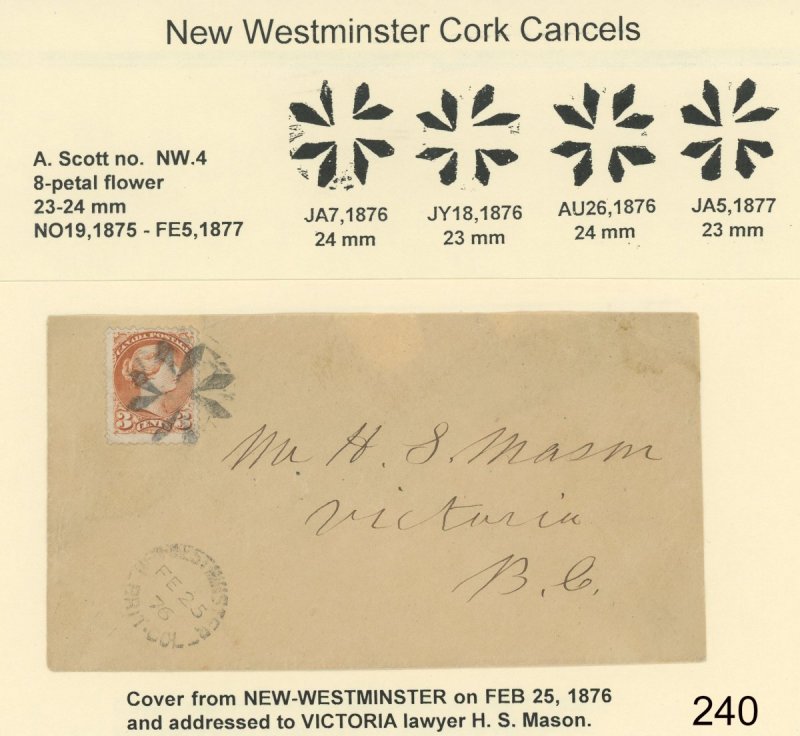
Addressed to: Mrs. A. Burrell / M. F. Brewers / Truro / Cornwall / England (i was unable to solve this one)
For British Columbia, the twice-across-the-border connection with eastern Canada was needed a few years later than for the Prairies. Victoria (the main settlement) had mail service similar to that at Fort Garry. In other words, all its mail came via the United States until the through mail began on the CPR in 1886. Until late 1859, all mail from eastern Canada went to New York, then by ship to Panama, across the Isthmus of Panama, and then by ship to San Francisco. Starting in the fall of 1859, some mail went by the overland mail through San Francisco. Aside from the odd cover that has an overland handstamp or endorsement, there is no way yet to tell whether a cover went via Panama or overland. The overland route became a fixture with the completion of the Union Pacific and Central Pacific railroads across the U.S. in 1869. All of BC’s mail continued to travel through San Francisco until a U.S. transcontinental railway reached the Pacific Northwest. In 1870, the Northern Pacific Railroad started building west from Lake Superior (near Duluth). Work started the same year at Kalama, Washington (on the Columbia River), heading both north toward the western terminal Tacoma, and east. The 100-mile western segment between Kalama and Tacoma was soon completed, but the transcontinental link was not made until 1883. From the early 1870s (soon after British Columbia joined Canada), closed mail between BC and eastern Canada still went through San Francisco, but letters were often carried by railway and stage routes, and by ship only between Victoria and either Olympia, Tacoma, or Port Townsend, Washington. Direct ships between Victoria and San Francisco continued, but they were not as frequent as the service to Puget Sound. Date stamps were made in the summer of 1877 with the indicia SF and T to indicate the route via either San Francisco (SF) or Tacoma (T). As with the Manitoba mail of this period, all the BC mail to or from eastern Canada passed through Detroit and Windsor. LINK to the complete article - (page 56) - www.rpsc.org/CP_scans/Canadian%20Philatelist,%20Vol.%2052...
- via - / VICTORIA / OC 13 / 75 / BRIT • COL / - split ring transit backstamp
- via - / WINDSOR / OC 27 / 75 / ONT / - split ring transit backstamp
- via - / HAMILTON / OC 28 / ONT / - split ring transit backstamp
- arrival - / TRURO / NO 13 / 75 / - cds arrival backstamp
Truro is a cathedral city and civil parish in Cornwall, England, UK. It is Cornwall's county town and only city, and its centre for administration, leisure and retail. Its population was recorded as 18,766 in the 2011 census. People from Truro are known as Truronians. Truro grew as a trade centre through its port and then as a stannary town for the tin-mining industry. It gained city status in 1876 with the founding of the Diocese of Truro, and so became mainland Britain's southernmost city.
Fireproof (and containing lead) Christmas icicles. Silver Sheen brand. Scan of the graphics on the box.
The eagle warriors of Yaxche, led by the fearsome war captain Cipac (crocodile).
The eagle warriors wear quilted cotton tunics which are surprisingly effective at stopping arrows and blunt weapons. They carry maquahuitls or broad bladed spears, both edged with obsidan. Obsidan is a volcanic mineral which is sharper than steel but loses it edge a lot faster.
Cipac fights under his flayed hand banner.
I put it on the balcony and noticed that the negative space made another flower.
Two photos in explore the same day, that's a surprise - and of the same flower!
And it just took over from the Clare Sheridan bust of Charlie Chaplin to become my most interesting photo. Ha ha, makes me laugh!
Effective only at the start of the War. The Boys Anti Tank Rifle fired a round similar to the 50 Cal. Bolt action and effective up to 300 meters, it proved useless against tanks after 1940.
Used a Brickarms HCSR, cut the scope & trigger guard; added a bipod, half cut monopod and pintle mount.
Am happy with the end result but I did have to fiddle with some sandpaper.
Thank you to all our Veterans. For far too long– gratitude for service, understanding the depth of emotional wounds, and lack of timely, compassionate care for the physical—have plagued our VA system.
It’s time our Veterans become educated and empowered about new and highly effective treatments f...
www.healtherpeople.com/new-hope-for-our-veterans-natural-...
An interesting and very effective recreation of National Bus Company 'dual-purpose' livery on a modern bus - this Volvo B8RLE with MCV Evora body masquerading as an NBC-era West Yorkshire Road Car bus is in the fleet of Connexions of Tockwith. It was photographed at the on-street stand outside Otley Bus Station, ready to return to Harrogate on the 1500 service X52 journey. Although only a few months old the bus is already with its second owner - it was new to Weavaway of Newbury, who applied the livery and had it registered as P600 LPF to rekindle memories of LPF 600P, a dual-purpose Leyland National in the Alder Valley fleet which carried this livery when new in 1976. (Photo taken 7 Oct 2025, posted 8 Oct 2025)
+++ DISCLAIMER +++
Nothing you see here is real, even though the conversion or the presented background story might be based on historical facts. BEWARE!
Some background:
The Panther tank, officially Panzerkampfwagen V Panther (abbreviated PzKpfw V) with ordnance inventory designation Sd.Kfz. 171, was a German medium tank of World War II. It was used on the Eastern and Western Fronts from mid-1943 to the end of the war. The Panther was intended to counter the Soviet T-34 medium tank and to replace the Panzer III and Panzer IV. Nevertheless, it served alongside the Panzer IV and the heavier Tiger I until the end of the war. It is considered one of the best tanks of World War II for its excellent firepower, protection, and mobility although its reliability in early times were less impressive.
The Panther was a compromise. While having essentially the same Maybach V12 petrol (700 hp) engine as the Tiger I, it had better gun penetration, was lighter and faster, and could traverse rough terrain better than the Tiger I. The trade-off was weaker side armor, which made it vulnerable to flanking fire. The Panther proved to be effective in open country and long-range engagements.
The Panther was far cheaper to produce than the heavy Tiger I. Key elements of the Panther design, such as its armor, transmission, and final drive, were simplifications made to improve production rates and address raw material shortages. Despite this the overall design remain described by some as "overengineered". The Panther was rushed into combat at the Battle of Kursk in the summer of 1943 despite numerous unresolved technical problems, leading to high losses due to mechanical failure. Most design flaws were rectified by late 1943 and early 1944, though the bombing of production plants, increasing shortages of high-quality alloys for critical components, shortage of fuel and training space, and the declining quality of crews all impacted the tank's effectiveness.
Though officially classified as a medium tank, at 44.8 metric tons the Panther was closer to a heavy tank weight and the same category as the American M26 Pershing (41.7 tons), British Churchill (40.7 tons) and the Soviet IS-2 (46 tons) heavy tanks. The Panther's weight caused logistical problems, such as an inability to cross certain bridges, otherwise the tank had a very high power-to-weight ratio which made it highly mobile.
The Panther was only used marginally outside of Germany, mostly captured or recovered vehicles, some even after the war. Japan already received in 1943 a specimen for evaluation. During March–April 1945, Bulgaria received 15 Panthers of various makes (D, A, and G variants) from captured and overhauled Soviet stocks; they only saw limited (training) service use. In May 1946, Romania received 13 Panther tanks from the USSR, too.
After the war, France was able to recover enough operable vehicles and components to equip its army and offer vehicles for sale. The French Army's 503e Régiment de Chars de Combat was equipped with a force of 50 Panthers from 1944 to 1947, in the 501st and 503rd Tank Regiments. These remained in service until they were replaced by French-built ARL 44 heavy tanks.
In 1946, Sweden sent a delegation to France to examine surviving specimens of German military vehicles. During their visit, the delegates found a few surviving Panthers and had one shipped to Sweden for further testing and evaluation, which continued until 1961.
However, this was not the Panther’s end of service. The last appearance by WWII German tanks on the world’s battlefields came in 1967, when Syria’s panzer force faced off against modern Israeli armor. Quite improbably, Syria had assembled a surprisingly wide collection of ex-Wehrmacht vehicles from a half-dozen sources over a decade and a half timeframe. This fleet consisted primarily of late production Panzer V, StuGIII and Jagdpanzer IVs, plus some Hummel SPAAGs and a handful Panthers. The tanks were procured from France, Spain, and Czechoslovakia, partly revamped before delivery.
All of the Panthers Syria came from Czechoslovakia. Immediately after Germany’s collapse in May 1945, the Soviet army established a staging area for surrendered German tanks at a former Wehrmacht barracks at Milovice, about 24 miles north of Prague, Czechoslovakia. By January 1946, a total of roughly 200 operational Panzer IVs and Panthers of varying versions were at this facility. Joining them was a huge cache of spare parts found at a former German tank repair depot in Teplice, along with ammunition collected from all over Czechoslovakia and the southern extremity of the Soviet occupation zone in Germany. Throughout 1946, the Czechoslovak government’s clean-up of WWII battlefields recovered more than one hundred further tank wrecks, of which 80 were pieced back together to operational status and handed over to the Czechoslovakian Army,
In early 1948, the now-nationalized CKD Works began a limited upkeep of the tanks, many of which had not had depot-level overhauls since the war. A few were rebuilt with a Czechoslovak-designed steering system, but this effort was halted due to cost. These tanks remained operational in the Czechoslovak army until the end of 1954, when sufficient T-34s were available to phase them out.
A Syrian military delegation visited Prague from 8 April – 22 April 1955. An agreement was struck for the sale, amongst other items, of 45 Panzer IVs and 15 Panthers. Despite their obsolescence the Czechoslovaks were not about to just give the tanks away and demanded payment in a ‘hard’ western currency, namely British pounds. The cost was £4,500 each (£86,000 or $112,850 in 2016 money), far above what they were probably worth militarily, especially considering the limited amount of foreign currency reserves available to the Damascus government. The deal included refurbishment, a full ammunition loadout for each, and a limited number of spare parts. Nonetheless, the deal was closed, and the tanks’ delivery started in early November 1955.
The Syrians were by that time already having dire problems keeping their French-sourced panzers operational, and in 1958, a second contract was signed with CKD Works for 15 additional Panzer IVs and 10 more Panthers, these being in lesser condition or non-operational, for use as spare parts hulks. An additional 16 refurbished Maybach engines for both types were also included in this contract, as well as more ammunition.
The refurbished Panthers for Syria had their original 7.5 cm KwK 42 L70 replaced with the less powerful Rheinmetall 7.5 cm KwK 40 L48 gun – dictated by the fact that this gun was already installed in almost all other Syrian tanks of German origin and rounds for the KwK 42 L70 were not available anymore. and the Panther’s full ammo load was 87 rounds. The KwK 40 L48 fired a standard APCBC shell at 750 m/s and could penetrate 109 mm (4.3 in) hardened steel at 1.000 m range. This was enough to take out an M4 Sherman at this range from any angle under ideal circumstances. With an APCR shell the gun was even able to penetrate 130 mm (5.1 in) of hardened steel at the same distance.
Outwardly, the gun switch was only recognizable through the shorter barrel with a muzzle brake, the German WWII-era TZF.5f gunsight was retained by the Syrians. Additionally, there were two secondary machine guns, either MG-34s or MG-42s, one coaxial with the main gun and a flexible one in a ball mount in the tank’s front glacis plate.
A few incomplete Panther hulls without turret were also outfitted with surplus Panzer IV turrets that carried the same weapon, but the exact share of them among the Syrian tanks is unknown – most probably less than five, and they were among the batch delivered in the course of the second contract from 1958.
As they had been lumped all together in Czechoslovak army service, the Syrians received a mixed bag of Panzer IV and Panther versions, many of them “half-breeds” or “Frankensteins”. Many had the bow machine gun removed, either already upon delivery or as a later field modification, and in some cases the machine gun in the turret was omitted as well.
An obvious modification of the refurbished Czech export Panthers for Syria was the installation of new, lighter road wheels. These were in fact adapted T-54 wheels from Czechoslovakian license production that had just started in 1957 - instead of revamping the Panthers’ original solid steel wheels, especially their rubberized tread surfaces, it was easier to replace them altogether, what also made spare parts logistics easier. The new wheels had almost the same diameter as the original German road wheels from WWII, and they were simply adapted to the Panther’s attachment points of the torsion bar suspension’s swing arms. Together with the lighter main gun and some other simplifications, the Syrian Panthers’ empty weight was reduced by more than 3 tonnes.
The Czechoslovaks furthermore delivered an adapter kit to mount a Soviet-made AA DShK 12.7mm machine gun to the commander cupola. This AA mount had originally been developed after WWII for the T-34 tank, and these kits were fitted to all initial tanks of the 1955 order. Enough were delivered that some could be installed on a few of the Spanish- / French-sourced tanks, too.
It doesn’t appear that the Czechoslovaks updated the radio fit on any of the ex-German tanks, and it’s unclear if the Syrians installed modern Soviet radios. The WWII German Fu 5 radio required a dedicated operator (who also manned the bow machine gun); if a more modern system was installed not requiring a dedicated operator, this crew position could be eliminated altogether, what favored the deletion of the bow machine gun on many ex-German Syrian tanks. However, due to their more spacious hull and turret, many Panthers were apparently outfitted with a second radio set and used as command tanks – visible through a second whip antenna on the hull.
A frequent domestic Panther upgrade were side skirts to suppress dust clouds while moving and to prevent dust ingestion into the engines and clogged dust filters. There was no standardized solution, though, and solutions ranged from simple makeshift rubber skirts bolted to the tanks’ flanks to wholesale transplants from other vehicles, primarily Soviet tanks. Some Panthers also had external auxiliary fuel tanks added to their rear, in the form of two 200 l barrels on metal racks of Soviet origin. These barrels were not directly connected with the Panther’s fuel system, though, but a pump-and-hose kit was available to re-fuel the internal tanks from this on-board source in the field. When empty or in an emergency - the barrels were placed on top of the engine bay and leaking fuel quite hazardous - the barrels/tanks could be jettisoned by the crew from the inside.
Inclusive of the cannibalization hulks, Syria received a total of roughly 80 former German tanks from Czechoslovakia. However, at no time were all simultaneously operational and by 1960, usually only two or three dozen were combat-ready.
Before the Six Day War, the Syrian army was surprisingly unorganized, considering the amount of money being pumped into it. There was no unit larger than a brigade, and the whole Syrian army had a sort of “hub & spokes” system originating in Damascus, with every individual formation answering directly to the GHQ rather than a chain of command. The Panthers, Panzer IVs and StuG IIIs were in three independent tank battalions, grossly understrength, supporting the normal tank battalions of three infantry brigades (the 8th, 11th, and 19th) in the Golan Heights. The Jagdpanzer IVs were in a separate independent platoon attached to a tank battalion operating T-34s and SU-100s. How the Hummel SPGs were assigned is unknown.
The first active participation of ex-German tanks in Syrian service was the so-called “Water War”. This was not really a war but rather a series of skirmishes between Israel and Syria during the mid-1960s. With increasing frequency starting in 1964, Syria emplaced tanks on the western slope of the Golan Heights, almost directly on the border, to fire down on Israeli irrigation workers and farmers in the Galilee region. Surprisingly (considering the small number available) Syria chose the Panzer IV for this task. It had no feature making it better or worse than any other tank; most likely the Syrians felt they were the most expendable tanks in their inventory as Israeli counterfire was expected. The panzers were in defilade (dug in) and not easy to shoot back at; due to their altitude advantage.
In 1964, Syria announced plans to divert 35% of the Jordan River’s flow away from Israel, to deprive the country of drinking water. The Israelis responded that they would consider this an act of war and, true to their word, engaged the project’s workers with artillery and sniper fire. Things escalated quickly; in 1965, Israeli M4 Shermans on Israeli soil exchanged fire with the Syrian Panzer IVs above inconclusively. A United Nations peacekeeping team ordered both sides to disengage from the border for a set period of time to “cool off”, but the UN “Blue Berets” were detested and considered useless by both the Israelis and Syrians, and both sides used the lull to prepare their next move. When the cooling-off period ended, the Syrians moved Panzer IVs and now some Panthers, too, back into position. However, the IDF had now Centurion tanks waiting for them, with their fire arcs pre-planned out. The Cold War-era Centurion had heavy armor, a high-velocity 105mm gun, and modern British-made optics. It outclassed the WWII panzers in any imaginable way and almost immediately, two Syrian Panzer IVs and a Panther were destroyed. Others were abandoned by their crews and that was the end of the situation.
Syria’s participation in the Six Say War that soon followed in 1967 war was sloppy and ultimately disastrous. Israel initially intended the conflict to be limited to a preemptive strike against Egypt to forestall an imminent attack by that country, with the possibility of having to fight Syria and Jordan defensively if they responded to the operations against Egypt. The war against Egypt started on 5 June 1967. Because of the poor organization of the Syrian army, news passed down from Damascus on the fighting in the Sinai was scarce and usually outdated by the time it reached the brigade level. Many Syrian units (including the GHQ) were using civilian shortwave radios to monitor Radio Cairo which was spouting off outlandish claims of imaginary Egyptian victories, even as Israeli divisions were steamrolling towards the Suez Canal.
Syrian vehicles of German origin during the Six Day War were either painted overall in beige or in a dark olive drab green. Almost all had, instead of tactical number codes, the name of a Syrian soldier killed in a previous war painted on the turret in white. During the Six Day War, no national roundel was typically carried, even though the Syrian flag was sometimes painted to the turret flanks. However just as the conflict was starting, white circles were often painted onto the top sides of tanks as quick ID markings for aircraft, and some tanks had red recognition triangles added to the side areas: Syrian soldiers were notoriously trigger-happy, and the decreased camouflage effect was likely cancelled out by the reduced odds of being blasted by a comrade!
During the evening of 5 June, Syrian generals in Damascus urged the government to take advantage of the situation and mount an immediate invasion of Israel. Planning and preparation were literally limited to a few hours after midnight, and shortly after daybreak on 6 June, Syrian commanders woke up with orders to invade Israel. The three infantry brigades in the Golan, backed up by several independent battalions, were to spearhead the attack as the rest of the Syrian army mobilized.
There was no cohesion at all: Separate battalions began their advance whenever they happened to be ready to go, and brigades went forward, missing subunits that lagged behind. A platoon attempting a southern outflank maneuver tried to ford the Jordan River in the wrong spot and was washed away. According to a KGB report, at least one Syrian unit “exhibited cowardice” and ignored its orders altogether.
On 7 June, 24 hours into their attack, Syrian forces had only advanced 2 miles into Israel. On 8 June, the IDF pushed the Syrians back to the prewar border and that afternoon, Israeli units eliminated the last Egyptian forces in the Sinai and began a fast redeployment of units back into Israel. Now the Syrians were facing serious problems.
On 9 June, Israeli forces crossed into the Golan Heights. They came by the route the Syrians least expected, an arc hugging the Lebanese border. Now for the first time, Syria’s panzers (considered too slow and fragile for the attack) were encountered. The next day, 10 June 1967, was an absolute rout as the Syrians were being attacked from behind by IDF units arcing southwards from the initial advance, plus Israel’s second wave coming from the west. It was later estimated that Syria lost between 20-25% of its total military vehicle inventory in a 15-hour span on 10 June, including eight Panthers. A ceasefire was announced at midnight, ending Syria’s misadventure. Syria permanently lost the Golan Heights to Israel.
By best estimate, Syria had just five Panthers and twenty-five Panzer IVs fully operational on 6 June 1967, with maybe another ten or so tanks partially operational or at least functional enough to take into combat. Most – if not all – of the ex-French tanks were probably already out of service by 1967, conversely the entire ex-Spanish lot was in use, along with some of the ex-Czechoslovak vehicles. The conflict’s last kill was on 10 June 1967 when a Panzer IV was destroyed by an Israeli M50 Super Sherman (an M4 Sherman hull fitted with a new American engine, and a modified turret housing Israeli electronics and a high-velocity French-made 75mm gun firing HEAT rounds). Like the Centurion, the Super Sherman outclassed the Panzer IV, and the Panther only fared marginally better.
Between 1964-1973 the USSR rebuilt the entire Syrian military from the ground up, reorganizing it along Warsaw Pact lines and equipping it with gear strictly of Soviet origin. There was no place for ex-Wehrmacht tanks and in any case, Czechoslovakia had ended spares & ammo support for the Panzer IV and the Panthers, so the types had no future. The surviving tanks were scrapped in Syria, except for a single Panzer IV survivor sold to a collector in Jordan.
Specifications:
Crew: Five (commander, gunner, loader, driver, radio operator)
Weight: 50 tonnes (55.1 long tons; 45.5 short tons)
Length: 6.87 m (22 ft 6 in) hull only
7.52 m (24 ft 7¾ in) overall with gun facing forward
Width: 3.42 m (11 ft 3 in) hull only
3,70 m (12 ft 1¾ in) with retrofitted side skirts
Height: 2.99 m (9 ft 10 in)’
Ground clearance: 56 cm (22 in)
Suspension: Double torsion bar, interleaved road wheels
Fuel capacity: 720 liters (160 imp gal; 190 US gal),
some Syrian Panthers carried two additional external 200 l fuel drums
Armor:
15–80 mm (0.6 – 3.93 in)
Performance:
Maximum road speed: 56 km/h (35 mph)
Operational range: 250 km (160 mi) on roads; 450 km (280 mi)with auxiliary fuel tanks
100 km (62 mi) cross-country
Power/weight: 14 PS (10.1 kW)/tonne (12.7 hp/ton)
Engine & transmission:
Maybach HL230 V-12 gasoline engine with 700 PS (690 hp, 515 kW)
ZF AK 7-200 gearbox with 7 forward 1 reverse gear
Armament:
1× 7,5 cm KwK 40 (L/48) with 87 rounds
2× 7.92 mm MG 34 or 42, or similar machine guns;
one co-axial with the main gun, another in the front glacis plate
with a total of 5.100 rounds (not always mounted)
Provision for a 12.7 mm DShK or Breda anti-aircraft machine gun on the commander cupola
The kit and its assembly:
A rather exotic what-if model, even though it’s almost built OOB. Inspiration came when I stumbled upon the weird Syrian Panzer IVs that were operated against Israel during the Six Day War – vehicles you would not expect there, and after more than 20 years after WWII. But when I did some more research, I was surprised about the numbers and the variety of former German tanks that Syria had gathered from various European countries, and it made me wonder if the Panther could not have been among this shaggy fleet, too?
I had a surplus Dragon Panther Spähpanzer in The Stash™, to be correct a “PzBeobWg V Ausf. G”, an observation and artillery fire guidance conversion that actually existed in small numbers, and I decided to use it as basis for this odd project. The Dragon kit has some peculiarities, though: its hull is made from primed white metal and consists of an upper and lower half that are held together by small screws! An ambiguous design, because the parts do not fit as good as IP parts, so that the model has a slightly die-cast-ish aura. PSR is necessary at the seams, but due to the metal it’s not easy to do. Furthermore, you have to use superglue everywhere, just as on a resin kit. On the other side, surface details are finely molded and crisp, even though many bits have to be added manually. However, the molded metal pins that hold the wheels are very robust and relatively thin – a feature I exploited for a modified running gear (see below).
For the modified Panther in my mind I had to retrograde the turret back to a late standard turret with mantlet parts left over from a Hasegawa kit – they fitted perfectly! The PzBeobWg V only comes with a stubby gun barrel dummy. But I changed the armament, anyway, and implanted an aftermarket white metal and brass KwK 40 L48, the weapon carried by all Syrian Panzer IVs, the Jagdpanzer IVs as well as the StuG IIIs. This standardization would IMHO make sense, even if it meant a performance downgrade from the original, longer KwK 42 L70.
For a Syrian touch, inspired by installations on the Panzer IVs, I added a mount for a heavy DShK machine gun on the commander’s cupola, which is a resin aftermarket kit from Armory Models Group (a kit that consists of no less than five fiddly parts for just a tiny machine gun!).
To change and modernize the Panther’s look further, I gave it side skirts, leftover from a ModelCollect T-72 kit, which had to be modified only slightly to fit onto the molded side skirt consoles on the Panther’s metal hull. A further late addition were the fuel barrels from a Trumpeter T-54 kit that I stumbled upon when I looked for the skirts among my pile of tank donor parts. Even though they look like foreign matter on the Panther’s tail, their high position is plausible and similar to the original arrangement on many Soviet post-WWII tanks. The whip antennae on turret and hull were created with heated black sprue material.
As a modern feature and to change the Panther’s overall look even more, I replaced its original solid “dish” road wheels with T-54/55 “starfish” wheels, which were frequently retrofitted to T-34-85s during the Fifties. These very fine aftermarket resin parts (all real-world openings are actually open, and there’s only little flash!) came from OKB Grigorovich from Bulgaria. The selling point behind this idea is/was that the Panther and T-54/55 wheels have almost the same diameter: in real life it’s 860 vs. 830 mm, so that the difference in 1:72 is negligible. Beneficially, the aftermarket wheels came in two halves, and these were thin enough to replace the Panther’s interleaved wheels without major depth problems.
Adapting the parts to the totally different wheel arrangement was tricky, though, especially due to the Dragon kit’s one-piece white metal chassis that makes any mods difficult. My solution: I retained the inner solid wheels from the Panther (since they are hardly visible in the “3rd row”), plus four pairs of T-54/55 wheels for the outer, more rows of interleaved wheels. The “inner” T-54/55 wheel halves were turned around, received holes to fit onto the metal suspension pins and scratched hub covers. The “outside” halves were taken as is but received 2 mm spacer sleeves on their back sides (styrene tube) for proper depth and simply to improve their hold on the small and rounded metal pin tips. This stunt worked better than expected and looks really good, too!
Painting and markings:
Basically very simple, and I used pictures of real Syrian Panzer IVs as benchmark. I settled for the common green livery variant, and though simple and uniform, I tried to add some “excitement” to it and attempted to make old paint shine through. The hull’s lower surface areas were first primed with RAL 7008 (Khakigrau, a rather brownish tone), then the upper surfaces were sprayed with a lighter sand brown tone, both applied from rattle cans.
On top of that, a streaky mix of Revell 45 and 46 – a guesstimate for the typical Syrian greyish, rather pale olive drab tone - was thinly applied with a soft, flat brush, so that the brownish tones underneath would shine through occasionally. Once dry, the layered/weathered effect was further emphasized through careful vertical wet-sanding and rubbing on all surfaces with a soft cotton cloth.
The rubber side skirts were painted with an anthracite base and the dry-brushed with light grey and beige.
The model then received an overall washing with a highly thinned mix of grey and dark brown acrylic artist paint. The vinyl tracks (as well as the IP spare track links on the hull) were painted, too, with a mix of grey, red brown and iron, all acrylic paints, too, that do not interact chemically with the soft vinyl.
The decals/markings are minimal; the Arabian scribble on the turret (must be a name?), using the picture of a Syrian Panzer IV as benchmark, was painted in white by hand, as well as the white circle on the turret roof. The orange ID triangles are a nice contrast, even though I was not able to come up with real-life visual evidence for them. I just found a color picture of a burned T-34-85 wreck with them, suggesting that the color was a dull orange red and not florescent orange, as claimed in some sources. I also found illustrations of the triangles as part of 1:35 decal sets for contemporary Syrian T-34-85s from FC Model Trend and Star Models, where they appear light red. For the model, they were eventually cut out from decal sheet material (TL-Modellbau, in a shade called “Rotorange”, what appears to be a good compromise).
Dry-brushing with light grey and beige to further emphasize edges and details followed. Finally, the model was sealed with matt acrylic vanish overall, and some additional very light extra dry-brushing with silver was done to simulate flaked paint. Dirt and rust residues were added here and there with watercolors. After final assembly, the lower areas of the model were furthermore powdered with mineral pigments to simulate dust.
The idea of a modernized WWII Panther: a simple idea that turned into a major conversion. With the resin DShK machine gun and T-54/55 wheel set the costs of this project escalated a little, but in hindsight I find that the different look and the mix of vintage German and modern Soviet elements provide this Panther with that odd touch that sets it apart from a simple paint/marking variation? I really like the outcome, and I think that the effort was worthwhile - this fictional Panther shoehorns well into its intended historical framework. :-D
The Burgtheater at Dr.-Karl -Lueger-Ring (from now on, Universitätsring) in Vienna is an Austrian Federal Theatre. It is one of the most important stages in Europe and after the Comédie-Française, the second oldest European one, as well as the greatest German speaking theater. The original 'old' Burgtheater at Saint Michael's square was utilized from 1748 until the opening of the new building at the ring in October, 1888. The new house in 1945 burnt down completely as a result of bomb attacks, until the re-opening on 14 October 1955 was the Ronacher serving as temporary quarters. The Burgtheater is considered as Austrian National Theatre.
Throughout its history, the theater was bearing different names, first Imperial-Royal Theater next to the Castle, then to 1918 Imperial-Royal Court-Burgtheater and since then Burgtheater (Castle Theater). Especially in Vienna it is often referred to as "The Castle (Die Burg)", the ensemble members are known as Castle actors (Burgschauspieler).
History
St. Michael's Square with the old K.K. Theatre beside the castle (right) and the Winter Riding School of the Hofburg (left)
The interior of the Old Burgtheater, painted by Gustav Klimt. The people are represented in such detail that the identification is possible.
The 'old' Burgtheater at St. Michael's Square
The original castle theater was set up in a ball house that was built in the lower pleasure gardens of the Imperial Palace of the Roman-German King and later Emperor Ferdinand I in 1540, after the old house 1525 fell victim to a fire. Until the beginning of the 18th Century was played there the Jeu de Paume, a precursor of tennis. On 14 March 1741 finally gave the Empress Maria Theresa, ruling after the death of her father, which had ordered a general suspension of the theater, the "Entrepreneur of the Royal Court Opera" and lessees of 1708 built theater at Kärntnertor (Carinthian gate), Joseph Karl Selliers, permission to change the ballroom into a theater. Simultaneously, a new ball house was built in the immediate vicinity, which todays Ballhausplatz is bearing its name.
In 1748, the newly designed "theater next to the castle" was opened. 1756 major renovations were made, inter alia, a new rear wall was built. The Auditorium of the Old Burgtheater was still a solid timber construction and took about 1200 guests. The imperial family could reach her royal box directly from the imperial quarters, the Burgtheater structurally being connected with them. At the old venue at Saint Michael's place were, inter alia, several works of Christoph Willibald Gluck, Ludwig van Beethoven, Wolfgang Amadeus Mozart as well as Franz Grillparzer premiered .
On 17 February 1776, Emperor Joseph II declared the theater to the German National Theatre (Teutsches Nationaltheater). It was he who ordered by decree that the stage plays should not deal with sad events for not bring the Imperial audience in a bad mood. Many theater plays for this reason had to be changed and provided with a Vienna Final (Happy End), such as Romeo and Juliet or Hamlet. From 1794 on, the theater was bearing the name K.K. Court Theatre next to the castle.
1798 the poet August von Kotzebue was appointed as head of the Burgtheater, but after discussions with the actors he left Vienna in 1799. Under German director Joseph Schreyvogel was introduced German instead of French and Italian as a new stage language.
On 12 October 1888 took place the last performance in the old house. The Burgtheater ensemble moved to the new venue at the Ring. The Old Burgtheater had to give way to the completion of Saint Michael's tract of Hofburg. The plans to this end had been drawn almost 200 years before the demolition of the old Burgtheater by Joseph Emanuel Fischer von Erlach.
The "new" K.K. Court Theatre (as the inscription reads today) at the Ring opposite the Town Hall, opened on 14 October 1888 with Grillparzer's Esther and Schiller's Wallenstein's Camp, was designed in neo-Baroque style by Gottfried Semper (plan) and Karl Freiherr von Hasenauer (facade), who had already designed the Imperial Forum in Vienna together. Construction began on 16 December 1874 and followed through 14 years, in which the architects quarreled. Already in 1876 Semper withdrew due to health problems to Rome and had Hasenauer realized his ideas alone, who in the dispute of the architects stood up for a mainly splendid designed grand lodges theater.
However, created the famous Viennese painter Gustav Klimt and his brother Ernst Klimt and Franz Matsch 1886-1888 the ceiling paintings in the two stairwells of the new theater. The three took over this task after similar commissioned work in the city theaters of Fiume and Karlovy Vary and in the Bucharest National Theatre. In the grand staircase on the side facing the café Landtmann of the Burgtheater (Archduke stairs) reproduced Gustav Klimt the artists of the ancient theater in Taormina on Sicily, in the stairwell on the "People's Garden"-side (Kaiserstiege, because it was reserved for the emperor) the London Globe Theatre and the final scene from William Shakespeare's "Romeo and Juliet". Above the entrance to the auditorium is Molière's The Imaginary Invalid to discover. In the background the painter immortalized himself in the company of his two colleagues. Emperor Franz Joseph I liked the ceiling paintings so much that he gave the members of the company of artists of Klimt the Golden Cross of Merit.
The new building resembles externally the Dresden Semper Opera, but even more, due to the for the two theaters absolutely atypical cross wing with the ceremonial stairs, Semper's Munich project from the years 1865/1866 for a Richard Wagner Festspielhaus above the Isar. Above the middle section there is a loggia, which is framed by two side wings, and is divided from a stage house with a gable roof and auditorium with a tent roof. Above the center house there decorates a statue of Apollo the facade, throning between the Muses of drama and tragedy. Above the main entrances are located friezes with Bacchus and Ariadne. At the exterior facade round about, portrait busts of the poets Calderon, Shakespeare, Moliere, Schiller, Goethe, Lessing, Halm, Grillparzer, and Hebbel can be seen. The masks which also can be seen here are indicating the ancient theater, furthermore adorn allegorical representations the side wings: love, hate, humility, lust, selfishness, and heroism. Although the theater since 1919 is bearing the name of Burgtheater, the old inscription KK Hofburgtheater over the main entrance still exists. Some pictures of the old gallery of portraits have been hung up in the new building and can be seen still today - but these images were originally smaller, they had to be "extended" to make them work better in high space. The points of these "supplements" are visible as fine lines on the canvas.
The Burgtheater was initially well received by Viennese people due to its magnificent appearance and technical innovations such as electric lighting, but soon criticism because of the poor acoustics was increasing. Finally, in 1897 the auditorium was rebuilt to reduce the acoustic problems. The new theater was an important meeting place of social life and soon it was situated among the "sanctuaries" of Viennese people. In November 1918, the supervision over the theater was transferred from the High Steward of the emperor to the new state of German Austria.
1922/1923 the Academy Theatre was opened as a chamber play stage of the Burgtheater. On 8th May 1925, the Burgtheater went into Austria's criminal history, as here Mentscha Karnitschewa perpetrated a revolver assassination on Todor Panitza.
The Burgtheater in time of National Socialism
The National Socialist ideas also left traces in the history of the Burgtheater. In 1939 appeared in Adolf Luser Verlag the strongly anti-Semitic characterized book of theater scientist Heinz Kindermann "The Burgtheater. Heritage and mission of a national theater", in which he, among other things, analyzed the "Jewish influence "on the Burgtheater. On 14 October 1938 was on the occasion of the 50th anniversary of the opening of the Burgtheater a Don Carlos production of Karl-Heinz Stroux shown that served Hitler's ideology. The role of the Marquis of Posa played the same Ewald Balser, who in a different Don Carlos production a year earlier (by Heinz Hilpert) at the Deutsches Theater in the same role with the sentence in direction of Joseph Goebbels box vociferated: "just give freedom of thought". The actor and director Lothar Müthel, who was director of the Burgtheater between 1939 and 1945, staged 1943 the Merchant of Venice, in which Werner Kraus the Jew Shylock clearly anti-Semitic represented. The same director staged after the war Lessing's parable Nathan the Wise. Adolf Hitler himself visited during the Nazi regime the Burgtheater only once (1938), and later he refused in pure fear of an assassination.
For actors and theater staff who were classified according to the Reich Citizenship Law of 1935 as "Jews ", were quickly imposed stage bans, within a few days, they were on leave, fired or arrested. The Burgtheater ensemble between 1938 and 1945 did not put up significant resistance against the Nazi ideology, the repertoire was heavily censored, only a few joined the Resistance, as Judith Holzmeister (then also at the People's Theatre engaged) or the actor Fritz Lehmann. Although Jewish members of the ensemble indeed have been helped to emigrate, was still an actor, Fritz Strassny, taken to a concentration camp and murdered there.
The Burgtheater at the end of the war and after the Second World War
In summer 1944, the Burgtheater had to be closed because of the decreed general theater suspension. From 1 April 1945, as the Red Army approached Vienna, camped a military unit in the house, a portion was used as an arsenal. In a bomb attack the house at the Ring was damaged and burned down on 12th April 1945 completely. Auditorium and stage were useless, only the steel structure remained. The ceiling paintings and part of the lobby were almost undamaged.
The Soviet occupying power expected from Viennese City Councillor Viktor Matejka to launch Vienna's cultural life as soon as possible again. The council summoned on 23 April (a state government did not yet exist) a meeting of all Viennese cultural workers into the Town Hall. Result of the discussions was that in late April 1945 eight cinemas and four theaters took up the operation again, including the Burgtheater. The house took over the Ronacher Theater, which was understood by many castle actors as "exile" as a temporary home (and remained there to 1955). This venue chose the newly appointed director Raoul Aslan, who championed particularly active.
The first performance after the Second World War was on 30 April 1945 Sappho by Franz Grillparzer directed by Adolf Rott from 1943 with Maria Eis in the title role. Also other productions from the Nazi era were resumed. With Paul Hoerbiger, a few days ago as Nazi prisoner still in mortal danger, was shown the play of Nestroy Mädl (Girlie) from the suburbs. The Academy Theatre could be played (the first performance was on 19 April 1945 Hedda Gabler, a production of Rott from the year 1941) and also in the ball room (Redoutensaal) at the Imperial Palace took place performances. Aslan the Ronacher in the summer had rebuilt because the stage was too small for classical performances. On 25 September 1945, Schiller's Maid of Orleans could be played on the enlarged stage.
The first new productions are associated with the name of Lothar Müthel: Everyone and Nathan the Wise, in both Raoul Aslan played the main role. The staging of The Merchant of Venice by Müthel in Nazi times seemed to have been fallen into oblivion.
Great pleasure gave the public the return of the in 1938 from the ensemble expelled Else Wohlgemuth on stage. She performaed after seven years in exile in December 1945 in Clare Biharys The other mother in the Academy Theater. 1951 opened the Burgtheater its doors for the first time, but only the left wing, where the celebrations on the 175th anniversary of the theater took place.
1948, a competition for the reconstruction was tendered: Josef Gielen, who was then director, first tended to support the design of ex aequo-ranked Otto Niedermoser, according to which the house was to be rebuilt into a modern gallery theater. Finally, he agreed but then for the project by Michael Engelhardt, whose plan was conservative but also cost effective. The character of the lodges theater was largely taken into account and maintained, the central royal box but has been replaced by two balconies, and with a new slanted ceiling construction in the audience was the acoustics, the shortcoming of the house, improved significantly.
On 14 October 1955 was happening under Adolf Rott the reopening of the restored house at the Ring. For this occasion Mozart's A Little Night Music was played. On 15 and on 16 October it was followed by the first performance (for reasons of space as a double premiere) in the restored theater: King Ottokar's Fortune and End of Franz Grillparzer, staged by Adolf Rott. A few months after the signing of the Austrian State Treaty was the choice of this play, which the beginning of Habsburg rule in Austria makes a subject of discussion and Ottokar of Horneck's eulogy on Austria (... it's a good country / Well worth that a prince bow to it! / where have you yet seen the same?... ) contains highly symbolic. Rott and under his successors Ernst Haeusserman and Gerhard Klingenberg the classic Burgtheater style and the Burgtheater German for German theaters were finally pointing the way .
In the 1950s and 1960s, the Burgtheater participated (with other well-known theaters in Vienna) on the so-called Brecht boycott.
Gerhard Klingenberg internationalized the Burgtheater, he invited renowned stage directors such as Dieter Dorn, Peter Hall, Luca Ronconi, Giorgio Strehler, Roberto Guicciardini and Otomar Krejča. Klingenberg also enabled the castle debuts of Claus Peymann and Thomas Bernhard (1974 world premiere of The Hunting Party). Bernhard was as a successor of Klingenberg mentioned, but eventually was appointed Achim Benning, whereupon the writer with the text "The theatrical shack on the ring (how I should become the director of the Burgtheater)" answered.
Benning, the first ensemble representative of the Burgtheater which was appointed director, continued Klingenberg's way of Europeanization by other means, brought directors such as Adolf Dresen, Manfred Wekwerth or Thomas Langhoff to Vienna, looked with performances of plays of Vaclav Havel to the then politically separated East and took the the public taste more into consideration.
Directorate Claus Peymann 1986-1999
Under the by short-term Minister of Education Helmut Zilk brought to Vienna Claus Peymann, director from 1986 to 1999, there was further modernization of the programme and staging styles. Moreover Peymann was never at a loss for critical contributions in the public, a hitherto unusual attitude for Burgtheater directors. Therefore, he and his program within sections of the audience met with rejection. The greatest theater scandal in Vienna since 1945 occurred in 1988 concerning the premiere of Thomas Bernhard's Heldenplatz (Place of the Heroes) drama which was fiercly fought by conservative politicians and zealots. The play deals with the Vergangenheitsbewältigung (process of coming to terms with the past) and illuminates the present management in Austria - with attacks on the then ruling Social Democratic Party - critically. Together with Claus Peymann Bernhard after the premiere dared to face on the stage applause and boos.
Bernard, to his home country bound in love-hate relationship, prohibited the performance of his plays in Austria before his death in 1989 by will. Peymann, to Bernhard bound in a difficult friendship (see Bernhard's play Claus Peymann buys a pair of pants and goes eating with me) feared harm for the author's work, should his plays precisely in his homeland not being shown. First, it was through permission of the executor Peter Fabjan - Bernhard's half-brother - after all, possible the already in the schedule of the Burgtheater included productions to continue. Finally, shortly before the tenth anniversary of the death of Bernard it came to the revival of the Bernhard play Before retirement by the first performance director Peymann. The plays by Bernhard are since then continued on the programme of the Burgtheater and they are regularly newly produced.
In 1993, the rehearsal stage of the Castle theater was opened in the arsenal (architect Gustav Peichl). Since 1999, the Burgtheater has the operation form of a limited corporation.
Directorate Klaus Bachler 1999-2009
Peymann was followed in 1999 by Klaus Bachler as director. He is a trained actor, but was mostly as a cultural manager (director of the Vienna Festival) active. Bachler moved the theater as a cultural event in the foreground and he engaged for this purpose directors such as Luc Bondy, Andrea Breth, Peter Zadek and Martin Kušej.
Were among the unusual "events" of the directorate Bachler
* The Theatre of Orgies and Mysteries by Hermann Nitsch with the performance of 122 Action (2005 )
* The recording of the MTV Unplugged concert with Die Toten Hosen for the music channel MTV (2005, under the title available)
* John Irving's reading from his book at the Burgtheater Until I find you (2006)
* The 431 animatographische (animatographical) Expedition by Christoph Schlingensief and a big event of him under the title of Area 7 - Matthew Sadochrist - An expedition by Christoph Schlingensief (2006).
* Daniel Hoevels cut in Schiller's Mary Stuart accidentally his throat (December 2008). Outpatient care is enough.
Jubilee Year 2005
In October 2005, the Burgtheater celebrated the 50th Anniversary of its reopening with a gala evening and the performance of Grillparzer's King Ottokar's Fortune and End, directed by Martin Kušej that had been performed in August 2005 at the Salzburg Festival as a great success. Michael Maertens (in the role of Rudolf of Habsburg) received the Nestroy Theatre Award for Best Actor for his role in this play. Actor Tobias Moretti was awarded in 2006 for this role with the Gertrude Eysoldt Ring.
Furthermore, there were on 16th October 2005 the open day on which the 82-minute film "burg/private. 82 miniatures" of Sepp Dreissinger was shown for the first time. The film contains one-minute film "Stand portraits" of Castle actors and guest actors who, without saying a word, try to present themselves with a as natural as possible facial expression. Klaus Dermutz wrote a work on the history of the Burgtheater. As a motto of this season served a quotation from Lessing's Minna von Barnhelm: "It's so sad to be happy alone."
The Burgtheater on the Mozart Year 2006
Also the Mozart Year 2006 was at the Burgtheater was remembered. As Mozart's Singspiel Die Entführung aus dem Serail in 1782 in the courtyard of Castle Theatre was premiered came in cooperation with the Vienna State Opera on the occasion of the Vienna Festival in May 2006 a new production (directed by Karin Beier) of this opera on stage.
Directorate Matthias Hartmann since 2009
From September 2009 to 2014, Matthias Hartmann was Artistic Director of the Burgtheater. A native of Osnabrück, he directed the stage houses of Bochum and Zurich. With his directors like Alvis Hermanis, Roland Schimmelpfennig, David Bösch, Stefan Bachmann, Stefan Pucher, Michael Thalheimer, came actresses like Dorte Lyssweski, Katharina Lorenz, Sarah Viktoria Frick, Mavie Hoerbiger, Lucas Gregorowicz and Martin Wuttke came permanently to the Burg. Matthias Hartmann himself staged around three premieres per season, about once a year, he staged at the major opera houses. For more internationality and "cross-over", he won the Belgian artist Jan Lauwers and his Need Company as "Artists in Residence" for the Castle, the New York group Nature Theater of Oklahoma show their great episode drama Live and Times of an annual continuation. For the new look - the Burgtheater presents itself without a solid logo with word games around the BURG - the Burgtheater in 2011 was awarded the Cultural Brand of the Year .
Since 2014, Karin Bergmann is the commander in chief.
Chassis n° AV35499
Les Grandes Marques du Monde au Grand Palais 2020
Bonhams
Parijs - Paris
Frankrijk - France
February 2020
Estimated : € 800.000 - 1.100.000
Sold for € 879.750
Talbot's reputation for producing highly effective competition cars owed a lot to the efforts of the Tolworth based motor dealership and racing preparation specialists, Fox & Nicholl, which looked after the works team from the beginning of 1930 to the end of 1932. The Fox & Nicholl Talbot 90s had dominated the 3-Litre class in prestigious international events such as the Le Mans 24-Hour race, despite displacing only 2.3 litres. For 1931, designer Georges Roesch produced a new car with a full 3-litre engine, which was lighter than its 2.3-litre predecessor and featured much larger valves in a staggered layout, giving improved breathing. This engine was fitted to a lighter and lower chassis, the new model being the AV105.
Famously registered 'GO 51' to 'GO 54' consecutively, the four Fox & Nicholl Talbot 105s enjoyed an outstanding run of successes during the 1931 and 1932 seasons. Highlights of the latter included 1st, 2nd and 3rd in class at the Brooklands 'Double Twelve' in 1931; 3rd overall at Le Mans and 1st un-supercharged car in 1931 and 1932; 1st, 2nd and 3rd in class in the Brooklands 500 in 1931 and 1st and 2nd in 1932; and 1st and 2nd in class at the TT in 1931 and 1932. There was also a glorious failure in the Mille Miglia in 1932 when a lone entry crashed after 900 miles when in 4th place overall.
In addition to its racetrack successes, the AV105 proved to be a formidable rally car. Roesch had always tested his cars in the Alps so it was no surprise when journalist Humfrey Symons borrowed an example to compete in the 1931 Coupe des Alpes (Alpine Rally). He lost no marks and won a Coupe des Glaciers, the highest possible award for a single entry.
The following year a more serious bid was mounted and a team of three tourer-bodied AV105s were prepared for the 1932 event by Fox and Nicholl. These cars were extremely successful, finishing without any penalties, and winning the Coupe des Alpes outright. Another AV105 team, this time with paired down cycle winged four-seater bodies, the famous 'BGH' cars, repeated the feat in 1934. The latter were the ultimate development of the competition Talbot and as such arguably represent the ultimate pre-war British racing sports car. By far the most developed of the three 'BGH' works cars was 'BGH 23' (sold by Bonhams in 2014) and the only other competition car that Talbot built to the same specification was 'AYL 2' offered here.
'AYL 2' was constructed at around the same time as the 'BGH' Alpine cars in 1934. It was ordered new by Dr E J H Roth, who was a leading Harley Street consultant and keen Talbot racer, having previously competed successfully with a 90 at Brooklands. Roth now wanted an even quicker Talbot to challenge for outright wins at the famed Surrey track, and saw the potential in a 'BGH'-style car. As such, the body was to the same general outline as the works Alpine team cars of 1934 but more pared down for track racing, being slightly narrower, with no hood fitted, the area this would normally reside in being panelled over. No windscreen was fitted and initially no passenger's side door, while the specification also included Zeiss headlamps, a Brooklands exhaust system, and André Telecontrol shock absorbers. As such, the car is widely regarded as a semi-works example.
Painted green with matching wheels, 'AYL 2' appeared for the first time at a Brooklands race meeting on 13th October 1934 and was raced by Roth in two races that day. Following this initial visit, Roth continued to race the car successfully at Brooklands, scoring a win in April 1935.
For the 1936 season, with Dr Roth in search of still greater performance and success at the track, 'AYL 2' was up-rated to single-seater specification with a new body manufactured by the famed ERA company of racing voiturette fame. For the BRDC 500-mile race of 1936, the car was prepared with works support to include the installation of the new 3.3-litre 110-type engine. It was driven in this, the most important Brooklands race of the year, by two of the best Brooklands drivers available, Chris Staniland (the 2nd quickest man ever to lap the circuit) and W M 'Mike' Couper. The latter was Talbot's crack 'works' Brooklands driver, famously piloting 'BGH 23' to many successes at the Surrey track. In single-seater form, 'AYL 2' never fulfilled its apparent potential; it is thought this was due to difficult handling caused by poor installation of the rear shock absorbers.
This period of the car's life, when it was fitted with the larger 110 engine, is nevertheless important, since 'AYL 2' is one of only two competition Talbots (the other being 'BGH 23') fitted with this engine in period. As a result, it is eligible today to run this larger and more powerful engine.
When 'AYL 2' was converted to a single-seater, its original sports car body was fitted in 1936 to an almost new Talbot AV105, registration number 'JJ 93'. The body would remain on this car for many years, unmodified apart from the useful addition of a passenger-side door and a windscreen.
In the 1950s, 'AYL 2', by now with its single seater body modified to two-seater configuration (and reregistered as 'JKJ 869' to take advantage of cheaper tax), passed through the trade (see advertisements on file) before being purchased by Arthur Archer, the highly respected Talbot restorer. By this time the original cylinder block was badly damaged; Archer scrapped the block but kept the rest of the car as a potential source of spares. Fortunately Archer never needed the spares and sold the car as a dismantled project to fellow Talbot specialist Ian Polson in 1975. He in turn sold the still dismantled project to John Ward, who rebuilt it using a replica body to the original pattern, as delivered to Dr Roth in 1934. Subsequently, 'AYL 2' was purchased by well-known long-term Talbot collector Nicholas Ward of Northern Ireland, Ward was able to purchase the remaining original parts that Archer had retained, and reunited the car with its original registration number.
Throughout this time the original 1934 team car-style body from 'AYL 2' had remained in good order, fitted to 'JJ 93' as mentioned above. Finally, in 2010, renowned Talbot collector and entrant John Ruston was able to purchase 'AYL 2' from Nicholas Ward and 'JJ 93' from its then owner Paul Wignall. 'AYL 2' was then reunited with its original body, as well as important original components such as road equipment and seats.
While owned by John Ruston and prepared and driven by Gareth Burnett, 'AYL 2' was again hugely successful both on road and track, exactly as its manufacturers had intended, winning two of the most highly regarded pre-war rally and race events: Plateau 1 overall at the Le Mans Classic in 2012 and the prestigious Flying Scotsman rally outright in 2013.
Following brief ownership by well-known German collector Michael Hinderer (who raced the car at the Goodwood Revival in 2015), 'AYL 2' was purchased by the current owner in 2017. A highly successful pre-war rally entrant, he wanted a car that would be equally at home on the rally stages as on the racetrack, and which was eligible for all of the world's great historic motoring events. 'AYL 2' has fitted the bill uniquely well. To ensure the car performed as well as possible, at time of purchase the engine was rebuilt around a new 110 cylinder block by Gareth Burnett. While in the vendor's ownership, the Flying Scotsman rally, Mille Miglia and Le Mans Classic were all completed successfully.
Being a man that likes his cars to drive and present as well as possible, the owner dispatched 'AYL 2' to Talbot specialist I S Polson at the end of the 2018 season with the brief to get the car running and driving on road and track to its very best capabilities. To this end the car was gone through from stem to stern. Works carried out included a complete rewire, top-end engine overhaul, remaking of the floor and associated brackets, re-fitting an original type radiator, re-plumbing the cooling system, rebuilding the seats, re-mounting the body, and overhauling the shock absorbers together with countless other smaller jobs (see invoices on file for circa £80,000). As such, the car only requires final set-up for a new owner to enjoy.
'AYL 2' is only offered for sale because a change in his plans means the owner will not be able to use the car as much as he feels an historic competition car of this quality deserves. A proven winner, this strong and successful post-Vintage thoroughbred is eligible to compete in all the world's best pre-war races and rallies, where its competition record speaks for itself. In the right hands, it is surely a car to be reckoned with, or in less skilled but equally enthusiastic hands, is a ticket for the very best the motoring world has to offer, just as it was for Dr Roth when new. Offered with current FIA HTP papers.