View allAll Photos Tagged dipinto
Il colle di San Giusto è stato sede di edifici di culto fin dall'epoca romana. Sulla stessa area in cui si innalza la Cattedrale sorgeva un tempio dedicato alla Triade Capitolina (Giove, Giunone e Minerva) dalla metà del primo sec. d.C. Intorno alla metà del V sec., sulle strutture romane fu costruita la basilica episcopale.
La chiesa paleocristiana fu sostituita, tra il X e XI sec, da due edifici paralleli, la Cattedrale di S.Maria a sinistra ed il sacello del martire Giusto a destra. Nella prima metà del trecento i due edifici furono fusi in un'unica grande aula a cinque navate. La navata maggiore è coperta da un soffitto in legno dipinto. All'esterno si possono ammirare il busto e lo stemma di Enea Silvio Piccolomini, già vescovo di Trieste (1447-1450) divenuto poi Papa col nome di Pio II. Il campanile fu iniziato nel 1337 e completato nel 1343.
The hill of San Giusto has been home to places of worship since Roman times. On the same area where the Cathedral stands, there was a temple dedicated to the Capitoline Triad (Jupiter, Juno and Minerva) from the middle of the first century AD. Around the middle of the 5th century, the episcopal basilica was built on the Roman structures.
The early Christian church was replaced, between the 10th and 11th centuries, by two parallel buildings, the Cathedral of S. Maria on the left and the shrine of the martyr Giusto on the right. In the first half of the 14th century, the two buildings were merged into a single large hall with five naves. The main nave is covered by a painted wooden ceiling. Outside, you can admire the bust and coat of arms of Enea Silvio Piccolomini, former bishop of Trieste (1447-1450) who later became Pope with the name of Pius II. The bell tower was begun in 1337 and completed in 1343.
🇫🇷 Il existe 20 papillons différents du genre Hamadryas. Ces papillons communément appelés Crackers, les mâles sont capables de produire un son percussif semblable au crépitement d'une poêle à frire. On pense que cette capacité inhabituelle sert à s'accoupler ou à éloigner les rivaux. Mais ,notre spécimen ....Hamadryas Iaodamia, ou papillon de la nuit étoilée, est unique dans ce genre parce qu'il est le seul de son espèce à ne pas produire ce craquement universellement identifié.
Le nom commun "Nuit étoilée" est dérivé du célèbre tableau de Vincent van Gogh. Il suffit d'observer ce papillon majestueux pour se rendre compte de sa ressemblance. Sa coloration dorsale est communément colorée par des taches de différentes tailles qui ressemblent beaucoup à l'écorce, mais certaines ont une coloration semblable à celle de la nuit étoilée.
🇬🇧 There are 20 different butterflies in the genus Hamadryas. Commonly known as Crackers, the males of these butterflies are capable of producing a percussive sound similar to the crackling of a frying pan. This unusual ability is thought to be used for mating or to ward off rivals. But our specimen ....Hamadryas Iaodamia, or Starry Night Butterfly, is unique in this genus because it is the only one of its kind not to produce this universally identified crackling sound.
The common name "Starry Night" is derived from the famous painting by Vincent van Gogh. You only have to look at this majestic butterfly to realise how similar it is. Its dorsal coloration is commonly coloured by spots of various sizes that closely resemble bark, but some have a colouration similar to that of the starry night.
🇪🇸 Existen 20 mariposas diferentes del género Hamadryas. Comúnmente conocidos como Crackers, los machos de estas mariposas son capaces de producir un sonido percusivo similar al crepitar de una sartén. Se cree que utilizan esta inusual capacidad para aparearse o para ahuyentar a sus rivales. Pero nuestro espécimen ....Hamadryas Iaodamia, o mariposa de la noche estrellada, es único en este género porque es el único de su especie que no produce este sonido crepitante universalmente identificado.
El nombre común "Noche estrellada" procede del famoso cuadro de Vincent van Gogh. Basta con observar a esta majestuosa mariposa para darse cuenta de su parecido. Su coloración dorsal está comúnmente coloreada por manchas de diversos tamaños que se asemejan mucho a la corteza, pero algunas tienen una coloración similar a la de la noche estrellada.
🇩🇪 Es gibt 20 verschiedene Schmetterlinge der Gattung Hamadryas. Diese Schmetterlinge werden gemeinhin als Crackers bezeichnet. Die Männchen sind in der Lage, einen perkussiven Ton zu erzeugen, der dem Knistern einer Bratpfanne ähnelt. Es wird angenommen, dass diese ungewöhnliche Fähigkeit zur Paarung oder zur Abschreckung von Rivalen dient. Aber ,unser Exemplar ....Hamadryas Iaodamia, oder Sternennachtfalter, ist in dieser Gattung einzigartig, weil er der einzige seiner Art ist, der nicht dieses universell identifizierbare Knacken erzeugt.
Der gebräuchliche Name "Sternennacht" ist von dem berühmten Gemälde von Vincent van Gogh abgeleitet. Ein Blick auf diesen majestätischen Schmetterling genügt, um die Ähnlichkeit zu erkennen. Seine Rückenfärbung ist üblicherweise durch unterschiedlich große Flecken gefärbt, die der Rinde sehr ähnlich sind, aber einige haben eine ähnliche Färbung wie die Sternennacht.
🇮🇹 Il genere Hamadryas comprende 20 farfalle diverse. Conosciuti comunemente come Cracker, i maschi di queste farfalle sono in grado di produrre un suono percussivo simile allo scoppiettio di una padella. Si pensa che questa insolita capacità venga utilizzata per l'accoppiamento o per allontanare i rivali. Ma il nostro esemplare ....Hamadryas Iaodamia, o farfalla della notte stellata, è unico in questo genere perché è l'unico della sua specie a non produrre questo suono scoppiettante universalmente identificato.
Il nome comune "Notte stellata" deriva dal famoso dipinto di Vincent van Gogh. Basta osservare questa maestosa farfalla per rendersi conto della sua somiglianza. La sua colorazione dorsale è comunemente colorata da macchie di varie dimensioni che ricordano da vicino la corteccia, ma alcune hanno una colorazione simile a quella della notte stellata.
in effetti è stato dipinto su un muro lì vicino (vedere nei commenti). A Verezzi (Savona, Liguria), classificato come uno dei borghi più belli d'Italia.
---------------------------------------------------------------------------------------------
Sorry, to me is very difficult to visit people that always only leave a fav without commenting...
Do not use any of my images on websites, blogs or other media without my explicit written permission.
All rights reserved - Copyright © fotomie2009 - Nora Caracci
Immagine non convenzionale nell'ambito della fotografia naturalistica ma, il soggetto e il contesto di luce e ambientazione mi hanno fatto immaginare, e tentare di riprodurre, l'atmosfera di alcuni quadri dell'800' .
IT
“Quella luce non è l’alba, ne son sicura, io.
È una meteora, emanata dal sole per illuminarti la strada
e scortarti, stanotte, come un servo con la torcia,
sino a Mantova. Ecco perché puoi ancora restare:
non c’è bisogno che te ne vada.”
EN
"Yon light is not day-light, I know it, I:
It is some meteor that the sun exhales
To be to thee this night a torch-bearer
And light thee on thy way to Mantua:
Therefore stay yet; thou need'st not to be gone."
Romeo and Juliet, Act III, Scene V
William Shakespeare
IT
Il dipinto "L'ultimo bacio di Romeo e Giulietta" di Francesco Hayez, realizzato nel 1823, è una delle opere più significative del Romanticismo italiano. L'opera raffigura il momento struggente dell’ultimo saluto tra i due celebri amanti shakespeariani, Romeo e Giulietta, poco prima della loro separazione definitiva.
EN
The painting "The Last Kiss of Romeo and Juliet" by Francesco Hayez, created in 1823, is one of the most important works of Italian Romanticism. The artwork portrays the heartbreaking moment of the final farewell between Shakespeare’s famous lovers, Romeo and Juliet, just before their definitive separation.
🇫🇷 La Spitalskirche (église hospitalière) est relativement petite, mais son emplacement sur Maria - Theresien - Strasse à Altstadt (vieille ville) et son extérieur rose caractéristique la rend facile à localiser. Initialement une chapelle de l’hôpital de la ville dès 1320, elle a été baptisée église en 1381. C'est devenu la structure baroque ( glorieux) qu' elle est aujourd'hui lorsqu'elle a été reconstruite entre 1700 et 1701. Son plafond est le plus joliment peint!
.Le maitre-autel et les fresques sont très belles
🇬🇧 The Spitalskirche (Hospital Church) is relatively small, but its location on Maria - Theresien - Strasse in the Altstadt (Old Town) and its distinctive pink exterior make it easy to locate. Originally a chapel for the town hospital as early as 1320, it was baptised a church in 1381. It became the glorious Baroque structure it is today when it was rebuilt between 1700 and 1701. Its ceiling is the most beautifully painted!
. The high altar and the frescoes are very beautiful.
🇩🇪 Die Spitalskirche ist relativ klein, aber durch ihre Lage in der Maria - Theresien - Straße in Altstadt und ihr charakteristisches rosafarbenes Äußeres ist sie leicht zu finden. Ursprünglich war sie ab 1320 eine Kapelle des städtischen Krankenhauses und wurde 1381 zur Kirche getauft. Zu ihrem heutigen glorreichen Barockbau wurde sie durch den Wiederaufbau zwischen 1700 und 1701. Die Decke ist die am schönsten bemalte!
. Der Hauptaltar und die Fresken sind sehr schön.
🇪🇸 La Spitalskirche (Iglesia del Hospital) es relativamente pequeña, pero su ubicación en la Maria - Theresien - Strasse del Altstadt (casco antiguo) y su característico exterior rosa facilitan su localización. Originalmente una capilla para el hospital de la ciudad ya en 1320, fue bautizada como iglesia en 1381. Se convirtió en la gloriosa estructura barroca que es hoy cuando fue reconstruida entre 1700 y 1701. Su techo es el más bellamente pintado!
. El altar mayor y los frescos son de gran belleza.
🇮🇹 La Spitalskirche (Chiesa dell'Ospedale) è relativamente piccola, ma la sua posizione in Maria - Theresien - Strasse nella Altstadt (Città Vecchia) e il suo caratteristico esterno rosa la rendono facilmente individuabile. Originariamente cappella dell'ospedale cittadino già nel 1320, fu battezzata chiesa nel 1381. La ricostruzione, avvenuta tra il 1700 e il 1701, la trasformò nella gloriosa struttura barocca di oggi. Il suo soffitto è il più bel dipinto!
. L'altare maggiore e gli affreschi sono molto belli.
🇫🇷 La crypte contient trois chapelles creusées dans la roche qui abritent 179 niches contenant des reliques attribuées à des martyrs du christianisme, ainsi que des tombes de dignitaires appartenant à la maison de Savoie, qui régna sur la Sardaigne à partir de 1720.les monuments funéraires néoclassiques de Maria Luisa de Savoie, reine de France, et le prince Carlo Emanuele di Savoia.
le cliché pris depuis le flic.kr/p/2qff3XV:
Les deux escaliers en marbre se rejoignent sur un palier, qui héberge au centre le sarcophage en marbre de l'archevêque Francisco de Esquivel et une peinture d'école espagnole - XVIIème siècle - représentant la Crucifixion, l'archevêque même et les martyres de Cagliari.
🇬🇧 The crypt contains three chapels dug into the rock, with 179 niches containing relics attributed to Christian martyrs, and the tombs of dignitaries of the House of Savoy, which ruled Sardinia from 1720: the neoclassical tombs of Maria Luisa of Savoy, Queen of France, and Prince Carlo Emanuele di Savoia.
The shot: The two marble staircases meet on a landing that houses the marble sarcophagus of Archbishop Francisco de Esquivel and a 17th century Spanish painting depicting the Crucifixion, the Archbishop himself and the Martyrs of Cagliari.
🇮🇹 La cripta contiene tre cappelle scavate nella roccia, che ospitano 179 nicchie contenenti reliquie attribuite a martiri cristiani, nonché le tombe di dignitari appartenenti alla Casa Savoia, che governò la Sardegna a partire dal 1720.I monumenti funebri neoclassici di Maria Luisa di Savoia, regina di Francia, e del principe Carlo Emanuele di Savoia.
l'inquadratura: le due scale di marmo si incontrano in un pianerottolo che ospita il sarcofago marmoreo dell'arcivescovo Francisco de Esquivel e un dipinto spagnolo del XVII secolo raffigurante la Crocifissione, l'arcivescovo stesso e i martiri di Cagliari.
🇩🇪 In der Krypta befinden sich drei in den Fels gehauene Kapellen mit 179 Nischen, in denen Reliquien christlicher Märtyrer aufbewahrt werden, sowie die Gräber von Würdenträgern des Hauses Savoyen, das Sardinien ab 1720 regierte.
Klischee: Die beiden Marmortreppen treffen sich auf einem Podest, in dessen Mitte sich der Marmorsarkophag des Erzbischofs Francisco de Esquivel und ein Gemälde der spanischen Schule (17. Jh.) befinden, das die Kreuzigung, den Erzbischof selbst und die Märtyrer von Cagliari darstellt.
🇪🇸 La cripta contiene tres capillas excavadas en la roca que albergan 179 nichos con reliquias de mártires del cristianismo, así como tumbas de miembros de la casa de Saboya, que reinó en Cerdeña a partir de 1720. Los monumentos funerarios neoclásicos de María Luisa de Saboya, reina de Francia, y del príncipe Carlo Emanuele di Savoia.
La toma: las dos escaleras de mármol se encuentran en un rellano que alberga un mausoleo de mármol del obispo Francisco de Esquivel y un cuadro español del siglo XVII que representa la crucifixión, el obispo y los mártires de Cagliari.
Of the Winter Landscape with Angelic Glory, painted in collaboration with Rottenhamer, we read in the "Musaeum" written by Federico Borromeo in 1625: «There are small winged figures of Rathnamero who in the winter frost throw flowers made by Brueghel. There is a mystery there, as if to say the enchantment of the flowers and the severity of the snow representing the opposite aspects of nature, as if the earth were represented in its winter aspect and the sky in its spring look. Moreover, reflecting on these symbols and mysteries, I did not give the order to paint the scene in this way».
Del Paesaggio invernale con Gloria angelica, eseguito in collaborazioe con Rottenhamer, si legge nel “Musaeum” scritto da Federico Borromeo nel 1625 « Di Rathnamero vi sono dei piccoli alati che nel gelo d’inverno spargono dei fiori realizzati da Brueghel. Vi si cala un mistero, come a dire l’incanto dei fiori e il rigore della neve che rappresentano gli aspetti opposti della natura, come se la terra fosse rappresentata nel suo aspetto invernale e il cielo nel suo volto primaverile. Peraltro io, riflettendo a questi simboli e misteri, non ho affatto dato l’ordine che il soggetto fosse dipinto così»
"Canal watch"
Portrait of famous men born in Dordrecht: Statesmen Johan & Cornelis de Witt, painters Ary Scheffer, Albert Cuyp and Ferdinand Bol.
Artists: Frans Kromeich & Rob van Kooten
... mi lascerei trasportare,
così da poter incontrare i tuoi occhi,
far mio il tuo sapore, il tuo stupore,
e definitivamente piombare nella felicità...
ENNIO MORRICONE--- 'The Mission S.T' youtu.be/fawtIF-SPM4
Matthias Scheits (1625-1700) - Soldiers in front of a sutler's tent (after 1651) - oil on panel oak wood 32,1 x 37,5 cmGemäldegalerie, Berlin
Un concerto sussurrato, minimale, pregno di soul, idee, emozioni. E’ quello di Zibba, protagonista mercoledì 5 gennaio alla Raindogs House (Officine Solimano), a Savona. Il cantautore, musicista e producer, all’anagrafe Sergio Vallarino, ha proposto un viaggio tra le canzoni più intime del suo repertorio, soprattutto le ultime tratte da “Amore, Morte e Distrazioni”, progetto a lungo raggio composto da tre Ep – ne sono usciti già due, quello “Arancione” e quello “Viola” – in cui appunto affronta una triade di tematiche legate a esperienze umane diverse pur coesistenti tra loro, “In un mondo in cui l’amore e la morte sono due punti fondamentali e le distrazioni servono a salvarsi, un po’ dall’uno e dall’altra”. Sul palco con lui Camilla Jeanine, la sua compagna, che ha dipinto in viola il concerto. Insomma due artisti sul palco.
Qui sotto una serie di momenti e per ultimo il "colore" ;-)
Vi propongo "Raschiando" tratto dall'EP "Viola"
-------------------------------------------------------------------------------------------
Do not use any of my images on websites, blogs or other media without my explicit written permission.
All rights reserved - Copyright © fotomie2009 - Nora Caracci
-------------------------------------------------------------------------------------------
Giorgio De Chirico (Volos, 1888 - Rome, 1978) - Les bains mystérieux (1934-36) - tempera and mixed technique on cardboard - Museo del Novecento, Florence
"Nel blu dipinto di blu" - In deutscher Übersetzung in etwa "In Blau gemaltes Blau". Erstmals 1958 von Domenico Modugno gesungen und heute ohne Zweifel einer der Evergreens der italienischsprachigen Musikwelt mit unzähligen Coverversionen. Obwohl Modugno in seinem auch unter dem Refrain "Volare" bekannt gewordenen Lied nicht die Blautöne des Meeres besingt, sondern jene des unendlich weiten Himmels und der Augen seiner Angebeteten, musste ich sofort daran denken, als ich das oben stehende Foto zur Veröffentlichung vorbereitete.
Denn tiefer blau kann das Meer wohl kaum sein, als die verschiedenen Schattierungen, die der Golf von Squillace im Abendlicht des 7. September 2019 zeigte. Gespickt war das Wasser nur mit den weißen Sprenkeln einiger Freizeitboote, während die Masse der Urlauber an Land blieb, sei es am Strand oder rund um die Pools und Tennisplätze der Ferienressorts. Auch wir verließen für unser Foto des abendlichen IC 567 (Taranto - Reggio di Calabria) den festen Boden nicht, obwohl das Panorama durchaus suggerieren könnte, wir hätten uns fliegenderweise in den Himmel erhoben. Den erhöhten Fotostandort bietet eine am Berghang liegende, ausgebrannte Industriebrache, die in krassem Gegensatz zum Urlaubsparadies einige Höhenmeter weiter unten steht... Aber der Ausblick auf Olivenhain, Eisenbahn und Meeresküste ist die verrußten Shorts wert gewesen, denke ich. :)
Süditalien wäre allerdings nicht Süditalien, wenn man nicht auch noch Bedarf gefunden hätte, an passender Stelle eine Betonbrücke zu drapieren, die ihrerseits an architektonischer Brutalität kaum zu überbieten ist...;) In diesem Fall ermöglicht am Morgen immerhin auch sie eine ansprechende Gelegenheit für Eisenbahnfotos, wie sie u.a. Michi schon wunderbar genutzt hat: www.flickr.com/photos/138701328@N06/41511952074/in/album-... (Der Standort meines Fotos ist etwas links der Bildmitte)
Orazio Gentileschi (Pisa, July 9, 1563 - London, September 11, 1639) - Martha scolds her sister Maria (1620)- oil on canvas 132.5 x 154.5 cm - Alte Pinakothek Munich
Il titolo del dipinto non è certo. È anche possibile che sia una rappresentazione moralizzante che mostri vanità e modestia come una coppia di opposti. Gesticolando urgentemente, la donna casta con il velo parla alla vanità con lo specchio, probabilmente per farle cambiare idea
The title of the painting is not certain. It is also possible that it is a moralizing depiction showing vanity and modesty as a pair of opposites. Gesturing urgently, the chaste woman with the veil speaks to the vanity with the mirror, probably to change her mind
San Matteo e l’angelo fu realizzato da Caravaggio in un secondo momento, ma la prima versione del dipinto viene rifiutata per l'eccessivo realismo.
San Matteo è rappresentato con l’aspetto di un popolano quasi analfabeta, al quale l’angelo deve dirigere la mano per aiutarlo a scrivere. Di quest'opera, andata perduta a Berlino durante la seconda guerra mondiale, restano solo copie fotografiche.
Nella seconda versione del dipinto, invece, Matteo è rappresentato sempre nell'atto di comporre il suo Vangelo con l'angelo che fornisce dei suggerimenti.
______________________________________
St. Matthew and the Angel was painted by Caravaggio at a later time, but the first version of the painting was rejected due to excessive realism.
St. Matthew is represented with the appearance of an almost illiterate commoner, to whom the angel must direct his hand to help him write. Of this work, which was lost in Berlin during the Second World War, only photographic copies remain.
In the second version of the painting, however, Matthew is always represented in the act of composing his Gospel with the angel providing suggestions.
civitavecchia.portmobility.it/sites/default/files/caravag...
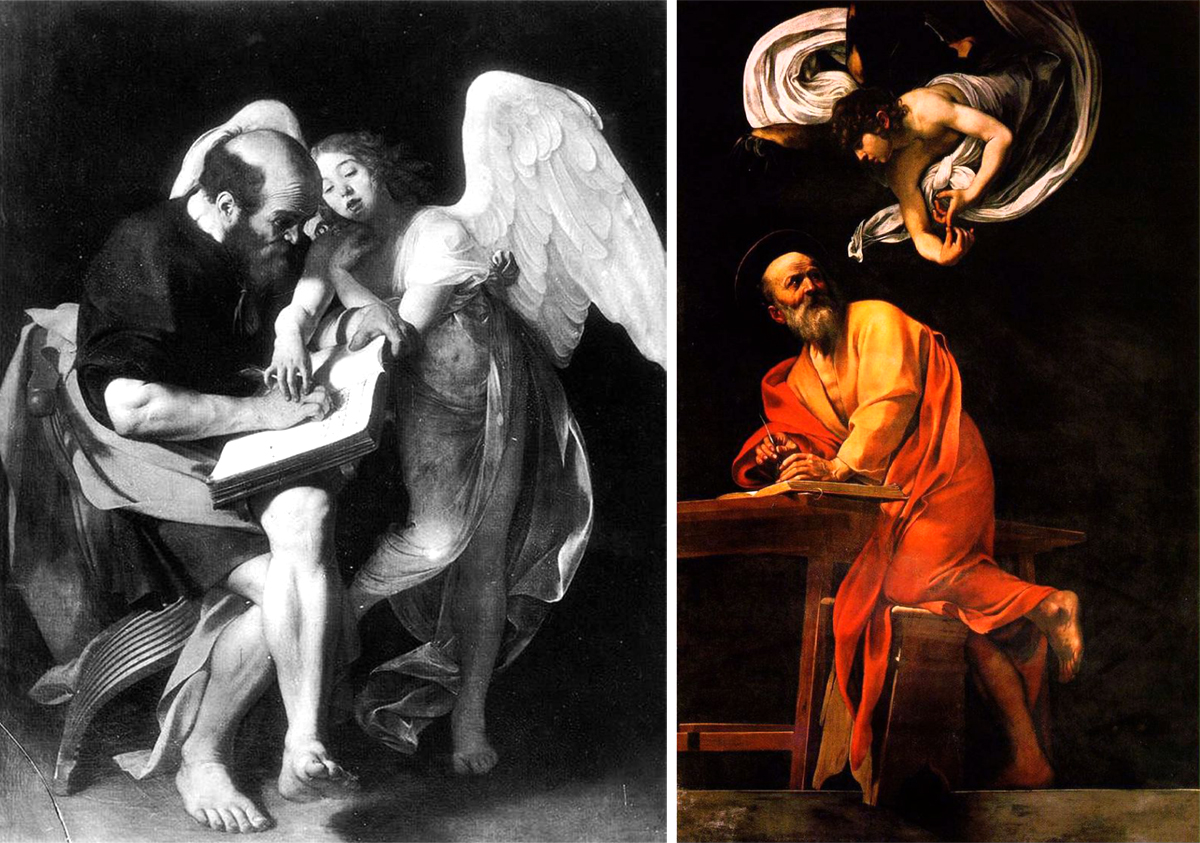
卡拉瓦乔后来画了《圣马太和天使》,但该画的第一个版本因过于现实主义而被拒绝。
马太的形象是一个几乎不识字的平民,天使必须用手帮助他写字。 这幅作品在第二次世界大战期间在柏林丢失,仅存有照片副本。
然而,在这幅画的第二个版本中,马太总是在天使提供建议的情况下撰写福音书。
{ +1 in comments }
"For most gulls, it is not flying that matters, but eating. For this gull, though, it was not eating that mattered, but flight."
.:: Richard Bach ::.
♪ ♫ Nel blu, dipinto di blu by Domenico Modugno ♫ ♪
Texture with thanks to Skeletal Mess
View Large On Black, and thank you all so much for your visits, comments, faves and invites. Very much appreciated! ♥
- - - - - - - - - - - - - - - - - - - - - - - - - - - - - - - - - - - - - - - - - - - - - - - - - - - - - - - - - - - - - - - - - - - -
Copyright © Kia & Zeno. All rights reserved.
No usage allowed in any form without our written explicit permission.
- - - - - - - - - - - - - - - - - - - - - - - - - - - - - - - - - - - - - - - - - - - - - - - - - - - - - - - - - - - - - - - - - - - -
Un paseo por el Tiber, puede convertirse, por obra y magia de Maxim de Winter en un cuadro delicioso...como toda su galería maravillosa, que os recomiendo disfrutar...
GRACIAS por darme tu textura, maestro!
EXPLORE, April 5th 2010
On the side of the river, laying down on the ground and admiring the beauty of this naturally composed painting. while the tepid breeze was coming straight from the sky
Su una sponda del fiume, sdraiato ad ammirare la bellezza di questo dipinto compostosi naturalmente, mentre la tiepida brezza veniva direttamente dal cielo
La cattedrale di Massa Marittima (Grosseto, Toscana) è dedicata a San Cerbone, vescovo di Populonia dal 570 al 573 d.C. e Patrono della medesima città. L'edificazione del tempio risale al secolo XI ma, come la maggioranza delle cattedrali antiche, ha subito vari rimaneggiamenti e ristrutturazioni radicali. Essa è costituita da due stili principali: il Romanico nel primo periodo di edificazione e il Gotico, stile con il quale Giovanni Pisano eseguì l'ampliamento nel 1287.
Presso la porta d'ingresso e situata nella navata destra - murata in una nicchia - si trova un sarcofago romano dell'epoca dei Severi (III secolo d.C.)sormontato da un affresco della fine del secolo XIII raffigurante la Madonna con il Bambino e ai lati San Francesco e Santa Caterina d'Alessandria.
Nella navata sinistra in un angolo si trova il fonte battesimale opera di Giroldo da Como del 1267.
Nella cappella minore della navata destra si conserva un preziosissimo dipinto con la Madonna delle Grazie opera di Duccio di Buoninsegna mentre nella parete si ammira una croce di legno opera di Segna di Bonaventura.
Descrivere tutte le bellezze artistiche di questo Duomo è difficile; basti ricordare che Massa Marittima fu nel medioevo una fiorente repubblica e alleata con Siena, per questo invito chi avrà la possibilità di visitare l'Italia di venire in questa piccola città toscana ma ricca di storia e di palazzi e chiese medievali.
The Cathedral of Massa Marittima (Grosseto, Tuscany) is dedicated to San Cerbone, bishop of Populonia from 570 to 573 AD. and Patron of the same city. The construction of the temple dates back to the 11th century but, like most of the ancient cathedrals, it has undergone various radical alterations and renovations. It consists of two main styles: the Romanesque in the first period of construction and the Gothic, style with which Giovanni Pisano carried out the expansion in 1287.
At the entrance door and located in the right aisle - walled up in a niche - there is a Roman sarcophagus from the Severan era (3rd century AD) surmounted by a fresco from the end of the 13th century depicting the Madonna with Child and on the sides San Francesco and Santa Caterina d'Alessandria.
In the left aisle in a corner there is the baptismal font by Giroldo da Como from 1267.
In the minor chapel of the right aisle there is a very precious painting with the Madonna delle Grazie by Duccio di Buoninsegna while on the wall you can admire a wooden cross by Segna di Bonaventura.
It is difficult to describe all the artistic beauties of this Cathedral; it is enough to remember that Massa Marittima was in the Middle Ages a flourishing republic and allied with Siena, for this I invite those who will have the opportunity to visit Italy to come to this small Tuscan city but rich in history and medieval palaces and churches.
© Riccardo Senis, All Rights Reserved
This image may not be copied, reproduced, republished, edited, downloaded, displayed, modified, transmitted, licensed, transferred, sold, distributed or uploaded in any way without my prior written permission.
.……………………………….
- “Do not touch me…”
Gospel of John, chapter 20, verse 17 (John 20, 17)
+++++++++++++++++++++
I was with you, Father,
at the moment of creation.
I could not fail to know the elements and master them.
What would it be to
lift the stone of a tomb
compared to your will as Creator?
You taught me how the world is composed
and made me your son,
but I was a participant
in creation.
The followers who followed me
believed in You and in me,
Your son.
They will be happy to see me rise again,
but I will weep
for those still chained
in hell,
and my hands
will silence their strident cries.
Poor souls,
who migrate toward nothingness.
The fear,
God,
of these blind depths,
of these people who have not had
the splendor of your reins.
Because you do not know,
Father,
what it means
to sit at Your right hand
as a king.
A gentle but not cowardly king
who mediates
between your divine wrath
and the lust and unbelief of man.
I,
who am just,
love man
and ask your forgiveness
through this slow agony
that has lasted for centuries
for the world.
Behold, Lord, I give you back my spirit
in the form of a white dove
that will fly toward heaven.
And no other way
have you built peace
than with the groins of a bird
that brings the olive branch to your lips.
Father,
I will rise again,
and I will sit at your right hand.
POEM OF THE CROSS - Alda Merini
+++++++++++++++++++++++++++++++++++++
- “Noli me tangere …”
Vangelo di Giovanni, capitolo 20, versetto 17 (Giovanni 20, 17)
++++++++++++++++++
- Ero con te, Padre,
al momento della creazione.
Non potevo non conoscere gli elementi e dominarli.
Cosa vuoi che sia
sollevare la pietra di un sepolcro
in confronto alla tua volontà di Creatore.
Tu mi hai insegnato come è composto il mondo
e mi hai reso figlio,
ma ero partecipe
della creazione.
I seguaci che mi hanno seguito
hanno creduto in Te e in me,
Tuo figlio.
Saranno felici di vedermi risorgere,
ma io piangerò
per quelli che sono ancora incatenati
nell'inferno
e le mie mani
faranno tacere i loro stridori.
Povere anime,
che migrano verso il nulla.
Lo spavento,
Dio,
di queste profondità cieche,
di questa gente che non ha avuto
lo splendore delle tue redini.
Perché tu non sai,
Padre,
cosa vuol dire
sedere alla Tua destra
in veste di re.
Un re mite ma non codardo
che fa da intermediario
tra la tua collera divina
e la lussuria e la miscredenza dell'uomo.
Io,
che sono giusto,
amo l'uomo
e ti chiedo perdono
attraverso questa lenta agonia
che dura da secoli
per il mondo.
Ecco, Signore, io ti rendo il mio spirito
in forma di bianca colomba
che volerà verso il cielo.
E non altrimenti
Tu hai costruito la pace
se non con gli inguini di un uccello
che porta l'ulivo alle tue labbra.
Padre,
io risorgerò,
e siederò alla Tua destra.
POEMA DELLA CROCE - Alda Merini
-----------------------------------------------------------------
click to activate the icon of slideshow: the small triangle inscribed in the small rectangle, at the top right, in the photostream;
or…. Press the “L” button to zoom in the image;
clicca sulla piccola icona per attivare lo slideshow: sulla facciata principale del photostream, in alto a destra c'è un piccolo rettangolo (rappresenta il monitor) con dentro un piccolo triangolo nero;
oppure…. premi il tasto “L” per ingrandire l'immagine;
www.worldphoto.org/sony-world-photography-awards/winners-...
www.fotografidigitali.it/gallery/2726/opere-italiane-segn...
…………………………………………………………………
This photographic story, with text, which I propose as my last work for Flickr in 2025 (2026 is now just a few minutes away), tells of the procession of the Holy Crucifix of Aracoeli, which took place in March of this year 2025 in the town of San Marco d'Alunzio (in the province of Messina). The procession normally begins on the morning of the last Friday of March each year, but there is an exception to this rule: when it coincides with Good Friday, then the procession is brought forward to the previous Friday. The procession of the Holy Crucifix of Aracoeli is an ancient penitential rite. On the feast day of the Crucifix, Holy Mass is celebrated in the Church of Aracoeli in San Marco d'Alunzio. On this occasion, the Holy Crucifix is celebrated. Crucifix (which is located in the church at the end of the right nave, at its feet is the painting of the Virgin of Sorrows pierced by seven swords), Christ on the Cross is removed by the devotees from the hook on which it is hanging, is carried outside the church, here it is raised and fixed on the float, the sermon of the priest who has climbed onto the float next to the Crucifix takes over, under the Cross is fixed the painting of His Sorrowful Mother, then they are carried in procession by the men (and women) in blue hoods called "babbaluti", they proceed invoking the pity and mercy of the Lord with a constant and rhythmic lament, saying "Signuri, Misericordia, Pietà!"; this is the norm, but this year the bad weather has brought some changes, the float on which they hoisted the SS. The crucifix with the kneeling babbaluti was not located in the churchyard, but inside the church. Christ was covered with a large sheet of cellophane to protect it from the rain, while the painting of the Madonna with swords in her heart was placed at her Son's feet only after the procession returned to the church. San Marco d'Alunzio is a charming town in the Messina area, located in the Nebrodi Mountains of Sicily. The procession takes place in honor of the Holy Crucifix of Araceli. This religious-penitential event is also known as the "procession of the babbaluti." These are those who, by vow or grace received, have chosen to carry the fercolo containing the crucifix and the painting on their shoulders in procession. they head to the nearby Church of Santa Maria dei Poveri or to some private home nearby where, sheltered from the curiosity of the faithful, they wear a simple but characteristic indigo-colored cloth habit, consisting of a tunic and a conical hood that covers the entire body and leaves only the eyes and hands free. It is not uncommon, however, for the penitents, rendered anonymous by the habit they wear, to also include women, who, to avoid any possibility of recognition, wear a pair of gloves; The babbaluti are 33 in number to commemorate the 33 years of Christ. The number is odd, in fact the 33rd babbaluto does not carry the vara. He (should be the “capo vara”) proceeds backwards, looking towards Christ and his Mother, and at the same time checks that everything is in order among the babbaluti, guiding the vara along the path, even if it is moving backwards (this is a way of proceeding in carrying the vara or fercolo, present in various Sicilian religious processions). So, the 32 (+1) "babbaluti" carry on their shoulders the float that bears the Holy Crucifix of the Araceli church (the statue of Christ was created by Scipione Li Volsi, in the year 1652, he was a sculptor and plasterer of the Sicilian Baroque), at whose feet, on the float, is tied the painting of Our Lady of Sorrows, whose chest appears pierced by seven swords (it is an 18th century painting), however, as already described, this year the painting, to protect it from the rain, was placed on the float only upon the return of the procession to the church. Before the procession begins, the babbaluti advance barefoot, wearing only heavy, hand-knitted stockings of raw wool. Before entering the church, they must walk a path of purification. When they approach the ancient church of Araceli, they bow and kiss the ground, thus receiving permission to enter the church. This, however, occurs through a side door, called the "false door" (in Sicilian dialect, "porta fausa"). Having entered the church from the side, they now exit through the main entrance, allowing them to take their places, kneeling in front and behind the float. To enter the "porta fausa," the babbaluti proceed in pairs, with the last babbaluti, the eldest, proceeding alone. After the priest's long-awaited speech, the procession can begin, winding through the streets of the picturesque and welcoming village of San Marco d'Alunzio. Along the way, the Babbaluti pace their steps, accompanying the mournful and plaintive jugular vein that invokes the Lord. Devout men and women walk alongside the Babbaluti, walking alongside the float, touching it, sometimes caressing it... just to have physical (and spiritual) contact with it. Finally, after completing a specific route, the procession returns to the ancient church (of Norman origins) of Aracoeli. Every time I attend this touching event, I am completely overwhelmed by emotion (which, however, I cannot abandon, lest I lose concentration while taking photos). The highlight is when the crucified Christ is removed from the hook fixed to the wall by expert men, and then carried (it seems to float) above the heads of the devotees, supported aloft with their hands, and hoisted and secured to the float. In these moments of intense emotion, it is common to see in the eyes of the devotees, shining with tears, that profound emotion of their relationship with this Christ, which has lasted forever: it is as if they were in the presence of the true Christ, in flesh and blood. This is the atmosphere experienced in those moments, this is the magic of the procession of the Most Holy Crucifix and His Mother, represented by the painting of Our Lady of Sorrows pierced by seven swords (an iconography of Spanish origin).
+++++++++++++++++++++++++++++++++++++++++
Il presente racconto fotografico, con testo, che propongo come ultimo mio lavoro per Flickr dell’anno 2025 (oramai mancano pochi minuti al 2026) parla della processione del Santissimo Crocifisso di Aracoeli che si è tenuto nel marzo di quest’anno 2025 nel paese di San Marco d’Alunzio (in provincia di Messina). La processione normalmente inizia la mattina dell’ultimo venerdì del mese di marzo di ogni anno, c’è però una eccezione a questa regola, quando si realizza la coincidenza col Venerdì Santo, allora la processione viene anticipata al venerdì precedente. Quella del SS.Crocifisso di Aracoeli è un antico rito penitenziale, il giorno della festa del Crocifisso, a San Marco d'Alunzio si celebra la S. Messa nella Chiesa dell'Aracoeli, in questa occasione il SS. Crocifisso (che si trova nella chiesa in fondo alla navata di destra, ai suoi piedi è posto il quadro della Vergine Addolorata trafitta da sette spade), il Cristo sulla Croce viene tolto dai devoti dal gancio sul quale è appeso, viene portato all’esterno della chiesa, qui viene innalzato e fissato sulla vara, subentra il sermone del sacerdote salito sulla vara accanto al Crocifisso, sotto alla Croce viene fissato il quadro di sua Madre Addolorata, quindi vengono portati in processione dagli uomini (e donne) incappucciati di colore blu detti “babbaluti”, essi procedono invocando la pietà e la misericordia del Signore con un costante e ritmato lamento, dicendo “Signuri, Misericordia, Pietà!”; questa è la norma, ma quest’anno il cattivo tempo ha portato qualche cambiamento, la vara sulla quale hanno issato il SS. Crocifisso con i babbaluti messi in ginocchio, non si trovava sul sagrato davanti la chiesa, ma era dentro la chiesa, il Cristo veniva ricoperto con un ampio foglio di cellophane per proteggerlo dalla pioggia, mentre il quadro della Madonna con le spade nel cuore, è stato messo ai piedi di Suo Figlio solo al rientro della processione nella chiesa. San Marco d’Alunzio è un ameno paese del territorio Messinese, sito sui monti Nebrodi, in Sicilia; la processione si svolge proprio in onore del Santissimo Crocifisso di Araceli, è questa una ricorrenza religioso-penitenziale conosciuta anche come "processione dei babbaluti", essi sono coloro che per voto o per grazia ricevuta, hanno deciso di portare in processione sulle loro spalle il fercolo con il Crocifisso ed il quadro; essi si dirigono nella vicina Chiesa di Santa Maria dei Poveri o in qualche abitazione privata lì vicino dove, al riparo dalla curiosità dei fedeli, indossano un semplice ma caratteristico saio di tela di colore indaco, costituito da una tunica e un cappuccio di forma conica tale da coprire l'intero corpo e lasciare liberi solo gli occhi e le mani, non è raro purtuttavia che tra i penitenti, resi anonimi dal saio che indossano, vi siano anche delle donne, le quali per evitare qualsiasi possibilità di riconoscimento, indossano un paio di guanti; i babbaluti sono in numero di 33 per rievocare i 33 anni di Cristo, il numero è dispari, infatti il 33° babbaluto non porta la vara, egli (dovrebbe essere il “capo vara”) procede all’indietro, rivolgendo lo sguardo al Cristo ed a sua Madre, e nel contempo controlla che tutto sia in ordine tra i babbaluti, guidando la vara lungo il percorso, anche se il suo andamento è a ritroso, (questo è un modo di procedere nel portare la vara o fercolo, presente in diverse processioni religiose siciliane). Quindi, i 32 (+1) "babbaluti" portano sulle loro spalle la vara che reca il Santo Crocifisso della chiesa dell’Araceli (la statua del Cristo è stata creata da Scipione Li Volsi, nell'anno 1652, egli fu uno scultore e stuccatore del barocco SIciliano), ai cui piedi, sulla vara, viene legato il quadro della Madonna Addolorata, il cui petto appare trafitto da sette spade ( è un dipinto del XVIII secolo), purtuttavia come già descritto, quest’anno il quadro, per proteggerlo dalla pioggia, è stato messo sulla vara solo al rientro della processione in chiesa. I babbaluti prima dell'inizio della processione avanzano a piedi scalzi indossando solo delle pesanti calze di lana grezza realizzate a mano, devono percorrere, prima di entrare in chiesa, un cammino di purificazione: quando essi giungono in prossimità dell'antica chiesa dell'Araceli, essi si chinano e baciano in terra, ricevendo in tal modo il permesso per poter accedere dentro la chiesa, questo però avviene da una porta laterale, chiamata "falsa porta" (In dialetto siciliano “porta fausa”), una volta entrati in chiesa lateralmente, ora fuoriescono dall'ingresso principale, potendo così prendere posto, inginocchiandosi sul davanti ed alle spalle, della vara; i babbaluti per accedere alla “porta fausa” procedono in coppia, l’ultimo babbaluto procede da solo, lui è il più anziano tra i babbaluti; seguirà l'atteso discorso del sacerdote, terminato, potrà iniziare la processione che si svolge per le vie del pittoresco ed accogliente paese di San Marco d'Alunzio. Lungo il percorso i Babbaluti cadenzano la propria andatura accompagnandosi alla mesta e lamentosa giugulatoria che invoca il Signore . Ci sono uomini e donne devoti che procedono assieme ai babbaluti camminando a lato della vara, toccandola, ora accarezzandola...pur di avere un contatto fisico (e di rimando spirituale) con essa. Infine, dopo aver compiuto un preciso percorso, la processione fa rientro nell'antica chiesa (di origini Normanne) dell'Aracoeli. Ogniqualvolta sono presente a questa toccante ricorrenza sono completamente inondato da emozioni (alle quali però non posso abbandonarmi, perderei la concentrazione nel realizzare le foto), il momento clou è quando il Cristo Crocifisso viene tolto dal gancio fissato sul muro da uomini esperti, per poi essere portato (sembra galleggiare) sopra la testa dei devoti, sostenuto in alto con le mani, ed essere issato e fissato sulla vara; in questi momenti di intensa emozione è comune vedere negli occhi dei devoti, lucidi di lacrime, quella emozione profonda del loro rapporto con questo Cristo, che dura da sempre: è come se si trovassero al cospetto del Cristo vero, in carne ed ossa, questa è l’atmosfera che si vive in quei momenti, questa è la magia della processione del SS. Crocifisso e di Sua Madre, rappresentata dal quadro dell’Addolorata trafitta da sette spade (iconografia di origine spagnola).
++++++++++++++++++++++++++++++++++++++++
Sebbene oggigiorno siano una rarità, un tempo gli orologi solari tracciati sulle pareti esterne degli edifici esposte a sud erano comuni (o quadrante rivolto a nord nell'emisfero sud), poiché visibili a distanza ed economici da realizzare. Il quadrante era semplicemente dipinto sul muro oppure ricavato su una lastra di marmo o pietra. Lo gnomone era uno stilo di ferro o di ottone, oppure un tripode di metallo, per maggiore robustezza.
Principale svantaggio di questi strumenti è che sono in grado di mostrare l'ora solamente per il periodo dell'anno e del giorno in cui il muro è direttamente illuminato dal sole.
L'inclinazione dello gnomone è uguale alla latitudine.
Tradizionalmente si usava collocare quattro orologi sul tetto o sulle pareti perimetrali di una torre, in modo da avere l'indicazione per tutto l'anno. È abitudine incidere sul quadrante un motto.
_____
Although they are a rarity nowadays, sundials traced on the exterior walls of south-facing buildings were once common (or north-facing dial in the southern hemisphere), as they were visible from a distance and cheap to make. The dial was simply painted on the wall or carved from a marble or stone slab. The gnomon was an iron or brass stylus, or a metal tripod, for greater strength.
The main disadvantage of these tools is that they are able to show the time only for the time of year and day when the wall is directly illuminated by the sun.
The inclination of the gnomon is equal to the latitude.
Traditionally it was used to place four clocks on the roof or on the perimeter walls of a tower, in order to have an indication for the whole year. It is customary to engrave a motto on the dial.
.……………………………….
- “Do not touch me…”
Gospel of John, chapter 20, verse 17 (John 20, 17)
+++++++++++++++++++++
I was with you, Father,
at the moment of creation.
I could not fail to know the elements and master them.
What would it be to
lift the stone of a tomb
compared to your will as Creator?
You taught me how the world is composed
and made me your son,
but I was a participant
in creation.
The followers who followed me
believed in You and in me,
Your son.
They will be happy to see me rise again,
but I will weep
for those still chained
in hell,
and my hands
will silence their strident cries.
Poor souls,
who migrate toward nothingness.
The fear,
God,
of these blind depths,
of these people who have not had
the splendor of your reins.
Because you do not know,
Father,
what it means
to sit at Your right hand
as a king.
A gentle but not cowardly king
who mediates
between your divine wrath
and the lust and unbelief of man.
I,
who am just,
love man
and ask your forgiveness
through this slow agony
that has lasted for centuries
for the world.
Behold, Lord, I give you back my spirit
in the form of a white dove
that will fly toward heaven.
And no other way
have you built peace
than with the groins of a bird
that brings the olive branch to your lips.
Father,
I will rise again,
and I will sit at your right hand.
POEM OF THE CROSS - Alda Merini
+++++++++++++++++++++++++++++++++++++
- “Noli me tangere …”
Vangelo di Giovanni, capitolo 20, versetto 17 (Giovanni 20, 17)
++++++++++++++++++
- Ero con te, Padre,
al momento della creazione.
Non potevo non conoscere gli elementi e dominarli.
Cosa vuoi che sia
sollevare la pietra di un sepolcro
in confronto alla tua volontà di Creatore.
Tu mi hai insegnato come è composto il mondo
e mi hai reso figlio,
ma ero partecipe
della creazione.
I seguaci che mi hanno seguito
hanno creduto in Te e in me,
Tuo figlio.
Saranno felici di vedermi risorgere,
ma io piangerò
per quelli che sono ancora incatenati
nell'inferno
e le mie mani
faranno tacere i loro stridori.
Povere anime,
che migrano verso il nulla.
Lo spavento,
Dio,
di queste profondità cieche,
di questa gente che non ha avuto
lo splendore delle tue redini.
Perché tu non sai,
Padre,
cosa vuol dire
sedere alla Tua destra
in veste di re.
Un re mite ma non codardo
che fa da intermediario
tra la tua collera divina
e la lussuria e la miscredenza dell'uomo.
Io,
che sono giusto,
amo l'uomo
e ti chiedo perdono
attraverso questa lenta agonia
che dura da secoli
per il mondo.
Ecco, Signore, io ti rendo il mio spirito
in forma di bianca colomba
che volerà verso il cielo.
E non altrimenti
Tu hai costruito la pace
se non con gli inguini di un uccello
che porta l'ulivo alle tue labbra.
Padre,
io risorgerò,
e siederò alla Tua destra.
POEMA DELLA CROCE - Alda Merini
-----------------------------------------------------------------
click to activate the icon of slideshow: the small triangle inscribed in the small rectangle, at the top right, in the photostream;
or…. Press the “L” button to zoom in the image;
clicca sulla piccola icona per attivare lo slideshow: sulla facciata principale del photostream, in alto a destra c'è un piccolo rettangolo (rappresenta il monitor) con dentro un piccolo triangolo nero;
oppure…. premi il tasto “L” per ingrandire l'immagine;
www.worldphoto.org/sony-world-photography-awards/winners-...
www.fotografidigitali.it/gallery/2726/opere-italiane-segn...
…………………………………………………………………
This photographic story, with text, which I propose as my last work for Flickr in 2025 (2026 is now just a few minutes away), tells of the procession of the Holy Crucifix of Aracoeli, which took place in March of this year 2025 in the town of San Marco d'Alunzio (in the province of Messina). The procession normally begins on the morning of the last Friday of March each year, but there is an exception to this rule: when it coincides with Good Friday, then the procession is brought forward to the previous Friday. The procession of the Holy Crucifix of Aracoeli is an ancient penitential rite. On the feast day of the Crucifix, Holy Mass is celebrated in the Church of Aracoeli in San Marco d'Alunzio. On this occasion, the Holy Crucifix is celebrated. Crucifix (which is located in the church at the end of the right nave, at its feet is the painting of the Virgin of Sorrows pierced by seven swords), Christ on the Cross is removed by the devotees from the hook on which it is hanging, is carried outside the church, here it is raised and fixed on the float, the sermon of the priest who has climbed onto the float next to the Crucifix takes over, under the Cross is fixed the painting of His Sorrowful Mother, then they are carried in procession by the men (and women) in blue hoods called "babbaluti", they proceed invoking the pity and mercy of the Lord with a constant and rhythmic lament, saying "Signuri, Misericordia, Pietà!"; this is the norm, but this year the bad weather has brought some changes, the float on which they hoisted the SS. The crucifix with the kneeling babbaluti was not located in the churchyard, but inside the church. Christ was covered with a large sheet of cellophane to protect it from the rain, while the painting of the Madonna with swords in her heart was placed at her Son's feet only after the procession returned to the church. San Marco d'Alunzio is a charming town in the Messina area, located in the Nebrodi Mountains of Sicily. The procession takes place in honor of the Holy Crucifix of Araceli. This religious-penitential event is also known as the "procession of the babbaluti." These are those who, by vow or grace received, have chosen to carry the fercolo containing the crucifix and the painting on their shoulders in procession. they head to the nearby Church of Santa Maria dei Poveri or to some private home nearby where, sheltered from the curiosity of the faithful, they wear a simple but characteristic indigo-colored cloth habit, consisting of a tunic and a conical hood that covers the entire body and leaves only the eyes and hands free. It is not uncommon, however, for the penitents, rendered anonymous by the habit they wear, to also include women, who, to avoid any possibility of recognition, wear a pair of gloves; The babbaluti are 33 in number to commemorate the 33 years of Christ. The number is odd, in fact the 33rd babbaluto does not carry the vara. He (should be the “capo vara”) proceeds backwards, looking towards Christ and his Mother, and at the same time checks that everything is in order among the babbaluti, guiding the vara along the path, even if it is moving backwards (this is a way of proceeding in carrying the vara or fercolo, present in various Sicilian religious processions). So, the 32 (+1) "babbaluti" carry on their shoulders the float that bears the Holy Crucifix of the Araceli church (the statue of Christ was created by Scipione Li Volsi, in the year 1652, he was a sculptor and plasterer of the Sicilian Baroque), at whose feet, on the float, is tied the painting of Our Lady of Sorrows, whose chest appears pierced by seven swords (it is an 18th century painting), however, as already described, this year the painting, to protect it from the rain, was placed on the float only upon the return of the procession to the church. Before the procession begins, the babbaluti advance barefoot, wearing only heavy, hand-knitted stockings of raw wool. Before entering the church, they must walk a path of purification. When they approach the ancient church of Araceli, they bow and kiss the ground, thus receiving permission to enter the church. This, however, occurs through a side door, called the "false door" (in Sicilian dialect, "porta fausa"). Having entered the church from the side, they now exit through the main entrance, allowing them to take their places, kneeling in front and behind the float. To enter the "porta fausa," the babbaluti proceed in pairs, with the last babbaluti, the eldest, proceeding alone. After the priest's long-awaited speech, the procession can begin, winding through the streets of the picturesque and welcoming village of San Marco d'Alunzio. Along the way, the Babbaluti pace their steps, accompanying the mournful and plaintive jugular vein that invokes the Lord. Devout men and women walk alongside the Babbaluti, walking alongside the float, touching it, sometimes caressing it... just to have physical (and spiritual) contact with it. Finally, after completing a specific route, the procession returns to the ancient church (of Norman origins) of Aracoeli. Every time I attend this touching event, I am completely overwhelmed by emotion (which, however, I cannot abandon, lest I lose concentration while taking photos). The highlight is when the crucified Christ is removed from the hook fixed to the wall by expert men, and then carried (it seems to float) above the heads of the devotees, supported aloft with their hands, and hoisted and secured to the float. In these moments of intense emotion, it is common to see in the eyes of the devotees, shining with tears, that profound emotion of their relationship with this Christ, which has lasted forever: it is as if they were in the presence of the true Christ, in flesh and blood. This is the atmosphere experienced in those moments, this is the magic of the procession of the Most Holy Crucifix and His Mother, represented by the painting of Our Lady of Sorrows pierced by seven swords (an iconography of Spanish origin).
+++++++++++++++++++++++++++++++++++++++++
Il presente racconto fotografico, con testo, che propongo come ultimo mio lavoro per Flickr dell’anno 2025 (oramai mancano pochi minuti al 2026) parla della processione del Santissimo Crocifisso di Aracoeli che si è tenuto nel marzo di quest’anno 2025 nel paese di San Marco d’Alunzio (in provincia di Messina). La processione normalmente inizia la mattina dell’ultimo venerdì del mese di marzo di ogni anno, c’è però una eccezione a questa regola, quando si realizza la coincidenza col Venerdì Santo, allora la processione viene anticipata al venerdì precedente. Quella del SS.Crocifisso di Aracoeli è un antico rito penitenziale, il giorno della festa del Crocifisso, a San Marco d'Alunzio si celebra la S. Messa nella Chiesa dell'Aracoeli, in questa occasione il SS. Crocifisso (che si trova nella chiesa in fondo alla navata di destra, ai suoi piedi è posto il quadro della Vergine Addolorata trafitta da sette spade), il Cristo sulla Croce viene tolto dai devoti dal gancio sul quale è appeso, viene portato all’esterno della chiesa, qui viene innalzato e fissato sulla vara, subentra il sermone del sacerdote salito sulla vara accanto al Crocifisso, sotto alla Croce viene fissato il quadro di sua Madre Addolorata, quindi vengono portati in processione dagli uomini (e donne) incappucciati di colore blu detti “babbaluti”, essi procedono invocando la pietà e la misericordia del Signore con un costante e ritmato lamento, dicendo “Signuri, Misericordia, Pietà!”; questa è la norma, ma quest’anno il cattivo tempo ha portato qualche cambiamento, la vara sulla quale hanno issato il SS. Crocifisso con i babbaluti messi in ginocchio, non si trovava sul sagrato davanti la chiesa, ma era dentro la chiesa, il Cristo veniva ricoperto con un ampio foglio di cellophane per proteggerlo dalla pioggia, mentre il quadro della Madonna con le spade nel cuore, è stato messo ai piedi di Suo Figlio solo al rientro della processione nella chiesa. San Marco d’Alunzio è un ameno paese del territorio Messinese, sito sui monti Nebrodi, in Sicilia; la processione si svolge proprio in onore del Santissimo Crocifisso di Araceli, è questa una ricorrenza religioso-penitenziale conosciuta anche come "processione dei babbaluti", essi sono coloro che per voto o per grazia ricevuta, hanno deciso di portare in processione sulle loro spalle il fercolo con il Crocifisso ed il quadro; essi si dirigono nella vicina Chiesa di Santa Maria dei Poveri o in qualche abitazione privata lì vicino dove, al riparo dalla curiosità dei fedeli, indossano un semplice ma caratteristico saio di tela di colore indaco, costituito da una tunica e un cappuccio di forma conica tale da coprire l'intero corpo e lasciare liberi solo gli occhi e le mani, non è raro purtuttavia che tra i penitenti, resi anonimi dal saio che indossano, vi siano anche delle donne, le quali per evitare qualsiasi possibilità di riconoscimento, indossano un paio di guanti; i babbaluti sono in numero di 33 per rievocare i 33 anni di Cristo, il numero è dispari, infatti il 33° babbaluto non porta la vara, egli (dovrebbe essere il “capo vara”) procede all’indietro, rivolgendo lo sguardo al Cristo ed a sua Madre, e nel contempo controlla che tutto sia in ordine tra i babbaluti, guidando la vara lungo il percorso, anche se il suo andamento è a ritroso, (questo è un modo di procedere nel portare la vara o fercolo, presente in diverse processioni religiose siciliane). Quindi, i 32 (+1) "babbaluti" portano sulle loro spalle la vara che reca il Santo Crocifisso della chiesa dell’Araceli (la statua del Cristo è stata creata da Scipione Li Volsi, nell'anno 1652, egli fu uno scultore e stuccatore del barocco SIciliano), ai cui piedi, sulla vara, viene legato il quadro della Madonna Addolorata, il cui petto appare trafitto da sette spade ( è un dipinto del XVIII secolo), purtuttavia come già descritto, quest’anno il quadro, per proteggerlo dalla pioggia, è stato messo sulla vara solo al rientro della processione in chiesa. I babbaluti prima dell'inizio della processione avanzano a piedi scalzi indossando solo delle pesanti calze di lana grezza realizzate a mano, devono percorrere, prima di entrare in chiesa, un cammino di purificazione: quando essi giungono in prossimità dell'antica chiesa dell'Araceli, essi si chinano e baciano in terra, ricevendo in tal modo il permesso per poter accedere dentro la chiesa, questo però avviene da una porta laterale, chiamata "falsa porta" (In dialetto siciliano “porta fausa”), una volta entrati in chiesa lateralmente, ora fuoriescono dall'ingresso principale, potendo così prendere posto, inginocchiandosi sul davanti ed alle spalle, della vara; i babbaluti per accedere alla “porta fausa” procedono in coppia, l’ultimo babbaluto procede da solo, lui è il più anziano tra i babbaluti; seguirà l'atteso discorso del sacerdote, terminato, potrà iniziare la processione che si svolge per le vie del pittoresco ed accogliente paese di San Marco d'Alunzio. Lungo il percorso i Babbaluti cadenzano la propria andatura accompagnandosi alla mesta e lamentosa giugulatoria che invoca il Signore . Ci sono uomini e donne devoti che procedono assieme ai babbaluti camminando a lato della vara, toccandola, ora accarezzandola...pur di avere un contatto fisico (e di rimando spirituale) con essa. Infine, dopo aver compiuto un preciso percorso, la processione fa rientro nell'antica chiesa (di origini Normanne) dell'Aracoeli. Ogniqualvolta sono presente a questa toccante ricorrenza sono completamente inondato da emozioni (alle quali però non posso abbandonarmi, perderei la concentrazione nel realizzare le foto), il momento clou è quando il Cristo Crocifisso viene tolto dal gancio fissato sul muro da uomini esperti, per poi essere portato (sembra galleggiare) sopra la testa dei devoti, sostenuto in alto con le mani, ed essere issato e fissato sulla vara; in questi momenti di intensa emozione è comune vedere negli occhi dei devoti, lucidi di lacrime, quella emozione profonda del loro rapporto con questo Cristo, che dura da sempre: è come se si trovassero al cospetto del Cristo vero, in carne ed ossa, questa è l’atmosfera che si vive in quei momenti, questa è la magia della processione del SS. Crocifisso e di Sua Madre, rappresentata dal quadro dell’Addolorata trafitta da sette spade (iconografia di origine spagnola).
++++++++++++++++++++++++++++++++++++++++
Simulazione con il sipario dipinto da Napoleone Angiolini (1853-54) andato distrutto nell'incendio del 1931.
---
Simulation of the curtain painted by Napoleone Angiolini (1853-54) was destroyed in the fire of 1931.
El "Felimare Picta", quizás sea el nudi que alcanza mayor tamaño en nuestro Mediterráneo.
Fotografiada en Cala Palmera, Alicante (España). No utilice esta imagen en sitios web, blogs u otros medios de comunicación sin el permiso explícito de @2023 José Salmerón -todos los derechos reservados.
The "Felimare Picta", perhaps the largest nudi in the Mediterranean Sea.
Photographed in Cove Palmera, Alicante (Spain). Do not use this image on websites, blogs or other media without explicit permission ©2023 José Salmerón - all rights reserved.
Genova, palazzo della Regione, piazza De Ferrari , sotto una pioggerella d'aprile
L'hai vista, obliqua,sull'acqua,
col suo gaio mezzaro,
Genova la bella,
il volto dipinto, gli occhi scintillanti....
( Alfred de Musset )
Have you seen her, , slanting on the water,
with her merry mezzaro ,
Genoa the beautiful,
the coloured face, the gleaming eye....
ps The mezzaro is a big square of handprinted fabric, made of cotton . It is always printed with rich patterns that represent trees and flowers The name comes from the antic Arabic word ' mizar', that means covered, hidden
e allora l'ho dipinto di rosso ;-)
Siamo all'interno del MuCEM di Marsiglia.
Gli amanti degli originali trovano qui sotto la foto solo leggermente vignettata.
------------------------
Sorry, to me is very difficult to visit people that always only leave a fav without commenting...
Do not use any of my images on websites, blogs or other media without my explicit written permission.
All rights reserved - Copyright © fotomie2009 - Nora Caracci
Con questa immagine inizio una nuova serie di lavori ispirati a dipinti e sculture famose e non.
ISPIRATO AL DIPINTO DI C.D. FRIEDRICH DEL 1818 "DONNA AL TRAMONTO DEL SOLE"
With this image I start a new series of works inspired by famous paintings and sculptures and not.
INSPIRED TO 1818 C.D FRIEDRICH'S PAINT "WOMAN AT THE SUNSET"
Follow me on Facebook: www.facebook.com/itsandreaperego/
YouTube: www.youtube.com/@MrPeregus
And Instagram: www.instagram.com/andreaperego_scrittore/