View allAll Photos Tagged common
Female Common Newt taken today in our garden. We first noticed that we had newts three years ago when they took up residence in an old Belfast sink, which is part of water feature by the house. Every year they reappear, this year there are four, two males and two females.
Sympetrum striolatum (male)
Follow me on:
Facebook: www.facebook.com/annerleyjohnsonphotos
Twitter: www.twitter.com/annerleyjphotos
Instagram: www.Instagram.com/annerleyjohnsonphotos
500px: www.500px.com/annerleyjphotos
© Annerley Johnson - All Rights Reserved
Please contact me for permission if you wish to use any of my images
Common Gallinule (Gallinula galeata).
Santa Ana National Wildlife Refuge. Alamo, Texas.
Hidalgo County. August 16, 2021.
Nikon D500. Nikkor AF-S 300mm f/4E ED PF VR + TC-14e III teleconverter.
(420mm) f/8 @ 1/3200 sec. ISO 1400.
Newport, Oregon
06/24/2012
Today's image, while not technically proficient, shows a huge colony of Common Murres on a large rock outcropping just beyond the Yaquina Head Lighthouse in Newport, Oregon. There were tens of thousands of birds on this rock and a couple of adjacent rocks. In the background, you can see the fuzzy images of thousands more murres in the water. I have never seen such a large flock of birds before.
Murres can dive up to 100 feet for food and can fly up to 200 kilometers from their nest to bring back food for their chicks. A group of murres are collectively known as a "bazaar" and a "fragrance" of murres. I can tell you from personal experience that this scene was reminiscent of a middle eastern bazaar and there was a definite fragrance to these murres. I can't imagine what this rock is like when the chicks start to hatch. What a scene that must be!
The one odd looking bird with the blue neck is a Brandt's Cormorant. While this image only shows the one cormorant, there were others interspersed on the colony. The colony was so large that you would need a wide angle lens to get it all in the frame. But it was so far away that the birds would have been indistinguishable from the rocks. So I chose to take a close up of a small portion of the rock.
Can you find the egg in this image? At least I think it's an egg.
Visit me at:
EatArt - Artfully Ending Hunger
My Photo Blog - The Stories Behind the Images
© Michael Libbe, All Rights Reserved.
This image is the property of the photographer and cannot be used, printed, downloaded, or reproduced in any way for either personal or commercial use without prior written consent of the photographer.
Common Whitetail (Plathemis lydia) female.
Village Creek Drying Beds. Fort Worth and Arlington, Texas.
Tarrant County. July 22, 2021.
Nikon D500. Nikkor AF-S 300mm f/4E ED PF VR + TC-14e III teleconverter.
(420mm) f/8 @ 1/2000 sec. ISO 1400.
S126-E-008075 (18 Nov. 2008) --- Astronaut Steve Bowen, STS-126 mission specialist, participates in the mission's first session of extravehicular activity (EVA) as construction and maintenance continue on the International Space Station. During the six-hour, 52-minute spacewalk, Bowen and astronaut Heidemarie Stefanyshyn-Piper (out of frame), mission specialist, worked to clean and lubricate part of the station's starboard Solar Alpha Rotary Joints (SARJ) and to remove two of SARJ's 12 trundle bearing assemblies. The spacewalkers also removed a depleted nitrogen tank from a stowage platform on the outside of the complex and moved it into Endeavour's cargo bay. They also moved a flex hose rotary coupler from the shuttle to the station stowage platform, as well as removing some insulation blankets from the common berthing mechanism on the Kibo laboratory.
Very skittish birds that fly away as soon as they detect your presence! However, their timid natures did at least allow me to take a few in-flight shots which I have not managed prior to this.
I spent most of last year trying to get a photo of a common blue and every one I saw foiled my every attempt...that was until now...phew!
Rock salt (sedimentary halitite) from the Permian of Poland (4.8 centimeters across at its widest).
This interesting rock is halitite, also called rock salt. As its name suggests, it is entirely composed of halite (NaCl - sodium chloride). Halitite is the most common type of evaporite, a crystalline-textured, chemical sedimentary rock formed by the evaporation of water (usually seawater), and the precipitation of dissolved minerals. Most halitites are clear to whitish to grayish. This sample is from Poland's Klodawa Salt Mine and has intensely blue-colored halite in places. The coloration is not due to impurities, but rather to structural defects at the atomic level. Blue-colored halite and rock salt tend to occur in proximity to sylvite (KCl) and other potassium salt minerals. Potassium-40 irradiation from these minerals causes atomic-scale defects, resulting in blue coloration. Blue halite at this mine also occurs in tectonically deformed rock salt, where tectonite formation has occurred (extreme stretching).
Geologic unit & age: Klodawa Salt Dome, Zechstein Formation, Upper Permian
Locality: Klodawa Salt Mine, ~1 to 2 km south of the town of Klodawa, central Poland
----------------
Most info. from:
Zelek et al. (2014) - Lattice deformation of blue halite from Zechstein evaporite basin: Klodawa Salt Mine, central Poland. Mineralogy and Petrology 108: 619-631.
The Common Macrotona (Macrotona australis) is mainly found in NSW, Victoria, Tasmania and SA. There are 7 other described species in this genus, plus 33 undescribed ones. The Common Macrotona is found in both calcareous and non-calcareous sandy zones in an open shrubland containing a variety of vegetation, particularly herbaceous species (spinifex grass in heath habitats). The coloration of the legs is very distinctive, as is the paraglossae (the wedge shape appendage in the neck region). The females are to 28 mm in length, whilst the males are recorded to only 18 mm in head-body size.
St Peter and St Paul, East Harling, Norfolk
With its aisles, clerestory, porch and chancel, St Peter and St Paul is a textbook example of its century, although there are a number of curiosities that add even more interest. The vestry on the north side of the chancel, for example, which was once a shrine chapel, retains its image niche on its eastern face. And there are more image niches, these with elaborate foliage pedestals, in the buttresses of the tower; everything is topped off by a lead and timber fleche which was apparently the model for the one at St Peter Mancroft in Norwich, a church which has several features in common with this one.
The tower is a delight, the buttressing and pinnacles exactly in proportion to make it appear to rise like a fairy castle from the ground. The south porch, by contrast, is, despite its flushwork, rather austere, a result of its rebuilding early in the 19th century before the ecclesiological movement took hold. All in all, this is as good as 15th century rebuilding gets, the money coming thanks to Anne Harling having no less than three husbands who all wanted to spend as little time in purgatory as possible.
You step down into a wide space which, on a dull day, can be rather gloomy. Although inevitably heavily restored by the Victorians, St Peter and St Paul does not have that depressingly anonymous urban feel you so often find in churches of this size. This is partly because the beautiful parclose screen in the south aisle partitions off so much space, creating a sense of rooms within rooms, altering the way your eyes are inevitably drawn to the east. The rood screen must have been vast here; its dado survives at the west end, a deeply traceried affair with its features presented in carving rather than painting.
When the rood screen was in its proper place, to move from the nave into the chancel must have been like stepping from darkness into light. This is because of the feature that makes East Harling famous, the vast east window with its 15th century glass. After St Peter Mancroft it is the best collection in Norfolk. Unusually, the provenance of the glass is fairly well-documented: we can be fairly certain that it came from this church originally. Still present after the Reformation, it was removed by the Harling family to the Hall in the early 17th century. They may have been Laudians wanting to preserve it from the intentions of the puritans, or merely thought it would look nice in their dining hall; whatever, we know that shortly before Francis Blomefield visited here in the 1730s it was returned to the church and set in its present configuration.
In 1939, when war threatened, it was removed again, being reset just before Cautley visited in the early 1950s. There are parts of at least three sequences here, two of which were almost certainly in the east window originally, and one which almost certainly wasn't.
Essentially, the window contains two rosary sequences; the Joyful Mysteries of the Blessed Virgin, which include the Annunciation, the Nativity and the Assumption, and the Sorrowful Mysteries of the Blessed Virgin, which include the Crucifixion and the Deposition. However, this is open to interpretation, as we shall see. There is also the figure of St Mary Magdalene, which may once have been associated with a nave altar, and would have been located in a window there.
The five lights contain four rows of panels, making twenty altogether.
Top row:
I. Annunciation: Mary at her prayer desk. Gabriel, crowned and haloed, with a sceptre of lilies, kneels in supplication.
II. Visitation: Elizabeth, hooded to show her age, places her hand on Mary's pregnant belly.
III. Nativity: Two midwives look on. The infant in the manger is rayed; a horned cow gazes in awe.
IV. Adoration of the Shepherds: One holds a lamb, one plays pipes. A third appears to offer a fleece.
V. Adoration of the Magi: Two of the wise men gauge each others' reactions as the third offers his gift.
Second row:
VI: collection of fragments.
VII: Presentation in the Temple: Joseph carries the doves, Mary offers the child to Simeon. Anna is not shown.
VIII: The Finding in the Temple: Head covered, Mary bursts in among the men to find her son teaching.
IX: The Wedding at Canaa: Christ, seated at the top table, blesses a chicken and a ham. Mary directs the servant.
X: collection of fragments.
Third row:
XI: Mary of Magdala: Mary holds her long hair ready to anoint Christ's feet. Probably not from this window originally.
XII: The Betrayal at Gethsemane: Judas kisses Christ; Peter cuts off the ear of the high priest's servant.
XIII: Crucifixion: Mary swoons in John's arms.
XIV: Deposition from the cross: The pieta. Tears spring from Mary's eyes.
XV: Assumption of the Blessed Virgin: Mary is assumed bodily into heaven.
Bottom row:
XVI: Donor: Probably Robert Wingfield, second husband of Anne Harling.
XVII: Resurrection: Christ steps fully clothed from the tomb. Unusually, the soldiers are awake.
XVIII: Ascension of Christ: Mary, surrounded by disciples, watches as her son ascends to heaven.
XIX: Descent of the Holy Spirit: Mary, surrounded by disciples, receives the Holy Spirit at Pentecost.
XX: Donor: Probably William Chamberlain, first husband of Anne Harling.
Nowadays, we tend to think of the rosary as consisting of three sequences of five mysteries each, but in the late middle ages things were much more flexible, and rosary sequences often consisted of seven mysteries. The Glorious Mysteries sequence, of which the Assumption is now a part, is a later development, and the two adorations shown here are subsumed into a single mystery. There are a couple of images here that don't quite fit; the Wedding at Canaa is obviously a Marian text, and yet is not traditionally a rosary subject. Similarly the Betrayal, the only one of the images not to feature Mary. I wonder if what we have here are parts of two separate sequences, a Marian sequence of mysteries (I-V, VII-IX, XV), and a Passion sequence (XII-XIV, XVII-XIX). They are both clearly the work of the same workshop, and Mary is always shown with the same face and dress, but this would not preclude them from being two sequences.
Why were they here at all? We need to get away from thinking of such things as a 'poor man's bible', the need for which was superseded at the Reformation. These were devotional objects, designed to be used as meditations while praying and saying the rosary. They were created in the 15th century, a time when the mind of the Church was fiercely concentrated on asserting orthodox Catholic doctrine in the face of local superstitions and abuses. As such, they were anathema to the reformers, and were later elsewhere destroyed for being superstitious, not for being superfluous. An 18th century antiquarian mind, ignorant of the nature of Catholic devotion, might easily mix the two sequences into historical order, and possibly misunderstand the Assumption (obviously, as Mary reappears two images on at the Ascension, it is out of order). I wonder what they thought it was?
A couple of other things about the east window that you shouldn't miss. Firstly, everywhere you look there are tiny baskets - Mortlock calls them 'frails', and tells us that they were simple rush baskets used by workmen to carry tools. Also, though not in such profusion, there are bodices. These symbols are repeated elsewhere in the church in stone on tombs, and as such must be symbols of the Harling family.
Another symbol is high up on the north side, a red squirrel. Curiously, this also appears in the painting A Lady with a Squirrel and a Starling by Hans Holbein, now thought to be a portrait of Anne Lovell - the squirrel is a symbol of the Lovell family, who took over the local manor here from the Harlings in the 16th century, and the starling represents Ea- well, you guess.
In July 2006, Chris Harrison and I came across
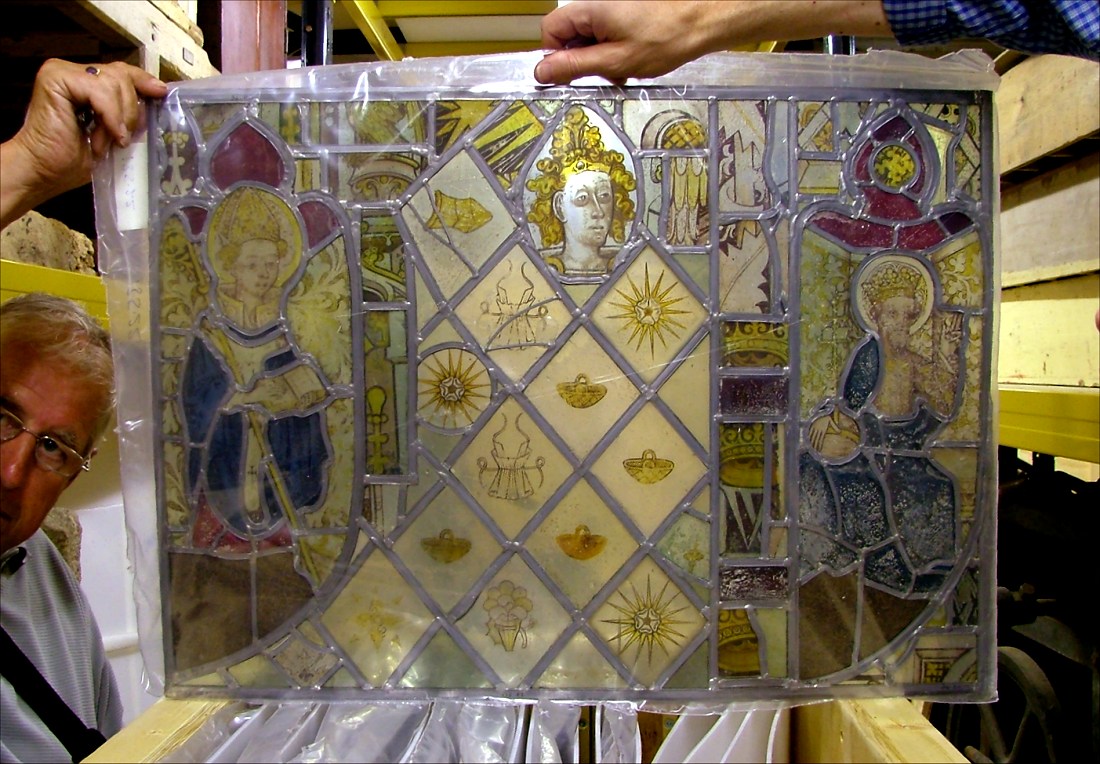
some more glass from East Harling in the Norfolk County Archaeologist Service archive at Gressenhall. It was probably removed from the church for safety in 1939, and then not replaced, possibly ending up at the museum of church art in Norwich at St Peter Hungate, disappearing into storage when that closed in 1993. It depicts a Bishop and Christ seated in Majesty, and the lozenges in between carry the telltale frails and bodices familiar from other glass within the church.
Within the screen is a large chapel, containing two major tombs. One is in alabaster, an early 17th century memorial to Sir Thomas and Lady Alice Lovell (remember the squirrel?) who died in 1604. The piece is good - too good, its 1950s restoration gives it a Festival of Britain air. Their symbols lie at their feet - his a magnificent peacock, hers a gruesome Saracen scalp held aloft.
The other appears to be a composite. It lies to the east, and the two effigies are clearly not from this tomb; they simply don't fit. They are supposed to be Robert Harling, died Paris in 1435, and his wife Dame Joan. Neither are buried here - she is at Rushford near Thetford, he is in some corner of a foreign field that is forever French schoolchildren on picnics excitedly tugging old thighbones from the soil - but in any case it is the trimmings of the tomb rather than the effigies that are most of interest, including a pelican in her piety and one that is almost a lily crucifix.
On the north side of the chancel is a fine tomb with brass inlays - the brasses now gone. Not as magnificent as either of the two previously mentioned, it is actually the most significant, as this is where you'll find Anne Harling, wife of the serial rebuilders of this church. Look out for those flails again.
What more? 17th century Lovells (remember the squirrel) have in-yer-face memorials either side of the sanctuary - that to the north curiously with no inscription. There are hatchments, remains of a wallpainting that are too indistinct to interpret (but may be seven works of mercy), a good set of royal arms, medieval heads, curious 19th century bench ends of a lion and a wild man, heraldic misericords, a Dec font - well, come and see for yourself. You know you want to.
A Common Raven that was hanging around one of the parking lots along the Grand Canyon of the Yellowstone River (North Rim?), no doubt hoping to find some easy food. It hopped just a little too close in this photo - I did not intend cutting off the beak : ) Taken on 14 September 2012, during a week's holiday down as far as Yellowstone National Park and the Grand Tetons.
"Common Ravens will eat almost anything they can get hold of. They eat carrion; small animals from the size of mice and baby tortoises up to adult Rock Pigeons and nestling Great Blue Herons; eggs; grasshoppers, beetles, scorpions, and other arthropods; fish; wolf and sled-dog dung; grains, buds, and berries; pet food; and many types of human food including unattended picnic items and garbage."
A male Common Scarlet (Crocothemis servilia) at Seletar North Link/Punggol Barat Island.
*Note: More pics of Dragonflies and Damselflies in my Dragonflies and Damselflies Album.