View allAll Photos Tagged applicable
Why are you still standing like a Philosopher ? Can't you see so many fishes are swimming here ? Come catch one easily like what I have caught - A fish with yellow Fins ! In many places in India , they call these Curry Mean Fishes !
A Painted Stork & a Great White Heron - @ Pulicat Lake Bird Sanctuary - Andhra Pradesh, India.
Revisited.
______________________________________________________________________ _______________
Copyright © learning.photography.
All rights reserved. All images contained in this Photostream remain the property of learning.photography and is protected by applicable Copyright Law. Any images from this Photostream may not be reproduced, copied, or used in any way without my written permission.
Thanks for your Visit, Comments, Favs and Awards !
No private group or multiple group invites please !
Where Rank is specified underneath any Explored Photo, that means that is the highest Rank achieved in Explore.
Those who have not uploaded any photograph yet, or have uploaded a very few photographs, should not mark me Contacts or comment on my photo. I may block them.
______________________________________________________________________ _______________
Pulicat lake bird sanctuary is a saline backwater lake lying along the T.N.-A.P coast; part extending to Chengalpattu district of T.N. It has an area of 481 sq.KM and it is the 2nd largest brackish water lagoon in India after Chilka lake in Orissa. The area on the TN side is 153.67 sq.km.
The Pulicat sanctuary is drained by Arni river while the Buckingham canal brings in the city’s drainage water. At the southern end is an opening on to Bay of Bengal through a shallow mouth of 200 m in width. The rest of the lake is closed by a sand bar running parallel to the Bay of Bengal in the form of the Sriharikota island.
The sanctuary has an area of 321 Sq. KM with 108 sq.KM of National Park area.
It lies within 11o 30’ N to 11o 42’ N and 76o 30’ E to 76o 45’ E.
Rainfall ranges from 800 - 2000mm. Temperature varies from 14o C to 33o C.
Altitude ranges from 100’ MSL to 1200’ MSL.
The wetlands eco system are considered as among the richest areas of bio diversity. Pulicat, by virtue of the mixing of fresh water with sea water is found to be an ideal habitat for diverse life-forms. 160 species of fish, 25 species of polychaete worms, 12 species of prawn, 19 species of mollusk and 100 speceis of birds are well documented apart from a number of other aquatic flora and fauna.
Among the most spectacular is the flamingo-a tall gaunt, white-coloured bird with a touch of pink on the wings, pink beak and legs, seen feeding in shallow water. The squat, large-billed grey pelican with gular pouch and a number of ducks are commonly seen. Flocks of sea gulls and terns circling in the sky or bobbing up and down on the water are an added attraction at pulicat. Besides, there are a number of waterside birds and waders such as curlews, stilts, plovers, sand pipers, lapwings, redshank. Egrets, herons, kites etc. are some other birds found here. The lake is also home to crabs, clams, mussels, oysters, snails, fish worms, insects, spiders, sponges, anemone, prawns, plankton and so on including rare endemic species like gilled leech, an unidentified bloodred fish, etc., Rapid siltation has caused loss of bio diversity. It is seen that mangrove opllen is found on Sriharikota Island indicating their existence some years back. Loss of mangroves may be one of the resons hastening siltation, reducing biodiversity and hence depriving fisherfolk of their livelihood.
Source : www.forests.tn.nic.in/wildbiodiversity/bs_plbs.html
Copyright © John G. Lidstone, all rights reserved.
You are warned: DO NOT STEAL or RE-POST THIS PHOTO.
It is an offence under law if you remove my copyright marking, or post this image anywhere else without my express written permission.
If you do, and I find out, you WILL be reported for copyright infringement action to the host platform and/or group applicable.
The same applies to all of my images.
My copyright is also embedded in the image metadata.
Type of camera: 35-mm single-lens reflex with electronically and mechanically controlled focal-plane shutter
Applicable film format: 35-mm film in a cartridge
Picture Frame Size: 24 x 36 mm
Lens mount: Nikon F mount
Shutter: Vertical-travel, metal focal-plane shutter
Shutter-Speed settings: Automatic: "A" (aperture-priority auto): 8 to 1/4000 sec., shutter speed electronic control stepless (indicative scales inside finder are 1 sec. to 1/4000 sec.); Manual: Bulb, 1 to 1/4000 sec., mechanically control
Viewfinder: Eye-Level pentaprism
Eyepoint: 14 mm
Focusing screen: K3 type (split prism-image microprism type, Clear Matte Screen IIa) standard, B3 type and E3 type optional
Viewfinder frame Coverage: Approx. 93% (objective screen)
Viewfinder Magnification: Approx. 0.83x *with 50-mm lens set to infinity
Viewfinder information: Shutter speed, exposure meter indication, shutter indication, direct aperture value, exposure compensation mark, ready light
Reflex Mirror: Quick-return type Exposure meter sync Ai type (automatic compensation at full-aperture f-stop)
Metering System: TTL center-weighted, full-aperture exposure metering system, approx. 60% of the meter's sensitivity concentrated on a 12-mm diameter circle (60:40)
Metering Range: EV1 to EV20 at ISO 100 (with a 50-mm f/1.4 lens)
Film-sensitivity settings: DX system or manual. With DX: ISO 25 to 5000 Manual: ISO 12 to 6400
Exposure Compensation: Exposure compensated to ±2 EV in units of 1/3 EV (compensation to the '+' side not possible with ISO 12, and that to the '-' side not possible with ISO 6400)
Auto Exposure Lock: Enabled by pressing the AE lock button
Film advance Lever: provided, 30° standoff angle and 135° winding angle, automatic film advance enabled with MD-12 Motor Drive (sold separately)
Frame Counter: Additive type (S, 1 to 36), automatic reset
Film Rewinding: Film reset button and rewind crank provided
Self-timer: Mechanical controlled, countdown time of approx.4 to 10 seconds, cancellation possible
Lens Aperture: Instant-return system, with aperture lever
Multiple Exposure: Activated with multiple exposure lever
Sync Contact: X-contact only; synchronized with the flash at a low speed of less than 1/250 sec.
Flash control:
TTL flash: Enabled by using SB-27, SB-26, SB50DX etc. in combination
TTL flash Compensation: Compensation to -1 EV activated with the TTL flash compensation button on the camera
Film speed Synchronization: in TTL flash: ISO 12 to 1000
Sync Terminal: JIS sync terminal provided as standard, with lock screws
Accessory Shoe: Hotshoe contact (sync contact, ready-light contact, monitor contact, stop-signal contact for TTL flash) with a lock hole to prevent accidental dropping
Ready Light: Lights when the flash is fully charged with SB-27, SB-26, SB-50DX etc.; blinks for full-output warning or shutter-speed settings from 1/500 to 1/4000 sec.
Camera-Back: Detachable hinged back, accepts optional MF-16/MF-12 Databacks
Camera-Back Opening: Achieved with film advance lever
Power Source: One 3-V lithium battery (CR-1/3N type), two 1.55 V silver batteries (SR44 type), or two 1.5 V alkaline batteries (LR44 type)
Meter-on Timer: To turn the camera on when the shutter-release button is pressed lightly, turning it off 16 seconds after your finger leaves the button. With the MD12 Motor Drive, the camera is turned on when the shutter release button of the MD-12 is pressed lightly, and it turns off approx. 66 seconds after your finger leaves the button.
Battery Power Check: Displayed for 16 seconds with the meter-on timer The exposure meter does not work if the batteries are exhausted.
Camera Back: Detachable hinged back; MF-16 Data Back can be attached in place.
Tripod Socket: 1/4" (ISO 1222)
Dimensions (W x H x D): Approx. 142.5 x 90 x 58 mm / 5.6 x 3.5 x 2.3 in.
(camera body only)
Weight: Approx. 570 g / 20.1 oz. (camera body only, including battery)
Five Black Drongos - Chennai, India.
[BACKGROUND EDITED VERSION]
_____________________________________________________________________________________
Copyright © learning.photography.
All rights reserved. All images contained in this Photostream remain the property of learning.photography and is protected by applicable Copyright Law. Any images from this Photostream may not be reproduced, copied, or used in any way without my written permission.
Thanks for your Visit, Comments, Favs and Awards !
No private group or multiple group invites please !
Those who have not uploaded any photograph yet, or have uploaded a very few photographs, should not mark me Contacts or comment on my photo. I may block them.
_____________________________________________________________________________________
The Black Drongo (Dicrurus macrocercus) is a small Asian passerine bird of the drongo family Dicruridae. It is a common resident breeder in much of tropical southern Asia from southwest Iran through India and Sri Lanka east to southern China and Indonesia. It is a wholly black bird with a distinctive forked tail and measures 28 cm (11 in) in length. Feeding on insects, it is common in open agricultural areas and light forest throughout its range, perching conspicuously on a bare perch or along power or telephone lines. The species is known for its aggressive behaviour towards much larger birds, such as crows, never hesitating to dive-bomb any birds of prey that invades its territory. This behaviour earns it the informal name of King Crow. Smaller birds often nest in the well-guarded vicinity of a nesting Black Drongo. Previously considered a subspecies (Dicrurus adsimilis macrocercus) of the African Fork-tailed Drongo (Dicrurus adsimilis), it is now recognized as a full species.
The Black Drongo has been introduced to some Pacific islands, where it has thrived and become abundant to the point of threatening and causing the extinction of native and endemic bird species there.
Source : en.wikipedia.org/wiki/Black_Drongo
Small Barges parked at River Ganges - Calcutta, India.
These barges carry mainly Jute & Iron & Building materials.
In the distance one can also see the famous & old Howrah Bridge.
IN FLICKR EXPLORE ON 27-11-2013.
www.flickr.com/photos/59670248@N05/11088424015/in/explore...
______________________________________________________________________ _______________
Copyright © learning.photography.
All rights reserved. All images contained in this Photostream remain the property of learning.photography and is protected by applicable Copyright Law. Any images from this Photostream may not be reproduced, copied, or used in any way without my written permission.
Thanks for your Visit, Comments, Favs and Awards !
No private group or multiple group invites please !
Those who have not uploaded any photograph yet, or have uploaded a very few photographs, should not mark me Contacts or comment on my photo. I may block them.
______________________________________________________________________ _______________
History :
In its upper reaches the river is generally known as the Bhāgirathi, until it reaches Hooghly. The word Bhāgirathi literally means "caused by Bhagiratha", a mythical Sagar Dynasty prince who was instrumental in bringing the river Ganges from the heavens on to the earth, in order to release his 60,000 grand-uncles from a curse of the saint Kapila.
The river was an important transportation channel in the early history of Bengal, and later with the colonial trading ports. The river's presence is one of the reasons chosen by the British to settle there at Calcutta. The Dutch/French colony at Chandannagar on the Hooghly was once the rival of British Calcutta, but was eclipsed by Calcutta in the colonial wars of the 18th century. The river banks hosted several battles and skirmishes towards the start of the colonial era, including the Battle of Plassey Palashi, as well as earlier wars against Maratha raiders. On eastern bank lie many historic and wealthy towns like Murshidabad, Jangipur and Ziaganj.
In 1974, the Farakka Barrage began diverting water into the Hooghly during the dry season so as to reduce the silting difficulties at Kolkata's port.
Like the rest of the Ganges, the Bhāgirathi-Hooghly is considered sacred to Hindus, and its water is considered holy.
The Bhāgirathi-Hooghly river system is an essential lifeline for the people of West Bengal. It is through this river that the East India Company sailed in to Bengal and established their trade settlement - Calcutta, which later grew up to be one of the greatest cities of the world and capital of the erstwhile British India. People from other countries like French, Dutch, Portuguese, etc. all had their trade settlement by the banks of this river.
The river provides perennial supply of water to the plain of West Bengal for irrigation and human & industry consumption. The river is navigable and the major transport system in the region with a huge traffic flow. For a long time, the Calcutta Port was the biggest port of India. Though in the past its significance had gone down, but recently it had again come up to the 3rd position in the list of Indian Ports. The fish from the river are important to the local economy.
The modern container port of Haldia, on the intersection of lower Hooghly and Haldi River, now carries much of the region's maritime trade. One new port will be built in the deep sea to reduce load on Calcutta port.
Hooghly river valley was the most important industrial area of erstwhile state of Bengal. Due to declining jute industry, the prime industry of this region, it lost its glory and partitioning of Bengal. But still it is one of the biggest industrial areas of India. Except Kolkata and Howrah it has number of small cities which forms the Greater Kolkata Agglomeration, the second biggest Indian city and former capital.
Several bridges run over the Hooghly at Kolkata – Howrah Bridge, Vidyasagar Setu, Vivekananda Setu, Nivedita Setu (second Vivekananda Bridge), Jubilee Bridge(chinsurah) and Iswar Gupta Setu(chinsurah).
Source - Wikipedia
6-25-2015 11-07-15 AM
The Fibonacci numbers are Nature's numbering system. They appear everywhere in Nature, from the leaf arrangement in plants, to the pattern of the florets of a flower, the bracts of a pinecone, or the scales of a pineapple. The Fibonacci numbers are therefore applicable to the growth of every living thing, including a single cell, a grain of wheat, a hive of bees, and even all of mankind.
Fibonacci Numbers
The sequence, in which each number is the sum of the two preceding numbers is known as the Fibonacci series: 1, 1, 2, 3, 5, 8, 13, 21, 34, 55, 89, 144, 233, 377, 610, 987, 1597, 2584, 4181, ... (each number is the sum of the previous two).
It is quite amazing that the Fibonacci number patterns occur so frequently in nature ( flowers, shells, plants, leaves, to name a few) that this phenomenon appears to be one of the principal "laws of nature".
Fibonacci sequences appear in biological settings, in two consecutive Fibonacci numbers, such as branching in trees, arrangement of leaves on a stem, the fruitlets of a pineapple, the flowering of artichoke, an uncurling fern and the arrangement of a pine cone.
In addition, numerous claims of Fibonacci numbers or golden sections in nature are found in popular sources, e.g. relating to the breeding of rabbits, the spirals of shells, and the curve of waves.
The Fibonacci numbers are also found in the family tree of honeybees.
Fibonacci and Nature
Plants do not know about this sequence - they just grow in the most efficient ways. Many plants show the Fibonacci numbers in the arrangement of the leaves around the stem. Some pine cones and fir cones also show the numbers, as do daisies and sunflowers.
Sunflowers can contain the number 89, or even 144. Many other plants, such as succulents, also show the numbers. Some coniferous trees show these numbers in the bumps on their trunks. And palm trees show the numbers in the rings on their trunks.
Why do these arrangements occur?
In the case of leaf arrangement, or phyllotaxis, some of the cases may be related to maximizing the space for each leaf, or the average amount of light falling on each one. Even a tiny advantage would come to dominate, over many generations.
In the case of close-packed leaves in cabbages and succulents the correct arrangement may be crucial for availability of space. This is well described in several books.
So nature isn't trying to use the Fibonacci numbers: they are appearing as a by-product of a deeper physical process. That is why the spirals are imperfect.
The plant is responding to physical constraints, not to a mathematical rule.
The basic idea is that the position of each new growth is about 222.5 degrees away from the previous one, because it provides, on average, the maximum space for all the shoots. This angle is called the golden angle, and it divides the complete 360 degree circle in the golden section, 0.618033989 . . . .
Examples of the Fibonacci sequence in nature.
Petals on flowers.
Probably most of us have never taken the time to examine very carefully the number or arrangement of petals on a flower.
If we were to do so, we would find that the number of petals on a flower, that still has all of its petals intact and has not lost any, for many flowers is a Fibonacci number:
•3 petals: lily, iris
•5 petals: buttercup, wild rose, larkspur, columbine (aquilegia)
•8 petals: delphiniums
•13 petals: ragwort, corn marigold, cineraria,
•21 petals: aster, black-eyed susan, chicory
•34 petals: plantain, pyrethrum
•55, 89 petals: michaelmas daisies, the asteraceae family.
Some species are very precise about the number of petals they have - e.g. buttercups, but others have petals that are very near those above, with the average being a Fibonacci number.
Copyright © John G. Lidstone, all rights reserved.
You are warned: DO NOT STEAL or RE-POST THIS PHOTO.
It is an offence under law if you remove my copyright marking, or post this image anywhere else without my express written permission.
If you do, and I find out, you WILL be reported for copyright infringement action to the host platform and/or group applicable.
The same applies to all of my images.
My copyright is also embedded in the image metadata.
How medical indifference turned a miracle drug into a national nightmare
by Robert Meyers
The unthinking development and tragic use of diethylstilbestrol from 1941 to 1971 - without the freshness, clarity, or applicability of DES: The Complete Story (1981), by Cynthia Orenberg, a medical writer and a victim.
Robert Meyers begins with the drug's synthesis in England, and follows its popularization and marketing, there and in the US, as a treatment for threatened miscarriage - to the point that it was prescribed for women with no symptoms or history of miscarriage. (Some of those treated, in fact, were pregnant for the first time.) The beginning of the end came in 1971 with the first published report linking DES to cancer in the female offspring of women who had taken the drug. The frenetic outcome included lawsuits by patients, FDA foot-dragging, and catastrophic medical treatment - elements which Meyers is unable either to disentangle or weave together coherently. In his view, this twisted tale "is preeminently a story of people - -the women who took it" and their families; all the other aspects - political, economic, medical - are "really elements that enter the funnel of American health care and come out on the doorsteps of American consumers." And, rather than give the doctors' role a hard going-over, Meyers takes a few tired pot-shots. (when a physician-interviewee puts on a white coat: "What was there about wearing that white coat? Did he speak better wearing the coat? With more authority?") For rigor as well as personal involvement, Orenberg is far superior. Sources: KirkusReviews
* Watch DES videos, read more about DES Daughters and DES Sons.
* DES DiEthylSilbestrol Resources by NCBI : Cancer and Pregnancy.
* DES DiEthylSilbestrol Resources by NCBI: In-Utero Exposure to DES.
* All our posts tagged DES and the DES-exposed.
All of my images are under protection of all applicable copyright laws. Unauthorized use and/or duplication of this material without express and written permission from myself is strictly prohibited. Excerpts and links may be used, provided that full and clear credit is given to dK.i Photography and Edward Kreis with appropriate and specific direction to the original content (website). I can be contacted through the contact link provided on this website.
| Fine Art America | Facebook | iStock | Getty Images |
After the sunrise session on Sunday, Reggie and I could not get enough of the soft light due to the cloud cover, so we went in search of a garden to shoot flowers. We found this family run, backwoods nursery in Owings, MD. The owners were gracious enough and allowed us to roam around with our cameras. Of course, of all days, I left my macros at home......
All of my images are under protection of all applicable copyright laws. Unauthorized use and/or duplication of this material without express and written permission from myself is strictly prohibited. Excerpts and links may be used, provided that full and clear credit is given to dK.i Photography and Edward Kreis with appropriate and specific direction to the original content (website). I can be contacted through the contact link provided on this website.
In the meantime, please visit my page @ edward-kreis.artistwebsites.com
You can also find me on Facebook
“Space Shuttle August 1972."
Space Shuttle/External Tank separation, 1972, as depicted - probably - by North American Rockwell artist Bert Winthrop.
Excellent additional information applicable to Mr. Vaughan’s linked photo, and I think this one as well. Extracted from the fantastic Aerospace Projects Review website:
“While this is broadly much like the STS as actually built, there are a lot of important differences. The spine down the top of the cargo bay… that was to give room for the cargo manipulator arm without putting it actually in the cylindrical bay, taking up valuable cargo space… The ET is of a slightly simpler geometry; the small cylinder on the nosecone contained the de-orbit solid rocket motor (because the ET would either go into orbit with the Shuttle, or so close to orbit that the splashdown location would be somewhat randomized).”
At:
www.aerospaceprojectsreview.com/blog/wp-content/uploads/2...
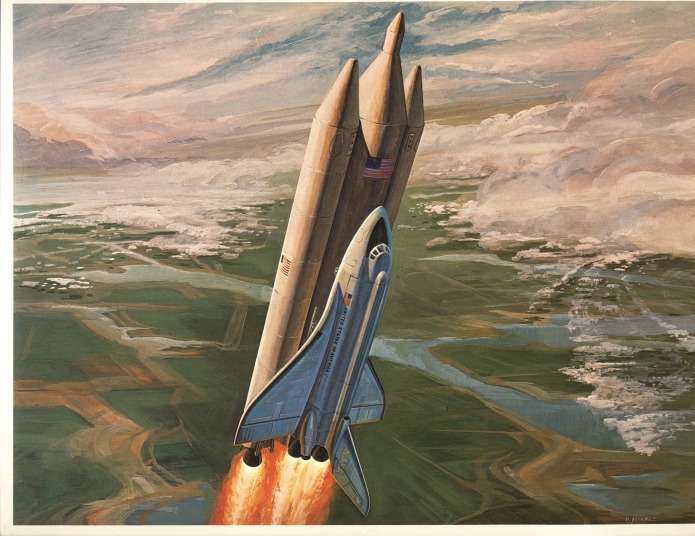
Note, even the axis of the hinged forward reaction control system panels/assemblies was changed between 1972 & 1973.
Chromatic Solstice #16
The question in my research project is ‘How do the "negative" spaces in Chinese landscape ink painting instigate poetic experiences?' Through a phenomenological and comparative approach, the project seeks to examine the relationships between the philosophical implications of Chinese landscape ink painting with Daoism, and Daoism with Heideggerian ontology, in an attempt to discover the applicability of Heideggerian concepts into the poetics of landscape ink painting.
Originally from Singapore, the former colony of Britain located at the equator receives consistent amount of sunlight throughout the year. The tropical climate has two weathers – sunshine and rain, unlike Scotland’s four seasons in a day, and the light differs from Scotland’s dramatic long winter darkness and perpetually bright summer skies. The work 'Chromatic Solstice' was inspired by the theatrical light of Scotland’s skies, observed through the repetitive equinoxes and solstices cycles.
sebastianmary@sebastianmarytay.co.uk
A Painted Stork eagerly looking for a fish - @ Pulicat Lake Bird Sanctuary - Andhra Pradesh, India.
Revisited
______________________________________________________________________ _______________
Copyright © learning.photography.
All rights reserved. All images contained in this Photostream remain the property of learning.photography and is protected by applicable Copyright Law. Any images from this Photostream may not be reproduced, copied, or used in any way without my written permission.
Thanks for your Visit, Comments, Favs and Awards !
No private group or multiple group invites please !
Where Rank is specified underneath any Explored Photo, that means that is the highest Rank achieved in Explore.
Those who have not uploaded any photograph yet, or have uploaded a very few photographs, should not mark me Contacts or comment on my photo. I may block them.
______________________________________________________________________ _______________
Pulicat lake bird sanctuary is a saline backwater lake lying along the T.N.-A.P coast; part extending to Chengalpattu district of T.N. It has an area of 481 sq.KM and it is the 2nd largest brackish water lagoon in India after Chilka lake in Orissa. The area on the TN side is 153.67 sq.km.
The Pulicat sanctuary is drained by Arni river while the Buckingham canal brings in the city’s drainage water. At the southern end is an opening on to Bay of Bengal through a shallow mouth of 200 m in width. The rest of the lake is closed by a sand bar running parallel to the Bay of Bengal in the form of the Sriharikota island.
The sanctuary has an area of 321 Sq. KM with 108 sq.KM of National Park area.
It lies within 11o 30’ N to 11o 42’ N and 76o 30’ E to 76o 45’ E.
Rainfall ranges from 800 - 2000mm. Temperature varies from 14o C to 33o C.
Altitude ranges from 100’ MSL to 1200’ MSL.
The wetlands eco system are considered as among the richest areas of bio diversity. Pulicat, by virtue of the mixing of fresh water with sea water is found to be an ideal habitat for diverse life-forms. 160 species of fish, 25 species of polychaete worms, 12 species of prawn, 19 species of mollusk and 100 speceis of birds are well documented apart from a number of other aquatic flora and fauna.
Among the most spectacular is the flamingo-a tall gaunt, white-coloured bird with a touch of pink on the wings, pink beak and legs, seen feeding in shallow water. The squat, large-billed grey pelican with gular pouch and a number of ducks are commonly seen. Flocks of sea gulls and terns circling in the sky or bobbing up and down on the water are an added attraction at pulicat. Besides, there are a number of waterside birds and waders such as curlews, stilts, plovers, sand pipers, lapwings, redshank. Egrets, herons, kites etc. are some other birds found here. The lake is also home to crabs, clams, mussels, oysters, snails, fish worms, insects, spiders, sponges, anemone, prawns, plankton and so on including rare endemic species like gilled leech, an unidentified bloodred fish, etc., Rapid siltation has caused loss of bio diversity. It is seen that mangrove opllen is found on Sriharikota Island indicating their existence some years back. Loss of mangroves may be one of the resons hastening siltation, reducing biodiversity and hence depriving fisherfolk of their livelihood.
Source : www.forests.tn.nic.in/wildbiodiversity/bs_plbs.html
Copyright © John G. Lidstone, all rights reserved.
You are warned: DO NOT STEAL or RE-POST THIS PHOTO.
It is an offence under law if you remove my copyright marking, or post this image anywhere else without my express written permission.
If you do, and I find out, you WILL be reported for copyright infringement action to the host platform and/or group applicable.
The same applies to all of my images.
My copyright is also embedded in the image metadata.
The saying goes "A red sky at night is a sailor's delight" and very applicable it is the sky over the port of Rotterdam.
Car: Toyota Prius Active.
Year of manufacture: 2018.
Date of first registration in the UK: 29th September 2018.
Place of registration: Nottingham.
Date of last MOT: Not applicable.
Mileage at last MOT: Not applicable.
Date of last change of keeper: 29th September 2018.
Date taken: 8th September 2021.
Album: Carspotting 2021
Copyright © John G. Lidstone, all rights reserved.
You are warned: DO NOT STEAL or RE-POST THIS PHOTO.
It is an offence under law if you remove my copyright marking, or post this image anywhere else without my express written permission.
If you do, and I find out, you WILL be reported for copyright infringement action to the host platform and/or group applicable.
The same applies to all of my images.
My copyright is also embedded in the image metadata.
Copyright © John G. Lidstone, all rights reserved.
You are warned: DO NOT STEAL or RE-POST THIS PHOTO.
It is an offence under law if you remove my copyright marking, or post this image anywhere else without my express written permission.
If you do, and I find out, you WILL be reported for copyright infringement action to the host platform and/or group applicable.
The same applies to all of my images.
My copyright is also embedded in the image metadata.
At Khajjiar (Hindi: खज्जियार) - a hill station in Chamba district, Himachal Pradesh, India.
______________________________________________________________________ _______________
Copyright © learning.photography.
All rights reserved. All images contained in this Photostream remain the property of learning.photography and is protected by applicable Copyright Law. Any images from this Photostream may not be reproduced, copied, or used in any way without my written permission.
Thanks for your Visit, Comments, Favs and Awards !
No private group or multiple group invites please !
Where Rank is specified underneath any Explored Photo, that means that is the highest Rank achieved in Explore.
Those who have not uploaded any photograph yet, or have uploaded a very few photographs, should not mark me Contacts or comment on my photo. I may block them.
______________________________________________________________________ _______________
Khajjiar (Hindi: खज्जियार) is a hill station in Chamba district, Himachal Pradesh, India, located approximately 24 km from Dalhousie.
Khajjiar sits on a small plateau with a small stream-fed lake in the middle that has been covered over with weeds. The hill station is surrounded by green meadows and dense forests. It is about 6,500 feet (2,000 m) above sea level in the foothills of the Dhauladhar ranges of the Western Himalayas and snowy peaks can be seen in the distance. It is part of the Kalatop Khajjiar Sanctuary.
Khajjiar can be reached from Dalhousie, the nearest major town and hill station, by bus in an hour or so. It has a rare combination of three ecosystems: lake, pasture and forest, all in one place.
On 7 July 1992, Mr. Willy T. Blazer, Vice Counselor and Head of Chancery of Switzerland in India brought Khajjiar on the world tourism map by christening it "Mini Switzerland". He also put a sign board of a yellow Swiss hiking footpath showing Khajjiar's distance from the Swiss capital Berne-6194 km. Khajjiar is among the 160 locations in the world that bear topographical resemblance with Switzerland. The counselor also took from Khajjiar a stone which will form part of a stone collage around the Swiss Parliament to remind the visitors of Khajjiar as a Mini Switzerland of India.
Source : en.wikipedia.org/wiki/Khajjiar
Statue of Lord Buddha at Gangaramaya Temple, Colombo, Srilanka.
______________________________________________________________________ _______________
Copyright © learning.photography.
All rights reserved. All images contained in this Photostream remain the property of learning.photography and is protected by applicable Copyright Law. Any images from this Photostream may not be reproduced, copied, or used in any way without my written permission.
Thanks for your Visit, Comments, Favs and Awards !
Where Rank is specified underneath any Explored Photo, that means that is the highest Rank achieved in Explore.
No private group or multiple group invites please !
Those who have not uploaded any photograph yet, or have uploaded a very few photographs, should not mark me Contacts or comment on my photo. I may block them.
______________________________________________________________________ _______________
Gangaramaya Temple is one of the most important temples in Colombo, Sri Lanka, being a mix of modern architecture and cultural essence.
Architecture
The temple's architecture demonstrates an eclectic mix of Sri Lankan, Thai, Indian, and Chinese architecture.
This Buddhist temple includes several imposing buildings and is situated not far from the placid waters of Beira Lake on a plot of land that was originally a small hermitage on a piece of marshy land. It has the main features of a Vihara (temple), the Cetiya (Pagada) the Bodhitree, the Vihara Mandiraya, the Seema malaka (assembly hall for monks) and the Relic Chamber. In addition, a museum, a library, a residential hall, a three storeyed Pirivena, educational halls and an alms hall are also on the premises.
Most notable for tourists is the architecture of the Simamalaka Shrine, which was built with donations from a Muslim sponsor to the design of Geoffrey Bawa.
Famous incumbents
It was the home for erudite scholars such as Ratmalana Sri Dharmarama Thero, Waskaduwa Sri Subhuti Thero, Weligama Sri Sumangala Thero, Welivitiye Dhammaratna Thero, and Pandit Batuwantudawe.
History
Don Bastian (de Silva Jayasuriya Goonewardane, Mudaliyar), a famous 19th century shipping merchant who was looking for a suitable land to build a temple for the Matara Sri Dharmarama thero, bought a beautiful piece of land belonging to three Moors, and filled and prepared the land at great expense. The land bordered on two sides by the Moragoda Ela and the Pettigala Ela was used to build the temple, which was subsequently named the Padawthota Gangaramaya Viharaya. The Mudaliyar, with the assistance of the people built a great 'Chaitya' (Dagaba) of 30 Riyans, and built a great decorative arch (thorana) and a 'Sandakada pahana' modeled on the ones found at Anuradhapura, at the entrance to the temple. A 'Bo' sapling brought from the great Sri Maha Bhodiya in Anuradhapura, was also planted by his own hands and brought up. He also built a three-storied preaching hall and the walls, railings and the moat round the temple.
Present day activities
Today Gangaramaya serves not only as a place of Buddhist worship; it is also a centre of learning. The temple is involved in Buddhist welfare work including old peoples' homes, a vocational school and an orphanage. The temple is uniquely attractive and tolerant to congregation members of many different religions. It has also been instrumental in establishing the Buddhist temple on Staten Island (U.S.A.) the Buddhist Center in New York and the Buddhist Centre in Tanzania, thereby helping to propagate the Dhamma in other countries.
Inside Gangolihat Kalika Mata Temple - Pithoragarh District, Uttarakhand, India.
IN FLICKR EXPLORE ON 11-04-2014.
www.flickr.com/photos/59670248@N05/13780498374/in/explore...
______________________________________________________________________ _______________
Copyright © learning.photography.
All rights reserved. All images contained in this Photostream remain the property of learning.photography and is protected by applicable Copyright Law. Any images from this Photostream may not be reproduced, copied, or used in any way without my written permission.
Thanks for your Visit, Comments, Favs and Awards !
No private group or multiple group invites please !
Where Rank is specified underneath any Explored Photo, that means that is the highest Rank achieved in Explore.
Those who have not uploaded any photograph yet, or have uploaded a very few photographs, should not mark me Contacts or comment on my photo. I may block them.
______________________________________________________________________ _______________
Gangolihat is a small Himalayan hill town in the Pithoragarh district of Uttarakhand, India. It is tehsil and sub divisional headquarters of the district. Gangolihat is famous for its Shakti Peethas of Hat Kalika of goddess Kali. Nearby at 'Patal Bhubneshwar', underground caves are major tourist attraction. Also nearby are the tiny hill stations of Chaukori and Berinag.From Gangolihat Panchchuli peaks and Nanda Devi are clearly visible.
Gangolihat is located at
29.48°N 80.05°E. It has an average elevation of 1,760 metres (5,773 feet). It is 78 km from Pithoragarh. The main town is at a hill top. The region is surrounded by two rivers Saryu and Ramganga. Which meet at Ghat at the foothill of the region. These two rivers make it like a Garland on the shoulders of mighty Himalaya. These two rivers gave the name to the region Gang (River in local dialect) + Awali (Garland) making Gangawali. Which became Gangoli later on. and Hat were the main markets/ gathering place for local people in past. Which made the name of Gangolihat.
Gangolihat is native of Pant Brahmins mainly. Along with Pant's, Joshi's, Upreti's, Pathak's, Mahar's, Negi's, Bisht, Rawal's, Verma's, Shah and Aryas are other major surnames found.
Gangolihaat is famous for its ancient temples and underground caves. 'Haat Kalika', 'Ambika Dewaal', 'Chamunda Mandir', 'Vaishnavi Mandir' are some of the famous temples here. 'Vaishnavi Mandir' is a special one because from here one can clearly view the Himalayas. This temple is situated on a mountain that is called 'Shail Parvat', which is notable in Hindu holy books.
There are many beautiful underground caves in Gangolihaat. 'Patal Bhuvneshwar', 'Shailashwer Gufa' and 'Mukteshwar Gufa' are most notable ones. A new underground cave has been also found recently and that is called 'Bholeshwar Gufa'.
'Haat Kalika Mandir' was chosen by Adi Guru Sankaracharya for installation of Mahakali Shaktipeeth. It is believed that the Original Goddes Kalika Mata, which supposed to be in West Bangal, shifted her place form Bangal to Gangolihat. This Temple is very famous all over the India, specially among Indian Armed Forces. Posthumous Param Veer Chakra award winner Capt. Bikram Batra was a great devotee of Goddess. The goddess Mahakali is the designated goddess of brave Kumaun Regiment which proved its unmatched bravery and patriotism during all major wars fought by India. Kumaun regiment has created an Army Rest House near the Temple for Army Personnel, who come Gangloihat to get the blessing of Goddess.
There are historical monuments made during 8-11th century near the famous temple. Which is a site preserved by Archaeological Survey of India (ASI). It depicts the nervelessness of the artistic creation at that time.
The highest peak in the range, Lankeshwar is a great picnic place. The view of greenery rich valleys of Kumaun Himalayas from this hilltop is memorable and heavenly.
SOURCE : en.wikipedia.org/wiki/Gangolihat
Must be a black and white day
All of my images are under protection of all applicable copyright laws. Unauthorized use and/or duplication of this material without express and written permission from myself is strictly prohibited. Excerpts and links may be used, provided that full and clear credit is given to dK.i Photography and Edward Kreis with appropriate and specific direction to the original content (website). I can be contacted through the contact link provided on this website.
| Fine Art America | Facebook | iStock | Getty Images |
Date: Circa 1930s
Source Type: Photograph
Publisher, Printer, Photographer: Unknown
Postmark: Not Applicable
Collection: Steven R. Shook
Remark: Ogden Dunes Garage was located on U.S. Route 12 along the South Shore Line adjacent to the Ogden Dunes Community. It is known that this Sinclair station and garage operated into the 1950s. Thomas Brady was the owner and operator of the garage.
Copyright 2023. Some rights reserved. The associated text may not be reproduced or transmitted in any form or by any means, electronic, mechanical, photocopying, recording, or otherwise, without prior written permission of Steven R. Shook.
Best in Lightbox
The title is obviously applicable to the sunset, but also it 'saddens' me to report that the withered tree has suffered storm damage and is merely a stump now. See photos below. It was very photogenic and one of my favourites, but all good things must come to an end. That said, from some angles it was 'in the way' so it's not all bad. It also enhances the uniqueness of the image because it is now impossible to revisit the scene and get anything vaguely similar. From this angle it just wouldn't be the same without the tree! :-))
© 2009 2025 Photo by Lloyd Thrap Photography for Halo Media Group
All works subject to applicable copyright laws. This intellectual property MAY NOT BE DOWNLOADED except by normal viewing process of the browser. The intellectual property may not be copied to another computer, transmitted , published, reproduced, stored, manipulated, projected, or altered in any way, including without limitation any digitization or synthesizing of the images, alone or with any other material, by use of computer or other electronic means or any other method or means now or hereafter known, without the written permission of Lloyd Thrap and payment of a fee or arrangement thereof.
No images are within Public Domain. Use of any image as the basis for another photographic concept or illustration is a violation of copyright.
Date: Circa 1890s
Source Type: Cabinet Card Photograph
Publisher, Printer, Photographer: Erickson and Hanson's Moscow Art Studio
Postmark: Not Applicable
Collection: Steven R. Shook
Remark: This is a large cabinet card measuring 5½ inches by 8½ inches. Given that each of the six individuals in this image are holding a whip, it is possible that they were wagon teamsters. The whips they are holding appear to be quite long in both shaft and lash, similar to a lunge whip used to train horses in a corral.
The top of photograph is rather interesting in that it appears as if the photograph may have been taken inside a tent.
Written in pencil on the reverse of this image is the following:
Front row left to right
George Lile
Tommy Clayton
Allen Clayton
Charley Ruark
Standing
Elmer, Bert Ruark
George Franklin Lile was born November 1866, in Walla Walla, Walla Walla County, Washington, the son of Isaac Lile and Sarah C. (Ellis) Lile. He married Sarah E. Clayton (b. 1869, d. 1928), sister of Charley and Tommy. George died on February 10, 1920, in Enterprise, Wallowa County, Oregon, and is buried in the Pomeroy Cemetery in Pomeroy, Garfield County, Washington.
Thomas "Tommy" Perry Clayton was born February 2, 1869, in Walla Walla, Walla Walla County, Washington, the son of Daniel and Cyrene G. (Moore) Clayton. He married Clara Vanausdale (b. 1876, d. 1900) in 1894 and as a widow married Lucy L. Stocking (b. 1877, d. 1943) in 1905. Tommy passed away on January 2, 1942, in Lewiston, Nez Perce County, Idaho, and is buried at Pomeroy City Cemetery in Pomeroy, Garfield County, Washington.
Allen Sylvester Clayton, brother of Tommy, was born November 3, 1863, in Walla Walla, Walla Walla County, Washington, the son of Daniel and Cyrene G. (Moore) Clayton. He married Myra Ada Lewis (b. 1868, d. 1896) and as a widow married Bessie C. Bridwell (b. 1873, d. 1952) in 1914. Allen passed away on September 6, 1954, in Clarkston, Asotin County, Washington, and is buried at Pomeroy City Cemetery in Pomeroy, Garfield County, Washington.
Charles "Charley" Augustus Ruark was born May 18, 1856, in Wayne County, Iowa, the son of Thomas and Mary Adelia (Messenger) Ruark. Charley married Rosalia C. Clayton (b. 1862, d. 1935), sister of Allen and Tommy Clayton, in 1877. Charley died on September 30, 1910, in Spokane, Spokane County, Washington, and is buried at Pomeroy City Cemetery in Pomeroy, Garfield County, Washington.
Albert "Bert" Curtis Ruark, brother of Charley, was born October 19, 1878, in Garfield County, Washington. Bert married Edna Munch (b. 1885, d. 1975) in 1902. Bert died on March 19, 1932, in Pomeroy, Garfield County, Washington, and is buried in the Pomeroy Cemetery.
Elmer is unidentified; it is possible that Elmer is a Ruark, but research has not been able to uncover his identity.
Source:
Find A Grave (www.findagrave.com)
Copyright 2021. Some rights reserved. The associated text may not be reproduced or transmitted in any form or by any means, electronic, mechanical, photocopying, recording, or otherwise, without prior written permission of Steven R. Shook.
Shuvo Bijaya (i.e. Happy Dassera) to you all.
Duga Puja - 2013 of our Association - South Madras Cultural association - Chennai.
In quest for the feel of Sacred Flames of the Sandhi Puja – The belief is, this will eradicate all the evils.
______________________________________________________________________ _______________
Copyright © learning.photography.
All rights reserved. All images contained in this Photostream remain the property of learning.photography and is protected by applicable Copyright Law. Any images from this Photostream may not be reproduced, copied, or used in any way without my written permission.
Thanks for your Visit, Comments, Favs and Awards !
No private group or multiple group invites please !
Those who have not uploaded any photograph yet, or have uploaded a very few photographs, should not mark me Contacts or comment on my photo. I may block them.
______________________________________________________________________ _______________
Sandhi Puja -
An integral and important part of Durga Puja, Sandhi Puja is performed at the juncture of the 8th and 9th lunar day. Sandhi puja lasts from the last 24 minutes of Ashtami till the first 24 minutes of Nabami. During this juncture (the "Sandhikhan"), Durga is worshipped in her Chamunda form. Devi Durga killed, Chando and Mundo, the two asuras at "Sandhikhan" and thus acquired the name of "Chamunda".
Myth behind Durga being worshipped as Chamunda -
While the Goddess and Mahishasura were engaged in a fierce battle, the two generals of Mahisha, Chando and Mundo attacked the Devi from the the rear. Durga appeared to them, a brilliantly glowing woman with her hair knotted on her head, a crescent moon above her forehead, a 'tilak' on her forehead and a garland around her neck. With golden earrings and clad in a yellow saari she emitted a golden glow. Her ten hands possessed ten different weapons. Though she appeared beautiful her face turned blue with anger when she faced Chondo and Mundo. From her third eye then emerged a Devi with a large falchion and a shield. She had a large face, bloody tongue and sunken blood shot eyes. She was Chamunda. With a bloodcurdling shriek she leapt forward and killed them. This moment was the juncture of the 8th and 9th lunar day.
Age old yardsticks for measuring the "Sandhikhan" -
Long back devotees in order to perform the Sandhi Puja at the exact juncture used a number of methods. With the last 24 mins. of the Ashtami puja still left, a bronze bowl with a tiny hole was placed in a bucket full of water. The bowl with the tiny hole was made in such a way that it took exactly 24 minutes for the bowl to submerge in the water. The moment the bowl submerged in the water cannon balls were
fired announcing this moment of Sandhi Puja. This yardstick for measuring the "Sandhikhan" was very popular ages ago in many "Rajbaris". Many "Rajbaris", including, the zamindar of Sutanuti of Sobhabajar Rajbari fired cannon balls to announce the "Sandhikhan". People around Sobhabajar waited for this indication to proceed with their puja. King of Krishnanagar, Raja Krishna Chandra, was given the
cannon of Plassey as a gift from Robert Clive. In Shikharbhum Rajbari a platter with vermillion (sindur) used to be kept in front of the Devi. It is said the foot prints of the Devi could be seen in the platter. This moment indicated the commencement of Sandhi Puja. Sabarno Raychoudhury of Barisha worshipped the Chamunda Devi by burning 'Layta' and 'Pholui' (types of fishes) fishes.
Things needed to perform Sandhi Puja -
Sandhi Puja requires 108 lotus flowers, a single fruit, dry rice grain for "noibiddo", 108 earthen lamps, clothes, jewelry, hibiscus garlands and wood apple (bel) leaves. The almost non existent rituals which underwent changes with the changes in the society can still be seen in some of the 200-250 year old Pujas.
A view of Kumarokam Lake - sometime after Sunset. Kerala, India.
______________________________________________________________________ _______________
Copyright © learning.photography.
All rights reserved. All images contained in this Photostream remain the property of learning.photography and is protected by applicable Copyright Law. Any images from this Photostream may not be reproduced, copied, or used in any way without my written permission.
Thanks for your Visit, Comments, Favs and Awards !
No private group or multiple group invites please !
Where Rank is specified underneath any Explored Photo, that means that is the highest Rank achieved in Explore.
Those who have not uploaded any photograph yet, or have uploaded a very few photographs, should not mark me Contacts or comment on my photo. I may block them.
______________________________________________________________________ _______________
Copyright © John G. Lidstone, all rights reserved.
I hope you enjoy my work and thanks for viewing.
NO use of this image is allowed without my express prior permission and subject to compensation/payment.
I do not want my images linked in Facebook groups.
It is an offence, under law, if you remove my copyright marking, and/or post this image anywhere else without my express written permission.
If you do, and I find out, you will be reported for copyright infringement action to the host platform and/or group applicable and you will be barred by me from social media platforms I use.
The same applies to all of my images.
My ownership & copyright is also embedded in the image metadata.
Copyright © John G. Lidstone, all rights reserved.
I hope you enjoy my work and thanks for viewing.
NO use of this image is allowed without my express prior permission and subject to compensation/payment.
I do not want my images linked in Facebook groups.
It is an offence, under law, if you remove my copyright marking, and/or post this image anywhere else without my express written permission.
If you do, and I find out, you will be reported for copyright infringement action to the host platform and/or group applicable and you will be barred by me from social media platforms I use.
The same applies to all of my images.
My ownership & copyright is also embedded in the image metadata.
Vehicle: Maxus Deliver 9.
Year of manufacture: 2021.
Date of first registration in the UK: 22nd June 2021.
Place of registration: Beverley.
Date of last MOT: 29th Not applicable.
Mileage at last MOT: Not applicable.
Date of last V5 issued: 22nd June 2021.
Date taken: 28th June 2021.
Album: Carspotting 2021
Car: Volvo V60.
Year of manufacture: 2011 to 2014.
Date of first registration in the UK: Not applicable.
Place of registration: Belgium.
Date of last MOT: Not applicable.
Mileage at last MOT: Not applicable.
Date of last V5 issued: Not applicable.
Date taken: 4th August 2021.
Album: Carspotting 2021
Copyright © John G. Lidstone, all rights reserved.
You are warned: DO NOT STEAL or RE-POST THIS PHOTO.
It is an offence under law if you remove my copyright marking, or post this image anywhere else without my express written permission.
If you do, and I find out, you WILL be reported for copyright infringement action to the host platform and/or group applicable.
The same applies to all of my images.
My copyright is also embedded in the image metadata.
Statue of Lord Buddha at Gangaramaya Temple, Colombo, Srilanka.
______________________________________________________________________ _______________
Copyright © learning.photography.
All rights reserved. All images contained in this Photostream remain the property of learning.photography and is protected by applicable Copyright Law. Any images from this Photostream may not be reproduced, copied, or used in any way without my written permission.
Thanks for your Visit, Comments, Favs and Awards !
Where Rank is specified underneath any Explored Photo, that means that is the highest Rank achieved in Explore.
No private group or multiple group invites please !
Those who have not uploaded any photograph yet, or have uploaded a very few photographs, should not mark me Contacts or comment on my photo. I may block them.
______________________________________________________________________ _______________
Gangaramaya Temple is one of the most important temples in Colombo, Sri Lanka, being a mix of modern architecture and cultural essence.
Architecture
The temple's architecture demonstrates an eclectic mix of Sri Lankan, Thai, Indian, and Chinese architecture.
This Buddhist temple includes several imposing buildings and is situated not far from the placid waters of Beira Lake on a plot of land that was originally a small hermitage on a piece of marshy land. It has the main features of a Vihara (temple), the Cetiya (Pagada) the Bodhitree, the Vihara Mandiraya, the Seema malaka (assembly hall for monks) and the Relic Chamber. In addition, a museum, a library, a residential hall, a three storeyed Pirivena, educational halls and an alms hall are also on the premises.
Most notable for tourists is the architecture of the Simamalaka Shrine, which was built with donations from a Muslim sponsor to the design of Geoffrey Bawa.
Famous incumbents
It was the home for erudite scholars such as Ratmalana Sri Dharmarama Thero, Waskaduwa Sri Subhuti Thero, Weligama Sri Sumangala Thero, Welivitiye Dhammaratna Thero, and Pandit Batuwantudawe.
History
Don Bastian (de Silva Jayasuriya Goonewardane, Mudaliyar), a famous 19th century shipping merchant who was looking for a suitable land to build a temple for the Matara Sri Dharmarama thero, bought a beautiful piece of land belonging to three Moors, and filled and prepared the land at great expense. The land bordered on two sides by the Moragoda Ela and the Pettigala Ela was used to build the temple, which was subsequently named the Padawthota Gangaramaya Viharaya. The Mudaliyar, with the assistance of the people built a great 'Chaitya' (Dagaba) of 30 Riyans, and built a great decorative arch (thorana) and a 'Sandakada pahana' modeled on the ones found at Anuradhapura, at the entrance to the temple. A 'Bo' sapling brought from the great Sri Maha Bhodiya in Anuradhapura, was also planted by his own hands and brought up. He also built a three-storied preaching hall and the walls, railings and the moat round the temple.
Present day activities
Today Gangaramaya serves not only as a place of Buddhist worship; it is also a centre of learning. The temple is involved in Buddhist welfare work including old peoples' homes, a vocational school and an orphanage. The temple is uniquely attractive and tolerant to congregation members of many different religions. It has also been instrumental in establishing the Buddhist temple on Staten Island (U.S.A.) the Buddhist Center in New York and the Buddhist Centre in Tanzania, thereby helping to propagate the Dhamma in other countries.
Car: Nissan Qashqai Acenta Premium.
Year of manufacture: 2021.
Date of first registration in the UK: 30th September 2021.
Place of registration: Shrewsbury.
Date of last MOT: Not applicable.
Mileage at last MOT: Not applicable.
Date of last V5 issued: 30th September 2021.
Date taken: 14th December 2021.
Album: Carspotting 2021
Date: Circa 1898
Source Type: Stereocard
Publisher, Printer, Photographer: John W. Graham and Company
Postmark: Not Applicable
Collection: Steven R. Shook
Remark: At the time this photograph was made, circa 1898, the head of navigation on the St. Joe River in Idaho was located at the twin communities of Ferrell and St. Joe, occasionally referred to as St. Joe City. Ferrell was located on the north shoreline of the St. Joe River, while St. Joe City was located immediately south of the river and across from Ferrell.
The Elk was originally called the St. Joe and was constructed in 1893 by the Sorenson Boat Works for the St. Joe Transportation Company. The sternwheeler was 100 feet long with a beam of 20 feet. Engines were supplied from Amelia Wheaton. The vessel was launched at a large celebration on July 4, 1893, and primarily operated along the St. Joe River.
In 1895, the vessel was owned and operated by the Coeur d'Alene Navigation Company. The following year, 1896, the sternwheeler was refitted with more powerful engines and new boiler and renamed the Elk and made its first run under this name on April 5, 1896, with 100 passengers.
The Elk was dismantled in 1900 and the superstructure, machinery, and fittings were transported to Lake Pend Oreille, Idaho, and installed on the sternwheeler Pend Oreille.
Sources:
Affleck, Edward L. 2000. A Century of Paddlewheelers in the Pacific Northwest, the Yukon, and Alaska. Vancouver, British Columbia: Alexander Nicholls Press. 98 p.
The Coeur d'Alene Press, Coeur d'Alene, Kootenai County, Idaho; April 11, 1896; Volume 5, Number 9, Page 3, Column 3. column titled "Improved Steamer Service."
Hult, Ruby El. 1968. Steamboats in the Timber. Portland, Oregon: Binfords & Mort. 209 p.
Copyright 2022. Some rights reserved. The associated text may not be reproduced or transmitted in any form or by any means, electronic, mechanical, photocopying, recording, or otherwise, without prior written permission of Steven R. Shook.
The quote is pretty applicable to this guy and his volume of photography books from the 70's. He was born in the wrong decade, I tell ya'.
Parrot tulip, taken at the National Mall in Washington DC....
All of my images are under protection of all applicable copyright laws. Unauthorized use and/or duplication of this material without express and written permission from myself is strictly prohibited. Excerpts and links may be used, provided that full and clear credit is given to dK.i Photography and Edward Kreis with appropriate and specific direction to the original content (website). I can be contacted through the contact link provided on this website.
| Fine Art America | Facebook | iStock | Getty Images |
...is because I needed an excuse to link this song!
(and there IS an applicable link between the photo and the song if you listen long enough).
Merry Christmas season, and you can thank me later for the ear worm.
PS: More of my pro wildlife photography.
Sunset from inside the premises of Chowmahalla Palace - Old Hyderabad City, Andhra Pradesh, India.
______________________________________________________________________ _______________
Copyright © learning.photography.
All rights reserved. All images contained in this Photostream remain the property of learning.photography and is protected by applicable Copyright Law. Any images from this Photostream may not be reproduced, copied, or used in any way without my written permission.
Thanks for your Visit, Comments, Favs and Awards !
Where Rank is specified underneath any Explored Photo, that means that is the highest Rank achieved in Explore.
No private group or multiple group invites please !
Those who have not uploaded any photograph yet, or have uploaded a very few photographs, should not mark me Contacts or comment on my photo. I may block them.
______________________________________________________________________ _______________
Chowmahalla Palace or Chowmahallat (4 Palaces), was a palace belonging to the Nizams of Hyderabad state. It was the seat of the Asaf Jahi dynasty and was the official residence of the Nizam.
In Persian, Chahar means four and in Arabic Mahalat (plural of Mahal) means palaces, hence the name Chowmahallat/four palaces, or four palaces.
All ceremonial functions including the accession of the Nizams and receptions for the Governor-General were held at this palace.
The prestigious UNESCO Asia Pacific Merit award for cultural heritage conservation was presented to Chowmahalla Palace on March 15, 2010. UNESCO representative Takahiko Makino formally handed over the plaque and certificate to Princess Esra, former wife and GPA holder of Prince Mukarram Jah Bahadur.
While Salabat Jung initiated its construction in 1750, it was completed by the period of Afzal ad-Dawlah, Asaf Jah V, the V Nizam ensured its completion between 1857 and 1869.
It is believed to be modelled on Shah of Iran's palace in Tehran.
The palace is unique for its style and elegance. Building of the palace began in the late 18th century and over the decades a synthesis of many architectural styles and influences emerged.
This palace consists of two courtyards, southern courtyard and northern courtyard. They have elegant palaces, the grand Khilwat (the Durbar Hall), fountains and gardens.
The palace originally covered 45 acres (180,000 m2), but only 14 acres (57,000 m2) remain today.
The present Nizam (Barkat Ali Khan Mukarram Jah, Pretender) and his family decided to restore the Chowmahalla Palace and open it to the public in January 2005. It took over 5 years to document and restore the palaces of the first courtyard to its former glory.
Source : en.wikipedia.org/wiki/Chowmahalla_Palace
Dates::
Taken on----------------------December 22, 2012 at 4.00pm IST
Main Exif data::
Camera----------------------Canon EOS 7D
Exposure----------------------0.001 sec (1/800)
Aperture----------------------f/16.0
Focal Length----------------------18 mm
ISO Speed----------------------100
Exposure Bias----------------------0 EV
Flash----------------------Off, Did not fire
Image Width----------------------5184
Image Height----------------------3456
X-Resolution----------------------500 dpi
Y-Resolution----------------------500 dpi
Exposure Program----------------------Program AE
Date and Time (Original)----------------------2012:12:22 16:00:46
Date and Time (Digitized)----------------------2012:12:22 16:00:46
Custom Rendered----------------------Normal
Exposure Mode----------------------Auto
White Balance----------------------Auto
Scene Capture Type----------------------Standard
Compression----------------------JPEG (old-style)
Lens----------------------EF-S18-135mm f/3.5-5.6 IS
REVISITED
This week: Less is More. A design motto, also applicable to photographic finds this week, sometimes artistic, sometimes metaphoric.
Find the album here: 2024 | 52 projects
(Wien/Oberes Heustadelwasser)
☘💚 This prayer of St Patrick of Ireland is very applicable to us today on this St. Patrick's Day, it shielded him in times of trouble & in his daily walk of life's path:
"Christ be within me, Christ behind me, Christ before me, Christ beside me, Christ to win me, Christ to comfort and restore me, Christ beneath me, Christ above me, Christ inquired, Christ in danger, Christ in hearts of all that love me, Christ in mouth of friend and stranger."
Amen!! ☘💚
Five Black Drongos - Chennai, India. [ORIGINAL VERSION]
_____________________________________________________________________________________
Copyright © learning.photography.
All rights reserved. All images contained in this Photostream remain the property of learning.photography and is protected by applicable Copyright Law. Any images from this Photostream may not be reproduced, copied, or used in any way without my written permission.
Thanks for your Visit, Comments, Favs and Awards !
No private group or multiple group invites please !
Those who have not uploaded any photograph yet, or have uploaded a very few photographs, should not mark me Contacts or comment on my photo. I may block them.
_____________________________________________________________________________________
The Black Drongo (Dicrurus macrocercus) is a small Asian passerine bird of the drongo family Dicruridae. It is a common resident breeder in much of tropical southern Asia from southwest Iran through India and Sri Lanka east to southern China and Indonesia. It is a wholly black bird with a distinctive forked tail and measures 28 cm (11 in) in length. Feeding on insects, it is common in open agricultural areas and light forest throughout its range, perching conspicuously on a bare perch or along power or telephone lines. The species is known for its aggressive behaviour towards much larger birds, such as crows, never hesitating to dive-bomb any birds of prey that invades its territory. This behaviour earns it the informal name of King Crow. Smaller birds often nest in the well-guarded vicinity of a nesting Black Drongo. Previously considered a subspecies (Dicrurus adsimilis macrocercus) of the African Fork-tailed Drongo (Dicrurus adsimilis), it is now recognized as a full species.
The Black Drongo has been introduced to some Pacific islands, where it has thrived and become abundant to the point of threatening and causing the extinction of native and endemic bird species there.
Source : en.wikipedia.org/wiki/Black_Drongo
Copyright © John G. Lidstone, all rights reserved.
I hope you enjoy my work and thanks for viewing.
NO use of this image is allowed without my express prior permission and subject to compensation/payment.
I do not want my images linked in Facebook groups.
It is an offence, under law, if you remove my copyright marking, and/or post this image anywhere else without my express written permission.
If you do, and I find out, you will be reported for copyright infringement action to the host platform and/or group applicable and you will be barred by me from social media platforms I use.
The same applies to all of my images.
My ownership & copyright is also embedded in the image metadata.
Portrait of an old Toda Tribal Woman - snapped at isolated Nilgiri plateau of Tamil Nadu, India.
BLACK & WHITE VERSION.
IN FLICKR EXPLORE ON 21-09-2013.
www.flickr.com/photos/59670248@N05/9860607286/in/explore-...
Revisited & Reposted.
______________________________________________________________________ _______________
Copyright © learning.photography.
All rights reserved. All images contained in this Photostream remain the property of learning.photography and is protected by applicable Copyright Law. Any images from this Photostream may not be reproduced, copied, or used in any way without my written permission.
Thanks for your Visit, Comments, Favs and Awards !
Where Rank is specified underneath any Explored Photo, that means that is the highest Rank achieved in Explore.
No private group or multiple group invites please !
Those who have not uploaded any photograph yet, or have uploaded a very few photographs, should not mark me Contacts or comment on my photo. I may block them.
______________________________________________________________________ _______________
The Toda people are a small pastoral community who live on the isolated Nilgiri plateau of Southern India. Before the 18th century, the Toda coexisted locally with other communities, including the Kota, and Kuruba, in a loose caste-like community organisation in which the Toda were the top ranking. The Toda population has hovered in the range 700 to 900 during the last century. Although an insignificant fraction of the large population of India, the Toda have attracted (since the late 18th century), "a most disproportionate amount of attention because of their ethnological aberrancy" and "their unlikeness to their neighbours in appearance, manners, and customs." The study of their culture by anthropologists and linguists would prove important in the creation of the fields of social anthropology and ethnomusicology.
The Toda traditionally live in settlements consisting of three to seven small thatched houses, constructed in the shape of half-barrels and spread across the slopes of the pasture. They traditionally trade dairy products with their Nilgiri neighbour people. Toda religion centres on the buffalo; consequently, rituals are performed for all dairy activities as well as for the ordination of dairymen-priests. The religious and funerary rites provide the social context in which complex poetic songs about the cult of the buffalo are composed and chanted. Fraternal polyandry in traditional Toda society was fairly common; however, this has now largely been abandoned. During the last quarter of the 20th century, some Toda pasture land was lost due to agriculture by outsiders or afforestation by the State Government of Tamil Nadu. This has threatened to undermine Toda culture by greatly diminishing the buffalo herds; however during the last decade both Toda society and culture have also become the focus of an international effort at culturally sensitive environmental restoration. The Toda lands are now a part of The Nilgiri Biosphere Reserve, a UNESCO-designated International Biosphere Reserve and is under consideration by the UNESCO World Heritage Committee for selection as a World Heritage Site.
Source : en.wikipedia.org/wiki/Toda_people
For further reading above site is suggested.
Beating the Drum (Dhaak) & the setting Sun through the sticks of the Dhaak (Drum) - Palavakkam Sea Beach, Chennai, India.
______________________________________________________________________ _______________
Copyright © learning.photography.
All rights reserved. All images contained in this Photostream remain the property of learning.photography and is protected by applicable Copyright Law. Any images from this Photostream may not be reproduced, copied, or used in any way without my written permission.
Thanks for your Visit, Comments, Favs and Awards !
No private group or multiple group invites please !
Those who have not uploaded any photograph yet, or have uploaded a very few photographs, should not mark me Contacts or comment on my photo. I may block them.
______________________________________________________________________ _______________
Our Dhaki (Drummer) - after the Goddess Durga & other Idols have been taken to the Sea Beach for immersion - Beating the Dhaak (Drum).
Dhakis (Bengali: ঢাকি) are traditional drummers who play the dhak (drum) during Hindu festivals, primarily in Bengal. Drum beats are an integral part of the five-day long annual festivities associated with Durga Puja but dhakis are losing out to pre-recorded CDs and cassettes.
Dhakis perform mostly in pandals of barowari pujas, starting from Viswakarma Puja till Kali Puja, but are most prominent during Durga Puja. For the latter festival Kolkata has over 2,000 pandals, with numerous more in the districts. Even a small pandal without the beat of dhaks is unimaginable. Every makeshift tent has a dhak.
The Statesman writes “Durga Puja does not assume the festive aura without the maddening beats of the dhak, the large drum that men hang around their necks and play with two thin sticks to infuse the frenzied rhythm into listeners. Those enchanting beats are enough to conjure up the sights and smells of Durga Puja.
The nuances of playing the instrument are handed down from generation to generation, but the old rhythms are undergoing changes. The rhythm is no longer as slow as in earlier generations. Nowadays, dhakis opt for faster tunes. Before, different beats were used for specific aspects of Durga Puja, as for example chokhhu daan (eye presentation), patha bali (goat sacrifice), bisarjan (immersion ceremony), sandhya arati (evening offerings), sandhipuja (worshiping at the conjunction of two phases), and so on.
Dhakis who cannot learn within the family typically take training under a guru in order to become a good dhaki, as is the case for most musical instruments. Some take six months to become mature players, while others do not even learn after three or four years. Many young dhakis nowadays are moving towards modern rhythms. Bikram Ghosh, a renowned tabla player and a patron of dhakis in Bengal, opines, “some dhakis do go the commercial way out of necessity. But most know the basic rhythms that have been taught to them by their ancestors.
The occasions when the dhak was played are changing. Apart from pujas or religious festivities, dhakis are also called to play in markets before Durga Puja when people crowd in large numbers. Sometimes, they are called for store inaugurations.
Bengali communities outside Bengal get dhakis from Bengal for Durga Puja. In Delhi around 400 Durga Pujas are organised. Many of the older and established pujas have their fixed dhakis, but others engage free-lancers who arrive on their own in Delhi just before the pujas. Some 100 dhakis travel to Delhi from Malda and Medinipur. Not all of them are engaged and some return empty handed.
Durga Puja is the time for the dhakis to earn some money. They are generally landless farmers and play the dhak in their villages when they have time to spare. The cost of a dhaki in Delhi is a little more than it is in Kolkata. It costs around Rs. 3,000 to 4,000 per dhaki plus Rs. 2,000 for the accompaniments.
The dhakis routinely brave police harassment in order to reach the capital with their large dhaks. With terrorism in the air, the harassment has increased. Even after checking with metal detectors for guns and bombs, the police do not allow them to go unless they pay. The return journey is more hazardous because they have money in their pockets.
Dhaks appear in the numerous Durga Puja pandals at Patna. In Jamshedpur, they also have a competition for dhakis. Dhakis travel to far way places like Hyderabad and Kochi for Durga Puja.
Sushil Das, a dhaki from Sukbazar village near Bolpur had an invitation to go to the USA, but could not accept it because of his lack of knowledge of English. A highly skilled dhaki, he can play six dhaks at a time. Some Indians residing in the USA were impressed by his performance in a puja pandal in Delhi and offered to take him to the USA.
The art of playing the dhak is now being referred to as a dying profession. While some of the dhakis may be lucky to retain old contacts, many are facing a decline and some are moving away from the traditional profession. Take the example of the seventy dhaki families in Amrul, a village in Bankura district. Ancestors of the dhakis were on the rolls of Malla kings of Bishnupur. Daily pujas were organised for the deities in the palace and the dhakis played a significant role. Times have changed. One of them was offered Rs. 800 for playing the dhak for five days. It is a pittance. Some of the younger generation even took to work as shoe shine boys, but the older generation still has pride in being artists. They look down upon such misadventures of the younger generation, but do not have an alternative before themselves.
Nottopara, in the Ashoknagar Kalyangarh area of North 24 Parganas district, is a locality of dhakis, who came as refugees from East Bengal. The locality is named after them, and some thirty-five to forty families live there. They regret, “earlier, we used to be treated like any other artist. Today, we are just another component of the Puja paraphernalia, who are supposed to perform on those days.“ Earlier, they used to be from around Mahalaya, but now go only for the five days. The importance of dhakis has diminished because of some people's preference for electronic music and bands. These days, some of the Nottos make dhaks. A dhak made of mango wood and goat skin sells for around Rs 3,000 to Rs 3,500, leaving a profit of only Rs 50. Some have taken to other professions.
There is another Nattapara in Hooghly district, a remote village in Balagarh block. There are some 100 dhakis in the village. There is not a single family without a dhaki. All used to go out to work as dhakis during the festive season, but now the demand has declined to such an extent that many are forced to give up the traditional profession and work as wage labourers. Worse still, a dhaki from the village was contacted by a well-known Durga Puja in Kolkata for Rs. 2,000. After he had performed his duties they paid him less and insulted him. It is not an isolated incident and there are similar complaints from dhakis in the Tarakeswar and Dhaniakhali regions.
Dhakis are losing out to technology. While music shops do brisk business in selling pre-recorded CDs and cassettes for anything between Rs. 23 and 40, dhakis find it hard to earn Rs. 150 to Rs. 200 per day, poor compensation considering the cost or hire charges of the dhak, the training that the dhaki must undergo, and the effort involved.
Source : Wikipedia
This solution is applicable to most Polarioid packfilm cameras. The one pictured is a 320, but should pretty much look similar for 100s, 200s, 300s, 400s (at least those models without timers).
Inside of the back door of Polaroid camera / filmback showing the 2 bobby pins enabling Fuji FP-100B/C/3000B filmpack to be used smoothly -- it eases pulling of black cover and white tabs.
Red rectangles show how the bobby pins should be held in place. It may be easier if you release the rollers, and swing them out to get access for placing the bobby pins in the correct position.
The pins are holding the strong spring which otherwise presses too hard on the 2 tabs of the FP100 pack, pressing on the films inside so tight that one would likely break the white tabs while trying to pull them out.
Refer to Step 1 on where the tip of the bobby pins should and should not touch the Fuji film pack.