View allAll Photos Tagged UltraHighDefinition
Image reconstructed using our artificial intelligence model. This image was taken by the Orion spacecraft (Artemis 1 mission), through the cameras mounted on the crew module, during the second flyover of the Moon on the 20th day of the flight (5 December 2022).
The resulting document is 16000x12642 pixels (202.27 million pixels).
Credit: NASA/PipploIMP (for AI reconstruction/enlargement)
Our Facebook page: bit.ly/PipploFB
Our YouTube channel: bit.ly/PipploYT
Image reconstructed using our artificial intelligence model. This image was taken by the Orion spacecraft (Artemis 1 mission), through the cameras mounted on the crew module, during the second flyover of the Moon on the 20th day of the flight (5 December 2022).
The resulting document is 16000x12642 pixels (202.27 million pixels).
Credit: NASA/PipploIMP (for AI reconstruction/enlargement)
Our Facebook page: bit.ly/PipploFB
Our YouTube channel: bit.ly/PipploYT
Reconstruction with our artificial intelligence model of the photo acquired by the JWST through the NIRCam (Near Infrared Camera) instrument of the candidate galaxy to be the most distant in time and space. The galaxy currently has two names given by two different teams observing it: GLASS-z13 and GHZ2. The faint red light seen in the centre of the image is a galaxy that formed some 300 million years after the Big Bang. It should be 13.5 billion light years away from us.
The generated file has been enlarged and qualitatively enhanced by our artificial intelligence model.
Credit: NASA/ESA/CSA/STScI/Tommaso Treu/Pascal Oesch/PipploIMP
Our Facebook page: bit.ly/PipploFB
Our YouTube channel: bit.ly/PipploYT
Image from the flyover by the Juno probe (perijove 45) over the Jovian moon Europa. The colours of the ice are not white, but slightly amber; these are the natural colours, due to the presence of salts on the surface from the inner ocean. In this version, derived from the raw image JNCE_2022272_45C00002_V01, we can clearly see the corrugations on the surface ice. Image acquired via Junocam on 29 September 2022 at 09:39 UTC. This image was reconstructed using our artificial intelligence model. The file is available for download at 159.25 millions of pixels at 15000x10617 pixels.
Image Credit: NASA/JPL-Caltech/SwRI/MSSS/PipploIMP
Our Facebook page: bit.ly/PipploFB
Our YouTube channel: bit.ly/PipploYT
Taken on the site of the old Maximum security wards (Wards 21 & 22) of Morisset Hospital, which were built in 1930 in a separate walled compound about 1.5 kilometres from centre of main hospital. Named 'Wyee Bay Gaol' this part of the hospital went on to have a long and distinguished role in the care of the criminally insane in NSW. It was also referred to as 'The Crim' and was closed in 1991.
Thanks for taking the time to check out my image!
If you really enjoyed this image, be sure to click on over to my Urbex & Street Art Collection and check out more of my Urbex & Street Art photos.
Even better, if you have some Urbex & Street Art to share, come on over to the Urbex & Street Art (NSW & ACT) Group, join up & share away!
If you’re feeling ’a little more adventuress’ then click on over to all my Albums and browse through my collection.
Cheers. ‘Squiz’
It is our personal farewell to NASA's InSight lander, which is now with totally empty batteries. The solar panels, covered in Martian regolith, no longer allow communication with Earth. So I wanted to take the last 45 photos from the IDC (Instrument Deployment Camera), enlarge them via AI and edit a video creating, again via artificial intelligence, a kind of time lapse. You can see in this 4K 60FPS video the flow of the shadows, the regolith moved by the wind (look at the protective dome on the right, it is hit by sand), at the last second the time lapse is rewound to show how much regolith has thickened on the lander's robotic arm.
Credits: NASA/JPL-Caltech for the original images, PipploIMP for reconstruction/enlargement via artificial intelligence.
Our Facebook page: bit.ly/PipploFB
Our YouTube channel: bit.ly/PipploYT
The lovely Miss Kate posing 'Goth' style.
If you enjoyed this image, be sure to check out my Modeling & CosPlay Collection and check out more of my Modeling & CosPlay photos.
Hey, come to think of it, if you have some CosPlay shot in context you’d like to share, come on over to the Real World CosPlay ~ CosPlay In Context Group, join up & share away!
If you’re feeling ’a little more adventuress’ then come on over look through all my Albums and browse my collection.
Cheers. ‘Squiz’
Reconstruction using our artificial intelligence model of 30 photos captured by Perseverance at SOL 786 (May 7, 2023) between 11:22:47 and 11:29:03 LMST using the right MastCam-Z. The file is available at 171.57 millions of pixels for download at a resolution of 35000x4902 pixels.
Credit: NASA/JPL-Caltech/ASU/PipploIMP
Our Facebook Page: bit.ly/PipploFB
Our YouTube Channel: bit.ly/PipploYT
Image reconstructed using our artificial intelligence model. This image was taken by the Orion spacecraft (Artemis 1 mission), through the cameras mounted on the crew module, during the second flyover of the Moon on the 20th day of the flight (5 December 2022).
The resulting document is 16000x12642 pixels (202.27 million pixels).
Credit: NASA/PipploIMP (for AI reconstruction/enlargement)
Our Facebook page: bit.ly/PipploFB
Our YouTube channel: bit.ly/PipploYT
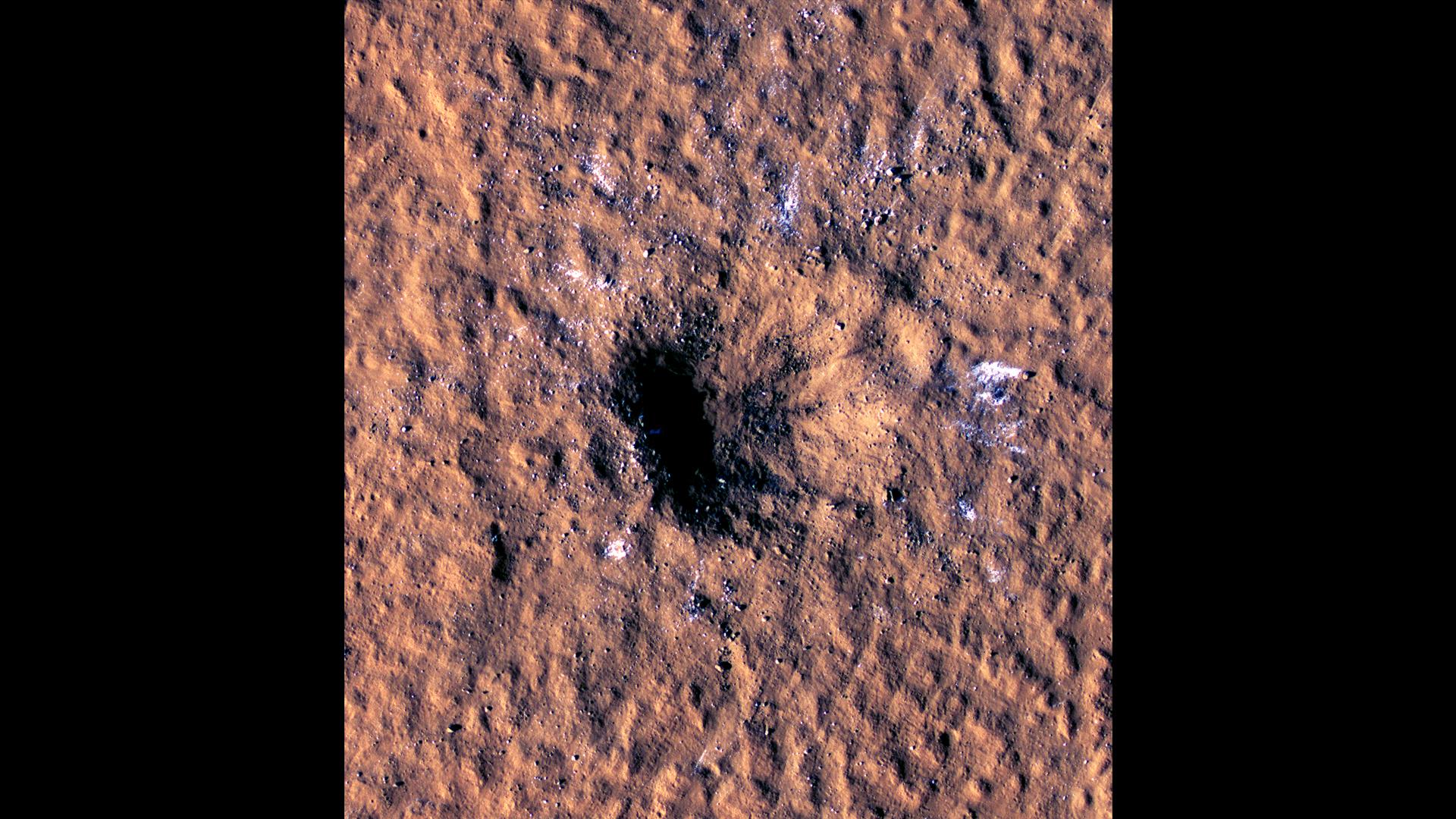
Martian image reconstructed using our artificial intelligence model from a photo acquired by MRO (Mars Reconnaissance Orbiter) about a crater, on Mars, formed on Dec. 24, 2021, when a meteoroid struck the ground in a region of Mars called Amazonis Planitia.The instrument that captured the image is the HiRISE (High-Resolution Imaging Science Experiment). NASA's InSight lander recorded a magnitude 4 Marsquake last 24 December, but scientists only later learned the cause of that quake: a meteor impact estimated to be one of the largest seen on Mars since NASA began exploring the cosmos. The diameter of the crater is about 150 metres, while the depth is 21 metres. The file is available at 52.66 million of pixels for download at 7021x7500 pixels.
Credit: NASA/JPL-Caltech/University of Arizona/PipploIMP (for magnification via AI)
Our Facebook page: bit.ly/PipploFB
Our YouTube channel: bit.ly/PipploYT
Image reconstructed using our artificial intelligence model. The image you see is from the Orion spacecraft and the Artemis 1 mission. The image was taken from cameras located at the ends of the Orion's solar panels.
The resulting document is 7500x4575 pixels (34.31 million pixels).
Credit: NASA/PipploIMP (for reconstruction/enlargement using AI)
Our Facebook page: bit.ly/PipploFB
Our YouTube channel: bit.ly/PipploYT
This is our version, via our artificial intelligence model, of the image provided by JWST about Cassiopeia A (Cas A) on December 11, 2023 at 01:00 UTC. Following the image of Cassiopeia A seen via MIRI in April 2023, the JWST team offers us a new image of this subject, in high definition via NIRCam (Near-Infrared Camera). This new image reveals intricate details of the rest of the supernova Cassiopeia A (Cas A) and shows the shell of expanding material colliding against the gas released by the star before its explosion.
The most striking colours in Webb's new image are the orange and light pink clusters that make up the inner shell of the rest of the supernova. These tiny nodes of gas, consisting of sulphur, oxygen, argon and neon from the star itself, are only detectable with NIRCam's extraordinary resolution and provide researchers with a clue as to how the dying star shattered like glass when it exploded.
North is in the top right-hand corner.
The file is available at 785.88 million pixels for download at a resolution of 26196x30000 pixels.
Map of wavelengths/colours:
blue for F162M;
green for F356W;
red for F444W.
Constellation: Cassiopeia.
Object Name: Cassiopeia A; SNR G111.7-02.1
Object Description: Supernova remnant.
Distance: 11,090 light-years.
Dimensions: Image is about 5.8 arcminutes across (19 light-years).
Exposure Date for NIRCam: November 5, 2022.
Release Date: December 11, 2023 at 01:00 (UTC).
Credits for image: NASA, ESA, CSA, STScI, Danny Milisavljevic (Purdue University), Ilse De Looze (UGent), Tea Temim (Princeton University). Magnification and reconstruction via AI by PipploIMP.
Our Facebook page: bit.ly/PipploFB
Our YouTube channel: bit.ly/PipploYT
Image reconstructed using our artificial intelligence model. The image you see is from the Orion spacecraft and the Artemis 1 mission. The image was taken from cameras located at the ends of the Orion's solar panels.
The resulting document is 7500x5625 pixels (42.19 million pixels).
Credit: NASA/PipploIMP (for reconstruction/enlargement using AI)
Our Facebook page: bit.ly/PipploFB
Our YouTube channel: bit.ly/PipploYT
Reconstruction using our artificial intelligence model of a photo captured by Perseverance at SOL 682 (January 20, 2022) at 14:47:16 LMST using the SHERLOC WATSON Camera. This is a special magnification focused on the titanium tube containing the sample that will be returned to Earth via the NASA Mars Sample Return mission. The file is available at 33.75 millions of pixels for download at a resolution of 7500x4500 pixels.
Credit: NASA/JPL-Caltech/PipploIMP
Our Facebook Page: bit.ly/PipploFB
Our YouTube Channel: bit.ly/PipploYT
Reconstruction using our artificial intelligence model of a photo captured by Perseverance at SOL 558 (September 15, 2022) at 15:08:37 LMST using the SHERLOC-WATSON Camera. The file is available at 167.46 millions of pixels for download at a resolution of 15000x11164 pixels.
Credit: NASA/JPL-Caltech/PipploIMP
Our Facebook Page: bit.ly/PipploFB
Our YouTube Channel: bit.ly/PipploYT
Thanks for taking the time to check out my image!
If you really enjoyed this image, be sure to click on over to my Urbex & Street Art Collection and check out more of my Urbex & Street Art photos.
Even better, if you have some Urbex & Street Art to share, come on over to the Urbex & Street Art (NSW & ACT) Group, join up & share away!
If you’re feeling ’a little more adventuress’ then click on over to all my Albums and browse through my collection.
Cheers. ‘Squiz’
Based on the image posted on Twitter by Michael Radke, who studies planetary atmospheres with photochemistry experiments in the lab at John Hopkins University (JHU), we attempted to enlarge the image using our artificial intelligence model. This is Titan as seen from JWST via MIRI (Mid-Infrared Instrument) between 4 and 5 November, adding red (at a wavelength of 4.8 μm), green (2.1 μm) and blue (1.4μm). These values are based on the VIMS (Visible and Infrared Mapping Spectrometer) of the Cassini mission.
Credit: NASA/JPL-Caltech/ESA/CSA/STScI/Michael Radke/PipploIMP (for magnification via AI)
Our Facebook Page: bit.ly/PipploFB
Our YouTube Channel: bit.ly/PipploYT
Reconstruction, using our artificial intelligence model, from 3 photos captured by Perseverance at SOL 806 (May 27, 2023) between 10:45:49 and 11:24:05 LMST using the SuperCam Remote Micro-Imager. The file is available at 375.12 millions of pixels for download at a resolution of 18756x20000 pixels.
Credit: NASA/JPL-Caltech/LANL/CNES/IRAP/PipploIMP
Our Facebook Page: bit.ly/PipploFB
Our YouTube Channel: bit.ly/PipploYT
Reconstruction (multifocal) using our artificial intelligence model of 28 photos captured by Perseverance at SOL 582 (October 10, 2022) between 20:40:10 and 20:46:04 LMST using the SHERLOC WATSON Camera. The file is available at 166.72 millions of pixels for download at a resolution of 15000x11115 pixels.
Credit: NASA/JPL-Caltech/PipploIMP
Our Facebook Page: bit.ly/PipploFB
Our YouTube Channel: bit.ly/PipploYT
One of my all time favorite sunsets. Taken whilst on assignment in Afghanistan; the shot reflected a mood of quiet calm, an unoccupied guard tower on dusk suggesting a peaceful night ahead but hiding the fact we were behind a larger perimeter with much better defence.
This image is part of my ’On Assignment Album’ which contains images from my 4 month assignment in Afghanistan ‘08/’09. If you liked this image why not check out the rest of my images in the album.
If you’re feeling a little more inquisitive, then be sure to take a look through all my Albums and browse my collection.
Cheers. ‘Squiz’
NASA’s James Webb Space Telescope has revealed the once-hidden features of the protostar within the dark cloud L1527, providing insight into the beginnings of a new star. These blazing clouds within the Taurus star-forming region are only visible in infrared light, making it an ideal target for Webb’s Near-Infrared Camera (NIRCam).
The protostar itself is hidden from view within the “neck” of this hourglass shape. An edge-on protoplanetary disk is seen as a dark line across the middle of the neck. Light from the protostar leaks above and below this disk, illuminating cavities within the surrounding gas and dust.
Filters and associated colour:
F200W Blue,
F335M Green
F444W Red,
F470N Orange.
Our artificial intelligence model has thoroughly reprocessed the captured image. The result is an image of 29402x30000 pixels (882.06 million pixels total).
Credit: NASA/ESA/CSA/STScI
/Joseph DePasquale (STScI)/ Anton M. Koekemoer (STScI)/ Alyssa Pagan (STScI)/PipploIMP (for AI magnification and reconstruction)
Our Facebook Page: bit.ly/PipploFB
Our YouTube Channel: bit.ly/PipploYT
Reconstruction using our artificial intelligence model of 2 photos captured by Perseverance at SOL 806 (May 27, 2023) between 10:17:47 and 10:18:47 LMST using both MastCam-Zs (1 from the left and 1 from the right). The file is available at 73.68 millions of pixels for download at a resolution of 10000x7368 pixels.
Credit: NASA/JPL-Caltech/ASU/PipploIMP
Our Facebook Page: bit.ly/PipploFB
Our YouTube Channel: bit.ly/PipploYT
The #Cougar is an #MRAP and #infantry mobility #vehicle structured to be resistant to #landmines and #improvised munitions, produced by Force Protection Inc.
These vehicles are protected against small arms, land mines and improvised explosive devices (IEDs) using a combination of design features and materials to protect both the crew and engine compartment against a wide range of attacks.
A Monocoque type, V-shaped hull extends to the engine bay and serves to direct the blast away from under the vehicle. Dual air-conditioners help keep heavily dressed troops from overheating in temperatures over 100 °F (38 °C).
This image is part of my ’On Assignment Album’ which contains images from my 4 month assignment in Afghanistan ‘08/’09. If you liked this image why not check out the rest of my images in the album.
If you’re feeling a little more inquisitive, then be sure to take a look through all my Albums and browse my collection.
Cheers. ‘Squiz’
Thanks stopping by & checking out my image!
If you enjoyed this image, be sure to check out my Modeling & CosPlay Collection and check out more of my Modeling & CosPlay photos.
Hey, come to think of it, if you have some CosPlay shot in context you’d like to share, come on over to the Real World CosPlay ~ CosPlay In Context Group, join up & share away!
If you’re feeling ’a little more adventuress’ then come on over look through all my Albums and browse my collection.
Cheers. ‘Squiz’
Reconstruction using our artificial intelligence model of a photo captured by Perseverance at SOL 680 (January 18, 2022) at 13:41:14 LMST using the SHERLOC WATSON Camera. This is a special magnification focused on the titanium tube containing the sample that will be returned to Earth via the NASA Mars Sample Return mission. The file is available at 33.75 millions of pixels for download at a resolution of 7501x4500 pixels.
Credit: NASA/JPL-Caltech/PipploIMP
Our Facebook Page: bit.ly/PipploFB
Our YouTube Channel: bit.ly/PipploYT
Reconstruction using our artificial intelligence model of a photo from ISS. A fortuitous orbit of the International Space Station allowed the astronauts this striking view of Sarychev volcano (Russia's Kuril Islands, northeast of Japan) in an early stage of eruption on June 12, 2009. Sarychev Peak is one of the most active volcanoes in the Kuril Island chain and is located on the northwestern end of Matua Island. The file is available at 438.4 millions of pixels for download at a resolution of 17040x25728 pixels.
Credit: NASA/PipploIMP (for reconstruction and enlargement via AI)
Our Facebook Page: bit.ly/PipploFB
Our YouTube Channel: bit.ly/PipploYT
Thanks stopping by & checking out my image!
If you enjoyed this image, be sure to check out my Modeling & CosPlay Collection and check out more of my Modeling & CosPlay photos.
Hey, come to think of it, if you have some CosPlay shot in context you’d like to share, come on over to the Real World CosPlay ~ CosPlay In Context Group, join up & share away!
If you’re feeling ’a little more adventuress’ then come on over look through all my Albums and browse my collection.
Cheers. ‘Squiz’
Reconstruction of the image taken during the overflight of Mercury by the ESA/JAXA probe Bepi Colombo during the second gravitational assist manoeuvre on Mercury, which took place on 23 June 2022 at 09:49:22 UTC. This manoeuvre is necessary to reach Mercury's orbit permanently, and four more will be needed. Finally, the probe will reach Mercury's orbit permanently on 5 December 2025. Our artificial intelligence model was used to improve the resolution to 15000x15000 pixels. The document can be downloaded from this page at a resolution of 225 million pixels.
Credit: ESA/BepiColombo/MTM/PipploIMP
Full video explaining the various gravitational manoeuvres: youtu.be/4u_djgMMh2Q
Our Facebook page: bit.ly/PipploFB
Our YouTube channel: bit.ly/PipploYT
This is an artistic illustration via AI, created especially for the article on our Facebook page. In reality the planet would be darker than a brown dwarf, here it is illuminated to show its tormented clouds. I also hypothesised the presence of several moons around this planet.
The idea was to depict the exoplanet VHS 1256 b, an enormous planet of about 11.8 Jovian masses 40 light years from us in the constellation Corvus. Too small to be a brown dwarf (you would need at least 75-80 Jovian masses), but big enough to possess Clouds with a temperature of about 830°C!
Considering that it gravitates around two stars (a binary system) and that it has a very wide orbit that takes it one revolution around the two stars in 10000 years, the temperatures of its Clouds are incredible!
The researchers deduced all this through the James Webb Space Telescope by identifying the characteristics of the silicate Clouds that are present in the atmosphere of this planet.
The atmosphere continually rises, mixes and shifts during its 22-hour day, bringing the warmer material up and pushing the cooler material down. The resulting changes in brightness are incredible. It is the most variable celestial body known to date.
The team, led by Brittany Miles of the University of Arizona, also found remarkably clear evidence of water, methane and carbon monoxide. This is the largest number of molecules ever detected all together on a planet outside our Solar System.
Copyright PipploIMP.
Our Facebook page: bit.ly/PipploFB
Our YouTube channel: bit.ly/PipploYT
Reconstruction using our artificial intelligence model of the photo acquired by the JWST through the NIRCam. What you see is the gas giant Jupiter in infrared, the body shining like a star on the left is Europa. The image is not intended for photorealism, but to understand the infrared emission. In the enlargement you can see black dots, they are probably bodies that stand between the telescope and Jupiter itself and as they do not emit light in the infrared they appear black. The file is available at 170.73 million pixels for download at a resolution of 15000x11382 pixels.
Credit: NASA/ESA/CSA/B.Holler and J. Stansberry (STScI)/PipploIMP
Our Facebook Page: bit.ly/PipploFB
Our YouTube Channel: bit.ly/PipploYT
Reconstruction, through our artificial intelligence model, of a photo captured by Ingenuity at SOL 450 (May 27, 2022) at 15:09:08 LMST using its NavCam. The file is available at 44.24 millions of pixel for download at a resolution of 7680x5760 pixels. The NavCam is the camera that the Ingenuity helicopter drone needs to orient itself during flight. The resolution is only 640x480 pixels and the images are all in black and white. Here, our artificial intelligence model enlarged the images to a factor of 12x and coloured the result.
Credit: NASA/JPL-Caltech/PipploIMP
Our Facebook Page: bit.ly/PipploFB
Our YouTube Channel: bit.ly/PipploYT
Reconstruction using our artificial intelligence model. What you see is the image taken by the Soar Telescope (Southern Astrophysical Research Telescope) while observing the asteroid Dimorphos two days after its collision with NASA's DART probe. In this image, digitally cleaned by our artificial intelligence model, you can clearly see the tail of debris coming from Dimorphos, a tail over 10,000 kilometres long. The impact occurred at 23:15 UTC on 26 September 2022.
The file is available at 37.7 million pixels for download at a resolution of 7501x5027 pixels.
Credits: Ctio/NoirLab/Soar/Nsf/Aura/T.Kareta (Lowell Observatory)/M.Knight(US Naval Academy)/PipploIMP (for reconstruction and enlargement via AI).
Our Facebook Page: bit.ly/PipploFB
Our YouTube Channel: bit.ly/PipploYT
Reconstruction using our artificial intelligence model of 8 photos captured by Perseverance at SOL 419 (April 25, 2022) at 14:29:33 LMST using the left NavCam. The file is available at 354.4 MP for download at a resolution of 30702x11544 pixels.
Credit: NASA/JPL-Caltech/PipploIMP
Our Facebook Page: bit.ly/PipploFB
Our YouTube Channel: bit.ly/PipploYT
Image reconstructed using our artificial intelligence model. The image you see is from the Orion spacecraft and the Artemis 1 mission. It is an image form the 20th flight day, the day of the 2nd flyby over the Moon.
The resulting document is 16000x12000 pixels (225 million pixels).
Credit: NASA/PipploIMP (for AI reconstruction/enlargement)
Our Facebook page: bit.ly/PipploFB
Our YouTube channel: bit.ly/PipploYT
Monaco Yacht Show 2013 Port Hercule ultra high resolution panorama, with 333 megapixels, shot during sunset in the Principality of Monaco. Even though the weather was not in our favour this year, our photographer still managed to get a lucky shot without too much movement of the yachts. The full image size is a 333 megapixel TIFF file (23,069 x 14418 pixels, at 300 dpi). A free wallpaper (10,240 x 6,400 px) is available for download for personal use here: crevis.io/p206 For commercial use, please contact Crevisio.
Reconstruction using our artificial intelligence model of a photo captured by Perseverance at SOL 482 (June 29, 2022) at 14:34:48 LMST using the SHERLOC-WATSON Camera. The file is available at 167.55 millions of pixels for download at a resolution of 15000x11170 pixels.
Credit: NASA/JPL-Caltech/PipploIMP
Our Facebook Page: bit.ly/PipploFB
Our YouTube Channel: bit.ly/PipploYT
Reconstruction with our artificial intelligence model of photos acquired by the DKIST telescope at the opening. Here we can see the solar photosphere in the image. It is the sharpest image of the Sun. It is the same area as in the image of the Chromosphere, only here we observe the layer below. In this image the granules, formed by convective flows of plasma, can be seen distinctly.The area is a perfect square with a side of 82500 kilometres, each individual granule is about 1600 kilometres wide. This image is taken at 486.13 nanometers using the hydrogen-beta line from the Balmer series.
The file is available at 2.025 billion pixels for download at a resolution of 45000x45000 pixels.
Credit: NSO/AURA/NSF/PipploIMP(for AI upscaling)
Our Facebook Page: bit.ly/PipploFB
Our YouTube Channel: bit.ly/PipploYT
Reconstruction using our artificial intelligence model from 2 photos captured by Perseverance at SOL 751 (April 1st, 2023) between 12:00:22 and 12:02:05 LMST using both MastCams-Zs (left & right). The file is available at 113.2 millions of pixels for download at a resolution of 12500x9056 pixels.
Credit: NASA/JPL-Caltech/ASU/PipploIMP
Our Facebook Page: bit.ly/PipploFB
Our YouTube Channel: bit.ly/PipploYT
Reconstruction using our artificial intelligence model of a photo captured by Perseverance at SOL 558 (September 15, 2022) at 15:06:24 LMST using the SHERLOC-WATSON Camera. The file is available at 167.46 millions of pixels for download at a resolution of 15000x11164 pixels.
Credit: NASA/JPL-Caltech/PipploIMP
Our Facebook Page: bit.ly/PipploFB
Our YouTube Channel: bit.ly/PipploYT
Image reconstructed using our artificial intelligence model. The image you see is from the Orion spacecraft and the Artemis 1 mission. It is an image form the 20th flight day, the day of the 2nd flyby over the Moon.
The resulting document is 16000x12000 pixels (225 million pixels).
Credit: NASA/PipploIMP (for AI reconstruction/enlargement)
Our Facebook page: bit.ly/PipploFB
Our YouTube channel: bit.ly/PipploYT
Reconstruction using our artificial intelligence model of a photo captured by Perseverance at SOL 691 (January 29, 2023) at 06:13:52 LMST using the left NavCam. The file is available at 75 millions of pixels for download at a resolution of 10000x7500 pixels.
Credit: NASA/JPL-Caltech/PipploIMP
Our Facebook Page: bit.ly/PipploFB
Our YouTube Channel: bit.ly/PipploYT