View allAll Photos Tagged UltraHighDefinition
Hey you, yes you, thanks for taking the time to check out my image!
If you really enjoyed this image, be sure to click on over to my Urbex & Street Art Collection and check out more of my Urbex & Street Art photos.
Even better, if you have some Urbex & Street Art to share, come on over to the Urbex & Street Art (NSW & ACT) Group, join up & share away!
If you’re feeling ’a little more adventuress’ then click on over to all my Albums and browse through my collection.
Cheers. ‘Squiz’
Project #365; A Photo A Day
Photocomposition, via our artificial intelligence model,
from 5 NASA's raw images:
JNCE_2023060_49C00074_V01,
JNCE_2023060_49C00075_V01,
JNCE_2023060_49C00076_V01,
JNCE_2023060_49C00077_V01,
JNCE_2023060_49C00078_V01.
The sequence shows the approach of the Juno probe to Io. The distances to the surface of this moon are respectively:
64994.2 km, 55389.7 km, 51525.0 km, 51760.5 km and 52515.6 km.
The file is available for download at 6 million pixels at 4000x1500 pixels.
Credits: NASA/JPL-Caltech/SwRI/MSSS/PipploIMP
Our Facebook page: bit.ly/PipploFB
Our YouTube channel: bit.ly/PipploYT
Thanks stopping by & checking out my image!
If you enjoyed this image, be sure to check out my Modeling & CosPlay Collection and check out more of my Modeling & CosPlay photos.
Hey, come to think of it, if you have some CosPlay shot in context you’d like to share, come on over to the Real World CosPlay ~ CosPlay In Context Group, join up & share away!
If you’re feeling ’a little more adventuress’ then come on over look through all my Albums and browse my collection.
Cheers. ‘Squiz’
Facebook | Flickriver | Cirkos Newcastle | Brontology CosPlay
Project #365; A Photo A Day
This image was taken by the MRO through HiRISE on 12 December 2022 from an altitude of 250.9 km, the circular area should be about 2 km in size. The colouring and magnification was done by artificial intelligence. The curious shape of this part of the Martian orography is very reminiscent of a bear. The curious V-shape of the central hill is very reminiscent of the nose and mouth of a plantigrade. Note the protrusion of a rock reminiscent of a bear's tooth. The two northernmost craters are reminiscent of the bear's eyes, while the circular subsidence of the whole area defines the contours of the face.
It is just pareidolia, the human brain trying to derive meaning from what it sees. A real freak of nature. The file is available for download at 668.74 million pixels at 25860x25860 pixels.
Credits: NASA/JPL-Caltech/University of Arizona/PipploIMP (for enlargement and colouring via AI).
Our Facebook page: bit.ly/PipploFB
Our YouTube channel: bit.ly/PipploYT
Image reconstructed using our artificial intelligence model. The image you see is from the Orion spacecraft and the Artemis 1 mission. It is an image form the 20th flight day, the day of the 2nd flyby over the Moon.
The resulting document is 16000x12000 pixels (225 million pixels).
Credit: NASA/PipploIMP (for AI reconstruction/enlargement)
Our Facebook page: bit.ly/PipploFB
Our YouTube channel: bit.ly/PipploYT
Thanks stopping by & checking out my image!
If you enjoyed this image, be sure to check out my Modeling & CosPlay Collection and check out more of my Modeling & CosPlay photos.
Hey, come to think of it, if you have some CosPlay shot in context you’d like to share, come on over to the Real World CosPlay ~ CosPlay In Context Group, join up & share away!
If you’re feeling ’a little more adventuress’ then come on over look through all my Albums and browse my collection.
Cheers. ‘Squiz’
Reconstruction using our artificial intelligence model from an image provided by Chandra X-ray Observatory about NGC 1672.
NGC 1672 is a spiral galaxy, but one that astronomers categorize as a “barred” spiral. In regions close to their centers, the arms of barred spiral galaxies are mostly in a straight band of stars across the center that encloses the core, as opposed to other spirals that have arms that twist all the way to their core. The Chandra data reveals compact objects like neutron stars or black holes pulling material from companion stars as well as the remnants of exploded stars. Additional data from Hubble (optical light) helps fill out the spiral arms with dust and gas, while Webb data shows dust and gas in the galaxy’s spiral arms. (X-ray: purple; optical: red, green, blue; infrared: red, green, blue)
The file is available at 147.40 millions of pixels for download at a resolution of 14400x10236 pixels.
Credits for X-ray: Chandra: NASA/CXC/SAO, XMM: ESA/XMM-Newton; for Infrared: JWST: NASA/ESA/CSA/STScI, Spitzer: NASA/JPL/CalTech; for Optical: Hubble: NASA/ESA/STScI, ESO; for Image Processing: L. Frattare, J. Major, and K. Arcand. Reconstruction and magnification via AI by PipploIMP.
Our Facebook Page: bit.ly/PipploFB
Our YouTube Channel: bit.ly/PipploYT
Reconstruction using our artificial intelligence model of a NASA's photo taken by astronaut Andrew Morgan. A fisheye lens was used to capture the intersection of two continents. The file is available at 1.067 billions of pixels for download at a resolution of 40000x26666 pixels.
Credit: NASA/Andrew Morgan/PipploIMP
Our Facebook Page: bit.ly/PipploFB
Our YouTube Channel: bit.ly/PipploYT
Reconstruction with our artificial intelligence model of the photo acquired by the JWST through the NIRCam (Near Infrared Camera) instrument of the candidate galaxy to be the most distant in time and space. The galaxy currently has two names given by two different teams observing it: GLASS-z13 and GHZ2. The faint red light seen in the centre of the image is a galaxy that formed some 300 million years after the Big Bang. It should be 13.5 billion light years away from us.
The generated file has been enlarged and qualitatively enhanced by our artificial intelligence model.
Credit: NASA/ESA/CSA/STScI/Tommaso Treu/PipploIMP
Our Facebook page: bit.ly/PipploFB
Our YouTube channel: bit.ly/PipploYT
CosPlay Session with the talented Miss Bronte putting a femine touch to 'Darth Maul'.
If you enjoyed this image, be sure to check out my Modeling & CosPlay Collection and check out more of my Modeling & CosPlay photos.
Hey, come to think of it, if you have some CosPlay shot in context you’d like to share, come on over to the Real World CosPlay ~ CosPlay In Context Group, join up & share away!
If you’re feeling ’a little more adventuress’ then come on over look through all my Albums and browse my collection.
Cheers. ‘Squiz’
Reconstruction using our artificial intelligence model of the photo acquired by the JWST through the NIRCam. It's a young, star-forming region NGC 3324 in the Carina Nebula at 9100 light years from Earth. Captured in infrared light by the NIRCam (Near-Infrared Camera) by James Webb Space Telescope, this image reveals previously obscured areas of star birth. The file is available at 2.085 billion pixels for download at a resolution of 60000x34755 pixels.
Credit: NASA/ESA/CSA/STScI/PipploIMP
Our Facebook Page: bit.ly/PipploFB
Our YouTube Channel: bit.ly/PipploYT
Image reconstructed using our artificial intelligence model. The image you see is from the Orion spacecraft and the Artemis 1 mission. It is an image form the 20th flight day, the day of the 2nd flyby over the Moon.
The resulting document is 16000x12000 pixels (225 million pixels).
Credit: NASA/PipploIMP (for AI reconstruction/enlargement)
Our Facebook page: bit.ly/PipploFB
Our YouTube channel: bit.ly/PipploYT
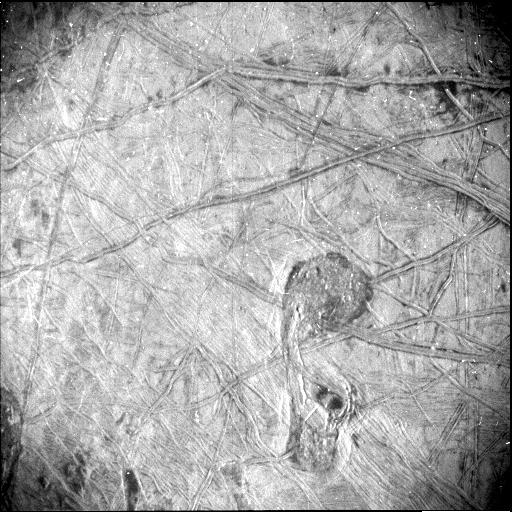
Image reconstructed by two of our artificial intelligence models. The base image is PIA 25332 from NASA and published on 5 October 2022 (512x512 pixels). This enlargement uses two artificial intelligence models to recreate the possible colouration (enhancing colouration) and relief structures in this part of Europa's ice surface. This image was acquired by the SRU (Stellar Reference Unit) during the 45th perijove on 29 September 2022.
The image was taken at a distance of about 412 kilometres over the darkened hemisphere of Europa. It covers about 150 kilometres by 200 kilometres of the moon's surface. The file is available for download at 24.95 millions of pixels at 5000x4990 pixels.
Image Credit: NASA/JPL-Caltech/SwRI/PipploIMP
Our Facebook page: bit.ly/PipploFB
Our YouTube channel: bit.ly/PipploYT
Reconstruction using our artificial intelligence model of a photo captured by Perseverance at SOL 490 (July 7, 2022) at 17:03:00 LMST using the left MastCam-Z. The photo is part of the core sampling phase of the Mazian rock. The file is available at 167.50 millions of pixels for download at a resolution of 15000x11167 pixels.
Credit: NASA/JPL-Caltech/ASU/PipploIMP
Our Facebook Page: bit.ly/PipploFB
Our YouTube Channel: bit.ly/PipploYT
Image reconstructed using our artificial intelligence model. The image you see is from the Orion spacecraft and the Artemis 1 mission. The image depicts the Moon on 11th day of flight (26 November 2022).
The resulting document is 5000x5000 pixels (25 million pixels).
Credit: NASA/PipploIMP (for reconstruction/enlargement via AI)
Our Facebook page: bit.ly/PipploFB
Our YouTube channel: bit.ly/PipploYT
Thanks for taking the time to check out my image!
If you really enjoyed this image, be sure to click on over to my Urbex & Street Art Collection and check out more of my Urbex & Street Art photos.
Even better, if you have some Urbex & Street Art to share, come on over to the Urbex & Street Art (NSW & ACT) Group, join up & share away!
If you’re feeling ’a little more adventuress’ then click on over to all my Albums and browse through my collection.
Cheers. ‘Squiz’
This is our version, via our artificial intelligence model, of the image provided by ESA/Webb. This composite image has as its main subject NGC 7469, a bright spiral galaxy about 90000 light years in diameter, 220 million light years from Earth in the direction of the constellation Pegasus. Part of the companion galaxy, IC 5283, can be glimpsed at lower left.
NGC 7469 was recently studied as part of the GOALS (Great Observatories All-sky LIRGs Survey) - ERS (Early Release Science) programs with the NASA/ESA/CSA James Webb Space Telescope, projects that aim to study the physics of star formation and the growth of black holes.
NGC 7469 hosts an active galactic nucleus (AGN), an extremely bright central region dominated by light emitted by dust and gas falling into the galaxy's central black hole.
Using Webb's MIRI, NIRCam and NIRspec instruments to obtain images and spectra of NGC 7469 in unprecedented detail, the GOALS team discovered a number of details about the object. These include never-before-seen clusters of very young stars in formation and pockets of very hot, turbulent molecular gas.
The file is available at 896.07 million pixels for download at a resolution of 30000x29869pixels.
Map of wavelengths/colours:
1.5 μm blue;
2.0 μm light blue;
3.35 μm ochre yellow;
4.44 μm red.
Photo id: potm2212a

Type: Observation
Release Date: 21 December 2022, 10:00 UTC
Credits: ESA/Webb, NASA & CSA, L. Armus, A. S. Evans. PipploIMP for artificial intelligence magnification and reconstruction.
Our Facebook page: bit.ly/PipploFB
Our YouTube channel: bit.ly/PipploYT
Thanks stopping by & checking out my image!
If you enjoyed this image, be sure to check out my Modeling & CosPlay Collection and check out more of my Modeling & CosPlay photos.
Hey, come to think of it, if you have some CosPlay shot in context you’d like to share, come on over to the Real World CosPlay ~ CosPlay In Context Group, join up & share away!
If you’re feeling ’a little more adventuress’ then come on over look through all my Albums and browse my collection.
Cheers. ‘Squiz’
Reconstruction using our artificial intelligence model of a photo captured by Perseverance at SOL 749 (March 30 2023) at 17:20:33 LMST using the left MastCams-Z. The file is available at 116.29 millions of pixels for download at a resolution of 12500x9303 pixels.
Credit: NASA/JPL-Caltech/ASU/PipploIMP
Our Facebook Page: bit.ly/PipploFB
Our YouTube Channel: bit.ly/PipploYT
This is our version, via our artificial intelligence model, of the image provided by JWST about Arp 220. Arp 220, could appear as a cluster of lights, surrounded by a myriad of galaxies all around. This is what this merger of two spiral galaxies (a merger that started about 700 million years ago) looks like under the gaze of the JWST's NIRCam and MIRI instruments.
It is about 250 million light years from Earth, looking towards the constellation of the Serpent. Arp 220 shines mainly in infrared light, making it an ideal target for Webb. It is an ultra-bright infrared galaxy (ULIRG) with a luminosity of more than a trillion suns. In comparison, our own Milky Way has a much more modest luminosity of about ten billion suns.
It triggered an enormous explosion of star formation. About 200 enormous star clusters reside in a dusty region of about 5,000 light years (about 5 per cent of the diameter of the Milky Way). The amount of gas in this small region is equal to that of the entire Milky Way galaxy. In this gigantic collision, there are the remains of about 100 supernovae in an area of less than 500 light years.
North is in the top right-hand corner.
The file is available at 528.42 million pixels for download at a resolution of 21137x25000 pixels.
Map of wavelengths/colours from NIRCam:
Blue: F090W+F150W;
Green F200W;
Orange F277W;
Red F356W + F444W.
Map of wavelengths/colours from MIRI:
Orange: F770W;
Red: F1130W.
Constellation: Serpens.
Object Description: Interacting Galaxies.
Distance: 250 million light-years (100 million parsecs).
Dimensions: 120,000 light-years across.
Exposure Date for NIRCam/MIRI: 2 June 2022, 4 June 2022.
Release Date: April 17, 2023 14:00 (UTC).
Credits for image: NASA, ESA, CSA, STScI; for image processing: Alyssa Pagan (STScI). Magnification and reconstruction via AI by PipploIMP.
Our Facebook page: bit.ly/PipploFB
Our YouTube channel: bit.ly/PipploYT
Reconstruction using our artificial intelligence model of the photo acquired by the JWST through the NIRCam. This is a composite image of Jupiter from three filters: F360M (red), F212N (yellow-green), and F150W2 (cyan). There is an alignment due to the planet’s rotation. The file is available at 592.72 million pixels for download at a resolution of 25000x23709 pixels.
Credit:NASA/ESA/CSA/Jupiter ERS Team; Image processing by Judy Schmidt./PipploIMP(for AI upscaling)
Our Facebook Page: bit.ly/PipploFB
Our YouTube Channel: bit.ly/PipploYT
Thanks stopping by & checking out my image!
If you enjoyed this image, be sure to check out my Modeling & CosPlay Collection and check out more of my Modeling & CosPlay photos.
Hey, come to think of it, if you have some CosPlay shot in context you’d like to share, come on over to the Real World CosPlay ~ CosPlay In Context Group, join up & share away!
If you’re feeling ’a little more adventuress’ then come on over look through all my Albums and browse my collection.
Cheers. ‘Squiz’
The Pillars of Creation are a particular area of the Eagle Nebula, 6500 light years from Earth. This image was taken by the JWST using the MIRI (Mid-Infrared Instrument). Our artificial intelligence model has thoroughly reprocessed the captured image. The result is an image of 15000x13717 pixels (205.75 million pixels total).
Credit: NASA/ESA/CSA/STScI. Image processing: Joseph DePasquale (STScI)/ Alyssa Pagan (STScI)/PipploIMP (for AI magnification).
Our Facebook Page: bit.ly/PipploFB
Our YouTube Channel: bit.ly/PipploYT
Magnification using our artificial intelligence model of the composite image provided by the JWST team. The team searched for faint galaxies that are visible in the infrared but whose spectrum breaks off abruptly at a critical wavelength. They conducted further observations (not shown here) with Webb's NIRSpec instrument to measure the redshift of each galaxy and reveal the properties of the gas and stars in these galaxies.
In this image, blue represents light at 1.15 microns (115W), green is 2.0 microns (200W) and red is 4.44 microns (444W).
The resulting document is 22858x25000 pixels (571.45 million pixels).
Credits: for image NASA / ESA / CSA / M. Zamani (ESA/Webb); for Science Brant Robertson (UC Santa Cruz) / S.Tacchella (Cambridge) / E.Curtis-Lake (UOH) / S.Carniani (Scuola Normale Superiore) / JADES Collaboration. PipploIMP(for magnification via AI).
Our Facebook Page: bit.ly/PipploFB
Our YouTube Channel: bit.ly/PipploYT
Reconstruction using our artificial intelligence model of a photo captured by Perseverance at SOL 558 (September 15, 2022) at 15:13:42 LMST using the SHERLOC-WATSON Camera. The file is available at 167.46 millions of pixels for download at a resolution of 15000x11164 pixels.
Credit: NASA/JPL-Caltech/PipploIMP
Our Facebook Page: bit.ly/PipploFB
Our YouTube Channel: bit.ly/PipploYT
Thanks for taking the time to check out my image!
If you really enjoyed this image, be sure to click on over to my Urbex & Street Art Collection and check out more of my Urbex & Street Art photos.
Even better, if you have some Urbex & Street Art to share, come on over to the Urbex & Street Art (NSW & ACT) Group, join up & share away!
If you’re feeling ’a little more adventuress’ then click on over to all my Albums and browse through my collection.
Cheers. ‘Squiz’
Image from the flyover by the Juno probe (perijove 45) over the Jovian moon Europa. The colours of the ice are not white, but slightly amber; these are the natural colours, due to the presence of salts on the surface from the inner ocean. In this version, derived from the raw image JNCE_2022272_45C00001_V01, we can clearly see the corrugations on the surface ice. Image acquired via Junocam on 29 September 2022 at 09:38 UTC. This image was reconstructed using our artificial intelligence model. The file is available for download at 157.5 millions of pixels at 15000x10500 pixels.
Image Credit: NASA/JPL-Caltech/SwRI/MSSS/PipploIMP
Our Facebook page: bit.ly/PipploFB
Our YouTube channel: bit.ly/PipploYT
Thanks stopping by & checking out my image!
If you enjoyed this image, be sure to check out my Modeling & CosPlay Collection and check out more of my Modeling & CosPlay photos.
Hey, come to think of it, if you have some CosPlay shot in context you’d like to share, come on over to the Real World CosPlay ~ CosPlay In Context Group, join up & share away!
If you’re feeling ’a little more adventuress’ then come on over look through all my Albums and browse my collection.
Cheers. ‘Squiz’
Thanks for taking the time to check out my image!
If you really enjoyed this image, be sure to click on over to my Urbex & Street Art Collection and check out more of my Urbex & Street Art photos.
Even better, if you have some Urbex & Street Art to share, come on over to the Urbex & Street Art (NSW & ACT) Group, join up & share away!
If you’re feeling ’a little more adventuress’ then click on over to all my Albums and browse through my collection.
Cheers. ‘Squiz’
Reconstruction using our artificial intelligence model of 2 photos captured by Perseverance at SOL 804 (May 25, 2023) at 12:34:14 LMST using both MastCam-Zs (one from the left and one from the right). The file is available at 113.73 millions of pixels for download at a resolution of 15000x7582 pixels.
Credit: NASA/JPL-Caltech/ASU/PipploIMP
Our Facebook Page: bit.ly/PipploFB
Our YouTube Channel: bit.ly/PipploYT
This is our version, via our artificial intelligence model, of the image provided by JWST about Cassiopeia A (Cas A). It is a supernova remnant located about 11,000 light years from Earth in the constellation Cassiopeia. This new image uses data from Webb's MIRI (Mid-Infrared Instrument) to reveal Cas A in a new light.
Outside the remnant, there are curtains of material that appear orange and red due to the emission of hot dust. This marks the point where the material ejected from the exploded star collides with the surrounding circumstellar material.
Inside this outer shell are bright pink mottled filaments, dotted with clumps and knots. This is material from the star itself, which probably glows from a mixture of various heavy elements and dust emission. The stellar material is also visible in the form of fainter clumps within the cavity.
A ring depicted in green extends to the bottom right offset from the centre. Its shape and complexity are unexpected and challenging for scientists to understand.
North is in the top right-hand corner.
The file is available at 365.44 million pixels for download at a resolution of 20000x18272 pixels.
Map of wavelengths/colours:
blue for F560W;
light blue for F770W;
cyan for F1000W;
green for F1130W;
yellow for F1280W;
orange for F1800W;
red for F2100W+F2550W.
Constellation: Cassiopeia.
Object Description: Supernova remnant.
Distance: 11,090 light-years.
Dimensions: 24 light-years.
Exposure Date for MIRI: August 4, 2022.
Release Date: April 07, 2023 14:00 (UTC).
Credits for image: NASA, ESA, CSA, Danny Milisavljevic (Purdue University), Tea Temim (Princeton University), Ilse De Looze (UGent); for image processing: Joseph DePasquale (STScI). Magnification and reconstruction via AI by PipploIMP.
Our Facebook page: bit.ly/PipploFB
Our YouTube channel: bit.ly/PipploYT
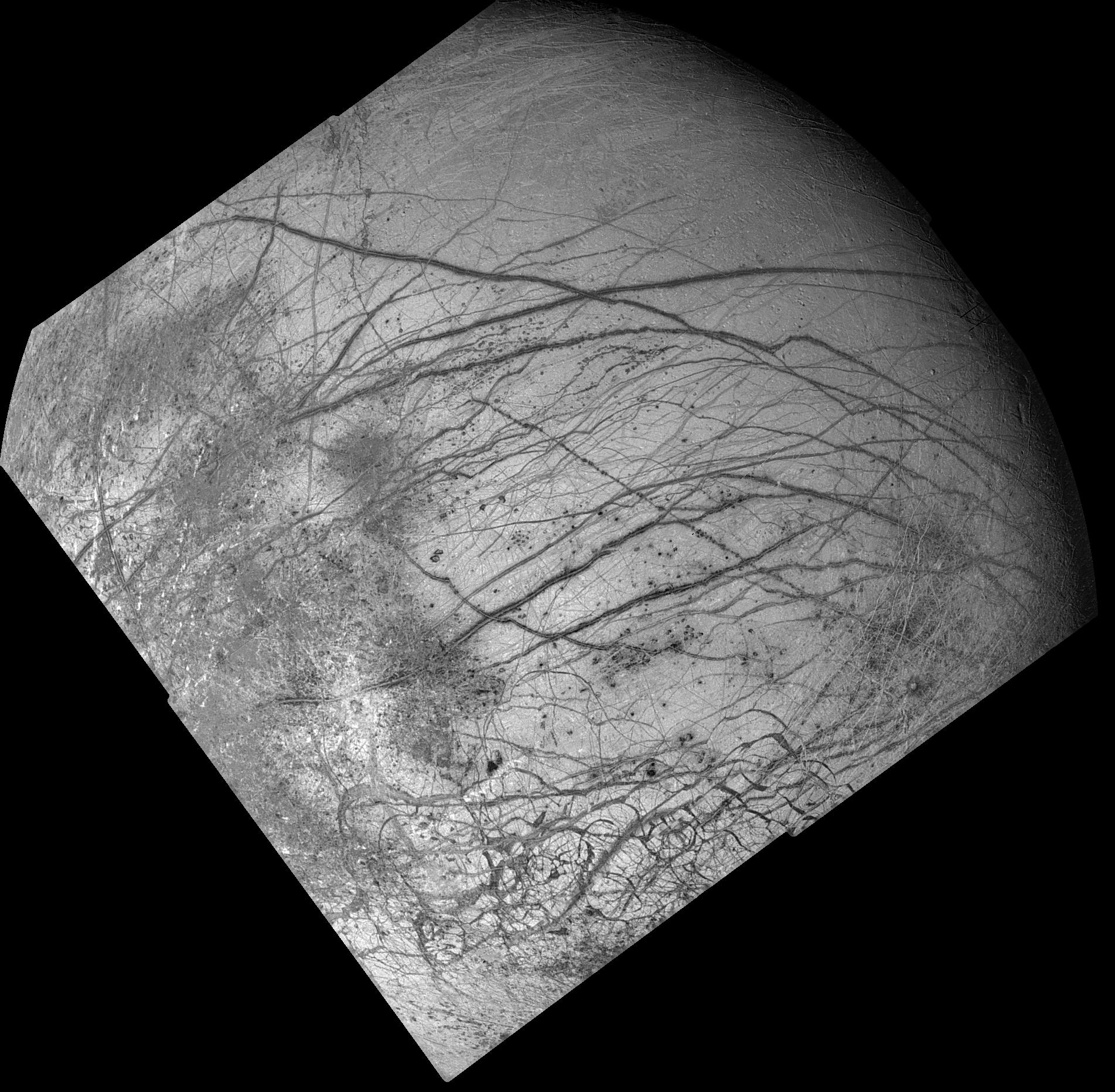
This image is our version, using our artificial intelligence model (enlargement and colouring), of the NASA photo PIA00295. It depicts the composite photo (from 4 images) taken by the Galileo probe on 27 June 1996.
The images were taken from a distance of 156,000 kilometres from the surface of Europa. Many of the dark bands are more than 1,600 kilometres long!
The file is available at 153.05 million pixels for download at a resolution of 12500x12244 pixels.
Credits: NASA/JPL/USGS. Full AI processing by PipploIMP.
Our Facebook Page: bit.ly/PipploFB
Our YouTube Channel: bit.ly/PipploYT