View allAll Photos Tagged UltraHighDefinition
Image reconstructed using our artificial intelligence model. What you see here is a reconstruction from 16 photos taken by the Optical Navigation Camera of the Orion spacecraft for the Artemis 1 mission. The surface shown has been largely corrected from the many lines in the original images.
The resulting document is 35000x30097 pixels (1.053 billion pixels).
Credit: NASA/JSC/PipploIMP (for magnification/reconstruction via AI)
Our Facebook page: bit.ly/PipploFB
Our YouTube channel: bit.ly/PipploYT
Thanks for taking the time to check out my image!
If you really enjoyed this image, be sure to click on over to my Urbex & Street Art Collection and check out more of my Urbex & Street Art photos.
Even better, if you have some Urbex & Street Art to share, come on over to the Urbex & Street Art (NSW & ACT) Group, join up & share away!
If you’re feeling ’a little more adventuress’ then click on over to all my Albums and browse through my collection.
Cheers. ‘Squiz’
Image from the flyover by the Juno probe (perijove 45) over the Jovian moon Europa. The colours of the ice are not white, but slightly amber; these are the natural colours, due to the presence of salts on the surface from the inner ocean. In this version, derived from the raw image JNCE_2022272_45C00001_V01, we can clearly see the corrugations on the surface ice. Image acquired via Junocam on 29 September 2022 at 09:38 UTC. This image was reconstructed using our artificial intelligence model. The file is available for download at 157.5 millions of pixels at 15000x10500 pixels.
Image Credit: NASA/JPL-Caltech/SwRI/MSSS/PipploIMP
Our Facebook page: bit.ly/PipploFB
Our YouTube channel: bit.ly/PipploYT
Thanks stopping by & checking out my image!
If you enjoyed this image, be sure to check out my Modeling & CosPlay Collection and check out more of my Modeling & CosPlay photos.
Hey, come to think of it, if you have some CosPlay shot in context you’d like to share, come on over to the Real World CosPlay ~ CosPlay In Context Group, join up & share away!
If you’re feeling ’a little more adventuress’ then come on over look through all my Albums and browse my collection.
Cheers. ‘Squiz’
Thanks for taking the time to check out my image!
If you really enjoyed this image, be sure to click on over to my Urbex & Street Art Collection and check out more of my Urbex & Street Art photos.
Even better, if you have some Urbex & Street Art to share, come on over to the Urbex & Street Art (NSW & ACT) Group, join up & share away!
If you’re feeling ’a little more adventuress’ then click on over to all my Albums and browse through my collection.
Cheers. ‘Squiz’
Reconstruction using our artificial intelligence model of 2 photos captured by Perseverance at SOL 804 (May 25, 2023) at 12:34:14 LMST using both MastCam-Zs (one from the left and one from the right). The file is available at 113.73 millions of pixels for download at a resolution of 15000x7582 pixels.
Credit: NASA/JPL-Caltech/ASU/PipploIMP
Our Facebook Page: bit.ly/PipploFB
Our YouTube Channel: bit.ly/PipploYT
This is our version, via our artificial intelligence model, of the image provided by JWST about Cassiopeia A (Cas A). It is a supernova remnant located about 11,000 light years from Earth in the constellation Cassiopeia. This new image uses data from Webb's MIRI (Mid-Infrared Instrument) to reveal Cas A in a new light.
Outside the remnant, there are curtains of material that appear orange and red due to the emission of hot dust. This marks the point where the material ejected from the exploded star collides with the surrounding circumstellar material.
Inside this outer shell are bright pink mottled filaments, dotted with clumps and knots. This is material from the star itself, which probably glows from a mixture of various heavy elements and dust emission. The stellar material is also visible in the form of fainter clumps within the cavity.
A ring depicted in green extends to the bottom right offset from the centre. Its shape and complexity are unexpected and challenging for scientists to understand.
North is in the top right-hand corner.
The file is available at 365.44 million pixels for download at a resolution of 20000x18272 pixels.
Map of wavelengths/colours:
blue for F560W;
light blue for F770W;
cyan for F1000W;
green for F1130W;
yellow for F1280W;
orange for F1800W;
red for F2100W+F2550W.
Constellation: Cassiopeia.
Object Description: Supernova remnant.
Distance: 11,090 light-years.
Dimensions: 24 light-years.
Exposure Date for MIRI: August 4, 2022.
Release Date: April 07, 2023 14:00 (UTC).
Credits for image: NASA, ESA, CSA, Danny Milisavljevic (Purdue University), Tea Temim (Princeton University), Ilse De Looze (UGent); for image processing: Joseph DePasquale (STScI). Magnification and reconstruction via AI by PipploIMP.
Our Facebook page: bit.ly/PipploFB
Our YouTube channel: bit.ly/PipploYT
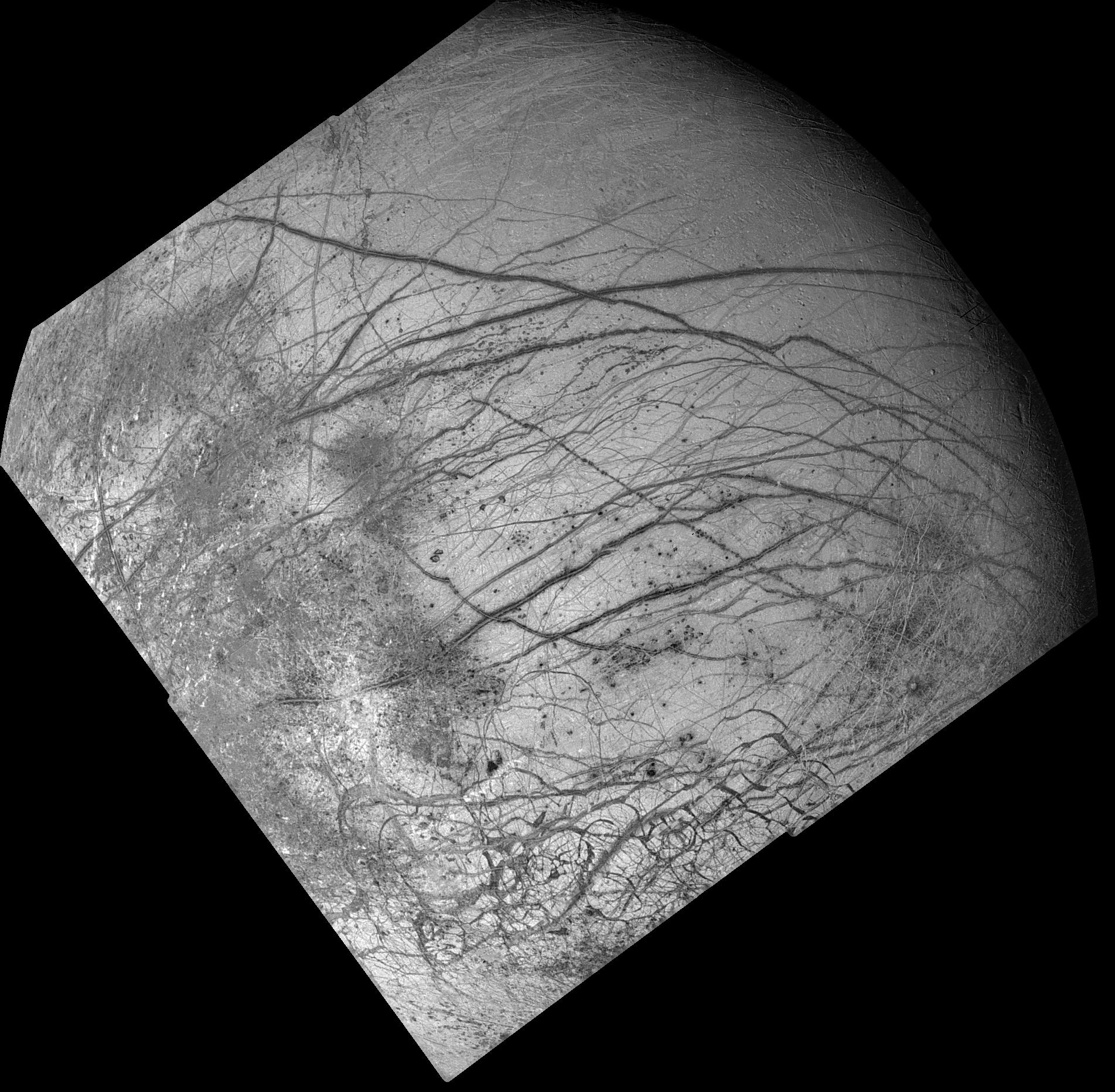
This image is our version, using our artificial intelligence model (enlargement and colouring), of the NASA photo PIA00295. It depicts the composite photo (from 4 images) taken by the Galileo probe on 27 June 1996.
The images were taken from a distance of 156,000 kilometres from the surface of Europa. Many of the dark bands are more than 1,600 kilometres long!
The file is available at 153.05 million pixels for download at a resolution of 12500x12244 pixels.
Credits: NASA/JPL/USGS. Full AI processing by PipploIMP.
Our Facebook Page: bit.ly/PipploFB
Our YouTube Channel: bit.ly/PipploYT
Thanks for taking the time to check out my image!
If you really enjoyed this image, be sure to click on over to my Urbex & Street Art Collection and check out more of my Urbex & Street Art photos.
Even better, if you have some Urbex & Street Art to share, come on over to the Urbex & Street Art (NSW & ACT) Group, join up & share away!
If you’re feeling ’a little more adventuress’ then click on over to all my Albums and browse through my collection.
Cheers. ‘Squiz’
Thanks stopping by & checking out my image!
If you enjoyed this image, be sure to check out my Modeling & CosPlay Collection and check out more of my Modeling & CosPlay photos.
Hey, come to think of it, if you have some CosPlay shot in context you’d like to share, come on over to the Real World CosPlay ~ CosPlay In Context Group, join up & share away!
If you’re feeling ’a little more adventuress’ then come on over look through all my Albums and browse my collection.
Cheers. ‘Squiz’
This is our version, using our artificial intelligence model, of the image provided by ESA's JUICE mission. The image has been enlarged, made sharper and with more realistic colours.
Shortly after the launch, on 14 April, ESA's Juice, the explorer of Jupiter's icy moons, captured this image with its JMC1 (Juice monitoring camera 1). The Gulf of Aden is clearly visible in the photo.
JMC1 stands on top of the spacecraft and looks diagonally upwards in a field of view that will eventually see the antennas deployed and, depending on their orientation, part of one of the solar arrays. The image was taken at 12:42 UTC.
The file is available for download at 25 million pixels with a resolution of 5000x5000 pixels.
Credits: ESA/Juice/JMC. Magnification and reconstruction via AI by PipploIMP.
Our Facebook page: bit.ly/PipploFB
Our YouTube channel: bit.ly/PipploYT
Reconstruction using our artificial intelligence model of a photo captured by Perseverance at SOL 490 (July 7, 2022) at 16:29:13 LMST using the right MastCam-Z. The photo is part of the core sampling phase of the Mazian rock. The file is available at 167.49 millions of pixels for download at a resolution of 15000x11166 pixels.
Credit: NASA/JPL-Caltech/ASU/PipploIMP
Our Facebook Page: bit.ly/PipploFB
Our YouTube Channel: bit.ly/PipploYT
Reconstruction using our artificial intelligence model from 7 photos captured by Perseverance at SOL 721 (March 1, 2023) between 11:03:41 and 11:05:12 LMST using the left MastCams-Z. The file is available at 210.8 millions of pixels for download at a resolution of 40000x5270 pixels.
Credit: NASA/JPL-Caltech/ASU/PipploIMP
Our Facebook Page: bit.ly/PipploFB
Our YouTube Channel: bit.ly/PipploYT
Reconstruction, using our artificial intelligence model, of the photo of Neptune, acquired by the JWST through the NIRCam (in the near-infrared range from 0.6 to 5 microns). Our artificial intelligence model cleaned up distortions and background noise as much as possible, after which the entire image was upscaled. Methane gas absorbs red and infrared light so strongly that the planet is quite dark at these near-infrared wavelengths, except when clouds are present at high altitudes. These clouds of ice and methane are evident as bright streaks and spots, which reflect sunlight before it is absorbed by methane gas.
In this extreme magnification, you can see here clearly shows the planetary rings and 5 of Neptune's 14 moons. Starting counter-clockwise at the top left: Galatea, Neiad, Thalassa, Larissa Despina.
The file is available at 21.3 million pixels for download at a resolution of 5712x3728 pixels.
Credit:NASA/ESA/CSA/STScI/PipploIMP (for AI upscaling)
Our Facebook Page: bit.ly/PipploFB
Our YouTube Channel: bit.ly/PipploYT
Reconstruction, through our artificial intelligence model, of a photo captured by Ingenuity at SOL 772 (April 23, 2023) at 15:23:04 LMST using its ColorCam. This was the date of Ingenuity's 51st flight. The file is available at 472.64 millions of pixel for download at a resolution of 2500018536 pixels.
Credit: NASA/JPL-Caltech/PipploIMP
Our Facebook Page: bit.ly/PipploFB
Our YouTube Channel: bit.ly/PipploYT
Reconstruction using our artificial intelligence model from a photo captured by Perseverance at SOL 786 (May 7, 2023) at 12:47:31 LMST using the SHERLOC WATSON Camera. The file is available at 116.29 millions of pixels for download at a resolution of 12500x9303 pixels.
Credit: NASA/JPL-Caltech/PipploIMP
Our Facebook Page: bit.ly/PipploFB
Our YouTube Channel: bit.ly/PipploYT
An old 'Contactor Panel' in an abandoned industrial building.
Thanks for taking the time to check out my image!
If you really enjoyed this image, be sure to click on over to my Urbex & Street Art Collection and check out more of my Urbex & Street Art photos.
Even better, if you have some Urbex & Street Art to share, come on over to the Urbex & Street Art (NSW & ACT) Group, join up & share away!
If you’re feeling ’a little more adventuress’ then click on over to all my Albums and browse through my collection.
Cheers. ‘Squiz’
Reconstruction using our artificial intelligence model from 44 photos captured by Perseverance at SOL 721 (March 1, 2023) between 15:27:45 and 15:40:12 LMST using the right MastCams-Z. The file is available at 793.4 millions of pixels for download at a resolution of 32000x24794 pixels.
Credit: NASA/JPL-Caltech/ASU/PipploIMP
Our Facebook Page: bit.ly/PipploFB
Our YouTube Channel: bit.ly/PipploYT
Image reconstructed with our artificial intelligence model. The image comes from ASI's Italian ArgoMoon nano-probe, built and operated by Argotec. Here, the Italian nano-probe pointed its lens towards Earth and the Indian Ocean. According to data provided by ASI, the photo was taken on 23 November 2022 when the probe was at a distance of 237,000 km from Earth!
The resulting document is 9375x12500 pixels (117.19 million pixels).
Credit: ASI/NASA/PipploIMP (for reconstruction/enlargement using AI)
Our Facebook page: bit.ly/PipploFB
Our YouTube channel: bit.ly/PipploYT
This is our version, via our artificial intelligence model, of the image provided by JWST about WR124, Wolf-Rayet star in the constellation of Sagitta. This version is a composite from both NIRCam and MIRI data.
The luminous, hot star Wolf-Rayet 124 (WR 124) is prominent at the center of the James Webb Space Telescope’s composite image combining near-infrared and mid-infrared wavelengths of light. The star displays the characteristic diffraction spikes of Webb’s Near-Infrared Camera (NIRCam), caused by the physical structure of the telescope itself. NIRCam effectively balances the brightness of the star with the fainter gas and dust surrounding it, while Webb’s Mid-Infrared Instrument (MIRI) reveals the nebula’s structure.
The file is available at 886.35 million pixels for download at a resolution of 30000x29545 pixels.
Map of wavelengths/colours:
Blue: F090W+F150W+F770W;
Green: F210M+F335M+F1130W;
Red: F444W+F470N+F1280W+F1800W.
Constellation: Sagitta.
Object Description: Wolf–Rayet star.
Distance: 15,000 light-years.
Dimensions: 10 lightyears.
Exposure Date for NIRCam: 2 June 2022.
Release Date: March 15, 2023 18:00 (UTC).
Credits: NASA, ESA, CSA, STScI, Webb ERO Production Team. Magnification and reconstruction via AI by PipploIMP.
Our Facebook page: bit.ly/PipploFB
Our YouTube channel: bit.ly/PipploYT
Image reconstructed using our artificial intelligence model. The image comes from ASI's Italian ArgoMoon nano-probe, which was built and is operated by Argotec. Here you can see with good resolution the lunar surface (hidden side)
The resulting document is 11250x15000 pixels (168.75 million pixels).
Credit: ASI/NASA/PipploIMP (for reconstruction/enlargement using AI)
Our Facebook page: bit.ly/PipploFB
Our YouTube channel: bit.ly/PipploYT
This image was provided by ASI, the Italian space agency. The photo was taken by the Italian nanoprobe ArgoMoon, released during the launch of Artemis 1 from the second stage of the SLS, the Interim Cryogenic Propulsion Stage (ICPS), at 10:34 UTC on 16 November 2022. The nanoprobe is managed by Argotec . The photo was taken on November 17, 2022 at 10:55:10 UTC.
The photo has been reprocessed using our artificial intelligence model to improve the quality and resolution as much as possible. It is available at 47.16 million pixels for download with a resolution of 7500x6288 pixels.
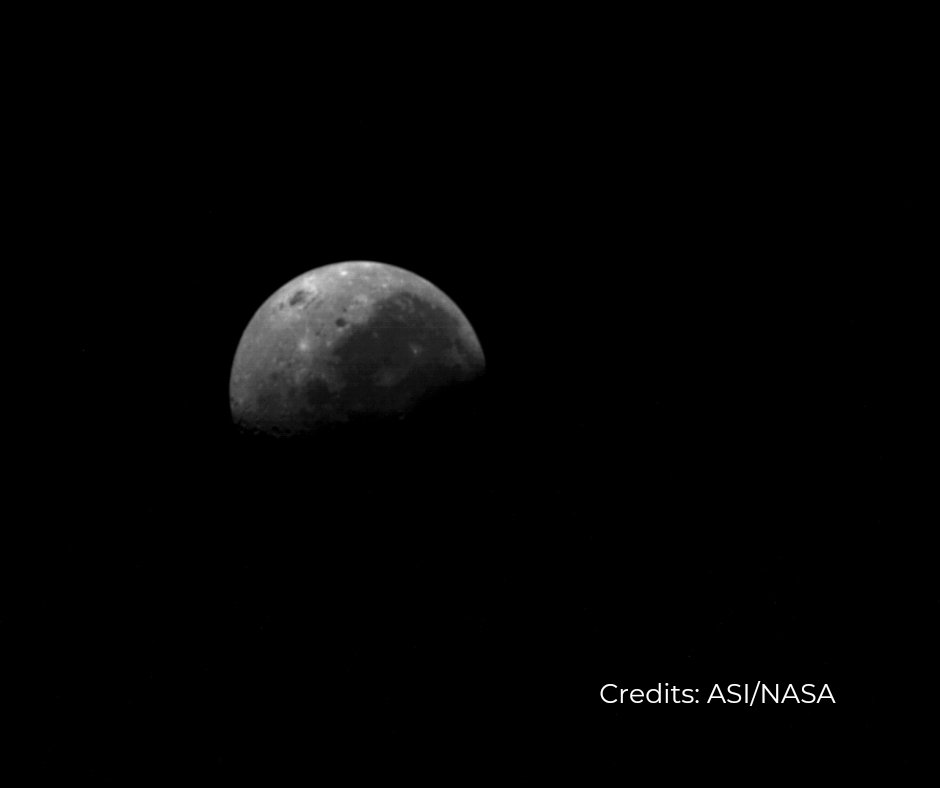
Credit: NASA/ASI/PipploIMP (for AI magnification and reconstruction)
Our Facebook page: bit.ly/PipploFB
Our YouTube channel: bit.ly/PipploYT
Image reconstructed using our artificial intelligence model. The image you see is from the Orion spacecraft and the Artemis 1 mission. The image shows the hidden side of the Moon as seen from the Orion spacecraft.
The resulting document is 5000x5000 pixels (25 million pixels).
Credit: NASA/PipploIMP (for reconstruction/enlargement using AI)
Our Facebook page: bit.ly/PipploFB
Our YouTube channel: bit.ly/PipploYT
Reconstruction using our artificial intelligence model from an image provided by Chandra X-ray Observatory about M16.
Messier 16, also known as the Eagle Nebula, is a famous region of the sky often referred to as the “Pillars of Creation.” The Webb image shows the dark columns of gas and dust shrouding the few remaining fledgling stars just being formed. The Chandra sources, which look like dots, are young stars that give off copious amounts of X-rays. (X-ray: red, blue; infrared: red, green, blue).
The file is available at 247.29 millions of pixels for download at a resolution of 16200x15265 pixels.
Credits for X-ray: Chandra: NASA/CXC/SAO, XMM: ESA/XMM-Newton; for Infrared: JWST: NASA/ESA/CSA/STScI, Spitzer: NASA/JPL/CalTech; for Optical: Hubble: NASA/ESA/STScI, ESO; for Image Processing: L. Frattare, J. Major, and K. Arcand. Reconstruction and magnification via AI by PipploIMP.
Our Facebook Page: bit.ly/PipploFB
Our YouTube Channel: bit.ly/PipploYT
Image reconstructed using our artificial intelligence model. This panorama consists of 5 images taken by the Orion spacecraft (Artemis 1 mission) via the cameras mounted on the crew module during the second flyover of the Moon on the 20th day of flight (5 December 2022).
The resulting document is 21863x40000 pixels (875.52 million pixels).
Credit: NASA/PipploIMP (for AI reconstruction/enlargement)
Our Facebook page: bit.ly/PipploFB
Our YouTube channel: bit.ly/PipploYT
Translated with www.DeepL.com/Translator (free version)
Image reconstructed using our artificial intelligence model. The image comes from ASI's Italian ArgoMoon nano-probe, which was built and is operated by Argotec. Here you can see with good resolution the lunar surface (hidden side)
The resulting document is 11250x15000 pixels (168.75 million pixels).
Credit: ASI/NASA/PipploIMP (for reconstruction/enlargement using AI)
Our Facebook page: bit.ly/PipploFB
Our YouTube channel: bit.ly/PipploYT
Thanks for taking the time to check out my image!
If you really enjoyed this image, be sure to click on over to my Urbex & Street Art Collection and check out more of my Urbex & Street Art photos.
Even better, if you have some Urbex & Street Art to share, come on over to the Urbex & Street Art (NSW & ACT) Group, join up & share away!
If you’re feeling ’a little more adventuress’ then click on over to all my Albums and browse through my collection.
Cheers. ‘Squiz’
Reconstruction using our artificial intelligence model of 25 photos captured by Perseverance at SOL 566 (September 23, 2022) between 13:15:08 and 13:15:10 LMST using both MastCams-Z (left & right). The file is available at 464.02 millions of pixels for download at a resolution of 25000x18561 pixels.
Credit: NASA/JPL-Caltech/ASU/PipploIMP
Our Facebook Page: bit.ly/PipploFB
Our YouTube Channel: bit.ly/PipploYT
Historical image taken during NASA's Apollo 17 mission (code name AS17-152-23274). This photo is dated 16 December 1972. The photo, re-processed by our artificial intelligence model, became a 30000x30000 pixel image (900 million pixels in total), greatly improving sharpness and detail.
Credit: NASA/PipploIMP
Our Facebook page: bit.ly/PipploFB
Our YouTube channel: bit.ly/PipploYT
Reconstruction using our artificial intelligence model of a photo captured by Perseverance at SOL 682 (January 20, 2022) at 14:47:16 LMST using the SHERLOC WATSON Camera. This is a special magnification focused on the titanium tube containing the sample that will be returned to Earth via the NASA Mars Sample Return mission. The file is available at 33.75 millions of pixels for download at a resolution of 7500x4500 pixels.
Credit: NASA/JPL-Caltech/PipploIMP
Our Facebook Page: bit.ly/PipploFB
Our YouTube Channel: bit.ly/PipploYT
Reconstruction with our artificial intelligence model (extreme magnification) from 2 photos captured by Perseverance at SOL 728 (8 March 2023) at 14:24:57 LMST using both MastCam-Zs (1 image from left and 1 image from right).
This is the Ingenuity helicopter drone as seen by Perseverance from a distance.
The file is available for download at 6.25 million pixels at a resolution of 2500x8406 pixels.
Credit: NASA/JPL-Caltech/ASU/PipploIMP
Our Facebook page: bit.ly/PipploFB
Our YouTube channel: bit.ly/PipploYT