View allAll Photos Tagged Testbed
Updated pictures. Not much has changed on it that I can remember, but I wanted nicer shots.
This was essentially a testbed for joints for my slightly larger frame, and while it works on the whole, I don't care for the joint solutions in some places, and likely won't make use of them in the future. Specifically, the lateral axis joint on the upper arm is not a great solution, as well as some foot connections.
Convair C-131B Samaritan (cn 243) Seen at an air show at Wright Patterson AFB in May, 1955, having been modified to a JC-131B testbed by the Wright Air Development Center whose logo it carries. Later to civil use as N3782V. (From my collection and not my shot).
N289MT Boeing 727-223Adv operated by Raytheon as a radar testbed. Seen taxiing in at its homebase of Los Angeles International, this aircraft uses the distinctive callsign VOODOO One.
DAF YP-X test bed. Research model to find a cheaper alternative for tracked vehicles. Triplex wooden housing on a steel frame. Fixed wheels, steering is done by lifting front and rear wheels and blocking the mid-wheels on a side to make a turn. Engine : Detroit V6 diesel from a M113. Gear from YP-408. Initiated by Dutch MoD
ex-American Airlines and Modern Air as passenger airliner and NASA testbed for space shuttles components.. now exposed at the entry Mojave Airport MHV.
In Spring of 2013, the full-sized, functional prototype of the GPS III satellite – the GPS III Non-Flight Satellite Testbed (GNST) -- completed Passive Intermodulation (PIM) and Electromagnetic Compatibility (EMC) testing at the Lockheed Martin’s state-of the-art satellite manufacturing facility outside Denver, Colo. Part of the U.S. Air Force’s rigorous “Back-to-Basics” acquisition approach, the GNST trailblazed the development, testing, and production processes and facilities for the GPS III program first, prior to the arrival of the first flight vehicles. This innovative investment significantly reduced risk, improved production predictability, increased mission assurance and lowered overall costs for the GPS III program.
The age and vulnerability of the RF-101C Voodoo was apparent by the Vietnam War. As losses rose among the Voodoo community, the USAF sought a faster and newer replacement. The solution turned out to be yet another variant of the eminently adaptable F-4C Phantom II. The basic airframe was retained with a new nose, with three cameras placed inside. As the RF-4C was meant to be unarmed, it was not necessary to retain the multimode interception radar of the F-4C, and the RF-4C used the smaller AN/APQ-99 navigation radar. Lighter and more aerodynamic than the F-4C, the RF-4C proved to be the perfect replacement for the RF-101 and remaining RF-84F Thunderstreaks in USAF service. It entered service in 1965.
The RF-4C would be the last dedicated manned tactical reconnaissance aircraft in USAF service. They were used extensively over Vietnam, and in active-duty USAF squadrons until the late 1980s, when they were relegated to Air National Guard units. The last two squadrons of ANG RF-4Cs saw service during the First Gulf War, after which they were retired completely. A number were supplied to foreign air forces afterwards, but the RF-4E (built off of the early F-4E variant) remains the primary foreign RF-4 version.
66-0384 is one of two RF-4Cs on display at the Veterans Freedom Memorial Park in Quartzsite, Arizona. It joined the USAF around 1967, initially with the 363rd Tactical Reconnaissance Wing at Shaw AFB, South Carolina. In 1978, it became a "white tail" NRF-4C testbed, with the Air Force Flight Test Center and later the 412th Test Wing, both at Edwards AFB, California. It was retired in 1992 and donated to the town of Quartzsite.
Of the two RF-4s, 66-0384 is the better looking of the two, with its markings in marginally better shape--enough to tell which unit it was out of and its serial number. The forward canopy is slightly open, which has allowed the canopies to get fogged. Quartzsite is a strange place to find a pair of Phantoms, but it's worth a stop.
In Spring of 2013, the full-sized, functional prototype of the GPS III satellite – the GPS III Non-Flight Satellite Testbed (GNST) -- completed Passive Intermodulation (PIM) and Electromagnetic Compatibility (EMC) testing at the Lockheed Martin’s state-of the-art satellite manufacturing facility outside Denver, Colo. Part of the U.S. Air Force’s rigorous “Back-to-Basics” acquisition approach, the GNST trailblazed the development, testing, and production processes and facilities for the GPS III program first, prior to the arrival of the first flight vehicles. This innovative investment significantly reduced risk, improved production predictability, increased mission assurance and lowered overall costs for the GPS III program.
Airbus A380-841
MSN 001
F-WWOW '001 GD' [Prototype/Rolls-Royce Trent testbed]
Airbus S.A.S.
Copyright © 2014 A380spotter. All rights reserved.
British Aerpspace ATP (Advanced Trubo Prop)
cn: 2002
ff: 20-02-1987 G-BMYM
uesd by BAe as a Testbed for ATP operations
10-07-1989 G-BMYM British Midland, config Y64 (leased from Lombard Aviation)
14-12-1993 G-MAUD Manx Airlines, config Y64 (leased from BMA)
25-01-1995 G-MAUD British Midland (returned), config Y64
29-03-1997 British Regional Airways tfd, (opf BA) and repainted to the interim colours of BA used first half of 1997. config Y66
1998 G-MAUD repainted to the new BA Wolrd colors, with the "Blue Pool" tail livery.
28-03-2002 G-MAUD British Airways CitiExpress tfd, (opf BA), config Y66
29-02-2004 G-MAUD Loganair tfd, config Y64, still in BA colours
31-05-2005 wfu
02-06-2005 stored at Southend (EGMC/SEN)
28-10-2005 G-MAUD West LB AG, and converted to freighter ATP(F)
14-12-2006 SE-MAF West Air Sweden, (op in basic white and blue ex BA colours, with West Ari Europe titles) as seen on this photo.
10-01-2016 wfu and stored at Malmö (SMS/MMX)
Seen parked at the western side of OSL, 11 years ago, wearing the logo of the Norwegian Post Office, as it was part of the Post delivery system flying each night.
+++ DISCLAIMER +++
Nothing you see here is real, even though the conversion or the presented background story might be based historical facts. BEWARE!
Some background:
The Northrop Grumman-IAI F-24 is the latest reincarnation of the USAF "Lightweight Fighter Program" which dates back to the 1950ies and started with the development of Northrop's F-5 "Freedom Fighter".
The 1st generation F-5 became very successful in the export market and saw a long line of development, including the much more powerful F-5E "Tiger II" and the F-20 Tigershark (initially called F-5G). Northrop had high hopes for the F-20 in the international market; however, policy changes following Ronald Reagan's election meant the F-20 had to compete for sales against aircraft like the F-16, the USAF's latest fighter design (which was politically favored). The F-20 development program was eventually abandoned in 1986 after three prototypes had been built and a fourth partially completed.
But this was not the end for Northrop’s Lightweight Fighter. In the early 1980s, two X-29As experimental aircraft were built by Grumman from two existing Northrop F-5A Freedom Fighter airframes. The Grumman X-29 was a testbed for forward-swept wings, canard control surfaces, and other novel aircraft technologies. The aerodynamic instability of this arrangement increased agility but required the use of computerized fly-by-wire control. Composite materials were used to control the aeroelastic divergent twisting experienced by forward-swept wings, also reducing the weight. The NASA test program continued from 1984 to 1991 and the X-29s flew 242 times, gathering valuable data and breaking ground for new aerodynamic technologies of 4th and 5th generation fighters.
Even though no service aircraft directly evolved from the X-29, its innovative FBW system as well as the new material technologies also opened the door for an updated F-20 far beyond the 1990ies. It became clear that ever expensive and complex aircraft could not be the answer to modern, asymmetrical warfare in remote corners of the world, with exploding development costs and just a limited number of aircraft in service that could not generate true economies of scale, esp. when their state-of-the-art design would not permit any export.
Anyway, a global market for simpler fighter aircraft was there, as 1st generation F-16s as well as the worldwide, aging F-5E fleet and types of Soviet/Russian origin like the MiG-29 provided the need for a modern, yet light and economical jet fighter. Contemporary types like the Indian HAL Tejas, the Swedish Saab Gripen, the French Dassault Rafale and the Pakistani/Chinese FC-1/JF-17 ”Thunder” proved this trend among 4th - 4.5th generation fighter aircraft.
Northrop Grumman (Northrop bought Grumman in 1994) initiated studies and basic design work on a respective New Lightweight Fighter (NLF) as a private venture in 1995. Work on the NLF started at a slow pace, as the company was busy with re-structuring.
The idea of an updated lightweight fighter was fueled by another source, too: Israel. In 1998 IAI started looking in the USA for a development partner for a new, light fighter that would replace its obsolete Kfir fleet and partly relieve its F-16 and F-15 fleet from interception tasks. The domestic project for that role, the IAI Lavi, had been stillborn, but lots of its avionics and research were still at hand and waited for an airframe for completion.
The new aircraft for the IAF was to be superior to the MiG-29, at least on par with the F-16C/D, but easier to maintain, smaller and overall cheaper. Since the performance profiles appeared to be similar to what Northrop Grumman was developing under the NLF label, the US company eventually teamed up with IAI in 2000 and both started the mutual project "Namer" (=נמר, “Tiger” in Hebrew), which eventually lead to the F-24 I for the IAF which kept its project name for service and to the USAF’s F-24A “Tigershark”.
The F-24, as the NLF, was based on the F-20 airframe, but outwardly showed only little family heritage, onle the forward fuselage around the cockpit reminds of the original F-5 design . Many aerodynamic details, e. g. the air intakes and air ducts, were taken over from the X-29, though, as the experimental aircraft and its components had been developed for extreme maneuvers and extra high agility. Nevertheless, the X-29's forward-swept wing was considered to be too exotic and fragile for a true service aircraft, but the F-24 was to feature an Active Aeroelastic Wing (AAW) system.
AAW Technology integrates wing aerodynamics, controls, and structure to harness and control wing aeroelastic twist at high speeds and dynamic pressures. By using multiple leading and trailing edge controls like "aerodynamic tabs", subtle amounts of aeroelastic twist can be controlled to provide large amounts of wing control power, while minimizing maneuver air loads at high wing strain conditions or aerodynamic drag at low wing strain conditions. This system was initially tested on the X-29 and later on the X-53 research aircraft, a modified F-18, until 2006.
Both USAF and IAF versions feature this state-of-the-art aerodynamic technology, but it is uncertain if other customers will receive it. While details concerning the F-24's system have not been published yet, it is assumed that its AAW is so effective that canard foreplanes could be omitted without sacrificing lift and maneuverability, and that drag is effectively minimized as the wing profile can be adjusted according to the aircraft’s speed, altitude, payload and mission – much like a VG wing, but without its clumsy and heavy swiveling mechanism which has to bear high g forces. As a result, the F-24 is, compared to the F-20, which could carry an external payload of about 3.5 tons, rumored to be able to carry up to 5 tons of ordnance.
The delta wing shape proved to be a perfect choice for the required surface and flap actuators inside of the wings, and it would also offer a very good compromise between lift and drag for a wide range of performance. Anyway, there was one price to pay: in order to keep the wing profile thin and simple, the F-24’s landing gear retracts into the lower fuselage, leaving the aircraft with a relatively narrow track.
Another major design factor for the outstanding performance of this rather small aircraft was weight reduction and structural integrity – combined with simplicity, ruggedness and a modular construction which would allow later upgrades. Instead of “going big” and expensive, the new F-24 was to create its performance through dedicated loss of weight, which was in some part also a compensation for the AAW system in the wings and its periphery.
Weight was saved wherever possible, e .g. a newly developed, lightweight M199A1 gatling gun. This 20mm cannon is a three-barreled, heavily modified version of the already “stripped” M61A2 gun in the USAF’s current F-18E and F-22. One of the novel features is a pneumatic drive instead of the traditional electric mechanism, what not only saves weight but also improves trigger response. The new gun weighs only a mere 65kg (the six-barreled M61A2 weighs 92kg, the original M61A1 112 kg), but still reaches a burst rate of fire of 1.800 RPM (about 800 RPM under cyclic fire, standard practice is to fire the cannon in 30 to 50-round bursts, though) and a muzzle velocity of 1.050 metres per second (3,450 ft/s) with a PGU-28/B round.
While the F-16 was and is still made from 80% aluminum alloys and only from 3% composites, the F-24 makes major use of carbon fiber and other lightweight materials, which make up about 40% of the aircraft’s structure, plus an increased share of Titanium and Magnesium alloys. As a consequence and through many other weight-saving measures like keeping stealth capabilities to a minimum (even though RAM was deliberately used and many details designed to have a natural low radar signature, resulting in modest radar cross-section (RCS) reductions), a single, relatively small engine, a fuel-efficient F404-GE-402 turbofan, is enough to make the F-24 a fast and very agile aircraft, coupled with a good range. The F-24’s thrust/weight ratio is considerably higher than 1, and later versions with a vectored thrust nozzle (see below) will take this level of agility even further – with the pilot becoming the limiting factor for the aircraft’s performance.
USAF and IAF F-24s are outfitted with Northrop Grumman's AN/APG-80 Active Electronically Scanned Array (AESA) radar, also used in the F-16 Block 60 aircraft. Other customers might only receive the AN/APG-68, making the F-24 comparable to the F-16C/D.
The first prototype, the YF-24, flew on 8th of March 2008, followed by two more aircraft plus a static airframe until summer 2010. In early 2011 the USAF placed an initial order of 101 aircraft (probably also to stir export sales – the earlier lightweight fighters from Northrop suffered from the fact that the manufacturer’s country would not use the aircraft in its own forces). These initial aircraft will replace older F-16 in the interceptor role, or free them for fighter bomber tasks. The USN and USMC also showed interest in the aircraft for their aggressor squadrons, for dissimilar air combat training. A two-seater, called the F-24B, is supposed to follow soon, too, and a later version for 2020 onwards, tentatively designated F-24C, is to feature an even stronger F404 engine and a 3D vectoring nozzle.
Israel is going to produce its own version domestically from late 2014 on, which will exclusively be used by the IAF. These aircraft will be outfitted with different avionics, built by Elta in Israel, and cater to national requirements which focus more on multi-purpose service, while the USAF focusses with its F-24A on aerial combat and interception tasks.
International interest for the F-24A is already there: in late 2013 Grumman stated that initial talks have been made with various countries, and potential export candidates from 2015 on are Taiwan, Singapore, Thailand, Finland, Norway, Australia and Japan.
General F-24A characteristics:
Crew: 1 pilot
Length: 47 ft 4 in (14.4 m)
Wingspan: 27 ft 11.9 in / 8.53 m; with wingtip missiles (26 ft 8 in/ 8.13 m; without wingtip missiles)
Height: 13 ft 10 in (4.20 m)
Wing area: 36.55 m² (392 ft²)
Empty weight: 13.150 lb (5.090 kg)
Loaded weight: 15.480 lb (6.830 kg)
Max. take-off weight: 27.530 lb (12.500 kg)
Powerplant
1× General Electric F404-GE-402 turbofan with a dry thrust of 11,000 lbf (48.9 kN) and 17,750 lbf (79.2 kN) with afterburner
Performance
Maximum speed: Mach 2+
Combat radius: 300 nmi (345 mi, 556 km); for hi-lo-hi mission with 2 × 330 US gal (1,250 L) drop tanks
Ferry range: 1,490 nmi (1715 mi, 2759 km); with 3 × 330 US gal (1,250 L) drop tanks
Service ceiling: 55,000 ft (16,800 m)
Rate of climb: 52,800 ft/min (255 m/s)
Wing loading: 70.0 lb/ft² (342 kg/m²)
Thrust/weight: 1.09 (1.35 with loaded weight & 50% fuel)
Armament
1× 20 mm (0.787 in) M199A1 3-barreled Gatling cannon in the lower fuselage with 400 RPG
Eleven external hardpoints (two wingtip tails, six underwing hardpoints, three underfuselage hardpoints) and a total capacity of 11.000 lb (4.994 kg) of missiles (incl. AIM 9 Sidewinder and AIM 120 AMRAAM), bombs, rockets, ECM pods and drop tanks for extended range.
The kit and its assembly:
A spontaneous project. This major kitbash was inspired by fellow user nighthunter at whatifmodelers.com, who came up with a profile of a mashed-up US fighter, created “out of boredom”. The original idea was called F-21C, and it was to be a domestic successor to the IAI Kfirs which had been used by the US as aggressor aircraft in USN and USMC service for a few years.
As a weird(?) coincidence I had many of the necessary ingredients for this fictional aircraft in store, even though some parts and details were later changed. This model here is an interpretation of the original design. The idea was spun further, and the available parts that finally went into the model also had some influence on design and background.
I thank nighthunter for sharing the early ideas, inviting me to take the design to the hardware stage (sort of…) and adapting my feedback into new design sketches, too, which, in return, inspired the model building process.
Well, what went into this thing? To cook up a F-24 à la Dizzyfugu you just need (all in 1:72):
● Fuselage from a Hasegawa X-29, including the cockpit and the landing gear
● Fin and nose cone from an Italeri F-16A
● Inner wings from a (vintage) Hasegawa MiG-21F
● Outer wings from a F-4 (probably a J, Hasegawa or Fujimi)
The wing construction deviates from nighthunter’s original idea. The favorite ingredients would have been F-16XL or simple Mirage III wings, but I found the composite wing to be more attractive and “different”. The big F-16XL wings, despite their benefit of a unique shape, might also have created scale/size problems with a F-20 style fuselage? So I built hybrid wings: The MiG-21 landing gear wells were filled with putty and the F-4 outer wings simply glued onto the MiG inner wing sections, which were simply cut down in span. It sounds like an unlikely combo, but these parts fit together almost perfectly! In order to hide the F-4 origins I modified them to carry wingtip launch rails, though, which were also part of nighthunter’s original design.
The AAW technology detail mentioned in the background came in handy as it explains the complicated wing shape and the fact that the landing gear retracts into the fuselage, not into the wings, which would have been more plausible… Anyway, there’s still room for a simpler export version, with Mirage III or Kfir C.2/7 wings, and maybe canards?
Using the X-29 as basis also made fitting the new wings onto the area-ruled fuselage pretty easy, as I could use the wing root parts from the X-29 to bridge the gap. The original, forward-swept wings were just cut away, and the remains used as consoles for the new hybrid delta wings. Took some SERIOUS putty work, but the result is IMHO fine.
The bigger/square X-29 air intakes were taken over, and they change the look of the aircraft, making it look less F-5-ish than a true F-20 fuselage. For the same reason I kept the large fairing at the fin base, combining it with a bigger F-16 tail, though, as a counter-balance to the new, bigger wings. Again, the F-16 fin was/is part of nighthunter’s idea, so the model stays true to the original concept.
For the same reason I omitted the original X-29 nose, which is rather pointy, sports vanes and a large sensor boom. The F-16 nose was a plausible choice, as the AN/APG-80 is also carried by late Fighting Falcons, and its shape fits well, too.
All around the hull, some small details like radar warning sensors, pitots and air scoops were added. Not really necessary, but such thing add IMHO to the overall impression of such a fictional aircraft beyond the prototype stage.
Cockpit and landing gear were taken OOB, I just added a pilot figure and slightly modified the seat.
The ordnance was puzzled together from the scrap box, the AIM-9Ls come from the same F-4 kit which donated its outer wings, the AIM-120s come from an Italeri NATO weapons kit. The drop tanks belong to an F-16.
Painting and markings:
At first I considered an F-24I in IAF markings, or even a Japanese aircraft, but then reverted to one of nighthunter’s initial, simple ideas: an USAF aircraft in the “Hill II” paint scheme (F-16 style), made up from three shades of gray (FS 36118, 36270 and 36375) with low-viz markings and stencils. Dutch/Turkish NF-5A/Bs in the “Hill II” scheme were used as design benchmarks, too. It’s a simple livery, but on this delta wing aircraft it looks pretty interesting. I used enamels, what I had at hand: Humbrol 127 and 126, and Modelmaster's 1723.
A light black ink wash was applied, in order to em,phasize the engraved panel lines, in contrast to that, panels were manually highlighted through dry-brushed, lighter shades of gray (Humbrol 27, 166 and 167).
“Hill II” also adds to a generic, realistic touch for this whif. Doing an exotic air force thing is rather easy, but creating a convincing whif for a huge military machinery like the USAF’s takes more subtlety, I think.
The cockpit was painted in medium Gray (Dark Gull Grey, FS 36231, Humbrol 140), as well as the radome. The landing gear and the air intakes were painted white. The radome was painted with Revell 47 and dry-brushed with Humbrol 140.
Decals were puzzled together from various USAF aircraft, including sheets from an Airfix F-117, an Italeri F-15E and even an Academy OV-10D.
Tadah: a hardware tribute to an idea, born from boredom - and the aircraft does not look even bad at all? What I wanted to achieve was to make the F-24 neither look like a F-20, nor a Saab Gripen clone, as the latter comes close in overall shape, size and design.
This airframe was seen with NL 200 modex markings in 1981, with VF-111 "Sundowners". Here's a slightly later photo from 1982:
www.flickr.com/photos/nicanair/366523894/
That Flickr page includes references to other photos showing 160666 at different times in its career and wearing different markings.
Notably, it points to a VX-30 web site which describes 160666 thus:
(www.thenorthspin.com/page_roster_vx30.html)
"On official SQ list with notes: "MCAP Instrument, ALE-50 Mod" 2/95. Spotted with no markings on VX-4 ramp 9/94. Spotted with NAWC-WD 2/95. Photo with basic gray and color 'eagle logo' on tail ?/98. Western Aerospace Museum, CA ?/99"
A number of F-14A models were rebuilt as NF-14A, to be used as testbeds. Maybe N covered wires to power and control cameras, avionics replaced by recorders or storage systems... It had a test establishment blue circle with stuff (an eagle?) in it, painted on the fin and rudder when it arrived at Oakland Aviation Museum.
OLYMPUS DIGITAL CAMERA P6160971
Oakland Aviation Museum www.oaklandaviationmuseum.org/hours-and-location
Airbus A380-841
MSN 001
F-WWOW '001 GD' [Prototype/Rolls-Royce Trent testbed]
Airbus S.A.S.
Copyright © 2014 A380spotter. All rights reserved.
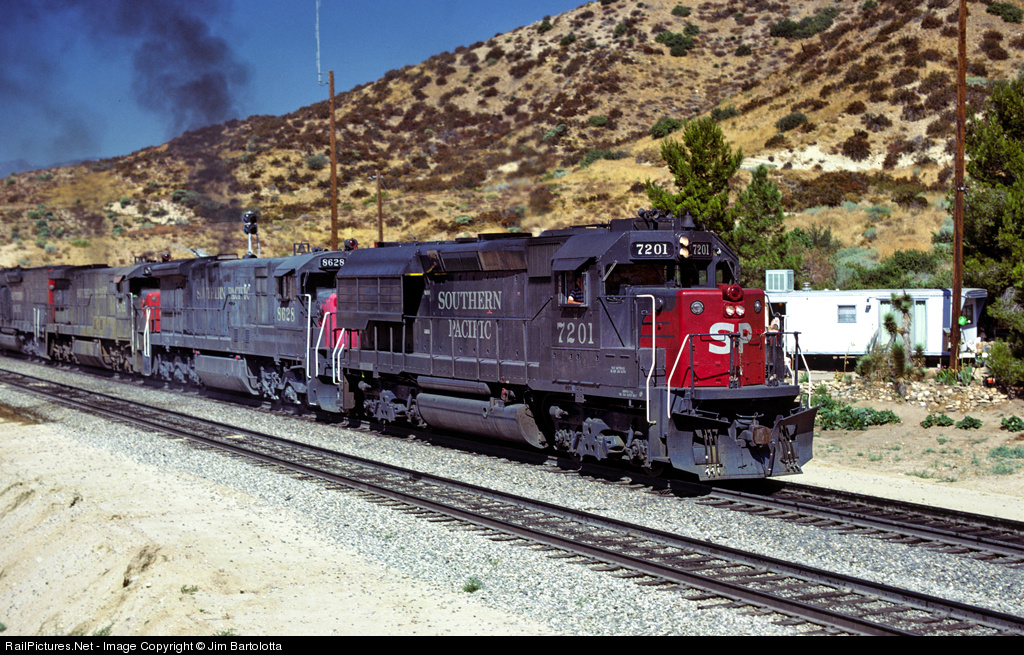
The GP40X was EMD's testbed for the future GP50 and introduced the unpopular HT-B truck. The 'elephant ears' version shown here was an experiment in normalizing the tunnel motor concept. The ears eventually were removed and the HT-B trucks were never reproduced. I needed a powered SP unit to haul around some heavy trains so all those unique qualities fit the bill just right. Originally I wanted to build the UP version, but the SP is more iconic with those elephant ears. The UP version will follow someday.
NASA opened its doors to media and social media its annual "State of NASA" event, Monday, Feb. 10, 2020, at the agency’s locations across the country, including the Jet Propulsion Laboratory in Pasadena, California. JPL hosted 29 digital creators to learn how the center’s robotic missions help future human exploration of the Moon and Mars. Participants met scientists and engineers, and went behind the scenes in mission control, an indoor "Mars Yard" for testing landers and rovers, and the Spacecraft Assembly Facility, where Mars 2020, NASA's next rover, is preparing for launch later this year. www.nasa.gov/social/state-of-nasa
Credit: NASA/JPL-Caltech
In 1928, Harold Pitcairn imported Juan de la Cierva's latest Autogiro, the C.8W (also known as the C.8 Mk.IV) to the United States as an experimental testbed for his own line of rotary-wing aircraft. This aircraft, as the first of its type in the United States, generated considerable interest in commercial and governmental circles. Highlighted in this image is the cockpit of the Cierva C.8W.
For more photography highlights, check out the Air and Space Photo airandspace.si.edu/albums/air-and-space-photo
This photo is subject to Smithsonian Terms of Use: si.edu/termsofuse
+++ DISCLAIMER +++
Nothing you see here is real, even though the conversion or the presented background story might be based historical facts. BEWARE!
Some background:
The Northrop Grumman-IAI F-24 is the latest reincarnation of the USAF "Lightweight Fighter Program" which dates back to the 1950ies and started with the development of Northrop's F-5 "Freedom Fighter".
The 1st generation F-5 became very successful in the export market and saw a long line of development, including the much more powerful F-5E "Tiger II" and the F-20 Tigershark (initially called F-5G). Northrop had high hopes for the F-20 in the international market; however, policy changes following Ronald Reagan's election meant the F-20 had to compete for sales against aircraft like the F-16, the USAF's latest fighter design (which was politically favored). The F-20 development program was eventually abandoned in 1986 after three prototypes had been built and a fourth partially completed.
But this was not the end for Northrop’s Lightweight Fighter. In the early 1980s, two X-29As experimental aircraft were built by Grumman from two existing Northrop F-5A Freedom Fighter airframes. The Grumman X-29 was a testbed for forward-swept wings, canard control surfaces, and other novel aircraft technologies. The aerodynamic instability of this arrangement increased agility but required the use of computerized fly-by-wire control. Composite materials were used to control the aeroelastic divergent twisting experienced by forward-swept wings, also reducing the weight. The NASA test program continued from 1984 to 1991 and the X-29s flew 242 times, gathering valuable data and breaking ground for new aerodynamic technologies of 4th and 5th generation fighters.
Even though no service aircraft directly evolved from the X-29, its innovative FBW system as well as the new material technologies also opened the door for an updated F-20 far beyond the 1990ies. It became clear that ever expensive and complex aircraft could not be the answer to modern, asymmetrical warfare in remote corners of the world, with exploding development costs and just a limited number of aircraft in service that could not generate true economies of scale, esp. when their state-of-the-art design would not permit any export.
Anyway, a global market for simpler fighter aircraft was there, as 1st generation F-16s as well as the worldwide, aging F-5E fleet and types of Soviet/Russian origin like the MiG-29 provided the need for a modern, yet light and economical jet fighter. Contemporary types like the Indian HAL Tejas, the Swedish Saab Gripen, the French Dassault Rafale and the Pakistani/Chinese FC-1/JF-17 ”Thunder” proved this trend among 4th - 4.5th generation fighter aircraft.
Northrop Grumman (Northrop bought Grumman in 1994) initiated studies and basic design work on a respective New Lightweight Fighter (NLF) as a private venture in 1995. Work on the NLF started at a slow pace, as the company was busy with re-structuring.
The idea of an updated lightweight fighter was fueled by another source, too: Israel. In 1998 IAI started looking in the USA for a development partner for a new, light fighter that would replace its obsolete Kfir fleet and partly relieve its F-16 and F-15 fleet from interception tasks. The domestic project for that role, the IAI Lavi, had been stillborn, but lots of its avionics and research were still at hand and waited for an airframe for completion.
The new aircraft for the IAF was to be superior to the MiG-29, at least on par with the F-16C/D, but easier to maintain, smaller and overall cheaper. Since the performance profiles appeared to be similar to what Northrop Grumman was developing under the NLF label, the US company eventually teamed up with IAI in 2000 and both started the mutual project "Namer" (=נמר, “Tiger” in Hebrew), which eventually lead to the F-24 I for the IAF which kept its project name for service and to the USAF’s F-24A “Tigershark”.
The F-24, as the NLF, was based on the F-20 airframe, but outwardly showed only little family heritage, onle the forward fuselage around the cockpit reminds of the original F-5 design . Many aerodynamic details, e. g. the air intakes and air ducts, were taken over from the X-29, though, as the experimental aircraft and its components had been developed for extreme maneuvers and extra high agility. Nevertheless, the X-29's forward-swept wing was considered to be too exotic and fragile for a true service aircraft, but the F-24 was to feature an Active Aeroelastic Wing (AAW) system.
AAW Technology integrates wing aerodynamics, controls, and structure to harness and control wing aeroelastic twist at high speeds and dynamic pressures. By using multiple leading and trailing edge controls like "aerodynamic tabs", subtle amounts of aeroelastic twist can be controlled to provide large amounts of wing control power, while minimizing maneuver air loads at high wing strain conditions or aerodynamic drag at low wing strain conditions. This system was initially tested on the X-29 and later on the X-53 research aircraft, a modified F-18, until 2006.
Both USAF and IAF versions feature this state-of-the-art aerodynamic technology, but it is uncertain if other customers will receive it. While details concerning the F-24's system have not been published yet, it is assumed that its AAW is so effective that canard foreplanes could be omitted without sacrificing lift and maneuverability, and that drag is effectively minimized as the wing profile can be adjusted according to the aircraft’s speed, altitude, payload and mission – much like a VG wing, but without its clumsy and heavy swiveling mechanism which has to bear high g forces. As a result, the F-24 is, compared to the F-20, which could carry an external payload of about 3.5 tons, rumored to be able to carry up to 5 tons of ordnance.
The delta wing shape proved to be a perfect choice for the required surface and flap actuators inside of the wings, and it would also offer a very good compromise between lift and drag for a wide range of performance. Anyway, there was one price to pay: in order to keep the wing profile thin and simple, the F-24’s landing gear retracts into the lower fuselage, leaving the aircraft with a relatively narrow track.
Another major design factor for the outstanding performance of this rather small aircraft was weight reduction and structural integrity – combined with simplicity, ruggedness and a modular construction which would allow later upgrades. Instead of “going big” and expensive, the new F-24 was to create its performance through dedicated loss of weight, which was in some part also a compensation for the AAW system in the wings and its periphery.
Weight was saved wherever possible, e .g. a newly developed, lightweight M199A1 gatling gun. This 20mm cannon is a three-barreled, heavily modified version of the already “stripped” M61A2 gun in the USAF’s current F-18E and F-22. One of the novel features is a pneumatic drive instead of the traditional electric mechanism, what not only saves weight but also improves trigger response. The new gun weighs only a mere 65kg (the six-barreled M61A2 weighs 92kg, the original M61A1 112 kg), but still reaches a burst rate of fire of 1.800 RPM (about 800 RPM under cyclic fire, standard practice is to fire the cannon in 30 to 50-round bursts, though) and a muzzle velocity of 1.050 metres per second (3,450 ft/s) with a PGU-28/B round.
While the F-16 was and is still made from 80% aluminum alloys and only from 3% composites, the F-24 makes major use of carbon fiber and other lightweight materials, which make up about 40% of the aircraft’s structure, plus an increased share of Titanium and Magnesium alloys. As a consequence and through many other weight-saving measures like keeping stealth capabilities to a minimum (even though RAM was deliberately used and many details designed to have a natural low radar signature, resulting in modest radar cross-section (RCS) reductions), a single, relatively small engine, a fuel-efficient F404-GE-402 turbofan, is enough to make the F-24 a fast and very agile aircraft, coupled with a good range. The F-24’s thrust/weight ratio is considerably higher than 1, and later versions with a vectored thrust nozzle (see below) will take this level of agility even further – with the pilot becoming the limiting factor for the aircraft’s performance.
USAF and IAF F-24s are outfitted with Northrop Grumman's AN/APG-80 Active Electronically Scanned Array (AESA) radar, also used in the F-16 Block 60 aircraft. Other customers might only receive the AN/APG-68, making the F-24 comparable to the F-16C/D.
The first prototype, the YF-24, flew on 8th of March 2008, followed by two more aircraft plus a static airframe until summer 2010. In early 2011 the USAF placed an initial order of 101 aircraft (probably also to stir export sales – the earlier lightweight fighters from Northrop suffered from the fact that the manufacturer’s country would not use the aircraft in its own forces). These initial aircraft will replace older F-16 in the interceptor role, or free them for fighter bomber tasks. The USN and USMC also showed interest in the aircraft for their aggressor squadrons, for dissimilar air combat training. A two-seater, called the F-24B, is supposed to follow soon, too, and a later version for 2020 onwards, tentatively designated F-24C, is to feature an even stronger F404 engine and a 3D vectoring nozzle.
Israel is going to produce its own version domestically from late 2014 on, which will exclusively be used by the IAF. These aircraft will be outfitted with different avionics, built by Elta in Israel, and cater to national requirements which focus more on multi-purpose service, while the USAF focusses with its F-24A on aerial combat and interception tasks.
International interest for the F-24A is already there: in late 2013 Grumman stated that initial talks have been made with various countries, and potential export candidates from 2015 on are Taiwan, Singapore, Thailand, Finland, Norway, Australia and Japan.
General F-24A characteristics:
Crew: 1 pilot
Length: 47 ft 4 in (14.4 m)
Wingspan: 27 ft 11.9 in / 8.53 m; with wingtip missiles (26 ft 8 in/ 8.13 m; without wingtip missiles)
Height: 13 ft 10 in (4.20 m)
Wing area: 36.55 m² (392 ft²)
Empty weight: 13.150 lb (5.090 kg)
Loaded weight: 15.480 lb (6.830 kg)
Max. take-off weight: 27.530 lb (12.500 kg)
Powerplant
1× General Electric F404-GE-402 turbofan with a dry thrust of 11,000 lbf (48.9 kN) and 17,750 lbf (79.2 kN) with afterburner
Performance
Maximum speed: Mach 2+
Combat radius: 300 nmi (345 mi, 556 km); for hi-lo-hi mission with 2 × 330 US gal (1,250 L) drop tanks
Ferry range: 1,490 nmi (1715 mi, 2759 km); with 3 × 330 US gal (1,250 L) drop tanks
Service ceiling: 55,000 ft (16,800 m)
Rate of climb: 52,800 ft/min (255 m/s)
Wing loading: 70.0 lb/ft² (342 kg/m²)
Thrust/weight: 1.09 (1.35 with loaded weight & 50% fuel)
Armament
1× 20 mm (0.787 in) M199A1 3-barreled Gatling cannon in the lower fuselage with 400 RPG
Eleven external hardpoints (two wingtip tails, six underwing hardpoints, three underfuselage hardpoints) and a total capacity of 11.000 lb (4.994 kg) of missiles (incl. AIM 9 Sidewinder and AIM 120 AMRAAM), bombs, rockets, ECM pods and drop tanks for extended range.
The kit and its assembly:
A spontaneous project. This major kitbash was inspired by fellow user nighthunter at whatifmodelers.com, who came up with a profile of a mashed-up US fighter, created “out of boredom”. The original idea was called F-21C, and it was to be a domestic successor to the IAI Kfirs which had been used by the US as aggressor aircraft in USN and USMC service for a few years.
As a weird(?) coincidence I had many of the necessary ingredients for this fictional aircraft in store, even though some parts and details were later changed. This model here is an interpretation of the original design. The idea was spun further, and the available parts that finally went into the model also had some influence on design and background.
I thank nighthunter for sharing the early ideas, inviting me to take the design to the hardware stage (sort of…) and adapting my feedback into new design sketches, too, which, in return, inspired the model building process.
Well, what went into this thing? To cook up a F-24 à la Dizzyfugu you just need (all in 1:72):
● Fuselage from a Hasegawa X-29, including the cockpit and the landing gear
● Fin and nose cone from an Italeri F-16A
● Inner wings from a (vintage) Hasegawa MiG-21F
● Outer wings from a F-4 (probably a J, Hasegawa or Fujimi)
The wing construction deviates from nighthunter’s original idea. The favorite ingredients would have been F-16XL or simple Mirage III wings, but I found the composite wing to be more attractive and “different”. The big F-16XL wings, despite their benefit of a unique shape, might also have created scale/size problems with a F-20 style fuselage? So I built hybrid wings: The MiG-21 landing gear wells were filled with putty and the F-4 outer wings simply glued onto the MiG inner wing sections, which were simply cut down in span. It sounds like an unlikely combo, but these parts fit together almost perfectly! In order to hide the F-4 origins I modified them to carry wingtip launch rails, though, which were also part of nighthunter’s original design.
The AAW technology detail mentioned in the background came in handy as it explains the complicated wing shape and the fact that the landing gear retracts into the fuselage, not into the wings, which would have been more plausible… Anyway, there’s still room for a simpler export version, with Mirage III or Kfir C.2/7 wings, and maybe canards?
Using the X-29 as basis also made fitting the new wings onto the area-ruled fuselage pretty easy, as I could use the wing root parts from the X-29 to bridge the gap. The original, forward-swept wings were just cut away, and the remains used as consoles for the new hybrid delta wings. Took some SERIOUS putty work, but the result is IMHO fine.
The bigger/square X-29 air intakes were taken over, and they change the look of the aircraft, making it look less F-5-ish than a true F-20 fuselage. For the same reason I kept the large fairing at the fin base, combining it with a bigger F-16 tail, though, as a counter-balance to the new, bigger wings. Again, the F-16 fin was/is part of nighthunter’s idea, so the model stays true to the original concept.
For the same reason I omitted the original X-29 nose, which is rather pointy, sports vanes and a large sensor boom. The F-16 nose was a plausible choice, as the AN/APG-80 is also carried by late Fighting Falcons, and its shape fits well, too.
All around the hull, some small details like radar warning sensors, pitots and air scoops were added. Not really necessary, but such thing add IMHO to the overall impression of such a fictional aircraft beyond the prototype stage.
Cockpit and landing gear were taken OOB, I just added a pilot figure and slightly modified the seat.
The ordnance was puzzled together from the scrap box, the AIM-9Ls come from the same F-4 kit which donated its outer wings, the AIM-120s come from an Italeri NATO weapons kit. The drop tanks belong to an F-16.
Painting and markings:
At first I considered an F-24I in IAF markings, or even a Japanese aircraft, but then reverted to one of nighthunter’s initial, simple ideas: an USAF aircraft in the “Hill II” paint scheme (F-16 style), made up from three shades of gray (FS 36118, 36270 and 36375) with low-viz markings and stencils. Dutch/Turkish NF-5A/Bs in the “Hill II” scheme were used as design benchmarks, too. It’s a simple livery, but on this delta wing aircraft it looks pretty interesting. I used enamels, what I had at hand: Humbrol 127 and 126, and Modelmaster's 1723.
A light black ink wash was applied, in order to em,phasize the engraved panel lines, in contrast to that, panels were manually highlighted through dry-brushed, lighter shades of gray (Humbrol 27, 166 and 167).
“Hill II” also adds to a generic, realistic touch for this whif. Doing an exotic air force thing is rather easy, but creating a convincing whif for a huge military machinery like the USAF’s takes more subtlety, I think.
The cockpit was painted in medium Gray (Dark Gull Grey, FS 36231, Humbrol 140), as well as the radome. The landing gear and the air intakes were painted white. The radome was painted with Revell 47 and dry-brushed with Humbrol 140.
Decals were puzzled together from various USAF aircraft, including sheets from an Airfix F-117, an Italeri F-15E and even an Academy OV-10D.
Tadah: a hardware tribute to an idea, born from boredom - and the aircraft does not look even bad at all? What I wanted to achieve was to make the F-24 neither look like a F-20, nor a Saab Gripen clone, as the latter comes close in overall shape, size and design.
Gloster Meteor FR.9 VZ608 originally served with 208 Squadron RAF as a standard FR.9, but was delivered to Rolls-Royce Hucknell in March 1951 for various engine tests, including in June 1955 installation of an RB.108 lift engine intended for the Shorts S.C.1 VSTOL research aircraft. This was fitted in the centre fuselage in place of the main fuel tank and exhausted through an opening in the bottom of the fuselage. Fuel for the lift engine and the main Derwent engines was stored in under wing tanks, limiting flight duration to about 30 minutes. VZ608 was later modified by Miles Aircraft to flight test the RB.108 and for this a replica of the S.C.1's dorsal air intake was fitted to the top of the fuselage and provision to swivel the lift engine in flight +/- 30 degrees from the vertical.
After the trials concluded, VZ608 was destined for the fire dump at Hucknall but was saved from this fate in February 1970 and moved to Newark Air Museum. It is the only surviving FR.9 known to exist.
Like VZ608, a large number of Meteors were modified for various engine trials and testing other experimental innovations in the 1950s, as the Meteor airframe proved very suitable for this. This included rocket motors, turbojets, turbo-props and even testing an experimental prone position cockpit (prone modified F.8 WK935 is now preserved at Cosford). Meteors are still used to this day by Martin Baker to flight test ejection seats.
Updated pictures. Not much has changed on it that I can remember, but I wanted nicer shots.
This was essentially a testbed for joints for my slightly larger frame, and while it works on the whole, I don't care for the joint solutions in some places, and likely won't make use of them in the future. Specifically, the lateral axis joint on the upper arm is not a great solution, as well as some foot connections.
Once the fastest production car in the world, the Jaguar XK120 was Jaguar's first new product following the end of the war, being designed in those dark final days of the conflict and being developed over the next three years, making its début in 1948.
The XK120 was launched in open two-seater form at the 1948 London Motor Show as a testbed and show car for the new Jaguar XK engine. The display car was the first prototype, chassis number 670001. It looked almost identical to the production cars except that the straight outer pillars of its windscreen would be curved on the production version. The roadster caused a sensation, which persuaded Jaguar founder and design boss William Lyons to put it into production.
Beginning in 1948, the first 242 cars wore wood-framed open 2-seater bodies with aluminium panels. Production switched to the 112lb heavier all-steel in early 1950. The "120" in the name referred to the aluminium car's 120 mph top speed, which made it the world's fastest production car at the time of its launch. Engine models ranged from a 160bhp DOHC Straight-6 Double SU H6 low end model, to the fastest version which was powered by a 210bhp DOHC Straight-6 Double SU H8, giving the car a top speed of 124mph, which in 1949 was a spectacular feat when compared to the Austins and Morris' of the time.
On 30 May 1949, on the empty Ostend-Jabbeke motorway in Belgium, a prototype XK120 timed by the officials of the Royal Automobile Club of Belgium achieved an average of runs in opposing directions of 132.6 mph with the windscreen replaced by just one small aeroscreen and a catalogued alternative top gear ratio, and 135 mph with a passenger-side tonneau cover in place. In 1950 and 1951, at a banked oval track in France, XK120 roadsters averaged over 100 mph for 24 hours and over 130 mph for an hour, and in 1952 a fixed-head coupé took numerous world records for speed and distance when it averaged 100 mph for a week.
The Motor magazine road-tested an XK120 roadster in November 1949. This pre-production car, chassis number 670001, road-registered as HKV 455, was the first prototype built. It was also the 1948 London Motor Show display model, and had been driven by Prince Bira in the 1949 Silverstone Production Car Race. The magazine reported a top speed of 124.6 mph, acceleration from 0–60 mph in 10.0 seconds and fuel consumption of 19.8 miles per imperial gallon. The car as tested cost £1263 including taxes.
In 1949 the first production roadster, chassis number 670003, was delivered to famous actor Clark Gable.
The XK120 was ultimately available in two open versions, first as an open 2-seater described in the US market as the roadster, then also as a drophead coupé from 1953; and also as a closed, or fixed head coupé from 1951.
Production of the car ended in 1954 after 12,055 examples were constructed, being replaced by the Jaguar XK140. Today you'd be hard pressed to find XK120's on a regular basis, but if you attend car shows like me you'd be likely to find at least one show up.
Most notably though, the car returned to the centre stage of modern motoring through a spectacularly organised and choreographed race between the presenters of Top Gear on their Race to the North, a competition set in a hypothetical 1949 between the primary modes of transport at the time, with James May in the Jaguar XK120, Richard Hammond on a Vincent Blackshadow motorbike, and Jeremy Clarkson on the rebuilt Peppercorn A1 Pacific number 60163 'Tornado'.
Honeywell International, Boeing 757-225, msn 22194 L/n 5, reg N757HW. The 5th 757 ever built is used by Honeywell as a flying testbed for electronics, engines (hung on a pylon at the right nose fuselage, etc. Seen static and flying display at Egyptian Airshow held a El Alamein International airport (DBB / HEAL)
+++ DISCLAIMER +++
Nothing you see here is real, even though the conversion or the presented background story might be based historical facts. BEWARE!
Some background:
The Northrop Grumman-IAI F-24 is the latest reincarnation of the USAF "Lightweight Fighter Program" which dates back to the 1950ies and started with the development of Northrop's F-5 "Freedom Fighter".
The 1st generation F-5 became very successful in the export market and saw a long line of development, including the much more powerful F-5E "Tiger II" and the F-20 Tigershark (initially called F-5G). Northrop had high hopes for the F-20 in the international market; however, policy changes following Ronald Reagan's election meant the F-20 had to compete for sales against aircraft like the F-16, the USAF's latest fighter design (which was politically favored). The F-20 development program was eventually abandoned in 1986 after three prototypes had been built and a fourth partially completed.
But this was not the end for Northrop’s Lightweight Fighter. In the early 1980s, two X-29As experimental aircraft were built by Grumman from two existing Northrop F-5A Freedom Fighter airframes. The Grumman X-29 was a testbed for forward-swept wings, canard control surfaces, and other novel aircraft technologies. The aerodynamic instability of this arrangement increased agility but required the use of computerized fly-by-wire control. Composite materials were used to control the aeroelastic divergent twisting experienced by forward-swept wings, also reducing the weight. The NASA test program continued from 1984 to 1991 and the X-29s flew 242 times, gathering valuable data and breaking ground for new aerodynamic technologies of 4th and 5th generation fighters.
Even though no service aircraft directly evolved from the X-29, its innovative FBW system as well as the new material technologies also opened the door for an updated F-20 far beyond the 1990ies. It became clear that ever expensive and complex aircraft could not be the answer to modern, asymmetrical warfare in remote corners of the world, with exploding development costs and just a limited number of aircraft in service that could not generate true economies of scale, esp. when their state-of-the-art design would not permit any export.
Anyway, a global market for simpler fighter aircraft was there, as 1st generation F-16s as well as the worldwide, aging F-5E fleet and types of Soviet/Russian origin like the MiG-29 provided the need for a modern, yet light and economical jet fighter. Contemporary types like the Indian HAL Tejas, the Swedish Saab Gripen, the French Dassault Rafale and the Pakistani/Chinese FC-1/JF-17 ”Thunder” proved this trend among 4th - 4.5th generation fighter aircraft.
Northrop Grumman (Northrop bought Grumman in 1994) initiated studies and basic design work on a respective New Lightweight Fighter (NLF) as a private venture in 1995. Work on the NLF started at a slow pace, as the company was busy with re-structuring.
The idea of an updated lightweight fighter was fueled by another source, too: Israel. In 1998 IAI started looking in the USA for a development partner for a new, light fighter that would replace its obsolete Kfir fleet and partly relieve its F-16 and F-15 fleet from interception tasks. The domestic project for that role, the IAI Lavi, had been stillborn, but lots of its avionics and research were still at hand and waited for an airframe for completion.
The new aircraft for the IAF was to be superior to the MiG-29, at least on par with the F-16C/D, but easier to maintain, smaller and overall cheaper. Since the performance profiles appeared to be similar to what Northrop Grumman was developing under the NLF label, the US company eventually teamed up with IAI in 2000 and both started the mutual project "Namer" (=נמר, “Tiger” in Hebrew), which eventually lead to the F-24 I for the IAF which kept its project name for service and to the USAF’s F-24A “Tigershark”.
The F-24, as the NLF, was based on the F-20 airframe, but outwardly showed only little family heritage, onle the forward fuselage around the cockpit reminds of the original F-5 design . Many aerodynamic details, e. g. the air intakes and air ducts, were taken over from the X-29, though, as the experimental aircraft and its components had been developed for extreme maneuvers and extra high agility. Nevertheless, the X-29's forward-swept wing was considered to be too exotic and fragile for a true service aircraft, but the F-24 was to feature an Active Aeroelastic Wing (AAW) system.
AAW Technology integrates wing aerodynamics, controls, and structure to harness and control wing aeroelastic twist at high speeds and dynamic pressures. By using multiple leading and trailing edge controls like "aerodynamic tabs", subtle amounts of aeroelastic twist can be controlled to provide large amounts of wing control power, while minimizing maneuver air loads at high wing strain conditions or aerodynamic drag at low wing strain conditions. This system was initially tested on the X-29 and later on the X-53 research aircraft, a modified F-18, until 2006.
Both USAF and IAF versions feature this state-of-the-art aerodynamic technology, but it is uncertain if other customers will receive it. While details concerning the F-24's system have not been published yet, it is assumed that its AAW is so effective that canard foreplanes could be omitted without sacrificing lift and maneuverability, and that drag is effectively minimized as the wing profile can be adjusted according to the aircraft’s speed, altitude, payload and mission – much like a VG wing, but without its clumsy and heavy swiveling mechanism which has to bear high g forces. As a result, the F-24 is, compared to the F-20, which could carry an external payload of about 3.5 tons, rumored to be able to carry up to 5 tons of ordnance.
The delta wing shape proved to be a perfect choice for the required surface and flap actuators inside of the wings, and it would also offer a very good compromise between lift and drag for a wide range of performance. Anyway, there was one price to pay: in order to keep the wing profile thin and simple, the F-24’s landing gear retracts into the lower fuselage, leaving the aircraft with a relatively narrow track.
Another major design factor for the outstanding performance of this rather small aircraft was weight reduction and structural integrity – combined with simplicity, ruggedness and a modular construction which would allow later upgrades. Instead of “going big” and expensive, the new F-24 was to create its performance through dedicated loss of weight, which was in some part also a compensation for the AAW system in the wings and its periphery.
Weight was saved wherever possible, e .g. a newly developed, lightweight M199A1 gatling gun. This 20mm cannon is a three-barreled, heavily modified version of the already “stripped” M61A2 gun in the USAF’s current F-18E and F-22. One of the novel features is a pneumatic drive instead of the traditional electric mechanism, what not only saves weight but also improves trigger response. The new gun weighs only a mere 65kg (the six-barreled M61A2 weighs 92kg, the original M61A1 112 kg), but still reaches a burst rate of fire of 1.800 RPM (about 800 RPM under cyclic fire, standard practice is to fire the cannon in 30 to 50-round bursts, though) and a muzzle velocity of 1.050 metres per second (3,450 ft/s) with a PGU-28/B round.
While the F-16 was and is still made from 80% aluminum alloys and only from 3% composites, the F-24 makes major use of carbon fiber and other lightweight materials, which make up about 40% of the aircraft’s structure, plus an increased share of Titanium and Magnesium alloys. As a consequence and through many other weight-saving measures like keeping stealth capabilities to a minimum (even though RAM was deliberately used and many details designed to have a natural low radar signature, resulting in modest radar cross-section (RCS) reductions), a single, relatively small engine, a fuel-efficient F404-GE-402 turbofan, is enough to make the F-24 a fast and very agile aircraft, coupled with a good range. The F-24’s thrust/weight ratio is considerably higher than 1, and later versions with a vectored thrust nozzle (see below) will take this level of agility even further – with the pilot becoming the limiting factor for the aircraft’s performance.
USAF and IAF F-24s are outfitted with Northrop Grumman's AN/APG-80 Active Electronically Scanned Array (AESA) radar, also used in the F-16 Block 60 aircraft. Other customers might only receive the AN/APG-68, making the F-24 comparable to the F-16C/D.
The first prototype, the YF-24, flew on 8th of March 2008, followed by two more aircraft plus a static airframe until summer 2010. In early 2011 the USAF placed an initial order of 101 aircraft (probably also to stir export sales – the earlier lightweight fighters from Northrop suffered from the fact that the manufacturer’s country would not use the aircraft in its own forces). These initial aircraft will replace older F-16 in the interceptor role, or free them for fighter bomber tasks. The USN and USMC also showed interest in the aircraft for their aggressor squadrons, for dissimilar air combat training. A two-seater, called the F-24B, is supposed to follow soon, too, and a later version for 2020 onwards, tentatively designated F-24C, is to feature an even stronger F404 engine and a 3D vectoring nozzle.
Israel is going to produce its own version domestically from late 2014 on, which will exclusively be used by the IAF. These aircraft will be outfitted with different avionics, built by Elta in Israel, and cater to national requirements which focus more on multi-purpose service, while the USAF focusses with its F-24A on aerial combat and interception tasks.
International interest for the F-24A is already there: in late 2013 Grumman stated that initial talks have been made with various countries, and potential export candidates from 2015 on are Taiwan, Singapore, Thailand, Finland, Norway, Australia and Japan.
General F-24A characteristics:
Crew: 1 pilot
Length: 47 ft 4 in (14.4 m)
Wingspan: 27 ft 11.9 in / 8.53 m; with wingtip missiles (26 ft 8 in/ 8.13 m; without wingtip missiles)
Height: 13 ft 10 in (4.20 m)
Wing area: 36.55 m² (392 ft²)
Empty weight: 13.150 lb (5.090 kg)
Loaded weight: 15.480 lb (6.830 kg)
Max. take-off weight: 27.530 lb (12.500 kg)
Powerplant
1× General Electric F404-GE-402 turbofan with a dry thrust of 11,000 lbf (48.9 kN) and 17,750 lbf (79.2 kN) with afterburner
Performance
Maximum speed: Mach 2+
Combat radius: 300 nmi (345 mi, 556 km); for hi-lo-hi mission with 2 × 330 US gal (1,250 L) drop tanks
Ferry range: 1,490 nmi (1715 mi, 2759 km); with 3 × 330 US gal (1,250 L) drop tanks
Service ceiling: 55,000 ft (16,800 m)
Rate of climb: 52,800 ft/min (255 m/s)
Wing loading: 70.0 lb/ft² (342 kg/m²)
Thrust/weight: 1.09 (1.35 with loaded weight & 50% fuel)
Armament
1× 20 mm (0.787 in) M199A1 3-barreled Gatling cannon in the lower fuselage with 400 RPG
Eleven external hardpoints (two wingtip tails, six underwing hardpoints, three underfuselage hardpoints) and a total capacity of 11.000 lb (4.994 kg) of missiles (incl. AIM 9 Sidewinder and AIM 120 AMRAAM), bombs, rockets, ECM pods and drop tanks for extended range.
The kit and its assembly:
A spontaneous project. This major kitbash was inspired by fellow user nighthunter at whatifmodelers.com, who came up with a profile of a mashed-up US fighter, created “out of boredom”. The original idea was called F-21C, and it was to be a domestic successor to the IAI Kfirs which had been used by the US as aggressor aircraft in USN and USMC service for a few years.
As a weird(?) coincidence I had many of the necessary ingredients for this fictional aircraft in store, even though some parts and details were later changed. This model here is an interpretation of the original design. The idea was spun further, and the available parts that finally went into the model also had some influence on design and background.
I thank nighthunter for sharing the early ideas, inviting me to take the design to the hardware stage (sort of…) and adapting my feedback into new design sketches, too, which, in return, inspired the model building process.
Well, what went into this thing? To cook up a F-24 à la Dizzyfugu you just need (all in 1:72):
● Fuselage from a Hasegawa X-29, including the cockpit and the landing gear
● Fin and nose cone from an Italeri F-16A
● Inner wings from a (vintage) Hasegawa MiG-21F
● Outer wings from a F-4 (probably a J, Hasegawa or Fujimi)
The wing construction deviates from nighthunter’s original idea. The favorite ingredients would have been F-16XL or simple Mirage III wings, but I found the composite wing to be more attractive and “different”. The big F-16XL wings, despite their benefit of a unique shape, might also have created scale/size problems with a F-20 style fuselage? So I built hybrid wings: The MiG-21 landing gear wells were filled with putty and the F-4 outer wings simply glued onto the MiG inner wing sections, which were simply cut down in span. It sounds like an unlikely combo, but these parts fit together almost perfectly! In order to hide the F-4 origins I modified them to carry wingtip launch rails, though, which were also part of nighthunter’s original design.
The AAW technology detail mentioned in the background came in handy as it explains the complicated wing shape and the fact that the landing gear retracts into the fuselage, not into the wings, which would have been more plausible… Anyway, there’s still room for a simpler export version, with Mirage III or Kfir C.2/7 wings, and maybe canards?
Using the X-29 as basis also made fitting the new wings onto the area-ruled fuselage pretty easy, as I could use the wing root parts from the X-29 to bridge the gap. The original, forward-swept wings were just cut away, and the remains used as consoles for the new hybrid delta wings. Took some SERIOUS putty work, but the result is IMHO fine.
The bigger/square X-29 air intakes were taken over, and they change the look of the aircraft, making it look less F-5-ish than a true F-20 fuselage. For the same reason I kept the large fairing at the fin base, combining it with a bigger F-16 tail, though, as a counter-balance to the new, bigger wings. Again, the F-16 fin was/is part of nighthunter’s idea, so the model stays true to the original concept.
For the same reason I omitted the original X-29 nose, which is rather pointy, sports vanes and a large sensor boom. The F-16 nose was a plausible choice, as the AN/APG-80 is also carried by late Fighting Falcons, and its shape fits well, too.
All around the hull, some small details like radar warning sensors, pitots and air scoops were added. Not really necessary, but such thing add IMHO to the overall impression of such a fictional aircraft beyond the prototype stage.
Cockpit and landing gear were taken OOB, I just added a pilot figure and slightly modified the seat.
The ordnance was puzzled together from the scrap box, the AIM-9Ls come from the same F-4 kit which donated its outer wings, the AIM-120s come from an Italeri NATO weapons kit. The drop tanks belong to an F-16.
Painting and markings:
At first I considered an F-24I in IAF markings, or even a Japanese aircraft, but then reverted to one of nighthunter’s initial, simple ideas: an USAF aircraft in the “Hill II” paint scheme (F-16 style), made up from three shades of gray (FS 36118, 36270 and 36375) with low-viz markings and stencils. Dutch/Turkish NF-5A/Bs in the “Hill II” scheme were used as design benchmarks, too. It’s a simple livery, but on this delta wing aircraft it looks pretty interesting. I used enamels, what I had at hand: Humbrol 127 and 126, and Modelmaster's 1723.
A light black ink wash was applied, in order to em,phasize the engraved panel lines, in contrast to that, panels were manually highlighted through dry-brushed, lighter shades of gray (Humbrol 27, 166 and 167).
“Hill II” also adds to a generic, realistic touch for this whif. Doing an exotic air force thing is rather easy, but creating a convincing whif for a huge military machinery like the USAF’s takes more subtlety, I think.
The cockpit was painted in medium Gray (Dark Gull Grey, FS 36231, Humbrol 140), as well as the radome. The landing gear and the air intakes were painted white. The radome was painted with Revell 47 and dry-brushed with Humbrol 140.
Decals were puzzled together from various USAF aircraft, including sheets from an Airfix F-117, an Italeri F-15E and even an Academy OV-10D.
Tadah: a hardware tribute to an idea, born from boredom - and the aircraft does not look even bad at all? What I wanted to achieve was to make the F-24 neither look like a F-20, nor a Saab Gripen clone, as the latter comes close in overall shape, size and design.
+++ DISCLAIMER +++
Nothing you see here is real, even though the conversion or the presented background story might be based historical facts. BEWARE!
Some background:
The Northrop Grumman-IAI F-24 is the latest reincarnation of the USAF "Lightweight Fighter Program" which dates back to the 1950ies and started with the development of Northrop's F-5 "Freedom Fighter".
The 1st generation F-5 became very successful in the export market and saw a long line of development, including the much more powerful F-5E "Tiger II" and the F-20 Tigershark (initially called F-5G). Northrop had high hopes for the F-20 in the international market; however, policy changes following Ronald Reagan's election meant the F-20 had to compete for sales against aircraft like the F-16, the USAF's latest fighter design (which was politically favored). The F-20 development program was eventually abandoned in 1986 after three prototypes had been built and a fourth partially completed.
But this was not the end for Northrop’s Lightweight Fighter. In the early 1980s, two X-29As experimental aircraft were built by Grumman from two existing Northrop F-5A Freedom Fighter airframes. The Grumman X-29 was a testbed for forward-swept wings, canard control surfaces, and other novel aircraft technologies. The aerodynamic instability of this arrangement increased agility but required the use of computerized fly-by-wire control. Composite materials were used to control the aeroelastic divergent twisting experienced by forward-swept wings, also reducing the weight. The NASA test program continued from 1984 to 1991 and the X-29s flew 242 times, gathering valuable data and breaking ground for new aerodynamic technologies of 4th and 5th generation fighters.
Even though no service aircraft directly evolved from the X-29, its innovative FBW system as well as the new material technologies also opened the door for an updated F-20 far beyond the 1990ies. It became clear that ever expensive and complex aircraft could not be the answer to modern, asymmetrical warfare in remote corners of the world, with exploding development costs and just a limited number of aircraft in service that could not generate true economies of scale, esp. when their state-of-the-art design would not permit any export.
Anyway, a global market for simpler fighter aircraft was there, as 1st generation F-16s as well as the worldwide, aging F-5E fleet and types of Soviet/Russian origin like the MiG-29 provided the need for a modern, yet light and economical jet fighter. Contemporary types like the Indian HAL Tejas, the Swedish Saab Gripen, the French Dassault Rafale and the Pakistani/Chinese FC-1/JF-17 ”Thunder” proved this trend among 4th - 4.5th generation fighter aircraft.
Northrop Grumman (Northrop bought Grumman in 1994) initiated studies and basic design work on a respective New Lightweight Fighter (NLF) as a private venture in 1995. Work on the NLF started at a slow pace, as the company was busy with re-structuring.
The idea of an updated lightweight fighter was fueled by another source, too: Israel. In 1998 IAI started looking in the USA for a development partner for a new, light fighter that would replace its obsolete Kfir fleet and partly relieve its F-16 and F-15 fleet from interception tasks. The domestic project for that role, the IAI Lavi, had been stillborn, but lots of its avionics and research were still at hand and waited for an airframe for completion.
The new aircraft for the IAF was to be superior to the MiG-29, at least on par with the F-16C/D, but easier to maintain, smaller and overall cheaper. Since the performance profiles appeared to be similar to what Northrop Grumman was developing under the NLF label, the US company eventually teamed up with IAI in 2000 and both started the mutual project "Namer" (=נמר, “Tiger” in Hebrew), which eventually lead to the F-24 I for the IAF which kept its project name for service and to the USAF’s F-24A “Tigershark”.
The F-24, as the NLF, was based on the F-20 airframe, but outwardly showed only little family heritage, onle the forward fuselage around the cockpit reminds of the original F-5 design . Many aerodynamic details, e. g. the air intakes and air ducts, were taken over from the X-29, though, as the experimental aircraft and its components had been developed for extreme maneuvers and extra high agility. Nevertheless, the X-29's forward-swept wing was considered to be too exotic and fragile for a true service aircraft, but the F-24 was to feature an Active Aeroelastic Wing (AAW) system.
AAW Technology integrates wing aerodynamics, controls, and structure to harness and control wing aeroelastic twist at high speeds and dynamic pressures. By using multiple leading and trailing edge controls like "aerodynamic tabs", subtle amounts of aeroelastic twist can be controlled to provide large amounts of wing control power, while minimizing maneuver air loads at high wing strain conditions or aerodynamic drag at low wing strain conditions. This system was initially tested on the X-29 and later on the X-53 research aircraft, a modified F-18, until 2006.
Both USAF and IAF versions feature this state-of-the-art aerodynamic technology, but it is uncertain if other customers will receive it. While details concerning the F-24's system have not been published yet, it is assumed that its AAW is so effective that canard foreplanes could be omitted without sacrificing lift and maneuverability, and that drag is effectively minimized as the wing profile can be adjusted according to the aircraft’s speed, altitude, payload and mission – much like a VG wing, but without its clumsy and heavy swiveling mechanism which has to bear high g forces. As a result, the F-24 is, compared to the F-20, which could carry an external payload of about 3.5 tons, rumored to be able to carry up to 5 tons of ordnance.
The delta wing shape proved to be a perfect choice for the required surface and flap actuators inside of the wings, and it would also offer a very good compromise between lift and drag for a wide range of performance. Anyway, there was one price to pay: in order to keep the wing profile thin and simple, the F-24’s landing gear retracts into the lower fuselage, leaving the aircraft with a relatively narrow track.
Another major design factor for the outstanding performance of this rather small aircraft was weight reduction and structural integrity – combined with simplicity, ruggedness and a modular construction which would allow later upgrades. Instead of “going big” and expensive, the new F-24 was to create its performance through dedicated loss of weight, which was in some part also a compensation for the AAW system in the wings and its periphery.
Weight was saved wherever possible, e .g. a newly developed, lightweight M199A1 gatling gun. This 20mm cannon is a three-barreled, heavily modified version of the already “stripped” M61A2 gun in the USAF’s current F-18E and F-22. One of the novel features is a pneumatic drive instead of the traditional electric mechanism, what not only saves weight but also improves trigger response. The new gun weighs only a mere 65kg (the six-barreled M61A2 weighs 92kg, the original M61A1 112 kg), but still reaches a burst rate of fire of 1.800 RPM (about 800 RPM under cyclic fire, standard practice is to fire the cannon in 30 to 50-round bursts, though) and a muzzle velocity of 1.050 metres per second (3,450 ft/s) with a PGU-28/B round.
While the F-16 was and is still made from 80% aluminum alloys and only from 3% composites, the F-24 makes major use of carbon fiber and other lightweight materials, which make up about 40% of the aircraft’s structure, plus an increased share of Titanium and Magnesium alloys. As a consequence and through many other weight-saving measures like keeping stealth capabilities to a minimum (even though RAM was deliberately used and many details designed to have a natural low radar signature, resulting in modest radar cross-section (RCS) reductions), a single, relatively small engine, a fuel-efficient F404-GE-402 turbofan, is enough to make the F-24 a fast and very agile aircraft, coupled with a good range. The F-24’s thrust/weight ratio is considerably higher than 1, and later versions with a vectored thrust nozzle (see below) will take this level of agility even further – with the pilot becoming the limiting factor for the aircraft’s performance.
USAF and IAF F-24s are outfitted with Northrop Grumman's AN/APG-80 Active Electronically Scanned Array (AESA) radar, also used in the F-16 Block 60 aircraft. Other customers might only receive the AN/APG-68, making the F-24 comparable to the F-16C/D.
The first prototype, the YF-24, flew on 8th of March 2008, followed by two more aircraft plus a static airframe until summer 2010. In early 2011 the USAF placed an initial order of 101 aircraft (probably also to stir export sales – the earlier lightweight fighters from Northrop suffered from the fact that the manufacturer’s country would not use the aircraft in its own forces). These initial aircraft will replace older F-16 in the interceptor role, or free them for fighter bomber tasks. The USN and USMC also showed interest in the aircraft for their aggressor squadrons, for dissimilar air combat training. A two-seater, called the F-24B, is supposed to follow soon, too, and a later version for 2020 onwards, tentatively designated F-24C, is to feature an even stronger F404 engine and a 3D vectoring nozzle.
Israel is going to produce its own version domestically from late 2014 on, which will exclusively be used by the IAF. These aircraft will be outfitted with different avionics, built by Elta in Israel, and cater to national requirements which focus more on multi-purpose service, while the USAF focusses with its F-24A on aerial combat and interception tasks.
International interest for the F-24A is already there: in late 2013 Grumman stated that initial talks have been made with various countries, and potential export candidates from 2015 on are Taiwan, Singapore, Thailand, Finland, Norway, Australia and Japan.
General F-24A characteristics:
Crew: 1 pilot
Length: 47 ft 4 in (14.4 m)
Wingspan: 27 ft 11.9 in / 8.53 m; with wingtip missiles (26 ft 8 in/ 8.13 m; without wingtip missiles)
Height: 13 ft 10 in (4.20 m)
Wing area: 36.55 m² (392 ft²)
Empty weight: 13.150 lb (5.090 kg)
Loaded weight: 15.480 lb (6.830 kg)
Max. take-off weight: 27.530 lb (12.500 kg)
Powerplant
1× General Electric F404-GE-402 turbofan with a dry thrust of 11,000 lbf (48.9 kN) and 17,750 lbf (79.2 kN) with afterburner
Performance
Maximum speed: Mach 2+
Combat radius: 300 nmi (345 mi, 556 km); for hi-lo-hi mission with 2 × 330 US gal (1,250 L) drop tanks
Ferry range: 1,490 nmi (1715 mi, 2759 km); with 3 × 330 US gal (1,250 L) drop tanks
Service ceiling: 55,000 ft (16,800 m)
Rate of climb: 52,800 ft/min (255 m/s)
Wing loading: 70.0 lb/ft² (342 kg/m²)
Thrust/weight: 1.09 (1.35 with loaded weight & 50% fuel)
Armament
1× 20 mm (0.787 in) M199A1 3-barreled Gatling cannon in the lower fuselage with 400 RPG
Eleven external hardpoints (two wingtip tails, six underwing hardpoints, three underfuselage hardpoints) and a total capacity of 11.000 lb (4.994 kg) of missiles (incl. AIM 9 Sidewinder and AIM 120 AMRAAM), bombs, rockets, ECM pods and drop tanks for extended range.
The kit and its assembly:
A spontaneous project. This major kitbash was inspired by fellow user nighthunter at whatifmodelers.com, who came up with a profile of a mashed-up US fighter, created “out of boredom”. The original idea was called F-21C, and it was to be a domestic successor to the IAI Kfirs which had been used by the US as aggressor aircraft in USN and USMC service for a few years.
As a weird(?) coincidence I had many of the necessary ingredients for this fictional aircraft in store, even though some parts and details were later changed. This model here is an interpretation of the original design. The idea was spun further, and the available parts that finally went into the model also had some influence on design and background.
I thank nighthunter for sharing the early ideas, inviting me to take the design to the hardware stage (sort of…) and adapting my feedback into new design sketches, too, which, in return, inspired the model building process.
Well, what went into this thing? To cook up a F-24 à la Dizzyfugu you just need (all in 1:72):
● Fuselage from a Hasegawa X-29, including the cockpit and the landing gear
● Fin and nose cone from an Italeri F-16A
● Inner wings from a (vintage) Hasegawa MiG-21F
● Outer wings from a F-4 (probably a J, Hasegawa or Fujimi)
The wing construction deviates from nighthunter’s original idea. The favorite ingredients would have been F-16XL or simple Mirage III wings, but I found the composite wing to be more attractive and “different”. The big F-16XL wings, despite their benefit of a unique shape, might also have created scale/size problems with a F-20 style fuselage? So I built hybrid wings: The MiG-21 landing gear wells were filled with putty and the F-4 outer wings simply glued onto the MiG inner wing sections, which were simply cut down in span. It sounds like an unlikely combo, but these parts fit together almost perfectly! In order to hide the F-4 origins I modified them to carry wingtip launch rails, though, which were also part of nighthunter’s original design.
The AAW technology detail mentioned in the background came in handy as it explains the complicated wing shape and the fact that the landing gear retracts into the fuselage, not into the wings, which would have been more plausible… Anyway, there’s still room for a simpler export version, with Mirage III or Kfir C.2/7 wings, and maybe canards?
Using the X-29 as basis also made fitting the new wings onto the area-ruled fuselage pretty easy, as I could use the wing root parts from the X-29 to bridge the gap. The original, forward-swept wings were just cut away, and the remains used as consoles for the new hybrid delta wings. Took some SERIOUS putty work, but the result is IMHO fine.
The bigger/square X-29 air intakes were taken over, and they change the look of the aircraft, making it look less F-5-ish than a true F-20 fuselage. For the same reason I kept the large fairing at the fin base, combining it with a bigger F-16 tail, though, as a counter-balance to the new, bigger wings. Again, the F-16 fin was/is part of nighthunter’s idea, so the model stays true to the original concept.
For the same reason I omitted the original X-29 nose, which is rather pointy, sports vanes and a large sensor boom. The F-16 nose was a plausible choice, as the AN/APG-80 is also carried by late Fighting Falcons, and its shape fits well, too.
All around the hull, some small details like radar warning sensors, pitots and air scoops were added. Not really necessary, but such thing add IMHO to the overall impression of such a fictional aircraft beyond the prototype stage.
Cockpit and landing gear were taken OOB, I just added a pilot figure and slightly modified the seat.
The ordnance was puzzled together from the scrap box, the AIM-9Ls come from the same F-4 kit which donated its outer wings, the AIM-120s come from an Italeri NATO weapons kit. The drop tanks belong to an F-16.
Painting and markings:
At first I considered an F-24I in IAF markings, or even a Japanese aircraft, but then reverted to one of nighthunter’s initial, simple ideas: an USAF aircraft in the “Hill II” paint scheme (F-16 style), made up from three shades of gray (FS 36118, 36270 and 36375) with low-viz markings and stencils. Dutch/Turkish NF-5A/Bs in the “Hill II” scheme were used as design benchmarks, too. It’s a simple livery, but on this delta wing aircraft it looks pretty interesting. I used enamels, what I had at hand: Humbrol 127 and 126, and Modelmaster's 1723.
A light black ink wash was applied, in order to em,phasize the engraved panel lines, in contrast to that, panels were manually highlighted through dry-brushed, lighter shades of gray (Humbrol 27, 166 and 167).
“Hill II” also adds to a generic, realistic touch for this whif. Doing an exotic air force thing is rather easy, but creating a convincing whif for a huge military machinery like the USAF’s takes more subtlety, I think.
The cockpit was painted in medium Gray (Dark Gull Grey, FS 36231, Humbrol 140), as well as the radome. The landing gear and the air intakes were painted white. The radome was painted with Revell 47 and dry-brushed with Humbrol 140.
Decals were puzzled together from various USAF aircraft, including sheets from an Airfix F-117, an Italeri F-15E and even an Academy OV-10D.
Tadah: a hardware tribute to an idea, born from boredom - and the aircraft does not look even bad at all? What I wanted to achieve was to make the F-24 neither look like a F-20, nor a Saab Gripen clone, as the latter comes close in overall shape, size and design.
This Hercules W.2, XV208 alias 'Snoopy', was used by the Meteorological Research Flight and later served as a testbed for the Europrop TP400 used for the A400M.
Since that work was completed in September 2009, she has been languishing at Cambridge.
Greenham Common, Berkshire
25th June 1979
Praktica LTL, Kodachrome
19790625 13315 XV208 IMG_0003 clean std
+++ DISCLAIMER +++
Nothing you see here is real, even though the conversion or the presented background story might be based historical facts. BEWARE!
Some background:
The Northrop Grumman-IAI F-24 is the latest reincarnation of the USAF "Lightweight Fighter Program" which dates back to the 1950ies and started with the development of Northrop's F-5 "Freedom Fighter".
The 1st generation F-5 became very successful in the export market and saw a long line of development, including the much more powerful F-5E "Tiger II" and the F-20 Tigershark (initially called F-5G). Northrop had high hopes for the F-20 in the international market; however, policy changes following Ronald Reagan's election meant the F-20 had to compete for sales against aircraft like the F-16, the USAF's latest fighter design (which was politically favored). The F-20 development program was eventually abandoned in 1986 after three prototypes had been built and a fourth partially completed.
But this was not the end for Northrop’s Lightweight Fighter. In the early 1980s, two X-29As experimental aircraft were built by Grumman from two existing Northrop F-5A Freedom Fighter airframes. The Grumman X-29 was a testbed for forward-swept wings, canard control surfaces, and other novel aircraft technologies. The aerodynamic instability of this arrangement increased agility but required the use of computerized fly-by-wire control. Composite materials were used to control the aeroelastic divergent twisting experienced by forward-swept wings, also reducing the weight. The NASA test program continued from 1984 to 1991 and the X-29s flew 242 times, gathering valuable data and breaking ground for new aerodynamic technologies of 4th and 5th generation fighters.
Even though no service aircraft directly evolved from the X-29, its innovative FBW system as well as the new material technologies also opened the door for an updated F-20 far beyond the 1990ies. It became clear that ever expensive and complex aircraft could not be the answer to modern, asymmetrical warfare in remote corners of the world, with exploding development costs and just a limited number of aircraft in service that could not generate true economies of scale, esp. when their state-of-the-art design would not permit any export.
Anyway, a global market for simpler fighter aircraft was there, as 1st generation F-16s as well as the worldwide, aging F-5E fleet and types of Soviet/Russian origin like the MiG-29 provided the need for a modern, yet light and economical jet fighter. Contemporary types like the Indian HAL Tejas, the Swedish Saab Gripen, the French Dassault Rafale and the Pakistani/Chinese FC-1/JF-17 ”Thunder” proved this trend among 4th - 4.5th generation fighter aircraft.
Northrop Grumman (Northrop bought Grumman in 1994) initiated studies and basic design work on a respective New Lightweight Fighter (NLF) as a private venture in 1995. Work on the NLF started at a slow pace, as the company was busy with re-structuring.
The idea of an updated lightweight fighter was fueled by another source, too: Israel. In 1998 IAI started looking in the USA for a development partner for a new, light fighter that would replace its obsolete Kfir fleet and partly relieve its F-16 and F-15 fleet from interception tasks. The domestic project for that role, the IAI Lavi, had been stillborn, but lots of its avionics and research were still at hand and waited for an airframe for completion.
The new aircraft for the IAF was to be superior to the MiG-29, at least on par with the F-16C/D, but easier to maintain, smaller and overall cheaper. Since the performance profiles appeared to be similar to what Northrop Grumman was developing under the NLF label, the US company eventually teamed up with IAI in 2000 and both started the mutual project "Namer" (=נמר, “Tiger” in Hebrew), which eventually lead to the F-24 I for the IAF which kept its project name for service and to the USAF’s F-24A “Tigershark”.
The F-24, as the NLF, was based on the F-20 airframe, but outwardly showed only little family heritage, onle the forward fuselage around the cockpit reminds of the original F-5 design . Many aerodynamic details, e. g. the air intakes and air ducts, were taken over from the X-29, though, as the experimental aircraft and its components had been developed for extreme maneuvers and extra high agility. Nevertheless, the X-29's forward-swept wing was considered to be too exotic and fragile for a true service aircraft, but the F-24 was to feature an Active Aeroelastic Wing (AAW) system.
AAW Technology integrates wing aerodynamics, controls, and structure to harness and control wing aeroelastic twist at high speeds and dynamic pressures. By using multiple leading and trailing edge controls like "aerodynamic tabs", subtle amounts of aeroelastic twist can be controlled to provide large amounts of wing control power, while minimizing maneuver air loads at high wing strain conditions or aerodynamic drag at low wing strain conditions. This system was initially tested on the X-29 and later on the X-53 research aircraft, a modified F-18, until 2006.
Both USAF and IAF versions feature this state-of-the-art aerodynamic technology, but it is uncertain if other customers will receive it. While details concerning the F-24's system have not been published yet, it is assumed that its AAW is so effective that canard foreplanes could be omitted without sacrificing lift and maneuverability, and that drag is effectively minimized as the wing profile can be adjusted according to the aircraft’s speed, altitude, payload and mission – much like a VG wing, but without its clumsy and heavy swiveling mechanism which has to bear high g forces. As a result, the F-24 is, compared to the F-20, which could carry an external payload of about 3.5 tons, rumored to be able to carry up to 5 tons of ordnance.
The delta wing shape proved to be a perfect choice for the required surface and flap actuators inside of the wings, and it would also offer a very good compromise between lift and drag for a wide range of performance. Anyway, there was one price to pay: in order to keep the wing profile thin and simple, the F-24’s landing gear retracts into the lower fuselage, leaving the aircraft with a relatively narrow track.
Another major design factor for the outstanding performance of this rather small aircraft was weight reduction and structural integrity – combined with simplicity, ruggedness and a modular construction which would allow later upgrades. Instead of “going big” and expensive, the new F-24 was to create its performance through dedicated loss of weight, which was in some part also a compensation for the AAW system in the wings and its periphery.
Weight was saved wherever possible, e .g. a newly developed, lightweight M199A1 gatling gun. This 20mm cannon is a three-barreled, heavily modified version of the already “stripped” M61A2 gun in the USAF’s current F-18E and F-22. One of the novel features is a pneumatic drive instead of the traditional electric mechanism, what not only saves weight but also improves trigger response. The new gun weighs only a mere 65kg (the six-barreled M61A2 weighs 92kg, the original M61A1 112 kg), but still reaches a burst rate of fire of 1.800 RPM (about 800 RPM under cyclic fire, standard practice is to fire the cannon in 30 to 50-round bursts, though) and a muzzle velocity of 1.050 metres per second (3,450 ft/s) with a PGU-28/B round.
While the F-16 was and is still made from 80% aluminum alloys and only from 3% composites, the F-24 makes major use of carbon fiber and other lightweight materials, which make up about 40% of the aircraft’s structure, plus an increased share of Titanium and Magnesium alloys. As a consequence and through many other weight-saving measures like keeping stealth capabilities to a minimum (even though RAM was deliberately used and many details designed to have a natural low radar signature, resulting in modest radar cross-section (RCS) reductions), a single, relatively small engine, a fuel-efficient F404-GE-402 turbofan, is enough to make the F-24 a fast and very agile aircraft, coupled with a good range. The F-24’s thrust/weight ratio is considerably higher than 1, and later versions with a vectored thrust nozzle (see below) will take this level of agility even further – with the pilot becoming the limiting factor for the aircraft’s performance.
USAF and IAF F-24s are outfitted with Northrop Grumman's AN/APG-80 Active Electronically Scanned Array (AESA) radar, also used in the F-16 Block 60 aircraft. Other customers might only receive the AN/APG-68, making the F-24 comparable to the F-16C/D.
The first prototype, the YF-24, flew on 8th of March 2008, followed by two more aircraft plus a static airframe until summer 2010. In early 2011 the USAF placed an initial order of 101 aircraft (probably also to stir export sales – the earlier lightweight fighters from Northrop suffered from the fact that the manufacturer’s country would not use the aircraft in its own forces). These initial aircraft will replace older F-16 in the interceptor role, or free them for fighter bomber tasks. The USN and USMC also showed interest in the aircraft for their aggressor squadrons, for dissimilar air combat training. A two-seater, called the F-24B, is supposed to follow soon, too, and a later version for 2020 onwards, tentatively designated F-24C, is to feature an even stronger F404 engine and a 3D vectoring nozzle.
Israel is going to produce its own version domestically from late 2014 on, which will exclusively be used by the IAF. These aircraft will be outfitted with different avionics, built by Elta in Israel, and cater to national requirements which focus more on multi-purpose service, while the USAF focusses with its F-24A on aerial combat and interception tasks.
International interest for the F-24A is already there: in late 2013 Grumman stated that initial talks have been made with various countries, and potential export candidates from 2015 on are Taiwan, Singapore, Thailand, Finland, Norway, Australia and Japan.
General F-24A characteristics:
Crew: 1 pilot
Length: 47 ft 4 in (14.4 m)
Wingspan: 27 ft 11.9 in / 8.53 m; with wingtip missiles (26 ft 8 in/ 8.13 m; without wingtip missiles)
Height: 13 ft 10 in (4.20 m)
Wing area: 36.55 m² (392 ft²)
Empty weight: 13.150 lb (5.090 kg)
Loaded weight: 15.480 lb (6.830 kg)
Max. take-off weight: 27.530 lb (12.500 kg)
Powerplant
1× General Electric F404-GE-402 turbofan with a dry thrust of 11,000 lbf (48.9 kN) and 17,750 lbf (79.2 kN) with afterburner
Performance
Maximum speed: Mach 2+
Combat radius: 300 nmi (345 mi, 556 km); for hi-lo-hi mission with 2 × 330 US gal (1,250 L) drop tanks
Ferry range: 1,490 nmi (1715 mi, 2759 km); with 3 × 330 US gal (1,250 L) drop tanks
Service ceiling: 55,000 ft (16,800 m)
Rate of climb: 52,800 ft/min (255 m/s)
Wing loading: 70.0 lb/ft² (342 kg/m²)
Thrust/weight: 1.09 (1.35 with loaded weight & 50% fuel)
Armament
1× 20 mm (0.787 in) M199A1 3-barreled Gatling cannon in the lower fuselage with 400 RPG
Eleven external hardpoints (two wingtip tails, six underwing hardpoints, three underfuselage hardpoints) and a total capacity of 11.000 lb (4.994 kg) of missiles (incl. AIM 9 Sidewinder and AIM 120 AMRAAM), bombs, rockets, ECM pods and drop tanks for extended range.
The kit and its assembly:
A spontaneous project. This major kitbash was inspired by fellow user nighthunter at whatifmodelers.com, who came up with a profile of a mashed-up US fighter, created “out of boredom”. The original idea was called F-21C, and it was to be a domestic successor to the IAI Kfirs which had been used by the US as aggressor aircraft in USN and USMC service for a few years.
As a weird(?) coincidence I had many of the necessary ingredients for this fictional aircraft in store, even though some parts and details were later changed. This model here is an interpretation of the original design. The idea was spun further, and the available parts that finally went into the model also had some influence on design and background.
I thank nighthunter for sharing the early ideas, inviting me to take the design to the hardware stage (sort of…) and adapting my feedback into new design sketches, too, which, in return, inspired the model building process.
Well, what went into this thing? To cook up a F-24 à la Dizzyfugu you just need (all in 1:72):
● Fuselage from a Hasegawa X-29, including the cockpit and the landing gear
● Fin and nose cone from an Italeri F-16A
● Inner wings from a (vintage) Hasegawa MiG-21F
● Outer wings from a F-4 (probably a J, Hasegawa or Fujimi)
The wing construction deviates from nighthunter’s original idea. The favorite ingredients would have been F-16XL or simple Mirage III wings, but I found the composite wing to be more attractive and “different”. The big F-16XL wings, despite their benefit of a unique shape, might also have created scale/size problems with a F-20 style fuselage? So I built hybrid wings: The MiG-21 landing gear wells were filled with putty and the F-4 outer wings simply glued onto the MiG inner wing sections, which were simply cut down in span. It sounds like an unlikely combo, but these parts fit together almost perfectly! In order to hide the F-4 origins I modified them to carry wingtip launch rails, though, which were also part of nighthunter’s original design.
The AAW technology detail mentioned in the background came in handy as it explains the complicated wing shape and the fact that the landing gear retracts into the fuselage, not into the wings, which would have been more plausible… Anyway, there’s still room for a simpler export version, with Mirage III or Kfir C.2/7 wings, and maybe canards?
Using the X-29 as basis also made fitting the new wings onto the area-ruled fuselage pretty easy, as I could use the wing root parts from the X-29 to bridge the gap. The original, forward-swept wings were just cut away, and the remains used as consoles for the new hybrid delta wings. Took some SERIOUS putty work, but the result is IMHO fine.
The bigger/square X-29 air intakes were taken over, and they change the look of the aircraft, making it look less F-5-ish than a true F-20 fuselage. For the same reason I kept the large fairing at the fin base, combining it with a bigger F-16 tail, though, as a counter-balance to the new, bigger wings. Again, the F-16 fin was/is part of nighthunter’s idea, so the model stays true to the original concept.
For the same reason I omitted the original X-29 nose, which is rather pointy, sports vanes and a large sensor boom. The F-16 nose was a plausible choice, as the AN/APG-80 is also carried by late Fighting Falcons, and its shape fits well, too.
All around the hull, some small details like radar warning sensors, pitots and air scoops were added. Not really necessary, but such thing add IMHO to the overall impression of such a fictional aircraft beyond the prototype stage.
Cockpit and landing gear were taken OOB, I just added a pilot figure and slightly modified the seat.
The ordnance was puzzled together from the scrap box, the AIM-9Ls come from the same F-4 kit which donated its outer wings, the AIM-120s come from an Italeri NATO weapons kit. The drop tanks belong to an F-16.
Painting and markings:
At first I considered an F-24I in IAF markings, or even a Japanese aircraft, but then reverted to one of nighthunter’s initial, simple ideas: an USAF aircraft in the “Hill II” paint scheme (F-16 style), made up from three shades of gray (FS 36118, 36270 and 36375) with low-viz markings and stencils. Dutch/Turkish NF-5A/Bs in the “Hill II” scheme were used as design benchmarks, too. It’s a simple livery, but on this delta wing aircraft it looks pretty interesting. I used enamels, what I had at hand: Humbrol 127 and 126, and Modelmaster's 1723.
A light black ink wash was applied, in order to em,phasize the engraved panel lines, in contrast to that, panels were manually highlighted through dry-brushed, lighter shades of gray (Humbrol 27, 166 and 167).
“Hill II” also adds to a generic, realistic touch for this whif. Doing an exotic air force thing is rather easy, but creating a convincing whif for a huge military machinery like the USAF’s takes more subtlety, I think.
The cockpit was painted in medium Gray (Dark Gull Grey, FS 36231, Humbrol 140), as well as the radome. The landing gear and the air intakes were painted white. The radome was painted with Revell 47 and dry-brushed with Humbrol 140.
Decals were puzzled together from various USAF aircraft, including sheets from an Airfix F-117, an Italeri F-15E and even an Academy OV-10D.
Tadah: a hardware tribute to an idea, born from boredom - and the aircraft does not look even bad at all? What I wanted to achieve was to make the F-24 neither look like a F-20, nor a Saab Gripen clone, as the latter comes close in overall shape, size and design.
Fully functional, 1/6th scale model of the JWST mirror in optics testbed.
Credit: NASA
86001 / Built in 1965, this Sabreliner was acquired by the Swedish Air Force in the 1980s and now performs the duty of a flying testbed for applications like ultra-wideband ground surveillance synthetic aperture radar (SAR). It is usually fitted with two long probes that run parallel to the fuselage for purposes of CARABAS (Coherent All Radio Band System). These are removed if the aircraft has to go above an altitude of 20,000 feet. This Sabreliner barely flies 20 hours annually, having last visited the United Kingdom back in 1992. Definitely, a rare catch!