View allAll Photos Tagged Testbed
Sally B is a Boeing B-17G Flying Fortress originally delivered to the United States Army Air Forces in 1945. After the war she was first converted to a TB-17G training aircraft before being converted again to a EB-17G testbed aircraft for experimental engine tests. 1954 she was sold off to Institut Géographique National. 1975 she moved back to England for restoration back to a Second World War B-17G.
In 1981 she was in the TV series We'll Meet Again. In 1983/1984 Sally-B was painted in an olive drag & grey colour scheme to protect her from the elements better. in 1990 she was used in the film Memphis Belle, which she still retains the nose art on her other side. Since 1985 Elly Sallingboe's B-17 Preservation Ltd has operated and maintained her.
This Lincoln MKZ is an open connected and automated vehicle research platform, or open CAV, at the University of Michigan. It is an open testbed for academic and industry researchers to rapidly test self-driving and connected vehicle technologies at Mcity, a world-class proving ground for advanced mobility vehicles operated by U-M's Mobility Transformation Center. The Lincoln will be joined by two Kia Souls equipped as open CAVs in coming months.
Photo: Joseph Xu/Michigan Engineering Multimedia Content Producer, University of Michigan
Hughes testbed NA-3A Skywarrior BuNo 135411 fitted with a F-111B nose and AWG-9 radar, 1966. R.L. Lawson.
The core structure of the GPS III Non-Flight Satellite Testbed (GNST) stands vertical in Lockheed Martin’s GPS III Processing Facility. Learn more at www.lockheedmartin.com/gps
Boeing 757 N757HW made his first flight on 04-02-1983 and was delivered to Eastern Air Lines on 28-02-1993. Since 04-10-2005, this 757 is a testbed for Honeywell (LN 5).
N580HW Convair 580 Honeywell International Paine Field 6 November 2017. 1952 vintage avionics testbed.
Having flown in commercial services between 2000-2007 under several different British Airways subsidiaries as G-BZAY, is now registered as G-ETPL, with the Empire Test Pilots Scholl / QinetiQ, and on display at RIAT 2024, at RAF Fairford complete with a Eurofighter Typhoons nose cone now mated to the fuselage to test advanced radar systems.
+++ DISCLAIMER +++
Nothing you see here is real, even though the conversion or the presented background story might be based historical facts. BEWARE!
Some background:
The Northrop Grumman-IAI F-24 is the latest reincarnation of the USAF "Lightweight Fighter Program" which dates back to the 1950ies and started with the development of Northrop's F-5 "Freedom Fighter".
The 1st generation F-5 became very successful in the export market and saw a long line of development, including the much more powerful F-5E "Tiger II" and the F-20 Tigershark (initially called F-5G). Northrop had high hopes for the F-20 in the international market; however, policy changes following Ronald Reagan's election meant the F-20 had to compete for sales against aircraft like the F-16, the USAF's latest fighter design (which was politically favored). The F-20 development program was eventually abandoned in 1986 after three prototypes had been built and a fourth partially completed.
But this was not the end for Northrop’s Lightweight Fighter. In the early 1980s, two X-29As experimental aircraft were built by Grumman from two existing Northrop F-5A Freedom Fighter airframes. The Grumman X-29 was a testbed for forward-swept wings, canard control surfaces, and other novel aircraft technologies. The aerodynamic instability of this arrangement increased agility but required the use of computerized fly-by-wire control. Composite materials were used to control the aeroelastic divergent twisting experienced by forward-swept wings, also reducing the weight. The NASA test program continued from 1984 to 1991 and the X-29s flew 242 times, gathering valuable data and breaking ground for new aerodynamic technologies of 4th and 5th generation fighters.
Even though no service aircraft directly evolved from the X-29, its innovative FBW system as well as the new material technologies also opened the door for an updated F-20 far beyond the 1990ies. It became clear that ever expensive and complex aircraft could not be the answer to modern, asymmetrical warfare in remote corners of the world, with exploding development costs and just a limited number of aircraft in service that could not generate true economies of scale, esp. when their state-of-the-art design would not permit any export.
Anyway, a global market for simpler fighter aircraft was there, as 1st generation F-16s as well as the worldwide, aging F-5E fleet and types of Soviet/Russian origin like the MiG-29 provided the need for a modern, yet light and economical jet fighter. Contemporary types like the Indian HAL Tejas, the Swedish Saab Gripen, the French Dassault Rafale and the Pakistani/Chinese FC-1/JF-17 ”Thunder” proved this trend among 4th - 4.5th generation fighter aircraft.
Northrop Grumman (Northrop bought Grumman in 1994) initiated studies and basic design work on a respective New Lightweight Fighter (NLF) as a private venture in 1995. Work on the NLF started at a slow pace, as the company was busy with re-structuring.
The idea of an updated lightweight fighter was fueled by another source, too: Israel. In 1998 IAI started looking in the USA for a development partner for a new, light fighter that would replace its obsolete Kfir fleet and partly relieve its F-16 and F-15 fleet from interception tasks. The domestic project for that role, the IAI Lavi, had been stillborn, but lots of its avionics and research were still at hand and waited for an airframe for completion.
The new aircraft for the IAF was to be superior to the MiG-29, at least on par with the F-16C/D, but easier to maintain, smaller and overall cheaper. Since the performance profiles appeared to be similar to what Northrop Grumman was developing under the NLF label, the US company eventually teamed up with IAI in 2000 and both started the mutual project "Namer" (=נמר, “Tiger” in Hebrew), which eventually lead to the F-24 I for the IAF which kept its project name for service and to the USAF’s F-24A “Tigershark”.
The F-24, as the NLF, was based on the F-20 airframe, but outwardly showed only little family heritage, onle the forward fuselage around the cockpit reminds of the original F-5 design . Many aerodynamic details, e. g. the air intakes and air ducts, were taken over from the X-29, though, as the experimental aircraft and its components had been developed for extreme maneuvers and extra high agility. Nevertheless, the X-29's forward-swept wing was considered to be too exotic and fragile for a true service aircraft, but the F-24 was to feature an Active Aeroelastic Wing (AAW) system.
AAW Technology integrates wing aerodynamics, controls, and structure to harness and control wing aeroelastic twist at high speeds and dynamic pressures. By using multiple leading and trailing edge controls like "aerodynamic tabs", subtle amounts of aeroelastic twist can be controlled to provide large amounts of wing control power, while minimizing maneuver air loads at high wing strain conditions or aerodynamic drag at low wing strain conditions. This system was initially tested on the X-29 and later on the X-53 research aircraft, a modified F-18, until 2006.
Both USAF and IAF versions feature this state-of-the-art aerodynamic technology, but it is uncertain if other customers will receive it. While details concerning the F-24's system have not been published yet, it is assumed that its AAW is so effective that canard foreplanes could be omitted without sacrificing lift and maneuverability, and that drag is effectively minimized as the wing profile can be adjusted according to the aircraft’s speed, altitude, payload and mission – much like a VG wing, but without its clumsy and heavy swiveling mechanism which has to bear high g forces. As a result, the F-24 is, compared to the F-20, which could carry an external payload of about 3.5 tons, rumored to be able to carry up to 5 tons of ordnance.
The delta wing shape proved to be a perfect choice for the required surface and flap actuators inside of the wings, and it would also offer a very good compromise between lift and drag for a wide range of performance. Anyway, there was one price to pay: in order to keep the wing profile thin and simple, the F-24’s landing gear retracts into the lower fuselage, leaving the aircraft with a relatively narrow track.
Another major design factor for the outstanding performance of this rather small aircraft was weight reduction and structural integrity – combined with simplicity, ruggedness and a modular construction which would allow later upgrades. Instead of “going big” and expensive, the new F-24 was to create its performance through dedicated loss of weight, which was in some part also a compensation for the AAW system in the wings and its periphery.
Weight was saved wherever possible, e .g. a newly developed, lightweight M199A1 gatling gun. This 20mm cannon is a three-barreled, heavily modified version of the already “stripped” M61A2 gun in the USAF’s current F-18E and F-22. One of the novel features is a pneumatic drive instead of the traditional electric mechanism, what not only saves weight but also improves trigger response. The new gun weighs only a mere 65kg (the six-barreled M61A2 weighs 92kg, the original M61A1 112 kg), but still reaches a burst rate of fire of 1.800 RPM (about 800 RPM under cyclic fire, standard practice is to fire the cannon in 30 to 50-round bursts, though) and a muzzle velocity of 1.050 metres per second (3,450 ft/s) with a PGU-28/B round.
While the F-16 was and is still made from 80% aluminum alloys and only from 3% composites, the F-24 makes major use of carbon fiber and other lightweight materials, which make up about 40% of the aircraft’s structure, plus an increased share of Titanium and Magnesium alloys. As a consequence and through many other weight-saving measures like keeping stealth capabilities to a minimum (even though RAM was deliberately used and many details designed to have a natural low radar signature, resulting in modest radar cross-section (RCS) reductions), a single, relatively small engine, a fuel-efficient F404-GE-402 turbofan, is enough to make the F-24 a fast and very agile aircraft, coupled with a good range. The F-24’s thrust/weight ratio is considerably higher than 1, and later versions with a vectored thrust nozzle (see below) will take this level of agility even further – with the pilot becoming the limiting factor for the aircraft’s performance.
USAF and IAF F-24s are outfitted with Northrop Grumman's AN/APG-80 Active Electronically Scanned Array (AESA) radar, also used in the F-16 Block 60 aircraft. Other customers might only receive the AN/APG-68, making the F-24 comparable to the F-16C/D.
The first prototype, the YF-24, flew on 8th of March 2008, followed by two more aircraft plus a static airframe until summer 2010. In early 2011 the USAF placed an initial order of 101 aircraft (probably also to stir export sales – the earlier lightweight fighters from Northrop suffered from the fact that the manufacturer’s country would not use the aircraft in its own forces). These initial aircraft will replace older F-16 in the interceptor role, or free them for fighter bomber tasks. The USN and USMC also showed interest in the aircraft for their aggressor squadrons, for dissimilar air combat training. A two-seater, called the F-24B, is supposed to follow soon, too, and a later version for 2020 onwards, tentatively designated F-24C, is to feature an even stronger F404 engine and a 3D vectoring nozzle.
Israel is going to produce its own version domestically from late 2014 on, which will exclusively be used by the IAF. These aircraft will be outfitted with different avionics, built by Elta in Israel, and cater to national requirements which focus more on multi-purpose service, while the USAF focusses with its F-24A on aerial combat and interception tasks.
International interest for the F-24A is already there: in late 2013 Grumman stated that initial talks have been made with various countries, and potential export candidates from 2015 on are Taiwan, Singapore, Thailand, Finland, Norway, Australia and Japan.
General F-24A characteristics:
Crew: 1 pilot
Length: 47 ft 4 in (14.4 m)
Wingspan: 27 ft 11.9 in / 8.53 m; with wingtip missiles (26 ft 8 in/ 8.13 m; without wingtip missiles)
Height: 13 ft 10 in (4.20 m)
Wing area: 36.55 m² (392 ft²)
Empty weight: 13.150 lb (5.090 kg)
Loaded weight: 15.480 lb (6.830 kg)
Max. take-off weight: 27.530 lb (12.500 kg)
Powerplant
1× General Electric F404-GE-402 turbofan with a dry thrust of 11,000 lbf (48.9 kN) and 17,750 lbf (79.2 kN) with afterburner
Performance
Maximum speed: Mach 2+
Combat radius: 300 nmi (345 mi, 556 km); for hi-lo-hi mission with 2 × 330 US gal (1,250 L) drop tanks
Ferry range: 1,490 nmi (1715 mi, 2759 km); with 3 × 330 US gal (1,250 L) drop tanks
Service ceiling: 55,000 ft (16,800 m)
Rate of climb: 52,800 ft/min (255 m/s)
Wing loading: 70.0 lb/ft² (342 kg/m²)
Thrust/weight: 1.09 (1.35 with loaded weight & 50% fuel)
Armament
1× 20 mm (0.787 in) M199A1 3-barreled Gatling cannon in the lower fuselage with 400 RPG
Eleven external hardpoints (two wingtip tails, six underwing hardpoints, three underfuselage hardpoints) and a total capacity of 11.000 lb (4.994 kg) of missiles (incl. AIM 9 Sidewinder and AIM 120 AMRAAM), bombs, rockets, ECM pods and drop tanks for extended range.
The kit and its assembly:
A spontaneous project. This major kitbash was inspired by fellow user nighthunter at whatifmodelers.com, who came up with a profile of a mashed-up US fighter, created “out of boredom”. The original idea was called F-21C, and it was to be a domestic successor to the IAI Kfirs which had been used by the US as aggressor aircraft in USN and USMC service for a few years.
As a weird(?) coincidence I had many of the necessary ingredients for this fictional aircraft in store, even though some parts and details were later changed. This model here is an interpretation of the original design. The idea was spun further, and the available parts that finally went into the model also had some influence on design and background.
I thank nighthunter for sharing the early ideas, inviting me to take the design to the hardware stage (sort of…) and adapting my feedback into new design sketches, too, which, in return, inspired the model building process.
Well, what went into this thing? To cook up a F-24 à la Dizzyfugu you just need (all in 1:72):
● Fuselage from a Hasegawa X-29, including the cockpit and the landing gear
● Fin and nose cone from an Italeri F-16A
● Inner wings from a (vintage) Hasegawa MiG-21F
● Outer wings from a F-4 (probably a J, Hasegawa or Fujimi)
The wing construction deviates from nighthunter’s original idea. The favorite ingredients would have been F-16XL or simple Mirage III wings, but I found the composite wing to be more attractive and “different”. The big F-16XL wings, despite their benefit of a unique shape, might also have created scale/size problems with a F-20 style fuselage? So I built hybrid wings: The MiG-21 landing gear wells were filled with putty and the F-4 outer wings simply glued onto the MiG inner wing sections, which were simply cut down in span. It sounds like an unlikely combo, but these parts fit together almost perfectly! In order to hide the F-4 origins I modified them to carry wingtip launch rails, though, which were also part of nighthunter’s original design.
The AAW technology detail mentioned in the background came in handy as it explains the complicated wing shape and the fact that the landing gear retracts into the fuselage, not into the wings, which would have been more plausible… Anyway, there’s still room for a simpler export version, with Mirage III or Kfir C.2/7 wings, and maybe canards?
Using the X-29 as basis also made fitting the new wings onto the area-ruled fuselage pretty easy, as I could use the wing root parts from the X-29 to bridge the gap. The original, forward-swept wings were just cut away, and the remains used as consoles for the new hybrid delta wings. Took some SERIOUS putty work, but the result is IMHO fine.
The bigger/square X-29 air intakes were taken over, and they change the look of the aircraft, making it look less F-5-ish than a true F-20 fuselage. For the same reason I kept the large fairing at the fin base, combining it with a bigger F-16 tail, though, as a counter-balance to the new, bigger wings. Again, the F-16 fin was/is part of nighthunter’s idea, so the model stays true to the original concept.
For the same reason I omitted the original X-29 nose, which is rather pointy, sports vanes and a large sensor boom. The F-16 nose was a plausible choice, as the AN/APG-80 is also carried by late Fighting Falcons, and its shape fits well, too.
All around the hull, some small details like radar warning sensors, pitots and air scoops were added. Not really necessary, but such thing add IMHO to the overall impression of such a fictional aircraft beyond the prototype stage.
Cockpit and landing gear were taken OOB, I just added a pilot figure and slightly modified the seat.
The ordnance was puzzled together from the scrap box, the AIM-9Ls come from the same F-4 kit which donated its outer wings, the AIM-120s come from an Italeri NATO weapons kit. The drop tanks belong to an F-16.
Painting and markings:
At first I considered an F-24I in IAF markings, or even a Japanese aircraft, but then reverted to one of nighthunter’s initial, simple ideas: an USAF aircraft in the “Hill II” paint scheme (F-16 style), made up from three shades of gray (FS 36118, 36270 and 36375) with low-viz markings and stencils. Dutch/Turkish NF-5A/Bs in the “Hill II” scheme were used as design benchmarks, too. It’s a simple livery, but on this delta wing aircraft it looks pretty interesting. I used enamels, what I had at hand: Humbrol 127 and 126, and Modelmaster's 1723.
A light black ink wash was applied, in order to em,phasize the engraved panel lines, in contrast to that, panels were manually highlighted through dry-brushed, lighter shades of gray (Humbrol 27, 166 and 167).
“Hill II” also adds to a generic, realistic touch for this whif. Doing an exotic air force thing is rather easy, but creating a convincing whif for a huge military machinery like the USAF’s takes more subtlety, I think.
The cockpit was painted in medium Gray (Dark Gull Grey, FS 36231, Humbrol 140), as well as the radome. The landing gear and the air intakes were painted white. The radome was painted with Revell 47 and dry-brushed with Humbrol 140.
Decals were puzzled together from various USAF aircraft, including sheets from an Airfix F-117, an Italeri F-15E and even an Academy OV-10D.
Tadah: a hardware tribute to an idea, born from boredom - and the aircraft does not look even bad at all? What I wanted to achieve was to make the F-24 neither look like a F-20, nor a Saab Gripen clone, as the latter comes close in overall shape, size and design.
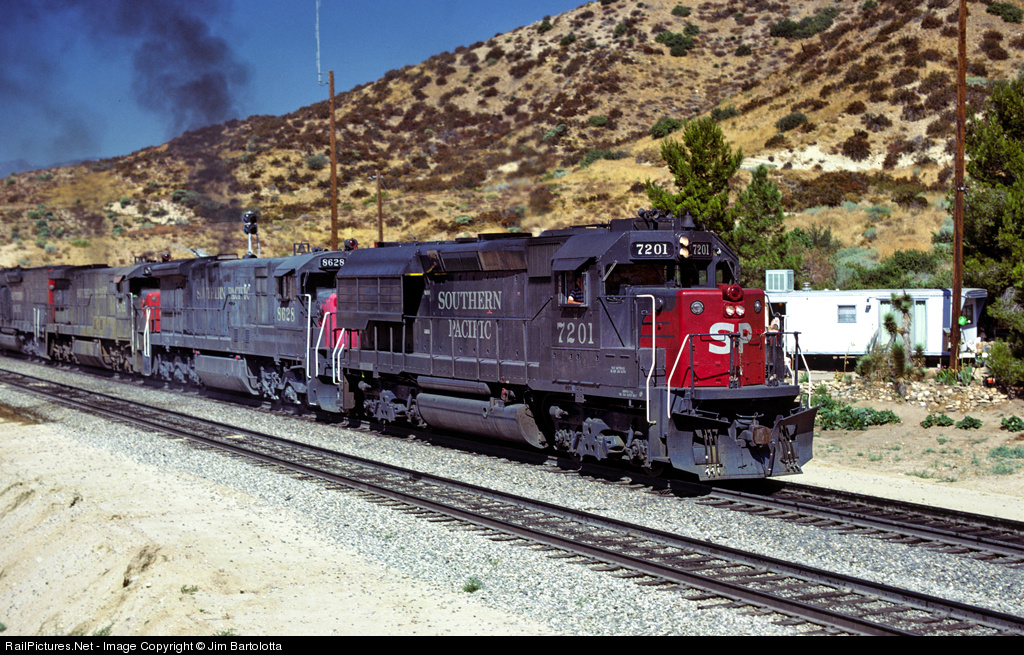
The GP40X was EMD's testbed for the future GP50 and introduced the unpopular HT-B truck. The 'elephant ears' version shown here was an experiment in normalizing the tunnel motor concept. The ears eventually were removed and the HT-B trucks were never reproduced. I needed a powered SP unit to haul around some heavy trains so all those unique qualities fit the bill just right. Originally I wanted to build the UP version, but the SP is more iconic with those elephant ears. The UP version will follow someday.
Information given at MAKS 2013:
SU-27LL Flying Test-Bed / In-flight Simulator with variable-in-flight dynamics
Applications:
•Future aircraft characteristics assessment and FCS research
•In-flight simulation and assessment of aircraft
•Development of flight safety enhancing systems
•Elaboration of adaptive flight control laws for perspective flying vehicles
Experimental equipment:
•Experimental digital FBW
•Autothrottle
•Experimental hand controllers
•Reprogrammable-in-flight HDD/HUD
•SNS
•Telemetry system
(photo 233-1)
Seen undergoing repairs following the discovery of leaking boiler tubes is preserved LMS Princess Royal Class 4-6-2 6201 "Princess Elizabeth". The last time I encountered this locomotive was November 2011, during its final stint on the Cumbrian Mountain Express prior to undergoing major overhaul. It's condition after 6 years appears to have improved immensely since then.
The Princess Royal class were a set of 13 4-6-2 Pacific locomotives designed by William Stanier and built at Crewe Works between 1933 and 1935 to be the prime motive power on the West Coast Mainline between London Euston, Birmingham, Manchester, Liverpool and Glasgow, including the famous Royal Scot premier express service. At first, two prototypical locomotives were built in 1933, followed by 11 production locomotives in 1935. These were later complimented by a fleet of 38 Coronation Pacific locomotives built between 1937 and 1948, which later went on to be arguably the most power steam locomotives ever built for the British Railway network.
One of the original prototypes however was retained for use as a testbed for a new Turbine Locomotive project to help improve the efficiency of the engines, later being unofficially dubbed 'Turbomotive'. The engine was fitted with turbines instead of cylinders, with the forward turbine containing 18 rows of blading, resulting in an output of 2,400hp, corresponding to running at 62 mph (100 km/h). The turbine was designed to operate into a maximum back-pressure of 2 psi, allowing a conventional double blast-pipe to provide the boiler draught, and eliminating draught fans, which always seemed to give a disproportionate amount of trouble.
The reverse turbine had 4 rows of blades. It was engaged by a dog clutch, activated when the reverser lever being set to "0". This was originally steam-operated by a small piston and cylinder. This locomotive was later rebuilt as a conventional classmate in 1952, using new mainframes and a spare set of cylinders from one of the Coronation Pacifics, and was numbered 46202, later to be named 'Princess Anne'.
6201, LMS lot number 99, was built at Crewe for the sum of £11,675 (£685,000 today) and named Princess Elizabeth, after the then Duke of York’s eldest daughter, currently our Queen Elizabeth II, leaving the works on 3rd November 1933.
Throughout the years the Princess Royal's continued to ply their trade on the West Coast services, but the years of World War II took their toll on the fleet. The beautiful Crimson Lake was replaced by Wartime Black, and the prestige manner that these locomotives had been accustomed to was stripped away as the railways were rationalised as part of the war effort. Work hours increased, and maintenance turns reduced, meaning these engines were being forced to the very limit of their design to keep Britain moving.
With the end of the war in 1945 the workload began to decrease, but the railways had paid the price. The beauty and lavish luxury of the pre-war companies had been stripped and would never return, with all of Britain's main railway companies now almost bankrupt and working a fleet of very tired engines on a poorly maintained railway network. In 1948 the Labour Government nationalised these companies to create British Railways, hoping to modernise the network and rebuild the overworked system.
The Princess Royals and their more powerful sisters the Coronation Pacifics continued to work hard as the implementation of diesels gathered pace. Early diesels however were underpowered and suffered heavily from reliability issues, meaning on many occasions the steam locomotives that they intended to replace actually came to their rescue!
It was not all plain sailing though for the Princess Royals in the 1950's, as this decade was littered with many fatal accidents. On 21 September 1951, locomotive No.46207 Princess Arthur of Connaught was hauling an express passenger train that was derailed at Weedon, Northamptonshire due to a defective front bogie on the locomotive, resulting in the deaths of 15 people and the injury of 35.
This was followed a year later by what would turn out to be the worst rail accident in the whole of British history. On 8 October 1952, an express passenger train hauled by Coronation Class, 46242 'City of Glasgow' overran signals on a train from Perth to London Euston, striking the rear of a stopped Tring to Euston commuter train at Harrow and Wealdstone station in North London. The ensuing wreckage was then struck by a northbound Liverpool express, hauled by Jubilee Class 45637 'Windward Islands', and recently rebuilt ex-Turbomotive Princess Royal 46202 'Princess Anne', which had only entered service two months earlier. In the chaos that followed, a total of 112 people were killed and 340 were injured, with 46202 obliterated in the accident, the first and only member of the class to be lost in an accident.
The late 50's however began to see the end of these engines as good, reliable diesels began to be introduced to replace them, followed closely by electric traction on the West Coast Mainline out of Euston. In 1961 the first members of the class were withdrawn from service, including 6201, which was placed in store in March 1961, but returned to service in May of that year due to poor diesel reliability.
As more diesels were delivered, in October of the same year 6201 was again placed into storage at Carlisle Kingmoor. However, again in January 1962 6201 was returned to traffic to cover for diesel failures and continued to work until September 1962 where it was once again placed into storage. It was subsequently withdrawn by BR in October 1962 and purchased by Roger Bell. The last of the locomotives to be withdrawn was class premier and original prototype number 62000 'The Princess Royal', which was withdrawn in November 1962 and subsequently scrapped. In all, only two locomotives were preserved, number 6203 'Princess Margaret Rose' and 6201 'Princess Elizabeth'.
+++ DISCLAIMER +++
Nothing you see here is real, even though the conversion or the presented background story might be based historical facts. BEWARE!
Some background:
The Northrop Grumman-IAI F-24 is the latest reincarnation of the USAF "Lightweight Fighter Program" which dates back to the 1950ies and started with the development of Northrop's F-5 "Freedom Fighter".
The 1st generation F-5 became very successful in the export market and saw a long line of development, including the much more powerful F-5E "Tiger II" and the F-20 Tigershark (initially called F-5G). Northrop had high hopes for the F-20 in the international market; however, policy changes following Ronald Reagan's election meant the F-20 had to compete for sales against aircraft like the F-16, the USAF's latest fighter design (which was politically favored). The F-20 development program was eventually abandoned in 1986 after three prototypes had been built and a fourth partially completed.
But this was not the end for Northrop’s Lightweight Fighter. In the early 1980s, two X-29As experimental aircraft were built by Grumman from two existing Northrop F-5A Freedom Fighter airframes. The Grumman X-29 was a testbed for forward-swept wings, canard control surfaces, and other novel aircraft technologies. The aerodynamic instability of this arrangement increased agility but required the use of computerized fly-by-wire control. Composite materials were used to control the aeroelastic divergent twisting experienced by forward-swept wings, also reducing the weight. The NASA test program continued from 1984 to 1991 and the X-29s flew 242 times, gathering valuable data and breaking ground for new aerodynamic technologies of 4th and 5th generation fighters.
Even though no service aircraft directly evolved from the X-29, its innovative FBW system as well as the new material technologies also opened the door for an updated F-20 far beyond the 1990ies. It became clear that ever expensive and complex aircraft could not be the answer to modern, asymmetrical warfare in remote corners of the world, with exploding development costs and just a limited number of aircraft in service that could not generate true economies of scale, esp. when their state-of-the-art design would not permit any export.
Anyway, a global market for simpler fighter aircraft was there, as 1st generation F-16s as well as the worldwide, aging F-5E fleet and types of Soviet/Russian origin like the MiG-29 provided the need for a modern, yet light and economical jet fighter. Contemporary types like the Indian HAL Tejas, the Swedish Saab Gripen, the French Dassault Rafale and the Pakistani/Chinese FC-1/JF-17 ”Thunder” proved this trend among 4th - 4.5th generation fighter aircraft.
Northrop Grumman (Northrop bought Grumman in 1994) initiated studies and basic design work on a respective New Lightweight Fighter (NLF) as a private venture in 1995. Work on the NLF started at a slow pace, as the company was busy with re-structuring.
The idea of an updated lightweight fighter was fueled by another source, too: Israel. In 1998 IAI started looking in the USA for a development partner for a new, light fighter that would replace its obsolete Kfir fleet and partly relieve its F-16 and F-15 fleet from interception tasks. The domestic project for that role, the IAI Lavi, had been stillborn, but lots of its avionics and research were still at hand and waited for an airframe for completion.
The new aircraft for the IAF was to be superior to the MiG-29, at least on par with the F-16C/D, but easier to maintain, smaller and overall cheaper. Since the performance profiles appeared to be similar to what Northrop Grumman was developing under the NLF label, the US company eventually teamed up with IAI in 2000 and both started the mutual project "Namer" (=נמר, “Tiger” in Hebrew), which eventually lead to the F-24 I for the IAF which kept its project name for service and to the USAF’s F-24A “Tigershark”.
The F-24, as the NLF, was based on the F-20 airframe, but outwardly showed only little family heritage, onle the forward fuselage around the cockpit reminds of the original F-5 design . Many aerodynamic details, e. g. the air intakes and air ducts, were taken over from the X-29, though, as the experimental aircraft and its components had been developed for extreme maneuvers and extra high agility. Nevertheless, the X-29's forward-swept wing was considered to be too exotic and fragile for a true service aircraft, but the F-24 was to feature an Active Aeroelastic Wing (AAW) system.
AAW Technology integrates wing aerodynamics, controls, and structure to harness and control wing aeroelastic twist at high speeds and dynamic pressures. By using multiple leading and trailing edge controls like "aerodynamic tabs", subtle amounts of aeroelastic twist can be controlled to provide large amounts of wing control power, while minimizing maneuver air loads at high wing strain conditions or aerodynamic drag at low wing strain conditions. This system was initially tested on the X-29 and later on the X-53 research aircraft, a modified F-18, until 2006.
Both USAF and IAF versions feature this state-of-the-art aerodynamic technology, but it is uncertain if other customers will receive it. While details concerning the F-24's system have not been published yet, it is assumed that its AAW is so effective that canard foreplanes could be omitted without sacrificing lift and maneuverability, and that drag is effectively minimized as the wing profile can be adjusted according to the aircraft’s speed, altitude, payload and mission – much like a VG wing, but without its clumsy and heavy swiveling mechanism which has to bear high g forces. As a result, the F-24 is, compared to the F-20, which could carry an external payload of about 3.5 tons, rumored to be able to carry up to 5 tons of ordnance.
The delta wing shape proved to be a perfect choice for the required surface and flap actuators inside of the wings, and it would also offer a very good compromise between lift and drag for a wide range of performance. Anyway, there was one price to pay: in order to keep the wing profile thin and simple, the F-24’s landing gear retracts into the lower fuselage, leaving the aircraft with a relatively narrow track.
Another major design factor for the outstanding performance of this rather small aircraft was weight reduction and structural integrity – combined with simplicity, ruggedness and a modular construction which would allow later upgrades. Instead of “going big” and expensive, the new F-24 was to create its performance through dedicated loss of weight, which was in some part also a compensation for the AAW system in the wings and its periphery.
Weight was saved wherever possible, e .g. a newly developed, lightweight M199A1 gatling gun. This 20mm cannon is a three-barreled, heavily modified version of the already “stripped” M61A2 gun in the USAF’s current F-18E and F-22. One of the novel features is a pneumatic drive instead of the traditional electric mechanism, what not only saves weight but also improves trigger response. The new gun weighs only a mere 65kg (the six-barreled M61A2 weighs 92kg, the original M61A1 112 kg), but still reaches a burst rate of fire of 1.800 RPM (about 800 RPM under cyclic fire, standard practice is to fire the cannon in 30 to 50-round bursts, though) and a muzzle velocity of 1.050 metres per second (3,450 ft/s) with a PGU-28/B round.
While the F-16 was and is still made from 80% aluminum alloys and only from 3% composites, the F-24 makes major use of carbon fiber and other lightweight materials, which make up about 40% of the aircraft’s structure, plus an increased share of Titanium and Magnesium alloys. As a consequence and through many other weight-saving measures like keeping stealth capabilities to a minimum (even though RAM was deliberately used and many details designed to have a natural low radar signature, resulting in modest radar cross-section (RCS) reductions), a single, relatively small engine, a fuel-efficient F404-GE-402 turbofan, is enough to make the F-24 a fast and very agile aircraft, coupled with a good range. The F-24’s thrust/weight ratio is considerably higher than 1, and later versions with a vectored thrust nozzle (see below) will take this level of agility even further – with the pilot becoming the limiting factor for the aircraft’s performance.
USAF and IAF F-24s are outfitted with Northrop Grumman's AN/APG-80 Active Electronically Scanned Array (AESA) radar, also used in the F-16 Block 60 aircraft. Other customers might only receive the AN/APG-68, making the F-24 comparable to the F-16C/D.
The first prototype, the YF-24, flew on 8th of March 2008, followed by two more aircraft plus a static airframe until summer 2010. In early 2011 the USAF placed an initial order of 101 aircraft (probably also to stir export sales – the earlier lightweight fighters from Northrop suffered from the fact that the manufacturer’s country would not use the aircraft in its own forces). These initial aircraft will replace older F-16 in the interceptor role, or free them for fighter bomber tasks. The USN and USMC also showed interest in the aircraft for their aggressor squadrons, for dissimilar air combat training. A two-seater, called the F-24B, is supposed to follow soon, too, and a later version for 2020 onwards, tentatively designated F-24C, is to feature an even stronger F404 engine and a 3D vectoring nozzle.
Israel is going to produce its own version domestically from late 2014 on, which will exclusively be used by the IAF. These aircraft will be outfitted with different avionics, built by Elta in Israel, and cater to national requirements which focus more on multi-purpose service, while the USAF focusses with its F-24A on aerial combat and interception tasks.
International interest for the F-24A is already there: in late 2013 Grumman stated that initial talks have been made with various countries, and potential export candidates from 2015 on are Taiwan, Singapore, Thailand, Finland, Norway, Australia and Japan.
General F-24A characteristics:
Crew: 1 pilot
Length: 47 ft 4 in (14.4 m)
Wingspan: 27 ft 11.9 in / 8.53 m; with wingtip missiles (26 ft 8 in/ 8.13 m; without wingtip missiles)
Height: 13 ft 10 in (4.20 m)
Wing area: 36.55 m² (392 ft²)
Empty weight: 13.150 lb (5.090 kg)
Loaded weight: 15.480 lb (6.830 kg)
Max. take-off weight: 27.530 lb (12.500 kg)
Powerplant:
1× General Electric F404-GE-402 turbofan with a dry thrust of 11,000 lbf (48.9 kN) and 17,750 lbf (79.2 kN) with afterburner
Performance
Maximum speed: Mach 2+
Combat radius: 300 nmi (345 mi, 556 km); for hi-lo-hi mission with 2 × 330 US gal (1,250 L) drop tanks
Ferry range: 1,490 nmi (1715 mi, 2759 km); with 3 × 330 US gal (1,250 L) drop tanks
Service ceiling: 55,000 ft (16,800 m)
Rate of climb: 52,800 ft/min (255 m/s)
Wing loading: 70.0 lb/ft² (342 kg/m²)
Thrust/weight: 1.09 (1.35 with loaded weight & 50% fuel)
Armament
1× 20 mm (0.787 in) M199A1 3-barreled Gatling cannon in the lower fuselage with 400 RPG
Eleven external hardpoints (two wingtip tails, six underwing hardpoints, three underfuselage hardpoints) and a total capacity of 11.000 lb (4.994 kg) of missiles (incl. AIM 9 Sidewinder and AIM 120 AMRAAM), bombs, rockets, ECM pods and drop tanks for extended range.
The kit and its assembly:
A spontaneous project. This major kitbash was inspired by fellow user nighthunter at whatifmodelers.com, who came up with a profile of a mashed-up US fighter, created “out of boredom”. The original idea was called F-21C, and it was to be a domestic successor to the IAI Kfirs which had been used by the US as aggressor aircraft in USN and USMC service for a few years.
As a weird(?) coincidence I had many of the necessary ingredients for this fictional aircraft in store, even though some parts and details were later changed. This model here is an interpretation of the original design. The idea was spun further, and the available parts that finally went into the model also had some influence on design and background.
I thank nighthunter for sharing the early ideas, inviting me to take the design to the hardware stage (sort of…) and adapting my feedback into new design sketches, too, which, in return, inspired the model building process.
Well, what went into this thing? To cook up a F-24 à la Dizzyfugu you just need (all in 1:72):
● Fuselage from a Hasegawa X-29, including the cockpit and the landing gear
● Fin and nose cone from an Italeri F-16A
● Inner wings from a (vintage) Hasegawa MiG-21F
● Outer wings from a F-4 (probably a J, Hasegawa or Fujimi)
The wing construction deviates from nighthunter’s original idea. The favorite ingredients would have been F-16XL or simple Mirage III wings, but I found the composite wing to be more attractive and “different”. The big F-16XL wings, despite their benefit of a unique shape, might also have created scale/size problems with a F-20 style fuselage? So I built hybrid wings: The MiG-21 landing gear wells were filled with putty and the F-4 outer wings simply glued onto the MiG inner wing sections, which were simply cut down in span. It sounds like an unlikely combo, but these parts fit together almost perfectly! In order to hide the F-4 origins I modified them to carry wingtip launch rails, though, which were also part of nighthunter’s original design.
The AAW technology detail mentioned in the background came in handy as it explains the complicated wing shape and the fact that the landing gear retracts into the fuselage, not into the wings, which would have been more plausible… Anyway, there’s still room for a simpler export version, with Mirage III or Kfir C.2/7 wings, and maybe canards?
Using the X-29 as basis also made fitting the new wings onto the area-ruled fuselage pretty easy, as I could use the wing root parts from the X-29 to bridge the gap. The original, forward-swept wings were just cut away, and the remains used as consoles for the new hybrid delta wings. Took some SERIOUS putty work, but the result is IMHO fine.
The bigger/square X-29 air intakes were taken over, and they change the look of the aircraft, making it look less F-5-ish than a true F-20 fuselage. For the same reason I kept the large fairing at the fin base, combining it with a bigger F-16 tail, though, as a counter-balance to the new, bigger wings. Again, the F-16 fin was/is part of nighthunter’s idea, so the model stays true to the original concept.
For the same reason I omitted the original X-29 nose, which is rather pointy, sports vanes and a large sensor boom. The F-16 nose was a plausible choice, as the AN/APG-80 is also carried by late Fighting Falcons, and its shape fits well, too.
All around the hull, some small details like radar warning sensors, pitots and air scoops were added. Not really necessary, but such thing add IMHO to the overall impression of such a fictional aircraft beyond the prototype stage.
Cockpit and landing gear were taken OOB, I just added a pilot figure and slightly modified the seat.
The ordnance was puzzled together from the scrap box, the AIM-9Ls come from the same F-4 kit which donated its outer wings, the AIM-120s come from an Italeri NATO weapons kit. The drop tanks belong to an F-16.
Painting and markings:
At first I considered an F-24I in IAF markings, or even a Japanese aircraft, but then reverted to one of nighthunter’s initial, simple ideas: an USAF aircraft in the “Hill II” paint scheme (F-16 style), made up from three shades of gray (FS 36118, 36270 and 36375) with low-viz markings and stencils. Dutch/Turkish NF-5A/Bs in the “Hill II” scheme were used as design benchmarks, too. It’s a simple livery, but on this delta wing aircraft it looks pretty interesting. I used enamels, what I had at hand: Humbrol 127 and 126, and Modelmaster's 1723.
A light black ink wash was applied, in order to em,phasize the engraved panel lines, in contrast to that, panels were manually highlighted through dry-brushed, lighter shades of gray (Humbrol 27, 166 and 167).
“Hill II” also adds to a generic, realistic touch for this whif. Doing an exotic air force thing is rather easy, but creating a convincing whif for a huge military machinery like the USAF’s takes more subtlety, I think.
The cockpit was painted in medium Gray (Dark Gull Grey, FS 36231, Humbrol 140), as well as the radome. The landing gear and the air intakes were painted white. The radome was painted with Revell 47 and dry-brushed with Humbrol 140.
Decals were puzzled together from various USAF aircraft, including sheets from an Airfix F-117, an Italeri F-15E and even an Academy OV-10D.
Tadah: a hardware tribute to an idea, born from boredom - and the aircraft does not look even bad at all? What I wanted to achieve was to make the F-24 neither look like a F-20, nor a Saab Gripen clone, as the latter comes close in overall shape, size and design.
+++ DISCLAIMER +++
Nothing you see here is real, even though the conversion or the presented background story might be based historical facts. BEWARE!
Some background:
The Northrop Grumman-IAI F-24 is the latest reincarnation of the USAF "Lightweight Fighter Program" which dates back to the 1950ies and started with the development of Northrop's F-5 "Freedom Fighter".
The 1st generation F-5 became very successful in the export market and saw a long line of development, including the much more powerful F-5E "Tiger II" and the F-20 Tigershark (initially called F-5G). Northrop had high hopes for the F-20 in the international market; however, policy changes following Ronald Reagan's election meant the F-20 had to compete for sales against aircraft like the F-16, the USAF's latest fighter design (which was politically favored). The F-20 development program was eventually abandoned in 1986 after three prototypes had been built and a fourth partially completed.
But this was not the end for Northrop’s Lightweight Fighter. In the early 1980s, two X-29As experimental aircraft were built by Grumman from two existing Northrop F-5A Freedom Fighter airframes. The Grumman X-29 was a testbed for forward-swept wings, canard control surfaces, and other novel aircraft technologies. The aerodynamic instability of this arrangement increased agility but required the use of computerized fly-by-wire control. Composite materials were used to control the aeroelastic divergent twisting experienced by forward-swept wings, also reducing the weight. The NASA test program continued from 1984 to 1991 and the X-29s flew 242 times, gathering valuable data and breaking ground for new aerodynamic technologies of 4th and 5th generation fighters.
Even though no service aircraft directly evolved from the X-29, its innovative FBW system as well as the new material technologies also opened the door for an updated F-20 far beyond the 1990ies. It became clear that ever expensive and complex aircraft could not be the answer to modern, asymmetrical warfare in remote corners of the world, with exploding development costs and just a limited number of aircraft in service that could not generate true economies of scale, esp. when their state-of-the-art design would not permit any export.
Anyway, a global market for simpler fighter aircraft was there, as 1st generation F-16s as well as the worldwide, aging F-5E fleet and types of Soviet/Russian origin like the MiG-29 provided the need for a modern, yet light and economical jet fighter. Contemporary types like the Indian HAL Tejas, the Swedish Saab Gripen, the French Dassault Rafale and the Pakistani/Chinese FC-1/JF-17 ”Thunder” proved this trend among 4th - 4.5th generation fighter aircraft.
Northrop Grumman (Northrop bought Grumman in 1994) initiated studies and basic design work on a respective New Lightweight Fighter (NLF) as a private venture in 1995. Work on the NLF started at a slow pace, as the company was busy with re-structuring.
The idea of an updated lightweight fighter was fueled by another source, too: Israel. In 1998 IAI started looking in the USA for a development partner for a new, light fighter that would replace its obsolete Kfir fleet and partly relieve its F-16 and F-15 fleet from interception tasks. The domestic project for that role, the IAI Lavi, had been stillborn, but lots of its avionics and research were still at hand and waited for an airframe for completion.
The new aircraft for the IAF was to be superior to the MiG-29, at least on par with the F-16C/D, but easier to maintain, smaller and overall cheaper. Since the performance profiles appeared to be similar to what Northrop Grumman was developing under the NLF label, the US company eventually teamed up with IAI in 2000 and both started the mutual project "Namer" (=נמר, “Tiger” in Hebrew), which eventually lead to the F-24 I for the IAF which kept its project name for service and to the USAF’s F-24A “Tigershark”.
The F-24, as the NLF, was based on the F-20 airframe, but outwardly showed only little family heritage, onle the forward fuselage around the cockpit reminds of the original F-5 design . Many aerodynamic details, e. g. the air intakes and air ducts, were taken over from the X-29, though, as the experimental aircraft and its components had been developed for extreme maneuvers and extra high agility. Nevertheless, the X-29's forward-swept wing was considered to be too exotic and fragile for a true service aircraft, but the F-24 was to feature an Active Aeroelastic Wing (AAW) system.
AAW Technology integrates wing aerodynamics, controls, and structure to harness and control wing aeroelastic twist at high speeds and dynamic pressures. By using multiple leading and trailing edge controls like "aerodynamic tabs", subtle amounts of aeroelastic twist can be controlled to provide large amounts of wing control power, while minimizing maneuver air loads at high wing strain conditions or aerodynamic drag at low wing strain conditions. This system was initially tested on the X-29 and later on the X-53 research aircraft, a modified F-18, until 2006.
Both USAF and IAF versions feature this state-of-the-art aerodynamic technology, but it is uncertain if other customers will receive it. While details concerning the F-24's system have not been published yet, it is assumed that its AAW is so effective that canard foreplanes could be omitted without sacrificing lift and maneuverability, and that drag is effectively minimized as the wing profile can be adjusted according to the aircraft’s speed, altitude, payload and mission – much like a VG wing, but without its clumsy and heavy swiveling mechanism which has to bear high g forces. As a result, the F-24 is, compared to the F-20, which could carry an external payload of about 3.5 tons, rumored to be able to carry up to 5 tons of ordnance.
The delta wing shape proved to be a perfect choice for the required surface and flap actuators inside of the wings, and it would also offer a very good compromise between lift and drag for a wide range of performance. Anyway, there was one price to pay: in order to keep the wing profile thin and simple, the F-24’s landing gear retracts into the lower fuselage, leaving the aircraft with a relatively narrow track.
Another major design factor for the outstanding performance of this rather small aircraft was weight reduction and structural integrity – combined with simplicity, ruggedness and a modular construction which would allow later upgrades. Instead of “going big” and expensive, the new F-24 was to create its performance through dedicated loss of weight, which was in some part also a compensation for the AAW system in the wings and its periphery.
Weight was saved wherever possible, e .g. a newly developed, lightweight M199A1 gatling gun. This 20mm cannon is a three-barreled, heavily modified version of the already “stripped” M61A2 gun in the USAF’s current F-18E and F-22. One of the novel features is a pneumatic drive instead of the traditional electric mechanism, what not only saves weight but also improves trigger response. The new gun weighs only a mere 65kg (the six-barreled M61A2 weighs 92kg, the original M61A1 112 kg), but still reaches a burst rate of fire of 1.800 RPM (about 800 RPM under cyclic fire, standard practice is to fire the cannon in 30 to 50-round bursts, though) and a muzzle velocity of 1.050 metres per second (3,450 ft/s) with a PGU-28/B round.
While the F-16 was and is still made from 80% aluminum alloys and only from 3% composites, the F-24 makes major use of carbon fiber and other lightweight materials, which make up about 40% of the aircraft’s structure, plus an increased share of Titanium and Magnesium alloys. As a consequence and through many other weight-saving measures like keeping stealth capabilities to a minimum (even though RAM was deliberately used and many details designed to have a natural low radar signature, resulting in modest radar cross-section (RCS) reductions), a single, relatively small engine, a fuel-efficient F404-GE-402 turbofan, is enough to make the F-24 a fast and very agile aircraft, coupled with a good range. The F-24’s thrust/weight ratio is considerably higher than 1, and later versions with a vectored thrust nozzle (see below) will take this level of agility even further – with the pilot becoming the limiting factor for the aircraft’s performance.
USAF and IAF F-24s are outfitted with Northrop Grumman's AN/APG-80 Active Electronically Scanned Array (AESA) radar, also used in the F-16 Block 60 aircraft. Other customers might only receive the AN/APG-68, making the F-24 comparable to the F-16C/D.
The first prototype, the YF-24, flew on 8th of March 2008, followed by two more aircraft plus a static airframe until summer 2010. In early 2011 the USAF placed an initial order of 101 aircraft (probably also to stir export sales – the earlier lightweight fighters from Northrop suffered from the fact that the manufacturer’s country would not use the aircraft in its own forces). These initial aircraft will replace older F-16 in the interceptor role, or free them for fighter bomber tasks. The USN and USMC also showed interest in the aircraft for their aggressor squadrons, for dissimilar air combat training. A two-seater, called the F-24B, is supposed to follow soon, too, and a later version for 2020 onwards, tentatively designated F-24C, is to feature an even stronger F404 engine and a 3D vectoring nozzle.
Israel is going to produce its own version domestically from late 2014 on, which will exclusively be used by the IAF. These aircraft will be outfitted with different avionics, built by Elta in Israel, and cater to national requirements which focus more on multi-purpose service, while the USAF focusses with its F-24A on aerial combat and interception tasks.
International interest for the F-24A is already there: in late 2013 Grumman stated that initial talks have been made with various countries, and potential export candidates from 2015 on are Taiwan, Singapore, Thailand, Finland, Norway, Australia and Japan.
General F-24A characteristics:
Crew: 1 pilot
Length: 47 ft 4 in (14.4 m)
Wingspan: 27 ft 11.9 in / 8.53 m; with wingtip missiles (26 ft 8 in/ 8.13 m; without wingtip missiles)
Height: 13 ft 10 in (4.20 m)
Wing area: 36.55 m² (392 ft²)
Empty weight: 13.150 lb (5.090 kg)
Loaded weight: 15.480 lb (6.830 kg)
Max. take-off weight: 27.530 lb (12.500 kg)
Powerplant:
1× General Electric F404-GE-402 turbofan with a dry thrust of 11,000 lbf (48.9 kN) and 17,750 lbf (79.2 kN) with afterburner
Performance
Maximum speed: Mach 2+
Combat radius: 300 nmi (345 mi, 556 km); for hi-lo-hi mission with 2 × 330 US gal (1,250 L) drop tanks
Ferry range: 1,490 nmi (1715 mi, 2759 km); with 3 × 330 US gal (1,250 L) drop tanks
Service ceiling: 55,000 ft (16,800 m)
Rate of climb: 52,800 ft/min (255 m/s)
Wing loading: 70.0 lb/ft² (342 kg/m²)
Thrust/weight: 1.09 (1.35 with loaded weight & 50% fuel)
Armament
1× 20 mm (0.787 in) M199A1 3-barreled Gatling cannon in the lower fuselage with 400 RPG
Eleven external hardpoints (two wingtip tails, six underwing hardpoints, three underfuselage hardpoints) and a total capacity of 11.000 lb (4.994 kg) of missiles (incl. AIM 9 Sidewinder and AIM 120 AMRAAM), bombs, rockets, ECM pods and drop tanks for extended range.
The kit and its assembly:
A spontaneous project. This major kitbash was inspired by fellow user nighthunter at whatifmodelers.com, who came up with a profile of a mashed-up US fighter, created “out of boredom”. The original idea was called F-21C, and it was to be a domestic successor to the IAI Kfirs which had been used by the US as aggressor aircraft in USN and USMC service for a few years.
As a weird(?) coincidence I had many of the necessary ingredients for this fictional aircraft in store, even though some parts and details were later changed. This model here is an interpretation of the original design. The idea was spun further, and the available parts that finally went into the model also had some influence on design and background.
I thank nighthunter for sharing the early ideas, inviting me to take the design to the hardware stage (sort of…) and adapting my feedback into new design sketches, too, which, in return, inspired the model building process.
Well, what went into this thing? To cook up a F-24 à la Dizzyfugu you just need (all in 1:72):
● Fuselage from a Hasegawa X-29, including the cockpit and the landing gear
● Fin and nose cone from an Italeri F-16A
● Inner wings from a (vintage) Hasegawa MiG-21F
● Outer wings from a F-4 (probably a J, Hasegawa or Fujimi)
The wing construction deviates from nighthunter’s original idea. The favorite ingredients would have been F-16XL or simple Mirage III wings, but I found the composite wing to be more attractive and “different”. The big F-16XL wings, despite their benefit of a unique shape, might also have created scale/size problems with a F-20 style fuselage? So I built hybrid wings: The MiG-21 landing gear wells were filled with putty and the F-4 outer wings simply glued onto the MiG inner wing sections, which were simply cut down in span. It sounds like an unlikely combo, but these parts fit together almost perfectly! In order to hide the F-4 origins I modified them to carry wingtip launch rails, though, which were also part of nighthunter’s original design.
The AAW technology detail mentioned in the background came in handy as it explains the complicated wing shape and the fact that the landing gear retracts into the fuselage, not into the wings, which would have been more plausible… Anyway, there’s still room for a simpler export version, with Mirage III or Kfir C.2/7 wings, and maybe canards?
Using the X-29 as basis also made fitting the new wings onto the area-ruled fuselage pretty easy, as I could use the wing root parts from the X-29 to bridge the gap. The original, forward-swept wings were just cut away, and the remains used as consoles for the new hybrid delta wings. Took some SERIOUS putty work, but the result is IMHO fine.
The bigger/square X-29 air intakes were taken over, and they change the look of the aircraft, making it look less F-5-ish than a true F-20 fuselage. For the same reason I kept the large fairing at the fin base, combining it with a bigger F-16 tail, though, as a counter-balance to the new, bigger wings. Again, the F-16 fin was/is part of nighthunter’s idea, so the model stays true to the original concept.
For the same reason I omitted the original X-29 nose, which is rather pointy, sports vanes and a large sensor boom. The F-16 nose was a plausible choice, as the AN/APG-80 is also carried by late Fighting Falcons, and its shape fits well, too.
All around the hull, some small details like radar warning sensors, pitots and air scoops were added. Not really necessary, but such thing add IMHO to the overall impression of such a fictional aircraft beyond the prototype stage.
Cockpit and landing gear were taken OOB, I just added a pilot figure and slightly modified the seat.
The ordnance was puzzled together from the scrap box, the AIM-9Ls come from the same F-4 kit which donated its outer wings, the AIM-120s come from an Italeri NATO weapons kit. The drop tanks belong to an F-16.
Painting and markings:
At first I considered an F-24I in IAF markings, or even a Japanese aircraft, but then reverted to one of nighthunter’s initial, simple ideas: an USAF aircraft in the “Hill II” paint scheme (F-16 style), made up from three shades of gray (FS 36118, 36270 and 36375) with low-viz markings and stencils. Dutch/Turkish NF-5A/Bs in the “Hill II” scheme were used as design benchmarks, too. It’s a simple livery, but on this delta wing aircraft it looks pretty interesting. I used enamels, what I had at hand: Humbrol 127 and 126, and Modelmaster's 1723.
A light black ink wash was applied, in order to em,phasize the engraved panel lines, in contrast to that, panels were manually highlighted through dry-brushed, lighter shades of gray (Humbrol 27, 166 and 167).
“Hill II” also adds to a generic, realistic touch for this whif. Doing an exotic air force thing is rather easy, but creating a convincing whif for a huge military machinery like the USAF’s takes more subtlety, I think.
The cockpit was painted in medium Gray (Dark Gull Grey, FS 36231, Humbrol 140), as well as the radome. The landing gear and the air intakes were painted white. The radome was painted with Revell 47 and dry-brushed with Humbrol 140.
Decals were puzzled together from various USAF aircraft, including sheets from an Airfix F-117, an Italeri F-15E and even an Academy OV-10D.
Tadah: a hardware tribute to an idea, born from boredom - and the aircraft does not look even bad at all? What I wanted to achieve was to make the F-24 neither look like a F-20, nor a Saab Gripen clone, as the latter comes close in overall shape, size and design.
+++ DISCLAIMER +++
Nothing you see here is real, even though the model, the conversion or the presented background story might be based historical facts. BEWARE!
Some background:
In the aftermath of the Second World War, Sweden required a strong air defense, utilizing the newly developed jet propulsion technology. The original concept had been designed around a mostly straight wing, but after Swedish engineers had obtained German research data on swept-wing designs, the prototype was altered to incorporate a 25° sweep. In order to make the wing as thin as possible, Saab elected to locate the retractable undercarriage in the aircraft's fuselage rather than into the wings.
Extensive wind tunnel testing had also influenced aspects of the aircraft's aerodynamics, such as stability and trim across the aircraft's speed range. In order to test the design of the swept wing further and avoid any surprises, it was decided to modify a Saab Safir. It received the designation Saab 201 and a full-scale swept wing for a series of flight tests. The first 'final' sketches of the aircraft, incorporating the new information, were drawn in January 1946.
The originally envisioned powerplant for the new fighter type was the de Havilland Goblin turbojet engine. However, in December 1945, information on the newer and more powerful de Havilland Ghost engine became available. The new engine was deemed to be ideal for Saab's in-development aircraft, as not only did the Ghost engine had provisions for the use of a central circular air intake, the overall diameter of the engine was favorable for the planned fuselage dimensions, too. Thus, following negotiations between de Havilland and Saab, the Ghost engine was selected to power the type and built in license as the RM 2.
By February 1946 the main outline of the proposed aircraft had been clearly defined. In autumn 1946, following the resolution of all major questions of principal and the completion of the project specification, the Swedish Air Force formally ordered the completion of the design and that three prototype aircraft be produced, giving the proposed type the designation J 29. After a thorough test program, production of the type commenced in 1948 and, in May 1951, the first deliveries of operational production aircraft were received by F 13 Norrköping. The J 29 proved to be very successful and several variants and updates of the Tunnan were produced, including a dedicated reconnaissance variant, a two seat trainer and an all-weather fighter with an onboard radar
However, Sweden foresaw that there would soon be a need for a jet fighter that could intercept bombers at high altitude and also successfully engage fighters. During September 1949, the Swedish Air Force, via the Swedish Defence Material Administration, released a requirement for a cutting-edge interceptor aircraft that was envisioned to be capable of attacking hostile bomber aircraft in the transonic speed range. As released, this requirement specified a top speed of Mach speed 1.4 to 1.5. (1956, the specified speed was revised and raised to Mach 1.7-1.8, and eventually led to the Saab 35 Draken). With the barely supersonic Saab 32 Lansen just under development, and intended for different roles than being a nimble day fighter, the company searched for a way to either achieve supersonic flight through modifications of an existing type or at least gather sufficient data and develop and try the new technologies necessary to meet the 1949 requirements.
Since Sweden did not have a truly supersonic aircraft in its inventory (not even an experimental type), Saab decided to convert the Saab 29 into a supersonic testbed, with the outlook to develop an interim day fighter that could replace the various Tunnan fighter versions and support the new Lansen fleet until a fully capable Mach 1.5+ interceptor was ready for service. Even though the type was regarded as a pure experimental aircraft, the designation remained close to the J29 nomenclature in order to secure military funding for the project and to confuse eventual spies. Consequently, the P29 was initially presented as a new J29 version (hence the “G” suffix).
The P29G was based on a heavily modified production J29B airframe, which was built in two versions and only in two specimens. Work on the first airframe started in 1952, just when the first Saab 32 prototype made its maiden flight. The initial challenge consisted of integrating two relatively compact axial flow jet engines with afterburners into the fuselage, since the J29’s original RM2, even in its late afterburner variant, was not able to safely deliver the necessary thrust for the intended supersonic flight program. After long negotiations, Saab was able to procure a small number of Westinghouse J34-WE-42 turbojets from the USA, which delivered as a pair 40% more thrust than the original RM2B. The engines were only delivered under the restriction that they would exclusively be used in connection with the supersonic research program.
Through a thorough re-construction, the Saab team was able to mount the new engines into the lower rear fuselage, and, internally, the air intake duct had to be modified and forked behind the landing gear wells. Due to the significantly widened rear fuselage, the P29G became quickly nicknamed “Kurviga Tunnan” (= “Curvy Barrel”). Even though the widened rear fuselage increased the aircraft’s frontal cross section, the modified shape had the (unintended) effect of area ruling, a welcome side benefit which became apparent during the flight test and which largely promoted the P29G’s gain of top speed.
Another special and unique feature of the P29G was a special wing attachment system. It consisted of two strengthened, open box spars in the fuselage with additional attachment points along the wing roots, which allowed different wings to be switched with relatively little effort. However, due to this modification, the wing tanks (with a total capacity of 900l inside of the J29s standard wings) were lost and only 2.150l in the Saab 29’s standard fuselage tanks could be carried – but this was, for a research aircraft, not regarded as a major weakness, and compensated for the wing attachment system’s additional weight. The original wing-mounted pitots were replaced by a single, massive sensor boom attached to the aircraft’s nose above the air intake, slightly set-off to starboard in order to give the pilot an unobstructed view.
The first P29G's maiden flight, marked “Gul Urban” (Yellow U), took place in July 1955. The aircraft behaved normally, even though the center of gravity had markedly shifted backwards and the overall gain of weight made the aircraft slightly unstable along the longitudinal axis. During the initial, careful attempts to break the sound barrier, it soon became apparent that both the original wings as well as the original air intake shape limited the P29G's potential. In its original form, the P29G could only barely pass Mach 1 in level flight.
As a consequence, the second P29G, which had been under conversion from another J29B airframe since mid-1954, received more thorough modifications. The air intake was lengthened and widened, and in order to make it more effective at supersonic speed it received a sharp lip. Wind tunnel tests with the first machine led to a modified tail, too: the fin was now taller and further swept back, the stabilizer was moved to a higher position, resulting in a cruciform layout. The original single-piece stabilizer was furthermore replaced by a two-piece, all-moving construction with a 45° sweep and a thinner profile. This not only improved the aerodynamics at high speed, it also suppressed the longitudinal instability problem, even though this was never really cured.
Due to the even higher all-up weight of the new aircraft, the landing gear was reinforced and the 2nd P29G received an experimental suspension system on its main legs with higher spring travel, which was designed for operations on semi-prepared airfields. This system had actually been designed for the updated J29 fighters (esp. the A32B attack variant), but it was not introduced into series production or the Saab 29E/F conversion program. Despite these massive changes, the P29G designation was retained, and the second machine, carrying the tactical code “Röd Urban” (Red U), was quickly nicknamed “Karpen” (“Carp”), due to its characteristic new intake shape, the long fin and its stocky shape.
The second P29G was ready for flight tests in August 1956, just in time to support the Saab 35’s ongoing development – the aircraft, which was eventually built to meet (and exceed) the Swedish Air Force’s 1949 supersonic interceptor requirement. The modifications proved to be successful and the P29G was, fitted with a 60° sweep wing and in clean configuration, able to achieve a maximum speed of 1.367 km/h (849 mph) in level flight, a formidable achievement (vs. the 1,060 km/h (660 mph) of the late J29F and the 1200 km/h (745 mph) of the J32B interceptor) for the post WWII design.
Several wing shapes and profiles were tested, including sweep angles from 25° to 63° as well as different shapes and profiles. Even though the machines carried provisions for the J29’s standard armament, the 20 mm cannons were normally not mounted and replaced with sensors and recording equipment. However, both machines were temporarily fitted with one or two guns in order to analyze the effects of firing the weapons at supersonic speed. Underwing ordnance was also almost never carried. In some tests, though, light bombs or unguided missiles were carried and deployed, or podded cine cameras were carried.
While the second P29G was used for high speed trials, the first machine remained in its original guise and took over low speed handling tests. Thanks to the unique wing switch mechanism, the supersonic research program could be held within a very tight schedule and lasted until late 1959. Thereafter, the P29Gs’ potential was of little use anymore, and the engine use agreement with the USA put an end to further use of the two aircraft, so that both P29Gs were retired from service in 1960. The 1st machine, outfitted with standard J29F wings and stripped off of its engines, remained in use as an instructional air at Malmslätt air base 1969, while the second machine was mothballed. However, both airframes were eventually scrapped in 1970.
General characteristics:
Crew: 1
Length: 11.66 m (38 ft 2 in) fuselage only,
13,97 m (45 ft 9 in) with pitot boom
Wingspan: varied*; 11.0 m (36 ft 1 in) with standard 25° sweep wings,
10.00 m (32 ft 9 ¾ in) with experimental 45° wings
Height: 4.54m (14 ft 10 ½ in)
Wing area: varied*; 24.15 m² (260.0 ft²) with standard 25° sweep wings
22.5 m² (242.2 ft²) with experimental 45° wings
Empty weight: 5,220 kg (11,500 lb)
Max. takeoff weight: 8,510 kg (18,744 lb)
Powerplant:
2× Westinghouse J34-WE-42 turbojets, each rated at 3,400 lbf (15 kN) dry thrust
and 4,200 lbf (19 kN) with full afterburner
Performance:
Maximum speed: 1.367 km/h (849 mph) were achieved*
Range: 790 km (490 mi)
Service ceiling: up to 17,250 m (56,500 ft)*
Rate of climb: up to 45 m/s (8,850 ft/min)*
*Varying figures due to different tested wing configurations
Armament:
None installed; provisions for 4x 20mm Hispano Mark V autocannon in the lower front fuselage.
Depending on the mounted wing type, various external loads could be carried, including a wide range of light bombs, 75 mm (3 in) air-to-air rockets, 145 mm (5.8 in) anti-armor rockets, 150 mm (6 in) HE (high-explosive) rockets or 180 mm (7.2 in) HE anti-ship rockets. Due to the lack of complex wiring or fuel plumbing, no guided weapons or drop tanks could be mounted, though.
The kit and its assembly:
Sweden is a prolific whiffing territory, and the Saab 29 offers some interesting options. This highly modified Tunnan, which is actually rather a kitbashing than a mere model kit modification, is/was a submission to the “More or less engines” group build at whatifmodelers.com in summer 2019.
I actually had the idea of a two-engine J29 in the back of my mind for a long time, spawned by a resin conversion set for the Hasegawa B-47 Stratojet kit that came with new intakes and exhaust sections for the four engine pods. The single engine pod parts had been spent a long time ago, but the twin engine parts were still waiting for a good use. Could the exhaust fit under/into a Tunnan…?
I even had a Matchbox J29 stashed away for this experiment long ago, as well as some donor parts like the wings, and the GB eventually offered the right motivation to put those things together that no one would expect to work.
So I pulled out all the stuff and started – a rather straightforward affair. Work started with the fuselage, which was, together with the (very nice) cockpit assembled OOB at first, the nose filled with as much lead as possible and with the lower rear section cut away, so the B-47 resin jet nozzles would end up at the same position as the original RM2B exhaust. Due to the pen nib fairing between them, though, the profile of the modified tail became (visually) more massive, and I had to fill some gaps under the tail boom (with styrene sheet and putty). The twin engines also turned out to be wider than expected – I had hoped for straight flanks, but the fuselage shape ended up with considerable bulges behind the landing gear wells. These were created with parts from drop tank halves and blended into the rest of the lower hill with PSR work. In the same wake the area under the fin was sculpted and re-created, too.
At that point it became clear that I had to do more on the fuselage, esp. the front end, in order to keep the aircraft visually balance. A convenient solution became an F-100 air intake, which I grafted onto the nose instead of the original circular and round-lipped orifice – with its sharp lip the Super Sabre piece was even a plausible change! The fuselage shapes and diameters differed considerably, though, more PSR became necessary.
Next came the wings: I had already set apart a pair of trapezoid wings with a 45° sweep angle – these were left over from a PM Model Ta 183 conversion some time ago. With their odd shape and size they were a perfect match for my project, even more so due to the fact that I could keep the original J29 wing attachment points, I just had to shorten and modify the trailing edge area on the fuselage. The result was very conclusive.
With the new nose and the wings in place, the overall proportions became clearer: still tail-heavy, but not unpleasant. At this time I was also certain that I had to modify the tail surfaces. The fin was too small and did not have enough sweep for the overall look, and the stabilizer, with its thick profile, rounded edges and the single, continuous rudder did not look supersonic at all. What followed was a long search in the donor banks for suitable replacements, and I eventually came up with a MiG-15 fin (Hobby Boss) which was later clipped at the top for a less recognizable profile. The stabilizers were more challenging, though. My solution eventually became a pair of modified stabilizers from a Matchbox Buccaneer(!), attached to the MiG-15 fin.
The design problems did not stop here, though: the landing gear caused some more headaches. I wanted to keep the OOB parts, but especially the main legs would leave the aircraft with a very goofy look through a short wheelbase and a rear axis position too much forward. In an attempt to save the situation I attached swing arms to the OOB struts, moving the axis maybe 5mm backwards and widening the track by 2mm at the same time. Not much in total, but it helped (a little, even though the aircraft is still very tail-heavy)
As a final addition – since the original, wing-mounted pitots of the J29 were gone now and would not go well with the wing-switching idea – I gave the P29G a large, nose-mounted pitot and sensor boom, placed on top of the nose. This part come, like the air intake, from an F-100.
Painting and markings:
I tend to be conservative when it comes to liveries for what-if models, and the P29G is no exception. At first, I thought that this build could become an operational supersonic daylight interceptor (the J29G), so that I could give the model full military markings and maybe a camouflage paint scheme. However, this idea would not work: the potential real life window for such an aircraft, based on the Saab 29, would be very narrow. And aircraft development in the late Fifties made quantum leaps within a very short period of time: While the J29A entered service, work on the Mach 2 Saab 35 was already underway – nobody would have accepted (or needed) a Mach 1 fighter, based on late Forties technology, at that time anymore, and there was the all-weather Saab J32B around, too. The update program with new wings and a more powerful afterburner engine was all that could be done to exploit the Tunnan’s potential, resulting in the (real world’s) J29E and F variants.
I eventually decided that the J29G would only be a prototype/research aircraft, consequently called P29G, and through this decision I became more or less settled upon a NMF finish with some colorful markings. Consequently, the model was painted with various shades of metal colors, primarily Polished Aluminum Metallizer from Humbrol, but also with Humbrol 191 and Matt Aluminum Metallizer as well as ModelMaster Steel Metallizer. Around the exhaust section, I also used Revell 91 (Iron) and ModelMaster Exhaust Metallizer. Some single panels and details were painted with Revell 99 (Aluminum), and I also used generic decal material in silver to simulate some smaller access panels. Grey decal sheet was used to simulate covers for the cannon nozzles.
The cockpit interior was painted, according to Saab 29 standard, in a dark greenish-grey (Revell 67), and bluish grey was used inside of the landing gear wells (Revell 57). The pitot boom received black and white stripes.
For markings I let myself get inspired from the real world Saab 29 and 32 prototypes, which were all marked with a colored “U” tactical code on the fin and also on the front fuselage, simply meaning “Utverding” (= “Test”). I found four red decals, and I also gave the aircraft a yellow cheatline, lent from an Airfix F-86D decal sheet. The Swedish roundels come from a generic aftermarket sheet, most stencils were taken from the Revell OOB sheet and a Printscale J29 sheet.
Before the model was sealed with semi-gloss acrylic varnish from Italeri, some grinded graphite was rubbed onto the rear fuselage, adding a metallic shine and simulating exhaust stains.
A thorough conversion – this has rather evolved into a kitbashing than just a kit conversion: not much from the original Matchbox J29 has been left over. But I like the outcome, even though things developed gradually from the simple idea of changing the number of engines on the Tunnan. One thing led to another. The resulting aircraft looks quite plausible, even though I am not totally happy with the landing gear, which appears to be rather far forward, despite surgical measures to mend the situation. The Ta 183 wings are a very good match, though, and I cannot help but recognize a certain French look, maybe due to the cruciform tail and the oval air intake? The P29G could also, with Argentinian marking, have become a revised version of the FMA Pulqui II?
The C111 was a series of experimental automobiles produced by Mercedes-Benz in the 1960s and 1970s. The company was experimenting with new engine technologies, including Wankel engines, Diesel engines, and turbochargers, and used the basic C111 platform as a testbed. Other experimental features included gullwing doors and a luxurious interior with leather trim and air conditioning.
(Wikipedia)
Israel Air Force, Boeing 720-023B, cn 18013/120, used as flying test bed for IAI Lavi radar nose, now rests at Hatzerim IAF Museum.Other info shows the aircraft is Boeing 707-328 cn 17617 /116. Any info about real?
This Lincoln MKZ is an open connected and automated vehicle research platform, or open CAV, at the University of Michigan. It is an open testbed for academic and industry researchers to rapidly test self-driving and connected vehicle technologies at Mcity, a world-class proving ground for advanced mobility vehicles operated by U-M's Mobility Transformation Center. The Lincoln will be joined by two Kia Souls equipped as open CAVs in coming months.
Photo: Joseph Xu/Michigan Engineering Multimedia Content Producer, University of Michigan
+++ DISCLAIMER +++
Nothing you see here is real, even though the conversion or the presented background story might be based historical facts. BEWARE!
Some background:
The Northrop Grumman-IAI F-24 is the latest reincarnation of the USAF "Lightweight Fighter Program" which dates back to the 1950ies and started with the development of Northrop's F-5 "Freedom Fighter".
The 1st generation F-5 became very successful in the export market and saw a long line of development, including the much more powerful F-5E "Tiger II" and the F-20 Tigershark (initially called F-5G). Northrop had high hopes for the F-20 in the international market; however, policy changes following Ronald Reagan's election meant the F-20 had to compete for sales against aircraft like the F-16, the USAF's latest fighter design (which was politically favored). The F-20 development program was eventually abandoned in 1986 after three prototypes had been built and a fourth partially completed.
But this was not the end for Northrop’s Lightweight Fighter. In the early 1980s, two X-29As experimental aircraft were built by Grumman from two existing Northrop F-5A Freedom Fighter airframes. The Grumman X-29 was a testbed for forward-swept wings, canard control surfaces, and other novel aircraft technologies. The aerodynamic instability of this arrangement increased agility but required the use of computerized fly-by-wire control. Composite materials were used to control the aeroelastic divergent twisting experienced by forward-swept wings, also reducing the weight. The NASA test program continued from 1984 to 1991 and the X-29s flew 242 times, gathering valuable data and breaking ground for new aerodynamic technologies of 4th and 5th generation fighters.
Even though no service aircraft directly evolved from the X-29, its innovative FBW system as well as the new material technologies also opened the door for an updated F-20 far beyond the 1990ies. It became clear that ever expensive and complex aircraft could not be the answer to modern, asymmetrical warfare in remote corners of the world, with exploding development costs and just a limited number of aircraft in service that could not generate true economies of scale, esp. when their state-of-the-art design would not permit any export.
Anyway, a global market for simpler fighter aircraft was there, as 1st generation F-16s as well as the worldwide, aging F-5E fleet and types of Soviet/Russian origin like the MiG-29 provided the need for a modern, yet light and economical jet fighter. Contemporary types like the Indian HAL Tejas, the Swedish Saab Gripen, the French Dassault Rafale and the Pakistani/Chinese FC-1/JF-17 ”Thunder” proved this trend among 4th - 4.5th generation fighter aircraft.
Northrop Grumman (Northrop bought Grumman in 1994) initiated studies and basic design work on a respective New Lightweight Fighter (NLF) as a private venture in 1995. Work on the NLF started at a slow pace, as the company was busy with re-structuring.
The idea of an updated lightweight fighter was fueled by another source, too: Israel. In 1998 IAI started looking in the USA for a development partner for a new, light fighter that would replace its obsolete Kfir fleet and partly relieve its F-16 and F-15 fleet from interception tasks. The domestic project for that role, the IAI Lavi, had been stillborn, but lots of its avionics and research were still at hand and waited for an airframe for completion.
The new aircraft for the IAF was to be superior to the MiG-29, at least on par with the F-16C/D, but easier to maintain, smaller and overall cheaper. Since the performance profiles appeared to be similar to what Northrop Grumman was developing under the NLF label, the US company eventually teamed up with IAI in 2000 and both started the mutual project "Namer" (=נמר, “Tiger” in Hebrew), which eventually lead to the F-24 I for the IAF which kept its project name for service and to the USAF’s F-24A “Tigershark”.
The F-24, as the NLF, was based on the F-20 airframe, but outwardly showed only little family heritage, onle the forward fuselage around the cockpit reminds of the original F-5 design . Many aerodynamic details, e. g. the air intakes and air ducts, were taken over from the X-29, though, as the experimental aircraft and its components had been developed for extreme maneuvers and extra high agility. Nevertheless, the X-29's forward-swept wing was considered to be too exotic and fragile for a true service aircraft, but the F-24 was to feature an Active Aeroelastic Wing (AAW) system.
AAW Technology integrates wing aerodynamics, controls, and structure to harness and control wing aeroelastic twist at high speeds and dynamic pressures. By using multiple leading and trailing edge controls like "aerodynamic tabs", subtle amounts of aeroelastic twist can be controlled to provide large amounts of wing control power, while minimizing maneuver air loads at high wing strain conditions or aerodynamic drag at low wing strain conditions. This system was initially tested on the X-29 and later on the X-53 research aircraft, a modified F-18, until 2006.
Both USAF and IAF versions feature this state-of-the-art aerodynamic technology, but it is uncertain if other customers will receive it. While details concerning the F-24's system have not been published yet, it is assumed that its AAW is so effective that canard foreplanes could be omitted without sacrificing lift and maneuverability, and that drag is effectively minimized as the wing profile can be adjusted according to the aircraft’s speed, altitude, payload and mission – much like a VG wing, but without its clumsy and heavy swiveling mechanism which has to bear high g forces. As a result, the F-24 is, compared to the F-20, which could carry an external payload of about 3.5 tons, rumored to be able to carry up to 5 tons of ordnance.
The delta wing shape proved to be a perfect choice for the required surface and flap actuators inside of the wings, and it would also offer a very good compromise between lift and drag for a wide range of performance. Anyway, there was one price to pay: in order to keep the wing profile thin and simple, the F-24’s landing gear retracts into the lower fuselage, leaving the aircraft with a relatively narrow track.
Another major design factor for the outstanding performance of this rather small aircraft was weight reduction and structural integrity – combined with simplicity, ruggedness and a modular construction which would allow later upgrades. Instead of “going big” and expensive, the new F-24 was to create its performance through dedicated loss of weight, which was in some part also a compensation for the AAW system in the wings and its periphery.
Weight was saved wherever possible, e .g. a newly developed, lightweight M199A1 gatling gun. This 20mm cannon is a three-barreled, heavily modified version of the already “stripped” M61A2 gun in the USAF’s current F-18E and F-22. One of the novel features is a pneumatic drive instead of the traditional electric mechanism, what not only saves weight but also improves trigger response. The new gun weighs only a mere 65kg (the six-barreled M61A2 weighs 92kg, the original M61A1 112 kg), but still reaches a burst rate of fire of 1.800 RPM (about 800 RPM under cyclic fire, standard practice is to fire the cannon in 30 to 50-round bursts, though) and a muzzle velocity of 1.050 metres per second (3,450 ft/s) with a PGU-28/B round.
While the F-16 was and is still made from 80% aluminum alloys and only from 3% composites, the F-24 makes major use of carbon fiber and other lightweight materials, which make up about 40% of the aircraft’s structure, plus an increased share of Titanium and Magnesium alloys. As a consequence and through many other weight-saving measures like keeping stealth capabilities to a minimum (even though RAM was deliberately used and many details designed to have a natural low radar signature, resulting in modest radar cross-section (RCS) reductions), a single, relatively small engine, a fuel-efficient F404-GE-402 turbofan, is enough to make the F-24 a fast and very agile aircraft, coupled with a good range. The F-24’s thrust/weight ratio is considerably higher than 1, and later versions with a vectored thrust nozzle (see below) will take this level of agility even further – with the pilot becoming the limiting factor for the aircraft’s performance.
USAF and IAF F-24s are outfitted with Northrop Grumman's AN/APG-80 Active Electronically Scanned Array (AESA) radar, also used in the F-16 Block 60 aircraft. Other customers might only receive the AN/APG-68, making the F-24 comparable to the F-16C/D.
The first prototype, the YF-24, flew on 8th of March 2008, followed by two more aircraft plus a static airframe until summer 2010. In early 2011 the USAF placed an initial order of 101 aircraft (probably also to stir export sales – the earlier lightweight fighters from Northrop suffered from the fact that the manufacturer’s country would not use the aircraft in its own forces). These initial aircraft will replace older F-16 in the interceptor role, or free them for fighter bomber tasks. The USN and USMC also showed interest in the aircraft for their aggressor squadrons, for dissimilar air combat training. A two-seater, called the F-24B, is supposed to follow soon, too, and a later version for 2020 onwards, tentatively designated F-24C, is to feature an even stronger F404 engine and a 3D vectoring nozzle.
Israel is going to produce its own version domestically from late 2014 on, which will exclusively be used by the IAF. These aircraft will be outfitted with different avionics, built by Elta in Israel, and cater to national requirements which focus more on multi-purpose service, while the USAF focusses with its F-24A on aerial combat and interception tasks.
International interest for the F-24A is already there: in late 2013 Grumman stated that initial talks have been made with various countries, and potential export candidates from 2015 on are Taiwan, Singapore, Thailand, Finland, Norway, Australia and Japan.
General F-24A characteristics:
Crew: 1 pilot
Length: 47 ft 4 in (14.4 m)
Wingspan: 27 ft 11.9 in / 8.53 m; with wingtip missiles (26 ft 8 in/ 8.13 m; without wingtip missiles)
Height: 13 ft 10 in (4.20 m)
Wing area: 36.55 m² (392 ft²)
Empty weight: 13.150 lb (5.090 kg)
Loaded weight: 15.480 lb (6.830 kg)
Max. take-off weight: 27.530 lb (12.500 kg)
Powerplant
1× General Electric F404-GE-402 turbofan with a dry thrust of 11,000 lbf (48.9 kN) and 17,750 lbf (79.2 kN) with afterburner
Performance
Maximum speed: Mach 2+
Combat radius: 300 nmi (345 mi, 556 km); for hi-lo-hi mission with 2 × 330 US gal (1,250 L) drop tanks
Ferry range: 1,490 nmi (1715 mi, 2759 km); with 3 × 330 US gal (1,250 L) drop tanks
Service ceiling: 55,000 ft (16,800 m)
Rate of climb: 52,800 ft/min (255 m/s)
Wing loading: 70.0 lb/ft² (342 kg/m²)
Thrust/weight: 1.09 (1.35 with loaded weight & 50% fuel)
Armament
1× 20 mm (0.787 in) M199A1 3-barreled Gatling cannon in the lower fuselage with 400 RPG
Eleven external hardpoints (two wingtip tails, six underwing hardpoints, three underfuselage hardpoints) and a total capacity of 11.000 lb (4.994 kg) of missiles (incl. AIM 9 Sidewinder and AIM 120 AMRAAM), bombs, rockets, ECM pods and drop tanks for extended range.
The kit and its assembly:
A spontaneous project. This major kitbash was inspired by fellow user nighthunter at whatifmodelers.com, who came up with a profile of a mashed-up US fighter, created “out of boredom”. The original idea was called F-21C, and it was to be a domestic successor to the IAI Kfirs which had been used by the US as aggressor aircraft in USN and USMC service for a few years.
As a weird(?) coincidence I had many of the necessary ingredients for this fictional aircraft in store, even though some parts and details were later changed. This model here is an interpretation of the original design. The idea was spun further, and the available parts that finally went into the model also had some influence on design and background.
I thank nighthunter for sharing the early ideas, inviting me to take the design to the hardware stage (sort of…) and adapting my feedback into new design sketches, too, which, in return, inspired the model building process.
Well, what went into this thing? To cook up a F-24 à la Dizzyfugu you just need (all in 1:72):
● Fuselage from a Hasegawa X-29, including the cockpit and the landing gear
● Fin and nose cone from an Italeri F-16A
● Inner wings from a (vintage) Hasegawa MiG-21F
● Outer wings from a F-4 (probably a J, Hasegawa or Fujimi)
The wing construction deviates from nighthunter’s original idea. The favorite ingredients would have been F-16XL or simple Mirage III wings, but I found the composite wing to be more attractive and “different”. The big F-16XL wings, despite their benefit of a unique shape, might also have created scale/size problems with a F-20 style fuselage? So I built hybrid wings: The MiG-21 landing gear wells were filled with putty and the F-4 outer wings simply glued onto the MiG inner wing sections, which were simply cut down in span. It sounds like an unlikely combo, but these parts fit together almost perfectly! In order to hide the F-4 origins I modified them to carry wingtip launch rails, though, which were also part of nighthunter’s original design.
The AAW technology detail mentioned in the background came in handy as it explains the complicated wing shape and the fact that the landing gear retracts into the fuselage, not into the wings, which would have been more plausible… Anyway, there’s still room for a simpler export version, with Mirage III or Kfir C.2/7 wings, and maybe canards?
Using the X-29 as basis also made fitting the new wings onto the area-ruled fuselage pretty easy, as I could use the wing root parts from the X-29 to bridge the gap. The original, forward-swept wings were just cut away, and the remains used as consoles for the new hybrid delta wings. Took some SERIOUS putty work, but the result is IMHO fine.
The bigger/square X-29 air intakes were taken over, and they change the look of the aircraft, making it look less F-5-ish than a true F-20 fuselage. For the same reason I kept the large fairing at the fin base, combining it with a bigger F-16 tail, though, as a counter-balance to the new, bigger wings. Again, the F-16 fin was/is part of nighthunter’s idea, so the model stays true to the original concept.
For the same reason I omitted the original X-29 nose, which is rather pointy, sports vanes and a large sensor boom. The F-16 nose was a plausible choice, as the AN/APG-80 is also carried by late Fighting Falcons, and its shape fits well, too.
All around the hull, some small details like radar warning sensors, pitots and air scoops were added. Not really necessary, but such thing add IMHO to the overall impression of such a fictional aircraft beyond the prototype stage.
Cockpit and landing gear were taken OOB, I just added a pilot figure and slightly modified the seat.
The ordnance was puzzled together from the scrap box, the AIM-9Ls come from the same F-4 kit which donated its outer wings, the AIM-120s come from an Italeri NATO weapons kit. The drop tanks belong to an F-16.
Painting and markings:
At first I considered an F-24I in IAF markings, or even a Japanese aircraft, but then reverted to one of nighthunter’s initial, simple ideas: an USAF aircraft in the “Hill II” paint scheme (F-16 style), made up from three shades of gray (FS 36118, 36270 and 36375) with low-viz markings and stencils. Dutch/Turkish NF-5A/Bs in the “Hill II” scheme were used as design benchmarks, too. It’s a simple livery, but on this delta wing aircraft it looks pretty interesting. I used enamels, what I had at hand: Humbrol 127 and 126, and Modelmaster's 1723.
A light black ink wash was applied, in order to em,phasize the engraved panel lines, in contrast to that, panels were manually highlighted through dry-brushed, lighter shades of gray (Humbrol 27, 166 and 167).
“Hill II” also adds to a generic, realistic touch for this whif. Doing an exotic air force thing is rather easy, but creating a convincing whif for a huge military machinery like the USAF’s takes more subtlety, I think.
The cockpit was painted in medium Gray (Dark Gull Grey, FS 36231, Humbrol 140), as well as the radome. The landing gear and the air intakes were painted white. The radome was painted with Revell 47 and dry-brushed with Humbrol 140.
Decals were puzzled together from various USAF aircraft, including sheets from an Airfix F-117, an Italeri F-15E and even an Academy OV-10D.
Tadah: a hardware tribute to an idea, born from boredom - and the aircraft does not look even bad at all? What I wanted to achieve was to make the F-24 neither look like a F-20, nor a Saab Gripen clone, as the latter comes close in overall shape, size and design.
Honeywell International Inc. Boeing Testbed 757-200 N757HW S/n 22194 LN:5
The third engine pylon seen above the upper half of the right side of the fuselage is what is used for testing Honeywell's 20 different TFE731 turbofan models in real time flight test evaluations.
=======================================================>
Thank you Ned Harris for this 757 TIA landing information today.
<=======================================================
© Paul Larson
Austrian Airlines, founded on September 30th, 1957, is the flag carrier of Austria and a subsidiary of the Lufthansa Group. Between 1988 and 2004 the company operated 4 Airbus A.310-300s.
OE-LAA (c/n 489 series -324) was delivered to Austrian Airlines in December 1988. In March 2000 the plane was sold to Air Plus Comet as EC-HLA. From July to October 2000 the aircraft was leased to Hapg-LLoys. Air Plus Comet retired the plane in December 2005 and sold it to Airbus. The plane was then used as a testbed by EADS CASA in Spain, fitted with a refueling boom and with large A310 BOOM DEMO title and EADS / CASA tail logo.
Slide taken at RIE (the old Munich Riem Airport) in January 1989. The plane wears the color scheme used by Austrian during the '80s.
Photographed the Convair YF2Y-1 Sea Dart that's on static display at the Florida Air Museum part of the Sun and Fun Complex located at the Lakeland Linder Regional Airport in Lakeland Florida U.S.A.
General characteristics
Crew: one
Length: 52 ft 7 in (16 m)
Wingspan: 33 ft 8 in (10.3 m)
Height: 16 ft 2 in (4.9 m)
Wing area: 568 ft² (53 m²)
Empty weight: 12,625 lb (5,730 kg)
Loaded weight: 16,500 lb (7,480 kg)
Max. takeoff weight: 21,500 lb (9,750 kg)
Powerplant: 2 × Westinghouse J46-WE-2 {testbed: J43-WE-32 w/ 3,400 lbf each. turbojets, 6,100. lbf (27 kN) each
Performance (estimated)
Maximum speed: 825 mph (1,325 km/h)
Range: 513 mi (446 nm, 826 km)
Service ceiling: 54,800 ft (16,700 m)
Take-off run: 5,500 ft (1,676 m)
Landing run: 1,500 ft (305 m)
Rate of climb: 17,100 ft/min (86.7 m/s)
Wing loading: 29.0 lb/ft² (142 kg/m²)
Thrust/weight: .56 (max loaded).96 (empty)
Armament
Guns: 4 × 20 mm (0.79 in) cannon
Rockets: Unguided rockets
Missiles: 2 × air-to-air missiles
©Copyright Notice
This photograph and all those within my photostream are protected by copyright. They may not be reproduced, copied, transmitted or manipulated without my written permission.
+++ DISCLAIMER +++
Nothing you see here is real, even though the model, the conversion or the presented background story might be based historical facts. BEWARE!
Some background:
In the aftermath of the Second World War, Sweden required a strong air defense, utilizing the newly developed jet propulsion technology. The original concept had been designed around a mostly straight wing, but after Swedish engineers had obtained German research data on swept-wing designs, the prototype was altered to incorporate a 25° sweep. In order to make the wing as thin as possible, Saab elected to locate the retractable undercarriage in the aircraft's fuselage rather than into the wings.
Extensive wind tunnel testing had also influenced aspects of the aircraft's aerodynamics, such as stability and trim across the aircraft's speed range. In order to test the design of the swept wing further and avoid any surprises, it was decided to modify a Saab Safir. It received the designation Saab 201 and a full-scale swept wing for a series of flight tests. The first 'final' sketches of the aircraft, incorporating the new information, were drawn in January 1946.
The originally envisioned powerplant for the new fighter type was the de Havilland Goblin turbojet engine. However, in December 1945, information on the newer and more powerful de Havilland Ghost engine became available. The new engine was deemed to be ideal for Saab's in-development aircraft, as not only did the Ghost engine had provisions for the use of a central circular air intake, the overall diameter of the engine was favorable for the planned fuselage dimensions, too. Thus, following negotiations between de Havilland and Saab, the Ghost engine was selected to power the type and built in license as the RM 2.
By February 1946 the main outline of the proposed aircraft had been clearly defined. In autumn 1946, following the resolution of all major questions of principal and the completion of the project specification, the Swedish Air Force formally ordered the completion of the design and that three prototype aircraft be produced, giving the proposed type the designation J 29. After a thorough test program, production of the type commenced in 1948 and, in May 1951, the first deliveries of operational production aircraft were received by F 13 Norrköping. The J 29 proved to be very successful and several variants and updates of the Tunnan were produced, including a dedicated reconnaissance variant, a two seat trainer and an all-weather fighter with an onboard radar
However, Sweden foresaw that there would soon be a need for a jet fighter that could intercept bombers at high altitude and also successfully engage fighters. During September 1949, the Swedish Air Force, via the Swedish Defence Material Administration, released a requirement for a cutting-edge interceptor aircraft that was envisioned to be capable of attacking hostile bomber aircraft in the transonic speed range. As released, this requirement specified a top speed of Mach speed 1.4 to 1.5. (1956, the specified speed was revised and raised to Mach 1.7-1.8, and eventually led to the Saab 35 Draken). With the barely supersonic Saab 32 Lansen just under development, and intended for different roles than being a nimble day fighter, the company searched for a way to either achieve supersonic flight through modifications of an existing type or at least gather sufficient data and develop and try the new technologies necessary to meet the 1949 requirements.
Since Sweden did not have a truly supersonic aircraft in its inventory (not even an experimental type), Saab decided to convert the Saab 29 into a supersonic testbed, with the outlook to develop an interim day fighter that could replace the various Tunnan fighter versions and support the new Lansen fleet until a fully capable Mach 1.5+ interceptor was ready for service. Even though the type was regarded as a pure experimental aircraft, the designation remained close to the J29 nomenclature in order to secure military funding for the project and to confuse eventual spies. Consequently, the P29 was initially presented as a new J29 version (hence the “G” suffix).
The P29G was based on a heavily modified production J29B airframe, which was built in two versions and only in two specimens. Work on the first airframe started in 1952, just when the first Saab 32 prototype made its maiden flight. The initial challenge consisted of integrating two relatively compact axial flow jet engines with afterburners into the fuselage, since the J29’s original RM2, even in its late afterburner variant, was not able to safely deliver the necessary thrust for the intended supersonic flight program. After long negotiations, Saab was able to procure a small number of Westinghouse J34-WE-42 turbojets from the USA, which delivered as a pair 40% more thrust than the original RM2B. The engines were only delivered under the restriction that they would exclusively be used in connection with the supersonic research program.
Through a thorough re-construction, the Saab team was able to mount the new engines into the lower rear fuselage, and, internally, the air intake duct had to be modified and forked behind the landing gear wells. Due to the significantly widened rear fuselage, the P29G became quickly nicknamed “Kurviga Tunnan” (= “Curvy Barrel”). Even though the widened rear fuselage increased the aircraft’s frontal cross section, the modified shape had the (unintended) effect of area ruling, a welcome side benefit which became apparent during the flight test and which largely promoted the P29G’s gain of top speed.
Another special and unique feature of the P29G was a special wing attachment system. It consisted of two strengthened, open box spars in the fuselage with additional attachment points along the wing roots, which allowed different wings to be switched with relatively little effort. However, due to this modification, the wing tanks (with a total capacity of 900l inside of the J29s standard wings) were lost and only 2.150l in the Saab 29’s standard fuselage tanks could be carried – but this was, for a research aircraft, not regarded as a major weakness, and compensated for the wing attachment system’s additional weight. The original wing-mounted pitots were replaced by a single, massive sensor boom attached to the aircraft’s nose above the air intake, slightly set-off to starboard in order to give the pilot an unobstructed view.
The first P29G's maiden flight, marked “Gul Urban” (Yellow U), took place in July 1955. The aircraft behaved normally, even though the center of gravity had markedly shifted backwards and the overall gain of weight made the aircraft slightly unstable along the longitudinal axis. During the initial, careful attempts to break the sound barrier, it soon became apparent that both the original wings as well as the original air intake shape limited the P29G's potential. In its original form, the P29G could only barely pass Mach 1 in level flight.
As a consequence, the second P29G, which had been under conversion from another J29B airframe since mid-1954, received more thorough modifications. The air intake was lengthened and widened, and in order to make it more effective at supersonic speed it received a sharp lip. Wind tunnel tests with the first machine led to a modified tail, too: the fin was now taller and further swept back, the stabilizer was moved to a higher position, resulting in a cruciform layout. The original single-piece stabilizer was furthermore replaced by a two-piece, all-moving construction with a 45° sweep and a thinner profile. This not only improved the aerodynamics at high speed, it also suppressed the longitudinal instability problem, even though this was never really cured.
Due to the even higher all-up weight of the new aircraft, the landing gear was reinforced and the 2nd P29G received an experimental suspension system on its main legs with higher spring travel, which was designed for operations on semi-prepared airfields. This system had actually been designed for the updated J29 fighters (esp. the A32B attack variant), but it was not introduced into series production or the Saab 29E/F conversion program. Despite these massive changes, the P29G designation was retained, and the second machine, carrying the tactical code “Röd Urban” (Red U), was quickly nicknamed “Karpen” (“Carp”), due to its characteristic new intake shape, the long fin and its stocky shape.
The second P29G was ready for flight tests in August 1956, just in time to support the Saab 35’s ongoing development – the aircraft, which was eventually built to meet (and exceed) the Swedish Air Force’s 1949 supersonic interceptor requirement. The modifications proved to be successful and the P29G was, fitted with a 60° sweep wing and in clean configuration, able to achieve a maximum speed of 1.367 km/h (849 mph) in level flight, a formidable achievement (vs. the 1,060 km/h (660 mph) of the late J29F and the 1200 km/h (745 mph) of the J32B interceptor) for the post WWII design.
Several wing shapes and profiles were tested, including sweep angles from 25° to 63° as well as different shapes and profiles. Even though the machines carried provisions for the J29’s standard armament, the 20 mm cannons were normally not mounted and replaced with sensors and recording equipment. However, both machines were temporarily fitted with one or two guns in order to analyze the effects of firing the weapons at supersonic speed. Underwing ordnance was also almost never carried. In some tests, though, light bombs or unguided missiles were carried and deployed, or podded cine cameras were carried.
While the second P29G was used for high speed trials, the first machine remained in its original guise and took over low speed handling tests. Thanks to the unique wing switch mechanism, the supersonic research program could be held within a very tight schedule and lasted until late 1959. Thereafter, the P29Gs’ potential was of little use anymore, and the engine use agreement with the USA put an end to further use of the two aircraft, so that both P29Gs were retired from service in 1960. The 1st machine, outfitted with standard J29F wings and stripped off of its engines, remained in use as an instructional air at Malmslätt air base 1969, while the second machine was mothballed. However, both airframes were eventually scrapped in 1970.
General characteristics:
Crew: 1
Length: 11.66 m (38 ft 2 in) fuselage only,
13,97 m (45 ft 9 in) with pitot boom
Wingspan: varied*; 11.0 m (36 ft 1 in) with standard 25° sweep wings,
10.00 m (32 ft 9 ¾ in) with experimental 45° wings
Height: 4.54m (14 ft 10 ½ in)
Wing area: varied*; 24.15 m² (260.0 ft²) with standard 25° sweep wings
22.5 m² (242.2 ft²) with experimental 45° wings
Empty weight: 5,220 kg (11,500 lb)
Max. takeoff weight: 8,510 kg (18,744 lb)
Powerplant:
2× Westinghouse J34-WE-42 turbojets, each rated at 3,400 lbf (15 kN) dry thrust
and 4,200 lbf (19 kN) with full afterburner
Performance:
Maximum speed: 1.367 km/h (849 mph) were achieved*
Range: 790 km (490 mi)
Service ceiling: up to 17,250 m (56,500 ft)*
Rate of climb: up to 45 m/s (8,850 ft/min)*
*Varying figures due to different tested wing configurations
Armament:
None installed; provisions for 4x 20mm Hispano Mark V autocannon in the lower front fuselage.
Depending on the mounted wing type, various external loads could be carried, including a wide range of light bombs, 75 mm (3 in) air-to-air rockets, 145 mm (5.8 in) anti-armor rockets, 150 mm (6 in) HE (high-explosive) rockets or 180 mm (7.2 in) HE anti-ship rockets. Due to the lack of complex wiring or fuel plumbing, no guided weapons or drop tanks could be mounted, though.
The kit and its assembly:
Sweden is a prolific whiffing territory, and the Saab 29 offers some interesting options. This highly modified Tunnan, which is actually rather a kitbashing than a mere model kit modification, is/was a submission to the “More or less engines” group build at whatifmodelers.com in summer 2019.
I actually had the idea of a two-engine J29 in the back of my mind for a long time, spawned by a resin conversion set for the Hasegawa B-47 Stratojet kit that came with new intakes and exhaust sections for the four engine pods. The single engine pod parts had been spent a long time ago, but the twin engine parts were still waiting for a good use. Could the exhaust fit under/into a Tunnan…?
I even had a Matchbox J29 stashed away for this experiment long ago, as well as some donor parts like the wings, and the GB eventually offered the right motivation to put those things together that no one would expect to work.
So I pulled out all the stuff and started – a rather straightforward affair. Work started with the fuselage, which was, together with the (very nice) cockpit assembled OOB at first, the nose filled with as much lead as possible and with the lower rear section cut away, so the B-47 resin jet nozzles would end up at the same position as the original RM2B exhaust. Due to the pen nib fairing between them, though, the profile of the modified tail became (visually) more massive, and I had to fill some gaps under the tail boom (with styrene sheet and putty). The twin engines also turned out to be wider than expected – I had hoped for straight flanks, but the fuselage shape ended up with considerable bulges behind the landing gear wells. These were created with parts from drop tank halves and blended into the rest of the lower hill with PSR work. In the same wake the area under the fin was sculpted and re-created, too.
At that point it became clear that I had to do more on the fuselage, esp. the front end, in order to keep the aircraft visually balance. A convenient solution became an F-100 air intake, which I grafted onto the nose instead of the original circular and round-lipped orifice – with its sharp lip the Super Sabre piece was even a plausible change! The fuselage shapes and diameters differed considerably, though, more PSR became necessary.
Next came the wings: I had already set apart a pair of trapezoid wings with a 45° sweep angle – these were left over from a PM Model Ta 183 conversion some time ago. With their odd shape and size they were a perfect match for my project, even more so due to the fact that I could keep the original J29 wing attachment points, I just had to shorten and modify the trailing edge area on the fuselage. The result was very conclusive.
With the new nose and the wings in place, the overall proportions became clearer: still tail-heavy, but not unpleasant. At this time I was also certain that I had to modify the tail surfaces. The fin was too small and did not have enough sweep for the overall look, and the stabilizer, with its thick profile, rounded edges and the single, continuous rudder did not look supersonic at all. What followed was a long search in the donor banks for suitable replacements, and I eventually came up with a MiG-15 fin (Hobby Boss) which was later clipped at the top for a less recognizable profile. The stabilizers were more challenging, though. My solution eventually became a pair of modified stabilizers from a Matchbox Buccaneer(!), attached to the MiG-15 fin.
The design problems did not stop here, though: the landing gear caused some more headaches. I wanted to keep the OOB parts, but especially the main legs would leave the aircraft with a very goofy look through a short wheelbase and a rear axis position too much forward. In an attempt to save the situation I attached swing arms to the OOB struts, moving the axis maybe 5mm backwards and widening the track by 2mm at the same time. Not much in total, but it helped (a little, even though the aircraft is still very tail-heavy)
As a final addition – since the original, wing-mounted pitots of the J29 were gone now and would not go well with the wing-switching idea – I gave the P29G a large, nose-mounted pitot and sensor boom, placed on top of the nose. This part come, like the air intake, from an F-100.
Painting and markings:
I tend to be conservative when it comes to liveries for what-if models, and the P29G is no exception. At first, I thought that this build could become an operational supersonic daylight interceptor (the J29G), so that I could give the model full military markings and maybe a camouflage paint scheme. However, this idea would not work: the potential real life window for such an aircraft, based on the Saab 29, would be very narrow. And aircraft development in the late Fifties made quantum leaps within a very short period of time: While the J29A entered service, work on the Mach 2 Saab 35 was already underway – nobody would have accepted (or needed) a Mach 1 fighter, based on late Forties technology, at that time anymore, and there was the all-weather Saab J32B around, too. The update program with new wings and a more powerful afterburner engine was all that could be done to exploit the Tunnan’s potential, resulting in the (real world’s) J29E and F variants.
I eventually decided that the J29G would only be a prototype/research aircraft, consequently called P29G, and through this decision I became more or less settled upon a NMF finish with some colorful markings. Consequently, the model was painted with various shades of metal colors, primarily Polished Aluminum Metallizer from Humbrol, but also with Humbrol 191 and Matt Aluminum Metallizer as well as ModelMaster Steel Metallizer. Around the exhaust section, I also used Revell 91 (Iron) and ModelMaster Exhaust Metallizer. Some single panels and details were painted with Revell 99 (Aluminum), and I also used generic decal material in silver to simulate some smaller access panels. Grey decal sheet was used to simulate covers for the cannon nozzles.
The cockpit interior was painted, according to Saab 29 standard, in a dark greenish-grey (Revell 67), and bluish grey was used inside of the landing gear wells (Revell 57). The pitot boom received black and white stripes.
For markings I let myself get inspired from the real world Saab 29 and 32 prototypes, which were all marked with a colored “U” tactical code on the fin and also on the front fuselage, simply meaning “Utverding” (= “Test”). I found four red decals, and I also gave the aircraft a yellow cheatline, lent from an Airfix F-86D decal sheet. The Swedish roundels come from a generic aftermarket sheet, most stencils were taken from the Revell OOB sheet and a Printscale J29 sheet.
Before the model was sealed with semi-gloss acrylic varnish from Italeri, some grinded graphite was rubbed onto the rear fuselage, adding a metallic shine and simulating exhaust stains.
A thorough conversion – this has rather evolved into a kitbashing than just a kit conversion: not much from the original Matchbox J29 has been left over. But I like the outcome, even though things developed gradually from the simple idea of changing the number of engines on the Tunnan. One thing led to another. The resulting aircraft looks quite plausible, even though I am not totally happy with the landing gear, which appears to be rather far forward, despite surgical measures to mend the situation. The Ta 183 wings are a very good match, though, and I cannot help but recognize a certain French look, maybe due to the cruciform tail and the oval air intake? The P29G could also, with Argentinian marking, have become a revised version of the FMA Pulqui II?
"At least two Crossfield-class starships served as testbeds for experiments to end the Federation-Klingon War of 2256-2257, the USS Discovery and the USS Glenn. They were equipped with an experimental propulsion technology, the displacement-activated spore hub drive."
More information about the MOC on Rebrickable: Crossfield Class
Arriva London Ltd.:
DW411 was retrofitted with a new driveline, as a testbed for what would become the Wrightbus StreetDeck. The original 6-cyl Cummins ISBe engine was replaced with the Mercedes-Benz (Daimler) OM934. The vehicle caught fire shortly after arrival to the London fleet in 2011, so instead of being written off, she was given a new lease of life, and a slightly different identity!
VDLbus DB300 (Daimler) /
Wrightbus Gemini 2DL (10.5m)
H41/24D - 2011
Rockwood Road, Stamford Hill
Saturday 1st August 2015
+++ DISCLAIMER +++
Nothing you see here is real, even though the model, the conversion or the presented background story might be based historical facts. BEWARE!
Some background:
In the aftermath of the Second World War, Sweden required a strong air defense, utilizing the newly developed jet propulsion technology. The original concept had been designed around a mostly straight wing, but after Swedish engineers had obtained German research data on swept-wing designs, the prototype was altered to incorporate a 25° sweep. In order to make the wing as thin as possible, Saab elected to locate the retractable undercarriage in the aircraft's fuselage rather than into the wings.
Extensive wind tunnel testing had also influenced aspects of the aircraft's aerodynamics, such as stability and trim across the aircraft's speed range. In order to test the design of the swept wing further and avoid any surprises, it was decided to modify a Saab Safir. It received the designation Saab 201 and a full-scale swept wing for a series of flight tests. The first 'final' sketches of the aircraft, incorporating the new information, were drawn in January 1946.
The originally envisioned powerplant for the new fighter type was the de Havilland Goblin turbojet engine. However, in December 1945, information on the newer and more powerful de Havilland Ghost engine became available. The new engine was deemed to be ideal for Saab's in-development aircraft, as not only did the Ghost engine had provisions for the use of a central circular air intake, the overall diameter of the engine was favorable for the planned fuselage dimensions, too. Thus, following negotiations between de Havilland and Saab, the Ghost engine was selected to power the type and built in license as the RM 2.
By February 1946 the main outline of the proposed aircraft had been clearly defined. In autumn 1946, following the resolution of all major questions of principal and the completion of the project specification, the Swedish Air Force formally ordered the completion of the design and that three prototype aircraft be produced, giving the proposed type the designation J 29. After a thorough test program, production of the type commenced in 1948 and, in May 1951, the first deliveries of operational production aircraft were received by F 13 Norrköping. The J 29 proved to be very successful and several variants and updates of the Tunnan were produced, including a dedicated reconnaissance variant, a two seat trainer and an all-weather fighter with an onboard radar
However, Sweden foresaw that there would soon be a need for a jet fighter that could intercept bombers at high altitude and also successfully engage fighters. During September 1949, the Swedish Air Force, via the Swedish Defence Material Administration, released a requirement for a cutting-edge interceptor aircraft that was envisioned to be capable of attacking hostile bomber aircraft in the transonic speed range. As released, this requirement specified a top speed of Mach speed 1.4 to 1.5. (1956, the specified speed was revised and raised to Mach 1.7-1.8, and eventually led to the Saab 35 Draken). With the barely supersonic Saab 32 Lansen just under development, and intended for different roles than being a nimble day fighter, the company searched for a way to either achieve supersonic flight through modifications of an existing type or at least gather sufficient data and develop and try the new technologies necessary to meet the 1949 requirements.
Since Sweden did not have a truly supersonic aircraft in its inventory (not even an experimental type), Saab decided to convert the Saab 29 into a supersonic testbed, with the outlook to develop an interim day fighter that could replace the various Tunnan fighter versions and support the new Lansen fleet until a fully capable Mach 1.5+ interceptor was ready for service. Even though the type was regarded as a pure experimental aircraft, the designation remained close to the J29 nomenclature in order to secure military funding for the project and to confuse eventual spies. Consequently, the P29 was initially presented as a new J29 version (hence the “G” suffix).
The P29G was based on a heavily modified production J29B airframe, which was built in two versions and only in two specimens. Work on the first airframe started in 1952, just when the first Saab 32 prototype made its maiden flight. The initial challenge consisted of integrating two relatively compact axial flow jet engines with afterburners into the fuselage, since the J29’s original RM2, even in its late afterburner variant, was not able to safely deliver the necessary thrust for the intended supersonic flight program. After long negotiations, Saab was able to procure a small number of Westinghouse J34-WE-42 turbojets from the USA, which delivered as a pair 40% more thrust than the original RM2B. The engines were only delivered under the restriction that they would exclusively be used in connection with the supersonic research program.
Through a thorough re-construction, the Saab team was able to mount the new engines into the lower rear fuselage, and, internally, the air intake duct had to be modified and forked behind the landing gear wells. Due to the significantly widened rear fuselage, the P29G became quickly nicknamed “Kurviga Tunnan” (= “Curvy Barrel”). Even though the widened rear fuselage increased the aircraft’s frontal cross section, the modified shape had the (unintended) effect of area ruling, a welcome side benefit which became apparent during the flight test and which largely promoted the P29G’s gain of top speed.
Another special and unique feature of the P29G was a special wing attachment system. It consisted of two strengthened, open box spars in the fuselage with additional attachment points along the wing roots, which allowed different wings to be switched with relatively little effort. However, due to this modification, the wing tanks (with a total capacity of 900l inside of the J29s standard wings) were lost and only 2.150l in the Saab 29’s standard fuselage tanks could be carried – but this was, for a research aircraft, not regarded as a major weakness, and compensated for the wing attachment system’s additional weight. The original wing-mounted pitots were replaced by a single, massive sensor boom attached to the aircraft’s nose above the air intake, slightly set-off to starboard in order to give the pilot an unobstructed view.
The first P29G's maiden flight, marked “Gul Urban” (Yellow U), took place in July 1955. The aircraft behaved normally, even though the center of gravity had markedly shifted backwards and the overall gain of weight made the aircraft slightly unstable along the longitudinal axis. During the initial, careful attempts to break the sound barrier, it soon became apparent that both the original wings as well as the original air intake shape limited the P29G's potential. In its original form, the P29G could only barely pass Mach 1 in level flight.
As a consequence, the second P29G, which had been under conversion from another J29B airframe since mid-1954, received more thorough modifications. The air intake was lengthened and widened, and in order to make it more effective at supersonic speed it received a sharp lip. Wind tunnel tests with the first machine led to a modified tail, too: the fin was now taller and further swept back, the stabilizer was moved to a higher position, resulting in a cruciform layout. The original single-piece stabilizer was furthermore replaced by a two-piece, all-moving construction with a 45° sweep and a thinner profile. This not only improved the aerodynamics at high speed, it also suppressed the longitudinal instability problem, even though this was never really cured.
Due to the even higher all-up weight of the new aircraft, the landing gear was reinforced and the 2nd P29G received an experimental suspension system on its main legs with higher spring travel, which was designed for operations on semi-prepared airfields. This system had actually been designed for the updated J29 fighters (esp. the A32B attack variant), but it was not introduced into series production or the Saab 29E/F conversion program. Despite these massive changes, the P29G designation was retained, and the second machine, carrying the tactical code “Röd Urban” (Red U), was quickly nicknamed “Karpen” (“Carp”), due to its characteristic new intake shape, the long fin and its stocky shape.
The second P29G was ready for flight tests in August 1956, just in time to support the Saab 35’s ongoing development – the aircraft, which was eventually built to meet (and exceed) the Swedish Air Force’s 1949 supersonic interceptor requirement. The modifications proved to be successful and the P29G was, fitted with a 60° sweep wing and in clean configuration, able to achieve a maximum speed of 1.367 km/h (849 mph) in level flight, a formidable achievement (vs. the 1,060 km/h (660 mph) of the late J29F and the 1200 km/h (745 mph) of the J32B interceptor) for the post WWII design.
Several wing shapes and profiles were tested, including sweep angles from 25° to 63° as well as different shapes and profiles. Even though the machines carried provisions for the J29’s standard armament, the 20 mm cannons were normally not mounted and replaced with sensors and recording equipment. However, both machines were temporarily fitted with one or two guns in order to analyze the effects of firing the weapons at supersonic speed. Underwing ordnance was also almost never carried. In some tests, though, light bombs or unguided missiles were carried and deployed, or podded cine cameras were carried.
While the second P29G was used for high speed trials, the first machine remained in its original guise and took over low speed handling tests. Thanks to the unique wing switch mechanism, the supersonic research program could be held within a very tight schedule and lasted until late 1959. Thereafter, the P29Gs’ potential was of little use anymore, and the engine use agreement with the USA put an end to further use of the two aircraft, so that both P29Gs were retired from service in 1960. The 1st machine, outfitted with standard J29F wings and stripped off of its engines, remained in use as an instructional air at Malmslätt air base 1969, while the second machine was mothballed. However, both airframes were eventually scrapped in 1970.
General characteristics:
Crew: 1
Length: 11.66 m (38 ft 2 in) fuselage only,
13,97 m (45 ft 9 in) with pitot boom
Wingspan: varied*; 11.0 m (36 ft 1 in) with standard 25° sweep wings,
10.00 m (32 ft 9 ¾ in) with experimental 45° wings
Height: 4.54m (14 ft 10 ½ in)
Wing area: varied*; 24.15 m² (260.0 ft²) with standard 25° sweep wings
22.5 m² (242.2 ft²) with experimental 45° wings
Empty weight: 5,220 kg (11,500 lb)
Max. takeoff weight: 8,510 kg (18,744 lb)
Powerplant:
2× Westinghouse J34-WE-42 turbojets, each rated at 3,400 lbf (15 kN) dry thrust
and 4,200 lbf (19 kN) with full afterburner
Performance:
Maximum speed: 1.367 km/h (849 mph) were achieved*
Range: 790 km (490 mi)
Service ceiling: up to 17,250 m (56,500 ft)*
Rate of climb: up to 45 m/s (8,850 ft/min)*
*Varying figures due to different tested wing configurations
Armament:
None installed; provisions for 4x 20mm Hispano Mark V autocannon in the lower front fuselage.
Depending on the mounted wing type, various external loads could be carried, including a wide range of light bombs, 75 mm (3 in) air-to-air rockets, 145 mm (5.8 in) anti-armor rockets, 150 mm (6 in) HE (high-explosive) rockets or 180 mm (7.2 in) HE anti-ship rockets. Due to the lack of complex wiring or fuel plumbing, no guided weapons or drop tanks could be mounted, though.
The kit and its assembly:
Sweden is a prolific whiffing territory, and the Saab 29 offers some interesting options. This highly modified Tunnan, which is actually rather a kitbashing than a mere model kit modification, is/was a submission to the “More or less engines” group build at whatifmodelers.com in summer 2019.
I actually had the idea of a two-engine J29 in the back of my mind for a long time, spawned by a resin conversion set for the Hasegawa B-47 Stratojet kit that came with new intakes and exhaust sections for the four engine pods. The single engine pod parts had been spent a long time ago, but the twin engine parts were still waiting for a good use. Could the exhaust fit under/into a Tunnan…?
I even had a Matchbox J29 stashed away for this experiment long ago, as well as some donor parts like the wings, and the GB eventually offered the right motivation to put those things together that no one would expect to work.
So I pulled out all the stuff and started – a rather straightforward affair. Work started with the fuselage, which was, together with the (very nice) cockpit assembled OOB at first, the nose filled with as much lead as possible and with the lower rear section cut away, so the B-47 resin jet nozzles would end up at the same position as the original RM2B exhaust. Due to the pen nib fairing between them, though, the profile of the modified tail became (visually) more massive, and I had to fill some gaps under the tail boom (with styrene sheet and putty). The twin engines also turned out to be wider than expected – I had hoped for straight flanks, but the fuselage shape ended up with considerable bulges behind the landing gear wells. These were created with parts from drop tank halves and blended into the rest of the lower hill with PSR work. In the same wake the area under the fin was sculpted and re-created, too.
At that point it became clear that I had to do more on the fuselage, esp. the front end, in order to keep the aircraft visually balance. A convenient solution became an F-100 air intake, which I grafted onto the nose instead of the original circular and round-lipped orifice – with its sharp lip the Super Sabre piece was even a plausible change! The fuselage shapes and diameters differed considerably, though, more PSR became necessary.
Next came the wings: I had already set apart a pair of trapezoid wings with a 45° sweep angle – these were left over from a PM Model Ta 183 conversion some time ago. With their odd shape and size they were a perfect match for my project, even more so due to the fact that I could keep the original J29 wing attachment points, I just had to shorten and modify the trailing edge area on the fuselage. The result was very conclusive.
With the new nose and the wings in place, the overall proportions became clearer: still tail-heavy, but not unpleasant. At this time I was also certain that I had to modify the tail surfaces. The fin was too small and did not have enough sweep for the overall look, and the stabilizer, with its thick profile, rounded edges and the single, continuous rudder did not look supersonic at all. What followed was a long search in the donor banks for suitable replacements, and I eventually came up with a MiG-15 fin (Hobby Boss) which was later clipped at the top for a less recognizable profile. The stabilizers were more challenging, though. My solution eventually became a pair of modified stabilizers from a Matchbox Buccaneer(!), attached to the MiG-15 fin.
The design problems did not stop here, though: the landing gear caused some more headaches. I wanted to keep the OOB parts, but especially the main legs would leave the aircraft with a very goofy look through a short wheelbase and a rear axis position too much forward. In an attempt to save the situation I attached swing arms to the OOB struts, moving the axis maybe 5mm backwards and widening the track by 2mm at the same time. Not much in total, but it helped (a little, even though the aircraft is still very tail-heavy)
As a final addition – since the original, wing-mounted pitots of the J29 were gone now and would not go well with the wing-switching idea – I gave the P29G a large, nose-mounted pitot and sensor boom, placed on top of the nose. This part come, like the air intake, from an F-100.
Painting and markings:
I tend to be conservative when it comes to liveries for what-if models, and the P29G is no exception. At first, I thought that this build could become an operational supersonic daylight interceptor (the J29G), so that I could give the model full military markings and maybe a camouflage paint scheme. However, this idea would not work: the potential real life window for such an aircraft, based on the Saab 29, would be very narrow. And aircraft development in the late Fifties made quantum leaps within a very short period of time: While the J29A entered service, work on the Mach 2 Saab 35 was already underway – nobody would have accepted (or needed) a Mach 1 fighter, based on late Forties technology, at that time anymore, and there was the all-weather Saab J32B around, too. The update program with new wings and a more powerful afterburner engine was all that could be done to exploit the Tunnan’s potential, resulting in the (real world’s) J29E and F variants.
I eventually decided that the J29G would only be a prototype/research aircraft, consequently called P29G, and through this decision I became more or less settled upon a NMF finish with some colorful markings. Consequently, the model was painted with various shades of metal colors, primarily Polished Aluminum Metallizer from Humbrol, but also with Humbrol 191 and Matt Aluminum Metallizer as well as ModelMaster Steel Metallizer. Around the exhaust section, I also used Revell 91 (Iron) and ModelMaster Exhaust Metallizer. Some single panels and details were painted with Revell 99 (Aluminum), and I also used generic decal material in silver to simulate some smaller access panels. Grey decal sheet was used to simulate covers for the cannon nozzles.
The cockpit interior was painted, according to Saab 29 standard, in a dark greenish-grey (Revell 67), and bluish grey was used inside of the landing gear wells (Revell 57). The pitot boom received black and white stripes.
For markings I let myself get inspired from the real world Saab 29 and 32 prototypes, which were all marked with a colored “U” tactical code on the fin and also on the front fuselage, simply meaning “Utverding” (= “Test”). I found four red decals, and I also gave the aircraft a yellow cheatline, lent from an Airfix F-86D decal sheet. The Swedish roundels come from a generic aftermarket sheet, most stencils were taken from the Revell OOB sheet and a Printscale J29 sheet.
Before the model was sealed with semi-gloss acrylic varnish from Italeri, some grinded graphite was rubbed onto the rear fuselage, adding a metallic shine and simulating exhaust stains.
A thorough conversion – this has rather evolved into a kitbashing than just a kit conversion: not much from the original Matchbox J29 has been left over. But I like the outcome, even though things developed gradually from the simple idea of changing the number of engines on the Tunnan. One thing led to another. The resulting aircraft looks quite plausible, even though I am not totally happy with the landing gear, which appears to be rather far forward, despite surgical measures to mend the situation. The Ta 183 wings are a very good match, though, and I cannot help but recognize a certain French look, maybe due to the cruciform tail and the oval air intake? The P29G could also, with Argentinian marking, have become a revised version of the FMA Pulqui II?
The Focke-Wulf Fw 190 Würger (Shrike) was a German single-seat, single radial engine fighter aircraft designed by Kurt Tank in the late 1930s. It was used by the Luftwaffe during the Second World War in a variety of roles. Like the Messerschmitt Bf 109, the Fw 190 was employed as a "workhorse", and proved suitable for a wide variety of roles, including day fighter, fighter-bomber, ground-attack aircraft, and also operated to a lesser degree as a night fighter.
When the Fw 190 started flying operationally over France in August 1941 it was quickly proven to be superior in all but turn radius to the Royal Air Force's main front line fighter, the Spitfire Mk. V. The 190 wrestled air superiority away from the RAF until the introduction of the vastly improved Spitfire Mk. IX in July 1942 restored qualitative parity. The Fw 190 made its air combat debut on the Eastern Front in November/December 1942. Soviet pilots regarded the Bf 109 as the greatest threat in combat on the Eastern Front; nevertheless, the Fw 190 made a significant impact. The fighter and its pilots proved just as capable as the Bf 109 in aerial combat, and in the opinion of German pilots that flew both German fighters, the Fw 190 presented increased firepower and manoeuvrability at low to medium altitude.
The Fw 190 became the backbone of Jagdwaffe (Fighter Force) along with the Bf 109. On the Eastern Front the Fw 190 was versatile enough to be used in Schlachtgeschwader (Battle Wings or Strike Wings), specialised ground attack units which achieved much success against Soviet ground forces. As an interceptor, the Fw 190 underwent improvements to make it effective at high altitude allowing the 190 to maintain relative parity against its Allied opponents. The Fw 190A series' performance decreased at high altitudes (usually 6,000 m (20,000 ft) and above) which reduced its effectiveness as a high-altitude interceptor, but this problem was mostly rectified in later models, particularly in the Junkers Jumo 213 inline-engine powered Focke-Wulf Fw 190D series, which was introduced in September 1944. In spite of its successes, it never entirely replaced the Bf 109.
The Fw 190 was well-liked by its pilots. Some of the Luftwaffe's most successful fighter aces flew the Fw 190, including Otto Kittel with 267 victories, Walter Nowotny with 258 victories and Erich Rudorffer with 222 claimed kills. A great many of their kills were claimed while flying the Fw 190.
The Focke-Wulf was not only faster but its superior handling and faster roll rate gave it an edge in the hands of even less experienced pilots. Such sparkling performance combined with the 190's superior armament presented Allied pilots with a real challenge until German pilot training began to drop in quality. The standard Fw 190A was quickly modified to perform a number of roles, particularly that of fighter-bomber in the F and G versions. These deleted the outer 20 mm cannon in favor of various combinations of bomb racks or cannon pods for the MK 103 30 mm cannon. Later versions of the FW 190A featured up to six 20 mm cannon (FW 190A6R1); the A-6/R-6 had two 210 mm (8.27 in) unguided rockets with which to attack US heavy bombers. The wide track landing gear assured ease of handling on takeoff and landing, unlike the twitchy Messerschmitt 109. The 190 was also one of the first fighters to feature a clear rear canopy, allowing pilots to keep an excellent lookout for enemy fighters.
The Fw 190 F-8 differed from the A-8 model with a slightly modified injector on the compressor that allowed for increased performance for several minutes at lower altitudes. The F-8 was also outfitted with the improved FuG 16 ZS radio unit which provided much better communication with ground combat units. Armament on the Fw 190 F-8 was two 20 mm MG 151/20 cannon in the wing roots and two 13 mm (.51 in) MG 131 machine guns above the engine. According to RLM acceptance reports, at least 3,400 F-8s were built, and probably several hundred more were built in December 1944 and from February to May 1945. (Data for these months is missing and probably lost.)[citation needed] Dozens of F-8s served as various testbeds for anti-tank armament, including the WGr.28 280 mm air-to-ground missile, likely based on the projectiles from the Nbw 41 heavy ground barrage rocket system, and the 88 mm (3.46 in) Panzerschreck 2 rockets, Panzerblitz 1 and R4M rockets.
There were also several Umrüst-Bausätze kits developed for the F-8, which included the Fw 190 F-8/U1 long range JaBo, outfitted with underwing V.Mtt-Schloß shackles to hold two 300 L (80 US gal) fuel tanks. ETC 503 bomb racks were also fitted, allowing the Fw 190 F-8/U1 to carry one SC 250 bomb under each wing and one SC 250 bomb on the centerline.
Specifications (Fw 190 A-8)
General characteristics
Crew:......................................... 1
Length: .................................... 9.00 m (29 ft 5 in)
Wingspan:.............................. 10.51 m (34 ft 5 in)
Height:...................................... 3.95 m (12 ft 12 in)
Wing area:............................. 18,30 m² (196.99 ft²)
Empty weight:.......................... 3,200 kg (7,060 lb)
Loaded weight:....................... 4,417 kg (9,735 lb)
Max takeoff weight:................ 4,900 kg (10,800 lb)
Powerplant:.................... 1× BMW 801 D-2 radial engine, 1,250 kW
(1,700 PS) , 1,471 kW (2,000 PS) with boost
Performance
Maximum speed:............... 656 km/h (408 mph) at 19,420 ft (5,920 m),
425 mph (657 km/h) with boost
Range:........................................... 800 km (500 mi)
Service ceiling:.................... 11,410 m (37,430 ft)
Rate of climb:....................... 13 m/s (2,560 ft/min)
Wing loading:........................ 241 kg/m² (49.4 lb/ft²)
Power/mass:.................... 0.29-0.33 kW/kg (0.18-0.21 hp/lb)
Armament
Guns:....................... * 2 × 13 mm (.51 in) MG 131 machine guns with approximately 900 rpm (depending upon the projectile mass of the ammunition being used)
4 × 20 mm MG 151/20 E cannons with 740 rpm in the wing root and 675 rpm outboard.
The inspiration for this artwork was the picture found here - en.wikipedia.org/wiki/File:FW_190_F.jpg

Hope you enjoy.
WHH 556S is a Leyland National 11351A/2R B21D. Built as a demonstrator for British Leyland of Lillyhall in 1978. It was mostly used as a testbed for innovative technologies such as Torotrak continuously variable transmission, which was a temporary replacement for a conventional gearbox. It was secured for preservation by the Workington Transport Group in May 2009. It was originally a 2 door unit fitted with a Leyland engine. Now is a single door vehicle with a DAF engine under the bonnet. It was taken in the yard of Bridgeton Bus Garage in Glasgow whilst in attendance at the GVVT's open weekend of 2022.
BOE204 to Keflavik : Arrived on the 2nd for display at Glasgow airport ,in connection with the opening of Boeings new Metallic,s Research Centre at Renfrew
AIB09AB Airbus A321 NEOXLR testbed departing Dublin for Miami painted in "QR Code" special colours after a customer visit
In Lockheed Martin’s GPS Processing Facility (GPF) near Denver, engineers work on the GPS III Non-Flight Satellite Testbed (GNST), a full-sized prototype of a GPS III satellite used to identify and solve development issues prior to integration and test of the first space vehicle. The approach significantly reduces risk, improves production predictability, increases mission assurance and lowers overall program costs. www.lockheedmartin.com/gps
Boeing 767-432ER
29705/773 [-400ER protoype/demonstrator]
N827MH 'Ship 1803'
DELTA Air Lines
DAL DL
Copyright © 2016 A380spotter. All rights reserved.
© M J Anahory. These images are protected by copyright. You cannot copy or republish this photo without written consent of the copyright holder. Any copyright infringements will be followed up with action legal or otherwise.
A transporter moves an electronic testbed version of a U.S. Navy Trident D5 submarine-launched ballistic missile from NASA's Kennedy Space Center to the interactive test facility at the Naval Ordnance Test Unit, or NOTU, located at Cape Canaveral Air Force Station adjacent to the space center. The inert missile will be used to evaluate the new facility. The space center, which has transformed into a multi-user spaceport servicing numerous government and commercial launch vehicles, spacecraft and companies, retains numerous transportation hubs including the railway system that connects the center to the Florida mainland and the rest of the Florida East Coast railroad network. Photo credit: NASA/Kim Shiflett
Reshade 0.15 Extreme Eyecancer Mod Testbed 0.1A
Blackfire's mod + TOD + Reli2
Ini tweaks + POM enabled
Lite TOD, light shadows, nohud, dof %25-50, adjusted brightess, contrast and gamma + exposure
80º FoV
SMAA (sweetfx+master effect) FXAA (custom settings)
Tonemap
Lensdirt
Vibrance
GPC Dof
Chromatic Aberration
Grain + noise
Letterbox
I don't even know why. I was too busy thinking if I could stack all these effects I didn't stop to think if I should.
Stood on display at Swanwick Junction is preserved LMS Princess Royal Class 4-6-2 46203 "Princess Margaret Rose", one of only two of these locomotives to be preserved, and both of which were sat in the same shed.
The Princess Royal class were a set of 13 4-6-2 Pacific locomotives designed by William Stanier and built at Crewe Works between 1933 and 1935 to be the prime motive power on the West Coast Mainline between London Euston, Birmingham, Manchester, Liverpool and Glasgow, including the famous Royal Scot premier express service. At first, two prototypical locomotives were built in 1933, followed by 11 production locomotives in 1935. These were later complimented by a fleet of 38 Coronation Pacific locomotives built between 1937 and 1948, which later went on to be arguably the most power steam locomotives ever built for the British Railway network.
One of the original prototypes however was retained for use as a testbed for a new Turbine Locomotive project to help improve the efficiency of the engines, later being unofficially dubbed 'Turbomotive'. The engine was fitted with turbines instead of cylinders, with the forward turbine containing 18 rows of blading, resulting in an output of 2,400hp, corresponding to running at 62 mph (100 km/h). The turbine was designed to operate into a maximum back-pressure of 2 psi, allowing a conventional double blast-pipe to provide the boiler draught, and eliminating draught fans, which always seemed to give a disproportionate amount of trouble.
The reverse turbine had 4 rows of blades. It was engaged by a dog clutch, activated when the reverser lever being set to "0". This was originally steam-operated by a small piston and cylinder. This locomotive was later rebuilt as a conventional classmate in 1952, using new mainframes and a spare set of cylinders from one of the Coronation Pacifics, and was numbered 46202, later to be named 'Princess Anne'.
6201, LMS lot number 99, was built at Crewe for the sum of £11,675 (£685,000 today) and named Princess Elizabeth, after the then Duke of York’s eldest daughter, currently our Queen Elizabeth II, leaving the works on 3rd November 1933.
Throughout the years the Princess Royal's continued to ply their trade on the West Coast services, but the years of World War II took their toll on the fleet. The beautiful Crimson Lake was replaced by Wartime Black, and the prestige manner that these locomotives had been accustomed to was stripped away as the railways were rationalised as part of the war effort. Work hours increased, and maintenance turns reduced, meaning these engines were being forced to the very limit of their design to keep Britain moving.
With the end of the war in 1945 the workload began to decrease, but the railways had paid the price. The beauty and lavish luxury of the pre-war companies had been stripped and would never return, with all of Britain's main railway companies now almost bankrupt and working a fleet of very tired engines on a poorly maintained railway network. In 1948 the Labour Government nationalised these companies to create British Railways, hoping to modernise the network and rebuild the overworked system.
The Princess Royals and their more powerful sisters the Coronation Pacifics continued to work hard as the implementation of diesels gathered pace. Early diesels however were underpowered and suffered heavily from reliability issues, meaning on many occasions the steam locomotives that they intended to replace actually came to their rescue!
It was not all plain sailing though for the Princess Royals in the 1950's, as this decade was littered with many fatal accidents. On 21 September 1951, locomotive No.46207 Princess Arthur of Connaught was hauling an express passenger train that was derailed at Weedon, Northamptonshire due to a defective front bogie on the locomotive, resulting in the deaths of 15 people and the injury of 35.
This was followed a year later by what would turn out to be the worst rail accident in the whole of British history. On 8 October 1952, an express passenger train hauled by Coronation Class, 46242 'City of Glasgow' overran signals on a train from Perth to London Euston, striking the rear of a stopped Tring to Euston commuter train at Harrow and Wealdstone station in North London. The ensuing wreckage was then struck by a northbound Liverpool express, hauled by Jubilee Class 45637 'Windward Islands', and recently rebuilt ex-Turbomotive Princess Royal 46202 'Princess Anne', which had only entered service two months earlier. In the chaos that followed, a total of 112 people were killed and 340 were injured, with 46202 obliterated in the accident, the first and only member of the class to be lost in an accident.
The late 50's however began to see the end of these engines as good, reliable diesels began to be introduced to replace them, followed closely by electric traction on the West Coast Mainline out of Euston. In 1961 the first members of the class were withdrawn from service, including 6201, which was placed in store in March 1961, but returned to service in May of that year due to poor diesel reliability.
As more diesels were delivered, in October of the same year 6201 was again placed into storage at Carlisle Kingmoor. However, again in January 1962 6201 was returned to traffic to cover for diesel failures and continued to work until September 1962 where it was once again placed into storage. It was subsequently withdrawn by BR in October 1962 and purchased by Roger Bell. The last of the locomotives to be withdrawn was class premier and original prototype number 62000 'The Princess Royal', which was withdrawn in November 1962 and subsequently scrapped. In all, only two locomotives were preserved, number 6203 'Princess Margaret Rose' and 6201 'Princess Elizabeth'.