View allAll Photos Tagged Spacestation
“APOLLO APPLICATIONS
EARTH RESOURCES EXPERIMENTS”
I’m not sure what’s going on here – there’s no Multiple Docking Adapter (MDA) – which I thought was a part of all (or so I thought) AAP configurations, even early ones. This depiction is of a direct CSM-to-workshop configuration. Along with that, there’s no evidence of there having been SLA panels that were jettisoned…to reveal whatever…like the MDA. Additionally, being 1967, this must be a ‘wet’ workshop, right? But with only the “earth resources experiments” section/compartment cut away? Also, oddly/interestingly, the cylinder (with hatch?), extending inward from the far wall I suppose is an/the airlock. Right? I think it’s way too big to be some sort of earth resources experiment package. Then again, who knows.
The electromagnetic read-write head and copper "voice coil" of an old hard disk drive. These days a smartphone has more disk space!
In this artist’s conception, with its crew section in cutout, is the Big or Big GEMINI spacecraft under study by McDonnell Douglas for NASA-Houston. S-IVB Orbital WORKSHOP is seen in the background. Holding a nominal crew of nine plus cargo, the Big G would be used as space shuttle to orbiting space stations in the mid-1970’s. It is a top contender in the dual Houston-Marshall space shuttle study.
8.5” x 11”.
The above is paraphrased from the December 5, 1968 issue of “SPACE Daily”, page 149, thanks to the always excellent Aerospace Projects Review website, at:
www.aerospaceprojectsreview.com/blog/?p=1140
Wow…see/read also:
www.astronautix.com/b/biggemini.html
Credit: Astronautix website
Finally, per the August 21, 1969 entry:
“McDonnell Douglas Corporation, under contract to MSC, submitted an eight-volume final report on a "Big G" study.
The study was performed to generate a preliminary definition of a logistic spacecraft derived from Gemini that would be used to resupply an orbiting space station. Land-landing at a preselected site and refurbishment and reuse were design requirements. Two baseline spacecraft were defined: a nine-man minimum modification version of the Gemini B called Min-Mod Big G and a 12-man advanced concept, having the same exterior geometry but with new, state-of-the-art subsystems, called Advanced Big G. Three launch vehicles-Saturn IB, Titan IIIM, and S-IC/S- IVB-were investigated for use with the spacecraft. The Saturn IB was discarded late in the study.
The spacecraft consisted of a crew module designed by extending the Gemini B exterior cone to a 419-cm-diameter heat shield and a cargo propulsion module. Recovery of the crew module would be effected by means of a gliding parachute (parawing). The parametric analyses and point design of the parawing were accomplished by Northrop- Ventura Company under a subcontract, and the contents of their final report were incorporated into the document. The landing attenuation of the spacecraft would be accomplished by a skid landing gear extended from the bottom of the crew module, allowing the crew to land in an upright position. The propulsion functions of transfer, rendezvous, attitude control, and retrograde would be performed by a single liquid-propellant system, and launch escape would be provided by a large Apollo-type escape tower.
In addition to the design analyses, operational support analyses and a program development plan were prepared…”
The above contained within the “McDonnell Douglas Corp. Report H321, Big G Final Report, Logistic Spacecraft System Evolving from Gemini, Volume I-Condensed Summary, 21 August 1969.”
Additionally:
forum.nasaspaceflight.com/index.php?topic=37347.60
Credit: NASA Spaceflight Forum website
Who KNEW?!? Did YOU!?! I DIDN’T!!!
No signature unfortunately.
It's probably just me, but I'm picturing the four guys secured to the aft bulkhead spinning around - about the central hatch - all yelling "WHEEEH!!!" & "FASTER!!!", kicking their legs up & down. No? I bet Pete Conrad would've done so. And…if each seat were to rotate, voila…an orbital Tea-Cup ride! Yay! Fun, artificial-gravity-inducing & data-producing...a three-fer.
Beautiful bright pass of the ISS this evening ;0)
Prime focus capture of the International Space Station, to achieve this shot Simon tracked in the finderscope of our 127mm Maksutov scope, constantly readjusting whilst I watched on the live view feature of our Canon 600D, as the ISS zoomed across, I clicked away ;0)
A SpaceX Falcon 9 rocket, with the Crew Dragon atop, stands poised for launch at historic Launch Complex 39A at NASA’s Kennedy Space Center in Florida on May 21, 2020, ahead of NASA’s SpaceX Demo-2 mission. The rocket and spacecraft will carry NASA astronauts Robert Behnken and Douglas Hurley to the International Space Station as part of the agency’s Commercial Crew Program, returning human spaceflight capability to the U.S. after nearly a decade. This will be SpaceX’s final flight test, paving the way for NASA to certify the crew transportation system for regular, crewed flights to the orbiting laboratory. Launch is slated for 4:33 p.m. EDT on Wednesday, May 27. Photo credit: NASA/Kim Shiflett
The International Space Station fades as it flies away to the east over Reesor Lake in the Cypress Hills of southeast Alberta. The ISS is fading as it enters the Earth’s shadow and experiences sunset. Illumination of the ground is from the first quarter Moon off frame at right. ..This is a stack of 4 x 25-second exposures with the 14mm Rokinon lens and Canon 6D. This fuzzy spot at left is M31, Andromedia Galaxy.
“In May of 1967, Barron Hilton – of Hilton Hotels – gave a presentation at the 13th Annual Meeting of the American Astronautical Society where he discusses the possibilities of orbiting and lunar hotels. Even as far back as ’67, Hilton considered such concepts to be perfectly feasible, and essentially inevitable. A shout-out is given to the Hilton depicted on Space Station V in “2001: A Space Odyssey” which would come out about a year later.
This being the 1960’s, of course there would be a “Galaxy Lounge” where guests could enjoy a martini.
Following Hilton was a presentation by Krafft Ehrike (then of North American Aviation) on the subject of “space tourism.” Once again, the concept was treated as wholly valid. He presented a design for a large orbiting tourist destination. While it featured zero-gravity facilities, it wisely was a rotating artificial gravity station, providing for the comfort and convenience of the guests. There would be several “world rooms” with different environments… artificial gravity levels matching the moon and Mars, say.
One assumption was that space launch costs would drop to $10/pound ($71/pound in 2015 dollars). At the time, with the rapid advances in space launch – remember, the first satellite had, at that time, only been launched less than a decade earlier, and now giant Saturn V rockets were preparing to send men to the moon – a price drop to those levels seemed a reasonable assumption. This would be done by having many, many launches of fully reusable vehicles, capable of reliably transporting the guests. The hotel would hold 1100 guests at a time, for 400,000 guest-days per year, and would have an in-orbit weight of 1,000,000 pounds. Profit would be a glittering $5 per guest per day… a total of about $39K/day in 2015 dollars.”
All above, with the image in color…lots of color(s), at the superlative “The Unwanted Blog” website:
Equally superlative, with a ton of other images:, under "Krafft Ehricke’s Astropolis":
www.projectrho.com/public_html/rocket/spacestations.php
Credit: ATOMIC ROCKETS website
A sexy retro-futuristic design, beautifully rendered, commensurate with something from the mind of Krafft Ehricke, by NAA/NR graphic artist Rick Olds. A WIN BTW! Some reverential memories of him:
www.linkedin.com/pulse/when-you-reach-end-era-whats-next-...
Credit: Kevin Alan Mau Photography/LinkedIn
There appear to be a bunch of bottle-suited folks tooling around, along with a multitude of bottle suit berthing/docking ports girdling the central stem near the ‘top’ end. Something akin to paddle boat rentals for the guests. Reckless, but still outstanding!
all images/posts are for educational purposes and are under copyright of creators and owners. Commercial Use Prohibited.
The International Space Station passes over the Washington, DC metro area as seen from the Reflecting Pool.
(Composite of 11 photos of the International Space Station and 8 photos for the wide-angle panorama view)
there's a plane, jupiter, venus, the space station and even great clouds showed up for the event. 4 photos combined, in order to get a more complete space station trail. the plane trail in the lower left was a bonus.
Lyndon B. Johnson Space Center- NASA's world famous Mission control + Technical Support Teams work here
“Design for a manned orbiting laboratory
Does man have a military mission in space? Are there jobs that he can do more effectively and more economically than the most elaborately instrumented unmanned satellite – or that he alone can do? Lockheed believes there are.
But while some of these missions can be simulated on the ground, others must actually be demonstrated in space.
During the past seven years, Lockheed Missiles & Space Company has worked steadily toward the goal of a practical earth-orbiting laboratory for this purpose. Practical because it would carry all the men, instruments, and supplies required for extended experiments in space. Practical because – in keeping with government policy – it would utilize an existing launch vehicle and return capsule.
The design shown above – one of the more recent evolutions of Lockheed’s concept for such a manned earth-orbiting laboratory – would be boosted into orbit by the Titan III-C and carry a Gemini capsule for return to earth.
Lockheed’s competence in the design and building of reliable spacecraft was established by the Agena, world’s only standard production-line space vehicle, which is now used in major military and civilian programs. Today Lockheed’s Man-in-Space organization is also making important contributions in bioastronautics, nuclear-powered space flight, and interplanetary vehicles.”
So, this being an "eye in the sky", I'm assuming the aft radial/peripheral apertures of the spacecraft, along with the large 'telescope-like' shaft extending from the aft, are to all facilitate observation/photography. The shape of the pod-like object within the aft base possibly a return capsule, if/as/when needed to return exposed film? I also assume the two - what look to be pivoting mirrors - permit observation/photography from the aforementioned peripheral/radial windows/viewports? Or are they also camera assemblies?
~8" x 11". The “brushed-nickel” sheen & shading of the metal surfaces has a Ludwik Źiemba look & feel to me. Actually, so does the earth, especially the land masses. How cool would that be? The time period and being Lockheed-produced would support such also.
I’m calling it - it’s The Maestro. Or maybe even one of his protégés, Anthony Saporito or William Collopy.
For the best viewing experience, please switch to HD and turn on the sound.
Clear skies prevailed between two very large thunderstorm cells and gave me a good opportunity to capture yet another ISS crossing!
This time at 484.2km above Raby Bay at Cleveland Point on the Bayside east of Brisbane.
International Space Station
1 December 2016 - 14h00m18.40s.
Crosses the disk of the Sun
Raby Bay, Cleveland Point,
Brisbane, Queensland, Australia.
Transit duration: 0.66s
Path Width: 6.96km.
Diameter of ISS: Angular size: 57.03″
Size=109.0m x 73.0m x 27.5m.
Satellite at Azimuth=271.9° W
Altitude=56.9° Distance=484.2 km.
Angular Velocity=49.6'/s
Ground Speed=7.483 km/s
Playing around with some exposures at this transmitter tower, myself and Edwin were just waiting for it to get darker so we could attempt some star trail action a little later in the evening...
The moon was too strong for anything much to happen, so this was probably the pick of the night...
Edwin's shot here -
I'd been wanting to capture an ISS flyover for a couple of weeks. Various free apps will tell you when and where to look. On the evening of 5/26, the space station was going to visible from my house, travelling from west to east across the northern sky, ultimately passing just above the North Star (Polaris). I set up this scene in the front yard, positioning a chair to provide foreground interest and block direct glare from a neighborhood streetlight. Learning from past mistakes, I composed the shot a half-hour in advance, checked focus, took several test shots to dial in the exposure, and waited. When the ISS appeared, all I had to do was push the button and count to 35.
The @Space_Station @ISS and cargo craft in the @LincsSkies above #Blyton
28.03.2018 21:04 BST
24mm 20.0 sec f/2.8 ISO 100
Screenshot of the beauty of Elite Dangerous.
Tools used: Image Composite Editor, Lightroom color correction custom preset.
Who cares how impractical, impossible or even ridiculous it is - it’s by John Gorsuch AND looks like a giant Apollo Command Module. What more can you ask for?
From/at:
www.pinterest.com/pin/322992604512085738/
Credit: Dax Araya-Derosier/Pinterest
This image is an artist's concept of the Skylab in orbit with labels of its major components. In an early effort to extend the use of Apollo for further applications, NASA established the Apollo Applications Program (AAP) in August of 1965. The AAP was to include long duration Earth orbital missions during which astronauts would carry out scientific, technological, and engineering experiments in space by utilizing modified Saturn launch vehicles and the Apollo spacecraft.
The goals of Skylab were to enrich our scientific knowledge of the Earth, the Sun, the stars, and cosmic space; to study the effects of weightlessness on living organisms, including man; to study the effects of the processing and manufacturing of materials utilizing the absence of gravity; and to conduct Earth resource observations. The Skylab also conducted 19 selected experiments submitted by high school students.
Skylab's three different 3-man crews spent up to 84 days in Earth orbit. The Marshall Space Flight Center (MSFC) had responsibility for developing and integrating most of the major components of the Skylab: the Orbital Workshop (OWS), Airlock Module (AM), Multiple Docking Adapter (MDA), Apollo Telescope Mount (ATM), Payload Shroud (PS), and most of the experiments. MSFC was also responsible for providing the Saturn IB launch vehicles for three Apollo spacecraft.
Credit: NASA
Image Number: MSFC-74-SL-7200-244A
Date: 1974
Screenshot of the beauty of Prey (2017).
Tools used: Otis_Inf 's Camera/Hud Tool, Lightroom color correction custom preset.
A very nice North American Rockwell artist’s depiction of the docked CSM/OWs configuration in earth orbit. The year is pretty much a SWAG based on the appearance of both the OWS & CSM. Minor details, to include no evidence of a MDA radial docking port and high fidelity of CSM details may support such. Then again, maybe not.
Wonderful artwork by Donald W. Bester.
Circa 1985 artist’s concept of the Industrial Space Facility (ISF), a privately owned space station, as proposed by Space Industries Inc.
“After his retirement from NASA in 1982, Dr. Max Faget co-founded Space Industries, Inc. with a major objective to develop a "man tended" Earth orbiting complex for scientific research. Plans were to have the complex carried inside the Space Shuttle's payload bay and released into orbit. Automated micro-gravity, pharmaceutical, and other experiments would operate for several months with retrieval of the results by the Space Shuttle. Political issues relating to NASA's own desire for a large space station and the Space Shuttle Challenger accident eventually derailed this project.”
Above credit:
www.bonhams.com/auctions/17778/lot/1137/
Credit: Bonhams website
Also, per Wikipedia:
“Space Industries was founded in Houston, Texas by Maxime Faget, who had recently retired as chief of engineering and operations at NASA, as well as entrepreneurs James Calaway, Guillermo Trotti, and Larry Bell. Their plan was to build a space station that would feed off the life support system of the space shuttle when it visited, but would not maintain continuous life support between shuttle visits. Faget proposed this plan because maintaining continuous life support would be cost prohibitive.
Joe Allen, a physicist and astronaut, was a partner, as was Westinghouse Electric Corporation. Investors included Roy M. Huffington, an oilman and later United States ambassador to Austria; James Elkins, not to be confused with James A. Elkins who was the co-founder of the Vinson & Elkins law firm; and Walter Mischer, a developer.
Calaway lobbied the United States government to be an anchor tenant in the proposed space station. In 1988, the Reagan Administration requested $700 million from the annual budget in order to participate in the project, but the request was not approved by Congress, and the space station was never built.
The company eventually merged with Calspan Corporation, which in turn merged with General Dynamics Corporation.”
At:
en.wikipedia.org/wiki/Space_Industries_Incorporated
Additional information available at:
forum.nasaspaceflight.com/index.php?topic=33781.0
Credit: NASA SPACEFLIGHT website/forum
www.astronautix.com/i/industrialspacefacility.html
Credit: Astronautix website/Marcus Lindroos
uhclarchives.omeka.net/exhibits/show/faget/industrial/blu...
Credit: University of Houston (Clear Lake) archives website
Who knew? Did you? I didn’t.
It even has the semi-obligatory moon in the distance, although it looks sort of smooth & metallic. Maybe one of the near-perfectly spherical ball bearings being manufactured escaped. Note also the boom extending out from the facility to provide passive gravity gradient atitude stabilization.
Most importantly, the depiction was featured on the obverse of a “SpaceShots, SERIES TWO” trading card, specifically no. 0216.
Check out the following, as I expect the images to have a finite online ‘shelf life’:
images-na.ssl-images-amazon.com/images/I/51HTiajgqKL._AC_...
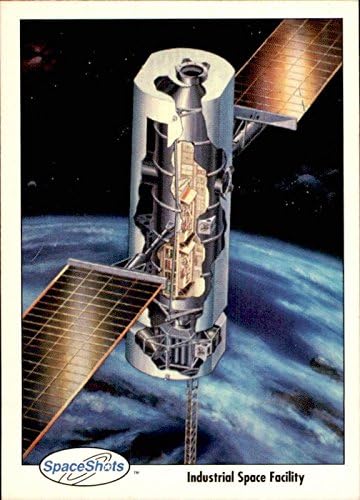
Credit: Amazon.com website
Further, per NASA Spinoff 1985:
“While some companies are focusing attention on materials processing experiments expected to lead to orbital product manufacture, another group of companies is pursuing a different but related line of commercial space development: fabrication of processing systems and equipment for lease to experimenters.
One such system is the Industrial Space Facility (ISF), being developed by Space Industries, Inc., a company formed only three years ago to pursue commercial space ventures. Shown in cutaway view at left, the ISF in its basic form is a large, solar powered module (35 feet long and 14½ feet in diameter) intended primarily for experimental or operational materials processing in such areas as advanced pharmaceuticals; growing large, ultrapure semiconductor crystals; containerless processing of vastly improved fiber optics; or creation of metal alloys and composites not producible on Earth. The ISF can also serve as a scientific laboratory or as a technology development facility for testing new space equipment and procedures. As many as six modules, each with its own laboratory factory equipment plus power storage, temperature control, communications, data management and other provisions, can be docked together to create what the developers call a "space industrial park."
The ISF is designed as an unmanned automated station, but a unique aspect of the design is provision for 2,500 square feet of pressurized volume in each facility module. Thus, Shuttle-delivered servicing crews will be able to work in a shirtsleeve environment for the two or three days it might take for repairs or adjustments, equipment changeouts, product harvesting and cleaning/restocking production apparatus.
In a Shuttle/ISF resupply and servicing operation, the Shuttle Orbiter is docked to the ISF by means of a berthing adapter. Astronauts enter the pressurized part of the facility module through a docking tunnel. Connected to the facility module is a separable supply module containing oxygen for pressurization and other consumables; resupply modules, six to 11 feet long, will be Shuttle-delivered every three to four months and depleted modules returned to Earth. The periodically man-tended ISF will operate in the same orbit as that of the planned Space Station and it will also be able to dock with the Space Station for servicing.
By agreement, NASA and Space Industries will exchange non-proprietary data and work together on technical matters and operational support requirements. Space Industries has completed preliminary engineering, applied for patents, begun negotiations with equipment suppliers and awarded a contract to Lockheed Missiles & Space Company for the large solar array. Target date for operational service of the fist ISF is 1989”
At/from:
spinoff.nasa.gov/back_issues_archives/1985.pdf
Last, but not least - in all seriousness - the artist's signature of "Li Hua" is visible. Certainly not ‘THE’ Li Hua, so sort of a win? I assume it to be a pseudonym...possibly in homage? If so, by whom? That is, unless the name Li Hua is akin to something like ‘Joe Smith’.
all images/posts are for educational purposes and are under copyright of creators and owners. Commercial Use Prohibited.
“A PERMANENT VIEW?
Here’s the view Soviet cosmonauts have from the Salyut 6 space station which passes over the Unites States twice a day. American experts believe the Russians plan to permanently man the station for both military and scientific purposed. Telemetry antennas protrude from the side of the spacecraft.”
The above affixed caption is dated 3/3/78. The image and it were to be published in March 19, Sunday newspapers ICW Howard Benedict’s Washington APN story about weapons in space.
If the above is correct, I suppose this photograph would have been taken during the first Salyut 6 extravehicular activity, the first Soviet EVA since 1969, by Soyuz 26/EO-1 (Expedition 1) Cosmonaut Georgi (Georgy) Grechko on 19 December, 1977. And, I guess the exposed film would’ve then been returned by the visiting Salyut 6 EP-1/Soyuz 27(?) crew…using the Soyuz 26 vehicle???
All kinds of interesting firsts & details pertaining to Salyut 6 & its multiple crews, to include its resupply, are available online. A few being:
en.wikipedia.org/wiki/Salyut_6
en.wikipedia.org/wiki/Soyuz_26
en.wikipedia.org/wiki/List_of_Salyut_spacewalks
en.wikipedia.org/wiki/Salyut_6_EO-1
en.wikipedia.org/wiki/Salyut_6_EP-1
en.wikipedia.org/wiki/Soyuz_27
All above credit: Wikipedia
www.spacefacts.de/english/salyut.htm
Credit: Spacefacts.de website
Of even greater significance are the following rarities regarding the actual photograph, bearing in mind it’s the USSR, SOVFOTO, and it’s 1977/78:
1. Uncharacteristically, it’s larger than 4” x 6”! Even by decadent capitalist pig standards, this is HUGE…it’s a whopping 8” x 11”! And it’s even on good “free world” grade photo paper.
2. As if that wasn’t enough, the photograph was purportedly taken OUTSIDE of the spacecraft, while purportedly IN FLIGHT, purportedly IN SPACE…and it’s of Soviet SPACE FLIGHT HARDWARE! NOT a posed crew photo…ON EARTH! Nor one taken of the crew about to board the spacecraft, while still…ON EARTH! Nor of the crew inside a training simulator…ON EARTH! Finally, it’s NOT the monotonous, repetitive scene of the huddled crew in space, INSIDE the spacecraft, hugging, drinking vodka or eating borscht.
Therefore, this is a UNICORN of Soviet manned space flight photography. 👍
Most unexpectedly/disappointingly, at what I consider to be the most knowledgeable & reliable source on Soviet/Russian space anything & everything, that being Anatoly Zak/RussianSpaceWeb, what I think is the antenna in the image…is NOT identified…with not one, but two lines pointing to the two dishes/reflectors. UGH.
Despite referred to as Salyut 1, I’d assume such a major component was a common element to all Salyut space stations.
www.russianspaceweb.com/salyut1-design.html
Other sites refer to it as a rendezvous, or navigation (synonymous with ‘rendezvous’?) antenna. Who knows.
Finally - and I’m fully aware that I’ve become the dullest crayon in the box - however, the dates, duration, timeline, etc. pertaining to Soyuz 27/Salyut 6 EP-1 or whatever else it’s called – has discrepancies, is confusing & even contradictory. At least with regard to making the caption date plausible.
As such, I’ve reasonably concluded that this is either a heavily airbrushed or otherwise doctored ‘photo’, or it’s an undisclosed engineering model in some hangar, soundstage, warehouse, etc., on the outskirts of…IDK…Minsk, Moscow, Novgorod, take your pick. Or maybe in an obscure building IVO Baikonur. Again, who really knows.
🇺🇦🙏🇺🇦🙏🇺🇦🙏
🇷🇺 = 👹