View allAll Photos Tagged Spacestation
A clear evening to watch the Space Station fly over, although with it being the middle of summer, the nights don't get completely dark here in northern UK, so even at 22:48 it was still very light. It hampers your chance of doing any really long exposure photography so this is just a 20 second image, even having the ISO very low to stop too much light leeching in. Normally at night you ramp up the ISO to bring light in.
A mature space station configuration might look like this one, conceived at Rockwell International’s North American Space Operations Division as part of contracted NASA studies. Two solar panels provide power. Cylindrical modules are arranged for living and for experimental activity. Prominently featured is an advanced Remote Manipulator System (RMS), for assembly of large structures and the servicing or storage of satellites and instruments, facilitated by the open basket-like structure. In this artist’s concept, an Astronaut is seen conducting an Extravehicular Activity (EVA), secured to the RMS arm, controlling it in a ‘cherry picker’ fashion in order to possibly grapple/maneuver the Orbital Transfer Vehicle (OTV). Note also the dual floodlights attached to the RMS platform on either side of the Astronaut, to provide illumination during nighttime passes. Finally, a shuttle orbiter is seen, either prior to/after docking with the space station, or possibly after delivery of the OTV?
Although the image is not contained within, this exact space station configuration, with its caption, from which I paraphrased the above, is at the following, on page 11 (of the actual document):
docshare01.docshare.tips/files/4606/46060281.pdf
Credit: “NASA Space Station” (EP-211), 1985, by David A. Anderton
See also, from two years earlier:
www.astronautix.com/s/spacestationdesigns-1982.html
Specifically. Looks to me to be the same configuration, from the other side:
www.astronautix.com/graphics/s/ss8232.jpg
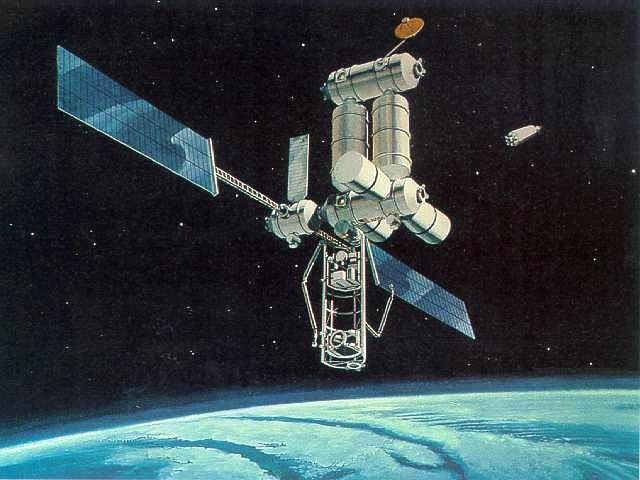
Credit: Astronautix website
A Grumman design, also from 1982. A very similar open basket-like structure is referred to as a/the “surrogate”:
www.astronautix.com/graphics/s/ssg82a.gif
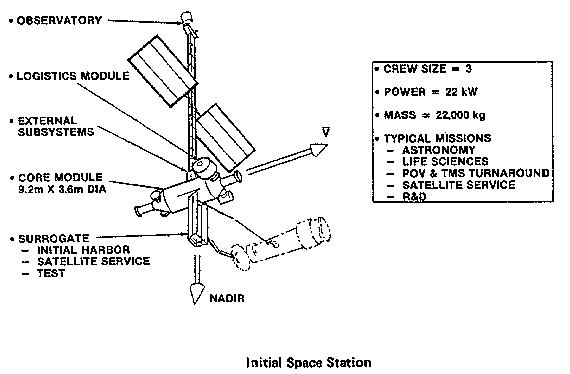
Credit: Astronautix website
Hmmm. Rockwell International. 1984/85. Manuel E. Alvarez? I'm pretty sure this was after Henry Lozano Jr's tenure. Maybe Ted Brown? Who knows. 😐
all images/posts are for educational purposes and are under copyright of creators and owners. Commercial Use Prohibited.
22:12 pass of the ISS, the largest Space Station / laboratory ever built orbiting the Earth, it can be spotted with the naked eye at certain times as it orbits the planet at 17,500mph at an altitude of roughly 200 miles.
Screenshot of the beauty of Prey (2017).
Tools used: Otis_Inf 's Camera/Hud Tool, Lightroom color correction custom preset.
Operations image of the week:
This vivid image shows China’s space station Tiangong-1 – the name means ‘heavenly palace’ – and was captured by French astrophotographer Alain Figer on 27 November 2017. It was taken from a ski area in the Hautes-Alpes region of southeast France as the station passed overhead near dusk.
The station is seen at lower right as a white streak, resulting from the exposure of several seconds, just above the summit of the snowy peak of Eyssina (2837 m altitude). Several artefacts in the original have been removed.
Tiangong-1 is 12 m long with a diameter of 3.3 m and had a launch mass of 8506 kg. It has been unoccupied since 2013 and there has been no contact with it since 2016.
The craft is now at about 280 km altitude in an orbit that will inevitably decay some time in March–April 2018, when it is expected to mostly burn up in the atmosphere.
“Owing to the geometry of the orbit, we can already exclude the possibility that any fragments will fall over any spot further north than 43ºN or further south than 43ºS,” says Holger Krag, head of ESA’s Space Debris Office.
“This means that reentry may take place over any spot on Earth between these latitudes, which includes several European countries, for example.”
“The date, time and geographic footprint can only be predicted with large uncertainties. Even shortly before reentry, only a very large time and geographical window can be estimated.”
The station’s mass and construction materials mean there is a possibility that some portions of it will survive and reach the ground.
In the history of spaceflight, no casualties from falling space debris have ever been confirmed.
ESA is hosting a test campaign to follow the reentry, which will be conducted by the Inter Agency Space Debris Coordination Committee, a grouping of the world’s top space agencies including ESA, NASA and the China National Space Administration.
Credit: A. Figer. Used by permission.
See:
More images from Alain Figer
Astrophotography group on Flickr
A colorful sunrise marks the dawn of a new era in human spaceflight ahead of NASA's SpaceX Demo-2 mission, as the SpaceX Falcon 9 rocket and Crew Dragon spacecraft stand ready for launch at NASA's Kennedy Space Center in Florida on May 29, 2020. The rocket and spacecraft lifted off from historic Launch Complex 39A at 3:22 p.m. EDT on May 30, carrying NASA astronauts Robert Behnken and Douglas Hurley to the International Space Station as part of the agency's Commercial Crew Program, returning human spaceflight capability to the U.S. after nearly a decade. Demo-2 is SpaceX's final flight test, paving the way for NASA to certify the crew transportation system for regular, crewed flights to the orbiting laboratory. Photo credit: NASA/Ben Smegelsky
Entry for my Iron Builder with VolumeX. The secret ingredient for this round is the yellow arch piece.
Image rendered @33 megapixels (custom DSR)
Injectable camera tools by Otis_Inf (game version rolled back to 1.0.4)
Real Lights plus Ultra Graphics Mod by jmx777
Reshade 3.4.1
Cropped and resampled on GIMP
The fix we did 10 years ago to our solar panel is still going strong. The impossible is possible: well done STS-120 ground & space team!
134E8145b
Credit: ESA/NASA
Screenshot of the beauty of Elite Dangerous.
Tools used: Image Composite Editor, Lightroom color correction custom preset.
(“Give it back, give it back!!”, in Blips' language)
One of the blips has been sucked up by Mr. Robot!! And he's going haywire… (look at his eyes!) The other two blimps are desperately trying to rescue their friend, while Benny freaks out and the vacuum cleaner is about to explode!! o_O
I got the idea from the movie “The glass bottom boat” starring Doris Day and Rod Taylor. In a scene of that movie Doris Day finds herself in a sort of space-age kitchen, with, among other gizmos, an automatic vacuum cleaner, that, in an attempt of cleaning the kitchen, tries to suck up one of her thongs.
P.S.: No blip has been harmed during this photo shoot.
YouTube 4K UHD Video Link: youtu.be/WVqzElW0WGU
flickr single image link: flic.kr/p/DTZguD
It has been a very quiet time on the surface of the Sun recently, with very
little solar activity for the start of 2018.
A new small and rather faint active region appeared on 16 January though and
seeing as the International Space Station with Expedition 54 on board was
going to fly overhead on the same morning, I decided to see if I could get a
Space Station crossing near the Sunspot.
It was very close and my first capture of a ISS solar crossing for 2018!!
Video was captured using the EOS-1DX Mark II with 800mm Canon Lens and solar
filter.
Single image composited from 18 Frames showing the path of the transit
across the Sun.
The ISS solar transit was viewed from Mount Coot-Tha, Brisbane, Queensland,
Australia.
@yourESA @nasa @roscosmosofficial @instagram @iss
International Space Station
16 January 2018 - 9h21m48.60s
Crosses the disk of the Sun next to Solar Sunspot Region AR2696
Mount Coot-Tha, Brisbane, Queensland, Australia.
Transit Duration: .69s Visible Path width: 5.47 km.
Diameter of ISS: 54.84" Size=109.0m x 73.0m x 27.5m
Satellite at Azimuth=88.7° E Altitude=54.3°
Distance=502.35 km Angular Velocity=47.4' /s
Ground Speed=7.39 km/s (27,600km/h)
Stace watches the International Space Station from the backyard. She did a pretty good job at standing still!
Screenshot of the beauty of Elite Dangerous.
Tools used: Image Composite Editor, Lightroom color correction custom preset.
Stop! Space tractors aren't allowed in the corridors!
In my last two pounds of black L-go from the flea market were these beautiful "Police" signs, so I've build a bit of scene around them.
I even tried to build a white, streamlined version of the Lanz, but a tractor and streamline are on opposite ends of the design spectrum. It just looks ridiculous in white with red stripes.
Toy Project Day 768
It’s no wonder I’m confused.
A wonderful compilation by Mr. Gary H. Kitmacher/Johnson Space Center, 2002.
At:
www.spacearchitect.org/pubs/IAC-02-IAA.8.2.04.pdf
Credit: AIAA Space Architecture Technical Committee website
I hope nobody sues me for propagating this wonderful, informative, albeit still confusing, graphic presentation.
"Stormtroopers are elite shock troops fanatically loyal to the Empire and impossible to sway from the Imperial cause. They wear imposing white armor, which offers a wide range of survival equipment and temperature controls to allow the soldiers to survive in almost any environment."
('Stormtrooper' by Hasbro / Star Wars - The Black Series / 6-inch)
Diorama by RK
Delightfully “huh?”.
If the stamped date is correct/close, this looks to be an Apollo Applications Program (AAP) S-IVB “wet” workshop, sort of confirmed by the presence of the Rocketdyne J-2 engine.
If correctly identified, it really makes this a “huh”. If something other, like being one end of a larger rotating complex, that could conceivably account for the obvious presence of artificial gravity.
And, neither here nor there, but it looks like the work of John Gorsuch to me.
This illustration Skylab shows the Apollo capsule, which was launched on a Saturn 1B rocket to ferry crews to space, docked to the multiple docking adapter, which was designed and built at NASA's Marshall Space Flight Center in Huntsville, Ala.
Image credit: NASA
View original image/caption:
mix.msfc.nasa.gov/abstracts.php?p=1248
View more Skylab images
www.flickr.com/photos/nasamarshall/sets/72157632646424119/
_____________________________________________
These official NASA photographs are being made available for publication by news organizations and/or for personal use printing by the subject(s) of the photographs. The photographs may not be used in materials, advertisements, products, or promotions that in any way suggest approval or endorsement by NASA. All Images used must be credited. For information on usage rights please visit: www.nasa.gov/audience/formedia/features/MP_Photo_Guidelin...
I wanted to test Blender out using my latest Mac Mini. Grabbed this great SpaceStation model by NProudlove and paired it with an interesting background. Although the model bogged down the computer, it rendered quickly. Need to try out some of my older models again.
One of the plethora of gorgeous depictions by Convair’s master artist, John M. Sentovic. His destiny…err, I mean collaboration with Dr. Krafft Ehricke, also of Convair, gifted us with some spectacular visualizations of the good Doctor’s visionary future of space travel & space exploration not yet, if ever to be realized.
Fortunately, the image was published as part of a brief biography of Mr. Sentovic in the March 1960, Volume 2, Number 2 issue of “SPACE AGE: The Fact Reporter for the Worlds of Science and Space” magazine, with the following caption:
“This drawing shows breakaway of the nuclear stage. The chemically powered winged glider is dropped away at left, while the nuclear-powered unit, containing a passenger compartment, heads into orbit to rendezvous with permanent satellite station. Nuclear stage can also be used in glider fashion for return trips to Earth.”
WOW…a nuclear powered spacecraft gliding…ummm...NO, but still!
Additionally, per the official Convair description associated with the image:
“NUCLEAR-POWERED PASSENGER ROCKET ASCENDS TO ORBITAL SATELLITE
SAN DIEGO, Calf.--When a manned satellite has been established in an orbit around the earth, personnel may travel to and from the satellite in vehicles such as this two-stage nuclear-powered rocket glider now being studied by Krafft A. Ehricke of the Convair Division, General Dynamics Corporation. The glider would take off horizontally, as an airplane, using a wheeled undercarriage which remains on the ground as the ship rises. Picture above shows vehicle about 30 miles up, at which point the lower stage is detached and guided safely back to earth. The second stage (right), carrying the passengers, would continue to the satellite orbit. For the return trip, the firing of small retarding rockets would reduce the ship's speed to less than orbital velocity, permitting it to descend gradually to the ground. The glider would land horizontally on skids retracted during flight. The lower stage reactor would heat ammonia and the upper stage reactor would heat hydrogen to produce thrust. The ship would measure 180 feet in length and have a wingspan of 50 feet. It would weigh between 350,000 and 400,000 pounds at takeoff, approximating the maximum takeoff weight of a B-36 bomber. This weight is considerably less than that of a three-stage chemical-powered rocket designed for the same mission. The horizontal takeoff feature would provide added safety in that the ship would be under control in the event of a power failure near the ground. Also, less power would be required for take-off, which in turn reduces the requirement for shielding from nuclear radiation. Shielding remains a major design problem, however. If it can be solved satisfactorily, the nuclear-powered glider should be feasible in ten years. Ehricke is assistant to the technical director of Convair-Astronauties, builder of the Atlas ICBM.
06618A”
Fascinating!
Who knew???
Did you???
I didn’t!!!
The mystery of life. How a plodding effort you regularly consider futile, pointless & inane, albeit a labor of love, can beget something else (thanks to an esteemed colleague), along with an against all odds “sighting”, yield, in at least this instance, the following:
e05.code.blog/2022/04/19/meet-john-sentovic/
Credit: Garrett O’Donoghue/’numbers station’ blog
A WIN.
Last (for now), but NOT least:
www.secretprojects.co.uk/threads/convair-nuclear-powered-...
Credit: SECRET PROJECTS Forum website
Vote and comment 4free on Bricklink till end of June 2023 to become a set:
www.bricklink.com/v3/designer-program/series-2/784/Space-...
“George Pal’s supreme screen achievement! Mankind’s Greatest Challenge . . . Conquest of Space. The thrills of tomorrow! On the screens of today!”
This vintage 1950s Sci fi thriller produced by George Pal and directed by Byron Haskin is based on a book by Chesley Bonestell and Willy Ley. It concerns the first interplanetary flight to the planet Mars, carrying a crew of five, and launched from Earth orbit near “The Wheel,” mankind’s first space station. On their long journey to the Red Planet, they encounter various dangers, both from within and without, that nearly destroy the mission.
Movie trailer: www.youtube.com/watch?v=BMK19sog5CM