Sponsored images from 
View allAll Photos Tagged Spacestation
Learning how to make a space composition of different images!
Three images made this.
Images sourced from NASA
The Milky Way pano
Credit: ESO/S. Brunier
The international space station seen fram Farø Denmark. via 500px ift.tt/2u7TSZy For more please visit www.bernholdt.dk
Screenshot of the beauty of Prey (2017).
Tools used: Otis_Inf 's Camera/Hud Tool, Lightroom color correction custom preset.
In the future a new earth-like planet - named Ademis - is discovered. A group of people with different skills is sent to Ademis to live there and examine the pre-conditions for a larger colony to be established.
This is a health care module with a garden passage, examination area, treatment room and surgery room.
My previous MOC Part I is a habitat example module. My aim is to build further example modules to visualize the various functions of the colony.
Sequence of the ISS Transiting the Moon - Updated
Fixed to show the ISS on the edge of the Moon missing from the first version.
Taken at prime focus of Celestron EdgeHD 925 telescope with Canon 70D. 8 photographs stacked in PSE 12 and with an extra frame of the missing part of the moon merged into it.
The circumstances were just right: good seeing, focus, exposure, timing.
This photograph was published in the June 2015 Sky and Telescope magazine.
More details on how to take shots like this is on here: ejwwest.wordpress.com/imaging-the-international-space-sta...
View of European Space Agency (ESA) Andre Kuipers,Expedition 30 Flight Engineer (FE),with some food and drink packets floating in the Node 1 of the International Space Station.
Credit: NASA
Image Number: iss030e166645
Date: January 30, 2012
Long Exposure of the International Space Station passing overhead Winstanley, Wigan from West to East.
North American Rockwell artist's concept ca. 1969/70, depicting a "DC-3" shuttle deploying a satellite in earth orbit. The shuttle design was developed, patented and promoted by renowned NASA Engineer, Dr. Maxime Faget. Note the air-breathing engine visible atop the wing.
While I normally regurgitate the original press slug/caption, since I often find them amusing and/or quaint, NOT this time, even I have limits…it’s pure schlock…and I know schlock, since I sometimes dispense it myself! “Whirling”, really...whirling? 😉
Although no signature is visible, the striking image is by Henry Lozano Jr., North American Aviation/North American Rockwell artist/illustrator extraordinaire. Appropriately enough, Mr. Lozano was 1970 President of the Society of Illustrators of Los Angeles (SILA):
Credit: SILA website
Excellent site:
www.pmview.com/spaceodysseytwo/spacelvs/sld022.htm
Credit: PMView website
Also:
en.wikipedia.org/wiki/North_American_DC-3
Credit Wikipedia
The following exemplifies a golden nugget, i.e., "WIN", that keeps me going down rabbit hole after rabbit hole, time after time. The payoff in this instance being Mr. Lozano’s visible signature near the lower right corner:
kssunews.wordpress.com/2014/04/09/previously-unseen-space...
Specifically, the following...gorgeous. Note however, although the shuttle & satellite are the same, and in the same relative positions, their orbital perspective is different and the space station in the background has been removed. Secondarily, and possibly as a correction, the intake of the air-breathing wing-top-mounted engine has been completed(?):
kssunews.files.wordpress.com/2014/04/space-shuttle-28129.jpg

Both above credit: Sacramento State/Associated Students, Inc. blogsite
Lastly, I had no idea there were this many designs, proposals & variations:
io9.gizmodo.com/early-design-specs-show-the-space-shuttle...
Credit: Gizmodo website
Skies cleared as the ISS crossed over Brisbane in the early hours of the morning, passing in front of the last waxing gibbous Moon for 2016.
International Space Station
12 December 2016 – 01h07m08s
Crosses the disk of the waxing gibbous Moon (91%)
Mt Coot-tha, Brisbane, Queensland, Australia
Transit-Duration: 2.11s, (in shadow of Earth)
Path width: 13.9km. Diameter of ISS: 29.4"
size=109.0m x 73.0m x 27.5m.
Satellite at Azimuth=298.9° WNW Altitude=22.4°
Distance=939.0 km.
Angular Velocity=15.2'/s
Ground Speed=9.597 km/s
Tonight wave at the crew of Exp 40 aboard the International Space Station ;0)
Beautifully bright pass, always a pleasure to both watch and photograph... we could almost see them waving back!
Long exposure, 25 sec, Canon 600D
Mapped at COGS:
The #ISS crosses the path of the Air Ambulance heading East over West Berkshire. 7 shots of 25 seconds, taken whilst standing knee deep in the lake. The Air Ambulance flew through the shot creating a lovely reflection on the water, matched by a faint ISS reflection in the bottom right.
This is a cropped and enhanced version I put together of the Gigantic Jet Lightning event captured by Astronaut Nichole Ayers aboard the ISS on July 3, 2025. x.com/Astro_Ayers/status/1940810789830451563/photo/1
This photo is part of an ongoing TLE mission by UHU to capture sprites and other types of TLEs not only from space but to also hopefully have a simultaneous capture from the ground by stormchasers from around the world. uhu.epss.hu/en/uhu-project/
Screenshot of the beauty of Prey (2017).
Tools used: Otis_Inf 's Camera/Hud Tool, Lightroom color correction custom preset.
The Galactic Assault War Station 3 (GAWS-3) or referred to as the "Nebula Prime". It is an Ares class war station that is heavily armed and fitted to destroy any enemy ship. Commissioned by the USSDF (United States Space Defense Force) in 2237, its primary task is to defend the USSDF assets and provide Sub-Orbital support with ground operations.
2021 Space Camping (Drivers of SL).
The space station as seen from the hangar bay.
[raw screenshot, Firestorm with ad hoc EEP setting]
The Galaxy Dropship IcePlanet version is the 6th theme derived from the set proposal at LegoIdeas. You may help it become a reality here:
ABOUT:The truck may now also tow a rocket launcher. The rocket launcher is fully functionable. More pics at LegoIdeas in the update section.
Boeing Manned Orbital Research Laboratory (MORL) proposal, circa 1966. Possibly earlier? Note what appears to be a possibly manned? space telescope in the background to the left, with with some sort of modular/'partial'/logistics(?) Command/Service Module docked to it. And the...whatever it is...to the right. A truss-like assembly destined to become part of the foreground MORL? A satellite? It does have a Ranger/early Mariner/ERTS/Landsat sort of appearance. Also, what looks like a satellite docked to the end of the MORL, almost like the early OAO, along with another Apollo-type logistics? module. Finally, note also the two Gemini space suit (G4C) attired astronauts conducting untethered EVAs.
The date SWAG is based solely on the 'contemporary' & similar appearance of the following, with it's confirmed date:
archive.org/download/S66-17592/S66-17592.jpg

Credit: Internet Archive website
Last, but certainly not least, the artist is Ted Brown. Fortunately, another rare WIN!!! Thanks to Angela Carole Brown, Mr. Brown’s daughter, at:
www.angelacarolebrown.com/images/TedBrownObituary.pdf
See also:
www.collectspace.com/ubb/Forum9/HTML/002211.html
Credit: collectSPACE website
thedisneyblog.com/2012/06/21/ksc-tour-now-has-rare-access...
Credit: The Disney Blog website
With sincerest gratitude Mr. Brown, RIP.
Screenshot of the beauty of Prey (2017).
Tools used: Otis_Inf 's Camera/Hud Tool, Lightroom color correction custom preset.
You can also find me on:
Multiwavelength View of Supernova 1987A
Astronomers combined observations from three different observatories to produce this colorful, multiwavelength image of the intricate remains of Supernova 1987A.
The red color shows newly formed dust in the center of the supernova remnant, taken at submillimeter wavelengths by the Atacama Large Millimeter/submillimeter Array (ALMA) telescope in Chile.
The green and blue hues reveal where the expanding shock wave from the exploded star is colliding with a ring of material around the supernova. The green represents the glow of visible light, captured by NASA’s Hubble Space Telescope. The blue color reveals the hottest gas and is based on data from NASA’s Chandra X-ray Observatory.
The ring was initially made to glow by the flash of light from the original explosion. Over subsequent years the ring material has brightened considerably as the explosion’s shock wave slams in it.
Supernova 1987A resides 163,000 light-years away in the Large Magellanic Cloud, where a firestorm of star birth is taking place.
The ALMA, Hubble, and Chandra images at the bottom of the graphic were used to make up the multiwavelength view.
Credits
Image credit: NASA, ESA, and A. Angelich (NRAO/AUI/NSF)
Hubble credit: NASA, ESA, and R. Kirshner (Harvard-Smithsonian Center for Astrophysics and Gordon and Betty Moore Foundation)
Chandra credit: NASA/CXC/Penn State/K. Frank et al.
ALMA credit: ALMA (ESO/NAOJ/NRAO) and R. Indebetouw (NRAO/AUI/NSF)
Screenshot of the beauty of Prey (2017).
Tools used: Otis_Inf 's Camera/Hud Tool, Lightroom color correction custom preset.
For more on this one, you could have a look at my blog: davewhatt.wordpress.com/2021/04/27/workmen-watching-engla...
Four Color / Heft-Reihe
Walt Disney's Man in Space
"A Science Feature from Tomorrowland"
cover: ?
Dell Publishing Co. / USA 1956
Reprint / Comic-Club NK 2010
ex libris MTP
all images/posts are for educational purposes and are under copyright of creators and owners. Commercial Use Prohibited.
www.youtube.com/watch?v=KGHA9oO1Ybg
"The best suppers happen when they aren't planned, or intended. Part of his illustrious Family were about the place, one of the first places to call their own back in the day. Memories of innocent and dreaming individuals mix with the reality of skilled survivors, trained assassins, and consumated Kareoke singers."
Looking for the Official Cocoon Group? Look no further: www.flickr.com/groups/cocoonrp/
Visit Cocoon Here: maps.secondlife.com/secondlife/Esperia/237/170/4086
Cocoon: Come for the Neon, stay for the Intrigue.
Screenshot of the beauty of Prey (2017).
Tools used: Otis_Inf 's Camera/Hud Tool, Lightroom color correction custom preset.
"Artist concepts of Space Stations under study."
I know I've seen each one of these over the years...best guess is upper right is a von Braun design/era, lower right, uhhmm, Lockheed?/Douglas?, lower left...some sort of S-IVB/Centaur/Gemini-MOL mutation, and upper left the unfolding inflatable one by whoever it was, Goodyear/Goodrich? (you get confused). Note the flip-top Apollo-like CSM configurations, not to mention the large flip-top capability of the the station itself in the lower right, to apparently swallow the "Apollo". That particular proposal apparently was part of "Project Olympus":
spaceflighthistory.blogspot.com/2015/11/space-station-res...
Credit: David S. F. Portree/"No Shortage of Dreams" blogspot
Note that this is a photograph of photographs (and strips of paper with title/sub-title) laid out on a surface.
Upper left quadrant artwork by Grant Lathe.
See also:
repository.si.edu/bitstream/handle/10088/17610/nasm_Space...
Credit: Smithsonian Libraries website
gizmodo.com/9-forgotten-nasa-concepts-for-space-stations-...
Credit: Gizmodo
www.pinterest.com/pin/62698619798672200/visual-search/?x=...
Credit: Pinterest
The Coriolis Starport from video game Elite Dangerous.
Please support on Lego ideas: ideas.lego.com/projects/02db00b1-ca71-482d-9f34-4043a888c44f
Length: 702m
Width: 372m
Height: 480m
Armament: Anti-Vessel 8 Ion-Blaster
Vehicles: 10 Fighter
Janeway-type transports: 3
Location: Omega Sector
Military Crew: 300
Civillians : 2900
Space Hub 154, mostly called Omega-Station, is home of the newly formed Omega-Command. Omega-Command will be responsible for fleet tactics and fleet logistics around Omega Sector and the outer territories of human space.
Omega sector became very interessting for earth, after recon missions found asteroid fields and planetary systems rich of ressources in Omega and the sourrounding areas.
The sector is also a waypoint for further expansion and possible colonisation efforts.
Omega-Station therefor will serve as an outpost for both, military and civil aspects, such as mining operations,as supply-station, sience and more...
Yet, most civil moduls of the complex are still in a phase of planing and will be constructed in the coming years.
The most distinctive part of the station at the moment is the main docking area. It is abled to repair and service capital ships up to the size of Auriga-Class carriers. Building of these ships would be possible too, but at the moment the effort to take all the raw materials needed to construct capital ships to Omega-Station is too high. Also it woul block the docking area for a long time.
Omega station will be also home of the local government, lead by a director and his staff. The director is also commander of the station, supported by a millitary officer, who makes the second in command and is leader of the omega-command.
Live will mostly take place in the two upper towers, which are the heart of the station.
If you like to know more:
“This is an artist’s rendering of a Grumman Space Station concept, which is capable of supporting from 50 to 100 people. Artificial gravity is maintained in the 33-foot modules out in the “arms.” Trolley-track vehicles provide transportation between modules. At the lower most portion of the station, space shuttle vehicles can be seen docked to the station.”
Above dated 11/6/70.
Craig Kavafes…nothing aerospace/space the man couldn’t render…beautifully.
Linear artifacts are due to scanner interpretation of glossy photo surface waviness. Induced long ago by the misguided soul/dolt that slopped too much water on the back of the caption, to make sure it stuck on real good. !%$?*$@!
Also at. Always excellent & informative:
www.aerospaceprojectsreview.com/blog/?p=3404
www.aerospaceprojectsreview.com/blog/?p=3682
Credit both: Aerospace Projects Review website
In the 1970s, turning a rocket into a habitat was an affordable way for NASA to build a space station with existing hardware. The Skylab concept that used Saturn V rocket hardware allowed NASA to build a space station during a fiscally constrained time when budgets for space missions decreased at the end of the Apollo lunar missons.This photograph was taken during assembly of the bottom and upper floors of the Skylab orbital workshop at NASA’s Marshall Space Flight Center in Huntsville, Ala.
Image credit: NASA
View original image/caption:
mix.msfc.nasa.gov/abstracts.php?p=1266
View more Skylab images
www.flickr.com/photos/nasamarshall/sets/72157632646424119/
_____________________________________________
These official NASA photographs are being made available for publication by news organizations and/or for personal use printing by the subject(s) of the photographs. The photographs may not be used in materials, advertisements, products, or promotions that in any way suggest approval or endorsement by NASA. All Images used must be credited. For information on usage rights please visit: www.nasa.gov/audience/formedia/features/MP_Photo_Guidelin...
© This photograph is copyrighted. Under no circumstances can it be reproduced, distributed, modified, copied, posted to websites or printed or published in media or other medium or used for commercial or other uses without the prior written consent and permission of the photographer.
Tonights prime focus single shot of the ISS ;0)
Simon tracked the ISS in the finderscope of our Mak 127mm telescope, with our Canon 600D attached I watched on the scrn as it whizzed past ;0)
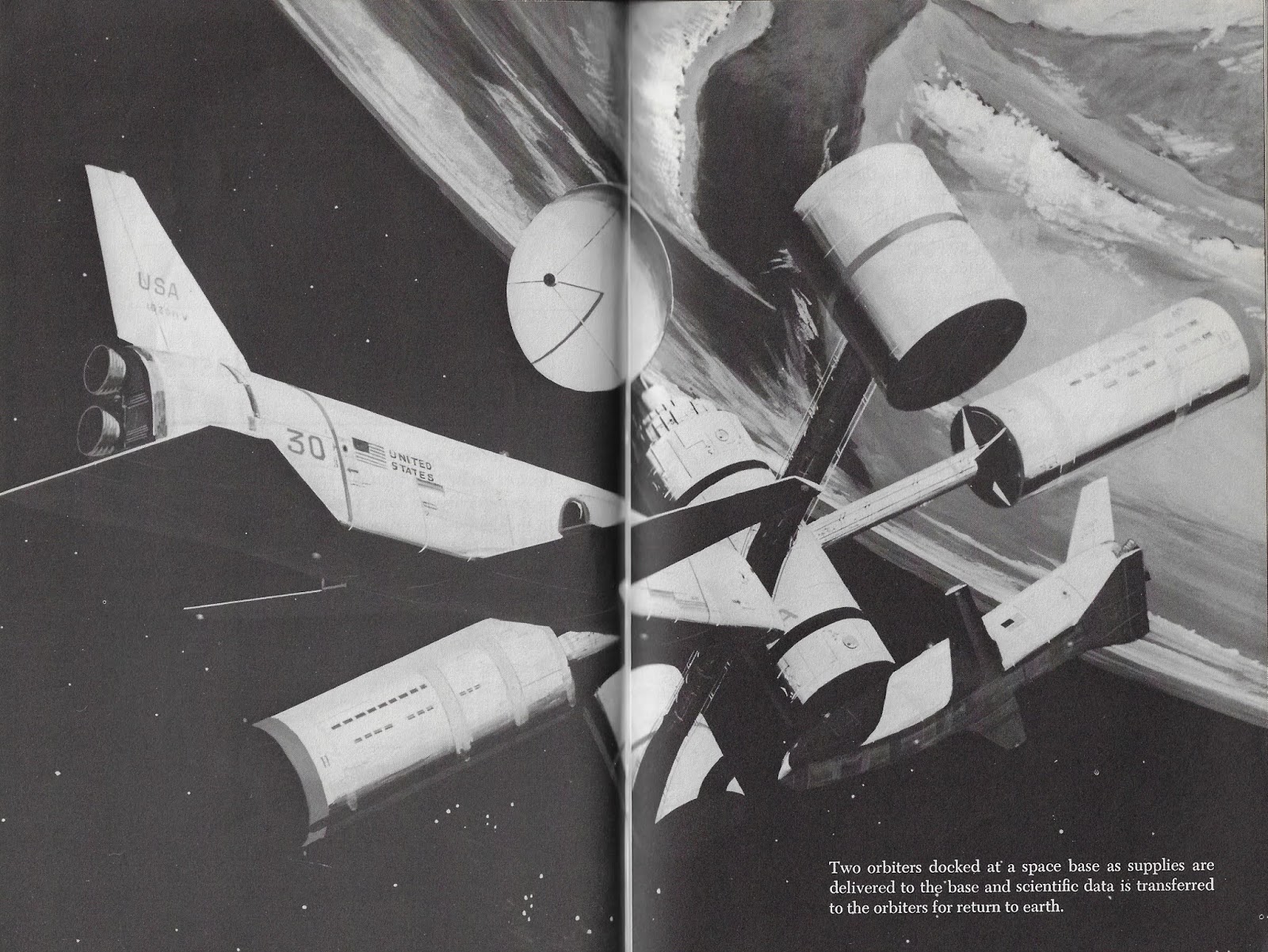
"DC-3 docks with large space base. In June 1969, NASA redirected North American to investigate a bold new concept proposed by the Manned Spacecraft Center's Maxime Faget. The company received a $0.25-million contract extension for this purpose, and another $2.9 million in July 1969 to develop large modular space stations and space base concepts like the early concept depicted here. Faget, the designer of the Mercury capsule, disliked Max Hunter's Starclipper lifting-body design since it had poor low-speed aerodynamics and also would be difficult to develop since the structure was tightly coupled with the aerodynamics. Faget preferred a simple winged design but he also admitted that traditional wings would be very heavy and the leading edges would be difficult to protect from the searing heat of reentry. His solution was the “DC-3” which alleviated the problem by reentering at a very high angle of attack (60 deg.), i.e. coming in nose-high much like the suborbital X-15 rocketplane. This would only expose the flat underside of the vehicle, as most of the thermal energy goes into the shock wave forming in front of the vehicle. The high drag also shortens the duration of the heat pulse, yet does not exceed acceptable crew deceleration load factors beyond 2 g's. The DC-3 wing would only be optimized for subsonic flight and landing, greatly reducing the development cost and time. But the low lift-to-drag ratio reentry profile advocated by Faget would also create some problems since the DC-3 would have limited crossrange during reentry, i.e. it would have been unable to fly larger distances than about 430km to the left and right of an initial direction of flight. Crossrange was an important military requirement, so the USAF opposed the DC-3."
The above, and the photo, along with a plethora of other fantastic images and information, at:
www.pmview.com/spaceodysseytwo/spacelvs/sld022.htm
Credit: PMView website
The exquisite artwork is by Henry Lozano Jr., North American Aviation/North American Rockwell artist/illustrator extraordinaire. Accordingly, Mr. Lozano was 1970 President of the Society of Illustrators of Los Angeles (SILA):
Unfortunately, the record of the above, along with the link itself, has been removed from the following SILA website...:
...and replaced by the following.
Both above credit: SILA website
While still very informative, with reference to other superb ‘aerospace’ artists, it’s nonetheless very disappointing that Mr. Lozano has been omitted from the record.
See also:
1.bp.blogspot.com/-OlAZql_DmEs/Xv0oJa3n2hI/AAAAAAAASts/RY...
Credit: John Sisson/Dreams of Space - Books and Ephemera blogspot
And:
forum.kerbalspaceprogram.com/index.php?/topic/127839-maxi...
Credit: KERBAL SPACE PROGRAM website/LOTS of cool stuff at this website as well.
en.wikipedia.org/wiki/North_American_DC-3
Credit Wikipedia
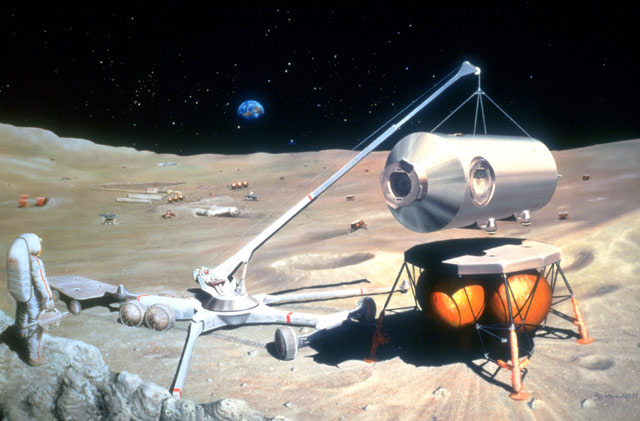
“An artist’s rendering gives a possible preview of early 21st century space station activity. A two-stage aerobrake orbital transfer vehicle (AOTV) with a common module and expendable lunar lander depart a growth “power station” type space station. The artwork was done by Patrick Rawlings of Eagle Engineering.
PLEASE NOTE: This artwork was unveiled during an October 29-31 conference in Washington, D.C. titled Lunar Bases and Space Activities of the 21st Century. Though some of the depicted hardware is under development, there is no definite program at this time for the shown activity.”
The Astronautix website/Marcus Lindroos refer to this particular configuration as a “Lunar Transit Station”.
See/read also (although the image is reversed):
www.pmview.com/spaceodysseytwo/station/sld099.htm
There is an absolutely amazing body of unbelievable work by Mr. Rawlings...mind boggling. Diverse, vivid, detailed, whimsical, bold, thoughtful, creative - you name it - every/any superlative adjective is applicable.
Note the names of the AOTVs: "Cutty Sark" & "Yankee Clipper". The transiting OMV is also named. Unfortunately, I can't quite resolve it, although it appears to start with the letter 'P' and end with a 'y'.
Possibly the lunar lander depicted...after touchdown on the surface?
www.patrawlings.com/images/large/E018.jpg
Credit: Pat Rawlings official website
Above the guiding lights of Droitwich Transmitting Station we captured the ISS this morning - the faint line directly below is Progress 56 resupply spacecraft ;0)
The radio masts can be seen to the east from the M5 motorway, between Droitwich and Bromsgrove.
A great dark site, but very windy!
Mapped at COGS: