View allAll Photos Tagged Produce
Greystones Camera Club's macro workshop was based around 'food' & before we eat the props some interesting shots were produced - this is one of my favs!
I first had an attempt at producing a passable digital image of this Kodachrome 64 colour transparency about ten years ago and failed miserably. I decided to take up the challenge again six months ago and have tried again at producing a passable digital image. At last after at least eight attempts I have managed a black and white version that is the best I am going to achieve and just about passes muster.
So here we have 37094 heading east at Stainforth with a long string of empty bogie bolsters no doubt heading for Scunthorpe steelworks, 15th April 1977.
Locomotive History
37094 was built as D6794 by English Electric at the Robert Stephenson and Hawthorn works, Darlington and entered traffic February 1963. In mid 1988 it entered Crewe Works for refurbishment and emerged as 37716 in December 1988> Stored unserviceable in October 2000 it was repaired and sent to Spain in May 2001, numbered LO34 later renumbered to L23. It returned to the UK in 2013 and overhauled and is currently (October 2019) in mainline use by DRS.
Praktica LTL
When it was my birthday six months ago, a very dear friend who enjoys photography as much as I do, and knows that I collect beautiful and vintage pieces, gave me a wonderful selection of antique ribbons, buttons, buckles, lace and other fine notions. She also gave me three follow up tins of similar delightful gifts for Christmas.
Those wonderful gifts are what has inspired me to create this series of "Embroider my World" images featuring my vintage bobbin collection. In this case, the wonderfully delicate net baric embroidered with minute blue and pale pink sequins I bought yesterday from a shop that specialises in luxurious and unusual fabrics. I could hardly wait to use it! The fabric was manufactured in Milan. I have accessorised them on a 1930s embroidered tablecloth with two Dewhurst's Sylko Peach Rose reels of cotton which dates from between 1938 and 1954 and a small Edwardian cotton reel of soft Kingfisher Blue made by J. P. Coats.
Belle Vue Mill, commonly known as Dewhurst’s, was built by Thomas Dewhurst in 1828. It opened in 1829 as John Dewhurst & Sons and was one of Skipton’s largest spinning and weaving mills. The mill’s position next to the Leeds Liverpool Canal meant that raw cotton could be shipped in by boats from Liverpool. Finished goods would then be sent back the same way ready for distribution. Coal to power the machine’s steam engines was also delivered by barge. In 1897 Dewhurst’s was bought by the English Sewing Cotton Co. It continued to produce Sylko, one of the mill’s most famous products. It was produced in over 500 colours and sold throughout the world. Sylko cottons are still available at haberdashers today.
In 1802 James Coats set up a weaving business in Paisley. In 1826 he opened a cotton mill at Ferguslie to produce his own thread and, when he retired in 1830, his sons, James & Peter, took up the business under the name of J. & P. Coats. In 1952 J. & P. Coats and the Clark Thread Co. merged to become Coats & Clark's. Today, the business is known as the Coats Group.
The sun begins to fade away in the sky. It hides behind the clouds and produces lovely rays of light on Lake Wakatipu, Queenstown.
Rocketdyne produced seven serialized high-fidelity F-1 engine mock-ups. Although non-functional, they were used for early engineering purposes. Most are/were? mounted on test (i.e., non-flight) Saturn V first stages.
In this photograph, the second of these, FM-101 (the first being FM-100), was featured in a paper written by D. E. Aldrich & D. J. Sanchini of the Rocketdyne Division of North American Aviation. See:
heroicrelics.org/info/f-1/fm-101/fm-101.jpg
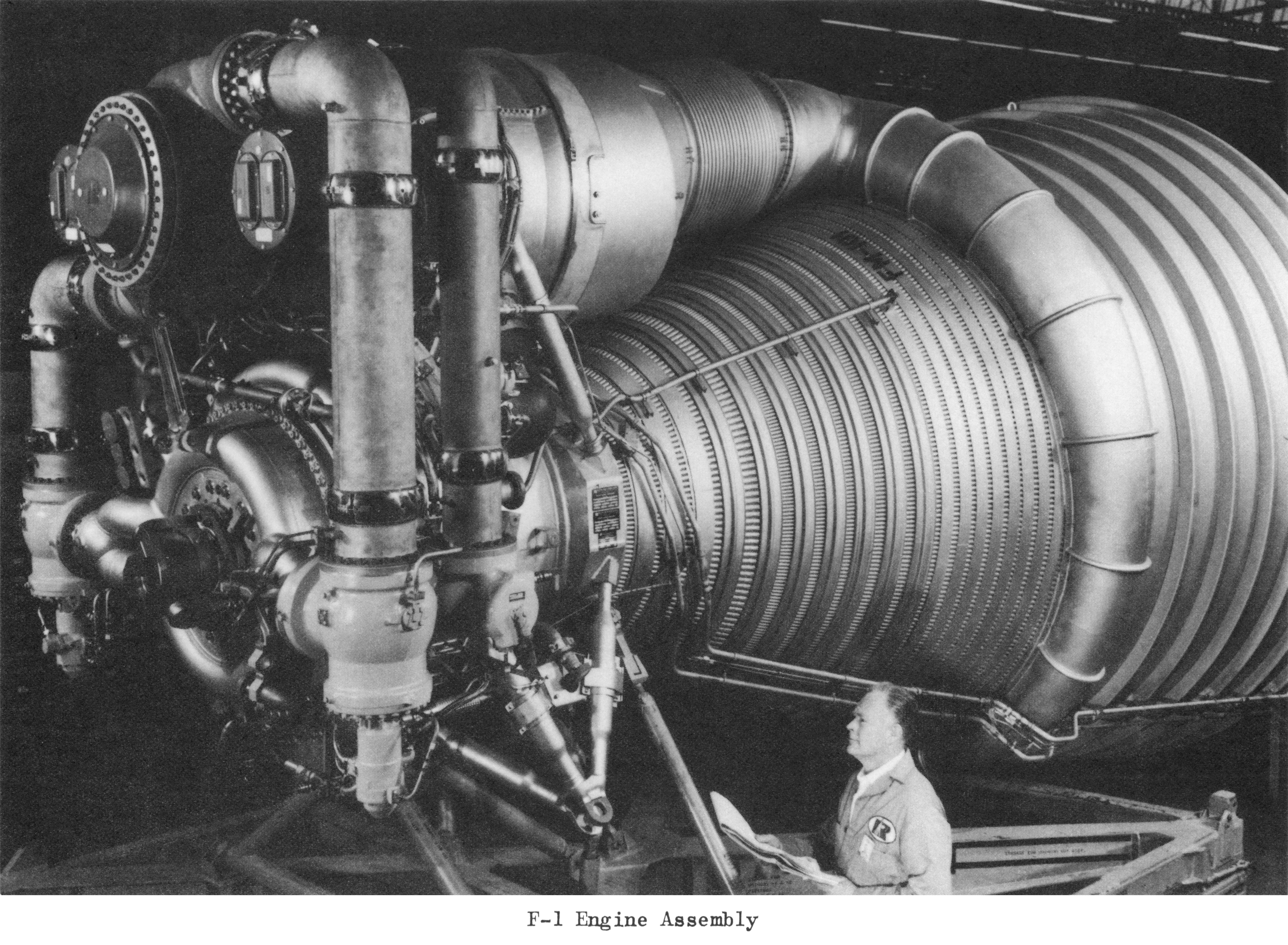
“I don't know exactly when FM-101 (or any of these engine mock-ups) were manufactured, but they certainly reflect an early design:
- There is no provision for thermal insulation.
- There is no interface panel.
- The fuel high-pressure ducts are straight, rather than the "U"-shaped ducts which characterized later production engines.
- The LOX dome has twin-elbow inlets.
F-1 engine mock-up FM-103 is on display in the Kennedy Space Center Rocket Garden (where, oddly enough, it is completely painted silver).”
The direct copy/paste above is in quotations, along with my paraphrasing from Mike Jetzer’s superlative “HEROIC RELICS” website, which he gleaned from Alan Lawrie’s book “Saturn” and a paper, “Saturn V Booster – The F-1 Engine”, by D. E. Aldrich, located in the Saturn V Collection, Dept. of Archives/Special Collections, M. Louis Salmon Library, University of Alabama in Huntsville, at:
heroicrelics.org/info/f-1/fm-101.html
I’m hoping the above is no longer the case, and that FM-103 was moved out of the elements into the Apollo/Saturn V Center.
Or:
evergreene.com/projects/ksc-f-1-engine-prototype/
Credit: EVERGREENE Architectural Arts website
As if the above wasn't enough, see/read also...wow:
heroicrelics.org/info/f-1/f-1-config-changes.html
Also credit: Mike Jetzer/"HEROIC RELICS" website
Wait…one more. Look at the multiple monstrous card catalog cabinets behind the F-1! Commensurate with the size of the the engine.
Hurricanes are the most powerful weather event on Earth. The 2022 Atlantic hurricane season extends from June 1 to November 30.
Faster than a cheetah, the fastest animal on land, hurricanes produce winds of 74 miles an hour (119 kilometers per hour) or more.
In this image from 2021, the crew aboard the International Space Station snapped this image of Hurricane Sam as it churned in the Atlantic Ocean while the station orbited 259 miles above Trinidad and Tobago.
Image Credit: NASA
#NASA #MarshallSpaceFlightCenter #MSFC #space #earth #hurricane #HurricaneSam #iss #InternationalSpaceStation
More about the International Space Station
To follow NASA astronauts on twitter, click here.
Jaguar XJS convertible, a 5.3-litre V12 luxury grand tourer produced from 1988 to 1996. Designed to replace the iconic E-Type but it never matched the unrivalled looks of its predecessor.
Sydney, Australia (Saturday 21 Jan 2017)
Hey, it's BEEN AWHILE, right? This was taken off the deck of the Enchanted Princess as I was departing the ship after a 27-night, transatlantic cruise. Dockworkers were busy restocking the food aboard the ship for its next journey. One of the twelve countries I've visited since my last post here (!)
The Contax S ("S" stands for "Spiegel", i.e. "mirror") was made by Zeiss Ikon in Dresden, and was the first single-lens reflex with a fixed prism viewfinder. It appeared in 1949 and was produced until 1952, after which it became the Contax D and later, after a reorganisation of the East German camera industry, was renamed "Pentacon Z".
It is shown here with the famous Carl Zeiss Jena Biotar 58mm f:2 lens (early version with 17 aperture blades - M-42 screw-mount).
Taken with a later (ten-bladed) version of the Biotar mounted on the Pentax K-1. Focus was on the knurled focussing-ring and the aperture was set at f:16 for maximum DOF. Lit with on-camera bounce flash, soft flash from the left and a reflector on the right.
All processing, including toning, vignetting and re-sizing, has been done using tools provided in the Pentax K-1.
HSS!!!
A juvenile grey butcherbird came to perch close by me when I was gardening, early one morning.
It stayed there for such a long time, watching me and probably looking for any unearthed grubs and bugs that my digging had produced.
It was great to work in the company of this little character.
Butcherbirds are named for their fascinating way of feeding. Once prey is captured, the butcherbird hangs it off a branch or tree fork, and hacks at it, just like a butcher.
It also hangs uneaten food in the fork of a branch or impaled on a twig and will then return to eat the leftovers later.
Grey butcherbird song is a sound synonymous and strongly connected with life here in Australia.
Cracticus torquatus, 25 cm body length.
© All rights reserved.
After much deliberating I decided to use this item for my Macro Mondays Corner theme, I counted at least 54 visible corners on it!
I came across it in the garage when looking for a suitable subject, and knew (sentimentally) after coming across this old piece of work, that I just had to use it!
Thirty-six years ago, a (far) younger Kev Gregory was undergoing his technical aircraft engineering training at RAF Halton in England, and one of the first phases on the course was Basic Engineering, where each student had to produce a test piece.
Set against stringent criteria laid down in an engineering drawing, the plate and block had to be handmade, shaped, and within tight tolerance to size and square, with the addition of blind and through holes to accommodate the rod and bolts, with threads cut as necessary.
This was a ‘rite of passage’ for students, there could be no progression on the course until this part had been mastered.
Despite being stored in a plastic bag for all these years, it’s succumbed to corrosion in a few places, but I managed to remove the majority of it before taking the shot.
Happy New Year and Macro Mondays everyone.
Since 1858, Hiram Walker and Sons Distillery has produced Canadian Club whiskey for the world in Walkerville. Walkerville was a classic factory town with employee row housing (still standing on Monmouth Street), their own post office, train station, schools etc. Hiram Walker even built his own railroad, the Lake Erie & Detroit River RY. It ran from Walkerville to Kingsville and eventually was purchased by the Pere Marquette, whom extended it to St Thomas. The location pictured here was the parallel mainlines of the Pere Marquette and Grand Trunk. The PM had that aforementioned depot and a small yard several hundred feet to the right out of frame, and the Grand Trunk had several tracks leading down to the riverfront where their yard, depot, roundhouse and ferry slips were located. At one time, one could see the C&O (later CSX albeit for a short period), CN, and Wabash (later N&W) all at this location. When I was a kid, CN still had a single track that went behind and out of frame to the big grain silos that are still on the river. I have a vivid memory from when I was 5 or 6 seeing a CN GP9 slug set working at the same spot 107 is at in this photo, which was the only time I ever saw CN here as a kid. At some point Hiram Walker's switched to trucks for their inbound grains, and for one reason or another CN gave up the tank car side of things. I'm not sure how it went down at the time, but ETR stepped in and began servicing the tank car facility. I believe they had to reinstall some switches to be able to access this location, but they don't have a direct connection to VIA. They switch this infrequently, and it was one of those things that had always eluded me until I got lucky on a Sunday morning. I'll add a link here to a David J Parker photo of an N&W freight heading towards to the waterfront from this spot.
www.railpictures.ca/upload/nw-nd-91-passes-the-walker-roa...
Train: ETR 0900 job with ETL 107 (SW1500).
ETR Sub
Windsor (Walkerville), ON
"Do anything, but let it produce joy"--Walt Whitman
Third in a series of work captured (with permission) at the Greenwood Resources tree farm near Boardman, Oregon. I chose this name for this particular work because honestly, it's been a joy to work on it. The colors in this particular work really held me. It feels soft to me, yet the lines are strong and the leading lines move the eye aggressively in to the piece.
More to come.
West Vancouver, BC, Canada.
An HDR image produced from two shots with different shutter speed: 1/6s, 1/40s.
Copyright © AwesomeFoto Photography. All rights reserved. Please do not use it without my permission.
You are welcome to visit my iStockPhoto or shutterstock. com/g/jameschen (remove space) to buy it.
(NOTE: All textures were produced in the shot, not photoshop. This piece is very "photoshop-lite" as I only healed a tiny spot near the nose, and adjusted the curves. Everything you see is pretty much on the original file.)
I'm still working out the kinks with this technique and while I like that it's mood is softer than the first shot in the series (the one of my son's face) I am not keen on how the camera autofocused on the glass. That little issue will be fixed next week when I get something less digitally crappy to shoot with (Santa, baby).
I will post another one from this series soon in which there are fewer scratched out parts on the glass. While I think there's something nice about the larger scratched out bits there is still also something about them which bothers me. I am hoping its the focus issue. If not then I'll have to think on it some more. What do you guys think?
September sometimes produces near perfect conditions at Sandwood on the west coast of Scotland. The midgies are largely gone, alongwith the klegs, whilst the tourists far fewer and the weather can be stunning. Admittedly the skylarks and other bird song are also gone together with the carpets of flowers and it is dark at 8 pm and not light until almost 12 hours later but the daytime can be warm and stunning.
So it was on Saturday, with cliff to cliff sunshine all day and a weird sea fog drifting over the land, the stack and the small island, Am Balg, to add to the dazzle.
When the sun is too bright, it suits black and white.
Grapes on the vine about a month from harvest. Looking forward to the wine it will produce.
Visit my website www.patkilkennyretouching.com
In Explore August 29, 2017.
The Festival of Nations is an annual multi-cultural celebration held in Tower Grove Park in St. Louis, Missouri. The Festival is produced by the International Institute of St. Louis, which was founded in 1919 to provide help to immigrants and their families and to promote ethnic diversity as a cultural and economic strength. The Festival of Nations debuted in 1934 and currently features 70 stage performances, 40+ food booths, and 30+ gift booths representing numerous nations across the word. The Festival is attended by over 125,000 people over two days.
I have been to several of these Festivals over the years, and the 2017 Festival was the best yet. The individual and group performers were spectacular, and the organization and handling of the event is top-notch. These photos are of some of the many, many performers who worked so hard for this event.
© All rights reserved - - No Usage Allowed in Any Form Without the Written Consent of the photographer.
The best way to view my photostream is on Flickriver: Nikon66's photos on Flickriver
without a shadow of doubt, this is one of my all time favourite images.....it produces so many feelings and emotions....this epitomizes why I take photo's.
Nikon D750 | Nikkor 50mm f/1.8G | Hoya HD Circular Polarizer
Cortaderia selloana, commonly known as pampas grass, is a flowering plant native to southern South America, including the Pampas region after which it is named. There are around 25 species in the genus Cortaderia.
It is a tall grass, growing in dense tussocks that can reach a height of 3m. The leaves are long and slender, with very sharp edges. The leaves are usually bluish-green, but can be silvery grey. The flowers are produced in a dense white panicle 20–40 cm long on a 2–3 m tall stem.
February in New Zealand. A cornucopia of colourful produce.
These photographs are part of an OCA project on the elements of design. Clockwise from top left: Two points in one photograph, curves, single point dominating a composition, implied triangle, rhythm.
Produced between 1967 - 1969.
Another shot from the archive, taken almost 9 years ago in 2015, edited today............ I really have far too many old RAW files that I need to edit.
Taken at the Brands Hatch American Speedfest 2015.
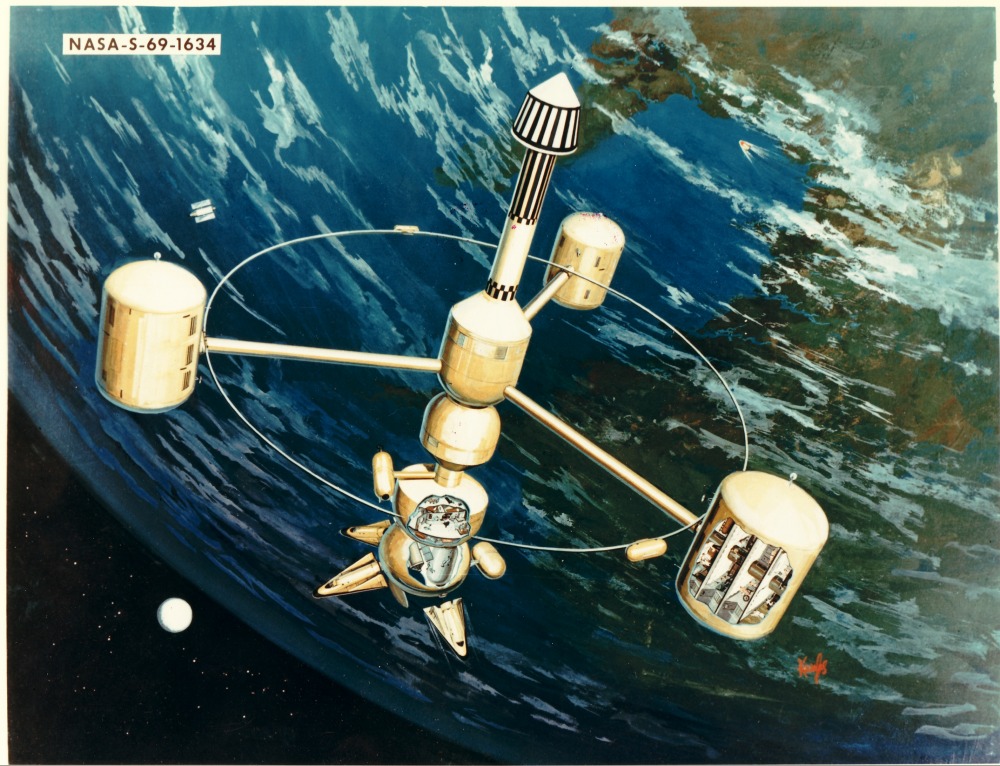
"A 1969 station concept. The station was to rotate on its central axis to produce artificial gravity. The majority of early space station concepts created artificial gravity one way or another in order to simulate a more natural or familiar environment for the health of the astronauts. After returning from a micro-gravity environment, astronauts find their muscles weak because they have not been using them. Long-term exposure to micro-gravity could generate long-term health problems for astronauts who do not utilize their muscles. This is why there are exercise machines on space shuttles and on the International Space Station. It was to be assembled on-orbit from spent Apollo program stages."
Obviously, the above is a relatively contemporary ‘composition’ and surprisingly okay. I wonder what the original was though. Although this isn’t, some other original printings must’ve been captioned…maybe.
The approaching ferry? capsule looks like an Apollo Command Module with a Mercury Recovery Compartment ‘appendage’. The space station actually appears to have the same spacecraft docked at both ends. In fact, the one on the right looks to be undocked. And I’m guessing the ring of ‘lights’, near the base of each are windows/portholes. If so, they’re good-sized craft.
This has long been an oft-reproduced & iconic rotating space station concept. I’ve always loved it…other than those lame motion/movement lines.
Thanks to James Vaughan’s posting (linked to below), this is a GAEC design/proposal, which helped to confirm that it’s the work of Craig Kavafes. A WIN!!! 👍👍👍
This, the following linked designs & my other linked Flickr photo below - based on the photo identification number - look to have been part of the same family/series of contractor concepts, proposals, etc., solicited/entertained by NASA ca. 1969:
www.aerospaceprojectsreview.com/blog/wp-content/uploads/2...
www.aerospaceprojectsreview.com/blog/wp-content/uploads/2...
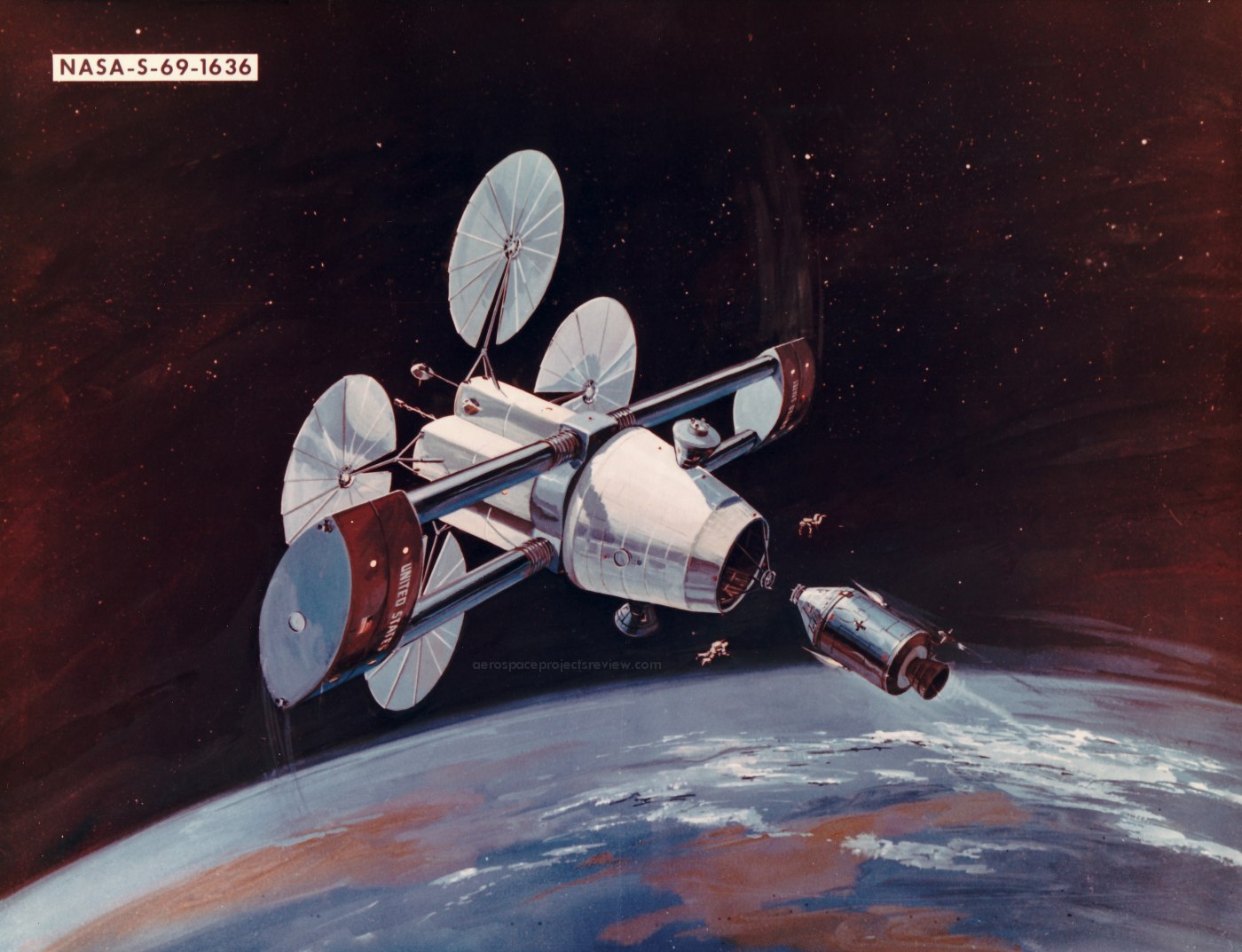
Both above credit: the excellent Aerospace Projects Review website
In fact and in confirmation of such; in January - February 1969, NASA Administrator Thomas O. Paine oversaw the creation of a Space Station Task Force, a Space Station Steering Group, and an independent Space Station Review Group. These bodies prepared a Phase B Space Station Study Statement of Work (SOW), which NASA released to industry on 19 April 1969. So, I'm pretty sure these works are some of the responses/submittals to that SOW.
"The SOW solicited proposals to study a 12-man Space Station, the design of which would eventually serve as a building block for a 100-man Earth-orbital Space Base. The 12-man Station was to reach orbit on a Saturn V rocket in 1975 and to remain in operation for 10 years...
Grumman, North American Rockwell (NAR), and McDonnell Douglas Aerospace Company (MDAC) submitted proposals in response to the SOW."
The above is a combination of paraphrasing & cut/paste from David S. F. Portree's superlative (as always) article at his wonderful "No Shortage of Dreams" blog. The entire informative content at:
spaceflighthistory.blogspot.com/2015/03/outpost-in-leo-mc...
A nice, long block of reefers, filled with Washington state produce (thanks Nick!) heads east on the Union Pacific near Malta, Illinois. The headlights in the distance are those of a stack train that is proceeding nice and slow past it's red signal...
Sunday, January 18, 2009
Willrett Road grade crossing
Union Pacific Railroad
Malta, Illinois, USA
Olympus E-510 DSLR
Olympus ED 40-150mm f4-5-5.6 zoom
ISO 400 RAW
Produced in Regina,
6 cylinder,
46 hp,
$665,
Canadian Automotive Museum,
Central, Oshawa, Ontario,
For my video; youtu.be/C17Tai00WE4
Pre-Dawn, iPhone 11 ProMax Night Vision - No Edits - only opened in Photoshop to convert HEIC to JPG. Couldn't figure how to do it in camera. Tweaking produces some beautiful additional results, but I wanted to show an unedited image.
This joiner was produced from the Jpegs and all adjustments to levels etc have been subtle and minimal but the joiner was from Jpegs which are obviously enhanced and compressed in camera.
I have reduced the resolution for Flickr.
This on the Web from the Met office:
What are Nacreous clouds? Nacreous clouds are rare and very high clouds, known mainly for the coloured light they reflect after sunset and before sunrise. The colours are reminiscent of the colours which reflect from a thin layer of oil on top of water, an effect known as iridescence.
During the winter in Scotland we have been able to see these clouds for several hours on occasions. Of course during the winter the days are very short so we are close to sunrise and sunset down to something like 6 hours of daylight.
I bought some a couple of days ago when I stopped by Talarico's Produce on SE Hawthorne Blvd.
I grew up with great chestnuts showing up every Fall and Winter in Istanbul and little charcoal grills on some street corners roasting chestnuts and filling little paper sacks for snacking in the cold weather, they smelled incredible roasted and still warm in the cold weather. Of course people walk the streets and there are many out, it makes it worthwhile... simple pleasures of life.
In the USA, Eastern Chestnuts disappeared due to a blight, there used to be wonderful chestnut forests and people gathered them in the Fall, then there were none... through GMO, they were able to grow trees resistant to this blight and a fresh forest is growing in the East, according to what I hear... ( I am not GMO everything by the way but I am glad they saved the chestnuts in the US )
Boiling them in salted water works real well for snacking, as well as roasting them in the oven.
Everything you ever wanted to know about chestnuts :)
en.wikipedia.org/wiki/Chestnut
please see large :)