View allAll Photos Tagged Mask
Mask (Buk, Krar, or Kara), mid to late 19th century, Mabuiag Island, Torres Strait, turtle shell, wood, cassowary feathers, fiber, resin, shell, paint, 54.6 x 63.5 x 57.8 cm (The Metropolitan Museum of Art)
91.Bamana Marka Mask, Mali................................................................................................$190.00
The Bamana are one of the most studied groups of West Africa. They say that they are of Mandinke origin and have tightly interwoven themselves with their neighbors through marriage, commercial trade, political alliances, and religion. The triangle of the Bamana region, divided in two parts by the Niger River, constitutes the greater part of the western and southern Mali of today. The dry savanna permits no more than a subsistence economy, and the soil produces, with some difficulty, millet, rice, and beans.
Arabic texts of the ninth century give the history of cities such as Djenne and Timbuktu, whose inhabitants they call "Bambara." At the beginning of the twentieth century, they were colonized by the French.
Numbering 1.9 million, the Bamana are distributed over regions that comprise villages placed under the authority of one family, whose head, the fama, representing the founder, enjoys considerable powers. He also plays a primary role in the agrarian rituals.
In 1940, archeologists discovered the traces of an earlier kingdom and found terra-cotta figures that were dated through thermoluminescent tests to around the year 1000. These terra-cottas are proof of a long tradition of sculpture; the first wood figures date back to the fourteenth century.
The Bamana believe in the existence of spiritual forces which are activated by individuals, who are capable of creating an atmosphere of harmony, prosperity, and well-being. The Bamana have a very complex cosmology. Initiation takes place within the men's associations, which are more or less active depending on the village: the n'tomo, the komo that directs the life of the community; the nama, the komo that regulates morality violations; and the koré and the tyi wara, which organize young farmers. These societies, run by ancestors, act in political, economic, and medical capacity and exercise social control over the community.
In the south of the Bamana region, the dyo association welcomes men and women, but initiation is shorter and less difficult for the latter; initiation for men lasts for seven years and ends with their symbolic death and their rebirth. It terminates in great masked feasts in which the newly initiated participate, going from village to village. The initiates are divided into groups, and the sons of blacksmiths dance in the presence of statues called nyeleni - upright female figures with wide, flat shoulders, standing on small circular -bases. Their cone-shaped breasts project frontally. (K. Ezra, 1986) During the feasts of dyo and the ritual of the gwan, linked to fertility, seated figures are exhibited. Statues of a woman with a child appeared on the market in the 1950s. Kept on the shrines throughout the year, the figures were cleaned, oiled, decorated with clothing and beads, and placed in groups of from two to five pieces. Naturalistic in style, they are of larger dimensions than the majority of Bamana sculpture. The bodies are massive, sculpted in the round, with wide shoulders, the features of the face treated with a sweetness and care for detail. In the same style, representations of musicians and of lance-carrying warriors are found. These statues illustrate the qualities that the future initiates must have: beauty, knowledge, and power. Each figure is "explained" to the initiates and conveys the vital force that contributes to the cohesion of the village. (K. Ezra)
During the agrarian feasts of the tyi wara association, farmers wear headdresses in the shape of an antelope, which represents the mythical character who taught them how to cultivate the land. In order to obtain an abundant harvest, they dance at the time of planting and harvesting by imitating the steps of the antelope. The horn is supposed to be the symbol of the millet's growth.
The komo association, run by the blacksmiths, welcomes all male adolescents after their circumcision. It has a mask characterized by a huge mouth and antelope horns to which various elements are added, such as animal jaws. The mask, worn only by blacksmiths, "dances" in front of the members of the komo. Its disquieting appearance evokes the bush, and its dangers and its force are such, they say, that it can kill an adversary.
Each association has its own masks, headdress crests, and marionettes. These masks appear at times of celebration: at weddings or inaugurations of a market or under other pretexts. With the help of music, poetry, and history as told by the griots, these celebrations are both a diversion and a reminder of the social values of the Bamana. For a young boy, dancing at the time of a celebration is an opportunity to show his personal abilities and to acquire prestige. But he will first have to prove his skill and obtain authorization from the elders to appear in public, which may subsequently be refused if his first performance is judged to be mediocre.
The Bamana sculpt lovely figures, less naturalistic than their maternity figures-statuettes representing twins, and doorlocks. Honored and kept in the village sanctuary or at its outskirts, the boli is an object whose magic ingredients are hidden in the center of a mixture of clay, wood, tree bark, roots, horn, jawbones, or precious metals. It may have human strength or assume the strength of a hippopotamus. It is handled only by the chief or a religious dignitary; it is "nourished" on blood and millet beer poured into a tube that goes all the way through it. (S. Brett-Smith.)
The complex symbolic system of the Bamana is reflected in its abundant artistic output, linked to ritual functions and with varying aesthetic qualities.
S. Brett-Smith, "The Poisonous Child," in RES, no. 6, 1983. G. Dieterlen, Essai sur la Religion Bambara (Paris: Presses Universitaires Fran@aises, 1951). K. Ezra,A,HumanldealinAfrica,nArt:BamanaFig,urativeSculpture(Washington,D.C.: National Museum of African Art, 1986). R. Goldwater, Bambara Sculpture from the Western Sudan (New York: The Museum of Primitive Art, 1960). P. J. Imperato, Buffoom, Queens, and Wooden Horsemen (New York: Kilima House Publishers, 1983). P. McNaughton, Secret Sculptures of Komo: Art and Power in Bamana Initiation Associations (Philadelphia: Institute for the Study of Human Issues, Working Papers in the Traditional Arts, no. 4).
The use of masks during the life of the Venetian Republic remains one of mankind's notably eccentric practices. Indeed, masks have been worn in cultures throughout the world for thousands of years, but perhaps never with such fervent pageantry as in Venice.
follow me at:
lostboyillustrations.squarespace.com
instagram: @_lostboy_
facebook: lostboyillustrations
(Project 365 Day 59)
Hear ye! Hear ye! The latest in mask technology!
And here's an animated gif version!
Having to move reluctantly, I had to throw away stuffs which tells a lot of my "previous life".
Bought these blank masks a few years ago to play with my son. I would ask him to tell me what to draw on the faces and did it in front of him. It was great fun with lots of laughters. Other times, I would draw something inspired by Damien Hirst or other classic paintings, or simply drew something out of the blue. Search Google for "Chinese Opera Masks" to see how colorful they can be!
I remember a time in my secondary school years when my parents forbade me to be a photographer, artist, musician or painter. My Dad's home was filled with great Chinese paintings and he talked a lot about these painters. Under the radar, I had to secretly borrow a camera to take pictures, signed up for a Chinese painting class from a well known master and bought these pigments and brushes, etc. Why this conflicting practice from my parents? My Dad loves Chinese paintings and he made a living buying and selling them. He spent a lot of time studying painters' life and how they evolved, authenticating them, putting them to auctions in Christie's and Sotheby's. In his words "great painters lives terrible lives and only after they are dead do people take advantage of their talents". Painstakingly sad and most of the time truthful. I must show you some of my previous Chinese paintings later on. These dishes and pigments are really important to me even though I haven't touched them for over 15 years. They are the past but the image is forever.
My little brother brought a sand block for sculpture and he only crafted the word JULY on it, it was also like 15 years ago. After reading an English novel with a tag line "It's like touching fantasy" I took this sand block and crafted something out of it. It was then placed in my Macquarium for a long time. Wow, it was over 10 years ago since I made the Color Classic Forever web site and "blogged" about my creation and mis-fortunes. New York Times even told my little story:
Exerpt of the New York Times article printed on August 24, 2000
Patrick Ng, an Internet executive in Hong Kong, has taken his obsession to more lyrical heights. A vice president at PacificDotCom, Mr. Ng has documented his self-diagnosed case of "CCFS" (Color Classic Fixation Syndrome) on his amusing Web site, Color Classic Forever (grus.hkstar.com /patrickn/colorclassic). The story began in October 1998, when Mr. Ng saw a photo of the Color Classic. He alerted a newsgroup to his quest for one and visited several shops until he found a dirty nonworking model.
After giving it a scrub, Mr. Ng rhapsodized in a diary entry on his site: "I now see the uncompromising beauty and elegance of CC even more obviously, it simply shines. As this mystic discovery continues, my super-ego seems to warn me the danger of the game, the emotional attachment to a physical object."
On New Year's Eve, while others were partying, Mr. Ng was otherwise occupied, as a later diary entry showed: "I embraced the dusted classic during the countdown. The rest of that night, perhaps I should say the rest of the millennium, I gradually slipped away and fell into a deep trance, everything went blurred except a single point of vision, I naturally put that point on the shining Color Classic."
He then decided that he wanted the machine to carry his child, "to give her life," he wrote. As it turned out, Mr. Ng's "child" is his Siamese fighting fish, Faust, who now swims in an aquarium installed in the Color Classic's chassis.
Cured of his obsession, Mr. Ng now keeps his Macquarium in his office, which overlooks Hong Kong. "I receive e-mails from all over the world asking about Faust," he said. "He's doing fine."
If you want to create a Macquarium, check out my version 1.1 and version 2.0instructions. Hmmmm.... want to see me naked with Color Classic? Here it is "Born Naked With Color Classic.
It was important to me and part of them still is. Notes from my Psychology/physiology/research method classes and my Philosophy classes. I particularly had a tough time in Philosophy classes being the only Chinese student there, unable to verbalize my thoughts and participate in discussions, I often got below average marks. I enjoyed the late night studies particularly, there is a point when you give up trying to get pass and start to study for the real meaning of life. Super fun! Unforgettable!
I couldn't throw away my blackboard though. I love the rawness, the sound of chalk on board reminds me of school life, the perfect circle my secondary school math teacher drew..... it is the essence of learning to me. Simple tools to pass along knowledge.
More on Scription blog: moleskine.vox.com/library/post/throwing-away-parts-of-my-...
I composited two textures with a photo I had taken of some Mayan masks with a red filter over the flash. I added in the eyes from two different people, then I layered in the back of a postcard I bought in Egypt and then I added in the cartouches and hieroglyphics from a King Tut chair.
CPR Mask is a clear mouth barrier for mouth-to-mouth resuscitation. Surgically clean mask is designed for single use and is disposable. CPR Mask comes in a sealed tamper-evident pouch, packaged for individual use and to replenish first aid kits.
Now becoming a common sight people walking the streets and in shops wearing them, these were bought in a 7 & 11 shop in Japan back in December more as souvenir than any thing else but offer little or non protection against Coronavirus
Placed an image of tree roots as the bottom layer, then added a cloudy sky and made a layer mask on the clouds to blend it with the roots. Cut out the house from another image, transferred it, and blended the bottom with the roots of the tree and the edges with the sky a bit. Placed the vintage film as a blending mode and chose "linear color"(?) as the setting, and set that layers opacity to 29%.
The Carnival of Venice (Italian: Carnevale di Venezia) is an annual festival, held in Venice, Italy. The Carnival ends with the Christian celebration of Lent, forty days before Easter on Shrove Tuesday (Fat Tuesday or Mardi Gras), the day before Ash Wednesday. The festival is famed for its elaborate masks.
History
It is said that the Carnival of Venice was started from a victory of the "Serenissima Repubblica" against the Patriarch of Aquileia, Ulrico di Treven in the year 1162. In the honor of this victory, the people started to dance and make reunions in San Marco Square. Apparently, this festival started on that period and became official in the Renaissance.
In the seventeenth century, the baroque carnival was a way to save the prestigious image of Venice in the world. It was very famous during the eighteenth century. It encouraged licence and pleasure, but it was also used to protect Venetians against the anguish for present time and future. However, under the rule of the King of Austria, the festival was outlawed entirely in 1797 and the use of masks became strictly forbidden. It reappeared gradually in the nineteenth century, but only for short periods and above all for private feasts, where it became an occasion for artistic creations.
After a long absence, the Carnival returned to operate in 1979.
The Italian government decided to bring back the history and culture of Venice, and sought to use the traditional Carnival as the centerpiece of its efforts. The redevelopment of the masks began as the pursuit of some Venetian college students for the tourist trade. Today, approximately 3 million visitors come to Venice every year for Carnival. One of the most important events is the contest for la maschera più bella ("the most beautiful mask") placed at the last weekend of the Carnival and juried by a panel of international costume and fashion designers.
Venetian carnival masks
A selection of Venetian carnival masks
Masks have always been a main feature of the Venetian carnival. Traditionally people were allowed to wear them between the festival of Santo Stefano (St. Stephen's Day, December 26) and the start of the carnival season at midnight of Shrove Tuesday. As masks were also allowed on Ascension and from October 5 to Christmas, people could spend a large portion of the year in disguise. Maskmakers (mascherari) enjoyed a special position in society, with their own laws and their own guild.
Venetian masks can be made of leather, porcelain or with the original glass technique. The original masks were rather simple in design, decoration, and often had a symbolic and practical function. Nowadays, most of them are made with the application of gesso and gold leaf and are all hand-painted using natural feathers and gems to decorate.
History
There is little evidence explaining the motive for the earliest mask wearing in Venice. One scholar argues that covering the face in public was a uniquely Venetian response to one of the most rigid class hierarchies in European history.
The first documented sources mentioning the use of masks in Venice can be found as far back as the 13th century. The Great Council made it a crime to throw scented eggs. The document decrees that masked persons were forbidden to gamble.
Another law in 1339 forbade Venetians from wearing vulgar disguises and visiting nun's convents while masked. The law also prohibits painting one's face, or wearing false beards or wigs.
Near the end of the Republic, the wearing of the masks in daily life was severely restricted. By the 18th century, it was limited only to about three months from December 26. The masks were traditionally worn with decorative beads matching in colour.
Types of masks
Several distinct styles of mask are worn in the Venice Carnival, some with identifying names. People with different occupations wore different masks.
Bauta
Masks at the Carnival of Venice, with the "Bauta" mask shown on the left.
The bauta (sometimes referred as baùtta) is a mask, today often heavily gilded though originally simple stark white, which is designed to comfortably cover the entire face; this traditional grotesque piece of art was characterized by the inclusion of an over-prominent nose, a thick supraorbital ridge, a projecting "chin line", and no mouth. The mask's beak-like chin is designed to enable the wearer to talk, eat, and drink without having to remove it, thereby preserving the wearer's anonymity. The bauta was often accompanied by a red or black cape and a tricorn.
In 18th century, together with a black cape called a "tabarro", the bauta had become a standardized society mask and disguise regulated by the Venetian government. It was obligatory to wear it at certain political decision-making events when all citizens were required to act anonymously as peers. Only citizens (i.e., men) had the right to use the bauta. Its role was similar to the anonymizing processes invented to guarantee general, direct, free, equal and secret ballots in modern democracies. Also, the bearing of weapons along with the mask was specifically prohibited by law and enforceable by the Venetian police.
Given this history and its grotesque design elements, the bauta was usually worn by men, but many paintings done in the 18th century also depict women wearing this mask and tricorn hat. The Ridotto and The Apple Seller by Pietro Longhi are two examples of this from the 1750s.
Mask (Buk, Krar, or Kara), mid to late 19th century, Mabuiag Island, Torres Strait, turtle shell, wood, cassowary feathers, fiber, resin, shell, paint, 54.6 x 63.5 x 57.8 cm (The Metropolitan Museum of Art)
Mask (Buk, Krar, or Kara), mid to late 19th century, Mabuiag Island, Torres Strait, turtle shell, wood, cassowary feathers, fiber, resin, shell, paint, 54.6 x 63.5 x 57.8 cm (The Metropolitan Museum of Art)
Mask (Buk, Krar, or Kara), mid to late 19th century, Mabuiag Island, Torres Strait, turtle shell, wood, cassowary feathers, fiber, resin, shell, paint, 54.6 x 63.5 x 57.8 cm (The Metropolitan Museum of Art)
From the ArtWorkers exhibition at the George A. Spiva Center for the Arts in Joplin, Missouri | ArtWorkers is sponsored by EaglePicher, LLC with financial assistance from the National Endowment for the Arts, Joplin Visitors and Convention Bureau and Missouri Arts Council, a state agency
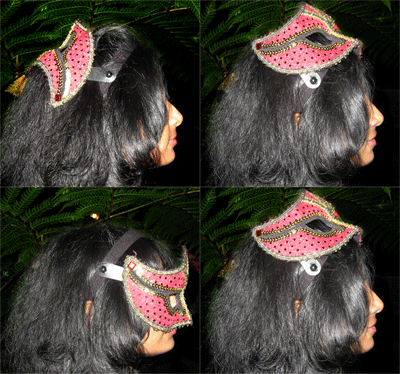
This is my new mask :D I love it. But holy cow was it hot with that thing on, but that also could have been because we had the air conditioner turned off. . .
I got the mask at Wal-mart. They have Halloween stuff out already, and it's my favorite holiday, and you all know how much I love masks. :D They had a pink one and also a blue one and only 5 bucks each!!! Once I find a way to get to the store I am most likely going to buy another, and a wig, and some eyelashes. lol YAY HALLOWEEN!
Face Mask Stock Photo
When using this photo on a website, please include an image credit for www.mayberryhealthandhome.com.
For Example: [Photo credit: Mayberry Health and Home]