View allAll Photos Tagged Lasting
There is a saying in Portuguese that goes something like "Christmas happens when Mankind wants" (O Natal é quando o Homem quer). And Summer is pretty much like Christmas ;) The days are shorter but still warm and the breeze outside makes it even more pleasant to enjoy the grass and the shadows cast by trees :)
Go See enjoys this lovely weather in her Dolly Dolls swimsuit, on her Las Cosicas de Nuria chair, in her 1997 Mattel head band and behind her Miniaturas do Tocas folding screen, for extra privacy ;)
Hunter F.58 ZZ191 makes a sleek getaway after being displayed at the 2016 Royal International Air Tattoo.
It is operated by Hawker Hunter Aviation and based at Scampton on military work.
It was built for Switzerland in 1959, who eventually retired it in 1994
Fairford, Gloucestershire
11th July 2016
20160711 IMG_4615 ZZ191 std
Photo of Nada Lake, at about 5,000 feet above sea level, captured via Minolta MD W.Rokkor-X 24mm F/2.8 Lens and the bracketing method of photography. On the Snow Lakes Trail and on the way to the Core Enchantments. Alpine Lakes Wilderness. Stuart Mountain Range. Central Cascades Range. Okanogan-Wenatchee National Forest. Chelan County, Washington. Late October 2016.
Exposure Time: 1/250 sec. * ISO Speed: ISO-200 * Aperture: F/8 * Bracketing: +1 / -1
Right now I'm not involved with anybody, but I hope by 75 I will be again. (Stevie Nicks)
Stevie Nicks - I Can't Wait (GTA5)
The Dresden Frauenkirche (German: Dresdner Frauenkirche, literally Church of Our Lady) is a Lutheran church in Dresden, eastern Germany.
Built in the 18th century, the church was destroyed in the firebombing of Dresden during World War II. It has been reconstructed as a landmark symbol of reconciliation between former warring enemies. The reconstruction of its exterior was completed in 2004, its interior in 2005 and, after 13 years of rebuilding, the church was reconsecrated on 30 October 2005 with festive services lasting through the Protestant observance of Reformation Day on 31 October.
Once a month, an Anglican Evensong in English is held in the Church of Our Lady, with clergy sent from St. George's Anglican Chaplaincy in Berlin.
A first Kirche zu unser liuben Vrouwen was built in the 11th century in romanesque architecture. It was outside the city walls and surrounded by a grave yard. The Frauenkirche was seat of an archpriest in the Diocese Meißen until Reformation, when it became a Protestant church. This first Frauenkirche was torn down in 1727 and replaced by a new church due to capacity requests. The modern Frauenkirche was built as a Lutheran (Protestant) parish church by the citizenry. Even though Saxony's Prince-elector, Frederick August I, reconverted to Roman Catholicism to become King of Poland, he supported the construction to have an impressive cupola in the Dresden townscape.
The original Baroque church was built between 1726 and 1743, and was designed by Dresden's city architect, George Bähr, who did not live to see the completion of his greatest work. Bähr's distinctive design for the church captured the new spirit of the Protestant liturgy by placing the altar, pulpit, and baptismal font directly centered in view of the entire congregation.
In 1736, famed organ maker Gottfried Silbermann built a three-manual, 43-stop instrument for the church. The organ was dedicated on 25 November and Johann Sebastian Bach gave a recital on the instrument on 1 December.
Church of Our Lady, 1880.
The church's most distinctive feature was its unconventional 96 m-high dome, called die Steinerne Glocke or "Stone Bell". An engineering feat comparable to Michelangelo's dome for St. Peter's Basilica in Rome, the Frauenkirche's 12,000-ton sandstone dome stood high resting on eight slender supports. Despite initial doubts, the dome proved to be extremely stable. Witnesses in 1760 said that the dome had been hit by more than 100 cannonballs fired by the Prussian army led by Friedrich II during the Seven Years' War. The projectiles bounced off and the church survived.
The completed church gave the city of Dresden a distinctive silhouette, captured in famous paintings by Bernardo Bellotto, a nephew of the artist Canaletto (also known by the same name), and in Dresden by Moonlight by Norwegian painter Johan Christian Dahl.
In 1849, the church was at the heart of the revolutionary disturbances known as the May Uprising. It was surrounded by barricades, and fighting lasted for days before those rebels who had not already fled were rounded up in the church and arrested.
For more than 200 years, the bell-shaped dome stood over the skyline of old Dresden, dominating the city.
Burials include Heinrich Schütz and George Bähr.
Destruction
Ruins of the Frauenkirche in 1958.
Catalogued fragments of the Frauenkirche ruins, September 1999.
On 13 February 1945, Anglo-American allied forces began the bombing of Dresden. The church withstood two days and nights of the attacks and the eight interior sandstone pillars supporting the large dome held up long enough for the evacuation of 300 people who had sought shelter in the church crypt, before succumbing to the heat generated by some 650,000 incendiary bombs that were dropped on the city. The temperature surrounding and inside the church eventually reached 1,000 degrees Celsius.[1] The dome finally collapsed at 10 a.m. on 15 February. The pillars glowed bright red and exploded; the outer walls shattered and nearly 6,000 tons of stone plunged to earth, penetrating the massive floor as it fell.
The altar, a relief depiction of Jesus’ agony in the Garden of Gethsemane on the Mount of Olives by Johann Christian Feige, was only partially damaged during the bombing raid and fire that destroyed the church. The altar and the structure behind it, the chancel, were among the remnants left standing. Features of most of the figures were lopped off by falling debris and the fragments lay under the rubble.
The building vanished from Dresden's skyline, and the blackened stones would lie in wait in a pile in the center of the city for the next 45 years as Communist rule enveloped what was now East Germany. Shortly after the end of World War II, residents of Dresden had already begun salvaging unique stone fragments from the Church of Our Lady and numbering them for future use in reconstruction. Popular sentiment discouraged the authorities from clearing the ruins away to make a car park. In 1966, the remnants were officially declared a "memorial against war", and state-controlled commemorations were held there on the anniversaries of the destruction of Dresden.
In 1982, the ruins began to be the site of a peace movement combined with peaceful protests against the East German regime. On the anniversary of the bombing, 400 Dresdeners came to the ruins in silence with flowers and candles, part of a growing East German civil rights movement. By 1989, the number of protesters in Dresden, Leipzig and other parts of East Germany had increased to tens of thousands, and the wall dividing East and West Germany toppled. This opened the way to the reunification of Germany.
Using original plans used by builder Georg Bähr in the 1720s, reconstruction finally began in January 1993 under the direction of church architect and engineer Eberhard Burger. The foundation stone was laid in 1994, the crypt was completed in 1996 and the inner cupola in 2000.
As far as possible, the church – except for its dome – was rebuilt using original material and plans, with the help of modern technology. The heap of rubble was documented and carried off stone by stone. The approximate original position of each stone could be determined from its position in the heap. Every usable piece was measured and catalogued. A computer imaging program that could move the stones three-dimensionally around the screen in various configurations was used to help architects find where the original stones sat and how they fit together.
Of the millions of stones used in the rebuilding, more than 8,500 original stones were salvaged from the original church and approximately 3,800 reused in the reconstruction. As the older stones are covered with a darker patina, due to fire damage and weathering, the difference between old and new stones will be clearly visible for a number of years after reconstruction.
Two thousand pieces of the original altar were cleaned and incorporated into the new structure.
The builders relied on thousands of old photographs, memories of worshippers and church officials and crumbling old purchase orders detailing the quality of the mortar or pigments of the paint (as in the 18th century, copious quantities of eggs were used to make the color that provides the interior its almost luminescent glow).
When it came time to duplicate the oak doors of the entrance, the builders had only vague descriptions of the detailed carving. Because people (especially wedding parties) often posed for photos outside the church doors, they issued an appeal for old photographs and the response—which included entire wedding albums—allowed artisans to recreate the original doors.
The new gilded orb and cross on top of the dome was forged by Grant Macdonald Silversmiths in London using the original 18th-century techniques as much as possible. It was constructed by Alan Smith, a British goldsmith from London whose father, Frank, was a member of one of the aircrews who took part in the bombing of Dresden.[2] Before travelling to Dresden, the cross was exhibited for five years in churches across the United Kingdom including Coventry Cathedral, Liverpool Cathedral, St Giles Cathedral in Edinburgh and St Paul's Cathedral in London. In February 2000, the cross was ceremonially handed over by The Duke of Kent,[1] to be placed on the top of the dome a few days after the 60th commemoration of D-Day on 22 June 2004.[3] The external structure of the Frauenkirche was completed. For the first time since the last war, the completed dome and its gilded cross grace Dresden's skyline as in centuries prior. The cross that once topped the dome, now twisted and charred, stands to the right of the new altar.
Seven new bells were cast for the church. They rang for the first time for the Pentecost celebration in 2003.
The church, almost finished, dominates the historic skyline of Dresden.
Interior.
It was decided not to reproduce a replica of the Silbermann organ, despite the fact that the original design papers, description and details exist. The decision resulted in the Dresden organ dispute ("Dresdner Orgelstreit"). A 4,873 pipe organ was built by Daniel Kern of Strasbourg, Alsace, and completed in April 2005. The Kern organ contains all the stops which were on the stoplist of the Silbermann organ and tries to reconstruct them. Additional stops also are included, especially a fourth swell manual in the symphonic 19th century style which is apt for the organ literature composed after the baroque period.
A bronze statue of reformer and theologian Martin Luther, which survived the bombings, has been restored and again stands in front of the church. It is the work of sculptor Adolf von Donndorf from 1885.
The intensive efforts to rebuild this world famous landmark were completed in 2005, one year earlier than originally planned, and in time for the 800-year anniversary of the city of Dresden in 2006. The church was reconsecrated with a festive service one day before Reformation Day. The rebuilt church is a monument reminding people of its history and a symbol of hope and reconciliation.
There are two devotional services every day and two liturgies every Sunday. Since October 2005 , there has been an exhibition on the history and reconstruction of the Frauenkirche at the Stadtmuseum (City Museum) in Dresden's Alten Landhaus
Die Frauenkirche in Dresden (ursprünglich: Kirche Unserer Lieben Frau – der Name bezieht sich auf die Heilige Maria) ist eine evangelisch-lutherische Kirche des Barocks und der prägende Monumentalbau des Dresdner Neumarkts. Sie gilt als prachtvolles Zeugnis des protestantischen Sakralbaus und verfügt über eine der größten steinernen Kirchenkuppeln nördlich der Alpen.
Die Dresdner Frauenkirche wurde von 1726 bis 1743 nach einem Entwurf von George Bähr erbaut. Im Luftkrieg des Zweiten Weltkriegs wurde sie während der Luftangriffe auf Dresden in der Nacht vom 13. zum 14. Februar 1945 durch den in Dresden wütenden Feuersturm schwer beschädigt und stürzte am Morgen des 15. Februar ausgebrannt in sich zusammen. In der DDR blieb ihre Ruine erhalten und diente als Mahnmal gegen Krieg und Zerstörung. Nach der Wende begann 1994 der 2005 abgeschlossene Wiederaufbau, den Fördervereine und Spender aus aller Welt finanzieren halfen.
Am 30. Oktober 2005 fand in der Frauenkirche ein Weihegottesdienst und Festakt statt. Aus dem Mahnmal gegen den Krieg soll nun ein Symbol der Versöhnung werden.
Es wird vermutet, dass der früheste Frauenkirche-Bau eine Missionskirche aus Holz war und kurz nach 1000 errichtet wurde. Von diesem Bau liegen jedoch keine Zeugnisse vor. Im 12. Jahrhundert wurde an der Stelle der heutigen Frauenkirche eine kleine romanische Kirche erbaut, die der Mutter von Jesus, Maria, geweiht war und folglich auf Mittelhochdeutsch Kirche zu unser liuben Vrouwen hieß. Von dieser Kirche wurden bei Grabungen Wandreste gefunden.
Im 14. Jahrhundert wurde die romanische Kirche mit einem neuen Sakralbau im Stil der Gotik umbaut. Er erhielt 1477 eine Choranlage im Stil der Spätgotik und 1497 ihren bis zum Abbruch 1727 letzten Dachreiter.
In der Reformation fiel das Kirchengebäude aus dem Mittelalter an die nun lutherische Gemeinde der Stadt. Bis dahin war sie die einzige Stadtkirche mit Sitz des Erzpriesters des Archidiakonats des Bistums Meißen. Unter anderem wurde in ihrer Vorhalle Heinrich Schütz bestattet. Anfang des 18. Jahrhunderts wurde das Gebäude baufällig und reichte für die wachsende Zahl der Gottesdienstbesucher nicht mehr aus. Da der Bau der Bährschen Frauenkirche neben der gotischen Frauenkirche begann, konnte der Gottesdienst während der Bauarbeiten am Neubau aufrechterhalten werden. Erst als die alte Frauenkirche den Weiterbau des Bährschen Baus behinderte, wurde sie 1727 abgetragen. Auch der die Kirche umgebende Frauenkirchhof wurde bis 1727 säkularisiert.
Nach dem Luftangriff auf Dresden durch Bomber der britischen RAF und der amerikanischen USAF in der Nacht vom 13. auf den 14. Februar 1945 brannte die Frauenkirche vollständig aus. Einige Fenster waren zugemauert worden, die anderen wurden durch am Neumarkt einschlagende Sprengbomben beschädigt oder platzten durch die enorme Hitze. Die Frauenkirche war dem Feuersturm schutzlos ausgesetzt, der im Stadtzentrum mit einer Brandhitze von bis zu 1200 Grad Celsius am stärksten wütete.
In den Kellern der Kirche war ein Filmarchiv der Luftwaffe untergebracht. Die Filme bestanden damals aus Zelluloid, das leicht brennbar ist und dabei enorme Hitze erzeugt. Da einige der Filme jedoch bei der archäologischen Trümmerberäumung im Vorfeld des Wiederaufbaus fast unversehrt geborgen werden konnten, geht man nach sorgfältiger Untersuchung heute davon aus, dass diese Filme nicht zur Entwicklung der Brandhitze und damit zum Einsturz des Gebäudes beigetragen haben. Der Hauptgrund dafür war der mit viel Holz ausgestattete Innenraum, der nach dem Schmelzen der Fenster dem Feuer reichlich Nahrung bot. Auch kann Sandstein nicht so große Hitze aushalten wie Hartstein, wie er beispielsweise in der Kreuz- und der Hofkirche eingesetzt ist. Er dehnte sich aus, bis er schließlich Risse bekam und platzte, womit seine Stabilität verloren ging.
Nach dem Großangriff auf die Stadt 1945 stand am Neumarkt kein Haus mehr. Das Martin-Luther-Denkmal vor der Kirche wurde schwer beschädigt. Lange nach dem Angriff brannte die Frauenkirche immer noch, während die Kuppel über den Ruinen thronte. Am 15. Februar um 10 Uhr morgens konnten die ausgeglühten Innenpfeiler schließlich die Last der gewaltigen Gewölbekonstruktion mit der steinernen Kuppel nicht mehr tragen. Aufgrund der Position der nach dem Einsturz noch stehenden Teile, der Umfassungsmauern des Chors bis zum Hauptgesims und der nordwestlichen Ecke, ist davon auszugehen, dass einer der Pfeiler der Südwestecke infolge Materialermüdung in sich zusammenbrach. Die gesamte Last des Gebäudes fiel schlagartig auf die Südwestseite, was weitere Pfeiler zum Einsturz brachte. Unter dem gewaltigen Druck der Kuppel wurden die massiven Außenmauern auseinandergesprengt, das Gebäude fiel mit einem dumpfen Knall in sich zusammen. Eine riesige, schwarze Rauchwolke stieg über der Stadt auf. Dieses Ereignis übertraf in seiner Symbolkraft für viele Dresdner die vorangegangenen Zerstörungen noch; für sie war die letzte Hoffnung, wenigstens etwas vom alten Dresden erhalten zu können, zerstört. Ein riesiger Trümmerberg lag da, wo einmal die Kirche war. Der von Johann Christian Feige geschaffene Altar wurde vor der Zerstörung bewahrt, da herabtropfendes Zinn der schmelzenden Silbermann-Orgel, die völlig zerstört wurde, ihn konservierte und herabstürzende Holzteile der Orgel die Wucht der fallenden Kuppeltrümmer abmilderte.
Umgang mit der Kirchruine nach 1945 [Bearbeiten]
Denkmal Martin Luthers vor der Ruine der Frauenkirche, aufgenommen 1958
Mai 1973:Mahnmal ohne Gestaltung
Nach dem Krieg wurden auf Initiative des damaligen Landeskurators Hans Nadler erste Untersuchungen zum Wiederaufbau durchgeführt. 1947 wurde der Altar gesichert und zugemauert, um ihn vor der Witterung zu schützen. Zudem wurden 850 Steine inventarisiert, zur Salzgasse transportiert und eingelagert. Auf Drängen der Stadtverordneten wurden 1959 diese Steine zur Pflasterung der Brühlschen Terrasse benutzt, wobei die Hälfte gerettet und zum Trümmerberg zurückgebracht werden konnte. Die großflächige Trümmerberäumung in der Dresdner Innenstadt im Sinne neuen sozialistischen Städtebaus zerschlug die Hoffnungen auf einen Wiederaufbau schnell. Der Versuch der Behörden, den Trümmerberg 1962 zu Gunsten einer Parkfläche zu beseitigen, scheiterte. Es kam zu Protesten aus der Bevölkerung, außerdem fehlte das dazu nötige Geld. Der Trümmerberg wurde mit Rosen bepflanzt.
So blieb der Trümmerberg im Stadtzentrum von Dresden zu Zeiten der DDR über 40 Jahre lang als Mahnmal, ähnlich der Ruine der Berliner Kaiser-Wilhelm-Gedächtniskirche, erhalten. Viele überlebende Dresdner gedachten hier ihrer bei den Bombenangriffen ums Leben gekommenen Angehörigen, für die es oft keine Gräber gab.
Die DDR erklärte die Kirchenruine 1966 offiziell zum Mahnmal gegen den Krieg. Zwar erfolgte keine Gestaltung, sodass die zunehmend baufällige Ruine de facto in einer Stadtbrache lag. Der Tag der Zerstörung Dresdens wurde aber fortan zu staatlich gelenkten Gedenkdemonstrationen an der Ruine genutzt. Zum 13. Februar 1982 riefen Dresdner Christen erstmals zum stillen Gedenken gegen den Krieg an den Trümmern der Frauenkirche auf.[3] Dieser Aufruf führte in den 1980er-Jahren zu Zusammenkünften von Gruppen der DDR-Bürgerrechts- und Friedensbewegung an jedem 13. Februar an der Ruine, um stumm des Krieges zu gedenken. Versuche staatlicher Stellen, diese Treffen zu verhindern, hatten kaum Erfolg.
Die Sächsische Landeskirche plante in dieser Zeit eine Konservierung der Ruine, die als Versöhnungsdenkmal erhalten bleiben sollte. Die Unterkirche sollte eine Ausstellung über die Geschichte der Frauenkirche aufnehmen und gleichzeitig als „Raum der Stille“ dienen. Die staatliche Forderung von Anfang der 1980er-Jahre, die Kirche mit Westgeldern wieder aufzubauen, lehnte die Landessynode der Sächsischen Landeskirche ab. Sie wurde darin auch von Teilen der Friedensbewegung unterstützt.
1985 wurde im Stadtrat Dresden eine Langzeitplanung für die nächsten Projekte nach dem Abschluss der Rekonstruktion der Semperoper erarbeitet, die auch den Wiederaufbau der Frauenkirche nach Beendigung der Arbeiten am Stadtschloss beinhaltete. Als Gründe dafür wurden unter anderem die fortschreitende Verwitterung der Sandsteinüberreste und der damit eintretende Verlust des Mahnmalcharakters angeführt. Durch die Wende wurden diese Planungen jedoch hinfällig.
Der Wiederaufbau der Frauenkirche [Bearbeiten]
Erste Pläne [Bearbeiten]
Die Ruine der Frauenkirche 1991
Am Reformationstag 1989 setzte ein „Offener Brief“ von Günter Voigt an den Landesbischof der Evangelisch-Lutherischen Landeskirche Sachsens Johannes Hempel mit dem Gedanken, den Wiederaufbau neu zu bedenken, ein wichtiges Zeichen. Aus einem Kreis gleichgesinnter Dresdner Bürger heraus, der sich im November 1989 traf, entstand der „Ruf aus Dresden“, den der Pfarrer Karl-Ludwig Hoch formulierte. Der Aufruf ging am 12. Februar 1990 in die Welt.
Die Idee eines Wiederaufbaus des Gotteshauses nahm nun immer konkretere Formen an. Aus der Folgewirkung des Aufrufes wurde die „Gesellschaft zur Förderung des Wiederaufbaus der Frauenkirche in Deutschland e. V.“ gegründet, deren Kommission unter Beteiligung einiger prominenter Dresdner wie Ludwig Güttler das Konzept für einen archäologischen Wiederaufbau entwickelte, fortan entscheidende Überzeugungsarbeit für den Wiederaufbau leistete (anfangs gab es nur zehn Prozent Befürworter) und Spenden sammelte. 1991 wurde die „Stiftung für den Wiederaufbau Frauenkirche“ gegründet, die den gesamten Wiederaufbau leitete. Am 18. März 1991 beschloss die sächsische Landessynode den Wiederaufbau der Frauenkirche.
More info and other languages:
de.wikipedia.org/wiki/Frauenkirche_(Dresden)
or
The Sick Kids Centre for Community Mental Health (CCMH) at 440 Jarvis Street. In the gay village. This facility was originally the C.M. Hincks Treatment Centre which opened in 1967 and dealt with children and adolescents. Then, in 1998, it became the Hincks-Dellcrest Centre. Finally, in February 2017, it became affiliated with the Sick Kids Hospital and took on its present name. Toronto, Canada. Spring afternoon, 2020.
Pentax K1 II.
1954 Article on psychiatrist Clare Hincks: archive.macleans.ca/article/1954/8/1/the-amazing-career-o...
The Amazing Career of Clare Hincks
August 1 1954 SIDNEY KATZ
The Amazing Career of Clare Hincks
SIDNEY KATZ
Wheedling half a billion dollars from rich men and governments Toronto’s Doctor Hincks made “mental health” a household term and won lasting fame. Yet since his teens he’s been seriously neurotic himself
HARRY (RED) FOSTER, a salesman who can sell so well that he climbed to the presidency of a Toronto advertising agency, is convinced that the greatest salesman and promoter of our age is not a businessman or a huckster but a doctor. His choice for this accolade—and it is shared by many top industrialists is Clarence Meredith Hincks, a tall, slightly stooped, bushy-browed 69-year-old Toronto psychiatrist.
For forty years Dr. Hincks, founder and consultant of the Canadian Mental Health Association (formerly National Committee for Mental Hygiene) has promoted good mental health with an intensity and zeal found only among religious missionaries. He has won countless battles on behalf of the mentally ill despite a crippling handicap: Hincks himself is a neurotic. For 53 of his 69 years, he has suffered from attacks of mental depression which last anywhere from six weeks to several months.
In spite of this, he has been able, in the interests of mental hygiene, to beg, cajole, flatter, threaten, bluff, scheme, manipulate, work twenty hours a day and travel several million miles. “I’m jealous of almost every dollar and every hour’s research spent on any other problem except mental health,” Hincks admits.
A ballad written about Hincks by a colleague contains t he lines:
Unlike other prophets who care not for gold,
Clare Hincks has a greed that, is quite uncontrolled.
Of the pickpockets college he ought to be Dean,
But it’s all in the interests of Mental Hygiene.
Hincks has collected at least $500 millions for mental health in the United States and Canada from ordinary citizens, millionaires, charitable foundations and governments. Dr. D. G. McKerracher, Saskatchewan’s director of mental-health services, describes Hincks as the sort of man “who can induce a millionaire to give a million dollars, then break down and weep because he can’t afford another million.”
Examples of Hincks’ persuasiveness are legion. Once, when his train was stuck in a snowdrift for several hours, a fellow passenger asked him what business he was in. Hincks the proselytizer went into action describing the plight of the mentally ill languishing in hospitals and the need to prevent mental illness. When he was finished, the stranger said, “Please accept a contribution of $3,000 for your organization on behalf of myself and my two sisters.”
Hincks so deeply impressed Sir Edward Beatty with the need of a mental-health program that Beatty invited him to dine at the Mount Royal Club in Montreal and repeat his story to a half-dozen wealthy friends like Herbert Molson, the brewer, and J. G. McConnell, the publisher. You have ten minutes to tell your story,” said Beatty. Hincks chose to speak just after the first drink. (“If you start earlier your listeners aren’t relaxed enough; if you wait for the second drink, they’re too relaxed.”) Within three minutes after he sat down, his fellow diners had pledged $100,000 to t he CM HA.
It was not long after this that Hincks, after doing a superb selling job on a fairly well-to-do Montreal widow, was compelled to spend an hour persuading her to cut her contribution from $50,000 down to $25,000. “I never take advantage of a person’s excessive sympathy with a cause,” says Hincks. The widow’s husband had died of mental illness.
In the course of a taxicab ride between New York City and nearby White Plains, he obtained the promise of a $150,000 grant from Beardsley Ruml, then head ol the Rockefeller Foundation. He was chiefly instrumental in persuading another Rockefeller president, Max Mason, to spend $200 million on mental hygiene in North America. (At the time Hincks was director of both the CMHA and its American equivalent, the National Committee for Mental Hygiene.) A poor man himself, Hincks has always derived enjoyment out. of raising money for his chosen cause. “There's as much thrill fishing for money as fishing for trout,” says Hincks.
One particularly thrilling episode occurred in t he late 192 )s when Canada was in danger of losing her prize stalde o psychologists —Professors William Blatz, Ned Bott, avi Ketchum, William Line, S. N. F. Chant and others. Working for the newly formed University of Toronto department of psychology, these men could barely make ends meet even though Hincks had them on the part-time payroll of the CMHA. A crisis was reached when Yale University offered to hire the entire Toronto team at twice their salaries. Hincks met the threat by advising the scientists to beg, borrow or steal all the cash they could. With $12,000 in his pocket, he went to Montreal to see his friend, J. G. McConnell, the publisher and financier. “I have $12,000 here belonging to some of my young scientists,” explained Hincks. “You’re supposed to be the wisest investor in Canada. I want you to take this money and increase its value quickly.” Within six months McConnell parlayed the $12,000 to $50,000. The psychologists stayed in Canada.
According to Hincks, a good part of his success has been clue to a remarkable partnership he has had with Marjorie Keyes for the past 38 years. She came to work for him as a young nurse and since then has become, in Hincks’ words, “my super-secretary, my business partner and my psychiatrist.” Her contacts and experience rank her as one of Canada’s top authorities in the field of mental health.
Hincks’ deeds and words during the past forty years have exerted such a tremendous influence that it is no exaggeration to term him one of our greatest living citizens. When he appeared on the Canadian scene in the 1910s, mental illness was a loathsome shameful disease; mental hospitals were secretive “lunatic asylums”; mental patients were doomed to die “mad”; mental hospitals were staffed by muscle-bound goons who often shackled and beat their patients. Psychiatry was the closed secret of a few “asylum” doctors and there were no psychiatric clinics. The mentally retarded were ignored ; they became prostitutes, thieves, the victims of venereal disease or indigents. Nobody was thinking about mental health in a positive way or the rich benefits which might be harvested from research.
More than any other Canadian, Clare Hincks changed all that.
In 1910, when he was an impoverished young doctor, he persuaded the Toronto Star to assign him to a medical convention in Buffalo where a new technique for measuring intelligence was to be introduced to North America by a couple of European scientists. Returning to Toronto, he began using these procedures on children, thus becoming the first Canadian to use the IQ test. The acceptance of the tests, along with many years of crusading, led to the establishment of scores of training schools and special classrooms for the mentally retarded.
In 1917, Hincks and Dr. C. K. Clarke opened the first psychiatric clinic in Canada; today there are 77 of them. He started the Canadian Mental Health Association in 1918 and for several years went storming through mental hospitals from coast to coast in an effort to obtain more humane treatment for the patients by educating, pleading, flattering and sometimes threatening government officials and hospital authorities.
For eight years Hincks was director of the American equivalent of the CMHA, thus making him responsible for progress in mental health in the area between the Mexican border and the Arctic Circle. During this period he commuted between New York and Toronto. On the New York-Toronto run he generally carried a fat cheque from some American charitable foundation to finance some current project. On the Toronto-New York trip he invariably had hidden in his luggage several bottles of the finest Canadian rye whisky which he used to entertain his prohibition-starved benefactors in New York. “Progress in mental health owes a great deal to smuggled Canadian whisky,” Hincks admits without shame.
Before Hincks, psychiatrists were almost exclusively devoted to the treatment of the psychotic and neurotic. Hincks hammered away at the necessity of preventing mental illness and was the first man in the world to popularize the term mental health. He obtained the funds to start a project which later developed into the Institute of Child Study, University of Toronto. He placed in charge of it William Blatz. a young Canadian doctor who was studying the behavior of rats at the University of Chicago as part of a PhD course in psychology. The Rockefeller Foundation, which was paying the shot, was doubtful about Blatz because of his youth and lack of experience. “If he’s your choice then heaven help you!” they warned him. Hincks was adamant. Blatz’ contributions to our knowledge about child development are today recognized throughout the world.
The Toronto Psychiatric Hospital, where the University of Toronto trains j psychiatrists and conducts research, is ! largely a Hincks creation. A picture of him hangs in the Crease Clinic at j Burnaby B.C.—the most modern treatment centre in Canada where 89 percent of all mental patients are returned to the community in a matter of months. He is thus honored because of the role he played in the clinic’s birth, as “inspirer” and “encourager.” Hincks has sparked literally thousands of projects relating to the treatment, prevention and research phases of mental illness and health.
A Fist on the Vice-Regal Desk
A poor advocate for himself, Hincks is fearless when pleading for the mentally ill. He is probably the only Canadian doctor ever to bang the table in anger at viceroyalty and threaten to report them to the boss. This happened in 1948. Hincks had gone to St. John’s, Nfld., and found the local mental hospital in shocking condition. He promptly called on the island’s governor, Sir Gordon MacDonald. (Before Newfoundland joined Canada, expenditures had to be approved by the governor.) He pleaded with the governor to authorize funds to erase what he called, “a blot on humanity.” MacDonald made it clear that he had no such intention. Thereupon Hincks advanced on the governor’s desk, smashed the hard surface several times with his fist and angrily shouted, “Your Excellency leaves me only one course. Tomorrow I’m flying to London to report you to Mr. Attlee and Mr. Bevan (Prime Minister and Minister of Health, respectively). I know that both are humanitarians and will want to do the right thing.” His Excellency blinked surprisedly for several seconds and then capitulated.
Hincks infiltrated into Ottawa’s Rideau Hall and got Lady Willingdon so enthused about mental health that she told him, “I’ll stand at the corner of Bank and Sparks Streets begging with a tin cup if it will do you any good.” Lady Byng once agreed to address a public mental-health meeting at Hincks’ request. When the Governor-General caught word of it a few hours before the meeting he was furious. “What are you trying to do, Hincks—make an actress of my wife!” he fumed. The incident ended with Byng, a strong believer in the doctrine that woman’s place is in the home, pinch-hitting on the platform for his spouse.
Once, as a favor to John D. Rockefeller, Jr., who was a liberal supporter of mental health, Hincks played a crucial role in a fight between Rockefeller and another financier over control of Standard Oil of Indiana. The persuasive Hincks helped turn the tide in favor of Rockefeller by personally canvassing Canadian shareholders and rounding up their proxies.
The first impression created by Hincks is such that he would never be mistaken for a supersalesman. His dress, appearance and voice are homey. His manner is humble and apologetic. “Clare has apologized his way to I success,” says Dr. D. G. McKerracher, director of Saskatchewan’s mental| health services. When he first arrived in New York to take over the National Committee for Mental Hygiene, the philant hropist Edwin Embree took him aside and said, “You’ll never get any where here unless you change your style. In New York you have to put on a bold aggressive front.” Yet under Hincks in the heart of the depression the organization attracted unparalleled support. “Perhaps people help me because they’re sorry for me,” says Hincks.
His associates on the other hand regard his remarkable sincerity as the prime factor in his success. “Hincks is never out selling for himself,” says Philip Fisher, of Southam Press, a member of the CMHA board. “He’s really interested in helping other people. That’s what comes through.”
“Wouldn’t Employ Himself”
Another reason for Hincks’ success is his ability to make people feel good in his presence. “A fifteen-minute visit with him is an emotional tonic,” says Dr. Baruch Silverman, director of the Mental Hygiene Institute, Montreal. Hincks unconsciously achieves this effect by constantly recognizing his visitor’s strong points and achievements and belittling his own. “I’m not the kind of person I’d employ,” he often says. “All my life I’ve been carried along on the shoulders of people much abler than I.”
This pattern of self-depreciation is so ingrained that Hincks has always felt guilty about accepting his CMHA salary, in spite of the fact that it has never risen beyond $9,000 a year, less than most general practitioners earn. To ease his conscience, for several years Hincks would go on an annual job-seeking tour. When he satisfied himself that there were private businesses, governments and philanthropic foundations anxious to have him on the payroll at salaries up to $30,000, he would contentedly settle back into his I poorer-paying job for another twelve I months.
Hincks’ own modest view of himself ; has not been modified by the fact that ! he’s a graduate of the University of S Toronto medical school; a member of I the Royal College of Physicians and I Surgeons; a fellow of the American ! Psychiatric Association; an honorary member of the Royal Medico-Psychological Association; a founder and member of the American Board of Neurology and Psychiatry and the
American Orthopsychiatric Association; member of the exclusive Comité d’Honneur of the World Federation of Mental Health; the first recipient of the award offered by the Mental Hygiene Institute, Montreal, and chairman of the Fifth International Congress on Mental Health to be held in Toronto next month. “You don’t earn these honors,” he says. “You get them by living a few years longer than the next fellow.”
No formal honors or titles, however, indicate Hincks’ tremendous ability to put himself in the other fellow’s shoes. Because others sense this quality in him, he has, throughout his lifetime, been called on to help people in almost every conceivable situation. When Sir Edward Beatty’s beloved ship the Empress of Britain was sunk during the war, it was when he was alone with Hincks that he broke down and wept, confessing how much the ship meant to him. An American millionaire consulted Hincks about his college daughter because she failed her grades and her behavior was promiscuous. “Send her to me,” said Hincks. He enrolled her at the University of Toronto, introduced her to agreeable companions and kept an eye on her. She graduated with high honors a few years later and went on to contract a successful marriage.
One afternoon, not long ago, Hincks received a frantic phone call from a drama director. “I’m in a mess,” he said. “Our play opens tonight and our leading man has been fast asleep for fourteen hours and we can’t get him up. Please help us.” A few minutes later, Hincks was working over the prone figure of a handsome six-footer, about 35 years old, in a fashionable apartment in the Bathurst-Eglinton district in North Toronto. The actor’s heart, temperature and pulse being normal, Hincks assumed that his soporific sleep was a flight from the anxieties of an opening night. For five minutes, Hincks slapped the actor and drenched him with cold water. When he showed signs of awakening a highly suggestible state—Hincks began admonishing him in a firm, quiet voice, “You will be wide awake in five minutes, completely refreshed . . . tonight you will give a brilliant performance . . . your work will be so outstanding that you will carry along the rest of the company with you.” The next day, the dramatic critics were unanimous in their high opinion of the leading man. A few months later he appeared in the Stratford, Ont., Shakespearean Festival and acquitted himself nobly.
Hincks believes that his ability to identify with other people is, in a largo part, due to the fact that he himself is a neurotic. “Most psychiatrists are as mentally healthy as the average citizen,” he says. “I happen to he an exception.” During the worst of his depressed periods Hincks tends to he uncommunicative, gloomy and worried about small details and there’s a partial paralysis of his thinking. “I never see a mental patient in hospital but that I can put myself in his place,” says Hincks. “I feel that I’m tarred by the same brush. My knowledge of psychiatry comes from the inside—from mv own personal suffering. Physical pain is like a pinprick compared to mental anguish.” Yet, in spite of this grave handicap, Hincks has been able to lead an active and productive life. “I’ve learned to accept my neurosis and live with it, the same as I’ve accepted the shape of my nose,” he says.
“My motto has been, know thyself, accept thyself and be thyself.”
He does not regard his handicap as unique. “There are probably 500,000 neurotics in Canada,” he says. “That makes the neurosis as common as the common cold.”
Because he believes that his experiences as a neurotic may be of value to his fellow-sufferers, he answered several pertinent questions in a recent series of interviews:
Q. : Can you remember the circumstances of the first attack of vour neurosis?
A.: I was sixteen years old, a University of Toronto undergraduate, and I was spending a social evening at a friend’s house on St. George Street. As I was playing cards, I suddenly became aware that there was something wrong with me. I had become self-conscious;
I had lost all spontaneity of thought and action, and my world seemed to change in some queer way. When I spoke it was as though someone else were speaking and that I was more of a listener. My usually buoyant mood left me. I was not depressed but I lost the joy of living. I had become conscious of what had been previously automatic actions, such as using my handkerchief, shuffling my cards, moving about on my chair, etc. . . . All these things became uncomfortable to me.
I found it difficult to carry on a conversation, even small talk among intimate friends. There was a paralysis of my thinking; the free association of ideas was blocked. Thus, I was suddenly struck by a condition that ! affected me intellectually and emotionally. This was the attack that was ! to repeat itself each year up till the | present. I am now 69 years old and I have had 53 attacks. It usually comes in late winter or early spring and has lasted as long as four or five months.
Q. : Are the people you come in contact with aware that you are going through a depression period?
A.: One of the things that has constantly amazed me is the way in which outsiders are unaware of what I am going through. Here I am with my entire inner life changed—anxious, wanting to be alone, thinking process j slowed down, no zest for living—yet no j one aware of it except two or three j people who are closest to me. This led me to conclude that human beings are so wrapped up in themselves that we don’t observe anything abnormal in the other fellow unless it’s something obvious like a bad limp or a blackened eye.
Q: Can you supply any other evidence to prove that people, as a rule, fail to recognize mental disorders among their fellows?
A.: Well, I have known people to visit mental hospitals and be unable to distinguish between staff and patients, unless staff wore their uniforms.
My former chief, Dr. C. K. Clarke, noted this on many occasions and once ¡ conducted an experiment. At the time, he was professor of psychiatry at | Queen’s University and superintendent j of Rock wood Mental Hospital, in Kingston, Ont. One evening, he invited to his home six leading Queen’s University professors, and without an introduction included one of his patients from the mental hospital.
Everybody had a good time. The conversation was animated and ranged from music, history, world politics, philosophy and science. One of the most active participants was the mental-hospital patient. After two hours of chatting, Clarke arranged for the patient to sit in another room with his own family. Clarke took advantage of this absence to ask the professors what they thought of his guest. They agreed that he was a man of culture, widely read and an interesting conversationalist. They wondered if it was Clarke’s intention to propose this stranger for a Queen’s post. Clarke said, “No, not at present because he happens to be a patient of mine at the mental hospital.” The guests were astonished and outraged and said that he had no right to be in hospital; he was as sane as anybody. Clarke then brought the patient back in and asked him this direct question: “Jim, please tell these gentlemen who you really are?” Jim, slightly displeased by their ignorance, replied, “Why I thought they knew. I am, of course, the strongest man in the world. I am Atlas. I balance the world on my shoulders.”
Q. : What is the difference between a psychosis and a neurosis?
A.: The neurosis is not as serious as the psychosis. And in the neurosis the victim knows he is ill while the psychotic possesses little or no insight. His world has crumbled and everything is out of joint but he does not attribute his troubles to his own lack of mental health. If anybody is sick, it is those about him, not himself. As I have said, my own disability is a neurosis and not a psychosis.
Q : With all the resources of modern medicine and psychiatry is there no cure for a person with your disability?
A.: There is alleviation but I believe no cure. If I were younger and subjected myself to three years of psychoanalysis I might be greatly improved. But I’m afraid this partial cure might be too expensive. I’m not thinking in terms of money but in terms of the job I want to do.
You see, my only job in life is pioneering. To be a pioneer you have to vigorously pursue self-imposed goals without any thought of sparing yourself. You have to walk where angels fear to tread. My present, emotional make-up is particularly suited to do that job. I can work like fury for six months or so of the year during which time I have the drive, the energy and enthusiasm of two men. This highpowered enthusiasm is contagious and enables me to enlist the support of men and women who are much abler than I and can carry out projects that I blueprint. I have a flair for contagious enthusiasm. I was born with it. Therein lies whatever success I’ve had in advancing mental hygiene.
Fortunately or unfortunately, I’m a race horse, not a truck horse. I’m good for short spurts of speed, not a long haul. When I am completely absorbed in my work, I must work sixteen hours a day. But I pay for il by going into a period of depression. Perhaps that’s nature’s protective device for slowing me down, for giving me an enforced period of rest to regain my energy for the next dash.
Now, if I were to be “cured” by some form of psychotherapy I -would probably be flattened out emotionally. I’d acquire poise and stability. Poised, stable, steady people in certain lines of work are priceless. But in other lines of work—like mine, for instance a touch of neuroticism seems to be essential.
Q. : Have you availed yourself of any psychiatric or medical help for your disability?
A.: I have two psychiatrists, one a man, the other a woman, whom I consult when I’m in a slump. They are both close friends, people whom I am genuinely fond of and who understand me. The principal relief I get is that I don’t have to keep my feelings bottled up. I can talk freely about the way I feel. I derive a feeling of comfort from knowing that I’m not fighting something alone.
Q. : How do you prefer to be treated when you are low?
A.: The best way friends and colleagues can act is not to ask me how I feel because the answer has to be “Like hell!” Up to a point I like to be ignored and taken for granted. I don’t want people to slap me on the back and tell me to cheer up and that everything will be all right. Verbal reassurances don’t do much good. My office colleagues understand all this. Marjorie Keyes, for example, knows exactly how I’m feeling without asking me.
In explaining the personality of Hincks the adult, Hincks’ intimate friends, who include some of the most astute students of human behavior on the North American continent, place particular emphasis on his early family history. He was an only child and he was strongly attached to his mother, a strong, capable and cultured woman who taught school in Hamilton. She married one of her former pupils — the Rev. William Hincks and put him through college. At the time of the marriage, Maudie Greene was forty and William Hincks was 26. “All my life it was as though mother had two sons,” recalls Hincks. Clare Hincks was born in St. Marys, near Stratford, while his father occupied the pulpit of the local Methodist church. When he was nine years old, his father was transferred to Toronto, where he was to serve for fifty years until his death in 1943. Thanks, in large part, to his wife, he was to win wide recognition as a preacher and scholar. Every Sunday morning, he staged spirited attacks on sin in all its guises drinking, smoking, gambling, sex and .Sunday streetcars.
Clare Hincks was promoting and selling things almost as soon as he could walk. At seven he was selling turtles which he had caught in the lagoons around Centre Island, just off Toronto Harbor. At twelve, he served as a barker in the midway of the Canadian National Exhibition. At fourteen, he teamed up with J. W. Bengough, a prominent newspaper political cartoonist, to stage exhibitions in various resort areas in the Muskoka district, north of Toronto.
‘‘A Wastrel, a Drunkard”
When Maudie Hincks died in 1936, practically her last words to her son were, “You and your father are strangers. Try to get to know him.” In fulfillment of his mother’s wishes, he invited his father to accompany him on a boat trip to England. The first night out, Rev. Hincks was shocked to find his son in the lounge smoking and drinking as he played a game of cards with some strangers. He blasted him later, “I didn’t know that I had a son who is a wastrel, a drunkard, a gambler and who keeps evil companions.” Hincks struck a bargain with his father: he would give up cards for the duration of the trip if his father joined him in a few drinks. His father agreed. In the privacy of their cabin, Rev. Hincks sipped a glass of crème de
menthe and reported his sensations in detail. “Now it’s warm in my mouth ... I have a hot sensation in my throat . . . it’s going through me like electricity . . . now I feel pleasant, good.” A few minutes later he embarked on another experiment, this time using whisky and soda. His findings were again positive. By the time the ship docked in Southampton, Hincks and his father were close friends -a friendship that lasted until his death.
Hincks undoubtedly inherited from his father the desire to preach and to reform, but not the propensity for formal religious observance. “Some people can’t live without a formal religion; others can’t live with it,” says Hincks. He recalls being summoned to the bedside of a woman dying with tuberculosis. She had one last request to make. “Make sure no clergyman gets near me before I die,” she said. “He might talk me into believing in a life after death. I don’t want to believe that. I can only die in peace, knowing that death ends all.” Hincks finds this woman’s point of view understandable. “Make a good job of living while on earth and the future will take care of itself,” he says. (On the other hand, one of Hincks’ three children is an ordained minister; one daughter is a nurse while the other is a teacher. Hincks was married to Mabel Millrran in 1918, a University of Toronto gold medallist in languages. She died a few years ago.)
Hincks graduated in medicine from the University of Toronto in 1907 with only average marks. For the next ten years, he struggled along in various settings as a general practitioner, finally admitting failure. “I had neither the physical nor mental equipment to make a good GP,” he says. “I couldn’t help people as much as I would have liked to.”
During Hincks’ early days in general practice, infection and tissue damage as a cause of disease were considered to be all-important; the emotions were hardly considered. Yet Hincks knew differently from his own practice, and :his was to spark his interest in mental health. One of his patients was a 55year-old bank manager, who in a moment of weakness had defrauded his firm of $10,000. All his life he had enjoyed good health, but now, facing a public trial and the certainty of a prison sentence, he decided that he no longer wanted to live. He took to his bed and within two weeks he died of “unknown causes.”
Hincks received another lesson in psychosomatic medicine from an 18year-old girl with typhoid fever. Her temperature mysteriously rose to 105 degrees. What had happened? Hincks learned that in performing a test for tuberculosis, the nurse had given the patient the impression that she had TB. He went to the patient’s bedside and talked to her. “You’re lucky,” he said. “Our test shows that you haven’t got TB. You’ve only got typhoid and you’re now on your way to recovery.” Within a few hours her temperature dropped and she staged an uneventful recovery. “Actually,” says Hincks, “typhoid is more dangerous to life than TB but most people—like my patient— didn’t think so.”
As a GP in Toronto, Hincks’ earnings never rose beyond $400 a year. This was largely because he sought to know his patients as “whole people” not just as cases of a disease; he had time to see only a few people a day. He hesitated to send out bills; the man who was later to be a fabulous collector of money simply couldn’t collect money for himself. He regarded his periods of depression as a grave handicap. “During my slumps I had to cut out all but the most urgent calls,” he says. To make ends meet, he took a succession of part-time jobs—life - insurance examiner, embryology demonstrator at the medical school and medical inspector for the West Toronto schools.
This latter job fanned his awakening interest in mental hygiene. He found that at least sixty percent of the children referred to him by teachers and nurses were problems of mental not physical health. He suspected that many of them were mentally retarded but there was no way of proving it. Thus, when he learned about the IQ test, he went rushing off to the medical convention in Buffalo to learn all he could about it. Returning home with this new psychological tool he was able to indicate that many school children (roughly two percent) had an inferior intelligence and required special classes and training.
He got permission to use the IQ test on delinquents in Judge Hawley Mott’s Toronto Juvenile Court. Hincks spent countless hours, serving without pay, carefully studying a long procession of youthful thieves, vandals, truants and runaways. As he had suspected, many of them were mentally retarded. He also threw a great deal of light on children of normal intelligence who go wrong. “Hincks was a blessing to the court,” recalls Mott. “He focused attention on the fact that body, mind and environment all play a part in determining personality. That was a fairly new idea in the 1910s.” Hincks recalls, “I learned about juvenile delinquents as I went along. The boys were my textbooks.”
One of his most profitable volumes was Mickey, a 14-year-old who Mott describes as “the worst kid in town.” Hincks struck up a close friendship with him, pleaded for him in court, stuck by him during a two-year prison sentence, helped him become a star basketball player and salesman. Ultimately, Mickey married and went on to win an important position with a large corporation. “It was a question of understanding the boy, helping him to capitalize on his assets and then keep on having faith in him no matter I what,” explains Hincks.
Word of Hincks’ concern with mental health reached Dr. C. K. Clarke, head of the University of Toronto department of psychiatry, who in 1916 was j planning to open the first psychiatric ^ clinic in Canada. A meeting with Hincks convinced him that he had found the right partner for his new project. They were then joined by Marjorie Keyes, a recently graduated nurse who had won all the medals in her class.
Hincks’ experiences after the clinic j opened its doors struck him like a j thunderbolt. He and his colleagues were | besieged by an army of men, women and children suffering with every j category and shade of mental deficiency and mental illness. Had there been facilities for treatment and research, i many of these people might have been spared their suffering. “It began to dawn on me,” says Hincks, that the promotion of mental health was a field in which I could exploit the one worthwhile asset I possessed—a flair for | contagious enthusiasm.”
After working in the clinic for a year or so, Hincks went to Clarke and announced his intention of quitting. “1 just can’t take it any more,” he said. “At present we’re only bailing out the boat—not plugging the leak. Temperamentally I’m not suited for this kind of work.” He listed his frustrations: no place to send mental patients for treatment; no place to send the mentally retarded for training; no research being undertaken in mental I illness; no mental screening of immigrants, with the result that scores of mental defectives and psychotics were streaming into Canada. “What are you going to do about it?” asked Clarke. Hincks said he was going to go to New York to see what was going on down there.
Punched, Kicked and Kneed
In New York, he met Clifford Beers, secretary of the National Committee for Mental Hygiene (U.S.A.), an organization which he had founded ten ] years earlier in 1908. Beers is the undisputed founder of the mental health movement in North America. This movement was born out of his own personal suffering. A few years after graduating in engineering from Yale University, Beers attempted suicide by leaping from a third-floor window. He ! survived with nothing worse than leg ¡ injuries. For the next three years he was in a number of private and public mental hospitals. In his lucid periods— which grew more frequent with his stay in hospital—he recalled being put in strait jackets, being punched, kicked and kneed by sadistic attendants; being cast into solitary unheated cells. After his recovery and discharge, he set down an account of his experiences in the most moving prose. His book, A Mind that Found Itself, was a sensation and led many wealthy citizens to support Beers with his new organization to improve the lot of mental patients.
After spending the better part of a day chatting, Beers said to Hincks, “I want you to start an organization like mine in Canada.” Hincks was excited. At last he had found a job that he really believed in a crusade on behalf of the mentally ill and for the prevention of mental illness.
He returned to Toronto, burning with a desire to get on with the job. He wangled an audience with the Governor-General, the Duke of Devonshire. “Your Excellency,” he said, “I want you to become the honorary patron of the Canadian Mental Health Association.”
“After what I’ve heard I’ll consider it very favorably,” replied His Excellency. “Have your board of directors send mean invitation.”
“But there is no board,” replied H incks.
“Then have your organizing committee do it.”
“But there is no organizing committee.”
“Well, under those circumstances you had better come back to see me again. It’s against all precedent for me to support a non-existent organization.”
Hincks spent another half hour explaining that if His Excellency didn’t lend his support at once there would probably never be a mental-health organization. Devonshire finally relented. “I’m doing this,” he said, “because you’re a sincere young man and Canada needs your movement."
Hincks made his first appeal for support, after careful thought, in Montreal. After assembling most of the faculty of the McGill University medical school, he delicately exploited the rivalry between Canada’s two greatest medical schools. He said, “I would prefer to inaugurate this national movement at McGill, not Toronto. Toronto is a provincial university; McGill is a national university.” The professors voted their support and Dr Charles Martin, dean of medicine, was elected firsTpresident of the Canadian Mental Health Association.
Now Hincks plunged in to get the money. “Give me a list of twenty men in Montreal who have the abilit y to run a railway or a bank,” he asked his friend, Sir William Peterson, principal of McGill. The list he was handed read like a Who’s Who of the financial world of 1918. ft included Lord Shaughnessy and Edward Beatty of the CPR, Sir Vincent Meredith, president of the Bank of Montreal, Sir George Burns, president of the Bank of Ottawa, William Birks the jeweler, Lord Atholstan, Fred Molson and several others.
Within a few days, Hincks had collected several thousand dollars and persuaded a half dozen of the biggest names in Montreal to serve on his board of directors. On his way home to Toronto, he dropped in at Rideau Hall to deliver a progress report .
“Remarkable,” said the Duke of Devonshire, “I don’t see how you got so many important people to serve.”
“It was simple,” replied Hincks. “I announced to everyone 1 contacted that I was coming to see them on your behalf.”
Back in Toronto, he quickly gathered followers by judiciously playing up the support he was receiving from vice royalty and the elite of Montreal. He invited Beers to be the guest speaker at a series of intimate salons held in private homes. The first gathering was held at the Toronto home of Mrs. 1). A. Dunlap, wife of the secretary of Hollinger Mines. When Beers finished speaking, there wasn’t a dry eye in the room. Within four minutes, a handful of guests subscribed $25,000 for mental health. Beers and Hincks conducted similar parties in Montreal, Ottawa and Quebec City.
With his organization established, Hincks now embarked on his first objective: the more humane treatment of mental patients. During the next several years, he was to visit practically every mental hospital in Canada. His boundless energy, his enthusiasm and his radical suggestions soon earned him the title, “the Nut Doctor.” Hincks says, “I gloried in that title. It’s only when I begin to get respectable that 1 know I’ll have to watch my step.”
Manitoba was the first province to be surveyed. Hincks and Marjorie Keyes found some shocking things. In one hospital, they unlocked what appeared to be a coffin standing up on end. Out fell a female patient who had been confined in it for three years. Her skin was chalk-white, her hair was matted and she used her tattered shawl to shield her eyes from the unaccustomed light. He found that at the Brandon Hospital for the Insane, and this was to prove true all over Canada, cages, shackles, strait jackets, muffs, camisoles and other forms of restraint were in common Use. Many patients walked around with bruises, scars and blackened eyes the handiwork of untrained attendants. Segregation and the keeping of records were not regarded as important. “Apparently anybody in Manitoba who wanted to get rid of a member of his family could send him here,” Hincks said of a Portage la Prairie institution.
Hincks was so upset by what he had seen that he went to Winnipeg and showed up at Premier T. C. Norris’ suite at the Royal Alexandra Hotel at six o’clock one evening and demanded an immediate conference. “But I’ve got an important dinner conference followed by a government caucus,” said Norris.
“No business can be more important than mine,” said Hincks. “I’ve seen things in your mental hospitals this past week that could put your government out of power.”
The upshot was that Hincks dined with the premier then sat with the government caucus until 3 a.m. Many of those present were deeply moved. Dr. R. S. Thornton, the Minister of Education, got. up and said, “Gentlemen, we ought to get down on our knees and beg forgiveness. We have been entrusted with the care of the mentally ill and we have failed in our trust.” Shortly after this meeting, Manitoba, acting under Hincks’ guidance, was to spend $2,225,000, completely overhauling her mental-health services.
Ten Cages in an Attic
Hincks found the mental hospitals of the other provinces just about as shocking. In New Brunswick, he found the attic room of one hospital occupied by ten wooden cages, with straw-covered floors, in which patients were kept. The Prince Edward Island mental hospital was a decaying firetrap; no records were kept, no treatment was given and admission procedures were sloppy. He met a perfectly healthy inmate who said, “I only came in to keep mv brother company.” He spoke to a child who had been sent over from a nearby orphanage because the matron complained that “I can’t do anything with him.”
Hincks was not a spectacular muckraker. He never used his explosive facts promiscuously to blackmail or embarrass a government. “I’m never for or against any government,” he would say. “I’m only for mental hygiene.” He would bring his findings directly to the government then try to persuade
them to make reforms. Starting with Manitoba, thanks to Hincks, the various governments of Canada were to spend millions of dollars on improvements. When Edwin Embree of the Rockefeller Foundation accompanied Hincks on a tour of Canadian hospitals, he expected to be greeted by a succession of slammed doors. No such thing happened. “It’s remarkable,” said Embree. “Everywhere you go they treat you like a member of the family.” This friendliness existed because hospital staffs and governments were convinced that Hincks had no personal axe to grind; he was only trying to introduce needed reforms in as friendly and painless a manner as possible.
On his travels Hincks gathered abundant proof that the existing policy of ignoring the mentally retarded was both inhuman and costly. In Alberta he found that 54 percent of the unmarried mothers and 68 percent of the prostitutes were mentally deficient.
Hincks was particularly alarmed by the fact that the mental deficiency in Nova Scotia was 3 percent compared to the Canadian average of only 2 percent. Part of this could be explained by the exodus of many of the province’s fittest citizens to other parts of Canada and to the United States. But equally important was the existence of clusters or “nests” of mental defectives in certain rural areas, due to generations of intermarriage. He visited the homes of fifty adult defectives and kept a careful record. These fifty homes produced 184 mental defectives, 78 illegitimate children and at least 28 delinquents. He studied a single family clan which had produced 25 mental defectives, 4 illegitimates, 19 delinquents and 10 recipients of public assistance. Hincks concluded that “the mentally until breed faster than the fit” and henceforth became a firm advocate of eugenic sterilization.
It was in Nova Scotia that Hincks came across a jail where he found what he often later referred to as a perfect example of working in partnership. The building was spotlessly clean and the half-dozen inmates were oozing contentment. The following conversation ensued between Hincks and a spokesman for the inmates:
“Where’s the warden?” asked Hincks. “He’s away sick.”
“Then who’s running the jail?”
“We are.”
“Have you notified the authorities?” “No.” '
“Why not?”
“We don’t want to see him fired. He’s too old, too nice and too sick.” “Won’t any of you run away?”
“Not likely. If we did, people would find out, then the old man would be fired and we’d get a young fellow in charge that we didn’t like.”
Hincks did not remain idle between surveys. By adroit manoeuvring, which involved the Rockefeller Foundation, the University of Toronto, the Ontario Government and the Toronto City Council, he managed to bring into existence the Toronto Psychiatric Hospital, the first training centre in Canada for psychiatric personnel. He took time to encourage a young general practitioner from Oakville by giving him CMHA funds for post-graduate study abroad. And that is how Brock Chisholm, later named director of the World Health Organization, became a psychiatrist. Hincks took an interest in a young medical undergraduate who played saxophone in an orchestra at a university medical affair. Today, Dr. Jack Griffin is the director of the CMHA, the position relinquished by Hincks last year.
With the money he raised, Hincks, through the CMHA, introduced occupational therapy into mental hospitals, helped develop the program of the newly formed University of Toronto psychology department, introduced mental-hygiene courses into schools of social work, provided money to train psychiatrists for Quebec’s schools, promoted mental - hygiene clinics, traveling clinics, initiated studies in feeble-mindedness, normal child development and the mental health of teachers and school children.
To broaden his mental-health knowledge, he started making trips to Europe. In a clinic in Zurich, Switzerland, he admiringly watched the famous psychiatrist Hans Meyer at work. “We need a man like you in America,” Hincks told him, “Would you consider coming over?” Meyer refused. “It’s taken me thirty years to learn something about the background of the people living in the three cantons around Zurich. That’s why 1 can help them. In America 1 would be useless. You can’t transplant a psychiatrist.”
Hincks decided that if he ever were to become psychotic he would like to be sent to Gheel in Belgium. This was the town where he found villagers taking in mental patients as boarders a tradition now live hundred years old. They shared the family’s life. He spoke to a woman, who came to Gheel branded as the most violent, patient ever to enter a Dutch mental hospital. In the relaxed, free atmosphere of the Belgian village she was no problem.
In Munich, Germany, he met Emil Kraepelin, the distinguished psychiatric research worker. Now old and fatigued, he was constantly beset by financial worries. His fifteen brilliant assistants were now working only for the sheer love of scientific research. “I want you to stop worrying,” Hincks told him. “I will send you one million dollars from America.” The Rockefeller Foundation later made good Hincks’ promise. Kraepelin was the man to achieve lasting fame by classifying and describing all the various types of mental illness.
By 1930, Hincks was a well-known figure in medical circles in both Canada and the United States. He helped organize the First International Mental Health Congress. The following year he was invited to assume the directorship of the National Committee for Mental Hygiene (U.S.A.) at a salary of $25,000. He refused to leave his $7,000 post in Canada. After the Americans convinced him that he was needed, he accepted on condition that he could divide his time between New York and Toronto. Instead of accepting the $30,000 or so offered for both jobs he set his salary at $20,000. But even so he was uncomfortable. He finally resolved his problem by not telling his family about the raise and giving away all earnings above his usual $7,000.
Hincks moved in on his New York job like a whirlwind. He raised money, conducted surveys, interested the 33rd Degree Scottish Rite Masons in the Northern Jurisdiction to underwrite research in schizophrenia. Up to this writing, the Masons have probably stimulated the spending of some $50 millions to find the cause and cure of this devastating form of mental illness.
From the very beginning of his stay in New York, Hincks was concerned about the health of Clifford Beers, who was still secretary of the organization. He feared that his old illness was creeping up on him again. He noticed that it took an abnormally long time to explain simple policy matters to Beers. All of this was time-consuming. Finally, Hincks found a way out of the deadlock. “Clifford,” he said, “tell me the name of the man in this world that you have the most confidence in?” Beers mentioned Vic Tyler, an old friend and supporter. Hincks said, “My plan is to take Tyler on staff and the three of us will run the organization by a majority vote.” Accordingly, Tyler was installed in the New York offices.
The procedure devised by Hincks was simple. Whenever he wanted a decision on any matter, he would explain his reasons to Beers and Tyler, then retire and go on with other duties. Tyler, in the meantime, would discuss the matter at great length with Beers. For the next few years, this arrangement worked fairly well with Tyler serving as a full-time “explainer” for Beers.
However, as Beers’ health failed, this system broke down. Beers was reluctant about making any decisions and became rather contentious. The organization’s program bogged down. 11 became so bad that one wealthy benefactor said, “I’ll give you one million dollars on condition that you drop Beers.”
This, of course, was unthinkable. Beers was the living symbol of the mental-health movement. The problem was ultimately solved by a combination of an office reorganization and the natural course of Beers’ illness. He was relieved of as much responsibility as possible. The number of callers was reduced to a minimum. He seemed to be content to sit in his office, arranging papers and clipping items out of newspapers and magazines. For some unknown reason he absolutely refused to grant an audience to any ex-mental patient that called. At times, he attached great importance to trifling things. Once a staff member obliged him by fetching a pair of glasses from the optometrist. Beers examined the lenses closely and detected a few scratches. He exploded violently, accusing Col. Edmund Bullis, a staff member, of deliberately disfiguring his property.
Beers’ condition gradually worsened until he was finally admitted to the Butler Hospital in Providence, R.I., a private mental hospital run by Dr. Arthur Ruggles, a prominent member of the mental-health movement. Here he steadily declined. Ruggles and his associates decided against the use of electric shock, lest the therapy prove fatal to the great man. In the final weeks of his life, Beers rarely talked. Little publicity attended his sickness or his death which came on July 9, 1943. No more than twelve people were at his funeral held in New Haven, not far from the spot where, as a young man, he had attempted to commit suicide and thus, by a circuitous route, became the world founder of the mental-health movement.
While in his New York position, Hincks met many prominent people. One evening in a country club just outside of Wilmington, Del., Hincks had a memorable meeting with three members of one of the wealthiest families in the United States—Pierre, Lammot and Irénée du Pont. He was accompanied by two Canadian friends, Sir Frederick Banting, the co-discoverer of insulin, and Edward Hall who was later to become president of the University of Western Ontario. Hincks had arranged this meeting to allow Banting the opportunity of expressing some of his ideas about research in the medical field. “We’re at the oxcart stage of research as far as illness is concerned,” Banting told the du Ponts. “What is needed is a mass attack on disease. When industry has a research problem they put the best men and the best equipment on it until it’s licked. With enough money the same procedure could be followed in the fight against disease.”
It was Hincks’ idea that each major corporation in the United States adopt a particular illness, and support if with large sums of money over a period of several years. Thus, the du Ponts might choose epilepsy, General Motors schizophrenia, American Telephone and Telegraph arthritis and so on.
The du Ponts were enthusiastic and so were the other industrialists who were later approached. But World War II and Banting’s untimely death in a plane crash intervened. Hincks never revived the plan. “I was only the office boy,” he says. “I needed Banting’s brains and prestige. But I still think our plan would have speeded up medical progress by twenty years.”
in the latter years of his life, Banting developed a keen interest in mental illness. After returning from a tour of mental hospitals which Hincks arranged, Banting observed that the doctor’s superior attitude toward his patient interfered with treatment. On the other hand, he saw great therapeutic possibilities in the friendly, sympathetic attitude that existed between patients. “My suggestion,” he said, “is that we should send nurses into the wards disguised as patients. We need an army of young people with the spirit of Florence Nightingale.” The suggestion was never implemented.
Hincks resumed full-time leadership of the CMHA in 1938. He was glad to be back. “Canada is the greatest mental-health laboratory in the world,” he says. “We’re big enough to have a wide variety of people, yet we’re sufficiently small so that everyone is within reach of a new idea.” The following year he was mobilizing the skills of psychiatry and psychology to help win the war. With Drs. Jack Griffin, William Line, Brock Chisholm and many others, he was concerned with the practical problems of psychological testing, soldiers’ morale, battle fatigue and rehabilitation. He ventured to war-torn England on one occasion to do the advance work in connection with a project to send 33 specially trained Canadian workers to help with the children evacuated from London.
Last year Hincks resigned from the directorship of the CMHA in order to serve as adviser and consultant. Each day he is at his desk, receiving visitors from far and wide, holding conferences and outlining new schemes. His successor, Dr. Jack Griffin, describes him as “the inspiration and symbol and father figure” of the mental-health movement in Canada. Hincks comes to the regular Monday morning staff meetings clutching scribbled yellow sheets of paper pertaining to matters under discussion. “These are actually valuable documents,” says Griffin. “Everything we plan Hincks has either tried it himself or seen it tried elsewhere.”
Hincks spends a part of each day, pencil in hand, making notes on what remains to be done in the mental-health field. He agrees that giant strides have been made since the far-off days when he released a chalk-white patient from a coffinlike cupboard in a Manitoba mental hospital. “But,” he says, “I’m not at all impressed by what we already know or what we’ve already done. Till the end of my days I’d like to explore the possibilities that lie ahead.” ★
The ArcelorMittal Orbit (often referred to as the Orbit Tower or its original name, Orbit) is a 114.5-metre (376-foot) sculpture and observation tower in the Queen Elizabeth Olympic Park in Stratford, London. It is Britain's largest piece of public art, and is intended to be a permanent lasting legacy of London's hosting of the 2012 Summer Olympic and Paralympic Games, assisting in the post-Olympics regeneration of the Stratford area. Sited between the Olympic Stadium (now called London Stadium) and the Aquatics Centre, it allows visitors to view the whole Olympic Park from two observation platforms.
Orbit was designed by Turner-Prize winning artist Anish Kapoor and Cecil Balmond of Arup Group, an engineering firm. Announced on 31 March 2010, it was expected to be completed by December 2011. The project came about after Mayor of London Boris Johnson and Olympics Minister Tessa Jowell decided in 2008 that the Olympic Park needed "something extra". Designers were asked for ideas for an "Olympic tower" at least 100 metres (330 ft) high: Orbit was the unanimous choice from proposals considered by a nine-person advisory panel. Kapoor and Balmond believed that Orbit represented a radical advance in the architectural field of combining sculpture and structural engineering, and that it combined both stability and instability in a work that visitors can engage with and experience via an incorporated spiral walkway. It has been both praised and criticised for its bold design, and has especially received criticism as a vanity project of questionable lasting use or merit as a public art project.
The project was expected to cost £19.1 million, with £16 million coming from Britain's then-richest man, the steel tycoon Lakshmi Mittal, Chairman of the ArcelorMittal steel company, and the balance of £3.1 million coming from the London Development Agency. The name "ArcelorMittal Orbit" combines the name of Mittal's company, as chief sponsor, with Orbit, the original working title for Kapoor and Balmond's design.
The ArcelorMittal Orbit temporarily closed after the 2012 Olympic and Paralympic Games while the South Plaza (in which Orbit is positioned) underwent reconstruction for its long-term legacy use as a public outdoor space. It re-opened to the public on 5 April 2014. The structure incorporates the world's tallest and longest – 178 m (584 ft) – tunnel slide, designed by Carsten Höller. The idea was originally envisioned by the London Legacy Development Corporation as a way to attract more visitors to the tower. The slide includes transparent sections to give a "different perspective" of the twisting red tower and was completed in June 2016. This follows an option to abseil down the tower, introduced in 2014.
According to London mayor Boris Johnson, in around October 2008 he and Tessa Jowell decided that the site in Stratford, London that was to become the Olympic Park for the 2012 Olympics needed "something extra" to "distinguish the East London skyline", and "arouse the curiosity and wonder of Londoners and visitors".
A design competition held in 2009 called for designs for an "Olympic tower". It received about 50 submissions. Johnson has said that his early concept for the project was something more modest than Orbit, along the lines of "a kind of 21st-century Trajan's Column", but this was dropped when more daring ideas were received.
The media reported unconfirmed details of the project in October 2009, describing the interest of the steel magnate Lakshmi Mittal, one of Britain's richest men, in funding a project that would cost around £15 million. Boris Johnson was believed to want something like the Eiffel Tower or the Statue of Liberty. At that time there were understood to be five artists being considered, including Antony Gormley. Early designs reportedly included 'Transmission' by Paul Fryer, a 400-foot (120 m) high structure "resembling a cross between a pylon and a native American totem pole", according to The Times. A spokesman for Johnson would only confirm that he was "keen to see stunning, ambitious, world-class art in the Olympic Park", and that work on commissioning the project was at an early stage.
Mittal's involvement came about after a chance meeting with Johnson in a cloakroom in Davos in January 2009, as they were on their way to separate dinner engagements. In a conversation that reportedly lasted 45 seconds Johnson pitched the idea to Mittal, who immediately agreed to supply the steel. Mittal later said of his involvement, "I never expected that this was going to be such a huge project. I thought it was just the supply of some steel, a thousand tonnes or so, and that would be it. But then we started working with artists and I realised that the object was not just to supply steel but to complete the whole project. It took us almost 15 months of negotiation and discussion." Johnson has said that, "In reality, ArcelorMittal has given much more than the steel."
Kapoor's and Balmond's Orbit was announced as the winner on 31 March 2010. According to The Guardian, Orbit was chosen from a short list of three, beating a design by Antony Gormley and one by the architectural firm Caruso St John. According to The Times, Gormley's design was a 390-foot (120 m) steel colossus titled Olympian Man, a trademark piece of a statue of himself, rejected mainly on the grounds of its projected cost, estimated at £40 million.
Johnson and Jowell agreed to issue a commission for Orbit in partnership with Mittal after it was chosen by a nine-person advisory panel brought together by them to advise on a long list of proposals. According to Mittal, the panel made a unanimous decision to pick Orbit, as it both represented the Olympic Games and was achievable within the ambitious time frame. Kapoor described it as "the commission of a lifetime".
Johnson pre-empted possible criticism during the official launch by stating: "Of course some people will say we are nuts – in the depths of a recession – to be building Britain’s biggest ever piece of public art. But both Tessa Jowell and I are certain that this is the right thing for the Stratford site, in Games time and beyond."
The completed structure was officially unveiled to the press and public on 11 May 2012.
An image of the structure was included in the 2015 design of the British passport.
The structure was re-purposed with the world's longest slide in 2016, as a way to attract more visitors.
Design
According to Kapoor, the design brief from the Mayor's office was for a "tower of at least 100 metres (330 ft)", while Balmond said that he was told the Mayor was "looking for an icon to match the Eiffel Tower".
Kapoor said that one of the influences on his design was the Tower of Babel, the sense of "building the impossible" that "has something mythic about it", and that the form "straddles Eiffel and Tatlin". Balmond, working on the metaphor of an orbit, envisaged an electron cloud moving, to create a structure that appears unstable, propping itself up, "never centred, never quite vertical". Both believe that Orbit represents a new way of thinking, "a radical new piece of structure and architecture and art" that uses non-linearity – the use of "instabilities as stabilities." The spaces inside the structure, in between the twisting steel, are "cathedral like", according to Balmond, while according to Kapoor, the intention is that visitors will engage with the piece as they wind "up and up and in on oneself" on the spiral walkway.
The Independent described Orbit as "a continuously looping lattice ... made up of eight strands winding into each other and combined by rings like a jagged knot". The Guardian describes it as a "giant lattice tripod sporting a counterweight collar around its neck designed to offset the weight of its head, a two-storey dining and viewing gallery". According to the BBC, the design incorporates the five Olympic rings.
Upon its launch Johnson said "It would have boggled the minds of the Romans. It would have boggled Gustave Eiffel."[18] Nicholas Serota, a member of the design panel, said that Orbit was a tower with an interesting twist, with "the energy you might traditionally associate with this type of structure but in a surprisingly female form".
According to Mittal, Orbit was already the working title, as it describes continuous action, a creative representation of the "extraordinary physical and emotional effort" that Olympians undertake in their continuous drive to do better. It was decided to keep this as the final name and prepend ArcelorMittal (as the project supporter).
On the public announcement of the design Johnson conceded that it might become known by something other than its official name, suggesting "Colossus of Stratford" or the "Hubble Bubble", in reference to his belief that it resembles a giant shisha pipe, or a variant on people's perceptions that it resembled a "giant treble clef", a "helter-skelter", or a "supersized mutant trombone".
Designers
Orbit is described as "designed by Anish Kapoor and Cecil Balmond". Kapoor is a Turner Prize winning sculptor, while Balmond is one of the world's leading designers. According to Kapoor, both men are "interested in a place where architecture meets sculpture" and "the way that form and geometry give rise to structure". Kapoor and Balmond stated that their interests have blurred and crossed over into each other's fields since they first began working together in 2002 on Kapoor's Marsyas installation in the Turbine Hall of the Tate Modern. As well as Orbit, in 2010 Kapoor and Balmond were also working on the Tees Valley Giants, a public art project in northern England.
The sculpture was engineered by the Global engineer Arup, who developed the overall geometry, structural design and the building services including the lighting displayed extensively during the Olympic games. Architectural input by Kathryn Findlay (Ushida Findlay Architects, as a sub-consultant to Arup) made the sculpture into a functional building, for example designing the staircase.
Structural
The organic design of Orbit demanded an extraordinary amount of structural engineering work. This was done by Arup, which reported that it took up two-thirds of the budget for the project (twice the percentage normally allotted to structural engineering in a building project).
From a structural point of view, Orbit consists of two parts:
The trunk has a base diameter of 37 metres (121 ft), narrowing to 5 metres (16 ft) on the way up, then widening again to 9.6 metres (31 ft) just under the observation deck. The trunk is supported and stabilized by the tube, which gives a structural character of a tripod to the entire construction. Further structural integrity is given to the construction by octagonal steel rings that surround the tube and trunk, spaced at 4 metres (13 ft) and cross-joined pairwise by sixteen diagonally mounted steel connectors.
A special part of the construction is the canopy, the conic shape that hangs off the bottom of the trunk. Originally planned as a fibreglass composite construction, costs forced the use of steel for this section as well. Centraalstaal was approached as a special consultant for the design of the steel cone and came up with a design for a cone built out of 117 individually shaped steel panels with a total surface area of 586 square metres. The entire cone weighs 84 tonnes.
Height
Early contradictory reports suggested the tower would be 120 metres (390 ft) tall. However, it finally measured in at 114.5 metres (376 ft), making it the UK's tallest sculpture, surpassing the 60-metre (200 ft) tall Aspire in Nottingham.
On announcing the project, the Greater London Authority described Orbit's height in comparison with the Statue of Liberty, stating that it would be 22 metres (72 ft) taller – the Statue of Liberty is 93 metres (305 ft) high, including the 46-metre (151 ft) statue and its pedestal. The media picked up the apparent intention to cast the Orbit as London's answer to the Eiffel Tower, which is 324 metres (1,063 ft) tall. The Guardian related how it was "considerably shorter", also noting that it is even "20 metres (66 ft) shorter than the diminutive Blackpool Tower".
Its height was also compared in the media with other London landmarks. It was described as being "slightly taller" or "nearly 20 metres (66 ft) taller" than the Big Ben clock tower, the centrepiece of the Palace of Westminster. It was also described as being "twice as tall" or "more than double the height" of Nelson's Column, the monument honouring Admiral Nelson in Trafalgar Square. Other reports described how it was "just short of" or "almost as tall as" the Great Pyramid of Giza in Egypt, the ancient tomb of the Pharaoh Khufu. Big Ben is 96.3 metres (316 ft) tall, Nelson's Column is 51.5 metres (169 ft) tall, including statue and column. The Giza Pyramid was thought to have been constructed as 280 Egyptian cubits or 146.478 metres (480.57 ft) tall, although with erosion it has reduced in height by nearly 10 metres.
Construction
Orbit is located in the southern area of the Olympic Park, between London Stadium and the Aquatics Centre. After the March 2010 confirmation of the winning design, construction began in November 2010; it reached its full height in November 2011.
Steel is the primary material used in the sculpture. According to Balmond, there was no feasible alternative, as steel was the only material that could give the minimum thickness and maximum strength represented in the coiling structure. It was built from approximately 2000 tonnes of steel, produced as much as possible from ArcelorMittal plants, with the exact sourcing being determined by the grades of steel required and the technical requirements of the project. Of this, 60% was recycled steel produced by the Esch Belval steel plant in Luxembourg.
On 14 March 2011, with construction already underway on the main pylon, The One Show broadcast footage of the on-site status of project, and profiled the four-man team putting it together, comprising two steel erectors, a crane operator and a site foreman.
Use
As an observation tower, Orbit has two indoor viewing platforms on two levels, with each level having capacity for 150 people. According to the Greater London Authority, the observation platform offers "unparalleled views of the entire 250 acres (1.0 km2; 0.39 sq mi) of the Olympic Park and London's skyline". According to The Independent, visitors should take the lift to the top and descend the 455-step staircase; this should allow them to appreciate the views around which Anish Kapoor arranged the sculpture.
It is designed to cope with 700 visitors per hour. During the Olympic Games the entrance fee was £15 for adults and £7 for children. The tower does not include a dining area, however there is a cafe, shop and other facilities at the South Park Hub building, which opened in April 2014.
The ambition is that the sculpture, as well as being a focal point for the Olympic Park during the Games, will form part of the wider Stratford regeneration plans, which aim to turn the Olympic site into a permanent tourist destination after the Games. Tessa Jowell said Orbit will be "like honey to bees for the millions of tourists that visit London each year". Boris Johnson predicted it would become "the perfect iconic cultural legacy". According to Lord Coe, chairman of the London 2012 Olympic organisers, it would play a central part in the Game's role of leaving a lasting legacy and transformed landscape in east London.
During the opening ceremony of the 2012 Summer Paralympics, Joe Townsend (a Royal Marine and double amputee) delivered the Paralympic flame into Olympic Stadium via a zipline that was attached to the top of Orbit.
In 2016, a permanent slide designed by German artist Carsten Höller was added to the sculpture. The slide is reported to be the world's tallest and longest tunnel slide at 178 metres. Though it was originally reported that admission to the slide would cost around £5, the general adult price for entry to the slide and viewing platforms is £30.00 (£25.00 if bought in advance), as of March 2023.
Funding
At the time of its public launch, the total cost of Orbit was announced as £19.1 million. ArcelorMittal was to fund up to £16 million, with the remaining £3.1 million being provided by the London Development Agency. This consists of a £10 million cash donation, and £6 million in underwriting of capital costs, which could be potentially recovered from profits generated after the Games. According to Johnson, the cost of the project would be recouped after the games through the private hire of a dining area at the top, predicting it would become a "corporate money-making venture".
Mittal said he was immediately interested in Orbit after he remembered the excitement that surrounded the announcement that London had won the Olympic bid. He saw it as an opportunity to leave a lasting legacy for London, showcase the "unique qualities of steel" and play a role in the regeneration of Stratford. Mittal said of his involvement in the project, "I live in London – I’ve lived here since 1997 – and I think it’s a wonderful city. This project is an incredible opportunity to build something really spectacular for London, for the Olympic Games and something that will play a lasting role in the legacy of the Games."
Advisory panel member and director of the Tate gallery, Nicholas Serota, said Orbit was "the perfect answer to the question of how sport and art come together", and praised Mittal's "really impressive piece of patronage" for supporting a "great commission".
In October 2015 Len Duvall, a Labour member of the London Assembly, stated that the tower was losing £520,000 a year; LLDC said they had revised their visitor target from 350,000 to 150,000 per year.
Reception
Overall reception to Orbit was mixed, but mostly negative. With regard to its potential as a lasting visitor attraction, The Guardian's Mark Brown reflected on the mixed fortunes of other large symbolic London visitor attractions such as the popular, but loss-making, Thames Tunnel; the Skylon structure, dismantled on the orders of Winston Churchill; and the successful London Eye. When plans were first reported for an Olympic tower, the media pointed to a manifesto pledge of Johnson's to crack down on tall buildings, in order to preserve London's "precious" skyline. The Times criticised the idea as a vanity project of Johnson's, with a design "matching his bravado", built to "seal his legacy", surmising it would be compared to other similar vanity projects such as the "wedding cake", the Monument to Vittorio Emanuele II built in Rome, or the Neutrality Arch, a rotating golden statue erected by Turkmenistan's President Saparmurat Niyazov, while comparing Johnson to Ozymandias.[6] Art critic Brian Sewell said "Our country is littered with public art of absolutely no merit. We are entering a new period of fascist gigantism. These are monuments to egos and you couldn't find a more monumental ego than Boris."
The Times reported the description of it being the "Godzilla of public art". In October 2012, ArcelorMittal Orbit was nominated and made the Building Design magazine shortlist for the Carbuncle Cup—an award for the worst British building completed in the past year, which was ultimately awarded to the Cutty Sark renovation.
Jay Merrick of The Independent said that "[Orbit's] sculptural power lies in its ability to suggest an unfinished form in the process of becoming something else", describing how its artistic riskiness elevated it above the banal artworks of the public art movement that have been built elsewhere in Britain's towns and cities. Merrick was of the opinion that it would be either loved or hated, being a design which is "beautifully fractious, and not quite knowable". Jonathan Glancey of The Guardian described Orbit as "Olympian in ambition" and a "fusion between striking art and daring engineering", and said that, the Aquatics Centre apart, it represented the architecturally striking Joker in the pack, given that the rest of the landscaping and architecture for the Games "promises little to get excited about". He believed it would become a "genuine eyecatcher" for the Olympics television coverage, with its extraordinary form being a "strange and enticing marriage of sorts" between the Eiffel Tower and the un-built early Soviet era Tatlin's Tower, with the biblical Tower of Babel as "best man".
Richard Morrison of The Times described Orbit as "like an enormous wire-mesh fence that has got hopelessly snagged round the bell of a giant french horn", adding that it "seems like an awful lot of trouble just to look at East London", in comparison to a music hall comedian's refrain at the $16 million cost of the Brooklyn Bridge. Morrison not only compared Johnson to Ozymandias, but also to the 20th century dictators Adolf Hitler, Joseph Stalin and Nicolae Ceaușescu, in their acts of "phallic politics" in building grandiose monuments. Criticising the lack of public involvement, he described how it would be an "undesired intrusion by the few into the consciousness of the many". He feared that it could become one of the many "thousands of naff eyesores" of recent public art in Britain, citing the embracing couple at St Pancras station (The Meeting Place), the Dockland's Traffic Light tree, and the proposed Rotherhithe Tunnel 'match-stick man' tribute to Isambard Kingdom Brunel, as London-based examples. Fellow Times writer Tom Dyckhoff, while calling it "a gift to the tabloids" and a "giant Mr. Messy", questioned whether the Olympic site needed another pointless icon, postulating whether it would stand the test of time like the London Eye and become a true icon to match the Eiffel Tower, or a hopeless white elephant. Suggesting the project had echoes of Tatlin's Monument to the Third International, and especially Constant Nieuwenhuys' utopian city New Babylon, he asked whether Orbit was just as revolutionary or possessed the same ideological purpose, or whether it was merely "a giant advert for one of the world’s biggest multinationals, sweetened with a bit of fun".
Rowan Moore of The Guardian questioned if it was going to be anything more than a folly, or whether it would be as eloquent as the Statue of Liberty. He speculated that the project might mark the time when society stops using large iconic projects as a tool for lifting areas out of deprivation. He questioned its ability to draw people's attention to Stratford after the Games, in a similar manner to the successes of the Angel of the North or the Guggenheim Museum Bilbao. He also questioned the piece's ability to strike a chord like the Angel, which he believed had at least "created a feelgood factor and sense of pride" in Gateshead, or whether it would simply become one of the "many more unloved rotting wrecks that no one has the nerve to demolish". He postulated that the addition of stairs and a lift made Orbit less succinct than Kapoor's previous successful works, while ultimately he said "hard to see what the big idea is, beyond the idea of making something big".
Fellow Guardian writer John Graham-Cumming rejected comparisons to icons like the Eiffel Tower, which had itself not been intended to be a lasting monument, only persisting into public acceptance as art through being useful; he also pointed out the Colossus of Rhodes collapsed within a few decades, and the Tower of Babel was "constructed to glorify those that constructed it." He suggested that Johnson should reconsider whether it should be pulled down after 20 years. Questioning its corporate role, he believed that meant it looked less and less like a work of art and more like a vanity project. In an online poll published by The Guardian, 38.6% of readers considered it a "grand design", while 61.4% considered it "garbage".
Responding to concerns from The Times that ArcelorMittal's sponsorship and naming of Orbit would represent an improper incursion of corporate branding into public life, Johnson stated that Olympic rules mean that it cannot carry any corporate branding during the games. Felicity Carus of The Guardian's environment blog questioned whether ArcelorMittal's record on carbon emissions was good enough to mean Orbit represented a fitting monument for the 2012 Olympics, billed as a 'world's first sustainable Olympics'.
Memorial controversy
The Mittal Steel company purchased the Omarska mining complex and planned to resume extraction of iron ore from the site. Mittal Steel announced in Banja Luka on 1 December 2005 that the company would build and finance a memorial in the 'White House' but the project was later abandoned. Many Bosnian Serbs believe there should not be a memorial, while many Bosniaks believe that construction should be postponed until all the victims are found and only if the entire mine—which is in use—be allocated for the memorial site.
By the time of the 20th anniversary of the camp's closure proposals for a physical memorial to the camp's existence had made no progress. ArcelorMittal said that it was prepared to meet the former inmates' demands but the local authorities were ultimately responsible for granting permission. The Republika Srpska authorities considered that allowing camp survivors free access to the site and the construction of a memorial as originally agreed by ArcelorMittal would undermine reconciliation. "Prijedor 92" president Mirsad Duratović, stated that the campaign for a memorial would continue.
In July 2012, ahead of the start of the 2012 London Olympic Games, survivors of the camp laid claim to the ArcelorMittal Orbit tower, located in the Olympic Park beside the Olympic stadium, as the 'Omarska Memorial in Exile'. The survivors allege that the Orbit is "tragically intertwined with the history of war crimes in Bosnia, as the bones of victims are mixed in with the iron ore". ArcelorMittal denied that material from Omarska had been used in the Orbit's construction. The company said that sensitive issues relating to the mine could not be addressed by ArcelorMittal on its own. Campaigners urged ArcelorMittal as the world's largest steel producer to use its considerable influence to oppose the local politics of denial and play an active role in healing fractured communities that have made the company's success possible. Susan Schuppli of the Centre for Research Architecture at Goldsmiths' College in London, observed that ArcelorMittal insistence on "not taking sides" in an area where persecution and injustice continued was not neutrality but taking a political position by default.
Advisory panel
The advisory panel consisted of:
Nicholas Serota, director of the Tate gallery
Julia Peyton-Jones, director of the Serpentine Gallery
Hans-Ulrich Obrist, also of the Serpentine Gallery
Sarah Weir OBE, of the Olympic Delivery Authority
Stuart Lipton, of Chelsfield LLP
Anita Zabludowicz, of the 176 gallery Zabludowicz collection
Michael Morris and James Lingwood, directors of the Artangel arts commissioning organisation
Munira Mirza, the Mayoral Advisor on Arts and Culture
In announcing the winning design, Johnson thanked the Greater London Authority, the Olympic Delivery Authority and the London Organising Committee of the Olympic Games and Paralympic Games, as well as David McAlpine and Philip Dilley of Arup, and Sir Robin Wales and Jules Pipe for their involvement and support in the project.
Some background:
The VF-1 was developed by Stonewell/Bellcom/Shinnakasu for the U.N. Spacy by using alien Overtechnology obtained from the SDF-1 Macross alien spaceship. Its production was preceded by an aerodynamic proving version of its airframe, the VF-X. Unlike all later VF vehicles, the VF-X was strictly a jet aircraft, built to demonstrate that a jet fighter with the features necessary to convert to Battroid mode was aerodynamically feasible. After the VF-X's testing was finished, an advanced concept atmospheric-only prototype, the VF-0 Phoenix, was flight-tested from 2005 to 2007 and briefly served as an active-duty fighter from 2007 to the VF-1's rollout in late 2008, while the bugs were being worked out of the fully functional VF-1 prototype (the VF-X-1).
Introduced in 2008, the VF-1 would be produced en masse within a short period of time, a total of 5,459 airframes were delivered until 2013. The space-capable VF-1's combat debut was on February 7, 2009, during the Battle of South Ataria Island - the first battle of Space War I - and remained the mainstay fighter of the U.N. Spacy for the entire conflict. From the start the VF-1 proved to be an extremely capable and versatile craft, successfully combating a variety of Zentraedi mecha even in most sorties which saw UN Spacy forces significantly outnumbered. The versatility of the Valkyrie design enabled the variable fighter to act as both large-scale infantry and as air/space superiority fighter. The signature skills of U.N. Spacy ace pilot Maximilian Jenius exemplified the effectiveness of the variable systems as he near-constantly transformed the Valkyrie in battle to seize advantages of each mode as combat conditions changed from moment to moment.
The basic VF-1 was deployed in four sub-variants (designated A, D, J, and S) and its success was increased by continued development of various enhancements and upgrades, including the GBP-1S "Armored" Valkyrie, FAST Pack "Super" Valkyrie and the additional RÖ-X2 heavy cannon pack weapon system for the VF-1S with additional firepower. The FAST Pack system was designed to enhance the VF-1 Valkyrie variable fighter, and the initial V1.0 came in the form of conformal pallets that could be attached to the fighter’s leg flanks for additional fuel – primarily for Long Range Interdiction tasks in atmospheric environment. Later FAST Packs were designed for space operations.
After the end of Space War I, production on Earth was stopped but the VF-1 continued to be manufactured both in the Sol system and throughout the UNG space colonies. Although the VF-1 would be replaced in 2020 as the primary Variable Fighter of the U.N. Spacy by the more capable, but also much bigger, VF-4 Lightning III, a long service record and its persistent production after the war in many space sectors proved the lasting worth of the design.
The versatile aircraft underwent constant upgrade programs. For instance, about a third of all VF-1 Valkyries were upgraded with Infrared Search and Track (IRST) systems, placed in a small, streamlined fairing in front of the cockpit. This system allowed passive long-range search and track modes, freeing the pilot from the need to give away his/her position through active radar emissions. The sensor could also be used for target illumination and precision weapons guidance.
Many Valkyries also received improved radar warning systems, with sensor arrays mounted on the wingtips, the fins and/or on the LERXs. Improved ECR measures and other defensive measure like flare/chaff dispensers were also added to some machines, typically in conformal fairings on the flanks of the legs/engine pods.
In early 2011, VF-1 production on Earth had already reached the 2.500th aircraft, a VF-1J which received a striking white-and-blue commemorative paint scheme upon roll-out, decorated with the logos of all major manufacturers and system suppliers. After a brief PR tour the machine (Bu. No. 2110406/1) was handed over to SVF-1, the famous Skull Squadron, as an attrition replacement for Major Yingluck 'Joker' Maneethapo's aircraft, leader of the unit’s 5th Flight and a Thai pilot ace from the first stages of the Zentraedi attacks in 2009.
With the opportunity to add more personal style to his new mount, Maneethapo's chose the non-standard modex ML 555 for his fighter - a play of words, because the five is pronounced 'ha' in Thai language and '555' a frequent abbreviation for 'laughing'. Bu. No. 2110406/1 retained its bright PR livery, because its primary colors matched well with SVF-1 ‘Lazulite’ flight’s ID color. The aircraft just lost the sponsor logos and instead received full military markings and tactical codes, including the unit’s renowned skull icon and the characteristic “ML” letter code on the foldable fins. The nose art for the 2.500th production VF-1 jubilee was retained, though.
In SVF-1 service, Bu. No. 2110406/1 was soon upgraded with an IRST and retrofitted with FAST Packs and avionics for various zero-G weapons for operations in space, since the unit was supposed to become based on SDF-1 and go into space with the large carrier ship. However, only SVF-1's Flight #1, 2 and 3 were taken on board of the SDF-1 when the ship left Earth, the remaining unit parts remained at the home base on Ataria Island, tasked with homeland defense duties.
In 2012, at the end of the war, SVF-1’s Lazulite’ flight was re-located on board of ARMD-02 (Armaments Rigged-up Moving Deck Space Carrier vessel), which was and rebuilt and attached to the refitted SDF-1 Macross as originally intended. There, Bu. No. 2110406/1 served into the first year of the New Era 0001 in 2013, when it was replaced as a Flight Leader’s mount by a VF-4 and handed over to SVF-42 back on Earth, where it was repainted in standard U.N. Spacy fighter colors (even though it still retained its commemorative nose art) and served until 2017. Bu. No. 2110406/1 was then retired and unceremoniously scrapped, having already exceeded its expected service life.
The VF-1 was without doubt the most recognizable variable fighter of Space War I and was seen as a vibrant symbol of the U.N. Spacy. At the end of 2015 the final rollout of the VF-1 was celebrated at a special ceremony, commemorating this most famous of variable fighters. The VF-1 Valkryie was built from 2006 to 2013 with several major variants (VF-1A = 5,093, VF-1D = 85, VF-1J = 49, VF-1S = 30), sub-variants (VF-1G = 12, VE-1 = 122, VT-1 = 68) and upgrades of existing airframes (like the VF-1P).
Despite its relatively short and intense production run the fighter remained active in many second line units and continued to show its worthiness even years later, e. g. through Milia Jenius who would use her old VF-1 fighter in defense of the colonization fleet - 35 years after the type's service introduction!
General characteristics:
All-environment variable fighter and tactical combat Battroid,
used by U.N. Spacy, U.N. Navy, U.N. Space Air Force and U.N.S. Marine Corps
Accommodation:
Pilot only in Marty & Beck Mk-7 zero/zero ejection seat
Dimensions:
Fighter Mode:
Length 14.23 meters
Wingspan 14.78 meters (at 20° minimum sweep)
Height 3.84 meters
Battroid Mode:
Height 12.68 meters
Width 7.3 meters
Length 4.0 meters
Empty weight: 13.25 metric tons
Standard T-O mass: 18.5 metric tons
MTOW: 37.0 metric tons
Power Plant:
2x Shinnakasu Heavy Industry/P&W/Roice FF-2001 thermonuclear reaction turbine engines, output 650 MW each, rated at 11,500 kg in standard or 225.63 kN in overboost
4x Shinnakasu Heavy Industry NBS-1 high-thrust vernier thrusters (1 x counter reverse vernier thruster nozzle mounted on the side of each leg nacelle/air intake, 1 x wing thruster roll control system on each wingtip)
18x P&W LHP04 low-thrust vernier thrusters beneath multipurpose hook/handles
Performance:
Battroid Mode: maximum walking speed 160 km/h
Fighter Mode: at 10,000 m Mach 2.71; at 30,000+ m Mach 3.87
g limit: in space +7
Thrust-to-weight ratio: empty 3.47; standard T-O 2.49; maximum T-O 1.24
Design Features:
3-mode variable transformation; variable geometry wing; vertical take-off and landing; control-configurable vehicle; single-axis thrust vectoring; three "magic hand" manipulators for maintenance use; retractable canopy shield for Battroid mode and atmospheric reentry; option of GBP-1S system, atmospheric-escape booster, or FAST Pack system
Transformation:
Standard time from Fighter to Battroid (automated): under 5 sec.
Min. time from Fighter to Battroid (manual): 0.9 sec.
Armament:
2x Mauler RÖV-20 anti-aircraft laser cannon, firing 6,000 ppm
1x Howard GU-11 55 mm three-barrel Gatling gun pod with 200 RPG, fired at 1,200 rpm
4x underwing hard points for a wide variety of ordnance, including…
12x AMM-1 hybrid guided multipurpose missiles (3/point), or
12x MK-82 LDGB conventional bombs (3/point), or
6x RMS-1 large anti-ship reaction missiles (2/outboard point, 1/inboard point), or
4x UUM-7 micro-missile pods (1/point) each carrying 15 x Bifors HMM-01 micro-missiles,
or a combination of above load-outs
The kit and its assembly:
Another small and vintage 1:100 VF-1 Fighter. This time it’s a non-canonical aircraft, based on a limited edition decal sheet that was published with the Japanese Model Graphix magazine in April 2001 (check this here for reference: www.starshipmodeler.com/mecha/jl_clrvalk.htm) with Hasegawa’s first release of their 1:72 Valkyrie Fighter kit. The give-away sheet featured several VF-1s, including an anniversary paint scheme for the 2.500th production Valkyrie. This is AFAIK neither ‘official’ nor canonical – but the pretty blue-and-white livery caught my attention, and I had for a long time the plan to re-create this livery on one of my favored 1:100 models. This would not work 100%, though, so I had to improvise – see below.
The kit was built OOB, with the landing gear down and (after taking the flight scenic pictures) with an open canopy, mounted on a small lift arm. Some typical small blade antennae the 1:100 simple kit lacks were added around the hull as a standard measure to improve the look. In the cockpit I added side consoles and a pilot figure for the in-flight shots.
The only non-standard additions are the IRST sensor fairing in front of the cockpit – the model of the anniversary VF-1 in the Model Graphix magazine carries this canonical upgrade, too, it was created from clear sprue material. Another tiny addition were the RHAWS antenna fairings at the top of the fins, scratched from small styrene profile bits.
The Valkyrie’s ordnance is standard and was taken OOB, featuring twelve AMM-1 missiles under the wings plus the standard GU-11 gatling gun pod; the latter was modified to hold a scratched wire display for in-flight pictures at its rear end. The Model Graphix VF-1 is insofar confusing as it seems to carry something that looks like a white ACMI pod on a non-standard pylon, rather attached to the legs than to the wings? That's odd and I could not make up a useful function, so I rejected this detail. The magazine Valkyrie's belly drop tank was - even though canonical, AFAIK - also not taken over to my later in-service status.
Painting and markings:
The more challenging part of the build, in two ways. First, re-creating the original commemorative livery would have called for home-made decals printed in opaque white for the manufacturers’ logos, something I was not able to do at home. So, I had to interpret the livery in a different way and decided to spin the aircraft’s story further: what would become of this VF-1 after its roll-out and PR event? In a war situation it would certainly be delivered quickly to a frontline unit, and since I had some proper markings left over, I decided to attach this colorful bird to the famous Skull Squadron, SVF-1, yet to a less glorious Flight. Since flight leaders and aces in the Macross universe would frequently fly VF-1s in individual non-standard liveries, sometimes even very bright ones, the 2,500th VF-1 could have well retained its catchy paint scheme.
The second part of the challenge: the actual paint job. Again, no suitable decals were at hand, so I had to re-create everything from scratch. The VF-1J kit I used thankfully came molded in white styrene, so that the front half of the aircraft could be easily painted in white, with no darker/colored plastic shining through. I painted the white (Revell 301, a very pure white) with a brush first. For the blue rear half, I settled upon an intense and deep cobalt blue tone (ModelMaster 2012). For the zigzag border between the colors, I used Tamiya masking tape, trimmed with a tailor’s zigzag scissors and applied in a slightly overlapping pattern for an irregular edge.
The landing gear became standard all-white (Revell 301, too), with bright red edges (Humbrol 174) on the covers. Antenna fairings were painted with radome tan (Humbrol 7) as small color highlights.
The cockpit interior became standard medium grey (Revell 47) with a black ejection seat with brown cushions (Humbrol 119 and Revell 84), and brown “black boxes” behind the headrest. The air intakes as well as the interior of the VG wings were painted dark grey (Revell 77). The jet nozzles/feet were internally painted with Humbrol 27003 (Steel Metallizer) and with Revell 91 on the outside, and they were later thoroughly treated with graphite to give them a burnt/worn look.
The GU-11 pod became standard bare metal (Revell 91, Iron metallic), the AMM-1s were painted in light grey (Humbrol 127) with many additional painted details in five additional colors, quite a tedious task when repeated twelve times...
After basic painting was one the model received a careful overall washing with black ink to emphasize the engraved panel lines, and light post-shading was done to the blue areas to emphasize single panels.
The full-color ’kite’ roundels came from an 1:100 VF-1A sheet, the skull emblems were left over from my Kotobukiya 1:72 VF-4 build some years ago, which OOB carries SVF-1 markings, too. The 2.500th aircraft nose art decoration was printed on clear decal film with an ink jet printer at home, even though it’s so small that no details can be discerned on the model. SVF-1’s “ML” tail code was created with single white decal letters (RAF WWII font), the red “555” modex came from an PrintScale A-26 Invader sheet, it's part of a USAF serial number from an all-black Korean War era aircraft.
The wings' leading edges were finished in medium grey, done with decal sheet material. The Model Graphix Valkyrie does not sport this detail, but I think that the VF-1 looks better with them and more realistic. Red warning stripes around the legs - also not seen on the model in the magazine - were made from similar material.
The confetti along the jagged edge between the white and the blue areas was created with decal material, too – every bit was cut out and put into place one for one… To match the cobalt blue tone, the respective enamel paint was applied on clear decal sheet material and cut into small bits. For the white and red confetti, generic decal sheet material was used. All in all, this was another tedious process, but, at the small 1:100 scale, masks or tape would have been much more complex and less successful with the brushes I use for painting. For this home-made approach the result looks quite good!
Finally, after some typical details and position lights had been added with clear paints over a silver base, the small VF-1 was sealed with a coat of semi-matt acrylic varnish, giving it a slightly shiny finish.
A pretty VF-1 – even though I’d call it purely fictional, despite being based on material that was published in a Japanese magazine more than 20 years ago. The simple yet striking livery was a bit tricky to create, but the result, with the additional SVF-1 unit markings, looks good and makes me wonder how this machine would look with FAST pack elements for use in space or as a transformed Battroid?
Rest in peace darling boy. Run over and killed by a car 31/01/2017. Feeling so very sad about you today. At least your mum has a lasting memory of you in this photo :-(
Taken on 28/11/2017 and the wild rose bush outside by the road is still throwing out a few buds . However , it is right cold outside now so I would be surprised to see it lasting for long .
What I consider to be a Salvador Dali inspired mural, below the Dali-designed "Chupa Chups" corporate logo; Sofia, Bulgaria.
The first marketing slogan for Chupa Chups, "És rodó i dura molt" translates into Catalan as "It's round and long-lasting".
© 2009 Loren Zemlicka
Cultivators of the earth are the most valuable citizens. They are the most vigorous, the most independant, the most virtuous, and they are tied to their country and wedded to it’s liberty and interests by the most lasting bands.
- Thomas Jefferson
.......................................................................
.......................................................................
* A 9minute 138Mby MP4 video, showing photographs from the northern end of the S.Y.J.R., between 22nd March, 2011 and 30th June, 2018.
* NB: As this is longer than the fixed 3 minute viewing in the Flickr interface, the Video must be downloaded to the desktop to see the full length.
* Right-click on the down-arrow option, the last of the three options to the lower right of the video frame. Select 'Save-As' and view...
** It has just come to my notice (10/12/23) that the Download option below and to the right of the media _does not_ allow you to download the full version, only the 3 minutes available here. So, I am going to try and 'fix' this for all videos lasting more than 3 minutes, this is the link to obtain the full version shown here-
www.flickr.tightfitz.com/Video/SYJR_Part_One_-_Firbeck,_M...
This is the first part of what is hoped will be a 2-part review of the South Yorkshire Joint Railway, in terms of traction moves which were, in the period stated, 2011-2018, chiefly related to the huge amount of coal, and the empty wagon returns, which took place along there during that time. Since then, and after spending a large amount of of money on Engineering work, some of which is shown in the 1st section of the present video, with further spent on the southern section, there has been a large down-turn in traffic since all this money was spent. Now there are no coal trains anymore, the eastern, River Trent, power stations now in decline EDF having now confirmed the last one, West Burton A, will close in September 2022, two years ahead of Government deadline for coal-fired power due for closure next year; Cottam closed on Monday 30 September 2019. There are occasional trains to and from the Peak forest area conveying aggregate to West Burton and bringing out the remains but with only a year to go, the coal feeding the station is now in terminal decline.
This has left the line open for charter trains, which over the last 18 months have been non-existent, Test Train services which still do run occasionally, one running this last week and back today, Saturday 5th June. Light engine moves of one sort or another and other Engineering workings which arise in Doncaster and travel to the east. There are a number of shots which haven't been shown here before as, particularly the Engineering ones which don't usually warrant posting to Flickr as individually they aren't worth it; in a video however these can be accommodated and this first, northern part of the SYJR from Firbeck to Laughton, shows all the remaining interesting ones, 33 from Firbeck, 25 from Maltby and 41 from Brookhouse/Laughton.
Included in the Maltby shots is a black and white photograph sent to me by Adrian Wynn on 4th April, 2019, just 4 months before he died after having had successful invasive heart surgery but then succumbing to septicaemia in the recovery period. The picture was purchased in an on-line auction and the details will follow. I have permission to use his material in this way, both from him and subsequently, his partner. While I am referring to Adrian, the 2nd 'Sheffield Regeneration' exhibition is now open, the first occured in the 1980s, at Weston Park in Sheffield, see-
www.museums-sheffield.org.uk/museums/weston-park/exhibiti...
Its an exhibition of pictures from 15 photographers from 1980-90.. Its free, with face covering and distancing required, you can also book a free ticket online. Well worth some time out for a calmed look round..
The pictures speak volumes about a City in Trauma.. during the early Thatcherite era..
So, this video is split into 3 sections at the north end of the S.Y.J.R from Firbeck/Tickhill/Harworth, then Maltby and finally Brookhouse and Laughton, whilst preparing this video sequence, starting on 24th May during a 'respite period' on the east coast south of Bridlington, and to date, Sunday 6th June, having taken 24 hours so far, with the bulk of the text narrative still to write; it was clear that another piece should be undertaken, relating to the southern section of the S.Y.J.R. over the same period, but starting at Laughton, along to Dinnington and Brancliffe East Junction. This line is fairly unique I feel in that having had an illustrious passenger carrying history, where at one stage there were 60,220, passenger moves recorded in 1913, along this line, it has since been used as a coal line, a diversion line, a container line and for other workings which have had to be diverted along here, to get from the south and through to Doncaster. As mentioned above, money was spent on refurbishing various parts of the line which included track relaying, at Firbeck and bank strengthening, at south of Dinnington at Lindrick north of Brancliffe. It is single track now from Maltby Box, the only semaphore, or any other, signalbox on the line, the northern control being at Doncaster P.S.B. and the southern, at Worksop P.S.B. The whole line is basically operated as 'one engine in steam' principles from Maltby to Dinnington Junction where the single line one more becomes, double-track, through Brancliffe East Junction where it joins the Lincoln Line to the east, through Shireoaks and on to Worksop.
* Firbeck & Harworth Colliery(33). I hadn't planned to include many shots from the state of play at Harworth, just over 10 years ago, on March 21st, 2011, but it quickly dawned on me that these were the only shots I ever took with much of the Colliery area still in place and so almost all the shots are included here. I well remember walking along the village road with Adrian Wynn in what was just about the 1st of our many sortie's out together attempting to '... to log the drift in a landscape of elusive utopias, picturing blocked sightlines and erasure of industrial memory; trying to wrest a visual metaphor from a derelict building or a plastering of graffiti...'. Couldn't have said it better myself and here we go, 10 years ago.. 10 shots of the colliery site walking along the lane next to the colliery just south of Scrooby Road, with all intact and moth-balled and awaiting re-use but the fates and climate change deemed it would never draw coal again and from 2109, it has become 'Simpson Park', with planning permission for 996 houses over 160 acres... The pictures in this section show a remarkably in-tact, but moth-balled site which had rail connections via Harworth and Firbeck Junctions on the S.Y.J.R. and, up until the late 1960s, a line also went from the the colliery, south-west , to the East-Coast Main Line; the trackbed is still partly walkable. A picture of an empty coal train with 'O4/B', 63785, coming off the E.C.M.L. and heading towards Harworth, can be seen in the 'Rail Centres' book on Doncaster, No.16, page 94. The following links also relate to other aspects of Harworth Colliery-
some information-
en.wikipedia.org/wiki/Harworth_Colliery
the high tower seen in these shots, has been 'laid to rest'-
www.youtube.com/watch?v=5bMi-kL5fGw
and a Coal Miners tribute to the colliery and demolishing the winding tower, towards the end-
www.youtube.com/watch?v=Al2uZemrnMo
10 years and 3 months on, the area is more-or-less a wilderness along the trackbed from Firbeck Junction where the SYJR is still in operation, and a track-bed walk from the colliery area in the east along to the Colliery and then via Harworth Junction to Firbeck Junction, after almost all of the infra-structure had gone, was taken on 25 Jun 2019, see-
www.youtube.com/watch?v=rU-KBTdiI64
Fortunately, the shots I have from the Firbeck Junction area and along towards Harworth, were taken before the rail infrastructure was removed, though large sections had already been stolen as the following pictures show. One with the winding tower in place, taken 5 months later on the 1st August, 2011 and other features include a fixed distant signal board, having been used for target practice alongside of which is a lineside wiring cabinet. Partly hidden be vegetation is a lineside plate-layers hut, at that stage not graffiti'd and lots of evidence of cable theft, the rubber insulation having been stripped off and left next to the A1(M) road over-bridge. The bridge number shown, 'HAC - 1' is that over the road at Firbeck Junction where the Harworth line leaves the S.Y.J.R and heads east and then south, towards Harworth Junction, straight on to the long-gone Firbeck Colliery, and east to Harworth Colliery.
Firbeck Junction is then shown from the Apy Hill Lane road over-bridge with, at that time, a distinct and visible set of rails and clear track-bed formation to the colliery.
15-16. The first traction along the line in the form of a Network Rail Test Train, heading north on one of those 'all over the place' workings and, still operating to this day, 1Q14, from the Derby and back much later to the same place with D.R.S. class 37, 37409, 'Lord Hinton' leading and D.B.S.O., 'Driving Break Second Open', number 9703 at the rear, taken a year later on the 16th August, 2014.
17-19. At that time coal trains still ran fairly frequently along the S.Y.J.R. taking the black stuff to the two large Trent Power Stations, east of Worksop, Cottam and West Burton. The 3 shots here in great light, show a full coal train heading south, with G.B.R.f, 66758, 'The Pavior', hauling imported coal on the 6F36 from Immingham H.I.T., Humber Import Terminal, to Cottam Power Station. Fly-tipping is evident at the side of the bridge next to the main line where building materials look to have been tossed over the bridge parapet.
20-21. The last pictures are now followed by 2 shots of a return empties heading north, with G.B.R.f. class 66, 66728, 'Institute of Railway Operators' on the 4R76, Cottam Power Station to Doncaster Down Decoy working.
22-23. Now more mundane traction appears shortly after the two coal trains on the same day, 10th September, 2015. This time, heading north, its a VolkerRail Matisa, On-Track Machine, DR75302, 'Gary Wright' operating on the 6J37, Doncaster D.C.E. Sidings to Doncaster D.C.E. (District Civil Engineers) Sidings, with two personnel on board. At this date, some track-lifting has taken place on the HArworth branch as may be seen in the second of the two shots of DR75302, a few of the sleepers having be piled up in the 'V' of the junction; the junction itself now having completely gone. Shame....
24-33. Track-bed re-ballasting and rail replacement work. The final shots in the Firbeck section shows work which went on just under two years later still, 13th June, 2017 and now 'things' really have changed. The Engineering work seen here, now well advanced, extended from the north of Maltby Colliery signalbox, through here and on past Tickhill and towards St. Catherines Junction outside Doncaster. As it turned out, similar work was also taking place at the southern end of the line at Brancliffe East Junction; details of this will follow in Part Two of the S.Y.J.R video.
The 10 shots here show the scene on this single track section, in the first shot, was the junction off to Harworth and Firbeck collieries heading off around the corner to the right, now completely denuded of any rail materials, all the track, sleepers and ballast having been cleared away. The 2nd shot shows the 'Carillion' access way down the steps onto the track bed, now filled with new ballast, and then the 3rd view looks to the south towards Maltby from where earlier, 37409, 'Lord Hinton' was seen approaching. The 4rd shot shows the view looking north under the Apy Hill Lane bridge with bags of ballast, lighting and new rail lying about the place. The 5th shot is a close up of Firbeck Junction, the Harworth branch having been lifted and now being used for materials storage. The microwave telephone tower has been a dominating feature here for quite some time, erected between 2009 & 2012. The 6th shot, taken further south shows the view towards Maltby once again where earlier, G.B.R.f. 66728, was seen with coal empties, heading north on the 4R76, Cottam Power Station to Doncaster Down Decoy working. The 7th shot shows Firbeck Junction looking more along the colliery branch to Harworth Junction where the line split, to go east to HArworth Colliery and south, to Firbeck Colliery, next to the Langold Lake. It didn't take long fro the branch line to disappear under heavy birch tree sapling and weed growth... The 8th and 9th shots show the Apy Hill Lane bridge area looking to the south with many more bags of ballast, railhead lighting and various other bits and pieces.. about the place. The last shot, Firbeck Junction once more viewed from the top of the cutting side at a higher elevation and you can tell its early June as the Elderflower is in full bloom; very good for making Elderflower wine and Champagne, and I've made plenty over the years! There were once two signalboxes here, Firbeck 'A' was on the main line and was located just beyond the line of 4 ballast bags in the top left-hand corner of the shot. Firbeck 'B' box was on the Harworth branch, off to the right just around the corner and out of sight of the camera, though it and Firbeck 'A' were closed in 1990 when control was handed over to Maltby Colliery South box which can be seen in the next section of the video. More details about the two Firbeck boxes can be found on the excellent 'Signalboxes' website-
signalboxes.com/firbeck-a-and-b-signalboxes.php
* Maltby(25).
Next along the line southwards having made a horizontal 'S-curve' around to pass the village of Stainton with its prominent church spire and just south of the line, the old 'Stainton Woodhouse', now a farm, was the colliery site of Maltby with its three semaphore signal boxes. The first, Maltby Colliery North, was on the Stainton Road bridge, around the corner from the second, and nearer the colliery, Maltby Colliery South. The North box controlled the line to and from Firbeck 'A' box whilst the South box controlled trains to and from Dinnington Jn. also workings which went into and out of Maltby Colliery. The remaining box was situated at the north end of the up platform, to Dinnington, at Maltby Station, south of the Maltby Colliery South box. This box opened in 1910, jointly by the G.N.R/G.C.R., but the G.N.R. quit the arrangement in 1911, and stayed in operation for only a short time, the station closing finally in 1929; at this time the line was still double-track as far as here. Approaching on this day, 2nd March, 2011, is DRS class 66, 66402, hauling a long rake of full coal from Doncaster Down Decoy to Cottam or West Burton Power Station and is seen passing right in front of the Maltby Colliery Box. This loco has a bit of a history-
'... Here is a shot of the ill fated 66402, see-
tomcurtisrailgallery.weebly.com/uploads/6/9/0/3/6903499/6...
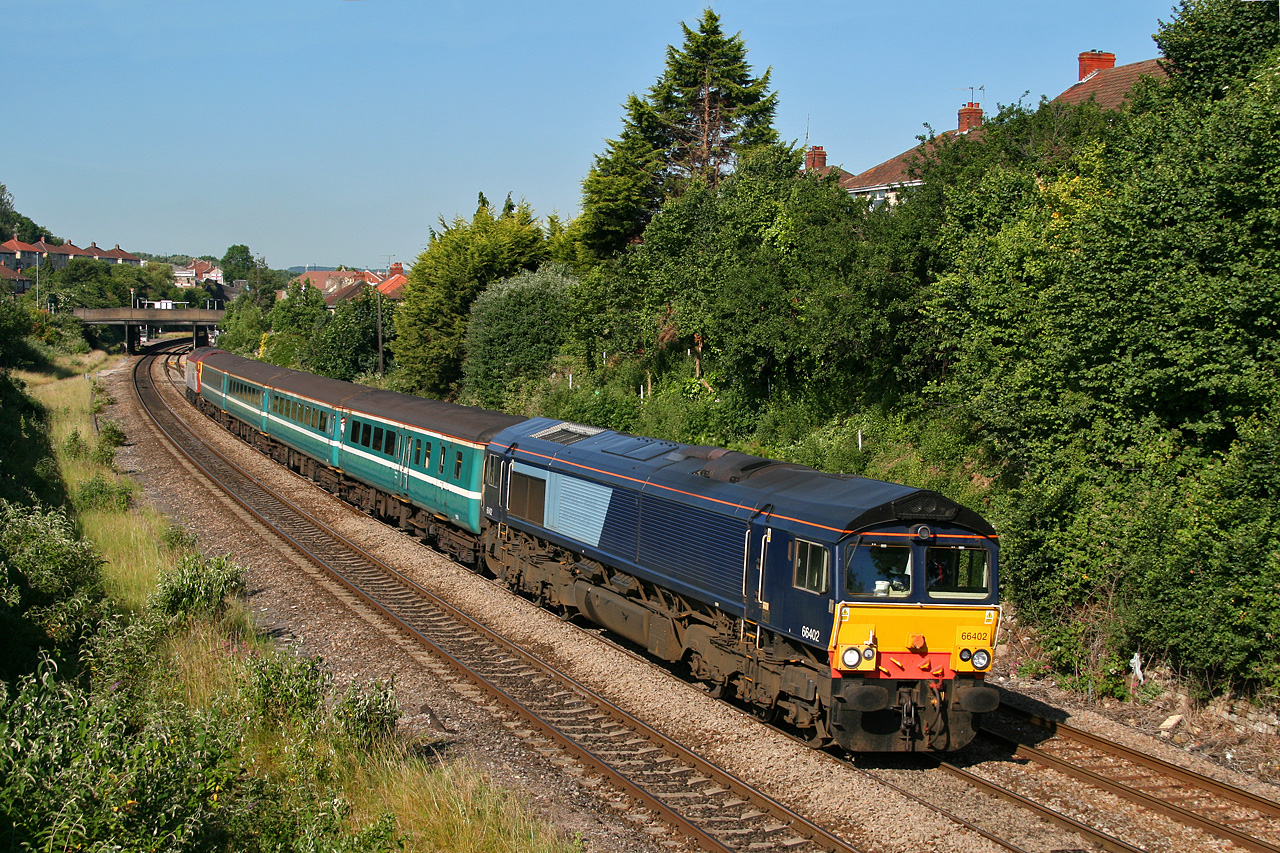
whilst it was working on the Cardiff/Bristol to Taunton LCHS diagrams during the summer of 2010. This loco was used due to the appalling reliability of the Class 57/3's that were the booked traction. Here it is passing Malago Vale in the western outskirts of Bristol working '2D04' from Taunton to Bristol-Parkway. One of the 57's, 57309 in Virgin-Thunderbird livery being on the rear. At this point the ex-DRS engine had been de-decaled. Not long afterwards it went to GBRf and got renumbered as 66734 and repainted in Europorte colours. Almost exactly 2 years later on 28 June 2012 it was derailed beside Loch Trieg nr Tulloch in Scotland. Due to the almost impossible task of recovery, the largely undamaged engine was cut up on site. However, that is not the end of the story. The engine from this loco has now been rebuilt and fitted to 66779 'Evening Star', nominally the final Class-66 ever to be built.'
So, the shot of the loco seen here, is the original one, before it donated its 'heart' to the Evening Star', 66779; what a story!
At the other side of the formation, some sort of track-side hut remains, though it must be many a year since it was last used. The next shot shows the rear of the DRS hauled coal wagons disappearing around the curve to the Maltby Station site whilst on the left of the rear wagons, 'BKS - 36' one of the Brookhouse road bridge signs can be seen. To the right, Maltby Colliery, still open and owned by 'RJB Mining' at that time, though the mine was closed 2 years later in 2013 and the above ground structures demolished in 2014.
36-37. In the sequence of pictures, shows the inside of Maltby Colliery box, invited in by the signaller at that time who had given us permission to use the steps to photograph the impending approach of the 'Lincolnshire Poacher', with 70013, 'Oliver Cromwell' in charge. Even at this time, the box looks to have a healthy number, 36, of levers still in use; there being only 2 painted white, 22 & 30, indicating disconnected/out-of-use levers. No.s 6, 12, 15 & 17 are 'reversed' presumably for signalling in the next working.
38-42. Three weeks later, on the Spring Equinox, March 22nd, 2011, an E.W.S. class 66, 66206, on another full coal move from Doncaster Down Decoy to the West Burton or Cottam Cottam Power Station, comes through and heads off south towards Brookhouse and Dinnington Junction. Various views south and north showing the Box location and a, then, healthy number of semaphore signal gantries to control moves into and from Maltby Colliery; note all shots from the track were taken with the signaller's permission whilst wearing hi-vis jackets.
43 & 44. Two shots in a sort of 'Then & Now' piece, the first of the 2 shots showing a G.B.R.f. class 66, 66727, 'Andrew Scott CBE', passing through the old station site on the 3rd March, 2012, a year later. This is the 6R45 working, Maltby Colliery to Immingham Import Terminal, which means it looks to be going the long way round as Immingham is off to the north-east, behind the train, the wagons look to be empty so maybe it is off for a refill. It was a very wet day and the bridge from which this, and other photographs were taken, was inundated with very fast moving traffic coming to and from Maltby to the east.
The next of the two shots however, is the star of the show. This B/W photograph was sent to me by Adrian Wynn on 4th April, 2019, asking me if I had heard of the charter train depicted in the shot, I hadn't and let the matter rest there. It wasn't until I came to put the stills sequence together for this video that I investigated more and found that this was a well-know charter tour which took place in May, 1957, here are the details-
steam rail charter operated by the R.C.T.S., 'Railway Correspondence & Travel Society', 'The East Midlander' with 'Holden GER Class D16 4-4-0' No. 62571, reporting number #880 from Nottingham Midland pausing at Maltby Station and then making its way back to Nottingham Midland. The places visited were-
* Nottingham Midland (dep. 09:25), Radford Jn., Trowell Jn., Treeton Jn., Rotherham Masborough, Wath Road Jn., Cudworth, Brierley Jn., Wrangbrook Jn., Aire Jn., Carlton Towers., North Cave, Locomotive Jn., Springbank West Jn., Springbank South Jn., Albert Dock West Jn.
* Albert Dock West Jn., St. Andrews Dock Jn.,
* St Andrews Dock Jn., Hessle Road Jn., Beverley, Market Weighton, Pocklington, York,
* York, Church Fenton, Sherburn South Jn., Gascoigne Wood Jn., Selby West Jn., Doncaster, Potteric Carr Jn., Low Ellers Jn., Tickhill, Maltby Station (18.20 ~ 18.35), Dinnington Jn., Shireoaks, Shirebrook West Jn., Mansfield, Hucknall, Nottingham Midland (arr. 19:50)
Quite a jaunt around and the shot here shows the happy travellers decamping on the Maltby Station site, replete with G.C.R. style lattice footbridge and water-crane for the loco. Priceless, Adrian! He obtained the negative in an on-line auction, and I use the shot with permission. Some further details on this venture, 'The East Midlander', can be found here-
www.sixbellsjunction.co.uk/50s/570512rc.html
Loco details-
Number: 62571
Type: Holden G.E.R. Class D16 4-4-0
Built: July 1909
Where: Stratford Works
Original number: G.E.R. No.1820
Subsequent numbers: 1924, LNER No.8820, October 1946 to LNER No.2571, September 1948 to B.R. No.62571
Withdrawn: January 1959
From: 40A Lincoln
45-48. Back to March 3rd, 2012, and another charter is on its way, this time northwards, and now its the W.C.R.C., 'West Coast Railway Company' operating 'The Lincolnshire Poacher' with 'Britannia 7MT 4-6-2', 70013, 'Oliver Cromwell' with class 47, 47760 at the back on the 1Z54, London Kings Cross to Cleethorpes charter, returning as 1Z55, Cleethorpes to London Kings Cross later in the day. It is seen in these pictures coming through a bit of a misty haze as it heads towards Doncaster past the Maltby signal box which had by this stage , 4 or 5 enthusiasts stood on the steps and platform awaiting its arrival. Heading north past the box without stopping, on the accompanying line, yet another coal train approaches, once again an E.W.S. on a full coal from Doncaster Down Decoy to West Burton or Cottam Power Station, providing the power, 66040. It and the class 47, 47760, at the rear of the Charter, look somewhat similar as they pass one another though the 66 was built on the 17th December 1998, whilst the 47, 47760, was built, as D1617, by B.R. at Crewe Works on September 4th 1964.
in the past, 47760 could also be seen in E.W.S. livery, see-
www.philt.org.uk/keyword/47760/i-HkwRLPk/A
Some details regarding 47760-
Number: 47760
Class: 47/7
Depot: CS - Steamtown Railway Centre, Carnforth T&RSMD
Pool: AWCA - WCRC Operational Locomotives
Livery: WC - West Coast Railway Company Maroon with West Coast Logo
Builder: Crewe Works (LNER/LMS/British Railways)
Built: 04/09/1964
Works Number: 47760 Named: 25/03/1994, 'Restless'
47760 Named: 10/04/1999, 'Ribblehead Viaduct'
Unamed: 30/08/2004
47760 Renumbered: from 47562 on 25/03/1994
47562 Named: 31/08/1983, 'Sir William Burrell'
Unamed: 08/07/1991
49-51. In the last 3 shots, 66040 has still got the 'peg off' at the box for its south-bound move whilst the Charter has now disappeared into the hazy conditions to the north. Heading through the colliery area site, the 'peg' is also clear for a move through the Maltby Station site and on to Brookhouse Viaduct and Dinnington, Worksop and one of the Power Stations in the east. The last of the 3 shots with 66040, show it crossing over from the double-track section onto the single track which will take is far as Dinnington Junction, where double rack starts again through to Brancliffe East Junction and the Lincoln Main Line.
52-53. Two years later almost to the day, on the 6th March, I was back again in the area and more moves of coal trains were about the place. The first, is Freightliner class 66, 66610, on an empty coal working from either West Burton or Cottam Power Station, along to Doncaster Down Decoy; the early MArch weather conditions are evident as is the fixed-distant for north-bound moves. At this time, 6th, March 2014, the Maltby Colliery site was still complete with its buildings though these were demolished later in the year.
54-56. Around 15 minutes later, the Freightliner having cleared the single-track section from the south, yet another E.W.S. full coal train from the north, trundles through the station site. This one, and all other E.W.S. locomotives, are now owned by D.B.S, though still in E.W.S. livery, this is 66126, the long-haul coal train from Hunterston High Level to West Burton Power Station coal move. Its a year later, and a month later and spring is well under way, with all the track-side greening up as another DBS/EWS train heads south, this time with a rake of Network Rail, yellow, empty engineers JNA box wagons. It is destined for weekend engineering work, as this is mid-day Saturday, all the normal workings have finished and this train is heading to Dinnington Junction where there will be a site for the new work.
57-58. Finally in this section. After the engineering train had departed south with its yellow, JNA box wagons, an air of peace descended around the Maltby Colliery box area, as there would now be no further moves along here over the weekend, traction moves commencing once more, early Monday morning. So, a peaceful pair of shots as the last in the sequence, showing the line to the north past the box and, at the back of it, the semi-silvan aspect of the fields which surround the tracks here, this one full of itchy, smelly, sneeze-inducing, eye-watering, Rape Seed Oil crop.. hate the stuff.. Some information relating to the 3 semaphore boxes in this area, North, South and Station.
North & South boxes-
www.signalboxes.com/maltby-north-junction.php
Station Box-
www.signalboxes.com/maltby-signalbox-and-station.php
* Brookhouse & Laughton(41). And so to the last section, of this first part, the area around Brookhouse, Slade Hooton, and a little further south, Laughton-en-le-Morthen. The most dominating aspect of this area is of course the Brookhouse Viaduct, crossing over Main Street in Brookhouse itself on a very impressive viaduct, built with two tracks in mind, but never carrying more than one. There are several perspectives available, over the formation which curves gently around directly to the south towards Laughton Common and Dinnington, but these days a few of them are now burgeoned with lineside vegetation growth, particularly the view along the viaduct. The viaduct itself was built with provision for a double track formation to pass over but in the event, this never happened, the line ran single over it and itself was eventually singled all the way along to Dinnington Junction.
59-60. The first picture of this section shows a Freightliner passing south over the viaduct and the support columns clearly show the space where the second track would have gone. Freightliner class 66, 66567, heads another coal train south from Doncaster Down Decoy to either West Burton or Cottam Power Stations with a long rake of full, HHA Bogie Hopper Wagons.
61-64. Just a little south of the Viaduct, at Laughton Common at the end of the section of track-bed between Laughton West and East Junctions, joining the old Thurcroft Colliery Line with the S.Y.J.R., was this remnant of a lineside wiring box. The information on the inside of the door shows the telecoms and signal wiring pairs between Dinnington Junction to the south and Maltby Colliery box to the north. All the cable to and from it had been stripped out and stolen and this was the only testament to any past infrastructure remaining at the junction... Around 1km to the north of the wiring box at Laughton East Junction, a foot-crossing exists and nine months later, on 13th January, 2012, a D.R.S. empty coal train heads north though Laughton Common with class 66, 66413, in charge on a move back from either West Burton or Cottam Power Station, to Doncaster Up Decoy and again with a longish rake of old Freightliner 'Heavy Haul', HHA bogie hopper wagons. As I recall, this was a bright, clear, cold, crisp day and just after the start of the new year, 2012...
65-74. A series of 35 traction shots now of various sorts, coal mainly, test trains, and an R.H.T.T. wagons haul, all in the vicinity of Brookhouse Viaduct, here's the list-
* DBC 66198, heads south on a full coal from Doncaster Down Decoy to West Burton or Cottam Power Station, crossing over the Viaduct,
* GBRf 66721, 'Harry Beck', in 'Metronet - Renewing the Tube' livery with HHA Bogie Wagons from Doncaster Up Decoy to Cottam Power Station
* DBC 66188, on the 6B29, Hatfield Colliery to West Burton Power Station
* DBC 66081, on the 4D15, West Burton Power Station to Milford Junction
* DBC 66176, on the 6E70, Leith Docks to Cottam Power Station
* GBRf 66725, on the 6F12, Tyne Coal Terminal to Cottam Power Station
* N.R. 950001 Test Train, on the 2Q08, Derby RTC to Doncaster West Yard
* An unusual move for this line on Wednesday, the 20th August 2014, was Freightliner 66593, on the 4E62, Felixstowe North(FLT) to Doncaster(EPT)
* Riviera Trains B.R. blue, 47843, 'Vulcan' on the 0Z47, Doncaster Down Decoy to Toton North Yard
* The first of two charter trains, this one heading south with DBC 66059 and 60059, 'Swinden Dalesman', on the 1Z36 Eastleigh to Eggborough Power Station 'Pathfinder Tours', 'The Generating Finale'
* N.R Test Train with 37607 & 37601, 'Class 37-Fifty' on the 1Q64, Derby R.T.C to Neville Hill T&R.S.M.D.
with coaches Coach 5981, Plain Line Pattern Recognition Vehicle, 6262 - Generator Van, 92928 Postal Vehicle
* Colas 56302, 'Peco' and 56087, 'ABP Port of Hull' on 6Z47, York Thrall Europa to Gloucester Horton Rd. with a rake of FEA-B RHTT A Tank Wagons. Some details about the two class 56 locomotives-
Number: 56302
Class: 56/3
Depot: RU - Rugby Rail Plant
Pool: Unknown
Livery: CO - Colas Rail Yellow, Orange and Black COLAS RAIL Logo
Builder:
Built: 25/09/1983
Works Number:
Named: 30/09/2007, 'Wilson Walshe'
Unamed: 30/09/2010
Named: 11/06/2016. 'Peco'
Number: 56087
Class: 56
Depot: W - Withdrawn from Service
Pool: Unknown
Livery: CO - Colas Rail Yellow, Orange and Black COLAS RAIL Logo
Builder:
Built: 21/12/1980
Works Number:
Named: 31/08/1997, 'ABP Port of Hull'
Unamed: 31/12/2004
* GBRf 66738, 'Huddersfield Town' heads north on the 4D08 empty coal, from Cottam Power Station(GBRf) to Doncaster Down Decoy(GBRf). The shot taken under the watchful gaze of Adrian Wynn who was stood just down from me on Brookhouse Lane with a view across the fields to the Viaduct. The fields at that time were home to some horses and their stable; not sure I ever saw the shot Adrian had taken here...
* GBRf 66740, 'Sarah', on 6F72, Immingham H.I.T to Cottam Power Station. This time on 11th January, 2014, 9 months after the last shot, a similar picture was taken, without Adrian Wynn this time, but now a 'stable lad' is inquisitive about what I am doing and me about him, turned out he lived in the Dinnington area and rented this field for his horses...
* The very last 3 pictures show the second of the charter trains, this one heading north with DBC 66133 and 66140 at the back on the 1Z25, Westbury, Somerset to Hedon Road Sidings, Hull, a 'Pathfinder Railtours' operated charter, 'The Trent Ouse Docker'.
The next part of this S.Y.J.R, a 7-year perspective, will continue on from Laughton Common, through Dinnington and on to the end of the line at Brancliffe East Junction ,also during the period 22nd March, 2011 to 30th June, 2018. As this part has taken 37 hours to put together, commencing on the 24 May, the next part will take around the same time I guess, so middle to end of July I guess. This one was interrupted several times by photography of other traction, the Hope Valley & Deepcar Line class 73 moves being two, so I expect the 2nd will also be interrupted in the same way. Just got to create the 'tags list' from a live file which has been growing during this process and then, that's it!! Enjoy.
SN/NC: Jacaranda mimosifolia, Bignoniaceae Family
Jacaranda is a sub-tropical tree native to south-central South America that has been widely planted elsewhere because of its attractive and long-lasting violet-colored flowers. It is also known as the jacaranda, blue jacaranda, black poui, Nupur or fern tree. Older sources call it J. acutifolia, but it is nowadays more usually classified as J. mimosifolia. In scientific usage, the name "jacaranda" refers to the genus Jacaranda, which has many other members, but in horticultural and everyday usage, it nearly always means the blue jacaranda. In its native range in the wild, J. mimosifolia is listed as Vulnerable by the IUCN.
Native of Brazil, it has its name inherited from the native tribe Tupi-Guarani and in Botanic is the only tree that keeps the same name in more than 200 countries across the world.
Pretoria, the administrative capital of South Africa, is popularly known as Jacaranda City because of the large number of trees, which turn the city blue and purple when they flower in spring. The jacaranda trees, far from their native Brazil, bloom every October.
The city of Grafton on the north coast of New South Wales, Australia, is famous for its jacarandas. Each year in late October and early November, the city has a jacaranda festival.[
In the United States, the jacaranda is grown extensively in California, the Southwest, southeast Texas and Florida and even in Hawaii. It is such a beautiful tree and used as ornamental tree in many cities across the universe. The color captivates and it has also a nice smell attracting bees and butterflies. The wood is noble and a reason for a tirelessly hunt of this precious tree.
Jacarandá é uma árvore subtropical nativa do centro-sul da América do Sul que tem sido amplamente plantada em outros lugares por causa de suas flores atraentes e duradouras de cor violeta. Também é conhecido como jacarandá, jacarandá azul, poui preto, Nupur ou samambaia. Fontes mais antigas chamam-na de J. acutifolia, mas hoje em dia é mais comumente classificada como J. mimosifolia. No uso científico, o nome "jacarandá" refere-se ao gênero Jacaranda, que possui muitos outros membros, mas no uso hortícola e cotidiano quase sempre significa o jacarandá azul. Em sua área de distribuição nativa na natureza, J. mimosifolia está listada como Vulnerável pela IUCN.
Nativa do Brasil, tem nome herdado da tribo nativa Tupi-Guarani e na botânica é a única árvore que mantém o mesmo nome em mais de 200 países ao redor do mundo.
Pretória, capital administrativa da África do Sul, é popularmente conhecida como Cidade Jacarandá devido ao grande número de árvores, que tornam a cidade azul e roxa quando florescem na primavera. Os jacarandás, longe de seu Brasil natal, florescem todo mês de outubro.
A cidade de Grafton, na costa norte de Nova Gales do Sul, na Austrália, é famosa por seus jacarandás. Todos os anos, no final de outubro e início de novembro, a cidade realiza um festival de jacarandá.[
Nos Estados Unidos, o jacarandá é cultivado extensivamente na Califórnia, no sudoeste, no sudeste do Texas e na Flórida e até no Havaí. É uma árvore tão bonita e usada como árvore ornamental em muitas cidades do universo. A cor cativa e tem também um cheiro agradável atraindo abelhas e borboletas. A madeira é nobre e motivo de uma caça incansável a esta preciosa árvore.
La jacarandá es un árbol subtropical originario del centro-sur de América del Sur que se ha plantado ampliamente en otros lugares debido a sus atractivas y duraderas flores de color violeta. También se le conoce como jacarandá, jacarandá azul, poui negro, nupur o helecho. Fuentes más antiguas lo llaman J. acutifolia, pero hoy en día se clasifica más habitualmente como J. mimosifolia. En el uso científico, el nombre "jacarandá" se refiere al género Jacaranda, que tiene muchos otros miembros, pero en el uso hortícola y cotidiano, casi siempre significa jacarandá azul. En su área de distribución nativa en estado silvestre, J. mimosifolia está clasificada como Vulnerable por la UICN.
Originario de Brasil, tiene su nombre heredado de la tribu nativa Tupí-Guaraní y en Botánico es el único árbol que mantiene el mismo nombre en más de 200 países alrededor del mundo.
Pretoria, la capital administrativa de Sudáfrica, es conocida popularmente como Ciudad Jacaranda debido a la gran cantidad de árboles, que tiñen la ciudad de azul y violeta cuando florecen en primavera. Los jacarandás, lejos de su Brasil natal, florecen cada octubre.
La ciudad de Grafton en la costa norte de Nueva Gales del Sur, Australia, es famosa por sus jacarandas. Cada año, a finales de octubre y principios de noviembre, la ciudad celebra un festival de jacarandá.
En Estados Unidos, la jacarandá se cultiva extensamente en California, el suroeste, el sureste de Texas y Florida e incluso en Hawaii. Es un árbol muy hermoso y se utiliza como árbol ornamental en muchas ciudades de todo el universo. El color cautiva y también tiene un olor agradable que atrae a las abejas y mariposas. La madera es noble y motivo de una caza incansable de este precioso árbol.
Jacaranda is een subtropische boom afkomstig uit zuid-centraal Zuid-Amerika en die elders op grote schaal is aangeplant vanwege zijn aantrekkelijke en langdurige violetkleurige bloemen. Het is ook bekend als de jacaranda, blauwe jacaranda, zwarte poui, Nupur of varenboom. Oudere bronnen noemen het J. acutifolia, maar tegenwoordig wordt het vaker geclassificeerd als J. mimosifolia. In wetenschappelijk gebruik verwijst de naam "jacaranda" naar het geslacht Jacaranda, dat nog veel meer leden kent, maar in de tuinbouw en in het dagelijks gebruik betekent het bijna altijd de blauwe jacaranda. In zijn oorspronkelijke verspreidingsgebied in het wild wordt J. mimosifolia door de IUCN als kwetsbaar beschouwd.
De boom komt oorspronkelijk uit Brazilië en heeft zijn naam geërfd van de inheemse stam Tupi-Guarani. In Botanic is het de enige boom die dezelfde naam draagt in meer dan 200 landen over de hele wereld.
Pretoria, de administratieve hoofdstad van Zuid-Afrika, staat in de volksmond bekend als Jacaranda City vanwege het grote aantal bomen, die de stad blauw en paars kleuren als ze bloeien in de lente. De jacarandabomen, ver van hun geboorteland Brazilië, bloeien elk jaar in oktober.
De stad Grafton aan de noordkust van New South Wales, Australië, is beroemd om zijn jacaranda's. Elk jaar eind oktober en begin november heeft de stad een jacarandafestival.
In de Verenigde Staten wordt de jacaranda op grote schaal verbouwd in Californië, het zuidwesten, zuidoosten van Texas en Florida en zelfs op Hawaï. Het is zo’n prachtige boom en wordt in veel steden in het universum als sierboom gebruikt. De kleur fascineert en het heeft ook een aangename geur die bijen en vlinders aantrekt. Het hout is nobel en een reden voor een onvermoeibare jacht op deze kostbare boom.
Le jacaranda est un arbre subtropical originaire du centre-sud de l'Amérique du Sud qui a été largement planté ailleurs en raison de ses fleurs violettes attrayantes et durables. Il est également connu sous le nom de jacaranda, jacaranda bleu, poui noir, Nupur ou fougère. Des sources plus anciennes l'appellent J. acutifolia, mais elle est aujourd'hui plus généralement classée comme J. mimosifolia. Dans l'usage scientifique, le nom « jacaranda » fait référence au genre Jacaranda, qui compte de nombreux autres membres, mais dans l'usage horticole et quotidien, il signifie presque toujours le jacaranda bleu. Dans son aire de répartition naturelle à l'état sauvage, J. mimosifolia est classée vulnérable par l'UICN.
Originaire du Brésil, son nom est hérité de la tribu indigène Tupi-Guarani et, en botanique, c'est le seul arbre qui conserve le même nom dans plus de 200 pays à travers le monde.
Pretoria, la capitale administrative de l'Afrique du Sud, est communément connue sous le nom de Jacaranda City en raison du grand nombre d'arbres qui colorent la ville en bleu et violet lorsqu'ils fleurissent au printemps. Les jacarandas, loin de leur Brésil natal, fleurissent chaque octobre.
La ville de Grafton, sur la côte nord de la Nouvelle-Galles du Sud, en Australie, est célèbre pour ses jacarandas. Chaque année, fin octobre et début novembre, la ville organise un festival des jacarandas.
Aux États-Unis, le jacaranda est largement cultivé en Californie, dans le sud-ouest, le sud-est du Texas, en Floride et même à Hawaï. C’est un très bel arbre et utilisé comme arbre ornemental dans de nombreuses villes à travers l’univers. La couleur captive et elle a aussi une odeur agréable qui attire les abeilles et les papillons. Le bois est noble et incite à chasser inlassablement cet arbre précieux.
Jacaranda ist ein subtropischer Baum aus Süd- und Zentralsüdamerika, der aufgrund seiner attraktiven und langlebigen violetten Blüten auch anderswo häufig gepflanzt wird. Er ist auch als Jacaranda, blauer Jacaranda, schwarzer Poui, Nupur oder Farnbaum bekannt. Ältere Quellen nennen es J. acutifolia, heutzutage wird es jedoch häufiger als J. mimosifolia klassifiziert. Im wissenschaftlichen Sprachgebrauch bezieht sich der Name „Jacaranda“ auf die Gattung Jacaranda, die viele weitere Mitglieder hat, im gärtnerischen und alltäglichen Gebrauch ist damit jedoch fast immer der blaue Jacaranda gemeint. In seinem natürlichen Verbreitungsgebiet wird J. mimosifolia von der IUCN als gefährdet eingestuft.
Der in Brasilien beheimatete Baum hat seinen Namen vom einheimischen Stamm Tupi-Guarani geerbt und ist botanisch gesehen der einzige Baum, der in mehr als 200 Ländern auf der ganzen Welt denselben Namen trägt.
Pretoria, die Verwaltungshauptstadt Südafrikas, ist im Volksmund als Jacaranda City bekannt, da es hier eine große Anzahl an Bäumen gibt, die die Stadt bei ihrer Blüte im Frühling blau und lila färben. Die Jacarandabäume, weit entfernt von ihrer Heimat Brasilien, blühen jedes Jahr im Oktober.
Die Stadt Grafton an der Nordküste von New South Wales, Australien, ist berühmt für ihre Jacarandas. Jedes Jahr Ende Oktober und Anfang November findet in der Stadt ein Jacaranda-Fest statt.[
In den Vereinigten Staaten wird Jacaranda in großem Umfang in Kalifornien, im Südwesten, im Südosten von Texas und Florida und sogar auf Hawaii angebaut. Es ist ein wunderschöner Baum und wird in vielen Städten im ganzen Universum als Zierbaum verwendet. Die Farbe ist faszinierend und der Duft lockt Bienen und Schmetterlinge an. Das Holz ist edel und ein Grund für eine unermüdliche Jagd nach diesem kostbaren Baum.
La Jacaranda è un albero subtropicale originario dell'America centro-meridionale che è stato ampiamente piantato altrove a causa dei suoi fiori viola attraenti e durevoli. È anche conosciuto come jacaranda, jacaranda blu, poui nero, Nupur o albero di felce. Fonti più antiche la chiamano J. acutifolia, ma oggigiorno è più comunemente classificata come J. mimosifolia. Nell'uso scientifico, il nome "jacaranda" si riferisce al genere Jacaranda, che comprende molti altri membri, ma nell'uso orticolo e quotidiano significa quasi sempre la jacaranda blu. Nel suo areale nativo in natura, J. mimosifolia è elencata come vulnerabile dalla IUCN.
Originario del Brasile, prende il nome ereditato dalla tribù nativa Tupi-Guarani e in botanica è l'unico albero che mantiene lo stesso nome in più di 200 paesi nel mondo.
Pretoria, la capitale amministrativa del Sud Africa, è popolarmente conosciuta come Jacaranda City per via del gran numero di alberi, che colorano la città di blu e viola quando fioriscono in primavera. Gli alberi di jacaranda, lontani dal loro nativo Brasile, fioriscono ogni ottobre.
La città di Grafton, sulla costa settentrionale del Nuovo Galles del Sud, in Australia, è famosa per le sue jacaranda. Ogni anno tra la fine di ottobre e l'inizio di novembre, la città organizza un festival della jacaranda.[
Negli Stati Uniti, la jacaranda è ampiamente coltivata in California, nel sud-ovest, nel sud-est del Texas, in Florida e persino alle Hawaii. È un albero così bello ed è usato come albero ornamentale in molte città dell'universo. Il colore affascina e ha anche un buon odore che attira api e farfalle. Il legno è nobile e motivo di una caccia instancabile a questo prezioso albero.
الجاكراندا هي شجرة شبه استوائية موطنها جنوب وسط أمريكا الجنوبية وقد تم زراعتها على نطاق واسع في أماكن أخرى بسبب أزهارها الجذابة ذات اللون البنفسجي التي تدوم طويلاً. تُعرف أيضًا باسم شجرة الجاكاراندا أو الجاكاراندا الزرقاء أو البوي الأسود أو النوبور أو شجرة السرخس. تسميها المصادر القديمة J. acutifolia، ولكن يتم تصنيفها في الوقت الحاضر على أنها J. mimosifolia. في الاستخدام العلمي، يشير اسم "الجاكراندا" إلى جنس الجاكاراندا، الذي يضم العديد من الأعضاء الآخرين، ولكن في الاستخدام البستاني واليومي، فهو يعني دائمًا الجاكراندا الزرقاء. في موطنها الأصلي في البرية، تم إدراج J. mimosifolia ضمن الأنواع المعرضة للخطر من قبل الاتحاد الدولي لحفظ الطبيعة.
موطنها الأصلي البرازيل، وقد ورثت اسمها من قبيلة توبي غواراني الأصلية، وهي الشجرة الوحيدة التي تحتفظ بنفس الاسم في أكثر من 200 دولة حول العالم.
بريتوريا هي العاصمة الإدارية لجنوب أفريقيا، وتعرف شعبياً باسم مدينة جاكاراندا بسبب كثرة الأشجار التي تحول المدينة إلى اللون الأزرق والبنفسجي عندما تزهر في فصل الربيع. تزهر أشجار الجاكراندا، بعيدًا عن موطنها الأصلي البرازيل، في شهر أكتوبر من كل عام.
تشتهر مدينة جرافتون الواقعة على الساحل الشمالي لولاية نيو ساوث ويلز بأستراليا بأشجار الجاكراندا. في أواخر أكتوبر وأوائل نوفمبر من كل عام، تقام في المدينة مهرجان الجاكراندا.[
في الولايات المتحدة، تتم زراعة الجاكراندا على نطاق واسع في كاليفورنيا والجنوب الغربي وجنوب شرق تكساس وفلوريدا وحتى في هاواي. إنها شجرة جميلة وتستخدم كشجرة زينة في العديد من المدن في جميع أنحاء الكون. لونه آسر وله أيضًا رائحة لطيفة تجذب النحل والفراشات. الخشب نبيل وسبب للبحث بلا كلل عن هذه الشجرة الثمينة.
ジャカランダは、南アメリカ中南部原産の亜熱帯の木で、その魅力的で長持ちする紫色の花のため、他の場所でも広く植栽されています。ジャカランダ、ブルー ジャカランダ、ブラック ポイ、ヌプール、またはシダの木としても知られています。古い情報源では J. acutifolia と呼ばれていますが、現在では一般的に J. mimosifolia として分類されています。科学的に使用される場合、「ジャカランダ」という名前は、他にも多くの仲間がいるジャカランダ属を指しますが、園芸や日常的に使用される場合は、ほぼ常に青いジャカランダを意味します。野生の自生範囲では、J. mimosifolia は IUCN によって絶滅危惧Ⅱ類に指定されています。
ブラジル原産のこの木は、原住民の部族トゥピ・グアラニ族からその名前を受け継いでおり、植物園では、世界 200 か国以上で同じ名前を保っている唯一の木です。
南アフリカの行政首都であるプレトリアは、春に花が咲くと街を青や紫に染める木々がたくさんあるため、ジャカランダ シティとして広く知られています。ジャカランダの木は原産地のブラジルから遠く離れており、毎年 10 月に開花します。
オーストラリア、ニューサウスウェールズ州の北海岸にあるグラフトン市は、ジャカランダで有名です。毎年 10 月下旬と 11 月上旬に、市ではジャカランダ フェスティバルが開催されます。[
米国では、ジャカランダはカリフォルニア、南西部、テキサス南東部、フロリダ、さらにはハワイでも広く栽培されています。それはとても美しい木であり、宇宙の多くの都市で装飾用の木として使用されています。色は魅惑的で、蜂や蝶を引き寄せる良い香りもします。この木材は高貴であり、この貴重な木を精力的に狩猟する理由があります。
1970 United Nations 25th Anniv. Single 6c Postage Stamp, Sc-#1419
U.S. (#1419) - 6¢ United Nations
Issue Date: November 20, 1970
City: New York, NY
Quantity: 127,610,000
Printed By: Bureau of Engraving and Printing
Printing Method: Lithographed and engraved
Perforations: 11
Color: Black, vermillion and ultramarine
World Hope For Lasting Peace - Sarzin cachet
Clyde J. Sarzin was a creative cachet maker known for his distinctive metallic first day covers, often featuring a thin sheet of metal affixed to the envelope, and for his space-themed covers. He was active from the 1960s to the 1970s, and his cachets are typically black-and-white with some single-colored examples for the Apollo missions. Sarzin also created more traditional first day covers, but his metallic and space covers are his most famous work.
-------------------------------------------------------------------------------------------
The president of the United Nations General Assembly is a position voted by representatives in the United Nations General Assembly on a yearly basis. The president is the chair and presiding officer of the General Assembly. (Not to be confused with Secretary-General of the United Nations). The presidency rotates annually between the five geographic groups: African, Asia-Pacific, Eastern European, Latin American and Caribbean, and Western European and other States. Because of their powerful stature globally, some of the largest, most powerful countries have never held the presidency, including the five permanent members of the United Nations Security Council and Japan. A few countries had a national elected as president of UNGA twice: Argentina, Chile, Ecuador, Hungary and Nigeria; all the other member states had a national holding this office once.
These are the six Presidents who have signed this First Day Cover:
(1) - The 7th President (1952): Lester Bowles "Mike" Pearson (April 23, 1897- December 27, 1972), was the 14th Prime Minister of Canada, serving from 1963 to 1968. He also served as leader of the Liberal Party from 1958 to 1968 and as leader of the Official Opposition from 1958 to 1963.
(2) - The 19th President (1964): Alex Quaison-Sackey (9 August 1924 – 21 December 1992) was a Ghanaian diplomat who served during the first and third republics. He was the first black African to serve as president of the United Nations General Assembly.
(3) - The 17th / 4th special President (1962): Muhammad Zafarullah Khan - Sir Chaudhry Mohammad Zafarullah Khan[a] KCSI (6 February 1893 – 1 September 1985) was a Pakistani diplomat and jurist who served as the first foreign minister of Pakistan. After serving as foreign minister he continued his international career and is the only Pakistani to preside over the International Court of Justice. He also served as the President of the UN General Assembly. He is the only person to date to serve as the President of both UN General Assembly and the International Court of Justice. Before he served in The UN he fought for Palestinian Interest thus it made him a hero well respected by the Arab Masses. In 1963, he became president of UN General Assembly State of Palestine in a de facto capacity. He left the UN in 1964 to return to the ICJ and, in 1970, he became the first and only Pakistani to serve as the President of the International Court of Justice, a position he maintained until 1973. He returned to Pakistan and retired in Lahore where he died in 1985 at the age of 92. Khan is considered a prominent figure in Pakistan. He authored several books on Islam both in Urdu and English. LINK to a photo - en.wikipedia.org/wiki/Muhammad_Zafarullah_Khan#/media/Fil...

-------------------------------------------------------------------------------------------
(4) - The 15th President (1960 / Third Special): Frederick Henry Boland (11 January 1904 – 4 December 1985) was an Irish diplomat who served as the first Irish Ambassador to both the United Kingdom and the United Nations. Boland was the president of the General Assembly of the United Nations on 12 October 1960, when Nikita Khrushchev allegedly took off his shoe and pounded it on his desk.
-------------------------------------------------------------------------------------------
(5) - The 21st President (1966 / 5th Emergency Special): Abdul Rahman Pazhwak (Persian: March 1919 – 8 June 1995) was an Afghan poet and diplomat. He was educated in Afghanistan and started his career as a journalist, later joining the foreign ministry. During the 1950s, he became ambassador to the United Nations and served as president of the UN General Assembly from 1966 to 1967. During the early 1970s, he served for short periods as Afghan ambassador to West Germany and India. In 1976, he became ambassador to the United Kingdom. He served in that position until the 1978 Saur Revolution. He then returned to Afghanistan and was put under house arrest. He was allowed to leave for medical treatment in 1982 and received asylum in the United States, where he lived until 1991, before moving to Peshawar, after Pakistan offered him sanctuary. Abdul Rahman Pazhwak died in Hayatabad in Peshawar on 8 June 1995. He was in Baghwani village off Surkh Road in Nangarhar Province, Afghanistan. (Note: he signed the cover in English and in his native language).
----------------------------------------------------------------------------------------
(6) - Unknown
See also a detail showing a close-up of the flag image (below).
Lasting Impressions
Stare at this flag, dear friend,
Then look away,
The image still stands by you.
If next Sunday, you'll attend
Our Rally Day,
Like impressions will then ensue.
Directions. Take card in both hands, look steadily at small diamond shaped speck on flag, try not to blink, and count to 40 slow, then look up at sky or a light wall and picture will appear greatly enlarged. Keep looking at one spot for 10 seconds. Result--the actual picture will appear and disappear several times.
Here are photos I took of the promo placard and display dolls at my local Disney Store today. They were only supposed to display the Cinderella doll (which is actually the second doll to be released). But the manager brought out the Snow White, Jasmine and Ariel dolls from the back so I can see them and take photos. They have not yet received the last two dolls to be released, Tiana and Belle. The placard lists the release dates and photos of the dolls, along with their edition sizes. They will be released one per week on Saturday, starting on October 6, rather than the usual Tuesday. They will start to hand out vouchers starting an hour before store opening and lasting about 30 minutes. They will then announce the winners of the raffle about 20 minutes before store opening, who may then purchase the doll being released that day. The online release will take place at 12:01 AM (Pacific time) on the morning of that same day. Each doll will cost $109.95.
The schedule of releases (for the US and Canada):
Snow White, 10/6/2018, LE 4100
Cinderella, 10/13/2018, LE 4400
Jasmine, 10/20/2018, LE 4000
Ariel, 10/27/2018, LE 4500
Tiana, 11/3/2018, LE 4000
Belle, 11/10/2018, LE 4500
The official announcement was made by the ShopDisney Facebook page this morning with a video of the dolls:
Disney Designer Collection: The Premiere Series
ShopDisney announcement
2018-09-10 9:32 am
Introducing, Disney Designer Collection: The Premiere Series. Inspired by the runways and red carpets during each beloved Disney heroine's theatrical debut, each doll's iconic fashion and accessories are carefully designed to capture a moment in fashion history.
Each doll releases every Saturday from October 6 to November 10 online at 12AM PT and through in-store lottery.
More photos and information at the ShopDisney website:
Disney Designer Collection: The Premiere Series
The UK Shop Disney Facebook page also announced the series this morning, with different release dates and procedures than the US/Canada stores.
Disney Designer Collection is proud to introduce The Premiere Series
The Disney Designer Collection is proud to introduce The Premiere Series, inspired by the runways and red carpets during each theatrical debut. Disney Designer Collection - Premiere Series – Snow White will be the first doll to be released from the series on 9th October and will be £95. There will be a global edition size of 4100, with 929 available to Europe. These will be available in selected stores* and online from 8am. Limited to 1 per Guest per household.
Release dates as follows:
Cinderella – 16/10
Ariel – 30/10
Belle – 13/11
Jasmine – 27/11
Tiana – 11/12
*Champs Elysees Paris, Lakeside West Thurrock, Oxford Street London, St Enoch Glasgow, Metro Centre Tyne & Wear, Bullring Birmingham, Grand Arcade Cardiff, Manchester Arndale, Westfield White City, Liverpool, Bluewater, Grafton Street Dublin, Puerta Del Angel Barcelona, La Vaguada Madrid, Juan De Austria, Parque Sur, Milan, Rome, Florence, Naples, Colombo, Munich, Stockholm.
For more info: Disney Designer Collection
A few years ago, when my friends Ken, Kelsie and I visited the Sunrise area of Mount Rainier, Kelsie mentioned a couple of times, that it would be her goal to hike iconic Wonderland Trail at some point in the near future.
This past summer, her dream came true when she was accompanied by her dad Ken, for a 13 day trip of a lifetime! On the average, only 200 people a year make the entire 93 mile trip.
I am very proud of their journey to say the least, and I hope to join them with our friend Jason, for a long hike in the Olympics later on this summer. Unless you push yourself, you will never know what you can accomplish!
Kelsie's blog; kelsiedonleycott.com/WT/
wearandcheer.com/the-ultimate-matte-lipsticks/
MATTE LIPSTICKS
Matte Lipsticks are extremely pigmented, luxuriantly formulated and long-wearing. The formula glides on efficiently and continues put through a non-drying matte end.”
Each day the editors of Wear and Cheer Beauty are sharing one remarkable product we sense should be on your m...
by Staff Author on Wear and Cheer - Fashion, Lifestyle, Cooking and Celebrities - Visit Now wearandcheer.com/the-ultimate-matte-lipsticks/
You must like it and share it with your friends.
It took a few hours of looking but I found the Lincoln's Sparrow that has been wintering at Meadowbrook (thanks to Jim Wilkinson for the original sighting). They are uncommon birds to find in Maryland during the winter. This little guy has lost an eye but made it through the blizzard. It can certainly see well since it is very hard to photograph. Very secretive little bird! I just started to think about why Songs and Swamps winter here without issue in good numbers and why Lincoln's so rarely do?
* From 12th March, 2011 to 17th November, 2018
* A 12mins 15sec, 190Mby MP4 video, showing photographs from the southern end of the S.Y.J.R., between 22nd March, 2011 and 30th June, 2018.
* NB: As this is longer than the fixed 3 minute viewing in the Flickr interface, the Video must be downloaded to the desktop to see the full length.
* Right-click on the down-arrow option, the last of the three options to the lower right of the video frame. Select 'Save-As' and view...
** It has just come to my notice (10/12/23) that the Download option below and to the right of the media _does not_ allow you to download the full version, only the 3 minutes available here. So, I am going to try and 'fix' this for all videos lasting more than 3 minutes, this is the link to obtain the full version shown here-
www.flickr.tightfitz.com/Video/SYJR_Part_Two_-_Firbeck,_M...
To the north and south of Dinnington, the S.Y.J.R. was joined by another section of line from the Silverwood Colliery area, through Braithwell Junction where the line from Gowdall joined the line which then ran through Thurcroft and its colliery. The L.M.S. & L.N.E.R. line continued south with a connecting line to the S.Y.J.R which ran from Laughton West Junction to Laughton East Junction near the Dinnington Colliery. South of Dinnington Junction, the Braithwell Line itself finally converged with the S.Y.J.R at Anston Junction; this section of line however between Laughton West Junction and Anston Junction, closed as long ago as the 1920s and has since been obscured by farm land which is easily visible in this shot looking south from Dinnington Junction in November, 2017 here-
www.flickr.com/photos/daohaiku/38357961186/
and in July, 2017, here-
www.flickr.com/photos/daohaiku/35871297502/
There was also once, briefly, a Brancliffe West Junction, this from the picture at the link below...
'...My 1923 OS map has a line still present passing under the bridge, the line heading from the North Junction to the West Junction off to the left, but at that time the West Junction had been severed. Going back to an earlier date, 1905 there was no SYJR at all and so no junctions on the Lincoln line, after 1923 when the line is shown severed, the next date, 1938 shows the L.M.S. & L.N.E. Joint Line still present and severed at the West Junction, the line now called the 'West Curve'. By 1955, the epoch of the next map, the line has gone and only the trackbed remains, albeit in a much more clear and open landscape and so presumably easier to walk along; it is also now labelled 'Dismantled Railway'. Interestingly, a signal box at the North Junction still remained at that time in the junction between the two lines...'
A shot of the box at North Junction with the West Curve turning off beyond the box and the line of track workers, can be seen here-
www.signalboxes.com/brancliffe-north.php
So it appears that the West curve between the north junction and west junction, came and went between 1905 and 1923, maybe its use was relevant for the 1st World War but after that, it fell into disuse and was severed... there are of course no pictures of anything on this curve, that I could find and there is scant detail on-line giving any information about it. The signalbox was presumably similar to the one at Brancliffe East Junction for which there are details and pictures, see-
www.signalboxes.com/brancliffe-east-jn.php
and the picture referred to above with a class 37 running along Lindrick Dale with the north junction in the background and the west curve at far left beyond the line of trees-
www.flickr.com/photos/imarch2/49578527642/
So, the southern section, in the present context has as much interesting infrastructure as does that in the northern section, but for slightly different reasons. Once the S.Y.J.R joined the G.C.R.'s Lincoln Line between the cities of Sheffield and Lincoln, there were other lineside 'attractions', including, collieries, quarries and miscellaneous engineering works and with the large up and down freight yards on the west side of Worksop, not far along the line to the east.
This second part is split into four sections continuing on from where the last part left off, see-
www.flickr.com/photos/vinc2020/51247222279/
at Laughton, south of Brookhouse. This time there are many more coal workings, 16 in all, along with test trains, aggregates, Charters and a container train. This period from March, 2011 to the end of June, 2018, marked the last busy period on the S.Y.J.R. for coal traffic with collieries, Maltby, Kellingley & Hatfield to name but three, having shut, there occured some diversions making up for a bit of the lost traffic, but even these from about 2019, largely stopped operating and then..at the end of 2019, there was Covid-19...
So, continuing on, back more than 10 years and its the 12th March, 2011 and, at that time, the area around the old Laughton East & West Junctions fascinated me as the path, the 'Laughton Mineral Trail', from the Dinnington area, north through Laughton and on to Thurcroft and Braithwell Junction was now a pleasant walking track. The colliery area was a desolate wasteland of piled up rubble with the odd fenced off gas vent about the place, the site being just north of Steadfolds Lane at Thurcroft, it was instructive to walk up there on several occasions to see what was to be seen. On the 2004 OS map, the area was labelled as 'disused workings' with the trackbed disappearing in the rubble on its way up to Braithwell Junction north of Hellaby in the Ravenfield area; the M18 now cuts right through the area close to the junction.
* Laughton Junction(11).
The first shot in the series of 11, shows the scene looking north with the S.Y.J.R. on the right and Laughton East Junction on the left, being March, the trees are denuded of leaves and so the trackbed to Laughton West Junction is easy to make out. It all looks pretty uninspiring.
2. The following shot shows the scene to the south with an industrial estate having grown up on the left and in the distance under the Todwick Road bridge, a M.A.S. signal, possibly Worksop's S0608, for moves south along the single line to Dinnington Junction.
3. Another shot looking back north follows, with a close-up view of the junction which shows the small wiring box featured in he last video, and situated over on the far left of the shot, hiding in the shrubbery. The wiring in the box once ran to and from Dinnington Junction and Maltby and I guess it may still be there, 10 years later.
4-5. Further north, near Laughton Common Farm where the local road passes close to a foot-crossing, is shown in this, where stone abutments can be seen which carried a footbridge across the track(s), it is now the foot crossing seen just after the shot of Laughton Parish Church which follows this shot.
6. Shot 6 shows the foot-crossing and the view looks to the south towards Laughton Common Road bridge in the distance and on to Dinnington.
7. Two years later, in February, 2013, whilst driving over to Laughton once more for some additional shots, this picture shows the on-going work in the Penny Hill Lane of Ulley, south of Rotherham, to erect a set of new wind-turbines and in the picture, one of the turbine blades is being delivered to the site by 'Collett Transport', and with police in attendance for traffic control. This set of Turbines is the one which can be seen easily from the M1 motorway where the junction for the M18 commences taking traffic either west then north on the M1 to Leeds or continuing north-east towards Doncaster on the M18; the junction commences here on a bridge deck and is in the background just around the corner.
8. On the same day, its back to Laughton East Junction with another, early February shot of the S.Y.J.R. on the right, still with the tall, prominent conifer in the background and on the left, the trackbed of Laughton East to West Junction. The reason for being back here was to capture some shots of traffic movement at this time and 45 minutes after the picture of the turbine blade was taken, at last, a freight.
9-11 This is one of the typical moves along the line at this time and is an E.W.S. class 66, 66087, running on the 6E77, Hunterston High Level to West Burton Power Station working, so carrying a long rake of full coal to the Power Station. Facing south to Dinnington Junction, the last two shots in this section show, in bright, low sun, the rake of old E.W.S. liveried HYA coal hoppers passing what I believe to be Worksop's S0608 signal for moves along to Dinnington Junction and the double track section to Brancliffe East Junction, Worksop and the Trent Power Station beyond to the east. Coal can just be seen, 'peeping' over the top of the last wagon...
And, this week, 19th July 2021, coal is being moved once more along here, from Immingham to West Burton, due to an energy shortage brought on by the hot, still weather, the latter not so good for Wind Turbines has resulted in a 1GW of power shortfall and is being met by a week of G.B.R.f. coal trains which pass along here around 14:30... I am hoping to get a shot of the working, today, Wednesday, 21st July.., see-
www.flickr.com/photos/vinc2020/51327037887/
and, as it turns out today, Monday, 26th July, the coal working is running again all week...
* Dinnington Junction(105).
This is where most of the action took place during the period shown here with others at Brancliffe East Junction along with the extensive Engineering works which took place on the 14th June, 2017 both at Brancliffe and further north at Firbeck Junction where the track-bed was re-ballasted and the rails replaced and slightly re-modelled., all of which took place at the same time , see 1st section of Part I of the video, here-
www.flickr.com/photos/vinc2020/51247222279/
At this time the whole of the S.Y.J.R. was closed for several weeks. Dinnington Junction has now suffered like other rail infrastructure in the area in that it has a much simpler layout with both some semaphore signalling at the northern end around Maltby Box and the rest of the track(s) under control of M.A.S. from the P.S.B. at the western end of platform 2 at Worksop. The old semaphore box, repainted along with the foot-bridge a few years ago, is at the other end of the station beyond platform 1 and the level crossing; it is now used as 'rest-room'.
12. In this first off 100=odd shots here, the view looks to the north with the site of the Dinnington Colliery Box over on the left where the palisaded off area is, protecting the CCTV camera which watches over the double-to-single track junction. The Colliery was over in the distance to the right of the Todwick Road bridge in the distance, the Colliery occupying a hug site and took up most of the land on the right of the tracks.
13. This view looks south from the same Cramfit Bridge on Common Road as the last shot and shows Dinnington's W0607 signal, which controls north-bound moves onto the single track section, all the way up to just west of Maltby Box then from there, single again to St. Catherines Junction. The bridge in the distance in this shot carries 'New Road' though it only coveys traffic to 'Burne Farm', about a kilometre over to the right and North Anston can be seen in the trees at top left.
So, here come the workings, as it were, listed in order of appearance by date from 9th March, 2011 to 20th, August, 2018-
14-16(9/3/11). E.W.S., 'East West & Scottish Railway', class 66, 66093, heads south on a full coal, 6xxx, Immingham H.I.T. to West Burton/Cottam Power Station, the actual details never recorded.
17-21.(1/6/12). Freightliner 66739, on the 4N17, heading north on the Cottam Power Station to Tyne S.S. return empties, being photographed by its driver whilst stood at Signal W0607 on the right.
22-24.(8/3/90). Anston Wood foot crossing and E.W.S. 66034 on the 4D37, Cottam Power Station to Hull Coal Terminal return coal empties.
25-28.(8/3/90). Anston Wood foot crossing and G.B.R.f., 'Great Britain Rail freight' with 66730, 'Whitemoor', on the 6F12 Tyne Coal Terminal to Cottam Power Station full coal train.
29-31.(15/3/13). Freightliner 66562, on the 4E83 Container train, diverted along here, Felixstowe North FLT to Doncaster E.P.T.
32-36.(15/3/13). 'Devon & Cornwall Railway', D.C.R. 56311, on the 6Z22, Thoresby Colliery to York Holgate Sidings with the driver once more alighting from the cab to take a picture of his 15 MBA type scrap wagons, before it heads north to York.
37.(4/11/13). E.W.S. 66043, on 6F29, Hatfield Main Mining to Cottam Power Station with a full coal from a local colliery.
38.(4/11/13). N.R.Measurement Test Train 950001 on the 2Q08, Derby R.T.C. to Doncaster West Yard working looking splendid in the bright early November weather,
39-43.(28/12/13). Almost 2 months later and D.B.S., 'D.B. Shenker Cargo', class 60, 60020 with class 67, 67005 'Queen's Messenger' at the back operates the 1Z50, London Kings Cross to Deepcar working and, later that day, the 1Z51, Deepcar to Hull charter.
44.(21/8/14). D.B.S. 66025, on the 4N07, West Burton Power Station to North Blythe(DBS) empty coal train heads north towards Doncaster.
45-47.(21/8/14). G.B.R.f. 66727, 'Andrew Scott CBE' on the 6F01, Doncaster Down Decoy to Cottam Power Station(FLHH) full coal train.
48.(21/8/14). D.B.S. 66025, on the 4N07, West Burton Power Station to North Blythe(DBS) empty coal train heads north towards Doncaster.
49-52.(21/8/14). G.B.R.f. 66715, 'Valour' on the 4D07, West Burton Power Station to Doncaster Down Decoy(GBRf) with yet another rake of empty 'Fastline' HYA/IIA coal hoppers, heading north. And, just noticed, there's a pheasant walking away from the line to the left of the loco, the bird looking rather nonchalant, though I guess with the traffic here as it was, its come to accept this type of racket...!
53-58.(21/8/14). Another diverted Container train, this one Freightliner 66593, 'Mersey Multimodal Gateway', on the 4E62, Felixstowe North(FLT) to Doncaster(EPT) working.
59-61.(11/4/15). Eight months later and back again for this Engineers Train with G.B.R.f. 66717, 'Good Old Boy' and 66739, 'Bluebell Railway', was a Freightliner, see pictures 17-21 above), on the 6F29, Doncaster, Hexthorpe Yard to West Burton Power Station with a rake of ex-Freightliner MBA-type box wagons.
62.(11/4/15). Another Freightliner, this time 66529, heading a rake of empty HYA coal wagons on the 4D28, Cottam Power Station(FHH) to Hunslet Yard working but halted at signal W0607 awaiting the passage of a south-bound train coming through from Maltby.
63.(11/4/15). And here it is, yet another full coal train this time with D.B.S. 66230 in charge on the 6Z29, Rossington Colliery to Worksop Up Receptions working. Rossington was a Colliery which still had piles of coal to be disposed of at this time.
64-69.(11/4/15). The next 6 shots show D.B.S. 6623, on the 6Z29, Rossington Colliery to Worksop Up Receptions, passing souhth alongside hte parked up Freightliner, 66529, awaiting dispatch to the north after the DBS had passed by, the Freightliner on the 4D28, Cottam Power Station(FHH) to Hunslet Yard empty coal working.
70-79.(11/4/15). And still the same day, at 15:10 and another D.B.S. class 66, in old EWS livery, this one 66015 on the Engineers Working, 6T57 Belmont Down Yard via Worksop Reception and back to Dinnington Junction during Network Rail Engineering possession work with, in one of the pictures, Gavin Bland present and shooting the actions... the last two pictures show the yellow JNA box wagons stretched out along the track north of Dinnington Junction with a new housing estate having now grown up on the left, south of Laughton Common Road..
80-84.(23/1/16). Its now late January, 2016 and as a bit of a change, W.C.R.C, 'West Coast Railway Company' and the 'Branch Line Society' are running class 37, 37706, with class 47, 47786, 'Roy Castle OBE', at the back on the 1Z23, Carnforth via SYJR to Cleethorpes and later, 1Z24, Cleethorpes via Sheffield to Carnforth day charter.
85-87.(22/8/16). And eight months later, another Test Train, this time with Colas Rail operating D.R.S., 'Direct Rail Services' class 37, 37602 and 37609 at the back on the 1Q23, Derby R.T.C. via Sheffield & Worksop to Doncaster West Yard working. The coach set consisting of coaches 9481, 977997, 72631 the P.L.P.R., 'Plain Line Pattern Recognition Coach, 9523, the I.M.T. 'Infrastructure Monitoring Train'...
88-92.(26/6/17). And 10 months later still, location the 'New Road' bridge, BKS/16, south of Dinnington Junction and its again Colas Rail which operate the Test Trains for Network Rail, this time its class 37, 37175, 'W. S. Sellar' with 37254 on the back on the 1Q64 Derby R.T.C. but this time to Heaton T&R.S.M.D. This time the coaches on the P.L.P.R., 'Plain Line Pattern Recognition' train are coaches 96606, 'Brake Force Runner' 72612, the 'Radio Survey Coach, 72639, the 'Plain Line Pattern Recognition Coach No 4. 975091, 'MENTOR', the 'Mobile Electronic Network Testing & Observation Recorder'. The set passes the point once under 'New Road' bridge which was the location of Anston Junction, carrying the line from here, through Laughton West Junction and on to Thurcroft and Braithwell.
93-97.(19/7/17). This time another diversion, this didn't last all that long so it was good to get out for shots of it while it was running this way. This is G.B.R.f. 66705, 'Golden Jubilee', on the diverted 6E89, Wellingborough Up T.C.(GBRf) to Rylstone Tilcon(GBRf) with a rake of what look like new MBA-type box wagons, here, empty. The set snakes onto the single line section and over on the right, some of the 'plant' is still hanging around from earlier Engineering work, these are notably the 'STORY 900', 'Liebherr #0990' unit with bucket #606 and a second unit, #0989..
98-103.(13/11/17). Around 4 months later, and yet another Test Train plies the rails northwards, this time its Colas Rail class 37, 37219, 'Jonty Jarvis 8-12-1998 to 18-3-2005' with, at the back, 37611, 'Pegasus', the winged messenger, on the usual 1Q64, Derby R.T.C. but this time to the Gascoigne Wood Down Loop which pauses for a brief time at the W0607, before heading off north. Have come under the Cramfit Road bridge, the rear 37, 37611, can be seen and is in 'Europhoenix' livery with 'Griffin' motif and, at the trackside, shown in close-up, two signs of a very different nature, a 'Soft(toy) hung on the palisade with a Hard(palisade) sign about trespass beyond the awful looking palisade fence, now ubiquitous everywhere on the railway...
104-106.(11/1/18). Three months later, its early January once more and an Engineers Train is rumbling along the S.Y.J.R. heading under the Todwick Road bridge heading fro Doncaster. This is G.B.R.f. 66776, 'Joanne', on the 6E42, Cliffe Hill Stud Farm to Doncaster Up Decoy working with a long rake of ballast from the quarry in the 'Stud Farm' area. The following panorama is distorted due to the proximity of the scene to the camera and there are now new industrial spaces all over the place in this area, one being over on the right, right next to the line where, on the other side of the road bridge is an access to the path along to the 'Bluebell Wood' area, its signs are self-explanatory...
107-112.(11/1/18). And, on the same day, back in the Dinnington Junction area, yet another Engineers Train trundles south, this time double-headed, with G.B.R.f. 66778, 'Darius Cheskin', and behind it, 66773, on the also diverted, from its normal route through Masbrough, 6M73, Doncaster Up Decoy to Toton North Yard working. This time in the short haul, are 4 ballast wagons and 7 concrete rail panel carriers.. Todwick Road bridge, from where the last shots were taken of the north-bound Engineers Train, is in the background and at the front of the consist is a VolkerRail crane for handling the materials on-board.. Some fence adornments alongside the Bluebell Wood' area along with the view over the S.Y.J.R. looking to the west and Aston and Todwick, are shown in the last of these 6 shots...
113-116.(20/8/18). Finally in this second section, the last working, taken on August 20th, 7 months later, another Colas Rail Test Train, this time with, at the front, class 37, in B.R. blue with red lining-out at the top, 37612 and at the back, yellow/orange liveried Colas 37421, 'Star of the East'. The train is, yet again, on the same working for these types of move, 1Q64, though now from the Tyseley L.M.D., Light Maintenance Department, to Neville Hill T&R.S.M.D., Traction and Rolling Stock Maintenance Department. With the usual rake of P.L.P.R., 'Plain Line Pattern Recognition' coaches, this time 977868, the 'Radio Survey Test coach, 72639, the 'Plain Line Pattern Recognition Coach No 4', 977974, the 'Track Inspection Unit No 2, and 6260, the 'Ultrasonic Test Coach'... It looks as if the rear 37 is providing some power as there is a cloud of 'clag' present as the set gets away onto the single line section through to Maltby..
* Lindrick Dale(21).
A quiet back-water off the very busy A57 trunk road, though once along here, there's not a sound, well, other than the coal trains passing to-and-fro from Doncaster to either West Burton or Cottam Power Stations near the River Trent, east of Worksop.
117. First up at this location on the 3rd April, 2017 and in good weather, a nicely turned out G.B.R.f., 'shed' comes slowly ambling across the only access bridge allowing access to the 'Fan Field Farm' area close to the Lincoln Line tracks and beyond, just 100m away, the Chesterfield Canal. G.B.R.f. 66757. 'West Somerset Railway' is, for a change, not on a full coal working, but 4D90, Hexthorpe Yard to Shirebrook - Davis & Son where they were, and still are, modifying HYA coal wagons for use as aggregate carriers.
118. Shows one of the other two bridges a little further south, this one, now redundant, takes the road/lane over the north to west curve trackbed which connected Brancliffe North Junction at top right with Brancliffe East Junction which is some way off to the left. Fan Field Farm cottages are in the background and the S.Y.J.R. runs in the cutting to the right of the pictures.
119. Fan Field Farm is the next shot alongside the Lincoln main lines with the signalling for Brancliffe East Junction at top right and the S.Y.J.R. lines curving off behind the farm. It was in the corner of this field, just beyond Worksop's W0518, two-head signal, here showing double yellow, that I was hoisted aloft to photograph Network Rail Engineering work on the 14th of June, this year, 2017, the two shots appear right at the end of the video... Behind the camera on the left a little way off and now unrecognisable, is where the west curve from Brancliffe North Junction, met the main Lincoln Lines at Brancliffe Wes6 Junction. As mentioned above... It appears that the West curve between the north junction and west junction, came and went between 1905 and 1923, maybe its use was relevant for the 1st World War but after that, it fell into disuse and was severed... there are of course no pictures of anything on this curve, that I could find and there is scant detail on-line giving any information about it. The signalbox was presumably similar to the one at Brancliffe East Junction for which there are details and pictures, see-
www.signalboxes.com/brancliffe-east-jn.php
120-122. Are shots of the nearby Chesterfield Canal area on this beautiful early April day with, in the first of the three looking west, walkers resting at one of the Thorpe Locks. The second, facing south is memorable as it is the location where I once photographed what looked like a huge 'ice-plug', floating on top of the cold water, see-
www.flickr.com/photos/daohaiku/6864399617/
taken 5 years earlier, on February 9th, 2012. The lock flight is here descending towards Shireoaks and the on past Worksop and the Canal in now undergoing extensive restoration in the Staveley area to connect the waters beyond Kiveton, where they end here, from the other side of Norwood Tunnel and on to Staveley, the 'Last Nine Miles', as it has been called, see-
chesterfield-canal-trust.org.uk/
The last of the 3 canal pictured shows bridge #35 which takes walkers and cyclists from the path through Lindrick Dael, along across Fan Field at the west side of the farm, across an accommodation crossing across the Lincoln Lines and then to here, the path continues up through Old Spring wood and its disused quarry to Thorpe Salvin.
123-124. Views of the Lincoln Line from the canal side of the formation with Network Rail class 144, 144007, passing east on a local service 2P63, Scunthorpe via Sheffield to Lincoln Central. The next shot of the two shows another Northern Rail DMU, again a class 144, which have now 'vanished' from regular passenger services but here, in 2017, it was running on the 2P68, Lincoln Central to Sheffield service. On the left in the corner of this field is where the elevated platform tractor action took place, seen in the last shots of this vide, with me atop, photographing the Engineering action below. Brancliffe East Junction is at far left and the lines curving round towards the camera are those of the S.Y.J.R.
125-128. And now some real action on the S.Y.J.R. With permission from the owner of 'Fan Field Farm', I am now located on the 3rd of the 3 bridges over the rail formation in this area, this one takes a farm track over the S.Y.J.R. between Fan Field Farm and 'Fan Field' itself close to Brancliffe Grange and one of the disused quarries nearby, Brancliffe Lime Works. At the spot on time and now in the company of the owner of the farm who was interested in what I was up too, so hung around whilst we waited for one of the frequent test trains that came along here, this one operated by Colas Rail is seen heading north from the east on a round-about trip checking out the state of the tracks and is a Colas, class 37/97, 97303, ex-E3356m, ex-D842, 'Meteor', with 37421, ex-E3527, ex-D956, 'Star of the East' on the back on the 1Q64, Derby R.T.C. via Toton, Retford & York to Neville T&R.S.M.D. seen here on the S.Y.J.R. doing the northern section of the, 'P.L.P.R.', 'Plain Line Pattern Recognition' Test Train working. In the last 2 of the 4 shots here, the set passes under the accommodation bridge and the walkers, who were seen earlier by the side of the canal, have now finished lunch and are now off north through Lindrick Dale walking towards the cottages near the Brancliffe West curve bridge. They pause on the bridge, which can be seen clearly in the last of the 4 shots, its midday, the sun is directly south behind the camera and illuminating the warning panel of the class 37 as the set makes its way towards Anston and Dinnington Junction.
129-132. The four shots in this part show details of the Brancliffe North Junction, its bridge and track-bed of the west curve to Brancliffe West Junction. The first picture shows the bridge over the now much over-grown west curve track-bed with, in the distance on the right, Anston Grange Farm' accommodation crossing allowing access between two of the farmer's fields. The double track section of the S.Y.J.R. passes beneath and in the next shots the camera will be in that area, close to the very busy A57 trunk road. The 2nd of the 4 shows the view of the S.Y.J.R. from the bridge over the West Curve to Brancliffe West Junction and its signalbox, Brancliffe North Junction and its signalbox being just on the right beyond the blue bag in the undergrowth. Looking back at the West Curve bridge and the S.Y.J.R. on the left, shows the substantial nature of the bridge structures here with a section of the land of 'Fan Field Farm' in the background; the West Curve track-bed looks pretty much the same as it does here, all along to the West Junction area. Finally in the is set of 4 bridge pictures, I am back at the spot where the GBRf crossed earlier on its way south to Shirebrook and this bridge access is the only one from the main A57 road, though Lindrick Dale to the southern-most part at 'Fan Field Farm' where the double track formation of the Lincoln Line cutes through from Sheffield, Worksop and Lincoln; lots of tree clearance had occured here in recent times and its easy to see why ...
133-137. Walking back up through Lindrick Dale towards the A57 and here is its road bridge across the track formation with a nicely coloured blue, 'Countrywide Express Ltd' H.G.V. passing over towards Anston from the Worksop direction, a lot of vegetation clearance and bank stabilisation had also been undertaken during this early period in April, 2017. The next shot shows the view to the south and Worksop's W0604 signal which, as far as I can make out, has been removed as there is no sign of it on the track-diagram, the signals being, from Maltby southbound, W0608, W0606, W0602, to W0522 and north-bound from Brancliffe, W0523, W0605, W0607 and 'LSSY' at Maltby. So, not quite sure what has replaced this signal or if it has just been moved and re-numbered... The last 3 shots in this section at Lindrick Dale, taken ne 18 months later on 11th November 2018, show more G.B.R.f. traction in the form of a fully loaded coal train with 66781 at the front on the 6F71, Immingham H.I.T. to Cottam Power Station(GBRf) working. The shots here were trick due to the steepness of the bank and in searching for a better viewpoint, I almost missed the passage of this working as it came forward very quietly, matters not being helped by the background noise of traffic from the A57. Rose-hips are now evident in on the bushes at this side of the tracks as its the end of Autumn and Winter beckons and it being around midday again, the view south has equally low sun to those shots taken 18 months earlier in April, 2017, so the view is a bit overwhelmed with low sunlight. In the last of the 3 shots of the coal train, the bridge seen in the distance in the shots taken in April 2017, from the end of Lindrick Dale, can just be made out in the distance, connection the two fields of Anston Grange Farm' with an accommodation access for the farmer as 66781 clatters on down the S.Y.J.R. to the Power Station at Cottam, with yet more coal.
* Brancliffe East Junction(46).
And, finally, the end-of-the-line, the S.Y.J.R., joined the main Sheffield to Lincoln Line at 2 junctions, one to the west and one here, Brancliffe East Junction. The one to the west, as has already been mentioned, the West curve between the North Junction and West Junction, came and went between 1905 and 1923, maybe its use was relevant for the 1st World War but after that, it fell into disuse and was severed. Brancliffe East Junction forms what was and to some extent still is, a busy place with traction passing bot E/W and N/W, though the latter, along the S.Y.J.R., has seen a down-turn in traffic over the last few years and this after a large amount of money was spent on the formation at various places from here, as will be shown in the latter pictures, all the way north to Firbeck. There are two foot-crossings here, one passing Fan Filed Farms just along the line to the west and one here behind the camera both of which lead off from the Chesterfield Canal, just 130m away to the south.
138.(26/8/14). So, here we are on 26th August, 2014, close to the eastern foot-crossing and coming along the main line, a Northern class 158, 158793, on the regular Scunthorpe to Lincoln Central service, this one 2P71. Behind the unit there are ground 'disk' signals to control crossing movements from the up line on the right, to the down on the left, though I have never seen any pictures from recent times of such a move taking place. Standing at the side of the down line at left, Worksop's W0523 signal with 'feather' atop controlling moves north onto the S.Y.J.R.
139.(26/8/14). And 5 minutes later, a move to the west in the form of a Northern class 142, now defunct in this area, 142066, on the 2R29, Lincoln Central via Sheffield for reversal then north to Adwick.
140.(26/8/14). Looking from the other side of the foot-crossing, Worksop's W0523 is now showing a red after passage west of the DMU and in the distance on the right, W0518 for moves along the up line in this direction, it too must be showing red as there is a freight working imminent off the S.Y.J.R. to the right.
141-145.(26/8/14). A few minutes later and out pops the freight working, with G.B.R.f. class 66, 66706, 'Nene Valley' coming around the bend off the S.Y.J.R., and onto the Lincoln Line east on the 6F93, Tyne Yard to Cottam Power Station full coal train. A walker has reached the area of the foot-crossing next to me and takes a keen look at the thunderous clatter going by, where around 1500 tonnes of coal is being shifted to the Cottam Power Station but, not for much longer; after 52 years and generating a total 500Terawatt hours (500,000,000 Megawatt hours) of power, Cottam closed completely on 30 September 2019. 66706 is hauling, as usual, around 20 full HYA/IIA coal hoppers.
146-147.(28/8/14). And, 2 days later, 28th August, the camera was back at the same spot! These two shots show a tele shot from the foot-crossing of the Worksop W0523 signal showing red and, a few moments later, changing to green with the divergence 'feather' lit, for a move onto the S.Y.J.R.
148-152.(28/8/14). And, 1 minute later, here's the reason, 66729, 'Derby County', thunders towards the camera on a diverted Container train, this one 4E33, the Felixstowe South(GBRf) to Doncaster Railport(GBRf) working with a full load of train of large and small container units. Brilliant weather for late August prevails and it was well worth the jaunt out here and the walk along the canal from Shireoaks to access the eastern foot crossing at Thorpe Locks on the Chesterfield Canal. Just after the loco has turned off, and moved 200m(I think this the correct overlap distance) beyond the signal, the signalling changes back to a red aspect protecting the rear of train from any oncoming traffic, of which, at this time, there was none.
153.(28/8/14). Still at this location on this date and the time is 17:06 and another Northern DMU rattles by along the line towards Worksop, this one another, now defunct, class 144, 144007, on the 2P63, Scunthorpe to Lincoln Central service in late afternoon sun.
154.(28/8/14). And three minutes later after the DMU had disappeared to the east, another move off the S.Y.J.R. was signalled and here it is, this time its a Freightliner class 66, 66506, 'Crewe Regeneration' on another full coal working, 6E73, from Hunterston High Level(FHH) to Cottam Power Station(FHH) with again a rake of HYA/IIA hoppers for the Power Station merry-go-round apparatus to take their coal for the furnaces...
155.(28/8/14). In this composite shot, Freightliner 66506 is seen passing on the 6E73, Hunterston High Level(FHH) to Cottam Power Station(FHH), whilst the earlier G.B.R.f. 66729, 'Derby County' on 4E33, Felixstowe South(GBRf) to Doncaster Railport(GBRf) is seen about to pass the Freightliner onto the S.Y.J.R.n north to Dinnington Junction. A pair of moves which is possible here, though sadly, I haven't actually seen this happen.
156-158.(28/8/14). Three further shots of the Freightliner, 66506, on the 6E73, Hunterston High Level(FHH) to Cottam Power Station(FHH) working, having just come off the S.Y.J.R., is now heading speedily along the line to the east through Worksop and Retford then continuing south-east on the line to Cottam Power Station, right next to the River Trent. Taking the line to the north-east at Clarborough Junction would take the working to the West Burton Power Station, also next to the River Trent. This Power Station, for the last two weeks starting 19th July, having been put on standby due to the hot weather with its attendant lack of any useful wind, causing a deficit in Power generated by Wind turbines...
159-160.(7/5/16). Its 18 months later and early May and its coming to the time, in just over a month, of a major Network Rail Line Possession, located on the S.Y.J.R., one to the north at Firbeck Junction and another here at Brancliffe East Junction. Meanwhile in yet more glorious weather a view of the Junction from the western foot-crossing, taking a path over from the Chesterfield Canal, via the back of Fan Field Farm and on to Lindrick Dale. Passing along the Lincoln Line to the east, yet another of the Northern class 14x type DMUs, this one 142, also now defunct as are the 144s, this one 142015 and yet again on the 2P63, Scunthorpe to Lincoln Central service. These units have now been replaced with class 195, 'Civity', 'CAF, Construcciones y Auxiliar de Ferrocarriles, S.A.', units and still extant class 15x units... The second of these two shots shows the view on the same day towards the west and the still extant platelayer's hut standing alongside the line between Brancliffe East and the now long gone, Brancliffe West Junction in the distance beyond the signal. The eastern foot-crossing is visible which takes walkers from Lindrick Dale over to the right, across here and to the Chesterfield Canal, just 100 or so metres off to the left; the red tile roof of Fan Field Farm can also be seen.
161-165.(7/5/16). And, the reason for being here at all on this 7th May, 2016. I don't recall a H.S.T. coming along here either before this one or indeed after it, to this day, so this was a bit of an event and once again, worth the jaunt over there. It was all in aid of a day out at the seaside on the north Lincolnshire coast and arrived into this area 15 minutes before noon on this day having set off from St Pancras at 07:32. This is the 'East Midland Trains', 'The Midland & Gt. Central Rail Tour', with class 43, H.S.T. sets, 43050 and 43059 on the 1Z43, St Pancras High Level to Cleethorpes Charter. The 'Six Bells Junction' website has the full details, see-
www.sixbellsjunction.co.uk/10s/160507uk.htm
Having arrive at 14:00 on the east coast, the passengers had 4 hours to enjoy the delights of Cleethorpes before setting off back at 16:00. The original two class 43 sets, failed at Derby and had to be replaced by these two at short notice, and the full set was-43050+41075+41076+40756+42328+42341+42148+42149+44051 with 43059, the H.S.T.s used clearly needed cleaning but there looks to have been not enough time!
166-167.(7/5/16). ONce the set had passed north on the S.Y.J.R., another couple of shots were taken of the junction, before it was all ripped up and replaced in just 5 weeks time. The platelayer's hut marks the spot, behind which, I get elevated to great heights, to take some fine shots over the Network Rail Engineering work in June, aided and abetted by 'Phil the Farmer', at Fan Field Farm in the background. The turn out speed onto the S.Y.J.R. is 25m.p.h., marked by the old cast-iron post and sign in the space between the two sets of lines... these speed restriction signs, originally with pure white numbers, are large, weighty and robust and still exist all over the network! A close-up shot follows showing the fence I will be looking over in around 5 weeks whilst being10m up in the air!
168-180.(14/6/17). Its the 14th June, 2017 and marks the time I arrived here, having confirmed with 'Phil the Farmer' that I could come onto his property to take some shots of the Engineering work. He was most pleasant and happy to assist and it was he who suggested that I may prefer a better vantage point, the last three shots in this section and indeed in this second part of the S.Y.J.R. video, show what was involved... The first shot shows the warning for the foot-crossing passing across the lie towards the Chesterfield Canal with, behind it, Worksop's W0518 signal, showing red, as were all the other signals around here as the area was under a Line Possession with already sections of the track missing. Beyond the signal to the right of it, Network Rail personnel are working on the lineside signal cabinets, the one in the foreground next to the signal has its door open and there is another where the 'orange-jacket' is standing. The small fenced off sections to the left and right of the warning sign are actually an underpass, from the Fan Field Farm area, passing under the tracks to the other side.. something Phil was only to happy for me to use though the area was 'somewhat' overgrown... The next 12 shots in this second to last section, show various views of the on-going track and ballast work taking place on both the main line and the junction with the S.Y.J.R.
By the time I arrived here in mid-June, 2017, a lot of the work had been done, old rail had been removed, including all that in the Brancliffe East Junction cross-overs, new ballast had been dropped, must of the alignment was on-going and there was plenty of ancillary work being undertaken. The 12 views show what was going on from the vantage of the corner of 'Phil's Field' right next to the back of the Platelayer's hut. At one stage I walked under the tracks though the culvert and photographed the scene from the other side though the shots were hampered, as always, by lineside Silver Birch saplings which got in the way. It also looks like the old metal 25m.p.h. sign may have been dispensed with and some tidying up had been undertaken; the platelayer's hut was, and is, however still present. The views from the other side of the tracks look both east and west during a period in which the Engineering work, now, looks to be largely winding down and getting back to the other side of the tracks, through the culvert under the tracks and back in the corner of Fan Field Farm between the two sets of tracks, S.Y.J.R. on the left and the Lincoln Main Line passing on the right, its time to 'prep' myself for Phil's idea of hoisting me aloft in a box attached to the fork lift on the front of his tractor, 'for a much better view'! Which, actually turned out to be the case.
181-183.(14/6/17). On this same day, having ambled about taking as many shots of interest I could,, the first of the last 3 shots of the whole video, shows the arrangement of the 'lifting platform' which Phil rigged up for me to stand in.. my car at that time, a Honda CRV, is just behind. Phil is in the tractor already to go, his Farm is in the background and all I have to do is climb on-board! What could possibly go wrong, as it turned out, nothing at all.. you may just want to imagine what the N.R. track workers thought as I rose aloft in the high sided pallet and peered over the end of the fences and started to take shots from a perfect perspective! The last 2 of the three shots shows the view from the back of the tractor looking towards the corner of the field, the platelayer's hut and onto the scene at Brancliffe East Junction; all I needed now, was height. So, the very last picture shows me in shorts and 'T' with Canon dangling and Phil, having parked the tractor and secured the platform mechanism, gets out and wanders off leaving me too it.. good job I had his phone number and my mobile with me..! It was from this vantage point that all the last shots were taken over the Junction, there weren't all that many, for the effort which had been made as the scene looked fairly static.. a train or two going through would have helped immensely but, of course, that couldn't happen..
Here endeth this tale of the South Yorkshire Joint Railway, a perspective taken between the years 2011 and 2018.. I hope you have enjoyed it as an awful lot of work has been put into this. 37 hours for the first part and by the time the video is re-edited again it will be getting on for 40 hours for this part...
The railway arrived in 1930 in Bobo-Dioulasso and then in 1954 in Ouagadougou. It was initially operated by the Régie Abidjan-Niger (RAN) from 1960 to 1989 before being taken over by SITARAIL (Bolloré Group) in 1995. Despite an ambitious project to connect the different countries of the sub-region by the rail network, almost nothing lasting has been achieved to date apart from two sections currently abandoned.
The first is a section which was to connect Niamey to Parakou, then to the Beninese network, started in 2013 and decommissioned in 2018, which was limited to around a hundred kilometres within Niger.
The second is an ambitious project carried out by the Burkinabe people under the revolutionary regime of Captain Thomas SANKARA (1983-1987). This involved extending the Abidjan-Ouagadougou line towards Niger by serving the Tambao phosphate mines. If the platform was built over most of the distance, the rails could only be laid over a hundred kilometres to reach Kaya. The railway nevertheless operated for several years before being abandoned following the deterioration of specific watercourse crossing structures. Operation of this line is currently limited to the Kossodo industrial zone on the northeastern outskirts of Ouagadougou.
However, this infrastructure could arouse new interest because it passes close to the future Donsin International Airport. Establishing a rail service to avoid traffic jams would be an avenue to explore, primarily as the work to be carried out would be limited.
Le chemin de fer est arrivé en 1930 à Bobo-Dioulasso puis en 1954 à Ouagadougou. Il était initialement exploité par la Régie Abidjan-Niger (RAN) de 1960 à 1989 avant d'être reprise par SITARAIL (Goupe Bolloré) en 1995. Malgré un ambitieux projet de relier les différents pays de la sous-région par le réseau ferré, quasiment rien de durable n'a été réalisé jusqu'à ce jour en dehors de deux tronçons actuellement à l'abandon.
Le premier est un tronçon qui devait relier Niamey à Parakou puis au réseau béninois entamé en 2013 et mis hors service en 2018 qui s'est limité à une centaine de kilomètres au sein du Niger.
Le second est un projet ambitieux réalisé par le peuple burkinabé sous le régime révolutionnaire du Capitaine Thomas SANKARA (1983-1987). Il s'agissait de prolonger la ligne Abidjan-Ouagadougou vers le Niger en desservant les mines de phosphate de Tambao. Si le terreplein a été réalisé sur une majeure parte de la distance, les rails n'ont pu être posés que sur une centaine de kilomètres pour atteindre Kaya. Le chemin de fer a néanmoins fonctionné durant un certain nombre d'années avant d'être abandonné suite à la dégradation de certains ouvrages de franchissement de cours d'eau. L'exploitation de cet ligne se limite actuellement à la zone industrielle de Kossodo dans la périphérie nord-est de Ouagadougou.
Pourtant, cette infrastructure pourrait susciter un nouvel intérêt du fait qu'elle passe à proximité du futur aéroport international de Donsin. La mise en place d'une desserte ferroviaire qui permettrait d'éviter les embouteillages serait une piste à explorer, d'autant que les travaux à réaliser seraient limités.
The Battle of Culloden took place on Culloden Moor, (a short drive outside Inverness), on 16 April 1746. It was the final battle of the 1745 Jacobite Rising and the last Battle to be held on British soil.
The Battle on Culloden Moor, was both quick and bloody, it started with an unsuccessful Jacobite Highland charge across flat boggy ground, totally unsuitable for this previously highly effective maneuver. The Jacobites troops were soon routed and driven from the field, the battle only lasting about an hour.
The Battle of Culloden saw some 1,500 Jacobites killed or wounded, while government losses were lighter with 50 dead and 259 wounded.
Lord George Murray the brilliant Jacobite military commander, unfortunately for the Jacobites - was not in charge of the Battle of Culloden, as "Bonnie Prince Charlie" the Jacobite campaign commander had fallen out with him. The battle ground chosen by the Prince and his advisers was totally unsuitabe for the Highland Jacobite army, leading to the first and only defeat of the Jacobite forces.
The Annual Battle of Culloden Remberance Service. Each year the Gaelic Society of Inverness holds a service of remberance on the Saturday nearest the 16th April, the date of the Battle of Culloden.
Here are some You Tube Videos to allow you to sample the importance of the annual remberance service and why Culloden marked a massive change in Highland Culture.
The aftermath of the Battle of Culloden.
The Battle of Culloden is often portrayed as being decisive, it was only decisive as far as 'Bonnie Prince Charlie', their leader decided to give up and abandon his highlanders returning to France. Lord George Murray, the Jacobite military commander's view after the battle, was that the Jacobites would win the next battle as he would have the complete Jacobite army in the field, (only two thirds of the army was at Culloden, as the others had been given home leave to see their families) and he would be in charge. This never came about on account ofthe Bonnie Prince Charlie's decision to quit. (Lord George Murray was a brilliant military commander never losing any battle he was in charge of, here in Britain and later when he was employed by the Dutch army to command them.)
The destruction of the Highlands.
The aftermath of the Battle of Cullodon and subsequent crackdown on the Highlands and all things to do with the Clan system and the Highland way of life, was brutal in the extreme, with atrocity after atrocity being committed by the government forces. The Duke of Cumberland, the government commander earned the name "Butcher Cumberland" on account of the wanton destruction on the Highlands by his forces.
Efforts were subsequently taken by the British government in Westminister to further integrate Scotland into the Kingdom of Britain; civil penalties were introduced to weaken Gaelic culture and destroy the Highland clan system. culloden-battlefield3.jpgThe decades after Culloden, saw mass migration of Highlanders to the new world in the American colonies, hoping to find a better life.
The Jacobites.
The Jacobites were mainly Highlanders, led by Charles Edward Stuart, "Bonnie Prince Charlie", the grandson of the exiled King James VII of Scotland and II of England. The objective being to restore the King to the British throne. Prince Charles Edward Stuart never mounted any further attempts to challenge Hanoverian power in Britain after the Battle of Culloden.
The Jacobite army consisted largely of Highlanders, plus a number of Lowland Scots, a small detachment of Englishmen from the Manchester Regiment, French and Irish units loyal to France.
Government Forces.
The government army was commanded by Charles Edward Stuart's cousin, William Augustus Duke of Cumberland, a younger son of George II, loyal to the British throne and House of Hanover.
The government force was mostly English, plus a significant number of Scottish Lowlanders and Highlanders, a battalion of Ulster men from Ireland, and a small number of Hessians from Germany and Austrians.
The shot here was taken from the visitor centre looking over the site of the Battlefield , a row of red flags across the area denote the positions of various regiments and their commander . Further back and not to visible in the shot is a row of blue flags denoting the positions of the various clans all at the start of the battle . Many of those that fell are buried near the cairn just off centre right denoted by their clans . The cairn is a memorial erected in 1881 , this area I think is treated as a War Grave Site .
Made a new shirt and Thalia snatched it up. I'm pretty happy with it but there are some things I would change. Anyway I'm happy to be out of school and back to sewing!
The rusty tones of autumn last long after the season of life ended for this fallen birch tree. Deep in the imagination inspiring woodland of Bole Hill Quarry.
Lasting only a mere five years on Red Arrow due to their poor wheelchair access layout, the 10 plates are to be redeployed on the X38 and Club Class. As wheelchairs cannot board these coaches in Nottingham Victoria Bus Station on Arrows, the fact that neither Club Class in Nottingham or X38 in Derby serve any Bus Station, terminating at on-street stops, this shouldn't cause any problems.
72 sits at the side of Victoria Bus Station in Nottingham in-between early evening Red Arrow journeys.
Made a new shirt and Thalia snatched it up. I'm pretty happy with it but there are some things I would change. Anyway I'm happy to be out of school and back to sewing!
Maker:
Born: UK
Active: UK
Medium: albumen print
Size: 6 3/4 in x 9 in
Location: UK
Object No. 2018.892
Shelf: D-11
Publication:
Other Collections:
Provenance: from an album titled "J.Johnstone, Grenadier Guards" via dontskip
Rank: 100
Notes: SS Great Eastern, aka the Leviathan, was an iron sailing steamship designed by Isambard Kingdom Brunel, and built by J. Scott Russell & Co. at Millwall Iron Works on the River Thames, London. She was by far the largest ship ever built at the time of her 1858 launch, and had the capacity to carry 4,000 passengers from England to Australia without refuelling. Her length of 692 feet (211 m) was only surpassed in 1899 by the 705-foot (215 m) 17,274-gross-ton RMS Oceanic, her gross tonnage of 18,915 was only surpassed in 1901 by the 701-foot (214 m) 21,035-gross-ton RMS Celtic, and her 4,000-passenger capacity was surpassed in 1913 by the 4,935-passenger SS Imperator. The ship's five funnels were rare. These were later reduced to four. Brunel knew her affectionately as the "Great Babe". He died in 1859 shortly after her ill-fated maiden voyage, during which she was damaged by an explosion. After repairs, she plied for several years as a passenger liner between Britain and North America before being converted to a cable-laying ship and laying the first lasting transatlantic telegraph cable in 1866.[4] Finishing her life as a floating music hall and advertising hoarding (for the famous department store Lewis's) in Liverpool, she was broken up on Merseyside in 1889 (source: Wikipedia)
To view our archive organized by themes and subjects, visit: OUR COLLECTIONS
For information about reproducing this image, visit: THE HISTORY OF PHOTOGRAPHY ARCH
Siege of Paris (1870–71)
The Siege of Paris, lasting from September 19, 1870 – January 28, 1871, and the consequent capture of the city by Prussian forces led to French defeat in the Franco-Prussian War and the establishment of the German Empire as well as the Paris Commune.
and the road to Paris was left open. Personally leading the Prussian forces Wilhelm I of Prussia along with his chief of staff Helmuth von Moltke, took the 3rd Army along with the new Prussian Army of the Meuse under Crown Prince Albert of Saxony and marched on Paris virtually unopposed. In Paris the Governor and commander-in-chief of the city's defenses General Louis Jules Trochu, assembled a force of regular soldiers that had managed to escape Sedan under Joseph Vinoy plus the National Guards and a brigade of sailors which totalled around 400,000.
Siege
The German armies quickly reached Paris, and on September 15 Moltke issued orders for the investment of the city. Crown Prince Albert's army closed in on Paris from the north unopposed, while Crown Prince Frederick moved in from the south. On September 17 a force under Vinoy attacked Frederick's army near Villeneuve-Saint-Georges in an effort to save a supply depot there and were eventually driven back by artillery fire. The railroad to Orléans was cut, and on the 18th Versailles was taken, which would then serve as the 3rd Army's and eventually Wilhelm's headquarters. By September 19, the encirclement was complete, and the siege officially began. Responsible for the direction of the siege was General (later Field Marshal) von Blumenthal.
Prussia's prime minister Bismarck suggested shelling Paris to ensure the city's quick surrender and render all French efforts to free the city pointless, but the German high command, headed by the king of Prussia, turned down the proposal on the insistence of General von Blumenthal, on the grounds that a bombardment would affect civilians, violate the rules of engagement, and turn the opinion of third parties against the Germans, without speeding up the final victory. It was contended also that a quick French surrender would leave the new French armies undefeated and allow France to renew the war shortly after. The new French armies would have to be annihilated first, and Paris would have to be starved into surrender.
Trochu had little faith in the ability of the National Guards, which made up half the force defending the city. So instead of making any significant attempt to prevent the investment by the Germans, Trochu hoped that Moltke would attempt to take the city by storm, and the French could then rely on the city's defenses. These consisted of the 33 km Thiers wall and a ring of sixteen detached forts, all of which had been built in the 1840s.[1] Moltke never had any intention of attacking the city and this became clear shortly after the siege began. Trochu changed his plan and allowed Vinoy to make a demonstration against the Prussians west of the Seine. On September 30 Vinoy attacked Chevilly with 20,000 soldiers and was soundly repulsed by the 3rd Army. Then on October 13 the II Bavarian Corps was driven from Châtillon but the French were forced to retire in face of Prussian artillery.
"The War: Defence of Paris—Students Going to Man the Fortifications". From the Illustrated London News of October 1, 1870. Perhaps one of the more iconic scenes from the Franco-Prussian War.
General Carey de Bellemare commanded the strongest fortress north of Paris at Saint Denis. On October 29, de Bellemare attacked the Prussian Guard at Le Bourget without orders, and took the town. The Guard actually had little interest in recapturing their positions at Le Bourget, but Crown Prince Albert ordered the city retaken anyway. In the battle of Le Bourget the Prussian Guards succeeded in retaking the city and captured 1,200 French. Upon hearing of the French surrender at Metz and the defeat at Le Bourget, morale in Paris began to sink. The people of Paris were beginning to suffer from the effects of the German blockade. Hoping to boost morale Trochu launched the largest attack from Paris on November 30 even though he had little hope of achieving a breakthrough. Nevertheless he sent Auguste-Alexandre Ducrot with 80,000 soldiers against the Prussians at Champigny, Créteil and Villiers. In what became known as the battle of Villiers the French succeeded in capturing and holding a position at Créteil and Champigny. By December 2 the Württemberg Corps drove Ducrot back into the defenses and the battle was over by December 3.
Balloons escaped from the Siege of Paris
On January 19 a final breakout attempt was aimed at Buzenval near the Prussian Headquarters west of Paris. The Crown Prince easily repulsed the attack inflicting over 4,000 casualties while suffering just over 600 himself. See main article: Battle of Buzenval. Trochu resigned as governor and left General Joseph Vinoy with 146,000 defenders.
During the winter, tensions began to arise in the Prussian high command. Field-Marshal Helmuth von Moltke and General Leonhard, Count von Blumenthal who commanded the siege (seen in the illustration on this page behind Bismarck's right shoulder) were primarily concerned with a methodical siege that would destroy the detached forts around the city and slowly strangle the defending forces with a minimum of German casualties.
Prussian artillery during the siege
But as time wore on, there was growing concern that a prolonged war was placing too much strain on the German economy and that an extended siege would convince the French Government of National Defense that Prussia could still be beaten. A prolonged campaign would also allow France time to reconstitute a new army and convince neutral powers to enter the war against Prussia. To Bismarck, Paris was the key to breaking the power of the intransigent republican leaders of France, ending the war in a timely manner, and securing peace terms favourable to Prussia. Moltke was also worried that insufficient winter supplies were reaching the German armies investing the city, as diseases such as tuberculosis were breaking out amongst the besieging soldiers. In addition, the siege operations competed with the demands of the ongoing Loire Campaign against the remaining French field armies.
In January, on Bismarck's advice, the Germans fired some 12,000 shells into the city over 23 nights in an attempt to break Parisian morale through terror bombing. About 400 perished or were wounded by the bombardment, which "had little effect on the spirit of resistance in Paris."[2] Delescluze declared, "The Frenchmen of 1870 are the sons of those Gauls for whom battles were holidays." Due to a severe shortage of food, Parisians were forced to slaughter whatever animals at hand. Rats, dogs, cats, and horses were regular fare on restaurant menus. Even Castor and Pollux, the only pair of elephants in Paris, were not spared.
A Christmas menu, 99th day of the siege. Unusual dishes include stuffed donkey's head, elephant consommé, roast camel, kangaroo stew, antelope terrine, bear ribs, cat with rats, and wolf haunch in deer sauce.
A Latin Quarter menu contemporary with the siege reads in part:
* Consommé de cheval au millet. (horse)
* Brochettes de foie de chien à la maître d'hôtel. (dog)
* Emincé de rable de chat. Sauce mayonnaise. (cat)
* Epaules et filets de chien braisés. Sauce aux tomates. (dog)
* Civet de chat aux champignons. (cat)
* Côtelettes de chien aux petits pois. (dog)
* Salamis de rats. Sauce Robert. (rats)
* Gigots de chien flanqués de ratons. Sauce poivrade. (dog, rats)
* Begonias au jus. (flowers)
* Plum-pudding au rhum et à la Moelle de Cheval. (horse)
Air medical transport is often stated to have first occurred in 1870 during the Siege of Paris when 160 wounded French soldiers were evacuated from the city by hot-air balloon, but this myth has been definitively disproven by full review of the crew and passenger records of each balloon which left Paris during the siege.
Elihu B. Washburne
During the siege, the only head of diplomatic mission from a major power who remained in Paris was United States Minister to France, Elihu B. Washburne. As a representative of a neutral country, Washburne was able to play a unique role in the conflict, becoming one of the few channels of communication into and out of the city for much of the siege. He also led the way in providing humanitarian relief to foreign nationals, including ethnic Germans.[4]
On January 25, 1871, Wilhelm I overruled Moltke and ordered the field-marshal to consult with Bismarck for all future operations. Bismarck immediately ordered the city to be bombarded with heavy caliber Krupp siege guns. This prompted the city's surrender on January 28, 1871. Paris sustained more damage in the 1870–1871 siege than in any other conflict.
The Prussian Army held a brief victory parade in Paris on February 17, 1871, and Bismarck honored the armistice by sending train-loads of food into Paris and withdrawing Prussian forces to the east of the city, which would be withdrawn as soon as France paid the agreed war indemnity.
Pigeon post
The Dove by Puvis de Chavannes. The companion painting in the Musée d'Orsay depicts a balloon.
A pigeon post was employed during the course of the siege, with pigeons being regularly taken out of Paris by balloon. Soon a regular service was in operation, based first at Tours and later at Poitiers. The pigeons were taken to their base after their arrival from Paris and when they had preened themselves, been fed and rested, they were ready for the return journey. Tours lies some 200 km from Paris and Poitiers some 300 km. Before release, they were loaded with their despatches. The first despatch was dated 27 September and reached Paris on 1 October. During the four months of the siege, 150,000 official and 1 million private communications were carried into Paris by this method.[5] Balloon mail was also used to overcome the communications blockade, with a rate of 20 cents per letter. Letters were photographically reduced by René Dagron to save weight. A total of 66 balloon flights were made, including one that accidentally set a world distance record by ending up in Norway.
Aftermath
On January 18, 1871, the German Empire is proclaimed in the Hall of Mirrors of the Palace of Versailles, painted by Anton von Werner.
The Prussians had secured their victory in the Franco-Prussian War. On January 18, 1871 at Versailles Wilhelm I was proclaimed German Emperor. The kingdoms of Bavaria, Württemberg, Saxony, the states of Baden and Hesse, and the free cities of Hamburg and Bremen were unified with the North German Confederation to create the German Empire. The preliminary peace treaty was signed at Versailles and the final peace treaty was signed with the Treaty of Frankfurt on May 10, 1871. Otto von Bismarck was able to secure Alsace-Lorraine from France as part of the German Empire under the Treaty of Frankfurt.
Another stipulation of the treaty was a German garrison to be left in Paris. This angered bitter Paris residents at the continued presence of German troops in the wake of defeat. Further resentment arose against the current French government and from April–May 1871 Paris workers and National Guards rebelled and established the Paris Commune.
Most yellow daisies are very tough and easy perennials which are bright in the garden and long-lasting in a vase; bringing a wide range of styles to sunny situations.
Rudbeckia fulgida, the orange coneflower or perennial coneflower, is a species of flowering plant in the family Asteraceae, native to eastern North America.
It is an herbaceous perennial growing up to 120 cm (47 in) tall, with bright yellow daisy-like composite flower heads.
Growth and reproduction
In the garden, this plant spreads aggressively by both stoloniferous stems and seed. The seeds are produced in fruits called cypselae, which are 2.2 to 4 mm long and have short coroniform pappi, 0.2 mm long. The ripe seed is a favorite food of finches in winter.
Morphology
Stems are hairy, ridged, and dark green. Leaves are dark green, sparsely but roughly haired, simple, with sparsely serrate margins. Flowers are heads, with black disk florets and bright orange ray florets, borne singly on stems that extend above the foliage. Stems are glabrous or moderately covered in hirsute hairs with spreading branches. The leaves have blades that are lanceolate to broadly ovate or elliptic in shape without lobes. The leaf bases are attenuate to cordate in shape and the margins of the leaves are usually entire or serrate, or sometimes lacerate. The upper surfaces of the leaves are glabrous or have hirsute to strigose hairs. The basal leaves are petiolate, with petioles that are 5 to 30 cm long and 1 to 8 cm wide, the cauline or stem leaves have petioles that are 2 to 25 cm long and 0.5 to 7 cm wide, the bases are attenuate to cordate or auriculate in shape.
The flower heads are often produced one per stem but are also often produced in corymbiform arrays with 2 to 7 flowers per stem. The cups that hold the flowers called receptacles, are hemispheric to ovoid in shape with paleae 2.5 to 4 mm long, the apices are obtuse to acute in shape with the ends usually glabrous and the apical margins ciliate. The flower heads have 10 to 15 ray florets with laminae elliptic to oblanceolate in shape and 15–25 cm long and 3 to 6 mm wide. The abaxially surfaces of the laminae have strigose hairs. The flower discs or center cones are 12 to 16 mm tall and 10 to 18 mm wide, made up of 50 to over 500 disc florets, with the corollas proximally yellowish green and brown-purple distally in color, 3 to 4.2 mm long, having style branches 1.3 mm long.
This fine display was at Legoland Windsor Resort, also known as Legoland Windsor, which is a child-oriented theme park and resort in Windsor, Berkshire in England, themed around the Lego toy system. The park opened in 1996 on the former Windsor Safari Park site as the second Legoland after Legoland Billund in Denmark. In common with the other Legolands across the world, the park's attractions consist of a mixture of Lego-themed rides, models, and building workshops. The park was acquired by Merlin Entertainments in 2005, which now operates the park, with the Lego Group retaining part ownership (30%). The facilities are mainly targeted at children between three and twelve.
In 2015, the park had 2,250,000 million visitors, making it the most visited theme park in the United Kingdom and the 9th most visited in Europe.
www.rhs.org.uk/plants/articles/graham-rice/10-agm-yellow-...
The humpback whale (Megaptera novaeangliae) is a species of baleen whale. One of the larger rorqual species, adults range in length from 12–16 m (39–52 ft) and weigh about 36,000 kg (79,000 lb). The humpback has a distinctive body shape, with long pectoral fins and a knobbly head. It is known for breaching and other distinctive surface behaviors, making it popular with whale watchers. Males produce a complex song lasting 10 to 20 minutes, which they repeat for hours at a time. Its purpose is not clear, though it may have a role in mating.
Found in oceans and seas around the world, humpback whales typically migrate up to 25,000 km (16,000 mi) each year. Humpbacks feed only in summer, in polar waters, and migrate to tropical or subtropical waters to breed and give birth in the winter when they fast and live off their fat reserves. Their diet consists mostly of krill and small fish. Humpbacks have a diverse repertoire of feeding methods, including the bubble net technique.
Fully grown males average 13–14 m (43–46 ft). Females are slightly larger at 15–16 m (49–52 ft); one large recorded specimen was 19 m (62 ft) long and had pectoral fins measuring 6 m (20 ft) each. The largest humpback on record, according to whaling records, was a female killed in the Caribbean; she was 27 m (89 ft) long with a weight of 90 metric tons (99 short tons), although the reliability of this information is unconfirmed due to illogicality of the record. Body mass typically is in the range of 25–30 metric tons (28–33 short tons), with large specimens weighing over 40 metric tons (44 short tons)
A humpback whale can easily be identified by its stocky body, obvious hump, black dorsal colouring, and elongated pectoral fins. The head and lower jaw are covered with knobs called tubercles, which are hair follicles, and are characteristic of the species. The fluked tail, which it typically lifts above the surface when diving, has wavy trailing edges.
Humpbacks have 270 to 400 darkly coloured baleen plates on each side of their mouths.[18] The plates measure from 18 in (46 cm) in the front to about 3 ft (0.91 m) in the back, behind the hinge.
Ventral grooves run from the lower jaw to the umbilicus about halfway along the underside of the whale. These grooves are less numerous (usually 14–22) than in other rorquals, but are fairly wide.
This image was taken in the Cross Sound as we sailed from Icy Strait Point to Ketchikan in Alaska