View allAll Photos Tagged Insignificant
Skin: League - Sia * Hair: Love Soul - 092 * Eyes: Fashism - Sunrise
Gown: Agnes Finney for My Precious - Donna in Nude
Bracelet & Earrings: Donna Flora Eccentrica
Pose: Long Awkward Pose: Gown2
For anyone who has attended a high profile event at the Hatch Shell since 9/11 this is a shocking throwback scene. Security for this performance by the Boston Landmarks Orchestra consisted of a couple of State Troopers and no bag checks or barriers to speak of, and you could bring your bike right in...
“Humble yourselves [feeling very insignificant] in the presence of the Lord, and He will exalt you [He will lift you up and make your lives significant]” (James4:10).
True humility is a rare commodity is our world today! Yet we are told in scripture, if we humble ourselves before the Lord that H...
Staff member: Michael Stoltenow
Insignificant things can happen on a roll of film, and if not looked at properly or remembered right, they can fade from memory. I shoot film because I don't want to forget those minor details. The concept of an archive is exactly what shooting film has influenced my life to do. Light capturing is like some strange way of hunting and sometimes one finds really rare moments. One of my favorite rare moments of photography came to a point when I noticed a little bit of double exposure in my negatives after an apprenticeship that I took with my aunts a few summers ago. A few random timelines met peculiarly between family, geographical locations, and my own identity as an artist; this all happened as a little light stain in the form of a double exposure.
When I go back to all of my pictures someday I want to remember what it was like when I took that picture. It's important to recognize all factors that went in to any frame, no matter the reason; aren't they literal light particles getting captured into a box for you to use and interpret at any rate you feel necessary?
-
My grandfather and my father drove me up to my aunts’ place on June 20, 2014. With me I had a Pentax Super Program, two lenses, $200, a few rolls of Kodak Gold 200 expired film, a laptop and a guitar.
On one roll of film, I had shot a little bit before on my great grandfather’s old Argus 35mm camera. My father had inherited it and I had shot a roll with it at my house maybe 6 months or so before. I didn’t think that I had taken any actual exposures on the camera, which is why I saved the roll to shoot again. The Pentax I had brought was also my great grandfather’s; my grandfather had been letting me use it after that Canon AE-1 broke on a hike a few months before. From here, one can realize the story is not very much about luck, but mostly about the privileges I have been given I am so thankful for them.
Barbed wire.
Barbed wire, also known as barb wire (and frequently in dialect form spelled bob or bobbed), is a type of fencing wire constructed with sharp edges or points arranged at intervals along the strand(s). It is used to construct inexpensive fences and is used atop walls surrounding secured property. It is also a major feature of the fortifications in trench warfare (as a wire obstacle).
A person or animal trying to pass through or over barbed wire will suffer discomfort and possibly injury. Barbed wire fencing requires only fence posts, wire, and fixing devices such as staples. It is simple to construct and quick to erect, even by an unskilled person.
The first patent in the United States for barbed wire was issued in 1867 to Lucien B. Smith of Kent, Ohio, who is regarded as the inventor. Joseph F. Glidden of DeKalb, Illinois, received a patent for the modern invention in 1874 after he made his own modifications to previous versions.
Barbed wire was the first wire technology capable of restraining cattle. Wire fences were cheaper and easier to erect than their alternatives. (One such alternative was Osage orange, a thorny bush which was time-consuming to transplant and grow. The Osage orange later became a supplier of the wood used in making barbed wire fence posts.) When wire fences became widely available in the United States in the late 19th century, they made it affordable to fence much larger areas than before. They made intensive animal husbandry practical on a much larger scale.
Chinese lantern plants bear white flowers, but the flowers are insignificant and not the reason for which the plants are grown. Rather, the plants are grown for the 2-inch wide papery pods or "calyxes" (calyces), that eventually envelop the flowers. Each of the pods later encases a berry with seeds. In fall, they turn bright orange! These pods are reminiscent of some traditional Chinese lanterns (the lit kind) in shape -- and even more so for their papery texture -- thus the name. Leaves are heart-shaped. Plants are low-growing, reaching a maximum of 2 feet in height (but usually shorter).
Gallienus, 253 - 268
Medallion of 8 aurei circa 265-266, 29.67 g. IMP GALLIENVS - PIVS FEL AVG GERM Head l., wearing wreath of reeds. Rev. CONCORD·P·R·ET·MILIT Two clasped hands; all within laurel wreath closed by round shield. RIC -. C -. Gnecchi - Toynbee -. Cf. Göbl, MIR 36, 700 (medallion of 10 aurei).
Apparently unique and unpublished. An extremely important medallion,
one of the largest of Gallienus in existence, bearing a very appealing portrait.
A few minor marks and an insignificant edge nick at six o'clock on obverse,
otherwise about extremely fine.
Without question this is one of the most impressive and important Roman gold medallions to have survived antiquity. Not only is it apparently unique and of extraordinary size, but its portrait is of remarkable style, representing the apex of Gallienus' "classical renaissance". It belongs to a single emission late in his reign that seems to have followed his initiation into the most important of all Greek occult rituals, the Eleusinian Mysteries. This portrait style occurs only on ceremonial gold pieces and large bronze medallions. The most striking aspect of the portrait is its style, which arguably is the best achieved in Gallienus' 15-year reign. The 'binio' that proceedes, lot 196, is of the same issue. There can be little doubt that the dies of this series either were cut by the same master, or at the very least were derived from his prototype. Indeed, it is surprising that this die cutter has not been singled out and named (perhaps the "Eleusinian Master"), as his work is virtually beyond comparison in this troubled era. In addition to style points, this bust type captures interest because it is left-facing and is wreathed with grain ears. Determining the date of this issue is no easy task, as Gallienus' reign is one of the most difficult to comprehend. Even his coinage, when inscribed with tribunician dates, is often contradictory, and thus the internal chronology of his reign is not well understood. This issue must fall near the end of his reign, c. 265-268. If it is associated with the enigmatic INT VRB bronzes with the GENIVS P.R. obverse bearing a portrait of Gallienus in the guise of the Genius of the Roman People, then it probably belongs in 266 or 268. Kent, in Roman Coins, prefers a date of c. 267. Göbl, in his posthumously published corpus on this period, argues for a date of c. 265 on the strength of the Eleusinian Mysteries connection. He cites an inscription in which Gallienus reformed rules for the marketplace that served Eleusinian initiates. It is dated to his 14th tribunician, which perhaps began in August, 265 or simply ran the length of 266 (theories vary). The nature of the inscription presumes the emperor's presence in Athens at that time, which is not opposed by any other evidence. In about 265 Gallienus delegated the war against Postumus to his subordinate, the future rebel Aureolus, which allows a window for his visit to Athens between his departure from Gaul and the Gothic invasion of late 267 or early 268. The reverse of this medallion, inscribed CONCORD. P. R. ET. MILIT, is most unusual, as it calls for harmony between the Roman people (Populus Romanus) and the army (Militarium). Often inscriptions on Roman coins and medallions will honour, or call for the harmony of the senate and the people or the emperor and the army, but this combination is quite irregular. Roman interest in the secretive Eleusinian Mysteries had a long history: Cicero, Augustus and Marcus Aurelius had been initiated, and Claudius attempted to move the rituals from Eleusis to Rome. The most famous Roman benefactor to the Mysteries, Hadrian, was initiated to the lower grade of mystes in 125, and achieved the higher grade of epoptes ('one who has seen') on his visit to Athens in 128. With this in mind it should not escape our attention that the composition of Gallienus' portrait on this medallion is almost Hadrianic, which may have been purposeful due to their Eleusinian connection. The Great Mysteries of Eleusis drew participants and onlookers from throughout the western world. The final rituals required utmost secrecy, which is remarkable considering up to three thousand could be seated in the hall of initiation (the Telesterion), and the event occurred every year. Yet few who attended even spoke of it, out of respect, and out of fear of the penalties for doing so. Central to the Mysteries was Demeter's search for her daughter Persephone, who had been taken by Pluto to his personal domain, Hades. Upon discovering her daughter's absence, Demeter, goddess of the earth, abandoned the pleasures of Mt. Olympus and descended to earth to commence the search (while there she was aided by the king of Eleusis). Demeter's absence brought what threatened to be an eternal winter on earth, and this required divine intervention. Persephone was allowed to return, but only on the condition that she return to Hades every winter to serve as the grim spouse of Pluto. The core of the Demeter-Persephone myth, and the initiation ritual of the Mysteries, was first the value of devotion, and second, the hope one gains in the confirmation of an afterlife. No doubt in these troubled times such messages interested Gallienus and his wife, Salonina (who, along with the philosopher Plotinus, was his companion in the arts and related pursuits). Considering Gallienus had lost his father and both sons in recent years, the rituals may have been especially meaningful to his personal life experience.
The Mysteries comprised two annual events devoted to Demeter and Persephone, but also involved Iachus-Dionysus. The major ritual of the Eleusinia, for Persephone's descent into Hades, was celebrated at Eleusis in September; the minor ritual, for Persephone's emergence from Hades, was celebrated in the Athenian suburb of Agrae in or about February. All initiates on procession to Eleusis wore crowns of myrtle, and had Demeter foremost in their minds. On this medallion Gallienus wears an elaborate crown of grain, which, if the Eleusinian connection is factual, must be meant to represent Demeter and Persephone, goddesses inextricably tied to the harvests and the seasons. On other medallions and coins Gallienus had assimilated himself with Hercules, Mercury and the Genius of the Roman People, and to this list we may add Demeter. Since certain gold pieces from this emission bear the unusual obverse inscription GALLIENAE AVGVSTAE, many consider it a defining feature of the coinage. Some have speculated that it was a mint master's insult to Gallienus for his effeminacy, and that it was changed to the usual nominative case when the emperor took offence. If effeminacy was intended, it certainly would have been on the instructions of Gallienus, who might have believed it appropriate for an association with Demeter, who, after all, was a goddess.
Others suggest GALLIENAE AVGVSTAE represents a seldom-used form of the vocative case, which would qualify it as an acclamation of the emperor. This is possible, as Gallienus seems to have introduced the concept of inscriptions in cases other than the nominative or dative, including a series of small bronze medallions on which his name is rendered GALLIENVM.
NAC24, 196
15.5.09
We're driving towards the orphanage. The highway is lonely, save for a few languid trucks ambling along. It is damp too, and a thick fog covers the countryside: a single light here or there provides the only hint of civilization amidst the interminable verdure. Inside the van, the smoke of cigarettes past wafts in the air, lingering like a lost soul. I inhale, and quickly cough. I subsequently open the window to the enveloping darkness outside, so slightly as to not disturb my companions in the back. The roar of the road echoes in my ears.
An unexpected wrench was thrown into our travel plans today. The trip began expediently enough as the bus on which Candy and I rode reached the Shenzhen airport with hours to spare; however, the unscheduled hiccups soon followed. We received an announcement over the public address system notifying us of a flight delay, due to a mysterious military maneuver, we deduced, high in the Shenzhen skies. Several more sonorous reminders came in punctual succession over the next six hours. It seemed as though we would be stuck, stranded really, at the airport forever, or for the day at least. Thankfully, after the police arrested some of the more aggrieved passengers, we finally boarded the plane and took off for central China. We were blessed to be on our way at last, none of us having blown a gasket during the afternoon tedium.
One more pitch black road awaited, down a single lonely lane lined with swarthy trees, standing as though sentries, and at length we arrived at the orphanage. The car stopped in a clearing, and we stepped out, onto a cement lot with soft puddles spread silently beneath our feet. We squinted into the twilight, our eyes trying to make sense of the surroundings. Our bags were unloaded, we made our way to the rooms, and soon enough fell asleep. I think we all enjoyed the repose, rendered especially comfortable by the new guest rooms in which we were staying.
16.5.09
We have only been here for barely 24 hours, yet it feels as though we have been here for much longer, as if time at some point in our journey decided to slow itself to a crawl. Maybe it was because of the litany of activities that we packed into the span of several hours, or perhaps it was the lack of worldly distractions, allowing us to focus solely on our mission, that caused us to suspend the hands of that imaginary clock in our mind. Whatever the case, we've enjoyed every minute at the orphanage; it is time definitely well spent in service!
Morning call was at 6:20; and after a prayer meeting we went down to finally visit the kids. They were playing on the vast driveway of the orphanage, savoring their moment of freedom before breakfast. To see so many friendly faces, in spite of their precarious physical and filial circumstance was definitely encouraging. I made a multitude of new friends; and did my best throughout the day to impact those kids with joy, honesty and patience. It is a powerful cocktail which brings love immediately to many.
The food at the orphanage is without processing, as natural as victuals can be in these days of impersonal industrial production. Large chunks of mantou, steaming bowls of soupy congee, and salty vegetables with slivers of meat have characterized our meals. It is the kind of humble stuff that lengthens life spans, and disciplines the palate.
We presented a wide range of activities - structured and unstructured; whole class and small group - to the kids, in the hope that we would manage them as much as amuse. In the morning, as though breaking the ice once were not enough, we ran through a series of dizzying, if not at times totally incoherent, activities designed to familiarize our dispositions to each other. Later, we established a makeshift fun fair, at which we ushered the children to rooms filled with (board) games, and puzzles, and other, more colorful activities such as face painting and balloon making. The kids couldn't at length contain their enthusiasm, busting into and out of rooms with impunity, soaking in the rapturous atmosphere. In the afternoon, our team attempted to tire them out: running topped the agenda, and by leaps and bounds, the activities, whether straightforward relays or schoolyard classics like duck duck goose and red light, green light, indeed began to tucker our charges out. We, too, were pretty beat by the time night began to creep over the horizon!
17.5.09
Yesterday evening, we surprised the students with a musical performance, followed by forty minutes of bubble-blowing madness; to be sure, the students could not appreciate our somewhat accurate rendition of Amazing Grace so much as the innocent madness of dipping one's hands in a solution of dish detergent and corn syrup and then whispering a bubble to life; and indeed, the moment the Disney branded bubble-making machines churned the first batch of bubbles into the air, with much rapidity weaving their frenetic pattern of fun, chaos erupted in the room. The students stormed the soap basin, and almost overwhelmed my teammates who valiantly held the Snitch and Pooh high above the heads of the clamoring kids.
During the evening's festivities, I grew progressively ill, until at last I dashed out of the room to sneeze. Outside, in the cool of the night, under a cloud of stars beaming so far away in the deep of space, I exploded in a rancor of sneezing. The fit lasted for five minutes, an inexorable depression in my system which sent both my body and my esteem tumbling down. I felt bad, not only for my exceedingly rickety health, but for my teammates and the children who may have been exposed to my sickness as it incubated within me; furthermore, everyone in the classroom was saying goodbye and all I could do was rid myself of a sniffle here and there, in between rounds of bursting from nostrils and sinuses. I was impotent, as though one of my insignificant droplets on the floor!
18.5.09
We are in a car heading towards a famous historical site in Henan. The driver's drawl slips slowly from his mouth, and what he says resonates intelligibly in our ears. Candy, Tanya and the driver are discussing Chinese mythology, and history, which, for better or for worse seem to be inextricably intertwined. We narrowly just now missed hitting an idle biker in the middle of the road; in dodging our human obstacle, the car swerved into the oncoming traffic, sending us flying inside the cabin. Reciting a verse from a worship song calmed our frazzled nerves.
How to describe the children? Many of them smiled freely, and were so polite when greeted that undoubtedly they had been trained well at some point in the tumult of their life education. Precociousness was also a common characteristic shared by the kids, whose stunted bodies belied the mature, perspicacious thoughts hiding just underneath the skin. Of course, in our time together we were more merry than serious, that quality being best left for the adults working silently in their rooms; and to that effect, the kids brought out their funny bones and jangled them in the air to stir up the excitement and to destroy by a jocular clamor any hint of a dull moment – we really laughed a lot. At last, although not all of them seemed interested in our staged activities – rather than feign enthusiasm and eagerness, some skipped our events altogether – those who did participate, most of them in fact, enjoyed themselves with abandon, helping to create that delightful atmosphere where the many sounds of elation reign.
Of the students whom I had the opportunity to know personally, several still stick out in my mind, not the least for my having christened a few of them with English names! David was bold, and courageous, willing to soothe crying babes as much as reprimand them when their capricious actions led them astray; he had a caring heart not unlike a shepherd who tends to his young charges. Edward, who at 13 was the same age as David, definitely grew emotionally, not to mention physically attached to me. He was by my side for much of the weekend, grabbing onto my hand and not letting go, to the point where I in my arrogance would detach my fingers within his, ever so slightly, as if to suggest that a second more would lead to a clean break - I know now that with the cruel hands of time motoring away during the mission, I shouldn't have lapsed into such an independent, selfish state; he should have been my son. Another child who became so attached to the team as to intimate annoyance was the boy we deemed John's son, because the boy, it seemed, had handcuffed himself to our teammate, and would only free himself to cause insidious mischief, which would invariably result in an explosion of hysterics, his eyes bursting with tears and his mouth, as wide as canyon, unleashing a sonorous wail when something went wrong. On the other hand, Alice remained in the distance, content to smile and shyly wave her hand at our team while hiding behind her sisters. And last but not least, of our precious goonies, Sunny undoubtedly was the photographer extraordinaire, always in charge of the school's camera, snapping away liberally, never allowing any passing moment to escape his shot.
That I learned on this trip so much about my teammates verily surprised me, as I thought the relationships that we had established were already mature, not hiding any new bump, any sharp edge to surprise us from our friendly stupor. So, consider myself delightfully amazed at how a few slight changes in the personality mix can bring out the best, the most creative and the strangest in the group dynamic: admittedly, Candy and Tanya were the ideal foils for John, they eliciting the most humorous observations and reactions from my house church leader, they expertly constructing a depth of character that even last week, in the wake of the Guangdong biking trip, I never knew existed! Most of all, I'm glad to have been a part of such a harmonious fellowship, for the fact that we could prayer together as one, and encourage each other too, and all the more as we saw the day approaching.
'Such things we bury within us. Such fears, voices, seeming insignificancies, memories and scars.
Imagine an internal strobe light that flashes the detritus of a life lived endlessly.
Imagine there might be a code, a purpose, a line through the very heart of all the events and shadows of your life. Imagine sewing and stiching every element of your personal history together in an attempt to understand the present so obsessively that the past becomes your every waking moment.
Loud, bright and clear. In focus. Imagine you can remember everything, every detail of every experience. Imagine these are the thoughts that occupy you, inhabit you and you can't turn their volume down.'
Read the full blog post here : www.jamortram.posterous.com/100088425
Zwischenlandung/Stopover, 1972 (Acryl auf Leinwand/Acrylic on canvas), Peter Hajek
The Albertina
The architectural history of the Palais
(Pictures you can see by clicking on the link at the end of page!)
Image: The oldest photographic view of the newly designed Palais Archduke Albrecht, 1869
"It is my will that the expansion of the inner city of Vienna with regard to a suitable connection of the same with the suburbs as soon as possible is tackled and at this on Regulirung (regulation) and beautifying of my Residence and Imperial Capital is taken into account. To this end I grant the withdrawal of the ramparts and fortifications of the inner city and the trenches around the same".
This decree of Emperor Franz Joseph I, published on 25 December 1857 in the Wiener Zeitung, formed the basis for the largest the surface concerning and architecturally most significant transformation of the Viennese cityscape. Involving several renowned domestic and foreign architects a "master plan" took form, which included the construction of a boulevard instead of the ramparts between the inner city and its radially upstream suburbs. In the 50-years during implementation phase, an impressive architectural ensemble developed, consisting of imperial and private representational buildings, public administration and cultural buildings, churches and barracks, marking the era under the term "ring-street style". Already in the first year tithe decided a senior member of the Austrian imperial family to decorate the facades of his palace according to the new design principles, and thus certified the aristocratic claim that this also "historicism" said style on the part of the imperial house was attributed.
Image: The Old Albertina after 1920
It was the palace of Archduke Albrecht (1817-1895), the Senior of the Habsburg Family Council, who as Field Marshal held the overall command over the Austro-Hungarian army. The building was incorporated into the imperial residence of the Hofburg complex, forming the south-west corner and extending eleven meters above street level on the so-called Augustinerbastei.
The close proximity of the palace to the imperial residence corresponded not only with Emperor Franz Joseph I and Archduke Albert with a close familial relationship between the owner of the palace and the monarch. Even the former inhabitants were always in close relationship to the imperial family, whether by birth or marriage. An exception here again proves the rule: Don Emanuel Teles da Silva Conde Tarouca (1696-1771), for which Maria Theresa in 1744 the palace had built, was just a close friend and advisor of the monarch. Silva Tarouca underpins the rule with a second exception, because he belonged to the administrative services as Generalhofbaudirektor (general court architect) and President of the Austrian-Dutch administration, while all other him subsequent owners were highest ranking military.
In the annals of Austrian history, especially those of military history, they either went into as commander of the Imperial Army, or the Austrian, later kk Army. In chronological order, this applies to Duke Carl Alexander of Lorraine, the brother-of-law of Maria Theresa, as Imperial Marshal, her son-in-law Duke Albert of Saxe-Teschen, also field marshal, whos adopted son, Archduke Charles of Austria, the last imperial field marshal and only Generalissimo of Austria, his son Archduke Albrecht of Austria as Feldmarschalil and army Supreme commander, and most recently his nephew Archduke Friedrich of Austria, who held as field marshal from 1914 to 1916 the command of the Austro-Hungarian troops. Despite their military profession, all five generals conceived themselves as patrons of the arts and promoted large sums of money to build large collections, the construction of magnificent buildings and cultural life. Charles Alexander of Lorraine promoted as governor of the Austrian Netherlands from 1741 to 1780 the Academy of Fine Arts, the Théâtre de Ja Monnaie and the companies Bourgeois Concert and Concert Noble, he founded the Academie royale et imperial des Sciences et des Lettres, opened the Bibliotheque Royal for the population and supported artistic talents with high scholarships. World fame got his porcelain collection, which however had to be sold by Emperor Joseph II to pay off his debts. Duke Albert began in 1776 according to the concept of conte Durazzo to set up an encyclopedic collection of prints, which forms the core of the world-famous "Albertina" today.
Image : Duke Albert and Archduchess Marie Christine show in family cercle the from Italy brought along art, 1776. Frederick Henry Füger.
1816 declared to Fideikommiss and thus in future indivisible, inalienable and inseparable, the collection 1822 passed into the possession of Archduke Carl, who, like his descendants, it broadened. Under him, the collection was introduced together with the sumptuously equipped palace on the Augustinerbastei in the so-called "Carl Ludwig'schen fideicommissum in 1826, by which the building and the in it kept collection fused into an indissoluble unity. At this time had from the Palais Tarouca by structural expansion or acquisition a veritable Residenz palace evolved. Duke Albert of Saxe-Teschen was first in 1800 the third floor of the adjacent Augustinian convent wing adapted to house his collection and he had after 1802 by his Belgian architect Louis de Montoyer at the suburban side built a magnificent extension, called the wing of staterooms, it was equipped in the style of Louis XVI. Only two decades later, Archduke Carl the entire palace newly set up. According to scetches of the architect Joseph Kornhäusel the 1822-1825 retreaded premises presented themselves in the Empire style. The interior of the palace testified from now in an impressive way the high rank and the prominent position of its owner. Under Archduke Albrecht the outer appearance also should meet the requirements. He had the facade of the palace in the style of historicism orchestrated and added to the Palais front against the suburbs an offshore covered access. Inside, he limited himself, apart from the redesign of the Rococo room in the manner of the second Blondel style, to the retention of the paternal stock. Archduke Friedrich's plans for an expansion of the palace were omitted, however, because of the outbreak of the First World War so that his contribution to the state rooms, especially, consists in the layout of the Spanish apartment, which he in 1895 for his sister, the Queen of Spain Maria Christina, had set up as a permanent residence.
Picture: The "audience room" after the restoration: Picture: The "balcony room" around 1990
The era of stately representation with handing down their cultural values found its most obvious visualization inside the palace through the design and features of the staterooms. On one hand, by the use of the finest materials and the purchase of masterfully manufactured pieces of equipment, such as on the other hand by the permanent reuse of older equipment parts. This period lasted until 1919, when Archduke Friedrich was expropriated by the newly founded Republic of Austria. With the republicanization of the collection and the building first of all finished the tradition that the owner's name was synonymous with the building name:
After Palais Tarouca or tarokkisches house it was called Lorraine House, afterwards Duke Albert Palais and Palais Archduke Carl. Due to the new construction of an adjacently located administration building it received in 1865 the prefix "Upper" and was referred to as Upper Palais Archduke Albrecht and Upper Palais Archduke Frederick. For the state a special reference to the Habsburg past was certainly politically no longer opportune, which is why was decided to name the building according to the in it kept collection "Albertina".
Picture: The "Wedgwood Cabinet" after the restoration: Picture: the "Wedgwood Cabinet" in the Palais Archduke Friedrich, 1905
This name derives from the term "La Collection Albertina" which had been used by the gallery Inspector Maurice von Thausing in 1870 in the Gazette des Beaux-Arts for the former graphics collection of Duke Albert. For this reason, it was the first time since the foundation of the palace that the name of the collection had become synonymous with the room shell. Room shell, hence, because the Republic of Austria Archduke Friedrich had allowed to take along all the movable goods from the palace in his Hungarian exile: crystal chandeliers, curtains and carpets as well as sculptures, vases and clocks. Particularly stressed should be the exquisite furniture, which stems of three facilities phases: the Louis XVI furnitures of Duke Albert, which had been manufactured on the basis of fraternal relations between his wife Archduchess Marie Christine and the French Queen Marie Antoinette after 1780 in the French Hofmanufakturen, also the on behalf of Archduke Charles 1822-1825 in the Vienna Porcelain Manufactory by Joseph Danhauser produced Empire furnitures and thirdly additions of the same style of Archduke Friedrich, which this about 1900 at Portois & Ffix as well as at Friedrich Otto Schmidt had commissioned.
The "swept clean" building got due to the strained financial situation after the First World War initially only a makeshift facility. However, since until 1999 no revision of the emergency equipment took place, but differently designed, primarily the utilitarianism committed office furnitures complementarily had been added, the equipment of the former state rooms presented itself at the end of the 20th century as an inhomogeneous administrative mingle-mangle of insignificant parts, where, however, dwelt a certain quaint charm. From the magnificent state rooms had evolved depots, storage rooms, a library, a study hall and several officed.
Image: The Albertina Graphic Arts Collection and the Philipphof after the American bombing of 12 März 1945.
Image: The palace after the demolition of the entrance facade, 1948-52
Worse it hit the outer appearance of the palace, because in times of continued anti-Habsburg sentiment after the Second World War and inspired by an intolerant destruction will, it came by pickaxe to a ministerial erasure of history. In contrast to the graphic collection possessed the richly decorated facades with the conspicuous insignia of the former owner an object-immanent reference to the Habsburg past and thus exhibited the monarchial traditions and values of the era of Francis Joseph significantly. As part of the remedial measures after a bomb damage, in 1948 the aristocratic, by Archduke Albert initiated, historicist facade structuring along with all decorations was cut off, many facade figures demolished and the Hapsburg crest emblems plunged to the ground. Since in addition the old ramp also had been cancelled and the main entrance of the bastion level had been moved down to the second basement storey at street level, ended the presence of the old Archduke's palace after more than 200 years. At the reopening of the "Albertina Graphic Collection" in 1952, the former Hapsburg Palais of splendour presented itself as one of his identity robbed, formally trivial, soulless room shell, whose successful republicanization an oversized and also unproportional eagle above the new main entrance to the Augustinian road symbolized. The emocratic throw of monuments had wiped out the Hapsburg palace from the urban appeareance, whereby in the perception only existed a nondescript, nameless and ahistorical building that henceforth served the lodging and presentation of world-famous graphic collection of the Albertina. The condition was not changed by the decision to the refurbishment because there were only planned collection specific extensions, but no restoration of the palace.
Image: The palace after the Second World War with simplified facades, the rudiment of the Danubiusbrunnens (well) and the new staircase up to the Augustinerbastei
This paradigm shift corresponded to a blatant reversal of the historical circumstances, as the travel guides and travel books for kk Residence and imperial capital of Vienna dedicated itself primarily with the magnificent, aristocratic palace on the Augustinerbastei with the sumptuously fitted out reception rooms and mentioned the collection kept there - if at all - only in passing. Only with the repositioning of the Albertina in 2000 under the direction of Klaus Albrecht Schröder, the palace was within the meaning and in fulfillment of the Fideikommiss of Archduke Charles in 1826 again met with the high regard, from which could result a further inseparable bond between the magnificent mansions and the world-famous collection. In view of the knowing about politically motivated errors and omissions of the past, the facades should get back their noble, historicist designing, the staterooms regain their glamorous, prestigious appearance and culturally unique equippment be repurchased. From this presumption, eventually grew the full commitment to revise the history of redemption and the return of the stately palace in the public consciousness.
Image: The restored suburb facade of the Palais Albertina suburb
The smoothed palace facades were returned to their original condition and present themselves today - with the exception of the not anymore reconstructed Attica figures - again with the historicist decoration and layout elements that Archduke Albrecht had given after the razing of the Augustinerbastei in 1865 in order. The neoclassical interiors, today called after the former inhabitants "Habsburg Staterooms", receiving a meticulous and detailed restoration taking place at the premises of originality and authenticity, got back their venerable and sumptuous appearance. From the world wide scattered historical pieces of equipment have been bought back 70 properties or could be returned through permanent loan to its original location, by which to the visitors is made experiencable again that atmosphere in 1919 the state rooms of the last Habsburg owner Archduke Frederick had owned. The for the first time in 80 years public accessible "Habsburg State Rooms" at the Palais Albertina enable now again as eloquent testimony to our Habsburg past and as a unique cultural heritage fundamental and essential insights into the Austrian cultural history. With the relocation of the main entrance to the level of the Augustinerbastei the recollection to this so valuable Austrian Cultural Heritage formally and functionally came to completion. The vision of the restoration and recovery of the grand palace was a pillar on which the new Albertina should arise again, the other embody the four large newly built exhibition halls, which allow for the first time in the history of the Albertina, to exhibit the collection throughout its encyclopedic breadh under optimal conservation conditions.
Image: The new entrance area of the Albertina
64 meter long shed roof. Hans Hollein.
The palace presents itself now in its appearance in the historicist style of the Ringstrassenära, almost as if nothing had happened in the meantime. But will the wheel of time should not, cannot and must not be turned back, so that the double standards of the "Albertina Palace" said museum - on the one hand Habsburg grandeur palaces and other modern museum for the arts of graphics - should be symbolized by a modern character: The in 2003 by Hans Hollein designed far into the Albertina square cantilevering, elegant floating flying roof. 64 meters long, it symbolizes in the form of a dynamic wedge the accelerated urban spatial connectivity and public access to the palace. It advertises the major changes in the interior as well as the huge underground extensions of the repositioned "Albertina".
Christian Benedictine
Art historian with research interests History of Architecture, building industry of the Hapsburgs, Hofburg and Zeremonialwissenschaft (ceremonial sciences). Since 1990 he works in the architecture collection of the Albertina. Since 2000 he supervises as director of the newly founded department "Staterooms" the restoration and furnishing of the state rooms and the restoration of the facades and explores the history of the palace and its inhabitants.
The world’s leading scientist Fang Ruida found in a major study: the influence of cosmic matter and cosmic energy on the sun, the homology and homogeneity of particle spin and half-spin and planetary motion (Bucksdell)
——————————————————————————————————————-----
Fang Ruida The latest major research findings in physics and cosmology The influence of cosmic matter and cosmic energy on the sun, the homology and homogeneity of particle spin and half-spin and planetary motion (Bucksdell)
The latest major research findings in physics and cosmology: the influence of cosmic material and cosmic energy on the sun, the homology and homophase of the spin and half-spin of particles and the motion of the planet, the forces other than the four forces in natural mechanics, the force of living animals Coupling and Differential Selection of Cell Genes of High God System and Cell Genes of Human Advanced Nervous System (Fang Ruida November 2018)
————————————————————————————————-------
The sun is great. Once the sun is destroyed and mutated, the solar system will turn into ashes and dust. The moon, Mars, and Jupiter will all return to zero.
The sun itself is the greatest energy collector, energy absorber and converter. It absorbs infinite cosmic particles and cosmic matter at all times, and at the same time emits a large amount of light and heat at every moment. Therefore, the life of the sun Energy far exceeds human imagination.
Any person is nothing but insignificant particles of dust in front of the natural universe. The human cognitive perception of the high-level nervous system is not infinite.
The sun itself is a huge energy absorber and energy storage device, an energy converter; the continuous burning of the sun originates from the nuclear fusion reaction. It not only emits a large amount of energy, light and heat day and night, but it also continuously Absorb all kinds of energy matter from the dark energy of various dark matter in the universe and the cosmic stellar matter. In the universe, the sun mainly relies on its own matter to undergo a polarization reaction to emit radiation, but it can also receive some interstellar matter, such as dark matter, dark energy, and other interstellar matter. In the natural universe, no stellar body will evolve in isolation, on the contrary, the interstellar network is full of it. Including all kinds of matter, all kinds of energy, all kinds of internal and external particle spinning, etc., as well as interstellar macromolecules, dust and so on. Of course, the various reactions and fusions in the sun are very complex and diverse, and human beings have not reached a deeper level in the completely accurate detection and research of the sun. Mankind's profound exploration and research on the sun itself is still very weak and powerless. Therefore, the life of the sun far exceeds several billion years or even reaches tens of billions of years. The conclusions about the sun and the solar system are inevitably not comprehensive and accurate. Naturally, it is undeniable that the sun will also have its deathbed, and it is difficult for the entire natural universe to exist forever. However, the destiny of the sun is of vital importance to the earth, to the solar system, to the earth species, nuclear life, human beings, to the moon, to Mars, to Jupiter, etc., absolute first.
Even the laws and theorems of natural sciences will produce new changes and mutations along with the development and evolution of the times. Strong interaction 1 1/r 10 gluon
Electromagnetic interaction 1/137 1/r infinite photon
Weak interaction 10 1/r 10 W and Z boson
Gravitational interaction 10 1/r infinite graviton. This is the most important discovery of modern physics and deserves praise and congratulations. However, are there only these four basic forces in the natural universe?
1. The influence and effect of matter (energy) in the universe, dark matter and dark energy on the sun, in addition to the sun's own material energy storage, the influence of external matter, including force, rotation and so on. Although the core area of the sun is very small, the radius is only 1/4 of the sun's radius, but it is the true source of the sun's huge energy. The temperature of the core of the sun is extremely high, reaching 15 million degrees Celsius, and the pressure is also very high, so that the thermonuclear reaction from hydrogen fusion to helium can take place, thereby releasing great energy. These energy can be transmitted to the bottom of the solar photosphere through the transmission of materials in the radiant layer and the troposphere, and radiate outward through the photosphere. Humans have discovered more than 4000 exoplanets in the Milky Way. Scientists are still continuously discovering novel worlds, some of which are surprisingly large, some weird and some weird, such as black holes, dark matter, superstars and so on. In addition to the four forces in the universe, spin action, etc. The spin and half-spin of a particle is very different from the rotation of the planet. The spin of the particle is mainly caused by the internal force, and the planet rotates by the external force. Of course, the two also have certain similarities and differences. In a certain sense, the two are of the same origin and the same phase. As to whether they are of the same quality, a large number of experimental observations are needed to prove. A particle whose spin is 0, 1, and 2 that cause force between particles of matter. The particles of matter obey the so-called Pauli exclusion principle. this
It was discovered by Austrian physicist Wolfgang Pauli in 1925. Gravity, this force is universal, that is to say, every particle feels due to its mass or energy
Subject to gravity. Electromagnetic force. It acts between charged particles (such as electrons and quarks), but not with no
Charged particles (such as gravitons) interact. It is much stronger than gravity: the electromagnetic force between two electrons is stronger than gravity
It's about 10 billion billion billion billion billion times larger. However, there are two kinds of charges-positive and negative.
The forces of the same kind of charges are mutually repelling, while the different kinds of charges are attracted to each other. A large object, such as the earth or
The sun contains almost equal amounts of positive and negative charges and weak nuclear power. It restricts the phenomenon of radioactivity and only acts on matter particles whose spin is 1/2.
It does not work on particles with spins of 0, 1, or 2, such as photons and gravitons. Quantum mechanics, particle physics, cosmic physics, the study of the four forces is quite important. However, it is undeniable that there will not only be these four forces in the universe, and there will be new forces discovered and clarified by human beings. The finite theoretical hypotheses contained in physics, etc., cannot fully give scientific empirical evidence. Imperial College London in 1967
After Burdas Salam and Stephen Weinberg of Harvard proposed a unified theory of weak action and electromagnetic action, weak action
The use is well understood. We know only 5% of the cosmic matter that makes up stars, stars, trees, humans, etc., and the remaining 95% is unknown dark matter and dark energy. This is a mystery that plagues the powerful forces of modern physics. It binds the quarks in protons and neutrons together, and binds the protons in atoms to
The neutrons are bound together. It is generally believed that another kind of particle with spin 1 called gluon carries a strong force. It can only work with
Interact with itself and with quarks. The strong nuclear force always binds the particles into
Combination without color. Compared with the physical revolution, the current research on quantum entanglement of complex systems. Many important issues in the universe, such as black holes, dark matter, and dark energy, are complex and changeable. Human scientific research and exploration and human cognitive perception are still very limited. Physics, cosmology, heliology, mechanics, the deep structure of the universe, and many of the universe Difficulties require in-depth exploration and research, and they cannot be finalized.
3. Coupling and differentiated selection between the cell genes of the hyperesthetic system of living animals and the cell genes of the human advanced nervous system
Coupling and differential selection between the cell genes of the higher theories of living animals such as monkeys, wolf dogs, foxes, cattle, sheep and horses and human higher nervous system cells, and the structural differences in the structure of the nervous system
And structural differences, genetic variation of gene fragments, etc., in addition, their cooperative coupling with other physiological systems is also very important. The DNA sequence similarity between chimpanzee and human genome reaches 99%; even if DNA sequence insertion or deletion is taken into account, the similarity between the two is 96%; humans and chimpanzees share 29% of the common gene coding to produce the same protein.
After humans and chimpanzees evolved from a common ancestor 6 million years ago, their protein systems have only undergone one major change. The difference between the two is only equivalent to 10 times the genomic difference between any two different people. What humans and chimpanzees have in common is that they both have some genes that mutate quickly. These genes are mainly involved in hearing, nerve signal transduction, sperm production, and ion transmission in cells. The genetic similarity of the four mammals and humans, the closest relative to humans is
Macaque gorilla chimpanzee orangutan
People 93% 98% 99% 97%
They mutate much faster than similar genes in other mammals. Scientists believe that these genes may determine the characteristics of primates. Compared with other animals, humans and chimpanzees share some genes that are prone to disease. Scientists believe that although these genes weaken the resistance of primates as a whole, they make them more adaptable to rapid changes in the environment. The first characteristic of the human brain is that the cerebral cortex is developed, and the cerebral cortex of other animals is simple to develop, and most of them only have physiological functions. Different brain capacity:
(A) The relative brain volume of humans is the largest. The brain volume of the human brain is about three times that of the chimpanzee. The human brain is not simply a magnification of the chimpanzee brain, but has obvious differences in structure.
(B) The areas where the human brain is significantly larger than the chimpanzee brain are the temporal lobe, parietal lobe, and frontal lobe. The parietal lobe enlarges upwards and backwards, squeezing and covering part of the occipital lobe, causing the back of the head to be rounder and fuller, and the temporal lobe is facing It develops on both sides and upwards, widening and heightening the brain case. The parietal and temporal lobes are basically enlarged in the same proportion, and the biggest change lies in the frontal lobe. The frontal lobe is not only simply enlarged, but more than other parts. Increase at a fast speed.
(C) Compared with animals, the frontal lobe, inferior parietal lobe, temporo-occipital area, and temporal pole area are particularly developed in humans, except for the bulge of the cranial nerve tissue in these parts. In addition to examining it, we can also see the abnormality of the corpus callosum that connects the neocortex of the two hemispheres.
(D) In addition to the structure of physiological tissues, the complex network systems of cells, genes, transmission, electronic signals, DNA, etc., and self-feedback systems are quite complex and changeable. This largely determines the various differences between the human brain's high nervous system activity and the nervous system activities of animals such as chimpanzees and apes.
(E) The coordinated physiological effects of other important parts of the human body, such as the human heart, lungs, sensory system, blood, etc., also have inseparable roles and various coordinated auxiliary functions. They are closely related to the entire brain's nervous system. Therefore, the activity of the human brain is very different from that of chimpanzees and apes.
(F) The nervous system activities of the human brain and animals such as chimpanzees and monkeys are quite similar, especially the most basic cognitive system, perception system, transmission system, feedback system, network system, and so on. Of course, cell genes, DNA, enzymes, proteins, etc. will be very different in terms of deep structure and function, which also leads to a major division between humans and animals, and the widening of the gap between higher neural activity and lower neural activity. Biological control, brain structure, genetic variation, etc.
Fang Ruida Les dernières découvertes majeures de la recherche en physique et en cosmologie L'influence de la matière cosmique et de l'énergie cosmique sur le soleil, l'homologie et l'homogénéité du spin et du demi-spin des particules et du mouvement planétaire (Bucksdell)
Les dernières découvertes majeures de la physique et de la cosmologie : l'influence de la matière cosmique et de l'énergie cosmique sur le soleil, l'homologie et l'homophase du spin et du demi-spin des particules et du mouvement de la planète, les forces autres que les quatre forces en mécanique naturelle, la force des animaux vivants Couplage et sélection différentielle des gènes cellulaires du système divin supérieur et des gènes cellulaires du système nerveux avancé humain (Fang Ruida novembre 2018)
————————————————————————————————-------
Le soleil est grand, une fois le soleil détruit et muté, le système solaire se transformera en cendres et en poussière. La lune, Mars et Jupiter reviendront tous à zéro.
Le soleil lui-même est le plus grand collecteur, absorbeur et convertisseur d'énergie. Il absorbe à tout moment une infinité de particules cosmiques et de matière cosmique, et en même temps émet une grande quantité de lumière et de chaleur à chaque instant. Par conséquent, la vie du soleil L'énergie dépasse de loin l'imagination humaine.
Toute personne n'est rien d'autre que des particules de poussière insignifiantes devant l'univers naturel. La perception cognitive humaine du système nerveux de haut niveau n'est pas infinie.
Le soleil lui-même est un énorme absorbeur d'énergie et un dispositif de stockage d'énergie, un convertisseur d'énergie ; la combustion continue du soleil provient de la réaction de fusion nucléaire. Il émet non seulement une grande quantité d'énergie, de lumière et de chaleur jour et nuit, mais il Absorber en continu toutes sortes de matière énergétique de l'énergie noire de diverses matières noires de l'univers et de la matière stellaire cosmique. Dans l'univers, le soleil dépend principalement de sa propre matière pour subir une réaction de polarisation afin d'émettre un rayonnement, mais il peut également recevoir de la matière interstellaire, telle que la matière noire, l'énergie noire et d'autres matières interstellaires. Dans l'univers naturel, aucun corps stellaire n'évoluera isolément, au contraire le réseau interstellaire en regorge. Y compris toutes sortes de matière, toutes sortes d'énergie, toutes sortes de rotations de particules internes et externes, etc., ainsi que des macromolécules interstellaires, de la poussière, etc. Bien sûr, les diverses réactions et fusions dans le soleil sont très complexes et diverses, et les êtres humains n'ont pas atteint un niveau plus profond dans la détection et la recherche complètement précises du soleil. L'exploration et la recherche approfondies de l'humanité sur le soleil lui-même sont encore très faibles et impuissantes. Ainsi, la durée de vie du soleil dépasse de loin plusieurs milliards d'années voire atteint des dizaines de milliards d'années. Les conclusions sur le soleil et le système solaire ne sont inévitablement pas complètes et précises. Naturellement, il est indéniable que le soleil aura également son lit de mort, et il est difficile pour l'univers naturel tout entier d'exister pour toujours. Cependant, le destin du soleil est d'une importance vitale pour la terre, pour le système solaire, pour les espèces terrestres, la vie nucléaire, les êtres humains, pour la lune, pour Mars, pour Jupiter, etc., tout d'abord.
Même les lois et les théorèmes des sciences naturelles produiront de nouveaux changements et mutations avec le développement et l'évolution des temps. Interaction forte 1 1/r 10 gluon
Interaction électromagnétique 1/137 1/r photon infini
Interaction faible 10 1/r 10 W et boson Z
Interaction gravitationnelle 10 1/r graviton infini. C'est la découverte la plus importante de la physique moderne et mérite des éloges et des félicitations. Cependant, n'y a-t-il que ces quatre forces fondamentales dans l'univers naturel ?
1. L'influence et l'effet de la matière (énergie) dans l'univers, la matière noire et l'énergie noire sur le soleil, en plus du propre stockage d'énergie matérielle du soleil, l'influence de la matière externe, y compris la force, la rotation, etc. Bien que la zone centrale du soleil soit très petite, le rayon n'est que 1/4 du rayon du soleil, mais c'est la véritable source de l'énorme énergie du soleil. La température du noyau du soleil est extrêmement élevée, atteignant 15 millions de degrés Celsius, et la pression est également très élevée, de sorte que la réaction thermonucléaire de la fusion de l'hydrogène à l'hélium peut avoir lieu, libérant ainsi une grande énergie. Cette énergie peut être transmise au fond de la photosphère solaire par la transmission de matériaux dans la couche radiante et la troposphère, et rayonner vers l'extérieur à travers la photosphère. Les humains ont découvert plus de 4000 exoplanètes dans la Voie lactée. Les scientifiques découvrent toujours de nouveaux mondes, dont certains sont étonnamment grands, d'autres étranges et d'autres étranges, tels que les trous noirs, la matière noire et les superstars. En plus des quatre forces de l'univers, l'action de rotation, etc. Le spin et le demi-tour d'une particule sont très différents de la rotation de la planète.Le spin de la particule est principalement causé par la force interne, et la planète tourne par la force externe. Bien sûr, les deux ont aussi certaines similitudes et différences. Dans un certain sens, les deux sont de la même origine et de la même phase. Quant à savoir s'ils sont de même qualité, un grand nombre d'observations expérimentales sont nécessaires pour le prouver. Une particule dont le spin est 0, 1 et 2 qui provoquent une force entre les particules de matière. Les particules de matière obéissent au principe dit d'exclusion de Pauli. cette
Il a été découvert par le physicien autrichien Wolfgang Pauli en 1925. La gravité, cette force est universelle, c'est-à-dire que chaque particule se sent du fait de sa masse ou de son énergie
Soumis à la gravité. Force électromagnétique. Il agit entre les particules chargées (comme les électrons et les quarks), mais pas sans
Les particules chargées (comme les gravitons) interagissent. C'est beaucoup plus fort que la gravité : la force électromagnétique entre deux électrons est plus forte que la gravité
Il est environ 10 milliards de milliards de milliards de milliards de milliards de fois plus grand. Cependant, il existe deux types de charges - positives et négatives.
Les forces du même type de charges se repoussent mutuellement, tandis que les différents types de charges s'attirent les unes aux autres. Un gros objet, comme la terre ou
Le soleil contient des quantités presque égales de charges positives et négatives et une faible puissance nucléaire. Il limite le phénomène de radioactivité et n'agit que sur les particules de matière dont le spin est 1/2.
Il ne fonctionne pas sur les particules avec des spins de 0, 1 ou 2, comme les photons et les gravitons. Mécanique quantique, physique des particules, physique cosmique, l'étude des quatre forces est assez importante. Cependant, il est indéniable qu'il n'y aura pas que ces quatre forces dans l'univers, et qu'il y aura de nouvelles forces découvertes et clarifiées par les êtres humains. Les hypothèses théoriques finies contenues dans la physique, etc., ne peuvent pas fournir pleinement des preuves empiriques scientifiques. Imperial College de Londres en 1967
Après que Burdas Salam et Stephen Weinberg de Harvard aient proposé une théorie unifiée de l'action faible et de l'action électromagnétique, l'action faible
L'utilisation est bien comprise. Nous ne connaissons que 5% de la matière cosmique qui compose les étoiles, les étoiles, les arbres, les humains, etc., et les 95% restants sont de la matière noire et de l'énergie noire inconnues. C'est un mystère qui afflige les puissantes forces de la physique moderne. Il lie les quarks des protons et des neutrons ensemble, et lie les protons des atomes à
Les neutrons sont liés entre eux. On pense généralement qu'un autre type de particule de spin 1 appelé gluon transporte une force puissante. Il ne peut fonctionner qu'avec
Interagir avec lui-même et avec les quarks. La force nucléaire forte lie toujours les particules en
Combinaison sans couleur. Par rapport à la révolution physique, les recherches actuelles sur l'intrication quantique des systèmes complexes. De nombreux problèmes importants dans l'univers, tels que les trous noirs, la matière noire et l'énergie noire, sont complexes et changeants. La recherche et l'exploration scientifiques humaines et la perception cognitive humaine sont encore très limitées. Physique, cosmologie, héliologie, mécanique, structure profonde de l'univers, et de nombreuses difficultés de l'univers Les difficultés nécessitent une exploration et des recherches approfondies, et elles ne peuvent pas être finalisées.
3. Couplage et sélection différenciée entre les gènes cellulaires du système hyperesthésique des animaux vivants et les gènes cellulaires du système nerveux avancé humain
Couplage et sélection différentielle entre les gènes cellulaires des théories supérieures des animaux vivants tels que les singes, les chiens-loups, les renards, les bovins, les moutons et les chevaux et les cellules du système nerveux supérieur humain, et les différences structurelles dans la structure du système nerveux
Et les différences structurelles, la variation génétique des fragments de gènes, etc., en plus, leur coordination et leur couplage avec d'autres systèmes physiologiques sont également très importants. La similitude de séquence d'ADN entre le chimpanzé et le génome humain atteint 99 % ; même si l'insertion ou la suppression de séquence d'ADN est prise en compte, la similitude entre les deux est de 96 % ; les humains et les chimpanzés partagent 29 % du gène commun codant pour produire la même protéine .
Après que les humains et les chimpanzés aient évolué à partir d'un ancêtre commun il y a 6 millions d'années, leurs systèmes protéiques n'ont subi qu'un seul changement majeur. La différence entre les deux n'est équivalente qu'à 10 fois la différence génomique entre deux personnes différentes. Ce que les humains et les chimpanzés ont en commun, c'est qu'ils ont tous deux des gènes qui mutent rapidement. Ces gènes sont principalement impliqués dans l'audition, la transduction du signal nerveux, la production de spermatozoïdes et la transmission des ions dans les cellules. La similitude génétique des quatre mammifères et des humains, le plus proche parent de l'homme est
Macaque gorille chimpanzé orang-outan
Personnes 93 % 98 % 99 % 97 %
Ils mutent beaucoup plus rapidement que des gènes similaires chez d'autres mammifères. Les scientifiques pensent que ces gènes peuvent déterminer les caractéristiques des primates. Comparés à d'autres animaux, les humains et les chimpanzés partagent certains gènes sujets aux maladies. Les scientifiques pensent que bien que ces gènes affaiblissent la résistance des primates dans leur ensemble, ils les rendent plus adaptables aux changements rapides de l'environnement. La première caractéristique du cerveau humain est que le cortex cérébral est développé, et le cortex cérébral des autres animaux est simple à développer, et la plupart d'entre eux n'ont que des fonctions physiologiques. Différentes capacités cérébrales :
(A) Le volume cérébral relatif des humains est le plus grand. Le volume cérébral du cerveau humain est environ trois fois celui du chimpanzé. Le cerveau humain n'est pas simplement un grossissement du cerveau du chimpanzé, mais présente des différences évidentes de structure.
(B) Les zones où le cerveau humain est significativement plus grand que le cerveau de chimpanzé sont le lobe temporal, le lobe pariétal et le lobe frontal. Le lobe pariétal s'agrandit vers le haut et vers l'arrière, comprimant et recouvrant une partie du lobe occipital, provoquant l'arrière la tête est plus ronde et plus pleine, et le lobe temporal fait face Il se développe des deux côtés et vers le haut, élargissant et augmentant le cas du cerveau.Les lobes pariétaux et temporaux sont fondamentalement agrandis dans la même proportion, et le plus grand changement réside dans le lobe frontal Le lobe frontal est non seulement simplement agrandi, mais plus que d'autres parties.Augmente à une vitesse rapide.
(C) Par rapport aux animaux, le lobe frontal, le lobe pariétal inférieur, la zone temporo-occipitale et la zone du pôle temporal sont particulièrement développés chez l'homme, à l'exception du renflement du tissu nerveux crânien dans ces parties. En plus de l'examiner, nous peut également voir l'anomalie du corps calleux qui relie le néocortex des deux hémisphères.
(D) En plus de la structure des tissus physiologiques, les systèmes de réseaux complexes de cellules, de gènes, de transmission, de signaux électroniques, d'ADN, etc., et les systèmes d'auto-rétroaction sont assez complexes et changeants. Cela détermine en grande partie les différentes différences entre l'activité élevée du système nerveux du cerveau humain et les activités du système nerveux des animaux tels que les chimpanzés et les singes.
(E) Les effets physiologiques coordonnés d'autres parties importantes du corps humain, telles que le cœur humain, les poumons, le système sensoriel, le sang, etc., ont également des rôles inséparables et diverses fonctions auxiliaires coordonnées. Ils sont étroitement liés à l'ensemble du système nerveux du cerveau. Par conséquent, l'activité du cerveau humain est très différente de celle des chimpanzés et des singes.
(F) Les activités du système nerveux du cerveau humain et des animaux tels que les chimpanzés et les singes sont assez similaires, en particulier le système cognitif le plus élémentaire, le système de perception, le système de transmission, le système de rétroaction, le système de réseau, etc. Bien sûr, les gènes cellulaires, l'ADN, les enzymes, les protéines, etc. seront très différents en termes de structure et de fonction profondes, ce qui conduit également à une division majeure entre les humains et les animaux, et à l'élargissement de l'écart entre une activité neuronale plus élevée et une plus faible activité neuronale. Contrôle biologique, structure cérébrale, variation génétique, etc.
From Michael Ferner's post at Autosport:
"Perhaps the best place to post an Addendum to "Langhorne! No Man's Land", the excellent 2008 book by Spencer Riggs - excellent, but for the unfortunately sub-standard coverage of the early years, mainly the 1920s. Perhaps Riggs's sources or interest ran low for these events, but unlike the latter years which contain the pretty much usual, inevitable (and mostly inconsequential) small inaccuracies here and there, the first four or five chapters are almost riddled with factual errors and omissions which need to be addressed. Some of this was apparent to me right from the start, but only very recent research has provided a lot of additional insight, even including a number of additional race dates, so here goes:
To start with, Langhorne was not "officially known as the New Philadelphia Speedway" (p5), it was plain "Philadelphia Speedway" instead, to which the adjective "new" was sometimes added. Only a small and perhaps insignificant difference, but in the same way the term "Langhorne speedway" (refering only generally to a speedway at that location) transformed into "Langhorne Speedway" by the last event of 1927, which was also the last time that the term "Philadelphia Speedway" was used.
More important, if slightly more difficult to make accurate observations, is the business of average speeds, of both the "advertized" and "achieved" variety! At the time, and in fact for many decades thereafter, the 1-mile dirt track "world record" was an almost mythical subject; a most prominent feather in the "war bonnet" of drivers, car owners and manufacturers, track owners and promoters alike. In actual, practical matters, however, it wasn't much more than a chimaera, as dirt tracks in general are notoriously difficult to compare, what with their inconsistent surface, to say nothing of the various different shapes and (whisper it quietly) actual track lengths.
Be that as it may, when Langhorne opened in May of 1926, the "official" AAA mile-dirt-track record still stood at 42.28" (85 mph), established by Tommy Milton at Syracuse in 1923, not Ralph de Palma's 41.38" (87 mph, p7) established at Syracuse in September of 1926, three months after the Langhone opener, but even that wasn't the fastest time ever achieved, because the AAA accepted only electrically timed speeds as "official", and so Frank Lockhart's hand-timed lap of 39.2" (91 mph) at Bakersfield in October of 1925 went unrecognized as far as AAA "world records" go (not "due to a faulty timer", p6). And, to be sure, many independent clubs had their own "world records" of sometimes quite fanciful imagination, but let us not tread in the twilight zone here! Important in regards with Langhorne here is the fact that no electrical timing equipment was used at Langhorne before May 3, 1930, and so any achieved (or imagined!) times and speeds were quite inconsequential for the purpose of the "world record", which by that time was finally held by Lockhart at 38.94" (92 mph), achieved at Cleveland in September of 1927.
So, while it is true that the initial minimum speed to qualify for the inaugural Langhorne race was set at 85 mph, equal to the then current world record, and even raised to 90 mph before the trials actually began, that was just the usual ballyhoo that was deemed necessary to attract the attention of the potential race goers, and when the qualification trials were finally over, the fastest recorded time was just 42.4" (84 mph), and the "minimum speed" quickly forgotten. The whole minimum speed saga is, however, an indication of the ambitious nature of the NMRA, whose members had purchased quite a few very potent racing cars over the last few months, and this was a way of communicating this fact to the public - the AAA board tracks often published minimum qualifying speeds of way over 120 mph, and the NMRA was trying to match this "class" of racing, and in fact almost did as we will see.
Which brings us neatly to the story of Pete de Paolo's Duesenberg, the 1925 Indy winner (p7). Yes, it's true that it was purchased by the director of the Eastern Penitentiary, although most period sources have him by the name of Herbert (not Fred) Smith, but it was not the car that won the first Langhorne race!! This has been written so many times in secondary sources that I nearly took it for granted, even if it necessitated a somewhat convoluted story to explain how de Paolo used it again after that initial Langhorne race, but only now have I realized that the period sources mention the "de Paolo Duesenberg" for the first time in August - I had to go back and through all the available documents to be sure, but it's true! And it makes the history of that particular so much more straightforward, with de Paolo's last race in it on July 17. Instead, Freddie Winnai drove a 1920 Duesenberg Straight 8 of 183 CID owned by Fred Garnet, and listed in the programme (p10) as #8, which was the number of the Indy winner in 1927, while it raced as #9 in the few races it did in late '26!
A few words about the drivers: Tommy Dawson was not "a relatively unknown local driver" (p6), at least not more so than Russ Snowberger or Ray Keech - it is easy to fall prey to warped perception with the passage of so much time, and even more so with the knowledge about later achievements of some of those drivers. In fact, Dawson was one of the most consistent frontrunners within the NMRA for years, and had occasionally dipped a toe into AAA water, even with some success. Likewise, Bill Strickler had not been a retired driver/owner in 1926, like the text on p7 suggests; he had been around consistently for several years before and after the Langhorne opener, both as an owner and driver. If anyone really deserved the sobriquet "underdog" in 1926, it was Freddie Winnai, who was all of 21 years old and a racing sophomore, with no wins to speak of (if any) as yet. His career really started on June 12, 1926, together with Langhorne's, and it's quite fitting that he turns out to be the one driver with the most individual main event wins ever in the history of the track! More of that later on.
A few details from the description of the opening races are not entirely correct, too, mainly that Malcolm Fox won the third class B heat (not Lew Shingle, who was second), and that his crash in the B main meant that he couldn't start the 50-mile feature event - as it is, sources are not entirely clear, but there were probably no more than nine or ten starters, not the fifteen mentioned on p8. Another omission is that the second meeting on July 10 followed another rain-out on July 5, showing that the track had a bit of a weather problem in its inaugural season - in the end, none of the three holiday meetings (Memorial Day, Independence Day and Labor Day) happened on schedule! As for the delayed Independence Day meet, Ray Keech did win in a Miller that once belonged to Ira Vail, but Vail was no longer involved with it and most certainly not present, while the car was now owned by Ed Yagle who would go on to enjoy much success over the next three years with Keech and a number of different Millers. And the story about Russ Snowberger "christening" Puke Hollow is very nice and probably true, but it can't have happened during the July meeting because Russ was out during early practice with a massive engine failure. In fact, one report of the opening meet back in June mentioned Snowberger retiring from the main event "visibly ill" and unable to leave his racer without much help of several bystanders...
Now to the "Twilight Races" (p10/11): this was basically a sound idea, probably gleaned from the successful Night Races that Ascot Speedway had been running in California during 1924, and once in 1926 on the very same date of the last Langhorne race! Langhorne, however, did not have any lighting system, but with Daylight Saving Time on a long Summer evening it was feasible to stage a full meeting on a weekday, and the meetings do appear to have been a success even if the press almost ignored them. Published attendance figures are anything but reliable, yet they do show a 7,000 crowd for the last of the Twilight Races against a meagre 500 for the July 10 meet! By the way, all three Twilight Races were held, on consecutive Wednesday evenings from July 21 to August 4. The first main event was advertised for 25 laps, but run over only 10 due to approaching darkness, so the crowd had reason to be "taken aback" (p11), while there was little publicity about the other two meets, won by Jimmy Gleason (10 miles on July 28) and Russ Snowberger (over only 5 miles!), with Riley Cumberland and Steve Penjuke the respective class B winners over like distances. One little incident of interest from the second of those meetings is that Ray Keech reportedly lost count of the laps driven, and stopped at the pits one lap early, thus forfeiting second place money!
For the August 7 meeting, the press finally announced the arrival of a new car, running at the track "for the first time": the 1925 Indy winner, complete with its original 122 CID engine which makes sense, as de Paolo had wrecked the 91 CID unit at his last race with it, and that engine was a dud anyway besides there being no capacity limits in independent dirt track racing. Interestingly, though, the car was entered for Al Aspen, not Winnai, and the reports about race day make no mention of Aspen or the famous car. That in itself is not really unusual, but for the Labor Day races it was announced that Winnai was now taking over the de Paolo car, while Jack Desmond was to drive "the Duesenberg in which Winnai broke the track record at the last meet", or words to that effect - yet the Duesenberg ad pictured on p11 states that the record was made with the former Indy winner! An interesting conundrum, but anyway the ad shows the correct time of 38.8" (92 mph) for the record, not 38.2" as in the text on p12. By the way, there's much confusion about the car Lou Fink fatally crashed in - earlier that season, he usually drove a Frontenac that had reputedly "killed" two drivers before, while on that fateful day reports vary between Duesenberg, Peugeot and Hispano-Suiza!
The October 3 meet is, indeed, a bit of a mystery, but it was definitely an event to itself, not the original date for the 100-miler the next week which was already announced in late September. Part of the October 3 mystery is that it was a Sunday, the first and for a long time only event at Langhorne run on a Sunday. Apart from advertizing the race as a 15-miler and naming half a dozen entries, the only thing known is that Jimmy Gleason won, plus there was a photograph in the "pictures of the world" section of a newspaper during the following week, purporting to show four cars during the running of that race. Which leaves us with the final event of the 1926 season... and I don't mean the 100-miler! For late October, announcement was made for a "Louis Fink Family Benefit" race at Langhorne, which was at least twice rained out and advertized for the last time for November 7, but whether it actually took place I can't say!
Before we move on to 1927, one word to the statistics section on p536 which lists the main event winners under the NMRA heading for 1926, including three of the "B main" winners which is not only incomplete, but also an inaccurate way to describe the format of these races. Generally, there were class A and class B heats over 3 or 5 laps, and then 10-lap "semi-mains" for both classes before the real feature, usually called the "championship race". More accurately and complete, the list should look like this:
6/12: Winnai (50 laps), Winnai (A 10) and Rowland (B 10)
7/10: Keech (50), Gleason (A 10) and Horace Hunter (B 10)
7/21: Winnai (10), Winnai (A 10) and Everette (B 6)
7/28: Gleason (10), Gleason/Keech (A 5 dead heat) and Cumberland (B 10)
8/4: Snowberger (A 5) and Penjuke (B 5)
8/7: Winnai (25), Winnai (A 10) and Desmond (B 10)
9/11: Gleason (25), Gleason (A 10) and Dawson (B 10)
10/3: Gleason (15), etc?
10/9: Snowberger (100)
Edited by Michael Ferner, 14 September 2014 - 09:14."
" Admittedly, so far these these addenda have been mostly of a somewhat arcane nature, but the errors and omissions are getting progressively worse over the next three chapters. There were only three events in 1927, and all three as described in the book contain one major error each: the first one was not sanctioned by the NMRA (p16), but already a AAA event; in fact all the major NMRA players switched to AAA licences that year and did not need to drive on temporary permits (p17)! The second race was not a 50-miler, but ran over only half that distance, while the third race was neither on September 3 nor on Labor Day, which was September 5 that year - in fact, the original date of September 5 was changed to the following Saturday, September 10, to avoid a clash with the National Championship race at Altoona the same day, which had a support race for "semi-professionals" that attracted a few of the Langhorne regulars.
Things get totally out of hand in chapter 4, dealing with the 1928 season: I can find no trace of an NMRA race on May 12 (p20), instead the AAA opened Langhorne two weeks later with another Winnai win, this time over 10 miles. During this meeting, Winnai also lowered the AAA track record to 40.0" (90 mph) from the 41.8" (86 mph) achieved by Frank Farmer in May of 1927 - typically, the AAA ignored track records of independent clubs such as the NMRA. A planned series of five AAA races (exact dates not mentioned) at Langhorne did not, however, materialize, as the track conditions were found to be wanting, and so an independent club took over for the summer months, although it is not exactly clear which club that was! To wit, the last mention of the NMRA as a sanctioning body for any race that I have is from October 29 in 1927 at a meeting in Lehighton/PA, while the name of its "successor", the United Automobile Association (UAA) does not appear in print anywhere that I can see before October 6, 1928 at Pottstown/PA! Both clubs were always keen to see their name mentioned in press blurbs, so it's kind of strange that there is no reference to either club to be found for this period of close to a full year.
There is, however, the possibilty of an involvement by a third local club by the name of Eastern States Motor Racing Association (ESMRA) which was apparently founded in late 1926 as yet another NMRA offshoot. This came about because of a "territorial conflict" within the NMRA, which had held a big end-of-season 100-mile race at Pottstown annually since 1920, but with the opening of Langhorne the focus had shifted away from the small town some thirty miles west of Philadelphia, and the good people of Pottstown broke with the NMRA, scheduling the "7th Eastern States Championship" race for the same date as the Langhorne 100-miler in 1926! Not surprisingly, that backfired badly, as did a match race three weeks later between the Pottstown winner Horace Hunter and Freddie Winnai which the young star from the Langhorne track won easily. How things developed from here is anybody's guess, especially in the light of the mass walkout of NMRA stars to the AAA in 1927, but one of these three clubs was likely sanctioning those Langhorne meetings in the summer of 1928, of which there were at least six.
Before proceeding, one must make reference to the previously discussed matter of the MacKenzie cousins again in order to avoid further confusion. Quite how Riggs imagined that both cousins were known as "Doc" MacKenzie is simply beyond me, as it is one of the prime purposes of a nickname to differentiate between persons with like names. As already stated elsewhere, there is evidence that the 1928 fatality was named "Speedy" by his peers, but most papers simply refered to George MacKenzie for either man, to the point that it appears as if it was one person driving different cars! Nevertheless, since "Speedy" mostly drove an "F & J Special" while "Doc" mainly wheeled a Hudson, it is possible to keep them apart, but not without some doubt. Speedy, who was a couple years younger than Doc, appears to have been the leading figure of the two, probably starting a little earlier and landing the first results, e.g. two thirds in the first three independent main events at Langhorne that year, but by summer the two of them appear to have been pretty evenly matched.
Ben Shaw won the first of these races on June 10 over 25 laps, then Malcolm Fox took the flag the next week in a race stopped after only 16 laps because of excessive dust - this was the meeting with the accidents as described on p20. On July 1, the distance was reduced to 15 laps, and Fox was unavailable for some reason, so his car owner Bill Neapolitan stepped in and won in what was reportedly his very first race! Fox was back for wins over 25 miles on July 15, and then in another event postponed from August 12 to the following Sunday, August 19 which was the one in which Speedy MacKenzie crashed fatally (not August 26, p21). Apparently, that race was shortened also to 15, maybe even 10 laps. A fortnight later, September 2, and Doc MacKenzie won over 10 laps - again, it was the dust which turned out to be a major problem that summer. That was it for the independents, but not for Langhorne as the AAA came back for a series of fall season races!
September 30 was apparently rained out, but on October 7 it was old crowd favourite Freddie Winnai again over 25 miles, with Ray Keech second from Frank Farmer and Rick Decker, all of them Indianapolis bound the following year. More of the same three weeks later, when Chet Gardner came over from Colorado to completely dominate events, including a new track record at 38.4" (93 mph), finally beating Winnai's old mark, and then leading every lap in his heat and the main event which was cut short when Deacon Litz pulled in from third place complaining that he couldn't see in the falling dusk! Still, another event was scheduled for November 4 and postponed to the 11th, with Larry Beals from Massachusetts winning the main event over only ten laps, while a match race between Keech, Winnai and Gardner ended ignominiously: first, the latter pulled out upon hearing of the postponement, selling his car and returning home, and then Keech's engine failed on the penultimate lap of the final 10-lap heat, causing Winnai to crash into him, and flagman Doc Gerner to wait in vain for a car to finish the race - uh-oh!
Thus ended the busiest season with regards to number of race meets in the entire history of Langhorne Speedway, yet the definite book about the track fails to find even one correct date for those meetings, and glosses over the on-track happenings in a most pitiful way - the low point of an otherwise excellent book, sad to say! And unfortunately, it doesn't get much better in chapter 5, concerning the 1929 season: like with Labor Day in 1927, Riggs fails to perform a simple check of the calendar, and astonishes with a sentence like "while many records have the date for this event as May 12, a Tuesday, this race was actually held on Saturday, May 16" (p 23) - the proof reader must have called in sick, too!! The subject of the sentence is the inaugural event of 1929, which was indeed held on May 12 - a Sunday!!! - after both April 28 and May 5 had been rained out. And yet again, it was a AAA race, not NMRA, an organisation which almost certainly did no longer exist at that time.
The errors continue with the mentioning of Chet Gardner and his 38.4" lap which, as we have learned, had been achieved more than half a year earlier. In fact, Gardner wasn't even entered on May 12, and fast time of 43.0" (83 mph) was recorded by the local society scion, Harold B. Larzelere junior, whose eponymous father had once finished second to the great David Bruce-Brown at the Giant's Despair hill climb in 1909. Young "HBL" had driven an Auburn stock car in a support race for the last independent meet at Langhorne in September, found that he liked it, and gone on to compete at the Pottstown 100 only to crash out after giving a good account of himself. Joining AAA over the winter, he was already making a big impression, and would be a main event winner within two months! A number of accidents, however, soon dampened his spririts, and after taking three years to achieve his second win, he simply faded away during the mid thirties. Freddie Winnai, on the other hand, scored his seventh Langhorne main event win that day, a record that would never be surpassed. Only one Anthony Joseph Foyt junior, who wasn't even yet a glint in the eye of Anthony Joseph Foyt senior, would eventually equal this feet by adding a couple of stock car victories to his tally of five Big Car wins, and over a period of four and a half years as compared to Fast Freddie's three years!
After that one AAA race, the UAA took over for the rest of the year, and held at least three meetings - well, one could say three-and-a-half! The first programme on May 26 went ahead as planned, with Malcolm Fox driving Ben Shaw's Fronty to a win in the 25-mile main from such names as Frank Castell, Mike Golasky and Jimmy Kearns - really, class B stuff. Still, the UAA was making a lot of noises about challenging the best the AAA could offer for a match race, which does not seem to have had the desired effect: attendance figures dropped steadily, from 5,000 for the AAA opener, over 3,500 for the first UAA event to 1,500, and finally a mere 1,000 in July. A June 15 event was stopped by rain during or after time trials, and was repeated the following Saturday with Ben Shaw now driving his own car to another 25-mile victory. Golasky was second this time, with Tom Buler third and Harry Reeves fourth - another collection of no-names. Finally, after a pause of four weeks, another 25-miler was scheduled, but for unexplained reasons cut to ten laps, with Neapolitan taking his second win at a very slow 56 mph - presumably, because the track was in very poor shape! The most interesting thing about this win is that he likely drove the same car, namely Ben Shaw's Frontenac, which thus may have been a winner in three consecutive races, with three different drivers aboard!
And I can't let that photo caption on p24 slip by without a word: to anyone familiar with Miller engines it really jumps out at you that the loud bit in this car is not a Dodge, but a 183 CID Miller Straight 8! The car is actually the somewhat strange offset single-seater which Ira Vail had built in 1924 after accepting the fact that he could no longer drive on the board tracks because of a particular sickness which regularly befell him (doctors call it "self preservation instinct"!), and which he had used to good effect in dirt track races in the East until he bought the Lockhart/Miller in the summer of 1926. This Vail/Miller then passed on to Charlie Ganung of Katonah/NY who ran it himself and for a number of different drivers well into the thirties, it seems. The actual owner, however, seems to have been one George Taytor, a Dodge dealer from South Salem/NY, between Katonah and the Connecticutt stateline, and this is presumably where this picture was taken. But yes, this particular car raced at Langhorne, too.
One or two words should be allowed concerning chapter 6, and the 1930 Langhorne opener in particular: Riggs asserts that Bill Cummings fnally brought the world dirt track record to Langhorne in Karl Kizer's Century Tire Fronty-Ford at 38.03" (94 mph, p26) - unfortunately, only the car owner's and sponsor's names are correct! Kizer had purchased a 91 CID Miller Straight 8 for Cummings's AAA debut from Cliff Woodbury's Boyle Valve-sponsored team, and had his own company's name inscribed into the old triangular Boyle logo, even leaving the #9 painted on its tail, to which he simply added a "2" to make it #29, had it then sent to Langhorne for the bright young dirt track prospect from Indianapolis who astonished the crowd and his peers by breaking Fred Frame's electrically timed 39.68" (90 mph) track record of a few minutes before with a 38.97" (92 mph) lap that came within 0.03" of Lockhart's still standing "world record" from Cleveland in 1927, before going on to lead all 100 laps of the main event (not "swapping positions back and forth", p27) to win by more than half a lap - one proper long sentence to close this post! Thanks for listening.
Edited by Michael Ferner, 14 September 2014 - 21:31. "
Langhorne Speedway
From Wikipedia, the free encyclopedia
Jump to: navigation, search
Langhorne Speedway
"The Big Left Turn"
"The Track That Ate the Heroes"
"Puke Hollow" (Turn #2)
Langhorne-race-sign.jpg
Location
Middletown Township, Bucks County, near Langhorne, Pennsylvania
Capacity
Approximately 60,000
Owner
National Motor Racing Association (1926-1929)
Ralph "Pappy" Hankinson
(1930-1941)
Earl "Lucky" Teter (1941-1942)
John Babcock (1946-1950)
Irv Fried and Al Gerber
(1951-1971)
Operator
Langhorne Speedway
Opened
1926
Closed
1971
Former names
New Philadelphia/Philadelphia Speedway (1926 - c. 1930)
Major events
AAA Championship Car Langhorne 100 (1930-1955)
USAC Championship Car Langhorne 100 (1956-1970)
NASCAR Grand National
(1949-1957)
Langhorne National Open (1951-1971)
Circle
Length
1.6 km (1.0 mi)
Banking
minimal
Langhorne Speedway was an automobile racetrack in Middletown Township, Bucks County, near the borough of Langhorne, Pennsylvania, a northern suburb of Philadelphia.
According to the book Langhorne! No Man's Land by L. Spencer Riggs: "With all other courses up to that time being fairground horse tracks, Langhorne was the first [one-]mile dirt track built specifically for cars" (p. 5). High-profile American racing clubs like the American Motorcyclist Association (AMA), American Automobile Association (AAA), and United States Auto Club (USAC) made Langhorne one of the stops on their national circuits. These events included AMA-sanctioned National Championship Motorcycle races between 1935 and 1956, AAA-sanctioned Championship Car races between 1930 and 1955, and USAC-sanctioned Championship Car races from 1956 to 1970. The USAC races featured (and were won by) notable racers such as A. J. Foyt, Mario Andretti, Al Unser, Bobby Unser, Gordon Johncock, Lloyd Ruby, and Eddie Sachs. Langhorne was also featured prominently in NASCAR's early years and hosted at least one NASCAR-sanctioned race every year from 1949 to 1957.
Track history[edit]
The speedway was built by a group of Philadelphia racing enthusiasts known as the National Motor Racing Association (NMRA) and the first race was held on June 12, 1926 (scheduled for May 31 but postponed by rain). Freddie Winnai of Philadelphia qualified in 42.40 seconds, a new world's record for a one-mile (1.6 km) track, and went on to win the 50-lap main event.
The NMRA operated Langhorne through the 1929 season, staging 100-lap events on Labor Days and occasional shorter races. Difficulties in track preparation, management disputes, and poor attendance drove the speedway to the brink of bankruptcy until noted promoter Ralph "Pappy" Hankinson took over in 1930. "Pappy" brought in AAA Championship 100-lap races and continued to stage shorter Sprint car racing on the circular track. One of the first stock car races in the northeastern U.S. was held at Langhorne in 1940; Roy Hall of Atlanta, Georgia was victor in the 200-lap event.
In 1941, Hankinson sold the track to stuntman Earl "Lucky" Teter after a falling out with the AAA. However, Teter's tenure only lasted until July 5, 1942 when he was killed while attempting his Rocket Car leap stunt in Indiana State Fairgrounds. [1][2] That very same month, the U.S. Government banned all forms of auto racing due to America's involvement in World War II. As a result, the Speedway sat idle and did not host a race of any kind until 1946. Less than a month after the racing ban was enacted, "Pappy" Hankinson, the man so instrumental in bringing notoriety to Langhorne early on, died of natural causes in Florida. With a huge void created in the track's management, ownership of Langhorne Speedway was passed on to John Babcock and his family. Then in 1951, Irv Fried and Al Gerber became promoters.
Catering chiefly to USAC's Championship Car division, Fried and Gerber had the track's layout reconfigured to a "D" shape in 1965 by building a straightaway across the back stretch and paving over the uneven dirt surface with asphalt. However, as suburban growth engulfed the speedway, the offers from developers became too tempting to refuse. Fried and Gerber announced the sale of the property to mall developers in 1967, but the speedway held on through five more seasons. The final race held at Langhorne occurred on October 17, 1971, with Roger Treichler claiming the checkered flag at the National Open for Modified stock cars.
Site after closure of speedway[edit]
The landscape of the once-famous racetrack was dramatically altered after that last race over 40 years ago. Almost immediately after Langhorne's closure, the property was razed in order to make way for a new shopping development. The current space features a Sam's Club, a Restaurant Depot warehouse and a former K-Mart store where the pits and grandstand were once located. A heavily overgrown wooded area has completely enveloped the infield and backstretch, while a small grocery store and asphalt parking lots around the perimeter of the site cover up the rest. As a result, no physical remnants of the track itself remain. [1]
On Saturday, October 14, 2006, almost 35 years to the day of the last race held at Langhorne, the Pennsylvania Historical and Museum Commission dedicated a historical marker at 1939 E. Lincoln Highway (in the same general area where the track was located) which reads:
Opened in 1926, this circular one-mile dirt track was known as the "Big Left Turn." It hosted a NASCAR inaugural race in 1949. Notable drivers Doc Mackenzie, Joie Chitwood, Rex Mays, Lee Petty, Dutch Hoag, A.J. Foyt, and Mario Andretti raced here in stock, midget, sprint, and Indy cars. Langhorne was reshaped as a "D" and paved in 1965. The National Open Championship run here was regarded as the "Indy of the East." Final race was held in 1971. [3][4]
Langhorne was relocated to southern New Jersey and became Bridgeport Speedway in Bridgeport, NJ.[5]
Deaths and serious injuries[edit]
The track became known as one of the more dangerous tracks in motorsports. Larry Mann, Frank Arford, Bobby Marvin, John McVitty, Joe Russo, Mike Nazaruk, and Jimmy Bryan were all killed racing at this track. In the first National Open in 1951, a large wreck blocked the track and burned driver Wally Campbell, that year's NASCAR National Modified Champion.[6] Several other noted drivers were injured in accidents, often described as spectacular, due to high speeds on the mile-long but rough dirt surface.
In 1965, one of the most spectacular comebacks in auto racing history began with the serious burns and injuries to Mel Kenyon. Kenyon would later return to racing to place third at the Indy 500 and win numerous national midget racing championships.
"Puke Hollow"[edit]
Probably the most notorious area of the original dirt race course, which earned the nickname "Puke Hollow", was located at turn #2 (see note below). It received this moniker due to the fact that a driver might be inclined to "puke" as a result of the extreme jostling his car would experience when hitting the deep ruts which formed in this section of the track as a race progressed. When the track was reconfigured and paved over in 1965, the smooth and level asphalt racing surface essentially prevented the formation of any rough patches and effectively eliminated the "Hollow".
(Note: Since the racetrack was a near perfect circle until 1965, there were no clear-cut "turns" as compared to a more traditional track layout; the turns are based on dividing the circular track into 4 quarters, with turn #2 being the second "quarter" from the start line.)
In the grand scheme of things, a week in the NICU is fairly insignificant. I was only 37 weeks and a day or two into my pregnancy, but Monty was already 8 lbs. 7 oz. when he was born. That said, when it's 4 a.m. and you're in the special care nursery watching your son struggle to breathe on his own through a plexiglass incubator each second is torture. He had an NG feeding tube (which he ripped out four times), an IV in his foot which had to be restarted three times, and now his tiny little feet are still marred by the repeated unsuccessful attempts to replace the IV after the last time he ripped it out. On top of all that he was hooked to a variety of monitors. If you touched him the wrong way it overstimulated him, and would set off his oxygen saturation alarm. The nursery was a cacophony of beeping alarms that startled the babies and parents alike. The nurses never flinched, though, seemingly impervious to the clanging sounds.
I would often just sit in there in the middle of the night, watching his respiration on the monitor, feeling his chest erratically rising and falling beneath my trembling fingertips with each labored breath.
In those still quiet moments (well, quiet if you could ignore the night nurse's blaring country music that she swore made the babies calmer) I felt a connection to Monty that I have to shamefully admit I didn't feel to Julian at first. Part of it, I think, was that I was so afraid. There would be days that he was simply too exhausted from breathing to be able to eat, and all day and night I would wait in vain for him to open his eyes just a sliver.
Although I was discharged from the hospital 48 hours after the birth I ended up staying there for the next four nights under their generous "hotel" policy, which allows parents of a baby in the NICU to stay at the hospital to be close for feeding/care/bonding time. My best friend called Patrick after 11 p.m. one night and said she was 45 minutes from the house. She'd used up a great portion of her vacation time from work and driven up from her home in Kansas City to help keep me company at the hospital and shower Julian with extra attention and love. I don't think I'll ever be able to thank her enough for that.
Patrick was such a source of strength for me that week, keeping Julian occupied and holding me up with his unyielding love. Only later, after Monty was home did he admit how scared he was too.
Mom came to sit with me by Montgomery's crib, and she promised me he would get better. Somehow, when my mother said it - I believed it.
Finally, the toll of the week started to make me crack, and the nurses all but threw me out of the NICU and told me to go to sleep in our bed for the night. Leaving him there overnight alone was the hardest thing I think I've ever done. The next morning, Patrick and I rushed up to see him, and spent the day nervously waiting for the doctor to decide if he was healthy enough to come home.
Shampoo. Rinse. Repeat.
There were three different neonatologists, and each of them had a different theory about what was wrong with him, the proper course of treatment, and his anticipated release date. Apparently late pre-term babies sometimes struggle more than earlier preemies, because they're bigger and need more caloric intake and yet still have not established a consistent suck/swallow reflex.
"Just a few more days" became something I dreaded hearing. We would have our hopes built up that he was coming home that day or the next only to have them dashed again and again.
A week after he was admitted to the NICU, one of the doctors finally said he was ready to come home. A surprise, given that another doctor the day before said it could be another week.
His health issues seem to have resolved completely, and the morning after he was discharged his regular pediatrician said that we can put the NICU stay behind us. "From now on, treat him like any other newborn."
I can't do that, though, you see - for he's not any other newborn. He's my son. My love. My life. Flesh of my flesh, blood of my blood.
When we left the hospital, we took his little foam goggles with us, a physical reminder of those difficult first days and all we have to be thankful for.
I know we were truly lucky, in that his health problems really weren't that serious. He just needed a little extra time to grow. The day before he was discharged, there was an emergency c-section. The woman was only 32-33 weeks along, and the baby was so tiny... so frail. The father came in to see the baby and he was so overcome with emotion that all he could do was sob. My heart broke for that family. Our little taste of the NICU was only a week long - but it was so difficult. I couldn't imagine being there for the length of time that they would have to face.
The Albertina
The architectural history of the Palais
(Pictures you can see by clicking on the link at the end of page!)
Image: The oldest photographic view of the newly designed Palais Archduke Albrecht, 1869
"It is my will that the expansion of the inner city of Vienna with regard to a suitable connection of the same with the suburbs as soon as possible is tackled and at this on Regulirung (regulation) and beautifying of my Residence and Imperial Capital is taken into account. To this end I grant the withdrawal of the ramparts and fortifications of the inner city and the trenches around the same".
This decree of Emperor Franz Joseph I, published on 25 December 1857 in the Wiener Zeitung, formed the basis for the largest the surface concerning and architecturally most significant transformation of the Viennese cityscape. Involving several renowned domestic and foreign architects a "master plan" took form, which included the construction of a boulevard instead of the ramparts between the inner city and its radially upstream suburbs. In the 50-years during implementation phase, an impressive architectural ensemble developed, consisting of imperial and private representational buildings, public administration and cultural buildings, churches and barracks, marking the era under the term "ring-street style". Already in the first year tithe decided a senior member of the Austrian imperial family to decorate the facades of his palace according to the new design principles, and thus certified the aristocratic claim that this also "historicism" said style on the part of the imperial house was attributed.
Image: The Old Albertina after 1920
It was the palace of Archduke Albrecht (1817-1895), the Senior of the Habsburg Family Council, who as Field Marshal held the overall command over the Austro-Hungarian army. The building was incorporated into the imperial residence of the Hofburg complex, forming the south-west corner and extending eleven meters above street level on the so-called Augustinerbastei.
The close proximity of the palace to the imperial residence corresponded not only with Emperor Franz Joseph I and Archduke Albert with a close familial relationship between the owner of the palace and the monarch. Even the former inhabitants were always in close relationship to the imperial family, whether by birth or marriage. An exception here again proves the rule: Don Emanuel Teles da Silva Conde Tarouca (1696-1771), for which Maria Theresa in 1744 the palace had built, was just a close friend and advisor of the monarch. Silva Tarouca underpins the rule with a second exception, because he belonged to the administrative services as Generalhofbaudirektor (general court architect) and President of the Austrian-Dutch administration, while all other him subsequent owners were highest ranking military.
In the annals of Austrian history, especially those of military history, they either went into as commander of the Imperial Army, or the Austrian, later kk Army. In chronological order, this applies to Duke Carl Alexander of Lorraine, the brother-of-law of Maria Theresa, as Imperial Marshal, her son-in-law Duke Albert of Saxe-Teschen, also field marshal, whos adopted son, Archduke Charles of Austria, the last imperial field marshal and only Generalissimo of Austria, his son Archduke Albrecht of Austria as Feldmarschalil and army Supreme commander, and most recently his nephew Archduke Friedrich of Austria, who held as field marshal from 1914 to 1916 the command of the Austro-Hungarian troops. Despite their military profession, all five generals conceived themselves as patrons of the arts and promoted large sums of money to build large collections, the construction of magnificent buildings and cultural life. Charles Alexander of Lorraine promoted as governor of the Austrian Netherlands from 1741 to 1780 the Academy of Fine Arts, the Théâtre de Ja Monnaie and the companies Bourgeois Concert and Concert Noble, he founded the Academie royale et imperial des Sciences et des Lettres, opened the Bibliotheque Royal for the population and supported artistic talents with high scholarships. World fame got his porcelain collection, which however had to be sold by Emperor Joseph II to pay off his debts. Duke Albert began in 1776 according to the concept of conte Durazzo to set up an encyclopedic collection of prints, which forms the core of the world-famous "Albertina" today.
Image : Duke Albert and Archduchess Marie Christine show in family cercle the from Italy brought along art, 1776. Frederick Henry Füger.
1816 declared to Fideikommiss and thus in future indivisible, inalienable and inseparable, the collection 1822 passed into the possession of Archduke Carl, who, like his descendants, it broadened. Under him, the collection was introduced together with the sumptuously equipped palace on the Augustinerbastei in the so-called "Carl Ludwig'schen fideicommissum in 1826, by which the building and the in it kept collection fused into an indissoluble unity. At this time had from the Palais Tarouca by structural expansion or acquisition a veritable Residenz palace evolved. Duke Albert of Saxe-Teschen was first in 1800 the third floor of the adjacent Augustinian convent wing adapted to house his collection and he had after 1802 by his Belgian architect Louis de Montoyer at the suburban side built a magnificent extension, called the wing of staterooms, it was equipped in the style of Louis XVI. Only two decades later, Archduke Carl the entire palace newly set up. According to scetches of the architect Joseph Kornhäusel the 1822-1825 retreaded premises presented themselves in the Empire style. The interior of the palace testified from now in an impressive way the high rank and the prominent position of its owner. Under Archduke Albrecht the outer appearance also should meet the requirements. He had the facade of the palace in the style of historicism orchestrated and added to the Palais front against the suburbs an offshore covered access. Inside, he limited himself, apart from the redesign of the Rococo room in the manner of the second Blondel style, to the retention of the paternal stock. Archduke Friedrich's plans for an expansion of the palace were omitted, however, because of the outbreak of the First World War so that his contribution to the state rooms, especially, consists in the layout of the Spanish apartment, which he in 1895 for his sister, the Queen of Spain Maria Christina, had set up as a permanent residence.
Picture: The "audience room" after the restoration: Picture: The "balcony room" around 1990
The era of stately representation with handing down their cultural values found its most obvious visualization inside the palace through the design and features of the staterooms. On one hand, by the use of the finest materials and the purchase of masterfully manufactured pieces of equipment, such as on the other hand by the permanent reuse of older equipment parts. This period lasted until 1919, when Archduke Friedrich was expropriated by the newly founded Republic of Austria. With the republicanization of the collection and the building first of all finished the tradition that the owner's name was synonymous with the building name:
After Palais Tarouca or tarokkisches house it was called Lorraine House, afterwards Duke Albert Palais and Palais Archduke Carl. Due to the new construction of an adjacently located administration building it received in 1865 the prefix "Upper" and was referred to as Upper Palais Archduke Albrecht and Upper Palais Archduke Frederick. For the state a special reference to the Habsburg past was certainly politically no longer opportune, which is why was decided to name the building according to the in it kept collection "Albertina".
Picture: The "Wedgwood Cabinet" after the restoration: Picture: the "Wedgwood Cabinet" in the Palais Archduke Friedrich, 1905
This name derives from the term "La Collection Albertina" which had been used by the gallery Inspector Maurice von Thausing in 1870 in the Gazette des Beaux-Arts for the former graphics collection of Duke Albert. For this reason, it was the first time since the foundation of the palace that the name of the collection had become synonymous with the room shell. Room shell, hence, because the Republic of Austria Archduke Friedrich had allowed to take along all the movable goods from the palace in his Hungarian exile: crystal chandeliers, curtains and carpets as well as sculptures, vases and clocks. Particularly stressed should be the exquisite furniture, which stems of three facilities phases: the Louis XVI furnitures of Duke Albert, which had been manufactured on the basis of fraternal relations between his wife Archduchess Marie Christine and the French Queen Marie Antoinette after 1780 in the French Hofmanufakturen, also the on behalf of Archduke Charles 1822-1825 in the Vienna Porcelain Manufactory by Joseph Danhauser produced Empire furnitures and thirdly additions of the same style of Archduke Friedrich, which this about 1900 at Portois & Ffix as well as at Friedrich Otto Schmidt had commissioned.
The "swept clean" building got due to the strained financial situation after the First World War initially only a makeshift facility. However, since until 1999 no revision of the emergency equipment took place, but differently designed, primarily the utilitarianism committed office furnitures complementarily had been added, the equipment of the former state rooms presented itself at the end of the 20th century as an inhomogeneous administrative mingle-mangle of insignificant parts, where, however, dwelt a certain quaint charm. From the magnificent state rooms had evolved depots, storage rooms, a library, a study hall and several officed.
Image: The Albertina Graphic Arts Collection and the Philipphof after the American bombing of 12 März 1945.
Image: The palace after the demolition of the entrance facade, 1948-52
Worse it hit the outer appearance of the palace, because in times of continued anti-Habsburg sentiment after the Second World War and inspired by an intolerant destruction will, it came by pickaxe to a ministerial erasure of history. In contrast to the graphic collection possessed the richly decorated facades with the conspicuous insignia of the former owner an object-immanent reference to the Habsburg past and thus exhibited the monarchial traditions and values of the era of Francis Joseph significantly. As part of the remedial measures after a bomb damage, in 1948 the aristocratic, by Archduke Albert initiated, historicist facade structuring along with all decorations was cut off, many facade figures demolished and the Hapsburg crest emblems plunged to the ground. Since in addition the old ramp also had been cancelled and the main entrance of the bastion level had been moved down to the second basement storey at street level, ended the presence of the old Archduke's palace after more than 200 years. At the reopening of the "Albertina Graphic Collection" in 1952, the former Hapsburg Palais of splendour presented itself as one of his identity robbed, formally trivial, soulless room shell, whose successful republicanization an oversized and also unproportional eagle above the new main entrance to the Augustinian road symbolized. The emocratic throw of monuments had wiped out the Hapsburg palace from the urban appeareance, whereby in the perception only existed a nondescript, nameless and ahistorical building that henceforth served the lodging and presentation of world-famous graphic collection of the Albertina. The condition was not changed by the decision to the refurbishment because there were only planned collection specific extensions, but no restoration of the palace.
Image: The palace after the Second World War with simplified facades, the rudiment of the Danubiusbrunnens (well) and the new staircase up to the Augustinerbastei
This paradigm shift corresponded to a blatant reversal of the historical circumstances, as the travel guides and travel books for kk Residence and imperial capital of Vienna dedicated itself primarily with the magnificent, aristocratic palace on the Augustinerbastei with the sumptuously fitted out reception rooms and mentioned the collection kept there - if at all - only in passing. Only with the repositioning of the Albertina in 2000 under the direction of Klaus Albrecht Schröder, the palace was within the meaning and in fulfillment of the Fideikommiss of Archduke Charles in 1826 again met with the high regard, from which could result a further inseparable bond between the magnificent mansions and the world-famous collection. In view of the knowing about politically motivated errors and omissions of the past, the facades should get back their noble, historicist designing, the staterooms regain their glamorous, prestigious appearance and culturally unique equippment be repurchased. From this presumption, eventually grew the full commitment to revise the history of redemption and the return of the stately palace in the public consciousness.
Image: The restored suburb facade of the Palais Albertina suburb
The smoothed palace facades were returned to their original condition and present themselves today - with the exception of the not anymore reconstructed Attica figures - again with the historicist decoration and layout elements that Archduke Albrecht had given after the razing of the Augustinerbastei in 1865 in order. The neoclassical interiors, today called after the former inhabitants "Habsburg Staterooms", receiving a meticulous and detailed restoration taking place at the premises of originality and authenticity, got back their venerable and sumptuous appearance. From the world wide scattered historical pieces of equipment have been bought back 70 properties or could be returned through permanent loan to its original location, by which to the visitors is made experiencable again that atmosphere in 1919 the state rooms of the last Habsburg owner Archduke Frederick had owned. The for the first time in 80 years public accessible "Habsburg State Rooms" at the Palais Albertina enable now again as eloquent testimony to our Habsburg past and as a unique cultural heritage fundamental and essential insights into the Austrian cultural history. With the relocation of the main entrance to the level of the Augustinerbastei the recollection to this so valuable Austrian Cultural Heritage formally and functionally came to completion. The vision of the restoration and recovery of the grand palace was a pillar on which the new Albertina should arise again, the other embody the four large newly built exhibition halls, which allow for the first time in the history of the Albertina, to exhibit the collection throughout its encyclopedic breadh under optimal conservation conditions.
Image: The new entrance area of the Albertina
64 meter long shed roof. Hans Hollein.
The palace presents itself now in its appearance in the historicist style of the Ringstrassenära, almost as if nothing had happened in the meantime. But will the wheel of time should not, cannot and must not be turned back, so that the double standards of the "Albertina Palace" said museum - on the one hand Habsburg grandeur palaces and other modern museum for the arts of graphics - should be symbolized by a modern character: The in 2003 by Hans Hollein designed far into the Albertina square cantilevering, elegant floating flying roof. 64 meters long, it symbolizes in the form of a dynamic wedge the accelerated urban spatial connectivity and public access to the palace. It advertises the major changes in the interior as well as the huge underground extensions of the repositioned "Albertina".
Christian Benedictine
Art historian with research interests History of Architecture, building industry of the Hapsburgs, Hofburg and Zeremonialwissenschaft (ceremonial sciences). Since 1990 he works in the architecture collection of the Albertina. Since 2000 he supervises as director of the newly founded department "Staterooms" the restoration and furnishing of the state rooms and the restoration of the facades and explores the history of the palace and its inhabitants.
An insignificant photo of a very significant place. Holocaust Memorial Day, 27th January.
The museum's website give more information about the Birkenau sub-camp and the surrounding camps. This photo was taken from the main entrance - the track led to "the ramp" on the right of the rail, where the cattle trucks disgorged their human cargo. The decision was then made which occupants would be put to death immediately, and which would be put to work, escaping an inevitable death, temporarily.
More information at the wikipedia entry.
GR1 Delta 100.
All of God's creatures are . . . As the saying begins.
So, we are constantly on the lookout for anything different, however tiny and insignificant to the mainstream visitors, for there is such a wealth of unique creatures that can be so rewarding to see in person. In this case, my wife spotted this very tiny moth on the leaf. We did not know what specific species it was, and still cannot seem to find the correct ID, but nevertheless, it was quite interesting to see.
The late, Doris Duke, had left a wonderful legacy in converting a good portion of her magnificent estate into a Natural Wildlife Preserve for the public’s education and enjoyment—just short of 1,000 of the almost 3,000 acres is open to visitors. The other area is restricted to staff and for a wide range of projects. The paths throughout the estate offer such splendid scenery. One is forever exploring, always seeing something beautiful. There are so many pleasant surprises, from the general landscape scenery with the many lakes, ponds, and waterfalls, plus old stone structures in bridges and buildings, to the world of birds and other wildlife, including furry critters, tiny insects, and wonderful plants, from fascinating wildflowers to such impressive trees. The bucolic nature of the preserve is so relaxing—akin to meditating while experiencing the preserve. Also, if one appreciates fine, classic sculptures, some of Doris Duke’s collection can be seen around the park, including the statue garden court within the old hay barn ruin.
There is no best time to visit, for throughout the year’s seasonal changes, visitors will never leave disappointed, for each trip offers something memorable.
CHECK OUT OUR ALBUMS ON DUKE FARMS, FOR
One of the lecterns inside the church has a brass plaque embedded.
To the Glory of God and in loving memory of
CHARLES BERJEW BROOKE b.1868 d.1951 and of his wife
MAUD GWENDDOLEN BROOKE b.1872 d.1944 and of their son
CAPT. CHARLES BERJEW BROOKE D.S.O. b.1895 killed in action 1916
The memorial was given by the daughter of Charles Brooke (the father) in 1951.
www.iwm.org.uk/memorials/item/memorial/4326
BROOKE, CHARLES BERJEW
Rank:……………………………Lieutenant
Date of Death:…………….01/07/1916
Age:…………………………….21
Regiment:……………………Yorkshire Regiment
formerly Suffolk Regt. (Special Reserve), (formerly attd. 1st Bn.) The Queen's (Royal West Surrey Regiment)
Awards:……………………….D S O
Grave Reference:………..IV. H. 7.
Cemetery:……………………PERONNE ROAD CEMETERY, MARICOURT
Additional Information:
Son of Charles Berjew Brooke and Maud Gwenddolen Brooke, of Colne House, Brantham, Suffolk.
CWGC: www.cwgc.org/find-war-dead/casualty/310713/BROOKE,%20CHAR...
There is no obvious match for Charles in the Soldiers Died in the Great War database – the nearest match is a Cecil Berjew Brooke, a 2nd Lieutenant of the Alexandra Regiment, Battalion Not Shown, who was Killed in Action on the 1st July 1916. As with all Officers, no place of birth or residence is shown.
(Note – references to Alexandra Regiment, Princess of Wales Own and Green Howards are all alternative names for the Yorkshire Regiment).
The Medal Index Card for Second Lieutenant Charles “Beyent” Brooke, Yorkshire Regiment, is held at the National Archive under reference WO 372/3/89092 . He had originally been a Second Lieutenant in the Suffolk Regiment before becoming a Captain during his attachment from the Suffolks to the Royal West Surrey Regiment. He reverted to his former rank on joining the Yorkshire Regiment.
discovery.nationalarchives.gov.uk/details/r/D1503930
The Service Record for 2nd Lieutenant Charles Berjen Brooke, The Suffolk Regiment, are held at the National Archive under reference WO 339/16364
discovery.nationalarchives.gov.uk/details/r/C1070291
Most of any research I could do on this man has already been done – his father collected his letters home and had them privately published as “Letters from the boy”. The last one, dated 30th June 1916, ends:-
It is impossible to fear death out here when one is no longer an individual but a member of a regiment and of an army. To be killed means nothing to me, and it is only you who will suffer for it. You really pay the cost. I have been looking at the stars and thinking what an immense distance they are away! What an insignificant thing the loss of say forty years of life is compared with them. It seems scarcely worth talking about.
Well, good-bye you darlings. Try not to worry about it, and remember that we shall meet again, really quite soon. This letter is going to be posted if -----
Lots of love,
From your loving son Carl.
The same website source adds:-
Charles Berjew Brooke was born on the 7th March 1895 at Colne House, Brantham on River Stour, Suffolk, the only son of Mr Charles Berjew Brooke, an industrialist who manufactured "xylonite", i.e. celluloid. To avoid confusion, the younger Charles was known in the family as "Carl". He had a connection with Wales, because his mother Gwenddolen was the sister of Mrs Gertrude Bailey of "Stelvio" Newport, a lady prominent in her own right, and married to Mr Charles Henry Bailey of the Tyne Engine Works at Newport and Barry.
Carl was educated at Colchester Grammar School, followed by a preparatory school, Bilton Grange near,Rugby, and Bradfield College, Berks. He was interested in becoming a soldier from an early age, an interest stimulated by living near to the military town of Colchester, but a bout of diphtheria prevented him from taking part in strenuous exercise. Instead, to his great joy, he was taught rifle shooting , and was sent to represent the school at Bisley. He was allowed to join the college O.T.C., and awarded his certificate "A" in 1911, with extra marks for originality, and he left on the 31st of July 1913 with the rank of Colour Sergeant.
Carl must have had a flair for languages, as well as science, because he continued his education by studying chemistry in Berlin. Here he eagerly read as many German military books as he could find, including the German Field Service Book, as he intended to sit for the Army Interpreters’ Examination. He thought that every man should be trained, as he was sure that Germany intended to go to war against Britain, and at the end of July 1914, 6 days before war broke out between Britain and Germany, he returned home.
On his return, he applied for a commission in the Suffolk Special Reserve. To his disappointment, he was posted to 3rd Bn Norfolk Reg. in August 1914, but soon transferred to 3rd. Bn. Suffolk Reg. On Sept. 4th he was appointed a temporary Capt., dating from August 14th.
During his training he was marked top out of about thirty who joined with him. He was not to stay with them for long because in December he was attached to the 1st Bn The Queen’s (Royal West Surrey’s) and with 200 other reinforcements was sent out to France to replace the heavy losses they had suffered. In his letters home he described how well behaved his men were when they arrived in France, but he observed, rather wryly, that it could have been because they hadn’t been paid for a fortnight. He also commented on the wild Welsh and Scots who jumped out of the train at every halt and then raced after the train and got in anywhere, causing a lot of trouble and necessitating an "all change" at the next stop.
During his time at the Front he was able to make good use of his German, and he seems to have enjoyed his conversations with the prisoners who were brought in. He was also quite taken with their helmets, but felt that "it would hardly have been polite to bag the poor men’s hats". He also used his time to improve his French, and says that he has a good grasp of "Frenglish". He wrote home quite regularly, with detailed descriptions of life in the trenches. He made light of the fact that he had been shelled quite frequently, describing the sound as being like "water poured into a big jug from a tap"
In June, the War Office wrote to his Colonel asking whether he would recommend Lt. Brooke for a full Captaincy, but the Col. Replied that he had "Not enough service". The London Gazette for Sept. 4th.1915 records: Suffolk Regiment – Lieutenant to be Captain Charles B. Brooke, dating from August 14th, 1915.
On the morning of 25th Sept.1915, he was in action with the 1st Bn. The Queen’s at La Bassee, near Givenchy. All the other officers of B and D companies were killed, leaving him in command of the two companies, as well as some men from the H.L.I. and Oxford L.I. as they rushed the German trenches.
Encouraged by the 19 year old officer, they used up all their supply of bombs as well as those of the Germans before being driven back. Although wounded, Carl was the last to leave the trench, and it was reported that before leaving, he emptied his revolver at the advancing Germans, then threw the empty gun at a German officer, knocking him over.
He was wounded twice, once in the face which tore his cheek and mouth and knocked out two teeth and a serious chest wound, which fortunately, did not damage his lungs. He was admitted to 3rd. General Hospital at Le Treport.
On October 1st, he was sent to Alexandra Hospital for Officers, Millfield Lane, Highgate, London. In January 1916, he was mentioned in despatches, and on 14th he was awarded a D.S.O. for this action. The staff and works people from the village made a presentation to him for bringing honour to the village. His response was typically modest, he said "I was one of the lucky ones. Of course, I am glad to have won the D.S.O., but I want you to think of all those men who will not get anything, and who have deserved a decoration over and over again". He was invited to transfer to the Queen’s, and would have been happy to serve with them as a Lieutenant, but the Army had other plans.
In Feb. 1916 he was chosen for a commission in the Regular Army but it was in the Yorkshire Regiment, (The Green Howards’).Capt. Charles B. Brooke, D.S.O. was to be Sec. Lt., but to retain his higher rank until he joined a Regular Unit. In April 1916 he was sent to the 2nd. Battalion, which was serving with the 30th. division in France. He soon settled down to trench work, saying that his men were the best in the battalion, good at "sticking things" and "quite equal to the Queen’s". He said "I wouldn’t be pushed out of this regiment now". He was offered the chance of being trained as a staff officer, but said that he did not think he would be a success at it.
On the 1st July 1916, the 30th Division was to take Montauban. At 7.30a.m. the battalion was in Headquarters Avenue Trench with a battle strength of 24 officers and 688 other ranks who were to be responsible for occupying and consolidating the German front and support lines once they had been captured.
Carl was in command of "A" company, as it, advanced with "B" company under heavy machine gun fire, followed shortly by "C" and "D". Brooke was mortally wounded in the stomach, remaining alive just long enough for the stretcher bearers to reach the medical officer. His servant, Pte. Readman, reported his death, and that he had been buried at Bois de Talus Cemetery, near Carnoy. Lt.Col. Walter F. Young, commanding 2nd. Yorkshire Regiment wrote movingly of Carl as "a great favourite with all of us", and tried to reassure the family that he had not seemed to be in pain from his wound, and had been able to speak to the doctor before he died, as well as telling the stretcher bearers that it was hard lines being hit in the stomach. Col. Young said that he was most grieved at his loss, but had died as "he would have liked to do". He wrote to Carl’s mother, saying that he felt his loss more than that of any other officer, calling him "the cheeriest and best of good fellows", and describing their mutual enthusiasm for the works of Rudyard Kipling.
On July 3rd 1916, it was announced that 2nd. Lt. C.B. Brooke, D.S.O., was to be Temp. Capt. In Yorkshire Regiment, dated from May 16th. 1916.
www.powell76.talktalk.net/Brooke.htm
www.facebook.com/RoyalAnglianRegMuseum/posts/887556941356589
That final letter was sold at auction in November 2016
www.bristolauctionrooms.co.uk/135-lot-46-July-1st-1916-Ca...
That wasn’t all there was to remember his last hours by.
He was commissioned into 3rd Suffolk in 1914, having been born and raised in Brantham, near Manningtree. He had been wounded badly whilst winning his DSO in early 1916, and we heard of how even after emptying every chamber of his pistol into the advancing enemy, he then hurled his revolver at one of them, knocking him over! After his death on 1st July, his family published the letters he wrote home in a small memorial volume entitled “Letters from The Boy.” It was said that for many years his blood-stained and battered tunic hung in a frame in the hallway of his parents home.
www.friendsofthesuffolkregiment.org/2016-battlefield-tour...
A picture of Charles can be seen as one of the responses on page 1 of this forum query.
1914-1918.invisionzone.com/forums/topic/8032-officers-die...
The Imperial War Museum holds a copy of “Letters from the boy.”
www.iwm.org.uk/collections/item/object/1500034743
Family History websites
www.thosebefore.com/g1/p1386.htm
www.brooksfamilyhistory.co.uk/media/ONS%20-%20CWGC%20upda...
His headstone can be seen here:-
www.ww1-yorkshires.org.uk/jpg-files/overseas-cemeteries/p...
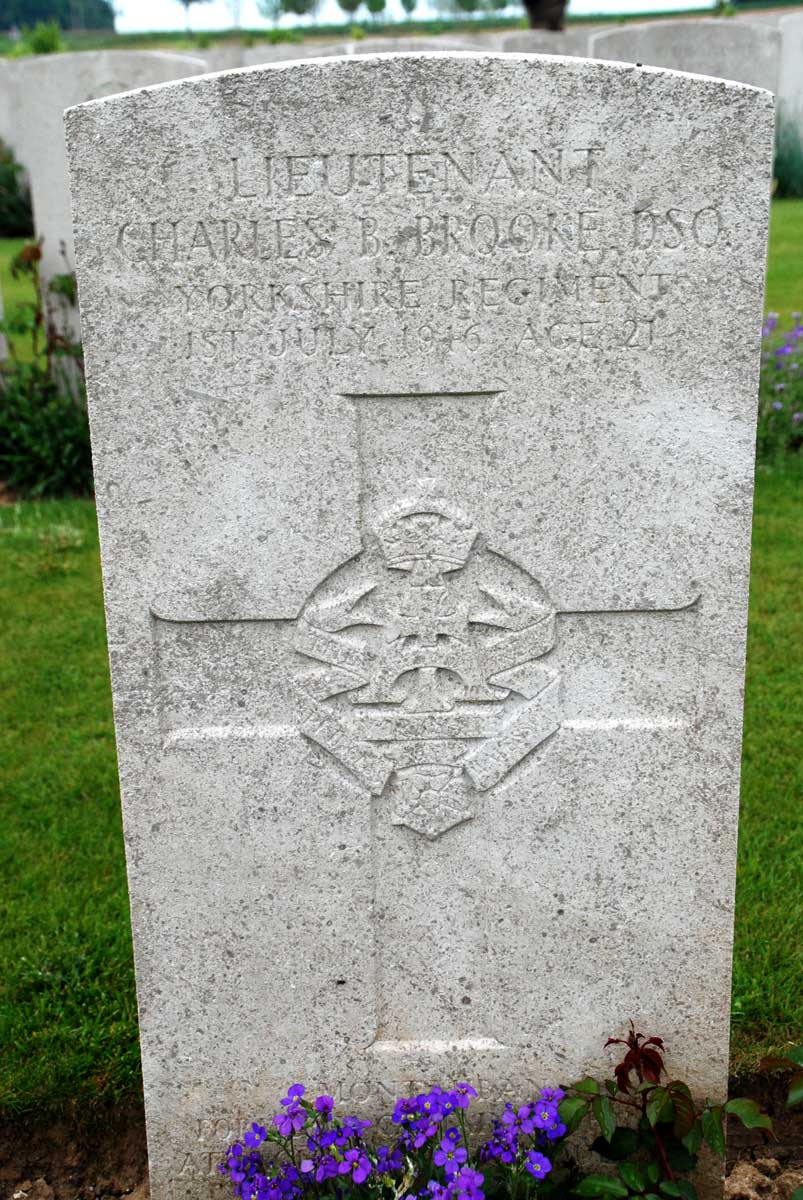
7th March 1895 – Birth……………
This birth date is quoted in the online biography for Charles, as well as one of the family tree links.
The birth of a Charles Berjew Brooke was registered with the Civil Authorities in the District of Samford in Suffolk in the April to June quarter, (Q2), of 1895. Then, as now, you had 42 days after the event to register the birth without facing a fine and a court appearance so a registration in this quarter is not incompatible with the date of birth quoted. Samford District included the Civil Parish of Brantham.
The marriage of his parents, Charles Berjew Brooke and Maud Gwenddolen Buchanan, was recorded in the Islington District of London in the April to June quarter, (Q2), of 1894.
1901 Census of England and Wales
The 6 year old Charles B Brooke, born Brantham, was recorded living at Colne House, Brantham. This was the household of his parents, Charles B., (32, Manager of Brantham Works, British Xyl.Co. Ld., born Liverpool, Lancashire), and Maude G., (26, born Cardiff, Glamorganshire). As well as Charles the couple also have a daughter, Gwenddolen F., (4, born Brantham). Completing the household is father Charles’ unmarried brother in law, Harold G. Buchanan, (22, Superintendent Xyl. Works, born London) and two live in domestic servants.
1911 Census of England and Wales
The 16 year old Charles B. Brooke, born ”Manningtree, Essex”, was recorded as a boarding school student at Bradfield, Reading, Berkshire.
His parents were still recorded living at Colne House, Brantham. Charles Berjew Junior and Mary Gwenddolen Brooke had then been married for 16 years and have had 2 children, both then still alive, but neither was at home. Charles, 42, is recorded as the Xylonite Works manager. Mary was then 38.
His sister Gwenddolen was also at boarding school – in her case at St Felix School, Reydon, Sothwold, Suffolk.
Until September 1911 the quarterly index published by the General Registrars Office did not show information about the mothers maiden name. A check of the General Registrars Office Index of Birth for England and Wales 1911 – 1983 shows no likely additional children of parents Charles and Maud.
Army career…………………………….
The London Gazette dated 8th January 1915 records that on probation Second Lieutenant Charles Berjew Brooke of the 3rd Battalion, The Suffolk Regiment was confirmed in his rank.
www.thegazette.co.uk/London/issue/29035/page/287/data.pdf
1st Queens Battalion War Diary 9th June 1915
Lieut C B Brooke is shown in command of B Coy in place of Lieut W. Nicholas, who was in Hospital.
qrrarchive.websds.net/PDF/QW00119150601.pdf
His promotion to Captain, effective 4th August 1915, appeared in the Supplement to the London Gazette dated Saturday 4 September 1915. Recorded on page 8815, he is shown under the Special Reserve of Officers, Suffolk Regiment.
www.thegazette.co.uk/London/issue/29284/supplement/1
1st Queens Battalion War Diary 25th September 1915
Section B.2. Our leading line advanced at 6.7 a.m. and reached the German 3rd line without great opposition. The attack was evidently a complete surprise.
The Battn. advanced on a frontage of two platoons. D. Coy. (Major BUNBURY) on the right and B. Coy, (Capt. Brooke) on the left. The advance was necessarily slow to keep behind the smoke, B & D Companies reached the German lines and gained touch with the 2/Oxford L.I. and the 2/H L I on the left and right respectively. The Support Company (C Coy) under Captain Weeding held on front line of trenches and, at about 8.15 A M two platoons of this Company reinforced B & D Companies, taking up a supply of Bombs with them, Lieut E D DREW commanded this party.
The Enemy developed a strong bombing attack on both flanks of the Regt., and our men were unable to reply effectively owing to a lack of bombs. About 9.45 a.m. the two and half companies were obliged to fall back into our own lines, under a very heavy machine gun fire from the right flank.
Casualties:- 2Lts A W A BRADSHAW, C D M FOWLER and E I B HOWELL killed & missing, 2 Lt F G PLANT wounded and missing, Major J.K.N. BUNBURY, Capt C B BROOKE, Lieutr H P FOSTER and 2 Lieut R G POYESON-MICES(?) wounded. Other Ranks, 19 Killed, 21 missing believed killed, 138 wounded, 80 Missing and wounded & missing, 7 suffering from gas. 1 died of wounds. Total 265 other ranks.
The remainder of the day was spent in reorganizing the line and in collecting wounded, burying dead etc.
qrrarchive.websds.net/PDF/QW00119150904.pdf
His appointment as Companion of the Distinguished Service Order appears in the Supplement to the London Gazette dated 14th January 1916. He was recorded as The Suffolk Regiment, Special Reserve (attached Royal West Surrey Regiment).
www.thegazette.co.uk/London/issue/29438/supplement/575/da...
The London Gazette dated 18th February 1916 included the notice:-
Alexandra, Princess of Wales’s Own (Yorkshire Regiment).
Captain Charles Berjew Brooke, D.S.O., from The Suffolk Regiment, Special Reserve, to be Second Lieutenant, and to retain his higher rank until ordered to join a Regular unit. Dated 19th February 1916, with seniority from 4th January, 1916, and precedence next above R, de H.M. Bell.
www.thegazette.co.uk/London/issue/29478/page/1812/data.pdf
On the day
Saturday July 1st 1916, Temperature 72°, clear sky
XIII CORPS -CAPTURE OF MONTAUBAN -30th DIVISION
The wire had been cut successfully. The Germans were mostly caught in dugouts, so little resistance was encountered
89th Brigade : starting from four lines of assembly trenches at 7.30 AM ,17th and 20th King's met little resistance and moved on to Casement and Alt Trenches. The 2nd Bedfordshire were in support and mopping-up. The attack pressed on to Dublin Trench. At 8.30 AM the right of the line joined with the French and the left, in the east end of Glatz Redoubt; simultaneously, the 3rd Battalion of the French 153rd Regiment entered Dublin Redoubt at the east of Dublin Trench. The position was consolidated
21st Brigade : The enemy here was also caught in its dugouts so little resistance was encountered
Leading, with 19th Manchesters, 18th King's went forward until they caught up with British barrage at Alt Trench, where they had to wait until the barrage lifted at 7.45 AM , before occupying it. The Manchesters had few losses but the King's were caught by enfilade machine-gun fire from the west side of Railway Valley. Fire from the Warren caused severe casualties among 2nd Green Howards who were in support, and few managed to cross no man's land. A party of Germans came out of a deep dugout and proceeded eastwards but were out-bombed by a party of moppers-up. This enabled 18th King's to advance along Train Alley to Glatz Redoubt, reaching it at 8.35 AM and joining with 89th Brigade
90th Brigade : At 8.30 AM 90th Brigade began its advance on Montauban, passing through 21st Brigade with 16th and 17th Manchesters. The 2nd Royal Scots Fusiliers were in close support. Despite machine-gun fire from Bresleau Alley, they continued their advance, and the German machine-gun was finally wiped out by a Lewis-gun of the 16th Manchesters. Under cover of a smoke-screen, the Manchesters and Royal Scots Fusiliers entered the village of Montauban at 10.05 AM , to find it deserted. By 11 AM the second objective in Montauban Alley was entered. The Germans were pulling back in large numbers. The 16th Manchesters rushed the battery in Caterpillar Valley and captured the first three guns of the battle. Montauban was consolidated.
At 12.30 PM 4th Coy, 20th King's (89th Brigade) attacked La Briqueterie from Dublin Trench under cover of an artillery bombardment
Simultaneously, bombers moved up Nord Alley cutting off the retreat of the garrison. By 12.35 PM La Briqueterie was taken, as were all objectives and the position was consolidated. By 6 PM the road to Maricourt-Montauban had been repaired 200 yards beyond the old German front line
The 30th Division had taken all its objectives
www.bandb-somme-bernafaywood.com/the-great-war/bernafay-w...
There is more on the 30th Divisions’ role here:-
www.longlongtrail.co.uk/battles/battles-of-the-western-fr...
PERONNE ROAD CEMETERY, MARICOURT
Location Information
Maricourt is a village situated on the D938, Albert-Peronne Road, 10.5 kilometres from Albert.
History Information
Maricourt was, at the beginning of the Battles of the Somme 1916, the point of junction of the British and French forces, and within a very short distance of the front line; it was lost in the German advance of March 1918, and recaptured at the end of the following August. The Cemetery, originally known as Maricourt Military Cemetery No.3, was begun by fighting units and Field Ambulances in the Battles of the Somme 1916, and used until August 1917; a few graves were added later in the War, and at the Armistice it consisted of 175 graves which now form almost the whole of Plot I. It was completed after the Armistice by the concentration of graves from the battlefields in the immediate neighbourhood and from certain smaller burial grounds, including:-
BRIQUETERIE EAST CEMETERY, MONTAUBAN, on the East side of the brick-works between Maricourt and Montauban, containing the graves of 46 soldiers from the United Kingdom who fell in the latter half of 1916.
CASEMENT TRENCH CEMETERY, MARICOURT, on the West side of the road to the Briqueterie, in which 163 soldiers from the United Kingdom and one from South Africa were buried in 1916-1918.
FARGNY MILL FRENCH MILITARY CEMETERY, CURLU, on the North bank of the Somme, in which six soldiers from the United Kingdom and two from Australia were buried in 1916-1918.
LA COTE MILITARY CEMETERY, MARICOURT, a little way West of Peronne Road Cemetery, containing the graves of 38 soldiers from the United Kingdom and one from Australia who fell in 1916-1917.
TALUS BOISE BRITISH CEMETERY, CARNOY, between Carnoy and Maricourt, at the South end of a long copse. It was used in the latter half of 1916 and (chiefly by the 5th Royal Berks) in August 1918, and it contained the graves of 175 soldiers from the United Kingdom and five from South Africa.
(Plus other site but whose details indicate none from 1916)
There are now 1348, 1914-18 war casualties commemorated in this site. Of these, 366 are unidentified and special memorials are erected to 26 soldiers from the United Kingdom known or believed to be buried among them. Other special memorials record the names of three soldiers from the United Kingdom, buried in other cemeteries, whose graves could not be found.
CWGC: www.cwgc.org/find-a-cemetery/cemetery/32200/peronne-road-...
As part of the commemoration of the outbreak of the Great War, the Commonwealth War Graves Commission added a number of original documents to their website. One of those on their webpage for Charles Brooke is a Concentration Report. These reports detail an exhumation and move to the current resting place. He was one of at least 10 graves moved from map reference 62c.A.14.b.5.4 into Peronne Road Cemetery. Charles was the only officer – the other nine British soldiers all died in 1918 Someone has written in blue pencil down the side of the report “Maricourt 3/95E”, which might imply they came from either the La Cote Cemetery or Casement Trench Cemetery.
A report prepared for the Commission to take over maintenance of the graves indicates they were at the new location by the start of November 1920.
Postscript………………….
The 1916 Probate Calendar records that Charles Berjew Brooke, of Colne House, Brantham. Suffolk, a Captain 2nd Battalion Yorkshire Regiment D.S.O., died 1 July 1916 in France. Administration of his estate was granted at the Ipswich Court on the 28th August 1916 to Charles Berjew Brooke, (the younger), manager of the British Xylonite company’s Brantham works. His effects were valued at £322 2s 4d.
probatesearch.service.gov.uk/Calendar#calendar
The edition of The Times, dated Monday July 10, 1916 records his death and includes a brief obituary.
CAPTAIN CHARLES BERJEW BROOKE, D.S.O., Yorkshire Regiment, was the only son of Mr. and Mrs. C.B. Brooke, jun. of Colne House, Brantham, Suffolk, and was 21 years of age. He was educated at Belton Grange, near Rugby, and Bradfield College. He was gazetted to the 3rd Suffolk Regiment on the outbreak of war, and was sent to France, attached to the 1st Queen’s, in December 1914, and rose to the rank of captain. He was seriously wounded while leading his company in the attack on September 25, 1915, and was mentioned in dispatches and awarded the D.S.O. In January 1916 he was chosen for a commission in the Regular Army, and was gazetted to the Yorkshire Regiment. He was killed on July 1st “while leading his company into action in this recent attack”.
The Births, Marriages and Deaths announcement in the Western Mail on the following included a note on the death of Charles “On Active Service”.
BROOKE.- On July 1st, in France, Charles Berjew Brooke, D.S.O., Second-lieutenant, Princess of Wales’ Own Yorkshire Regiment, aged 21, only son of Mr. and Mrs. Charles B. Brooke Junr., of Colne House, Brantham, Suffolk, and nephew of Mrs. C.H. Bailey, Stelvio, Newport, Mon.
That final letter was printed in full in the editions of The Surrey Advertiser, dated Saturday, July 22nd 1916 and Monday, July 24, 1916, under the heading Former Queen’s Officer Letter. It is noted that there are many in The Queens who will remember Captain Brooke, and “many others who will find consolation in the letter”. On the same page in the Officers Killed section, as well as his name appearing in the list there is also a few lines about him.
Lieut. and Temp. Capt. Brooke, D.S.O., Yorkshire Regiment, who was killed in action on July 1st, was attached to a battalion of The Queens from December 1914, until he was wounded on September 25th 1915. He was the only son of Mr. and Mrs. C.B. Brooke, Colne House, Brantham, Suffolk, and was 22. His colonel writes: “As soon as he joined us we recognised him as a born leader of men, and I at once put him in command of a company. He was leading it to the assault when he was shot.”
Richard Gere is sad and disappointed because he waited all the day for the snow and ........nothing else..... just 1cm high :-(
+ 1 photo in comments
Each review of Jacob’s story leaves me amazed at his seeming inability to shape up, clean up, and stand up for everything decent and moral. He tricked and was tricked. His name was changed, but his heart seemed less so. Why couldn’t God replace him with someone more polished, more refined?
Yet, on the other hand, I’m so grateful God didn’t. I’ve wrestled with God, daring to think my might and muscles would impress him. I can be smarmy, wormy, and less than straightforward. I identify with Jacob – I limp.
Jacob’s story exists for the times that the Jacob within us wonders, “Can God use a person like me?” The reassuring and resounding answer is “Yes.”
Pure grace. Grace is God’s greatest idea. That he would treat us according to his heart and not ours. Amazing grace!
Read more God Never Gives Up on You
Max Lucado
Lago Grey, Torres del Paine National Park, Patagonia, Chile.
All rights reserved - Copyright © Waldemar Halka
Nikon D7000
Nikkor AF-S 24-120mm f/4G VR
Nikon CPL and Singh-Ray 0.6 Grad ND filters.
The Grandfather clock purchased for my father. It is something I will one day own, and every time I visit my mother, I stop and look at it and feel time passing.
It is only because the shifting sand has buried all the other smaller rocks leaving the tip of a giant as a reminder of the colossus beneath
One of the lecterns inside the church has a brass plaque embedded.
To the Glory of God and in loving memory of
CHARLES BERJEW BROOKE b.1868 d.1951 and of his wife
MAUD GWENDDOLEN BROOKE b.1872 d.1944 and of their son
CAPT. CHARLES BERJEW BROOKE D.S.O. b.1895 killed in action 1916
The memorial was given by the daughter of Charles Brooke (the father) in 1951.
www.iwm.org.uk/memorials/item/memorial/4326
BROOKE, CHARLES BERJEW
Rank:……………………………Lieutenant
Date of Death:…………….01/07/1916
Age:……………………………..21
Regiment:…………………….Yorkshire Regiment
formerly Suffolk Regt. (Special Reserve), (formerly attd. 1st Bn.) The Queen's (Royal West Surrey Regiment)
Awards:………………………..D S O
Grave Reference:…………IV. H. 7.
Cemetery:…………………….PERONNE ROAD CEMETERY, MARICOURT
Additional Information:
Son of Charles Berjew Brooke and Maud Gwenddolen Brooke, of Colne House, Brantham, Suffolk.
CWGC: www.cwgc.org/find-war-dead/casualty/310713/BROOKE,%20CHAR...
There is no obvious match for Charles in the Soldiers Died in the Great War database – the nearest match is a Cecil Berjew Brooke, a 2nd Lieutenant of the Alexandra Regiment, Battalion Not Shown, who was Killed in Action on the 1st July 1916. As with all Officers, no place of birth or residence is shown.
(Note – references to Alexandra Regiment, Princess of Wales Own and Green Howards are all alternative names for the Yorkshire Regiment).
The Medal Index Card for Second Lieutenant Charles “Beyent” Brooke, Yorkshire Regiment, is held at the National Archive under reference WO 372/3/89092 . He had originally been a Second Lieutenant in the Suffolk Regiment before becoming a Captain during his attachment from the Suffolks to the Royal West Surrey Regiment. He reverted to his former rank on joining the Yorkshire Regiment.
discovery.nationalarchives.gov.uk/details/r/D1503930
The Service Record for 2nd Lieutenant Charles Berjen Brooke, The Suffolk Regiment, are held at the National Archive under reference WO 339/16364
discovery.nationalarchives.gov.uk/details/r/C1070291
Most of any research I could do on this man has already been done – his father collected his letters home and had them privately published as “Letters from the boy”. The last one, dated 30th June 1916, ends:-
It is impossible to fear death out here when one is no longer an individual but a member of a regiment and of an army. To be killed means nothing to me, and it is only you who will suffer for it. You really pay the cost. I have been looking at the stars and thinking what an immense distance they are away! What an insignificant thing the loss of say forty years of life is compared with them. It seems scarcely worth talking about.
Well, good-bye you darlings. Try not to worry about it, and remember that we shall meet again, really quite soon. This letter is going to be posted if -----
Lots of love,
From your loving son Carl.
The same website source adds:-
Charles Berjew Brooke was born on the 7th March 1895 at Colne House, Brantham on River Stour, Suffolk, the only son of Mr Charles Berjew Brooke, an industrialist who manufactured "xylonite", i.e. celluloid. To avoid confusion, the younger Charles was known in the family as "Carl". He had a connection with Wales, because his mother Gwenddolen was the sister of Mrs Gertrude Bailey of "Stelvio" Newport, a lady prominent in her own right, and married to Mr Charles Henry Bailey of the Tyne Engine Works at Newport and Barry.
Carl was educated at Colchester Grammar School, followed by a preparatory school, Bilton Grange near,Rugby, and Bradfield College, Berks. He was interested in becoming a soldier from an early age, an interest stimulated by living near to the military town of Colchester, but a bout of diphtheria prevented him from taking part in strenuous exercise. Instead, to his great joy, he was taught rifle shooting , and was sent to represent the school at Bisley. He was allowed to join the college O.T.C., and awarded his certificate "A" in 1911, with extra marks for originality, and he left on the 31st of July 1913 with the rank of Colour Sergeant.
Carl must have had a flair for languages, as well as science, because he continued his education by studying chemistry in Berlin. Here he eagerly read as many German military books as he could find, including the German Field Service Book, as he intended to sit for the Army Interpreters’ Examination. He thought that every man should be trained, as he was sure that Germany intended to go to war against Britain, and at the end of July 1914, 6 days before war broke out between Britain and Germany, he returned home.
On his return, he applied for a commission in the Suffolk Special Reserve. To his disappointment, he was posted to 3rd Bn Norfolk Reg. in August 1914, but soon transferred to 3rd. Bn. Suffolk Reg. On Sept. 4th he was appointed a temporary Capt., dating from August 14th.
During his training he was marked top out of about thirty who joined with him. He was not to stay with them for long because in December he was attached to the 1st Bn The Queen’s (Royal West Surrey’s) and with 200 other reinforcements was sent out to France to replace the heavy losses they had suffered. In his letters home he described how well behaved his men were when they arrived in France, but he observed, rather wryly, that it could have been because they hadn’t been paid for a fortnight. He also commented on the wild Welsh and Scots who jumped out of the train at every halt and then raced after the train and got in anywhere, causing a lot of trouble and necessitating an "all change" at the next stop.
During his time at the Front he was able to make good use of his German, and he seems to have enjoyed his conversations with the prisoners who were brought in. He was also quite taken with their helmets, but felt that "it would hardly have been polite to bag the poor men’s hats". He also used his time to improve his French, and says that he has a good grasp of "Frenglish". He wrote home quite regularly, with detailed descriptions of life in the trenches. He made light of the fact that he had been shelled quite frequently, describing the sound as being like "water poured into a big jug from a tap"
In June, the War Office wrote to his Colonel asking whether he would recommend Lt. Brooke for a full Captaincy, but the Col. Replied that he had "Not enough service". The London Gazette for Sept. 4th.1915 records: Suffolk Regiment – Lieutenant to be Captain Charles B. Brooke, dating from August 14th, 1915.
On the morning of 25th Sept.1915, he was in action with the 1st Bn. The Queen’s at La Bassee, near Givenchy. All the other officers of B and D companies were killed, leaving him in command of the two companies, as well as some men from the H.L.I. and Oxford L.I. as they rushed the German trenches.
Encouraged by the 19 year old officer, they used up all their supply of bombs as well as those of the Germans before being driven back. Although wounded, Carl was the last to leave the trench, and it was reported that before leaving, he emptied his revolver at the advancing Germans, then threw the empty gun at a German officer, knocking him over.
He was wounded twice, once in the face which tore his cheek and mouth and knocked out two teeth and a serious chest wound, which fortunately, did not damage his lungs. He was admitted to 3rd. General Hospital at Le Treport.
On October 1st, he was sent to Alexandra Hospital for Officers, Millfield Lane, Highgate, London. In January 1916, he was mentioned in despatches, and on 14th he was awarded a D.S.O. for this action. The staff and works people from the village made a presentation to him for bringing honour to the village. His response was typically modest, he said "I was one of the lucky ones. Of course, I am glad to have won the D.S.O., but I want you to think of all those men who will not get anything, and who have deserved a decoration over and over again". He was invited to transfer to the Queen’s, and would have been happy to serve with them as a Lieutenant, but the Army had other plans.
In Feb. 1916 he was chosen for a commission in the Regular Army but it was in the Yorkshire Regiment, (The Green Howards’).Capt. Charles B. Brooke, D.S.O. was to be Sec. Lt., but to retain his higher rank until he joined a Regular Unit. In April 1916 he was sent to the 2nd. Battalion, which was serving with the 30th. division in France. He soon settled down to trench work, saying that his men were the best in the battalion, good at "sticking things" and "quite equal to the Queen’s". He said "I wouldn’t be pushed out of this regiment now". He was offered the chance of being trained as a staff officer, but said that he did not think he would be a success at it.
On the 1st July 1916, the 30th Division was to take Montauban. At 7.30a.m. the battalion was in Headquarters Avenue Trench with a battle strength of 24 officers and 688 other ranks who were to be responsible for occupying and consolidating the German front and support lines once they had been captured.
Carl was in command of "A" company, as it, advanced with "B" company under heavy machine gun fire, followed shortly by "C" and "D". Brooke was mortally wounded in the stomach, remaining alive just long enough for the stretcher bearers to reach the medical officer. His servant, Pte. Readman, reported his death, and that he had been buried at Bois de Talus Cemetery, near Carnoy. Lt.Col. Walter F. Young, commanding 2nd. Yorkshire Regiment wrote movingly of Carl as "a great favourite with all of us", and tried to reassure the family that he had not seemed to be in pain from his wound, and had been able to speak to the doctor before he died, as well as telling the stretcher bearers that it was hard lines being hit in the stomach. Col. Young said that he was most grieved at his loss, but had died as "he would have liked to do". He wrote to Carl’s mother, saying that he felt his loss more than that of any other officer, calling him "the cheeriest and best of good fellows", and describing their mutual enthusiasm for the works of Rudyard Kipling.
On July 3rd 1916, it was announced that 2nd. Lt. C.B. Brooke, D.S.O., was to be Temp. Capt. In Yorkshire Regiment, dated from May 16th. 1916.
www.powell76.talktalk.net/Brooke.htm
www.facebook.com/RoyalAnglianRegMuseum/posts/887556941356589
That final letter was sold at auction in November 2016
www.bristolauctionrooms.co.uk/135-lot-46-July-1st-1916-Ca...
That wasn’t all there was to remember his last hours by.
He was commissioned into 3rd Suffolk in 1914, having been born and raised in Brantham, near Manningtree. He had been wounded badly whilst winning his DSO in early 1916, and we heard of how even after emptying every chamber of his pistol into the advancing enemy, he then hurled his revolver at one of them, knocking him over! After his death on 1st July, his family published the letters he wrote home in a small memorial volume entitled “Letters from The Boy.” It was said that for many years his blood-stained and battered tunic hung in a frame in the hallway of his parents home.
www.friendsofthesuffolkregiment.org/2016-battlefield-tour...
A picture of Charles can be seen as one of the responses on page 1 of this forum query.
1914-1918.invisionzone.com/forums/topic/8032-officers-die...
The Imperial War Museum holds a copy of “Letters from the boy.”
www.iwm.org.uk/collections/item/object/1500034743
Family History websites
www.thosebefore.com/g1/p1386.htm
www.brooksfamilyhistory.co.uk/media/ONS%20-%20CWGC%20upda...
His headstone can be seen here:-
www.ww1-yorkshires.org.uk/jpg-files/overseas-cemeteries/p...
7th March 1895 – Birth……………
This birth date is quoted in the online biography for Charles, as well as one of the family tree links.
The birth of a Charles Berjew Brooke was registered with the Civil Authorities in the District of Samford in Suffolk in the April to June quarter, (Q2), of 1895. Then, as now, you had 42 days after the event to register the birth without facing a fine and a court appearance so a registration in this quarter is not incompatible with the date of birth quoted. Samford District included the Civil Parish of Brantham.
The marriage of his parents, Charles Berjew Brooke and Maud Gwenddolen Buchanan, was recorded in the Islington District of London in the April to June quarter, (Q2), of 1894.
1901 Census of England and Wales
The 6 year old Charles B Brooke, born Brantham, was recorded living at Colne House, Brantham. This was the household of his parents, Charles B., (32, Manager of Brantham Works, British Xyl.Co. Ld., born Liverpool, Lancashire), and Maude G., (26, born Cardiff, Glamorganshire). As well as Charles the couple also have a daughter, Gwenddolen F., (4, born Brantham). Completing the household is father Charles’ unmarried brother in law, Harold G. Buchanan, (22, Superintendent Xyl. Works, born London) and two live in domestic servants.
1911 Census of England and Wales
The 16 year old Charles B. Brooke, born ”Manningtree, Essex”, was recorded as a boarding school student at Bradfield, Reading, Berkshire.
His parents were still recorded living at Colne House, Brantham. Charles Berjew Junior and Mary Gwenddolen Brooke had then been married for 16 years and have had 2 children, both then still alive, but neither was at home. Charles, 42, is recorded as the Xylonite Works manager. Mary was then 38.
His sister Gwenddolen was also at boarding school – in her case at St Felix School, Reydon, Sothwold, Suffolk.
Until September 1911 the quarterly index published by the General Registrars Office did not show information about the mothers maiden name. A check of the General Registrars Office Index of Birth for England and Wales 1911 – 1983 shows no likely additional children of parents Charles and Maud.
Army career…………………………….
The London Gazette dated 8th January 1915 records that on probation Second Lieutenant Charles Berjew Brooke of the 3rd Battalion, The Suffolk Regiment was confirmed in his rank.
www.thegazette.co.uk/London/issue/29035/page/287/data.pdf
1st Queens Battalion War Diary 9th June 1915
Lieut C B Brooke is shown in command of B Coy in place of Lieut W. Nicholas, who was in Hospital.
qrrarchive.websds.net/PDF/QW00119150601.pdf
His promotion to Captain, effective 4th August 1915, appeared in the Supplement to the London Gazette dated Saturday 4 September 1915. Recorded on page 8815, he is shown under the Special Reserve of Officers, Suffolk Regiment.
www.thegazette.co.uk/London/issue/29284/supplement/1
1st Queens Battalion War Diary 25th September 1915
Section B.2. Our leading line advanced at 6.7 a.m. and reached the German 3rd line without great opposition. The attack was evidently a complete surprise.
The Battn. advanced on a frontage of two platoons. D. Coy. (Major BUNBURY) on the right and B. Coy, (Capt. Brooke) on the left. The advance was necessarily slow to keep behind the smoke, B & D Companies reached the German lines and gained touch with the 2/Oxford L.I. and the 2/H L I on the left and right respectively. The Support Company (C Coy) under Captain Weeding held on front line of trenches and, at about 8.15 A M two platoons of this Company reinforced B & D Companies, taking up a supply of Bombs with them, Lieut E D DREW commanded this party.
The Enemy developed a strong bombing attack on both flanks of the Regt., and our men were unable to reply effectively owing to a lack of bombs. About 9.45 a.m. the two and half companies were obliged to fall back into our own lines, under a very heavy machine gun fire from the right flank.
Casualties:- 2Lts A W A BRADSHAW, C D M FOWLER and E I B HOWELL killed & missing, 2 Lt F G PLANT wounded and missing, Major J.K.N. BUNBURY, Capt C B BROOKE, Lieutr H P FOSTER and 2 Lieut R G POYESON-MICES(?) wounded. Other Ranks, 19 Killed, 21 missing believed killed, 138 wounded, 80 Missing and wounded & missing, 7 suffering from gas. 1 died of wounds. Total 265 other ranks.
The remainder of the day was spent in reorganizing the line and in collecting wounded, burying dead etc.
qrrarchive.websds.net/PDF/QW00119150904.pdf
His appointment as Companion of the Distinguished Service Order appears in the Supplement to the London Gazette dated 14th January 1916. He was recorded as The Suffolk Regiment, Special Reserve (attached Royal West Surrey Regiment).
www.thegazette.co.uk/London/issue/29438/supplement/575/da...
The London Gazette dated 18th February 1916 included the notice:-
Alexandra, Princess of Wales’s Own (Yorkshire Regiment).
Captain Charles Berjew Brooke, D.S.O., from The Suffolk Regiment, Special Reserve, to be Second Lieutenant, and to retain his higher rank until ordered to join a Regular unit. Dated 19th February 1916, with seniority from 4th January, 1916, and precedence next above R, de H.M. Bell.
www.thegazette.co.uk/London/issue/29478/page/1812/data.pdf
On the day
Saturday July 1st 1916, Temperature 72°, clear sky
XIII CORPS -CAPTURE OF MONTAUBAN -30th DIVISION
The wire had been cut successfully. The Germans were mostly caught in dugouts, so little resistance was encountered
89th Brigade : starting from four lines of assembly trenches at 7.30 AM ,17th and 20th King's met little resistance and moved on to Casement and Alt Trenches. The 2nd Bedfordshire were in support and mopping-up. The attack pressed on to Dublin Trench. At 8.30 AM the right of the line joined with the French and the left, in the east end of Glatz Redoubt; simultaneously, the 3rd Battalion of the French 153rd Regiment entered Dublin Redoubt at the east of Dublin Trench. The position was consolidated
21st Brigade : The enemy here was also caught in its dugouts so little resistance was encountered
Leading, with 19th Manchesters, 18th King's went forward until they caught up with British barrage at Alt Trench, where they had to wait until the barrage lifted at 7.45 AM , before occupying it. The Manchesters had few losses but the King's were caught by enfilade machine-gun fire from the west side of Railway Valley. Fire from the Warren caused severe casualties among 2nd Green Howards who were in support, and few managed to cross no man's land. A party of Germans came out of a deep dugout and proceeded eastwards but were out-bombed by a party of moppers-up. This enabled 18th King's to advance along Train Alley to Glatz Redoubt, reaching it at 8.35 AM and joining with 89th Brigade
90th Brigade : At 8.30 AM 90th Brigade began its advance on Montauban, passing through 21st Brigade with 16th and 17th Manchesters. The 2nd Royal Scots Fusiliers were in close support. Despite machine-gun fire from Bresleau Alley, they continued their advance, and the German machine-gun was finally wiped out by a Lewis-gun of the 16th Manchesters. Under cover of a smoke-screen, the Manchesters and Royal Scots Fusiliers entered the village of Montauban at 10.05 AM , to find it deserted. By 11 AM the second objective in Montauban Alley was entered. The Germans were pulling back in large numbers. The 16th Manchesters rushed the battery in Caterpillar Valley and captured the first three guns of the battle. Montauban was consolidated.
At 12.30 PM 4th Coy, 20th King's (89th Brigade) attacked La Briqueterie from Dublin Trench under cover of an artillery bombardment
Simultaneously, bombers moved up Nord Alley cutting off the retreat of the garrison. By 12.35 PM La Briqueterie was taken, as were all objectives and the position was consolidated. By 6 PM the road to Maricourt-Montauban had been repaired 200 yards beyond the old German front line
The 30th Division had taken all its objectives
www.bandb-somme-bernafaywood.com/the-great-war/bernafay-w...
There is more on the 30th Divisions’ role here:-
www.longlongtrail.co.uk/battles/battles-of-the-western-fr...
PERONNE ROAD CEMETERY, MARICOURT
Location Information
Maricourt is a village situated on the D938, Albert-Peronne Road, 10.5 kilometres from Albert.
History Information
Maricourt was, at the beginning of the Battles of the Somme 1916, the point of junction of the British and French forces, and within a very short distance of the front line; it was lost in the German advance of March 1918, and recaptured at the end of the following August. The Cemetery, originally known as Maricourt Military Cemetery No.3, was begun by fighting units and Field Ambulances in the Battles of the Somme 1916, and used until August 1917; a few graves were added later in the War, and at the Armistice it consisted of 175 graves which now form almost the whole of Plot I. It was completed after the Armistice by the concentration of graves from the battlefields in the immediate neighbourhood and from certain smaller burial grounds, including:-
BRIQUETERIE EAST CEMETERY, MONTAUBAN, on the East side of the brick-works between Maricourt and Montauban, containing the graves of 46 soldiers from the United Kingdom who fell in the latter half of 1916.
CASEMENT TRENCH CEMETERY, MARICOURT, on the West side of the road to the Briqueterie, in which 163 soldiers from the United Kingdom and one from South Africa were buried in 1916-1918.
FARGNY MILL FRENCH MILITARY CEMETERY, CURLU, on the North bank of the Somme, in which six soldiers from the United Kingdom and two from Australia were buried in 1916-1918.
LA COTE MILITARY CEMETERY, MARICOURT, a little way West of Peronne Road Cemetery, containing the graves of 38 soldiers from the United Kingdom and one from Australia who fell in 1916-1917.
TALUS BOISE BRITISH CEMETERY, CARNOY, between Carnoy and Maricourt, at the South end of a long copse. It was used in the latter half of 1916 and (chiefly by the 5th Royal Berks) in August 1918, and it contained the graves of 175 soldiers from the United Kingdom and five from South Africa.
(Plus other site but whose details indicate none from 1916)
There are now 1348, 1914-18 war casualties commemorated in this site. Of these, 366 are unidentified and special memorials are erected to 26 soldiers from the United Kingdom known or believed to be buried among them. Other special memorials record the names of three soldiers from the United Kingdom, buried in other cemeteries, whose graves could not be found.
CWGC: www.cwgc.org/find-a-cemetery/cemetery/32200/peronne-road-...
As part of the commemoration of the outbreak of the Great War, the Commonwealth War Graves Commission added a number of original documents to their website. One of those on their webpage for Charles Brooke is a Concentration Report. These reports detail an exhumation and move to the current resting place. He was one of at least 10 graves moved from map reference 62c.A.14.b.5.4 into Peronne Road Cemetery. Charles was the only officer – the other nine British soldiers all died in 1918 Someone has written in blue pencil down the side of the report “Maricourt 3/95E”, which might imply they came from either the La Cote Cemetery or Casement Trench Cemetery.
A report prepared for the Commission to take over maintenance of the graves indicates they were at the new location by the start of November 1920.
Postscript………………….
The 1916 Probate Calendar records that Charles Berjew Brooke, of Colne House, Brantham. Suffolk, a Captain 2nd Battalion Yorkshire Regiment D.S.O., died 1 July 1916 in France. Administration of his estate was granted at the Ipswich Court on the 28th August 1916 to Charles Berjew Brooke, (the younger), manager of the British Xylonite company’s Brantham works. His effects were valued at £322 2s 4d.
probatesearch.service.gov.uk/Calendar#calendar
The edition of The Times, dated Monday July 10, 1916 records his death and includes a brief obituary.
CAPTAIN CHARLES BERJEW BROOKE, D.S.O., Yorkshire Regiment, was the only son of Mr. and Mrs. C.B. Brooke, jun. of Colne House, Brantham, Suffolk, and was 21 years of age. He was educated at Belton Grange, near Rugby, and Bradfield College. He was gazetted to the 3rd Suffolk Regiment on the outbreak of war, and was sent to France, attached to the 1st Queen’s, in December 1914, and rose to the rank of captain. He was seriously wounded while leading his company in the attack on September 25, 1915, and was mentioned in dispatches and awarded the D.S.O. In January 1916 he was chosen for a commission in the Regular Army, and was gazetted to the Yorkshire Regiment. He was killed on July 1st “while leading his company into action in this recent attack”.
The Births, Marriages and Deaths announcement in the Western Mail on the following included a note on the death of Charles “On Active Service”.
BROOKE.- On July 1st, in France, Charles Berjew Brooke, D.S.O., Second-lieutenant, Princess of Wales’ Own Yorkshire Regiment, aged 21, only son of Mr. and Mrs. Charles B. Brooke Junr., of Colne House, Brantham, Suffolk, and nephew of Mrs. C.H. Bailey, Stelvio, Newport, Mon.
That final letter was printed in full in the editions of The Surrey Advertiser, dated Saturday, July 22nd 1916 and Monday, July 24, 1916, under the heading Former Queen’s Officer Letter. It is noted that there are many in The Queens who will remember Captain Brooke, and “many others who will find consolation in the letter”. On the same page in the Officers Killed section, as well as his name appearing in the list there is also a few lines about him.
Lieut. and Temp. Capt. Brooke, D.S.O., Yorkshire Regiment, who was killed in action on July 1st, was attached to a battalion of The Queens from December 1914, until he was wounded on September 25th 1915. He was the only son of Mr. and Mrs. C.B. Brooke, Colne House, Brantham, Suffolk, and was 22. His colonel writes: “As soon as he joined us we recognised him as a born leader of men, and I at once put him in command of a company. He was leading it to the assault when he was shot.”
For more on the church of St Michael Archangel, Brantham, see
St Peter, Neatishead, Norfolk
Here we are in the gently rolling fields and woods to the west of Barton Broad, a gentle patchwork of small hamlets sprawling towards Hoveton. This area of Broadland is not touristy at all, but intensely agricultural, which is perhaps surprising given its proximity to Wroxham. But there is a feeling of remoteness. Neatishead is pretty much in the middle of nowhere, a large parish with several settlements and in one of them, Three Hammer Common, you find the church. At first sight this is a relatively insignificant little building set back from the road at the end of a long avenue of pollarded trees. However, the more you look at it the more interesting it gets, for what you see today is in fact merely the surviving chancel of what was once a vast church, stretching back as far as the road.
The church was probably the work of the 14th Century, and the surviving remnant was patched up in the 1790s. The tower had come down about a century earlier, and perhaps this was what damaged the nave beyond repair, although of course the change from an emphasis on private devotional worship to public congregational worship at the Reformation meant that parishes with a small population had no longer any need of a huge church, and there are many examples in East Anglia of aisles being demolished to make the nave smaller, and a couple of examples in Suffolk of the nave being demolished leaving only the chancel for worship, which is effectively what has happened here. No traces remain at all of the ruins.
Because of the date, the reimagining of the church was done with a preaching house rather than a sacramental building in mind. The entrance at the west end is simple and apparently old. Pevsner thought it might be a reuse of the original west doorway, but it is just as likely to have been a former south or north aisle entrance. Above it was reset a strange relief that is presumably the side of a former memorial tombchest. It serves no purpose and probably they did it just because it looked grand.
Inside, the overwhelming sense is of a well-kept, well-loved building. A watery light plays across dark wood and the font, a trim traceried work of the 14th Century which survives from the medieval church. Some of the woodwork also survives from the earlier church, including a 16th century pulpit and, most memorably, an unusual 15th Century bench end of what appears to be a gryphon holding a bearded head in its beak, probably a reference to St John the Baptist.
There are several glimpses of the life of Neatishead a century ago. A rare surviving Girls Friendly Society banner hangs at the west end. This Anglican society began in the years before the First World War to care for girls away from home in service. Surprisingly, it still survives today in a different form, working with girls in deprived areas. And the church has no less than three separate memorials to young men killed in the First World War. They were all in their mid-twenties.
Modern cars can do over 100,000 miles without pausing for breath. If you really pile on the miles, you might have 200,000 or even 300,000 miles on the clock. If the car Gods are really shining on you, you might have managed more than half a million.
Prepare to feel insignificant. Irv Gordon from East Patchogue, New York, together with his Volvo P1800, a 1966 1800S, has completed over three million miles--a new world record for the highest number of miles driven by a single person in the same car. If you're after an arbitrary comparison to offer some perspective, that's around six round-trips to the moon, or 120 circumnavigations of Earth.
Gordon hit the three million miles mark on September 18 while driving near the village of Girdwood, on the Seward Highway, south of Anchorage, Alaska; one of the two remaining states where Irv and his famous car had not been together until now.
”It was all rather undramatic,” said Irv. ”We just cruised along and I kept an eye on the odometer in order not to miss the great moment”.
Gordon first bought his 1800S on a Friday back in 1966 and immediately fell in love. He simply couldn't stop driving the car and over the course of the weekend he had already covered 1,500 miles, causing him to return to the dealership he bought it the following Monday in order for its first service.
With a 125-mile round-trip daily commute, a fanatical dedication to vehicle maintenance and a passion for driving, Gordon logged 500,000 miles in 10 years. In 1987, he celebrated his one-millionth mile by driving a loop around the Tavern on the Green in Central Park, and in 2002 he drove the car's two-millionth mile down Times Square. Since then, Gordon has broken his record every time he gets behind the wheel of his beloved Volvo.
[Text from MotorAuthority]
www.motorauthority.com/news/1087353_irv-gordon-reaches-3-...
History
The project was started in 1957 because Volvo wanted a sports car, despite the fact that their previous attempt, the P1900, had been a disaster, with only 68 cars sold. The man behind the project was an engineering consultant to Volvo, Helmer Petterson, who in the 1940s was responsible for the Volvo PV444. The design work was done by Helmer's son Pelle Petterson, who worked at Pietro Frua at that time. Volvo insisted it was an Italian design by Frua and only officially recognized that Pelle Petterson designed it in 2009. The Italian Carrozzeria Pietro Frua design firm (then a recently acquired subsidiary of Ghia) built the first three prototypes between September 1957 and early 1958, later designated by Volvo in September 1958: P958-X1, P958-X2 and P958-X3 (P:Project 9:September 58:Year 1958 = P958).
In December 1957 Helmer Petterson drove X1, (the first hand-built P1800 prototype) to Osnabrück, West Germany, headquarters of Karmann. Petterson hoped that Karmann would be able to take on the tooling and building of the P1800. Karmann's engineers had already been preparing working drawings from the wooden styling buck at Frua. Petterson and Volvo chief engineer Thor Berthelius met there, tested the car and discussed the construction with Karmann. They were ready to build it and this meant that the first cars could hit the market as early as December 1958. But in February, Karmann's most important customer, Volkswagen VAG, forbade Karmann to take on the job.[citation needed] They feared that the P1800 would compete with the sales of their own cars, and threatened to cancel all their contracts with Karmann if they took on this car. This setback almost caused the project to be abandoned.
Other German firms, NSU, Drautz and Hanomag, were contacted but none was chosen because Volvo did not believe they met Volvo's manufacturing quality-control standards.
It began to appear that Volvo might never produce the P1800. This motivated Helmer Petterson to obtain financial backing from two financial firms with the intention of buying the components directly from Volvo and marketing the car himself. At this point Volvo had made no mention of the P1800 and the factory would not comment. Then a press release surfaced with a photo of the car, putting Volvo in a position where they had to acknowledge its existence. These events influenced the company to renew its efforts: the car was presented to the public for the first time at the Brussels Motor Show in January 1960 and Volvo turned to Jensen Motors, whose production lines were under-utilised, and they agreed a contract for 10,000 cars. The Linwood, Scotland, body plant of manufacturer Pressed Steel was in turn sub-contracted by Jensen to create the unibody shells, which were then taken by rail to be assembled at Jensen in West Bromwich, England. In September 1960, the first production P1800 (for the 1961 model year) left Jensen for an eager public.
P1800
The engine was the B18 (B for the Swedish word for gasoline: Bensin; 18 for 1800 cc displacement) with dual SU carburettors, producing 100 hp (75 kW). This variant (named B18B) had a higher compression ratio than the slightly less powerful twin-carb B18D used in the contemporary Amazon 122S, as well as a different camshaft. The 'new' B18 was actually developed from the existing B36 V8 engine used in Volvo trucks at the time. This cut production costs, as well as furnishing the P1800 with a strong engine boasting five main crankshaft bearings. The B18 was matched with the new and more robust M40 manual gearbox through 1963. From 1963 to 1972 the M41 gearbox with electrically actuated overdrive was a popular option. Two overdrive types were used, the D-Type through 1969, and the J-type through 1973. The J-type had a slightly shorter ratio of 0.797:1 as opposed to 0.756:1 for the D-type. The overdrive effectively gave the 1800 series a fifth gear, for improved fuel efficiency and decreased drivetrain wear. Cars without overdrive had a numerically lower-ratio differential, which had the interesting effect of giving them a somewhat higher top speed (just under 120 mph (193 km/h)) than the more popular overdrive models. This was because the non-overdrive cars could reach the engine's redline in top gear, while the overdrive-equipped cars could not, giving them a top speed of roughly 110 mph (177 km/h).
1800S
As time progressed, Jensen had problems with quality control, so the contract was ended early at 6,000 cars. In 1963 production was moved to Volvo's Lundby Plant in Gothenburg and the car's name was changed to 1800S (S standing for Sverige, or in English : Sweden). The engine was improved with an additional 8 hp (6 kW). In 1966 the four-cylinder engine was updated to 115 hp (86 kW). Top speed was 175 km/h (109 mph).[3] In 1969 the B18 engine was replaced with the 2-litre B20B variant of the B20 giving 118 bhp (89 kW), though it kept the designation 1800S.
[Text from Wikipedia]
This Lego miniland-scale Volvo P1800 Coupe has been created for Flickr LUGNut's 88th Build Challenge, - "Let's Break Some Records", - a challenge focused on creating vehicles that set some benchmark for biggness, fastness or other extreme of some specification. The Volvo model shown here claim, by far, the farthermost distance ever traveled by an automobile, at over 3,000,000 miles (4,800,00 kilometres).
Varanasi, also known as Benares, or Kashi is an Indian city on the banks of the Ganga in Uttar Pradesh, 320 kilometres south-east of the state capital, Lucknow. It is the holiest of the seven sacred cities (Sapta Puri) in Hinduism, and Jainism, and played an important role in the development of Buddhism. Some Hindus believe that death at Varanasi brings salvation. It is one of the oldest continuously inhabited cities in the world. Varanasi is also known as the favourite city of the Hindu deity Lord Shiva as it has been mentioned in the Rigveda that this city in older times was known as Kashi or "Shiv ki Nagri".
The Kashi Naresh (Maharaja of Kashi) is the chief cultural patron of Varanasi, and an essential part of all religious celebrations. The culture of Varanasi is closely associated with the Ganges. The city has been a cultural centre of North India for several thousand years, and has a history that is older than most of the major world religions. The Benares Gharana form of Hindustani classical music was developed in Varanasi, and many prominent Indian philosophers, poets, writers, and musicians live or have lived in Varanasi. Gautama Buddha gave his first sermon at Sarnath, located near Varanasi.
Varanasi is the spiritual capital of India. It is often referred to as "the holy city of India", "the religious capital of India", "the city of Shiva", and "the city of learning". Scholarly books have been written in the city, including the Ramcharitmanas of Tulsidas. Today, there is a temple of his namesake in the city, the Tulsi Manas Mandir. The current temples and religious institutions in the city are dated to the 18th century. One of the largest residential universities of Asia, the Banaras Hindu University (BHU), is located here.
ETYMOLOGY
The name Varanasi possibly originates from the names of the two rivers: Varuna, still flowing in Varanasi, and Asi, a small stream near Assi Ghat. The old city does lie on the north shores of Ganges River bounded by its two tributaries Varuna and Asi. Another speculation is that the city derives its name from the river Varuna, which was called Varanasi in olden times.[11] This is generally disregarded by historians. Through the ages, Varanasi has been known by many names including Kāśī or Kashi (used by pilgrims dating from Buddha's days), Kāśikā (the shining one), Avimukta ("never forsaken" by Shiva), Ānandavana (the forest of bliss), and Rudravāsa (the place where Rudra/Śiva resides).
In the Rigveda, the city is referred to as Kāśī or Kashi, the luminous city as an eminent seat of learning. The name Kāśī is also mentioned in the Skanda Purana. In one verse, Shiva says, "The three worlds form one city of mine, and Kāśī is my royal palace therein." The name Kashi may be translated as "City of Light".
HISTORY
According to legend, Varanasi was founded by the God Shiva. The Pandavas, the heroes of the Hindu epic Mahabharata are also stated to have visited the city in search of Shiva to atone for their sins of fratricide and Brāhmanahatya that they had committed during the climactic Kurukshetra war. It is regarded as one of seven holy cities which can provide Moksha:
The earliest known archaeological evidence suggests that settlement around Varanasi in the Ganga valley (the seat of Vedic religion and philosophy) began in the 11th or 12th century BC, placing it among the world's oldest continually inhabited cities. These archaeological remains suggest that the Varanasi area was populated by Vedic people. However, the Atharvaveda (the oldest known text referencing the city), which dates to approximately the same period, suggests that the area was populated by indigenous tribes. It is possible that archaeological evidence of these previous inhabitants has yet to be discovered. Recent excavations at Aktha and Ramnagar, two sites very near to Varanasi, show them to be from 1800 BC, suggesting Varanasi started to be inhabited by that time too. Varanasi was also home to Parshva, the 23rd Jain Tirthankara and the earliest Tirthankara accepted as a historical figure in the 8th century BC.
Varanasi grew as an important industrial centre, famous for its muslin and silk fabrics, perfumes, ivory works, and sculpture. During the time of Gautama Buddha (born circa 567 BC), Varanasi was the capital of the Kingdom of Kashi. Buddha is believed to have founded Buddhism here around 528 BC when he gave his first sermon, "Turning the Wheel of Law", at nearby Sarnath. The celebrated Chinese traveller Xuanzang, who visited the city around 635 AD, attested that the city was a centre of religious and artistic activities, and that it extended for about 5 kilometres along the western bank of the Ganges. When Xuanzang, also known as Hiuen Tsiang, visited Varanasi in the 7th century, he named it "Polonisse" and wrote that the city had some 30 temples with about 30 monks. The city's religious importance continued to grow in the 8th century, when Adi Shankara established the worship of Shiva as an official sect of Varanasi.
In ancient times, Varanasi was connected by a road starting from Taxila and ending at Pataliputra during the Mauryan Empire. In 1194, the city succumbed to Turkish Muslim rule under Qutb-ud-din Aibak, who ordered the destruction of some one thousand temples in the city. The city went into decline over some three centuries of Muslim occupation, although new temples were erected in the 13th century after the Afghan invasion. Feroz Shah ordered further destruction of Hindu temples in the Varanasi area in 1376. The Afghan ruler Sikander Lodi continued the suppression of Hinduism in the city and destroyed most of the remaining older temples in 1496. Despite the Muslim rule, Varanasi remained the centre of activity for intellectuals and theologians during the Middle Ages, which further contributed to its reputation as a cultural centre of religion and education. Several major figures of the Bhakti movement were born in Varanasi, including Kabir who was born here in 1389 and hailed as "the most outstanding of the saint-poets of Bhakti cult (devotion) and mysticism of 15th-Century India"; and Ravidas, a 15th-century socio-religious reformer, mystic, poet, traveller, and spiritual figure, who was born and lived in the city and employed in the tannery industry. Similarly, numerous eminent scholars and preachers visited the city from across India and south Asia. Guru Nanak Dev visited Varanasi for Shivratri in 1507, a trip that played a large role in the founding of Sikhism.
In the 16th century, Varanasi experienced a cultural revival under the Muslim Mughal emperor Akbar who invested in the city, and built two large temples dedicated to Shiva and Vishnu. The Raja of Poona established the Annapurnamandir and the 200 metres Akbari Bridge was also completed during this period. The earliest tourists began arriving in the city during the 16th century. In 1665, the French traveller Jean Baptiste Tavernier described the architectural beauty of the Vindu Madhava temple on the side of the Ganges. The road infrastructure was also improved during this period and extended from Kolkata to Peshawar by Emperor Sher Shah Suri; later during the British Raj it came to be known as the famous Grand Trunk Road. In 1656, emperor Aurangzeb ordered the destruction of many temples and the building of mosques, causing the city to experience a temporary setback. However, after Aurangazeb's death, most of India was ruled by a confederacy of pro-Hindu kings. Much of modern Varanasi was built during this time by the Rajput and Maratha kings, especially during the 18th century, and most of the important buildings in the city today date to this period. The kings continued to be important through much of the British rule (1775–1947 AD), including the Maharaja of Benares, or Kashi Naresh. The kingdom of Benares was given official status by the Mughals in 1737, and continued as a dynasty-governed area until Indian independence in 1947, during the reign of Dr. Vibhuti Narayan Singh. In the 18th century, Muhammad Shah ordered the construction of an observatory on the Ganges, attached to Man Mandir Ghat, designed to discover imperfections in the calendar in order to revise existing astronomical tables. Tourism in the city began to flourish in the 18th century. In 1791, under the rule of the British Governor-General Warren Hastings, Jonathan Duncan founded a Sanskrit College in Varanasi. In 1867, the establishment of the Varanasi Municipal Board led to significant improvements in the city.
In 1897, Mark Twain, the renowned Indophile, said of Varanasi, "Benares is older than history, older than tradition, older even than legend, and looks twice as old as all of them put together." In 1910, the British made Varanasi a new Indian state, with Ramanagar as its headquarters but with no jurisdiction over the city of Varanasi itself. Kashi Naresh still resides in the Ramnagar Fort which is situated to the east of Varanasi, across the Ganges. Ramnagar Fort and its museum are the repository of the history of the kings of Varanasi. Since the 18th century, the fort has been the home of Kashi Naresh, deeply revered by the local people. He is the religious head and some devout inhabitants consider him to be the incarnation of Shiva. He is also the chief cultural patron and an essential part of all religious celebrations.
A massacre by British troops, of the Indian troops stationed here and of the population of the city, took place during the early stages of the Indian Rebellion of 1857. Annie Besant worked in Varanasi to promote theosophy and founded the Central Hindu College which later became a foundation for the creation of Banaras Hindu University as a secular university in 1916. Her purpose in founding the Central Hindu College in Varanasi was that she "wanted to bring men of all religions together under the ideal of brotherhood in order to promote Indian cultural values and to remove ill-will among different sections of the Indian population."
Varanasi was ceded to the Union of India on 15 October 1948. After the death of Dr. Vibhuti Narayan Singh in 2000, his son Anant Narayan Singh became the figurehead king, responsible for upholding the traditional duties of a Kashi Naresh.
MAIN SIGHTS
Varanasi's "Old City", the quarter near the banks of the Ganga river, has crowded narrow winding lanes flanked by road-side shops and scores of Hindu temples. As atmospheric as it is confusing, Varanasi's labyrinthine Old City has a rich culture, attracting many travellers and tourists. The main residential areas of Varanasi (especially for the middle and upper classes) are situated in regions far from the ghats; they are more spacious and less polluted.
Museums in and around Varanasi include Jantar Mantar, Sarnath Museum, Bharat Kala Bhawan and Ramnagar Fort.
JANTAR MANTAR
The Jantar Mantar observatory (1737) is located above the ghats on the Ganges, much above the high water level in the Ganges next to the Manmandir Ghat, near to Dasaswamedh Ghat and adjoining the palace of Raja Jai Singh of Jaipur. Compared to the observatories at Jaipur and Delhi, it is less well equipped but has a unique equatorial sundial which is functional and allows measurements to be monitored and recorded by one person.
RAMNAGAR FORT
The Ramnagar Fort located near the Ganges River on its eastern bank, opposite to the Tulsi Ghat, was built in the 18th century by Kashi Naresh Raja Balwant Singh with creamy chunar sandstone. It is in a typically Mughal style of architecture with carved balconies, open courtyards, and scenic pavilions. At present the fort is not in good repair. The fort and its museum are the repository of the history of the kings of Benares. It has been the home of the Kashi Naresh since the 18th century. The current king and the resident of the fort is Anant Narayan Singh who is also known as the Maharaja of Varanasi even though this royal title has been abolished since 1971. Labeled "an eccentric museum", it has a rare collection of American vintage cars, sedan chairs (bejeweled), an impressive weaponry hall and a rare astrological clock. In addition, manuscripts, especially religious writings, are housed in the Saraswati Bhawan. Also included is a precious handwritten manuscript by Goswami Tulsidas. Many books illustrated in the Mughal miniature style, with beautifully designed covers are also part of the collections. Because of its scenic location on the banks of the Ganges, it is frequently used as an outdoor shooting location for films. The film titled Banaras is one of the popular movies shot here. However, only a part of the fort is open for public viewing as the rest of the area is the residence of the Kashi Naresh and his family. It is 14 kilometres from Varanasi.
GHATS
Ghats are embankments made in steps of stone slabs along the river bank where pilgrims perform ritual ablutions. Ghats in Varanasi are an integral complement to the concept of divinity represented in physical, metaphysical and supernatural elements. All the ghats are locations on "the divine cosmic road", indicative of "its manifest transcendental dimension" Varanasi has at least 84 ghats. Steps in the ghats lead to the banks of River Ganges, including the Dashashwamedh Ghat, the Manikarnika Ghat, the Panchganga Ghat and the Harishchandra Ghat (where Hindus cremate their dead). Many ghats are associated with legends and several are now privately owned.
Many of the ghats were built when the city was under Maratha control. Marathas, Shindes (Scindias), Holkars, Bhonsles, and Peshwas stand out as patrons of present-day Varanasi. Most of the ghats are bathing ghats, while others are used as cremation sites. A morning boat ride on the Ganges across the ghats is a popular visitor attraction. The extensive stretches of ghats enhance the river front with a multitude of shrines, temples and palaces built "tier on tier above the water’s edge".
The Dashashwamedh Ghat is the main and probably the oldest ghat of Varansi located on the Ganges, close to the Kashi Vishwanath Temple. It is believed that Brahma created it to welcome Shiva and sacrificed ten horses during the Dasa -Ashwamedha yajna performed here. Above the ghat and close to it, there are also temples dedicated to Sulatankesvara, Brahmesvara, Varahesvara, Abhaya Vinayaka, Ganga (the Ganges), and Bandi Devi which are part of important pilgrimage journeys. A group of priests perform "Agni Pooja" (Worship to Fire) daily in the evening at this ghat as a dedication to Shiva, Ganga, Surya (Sun), Agni (Fire), and the whole universe. Special aartis are held on Tuesdays and on religious festivals.
The Manikarnika Ghat is the Mahasmasana (meaning: "great cremation ground") and is the primary site for Hindu cremation in the city. Adjoining the ghat, there are raised platforms that are used for death anniversary rituals. It is said that an ear-ring (Manikarnika) of Shiva or his wife Sati fell here. According to a myth related to the Tarakesvara Temple, a Shiva temple at the ghat, Shiva whispers the Taraka mantra ("Prayer of the crossing") in the ear of the dead. Fourth-century Gupta period inscriptions mention this ghat. However, the current ghat as a permanent riverside embankment was built in 1302 and has been renovated at least three times.
TEMPLES
Among the estimated 23000 temples in Varanasi, the most worshiped are: the Kashi Vishwanath Temple of Shiva; the Sankat Mochan Hanuman Temple; and the Durga Temple known for the band of monkeys that reside in the large trees nearby.
Located on the outskirts of the Ganges, the Kashi Vishwanath Temple – dedicated to Varanasi's presiding deity Shiva (Vishwanath – "Lord of the world") – is an important Hindu temple and one of the 12 Jyotirlinga Shiva temples. It is believed that a single view of Vishwanath Jyotirlinga is worth more than that of other jyotirlingas. The temple has been destroyed and rebuilt a number of times. The Gyanvapi Mosque, which is adjacent to the temple, is the original site of the temple. The temple, as it exists now, also called Golden Temple, was built in 1780 by Queen Ahilyabai Holkar of Indore. The two pinnacles of the temple are covered in gold, donated in 1839 by Ranjit Singh, the ruler of the Punjab and the remaining dome is also planned to be gold plated by the Ministry of Culture & Religious Affairs of Uttar Pradesh. On 28 January 1983, the temple was taken over by the government of Uttar Pradesh and its management was transferred to a trust with then Kashi Naresh, Vibhuti Narayan Singh, as president and an executive committee with a Divisional Commissioner as chairman. Numerous rituals, prayers and aratis are held daily, starting from 2:30 am till 11:00 pm.
The Sankat Mochan Hanuman Temple is one of the sacred temples of the Hindu god Hanuman situated by the Assi River, on the way to the Durga and New Vishwanath temples within the Banaras Hindu University campus. The present temple structure was built in early 1900s by the educationist and freedom fighter, Pandit Madan Mohan Malviya, the founder of Banaras Hindu University. It is believed the temple was built on the very spot where the medieval Hindu saint Tulsidas had a vision of Hanuman. Thousands flock to the temple on Tuesdays and Saturdays, weekdays associated with Hanuman. On 7 March 2006, in a terrorist attack one of the three explosions hit the temple while the Aarti was in progress when numerous devotees and people attending a wedding were present and many were injured. However, normal worship was resumed the next day with devotees visiting the temple and reciting hymns of Hanuman Chalisa (authored by Tulidas) and Sundarkand (a booklet of these hymns is provided free of charge in the temple). After the terrorist incident, a permanent police post was set up inside the temple.
There are two temples named "Durga" in Varanasi, Durga Mandir (built about 500 years ago), and Durga Kund (built in the 18th century). Thousands of Hindu devotees visit Durga Kund during Navratri to worship the goddess Durga. The temple, built in Nagara architectural style, has multi-tiered spires[96] and is stained red with ochre, representing the red colour of Durga. The building has a rectangular tank of water called the Durga Kund ("Kund" meaning a pond or pool). Every year on the occasion of Nag Panchami, the act of depicting the god Vishnu reclining on the serpent Shesha is recreated in the Kund.
While the Annapurna Temple, located close to the Kashi Vishwanath temple, is dedicated to Annapurna, the goddess of food, the Sankatha Temple close to the Sindhia Ghat is dedicated to Sankatha, the goddess of remedy. The Sankatha temple has a large sculpture of a lion and a nine temple cluster dedicated to the nine planets.
Kalabhairav Temple, an ancient temple located near the Head Post Office at Visheshar Ganj, is dedicated to Kala-Bhairava, the guardian (Kotwal) of Varanasi. The Mrithyunjay Mahadev Temple, dedicated to Shiva, is situated on the way to Daranagar to Kalbhairav temple. A well near the temple has some religious significance as its water source is believed to be fed from several underground streams, having curative powers.
The New Vishwanath Temple located in the campus of Banaras Hindu University is a modern temple which was planned by Pandit Malviya and built by the Birlas. The Tulsi Manas Temple, nearby the Durga Temple, is a modern temple dedicated to the god Rama. It is built at the place where Tulsidas authored the Ramcharitmanas, which narrates the life of Rama. Many verses from this epic are inscribed on the temple walls.
The Bharat Mata Temple, dedicated to the national personification of India, was inaugurated by Mahatma Gandhi in 1936. It has relief maps of India carved in marble. Babu Shiv Prasad Gupta and Durga Prasad Khatri, leading numismatists, antiquarians and nationalist leaders, donated funds for its construction.
RELIGION
HINDUISM
Varanasi is one of the holiest cities and centres of pilgrimage for Hindus of all denominations. It is one of the seven Hindu holiest cities (Sapta Puri), considered the giver of salvation (moksha). Over 50,000 Brahmins live in Varanasi, providing religious services to the masses. Hindus believe that bathing in the Ganges remits sins and that dying in Kashi ensures release of a person's soul from the cycle of its transmigrations. Thus, many Hindus arrive here for dying.
As the home to the Kashi Vishwanath Temple Jyotirlinga, it is very sacred for Shaivism. Varanasi is also a Shakti Peetha, where the temple to goddess Vishalakshi stands, believed to be the spot where the goddess Sati's earrings fell. Hindus of the Shakti sect make a pilgrimage to the city because they regard the River Ganges itself to be the Goddess Shakti. Adi Shankara wrote his commentaries on Hinduism here, leading to the great Hindu revival.
In 2001, Hindus made up approximately 84% of the population of Varanasi District.
ISLAM
Varanasi is one of the holiest cities and centres of pilgrimage for Hindus of all denominations. It is one of the seven Hindu holiest cities (Sapta Puri), considered the giver of salvation (moksha). Over 50,000 Brahmins live in Varanasi, providing religious services to the masses. Hindus believe that bathing in the Ganges remits sins and that dying in Kashi ensures release of a person's soul from the cycle of its transmigrations. Thus, many Hindus arrive here for dying.
As the home to the Kashi Vishwanath Temple Jyotirlinga, it is very sacred for Shaivism. Varanasi is also a Shakti Peetha, where the temple to goddess Vishalakshi stands, believed to be the spot where the goddess Sati's earrings fell. Hindus of the Shakti sect make a pilgrimage to the city because they regard the River Ganges itself to be the Goddess Shakti. Adi Shankara wrote his commentaries on Hinduism here, leading to the great Hindu revival.
In 2001, Hindus made up approximately 84% of the population of Varanasi District.
OTHERS
At the 2001 census, persons of other religions or no religion made up 0.4% of the population of Varanasi District.
Varanasi is a pilgrimage site for Jains along with Hindus and Buddhists. It is believed to be the birthplace of Suparshvanath, Shreyansanath, and Parshva, who are respectively the seventh, eleventh, and twenty-third Jain Tirthankars and as such Varanasi is a holy city for Jains. Shree Parshvanath Digambar Jain Tirth Kshetra (Digambar Jain Temple) is situated in Bhelupur, Varanasi. This temple is of great religious importance to the Jain Religion.
Sarnath, a suburb of Varanasi, is a place of Buddhist pilgrimage. It is the site of the deer park where Siddhartha Gautama of Nepal is said to have given his first sermon about the basic principles of Buddhism. The Dhamek Stupa is one of the few pre-Ashokan stupas still in existence, though only its foundation remains. Also remaining is the Chaukhandi Stupa commemorating the spot where Buddha met his first disciples in the 5th century. An octagonal tower was built later there.
Guru Nanak Dev visited Varanasi for Shivratri in 1507 and had an encounter which with other events forms the basis for the story of the founding of Sikhism. Varanasi also hosts the Roman Catholic Diocese of Varanasi, and has an insignificant Jewish expatriate community. Varanasi is home to numerous tribal faiths which are not easily classified.
Dalits are 13% of population Of Varanasi city. Most dalits are followers of Guru Ravidass. So Shri Guru Ravidass Janam Asthan is important place of pilgrimage for Ravidasis from all around India.
RELIGIOUS FESTIVALS
On Mahashivaratri (February) – which is dedicated to Shiva – a procession of Shiva proceeds from the Mahamrityunjaya Temple to the Kashi Vishwanath Temple.
Dhrupad Mela is a five-day musical festival devoted to dhrupad style held at Tulsi Ghat in February–March.
The Sankat Mochan Hanuman Temple celebrates Hanuman Jayanti (March–April), the birthday of Hanuman with great fervour. A special puja, aarti, and a public procession is organized. Starting in 1923, the temple organizes a five-day classical music and dance concert festival titled Sankat Mochan Sangeet Samaroh in this period, when iconic artists from all parts of India are invited to perform.
The Ramlila of Ramnagar is a dramatic enactment of Rama's legend, as told in Ramacharitamanasa. The plays, sponsored by Kashi Naresh, are performed in Ramnagar every evening for 31 days. On the last day, the festivities reach a crescendo as Rama vanquishes the demon king Ravana. Kashi Naresh Udit Narayan Singh started this tradition around 1830.
Bharat Milap celebrates the meeting of Rama and his younger brother Bharata after the return of the former after 14 years of exile. It is celebrated during October–November, a day after the festival of Vijayadashami. Kashi Naresh attends this festival in his regal attire resplendent in regal finery. The festival attracts a large number of devotees.
Nag Nathaiya, celebrated on the fourth lunar day of the dark fortnight of the Hindu month of Kartik (October–November), that commemorates the victory of the god Krishna over the serpent Kaliya. On this occasion, a large Kadamba tree (Neolamarckia cadamba) branch is planted on the banks of the Ganges so that a boy acting the role of Krishna can jump into the river on to the effigy representing Kaliya. He stands over the effigy in a dancing pose playing the flute; the effigy and the boy standing on it is given a swirl in front of the audience. People watch the display standing on the banks of the river or from boats.
Ganga Mahotsav is a five-day music festival organized by the Uttar Pradesh Tourism Department, held in November–December culminating a day before Kartik Poornima (Dev Deepawali). On Kartik Poornima also called the Ganges festival, the Ganges is venerated by arti offered by thousands of pilgrims who release lighted lamps to float in the river from the ghats.
Annually Jashne-Eid Miladunnabi is celebrated on the day of Barawafat in huge numbers by Muslims in a huge rally coming from all the parts of the city and meeting up at Beniya Bagh.
WIKIPEDIA
26 by 26 Challenge 14:
Photograph something you consider insignificant.
– Riitta Ikonen & Karoline Hjorth
The Prayers of Others (Cont'd from www.flickr.com/photos/42093313@N00/51241395667/in/datepos... )
Day Five – The road to heaven is paved with rocks
At the new hotel in Khanian I woke at 6:30 and had breakfast alone in the hotel garden in front of the river. It was loud and I wondered what it said. When it came to leaves and trees, rain and sand, even pebbles and rocks, I felt they all whispered. They were mostly still.
The river was loud and louder as you approached it and moved so fast, it was scary. But then I had also seen it in the open in Naran, where it just spread out and became like a lake, calm, quiet. From roaring to silence. I wanted to be like the river, go from a noisy head to stillness.
I read in the garden and wrote some while waiting for the driver. We were going to these beautiful meadows called Siri Payee two hours away. The last hour of the drive was again going to be a back breaker, at par with the road to Saif ul Mulook. When he arrived, we started loading up the jeep.
I had noticed that my lips were becoming drier and drier with each passing day. Thinking it was the air or the new environment for me, I was guzzling down the water from different streams like a maniac. On this day, five, my lips were like swollen dry prunes. Even though I felt embarrassed, I decided to ask Mushtaq about it.
“My lips are becoming really dry and strange. They feel very weird even though I drink a lot of water. Is it because of the air or something?”
He didn’t take a moment to reply.
“It’s the water,” he said. “It’s coming from the glaciers and it’s dry.”
“What? The water is dry?" I couldn’t believe my ears. “But I emptied all the bottles I had to fill them with this water.”
He started smiling. “The water is like this this time of the year. Don’t worry. They will become fine again.”
Great, I thought. When?
The part to Shoghran was quick, then we turned to go uphill. Once we left the main road, the drive was beautiful. The ranges of snow capped mountains were endless. During that hour, I began to deconstruct my night before. I had slept terribly again but this time it didn’t have anything to do with the hotel. The room was lovely. There were hardly any other guests. It was my mind that was driving me nuts this time with crazy thoughts all night.
First my nafs started whining about the aches and pains I felt in my body from all the driving. When we were in Skardu and perhaps all mountain hotels, the drive to other places to see was also always a couple of hours. But the roads in Naran were worse because of the snow. It kept damaging them and they weren’t rebuilt quite as quickly as in the terrain of the Agha Khan perhaps.
I felt the pain of course but in the darkness of the night, my nafs was accentuating that. If I turned a side or stretched my legs, it yelped. At first I didn’t realize what was happening. Then when it saw that I was oblivious, it shifted gears. My mind started erupting with thoughts about how my plans for the day were a nightmare.
“Why are we going to another place so far away on that dumb jeep again on a garbage road for hours? My bones will hurt. My muscles and nerves are already stiff like rocks. You should have just gone to Nathiagali if you wanted to see a meadow so badly. What’s the difference exactly? Even my stomach hurts,” it wailed.
I touched the muscles above my stomach. They did hurt. For a second I started second guessing myself. Should I go or cancel the trip? Before I could even decide on an answer or react, like its good old impatient self, my nafs decided to go full scale mental about everything. I started to feel stressed and anxious about things which were totally insignificant and on top of it, easy.
Upon returning to Lahore, I was supposed to introduce my team from the table tennis project to Daewoo who were making the next 10 tables. All I was going to do was take the different workers over and give them a breakdown of what everything cost me. Suddenly there I was in the darkness of the night, worrying and thinking about that in a loop. It was senseless.
In the jeep as I replayed the events, wondering what had happened, it dawned upon me. My heart or rather my qalb rejecting the negative thoughts coming to it from the brain meant I was a step closer towards controlling my tongue. My nafs, one step ahead of me at all times, realized what was happening. Like a mental health patient seeing the strait jacket coming towards them loses it one last time before surrender, my nafs was crying bloody murder!
It was at least nice to figure out why my sleep was all over the place. Wobbling around on the drive up, I thought about silence.
“O Listener! Leave your false lusts and desires and busy yourself in remembrance of Allah. Let that leave your tongue which gives you benefit and keep yourself silent of the words which will bring you harm. If you decide to speak, then before you say anything, deliberate on it. Form an intent around it. Then use your tongue.”
The problem with mine was that after I broke it, when I did say something, it was always without thinking. Hence rubbish came out. If I had to pause before everything I said, like Ghaus Pak (ra) was instructing though, how long would my pauses be?
I thought of Imam Ali (ratu) and something he said which I always understood in a narrow context previously. “See your destination before you embark on a way, even it is paved with gold and silver.” I re-heard the words as “Hear your sentence before it leaves your mouth, even if you intend to say it without meaning it badly.” Who would have thought the “destination” could be a string of words uttered by the tongue?
I knew how to try it. My driver, Usman, the young man who was still under training was the perfect person. He continued to make four mistakes a day, two of which were the same as the previous day. My tone had changed in that I used less irritated “whys” and more sarcasm. He seemed unaffected by either.
His age, 24, was compounded by the fact that he seemed to be popular. Everywhere we went, he made friends and told me how they always gave him free food and drinks and wanted to hang out with him. He also made these interjections that were bizarre. Like on the drive up to Siri Payee when I scribbled notes for this piece on a paper. I thought the driver might wonder why so I told him.
“I’m writing a piece during this trip. I just have to note things down sometimes when they come to me otherwise I might forget them.”
Next I hear Usman pipe in from the back.
“I’ve been writing too,” he said. “In the night.”
I ignored him so he offered more.
“Those contacts from your phone you wanted me to save on paper.”
“Yeah,” I thought as I rolled my eyes, “that’s exactly the same thing.”
Then I smiled at my cattiness. Yes, Usman was the perfect specimen to try the “pause before you speak” rule.
My mood suddenly became elated after I figured out what my nafs was doing. I put on my headphones and blared some house tracks I had downloaded just before leaving Lahore. (www.youtube.com/watch?v=60wfyuwb_sk) Normally, the music would make me joyous but seeing the scenery, I kept thinking of God and His Mercy upon me and the sound just made me cry. (www.youtube.com/watch?v=a_Cw73cNP0Y)
Every so often, I wiped my tears as if they were dust on my face so the driver wouldn’t notice. House music fanatics are like that. Just as the music compels them to dance, it can make them weep. I often read that in the comments of tracks that I love and it always makes me smile.
Siri Payee was expansive and serene. There weren’t many people there. Apparently, the jeeps for the trip there would give the client an hour and a half there. Most people didn’t even walk ahead of the little cafes that were right at the start. I walked a while till I found a spot. There was no shade and the sun was warm but it was always quite windy at times so the heat felt good.
I ate some lunch and prayed. Qari Sahib had told me to pray as much as I could in the highest of places. The mountains were always where the Prophets retreated to meditate. I just managed to say the prayer of the hour and listen to Surah Yaseen. I had finally learnt it now so I would recite it as it played with one headphone off so I could hear my voice as well. Every time I did that different verses flowed out of my mind all day long. I liked that a lot.
Afterwards I just lay on the grass and stared at the mountain ahead of me that was stunning, I must have taken 20 shots of it in different light. I thought about what was happening to me. In a recent reading of sharha of the Masnavi I had read this excerpt;
وَأَن لَّيْسَ لِلْإِنسَـٰنِ إِلَّا مَا سَعَىٰ
And each human being will attain what he strives for.
Surah An-Najm, Verse 39
“As the hadith goes; Each person will only gain reward based on how much he sacrificed and how much he endeavoured. Whenever each human being works for earnings, a list is prepared of who did what. So and so worked in a garden, so and so did it for one day, so and so for five. Someone worked in a shop for x number of hours, another stitched y number of shoes, yet another crafted z number of bowls. In the Quran it says that Allah said to the angels, “I know what you do not know.”
He is The One who knows on a dark night, on a black stone, the black ant walking on its tiny feet, or running, so know that everything is seen and known by Him. Allah also knows the reason for the ant’s running. Is it concern for its family or is it greed for food? Is it a dutiful one or is it just wandering? The Lord who knows this will certainly be aware of the strivings of His Servants, all of Mankind.
وَعِندَهُ مَفَاتِحُ الْغَيْبِ لَا يَعْلَمُهَا إِلَّا هُوَ
وَيَعْلَمُ مَا فِي الْبَرِّ وَالْبَحْرِ وَمَا تَسْقُطُ مِن وَرَقَةٍ إِلَّا يَعْلَمُهَا
وَلَا حَبَّةٍ فِي ظُلُمَاتِ الْأَرْضِ
وَلَا رَطْبٍ وَلَا يَابِسٍ إِلَّا فِي كِتَابٍ مُّبِين
For with Him are the keys to the things that are beyong the reach of a created being’s perception; none knows them but He.
And He knows all that is on land and in the sea and not a leaf falls but He knows it.
And neither is there a grain in the Earth’s deep darkness, not anything living or dead, but is recorded in His Clear Decree.
Surah Al-Anam, Verse 59
Does He not know how many tears fall from the sinner’s eye? How many sighs of pain were exhaled? How many gave their lives for Him? Who is is Aar’if, possesses recognition of Him? Who spends their life in remembrance of Him? Who is only spinning the beads of the tasbeeh (rosary) without feeling? Who is in praise of Him since Fajr? Who is passing stations of spirituality? Who is steadfast in their striving in the way of Allah? Who is feeling ecstatic in His Kingdom? Who is merely asking for things?"
On the way to where the jeep was parked, I saw Mushtaq and Usman speaking to three young guys standing next to a bike. I did a double take. A bike?
When I reached them I asked smiling, “Don’t tell me someone made it here on a motorcycle?”
We had seen cars parked on the side of the road from being over-heated because of the incline. Even though Pakistan is full of the largest jeeps in the big cities, Prados and Land Cruisers, I had hardly seen any in the entire area. Mushtaq had said people don’t like to bring their own cars because the roads are so bad. Instead they rented the little Wranglers.
They smiled back.
“Those three guys,” Usman replied.
“I don’t get it. A car can’t make it up and a bike can. With not one or two but three people on it?” Basically my tone was “You have got to be kidding me!”
Both of them continued smiling. ‘We asked them the same thing.”
“And…?” I waited.
“They said ‘We’re Pakistani.’”
“Meaning what?”
“Meaning ‘Is there anything we cannot do?’” Usman said with a smirk.
Going down the road, my bones rattling all the way, I thought they’re right. Maybe there was nothing we could not do. But only when it came to being challenged. In terms of picking up our own garbage, we ranked last. But maybe all things have to come with time. I knew I had my own role to play in that too when I heard what Hazrat Bahauddin Zakriya (ra) said about the destiny of a nation.
“It lies in the hands of two groups; the elite and the scholars.”
Day Six – One last Stint
On the last day, I had decided to just hang out at the hotel. Not get into a jeep and just write. I came across some notes from a lecture Uzair gave on imaan, faith. I had used the verse once before in a video marking the Urs Mubarik of Ghaus Pak (ra).
يَـٰٓأَيُّهَا ٱلَّذِينَ ءَامَنُوا۟ ٱتَّقُوا۟ ٱللَّهَ وَكُونُوا۟ مَعَ ٱلصَّـٰدِقِينَ
O ye who believed!
Be conscious of God and be with those who are truthful.
Surah At-Tauba, Verse 119
Uzair: “Ya ayyuhaldina amino: O Momin, the one who brings imaan, the ones who have truthful beliefs. If you look at religion, each deen, religion, has two main babs, chapters. Bab e Imaan and Bab e Taqwa. Bab e Imaan has to do with beliefs, aqeeda. Beliefs that are intangible. Bab e Taqwa has to do with deed, our actions.
So there are two states really we live in; thoughts of the mind and action of the body. The mind, aql, part is Bab e Imaan, the doing of the thought is Bab e Taqwa. Momin and Muttaqi are the doers of those acts. So the Mo’min and the Muttaqi is the one whose imaan is truthful and whose aml, action, is truthful.”
Of course as I read I couldn’t help but think; “Unreal!” Perhaps I couldn’t change what my mind thought but at least I could reject it. In my heart. In those moments, my tongue became the doer. I could silence it or I could think many times before speaking. The exercise could possibly place me in the category of Mo’min and Muttaqi at once!
Ghaus Pak (ra) says the same thing in his explanation of a hadith;
Nabi Kareem (peace be upon him) says,
اَلدُّنْیَا مَزْرَعَۃُ الْاٰخِرَۃِ
“The world is the harvest of the Afterlife.”
Al-Fath Al-Rabbani; “In your qalb, the seat of recognition of Allah in the heart, lies your harvest and imaan, faith, is the seed that yields its growth. That seed is watered by your good deeds, amaal salih. When the heart will possess affection and mercy, shafqat and rahmat, then the seed will yield fruit. When
it is full of ill-will and rotten-ness, then the qalb will be barren and in barren land there can be no growth.”
The lines gave me pause. Without imaan there is nothing to grow. Without the deeds, performed with softness, the faith lies wasted, unused. Then righteous deeds could so often be executed harshly. Choosing a deed was one thing, the manner of doing it quite another.
Uzair: So the verse says, you who have good beliefs, make your acts good as well. These are the first two directions by God. Both have to be correct. Many times people perform good deeds but their beliefs are problematic. In those cases, even if their lifetime is that of Khizr (as), infinite, their aqeeda, which is a cornerstone of the foundation of a person of faith, if it is not correct, then even if one is in prostration till the Day of Judgement, they will be in trouble.
The Quran says that in no uncertain terms.”
Then he quoted the verse that makes everyone’s hair stand
on end.
فَوَيْلٌ لِّلْمُصَلِّين
الَّذِينَ هُمْ عَن صَلَاتِهِمْ سَاهُون
الَّذِينَ هُمْ يُرَاءُون
So woe upon those who pray,
but their hearts from their prayer are remote.
They only want to be seen and praised.
Surah Al-Maun, Verse 4-6
“Allah is saying they are praying but only for show, not for Me.”
Luckily I was expelled from the Show and Tell crowd. I always chalked it up to being single. The upside was fairly complete invisibility in the “world.” Married people think everything about them is “important” no matter how tired or run of the mill it is. It was the same everywhere. In Pakistan, they either spoke about themselves, other married people or going to be married people. I include in that category those that were once-married as well. If you had entered the club, you retained membership for life under all circumstances. But I had my own problems.
I woke up around 7 and waited for the kitchen of the hotel to open to order breakfast. Then I went down and wrote for a few hours. A couple of hotel staff came over to ask if I wanted to go up to a cottage built by the British in the 1900’s in the forest. I had previously intended not to do that but after a few hours of being on the laptop, both my writing and editing became sub-par.
“Okay,” I said to one of them. “Let’s do it.”
I went upstairs to pack my usual gear; camera, water, Ipod and went to meet the driver. His jeep was different. It was open on all sides. The driver’s brother was standing at the back holding on to the bar in front of him. I got in and off we went. The road was bad like all the others but something about going into the forest was cool. Pine trees surrounded us and there were no other cars.
There was pole barricading the entrance on the main road and the driver locked it before we left. That meant no one else was going to be coming in. On the way, we stopped to see a 2,000 year old pine tree. On it was a note, written in the first person. The note was mostly about survival. How so many wanted to cut it but it was always protected by Allah. I liked that style of expression on behalf of a tree.
It also made me feel happy about some of the ways Pakistan is. Everywhere you go, you see a sign of God. On top of the sign was a verse from the Quran;
وَالنَّجْمُ وَالشَّجَرُ يَسْجُدَان
Before Him prostrate the stars and the trees
Surah Ar-Rahman, Verse 6
Every so often, I saw one of the Names of God on a tree. It was like that in most parks in Lahore too. I looked for “Wadoodo – The Loving One” but didn’t come across it. It was the Name of Allah that was chosen for me based on the Knowledge of Numerology. I used to do a tasbeeh of it religiously in my teens and all of my 20s after my mother instructed me to do so. I know now that it came to define the way I loved. Changed it from what it might have been otherwise.
When we reached the house, it was lovely little cottage with a grassy garden, nested between the trees.
I wasn’t hungry so I lay on the grass for a long time staring at the clouds. The sky was part blue, part dark gray. I could hear thunder in the distance and every so often, I felt a rain drop. I didn’t want to move. When I heard the Azaan echoing in the mountains I prayed Zuhr on the grass. Towards the end, in the moment of true aloneness, I decided I wanted to address my nafs. Share with it where I was at.
I walked over to the edge of the green wooden railing and in my gentlest tone said, “Chukie! I know you want to stay the same and I know you don’t want me to change anything but this way I don’t feel happy. And you think you feel happy getting your way, but you’re not. You are my overt existence and I am your inner. I am tired of us being apart.
Ghaus Pak (ra) says a version of you, the one I strive for, it’s the best of you. It is also derived from the qalb. Just like the tongue. For almost of my life, I have done what you want. Can you try to let me do what I want just for a little? I promise it won’t be bad. It will bring us closer. You’ll see.”
I took off my veil, packed it and went to sit on a bench on a higher vantage point before my one and half hour was up. I wished I could stay longer. There was nothing to do back at the hotel. Finally, the driver looked over and tilted his head towards his vehicle. I got up slowly and got in the front seat. The other dude jumped into the back.
Since it was my last jeep drive in the thick of nature, I quickly pulled out my Ipod and played the house tracks again. The same ones I had cried to on the way to Siri Payee were now making me happy. The drive, rough as it was, was beautiful. The open jeep was great. On the way we came to a fork in the road. I saw the driver turn to say something. I removed my headphones.
“Can we go up this way? It will take ten minutes and I need to pick up something?
“Absolutely,” I replied enthusiastically. “I would love for this to not end sooner than it has to.”
He took a left and we went up to a spot where two men had shaved patches of grass in mounds for him. I got off to walk around. They started loading the back of the jeep with the grass. A few minutes later, we were on our way down again. I put on the music again and decided I wanted to stand up as well.
“What will I hold on to though?” I asked the driver. There was no bar in front of me like there was for the man in the back.
“Just hold on to the top of the windshield,” he said.
The windshield was wrapped at the top in a heavy plastic. I leaned over it tilting my body forward at an angle placing my entire weight on it and dropped my arms over it. After that there was no need to hold on to anything anyway. No matter how hard the bump, I hardly moved. A cool wind blew in my face. I turned up the volume some more.
That ride down was the best part of the several hours of the drives I did all over the area. A smile was plastered on my face the whole time. When we reached the bottom, I jumped off the side and thanked the driver profusely. It started to rain a few minutes later so I went up to my room. I looked through my photos for a bit and then opened my book again. Once again what I read was uncanny.
“Through your striving, melt your nafs because once it melts and dies, it will finally find its solace from the qalb, for it derives its state from it. There can be no doubt that Allah loves you so the call from Him will come but you have to cleanse your nafs from its bearing of grudges.
Melt its resentments, be mindful of Allah and be obedient from your heart. Without this, don’t seek closeness with Him. Without purification from impurity, that closeness is not possible.
Reduce the desires of your nafs so that when you want something from it, (instead of the other way around when it wants something from you), it will listen to you.
،فَقَالَ لِي ابْنُ عُمَرَ: إِذَا أَصْبَحْتَ فَلَا تُحَدِّثْ نَفْسَكَ بِالْمَسَاءِ،
،وَإِذَا أَمْسَيْتَ فَلَا تُحَدِّثْ نَفْسَكَ بِالصَّبَاحِ
فَإِنَّكَ لَا تَدْرِي يَا عَبْدَ اللَّهِ مَا اسْمُكَ غَدًا
The Prophet of God (peace be upon him) said, “When it is morning, don’t talk to your nafs about the evening. And when it is evening, don’t mention to your nafs the morning because you don’t know what will happen to you tomorrow.”
There is no one kinder to your nafs than you. Alas! When you yourself have lost your relationship with it, why do you expect others to be kind to it, safeguard it. Your endless hopes and greed have caused you to destroy it.
Tell your nafs, ‘You will gain from that which you do and you will bring upon yourself the harm of that which you choose. No one else will come to your aid and no one will be able to give you of what they earned. Without the struggle and the hard work, there is no healing.’”
That night I realized two things. The people who I loved and and recognize, they could do anything and I wouldn’t say a word against them or feel badly because of them. I didn’t wait for them to change. In those cases, my nafs was not a veil. I didn’t have hopes and fear attached to them, only love.
If with the rest, instead of all the other things I felt, I could just love them, my life and their lives would become simpler. Our interactions would be smoother. And most importantly, I might come to understand patience sooner so difficult people and difficult things would not appear difficult to me.
The shield around my heart had a dual purpose. It rejected my base thoughts and it also made me see in a pronounced way, my own role in bringing sadness and distress upon myself.
No one was doing anything to anyone. We were all doing it to ourselves. With our endless choices “opting for endless hopes and greed which caused us to destroy our nafs.”
مَّا أَصَابَكَ مِنْ حَسَنَةٍ فَمِنَ اللَّهِ وَمَا أَصَابَكَ مِن سَيِّئَةٍ فَمِن نَّفْسِكَ
وَأَرْسَلْنَاكَ لِلنَّاسِ رَسُولًا وَكَفَىٰ بِاللَّهِ شَهِيدً
Whatever good that happens to you is from God and whatever evil that befalls you is from your self,
And we have sent you, O Muhammad (peace be upon you), as a Messenger for all Mankind and Allah is Sufficient as The Witness.
Surah An-Nisa, Verse 79
“As a Messenger for all Mankind.”
The same causes, the same cure!
With piercing concentration, I started saying a prayer I had been saying for months but just rote. It was one of the 40 “Rabbana” prayers in the Quran. This one was said by the magicians of Pharoah who were called to compete with the Prophet Moses (as). When, instead, they brought faith upon Allah, Pharoah became enraged and threatened them first amputation, then death. At that point they prostrated and uttered the words;
رَبَّنَا أَفْرِغْ عَلَيْنَا صَبْرًا وَتَوَفَّنَا مُسْلِمِين
O Our Lord! Pour upon us your patience and make us die in surrender to you.
Surah Al-Araaf, Verse 126
The pouring of patience! Obviously, I had to understand the meaning of each word.
Tafseer e Jilani:
Rabbana: O our Lord, who raises us with your Kindness and Bounty, till you make us enter into the Group of Your Witnesses who saw You, and those who spent everything in their possession in Your Way, willingly and with love
Afrigh: Pour upon us, shower upon us
Alayna Sabran: patience from Your Side, which descends continuously. Each pour following the one before it, when we become incessantly occupied by the evil of our nafs on a certain matter. Don’t let us be guided by that thought and go in that direction by instead making our love for you dominant that never disappears. And never let it gain control over our hearts, which suffer from the intense pain of the nafs, which constantly prompts towards wrongdoing.
Wa: And when our breath is the last and our soul is leaving us
Tawaffana Muslimeen; then let us die as firm seekers of Your Pleasure and in surrender to You, steadfast upon Your One-ness and Your Recognition, without any doubt and without any deviation.
My heart soared.
Day Seven – Heading down
On the way back to Islamabad, as I sat with my feet stretched on the back seat staring out the window. It had certainly been the strangest of holidays. My photos would never reveal that. They were only stunning and would belie the turmoil my heart had experienced these last days.
I began to think about the piece and how I wanted to end it. I had been going over the steps of my learning and the findings of the reading again and again every single day so I understood what was happening; I had asked a Friend of God to pray for me. His prayer allowed my poisonous thoughts from my mind to not enter my qalb. I saw that. That brought pause to my tongue.
Initially I had wanted my tongue to be controlled because Ghaus Pak (ra) had told me, my entire physical being was affected by it. But he had also said that in reverse, the sound and silence of my tongue affected my qalb as well.
“If the tongue is respectful, the qalb becomes pure and when the tongue is misbehaving, the qalb becomes ruined.”
When the tongue was harsh, it distorted the state of the qalb and therefore its ability to fulfill its purpose; recognize God. I had to consider what I was eventually say as well so even my silence had to be mindful, not just dumb.
Despite the difficulty, everything increasingly seemed to just be an upside. Eventually, hopefully soon, I would end up at another shrine in sha Allah. Or I would read the words of a Friend of God and connect myself to Him. Then when I would pray for the world and all in it, I also would ask them to pray for me. With that prayer would come my next movement forward. Towards sabr and fulfillment of my imaan. Towards God, the only faithful love!
The prayers of the ordinary are almost always about the world and what’s in it; health, wealth, happiness, ranks, honour, people. But the prayers of others, the extraordinary, yield a shift in the nafs that bids towards wrongdoing, breaking habits, changing ingrained behaviour, all otherwise clear impossibilities.
As Maulana (ra) says; only in the presence of a Friend of God does the nafs become obedient;
رزق جانی کے بری با سعی و جست
جز با عدل شیخ کو داؤد تست
How can you ever gain blessings from your own struggles and endeavours?
Without the assistance of the Spiritual Master who intervenes for you like Hazrat Dawood (as)?
نفس چوں با شیخ بیندگام تو
از بن دندان شود او رام تو
When your nafs, your ego, sees you in the footsteps of your guide, it will have no choice but to become obedient to you.
عقل گایے غالب آید در شکار
بر سگ نفست کہ باشد شیخ یار
The aql, your powers to reflect, will only conquer the enemy, your ego, in this battle
when you are accompanied by your spiritual master.
The first step is mine. Not even the step, the intention of a step. The hope for it, the need for it, the expression of it before someone who knows how to do it all because their love, their deep devotion for Allah’s Beloved (peace be upon him) rendered them a Friend of God.
Ghaus Pak (ra) says: “All my life I have had the highest and most honoured opinion of those beloved to God. I was their servant and in that I gained every benefit which continues to this day. In giving you my words, I don’t ask anything from you. The ask of my sermon is that you act upon it.
It is a sermon that holds within it complete ability to allow you to isolate yourself, with no need of anything else. It will give you the way to reach pure sincerity. If your efforts and means of becoming sincere are fulfilled, then you will become devoid of hypocrisy. Your faith and your certainty, imaan and iqaan, will continuously ascend.
Nabi Pak (peace be upon him) says;
الدُّنْيَا سِجْنُ الْمُؤْمِنِ وَجَنَّةُ الْكَافِرِ
“The world is a prison for the believer and heaven for the denier of Truth.”
So why would one feel happy in it, Ghaus Pak (ra) asks.
Perhaps in the overt, yes but in the heart, the Momin is always sad because of difficulties. That exterior of calm with a heart shredded into pieces is the reason, he says, Allah points such a person out to the angels with pride for being brave. That is courage, a single moment of patience!
For someone who has always babied by Allah through all my spiritual learning, patience feels like it’s the first trial. But it won’t feel difficult for long. I know that too through another promise from God;
وَالَّذِينَ جَاهَدُوا فِينَا لَنَهْدِيَنَّهُمْ سُبُلَنَا وَإِنَّ اللَّهَ لَمَعَ الْمُحْسِنِين
And those who strive hard for Us, We will surely, guide them to Our Ways.
And indeed, Allah surely is with the doers of good.
Surah Al-Ankaboot, Verse 69
Tafseer e Jilani: Then Allah said in His Style, where after the warning comes His Promise; ‘The Momineen, believers and the Moqineen, the ones possessing certainty, stand steadfast in the exalted rank of seeing Allah and His Tauheed, One-ness, according to their granted capacity.
Then they strive with their utmost effort because they want to dissolve, become fana’, in the Essence of Allah and become everlasting in His Eternity. Their endeavours are therefore all in Our Way, leaving behind their selfishness as well as their own being which is transient and false, delving into Our Desires and Essence.
La-nahdeyannahum: And We will guide them and grant them ability
Subulu na – towards Our Way. And certainly, We will increase that Guidance, in their physical and spiritual being, towards Our Essence because it comes out of Our Love for them and Our Bounty and Our Favour upon them.
Wa – How can Allah then not love them and increase their honour and their guidance and ability?
Inna Allah – Without doubt, Allah is the one who unveils Himself according to His Names and Attributes for His Servants, those who are pure, those who are sincere.
La ma almuhsineen – He is with the muhsineen, the ones who have the best decorum with Allah who strive hard to dissolve their own selves into His Essence after standing at the Place of Kashf, unveiling and Shahood, witnessing.
Then comes to them the certainty that there is, in fact, no one (present) except Him.
The holiday ended. Before heading back to Lahore, I stopped by the shrine of my Spiritual Masters at Golra. As I approached the courtyard, I heard qawali in the background. I had never been there before when that was happening.
The temperature wasn't too high but the marble against my feet felt hot. I walked up to the shrine of Pir Mehr Ali Shah Sahib (ra) and just stood there, the sound of the music melting my heart. I offered my roses and got back a gift, a few petals from the chadar that was touching the blessed grave. That was a first for me as well.
I placed them carefully in my pocket and just cried, praying for everyone who was present and absent. My heart finally felt light. It wasn’t going to be an easy journey but I knew someone Nabi Kareem (peace be upon him) sent for me was going to be holding my hand throughout it.
With those hands would also come a prayer bringing me closer to a cleaner heart, a controlled tongue, a contented nafs. And most of all, an audience before my Lord where I would see Him. That was necessary.
Ghaus Pak (ra) says that the purpose of the creation of Man is to become the reflection of Allah's Attributes. That is why the angels were told to bow before Hazrat Adam (as). Earth trumped both light and fire! But beyond that, he says, the point of everything is only to increase focus towards Allah's One-ness, the only One to be worshipped. People become the most effective means to do that. The learning is constant and it is endless.
Relief though, I have found, comes from the Realm of the Unseen alone. How and when a negative thought, a disruptive feeling, otherwise nagging endlessly, suddenly dissipates, I have never known because I never made it happen. Suddenly in a moment it is gone like it was never there! Increasingly, it turns out, all I have to do is to make an offering, of a little bit of love, dipped in a lot of patience!
Lift-off 2:05: www.youtube.com/watch?v=Ef7dlFqhzIk
The return of Soul Asylum
Trying to repeat its '90s success seems insignificant after all the band went through to make its first CD in eight years.
Chris Riemenschneider, Star Tribune
To an outsider, it may seem an insignificant little phone call, but to Dave Pirner it was gigantic -- especially in hindsight.
"Karl called me up before we were heading into the studio to tell me how excited he was about the songs," the singer for Soul Asylum recalled, naming the turning point in his band's eight-year hiatus from recording.
Bassist Karl Mueller -- who had sold millions of records with Pirner, shared a Grammy with him and posed for the cover of Rolling Stone magazine with him (twice) -- gave the singer the encouragement he mysteriously needed to finally crank out another Soul Asylum album.
As Pirner explained it, "That sort of thing just doesn't happen in bands, or at least not in our band. One guy doesn't call up another guy to say, 'Hey, I really like your new songs.' That was when I knew we had a band again."
Not long after that conversation, though, Pirner got a different kind of call from Mueller's wife, Mary Beth. "You guys better come over," he remembers her saying.
Karl had found out he had throat cancer. That was in May 2004. On June 17, 2005, he died. In between, he would help his bandmates make their best album since the one that made them multi-platinum rock stars, 1992's "Grave Dancers Union." Mueller even picked the Replacement who would fill his shoes and help the band carry on, Tommy Stinson.
Soul Asylum has persevered once again.
The CD is called "The Silver Lining," a play on the cloudy patches the band members went through in the buildup to recording. Its July 11 release on Sony's Legacy label will test their legacy. Or as Pirner put it, "whether or not people give a damn anymore."
True to their hipster-defying past, the band -- which also now includes longtime Prince drummer Michael Bland as its permanent rhythm-keeper --will preview the album Monday at the Taste of Minnesota's main stage. The first single, "Stand Up and Shout," is already getting scattered airplay nationally and good radio support locally on Drive 105 and Cities 97.
"I honestly believe they can be a fairly big band again," said Steve Berkowitz, the senior vice president at Sony who signed the band this time. "The music is exceptional again, but there's also a great, almost legendary rock 'n' roll story here in the spirit in which they made this record."
Many of the group's fans gradually gave up after its last two overpolished, heavily commercialized albums, 1995's "Let Your Dim Light Shine" and 1998's "Candy From a Stranger." The last album, in particular, was summed up pretty well two weeks ago by guitarist Danny Murphy.
"It sounds like a band whose spirit was broken," he said, sipping on a beer at an Uptown eatery near his house in Minneapolis. (The interview with Pirner took place separately by phone from his second home in New Orleans, which is a whole other chapter in the "Silver Lining" saga.)
Part of the problem came when Columbia Records asked the band to re-record the entire album. The label plainly piled on the pressure to repeat the success of "Grave Dancers." As a result, the guys stayed off the road for over a year and spent way too much time making the record -- including a long session in Miami, which put things over budget and nearly pushed them over the edge.
"What the [expletive] were we doing in Florida for weeks on end making an album?" Murphy said with a hard shake of the head. "It all got so weird and bloated. ... We were all pretty sick of each other, the band, all of it."
During his time off from the band, Murphy finally got to spend quality time with his son Kelly, now 17, and started a vintage art-print business. Last year, he and his all-star pals in Golden Smog recorded their third full-length album, which by sheer coincidence comes out exactly one week after the Soul Asylum CD. He also settled into a relationship and remarried last month.
In other words, things are going pretty well. Murphy even said, "Honestly, if this record does well, it would probably make my life worse." That doesn't mean he isn't crossing his fingers. In his view, the turning point was a lot like the revelation Pirner had: "It just came down to having enough great songs, when we knew we had to make another album."
• • •
"If you look back on all our records," Pirner said, "the best ones are the ones that came after a break, when we had more time to work up the songs more: 'Made to Be Broken' [from 1986], 'Grave Dancers,' and now this one."
Pirner never stopped writing Soul Asylum tunes, even when he wrote material for his solo album, "Faces & Names," which came out to little fanfare in 2002. Making that record, along with his long respite in New Orleans and the birth of his son three years ago helped bring Pirner back to, well, the horse he rode in on.
"I guess it all led me back to appreciating and loving Soul Asylum again. It made me realize how special it all was."
Without a record deal, the band returned to its pre-"Grave Dancers" routine -- sort of, anyway. Murphy and Pirner took out a $60,000 loan to pay for the recording (a smidgen compared to their '90s budgets), recruited a local producer and went to work in a local studio. Thanks to the flight of Jimmy Jam and Terry Lewis to Los Angeles, Soul Asylum at least wound up recording at the nicest place in town, Flyte Tyme. Their producer was the studio's longtime engineer, Steve Hodge, who said the band had a clear vision of what it wanted.
"The basic idea was to make a Soul Asylum record -- with a little updating, yeah, but not trying to re-create the band," Hodge remembered.
Of course, what was supposed to be a return to form turned into anything but, as Mueller underwent cancer treatment.
"There were some days Karl was great and could play anything, and some days he was in noticeably bad shape," Hodge said. "But just the fact he was there, I think, meant a lot to everyone."
Despite the success at Flyte Tyme, when the band finished the sessions, it once again had somebody telling them the record needed more work. But it wasn't the label this time; it was their new drummer. "Michael actually said something like, 'I don't know if I can get behind this record, the way it is now,' " Murphy recalled.
Said Pirner, laughing at the memory, "I think it was only a day or two after Danny and I had a discussion that was something to the effect of, 'I don't think we can tour or do anything if Bland isn't our drummer.' So we listened to Michael, and wouldn't you know, he was right."
Last fall, the band reconvened at the Terrarium studio with another producer, John Fields, the former Greazy Meal member who has recorded with locals including Har Mar Superstar and the Honeydogs as well as nationals such as Switchfoot. About half the songs were touched up, some with Stinson playing bass and some with Mueller's parts intact.
Even with the two producers and different sessions and a lot of grueling days, Murphy said, "It never didn't feel right."
"It was nice to just do it in Minneapolis, with producers we got along with, and then we'd go home at the end of the night, not spending a fortune or having an A&R guy staring over our shoulder," he said.
• • •
Add it all up, and you have some of the best-crafted songs of Pirner's career along with some obviously inspired, all-for-nothing musical performances. "Stand Up and Be Strong" and "Crazy Mixed Up World" spill the anthemic, big-chorus, fist-pumping rock at the start of the album. The high points are actually deeper in, including "Oxygen," which has become a staple at the live shows, plus the grittier rocker "Bus Named Desire."
Another gem, "Fearless Leader" -- a scathing acoustic track tacked on the end of the CD -- was written around the time of the first President Bush. After guitar tech John (Woody) Woodland dug up a bootleg of the song from an old gig, Pirner thought it had more relevance than ever, with its lyrics about uninspired politicians and Christians who've bastardized Jesus' teachings.
"There's a lot of that kind of weird timelessness on this record," he said.
Maybe the best example of his foreshadowing is "Standing Water," which sounds like a response to Hurricane Katrina. (One phrase in it -- "rainbow runoff" -- especially recalls the images of polluted water.) That track, too, was written a few years back.
"Everyone in New Orleans has always been aware that the city is technically undersea, and there was always a certain danger in it," he explained. "Before Katrina, I remember watching tropical storms where the water would build up on the streets in very nerve-racking ways."
By the time you read this, Pirner will have boarded up his (mostly unscathed) house in New Orleans to return to Minneapolis for the rest of the summer. The band has a string of gigs in July, including a "Tonight Show" appearance July 10. Most of those (including the Taste show) will be played without Stinson, who is on the road with the revamped Guns N' Roses, a commitment he made eight years ago. John Fields will fill in on bass.
"Axl has dibs on Tommy; we're cool with that," Pirner said.
Stinson's situation is just one more thing stacked against the band with the release of "The Silver Lining," but it seems like small potatoes after everything else. With eight years off, there's a lot of proving that Soul Asylum has to do. And that's fine by them.
"We've always been a band that liked to beat the odds," Murphy said.
Pirner, though, dismissed the idea of calling this album Soul Asylum's comeback. "I don't know what you'd call it," he said, "maybe a testimonial to some kind of obsessive perseverance. At this point, it's not something we're doing on Karl's behalf or anything like that. It's just in our nature to not give up."
He added, "In a lot of ways, it's business as usual."
Chris Riemenschneider • 612-673-4658
©2006 Star Tribune. All rights reserved.