View allAll Photos Tagged Insignificant
On the way to the Kongma La pass, below the stunning north face of Ama Dablam. Original image on www.aperturefirst.org.
"Try to maintain perfectly pure thoughts in all circumstances, so that even the most insignificant of your acts will preserve their positive energy until you attain enlightenment. A drop of water that falls into the ocean will last as long as the ocean itself."
- H.H. Dilgo Khyentse Rinpoche
This one is easy to say, but try never saying a negative thing about anyone else.
Location: Mavericks, Pillar Point, North end of Half Moon Bay, California, USA very low tide with the waves coming in. Note - it is nearly impossible to get down there without stepping on little living creatures.
Snowflake bush, Euphorbia leucocephala.
Euphorbias are generally known for their showy “flowers” or unusual foliage The Snowflake bush is so much more delicate and refined than its close relative the Poinsettia, Euphorbia pulcherrima. They are similar in that the true flowers are small and insignificant and it is the bracts surrounding the flowers that look so eye catching.
Insignificant and tiny when faced by the majesty of the Buckle..
@ buachaille etive mor (Glencoe)
In case i need to point this out there is a paraglider on the right
tiny it is too ;-)
ALL rights reserved
just because its on Flickr it does not mean its in the public domain
this image is copyright protected and i will hunt down any unauthorised use.
should you wish to purchase any of my fine art prints my portfolio is on smug mug
no pinning on pinterest or uploading to tumblr
these sites are the axis of evil for copyright theft
thanks
John
tiny,
insignificant,
barely recognizable...
something you have in your hand
right now,
when you let that go,
your dream
really will
come true....
with that tiny seed of hope,
dreamers idealize the
framed photos of their futures.
When we share what we have,
so much more comes back to us...
I won't forget, I can't out give God....
" give and it shall be given to you,
pressed down, shaken
and overflowing in abundance..."
.....every moment, i breathe, open my eyes, touch another human, hear a small child laughing or feel the long to embrace a crying infant, smell the pungent aroma of earth after a fresh rain,
run my hand over a coarse surface...
i am inspired, to be thankful for this
ride we're calling 'life'....
Posted for ODC: Inspiration
My people watching is limited to the gym these days, where I hop on a treadmill overlooking the skatepark and I admire the cute skater boys (and cheer on the few girls). I also watch ravens and turkey vultures spiralling in thermals over Sabino Canyon and it makes me feel small and insignificant (which is a good thing).
This is my current workout tape (some of it shows my age; but Patti Smith and Georgia O'Keeffe both had hot younger boyfriends...I keep telling myself that):
Flat Duo Jets - My Life, My Love
Monkees - Can You Dig It
Elvis - Promised Land
Arcade Fire - Black Mirror
Arcade Fire - Half Light II
Liz Phair - Supernova
The Babies - Run Me Over
Cee-Lo - F*ck You
Cee-Lo - Kung Fu Fighting
Free Energy - Dream City
Fountains of Wayne - Mexican Wine
Cornershop - Brimful of Asha
Five O'Clock Heroes - Rough Boys
Garbage - Vow
Kid Congo Powers - La Historia de un Amour
Kate Bush - Wuthering Heights
Cramps - Journey to the Center of a Girl
Cult - She Sells Sanctuary
Muse - Supermassive Black Hole
The Church - Under the Milky Way
Feist - Sea Lion Woman
Joan Jett - Love is All Around
Nerf Herder - Tractor for Sale
Lone Justice - Ways to Be Wicked
Mary Lou Lord & Semisonic - Sugar Sugar
Karen O & the kids - All is Love
The Heavy - How You Like Me Now
Samantha Ronson - Built this Way
Architecture in Helsinki - Contact High
Postal Service - Such Great Heights
Postal Service - The District Sleeps Alone Tonight
Rage Against the Machine - Killing in the Name
Happy Trendy - Skinny Ghost
Cheap Trick - Surrender
Cheap Trick - The Flame
Lou Reed - September Song
Rolling Stones - Under My Thumb
Rolling Stones - Heartbreaker
Teen Daze - Keep the Girls Away
Metric - Black Sheep
Metric - Gimme Sympathy
Matt & Kim - Daylight
Zooey Deschanel - Hello, Dolly!
Madonna - Into the Groove
Madonna - Dress You Up
Pink - Trouble
Echo & the Bunnymen - The Killing Moon
Peter Murphy - Cuts You Up
Moby - Anchovie
Underworld - Cowgirl
I know I've posted some of these before -- either here or on facebook; these are my heavy rotation tracks.
...if anyone wants a copy, let me know!
These are the flowers of the Spider plant, a common indoor house plant in the UK. The plants are mostly admired for their spearshaped long yellow and green curving leaves. The small flowers last about a day are small and appear at first to be quite insignificant. I had a closer look and decided to take a macro shot. How pleased I am that I did, they are beautiful and I just love their yellow booties. At the end of eack of these stalks they produce more of the spider plants that can be cut off and planted on.
Worth viewing huge :))
#14: Photograph something you consider insignificant.
This is my artists dummy, I was very pleased to get it as I am working on something that I thought would make this dummy a must have asset. Unfortunately it is useless as it is poorly made with none of the movable poses that I need because it has a metal rod through it and other things that wont work for me.This is my most insignificant possession and I would have put it in the bin if I was not bothered about hurting my wifes feelings. I put him in the most insignificant pose I could think of for this shot.
Looking rather insignificant, 150130 was crossing the River Ribble whilst exiting Preston on the Up Slow with the 10.24 Preston to Colne service (2N15) on December 10th 2025.
Skin: League - Sia * Hair: Love Soul - 092 * Eyes: Fashism - Sunrise
Gown: Agnes Finney for My Precious - Donna in Nude
Bracelet & Earrings: Donna Flora Eccentrica
Pose: Long Awkward Pose: Gown2
For anyone who has attended a high profile event at the Hatch Shell since 9/11 this is a shocking throwback scene. Security for this performance by the Boston Landmarks Orchestra consisted of a couple of State Troopers and no bag checks or barriers to speak of, and you could bring your bike right in...
Peculiarities of American Cities by Captain Willard Glazier
PHILADELPHIA: HUBBARD BROTHERS, PUBLISHERS, No. 723 Chestnut Street. 1886
CHAPTER II.
BOSTON.
Geographical Location of Boston.—Ancient Names.—Etymology of the Word Massachusetts.—Changes in the Peninsula.—Noted Points of Interest.—Boston Common.—Old Elm.—Duel Under its Branches.—Soldiers' Monument.—Fragmentary History.—Courtship on the Common.—Faneuil Hall and Market.—Old State House.—King's Chapel.—Brattle Square Church.—New State House.—New Post Office.—Old South Church.—Birthplace of Franklin.—"News Letter."—City Hall.—Custom House.—Providence Railroad Station.—Places of General Interest.
Boston sits like a queen at the head of her harbor on the Massachusetts coast, and wears her crown of past and present glory with an easy and self-satisfied grace. Her commercial importance is large; her ships float on many seas; and she rejoices now in the same uncompromising spirit of independence which controlled the actions of the celebrated "Tea Party" in the pioneer days of '76. Her safe harbor is one of the best on the Atlantic seaboard, and is dotted with over a hundred islands. On some of these, garrisoned forts look grimly seaward.
Boston is built on a peninsula about four miles in circumference, and to this fact may be attributed the origin of her first name, Shawmutt, that word signifying in the Indian vocabulary a peninsula. Its second name, Tremount, took its rise from the three peaks of Beacon Hill, prominently seen from Charlestown by the first settlers there. Many of the colonists were from old Boston, in Lincolnshire, England, and on the seventh of September, 1630, this name supplanted the first two.
BOSTON, AS VIEWED FROM THE BAY.
[Pg 39]
In this connection may be given the etymology of the word Massachusetts, which is somewhat curious. It is said that the red Sachem who governed in this part of the country had his seat on a hill about two leagues south of Boston. It lay in the shape of an Indian arrow's head, which in their language was called Mos. Wetuset, pronounced Wechuset, was also their name for a hill, and the Sachem's seat was therefore named Mosentuset, which a slight variation changed into the name afterwards received by the colony. Boston, as the centre of this colony, began from the first to assume the importance of the first city of New England. Its history belongs not only to itself, but to the country at large, as the pioneer city in the grand struggle for constitutional and political liberty. A large majority of the old landmarks which connected it with the stormy days of the past, and stood as monuments of its primeval history, are now obliterated by time and the steady march of improvements. The face of the country is changed. The three peaks of Beacon Hill, which once lifted themselves to the height of a hundred and thirty feet above the sea, are now cut down into insignificant knolls. The waters of the "black bay" which swelled around its base have receded to give place to the encroachments of the city. Made lands, laid out in streets and set thick with dwellings, supplant the mud flats formerly covered by the tide. Thousands of acres which were once the bed of the harbor are now densely populated.
The house on Harrison avenue where the writer is at present domiciled is located on the spot which once was occupied by one of the best wharves in the city. The largest ocean craft moored to this wharf, on account of the great depth of water flowing around it.[Pg 40] The land has steadily encroached on the water, until the peninsula that was is a peninsula no longer, and its former geographical outlines have dropped out of sight in the whirl and rush of the populous and growing city. A few old landmarks of the past, however, still remain, linking the now and thethen, and among the most prominent of these are Faneuil Hall, the Old South Church, which was founded in 1660, King's Chapel, the Old Granary Burying-ground, Brattle Square Church, quite recently demolished, the old State House, and Boston Common. The Common antedates nearly all other special features of the city, and is the pride of Bostonians. Here juvenile Boston comes in winter to enjoy the exciting exercise of "coasting," and woe to the unwary foot passenger who may chance to collide with the long sleds full of noisy boys which shoot like black streaks from the head of Beacon street Mall, down the diagonal length of the Common, to the junction of Boylston and Tremont streets. This winter (1874-5), owing to several unfortunate accidents to passers-by across the snowy roads of the coasters, elevated bridges have been erected, to meet the wants of the people without interfering with the rights of the boys. The Common was originally a fifty-acre lot belonging to a Mr. Blackstone. This was in 1633. It was designed as a cow pasture and training ground, and was sold to the people of Boston the next year, 1634, for thirty pounds. The city was taxed for this purpose to the amount of not less than five shillings for each inhabitant. Mr. Blackstone afterwards removed to Cumberland, Rhode Island, where he died, in the spring of 1675. It is said that John Hancock's cows were pastured on the Common in the days of the Revolution. On the tenth of May,[Pg 41] 1830, the city authorities forbade the use of the Common for cows, at which time it was inclosed by a two-rail fence. The handsome iron paling which now surrounds the historic area has long since taken the place of the ancient fence.
Perhaps the most noticeable, certainly the most famous object on Boston Common, is the Great Tree, or Old Elm, which stands in a hollow of rich soil near a permanent pond of water, not far from the centre of the enclosure. It is of unknown age. It was probably over a hundred years old in 1722. Governor Winthrop came to Boston in 1630, but before that period the tree probably had its existence. It antedates the arrival of the first settlers, and it seems not unlikely that the Indian Shawmutt smoked the pipe of peace under its pendent branches. In 1844 its height was given at seventy-two and a half feet—girth, one foot above the ground, twenty-two and a half feet. The storms of over two centuries have vented their fury upon it and destroyed its graceful outlines. But in its age and decrepitude it has been tenderly nursed and partially rejuvenated. Broken limbs, torn off by violent gales, have been replaced by means of iron clamps, and such skill as tree doctors may use. In the last century a hollow orifice in its trunk was covered with canvas and its edges protected by a mixture of clay and other substances. Later, in 1854, Mr. J. V. C. Smith, Mayor of the city, placed around it an iron fence bearing the following inscription:—
"The Old Elm."
"This tree has been standing here for an unknown period. It is believed to have existed before the settlement of Boston, being full-grown in 1722. Exhibited[Pg 42] marks of old age in 1792, and was nearly destroyed by a storm in 1832. Protected by an iron inclosure in 1854."
What a long array of exciting events has this tree witnessed! In the stirring days of the Revolution the British army was encamped around it. In 1812 the patriot army occupied the same place, in protecting the town against the invasion of a foreign foe. Tumultuous crowds have here assembled on election and Independence days, and its sturdy branches have faced alike the anger of the elements and the wrath of man. Public executions have taken place under its shadow, and witches have dangled from its branches in death's last agonies. Here, in 1740, Rev. George Whitfield preached his farewell sermon to an audience of thirty thousand people; and here, also, at an earlier date, old Matoonas, of the Nipmuck tribe, was shot to death by the dusky warriors of Sagamore John, on a charge of committing the first murder in Massachusetts Colony. An incident of still more romantic interest belongs to the history of the Old Elm. On July third, 1728, this spot was the scene of a mortal combat between two young men belonging to the upper circle of Boston society. The cause of dispute was the possession of an unknown fair one. The names of the young men were Benjamin Woodbridge and Henry Phillips, both about twenty years old. The time was evening, the weapons rapiers, and Woodbridge was fatally dispatched by a thrust from the rapier of his antagonist. Phillips fled to a British ship of war lying in the harbor, and was borne by fair breezes to English shores. He did not long survive his opponent, however, dying, it is said, of despair, shortly after his arrival in England.[Pg 43]
Frog Pond, or Fountain Pond, near the Old Elm, has been transformed from a low, marshy spot of stagnant water, to the clear sheet which is now the delight of the boys. October twenty-fifth, 1848, the water from Cochituate Lake was introduced through this pond, and in honor of the occasion a large procession marched through the principal streets of the city to the Common. Addresses, hymns, prayers, and songs, were the order of the day, and when the pure water of the lake leaped through the fountain gate, the ringing of bells and boom of cannon attested the joy of the people.
Near the Old Elm and the Frog Pond, on Flagstaff Hill, the corner-stone of a Soldiers' Monument was laid, September eighteenth, 1871. Some idea of the style of the monument may be gathered from the following description:—"Upon a granite platform will rest the plinth, in the form of a Greek cross, with four panels, in which will be inserted bas-reliefs representing the Sanitary Commission, the Navy, the Departure for the War and the Return. At each of the four corners will be a statue, of heroic size, representing Peace, History, the Army, and the Navy. The die upon the plinth will also be richly sculptured, and upon it, surrounding the shaft in alto-relievo, will be four allegorical figures representing the North, South, East and West. The shaft is to be an elegant Doric column, the whole to be surmounted by a colossal statue of America resting on a hemisphere, guarded by four figures of the American eagle, with outspread wings. 'America' will hold in her left hand the national standard, and in her right she will support a sheathed sword, and wreaths for the victors. The extreme height of the monument will be ninety feet. The artist is Martin Millmore, of Boston."[Pg 44]
In the year 1668, a certain Mr. Dunton visited Boston, and wrote the following letter to his friends in England. It will serve to show the custom of Bostonians on training day, and recall some of the scenes which transpired over two hundred years ago on the historic Common. "It is a custom here," he says, "for all that can bear arms to go out on a training day. I thought a pike was best for a young soldier, so I carried a pike; 'twas the first time I ever was in arms. Having come into the field, the Captain called us into line to go to prayer, and then prayed himself, and when the exercise was done the Captain likewise concluded with a prayer. Solemn prayer upon a field, on training day, I never knew but in New England, where it seems it is a common custom. About three o'clock, our exercises and prayers being over, we had a very noble dinner, to which all the clergymen were invited."
In 1640, Arthur Perry was Town Drummer for all public purposes. There being no meeting-house bell in town, he called the congregation together with his drum. "He joined the Ancient and Honorable Artillery Company in that capacity, for which yearly service he received five pounds. The second additional musical instrument was a clarionet, performed on by a tall, strapping fellow with but one eye, who headed the Ancient and Honorable a few strides." The first band of music used in Boston was in 1790, at the funeral of Colonel Joseph Jackson. Yearly, for a period of between two and three hundred years, this military company has appeared on the Common, to be received by the Governor of the State, with his aides, who appointed the new commissions for the year to come and received those for the year just past. Their anniversary occurs on the first Monday in June.[Pg 45]
The Brewer Fountain, the Deer Park and the Tremont and Beacon Street Malls complete the list of conspicuous attractions on the Common. The Beacon Street Mall is perhaps the finest, being heavily shaded by thickly-set rows of American elms. A particular portion of this mall is described as the scene of at least one courtship, and how many more may have transpired in the neighborhood history or tradition tells us not!
The "Autocrat of the Breakfast-table" loved the schoolmistress who partook of her daily food at the same board with himself and listened quietly to his wise morning talks, with only an occasional sensible reply. The schoolmistress returned his passion, but the young Autocrat, uncertain of his fate, rashly determined that if she said him "nay" to this most important question of his life, he would take passage in the next steamer bound for Liverpool, and never look upon her face again. The fateful hour which was to decide his fate approached, and the Autocrat proposed a walk. They took the direction of the Beacon Street Mall, and what happened next his own charming pen-picture best describes:
"It was on the Common that we were walking. The mall or boulevard of our Common, you know, has various branches leading from it in different directions. One of these runs down from opposite Joy street, southward, across the length of the whole Common, to Boylston street. We called it the long path, and were fond of it.
"I felt very weak indeed (though of a tolerably robust habit) as we came opposite the head of this path on that morning. I think I tried to speak twice without making myself distinctly audible. At last I got out the question:—'Will you take the long path with me?'[Pg 46]
"'Certainly,' said the schoolmistress, 'with much pleasure.'
"'Think,' I said, 'before you answer; if you take the long path with me now, I shall interpret it that we are to part no more!' The schoolmistress stepped back with a sudden movement, as if an arrow had struck her.
"One of the long, granite blocks used as seats was hard by, the one you may still see close by the Ginko tree. 'Pray, sit down,' I said.
"'No, no,' she answered softly, 'I will walk the long path with you.'"
Propositions to convert the Common into public thoroughfares have ever met with stout resistance from "we the people"—the Commoners of Boston—and only this winter a meeting was held in Faneuil Hall for the purpose of protesting against this causeless desecration. The occasion of the meeting was a clique movement to have a street-car track run through the sacred ground. One of the speakers—a workingman—waxed eloquent on the theme of the "poor man's park, where in summer a soiled son of labor might buy a cent apple and lounge at his ease under the shady trees."
In 1734, by vote of the town, a South End and North End Market were established. Before this the people were supplied with meats and vegetables at their own doors. In 1740, Peter Faneuil offered to build a market-house at his own expense, and present it to the town. His proposition was carried by seven majority. Faneuil Hall, the "Cradle of Liberty," was first built two stories high, forty feet wide, and one hundred feet in length. It was nearly destroyed by fire in 1761, and in 1805 it was enlarged to eighty feet in width and twenty feet greater elevation. "The Hall is never let for[Pg 47] money," but is at the disposal of the people whenever a sufficient number of persons, complying with certain regulations, ask to have it opened. The city charter of Boston contains a provision forbidding the sale or lease of this Hall. For a period of over eighty years—from the time of its erection until 1822—all town meetings were held within its walls. It is "peculiarly fitted for popular assemblies, possessing admirable acoustic properties."
The capacity of the Hall is increased by the absence of all seats on the floor—the gallery only being provided with these conveniences. Portraits cover the walls. Healy's picture of Webster replying to Hayne hangs in heavy gilt, back of the rostrum. Paintings of the two Adamses, of General Warren and Commodore Preble, of Edward Everett and Governor Andrew, adorn other portions of the Hall. Nor are Washington and Lincoln forgotten. The pictured faces of these noble patriots of the past seem to shed a mysterious influence around, and silently plead the cause of right and of justice. The words which echoed from this rostrum in the days before the Revolution still ring down from the past, touching the present with a living power whenever liberty needs a champion or the people an advocate.
Faneuil Hall Market, or Quincy Market, as it is popularly called, grew out of a recommendation by Mayor Quincy, in 1823. Two years later the corner-stone was laid, and in 1827 the building was completed. It is five hundred and thirty-five feet long, fifty feet wide, and two stories high. Its site was reclaimed from the tide waters, and one hundred and fifty thousand dollars were expended in its erection.[Pg 48]
The capital for its construction was managed in such a judicious way that not only the market was built, but six new streets were opened and a seventh enlarged, without a cent of city tax or a dollar's increase of the city's debt.
The Old State House was located on the site of the first public market, at the head or western end of State street. It was commenced with a bequest of five hundred pounds from Robert Keayne, the first commander of the "Ancient and Honorable Artillery Company." It was known as the Town House, and was erected about the year 1670. The present Old State House was built in 1748, on the same site. Its vicinity is historic. The square in State street below the Old State House, was the scene of the Boston massacre, March fifth, 1770. "The funeral of the victims of the massacre was attended by an immense concourse of people from all parts of New England." About the same year also, in front of this Town House, occurred the famous battle of the broom, between a fencing master just arrived from England and Goff, the regicide. This English fencer erected an elevated platform in front of the Town House and paraded, sword in hand, for three days, challenging all America for a trial of his skill. At this time three of the judges who signed the death warrant for beheading Charles the First, of England, had escaped to Boston, and were concealed by the people of Massachusetts and Connecticut. Their names were Goff, Whalley and Dixwell, for whom, dead or alive, Parliament offered one hundred pounds each. The fencing master made such a stir about his skill that Goff, hearing of it at his place of concealment in the woods of Hadley, came to Boston and confronted the wordy hero.[Pg 49] His sword was a birch broom, his shield a white oak cheese slung from his arm in a napkin. After he had soaked his broom in a mud-puddle he mounted the platform for battle. The fencing master ordered him off, but Goff stood his ground and neatly parried the first thrust of the braggart. The battle then commenced in earnest, and the cheese three times received the sword of the fencing master. Before it could be withdrawn, Goff each time daubed the face of his antagonist with the muddy broom, amid the huzzas of the crowd which had gathered from all quarters to witness the contest. At the third lunge into the huge cheese the swordsman threw aside his small blade, and, unsheathing a broadsword, rushed furiously upon Goff.
"Stop, sir!" exclaimed Goff; "hitherto, you see, I have only played with you, and have not attempted to hurt you, but if you come at me with the broadsword, know that I will certainly take your life!"
"Who can you be?" replied the other; "you are either Goff, Whalley or the devil, for there was no other man in England could beat me!"
Goff immediately retired, amid the plaudits of the crowd, and the subdued fencing master slunk away with chagrin.
The interior arrangement of the Old State House has been entirely remodeled, and is now used exclusively for business.
King's Chapel, at the corner of Tremont and School streets, is another noteworthy point of interest. The corner-stone was laid in 1750, and four years were occupied in its construction, the stone for the building material being imported. Its church-yard was Boston's first burial-ground, and some of the tombstones date[Pg 50] back as far as 1658. Mr. Isaac Johnson, one of the founders of Boston, is said to have here found his last resting place. John Winthrop, his son and grandson—all governors of Connecticut, lay in the same family tomb in this yard. Four pastors of the "First Church of Christ in Boston" are also buried here. The body of General Joseph Warren was placed in King's Chapel before it was re-interred at Cambridge, and "dust to dust" has been pronounced over many other distinguished men at this stone church. The edifice is constructed in a peculiar way, with Doric columns of gray stone, and is sure to attract the attention of the stranger. It was the first Episcopal, as well as the first Unitarian church in Boston, and its pulpit is now the exponent of Unitarian doctrine, added to the Church of England service.
Going down Washington street towards Charlestown, we come to the famous Brattle Square, and its church, which once consecrated the spot. Here Edward Everett preached to his listening flock, and here, on July thirtieth, 1871, Dr. S. K. Lothrop pronounced the last sermon within its walls. Its ancient bell has ceased to ring, and the old-fashioned pulpit echoes no more to the tread of distinguished men.
The first Brattle Square Church was built in 1699. It was torn down in 1772, and the next year rebuilt on the same site, the dedication taking place July twenty-fifth.
On the night of March sixteenth, 1776, the British under Lord Howe were encamped in this neighborhood, some of the regiments using Brattle Square Church as a barrack. A cannon ball, fired from Cambridge, where the American army was then stationed, struck the church, and was afterwards built into the wall of the historic edifice, above the porch. On the next night[Pg 51] ten thousand of Lord Howe's troops embarked from Boston. In 1871 the building was sold by the society, and a handsome granite block now takes its place.
The new State House on Beacon street is one of the most prominent geographical points in all Boston, and the view from its cupola is second only to that obtained from the glorious height of Bunker Hill monument. Its gilded dome is a conspicuous object far and near, and glitters in the sunlight like veritable gold. The land on which the State House stands was bought by the town from Governor Hancock's heirs, and given to the State. The corner-stone was laid July fourth, 1793, the ceremony being conducted by the Freemasons, Paul Revere, as Grand Master, at their head. The massive stone was drawn to its place by fifteen white horses, that being the number then of the States in the Union. Ex-Governor Samuel Adams delivered the address. The Legislature first convened in the new State House in January, 1798. In 1852 it was greatly enlarged, and in 1867 the interior was entirely remodeled. Chantry's statue of Washington, the statues of Webster and Mann, busts of Adams, Lincoln and Sumner, and that beautiful piece of art in marble, the full-length statue of Governor Andrew, in the Doric Hall—all attract the attention of the visitor. In this rotunda there are also copies of the tombstones of the Washington family of Brington Parish, England, presented by Charles Sumner, and the torn and soiled battle-flags of Massachusetts regiments, hanging in glass cases. In the Hall of Representatives and the Senate Chamber, relics of the past are scattered about, and the walls are adorned with portraits of distinguished men. The eastern wing of the State House is occupied with the State Library[Pg 52] Large numbers of visitors yearly throng the building and climb the circular stairways for the fine view of Boston to be obtained from the cupola.
The new Post Office is accounted one of the finest public buildings in New England. It has a frontage on Devonshire street, of over two hundred feet and occupies the entire square between Milk and Water streets. It was several years in building, being occupied this winter for the first time since the great fire. Its cost was something like three millions of dollars. Its style of architecture is grand in the extreme. Groups of statuary ornament the central projections of the building, and orders of pilasters, columns, entablatures and balustrades add to it their elegant finish. Its roof is an elaboration of the Louvre and Mansard styles, and the interior arrangement cannot be surpassed for beauty or convenience. It has three street façades, from one of which a broad staircase leads to the four upper stories. On these floors are located important public offices. The Post Office corridor is twelve feet in height and extends across two sides of the immense building. At the time of the great fire of 1872 this structure was receiving its roof, and became a barrier against the onward sweep of the flames. The massive granite walls were cracked and split, but they effectually stopped the work of the fire fiend.
In the heart of the city, at the corner of Milk and Washington streets, stands one of the most famous buildings in Boston, and perhaps the most celebrated house of religious worship in the United States. It was founded in 1669, and received the name of the Old South Church. The first building was made of cedar, and stood for sixty years. In 1729 it was taken down, and the present building erected on the same spot. The[Pg 53] interior arrangement is described as having been exceedingly quaint, with its pulpit sounding board, its high, square pews, and double tier of galleries. During the Revolution it was frequently used for public meetings, and Faneuil Hall assemblies adjourned to the Old South whenever the size of the crowd demanded it. Here the celebrated "Tea Party" held their meetings, and discussed the measures which resulted in consigning the British tea, together with the hated tax, to the bottom of Boston Harbor. Here Joseph Warren delivered his famous oration on the Boston Massacre, drawing tears from the eyes of even the British soldiery, sent there to intimidate him. In 1775 the edifice was occupied by the British as a place for cavalry drill, and a grog-shop was established in one of the galleries. In 1782 the building was put in repair, and has stood without further change until the present time, nearly a hundred years. In 1872 it was occupied as a Post Office, and has only been vacated this winter. Its day of religious service is doubtless over. It will probably be used for business purposes, but never again as a society sanctuary.
Opposite the south front of the Old South Church, on Milk street, stood the house in which Benjamin Franklin was born. Here, on the seventeenth of January, 1706, the great philosopher was ushered into existence, and on the same day was christened at the Old South. When he was ten years old, he worked with his father in a candle manufactory, on the corner of Union and Hanover streets, at the sign of the Blue Bell. He was afterwards printer's devil for his brother James, and at eighteen established the fourth newspaper printed in this country. It was entitled "The New England Courant."
The first newspaper of Boston was also the first in the[Pg 54] colonies, and was printed on a half sheet of Pot paper, in small pica. It was entitled "The Boston News Letter. Published, by authority, from Monday, April seventeenth, to Monday, April twenty-fourth, 1704." John Campbell, a Scotchman and bookseller, was proprietor.
Now the Boston press stands in the front rank of the world's journalism, and is commodiously accommodated; as the elegant buildings of the Transcript, Globe, Journal, Herald and other papers, testify. The Advertiser is the oldest daily paper in the city.
It is impossible to properly describe Boston within the limits of so short a chapter, and only a glance at a few other points of interest will therefore be given.
The City Hall, on School street, is on the site of the house of Isaac Johnson, who lived here in 1630, and who has been styled the founder of Boston. The corner-stone of the new building was laid December twenty-second, 1672. It is of Concord granite, and is in the finest style of modern architecture. Here, under the arching roof of the French dome, the fire-alarm telegraph centres, and the sentinel who stands guard at this important point never leaves his post, night or day. The mysterious signal, though touched in the city's remotest rim, is instantly obeyed, and in less time than it takes to tell it the brave firemen are rushing to the rescue. A fine bronze statue of Benjamin Franklin stands in the inclosure in front of the building.
The Custom House, on State street, is built of granite, even to the roof. It is constructed in the form of a Greek cross, and is surrounded by thirty-two granite columns, a little over five feet in diameter. The site was reclaimed from the tide waters, and the massive building[Pg 55] rests upon about three thousand piles. Over a million dollars were expended in its erection.
The Old Granary Burying-ground, once a part of the Common, received its name from a public granary which formerly stood within its limits. Some of the most distinguished dust in history is consigned to its keeping. Paul Revere, Peter Faneuil, Samuel Adams, John Hancock, the victims of the Boston Massacre, the parents of Franklin, the first Mayor of Boston, and a long list of other names famed in their day and ours, lie buried within this ancient ground. Near by, between the Common and the Granary Cemetery, stands the celebrated Park Street Church, of which W. H. H. Murray, the brilliant writer and preacher, was, until lately, the pastor. It used to be known as "brimstone corner." This winter we attended Park Street Church on the same day with the brunette monarch, Kalakaua and suite.
One of the most commodious and elegant stations in New England, or this country, is that of the Boston and Providence Railroad. It is about eight hundred feet in length, and is built of brick, with two shades of sandstone. The track house is seven hundred feet long, covering five tracks, and has a span of one hundred and twenty-five feet. Its cost is somewhere in the neighborhood of six hundred thousand dollars. The interior arrangement is quite novel in style. The waiting-rooms open out of an immense central apartment with a balcony reaching around the entire inner circumference. Theatre tickets, flower and cigar stands, a billiard room and a barber shop, are some of the special features of the station. Refreshment rooms and dressing rooms, in oak and crimson, are also an integral part of the building.[Pg 56]
Hundreds of interesting places in this singular and devious city of Boston must go unnoticed in these pages. The beautiful Tremont Temple and its Sunday temperance lectures; Music Hall, with its big organ of six thousand pipes, through one of which Henry Ward Beecher is said to have crawled, before its erection; the Parker House, one of the crack hotels of the city; the Revere House, where all the distinguished people stop, with its special suite of rooms upholstered in blue satin, where King Kalakaua smoked his cigars in peace; the beneficent Public Library; the Boston Athenæum, home of art; the Boston Theatre, the new and elegant Globe Theatre, and the suburban limits, including Charlestown and famous Bunker Hill, Cambridge and Harvard University, Mt. Auburn, Dorchester Heights, Roxbury and East Boston, which was formerly known as Noddle's Island, and where now the Cunard line of steamers arrive and depart—all these tempt my pen to linger within their charmed localities. But it is a temptation to be resisted. When, after many weeks' sojourn in the intellectual "Hub," I was at last seated in the outward bound train, ticketed for the west, a regret, born of pleasant associations and a taste of Boston atmosphere, took possession of me. The farewells I uttered held an undertone of pain. But the train sped onward, unheeding, and the city of the harbor seemed to dissolve and disappear in the smoke of her thousand chimneys, like a dream of the night.
________________________________________
[Pg 57]
Lago Grey, Torres del Paine National Park, Patagonia, Chile.
All rights reserved - Copyright © Waldemar Halka
Nikon D7000
Nikkor AF-S 24-120mm f/4G VR
Nikon CPL and Singh-Ray 0.6 Grad ND filters.
After 17 years, the medium and heavy duty Hino trucks finally get substantial refresh for the Taiwanese market, instead of some insignificant facelift.
When you're out in the outback, you're really quite 'insignificant...
'TAMBO - AUGATHELLA' (DJI Phantom4)
The world’s leading scientist Fang Ruida found in a major study: the influence of cosmic matter and cosmic energy on the sun, the homology and homogeneity of particle spin and half-spin and planetary motion (Bucksdell)
——————————————————————————————————————-----
Fang Ruida The latest major research findings in physics and cosmology The influence of cosmic matter and cosmic energy on the sun, the homology and homogeneity of particle spin and half-spin and planetary motion (Bucksdell)
The latest major research findings in physics and cosmology: the influence of cosmic material and cosmic energy on the sun, the homology and homophase of the spin and half-spin of particles and the motion of the planet, the forces other than the four forces in natural mechanics, the force of living animals Coupling and Differential Selection of Cell Genes of High God System and Cell Genes of Human Advanced Nervous System (Fang Ruida November 2018)
————————————————————————————————-------
The sun is great. Once the sun is destroyed and mutated, the solar system will turn into ashes and dust. The moon, Mars, and Jupiter will all return to zero.
The sun itself is the greatest energy collector, energy absorber and converter. It absorbs infinite cosmic particles and cosmic matter at all times, and at the same time emits a large amount of light and heat at every moment. Therefore, the life of the sun Energy far exceeds human imagination.
Any person is nothing but insignificant particles of dust in front of the natural universe. The human cognitive perception of the high-level nervous system is not infinite.
The sun itself is a huge energy absorber and energy storage device, an energy converter; the continuous burning of the sun originates from the nuclear fusion reaction. It not only emits a large amount of energy, light and heat day and night, but it also continuously Absorb all kinds of energy matter from the dark energy of various dark matter in the universe and the cosmic stellar matter. In the universe, the sun mainly relies on its own matter to undergo a polarization reaction to emit radiation, but it can also receive some interstellar matter, such as dark matter, dark energy, and other interstellar matter. In the natural universe, no stellar body will evolve in isolation, on the contrary, the interstellar network is full of it. Including all kinds of matter, all kinds of energy, all kinds of internal and external particle spinning, etc., as well as interstellar macromolecules, dust and so on. Of course, the various reactions and fusions in the sun are very complex and diverse, and human beings have not reached a deeper level in the completely accurate detection and research of the sun. Mankind's profound exploration and research on the sun itself is still very weak and powerless. Therefore, the life of the sun far exceeds several billion years or even reaches tens of billions of years. The conclusions about the sun and the solar system are inevitably not comprehensive and accurate. Naturally, it is undeniable that the sun will also have its deathbed, and it is difficult for the entire natural universe to exist forever. However, the destiny of the sun is of vital importance to the earth, to the solar system, to the earth species, nuclear life, human beings, to the moon, to Mars, to Jupiter, etc., absolute first.
Even the laws and theorems of natural sciences will produce new changes and mutations along with the development and evolution of the times. Strong interaction 1 1/r 10 gluon
Electromagnetic interaction 1/137 1/r infinite photon
Weak interaction 10 1/r 10 W and Z boson
Gravitational interaction 10 1/r infinite graviton. This is the most important discovery of modern physics and deserves praise and congratulations. However, are there only these four basic forces in the natural universe?
1. The influence and effect of matter (energy) in the universe, dark matter and dark energy on the sun, in addition to the sun's own material energy storage, the influence of external matter, including force, rotation and so on. Although the core area of the sun is very small, the radius is only 1/4 of the sun's radius, but it is the true source of the sun's huge energy. The temperature of the core of the sun is extremely high, reaching 15 million degrees Celsius, and the pressure is also very high, so that the thermonuclear reaction from hydrogen fusion to helium can take place, thereby releasing great energy. These energy can be transmitted to the bottom of the solar photosphere through the transmission of materials in the radiant layer and the troposphere, and radiate outward through the photosphere. Humans have discovered more than 4000 exoplanets in the Milky Way. Scientists are still continuously discovering novel worlds, some of which are surprisingly large, some weird and some weird, such as black holes, dark matter, superstars and so on. In addition to the four forces in the universe, spin action, etc. The spin and half-spin of a particle is very different from the rotation of the planet. The spin of the particle is mainly caused by the internal force, and the planet rotates by the external force. Of course, the two also have certain similarities and differences. In a certain sense, the two are of the same origin and the same phase. As to whether they are of the same quality, a large number of experimental observations are needed to prove. A particle whose spin is 0, 1, and 2 that cause force between particles of matter. The particles of matter obey the so-called Pauli exclusion principle. this
It was discovered by Austrian physicist Wolfgang Pauli in 1925. Gravity, this force is universal, that is to say, every particle feels due to its mass or energy
Subject to gravity. Electromagnetic force. It acts between charged particles (such as electrons and quarks), but not with no
Charged particles (such as gravitons) interact. It is much stronger than gravity: the electromagnetic force between two electrons is stronger than gravity
It's about 10 billion billion billion billion billion times larger. However, there are two kinds of charges-positive and negative.
The forces of the same kind of charges are mutually repelling, while the different kinds of charges are attracted to each other. A large object, such as the earth or
The sun contains almost equal amounts of positive and negative charges and weak nuclear power. It restricts the phenomenon of radioactivity and only acts on matter particles whose spin is 1/2.
It does not work on particles with spins of 0, 1, or 2, such as photons and gravitons. Quantum mechanics, particle physics, cosmic physics, the study of the four forces is quite important. However, it is undeniable that there will not only be these four forces in the universe, and there will be new forces discovered and clarified by human beings. The finite theoretical hypotheses contained in physics, etc., cannot fully give scientific empirical evidence. Imperial College London in 1967
After Burdas Salam and Stephen Weinberg of Harvard proposed a unified theory of weak action and electromagnetic action, weak action
The use is well understood. We know only 5% of the cosmic matter that makes up stars, stars, trees, humans, etc., and the remaining 95% is unknown dark matter and dark energy. This is a mystery that plagues the powerful forces of modern physics. It binds the quarks in protons and neutrons together, and binds the protons in atoms to
The neutrons are bound together. It is generally believed that another kind of particle with spin 1 called gluon carries a strong force. It can only work with
Interact with itself and with quarks. The strong nuclear force always binds the particles into
Combination without color. Compared with the physical revolution, the current research on quantum entanglement of complex systems. Many important issues in the universe, such as black holes, dark matter, and dark energy, are complex and changeable. Human scientific research and exploration and human cognitive perception are still very limited. Physics, cosmology, heliology, mechanics, the deep structure of the universe, and many of the universe Difficulties require in-depth exploration and research, and they cannot be finalized.
3. Coupling and differentiated selection between the cell genes of the hyperesthetic system of living animals and the cell genes of the human advanced nervous system
Coupling and differential selection between the cell genes of the higher theories of living animals such as monkeys, wolf dogs, foxes, cattle, sheep and horses and human higher nervous system cells, and the structural differences in the structure of the nervous system
And structural differences, genetic variation of gene fragments, etc., in addition, their cooperative coupling with other physiological systems is also very important. The DNA sequence similarity between chimpanzee and human genome reaches 99%; even if DNA sequence insertion or deletion is taken into account, the similarity between the two is 96%; humans and chimpanzees share 29% of the common gene coding to produce the same protein.
After humans and chimpanzees evolved from a common ancestor 6 million years ago, their protein systems have only undergone one major change. The difference between the two is only equivalent to 10 times the genomic difference between any two different people. What humans and chimpanzees have in common is that they both have some genes that mutate quickly. These genes are mainly involved in hearing, nerve signal transduction, sperm production, and ion transmission in cells. The genetic similarity of the four mammals and humans, the closest relative to humans is
Macaque gorilla chimpanzee orangutan
People 93% 98% 99% 97%
They mutate much faster than similar genes in other mammals. Scientists believe that these genes may determine the characteristics of primates. Compared with other animals, humans and chimpanzees share some genes that are prone to disease. Scientists believe that although these genes weaken the resistance of primates as a whole, they make them more adaptable to rapid changes in the environment. The first characteristic of the human brain is that the cerebral cortex is developed, and the cerebral cortex of other animals is simple to develop, and most of them only have physiological functions. Different brain capacity:
(A) The relative brain volume of humans is the largest. The brain volume of the human brain is about three times that of the chimpanzee. The human brain is not simply a magnification of the chimpanzee brain, but has obvious differences in structure.
(B) The areas where the human brain is significantly larger than the chimpanzee brain are the temporal lobe, parietal lobe, and frontal lobe. The parietal lobe enlarges upwards and backwards, squeezing and covering part of the occipital lobe, causing the back of the head to be rounder and fuller, and the temporal lobe is facing It develops on both sides and upwards, widening and heightening the brain case. The parietal and temporal lobes are basically enlarged in the same proportion, and the biggest change lies in the frontal lobe. The frontal lobe is not only simply enlarged, but more than other parts. Increase at a fast speed.
(C) Compared with animals, the frontal lobe, inferior parietal lobe, temporo-occipital area, and temporal pole area are particularly developed in humans, except for the bulge of the cranial nerve tissue in these parts. In addition to examining it, we can also see the abnormality of the corpus callosum that connects the neocortex of the two hemispheres.
(D) In addition to the structure of physiological tissues, the complex network systems of cells, genes, transmission, electronic signals, DNA, etc., and self-feedback systems are quite complex and changeable. This largely determines the various differences between the human brain's high nervous system activity and the nervous system activities of animals such as chimpanzees and apes.
(E) The coordinated physiological effects of other important parts of the human body, such as the human heart, lungs, sensory system, blood, etc., also have inseparable roles and various coordinated auxiliary functions. They are closely related to the entire brain's nervous system. Therefore, the activity of the human brain is very different from that of chimpanzees and apes.
(F) The nervous system activities of the human brain and animals such as chimpanzees and monkeys are quite similar, especially the most basic cognitive system, perception system, transmission system, feedback system, network system, and so on. Of course, cell genes, DNA, enzymes, proteins, etc. will be very different in terms of deep structure and function, which also leads to a major division between humans and animals, and the widening of the gap between higher neural activity and lower neural activity. Biological control, brain structure, genetic variation, etc.
Fang Ruida Les dernières découvertes majeures de la recherche en physique et en cosmologie L'influence de la matière cosmique et de l'énergie cosmique sur le soleil, l'homologie et l'homogénéité du spin et du demi-spin des particules et du mouvement planétaire (Bucksdell)
Les dernières découvertes majeures de la physique et de la cosmologie : l'influence de la matière cosmique et de l'énergie cosmique sur le soleil, l'homologie et l'homophase du spin et du demi-spin des particules et du mouvement de la planète, les forces autres que les quatre forces en mécanique naturelle, la force des animaux vivants Couplage et sélection différentielle des gènes cellulaires du système divin supérieur et des gènes cellulaires du système nerveux avancé humain (Fang Ruida novembre 2018)
————————————————————————————————-------
Le soleil est grand, une fois le soleil détruit et muté, le système solaire se transformera en cendres et en poussière. La lune, Mars et Jupiter reviendront tous à zéro.
Le soleil lui-même est le plus grand collecteur, absorbeur et convertisseur d'énergie. Il absorbe à tout moment une infinité de particules cosmiques et de matière cosmique, et en même temps émet une grande quantité de lumière et de chaleur à chaque instant. Par conséquent, la vie du soleil L'énergie dépasse de loin l'imagination humaine.
Toute personne n'est rien d'autre que des particules de poussière insignifiantes devant l'univers naturel. La perception cognitive humaine du système nerveux de haut niveau n'est pas infinie.
Le soleil lui-même est un énorme absorbeur d'énergie et un dispositif de stockage d'énergie, un convertisseur d'énergie ; la combustion continue du soleil provient de la réaction de fusion nucléaire. Il émet non seulement une grande quantité d'énergie, de lumière et de chaleur jour et nuit, mais il Absorber en continu toutes sortes de matière énergétique de l'énergie noire de diverses matières noires de l'univers et de la matière stellaire cosmique. Dans l'univers, le soleil dépend principalement de sa propre matière pour subir une réaction de polarisation afin d'émettre un rayonnement, mais il peut également recevoir de la matière interstellaire, telle que la matière noire, l'énergie noire et d'autres matières interstellaires. Dans l'univers naturel, aucun corps stellaire n'évoluera isolément, au contraire le réseau interstellaire en regorge. Y compris toutes sortes de matière, toutes sortes d'énergie, toutes sortes de rotations de particules internes et externes, etc., ainsi que des macromolécules interstellaires, de la poussière, etc. Bien sûr, les diverses réactions et fusions dans le soleil sont très complexes et diverses, et les êtres humains n'ont pas atteint un niveau plus profond dans la détection et la recherche complètement précises du soleil. L'exploration et la recherche approfondies de l'humanité sur le soleil lui-même sont encore très faibles et impuissantes. Ainsi, la durée de vie du soleil dépasse de loin plusieurs milliards d'années voire atteint des dizaines de milliards d'années. Les conclusions sur le soleil et le système solaire ne sont inévitablement pas complètes et précises. Naturellement, il est indéniable que le soleil aura également son lit de mort, et il est difficile pour l'univers naturel tout entier d'exister pour toujours. Cependant, le destin du soleil est d'une importance vitale pour la terre, pour le système solaire, pour les espèces terrestres, la vie nucléaire, les êtres humains, pour la lune, pour Mars, pour Jupiter, etc., tout d'abord.
Même les lois et les théorèmes des sciences naturelles produiront de nouveaux changements et mutations avec le développement et l'évolution des temps. Interaction forte 1 1/r 10 gluon
Interaction électromagnétique 1/137 1/r photon infini
Interaction faible 10 1/r 10 W et boson Z
Interaction gravitationnelle 10 1/r graviton infini. C'est la découverte la plus importante de la physique moderne et mérite des éloges et des félicitations. Cependant, n'y a-t-il que ces quatre forces fondamentales dans l'univers naturel ?
1. L'influence et l'effet de la matière (énergie) dans l'univers, la matière noire et l'énergie noire sur le soleil, en plus du propre stockage d'énergie matérielle du soleil, l'influence de la matière externe, y compris la force, la rotation, etc. Bien que la zone centrale du soleil soit très petite, le rayon n'est que 1/4 du rayon du soleil, mais c'est la véritable source de l'énorme énergie du soleil. La température du noyau du soleil est extrêmement élevée, atteignant 15 millions de degrés Celsius, et la pression est également très élevée, de sorte que la réaction thermonucléaire de la fusion de l'hydrogène à l'hélium peut avoir lieu, libérant ainsi une grande énergie. Cette énergie peut être transmise au fond de la photosphère solaire par la transmission de matériaux dans la couche radiante et la troposphère, et rayonner vers l'extérieur à travers la photosphère. Les humains ont découvert plus de 4000 exoplanètes dans la Voie lactée. Les scientifiques découvrent toujours de nouveaux mondes, dont certains sont étonnamment grands, d'autres étranges et d'autres étranges, tels que les trous noirs, la matière noire et les superstars. En plus des quatre forces de l'univers, l'action de rotation, etc. Le spin et le demi-tour d'une particule sont très différents de la rotation de la planète.Le spin de la particule est principalement causé par la force interne, et la planète tourne par la force externe. Bien sûr, les deux ont aussi certaines similitudes et différences. Dans un certain sens, les deux sont de la même origine et de la même phase. Quant à savoir s'ils sont de même qualité, un grand nombre d'observations expérimentales sont nécessaires pour le prouver. Une particule dont le spin est 0, 1 et 2 qui provoquent une force entre les particules de matière. Les particules de matière obéissent au principe dit d'exclusion de Pauli. cette
Il a été découvert par le physicien autrichien Wolfgang Pauli en 1925. La gravité, cette force est universelle, c'est-à-dire que chaque particule se sent du fait de sa masse ou de son énergie
Soumis à la gravité. Force électromagnétique. Il agit entre les particules chargées (comme les électrons et les quarks), mais pas sans
Les particules chargées (comme les gravitons) interagissent. C'est beaucoup plus fort que la gravité : la force électromagnétique entre deux électrons est plus forte que la gravité
Il est environ 10 milliards de milliards de milliards de milliards de milliards de fois plus grand. Cependant, il existe deux types de charges - positives et négatives.
Les forces du même type de charges se repoussent mutuellement, tandis que les différents types de charges s'attirent les unes aux autres. Un gros objet, comme la terre ou
Le soleil contient des quantités presque égales de charges positives et négatives et une faible puissance nucléaire. Il limite le phénomène de radioactivité et n'agit que sur les particules de matière dont le spin est 1/2.
Il ne fonctionne pas sur les particules avec des spins de 0, 1 ou 2, comme les photons et les gravitons. Mécanique quantique, physique des particules, physique cosmique, l'étude des quatre forces est assez importante. Cependant, il est indéniable qu'il n'y aura pas que ces quatre forces dans l'univers, et qu'il y aura de nouvelles forces découvertes et clarifiées par les êtres humains. Les hypothèses théoriques finies contenues dans la physique, etc., ne peuvent pas fournir pleinement des preuves empiriques scientifiques. Imperial College de Londres en 1967
Après que Burdas Salam et Stephen Weinberg de Harvard aient proposé une théorie unifiée de l'action faible et de l'action électromagnétique, l'action faible
L'utilisation est bien comprise. Nous ne connaissons que 5% de la matière cosmique qui compose les étoiles, les étoiles, les arbres, les humains, etc., et les 95% restants sont de la matière noire et de l'énergie noire inconnues. C'est un mystère qui afflige les puissantes forces de la physique moderne. Il lie les quarks des protons et des neutrons ensemble, et lie les protons des atomes à
Les neutrons sont liés entre eux. On pense généralement qu'un autre type de particule de spin 1 appelé gluon transporte une force puissante. Il ne peut fonctionner qu'avec
Interagir avec lui-même et avec les quarks. La force nucléaire forte lie toujours les particules en
Combinaison sans couleur. Par rapport à la révolution physique, les recherches actuelles sur l'intrication quantique des systèmes complexes. De nombreux problèmes importants dans l'univers, tels que les trous noirs, la matière noire et l'énergie noire, sont complexes et changeants. La recherche et l'exploration scientifiques humaines et la perception cognitive humaine sont encore très limitées. Physique, cosmologie, héliologie, mécanique, structure profonde de l'univers, et de nombreuses difficultés de l'univers Les difficultés nécessitent une exploration et des recherches approfondies, et elles ne peuvent pas être finalisées.
3. Couplage et sélection différenciée entre les gènes cellulaires du système hyperesthésique des animaux vivants et les gènes cellulaires du système nerveux avancé humain
Couplage et sélection différentielle entre les gènes cellulaires des théories supérieures des animaux vivants tels que les singes, les chiens-loups, les renards, les bovins, les moutons et les chevaux et les cellules du système nerveux supérieur humain, et les différences structurelles dans la structure du système nerveux
Et les différences structurelles, la variation génétique des fragments de gènes, etc., en plus, leur coordination et leur couplage avec d'autres systèmes physiologiques sont également très importants. La similitude de séquence d'ADN entre le chimpanzé et le génome humain atteint 99 % ; même si l'insertion ou la suppression de séquence d'ADN est prise en compte, la similitude entre les deux est de 96 % ; les humains et les chimpanzés partagent 29 % du gène commun codant pour produire la même protéine .
Après que les humains et les chimpanzés aient évolué à partir d'un ancêtre commun il y a 6 millions d'années, leurs systèmes protéiques n'ont subi qu'un seul changement majeur. La différence entre les deux n'est équivalente qu'à 10 fois la différence génomique entre deux personnes différentes. Ce que les humains et les chimpanzés ont en commun, c'est qu'ils ont tous deux des gènes qui mutent rapidement. Ces gènes sont principalement impliqués dans l'audition, la transduction du signal nerveux, la production de spermatozoïdes et la transmission des ions dans les cellules. La similitude génétique des quatre mammifères et des humains, le plus proche parent de l'homme est
Macaque gorille chimpanzé orang-outan
Personnes 93 % 98 % 99 % 97 %
Ils mutent beaucoup plus rapidement que des gènes similaires chez d'autres mammifères. Les scientifiques pensent que ces gènes peuvent déterminer les caractéristiques des primates. Comparés à d'autres animaux, les humains et les chimpanzés partagent certains gènes sujets aux maladies. Les scientifiques pensent que bien que ces gènes affaiblissent la résistance des primates dans leur ensemble, ils les rendent plus adaptables aux changements rapides de l'environnement. La première caractéristique du cerveau humain est que le cortex cérébral est développé, et le cortex cérébral des autres animaux est simple à développer, et la plupart d'entre eux n'ont que des fonctions physiologiques. Différentes capacités cérébrales :
(A) Le volume cérébral relatif des humains est le plus grand. Le volume cérébral du cerveau humain est environ trois fois celui du chimpanzé. Le cerveau humain n'est pas simplement un grossissement du cerveau du chimpanzé, mais présente des différences évidentes de structure.
(B) Les zones où le cerveau humain est significativement plus grand que le cerveau de chimpanzé sont le lobe temporal, le lobe pariétal et le lobe frontal. Le lobe pariétal s'agrandit vers le haut et vers l'arrière, comprimant et recouvrant une partie du lobe occipital, provoquant l'arrière la tête est plus ronde et plus pleine, et le lobe temporal fait face Il se développe des deux côtés et vers le haut, élargissant et augmentant le cas du cerveau.Les lobes pariétaux et temporaux sont fondamentalement agrandis dans la même proportion, et le plus grand changement réside dans le lobe frontal Le lobe frontal est non seulement simplement agrandi, mais plus que d'autres parties.Augmente à une vitesse rapide.
(C) Par rapport aux animaux, le lobe frontal, le lobe pariétal inférieur, la zone temporo-occipitale et la zone du pôle temporal sont particulièrement développés chez l'homme, à l'exception du renflement du tissu nerveux crânien dans ces parties. En plus de l'examiner, nous peut également voir l'anomalie du corps calleux qui relie le néocortex des deux hémisphères.
(D) En plus de la structure des tissus physiologiques, les systèmes de réseaux complexes de cellules, de gènes, de transmission, de signaux électroniques, d'ADN, etc., et les systèmes d'auto-rétroaction sont assez complexes et changeants. Cela détermine en grande partie les différentes différences entre l'activité élevée du système nerveux du cerveau humain et les activités du système nerveux des animaux tels que les chimpanzés et les singes.
(E) Les effets physiologiques coordonnés d'autres parties importantes du corps humain, telles que le cœur humain, les poumons, le système sensoriel, le sang, etc., ont également des rôles inséparables et diverses fonctions auxiliaires coordonnées. Ils sont étroitement liés à l'ensemble du système nerveux du cerveau. Par conséquent, l'activité du cerveau humain est très différente de celle des chimpanzés et des singes.
(F) Les activités du système nerveux du cerveau humain et des animaux tels que les chimpanzés et les singes sont assez similaires, en particulier le système cognitif le plus élémentaire, le système de perception, le système de transmission, le système de rétroaction, le système de réseau, etc. Bien sûr, les gènes cellulaires, l'ADN, les enzymes, les protéines, etc. seront très différents en termes de structure et de fonction profondes, ce qui conduit également à une division majeure entre les humains et les animaux, et à l'élargissement de l'écart entre une activité neuronale plus élevée et une plus faible activité neuronale. Contrôle biologique, structure cérébrale, variation génétique, etc.
“Humble yourselves [feeling very insignificant] in the presence of the Lord, and He will exalt you [He will lift you up and make your lives significant]” (James4:10).
True humility is a rare commodity is our world today! Yet we are told in scripture, if we humble ourselves before the Lord that H...
Barbed wire.
Barbed wire, also known as barb wire (and frequently in dialect form spelled bob or bobbed), is a type of fencing wire constructed with sharp edges or points arranged at intervals along the strand(s). It is used to construct inexpensive fences and is used atop walls surrounding secured property. It is also a major feature of the fortifications in trench warfare (as a wire obstacle).
A person or animal trying to pass through or over barbed wire will suffer discomfort and possibly injury. Barbed wire fencing requires only fence posts, wire, and fixing devices such as staples. It is simple to construct and quick to erect, even by an unskilled person.
The first patent in the United States for barbed wire was issued in 1867 to Lucien B. Smith of Kent, Ohio, who is regarded as the inventor. Joseph F. Glidden of DeKalb, Illinois, received a patent for the modern invention in 1874 after he made his own modifications to previous versions.
Barbed wire was the first wire technology capable of restraining cattle. Wire fences were cheaper and easier to erect than their alternatives. (One such alternative was Osage orange, a thorny bush which was time-consuming to transplant and grow. The Osage orange later became a supplier of the wood used in making barbed wire fence posts.) When wire fences became widely available in the United States in the late 19th century, they made it affordable to fence much larger areas than before. They made intensive animal husbandry practical on a much larger scale.
Chinese lantern plants bear white flowers, but the flowers are insignificant and not the reason for which the plants are grown. Rather, the plants are grown for the 2-inch wide papery pods or "calyxes" (calyces), that eventually envelop the flowers. Each of the pods later encases a berry with seeds. In fall, they turn bright orange! These pods are reminiscent of some traditional Chinese lanterns (the lit kind) in shape -- and even more so for their papery texture -- thus the name. Leaves are heart-shaped. Plants are low-growing, reaching a maximum of 2 feet in height (but usually shorter).
An insignificant photo of a very significant place. Holocaust Memorial Day, 27th January.
The museum's website give more information about the Birkenau sub-camp and the surrounding camps. This photo was taken from the main entrance - the track led to "the ramp" on the right of the rail, where the cattle trucks disgorged their human cargo. The decision was then made which occupants would be put to death immediately, and which would be put to work, escaping an inevitable death, temporarily.
More information at the wikipedia entry.
GR1 Delta 100.
In the grand scheme of things, a week in the NICU is fairly insignificant. I was only 37 weeks and a day or two into my pregnancy, but Monty was already 8 lbs. 7 oz. when he was born. That said, when it's 4 a.m. and you're in the special care nursery watching your son struggle to breathe on his own through a plexiglass incubator each second is torture. He had an NG feeding tube (which he ripped out four times), an IV in his foot which had to be restarted three times, and now his tiny little feet are still marred by the repeated unsuccessful attempts to replace the IV after the last time he ripped it out. On top of all that he was hooked to a variety of monitors. If you touched him the wrong way it overstimulated him, and would set off his oxygen saturation alarm. The nursery was a cacophony of beeping alarms that startled the babies and parents alike. The nurses never flinched, though, seemingly impervious to the clanging sounds.
I would often just sit in there in the middle of the night, watching his respiration on the monitor, feeling his chest erratically rising and falling beneath my trembling fingertips with each labored breath.
In those still quiet moments (well, quiet if you could ignore the night nurse's blaring country music that she swore made the babies calmer) I felt a connection to Monty that I have to shamefully admit I didn't feel to Julian at first. Part of it, I think, was that I was so afraid. There would be days that he was simply too exhausted from breathing to be able to eat, and all day and night I would wait in vain for him to open his eyes just a sliver.
Although I was discharged from the hospital 48 hours after the birth I ended up staying there for the next four nights under their generous "hotel" policy, which allows parents of a baby in the NICU to stay at the hospital to be close for feeding/care/bonding time. My best friend called Patrick after 11 p.m. one night and said she was 45 minutes from the house. She'd used up a great portion of her vacation time from work and driven up from her home in Kansas City to help keep me company at the hospital and shower Julian with extra attention and love. I don't think I'll ever be able to thank her enough for that.
Patrick was such a source of strength for me that week, keeping Julian occupied and holding me up with his unyielding love. Only later, after Monty was home did he admit how scared he was too.
Mom came to sit with me by Montgomery's crib, and she promised me he would get better. Somehow, when my mother said it - I believed it.
Finally, the toll of the week started to make me crack, and the nurses all but threw me out of the NICU and told me to go to sleep in our bed for the night. Leaving him there overnight alone was the hardest thing I think I've ever done. The next morning, Patrick and I rushed up to see him, and spent the day nervously waiting for the doctor to decide if he was healthy enough to come home.
Shampoo. Rinse. Repeat.
There were three different neonatologists, and each of them had a different theory about what was wrong with him, the proper course of treatment, and his anticipated release date. Apparently late pre-term babies sometimes struggle more than earlier preemies, because they're bigger and need more caloric intake and yet still have not established a consistent suck/swallow reflex.
"Just a few more days" became something I dreaded hearing. We would have our hopes built up that he was coming home that day or the next only to have them dashed again and again.
A week after he was admitted to the NICU, one of the doctors finally said he was ready to come home. A surprise, given that another doctor the day before said it could be another week.
His health issues seem to have resolved completely, and the morning after he was discharged his regular pediatrician said that we can put the NICU stay behind us. "From now on, treat him like any other newborn."
I can't do that, though, you see - for he's not any other newborn. He's my son. My love. My life. Flesh of my flesh, blood of my blood.
When we left the hospital, we took his little foam goggles with us, a physical reminder of those difficult first days and all we have to be thankful for.
I know we were truly lucky, in that his health problems really weren't that serious. He just needed a little extra time to grow. The day before he was discharged, there was an emergency c-section. The woman was only 32-33 weeks along, and the baby was so tiny... so frail. The father came in to see the baby and he was so overcome with emotion that all he could do was sob. My heart broke for that family. Our little taste of the NICU was only a week long - but it was so difficult. I couldn't imagine being there for the length of time that they would have to face.
Gallienus, 253 - 268
Medallion of 8 aurei circa 265-266, 29.67 g. IMP GALLIENVS - PIVS FEL AVG GERM Head l., wearing wreath of reeds. Rev. CONCORD·P·R·ET·MILIT Two clasped hands; all within laurel wreath closed by round shield. RIC -. C -. Gnecchi - Toynbee -. Cf. Göbl, MIR 36, 700 (medallion of 10 aurei).
Apparently unique and unpublished. An extremely important medallion,
one of the largest of Gallienus in existence, bearing a very appealing portrait.
A few minor marks and an insignificant edge nick at six o'clock on obverse,
otherwise about extremely fine.
Without question this is one of the most impressive and important Roman gold medallions to have survived antiquity. Not only is it apparently unique and of extraordinary size, but its portrait is of remarkable style, representing the apex of Gallienus' "classical renaissance". It belongs to a single emission late in his reign that seems to have followed his initiation into the most important of all Greek occult rituals, the Eleusinian Mysteries. This portrait style occurs only on ceremonial gold pieces and large bronze medallions. The most striking aspect of the portrait is its style, which arguably is the best achieved in Gallienus' 15-year reign. The 'binio' that proceedes, lot 196, is of the same issue. There can be little doubt that the dies of this series either were cut by the same master, or at the very least were derived from his prototype. Indeed, it is surprising that this die cutter has not been singled out and named (perhaps the "Eleusinian Master"), as his work is virtually beyond comparison in this troubled era. In addition to style points, this bust type captures interest because it is left-facing and is wreathed with grain ears. Determining the date of this issue is no easy task, as Gallienus' reign is one of the most difficult to comprehend. Even his coinage, when inscribed with tribunician dates, is often contradictory, and thus the internal chronology of his reign is not well understood. This issue must fall near the end of his reign, c. 265-268. If it is associated with the enigmatic INT VRB bronzes with the GENIVS P.R. obverse bearing a portrait of Gallienus in the guise of the Genius of the Roman People, then it probably belongs in 266 or 268. Kent, in Roman Coins, prefers a date of c. 267. Göbl, in his posthumously published corpus on this period, argues for a date of c. 265 on the strength of the Eleusinian Mysteries connection. He cites an inscription in which Gallienus reformed rules for the marketplace that served Eleusinian initiates. It is dated to his 14th tribunician, which perhaps began in August, 265 or simply ran the length of 266 (theories vary). The nature of the inscription presumes the emperor's presence in Athens at that time, which is not opposed by any other evidence. In about 265 Gallienus delegated the war against Postumus to his subordinate, the future rebel Aureolus, which allows a window for his visit to Athens between his departure from Gaul and the Gothic invasion of late 267 or early 268. The reverse of this medallion, inscribed CONCORD. P. R. ET. MILIT, is most unusual, as it calls for harmony between the Roman people (Populus Romanus) and the army (Militarium). Often inscriptions on Roman coins and medallions will honour, or call for the harmony of the senate and the people or the emperor and the army, but this combination is quite irregular. Roman interest in the secretive Eleusinian Mysteries had a long history: Cicero, Augustus and Marcus Aurelius had been initiated, and Claudius attempted to move the rituals from Eleusis to Rome. The most famous Roman benefactor to the Mysteries, Hadrian, was initiated to the lower grade of mystes in 125, and achieved the higher grade of epoptes ('one who has seen') on his visit to Athens in 128. With this in mind it should not escape our attention that the composition of Gallienus' portrait on this medallion is almost Hadrianic, which may have been purposeful due to their Eleusinian connection. The Great Mysteries of Eleusis drew participants and onlookers from throughout the western world. The final rituals required utmost secrecy, which is remarkable considering up to three thousand could be seated in the hall of initiation (the Telesterion), and the event occurred every year. Yet few who attended even spoke of it, out of respect, and out of fear of the penalties for doing so. Central to the Mysteries was Demeter's search for her daughter Persephone, who had been taken by Pluto to his personal domain, Hades. Upon discovering her daughter's absence, Demeter, goddess of the earth, abandoned the pleasures of Mt. Olympus and descended to earth to commence the search (while there she was aided by the king of Eleusis). Demeter's absence brought what threatened to be an eternal winter on earth, and this required divine intervention. Persephone was allowed to return, but only on the condition that she return to Hades every winter to serve as the grim spouse of Pluto. The core of the Demeter-Persephone myth, and the initiation ritual of the Mysteries, was first the value of devotion, and second, the hope one gains in the confirmation of an afterlife. No doubt in these troubled times such messages interested Gallienus and his wife, Salonina (who, along with the philosopher Plotinus, was his companion in the arts and related pursuits). Considering Gallienus had lost his father and both sons in recent years, the rituals may have been especially meaningful to his personal life experience.
The Mysteries comprised two annual events devoted to Demeter and Persephone, but also involved Iachus-Dionysus. The major ritual of the Eleusinia, for Persephone's descent into Hades, was celebrated at Eleusis in September; the minor ritual, for Persephone's emergence from Hades, was celebrated in the Athenian suburb of Agrae in or about February. All initiates on procession to Eleusis wore crowns of myrtle, and had Demeter foremost in their minds. On this medallion Gallienus wears an elaborate crown of grain, which, if the Eleusinian connection is factual, must be meant to represent Demeter and Persephone, goddesses inextricably tied to the harvests and the seasons. On other medallions and coins Gallienus had assimilated himself with Hercules, Mercury and the Genius of the Roman People, and to this list we may add Demeter. Since certain gold pieces from this emission bear the unusual obverse inscription GALLIENAE AVGVSTAE, many consider it a defining feature of the coinage. Some have speculated that it was a mint master's insult to Gallienus for his effeminacy, and that it was changed to the usual nominative case when the emperor took offence. If effeminacy was intended, it certainly would have been on the instructions of Gallienus, who might have believed it appropriate for an association with Demeter, who, after all, was a goddess.
Others suggest GALLIENAE AVGVSTAE represents a seldom-used form of the vocative case, which would qualify it as an acclamation of the emperor. This is possible, as Gallienus seems to have introduced the concept of inscriptions in cases other than the nominative or dative, including a series of small bronze medallions on which his name is rendered GALLIENVM.
NAC24, 196
'Such things we bury within us. Such fears, voices, seeming insignificancies, memories and scars.
Imagine an internal strobe light that flashes the detritus of a life lived endlessly.
Imagine there might be a code, a purpose, a line through the very heart of all the events and shadows of your life. Imagine sewing and stiching every element of your personal history together in an attempt to understand the present so obsessively that the past becomes your every waking moment.
Loud, bright and clear. In focus. Imagine you can remember everything, every detail of every experience. Imagine these are the thoughts that occupy you, inhabit you and you can't turn their volume down.'
Read the full blog post here : www.jamortram.posterous.com/100088425
Varanasi, also known as Benares, or Kashi is an Indian city on the banks of the Ganga in Uttar Pradesh, 320 kilometres south-east of the state capital, Lucknow. It is the holiest of the seven sacred cities (Sapta Puri) in Hinduism, and Jainism, and played an important role in the development of Buddhism. Some Hindus believe that death at Varanasi brings salvation. It is one of the oldest continuously inhabited cities in the world. Varanasi is also known as the favourite city of the Hindu deity Lord Shiva as it has been mentioned in the Rigveda that this city in older times was known as Kashi or "Shiv ki Nagri".
The Kashi Naresh (Maharaja of Kashi) is the chief cultural patron of Varanasi, and an essential part of all religious celebrations. The culture of Varanasi is closely associated with the Ganges. The city has been a cultural centre of North India for several thousand years, and has a history that is older than most of the major world religions. The Benares Gharana form of Hindustani classical music was developed in Varanasi, and many prominent Indian philosophers, poets, writers, and musicians live or have lived in Varanasi. Gautama Buddha gave his first sermon at Sarnath, located near Varanasi.
Varanasi is the spiritual capital of India. It is often referred to as "the holy city of India", "the religious capital of India", "the city of Shiva", and "the city of learning". Scholarly books have been written in the city, including the Ramcharitmanas of Tulsidas. Today, there is a temple of his namesake in the city, the Tulsi Manas Mandir. The current temples and religious institutions in the city are dated to the 18th century. One of the largest residential universities of Asia, the Banaras Hindu University (BHU), is located here.
ETYMOLOGY
The name Varanasi possibly originates from the names of the two rivers: Varuna, still flowing in Varanasi, and Asi, a small stream near Assi Ghat. The old city does lie on the north shores of Ganges River bounded by its two tributaries Varuna and Asi. Another speculation is that the city derives its name from the river Varuna, which was called Varanasi in olden times.[11] This is generally disregarded by historians. Through the ages, Varanasi has been known by many names including Kāśī or Kashi (used by pilgrims dating from Buddha's days), Kāśikā (the shining one), Avimukta ("never forsaken" by Shiva), Ānandavana (the forest of bliss), and Rudravāsa (the place where Rudra/Śiva resides).
In the Rigveda, the city is referred to as Kāśī or Kashi, the luminous city as an eminent seat of learning. The name Kāśī is also mentioned in the Skanda Purana. In one verse, Shiva says, "The three worlds form one city of mine, and Kāśī is my royal palace therein." The name Kashi may be translated as "City of Light".
HISTORY
According to legend, Varanasi was founded by the God Shiva. The Pandavas, the heroes of the Hindu epic Mahabharata are also stated to have visited the city in search of Shiva to atone for their sins of fratricide and Brāhmanahatya that they had committed during the climactic Kurukshetra war. It is regarded as one of seven holy cities which can provide Moksha:
The earliest known archaeological evidence suggests that settlement around Varanasi in the Ganga valley (the seat of Vedic religion and philosophy) began in the 11th or 12th century BC, placing it among the world's oldest continually inhabited cities. These archaeological remains suggest that the Varanasi area was populated by Vedic people. However, the Atharvaveda (the oldest known text referencing the city), which dates to approximately the same period, suggests that the area was populated by indigenous tribes. It is possible that archaeological evidence of these previous inhabitants has yet to be discovered. Recent excavations at Aktha and Ramnagar, two sites very near to Varanasi, show them to be from 1800 BC, suggesting Varanasi started to be inhabited by that time too. Varanasi was also home to Parshva, the 23rd Jain Tirthankara and the earliest Tirthankara accepted as a historical figure in the 8th century BC.
Varanasi grew as an important industrial centre, famous for its muslin and silk fabrics, perfumes, ivory works, and sculpture. During the time of Gautama Buddha (born circa 567 BC), Varanasi was the capital of the Kingdom of Kashi. Buddha is believed to have founded Buddhism here around 528 BC when he gave his first sermon, "Turning the Wheel of Law", at nearby Sarnath. The celebrated Chinese traveller Xuanzang, who visited the city around 635 AD, attested that the city was a centre of religious and artistic activities, and that it extended for about 5 kilometres along the western bank of the Ganges. When Xuanzang, also known as Hiuen Tsiang, visited Varanasi in the 7th century, he named it "Polonisse" and wrote that the city had some 30 temples with about 30 monks. The city's religious importance continued to grow in the 8th century, when Adi Shankara established the worship of Shiva as an official sect of Varanasi.
In ancient times, Varanasi was connected by a road starting from Taxila and ending at Pataliputra during the Mauryan Empire. In 1194, the city succumbed to Turkish Muslim rule under Qutb-ud-din Aibak, who ordered the destruction of some one thousand temples in the city. The city went into decline over some three centuries of Muslim occupation, although new temples were erected in the 13th century after the Afghan invasion. Feroz Shah ordered further destruction of Hindu temples in the Varanasi area in 1376. The Afghan ruler Sikander Lodi continued the suppression of Hinduism in the city and destroyed most of the remaining older temples in 1496. Despite the Muslim rule, Varanasi remained the centre of activity for intellectuals and theologians during the Middle Ages, which further contributed to its reputation as a cultural centre of religion and education. Several major figures of the Bhakti movement were born in Varanasi, including Kabir who was born here in 1389 and hailed as "the most outstanding of the saint-poets of Bhakti cult (devotion) and mysticism of 15th-Century India"; and Ravidas, a 15th-century socio-religious reformer, mystic, poet, traveller, and spiritual figure, who was born and lived in the city and employed in the tannery industry. Similarly, numerous eminent scholars and preachers visited the city from across India and south Asia. Guru Nanak Dev visited Varanasi for Shivratri in 1507, a trip that played a large role in the founding of Sikhism.
In the 16th century, Varanasi experienced a cultural revival under the Muslim Mughal emperor Akbar who invested in the city, and built two large temples dedicated to Shiva and Vishnu. The Raja of Poona established the Annapurnamandir and the 200 metres Akbari Bridge was also completed during this period. The earliest tourists began arriving in the city during the 16th century. In 1665, the French traveller Jean Baptiste Tavernier described the architectural beauty of the Vindu Madhava temple on the side of the Ganges. The road infrastructure was also improved during this period and extended from Kolkata to Peshawar by Emperor Sher Shah Suri; later during the British Raj it came to be known as the famous Grand Trunk Road. In 1656, emperor Aurangzeb ordered the destruction of many temples and the building of mosques, causing the city to experience a temporary setback. However, after Aurangazeb's death, most of India was ruled by a confederacy of pro-Hindu kings. Much of modern Varanasi was built during this time by the Rajput and Maratha kings, especially during the 18th century, and most of the important buildings in the city today date to this period. The kings continued to be important through much of the British rule (1775–1947 AD), including the Maharaja of Benares, or Kashi Naresh. The kingdom of Benares was given official status by the Mughals in 1737, and continued as a dynasty-governed area until Indian independence in 1947, during the reign of Dr. Vibhuti Narayan Singh. In the 18th century, Muhammad Shah ordered the construction of an observatory on the Ganges, attached to Man Mandir Ghat, designed to discover imperfections in the calendar in order to revise existing astronomical tables. Tourism in the city began to flourish in the 18th century. In 1791, under the rule of the British Governor-General Warren Hastings, Jonathan Duncan founded a Sanskrit College in Varanasi. In 1867, the establishment of the Varanasi Municipal Board led to significant improvements in the city.
In 1897, Mark Twain, the renowned Indophile, said of Varanasi, "Benares is older than history, older than tradition, older even than legend, and looks twice as old as all of them put together." In 1910, the British made Varanasi a new Indian state, with Ramanagar as its headquarters but with no jurisdiction over the city of Varanasi itself. Kashi Naresh still resides in the Ramnagar Fort which is situated to the east of Varanasi, across the Ganges. Ramnagar Fort and its museum are the repository of the history of the kings of Varanasi. Since the 18th century, the fort has been the home of Kashi Naresh, deeply revered by the local people. He is the religious head and some devout inhabitants consider him to be the incarnation of Shiva. He is also the chief cultural patron and an essential part of all religious celebrations.
A massacre by British troops, of the Indian troops stationed here and of the population of the city, took place during the early stages of the Indian Rebellion of 1857. Annie Besant worked in Varanasi to promote theosophy and founded the Central Hindu College which later became a foundation for the creation of Banaras Hindu University as a secular university in 1916. Her purpose in founding the Central Hindu College in Varanasi was that she "wanted to bring men of all religions together under the ideal of brotherhood in order to promote Indian cultural values and to remove ill-will among different sections of the Indian population."
Varanasi was ceded to the Union of India on 15 October 1948. After the death of Dr. Vibhuti Narayan Singh in 2000, his son Anant Narayan Singh became the figurehead king, responsible for upholding the traditional duties of a Kashi Naresh.
MAIN SIGHTS
Varanasi's "Old City", the quarter near the banks of the Ganga river, has crowded narrow winding lanes flanked by road-side shops and scores of Hindu temples. As atmospheric as it is confusing, Varanasi's labyrinthine Old City has a rich culture, attracting many travellers and tourists. The main residential areas of Varanasi (especially for the middle and upper classes) are situated in regions far from the ghats; they are more spacious and less polluted.
Museums in and around Varanasi include Jantar Mantar, Sarnath Museum, Bharat Kala Bhawan and Ramnagar Fort.
JANTAR MANTAR
The Jantar Mantar observatory (1737) is located above the ghats on the Ganges, much above the high water level in the Ganges next to the Manmandir Ghat, near to Dasaswamedh Ghat and adjoining the palace of Raja Jai Singh of Jaipur. Compared to the observatories at Jaipur and Delhi, it is less well equipped but has a unique equatorial sundial which is functional and allows measurements to be monitored and recorded by one person.
RAMNAGAR FORT
The Ramnagar Fort located near the Ganges River on its eastern bank, opposite to the Tulsi Ghat, was built in the 18th century by Kashi Naresh Raja Balwant Singh with creamy chunar sandstone. It is in a typically Mughal style of architecture with carved balconies, open courtyards, and scenic pavilions. At present the fort is not in good repair. The fort and its museum are the repository of the history of the kings of Benares. It has been the home of the Kashi Naresh since the 18th century. The current king and the resident of the fort is Anant Narayan Singh who is also known as the Maharaja of Varanasi even though this royal title has been abolished since 1971. Labeled "an eccentric museum", it has a rare collection of American vintage cars, sedan chairs (bejeweled), an impressive weaponry hall and a rare astrological clock. In addition, manuscripts, especially religious writings, are housed in the Saraswati Bhawan. Also included is a precious handwritten manuscript by Goswami Tulsidas. Many books illustrated in the Mughal miniature style, with beautifully designed covers are also part of the collections. Because of its scenic location on the banks of the Ganges, it is frequently used as an outdoor shooting location for films. The film titled Banaras is one of the popular movies shot here. However, only a part of the fort is open for public viewing as the rest of the area is the residence of the Kashi Naresh and his family. It is 14 kilometres from Varanasi.
GHATS
Ghats are embankments made in steps of stone slabs along the river bank where pilgrims perform ritual ablutions. Ghats in Varanasi are an integral complement to the concept of divinity represented in physical, metaphysical and supernatural elements. All the ghats are locations on "the divine cosmic road", indicative of "its manifest transcendental dimension" Varanasi has at least 84 ghats. Steps in the ghats lead to the banks of River Ganges, including the Dashashwamedh Ghat, the Manikarnika Ghat, the Panchganga Ghat and the Harishchandra Ghat (where Hindus cremate their dead). Many ghats are associated with legends and several are now privately owned.
Many of the ghats were built when the city was under Maratha control. Marathas, Shindes (Scindias), Holkars, Bhonsles, and Peshwas stand out as patrons of present-day Varanasi. Most of the ghats are bathing ghats, while others are used as cremation sites. A morning boat ride on the Ganges across the ghats is a popular visitor attraction. The extensive stretches of ghats enhance the river front with a multitude of shrines, temples and palaces built "tier on tier above the water’s edge".
The Dashashwamedh Ghat is the main and probably the oldest ghat of Varansi located on the Ganges, close to the Kashi Vishwanath Temple. It is believed that Brahma created it to welcome Shiva and sacrificed ten horses during the Dasa -Ashwamedha yajna performed here. Above the ghat and close to it, there are also temples dedicated to Sulatankesvara, Brahmesvara, Varahesvara, Abhaya Vinayaka, Ganga (the Ganges), and Bandi Devi which are part of important pilgrimage journeys. A group of priests perform "Agni Pooja" (Worship to Fire) daily in the evening at this ghat as a dedication to Shiva, Ganga, Surya (Sun), Agni (Fire), and the whole universe. Special aartis are held on Tuesdays and on religious festivals.
The Manikarnika Ghat is the Mahasmasana (meaning: "great cremation ground") and is the primary site for Hindu cremation in the city. Adjoining the ghat, there are raised platforms that are used for death anniversary rituals. It is said that an ear-ring (Manikarnika) of Shiva or his wife Sati fell here. According to a myth related to the Tarakesvara Temple, a Shiva temple at the ghat, Shiva whispers the Taraka mantra ("Prayer of the crossing") in the ear of the dead. Fourth-century Gupta period inscriptions mention this ghat. However, the current ghat as a permanent riverside embankment was built in 1302 and has been renovated at least three times.
TEMPLES
Among the estimated 23000 temples in Varanasi, the most worshiped are: the Kashi Vishwanath Temple of Shiva; the Sankat Mochan Hanuman Temple; and the Durga Temple known for the band of monkeys that reside in the large trees nearby.
Located on the outskirts of the Ganges, the Kashi Vishwanath Temple – dedicated to Varanasi's presiding deity Shiva (Vishwanath – "Lord of the world") – is an important Hindu temple and one of the 12 Jyotirlinga Shiva temples. It is believed that a single view of Vishwanath Jyotirlinga is worth more than that of other jyotirlingas. The temple has been destroyed and rebuilt a number of times. The Gyanvapi Mosque, which is adjacent to the temple, is the original site of the temple. The temple, as it exists now, also called Golden Temple, was built in 1780 by Queen Ahilyabai Holkar of Indore. The two pinnacles of the temple are covered in gold, donated in 1839 by Ranjit Singh, the ruler of the Punjab and the remaining dome is also planned to be gold plated by the Ministry of Culture & Religious Affairs of Uttar Pradesh. On 28 January 1983, the temple was taken over by the government of Uttar Pradesh and its management was transferred to a trust with then Kashi Naresh, Vibhuti Narayan Singh, as president and an executive committee with a Divisional Commissioner as chairman. Numerous rituals, prayers and aratis are held daily, starting from 2:30 am till 11:00 pm.
The Sankat Mochan Hanuman Temple is one of the sacred temples of the Hindu god Hanuman situated by the Assi River, on the way to the Durga and New Vishwanath temples within the Banaras Hindu University campus. The present temple structure was built in early 1900s by the educationist and freedom fighter, Pandit Madan Mohan Malviya, the founder of Banaras Hindu University. It is believed the temple was built on the very spot where the medieval Hindu saint Tulsidas had a vision of Hanuman. Thousands flock to the temple on Tuesdays and Saturdays, weekdays associated with Hanuman. On 7 March 2006, in a terrorist attack one of the three explosions hit the temple while the Aarti was in progress when numerous devotees and people attending a wedding were present and many were injured. However, normal worship was resumed the next day with devotees visiting the temple and reciting hymns of Hanuman Chalisa (authored by Tulidas) and Sundarkand (a booklet of these hymns is provided free of charge in the temple). After the terrorist incident, a permanent police post was set up inside the temple.
There are two temples named "Durga" in Varanasi, Durga Mandir (built about 500 years ago), and Durga Kund (built in the 18th century). Thousands of Hindu devotees visit Durga Kund during Navratri to worship the goddess Durga. The temple, built in Nagara architectural style, has multi-tiered spires[96] and is stained red with ochre, representing the red colour of Durga. The building has a rectangular tank of water called the Durga Kund ("Kund" meaning a pond or pool). Every year on the occasion of Nag Panchami, the act of depicting the god Vishnu reclining on the serpent Shesha is recreated in the Kund.
While the Annapurna Temple, located close to the Kashi Vishwanath temple, is dedicated to Annapurna, the goddess of food, the Sankatha Temple close to the Sindhia Ghat is dedicated to Sankatha, the goddess of remedy. The Sankatha temple has a large sculpture of a lion and a nine temple cluster dedicated to the nine planets.
Kalabhairav Temple, an ancient temple located near the Head Post Office at Visheshar Ganj, is dedicated to Kala-Bhairava, the guardian (Kotwal) of Varanasi. The Mrithyunjay Mahadev Temple, dedicated to Shiva, is situated on the way to Daranagar to Kalbhairav temple. A well near the temple has some religious significance as its water source is believed to be fed from several underground streams, having curative powers.
The New Vishwanath Temple located in the campus of Banaras Hindu University is a modern temple which was planned by Pandit Malviya and built by the Birlas. The Tulsi Manas Temple, nearby the Durga Temple, is a modern temple dedicated to the god Rama. It is built at the place where Tulsidas authored the Ramcharitmanas, which narrates the life of Rama. Many verses from this epic are inscribed on the temple walls.
The Bharat Mata Temple, dedicated to the national personification of India, was inaugurated by Mahatma Gandhi in 1936. It has relief maps of India carved in marble. Babu Shiv Prasad Gupta and Durga Prasad Khatri, leading numismatists, antiquarians and nationalist leaders, donated funds for its construction.
RELIGION
HINDUISM
Varanasi is one of the holiest cities and centres of pilgrimage for Hindus of all denominations. It is one of the seven Hindu holiest cities (Sapta Puri), considered the giver of salvation (moksha). Over 50,000 Brahmins live in Varanasi, providing religious services to the masses. Hindus believe that bathing in the Ganges remits sins and that dying in Kashi ensures release of a person's soul from the cycle of its transmigrations. Thus, many Hindus arrive here for dying.
As the home to the Kashi Vishwanath Temple Jyotirlinga, it is very sacred for Shaivism. Varanasi is also a Shakti Peetha, where the temple to goddess Vishalakshi stands, believed to be the spot where the goddess Sati's earrings fell. Hindus of the Shakti sect make a pilgrimage to the city because they regard the River Ganges itself to be the Goddess Shakti. Adi Shankara wrote his commentaries on Hinduism here, leading to the great Hindu revival.
In 2001, Hindus made up approximately 84% of the population of Varanasi District.
ISLAM
Varanasi is one of the holiest cities and centres of pilgrimage for Hindus of all denominations. It is one of the seven Hindu holiest cities (Sapta Puri), considered the giver of salvation (moksha). Over 50,000 Brahmins live in Varanasi, providing religious services to the masses. Hindus believe that bathing in the Ganges remits sins and that dying in Kashi ensures release of a person's soul from the cycle of its transmigrations. Thus, many Hindus arrive here for dying.
As the home to the Kashi Vishwanath Temple Jyotirlinga, it is very sacred for Shaivism. Varanasi is also a Shakti Peetha, where the temple to goddess Vishalakshi stands, believed to be the spot where the goddess Sati's earrings fell. Hindus of the Shakti sect make a pilgrimage to the city because they regard the River Ganges itself to be the Goddess Shakti. Adi Shankara wrote his commentaries on Hinduism here, leading to the great Hindu revival.
In 2001, Hindus made up approximately 84% of the population of Varanasi District.
OTHERS
At the 2001 census, persons of other religions or no religion made up 0.4% of the population of Varanasi District.
Varanasi is a pilgrimage site for Jains along with Hindus and Buddhists. It is believed to be the birthplace of Suparshvanath, Shreyansanath, and Parshva, who are respectively the seventh, eleventh, and twenty-third Jain Tirthankars and as such Varanasi is a holy city for Jains. Shree Parshvanath Digambar Jain Tirth Kshetra (Digambar Jain Temple) is situated in Bhelupur, Varanasi. This temple is of great religious importance to the Jain Religion.
Sarnath, a suburb of Varanasi, is a place of Buddhist pilgrimage. It is the site of the deer park where Siddhartha Gautama of Nepal is said to have given his first sermon about the basic principles of Buddhism. The Dhamek Stupa is one of the few pre-Ashokan stupas still in existence, though only its foundation remains. Also remaining is the Chaukhandi Stupa commemorating the spot where Buddha met his first disciples in the 5th century. An octagonal tower was built later there.
Guru Nanak Dev visited Varanasi for Shivratri in 1507 and had an encounter which with other events forms the basis for the story of the founding of Sikhism. Varanasi also hosts the Roman Catholic Diocese of Varanasi, and has an insignificant Jewish expatriate community. Varanasi is home to numerous tribal faiths which are not easily classified.
Dalits are 13% of population Of Varanasi city. Most dalits are followers of Guru Ravidass. So Shri Guru Ravidass Janam Asthan is important place of pilgrimage for Ravidasis from all around India.
RELIGIOUS FESTIVALS
On Mahashivaratri (February) – which is dedicated to Shiva – a procession of Shiva proceeds from the Mahamrityunjaya Temple to the Kashi Vishwanath Temple.
Dhrupad Mela is a five-day musical festival devoted to dhrupad style held at Tulsi Ghat in February–March.
The Sankat Mochan Hanuman Temple celebrates Hanuman Jayanti (March–April), the birthday of Hanuman with great fervour. A special puja, aarti, and a public procession is organized. Starting in 1923, the temple organizes a five-day classical music and dance concert festival titled Sankat Mochan Sangeet Samaroh in this period, when iconic artists from all parts of India are invited to perform.
The Ramlila of Ramnagar is a dramatic enactment of Rama's legend, as told in Ramacharitamanasa. The plays, sponsored by Kashi Naresh, are performed in Ramnagar every evening for 31 days. On the last day, the festivities reach a crescendo as Rama vanquishes the demon king Ravana. Kashi Naresh Udit Narayan Singh started this tradition around 1830.
Bharat Milap celebrates the meeting of Rama and his younger brother Bharata after the return of the former after 14 years of exile. It is celebrated during October–November, a day after the festival of Vijayadashami. Kashi Naresh attends this festival in his regal attire resplendent in regal finery. The festival attracts a large number of devotees.
Nag Nathaiya, celebrated on the fourth lunar day of the dark fortnight of the Hindu month of Kartik (October–November), that commemorates the victory of the god Krishna over the serpent Kaliya. On this occasion, a large Kadamba tree (Neolamarckia cadamba) branch is planted on the banks of the Ganges so that a boy acting the role of Krishna can jump into the river on to the effigy representing Kaliya. He stands over the effigy in a dancing pose playing the flute; the effigy and the boy standing on it is given a swirl in front of the audience. People watch the display standing on the banks of the river or from boats.
Ganga Mahotsav is a five-day music festival organized by the Uttar Pradesh Tourism Department, held in November–December culminating a day before Kartik Poornima (Dev Deepawali). On Kartik Poornima also called the Ganges festival, the Ganges is venerated by arti offered by thousands of pilgrims who release lighted lamps to float in the river from the ghats.
Annually Jashne-Eid Miladunnabi is celebrated on the day of Barawafat in huge numbers by Muslims in a huge rally coming from all the parts of the city and meeting up at Beniya Bagh.
WIKIPEDIA
From Michael Ferner's post at Autosport:
"Perhaps the best place to post an Addendum to "Langhorne! No Man's Land", the excellent 2008 book by Spencer Riggs - excellent, but for the unfortunately sub-standard coverage of the early years, mainly the 1920s. Perhaps Riggs's sources or interest ran low for these events, but unlike the latter years which contain the pretty much usual, inevitable (and mostly inconsequential) small inaccuracies here and there, the first four or five chapters are almost riddled with factual errors and omissions which need to be addressed. Some of this was apparent to me right from the start, but only very recent research has provided a lot of additional insight, even including a number of additional race dates, so here goes:
To start with, Langhorne was not "officially known as the New Philadelphia Speedway" (p5), it was plain "Philadelphia Speedway" instead, to which the adjective "new" was sometimes added. Only a small and perhaps insignificant difference, but in the same way the term "Langhorne speedway" (refering only generally to a speedway at that location) transformed into "Langhorne Speedway" by the last event of 1927, which was also the last time that the term "Philadelphia Speedway" was used.
More important, if slightly more difficult to make accurate observations, is the business of average speeds, of both the "advertized" and "achieved" variety! At the time, and in fact for many decades thereafter, the 1-mile dirt track "world record" was an almost mythical subject; a most prominent feather in the "war bonnet" of drivers, car owners and manufacturers, track owners and promoters alike. In actual, practical matters, however, it wasn't much more than a chimaera, as dirt tracks in general are notoriously difficult to compare, what with their inconsistent surface, to say nothing of the various different shapes and (whisper it quietly) actual track lengths.
Be that as it may, when Langhorne opened in May of 1926, the "official" AAA mile-dirt-track record still stood at 42.28" (85 mph), established by Tommy Milton at Syracuse in 1923, not Ralph de Palma's 41.38" (87 mph, p7) established at Syracuse in September of 1926, three months after the Langhone opener, but even that wasn't the fastest time ever achieved, because the AAA accepted only electrically timed speeds as "official", and so Frank Lockhart's hand-timed lap of 39.2" (91 mph) at Bakersfield in October of 1925 went unrecognized as far as AAA "world records" go (not "due to a faulty timer", p6). And, to be sure, many independent clubs had their own "world records" of sometimes quite fanciful imagination, but let us not tread in the twilight zone here! Important in regards with Langhorne here is the fact that no electrical timing equipment was used at Langhorne before May 3, 1930, and so any achieved (or imagined!) times and speeds were quite inconsequential for the purpose of the "world record", which by that time was finally held by Lockhart at 38.94" (92 mph), achieved at Cleveland in September of 1927.
So, while it is true that the initial minimum speed to qualify for the inaugural Langhorne race was set at 85 mph, equal to the then current world record, and even raised to 90 mph before the trials actually began, that was just the usual ballyhoo that was deemed necessary to attract the attention of the potential race goers, and when the qualification trials were finally over, the fastest recorded time was just 42.4" (84 mph), and the "minimum speed" quickly forgotten. The whole minimum speed saga is, however, an indication of the ambitious nature of the NMRA, whose members had purchased quite a few very potent racing cars over the last few months, and this was a way of communicating this fact to the public - the AAA board tracks often published minimum qualifying speeds of way over 120 mph, and the NMRA was trying to match this "class" of racing, and in fact almost did as we will see.
Which brings us neatly to the story of Pete de Paolo's Duesenberg, the 1925 Indy winner (p7). Yes, it's true that it was purchased by the director of the Eastern Penitentiary, although most period sources have him by the name of Herbert (not Fred) Smith, but it was not the car that won the first Langhorne race!! This has been written so many times in secondary sources that I nearly took it for granted, even if it necessitated a somewhat convoluted story to explain how de Paolo used it again after that initial Langhorne race, but only now have I realized that the period sources mention the "de Paolo Duesenberg" for the first time in August - I had to go back and through all the available documents to be sure, but it's true! And it makes the history of that particular so much more straightforward, with de Paolo's last race in it on July 17. Instead, Freddie Winnai drove a 1920 Duesenberg Straight 8 of 183 CID owned by Fred Garnet, and listed in the programme (p10) as #8, which was the number of the Indy winner in 1927, while it raced as #9 in the few races it did in late '26!
A few words about the drivers: Tommy Dawson was not "a relatively unknown local driver" (p6), at least not more so than Russ Snowberger or Ray Keech - it is easy to fall prey to warped perception with the passage of so much time, and even more so with the knowledge about later achievements of some of those drivers. In fact, Dawson was one of the most consistent frontrunners within the NMRA for years, and had occasionally dipped a toe into AAA water, even with some success. Likewise, Bill Strickler had not been a retired driver/owner in 1926, like the text on p7 suggests; he had been around consistently for several years before and after the Langhorne opener, both as an owner and driver. If anyone really deserved the sobriquet "underdog" in 1926, it was Freddie Winnai, who was all of 21 years old and a racing sophomore, with no wins to speak of (if any) as yet. His career really started on June 12, 1926, together with Langhorne's, and it's quite fitting that he turns out to be the one driver with the most individual main event wins ever in the history of the track! More of that later on.
A few details from the description of the opening races are not entirely correct, too, mainly that Malcolm Fox won the third class B heat (not Lew Shingle, who was second), and that his crash in the B main meant that he couldn't start the 50-mile feature event - as it is, sources are not entirely clear, but there were probably no more than nine or ten starters, not the fifteen mentioned on p8. Another omission is that the second meeting on July 10 followed another rain-out on July 5, showing that the track had a bit of a weather problem in its inaugural season - in the end, none of the three holiday meetings (Memorial Day, Independence Day and Labor Day) happened on schedule! As for the delayed Independence Day meet, Ray Keech did win in a Miller that once belonged to Ira Vail, but Vail was no longer involved with it and most certainly not present, while the car was now owned by Ed Yagle who would go on to enjoy much success over the next three years with Keech and a number of different Millers. And the story about Russ Snowberger "christening" Puke Hollow is very nice and probably true, but it can't have happened during the July meeting because Russ was out during early practice with a massive engine failure. In fact, one report of the opening meet back in June mentioned Snowberger retiring from the main event "visibly ill" and unable to leave his racer without much help of several bystanders...
Now to the "Twilight Races" (p10/11): this was basically a sound idea, probably gleaned from the successful Night Races that Ascot Speedway had been running in California during 1924, and once in 1926 on the very same date of the last Langhorne race! Langhorne, however, did not have any lighting system, but with Daylight Saving Time on a long Summer evening it was feasible to stage a full meeting on a weekday, and the meetings do appear to have been a success even if the press almost ignored them. Published attendance figures are anything but reliable, yet they do show a 7,000 crowd for the last of the Twilight Races against a meagre 500 for the July 10 meet! By the way, all three Twilight Races were held, on consecutive Wednesday evenings from July 21 to August 4. The first main event was advertised for 25 laps, but run over only 10 due to approaching darkness, so the crowd had reason to be "taken aback" (p11), while there was little publicity about the other two meets, won by Jimmy Gleason (10 miles on July 28) and Russ Snowberger (over only 5 miles!), with Riley Cumberland and Steve Penjuke the respective class B winners over like distances. One little incident of interest from the second of those meetings is that Ray Keech reportedly lost count of the laps driven, and stopped at the pits one lap early, thus forfeiting second place money!
For the August 7 meeting, the press finally announced the arrival of a new car, running at the track "for the first time": the 1925 Indy winner, complete with its original 122 CID engine which makes sense, as de Paolo had wrecked the 91 CID unit at his last race with it, and that engine was a dud anyway besides there being no capacity limits in independent dirt track racing. Interestingly, though, the car was entered for Al Aspen, not Winnai, and the reports about race day make no mention of Aspen or the famous car. That in itself is not really unusual, but for the Labor Day races it was announced that Winnai was now taking over the de Paolo car, while Jack Desmond was to drive "the Duesenberg in which Winnai broke the track record at the last meet", or words to that effect - yet the Duesenberg ad pictured on p11 states that the record was made with the former Indy winner! An interesting conundrum, but anyway the ad shows the correct time of 38.8" (92 mph) for the record, not 38.2" as in the text on p12. By the way, there's much confusion about the car Lou Fink fatally crashed in - earlier that season, he usually drove a Frontenac that had reputedly "killed" two drivers before, while on that fateful day reports vary between Duesenberg, Peugeot and Hispano-Suiza!
The October 3 meet is, indeed, a bit of a mystery, but it was definitely an event to itself, not the original date for the 100-miler the next week which was already announced in late September. Part of the October 3 mystery is that it was a Sunday, the first and for a long time only event at Langhorne run on a Sunday. Apart from advertizing the race as a 15-miler and naming half a dozen entries, the only thing known is that Jimmy Gleason won, plus there was a photograph in the "pictures of the world" section of a newspaper during the following week, purporting to show four cars during the running of that race. Which leaves us with the final event of the 1926 season... and I don't mean the 100-miler! For late October, announcement was made for a "Louis Fink Family Benefit" race at Langhorne, which was at least twice rained out and advertized for the last time for November 7, but whether it actually took place I can't say!
Before we move on to 1927, one word to the statistics section on p536 which lists the main event winners under the NMRA heading for 1926, including three of the "B main" winners which is not only incomplete, but also an inaccurate way to describe the format of these races. Generally, there were class A and class B heats over 3 or 5 laps, and then 10-lap "semi-mains" for both classes before the real feature, usually called the "championship race". More accurately and complete, the list should look like this:
6/12: Winnai (50 laps), Winnai (A 10) and Rowland (B 10)
7/10: Keech (50), Gleason (A 10) and Horace Hunter (B 10)
7/21: Winnai (10), Winnai (A 10) and Everette (B 6)
7/28: Gleason (10), Gleason/Keech (A 5 dead heat) and Cumberland (B 10)
8/4: Snowberger (A 5) and Penjuke (B 5)
8/7: Winnai (25), Winnai (A 10) and Desmond (B 10)
9/11: Gleason (25), Gleason (A 10) and Dawson (B 10)
10/3: Gleason (15), etc?
10/9: Snowberger (100)
Edited by Michael Ferner, 14 September 2014 - 09:14."
" Admittedly, so far these these addenda have been mostly of a somewhat arcane nature, but the errors and omissions are getting progressively worse over the next three chapters. There were only three events in 1927, and all three as described in the book contain one major error each: the first one was not sanctioned by the NMRA (p16), but already a AAA event; in fact all the major NMRA players switched to AAA licences that year and did not need to drive on temporary permits (p17)! The second race was not a 50-miler, but ran over only half that distance, while the third race was neither on September 3 nor on Labor Day, which was September 5 that year - in fact, the original date of September 5 was changed to the following Saturday, September 10, to avoid a clash with the National Championship race at Altoona the same day, which had a support race for "semi-professionals" that attracted a few of the Langhorne regulars.
Things get totally out of hand in chapter 4, dealing with the 1928 season: I can find no trace of an NMRA race on May 12 (p20), instead the AAA opened Langhorne two weeks later with another Winnai win, this time over 10 miles. During this meeting, Winnai also lowered the AAA track record to 40.0" (90 mph) from the 41.8" (86 mph) achieved by Frank Farmer in May of 1927 - typically, the AAA ignored track records of independent clubs such as the NMRA. A planned series of five AAA races (exact dates not mentioned) at Langhorne did not, however, materialize, as the track conditions were found to be wanting, and so an independent club took over for the summer months, although it is not exactly clear which club that was! To wit, the last mention of the NMRA as a sanctioning body for any race that I have is from October 29 in 1927 at a meeting in Lehighton/PA, while the name of its "successor", the United Automobile Association (UAA) does not appear in print anywhere that I can see before October 6, 1928 at Pottstown/PA! Both clubs were always keen to see their name mentioned in press blurbs, so it's kind of strange that there is no reference to either club to be found for this period of close to a full year.
There is, however, the possibilty of an involvement by a third local club by the name of Eastern States Motor Racing Association (ESMRA) which was apparently founded in late 1926 as yet another NMRA offshoot. This came about because of a "territorial conflict" within the NMRA, which had held a big end-of-season 100-mile race at Pottstown annually since 1920, but with the opening of Langhorne the focus had shifted away from the small town some thirty miles west of Philadelphia, and the good people of Pottstown broke with the NMRA, scheduling the "7th Eastern States Championship" race for the same date as the Langhorne 100-miler in 1926! Not surprisingly, that backfired badly, as did a match race three weeks later between the Pottstown winner Horace Hunter and Freddie Winnai which the young star from the Langhorne track won easily. How things developed from here is anybody's guess, especially in the light of the mass walkout of NMRA stars to the AAA in 1927, but one of these three clubs was likely sanctioning those Langhorne meetings in the summer of 1928, of which there were at least six.
Before proceeding, one must make reference to the previously discussed matter of the MacKenzie cousins again in order to avoid further confusion. Quite how Riggs imagined that both cousins were known as "Doc" MacKenzie is simply beyond me, as it is one of the prime purposes of a nickname to differentiate between persons with like names. As already stated elsewhere, there is evidence that the 1928 fatality was named "Speedy" by his peers, but most papers simply refered to George MacKenzie for either man, to the point that it appears as if it was one person driving different cars! Nevertheless, since "Speedy" mostly drove an "F & J Special" while "Doc" mainly wheeled a Hudson, it is possible to keep them apart, but not without some doubt. Speedy, who was a couple years younger than Doc, appears to have been the leading figure of the two, probably starting a little earlier and landing the first results, e.g. two thirds in the first three independent main events at Langhorne that year, but by summer the two of them appear to have been pretty evenly matched.
Ben Shaw won the first of these races on June 10 over 25 laps, then Malcolm Fox took the flag the next week in a race stopped after only 16 laps because of excessive dust - this was the meeting with the accidents as described on p20. On July 1, the distance was reduced to 15 laps, and Fox was unavailable for some reason, so his car owner Bill Neapolitan stepped in and won in what was reportedly his very first race! Fox was back for wins over 25 miles on July 15, and then in another event postponed from August 12 to the following Sunday, August 19 which was the one in which Speedy MacKenzie crashed fatally (not August 26, p21). Apparently, that race was shortened also to 15, maybe even 10 laps. A fortnight later, September 2, and Doc MacKenzie won over 10 laps - again, it was the dust which turned out to be a major problem that summer. That was it for the independents, but not for Langhorne as the AAA came back for a series of fall season races!
September 30 was apparently rained out, but on October 7 it was old crowd favourite Freddie Winnai again over 25 miles, with Ray Keech second from Frank Farmer and Rick Decker, all of them Indianapolis bound the following year. More of the same three weeks later, when Chet Gardner came over from Colorado to completely dominate events, including a new track record at 38.4" (93 mph), finally beating Winnai's old mark, and then leading every lap in his heat and the main event which was cut short when Deacon Litz pulled in from third place complaining that he couldn't see in the falling dusk! Still, another event was scheduled for November 4 and postponed to the 11th, with Larry Beals from Massachusetts winning the main event over only ten laps, while a match race between Keech, Winnai and Gardner ended ignominiously: first, the latter pulled out upon hearing of the postponement, selling his car and returning home, and then Keech's engine failed on the penultimate lap of the final 10-lap heat, causing Winnai to crash into him, and flagman Doc Gerner to wait in vain for a car to finish the race - uh-oh!
Thus ended the busiest season with regards to number of race meets in the entire history of Langhorne Speedway, yet the definite book about the track fails to find even one correct date for those meetings, and glosses over the on-track happenings in a most pitiful way - the low point of an otherwise excellent book, sad to say! And unfortunately, it doesn't get much better in chapter 5, concerning the 1929 season: like with Labor Day in 1927, Riggs fails to perform a simple check of the calendar, and astonishes with a sentence like "while many records have the date for this event as May 12, a Tuesday, this race was actually held on Saturday, May 16" (p 23) - the proof reader must have called in sick, too!! The subject of the sentence is the inaugural event of 1929, which was indeed held on May 12 - a Sunday!!! - after both April 28 and May 5 had been rained out. And yet again, it was a AAA race, not NMRA, an organisation which almost certainly did no longer exist at that time.
The errors continue with the mentioning of Chet Gardner and his 38.4" lap which, as we have learned, had been achieved more than half a year earlier. In fact, Gardner wasn't even entered on May 12, and fast time of 43.0" (83 mph) was recorded by the local society scion, Harold B. Larzelere junior, whose eponymous father had once finished second to the great David Bruce-Brown at the Giant's Despair hill climb in 1909. Young "HBL" had driven an Auburn stock car in a support race for the last independent meet at Langhorne in September, found that he liked it, and gone on to compete at the Pottstown 100 only to crash out after giving a good account of himself. Joining AAA over the winter, he was already making a big impression, and would be a main event winner within two months! A number of accidents, however, soon dampened his spririts, and after taking three years to achieve his second win, he simply faded away during the mid thirties. Freddie Winnai, on the other hand, scored his seventh Langhorne main event win that day, a record that would never be surpassed. Only one Anthony Joseph Foyt junior, who wasn't even yet a glint in the eye of Anthony Joseph Foyt senior, would eventually equal this feet by adding a couple of stock car victories to his tally of five Big Car wins, and over a period of four and a half years as compared to Fast Freddie's three years!
After that one AAA race, the UAA took over for the rest of the year, and held at least three meetings - well, one could say three-and-a-half! The first programme on May 26 went ahead as planned, with Malcolm Fox driving Ben Shaw's Fronty to a win in the 25-mile main from such names as Frank Castell, Mike Golasky and Jimmy Kearns - really, class B stuff. Still, the UAA was making a lot of noises about challenging the best the AAA could offer for a match race, which does not seem to have had the desired effect: attendance figures dropped steadily, from 5,000 for the AAA opener, over 3,500 for the first UAA event to 1,500, and finally a mere 1,000 in July. A June 15 event was stopped by rain during or after time trials, and was repeated the following Saturday with Ben Shaw now driving his own car to another 25-mile victory. Golasky was second this time, with Tom Buler third and Harry Reeves fourth - another collection of no-names. Finally, after a pause of four weeks, another 25-miler was scheduled, but for unexplained reasons cut to ten laps, with Neapolitan taking his second win at a very slow 56 mph - presumably, because the track was in very poor shape! The most interesting thing about this win is that he likely drove the same car, namely Ben Shaw's Frontenac, which thus may have been a winner in three consecutive races, with three different drivers aboard!
And I can't let that photo caption on p24 slip by without a word: to anyone familiar with Miller engines it really jumps out at you that the loud bit in this car is not a Dodge, but a 183 CID Miller Straight 8! The car is actually the somewhat strange offset single-seater which Ira Vail had built in 1924 after accepting the fact that he could no longer drive on the board tracks because of a particular sickness which regularly befell him (doctors call it "self preservation instinct"!), and which he had used to good effect in dirt track races in the East until he bought the Lockhart/Miller in the summer of 1926. This Vail/Miller then passed on to Charlie Ganung of Katonah/NY who ran it himself and for a number of different drivers well into the thirties, it seems. The actual owner, however, seems to have been one George Taytor, a Dodge dealer from South Salem/NY, between Katonah and the Connecticutt stateline, and this is presumably where this picture was taken. But yes, this particular car raced at Langhorne, too.
One or two words should be allowed concerning chapter 6, and the 1930 Langhorne opener in particular: Riggs asserts that Bill Cummings fnally brought the world dirt track record to Langhorne in Karl Kizer's Century Tire Fronty-Ford at 38.03" (94 mph, p26) - unfortunately, only the car owner's and sponsor's names are correct! Kizer had purchased a 91 CID Miller Straight 8 for Cummings's AAA debut from Cliff Woodbury's Boyle Valve-sponsored team, and had his own company's name inscribed into the old triangular Boyle logo, even leaving the #9 painted on its tail, to which he simply added a "2" to make it #29, had it then sent to Langhorne for the bright young dirt track prospect from Indianapolis who astonished the crowd and his peers by breaking Fred Frame's electrically timed 39.68" (90 mph) track record of a few minutes before with a 38.97" (92 mph) lap that came within 0.03" of Lockhart's still standing "world record" from Cleveland in 1927, before going on to lead all 100 laps of the main event (not "swapping positions back and forth", p27) to win by more than half a lap - one proper long sentence to close this post! Thanks for listening.
Edited by Michael Ferner, 14 September 2014 - 21:31. "
Langhorne Speedway
From Wikipedia, the free encyclopedia
Jump to: navigation, search
Langhorne Speedway
"The Big Left Turn"
"The Track That Ate the Heroes"
"Puke Hollow" (Turn #2)
Langhorne-race-sign.jpg
Location
Middletown Township, Bucks County, near Langhorne, Pennsylvania
Capacity
Approximately 60,000
Owner
National Motor Racing Association (1926-1929)
Ralph "Pappy" Hankinson
(1930-1941)
Earl "Lucky" Teter (1941-1942)
John Babcock (1946-1950)
Irv Fried and Al Gerber
(1951-1971)
Operator
Langhorne Speedway
Opened
1926
Closed
1971
Former names
New Philadelphia/Philadelphia Speedway (1926 - c. 1930)
Major events
AAA Championship Car Langhorne 100 (1930-1955)
USAC Championship Car Langhorne 100 (1956-1970)
NASCAR Grand National
(1949-1957)
Langhorne National Open (1951-1971)
Circle
Length
1.6 km (1.0 mi)
Banking
minimal
Langhorne Speedway was an automobile racetrack in Middletown Township, Bucks County, near the borough of Langhorne, Pennsylvania, a northern suburb of Philadelphia.
According to the book Langhorne! No Man's Land by L. Spencer Riggs: "With all other courses up to that time being fairground horse tracks, Langhorne was the first [one-]mile dirt track built specifically for cars" (p. 5). High-profile American racing clubs like the American Motorcyclist Association (AMA), American Automobile Association (AAA), and United States Auto Club (USAC) made Langhorne one of the stops on their national circuits. These events included AMA-sanctioned National Championship Motorcycle races between 1935 and 1956, AAA-sanctioned Championship Car races between 1930 and 1955, and USAC-sanctioned Championship Car races from 1956 to 1970. The USAC races featured (and were won by) notable racers such as A. J. Foyt, Mario Andretti, Al Unser, Bobby Unser, Gordon Johncock, Lloyd Ruby, and Eddie Sachs. Langhorne was also featured prominently in NASCAR's early years and hosted at least one NASCAR-sanctioned race every year from 1949 to 1957.
Track history[edit]
The speedway was built by a group of Philadelphia racing enthusiasts known as the National Motor Racing Association (NMRA) and the first race was held on June 12, 1926 (scheduled for May 31 but postponed by rain). Freddie Winnai of Philadelphia qualified in 42.40 seconds, a new world's record for a one-mile (1.6 km) track, and went on to win the 50-lap main event.
The NMRA operated Langhorne through the 1929 season, staging 100-lap events on Labor Days and occasional shorter races. Difficulties in track preparation, management disputes, and poor attendance drove the speedway to the brink of bankruptcy until noted promoter Ralph "Pappy" Hankinson took over in 1930. "Pappy" brought in AAA Championship 100-lap races and continued to stage shorter Sprint car racing on the circular track. One of the first stock car races in the northeastern U.S. was held at Langhorne in 1940; Roy Hall of Atlanta, Georgia was victor in the 200-lap event.
In 1941, Hankinson sold the track to stuntman Earl "Lucky" Teter after a falling out with the AAA. However, Teter's tenure only lasted until July 5, 1942 when he was killed while attempting his Rocket Car leap stunt in Indiana State Fairgrounds. [1][2] That very same month, the U.S. Government banned all forms of auto racing due to America's involvement in World War II. As a result, the Speedway sat idle and did not host a race of any kind until 1946. Less than a month after the racing ban was enacted, "Pappy" Hankinson, the man so instrumental in bringing notoriety to Langhorne early on, died of natural causes in Florida. With a huge void created in the track's management, ownership of Langhorne Speedway was passed on to John Babcock and his family. Then in 1951, Irv Fried and Al Gerber became promoters.
Catering chiefly to USAC's Championship Car division, Fried and Gerber had the track's layout reconfigured to a "D" shape in 1965 by building a straightaway across the back stretch and paving over the uneven dirt surface with asphalt. However, as suburban growth engulfed the speedway, the offers from developers became too tempting to refuse. Fried and Gerber announced the sale of the property to mall developers in 1967, but the speedway held on through five more seasons. The final race held at Langhorne occurred on October 17, 1971, with Roger Treichler claiming the checkered flag at the National Open for Modified stock cars.
Site after closure of speedway[edit]
The landscape of the once-famous racetrack was dramatically altered after that last race over 40 years ago. Almost immediately after Langhorne's closure, the property was razed in order to make way for a new shopping development. The current space features a Sam's Club, a Restaurant Depot warehouse and a former K-Mart store where the pits and grandstand were once located. A heavily overgrown wooded area has completely enveloped the infield and backstretch, while a small grocery store and asphalt parking lots around the perimeter of the site cover up the rest. As a result, no physical remnants of the track itself remain. [1]
On Saturday, October 14, 2006, almost 35 years to the day of the last race held at Langhorne, the Pennsylvania Historical and Museum Commission dedicated a historical marker at 1939 E. Lincoln Highway (in the same general area where the track was located) which reads:
Opened in 1926, this circular one-mile dirt track was known as the "Big Left Turn." It hosted a NASCAR inaugural race in 1949. Notable drivers Doc Mackenzie, Joie Chitwood, Rex Mays, Lee Petty, Dutch Hoag, A.J. Foyt, and Mario Andretti raced here in stock, midget, sprint, and Indy cars. Langhorne was reshaped as a "D" and paved in 1965. The National Open Championship run here was regarded as the "Indy of the East." Final race was held in 1971. [3][4]
Langhorne was relocated to southern New Jersey and became Bridgeport Speedway in Bridgeport, NJ.[5]
Deaths and serious injuries[edit]
The track became known as one of the more dangerous tracks in motorsports. Larry Mann, Frank Arford, Bobby Marvin, John McVitty, Joe Russo, Mike Nazaruk, and Jimmy Bryan were all killed racing at this track. In the first National Open in 1951, a large wreck blocked the track and burned driver Wally Campbell, that year's NASCAR National Modified Champion.[6] Several other noted drivers were injured in accidents, often described as spectacular, due to high speeds on the mile-long but rough dirt surface.
In 1965, one of the most spectacular comebacks in auto racing history began with the serious burns and injuries to Mel Kenyon. Kenyon would later return to racing to place third at the Indy 500 and win numerous national midget racing championships.
"Puke Hollow"[edit]
Probably the most notorious area of the original dirt race course, which earned the nickname "Puke Hollow", was located at turn #2 (see note below). It received this moniker due to the fact that a driver might be inclined to "puke" as a result of the extreme jostling his car would experience when hitting the deep ruts which formed in this section of the track as a race progressed. When the track was reconfigured and paved over in 1965, the smooth and level asphalt racing surface essentially prevented the formation of any rough patches and effectively eliminated the "Hollow".
(Note: Since the racetrack was a near perfect circle until 1965, there were no clear-cut "turns" as compared to a more traditional track layout; the turns are based on dividing the circular track into 4 quarters, with turn #2 being the second "quarter" from the start line.)
Japan has a very high precipitation rate. Fortunately, transparent plastic umbrellas can be bought almost anywhere at convenience stores for around ¥500 (£3). Archetype of disposable goods, they prevent people from standing out in the crowd, as everyone carry the same ones.
But, behind the creation of this seemingly insignificant item lies a story. Since most of the umbrellas in 1949 were made of cotton, Mitsuo Sudou (須藤三男) thought to cover them with the plastic tablecloths brought by the occupying army.
However, in the late 50's nylon umbrellas started to be sold, so that the colour dripping out and staining clothes was no longer an issue. Since they did not required stitching technique, wholesalers refused to buy Sudou products, thinking it would cause Japanese craftsmen to go bankrupt. Therefore, Sudou first launched his business in New-York. Plastic umbrellas became a success.
In the end of the 60's, the trend reached Japan, tough the price was still a bit high. Concurrence later moved to China, lowering the production cost. But Sudou's company, White Rose, survived thanks to custom items requests.
In particular, the Empress Michiko Shoda (正田 美智子) desired to feel closer to ordinary people. Hence the demand for a transparent but lighter umbrella, called Enyu. At first sight, Enyu looks like a regular umbrella, but upon closer examination it is not ...
NB : non sponsored post and picture.
:)
i watched the eclipse last night.
it was wonderful
crazy thinking about how insignificant we are compared to this entire galaxy..
15.5.09
We're driving towards the orphanage. The highway is lonely, save for a few languid trucks ambling along. It is damp too, and a thick fog covers the countryside: a single light here or there provides the only hint of civilization amidst the interminable verdure. Inside the van, the smoke of cigarettes past wafts in the air, lingering like a lost soul. I inhale, and quickly cough. I subsequently open the window to the enveloping darkness outside, so slightly as to not disturb my companions in the back. The roar of the road echoes in my ears.
An unexpected wrench was thrown into our travel plans today. The trip began expediently enough as the bus on which Candy and I rode reached the Shenzhen airport with hours to spare; however, the unscheduled hiccups soon followed. We received an announcement over the public address system notifying us of a flight delay, due to a mysterious military maneuver, we deduced, high in the Shenzhen skies. Several more sonorous reminders came in punctual succession over the next six hours. It seemed as though we would be stuck, stranded really, at the airport forever, or for the day at least. Thankfully, after the police arrested some of the more aggrieved passengers, we finally boarded the plane and took off for central China. We were blessed to be on our way at last, none of us having blown a gasket during the afternoon tedium.
One more pitch black road awaited, down a single lonely lane lined with swarthy trees, standing as though sentries, and at length we arrived at the orphanage. The car stopped in a clearing, and we stepped out, onto a cement lot with soft puddles spread silently beneath our feet. We squinted into the twilight, our eyes trying to make sense of the surroundings. Our bags were unloaded, we made our way to the rooms, and soon enough fell asleep. I think we all enjoyed the repose, rendered especially comfortable by the new guest rooms in which we were staying.
16.5.09
We have only been here for barely 24 hours, yet it feels as though we have been here for much longer, as if time at some point in our journey decided to slow itself to a crawl. Maybe it was because of the litany of activities that we packed into the span of several hours, or perhaps it was the lack of worldly distractions, allowing us to focus solely on our mission, that caused us to suspend the hands of that imaginary clock in our mind. Whatever the case, we've enjoyed every minute at the orphanage; it is time definitely well spent in service!
Morning call was at 6:20; and after a prayer meeting we went down to finally visit the kids. They were playing on the vast driveway of the orphanage, savoring their moment of freedom before breakfast. To see so many friendly faces, in spite of their precarious physical and filial circumstance was definitely encouraging. I made a multitude of new friends; and did my best throughout the day to impact those kids with joy, honesty and patience. It is a powerful cocktail which brings love immediately to many.
The food at the orphanage is without processing, as natural as victuals can be in these days of impersonal industrial production. Large chunks of mantou, steaming bowls of soupy congee, and salty vegetables with slivers of meat have characterized our meals. It is the kind of humble stuff that lengthens life spans, and disciplines the palate.
We presented a wide range of activities - structured and unstructured; whole class and small group - to the kids, in the hope that we would manage them as much as amuse. In the morning, as though breaking the ice once were not enough, we ran through a series of dizzying, if not at times totally incoherent, activities designed to familiarize our dispositions to each other. Later, we established a makeshift fun fair, at which we ushered the children to rooms filled with (board) games, and puzzles, and other, more colorful activities such as face painting and balloon making. The kids couldn't at length contain their enthusiasm, busting into and out of rooms with impunity, soaking in the rapturous atmosphere. In the afternoon, our team attempted to tire them out: running topped the agenda, and by leaps and bounds, the activities, whether straightforward relays or schoolyard classics like duck duck goose and red light, green light, indeed began to tucker our charges out. We, too, were pretty beat by the time night began to creep over the horizon!
17.5.09
Yesterday evening, we surprised the students with a musical performance, followed by forty minutes of bubble-blowing madness; to be sure, the students could not appreciate our somewhat accurate rendition of Amazing Grace so much as the innocent madness of dipping one's hands in a solution of dish detergent and corn syrup and then whispering a bubble to life; and indeed, the moment the Disney branded bubble-making machines churned the first batch of bubbles into the air, with much rapidity weaving their frenetic pattern of fun, chaos erupted in the room. The students stormed the soap basin, and almost overwhelmed my teammates who valiantly held the Snitch and Pooh high above the heads of the clamoring kids.
During the evening's festivities, I grew progressively ill, until at last I dashed out of the room to sneeze. Outside, in the cool of the night, under a cloud of stars beaming so far away in the deep of space, I exploded in a rancor of sneezing. The fit lasted for five minutes, an inexorable depression in my system which sent both my body and my esteem tumbling down. I felt bad, not only for my exceedingly rickety health, but for my teammates and the children who may have been exposed to my sickness as it incubated within me; furthermore, everyone in the classroom was saying goodbye and all I could do was rid myself of a sniffle here and there, in between rounds of bursting from nostrils and sinuses. I was impotent, as though one of my insignificant droplets on the floor!
18.5.09
We are in a car heading towards a famous historical site in Henan. The driver's drawl slips slowly from his mouth, and what he says resonates intelligibly in our ears. Candy, Tanya and the driver are discussing Chinese mythology, and history, which, for better or for worse seem to be inextricably intertwined. We narrowly just now missed hitting an idle biker in the middle of the road; in dodging our human obstacle, the car swerved into the oncoming traffic, sending us flying inside the cabin. Reciting a verse from a worship song calmed our frazzled nerves.
How to describe the children? Many of them smiled freely, and were so polite when greeted that undoubtedly they had been trained well at some point in the tumult of their life education. Precociousness was also a common characteristic shared by the kids, whose stunted bodies belied the mature, perspicacious thoughts hiding just underneath the skin. Of course, in our time together we were more merry than serious, that quality being best left for the adults working silently in their rooms; and to that effect, the kids brought out their funny bones and jangled them in the air to stir up the excitement and to destroy by a jocular clamor any hint of a dull moment – we really laughed a lot. At last, although not all of them seemed interested in our staged activities – rather than feign enthusiasm and eagerness, some skipped our events altogether – those who did participate, most of them in fact, enjoyed themselves with abandon, helping to create that delightful atmosphere where the many sounds of elation reign.
Of the students whom I had the opportunity to know personally, several still stick out in my mind, not the least for my having christened a few of them with English names! David was bold, and courageous, willing to soothe crying babes as much as reprimand them when their capricious actions led them astray; he had a caring heart not unlike a shepherd who tends to his young charges. Edward, who at 13 was the same age as David, definitely grew emotionally, not to mention physically attached to me. He was by my side for much of the weekend, grabbing onto my hand and not letting go, to the point where I in my arrogance would detach my fingers within his, ever so slightly, as if to suggest that a second more would lead to a clean break - I know now that with the cruel hands of time motoring away during the mission, I shouldn't have lapsed into such an independent, selfish state; he should have been my son. Another child who became so attached to the team as to intimate annoyance was the boy we deemed John's son, because the boy, it seemed, had handcuffed himself to our teammate, and would only free himself to cause insidious mischief, which would invariably result in an explosion of hysterics, his eyes bursting with tears and his mouth, as wide as canyon, unleashing a sonorous wail when something went wrong. On the other hand, Alice remained in the distance, content to smile and shyly wave her hand at our team while hiding behind her sisters. And last but not least, of our precious goonies, Sunny undoubtedly was the photographer extraordinaire, always in charge of the school's camera, snapping away liberally, never allowing any passing moment to escape his shot.
That I learned on this trip so much about my teammates verily surprised me, as I thought the relationships that we had established were already mature, not hiding any new bump, any sharp edge to surprise us from our friendly stupor. So, consider myself delightfully amazed at how a few slight changes in the personality mix can bring out the best, the most creative and the strangest in the group dynamic: admittedly, Candy and Tanya were the ideal foils for John, they eliciting the most humorous observations and reactions from my house church leader, they expertly constructing a depth of character that even last week, in the wake of the Guangdong biking trip, I never knew existed! Most of all, I'm glad to have been a part of such a harmonious fellowship, for the fact that we could prayer together as one, and encourage each other too, and all the more as we saw the day approaching.
All of God's creatures are . . . As the saying begins.
So, we are constantly on the lookout for anything different, however tiny and insignificant to the mainstream visitors, for there is such a wealth of unique creatures that can be so rewarding to see in person. In this case, my wife spotted this very tiny moth on the leaf. We did not know what specific species it was, and still cannot seem to find the correct ID, but nevertheless, it was quite interesting to see.
The late, Doris Duke, had left a wonderful legacy in converting a good portion of her magnificent estate into a Natural Wildlife Preserve for the public’s education and enjoyment—just short of 1,000 of the almost 3,000 acres is open to visitors. The other area is restricted to staff and for a wide range of projects. The paths throughout the estate offer such splendid scenery. One is forever exploring, always seeing something beautiful. There are so many pleasant surprises, from the general landscape scenery with the many lakes, ponds, and waterfalls, plus old stone structures in bridges and buildings, to the world of birds and other wildlife, including furry critters, tiny insects, and wonderful plants, from fascinating wildflowers to such impressive trees. The bucolic nature of the preserve is so relaxing—akin to meditating while experiencing the preserve. Also, if one appreciates fine, classic sculptures, some of Doris Duke’s collection can be seen around the park, including the statue garden court within the old hay barn ruin.
There is no best time to visit, for throughout the year’s seasonal changes, visitors will never leave disappointed, for each trip offers something memorable.
CHECK OUT OUR ALBUMS ON DUKE FARMS, FOR
One of the lecterns inside the church has a brass plaque embedded.
To the Glory of God and in loving memory of
CHARLES BERJEW BROOKE b.1868 d.1951 and of his wife
MAUD GWENDDOLEN BROOKE b.1872 d.1944 and of their son
CAPT. CHARLES BERJEW BROOKE D.S.O. b.1895 killed in action 1916
The memorial was given by the daughter of Charles Brooke (the father) in 1951.
www.iwm.org.uk/memorials/item/memorial/4326
BROOKE, CHARLES BERJEW
Rank:……………………………Lieutenant
Date of Death:…………….01/07/1916
Age:…………………………….21
Regiment:……………………Yorkshire Regiment
formerly Suffolk Regt. (Special Reserve), (formerly attd. 1st Bn.) The Queen's (Royal West Surrey Regiment)
Awards:……………………….D S O
Grave Reference:………..IV. H. 7.
Cemetery:……………………PERONNE ROAD CEMETERY, MARICOURT
Additional Information:
Son of Charles Berjew Brooke and Maud Gwenddolen Brooke, of Colne House, Brantham, Suffolk.
CWGC: www.cwgc.org/find-war-dead/casualty/310713/BROOKE,%20CHAR...
There is no obvious match for Charles in the Soldiers Died in the Great War database – the nearest match is a Cecil Berjew Brooke, a 2nd Lieutenant of the Alexandra Regiment, Battalion Not Shown, who was Killed in Action on the 1st July 1916. As with all Officers, no place of birth or residence is shown.
(Note – references to Alexandra Regiment, Princess of Wales Own and Green Howards are all alternative names for the Yorkshire Regiment).
The Medal Index Card for Second Lieutenant Charles “Beyent” Brooke, Yorkshire Regiment, is held at the National Archive under reference WO 372/3/89092 . He had originally been a Second Lieutenant in the Suffolk Regiment before becoming a Captain during his attachment from the Suffolks to the Royal West Surrey Regiment. He reverted to his former rank on joining the Yorkshire Regiment.
discovery.nationalarchives.gov.uk/details/r/D1503930
The Service Record for 2nd Lieutenant Charles Berjen Brooke, The Suffolk Regiment, are held at the National Archive under reference WO 339/16364
discovery.nationalarchives.gov.uk/details/r/C1070291
Most of any research I could do on this man has already been done – his father collected his letters home and had them privately published as “Letters from the boy”. The last one, dated 30th June 1916, ends:-
It is impossible to fear death out here when one is no longer an individual but a member of a regiment and of an army. To be killed means nothing to me, and it is only you who will suffer for it. You really pay the cost. I have been looking at the stars and thinking what an immense distance they are away! What an insignificant thing the loss of say forty years of life is compared with them. It seems scarcely worth talking about.
Well, good-bye you darlings. Try not to worry about it, and remember that we shall meet again, really quite soon. This letter is going to be posted if -----
Lots of love,
From your loving son Carl.
The same website source adds:-
Charles Berjew Brooke was born on the 7th March 1895 at Colne House, Brantham on River Stour, Suffolk, the only son of Mr Charles Berjew Brooke, an industrialist who manufactured "xylonite", i.e. celluloid. To avoid confusion, the younger Charles was known in the family as "Carl". He had a connection with Wales, because his mother Gwenddolen was the sister of Mrs Gertrude Bailey of "Stelvio" Newport, a lady prominent in her own right, and married to Mr Charles Henry Bailey of the Tyne Engine Works at Newport and Barry.
Carl was educated at Colchester Grammar School, followed by a preparatory school, Bilton Grange near,Rugby, and Bradfield College, Berks. He was interested in becoming a soldier from an early age, an interest stimulated by living near to the military town of Colchester, but a bout of diphtheria prevented him from taking part in strenuous exercise. Instead, to his great joy, he was taught rifle shooting , and was sent to represent the school at Bisley. He was allowed to join the college O.T.C., and awarded his certificate "A" in 1911, with extra marks for originality, and he left on the 31st of July 1913 with the rank of Colour Sergeant.
Carl must have had a flair for languages, as well as science, because he continued his education by studying chemistry in Berlin. Here he eagerly read as many German military books as he could find, including the German Field Service Book, as he intended to sit for the Army Interpreters’ Examination. He thought that every man should be trained, as he was sure that Germany intended to go to war against Britain, and at the end of July 1914, 6 days before war broke out between Britain and Germany, he returned home.
On his return, he applied for a commission in the Suffolk Special Reserve. To his disappointment, he was posted to 3rd Bn Norfolk Reg. in August 1914, but soon transferred to 3rd. Bn. Suffolk Reg. On Sept. 4th he was appointed a temporary Capt., dating from August 14th.
During his training he was marked top out of about thirty who joined with him. He was not to stay with them for long because in December he was attached to the 1st Bn The Queen’s (Royal West Surrey’s) and with 200 other reinforcements was sent out to France to replace the heavy losses they had suffered. In his letters home he described how well behaved his men were when they arrived in France, but he observed, rather wryly, that it could have been because they hadn’t been paid for a fortnight. He also commented on the wild Welsh and Scots who jumped out of the train at every halt and then raced after the train and got in anywhere, causing a lot of trouble and necessitating an "all change" at the next stop.
During his time at the Front he was able to make good use of his German, and he seems to have enjoyed his conversations with the prisoners who were brought in. He was also quite taken with their helmets, but felt that "it would hardly have been polite to bag the poor men’s hats". He also used his time to improve his French, and says that he has a good grasp of "Frenglish". He wrote home quite regularly, with detailed descriptions of life in the trenches. He made light of the fact that he had been shelled quite frequently, describing the sound as being like "water poured into a big jug from a tap"
In June, the War Office wrote to his Colonel asking whether he would recommend Lt. Brooke for a full Captaincy, but the Col. Replied that he had "Not enough service". The London Gazette for Sept. 4th.1915 records: Suffolk Regiment – Lieutenant to be Captain Charles B. Brooke, dating from August 14th, 1915.
On the morning of 25th Sept.1915, he was in action with the 1st Bn. The Queen’s at La Bassee, near Givenchy. All the other officers of B and D companies were killed, leaving him in command of the two companies, as well as some men from the H.L.I. and Oxford L.I. as they rushed the German trenches.
Encouraged by the 19 year old officer, they used up all their supply of bombs as well as those of the Germans before being driven back. Although wounded, Carl was the last to leave the trench, and it was reported that before leaving, he emptied his revolver at the advancing Germans, then threw the empty gun at a German officer, knocking him over.
He was wounded twice, once in the face which tore his cheek and mouth and knocked out two teeth and a serious chest wound, which fortunately, did not damage his lungs. He was admitted to 3rd. General Hospital at Le Treport.
On October 1st, he was sent to Alexandra Hospital for Officers, Millfield Lane, Highgate, London. In January 1916, he was mentioned in despatches, and on 14th he was awarded a D.S.O. for this action. The staff and works people from the village made a presentation to him for bringing honour to the village. His response was typically modest, he said "I was one of the lucky ones. Of course, I am glad to have won the D.S.O., but I want you to think of all those men who will not get anything, and who have deserved a decoration over and over again". He was invited to transfer to the Queen’s, and would have been happy to serve with them as a Lieutenant, but the Army had other plans.
In Feb. 1916 he was chosen for a commission in the Regular Army but it was in the Yorkshire Regiment, (The Green Howards’).Capt. Charles B. Brooke, D.S.O. was to be Sec. Lt., but to retain his higher rank until he joined a Regular Unit. In April 1916 he was sent to the 2nd. Battalion, which was serving with the 30th. division in France. He soon settled down to trench work, saying that his men were the best in the battalion, good at "sticking things" and "quite equal to the Queen’s". He said "I wouldn’t be pushed out of this regiment now". He was offered the chance of being trained as a staff officer, but said that he did not think he would be a success at it.
On the 1st July 1916, the 30th Division was to take Montauban. At 7.30a.m. the battalion was in Headquarters Avenue Trench with a battle strength of 24 officers and 688 other ranks who were to be responsible for occupying and consolidating the German front and support lines once they had been captured.
Carl was in command of "A" company, as it, advanced with "B" company under heavy machine gun fire, followed shortly by "C" and "D". Brooke was mortally wounded in the stomach, remaining alive just long enough for the stretcher bearers to reach the medical officer. His servant, Pte. Readman, reported his death, and that he had been buried at Bois de Talus Cemetery, near Carnoy. Lt.Col. Walter F. Young, commanding 2nd. Yorkshire Regiment wrote movingly of Carl as "a great favourite with all of us", and tried to reassure the family that he had not seemed to be in pain from his wound, and had been able to speak to the doctor before he died, as well as telling the stretcher bearers that it was hard lines being hit in the stomach. Col. Young said that he was most grieved at his loss, but had died as "he would have liked to do". He wrote to Carl’s mother, saying that he felt his loss more than that of any other officer, calling him "the cheeriest and best of good fellows", and describing their mutual enthusiasm for the works of Rudyard Kipling.
On July 3rd 1916, it was announced that 2nd. Lt. C.B. Brooke, D.S.O., was to be Temp. Capt. In Yorkshire Regiment, dated from May 16th. 1916.
www.powell76.talktalk.net/Brooke.htm
www.facebook.com/RoyalAnglianRegMuseum/posts/887556941356589
That final letter was sold at auction in November 2016
www.bristolauctionrooms.co.uk/135-lot-46-July-1st-1916-Ca...
That wasn’t all there was to remember his last hours by.
He was commissioned into 3rd Suffolk in 1914, having been born and raised in Brantham, near Manningtree. He had been wounded badly whilst winning his DSO in early 1916, and we heard of how even after emptying every chamber of his pistol into the advancing enemy, he then hurled his revolver at one of them, knocking him over! After his death on 1st July, his family published the letters he wrote home in a small memorial volume entitled “Letters from The Boy.” It was said that for many years his blood-stained and battered tunic hung in a frame in the hallway of his parents home.
www.friendsofthesuffolkregiment.org/2016-battlefield-tour...
A picture of Charles can be seen as one of the responses on page 1 of this forum query.
1914-1918.invisionzone.com/forums/topic/8032-officers-die...
The Imperial War Museum holds a copy of “Letters from the boy.”
www.iwm.org.uk/collections/item/object/1500034743
Family History websites
www.thosebefore.com/g1/p1386.htm
www.brooksfamilyhistory.co.uk/media/ONS%20-%20CWGC%20upda...
His headstone can be seen here:-
www.ww1-yorkshires.org.uk/jpg-files/overseas-cemeteries/p...
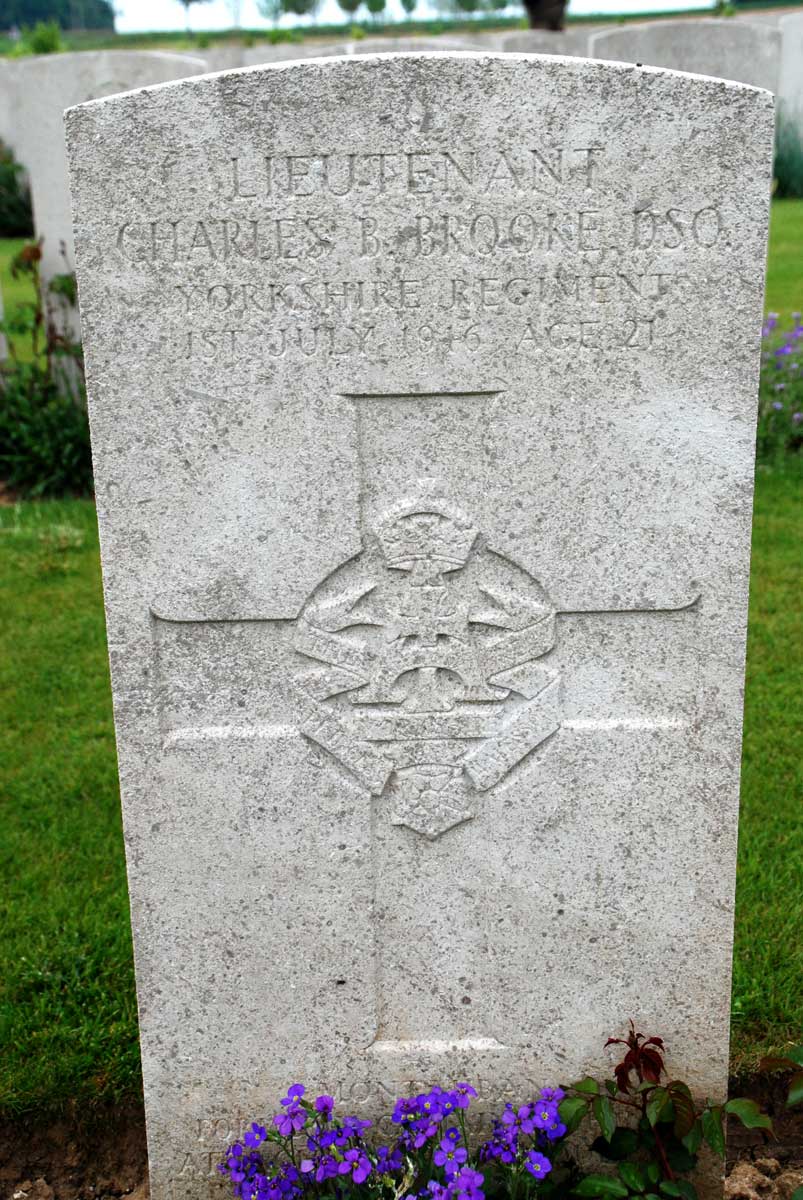
7th March 1895 – Birth……………
This birth date is quoted in the online biography for Charles, as well as one of the family tree links.
The birth of a Charles Berjew Brooke was registered with the Civil Authorities in the District of Samford in Suffolk in the April to June quarter, (Q2), of 1895. Then, as now, you had 42 days after the event to register the birth without facing a fine and a court appearance so a registration in this quarter is not incompatible with the date of birth quoted. Samford District included the Civil Parish of Brantham.
The marriage of his parents, Charles Berjew Brooke and Maud Gwenddolen Buchanan, was recorded in the Islington District of London in the April to June quarter, (Q2), of 1894.
1901 Census of England and Wales
The 6 year old Charles B Brooke, born Brantham, was recorded living at Colne House, Brantham. This was the household of his parents, Charles B., (32, Manager of Brantham Works, British Xyl.Co. Ld., born Liverpool, Lancashire), and Maude G., (26, born Cardiff, Glamorganshire). As well as Charles the couple also have a daughter, Gwenddolen F., (4, born Brantham). Completing the household is father Charles’ unmarried brother in law, Harold G. Buchanan, (22, Superintendent Xyl. Works, born London) and two live in domestic servants.
1911 Census of England and Wales
The 16 year old Charles B. Brooke, born ”Manningtree, Essex”, was recorded as a boarding school student at Bradfield, Reading, Berkshire.
His parents were still recorded living at Colne House, Brantham. Charles Berjew Junior and Mary Gwenddolen Brooke had then been married for 16 years and have had 2 children, both then still alive, but neither was at home. Charles, 42, is recorded as the Xylonite Works manager. Mary was then 38.
His sister Gwenddolen was also at boarding school – in her case at St Felix School, Reydon, Sothwold, Suffolk.
Until September 1911 the quarterly index published by the General Registrars Office did not show information about the mothers maiden name. A check of the General Registrars Office Index of Birth for England and Wales 1911 – 1983 shows no likely additional children of parents Charles and Maud.
Army career…………………………….
The London Gazette dated 8th January 1915 records that on probation Second Lieutenant Charles Berjew Brooke of the 3rd Battalion, The Suffolk Regiment was confirmed in his rank.
www.thegazette.co.uk/London/issue/29035/page/287/data.pdf
1st Queens Battalion War Diary 9th June 1915
Lieut C B Brooke is shown in command of B Coy in place of Lieut W. Nicholas, who was in Hospital.
qrrarchive.websds.net/PDF/QW00119150601.pdf
His promotion to Captain, effective 4th August 1915, appeared in the Supplement to the London Gazette dated Saturday 4 September 1915. Recorded on page 8815, he is shown under the Special Reserve of Officers, Suffolk Regiment.
www.thegazette.co.uk/London/issue/29284/supplement/1
1st Queens Battalion War Diary 25th September 1915
Section B.2. Our leading line advanced at 6.7 a.m. and reached the German 3rd line without great opposition. The attack was evidently a complete surprise.
The Battn. advanced on a frontage of two platoons. D. Coy. (Major BUNBURY) on the right and B. Coy, (Capt. Brooke) on the left. The advance was necessarily slow to keep behind the smoke, B & D Companies reached the German lines and gained touch with the 2/Oxford L.I. and the 2/H L I on the left and right respectively. The Support Company (C Coy) under Captain Weeding held on front line of trenches and, at about 8.15 A M two platoons of this Company reinforced B & D Companies, taking up a supply of Bombs with them, Lieut E D DREW commanded this party.
The Enemy developed a strong bombing attack on both flanks of the Regt., and our men were unable to reply effectively owing to a lack of bombs. About 9.45 a.m. the two and half companies were obliged to fall back into our own lines, under a very heavy machine gun fire from the right flank.
Casualties:- 2Lts A W A BRADSHAW, C D M FOWLER and E I B HOWELL killed & missing, 2 Lt F G PLANT wounded and missing, Major J.K.N. BUNBURY, Capt C B BROOKE, Lieutr H P FOSTER and 2 Lieut R G POYESON-MICES(?) wounded. Other Ranks, 19 Killed, 21 missing believed killed, 138 wounded, 80 Missing and wounded & missing, 7 suffering from gas. 1 died of wounds. Total 265 other ranks.
The remainder of the day was spent in reorganizing the line and in collecting wounded, burying dead etc.
qrrarchive.websds.net/PDF/QW00119150904.pdf
His appointment as Companion of the Distinguished Service Order appears in the Supplement to the London Gazette dated 14th January 1916. He was recorded as The Suffolk Regiment, Special Reserve (attached Royal West Surrey Regiment).
www.thegazette.co.uk/London/issue/29438/supplement/575/da...
The London Gazette dated 18th February 1916 included the notice:-
Alexandra, Princess of Wales’s Own (Yorkshire Regiment).
Captain Charles Berjew Brooke, D.S.O., from The Suffolk Regiment, Special Reserve, to be Second Lieutenant, and to retain his higher rank until ordered to join a Regular unit. Dated 19th February 1916, with seniority from 4th January, 1916, and precedence next above R, de H.M. Bell.
www.thegazette.co.uk/London/issue/29478/page/1812/data.pdf
On the day
Saturday July 1st 1916, Temperature 72°, clear sky
XIII CORPS -CAPTURE OF MONTAUBAN -30th DIVISION
The wire had been cut successfully. The Germans were mostly caught in dugouts, so little resistance was encountered
89th Brigade : starting from four lines of assembly trenches at 7.30 AM ,17th and 20th King's met little resistance and moved on to Casement and Alt Trenches. The 2nd Bedfordshire were in support and mopping-up. The attack pressed on to Dublin Trench. At 8.30 AM the right of the line joined with the French and the left, in the east end of Glatz Redoubt; simultaneously, the 3rd Battalion of the French 153rd Regiment entered Dublin Redoubt at the east of Dublin Trench. The position was consolidated
21st Brigade : The enemy here was also caught in its dugouts so little resistance was encountered
Leading, with 19th Manchesters, 18th King's went forward until they caught up with British barrage at Alt Trench, where they had to wait until the barrage lifted at 7.45 AM , before occupying it. The Manchesters had few losses but the King's were caught by enfilade machine-gun fire from the west side of Railway Valley. Fire from the Warren caused severe casualties among 2nd Green Howards who were in support, and few managed to cross no man's land. A party of Germans came out of a deep dugout and proceeded eastwards but were out-bombed by a party of moppers-up. This enabled 18th King's to advance along Train Alley to Glatz Redoubt, reaching it at 8.35 AM and joining with 89th Brigade
90th Brigade : At 8.30 AM 90th Brigade began its advance on Montauban, passing through 21st Brigade with 16th and 17th Manchesters. The 2nd Royal Scots Fusiliers were in close support. Despite machine-gun fire from Bresleau Alley, they continued their advance, and the German machine-gun was finally wiped out by a Lewis-gun of the 16th Manchesters. Under cover of a smoke-screen, the Manchesters and Royal Scots Fusiliers entered the village of Montauban at 10.05 AM , to find it deserted. By 11 AM the second objective in Montauban Alley was entered. The Germans were pulling back in large numbers. The 16th Manchesters rushed the battery in Caterpillar Valley and captured the first three guns of the battle. Montauban was consolidated.
At 12.30 PM 4th Coy, 20th King's (89th Brigade) attacked La Briqueterie from Dublin Trench under cover of an artillery bombardment
Simultaneously, bombers moved up Nord Alley cutting off the retreat of the garrison. By 12.35 PM La Briqueterie was taken, as were all objectives and the position was consolidated. By 6 PM the road to Maricourt-Montauban had been repaired 200 yards beyond the old German front line
The 30th Division had taken all its objectives
www.bandb-somme-bernafaywood.com/the-great-war/bernafay-w...
There is more on the 30th Divisions’ role here:-
www.longlongtrail.co.uk/battles/battles-of-the-western-fr...
PERONNE ROAD CEMETERY, MARICOURT
Location Information
Maricourt is a village situated on the D938, Albert-Peronne Road, 10.5 kilometres from Albert.
History Information
Maricourt was, at the beginning of the Battles of the Somme 1916, the point of junction of the British and French forces, and within a very short distance of the front line; it was lost in the German advance of March 1918, and recaptured at the end of the following August. The Cemetery, originally known as Maricourt Military Cemetery No.3, was begun by fighting units and Field Ambulances in the Battles of the Somme 1916, and used until August 1917; a few graves were added later in the War, and at the Armistice it consisted of 175 graves which now form almost the whole of Plot I. It was completed after the Armistice by the concentration of graves from the battlefields in the immediate neighbourhood and from certain smaller burial grounds, including:-
BRIQUETERIE EAST CEMETERY, MONTAUBAN, on the East side of the brick-works between Maricourt and Montauban, containing the graves of 46 soldiers from the United Kingdom who fell in the latter half of 1916.
CASEMENT TRENCH CEMETERY, MARICOURT, on the West side of the road to the Briqueterie, in which 163 soldiers from the United Kingdom and one from South Africa were buried in 1916-1918.
FARGNY MILL FRENCH MILITARY CEMETERY, CURLU, on the North bank of the Somme, in which six soldiers from the United Kingdom and two from Australia were buried in 1916-1918.
LA COTE MILITARY CEMETERY, MARICOURT, a little way West of Peronne Road Cemetery, containing the graves of 38 soldiers from the United Kingdom and one from Australia who fell in 1916-1917.
TALUS BOISE BRITISH CEMETERY, CARNOY, between Carnoy and Maricourt, at the South end of a long copse. It was used in the latter half of 1916 and (chiefly by the 5th Royal Berks) in August 1918, and it contained the graves of 175 soldiers from the United Kingdom and five from South Africa.
(Plus other site but whose details indicate none from 1916)
There are now 1348, 1914-18 war casualties commemorated in this site. Of these, 366 are unidentified and special memorials are erected to 26 soldiers from the United Kingdom known or believed to be buried among them. Other special memorials record the names of three soldiers from the United Kingdom, buried in other cemeteries, whose graves could not be found.
CWGC: www.cwgc.org/find-a-cemetery/cemetery/32200/peronne-road-...
As part of the commemoration of the outbreak of the Great War, the Commonwealth War Graves Commission added a number of original documents to their website. One of those on their webpage for Charles Brooke is a Concentration Report. These reports detail an exhumation and move to the current resting place. He was one of at least 10 graves moved from map reference 62c.A.14.b.5.4 into Peronne Road Cemetery. Charles was the only officer – the other nine British soldiers all died in 1918 Someone has written in blue pencil down the side of the report “Maricourt 3/95E”, which might imply they came from either the La Cote Cemetery or Casement Trench Cemetery.
A report prepared for the Commission to take over maintenance of the graves indicates they were at the new location by the start of November 1920.
Postscript………………….
The 1916 Probate Calendar records that Charles Berjew Brooke, of Colne House, Brantham. Suffolk, a Captain 2nd Battalion Yorkshire Regiment D.S.O., died 1 July 1916 in France. Administration of his estate was granted at the Ipswich Court on the 28th August 1916 to Charles Berjew Brooke, (the younger), manager of the British Xylonite company’s Brantham works. His effects were valued at £322 2s 4d.
probatesearch.service.gov.uk/Calendar#calendar
The edition of The Times, dated Monday July 10, 1916 records his death and includes a brief obituary.
CAPTAIN CHARLES BERJEW BROOKE, D.S.O., Yorkshire Regiment, was the only son of Mr. and Mrs. C.B. Brooke, jun. of Colne House, Brantham, Suffolk, and was 21 years of age. He was educated at Belton Grange, near Rugby, and Bradfield College. He was gazetted to the 3rd Suffolk Regiment on the outbreak of war, and was sent to France, attached to the 1st Queen’s, in December 1914, and rose to the rank of captain. He was seriously wounded while leading his company in the attack on September 25, 1915, and was mentioned in dispatches and awarded the D.S.O. In January 1916 he was chosen for a commission in the Regular Army, and was gazetted to the Yorkshire Regiment. He was killed on July 1st “while leading his company into action in this recent attack”.
The Births, Marriages and Deaths announcement in the Western Mail on the following included a note on the death of Charles “On Active Service”.
BROOKE.- On July 1st, in France, Charles Berjew Brooke, D.S.O., Second-lieutenant, Princess of Wales’ Own Yorkshire Regiment, aged 21, only son of Mr. and Mrs. Charles B. Brooke Junr., of Colne House, Brantham, Suffolk, and nephew of Mrs. C.H. Bailey, Stelvio, Newport, Mon.
That final letter was printed in full in the editions of The Surrey Advertiser, dated Saturday, July 22nd 1916 and Monday, July 24, 1916, under the heading Former Queen’s Officer Letter. It is noted that there are many in The Queens who will remember Captain Brooke, and “many others who will find consolation in the letter”. On the same page in the Officers Killed section, as well as his name appearing in the list there is also a few lines about him.
Lieut. and Temp. Capt. Brooke, D.S.O., Yorkshire Regiment, who was killed in action on July 1st, was attached to a battalion of The Queens from December 1914, until he was wounded on September 25th 1915. He was the only son of Mr. and Mrs. C.B. Brooke, Colne House, Brantham, Suffolk, and was 22. His colonel writes: “As soon as he joined us we recognised him as a born leader of men, and I at once put him in command of a company. He was leading it to the assault when he was shot.”