View allAll Photos Tagged FirstEditions,
Illustrations of various Pneumatic apparatus.
Copperplate engraving from the First Edition of the Encyclopedia Britannica, or Dictionary of the Arts and Sciences, founded in 1768 and first printed in 1771. 3 Volumes, this is Volume 3.
The largest encyclopedia of general knowledge published to date, with contributions by leaders in their fields.
Printed for Bell and Macfarquhar, Edinburgh. Original half leather binding, 970 pages this volume. 26cm x 21cm.
Welcome to the next episode of "Stuff I Bought in Vancouver". Tonight, I bring you something that is, as always exotic, but more importantly, something that again, I probably wouldn't have run into while in Toronto. The subject of tonights review is the S.H. Figuarts Sailor Moon figure, First Edition.
So, Sailor Moon. The Figuarts releases I've picked up two of them up to this point - Sailor Chibi Moon and Sailor Venus, so clearly they exist here in Toronto. I had gotten lucky so far with regards to pricing thus far, finding the right person at the right time who was willing to make a deal just to get rid of it. It was a similar situation for this particular figure, which I ended up paying $60 CAD for, making it the most expensive figure I purchased during my time out West. For those paying attention, that's pretty much MSRP - why did I do that??? Well, the answer lies in the second part of the title - First Edition. First Edition releases of Sailor Moon came with two additional face plates that were not available later on, and to be honest they're ones that should have been standard, but I digress. The point is, if one were to take into account the First Edition perks, and the fact the figure had never been opened, $60 CAD ends up being a pretty good buy.
Sailor Moon is, of course, the titular character from the Sailor Moon series. The superhero guise of Usagi Tsukino (Serena in the US dub), Sailor Moon starts off, like all many other anime heroes, kind of clumsy, childlike, but eventually matures into a competent leader of her fellow Sailor Senshi in their battle against the forces of evil and enemies of the Moon Kingdom, from whence she originated from. In superhero form, Usagi maintains her trademark twin pigtails, gets a few more pieces of jewelery, and is generally decked out in the now legendary ensemble of high school girl outfit combined with some bows and a kickass pair of boots. Being Sailor Moon, however, her outfit has a few extra bells and whistles not present on the other Sailor Senshi, like the moon on her choker, a jewel encrusted pendant on her chest ribbon, moons on her boots, and jewels in the buns of her hair.
Sailor Moon comes with the most accessories I've seen in a Sailor Moon Figuarts thus far (I admittedly haven't seen that many). There's the figure, of course, with five additional faces (winking and crying faces being the exclusives... FINALLY, a winking face), Moon Crescent Wand, Moon Crescent Wand with the Imperium Silver Crystal installed, seven additional hands with one dedicated for holding her wand, two for her trademark pose, and additional hand/effect piece for her Moon Tiara Action, a mini Luna, and a stand. To the surprise of nobody, it appears that Luna and Artemis are effectively repaints of one another, though I found that Luna stood very easily, whereas Artemis was required some futzing to get him to pose for photos. Points of articulation on Luna are her head and tail, both on ball joints.
The figure of course, looks very faithful to the the animation model. General silhouette is there, and compared to Sailor Venus, slightly more accurate body proportions, mostly with the legs, which seem to have a shorter lower leg as compared to the statuesque Sailor Venus. Otherwise, you have the same general slender high school girl physique. Sailor Moon, to me, has a more accurate facial structure as well.. in fact, if I didn't know better, I'd say they adapted Sailor Moons base face plates for use on Venus. Both are, IMO, a bit too narrow and could stand to be a bit wider at the temples. Sailor Moon fares much better at actually being able to use the included stand properly, as she does not have a giant mound of hair getting in the way of the dynamic arm of the stand. Speaking of hair, good recreation of the hair on the character, with the added "bonus" of being made from translucent plastic that is painted yellow so she has the shimmering effect on her head. The down side is tolerances, as evidences by the fact her right pigtail keeps popping out of the socket. Otherwise, you get some good sculpting in terms of detailing of the outfit and hair, both of which has been pretty consistent in terms of quality across the three characters that I have.
As mentioned above, this First Edition release comes with two additional face plates that are very much essential to Sailor Moon as a character. I can sort of get the crying face as an exclusive, as its usage is relatively limited (unless you're willing to be a bit creative, like me) but for magical girl figures to not come with winking faces ought to be made a crime punishable by public ridicule. The other faces are your typical smiling, neutral, attacking, and one face with no tiara painted on it with the intent of use with the Moon Tiara Action hand effect.
Articulation.. boy, is it nice coming back to something that is not maddening to make use. Points of articulation, again, are consistent with the other Sailor Senshi - ankles, single jointed knees, hips with pull down action to improve range of motion, waist, upper torso swivel, shoulders with some chest collapse, single jointed eblows, wirsts, and head. As stated above, there is one point of articulation on each of the pigtails to allow for some dynamic posing of the pigtails, though it mainly allows for side to side displays of hair rather than dashing forward displays. I found that perhaps due to a more pliable rubber (or maybe I just tried harder), Sailor Moon, while unable to kick high, was able to at least maintain a proper seated position. Hands come off the wrist pegs easily.. perhaps a bit TOO easily. I've read that subsequent releases of the figure (most notable being the anime coloured edition), the wrist pegs have been changed such that they have balls on the end of them to improve the grip.
Paintwork is again that lovely combination of good and meh that is present on Venus and Chibi moon. One again, the outfit itself is painted with pearl based paints on the whites, which makes for a lovely shimmering effect, if a bit thick in terms of application. Coloured sections of the outfit, along with various metal pieces are painted with metallic paints. These metallic paint apps can get a bit messy, especially on detailed areas like the small lines on her hair bun jewels, her pendant on the chest, the tiaras on her foreheads, and her earrings. The hair appears be partially solid plastic with some translucent plastics (bangs, pigtails), all of which is painted, which does make for an effective glowing effect at the cost of some less than stellar tolerances. Paint work on the hair itself is surprisingly smooth, with no splotches of colour that not only would look bad, but would also interfere with the translucent quality of the hair. Fleshy bits appear to be the base plastic colours, which are slightly different from Sailor Venus (more tan). In terms of paint masking, some weakness was observed at most transition points, with the most notable being between her outfit and her blue skirt.
Decals are applied well, with no bubbles observed, and no misalignment issues to report. In general, fit and tolerances are pretty good, with the only real issue I can mention is the one with that one pigtail that likes to fall out. Otherwise, there aren't any issues with tolerances or poorly mating parts to report. Some improvements on the parts finish side would have been nice, as mould lines and various seams were more prevalent on Sailor Moon than Venus or Chibi Moon. It's not like the latter two were perfect, and neither is Sailor Moon the worst figure ever made, it's just that by comparison to the other two, Sailor Moon does exhibit significantly weaker traits from this perspective, so I know a better product is technically possible. Build quality is the typical Figuarts level of excellence, with tight joints and a generally solid toy that can withstand some typical handling by a collector.
This is undeniably a great Sailor Moon figure, though one that is for... reasons, worse off from a parts finish perspective than her peers that I own. The base figure doesn't really offer anything that the other Sailor Senshi don't have (other than perhaps a slightly more appropriate face), but that's no surprise (or an issue) when they're all based off a pretty decent platform, though keep in mind I was able to get her seated when I couldn't get Sailor Venus or Chibi Moon to do so. While the base accessory set is pretty good (considering all the main Senshi cost the same), the First Edition faces truly make this figure shine. So while the figure is clearly a recommend for fans of the series, I'm going to do something I normally don't do, and recommend that you hunt down a First Edition version. While you may not benefit from the improved wrist pegs, the crying and winking expressions are a HUGE part of the character, and are worth going the extra mile for. If you're gonna hunt this figure down, I'd strongly recommend finding a First Edition and hassling the seller until a price that is agreeable to you can be reached.
“Martians, Go Home” is a broad satire of the human race as seen through the eyes of a billion jeering, invulnerable Martians who arrive not to conquer the world but to drive it crazy.
The following is a brief biography of Fredric Brown from the Goodreads website (at www.goodreads.com/author/show/51503.Fredric_Brown):
"Fredric Brown was an American science fiction and mystery writer. He was one of the boldest early writers in genre fiction in his use of narrative experimentation. While never in the front rank of popularity in his lifetime, Brown has developed a considerable cult following in the almost half century since he last wrote. His works have been periodically reprinted and he has a worldwide fan base, most notably in the U.S. and Europe, and especially in France, where there have been several recent movie adaptations of his work. He also remains popular in Japan.
"Never financially secure, Brown - like many other pulp writers - often wrote at a furious pace in order to pay bills. This accounts, at least in part, for the uneven quality of his work. A newspaperman by profession, Brown was only able to devote 14 years of his life as a full-time fiction writer. Brown was also a heavy drinker, and this at times doubtless affected his productivity. A cultured man and omnivorous reader whose interests ranged far beyond those of most pulp writers, Brown had a lifelong interest in the flute, chess, poker, and the works of Lewis Carroll. Brown married twice and was the father of two sons."
With 40 illustrations by Phiz (Hablot Knight Browne).
Martin Chuzzlewit, Dickens’ sixth novel, was first published in installments from January, 1843 through July, 1844. The main theme of the novel is selfishness, all kinds of selfishness including greed and arrogance, portrayed satirically using members of the extended Chuzzlewit family. The elder Martin Chuzzlewit is a very rich man and, when he appears to be near death, the vultures around him scheme their way to his fortune, all of them hoping for an inheritance.
Dickens wrote the novel shortly after visiting America in 1842, which left him with a very bad impression. Using his experience in his work like any good author, he expressed his dissatisfaction by writing a scathing satire of America. It didn’t go over well on the other side of the Atlantic where the installments containing the offending chapters were greeted with a “frenzy of wrath.”
Residence of the Prince of Wales.
The Illustrated News of the World – First Edition 1858.
‘The Illustrated News of the World and National Portrait Gallery of Eminent Personages’ was a new publication with the strong visual emphasis of numerous large woodcuts to illustrate local and world events, and also featuring a number of fine steel engravings of eminent persons. The publishers stated their hopes that the publication would match or supplement the existing illustrated magazines:- The Illustrated London News and Punch Magazine .
Published by Illustrated News of the World, The Strand, London. Annual bound collection, red cloth boards 338 pages 42cm x 29cm.
Fred Freeman (1907-1988) was a graphic artist who designed and illustrated books on naval history, space exploration and other subjects. He was a successful commercial artist in New York City from the late 1920's through the 30's, doing many illustrations and magazine covers for publications including The Saturday Evening Post and Collier's.
After serving in the United States Navy during World War II, he turned mainly to book design and illustration. He illustrated books on submarines and destroyers from World War II, for the United States Naval Institute. In 1956, with Theodore Roscoe, he designed the ''Picture History of the U.S. Navy,'' published by Charles Scribner's Sons. In 1960, he illustrated a children's book, ''First Men to the Moon,'' written by the scientist, Werner von Braun.
Oh, Fortune!
velut luna statu variabilis
Like the moon you change:
semper crescis, aut decrescis
ever waxing, ever waning.
vita detestabilis
Our vexing life
nunc obdurat, et tunc curat
first injures, then nurtures
ludo mentis aciem
as it pleases.
egestatem, potestatem
Subordination, Power--
dissolvit ut glaciem.
both melt like ice.
--------
'Fortuna Imperatrix Mundi', Carmina Burana
11th century
Set to music by Carl Orff (1936)
Deck design by Robert M Place. All rights reserved.
2005.10.03
© Alton Thompson 唐博敦
Set in London of 632 A.F. (“After Ford”), the novel portrays a futuristic society in which the individual is sacrificed for the state, science is used to control and subjugate, and all forms of art and history are outlawed. The novel anticipates developments in reproductive technology, sleep-learning, classical conditioning and psychological manipulation that combine profoundly to change society. Modern Library ranked “Brave New World” fifth on its list of the 100 best English-language novels of the 20th century. [Source: Wikipedia]
“Captains Courageous” is a coming-of-age tale of fishing off the New England coast. It is the story of Harvey Cheyne, a spoiled rich kid, who stumbles overboard an ocean liner and is rescued by fisherman Manuel Fidello off the Grand Banks of Newfoundland and brought aboard a small fishing boat. There he meets Disko Troop, captain of the fishing boat, who refuses to take the young man back to port but agrees to take him on as part of the crew against Harvey’s wishes. Over the course of the novel, Harvey befriends the captain’s son Dan and has some sense knocked into him. Dan helps the arrogant, overly pampered Harvey become a hard-working, self-reliant man at sea.
“Captains Courageous” is also an excellent portrayal of life in the Gloucester fishing fleet of Massachusetts, written while the newlywed Kipling lived in Vermont. Although Kipling lived in Vermont several years and was married to an American this is his only novel with entirely American settings, themes and major characters. The American edition of the book is dedicated to James Conland, M.D., of Brattleboro, Vermont. Dr. Conland had brought the Kiplings elder daughter into the world and had been a member of the Massachusetts fishing fleet. It is he who took Kipling to explore the wharves and quays of Boston and Gloucester.
Considered one of the great sea novels of the 19th century, “Captains Courageous” was made into an excellent Victor Fleming film in 1937 starring Freddie Bartholomew (Harvey Cheyne), Spencer Tracy (his rescuer Manuel Fidello),
Lionel Barrymore (Captain Disko Troop) and Mickey Rooney (Dan Troop).
TYPOGRAPHIE: MANUAL OF TYPOGRAPHICAL DESIGN
First Press
www.thenewgraphic.com/2011/01/typographie-manual-of-typog...
This is the story of a free black citizen of Saratoga, New York who was kidnapped in Washington in 1841, trapped in a system of brutal subjugation and rescued in 1853 from a cotton plantation near the Red River in Louisiana. Northup’s powerful and insightful memoir was published just three months after his liberation and it stunned the nation. It is among the most detailed and accurate firsthand accounts of slavery in America. Northup’s slave narrative was the basis for the film “Twelve Years a Slave” which won the 2014 Academy Award for Best Picture.
The seven wood engravings in Northup's book are by Nathaniel Orr, based on illustrations by Frederick M. Coffin.
Solomon Northup was a renowned fiddler so, at the end of “Twelve Years a Slave,” he included the tune to “Roaring River – A Refrain of the Red River Plantation.” It invited his nineteenth-century readers to engage with his story in some small way by performing the tune. Here is a link to that page in the book:
pastispresent.org/wp-content/uploads/199111_0007.jpg
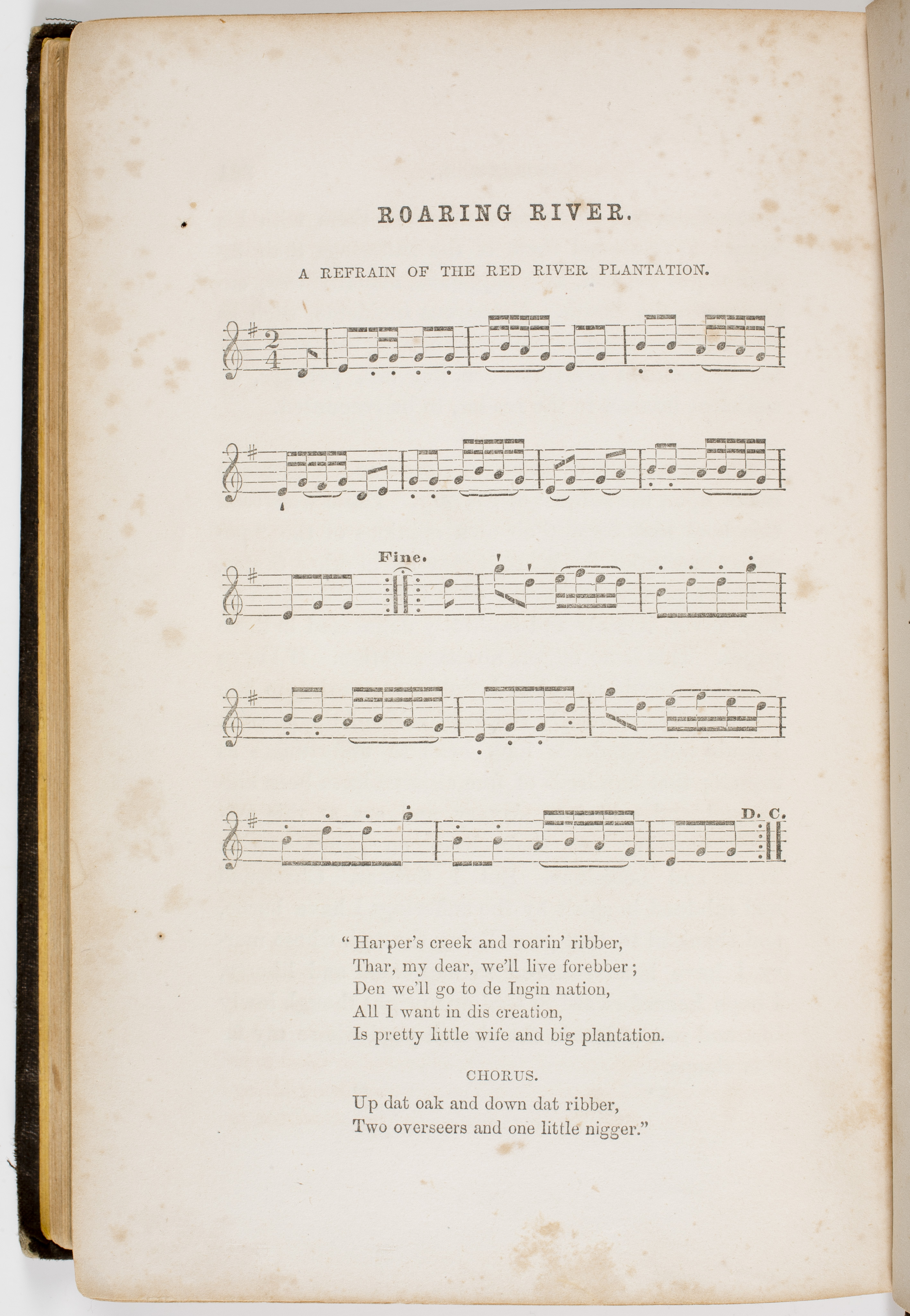
A twenty-first-century movie-goer was inspired to read the book and perform that old-time plantation tune. Here is a link to his musical performance:
www.youtube.com/watch?v=LApDW18pfO0
For more information, check out the American Antiquarian Society Blog at:
pastispresent.org/2014/good-sources/twelve-years-a-slave-...
Welcome to the next episode of "Stuff I Bought in Vancouver". Tonight, I bring you something that is, as always exotic, but more importantly, something that again, I probably wouldn't have run into while in Toronto. The subject of tonights review is the S.H. Figuarts Sailor Moon figure, First Edition.
So, Sailor Moon. The Figuarts releases I've picked up two of them up to this point - Sailor Chibi Moon and Sailor Venus, so clearly they exist here in Toronto. I had gotten lucky so far with regards to pricing thus far, finding the right person at the right time who was willing to make a deal just to get rid of it. It was a similar situation for this particular figure, which I ended up paying $60 CAD for, making it the most expensive figure I purchased during my time out West. For those paying attention, that's pretty much MSRP - why did I do that??? Well, the answer lies in the second part of the title - First Edition. First Edition releases of Sailor Moon came with two additional face plates that were not available later on, and to be honest they're ones that should have been standard, but I digress. The point is, if one were to take into account the First Edition perks, and the fact the figure had never been opened, $60 CAD ends up being a pretty good buy.
Sailor Moon is, of course, the titular character from the Sailor Moon series. The superhero guise of Usagi Tsukino (Serena in the US dub), Sailor Moon starts off, like all many other anime heroes, kind of clumsy, childlike, but eventually matures into a competent leader of her fellow Sailor Senshi in their battle against the forces of evil and enemies of the Moon Kingdom, from whence she originated from. In superhero form, Usagi maintains her trademark twin pigtails, gets a few more pieces of jewelery, and is generally decked out in the now legendary ensemble of high school girl outfit combined with some bows and a kickass pair of boots. Being Sailor Moon, however, her outfit has a few extra bells and whistles not present on the other Sailor Senshi, like the moon on her choker, a jewel encrusted pendant on her chest ribbon, moons on her boots, and jewels in the buns of her hair.
Sailor Moon comes with the most accessories I've seen in a Sailor Moon Figuarts thus far (I admittedly haven't seen that many). There's the figure, of course, with five additional faces (winking and crying faces being the exclusives... FINALLY, a winking face), Moon Crescent Wand, Moon Crescent Wand with the Imperium Silver Crystal installed, seven additional hands with one dedicated for holding her wand, two for her trademark pose, and additional hand/effect piece for her Moon Tiara Action, a mini Luna, and a stand. To the surprise of nobody, it appears that Luna and Artemis are effectively repaints of one another, though I found that Luna stood very easily, whereas Artemis was required some futzing to get him to pose for photos. Points of articulation on Luna are her head and tail, both on ball joints.
The figure of course, looks very faithful to the the animation model. General silhouette is there, and compared to Sailor Venus, slightly more accurate body proportions, mostly with the legs, which seem to have a shorter lower leg as compared to the statuesque Sailor Venus. Otherwise, you have the same general slender high school girl physique. Sailor Moon, to me, has a more accurate facial structure as well.. in fact, if I didn't know better, I'd say they adapted Sailor Moons base face plates for use on Venus. Both are, IMO, a bit too narrow and could stand to be a bit wider at the temples. Sailor Moon fares much better at actually being able to use the included stand properly, as she does not have a giant mound of hair getting in the way of the dynamic arm of the stand. Speaking of hair, good recreation of the hair on the character, with the added "bonus" of being made from translucent plastic that is painted yellow so she has the shimmering effect on her head. The down side is tolerances, as evidences by the fact her right pigtail keeps popping out of the socket. Otherwise, you get some good sculpting in terms of detailing of the outfit and hair, both of which has been pretty consistent in terms of quality across the three characters that I have.
As mentioned above, this First Edition release comes with two additional face plates that are very much essential to Sailor Moon as a character. I can sort of get the crying face as an exclusive, as its usage is relatively limited (unless you're willing to be a bit creative, like me) but for magical girl figures to not come with winking faces ought to be made a crime punishable by public ridicule. The other faces are your typical smiling, neutral, attacking, and one face with no tiara painted on it with the intent of use with the Moon Tiara Action hand effect.
Articulation.. boy, is it nice coming back to something that is not maddening to make use. Points of articulation, again, are consistent with the other Sailor Senshi - ankles, single jointed knees, hips with pull down action to improve range of motion, waist, upper torso swivel, shoulders with some chest collapse, single jointed eblows, wirsts, and head. As stated above, there is one point of articulation on each of the pigtails to allow for some dynamic posing of the pigtails, though it mainly allows for side to side displays of hair rather than dashing forward displays. I found that perhaps due to a more pliable rubber (or maybe I just tried harder), Sailor Moon, while unable to kick high, was able to at least maintain a proper seated position. Hands come off the wrist pegs easily.. perhaps a bit TOO easily. I've read that subsequent releases of the figure (most notable being the anime coloured edition), the wrist pegs have been changed such that they have balls on the end of them to improve the grip.
Paintwork is again that lovely combination of good and meh that is present on Venus and Chibi moon. One again, the outfit itself is painted with pearl based paints on the whites, which makes for a lovely shimmering effect, if a bit thick in terms of application. Coloured sections of the outfit, along with various metal pieces are painted with metallic paints. These metallic paint apps can get a bit messy, especially on detailed areas like the small lines on her hair bun jewels, her pendant on the chest, the tiaras on her foreheads, and her earrings. The hair appears be partially solid plastic with some translucent plastics (bangs, pigtails), all of which is painted, which does make for an effective glowing effect at the cost of some less than stellar tolerances. Paint work on the hair itself is surprisingly smooth, with no splotches of colour that not only would look bad, but would also interfere with the translucent quality of the hair. Fleshy bits appear to be the base plastic colours, which are slightly different from Sailor Venus (more tan). In terms of paint masking, some weakness was observed at most transition points, with the most notable being between her outfit and her blue skirt.
Decals are applied well, with no bubbles observed, and no misalignment issues to report. In general, fit and tolerances are pretty good, with the only real issue I can mention is the one with that one pigtail that likes to fall out. Otherwise, there aren't any issues with tolerances or poorly mating parts to report. Some improvements on the parts finish side would have been nice, as mould lines and various seams were more prevalent on Sailor Moon than Venus or Chibi Moon. It's not like the latter two were perfect, and neither is Sailor Moon the worst figure ever made, it's just that by comparison to the other two, Sailor Moon does exhibit significantly weaker traits from this perspective, so I know a better product is technically possible. Build quality is the typical Figuarts level of excellence, with tight joints and a generally solid toy that can withstand some typical handling by a collector.
This is undeniably a great Sailor Moon figure, though one that is for... reasons, worse off from a parts finish perspective than her peers that I own. The base figure doesn't really offer anything that the other Sailor Senshi don't have (other than perhaps a slightly more appropriate face), but that's no surprise (or an issue) when they're all based off a pretty decent platform, though keep in mind I was able to get her seated when I couldn't get Sailor Venus or Chibi Moon to do so. While the base accessory set is pretty good (considering all the main Senshi cost the same), the First Edition faces truly make this figure shine. So while the figure is clearly a recommend for fans of the series, I'm going to do something I normally don't do, and recommend that you hunt down a First Edition version. While you may not benefit from the improved wrist pegs, the crying and winking expressions are a HUGE part of the character, and are worth going the extra mile for. If you're gonna hunt this figure down, I'd strongly recommend finding a First Edition and hassling the seller until a price that is agreeable to you can be reached.
Quoting from the book (page 320):
Mr. Guppy takes the light. They go down, more dead than alive, and holding one another, push open the door of the back shop. The cat has retreated close to it, and stands snarling – not at them; at something on the ground, before the fire. There is very little fire left in the grate, but there is a smouldering suffocating vapor in the room, and a dark greasy coating on the walls and ceiling. The chairs and table, and the bottle so rarely absent from the table, all stand as usual. On one chair-back, hang the old man’s hairy cap and coat.
A scientist by the name of Griffin (we never learn his full name) finds a way to make himself invisible but doesn’t know how to reverse the process. He becomes consumed with power, resorts to crime for survival and, eventually, goes crazy. It paints an unflattering picture of a scientist as someone who is selfish and lacks a conscience and humanity. Bah humbug! Ripping good story, though.
A 1961 first edition photography book and memoir. It is billed as one of the very first environmental photobooks serving as a warning, and fashioning an eloquent plea." Author Peter Merom created a "prescient study of the conflict between Israel’s need for water and the environmental effects this caused."
Welcome to the next episode of "Stuff I Bought in Vancouver". Tonight, I bring you something that is, as always exotic, but more importantly, something that again, I probably wouldn't have run into while in Toronto. The subject of tonights review is the S.H. Figuarts Sailor Moon figure, First Edition.
So, Sailor Moon. The Figuarts releases I've picked up two of them up to this point - Sailor Chibi Moon and Sailor Venus, so clearly they exist here in Toronto. I had gotten lucky so far with regards to pricing thus far, finding the right person at the right time who was willing to make a deal just to get rid of it. It was a similar situation for this particular figure, which I ended up paying $60 CAD for, making it the most expensive figure I purchased during my time out West. For those paying attention, that's pretty much MSRP - why did I do that??? Well, the answer lies in the second part of the title - First Edition. First Edition releases of Sailor Moon came with two additional face plates that were not available later on, and to be honest they're ones that should have been standard, but I digress. The point is, if one were to take into account the First Edition perks, and the fact the figure had never been opened, $60 CAD ends up being a pretty good buy.
Sailor Moon is, of course, the titular character from the Sailor Moon series. The superhero guise of Usagi Tsukino (Serena in the US dub), Sailor Moon starts off, like all many other anime heroes, kind of clumsy, childlike, but eventually matures into a competent leader of her fellow Sailor Senshi in their battle against the forces of evil and enemies of the Moon Kingdom, from whence she originated from. In superhero form, Usagi maintains her trademark twin pigtails, gets a few more pieces of jewelery, and is generally decked out in the now legendary ensemble of high school girl outfit combined with some bows and a kickass pair of boots. Being Sailor Moon, however, her outfit has a few extra bells and whistles not present on the other Sailor Senshi, like the moon on her choker, a jewel encrusted pendant on her chest ribbon, moons on her boots, and jewels in the buns of her hair.
Sailor Moon comes with the most accessories I've seen in a Sailor Moon Figuarts thus far (I admittedly haven't seen that many). There's the figure, of course, with five additional faces (winking and crying faces being the exclusives... FINALLY, a winking face), Moon Crescent Wand, Moon Crescent Wand with the Imperium Silver Crystal installed, seven additional hands with one dedicated for holding her wand, two for her trademark pose, and additional hand/effect piece for her Moon Tiara Action, a mini Luna, and a stand. To the surprise of nobody, it appears that Luna and Artemis are effectively repaints of one another, though I found that Luna stood very easily, whereas Artemis was required some futzing to get him to pose for photos. Points of articulation on Luna are her head and tail, both on ball joints.
The figure of course, looks very faithful to the the animation model. General silhouette is there, and compared to Sailor Venus, slightly more accurate body proportions, mostly with the legs, which seem to have a shorter lower leg as compared to the statuesque Sailor Venus. Otherwise, you have the same general slender high school girl physique. Sailor Moon, to me, has a more accurate facial structure as well.. in fact, if I didn't know better, I'd say they adapted Sailor Moons base face plates for use on Venus. Both are, IMO, a bit too narrow and could stand to be a bit wider at the temples. Sailor Moon fares much better at actually being able to use the included stand properly, as she does not have a giant mound of hair getting in the way of the dynamic arm of the stand. Speaking of hair, good recreation of the hair on the character, with the added "bonus" of being made from translucent plastic that is painted yellow so she has the shimmering effect on her head. The down side is tolerances, as evidences by the fact her right pigtail keeps popping out of the socket. Otherwise, you get some good sculpting in terms of detailing of the outfit and hair, both of which has been pretty consistent in terms of quality across the three characters that I have.
As mentioned above, this First Edition release comes with two additional face plates that are very much essential to Sailor Moon as a character. I can sort of get the crying face as an exclusive, as its usage is relatively limited (unless you're willing to be a bit creative, like me) but for magical girl figures to not come with winking faces ought to be made a crime punishable by public ridicule. The other faces are your typical smiling, neutral, attacking, and one face with no tiara painted on it with the intent of use with the Moon Tiara Action hand effect.
Articulation.. boy, is it nice coming back to something that is not maddening to make use. Points of articulation, again, are consistent with the other Sailor Senshi - ankles, single jointed knees, hips with pull down action to improve range of motion, waist, upper torso swivel, shoulders with some chest collapse, single jointed eblows, wirsts, and head. As stated above, there is one point of articulation on each of the pigtails to allow for some dynamic posing of the pigtails, though it mainly allows for side to side displays of hair rather than dashing forward displays. I found that perhaps due to a more pliable rubber (or maybe I just tried harder), Sailor Moon, while unable to kick high, was able to at least maintain a proper seated position. Hands come off the wrist pegs easily.. perhaps a bit TOO easily. I've read that subsequent releases of the figure (most notable being the anime coloured edition), the wrist pegs have been changed such that they have balls on the end of them to improve the grip.
Paintwork is again that lovely combination of good and meh that is present on Venus and Chibi moon. One again, the outfit itself is painted with pearl based paints on the whites, which makes for a lovely shimmering effect, if a bit thick in terms of application. Coloured sections of the outfit, along with various metal pieces are painted with metallic paints. These metallic paint apps can get a bit messy, especially on detailed areas like the small lines on her hair bun jewels, her pendant on the chest, the tiaras on her foreheads, and her earrings. The hair appears be partially solid plastic with some translucent plastics (bangs, pigtails), all of which is painted, which does make for an effective glowing effect at the cost of some less than stellar tolerances. Paint work on the hair itself is surprisingly smooth, with no splotches of colour that not only would look bad, but would also interfere with the translucent quality of the hair. Fleshy bits appear to be the base plastic colours, which are slightly different from Sailor Venus (more tan). In terms of paint masking, some weakness was observed at most transition points, with the most notable being between her outfit and her blue skirt.
Decals are applied well, with no bubbles observed, and no misalignment issues to report. In general, fit and tolerances are pretty good, with the only real issue I can mention is the one with that one pigtail that likes to fall out. Otherwise, there aren't any issues with tolerances or poorly mating parts to report. Some improvements on the parts finish side would have been nice, as mould lines and various seams were more prevalent on Sailor Moon than Venus or Chibi Moon. It's not like the latter two were perfect, and neither is Sailor Moon the worst figure ever made, it's just that by comparison to the other two, Sailor Moon does exhibit significantly weaker traits from this perspective, so I know a better product is technically possible. Build quality is the typical Figuarts level of excellence, with tight joints and a generally solid toy that can withstand some typical handling by a collector.
This is undeniably a great Sailor Moon figure, though one that is for... reasons, worse off from a parts finish perspective than her peers that I own. The base figure doesn't really offer anything that the other Sailor Senshi don't have (other than perhaps a slightly more appropriate face), but that's no surprise (or an issue) when they're all based off a pretty decent platform, though keep in mind I was able to get her seated when I couldn't get Sailor Venus or Chibi Moon to do so. While the base accessory set is pretty good (considering all the main Senshi cost the same), the First Edition faces truly make this figure shine. So while the figure is clearly a recommend for fans of the series, I'm going to do something I normally don't do, and recommend that you hunt down a First Edition version. While you may not benefit from the improved wrist pegs, the crying and winking expressions are a HUGE part of the character, and are worth going the extra mile for. If you're gonna hunt this figure down, I'd strongly recommend finding a First Edition and hassling the seller until a price that is agreeable to you can be reached.
Babar! As they say: Anything without elephants is irrelephant. Christmas is saved.
Babar and Father Christmas.
by Jean De Brunhoff
Translated by Merle Haas
Published by Random House (1940)
This book was one of the first color editions and the last Brer Rabbit collection published during the lifetime of the author, Georgia native Joel Chandler Harris (1845-1908). Raised in poverty, Harris was an apprentice to a Southern newspaper as a teenager and he made friends with plantation slaves who passed along their stories. Harris hoped that the charming illustrations and his use of dialect in retelling these old black legends would “suggest a certain picturesque sensitiveness – a curious exaltation of mind and temperament (of the black man).”
The characters of Uncle Remus and Brer Rabbit are best known from the classic 1946 Disney movie, “Song of the South.” Here is a memorable scene in that movie:
Welcome to the next episode of "Stuff I Bought in Vancouver". Tonight, I bring you something that is, as always exotic, but more importantly, something that again, I probably wouldn't have run into while in Toronto. The subject of tonights review is the S.H. Figuarts Sailor Moon figure, First Edition.
So, Sailor Moon. The Figuarts releases I've picked up two of them up to this point - Sailor Chibi Moon and Sailor Venus, so clearly they exist here in Toronto. I had gotten lucky so far with regards to pricing thus far, finding the right person at the right time who was willing to make a deal just to get rid of it. It was a similar situation for this particular figure, which I ended up paying $60 CAD for, making it the most expensive figure I purchased during my time out West. For those paying attention, that's pretty much MSRP - why did I do that??? Well, the answer lies in the second part of the title - First Edition. First Edition releases of Sailor Moon came with two additional face plates that were not available later on, and to be honest they're ones that should have been standard, but I digress. The point is, if one were to take into account the First Edition perks, and the fact the figure had never been opened, $60 CAD ends up being a pretty good buy.
Sailor Moon is, of course, the titular character from the Sailor Moon series. The superhero guise of Usagi Tsukino (Serena in the US dub), Sailor Moon starts off, like all many other anime heroes, kind of clumsy, childlike, but eventually matures into a competent leader of her fellow Sailor Senshi in their battle against the forces of evil and enemies of the Moon Kingdom, from whence she originated from. In superhero form, Usagi maintains her trademark twin pigtails, gets a few more pieces of jewelery, and is generally decked out in the now legendary ensemble of high school girl outfit combined with some bows and a kickass pair of boots. Being Sailor Moon, however, her outfit has a few extra bells and whistles not present on the other Sailor Senshi, like the moon on her choker, a jewel encrusted pendant on her chest ribbon, moons on her boots, and jewels in the buns of her hair.
Sailor Moon comes with the most accessories I've seen in a Sailor Moon Figuarts thus far (I admittedly haven't seen that many). There's the figure, of course, with five additional faces (winking and crying faces being the exclusives... FINALLY, a winking face), Moon Crescent Wand, Moon Crescent Wand with the Imperium Silver Crystal installed, seven additional hands with one dedicated for holding her wand, two for her trademark pose, and additional hand/effect piece for her Moon Tiara Action, a mini Luna, and a stand. To the surprise of nobody, it appears that Luna and Artemis are effectively repaints of one another, though I found that Luna stood very easily, whereas Artemis was required some futzing to get him to pose for photos. Points of articulation on Luna are her head and tail, both on ball joints.
The figure of course, looks very faithful to the the animation model. General silhouette is there, and compared to Sailor Venus, slightly more accurate body proportions, mostly with the legs, which seem to have a shorter lower leg as compared to the statuesque Sailor Venus. Otherwise, you have the same general slender high school girl physique. Sailor Moon, to me, has a more accurate facial structure as well.. in fact, if I didn't know better, I'd say they adapted Sailor Moons base face plates for use on Venus. Both are, IMO, a bit too narrow and could stand to be a bit wider at the temples. Sailor Moon fares much better at actually being able to use the included stand properly, as she does not have a giant mound of hair getting in the way of the dynamic arm of the stand. Speaking of hair, good recreation of the hair on the character, with the added "bonus" of being made from translucent plastic that is painted yellow so she has the shimmering effect on her head. The down side is tolerances, as evidences by the fact her right pigtail keeps popping out of the socket. Otherwise, you get some good sculpting in terms of detailing of the outfit and hair, both of which has been pretty consistent in terms of quality across the three characters that I have.
As mentioned above, this First Edition release comes with two additional face plates that are very much essential to Sailor Moon as a character. I can sort of get the crying face as an exclusive, as its usage is relatively limited (unless you're willing to be a bit creative, like me) but for magical girl figures to not come with winking faces ought to be made a crime punishable by public ridicule. The other faces are your typical smiling, neutral, attacking, and one face with no tiara painted on it with the intent of use with the Moon Tiara Action hand effect.
Articulation.. boy, is it nice coming back to something that is not maddening to make use. Points of articulation, again, are consistent with the other Sailor Senshi - ankles, single jointed knees, hips with pull down action to improve range of motion, waist, upper torso swivel, shoulders with some chest collapse, single jointed eblows, wirsts, and head. As stated above, there is one point of articulation on each of the pigtails to allow for some dynamic posing of the pigtails, though it mainly allows for side to side displays of hair rather than dashing forward displays. I found that perhaps due to a more pliable rubber (or maybe I just tried harder), Sailor Moon, while unable to kick high, was able to at least maintain a proper seated position. Hands come off the wrist pegs easily.. perhaps a bit TOO easily. I've read that subsequent releases of the figure (most notable being the anime coloured edition), the wrist pegs have been changed such that they have balls on the end of them to improve the grip.
Paintwork is again that lovely combination of good and meh that is present on Venus and Chibi moon. One again, the outfit itself is painted with pearl based paints on the whites, which makes for a lovely shimmering effect, if a bit thick in terms of application. Coloured sections of the outfit, along with various metal pieces are painted with metallic paints. These metallic paint apps can get a bit messy, especially on detailed areas like the small lines on her hair bun jewels, her pendant on the chest, the tiaras on her foreheads, and her earrings. The hair appears be partially solid plastic with some translucent plastics (bangs, pigtails), all of which is painted, which does make for an effective glowing effect at the cost of some less than stellar tolerances. Paint work on the hair itself is surprisingly smooth, with no splotches of colour that not only would look bad, but would also interfere with the translucent quality of the hair. Fleshy bits appear to be the base plastic colours, which are slightly different from Sailor Venus (more tan). In terms of paint masking, some weakness was observed at most transition points, with the most notable being between her outfit and her blue skirt.
Decals are applied well, with no bubbles observed, and no misalignment issues to report. In general, fit and tolerances are pretty good, with the only real issue I can mention is the one with that one pigtail that likes to fall out. Otherwise, there aren't any issues with tolerances or poorly mating parts to report. Some improvements on the parts finish side would have been nice, as mould lines and various seams were more prevalent on Sailor Moon than Venus or Chibi Moon. It's not like the latter two were perfect, and neither is Sailor Moon the worst figure ever made, it's just that by comparison to the other two, Sailor Moon does exhibit significantly weaker traits from this perspective, so I know a better product is technically possible. Build quality is the typical Figuarts level of excellence, with tight joints and a generally solid toy that can withstand some typical handling by a collector.
This is undeniably a great Sailor Moon figure, though one that is for... reasons, worse off from a parts finish perspective than her peers that I own. The base figure doesn't really offer anything that the other Sailor Senshi don't have (other than perhaps a slightly more appropriate face), but that's no surprise (or an issue) when they're all based off a pretty decent platform, though keep in mind I was able to get her seated when I couldn't get Sailor Venus or Chibi Moon to do so. While the base accessory set is pretty good (considering all the main Senshi cost the same), the First Edition faces truly make this figure shine. So while the figure is clearly a recommend for fans of the series, I'm going to do something I normally don't do, and recommend that you hunt down a First Edition version. While you may not benefit from the improved wrist pegs, the crying and winking expressions are a HUGE part of the character, and are worth going the extra mile for. If you're gonna hunt this figure down, I'd strongly recommend finding a First Edition and hassling the seller until a price that is agreeable to you can be reached.
Welcome to the next episode of "Stuff I Bought in Vancouver". Tonight, I bring you something that is, as always exotic, but more importantly, something that again, I probably wouldn't have run into while in Toronto. The subject of tonights review is the S.H. Figuarts Sailor Moon figure, First Edition.
So, Sailor Moon. The Figuarts releases I've picked up two of them up to this point - Sailor Chibi Moon and Sailor Venus, so clearly they exist here in Toronto. I had gotten lucky so far with regards to pricing thus far, finding the right person at the right time who was willing to make a deal just to get rid of it. It was a similar situation for this particular figure, which I ended up paying $60 CAD for, making it the most expensive figure I purchased during my time out West. For those paying attention, that's pretty much MSRP - why did I do that??? Well, the answer lies in the second part of the title - First Edition. First Edition releases of Sailor Moon came with two additional face plates that were not available later on, and to be honest they're ones that should have been standard, but I digress. The point is, if one were to take into account the First Edition perks, and the fact the figure had never been opened, $60 CAD ends up being a pretty good buy.
Sailor Moon is, of course, the titular character from the Sailor Moon series. The superhero guise of Usagi Tsukino (Serena in the US dub), Sailor Moon starts off, like all many other anime heroes, kind of clumsy, childlike, but eventually matures into a competent leader of her fellow Sailor Senshi in their battle against the forces of evil and enemies of the Moon Kingdom, from whence she originated from. In superhero form, Usagi maintains her trademark twin pigtails, gets a few more pieces of jewelery, and is generally decked out in the now legendary ensemble of high school girl outfit combined with some bows and a kickass pair of boots. Being Sailor Moon, however, her outfit has a few extra bells and whistles not present on the other Sailor Senshi, like the moon on her choker, a jewel encrusted pendant on her chest ribbon, moons on her boots, and jewels in the buns of her hair.
Sailor Moon comes with the most accessories I've seen in a Sailor Moon Figuarts thus far (I admittedly haven't seen that many). There's the figure, of course, with five additional faces (winking and crying faces being the exclusives... FINALLY, a winking face), Moon Crescent Wand, Moon Crescent Wand with the Imperium Silver Crystal installed, seven additional hands with one dedicated for holding her wand, two for her trademark pose, and additional hand/effect piece for her Moon Tiara Action, a mini Luna, and a stand. To the surprise of nobody, it appears that Luna and Artemis are effectively repaints of one another, though I found that Luna stood very easily, whereas Artemis was required some futzing to get him to pose for photos. Points of articulation on Luna are her head and tail, both on ball joints.
The figure of course, looks very faithful to the the animation model. General silhouette is there, and compared to Sailor Venus, slightly more accurate body proportions, mostly with the legs, which seem to have a shorter lower leg as compared to the statuesque Sailor Venus. Otherwise, you have the same general slender high school girl physique. Sailor Moon, to me, has a more accurate facial structure as well.. in fact, if I didn't know better, I'd say they adapted Sailor Moons base face plates for use on Venus. Both are, IMO, a bit too narrow and could stand to be a bit wider at the temples. Sailor Moon fares much better at actually being able to use the included stand properly, as she does not have a giant mound of hair getting in the way of the dynamic arm of the stand. Speaking of hair, good recreation of the hair on the character, with the added "bonus" of being made from translucent plastic that is painted yellow so she has the shimmering effect on her head. The down side is tolerances, as evidences by the fact her right pigtail keeps popping out of the socket. Otherwise, you get some good sculpting in terms of detailing of the outfit and hair, both of which has been pretty consistent in terms of quality across the three characters that I have.
As mentioned above, this First Edition release comes with two additional face plates that are very much essential to Sailor Moon as a character. I can sort of get the crying face as an exclusive, as its usage is relatively limited (unless you're willing to be a bit creative, like me) but for magical girl figures to not come with winking faces ought to be made a crime punishable by public ridicule. The other faces are your typical smiling, neutral, attacking, and one face with no tiara painted on it with the intent of use with the Moon Tiara Action hand effect.
Articulation.. boy, is it nice coming back to something that is not maddening to make use. Points of articulation, again, are consistent with the other Sailor Senshi - ankles, single jointed knees, hips with pull down action to improve range of motion, waist, upper torso swivel, shoulders with some chest collapse, single jointed eblows, wirsts, and head. As stated above, there is one point of articulation on each of the pigtails to allow for some dynamic posing of the pigtails, though it mainly allows for side to side displays of hair rather than dashing forward displays. I found that perhaps due to a more pliable rubber (or maybe I just tried harder), Sailor Moon, while unable to kick high, was able to at least maintain a proper seated position. Hands come off the wrist pegs easily.. perhaps a bit TOO easily. I've read that subsequent releases of the figure (most notable being the anime coloured edition), the wrist pegs have been changed such that they have balls on the end of them to improve the grip.
Paintwork is again that lovely combination of good and meh that is present on Venus and Chibi moon. One again, the outfit itself is painted with pearl based paints on the whites, which makes for a lovely shimmering effect, if a bit thick in terms of application. Coloured sections of the outfit, along with various metal pieces are painted with metallic paints. These metallic paint apps can get a bit messy, especially on detailed areas like the small lines on her hair bun jewels, her pendant on the chest, the tiaras on her foreheads, and her earrings. The hair appears be partially solid plastic with some translucent plastics (bangs, pigtails), all of which is painted, which does make for an effective glowing effect at the cost of some less than stellar tolerances. Paint work on the hair itself is surprisingly smooth, with no splotches of colour that not only would look bad, but would also interfere with the translucent quality of the hair. Fleshy bits appear to be the base plastic colours, which are slightly different from Sailor Venus (more tan). In terms of paint masking, some weakness was observed at most transition points, with the most notable being between her outfit and her blue skirt.
Decals are applied well, with no bubbles observed, and no misalignment issues to report. In general, fit and tolerances are pretty good, with the only real issue I can mention is the one with that one pigtail that likes to fall out. Otherwise, there aren't any issues with tolerances or poorly mating parts to report. Some improvements on the parts finish side would have been nice, as mould lines and various seams were more prevalent on Sailor Moon than Venus or Chibi Moon. It's not like the latter two were perfect, and neither is Sailor Moon the worst figure ever made, it's just that by comparison to the other two, Sailor Moon does exhibit significantly weaker traits from this perspective, so I know a better product is technically possible. Build quality is the typical Figuarts level of excellence, with tight joints and a generally solid toy that can withstand some typical handling by a collector.
This is undeniably a great Sailor Moon figure, though one that is for... reasons, worse off from a parts finish perspective than her peers that I own. The base figure doesn't really offer anything that the other Sailor Senshi don't have (other than perhaps a slightly more appropriate face), but that's no surprise (or an issue) when they're all based off a pretty decent platform, though keep in mind I was able to get her seated when I couldn't get Sailor Venus or Chibi Moon to do so. While the base accessory set is pretty good (considering all the main Senshi cost the same), the First Edition faces truly make this figure shine. So while the figure is clearly a recommend for fans of the series, I'm going to do something I normally don't do, and recommend that you hunt down a First Edition version. While you may not benefit from the improved wrist pegs, the crying and winking expressions are a HUGE part of the character, and are worth going the extra mile for. If you're gonna hunt this figure down, I'd strongly recommend finding a First Edition and hassling the seller until a price that is agreeable to you can be reached.
Welcome to the next episode of "Stuff I Bought in Vancouver". Tonight, I bring you something that is, as always exotic, but more importantly, something that again, I probably wouldn't have run into while in Toronto. The subject of tonights review is the S.H. Figuarts Sailor Moon figure, First Edition.
So, Sailor Moon. The Figuarts releases I've picked up two of them up to this point - Sailor Chibi Moon and Sailor Venus, so clearly they exist here in Toronto. I had gotten lucky so far with regards to pricing thus far, finding the right person at the right time who was willing to make a deal just to get rid of it. It was a similar situation for this particular figure, which I ended up paying $60 CAD for, making it the most expensive figure I purchased during my time out West. For those paying attention, that's pretty much MSRP - why did I do that??? Well, the answer lies in the second part of the title - First Edition. First Edition releases of Sailor Moon came with two additional face plates that were not available later on, and to be honest they're ones that should have been standard, but I digress. The point is, if one were to take into account the First Edition perks, and the fact the figure had never been opened, $60 CAD ends up being a pretty good buy.
Sailor Moon is, of course, the titular character from the Sailor Moon series. The superhero guise of Usagi Tsukino (Serena in the US dub), Sailor Moon starts off, like all many other anime heroes, kind of clumsy, childlike, but eventually matures into a competent leader of her fellow Sailor Senshi in their battle against the forces of evil and enemies of the Moon Kingdom, from whence she originated from. In superhero form, Usagi maintains her trademark twin pigtails, gets a few more pieces of jewelery, and is generally decked out in the now legendary ensemble of high school girl outfit combined with some bows and a kickass pair of boots. Being Sailor Moon, however, her outfit has a few extra bells and whistles not present on the other Sailor Senshi, like the moon on her choker, a jewel encrusted pendant on her chest ribbon, moons on her boots, and jewels in the buns of her hair.
Sailor Moon comes with the most accessories I've seen in a Sailor Moon Figuarts thus far (I admittedly haven't seen that many). There's the figure, of course, with five additional faces (winking and crying faces being the exclusives... FINALLY, a winking face), Moon Crescent Wand, Moon Crescent Wand with the Imperium Silver Crystal installed, seven additional hands with one dedicated for holding her wand, two for her trademark pose, and additional hand/effect piece for her Moon Tiara Action, a mini Luna, and a stand. To the surprise of nobody, it appears that Luna and Artemis are effectively repaints of one another, though I found that Luna stood very easily, whereas Artemis was required some futzing to get him to pose for photos. Points of articulation on Luna are her head and tail, both on ball joints.
The figure of course, looks very faithful to the the animation model. General silhouette is there, and compared to Sailor Venus, slightly more accurate body proportions, mostly with the legs, which seem to have a shorter lower leg as compared to the statuesque Sailor Venus. Otherwise, you have the same general slender high school girl physique. Sailor Moon, to me, has a more accurate facial structure as well.. in fact, if I didn't know better, I'd say they adapted Sailor Moons base face plates for use on Venus. Both are, IMO, a bit too narrow and could stand to be a bit wider at the temples. Sailor Moon fares much better at actually being able to use the included stand properly, as she does not have a giant mound of hair getting in the way of the dynamic arm of the stand. Speaking of hair, good recreation of the hair on the character, with the added "bonus" of being made from translucent plastic that is painted yellow so she has the shimmering effect on her head. The down side is tolerances, as evidences by the fact her right pigtail keeps popping out of the socket. Otherwise, you get some good sculpting in terms of detailing of the outfit and hair, both of which has been pretty consistent in terms of quality across the three characters that I have.
As mentioned above, this First Edition release comes with two additional face plates that are very much essential to Sailor Moon as a character. I can sort of get the crying face as an exclusive, as its usage is relatively limited (unless you're willing to be a bit creative, like me) but for magical girl figures to not come with winking faces ought to be made a crime punishable by public ridicule. The other faces are your typical smiling, neutral, attacking, and one face with no tiara painted on it with the intent of use with the Moon Tiara Action hand effect.
Articulation.. boy, is it nice coming back to something that is not maddening to make use. Points of articulation, again, are consistent with the other Sailor Senshi - ankles, single jointed knees, hips with pull down action to improve range of motion, waist, upper torso swivel, shoulders with some chest collapse, single jointed eblows, wirsts, and head. As stated above, there is one point of articulation on each of the pigtails to allow for some dynamic posing of the pigtails, though it mainly allows for side to side displays of hair rather than dashing forward displays. I found that perhaps due to a more pliable rubber (or maybe I just tried harder), Sailor Moon, while unable to kick high, was able to at least maintain a proper seated position. Hands come off the wrist pegs easily.. perhaps a bit TOO easily. I've read that subsequent releases of the figure (most notable being the anime coloured edition), the wrist pegs have been changed such that they have balls on the end of them to improve the grip.
Paintwork is again that lovely combination of good and meh that is present on Venus and Chibi moon. One again, the outfit itself is painted with pearl based paints on the whites, which makes for a lovely shimmering effect, if a bit thick in terms of application. Coloured sections of the outfit, along with various metal pieces are painted with metallic paints. These metallic paint apps can get a bit messy, especially on detailed areas like the small lines on her hair bun jewels, her pendant on the chest, the tiaras on her foreheads, and her earrings. The hair appears be partially solid plastic with some translucent plastics (bangs, pigtails), all of which is painted, which does make for an effective glowing effect at the cost of some less than stellar tolerances. Paint work on the hair itself is surprisingly smooth, with no splotches of colour that not only would look bad, but would also interfere with the translucent quality of the hair. Fleshy bits appear to be the base plastic colours, which are slightly different from Sailor Venus (more tan). In terms of paint masking, some weakness was observed at most transition points, with the most notable being between her outfit and her blue skirt.
Decals are applied well, with no bubbles observed, and no misalignment issues to report. In general, fit and tolerances are pretty good, with the only real issue I can mention is the one with that one pigtail that likes to fall out. Otherwise, there aren't any issues with tolerances or poorly mating parts to report. Some improvements on the parts finish side would have been nice, as mould lines and various seams were more prevalent on Sailor Moon than Venus or Chibi Moon. It's not like the latter two were perfect, and neither is Sailor Moon the worst figure ever made, it's just that by comparison to the other two, Sailor Moon does exhibit significantly weaker traits from this perspective, so I know a better product is technically possible. Build quality is the typical Figuarts level of excellence, with tight joints and a generally solid toy that can withstand some typical handling by a collector.
This is undeniably a great Sailor Moon figure, though one that is for... reasons, worse off from a parts finish perspective than her peers that I own. The base figure doesn't really offer anything that the other Sailor Senshi don't have (other than perhaps a slightly more appropriate face), but that's no surprise (or an issue) when they're all based off a pretty decent platform, though keep in mind I was able to get her seated when I couldn't get Sailor Venus or Chibi Moon to do so. While the base accessory set is pretty good (considering all the main Senshi cost the same), the First Edition faces truly make this figure shine. So while the figure is clearly a recommend for fans of the series, I'm going to do something I normally don't do, and recommend that you hunt down a First Edition version. While you may not benefit from the improved wrist pegs, the crying and winking expressions are a HUGE part of the character, and are worth going the extra mile for. If you're gonna hunt this figure down, I'd strongly recommend finding a First Edition and hassling the seller until a price that is agreeable to you can be reached.
Jasper Maskelyne, a successful magician on the London stage, was recruited by the British Government in World War II to use his magical talents to deceive and confuse the Germans. He and his hand-picked Magic Gang used the technique of stage magic to confound Rommel and his Afrika Korps with the most incredible array of illusions and special effects ever produced on the battlefield. They hid the Suez Canal. They moved the Alexandria Harbor. They created dummy tanks, disguised real tanks as trucks and created an entire army out of shadow. They launched a phantom fleet of submarines and a 700-foot battleship. Maskelyne also devised kits for POW’s with tools for escape and sabotage hidden in their boots and polishing brushes. He created a mini-submarine that sank a cargo ship bringing heavy water to Nazi A-bomb laboratories and perfected a fire repellant paste that saved the lives of hundreds of aviators. Maskelyne was so successful in deceiving the Germans that Hitler ordered the Gestapo to assassinate him. Needless to say, they failed. Maskelyne died in Kenya in 1973.
Here is one of Maskelyne's inflatable Sherman tanks:
media.moddb.com/cache/images/groups/1/3/2074/thumb_620x20...

Written by William Shakespeare, published in 1623. View all four folios at digital.lib.MiamiOH.edu/folios.
This is an uncommon form of the many bindings on this book. The first edition sheets are in what may be a remainder paperback binding.
Wells coined the term “time machine” and is generally credited with popularizing the concept of time travel. Wells’ story transports the reader from Victorian England to a society 800-thousand years into the future for a close encounter with the childlike Eloi who live on the surface of planet Earth and the apelike Morlocks who live underground. The time traveler and narrator, an English inventor, tells a remarkable tale of his adventures in that distant future.
Here, Artist H. K. Browne shows the always optimistic but impoverished Mr. Micawber with his long-suffering but totally devoted and loving wife Emma.
“David Copperfield” is one of Dickens’ most popular and critically acclaimed novels. The story follows David’s life from childhood to maturity and many of its elements follow events in Dickens’ own life, especially in the early chapters describing David’s provincial upbringing. The story is filled with vivid characters such as Uriah Heep, Mr. Micawber, the Pegottys, and eccentric Aunt Betsey and it ranks as the finest of Dickens’ works. “Of all my books,” Dickens wrote in the preface to the 1867 edition, “I like this the best… like many fond parents, I have in my heart of hearts a favourite child. And his name is David Copperfield.”
Publisher Bradbury & Evans first released the story in monthly parts from May, 1849 through November, 1850, and in book form in 1850. The text was embellished with full-page, black & white engravings by H. K. Browne (“Phiz”). Subscribers who wished a hardcover edition for their libraries would either purchase a copy from the publisher when available or have the serial parts bound into book form, often in leather.
Bound in brown half calf and marbled boards.
The plot of the novel follows the life of Nell Trent and her grandfather, both residents of The Old Curiosity Shop in London.
The Old Curiosity Shop was one of two novels (the other being Barnaby Rudge) which Dickens published along with short stories in his weekly serial Master Humphrey's Clock, which lasted from 1840 to 1841. It was so popular that New York readers stormed the wharf when the ship bearing the final installment arrived in 1841. The Old Curiosity Shop was printed in book form in 1841. [Source: Wikipedia]
The sequel to “Alice’s Adventures in Wonderland” (1865), “Through the Looking Glass and What Alice Found There” (1872) was published seven years later and is set some six months later than the earlier book. This time Alice enters a fantastic world by stepping through a mirror. “Through the Looking Glass” is not quite as popular as “Wonderland” but it does include celebrated verses such as “Jabberwocky” and “The Walrus and the Carpenter,” and episodes involving “Tweedledum and Tweedledee” and “Humpty Dumpty.” The book features fifty in-text illustrations by John Tenniel.
Watching the first Saturn I launch from Blockhouse 34 at Huntsville, Alabama, October 1961. Left to right: George E. Mueller, NASA Associate Administrator for Manned Space Flight; Wernher von Braun and Eberhard F. M. Rees, Deputy Director , Marshall Space Flight Center. (Photo by Mitchell R. Sharpe.)
Written by William Shakespeare, published in 1623. View all four folios at digital.lib.MiamiOH.edu/folios.
“The Tragedy of Pudd’nhead Wilson” is one of Twain’s lesser known novels, but it may be one of his best. Set in the early years of the 19th century, this pre-Civil War satire tackles social issues still being debated today. Here is what the Goodreads website has to say about the novel (at www.goodreads.com/book/show/682793.Pudd_nhead_Wilson):
“At the beginning of Pudd'nhead Wilson a young slave woman, fearing for her infant's son's life, exchanges her light-skinned child with her master's. From this rather simple premise Mark Twain fashioned one of his most entertaining, funny, yet biting novels. On its surface, Pudd'nhead Wilson possesses all the elements of an engrossing nineteenth-century mystery: reversed identities, a horrible crime, an eccentric detective, a suspenseful courtroom drama, and a surprising, unusual solution. Yet it is not a mystery novel. Seething with the undercurrents of antebellum southern culture, the book is a savage indictment in which the real criminal is society, and racial prejudice and slavery are the crimes. Written in 1894, Pudd'nhead Wilson glistens with characteristic Twain humor, with suspense, and with pointed irony: a gem among the author's later works.”
The book contains over a thousand illustrations, which are distributed in the margins throughout the text, a technique that had never before been used for a Mark Twain text. Two artists, F. M. Senior and C. H. Warren, supplied the copious, cartoon-sized pictures required for this mode of illustration.
The first edition of the book also has a bonus story called “Those Extraordinary Twins.” "‘Those Extraordinary Twins’ was published as a short story, separate and distinct from its origins inside Twain's ‘The Tragedy of Pudd'nhead Wilson.’ As Twain explains, he extricated ‘Twins’ from ‘Pudd'nhead’ when he found, as he was writing, that he'd created a farce inside a tragedy. This is the excised farce, a story about Italian Siamese twins who completely take over a small Missouri town, splitting it down the middle with half supporting one head and the other, the other.” [From the Introduction by John Greenman for the LibriVox audio edition of the “Twins” story at librivox.org/those-extraordinary-twins-by-mark-twain/]
The novelist Ernest Hemingway once remarked that “all modern American literature comes from one book by Mark Twain called Huckleberry Finn,” and other writers such as poet T. S. Eliot and African American novelist Ralph Ellison have added their acclaim. Mark Twain, the pen name of Samuel Clemens, worked for eight years on the story of an outcast white boy, Huck, and his adult friend Jim, a runaway slave, who together flee Missouri on a raft down the Mississippi River in the 1840s. The book has been controversial since the day it was published, opinions ranging from “the book is a masterpiece” to the book is “trash and suitable only for the slums.” The free-spirited and not always truthful Huck narrates the colorful stories in the book in his own coarse and ungrammatical voice. He shows a lack of respect for religion and adult authority and repeatedly uses the “n” word. Some readers view the book as satire and consider it a powerful attack on racism. Others believe it contributes to a “racially hostile environment” and are offended by the language and the portrayal of the slave Jim. In spite of it all, Huck Finn remains the Great American Novel to the many people who have read it and loved it.
Artist H. K. Browne illustrates David's marriage to the childlike Dora Spenlow.
“David Copperfield” is one of Dickens’ most popular and critically acclaimed novels. The story follows David’s life from childhood to maturity and many of its elements follow events in Dickens’ own life, especially in the early chapters describing David’s provincial upbringing. The story is filled with vivid characters such as Uriah Heep, Mr. Micawber, the Pegottys, and eccentric Aunt Betsey and it ranks as the finest of Dickens’ works. “Of all my books,” Dickens wrote in the preface to the 1867 edition, “I like this the best… like many fond parents, I have in my heart of hearts a favourite child. And his name is David Copperfield.”
Publisher Bradbury & Evans first released the story in monthly parts from May, 1849 through November, 1850, and in book form in 1850. The text was embellished with full-page, black & white engravings by H. K. Browne (“Phiz”). Subscribers who wished a hardcover edition for their libraries would either purchase a copy from the publisher when available or have the serial parts bound into book form, often in leather.
"In Darkest Africa (1890) is Henry M. Stanley’s own account of his last adventure on the African continent. At the turn of that century, the interior of the African continent was largely unknown to the American and European public. With the accounts of great explorers like Stanley, readers became thrilled by stories of African expeditions and longed to follow in the footsteps of these explorers. In 1888, Stanley led an expedition to come to the aid of Mehmed Emin Pasha. The two volumes that compose 'In Darkest Africa; or, The Quest, Rescue, and Retreat of Emin, Governor of Equatoria' are his account of what happened." [www.biblio.com/in-darkest-africa-by-stanley-henry-m/work/...]
Celebrating the opening of the new graving dock in Glasgow in 1858.
Woodcut from The Illustrated News of the World – First Edition 1858.
‘The Illustrated News of the World and National Portrait Gallery of Eminent Personages’ was a new publication with the strong visual emphasis of numerous large woodcuts to illustrate local and world events, and also featuring a number of fine steel engravings of eminent persons. A competitor to the existing illustrated magazines:- The Illustrated London News and Punch Magazine .
Published by Illustrated News of the World, The Strand, London. Annual bound collection, red cloth boards 338 pages 42cm x 29cm.
Written by William Shakespeare, published in 1623. View all four folios at digital.lib.MiamiOH.edu/folios.
“The Gift” was an annual literary anthology published in a gift book format for the years 1836, 1837, 1839, 1840, and 1842-1845. Each book was published by Carey & Hart of Philadelphia in the fall of the year prior to the date given in the title, so that The Gift for 1836 was actually issued in October of 1835. Five of the gift books include new tales by Edgar Allan Poe – “Manuscript Found in a Bottle” (1836), “William Wilson” (1840), “Eleonora” (1842), “The Pit and the Pendulum” (1843), and “The Purloined Letter” (1845).
"The Pit and the Pendulum" is about the torments endured by a prisoner of the Spanish Inquisition, though Poe skews historical facts. The narrator of the story describes his experience of being tortured.
Welcome to the next episode of "Stuff I Bought in Vancouver". Tonight, I bring you something that is, as always exotic, but more importantly, something that again, I probably wouldn't have run into while in Toronto. The subject of tonights review is the S.H. Figuarts Sailor Moon figure, First Edition.
So, Sailor Moon. The Figuarts releases I've picked up two of them up to this point - Sailor Chibi Moon and Sailor Venus, so clearly they exist here in Toronto. I had gotten lucky so far with regards to pricing thus far, finding the right person at the right time who was willing to make a deal just to get rid of it. It was a similar situation for this particular figure, which I ended up paying $60 CAD for, making it the most expensive figure I purchased during my time out West. For those paying attention, that's pretty much MSRP - why did I do that??? Well, the answer lies in the second part of the title - First Edition. First Edition releases of Sailor Moon came with two additional face plates that were not available later on, and to be honest they're ones that should have been standard, but I digress. The point is, if one were to take into account the First Edition perks, and the fact the figure had never been opened, $60 CAD ends up being a pretty good buy.
Sailor Moon is, of course, the titular character from the Sailor Moon series. The superhero guise of Usagi Tsukino (Serena in the US dub), Sailor Moon starts off, like all many other anime heroes, kind of clumsy, childlike, but eventually matures into a competent leader of her fellow Sailor Senshi in their battle against the forces of evil and enemies of the Moon Kingdom, from whence she originated from. In superhero form, Usagi maintains her trademark twin pigtails, gets a few more pieces of jewelery, and is generally decked out in the now legendary ensemble of high school girl outfit combined with some bows and a kickass pair of boots. Being Sailor Moon, however, her outfit has a few extra bells and whistles not present on the other Sailor Senshi, like the moon on her choker, a jewel encrusted pendant on her chest ribbon, moons on her boots, and jewels in the buns of her hair.
Sailor Moon comes with the most accessories I've seen in a Sailor Moon Figuarts thus far (I admittedly haven't seen that many). There's the figure, of course, with five additional faces (winking and crying faces being the exclusives... FINALLY, a winking face), Moon Crescent Wand, Moon Crescent Wand with the Imperium Silver Crystal installed, seven additional hands with one dedicated for holding her wand, two for her trademark pose, and additional hand/effect piece for her Moon Tiara Action, a mini Luna, and a stand. To the surprise of nobody, it appears that Luna and Artemis are effectively repaints of one another, though I found that Luna stood very easily, whereas Artemis was required some futzing to get him to pose for photos. Points of articulation on Luna are her head and tail, both on ball joints.
The figure of course, looks very faithful to the the animation model. General silhouette is there, and compared to Sailor Venus, slightly more accurate body proportions, mostly with the legs, which seem to have a shorter lower leg as compared to the statuesque Sailor Venus. Otherwise, you have the same general slender high school girl physique. Sailor Moon, to me, has a more accurate facial structure as well.. in fact, if I didn't know better, I'd say they adapted Sailor Moons base face plates for use on Venus. Both are, IMO, a bit too narrow and could stand to be a bit wider at the temples. Sailor Moon fares much better at actually being able to use the included stand properly, as she does not have a giant mound of hair getting in the way of the dynamic arm of the stand. Speaking of hair, good recreation of the hair on the character, with the added "bonus" of being made from translucent plastic that is painted yellow so she has the shimmering effect on her head. The down side is tolerances, as evidences by the fact her right pigtail keeps popping out of the socket. Otherwise, you get some good sculpting in terms of detailing of the outfit and hair, both of which has been pretty consistent in terms of quality across the three characters that I have.
As mentioned above, this First Edition release comes with two additional face plates that are very much essential to Sailor Moon as a character. I can sort of get the crying face as an exclusive, as its usage is relatively limited (unless you're willing to be a bit creative, like me) but for magical girl figures to not come with winking faces ought to be made a crime punishable by public ridicule. The other faces are your typical smiling, neutral, attacking, and one face with no tiara painted on it with the intent of use with the Moon Tiara Action hand effect.
Articulation.. boy, is it nice coming back to something that is not maddening to make use. Points of articulation, again, are consistent with the other Sailor Senshi - ankles, single jointed knees, hips with pull down action to improve range of motion, waist, upper torso swivel, shoulders with some chest collapse, single jointed eblows, wirsts, and head. As stated above, there is one point of articulation on each of the pigtails to allow for some dynamic posing of the pigtails, though it mainly allows for side to side displays of hair rather than dashing forward displays. I found that perhaps due to a more pliable rubber (or maybe I just tried harder), Sailor Moon, while unable to kick high, was able to at least maintain a proper seated position. Hands come off the wrist pegs easily.. perhaps a bit TOO easily. I've read that subsequent releases of the figure (most notable being the anime coloured edition), the wrist pegs have been changed such that they have balls on the end of them to improve the grip.
Paintwork is again that lovely combination of good and meh that is present on Venus and Chibi moon. One again, the outfit itself is painted with pearl based paints on the whites, which makes for a lovely shimmering effect, if a bit thick in terms of application. Coloured sections of the outfit, along with various metal pieces are painted with metallic paints. These metallic paint apps can get a bit messy, especially on detailed areas like the small lines on her hair bun jewels, her pendant on the chest, the tiaras on her foreheads, and her earrings. The hair appears be partially solid plastic with some translucent plastics (bangs, pigtails), all of which is painted, which does make for an effective glowing effect at the cost of some less than stellar tolerances. Paint work on the hair itself is surprisingly smooth, with no splotches of colour that not only would look bad, but would also interfere with the translucent quality of the hair. Fleshy bits appear to be the base plastic colours, which are slightly different from Sailor Venus (more tan). In terms of paint masking, some weakness was observed at most transition points, with the most notable being between her outfit and her blue skirt.
Decals are applied well, with no bubbles observed, and no misalignment issues to report. In general, fit and tolerances are pretty good, with the only real issue I can mention is the one with that one pigtail that likes to fall out. Otherwise, there aren't any issues with tolerances or poorly mating parts to report. Some improvements on the parts finish side would have been nice, as mould lines and various seams were more prevalent on Sailor Moon than Venus or Chibi Moon. It's not like the latter two were perfect, and neither is Sailor Moon the worst figure ever made, it's just that by comparison to the other two, Sailor Moon does exhibit significantly weaker traits from this perspective, so I know a better product is technically possible. Build quality is the typical Figuarts level of excellence, with tight joints and a generally solid toy that can withstand some typical handling by a collector.
This is undeniably a great Sailor Moon figure, though one that is for... reasons, worse off from a parts finish perspective than her peers that I own. The base figure doesn't really offer anything that the other Sailor Senshi don't have (other than perhaps a slightly more appropriate face), but that's no surprise (or an issue) when they're all based off a pretty decent platform, though keep in mind I was able to get her seated when I couldn't get Sailor Venus or Chibi Moon to do so. While the base accessory set is pretty good (considering all the main Senshi cost the same), the First Edition faces truly make this figure shine. So while the figure is clearly a recommend for fans of the series, I'm going to do something I normally don't do, and recommend that you hunt down a First Edition version. While you may not benefit from the improved wrist pegs, the crying and winking expressions are a HUGE part of the character, and are worth going the extra mile for. If you're gonna hunt this figure down, I'd strongly recommend finding a First Edition and hassling the seller until a price that is agreeable to you can be reached.
Arthur Conan Doyle. London: G. Newnes, 1892.
Conan Doyle’s long association with The Strand Magazine began with the short stories from this collection. Publisher George Newnes made good use of the stories, publishing them first in his magazine, then as collections in both fine and cheap editions. This beautiful first English edition features 104 illustrations by iconic Holmes illustrator Sidney Paget.
Order this print or a high-resolution file from the Library.
Copyright: Public Domain
Digital Rights: Copyright Toronto Public Library
Source Credit: Toronto Public Library, Special Collections
Electric Drive
98° Motor Show Brussels
Autosalon Brussel
Salon de l'Auto Bruxelles
Brussels - Belgium
January 2020
L. Sprague de Camp provides a history of the heroic fantasy genre from prehistoric myths and legends, biographical sketches of its leading practitioners, and literary criticism of the classic writings.
If a single individual may be said to have invented modern heroic fantasy, it was William Morris, the nineteenth-century English artist, decorator, poet, writer, publisher, industrialist, and reformer. In his last years, Morris composed several novels in imitation of the medieval romance. These are tales of romantic adventure, laid in imaginary pre-industrial realms in which magic prevails and supernatural beings participate actively in human affairs.
De Camp explores the subsequent development of this genre as Lord Dunsany adapted the sword & sorcery formula to the short story, while Eric Rucker Eddison fitted it to the mold of the Icelandic saga. Heroic fantasy attained its maturity with Tolkien's "Lord of the Rings," T. H. White's "Once and Future King," and Robert E. Howard's stirring tales of Conan the Cimmerian. Other twentieth-century authors discussed include Henry Kuttner, Fritz Leiber, H. P. Lovecraft, C. L. Moore, Fletcher Pratt, and Clark Ashton Smith.