View allAll Photos Tagged Develop
Natural arch developed in chalk & impure chalk in the Cretaceous of Kansas, USA.
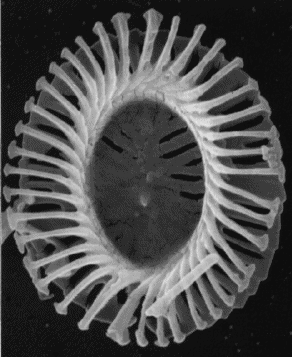
This western Kansas landscape consists of chalk badlands and chalk pillars and a natural arch. The rocks are chalks and impure chalks (e.g., argillaceous chalk and chalky shale) that range in color from whitish to light gray to yellowish. Chalk is a biogenic, calcitic, marine sedimentary rock composed of numerous coccolith microfossils (see: www.soes.soton.ac.uk/staff/tt/eh/pics/lith2.gif). Coccoliths are individual calcareous plates that covered a single-celled photosynthetic marine organism called a coccolithophorid (a.k.a. coccolithophore) (see: upload.wikimedia.org/wikipedia/commons/d/d9/Emiliania_hux...). These beds were deposited in the ancient Western Interior Seaway, a section of ocean that existed during parts of the Mesozoic Era in what is now the American and Canadian Great Plains.
.png)
Rock arches are rare erosional features - those developed in chalk beds are even rarer. If a stream goes under an arch, it is known as a natural bridge. If no stream is present, the feature is a natural arch. Along lakeshores, they are called lake arches. Along oceanic coastlines, they are called sea arches. The highest concentration of natural arches on Earth is Arches National Park in eastern Utah.
Stratigraphy: Smoky Hill Chalk Member (a.k.a. Smoky Hills Member), Niobrara Formation, mid-Upper Cretaceous
Locality: Monument Rocks (also known as the Chalk Pyramids), along Gove County Road 16, north of the Smoky Hill River, Gove County, western Kansas, USA (38° 47' 43.24" North latitude, 100° 45' 52.06" West longitude)
Developing a global brand of prison products moved a step closer to being realized in May 2017 with the bringing together of key prison administrators from across Latin America.
Part of UNODC's Doha Declaration Global Programme, the event was organized to explore new and innovative approaches within the Latin American region which are being used to mitigate the social, economic and personal challenges faced by prisoners and reduce the risk of recidivism through rehabilitation. By identifying programmes which support prisoner's ability to lead self-sustained lives, the aim is to support the wider ideal of promoting a culture of lawfulness.
On December 24, 2024, I picked up my venerable Leica M3 year 1956 (see below for details) for a photowalk in Lyon city, France. I went to Fourvière, enjoying a not too cold (6°C) and clear sunny weather.
My Leica was loaded with a 36-exposure Ilford HP5+ film. I equipped the Summicron 2/5cm lens with a Hoya HMC AUV screw-on 39mm protective filter plus the Leitz shade hood for all indoor scenes, and outdoor I mounted a push-on 42mm FOCA (France) Yellow x2.5 filter and a generic cylindrical stainless steel hood that, unfortunately, induced some vignette if not perfectly aligned, that should be corrected during the processing). I should find a 39mm screw-on filter more safe to use with my Summicron 2/5cm,
Expositions were determined for the indicated 400 ISO (28 DIN) using an Autometer III Minolta light meter fitted with a 10° finder for selective measurements privileging the shadow areas and erected for the filter absorption if any.
The outside temperature was about 6°C with a bright sunny weather in the afternoon. Typically exposures outdoor were made at 1/250s with apertures ranging from f/8 to 11 and 1/50s or 1/25s at full aperture f/2 or f/2.8 indoor.
Basilique Notre-Dame de Fourvière***, December 24, 2024
69005 Lyon
France
-------
*** The Basilica of Notre-Dame de Fourvière is the work of the architects Bossan and Sainte-Marie Perrin. It was built from a public subscription in 1870 and consecrated in 1896. From the top of “the hill that prays”, the basilica dedicated to the Virgin Mary is classified as a historical monument. It is part of the Lyon site registered as a UNESCO World Heritage Site. Today, the emblem of the city of Lyon, the basilica welcomes more than 2.5 million pilgrims and visitors each year.
---------
After exposure, the film was processed in Adox Adonal (Agfa Rodinal) developper at dilution 1+25 and 20°C for 6 min. The film was then digitized using a Sony A7 body fitted to a Minolta Slide Duplicator installed on a Minolta Auto Bellows III with a lens Minolta Bellow Macro Rokkor 50mm f/3.5. The RAW files obtained were processed without intermediate files in LR and edited to the final jpeg pictures. All views of the film are presented in the dedicated album either in the printed framed versions and unframed full-size jpeg accompanied by some documentary smartphone Vivio Y76 color pictures.
About the camera and the lens :
This Leica M3 circa 1956 (Ref. Leitz ISUMO), double stroke, was sold to me with a Leitz Wetzlar Summicron collapsible normal lens 1:2 f=5cm of the same period equipped with a 39mm screw-on protective filter, a 42mm push-on Leica lens cap and an original Leitz shade hood (Ref. Leitz IROOA).
The camera was serviced in Paris, France, in 2018 by Gérard Métrot at Photo-Suffren, (a Leica boutique) who worked on the maintenance of camera's of famous French photographers as Henri Cartier-Bresson and Robert Doisneau. The camera was inspected by Odéon-Photo, Paris, another historic Leica place in Paris, in April 2024.
I sourced at the same time in Germany a stunning Leitz Leica leather bag (Ref; Leitz IDCOO) of the same model that appeared on the back cover page go the Leica brochure year 1954. This bag can accommodate the camera and a mounted Leica-Meter type M. The interior in covered with a carmin velvet in perfect condition.
The Leica M3 is one of the most iconic range-finder 35mm camera of the 50's and the 60's. It was produced in Wetzlar, Germany, in different versions at 226178 exemplars, between 1954 (n° 700000) and 1966 (n° 1164865, www.summilux.net/materiel/Leica-M3) . The Leica M3 was the result of the study of a "super-Leica" that was started before WWII and only achieved in the 50'S.
The greater improvement of the M3 compared the classical Leica's was in a magnificent and very complex range-finder combined to the view finder permitting the framing with the two eyes open, integrating the frame in the real and normal vision. The shutter integrates too the normal and the slow speeds in the same barillet. The film advance of this version of Leica M3 is also the typical "double-stroke" advance that was exclusive to the Leica M3 first versions.
The camera was transported to me from Paris to Lyon, France on April 26, 2024 and the bag arrived the day after.
Developed in conjunction with Around the Table, the San Jose Museum of Art's community initiative, Sip. Do Not Gulp. examines the interconnectedness of food and water throughout Santa Clara Valley's long history. Created by Bay Area artist Michele Guieu, the site-specific installation calls attention to the shifting patterns and practices of water usage in this area. Once an abundant resource, agricultural development, population increase, and urban sprawl have placed stress on fresh water availability. Comprised of a painted mural, a documentary video, and a symbolic acorn "rug," Guieu highlights the preciousness of water as a local resource and draws salient connections to food production in this region: if there is no water, there is no food.
the de Saisset Museum
Santa Clara university
Santa Clara, CA.
January 17 - March 16, 2014
Exhibition Reception February 13, from 7:00 to 8:30pm.
www.scu.edu/desaisset/exhibitions/Food-and-Water.cfm
Also on view:
A Serving of Shapes: An Exploration in 3D Printing by Corinne Takara
- See more at: www.scu.edu/desaisset/exhibitions/servingshapes.cfm
cgi.ebay.co.uk/ws/eBayISAPI.dll?ViewItem&item=2508861...
The 16mm cine film Developing Tank appears unused
or if used has been cleaned meticulously.
The ORIGINAL box shows some signs of wear.
The Developing Tank is from Leningrad, Russian / USSR. It has a certificate.
It dates 18 VIII 1964. (That's 18th of August 1964)
The rubber pipes are in really good condition and not porous or brittle at all.
Quite amazing for this age. The Tank itself is almost scratch free, shining
and just looks fantastic. I do not know how to use it. And I am only selling
as I have course fees to pay, so it is a reluctant sale of an object I adore.
If you are interested in the Developing Tank then please see the
collection of youtube videos I made showing it from all angles
www.youtube.com/playlist?list=PL000C1C02C698EBC3
(at the moment I have 8 or so individual short clips of the developing tank,
arranged in a playlist, please check through them on you tube)
You should be able to see how good it looks. I can re-film any aspect of it
if you are interested, so please just get in touch, with questions and suggestions.
I am uploading the youtube videos at the moment, so they may take an hour or
so before they link up correctly.
I hope you will love this item as I did.
check this page it lists lots of tanks for sale in the US and UK, mine is the cheapest: www.super8camera.com/netsearch.php?zoekterm=developing+ta...
The Kick-off Meeting Erasmus+ Project “ DeSTRESS – Developing Competencies for Stress Resilience @ SMEs took place at ISCTE-IUL on the 20th and 21st of november 2019.
Fotografia de Hugo Alexandre Cruz.
Developped in Caffenol. Photo Hall color prints 200 iso (a.k.a. Fujifilm superia). Taken by Eho Altissa Altix IV (trioplan 50mm 2,9)
I developed this film using QWD ECN-2 chemistry. It's a long story about a gift of 4 Silbersalz rolls that should have included developing and scanning back in Stuttgart. Instead, the film took a round trip from New York to Frankfurt, getting stuck in German customs for months with indifferent support from Silbersalz. So upon their return to me, I developed and scanned them myself. QWD makes a great product for home development of Vision3.
In developing my A2 coursework final piece, I studied the works of Chuck Close, Paul Cezanne and Henry Matisse. Choosing my father as my subject, my aim was to produce a representational work, that was authentic and which captured his essence. I was primarily influenced by Close’s photo-realist portraits. By using techniques of exaggerated tones and brush strokes, such as used by Cezanne and Matisse in their portraiture, my work had a richer depth. A key idea was to build on the effect that these artists created by painting their subject looking straight on, directly at the viewer, yet not giving away any emotion.
My A2 exam work is influenced by the works of Edward Hopper and Ken Howard, their use of light and muted tones to create idyllic scenes has an enthralling effect on the viewer. In my final piece, I tried to ensure the focal point was not just the rays of light within the painting, but the painting as a whole, an effect that Hopper successfully achieves in his scenic paintings. I experimented with different images in order to find one with which, I could achieve similar effects to those of Hopper and Howard’s paintings, in terms of colour and focal points.
My most recent works are comprised of a series of landscapes using watercolour paints. These works have primarily been influenced by walks on Hampstead Heath and David Hockney’s ‘Beyond the trees’, using of bright colours and small detailed brush strokes to create a vibrant effect.
Voigtlander Bessa R3a rangefinder & Super Wide-Heliar 15mm lens
Legacy Pro 100 developed in Ilford ID-11 1:1 for 10 minutes @ 20'C, 30 second initial agitation, 4 turns on every minute.
PIR Circuit board with photo resist washed off the area to be etched
(I didn't actually end up using this one as it was a little over exposed)
Developing Sustainable Corporate Engagement Practices
•Seth Farbman, Global Chief Marketing Officer – Gap, Inc.
•Jeffrey Hollender, Co-Founder – Seventh Generation
•Moderator: Richard Hall, Director, Global Strategic Alliances – Intel Corporation
The SC Neustar CA36 is a developed, designed and made in Singapore Integral Coach Bus.
There were 11 buses in the pre-production batch and all were built with SC Chivalrous Bodywork.
Chassis 1 (which was built in 2015) was the prototype chassis sent for homologation and was therefore fitted with Denso AC Pod while the remaining 10 pre-production chassis (all of which were built in 2017) were fitted with a different brand of AC Pod.
The 11 chassis in the pre-production batch and were bodied with the SC Chivalrous bodywork are as follows
Chassis 1 (PF9SCAD36FS003001)-PA1467K (formerly registered as PC6254P)
Chassis 2 (PF9SCAD36HS003002)-PC6281K
Chassis 3 (PF9SCAD36HS003003)-PC87U
Chassis 4 (PF9SCAD36HS003004)-PC6802H
Chassis 5 (PF9SCAD36HS003005)-PC6986K
Chassis 6 (PF9SCAD36HS003006)-PC6954C
Chassis 7 (PF9SCAD36HS003007)-PC6870K
Chassis 8 (PF9SCAD36HS003008)-PC6873C
Chassis 9 (PF9SCAD36HS003009)-PD1504X (formerly registered as PA1128P and PZ9988P)
Chassis 10 (PF9SCAD36HS003010)-PC7162P
Chassis 11 (PF9SCAD36HS003011)-PC7097U
Production Batch Buses (built from 2018 onwards) received a facelifted (FL) bodywork designed for the SC Neustar.
Some of the buses are
PC7861E
PC8168S
PC8023B
PC7493J
PC7980U
PC8075B
PC8354X
PC8364S
PC8410S
PC9375D
PC9584S
Other Singaporean Excursion Buses
PD38G
PD438K
PC7904R
PC8022D
PC9376B
PC9585P
PA1468H
PC8302X
PC8024Z
PC8025X
PC8074D
PC8959B
PC8966E
PC9262X
PC2791G
PC2792D
PC4253E
PC4807H
PC8076Z
PC8077X
PC8958D
PC8960X
PC7742R
PC7758X
PA2A
PA33K
PC3738E
PC3763G
PC3764D
PC3769R
PC3770K
PC3785T
PC3786R
PC3787M
PC3788K
PC3849T
PC3850M
PC3853E
PC3867R
PC3868M
PC3876P
PC3880B
PC3906L
PC3925G
PC3929X
PC3930R
PC3931M
PC3932K
PC3940L
PC3947T
PC3948R
PC3949M
PC3950H
PC3954Y
PC3957P
PC3967K
PC3968H
PC3969E
PC3970A
PC3971Y
PC3972U
PC3983M
PC3984K
PC3989Y
PC3990S
PC3995D
PC3996B
PC4009U
PC4010P
PC4019R
PC4020K
PC4032B
PC4038K
PC4051X
PC4052T
PC4068Z
PC4071M
PC4072K
PA9442D
PA9443B
PA9444Z
PA9465M
PA9474L
PA9552U
PA9558D
PA9559B
PA9560X
PA9575D
PA9576B
PA9596T
PA9701G
PA9702D
PA9703B
PA9704Z
PA9708M
PA9757X
PA9772B
PA9779H
PA9780C
PA9786L
PA9791X
PA9792T
PA9793R
PA9794M
PA9799A
PA9800D
PA9801B
PA9841K
PA9869G
PA9870B
PA9894H
PC7187T
PC7188R
PC7203E
PC7204C
PC7205A
PC7363B
PC7362D
PC7382X
PC7434E
PC7515E
PC7516C
PC9428K
PC9429H
PC9430C
PA4136X
PA4137T
PA4138R
PA4139M
PA4140H
PA4141E
PA4144Y
RU3718U
RU3719S
RU3720L
RU3721J
RU3722G
PA5451D
PA5452B
PA5456R
PA5478C
PA5278M
PA5279K
PA5280E
PA5286P
RU4127T
RU4128R
RU4290D
RU4291B
RU4292Z
PC5982C
PC8932C
PC8940D
PC8941B
PC8948H
PC8969Y
PC8970S
PC8976B
PC8997R
PC8998M
PC9034M
PC9040U
PC9043L
PC9044J
PC9045G
PC9054E
PC9064B
PC9078L
PC9089E
PC9090A
PC9098D
PC9099B
PC9100E
PC9173U
PC9174S
PC9175P
PC9176L
PC9255S
PC9256P
PC9263T
PC9264R
PC9271U
PC9272S
PC9273P
PC7639G
PC7640B
PC8160M
PC8231S
PC8232P
PC8431G
PC8432D
PC8433B
PC8434Z
PC8435X
PC8436T
PC8437R
PC7990R
PC7991M
PC7992K
PC8560S
PC8561P
PC8562L
PC8655C
PC8656A
PC8657Y
PC8668R
PC8669M
PC8670H
PC7442G
PC7452C
PC7674D
PC7675B
PC7676Z
PC7690G
PZ842K
PZ1144K
PZ442G
PD8989J
PD8990D
PD8991B
PD8992Z
PD7774T
PA4902B
PA4959M
PA4960H
PA6464K
PA6468A
PA6469Y
PA6470S
PA6471P
PA6472L
PA6473J
PA6474G
PA6475D
PA6476B
PA6477Z
PZ1711Z
PZ1788C
PA6152K
PZ2828P
PC1305J
PC84C
PC1680A
PC1223L
PC1224J
PC1225G
PC1259J
PC1260D
PC1261B
PC2193H
PC2302K
PC2313D
PC2433R
PC8765T
PA8298K
PA8698P
PA8928B
PA8968K
PD2168B
Since the 1990s, a more active and open civil society sector has developed across the Russian Federation. While civil society institutions and civic engagement in Russia are not new, the growth of the sector in recent years created hopes that Russian civil society could become the voice for a more effective democratic system, more efficient social services, and a check against corruption and centralized power. At the same time, the increasing interconnectivity between Russian and international civil society institutions created a sense of optimism that an interconnected “Euro-Atlantic civil society” could make positive contributions to difficult geo-political challenges.
Of late, however, these hopes have largely been put on hold. Russian civil society institutions are facing a variety of political and social pressures, and are becoming less connected to international partners. Geo-political relations between Russia and the Euro-Atlantic community have worsened, and international civil society groups and donors have become the object of suspicion as instruments of external interference. At a political level, prior optimism about a “re-set” in Russia-Euro-Atlantic relations has faltered, however, with implications for support for civil society institutions.
There is an urgent need to rebuild bridges and to reestablish a serious dialogue about the role of Russian civil society and relations between diverse civic actors domestically, as well as between Russian organizations and international partners. In cooperation with, and with the generous support of, the Yeltsin Presidential Center and Yeltsin Foundation, this Symposium will address the challenges and opportunities currently facing civil society in Russia as a means to understand the needs and perspective of Russian civil society groups and to consider new approaches to international civil society engagement with Russia.