View allAll Photos Tagged Command
EAST CHINA SEA (Feb. 10, 2015) - Arleigh-burke class guided-missile destroyer USS Lassen (DDG 82) conducts an underway replenishment with USNS Richard E. Byrd (USNS T-AKE-4). Lassen is on patrol in the 7th Fleet area of operations in support of security and stability in the Indo-Asia-Pacific region. (U.S. Navy photo by Lt. j.g. Lauren Chatmas) 150210-N-ZZ999-1497
** Interested in following U.S. Pacific Command? Engage and connect with us at www.facebook.com/pacific.command and twitter.com/PacificCommand and www.pacom.mil/
WHITE BEACH, Okinawa (Jan. 28, 2015) - Landing Craft Air Cushion (LCAC) 9, assigned to Naval Beach Unit (NBU) 7, propels toward the well deck of the forward-deployed amphibious assault ship USS Bonhomme Richard (LHD 6). Bonhomme Richard is currently deployed in the U.S. 7th Fleet Area of Operations. (U.S. Navy photo by Mass Communication Specialist 2nd Class Adam D. Wainwright) 150128-N-LM312-094
** Interested in following U.S. Pacific Command? Engage and connect with us at www.facebook.com/pacific.command and twitter.com/PacificCommand and www.pacom.mil/
SASEBO, Japan (June 19, 2014) - The forward-deployed amphibious assault ship USS Bonhomme Richard (LHD 6) (left), Austin-class amphibious transport dock USS Denver (LPD 9), and ships from the Japan Maritime Self-Defense Force, sit moored at Fleet Activities. Bonhomme Richard, commanded by Capt. Joey Tynch, is currently undergoing a maintenance period. (U.S. Navy photo by Mass Communication Specialist 2nd Class Michael Achterling) 140619-N-BJ178-111
** Interested in following U.S. Pacific Command? Engage and connect with us at www.facebook.com/pacific.command and twitter.com/PacificCommand and www.pacom.mil/
BLUE BEACH, Okinawa (Feb. 12, 2015) - Operations Specialist 3rd Class Keith L. Dunlap, from Chicago, assigned to Naval Beach Unit (NBU) 7, directs Landing Craft Air Cushion (LCAC) 47 off the beach during an equipment off-load for the forward-deployed amphibious assault ship USS Bonhomme Richard (LHD 6). Bonhomme Richard is currently underway conducting operations in the U.S. 7th Fleet Area of Responsibility. (U.S. Navy photo by Mass Communication Specialist 3rd Class Kevin V. Cunningham) 150212-N-UF697-296
** Interested in following U.S. Pacific Command? Engage and connect with us at www.facebook.com/pacific.command and twitter.com/PacificCommand and www.pacom.mil/
Found today at Target: Hasbro Star Wars Command
9 Figure packs: Sandtrooper Strike, Imperial Assault, and Galactic Empire
My son has already started custom painting these.
KUNSAN AIR BASE, Republic of Korea (Mar. 6, 2015) - Tech Sgt. Phillip Suchicital, 8th Aircraft Maintenance Squadron end of runway NCO in charge, marshals in an F-16 Fighting Falcon during Exercise Beverly Midnight 15-2. BM 15-2 tests Airmen on their ability to survive and operate while under the stress of simulated wartime activities all while ensuring aircraft generate. (U.S. Air Force photo by Senior Airman Taylor Curry) 150306-F-NB144-010
** Interested in following U.S. Pacific Command? Engage and connect with us at www.facebook.com/pacific.command and twitter.com/PacificCommand and www.pacom.mil/
Miro scale Command Module. This is a detachable ship which serves as the bridge and forward, primary command center for a larger interstellar vessel (WIP). I would love to get some feedback as I am hooked on microscale but so far only 3 or four MOCs into it. I do fondly remember, however, building microscale star wars WAAAAY back in the early 90's when I was a kid. Let me know what you think, the big ship will be done soon.
The Vigilant Air Command Warbird Museum is a cool air museum that doubles as an aircraft preservation and/or restoration facility. I had never heard of it until the day I visited - it sounded pretty good, and it was. I hit it shortly before closing on a Sunday evening and had the place to myself. My first impression was how crowded it was. Planes were tightly packed together in the hanger. It was hard to get any photos without getting a bunch of other stuff in the photo. There are also a number of planes outside in the elements. I liked that you can get up close and personal with the planes, but be careful since I almost poked my eyes out several times.
The museum is located at the Space Coast Regional Airport, near Titusville, Florida. Check it out if you are in the area. I took these photos in mid-December 2021.
SOUTH CHINA SEA (Feb. 15, 2018) - Naval Aircrewman (Helicopter) 2nd Class Dalton Branson, assigned to the Black Knights of Helicopter Sea Combat Squadron (HSC) 4, signals from the water during a during a search and rescue exercise with Nimitz-class aircraft carrier USS Carl Vinson (CVN 70). Carl Vinson Strike Group is currently operating in the Western Pacific as part of a regularly scheduled deployment. (U.S. Navy Photo by Mass Communication Specialist 2nd Class Z.A. Landers) 180215-N-GD109-0242
** Interested in following U.S. Pacific Command? Engage and connect with us at www.facebook.com/pacific.command | twitter.com/PacificCommand |
instagram.com/pacificcommand | www.flickr.com/photos/us-pacific-command; | www.youtube.com/user/USPacificCommand | www.pacom.mil/
Command Module/Spacecraft 007 (S/C 007, CM-007), during assembly in Bldg 290 of the North American Aviation/Rockwell plant, Downey, CA. I believe the capsule is undergoing weight/balance measurements here.
Quite the life of S/C 007 (other than not flying) - per these fine sites:
www.jonessite.net/upload/LRD/stories/CM007A.pdf
Credit: Coye Mac Jones' website
Additional excellent information:
ntrs.nasa.gov/archive/nasa/casi.ntrs.nasa.gov/19740026226...
www.americanspacecraft.com/pages/apollo/CM-007.html
Credit: "A Field Guide to American Spacecraft" website
Amazingly informative & detailed discussion pertaining to Block I and Block II Command Modules, external appearances and configurations and their identification:
www.collectspace.com/ubb/Forum29/HTML/001008.html
Credit: collectSPACE website
Also:
www.popsci.com/blog-network/vintage-space/when-astronauts...
www.nasa.gov/feature/50-years-ago-apollo-tests-seaworthin...
commons.m.wikimedia.org/wiki/Category:CSM-007
“Apollo Command Module CSM-007 aboard MV Retriever in the Gulf of Mexico, used for manned 48-hour Apollo Block I Command Module post landing systems qualification tests.”
www.navsource.org/archives/10/18/1018153006.jpg
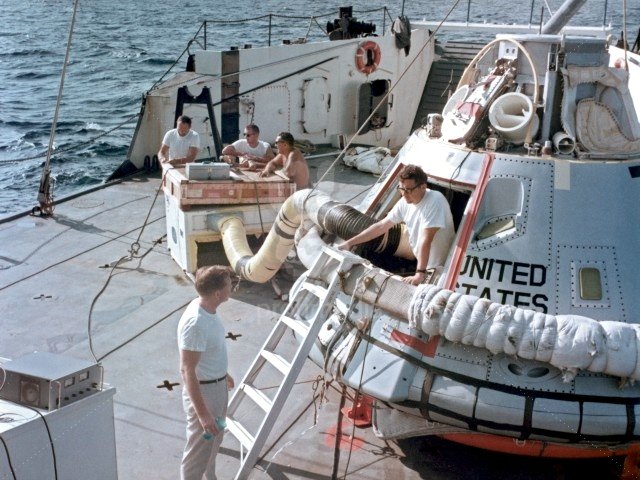
Credit: NavSource Online website
“Apollo Command Module CSM-007A near NASA's MV Retriever in the Gulf of Mexico, during a manned 48-hour Apollo Block II Command Module postlanding systems qualification test.”:
upload.wikimedia.org/wikipedia/commons/9/97/Apollo_CM-007...
.png)
Credit: Wikimedia
“Apollo recovery test in the Gulf of Mexico. Astronauts Lovell, Roosa and Duke spent 48 hours inside CM-007 April 5-7, 1968 evaluating the capacity of the Command Module to support three Astronauts waiting for a delayed recovery.”
www.hq.nasa.gov/office/pao/History/alsj/misc/apmisc-68-31...
Credit: Project Apollo Archive/J.L. Pickering
On March 6, 2017, FDNY launched its first ever tethered drone to respond to a fire in a 6-story building on Crotona Park North in the Bronx.
The $85,000 FDNY tethered drone weighs 8 pounds and incorporates both a high-definition camera and infrared camera. These capabilities allow the drone to transmit live images of a fire operation to the Chief in charge of the incident. The drone’s camera allows Chiefs at the command post to see where Firefighters are operating on the roof of a building and to make decisions to help suppress the fire and keep FDNY members safe. The image is fed directly to the Incident Commander and is also shared with senior decision makers in the Fire Department through the FDNY Operations Center.
"We deployed the drone for the first time in support of a 4th alarm fire in the Bronx,” says FDNY Director of FDNY Operations Center, Timothy Herlocker. “We were able to get a good view of the roof, which allowed the Incident Commander on the ground to view the Firefighters as they were conducting roof operations, venting the roof and putting water on the fire."
“This fire was helped by our drone, said Deputy Assistant Chief Dan Donoghue, the incident commander at the 4th alarm fire. “The roof started to fail and we had a lot of great radio reports but that’s only verbal, so with the drone we had good visual pictures and it really helped us make decisions to put this fire out and keep our members safe.”
The FDNY drone is tethered using a small cable that carries electricity up to the device, which gives the drone an unlimited flight time. The drone can stay aloft for as long as necessary to keep an aerial view on the target. All controls, data, and power transmit back and forth through the tether preventing interference with radio frequency signals. The drone is piloted by specially trained FDNY Firefighters from the Department’s Command Tactical Unit. The Department currently has three drones in its fleet to deploy as needed.
“This new technology is going to make a positive impact in our fire operations,” said Fire Commissioner Daniel A. Nigro. “The drone’s camera gives our Chiefs a view they never had before. It’s an important tool that will make our members, and the people we protect, even safer.”
FDNY works closely with the FAA to ensure the drone operates safely and adheres to all rules and policies regarding airspace in New York City. The Fire Department Operations Center contacts the FAA prior to flying the drone for permission to deploy at night, or into FAA Class B Air Space - the FAA’s most restricted air space. Approval takes approximately ten minutes and takes place while the drone and its operators are responding to a fire.
PACIFIC OCEAN (July 19, 2016) - U.S. Marine Corps MV-22 Ospreys assigned to Marine Medium Tiltrotor Squadron 265, Marine Corps Air Station Futenma, Japan, fly in formation with a U.S. Air Force MC-130J Commando II assigned to the 17th Special Operations Squadron, Kadena Air Base, Japan, during a tiltrotor air to air refueling (TAAR) over the Pacific Ocean. The TAAR enabled the Ospreys to operate beyond unassisted flight range in a training exercise designed to evaluate long-range airfield seizure capability in a joint operation between the Marines and Air Force. (U.S. Air Force Photo by Senior Airman Peter Reft/Released) 160719-F-YW474-045
** Interested in following U.S. Pacific Command? Engage and connect with us at www.facebook.com/pacific.command and twitter.com/PacificCommand and www.pacom.mil/
After spending too much money on the shark tank, the command center had to be scaled back. The video wall and Dr Evil chair will have to come later...
PEARL HARBOR, Hawaii (Sept. 28, 2017) - Los Angeles-class attack submarine USS Chicago (SSN 721) arrives at Joint Base Pearl Harbor-Hickam after completing a change of homeport from Guam. The submarine's ability to support a multitude of missions, including anti-submarine warfare, anti-surface ship warfare, strike warfare, surveillance and reconnaissance, has made Chicago one of the most capable submarines in the world. (U.S. Navy photo by Mass Communication Specialist 1st Class Daniel Hinton) 170928-N-KC128-0115
** Interested in following U.S. Pacific Command? Engage and connect with us at www.facebook.com/pacific.command | twitter.com/PacificCommand |
instagram.com/pacificcommand | www.flickr.com/photos/us-pacific-command; | www.youtube.com/user/USPacificCommand | www.pacom.mil/
EAST CHINA SEA (April 10, 2017) - Landing craft air cushion (LCAC) 29, assigned to Naval Beach Unit (NBU) 7, disembarks the amphibious assault ship USS Bonhomme Richard (LHD 6) prior to the ship's return to Commander, Fleet Activities Sasebo. Bonhomme Richard, flagship of the Bonhomme Richard Amphibious Ready Group, is returning from a 6-week patrol in the Indo-Asia-Pacific region. (U.S. Navy photo by Mass Communication Specialist 2nd Class Diana Quinlan/Released) 170410-N-WF272-028
** Interested in following U.S. Pacific Command? Engage and connect with us at www.facebook.com/pacific.command | twitter.com/PacificCommand |
instagram.com/pacificcommand | www.flickr.com/photos/us-pacific-command; | www.youtube.com/user/USPacificCommand | www.pacom.mil/
Kabal of the Pallid Sun Command Venom designed to carry the Archon with his Incubi retinue. Armed with two splinter cannons.
This is a quick prank illustration. I was real sloppy with the hands on this one. Well, I'm always sloppy with the hands. I need to read some Hogarth or something.
A WIP of my entry for the Eurobricks Battle Pack contest. It currently contains exactly 70 parts (minus the minifigures).
This normally started out as a huge, 100+ part creation (which also included a huge resupply locker), but then I went through some phases where parts that were not needed were removed (the locker was replaced by the four guns attached to the 1 x 4 "washing machine" brick on the left). I currently only need to add a different face to the Imperial officer...
"Preliminary" pictures will be coming in the next few weeks!
Comments/Criticisms are welcome! :)
P.S. This creation is non-canon, and takes place somewhere in the Death Star.
PACIFIC OCEAN (Jan. 15, 2018) - An F/A-18E Super Hornet from the Kestrels of Strike Fighter Squadron (VFA) 137 makes an arrested landing on the flight deck of the aircraft carrier USS Carl Vinson (CVN 70). The Carl Vinson Strike Group is currently operating in the Pacific as part of a regularly scheduled deployment. (U.S. Navy photo by Mass Communication Specialist 3rd Class Dylan M. Kinee) 180115-N-MT837-0147
** Interested in following U.S. Pacific Command? Engage and connect with us at www.facebook.com/pacific.command and twitter.com/PacificCommand
and www.pacom.mil/
Vous vous souvenez de mon tableau à l'acrylique d'Assat, la rue qui tourne et la vieille maison. Eh bien, la propriétaire de la dite maison, une ancienne élève très âgée et malade, souhaitait un double, sachant que le tableau du concours avait été acheté par son frère. Je suis donc en train de lui faire un double du tableau, avant d'entamer une autre commande de sa voisine, mais dans une autre technique et sur la maison de cette dernière. Après imprimature, j'ai démarré sur celui-ci les vraies couleurs. Et comme c'est pas trop mal, je vous montre le tableau en cours de réalisation, non terminé évidemment.Mais bien entamé.
Hit 'L' to view on large.
This place was an abandoned blast furnace that had a full barrier and walkway around it and was a tourist attraction up to a certain time of day. It also had powerful coloured lights all over it to show off the structure and its internals but we decided to visit outside normal hours and climb in. We accessed the attraction but only so far as some of the levels were very rusty. Martin stayed outside and photographed the perimeter and unfortunately fell and broke his camera.
The Lucky 3 UE Eurotour
3 Man crew
My 3rd time and
3 Countries - Luxembourg, France and Belgium
A heap of locations, 1541 KMs driving, a late night rainy steep infiltration to a famous urbex haunt and a day mostly spent driving and walking to some wrong coordinates.
Full set here:
www.flickr.com/photos/timster1973/sets/72157633420917013/...
Previous Eurotours:
www.flickr.com/photos/timster1973/sets/72157632759059815/
www.flickr.com/photos/timster1973/sets/72157631939892302/
Also on Facebook:
www.Facebook.com/TimKniftonPhotography
My blog:
timster1973.wordpress.com
BW Models white metal kit, Volvo FL6/Bailey incident command unit based on North Yorkshire Fire & Rescue N765 YEF. Bought second-hand in built condition as this kit, like most of the BW range, disappeared without trace when BW ceased trading.
WATERS EAST OF THE KOREAN PENINSULA (March 17, 2016) - A MV-22 Osprey, assigned to the "Dragons" of Marine Medium Tiltrotor Squadron (VMM) 265, prepare to take off from the flight deck of amphibious assault ship USS Bonhomme Richard (LHD 6). Bonhomme Richard is the flagship of the Bonhomme Richard Expeditionary Strike Group and is participating in Exercise Ssang Yong 2016, a biennial combined amphibious exercise conducted by forward-deployed U.S. forces with the Republic of Korea Navy and Marine Corps, Australian Army and Royal New Zealand Army Forces in order to strengthen our interoperability and working relationships across a wide range of military operations - from disaster relief to complex expeditionary operations. (U.S. Navy photo by Mass Communication Specialist Seaman William Sykes/Released) 160317-N-XK809-018
** Interested in following U.S. Pacific Command? Engage and connect with us at www.facebook.com/pacific.command and twitter.com/PacificCommand and www.pacom.mil/
NAVAL BASE GUAM (June 7, 2017) - Sailors assigned to Naval Mobile Construction Battalion (NMCB) 1 demonstrate force protection capabilities during the U.S. 7th Fleet Commander's Training Symposium at Naval Base Guam. Task force leaders from U.S. 7th Fleet are in Guam for two days of briefings, war games, and coordination meetings. NMCB 1 provides expeditionary construction and engineering support to expeditionary bases and responds to humanitarian assistance disaster relief requests. (U.S. Navy Combat Camera photo by Information Systems Technician 1st Class Ledget Glover III) 170607-N-YV613-0011
** Interested in following U.S. Pacific Command? Engage and connect with us at www.facebook.com/pacific.command | twitter.com/PacificCommand |
instagram.com/pacificcommand | www.flickr.com/photos/us-pacific-command; | www.youtube.com/user/USPacificCommand | www.pacom.mil/
In this photo taken by Command Module Pilot John Young, the ascent stage of the Apollo 10 Lunar Module (LM) is seen prior to docking in lunar orbit. Mission Commander Thomas P. Stafford and Lunar Module Pilot Eugene A. Cernan are returning to the Command and Service Module "Charlie Brown" after descending in the LM, known as "Snoopy," to within 14.4 km of the lunar surface. The LM had flown over Landing Site 2 in the Sea of Tranquility, testing the systems and procedures that would be used during the first Apollo lunar landing that would happen two months later during the Apollo 11 mission. The LM descent stage was jettisoned into lunar orbit.
The lunar surface in the background is near, but beyond the eastern limb of the Moon as viewed from Earth (about 120 degrees east longitude). The red/blue diagonal line is the spacecraft window.
Credit: NASA
Photo number: AS10-34-5112
Date: May 22, 1969
WATERS EAST OF JAPAN (Nov. 22, 2014) - Ticonderoga-class guided-missile cruiser USS Antietam (CG 54) is underway off the coast of Japan near Mt. Fuji. Antietam is on patrol in the 7th Fleet area of operations in support of security and stability in the Indo-Asia-Pacific region. (U.S. Navy photo by Mass Communication Specialist Seaman David Flewellyn/Released) 141122-N-ZZ786-434
** Interested in following U.S. Pacific Command? Engage and connect with us at www.facebook.com/pacific.command and twitter.com/PacificCommand and www.pacom.mil/
Backstage, awaiting our cue. Phantasia is a re-imagining of Phantom of the Opera, directed by Levi Rawlings at the Royal Theatre in Antiquity. This performance is a fundraiser for Relay for Life.
Visit this location at Mont Saint Bruno - The Baroque City in Antiquity-Theater in Second Life
CHUK SAMET, Thailand (Aug. 28, 2017) - An M1126 Infantry Carrier Vehicle “Stryker” is lowered into heavy-lift vessel MV Ocean Jazz during a backload of military equipment that was used in exercise Hanuman Guardian 2017. The Ocean Jazz is under a Military Sealift Command contract to support U.S. Army Pacific’s transportation requirements. (U.S. Navy courtesy photo/Released) 170829-N-IX266-002
** Interested in following U.S. Pacific Command? Engage and connect with us at www.facebook.com/pacific.command | twitter.com/PacificCommand |
instagram.com/pacificcommand | www.flickr.com/photos/us-pacific-command; | www.youtube.com/user/USPacificCommand | www.pacom.mil/
KUNSAN AIR BASE, Republic of Korea (June 5, 2107) - 8th Maintenance Squadron conventional maintenance crew members assemble Guided Bomb Unit 31 version 3 during the Combat Ammunition Production Exercise (capex) at Kunsan Air Base. CAPEX involved approximately 350 Airmen who were evaluated on total force integration, how well they maintained Air Tasking Order requirements, receipt of munitions and the weapons breakdown process. (U.S. Air Force photo by Senior Airman Colville McFee/Released) 170605-F-IF848-023
** Interested in following U.S. Pacific Command? Engage and connect with us at www.facebook.com/pacific.command | twitter.com/PacificCommand |
instagram.com/pacificcommand | www.flickr.com/photos/us-pacific-command; | www.youtube.com/user/USPacificCommand | www.pacom.mil/
PACIFIC OCEAN (Aug. 18, 2020) - An HM-60S Sea Hawk Helicopter assigned to Helicopter Sea Combat Squadron (HSC) 21 flies overhead the Legend-class cutter USCGC Munro (WMSL 755), August 18. Ten nations, 22 ships, 1 submarine, and more than 5,300 personnel are participating in Exercise Rim of the Pacific (RIMPAC) from August 17 to 31 at sea around the Hawaiian Islands. RIMPAC is a biennial exercise designed to foster and sustain cooperative relationships, critical to ensuring the safety of sea lanes and security in support of a free and open Indo-Pacific region. The exercise is a unique training platform designed to enhance interoperability and strategic maritime partnerships. RIMPAC 2020 is the 27th exercise in the series that began in 1971. (U.S. Navy photo by Mass Communication Specialist 3rd Class Madysson Anne Ritter) 200818-N-UM706-1112
** Interested in following U.S. Indo-Pacific Command? Engage and connect with us at www.facebook.com/indopacom | twitter.com/INDOPACOM |
www.instagram.com/indopacom | www.flickr.com/photos/us-pacific-command; | www.youtube.com/user/USPacificCommand | www.pacom.mil/ **
SHOALWATER BAY, QLD, Australia (July 8, 2017) - Marines with India Company, Battalion Landing Team, 3rd Battalion, 5th Marines, 31st Marine Expeditionary Unit, maneuver the shoreline at Crowley Beach during rehearsals for Exercise Talisman Saber 17, Australian Defence Force's Cowley Beach Training Area, Queensland, Australia, July 8, 2017. India Company is the mechanized raid company for the 31st MEU, currently supporting Talisman Saber 17 while deployed on its regularly-scheduled patrol of the Indo-Asia-Pacific region. Talisman Saber is a biennial exercise designed to improve the interoperability between Australian and U.S. forces. (U.S. Marine Corps photo by Cpl. Amaia Unanue/ Released) 170708-M-GE751-133
** Interested in following U.S. Pacific Command? Engage and connect with us at www.facebook.com/pacific.command | twitter.com/PacificCommand |
instagram.com/pacificcommand | www.flickr.com/photos/us-pacific-command; | www.youtube.com/user/USPacificCommand | www.pacom.mil/
Interior view of the 2TV-1 Command Module, ca. 1968. The Apollo 2TV-1 "mission" involved the crew of Joe Kerwin, Vance Brand, and Joe Engle staying in the CSM test spacecraft (2TV-1) for 177 hours while the spacecraft was in a large vacuum chamber in Houston. A similar test (LTA-8) was run on the LM, with James Irwin and John Bull. The purpose of the tests was to verify the spacecraft were capable of operating in the vacuum of space, under the temperatures and lighting conditions that would be experienced during an Apollo space flight.
Credit: collectSPACE website, member "tr", at:
www.collectspace.com/ubb/Forum29/HTML/000742.html
Also:
ntrs.nasa.gov/archive/nasa/casi.ntrs.nasa.gov/19740012430...
Excellent summation of the purpose and pertinent specifics of the 2TV-1 "spacecraft/mission":
www.jsc.nasa.gov/history/roundups/issues/68-06-21.pdf
And multiple excellent photos here:
archive.org/search.php?query=2TV-1
HOKUDAIEN, Japan (Aug. 16, 2017) - U.S. Marines and Japanese Ground Self-Defense Force clean the main gun's barrel of a Japanese tank at the live fire range in Hokudaien, Japan, during Northern Viper 17. The service members assaulted the target by cover and maneuver and suppressed fire from Japanese tanks and U.S. light armored vehicles. The U.S. has a vested interest in a secure Pacific; Combined-joint exercises enhance regional cooperation between participating nations to collectively deter security threats. (U.S. Marine Corps photo by Sgt. Ally Beiswanger) 170816-M-WW697-955
** Interested in following U.S. Pacific Command? Engage and connect with us at www.facebook.com/pacific.command | twitter.com/PacificCommand |
instagram.com/pacificcommand | www.flickr.com/photos/us-pacific-command; | www.youtube.com/user/USPacificCommand | www.pacom.mil/
CAMP BLANDING, Fla. – After a punishing, 72-hour challenge that started with an Army Physical Fitness Test and weapons qualification, continued with warrior skill stations and an air assault obstacle course, and concluded with a 10-mile ruck march and sergeants major appearance board, 12 Army Reserve Soldiers can proudly say they completed the 2017 143d Sustainment Command (Expeditionary) Best Warrior Competition.
Brig. Gen. Deborah L. Army Brig. Gen. Deborah L. Kotulich, commanding general, 143d ESC, personally congratulated the participants during an awards ceremony conducted March 11, 2017, at Camp Blanding, Fla.
“I am thrilled by what you did to get here and impressed by what you accomplished here,” said Kotulich, a career officer who completed Air Assault school while attending West Point and, decades later, earned the German Armed Forces Badge for Military Proficiency. “I encourage everyone to share your experiences with your fellow Soldiers. The skills you demonstrated during this competition may one day save your life or the lives your battle buddies in combat.”
Although all 12 Soldiers received and deserved high praise from the 143d ESC’s senior leadership, only two earned the right to earn the title, “Best Warrior.”
Spc. Alisha Howell, an Orlando, Fla., native serving as a Chemical, Biological, Radiological and Nuclear specialist at Headquarters and Headquarters Company, 143d ESC, won first place in the Soldier category, while Sgt. James A. Smith, a Bay Springs, Miss., native assigned to the 647th Transportation Company as a motor transport operator, took home the trophy in the noncommissioned officer category. Howell and Smith will leave for New Orleans in April to compete at the 377th Theater Sustainment Command level.
“I am confident that these two Soldiers will proudly represent the 143d ESC at the next level,” said Kotulich. “I am also especially honored to be associated with every Soldier here who took precious time from his or her job, school and family to participate and support this annual event. Your courage and commitment exemplify the finest qualities of an Army Reserve Soldier.”
Story by Sgt. John L. Carkeet IV, 143d ESC
Photos by Sgt. John L. Carkeet IV, 143d ESC, and Spc. Aaron Barnes, 321st MI BN